SB 134: State Bar of California: Interest on Lawyers’ Trust Accounts: escheated funds: Public Interest Attorney Loan Repayment Program.
- Session Year: 2015-2016
- House: Senate
- Latest Version Date: 2015-10-04
Existing law, the State Bar Act, provides for the licensure and regulation of attorneys by the State Bar of California, a public corporation. Existing law requires an attorney or law firm that receives or disburses trust funds to establish an interest-bearing demand trust account and to deposit in the account all client deposits that are nominal in amount or are on deposit for a short period of time. Existing law creates the Public Interest Attorney Loan Repayment Program, which is administered by the Student Aid Commission, to provide loan repayment assistance for licensed attorneys who practice or agree to practice in public interest areas of the law in California.
Existing law provides for the escheat of property to the state. Existing law requires all property that escheats to the state to be deposited into the Abandoned Property Account in the Unclaimed Property Fund, which is continuously appropriated for specified purposes. Existing law establishes procedures for submitting a claim for property that has escheated.
This bill would require funds in Interest on Lawyers Trust Accounts (IOLTA) that escheat to the state to be deposited into the Abandoned IOLTA Property Account, which would be established within the Unclaimed Property Fund. The bill would establish the IOLTA Claims Reserve Subaccount within the account and would require that 25% of IOLTA escheated funds be deposited into the subaccount to be used by the Controller, upon appropriation by the Legislature, for the purposes of paying refunds, claims, and costs associated with escheated IOLTA funds. The bill would require the balance of the escheated IOLTA funds to be transferred annually into the Public Interest Attorney Loan Repayment Account to be established by this bill within the State Treasury for the purposes of providing, upon appropriation by the Legislature, additional funding to the Student Aid Commission for the administration of, and provision of loan assistance pursuant to, the Public Interest Attorney Loan Repayment Program.
Existing law, the State Bar Act, provides for the licensure and regulation of attorneys by the State Bar of California, a public corporation. Existing law requires an attorney or law firm that receives or disburses trust funds to establish an interest-bearing demand trust account and to deposit in the account all client deposits that are nominal in amount or are on deposit for a short period of time. Existing law creates the Public Interest Attorney Loan Repayment Program, which is administered by the Student Aid Commission, to provide loan repayment assistance for licensed attorneys who practice or agree to practice in public interest areas of the law in California.
Existing law provides for the escheat of property to the state. Existing law requires all property that escheats to the state to be deposited into the Abandoned Property Account in the Unclaimed Property Fund, which is continuously appropriated for specified purposes. Existing law establishes procedures for submitting a claim for property that has escheated.
This bill would require funds in Interest on Lawyers Trust Accounts (IOLTA) that escheat to the state to be deposited into the Abandoned IOLTA Property Account, which would be established within the Unclaimed Property Fund. The bill would establish the IOLTA Claims Reserve Subaccount within the account and would require that 25% of IOLTA escheated funds be deposited into the subaccount to be used by the Controller to determine and transfer for deposit into the subaccount an amount that is sufficient to pay refunds, claims, and costs associated with escheated IOLTA funds, to be available upon appropriation by the Legislature. Controller, upon appropriation by the Legislature, for the purposes of paying refunds, claims, and costs associated with escheated IOLTA funds. The bill would require the balance of the escheated IOLTA funds to be transferred annually into the Public Interest Attorney Loan Repayment Account to be established by this bill within the State Treasury for the purposes of providing, upon appropriation by the Legislature, additional funding to the Student Aid Commission for the administration of, and provision of loan assistance pursuant to, the Public Interest Attorney Loan Repayment Program.
(1)Existing
Existing law, the State Bar Act, provides for the licensure and regulation of attorneys by the State Bar of California, a public corporation. Existing law requires an attorney or law firm that receives or disburses trust funds to establish an interest-bearing demand trust account and to deposit in the account all client deposits that are nominal in amount or are on deposit for a short period of time.
(2)Existing time. Existing law creates the Public Interest Attorney Loan Repayment Program, which is administered by the Student Aid Commission, to provide loan repayment assistance for licensed attorneys who practice or agree to practice in public interest areas of the law in California.
(3)Existing
Existing law provides for the escheat of property to the state. Existing law requires all property that escheats to the state to be deposited into the Abandoned Property Account in the Unclaimed Property Fund, which is continuously appropriated for specified purposes. Existing law establishes procedures for submitting a claim for property that has escheated.
This bill would require unclaimed property funds in Interest on Lawyers Trust Accounts (IOLTA) to, instead, that escheat to the state to be deposited into the Abandoned IOLTA Property Account, which would be established within the Unclaimed Property Fund. The bill would establish the IOLTA Claims Reserve Subaccount within the account and would require the Controller to determine and transfer for deposit into the subaccount an amount that is sufficient to pay refunds, claims, and costs associated with escheated IOLTA funds, to be available upon appropriation by the Legislature. The bill would require the balance of the escheated IOLTA funds to be transferred annually into the Public Interest Attorney Loan Repayment Account to be established by this bill in within the State Treasury for the purposes of providing, upon appropriation by the Legislature, additional funding to the Student Aid Commission for the administration of, and provision of loan assistance pursuant to, the Public Interest Attorney Loan Repayment Program.
(1)Existing law, the State Bar Act, provides for the licensure and regulation of attorneys by the State Bar of California, a public corporation. Existing law authorizes the State Bar to collect annual membership dues and voluntary fees, as specified. Existing law requires an attorney or law firm that receives or disburses trust funds to establish an interest-bearing demand trust account and to deposit in the account all client deposits that are nominal in amount or are on deposit for a short period of time. Existing
(2)Existing law creates the Public Interest Attorney Loan Repayment Program, which is administered by the Student Aid Commission, to provide loan repayment assistance for licensed attorneys who practice or agree to practice in public interest areas of the law in California.
(3)Existing law provides for the escheat of property to the state. Existing law requires all property that escheats to the state to be deposited into the Abandoned Property Account in the Unclaimed Property Fund, which is continuously appropriated for specified purposes. Existing law establishes procedures for submitting a claim for property that has escheated.
This bill would require unclaimed property in Interest on Lawyers Trust Accounts (IOLTA) to, instead, be deposited into the Public Interest Attorney Loan Repayment Account established by this bill in the State Treasury for the purposes of providing, upon appropriation by the Legislature, additional funding for the Public Interest Attorney Loan Repayment Program.
This bill would expressly authorize the State Bar to collect voluntary fees on behalf of, and for the purpose of funding, the Public Interest Attorney Loan Repayment Program.
Existing law, the State Bar Act, provides for the licensure and regulation of attorneys by the State Bar of California, a public corporation. Existing law authorizes the State Bar to collect annual membership dues and voluntary fees, as specified. Existing law creates the Public Interest Attorney Loan Repayment Program, which is administered by the Student Aid Commission, to provide loan repayment assistance for licensed attorneys who practice or agree to practice in public interest areas of the law in California. Existing law limits the warrants that the commission may award for the assumption of loans pursuant to that program to the number authorized in the annual Budget Act for the applicable fiscal year.
This bill would expressly authorize the State Bar to collect voluntary fees on behalf of, and for the purpose of funding, the Public Interest Attorney Loan Repayment Program. The bill would repeal the limit on the number of warrants the commission may issue, as described above.
Existing law, the State Bar Act, provides for the licensure and regulation of attorneys by the State Bar of California, a public corporation. Existing law authorizes the State Bar to collect annual membership dues and voluntary fees, as specified. Existing law creates the Public Interest Attorney Loan Repayment Program, which is administered by the Student Aid Commission, to provide loan repayment assistance for licensed attorneys who practice or agree to practice in public interest areas of the law in California.
This bill would expressly authorize the State Bar to collect voluntary fees on behalf of, and for the purpose of funding, the Public Interest Attorney Loan Repayment Program.
(a)The Public Interest Attorney Loan Repayment Account is hereby established within the State Treasury.
(b)Funds from an IOLTA account that escheat to the state and are deposited into the Public Interest Attorney Loan Repayment Account pursuant to subdivision (c) of Section 1564.5 of the Code of Civil Procedure shall be used, upon appropriation by the Legislature, by the Student Aid Commission for the purpose of providing increased funding for, both the administration of and the provision of loan assistance pursuant to, the Public Interest Attorney Loan Repayment Program pursuant to Article 12 (commencing with Section 69740) of Chapter 2 of Part 42 of Division 5 of Title 3 of the Education Code.
SEC. 2.Section 1564.5 is added to the Code of Civil Procedure, to read:1564.5.(a)Notwithstanding any law, including, but not limited to, Section 1564, all money received under this chapter from funds held in an Interest on Lawyers Trust Account (IOLTA) that escheat to the state shall be administered as set forth in this section. The money shall be deposited into the Abandoned IOLTA Property Account, which is hereby established within the Unclaimed Property Fund.
(b)Twenty-five percent of the money in the Abandoned IOLTA Property Account shall be deposited into the IOLTA Claims Reserve Subaccount, which is hereby established within the Abandoned IOLTA Property Account. Funds in the subaccount shall, upon appropriation by the Legislature, be available to the Controller for the payment of all refunds, claims, and costs pursuant to this chapter related to escheated IOLTA funds.
(c)The balance of the funds in the Abandoned IOLTA Property Account, excluding funds in the subaccount, shall be transferred on an annual basis to the Public Interest Attorney Loan Repayment Account established pursuant to Section 6032.5 of the Business and Professions Code. Before making this transfer, the Controller shall record the name and last known address of each person appearing from the holders report to be entitled to the escheated property. The record shall be available for public inspection at all reasonable business hours.
(a)The Public Interest Attorney Loan Repayment Account is hereby established within the State Treasury.
(b)Funds from an IOLTA account that escheat to the state and are deposited into the Public Interest Attorney Loan Repayment Account pursuant to subdivision (c) of Section 1564.5 of the Code of Civil Procedure shall be used, upon appropriation by the Legislature, by the Student Aid Commission for the purpose of providing increased funding for, both the administration of and the provision of loan assistance pursuant to, the Public Interest Attorney Loan Repayment Program pursuant to Article 12 (commencing with Section 69740) of Chapter 2 of Part 42 of Division 5 of Title 3 of the Education Code.
SEC. 2.Section 1564.5 is added to the Code of Civil Procedure, to read:1564.5.(a)Notwithstanding any law, including, but not limited to, Section 1564, all money received under this chapter from funds held in an Interest on Lawyers Trust Account (IOLTA) that escheat to the state shall be administered as set forth in this section. The money shall be deposited into the Abandoned IOLTA Property Account, which is hereby established within the Unclaimed Property Fund.
(b)From all money deposited into Twenty-five percent of the money in the Abandoned IOLTA Property Account, the Controller Account shall determine and transfer for deposit be deposited into the IOLTA Claims Reserve Subaccount, which is hereby established within the Abandoned IOLTA Property Account, an amount that is sufficient to pay all refunds, claims, and costs pursuant to this chapter related to the escheated IOLTA funds. Account. Funds in the subaccount shall, upon appropriation by the Legislature, be available to the Controller for these payments. the payment of all refunds, claims, and costs pursuant to this chapter related to escheated IOLTA funds.
(c)The balance of the funds deposited into in the Abandoned IOLTA Property Account in excess of the Account, excluding funds in the subaccount, shall be transferred on an annual basis to the Public Interest Attorney Loan Repayment Account established pursuant to Section 6032.5 of the Business and Professions Code. Before making this transfer, the Controller shall record the name and last known address of each person appearing from the holders report to be entitled to the escheated property. The record shall be available for public inspection at all reasonable business hours.
(a)Notwithstanding any law, including, but not limited to, Section 1564 of the Code of Civil Procedure, any escheated property held in an IOLTA account shall be deposited into the The Public Interest Attorney Loan Repayment Account which is hereby established within the State Treasury.
(b)Escheated property in Funds from an IOLTA account that escheat to the state and are deposited into the Public Interest Attorney Loan Repayment Account pursuant to subdivision (c) of Section 1564.5 of the Code of Civil Procedure shall be used, upon appropriation by the Legislature, by the Student Aid Commission for the purpose of providing increased funding for, both the administration of and the provision of loan assistance pursuant to, the Public Interest Attorney Loan Repayment Program pursuant to Article 12 (commencing with Section 69740) of Chapter 2 of Part 42 of Division 5 of Title 3 of the Education Code.
(c)For the purposes of this section, escheated property has the same meaning as set forth in subdivision (c) of Section 1561 of the Code of Civil Procedure.
SEC. 2.Section 1564.5 is added to the Code of Civil Procedure, to read:1564.5.(a)Notwithstanding any law, including, but not limited to, Section 1564, escheated property held in an Interest on Lawyers Trust Account (IOLTA) shall be deposited into the Public Interest Attorney Loan Repayment Account, as set forth in Section 6032.5 of the Business and Professions Code. all money received under this chapter from funds held in an Interest on Lawyers Trust Account (IOLTA) that escheat to the state shall be administered as set forth in this section. The money shall be deposited into the Abandoned IOLTA Property Account, which is hereby established within the Unclaimed Property Fund.
(b)From all money deposited into the Abandoned IOLTA Property Account, the Controller shall determine and transfer for deposit into the IOLTA Claims Reserve Subaccount, which is hereby established within the Abandoned IOLTA Property Account, an amount that is sufficient to pay all refunds, claims, and costs pursuant to this chapter related to the escheated IOLTA funds. Funds in the subaccount shall, upon appropriation by the Legislature, be available to the Controller for these payments.
(c)The balance of the funds deposited into the Abandoned IOLTA Property Account in excess of the funds in the subaccount, shall be transferred on an annual basis to the Public Interest Attorney Loan Repayment Account established pursuant to Section 6032.5 of the Business and Professions Code. Before making this transfer, the Controller shall record the name and last known address of each person appearing from the holders report to be entitled to the escheated property. The record shall be available for public inspection at all reasonable business hours.
(a)Notwithstanding any law, including, but not limited to, Section 1564 of the Code of Civil Procedure, any escheated property held in an IOLTA account shall be deposited into the Public Interest Attorney Loan Repayment Account which is hereby established within the State Treasury.
(b)Escheated property in the Public Interest Attorney Loan Repayment Account shall be used, upon appropriation by the Legislature, by the Student Aid Commission for the purpose of providing increased funding for, both the administration of and the provision of loan assistance pursuant to, the Public Interest Attorney Loan Repayment Program pursuant to Article 12 (commencing with Section 69740) of Chapter 2 of Part 42 of Division 5 of Title 3 of the Education Code.
(c)For the purposes of this section, escheated property has the same meaning as set forth in subdivision (c) of Section 1561 of the Code of Civil Procedure.
SEC. 2.Section 1564.5 is added to the Code of Civil Procedure, to read:1564.5.Notwithstanding Section 1564, escheated property held in an Interest on Lawyers Trust Account (IOLTA) shall be deposited into the Public Interest Attorney Loan Repayment Account, as set forth in Section 6032.5 of the Business and Professions Code.
SECTION 1.Section 6032 of the Business and Professions Code is amended to read:6032.(a)Notwithstanding any other provision of law, the State Bar is expressly authorized to collect, in conjunction with the State Bars collection of its annual membership dues, voluntary fees on behalf of, and for the purpose of funding, the California Supreme Court Historical Society, which advances the science of jurisprudence by preserving and disseminating to the general public the history of the Supreme Court and the judicial branch.
(b)Notwithstanding any other law, the State Bar is expressly authorized to collect, in conjunction with the State Bars collection of its annual membership dues, voluntary fees on behalf of, and for the purpose of funding, both the administration and provision of loan assistance for, the Public Interest Attorney Loan Repayment Program (Article 12 (commencing with Section 69740) of Chapter 2 of Part 42 of Division 5 of Title 3 of the Education Code), which provides loan assistance to licensed attorneys who practice or agree to practice in public interest areas of the law in this state.
Participants in this program are eligible for a maximum of eleven thousand dollars ($11,000) in loan assistance for four years, as follows:
(a)For the first year, two thousand dollars ($2,000) in loan repayment assistance.
(b)For the second, third, and fourth years, three thousand dollars ($3,000) in loan repayment assistance for each year.
SEC. 2.SECTION 1.Section 6032 of the Business and Professions Code is amended to read:6032.(a)Notwithstanding any other provision of law, the State Bar is expressly authorized to collect, in conjunction with the State Bars collection of its annual membership dues, voluntary fees on behalf of, and for the purpose of funding, the California Supreme Court Historical Society, which advances the science of jurisprudence by preserving and disseminating to the general public the history of the Supreme Court and the judicial branch.
(b)Notwithstanding any other law, the State Bar is expressly authorized to collect, in conjunction with the State Bars collection of its annual membership dues, voluntary fees on behalf of, and for the purpose of funding, funding, both the administration and provision of loan assistance for, the Public Interest Attorney Loan Repayment Program (Article 12 (commencing with Section 69740) of Chapter 2 of Part 42 of Division 5 of Title 3 of the Education Code), which provides loan assistance to licensed attorneys who practice or agree to practice in public interest areas of the law in this state.
(a)Participants in this program are eligible for a maximum of eleven thousand dollars ($11,000) in loan assistance for four years, as follows:
(1)
(a)For the first year, two thousand dollars ($2,000) in loan repayment assistance.
(2)
(b)For the second, third, and fourth years, three thousand dollars ($3,000) in loan repayment assistance for each year.
(b)Notwithstanding any other provision of law, in any fiscal year, the commission shall award no more than the number of warrants that are authorized in the annual Budget Act for that fiscal year for the assumption of loans pursuant to this article.
SECTION 1.SEC. 2.Section 6032 of the Business and Professions Code is amended to read:6032.(a)Notwithstanding any other provision of law, the State Bar is expressly authorized to collect, in conjunction with the State Bars collection of its annual membership dues, voluntary fees on behalf of, and for the purpose of funding, the California Supreme Court Historical Society, which advances the science of jurisprudence by preserving and disseminating to the general public the history of the Supreme Court and the Judicial Branch. judicial branch.
(b)Notwithstanding any other law, the State Bar is expressly authorized to collect, in conjunction with the State Bars collection of its annual membership dues, voluntary fees on behalf of, and for the purpose of funding, the Public Interest Attorney Loan Repayment Program (Article 12 (commencing with Section 69740) of Chapter 2 of Part 42 of Division 5 of Title 3 of the Education Code), which provides loan assistance to licensed attorneys who practice or agree to practice in public interest areas of the law in this state.
(a)Notwithstanding any other provision of law, the State Bar is expressly authorized to collect, in conjunction with the State Bars collection of its annual membership dues, voluntary fees on behalf of of, and for the purpose of funding funding, the California Supreme Court Historical Society, which advances the science of jurisprudence by preserving and disseminating to the general public the history of the Supreme Court and the Judicial Branch.
(b)Notwithstanding any other law, the State Bar is expressly authorized to collect, in conjunction with the State Bars collection of its annual membership dues, voluntary fees on behalf of, and for the purpose of funding, the Public Interest Attorney Loan Repayment Program (Article 12 (commencing with Section 69740) of Chapter 2 of Part 42 of Division 5 of Title 3 of the Education Code), which provides loan assistance to licensed attorneys who practice or agree to practice in public interest areas of the law in this state.
|
Date
|
Status
|
|---|---|
| Sep 8, 2015 | In Senate. Concurrence in Assembly amendments pending. |
| Jun 11, 2015 | Referred to Com. on JUD. |
| Jun 24, 2015 | From committee with author's amendments. Read second time and amended. Re-referred to Com. on JUD. |
| Jul 7, 2015 | From committee: Do pass and re-refer to Com. on APPR. (Ayes 9. Noes 1.) (July 7). Re-referred to Com. on APPR. |
| Aug 19, 2015 | From committee with author's amendments. Read second time and amended. Re-referred to Com. on APPR. |
| Aug 26, 2015 | From committee: Do pass. (Ayes 17. Noes 0.) (August 26). |
| Aug 27, 2015 | Read second time. Ordered to third reading. |
| Sep 3, 2015 | Ordered to third reading. |
| Sep 3, 2015 | Read third time and amended. |
| Jun 4, 2015 | In Assembly. Read first time. Held at Desk. |
| Sep 8, 2015 | Read third time. Passed. Ordered to the Senate. |
| Sep 8, 2015 | Read third time. Passed. (Ayes 65. Noes 13. Page 2950.) Ordered to the Senate. |
| Sep 10, 2015 | Assembly amendments concurred in. (Ayes 38. Noes 0.) Ordered to engrossing and enrolling. |
| Sep 10, 2015 | Assembly amendments concurred in. (Ayes 39. Noes 0. Page 2661.) Ordered to engrossing and enrolling. |
| Sep 10, 2015 | Assembly amendments concurred in. (Ayes 39. Noes 0.) Ordered to engrossing and enrolling. |
| Sep 11, 2015 | Enrolled and presented to the Governor at 10:45 p.m. |
| Oct 4, 2015 | Approved by the Governor. |
| Oct 4, 2015 | Chaptered by Secretary of State. Chapter 488, Statutes of 2015. |
| May 22, 2015 | Joint Rule 62(a) suspended. |
| Jan 23, 2015 | From printer. May be acted upon on or after February 22. |
| Feb 5, 2015 | Referred to Com. on JUD. |
| Apr 24, 2015 | Set for hearing May 5. |
| May 12, 2015 | From committee: Do pass as amended. (Ayes 7. Noes 0. Page 921.) (May 5). |
| May 12, 2015 | From committee: Do pass as amended. (Ayes 7. Noes 0.) (May 5). |
| May 13, 2015 | Read second time and amended. Ordered to third reading. |
| May 14, 2015 | Re-referred to Com. on APPR. pursuant to Joint Rule 10.5. |
| May 19, 2015 | Set for hearing May 26. |
| Jan 22, 2015 | Introduced. Read first time. To Com. on RLS. for assignment. To print. |
| May 26, 2015 | May 26 hearing: Placed on APPR. suspense file. |
| May 27, 2015 | Set for hearing May 28. |
| Jun 1, 2015 | From committee: Do pass as amended. (Ayes 7. Noes 0. Page 1147.) (May 28). |
| Jun 1, 2015 | From committee: Do pass as amended. (Ayes 7. Noes 0.) (May 28). |
| Jun 2, 2015 | Read second time and amended. Ordered to third reading. |
| Jun 3, 2015 | Read third time. Passed. (Ayes 37. Noes 0. Page 1293.) Ordered to the Assembly. |
| Jun 3, 2015 | Read third time. Passed. (Ayes 37. Noes 0.) Ordered to the Assembly. |
|
Date
|
Description
|
Location
|
Votes
|
|
|---|---|---|---|---|
| Sep 10, 2015 | Unfinished Business SB134 Hertzberg Concurrence | Senate Floor |
Passed |
|
| Sep 8, 2015 | SB 134 Hertzberg Senate Third Reading By ALEJO | Assembly Floor |
Passed |
|
| Aug 26, 2015 | Do pass. | Assembly Standing Committee on Appropriations |
Passed |
|
| Jul 7, 2015 | Do pass and be re-referred to the Committee on [Appropriations] | Assembly Standing Committee on Judiciary |
Passed |
|
| Jun 3, 2015 | Senate 3rd Reading SB134 Hertzberg | Senate Floor |
Passed |
|
| May 28, 2015 | Do pass as amended | Senate Standing Committee on Appropriations |
Passed |
|
| May 26, 2015 | Placed on suspense file | Senate Standing Committee on Appropriations |
Passed |
|
| May 5, 2015 | Do pass as amended | Senate Standing Committee on Judiciary |
Passed |
This list shows positions taken on this bill by organizations on the date displayed, which is linked to the original source.
Positions by individuals are not included.
|
Organization
|
Position
|
Date
|
|---|---|---|
| California Attorneys, Administrative Law Judges and Hearing Officers in State Employment | ** Support | Sep 8, 2015 |
| California Public Defenders Association | ** Support | Sep 8, 2015 |
| California State Conference of the NAACP | ** Support | Sep 8, 2015 |
| California Student Aid Commission | ** Support | Sep 8, 2015 |
| Equal Justice Works | ** Support | Sep 8, 2015 |
| Legal Aid Association Of California | ** Support | Sep 8, 2015 |
| Los Angeles County District Attorney'S Office | ** Support | Sep 8, 2015 |
| Mexican American Legal Defense and Educational Fund | ** Support | Sep 8, 2015 |
| University of California Hastings College of the Law | ** Support | Sep 8, 2015 |
| University of the Pacific, McGeorge School of Law | ** Support | Sep 8, 2015 |
| Ventura County Public Defender's Office | ** Support | Sep 8, 2015 |
| Worksafe | ** Support | Sep 8, 2015 |
SB 134
Page 5
|
Office of Senate Floor Analyses (916) 651-1520 Fax: (916) 327-4478 |
UNFINISHED BUSINESS
Bill No: SB 134
Amended: 9/3/15
SENATE JUDICIARY COMMITTEE: 7-0, 5/5/15
AYES: Jackson, Moorlach, Anderson, Hertzberg, Leno, Monning, Wieckowski
SENATE APPROPRIATIONS COMMITTEE: 7-0, 5/28/15
AYES: Lara, Bates, Beall, Hill, Leyva, Mendoza, Nielsen
SENATE FLOOR: 37-0, 6/3/15
AYES: Allen, Anderson, Bates, Beall, Berryhill, Block, Cannella, De León, Fuller, Gaines, Galgiani, Glazer, Hall, Hancock, Hernandez, Hertzberg, Hill, Hueso, Huff, Jackson, Lara, Leno, Leyva, Liu, McGuire, Mendoza, Mitchell, Monning, Moorlach, Nielsen, Pan, Pavley, Roth, Stone, Vidak, Wieckowski, Wolk
NO VOTE RECORDED: Morrell, Nguyen, Runner
ASSEMBLY FLOOR: 65-13, 9/8/15 - See last page for vote
SUBJECT: State Bar of California: Interest on Lawyers’ Trust Accounts: escheated funds: Public Interest Attorney Loan Repayment Program
DIGEST: This bill requires funds in Interest on Lawyers’ Trust Accounts (IOLTA) that escheat to the state to be deposited into the Abandoned IOLTA Property Account, which is established within the Unclaimed Property Fund. This bill requires a portion of the escheated IOLTA funds to be transferred annually into the Public Interest Attorney Loan Repayment Account to be established by this bill within the State Treasury for the purposes of providing, upon appropriation by the Legislature, additional funding to the Student Aid Commission for the administration of, and provision of loan assistance pursuant to, the Public Interest Attorney Loan Repayment Program (Program).
Assembly Amendments change the source of funding for the Program from voluntary fees collected by the State Bar to a portion of the escheated IOLTA funds.
Existing law:
Requires all attorneys who practice law in California to be members of the State Bar and establishes the State Bar for the purpose of regulating the legal profession.
Requires an attorney or law firm that, in the course of the practice of law, receives or disburses trust funds to establish and maintain an IOLTA account in which the attorney or law firm shall deposit or invest all client deposits or funds that are nominal in amount or are on deposit or invested for a short period of time.
Provides, in the Unclaimed Property Law, or UPL, for the escheat of property to the state and requires all property that escheats to the state to be deposited into the Abandoned Property Account in the Unclaimed Property Fund, which is continuously appropriated for specified purposes, and establishes procedures for submitting a claim for property that has escheated.
Establishes the Public Interest Attorney Loan Repayment Program for licensed attorneys who practice or agree to practice in public interest areas of law in this state and provides that participants are eligible for a maximum of $11,000 in loan assistance for four years.
This bill:
Provides that all money received from funds held in an IOLTA that escheat to the state shall be deposited into the Abandoned IOLTA Property Account.
States that 25 percent of the money in the Abandoned IOLTA Property Account shall be deposited into the IOLTA Claims Reserve Subaccount, and those funds shall, upon appropriation by the Legislature, be available by the State Controller for the payment of all refunds, claims, and costs related to escheated IOLTA funds.
Provides that the balance of the funds in the Abandoned IOLTA Property Account, excluding funds in the subaccount, shall be annually transferred to the Public Interest Attorney Loan Repayment Account, as specified.
Provides that funds in the Public Interest Attorney Loan Repayment Account shall be used, upon appropriation by the Legislature, by the Student Aid Commission for the purposes of providing increased funding for, both the administration of and the provision of loan assistance pursuant to, the Program.
Background
In 2001, AB 935 (Hertzberg, Chapter 881, Statutes of 2001) created the Program to help repay educational loans for participating California attorneys who practice, or agree to practice, in public interest areas of law. Participants in the Program are eligible for a maximum of $11,000 in loan assistance for four years. The California Student Aid Commission (CSAC), charged with administering the Program, was required to establish eligibility criteria for the Program based upon need and merit. Initial regulations were to be adopted within one year of the effective date of the initial appropriation funding the Program.
To provide funding for the Program, this bill requires unclaimed property in IOLTA, rather than escheating to the state, to be deposited into a separate account, a portion of which may be used, upon appropriation by the Legislature, to provide funding for the existing Program.
Comments
As stated by the author:
The increasingly high levels of debt accrued while obtaining a law degree, make it difficult for attorneys to serve in public interest areas of law, since the average pay is lower than it is in private practice. Public interest law offices must retain talented attorneys to ensure that their clientele consistently receive an acceptable level of service and equal access to justice. . . .
FISCAL EFFECT: Appropriation: No Fiscal Com.: Yes Local: No
According to the Assembly Appropriations Committee, the State Controller's Office has identified a total of $255,000 in 263 IOLTA accounts that have escheated to the state over the last 10 to 20 years, or an average of about $12,000 to $25,000 annually. This level of revenue would be sufficient to provide loan repayment assistance for a handful of lawyers each year, but would not cover any of CSAC's administrative costs, which are estimated at $100,000 annually for one position. Since the escheated monies, less any amount set aside to pay unclaimed property claims, would otherwise go to the General Fund, all of the program and administrative costs are essentially a General Fund cost.
California Attorneys, Administrative Law Judges and Hearing Officers in State Employment
California Public Defenders Association
California State Conference of the NAACP
California Student Aid Commission
Equal Justice Works
Legal Aid Association of California
Los Angeles County District Attorney’s Office
Mexican American Legal Defense and Educational Fund
University of California Hastings College of the Law
University of the Pacific, McGeorge School of Law
Ventura County Public Defender’s Office
Worksafe
None received
AYES: Achadjian, Alejo, Bigelow, Bloom, Bonilla, Bonta, Brown, Burke, Calderon, Campos, Chau, Chiu, Chu, Cooley, Cooper, Dababneh, Daly, Dodd, Eggman, Frazier, Gallagher, Cristina Garcia, Eduardo Garcia, Gatto, Gipson, Gomez, Gonzalez, Gordon, Gray, Roger Hernández, Holden, Irwin, Jones, Jones-Sawyer, Kim, Lackey, Levine, Linder, Lopez, Low, Mathis, McCarty, Medina, Melendez, Mullin, Nazarian, O'Donnell, Olsen, Perea, Quirk, Rendon, Ridley-Thomas, Rodriguez, Salas, Santiago, Steinorth, Mark Stone, Thurmond, Ting, Wagner, Weber, Wilk, Williams, Wood, Atkins
NOES: Travis Allen, Baker, Brough, Chang, Beth Gaines, Grove, Hadley, Harper, Maienschein, Mayes, Obernolte, Patterson, Waldron
NO VOTE RECORDED: Chávez, Dahle
Prepared by: Benjamin Palmer / JUD. / (916) 651-4113
9/8/15 21:59:38
**** END ****
SB 134
Page 3
SENATE THIRD READING
SB 134
(Hertzberg)
As Amended September 3, 2015
Majority vote
SENATE VOTE: 37-0
Committee |
Votes |
Ayes |
Noes |
Judiciary |
9-1 |
Mark Stone, Wagner, Alejo, Chau, Chiu, Gallagher, Cristina Garcia, Holden, O'Donnell |
Maienschein |
Appropriations |
17-0 |
Gomez, Bigelow, Bloom, Bonta, Calderon, Chang, Gordon, Eggman, Gallagher, Eduardo Garcia, Holden, Jones, Quirk, Rendon, Wagner, Weber, Wood |
|
SUMMARY: Requires unclaimed property in Interest on Lawyers' Trust Accounts (IOLTA), rather than escheating to the state, to be deposited into a separate account, a portion of which may be used, upon appropriation by the Legislature, to provide funding for the existing Public Interest Attorney Loan Repayment Program. Specifically, this bill:
Creates the Abandoned IOLTA Property Account within the State Treasury into which funds from all IOLTA accounts that escheat to the state are deposited, as well as the IOLTA Claims Reserve Subaccount within that account.
Provides that 25% of all funds deposited into the Abandoned IOLTA Property Account shall be available for the payment of refunds, claims, and costs related to escheated IOLTA funds.
Requires the State Controller to transfer the balance of the funds deposited into the Abandoned IOLTA Property Account in excess of the funds transferred into the subaccount to the existing Public Interest Attorney Loan Repayment Account.
Requires the State Controller to record the name and last known address of each person appearing from the holders’ report to be entitled to the escheated property before making this transfer and makes the record available for public inspection at all reasonable business hours.
EXISTING LAW:
Requires an attorney or law firm that receives or disburses trust funds to establish an interest bearing demand trust account and to deposit in the account all client deposits that are nominal in amount or are on deposit or invested for a short period of time.
Establishes the Public Interest Attorney Loan Repayment Program for licensed attorneys who practice or agree to practice in public interest areas of law in this state and provides that participants are eligible for a maximum of $11,000 in loan assistance over four years.
Provides, in the Unclaimed Property Law, or UPL, for the escheat of property to the state and requires all property that escheats to the state to be deposited into the Abandoned Property Account in the Unclaimed Property Fund, which is continuously appropriated for specified purposes, and establishes procedures for submitting a claim for property that has escheated.
Defines various relevant terms.
FISCAL EFFECT: According to the Assembly Appropriations Committee, the State Controller's Office has identified a total of $255,000 in 263 IOLTA accounts that have escheated to the state over the last 10 to 20 years, or an average of about $12,000 to $25,000 annually. This level of revenue would be sufficient to provide loan repayment assistance for a handful of lawyers each year, but would not cover any of California Student Aid Commission's (CSAC's) administrative costs, which are estimated at $100,000 annually for one position. Since the escheated monies, less any amount set aside to pay unclaimed property claims, would otherwise go to the General Fund, all of the program and administrative costs are essentially a General Fund cost.
COMMENTS: This bill is intended to address the high cost of a legal education and to encourage law students and new attorneys to pursue careers in public service.
High Price of a Legal Education – Debt and Risk of Unemployment or Underemployment After Law School. According to the American Bar Association (ABA), the average yearly tuition at a private law school in 2012 (the date of the ABA's most recent national survey) was $40,634, and for residents at a public law school, it was $23,214. Combined with living expenses, which often exceed $20,000 a year, books and other fees, the typical private law school student will pay in excess of $65,000 per year to get a legal education, and a typical public law school student will pay about $50,000 per year. (2014 ABA LSAC Official Guide to ABA-Approved Law Schools (2013), available on the LSAC Web site at
https://officialguide.lsac.org/release/OfficialGuide_Default.aspx.)
The law school debt burden is particularly heavy for both women and minorities. Because of the gender and race pay gap, these groups spend a larger proportion of their earnings on repaying loans and have less money to put toward other investments. (Brand, How Student Debt Affects Women and Minorities, Equal Justice Works, May 9, 2013, http://www.equaljusticeworks.org/news/blog/studentloanranger-women-minorities.)
Legislative History Regarding Law School Loan Forgiveness. In 2001, AB 935 (Hertzberg), Chapter 881, Statutes of 2001, created the Public Interest Attorney Loan Repayment Program to help repay educational loans for participating California attorneys who practice, or agree to practice, in public interest areas of law. Participants in the program are eligible for a maximum of $11,000 in loan assistance over four years. The CSAC, charged with administering the program, was required to establish eligibility criteria for the program based upon need and merit. Initial regulations were to be adopted within one year of the effective date of the initial appropriation funding the program. Unfortunately, the program was never funded.
Background – IOLTA. In the course of their legal practice, attorneys are frequently required to hold clients' funds for various lengths of time. It has long been recognized that attorneys have a professional and fiduciary obligation to avoid commingling their clients' money with their own. Before 1980, client funds were typically held in non-interest-bearing federally insured checking accounts. Because of federal banking regulations in effect since the Great Depression, banks were prohibited from paying interest on checking accounts. As a result, the value of the use of the clients' money in such accounts inured to the banking institutions.
Florida adopted the first IOLTA program in 1981 authorizing the use of NOW accounts for the deposit of client funds, and providing that all of the interest on such accounts be used for charitable purposes. Every state in the nation and the District of Columbia has followed Florida's lead and adopted an IOLTA program, either through their legislatures or their highest courts. The result is that, whereas before 1980 the banks retained the value of the use of the money deposited in non-interest-bearing client trust accounts, today, because of the adoption of IOLTA programs, that value is transferred to charitable entities providing legal services for the poor. The aggregate value of those contributions in 2001 apparently exceeded $ 200 million. (Brown v. Legal Found. (2003) 538 U.S. 216, 221-223.)
Similar Legislation in Oregon. Oregon is the only state in the nation in which unclaimed or abandoned client funds held in lawyer trust accounts are used to fund legal aid programs as a result of 2009 legislation, SB 687, which amended Oregon's Uniform Disposition of Unclaimed Property Act (ORS 98.302 to 98.436). SB 687 requires unclaimed client money in lawyer trust accounts to be used to fund the Oregon State Bar's Legal Services Program (OSB LSP). The OSB LSP is charged with managing the state funds appropriated to legal aid and providing ongoing oversight and evaluation to ensure compliance and further the program's goals.
Since the Oregon program’s inception in 2010, the state has received approximately $530,000 in unclaimed property from lawyer trust accounts. The amount received each year has ranged from $54,000 to $140,000. The Oregon State Bar maintains a reserve fund for owners who claim their property. The Oregon State Bar keeps a minimum of $100,000 in the fund to pay claims. Only 16 claims have been made since 2010, totaling just $32,500. When a large amount of money is delivered to the Bar Association from one account, the entire amount is placed in the reserve because it is assumed the owner will eventually claim the funds.
There are significantly more licensed attorneys in the State of California (over 163,000, according to the ABA, in 2013) than the State of Oregon (12,273 in 2013, according to the ABA). Therefore, there should be considerably more IOLTA accounts in California (at least ten times as many, if the number of IOLTA accounts is proportionate to the number of attorneys in California and compared to the numbers of attorneys in Oregon) that escheat to the state each year. If approximately $50,000 in unclaimed IOLTA accounts escheat to the State of Oregon annually, and there are likely at least ten times as many IOLTA accounts in California, it is possible that at least $500,000 in unclaimed IOLTA funds escheat to the State of California each year.
Analysis Prepared by: Alison Merrilees / JUD. / (916) 319-2334 FN: 0002065
SB 134
Page 3
SENATE THIRD READING
SB 134
(Hertzberg)
As Amended August 19, 2015
Majority vote
SENATE VOTE: 37-0
Committee |
Votes |
Ayes |
Noes |
Judiciary |
9-1 |
Mark Stone, Wagner, Alejo, Chau, Chiu, Gallagher, Cristina Garcia, Holden, O'Donnell |
Maienschein |
Appropriations |
17-0 |
Gomez, Bigelow, Bloom, Bonta, Calderon, Chang, Gordon, Eggman, Gallagher, Eduardo Garcia, Holden, Jones, Quirk, Rendon, Wagner, Weber, Wood |
|
SUMMARY: Requires unclaimed property in Interest on Lawyers' Trust Accounts (IOLTA), rather than escheating to the state, to be deposited into a separate account, a portion of which may be used, upon appropriation by the Legislature, to provide funding for the existing Public Interest Attorney Loan Repayment Program. Specifically, this bill:
Creates the Abandoned IOLTA Property Account within the State Treasury into which funds from all IOLTA accounts that escheat to the state are deposited, as well as the IOLTA Claims Reserve Subaccount within that account.
Requires the Controller to determine and transfer for deposit into the IOLTA Claims Reserve Subaccount an amount that is sufficient to pay all refunds, claims, and costs related to escheated IOLTA funds.
Requires the State Controller to transfer the balance of the funds deposited into the Abandoned IOLTA Property Account in excess of the funds transferred into the subaccount to the existing Public Interest Attorney Loan Repayment Account.
Requires the State Controller to record the name and last known address of each person appearing from the holders’ report to be entitled to the escheated property before making this transfer and makes the record available for public inspection at all reasonable business hours.
EXISTING LAW:
Requires an attorney or law firm that receives or disburses trust funds to establish an interest bearing demand trust account and to deposit in the account all client deposits that are nominal in amount or are on deposit or invested for a short period of time.
Establishes the Public Interest Attorney Loan Repayment Program for licensed attorneys who practice or agree to practice in public interest areas of law in this state and provides that participants are eligible for a maximum of $11,000 in loan assistance over four years.
Provides, in the Unclaimed Property Law, or UPL, for the escheat of property to the state and requires all property that escheats to the state to be deposited into the Abandoned Property Account in the Unclaimed Property Fund, which is continuously appropriated for specified purposes, and establishes procedures for submitting a claim for property that has escheated.
Defines various relevant terms.
FISCAL EFFECT: According to the Assembly Appropriations Committee, the State Controller's Office has identified a total of $255,000 in 263 IOLTA accounts that have escheated to the state over the last 10 to 20 years, or an average of about $12,000 to $25,000 annually. This level of revenue would be sufficient to provide loan repayment assistance for a handful of lawyers each year, but would not cover any of California Student Aid Commission's (CSAC's) administrative costs, which are estimated at $100,000 annually for one position. Since the escheated monies, less any amount set aside to pay unclaimed property claims, would otherwise go to the General Fund, all of the program and administrative costs are essentially a General Fund cost.
COMMENTS: This bill is intended to address the high cost of a legal education and to encourage law students and new attorneys to pursue careers in public service.
High Price of a Legal Education – Debt and Risk of Unemployment or Underemployment After Law School. According to the American Bar Association (ABA), the average yearly tuition at a private law school in 2012 (the date of the ABA's most recent national survey) was $40,634, and for residents at a public law school, it was $23,214. Combined with living expenses, which often exceed $20,000 a year, books and other fees, the typical private law school student will pay in excess of $65,000 per year to get a legal education, and a typical public law school student will pay about $50,000 per year. (2014 ABA LSAC Official Guide to ABA-Approved Law Schools (2013), available on the LSAC Web site at
https://officialguide.lsac.org/release/OfficialGuide_Default.aspx.)
The law school debt burden is particularly heavy for both women and minorities. Because of the gender and race pay gap, these groups spend a larger proportion of their earnings on repaying loans and have less money to put toward other investments. (Brand, How Student Debt Affects Women and Minorities, Equal Justice Works, May 9, 2013, http://www.equaljusticeworks.org/news/blog/studentloanranger-women-minorities.)
Legislative History Regarding Law School Loan Forgiveness. In 2001, AB 935 (Hertzberg), Chapter 881, Statutes of 2001, created the Public Interest Attorney Loan Repayment Program to help repay educational loans for participating California attorneys who practice, or agree to practice, in public interest areas of law. Participants in the program are eligible for a maximum of $11,000 in loan assistance over four years. The CSAC, charged with administering the program, was required to establish eligibility criteria for the program based upon need and merit. Initial regulations were to be adopted within one year of the effective date of the initial appropriation funding the program. Unfortunately, the program was never funded.
Background – IOLTA. In the course of their legal practice, attorneys are frequently required to hold clients' funds for various lengths of time. It has long been recognized that attorneys have a professional and fiduciary obligation to avoid commingling their clients' money with their own. Before 1980, client funds were typically held in non-interest-bearing federally insured checking accounts. Because of federal banking regulations in effect since the Great Depression, banks were prohibited from paying interest on checking accounts. As a result, the value of the use of the clients' money in such accounts inured to the banking institutions.
Florida adopted the first IOLTA program in 1981 authorizing the use of NOW accounts for the deposit of client funds, and providing that all of the interest on such accounts be used for charitable purposes. Every state in the nation and the District of Columbia has followed Florida's lead and adopted an IOLTA program, either through their legislatures or their highest courts. The result is that, whereas before 1980 the banks retained the value of the use of the money deposited in non-interest-bearing client trust accounts, today, because of the adoption of IOLTA programs, that value is transferred to charitable entities providing legal services for the poor. The aggregate value of those contributions in 2001 apparently exceeded $ 200 million. (Brown v. Legal Found. (2003) 538 U.S. 216, 221-223.)
Similar Legislation in Oregon. Oregon is the only state in the nation in which unclaimed or abandoned client funds held in lawyer trust accounts are used to fund legal aid programs as a result of 2009 legislation, SB 687, which amended Oregon's Uniform Disposition of Unclaimed Property Act (ORS 98.302 to 98.436). SB 687 requires unclaimed client money in lawyer trust accounts to be used to fund the Oregon State Bar's Legal Services Program (OSB LSP). The OSB LSP is charged with managing the state funds appropriated to legal aid and providing ongoing oversight and evaluation to ensure compliance and further the program's goals.
Since the Oregon program’s inception in 2010, the state has received approximately $530,000 in unclaimed property from lawyer trust accounts. The amount received each year has ranged from $54,000 to $140,000. The Oregon State Bar maintains a reserve fund for owners who claim their property. The Oregon State Bar keeps a minimum of $100,000 in the fund to pay claims. Only 16 claims have been made since 2010, totaling just $32,500. When a large amount of money is delivered to the Bar Association from one account, the entire amount is placed in the reserve because it is assumed the owner will eventually claim the funds.
There are significantly more licensed attorneys in the State of California (over 163,000, according to the ABA, in 2013) than the State of Oregon (12,273 in 2013, according to the ABA). Therefore, there should be considerably more IOLTA accounts in California (at least ten times as many, if the number of IOLTA accounts is proportionate to the number of attorneys in California and compared to the numbers of attorneys in Oregon) that escheat to the state each year. If approximately $50,000 in unclaimed IOLTA accounts escheat to the State of Oregon annually, and there are likely at least ten times as many IOLTA accounts in California, it is possible that at least $500,000 in unclaimed IOLTA funds escheat to the State of California each year.
Analysis Prepared by: Alison Merrilees / JUD. / (916) 319-2334 FN: 0001561
Date of Hearing: August 26, 2015
ASSEMBLY COMMITTEE ON APPROPRIATIONS
Jimmy Gomez, Chair
SB 134
(Hertzberg) – As Amended August 19, 2015
Policy Committee: |
Judiciary |
Vote: |
9 - 1 |
|
|
|
|
|
|
|
|
Urgency: No State Mandated Local Program: No Reimbursable: No
SUMMARY:
This bill directs unclaimed property that escheats to the state from Interest on Lawyers' Trust Accounts (IOLTA accounts) to fund an existing but never-funded college loan repayment program for lawyers working in public interest occupations. Specifically, this bill:
Directs funds in IOLTA accounts that escheat to the state, pursuant to current law, into the newly-established Abandoned IOLTA Property Account.
Requires the State Controller to determine an amount in the Abandoned IOLTA Property Account to be placed in an IOLTA Claims Reserve Account, which, upon appropriation by the Legislature, is to be used to be paid any unclaimed property claims for escheated IOLTA funds.
Requires that the balance of funds from (2) be transferred into the newly-established Public Interest Attorney Loan Repayment Account, for use by the California Student Aid Commission (CSAC) to fund loan repayment assistance and program administrative costs.
Requires the Controller, prior to making the transfer in (3), to record the name and last known address of each person appearing on the holders' report and thus entitled to the escheated property.
FISCAL EFFECT:
The State Controller's Office (SCO) has identified a total of $255,000 in 263 IOLTA accounts that have escheated to the state over the last 10 to 20 years, or an average of about $12,000 to $25,000 annually. This level of revenue would be sufficient to provide loan repayment assistance for only a handful of lawyers each year, and would not cover any of CSAC's administrative costs, which are estimated at $100,000 annually for one position. Since the escheated monies, less any amount set aside to pay unclaimed property claims, would otherwise go to the General Fund, all of the program and administrative costs are essentially a General Fund cost.
[The author's believes that the small amount of escheat revenue identified by the SCO is in part because banks and other holders of unclaimed property accounts do not consistently identify inactive accounts specifically as IOLTA accounts, and no mechanism to do so is currently required in the bill. As a comparison, a program in Oregon that funds legal aid services from escheated IOLTA funds has generated about $105,000 annually on average since its inception in 2010. If the program in California under SB 134 was to generate a proportionate amount of revenue, there could be up to $1 million annually for this program. At this level of funding, CSAC would require additional administrative positions at a cost of up to $300,000 annually.]
COMMENTS:
Purpose. This bill is intended to address the high cost of a legal education and to encourage law students and new attorneys to pursue careers in public service. According to the author, "Public interest law offices must retain talented attorneys to ensure that their clientele consistently receive an acceptable level of service and equal access to justice. However, the increasingly high levels of debt accrued while obtaining a law degree, make it difficult for attorneys to serve in public interest areas of law since the average pay is lower than it is in private practice."
As an example of the costs faced by law students, tuition, housing, and other expenses for such students at USC are estimated to be $82,300 in 2015-16. The estimated costs to attend UC Berkeley’s Boalt Hall are not much less, at $75,900 for California residents and $79,800 for residents of other states.
Legislative History. AB 935 (Hertzberg)/Chapter 881, Statutes of 2001, created the Public Interest Attorney Loan Repayment Program to help repay educational loans for participating California attorneys who practice, or agree to practice, in public interest areas of law. Participants in the program are eligible for a maximum of $11,000 in loan assistance over four years. CSAC, which was charged with administering the program, was required to establish eligibility criteria for the program based upon need and merit. Initial regulations were to be adopted within one year of the effective date of the initial appropriation funding the program. The program has never been funded, however.
IOLTA. Current law requires attorneys to place their clients’ funds (advances for attorney expenses, etc.) in a special IOLTA account on which interest earnings are remitted to the California State Bar in order to fund indigent legal services. The state's Unclaimed Property Law (UPL) also provides that if there is no activity for a specified time (generally three years) on an account held by a bank or financial institution, the property in the account escheats to the state and the bank or financial institution (or “holder”) is required to relinquish any unclaimed property in the account to the SCO. The Controller deposits all unclaimed funds, including funds from abandoned IOLTA accounts, into the Abandoned Property Account in the Unclaimed Property Fund, which is continuously appropriated as needed to the state’s General Fund. However, an owner of the escheated funds, or even the owner’s heirs, can always make a claim for the funds. When a claim is approved by the Controller, the state issues a check to the claimant.
This bill, in effect, creates an exception to the UPL for IOLTA funds that escheat to the state. Instead of being deposited in the Abandoned Property Account for use by the state’s General Fund until and unless the owners file claims for their return, abandoned IOLTA funds would instead be deposited into the Public Interest Attorney Loan Repayment Account for the purpose of providing, upon appropriation by the Legislature, additional funding for the Public Interest Attorney Loan Repayment Program and administering the program.
Analysis Prepared by: Chuck Nicol / APPR. / (916) 319-2081
SB 134
Page 9
Date of Hearing: July 7, 2015
ASSEMBLY COMMITTEE ON JUDICIARY
Mark Stone, Chair
SB 134
(Hertzberg) – As Amended June 24, 2015
SENATE VOTE: 37-0
SUBJECT: INTEREST ON LAWYER TRUST ACCOUNTS: ESCHEATED FUNDS: LOAN REPAYMENT PROGRAM
KEY ISSUE: SHOULD UNCLAIMED FUNDS IN INTEREST ON LAWYERS’ TRUST ACCOUNTS, RATHER THAN ESCHEATING TO THE STATE, BE DEPOSITED INTO THE PUBLIC INTEREST ATTORNEY LOAN REPAYMENT ACCOUNT IN THE STATE TREASURY FOR THE PURPOSE OF PROVIDING LOAN FORGIVENESS TO LICENSED ATTORNEYS WHO PRACTICE IN PUBLIC INTEREST AREAS OF THE LAW AND ADMINISTERING THE PROGRAM?
SYNOPSIS
In order to address the high cost of a legal education and to encourage law students and new attorneys to pursue careers in public service, the author proposes, in this well-intentioned measure, to require unclaimed funds in Interest on Lawyers’ Trust Accounts (IOLTA accounts), rather than escheating to the state, to be deposited into the newly created Public Interest Attorney Loan Repayment Account in the State Treasury for the purposes of providing, upon appropriation by the Legislature, additional funding for the Public Interest Attorney Loan Repayment Program. Existing state law requires attorneys to place their clients’ funds (advances for attorney expenses, etc.) in a special IOLTA account on which interest is paid to the California State Bar in order to fund indigent legal services. Existing state law (the Unclaimed Property Law, or UPL) also provides that if there is no activity for a specified time (generally three years) on an account held by a bank or financial institution, the property in the account escheats to the state and the bank or financial institution (or “holder”) is required to relinquish any unclaimed property in the account to the state controller’s office. The controller deposits all unclaimed funds, including funds from abandoned IOLTA accounts, into the Abandoned Property Account in the Unclaimed Property Fund, which is continuously appropriated by the state, as needed by the state’s General Fund. However, the owner of the escheated funds, or even the owner’s heirs, can always make a claim for the funds. When a claim is approved by the controller, the state issues a check (without paying any interest on the funds) to the claimant.
This bill would, in effect, create an exception to UPL for IOLTA funds that escheat to the state. Instead of being deposited in the Abandoned Property Account for use by the state’s General Fund until and unless the owners file claims for their return, abandoned IOLTA funds would instead be deposited into the Public Interest Attorney Loan Repayment Account established by this bill in the State Treasury for the purpose of providing, upon appropriation by the Legislature, additional funding for the Public Interest Attorney Loan Repayment Program and administering the program. Loan repayment assistance is a worthy public policy goal, given the high cost of law school tuition, large amount of debt that burdens most law school graduates and the desire for lawyers to serve in the public interest, although the federal government and many law schools already offer loan forgiveness programs. Nevertheless, the author of this bill argues that because public interest law offices must retain talented attorneys to ensure that their clientele consistently receive an acceptable level of service and equal access to justice, it is appropriate to allocate unclaimed IOLTA funds for this purpose. At the same time, allocating the funds in this manner will have some negative impact on the state’s General Fund and it is conceivable that, if the funds were not placed into the Abandoned Property Account for appropriation to the General Fund, they could possibly be used for another purpose that could serve individuals who are more needy than attorneys employed in public interest jobs. This bill is supported by the California Attorneys, Administrative Law Judges and Hearing Officers in State Employment; the California State Conference of the NAACP; Los Angeles County District Attorney Jackie Lacey; MALDEF; and University of California Hastings College of the Law and has no opposition.
SUMMARY: Requires unclaimed property in Interest on Lawyers’ Trust Accounts (IOLTA), rather than escheating to the state, to be deposited into a Public Interest Attorney Loan Repayment Account for the purposes of providing, upon appropriation by the Legislature, additional funding for the Public Interest Attorney Loan Repayment Program. Specifically, this bill:
Requires escheated property held in an IOLTA account to be deposited into the Public Interest Attorney Loan Repayment Account, as defined.
Provides that notwithstanding any law, any escheated property held in an IOLTA account shall be deposited into the Public Interest Attorney Loan Repayment Account, which is hereby established within the State Treasury.
Requires escheated property in the Public Interest Attorney Loan Repayment Account to be used, upon appropriation by the Legislature, by the Student Aid Commission for the purpose of providing increased funding for, both the administration of and the provision of loan repayment assistance pursuant to, the Public Interest Attorney Loan Repayment Program, as provided.
EXISTING LAW:
Requires an attorney or law firm that receives or disburses trust funds to establish an interest bearing demand trust account and to deposit in the account all client deposits that are nominal in amount or are on deposit or invested for a short period of time. (Business & Professions Code Section 6211(a).)
Defines “IOLTA account” to mean (1) an interest-bearing checking account, (2) an investment sweep product that is a daily (overnight) financial institution repurchase agreement or an open-end money-market fund, or (3) any other investment product authorized by California Supreme Court rule or order and established and maintained pursuant to Business & Professions Code Section 6211(a).
Requires a daily financial institution repurchase agreement to be fully collateralized by U.S. Government Securities or other comparably conservative debt securities and to be established only with an eligible institution that is “well-capitalized” or “adequately capitalized” as those terms are defined by applicable federal statutes and regulations.
Requires that an open-end money-market fund: (1) must be invested solely in U.S. Government Securities or repurchase agreements fully collateralized by U.S. Government Securities; (2) must hold itself out as a “money-market fund” as that term is defined by federal statutes and regulations under the Investment Company Act of 1940; and (3) must have, at the time of the investment, total assets of at least $250,000,000. (Business & Professions Code Section 6213(j).)
Defines “eligible institution” to mean a bank or any other financial institution authorized by the Supreme Court to hold an IOLTA account. (Business & Professions Code Section 6213(k).)
Defines “escheated property” to mean property that escheats to this state, whether or not it is determined that another state had a superior right to escheat such property at the time it was paid or delivered to the State Controller or at some time thereafter. (Code of Civil Procedure Section 1564. All further statutory references are to this code, unless otherwise indicated.)
Establishes the Public Interest Attorney Loan Repayment Program for licensed attorneys who practice or agree to practice in public interest areas of law in this state and provides that participants are eligible for a maximum of $11,000 in loan assistance over four years. (Education Code Sections 69741, 69741.5.)
Provides, in the Unclaimed Property Law, or UPL, for the escheat of property to the state and requires all property that escheats to the state to be deposited into the Abandoned Property Account in the Unclaimed Property Fund, which is continuously appropriated for specified purposes, and establishes procedures for submitting a claim for property that has escheated. (Section 1500 et seq.)
FISCAL EFFECT: As currently in print this bill is keyed fiscal.
COMMENTS: This bill is intended to address the high cost of a legal education and to encourage law students and new attorneys to pursue careers in public service. According to the author:
Public interest law offices must retain talented attorneys to ensure that their clientele consistently receive an acceptable level of service and equal access to justice.
However, the increasingly high levels of debt accrued while obtaining a law degree, make it difficult for attorneys to serve in public interest areas of law since the average pay is lower than it is in private practice.
This bill allows for escheated unclaimed property in IOLTA accounts to be deposited into the Public Interest Attorney Loan Repayment Account. These funds will go towards helping relieve some of that debt burden.
The Student Aid Commission is authorized to award participants a maximum of eleven thousand dollars ($11,000) in four years of service.
High Price of a Legal Education – Debt and Risk of Unemployment or Underemployment After Law School. According to the American Bar Association (ABA), the average yearly tuition at a private law school in 2012 (the date of the ABA’s most recent national survey) was $40,634, and for residents at a public law school, it was $23,214. Combined with living expenses, which often exceed $20,000 a year, books and other fees, the typical private law school student will pay in excess of $65,000 per year to get a legal education, and a typical public law school student will pay about $50,000 per year. (2014 ABA LSAC Official Guide to ABA-Approved Law Schools (2013), available on the LSAC website at
https://officialguide.lsac.org/release/OfficialGuide_Default.aspx.)
Costs appear to be even higher now, especially in California. For example, tuition, housing, and other expenses for law students at USC are estimated to be $82,333 in 2015-16. (USC Gould School of Law, Cost of Attendance, available at http://weblaw.usc.edu/how/jd/finaid/costs.cfm.)
The estimated costs to attend UC Berkeley’s Boalt Hall are not much less: $75,857.50 for California residents and $79,808.50 for residents of other states. (Berkeley Law, University of California, Fees and Cost of Attendance, available at https://www.law.berkeley.edu
/admissions/financial-aid/fees-cost-of-attendance/.)
In comparison, according to data from the U.S. Census, the median household income in the United States in 2012 was $51,371. (Amanda Noss, (2013) U.S. Census Bureau, Household Income: 2012, at p. 3, available at https://www.census.gov/prod/2013pubs/acsbr12-02.pdf.) That means that in any given year the median American household could put its entire income toward funding law school and still not be able to cover a private law school education. To make matters worse, tuition continues to increase at levels far outpacing inflation.
According to ABA statistics, the average 2012 graduate of a public law school borrowed $84,600, and the average 2012 graduate of a private law school borrowed $122,158. (ABA, Average Amount Borrowed, 2001-2012, http://www.americanbar.org/content/dam/aba
/administrative/legal_education_and_admissions_to_the_bar/statistics/avg_amnt_brwd.authcheckdam.pdf.) Significantly, those figures do not include interest that may accrue before graduation, undergraduate debt, and debt from loans to study for the bar exam. After tallying up all of these other costs, it is not uncommon for law school graduates to carry a debt burden of between $150,000 and $200,000, and many have much more.
The law school debt burden is particularly heavy for both women and minorities. Because of the gender and race pay gap, these groups spend a larger proportion of their earnings on repaying loans and have less money to put toward other investments. (Brand, How Student Debt Affects Women and Minorities, Equal Justice Works, May 9, 2013, http://www.equaljusticeworks.org/news/blog/studentloanranger-women-minorities.) To make matters worse, minority undergraduates have higher rates of unemployment, affecting their repayment power. Finally, according to the National Association for Law Placement, the average salary of a public interest attorney is $58,000, compared to the $188,000 average salary of a private attorney. (http://www.nalp.org/sept2010pubintsal.)
Legislative History Regarding Law School Loan Forgiveness. In 2001, AB 935 (Hertzberg, Chap. 881, Stats. 2001) created the Public Interest Attorney Loan Repayment Program to help repay educational loans for participating California attorneys who practice, or agree to practice, in public interest areas of law. Participants in the program are eligible for a maximum of $11,000 in loan assistance over four years. The California Student Aid Commission, charged with administering the program, was required to establish eligibility criteria for the program based upon need and merit. Initial regulations were to be adopted within one year of the effective date of the initial appropriation funding the program. Unfortunately, the program was never funded. According to the Legislative Analyst:
[The Legislature] authorized 100 warrants for the Public Interest Attorney Loan Repayment Program. While it was created several years ago, no warrants have ever been authorized for this program. The Governor vetoed the language authorizing these warrants, as well as the $100,000 the Legislature had appropriated for administrative costs. (Legislative Analyst’s Office, California Spending Plan 2007-08, The Budget Act and Related Legislation (Oct. 2007) <http://www.lao.ca.gov/2007/spend_plan/
spending_plan_07-08.aspx> [as of June 24, 2015].)
Other Sources of Loan Forgiveness. The federal government offers a variety of loan repayment assistance or forgiveness for lawyers in public service careers. The Public Service Loan Forgiveness program (PSLF) offers tax free forgiveness for eligible Federal Direct Loans after a student makes 120 monthly payments while working full time in a qualifying public service position. Only certain types of employment qualify:
Government (local, state, federal or tribal government organization, agency or entity, other than as a member of the U.S. Congress);
Nonprofit: employment at a nonprofit organization that is exempt from taxation under section 501(a) of the Internal Revenue Code is qualifying employment;
The Peace Corps; or
A private "public service organization": a private public service organization is a nonprofit organization (that is not organized under Section 501(c)(3)) that provides specified services, including military service; public safety; law enforcement; childhood education; public service for individuals with disabilities and the elderly; public health; and public education.
Applicants for federal loan forgiveness are required to work full-time, defined as working in qualifying employment in one or more jobs. They must make 120 qualifying monthly payments on those eligible loans while in qualifying employment. Each one of the 120 monthly payments must be made separately, on time, and for the full amount due.
Many individual schools have their own programs. Justice Works, a non-profit organization “dedicated to creating a just society by mobilizing the next generation of lawyers committed to equal justice,” lists over 100 law schools on its website that offer their own public interest loan repayment programs (http://www.equaljusticeworks.org/resources/student-debt-relief/law-school-lraps/list-law-school-lraps), ranging from Harvard Law School and other highly competitive schools, to others that are virtually unknown. The Public Interest Attorney Loan Repayment Program, which the author seeks to fund, acknowledges this fact by providing that the “program is intended to supplement, and not to replace, existing loan repayment programs operated by law schools.” (Education Code Section 69743.) In fact, “prior to participating in the program, an applicant [is required to] apply for any educational loan assistance from his or her educational institution for which he or she may qualify. Only if an applicant has received no loan repayment assistance, or only partial assistance, from other available sources, may he or she apply to the program for assistance in repaying the balance of his or her educational loans.” (Ibid.)
Escheated Funds Belong to Their Owners, but are Used by the State Until and Unless They are Claimed. The UPL governs how the state handles and disposes of unclaimed property such as bank accounts and securities held by entities such as banks, brokerage firms, and insurance companies that owners have not acknowledged or claimed for several years, generally three. Such property by statute escheats, non-permanently, to the state and the holder of the property must transfer it to the controller. The controller sells the property (other than money), and deposits the proceeds in an Unclaimed Property Fund, from which the controller pays approved claims, as well as expenses of administering the property. The contents of the account are regularly transferred to the General Fund. (Sections 1563-1564.)
When the original owner (or his or her heirs or assignees) claims the property, the controller approves the claim and pays the amount of the claim to the claimant. (Section 1540.) No interest is payable on the claim (Section 1540, subd. (c)), and any interest or other accruals derived from the Unclaimed Property Fund is deposited in the General Fund. (Section 1562.) The purposes of the UPL are to protect the owners of unclaimed property by finding them and restoring their property to them; and “to give the state rather than the holders of unclaimed property the benefit of the use of it, most of which experience shows will never be claimed [Citations and internal quotations omitted].” (Harris v. Westly (2004) 116 Cal.App.4th 214, 219 [Review denied 2008 Cal. LEXIS 10024 (Cal. Aug. 13, 2008)].) According to Controller Betty Yee, the State of California currently possesses more than $7.1 billion in unclaimed property belonging to approximately 27.9 million individuals and organizations.
Nationwide, more than $62 billion languishes in unclaimed accounts. (Makarechi, Great News for People who Love Finding Lost Money, Vanity Fair, October 2014, available at http://www.vanityfair.com/news/daily-news/2014/10/unclaimed-funds-new-york-lost-money.)
According to the National Association of Unclaimed Property Administrators, in 2006 alone, states collected nearly $5 billion in unclaimed property and paid out just $1.75 billion that year (about 5% of the total monies held). There is no statute of limitations in California, like the vast majority of states, for property owners or their heirs to collect funds held in state custody. However, at least two states now impose time limits on consumers to step forward and claim abandoned assets: Idaho (10 years) and Indiana (25 years).
It is fundamental under California law that the owner of escheated property always has a right to reclaim the property (or funds from its sale) from the state. This bill would instead transfer all unclaimed funds from IOLTA accounts for use, upon appropriation, to repay the law school loans of attorneys who are practicing in public interest legal professions. If that were to occur, as envisioned by this bill, those precise unclaimed IOLTA funds would not be available to the owners of the escheated funds (the clients who entrusted those funds to attorneys who, in turn, placed them into IOLTA accounts that later escheated to the state), but the General Fund would be. Whenever the owners or heirs sought repayment, the state would be liable to pay all claims by the owners of escheated IOLTA funds. Consequently, the state’s General Fund would experience a net loss (although the amount would constitute a miniscule percentage of the state’s General Fund) of funds.
Background – IOLTA. In the course of their legal practice, attorneys are frequently required to hold clients' funds for various lengths of time. It has long been recognized that attorneys have a professional and fiduciary obligation to avoid commingling their clients' money with their own. Before 1980, client funds were typically held in non-interest-bearing federally insured checking accounts. Because of federal banking regulations in effect since the Great Depression, banks were prohibited from paying interest on checking accounts. As a result, the value of the use of the clients' money in such accounts inured to the banking institutions.
In 1980, Congress authorized federally insured banks to pay interest on a limited category of demand deposits referred to as "NOW accounts." This category includes deposits made by individuals and charitable organizations, but does not include those made by for-profit corporations or partnerships unless the deposits are made pursuant to a program under which charitable organizations have "the exclusive right to the interest."
In response to the change in federal law, Florida adopted the first IOLTA program in 1981 authorizing the use of NOW accounts for the deposit of client funds, and providing that all of the interest on such accounts be used for charitable purposes. Every state in the nation and the District of Columbia has followed Florida's lead and adopted an IOLTA program, either through their legislatures or their highest courts. The result is that, whereas before 1980 the banks retained the value of the use of the money deposited in non-interest-bearing client trust accounts, today, because of the adoption of IOLTA programs, that value is transferred to charitable entities providing legal services for the poor. The aggregate value of those contributions in 2001 apparently exceeded $ 200 million. (Brown v. Legal Found. (2003) 538 U.S. 216, 221-223.) In California, the interest is transferred to the State Bar, where it is deposited into the Legal Services Trust Fund Program, which makes grants to nonprofit organizations that provide free civil legal services to low-income Californians.
Similar Legislation in Oregon. Oregon is the only state in the nation in which unclaimed or abandoned client funds held in lawyer trust accounts are used to fund legal aid programs as a result of 2009 legislation, SB 687, which amended Oregon’s Uniform Disposition of Unclaimed Property Act (ORS 98.302 to 98.436). SB 687 requires unclaimed client money in lawyer trust accounts to be used to fund the Oregon State Bar's Legal Services Program (OSB LSP). The OSB LSP is charged with managing the state funds appropriated to legal aid and providing ongoing oversight and evaluation to ensure compliance and further the program's goals.
After SB 687 passed, the OSB LSP became the custodian for the reported client funds. Pursuant to the Uniform Disposition of Unclaimed Property Act, the funds have to be held in safekeeping for perpetuity. This created a dilemma concerning how to disburse the principle so that legal aid received funding but the OSB did not take on undue risk (i.e., if there were subsequent claims to collect the funds, which belong to the clients who deposited them). According to a recent article in the ABA Journal:
After much deliberation a distribution method and reserve policy was approved by the OSB Board of Governors. Under the policy, the OSB LSP holds $100,000 in reserve to cover potential claims and distributes the revenue that arrives each year above that amount. The amount of funds disbursed changes from year to year depending on the unclaimed funds received and claims made each year. The OSB also entered into an agreement with the legal aid providers in which the legal aid providers agreed to reimburse the OSB if the allotted reserve gets diminished or depleted; to date, the legal aid providers have not had to provide any reimbursement. This disbursement method and reserve policy is reviewed each year to ensure that the policy is still valid given the current circumstances of the fund. (Baker, Claiming Unclaimed Property in IOLTA Accounts for Legal Aid: The Oregon Experience, ABA Journal, Fall 2014/Winter 2015.)
Oregon law differs significantly from California law. Whereas existing California law provides that owners (and their heirs) always have the right to obtain payment of unclaimed funds from the state controller, Oregon law provides unclaimed funds held by a fiduciary are deemed abandoned if the owner has not accepted payment of the funds, corresponded in writing about the funds or otherwise indicated interest in the funds within two years after the funds are payable or distributable to the owner. (ORS 98.332.)
Since the Oregon program’s inception in 2010, the state has received approximately $530,000 in unclaimed property from lawyer trust accounts. The amount received each year has ranged from $54,000 to $140,000. The Oregon State Bar maintains a reserve fund for owners who claim their property. The Oregon State Bar keeps a minimum of $100,000 in the fund to pay claims. Only sixteen claims have been made since 2010, totaling just $32,500. When a large amount of money is delivered to the Bar Association from one account, the entire amount is placed in the reserve because it is assumed the owner will eventually claim the funds.
There are significantly more licensed attorneys in the State of California (over 163,000, according to the ABA, in 2013) than the State of Oregon (12,273 in 2013, according to the ABA). Therefore, there should be considerably more IOLTA accounts in California (at least ten times as many, if the number of IOLTA accounts is proportionate to the number of attorneys in California and compared to the numbers of attorneys in Oregon) that escheat to the state each year. If approximately $50,000 in unclaimed IOLTA accounts escheat to the State of Oregon annually, and there are likely at least ten times as many IOLTA accounts in California, it is possible that at least $500,000 in unclaimed IOLTA funds escheat to the State of California each year.
How Many Lawyers Working in Public Interest Law Positions Would Likely Benefit. Once it is funded, the Public Interest Attorney Loan Repayment Program will provide grants to eligible recipients (licensed attorneys who practice or agree to practice in public interest areas of law in this state) for a maximum of $11,000 in loan assistance for four years. (Education Code Sections 69741, 69741.5.) If $500,000 in unclaimed IOLTA funds escheat to the state each year and this bill were to become law, approximately 200 attorneys could obtain grants in a four-year period. The number of attorneys could be significantly fewer given that the unclaimed IOLTA funds would also be used, in accordance with the requirements of this bill, to fund the costs of administering the Public Interest Attorney Loan Repayment Program.
Similar Past Legislation. AB 212 (Lowenthal, Chap. 362, Stats. 2013) requires a person holding escheated property to include in his or her report to the State Controller the name and last known address of the apparent owner of any escheated property. Also, authorizes a banking or financial institution to impose a service charge for notice if the deposit, account, shares, or other interest has a value greater than $2.
AB 1809 (Monning, 2012) would have directed unclaimed rebates of premiums owed to enrollees, by health plans and insurers for failure to spend a certain percentage of premium dollars on medical care, to a newly created account to be used for health care outreach and enrollment efforts. It also exempted this redirection of rebates from current law governing unclaimed property. AB 1809 died on the Suspense File in Assembly Appropriations.
REGISTERED SUPPORT / OPPOSITION:
Support
California Attorneys, Administrative Law Judges and Hearing Officers in State Employment
California State Conference of the NAACP
Los Angeles County District Attorney’s Office, District Attorney Jackie Lacey
MALDEF
University of California Hastings College of the Law
Opposition
None on file
Analysis Prepared by: Alison Merrilees / JUD. / (916) 319-2334
SB 134
Page 3
|
Office of Senate Floor Analyses (916) 651-1520 Fax: (916) 327-4478 |
THIRD READING
Bill No: SB 134
Amended: 6/2/15
SENATE JUDICIARY COMMITTEE: 7-0, 5/5/15
AYES: Jackson, Moorlach, Anderson, Hertzberg, Leno, Monning, Wieckowski
SENATE APPROPRIATIONS COMMITTEE: 7-0, 5/28/15
AYES: Lara, Bates, Beall, Hill, Leyva, Mendoza, Nielsen
SUBJECT: State Bar of California: voluntary fee collection
DIGEST: This bill expressly authorizes the State Bar to collect voluntary fees on behalf of, and for the purpose of funding, the Public Interest Attorney Loan Repayment Program.
Existing law:
1) Requires all attorneys who practice law in California to be members of the State Bar and establishes the State Bar for the purpose of regulating the legal profession. Pursuant to the State Bar Act, the annual mandatory membership fee set by the State Bar’s Board of Trustees to pay for discipline and other functions must be ratified by the Legislature.
2) Authorizes the State Bar to collect voluntary fees, including amounts to support the California Supreme Court Historical Society and the provision of legal services.
3) Establishes the Public Interest Attorney Loan Repayment Program (Program) for licensed attorneys who practice or agree to practice in public interest areas of law in this state and provides that participants are eligible for a maximum of $11,000 in loan assistance for four years.
This bill authorizes the State Bar to collect, in conjunction with the State Bar’s collection of its annual membership dues, voluntary fees on behalf of, and for the purpose of funding, the Program, which provides loan assistance to licensed attorneys who practice or agree to practice in public interest areas of the law in this state.
Background
In 2001, AB 935 (Hertzberg, Chapter 881, Statutes of 2001) created the Program to help repay educational loans for participating California attorneys who practice, or agree to practice, in public interest areas of law. Participants in the Program are eligible for a maximum of $11,000 in loan assistance for four years. The California Student Aid Commission (CSAC), charged with administering the Program, was required to establish eligibility criteria for the Program based upon need and merit. Initial regulations were to be adopted within one year of the effective date of the initial appropriation funding the Program.
To provide funding for the Program, this bill seeks to expressly authorize the State Bar to collect, in conjunction with its annual membership dues, voluntary fees for the support of the Program. Those fees would be collected as part of the annual bar dues bill.
Comments
As stated by the author:
The increasingly high levels of debt accrued while obtaining a law degree, make it difficult for attorneys to serve in public interest areas of law, since the average pay is lower than it is in private practice. Public interest law offices must retain talented attorneys to ensure that their clientele consistently receive an acceptable level of service and equal access to justice. . . . The bill allows for licensed attorneys to donate to the Public Interest Attorney Loan Repayment Program when paying their annual State Bar dues.
FISCAL EFFECT: Appropriation: No Fiscal Com.: Yes Local: No
According to the Senate Appropriations Committee, potentially significant one-time and ongoing state costs of about $200,000 (General Fund) for CSAC to establish and administer the Program. To date, the Program has not been funded, and therefore, no resources have been dedicated for program activities. The loan repayment awards and administration costs would be funded with the voluntary fee revenue, but the mechanism by which CSAC would access the funds is unclear.
California Public Defenders Association
California State Conference of the NAACP
Equal Justice Works
Los Angeles County District Attorney’s Office
Mexican American Legal Defense and Educational Fund
University of California Hastings College of the Law
University of the Pacific, McGeorge School of Law
Ventura County Public Defender’s Office
Worksafe
None received
Prepared by: Benjamin Palmer / JUD. / (916) 651-4113
6/2/15 14:06:13
**** END ****
SB 134 (Hertzberg) Page 3 of 3
SENATE COMMITTEE ON APPROPRIATIONS
Senator Ricardo Lara, Chair
2015 - 2016 Regular Session
SB 134 (Hertzberg) - State Bar of California: voluntary fee collection: loan repayment program
|
|
Version: May 13, 2015 |
Policy Vote: JUD. 7 - 0 |
Urgency: No |
Mandate: No |
Hearing Date: May 28, 2015 |
Consultant: Jolie Onodera |
SUSPENSE FILE. AS AMENDED.
Bill Summary:
SB 134 would authorize the State Bar to collect voluntary fees on behalf of, and for the purpose of funding, the Public Interest Attorney Loan Repayment Program. This bill would repeal the limit on the number of warrants the Student Aid Commission (Commission) may issue each fiscal year, which is currently restricted to the number authorized in the annual Budget Act.
Fiscal Impact (as approved May 28, 2015):
Potentially significant one-time and ongoing state costs of about $200,000 (General Fund) for the Commission to establish and administer the program. To date, the program has not been funded, and therefore, no resources have been dedicated for program activities. The loan repayment awards and administration costs would be funded with the voluntary fee revenue, but the mechanism by which the Commission would access the funds is unclear.
Background:
Existing law provides for the Public Interest Attorney Loan Repayment Program, established for licensed attorneys who practice or agree to practice in public interest areas of the law in this State. Existing law specifies that the program is to be administered by the Student Aid Commission. (Education Code (EC) § 69741.)
Existing law specifies that participants are eligible for a maximum of $11,000 in loan assistance for four years: $2,000 in loan repayment assistance for the first year, and $3,000 in loan repayment assistance for each of the second, third, and fourth years. Under existing law, in any fiscal year, the Commission is limited to awarding no more than the number of warrants that are authorized in the annual Budget Act for that fiscal year for the assumption of loans. (EC § 69741.5.)
Under existing law, the Commission is required to establish eligibility criteria for participation in the Program based upon need and merit. Further, the Commission is required to adopt initial regulations for the Program within one year of the effective date of the initial appropriation funding the Program. Existing law provides that the Commission may use the funds appropriated for the Program for the purpose of loan repayments and to defray reasonable administrative costs. Existing law additionally requires the Commission to annually establish the total amount of funding to be awarded for loan repayments, and requires the Commission to submit an annual written report to the Legislature, as specified. (EC §§ 69742-69746.5.),
In 2001, AB 935 (Hertzberg) Chapter 881/2001 created the Public Interest Attorney Loan Repayment. Initial regulations were to be adopted within one year of the effective date of the initial appropriation funding the program. While the program was never funded, the Legislative Analyst’s Office (LAO) analysis of the 2007-08 Budget noted the following:
The Legislature also authorized 100 warrants for the Public Interest Attorney Loan Repayment Program. While it was created several years ago, no warrants have ever been authorized for this program. The Governor vetoed the language authorizing these warrants, as well as the $100,000 the Legislature had appropriated for administrative costs. (LAO, California Spending Plan 2007-08, The Budget Act and Related Legislation, October 2007)
Proposed Law:
This bill would expressly authorize the State Bar to collect voluntary fees on behalf of, and for the purpose of funding, the Public Interest Attorney Loan Repayment Program, which provides loan assistance to licensed attorneys who practice or agree to practice in public interest areas of the law in this state.
Additionally, this bill deletes the existing provision of law restricting the Commission to awarding no more than the number of warrants that are authorized in the annual Budget Act for that fiscal year for the assumption of loans.
Prior Legislation:
AB 935 (Hertzberg) Chapter 881/2001 created the Public Interest Attorney Loan Repayment Program.
Staff Comments:
The Commission has indicated the provisions of this bill will result in new workload that cannot be absorbed within existing resources. First-year and ongoing costs of $207,000 representing two positions for development and administration of the program are estimated. In the absence of other specified provisions, the Commission has indicated the administrative costs would be funded out of the General Fund. While the loan repayment awards are intended to be funded with the voluntary fee revenue, the mechanism by which the Commission would access the funds from the State Bar, and whether the funds are intended to support the Commission's workload as well as the awards, are unclear.
Staff notes that in addition to mandatory membership dues, the State Bar annual fee statement includes various optional donations that allow individuals to contribute to, among other things, legal services, the California Bar Foundation, and the California Supreme Court Historical Society. While the number and amount of donations that the program would receive from its 184,000 active members through this collection method is unknown, the additional option could result in either a net increase in donations or potentially an offsetting decrease in donations to other existing options.
Author amendments (as adopted May 28, 2015):
Reinsert the language deleted in EC § 69741.5(b).
Committee amendments (as adopted May 28, 2015): Clarify fee revenues collected are for the purposes of supporting both the administration of the program and the provision of loan assistance.
-- END --
SB 134 (Hertzberg) Page 3 of 3
SENATE COMMITTEE ON APPROPRIATIONS
Senator Ricardo Lara, Chair
2015 - 2016 Regular Session
SB 134 (Hertzberg) - State Bar of California: voluntary fee collection: loan repayment program
|
|
Version: May 13, 2015 |
Policy Vote: JUD. 7 - 0 |
Urgency: No |
Mandate: No |
Hearing Date: May 26, 2015 |
Consultant: Jolie Onodera |
This bill meets the criteria for referral to the Suspense File.
Bill Summary:
SB 134 would authorize the State Bar to collect voluntary fees on behalf of, and for the purpose of funding, the Public Interest Attorney Loan Repayment Program. This bill would repeal the limit on the number of warrants the Student Aid Commission (Commission) may issue each fiscal year, which is currently restricted to the number authorized in the annual Budget Act.
Fiscal Impact:
Potentially significant one-time and ongoing state costs of about $200,000 (General Fund) for the Commission to establish and administer the program. To date, the program has not been funded, and therefore, no resources have been dedicated for program activities. The loan repayment awards would be funded with the voluntary fee revenue, but the mechanism by which the Commission would access the funds and whether the funds are intended to support the Commission's workload as well as the awards, are unclear.
Further, as the number of warrants issued would no longer be restricted by the number authorized in the annual Budget Act, to the extent the Commission chooses to issue a number of warrants that require funding in excess of the amount collected by the State Bar, additional costs from the General Fund could be required.
Background:
Existing law provides for the Public Interest Attorney Loan Repayment Program, established for licensed attorneys who practice or agree to practice in public interest areas of the law in this State. Existing law specifies that the program is to be administered by the Student Aid Commission. (Education Code (EC) § 69741.)
Existing law specifies that participants are eligible for a maximum of $11,000 in loan assistance for four years: $2,000 in loan repayment assistance for the first year, and $3,000 in loan repayment assistance for each of the second, third, and fourth years. Under existing law, in any fiscal year, the Commission is limited to awarding no more than the number of warrants that are authorized in the annual Budget Act for that fiscal year for the assumption of loans. (EC § 69741.5.)
Under existing law, the Commission is required to establish eligibility criteria for participation in the Program based upon need and merit. Further, the Commission is required to adopt initial regulations for the Program within one year of the effective date of the initial appropriation funding the Program. Existing law provides that the Commission may use the funds appropriated for the Program for the purpose of loan repayments and to defray reasonable administrative costs. Existing law additionally requires the Commission to annually establish the total amount of funding to be awarded for loan repayments, and requires the Commission to submit an annual written report to the Legislature, as specified. (EC §§ 69742-69746.5.),
In 2001, AB 935 (Hertzberg) Chapter 881/2001 created the Public Interest Attorney Loan Repayment. Initial regulations were to be adopted within one year of the effective date of the initial appropriation funding the program. While the program was never funded, the Legislative Analyst’s Office (LAO) analysis of the 2007-08 Budget noted the following:
The Legislature also authorized 100 warrants for the Public Interest Attorney Loan Repayment Program. While it was created several years ago, no warrants have ever been authorized for this program. The Governor vetoed the language authorizing these warrants, as well as the $100,000 the Legislature had appropriated for administrative costs. (LAO, California Spending Plan 2007-08, The Budget Act and Related Legislation, October 2007)
Proposed Law:
This bill would expressly authorize the State Bar to collect voluntary fees on behalf of, and for the purpose of funding, the Public Interest Attorney Loan Repayment Program, which provides loan assistance to licensed attorneys who practice or agree to practice in public interest areas of the law in this state.
Additionally, this bill deletes the existing provision of law restricting the Commission to awarding no more than the number of warrants that are authorized in the annual Budget Act for that fiscal year for the assumption of loans.
Prior Legislation:
AB 935 (Hertzberg) Chapter 881/2001 created the Public Interest Attorney Loan Repayment Program.
Staff Comments:
The Commission has indicated the provisions of this bill will result in new workload that cannot be absorbed within existing resources. First-year and ongoing costs of $207,000 representing two positions for development and administration of the program are estimated. In the absence of other specified provisions, the Commission has indicated the administrative costs would be funded out of the General Fund. While the loan repayment awards are intended to be funded with the voluntary fee revenue, the mechanism by which the Commission would access the funds from the State Bar, and whether the funds are intended to support the Commission's workload as well as the awards, are unclear.
Staff notes that in addition to mandatory membership dues, the State Bar annual fee statement includes various optional donations that allow individuals to contribute to, among other things, legal services, the California Bar Foundation, and the California Supreme Court Historical Society. While the number and amount of donations that the program would receive from its 184,000 active members through this collection method is unknown, the additional option could result in either a net increase in donations or potentially an offsetting decrease in donations to other existing options.
Recommended Amendments:
To contain potential costs, staff recommends an amendment to reinsert the language deleted in EC § 69741.5(b). Additionally, to the extent the intent of the author is to fund Commission workload with the voluntary fee revenues collected, staff recommends an amendment to specify fee revenues collected are for the purposes of supporting both the administration of the program and the provision of loan assistance.
-- END --
SB 134
Page 3
|
Office of Senate Floor Analyses (916) 651-1520 Fax: (916) 327-4478 |
THIRD READING
Bill No: SB 134
Amended: 5/13/15
SENATE JUDICIARY COMMITTEE: 7-0, 5/5/15
AYES: Jackson, Moorlach, Anderson, Hertzberg, Leno, Monning, Wieckowski
SUBJECT: State Bar of California: voluntary fee collection
DIGEST: This bill expressly authorizes the State Bar to collect voluntary fees on behalf of, and for the purpose of funding, the Public Interest Attorney Loan Repayment Program.
Existing law:
1) Requires all attorneys who practice law in California to be members of the State Bar and establishes the State Bar for the purpose of regulating the legal profession. Pursuant to the State Bar Act, the annual mandatory membership fee set by the State Bar’s Board of Trustees to pay for discipline and other functions must be ratified by the Legislature.
2) Authorizes the State Bar to collect voluntary fees, including amounts to support the California Supreme Court Historical Society and the provision of legal services.
3) Establishes the Public Interest Attorney Loan Repayment Program (Program) for licensed attorneys who practice or agree to practice in public interest areas of law in this state and provides that participants are eligible for a maximum of $11,000 in loan assistance for four years.
This bill:
1) Authorizes the State Bar to collect, in conjunction with the State Bar’s collection of its annual membership dues, voluntary fees on behalf of, and for the purpose of funding, the Program, which provides loan assistance to licensed attorneys who practice or agree to practice in public interest areas of the law in this state.
2) Removes obsolete language regarding warrants authorized in the Budget Act.
Background
In 2001, AB 935 (Hertzberg, Chapter 881, Statutes of 2001) created the Program to help repay educational loans for participating California attorneys who practice, or agree to practice, in public interest areas of law. Participants in the Program are eligible for a maximum of $11,000 in loan assistance for four years. The California Student Aid Commission, charged with administering the Program, was required to establish eligibility criteria for the Program based upon need and merit. Initial regulations were to be adopted within one year of the effective date of the initial appropriation funding the Program.
To provide funding for the Program, this bill seeks to expressly authorize the State Bar of California to collect, in conjunction with its annual membership dues, voluntary fees for the support of the Program. Those fees would be collected as part of the annual bar dues bill.
Comments
As stated by the author:
The increasingly high levels of debt accrued while obtaining a law degree, make it difficult for attorneys to serve in public interest areas of law, since the average pay is lower than it is in private practice. Public interest law offices must retain talented attorneys to ensure that their clientele consistently receive an acceptable level of service and equal access to justice. . . . The bill allows for licensed attorneys to donate to the Public Interest Attorney Loan Repayment Program when paying their annual State Bar dues.
FISCAL EFFECT: Appropriation: No Fiscal Com.: No Local: No
California Public Defenders Association
California State Conference of the NAACP
Equal Justice Works
Los Angeles County District Attorney’s Office
Mexican American Legal Defense and Educational Fund
University of California Hastings College of the Law
University of the Pacific, McGeorge School of Law
Ventura County Public Defender’s Office
Worksafe
OPPOSITION: (Verified 5/13/15)
None received
Prepared by: Benjamin Palmer / JUD. / (916) 651-4113
5/13/15 17:26:14
**** END ****
SB 134 (Hertzberg)
Page 6 of 6
Senator Hannah-Beth Jackson, Chair
2015 - 2016 Regular Session
SB 134 (Hertzberg)
Version: January 22, 2015
Hearing Date: May 5, 2015
Fiscal: No
Urgency: No
BP
SUBJECT
State Bar of California: voluntary fee collection
DESCRIPTION
This bill would expressly authorize the State Bar to collect voluntary fees on behalf of, and for the purpose of funding, the Public Interest Attorney Loan Repayment Program.
BACKGROUND
In 2001, AB 935 (Hertzberg, Chapter 881, Statutes of 2001) created the Public Interest Attorney Loan Repayment Program to help repay educational loans for participating California attorneys who practice, or agree to practice, in public interest areas of law. Participants in the program are eligible for a maximum of $11,000 in loan assistance for four years. The California Student Aid Commission, charged with administering the program, was required to establish eligibility criteria for the program based upon need and merit. Initial regulations were to be adopted within one year of the effective date of the initial appropriation funding the program. While the program was never funded, the Legislative Analyst’s Office’s analysis of the 2007-08 budget noted that:
The Legislature also authorized 100 warrants for the Public Interest Attorney Loan Repayment Program. While it was created several years ago, no warrants have ever been authorized for this program. The Governor vetoed the language authorizing these warrants, as well as the $100,000 the Legislature had appropriated for administrative costs. (Legislative Analyst’s Office, California Spending Plan 2007-08, The Budget Act and Related Legislation (Oct. 2007) <http://www.lao.ca.gov/2007/spend_plan/spending_plan_07-08.aspx> [as of Apr. 29, 2015].)
To provide funding for the program, this bill seeks to expressly authorize the State Bar of California to collect, in conjunction with its annual membership dues, voluntary fees for the support of the Public Interest Attorney Loan Repayment Program. Those fees would be collected as part of the annual bar dues bill.
CHANGES TO EXISTING LAW
Existing law requires all attorneys who practice law in California to be members of the State Bar and establishes the State Bar for the purpose of regulating the legal profession. Pursuant to the State Bar Act, the annual mandatory membership fee set by the State Bar’s Board of Trustees to pay for discipline and other functions must be ratified by the Legislature. (Bus. & Prof. Code Sec. 6000 et seq.)
Existing law authorizes the State Bar to collect voluntary fees, including amounts to support the California Supreme Court Historical Society and the provision of legal services. (See, e.g., Bus. & Prof. Code Secs. 6032, 6033.)
Existing law establishes the Public Interest Attorney Loan Repayment Program for licensed attorneys who practice or agree to practice in public interest areas of law in this state and provides that participants are eligible for a maximum of $11,000 in loan assistance for four years. (Ed. Code Secs. 69741, 69741.5.)
This bill would expressly authorize the State Bar to collect, in conjunction with the State Bar’s collection of its annual membership dues, voluntary fees on behalf of, and for the purpose of funding, the Public Interest Attorney Loan Repayment Program, which provides loan assistance to licensed attorneys who practice or agree to practice in public interest areas of the law in this state.
COMMENT
1. Stated need for the bill
According to the author:
The increasingly high levels of debt accrued while obtaining a law degree, make it difficult for attorneys to serve in public interest areas of law, since the average pay is lower than it is in private practice. Public interest law offices must retain talented attorneys to ensure that their clientele consistently receive an acceptable level of service and equal access to justice. . . . The bill allows for licensed attorneys to donate to the Public Interest Attorney Loan Repayment Program when paying their annual State Bar dues.
2. Encouraging attorneys to serve in public interest areas of law
Although never funded, California’s Public Interest Attorney Loan Repayment Program seeks to provide participants with some relief from that debt for attorneys who elect to go into public interest law. This bill seeks to further aid those graduates who elect to go into public interest law by facilitating donations to that program through the collection of State Bar dues. As the program is currently unfunded, those amounts would represent the sole source of funding for the program. Of those funds received, the Student Aid Commission is currently authorized to further deduct their administrative costs in administering the program.
As noted by the author, salaries for those attorneys who practice public interest law are generally lower than those in private practice, and, despite that difference in salary, public interest law offices must still retain talented attorneys. If some amounts of funds are received as a result of the contributions authorized by this bill, the resulting loan assistance could provide further reassurance to aspiring public interest attorneys that they can afford their loan payments while participating in the program. As background, under existing law, participants must be licensed attorneys who have been admitted to the program and commenced practice in this state in a public interest area of the law. Public interest areas are defined to include providing direct legal service at a legal services organization, prosecuting attorney’s office, child support agency office, or a criminal public defender’s office. Participants are eligible for a maximum of $11,000 in loan assistance for four years as follows: $2,000 in repayment assistance for the first year, and $3,000 in assistance for the second, third, and fourth years.
Given the average debt incurred by recent law school graduates, it would appear appropriate as a matter of public policy to take some steps to assist those students with that debt should they go into public interest law. Absent either a change in costs for law school, or assistance in repaying the debt, it is unclear how it will be feasible for many graduates to both practice public interest law and repay their student loan debt in a reasonable amount of time. Regarding the salary paid to those who do practice public interest law, the National Association for Law Placement’s (NALP) Public Sector & Public Interest Salary Report for July 2014 noted:
Surveys [over a] ten-year span have consistently documented that practice experience brings with it relatively modest salary increases, particularly within civil legal services organizations. For example, the median entry-level salary for a legal services attorney is $44,600; at 11-15 years of experience the median is $65,000. Pay for public defenders and local prosecuting attorneys is somewhat higher, with a median of $50,400 for entry-level public defenders and increasing to about $84,500 for those with 11-15 years of experience. For local prosecuting attorneys, the corresponding figures are $51,100 and $80,000.
Moreover, for the most part, salary medians have increased by about $1,000 per year over the decade . . . For example, the median entry-level salary has increased from $34,000 to $44,600 at civil legal services organizations, while for local prosecuting attorneys the median increased from $40,000 to $51,100. Among more experienced attorneys at these organizations, medians have also increased by about $10,000. Public defenders have fared a little bit better, at least among those with more experience, where the median increased from $65,000 to about $84,000. (NALP’s Public Sector & Public Interest Salary Report Turns 10! (July 2014) <http://www.nalp.org/july14research> [as of Apr. 29, 2015])
According to statistics collected by the American Bar Association (ABA), the average amount borrowed by graduates of public law schools in 2012 was $84,600 with graduates of private law schools borrowing an average of $122,158. Using those numbers as a rough estimate of average law school debt, a graduate who elects to repay the borrowed amount over 10 years at an interest rate of 5 percent would have a monthly payment of $897, or, $1,296, respectively. It should also be noted that graduates who elect to go into public interest law may also qualify for the federal Public Service Loan Forgiveness Program.
3. State Bar collection of fees
The State Bar of California is a public corporation. Attorneys who wish to practice law in California generally must be admitted and licensed in this state and must be a member of the State Bar. (Cal. Const., art. VI, Sec. 9.) The State Bar of California is the largest state bar in the country. As of April 2015, the State Bar had 183,952 active members and 55,282 inactive members, which represents a slight annual increase in both active members and inactive members. Total State Bar membership is listed at 253,200, which includes 2,150 judge members and 11,815 members who are “Not Eligible to Practice Law.” The Bar’s programs are financed mostly by annual membership dues paid by attorneys as well as other fees paid by applicants seeking to practice law.
In addition to mandatory membership dues, the annual fee statement includes various optional donations that allow individuals to contribute to, among other things, legal services, the California Bar Foundation, and the California Supreme Court Historical Society. Similarly, this bill would authorize the State Bar to similarly collect voluntary fees for the purpose of funding the Public Interest Attorney Loan Repayment Program. While it is unclear the number and amount of donations that the program would receive through this collection method, as a practical matter, even if only a third of the total 183,952 active members contribute $20 each, this bill could bring in over $1.2 million that could then be used to further encourage talented attorneys to go into public interest law.
4. Warrant language
Under existing law, the Student Aid Commission is prohibited from awarding “more than the number of warrants that are authorized in the annual Budget Act for that fiscal year for the assumption of loans pursuant to [the program].” (Ed. Code Sec. 69741.5.) That language was not part of the original legislation establishing the program, but, was added by a trailer bill for the 2006-07 budget. In vetoing the warrants that would have been authorized in that budget, the Governor stated:
I am deleting the legislative language augmentation included in Provision 10 that authorizes 100 new warrants for the Public Interest Attorney Loan Repayment Program. Because the education trailer bill would delete the provisions of current law that authorize donations for the purpose of funding this program, these warrants would require General Fund repayment in future years. Therefore, this action is necessary to limit program expansions.
To ensure that the warrant language does not inadvertently preclude the commission from awarding loans to qualifying individuals due to the lack of warrants authorized in the annual Budget Act, the author should consider striking this language.
Suggested amendment:
Section 69741.5 of the Education Code is amended to read:
69741.5 (a) Participants in this program are eligible for a maximum of eleven thousand dollars ($11,000) in loan assistance for four years, as follows:
(1) For the first year, two thousand dollars ($2,000) in loan repayment assistance.
(2) For the second, third, and fourth years, three thousand dollars ($3,000) in loan repayment assistance for each year.
(b) Notwithstanding any
other provision of law, in any fiscal year, the commission shall
award no more than the number of warrants that are authorized in the
annual Budget Act for that fiscal year for the assumption of loans
pursuant to this article.
5. Author’s amendment to add coauthors
The author offers an amendment to add the following coauthors: Senators Allen and Wieckowski and Assemblymembers Garcia, Santiago and Steinorth
Support: California Public Defenders Association; California State Conference of the NAACP; Equal Justice Works; Los Angeles County District Attorney’s Office; MALDEF; University of California Hastings College of the Law; University of the Pacific, McGeorge School of Law; Ventura County Public Defender’s Office; Worksafe
Opposition: None Known
HISTORY
Source: Author
Related Pending Legislation: SB 387 (Jackson) would authorize the State Bar to charge the annual membership fee for 2016.
Prior Legislation: AB 935 (Hertzberg, Chapter 881, Statutes of 2001) See Background.
**************
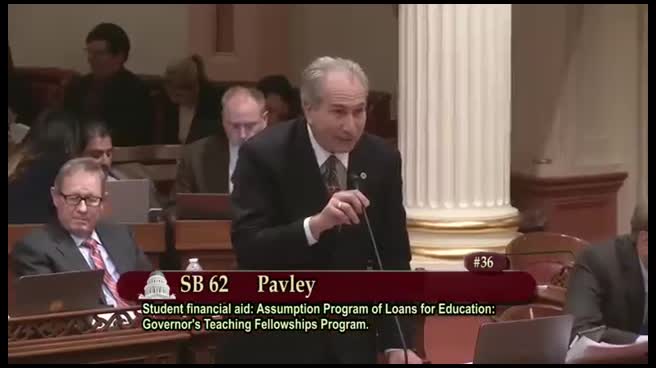
Bill Author