SB 1340: Water Conservation in Landscaping Act.
- Session Year: 2015-2016
- House: Senate
- Latest Version Date: 2016-08-26
Existing law, the Water Conservation in Landscaping Act, requires the Department of Water Resources to update a specified model water efficient landscape ordinance by regulation and prescribes various requirements for the updated model ordinance. Existing law requires each local agency to adopt either the updated model water efficient landscape ordinance or an ordinance that is at least as effective in conserving water as the updated model ordinance. If the local agency does not make a selection, the model ordinance shall apply within the jurisdiction of the local agency.
This bill, on or after July 1, 2018, would require a local agency to require a permit for the installation of specified automatic irrigation systems, or the expansion of the same specified automatic irrigation systems to increase the irrigated area by 25% or more, for a landscape project. The bill would allow the governing body of a local agency to adopt an ordinance prescribing fees for filing an application for the permit, subject to the restrictions that the fees not exceed the amount reasonably required to review applications and issue the permits and that the fees not be levied for general revenue purposes. The bill would authorize a property owner, property manager, landscape contractor, landscape architect, or any other agent designated by the property owner to submit the application for a permit required pursuant to these provisions for an irrigation system serving a residential landscape. The bill would exempt from these requirements the repair and replacement of the components or parts of an automatic irrigation system.
By adding to the duties of local agencies, this bill would impose a state-mandated local program.
The California Constitution requires the state to reimburse local agencies and school districts for certain costs mandated by the state. Statutory provisions establish procedures for making that reimbursement.
This bill would provide that no reimbursement is required by this act for a specified reason.
Existing law, the Water Conservation in Landscaping Act, requires the Department of Water Resources to update a specified model water efficient landscape ordinance by regulation and prescribes various requirements for the updated model ordinance. Existing law requires each local agency to adopt either the updated model water efficient landscape ordinance or an ordinance that is at least as effective in conserving water as the updated model ordinance. If the local agency does not make a selection, the model ordinance shall apply within the jurisdiction of the local agency.
This bill would, bill, on or after July 1, 2018, would require a local agency to require a permit for the installation of specified automatic irrigation systems, or the expansion of the same specified automatic irrigation systems to increase the irrigated area by 25% or more, for a landscape project. The bill would allow the governing body of a local agency to adopt an ordinance prescribing fees for filing an application for the permit, subject to the restrictions that the fees not exceed the amount reasonably required to review applications and issue the permits and that the fees not be levied for general revenue purposes. The bill would authorize a property owner, property manager, landscape contractor, landscape architect, or any other agent designated by the property owner to submit the application for a permit required pursuant to these provisions for an irrigation system serving a residential landscape. The bill would exempt from these requirements the repair and replacement of the components or parts of an automatic irrigation system.
By adding to the duties of local agencies, this bill would impose a state-mandated local program.
The California Constitution requires the state to reimburse local agencies and school districts for certain costs mandated by the state. Statutory provisions establish procedures for making that reimbursement.
This bill would provide that no reimbursement is required by this act for a specified reason.
Existing law, the Water Conservation in Landscaping Act, requires the Department of Water Resources to update a specified model water efficient landscape ordinance by regulation and prescribes various requirements for the updated model ordinance. Existing law requires each local agency to adopt either the updated model water efficient landscape ordinance or an ordinance that is at least as effective in conserving water as the updated model ordinance. If the local agency does not make a selection, the model ordinance shall apply within the jurisdiction of the local agency.
The
This bill would add to the model water efficient landscape ordinance would, on or after July 1, 2018, require a local agency to require a permit requirement for the installation or replacement of specified automatic irrigation systems, or the expansion of the same specified automatic irrigation systems to increase the irrigated area by 25% or more, for a landscape project on or after July 1, 2018. project. The bill would allow the governing body of a local agency to adopt an ordinance prescribing fees for filing an application for the permit, subject to the restrictions that the fees not exceed the amount reasonably required to review applications and issue the permits and that the fees not be levied for general revenue purposes. The bill would authorize a property owner, property manager, landscape contractor, landscape architect, or any other agent designated by the property owner to submit the application for a permit required pursuant to these provisions for an irrigation system serving a residential landscape.
The California Constitution requires the state to reimburse local agencies and school districts for certain costs mandated by the state. Statutory provisions establish procedures for making that reimbursement.
This bill would provide that no reimbursement is required by this act for a specified reason.
Existing law, the Water Conservation in Landscaping Act, requires the Department of Water Resources to update a specified model water efficient landscape ordinance by regulation and prescribes various requirements for the updated model ordinance. Existing law requires each local agency to adopt either the updated model water efficient landscape ordinance or an ordinance that is at least as effective in conserving water as the updated model ordinance. If the local agency does not make a selection, the model ordinance shall apply within the jurisdiction of the local agency.
The bill would add to the model water efficient landscape ordinance a permit requirement for the installation, expansion, installation or replacement of specified automatic irrigation systems systems, or the expansion of the same specified automatic irrigation systems to increase the irrigated area by 25% or more, for a landscape project on or after July 1, 2017. 2018. The bill would allow the governing body of a local agency to adopt an ordinance prescribing fees for filing an application for the permit, subject to the restrictions that the fees not exceed the amount reasonably required to review applications and issue the permits and that the fees not be levied for general revenue purposes.
Existing law, the Water Conservation in Landscaping Act, requires the Department of Water Resources to update a specified model water efficient landscape ordinance by regulation and prescribes various requirements for the updated model ordinance. Existing law requires each local agency to adopt either the updated model water efficient landscape ordinance or an ordinance that is at least as effective in conserving water as the updated model ordinance. If the local agency does not make a selection, the model ordinance shall apply within the jurisdiction of the local agency.
The bill would add to the model water efficient landscape ordinance a permit requirement for the installation, expansion, or replacement of specified automatic irrigation systems for a landscape project on or after July 1, 2017. The bill would allow the governing body of a local agency to adopt an ordinance prescribing fees for filing an application for the permit, subject to the restrictions that the fees not exceed the amount reasonably required to review applications and issue the permits and that the fees not be levied for general revenue purposes.
(a)(1)To the extent funds are appropriated, not later than January 1, 2009, by regulation, the department shall update the model water efficient landscape ordinance adopted pursuant to Chapter 1145 of the Statutes of 1990, after holding one or more public hearings. The updated model ordinance shall be based on the recommendations set forth in the report prepared pursuant to Chapter 682 of the Statutes of 2004 and shall meet the requirements of Section 65596.
(2)Before the adoption of the updated model ordinance pursuant to paragraph (1), the department shall prepare and submit to the Legislature a report relating to both of the following:
(A)The extent to which local agencies have complied with the model water efficient landscape ordinance adopted pursuant to Chapter 1145 of the Statutes of 1990.
(B)The departments recommendations regarding the landscape water budget component of the updated model ordinance described in subdivision (b) of Section 65596.
(b)Not later than January 31, 2009, the department shall distribute the updated model ordinance adopted pursuant to subdivision (a) to all local agencies and other interested parties.
(c)On or before January 1, 2010, a local agency shall adopt one of the following:
(1)A water efficient landscape ordinance that is, based on evidence in the record, at least as effective in conserving water as the updated model ordinance adopted by the department pursuant to subdivision (a).
(2)The updated model ordinance described in paragraph (1).
(d)If the local agency has not adopted, on or before January 1, 2010, a water efficient landscape ordinance pursuant to subdivision (c), the updated model ordinance adopted by the department pursuant to subdivision (a) shall apply within the jurisdiction of the local agency as of that date, shall be enforced by the local agency, and shall have the same force and effect as if adopted by the local agency.
(e)(1)On or after July 1, 2018, a local agency shall require a written permit for the installation of any automatic irrigation system, or the expansion of an existing automatic irrigation system to increase the irrigated area by 25 percent or more, for a landscape project subject to this article and not otherwise within the scope of a local agency permit, if the irrigation system is to serve either of the following:
(A)A nonresidential landscape that is not a cemetery and that is at least 2,500 square feet or greater.
(B)A residential landscape that is at least 10,000 square feet or greater.
(2)Before issuing any permit required by paragraph (1), the governing body of a local agency may adopt an ordinance prescribing fees for filing an application for that permit, but the fees shall not exceed the amount reasonably required by the local agency to review applications and issue those permits, and shall not be levied for general revenue purposes.
(3)An application for a permit required under this subdivision for an irrigation system serving a residential landscape may be submitted by a property owner, property manager, landscape contractor, landscape architect, or any other agent designated by the property owner.
(f)Subdivision (e) shall not apply to the repair or replacement of the components or parts of any existing automatic irrigation system.
(g)Nothing in this article shall be construed to require the local agencys water efficient landscape ordinance to duplicate, or to conflict with, a water efficiency program or measure implemented by a public water system, as defined in Section 116275 of the Health and Safety Code, within the jurisdictional boundaries of the local agency.
SEC. 2.No reimbursement is required by this act pursuant to Section 6 of Article XIIIB of the California Constitution because a local agency or school district has the authority to levy service charges, fees, or assessments sufficient to pay for the program or level of service mandated by this act, within the meaning of Section 17556 of the Government Code.
(a)(1)To the extent funds are appropriated, not later than January 1, 2009, by regulation, the department shall update the model water efficient landscape ordinance adopted pursuant to Chapter 1145 of the Statutes of 1990, after holding one or more public hearings. The updated model ordinance shall be based on the recommendations set forth in the report prepared pursuant to Chapter 682 of the Statutes of 2004 and shall meet the requirements of Section 65596.
(2)Before the adoption of the updated model ordinance pursuant to paragraph (1), the department shall prepare and submit to the Legislature a report relating to both of the following:
(A)The extent to which local agencies have complied with the model water efficient landscape ordinance adopted pursuant to Chapter 1145 of the Statutes of 1990.
(B)The departments recommendations regarding the landscape water budget component of the updated model ordinance described in subdivision (b) of Section 65596.
(b)Not later than January 31, 2009, the department shall distribute the updated model ordinance adopted pursuant to subdivision (a) to all local agencies and other interested parties.
(c)On or before January 1, 2010, a local agency shall adopt one of the following:
(1)A water efficient landscape ordinance that is, based on evidence in the record, at least as effective in conserving water as the updated model ordinance adopted by the department pursuant to subdivision (a).
(2)The updated model ordinance described in paragraph (1).
(d)If the local agency has not adopted, on or before January 1, 2010, a water efficient landscape ordinance pursuant to subdivision (c), the updated model ordinance adopted by the department pursuant to subdivision (a) shall apply within the jurisdiction of the local agency as of that date, shall be enforced by the local agency, and shall have the same force and effect as if adopted by the local agency.
(e)(1)On or after July 1, 2018, a local agency shall require a written permit for the installation of any automatic irrigation system, or the expansion of an existing automatic irrigation system to increase the irrigated area by 25 percent or more, for a landscape project subject to this article and not otherwise within the scope of a local agency permit, if the irrigation system is to serve either of the following:
(A)A nonresidential landscape that is not a cemetery and that is at least 500 2,500 square feet or a greater area as may be found by the California Building Standards Commission to be in the public interest and consistent with the purposes of this article, following notice and opportunity for public comment. greater.
(B)A residential landscape that is at least 10,000 square feet or greater, or a lesser area as may be found by the Department of Housing and Community Development to be in the public interest and consistent with the purposes of this article, following notice and opportunity for public comment. greater.
(2)Before issuing any permit required by paragraph (1), the governing body of a local agency may adopt an ordinance prescribing fees for filing an application for that permit, but the fees shall not exceed the amount reasonably required by the local agency to review applications and issue those permits, and shall not be levied for general revenue purposes.
(3)An application for a permit required under this subdivision for an irrigation system serving a residential landscape may be submitted by a property owner, property manager, landscape contractor, landscape architect, or any other agent designated by the property owner.
(f)Subdivision (e) shall not apply to the repair or replacement of the components or parts of any existing automatic irrigation system.
(f)
(g)Nothing in this article shall be construed to require the local agencys water efficient landscape ordinance to duplicate, or to conflict with, a water efficiency program or measure implemented by a public water system, as defined in Section 116275 of the Health and Safety Code, within the jurisdictional boundaries of the local agency.
SEC. 2.No reimbursement is required by this act pursuant to Section 6 of Article XIIIB of the California Constitution because a local agency or school district has the authority to levy service charges, fees, or assessments sufficient to pay for the program or level of service mandated by this act, within the meaning of Section 17556 of the Government Code.
(a)(1)To the extent funds are appropriated, not later than January 1, 2009, by regulation, the department shall update the model water efficient landscape ordinance adopted pursuant to Chapter 1145 of the Statutes of 1990, after holding one or more public hearings. The updated model ordinance shall be based on the recommendations set forth in the report prepared pursuant to Chapter 682 of the Statutes of 2004 and shall meet the requirements of Section 65596.
(2)Before the adoption of the updated model ordinance pursuant to paragraph (1), the department shall prepare and submit to the Legislature a report relating to both of the following:
(A)The extent to which local agencies have complied with the model water efficient landscape ordinance adopted pursuant to Chapter 1145 of the Statutes of 1990.
(B)The departments recommendations regarding the landscape water budget component of the updated model ordinance described in subdivision (b) of Section 65596.
(b)Not later than January 31, 2009, the department shall distribute the updated model ordinance adopted pursuant to subdivision (a) to all local agencies and other interested parties.
(c)On or before January 1, 2010, a local agency shall adopt one of the following:
(1)A water efficient landscape ordinance that is, based on evidence in the record, at least as effective in conserving water as the updated model ordinance adopted by the department pursuant to subdivision (a).
(2)The updated model ordinance described in paragraph (1).
(d)If the local agency has not adopted, on or before January 1, 2010, a water efficient landscape ordinance pursuant to subdivision (c), the updated model ordinance adopted by the department pursuant to subdivision (a) shall apply within the jurisdiction of the local agency as of that date, shall be enforced by the local agency, and shall have the same force and effect as if adopted by the local agency.
(e)(1)On or after July 1, 2018, a local agency shall require a written permit for the installation of any automatic irrigation system, or the expansion of an existing automatic irrigation system to increase the irrigated area by 25 percent or more, for a landscape project subject to this article and not otherwise within the scope of a local agency permit, if the irrigation system is to serve either of the following:
(A)A nonresidential landscape that is not a cemetery and that is at least 500 square feet or a greater area as may be found by the California Building Standards Commission to be in the public interest and consistent with the purposes of this article, following notice and opportunity for public comment.
(B)A residential landscape that is at least 10,000 square feet or greater, or a lesser area as may be found by the Department of Housing and Community Development to be in the public interest and consistent with the purposes of this article, following notice and opportunity for public comment.
(2)Before issuing any permit required by paragraph (1), the governing body of a local agency may adopt an ordinance prescribing fees for filing an application for that permit, but the fees shall not exceed the amount reasonably required by the local agency to review applications and issue those permits, and shall not be levied for general revenue purposes.
(3)An application for a permit required under this subdivision for an irrigation system serving a residential landscape may be submitted by a property owner, property manager, landscape contractor, landscape architect, or any other agent designated by the property owner.
(e)
(f)Nothing in this article shall be construed to require the local agencys water efficient landscape ordinance to duplicate, or to conflict with, a water efficiency program or measure implemented by a public water system, as defined in Section 116275 of the Health and Safety Code, within the jurisdictional boundaries of the local agency.
SEC. 2.No reimbursement is required by this act pursuant to Section 6 of Article XIIIB of the California Constitution because a local agency or school district has the authority to levy service charges, fees, or assessments sufficient to pay for the program or level of service mandated by this act, within the meaning of Section 17556 of the Government Code.
SECTION 1.Section 65596 of the Government Code is amended to read:65596.The updated model ordinance adopted pursuant to Section 65595 shall do all the following in order to reduce water use:
(a)Include provisions for water conservation and the appropriate use and groupings of plants that are well-adapted to particular sites and to particular climatic, soil, or topographic conditions. The model ordinance shall not prohibit or require specific plant species, but it may include conditions for the use of plant species or encourage water conserving plants. However, the model ordinance shall not include conditions that have the effect of prohibiting or requiring specific plant species.
(b)Include a landscape water budget component that establishes the maximum amount of water to be applied through the irrigation system, based on climate, landscape size, irrigation efficiency, and plant needs.
(c)Promote the benefits of consistent local ordinances in neighboring areas.
(d)Encourage the capture and retention of stormwater onsite to improve water use efficiency or water quality.
(e)Include provisions for the use of automatic irrigation systems and irrigation schedules based on climatic conditions, specific terrains and soil types, and other environmental conditions. The model ordinance shall include references to local, state, and federal laws and regulations regarding standards for water-conserving irrigation equipment. The model ordinance may include climate information for irrigation scheduling based on the California Irrigation Management Information System (Chapter 2 (commencing with Section 10015) of Part 1.5 of Division 6 of the Water Code ).
(f)Include provisions for onsite soil assessment and soil management plans that include grading and drainage to promote healthy plant growth and to prevent excessive erosion and runoff, and the use of mulches in shrub areas, garden beds, and landscaped areas where appropriate.
(g)Promote the use of recycled water consistent with Article 4 (commencing with Section 13520) of Chapter 7 of Division 7 of the Water Code.
(h)Seek to educate water users on the efficient use of water and the benefits of doing so.
(i)Address regional differences, including fire prevention needs.
(j)Exempt landscaping that is part of a registered historical site.
(k)Encourage the use of economic incentives to promote the efficient use of water.
(l)Include provisions for landscape maintenance practices that foster long-term landscape water conservation. Landscape maintenance practices may include, but are not limited to, performing routine irrigation system repair and adjustments, conducting water audits, and prescribing the amount of water applied per landscaped acre.
(m)Include provisions to minimize landscape irrigation overspray and runoff.
(n)(1)Include a provision requiring, on or after July 1, 2018, a written permit for the installation or replacement of any automatic irrigation system, or the expansion of an existing automatic irrigation system to increase the irrigated area by 25 percent or more, for a landscape project subject to this article and not otherwise within the scope of a local agency permit, if the irrigation system is to serve either of the following:
(A)A nonresidential landscape, except a cemetery.
(B)A residential landscape of 10,000 square feet or greater.
(2)Before issuing any permit required by paragraph (1), the governing body of a local agency may adopt an ordinance prescribing fees for filing an application for that permit, but the fees shall not exceed the amount reasonably required by the local agency to review applications and issue those permits, and shall not be levied for general revenue purposes.
The updated model ordinance adopted pursuant to Section 65595 shall do all the following in order to reduce water use:
(a)Include provisions for water conservation and the appropriate use and groupings of plants that are well-adapted to particular sites and to particular climatic, soil, or topographic conditions. The model ordinance shall not prohibit or require specific plant species, but it may include conditions for the use of plant species or encourage water conserving plants. However, the model ordinance shall not include conditions that have the effect of prohibiting or requiring specific plant species.
(b)Include a landscape water budget component that establishes the maximum amount of water to be applied through the irrigation system, based on climate, landscape size, irrigation efficiency, and plant needs.
(c)Promote the benefits of consistent local ordinances in neighboring areas.
(d)Encourage the capture and retention of stormwater onsite to improve water use efficiency or water quality.
(e)Include provisions for the use of automatic irrigation systems and irrigation schedules based on climatic conditions, specific terrains and soil types, and other environmental conditions. The model ordinance shall include references to local, state, and federal laws and regulations regarding standards for water-conserving irrigation equipment. The model ordinance may include climate information for irrigation scheduling based on the California Irrigation Management Information System (Chapter 2 (commencing with Section 10015) of Part 1.5 of Division 6 of the Water Code ).
(f)Include provisions for onsite soil assessment and soil management plans that include grading and drainage to promote healthy plant growth and to prevent excessive erosion and runoff, and the use of mulches in shrub areas, garden beds, and landscaped areas where appropriate.
(g)Promote the use of recycled water consistent with Article 4 (commencing with Section 13520) of Chapter 7 of Division 7 of the Water Code.
(h)Seek to educate water users on the efficient use of water and the benefits of doing so.
(i)Address regional differences, including fire prevention needs.
(j)Exempt landscaping that is part of a registered historical site.
(k)Encourage the use of economic incentives to promote the efficient use of water.
(l)Include provisions for landscape maintenance practices that foster long-term landscape water conservation. Landscape maintenance practices may include, but are not limited to, performing routine irrigation system repair and adjustments, conducting water audits, and prescribing the amount of water applied per landscaped acre.
(m)Include provisions to minimize landscape irrigation overspray and runoff.
(n)(1)Include a provision requiring, on or after July 1, 2017, 2018, a written permit for the installation, expansion, installation or replacement of any automatic irrigation system system, or the expansion of an existing automatic irrigation system to increase the irrigated area by 25 percent or more, for a landscape project subject to this article and not otherwise within the scope of a local agency permit, if the irrigation system is to serve either of the following:
(A)A nonresidential landscape, except a cemetery.
(B)A residential landscape of 10,000 square feet or greater.
(2)Before issuing any permit required by paragraph (1), the governing body of a local agency may adopt an ordinance prescribing fees for filing an application for that permit, but the fees shall not exceed the amount reasonably required by the local agency to review applications and issue those permits, and shall not be levied for general revenue purposes.
The updated model ordinance adopted pursuant to Section 65595 shall do all the following in order to reduce water use:
(a)Include provisions for water conservation and the appropriate use and groupings of plants that are well-adapted to particular sites and to particular climatic, soil, or topographic conditions. The model ordinance shall not prohibit or require specific plant species, but it may include conditions for the use of plant species or encourage water conserving plants. However, the model ordinance shall not include conditions that have the effect of prohibiting or requiring specific plant species.
(b)Include a landscape water budget component that establishes the maximum amount of water to be applied through the irrigation system, based on climate, landscape size, irrigation efficiency, and plant needs.
(c)Promote the benefits of consistent local ordinances in neighboring areas.
(d)Encourage the capture and retention of stormwater onsite to improve water use efficiency or water quality.
(e)Include provisions for the use of automatic irrigation systems and irrigation schedules based on climatic conditions, specific terrains and soil types, and other environmental conditions. The model ordinance shall include references to local, state, and federal laws and regulations regarding standards for water-conserving irrigation equipment. The model ordinance may include climate information for irrigation scheduling based on the California Irrigation Management Information System (Chapter 2 (commencing with Section 10015) of Part 1.5 of Division 6 of the Water Code ).
(f)Include provisions for onsite soil assessment and soil management plans that include grading and drainage to promote healthy plant growth and to prevent excessive erosion and runoff, and the use of mulches in shrub areas, garden beds, and landscaped areas where appropriate.
(g)Promote the use of recycled water consistent with Article 4 (commencing with Section 13520) of Chapter 7 of Division 7 of the Water Code.
(h)Seek to educate water users on the efficient use of water and the benefits of doing so.
(i)Address regional differences, including fire prevention needs.
(j)Exempt landscaping that is part of a registered historical site.
(k)Encourage the use of economic incentives to promote the efficient use of water.
(l)Include provisions for landscape maintenance practices that foster long-term landscape water conservation. Landscape maintenance practices may include, but are not limited to, performing routine irrigation system repair and adjustments, conducting water audits, and prescribing the amount of water applied per landscaped acre.
(m)Include provisions to minimize landscape irrigation overspray and runoff.
(n)(1)Include a provision requiring, on or after July 1, 2017, a written permit for the installation, expansion, or replacement of any automatic irrigation system for a landscape project subject to this article and not otherwise within the scope of a local agency permit, if the irrigation system is to serve either of the following:
(A)A nonresidential landscape, except a cemetery.
(B)A residential landscape of 10,000 square feet or greater.
(2)Before issuing any permit required by paragraph (1), the governing body of a local agency may adopt an ordinance prescribing fees for filing an application for that permit, but the fees shall not exceed the amount reasonably required by the local agency to review applications and issue those permits, and shall not be levied for general revenue purposes.
|
Date
|
Status
|
|---|---|
| Jun 14, 2016 | June 14 set for first hearing. Failed passage in committee. (Ayes 6. Noes 8.) Reconsideration granted. |
| Aug 30, 2016 | Enrolled and presented to the Governor at 1:30 p.m. |
| Aug 24, 2016 | Assembly amendments concurred in. (Ayes 25. Noes 14.) Ordered to engrossing and enrolling. |
| Aug 19, 2016 | In Senate. Concurrence in Assembly amendments pending. |
| Aug 18, 2016 | Read third time. Passed. (Ayes 47. Noes 31. Page 5913.) Ordered to the Senate. |
| Aug 18, 2016 | Read third time. Passed. Ordered to the Senate. |
| Aug 11, 2016 | Read second time. Ordered to third reading. |
| Aug 10, 2016 | From committee: Do pass. (Ayes 14. Noes 5.) (August 10). |
| Aug 3, 2016 | August 3 hearing postponed by committee. |
| Jun 30, 2016 | From committee: Do pass and re-refer to Com. on APPR. (Ayes 5. Noes 3.) (June 29). Re-referred to Com. on APPR. |
| Jun 28, 2016 | From committee: Do pass and re-refer to Com. on L. GOV. (Ayes 9. Noes 5.) (June 28). Re-referred to Com. on L. GOV. |
| Jun 23, 2016 | Assembly Rule 56 suspended. (Page 5473.) |
| Jun 23, 2016 | Assembly Rule 56 suspended. |
| Jun 21, 2016 | From committee with author's amendments. Read second time and amended. Re-referred to Com. on W., P., & W. |
| Feb 19, 2016 | Introduced. To Com. on RLS. for assignment. To print. |
| Jun 8, 2016 | From committee with author's amendments. Read second time and amended. Re-referred to Com. on W., P., & W. |
| Jun 1, 2016 | Referred to Coms. on W., P., & W. and L. GOV. |
| May 16, 2016 | Read third time. Passed. (Ayes 21. Noes 12.) Ordered to the Assembly. |
| May 16, 2016 | Read third time. Passed. (Ayes 21. Noes 12. Page 3873.) Ordered to the Assembly. |
| May 16, 2016 | In Assembly. Read first time. Held at Desk. |
| Apr 13, 2016 | Read second time. Ordered to third reading. |
| Apr 12, 2016 | From committee: Do pass. (Ayes 7. Noes 2.) (April 12). |
| Apr 12, 2016 | From committee: Do pass. (Ayes 7. Noes 2. Page 3496.) (April 12). |
| Apr 5, 2016 | From committee with author's amendments. Read second time and amended. Re-referred to Com. on N.R. & W. |
| Mar 24, 2016 | Set for hearing April 12. |
| Mar 3, 2016 | Referred to Com. on N.R. & W. |
| Feb 22, 2016 | Read first time. |
| Feb 22, 2016 | From printer. May be acted upon on or after March 23. |
|
Date
|
Description
|
Location
|
Votes
|
|
|---|---|---|---|---|
| Aug 24, 2016 | Unfinished Business SB1340 Wolk Concurrence | Senate Floor |
Passed |
|
| Aug 18, 2016 | SB 1340 Wolk Senate Third Reading By EGGMAN | Assembly Floor |
Passed |
|
| Aug 10, 2016 | Do pass. | Assembly Standing Committee on Appropriations |
Passed |
|
| Jun 29, 2016 | Do pass and be re-referred to the Committee on [Appropriations] | Assembly Standing Committee on Local Government |
Passed |
|
| Jun 28, 2016 | Do pass and be re-referred to the Committee on [Local Government] | Assembly Standing Committee on Water, Parks, and Wildlife |
Passed |
|
| Jun 14, 2016 | Reconsideration. | Assembly Standing Committee on Water, Parks, and Wildlife |
Passed |
|
| Jun 14, 2016 | Do pass and be re-referred to the Committee on [Local Government] | Assembly Standing Committee on Water, Parks, and Wildlife |
Failed |
|
| May 16, 2016 | Senate 3rd Reading SB1340 Wolk | Senate Floor |
Passed |
|
| Apr 12, 2016 | Do pass | Senate Standing Committee on Natural Resources and Water |
Passed |
This list shows positions taken on this bill by organizations on the date displayed, which is linked to the original source.
Positions by individuals are not included.
|
Organization
|
Position
|
Date
|
|---|---|---|
| Apartment Association Of Orange County | ** Support | Aug 24, 2016 |
| Apartment Association, California Southern Cities | ** Support | Aug 24, 2016 |
| Association Of California Water Agencies | ** Against | Jun 29, 2016 |
| California Air Plant Society | * Support | Jun 29, 2016 |
| California Association Of Realtors | * Against | Jun 29, 2016 |
| California Building Industry Association | ** Support | Aug 24, 2016 |
| California Building Officials | ** Support | Aug 24, 2016 |
| California Business Properties Association | ** Support | Aug 24, 2016 |
| California Friendly Voters | * Support | Jun 14, 2016 |
| California Landscape Contractor'S Association | ** Support | Aug 24, 2016 |
| California League Of Conservation Voters | ** Support | Aug 24, 2016 |
| California Native Plant Society | ** Support | Aug 24, 2016 |
| Clean Water Action | ** Support | Aug 24, 2016 |
| East Bay Rental Housing Association | ** Support | Aug 24, 2016 |
| Gardenworks, Inc. | ** Support | Jun 29, 2016 |
| Irrigation Association | ** Support | Aug 24, 2016 |
| Natural Resources Defense Council | ** Support | Aug 24, 2016 |
| North Valley Property Owners Association | ** Support | Aug 24, 2016 |
| NRDC | * Support | Jun 29, 2016 |
| Regional Water Authority | ** Support | Aug 24, 2016 |
| San Gabriel Basin Water Quality Authority | * Support | Apr 12, 2016 |
| Sierra Club California | ** Support | Aug 24, 2016 |
| Sonoma County Water Agency | ** Support | Jun 29, 2016 |
| Sonoma County Water District | ** Support | May 16, 2016 |
| Trust For Public Land, The | ** Support | Aug 24, 2016 |
| USGBC California | ** Support | Aug 24, 2016 |
Office of Senate Floor Analyses (916) 651-1520 Fax: (916) 327-4478 | SB 1340 |
VETO
Bill No: SB 1340
Amended: 6/21/16
SENATE NATURAL RES. & WATER COMMITTEE: 7-2, 4/12/16
AYES: Pavley, Allen, Hertzberg, Hueso, Jackson, Monning, Wolk
NOES: Stone, Vidak
SENATE FLOOR: 21-12, 5/16/16
AYES: Allen, Beall, Block, De León, Glazer, Hancock, Hernandez, Hertzberg, Hill, Jackson, Lara, Leno, Leyva, Liu, McGuire, Mitchell, Monning, Pavley, Roth, Wieckowski, Wolk
NOES: Anderson, Bates, Berryhill, Cannella, Fuller, Gaines, Huff, Morrell, Nguyen, Nielsen, Stone, Vidak
NO VOTE RECORDED: Galgiani, Hall, Hueso, Mendoza, Moorlach, Pan, Runner
SENATE FLOOR: 25-14, 8/24/16
AYES: Allen, Beall, Block, De León, Glazer, Hall, Hancock, Hernandez, Hertzberg, Hill, Hueso, Jackson, Lara, Leno, Leyva, Liu, McGuire, Mendoza, Mitchell, Monning, Pan, Pavley, Roth, Wieckowski, Wolk
NOES: Anderson, Bates, Berryhill, Cannella, Fuller, Gaines, Galgiani, Huff, Moorlach, Morrell, Nguyen, Nielsen, Stone, Vidak
ASSEMBLY FLOOR: 47-31, 8/18/16 - See last page for vote
SUBJECT: Water Conservation in Landscaping Act
DIGEST: This bill requires a local permit, for water efficiency compliance purposes, for installation of large stand-alone landscaping irrigation systems.
Existing law:
- Requires, under the Water Conservation in Landscaping Act, the Department of Water Resources (DWR) to adopt and update a model water efficient landscaping ordinance.
- Requires the model ordinance to address specific elements to reduce water use, including but not limited to, water conservation and appropriate plant use, a landscape water budget, stormwater capture, automatic irrigation systems and schedules, soil assessment and management, use of recycled water, water user education, economic incentives, maintenance practices for long-term water conservation, and minimization of overspray and runoff.
This bill:
- Requires a local agency, on or after July 1, 2018, to require a written permit for installation of an automatic irrigation system, or the expansion of an existing irrigation system to increase the irrigated area by 25% or more, for landscaping that is not already within the scope of another permit and is either:
- Nonresidential landscaping that is not a cemetery and is at least 2,500 square feet.
- Residential landscaping of 10,000 square feet or greater.
- Clarifies that the permit requirement established by this bill does not apply to the repair or replacement of the components or parts of any existing automatic irrigation system.
- Authorizes the local agency to adopt an ordinance prescribing permit fees, not to exceed the amount reasonably required for review of applications and issuance of the permits, and not for general revenue purposes.
- Authorizes the applications for residential landscapes to be submitted by the property owner, property manager, landscape contractor, landscape architect, or other agent of the owner.
Comments
Permit to what end? The permitting requirement is intended to ensure that landscapes would be designed and installed consistent with the model ordinance. By having homeowners, landscapers, etc. get a permit for the irrigation, the expectation is that the plan check would include a review of all the provisions of the local agency’s ordinance.
Related/Prior Legislation
AB 1928(Campos, 2016) extends the date from January 1, 2010, to January 1, 2019, by which the California Energy Commission (CEC) is required to adopt landscape irrigation equipment performance standards and labeling requirements. This bill was chaptered on 9/13/2016
FISCAL EFFECT: Appropriation: No Fiscal Com.: Yes Local: Yes
According to the Assembly Appropriations Committee:
“Negligible state fiscal impact. Although a state mandate, costs are not reimbursable because the Agency has authority to levy fees sufficient to cover any costs.”
Apartment Association of Orange County
Apartment Association, California Southern Cities
California Building Industry Association
California Building Officials
California Business Properties Association
California Landscape Contractors Association
California League of Conservation Voters
California Native Plant Society
Clean Water Action
East Bay Rental Housing Association
Gardenworks Inc.
Irrigation Association
Natural Resources Defense Council
North Valley Property Owners Association
Regional Water Authority
Sierra Club California
Sonoma County Water Agency
Trust for Public Land
USGBC California
OPPOSITION: (Verified 10/6/16)
California Association of Realtors
ARGUMENTS IN SUPPORT: According to the author, “The coverage of [Act] as specified in the Model Ordinance has a major gap that leaves a very significant portion of new landscape projects not subject to any standards. This is because it is common practice in most parts of the state for home builders to leave the back yards of new homes un-landscaped. What’s more, in some parts of the state, it is common for front yards to be left un-landscaped by home builders as well. Thus, in many cases the building permit for the new home does not include the landscape, and the owner-initiated landscape projects that may follow new home construction by anywhere from a few months to a few years are not subject to the Model Ordinance because in most localities, the installation of landscape materials and an irrigation system as a stand-alone project do not themselves require a permit.”
“The proper design, installation, and control of automatic landscape irrigation systems is essential to the efficient use and avoidance of waste of water. Stand-alone landscape projects are common in California, and should not be exempt from permitting. In light of the diverse and challenging conditions in which ornamental landscapes are installed, and the frequent changes in irrigation technology and plant varieties, the avoidance of waste requires that all large new landscapes and major renovations should require a permit.”
ARGUMENTS IN OPPOSITION: The California Association of Realtors, in opposition, states, "SB 1340 (Wolk)…introduces a new, time-consuming and expensive mandate on local property owners that is unlikely to improve overall reductions in water consumption for irrigated landscapes. Just because a system is permitted does not ensure that any water savings will result. The existing [Model Ordinance] program already offers local governments a multitude of options to address water conservation in irrigated landscapes. SB 1340 (Wolk) strips local government of the authority to define their own rules, goes outside the existing program and provides no guarantee of a reduction in water usage. Instead of putting an extra burden on property owners, actions should be taken to help them make better landscape decisions."
GOVERNOR'S VETO MESSAGE:
I am returning Senate Bill 1340 without my signature.
This bill requires a local permit for installation of large stand-alone landscaping irrigation systems.
The existing Model Water Efficient Landscape Ordinance program offers local governments a multitude of options to address water conservation in irrigated landscapes.
I have asked the Department of Water Resources and the State Water Resources Control Board to develop a permanent framework for water use reduction targets. This type of landscape permit will be considered in that framework.
ASSEMBLY FLOOR: 47-31, 8/18/16
AYES: Alejo, Arambula, Atkins, Bloom, Bonilla, Bonta, Brown, Burke, Calderon, Campos, Chau, Chiu, Chu, Cooley, Cooper, Dababneh, Daly, Dodd, Eggman, Frazier, Cristina Garcia, Eduardo Garcia, Gipson, Gomez, Gonzalez, Gordon, Holden, Jones-Sawyer, Levine, Lopez, Low, Maienschein, McCarty, Medina, Mullin, Nazarian, Quirk, Ridley-Thomas, Rodriguez, Santiago, Mark Stone, Thurmond, Ting, Weber, Williams, Wood, Rendon
NOES: Achadjian, Travis Allen, Baker, Bigelow, Brough, Chang, Chávez, Dahle, Beth Gaines, Gallagher, Gatto, Gray, Grove, Hadley, Harper, Irwin, Jones, Kim, Lackey, Linder, Mathis, Mayes, Melendez, Obernolte, Olsen, Patterson, Salas, Steinorth, Wagner, Waldron, Wilk
NO VOTE RECORDED: Roger Hernández, O'Donnell
Prepared by: Dennis O'Connor / N.R. & W. / (916) 651-4116
10/17/16 13:58:49
**** END ****
Office of Senate Floor Analyses (916) 651-1520 Fax: (916) 327-4478 | SB |
UNFINISHED BUSINESS
Bill No: SB 1340
:
SENATE NATURAL RES. & WATER COMMITTEE: 7-2, 4/12/16
AYES: Pavley, Allen, Hertzberg, Hueso, Jackson, Monning, Wolk
NOES: Stone, Vidak
SENATE FLOOR: 21-12, 5/16/16
AYES: Allen, Beall, Block, De León, Glazer, Hancock, Hernandez, Hertzberg, Hill, Jackson, Lara, Leno, Leyva, Liu, McGuire, Mitchell, Monning, Pavley, Roth, Wieckowski, Wolk
NOES: Anderson, Bates, Berryhill, Cannella, Fuller, Gaines, Huff, Morrell, Nguyen, Nielsen, Stone, Vidak
NO VOTE RECORDED: Galgiani, Hall, Hueso, Mendoza, Moorlach, Pan, Runner
ASSEMBLY FLOOR: 47-31, 8/18/16 - See last page for vote
DIGEST: This bill requires a local permit, for water efficiency compliance purposes, for installation of large stand-alone landscaping irrigation systems.
Assembly Amendments exempt non-cemetery nonresidential landscapes of less than 2500 square feet, clarify who can submit applications for the permit, clarify that a permit is not required for repair or replacement of the components or parts of any existing automatic irrigation system, and make other technical changes.
Existing law:
- Requires, under the Water Conservation in Landscaping Act, the Department of Water Resources (DWR) to adopt and update a model water efficient landscaping ordinance.
- Requires the model ordinance to address specific elements to reduce water use, including but not limited to, water conservation and appropriate plant use, a landscape water budget, stormwater capture, automatic irrigation systems and schedules, soil assessment and management, use of recycled water, water user education, economic incentives, maintenance practices for long-term water conservation, and minimization of overspray and runoff.
This bill:
- Requires a local agency, on or after July 1, 2018, to require a written permit for installation of an automatic irrigation system, or the expansion of an existing irrigation system to increase the irrigated area by 25% or more, for landscaping that is not already within the scope of another permit and is either:
- Nonresidential landscaping that is not a cemetery and is at least 2,500 square feet.
- Residential landscaping of 10,000 square feet or greater.
- Clarifies that the permit requirement established by this bill does not apply to the repair or replacement of the components or parts of any existing automatic irrigation system.
- Authorizes the local agency to adopt an ordinance prescribing permit fees, not to exceed the amount reasonably required for review of applications and issuance of the permits, and not for general revenue purposes.
- Authorizes the applications for residential landscapes to be submitted by the property owner, property manager, landscape contractor, landscape architect, or other agent of the owner.
Comments
Permit to what end? The permitting requirement is intended to ensure that landscapes would be designed and installed consistent with the model ordinance. By having homeowners, landscapers, etc. get a permit for the irrigation, the expectation is that the plan check would include a review of all the provisions of the local agency’s ordinance.
Related/Prior Legislation
AB 1928(Campos, 2016) extends the date from January 1, 2010, to January 1, 2019, by which the California Energy Commission (CEC) is required to adopt landscape irrigation equipment performance standards and labeling requirements.
FISCAL EFFECT: Appropriation: Fiscal Com.: Local:
According to the Assembly Appropriations Committee:
“Negligible state fiscal impact. Although a state mandate, costs are not reimbursable because the Agency has authority to levy fees sufficient to cover any costs.”
Apartment Association of Orange County
Apartment Association, California Southern Cities
California Building Industry Association
California Building Officials
California Business Properties Association
California Landscape Contractors Association
California League of Conservation Voters
California Native Plant Society
Clean Water Action
East Bay Rental Housing Association
Gardenworks Inc.
Irrigation Association
Natural Resources Defense Council
North Valley Property Owners Association
Regional Water Authority
Sierra Club California
Trust for Public Land
USGBC California
OPPOSITION: (Verified 8/19/16)
California Association of Realtors
ARGUMENTS IN SUPPORT: According to the author, “The coverage of [Act] as specified in the Model Ordinance has a major gap that leaves a very significant portion of new landscape projects not subject to any standards. This is because it is common practice in most parts of the state for home builders to leave the back yards of new homes un-landscaped. What’s more, in some parts of the state, it is common for front yards to be left un-landscaped by home builders as well. Thus, in many cases the building permit for the new home does not include the landscape, and the owner-initiated landscape projects that may follow new home construction by anywhere from a few months to a few years are not subject to the Model Ordinance because in most localities, the installation of landscape materials and an irrigation system as a stand-alone project do not themselves require a permit.”
“The proper design, installation, and control of automatic landscape irrigation systems is essential to the efficient use and avoidance of waste of water. Stand-alone landscape projects are common in California, and should not be exempt from permitting. In light of the diverse and challenging conditions in which ornamental landscapes are installed, and the frequent changes in irrigation technology and plant varieties, the avoidance of waste requires that all large new landscapes and major renovations should require a permit.”
ARGUMENTS IN OPPOSITION: The California Association of Realtors, in opposition, states, "SB 1340 (Wolk)…introduces a new, time-consuming and expensive mandate on local property owners that is unlikely to improve overall reductions in water consumption for irrigated landscapes. Just because a system is permitted does not ensure that any water savings will result. The existing [Model Ordinance] program already offers local governments a multitude of options to address water conservation in irrigated landscapes. SB 1340 (Wolk) strips local government of the authority to define their own rules, goes outside the existing program and provides no guarantee of a reduction in water usage. Instead of putting an extra burden on property owners, actions should be taken to help them make better landscape decisions."
ASSEMBLY FLOOR: 47-31, 8/18/16
AYES: Alejo, Arambula, Atkins, Bloom, Bonilla, Bonta, Brown, Burke, Calderon, Campos, Chau, Chiu, Chu, Cooley, Cooper, Dababneh, Daly, Dodd, Eggman, Frazier, Cristina Garcia, Eduardo Garcia, Gipson, Gomez, Gonzalez, Gordon, Holden, Jones-Sawyer, Levine, Lopez, Low, Maienschein, McCarty, Medina, Mullin, Nazarian, Quirk, Ridley-Thomas, Rodriguez, Santiago, Mark Stone, Thurmond, Ting, Weber, Williams, Wood, Rendon
NOES: Achadjian, Travis Allen, Baker, Bigelow, Brough, Chang, Chávez, Dahle, Beth Gaines, Gallagher, Gatto, Gray, Grove, Hadley, Harper, Irwin, Jones, Kim, Lackey, Linder, Mathis, Mayes, Melendez, Obernolte, Olsen, Patterson, Salas, Steinorth, Wagner, Waldron, Wilk
NO VOTE RECORDED: Roger Hernández, O'Donnell
8/19/16 19:21:41
**** END ****
SENATE THIRD READING
STR Bill Id:SB 1340
Author:(Wolk)
As Amended Ver:June 21, 2016
Majority vote
SENATE VOTE: 21-12
Committee | Votes | Ayes | Noes |
Water | 9-5 | Levine, Dodd, Eggman, Cristina Garcia, Eduardo Garcia, Gomez, Lopez, Nazarian, Williams | Gallagher, Bigelow, Harper, Olsen, Salas |
Local Government | 5-3 | Eggman, Bonilla, Chiu, Cooley, Gordon | Waldron, Beth Gaines, Linder |
Appropriations | 14-5 | Gonzalez, Bloom, Bonilla, Bonta, Calderon, Daly, Eggman, Eduardo Garcia, Holden, Quirk, Santiago, Weber, Wood, Chu | Bigelow, Gallagher, Jones, Obernolte, Wagner |
SUMMARY: Requires a local permit, for water efficiency compliance purposes, for installation of large stand-alone landscaping irrigation systems. Specifically, this bill:
- Requires a local agency, on or after July 1, 2018, to require a written permit for installation of an automatic irrigation system, or the expansion of an existing irrigation system to increase the irrigated area by 25% or more, for landscaping that is not already within the scope of another permit and is either:
- Nonresidential landscaping that is not a cemetery and is at least 2,500 square feet.
- Residential landscaping of 10,000 square feet or greater.
- Clarifies that the permit requirement established by this bill does not apply to the repair or replacement of the components or parts of any existing automatic irrigation system.
- Authorizes the local agency to adopt an ordinance prescribing permit fees, not to exceed the amount reasonably required for review of applications and issuance of the permits, and not for general revenue purposes.
- Authorizes the applications for residential landscapes to be submitted by the property owner, property manager, landscape contractor, landscape architect, or other agent of the owner.
EXISTING LAW:
- Requires, under the Water Conservation in Landscaping Act, the Department of Water Resources (DWR) to adopt and update a model water efficient landscaping ordinance.
- Requires the model ordinance to address specific elements to reduce water use, including but not limited to, water conservation and appropriate plant use, a landscape water budget, stormwater capture, automatic irrigation systems and schedules, soil assessment and management, use of recycled water, water user education, economic incentives, maintenance practices for long-term water conservation, and minimization of overspray and runoff.
FISCAL EFFECT: According to the Assembly Appropriations Committee, negligible state fiscal impact. Although a state mandate, costs are not reimbursable because the Agency has authority to levy fees sufficient to cover any costs.
COMMENTS: This bill seeks to close a gap in implementation of California's existing water efficient landscape ordinance, by establishing a local permit requirement for large stand-alone landscape irrigation projects, that are installed after building construction. By requiring a local permit for installation, this bill seeks to help ensure that the water efficiency standards addressed by the model ordinance are applied to large stand-alone irrigation systems. This bill would implement a recommendation of the Independent Technical Panel on Demand Management Measures included in their May 2016 final draft report.
Since at least 1990 it has been the goal of the state that new landscapes and major renovations be designed and installed to be water-efficient. The state's model water efficient landscape ordinance provides standards and criteria for new and renovated landscape projects that are included in projects that require a local permit, plan check, or design review, such as construction of a new building. However, there is a major gap that leaves a significant portion of new landscape projects without any standards. It is a common practice for home builders to leave back yards of new homes un-landscaped. In some parts of the state it is also common for front yards to be left un-landscaped by home builders. In these cases the building permit for the new home does not include the landscape. Consequently, the owner-initiated landscape projects that may follow new home construction by anywhere from a few months to a few years are not subject to the water efficiency standards of the model ordinance, because in most localities the installation of landscape materials and an irrigation system as a stand-alone project do not require a permit.
At the request of the Legislature in 2007, an Independent Technical Panel (ITP) on Demand Management Measures was formed to provide the DWR and the Legislature information and recommendations on new water demand management measures, technologies, and approaches to water use efficiency. The most recent report of the ITP was issued in May 2016 and is titled Recommendations Report to the Legislature on Landscape Water Use Efficiency. Among other recommendations, the report recommends that a new permit requirement be implemented by local agencies for installation of new automatic irrigation systems, or the expansion of existing irrigation systems, for large nonresidential and residential landscapes over certain sizes. This bill would implement this recommendation of the ITP.
The ITP report notes that the proper design, installation, and control of automatic landscape irrigation systems is essential to the efficient use of water and avoidance of water waste. Stand-alone landscape projects are common in California, and should not be exempt from permitting. While the planting of landscape materials can take place over an extended period of time, the irrigation system largely controls the delivery of water to the landscape. Thus, the installation of an irrigation system for a large landscape is itself an appropriate trigger for a permit subject to all requirements of the model ordinance. Developer-installed landscape projects would continue to be covered by a building permit, without requiring a separate permit for the irrigation system.
The ITP report further states that they recommend that the Legislature directly incorporate a requirement for permitting of stand-alone irrigation installations for commercial and large residential landscapes into the Water Conservation and Landscaping Act. The effect will be to bring stand-alone landscape projects under the scope of the revised model ordinance in all local jurisdictions. Finally, the ITP report notes in light of the diverse and challenging conditions in which ornamental landscapes are installed, and the frequent changes in irrigation technology and plant varieties, the avoidance of waste requires that all new landscapes and major additions should require a permit.
Supporters note that statewide about half of the water supplied to urban areas is used outdoors, primarily for landscape irrigation. Improving efficiency in outdoor water use is critically important for water supply reliability. The proper design, installation, and control of automatic landscape irrigation systems are essential to improving water use efficiency. A permitting requirement for large, stand-alone irrigation projects will help assure those improvements.
Opponents assert this bill would impose a new, time-consuming, unnecessary and expensive mandate on local property owners, and burden property owners rather than assist them in making better landscape decisions.
In response to the assertion that this bill imposes a new mandate on local property owners, the author notes that landscape installations associated with a new home are already covered by the model ordinance. This bill will ensure that landscape installations that are deferred, and come at a later time, are also subject to the water efficiency standards of the model ordinance.
Analysis Prepared by: Diane Colborn / W., P., & W. / (916) 319-2096 FN: 0003926
Date of Hearing: August 10, 2016
ASSEMBLY COMMITTEE ON APPROPRIATIONS
Lorena Gonzalez, Chair
SBPCA Bill Id:SB 1340
Author:(Wolk) – As Amended Ver:June 21, 2016
Policy Committee: | Water, Parks and Wildlife | Vote: | 9 - 5 |
Local Government | 5 - 3 |
Urgency: No State Mandated Local Program: Yes Reimbursable: No
SUMMARY: This bill requires a local permit, for water efficiency compliance purposes, for installation of large stand-alone landscaping irrigation systems. Specifically, this bill:
- Requires a local agency, on or after July 1, 2018, to require a written permit for installation of an automatic irrigation system, or the expansion of an existing irrigation system to increase the irrigated area by 25% or more, for landscaping that is not already within the scope of another permit and is either:
- Nonresidential landscaping that is not a cemetery and is at least 2,500 square feet or greater.
- Residential landscaping that is at least10,000 square feet or greater.
- Clarifies that the permit requirement established by this bill does not apply to the repair or replacement of the components of parts of any existing automatic irrigation system.
- Authorizes the local agency to adopt an ordinance prescribing permit fees, not to exceed the amount reasonably required for review of applications and issuance of the permits, and not for general revenue purposes.
- Authorizes the applications for residential landscapes to be submitted by the property owner, property manager, landscape contractor, landscape architect, or other agent of the owner.
FISCAL EFFECT:
Negligible state fiscal impact. Although a state mandate, costs are not reimbursable because the Agency has authority to levy fees sufficient to cover any costs.
COMMENTS:
- Purpose. According to the author, "It has been the goal of the State since at least 1990 that new landscapes and major renovations of existing landscapes should be designed and installed to be water-efficient. The state’s Model Water Efficient Landscape Ordinance (MWELO) carries standards and criteria for new and renovated landscape projects that are included in projects that require a local permit, plan check or design review such as the construction of a new building, the extension of electric or natural gas lines from an existing building, or major excavation and regrading.
"However, the coverage of MWELO as specified in the Model Ordinance has a major gap that leaves a very significant portion of new landscape projects not subject to any standards. This is because it is common practice in most parts of the state for home builders to leave the back yards of new homes un-landscaped. What’s more, in some parts of the state, it is common for front yards to be left un-landscaped by home builders as well. Thus, in many cases the building permit for the new home does not include the landscape, and the owner-initiated landscape projects that may follow new home construction by anywhere from a few months to a few years are not subject to the Model Ordinance because in most localities, the installation of landscape materials and an irrigation system as a stand-alone project do not themselves require a permit."
- Background. At the request of the Legislature in 2007, an Independent Technical Panel (ITP) on Demand Management Measures was formed to provide DWR and the Legislature information and recommendations on new water demand management measures, technologies and approaches to water use efficiency. The most recent report of the ITP was issued in May 2016 and is titled “Recommendations Report to the Legislature on Landscape Water Use Efficiency.” Among other recommendations, the report recommends that a new permit requirement be implemented by local agencies for installation of new automatic irrigation systems, or the expansion of existing irrigation systems, for large nonresidential and residential landscapes over certain sizes. This bill would implement this recommendation of the ITP.
- Arguments in Support. Supporters note that statewide about half of the water supplied to urban areas is used outdoors, primarily for landscape irrigation. Improving efficiency in outdoor water use is critically important for water supply reliability. The proper design, installation, and control of automatic landscape irrigation systems are essential to improving water use efficiency. A permitting requirement for large, stand-alone irrigation projects will help assure those improvements.
- Arguments in Opposition. The California Association of Realtors asserts that this bill would impose a new, time-consuming, unnecessary and expensive mandate on local property owners, which would burden property owners rather than assist them in making better landscape decisions.
- Current Legislation.
- AB 2525 (Holden) would have required the DWR to create a water efficiency landscaping program to encourage local economic incentives to promote water efficient landscapes. AB 2525 was held on this Committee's Suspense File last month.
- AB 1928 (Campos), pending in the Senate Appropriations Committee, extends the date by which the State Energy Resources Conservation and Development Commission is required to adopt landscape irrigation equipment performance standards and labeling requirements.
- AB 2617 (Mayes), pending in the Senate Rules Committee, requires the DWR to prepare a report analyzing the costs and benefits of incentives for various water efficiency measures.
- AB 2515 (Weber), pending in the Senate Appropriations Committee, requires the DWR, on or before January 1, 2020, and every three years thereafter, to either update the model water-efficient landscaping ordinance or make a finding that an update to the model water-efficient landscaping ordinance at that time is not useful or effective. The bill would additionally require DWR to submit the update to the Building Standards Commission during the triennial revision process of the California Green Building Standards Code.
- Prior Legislation.
- AB 1881 (Laird), Chapter 559, Statutes of 2006, required the DWR to update the model water efficiency in landscaping ordinance, and required local agencies to either adopt the model ordinance or another ordinance that is at least as efficient in conserving water.
- AB 1420 (Laird), Chapter 628, Statutes of 2007, directed the DWR to form an independent panel to provide information to the DWR and the Legislature on new demand management measures, technologies, and approaches.
Analysis Prepared by: Jennifer Swenson / APPR. / (916) 319-2081
Date of Hearing: June 29, 2016
ASSEMBLY COMMITTEE ON LOCAL GOVERNMENT
Susan Talamantes Eggman, Chair
SBPCA Bill Id:SB 1340
Author:(Wolk) – As Amended Ver:June 21, 2016
SENATE VOTE: 21-12
SUBJECT: Water Conservation in Landscaping Act.
SUMMARY: Requires a local permit for the installation or expansion of automatic irrigation systems for specified residential and nonresidential landscape projects. Specifically, this bill:
- Amends the Water Conservation in Landscaping Act (Act) by requiring, on or after July 1, 2018, a local agency to require a written permit for the installation of any automatic irrigation system, or the expansion of an existing automatic irrigation system to increase the irrigated area by 25% or more, for a landscape project subject to the Act and not otherwise within the scope of a local agency permit, if the irrigation system is to serve either of the following:
- A nonresidential landscape that is not a cemetery and that is at least 2,500 square feet (sq. ft.) or greater; or,
- A residential landscape that is at least 10,000 sq. ft. or greater.
- Allows the governing body of a local agency, before issuing any permit required by this bill, to adopt an ordinance prescribing fees for filing an application for that permit.
- Prohibits permit fees from exceeding the amount reasonably required by the local agency to review applications and issue permits.
- Prohibits permit fees from being levied for general revenue purposes.
- Allows an application for a permit for a residential landscape irrigation system to be submitted by a property owner, property manager, landscape contractor, landscape architect, or any other agent designated by the property owner.
- Provides that the bill's provisions do not apply to the repair or replacement of the components or parts of any existing automatic irrigation system.
- Provides that no reimbursement is required by this bill because a local agency or school district has the authority to levy service charges, fees, or assessments sufficient to pay for the program or level of service mandated by this bill, as specified.
EXISTING LAW:
- Requires, pursuant to the Act, the Department of Water Resources (DWR) to adopt and update a model water efficient landscaping ordinance (MWELO).
- Requires the MWELO to be updated to address specific elements to reduce water use, including, but not limited to, water conservation and appropriate plant use, a landscape water budget, storm water capture, automatic irrigation systems and schedules, soil assessment and management, use of recycled water, water user education, economic incentives, maintenance practices for long-term water conservation, and minimization of overspray and runoff.
- Requires, on or before January 1, 2010, a local agency to adopt one of the following:
- A water efficient landscape ordinance that is, based on evidence in the record, at least as effective in conserving water as the updated MWELO adopted by DWR; or,
- The updated MWELO adopted by DWR.
- Provides that, if a local agency has not adopted an ordinance as described above, DWR's updated MWELO shall apply within the jurisdiction of the local agency, shall be enforced by the local agency, and shall have the same force and effect as if adopted by the local agency.
- Defines, for the purposes of the Act, "local agency" to mean any city, county, or city and county, including a charter city or charter county.
FISCAL EFFECT: This bill is keyed fiscal.
COMMENTS:
- Bill Summary. This bill amends the Act by requiring local agencies to require a permit for the installation of any automatic irrigation system, or the expansion of an existing automatic irrigation system that would increase the irrigated area by 25% or more, for a landscape project subject to the Act and not otherwise within the scope of a local permit. This requirement applies to an irrigation system that will serve a nonresidential landscape that is 2,500 sq. ft. or larger (except cemeteries) or a residential landscape that is 10,000 sq. ft. or larger, and would go into effect July 1, 2018.
This bill allows a process for local agencies to adopt permit fees via ordinance, and prohibits permit fees from exceeding the amount reasonably required by the local agency to review applications and issue permits or from being levied for general revenue purposes. Applications for residential landscape irrigation system permits may be submitted by a property owner, property manager, landscape contractor, landscape architect, or any other agent designated by the property owner. The bill's provisions do not apply to the repair or replacement of the components or parts of any existing automatic irrigation system. This bill's provisions, as an amendment to the Act, apply to any county or city, including a charter city.
This bill is sponsored by the author.
- Author's Statement. According to the author, "It has been the goal of the State since at least 1990 that new landscapes and major renovations of existing landscapes should be designed and installed to be water-efficient. The state’s Model Water Efficient Landscape Ordinance (MWELO) carries standards and criteria for new and renovated landscape projects that are included in projects that require a local permit, plan check or design review such as the construction of a new building, the extension of electric or natural gas lines from an existing building, or major excavation and regrading.
"However, the coverage of MWELO as specified in the Model Ordinance has a major gap that leaves a very significant portion of new landscape projects not subject to any standards. This is because it is common practice in most parts of the state for home builders to leave the back yards of new homes un-landscaped. What’s more, in some parts of the state, it is common for front yards to be left un-landscaped by home builders as well. Thus, in many cases the building permit for the new home does not include the landscape, and the owner-initiated landscape projects that may follow new home construction by anywhere from a few months to a few years are not subject to the Model Ordinance because in most localities, the installation of landscape materials and an irrigation system as a stand-alone project do not themselves require a permit."
- Background. The Act, approved in 1990, required DWR to prepare a MWELO and required all local agencies to adopt a landscape ordinance by 1993 or the MWELO would automatically take effect. AB 1881 (Laird), Chapter 559, Statutes of 2006, revised the Act significantly. The revised Act required DWR to revise the MWELO by January 2009, pending funding, to incorporate a number of measures to reduce water use. DWR adopted the revised MWELO on September 10, 2010.
On April 1, 2015, the Governor issued an executive order regarding the ongoing drought. Among its provisions was direction to DWR to update the MWELO through expedited regulation. This update was intended to increase water efficiency standards for new and existing landscapes through more efficient irrigation systems, greywater use, onsite storm water capture, and limiting the portion of landscapes that can be covered in turf. It also required reporting on the implementation and enforcement of local ordinances, with required reports due by December 31, 2015. DWR was further directed to provide information on local compliance to the State Water Resources Control Board, which must consider adopting regulations or taking appropriate enforcement actions to promote compliance. DWR was also directed to provide technical assistance and give priority in grant funding to public agencies for actions necessary to comply with local ordinances.
On July 15, 2015, the California Water Commission approved DWR’s revision to the MWELO. Local agencies had until December 1, 2015, to adopt the updated MWELO or to adopt a local ordinance that is at least as effective in conserving water as the MWELO. Local agencies working together to develop a regional ordinance had until February 1, 2016, to adopt their ordinance.
- Independent Technical Panel Recommendations. At the direction of the Legislature in 2007, an Independent Technical Panel (ITP) on Demand Management Measures was formed to provide DWR and the Legislature information and recommendations on new water demand management measures, technologies and approaches to water use efficiency. The most recent report of the ITP was issued in May 2016. Among other recommendations, the report recommends that a new permit requirement be implemented by local agencies for the installation of new automatic irrigation systems, or the expansion of existing irrigation systems, for large nonresidential and residential landscapes over certain sizes. The report set those thresholds at 500 sq. ft. or greater for nonresidential landscapes, and 10,000 sq. ft. or greater for residential landscapes.
The ITP report states, "While the planting of landscape materials can take place over an extended period of time, the irrigation system largely controls the delivery of water to the landscape. Thus, the installation of an irrigation system for a large landscape is itself an appropriate 'trigger' for a permit subject to all requirements of MWELO…..Developer-installed landscape projects would continue to be covered by a building permit, without requiring a separate permit for the irrigation system.”
The ITP report further states, “we recommend that the Legislature directly incorporate a requirement for permitting of stand-alone irrigation installations for commercial and large residential landscapes into the Water Conservation and Landscaping Act. The effect will be to bring stand-alone landscape projects under the scope of the revised MWELO in all local jurisdictions…”
- Previous Legislation. AB 1420 (Laird), Chapter 628, Statutes of 2007, directed the DWR to form an independent panel to provide information to the DWR and the Legislature on new demand management measures, technologies, and approaches.
AB 1881 (Laird), Chapter 559, Statutes of 2006, required the DWR to update the MWELO, and required local agencies to either adopt the model ordinance or another ordinance that is at least as efficient in conserving water.
- Arguments in Support. The California League of Conservation Voters, in support, writes, "Statewide, about half of all the water supplied to urban areas is used outdoors, primarily for landscape irrigation. Improving the efficiency of outdoor water use is critically important for water supply reliability and resource protection throughout California…Stand-alone landscape projects are common in California, and should not be exempt from permitting and the water efficiency requirements of (MWELO). The proper design, installation, and control of automatic landscape irrigation systems is essential to the efficient use and avoidance of waste of water. The avoidance of waste requires that new stand-alone irrigation projects should require a permit."
- Arguments in Opposition. The California Association of Realtors, in opposition, states, "SB 1340 (Wolk)…introduces a new, time-consuming and expensive mandate on local property owners that is unlikely to improve overall reductions in water consumption for irrigated landscapes. Just because a system is permitted does not ensure that any water savings will result. The existing MWELO program already offers local governments a multitude of options to address water conservation in irrigated landscapes. SB 1340 (Wolk) strips local government of the authority to define their own rules, goes outside the existing program and provides no guarantee of a reduction in water usage. Instead of putting an extra burden on property owners, actions should be taken to help them make better landscape decisions."
- Double-Referral. This bill is double-referred to the Assembly Water, Parks and Wildlife Committee, where it failed on a 6-8 vote on June 14, 2016. The bill was subsequently amended on June 21, 2016, and is scheduled for a vote-only action in the Water, Parks and Wildlife Committee on June 28, 2016.
REGISTERED SUPPORT / OPPOSITION:
Support
Apartment Association of Orange County
Apartment Association, California Southern Cities
California Building Industry Association
California Building Officials
California Business Properties Association
California Landscape Contractors Association
California League of Conservation Voters
California Native Plant Society
East Bay Rental Housing Association
Gardenworks Inc.
Irrigation Association
Natural Resources Defense Council
North Valley Property Owners Association
Sierra Club California
USGBC California
Opposition
California Association of Realtors
Analysis Prepared by: Angela Mapp / L. GOV. / (916) 319-3958
Date of Hearing: June 28, 2016
ASSEMBLY COMMITTEE ON WATER, PARKS, AND WILDLIFE
Marc Levine, Chair
SBPCA Bill Id:SB 1340
Author:(Wolk) – As Amended Ver:June 21, 2016
SENATE VOTE: 21-12
SUBJECT: Water Conservation in Landscaping Act
SUMMARY: Requires a local permit, for water efficiency compliance purposes, for installation of large stand-alone landscaping irrigation systems. Specifically, this bill:
- Requires a local agency, on or after July 1, 2018, to require a written permit for installation of an automatic irrigation system, or the expansion of an existing irrigation system to increase the irrigated area by 25% or more, for landscaping that is not already within the scope of another permit and is either:
- Nonresidential landscaping that is not a cemetery and is at least 2,500 square feet.
- Residential landscaping of 10,000 square feet or greater.
- Clarifies that the permit requirement established by this bill does not apply to the repair or replacement of the components of parts of any existing automatic irrigation system.
- Authorizes the local agency to adopt an ordinance prescribing permit fees, not to exceed the amount reasonably required for review of applications and issuance of the permits, and not for general revenue purposes.
- Authorizes the applications for residential landscapes to be submitted by the property owner, property manager, landscape contractor, landscape architect, or other agent of the owner.
EXISTING LAW:
- Requires, under the Water Conservation in Landscaping Act, the Department of Water Resources (DWR) to adopt and update a model water efficient landscaping ordinance.
- Requires the model ordinance to address specific elements to reduce water use, including but not limited to, water conservation and appropriate plant use, a landscape water budget, stormwater capture, automatic irrigation systems and schedules, soil assessment and management, use of recycled water, water user education, economic incentives, maintenance practices for long-term water conservation, and minimization of overspray and runoff.
FISCAL EFFECT: This bill has been designated as non-fiscal by Legislative Counsel.
COMMENTS: This bill seeks to close a gap in implementation of California’s existing water efficient landscape ordinance, by establishing a local permit requirement for large, stand-alone landscape irrigation projects that are installed after building construction. By requiring a local permit for installation, this bill seeks to help ensure that the water efficiency standards addressed by the model ordinance are applied to large stand-alone irrigation systems. This bill would implement a recommendation of the Independent Technical Panel on Demand Management Measures included in their May 2016 final draft report.
- Author’s Statement: Since at least 1990 it has been the goal of the state that new landscapes and major renovations be designed and installed to be water-efficient. The state’s model water efficient landscape ordinance provides standards and criteria for new and renovated landscape projects that are included in projects that require a local permit, plan check or design review, such as construction of a new building. However, there is a major gap that leaves a significant portion of new landscape projects without any standards. It is a common practice for home builders to leave back yards of new homes un-landscaped. In some parts of the state it is also common for front yards to be left un-landscaped by home builders. In these cases the building permit for the new home does not include the landscape. Consequently, the owner-initiated landscape projects that may follow new home construction by anywhere from a few months to a few years are not subject to the water efficiency standards of the model ordinance, because in most localities the installation of landscape materials and an irrigation system as a stand-alone project do not require a permit.
- Background: At the request of the Legislature in 2007, an Independent Technical Panel (ITP) on Demand Management Measures was formed to provide DWR and the Legislature information and recommendations on new water demand management measures, technologies and approaches to water use efficiency. The most recent report of the ITP was issued in May 2016 and is titled “Recommendations Report to the Legislature on Landscape Water Use Efficiency.” Among other recommendations, the report recommends that a new permit requirement be implemented by local agencies for installation of new automatic irrigation systems, or the expansion of existing irrigation systems, for large nonresidential and residential landscapes over certain sizes. This bill would implement this recommendation of the ITP.
The ITP report notes that “the proper design, installation, and control of automatic landscape irrigation systems is essential to the efficient use of water and avoidance of water waste. Stand-alone landscape projects are common in California, and should not be exempt from permitting. While the planting of landscape materials can take place over an extended period of time, the irrigation system largely controls the delivery of water to the landscape. Thus, the installation of an irrigation system for a large landscape is itself an appropriate “trigger” for a permit subject to all requirements of the [model ordinance]…..Developer-installed landscape projects would continue to be covered by a building permit, without requiring a separate permit for the irrigation system.”
The ITP report further states that “we recommend that the Legislature directly incorporate a requirement for permitting of stand-alone irrigation installations for commercial and large residential landscapes into the Water Conservation and Landscaping Act. The effect will be to bring stand-alone landscape projects under the scope of the revised [model ordinance] in all local jurisdictions…” Finally, the ITP report notes “In light of the diverse and challenging conditions in which ornamental landscapes are installed, and the frequent changes in irrigation technology and plant varieties, the avoidance of waste requires that all new landscapes and major additions should require a permit.” - Double-referral: This bill is double-referred to the Assembly Local Government Committee which is scheduled to hear this bill next after this committee.
- Recent Amendments: This bill was previously heard in this committee on June 14, 2016. The measure failed passage but reconsideration was granted. Author's amendments taken since that hearing increased the threshold for commercial properties from 500 to 2,500 square feet, and deleted the authorization for the California Building Standards Commission or the Department of Housing and Community Development to revise the thresholds. The amendments also clarified that the permit requirement does not apply to repair or replacement of the components of any existing automatic irrigation system.
- Prior and Related Legislation: AB 1881 (Laird), Chapter 559, Statutes of 2006, required the DWR to update the model water efficiency in landscaping ordinance, and required local agencies to either adopt the model ordinance or another ordinance that is at least as efficient in conserving water.
AB 1420 (Laird), Chapter 628, Statutes of 2007, directed the DWR to form an independent panel to provide information to the DWR and the Legislature on new demand management measures, technologies, and approaches.
AB 2525 (Holden) would require the DWR to create a water efficiency landscaping program to encourage local economic incentives to promote water efficient landscapes. AB 2525 was held in the Assembly Appropriations Committee last month.
AB 1928 (Campos) extends the date by which the State Energy Resources Conservation and Development Commission is required to adopt landscape irrigation equipment performance standards and labeling requirements. AB 1928 passed the Assembly and is pending in the Senate.
AB 2617 (Mayes) requires the DWR to prepare a report analyzing the costs and benefits of incentives for various water efficiency measures. AB 2617 passed the Assembly and is pending in the Senate.
AB 2515 (Weber) requires the DWR, on or before January 1, 2020, and every three years thereafter, to either update the model water-efficient landscaping ordinance or make a finding that an update to the model water-efficient landscaping ordinance at that time is not useful or effective. The bill would additionally require DWR to submit the update to the Building Standards Commission during the triennial revision process of the California Green Building Standards Code. AB 2515 passed the Assembly and is pending in the Senate.
- Support Arguments: Supporters note that statewide about half of the water supplied to urban areas is used outdoors, primarily for landscape irrigation. Improving efficiency in outdoor water use is critically important for water supply reliability. The proper design, installation, and control of automatic landscape irrigation systems are essential to improving water use efficiency. A permitting requirement for large, stand-alone irrigation projects will help assure those improvements.
- Opposition Arguments: The California Association of Realtors asserts that this bill would impose a new, time-consuming, unnecessary and expensive mandate on local property owners, which would burden property owners rather than assist them in making better landscape decisions. The Association of California Water Agencies believes that this bill would increase workload and costs for water agencies to process the permits, and would burden ratepayers with an additional fee.
In response to the assertion that this bill imposes a new mandate on local property owners, the author notes that landscape installations associated with a new home are already covered by the model ordinance. This bill will ensure that landscape installations that are deferred, and come at a later time, are also subject to the water efficiency standards of the model ordinance.
REGISTERED SUPPORT / OPPOSITION:
Support
Apartment Association, California Southern Cities
Apartment Association of Orange County
California Building Industry Association
California Building Officials
California Business Properties Association
California Landscape Contractors' Association
California League of Conservation Voters
California Native Plant Society
Clean Water Action
East Bay Rental Housing Association
Gardenworks, Inc.
Irrigation Association
Natural Resources Defense Council
North Valley Property Owners Association
Regional Water Authority
Sierra Club California
Sonoma County Water Agency
Trust for Public Lands
USGBC California
Opposition
Association of California Water Agencies
California Association of Realtors
Analysis Prepared by: Diane Colborn / W., P., & W. / (916) 319-2096
Date of Hearing: June 14, 2016
ASSEMBLY COMMITTEE ON WATER, PARKS, AND WILDLIFE
Marc Levine, Chair
SBPCA Bill Id:SB 1340
Author:(Wolk) – As Amended Ver:June 8, 2016
SENATE VOTE: 21-12
SUBJECT: Water Conservation in Landscaping Act
SUMMARY: Requires a local permit, for water efficiency compliance purposes, for installation of large stand-alone landscaping irrigation systems. Specifically, this bill:
- Requires a local agency, on or after July 1, 2018, to require a written permit for installation of an automatic irrigation system, or the expansion of an existing irrigation system to increase the irrigated area by 25% or more, for landscaping that is not already within the scope of another permit and is either:
- Nonresidential landscaping that is not a cemetery and is at least 500 square feet.
- Residential landscaping of 10,000 square feet or greater.
- Authorizes the Building Standards Commission to increase the size of the area that is subject to the permit requirement for nonresidential projects, and authorizes the Department of Housing and Community Development to reduce the size of the area that is subject to the permit requirement for residential projects, if the commission or department finds that the adjustment would be in the public interest, and following notice and an opportunity for public comment.
- Authorizes the local agency to adopt an ordinance prescribing permit fees, not to exceed the amount reasonably required for review of applications and issuance of the permits, and not for general revenue purposes.
- Authorizes the applications for residential landscapes to be submitted by the property owner, property manager, landscape contractor, landscape architect, or other agent of the owner.
EXISTING LAW:
- Requires, under the Water Conservation in Landscaping Act, the Department of Water Resources (DWR) to adopt and update a model water efficient landscaping ordinance.
- Requires the model ordinance to address specific elements to reduce water use, including but not limited to, water conservation and appropriate plant use, a landscape water budget, stormwater capture, automatic irrigation systems and schedules, soil assessment and management, use of recycled water, water user education, economic incentives, maintenance practices for long-term water conservation, and minimization of overspray and runoff.
FISCAL EFFECT: This bill has been designated as non-fiscal by Legislative Counsel.
COMMENTS: This bill seeks to close a gap in implementation of California’s existing water efficient landscape ordinance, by establishing a local permit requirement for large, stand-alone landscape irrigation projects that are installed after building construction. By requiring a local permit for installation, this bill seeks to help ensure that the water efficiency standards addressed by the model ordinance are applied to large stand-alone irrigation systems. This bill would implement a recommendation of the Independent Technical Panel on Demand Management Measures included in their May 2016 final draft report.
- Author’s Statement: Since at least 1990 it has been the goal of the state that new landscapes and major renovations be designed and installed to be water-efficient. The state’s model water efficient landscape ordinance provides standards and criteria for new and renovated landscape projects that are included in projects that require a local permit, plan check or design review, such as construction of a new building. However, there is a major gap that leaves a significant portion of new landscape projects without any standards. It is a common practice for home builders to leave back yards of new homes un-landscaped. In some parts of the state it is also common for front yards to be left un-landscaped by home builders. In these cases the building permit for the new home does not include the landscape. Consequently, the owner-initiated landscape projects that may follow new home construction by anywhere from a few months to a few years are not subject to the water efficiency standards of the model ordinance, because in most localities the installation of landscape materials and an irrigation system as a stand-alone project do not require a permit.
- Background: At the request of the Legislature in 2007, an Independent Technical Panel (ITP) on Demand Management Measures was formed to provide DWR and the Legislature information and recommendations on new water demand management measures, technologies and approaches to water use efficiency. The most recent report of the ITP was issued in May 2016 and is titled “Recommendations Report to the Legislature on Landscape Water Use Efficiency.” Among other recommendations, the report recommends that a new permit requirement be implemented by local agencies for installation of new automatic irrigation systems, or the expansion of existing irrigation systems, for large nonresidential and residential landscapes over certain sizes. This bill would implement this recommendation of the ITP.
The ITP report notes that “the proper design, installation, and control of automatic landscape irrigation systems is essential to the efficient use of water and avoidance of water waste. Stand-alone landscape projects are common in California, and should not be exempt from permitting. While the planting of landscape materials can take place over an extended period of time, the irrigation system largely controls the delivery of water to the landscape. Thus, the installation of an irrigation system for a large landscape is itself an appropriate “trigger” for a permit subject to all requirements of the [model ordinance]…..Developer-installed landscape projects would continue to be covered by a building permit, without requiring a separate permit for the irrigation system.”
The ITP report further states that “we recommend that the Legislature directly incorporate a requirement for permitting of stand-alone irrigation installations for commercial and large residential landscapes into the Water Conservation and Landscaping Act. The effect will be to bring stand-alone landscape projects under the scope of the revised [model ordinance] in all local jurisdictions…” Finally, the ITP report notes “In light of the diverse and challenging conditions in which ornamental landscapes are installed, and the frequent changes in irrigation technology and plant varieties, the avoidance of waste requires that all new landscapes and major additions should require a permit.” - Double-referral: This bill is double-referred to the Assembly Local Government Committee which is scheduled to hear this bill next after this committee.
- Prior and Related Legislation: AB 1881 (Laird), Chapter 559, Statutes of 2006, required the DWR to update the model water efficiency in landscaping ordinance, and required local agencies to either adopt the model ordinance or another ordinance that is at least as efficient in conserving water.
AB 1420 (Laird), Chapter 628, Statutes of 2007, directed the DWR to form an independent panel to provide information to the DWR and the Legislature on new demand management measures, technologies, and approaches.
AB 2525 (Holden) would require the DWR to create a water efficiency landscaping program to encourage local economic incentives to promote water efficient landscapes. AB 2525 was held in the Assembly Appropriations Committee last month.
AB 1928 (Campos) extends the date by which the State Energy Resources Conservation and Development Commission is required to adopt landscape irrigation equipment performance standards and labeling requirements. AB 1928 passed the Assembly and is pending in the Senate.
AB 2617 (Mayes) requires the DWR to prepare a report analyzing the costs and benefits of incentives for various water efficiency measures. AB 2617 passed the Assembly and is pending in the Senate.
AB 2515 (Weber) requires the DWR, on or before January 1, 2020, and every three years thereafter, to either update the model water-efficient landscaping ordinance or make a finding that an update to the model water-efficient landscaping ordinance at that time is not useful or effective. The bill would additionally require DWR to submit the update to the Building Standards Commission during the triennial revision process of the California Green Building Standards Code. AB 2515 passed the Assembly and is pending in the Senate.
- Support Arguments: Supporters note that statewide about half of the water supplied to urban areas is used outdoors, primarily for landscape irrigation. Improving efficiency in outdoor water use is critically important for water supply reliability. The proper design, installation, and control of automatic landscape irrigation systems are essential to improving water use efficiency. A permitting requirement for large, stand-alone irrigation projects will help assure those improvements.
- Opposition Arguments: The California Association of Realtors asserts that this bill would impose a new, time-consuming, unnecessary and expensive mandate on local property owners, which would burden property owners rather than assist them in making better landscape decisions.
In response to the assertion that this bill imposes a new mandate on local property owners, the author notes that landscape installations associated with a new home are already covered by the model ordinance. This bill will ensure that landscape installations that are deferred, and come at a later time, are also subject to the water efficiency standards of the model ordinance.
REGISTERED SUPPORT / OPPOSITION:
Support
California Building Industry Association
California Building Officials
California Business Properties Association
California Landscape Contractors' Association
Gardenworks, Inc.
Irrigation Association
Natural Resources Defense Council
Regional Water Authority
Sierra Club California
Sonoma County Water Agency
Opposition
California Association of Realtors
Analysis Prepared by: Diane Colborn / W., P., & W. / (916) 319-2096
Office of Senate Floor Analyses (916) 651-1520 Fax: (916) 327-4478 | SB |
THIRD READING
Bill No: SB 1340
:
SENATE NATURAL RES. & WATER COMMITTEE: 7-2, 4/12/16
AYES: Pavley, Allen, Hertzberg, Hueso, Jackson, Monning, Wolk
NOES: Stone, Vidak
DIGEST: This bill adds to the model water efficient landscape ordinance a permit requirement for the installation or replacement of specified automatic irrigation systems, or the expansion of the same specified automatic irrigation systems to increase the irrigated area by 25% or more, for a landscape project on or after July 1, 2018.
Existing law:
- Requires, under the Water Conservation in Landscaping Act (Act):
- The Department of Water Resources (DWR) to prepare a Model Water Efficient Landscape Ordinance.
- The Act requires the model ordinance to do all of the following to reduce water use:
- Provide for water conservation and the appropriate use and groupings of plants.
- Include a landscape water budget based on climate, landscape size, irrigation efficiency, and plant needs.
- Promote the benefits of consistent local ordinances in neighboring areas.
- Encourage the capture and retention of stormwater onsite.
- Provide for the use of automatic irrigation systems and schedules based on climatic conditions, specific terrains and soil types, and other environmental conditions.
- Provide for onsite soil assessment and soil management plans that include grading and drainage and use of mulches in shrub areas, garden beds, and landscaped areas where appropriate.
- Promote the use of recycled water.
- Educate water users on the efficient use of water and the benefits of doing so.
- Address regional differences, including fire prevention needs.
- Exempt landscaping that is part of a registered historical site.
- Encourage the use of economic incentives to promote the efficient use of water.
- Provide for landscape maintenance practices that foster long-term landscape water conservation.
- Minimize landscape irrigation overspray and runoff.
- The Act requires all local agencies to adopt a landscape ordinance or the model ordinance would automatically take effect.
- A local agency can make findings that an ordinance was unnecessary if certain conditions existed.
- Requires DWR, under the Governor’s April 1, 2015 executive order regarding the ongoing drought to do a number of things, including updating the model ordinance through expedited regulation. Specifically, the executive order:
- States the update is to increase water efficiency standards for new and existing landscapes through more efficient irrigation systems, greywater usage, onsite storm water capture, and by limiting the portion of landscapes that can be covered in turf.
- Requires DWR to report on the implementation and enforcement of local ordinances, with required reports due by December 31, 2015.
- Requires DWR to provide information on local compliance to the Water Board, which shall consider adopting regulations or taking appropriate enforcement actions to promote compliance.
- Requires DWR to provide technical assistance and give priority in grant funding to public agencies for actions necessary to comply with local ordinances.
This bill:
- Requires the model landscape ordinance to include a provision requiring, on or after July 1, 2018, a written permit for the installation or replacement of any automatic irrigation system, or the expansion of an existing automatic irrigation system to increase the irrigated area by 25 percent or more, for a landscape project subject to the Act and not otherwise within the scope of a local agency permit, if the irrigation system is to serve either of the following:
- A nonresidential landscape, except a cemetery.
- A residential landscape of 10,000 square feet or greater.
- Authorizes the governing body of a local agency, before issuing any such permit to adopt an ordinance prescribing fees for filing an application for that permit, provided the fees do not exceed the amount reasonably required by the local agency to review applications and issue those permits, and are not be levied for general revenue purposes.
Background
On July 15, 2015, the California Water Commission approved DWR’s revision to the model ordinance. Local agencies had until December 1, 2015 to adopt the model ordinance or to adopt a local ordinance which was at least as effective in conserving water as the model ordinances. Local agencies working together to develop a regional ordinance had until February 1, 2016 to adopt.
Comments
Permit to what end? The permitting requirement is intended to ensure that landscapes would be designed and installed consistent with the model ordinance. By having homeowners, landscapers, etc. get a permit for the irrigation, the expectation is that the plan check would include a review of all the provisions of the local agency’s ordinance.
Update again so soon? DWR finished the regulatory process of updating the model ordinance less than a year ago. As written, this bill seems to require DWR to go through the regulatory process of updating the ordinance again to add a permitting requirement for irrigation systems. The author’s staff indicate that this bill is intended to be self-executing and not require DWR to go through the regulatory process.
Why 10,000 sq ft? The author’s staff report the intent of the 10,000 sq. ft. threshold for residential landscapes is to ensure the focus is on larger residential landscapes. At 10,000 sq. ft., this bill would apply to landscapes slightly less than ¼ acre in size.
Additional amendments sought by some supporters. Natural Resources Defense Council, in their letter supporting this bill, suggests the bill need additional amendments. These include amendments that would:
- Remove “replacement” of an existing irrigation system from the bill’s permitting requirement, as this might discourage needed improvements to an irrigation system due to the burdens of applying the current model ordinance to an existing landscape;
- Set a minimum size threshold for commercial landscape projects subject to permitting, to avoid time and attention devoted to very small projects. It recommended that 500 square feet – the threshold adopted in 2015 for model ordinance applicability – be considered for this purpose.
- Reposition the requirements of the bill in current law such that the provisions are self-executing without requiring further rulemaking by the DWR of Water Resources.
- Clarify that a full range of landscape professionals can assist residential property owners in applying for a permit required by the bill.
Related Legislation
AB 1928 (Campos) requires the Energy Commission, by January 1, 2018, to adopt landscape irrigation equipment performance standards and labeling requirements. Bans the sale of landscape irrigation equipment that does not meet those established performance standards and labeling requirements beginning January 1, 2020.
AB 2525 (Holden) creates the California Water Efficient Landscaping Program in DWR to encourage Californians to upgrade their landscape and irrigation equipment for more efficient ones. Also prioritizes participation of families that qualify for the Low-Income Home Energy Assistance Program.
FISCAL EFFECT: Appropriation: Fiscal Com.: Local:
Natural Resources Defense Council
Sierra Club California
Sonoma County Water District
OPPOSITION: (Verified 4/13/16)
None received
ARGUMENTS IN SUPPORT: According to the author, “The coverage of [Act] as specified in the Model Ordinance has a major gap that leaves a very significant portion of new landscape projects not subject to any standards. This is because it is common practice in most parts of the state for home builders to leave the back yards of new homes un-landscaped. What’s more, in some parts of the state, it is common for front yards to be left un-landscaped by home builders as well. Thus, in many cases the building permit for the new home does not include the landscape, and the owner-initiated landscape projects that may follow new home construction by anywhere from a few months to a few years are not subject to the Model Ordinance because in most localities, the installation of landscape materials and an irrigation system as a stand-alone project do not themselves require a permit.”
“The proper design, installation, and control of automatic landscape irrigation systems is essential to the efficient use and avoidance of waste of water. Stand-alone landscape projects are common in California, and should not be exempt from permitting. In light of the diverse and challenging conditions in which ornamental landscapes are installed, and the frequent changes in irrigation technology and plant varieties, the avoidance of waste requires that all large new landscapes and major renovations should require a permit.”
4/29/16 11:21:25
**** END ****
Office of Senate Floor Analyses (916) 651-1520 Fax: (916) 327-4478 | SB |
THIRD READING
Bill No: SB 1340
:
SENATE NATURAL RES. & WATER COMMITTEE: 7-2, 4/12/16
AYES: Pavley, Allen, Hertzberg, Hueso, Jackson, Monning, Wolk
NOES: Stone, Vidak
DIGEST: This bill adds to the model water efficient landscape ordinance a permit requirement for the installation or replacement of specified automatic irrigation systems, or the expansion of the same specified automatic irrigation systems to increase the irrigated area by 25% or more, for a landscape project on or after July 1, 2018.
Existing law:
- Requires, under the Water Conservation in Landscaping Act (Act):
- The Department of Water Resources (DWR) to prepare a Model Water Efficient Landscape Ordinance.
- The Act requires the model ordinance to do all of the following to reduce water use:
- Provide for water conservation and the appropriate use and groupings of plants.
- Include a landscape water budget based on climate, landscape size, irrigation efficiency, and plant needs.
- Promote the benefits of consistent local ordinances in neighboring areas.
- Encourage the capture and retention of stormwater onsite.
- Provide for the use of automatic irrigation systems and schedules based on climatic conditions, specific terrains and soil types, and other environmental conditions.
- Provide for onsite soil assessment and soil management plans that include grading and drainage and use of mulches in shrub areas, garden beds, and landscaped areas where appropriate.
- Promote the use of recycled water.
- Educate water users on the efficient use of water and the benefits of doing so.
- Address regional differences, including fire prevention needs.
- Exempt landscaping that is part of a registered historical site.
- Encourage the use of economic incentives to promote the efficient use of water.
- Provide for landscape maintenance practices that foster long-term landscape water conservation.
- Minimize landscape irrigation overspray and runoff.
- The Act requires all local agencies to adopt a landscape ordinance or the model ordinance would automatically take effect.
- A local agency can make findings that an ordinance was unnecessary if certain conditions existed.
- Requires DWR, under the Governor’s April 1, 2015 executive order regarding the ongoing drought to do a number of things, including updating the model ordinance through expedited regulation. Specifically, the executive order:
- States the update is to increase water efficiency standards for new and existing landscapes through more efficient irrigation systems, greywater usage, onsite storm water capture, and by limiting the portion of landscapes that can be covered in turf.
- Requires DWR to report on the implementation and enforcement of local ordinances, with required reports due by December 31, 2015.
- Requires DWR to provide information on local compliance to the Water Board, which shall consider adopting regulations or taking appropriate enforcement actions to promote compliance.
- Requires DWR to provide technical assistance and give priority in grant funding to public agencies for actions necessary to comply with local ordinances.
This bill:
- Requires the model landscape ordinance to include a provision requiring, on or after July 1, 2018, a written permit for the installation or replacement of any automatic irrigation system, or the expansion of an existing automatic irrigation system to increase the irrigated area by 25 percent or more, for a landscape project subject to the Act and not otherwise within the scope of a local agency permit, if the irrigation system is to serve either of the following:
- A nonresidential landscape, except a cemetery.
- A residential landscape of 10,000 square feet or greater.
- Authorizes the governing body of a local agency, before issuing any such permit to adopt an ordinance prescribing fees for filing an application for that permit, provided the fees do not exceed the amount reasonably required by the local agency to review applications and issue those permits, and are not be levied for general revenue purposes.
Background
On July 15, 2015, the California Water Commission approved DWR’s revision to the model ordinance. Local agencies had until December 1, 2015 to adopt the model ordinance or to adopt a local ordinance which was at least as effective in conserving water as the model ordinances. Local agencies working together to develop a regional ordinance had until February 1, 2016 to adopt.
Comments
Permit to what end? The permitting requirement is intended to ensure that landscapes would be designed and installed consistent with the model ordinance. By having homeowners, landscapers, etc. get a permit for the irrigation, the expectation is that the plan check would include a review of all the provisions of the local agency’s ordinance.
Update again so soon? DWR finished the regulatory process of updating the model ordinance less than a year ago. As written, this bill seems to require DWR to go through the regulatory process of updating the ordinance again to add a permitting requirement for irrigation systems. The author’s staff indicate that this bill is intended to be self-executing and not require DWR to go through the regulatory process.
Why 10,000 sq ft? The author’s staff report the intent of the 10,000 sq. ft. threshold for residential landscapes is to ensure the focus is on larger residential landscapes. At 10,000 sq. ft., this bill would apply to landscapes slightly less than ¼ acre in size.
Additional amendments sought by some supporters. Natural Resources Defense Council, in their letter supporting this bill, suggests the bill need additional amendments. These include amendments that would:
- Remove “replacement” of an existing irrigation system from the bill’s permitting requirement, as this might discourage needed improvements to an irrigation system due to the burdens of applying the current model ordinance to an existing landscape;
- Set a minimum size threshold for commercial landscape projects subject to permitting, to avoid time and attention devoted to very small projects. It recommended that 500 square feet – the threshold adopted in 2015 for model ordinance applicability – be considered for this purpose.
- Reposition the requirements of the bill in current law such that the provisions are self-executing without requiring further rulemaking by the DWR of Water Resources.
- Clarify that a full range of landscape professionals can assist residential property owners in applying for a permit required by the bill.
Related Legislation
AB 1928 (Campos) – requires the Energy Commission, by January 1, 2018, to adopt landscape irrigation equipment performance standards and labeling requirements. Bans the sale of landscape irrigation equipment that does not meet those established performance standards and labeling requirements beginning January 1, 2020.
AB 2525 (Holden) – Creates the California Water Efficient Landscaping Program in DWR to encourage Californians to upgrade their landscape and irrigation equipment for more efficient ones. Also prioritizes participation of families that qualify for the Low-Income Home Energy Assistance Program.
FISCAL EFFECT: Appropriation: Fiscal Com.: Local:
Natural Resources Defense Council
Sierra Club California
Sonoma County Water District
OPPOSITION: (Verified 4/13/16)
None received
ARGUMENTS IN SUPPORT: According to the author, “The coverage of [Act] as specified in the Model Ordinance has a major gap that leaves a very significant portion of new landscape projects not subject to any standards. This is because it is common practice in most parts of the state for home builders to leave the back yards of new homes un-landscaped. What’s more, in some parts of the state, it is common for front yards to be left un-landscaped by home builders as well. Thus, in many cases the building permit for the new home does not include the landscape, and the owner-initiated landscape projects that may follow new home construction by anywhere from a few months to a few years are not subject to the Model Ordinance because in most localities, the installation of landscape materials and an irrigation system as a stand-alone project do not themselves require a permit.”
“The proper design, installation, and control of automatic landscape irrigation systems is essential to the efficient use and avoidance of waste of water. Stand-alone landscape projects are common in California, and should not be exempt from permitting. In light of the diverse and challenging conditions in which ornamental landscapes are installed, and the frequent changes in irrigation technology and plant varieties, the avoidance of waste requires that all large new landscapes and major renovations should require a permit.”
4/13/16 16:59:28
**** END ****
SENATE COMMITTEE ON NATURAL RESOURCES AND WATER
Senator Fran Pavley, Chair
2015 - 2016 Regular
Bill No: SB 1340 Hearing Date: April 12, 2016
Author: | |||
Version: | Amended | ||
Urgency: | Fiscal: | ||
Consultant: | |||
Subject: Water Conservation in Landscaping Act
BACKGROUND AND EXISTING LAW
The Water Conservation in Landscaping Act was enacted in 1990. This Act required the Department of Water Resources (DWR) to prepare a Model Water Efficient Landscape Ordinance. The Act required all local agencies to adopt a landscape ordinance by 1993 or the model ordinance would automatically take effect. A local agency could make findings that an ordinance was unnecessary if certain conditions existed.
In 2006, AB 1881 (Laird) revised the act significantly. The revised act required DWR to revise the model ordinance by January 2009, pending funding, to do all of the following to reduce water use:
- Provide for water conservation and the appropriate use and groupings of plants.
- Include a landscape water budget based on climate, landscape size, irrigation efficiency, and plant needs.
- Promote the benefits of consistent local ordinances in neighboring areas.
- Encourage the capture and retention of stormwater onsite.
- Provide for the use of automatic irrigation systems and schedules based on climatic conditions, specific terrains and soil types, and other environmental conditions.
- Provide for onsite soil assessment and soil management plans that include grading and drainage and use of mulches in shrub areas, garden beds, and landscaped areas where appropriate.
- Promote the use of recycled water.
- Educate water users on the efficient use of water and the benefits of doing so.
- Address regional differences, including fire prevention needs.
- Exempt landscaping that is part of a registered historical site.
- Encourage the use of economic incentives to promote the efficient use of water.
- Provide for landscape maintenance practices that foster long-term landscape water conservation.
- Minimize landscape irrigation overspray and runoff.
DWR adopted the revised Model Water Efficient Landscape Ordinance (MWELO) on September 10, 2010.
On April 1, 2015, the Governor issued an executive order regarding the ongoing drought. Among its provisions was direction to DWR to update the model ordinance through expedited regulation. This update was to increase water efficiency standards for new and existing landscapes through more efficient irrigation systems, greywater usage, onsite storm water capture, and by limiting the portion of landscapes that can be covered in turf. It also required reporting on the implementation and enforcement of local ordinances, with required reports due by December 31, 2015. DWR was further directed to provide information on local compliance to the Water Board, which shall consider adopting regulations or taking appropriate enforcement actions to promote compliance. DWR was also directed to provide technical assistance and give priority in grant funding to public agencies for actions necessary to comply with local ordinances.
On July 15, 2015, the California Water Commission approved DWR’s revision to the model ordinance. Local agencies had until December 1, 2015 to adopt the model ordinance or to adopt a local ordinance which was at least as effective in conserving water as the model ordinances. Local agencies working together to develop a regional ordinance had until February 1, 2016 to adopt.
PROPOSED LAW
This bill would require the model landscape ordinance to include a provision requiring, on or after July 1, 2018, a written permit for the installation or replacement of any automatic irrigation system, or the expansion of an existing automatic irrigation system to increase the irrigated area by 25 percent or more, for a landscape project subject to the Water Conservation in Landscaping Act and not otherwise within the scope of a local agency permit, if the irrigation system is to serve either of the following:
- A nonresidential landscape, except a cemetery.
- A residential landscape of 10,000 square feet or greater.
The bill would authorize the governing body of a local agency, before issuing any such permit to adopt an ordinance prescribing fees for filing an application for that permit, provided the fees do not exceed the amount reasonably required by the local agency to review applications and issue those permits, and are not be levied for general revenue purposes.
ARGUMENTS IN SUPPORT
According to the author, “The coverage of [Act] as specified in the Model Ordinance has a major gap that leaves a very significant portion of new landscape projects not subject to any standards. This is because it is common practice in most parts of the state for home builders to leave the back yards of new homes un-landscaped. What’s more, in some parts of the state, it is common for front yards to be left un-landscaped by home builders as well. Thus, in many cases the building permit for the new home does not include the landscape, and the owner-initiated landscape projects that may follow new home construction by anywhere from a few months to a few years are not subject to the Model Ordinance because in most localities, the installation of landscape materials and an irrigation system as a stand-alone project do not themselves require a permit.”
“The proper design, installation, and control of automatic landscape irrigation systems is essential to the efficient use and avoidance of waste of water. Stand-alone landscape projects are common in California, and should not be exempt from permitting. In light of the diverse and challenging conditions in which ornamental landscapes are installed, and the frequent changes in irrigation technology and plant varieties, the avoidance of waste requires that all large new landscapes and major renovations should require a permit.”
ARGUMENTS IN OPPOSITION: None Received
COMMENTS
Permit to what end? The permitting requirement is intended to ensure that landscapes would be designed and installed consistent with the model ordinance. By having homeowners, landscapers, etc. get a permit for the irrigation, the expectation is that the plan check would include a review of all the provisions of the local agency’s ordinance.
Update again so soon? DWR finished the regulatory process of updating the model ordinance less than a year ago. As written, this bill seems to require DWR to go through the regulatory process of updating the ordinance again to add a permitting requirement for irrigation systems. The author’s staff indicate that this bill is intended to be self-executing and not require DWR to go through the regulatory process.
Why 10,000 sq ft? The author’s staff report the intent of the 10,000 sq. ft. threshold for residential landscapes is to ensure the focus is on larger residential landscapes. At 10,000 sq. ft., this bill would apply to landscapes slightly less than ¼ acre in size.
Additional amendments sought by some supporters. Natural Resources Defense Council (NRDC), in their letter supporting this bill, suggests the bill need additional amendments. These include amendments that would:
- Remove “replacement” of an existing irrigation system from the bill’s permitting requirement, as this might discourage needed improvements to an irrigation system due to the burdens of applying current MWELO to an existing landscape;
- Set a minimum size threshold for commercial landscape projects subject to permitting, to avoid time and attention devoted to very small projects. It recommended that 500 square feet – the threshold adopted in 2015 for MWELO applicability – be considered for this purpose.
- Reposition the requirements of the bill in current law such that the provisions are self-executing without requiring further rulemaking by the DWR of Water Resources.
- Clarify that a full range of landscape professionals can assist residential property owners in applying for a permit required by the bill.
The committee may wish to suggest explore these proposed amendments with the author.
Related Bills:
AB 1928(Campos) – would require the Energy Commission, by January 1, 2018, to adopt landscape irrigation equipment performance standards and labeling requirements. The sale of landscape irrigation equipment that does not meet those established performance standards and labeling requirements would be banned beginning January 1, 2020.
AB 2525(Holden) – would create the California Water Efficient Landscaping (WEL) Program in DWR to encourage Californians to upgrade their landscape and irrigation equipment for more efficient ones. Would also prioritize participation of families that qualify for the Low-Income Home Energy Assistance Program.
SUGGESTED AMENDMENTS: None
SUPPORT
Natural Resources Defense Council – seek additional amendments
Sierra Club California
Sonoma County Water District
OPPOSITION: None Received
-- END --
Discussed in Hearing
 2MIN
Senate Floor
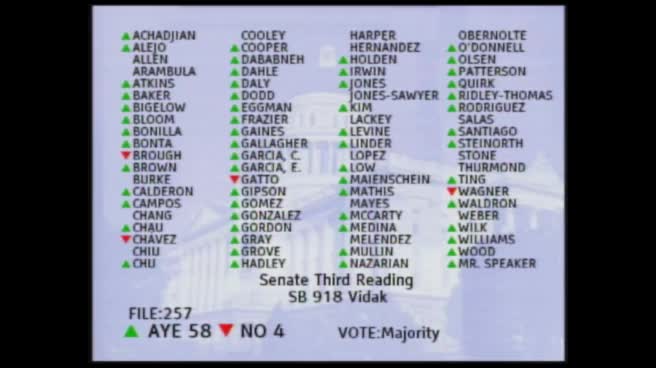 2MIN
Assembly Floor
 1MIN
Assembly Standing Committee on Appropriations
 17MIN
Assembly Standing Committee on Local Government
 9MIN
Assembly Standing Committee on Water, Parks, and Wildlife
 3MIN
Senate Floor
 6MIN
Senate Standing Committee on Natural Resources and Water
Bill Author

Bill Co-Author(s):