SB 1367: Harmful substances: local regulation.
- Session Year: 2015-2016
- House: Senate
- Latest Version Date: 2016-05-18
Existing law prohibits the operation of a place of business in which drug paraphernalia is kept, displayed, or sold unless the drug paraphernalia is completely kept within a separate room or enclosure to which persons under 18 years of age are excluded. Existing law prohibits the sale of synthetic cannabinoid compounds, as specified.
This bill would allow a city, county, or city and county, to regulate, by ordinance, the sale of substances that pose a substance used as a recreational drug that poses a threat to human life or health and a particular risk to minors if specified conditions are met, including the fact that the substance is sold under a product name or label that is clearly identifiable, there is substantial evidence that the substance has been advertised, purchased, sold, or consumed as a recreational drug and drug, and there is substantial evidence that the substance can cause intoxication, disability, or death if swallowed, ingested smoked, inhaled, or injected into the body. The bill would allow the city council or board of supervisors to require vendors to maintain records of sale, make inventory available for inspection by a peace officer, and store the substance in a secure place that cannot be accessed by minors. The bill would allow the city, county, or city and county, to prohibit the sale of the substance to minors and require the payment of a penalty for noncompliance with the ordinance, not to exceed $250.
Existing law prohibits the operation of a place of business in which drug paraphernalia is kept, displayed, or sold unless the drug paraphernalia is completely kept within a separate room or enclosure to which persons under 18 years of age are excluded. Existing law prohibits the sale of synthetic cannabinoid compounds, as specified.
This bill would allow a city, county, or city and county, to regulate, by ordinance, the sale of substances that pose a threat to human life or health and a particular risk to minors if specified conditions are met, including the fact that the substance has been advertised, purchased, or consumed as a recreational drug and the substance can cause intoxication, disability, or death if swallowed, smoked, inhaled, or injected into the body. The bill would allow the city council or board of supervisors to require vendors to maintain records of sale, make inventory available for inspection by a peace officer, and store the substance in a secure place that cannot be accessed by minors. The bill would allow the city, county, or city and county, to require the payment of a penalty for noncompliance with the ordinance, not to exceed $250.
(a)A city, county, or city and county, may regulate, pursuant to subdivision (b), the sale of substances that pose a substance used as a recreational drug that poses a threat to human life or health and a particular risk to minors if the city council or board of supervisors find, finds, after notice and a public hearing, that each of the following conditions are true:
(1)The substance is labeled packaged or labeled as a product to be used for purposes other than human consumption. consumption, ingestion, inhalation, or dermal application.
(2)The substance is sold under a product name or label that is clearly identifiable.
(2)
(3)The sale of the substance is not already regulated by the state or federal government as toxic to humans. humans and it is not unlawful for any person, firm, or corporation to sell the substance to a person under 18 years of age.
(3)The substance can cause intoxication, disability, or death if it is swallowed, smoked, inhaled, or injected into the human body.
(4)There is substantial evidence that the substance can cause intoxication, disability, or death if it is ingested, smoked, inhaled, or injected into the human body.
(4)
(5)There is substantial evidence that the substance has in fact been advertised, purchased, sold, or consumed as a recreational drug.
(5)
(6)The unregulated sale of the substance creates a continuing and particular risk to the health and safety of children and young adults in the community.
(6)
(7)Regulating the sale of the substance would mitigate the risk to minors living in the community.
(b)Upon finding that all of the conditions of subdivision (a) have been met, the city council or board of supervisors may regulate the sale of the identified substances substance, identified by a product name or label, following the adoption of an ordinance which ordinance. The ordinance may, no less than 30 days after actual notice, require vendors to comply with any of the following conditions:
(1)Maintain all records of purchase of the substance. substance identified in the ordinance by a product name or label.
(2)Make inventory of the substance identified in the ordinance by a product name or label available for inspection upon request of a peace officer.
(3)Store the substance in a secure place that cannot be accessed by minors.
(4)Maintain a registry of sale to ensure that the substance is not sold to any person under 18 years of age.
(5)Require payment of a penalty for noncompliance with the ordinance enacted pursuant to this subdivision, not to exceed two hundred fifty dollars ($250) per violation.
(6)Prohibit the sale of the identified substances substance identified in the ordinance by a product name or label to minors.
(7)Any other regulation allowable pursuant to Section 7 of Article XI of the California Constitution.
(a)A city, county, or city and county, may regulate, pursuant to subdivision (b), the sale of substances that pose a threat to human life or health and a particular risk to minors if the city council or board of supervisors find, after notice and a public hearing, that each of the following conditions are true:
(1)The substance is labeled for purposes other than human consumption.
(2)The sale of the substance is not already regulated by the state or federal government as toxic to humans.
(3)The substance can cause intoxication, disability, or death if it is swallowed, smoked, inhaled, or injected into the human body.
(4)There is substantial evidence that the substance has in fact been advertised, purchased, or consumed as a recreational drug.
(5)The unregulated sale of the substance creates a continuing and particular risk to the health and safety of children and young adults in the community.
(6)Regulating the sale of the substance would mitigate the risk to minors living in the community.
(b)Upon finding that all of the conditions of subdivision (a) have been met, the city council or board of supervisors may regulate the sale of the identified substances following the adoption of an ordinance which may, no less than 30 days after actual notice, require vendors to comply with any of the following conditions:
(1)Maintain all records of purchase of the substance.
(2)Make inventory available for inspection upon request of a peace officer.
(3)Store the substance in a secure place that cannot be accessed by minors.
(4)Maintain a registry of sale to ensure that the substance is not sold to any person under 18 years of age.
(5)Require payment of a penalty for noncompliance with the ordinance enacted pursuant to this subdivision, not to exceed two hundred fifty dollars ($250) per violation.
(6)Prohibit the sale of the identified substances to minors.
(7)Any other regulation allowable pursuant to Section 7 of Article XI of the California Constitution.
(a)A city, county, or city and county, may regulate, pursuant to subdivision (b), the sale of substances that pose a threat to human life or health and a particular risk to minors if the city council or board of supervisors find, after notice and a public hearing, that each of the following conditions are true:
(1)The substance is labeled for purposes other than human consumption.
(2)The sale of the substance is not already regulated by the state or federal government as toxic to humans.
(3)The substance can cause intoxication, disability, or death if it is swallowed, smoked, inhaled, or injected into the human body.
(4)There is substantial evidence that the substance has in fact been advertised, purchased, or consumed as a recreational drug.
(5)The unregulated sale of the substance creates a continuing and particular risk to the health and safety of children and young adults in the community.
(6)Regulating the sale of the substance would mitigate the risk to minors living in the community.
(b)Upon finding that all of the conditions of subdivision (a) have been met, the city council or board of supervisors may regulate the sale of the identified substances following the adoption of an ordinance which may, no less than 30 days after actual notice, require vendors to comply with any of the following conditions:
(1)Maintain all records of purchase of the substance.
(2)Make inventory available for inspection upon request of a peace officer.
(3)Store the substance in a secure place that cannot be accessed by minors.
(4)Maintain a registry of sale to ensure that the substance is not sold to any person under 18 years of age.
(5)Require payment of a penalty for noncompliance with the ordinance enacted pursuant to this subdivision, not to exceed two hundred fifty dollars ($250) per violation.
|
Date
|
Status
|
|---|---|
| Feb 19, 2016 | Introduced. To Com. on RLS. for assignment. To print. |
| Feb 22, 2016 | From printer. May be acted upon on or after March 23. |
| Feb 22, 2016 | Read first time. |
| Mar 3, 2016 | Referred to Com. on GOV. & F. |
| Apr 5, 2016 | Set for hearing April 13. |
| Apr 19, 2016 | From committee: Do pass as amended. (Ayes 6. Noes 0. Page 3518.) (April 13). |
| Apr 19, 2016 | From committee: Do pass as amended. (Ayes 6. Noes 0.) (April 13). |
| Apr 20, 2016 | Read second time and amended. Ordered to third reading. |
| May 2, 2016 | Read third time. Passed. (Ayes 38. Noes 0. Page 3736.) Ordered to the Assembly. |
| May 2, 2016 | Read third time. Passed. (Ayes 38. Noes 0.) Ordered to the Assembly. |
| May 3, 2016 | In Assembly. Read first time. Held at Desk. |
| May 12, 2016 | Referred to Com. on L. GOV. |
| May 18, 2016 | From committee with author's amendments. Read second time and amended. Re-referred to Com. on L. GOV. |
| Jun 30, 2016 | June 29 set for first hearing. Held in committee without recommendation. |
|
Date
|
Description
|
Location
|
Votes
|
|
|---|---|---|---|---|
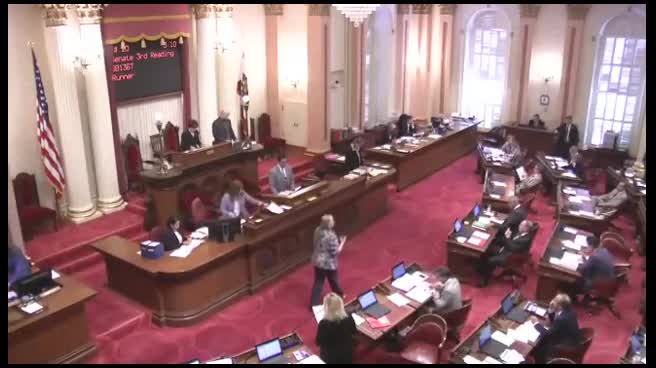
| May 2, 2016 | Senate 3rd Reading SB1367 Runner By Galgiani | Senate Floor |
Passed |
|
| Apr 13, 2016 | Do pass as amended | Senate Standing Committee on Governance and Finance |
Passed |
This list shows positions taken on this bill by organizations on the date displayed, which is linked to the original source.
Positions by individuals are not included.
|
Organization
|
Position
|
Date
|
|---|---|---|
| Association For Los Angeles Deputy Sheriffs | ** Support | Jun 29, 2016 |
| California Association Of Code Enforcement Officers | ** Support | Jun 29, 2016 |
| California Association Of Resource Conservation Districts | * Support | Jun 25, 2018 |
| California College And University Police Chiefs Association | ** Support | Jun 29, 2016 |
| California Police Chiefs Association | * Support | Jun 29, 2016 |
| California Retailers Association | ** Against | Jun 29, 2016 |
| California Travel Association | * Support | Jun 25, 2018 |
| City Of San Diego | * Support | Jun 25, 2018 |
| Crime Victims United Of California | ** Support | Jun 29, 2016 |
| Los Angeles County Professional Peace Officers Association | ** Support | Jun 29, 2016 |
| Los Angeles Police Protective League | ** Support | Jun 29, 2016 |
| Mountains Recreation & Conservation Authority | * Support | Jun 25, 2018 |
| Nature Conservancy | * Support | Jun 25, 2018 |
| Port Of San Diego | * Support | Jun 25, 2018 |
Date of Hearing: June 29, 2016
ASSEMBLY COMMITTEE ON LOCAL GOVERNMENT
Susan Talamantes Eggman, Chair
SBPCA Bill Id:SB 1367
Author:(Runner and Galgiani) – As Amended Ver:May 18, 2016
SENATE VOTE: 38-0
SUBJECT: Harmful substances: local regulation.
SUMMARY: Allows local agencies to regulate the sale of certain harmful substances by ordinance. Specifically, this bill:
- Allows a city, county, or city and county, to regulate the sale of a substance used as a recreational drug that poses a threat to human life or health and a particular risk to minors if the city council (council) or board of supervisors (board) finds, after notice and a public hearing, that each of the following conditions are true:
- The substance is packaged or labeled as a product to be used for purposes other than human consumption, ingestion, inhalation, or dermal application;
- The substance is sold under a product name or label that is clearly identifiable;
- The sale of the substance is not regulated by the state or federal government as toxic to humans and it is not unlawful for any person, firm, or corporation to sell the substance to a person under 18 years of age;
- There is substantial evidence that the substance can cause intoxication, disability, or death if it is ingested, smoked, inhaled, or injected into the human body;
- There is substantial evidence that the substance has in fact been advertised, purchased, sold, or consumed as a recreational drug;
- The unregulated sale of the substance creates a continuing and particular risk to the health and safety of children and young adults in the community; and,
- Regulating the sale of the substance would mitigate the risk to minors in the community.
- Allows, upon finding that all of the above conditions have been met, the council or board to regulate the sale of the substance, identified by a product name or label, following the adoption of an ordinance.
- Allows an ordinance adopted pursuant to this bill to require vendors, no less than 30 days after actual notice, to comply with any of the following conditions:
- Maintain all records of purchase of the substance identified in the ordinance by a product name or label;
- Make inventory of the substance identified in the ordinance by a product name or label available for inspection upon request of a peace officer;
- Store the substance in a secure place that cannot be accessed by minors;
- Maintain a registry of sale to ensure that the substance is not sold to any person under 18 years of age;
- Require payment of a penalty for noncompliance with the ordinance enacted, pursuant to this bill, not to exceed $250 per violation;
- Prohibit the sale of the substance identified in the ordinance by a product name or label to minors; or,
- Any other regulation allowable, pursuant to Section 7 of Article XI of the California Constitution.
EXISTING LAW:
- Allows, pursuant to Section 7 of Article XI of the California Constitution, a city or county to make and enforce within its limits all local, police, sanitary and other ordinances and regulations not in conflict with general laws.
- Classifies drugs into five schedules and provides penalties for possession of and commerce in controlled substances.
- Treats a substance that is the chemical or functional equivalent of a drug listed in Schedule I or II of the controlled substance schedules the same as a scheduled drug, defined as a controlled substance "analog."
- Prohibits the sale of drug paraphernalia unless the paraphernalia is in a separate room inaccessible to minors.
- Provides that any person who possesses for sale, sells or furnishes any synthetic cannabinoid compound shall be punished by imprisonment in the county jail for up to six months, a fine of up to $1,000, or both.
- Provides that any person who sells, dispenses, distributes, or gives the stimulant substances naphthylpyrovalerone or cathinone, or specified variations of these drugs, or who offers to do such acts, is guilty of a misdemeanor, punishable by a jail term of up to six months, a fine of up to $1,000, or both.
FISCAL EFFECT: None
COMMENTS:
- Bill Summary. This bill allows counties and cities to regulate the sale of a substance used as a recreational drug that poses a threat to human life or health and a particular risk to minors. Prior to regulating such sales, the council or board must make seven specified findings regarding the substance to be regulated, after notice and a public hearing. Those seven findings are as follows:
- The substance is packaged or labeled as a product to be used for purposes other than human consumption, ingestion, inhalation, or dermal application;
- The substance is sold under a product name or label that is clearly identifiable;
- The sale of the substance is not regulated by the state or federal government as toxic to humans and it is not unlawful for any person, firm, or corporation to sell the substance to a person under 18 years of age;
- There is substantial evidence that the substance can cause intoxication, disability, or death if it is ingested, smoked, inhaled, or injected into the human body;
- There is substantial evidence that the substance has in fact been advertised, purchased, sold, or consumed as a recreational drug;
- The unregulated sale of the substance creates a continuing and particular risk to the health and safety of children and young adults in the community; and,
- Regulating the sale of the substance would mitigate the risk to minors in the community.
Upon making these findings and after adopting an ordinance, the council or board may regulate the sale of the substance, identified by a product name or label. An ordinance adopted pursuant to this bill may require vendors, no less than 30 days after actual notice, to comply with any of the following conditions:
- Maintain all records of purchase of the substance identified in the ordinance by a product name or label;
- Make inventory of the substance identified in the ordinance by a product name or label available for inspection upon request of a peace officer;
- Store the substance in a secure place that cannot be accessed by minors;
- Maintain a registry of sale to ensure that the substance is not sold to any person under 18 years of age;
- Require payment of a penalty for noncompliance with the ordinance enacted, pursuant to this bill, not to exceed $250 per violation;
- Prohibit the sale of the substance identified in the ordinance by a product name or label to minors; or,
- Any other regulation allowable, pursuant to provisions of the California Constitution , that allow a city or county to make and enforce within its limits all local, police, sanitary and other ordinances and regulations not in conflict with general laws (commonly referred to as "police powers").
This bill is sponsored by the authors.
- Authors' Statement. According to the authors, "California law prohibits the sale of certain synthetic recreational drugs which are labeled 'not for human consumption' but are marketed in a form that can be smoked or vaporized and inhaled. These drugs are often misrepresented as bath salts, incense or bird seed under names like 'spice.' These drugs are called cannabinoids because they are related to the chemicals in marijuana but are often much more toxic.
"The proliferation of recreational drugs and the threat posed to high school aged juveniles has been reflected in the number of emergency room cases triggered by the consumption of 'spice.' Unfortunately once the federal or state government prohibits a substance such as 'spice' a new compound with a slightly difference chemical configuration appears on the market.
"SB 1367 is designed to provide local government with an expedited process for regulating substances harmful to minors when they surface in the community and before the state or federal government have an opportunity to consider prohibiting sale of the new drug."
- Background. Cannabinoids are drugs that bind to certain receptors in the brain – the same receptors to which THC and other drugs obtained from cannabis bind. Synthetic cannabinoids are often inaccurately described as "synthetic marijuana" or "synthetic THC." However, such terms are something of a misnomer because the chemical makeup of synthetic cannabinoids is frequently very different from the chemical composition of THC.
If a synthetic cannabinoid is shown to be chemically equivalent to THC, or if the effects of the drug are equivalent to the effects of THC, conduct involving the synthetic cannabinoid would be subject to prosecution because the drug would be considered an analog of THC. An analog is a drug that is substantially similar in chemical structure or effects to a scheduled drug. Under California law, an analog of a controlled substance is essentially treated as a controlled substance. Because many synthetic cannabinoids may not be similar in properties or chemical structure to THC, the ability of prosecutors to use the analog statute in synthetic cannabinoid cases may be limited.
The diverse chemical structures and effects on a user of synthetic cannabinoids also make it difficult to draft a statute including the drugs in the controlled substance schedules as generic groups or classes of drugs, unlike opiates for example. It has been necessary to name each class or form of similar synthetic cannabinoids, including numerous individual chemicals. There are dozens, if not hundreds, of synthetic cannabinoids on the market.
It has been reported that new forms of synthetic cannabinoids are being developed to avoid detection in drug tests and to induce greater intoxication. Each new form has its own distinctive binding affinity to cannabinoid receptors. First generation synthetic cannabinoids are believed to be more benign than the newer generation cannabinoids, which are more likely to cause cardiotoxicity and neurotoxicity.
Synthetic cannabinoids are not classified by schedule under California law, but are separately defined and prohibited. SB 420 (Hernández), Chapter 420, Statutes of 2011, made certain specific chemical formulations of synthetic cannabinoids illegal to sell or furnish. SB 1283 (Galgiani), Chapter 372, Statutes of 2014, made those chemicals illegal to use or possess as of January 1, 2016. Since they are not scheduled drugs, the laws on analogs of controlled substances do not apply to synthetic cannabinoids.
Synthetic cathinones, commonly called "bath salts," are synthetic equivalents of cathinone, a psychoactive chemical found in the khat plant. State law categorizes bath salts as Schedule II controlled substances (drugs with high potential for abuse), which makes their possession, sale, or transportation illegal and subject to certain penalties. Much like synthetic cannabinoids, the chemical formula for bath salts can be slightly altered to avoid meeting the legal definition of a synthetic cathinone. However, because bath salts are scheduled substances, any analogs of bath salts are also illegal.
Synthetic cannabinoids and bath salts are often sold online or in stores that specialize in the sale of drug paraphernalia, and are purchased by individuals seeking a “legal high.” These products are labeled as “not for human consumption” in an effort to avoid regulation by the Food and Drug Administration.
- Policy Considerations. The Committee may wish to consider the following:
- Is Legislation Necessary? The California Constitution allows a city or county to "make and enforce within its limits, all local, police, sanitary and other ordinances and regulations not in conflict with general laws,” known as the police power of cities. It is from this fundamental power that local governments derive their authority to regulate land use through planning, zoning ordinances, and use permits. Local agencies also use this police power to abate nuisances and protect public health, safety and welfare. Given that local agencies already have this broad authority to regulate, the Committee may wish to consider whether a bill is necessary or whether a city or county can already choose to enact its own local regulations on harmful substances.
- Preemption. The California Supreme Court noted in Candid Enterprises, Inc. v. Grossmont Union High School Dist. (1985) that state law preempts local authority when there is a conflict between the two, either expressly or by legislative implication. An implicit conflict may exist if “the subject matter has been partially covered by general law couched in such terms as to indicate clearly that a paramount state concern will not tolerate further or additional local action.” Cities and counties can already use their police power to regulate synthetic cannabinoids or other harmful substances. By spelling out the ways that locals can regulate these substances, SB 1367 may pose a risk of preempting other local actions.
- Local vs. Statewide Regulation. Many drugs and other potentially harmful substances are regulated statewide, rather than on a jurisdiction by jurisdiction basis. SB 1367 encourages individual local governments to adopt regulations for the sale of potentially harmful substances, but the physiological effects of these drugs don’t vary based on geographic location. SB 1367 raises questions about whether the sale of such substances should be prohibited or regulated on a statewide level.
- Whack-a-Mole. As noted above, the chemical compounds of synthetic cannabinoids are continually changing. While the definitions in this bill may attempt to get around a list of specific chemical compounds that becomes outdated as soon as a new drug is formulated, it is not clear that these broader definitions will help prevent the sale of these substances. If the substance must be "identified by product name or label," it seems a product name or label could be changed as easily as a chemical compound, if not more so, in order to avoid regulation. The Committee may wish to consider if this bill will be effective in helping prevent the sale of these harmful substances.
- Harmless Products. The findings that a local agency governing board must make regarding a targeted substance are vague enough that a local ordinance could unintentionally regulate the sale of some products that actually pose no harm. The Committee may wish to consider if the definitions of this bill are specific enough to avoid this unintended outcome.
- Related Legislation. SB 139 (Galgiani) of 2015 adds an extensive list of specified categories of synthetic cannabinoids, specific formulations of synthetic cathinones, and other specific chemicals to the list of synthetic cannabinoids already prohibited under law. SB 139 is pending in the Assembly Public Safety Committee.
SB 1036 (Hernández) of 2016 makes it a crime to possess, sell, transport, or manufacture an analog of a synthetic cannabinoid compound, and expands the definition of controlled substance analog to include a substance the chemical structure of which is substantially similar to the chemical structure of a synthetic cannabinoid compound. SB 1036 is pending in the Assembly Appropriations Committee.
- Previous Legislation. SB 1283 (Galgiani), Chapter 372, Statutes of 2013, made the use or possession of specified synthetic stimulant compounds or synthetic stimulant derivatives punishable by a fine not exceeding $250.
AB 2420 (Hueso) of 2012 would have created infraction and misdemeanor penalties for possession or use of specified synthetic stimulants and synthetic cannabinoids. AB 2420 was held in the Assembly Public Safety Committee.
AB 486 (Hueso), Chapter 656, Statutes of 2011, prohibited the sale, dispensing, distribution, furnishment, administration or giving, or attempt to do so, of any synthetic stimulant compound of any specified synthetic stimulant derivative. Violation of this section is punishable by imprisonment in a county jail not exceeding six months, or by a fine not exceeding $1,000, or by both that fine and imprisonment.
SB 420 (Hernandez), Chapter 420, Statutes of 2011, prohibited the sale, dispensing, distribution, administration or giving, or attempt to do so, of any synthetic cannabinoid compound or any synthetic cannabinoid derivative. Violation of this section is punishable by imprisonment in a county jail not exceeding six months, or by a fine not exceeding $1,000, or by both that fine and imprisonment.
- Arguments in Support. The Association for Los Angeles Deputy Sheriffs, the California Association of Code Enforcement Officers, the California College and University Police Chiefs Association, the California Narcotic Officers Association, the Los Angeles County Professional Peace Officers Association, the Los Angeles Police Protective League, and the Riverside Sheriffs Association, in support, state, "The proliferation of recreational drugs and the threat posed to high school aged juveniles has been reflected in the number of emergency room cases triggered by the consumption of 'spice' and other cannabinoid compounds. Unfortunately, once the federal or state government prohibits a substance such as 'spice' a new compound with a slightly difference chemical configuration appears on the market. Those who sell these dangerous drugs rely on the difficulty confronting law enforcement before new state legislation can be passed to prohibit the latest 'spice' like chemical compound. SB 1367 is designed to provide local government with an expedited process for regulating substances harmful to minors when they surface in the community."
- Arguments in Opposition. The California Retailers Association, in opposition, writes, "Unfortunately, our membership has faced many challenges complying with local jurisdictions that have enacted differing regulations on various issues in the past, some specifically dealing with product regulation. As national retailers with hundreds of stores operating across the state, our frustration with different requirements cannot be overstated. SB 1367 raises concerns with our membership since the regulation of the sale is open-ended. This could lead to a disjointed approach on how the sale of these substances may be regulated. For example, one jurisdiction may require ID verification while another may require a complete product ban. Furthermore, the regulatory sales approaches could differ depending on the substance. Put simply, SB 1367 could make compliance more difficult than it has to be."
REGISTERED SUPPORT / OPPOSITION:
Support
Association for Los Angeles Deputy Sheriffs
California Association of Code Enforcement Officers
California College and University Police Chiefs Association
California Narcotic Officers Association
California Police Chiefs Association
Crime Victims United of California
Los Angeles County Professional Peace Officers Association
Los Angeles Police Protective League
Riverside Sheriffs Association
Opposition
California Retailers Association
Analysis Prepared by: Angela Mapp / L. GOV. / (916) 319-3958
Office of Senate Floor Analyses (916) 651-1520 Fax: (916) 327-4478 | SB |
THIRD READING
Bill No: SB 1367
ed: 4/20/16
SENATE GOVERNANCE & FIN. COMMITTEE: 6-0, 4/13/16
AYES: Hertzberg, Beall, Hernandez, Lara, Moorlach, Pavley
NO VOTE RECORDED: Nguyen
DIGEST: This bill authorizes local governments to regulate the sale of certain harmful substances by ordinance.
Existing law:
- Allows a city or county to, under the California Constitution:
- Make and enforce within its limits, all local, police, sanitary and other ordinances and regulations not in conflict with general laws, known as the police power of cities.
- Regulate land uses through planning, zoning ordinances, and use permits.
- Abate nuisances and protect public health, safety and welfare.
- Classifies drugs into five schedules—intended to reflect decreasing order of harm and increasing medical utility or safety—and provides penalties for possession of and commerce in controlled substances.
- Treats a substance that is the chemical or functional equivalent of a drug listed in Schedule I or II of the controlled substance schedules the same as a scheduled drug, defined as a controlled substance “analog.”
- Prohibits the sale of drug paraphernalia unless the paraphernalia is in a separate room inaccessible to minors.
This bill:
- Allows a city or county to adopt an ordinance to regulate the sale of substances that pose a threat to human life or health, and a particular risk to minors, if the city council or board of supervisors makes all of the following findings:
- The substance is labeled for purposes other than human consumption.
- The sale of the substance is not already regulated by the state or federal government as toxic to humans.
- The substance can cause intoxication, disability, or death if it enters the human body.
- There is substantial evidence that the substance has been advertised, purchased, or consumed as a recreational drug.
- The unregulated sale of the substance poses a risk to minors in the community.
- Regulating the sale would mitigate the risk to minors.
- Allows the ordinance to require vendors to take actions regarding the sale of the identified substances, specifically to:
- Maintain records of purchase.
- Make inventory available for inspection.
- Secure the substance from access by minors.
- Maintain a registry of sale to ensure that the substance is not sold to any person under 18 years of age.
- Require a penalty for noncompliance of up to $250 per violation.
- Prohibit the sale of the identified substance to minors.
- Regulate the substance in any other manner allowed by the California Constitution.
- Requires a public hearing and notice of the ordinance.
Background
Two types of synthetic drugs have recently risen in prominence: synthetic cannabinoids, and synthetic cathinones (“bath salts”). Synthetic cannabinoids are chemicals that bind to the same receptors in the brain as chemicals in cannabis plants. Synthetic cannabinoids were originally developed in order to conduct basic medical research on the potential for therapeutic uses. However, they were found to have intoxicating effects and began to appear for purchase in the United States in 2008 as products labeled “spice.” Synthetic cannabinoids can have harmful health effects, including seizures, vomiting, and in some cases death. According to a report by the Substance Abuse and Mental Health Administration, synthetic cannabinoids were linked to over 28,000 emergency department visits in 2011, more than a quarter of which involved children ages 12-18.
The chemical formulas of synthetic cannabinoids rapidly change; for example, the number of synthetic cannabinoids tracked by the European Union’s drug jumped from 29 in 2013 to 137 in 2015. This rapid proliferation of chemical formulas makes it difficult to comprehensively ban all synthetic cannabinoids, because once a particular formula is banned, manufacturers tweak the formula to produce a new, uncontrolled cannabinoid.
Synthetic cannabinoids are not classified by schedule under California law, but are separately defined and prohibited. SB 420 (Hernandez, Chapter 420, Statutes of 2011) made certain specific chemical formulations of synthetic cannabinoids illegal to sell or furnish, and SB 1283 (Galgiani, Chapter 372, Statutes of 2014) made those chemicals illegal to use or possess as of January 1, 2016. Since they are not scheduled drugs, the laws on analogs of controlled substances do not apply to synthetic cannabinoids.
Bath salts are synthetic equivalents of cathinone, a psychoactive chemical found in the khat plant. State law categorizes bath salts as Schedule II controlled substances (drugs with high potential for abuse), which makes their possession, sale, or transportation illegal and subject to certain penalties. Much like synthetic cannabinoids, the chemical formula for bath salts can be slightly altered to avoid meeting the legal definition of a synthetic cathinone. However, because bath salts are scheduled substances, any analogs of bath salts are also illegal.
Synthetic cannabinoids and bath salts are often sold online or in stores that specialize in the sale of drug paraphernalia, and are purchased by individuals seeking a “legal high.” These products are labeled as “not for human consumption” in an effort to avoid regulation by the Food and Drug Administration. As a result, minors are frequent consumers of these chemicals. Some officials want to make it easier for local governments to regulate the sale of synthetic cannabinoids and bath salts.
Comments
Purpose of the bill. State law already recognizes the importance of protecting minors from harmful substances. For example, state law prohibits the sale of certain glues to minors because they may cause intoxication and other harms if purposefully inhaled. Synthetic cannabinoids and bath salts pose an even greater danger because the constant changes to formulas mean that the potency and effects of the drugs are unknown to the users. Yet the potential for formula changes also mean that the standard approach to banning these substances is no longer effective. Even where these chemicals may be illegal under California’s drug analog laws, it can be difficult to prosecute a violation because identifying an analog often requires laboratory testing and expert analysis and testimony on chemical structures and the effects of the drug. Small cities and counties may not have the resources or facilities to perform the needed work. SB 1367 provides cities and counties with an additional tool for regulating the sale of these dangerous substances to children. It bridges a gap in state law where harm from these substances may be known to local governments, but state drug laws have not yet caught up. SB 1367 provides local governments with the ability to rapidly respond once a new harmful substance appears in the community.
Sure, but will it work? SB 1367 allows regulation of “identified substances,” but local governments may find it difficult to define the regulated substances in a way that overcomes the constant changes to the chemicals. For example, if a local government identifies bath salts as a harmful substance and regulates their sale, a vendor may change the name under which the substance is marketed. However, an ordinance that covers a broader category, such as harmful substances generally, may violate constitutional due process requirements because a vendor may not be able to know what specific substances are in fact regulated. Local governments may find themselves playing the same game of cat and mouse with vendors of these products that state legislators and regulators currently face.
FISCAL EFFECT: Appropriation: Fiscal Com.: Local:
Association for Los Angeles Deputy Sheriffs
California Association of Code Enforcement Officers
California College and University Police Chiefs Association
California Narcotic Officers Association
Los Angeles County Professional Peace Officers Association
Los Angeles Police Protective League
Riverside Sheriffs Association
OPPOSITION: (Verified 4/19/16)
None received
4/20/16 15:39:02
**** END ****
SENATE COMMITTEE ON GOVERNANCE AND FINANCE
Senator Robert M. Hertzberg, Chair
2015 - 2016 Regular
Bill No: | SB 1367 | Hearing Date: | 4/13/16 |
Author: | Runner | Tax Levy: | No |
Version: | 2/19/16 | Fiscal: | No |
Consultant: | Favorini-Csorba | ||
Harmful substances: local regulation
Authorizes local governments to regulate the sale of certain harmful substances by ordinance.
Background
The California Constitution allows a city or county to "make and enforce within its limits, all local, police, sanitary and other ordinances and regulations not in conflict with general laws, known as the police power of cities." It is from this fundamental power that local governments derive their authority to regulate land uses through planning, zoning ordinances, and use permits. Local agencies also use this police power to abate nuisances and protect public health, safety and welfare.
The Uniform Controlled Substances Act classifies drugs into five schedules—intended to reflect decreasing order of harm and increasing medical utility or safety—and provides penalties for possession of and commerce in controlled substances. California law treats a substance that is the chemical or functional equivalent of a drug listed in Schedule I or II of the controlled substance schedules the same as a scheduled drug. Such a drug is defined as a controlled substance “analog.” Schedule I drugs are deemed to have no medical utility and a high potential for abuse. Schedule II drugs have legitimate medical uses, but also a high potential for abuse and are potentially dangerous. State law also prohibits the sale of drug paraphernalia unless the paraphernalia is in a separate room inaccessible to minors.
Two types of synthetic drugs have recently risen in prominence: synthetic cannabinoids, and synthetic cathinones (“bath salts”). Synthetic cannabinoids are chemicals that bind to the same receptors in the brain as chemicals in cannabis plants. Synthetic cannabinoids were originally developed in order to conduct basic medical research on the potential for therapeutic uses. However, they were found to have intoxicating effects and began to appear for purchase in the United States in 2008 as products labeled “spice.” Synthetic cannabinoids can have harmful health effects, including seizures, vomiting, and in some cases death. According to a report by the Substance Abuse and Mental Health Administration, synthetic cannabinoids were linked to over 28,000 emergency department visits in 2011, more than a quarter of which involved children ages 12-18.
The chemical formulas of synthetic cannabinoids rapidly change; for example, the number of synthetic cannabinoids tracked by the European Union’s drug jumped from 29 in 2013 to 137 in 2015. This rapid proliferation of chemical formulas makes it difficult to comprehensively ban all synthetic cannabinoids, because once a particular formula is banned, manufacturers tweak the formula to produce a new, uncontrolled cannabinoid.
Synthetic cannabinoids are not classified by schedule under California law, but are separately defined and prohibited. SB 420 (Hernandez, 2011) made certain specific chemical formulations of synthetic cannabinoids illegal to sell or furnish, and SB 1283 (Galgiani, 2014) made those chemicals illegal to use or possess as of January 1, 2016. Since they are not scheduled drugs, the laws on analogs of controlled substances do not apply to synthetic cannabinoids.
Bath salts are synthetic equivalents of cathinone, a psychoactive chemical found in the khat plant. State law categorizes bath salts as Schedule II controlled substances (drugs with high potential for abuse), which makes their possession, sale, or transportation illegal and subject to certain penalties. Much like synthetic cannabinoids, the chemical formula for bath salts can be slightly altered to avoid meeting the legal definition of a synthetic cathinone. However, because bath salts are scheduled substances, any analogs of bath salts are also illegal.
Synthetic cannabinoids and bath salts are often sold online or in stores that specialize in the sale of drug paraphernalia, and are purchased by individuals seeking a “legal high.” These products are labeled as “not for human consumption” in an effort to avoid regulation by the Food and Drug Administration. As a result, minors are frequent consumers of these chemicals. Some officials want to make it easier for local governments to regulate the sale of synthetic cannabinoids and bath salts.
Proposed Law
Senate Bill 1367 allows a city or county to adopt an ordinance to regulate the sale of substances that pose a threat to human life or health, and a particular risk to minors, if the city council or board of supervisors makes all of the following findings:
- The substance is labeled for purposes other than human consumption.
- The sale of the substance is not already regulated by the state or federal government as toxic to humans.
- The substance can cause intoxication, disability, or death if it enters the human body.
- There is substantial evidence that the substance has been advertised, purchased, or consumed as a recreational drug.
- The unregulated sale of the substance poses a risk to minors in the community.
- Regulating the sale would mitigate the risk to minors.
The ordinance may require vendors to take actions regarding the sale of the identified substances, specifically to: (1) maintain records of purchase, (2) make inventory available for inspection, (3) secure the substance from access by minors, (4) maintain a registry of sale to ensure that the substance is not sold to any person under 18 years of age, or (5) require a penalty for noncompliance of up to $250 per violation. SB 1367 also requires a public hearing and notice of the ordinance.
State Revenue Impact
No estimate.
Comments
1. Purpose of the bill. State law already recognizes the importance of protecting minors from harmful substances. For example, state law prohibits the sale of certain glues to minors because they may cause intoxication and other harms if purposefully inhaled. Synthetic cannabinoids and bath salts pose an even greater danger because the constant changes to formulas mean that the potency and effects of the drugs are unknown to the users. Yet the potential for formula changes also mean that the standard approach to banning these substances is no longer effective. Even where these chemicals may be illegal under California’s drug analog laws, it can be difficult to prosecute a violation because identifying an analog often requires laboratory testing and expert analysis and testimony on chemical structures and the effects of the drug. Small cities and counties may not have the resources or facilities to perform the needed work. SB 1367 provides cities and counties with an additional tool for regulating the sale of these dangerous substances to children. It bridges a gap in state law where harm from these substances may be known to local governments, but state drug laws have not yet caught up. SB 1367 provides local governments with the ability to rapidly respond once a new harmful substance appears in the community.
2. Preemption. The California Supreme Court noted in Candid Enterprises, Inc. v. Grossmont Union High School Dist. (1985) that state law preempts local authority when there is a conflict between the two, either expressly or by legislative implication. An implicit conflict may exist if “the subject matter has been partially covered by general law couched in such terms as to indicate clearly that a paramount state concern will not tolerate further or additional local action.” Cities and counties can already use their police power to regulate synthetic cannabinoids or other harmful substances. By spelling out the ways that locals can regulate these substances, SB 1367 may pose a risk of preempting other local actions. In addition, SB 1367 does not explicitly include the authority to prohibit the sale of an identified substance to minors as a condition a local government can impose on vendors. In order to ensure that local authority to enact other regulations of these substances remains intact and that local governments are clear on the authority that the bill provides them, the Committee may wish to consider amending SB 1367 to expressly recognize other potential local regulations and to explicitly allow cities and counties to prohibit the sale of these substances to minors.
3. Sure, but will it work? SB 1367 allows regulation of “identified substances,” but local governments may find it difficult to define the regulated substances in a way that overcomes the constant changes to the chemicals. For example, if a local government identifies bath salts as a harmful substance and regulates their sale, a vendor may change the name under which the substance is marketed. However, an ordinance that covers a broader category, such as harmful substances generally, may violate constitutional due process requirements because a vendor may not be able to know what specific substances are in fact regulated. Local governments may find themselves playing the same game of cat and mouse with vendors of these products that state legislators and regulators currently face.
4. Regulators, mount up. Many drugs and other potentially harmful substances are regulated statewide, rather than on a jurisdiction by jurisdiction basis. SB 1367 encourages individual local governments to adopt regulations for the sale of potentially harmful substances, but the physiological effects of these drugs don’t vary based on geographic location. SB 1367 raises questions about whether the sale of such substances should be prohibited or regulated on a statewide level.
5. Related legislation. Two bills in the current legislative session attempt to comprehensively outlaw synthetic cannabinoids and other synthetic drugs. SB 139 (Galgiani, 2015) adds an extensive list of specified categories of synthetic cannabinoids, specific formulations of synthetic cathinones, and other specific chemicals to the list of synthetic cannabinoids already prohibited under law. SB 1036 (Hernandez, 2016) makes illegal analogs of synthetic cannabinoids, as defined in existing law, in the same way as analogs of scheduled drugs.
Support and Opposition
(4/7/16)
Support: Association for Los Angeles Deputy Sheriffs; California Association of Code Enforcement Officers; California College and University Police Chiefs Association; California Narcotic Officers Association; Los Angeles County Professional Peace Officers Association; Los Angeles Police Protective League; Riverside Sheriffs Association.
Opposition: Unknown.
-- END --
Discussed in Hearing
 4MIN
Assembly Standing Committee on Natural Resources
 8MIN
Assembly Standing Committee on Local Government
 2MIN
Senate Floor


Bill Co-Author(s):