SB 1458: Property taxation: exemptions: disabled veterans.
- Session Year: 2015-2016
- House: Senate
- Latest Version Date: 2016-09-30
Existing property tax law provides, pursuant to the authorization of the California Constitution, a disabled veterans property tax exemption for the principal place of residence of a veteran or a veterans spouse, including an unmarried surviving spouse, if the veteran, because of an injury incurred in military service, is blind in both eyes, has lost the use of 2 or more limbs, or is totally disabled, as those terms are defined, or if the veteran has, as a result of a service-connected injury or disease, died while on active duty in military service. That law defines a veteran for its purposes as a person who, among other things, is serving in or has served in and has been discharged under honorable conditions from service in the United States Army, Navy, Air Force, Marine Corps, or Coast Guard.
This bill, for property tax lien dates for the 201718 fiscal year and each fiscal year thereafter, would expand that definition of veteran to include a person who has been discharged in other than dishonorable conditions from service under those same conditions and who has been determined by the United States Department of Veterans Affairs to be eligible for federal veterans health and medical benefits.
Existing property tax law allows the correction of certain errors resulting in incorrect entries on the property tax roll within 4 years after the making of the assessment.
This bill would extend the time for correcting errors to the roll related to the disabled veterans exemption to 8 years.
Existing law requires property taxes to be refunded upon the filing of a claim within 8 years after making the payment sought to be refunded if the claim relates to the disabled veterans exemption.
This bill would instead require a refund on a claim filed within 8 years after making the payment sought to be refunded, or within 60 days of the date of a specified notice, whichever is later.
Existing property tax law authorizes any taxes paid before or after delinquency to be refunded by the county tax collector within 4 years after the date of payment under specified conditions.
This bill would authorize any taxes paid before or after delinquency to be refunded by the county tax collector within 8 years after the date of payment if the amount paid exceeds the amount due on the property as a result of corrections to the roll that relate to the disabled veterans exemption.
By changing the manner in which local county officials administer property tax refunds with respect to the disabled veterans exemption, this bill would impose a state-mandated local program.
The California Constitution requires the state to reimburse local agencies and school districts for certain costs mandated by the state. Statutory provisions establish procedures for making that reimbursement.
This bill would provide that, if the Commission on State Mandates determines that the bill contains costs mandated by the state, reimbursement for those costs shall be made pursuant to these statutory provisions.
Section 2229 of the Revenue and Taxation Code requires the Legislature to reimburse local agencies annually for certain property tax revenues lost as a result of any exemption or classification of property for purposes of ad valorem property taxation.
This bill would provide that, notwithstanding Section 2229 of the Revenue and Taxation Code, no appropriation is made and the state shall not reimburse local agencies for property tax revenues lost by them pursuant to the bill.
This bill would take effect immediately as a tax levy.
Existing property tax law provides, pursuant to the authorization of the California Constitution, a disabled veterans property tax exemption for the principal place of residence of a veteran or a veterans spouse, including an unmarried surviving spouse, if the veteran, because of an injury incurred in military service, is blind in both eyes, has lost the use of 2 or more limbs, or is totally disabled, as those terms are defined, or if the veteran has, as a result of a service-connected injury or disease, died while on active duty in military service. That law defines a veteran for its purposes as a person who, among other things, is serving in or has served in and has been discharged under honorable conditions from service in the United States Army, Navy, Air Force, Marine Corps, or Coast Guard.
This bill, for property tax lien dates for the 201718 fiscal year and each fiscal year thereafter, would expand that definition of veteran to include a person who has been discharged in other than dishonorable conditions from service under those same conditions and who has been determined by the United States Department of Veterans Affairs to be eligible for federal veterans health and medical benefits.
Existing property tax law allows the correction of certain errors resulting in incorrect entries on the property tax roll within 4 years after the making of the assessment.
This bill would extend the time for correcting errors to the roll related to the disabled veterans exemption to 8 years.
Existing law requires property taxes to be refunded upon the filing of a claim within 8 years after making the payment sought to be refunded if the claim relates to the disabled veterans exemption.
This bill would instead require a refund on a claim filed within 8 years after making the payment sought to be refunded, or within 60 days of the date of a specified notice, whichever is later.
Existing property tax law authorizes any taxes paid before or after delinquency to be refunded by the county tax collector within 4 years after the date of payment under specified conditions.
This bill would authorize any taxes paid before or after delinquency to be refunded by the county tax collector within 8 years after the date of payment if the amount paid exceeds the amount due on the property as a result of corrections to the roll that relate to the disabled veterans exemption.
By changing the manner in which local county officials administer property tax refunds with respect to the disabled veterans exemption, this bill would impose a state-mandated local program.
The California Constitution requires the state to reimburse local agencies and school districts for certain costs mandated by the state. Statutory provisions establish procedures for making that reimbursement.
This bill would provide that, if the Commission on State Mandates determines that the bill contains costs mandated by the state, reimbursement for those costs shall be made pursuant to these statutory provisions.
Section 2229 of the Revenue and Taxation Code requires the Legislature to reimburse local agencies annually for certain property tax revenues lost as a result of any exemption or classification of property for purposes of ad valorem property taxation.
This bill would provide that, notwithstanding Section 2229 of the Revenue and Taxation Code, no appropriation is made and the state shall not reimburse local agencies for property tax revenues lost by them pursuant to the bill.
This bill would take effect immediately as a tax levy.
Existing property tax law provides, pursuant to the authorization of the California Constitution, a disabled veterans property tax exemption for the principal place of residence of a veteran or a veterans spouse, including an unmarried surviving spouse, if the veteran, because of an injury incurred in military service, is blind in both eyes, has lost the use of 2 or more limbs, or is totally disabled, as those terms are defined, or if the veteran has, as a result of a service-connected injury or disease, died while on active duty in military service. That law defines a veteran for its purposes as a person who, among other things, is serving in or has served in and has been discharged under honorable conditions from service in the United States Army, Navy, Air Force, Marine Corps, or Coast Guard.
This bill, for property tax lien dates for the 2017 18 fiscal year and each fiscal year thereafter, would expand that definition of veteran to include a person who has been discharged in other than dishonorable conditions from service under those same conditions and who has been determined by the United States Department of Veterans Affairs to be eligible for federal veterans health and medical benefits.
Existing property tax law allows the correction of certain errors resulting in incorrect entries on the property tax roll within 4 years after the making of the assessment.
This bill would extend the time for correcting errors to the roll related to the disabled veterans exemption to 8 years.
Existing law requires property taxes to be refunded upon the filing of a claim within 8 years after making the payment sought to be refunded if the claim relates to the disabled veterans exemption.
This bill would instead require a refund on a claim filed within 8 years after making the payment sought to be refunded, or within 60 days of the date of a specified notice, whichever is later.
Existing property tax law authorizes any taxes paid before or after delinquency to be refunded by the county tax collector within 4 years after the date of payment under specified conditions.
This bill would authorize any taxes paid before or after delinquency to be refunded by the county tax collector within 8 years after the date of payment if the amount paid exceeds the amount due on the property as a result of corrections to the roll that relate to the disabled veterans exemption.
By changing the manner in which local county officials administer property tax refunds with respect to the disabled veterans exemption, this bill would impose a state-mandated local program.
The California Constitution requires the state to reimburse local agencies and school districts for certain costs mandated by the state. Statutory provisions establish procedures for making that reimbursement.
This bill would provide that, if the Commission on State Mandates determines that the bill contains costs mandated by the state, reimbursement for those costs shall be made pursuant to these statutory provisions.
The California Constitution requires the state to reimburse local agencies and school districts for certain costs mandated by the state. Statutory provisions establish procedures for making that reimbursement.
This bill would provide that, if the Commission on State Mandates determines that the bill contains costs mandated by the state, reimbursement for those costs shall be made pursuant to these statutory provisions.
Section 2229 of the Revenue and Taxation Code requires the Legislature to reimburse local agencies annually for certain property tax revenues lost as a result of any exemption or classification of property for purposes of ad valorem property taxation.
This bill would provide that, notwithstanding Section 2229 of the Revenue and Taxation Code, no appropriation is made and the state shall not reimburse local agencies for property tax revenues lost by them pursuant to the bill.
This bill would take effect immediately as a tax levy.
Existing property tax law provides, pursuant to the authorization of the California Constitution, a disabled veterans property tax exemption for the principal place of residence of a veteran or a veterans spouse, including an unmarried surviving spouse, if the veteran, because of an injury incurred in military service, is blind in both eyes, has lost the use of 2 or more limbs, or is totally disabled, as those terms are defined, or if the veteran has, as a result of a service-connected injury or disease, died while on active duty in military service. That law defines a veteran for its purposes as a person who, among other things, is serving in or has served in and has been discharged under honorable conditions from service in the United States Army, Navy, Air Force, Marine Corps, or Coast Guard.
This bill bill, for property tax lien dates for the 2017 18 fiscal year and each fiscal year thereafter, would expand that definition of veteran to include a person who has been discharged in other than dishonorable conditions from service under those same conditions and who has been determined by the United States Department of Veterans Affairs to be eligible for federal veterans health and medical benefits.
Section 2229 of the Revenue and Taxation Code requires the Legislature to reimburse local agencies annually for certain property tax revenues lost as a result of any exemption or classification of property for purposes of ad valorem property taxation.
This bill would provide that, notwithstanding Section 2229 of the Revenue and Taxation Code, no appropriation is made and the state shall not reimburse local agencies for property tax revenues lost by them pursuant to the bill.
This bill would take effect immediately as a tax levy.
Existing property tax law provides, pursuant to the authorization of the California Constitution, a disabled veterans property tax exemption for the principal place of residence of a veteran or a veterans spouse, including an unmarried surviving spouse, if the veteran, because of an injury incurred in military service, is blind in both eyes, has lost the use of 2 or more limbs, or is totally disabled, as those terms are defined, or if the veteran has, as a result of a service-connected injury or disease, died while on active duty in military service. That law defines a veteran for its purposes as a person who, among other things, is serving in or has served in and has been discharged under honorable conditions from service in the United States Army, Navy, Air Force, Marine Corps, or Coast Guard.
This bill would expand that definition of veteran to include a person who has been discharged in other than dishonorable conditions from service under those same conditions. conditions and who has been determined by the United States Department of Veterans Affairs to be eligible for federal veterans health and medical benefits.
Section 2229 of the Revenue and Taxation Code requires the Legislature to reimburse local agencies annually for certain property tax revenues lost as a result of any exemption or classification of property for purposes of ad valorem property taxation.
This bill would provide that, notwithstanding Section 2229 of the Revenue and Taxation Code, no appropriation is made and the state shall not reimburse local agencies for property tax revenues lost by them pursuant to the bill.
This bill would take effect immediately as a tax levy.
Existing property tax law provides, pursuant to the authorization of the California Constitution, a disabled veterans property tax exemption for the principal place of residence of a veteran or a veterans spouse, including an unmarried surviving spouse, if the veteran, because of an injury incurred in military service, is blind in both eyes, has lost the use of 2 or more limbs, or is totally disabled, as those terms are defined, or if the veteran has, as a result of a service-connected injury or disease, died while on active duty in military service. That law defines a veteran for its purposes as a person who, among other things, is serving in or has served in and has been discharged under honorable conditions from service in the United States Army, Navy, Air Force, Marine Corps, or Coast Guard.
This bill would expand that definition of veteran to include a person who has been discharged in other than dishonorable conditions from service under those same conditions.
Section 2229 of the Revenue and Taxation Code requires the Legislature to reimburse local agencies annually for certain property tax revenues lost as a result of any exemption or classification of property for purposes of ad valorem property taxation.
This bill would provide that, notwithstanding Section 2229 of the Revenue and Taxation Code, no appropriation is made and the state shall not reimburse local agencies for property tax revenues lost by them pursuant to the bill.
This bill would take effect immediately as a tax levy.
(a)Property that constitutes the principal place of residence of a veteran, that is owned by the veteran, the veterans spouse, or the veteran and the veterans spouse jointly, is exempted from taxation on that part of the full value of the residence that does not exceed one hundred thousand dollars ($100,000), as adjusted for the relevant assessment year as provided in subdivision (h), if the veteran is blind in both eyes, has lost the use of two or more limbs, or if the veteran is totally disabled as a result of injury or disease incurred in military service. The one hundred thousand dollar ($100,000) exemption shall be one hundred fifty thousand dollars ($150,000), as adjusted for the relevant assessment year as provided in subdivision (h), in the case of an eligible veteran whose household income does not exceed the amount of forty thousand dollars ($40,000), as adjusted for the relevant assessment year as provided in subdivision (g).
(b)(1)For purposes of this section, veteran means either of the following:
(A)A person who is serving in or has served in and has been discharged under other than dishonorable conditions from service in the United States Army, Navy, Air Force, Marine Corps, or Coast Guard, and served either in time of war or in time of peace in a campaign or expedition for which a medal has been issued by Congress, or in time of peace and because of a service-connected disability was released from active duty, and who has been determined by the United States Department of Veterans Affairs to be eligible for federal veterans health and medical benefits.
(B)Any person who would qualify as a veteran pursuant to subparagraph (A) except that he or she has, as a result of a service-connected injury or disease, died while on active duty in military service. The United States Department of Veterans Affairs shall determine whether an injury or disease is service connected.
(2)For purposes of this section, property is deemed to be the principal place of residence of a veteran, disabled as described in subdivision (a), who is confined to a hospital or other care facility, if that property would be that veterans principal place of residence were it not for his or her confinement to a hospital or other care facility, provided that the residence is not rented or leased to a third party. For purposes of this paragraph, a family member who resides at the residence is not a third party.
(c)(1)Property that is owned by, and that constitutes the principal place of residence of, the unmarried surviving spouse of a deceased veteran is exempt from taxation on that part of the full value of the residence that does not exceed one hundred thousand dollars ($100,000), as adjusted for the relevant assessment year as provided in subdivision (h), in the case of a veteran who was blind in both eyes, had lost the use of two or more limbs, or was totally disabled provided that either of the following conditions is met:
(A)The deceased veteran during his or her lifetime qualified for the exemption pursuant to subdivision (a), or would have qualified for the exemption under the laws effective on January 1, 1977, except that the veteran died prior to January 1, 1977.
(B)The veteran died from a disease that was service connected as determined by the United States Department of Veterans Affairs.
The one hundred thousand dollar ($100,000) exemption shall be one hundred fifty thousand dollars ($150,000), as adjusted for the relevant assessment year as provided in subdivision (h), in the case of an eligible unmarried surviving spouse whose household income does not exceed the amount of forty thousand dollars ($40,000), as adjusted for the relevant assessment year as provided in subdivision (g).
(2)Commencing with the 199495 fiscal year, property that is owned by, and that constitutes the principal place of residence of, the unmarried surviving spouse of a veteran as described in subparagraph (B) of paragraph (1) of subdivision (b) is exempt from taxation on that part of the full value of the residence that does not exceed one hundred thousand dollars ($100,000), as adjusted for the relevant assessment year as provided in subdivision (h). The one hundred thousand dollar ($100,000) exemption shall be one hundred fifty thousand dollars ($150,000), as adjusted for the relevant assessment year as provided in subdivision (h), in the case of an eligible unmarried surviving spouse whose household income does not exceed the amount of forty thousand dollars ($40,000), as adjusted for the relevant assessment year as provided in subdivision (g).
(3)Beginning with the 201213 fiscal year and for each fiscal year thereafter, property is deemed to be the principal place of residence of the unmarried surviving spouse of a deceased veteran, who is confined to a hospital or other care facility, if that property would be the unmarried surviving spouses principal place of residence were it not for his or her confinement to a hospital or other care facility, provided that the residence is not rented or leased to a third party. For purposes of this paragraph, a family member who resides at the residence is not a third party.
(d)As used in this section, property that is owned by a veteran or property that is owned by the veterans unmarried surviving spouse includes all of the following:
(1)Property owned by the veteran with the veterans spouse as a joint tenancy, tenancy in common, or as community property.
(2)Property owned by the veteran or the veterans spouse as separate property.
(3)Property owned with one or more other persons to the extent of the interest owned by the veteran, the veterans spouse, or both the veteran and the veterans spouse.
(4)Property owned by the veterans unmarried surviving spouse with one or more other persons to the extent of the interest owned by the veterans unmarried surviving spouse.
(5)So much of the property of a corporation as constitutes the principal place of residence of a veteran or a veterans unmarried surviving spouse when the veteran, or the veterans spouse, or the veterans unmarried surviving spouse is a shareholder of the corporation and the rights of shareholding entitle one to the possession of property, legal title to which is owned by the corporation. The exemption provided by this paragraph shall be shown on the local roll and shall reduce the full value of the corporate property. Notwithstanding any law or articles of incorporation or bylaws of a corporation described in this paragraph, any reduction of property taxes paid by the corporation shall reflect an equal reduction in any charges by the corporation to the person who, by reason of qualifying for the exemption, made possible the reduction for the corporation.
(e)For purposes of this section, being blind in both eyes means having a visual acuity of 5/200 or less, or concentric contraction of the visual field to 5 degrees or less; losing the use of a limb means that the limb has been amputated or its use has been lost by reason of ankylosis, progressive muscular dystrophies, or paralysis; and being totally disabled means that the United States Department of Veterans Affairs or the military service from which the veteran was discharged has rated the disability at 100 percent or has rated the disability compensation at 100 percent by reason of being unable to secure or follow a substantially gainful occupation.
(f)An exemption granted to a claimant pursuant to this section shall be in lieu of the veterans exemption provided by subdivisions (o), (p), (q), and (r) of Section 3 of Article XIII of the California Constitution and any other real property tax exemption to which the claimant may be entitled. No other real property tax exemption may be granted to any other person with respect to the same residence for which an exemption has been granted pursuant to this section; provided, that if two or more veterans qualified pursuant to this section coown a property in which they reside, each is entitled to the exemption to the extent of his or her interest.
(g)Commencing on January 1, 2002, and for each assessment year thereafter, the household income limit shall be compounded annually by an inflation factor that is the annual percentage change, measured from February to February of the two previous assessment years, rounded to the nearest one-thousandth of 1 percent, in the California Consumer Price Index for all items, as determined by the California Department of Industrial Relations.
(h)Commencing on January 1, 2006, and for each assessment year thereafter, the exemption amounts set forth in subdivisions (a) and (c) shall be compounded annually by an inflation factor that is the annual percentage change, measured from February to February of the two previous assessment years, rounded to the nearest one-thousandth of 1 percent, in the California Consumer Price Index for all items, as determined by the California Department of Industrial Relations.
(i)The amendments made to this section by the act adding this subdivision shall apply for property tax lien dates for the 201718 fiscal year and for each fiscal year thereafter.
SEC. 2.Section 4831.1 is added to the Revenue and Taxation Code, to read:4831.1.Notwithstanding any other law, corrections to the roll that relate to the disabled veterans exemption described in Section 205.5 may be corrected within eight years after the making of the assessment being corrected.
SEC. 3.Section 5097 of the Revenue and Taxation Code is amended to read:5097.(a)An order for a refund under this article shall not be made, except on a claim:
(1)Verified by the person who paid the tax, his or her guardian, executor, or administrator.
(2)Except as provided in paragraph (3) or (4), filed within four years after making the payment sought to be refunded, or within one year after the mailing of notice as prescribed in Section 2635, or the period agreed to as provided in Section 532.1, or within 60 days of the date of the notice prescribed by subdivision (a) of Section 4836, whichever is later.
(3)(A)Filed within one year, if an application for a reduction in an assessment or an application for equalization of an assessment has been filed pursuant to Section 1603 and the applicant does not state in the application that the application is intended to constitute a claim for a refund, of either of the following events, whichever occurs first:
(i)After the county assessment appeals board makes a final determination on the application for reduction in assessment or on the application for equalization of an escape assessment of the property, and mails a written notice of its determination to the applicant and the notice does not advise the applicant to file a claim for refund.
(ii)After the expiration of the time period specified in subdivision (c) of Section 1604 if the county assessment appeals board fails to hear evidence and fails to make a final determination on the application for reduction in assessment or on the application for equalization of an escape assessment of the property.
(B)Filed within six months, if an application for a reduction in an assessment or an application for equalization of an assessment has been filed pursuant to Section 1603 and the applicant does not state in the application that the application is intended to constitute a claim for a refund, after the county assessment appeals board makes a final determination on the application for reduction in assessment or on the application for equalization of an escape assessment, and mails a written notice of its determination to the applicant and the notice advises the applicant to file a claim for refund within six months of the date of the county assessment appeals boards final determination.
(4)Filed within eight years after making the payment sought to be refunded, or within 60 days of the notice prescribed by subdivision (a) of Section 4836, whichever is later, if the claim for refund is filed on or after January 1, 2015, and relates to the disabled veterans exemption described in Section 205.5.
(b)An application for a reduction in an assessment filed pursuant to Section 1603 shall also constitute a sufficient claim for refund under this section if the applicant states in the application that the application is intended to constitute a claim for refund. If the applicant does not so state, he or she may thereafter and within the period provided in paragraph (3) of subdivision (a) file a separate claim for refund of taxes extended on the assessment which the applicant applied to have reduced pursuant to Section 1603 or Section 1604.
(c)If an application for equalization of an escape assessment is filed pursuant to Section 1603, a claim may be filed on any taxes resulting from the escape assessment or the original assessment to which the escape relates within the period provided in paragraph (3) of subdivision (a).
(d)The amendments made to this section by the act adding this subdivision shall apply to claims for refund filed on or after January 1, 2015.
SEC. 4.Section 5097.3 is added to the Revenue and Taxation Code, to read:5097.3.Notwithstanding any other law, any taxes paid before or after delinquency may be refunded by the county tax collector or the county auditor, within eight years after the date of payment, if the amount paid exceeds the amount due on the property as the result of corrections to the roll that relate to the disabled veterans exemption described in Section 205.5.
SEC. 5.If the Commission on State Mandates determines that this act contains costs mandated by the state, reimbursement to local agencies and school districts for those costs shall be made pursuant to Part 7 (commencing with Section 17500) of Division 4 of Title 2 of the Government Code.
SEC. 6.Notwithstanding Section 2229 of the Revenue and Taxation Code, no appropriation is made by this act and the state shall not reimburse any local agency for any property tax revenues lost by it pursuant to this act.
SEC. 7.This act provides for a tax levy within the meaning of Article IV of the Constitution and shall go into immediate effect.
(a)Property that constitutes the principal place of residence of a veteran, that is owned by the veteran, the veterans spouse, or the veteran and the veterans spouse jointly, is exempted from taxation on that part of the full value of the residence that does not exceed one hundred thousand dollars ($100,000), as adjusted for the relevant assessment year as provided in subdivision (h), if the veteran is blind in both eyes, has lost the use of two or more limbs, or if the veteran is totally disabled as a result of injury or disease incurred in military service. The one hundred thousand dollar ($100,000) exemption shall be one hundred fifty thousand dollars ($150,000), as adjusted for the relevant assessment year as provided in subdivision (h), in the case of an eligible veteran whose household income does not exceed the amount of forty thousand dollars ($40,000), as adjusted for the relevant assessment year as provided in subdivision (g).
(b)(1)For purposes of this section, veteran means either of the following:
(A)A person who is serving in or has served in and has been discharged under other than dishonorable conditions from service in the United States Army, Navy, Air Force, Marine Corps, or Coast Guard, and served either in time of war or in time of peace in a campaign or expedition for which a medal has been issued by Congress, or in time of peace and because of a service-connected disability was released from active duty, and who has been determined by the United States Department of Veterans Affairs to be eligible for federal veterans health and medical benefits.
(B)Any person who would qualify as a veteran pursuant to subparagraph (A) except that he or she has, as a result of a service-connected injury or disease, died while on active duty in military service. The United States Department of Veterans Affairs shall determine whether an injury or disease is service connected.
(2)For purposes of this section, property is deemed to be the principal place of residence of a veteran, disabled as described in subdivision (a), who is confined to a hospital or other care facility, if that property would be that veterans principal place of residence were it not for his or her confinement to a hospital or other care facility, provided that the residence is not rented or leased to a third party. For purposes of this paragraph, a family member who resides at the residence is not a third party.
(c)(1)Property that is owned by, and that constitutes the principal place of residence of, the unmarried surviving spouse of a deceased veteran is exempt from taxation on that part of the full value of the residence that does not exceed one hundred thousand dollars ($100,000), as adjusted for the relevant assessment year as provided in subdivision (h), in the case of a veteran who was blind in both eyes, had lost the use of two or more limbs, or was totally disabled provided that either of the following conditions is met:
(A)The deceased veteran during his or her lifetime qualified for the exemption pursuant to subdivision (a), or would have qualified for the exemption under the laws effective on January 1, 1977, except that the veteran died prior to January 1, 1977.
(B)The veteran died from a disease that was service connected as determined by the United States Department of Veterans Affairs.
The one hundred thousand dollar ($100,000) exemption shall be one hundred fifty thousand dollars ($150,000), as adjusted for the relevant assessment year as provided in subdivision (h), in the case of an eligible unmarried surviving spouse whose household income does not exceed the amount of forty thousand dollars ($40,000), as adjusted for the relevant assessment year as provided in subdivision (g).
(2)Commencing with the 199495 fiscal year, property that is owned by, and that constitutes the principal place of residence of, the unmarried surviving spouse of a veteran as described in subparagraph (B) of paragraph (1) of subdivision (b) is exempt from taxation on that part of the full value of the residence that does not exceed one hundred thousand dollars ($100,000), as adjusted for the relevant assessment year as provided in subdivision (h). The one hundred thousand dollar ($100,000) exemption shall be one hundred fifty thousand dollars ($150,000), as adjusted for the relevant assessment year as provided in subdivision (h), in the case of an eligible unmarried surviving spouse whose household income does not exceed the amount of forty thousand dollars ($40,000), as adjusted for the relevant assessment year as provided in subdivision (g).
(3)Beginning with the 201213 fiscal year and for each fiscal year thereafter, property is deemed to be the principal place of residence of the unmarried surviving spouse of a deceased veteran, who is confined to a hospital or other care facility, if that property would be the unmarried surviving spouses principal place of residence were it not for his or her confinement to a hospital or other care facility, provided that the residence is not rented or leased to a third party. For purposes of this paragraph, a family member who resides at the residence is not a third party.
(d)As used in this section, property that is owned by a veteran or property that is owned by the veterans unmarried surviving spouse includes all of the following:
(1)Property owned by the veteran with the veterans spouse as a joint tenancy, tenancy in common, or as community property.
(2)Property owned by the veteran or the veterans spouse as separate property.
(3)Property owned with one or more other persons to the extent of the interest owned by the veteran, the veterans spouse, or both the veteran and the veterans spouse.
(4)Property owned by the veterans unmarried surviving spouse with one or more other persons to the extent of the interest owned by the veterans unmarried surviving spouse.
(5)So much of the property of a corporation as constitutes the principal place of residence of a veteran or a veterans unmarried surviving spouse when the veteran, or the veterans spouse, or the veterans unmarried surviving spouse is a shareholder of the corporation and the rights of shareholding entitle one to the possession of property, legal title to which is owned by the corporation. The exemption provided by this paragraph shall be shown on the local roll and shall reduce the full value of the corporate property. Notwithstanding any law or articles of incorporation or bylaws of a corporation described in this paragraph, any reduction of property taxes paid by the corporation shall reflect an equal reduction in any charges by the corporation to the person who, by reason of qualifying for the exemption, made possible the reduction for the corporation.
(e)For purposes of this section, being blind in both eyes means having a visual acuity of 5/200 or less, or concentric contraction of the visual field to 5 degrees or less; losing the use of a limb means that the limb has been amputated or its use has been lost by reason of ankylosis, progressive muscular dystrophies, or paralysis; and being totally disabled means that the United States Department of Veterans Affairs or the military service from which the veteran was discharged has rated the disability at 100 percent or has rated the disability compensation at 100 percent by reason of being unable to secure or follow a substantially gainful occupation.
(f)An exemption granted to a claimant pursuant to this section shall be in lieu of the veterans exemption provided by subdivisions (o), (p), (q), and (r) of Section 3 of Article XIII of the California Constitution and any other real property tax exemption to which the claimant may be entitled. No other real property tax exemption may be granted to any other person with respect to the same residence for which an exemption has been granted pursuant to this section; provided, that if two or more veterans qualified pursuant to this section coown a property in which they reside, each is entitled to the exemption to the extent of his or her interest.
(g)Commencing on January 1, 2002, and for each assessment year thereafter, the household income limit shall be compounded annually by an inflation factor that is the annual percentage change, measured from February to February of the two previous assessment years, rounded to the nearest one-thousandth of 1 percent, in the California Consumer Price Index for all items, as determined by the California Department of Industrial Relations.
(h)Commencing on January 1, 2006, and for each assessment year thereafter, the exemption amounts set forth in subdivisions (a) and (c) shall be compounded annually by an inflation factor that is the annual percentage change, measured from February to February of the two previous assessment years, rounded to the nearest one-thousandth of 1 percent, in the California Consumer Price Index for all items, as determined by the California Department of Industrial Relations.
(i)The amendments made to this section by the act adding this subdivision shall apply for property tax lien dates for the 201718 fiscal year and for each fiscal year thereafter.
SEC. 2.Section 4831.1 is added to the Revenue and Taxation Code, to read:4831.1.Notwithstanding any other law, corrections to the roll that relate to the disabled veterans exemption described in Section 205.5 may be corrected within eight years after the making of the assessment being corrected.
SEC. 3.Section 5097 of the Revenue and Taxation Code is amended to read:5097.(a)An order for a refund under this article shall not be made, except on a claim:
(1)Verified by the person who paid the tax, his or her guardian, executor, or administrator.
(2)Except as provided in paragraph (3) or (4), filed within four years after making the payment sought to be refunded, or within one year after the mailing of notice as prescribed in Section 2635, or the period agreed to as provided in Section 532.1, or within 60 days of the date of the notice prescribed by subdivision (a) of Section 4836, whichever is later.
(3)(A)Filed within one year, if an application for a reduction in an assessment or an application for equalization of an assessment has been filed pursuant to Section 1603 and the applicant does not state in the application that the application is intended to constitute a claim for a refund, of either of the following events, whichever occurs first:
(i)After the county assessment appeals board makes a final determination on the application for reduction in assessment or on the application for equalization of an escape assessment of the property, and mails a written notice of its determination to the applicant and the notice does not advise the applicant to file a claim for refund.
(ii)After the expiration of the time period specified in subdivision (c) of Section 1604 if the county assessment appeals board fails to hear evidence and fails to make a final determination on the application for reduction in assessment or on the application for equalization of an escape assessment of the property.
(B)Filed within six months, if an application for a reduction in an assessment or an application for equalization of an assessment has been filed pursuant to Section 1603 and the applicant does not state in the application that the application is intended to constitute a claim for a refund, after the county assessment appeals board makes a final determination on the application for reduction in assessment or on the application for equalization of an escape assessment, and mails a written notice of its determination to the applicant and the notice advises the applicant to file a claim for refund within six months of the date of the county assessment appeals boards final determination.
(4)Filed within eight years after making the payment sought to be refunded, or within 60 days of the notice prescribed by subdivision (a) of Section 4836, whichever is later, if the claim for refund is filed on or after January 1, 2015, and relates to the disabled veterans exemption described in Section 205.5.
(b)An application for a reduction in an assessment filed pursuant to Section 1603 shall also constitute a sufficient claim for refund under this section if the applicant states in the application that the application is intended to constitute a claim for refund. If the applicant does not so state, he or she may thereafter and within the period provided in paragraph (3) of subdivision (a) file a separate claim for refund of taxes extended on the assessment which the applicant applied to have reduced pursuant to Section 1603 or Section 1604.
(c)If an application for equalization of an escape assessment is filed pursuant to Section 1603, a claim may be filed on any taxes resulting from the escape assessment or the original assessment to which the escape relates within the period provided in paragraph (3) of subdivision (a).
(d)The amendments made to this section by the act adding this subdivision shall apply to claims for refund filed on or after January 1, 2015.
SEC. 4.Section 5097.3 is added to the Revenue and Taxation Code, to read:5097.3.Notwithstanding any other law, any taxes paid before or after delinquency may be refunded by the county tax collector or the county auditor, within eight years after the date of payment, if the amount paid exceeds the amount due on the property as the result of corrections to the roll that relate to the disabled veterans exemption described in Section 205.5.
SEC. 5.If the Commission on State Mandates determines that this act contains costs mandated by the state, reimbursement to local agencies and school districts for those costs shall be made pursuant to Part 7 (commencing with Section 17500) of Division 4 of Title 2 of the Government Code.
SEC. 6.Notwithstanding Section 2229 of the Revenue and Taxation Code, no appropriation is made by this act and the state shall not reimburse any local agency for any property tax revenues lost by it pursuant to this act.
SEC. 7.This act provides for a tax levy within the meaning of Article IV of the Constitution and shall go into immediate effect.
(a)Property that constitutes the principal place of residence of a veteran, that is owned by the veteran, the veterans spouse, or the veteran and the veterans spouse jointly, is exempted from taxation on that part of the full value of the residence that does not exceed one hundred thousand dollars ($100,000), as adjusted for the relevant assessment year as provided in subdivision (h), if the veteran is blind in both eyes, has lost the use of two or more limbs, or if the veteran is totally disabled as a result of injury or disease incurred in military service. The one hundred thousand dollar ($100,000) exemption shall be one hundred fifty thousand dollars ($150,000), as adjusted for the relevant assessment year as provided in subdivision (h), in the case of an eligible veteran whose household income does not exceed the amount of forty thousand dollars ($40,000), as adjusted for the relevant assessment year as provided in subdivision (g).
(b)(1)For purposes of this section, veteran means either of the following:
(A)A person who is serving in or has served in and has been discharged under other than dishonorable conditions from service in the United States Army, Navy, Air Force, Marine Corps, or Coast Guard, and served either in time of war or in time of peace in a campaign or expedition for which a medal has been issued by Congress, or in time of peace and because of a service-connected disability was released from active duty, and who has been determined by the United States Department of Veterans Affairs to be eligible for federal veterans health and medical benefits.
(B)Any person who would qualify as a veteran pursuant to subparagraph (A) except that he or she has, as a result of a service-connected injury or disease, died while on active duty in military service. The United States Department of Veterans Affairs shall determine whether an injury or disease is service connected.
(2)For purposes of this section, property is deemed to be the principal place of residence of a veteran, disabled as described in subdivision (a), who is confined to a hospital or other care facility, if that property would be that veterans principal place of residence were it not for his or her confinement to a hospital or other care facility, provided that the residence is not rented or leased to a third party. For purposes of this paragraph, a family member who resides at the residence is not a third party.
(c)(1)Property that is owned by, and that constitutes the principal place of residence of, the unmarried surviving spouse of a deceased veteran is exempt from taxation on that part of the full value of the residence that does not exceed one hundred thousand dollars ($100,000), as adjusted for the relevant assessment year as provided in subdivision (h), in the case of a veteran who was blind in both eyes, had lost the use of two or more limbs, or was totally disabled provided that either of the following conditions is met:
(A)The deceased veteran during his or her lifetime qualified for the exemption pursuant to subdivision (a), or would have qualified for the exemption under the laws effective on January 1, 1977, except that the veteran died prior to January 1, 1977.
(B)The veteran died from a disease that was service connected as determined by the United States Department of Veterans Affairs.
The one hundred thousand dollar ($100,000) exemption shall be one hundred fifty thousand dollars ($150,000), as adjusted for the relevant assessment year as provided in subdivision (h), in the case of an eligible unmarried surviving spouse whose household income does not exceed the amount of forty thousand dollars ($40,000), as adjusted for the relevant assessment year as provided in subdivision (g).
(2)Commencing with the 199495 fiscal year, property that is owned by, and that constitutes the principal place of residence of, the unmarried surviving spouse of a veteran as described in subparagraph (B) of paragraph (1) of subdivision (b) is exempt from taxation on that part of the full value of the residence that does not exceed one hundred thousand dollars ($100,000), as adjusted for the relevant assessment year as provided in subdivision (h). The one hundred thousand dollar ($100,000) exemption shall be one hundred fifty thousand dollars ($150,000), as adjusted for the relevant assessment year as provided in subdivision (h), in the case of an eligible unmarried surviving spouse whose household income does not exceed the amount of forty thousand dollars ($40,000), as adjusted for the relevant assessment year as provided in subdivision (g).
(3)Beginning with the 201213 fiscal year and for each fiscal year thereafter, property is deemed to be the principal place of residence of the unmarried surviving spouse of a deceased veteran, who is confined to a hospital or other care facility, if that property would be the unmarried surviving spouses principal place of residence were it not for his or her confinement to a hospital or other care facility, provided that the residence is not rented or leased to a third party. For purposes of this paragraph, a family member who resides at the residence is not a third party.
(d)As used in this section, property that is owned by a veteran or property that is owned by the veterans unmarried surviving spouse includes all of the following:
(1)Property owned by the veteran with the veterans spouse as a joint tenancy, tenancy in common, or as community property.
(2)Property owned by the veteran or the veterans spouse as separate property.
(3)Property owned with one or more other persons to the extent of the interest owned by the veteran, the veterans spouse, or both the veteran and the veterans spouse.
(4)Property owned by the veterans unmarried surviving spouse with one or more other persons to the extent of the interest owned by the veterans unmarried surviving spouse.
(5)So much of the property of a corporation as constitutes the principal place of residence of a veteran or a veterans unmarried surviving spouse when the veteran, or the veterans spouse, or the veterans unmarried surviving spouse is a shareholder of the corporation and the rights of shareholding entitle one to the possession of property, legal title to which is owned by the corporation. The exemption provided by this paragraph shall be shown on the local roll and shall reduce the full value of the corporate property. Notwithstanding any law or articles of incorporation or bylaws of a corporation described in this paragraph, any reduction of property taxes paid by the corporation shall reflect an equal reduction in any charges by the corporation to the person who, by reason of qualifying for the exemption, made possible the reduction for the corporation.
(e)For purposes of this section, being blind in both eyes means having a visual acuity of 5/200 or less, or concentric contraction of the visual field to 5 degrees or less; losing the use of a limb means that the limb has been amputated or its use has been lost by reason of ankylosis, progressive muscular dystrophies, or paralysis; and being totally disabled means that the United States Department of Veterans Affairs or the military service from which the veteran was discharged has rated the disability at 100 percent or has rated the disability compensation at 100 percent by reason of being unable to secure or follow a substantially gainful occupation.
(f)An exemption granted to a claimant pursuant to this section shall be in lieu of the veterans exemption provided by subdivisions (o), (p), (q), and (r) of Section 3 of Article XIII of the California Constitution and any other real property tax exemption to which the claimant may be entitled. No other real property tax exemption may be granted to any other person with respect to the same residence for which an exemption has been granted pursuant to this section; provided, that if two or more veterans qualified pursuant to this section coown a property in which they reside, each is entitled to the exemption to the extent of his or her interest.
(g)Commencing on January 1, 2002, and for each assessment year thereafter, the household income limit shall be compounded annually by an inflation factor that is the annual percentage change, measured from February to February of the two previous assessment years, rounded to the nearest one-thousandth of 1 percent, in the California Consumer Price Index for all items, as determined by the California Department of Industrial Relations.
(h)Commencing on January 1, 2006, and for each assessment year thereafter, the exemption amounts set forth in subdivisions (a) and (c) shall be compounded annually by an inflation factor that is the annual percentage change, measured from February to February of the two previous assessment years, rounded to the nearest one-thousandth of 1 percent, in the California Consumer Price Index for all items, as determined by the California Department of Industrial Relations.
(i)The amendments made to this section by the act adding this subdivision shall apply for property tax lien dates for the 201718 fiscal year and for each fiscal year thereafter.
SEC. 2.Section 4831.1 is added to the Revenue and Taxation Code, to read:4831.1.Notwithstanding any other law, corrections to the roll that relate to the disabled veterans exemption described in Section 205.5 may be corrected within eight years after the making of the assessment being corrected.
SEC. 3.Section 5097 of the Revenue and Taxation Code is amended to read:5097.(a)An order for a refund under this article shall not be made, except on a claim:
(1)Verified by the person who paid the tax, his or her guardian, executor, or administrator.
(2)Except as provided in paragraph (3) or (4), filed within four years after making the payment sought to be refunded, or within one year after the mailing of notice as prescribed in Section 2635, or the period agreed to as provided in Section 532.1, or within 60 days of the date of the notice prescribed by subdivision (a) of Section 4836, whichever is later.
(3)(A)Filed within one year, if an application for a reduction in an assessment or an application for equalization of an assessment has been filed pursuant to Section 1603 and the applicant does not state in the application that the application is intended to constitute a claim for a refund, of either of the following events, whichever occurs first:
(i)After the county assessment appeals board makes a final determination on the application for reduction in assessment or on the application for equalization of an escape assessment of the property, and mails a written notice of its determination to the applicant and the notice does not advise the applicant to file a claim for refund.
(ii)After the expiration of the time period specified in subdivision (c) of Section 1604 if the county assessment appeals board fails to hear evidence and fails to make a final determination on the application for reduction in assessment or on the application for equalization of an escape assessment of the property.
(B)Filed within six months, if an application for a reduction in an assessment or an application for equalization of an assessment has been filed pursuant to Section 1603 and the applicant does not state in the application that the application is intended to constitute a claim for a refund, after the county assessment appeals board makes a final determination on the application for reduction in assessment or on the application for equalization of an escape assessment, and mails a written notice of its determination to the applicant and the notice advises the applicant to file a claim for refund within six months of the date of the county assessment appeals boards final determination.
(4)Filed within eight years after making the payment sought to be refunded, or within 60 days of the notice prescribed by subdivision (a) of Section 4836, whichever is later, if the claim for refund is filed on or after January 1, 2015, and relates to the disabled veterans exemption described in Section 205.5.
(b)An application for a reduction in an assessment filed pursuant to Section 1603 shall also constitute a sufficient claim for refund under this section if the applicant states in the application that the application is intended to constitute a claim for refund. If the applicant does not so state, he or she may thereafter and within the period provided in paragraph (3) of subdivision (a) file a separate claim for refund of taxes extended on the assessment which the applicant applied to have reduced pursuant to Section 1603 or Section 1604.
(c)If an application for equalization of an escape assessment is filed pursuant to Section 1603, a claim may be filed on any taxes resulting from the escape assessment or the original assessment to which the escape relates within the period provided in paragraph (3) of subdivision (a).
(d)The amendments made to this section by the act adding this subdivision shall apply to claims for refund filed on or after January 1, 2015.
SEC. 4.Section 5097.3 is added to the Revenue and Taxation Code, to read:5097.3.Notwithstanding any other law, any taxes paid before or after delinquency may be refunded by the county tax collector or the county auditor, within eight years after the date of payment, if the amount paid exceeds the amount due on the property as the result of corrections to the roll that relate to the disabled veterans exemption described in Section 205.5.
SEC. 5.If the Commission on State Mandates determines that this act contains costs mandated by the state, reimbursement to local agencies and school districts for those costs shall be made pursuant to Part 7 (commencing with Section 17500) of Division 4 of Title 2 of the Government Code.
SEC. 2.SEC. 6.Notwithstanding Section 2229 of the Revenue and Taxation Code, no appropriation is made by this act and the state shall not reimburse any local agency for any property tax revenues lost by it pursuant to this act.
SEC. 3.SEC. 7.This act provides for a tax levy within the meaning of Article IV of the Constitution and shall go into immediate effect.
(a)Property that constitutes the principal place of residence of a veteran, that is owned by the veteran, the veterans spouse, or the veteran and the veterans spouse jointly, is exempted from taxation on that part of the full value of the residence that does not exceed one hundred thousand dollars ($100,000), as adjusted for the relevant assessment year as provided in subdivision (h), if the veteran is blind in both eyes, has lost the use of two or more limbs, or if the veteran is totally disabled as a result of injury or disease incurred in military service. The one hundred thousand dollar ($100,000) exemption shall be one hundred fifty thousand dollars ($150,000), as adjusted for the relevant assessment year as provided in subdivision (h), in the case of an eligible veteran whose household income does not exceed the amount of forty thousand dollars ($40,000), as adjusted for the relevant assessment year as provided in subdivision (g).
(b)(1)For purposes of this section, veteran means either of the following:
(A)A person who is serving in or has served in and has been discharged under other than dishonorable conditions from service in the United States Army, Navy, Air Force, Marine Corps, or Coast Guard, and served either in time of war or in time of peace in a campaign or expedition for which a medal has been issued by Congress, or in time of peace and because of a service-connected disability was released from active duty, and who has been determined by the United States Department of Veterans Affairs to be eligible for federal veterans health and medical benefits.
(B)Any person who would qualify as a veteran pursuant to subparagraph (A) except that he or she has, as a result of a service-connected injury or disease, died while on active duty in military service. The United States Department of Veterans Affairs shall determine whether an injury or disease is service connected.
(2)For purposes of this section, property is deemed to be the principal place of residence of a veteran, disabled as described in subdivision (a), who is confined to a hospital or other care facility, if that property would be that veterans principal place of residence were it not for his or her confinement to a hospital or other care facility, provided that the residence is not rented or leased to a third party. For purposes of this paragraph, a family member who resides at the residence is not a third party.
(c)(1)Property that is owned by, and that constitutes the principal place of residence of, the unmarried surviving spouse of a deceased veteran is exempt from taxation on that part of the full value of the residence that does not exceed one hundred thousand dollars ($100,000), as adjusted for the relevant assessment year as provided in subdivision (h), in the case of a veteran who was blind in both eyes, had lost the use of two or more limbs, or was totally disabled provided that either of the following conditions is met:
(A)The deceased veteran during his or her lifetime qualified for the exemption pursuant to subdivision (a), or would have qualified for the exemption under the laws effective on January 1, 1977, except that the veteran died prior to January 1, 1977.
(B)The veteran died from a disease that was service connected as determined by the United States Department of Veterans Affairs.
The one hundred thousand dollar ($100,000) exemption shall be one hundred fifty thousand dollars ($150,000), as adjusted for the relevant assessment year as provided in subdivision (h), in the case of an eligible unmarried surviving spouse whose household income does not exceed the amount of forty thousand dollars ($40,000), as adjusted for the relevant assessment year as provided in subdivision (g).
(2)Commencing with the 199495 fiscal year, property that is owned by, and that constitutes the principal place of residence of, the unmarried surviving spouse of a veteran as described in subparagraph (B) of paragraph (1) of subdivision (b) is exempt from taxation on that part of the full value of the residence that does not exceed one hundred thousand dollars ($100,000), as adjusted for the relevant assessment year as provided in subdivision (h). The one hundred thousand dollar ($100,000) exemption shall be one hundred fifty thousand dollars ($150,000), as adjusted for the relevant assessment year as provided in subdivision (h), in the case of an eligible unmarried surviving spouse whose household income does not exceed the amount of forty thousand dollars ($40,000), as adjusted for the relevant assessment year as provided in subdivision (g).
(3)Beginning with the 201213 fiscal year and for each fiscal year thereafter, property is deemed to be the principal place of residence of the unmarried surviving spouse of a deceased veteran, who is confined to a hospital or other care facility, if that property would be the unmarried surviving spouses principal place of residence were it not for his or her confinement to a hospital or other care facility, provided that the residence is not rented or leased to a third party. For purposes of this paragraph, a family member who resides at the residence is not a third party.
(d)As used in this section, property that is owned by a veteran or property that is owned by the veterans unmarried surviving spouse includes all of the following:
(1)Property owned by the veteran with the veterans spouse as a joint tenancy, tenancy in common, or as community property.
(2)Property owned by the veteran or the veterans spouse as separate property.
(3)Property owned with one or more other persons to the extent of the interest owned by the veteran, the veterans spouse, or both the veteran and the veterans spouse.
(4)Property owned by the veterans unmarried surviving spouse with one or more other persons to the extent of the interest owned by the veterans unmarried surviving spouse.
(5)So much of the property of a corporation as constitutes the principal place of residence of a veteran or a veterans unmarried surviving spouse when the veteran, or the veterans spouse, or the veterans unmarried surviving spouse is a shareholder of the corporation and the rights of shareholding entitle one to the possession of property, legal title to which is owned by the corporation. The exemption provided by this paragraph shall be shown on the local roll and shall reduce the full value of the corporate property. Notwithstanding any law or articles of incorporation or bylaws of a corporation described in this paragraph, any reduction of property taxes paid by the corporation shall reflect an equal reduction in any charges by the corporation to the person who, by reason of qualifying for the exemption, made possible the reduction for the corporation.
(e)For purposes of this section, being blind in both eyes means having a visual acuity of 5/200 or less, or concentric contraction of the visual field to 5 degrees or less; losing the use of a limb means that the limb has been amputated or its use has been lost by reason of ankylosis, progressive muscular dystrophies, or paralysis; and being totally disabled means that the United States Department of Veterans Affairs or the military service from which the veteran was discharged has rated the disability at 100 percent or has rated the disability compensation at 100 percent by reason of being unable to secure or follow a substantially gainful occupation.
(f)An exemption granted to a claimant pursuant to this section shall be in lieu of the veterans exemption provided by subdivisions (o), (p), (q), and (r) of Section 3 of Article XIII of the California Constitution and any other real property tax exemption to which the claimant may be entitled. No other real property tax exemption may be granted to any other person with respect to the same residence for which an exemption has been granted pursuant to this section; provided, that if two or more veterans qualified pursuant to this section coown a property in which they reside, each is entitled to the exemption to the extent of his or her interest.
(g)Commencing on January 1, 2002, and for each assessment year thereafter, the household income limit shall be compounded annually by an inflation factor that is the annual percentage change, measured from February to February of the two previous assessment years, rounded to the nearest one-thousandth of 1 percent, in the California Consumer Price Index for all items, as determined by the California Department of Industrial Relations.
(h)Commencing on January 1, 2006, and for each assessment year thereafter, the exemption amounts set forth in subdivisions (a) and (c) shall be compounded annually by an inflation factor that is the annual percentage change, measured from February to February of the two previous assessment years, rounded to the nearest one-thousandth of 1 percent, in the California Consumer Price Index for all items, as determined by the California Department of Industrial Relations.
(i)The amendments made to this section by the act adding this subdivision shall apply for property tax lien dates for the 201718 fiscal year and for each fiscal year thereafter.
SEC. 2.Notwithstanding Section 2229 of the Revenue and Taxation Code, no appropriation is made by this act and the state shall not reimburse any local agency for any property tax revenues lost by it pursuant to this act.
SEC. 3.This act provides for a tax levy within the meaning of Article IV of the Constitution and shall go into immediate effect.
(a)Property that constitutes the principal place of residence of a veteran, that is owned by the veteran, the veterans spouse, or the veteran and the veterans spouse jointly, is exempted from taxation on that part of the full value of the residence that does not exceed one hundred thousand dollars ($100,000), as adjusted for the relevant assessment year as provided in subdivision (h), if the veteran is blind in both eyes, has lost the use of two or more limbs, or if the veteran is totally disabled as a result of injury or disease incurred in military service. The one hundred thousand dollar ($100,000) exemption shall be one hundred fifty thousand dollars ($150,000), as adjusted for the relevant assessment year as provided in subdivision (h), in the case of an eligible veteran whose household income does not exceed the amount of forty thousand dollars ($40,000), as adjusted for the relevant assessment year as provided in subdivision (g).
(b)(1)For purposes of this section, veteran means either of the following:
(A)A person who is serving in or has served in and has been discharged under other than dishonorable conditions from service in the United States Army, Navy, Air Force, Marine Corps, or Coast Guard, and served either in time of war or in time of peace in a campaign or expedition for which a medal has been issued by Congress, or in time of peace and because of a service-connected disability was released from active duty. duty, and who has been determined by the United States Department of Veterans Affairs to be eligible for federal veterans health and medical benefits.
(B)Any person who would qualify as a veteran pursuant to subparagraph (A) except that he or she has, as a result of a service-connected injury or disease, died while on active duty in military service. The United States Department of Veterans Affairs shall determine whether an injury or disease is service connected.
(2)For purposes of this section, property is deemed to be the principal place of residence of a veteran, disabled as described in subdivision (a), who is confined to a hospital or other care facility, if that property would be that veterans principal place of residence were it not for his or her confinement to a hospital or other care facility, provided that the residence is not rented or leased to a third party. For purposes of this paragraph, a family member who resides at the residence is not a third party.
(c)(1)Property that is owned by, and that constitutes the principal place of residence of, the unmarried surviving spouse of a deceased veteran is exempt from taxation on that part of the full value of the residence that does not exceed one hundred thousand dollars ($100,000), as adjusted for the relevant assessment year as provided in subdivision (h), in the case of a veteran who was blind in both eyes, had lost the use of two or more limbs, or was totally disabled provided that either of the following conditions is met:
(A)The deceased veteran during his or her lifetime qualified for the exemption pursuant to subdivision (a), or would have qualified for the exemption under the laws effective on January 1, 1977, except that the veteran died prior to January 1, 1977.
(B)The veteran died from a disease that was service connected as determined by the United States Department of Veterans Affairs.
The one hundred thousand dollar ($100,000) exemption shall be one hundred fifty thousand dollars ($150,000), as adjusted for the relevant assessment year as provided in subdivision (h), in the case of an eligible unmarried surviving spouse whose household income does not exceed the amount of forty thousand dollars ($40,000), as adjusted for the relevant assessment year as provided in subdivision (g).
(2)Commencing with the 199495 fiscal year, property that is owned by, and that constitutes the principal place of residence of, the unmarried surviving spouse of a veteran as described in subparagraph (B) of paragraph (1) of subdivision (b) is exempt from taxation on that part of the full value of the residence that does not exceed one hundred thousand dollars ($100,000), as adjusted for the relevant assessment year as provided in subdivision (h). The one hundred thousand dollar ($100,000) exemption shall be one hundred fifty thousand dollars ($150,000), as adjusted for the relevant assessment year as provided in subdivision (h), in the case of an eligible unmarried surviving spouse whose household income does not exceed the amount of forty thousand dollars ($40,000), as adjusted for the relevant assessment year as provided in subdivision (g).
(3)Beginning with the 201213 fiscal year and for each fiscal year thereafter, property is deemed to be the principal place of residence of the unmarried surviving spouse of a deceased veteran, who is confined to a hospital or other care facility, if that property would be the unmarried surviving spouses principal place of residence were it not for his or her confinement to a hospital or other care facility, provided that the residence is not rented or leased to a third party. For purposes of this paragraph, a family member who resides at the residence is not a third party.
(d)As used in this section, property that is owned by a veteran or property that is owned by the veterans unmarried surviving spouse includes all of the following:
(1)Property owned by the veteran with the veterans spouse as a joint tenancy, tenancy in common, or as community property.
(2)Property owned by the veteran or the veterans spouse as separate property.
(3)Property owned with one or more other persons to the extent of the interest owned by the veteran, the veterans spouse, or both the veteran and the veterans spouse.
(4)Property owned by the veterans unmarried surviving spouse with one or more other persons to the extent of the interest owned by the veterans unmarried surviving spouse.
(5)So much of the property of a corporation as constitutes the principal place of residence of a veteran or a veterans unmarried surviving spouse when the veteran, or the veterans spouse, or the veterans unmarried surviving spouse is a shareholder of the corporation and the rights of shareholding entitle one to the possession of property, legal title to which is owned by the corporation. The exemption provided by this paragraph shall be shown on the local roll and shall reduce the full value of the corporate property. Notwithstanding any law or articles of incorporation or bylaws of a corporation described in this paragraph, any reduction of property taxes paid by the corporation shall reflect an equal reduction in any charges by the corporation to the person who, by reason of qualifying for the exemption, made possible the reduction for the corporation.
(e)For purposes of this section, being blind in both eyes means having a visual acuity of 5/200 or less, or concentric contraction of the visual field to 5 degrees or less; losing the use of a limb means that the limb has been amputated or its use has been lost by reason of ankylosis, progressive muscular dystrophies, or paralysis; and being totally disabled means that the United States Department of Veterans Affairs or the military service from which the veteran was discharged has rated the disability at 100 percent or has rated the disability compensation at 100 percent by reason of being unable to secure or follow a substantially gainful occupation.
(f)An exemption granted to a claimant pursuant to this section shall be in lieu of the veterans exemption provided by subdivisions (o), (p), (q), and (r) of Section 3 of Article XIII of the California Constitution and any other real property tax exemption to which the claimant may be entitled. No other real property tax exemption may be granted to any other person with respect to the same residence for which an exemption has been granted pursuant to this section; provided, that if two or more veterans qualified pursuant to this section coown a property in which they reside, each is entitled to the exemption to the extent of his or her interest.
(g)Commencing on January 1, 2002, and for each assessment year thereafter, the household income limit shall be compounded annually by an inflation factor that is the annual percentage change, measured from February to February of the two previous assessment years, rounded to the nearest one-thousandth of 1 percent, in the California Consumer Price Index for all items, as determined by the California Department of Industrial Relations.
(h)Commencing on January 1, 2006, and for each assessment year thereafter, the exemption amounts set forth in subdivisions (a) and (c) shall be compounded annually by an inflation factor that is the annual percentage change, measured from February to February of the two previous assessment years, rounded to the nearest one-thousandth of 1 percent, in the California Consumer Price Index for all items, as determined by the California Department of Industrial Relations.
SEC. 2.Notwithstanding Section 2229 of the Revenue and Taxation Code, no appropriation is made by this act and the state shall not reimburse any local agency for any property tax revenues lost by it pursuant to this act.
SEC. 3.This act provides for a tax levy within the meaning of Article IV of the Constitution and shall go into immediate effect.
(a)Property that constitutes the principal place of residence of a veteran, that is owned by the veteran, the veterans spouse, or the veteran and the veterans spouse jointly, is exempted from taxation on that part of the full value of the residence that does not exceed one hundred thousand dollars ($100,000), as adjusted for the relevant assessment year as provided in subdivision (h), if the veteran is blind in both eyes, has lost the use of two or more limbs, or if the veteran is totally disabled as a result of injury or disease incurred in military service. The one hundred thousand dollar ($100,000) exemption shall be one hundred fifty thousand dollars ($150,000), as adjusted for the relevant assessment year as provided in subdivision (h), in the case of an eligible veteran whose household income does not exceed the amount of forty thousand dollars ($40,000), as adjusted for the relevant assessment year as provided in subdivision (g).
(b)(1)For purposes of this section, veteran means either of the following:
(A)A veteran as specified in subdivision (o) of Section 3 of Article XIII of the California Constitution without regard to any limitation contained therein on the value of property owned by the veteran or the veterans spouse.
(A)A person who is serving in or has served in and has been discharged under other than dishonorable conditions from service in the United States Army, Navy, Air Force, Marine Corps, or Coast Guard, and served either in time of war or in time of peace in a campaign or expedition for which a medal has been issued by Congress, or in time of peace and because of a service-connected disability was released from active duty.
(B)Any person who would qualify as a veteran pursuant to paragraph (1) subparagraph (A) except that he or she has, as a result of a service-connected injury or disease, died while on active duty in military service. The United States Department of Veterans Affairs shall determine whether an injury or disease is service connected.
(2)For purposes of this section, property is deemed to be the principal place of residence of a veteran, disabled as described in subdivision (a), who is confined to a hospital or other care facility, if that property would be that veterans principal place of residence were it not for his or her confinement to a hospital or other care facility, provided that the residence is not rented or leased to a third party. A For purposes of this paragraph, a family member that who resides at the residence is not considered to be a third party.
(c)(1)Property that is owned by, and that constitutes the principal place of residence of, the unmarried surviving spouse of a deceased veteran is exempt from taxation on that part of the full value of the residence that does not exceed one hundred thousand dollars ($100,000), as adjusted for the relevant assessment year as provided in subdivision (h), in the case of a veteran who was blind in both eyes, had lost the use of two or more limbs, or was totally disabled provided that either of the following conditions is met:
(A)The deceased veteran during his or her lifetime qualified in all respects for the exemption pursuant to subdivision (a), or would have qualified for the exemption under the laws effective on January 1, 1977, except that the veteran died prior to January 1, 1977.
(B)The veteran died from a disease that was service connected as determined by the United States Department of Veterans Affairs.
The one hundred thousand dollar ($100,000) exemption shall be one hundred fifty thousand dollars ($150,000), as adjusted for the relevant assessment year as provided in subdivision (h), in the case of an eligible unmarried surviving spouse whose household income does not exceed the amount of forty thousand dollars ($40,000), as adjusted for the relevant assessment year as provided in subdivision (g).
(2)Commencing with the 199495 fiscal year, property that is owned by, and that constitutes the principal place of residence of, the unmarried surviving spouse of a veteran as described in subparagraph (B) of paragraph (1) of subdivision (b) is exempt from taxation on that part of the full value of the residence that does not exceed one hundred thousand dollars ($100,000), as adjusted for the relevant assessment year as provided in subdivision (h). The one hundred thousand dollar ($100,000) exemption shall be one hundred fifty thousand dollars ($150,000), as adjusted for the relevant assessment year as provided in subdivision (h), in the case of an eligible unmarried surviving spouse whose household income does not exceed the amount of forty thousand dollars ($40,000), as adjusted for the relevant assessment year as provided in subdivision (g).
(3)Beginning with the 201213 fiscal year and for each fiscal year thereafter, property is deemed to be the principal place of residence of the unmarried surviving spouse of a deceased veteran, who is confined to a hospital or other care facility, if that property would be the unmarried surviving spouses principal place of residence were it not for his or her confinement to a hospital or other care facility, provided that the residence is not rented or leased to a third party. For purposes of this paragraph, a family member who resides at the residence is not considered to be a third party.
(d)As used in this section, property that is owned by a veteran or property that is owned by the veterans unmarried surviving spouse includes all of the following:
(1)Property owned by the veteran with the veterans spouse as a joint tenancy, tenancy in common, or as community property.
(2)Property owned by the veteran or the veterans spouse as separate property.
(3)Property owned with one or more other persons to the extent of the interest owned by the veteran, the veterans spouse, or both the veteran and the veterans spouse.
(4)Property owned by the veterans unmarried surviving spouse with one or more other persons to the extent of the interest owned by the veterans unmarried surviving spouse.
(5)So much of the property of a corporation as constitutes the principal place of residence of a veteran or a veterans unmarried surviving spouse when the veteran, or the veterans spouse, or the veterans unmarried surviving spouse is a shareholder of the corporation and the rights of shareholding entitle one to the possession of property, legal title to which is owned by the corporation. The exemption provided by this paragraph shall be shown on the local roll and shall reduce the full value of the corporate property. Notwithstanding any provision of law or articles of incorporation or bylaws of a corporation described in this paragraph, any reduction of property taxes paid by the corporation shall reflect an equal reduction in any charges by the corporation to the person who, by reason of qualifying for the exemption, made possible the reduction for the corporation.
(e)For purposes of this section, being blind in both eyes means having a visual acuity of 5/200 or less, or concentric contraction of the visual field to 5 degrees or less; losing the use of a limb means that the limb has been amputated or its use has been lost by reason of ankylosis, progressive muscular dystrophies, or paralysis; and being totally disabled means that the United States Department of Veterans Affairs or the military service from which the veteran was discharged has rated the disability at 100 percent or has rated the disability compensation at 100 percent by reason of being unable to secure or follow a substantially gainful occupation.
(f)An exemption granted to a claimant in accordance with the provisions of pursuant to this section shall be in lieu of the veterans exemption provided by subdivisions (o), (p), (q), and (r) of Section 3 of Article XIII of the California Constitution and any other real property tax exemption to which the claimant may be entitled. No other real property tax exemption may be granted to any other person with respect to the same residence for which an exemption has been granted under the provisions of pursuant to this section; provided, that if two or more veterans qualified pursuant to this section coown a property in which they reside, each is entitled to the exemption to the extent of his or her interest.
(g)Commencing on January 1, 2002, and for each assessment year thereafter, the household income limit shall be compounded annually by an inflation factor that is the annual percentage change, measured from February to February of the two previous assessment years, rounded to the nearest one-thousandth of 1 percent, in the California Consumer Price Index for all items, as determined by the California Department of Industrial Relations.
(h)Commencing on January 1, 2006, and for each assessment year thereafter, the exemption amounts set forth in subdivisions (a) and (c) shall be compounded annually by an inflation factor that is the annual percentage change, measured from February to February of the two previous assessment years, rounded to the nearest one-thousandth of 1 percent, in the California Consumer Price Index for all items, as determined by the California Department of Industrial Relations.
SEC. 2.Notwithstanding Section 2229 of the Revenue and Taxation Code, no appropriation is made by this act and the state shall not reimburse any local agency for any property tax revenues lost by it pursuant to this act.
SEC. 3.This act provides for a tax levy within the meaning of Article IV of the Constitution and shall go into immediate effect.
|
Date
|
Status
|
|---|---|
| Aug 8, 2016 | From consent calendar on motion of Assembly Member Calderon. |
| Jun 1, 2016 | In Assembly. Read first time. Held at Desk. |
| Jun 9, 2016 | Referred to Coms. on V.A. and REV. & TAX. |
| Jun 15, 2016 | From committee: Do pass and re-refer to Com. on REV. & TAX. (Ayes 7. Noes 0.) (June 14). Re-referred to Com. on REV. & TAX. |
| Jun 22, 2016 | From committee: Do pass as amended and re-refer to Com. on APPR. with recommendation: To consent calendar. (Ayes 9. Noes 0.) (June 20). |
| Jun 23, 2016 | Read second time and amended. Re-referred to Com. on APPR. |
| Jun 29, 2016 | From committee with author's amendments. Read second time and amended. Re-referred to Com. on APPR. |
| Aug 3, 2016 | From committee: Do pass. Ordered to consent calendar. (Ayes 20. Noes 0.) (August 3). |
| Aug 4, 2016 | Read second time. Ordered to consent calendar. |
| May 31, 2016 | Read third time. Passed. (Ayes 39. Noes 0.) Ordered to the Assembly. |
| Aug 8, 2016 | Ordered to third reading. |
| Aug 18, 2016 | Read third time. Passed. Ordered to the Senate. |
| Aug 18, 2016 | Read third time. Passed. (Ayes 79. Noes 0. Page 5897.) Ordered to the Senate. |
| Aug 19, 2016 | In Senate. Concurrence in Assembly amendments pending. |
| Aug 23, 2016 | Ordered to special consent calendar. |
| Aug 25, 2016 | Assembly amendments concurred in. (Ayes 39. Noes 0. Page 5432.) Ordered to engrossing and enrolling. |
| Aug 25, 2016 | Assembly amendments concurred in. (Ayes 39. Noes 0.) Ordered to engrossing and enrolling. |
| Aug 31, 2016 | Enrolled and presented to the Governor at 6 p.m. |
| Apr 27, 2016 | From committee: Do pass and re-refer to Com. on APPR. (Ayes 7. Noes 0.) (April 27). Re-referred to Com. on APPR. |
| Feb 22, 2016 | From printer. May be acted upon on or after March 23. |
| Feb 22, 2016 | Read first time. |
| Mar 10, 2016 | Referred to Coms. on V.A. and GOV. & F. |
| Mar 11, 2016 | Set for hearing April 12. |
| Apr 6, 2016 | From committee with author's amendments. Read second time and amended. Re-referred to Com. on V.A. |
| Apr 13, 2016 | From committee: Do pass and re-refer to Com. on GOV. & F. (Ayes 4. Noes 0. Page 3524.) (April 12). Re-referred to Com. on GOV. & F. |
| Apr 13, 2016 | From committee: Do pass and re-refer to Com. on GOV. & F. (Ayes 4. Noes 0.) (April 12). Re-referred to Com. on GOV. & F. |
| Apr 27, 2016 | From committee: Do pass and re-refer to Com. on APPR. (Ayes 7. Noes 0. Page 3699.) (April 27). Re-referred to Com. on APPR. |
| Feb 19, 2016 | Introduced. To Com. on RLS. for assignment. To print. |
| Apr 29, 2016 | Set for hearing May 9. |
| May 9, 2016 | May 9 hearing: Placed on APPR. suspense file. |
| May 20, 2016 | Set for hearing May 27. |
| May 27, 2016 | From committee: Do pass. (Ayes 7. Noes 0. Page 4011.) (May 27). |
| May 27, 2016 | From committee: Do pass. (Ayes 7. Noes 0.) (May 27). |
| May 27, 2016 | Read second time. Ordered to third reading. |
| May 31, 2016 | Read third time. Passed. (Ayes 39. Noes 0. Page 4050.) Ordered to the Assembly. |
|
Date
|
Description
|
Location
|
Votes
|
|
|---|---|---|---|---|
| Aug 25, 2016 | Special Consent SB1458 Bates | Senate Floor |
Passed |
|
| Aug 18, 2016 | SB 1458 Bates Senate Third Reading By BROUGH | Assembly Floor |
Passed |
|
| Aug 3, 2016 | Do pass. To Consent Calendar. | Assembly Standing Committee on Appropriations |
Passed |
|
| Jun 20, 2016 | Do pass as amended, and be re-referred to the Committee on [Appropriations] with recommendation: To Consent Calendar | Assembly Standing Committee on Revenue and Taxation |
Passed |
|
| Jun 14, 2016 | Do pass and be re-referred to the Committee on [Revenue and Taxation] | Assembly Standing Committee on Veterans Affairs |
Passed |
|
| May 31, 2016 | Senate 3rd Reading SB1458 Bates | Senate Floor |
Passed |
|
| May 27, 2016 | Do pass | Senate Standing Committee on Appropriations |
Passed |
|
| May 9, 2016 | Placed on suspense file | Senate Standing Committee on Appropriations |
Passed |
|
| Apr 27, 2016 | Do pass, but first be re-referred to the Committee on [Appropriations] | Senate Standing Committee on Governance and Finance |
Passed |
|
| Apr 12, 2016 | Do pass, but first be re-referred to the Committee on [Governance and Finance] | Senate Standing Committee on Veterans Affairs |
Passed |
This list shows positions taken on this bill by organizations on the date displayed, which is linked to the original source.
Positions by individuals are not included.
|
Organization
|
Position
|
Date
|
|---|---|---|
| American G.I Forum of California | ** Support | Aug 18, 2016 |
| American Legion-Department of California | ** Support | Aug 18, 2016 |
| AMVETS-Department of California | ** Support | Aug 18, 2016 |
| Board Equalization | * Support | Apr 12, 2016 |
| California Assessors' Association | ** Support | Aug 18, 2016 |
| California Association Of County Veterans Service Officers | ** Support | Aug 18, 2016 |
| California Council of Chapters | ** Support | Aug 18, 2016 |
| California State Commanders Veterans Council | ** Support | Aug 18, 2016 |
| Member George Runner, State Board of Equalization | ** Support | Aug 18, 2016 |
| State Board of Equalizations | ** Support | Aug 18, 2016 |
| The Military Officers Association of America | ** Support | Aug 18, 2016 |
| Various veterans organizations | * Support | Apr 12, 2016 |
| Veterans Association of North County | ** Support | Jun 14, 2016 |
| Veterans of Foreign Wars - Department of California | ** Support | May 31, 2016 |
| VFW-Department of California | ** Support | Aug 18, 2016 |
| Vietnam Veterans of America-California State Council | ** Support | Aug 18, 2016 |
| Vietnam Veterans of American - California State Council | ** Support | May 31, 2016 |
Office of Senate Floor Analyses (916) 651-1520 Fax: (916) 327-4478 | SB |
UNFINISHED BUSINESS
Bill No: SB 1458
:
SENATE VETERANS AFFAIRS COMMITTEE: 4-0, 4/12/16
AYES: Nielsen, Hueso, Allen, Roth
NO VOTE RECORDED: Nguyen
SENATE GOVERNANCE & FIN. COMMITTEE: 7-0, 4/27/16
AYES: Hertzberg, Nguyen, Beall, Hernandez, Lara, Moorlach, Pavley
SENATE APPROPRIATIONS COMMITTEE: 7-0, 5/27/16
AYES: Lara, Bates, Beall, Hill, McGuire, Mendoza, Nielsen
SENATE FLOOR: 39-0, 5/31/16
AYES: Allen, Anderson, Bates, Beall, Berryhill, Block, Cannella, De León, Fuller, Gaines, Galgiani, Glazer, Hall, Hancock, Hernandez, Hertzberg, Hill, Hueso, Huff, Jackson, Lara, Leno, Leyva, Liu, McGuire, Mendoza, Mitchell, Monning, Moorlach, Morrell, Nguyen, Nielsen, Pan, Pavley, Roth, Stone, Vidak, Wieckowski, Wolk
NO VOTE RECORDED: Runner
ASSEMBLY FLOOR: 79-0, 8/18/16 - See last page for vote
SUBJECT: Property taxation: exemptions: disabled veterans
SOURCE: George Runner, Member, State Board of Equalization
DIGEST: This bill expands eligibility for the Disabled Veteran's Property Tax Exemption (Disabled Veteran's Exemption) to include a person who has been discharged under the "other than dishonorable conditions" – but who is otherwise eligible for federal veterans' health and medical benefits, as determined by the United States Department of Veterans Affairs (USDVA). This bill also contains technical provisions that allow county assessors to process assessment roll corrections beyond four years related to the Disabled Veteran's Exemption.
Assembly Amendments allow counties to process assessment roll corrections beyond four years, consistent with recent legislation.
Existing law:
- Authorizes the Legislature to exempt partially or fully from property tax, the home of a disabled veteran – or the veteran’s spouse, including an unmarried surviving spouse – if the veteran’s disabling injury incurred in military service; and the veteran is blind in both eyes; lost the use of two or more limbs; or is totally disabled.
- Applies also to the veteran’s spouse, including an unmarried surviving spouse, if the veteran has, as a result of a service-connected injury or disease, died while on active duty in military service.
- Does not apply if the home is receiving another real property exemption.
- Provides a partial exemption for eligible disabled veterans.
- Defines an eligible veteran as a person who, among other things, is serving in or has served in and has been discharged under honorable conditions from service in the United States Army, Navy, Air Force, Marine Corps, or Coast Guard.
- Allows the correction of certain errors resulting in incorrect entries on the property tax roll within four years after the making of the assessment.
- Requires property taxes to be refunded upon the filing of a claim within eight years after making the payment sought to be refunded if the claim relates to the disabled veterans’ exemption.
- Authorizes any taxes paid before or after delinquency to be refunded by the county tax collector within four years after the date of payment under specified conditions.
This bill:
- Modifies the military discharge standard, regarding eligibility for the disabled veterans property tax exemption, to include both of the following criteria:
- Discharged from military service “under other than dishonorable conditions”; and
- Determined by the USDVA to be eligible for federal veterans’ health and medical benefits.
- Provides that no appropriation is made and the state shall not reimburse local agencies for property tax revenues lost by them pursuant to the bill.
- Extends the time for correcting errors to the roll related to the disabled veterans’ exemption to eight years.
- Requires a refund on a claim filed within eight years after making the payment sought to be refunded, or within 60 days of the date of a specified notice, whichever is later.
- Authorizes any taxes paid before or after delinquency to be refunded by the county tax collector within eight years after the date of payment if the amount paid exceeds the amount due on the property as a result of corrections to the roll that relate to the disabled veterans’ exemption.
Background
Disabled Veterans Property Tax Exemption. California provides qualified disabled veterans and their unmarried surviving spouses with a property tax exemption that applies to their home’s assessed value. Eligibility provisions require that the claimant demonstrate award of disability rating from the USDVA that:
- Rates the veteran’s disability at 100%; or
- Rates the veteran’s disability compensation at 100% because the veteran is unable to secure and maintain gainful employment.
The law also allows surviving spouses to receive the exemption if the spouse's death was service-connected. To be eligible for the exemption, surviving spouses must receive a USDVA determination that the spouse’s death was service-connected. A USDVA determination is necessary for (1) active duty personnel deaths (i.e., the service person was not a “veteran”) and (2) veterans without a 100% rating when alive, but whose cause of death is deemed service-connected. Surviving spouses of veterans with a 100% disability rating during their lifetime continue to receive the exemption after the veteran’s death so long as they do not remarry.
The exemption amount depends upon the claimant’s income. According to the State Board of Equalization (BOE), for Fiscal Year 2016-17, the basic exemption adjusted for inflation will be $127,510. If the claimant’s income is less than $57,258, the exemption amount will be $191,266. For Fiscal Year 2015-16, 37,653 disabled veterans or their unmarried surviving spouses were granted the exemption.
Discharge Requirements for Veterans Benefits. The military separates its personnel from active service by formally discharging them. Discharges may be either administrative or punitive. Each of five different discharge statuses is determined by the characterization of an individual’s service. The character of service slides downward in merit along the following scale:
- Honorable Discharge
- General Discharge (under honorable conditions)
- Other than Honorable (OTH) Discharge
- Bad Conduct Discharge
- Dishonorable Discharge
Basic eligibility for federal veterans benefits depends upon the type of military service performed, duration of service, and character of discharge or separation. The discharging military branch makes those determinations; the USDVA reviews the military’s description of the “character of discharge” to determine whether a person meets the basic eligibility requirements for receipt of USDVA benefits under Title 38 of the United States Code.
A discharge characterized by a military service as “under honorable conditions” is binding on the USDVA and requires it to provide benefits if other eligibility requirements are met. A Dishonorable Discharge explicitly bars the USDVA from providing benefits.
The OTH and Bad Conduct discharges bar an individual from presumptive eligibility for federal benefits. In these cases, however, the USDVA, as administering agency of benefits, may be asked to make an independent assessment of the character of service. The USDVA reviews facts and circumstances surrounding the incident(s) that led to the discharge, as reported by the military, as well as any supporting evidence from the claimant or third parties. On a case-by-case basis, USDVA determines whether the incidents that led to the OTH or Bad Conduct discharge may be found to have been “under conditions other than dishonorable,” and thus whether basic eligibility for USDVA benefits can be established.
Therefore, while recipients of OTH and Bad Conduct discharges were not separated “under honorable conditions,” for the purposes of determining benefit eligibility, they may be found to have been separated “under other than dishonorable conditions.”
Comments
This bill affects the small number of former military personnel who meet all of the following criteria:
- Rated by the USDVA as 100% service-connected disabled.
- Received either an OTH or Bad Conduct discharge.
- Appealed to the USDVA and had their character of service reassessed and determined to be “other than dishonorable.”
FISCAL EFFECT: Appropriation: No Fiscal Com.: Yes Local: Yes
According to the Assembly Appropriations Committee:
- Minor and absorbable administrative costs to the BOE.
- Modest General Fund (GF) costs as a result of expanded eligibility for the Disabled Veteran's Exemption. Annual property tax revenue loss is approximately $127,000 for every 100 newly-qualified disabled veterans, resulting in GF costs of approximately $63,500 as a result of the Proposition 98 guarantee. The exact number of newly eligible veterans is unknown, but likely small.
George Runner, Member, State Board of Equalization (source)
American G.I. Forum of California
American Legion - Department of California
AMVETS - Department of California
California Assessors Association
California Association of County Veterans Service Officers
California State Commanders Veteran Council
Military Officers Association of America - California Council of Chapters
Veterans of Foreign Wars - Department of California
Vietnam Veterans of American - California State Council
OPPOSITION: (Verified 8/19/16)
None received
ASSEMBLY FLOOR: 79-0, 8/18/16
AYES: Achadjian, Alejo, Travis Allen, Arambula, Atkins, Baker, Bigelow, Bloom, Bonilla, Bonta, Brough, Brown, Burke, Calderon, Campos, Chang, Chau, Chávez, Chiu, Chu, Cooley, Cooper, Dababneh, Dahle, Daly, Dodd, Eggman, Frazier, Beth Gaines, Gallagher, Cristina Garcia, Eduardo Garcia, Gatto, Gipson, Gomez, Gonzalez, Gordon, Gray, Grove, Hadley, Harper, Holden, Irwin, Jones, Jones-Sawyer, Kim, Lackey, Levine, Linder, Lopez, Low, Maienschein, Mathis, Mayes, McCarty, Medina, Melendez, Mullin, Nazarian, Obernolte, O'Donnell, Olsen, Patterson, Quirk, Ridley-Thomas, Rodriguez, Salas, Santiago, Steinorth, Mark Stone, Thurmond, Ting, Wagner, Waldron, Weber, Wilk, Williams, Wood, Rendon
NO VOTE RECORDED: Roger Hernández
Prepared by: Wade Cooper Teasdale / V.A. / (916) 651-1503
8/19/16 19:37:21
**** END ****
SENATE THIRD READING
STR Bill Id:SB 1458
Author:(Bates)
As Amended Ver:June 29, 2016
Majority vote. Urgency
SENATE VOTE: 39-0
Committee | Votes | Ayes | Noes |
Veterans Affairs | 7-0 | Irwin, Achadjian, Alejo, Brown, Daly, Frazier, Salas | |
Revenue & Taxation | 9-0 | Ridley-Thomas, Brough, Dababneh, Gipson, Mullin, O'Donnell, Patterson, Quirk, Wagner | |
Appropriations | 20-0 | Gonzalez, Bigelow, Bloom, Bonilla, Bonta, Calderon, Chang, Daly, Eggman, Gallagher, Eduardo Garcia, Holden, Jones, Obernolte, Quirk, Santiago, Wagner, Weber, Wood, Chau |
SUMMARY: Expands eligibility for the Disabled Veteran's Property Tax Exemption (Disabled Veteran's Exemption) to include a person who has been discharged under the "other than dishonorable conditions" but who is otherwise eligible for federal veterans' health and medical benefits, as determined by the United States Department of Veterans Affairs (USDVA). The bill also contains technical provisions that allow county assessors to process assessment roll corrections beyond four years related to the Disabled Veteran's Exemption.
FISCAL EFFECT: According to the Assembly Appropriations Committee:
Minor and absorbable administrative costs to the Board of Equalization (BOE).
Modest General Fund (GF) costs as a result of expanded eligibility for the Disabled Veteran's Exemption. Annual property tax revenue loss is approximately $127,000 for every 100 newly-qualified disabled veterans, resulting in GF costs of approximately $63,500 as a result of the Proposition 98 guarantee. The exact number of newly eligible veterans is unknown, but likely small.
COMMENTS:
Purpose: According to the author:
Senate Bill 1458 makes California law consistent with federal law so that any veteran receiving service-connected disability benefits at 100% will be eligible to receive the state's disabled veterans' property tax exemption on their home. Currently, veterans who have the 100% disability rating are unable to receive the property tax exemption unless they are Honorably Discharged. It is unknown how many veterans fall under the other types of discharge allowed by this bill (General Discharge Under Honorable Conditions, Discharge Other than Honorable Conditions), however it is expected to be a small amount.
A veteran should qualify for the state property tax exemption if he/she received a 100% disability rating, did not receive a dishonorable or bad conduct discharge, and if they qualify for existing USDVA disability compensation benefits.
SB 1458 necessarily helps California veterans returning from war receive a well-deserved property tax exemption, as long as they meet the appropriate discharge eligibility from the service.
It is not clear that there is a problem that the bill will solve, in that no evidence has been provided that veterans are generally more challenged by property taxes than other subpopulations. However, the basis for this bill seems rooted in the recognition of the service and sacrifice of veterans, particularly those with 100% service connected disabilities. Recognition of such service and sacrifice is a well-established policy foundation in California.
The bill does generally conform the state code to the federal standard. According to the USDVA:
Generally, in order to receive VA [Veterans Affairs] benefits and services, the Veteran's character of discharge or service must be under other than dishonorable conditions (e.g., honorable, under honorable conditions, general). However, individuals receiving undesirable, bad conduct, and other types of dishonorable discharges may qualify for VA benefits depending on a determination made by VA.
But it must be noted that there are fairly complex permutations that arise depending on the particular veterans benefit and the particular character of discharge. For example, according to the USDVA some of the benefit/discharge requirements are:
Discharge Requirements for [disability] Compensation Benefits
… other than dishonorable conditions …
Discharge Requirements for Education Benefits
…honorable...
Discharge Requirements for Home Loan Benefits
… other than dishonorable conditions...
Newly eligible veterans included by this bill will have received a discharge characterization which is something less than honorable. However, the bill does not alter the existing 100% service connected disability requirement and does not abandon a character of discharge requirement altogether at the negative end of the spectrum. In summary, the newly eligible were irrevocably severely disabled in service to the United States but for innumerable reasons received something less than a perfect character of discharge and more than a very bad one. Placing in the balance on one hand an extreme service connected sacrifice and on the other a broad spectrum of reasons for a less than perfect discharge, this bill finds the weight of these to be in favor, for this benefit, of including additional veterans.
Background. The Disabled Veteran's Exemption exempts a portion of the assessed value of a principal place of residence from property tax for qualified veterans and their spouses. In 2016, most qualified veterans will not pay property taxes on the first $127,510 of their home's value.
Low-income disabled veterans are granted a more generous exemption: In 2016, disabled veterans and their spouses with a household income of $57,258 or less will be exempt from property taxes on the first $191,266 of their principal place of residence.
This exemption is also only available to those disabled veterans who received an Honorable discharge from military service.
Recent amendments. According to the Assembly Appropriations Committee:
[T]he author amended the bill on June 29, 2016 to allow counties to process assessment roll corrections beyond four years, consistent with recent legislation. SB 1113 (Knight), Chapter 656, Statutes of 2014, expanded from four years to eight the time period in which disabled veterans otherwise eligible to receive the exemption could be refunded property taxes previously paid. However, SB 1113 lacked provisions to allow counties to use their existing roll correction process as the administrative mechanism to provide these additional refunds. The most recent amendments give counties the authority to use their existing roll correction procedures to provide disabled veterans' exemption refunds for additional prior tax years as authorized by 2014's SB 1113, and supporters of the bill argue these technical amendments will make implementing the Disabled Veteran's Exemption less complex.
Related Legislation:
SB 1113 (Knight, 2014), Chapter 656 – Property taxation: disabled veterans' exemption: statute of limitations.
Analysis Prepared by: John Spangler / V.A. / (916) 319-3550 FN: 0003967
Date of Hearing: August 3, 2016
ASSEMBLY COMMITTEE ON APPROPRIATIONS
Lorena Gonzalez, Chair
SBPCA Bill Id:SB 1458
Author:(Bates) – As Amended Ver:June 29, 2016
Policy Committee: | Veterans Affairs | Vote: | 7 - 0 |
Revenue and Taxation | 9 - 0 | ||
|
|
Urgency: No State Mandated Local Program: Yes Reimbursable: Yes
SUMMARY:
This bill expands eligibility for the Disabled Veteran’s Property Tax Exemption (Disabled Veteran’s Exemption) to include a person who has been discharged under the “other than dishonorable conditions” but who is otherwise eligible for federal veterans’ health and medical benefits, as determined by the U.S. Department of Veterans Affairs (USDVA). The bill also contains technical provisions that clarify how the Board of Equalization (BOE) can process corrections related to the Disabled Veteran’s Exemption.
FISCAL EFFECT:
- Minor and absorbable administrative costs to BOE.
- Modest GF costs as a result of expanded eligibility for the Disabled Veteran’s Exemption. Annual property tax revenue loss is approximately $127,000 for every 100 newly-qualified disabled veterans, resulting in GF costs of approximately $63,500 as a result of the Proposition 98 guarantee. The exact number of newly eligible veterans is unknown, but likely small.
COMMENTS:
- Purpose. According to the author, SB 1458 will make any veterans receiving federal service-connected disability benefits eligible for the Disabled Veteran’s Exemption. The author argues that this bill will ensure 100% disabled veterans receive the benefits that they deserve.
- Background. The Disabled Veteran’s Exemption exempts a portion of the assessed value of a principal place of residence from property tax for qualified veterans and their spouses. In 2016, most qualified veterans will not pay property taxes on the first $127,510 of their home’s value.
Low-income disabled veterans are granted a more generous exemption: In 2016, disabled veterans and their spouses with a household income of $57,258 or less will be exempt from property taxes on the first $191,266 of their principal place of residence.
This exemption is also only available to those disabled veterans who received an Honorable discharge from military service.
- Federal health and medical benefits. Under federal law, USDVA benefits and services provided to a veteran depend on the veteran’s character of discharge from military service. A veteran with an Honorable or General (under honorable conditions) discharge is eligible for benefits. However, a veteran with an Other Than Honorable (OTH), or Bad Conduct discharge, may be eligible for benefits on a case by case basis after an USDVA investigation; the circumstances surrounding those discharges may leave the door open for the USDVA to make its own character of discharge determination. The USDVA reviews facts and circumstances surrounding the incident(s) that led to the discharge, as reported by the military, as well as any supporting evidence furnished by the claimant or obtained from third parties. On a case-by-case basis, USDVA determines whether the incidents that led to the discharge may be found to have been “under conditions other than dishonorable,” and thus whether basic eligibility for USDVA benefits can be established.
- Recent amendments. The author amended the bill on June 29, 2016 to allow counties to process corrections beyond four years, consistent with recent legislation. SB 1113 (Knight), Chapter 656, Statutes of 2014, expanded from four years to eight the time period in which disabled veterans otherwise eligible to receive the exemption could be refunded property taxes previously paid. However, SB 1113 lacked provisions to allow counties to use their existing correction process as the administrative mechanism to provide these additional refunds. The most recent amendments give counties the authority to use their existing correction procedures to provide disabled veterans’ exemption refunds for additional prior tax years as authorized by 2014’s SB 1113, and supporters of the bill argue these technical amendments will make implementing the Disabled Veteran’s Exemption less complex.
Analysis Prepared by: Luke Reidenbach / APPR. / (916) 319-2081
Date of Hearing: June 20, 2016
ASSEMBLY COMMITTEE ON REVENUE AND TAXATION
Sebastian Ridley-Thomas, Chair
SBPCA Bill Id:SB 1458
Author:(Bates) – As Amended Ver:April 6, 2016
Majority vote. Fiscal committee.
SENATE VOTE: 39-0
SUBJECT: Property taxation: exemptions: disabled veterans
SUMMARY: Expands eligibility for the disabled veterans' exemption from property tax to include a person who has been discharged under "other than dishonorable conditions," as provided. Specifically, this bill:
- Revises the definition of "veteran," which is used in determining eligibility for the disabled veteran's property tax exemption, to do both of the following:
- Eliminate a cross-reference to Section 3(o) of Article XIII of the California Constitution that requires that a "veteran" be discharged under honorable conditions from military service.
- Provide that the term "veteran" includes an otherwise qualified person who has been discharged from military service under "other than dishonorable conditions" and determined by the United States (U.S.) Department of Veterans Affairs to be eligible for federal veterans' health and medical benefits.
- Eliminate a cross-reference to Section 3(o) of Article XIII of the California Constitution that requires that a "veteran" be discharged under honorable conditions from military service.
- Specifies that no appropriation is made and the state shall not reimburse local agencies for property tax revenues lost by them pursuant to this bill.
- Takes effect immediately as a tax levy.
EXISTING LAW:
- Exempts from property tax, in whole or in part, the home of a veteran who is totally disabled because of injury or disease incurred in military service, or his/her surviving unmarried spouse. [Article XIII, Section 4, California Constitution; Revenue and Taxation Code (R&TC) Section 205.5.] The disabled veterans' exemption is also available to the surviving spouse of a person who has died as a result of service-connected injuries while on active military duty. The amount of the exemption depends on the claimant's income. The basic exemption amount is $100,000, adjusted annually for inflation. For low-income claimants, the exemption amount is $150,000, adjusted annually for inflation, when the veteran's household income does not exceed $40,000, as adjusted. For the fiscal year (FY) 2016-17, the disabled veterans' exemption amount is $191,266 of assessed value for those with a household income below $57,258 (the "low-income" exemption), and $127,510 for all other disabled veterans (the "basic" exemption).
- Defines a "totally disabled veteran" as a veteran who has a disability rating from the U.S. Department of Veterans Affairs, or the military service from which the veteran was discharged, at 100%, or has a disability compensation rating at 100% because he/she is unable to secure or follow a substantially gainful occupation.
- Refers to the constitutional definition of "veteran" to determine eligibility for the disabled veterans' exemption from property tax, which includes a person:
- Who is serving in the U.S. Army, Navy, Air Force, Marines, Coast Guard, or Revenue marine Service, or served in one of the listed services and was discharged under honorable conditions;
- Served either in time of war or in time of peace in a campaign or expedition for which a medal has been issued by Congress or in time of peace and because of a service-connected disability was released from active duty; and,
- Resides in the State on the current lien date. [Article XIII, Section 3(o), California Constitution; R&TC Section 205.5.]
- Who is serving in the U.S. Army, Navy, Air Force, Marines, Coast Guard, or Revenue marine Service, or served in one of the listed services and was discharged under honorable conditions;
- Requires a disabled veteran to file a claim with the local county assessor to receive the exemption. To receive the basic exemption, a claimant needs to file a claim only once. To receive the larger low-income exemption, the claimant must file a claim each year to verify income eligibility.
FISCAL EFFECT: The State Board of Equalization (BOE) staff estimates that for every 100 additional qualifying disabled veteran-owned homes, this bill would result in an annual revenue loss of $126,880.
COMMENTS:
- Author's Statement. The author has provided the following statement in support of this bill:
"California has the nation's highest number of veterans. Representing Camp Pendleton in San Diego, I see many men and women serve their county with great honor. Often these brave service members do not make it back to their loved ones, whereas some return with significant disabilities. SB 1458 will make California's law consistent with federal law so that any veteran receiving service-connected disability benefits at 100% will be eligible to receive the state's disabled veterans' property tax exemption on their home. When veterans leave active duty with a 100% disability rating (excluding those Dishonorably Discharged or Discharged for Bad Conduct), they should be eligible for California's disabled veteran's property tax exemption. SB 1458 will ensure 100% disabled veterans receive the benefits that they deserve." - "Disabled Veterans' Exemption": Background. Existing law authorizes a property tax exemption for the principal residence of a disabled veteran or for the unmarried surviving spouse of a deceased disabled veteran. For purposes of the exemption, the disability rating must be 100%, generally occurring for a veteran who is blind in both eyes, has lost the use of two or more limbs, or is totally disabled. This exemption is commonly referred to as the "disabled veterans' exemption."
The property tax exemption amount is equal to the assessed value of the property, up to $100,000. If the household income does not exceed $40,000, the maximum property tax exemption is increased to $150,000. The exemption amounts and income limitation are adjusted annually for the change in the California Consumer Price Index for all items, as determined by the California Department of Industrial relations. For the 2016-17 fiscal years, the basic exemption amount is $127,510; the low-income exemption amount is $191,266; and the maximum household income for low-income classification is $57,258.
The exemption is only available on a veteran's principal place of residence. The eligible veteran must file a timely claim with the county assessor by the specified deadlines to receive the full amount of the property tax exemption. Since the home may only receive one property exemption, if a homeowners' exemption has been granted on a property and the owner subsequently qualifies for the disabled veterans' exemption, the homeowners' exemption should be cancelled to allow for the disabled veterans' exemption as it provides the greater benefit.
- What is the Problem? In order to qualify for the property tax exemption, a veteran must receive a disability certification from either the United States Department of Veterans' Affairs (USDVA) or the military service from which the veteran was discharged. Currently, existing law applies only to veterans honorably discharged. Thus, many veterans who were discharged under conditions other than honorable served with sufficient distinction to be eligible for benefits but are unable to obtain the exemption.
- Types of Military Discharges. According to the Senate Committee on Veterans Affairs, the military separates its personnel from active service by formally discharging them. The types of discharges fall under one of two categories: either "administrative" or "punitive" (which are reserved for the most negative cases). Each of the five different categories of discharge is determined by the characterization of an individual's service, ranging from "honorable" at the high end to "dishonorable" at the low end.
- Administrative discharges include the following three categories of discharge:
- Honorable. This is the most common discharge status, which presumes creditable service and good behavior. All service members will earn an Honorable Discharge unless they experience significant problems and receive a lower type of discharge.
- General (under honorable conditions). This type of discharge is sometimes referred to as a "General Discharge" and is granted if an individual's commander determines that the service has been generally honest and faithful. General Discharges are given for a variety of reasons, including failure to progress in training; failure to maintain military standards in appearance, weight, or fitness; or for disciplinary infractions, including drug or alcohol abuse.
- Other than Honorable (OTH). An "OTH" discharge usually is given when an individual's service represents a broader pattern of departure from the conduct and performance expected of all military members. OTH can result from notable drug or alcohol problems, but also can be based on other misconduct, such as abuse of authority, fraternization, or a pattern of continued misconduct. OTH discharges bar the individual from reenlisting into any component of the Armed Forces, including the Federal Reserves and National Guard.
- Honorable. This is the most common discharge status, which presumes creditable service and good behavior. All service members will earn an Honorable Discharge unless they experience significant problems and receive a lower type of discharge.
- Punitive discharges are authorized punishments of courts-martial and can only be imposed as an approved court-martial sentence following an individual's conviction for violating the Uniform Code of Military Justice. There are two types of punitive discharges:
- Bad Conduct Discharge. This discharge may be imposed by both special and general courts-martial and is usually given for convictions of crimes, such as absent without leave, drunk on duty, driving while under the influence, adultery, writing bad checks, and disorderly conduct.
- Dishonorable Discharge. This type of discharge is the worst type of military discharge a service member can receive and may be imposed only by a general court-martial. In most cases, a Dishonorable Discharge also involves being sentenced to serve time in a military prison.
- Bad Conduct Discharge. This discharge may be imposed by both special and general courts-martial and is usually given for convictions of crimes, such as absent without leave, drunk on duty, driving while under the influence, adultery, writing bad checks, and disorderly conduct.
- Administrative discharges include the following three categories of discharge:
- Proposed Solution. This bill revises the eligibility standard from a discharge under "honorable conditions" to a discharge under "other than dishonorable conditions," provided other applicable criteria are met. Thus, disabled veterans who received OTH and Bad Conduct discharges would be eligible for the disabled veterans' exemption so long as they qualify for federal veterans' health and medical benefits. According to the Senate Committee on Veterans' Affairs, basic eligibility for federal veterans' benefits depends upon the type of military service performed, duration of service, and character of discharge or separation. The discharging military branch makes those determinations. The USDVA reviews the military's description of the "character of discharge" to determine whether a person meets the basic eligibility requirements for receipt of VA benefits under Title 38 of the United States Code.
A discharge characterized by a military service as "under honorable conditions" is binding on the USDVA and requires the USDVA to provide benefits if other eligibility requirements are met. A Dishonorable Discharge explicitly bars the USDVA from providing benefits. The OTH and Bad Conduct discharges bar an individual from presumptive eligibility for federal benefits. However, in these cases, the USDVA, as administering agency of benefits, may be asked to make an independent assessment of the character of service. The USDVA will review facts and circumstances surrounding the incident(s) that led to the discharge, as reported by the military, as well as any supporting evidence from the claimant or third parties. On a case-by-case basis, the USDVA will determine whether the incidents that led to the OTH or Bad Conduct discharge may be found to have been "under conditions other than dishonorable," and thus whether basic eligibility for USDVA benefits can be established. This bill would align state and federal benefits for disabled veterans by allowing veterans with a 100% disability rating to receive the state's property tax exemption, provided they qualify for federal health and medical benefits and were discharged under "other than dishonorable conditions." - Operative Date. As noted by the BOE staff in its analysis, this bill will go into effect immediately as a tax levy. For ease of administration, the Committee may wish to consider delaying the operative date to coincide with the 2017-18 lien date. The Committee may also wish to consider whether this bill's provisions relating to the change in eligibility for the disabled veterans' exemption from property tax should apply only prospectively.
- Double-Referral. This bill was referred to both Assembly Committee on Veterans Affairs and this Committee. This bill passed the Assembly Committee on Veterans Affairs on June 14, 2016, on a 7-0 vote.
REGISTERED SUPPORT / OPPOSITION:
Support
Member George Runner, State Board of Equalization (sponsor)
State Board of Equalizations
California Assessors' Association
American G.I Forum of California
American Legion-Department of California
AMVETS-Department of California
California Association of County Veterans Service Officers
California State Commanders Veterans Council
Military officers Association of America
California Council of Chapters
VFW-Department of California
Vietnam Veterans of America-California State Council
Opposition
None on file
Analysis Prepared by: Oksana Jaffe / REV. & TAX. / (916) 319-2098
Date of Hearing: June 14, 2016
ASSEMBLY COMMITTEE ON VETERANS AFFAIRS
Jacqui Irwin, Chair
SBPCA Bill Id:SB 1458
Author:(Bates) – As Amended Ver:April 6, 2016
SENATE VOTE: 39-0
SUBJECT: Property taxation: exemptions: disabled veterans
SUMMARY: Expands eligibility for the disabled veterans property tax exemption to include persons, who were discharged from military service under “other than dishonorable conditions.” Specifically, this bill:
- Modifies the military discharge standard, regarding eligibility for the disabled veterans property tax exemption, to include both of the following criteria:
- Discharged from military service “under other than dishonorable conditions”; and
- Determined by the United States Department of Veterans Affairs (USDVA) to be eligible for federal veterans’ health and medical benefits.
- Provides that no appropriation is made and the state shall not reimburse local agencies for property tax revenues lost by them pursuant to this bill.
EXISTING LAW:
The Code of Federal Regulations at, 38 C.F.R., requires that a veteran’s character of discharge (COD) must be under other than dishonorable conditions to establish eligibility for Department of Veterans Affairs (VA) benefits based on that individual’s military service.
The California Constitution states in pertinent part in section 3 ofArticle XIII:
(o) Property in the amount of $1,000 of a claimant who--
(1) is serving in or has served in and has been discharged under
honorable conditions from service in the United States Army, Navy,
Air Force, Marine Corps, Coast Guard, or Revenue Marine (Revenue
Cutter) Service; and--
(2) served either
(i) in time of war, or
(ii) in time of peace in a campaign or expedition for which a
medal has been issued by Congress, or
(iii) in time of peace and because of a service-connected
disability was released from active duty; and--
(3) resides in the State on the current lien date.
California Revenue and Taxation Code section 205.5:
(a) Property that constitutes the principal place of residence of a veteran, that is owned by the veteran, the veteran’s spouse, or the veteran and the veteran’s spouse jointly, is exempted from taxation on that part of the full value of the residence that does not exceed one hundred thousand dollars ($100,000), as adjusted for the relevant assessment year as provided in subdivision (h), if the veteran is blind in both eyes, has lost the use of two or more limbs, or if the veteran is totally disabled as a result of injury or disease incurred in military service. The one hundred thousand dollar ($100,000) exemption shall be one hundred fifty thousand dollars ($150,000), as adjusted for the relevant assessment year as provided in subdivision (h), in the case of an eligible veteran whose household income does not exceed the amount of forty thousand dollars ($40,000), as adjusted for the relevant assessment year as provided in subdivision (g).
(b) (1) For purposes of this section, “veteran” means either of the following:
(A) A veteran as specified in subdivision (o) of Section 3 of Article XIII of the California Constitution without regard to any limitation contained therein on the value of property owned by the veteran or the veteran’s spouse.
FISCAL EFFECT: According to the Senate Appropriations Committee:
- The BOE indicates that this bill will result in an annual property tax revenue loss of $127,000 for every 100 newly-qualified disabled veterans. Lower local property tax revenues lead to increased General Fund Proposition 98 spending by up to roughly 50 percent (the exact amount depends on the specific amount of the annual Proposition 98 guarantee, which in turns depends upon a variety of economic, demographic and budgetary factors).
- The BOE would incur minor implementation costs.
COMMENTS: This bill is double referred to the Revenue and Taxation Committee, so this analysis will focus on the veterans aspects of the bill, setting aside issues which are primarily issues for that Committee.
According to the author:
Senate Bill 1458 makes California law consistent with federal law so that any veteran receiving service-connected disability benefits at 100% will be eligible to receive the state's disabled veterans' property tax exemption on their home. Currently, veterans who have the 100% disability rating are unable to receive the property tax exemption unless they are Honorably Discharged. It is unknown how many veterans fall under the other types of discharge allowed by this bill (General Discharge Under Honorable Conditions, Discharge Other than Honorable Conditions), however it is expected to be a small amount.
A veteran should qualify for the state property tax exemption if he/she received a 100% disability rating, did not receive a dishonorable or bad conduct discharge, and if they qualify for existing USDVA disability compensation benefits.
SB 1458 necessarily helps California veterans returning from war receive a well-deserved property tax exemption, as long as they meet the appropriate discharge eligibility from the service.
It is not clear that there is a problem that the bill will solve, in that no evidence has been provided that veterans are generally more challenged by property taxes than other subpopulations. However, the basis for this bill seems rooted in the recognition of the service and sacrifice of veterans, particularly those with 100% service connected disabilities which is well established as a policy foundation in California.
The bill does generally conform the state property to the federal standard for veterans benefits. Veterans who might be included by the bill, though they may have received a discharge less than honorable but more than dishonorable, nevertheless are required to have a 100% service connected disability. In recognition of this level of sacrifice, the author proposes to extend the benefit.
Related Legislation:
SB 1113 (Knight, 2014), chapter 656 – Property taxation: disabled veterans’ exemption: statute of limitations.
REGISTERED SUPPORT / OPPOSITION:
Support
BOE member George Runner (sponsor)
American Legion- Department of California
AMVETS- Department of California
California Association of County Veterans Service Officers
California State Commanders Veterans Council
Military Officers Association of America
California Council of Chapters
San Diego Chapter of Disabled Veterans Assoc. of America
Veterans Association of North County (VANC)
Vietnam Veterans of America- California State Council.
Opposition
None on File.
Analysis Prepared by: Jenny Callison / V.A. / (916) 319-3550
Office of Senate Floor Analyses (916) 651-1520 Fax: (916) 327-4478 | SB |
THIRD READING
Bill No: SB 1458
:
SENATE VETERANS AFFAIRS COMMITTEE: 4-0, 4/12/16
AYES: Nielsen, Hueso, Allen, Roth
NO VOTE RECORDED: Nguyen
SENATE GOVERNANCE & FIN. COMMITTEE: 7-0, 4/27/16
AYES: Hertzberg, Nguyen, Beall, Hernandez, Lara, Moorlach, Pavley
SENATE APPROPRIATIONS COMMITTEE: 7-0, 5/27/16
AYES: Lara, Bates, Beall, Hill, McGuire, Mendoza, Nielsen
SOURCE: Hon. George Runner, Member, State Board of Equalization
DIGEST: This bill expands eligibility for the disabled veterans property tax exemption to include persons, who were discharged from military service under “other than dishonorable conditions.”
Existing law:
- Authorizes the Legislature to exempt partially or fully from property tax, the home of a disabled veteran – or the veteran’s spouse, including an unmarried surviving spouse – if the veteran’s disabling injury incurred in military service; and the veteran is blind in both eyes; lost the use of two or more limbs; or is totally disabled.
- Applies also to the veteran’s spouse, including an unmarried surviving spouse, if the veteran has, as a result of a service-connected injury or disease, died while on active duty in military service.
- Does not apply if the home is receiving another real property exemption.
- Provides a partial exemption for eligible disabled veterans.
- Defines an eligible veteran as a person who, among other things, is serving in or has served in and has been discharged under honorable conditions from service in the United States Army, Navy, Air Force, Marine Corps, or Coast Guard.
This bill:
- Modifies the military discharge standard, regarding eligibility for the disabled veterans property tax exemption, to include both of the following criteria:
- Discharged from military service “under other than dishonorable conditions”; and
- Determined by the United States Department of Veterans Affairs (USDVA) to be eligible for federal veterans’ health and medical benefits.
2) Provides that no appropriation is made and the state shall not reimburse local agencies for property tax revenues lost by them pursuant to this bill.
Background
Disabled Veterans Property Tax Exemption. California provides qualified disabled veterans and their unmarried surviving spouses with a property tax exemption that applies to their home’s assessed value. Eligibility provisions require that the claimant demonstrate award of disability rating from the USDVA that:
- Rates the veteran’s disability at 100%; or
- Rates the veteran’s disability compensation at 100% because the veteran is unable to secure and maintain gainful employment.
The law allows surviving spouses to receive the exemption if the spouse's death was service-connected. To be eligible for the exemption, surviving spouses must receive a USDVA determination that the spouse’s death was service-connected. A USDVA determination is necessary for (1) active duty personnel deaths (i.e., the service person was not a “veteran”) and (2) veterans without a 100% rating when alive, but whose cause of death is deemed service-connected. Surviving spouses of veterans with a 100% disability rating during their lifetime continue to receive the exemption after the veteran’s death so long as they do not remarry.
The exemption amount depends upon the claimant’s income. According to the State Board of Equalization (BOE), Fiscal Year 2016-17, the basic exemption adjusted for inflation will be $127,510. If the claimant’s income is less than $57,258, the exemption amount will be $191,266. For Fiscal Year 2015-16, 37,653 disabled veterans or their unmarried surviving spouses were granted the exemption.
Types of Military Discharges. The military separates its personnel from active service by formally discharging them. Discharges may be either administrative or punitive. Each of the five different discharge statuses is determined by the characterization of an individual’s service. The character of service slides along a scale with “honorable” at the high end and “dishonorable” at the low end.
The types of discharges fall under one of two categories: “Administrative” or “punitive.” Punitive discharges are reserved for the most negative cases and imposed only by special and general courts martial. Administrative separations cannot be awarded by a court-martial and are not punitive in nature. Enlisted personnel may be administratively separated with a characterization of service or a description of separation. Administrative discharges include:
- Honorable. The most common discharge status, it presumes creditable service and good behavior. All service members earn an Honorable Discharge unless they experience significant problems and receive a lower type of discharge,
- General (under honorable conditions). Sometimes referred to as a “General Discharge,” it is granted if an individual’s commander determines that service has been generally honest and faithful, even if the person ran into some trouble. General Discharges are given for a various reasons, including failure to progress in training; failure to maintain military standards in appearance, weight, or fitness; or disciplinary infractions, including drug or alcohol abuse.
- Other than Honorable. An “OTH” discharge usually is given when an individual’s service represents a broader pattern of departure from the conduct and performance expected of all military members. It can result from notable drug or alcohol problems, but also can be based on other misconduct, such as abuse of authority, fraternization, or a pattern of continued misconduct. OTH discharges bar the individual from reenlisting into any component of the Armed Forces, including the federal reserves and National Guard.
Punitive discharges are authorized punishments of courts-martial and can only be imposed as an approved court-martial sentence following an individual’s conviction for violating the Uniform Code of Military Justice. There are two types of punitive discharges:
- Bad Conduct Discharge. This can be imposed by both special and general courts-martial. This discharge is usually given for convictions of crimes such as absent without leave, drunk on duty, driving while under the influence, adultery, writing bad checks, and disorderly conduct.
- Dishonorable Discharge. The worst type of military discharge, it can be imposed only by a general court-martial. In most cases, a Dishonorable Discharge also involves being sentenced to serve time in a military prison.
Discharge Requirements for Veterans Benefits. Basic eligibility for federal veterans benefits depends upon the type of military service performed, duration of service, and character of discharge or separation. The discharging military branch makes those determinations; the USDVA reviews the military’s description of the “character of discharge” to determine whether a person meets the basic eligibility requirements for receipt of VA benefits under Title 38 of the United States Code.
A discharge characterized by a military service as “under honorable conditions” is binding on the USDVA and requires it to provide benefits if other eligibility requirements are met. A Dishonorable Discharge explicitly bars the USDVA from providing benefits.
The OTH and Bad Conduct discharges bar an individual from presumptive eligibility for federal benefits. In these cases, however, the USDVA, as administering agency of benefits, may be asked to make an independent assessment of the character of service. The USDVA reviews facts and circumstances surrounding the incident(s) that led to the discharge, as reported by the military, as well as any supporting evidence from the claimant or third parties. On a case-by-case basis, VA determines whether the incidents that led to the OTH or Bad Conduct discharge may be found to have been “under conditions other than dishonorable,” and thus whether basic eligibility for VA benefits can be established.
Therefore, while recipients of OTH and Bad Conduct discharges were not separated “under honorable conditions,” for the purposes of determining benefit eligibility, they may be found to have been separated “under other than dishonorable conditions.”
Related/Prior Legislation
SB 1104 (Stone, 2016) fully exempts the home of a disabled veteran from property tax and prohibits any future Proposition 13-related inflation adjustments to the assessed value of homes of honorably discharged veterans over the age of 65. Pending in Senate Committee on Appropriations.
SB 1183 (Bates, 2016) fully exempts from property tax the home of any person eligible for the disabled veterans’ exemption. Pending in Senate Committee on Appropriations.
AB 1556 (Mathis/Weber, 2016) is almost identical to SB 1183 (Bates, 2016). Pending in Assembly Committee on Appropriations.
FISCAL EFFECT: Appropriation: Fiscal Com.: Local:
According to the Senate Appropriations Committee:
- The BOE indicates that this bill will result in an annual property tax revenue loss of $127,000 for every 100 newly-qualified disabled veterans. Lower local property tax revenues lead to increased General Fund Proposition 98 spending by up to roughly 50 percent (the exact amount depends on the specific amount of the annual Proposition 98 guarantee, which in turns depends upon a variety of economic, demographic and budgetary factors).
- The BOE would incur minor implementation costs.
Hon. George Runner, Member, State Board of Equalization (source)
American G.I. Forum of California
American Legion - Department of California
AMVETS - Department of California
California Association of County Veterans Service Officers
California State Commanders Veteran Council
Military Officers Association of America - California Council of Chapters
State Board of Equalization
Veterans of Foreign Wars - Department of California
Vietnam Veterans of American - California State Council
OPPOSITION: (Verified 5/27/16)
None received
5/28/16 16:46:15
**** END ****
SENATE COMMITTEE ON
Senator Ricardo Lara, Chair
2015 - 2016 Regular Session
SB 1458 (Bates) - Property taxation: exemptions: disabled veterans
Version: | Policy Vote: |
Urgency: | Mandate: |
Hearing Date: | Consultant: |
This bill meets the criteria for referral to the Suspense File.
Bill Summary:
SB 1458 would expand eligibility for the disabled veteran’s property tax exemption, by changing the requirement that a veteran’s character of discharge from military service be under “honorable” conditions to the standard of under “other than dishonorable,” provided the veteran is eligible for federal benefits.
Fiscal Impact:
The Board of Equalization (BOE) indicates that the bill would result in an annual property tax revenue loss of $127,000 for every 100 newly-qualified disabled veterans. Lower local property tax revenues lead to increased General Fund Proposition 98 spending by up to roughly 50 percent (the exact amount depends on the specific amount of the annual Proposition 98 guarantee, which in turns depends upon a variety of economic, demographic and budgetary factors). BOE would incur minor implementation costs.
Background:
Under the California Constitution, all property is taxable unless explicitly exempted. The Constitution limits the maximum amount of any ad valorem tax on real property at 1 percent of full cash value, plus any locally-authorized bonded indebtedness. Assessors reappraise property whenever it is purchased, newly constructed, or when ownership changes.
The Constitution permits the Legislature to partially or wholly exempt from property tax the value of a disabled veteran’s principal place of residence if the veteran has lost one or more limbs, is totally blind, or is totally disabled, as a result of a service-connected injury. This is known as the “disabled veterans’ exemption.” The Constitution provides that disabled veteran taxpayers, or unmarried surviving spouses of persons who die while on active duty, must apply for the exemption instead of, but not in combination with, other real property exemptions. BOE indicates that the number of taxpayers claiming the disabled veterans’ exemption has increased by 344 percent between 1990 and 2015. Unlike the homeowners’ property tax exemption, the State does not backfill local property tax revenue losses resulting from taxpayers applying the disabled veterans’ exemption.
State law implementing the exemption doesn’t fully exclude property value; instead, it enacts a partial exemption of $100,000 for disabled veteran taxpayers with household income of more than $40,000, or $150,000 for income lower than that amount, with each threshold adjusted for inflation (as measured by the California Consumer Price Index). The current inflation adjusted value is $127,510 for disabled veterans with income of more than $57,258, and $191,266 for those with less than that amount.
Current law refers to the Constitutional definition of “veteran” to determine eligibility for the exemption, which includes a person who is serving in the United States Army, Navy, Air Force, Marines, Coast Guard, or Revenue Marine (Revenue Cutter) Service, or served in one of the listed services and was discharged under honorable conditions. Veterans who meet this definition, but died while on active duty as a result of a service-connected injury or disease, qualify their unmarried, surviving spouses for the exemption. The veteran must also have served in war; or in a time of peace as part of a campaign or expedition where Congress issued medals.
Currently, there are five different types of discharges from active duty: Honorable Discharge, General Discharge Under Honorable Conditions, Discharge Under Other than Honorable Conditions (OTH), Bad Conduct, and Dishonorable. Under federal law, various veteran benefits depend on the type of discharge. Generally, to receive disability compensation benefits from the United States Department of Veteran Affairs (USDVA) requires an Honorable Discharge, a General Discharge and, on occasion, an OTH.
Under existing state law, only veterans who receive an Honorable Discharge can receive the property tax exemption; thus, although a veteran may have received a 100 percent disability rating from the USDVA, they are unable to quality for the state’s disabled veterans’ property tax exemption if they did not receive an Honorable Discharge.
Proposed Law:
This bill would delete the reference to the California Constitution’s definition of veteran currently used to determine eligibility for the disabled veteran’s exemption. Instead, the measure would provide that to be eligible, a person must (1) be serving in, or have served in, the United States Army, Navy, Air Force, Marine Corps, or Coast Guard, (2) be discharged under other than dishonorable conditions, (3) have served in war; or in a time of peace as part of a campaign or expedition where Congress issued medals, or because of a service-connected disability, and (4) have been determined by the USDVA to be eligible for federal veterans’ health and medical benefits.
Related Legislation:
SB 1183 (Bates) would fully exempt from property tax the home of any person eligible for the disabled veterans’ exemption. SB 1104 (Stone) would fully exempt the home of a disabled veteran from property tax and prohibit any future inflation adjustments to the assessed value of homes of honorably discharged veterans over the age of 65. Both bills await action in this Committee
Staff Comments:
BOE research staff note that the number of additional veteran-owned homes that would qualify for an exemption under this bill is difficult to determine. Using data from both the U.S. Census and USDVA, BOE assumes the number would be small vis-à-vis the over 37,000 claimants currently qualified. BOE assumes continuation of the historical split between the number of exemption claims granted are at the basic exemption level (90 percent) and at the lower income exemption level (10 percent). Additionally, newly qualifying claimants would receive this relief in lieu of the standard $7,000 homeowners’ exemption they are currently receiving. Ultimately, BOE concludes that for every 100 additional qualifying disabled veteran-owned homes, the bill would result in an annual revenue loss of $127,000.
-- END --
SENATE COMMITTEE ON GOVERNANCE AND FINANCE
Senator Robert M. Hertzberg, Chair
2015 - 2016 Regular
Bill No: | SB 1458 | Hearing Date: | 4/27/16 |
Author: | Bates | Tax Levy: | Yes |
Version: | 4/6/16 | Fiscal: | Yes |
Consultant: | Grinnell | ||
Property taxation: exemptions: disabled veterans
Expands eligibility for the disabled veteran’s exemption from property tax to other than dishonorable discharges, so long as the veteran is eligible for federal benefits.
Background
The California Constitution provides that all property is taxable unless explicitly exempted by the Constitution or federal law. The Constitution limits the maximum amount of any ad valorem tax on real property at 1% of full cash value, plus any locally-authorized bonded indebtedness. Assessors reappraise property whenever it is purchased, newly constructed, or when ownership changes.
The Constitution allows the Legislature to partially or wholly exempt from property tax the value of a disabled veteran’s principal place of residence if the veteran has lost one or more limbs, is totally blind, or is totally disabled, as a result of a service-connected injury. This is known as the “disabled veterans’ exemption.” The Constitution provides that disabled veteran taxpayers, or unmarried surviving spouses of persons who die while on active duty, must apply the exemption instead of, but not in combination with, other real property exemptions.
Unlike the homeowners’ exemption, the state does not backfill property tax revenue losses resulting from taxpayers applying the exemption. According to the Board of Equalization (BOE), the number of taxpayers claiming the exemption has increased from 8,483 to 37,653 between 1990 and 2015, an increase of 344%. San Diego (5,391), San Bernardino (3,732), and Sacramento (2,422) are the counties with the most taxpayers claiming the exemption.
State law implementing the exemption doesn’t fully exclude the property value, instead enacting a partial exemption of $100,000 for disabled veteran taxpayers with household income of more than $40,000, or $150,000 for income lower than that amount, with each threshold adjusted for inflation by the Department of Industrial Relations using the California Consumer Price Index for all items. The current inflation adjusted value is $127,410 for disabled veterans with income of more than $57,258, and $191,266 for those with less than that amount.
Current law refers to the Constitutional definition of “veteran” to determine eligibility for the exemption, which includes a person who is serving in the United States Army, Navy, Air Force, Marines, Coast Guard, or Revenue Marine (Revenue Cutter) Service, or served in one of the listed services and was discharged under honorable conditions. Veterans who meet this definition, but died while on active duty as a result of a service-connected injury or disease, qualify their unmarried, surviving spouses for the exemption. The veteran must also have served in war; or in a time of peace as part of a campaign or expedition where Congress issued medals. The veteran must also live in the state on the lien date to be eligible for the exemption. Seeking to expand the application of the exemption, Board of Equalization Member George Runner wants to expand eligibility to veterans who receive benefits provided by the United States Department of Veterans’ Affairs, but aren’t currently eligible for the exemption because they were not honorably discharged.
Proposed Law
Senate Bill 1458 deletes the reference to the California Constitution’s definition of veteran currently used to determine eligibility for the disabled veteran’s exemption. The measure instead provides that to be eligible, a person must:
- Be serving in, or have served in, the United States Army, Navy, Air Force, Marine Corps, or Coast Guard,
- Be discharged under other than dishonorable conditions,
- Have served in war; or in a time of peace as part of a campaign or expedition where Congress issued medals, or because of a service-connected disability, and
- Have been determined by the USDVA to be eligible for federal veterans’ health and medical benefits.
The measure also makes technical and conforming changes.
State Revenue Impact
According to BOE, SB 1458 results in property tax revenue losses of $126,880 annually.
Comments
1. Purpose of the bill. According to the author, “California has the nation’s highest number of veterans. Representing Camp Pendleton in San Diego, I see many men and women serve their county with great honor. Often these brave service members don’t make it back to their loved ones, whereas some return with significant disabilities. SB 1458 will make California’s law consistent with federal law so that any veteran receiving service-connected disability benefits at 100% disabled will be eligible to receive the state's disabled veterans' property tax exemption on their home. When veterans leave active duty with a 100% disability rating (excluding those Dishonorably Discharged or Discharged for Bad Conduct), they should be eligible for California’s disabled veteran’s property tax exemption. The problem with current statute in California is that only veterans who receive an “honorable discharge” may qualify for the disabled veterans’ property tax exemption, whereas federal statute allows these same veterans to receive benefits if they are discharged under “honorable,” “general,” or “other than honorable” conditions. SB 1458 fixes this problem and gives 100% disabled veterans access to a tax benefit they deserve. Additionally, this bill necessarily helps California veterans returning from war receive a merited property tax exemption, as long as they meet the appropriate discharge eligibility from the service.”
2. What qualifies? Unlike the general veterans’ exemption, the Constitution allows the Legislature to establish eligibility for the disabled veterans’ exemption as it sees fit, so long as the veteran lost one or more limbs, is totally blind, or is totally disabled, as a result of a service-connected injury. While the law currently applies only to veterans honorably discharged, many veterans who were discharged under conditions other than honorable, possibly due to conditions such as post-traumatic stress disorder, but served with sufficient distinction to be eligible for benefits, are unable to obtain the exemption. SB 1458 would provide a substantial tax benefit to these disabled veterans. However, the individuals affected by the bill are distinct from those eligible under current law because the military has some reason not to grant them honorable discharges, which is required for state veteran benefits (Military and Veterans Code §980). On the other hand, other state programs don’t require honorable discharges, and recent amendments require that the veteran demonstrate to USDVA that the facts justifying the discharge aren’t so bad as to deny them benefits. The Committee may wish to consider what forms of military discharges should qualify a disabled veteran for the exemption.
3. Types of discharges. SB 1458 would change the eligibility for the disabled veterans’ exemption to include veterans who were discharged under “other than honorable conditions.” According to the Senate Committee on Veterans Affairs, the military separates its personnel from active service by formally discharging them, either administratively or punitively. Each of the five different discharge statuses is determined by the characterization of an individual’s service, which slides along a scale with “honorable” at the high end and “dishonorable” at the low end. Punitive discharges are reserved for the most negative cases and imposed only by special and general courts martial. Administrative separations cannot be awarded by a court-martial and are not punitive in nature. Enlisted personnel may be administratively separated with a characterization of service or a description of separation. Administrative discharges include:
- Honorable. This is the most common discharge status. It presumes creditable service and good behavior. All service members will earn an Honorable Discharge unless they experience significant problems and receive a lower type of discharge,
- General (under honorable conditions). Sometimes referred to as a “General Discharge,” it is granted if an individual’s commander determines that the service has been generally honest and faithful, even if the person ran into some trouble. General Discharges are given for a variety of reasons, including failure to progress in training; failure to maintain military standards in appearance, weight, or fitness; or for disciplinary infractions, including drug or alcohol abuse.
- Other than Honorable. An “OTH” discharge usually is given when an individual’s service represents a broader pattern of departure from the conduct and performance expected of all military members. It can result from notable drug or alcohol problems, but also can be based on other misconduct, such as abuse of authority, fraternization, or a pattern of continued misconduct. OTH discharges bar the individual from reenlisting into any component of the Armed Forces, including the federal reserves and National Guard.
Punitive discharges are authorized punishments of courts-martial and can only be imposed as an approved court-martial sentence following an individual’s conviction for violating the Uniform Code of Military Justice. There are two types of punitive discharges:
- Bad Conduct Discharge. This can be imposed by both special and general courts-martial. This discharge is usually given for convictions of crimes such as absent without leave, drunk on duty, driving while under the influence, adultery, writing bad checks, and disorderly conduct.
- Dishonorable Discharge. This is the worst type of military discharge a service member can receive, and can be imposed only by a general court-martial. In most cases, a Dishonorable Discharge also involves being sentenced to serve time in a military prison.
SB 1458 would make veterans who received OTH and Bad Conduct discharges eligible for the disabled veterans’ exemption, so long as they met the other legal criteria, including receiving USDVA benefits.
4. Discharge Requirements for Veterans Benefits. SB 1458 would require that the veteran receive USDVA benefits to be eligible for the exemption. According to the Senate Committee on Veterans’ Affairs, basic eligibility for federal veterans’ benefits depends upon the type of military service performed, duration of service, and character of discharge or separation. The discharging military branch makes those determinations; the USDVA reviews the military’s description of the “character of discharge” to determine whether a person meets the basic eligibility requirements for receipt of VA benefits under Title 38 of the United States Code. A discharge characterized by a military service as “under honorable conditions” is binding on the USDVA, and requires it to provide benefits if other eligibility requirements are met. A Dishonorable Discharge explicitly bars the USDVA from providing benefits. The OTH and Bad Conduct discharges bar an individual from presumptive eligibility for federal benefits. In these cases, however, the USDVA, as administering agency of benefits, may be asked to make an independent assessment of the character of service. The USDVA reviews facts and circumstances surrounding the incident(s) that led to the discharge, as reported by the military, as well as any supporting evidence from the claimant or third parties. On a case-by-case basis, USDVA determines whether the incidents that led to the OTH or Bad Conduct discharge may be found to have been “under conditions other than dishonorable,” and thus whether basic eligibility for USDVA benefits can be established.
5. Related legislation. At its April 27th hearing, the Committee will also hear SB 1183 (Bates), which expands the current partial exemption to a full one. SB 1104 (Stone) which disconnects inflation adjustments for veterans over 65 while also expanding the current partial exemption to a full one is set for the Committee’s May 11th hearing.
6. Technical. BOE and Committee staff recommends an amendment to specify that the bill takes effect for lien dates for the 2017-18 fiscal year.
7. Incoming! On April 12th, the Committee on Veteran’s Affairs approved SB 1458 by a vote of 4 to 0. The Committee on Governance and Finance is hearing the measure as the committee of second referral.
Support and Opposition
(4/21/16)
Support: BOE Member George Runner, Board of Equalization; Disabled Veterans of America, Cal-Diego Chapter (Sponsor); American G.I. Forum of California; Paralyzed Veterans of America, Cal-Diego Chapter; The American Legion – Department of California; The AMVETS – Department of California; The California Association of County Veterans Service Officers; The California State Commanders Veterans Council; The Military Officers Association of America, California Council of Chapters; The VFW – Department of California; The Vietnam Veterans of America – California State Council
Opposition: Unknown.
-- END --
SENATE COMMITTEE ON
Senator Jim Nielsen, Chair
2015 - 2016 Regular
Bill No: Hearing Date: 4/12/16
Author: | Bates | ||
Version: |
| ||
Urgency: | Fiscal: | ||
Consultant: | |||
Subject:
DESCRIPTION
Summary:
Expands eligibility of the “disabled veterans property tax exemption” to include persons, who were discharged from military service under “other than dishonorable conditions.”
Existing law:
- Authorizes the Legislature to exempt partially or fully from property tax, the home of a disabled veteran – or the veteran’s spouse, including an unmarried surviving spouse – if the veteran’s disabling injury incurred in military service; and the veteran is blind in both eyes; lost the use of two or more limbs; or is totally disabled.
[California Constitution, Article XIII, Section 4(a)]
- Applies also to the veteran’s spouse, including an unmarried surviving spouse, if the veteran has, as a result of a service-connected injury or disease, died while on active duty in military service.
- Does not apply if the home is receiving another real property exemption.
- Provides a partial exemption for eligible disabled veterans. (RTC Section 205.5)
- Defines an eligible veteran as a person who, among other things, is serving in or has served in and has been discharged under honorable conditions from service in the United States Army, Navy, Air Force, Marine Corps, or Coast Guard. (RTC Section 205.5)
This bill:
- Regarding eligibility for the disabled veterans property tax exemption, modifies the military discharge standard to include both of the following criteria:
- Discharged from military service “under other than dishonorable conditions”; and
- Determined by the United States Department of Veterans Affairs (USDVA) to be eligible for federal veterans’ health and medical benefits.
2) Provides that no appropriation is made and the state shall not reimburse local agencies for property tax revenues lost by them pursuant to the bill.
BACKGROUND
Disabled Veterans Property Tax Exemption
California provides qualified disabled veterans and their unmarried surviving spouses with a property tax exemption that applies to their home’s assessed value. Eligibility provisions require that the claimant demonstrate award of disability rating from the USDVA that:
- Rates the veteran’s disability at 100%; or
- Rates the veteran’s disability compensation at 100% because the veteran is unable to secure and maintain gainful employment.
The law also allows surviving spouses to receive the exemption if the spouse's death was service-connected. To be eligible for the exemption, surviving spouses must receive a USDVA determination that the spouse’s death was service-connected. A USDVA determination is necessary for (1) active duty personnel deaths (i.e., the service person was not a “veteran”) and (2) veterans without a 100% rating when alive, but whose cause of death is deemed service-connected. Surviving spouses of veterans with a 100% disability rating during their lifetime continue to receive the exemption after the veteran’s death so long as they do not remarry.
The exemption amount depends upon the claimant’s income. According to the State Board of Equalization, Fiscal year 2016-17, the basic exemption adjusted for inflation will be $127,510. If the claimant’s income is less than $57,258, the exemption amount will be $191,266. For Fiscal Year 2015-16, 37,653 disabled veterans or their unmarried surviving spouses were granted the exemption.
Qualification | Basic Exemption Amount | Lower Income Exemption Amount $40,000 adjusted for inflation $57,258 |
Disabled Veteran
Spouse of Military Personnel
| $100,000 adjusted for inflation $127,510 | $150,000 adjusted for inflation $191,266 |
Claims Granted: 37,653 | 33,196 | 4,457 |
Source: California State Board of Equalization, Legislative and Research Division, 2016 | ||
Types of Military Discharges
The military separates its personnel from active service by formally discharging them. Discharges may be either administrative or punitive. Each of the five different discharge statuses is determined by the characterization of an individual’s service. The character of service slides along a scale with “honorable” at the high end and “dishonorable” at the low end.
The types of discharges fall under one of two categories: “Administrative” or “punitive.” Punitive discharges are reserved for the most negative cases and imposed only by special and general courts martial. Administrative separations cannot be awarded by a court-martial and are not punitive in nature. Enlisted personnel may be administratively separated with a characterization of service or a description of separation. Administrative discharges include:
- Honorable. This is the most common discharge status. It presumes creditable service and good behavior. All service members will earn an Honorable Discharge unless they experience significant problems and receive a lower type of discharge,
- General (under honorable conditions).Sometimes referred to as a “General Discharge,” it is granted if an individual’s commander determines that the service has been generally honest and faithful, even if the person ran into some trouble. General Discharges are given for a variety of reasons, including failure to progress in training; failure to maintain military standards in, appearance, weight, or fitness; or for disciplinary infractions, including drug or alcohol abuse.
- Other than Honorable. An “OTH” discharge usually is given when an individual’s service represents a broader pattern of departure from the conduct and performance expected of all military members. It can result from notable drug or alcohol problems, but also can be based on other misconduct, such as abuse of authority, fraternization, or a pattern of continued misconduct. OTH discharges bar the individual from reenlisting into any component of the Armed Forces, including the federal reserves and National Guard.
Punitive discharges are authorized punishments of courts-martial and can only be imposed as an approved court-martial sentence following an individual’s conviction for violating the Uniform Code of Military Justice. There are two types of punitive discharges:
- Bad Conduct Discharge. This can be imposed by both special and general courts-martial. This discharge is usually given for convictions of crimes such as absent without leave, drunk on duty, driving while under the influence, adultery, writing bad checks, and disorderly conduct.
- Dishonorable Discharge. This is the worst type of military discharge a service member can receive, and can be imposed only by a general court-martial. In most cases, a Dishonorable Discharge also involves being sentenced to serve time in a military prison.
Discharge Requirements for Veterans Benefits
Basic eligibility for federal veterans benefits depends upon the type of military service performed, duration of service, and character of discharge or separation. The discharging military branch makes those determinations; the USDVA reviews the military’s description of the “character of discharge” to determine whether a person meets the basic eligibility requirements for receipt of VA benefits under title 38 of the United States Code.
A discharge characterized by a military service as “under honorable conditions” is binding on the USDVA and requires it to provide benefits if other eligibility requirements are met. A Dishonorable Discharge explicitly bars the USDVA from providing benefits.
The OTH and Bad Conduct discharges bar an individual from presumptive eligibility for federal benefits. In these cases, however, the USDVA, as administering agency of benefits, may be asked to make an independent assessment of the character of service. The USDVA reviews facts and circumstances surrounding the incident(s) that led to the discharge, as reported by the military, as well as any supporting evidence from the claimant or third parties. On a case-by-case basis, VA determines whether the incidents that led to the OTH or Bad Conduct discharge may be found to have been “under conditions other than dishonorable,” and thus whether basic eligibility for VA benefits can be established.
Therefore, while recipients of OTH and Bad Conduct discharges were not separated “under honorable conditions,” for the purposes of determining benefit eligibility, they may be found to have been separated “under other than dishonorable conditions.”
Attached to this analysis is a table, which describes the federal veterans benefits available to an individual based on type of discharge. This table was produced by the United States Army and provided by the California National Guard.
COMMENT
Committee comments:
- The California Constitution does not condition the disabled veteran property tax exemption on the nature of an individual’s discharge status. That condition, which is in statute, is the provision of law which SB 1458 seeks to change.
- Discharge status:
- Traditionally, when defining the term “veteran” for the purposes of establishing eligibility for state-provided veterans benefits, California hews toward Honorable Discharge, which is the highest federal standard. The general definition of “veteran” is contained in Military and Veterans Code (MVC) Sec. 980 is “any person who did all of the following”:
- Served in the active military, naval, or air service of the United States for a period of not less than 90 consecutive days or was discharged from the service due to a service-connected disability within that 90-day period.
- Received an Honorable Discharge or was released from active duty under honorable conditions.
- Traditionally, when defining the term “veteran” for the purposes of establishing eligibility for state-provided veterans benefits, California hews toward Honorable Discharge, which is the highest federal standard. The general definition of “veteran” is contained in Military and Veterans Code (MVC) Sec. 980 is “any person who did all of the following”:
- For example, the Military and Veterans Code (MVC) Section 987.52 defines eligibility for the CalVet Home Loan Program as meeting either of the following:
- Any veteran as defined in MVC Section 980;
- Any person who is on active duty in the military or naval service of the United States, whose service may or may not have been continuous, and who is in all other respects qualified pursuant to MVC Section 980.
- One recent departure from tradition is the Veterans Housing and Homelessness Prevention (VHHP) Program, which does not condition its provision of housing or supportive services on a potential beneficiary’s discharge status. The VHHP defines an eligible veteran as follows:
“Veteran” means any person who served in the active military, naval, or air service of the United States, or as a member of the National Guard who was called to and released from active duty or active service, for a period of not less than 90 consecutive days or was discharged from the service due to a service-connected disability within that 90-day period. [MVC Sec. 987.003(d)]
Related /Prior Legislation
SB 1104 (Stone, pending Senate Governance and Finance Committee, 2016) fully exempts the home of a disabled veteran from property tax and prohibits any future Proposition 13-related inflation adjustments to the assessed value of homes of honorably discharged veterans over the age of 65.
SB 1183 (Bates, pending Senate Veterans Affairs Committee, 2016) fully exempts from property tax the home of any person eligible for the disabled veterans’ exemption.
AB 1556 (Mathis/Weber, pending Assembly Revenue and Taxation Committee, 2016) almost identical to SB 1183 (Bates, 2016).
AB 188 (Block & Butler, Chapter 202, Statutes of 2011) provides that the disabled veterans’ property tax exemption applies when an unmarried surviving spouse is confined to a health care facility.
POSITIONS
Sponsor:
Hon. George Runner, Member, State Board of Equalization
Support:
American G.I. Forum of California
American Legion - Department of California
AMVETS - Department of California
California Association of County Veterans Service Officers
California State Commanders Veteran Council
Military Officers Association of America - California Council of Chapters
Veterans of Foreign Wars - Department of California
Vietnam Veterans of American - California State Council
Oppose: None received
-- END --
Discussed in Hearing
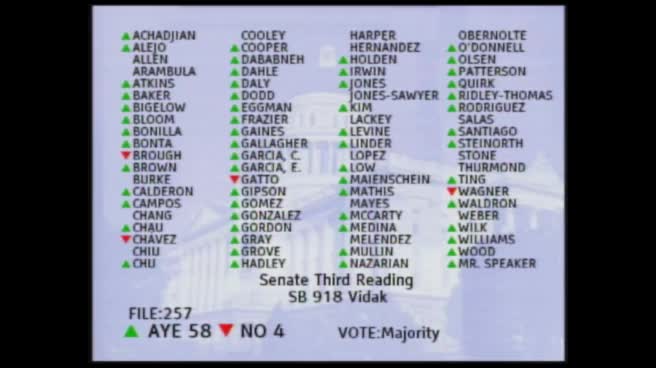 1MIN
Assembly Floor
 6MIN
Assembly Standing Committee on Veterans Affairs
 1MIN
Senate Floor
 4MIN
Senate Standing Committee on Governance and Finance
 12MIN
Senate Standing Committee on Veterans Affairs
Bill Author

Bill Co-Author(s):