SB 19: Physician Orders for Life Sustaining Treatment form: electronic registry pilot.
- Session Year: 2015-2016
- House: Senate
- Latest Version Date: 2015-10-05
Existing law defines a request regarding resuscitative measures as a written document, signed by an individual with capacity, or a legally recognized health care decisionmaker, and the individuals physician, directing a health care provider regarding resuscitative measures. Existing law defines a Physician Orders for Life Sustaining Treatment form, which is commonly referred to as a POLST form, and provides that a request regarding resuscitative measures includes a POLST form. Existing law requires that a POLST form and the medical intervention and procedures offered by the form be explained by a health care provider. Existing law distinguishes a request regarding resuscitative measures from an advance health care directive.
This bill would enact the California POLST eRegistry Pilot Act. The bill would require the Emergency Medical Services Authority to establish a pilot project, in consultation with stakeholders, to operate an electronic registry system on a pilot basis, to be known as the California POLST eRegistry Pilot, for the purpose of collecting POLST information received from a physician or physicians designee. The bill would require the authority to coordinate the POLST eRegistry Pilot, which would be operated by health information exchange networks, by an independent contractor, or by a combination thereof. The bill would require the authority to implement these provisions only after it determines that sufficient nonstate funds are available for development of the POLST eRegistry Pilot, any related startup costs, and an evaluation of the POLST eRegistry Pilot. When the POLST eRegistry Pilot is operable in the geographic area in which he or she operates or practices, a physician or physicians designee who completes POLST information would be required to include the POLST information in the patients official medical record and would be required to submit a copy of the form to, or to enter the information into, the POLST eRegistry Pilot, unless a patient or his or her health care decisionmaker chooses not to participate in the POLST eRegistry Pilot. The bill would require the authority to adopt guidelines for, among other things, the operation of the POLST eRegistry Pilot, including the means by which POLST information would be submitted electronically, modified, or withdrawn, the appropriate and timely methods for dissemination of POLST form information, the procedures for verifying the identity of an authorized user, and rules for maintaining the confidentiality of POLST information received by the POLST eRegistry Pilot. The bill would require that any disclosure of POLST information in the POLST eRegistry Pilot be made in accordance with applicable state and federal privacy and security laws and regulations. The bill would provide immunity from criminal prosecution, civil liability, discipline for unprofessional conduct, and any other sanction for a health care provider who honors a patients request regarding resuscitative measures obtained from the POLST eRegistry Pilot, as specified. The bill would require an independent contractor approved by the authority to conduct an evaluation of the POLST eRegistry Pilot. The provisions of the bill would be operative until January 1, 2020.
Existing law defines a request regarding resuscitative measures as a written document, signed by an individual with capacity, or a legally recognized health care decisionmaker, and the individuals physician, directing a health care provider regarding resuscitative measures. Existing law defines a Physician Orders for Life Sustaining Treatment form, which is commonly referred to as a POLST form, and provides that a request regarding resuscitative measures includes a POLST form. Existing law requires that a POLST form and the medical intervention and procedures offered by the form be explained by a health care provider. Existing law distinguishes a request regarding resuscitative measures from an advance health care directive.
This bill would enact the California POLST eRegistry Pilot Act. The bill would require the Emergency Medical Services Authority to establish a pilot project, in consultation with stakeholders, to operate an electronic registry system on a pilot basis, to be known as the California POLST eRegistry Pilot, for the purpose of collecting POLST information received from a physician or physicians designee. The bill would require the authority to coordinate the POLST eRegistry Pilot, which would be operated by health information exchange networks, by an independent contractor, or by a combination thereof. The bill would require the authority to implement these provisions only after it determines that sufficient nonstate funds are available for development of the POLST eRegistry Pilot, any related startup costs, and an evaluation of the POLST eRegistry Pilot. When the POLST eRegistry Pilot is operable in the geographic area in which he or she operates or practices, a physician or physicians designee who completes POLST information would be required to include the POLST information in the patients official medical record and would be required to submit a copy of the form to, or to enter the information into, the POLST eRegistry Pilot, unless a patient or his or her health care decisionmaker chooses not to participate in the POLST eRegistry Pilot. The bill would require the authority to adopt guidelines for, among other things, the operation of the POLST eRegistry Pilot, including the means by which POLST information would be submitted electronically, modified, or withdrawn, the appropriate and timely methods for dissemination of POLST form information, the procedures for verifying the identity of an authorized user, and rules for maintaining the confidentiality of POLST information received by the POLST eRegistry Pilot. The bill would require that any disclosure of POLST information in the POLST eRegistry Pilot be made in accordance with applicable state and federal privacy and security laws and regulations. The bill would provide immunity from criminal prosecution, civil liability, discipline for unprofessional conduct, and any other sanction for a health care provider who honors a patients request regarding resuscitative measures obtained from the POLST eRegistry Pilot, as specified. The bill would require an independent contractor approved by the authority to conduct an evaluation of the POLST eRegistry Pilot. The provisions of the bill would be operative until January 1, 2020.
Existing law defines a request regarding resuscitative measures as a written document, signed by an individual with capacity, or a legally recognized health care decisionmaker, and the individuals physician, directing a health care provider regarding resuscitative measures. Existing law defines a Physician Orders for Life Sustaining Treatment form, which is commonly referred to as a POLST form, and provides that a request regarding resuscitative measures includes a POLST form. Existing law requires that a POLST form and the medical intervention and procedures offered by the form be explained by a health care provider. Existing law distinguishes a request regarding resuscitative measures from an advance health care directive.
This bill would enact the California POLST eRegistry Pilot Act. The bill would require the Emergency Medical Services Authority to establish a pilot project, in consultation with stakeholders, to operate an electronic registry system on a pilot basis, to be known as the California POLST eRegistry Pilot, for the purpose of collecting POLST information received from a physician or physicians designee. The bill would require the authority to coordinate the POLST eRegistry Pilot, which would be operated by health information exchange networks, by an independent contractor, or by a combination thereof. The bill would require the authority to implement these provisions only after it determines that sufficient nonstate funds are available for development of the POLST eRegistry Pilot, any related startup costs, and an evaluation of the POLST eRegistry Pilot. When the POLST eRegistry Pilot is operable in the geographic area in which he or she operates or practices, a physician or physicians designee who completes POLST information would be required to include the POLST information in the patients official electronic health medical record and would be required to submit a copy of the form to, or to enter the information into, the POLST eRegistry Pilot, unless a patient or his or her health care decisionmaker chooses not to participate in the POLST eRegistry Pilot. The bill would require the authority to adopt guidelines for, among other things, the operation of the POLST eRegistry Pilot, including the means by which POLST information would be submitted electronically, modified, or withdrawn, the appropriate and timely methods for dissemination of POLST form information, the procedures for verifying the identity of an authorized user, and rules for maintaining the confidentiality of POLST information received by the POLST eRegistry Pilot. The bill would require that any disclosure of POLST information in the POLST eRegistry Pilot be made in accordance with applicable state and federal privacy and security laws and regulations. The bill would provide immunity from criminal prosecution, civil liability, discipline for unprofessional conduct, and any other sanction for a health care provider who honors a patients request regarding resuscitative measures obtained from the POLST eRegistry Pilot, as specified. The bill would require an independent contractor approved by the authority to conduct an evaluation of the POLST eRegistry Pilot. The provisions of the bill would be operative until January 1, 2020.
Existing law defines a request regarding resuscitative measures as a written document, signed by an individual with capacity, or a legally recognized health care decisionmaker, and the individuals physician, directing a health care provider regarding resuscitative measures. Existing law defines a Physician Orders for Life Sustaining Treatment form, which is commonly referred to as a POLST form, and provides that a request regarding resuscitative measures includes a POLST form. Existing law requires that a POLST form and the medical intervention and procedures offered by the form be explained by a health care provider. Existing law distinguishes a request regarding resuscitative measures from an advance health care directive.
This bill would enact the California POLST Registry eRegistry Pilot Act. The bill would require the California Health and Human Services Agency Emergency Medical Services Authority to establish and operate a statewide registry system, a pilot project, in consultation with stakeholders, to operate an electronic registry system on a pilot basis, to be known as the California POLST Registry, eRegistry Pilot, for the purpose of collecting POLST forms information received from a physician or physicians designee. The bill would require the authority to coordinate the POLST eRegistry Pilot, which would be operated by health information exchange networks, by an independent contractor, or by a combination thereof. The bill would require the agency authority to implement these provisions only after it determines that sufficient nonstate funds have been received are available for development of the registry and POLST eRegistry Pilot, any related startup costs. A costs, and an evaluation of the POLST eRegistry Pilot. When the POLST eRegistry Pilot is operable in the geographic area in which he or she operates or practices, a physician or physicians designee who completes a POLST form information would be required to include the POLST form information in the patients medical official electronic health record and would be required to submit the form to the registry, a copy of the form to, or to enter the information into, the POLST eRegistry Pilot, unless a patient or his or her health care decisionmaker chooses not to participate in the registry. The bill would require the agency to disseminate the information in the POLST form to an authorized user. The bill would define authorized user to include a health care provider. POLST eRegistry Pilot. The bill would require the agency authority to adopt rules guidelines for, among other things, the operation of the registry, POLST eRegistry Pilot, including the means by which POLST forms information would be submitted electronically, revised, and revoked, the capability to check the POLST form for accuracy prior to it being made available, modified, or withdrawn, the appropriate and timely methods for dissemination of POLST form information, the procedures for verifying the identity of an authorized user, and rules for maintaining the confidentiality of a POLST form information received by the registry. POLST eRegistry Pilot. The bill would require that any disclosure of POLST form information in the registry POLST eRegistry Pilot be made in accordance with applicable state and federal privacy and security laws and regulations. The bill would provide immunity from criminal prosecution, civil liability, discipline for unprofessional conduct, and any other sanction for a health care provider who honors a patients request regarding resuscitative measures obtained from the registry, POLST eRegistry Pilot, as specified. The bill would require an independent contractor approved by the authority to conduct an evaluation of the POLST eRegistry Pilot. The provisions of the bill would be operative until January 1, 2020.
Existing law defines a request regarding resuscitative measures as a written document, signed by an individual with capacity, or a legally recognized health care decisionmaker, and the individuals physician, directing a health care provider regarding resuscitative measures. Existing law defines a Physician Orders for Life Sustaining Treatment form, which is commonly referred to as a POLST form, and provides that a request regarding resuscitative measures includes a POLST form. Existing law requires that a POLST form and the medical intervention and procedures offered by the form be explained by a health care provider. Existing law distinguishes a request regarding resuscitative measures from an advance health care directive.
This bill would enact the California POLST Registry Act. The bill would require the California Health and Human Services Agency to establish and operate a statewide registry system, to be known as the California POLST Registry, for the purpose of collecting POLST forms received from a physician or physicians designee. The bill would require the agency to implement these provisions only after it determines that sufficient nonstate finds funds have been received for development of the registry and any related startup costs. A physician or physicians designee who completes a POLST form would be required to include the POLST form in the patients medical record and would be required to submit the form to the registry, unless a patient or his or her health care decisionmaker chooses not to participate in the registry. The bill would require the agency to disseminate the information in the POLST form to an authorized user. The bill would define authorized user to include a health care provider. The bill would require the agency to adopt rules for, among other things, the operation of the registry, including the means by which POLST forms would be submitted electronically, revised, and revoked, the capability to check the POLST form for accuracy prior to it being made available, the appropriate and timely methods for dissemination of POLST form information, the procedures for verifying the identity of an authorized user, and rules for maintaining the confidentiality of a POLST form received by the registry. The bill would require that any disclosure of POLST form information in the registry be made in accordance with applicable state and federal privacy and security laws and regulations. The bill would provide immunity from criminal prosecution, civil liability, discipline for unprofessional conduct, and any other sanction for a health care provider who honors a patients request regarding resuscitative measures obtained from the registry, as specified.
Existing law defines a request regarding resuscitative measures as a written document, signed by an individual with capacity, or a legally recognized health care decisionmaker, and the individuals physician, directing a health care provider regarding resuscitative measures. Existing law defines a Physician Orders for Life Sustaining Treatment form, which is commonly referred to as a POLST form, and provides that a request regarding resuscitative measures includes a POLST form. Existing law requires that a POLST form and the medical intervention and procedures offered by the form be explained by a health care provider. Existing law distinguishes a request regarding resuscitative measures from an advance health care directive.
This bill would enact the California POLST Registry Act. The bill would require the California Health and Human Services Agency to establish and operate a statewide registry system, to be known as the California POLST Registry, for the purpose of collecting POLST forms received from a physician or physician physicians designee. The bill would require the agency to implement these provisions only after it determines that sufficient nonstate finds have been received for development of the registry and any related startup costs. A physician or physician physicians designee who completes a POLST form would be required to include the POLST form in the patients medical record and would be required to submit the form to the registry, unless a patient or his or her health care decisionmaker chooses not to participate in the registry. The bill would require the agency to disseminate the information in the POLST form to an authorized user. The bill defines would define authorized user to include a health care provider. The bill would require the agency to adopt rules for, among other things, the operation of the registry, including the means by which POLST forms would be submitted electronically, revised, and revoked, the capability to check the POLST form for accuracy prior to it being made available, the appropriate and timely methods for dissemination of POLST form information, the procedures for verifying the identity of an authorized user, and rules for maintaining the confidentiality of a POLST form received by the registry. The bill would require that any disclosure of POLST form information in the registry be made in accordance with applicable state and federal privacy and security laws and regulations. The bill would provide immunity from criminal prosecution, civil liability, discipline for unprofessional conduct, and any other sanction for a health care provider who honors a patients request regarding resuscitative measures obtained from the registry, as specified.
Existing law defines a request regarding resuscitative measures as a written document, signed by an individual with capacity, or a legally recognized health care decisionmaker, and the individuals physician, directing a health care provider regarding resuscitative measures. Existing law defines a Physician Orders for Life Sustaining Treatment form, which is commonly referred to as a POLST form, and provides that a request regarding resuscitative measures includes a POLST form. Existing law requires that a POLST form and the medical intervention and procedures offered by the form be explained by a health care provider. Existing law distinguishes a request regarding resuscitative measures from an advance health care directive.
This bill would enact the California POLST Registry Act. The bill would require the California Health and Human Services Agency to establish and operate a statewide registry system, to be known as the California POLST Registry, for the purpose of collecting POLST forms received from a physician or physician designee. A physician or physician designee who completes a POLST form would be required to include the POLST form in the patients medical record and would be required to submit the form to the registry, unless a patient or his or her health care decisionmaker chooses not to participate in the registry. The bill would require the agency to disseminate the information in the POLST form to an authorized user. The bill defines authorized user to include a health care provider. The bill would require the agency to adopt rules for, among other things, the operation of the registry, including the means by which POLST forms would be submitted electronically, revised, and revoked, the capability to check the POLST form for accuracy prior to it being made available, the appropriate and timely methods for dissemination of POLST form information, the procedures for verifying the identity of an authorized user, and rules for maintaining the confidentiality of a POLST form received by the registry. The bill would require that any disclosure of POLST form information in the registry be made in accordance with applicable state and federal privacy and security laws and regulations. The bill would provide immunity for an authorized user who acts upon information obtained from the registry and acts in good faith. from criminal prosecution, civil liability, discipline for unprofessional conduct, and any other sanction for a health care provider who honors a patients request regarding resuscitative measures obtained from the registry, as specified.
Existing law defines a request regarding resuscitative measures as a written document, signed by an individual with capacity, or a legally recognized health care decisionmaker, and the individuals physician, directing a health care provider regarding resuscitative measures. Existing law defines a Physician Orders for Life Sustaining Treatment form, which is commonly referred to as a POLST form, and provides that a request regarding resuscitative measures includes a POLST form. Existing law requires that a POLST form and the medical intervention and procedures offered by the form be explained by a health care provider. Existing law distinguishes a request regarding resuscitative measures from an advance health care directive.
This bill would enact the California POLST Registry Act. The bill would require the California Health and Human Services Agency to establish and operate a statewide registry system, to be known as the California POLST Registry, for the purpose of collecting POLST forms received from health care providers. Health care providers a physician or physician designee. A physician or physician designee who complete completes a POLST form would be required to include the POLST form in the patients medical record and would be required to submit the form to the registry, unless a patient or his or her health care decisionmaker chooses not to participate in the registry. The bill would require the agency to disseminate the information in the POLST form to an authorized user. The bill defines authorized user to include a health care provider. The bill would require the agency to adopt rules for, among other things, the operation of the registry, including the means by which POLST forms would be submitted electronically, revised, and revoked, the capability to check the POLST form for accuracy prior to it being made available, the appropriate and timely methods for dissemination of POLST form information, the procedures for verifying the identity of an authorized user, and rules for maintaining the confidentiality of a POLST form received by the registry. The bill would require that any disclosure of POLST form information in the registry be made in accordance with applicable state and federal privacy and security laws and regulations. The bill would provide immunity for an authorized user who acts upon information obtained from the registry and acts in good faith.
Existing law defines a request regarding resuscitative measures as a written document, signed by an individual with capacity, or a legally recognized health care decisionmaker, and the individuals physician, directing a health care provider regarding resuscitative measures. Existing law defines a Physician Orders for Life Sustaining Treatment form, which is commonly referred to as a POLST form, and provides that a request regarding resuscitative measures includes a POLST form. Existing law requires that a POLST form and the medical intervention and procedures offered by the form be explained by a health care provider. Existing law distinguishes a request regarding resuscitative measures from an advance health care directive.
This bill would enact the California POLST Registry Act. The bill would require the California Health and Human Services Agency to establish and operate a statewide registry system, to be known as the California POLST Registry, for the purpose of collecting POLST forms received from health care providers. Health care providers who complete a POLST form would be required to include the POLST form in the patients medical record and would be required to submit the form to the registry, unless a patient or his or her health care decisionmaker chooses not to participate in the registry. The bill would require the agency to disseminate the information in the POLST form to an authorized user. The bill defines authorized user to include a health care provider. The bill would require the agency to adopt rules for, among other things, the operation of the registry, including the means by which POLST forms would be submitted electronically, revised, and revoked, the capability to check the POLST form for accuracy prior to it being made available, the appropriate and timely methods for dissemination of POLST form information, the procedures for verifying the identity of an authorized user, and rules for maintaining the confidentiality of a POLST form received by the registry. The bill would require that any disclosure of POLST form information in the registry be made in accordance with applicable federal privacy laws. The bill would provide immunity for an authorized user who acts upon information obtained from the registry and acts in good faith.
This act shall be known, and may be cited, as the California POLST eRegistry Pilot Act.
SEC. 2.Section 4788 is added to the Probate Code, to read:4788.(a) For purposes of this section:
(1)Authority means the Emergency Medical Services Authority.
(2)Authorized user means a person authorized by the authority to submit information to, or to receive information from, the POLST eRegistry Pilot, including health care providers, as defined in Section 4781, and their designees.
(3)POLST means a Physician Orders for Life Sustaining Treatment that fulfills the requirements, in any format, of Section 4780.
(4)POLST eRegistry Pilot means the California POLST eRegistry Pilot Act established pursuant to this section to make electronic, in addition to other modes of submission and transmission, POLST information available to authorized users.
(b)(1)The authority shall establish a pilot project, in consultation with stakeholders, to operate an electronic registry system on a pilot basis, to be known as the California POLST eRegistry Pilot, for the purpose of collecting a patients POLST information received from a physician or physicians designee and disseminating the information to an authorized user.
(2)The authority shall implement this section only after determining that sufficient nonstate funds are available to allow for the development of the POLST eRegistry Pilot, any related startup costs, and an evaluation of the POLST eRegistry Pilot.
(3)The authority shall coordinate the POLST eRegistry Pilot, which shall be operated by, and as a part of, the health information exchange networks, or by an independent contractor, or by a combination thereof. The POLST eRegistry Pilot may operate in a single geographic area or multiple geographic areas and may test various methods of making POLST information available electronically. The design of the POLST eRegistry Pilot shall be sufficiently robust, based on the success of the pilot, to inform the permanent, statewide operation of a POLST eRegistry.
(4)The authority shall adopt guidelines necessary for the operation of the POLST eRegistry Pilot. In developing these guidelines, the authority shall seek input from interested parties and hold at least one public meeting. The adoption, amendment, or repeal of the guidelines authorized by this paragraph is hereby exempted from the Administrative Procedure Act (Chapter 3.5 (commencing with Section 11340) of Part 1 of Division 3 of Title 2 of the Government Code). The guidelines shall include, but not be limited to, the following:
(A)The means by which initial or subsequent POLST information may be submitted to, or withdrawn from, the POLST eRegistry Pilot, which shall include a method for electronic delivery of this information and the use of legally sufficient electronic signatures.
(B)Appropriate and timely methods by which the information in the POLST eRegistry Pilot may be disseminated to an authorized user.
(C)Procedures for verifying the identity of an authorized user.
(D)Procedures to ensure the accuracy of, and to appropriately protect the confidentiality of, POLST information submitted to the POLST eRegistry Pilot.
(E)The requirement that a patient, or, when appropriate, his or her legally recognized health care decisionmaker, receive a confirmation or a receipt that the patients POLST information has been received by the POLST eRegistry Pilot.
(F)The ability of a patient, or, when appropriate, his or her legally recognized health care decisionmaker, with his or her health care provider, as defined in Section 4621, to modify or withdraw POLST information on the POLST eRegistry Pilot.
(6)(A)Prior to implementation of the POLST eRegistry Pilot, the authority shall submit a detailed plan to the Legislature that explains how the POLST eRegistry Pilot will operate.
(B)The plan to be submitted pursuant to subparagraph (A) shall be submitted in compliance with Section 9795 of the Government Code.
(c)The operation of the POLST eRegistry Pilot, for all users, shall comply with state and federal privacy and security laws and regulations, including, but not limited to, compliance with the Confidentiality of Medical Information Act (Part 2.6 (commencing with Section 56) of Division 1 of the Civil Code) and the regulations promulgated pursuant to the federal Health Insurance Portability and Accountability Act of 1996 (Public Law 104-191), found at Parts 160 and 164 of Title 45 of the Code of Federal Regulations.
(d)When the POLST eRegistry Pilot is operable in the geographic area in which he or she practices or operates, a physician or physicians designee who completes POLST information with a patient or his or her legally recognized health care decisionmaker shall include the POLST information in the patients official medical record and shall submit a copy of the POLST form to, or enter the POLST information into, the POLST eRegistry Pilot, unless the patient or the legally recognized health care decisionmaker chooses not to participate in the POLST eRegistry Pilot.
(e)When the POLST eRegistry Pilot is operable in the geographic area in which they practice or operate, physicians, hospitals, and health information exchange networks shall make electronic POLST information available, for use during emergencies, through the POLST eRegistry Pilot to health care providers, as defined in Section 4781, that also practice or operate in a geographic area where the POLST eRegistry Pilot is operable, but that are outside of their health information exchange networks.
(f)In accordance with Section 4782, a health care provider, as defined in Section 4781, who honors a patients request regarding resuscitative measures obtained from the POLST eRegistry Pilot shall not be subject to criminal prosecution, civil liability, discipline for unprofessional conduct, administrative sanction, or any other sanction, if the health care provider (1) believes in good faith that the action or decision is consistent with this part, and (2) has no knowledge that the action or decision would be inconsistent with a health care decision that the individual signing the request would have made on his or her own behalf under like circumstances.
(g)An independent contractor approved by the authority shall perform an evaluation of the POLST eRegistry Pilot.
(h)This section shall remain in effect only until January 1, 2020, and as of that date is repealed, unless a later enacted statute, that is enacted before January 1, 2020, deletes or extends that date.
This act shall be known, and may be cited, as the California POLST eRegistry Pilot Act.
SEC. 2.Section 4788 is added to the Probate Code, to read:4788.(a) For purposes of this section:
(1)Authority means the Emergency Medical Services Authority.
(2)Authorized user means a person authorized by the authority to submit information to, or to receive information from, the POLST eRegistry Pilot, including health care providers, as defined in Section 4781, and their designees.
(3)POLST means a Physician Orders for Life Sustaining Treatment that fulfills the requirements, in any format, of Section 4780.
(4)POLST eRegistry Pilot means the California POLST eRegistry Pilot Act established pursuant to this section to make electronic, in addition to other modes of submission and transmission, POLST information available to authorized users.
(b)(1)The authority shall establish a pilot project, in consultation with stakeholders, to operate an electronic registry system on a pilot basis, to be known as the California POLST eRegistry Pilot, for the purpose of collecting a patients POLST information received from a physician or physicians designee and disseminating the information to an authorized user.
(2)The authority shall implement this section only after determining that sufficient nonstate funds are available to allow for the development of the POLST eRegistry Pilot, any related startup costs, and an evaluation of the POLST eRegistry Pilot.
(3)The authority shall coordinate the POLST eRegistry Pilot, which shall be operated by, and as a part of, the health information exchange networks, or by an independent contractor, or by a combination thereof. The POLST eRegistry Pilot may operate in a single geographic area or multiple geographic areas and may test various methods of making POLST information available electronically. The design of the POLST eRegistry Pilot shall be sufficiently robust, based on the success of the pilot, to inform the permanent, statewide operation of a POLST eRegistry.
(4)The authority shall adopt guidelines necessary for the operation of the POLST eRegistry Pilot. In developing these guidelines, the authority shall seek input from interested parties and hold at least one public meeting. The adoption, amendment, or repeal of the guidelines authorized by this paragraph is hereby exempted from the Administrative Procedure Act (Chapter 3.5 (commencing with Section 11340) of Part 1 of Division 3 of Title 2 of the Government Code). The guidelines shall include, but not be limited to, the following:
(A)The means by which initial or subsequent POLST information may be submitted to, or withdrawn from, the POLST eRegistry Pilot, which shall include a method for electronic delivery of this information and the use of legally sufficient electronic signatures.
(B)Appropriate and timely methods by which the information in the POLST eRegistry Pilot may be disseminated to an authorized user.
(C)Procedures for verifying the identity of an authorized user.
(D)Procedures to ensure the accuracy of, and to appropriately protect the confidentiality of, POLST information submitted to the POLST eRegistry Pilot.
(E)The requirement that a patient, or, when appropriate, his or her legally recognized health care decisionmaker, receive a confirmation or a receipt that the patients POLST information has been received by the POLST eRegistry Pilot.
(F)The ability of a patient, or, when appropriate, his or her legally recognized health care decisionmaker, with his or her health care provider, as defined in Section 4621, to modify or withdraw POLST information on the POLST eRegistry Pilot.
(6)(A)Prior to implementation of the POLST eRegistry Pilot, the authority shall submit a detailed plan to the Legislature that explains how the POLST eRegistry Pilot will operate.
(B)The plan to be submitted pursuant to subparagraph (A) shall be submitted in compliance with Section 9795 of the Government Code.
(c)The operation of the POLST eRegistry Pilot, for all users, shall comply with state and federal privacy and security laws and regulations, including, but not limited to, compliance with the Confidentiality of Medical Information Act (Part 2.6 (commencing with Section 56) of Division 1 of the Civil Code) and the regulations promulgated pursuant to the federal Health Insurance Portability and Accountability Act of 1996 (Public Law 104-191), found at Parts 160 and 164 of Title 45 of the Code of Federal Regulations.
(d)When the POLST eRegistry Pilot is operable in the geographic area in which he or she practices or operates, a physician or physicians designee who completes POLST information with a patient or his or her legally recognized health care decisionmaker shall include the POLST information in the patients official medical record and shall submit a copy of the POLST form to, or enter the POLST information into, the POLST eRegistry Pilot, unless the patient or the legally recognized health care decisionmaker chooses not to participate in the POLST eRegistry Pilot.
(e)When the POLST eRegistry Pilot is operable in the geographic area in which they practice or operate, physicians, hospitals, and health information exchange networks shall make electronic POLST information available, for use during emergencies, through the POLST eRegistry Pilot to health care providers, as defined in Section 4781, that also practice or operate in a geographic area where the POLST eRegistry Pilot is operable, but that are outside of their health information exchange networks.
(f)In accordance with Section 4782, a health care provider, as defined in Section 4781, who honors a patients request regarding resuscitative measures obtained from the POLST eRegistry Pilot shall not be subject to criminal prosecution, civil liability, discipline for unprofessional conduct, administrative sanction, or any other sanction, if the health care provider (1) believes in good faith that the action or decision is consistent with this part, and (2) has no knowledge that the action or decision would be inconsistent with a health care decision that the individual signing the request would have made on his or her own behalf under like circumstances.
(g)An independent contractor approved by the authority shall perform an evaluation of the POLST eRegistry Pilot.
(h)This section shall remain in effect only until January 1, 2020, and as of that date is repealed, unless a later enacted statute, that is enacted before January 1, 2020, deletes or extends that date.
This act shall be known, and may be cited, as the California POLST eRegistry Pilot Act.
SEC. 2.Section 4788 is added to the Probate Code, to read:4788.(a) For purposes of this section:
(1)Authority means the Emergency Medical Services Authority.
(2)Authorized user means a person authorized by the authority to submit information to, or to receive information from, the POLST eRegistry Pilot, including health care providers providers, as defined in Section 4781, and their designees.
(3)Health care provider has the meaning provided in Section 4781.
(4)
(3)POLST means a Physician Orders for Life Sustaining Treatment that fulfills the requirements, in any format, of Section 4780.
(5)
(4)POLST eRegistry Pilot means the California POLST eRegistry Pilot Act established pursuant to this section to make electronic, in addition to other modes of submission and transmission, POLST information available to authorized users.
(b)(1)The authority shall establish a pilot project, in consultation with stakeholders, to operate an electronic registry system on a pilot basis, to be known as the California POLST eRegistry Pilot, for the purpose of collecting a patients POLST information received from a physician or physicians designee and disseminating the information to an authorized user.
(2)The authority shall implement this section only after determining that sufficient nonstate funds are available to allow for the development of the POLST eRegistry Pilot, any related startup costs, and an evaluation of the POLST eRegistry Pilot.
(3)The authority shall coordinate the POLST eRegistry Pilot, which shall be operated by, and as a part of, the health information exchange networks, or by an independent contractor, or by a combination thereof. The POLST eRegistry Pilot may operate in a single geographic area or multiple geographic areas and may test various methods of making POLST information available electronically. The design of the POLST eRegistry Pilot shall be sufficiently robust, based on the success of the pilot, to inform the permanent, statewide operation of a POLST eRegistry.
(4)The authority shall adopt guidelines necessary for the operation of the POLST eRegistry Pilot. In developing these guidelines, the authority shall seek input from interested parties and hold at least one public meeting. The adoption, amendment, or repeal of the guidelines authorized by this paragraph is hereby exempted from the Administrative Procedure Act (Chapter 3.5 (commencing with Section 11340) of Part 1 of Division 3 of Title 2 of the Government Code). The guidelines shall include, but not be limited to, the following:
(A)The means by which initial or subsequent POLST information may be submitted to, or withdrawn from, the POLST eRegistry Pilot, which shall include a method for electronic delivery of this information and the use of legally sufficient electronic signatures.
(B)Appropriate and timely methods by which the information in the POLST eRegistry Pilot may be disseminated to an authorized user.
(C)Procedures for verifying the identity of an authorized user.
(D)Procedures to ensure the accuracy of, and to appropriately protect the confidentiality of, POLST information submitted to the POLST eRegistry Pilot.
(E)The requirement that a patient, or, when appropriate, his or her legally recognized health care decisionmaker, receive a confirmation or a receipt that the patients POLST information has been received by the POLST eRegistry Pilot.
(F)The ability of a patient, or, when appropriate, his or her legally recognized health care decisionmaker, with his or her health care provider, as defined in Section 4621, to modify or withdraw POLST information on the POLST eRegistry Pilot.
(6)(A)Prior to implementation of the POLST eRegistry Pilot, the authority shall submit a detailed plan to the Legislature that explains how the POLST eRegistry Pilot will operate.
(B)The plan to be submitted pursuant to subparagraph (A) shall be submitted in compliance with Section 9795 of the Government Code.
(c)The operation of the POLST eRegistry Pilot, for all users, shall comply with state and federal privacy and security laws and regulations, including, but not limited to, compliance with the Confidentiality of Medical Information Act (Part 2.6 (commencing with Section 56) of Division 1 of the Civil Code) and the regulations promulgated pursuant to the federal Health Insurance Portability and Accountability Act of 1996 (Public Law 104-191), found at Parts 160 and 164 of Title 45 of the Code of Federal Regulations.
(d)When the POLST eRegistry Pilot is operable in the geographic area in which he or she practices or operates, a physician or physicians designee who completes POLST information with a patient or his or her legally recognized health care decisionmaker shall include the POLST information in the patients official electronic health medical record and shall submit a copy of the POLST form to, or enter the POLST information into, the POLST eRegistry Pilot, unless the patient or the legally recognized health care decisionmaker chooses not to participate in the POLST eRegistry Pilot.
(e)When the POLST eRegistry Pilot is operable in the geographic area in which they practice or operate, physicians, hospitals, and health information exchange networks shall make electronic POLST information available, for use during emergencies, through the POLST eRegistry Pilot to health care providers providers, as defined in Section 4781, that also practice or operate in a geographic area where the POLST eRegistry Pilot is operable, but that are outside of their health information exchange networks.
(f)In accordance with Section 4782, a health care provider provider, as defined in Section 4781, who honors a patients request regarding resuscitative measures obtained from the POLST eRegistry Pilot shall not be subject to criminal prosecution, civil liability, discipline for unprofessional conduct, administrative sanction, or any other sanction, if the health care provider (1) believes in good faith that the action or decision is consistent with this part, and (2) has no knowledge that the action or decision would be inconsistent with a health care decision that the individual signing the request would have made on his or her own behalf under like circumstances.
(g)An independent contractor approved by the authority shall perform an evaluation of the POLST eRegistry Pilot.
(h)This section shall remain in effect only until January 1, 2020, and as of that date is repealed, unless a later enacted statute, that is enacted before January 1, 2020, deletes or extends that date.
This act shall be known, and may be cited, as the California POLST Registry eRegistry Pilot Act.
SEC. 2.Section 4788 is added to the Probate Code, to read:4788.(a) For purposes of this section:
(1)Agency means the California Health and Human Services Agency.
(1)Authority means the Emergency Medical Services Authority.
(2)Authorized user means a person authorized by the agency authority to submit information to, or to receive information from, the POLST registry, eRegistry Pilot, including health care providers and their designees.
(3)Health care provider has the meaning provided in Section 4621. 4781.
(4)POLST form POLST means a Physician Orders for Life Sustaining Treatment form that fulfills the requirements requirements, in any format, of Section 4780.
(5)Registry POLST eRegistry Pilot means the California POLST Registry established by the agency eRegistry Pilot Act established pursuant to this section. section to make electronic, in addition to other modes of submission and transmission, POLST information available to authorized users.
(b)(1)The agency shall establish and operate a statewide registry system, to be known as the California POLST Registry, The authority shall establish a pilot project, in consultation with stakeholders, to operate an electronic registry system on a pilot basis, to be known as the California POLST eRegistry Pilot, for the purpose of collecting a patients POLST form information received from a physician or physicians designee and disseminating the information in the form to an authorized user.
(2)The agency authority shall implement this section only after determining that sufficient nonstate funds have been received are available to allow for the development of the registry and POLST eRegistry Pilot, any related startup costs. costs, and an evaluation of the POLST eRegistry Pilot.
(3)The registry may be operated and maintained by a contractor of the agency. The agency
(3)The authority shall coordinate the POLST eRegistry Pilot, which shall be operated by, and as a part of, the health information exchange networks, or by an independent contractor, or by a combination thereof. The POLST eRegistry Pilot may operate in a single geographic area or multiple geographic areas and may test various methods of making POLST information available electronically. The design of the POLST eRegistry Pilot shall be sufficiently robust, based on the success of the pilot, to inform the permanent, statewide operation of a POLST eRegistry.
(4)The authority shall adopt all rules guidelines necessary for the operation of the registry, which POLST eRegistry Pilot. In developing these guidelines, the authority shall seek input from interested parties and hold at least one public meeting. The adoption, amendment, or repeal of the guidelines authorized by this paragraph is hereby exempted from the Administrative Procedure Act (Chapter 3.5 (commencing with Section 11340) of Part 1 of Division 3 of Title 2 of the Government Code). The guidelines shall include, but not be limited to, the following:
(A)The means by which an initial or subsequent POLST form information may be submitted to, or withdrawn from, the registry, POLST eRegistry Pilot, which shall include a method for electronic delivery of this information and the use of legally sufficient electronic signatures.
(B)Appropriate and timely methods by which the information in the registry POLST eRegistry Pilot may be disseminated to an authorized user.
(C)Procedures for verifying the identity of an authorized user.
(D)Procedures to ensure the accuracy of, and to appropriately protect the confidentiality of, POLST forms information submitted to the registry. POLST eRegistry Pilot.
(E)The requirement that a patient, or, when appropriate, his or her legally recognized health care decisionmaker, receive a confirmation or a receipt that the patients POLST form information has been received by the registry. POLST eRegistry Pilot.
(F)The ability of the physician who signed the POLST form, or his or her designee, and of a patient, or, when appropriate, his or her legally recognized health care decisionmaker, to review the information in the patients POLST form after it has been entered into the registry, and to confirm that it is accurate, prior to the information being available to an authorized user.
(G)
(F)The ability of a patient, or, when appropriate, his or her legally recognized health care decisionmaker, to withdraw a POLST form from the registry. with his or her health care provider, to modify or withdraw POLST information on the POLST eRegistry Pilot.
(6)(A)Prior to implementation of the POLST eRegistry Pilot, the authority shall submit a detailed plan to the Legislature that explains how the POLST eRegistry Pilot will operate.
(B)The plan to be submitted pursuant to subparagraph (A) shall be submitted in compliance with Section 9795 of the Government Code.
(c)The operation of the registry POLST eRegistry Pilot, for all users, shall comply with state and federal privacy and security laws and regulations, including, but not limited to, compliance with the Confidentiality of Medical Information Act (Part 2.6 (commencing with Section 56) of Division 1 of the Civil Code) and the regulations promulgated pursuant to the federal Health Insurance Portability and Accountability Act of 1996 (Public Law 104-191), found at Parts 160 and 164 of Title 45 of the Code of Federal Regulations.
(d)A When the POLST eRegistry Pilot is operable in the geographic area in which he or she practices or operates, a physician or physicians designee who completes a POLST form POLST information with a patient or his or her legally recognized health care decisionmaker shall include the POLST form information in the patients official medical record. The physician or physicians designee electronic health record and shall submit a copy of the POLST form to the registry to, or enter the POLST information into, the POLST eRegistry Pilot, unless the patient or the legally recognized health care decisionmaker chooses not to participate in the registry. POLST eRegistry Pilot.
(e)When the POLST eRegistry Pilot is operable in the geographic area in which they practice or operate, physicians, hospitals, and health information exchange networks shall make electronic POLST information available, for use during emergencies, through the POLST eRegistry Pilot to health care providers that also practice or operate in a geographic area where the POLST eRegistry Pilot is operable, but that are outside of their health information exchange networks.
(e)
(f)In accordance with Section 4782, a health care provider who honors a patients request regarding resuscitative measures obtained from the registry POLST eRegistry Pilot shall not be subject to criminal prosecution, civil liability, discipline for unprofessional conduct, administrative sanction, or any other sanction, if the health care provider (1) believes in good faith that the action or decision is consistent with this part, and (2) has no knowledge that the action or decision would be inconsistent with a health care decision that the individual signing the request would have made on his or her own behalf under like circumstances.
(g)An independent contractor approved by the authority shall perform an evaluation of the POLST eRegistry Pilot.
(h)This section shall remain in effect only until January 1, 2020, and as of that date is repealed, unless a later enacted statute, that is enacted before January 1, 2020, deletes or extends that date.
This act shall be known, and may be cited, as the California POLST Registry Act.
SEC. 2.Section 4788 is added to the Probate Code, to read:4788.(a) For purposes of this section:
(1)Agency means the California Health and Human Services Agency.
(2)Authorized user means a person authorized by the agency to submit information to, or to receive information from, the POLST registry, including health care providers and their designees.
(3)Health care provider has the meaning provided in Section 4621.
(4)POLST form means a Physician Orders for Life Sustaining Treatment form that fulfills the requirements of Section 4780.
(5)Registry means the California POLST Registry established by the agency pursuant to this section.
(b)(1)The agency shall establish and operate a statewide registry system, to be known as the California POLST Registry, for the purpose of collecting a POLST form received from a physician or physicians designee and disseminating the information in the form to an authorized user.
(2)The agency shall implement this section only after determining that sufficient nonstate funds have been received to allow for the development of the registry and any related startup costs.
(3)The registry may be operated and maintained by a contractor of the agency. The agency shall adopt all rules necessary for the operation of the registry, which shall include, but not be limited to, the following:
(A)The means by which an initial or subsequent POLST form may be submitted to, or withdrawn from, the registry, which shall include a method for electronic delivery of this information and the use of legally sufficient electronic signatures.
(B)Appropriate and timely methods by which the information in the registry may be disseminated to an authorized user.
(C)Procedures for verifying the identity of an authorized user.
(D)Procedures to ensure the accuracy of, and to appropriately protect the confidentiality of, POLST forms submitted to the registry.
(E)The requirement that a patient, or, when appropriate, his or her legally recognized health care decisionmaker, receive a confirmation or a receipt that the patients POLST form has been received by the registry.
(F)The ability of the physician who signed the POLST form, or his or her designee, and of a patient, or, when appropriate, his or her legally recognized health care decisionmaker, to review the information in the patients POLST form after it has been entered into the registry, and to confirm that it is accurate, prior to the information being available to an authorized user.
(G)The ability of a patient, or, when appropriate, his or her legally recognized health care decisionmaker, to withdraw a POLST form from the registry.
(c)The operation of the registry shall comply with state and federal privacy and security laws and regulations, including, but not limited to, compliance with the Confidentiality of Medical Information Act (Part 2.6 (commencing with Section 56) of Division 1 of the Civil Code) and the regulations promulgated pursuant to the federal Health Insurance Portability and Accountability Act of 1996 (Public Law 104-191), found at Parts 160 and 164 of Title 45 of the Code of Federal Regulations.
(d)A physician or physicians designee who completes a POLST form with a patient or his or her legally recognized health care decisionmaker shall include the POLST form in the patients official medical record. The physician or physicians designee shall submit a copy of the POLST form to the registry unless the patient or the legally recognized health care decisionmaker chooses not to participate in the registry.
(e)A In accordance with Section 4782, a health care provider who honors a patients request regarding resuscitative measures obtained from the registry shall not be subject to criminal prosecution, civil liability, discipline for unprofessional conduct, administrative sanction, or any other sanction as set forth in Section 4782 of the Probate Code. sanction, if the health care provider (1) believes in good faith that the action or decision is consistent with this part, and (2) has no knowledge that the action or decision would be inconsistent with a health care decision that the individual signing the request would have made on his or her own behalf under like circumstances.
This act shall be known, and may be cited, as the California POLST Registry Act.
SEC. 2.Section 4788 is added to the Probate Code, to read:4788.(a) For purposes of this section:
(1)Agency means the California Health and Human Services Agency.
(2)Authorized user means a person authorized by the agency to submit information to, or to receive information from, the POLST registry, including health care providers and their designees.
(3)Health care provider has the meaning provided in Section 4621.
(4)POLST form means a Physician Orders for Life Sustaining Treatment form that fulfills the requirements of Section 4780.
(5)Registry means the California POLST Registry established by the agency pursuant to this section.
(b)(1)The agency shall establish and operate a statewide registry system, to be known as the California POLST Registry, for the purpose of collecting a POLST form received from a physician or physician physicians designee and disseminating the information in the form to an authorized user. The
(2)The agency shall implement this section only after determining that sufficient nonstate funds have been received to allow for the development of the registry and any related startup costs.
(3)The registry may be operated and maintained by a contractor of the agency. The agency shall adopt all rules necessary for the operation of the registry, which shall include, but not be limited to, the following:
(1)
(A)The means by which an initial or subsequent POLST form may be submitted to, or withdrawn from, the registry, which shall include a method for electronic delivery of this information and the use of legally sufficient electronic signatures.
(2)
(B)Appropriate and timely methods by which the information in the registry may be disseminated to an authorized user.
(3)
(C)Procedures for verifying the identity of an authorized user.
(4)
(D)Procedures to ensure the accuracy of, and to appropriately protect the confidentiality of, POLST forms submitted to the registry.
(5)
(E)The requirement that a patient, or, when appropriate, his or her legally recognized health care decisionmaker, receive a confirmation or a receipt that the patients POLST form has been received by the registry.
(6)
(F)The ability of the physician who signed the POLST form, or his or her designee, and of a patient, or, when appropriate, his or her legally recognized health care decisionmaker, to review the information in the patients POLST form after it has been entered into the registry, and to confirm that it is accurate, prior to the information being available to an authorized user.
(7)
(G)The ability of a patient, or, when appropriate, his or her legally recognized health care decisionmaker, to withdraw a POLST form from the registry.
(c)The operation of the registry shall comply with state and federal privacy and security laws and regulations, including, but not limited to, compliance with the Confidentiality of Medical Information Act (Part 2.6 (commencing with Section 56) of Division 1 of the Civil Code) and the regulations promulgated pursuant to the federal Health Insurance Portability and Accountability Act of 1996 (Public Law 104-191), found at Parts 160 and 164 of Title 45 of the Code of Federal Regulations.
(d)A physician or physician physicians designee who completes a POLST form with a patient or his or her legally recognized health care decisionmaker shall include the POLST form in the patients official medical record. The physician or physician physicians designee shall submit a copy of the POLST form to the registry unless the patient or the legally recognized health care decisionmaker chooses not to participate in the registry.
(e)A health care provider who honors a patients request regarding resuscitative measures obtained from the registry shall not be subject to criminal prosecution, civil liability, discipline for unprofessional conduct, administrative sanction, or any other sanction as set forth in Section 4782 of the Probate Code.
This act shall be known, and may be cited, as the California POLST Registry Act.
SEC. 2.Section 4788 is added to the Probate Code, to read:4788.(a) For purposes of this section:
(1)Agency means the California Health and Human Services Agency.
(2)Authorized user means a person authorized by the agency to submit information to, or to receive information from, the POLST registry, including health care providers and their designees.
(3)Health care provider has the meaning provided in Section 4621.
(4)POLST form means a Physician Orders for Life Sustaining Treatment form that fulfills the requirements of Section 4780.
(5)Registry means the California POLST Registry established by the agency pursuant to this section.
(b)The agency shall establish and operate a statewide registry system, to be known as the California POLST Registry, for the purpose of collecting a POLST form received from a physician or physician designee and disseminating the information in the form to an authorized user. The registry may be operated and maintained by a contractor of the agency. The agency shall adopt all rules necessary for the operation of the registry, which shall include, but not be limited to, the following:
(1)The means by which an initial or subsequent POLST form may be submitted to, or withdrawn from, the registry, which shall include a method for electronic delivery of this information and the use of legally sufficient electronic signatures.
(2)Appropriate and timely methods by which the information in the registry may be disseminated to an authorized user.
(3)Procedures for verifying the identity of an authorized user.
(4)Procedures to ensure the accuracy of, and to appropriately protect the confidentiality of, POLST forms submitted to the registry.
(5)The requirement that a patient, or, when appropriate, his or her legally recognized health care decisionmaker, receive a confirmation or a receipt that the patients POLST form has been received by the registry.
(6)The ability of the physician who signed the POLST form, or his or her designee, and of a patient, or, when appropriate, his or her legally recognized health care decisionmaker, to review the information in the patients POLST form after it has been entered into the registry, and to confirm that it is accurate, prior to the information being available to an authorized user.
(7)The ability of a patient, or, when appropriate, his or her legally recognized health care decisionmaker, to withdraw a POLST form from the registry.
(c)The operation of the registry shall comply with state and federal privacy and security laws and regulations, including, but not limited to, compliance with the Confidentiality of Medical Information Act (Part 2.6 (commencing with Section 56) of Division 1 of the Civil Code) and the regulations promulgated pursuant to the federal Health Insurance Portability and Accountability Act of 1996 (Public Law 104-191), found at Parts 160 and 164 of Title 45 of the Code of Federal Regulations.
(d)A physician or physician designee who completes a POLST form with a patient or his or her legally recognized health care decisionmaker shall include the POLST form in the patients official medical record. The physician or physician designee shall submit a copy of the POLST form to the registry unless the patient or the legally recognized health care decisionmaker chooses not to participate in the registry.
(e)An authorized user acting upon information obtained from the registry is not subject to criminal prosecution, civil liability, discipline for unprofessional conduct, administrative sanction, or any other sanction, if the person acted in good faith and had no knowledge that the action or decision would be inconsistent with a health care decision that the individual signing the POLST form would have made on his or her own behalf, or on behalf of the patient, under the circumstances.
(e)A health care provider who honors a patients request regarding resuscitative measures obtained from the registry shall not be subject to criminal prosecution, civil liability, discipline for unprofessional conduct, administrative sanction, or any other sanction as set forth in Section 4782 of the Probate Code.
This act shall be known, and may be cited, as the California POLST Registry Act.
SEC. 2.Section 4788 is added to the Probate Code, to read:4788.(a) For purposes of this section:
(1)Agency means the California Health and Human Services Agency.
(2)Authorized user means a person authorized by the agency to submit information to, or to receive information from, the POLST registry, including health care providers. providers and their designees.
(3)Health care provider has the meaning provided in Section 4621.
(4)POLST form means a Physician Orders for Life Sustaining Treatment form that fulfills the requirements of Section 4780.
(5)Registry means the California POLST Registry established by the agency pursuant to this section.
(b)The agency shall establish and operate a statewide registry system, to be known as the California POLST Registry, for the purpose of collecting a POLST form received from a health care provider physician or physician designee and disseminating the information in the form to an authorized user. The registry may be operated and maintained by a contractor of the agency. The agency shall adopt all rules necessary for the operation of the registry, which shall include, but not be limited to, the following:
(1)The means by which a an initial or subsequent POLST form may be submitted to, or withdrawn from, the registry, may be revised, and may be revoked, which shall include a method for electronic delivery of this information and the use of legally sufficient electronic signatures.
(2)Appropriate and timely methods by which the information in the registry may be disseminated to an authorized user.
(3)Procedures for verifying the identity of an authorized user.
(4)Procedures to ensure the accuracy of, and to appropriately protect the confidentiality of, POLST forms submitted to the registry.
(5)The requirement that a patient, or or, when appropriate, his or her legally recognized health care decisionmaker, receive a confirmation or a receipt that the patients POLST form has been received by the registry.
(6)The ability of the physician who signed the POLST form, or his or her designee, and of a patient, or or, when appropriate, his or her legally recognized health care decisionmaker, to review the information in the patients POLST form after it has been entered into the registry, and to confirm that it is accurate, prior to the information being available to an authorized user.
(7)The ability of a patient, or or, when appropriate, his or her legally recognized health care decisionmaker, to amend or withdraw a POLST form from the registry.
(c)The registry and the information it contains shall be the property of the state and any disclosure of information in a POLST form received by the registry shall be made in a manner consistent with the federal Health Insurance Portability and Accountability Act of 1996 (Public Law 104-191).
(c)The operation of the registry shall comply with state and federal privacy and security laws and regulations, including, but not limited to, compliance with the Confidentiality of Medical Information Act (Part 2.6 (commencing with Section 56) of Division 1 of the Civil Code) and the regulations promulgated pursuant to the Health Insurance Portability and Accountability Act of 1996, found at parts 160 and 164 of Title 45 of the Code of Federal Regulations.
(d)A health care provider physician or physician designee who completes a POLST form with a patient or his or her legally recognized health care decisionmaker shall include the POLST form in the patients official medical record. The health care provider physician or physician designee shall submit a copy of the POLST form to the registry unless the patient or the legally recognized health care decisionmaker chooses not to participate in the registry.
(e)An authorized user acting upon information obtained from the registry is not subject to criminal prosecution, civil liability, discipline for unprofessional conduct, administrative sanction, or any other sanction, if the person acted in good faith and had no knowledge that the action or decision would be inconsistent with a health care decision that the individual signing the POLST form would have made on his or her own behalf, or on behalf of the patient, under the circumstances.
This act shall be known, and may be cited, as the California POLST Registry Act.
SEC. 2.Section 4788 is added to the Probate Code, to read:4788.(a) For purposes of this section:
(1)Agency means the California Health and Human Services Agency.
(2)Authorized user means a person authorized by the agency to submit information to, or to receive information from, the POLST registry, including health care providers.
(3)Health care provider has the meaning provided in Section 4621.
(4)POLST form means a Physician Orders for Life Sustaining Treatment form that fulfills the requirements of Section 4780.
(5)Registry means the California POLST Registry established by the agency pursuant to this section.
(b)The agency shall establish and operate a statewide registry system, to be known as the California POLST Registry, for the purpose of collecting a POLST form received from a health care provider and disseminating the information in the form to an authorized user. The registry may be operated and maintained by a contractor of the agency. The agency shall adopt all rules necessary for the operation of the registry, which shall include, but not be limited to, the following:
(1)The means by which a POLST form may be submitted to the registry, may be revised, and may be revoked, which shall include a method for electronic delivery of this information and the use of legally sufficient electronic signatures.
(2)Appropriate and timely methods by which the information in the registry may be disseminated to an authorized user.
(3)Procedures for verifying the identity of an authorized user.
(4)Procedures to ensure the accuracy of, and to appropriately protect the confidentiality of, POLST forms submitted to the registry.
(5)The requirement that a patient, or his or her legally recognized health care decisionmaker, receive a confirmation or a receipt that the patients POLST form has been received by the registry.
(6)The ability of a patient, or his or her legally recognized health care decisionmaker, to review the information in the patients POLST form after it has been entered into the registry, and to confirm that it is accurate, prior to the information being available to an authorized user.
(7)The ability of a patient, or his or her legally recognized health care decisionmaker, to amend or withdraw a POLST form from the registry.
(c)The registry and the information it contains shall be the property of the state and any disclosure of information in a POLST form received by the registry shall be made in a manner consistent with the federal Health Insurance Portability and Accountability Act of 1996 (Public Law 104-191).
(d)A health care provider who completes a POLST form with a patient or his or her legally recognized health care decisionmaker shall include the POLST form in the patients official medical record. The health care provider shall submit a copy of the POLST form to the registry unless the patient or the legally recognized health care decisionmaker chooses not to participate in the registry.
(e)An authorized user acting upon information obtained from the registry is not subject to criminal prosecution, civil liability, discipline for unprofessional conduct, administrative sanction, or any other sanction, if the person acted in good faith and had no knowledge that the action or decision would be inconsistent with a health care decision that the individual signing the POLST form would have made on his or her own behalf, or on behalf of the patient, under the circumstances.
|
Date
|
Status
|
|---|---|
| Sep 4, 2015 | Read third time and amended. |
| Jul 16, 2015 | Read second time and amended. Re-referred to Com. on APPR. |
| Aug 19, 2015 | August 19 set for first hearing. Placed on APPR. suspense file. |
| Aug 31, 2015 | From committee: Do pass as amended. (Ayes 17. Noes 0.) (August 27). |
| Aug 31, 2015 | Read second time and amended. Ordered to second reading. |
| Sep 1, 2015 | Read second time. Ordered to third reading. |
| Sep 2, 2015 | Read third time. Passed. Ordered to the Senate. |
| Sep 2, 2015 | Read third time. Passed. (Ayes 67. Noes 10. Page 2791.) Ordered to the Senate. |
| Sep 3, 2015 | Action rescinded whereby the bill was read a third time, passed, and ordered to the Senate. |
| Sep 3, 2015 | Ordered to third reading. |
| Sep 4, 2015 | Ordered to third reading. |
| Jul 15, 2015 | From committee: Do pass as amended and re-refer to Com. on APPR. (Ayes 10. Noes 0.) (July 14). |
| Sep 8, 2015 | In Senate. Concurrence in Assembly amendments pending. |
| Sep 8, 2015 | Read third time. Passed. Ordered to the Senate. |
| Sep 8, 2015 | Read third time. Passed. (Ayes 64. Noes 11. Page 2968.) Ordered to the Senate. |
| Sep 10, 2015 | Assembly amendments concurred in. (Ayes 38. Noes 0.) Ordered to engrossing and enrolling. |
| Sep 10, 2015 | Assembly amendments concurred in. (Ayes 39. Noes 0. Page 2671.) Ordered to engrossing and enrolling. |
| Sep 10, 2015 | Assembly amendments concurred in. (Ayes 39. Noes 0.) Ordered to engrossing and enrolling. |
| Sep 11, 2015 | Enrolled and presented to the Governor at 10:45 p.m. |
| Oct 5, 2015 | Approved by the Governor. |
| Oct 5, 2015 | Chaptered by Secretary of State. Chapter 504, Statutes of 2015. |
| May 18, 2015 | May 18 hearing: Placed on APPR. suspense file. |
| Dec 2, 2014 | From printer. May be acted upon on or after January 1. |
| Jan 15, 2015 | Referred to Coms. on HEALTH and JUD. |
| Mar 10, 2015 | Set for hearing April 8. |
| Mar 25, 2015 | From committee with author's amendments. Read second time and amended. Re-referred to Com. on HEALTH. |
| Apr 9, 2015 | From committee: Do pass and re-refer to Com. on JUD. (Ayes 9. Noes 0. Page 544.) (April 8). Re-referred to Com. on JUD. |
| Apr 21, 2015 | Set for hearing April 28. |
| May 4, 2015 | From committee: Do pass as amended and re-refer to Com. on APPR. (Ayes 6. Noes 0. Page 817.) (April 28). |
| May 5, 2015 | Read second time and amended. Re-referred to Com. on APPR. |
| May 8, 2015 | Set for hearing May 18. |
| Dec 1, 2014 | Introduced. Read first time. To Com. on RLS. for assignment. To print. |
| May 23, 2015 | Set for hearing May 28. |
| Jun 1, 2015 | From committee: Do pass as amended. (Ayes 7. Noes 0. Page 1145.) (May 28). |
| Jun 1, 2015 | From committee: Do pass as amended. (Ayes 7. Noes 0.) (May 28). |
| Jun 2, 2015 | Read second time and amended. Ordered to third reading. |
| Jun 3, 2015 | Read third time. Passed. (Ayes 40. Noes 0. Page 1299.) Ordered to the Assembly. |
| Jun 3, 2015 | Read third time. Passed. (Ayes 40. Noes 0.) Ordered to the Assembly. |
| Jun 4, 2015 | In Assembly. Read first time. Held at Desk. |
| Jun 15, 2015 | Referred to Coms. on HEALTH and JUD. |
| Jul 8, 2015 | From committee: Do pass and re-refer to Com. on JUD. (Ayes 19. Noes 0.) (July 7). Re-referred to Com. on JUD. |
|
Date
|
Description
|
Location
|
Votes
|
|
|---|---|---|---|---|
| Sep 10, 2015 | Unfinished Business SB19 Wolk Concurrence | Senate Floor |
Passed |
|
| Sep 8, 2015 | SB 19 Wolk Senate Third Reading By DABABNEH | Assembly Floor |
Passed |
|
| Sep 2, 2015 | SB 19 Wolk Senate Third Reading By DABABNEH | Assembly Floor |
Passed |
|
| Aug 27, 2015 | Do pass as amended. | Assembly Standing Committee on Appropriations |
Passed |
|
| Jul 14, 2015 | Do pass as amended and be re-referred to the Committee on [Appropriations] | Assembly Standing Committee on Judiciary |
Passed |
|
| Jul 7, 2015 | Do pass and be re-referred to the Committee on [Judiciary] | Assembly Standing Committee on Health |
Passed |
|
| Jun 3, 2015 | Senate 3rd Reading SB19 Wolk | Senate Floor |
Passed |
|
| May 28, 2015 | Do pass as amended | Senate Standing Committee on Appropriations |
Passed |
|
| May 18, 2015 | Placed on suspense file | Senate Standing Committee on Appropriations |
Passed |
|
| Apr 28, 2015 | Do pass as amended, but first amend, and re-refer to the Committee on [Appropriations] | Senate Standing Committee on Judiciary |
Passed |
|
| Apr 8, 2015 | Do pass, but first be re-referred to the Committee on [Judiciary] | Senate Standing Committee on Health |
Passed |
This list shows positions taken on this bill by organizations on the date displayed, which is linked to the original source.
Positions by individuals are not included.
|
Organization
|
Position
|
Date
|
|---|---|---|
| AARP | ** Support | Sep 8, 2015 |
| Alliance Of Catholic Health Care Inc. | ** Support | Sep 8, 2015 |
| Bioethicist | * Against | Jul 7, 2015 |
| Blue Path Health | * Support | Jul 7, 2015 |
| Blue Shield Of California | ** Support | Sep 8, 2015 |
| BluePath Health Consulting | * Support | Apr 8, 2015 |
| California Accountable Physician Groups | ** Support | Sep 8, 2015 |
| California Advocates for Nursing Home Reform | ** Against | Sep 8, 2015 |
| California American College of Emergency Physicians | ** Support | Sep 8, 2015 |
| California Assisted Living Association | ** Support | Sep 8, 2015 |
| California Association Of Physician Groups | ** Support | Sep 8, 2015 |
| California Chapter American College Of Emergency Physicians | ** Support | Sep 8, 2015 |
| California Commission on Aging | ** Support | Sep 8, 2015 |
| California Hospital Association | ** Support | Sep 8, 2015 |
| California Long Term-Care Ombudsman Association | ** Support | Apr 8, 2015 |
| California Medical Association, Inc. | * Support | Apr 8, 2015 |
| Care Like A Daughter, LLC | ** Support | Sep 8, 2015 |
| Coalition for Compassionate Care of California | ** Support | Sep 8, 2015 |
| Dignity Health | ** Support | Jul 7, 2015 |
| Medical Board of California | ** Support | Jul 14, 2015 |
| Mission Hospital, Laguna Beach | ** Support | Sep 8, 2015 |
| Mission Hospital, Mission Viejo | ** Support | Sep 8, 2015 |
| On Lok Senior Health Services | ** Support | Jul 7, 2015 |
| Partnership HealthPlan of California | ** Support | Jul 14, 2015 |
| Petaluma Valley Hospital | ** Support | Sep 8, 2015 |
| Private Essential Access Community Hospitals | * Support | Jul 7, 2015 |
| Providence Health & Services Southern California | ** Support | Sep 8, 2015 |
| Queen of the Valley Medical Center | ** Support | Jul 14, 2015 |
| Queen of the Valley Medical Center, Napa | ** Support | Sep 8, 2015 |
| Redwood Memorial Hospital, Fortuna | ** Support | Sep 8, 2015 |
| Riverside Family Physicians | ** Support | Sep 8, 2015 |
| Santa Rosa Memorial Hospital | ** Support | Sep 8, 2015 |
| St. Joseph Hospital, Eureka | ** Support | Jul 14, 2015 |
| St. Joseph Hospital, Orange | ** Support | Sep 8, 2015 |
| St. Jude Medical Center | ** Support | Jul 14, 2015 |
| St. Jude Medical Center, Fullerton | ** Support | Sep 8, 2015 |
| St. Mary Medical Center, Apple Valley | ** Support | Sep 8, 2015 |
| Sutter General | * Support | Jul 7, 2015 |
| Sutter General Hospital | * Support | Jul 14, 2015 |
| The Arc California | * Support | Apr 8, 2015 |
| The Voice of Accountable Physician Groups | ** Support | Jul 14, 2015 |
| Turnout California | * Against | Jul 7, 2015 |
| United Cerebral Palsy California Coalition | * Support | Apr 8, 2015 |
| Vynca | ** Support | Sep 8, 2015 |
SB 19
Page 8
|
Office of Senate Floor Analyses (916) 651-1520 Fax: (916) 327-4478 |
UNFINISHED BUSINESS
Bill No: SB 19
Amended: 9/4/15
SENATE HEALTH COMMITTEE: 9-0, 4/8/15
AYES: Hernandez, Nguyen, Hall, Mitchell, Monning, Nielsen, Pan, Roth, Wolk
SENATE JUDICIARY COMMITTEE: 6-0, 4/28/15
AYES: Jackson, Anderson, Hertzberg, Leno, Monning, Wieckowski
NO VOTE RECORDED: Moorlach
SENATE APPROPRIATIONS COMMITTEE: 7-0, 5/28/15
AYES: Lara, Bates, Beall, Hill, Leyva, Mendoza, Nielsen
SENATE FLOOR: 40-0, 6/3/15
AYES: Allen, Anderson, Bates, Beall, Berryhill, Block, Cannella, De León, Fuller, Gaines, Galgiani, Glazer, Hall, Hancock, Hernandez, Hertzberg, Hill, Hueso, Huff, Jackson, Lara, Leno, Leyva, Liu, McGuire, Mendoza, Mitchell, Monning, Moorlach, Morrell, Nguyen, Nielsen, Pan, Pavley, Roth, Runner, Stone, Vidak, Wieckowski, Wolk
ASSEMBLY FLOOR: 64-11, 9/8/15 - See last page for vote
SUBJECT: Physician Orders for Life Sustaining Treatment form: electronic registry pilot.
SOURCE: Coalition for Compassionate Care of California
DIGEST: This bill establishes a Physician Orders for Life Sustaining Treatment (POLST) eRegistry Pilot operated by the California Emergency Medical Services Authority for the purpose of collecting a POLST form received from a physician, or his or her designee, and disseminating the information in the form to authorized persons.
Assembly Amendments (1) make this bill a pilot project at the Emergency Medical Services Authority (EMSA); (2) require EMSA to coordinate the registry pilot operated by, and as part of, health information exchange networks, or by an independent contractor, or a combination thereof; (3) adopt guidelines necessary for operation of the pilot exempt from the Administrative Procedures Act, but after seeking input from interested parties and holding at least one public meeting; (4) delete the ability of the physician who signed the POLST form and the patient to review the form after it has been entered into the registry; (5) require EMSA to submit a detailed plan to the Legislature prior to implementation; (6) modify the liability protections with regard to resuscitative measures; (7) limit the health care provider types who can modify or withdraw POLST information on the POLST eRegistry Pilot; (8) require an independent contractor approved by EMSA to perform an evaluation, and (9) sunset the bill on January 1, 2020.
Existing law:
Requires the Secretary of State to establish a registry system through which a person who has executed a written advance health care directive may register information regarding the advance directive, making that information available upon request to any health care provider, the public guardian, or the legal representative of the registrant. Defines advance health care directive or directive to mean either an individual health care instruction or a power of attorney for health care.
Establishes the POLST form and medical intervention and procedures, and requires that POLST is explained by a health care provider, as defined.
Requires POLST to be completed by a health care provider based on patient preferences and medical indications, and signed by a physician and the patient or his or her legally recognized health care decision maker. Requires the health care provider, during the process of completing form, to inform the patient about the difference between an advance health care directive and the POLST form.
Defines “health care provider” for the purposes of health care decisions, as an individual licensed, certified, or otherwise authorized or permitted by the law of this state to provide health care in the ordinary course of business or practice of a profession. Defines “health care provider” for purposes of request for resuscitative measures as persons described in the preceding sentence, and emergency response employees, including, but not limited to, firefighters, law enforcement officers, emergency medical technicians I and II, paramedics, and employees and volunteer members of legally organized and recognized volunteer organizations, as specified.
This bill:
Establishes the California POLST eRegistry Pilot Act, and requires EMSA to make electronic, in addition to other modes of submission and transmission, POLST information available to authorized users, and establish a pilot to operate an electronic registry system on a pilot basis for the purpose of collecting a POLST form received from a physician or physician designee and disseminating the information in the form to an authorized user.
Requires EMSA to implement this bill only after determining that sufficient non-state funds are available to allow for the development of the pilot and any related start-up costs and evaluation.
Requires EMSA to coordinate the pilot, operated by, and as part of, health information exchange networks, or by an independent contractor, or by a combination thereof. Permits the pilot to operate in a single geographic area or multiple geographic areas and may test various methods of making POLST information available electronically.
Requires EMSA to adopt guidelines necessary for the operation of pilot, and seek input from interested parties and hold at least one public meeting. Exempts EMSA from the Administrative Procedures Act in adopting these guidelines.
Requires the guidelines include the means to submit initial or subsequent POLST information, or withdraw a form, from the pilot, including a method for electronic delivery and the use of legally sufficient electronic signatures.
Requires the operation of the pilot to comply with state and federal privacy and security laws and regulations including the federal Health Insurance Portability and Accountability Act of 1996.
Requires EMSA to submit a detailed plan to the Legislature that explains how the pilot will operate prior to implementation, and the plan to be submitted in compliance with the law, as specified.
Protects a health care provider who honors a patient’s request regarding resuscitative measures obtained from the eRegistry from criminal prosecution, civil liability, discipline for unprofessional conduct, administrative sanction, or any other sanction, if the health care provider believes in good faith that the action or decision is consistent with this part, and has no knowledge that the action or decision would be inconsistent with a health care decision that the individual signing the request would have made on his or her own behalf under like circumstances.
Requires an independent contractor approved by EMSA perform an evaluation of the pilot.
Sunsets this bill on January 1, 2020.
Comments
Author’s statement. According to the author, POLST is a form that contains a doctor’s orders to ensure that a patient’s wishes are honored regarding medical treatment towards the end of life. Currently, the POLST form is a paper document, and as such, is oftentimes a key barrier to its effectiveness given that it can be misplaced. Furthermore, there isn’t a central database or registry that first responders can access in an emergency situation. An electronic POLST registry in California would help ensure immediate access to vital medical orders by emergency medical personnel. In an era of ever-increasing technology and federal funding available to specifically support electronic health records. Several states are developing and a few states have already completed a statewide registry to access POLST forms more effectively.
What is POLST? POLST is neither an advance directive nor a replacement for advance directives. However, both documents are helpful for communicating patient wishes when appropriately used. An advance directive is a form in which an individual appoints a person or persons to make health care decisions for the individual if and when the individual loses capacity to make health care decisions (health care power of attorney); and/or provides guidance or instructions for making health care decisions (living will). An advance directive is from the patient, not a medical order. POLST consists of a set of medical orders that applies to a limited population of patients and addresses a limited number of critical medical decisions. POLST is a complement to advance directives in that it serves as a translation tool and a continuity of care assurance.
POLST in California. According to Dr. Neil Wenger of UCLA Health Ethics Center at a December 3, 2014 briefing on POLST in California, based on an evaluation by UCLA, POLST is widely used in California but there are challenges with completing the form and making sure it travels with the patient. Additional problems include incomplete or inaccurate information and for emergency medical responders the documents are not always available. Dr. Wenger suggests a registry is one solution to these challenges.
California pilot project. In October of 2014, the California HealthCare Foundation (CHCF) issued a request for information to learn about the technical, infrastructure, and cost requirements for developing a POLST registry in a single California community. CHCF was looking for information from vendors around the technology, operational, and support services necessary to establish a POLST registry and estimates of corresponding costs. The ideal technical solution(s) should receive the POLST information for patients from varied sources, communicate POLST records to emergency responders and other medical professionals, and maintain data accuracy by interfacing with medical and public health information systems (such as the California death registry). CHCF also requested letters of interest from California communities with the ability to convene acute care hospitals, medical groups, nursing homes, hospices, and emergency medical services to test a registry platform that would make POLST records available to authorized providers telephonically, electronically, or both. The ideal provider community would be able to modify clinical workflows to use the pilot POLST registry, integrate the POLST form into electronic health record systems, and explore a sustainable financing model. A decision by CHCF to move forward with a pilot is not expected until September.
FISCAL EFFECT: Appropriation: No Fiscal Com.: Yes Local: No
According to the Assembly Appropriations Committee, costs likely exceeding $1 million per year for two years (non-state funds) for system development. CHCF has commissioned a feasibility report to examine the concept of a POLST registry. According to a draft of the report, it would cost about $2.5 million to develop a statewide information technology system for an online-accessible registry and set up the program; costs in the hundreds of thousands of dollars per year to staff, maintain, and market the registry pilot for the course of the pilot (General Fund or other unknown fund source); and, unknown potential cost savings due to avoided unwanted medical care (various fund sources).
Coalition for Compassionate Care of California (source)
AARP
Alliance of Catholic Health Care
Arc and United Cerebral Palsy California Collaboration
Blue Shield of California
California Accountable Physician Groups
California American College of Emergency Physicians
California Assisted Living Association
California Association of Physician Groups
California Chapter American College of Emergency Physicians
California Commission on Aging
California Hospital Association
Care Like A Daughter, LLC
Long Term Care Ombudsman Services of San Luis Obispo County
Mission Hospital, Laguna Beach
Mission Hospital, Mission Viejo
Petaluma Valley Hospital
Providence Health & Services Southern California
Queen of the Valley Medical Center, Napa
Redwood Memorial Hospital, Fortuna
Riverside Family Physicians
Santa Rosa Memorial Hospital
St. Mary Medical Center, Apple Valley
St. Joseph Hospital, Orange
St. Jude Medical Center, Fullerton
Vynca
California Advocates for Nursing Home Reform
California Right to Life Committee
ARGUMENTS IN SUPPORT: According to this bill’s sponsor, Coalition for Compassionate Care of California (CCCC), POLST has been widely adopted in California, almost 95% of California hospitals have admitted a patient with a POLST and 87% have blank forms available; 69% of nursing homes had reported admitting a resident with a POLST form and 81% report a staff member had completed a POLST with a resident; and after hearing a description of POLST almost two-thirds of Californians say they would definitely or probably want to complete a POLST form if they were seriously ill. CCCC states that gaining access to a patient’s POLST during a medical crisis is a critical factor in honoring patients’ wishes and a statewide registry will eliminate delays in care and confusion. Hospitals have written that POLST is an important care planning tool, but it does little good if the information is not easily available in a time of crisis. POLST forms sometimes get lost when patients transition from care settings and a statewide registry would eliminate this problem. Others write that POLST facilitates free and informed consent required for medical treatments and procedures for persons who are frail and elderly or who have a compromised medical condition. There are common roadblocks to effective use of POLST but the registry can be a solution.
ARGUMENTS IN OPPOSITION: The California Right to Life Committee, Inc. opposes this bill because the organization believes the goals of this bill are directly tied to SB 128. The California Right to Life Committee, Inc. believes this bill is another interjection of the state into the medical field and will result in an authorization of the death industry to heavily pressure ill, elderly or disabled, especially low-income citizens to succumb to their sales pitch and seek to end their own lives. The California Advocates for Nursing Home Reform (CANHR) believes using state resources to create a POLST registry without including advance health care directives represents a significant missed opportunity and threatens to further relegate advance health care directives to second class status compared to POLST. CANHR believes the POLST promotion has exacerbated some of the form’s problems, namely the form does not need to be signed by patients and can sometimes be used to override their actual wishes. CANHR writes that advance health care directives are generally superior to POLSTs for advance care planning, but under this bill, advance health care directives will continue to languish in a registry system that is ancient, unused, and virtually useless.
ASSEMBLY FLOOR: 64-11, 9/8/15
AYES: Achadjian, Alejo, Baker, Bloom, Bonilla, Bonta, Brown, Burke, Campos, Chang, Chau, Chiu, Chu, Cooley, Cooper, Dababneh, Daly, Dodd, Frazier, Gallagher, Cristina Garcia, Eduardo Garcia, Gatto, Gipson, Gomez, Gonzalez, Gordon, Gray, Hadley, Roger Hernández, Holden, Irwin, Jones, Jones-Sawyer, Lackey, Levine, Linder, Lopez, Low, Maienschein, Mathis, McCarty, Medina, Mullin, Nazarian, Obernolte, O'Donnell, Olsen, Perea, Quirk, Rendon, Ridley-Thomas, Rodriguez, Salas, Santiago, Steinorth, Mark Stone, Thurmond, Ting, Wagner, Weber, Williams, Wood, Atkins
NOES: Travis Allen, Bigelow, Brough, Dahle, Beth Gaines, Harper, Mayes, Melendez, Patterson, Waldron, Wilk
NO VOTE RECORDED: Calderon, Chávez, Eggman, Grove, Kim
Prepared by: Teri Boughton / HEALTH /
9/8/15 20:56:40
**** END ****
SB 19
Page 4
SENATE THIRD READING
SB 19
(Wolk)
As Amended September 4, 2015
Majority vote
SENATE VOTE: 40-0
Committee |
Votes |
Ayes |
Noes |
Health |
19-0 |
Bonta, Maienschein, Bonilla, Burke, Chávez, Chiu, Gomez, Gonzalez, Roger Hernández, Lackey, Nazarian, Patterson, Ridley-Thomas, Rodriguez, Santiago, Steinorth, Thurmond, Waldron, Wood |
|
Judiciary |
10-0 |
Mark Stone, Weber, Wagner, Alejo, Chau, Chiu, Gallagher, Cristina Garcia, Maienschein, Thurmond |
|
Appropriations |
17-0 |
Gomez, Bigelow, Bloom, Bonta, Calderon, Chang, Nazarian, Eggman, Gallagher, Eduardo Garcia, Holden, Jones, Quirk, Rendon, Wagner, Weber, Wood |
|
SUMMARY: Requires the Emergency Medical Services Authority (EMSA) to establish and operate a California POLST eRegistry Pilot to collect Physician Orders for Life Sustaining Treatment (POLST), and disseminate the information to authorized users, including health care providers, as defined. Specifically, this bill:
Requires EMSA to establish and operate the California POLST eRegistry once sufficient non-state funds are available to allow for the development of the registry and any related startup and evaluation costs.
Requires EMSA to coordinate the POLST eRegistry which will be operated by, and as part of, the health information exchange (HIE) networks, an independent contractor, or a combination thereof; allows the POLST eRegistry Pilot to operate in a single geographic area, or multiple areas, and to test various methods of making POLST information available electronically. Requires the design of the Pilot to be sufficiently robust, and based on the success of the Pilot, to inform the permanent, statewide operation of a POLST eRegistry.
Requires EMSA to adopt guidelines for the operation of the eRegistry Pilot, and in developing the guidelines to seek input from interested parties and hold at least one public meeting.
Exempts the adoption, amendment or repeal of the guidelines from the Administrative Procedure Act. Requires the guidelines to include, but not be limited to the following:
The means by which POLST information may be submitted or withdrawn from the eRegistry, including a method for electronic delivery of the information and the use of electronic signatures;
Appropriate and timely methods for the information to be disseminated to an authorized user;
Procedures for verifying the identity of an authorized user;
Procedures to ensure the accuracy of, and appropriately protect the confidentiality of, POLST information submitted to the POLST eRegistry Pilot; and,
The ability of the patient, or his/her legally recognized health care decision maker, with his or her health care provider to modify or withdraw POLST information on the POLST eRegistry Pilot.
Requires the operation of the POLST eRegistry Pilot to comply with state and federal privacy and security laws and regulations, including but not limited to the federal Health Insurance Portability and Accountability Act.
Requires a physician or his/her designee who completes a POLST with a patient or his/her legally recognized health care decision maker to include the POLST information in the patient's official medical record, and to submit a copy of the POLST form to the eRegistry Pilot, unless the patient or the legally recognized health care decision maker chooses not to participate in the eRegistry.
Specifies that when a patient or his/her health care decision maker are withdrawing information from the POLST eRegistry, that the definition of a health care provider means an individual licensed, certified, or otherwise authorized or permitted by the law of this state to provide health care in the ordinary course of business or practice of a profession.
Requires physicians, hospitals, and HIEs, when the POLST eRegistry is operable, to make electronic POLST information available to all heath care providers outside of their health information exchange networks, through the POLST eRegistry pilot, for use during emergencies.
Specifies that when the POLST eRegistry Pilot is providing information during emergencies to health care providers, that the definition of health care provider means emergency response employees, including but not limited to, firefighters, law enforcement officers, emergency medical technicians, paramedics, and employees and volunteer members of legally organized and recognized organizations who are trained in accordance with Standard adopted by EMSA.
Provides that a health care provider who honors a patient's request regarding resuscitative measures obtained from the POLST eRegistry Pilot is not subject to criminal prosecution, civil liability, discipline for unprofessional conduct, or administrative sanction.
Requires an evaluation of the POLST eRegistry Pilot to be done by an independent contractor approved by EMSA.
Specify that the provisions of this bill will remain in effect only until January 1, 2020.
FISCAL EFFECT: According to the Assembly Appropriations Committee, costs likely exceeding $1 million per year for two years (non-state funds) for system development. The California Health Care Foundation (CHCF) has commissioned a feasibility report to examine the concept of a POLST registry. According to a draft of the report, it would cost about $2.5 million to develop a statewide information technology system for an online-accessible registry and set up the program; costs in the hundreds of thousands of dollars per year to staff, maintain, and market the registry pilot for the course of the pilot (General Fund or other unknown fund source); and, unknown potential cost savings due to avoided unwanted medical care (various fund sources).
COMMENTS: According to the author, a POLST is a form that contains a doctor's orders to ensure that a patient's wishes are honored regarding medical treatment towards the end of life. The author notes, currently, the POLST form is a paper document, and as such, is oftentimes a key barrier to its effectiveness given that it can be misplaced and there isn't a central database or registry that first responders can access in an emergency situation. The author states, a statewide electronic POLST registry in California would help ensure immediate access to vital medical orders by emergency medical personnel in an era of ever-increasing technology and federal funding available to specifically support electronic health records. The author concludes, several states are developing and a few states have already completed a statewide registry to access POLST forms more effectively.
California Pilot Project. In early 2014, CHCF interviewed a wide range of health care stakeholders and POLST leaders regarding the adoption of a POLST registry in California. Those interviewed included representatives of hospital emergency departments, acute care facilities, hospices, skilled nursing facilities, emergency medical services, and other care providers. Next steps identified by interviewees included: piloting the registry in a community, with the intent to scale rapidly; developing a technology platform for the registry that supports multiple forms of input and output, from paper to fax to mobile devices; expand existing POLST education infrastructure to include education about the registry; engaging state administrative leadership and consider development of an independently operated registry, based on the approaches of other successful California health registries, such as the California Cancer Registry; and, identifying funding sources to build and sustain the registry.
CHCF is currently exploring the idea of sponsoring a POLST pilot project. They have received nine community proposals, representing seven counties throughout California – north and south. The next step is for CHCF to meet with the sponsors of the proposals and assess the level of engagement of the provider community – hospitals, nursing homes and emergency medical services. A decision by CHCF's Board on whether to move forward is not expected until September or December 2015.
What are Health Information Exchange Networks? HIE networks are standards, services and policies that will help move healthcare from a system where patient information is stored within in paper medical records and carried from one doctor's office to the next to a process where information is stored and shared securely and electronically. HIE Networks rely on linking centers that use the same electronic record systems. Many providers are getting in on the ground floor with HIEs as a means of safely and securely exchanging patient information with clinicians within their network and also with those outside the network. While Electronic Health Record (EHR) technology is well established HIEs is newer and still developing. Some HIEs are repositories that store information as well as transmit it while others are just pipelines. Because health systems are in the process of consolidating their EHRs this is a good time to also establish the POLST information as part of changing ways in which health information is being shared electronically and securely.
Analysis Prepared by: Lara Flynn / HEALTH / (916) 319-2097 FN: 0002092
SB 19
Page 3
SENATE THIRD READING
SB 19
(Wolk)
As Amended August 31, 2015
Majority vote
SENATE VOTE: 40-0
Committee |
Votes |
Ayes |
Noes |
Health |
19-0 |
Bonta, Maienschein, Bonilla, Burke, Chávez, Chiu, Gomez, Gonzalez, Roger Hernández, Lackey, Nazarian, Patterson, Ridley-Thomas, Rodriguez, Santiago, Steinorth, Thurmond, Waldron, Wood |
|
Judiciary |
10-0 |
Mark Stone, Weber, Wagner, Alejo, Chau, Chiu, Gallagher, Cristina Garcia, Maienschein, Thurmond |
|
Appropriations |
17-0 |
Gomez, Bigelow, Bloom, Bonta, Calderon, Chang, Nazarian, Eggman, Gallagher, Eduardo Garcia, Holden, Jones, Quirk, Rendon, Wagner, Weber, Wood |
|
SUMMARY: Requires the Emergency Medical Services Authority (EMSA) to establish and operate a California POLST eRegistry Pilot to collect Physician Orders for Life Sustaining Treatment (POLST), and disseminate the information to authorized users, including health care providers. Specifically, this bill:
Requires EMSA to establish and operate the California POLST eRegistry once sufficient non-state funds are available to allow for the development of the registry and any related startup and evaluation costs.
Requires EMSA to coordinate the POLST eRegistry which will be operated by, and as part of, the health information exchange (HIE) networks, an independent contractor, or a combination thereof; allows the Pilot to operate in a single geographic area, or multiple areas, and to test various methods of making POLST information available electronically. Requires the design of the Pilot to be sufficiently robust, and based on the success of the Pilot, to inform the permanent, statewide operation of a POLST eRegistry.
Requires EMSA to adopt guidelines for the operation of the eRegistry Pilot, and in developing the guidelines to seek input from interested parties and hold at least one public meeting.
Exempts the adoption, amendment or repeal of the guidelines from the Administrative Procedure Act. Requires the guidelines to include, but not be limited to the following:
The means by which POLST information may be submitted or withdrawn from the eRegistry, including a method for electronic delivery of the information and the use of electronic signatures;
Appropriate and timely methods for the information to be disseminated to an authorized user;
Procedures for verifying the identity of an authorized user;
Procedures to ensure the accuracy of, and appropriately protect the confidentiality of, POLST information submitted to the POLST eRegistry Pilot; and,
The ability of the patient, or his/her legally recognized health care decision maker, with his or her health care provider to modify or withdraw POLST information on the POLST eRegistry Pilot.
Requires the operation of the POLST eRegistry Pilot to comply with state and federal privacy and security laws and regulations, including but not limited to the federal Health Insurance Portability and Accountability Act.
Requires a physician or his/her designee who completes a POLST with a patient or his/her legally recognized health care decision maker to include the POLST information in the patient's official electronic health record, and to submit a copy of the POLST form to the eRegistry Pilot, unless the patient or the legally recognized health care decision maker chooses not to participate in the eRegistry.
Requires physicians, hospitals, and HIEs, when the POLST eRegistry is operable, to make electronic POLST information available to all heath care providers outside of their health information exchange networks, through the POLST eRegistry pilot, for use during emergencies.
Provides that a health care provider who honors a patient's request regarding resuscitative measures obtained from the POLST eRegistry Pilot is not subject to criminal prosecution, civil liability, discipline for unprofessional conduct, or administrative sanction.
Requires an evaluation of the POLST eRegistry Pilot to be done by an independent contractor approved by EMSA.
Specify that the provisions of this bill will remain in effect only until January 1, 2020.
FISCAL EFFECT: According to the Assembly Appropriations Committee, costs likely exceeding $1 million per year for two years (non-state funds) for system development. The California Health Care Foundation (CHCF) has commissioned a feasibility report to examine the concept of a POLST registry. According to a draft of the report, it would cost about $2.5 million to develop a statewide information technology system for an online-accessible registry and set up the program; costs in the hundreds of thousands of dollars per year to staff, maintain, and market the registry pilot for the course of the pilot (General Fund or other unknown fund source); and, unknown potential cost savings due to avoided unwanted medical care (various fund sources).
COMMENTS: According to the author, a POLST is a form that contains a doctor's orders to ensure that a patient's wishes are honored regarding medical treatment towards the end of life. The author notes, currently, the POLST form is a paper document, and as such, is oftentimes a key barrier to its effectiveness given that it can be misplaced and there isn't a central database or registry that first responders can access in an emergency situation. The author states, a statewide electronic POLST registry in California would help ensure immediate access to vital medical orders by emergency medical personnel in an era of ever-increasing technology and federal funding available to specifically support electronic health records. The author concludes, several states are developing and a few states have already completed a statewide registry to access POLST forms more effectively.
California Pilot Project. In early 2014, CHCF interviewed a wide range of health care stakeholders and POLST leaders regarding the adoption of a POLST registry in California. Those interviewed included representatives of hospital emergency departments, acute care facilities, hospices, skilled nursing facilities, emergency medical services, and other care providers. Next steps identified by interviewees included: piloting the registry in a community, with the intent to scale rapidly; developing a technology platform for the registry that supports multiple forms of input and output, from paper to fax to mobile devices; expand existing POLST education infrastructure to include education about the registry; engaging state administrative leadership and consider development of an independently operated registry, based on the approaches of other successful California health registries, such as the California Cancer Registry; and, identifying funding sources to build and sustain the registry.
CHCF is currently exploring the idea of sponsoring a POLST pilot project. They have received nine community proposals, representing seven counties throughout California – north and south. The next step is for CHCF to meet with the sponsors of the proposals and assess the level of engagement of the provider community – hospitals, nursing homes and emergency medical services. A decision by CHCF's Board on whether to move forward is not expected until September or December 2015.
What are Health Information Exchange Networks? HIE networks are standards, services and policies that will help move healthcare from a system where patient information is stored within in paper medical records and carried from one doctor's office to the next to a process where information is stored and shared securely and electronically. HIE Networks rely on linking centers that use the same electronic record systems. Many providers are getting in on the ground floor with HIEs as a means of safely and securely exchanging patient information with clinicians within their network and also with those outside the network. While Electronic Health Record (EHR) technology is well established HIEs is newer and still developing. Some HIEs are repositories that store information as well as transmit it while others are just pipelines. Because health systems are in the process of consolidating their EHRs this is a good time to also establish the POLST information as part of changing ways in which health information is being shared electronically and securely.
Analysis Prepared by: Lara Flynn / HEALTH / (916) 319-2097 FN: 0001713
SB 19
Page 8
|
Office of Senate Floor Analyses (916) 651-1520 Fax: (916) 327-4478 |
UNFINISHED BUSINESS
Bill No: SB 19
Amended: 8/31/15
SENATE HEALTH COMMITTEE: 9-0, 4/8/15
AYES: Hernandez, Nguyen, Hall, Mitchell, Monning, Nielsen, Pan, Roth, Wolk
SENATE JUDICIARY COMMITTEE: 6-0, 4/28/15
AYES: Jackson, Anderson, Hertzberg, Leno, Monning, Wieckowski
NO VOTE RECORDED: Moorlach
SENATE APPROPRIATIONS COMMITTEE: 7-0, 5/28/15
AYES: Lara, Bates, Beall, Hill, Leyva, Mendoza, Nielsen
SENATE FLOOR: 40-0, 6/3/15
AYES: Allen, Anderson, Bates, Beall, Berryhill, Block, Cannella, De León, Fuller, Gaines, Galgiani, Glazer, Hall, Hancock, Hernandez, Hertzberg, Hill, Hueso, Huff, Jackson, Lara, Leno, Leyva, Liu, McGuire, Mendoza, Mitchell, Monning, Moorlach, Morrell, Nguyen, Nielsen, Pan, Pavley, Roth, Runner, Stone, Vidak, Wieckowski, Wolk
ASSEMBLY FLOOR: 67-10, 9/2/15 - See last page for vote
SUBJECT: Physician Orders for Life Sustaining Treatment form: electronic registry pilot
SOURCE: Coalition for Compassionate Care of California
DIGEST: This bill establishes a Physician Orders for Life Sustaining Treatment (POLST) eRegistry Pilot operated by the California Emergency Medical Services Authority for the purpose of collecting a POLST form received from a physician, or his or her designee, and disseminating the information in the form to authorized persons.
Assembly Amendments (1) make this bill a pilot project at the Emergency Medical Services Authority (EMSA); (2) require EMSA to coordinate the registry pilot operated by, and as part of, health information exchange networks, or by an independent contractor, or a combination thereof; (3) adopt guidelines necessary for operation of the pilot exempt from the Administrative Procedures Act, but after seeking input from interested parties and holding at least one public meeting; (4) delete the ability of the physician who signed the POLST form and the patient to review the form after it has been entered into the registry; (5) require EMSA to submit a detailed plan to the Legislature prior to implementation; (6) modify the liability protections with regard to resuscitative measures; (7) require an independent contractor approved by EMSA to perform an evaluation, and (8) sunset the bill on January 1, 2020.
Existing law:
Requires the Secretary of State to establish a registry system through which a person who has executed a written advance health care directive may register information regarding the advance directive, making that information available upon request to any health care provider, the public guardian, or the legal representative of the registrant. Defines advance health care directive or directive to mean either an individual health care instruction or a power of attorney for health care.
Establishes the POLST form and medical intervention and procedures, and requires that POLST is explained by a health care provider, as defined.
Requires POLST to be completed by a health care provider based on patient preferences and medical indications, and signed by a physician and the patient or his or her legally recognized health care decision maker. Requires the health care provider, during the process of completing form, to inform the patient about the difference between an advance health care directive and the POLST form.
This bill:
Establishes the California POLST eRegistry Pilot Act, and requires EMSA to make electronic, in addition to other modes of submission and transmission, POLST information available to authorized users, and establish a pilot to operate an electronic registry system on a pilot basis for the purpose of collecting a POLST form received from a physician or physician designee and disseminating the information in the form to an authorized user.
Requires EMSA to implement this bill only after determining that sufficient non-state funds are available to allow for the development of the pilot and any related start-up costs and evaluation.
Requires EMSA to coordinate the pilot, operated by, and as part of, health information exchange networks, or by an independent contractor, or by a combination thereof. Permits the pilot to operate in a single geographic area or multiple geographic areas and may test various methods of making POLST information available electronically.
Requires EMSA to adopt guidelines necessary for the operation of pilot, and
seek input from interested parties and hold at least one public
meeting. Exempts EMSA from the Administrative Procedures Act in
adopting these guidelines.
Requires the guidelines include the means to submit initial or subsequent POLST information, or withdraw a form, from the pilot, including a method for electronic delivery and the use of legally sufficient electronic signatures.
Requires the operation of the pilot to comply with state and federal privacy and security laws and regulations including the federal Health Insurance Portability and Accountability Act of 1996.
Requires EMSA to submit a detailed plan to the Legislature that explains how the pilot will operate prior to implementation, and the plan to be submitted in compliance with the law, as specified.
Protects a health care provider who honors a patient’s request regarding resuscitative measures obtained from the eRegistry from criminal prosecution, civil liability, discipline for unprofessional conduct, administrative sanction, or any other sanction, if the health care provider believes in good faith that the action or decision is consistent with this part, and has no knowledge that the action or decision would be inconsistent with a health care decision that the individual signing the request would have made on his or her own behalf under like circumstances.
Requires an independent contractor approved by EMSA perform an evaluation of the pilot.
Sunsets this bill on January 1, 2020.
Comments
Author’s statement. According to the author, POLST is a form that contains a doctor’s orders to ensure that a patient’s wishes are honored regarding medical treatment towards the end of life. Currently, the POLST form is a paper document, and as such, is oftentimes a key barrier to its effectiveness given that it can be misplaced. Furthermore, there isn’t a central database or registry that first responders can access in an emergency situation. An electronic POLST registry in California would help ensure immediate access to vital medical orders by emergency medical personnel. In an era of ever-increasing technology and federal funding available to specifically support electronic health records. Several states are developing and a few states have already completed a statewide registry to access POLST forms more effectively.
What is POLST? POLST is neither an advance directive nor a replacement for advance directives. However, both documents are helpful for communicating patient wishes when appropriately used. An advance directive is a form in which an individual appoints a person or persons to make health care decisions for the individual if and when the individual loses capacity to make health care decisions (health care power of attorney); and/or provides guidance or instructions for making health care decisions (living will). An advance directive is from the patient, not a medical order. POLST consists of a set of medical orders that applies to a limited population of patients and addresses a limited number of critical medical decisions. POLST is a complement to advance directives in that it serves as a translation tool and a continuity of care assurance.
POLST in California. According to Dr. Neil Wenger of UCLA Health Ethics Center at a December 3, 2014 briefing on POLST in California, based on an evaluation by UCLA, POLST is widely used in California but there are challenges with completing the form and making sure it travels with the patient. Additional problems include incomplete or inaccurate information and for emergency medical responders the documents are not always available. Dr. Wenger suggests a registry is one solution to these challenges.
California pilot project. In October of 2014, the California HealthCare Foundation (CHCF) issued a request for information to learn about the technical, infrastructure, and cost requirements for developing a POLST registry in a single California community. CHCF was looking for information from vendors around the technology, operational, and support services necessary to establish a POLST registry and estimates of corresponding costs. The ideal technical solution(s) should receive the POLST information for patients from varied sources, communicate POLST records to emergency responders and other medical professionals, and maintain data accuracy by interfacing with medical and public health information systems (such as the California death registry). CHCF also requested letters of interest from California communities with the ability to convene acute care hospitals, medical groups, nursing homes, hospices, and emergency medical services to test a registry platform that would make POLST records available to authorized providers telephonically, electronically, or both. The ideal provider community would be able to modify clinical workflows to use the pilot POLST registry, integrate the POLST form into electronic health record systems, and explore a sustainable financing model. A decision by CHCF to move forward with a pilot is not expected until September.
FISCAL EFFECT: Appropriation: No Fiscal Com.: Yes Local: No
According to the Assembly Appropriations Committee, costs likely exceeding $1 million per year for two years (non-state funds) for system development. The CHCF has commissioned a feasibility report to examine the concept of a POLST registry. According to a draft of the report, it would cost about $2.5 million to develop a statewide information technology system for an online-accessible registry and set up the program; costs in the hundreds of thousands of dollars per year to staff, maintain, and market the registry pilot for the course of the pilot (General Fund or other unknown fund source); and, unknown potential cost savings due to avoided unwanted medical care (various fund sources).
Coalition for Compassionate Care of California (source)
AARP
Alliance of Catholic Health Care
Arc and United Cerebral Palsy California Collaboration
Blue Shield of California
California Accountable Physician Groups
California American College of Emergency Physicians
California Assisted Living Association
California Association of Physician Groups
California Chapter American College of Emergency Physicians
California Commission on Aging
California Hospital Association
Care Like A Daughter, LLC
Long Term Care Ombudsman Services of San Luis Obispo County
Mission Hospital, Laguna Beach
Mission Hospital, Mission Viejo
Petaluma Valley Hospital
Providence Health & Services Southern California
Queen of the Valley Medical Center, Napa
Redwood Memorial Hospital, Fortuna
Riverside Family Physicians
Santa Rosa Memorial Hospital
St. Mary Medical Center, Apple Valley
St. Joseph Hospital, Orange
St. Jude Medical Center, Fullerton
Vynca
California Advocates for Nursing Home Reform
California Right to Life Committee
ARGUMENTS IN SUPPORT: According to this bill’s sponsor, Coalition for Compassionate Care of California (CCCC), POLST has been widely adopted in California, almost 95% of California hospitals have admitted a patient with a POLST and 87% have blank forms available; 69% of nursing homes had reported admitting a resident with a POLST form and 81% report a staff member had completed a POLST with a resident; and after hearing a description of POLST almost two-thirds of Californians say they would definitely or probably want to complete a POLST form if they were seriously ill. CCCC states that gaining access to a patient’s POLST during a medical crisis is a critical factor in honoring patients’ wishes and a statewide registry will eliminate delays in care and confusion. Hospitals have written that POLST is an important care planning tool, but it does little good if the information is not easily available in a time of crisis. POLST forms sometimes get lost when patients transition from care settings and a statewide registry would eliminate this problem. Others write that POLST facilitates free and informed consent required for medical treatments and procedures for persons who are frail and elderly or who have a compromised medical condition. There are common roadblocks to effective use of POLST but the registry can be a solution.
ARGUMENTS IN OPPOSITION: The California Right to Life Committee, Inc. opposes this bill because the organization believes the goals of this bill are directly tied to SB 128. The California Right to Life Committee, Inc. believes this bill is another interjection of the state into the medical field and will result in an authorization of the death industry to heavily pressure ill, elderly or disabled, especially low-income citizens to succumb to their sales pitch and seek to end their own lives. The California Advocates for Nursing Home Reform (CANHR) believes using state resources to create a POLST registry without including advance health care directives represents a significant missed opportunity and threatens to further relegate advance health care directives to second class status compared to POLST. CANHR believes the POLST promotion has exacerbated some of the form’s problems, namely the form does not need to be signed by patients and can sometimes be used to override their actual wishes. CANHR writes that advance health care directives are generally superior to POLSTs for advance care planning, but under this bill, advance health care directives will continue to languish in a registry system that is ancient, unused, and virtually useless.
ASSEMBLY FLOOR: 67-10, 9/02/15
AYES: Achadjian, Alejo, Baker, Bloom, Bonilla, Bonta, Brown, Burke, Calderon, Campos, Chau, Chávez, Chiu, Chu, Cooper, Dababneh, Daly, Dodd, Eggman, Frazier, Gallagher, Cristina Garcia, Eduardo Garcia, Gatto, Gipson, Gomez, Gonzalez, Gordon, Gray, Hadley, Roger Hernández, Holden, Irwin, Jones, Jones-Sawyer, Lackey, Levine, Linder, Lopez, Low, Maienschein, Mathis, Mayes, McCarty, Medina, Mullin, Nazarian, Obernolte, O'Donnell, Olsen, Patterson, Perea, Quirk, Rendon, Ridley-Thomas, Rodriguez, Salas, Santiago, Steinorth, Mark Stone, Thurmond, Ting, Wagner, Weber, Williams, Wood, Atkins
NOES: Travis Allen, Bigelow, Brough, Dahle, Beth Gaines, Grove, Kim, Melendez, Waldron, Wilk
NO VOTE RECORDED: Chang, Cooley, Harper
Prepared by: Teri Boughton / HEALTH /
9/2/15 17:47:32
**** END ****
Date of Hearing: August 19, 2015
ASSEMBLY COMMITTEE ON APPROPRIATIONS
Jimmy Gomez, Chair
SB 19
(Wolk) – As Amended July 16, 2015
Policy Committee: |
Health |
Vote: |
19 - 0 |
|
Judiciary |
|
10 - 0 |
|
|
|
|
Urgency: No State Mandated Local Program: No Reimbursable: No
SUMMARY:
This bill requires the California Health and Human Services Agency (CHHSA) to establish and operate a statewide registry system to collect Physician Orders for Life-Sustaining Treatment (POLST) forms, and disseminate the information in the form to authorized users, including health care providers.
FISCAL EFFECT:
Start-up costs of about $2.5 million over the first three years to develop the system (non-state funds). The California Health Care Foundation has commissioned a feasibility report to examine the concept of a POLST registry. According to a draft of the report, it will cost about $2.5 million to develop the information technology system for an online-accessible registry and set up the program.
Ongoing costs of about $1.3 million per year to staff, maintain, and market the system (General Fund or other unknown fund source).
Unknown potential cost savings due to avoided unwanted medical care (various fund sources). The primary purpose of a POLST and the POLST registry proposed in this bill is to document a patient's preferences for end-of-life treatment. This can either ensure that individuals receive all treatment possible to prolong life, or ensure that people do not receive medical care they do not wish to receive. According to experience in other states, most people who fill out a POLST form indicate their wishes for – and receive— much less intensive treatment. By creating a registry of POLST forms, the bill will improve access to POLST forms by emergency medical services and hospitals. In turn, this will lead to fewer emergency health care services for individuals who do not want those services. The size of this impact is unknown.
COMMENTS:
Purpose. This bill establishes an electronic POLST registry that allows individuals and health care providers to update and access information about an individual's end-of-life treatment options.
POLST. The POLST form is a voluntary form that documents patient preferences about medical interventions common in end-of-life treatment, including cardiopulmonary resuscitation (CPR), mechanical ventilation, intubation, and artificially administered nutrition. It is completed and signed by a patient or their authorized representative, and is also signed by a physician. A signed POLST form, or copy thereof, is a legally valid physician order that other health care providers, such as emergency medical services (EMS) personnel, can rely on to make treatment decisions. POLST is used widely in health care settings, but nursing homes and hospitals report problems with the flow of paper forms between settings.
POLST versus Advanced Health Care Directives (AHCD). POLST is designed for use by seriously ill or medically frail individuals who are close to the end of their lives. POLST also includes very specific instructions about certain medical interventions, is applicable to current treatment, and is a legally valid physician order. In contrast, AHCDs are more general legal documents that allow anyone 18 years or older to designate future treatment preferences and to appoint a health care representative. Unlike POLST, AHCDs do not carry the legal weight of a valid physician order. This means AHCDs can guide inpatient treatment by a physician who has reviewed the AHCD, but do not provide a legal basis for EMS personnel to follow a patient's treatment preferences.
POLST Registry Supports Ongoing Policy Initiatives. This bill aligns with goals devised by Let's Get Healthy California, a public-private partnership coordinated by the CHHSA in 2012 to improve the health of Californians. LGHC, as well as a related 2014 California State Innovation Model (CalSIM) grant proposal to the federal government, identified improving end-of-life care, by reducing deaths in the hospital and increasing advanced care planning, as a key initiative. Although California was unsuccessful in the CalSIM grant application, some work is ongoing to implement the proposed initiative. This bill appears to be consistent with these efforts.
Readiness for a POLST Registry in California. A brief commissioned by the California Health Care Foundation (CHCF) assessing California's readiness for a POLST registry found support for the concept among health care providers involved in using and completing POLST forms. Stakeholders interviewed for the brief suggested piloting an electronic registry, developing a modern technology platform, expanding education about POLST, engaging state administrative leadership, and identifying funding sources to build and maintain the registry. It also notes both Oregon and New York have successful electronic POSLT registries. CHCF is currently exploring the idea of sponsoring a POLST pilot project and a decision on moving forward with funding a pilot project is pending.
Prior Legislation.
SB 1357 (Wolk) of 2014 was substantially similar to this bill, and was held on the Suspense File of the Senate Appropriations Committee.
AB 2452 (Pan) of 2014 required the Secretary of State to develop an online registry for advance health care directives, and was held in the Senate Judiciary Committee.
Staff Comments.
Funding a POLST Registry. This bill specifies CHHSA shall implement the registry only after determining that sufficient nonstate funds have been received to allow for the development of the registry and any related startup costs. Interest from private foundations in establishing a POLST registry indicates it may be possible to fund the initial development cost with non-state sources.
However, the bill does not specify an ongoing fund source, raising questions about an appropriate fund source for ongoing customer service staffing and maintenance of an IT system. Given the cost of providing aggressive and often unwanted end-of-life medical interventions, both in dollars and human terms, providing real-time access to POLST forms through an electronic registry appears to be a reasonable investment for the state. Some potential fund sources that could be considered for ongoing support include:
GF. The benefits of a POLST registry would be widespread and statewide, and the GF would also likely incur savings in state-funded health programs from making all patient's end-of-life wishes more accessible, making the GF a reasonable long-term funding source in absence of a more specific funding source.
Federal funds may be available through federal financial participation (FFP) for serving the Medi-Cal population or potentially through grants, though grant funding may prove unreliable as an ongoing fund source. Drawing down FFP to cover some of the cost would likely only be available through a federal waiver, and would generally require a nonfederal share to match any federal dollars.
The Health Data and Planning Fund administered by the Office of Statewide Health Planning and Development is another non-GF source to consider. Fees charged to health care facilities support OSHPD's work in collecting and disseminating health care data, and bolstering California's health care workforce through improved training. Although the bill does not specify OSHPD as an administering agency, this fund would likely be a fiscally sound revenue source for a program of this size, and offers a reasonable nexus between the payers and the activities being funded. Hospitals and skilled nursing facilities that provide the majority of end-of-life care, which are the primary users of a POLST system, are also the primary payers into the fund. This fund received a GF loan repayment of $12 million in 2015-16.
Pilot program? As mentioned above, the CHCF readiness assessment suggested an electronic POLST registry start with a pilot project, one that could be rapidly scalable after success was proven. Though a statewide POLST registry appears to be a reasonable long-term policy goal, the committee may wish to consider whether starting with a regional pilot may offer a better chance at success, and minimize potential fiscal risk associated with statewide implementation.
Analysis Prepared by: Lisa Murawski / APPR. / (916) 319-2081
SB 19
Page 7
Date of Hearing: July 14, 2015
ASSEMBLY COMMITTEE ON JUDICIARY
Mark Stone, Chair
SB 19
(Wolk) – As Amended June 2, 2015
As Proposed to be Amended
SENATE VOTE: 40-0
SUBJECT: PHYSICIAN ORDERS FOR LIFE-SUSTAINING TREATMENT FORM: STATEWIDE REGISTRY
KEY ISSUES:
should the California Health and Human Services Agency be required, upon determining that sufficient nonstate funds are available for development of the registry and any related startup costs, to establish and operate a statewide registry system known as the California POLST Registry, for the purpose of collecting Physician orders for life-sustaining treatment forms received from physicians and their designees?
SHOULD A PHYSICIAN WHO HONORS A PATIENT’S REQUEST REGARDING RESUSCITATIVE MEASURES OBTAINED FROM THE POLST REGISTRY HAVE IMMUNITY FROM CRIMINAL PROSECTUTION, CIVIL LIABILITY, DISCIPLINE FOR UNPROFESSIONAL CONDUCT, AND ANY OTHER SANCTION FOR A HEALTH CARE PROVIDER?
SYNOPSIS
The Physician Orders for Life Sustaining Treatment (POLST) paradigm is a clinical process designed to facilitate communication between health care professionals and their patients (or their authorized surrogates, in cases where the patients themselves do not have the capacity to make health care decisions) who are very ill or very frail in order to communicate the patients’ goals for care in regard to the use of cardiopulmonary resuscitation and other medical interventions to providers of end-of-life medical care. The POLST form is neither an advance directive, nor a replacement for advance directives. However, like an advance directive, the POLST form is helpful for communicating patient wishes to health care providers. The POLST form is a complement to advance directives in that it serves as a translation tool for continuity of care. Currently, the POLST form is a paper document, and as such, is oftentimes a key barrier to its effectiveness given that it can be misplaced. Several states are developing and a few states have already completed a statewide registry to access POLST forms more effectively. According to the author, it would be helpful to healthcare providers in California, including first responders, if there were a central database or registry that healthcare providers can access when they need to determine a patient’s wishes for his or her end-of-life care.
This bill requires the California Health and Human Services Agency, upon determining that sufficient nonstate funds are available, to establish and operate the California POLST Registry. The bill also provides immunity for physicians who rely upon POLST forms in the POLST Registry in providing resuscitative measures to their patients. As proposed to be amended, the immunity provision will duplicate the section of existing law that provides immunity to healthcare providers who rely upon POLST forms, rather than creating a new standard for immunity when the POLST form is found in the POLST registry. The bill is supported by many hospitals, hospice organizations, physician organizations, disability advocacy organizations, and senior organizations. It is supported, in concept, by the California Medical Board and has no opposition. It was recently approved by the Assembly Health Committee, where it passed by a vote of 19-0.
SUMMARY: Requires the establishment of the POLST Registry and provides immunity for physicians who rely upon POLST forms in the POLST Registry in providing end-of-life medical care to their patients. Specifically, this bill:
Requires the California Health and Human Services Agency (Agency), only after determining that sufficient nonstate funds have been received to allow for the development and any related startup costs, to establish and operate a statewide registry system, to be known as the California POLST Registry, for the purpose of collecting a POLST form received from a physician or physician’s designee and disseminating the information in the form to an authorized user.
Allows the registry to be operated and maintained by a contractor of the Agency.
Requires the Agency to adopt all rules necessary for the operation of the registry to ensure that information is secure, accurate and timely and specifies that the rules satisfy specified standards and, among other things, give a patient (or, when appropriate, his or her legally recognized health care decisionmaker) the ability to withdraw a POLST form from the registry.
Requires the operation of the registry to comply with state and federal privacy and security laws and regulations, including, but not limited to, compliance with the Confidentiality of Medical Information Act, and the regulations promulgated pursuant to the federal Health Insurance Portability and Accountability Act of 1996 (Public Law 104-191).
Requires a physician or physician’s designee who completes a POLST form with a patient or his or her legally recognized health care decisionmaker to include the POLST form in the patient’s official medical record and submit a copy of the POLST form to the registry, unless the patient or the legally recognized health care decisionmaker chooses not to participate in the registry.
Provides that a health care provider who honors a patient’s request regarding resuscitative measures obtained from the registry shall not be subject to criminal prosecution, civil liability, discipline for unprofessional conduct, administrative sanction, or any other sanction.
EXISTING LAW:
Provides that an advanced health care directive is either a document containing (1) individual health care instruction or (2) a power of attorney for health care. Existing law further establishes a process and form for an individual to give instructions about health care decision making and designating an agent to make decisions on his or her behalf. (Probate Code Sec. 4670 et seq. All references are to the Probate Code, unless otherwise indicated.)
Requires the Secretary of State to establish a registry system where advance health care directives may be registered in a central information center, and that information may be made available upon request to any health care provider, the public guardian, or the legal representative of the registrant. (Section 4800.)
Requires a request regarding resuscitative orders to be a pre-hospital “Do Not Resuscitate” form, as specified, or an Emergency Medical Services Authority (EMSA) approved POLST form. (Section 4780.)
Establishes the POLST form and requires the form to be completed by a health care provider based on patient preferences and medical indications, and signed by a physician and the patient or his or her legally recognized health care decision-maker. (Section 4780.)
Requires the health care provider, during the process of completing the form, to inform the patient about the difference between an advance health care directive and the POLST form. (Section 4870 et seq.)
Protects a health care provider from liability regarding resuscitative measures if the health care provider (1) believes in good faith that his or her action is consistent with the applicable law, and (2) has no knowledge that the action or decision would be inconsistent with a health care decision that the individual would have made on his or her own behalf under like circumstances. (Section 4782.)
FISCAL EFFECT: As currently in print this bill is keyed fiscal.
COMMENTS: The Physician Orders for Life Sustaining Treatment (POLST) paradigm is a clinical process designed to facilitate communication between health care professionals and their patients (or their authorized surrogates, in cases where the patients themselves do not have the capacity to make health care decisions) who are very ill or very frail in order to communicate the patients’ goals for care in regard to the use of cardiopulmonary resuscitation and other medical interventions to providers of end-of-life medical care. The POLST paradigm promotes the use of a highly visible, portable medical form, known as a POLST form, which transfers from one setting to another with the patient. The POLST form functions as a Do Not Resuscitate order and provides treatment direction for multiple health situations. The form itself is outcome neutral. Its options range from full treatment to comfort care only.
The POLST form is neither an advance directive, nor a replacement for advance directives. However, like an advance directive, the POLST form is helpful for communicating patient wishes to health care providers. An advance directive, also called a “living will,” is a document providing guidance or instructions for making health care decisions that contains one of the following: (1) Individual health care instruction, or (2) a power of attorney for health care. Existing law further establishes a process and form for an individual to give instructions about health care decision making and designating an agent to make decisions on his or her behalf. (Sections 4670 et seq.) The POLST consists of a set of medical orders that applies to a limited population of patients and addresses a limited number of critical medical decisions. The POLST form is a complement to advance directives in that it serves as a translation tool for continuity of care.
As of January 1, 2014, 24 states offered POLST programs. In the majority of those states (14 of 24), RNs and PAs were allowed to sign a POLST form. California is one of only nine states that allow only physicians to sign POLST forms. (New Jersey allows a physician or “Advanced Practice Nurse” to sign the form. (2H-134(b)(3).)
According to the author:
The “Physician Orders for Life-Sustaining Treatment” (POLST) is a form that contains a doctor’s orders to ensure that a patient’s wishes are honored regarding medical treatment towards the end of life. Currently, the POLST form is a paper document, and as such, is oftentimes a key barrier to its effectiveness given that it can be misplaced. Furthermore, there isn’t a central database or registry that first responders can access in an emergency situation.
A statewide electronic POLST registry in California would help ensure immediate access to vital medical orders by emergency medical personnel. In an era of ever-increasing technology and federal funding available to specifically support electronic health records. Several states are developing and a few states have already completed a statewide registry to access POLST forms more effectively.
POLST Implementation in California. As published in an August 10, 2012 article in the Journal of General Internal Medicine, Implementation of Physician Orders for Life Sustaining Treatment in Nursing Homes in California: Evaluation of a Novel Statewide Dissemination Mechanism, 82 percent of the 546 California nursing homes responding to a statewide survey of nursing homes reported that their staff received POLST education. Fifty-nine percent of responding nursing homes reported having a formal policy on POLST. Two-thirds had admitted a resident with a POLST and 15 percent of newly admitted residents over the past month had a POLST. Few nursing homes reported difficulty following POLST orders, but 38 percent noted difficulty involving physicians in POLST completion.
A 2013 article in the Journal of American Geriatrics Society, Implementing Physician Orders for Life-Sustaining Treatment in California Hospitals: Factors Associated with Adoption, indicates that 65 percent of hospitals which responded to a survey had a policy on POLST. Eighty-seven percent of the hospitals made POLST forms available, 84 percent had educated staff, and 94 percent reported handling POLST properly in the emergency department upon admission of patients. Although the POLST form is widely used in California, a significant number of hospitals remain unprepared three years after implementation.
Among consumers, a 2010 survey commissioned by the California Healthcare Foundation regarding POLST use in California nursing homes found overall satisfaction with the forms among residents. The survey also revealed that more than one third of nursing homes reported difficulty in obtaining physician participation in POLST completion and having physicians sign the POLST. (Wenger et al.: POLST Dissemination in California Nursing Homes, J Gen Intern Med 28(1): 51–7; http://www.polst.org/wp-content/uploads/2013/01/wenger_JGIM.pdf.)
Effect of POLST Forms on Advance Health Care Directives (and Vice Versa). An advance health care directive (AHCD) gives an individual the power to give instructions about his or her own health care, and/or the ability to name someone else to make health care decisions for him or her in the event of incapacity. The AHCD may assist in guiding inpatient treatment decisions, and is recommended for all adults, regardless of their health status. The POLST form, which has been described as a complement to an AHCD, is different in that it is filled out by a physician, near the end of life, and is generally used to guide actions by Emergency Medical Personnel (EMP).
In the event that a patient has executed both a POLST and an AHCD, to the extent that the two documents are in conflict, the last executed document controls. Generally, the two documents are distinct because they were designed to address different topics, but there remains the potential for quite a bit of overlap which can lead to challenges in determining exactly what a patient’s wishes are. In 2010, California Advocates for Nursing Home Reform (CANHR) wrote a policy brief and noted a number of issues with the POLST form and POLST law. CANHR described the following situation where a patient’s wishes were overridden by the wishes of his son.
Unfortunately, the POLST law permits third parties to expressions of a patient’s preferences, undermining the primary purpose of POLST and setting California privacy law and advance health care decision making on their heads. For example, E.H. from Fairfield, California, reports that his friend wrote an AHCD directing that he receive all treatment necessary to prolong his life. The friend’s son (and, it should be noted, his heir) nonetheless later signed a POLST directing his father receive comfort care only. His father passed away soon after.
This situation highlights the importance of the two documents being read together because a physician who signs a POLST may not be aware of the AHCD indicating that the patient’s wishes differ from those expressed on the POLST form. The POLST form asks a physician to indicate whether he has read a patient’s AHCD, but there is no statutory obligation to do so. In addition, because an AHCD, like a will, can be stored anywhere, this requirement does little to ensure the physician signing a POLST knows of the AHCD’s existence. Storing the two documents together will help health care providers easily access an AHCD, and will help ensure that health care providers have all relevant information at their disposal when seeking to carry out a patient’s wishes.
Furthermore, emergency medical technicians who consult the POLST Registry would not necessarily know if a patient had an AHCD executed either prior to or after the POLST form. This could lead to emergency medical decisions that are not in line with a patient’s later expressed wishes and potentially could violate the patient’s intent expressed in the controlling document. Two simple safeguards could arguably help ensure that the patient’s wishes are respected and that physicians are protected from malpractice suits, and the state is protected from wrongful death law suits. First, physicians should be required to review any advance health care directive that the patient has completed, and second, the Registry could house both advance health care directives and POLST forms so that they can be viewed together. The Committee notes that those two safeguards would be consistent with the directions on the POLST form which state: “POLST does not replace the Advance Directive. When available, review the Advance Directive and POLST form to ensure consistency, and update forms appropriately to resolve any conflicts.”
Immunity for Healthcare Providers who Honor POLST Forms. Existing law provides immunity for healthcare providers who rely upon a POLST form. Section 4782 states the following:
A health care provider who honors a request regarding resuscitative measures is not subject to criminal prosecution, civil liability, discipline for unprofessional conduct, administrative sanction, or any other sanction, as a result of his or her reliance on the request, if the health care provider (a) believes in good faith that the action or decision is consistent with this part, and (b) has no knowledge that the action or decision would be inconsistent with a health care decision that the individual signing the request would have made on his or her own behalf under like circumstances. (Section 4782.)
Arguably, this existing provision would immunize any healthcare provider who relied upon a POLST form that would be found in the new POLST registry that would be created by this bill, if it were to become law. Nevertheless, this bill includes a provision granting nearly identical immunity to a health care provider who relies upon a POLST found in the registry in providing end-of-life care:
(e) A health care provider who honors a patient’s request regarding resuscitative measures obtained from the registry shall not be subject to criminal prosecution, civil liability, discipline for unprofessional conduct, administrative sanction, or any other sanction as set forth in Section 4782 of the Probate Code.
This immunity language differs slightly from the language in Section 4782 in that it does not include the italicized language. It could be argued that the immunity provided under 4788 does not require proof of all of the elements set forth in 4782 (i.e. that the healthcare provider who relies on a POLST form in the registry would have immunity by just showing he or she “honor[ed] a patient’s request regarding resuscitative measures obtained from the registry).
In order to clarify that health care providers who rely on POLST forms found in the registry are held to the same standards as health care providers who rely on POLST forms that are obtained elsewhere, the author has agreed to the following amendment:
On Page 4; line 31, after “sanction” insert the following:
as a result of his or her reliance on the request, if the health care provider (a) believes in good faith that the action or decision is consistent with this part, and (b) has no knowledge that the action or decision would be inconsistent with a health care decision that the individual signing the request would have made on his or her own behalf under like circumstances,
Concerns about impact of POLST Registry on AHCDs. CANHR writes that it “reluctantly opposes SB 19 unless it is amended to include advance care directives (AHCDs):
CANHR has no objection to creating a POLST registry in and of itself. . . . Since POLST was created in 2009, we have watched it overtake AHCDs are the preferred advanced care planning device of health care providers in the state. Millions of dollars and countless hours have been spent promoting the use of POLST to the point that it is used for patients do who not have anything resembling a terminal illness or chronic condition likely to end their lives. POLST promotion has exacerbated some of the form’s problems, namely the form does not need to be signed by the patients and can sometimes be used to override their actual wishes.
We have long thought that AHCDs are generally superior to POLSTs for advance care planning, but under [this bill] AHCDs will continue to languish in a registry system that is ancient, unused, and virtually worthless. If the state is going to create a state of the art registry for POLST, it ought to include AHCDs.
Pending Related Legislation. AB 637 (Campos) would expand the ability to sign a Physician Order for Life Sustaining Treatment Form to Nurse Practitioners and Physician Assistants. AB 637 has passed both houses of the Legislature.
REGISTERED SUPPORT / OPPOSITION:
Support
Coalition for Compassionate Care of California (sponsor)
AARP
Alliance of Catholic Health Care
Arc and United Cerebral Palsy California Collaboration
Blue Shield of California
California Accountable Physician Groups
California Assisted Living Association
California Association of Physician Groups
California Chapter American College of Emergency Physicians
California Commission on Aging
California Hospital Association
Care Like A Daughter, LLC
California Long-Term Care Ombudsman Association
Long Term Care Ombudsman Services of San Luis Obispo County
Mission Hospital, Mission Viejo
Mission Hospital, Laguna Beach
Partnership HealthPlan of California
Petaluma Valley Hospital
Providence Health & Services Southern California
Queen of the Valley Medical Center
Redwood Memorial Hospital, Fortuna
Riverside Family Physicians
Santa Rosa Memorial Hospital
St Mary Medical Center, Apple Valley
St. Joseph Hospital, Eureka
St. Joseph Hospital, Orange
Redwood Memorial Hospital, Fortuna
St. Jude Medical Center
The Voice of Accountable Physician Groups
Vynca
Support in Concept
Medical Board of California
Opposition
None on file
Oppose Unless Amended
California Advocates for Nursing Home Reform
Analysis Prepared by: Alison Merrilees / JUD. / (916) 319-2334
SB 19
Page 7
Date of Hearing: July 7, 2015
ASSEMBLY COMMITTEE ON HEALTH
Rob Bonta, Chair
SB 19
(Wolk) – As Amended June 2, 2015
SENATE VOTE: 40-0
SUBJECT: Physician Orders for Life Sustaining Treatment form: statewide registry.
SUMMARY: Requires the California Health and Human Services Agency (CHHSA) to establish and operate a statewide registry system to collect Physician Orders for Life Sustaining Treatment (POLST) forms, and disseminate the information in the form to authorized users, including health care providers. Specifically, this bill:
Requires CHHSA to establish and operate the California POLST Registry once sufficient non-state funds have been received to allow for the development of the registry and any related startup costs.
Allows CHHSA to contract for the operation and maintenance of the registry, and requires CHHSA to adopt rules necessary for the operation of the registry, including, but not limited to the following:
The means by which a POLST form may be submitted or withdrawn from the registry, including a method for electronic delivery of the information and the use of electronic signatures;
Appropriate and timely methods for the information to be disseminated to an authorized user;
Procedures for verifying the identity of an authorized user;
Procedures to ensure the accuracy of, and appropriately protect the confidentiality of, POLST forms submitted to the registry;
The requirement that a patient, or his or her legally recognized health care decision maker, receive a confirmation or receipt that the patient's POLST form has been received by the registry;
The ability of the physician who signed the POLST form, or his/her designee, and of a patient, or his/her legally recognized health care decision maker, to review the information in the POLST form after it has been entered into the registry, and to confirm that it is accurate, prior to the information being available to an authorized user; and,
The ability of a patient, or his/her legally recognized health care decision maker to withdraw a POLST form from the registry.
Requires the operation of the registry to comply with state and federal privacy and security laws and regulations, including but not limited to the federal Health Insurance Portability and Accountability Act.
Requires a physician or his/her designee who completes a POLST with a patient or his/her legally recognized health care decision maker to include the POLST form in the patient's official medical record, and to submit a copy of the POLST to the registry unless the patient or the legally recognized health care decision maker chooses not to participate in the registry.
Provides that a health care provider who honors a patient's request regarding resuscitative measures obtained from the registry is not subject to criminal prosecution, civil liability, discipline for unprofessional conduct, or administrative sanction.
EXISTING LAW:
Defines a request regarding resuscitative measures as a written document signed by an individual with capacity, or a legally recognized health care decision maker, and the individual's physician that directs a health provider regarding resuscitative measures. Specifies that a request regarding resuscitative measures is not an advance health care directive.
Specifies that a request regarding resuscitative measures includes one, or both of the following:
A do not resuscitate form developed by the Emergency Medical Services Authority (EMSA), or one substantially similar; and,
A POLST form approved by EMSA.
Defines a POLST form as a request regarding resuscitative and life-sustaining measures that directs a health care provider regarding resuscitative and life-sustaining measures.
Allows a legally recognized health care decision maker to execute a POLST form only if the individual lacks capacity, or the individual has designated that the decision maker's authority is in effect.
Requires the POLST form and medical intervention procedures offered by the form to be explained by a health care provider; the form to be completed by a health care provider based on patient preferences and medical indications; and, signed by a physician and the patient or his/her legally recognized health care decision maker. Encourages health care providers to inform patients about the difference between an advance health care directive and a POLST.
Allows an individual with the capacity to revoke a POLST form at any time.
Requires a health care provider to treat an individual in accordance with a POLST, unless the POLST requires medically ineffective care or care contrary to generally accepted standards. Allows a physician to conduct an evaluation of the individual and, if possible, in consultation with the individual or his/her legally recognized health care decision maker, issue a new POLST consistent with the most current information available about the individual's health status and goals of care.
Specifies that a health care provider who honors a request regarding resuscitative measures is not subject to criminal prosecution, civil liability, discipline for unprofessional conduct, or administrative sanction, if the health care provider believes in good faith that the action or decision is consistent with these provisions and has no knowledge that the action or decision would be inconsistent with a health care decision the individual signing the request would have made on his/her own behalf under like circumstances.
Requires the Secretary of State (SoS) to establish a registry system for advance health care directives (AHCD) and make the information in an AHCD available upon request to health care providers, the public guardian, or the legal representative of the registrant.
Provides the format for an AHCD form, which outlines the options for a person to designate medical decision making responsibility to another, specify his or her wishes regarding instructions for health care in the event he or she is unable to communicate; including whether or not to the person wants to prolong his or her life as long as possible, or withhold, or withdraw treatment if he or she has an incurable or irreversible condition. Does not require that the exact form be used when a person is creating an AHCD.
FISCAL EFFECT: According to the Senate Appropriations Committee (as approved on May 28, 2015): Start-up costs of about $2.5 million over the first three years to develop the system (private funds). The California HealthCare Foundation (CHCF) has commissioned a feasibility report to examine the concept of a POLST registry. According to a draft of the report, it will cost about $2.5 million to develop the information technology system for an online-accessible registry and set up the program.
Ongoing costs of about $1.3 million per year to maintain the system, assist health care providers trying to access a POLST form for a patient, and market the system (General Fund or other unknown fund source).
Unknown potential cost savings due to avoided unwanted medical care (various fund sources). The primary purpose of a POLST and the POLST registry proposed in this bill is to ensure that individuals do not receive medical care they do not wish to receive. By creating a registry of POLST forms, the bill will improve access to POLST forms by emergency medical services and hospitals. In turn, this will lead to fewer emergency health care services for individuals who do not want those services. The size of this impact is unknown.
COMMENTS:
PURPOSE OF THIS BILL. According to the author, a POLST is a form that contains a doctor’s orders to ensure that a patient’s wishes are honored regarding medical treatment towards the end of life. The author notes, currently, the POLST form is a paper document, and as such, is oftentimes a key barrier to its effectiveness given that it can be misplaced and there isn’t a central database or registry that first responders can access in an emergency situation. The author states, a statewide electronic POLST registry in California would help ensure immediate access to vital medical orders by emergency medical personnel in an era of ever-increasing technology and federal funding available to specifically support electronic health records. The author concludes, several states are developing and a few states have already completed a statewide registry to access POLST forms more effectively.
BACKGROUND.
National POLST Paradigm. According to the National POLST Paradigm, the program is an approach to end-of-life planning emphasizing: advance care planning conversations between patients, health care professionals and loved ones; shared decision-making between a patient and his/her health care professional about the care the patient would like to receive at the end of his/her life; and, ensuring patient wishes are honored. As a result of these conversations, patient wishes may be documented in a POLST form, which translates the shared decisions into actionable medical orders. The POLST form assures patients that health care professionals will provide only the treatments that patients themselves wish to receive, and decreases the frequency of medical errors.
POLST vs. AHCD. The National Paradigm does not recommend a POLST for everyone. Only patients with serious illness or frailty, for whom a health care professional would not be surprised if they died within one year, should have a POLST form. For these patients, their current health status indicates the need for standing medical orders. For healthy patients, an AHCD is deemed an appropriate tool for making future end of life care wishes known.
-
-
POLST
AHCD
For seriously ill/frail, at any age
For anyone 18 and older
Specific orders for current treatment
General instructions for future treatment
Can be signed by decision maker
Appoints decision maker
-
Both documents are helpful for communicating patient wishes. An AHCD is a form in which an individual appoints a person to make healthcare decisions for the individual if and when the individual loses that capacity. An AHCD is from the patient, not a medical order. POLST is a set of medical orders, signed by a health care provider that addresses a limited number of critical medical decisions.
POLST use in California. POLST use in California is fairly wide spread. According to a 2012 article in the Journal of General Internal Medicine, “Implementation of Physician Orders for Life Sustaining Treatment in Nursing Homes in California: Evaluation of a Novel Statewide Dissemination Mechanism,” a survey of 546 nursing homes found that 82% of responding skilled nursing facilities in California have participated in training sessions about POLST and 59% reported having a formal policy on POLST. Few nursing homes reported difficulty following POLST orders, but 38% noted difficulty involving physicians in POLST completion. A 2013 article in the Journal of American Geriatrics Society, Implementing Physician Orders for Life-Sustaining Treatment in California Hospitals: Factors Associated with Adoption, indicates of 349 hospitals surveyed, sixty-five% of hospitals had a policy on POLST, 87% had available POLST forms, 84% had educated staff, and 94% reported handling POLST properly in the emergency department on admission.
AHCD use in California. The SoS maintains the AHCD registry, which allows a person who has executed an AHCD to register the directive with the SoS. An AHCD can be made a part of the SoS's registry by attaching a copy of the AHCD to the Registration of Written Advance Health Care Directive filed with the SoS. As of April 3, 2015, there are 4,907 AHCDs on file. In the past five fiscal years, a total of 2,152 written AHCDs have been filed for an average of 430 filings per year. This information is made available upon request to the registrant's health care provider, public guardian, or legal representative. The annual cost to maintain the registry is approximately $45,000, excluding overhead costs. Although there is a $10 registration fee, maintaining the registry is absorbed as part of other programs and services provided by the Business Programs Division through the Business Fees Fund, which consists of a pool of money paid by businesses and individuals that are required or permitted to file documents with the SoS’s office.
Other states. As of December 2013, the POLST Paradigm Task Force had endorsed the POLST programs of 16 states and another 12 states were developing POLST implementation plans. The 16 endorsed states are: California, Colorado, Georgia, Hawaii, Idaho, Louisiana, Montana, New York, North Carolina, Oregon, Pennsylvania, Tennessee, Utah, Washington, West Virginia, and Wisconsin (Wisconsin has been endorsed on a regional basis).
California Pilot Project? In early 2014, CHCF interviewed a wide range of health care stakeholders and POLST leaders regarding the adoption of a POLST registry in California. Those interviewed included representatives of hospital emergency departments, acute care facilities, hospices, skilled nursing facilities, emergency medical services, and other care providers. Next steps identified by interviewees included:
Pilot the registry in a community, with the intent to scale rapidly;
Develop a technology platform for the registry that supports multiple forms of input and output, from paper to fax to mobile devices;
Expand existing POLST education infrastructure to include education about the registry;
Engage state administrative leadership and consider development of an independently operated registry, based on the approaches of other successful California health registries, such as the California Cancer Registry; and,
Identify funding sources to build and sustain the registry.
CHCF is currently exploring the idea of sponsoring a POLST pilot project. They have received nine community proposals, representing seven counties throughout California – north and south. The next step is for CHCF to meet with the sponsors of the proposals and assess the level of engagement of the provider community – hospitals, nursing homes and emergency medical services. A decision by CHCF’s Board on whether to move forward is not expected until September or December 2015.
SUPPORT. The Coalition for Compassionate Care of California (CCCC) is the sponsor of this bill and states; a POLST is a physician's order that gives seriously-ill patients more control over their care. Produced on a distinctive bright pink form and signed by both the doctor and patient, POLST specifies the types of medical care that a patient wishes to receive at the end of their life. CCCC notes, in so doing, POLST helps ensure that patients receive the care they want, and avoid the care they don't.
The California Assisted Living Association (CALA) supports this bill because an online database will help make POLST forms more accessible for health care and emergency professionals, especially in the event that the paper POLST form is not present. CALA concludes this accessibility will be a positive step to ensure that individuals' wishes regarding end of life medical treatments are honored.
AARP supports this bill because they believe an electronic registry will successfully address the issues of portability of the POLST document and respecting and abiding by the wishes of a patient regarding life sustaining treatment.
OPPOSITION. California Advocates for Nursing Home Reform (CAHNR) is opposed to this bill unless it is amended to include AHCDs. CAHNR states they have no objection to creating a POLST registry; however, utilizing state resources to create this registry without including AHCDs represents a significant missed opportunity and threatens to further relegate AHCDs to second class status when it comes to advance health directives. CAHNR states that currently POLST is used for patients who do not have anything resembling a terminal illness or a chronic condition likely to end their lives, and they believe AHCDs are superior to POLSTs for advance care planning.
RELATED LEGISLATION.
SB 128 (Wolk and Monning), permits a competent, qualified individual who is a terminally ill adult to receive a prescription for aid in dying drug in order to end their life in a humane and dignified manner. SB 128 is scheduled for hearing in the Assembly Health Committee on July 7, 2015.
AB 637 (Campos) allows nurse practitioners and physician assistants acting under the supervision of the physician and within the scope of practice authorized by law to sign a POLST form. AB 637 is pending a vote on the Senate Floor.
AB 791 (Cooley) requires the State Medicaid Health Information Technology Plan to specify the process by which patient advance health care directive information would be managed, including the secure preparation, storage, printing, and display of the patient’s advance health direction information, as prescribed. AB 791 was heard in the Assembly Health Committee on April 21, 2015, but no vote was taken.
PREVIOUS LEGISLATION.
SB 1357 (Wolk), of 2014, would have established a POLST registry at CHHS. SB 1357 was held on the Senate Appropriations suspense file.
AB 2452 (Pan), of 2014, would have required the SoS to transfer the contents of its advance health care directive’s registry to the Department of Public Health (DPH) on January 1, 2016, and would have required DPH to maintain a health care decision registry, to be referred to as the California Health Care Decisions Online Registry. AB 2452 was never scheduled for a hearing in the Senate Judiciary Committee.
AB 3000 (Wolk), Chapter 266, Statutes of 2008, created POLST in California, which is a standardized form to reflect a broader vision of resuscitative or life sustaining requests and to encourage the use of POLST orders to better handle resuscitative or life sustaining treatment consistent with a patient’s wishes.
DOUBLE REFERRAL. This bill is double referred; upon passage in this Committee, this bill will be referred to the Assembly Judiciary Committee.
REGISTERED SUPPORT / OPPOSITION:
Support
Coalition for
Compassionate Care of California (sponsor)
AARP
Alliance of
Catholic Health Care
Blue Shield of California
California
Assisted Living Association
California Association of Physician
Groups
California Chapter of the American College of Emergency
Physicians
California Commission on Aging
California
Hospital Association
California Long-Term Care Ombudsman
Association
Dignity Health
Long
Term Care Ombudsman Services of San Luis Obispo County
On Lok
Senior Health Services
Partnership HealthPlan of
California
Providence Health & Services, Southern
California
Riverside Family Physicians
St. Joseph Health -
Eureka, Redwood Memorial Hospital, Santa Rosa Memorial, St. Jude,
Petaluma Valley, Orange, and Queen of the Valley
Opposition
California Advocates for Nursing Home Reform (unless amended)
Analysis Prepared by: Lara Flynn / HEALTH / (916) 319-2097
SB 19
Page 7
|
Office of Senate Floor Analyses (916) 651-1520 Fax: (916) 327-4478 |
THIRD READING
Bill No: SB 19
Amended: 6/2/15
SENATE HEALTH COMMITTEE: 9-0, 4/8/15
AYES: Hernandez, Nguyen, Hall, Mitchell, Monning, Nielsen, Pan, Roth, Wolk
SENATE JUDICIARY COMMITTEE: 6-0, 4/28/15
AYES: Jackson, Anderson, Hertzberg, Leno, Monning, Wieckowski
NO VOTE RECORDED: Moorlach
SENATE APPROPRIATIONS COMMITTEE: 7-0, 5/28/15
AYES: Lara, Bates, Beall, Hill, Leyva, Mendoza, Nielsen
SUBJECT: Physician Orders for Life Sustaining Treatment form: statewide registry
SOURCE: Coalition for Compassionate Care of California
DIGEST: This bill establishes a Physician Orders for Life Sustaining Treatment (POLST) Registry operated by the California Health and Human Services Agency (CHHS) for the purpose of collecting a POLST form received from a physician, or his or her designee, and disseminating the information in the form to persons authorized by CHHS.
Existing law:
Requires the Secretary of State (SOS) to establish a registry system through which a person who has executed a written advance health care directive may register information regarding the advance directive, making that information available upon request to any health care provider, the public guardian, or the legal representative of the registrant. Defines advance health care directive or directive to mean either an individual health care instruction or a power of attorney for health care.
Establishes the POLST form and medical intervention and procedures, and requires that POLST is explained by a health care provider, as defined.
Requires POLST to be completed by a health care provider based on patient preferences and medical indications, and signed by a physician and the patient or his or her legally recognized health care decision maker. Requires the health care provider, during the process of completing form, to inform the patient about the difference between an advance health care directive and the POLST form.
This bill:
Establishes the California POLST Registry Act, and requires CHHS to establish and operate a statewide registry system for the purpose of collecting a POLST form received from a physician or physician designee and disseminating the information in the form to an authorized user, who is a person authorized by CHHS. Permits the Registry to be operated and maintained by a contractor of CHHS.
Requires CHHS to implement this bill only after determining that sufficient non-state funds have been received to allow for the development of the POLST Registry and any related start-up costs.
Requires CHHS to adopt all rules necessary for the operation of the Registry, and establishes minimum rules that include the means to submit an initial or subsequent POLST form, or withdraw a form, from the Registry, including a method for electronic delivery and the use of legally sufficient electronic signatures.
Requires the operation of the Registry to comply with state and federal privacy and security laws and regulations including the federal Health Insurance Portability and Accountability Act of 1996.
Requires a physician or physician designee who completes a POLST form with a patient or his or her legally recognized health care decision maker to include the POLST form in the patient’s official medical record, and submit a copy to the Registry unless the patient or the legally recognized health care decision maker chooses not to participate in the Registry.
Protects a health care provider who honors a patient’s request regarding resuscitative measures obtained from the Registry from criminal prosecution, civil liability, discipline for unprofessional conduct, administrative sanction, or any other sanction, as specified.
Comments
Author’s statement. According to the author, POLST is a form that contains a doctor’s orders to ensure that a patient’s wishes are honored regarding medical treatment towards the end of life. Currently, the POLST form is a paper document, and as such, is oftentimes a key barrier to its effectiveness given that it can be misplaced. Furthermore, there isn’t a central database or registry that first responders can access in an emergency situation.
A statewide electronic POLST registry in California would help ensure immediate access to vital medical orders by emergency medical personnel. In an era of ever-increasing technology and federal funding available to specifically support electronic health records. Several states are developing and a few states have already completed a statewide registry to access POLST forms more effectively.
What is POLST? POLST is neither an advance directive nor a replacement for advance directives. However, both documents are helpful for communicating patient wishes when appropriately used. An advance directive is a form in which an individual appoints a person or persons to make health care decisions for the individual if and when the individual loses capacity to make health care decisions (health care power of attorney); and/or provides guidance or instructions for making health care decisions (living will). An advance directive is from the patient, not a medical order. POLST consists of a set of medical orders that applies to a limited population of patients and addresses a limited number of critical medical decisions. POLST is a complement to advance directives in that it serves as a translation tool and a continuity of care assurance.
POLST in California. According to Dr. Neil Wenger of UCLA Health Ethics Center at a December 3, 2014 briefing on POLST in California, based on an evaluation by UCLA, POLST is widely used in California but there are challenges with completing the form and making sure it travels with the patient. Additional problems include incomplete or inaccurate information and for emergency medical responders the documents are not always available. Dr. Wenger suggests a registry is one solution to these challenges.
Advance health care directive registry. The SOS maintains the advance health care directive registry. An advance health care directive can be made a part of the SOS’ registry by attaching a copy of the advance health care directive to the Registration of Written Advance Health Care Directive filed with the SOS or the location of an advance health care directive can be indicated on the registration form. As of April 3, 2015, there are 4,907 advance health care directives on file. In the past five fiscal years, a total of 2,152 written advance health care directives have been filed for an average of 430 filings per year. Over the last two years, there has been a spike in the number of inquiries due to the fact that Ventura and Los Angeles counties have been permitted to send email inquiries with supporting documentation. In the past two years, there has been an average of 526 inquiries each year with a vast majority of the inquiries being email inquiries. Prior to fiscal year 2013-14, an average of two inquiries were received a year.
Oregon. Oregon’s POLST registry is housed in the Oregon Health Authority and operated on contract with the Oregon Health and Science University Department of Emergency Medicine, which already had a 24-hour Emergency Communication Center. Legislation adopted in Oregon mandated that all completed POLST forms be submitted to the registry by the signer unless the patient opts out. At a December 3, 2014 briefing in Sacramento, Dr. Susan Tolle, an official with the Oregon POLST Registry, indicated that by September 2014, Oregon had received over 225,000 POLST forms. Based on a study using 2010-2011 death records matched with POLST orders of 58,000 decedents, Dr. Tolle indicates that 6.4% of patients who specified comfort measures only on their POLST forms died in a hospital and 34.2% of people with no POLST form died in a hospital. The study concludes that end-of-life preferences of people who wish to avoid hospitalization as documented in POLST orders are honored. Dr. Tolle identifies as key elements of Oregon’s success that the POLST registry contains POLST forms only; that completion of POLST by a patient or caregiver is voluntary; providers must submit POLST forms to the registry but patients can opt out; the registry operates statewide and within the emergency medical response/health system.
California pilot project. In October of 2014, the California HealthCare Foundation (CHCF) issued a request for information to learn about the technical, infrastructure, and cost requirements for developing a POLST registry in a single California community. CHCF was looking for information from vendors around the technology, operational, and support services necessary to establish a POLST registry and estimates of corresponding costs. The ideal technical solution(s) should receive the POLST information for patients from varied sources, communicate POLST records to emergency responders and other medical professionals, and maintain data accuracy by interfacing with medical and public health information systems (such as the California death registry). CHCF also requested letters of interest from California communities with the ability to convene acute care hospitals, medical groups, nursing homes, hospices, and emergency medical services to test a registry platform that would make POLST records available to authorized providers telephonically, electronically, or both. The ideal provider community would be able to modify clinical workflows to use the pilot POLST registry, integrate the POLST form into electronic health record systems, and explore a sustainable financing model. A decision by CHCF to move forward with a pilot is not expected until September.
FISCAL EFFECT: Appropriation: No Fiscal Com.: Yes Local: No
According
to the Senate Appropriations Committee:
Start-up costs of about $2.5 million over the first three years to develop the system (private funds). CHCF has commissioned a feasibility report to examine the concept of a POLST registry. According to a draft of the report, it will cost about $2.5 million to develop the information technology system for an online-accessible registry and set up the program.
Ongoing costs of about $1.3 million per year to maintain the system, assist health care providers trying to access a POLST form for a patient, and market the system (General Fund or other unknown fund source).
Unknown potential cost savings due to avoided unwanted medical care (various fund sources). The primary purpose of a POLST and the POLST registry proposed in this bill is to ensure that individuals do not receive medical care they do not wish to receive. By creating a registry of POLST forms, this bill will improve access to POLST forms by emergency medical services and hospitals. In turn, this will lead to fewer emergency health care services for individuals who do not want those services. The size of this impact is unknown.
Coalition for Compassionate Care of California (source)
AARP
Alliance of Catholic Health Care
Arc and United Cerebral Palsy California Collaboration
Blue Shield of California
California Accountable Physician Groups
California American College of Emergency Physicians
California Assisted Living Association
California Association of Physician Groups
California Chapter American College of Emergency Physicians
California Commission on Aging
California Hospital Association
Care Like A Daughter, LLC
Long Term Care Ombudsman Services of San Luis Obispo County
Mission Hospital, Laguna Beach
Mission Hospital, Mission Viejo
Petaluma Valley Hospital
Providence Health & Services Southern California
Queen of the Valley Medical Center, Napa
Redwood Memorial Hospital, Fortuna
Riverside Family Physicians
Santa Rosa Memorial Hospital
St. Mary Medical Center, Apple Valley
St. Joseph Hospital, Orange
St. Jude Medical Center, Fullerton
Vynca
OPPOSITION: (Verified 5/28/15)
California Advocates for Nursing Home Reform
California Right to Life Committee
ARGUMENTS IN SUPPORT: According to this bill’s sponsor, Coalition for Compassionate Care of California (CCCC), POLST has been widely adopted in California, almost 95% of California hospitals have admitted a patient with a POLST and 87% have blank forms available; 69% of nursing homes had reported admitting a resident with a POLST form and 81% report a staff member had completed a POLST with a resident; and after hearing a description of POLST almost two-thirds of Californians say they would definitely or probably want to complete a POLST form if they were seriously ill. CCCC states that gaining access to a patient’s POLST during a medical crisis is a critical factor in honoring patients’ wishes and a statewide registry will eliminate delays in care and confusion. Hospitals have written that POLST is an important care planning tool, but it does little good if the information is not easily available in a time of crisis. POLST forms sometimes get lost when patients transition from care settings and a statewide registry would eliminate this problem. Others write that POLST facilitates free and informed consent required for medical treatments and procedures for persons who are frail and elderly or who have a compromised medical condition. There are common roadblocks to effective use of POLST but the registry can be a solution. The Long Term Care Ombusdsman Services of San Luis Obispo indicates many people who have a POLST do not have the document available when they are in an emergency room or receiving assistance from paramedics/EMTs. The creation of a registry will greatly improve access to these forms when they are needed most. The California Assisted Living Association writes that this bill’s effort to make POLST forms available online in a secure format reinforces the important issue of honoring end of life wishes.
ARGUMENTS
IN OPPOSITION: The California Right to Life Committee,
Inc., opposes this bill because the organization believes the goals
of this bill are directly tied to SB 128. The California Right to
Life Committee, Inc., believes this bill is another interjection of
the state into the medical field and will result in an authorization
of the death industry to heavily pressure ill, elderly or disabled,
especially low-income citizens to succumb to their sales pitch and
seek to end their own lives.
The California Advocates for Nursing Home Reform (CANHR) believes using state resources to create a POLST registry without including advance health care directives represents a significant missed opportunity and threatens to further relegate advance health care directives to second class status compared to POLST. CANHR believes the POLST promotion has exacerbated some of the form’s problems, namely the form does not need to be signed by patients and can sometimes be used to override their actual wishes. CANHR writes that the advance health care directives are generally superior to POLSTs for advance care planning, but under this bill, advance health care directives will continue to languish in a registry system that is ancient, unused, and virtually useless.
Prepared by: Teri Boughton / HEALTH /
6/2/15 10:38:34
SB 19 (Wolk) Page 3 of 3
SENATE COMMITTEE ON APPROPRIATIONS
Senator Ricardo Lara, Chair
2015 - 2016 Regular Session
SB 19 (Wolk) - Physician Orders for Life Sustaining Treatment form: statewide registry
|
|
Version: May 5, 2015 |
Policy Vote: HEALTH 9 - 0, JUD. 6 - 0 |
Urgency: No |
Mandate: No |
Hearing Date: May 28, 2015 |
Consultant: Brendan McCarthy |
SUSPENSE FILE. AS AMENDED.
Bill Summary:
SB 19 would require the Health and Human Services Agency to create a statewide registry for Physician Orders for Life Sustaining Treatment forms.
Fiscal Impact (as approved on May 28, 2015):
Start-up costs of about $2.5 million over the first three years to develop the system (private funds). The California Health Care Foundation has commissioned a feasibility report to examine the concept of a POLST registry. According to a draft of the report, it will cost about $2.5 million to develop the information technology system for an online-accessible registry and set up the program.
Ongoing costs of about $1.3 million per year to maintain the system, assist health care providers trying to access a POLST form for a patient, and market the system (General Fund or other unknown fund source).
Unknown potential cost savings due to avoided unwanted medical care (various fund sources). The primary purpose of a POLST and the POLST registry proposed in this bill is to ensure that individuals do not receive medical care they do not wish to receive. By creating a registry of POLST forms, the bill will improve access to POLST forms by emergency medical services and hospitals. In turn, this will lead to fewer emergency health care services for individuals who do not want those services. The size of this impact is unknown.
Background:
Under current law, a physician can complete a Physician Orders for Life Sustaining Treatment (POLST) form based on patient preferences and medical indications. A POLST form must be signed by the patient and the physician. The POLST form gives information to other health care providers about the patient’s wishes for medical care at the end of life. The POLST form allows the patient to specify the level of care that he or she wishes to be provided (across a wide range of treatment options). A POLST form is a more detailed set of instructions for health care providers than a Do Not Resuscitate form. Importantly, because a POLST form is signed by a physician, other health care providers can use the POLST form as a physician’s order, allowing them to provide or withhold treatment based on the direction of the form.
Also authorized under current law, an individual may create an advance care directive. An advance care directive is a legal document through which an individual can appoint someone else to make health care decisions, if the individual is not able to make his or her own decisions. An advance care directive can also give instructions for making health care decisions, for example by giving instructions to family members about a patient’s wishes, should he or she be unable to make health care decisions.
The Secretary of State’s Office currently maintains an advance care directive registry. That system is paper based and is not widely marketed. There are only about 4,000 records in the system and the Secretary’s Office receives about 40 requests per month for directives in the system. Because it is a paper-based system with limited funding, requests can only be responded to during normal business hours.
Proposed Law:
SB 19 would require the Health and Human Services Agency to create a statewide registry for Physician Orders for Life Sustaining Treatment (POLST) forms.
Specific provisions of the bill would:
Require the Health and Human Services Agency to establish a statewide POLST registry;
Require the registry to accept electronic submissions;
Require standards for verifying users and protecting information in the registry;
Require other privacy and accuracy protections;
Require a health care provider who completes a POLST form to include it in the patient’s medical record;
Provide that a health care provider, acting in good faith upon information in a POLST form, would be protected from criminal or civil liability or other sanctions.
Related Legislation:
SB 128 (Wolk and Monning) would permit a competent individual who has been diagnosed with a terminal illness to request a prescription for aid in dying medication. That bill is on this committee’s Suspense File.
SB 1357 (Wolk, 2014) was substantially similar to this bill. That bill was held on this committee’s Suspense File.
AB 2452 (Pan, 2014) would have required the Secretary of State to develop an online registry for advance health care directives. That bill was held in the Senate Judiciary Committee.
Staff Comments:
Under both the federal American Recovery and Reinvestment Act and the Affordable Care Act, funding has been made available to state governments and health care providers for improvements to health-related information technology systems. Based on information provided by the Health and Human Services Agency, it does not seem likely that such federal funding would be available to provide significant funding for the POLST registry proposed in this bill. For example, federal Medicaid funding for information technology systems authorized in the Affordable Care Act is limited to the adoption and/or meaningful use of electronic health records for Medicaid programs. While some users of the proposed POLST system will certainly be Medi-Cal beneficiaries, the Agency indicates that this connection to the Medi-Cal program is likely not strong enough to secure federal funds. Similarly, funding available under the American Recovery and Reinvestment Act is available to advance health information exchange efforts that are already under way.
Committee amendments (as adopted May 28, 2015): would require the initial development costs to be paid for with non-state funds.
-- END --
SB 19 (Wolk) Page 3 of 3
SENATE COMMITTEE ON APPROPRIATIONS
Senator Ricardo Lara, Chair
2015 - 2016 Regular Session
SB 19 (Wolk) - Physician Orders for Life Sustaining Treatment form: statewide registry
|
|
Version: May 5, 2015 |
Policy Vote: HEALTH 9 - 0, JUD. 6 - 0 |
Urgency: No |
Mandate: No |
Hearing Date: May 18, 2015 |
Consultant: Brendan McCarthy |
This bill meets the criteria for referral to the Suspense File.
Bill Summary:
SB 19 would require the Health and Human Services Agency to create a statewide registry for Physician Orders for Life Sustaining Treatment forms.
Fiscal Impact:
Start-up costs of about $2.5 million over the first three years to develop the system (General Fund or other unknown fund source). The California Health Care Foundation has commissioned a feasibility report to examine the concept of a POLST registry. According to a draft of the report, it will cost about $2.5 million to develop the information technology system for an online-accessible registry and set up the program.
Ongoing costs of about $1.3 million per year to maintain the system, assist health care providers trying to access a POLST form for a patient, and market the system (General Fund or other unknown fund source).
Unknown potential cost savings due to avoided unwanted medical care (various fund sources). The primary purpose of a POLST and the POLST registry proposed in this bill is to ensure that individuals do not receive medical care they do not wish to receive. By creating a registry of POLST forms, the bill will improve access to POLST forms by emergency medical services and hospitals. In turn, this will lead to fewer emergency health care services for individuals who do not want those services. The size of this impact is unknown.
Background:
Under current law, a physician can complete a Physician Orders for Life Sustaining Treatment (POLST) form based on patient preferences and medical indications. A POLST form must be signed by the patient and the physician. The POLST form gives information to other health care providers about the patient’s wishes for medical care at the end of life. The POLST form allows the patient to specify the level of care that he or she wishes to be provided (across a wide range of treatment options). A POLST form is a more detailed set of instructions for health care providers than a Do Not Resuscitate form. Importantly, because a POLST form is signed by a physician, other health care providers can use the POLST form as a physician’s order, allowing them to provide or withhold treatment based on the direction of the form.
Also authorized under current law, an individual may create an advance care directive. An advance care directive is a legal document through which an individual can appoint someone else to make health care decisions, if the individual is not able to make his or her own decisions. An advance care directive can also give instructions for making health care decisions, for example by giving instructions to family members about a patient’s wishes, should he or she be unable to make health care decisions.
The Secretary of State’s Office currently maintains an advance care directive registry. That system is paper based and is not widely marketed. There are only about 4,000 records in the system and the Secretary’s Office receives about 40 requests per month for directives in the system. Because it is a paper-based system with limited funding, requests can only be responded to during normal business hours.
Proposed Law:
SB 19 would require the Health and Human Services Agency to create a statewide registry for Physician Orders for Life Sustaining Treatment (POLST) forms.
Specific provisions of the bill would:
Require the Health and Human Services Agency to establish a statewide POLST registry;
Require the registry to accept electronic submissions;
Require standards for verifying users and protecting information in the registry;
Require other privacy and accuracy protections;
Require a health care provider who completes a POLST form to include it in the patient’s medical record;
Provide that a health care provider, acting in good faith upon information in a POLST form, would be protected from criminal or civil liability or other sanctions.
Related Legislation:
SB 128 (Wolk and Monning) would permit a competent individual who has been diagnosed with a terminal illness to request a prescription for aid in dying medication. That bill is on this committee’s Suspense File.
SB 1357 (Wolk, 2014) was substantially similar to this bill. That bill was held on this committee’s Suspense File.
AB 2452 (Pan, 2014) would have required the Secretary of State to develop an online registry for advance health care directives. That bill was held in the Senate Judiciary Committee.
Staff Comments:
Under both the federal American Recovery and Reinvestment Act and the Affordable Care Act, funding has been made available to state governments and health care providers for improvements to health-related information technology systems. Based on information provided by the Health and Human Services Agency, it does not seem likely that such federal funding would be available to provide significant funding for the POLST registry proposed in this bill. For example, federal Medicaid funding for information technology systems authorized in the Affordable Care Act is limited to the adoption and/or meaningful use of electronic health records for Medicaid programs. While some users of the proposed POLST system will certainly be Medi-Cal beneficiaries, the Agency indicates that this connection to the Medi-Cal program is likely not strong enough to secure federal funds. Similarly, funding available under the American Recovery and Reinvestment Act is available to advance health information exchange efforts that are already under way.
-- END --
SB 19 (Wolk)
Page 11 of 11
Senator Hannah-Beth Jackson, Chair
2015 - 2016 Regular Session
SB 19 (Wolk)
Version: March 25, 2015
Hearing Date: April 28, 2015
Fiscal: Yes
Urgency: No
NR
SUBJECT
Physician Orders for Life Sustaining Treatment form: statewide registry
DESCRIPTION
This bill, the California Physician Orders for Life Sustaining Treatment (POLST) Act, would require the California Health and Human Services Agency (CHHS) to operate a statewide registry system for the purpose of collecting POLST forms from health care providers and disseminating that information to authorized users.
This bill would require CHHS to adopt rules for the operation of the registry, including the means by which POLST forms would be submitted, revised, revoked, and would require that the ability to review the forms for accuracy be made available. This bill would require that the POLST form be made part of the patient’s official medical record, and require that any disclosure of POLST form information be made in accordance with applicable federal privacy laws.
This bill would provide immunity for authorized users who obtain information from the registry and act in good faith, as specified.
BACKGROUND
End-of-life is one of the most difficult stages of life and in great need of attention to improve the care and experience of dying individuals. Data reveals that the majority of Californians prefer to spend their last months in a non-hospital setting, free of pain, and making sure their family is not burdened by their care. Although 70 percent of Californians indicate they would prefer to die a natural death at home, only 32 percent of deaths occurred at home. In addition, care provided at the end of life consumes a disproportionate share of costs. (Let’s Get Healthy California, Task Force Final Report, December 19, 2012.)
A number of options exist for those who wish to control their end-of-life care. Patients may create a “request regarding resuscitative measures,” which is a written document signed by the patient and the patient’s physician, that directs a healthcare provider regarding resuscitative measures. These typically come in the form of a “do not resuscitate” order/form (DNR), or a Physician Orders for Life Sustaining Treatment form (POLST). Patients may also create an advance health care directive (AHCD), which is a document in which an individual appoints a person to make health care decisions if and when the individual loses the capacity to make those decisions for himself and/or provides guidance or instructions for making health care decisions.
Advance health care directives, which allow another to make health care decisions in the patient’s incapacity, are much broader in scope than the DNRs and POLSTs which are used only when a patient faces death if not resuscitated or if there is not a specific medical intervention. DNRs are used when an individual wishes, in a situation where his or her heart stops beating or he or she stops breathing, for medical providers to not administer any medical procedure to restart breathing or heart function. POLSTs cover the DNR situation described above, but also allow an individual to indicate what type of medical intervention he or she wants when he or she has a pulse and/or is breathing. The options, presented as a box to be checked, are “comfort measures only,” “limited additional interventions,” or “full treatment.” The form is easy for first responders and other medical personnel to understand, and is supposed to physically follow a patient in the event that he or she is discharged or transferred to another facility.
Medical professionals have found POLSTs useful in determining how to best care for patients while respecting their end-of-life wishes. However, POLSTs, which are paper forms, are not always accessible and are reportedly often lost. To address the accessibility issue, a handful of states have created POLST registries which allow medical professionals to locate the POLST, or a copy of it, when the paper form is not readily available. This bill similarly seeks to ensure that a patient’s end-of-life treatment preferences are respected by creating a statewide registry system to provide medical providers with electronic access to POLST forms.
CHANGES TO EXISTING LAW
Existing law provides that an advanced health care directive is either a document containing (1) individual health care instruction or (2) a power of attorney for health care. Existing law further establishes a process and form for an individual to give instructions about health care decision making and designating an agent to make decisions on his or her behalf. (Prob. Code Sec. 4670 et seq.)
Existing
law requires the
Secretary of State to establish a registry system where advance
health care directives may be registered in a central information
center, and that information may be made available upon request to
any health care provider, the public guardian, or the legal
representative of the registrant. (Prob. Code Sec. 4800.)
Existing
law prohibits the failure
to register with the Secretary of State from affecting the validity
of any advance health care directive. (Prob. Code Sec. 4803.)
Existing law requires the Secretary of State to work with the State Department of Health Care Services (DHCS) and the office of the Attorney General (AG) to develop information about end of life care, advance health care directives, and registration of the advance health care directives with the registry. (Prob. Code Sec. 4806.)
Existing law requires a request regarding resuscitative orders to be a pre-hospital “Do Not Resuscitate” form, as specified, or an Emergency Medical Services Authority (EMSA) approved POLST form. (Prob. Code Sec. 4780.)
Existing
law establishes the
Physician Orders for Life Sustaining Treatment (POLST) form and
requires the form to be completed by a health care provider based on
patient preferences and medical indications, and signed by a
physician and the patient or his or her legally recognized health
care decision-maker. Existing law requires the health care provider,
during the process of completing form, to inform the patient about
the difference between an advance health care directive and the POLST
form. (Prob. Code Sec. 4780 et seq.)
Existing law protects a health care provider from liability regarding a resuscitative measure if the health care provider (1) believes in good faith that his or her action is consistent with the applicable law and (2) has no knowledge that the action or decision would be inconsistent with a health care decision that the individual would have made on his or her own behalf under like circumstances. (Prob. Code Sec. 4782.)
This bill would require the California Health and Human Services Agency (CHHS) to establish and operate a statewide registry system (Registry) for the purpose of collecting POLST forms from health care providers or their designees, and disseminating the information in the form to authorized users.
This bill would allow the Registry to be operated and maintained by a contractor of CHHS and would require CHHS to adopt all rules necessary for the operation of the Registry, including:
the means by which an initial or subsequent POLST form may be submitted to or withdrawn from the Registry, and include a method for electronic delivery of this information and the use of legally sufficient electronic signatures;
appropriate and timely methods by which the information may be disseminated to an authorized user;
procedures for verifying the identity of an authorized user;
procedures to ensure the accuracy of, and to appropriately protect the confidentiality of, POLST forms submitted to the Registry;
that a patient or his or her legally recognized health care decision maker, when appropriate, receive confirmation or a receipt that the patient’s POLST form has been received by the Registry;
the ability of the physician who signed the POLST form, his or her designee, the patient, or when appropriate, his or her legally recognized health care decision maker, to review the information in the patient’s POLST form after it has been entered into the Registry, and to confirm it is accurate, prior to it being available to an authorized user; and
the ability of a patient, or when appropriate, his or her legally recognized health care decision maker, to withdraw a POLST form from the Registry.
This
bill would require the
operation of the registry to comply with state and federal privacy
and security laws and regulations, including, but not limited to,
compliance with the Confidentiality of Medical Information Act (CMIA)
and the regulations promulgated pursuant to HIPAA.
This bill would require a physician, or physician designee, who completes a POLST form with a patient or his or her legally recognized health care decision maker, to include the POLST form in the patient’s official medical record and submit a copy to the Registry, unless the patient or the legally recognized health care decision maker chooses not to participate in the Registry.
This
bill would define
authorized user as a person authorized by CHHS to submit information
to, or receive information from, the POLST registry, including health
care providers and their designees.
This
bill would protect an
authorized user acting upon information obtained from the registry
from criminal prosecution, civil liability, discipline for
unprofessional conduct, administrative sanction, or any other
sanction, if the person acted in good faith and had no knowledge that
the action or decision would be inconsistent with a health care
decision that the individual signing the POLST form would have made
on his or her own behalf, or on behalf of the patient, under the
circumstances.
COMMENT
Stated need for the bill
According to the author:
Healthcare professionals have found the POLST form very useful, when they have access to it; however often times the POLST form doesn’t always travel along with the patient. POLST orders in particular can be critical to making important determinations such as whether or not to: transfer a patient to a hospital; initiate intubation and mechanical ventilation; or attempt resuscitation after cardiac arrest. There may be only minutes in which to make these vital decisions.
It is important to develop an electronic registry of these documents and the wishes or medical orders they contain. Therefore, individuals’ wishes regarding life-sustaining treatments are known and honored across all health care settings.
In an era of ever-increasing technology and federal support specifically designed to expedite meaningful use of electronic health records, many states are developing electronic registries and/or other systems facilitating the completion of, and access to POLST forms.
POLST forms may conflict with advance health care directives
Advance health care directives (AHCD) give an individual the power to give instructions about his or her own health care, and/or the ability to name someone else to make health care decisions for him or her in the event of incapacity. The AHCD may assist in guiding inpatient treatment decisions, and is recommended for all adults, regardless of their health status. The POLST form, which has been described as a complement to an AHCD, is different in that it is filled out by a physician, near the end of life, and is generally used to guide actions by Emergency Medical Personnel (EMP).
In the event that a patient has executed both a POLST and an AHCD, to the extent that the two documents are in conflict, the last executed document controls. Generally, the two documents are distinct because they were designed to address different topics, but there remains the potential for quite a bit of overlap which can lead to challenges in determining exactly what a patient’s wishes are. In 2010, California Advocates for Nursing Home Reform (CANHR) wrote a policy brief and noted a number of issues with the POLST form and POLST law. CANHR described the following situation where a patient’s wishes were overridden by the wishes of his son.
Unfortunately, the POLST law permits third parties to expressions of a patient’s preferences, undermining the primary purpose of POLST and setting California privacy law and advance health care decision making on their heads. For example, E.H. from Fairfield, California, reports that his friend wrote an AHCD directing that he receive all treatment necessary to prolong his life. The friend’s son (and, it should be noted, his heir) nonetheless later signed a POLST directing his father receive comfort care only. His father passed away soon after.
This situation highlights the importance of the two documents being read together because, arguably, the physician would not have signed the POLST form if he was aware of the AHCD indicating that the patient’s wishes were contrary to those his son was expressing. The POLST form asks a physician to indicate whether he has read a patient’s AHCD, but there is no statutory obligation to do so. In addition, because an AHCD, like a will, can be stored anywhere, this requirement does little to ensure the physician signing a POLST knows of the AHCD’s existence. Storing the two documents together will help health care providers easily access an AHCD, and will help ensure that health care providers have all relevant information at their disposal when seeking to carry out a patient’s wishes.
Staff further notes that emergency medical technicians who consult the POLST Registry would not necessarily know if a patient had an AHCD, executed either prior to or after the POLST form. This could lead to emergency medical decisions that are not in line with a patient’s expressed wishes and potentially violate the controlling legal document. Two simple safeguards could arguably help ensure that the patient’s wishes are respected and that physicians are protected from malpractice suits, and the state is protected from wrongful death law suits. First, physicians should be required to review any advance health care directive that the patient has completed, and second, the Registry should house both advance health care directives and POLST forms so that they can be viewed together. Staff notes that those two safeguards would be consistent with the directions on the POLST form which state: “POLST does not replace the Advance Directive. When available, review the Advance Directive and POLST form to ensure consistency, and update forms appropriately to resolve any conflicts.”
CANHR, in reluctant opposition to this bill writes, “we have long thought that AHCDs are generally superior to POLSTs for advance care planning, but under [this bill] AHCDs will continue to languish in a registry system that is ancient, unused, and virtually worthless. If the state is going to create a state of the art registry for POLST, it ought to include AHCDs.”
Registry may be maintained by a contactor
At present, there is broad agreement regarding the benefits of medical providers being able to easily access POLST forms in a timely manner. However, there is no agreement as to how, when, or where a registry should be implemented. In 2012, a report on behalf of the National POLST Paradigm Task Force was published, and questioned whether California was ready to implement a POLST registry. The report questioned the age of California’s POLST program, and emphasized the need for statewide coordination and leadership. The report noted that the state of health information technology is in flux, and as of 2012 there was no clear choice for appropriate technology to serve such a large and diverse state. Furthermore, the report noted that, “because emergency responders in California are overseen by 32 local emergency medical authorities, rather than a single statewide agency, there is no logical centralized home for the registry.” (Pathways to POLST Development: Lessons Learned, found at < http://www.polst.org /wp-content/uploads/2012/12/POLST-Registry.pdf> [as of April 24, 2014].)
The author argues that California is indeed ready for a Registry, and has used the Oregon registry as an example of how to implement a POLST registry in this state. Vynca, a healthcare technology company specializing in electronic POLST documentation and registry integration that is currently assisting the state of Oregon with the electronic implementation for their POLST completion, testified in Committee and wrote in support of SB 1357 that they have “the technical capability and experience to contribute the technical infrastructure of the proposed California POLST registry.”
Staff notes, however, that healthcare providers in Oregon currently access the POLST registry through a telephone hotline, because the electronic format and retrieval system is not yet completed. Oregon’s population is roughly 10 percent of California’s, and largely speaks English as a first language, unlike California where over 40 percent of persons speak a language other than English at home. Thus, it is difficult to say how such a system will function, or whether it will work well for California’s substantially larger, more diverse population and different health care structure.
Perhaps more relevant to the feasibility of a California POLST Registry would be a review of how a POLST registry actually works in one or more communities in California. The California Health Care Foundation (CHCF) has studied the feasibility of a California POLST Registry pilot project. That study identified a number of information technology (IT) vendors who have expressed an interest in and ability to develop the IT platform, along with a handful of communities willing and able to serve as pilot communities. By reviewing the successes and challenges of that project, should it be funded by a private foundation, CHHS will arguably better understand what qualities the Registry, and the contractors associated with it, must possess to be successful in California. Thus, to the extent that this bill authorizes CHHS to have the Registry operated and maintained by a contractor, CHHS should look to all relevant programs, including any California pilot project operated with private funds, for guidance in choosing contractors and where to house the Registry.
Liability associated with a state-run POLST registry
This bill would require CHHS to establish and operate a statewide POLST registry, and would require CHHS to adopt all rules necessary for the operation of the registry. The bill would also allow the registry to be operated and maintained by a contractor.
The presence of an electronic registry raises issues of liability in the event that the system malfunctions, if there is a security breach, or if data is entered inaccurately. For example, imagine the scenario where a health care provider goes to the aid of a person in cardiac arrest and cannot physically locate a POLST form. The doctor then accesses the POLST registry and finds a form associated with the patient by name and birthday. The electronic POLST information indicates that the patient wishes to die a natural death, and has agreed to forgo any resuscitation. The doctor therefore allows the patient to die, only to subsequently discover from the family who produces the original POLST form that the information the physician received from the registry was inaccurate and the patient wished to be resuscitated.
California has a long history of challenges with respect to information technology, dating as far back as 1994 when a failed DMV system was abandoned after the state had already spent $50 million. In 2012, the state controller’s office reported that “one of the state’s biggest technology endeavors, a $371 million overhaul of the government payroll system, is beset with problems and in danger of collapsing. (Chris Megerian, Overhaul of California government payroll system at risk of collapse, Los Angeles Times, Dec. 21, 2012.) Again in 2013, the DMV canceled a technology overhaul after spending $135 million, and in 2012 the Judicial Council shelved a Court Case Management System after only partial implementation. (California’s courts, minus computers; The Los Angeles Times, March 27, 2012.) Given the above track record, this Committee’s analysis of SB 1357 noted concerns about the ability of the state to effectively develop a database.
Although there was broad consensus regarding the benefits of medical providers being able to access POLST forms easily, the Committee questioned the reliability of presently unknown contractors, software, and methods of operation. Moreover, it is unclear who, if anyone at all, would be held liable in the event that the program malfunctioned or information was entered into the registry inaccurately. Because the POLST registry necessarily deals with life and death, the Committee recognized that any error could result in death and potentially a wrongful death suit.
The immunity provision under this bill is nearly identical to the protections extended to health care providers under existing law dealing with resuscitative measures (i.e., DNRs and POLSTs). Thus, including it in this bill will not change the liability for health care providers acting in good faith, and would also serve to insulate health care providers from a wrongful death law suit when they relied on data that was inaccurately entered or transmitted from the POLST registry. However, as a matter of policy, the question arises as to whether a contractor operating the Registry could be liable in a suit resulting from the inaccurate transmission of information that was reasonably relied upon by a health care provider.
The following amendment would clarify that contractors are not protected from liability under the bill, thereby ensuring that a contractor could be liable in the event of negligence on its part.
Author’s amendment:
On page 4, strike lines 17-24, and insert “A health care provider who honors a patient’s request regarding resuscitative obtained from the registry is not subject to criminal prosecution, civil liability, discipline for unprofessional conduct, administrative sanction, or any other sanction as set forth in Probate Code Section 4782.”
Support: AARP; Alliance of Catholic Health Care; Blue Shield of California; California Assisted Living Association; California Association of Physician Groups; California Chapter American College of Emergency Physicians; California Commission on Aging
California Hospital Association; California Long Term-Care Ombudsman Association; Long Term Ombudsman Services of San Luis Obispo County; Medical Board of California; Petaluma Valley Hospital; Providence Health and Services Southern California; Queen of the Valley Medical Center; Redwood Memorial Hospital; Riverside Family Physicians; Santa Rosa Memorial Hospital; St. Joseph Hospital, Eureka;
St. Joseph Hospital, Orange; St. Jude Medical Center, Fullerton
Opposition: California Advocates for Nursing Home Reform (unless amended)
HISTORY
Source: The Coalition for Compassionate Care of California
Related Pending Legislation:
AB 637 (Campos) would allow nurse practitioners and physician assistants, acting under the supervision of the physician and within the scope of practice authorized by law, to sign a POLST form. This bill was heard in the Assembly Judiciary Committee on April 7, 2015, and is currently on the Assembly Floor.
AB 791 (Cooley) would require the State Medicaid Health Information Technology Plan to specify the process by which patient advance health care directive information would be managed, including the secure preparation, storage, printing, and display of the patient’s advance health direction information, as prescribed. This bill is scheduled for hearing in the Assembly Health Committee on April 21, 2015.
Prior Legislation:
SB 1357 (Wolk, 2014) would have established a POLST registry at CHHS. This bill was held on the Senate Appropriations suspense file.
AB 2452 (Pan, 2014) required, commencing on January 1, 2016, the Secretary of State to establish and maintain access, as specified, to a secure portion of the Secretary of State’s Internet Web site that provides an electronic reproduction of an advance health care directive and other specified documents submitted to the registry system. This bill was never scheduled for hearing in the Senate Judiciary Committee.
AB 3000 (Wolk, Chapter 266, Statutes of 2008) created POLST in California, which is a standardized form to reflect a broader vision of resuscitative or life sustaining requests and to encourage the use of POLST orders to better handle resuscitative or life sustaining treatment consistent with a patient’s wishes.
AB 1676 (Richman, Chapter 434, Statutes of 2005) created the Advance Directives and Terminal Illness Decisions Program, which required the development of information about end of life care, advance health care directives, and registration of the advance health care directives at the Advance Health Care Directive Registry.
AB 2445 (Canciamilla, Chapter 882, Statutes of 2004) required the Secretary of State to receive and release a person’s advance health care directive and transmit the information to the Advance Health Care Directive Registry of another jurisdiction upon request.
AB 891 (Alquist, Chapter 658, Statutes of 2000) established the Health Care Decisions Law which also governs advance health care directives.
SB 1857 (Watson, Chapter 1280, Statutes of 1994) required the Secretary of State to establish a central registry for power of attorney for health care or a Natural Death Act declaration. This legislation was repealed and replaced by the Health Care Decisions Law.
Prior Vote: Senate Health Committee (Ayes 9, Noes 0)
**************
SB 19 (Wolk) Page 10 of 10
SENATE COMMITTEE ON HEALTH
Senator Ed Hernandez, O.D., Chair
BILL NO: SB 19
AUTHOR: |
Wolk |
||
VERSION: |
March 25, 2015 |
||
HEARING DATE: |
April 8, 2015 |
|
|
CONSULTANT: |
Teri Boughton |
||
SUBJECT: Physician Orders for Life Sustaining Treatment form: statewide registry
SUMMARY:
Establishes a Physician Orders for Life Sustaining Treatment (POLST) Registry operated by the California Health and Human Services Agency (CHHS) for the purpose of collecting a POLST form received from a physician, or his or her designee, and disseminating the information in the form to persons authorized by CHHS.
Existing law:
Defines advance health care directive or directive to mean either an individual health care instruction or a power of attorney for health care. Requires the Secretary of State to establish a registry system through which a person who has executed a written advance health care directive may register in a central information center, information regarding the advance directive, making that information available upon request to any health care provider, the public guardian, or the legal representative of the registrant.
Requires the Secretary of State to establish procedures to verify the identities of health care providers, the public guardian, and other authorized persons requesting information from the registry system. Prohibits a fee from being charged to any health care provider, the public guardian, or other authorized person requesting information from the registry system.
Establishes the POLST form and medical intervention and procedures offered by the form, and requires that it be explained by a health care provider, defined as an individual licensed, certified, or otherwise authorized or permitted by the law of this state to provide health care in the ordinary course of business or practice of a profession.
Requires the form to be completed by a health care provider based on patient preferences and medical indications, and signed by a physician and the patient or his or her legally recognized health care decision maker. Requires the health care provider, during the process of completing form, to inform the patient about the difference between an advance health care directive and the POLST form.
Requires a request regarding resuscitative orders to be made by an Emergency Medical Services Authority (EMSA) developed prehospital “Do Not Resuscitate” or other substantially similar form or, an EMSA approved POLST form.
Establishes the Confidentiality of Medical Information Act (CMIA) which prohibits any health care provider, health insurer, or medical service contractor from disclosing a patient’s medical information without the patient's consent, subject to certain mandatory and voluntary exceptions.
Requires under the federal Health Insurance Portability and Accountability Act of 1996 (HIPAA) procedures for health care providers, health plans, health care clearinghouses and their business associates for protecting and confidentially handling protected health information.
This bill:
Establishes the California POLST Registry Act, and requires CHHS to establish and operate a statewide registry system for the purpose of collecting a POLST form received from a physician or physician designee and disseminating the information in the form to an authorized user.
Permits the registry to be operated and maintained by a contractor of CHHS.
Requires CHHS to adopt all rules necessary for the operation of the registry, and requires but does not limit the rules to include the following:
The means to submit an initial or subsequent POLST form, or withdraw a form, from the registry, including a method for electronic delivery and the use of legally sufficient electronic signatures;
Appropriate and timely methods by which the information may be disseminated to an authorized user;
Procedures for verifying the identity of an authorized user;
Procedures to ensure the accuracy of, and to appropriately protect the confidentiality of, POLST forms submitted to the registry;
That a patient, or when appropriate, his or her legally recognized health care decision maker, receive a confirmation or a receipt that the patient’s POLST form has been received by the registry;
The ability of the physician who signed the POLST form, his or her designee, the patient, or when appropriate, his or her legally recognized health care decision maker, to review the information in the patient’s POLST form after it has been entered into the registry, and to confirm it is accurate, prior to it being available to an authorized user; and,
The ability of a patient, or when appropriate, his or her legally recognized health care decision maker, to withdraw a POLST form from the registry.
Requires the operation of the registry to comply with state and federal privacy and security laws and regulations, including, but not limited to, compliance with the CMIA and the regulations promulgated pursuant to HIPAA.
Requires a physician or physician designee who completes a POLST form with a patient or his or her legally recognized health care decision maker to include the POLST form in the patient’s official medical record, and submit a copy to the registry unless the patient or the legally recognized health care decision maker chooses not to participate in the registry.
Protects an authorized user acting upon information obtained from the registry from criminal prosecution, civil liability, discipline for unprofessional conduct, administrative sanction, or any other sanction, if the person acted in good faith and had no knowledge that the action or decision would be inconsistent with a health care decision that the individual signing the POLST form would have made on his or her own behalf, or on behalf of the patient, under the circumstances.
Defines authorized user as a person authorized by CHHS to submit information to, or receive information from, the POLST registry, including health care providers and their designees.
FISCAL EFFECT:
This bill has not been analyzed by a fiscal committee.
COMMENTS:
Author’s statement. According to the author, the “Physician Orders for Life-Sustaining Treatment” (POLST) is a form that contains a doctor’s orders to ensure that a patient’s wishes are honored regarding medical treatment towards the end of life. Currently, the POLST form is a paper document, and as such, is oftentimes a key barrier to its effectiveness given that it can be misplaced. Furthermore, there isn’t a central database or registry that first responders can access in an emergency situation.
A statewide electronic POLST registry in California would help ensure immediate access to vital medical orders by emergency medical personnel. In an era of ever-increasing technology and federal funding available to specifically support electronic health records. Several states are developing and a few states have already completed a statewide registry to access POLST forms more effectively.
What is POLST? According to the POLST Legislative Guide, approved February 28, 2014 by the National POLST Paradigm Task Force, the POLST Paradigm is a clinical process designed to facilitate communication between health care professionals and patients with serious illness or frailty (or their authorized surrogate) where the health care professional would not be surprised if the patient died within the next year. The process encourages shared, informed medical decision-making leading to a set of portable medical orders that respects the patient’s goals for care in regard to the use of cardiopulmonary resuscitation and other medical interventions, is applicable across health care settings, and can be reviewed and revised as needed. The POLST paradigm promotes the use of a highly visible, portable medical form that transfers from one setting to another with the patient. It functions as a Do Not Resuscitate order and provides treatment direction for multiple situations. The form itself is outcome neutral. Its options range from full treatment to comfort care only. As of December 2013, the POLST Paradigm Task Force had endorsed the POLST programs of 16 states, and another 12 states were developing POLST implementation plans. The 16 endorsed states are: California, Colorado, Georgia, Hawaii, Idaho, Louisiana, Montana, New York, North Carolina, Oregon, Pennsylvania, Tennessee, Utah, Washington, West Virginia, and Wisconsin (Wisconsin has been endorsed only regionally).
POLST is neither an advance directive nor a replacement for advance directives. However, both documents are helpful for communicating patient wishes when appropriately used. An advance directive is a form in which an individual appoints a person or persons to make health care decisions for the individual if and when the individual loses capacity to make health care decisions (health care power of attorney); and/or provides guidance or instructions for making health care decisions (living will). An advance directive is from the patient, not a medical order. POLST consists of a set of medical orders that applies to a limited population of patients and addresses a limited number of critical medical decisions. POLST is a complement to advance directives in that it serves as a translation tool and a continuity of care assurance.
POLST in California. As published in an August 10, 2012 article in the Journal of General Internal Medicine, Implementation of Physician Orders for Life Sustaining Treatment in Nursing Homes in California: Evaluation of a Novel Statewide Dissemination Mechanism, 546 California nursing homes were surveyed and in 82 percent of responding nursing homes, staff received POLST education and 59 percent reported having a formal policy on POLST. Two-thirds had admitted a resident with a POLST and 15 percent of newly admitted residents over the past month had a POLST. Few nursing homes reported difficulty following POLST orders, but 38 percent noted difficulty involving physicians in POLST completion. A 2013 article in the Journal of American Geriatrics Society, Implementing Physician Orders for Life-Sustaining Treatment in California Hospitals: Factors Associated with Adoption, indicates of 349 hospitals surveyed, 81.9 percent responded. Sixty-five percent of hospitals had a policy on POLST, 87 percent had available POLST forms, 84 percent had educated staff, and 94 percent reported handling POLST properly in the emergency department on admission. Although POLST is widely used in California, a significant minority of hospitals remain unprepared three years after implementation. According to Dr. Neil Wenger of UCLA Health Ethics Center at a December 3, 2014 briefing on POLST in California, based on an evaluation by UCLA, POLST is widely used in California but there are challenges with completing the form and making sure it travels with the patient. Additional problems include incomplete or inaccurate information and for emergency medical responders the documents are not always available. Dr. Wenger suggests a registry is one solution to these challenges.
Other California Registries.
Advance Health Care Directive Registry. The Secretary of State maintains the advance health care directive registry, as required by law, which allows a person who has executed an advance health care directive to register information regarding the directive with the Secretary of State. An advance health care directive can be made a part of the Secretary of State's registry by attaching a copy of the advance health care directive to the Registration of Written Advance Health Care Directive filed with the Secretary of State. As an alternative to providing a copy of the written directive to the Secretary of State, its location can be indicated on the registration form. As of April 3, 2015, there are 4,907 advance health care directives on file. In the past five fiscal years, a total of 2,152 written advance health care directives have been filed for an average of 430 filings per year. For this fiscal year, 279 written advance health care directives have been filed through the month of February. This information is made available upon request to the registrant's health care provider, public guardian, or legal representative. A request for information must state the need for the information. Over the last two years, there has been a spike in the number of inquiries due to the fact that Ventura and Los Angeles counties have been permitted to send email inquiries with supporting documentation. In the past two years, there has been an average of 526 inquiries each year with a vast majority of the inquiries being email inquiries. Prior to fiscal year 2013-14, an average of two inquiries were received a year. The annual cost to maintain the registry is approximately $45,000, excluding overhead costs. Staff support for the filings and inquiries equates to a .5 personnel year. Although there is a $10 registration fee, maintaining the registry is absorbed as part of other programs and services provided by the Business Programs Division through the Business Fees Fund, which consists of a cumulative pool of money paid by all businesses and individuals that are required or are permitted to file documents with the Secretary of State’s office.
California Cancer Registry. According to the California Department of Public Health, California Cancer Registry (CCR) is California's statewide population-based cancer surveillance system. The CCR collects information about all cancers diagnosed in California (except basal and squamous cell carcinoma of the skin and carcinoma in situ of the cervix). In 1985, statewide, population-based cancer reporting was required by law. The CCR is now recognized as one of the leading cancer registries in the world. Due to the size and diversity of the California population, more is now known about the occurrence of cancer in diverse populations than ever before. The CCR has proven to be the cornerstone of a substantial amount of cancer research in the California population.
California Immunization Information Registry (CAIR). CAIR is a collaborative effort involving local health departments, the California Department of Public Health (DPH), Immunization Branch, and a spectrum of key stakeholders across the state. There are seven regional registries managed by department staff. CAIR is working to develop an integrated, statewide computerized registry to network each child's full immunization history.
Health care providers and other authorized users log in to the registry using a user ID and password. In addition to accessing patient immunization information, users can utilize the integrated vaccine algorithm to determine vaccinations due, enter new patients or vaccine doses administered, manage vaccine inventory, run patient or inventory reports, or run reminder/recalls on their patients. New patients or vaccine doses can either be entered directly into CAIR using the web interface or can be submitted electronically as aggregated data files (e.g. exported from their EHR systems) for upload to CAIR. Many prominent private and public health care entities already share data electronically with CAIR.
Statewide there are 14.9 million patients with 160 million vaccines registered. In 2010, state General Fund support for the registries (approximately $3.5 million) was withdrawn and efforts to integrate the registries were put on hold. Support to users and system enhancements were diminished.
Lessons Learned. Pathways to POLST Registry Development: Lessons Learned by Zive and Schmidt, October 2012, examined POLST Paradigm registry systems in seven different states (California, which has no current registry, Idaho, New York, Oregon, Utah, Washington State, and West Virginia). Five of the states studied had either an active registry or an Electronic Form Completion System. Several key findings emerged from the study: 1) Defining the registry’s purpose is essential. 2) A mature, widespread POLST program supports more rapid population of the registry. 3) Strong leadership is essential. 4) Integrating into existing health care systems and Electronic Medical Records increases use and economizes resources. 5) Volume of submissions is impacted by the process for submission and who can submit. 6) Launching a registry prematurely can divert resources from other aspects of establishing a successful POLST program. 7) Sustaining funding for registry operations is vital to long-term success. According to the 2012 study, California’s POLST is relatively new. Since California is such a large and diverse state, statewide coordination including interaction and communication with local health care leaders has been extremely important. Much of the focus is on quality implementation. Because emergency responders are overseen by 32 local emergency medical authorities rather than a single statewide entity there is no logical centralized home for a registry. Additionally, the desire to share information electronically expands to health care information beyond POLST, and the state of health information technology is in flux. The registry needs to interface with future health information technology.
West Virginia. West Virginia has established the West Virginia e-Directive Registry. With the permission of patients or their legal agents, the electronic registry houses and makes available to treating health care providers advance directive forms, do not resuscitate (DNR) cards, and Physician Orders for Scope of Treatment (POST) forms. The registry is password-protected and HIPAA compliant. As of January 31, 2015, the registry had received 36,526 total forms, which includes POST forms, medical power of attorney and living wills as individual documents and many combined DNR cards and other documents which are helpful in a time of medical crisis.
Oregon. Oregon’s POLST registry is housed in the Oregon Health Authority and operated on contract with the Oregon Health and Science University Department of Emergency Medicine, which already had a 24-hour Emergency Communication Center. Legislation adopted in Oregon mandated that all completed POLST forms be submitted to the registry by the signer unless the patient opts out. At a December 3, 2014 briefing in Sacramento, Dr. Susan Tolle, an official with the Oregon POLST Registry, indicated that by September 2014, Oregon had received over 225,000 POLST forms. Based on a study using 2010-2011 death records matched with POLST orders of 58,000 decedents, Dr. Tolle indicates that 6.4 percent of patients who specified comfort measures only on their POLST forms died in a hospital and 34.2 percent of people with no POLST form died in a hospital. The study concludes that end-of-life preferences of people who wish to avoid hospitalization as documented in POLST orders are honored. Dr. Tolle identifies as key elements of Oregon’s success that the POLST registry contains POLST forms only; that completion of POLST by a patient or caregiver is voluntary; providers must submit POLST forms to the registry but patients can opt out; the registry operates statewide and within the emergency medical response/health system.
California Pilot Project. In October of 2014, the California HealthCare Foundation (CHCF) issued a request for information to learn about the technical, infrastructure, and cost requirements for developing a POLST Registry in a single California community. CHCF was looking for information from vendors around the technology, operational, and support services necessary to establish a POLST registry and estimates of corresponding costs. The ideal technical solution(s) should receive the POLST information for patients from varied sources, communicate POLST records to emergency responders and other medical professionals, and maintain data accuracy by interfacing with medical and public health information systems (such as the California death registry). CHCF also requested letters of interest from California communities with the ability to convene acute care hospitals, medical groups, nursing homes, hospices, and emergency medical services to test a registry platform that would make POLST records available to authorized providers telephonically, electronically, or both. The ideal provider community would be able to modify clinical workflows to use the pilot POLST registry, integrate the POLST form into electronic health record systems, and explore a sustainable financing model. A decision by CHCF to move forward with a pilot is not expected until September.
Double referral. This bill is double referred. Should it pass out of this committee it will be referred to the Senate Judiciary Committee.
Related legislation.
SB 128 (Wolk and Monning), would permit a competent, qualified individual who is a terminally ill adult to receive a prescription for aid in dying medication if certain conditions are met, such as two oral requests, a minimum of 15 days apart, and a written request signed by two witnesses, is provided to his or her attending physician, the attending physician refers the patient to a consulting physician to confirm diagnosis and competency of the patient, and the attending physician refers the patient for counseling, if appropriate. This bill is scheduled for hearing in the Senate Judiciary Committee on April 7, 2015.
AB 972 (Jones), requires DPH to inform a patient diagnosed with cancer by, or receiving cancer therapy treatment from, a specified health care practitioner, or a hospital or other facility within an area designated as a cancer reporting area of the reporting requirement, and requires DPH to also notify a patient of specified information, including, among other things, that DPH is authorized to release confidential patient information to health researchers. This bill is pending in the Assembly Health Committee.
AB 637 (Campos) allows nurse practitioners and physician assistants acting under the supervision of the physician and within the scope of practice authorized by law to sign a POLST form. AB 637 is scheduled for a hearing in the Assembly Judiciary Committee on April 7, 2015.
AB 791 (Cooley) requires the State Medicaid Health Information Technology Plan to specify the process by which patient advance health care directive information would be managed, including the secure preparation, storage, printing, and display of the patient’s advance health direction information, as prescribed. AB 791 is scheduled for a hearing in the Assembly Health Committee on April 21, 2015.
Prior legislation. SB 1357 (Wolk), of 2014, would have established a POLST registry at CHHS. The bill was held on the Senate Appropriations suspense file.
AB 2452 (Pan), of 2014,
would have required the Secretary of State to transfer the contents
of its advance health care directive’s registry to the DPH on
January 1, 2016, and would have required DPH to maintain a health
care decision registry, to be referred to as the California Health
Care Decisions Online Registry. The
bill was never scheduled for a hearing in the Senate Judiciary
Committee.
AB 1683 (Jones), of 2014, would have required DPH to inform all patients diagnosed with, or being treated for cancer that their case has been reported to the Ken Maddy CCR within six months of their case being reported. This bill was held on the Assembly Appropriations suspense file.
AB 3000 (Wolk), Chapter 266, Statutes of 2008, created POLST in California, which is a standardized form to reflect a broader vision of resuscitative or life sustaining requests and to encourage the use of POLST orders to better handle resuscitative or life sustaining treatment consistent with a patient’s wishes.
AB 1676 (Richman and Nation), Chapter 434, Statutes of 2005, created the Advance Directives and Terminal Illness Decisions Program, which requires the Secretary of State to work with the Department of Health Services (now DHCS) and the Attorney General (AG) to develop information about end-of-life care, advance health care directives, and registration of the advance health care directives at the advance health care directive registry. This act also requires links to be provided for this information on the websites of the Secretary of State, DHCS, the AG, Department of Managed Health Care, Department of Insurance, Board of Registered Nursing, and the Medical Board of California.
AB 2442 (Canciamilla), Chapter 882, Statutes of 2004, requires the Secretary of State, as part of the duties associated with the advance health care directive registry, to receive and release a person's advance health care directive and transmit the information to the registry of another jurisdiction upon request. It requires the Secretary of State to respond by the close of business on the next business day to a request for information received from the emergency department of a general acute care hospital.
AB 891 (Alquist), Chapter 658,
Statutes of 2000, established the Health Care Decisions Law which
also governs advance health care directives.
SB 1857 (Watson), Chapter 1280, Statutes of 1994, requires the Secretary of State to establish a central registry for power of attorney for health care or a Natural Death Act declaration. This legislation was repealed and replaced by the Health Care Decisions Law.
AB 48 (Cedillo), Chapter 368, Statutes of 2000, renamed the CCR the Ken Maddy CCR.
AB 136 (Connelly), Chapter 841,
Statutes of 1985, established CCR.
Support. According to the Coalition for Compassionate Care of California (CCCC), POLST has been widely adopted in California, almost 95 percent of California hospitals have admitted a patient with a POLST and 87 percent have blank forms available; 69 percent of nursing homes had reported admitting a resident with a POLST form and 81 percent report a staff member had completed a POLST with a resident; and after hearing a description of POLST almost two thirds of Californians say they would definitely or probably want to complete a POLST form if they were seriously ill. CCCC states that gaining access to a patient’s POLST during a medical crisis is a critical factor in honoring patients’ wishes and a statewide registry will eliminate delays in care and confusion. Hospitals have written that POLST is an important care planning tool, but it does little good if the information is not easily available in a time of crisis. POLST forms sometimes get lost when patients transition from care settings and a statewide registry would eliminate this problem. Others write that POLST facilitates free and informed consent required for medical treatments and procedures for persons who are frail and elderly or who have a compromised medical condition. There are common roadblocks to effective use of POLST but the registry can be a solution. The Long Term Care Ombusdsman Services of San Luis Obispo indicates many people who have a POLST do not have the document available when they are in an emergency room or receiving assistance from paramedics/EMTs. The creation of a registry will greatly improve access to these forms when they are needed most. The California Assisted Living Association writes that this bill’s effort to make POLST forms available online in a secure format reinforces the important issue of honoring end of life wishes.
Support in Concept. The Medical Board of California supports the concept of making the POLST form available electronically and establishing a statewide POLST Registry. The Board can only support the concept at this point, as many of the details of the implementation of the Registry are not included in this bill. Currently, this bill does not address funding, who will have access to the POLST forms as authorized users, or how the electronic registry will operate.
Opposition. The California Right to Life Committee, Inc., opposes this bill because the organization believes the goals of this bill are directly tied to SB 128. The California Right to Life Committee, Inc., believes this bill is another interjection of the state into the medical field and will result in an authorization of the death industry to heavily pressure ill, elderly or disabled, especially low-income citizens to succumb to their sales pitch and seek to end their own lives.
Oppose unless amended. The California Advocates for Nursing Home Reform (CANHR) believes using state resources to create a POLST registry without including advance health care directives represents a significant missed opportunity and threatens to further relegate advance health care directives to second class status compared to POLST. CANHR believes the POLST promotion has exacerbated some of the form’s problems, namely the form does not need to be signed by patients and can sometimes be used to override their actual wishes. CANHR writes that the advance health care directives are generally superior to POLSTs for advance care planning, but under this bill, advance health care directives will continue to languish in a registry system that is ancient, unused, and virtually useless.
Is California ready for a statewide registry? There are many issues with regard to the registry yet to be worked out. Is CHHS the appropriate entity to house the registry? Would CHHS delegate to one of the departments under its jurisdiction? Should the POLST registry be housed together with the advance health care directive registry? The low uptake of the advance health care directive registry suggests that the Secretary of State may not be the appropriate place to house a POLST registry. Will a POLST registry have better uptake? DPH has some experience with other registries. Since advance directives and POLST forms complement one another perhaps the registries should be housed together. According to the October 2012 lessons learned report there were a number of issues raised that suggested California wasn’t quite ready for a POLST registry. What has changed since that report was published? Has California’s POLST program matured enough? Is there leadership at the state level? Does California have the resources now to support this activity? Should the state support development of a registry through a pilot project prior to the creation of a statewide registry?
Technical amendments.
On page 3 (b)(1) and (b)(7) appear to be duplicative and should be revised.
On page 2, line 31 a technical amendment is suggested in (b)(6) ….. prior to the information being available to
another authorized users.
SUPPORT AND OPPOSITION:
Support:
The Coalition for Compassionate Care of California (sponsor)
AARP
Alliance of Catholic Health Care
Blue Shield of California
California Assisted Living Association
California Association of Physician Groups
California Chapter American College of Emergency Physicians
California Commission on Aging
California Hospital Association
California Long Term-Care Ombudsman Association
Long Term Ombudsman Services of San Luis Obispo County
Petaluma Valley Hospital
Providence Health and Services Southern California
Queen of the Valley Medical Center
Riverside Family Physicians
Santa Rosa Memorial Hospital
St. Joseph Hospital, Orange
St. Jude Medical Center, Fullerton
Numerous individuals
Oppose:
California Advocates for Nursing Home Reform (unless amended)
California Right to Life Committee
Numerous individuals
-- END --
Discussed in Hearing
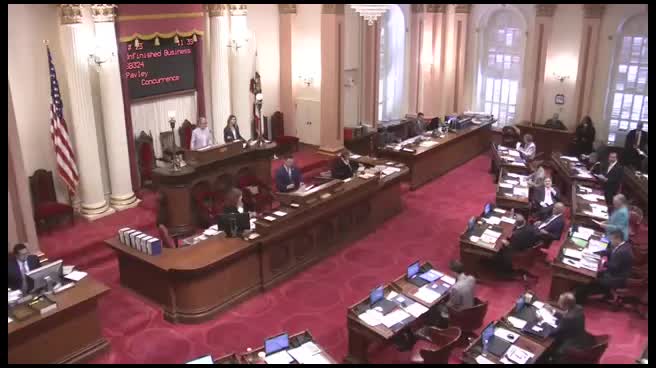 50SEC
Senate Floor
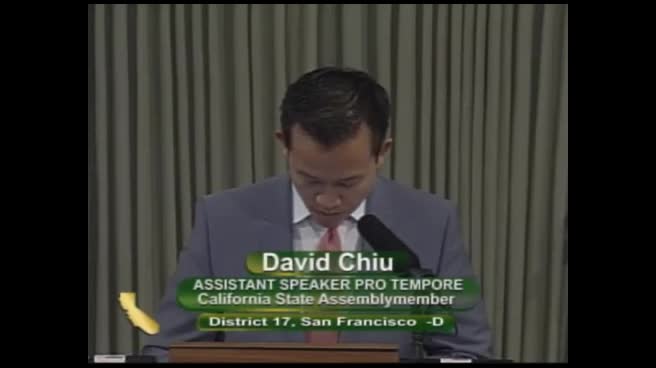 2MIN
Assembly Floor
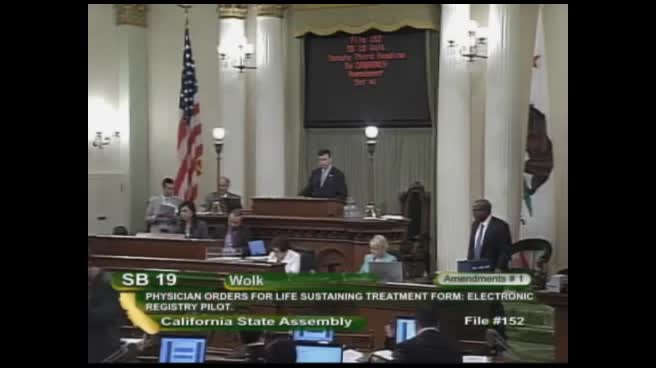 43SEC
Assembly Floor
 1MIN
Assembly Floor
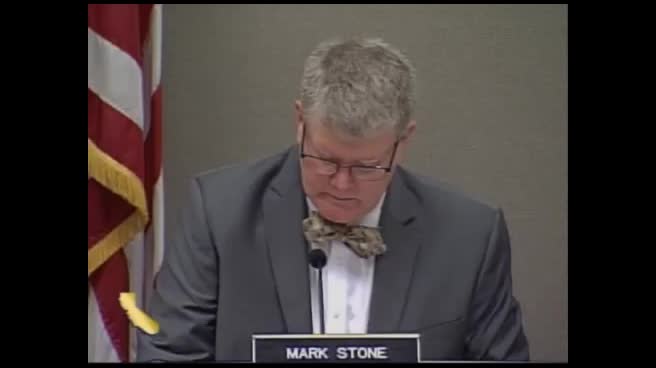 4MIN
Assembly Standing Committee on Judiciary
 9MIN
Assembly Standing Committee on Health
 1MIN
Senate Floor
 5MIN
Senate Standing Committee on Health
Bill Author

Bill Co-Author(s):