SB 206: Vehicle information systems.
- Session Year: 2015-2016
- House: Senate
- Latest Version Date: 2015-05-06
Existing law imposes various limitations on emissions of air contaminants for the control of air pollution from vehicular and nonvehicular sources. Existing law generally designates the State Air Resources Board as the state agency with the primary responsibility for the control of vehicular air pollution. Existing law requires the state board to adopt and implement motor vehicle emission standards, in-use performance standards, and motor vehicle fuel specifications for the control of air contaminants, including standards for off-road and nonvehicle engine categories.
This bill would prohibit the state board from obtaining locational data or vehicle speed data from a vehicle information system, as defined. The bill would provide that these provisions do not apply to the motor vehicle inspection and maintenance program, commonly known as smog check. defined, except to assist the vehicle owner or operator to use as a defense in an enforcement action brought by the state board.
Existing law imposes various limitations on emissions of air contaminants for the control of air pollution from vehicular and nonvehicular sources. Existing law generally designates the State Air Resources Board as the state agency with the primary responsibility for the control of vehicular air pollution. Existing law requires the state board to adopt and implement motor vehicle emission standards, in-use performance standards, and motor vehicle fuel specifications for the control of air contaminants, including standards for off-road and nonvehicle engine categories.
This bill would prohibit the state board from obtaining information locational data or vehicle speed data from a motor vehicles on-board diagnostic vehicle information system, as defined. The bill would provide that these provisions do not apply to the motor vehicle inspection and maintenance program, commonly known as smog check.
Existing law imposes various limitations on emissions of air contaminants for the control of air pollution from vehicular and nonvehicular sources. Existing law generally designates the State Air Resources Board as the state agency with the primary responsibility for the control of vehicular air pollution. Existing law requires the state board to adopt and implement motor vehicle emission standards, in-use performance standards, and motor vehicle fuel specifications for the control of air contaminants, including standards for off-road and nonvehicle engine categories.
This bill would prohibit the state board, and any other state agency, from obtaining information from a motor vehicles on-board diagnostic system unless the registered owner of the motor vehicle has provided written consent for the collection of that information. The bill would require the state board to develop a system through which a registered motor vehicle owner may electronically provide his or her consent, to maintain a database of those consenting registered motor vehicle owners, and to develop a form for registered motor vehicle owners to remove themselves from the database. system. The bill would provide that these provisions do not apply to the motor vehicle inspection and maintenance program, commonly known as smog check.
Existing law imposes various limitations on emissions of air contaminants for the control of air pollution from vehicular and nonvehicular sources. Existing law generally designates the State Air Resources Board as the state agency with the primary responsibility for the control of vehicular air pollution. Existing law requires the state board to adopt and implement motor vehicle emission standards, in-use performance standards, and motor vehicle fuel specifications for the control of air contaminants, including standards for off-road and nonvehicle engine categories.
This bill would prohibit the state board, and any other state agency, from obtaining information from a motor vehicles on-board diagnostic system unless the registered owner of the motor vehicle has provided written consent for the collection of that information. The bill would require the state board to develop a system through which a registered motor vehicle owner may electronically provide his or her consent, to maintain a database of those consenting registered motor vehicle owners, and to develop a form for registered motor vehicle owners to remove themselves from the database. The bill would provide that these provisions do not apply to the motor vehicle inspection and maintenance program, commonly known as smog check.
(a)The state board shall not obtain locational data or vehicle speed data from a vehicle information system. system except to assist the vehicle owner or operator to use as a defense in an enforcement action brought by the state board.
(b)Vehicle information system means a computer or other device embedded or integrated into the vehicle, other than an event recorder, that records, generates, stores, or collects data that can by itself or with other information be used to distinguish or individually identify the registered owned, owner of the vehicle, the driver of the vehicle, or the operation, use, or condition of the vehicle.
(c)This section does not apply to Chapter 5 (commencing with Section 44000).
(a)The state board shall not obtain information locational data or vehicle speed data from a motor vehicles on-board diagnostic vehicle information system.
(b)Vehicle information system means a computer or other device embedded or integrated into the vehicle, other than an event recorder, that records, generates, stores, or collects data that can by itself or with other information be used to distinguish or individually identify the registered owned, of the vehicle, the driver of the vehicle, or the operation, use, or condition of the vehicle.
(b)
(c)This section does not apply to Chapter 5 (commencing with Section 44000).
(a)The state board, and any other state agency, shall not obtain information from a motor vehicles on-board diagnostic system unless the registered owner of the motor vehicle has provided written consent for the collection of that information. system.
(b)The state board shall do all of the following:
(1)Develop a system through which a registered motor vehicle owner may electronically provide his or her consent pursuant to subdivision (a).
(2)Maintain a database of those registered motor vehicle owners who have provided their consent pursuant to subdivision (a).
(3)Develop a form for registered motor vehicle owners to remove themselves from the database.
(c)
(b)This section does not apply to Chapter 5 (commencing with Section 44000).
(a)The state board, and any other state agency, shall not obtain information from a motor vehicles on-board diagnostic system unless the registered owner of the motor vehicle has provided written consent for the collection of that information.
(b)The state board shall do all of the following:
(1)Develop a system through which a registered motor vehicle owner may electronically provide his or her consent pursuant to subdivision (a).
(2)Maintain a database of those registered motor vehicle owners who have provided their consent pursuant to subdivision (a).
(3)Develop a form for registered motor vehicle owners to remove themselves from the database.
(c)This section does not apply to Chapter 5 (commencing with Section 44000).
|
Date
|
Status
|
|---|---|
| Apr 21, 2015 | Set for hearing April 28. |
| Feb 1, 2016 | Returned to Secretary of Senate pursuant to Joint Rule 56. |
| May 28, 2015 | May 28 hearing: Held in committee and under submission. |
| May 23, 2015 | Set for hearing May 28. |
| May 11, 2015 | May 11 hearing: Placed on APPR. suspense file. |
| May 6, 2015 | From committee with author's amendments. Read second time and amended. Re-referred to Com. on APPR. |
| May 1, 2015 | Set for hearing May 11. |
| Apr 29, 2015 | From committee: Do pass and re-refer to Com. on APPR. (Ayes 6. Noes 0.) (April 28). Re-referred to Com. on APPR. |
| Apr 29, 2015 | From committee: Do pass and re-refer to Com. on APPR. (Ayes 6. Noes 0. Page 818.) (April 28). Re-referred to Com. on APPR. |
| Feb 11, 2015 | Introduced. Read first time. To Com. on RLS. for assignment. To print. |
| Apr 16, 2015 | From committee: Do pass and re-refer to Com. on JUD. (Ayes 6. Noes 1. Page 649.) (April 15). Re-referred to Com. on JUD. |
| Apr 7, 2015 | From committee with author's amendments. Read second time and amended. Re-referred to Com. on E.Q. |
| Apr 6, 2015 | From committee with author's amendments. Read second time and amended. Re-referred to Com. on E.Q. |
| Mar 17, 2015 | Set for hearing April 15. |
| Mar 5, 2015 | March 18 set for first hearing canceled at the request of author. |
| Mar 3, 2015 | Set for hearing March 18. |
| Feb 19, 2015 | Referred to Coms. on E.Q. and JUD. |
| Feb 12, 2015 | From printer. May be acted upon on or after March 14. |
|
Date
|
Description
|
Location
|
Votes
|
|
|---|---|---|---|---|
| May 11, 2015 | Placed on suspense file | Senate Standing Committee on Appropriations |
Passed |
|
| Apr 28, 2015 | Do pass, but first be re-referred to the Committee on [Appropriations] | Senate Standing Committee on Judiciary |
Passed |
|
| Apr 15, 2015 | Do pass, but first be re-referred to the Committee on [Judiciary] | Senate Standing Committee on Environmental Quality |
Passed |
This list shows positions taken on this bill by organizations on the date displayed, which is linked to the original source.
Positions by individuals are not included.
|
Organization
|
Position
|
Date
|
|---|---|---|
| Automotive Parts Industry | * Support | Apr 15, 2015 |
| Electronic Frontier Foundation | * Support | Apr 15, 2015 |
SB 206 (Gaines) Page 2 of 2
SENATE COMMITTEE ON APPROPRIATIONS
Senator Ricardo Lara, Chair
2015 - 2016 Regular Session
SB 206 (Gaines) - Vehicle information systems
|
|
Version: May 6, 2015 |
Policy Vote: E.Q. 6 - 1, JUD. 6 - 0 |
Urgency: No |
Mandate: No |
Hearing Date: May 11, 2015 |
Consultant: Marie Liu |
This bill meets the criteria for referral to the Suspense File.
Bill Summary:
SB 206 would prohibit the California Air Resources Board (ARB) from obtaining locational data from a vehicle information system.
Fiscal Impact:
One-time costs of at least $200,000 with ongoing costs less than $150,000 annually from various special funds* to the ARB reconfigure or replace devices and vehicles that currently can obtain locational data.
Unknown one-time costs, likely in the hundreds of thousands of dollars, to various special funds* to alter existing testing, research, modeling, and regulatory programs to find substitute data or other workarounds for the loss of locational data.
* Motor Vehicle Account, Air Pollution Control Fund, Vehicle Inspection and Repair Fund, and the Cost of Implementation Fund
Background:
On-board diagnostic (OBD) systems are computer-based systems built into the hardware and software of a vehicle’s on-board computer of all 1996 and later light-duty vehicles and trucks, as required by the federal Clean Air Act Amendments of 1990.
OBD II, California’s second generation of OBD requirements, is a diagnostic system incorporated into the vehicle’s powertrain computer. The purpose of the OBD II systems is to detect high emission levels caused by emission-related malfunctions, reduce the time between the occurrence of a malfunction and its detection and repair, and also to assist in the diagnosis and repair of the malfunction. OBD II systems activate their monitoring strategies during normal on-road vehicle driving. If a problem is detected, the OBD II system illuminates a warning lamp on the vehicle instrument panel to alert the driver, and stores data related to the detected malfunction in the on-board computer so that it will be available to the technician for downloading when the vehicle is serviced.
Proposed Law:
This bill prohibits ARB from obtaining locational data from a vehicle information system except if that data is being used to assist a vehicle owner in a defense against an enforcement action brought by the ARB.
“Vehicle information system” is defined as a device integrated into the vehicle that collects data that can by itself, or with other information, be used to individually identify the registered owner of the vehicle, the driver of the vehicle, or the operation, use, or condition of the vehicle.
Related Legislation:
AB 886 (Chau, 2015) would prohibit a transportation network provider, as defined, from requesting or requiring personally identifiable data, including locational data, of a passenger except for certain purposes. This bill is currently in the Assembly Utilities and Commerce Committee.
SB 994 (Monning, 2014) would have restricted the use of vehicle data without the consent of a vehicle’s owner by both the public and private sector. This bill failed in the Senate Transportation and Housing Committee.
AB 213 (Leslie) Chapter 427, Statutes of 2003 required that if a motor vehicle is equipped with one or more data recording devices for the purpose of retrieving data after an accident, then the vehicle manufacturer must disclose this fact in the owner’s manual of the vehicle.
Staff Comments:
According to the ARB website, there are no plans to create a new OBD program that would utilize remote transponders to send information to the ARB indicating whether the vehicle’s emissions are in compliance. That said, according to the ARB, it currently collects locational data for various testing, research, modeling, and regulatory purposes. For example, locational data enables ARB to study how emissions correlate to geographical conditions and to inform the creation of site-specific emissions inventories. Much of this information is collected voluntarily, like under the ARB’s Truck and Bus regulations, where the regulated party can voluntarily provide electronic tracking in place of a log-book recording to annually show compliance. This bill would prohibit ARB from collecting all locational data, except in defense of the vehicle owner in an enforcement action brought by ARB, even if the information is voluntarily offered. This bill would impose unknown, but likely one-time costs in the hundreds of thousands of dollars, to find alternatives to locational data in ARB’s various testing, research, modeling, and regulatory purposes.
Locational data is collected electronically from the vehicle information system with off-board data loggers or scan tools. Under this bill, ARB would be required to review the various devices and vehicles used by the ARB that might be able to obtain locational data from the vehicle information system. There would be substantial upfront work initially to review and reconfigure or replace all affected equipment. These review costs are uncertain but are likely to be at least $200,000 spread across various special funds. There would also be some ongoing costs to review new equipment that are likely to be substantially less than the initial efforts, likely less than $150,000 per year.
-- END --
SB 206 (Gaines)
Page 5 of 5
Senator Hannah-Beth Jackson, Chair
2015 - 2016 Regular Session
SB 206 (Gaines)
Version: April 7, 2015
Hearing Date: April 28, 2015
Fiscal: Yes
Urgency: No
TH
SUBJECT
Vehicle Information Systems
DESCRIPTION
This bill would prohibit the California Air Resources Board from obtaining locational data or vehicle speed data from a vehicle’s computer system except for use in implementing California’s vehicular smog abatement program known as Smog Check.
BACKGROUND
In 1982, California implemented a vehicular smog abatement program popularly known as Smog Check as part of the state’s plan to meet federal air quality standards. The Smog Check program is administered by the Bureau of Automotive Repair (BAR) within the Department of Consumer Affairs (DCA). The Smog Check program requires California-registered motor vehicles in certain areas to have an emissions inspection every two years, and for vehicles to receive an emissions test upon initial registration or change of ownership. The Smog Check program requires both a tailpipe gas emissions test and an inspection of the vehicle’s on-board diagnostic system known as OBD II.
The California Air Resources Board (CARB) is mandated under existing law to work with and provide data and information to DCA and BAR on several aspects of the Smog Check program, including setting maximum emissions standards and developing alternative test procedures for vehicles that have operational problems with their OBD II systems. This bill would prohibit CARB from obtaining locational or vehicle speed data from a vehicle’s computer system, including its OBD II system, except as necessary to comply with the Smog Check vehicular inspection program.
CHANGES TO EXISTING LAW
Existing law establishes the Motor Vehicle Inspection Program and directs the Department of Consumer Affairs (DCA) to take those actions consistent with its statutory authority to ensure that a reduction in vehicle emissions of hydrocarbons, carbon monoxide, and oxides of nitrogen meets or exceeds the reductions required by the amendments enacted to the Clean Air Act in 1990. (Health & Saf. Code Sec. 44001.5.)
Existing law directs DCA, in cooperation with the California Air Resources Board (CARB), to prescribe maximum emission standards to be applied in inspecting motor vehicles under the Motor Vehicle Inspection Program. Existing law directs the standards to be set at a level reasonably achievable for each class and model of motor vehicle when operating in a reasonably sound mechanical condition, as specified. (Health & Saf. Code Sec. 440013.)
Existing law provides that a vehicular emissions test under this Program shall be performed in accordance with procedures prescribed by DCA and may require loaded mode dynamometer testing, two-speed idle testing, testing utilizing a vehicle’s onboard diagnostic system, or other appropriate test procedures as determined by DCA in consultation with CARB, as specified. Existing law provides that DCA, in consultation with CARB, may prescribe alternative test procedures that include loaded mode dynamometer or two-speed idle testing for vehicles with onboard diagnostic systems that DCA and CARB determine exhibit operational problems. (Health & Saf. Code Sec. 440012.)
Existing law prohibits any person other than the registered owner of a motor vehicle from downloading or otherwise retrieving data from the vehicle’s event data recorder, except as specified. (Veh. Code Sec. 9951.)
This bill would prohibit CARB from obtaining locational data or vehicle speed data from a vehicle information system.
This bill would state that the above prohibition does not apply to the Motor Vehicle Inspection Program.
This bill would define “vehicle information system” to mean a computer or other device embedded or integrated into the vehicle, other than an event recorder, that records, generates, stores, or collects data that can by itself or with other information be used to distinguish or individually identify the registered owner, of the vehicle, the driver of the vehicle, or the operation, use, or condition of the vehicle.
COMMENT
Stated need for the bill
The author writes:
In 2010, the Air Resource[s] Board and the Bureau of Automotive Repair jointly sponsored AB 2289, which allowed the use of OBDII when performing the biennial smog check in lieu of tailpipe testing. Utilizing the vehicle’s own emission monitoring systems allow for more accurate readings as well as cut[s] down on the consumer’s wait time. While AB 2289 did propel technological delivery into the 21st century, it also opened the door for the possibility that state agencies may view and retain more information than necessary when performing smog check services. As technology moves forward, OBDII, or future data gathering and transfer systems, could retain more sensitive information, including the location and speed of the vehicle.
. . .
This bill would disallow the California Air Resources Board, from obtaining and retaining a vehicle’s location or speed data from a motor vehicle’s information system. This bill does not prohibit the Air Resource[s] Board from gathering data necessary to carry out California’s smog check program.
Fundamental Right to Privacy
California recognizes that the right to privacy is a fundamental right, and has enshrined that right along with other fundamental rights in section 1, article I of the California Constitution. The misuse of locational information taken from a vehicle’s on-board computer system threatens to undermine this fundamental right, given the possibility that one could use the locational history of a vehicle to extrapolate certain details about the car’s driver. As the U.S. Supreme Court recently noted, government access to a vehicle’s locational data could enable it “to ascertain, more or less at will, [a driver’s] political and religious beliefs, sexual habits, and so on.” (United States v. Jones (2012) 132 S. Ct. 945, 956.) California residents may be less willing to exercise their associational and expressive freedoms if they know that their movements could potentially be accessed by the government through a vehicle’s on-board computer system.
While this bill would ostensibly prevent such abuse, staff notes that the bill stops well short of offering a comprehensive solution to strengthening California’s constitutional right to privacy and preventing the potential misuse of vehicle generated data, including locational information. Last year, SB 994 (Monning, 2014) would have restricted the use of vehicle data without the consent of a vehicle’s owner by both the public and private sector. This bill limits its scope to only one agency in the public sector, and that agency neither currently nor plans in the future to collect locational data from vehicles. (See California Air Resources Board, On-Board Diagnostic II (OBD II) Systems - Fact Sheet/FAQs <http://www.arb.ca.gov/msprog/obdprog/obdfaq.htm> [as of Apr. 22, 2015].)
Staff further notes that this bill explicitly excludes the Smog Check program from the scope of its prohibitions. While this is likely the primary means by which CARB would gain access to data collected by a vehicle’s on-board computer system, CARB may administer other vehicle emissions reduction programs to which this bill’s prohibitions would apply.
Support: California Construction Trucking Association
Opposition: None Known
HISTORY
Source: Author
Related Pending Legislation: AB 886 (Chau, 2015) would prohibit a transportation service network provider, as defined, from requesting or requiring personally identifiable data, including locational data, of a passenger unless the information is used for certain purposes, including establishing, maintaining, and updating a customer’s account. This bill would require a transportation service network provider to provide an accountholder with an opportunity to cancel or terminate an account, and would require a transportation service network provider to destroy or dispose of all personally identifiable data in a secure manner when the information is no longer needed for the purposes for which it was collected or when an accountholder cancels or terminates his or her account. This bill is pending in the Assembly Utilities and Commerce Committee.
Prior Legislation:
SB 994 (Monning, 2014) would have required manufacturers of new motor vehicles that record, generate, store, or collect vehicle information to make certain disclosures to the registered owner regarding the recordation, generation, storage, and collection of that information. This bill also would have required the manufacturer to provide the registered owner of the vehicle with access to the vehicle information, and would have prohibited vehicle information from being downloaded or otherwise retrieved from the motor vehicle without the consent of the registered owner, except as specified. This bill died in the Senate Transportation and Housing Committee.
AB 2289 (Eng, Ch. 258, Stats. 2010), among other things, required the Department of Consumer Affairs to implement vehicle emissions testing using a vehicle’s on-board diagnostic system in lieu of a dynamometer or idle test for specified vehicles. This bill directed the Department, in consultation with the California Air Resources Board, to determine the appropriate emissions test procedures, and made other changes to the Department’s authority with respect to the Smog Check program, including requirements relating to testing equipment and motor vehicle emission data.
Prior Vote: Senate Environmental Quality Committee (Ayes 6, Noes 1)
**************
SB 206 (Gaines) Page 6 of 6
SENATE COMMITTEE ON ENVIRONMENTAL QUALITY
Senator Wieckowski, Chair
2015 - 2016 Regular
Bill No: SB 206
Author: |
Gaines |
||
Version: |
4/7/2015 |
Hearing Date: |
4/15/2015 |
Urgency: |
No |
Fiscal: |
Yes |
Consultant: |
Joanne Roy |
||
Subject: Vehicle information systems
ANALYSIS:
Existing law:
Under the federal Clean Air Act (42 U.S.C. §7401 et seq.):
Requires the US Environmental Protection Agency to establish national ambient air quality standards for certain common and widespread pollutants and regulates air emissions from stationary and mobile sources.
Requires states to adopt enforceable plans to achieve and maintain air quality meeting the national air quality standards.
Provides that the state Air Resources Board (ARB) is responsible for developing statewide programs and strategies to reduce the emission of smog-forming pollutants and toxics by mobile sources. These include both on- and off-road sources such as passenger cars, motorcycles, trucks, busses, heavy-duty construction equipment, recreational vehicles, marine vessels, lawn and garden equipment, and small utility engines.
Establishes the state Motor Vehicle Inspection Program. (HSC §44000 et seq.).
Subjects all motor vehicles that are registered within designated areas to a smog check every two years with specified exceptions. (HSC §44011(a)).
Provides an exception to HSC §44011(a) for motor vehicles six or less model-years old unless ARB finds that providing this exception will prohibit the state from meeting specified requirements of the federal Clean Air Act or the state’s commitments with respect to the state implementation plan required by the federal Clean Air Act. (HSC §44011(a)(4)(B)).
Restricts the use of data from recording devices installed in vehicles. (Vehicle Code §9951).
This bill:
Prohibits ARB from obtaining locational data or vehicle speed data from a vehicle information system.
Provides that this prohibition does not apply to the Motor Vehicle Inspection Program (i.e. Smog Check program).
Defines “vehicle information system” as a system which collects data that a motor vehicle records, generates, stores, or collects through a computer or other device embedded or integrated into the vehicle, other than an event recorder, that can by itself or with other information be used to distinguish or individually identify the registered owner of the vehicle, the driver, or the operation, use, or condition of the vehicle.
Background
On-Board Diagnostic Systems.
According to ARB, on-board diagnostic (OBD) systems, or "OBDs," are computer-based systems built into the hardware and software of a vehicle’s on-board computer of all 1996 and later light-duty vehicles and trucks, as required by the federal Clean Air Act Amendments of 1990.
OBD II, California’s second generation of OBD requirements, is a diagnostic system incorporated into the vehicle’s powertrain computer. The purpose of the OBD II systems is to detect high emission levels caused by emission-related malfunctions, reduce the time between the occurrence of a malfunction and its detection and repair, and also to assist in the diagnosis and repair of the malfunction. OBD II systems activate their monitoring strategies during normal on-road vehicle driving. If a problem is detected, the OBD II system illuminates a warning lamp on the vehicle instrument panel to alert the driver, and stores data related to the detected malfunction in the on-board computer so that it will be available to the technician for downloading when the vehicle is serviced.
California’s Smog Check Program.
The purpose of the state’s Smog Check program is to reduce air pollution from vehicles by making sure that cars with excessive emissions are repaired in accordance with federal and state requirements. Gasoline-powered vehicles, hybrid vehicles, and alternative-fuel vehicles that are model year 1976 and newer require a smog check.
A smog inspection consists of a tailpipe emission test and an inspection of a vehicle’s OBD II. The tailpipe emission test is a visual inspection in which the technician checks for blue or black smoke emitting from the tailpipe. As long as there is no blue or black exhaust, the vehicle passes this part of the smog inspection. The OBD II test requires the inspector to attach vehicle components to a smog check machine and run the test for certain codes. An OBD II system independently monitors the performance of a vehicle’s emission control system and relays that information to the smog check machine. If the vehicle components pass each code, then the vehicle passes this part of the smog inspection.
Comments
Purpose of Bill.
According to the author, “In 2010, the Air Resources Board and the Bureau of Automotive Repair jointly sponsored AB 2289, which allowed the use of OBD II when performing the biennial smog check in lieu of tailpipe testing. Utilizing the vehicle’s own emission monitoring systems allow for more accurate readings as well as cut down on the consumer’s wait time. While AB 2289 did propel technological delivery into the 21st century, it also opened the door for the possibility that state agencies may view and retain more information than necessary when performing smog check services. As technology moves forward, OBD II will continue to retain more sensitive information; one such as the location and speed of the vehicle. Therefore, the safeguards this bill provides create sound legislation, and will protect the personal privacy rights of individuals…Any information needed for performing a smog check falls outside of the realm of this bill.”
Data Obtained for the Public Interest vs. Right to Privacy.
The volume of cars on the road and the increasing miles traveled daily make automobiles the single largest source of smog forming emissions. While new vehicles may start out with very low emissions, improper maintenance or faulty components can cause the vehicle emission levels to sharply increase. Studies estimate that approximately 50% of the total emissions from late-model vehicles are the result of emission-related malfunctions.
Also, studies have found that OBD II based inspections catch a greater percentage of vehicles that are in need of emission-related repairs compared to tailpipe emissions tests that have been traditionally used for state Inspection and Maintenance programs. The Smog Check program utilizes individual vehicle data to improve vehicle emissions statewide and OBDs are an integral component of the Smog Check program.
Some have raised concern about the potential vulnerability and accessibility of private data stored in a vehicle information system. They want to make sure that data obtained from their vehicles do not cross the line from providing non-personal information that improves the public good to an invasion of privacy.
This bill proposes to strike a balance between sharing data for public benefit and a person’s right to privacy by prohibiting ARB from obtaining a vehicle’s locational data and vehicle speed data for purposes other than the Smog Check program. These types of vehicle information likely have no bearing on air quality issues. Although ARB does not currently collect such information, this bill would prevent the board from doing so in the future for purposes other than the Smog Check program.
ARB Addresses Rumors About “OBD III”.
Some have raised concern that ARB may intend to collect more personal data from vehicles beyond what it currently obtains for the Smog Check program.
On its website, ARB states, “First, there is no such thing [as an OBD III]. There has been speculation about a new OBD program that would utilize remote transponders (like those currently used for automated bridges or toll roads) to send information indicating if any malfunctioning component is present in the vehicle in lieu of having the vehicle inspected at a Smog Check facility every one or two years. Many have referred to such a concept as OBD III. However, contrary to the rumors, no such program has been adopted by ARB nor have any decisions been made by ARB to pursue such an approach in California. The concept certainly exists and there are various products consumers can buy to remotely monitor their vehicle. Some other states are even pursuing pilot programs and allowing consumers who voluntarily equip their vehicles with such devices to be exempted from their inspection programs that are similar to California’s Smog Check. These other states have pursued such approaches as additional ways to reduce consumer inconvenience and costs of participating in the inspection program.”
Where Does All the Data Go Now?
Vehicles increasingly collect data about themselves and then communicate that data in some fashion. This data is generally in a raw form that requires proprietary tools to download and interpret. It is currently unclear what is happening with the data that vehicles collect; and what is collected and how it is used is rapidly evolving. Some facts are clear, however, including that most vehicle owners do not know what data their vehicle generates, who has access to that data, and for what purposes it is used. The law appears to be silent on who owns this data, but as of now, vehicle manufacturers are most in control of it due to their knowledge of the technology installed on the vehicles they sell.
Double Referral.
Double Referral to Senate Judiciary Committee. If this measure is approved by the Senate Environmental Quality Committee, the do pass motion must include the action to re-refer the bill to the Senate Judiciary Committee.
Related/Prior Legislation
AB
2289 (Eng), Chapter 258, Statutes of 2010, authorized the Bureau of
Automotive Repair to certify high performing Smog Check stations and
technicians as STAR certified, which allows them to inspect and
repair vehicles that are likely to be high polluters.
AB
213 (Leslie), Chapter 427, Statutes of 2003, required that if a motor
vehicle is equipped with one or more data recording devices (event
recorder) for the purpose of retrieving data after an accident, then
the vehicle manufacturer must disclose this fact in the owner’s
manual for the vehicle.
SB 33 (Presley), Chapter 892,
Statutes of 1982, authorized the Bureau of Automotive Repair to
implement, maintain, and enforce the Smog Check Program, which
licenses Smog Check stations and technicians to reduce air pollution
from vehicles through mandatory testing of vehicle emission control
components.
SOURCE:
Author
SUPPORT:
None on file
OPPOSITION:
None on file
-- END --
Discussed in Hearing
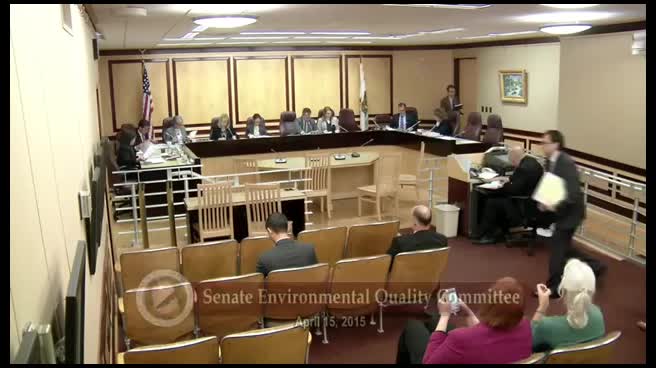 13MIN
Senate Standing Committee on Environmental Quality
Bill Author

Bill Co-Author(s):