SB 376: Public contracts: University of California.
- Session Year: 2015-2016
- House: Senate
- Latest Version Date: 2015-09-15
Existing provisions of the California Constitution provide that the University of California constitutes a public trust and require the university to be administered by the Regents of the University of California (regents), a corporation in the form of a board, with full powers of organization and government, subject to legislative control only for specified purposes, including such competitive bidding procedures as may be applicable to the university by statute for the letting of construction contracts, sales of real property, and purchasing of materials, goods, and services. Existing law requires the regents, except as provided, to let all contracts involving an expenditure of $100,000 or more annually for goods and materials or services, excepting personal or professional services, to the lowest responsible bidder meeting certain specifications, or to reject all bids. Existing law, until January 1, 2018, also authorizes the bid evaluation and selection for these contracts to be determined by the best value.
This bill would require a bidder, to qualify as a lowest responsible bidder or best value awardee on contracts for specified services, to certify in writing to the University of California (UC) that the bid includes a total employee compensation package that is valued on a per-employee basis at a level sufficient that it does not materially undercut the average per-employee value of total compensation for UC employees who perform comparable work at the relevant campus, medical center, or laboratory at which the bidder proposes to perform the work. The bill would require the UC to include in its request for proposals a calculation of the average per-employee value of total compensation for UC employees who perform comparable work at the relevant location, as prescribed. The bill would require contracts for services involving an expenditure of $100,000 or more annually to include any renewals or extensions of the contract that would result in an expenditure of $100,000 or more annually.
This bill would exclude specified employees and public works from these provisions, as provided.
Existing provisions of the California Constitution provide that the University of California constitutes a public trust and require the university to be administered by the Regents of the University of California (regents), a corporation in the form of a board, with full powers of organization and government, subject to legislative control only for specified purposes, including such competitive bidding procedures as may be applicable to the university by statute for the letting of construction contracts, sales of real property, and purchasing of materials, goods, and services. Existing law requires the regents, except as provided, to let all contracts involving an expenditure of $100,000 or more annually for goods and materials or services, excepting personal or professional services, to the lowest responsible bidder meeting certain specifications, or to reject all bids. Existing law, until January 1, 2018, also authorizes the bid evaluation and selection for these contracts to be determined by the best value.
This bill would require a bidder, to qualify as a lowest responsible bidder or best value awardee on contracts for specified services, to certify in writing to the University of California (UC) that the bid includes a total employee compensation package that is valued on a per-employee basis at a level sufficient that it does not materially undercut the average per-employee value of total compensation for UC employees who perform comparable work at the relevant campus, medical center, or laboratory at which the bidder proposes to perform the work. The bill would require the UC to include in its request for proposals a calculation of the average per-employee value of total compensation for UC employees who perform comparable work at the relevant location, as prescribed. The bill, with respect to contracts for services involving an expenditure of $100,000 or more, would not except personal services from the lowest responsible bidder requirement. The bill would require contracts for services involving an expenditure of $100,000 or more annually to include any renewals or extensions of the contract that would result in an expenditure of $100,000 or more annually.
This bill would exclude specified employees and public works from these provisions, as provided.
Existing provisions of the California Constitution provide that the University of California constitutes a public trust and require the university to be administered by the Regents of the University of California (regents), a corporation in the form of a board, with full powers of organization and government, subject to legislative control only for specified purposes, including such competitive bidding procedures as may be applicable to the university by statute for the letting of construction contracts, sales of real property, and purchasing of materials, goods, and services. Existing law requires the regents, except as provided, to let all contracts involving an expenditure of more than $100,000 or more annually for goods and materials or services, excepting personal or professional services, to the lowest responsible bidder meeting certain specifications, or to reject all bids. Existing law, until January 1, 2018, also authorizes the bid evaluation and selection for these contracts to be determined by the best value.
This bill would require a bidder, to qualify as a lowest responsible bidder or best value awardee, awardee on contracts for specified services, to certify in writing to the University of California (UC) that the bid includes a total employee compensation package that is valued on a per-employee basis at a level sufficient that it does not materially undercut the average per-employee value of total compensation for UC employees who perform comparable work at the relevant campus, medical center, or laboratory at which the bidder proposes to perform the work. The bill would require the UC to include in its request for proposals a calculation of the average per-employee value of total compensation for UC employees who perform comparable work at the relevant location, as prescribed. The bill, with respect to contracts for services, would remove services involving an expenditure of $100,000 or more, would not except personal services from the lowest responsible bidder requirement exemption and requirement. The bill would require contracts for services involving an expenditure exceeding of $100,000 or more annually to include any renewals or extensions of the contract that will also would result in an expenditure exceeding of $100,000 or more annually.
This bill would exclude specified employees and public works from these provisions, as provided.
Existing provisions of the California Constitution provide that the University of California constitutes a public trust and require the university to be administered by the Regents of the University of California (regents), a corporation in the form of a board, with full powers of organization and government, subject to legislative control only for specified purposes, including such competitive bidding procedures as may be applicable to the university by statute for the letting of construction contracts, sales of real property, and purchasing of materials, goods, and services. Existing law requires the regents, except as provided, to let all contracts involving an expenditure of more than $100,000 annually for goods and materials or services, excepting personal or professional services, to the lowest responsible bidder meeting certain specifications, or to reject all bids. Existing law, until January 1, 2018, also authorizes the bid evaluation and selection for these contracts to be determined by the best value.
This bill would require a bidder, to qualify as a lowest responsible bidder or best value awardee, to certify in writing to the University of California (UC) that the bid includes a total employee compensation package that is valued on a per-employee basis at a level sufficient that it does not materially undercut the average per-employee value of total compensation for UC employees who perform comparable work at the relevant campus, medical center, or laboratory at which the bidder proposes to perform the work. The bill would require the UC to include in its request for proposals a calculation of the average per-employee value of total compensation for UC employees who perform comparable work at the relevant location, as prescribed. The bill, with respect to contracts for services, would remove personal services from the lowest responsible bidder requirement exemption and would require contracts for services involving an expenditure exceeding $100,000 annually to include any renewals or extensions of the contract that will also result in an expenditure exceeding $100,000 annually.
Existing law authorizes state agencies, in exercising their delegation of contracting authority from the Department of General Services, to contract for specified items or services with suppliers who have multiple award schedules with the General Services Administration of the United States, as provided.
This bill would make nonsubstantive changes to that provision.
The Legislature finds and declares the following:
(a)It is a matter of statewide concern that responsible competitive bidding at the University of California not undercut the wages and benefits provided by the University of California for comparable work, given that a significant percentage of University of California employees already are eligible for public benefits and any material decrease in the compensation of employees performing such work would result in materially increased General Fund costs for the provision of benefits.
(b)It is a matter of statewide concern that the University of California not repeat past instances in which public resources have been squandered via contracting out to for-profit private contractors that charge significant administrative overhead.
SEC. 2.Section 10507.6 is added to the Public Contract Code, to read:10507.6.(a)For the purposes of this article, to qualify as a lowest responsible bidder or best value awardee on any contract for building maintenance, cleaning, or custodial services, call center services, clerical services, dining and food services, gardening, grounds keeping and plant nursery services, laborer services, mailroom services, parking, shuttle bus, truck driving, or transportation services, security services, storekeeper services, patient care technical employee services, patient billing services, medical transcribing services, patient escort services, or nursing assistant services, a bidder shall certify in writing to the University of California that the bid includes a total employee compensation package, including fringe benefits, that is valued on a per-employee basis at a level sufficient that it does not materially undercut the average per-employee value of total compensation, including fringe benefits, for employees of the University of California who perform comparable work at the relevant campus, medical center, or laboratory at which the bidder proposes to perform the work.
(b)The University of California shall implement this section by including in its request for proposals a calculation of the average per-employee value of total compensation, including fringe benefits, for employees of the University of California who perform comparable work at the relevant campus, medical center, or laboratory, and that calculation shall use all known cost escalators to project the future rate of growth of average per-employee total compensation costs.
(c)The requirements of this section shall not apply to employees subject to Section 1191.5 of the Labor Code or Section 214(c) of Title 29 of the United States Code. Any employees covered by Section 1191.5 of the Labor Code or Section 214(c) of Title 29 of the United States Code shall be omitted from all calculations and certifications required by this section.
(d)This section does not apply to any work subject to Chapter 1 (commencing with Section 1720) of Part 7 of Division 2 of the Labor Code.
SEC. 3.Section 10507.7 of the Public Contract Code is amended to read:10507.7.(a) Except as provided for in this article, the Regents of the University of California shall let all contracts involving an expenditure of more than one hundred thousand dollars ($100,000) annually for goods and materials to be sold to the University of California to the lowest responsible bidder meeting specifications, or else reject all bids. Contracts for services to be performed, other than personal or professional services, involving an expenditure of one hundred thousand dollars ($100,000) or more annually shall be made or entered into with the lowest responsible bidder meeting specifications, or else all bids shall be rejected. If the regents deem it to be for the best interest of the university, the regents may, on the refusal or failure of the successful bidder for materials, goods, or services to execute a tendered contract, award it to the second lowest responsible bidder meeting specifications. If the second lowest responsible bidder fails or refuses to execute the contract, the regents may likewise award it to the third lowest responsible bidder meeting specifications.
(b)For the purposes of this section, contracts for services involving an expenditure of one hundred thousand dollars ($100,000) or more annually shall include any renewal or extension of an existing contract, if the renewal or extension involves an expenditure of one hundred thousand dollars ($100,000) or more annually.
The Legislature finds and declares the following:
(a)It is a matter of statewide concern that responsible competitive bidding at the University of California not undercut the wages and benefits provided by the University of California for comparable work, given that a significant percentage of University of California employees already are eligible for public benefits and any material decrease in the compensation of employees performing such work would result in materially increased General Fund costs for the provision of benefits.
(b)It is a matter of statewide concern that the University of California not repeat past instances in which public resources have been squandered via contracting out to for-profit private contractors that charge significant administrative overhead.
SEC. 2.Section 10507.6 is added to the Public Contract Code, to read:10507.6.(a)For the purposes of this article, to qualify as a lowest responsible bidder or best value awardee on any contract for building maintenance, cleaning, or custodial services, call center services, clerical services, dining and food services, gardening, grounds keeping and plant nursery services, laborer services, mailroom services, parking, shuttle bus, truck driving, or transportation services, security services, storekeeper services, patient care technical employee services, patient billing services, medical transcribing services, patient escort services, or nursing assistant services, a bidder shall certify in writing to the University of California that the bid includes a total employee compensation package, including fringe benefits, that is valued on a per-employee basis at a level sufficient that it does not materially undercut the average per-employee value of total compensation, including fringe benefits, for employees of the University of California who perform comparable work at the relevant campus, medical center, or laboratory at which the bidder proposes to perform the work.
(b)The University of California shall implement this section by including in its request for proposals a calculation of the average per-employee value of total compensation, including fringe benefits, for employees of the University of California who perform comparable work at the relevant campus, medical center, or laboratory, and that calculation shall use all known cost escalators to project the future rate of growth of average per-employee total compensation costs.
The
(c)The requirements of this section shall not apply to employees subject to Section 1191.5 of the Labor Code or Section 214(c) of Title 29 of the United States Code. Any employees covered by Section 1191.5 of the Labor Code or Section 214(c) of Title 29 of the United States Code shall be omitted from all calculations and certifications required by this article. section.
(c)
(d)This section does not apply to any work subject to Chapter 1 (commencing with Section 1720) of Part 7 of Division 2 of the Labor Code.
SEC. 3.Section 10507.7 of the Public Contract Code is amended to read:10507.7.(a) Except as provided for in this article, the Regents of the University of California shall let all contracts involving an expenditure of more than one hundred thousand dollars ($100,000) annually for goods and materials to be sold to the University of California to the lowest responsible bidder meeting specifications, or else reject all bids. Contracts for services to be performed, other than personal or professional services, involving an expenditure of one hundred thousand dollars ($100,000) or more annually shall be made or entered into with the lowest responsible bidder meeting specifications, or else all bids shall be rejected. If the regents deem it to be for the best interest of the university, the regents, regents may, on the refusal or failure of the successful bidder for materials, goods, or services to execute a tendered contract, may award it to the second lowest responsible bidder meeting specifications. If the second lowest responsible bidder fails or refuses to execute the contract, the regents may likewise award it to the third lowest responsible bidder meeting specifications.
(b)For the purposes of this section, contracts for services involving an expenditure of one hundred thousand dollars ($100,000) or more annually shall include any renewal or extension of an existing contract, if the renewal or extension involves an expenditure of one hundred thousand dollars ($100,000) or more annually.
The Legislature finds and declares the following:
(a)It is a matter of statewide concern that responsible competitive bidding at the University of California not undercut the wages and benefits provided by the University of California for comparable work, given that a significant percentage of University of California employees already are eligible for public benefits and any material decrease in the compensation of employees performing such work would result in materially increased General Fund costs for the provision of benefits.
(b)It is a matter of statewide concern that the University of California not repeat past instances in which public resources have been squandered via contracting out to for-profit private contractors that charge significant administrative overhead.
SEC. 2.Section 10507.6 is added to the Public Contract Code, to read:10507.6.(a)For the purposes of this article, to qualify as a lowest responsible bidder or best value awardee on any contract for building maintenance, cleaning, or custodial services, call center services, clerical services, dining and food services, grounds keeping gardening, grounds keeping and plant nursery services, laborer services, mailroom services, parking parking, shuttle bus, truck driving, or transportation services, security services, or storekeeper services, patient care technical employee services, patient billing services, medical transcribing services, patient escort services, or nursing assistant services, a bidder shall certify in writing to the University of California that the bid includes a total employee compensation package, including fringe benefits, that is valued on a per-employee basis at a level sufficient that it does not materially undercut the average per-employee value of total compensation, including fringe benefits, for employees of the University of California who perform comparable work at the relevant campus, medical center, or laboratory at which the bidder proposes to perform the work.
(b)The University of California shall implement this section by including in its request for proposals a calculation of the average per-employee value of total compensation, including fringe benefits, for employees of the University of California who perform comparable work at the relevant campus, medical center, or laboratory, and that calculation shall use all known cost escalators to project the future rate of growth of average per-employee total compensation costs.The requirements of this section shall not apply to employees subject to Section 1191.5 of the Labor Code or Section 214(c) of Title 29 of the United States Code. Any employees covered by Section 1191.5 of the Labor Code or Section 214(c) of Title 29 of the United States Code shall be omitted from all calculations and certifications required by this article.
(c)This section does not apply to any work subject to Chapter 1 (commencing with Section 1720) of Part 7 of Division 2 of the Labor Code.
SEC. 3.Section 10507.7 of the Public Contract Code is amended to read:10507.7.(a) Except as provided for in this article, the Regents of the University of California shall let all contracts involving an expenditure of more than one hundred thousand dollars ($100,000) annually for goods and materials to be sold to the University of California to the lowest responsible bidder meeting specifications, or else reject all bids. Contracts for services to be performed, other than professional services, involving an expenditure of one hundred thousand dollars ($100,000) or more annually shall be made or entered into with the lowest responsible bidder meeting specifications, or else all bids shall be rejected. If the regents deem it to be for the best interest of the university, the regents, on the refusal or failure of the successful bidder for materials, goods, or services to execute a tendered contract, may award it to the second lowest responsible bidder meeting specifications. If the second lowest responsible bidder fails or refuses to execute the contract, the regents may likewise award it to the third lowest responsible bidder meeting specifications.
(b)For the purposes of this section, contracts for services involving an expenditure of one hundred thousand dollars ($100,000) or more annually shall include any renewal or extension of an existing contract, if the renewal or extension involves an expenditure of one hundred thousand dollars ($100,000) or more annually.
The Legislature finds and declares the following:
(a)It is a matter of statewide concern that responsible competitive bidding at the University of California not undercut the wages and benefits provided by the University of California for comparable work, given that a significant percentage of University of California employees already are eligible for public benefits and any material decrease in the compensation of employees performing such work would result in materially increased General Fund costs for the provision of benefits.
(b)It is a matter of statewide concern that the University of California not repeat past instances in which public resources have been squandered via contracting out to for-profit private contractors that charge significant administrative overhead.
SEC. 2.Section 10507.6 is added to the Public Contract Code, to read:10507.6.(a)For the purposes of this article, to qualify as a lowest responsible bidder or best value awardee, awardee on any contract for building maintenance, cleaning, or custodial services, call center services, dining services, grounds keeping services, laborer services, mail room services, parking or transportation services, security services, or patient care technical employee or nursing assistant services, a bidder shall certify the following in writing to the University of California:
(a)That California that the bid includes a total employee compensation package, including fringe benefits, that is valued on a per-employee basis at a level sufficient that it does not materially undercut the average per-employee value of total compensation, including fringe benefits, for employees of the University of California who perform comparable work at the relevant campus, medical center, or laboratory at which the bidder proposes to perform the work.(b)The University of California shall implement this paragraph section by including in its request for proposals a calculation of the average per-employee value of total compensation, including fringe benefits, for employees of the University of California who perform comparable work at the relevant campus, medical center, or laboratory, and that calculation shall use all known cost escalators to project the future rate of growth of average per-employee total compensation costs.
The requirements of this section shall not apply to employees subject to Section 1191.5 of the Labor Code or Section 214(c) of Title 29 of the United States Code. Any employees covered by Section 1191.5 of the Labor Code or Section 214(c) of Title 29 of the United States Code shall be omitted from all calculations and certifications required by this article.
(c)This section does not apply to any work subject to Chapter 1 (commencing with Section 1720) of Part 7 of Division 2 of the Labor Code.
SEC. 3.Section 10507.7 of the Public Contract Code is amended to read:10507.7.(a) Except as provided for in this article, the Regents of the University of California shall let all contracts involving an expenditure of more than one hundred thousand dollars ($100,000) annually for goods and materials to be sold to the University of California to the lowest responsible bidder meeting specifications, or else reject all bids. Contracts for services to be performed, other than professional services, involving an expenditure of one hundred thousand dollars ($100,000) or more annually shall be made or entered into with the lowest responsible bidder meeting specifications, or else all bids shall be rejected. If the regents deem it to be for the best interest of the university, the regents, on the refusal or failure of the successful bidder for materials, goods, or services to execute a tendered contract, may award it to the second lowest responsible bidder meeting specifications. If the second lowest responsible bidder fails or refuses to execute the contract, the regents may likewise award it to the third lowest responsible bidder meeting specifications.
(b)For the purposes of this section, contracts for services involving an expenditure of one hundred thousand dollars ($100,000) or more annually shall include any renewal or extension of an existing contract, if the renewal or extension involves an expenditure of one hundred thousand dollars ($100,000) or more annually.
The Legislature finds and declares the following:
(a)It is a matter of statewide concern that responsible competitive bidding at the University of California not undercut the wages and benefits provided by the University of California for comparable work, given that a significant percentage of University of California employees already are eligible for public benefits and any material decrease in the compensation of employees performing such work would result in materially increased General Fund costs for the provision of benefits.
(b)It is a matter of statewide concern that the University of California not repeat past instances in which public resources have been squandered via contracting out to for-profit private contractors that charge significant administrative overhead.
SEC. 2.Section 10507.6 is added to the Public Contract Code, to read:10507.6.For the purposes of this article, to qualify as a lowest responsible bidder or best value awardee, a bidder shall certify the following in writing to the University of California:
(a)That the bid includes a total employee compensation package, including fringe benefits, that is valued on a per-employee basis at a level sufficient that it does not materially undercut the average per-employee value of total compensation, including fringe benefits, for employees of the University of California who perform comparable work at the relevant campus, medical center, or laboratory at which the bidder proposes to perform the work.
(b)The University of California shall implement this paragraph by including in its request for proposals a calculation of the average per-employee value of total compensation, including fringe benefits, for employees of the University of California who perform comparable work at the relevant campus, medical center, or laboratory, and that calculation shall use all known cost escalators to project the future rate of growth of average per-employee total compensation costs.
SEC. 3.Section 10507.7 of the Public Contract Code is amended to read:10507.7.(a) Except as provided for in this article, the Regents of the University of California shall let all contracts involving an expenditure of more than one hundred thousand dollars ($100,000) annually for goods and materials to be sold to the University of California to the lowest responsible bidder meeting specifications, or else reject all bids. Contracts for services to be performed, other than personal or professional services, involving an expenditure of one hundred thousand dollars ($100,000) or more annually shall be made or entered into with the lowest responsible bidder meeting specifications, or else all bids shall be rejected. If the regents deem it to be for the best interest of the university, the regents may, regents, on the refusal or failure of the successful bidder for materials, goods, or services to execute a tendered contract, may award it to the second lowest responsible bidder meeting specifications. If the second lowest responsible bidder fails or refuses to execute the contract, the regents may likewise award it to the third lowest responsible bidder meeting specifications.
(b)For the purposes of this section, contracts for services involving an expenditure of one hundred thousand dollars ($100,000) or more annually shall include any renewal or extension of an existing contract, if the renewal or extension involves an expenditure of one hundred thousand dollars ($100,000) or more annually.
SECTION 1.Section 10290.1 of the Public Contract Code is amended to read:10290.1.(a)Notwithstanding any other provision of law, in exercising its delegation of contracting authority from the department, a state agency may contract for goods, information technology, or services with suppliers who have multiple award schedules with the General Services Administration of the United States if the supplier is willing to extend those terms, conditions, and prices. The department may also develop multiple award schedules or agreements for use by state agencies in the same manner.
(b)The department shall determine the delegation contracting authority for agencies wishing to contract with suppliers who have multiple award schedules. The department shall seek input from both customer departments and agencies and private sector suppliers.
(a)Notwithstanding any other provision of law, in exercising their its delegation of contracting authority from the department, a state agencies agency may contract for goods, information technology, or services with suppliers who have multiple award schedules with the General Services Administration of the United States if the supplier is willing to extend those terms, conditions, and prices. The department may also develop multiple award schedules or agreements for use by state agencies in the same manner.
(b)The department shall determine the delegation contracting authority for agencies wishing to contract with suppliers who have multiple award schedules. The department shall seek input from both customer departments and agencies and private sector suppliers.
|
Date
|
Status
|
|---|---|
| Sep 10, 2015 | Read third time. Passed. Ordered to the Senate. |
| Jul 8, 2015 | From committee: Do pass and re-refer to Com. on A. & A.R. (Ayes 9. Noes 3.) (July 7). Re-referred to Com. on A. & A.R. |
| Aug 17, 2015 | (Received at desk July 17 pursuant to JR 61(a)(10)) |
| Aug 17, 2015 | From committee: Do pass as amended and re-refer to Com. on APPR. (Ayes 6. Noes 3.) (July 15). |
| Aug 18, 2015 | Read second time and amended. Re-referred to Com. on APPR. |
| Aug 26, 2015 | August 26 set for first hearing. Placed on APPR. suspense file. |
| Aug 27, 2015 | Joint Rule 62(a) suspended. |
| Aug 28, 2015 | From committee: Do pass. (Ayes 12. Noes 5.) (August 27). |
| Aug 31, 2015 | Read second time. Ordered to third reading. |
| Sep 10, 2015 | In Senate. Concurrence in Assembly amendments pending. |
| Jun 29, 2015 | From committee with author's amendments. Read second time and amended. Re-referred to Com. on HIGHER ED. |
| Sep 10, 2015 | Read third time. Passed. (Ayes 51. Noes 27. Page 3094.) Ordered to the Senate. |
| Sep 11, 2015 | Assembly amendments concurred in. (Ayes 24. Noes 15. Page 2752.) Ordered to engrossing and enrolling. |
| Sep 11, 2015 | Assembly amendments concurred in. (Ayes 24. Noes 15.) Ordered to engrossing and enrolling. |
| Sep 16, 2015 | Enrolled and presented to the Governor at 4:45 p.m. |
| Oct 9, 2015 | In Senate. Consideration of Governor's veto pending. |
| Oct 9, 2015 | Vetoed by the Governor. |
| Apr 25, 2016 | Last day to consider Governors veto pursuant to Joint Rule 58.5. |
| Apr 25, 2016 | Last day to consider Governor’s veto pursuant to Joint Rule 58.5. |
| May 4, 2015 | May 4 hearing: Placed on APPR. suspense file. |
| Feb 25, 2015 | From printer. May be acted upon on or after March 27. |
| Mar 5, 2015 | Referred to Com. on RLS. |
| Apr 6, 2015 | From committee with author's amendments. Read second time and amended. Re-referred to Com. on RLS. |
| Apr 9, 2015 | Re-referred to Com. on ED. |
| Apr 10, 2015 | Set for hearing April 15. |
| Apr 13, 2015 | April 15 set for first hearing canceled at the request of author. |
| Apr 14, 2015 | Set for hearing April 22. |
| Apr 22, 2015 | From committee: Do pass and re-refer to Com. on APPR. (Ayes 7. Noes 2. Page 722.) (April 22). Re-referred to Com. on APPR. |
| Apr 24, 2015 | Set for hearing May 4. |
| Feb 24, 2015 | Introduced. Read first time. To Com. on RLS. for assignment. To print. |
| May 23, 2015 | Set for hearing May 28. |
| May 28, 2015 | From committee: Do pass as amended. (Ayes 5. Noes 2. Page 1152.) (May 28). |
| May 28, 2015 | From committee: Do pass as amended. (Ayes 5. Noes 2.) (May 28). |
| Jun 1, 2015 | Read second time and amended. Ordered to third reading. |
| Jun 2, 2015 | In Assembly. Read first time. Held at Desk. |
| Jun 2, 2015 | Read third time. Passed. (Ayes 24. Noes 14. Page 1258.) Ordered to the Assembly. |
| Jun 2, 2015 | Read third time. Passed. (Ayes 24. Noes 14.) Ordered to the Assembly. |
| Jun 18, 2015 | Referred to Coms. on HIGHER ED. and A. & A.R. |
|
Date
|
Description
|
Location
|
Votes
|
|
|---|---|---|---|---|
| Sep 11, 2015 | Unfinished Business SB376 Lara Concurrence | Senate Floor |
Passed |
|
| Sep 10, 2015 | SB 376 Lara Senate Third Reading By GONZALEZ | Assembly Floor |
Passed |
|
| Aug 27, 2015 | Do pass. | Assembly Standing Committee on Appropriations |
Passed |
|
| Jul 15, 2015 | Do pass as amended and be re-referred to the Committee on [Appropriations] | Assembly Standing Committee on Accountability and Administrative Review |
Passed |
|
| Jul 7, 2015 | Do pass and be re-referred to the Committee on [Accountability and Administrative Review] | Assembly Standing Committee on Higher Education |
Passed |
|
| Jun 2, 2015 | Senate 3rd Reading SB376 Lara | Senate Floor |
Passed |
|
| May 28, 2015 | Do pass as amended | Senate Standing Committee on Appropriations |
Passed |
|
| May 4, 2015 | Placed on suspense file | Senate Standing Committee on Appropriations |
Passed |
|
| Apr 22, 2015 | Do pass, but first be re-referred to the Committee on [Appropriations] | Senate Standing Committee on Education |
Passed |
This list shows positions taken on this bill by organizations on the date displayed, which is linked to the original source.
Positions by individuals are not included.
|
Organization
|
Position
|
Date
|
|---|---|---|
| Afscme | * Support | Jul 15, 2015 |
| AFSCME 3299 | * Support | Jul 15, 2015 |
| American Federation Of State County And Municipal Employees Afl-Cio | * Support | Jul 15, 2015 |
| American Federation Of State, County And Municipal Employees, Afl-Cio | * Support | Jul 15, 2015 |
| California Association of School Districts | * Indeterminate | Apr 22, 2015 |
| California Labor Federation, Afl-Cio | * Support | Jul 15, 2015 |
| California State University Employees Union (Csueu) | * Support | Apr 22, 2015 |
| California Teamsters Public Affairs Council | ** Support | Jul 7, 2015 |
| Central Labor Council of Contra Costa County, AFL-CIO | ** Support | Jul 15, 2015 |
| Community Water Center, Visalia | * Indeterminate | Jul 15, 2015 |
| In the Public Interest | ** Support | Apr 22, 2015 |
| Kings Basin Water Authority | * Indeterminate | Jul 15, 2015 |
| Kings County Division of Environmental Health Services | * Indeterminate | Jul 15, 2015 |
| Orange County Department Of Education | * Indeterminate | Apr 22, 2015 |
| Recovery Section (OES) | * Indeterminate | Jul 15, 2015 |
| Self-Help Enterprises | * Indeterminate | Jul 15, 2015 |
| State Operations Center | * Indeterminate | Jul 15, 2015 |
| Tulare County | * Indeterminate | Jul 15, 2015 |
| University of California | ** Against | Jul 7, 2015 |
SB 376
Page 6
|
Office of Senate Floor Analyses (916) 651-1520 Fax: (916) 327-4478 |
SB 376 |
VETO
Bill No: SB 376
Amended: 8/18/15
SENATE EDUCATION COMMITTEE: 7-2, 4/22/15
AYES: Liu, Block, Hancock, Leyva, Mendoza, Monning, Pan
NOES: Runner, Vidak
SENATE APPROPRIATIONS COMMITTEE: 5-2, 5/28/15
AYES: Lara, Beall, Hill, Leyva, Mendoza
NOES: Bates, Nielsen
SENATE FLOOR: 24-14, 6/2/15
AYES: Beall, Block, Cannella, De León, Galgiani, Hall, Hancock, Hernandez, Hertzberg, Hill, Hueso, Jackson, Lara, Leno, Leyva, Liu, McGuire, Mendoza, Mitchell, Monning, Pan, Pavley, Roth, Wieckowski
NOES: Anderson, Bates, Berryhill, Fuller, Gaines, Glazer, Huff, Moorlach, Morrell, Nguyen, Nielsen, Runner, Stone, Vidak
NO VOTE RECORDED: Allen, Wolk
SENATE FLOOR: 24-15, 9/11/15
AYES: Beall, Block, Cannella, De León, Galgiani, Hall, Hancock, Hernandez, Hertzberg, Hill, Hueso, Jackson, Lara, Leno, Leyva, Liu, McGuire, Mendoza, Mitchell, Monning, Pan, Pavley, Roth, Wieckowski
NOES: Anderson, Bates, Berryhill, Fuller, Gaines, Glazer, Huff, Moorlach, Morrell, Nguyen, Nielsen, Runner, Stone, Vidak, Wolk
NO VOTE RECORDED: Allen
ASSEMBLY FLOOR: 51-27, 9/10/15 - See last page for vote
SUBJECT: Public contracts: University of California
DIGEST: This bill modifies the requirements for qualifying as a lowest responsible bidder or best value awardee for contracts for specified services at the University of California (UC) by (1) requiring a bidder to certify in writing, for specified types of service contracts, that its employees are compensated at a level that does not materially undercut the average per-employee total compensation for UC employees who perform comparable work, as specified, and (2) making the $100,000 threshold for competitive bidding applicable to any renewal or extension of an existing contract for goods, materials and services to be performed if it involves an expenditure of $100,000 or more annually.
Existing law:
Outlines the requirements and procedures for competitive bidding at the University of California. Existing law outlines requirements and procedures, specifically for the acquisition of materials, goods and services. (Public Contract Code § 10500, et. seq.)
Requires the UC to let any contract involving an expenditure of $100,000 or more annually for goods and materials, or for services to be performed (other than personal or professional services) to the lowest responsible bidder. (PCC § 10507.7)
Authorizes the UC, when it determines that it can expect long-term savings, as specified, to select the lowest responsible bidder on the basis of the best value to the university. (PCC §10507.8)
Declares the intent of the Legislature to facilitate the participation of small businesses, particularly small disadvantaged or minority business enterprises, women business enterprises and disabled veteran business enterprises in business contracting with the UC. (PCC § 10500.5)
This bill modifies the requirements for qualifying as a lowest responsible bidder or best value awardee for contracts for materials, goods, and services at the UC. Specifically, it:
Requires a bidder to certify in writing to the UC that the bid includes a total employee compensation package, including fringe benefits, that is valued at a basis that does not materially undercut the average per-employee value of total compensation for employees at the UC who perform comparable work at the relevant campus, medical center, or laboratory, where the proposed work will be performed. In addition, it:
Applies these requirements specifically to contracts for building maintenance, cleaning, or custodial services, call center services, clerical services, dining and food services, gardening, grounds keeping and plant nursery services, laborer services, mailroom services, parking, shuttle bus, truck driving, or transportation services, security services, storekeeper services, patient care technical employee services, patient billing services, medical transcribing services, patient escort services, or nursing assistant services.
Exempts the application of these requirements to employees who are mentally or physically handicapped, or both, who have been issued a license for employment for employment at less than minimum wage by the Industrial Welfare Commission.
Exempts public works projects conducted by public agencies from these requirements.
Requires the UC to:
Include in its request for proposals a calculation which considers the criteria outlined in 1) above.
Use all known cost escalators in the calculation to project the future rate of growth of average per-employee total compensation costs.
Makes the $100,000 threshold for competitive bidding of contracts for goods, materials and services to be performed applicable to any renewal or extension of an existing contract if it involves an expenditure of $100,000 or more annually.
Makes findings and declarations that the UC has squandered public resources via contracting out to for-profit private contractors that charge significant administrative overhead.
Comments
Need for the bill. According to the author, this bill seeks to address the growing challenge to California of the use of contingent workers to replace employees and the consequential effect it has on wages and worker protections. This bill requires the UC, when evaluating bids for contract work for specified services, to evaluate the total employee compensation package and ensure that it does not undercut wages and benefits of existing university employees. According to the author, the UC serves as an anchor institution in the markets in which it operates, and as a public institution, and the third-largest California employer, should adopt and promote policies that respect its employees and protect workers’ rights.
Related Study. According to a 2012 study by the UC Berkeley Labor Center, Temporary Workers in California are Twice as Likely as Non-Temps to Live in Poverty: Problems with Temporary and Subcontracted Work in California, almost one-quarter of a million people worked in the temporary help services industry in California in 2010. These workers were slightly younger, more likely to be female, less likely to be white non-Hispanic, and less likely to have a high school diploma or GED than the average non-temp worker. These workers were also more susceptible to workplace illness and injury, earned less than their non-temp counterparts, and were less likely to get benefits. The report notes that lowered wages mean that these workers rely more on the state safety net than their direct-hire counterparts and that these employment arrangements undermine worker protections by allowing employers to avoid certain provisions of worker protection and making it difficult to enforce other protections. The report also notes that these employment relationships create downward pressure on wages.
Related Contract Provisions. According to the UC, Article 5 of its contract with employees represented by American Federation of State, County and Municipal Employees (AFSCME) addresses the issue of contracting out. These provisions specifically prohibit the UC from contracting out services solely on the basis that savings will result from lower contractor pay rates and benefits for services customarily performed by bargaining unit employees. The UC is permitted to contract out for special services and equipment unavailable internally, to obtain special expertise or efficiencies better provided through an outside contractor, for short-term temporary staffing needs, financial necessity, and for remote facilities. The bargaining contract also provides that when the UC contracts for services customarily provided by AFSCME unit employees, it must provide a copy of any request for proposals within 10 business days of issuance, requires the UC to provide all relevant non-confidential written information used in the making of the contracting out decision, requires accommodation of any meeting request by AFSCME, and establishes a complaint process through the Office of the President, Office of Labor Relations. The Office of the President is required to make the final determination whether conditions were met and the decision is not grievable or arbitrable. The contract also requires that, for bargaining unit employees laid off or released because of a contract, the UC make available another bargaining unit position for which the employee is qualified at the same location.
FISCAL EFFECT: Appropriation: No Fiscal Com.: Yes Local: No
According to the Assembly Appropriations Committee, the UC estimates $36 million in costs related to providing parity in benefits and $12 million to $24 million to provide wage parity. Fund sources for this purpose would include the State General Fund, federal funds, auxiliary funds, and enterprise funds, such as from the medical centers. This impact should diminish over time due to implementation of UC's Fair Wage/Fair Work plan, which will be applied to new contracts and as existing contracts are renewed/extended.
None received
OPPOSITION: (Verified 11/9/15)
None received
GOVERNOR'S VETO MESSAGE:
I am returning Senate Bill 376 without my signature.
Senate Bill 376 seeks to bring wage and benefit parity to the University of California's contracted workers in specific job categories, such as custodial, clerical and food services, and other services associated with the University's medical enterprises. The bill touches several issues - from contracting out service industry work that could be performed by employees, to the pay and working conditions of contracted workers, to the need for more vigorous oversight of contract employers.
Without a doubt, these are all serious matters to consider, and they reflect the difficulty in balancing things we commonly value, such as increasing the wages of low-income workers and keeping operational costs down. It's worth noting that the University of California recently responded to criticisms of its wage and contracting practices with a plan to incrementally increase its minimum wage for both employees and contract workers, and a pledge to better oversee contracts generally.
The effort to provide increased compensation to those who work for UC - either directly or on a contract basis - is well-intentioned, but I'm not prepared to embrace the provisions of this bill.
I would caution the University, however, to provide a transparent accounting of its contracts and clearly demonstrate how the interests of all its lower paid workers are being protected.
ASSEMBLY FLOOR: 51-27, 9/10/15
AYES: Alejo, Bonilla, Bonta, Brown, Burke, Calderon, Campos, Chau, Chiu, Chu, Cooley, Cooper, Dababneh, Dodd, Eggman, Frazier, Cristina Garcia, Eduardo Garcia, Gatto, Gipson, Gomez, Gonzalez, Gray, Roger Hernández, Holden, Irwin, Jones-Sawyer, Levine, Linder, Lopez, Low, McCarty, Medina, Mullin, Nazarian, O'Donnell, Perea, Quirk, Rendon, Ridley-Thomas, Rodriguez, Salas, Santiago, Steinorth, Mark Stone, Thurmond, Ting, Weber, Williams, Wood, Atkins
NOES: Achadjian, Travis Allen, Baker, Bigelow, Brough, Chang, Chávez, Dahle, Beth Gaines, Gallagher, Gordon, Grove, Hadley, Harper, Jones, Kim, Lackey, Maienschein, Mathis, Mayes, Melendez, Obernolte, Olsen, Patterson, Wagner, Waldron, Wilk
NO VOTE RECORDED: Bloom, Daly
Prepared by: Kathleen Chavira / ED. / (916) 651-4105
11/13/15 16:03:41
**** END ****
SB 376
Page 6
|
Office of Senate Floor Analyses (916) 651-1520 Fax: (916) 327-4478 |
UNFINISHED BUSINESS
Bill No: SB 376
Amended: 8/18/15
SENATE EDUCATION COMMITTEE: 7-2, 4/22/15
AYES: Liu, Block, Hancock, Leyva, Mendoza, Monning, Pan
NOES: Runner, Vidak
SENATE APPROPRIATIONS COMMITTEE: 5-2, 5/28/15
AYES: Lara, Beall, Hill, Leyva, Mendoza
NOES: Bates, Nielsen
SENATE FLOOR: 24-14, 6/2/15
AYES: Beall, Block, Cannella, De León, Galgiani, Hall, Hancock, Hernandez, Hertzberg, Hill, Hueso, Jackson, Lara, Leno, Leyva, Liu, McGuire, Mendoza, Mitchell, Monning, Pan, Pavley, Roth, Wieckowski
NOES: Anderson, Bates, Berryhill, Fuller, Gaines, Glazer, Huff, Moorlach, Morrell, Nguyen, Nielsen, Runner, Stone, Vidak
NO VOTE RECORDED: Allen, Wolk
ASSEMBLY FLOOR: 51-27, 9/10/15 - See last page for vote
SUBJECT: Public contracts: University of California
DIGEST: This bill modifies the requirements for qualifying as a lowest responsible bidder or best value awardee for contracts for specified services at the University of California (UC) by (1) requiring a bidder to certify in writing, for specified types of service contracts, that its employees are compensated at a level that does not materially undercut the average per-employee total compensation for UC employees who perform comparable work, as specified, and (2) making the $100,000 threshold for competitive bidding applicable to any renewal or extension of an existing contract for goods, materials and services to be performed if it involves an expenditure of $100,000 or more annually.
Assembly Amendments expand the list of specified service contracts subject to this bill’s provisions, restore the current law exception to the $100,000 threshold for competitive bidding of contracts for personal services, and make other technical corrections.
Existing law:
Outlines the requirements and procedures for competitive bidding at the University of California. Existing law outlines requirements and procedures, specifically for the acquisition of materials, goods and services. (Public Contract Code § 10500, et. seq.)
Requires the UC to let any contract involving an expenditure of $100,000 or more annually for goods and materials, or for services to be performed (other than personal or professional services) to the lowest responsible bidder. (PCC § 10507.7)
Authorizes the UC, when it determines that it can expect long-term savings, as specified, to select the lowest responsible bidder on the basis of the best value to the university. (PCC §10507.8)
Declares the intent of the Legislature to facilitate the participation of small businesses, particularly small disadvantaged or minority business enterprises, women business enterprises and disabled veteran business enterprises in business contracting with the UC. (PCC § 10500.5)
This bill modifies the requirements for qualifying as a lowest responsible bidder or best value awardee for contracts for materials, goods, and services at the UC. Specifically, it:
Requires a bidder to certify in writing to the UC that the bid includes a total employee compensation package, including fringe benefits, that is valued at a basis that does not materially undercut the average per-employee value of total compensation for employees at the UC who perform comparable work at the relevant campus, medical center, or laboratory, where the proposed work will be performed. In addition, it:
Applies these requirements specifically to contracts for building maintenance, cleaning, or custodial services, call center services, clerical services, dining and food services, gardening, grounds keeping and plant nursery services, laborer services, mailroom services, parking, shuttle bus, truck driving, or transportation services, security services, storekeeper services, patient care technical employee services, patient billing services, medical transcribing services, patient escort services, or nursing assistant services.
Exempts the application of these requirements to employees who are mentally or physically handicapped, or both, who have been issued a license for employment for employment at less than minimum wage by the Industrial Welfare Commission.
Exempts public works projects conducted by public agencies from these requirements.
Requires the UC to:
Include in its request for proposals a calculation which considers the criteria outlined in 1) above.
Use all known cost escalators in the calculation to project the future rate of growth of average per-employee total compensation costs.
Makes the $100,000 threshold for competitive bidding of contracts for goods, materials and services to be performed applicable to any renewal or extension of an existing contract if it involves an expenditure of $100,000 or more annually.
Makes findings and declarations that the UC has squandered public resources via contracting out to for-profit private contractors that charge significant administrative overhead.
Comments
Need for the bill. According to the author, this bill seeks to address the growing challenge to California of the use of contingent workers to replace employees and the consequential effect it has on wages and worker protections. This bill requires the UC, when evaluating bids for contract work for specified services, to evaluate the total employee compensation package and ensure that it does not undercut wages and benefits of existing university employees. According to the author, the UC serves as an anchor institution in the markets in which it operates, and as a public institution, and the third-largest California employer, should adopt and promote policies that respect its employees and protect workers’ rights.
Related Study. According to a 2012 study by the UC Berkeley Labor Center, Temporary Workers in California are Twice as Likely as Non-Temps to Live in Poverty: Problems with Temporary and Subcontracted Work in California, almost one-quarter of a million people worked in the temporary help services industry in California in 2010. These workers were slightly younger, more likely to be female, less likely to be white non-Hispanic, and less likely to have a high school diploma or GED than the average non-temp worker. These workers were also more susceptible to workplace illness and injury, earned less than their non-temp counterparts, and were less likely to get benefits. The report notes that lowered wages mean that these workers rely more on the state safety net than their direct-hire counterparts and that these employment arrangements undermine worker protections by allowing employers to avoid certain provisions of worker protection and making it difficult to enforce other protections. The report also notes that these employment relationships create downward pressure on wages.
Related Contract Provisions. According to the UC, Article 5 of its contract with employees represented by American Federation of State, County and Municipal Employees (AFSCME) addresses the issue of contracting out. These provisions specifically prohibit the UC from contracting out services solely on the basis that savings will result from lower contractor pay rates and benefits for services customarily performed by bargaining unit employees. The UC is permitted to contract out for special services and equipment unavailable internally, to obtain special expertise or efficiencies better provided through an outside contractor, for short-term temporary staffing needs, financial necessity, and for remote facilities. The bargaining contract also provides that when the UC contracts for services customarily provided by AFSCME unit employees, it must provide a copy of any request for proposals within 10 business days of issuance, requires the UC to provide all relevant non-confidential written information used in the making of the contracting out decision, requires accommodation of any meeting request by AFSCME, and establishes a complaint process through the Office of the President, Office of Labor Relations. The Office of the President is required to make the final determination whether conditions were met and the decision is not grievable or arbitrable. The contract also requires that, for bargaining unit employees laid off or released because of a contract, the UC make available another bargaining unit position for which the employee is qualified at the same location.
FISCAL EFFECT: Appropriation: No Fiscal Com.: Yes Local: No
According to the Assembly Appropriations Committee, the UC estimates $36 million in costs related to providing parity in benefits and $12 million to $24 million to provide wage parity. Fund sources for this purpose would include the State General Fund, federal funds, auxiliary funds, and enterprise funds, such as from the medical centers. This impact should diminish over time due to implementation of UC's Fair Wage/Fair Work plan, which will be applied to new contracts and as existing contracts are renewed/extended.
None received
ASSEMBLY FLOOR: 51-27, 9/10/15
AYES: Alejo, Bonilla, Bonta, Brown, Burke, Calderon, Campos, Chau, Chiu, Chu, Cooley, Cooper, Dababneh, Dodd, Eggman, Frazier, Cristina Garcia, Eduardo Garcia, Gatto, Gipson, Gomez, Gonzalez, Gray, Roger Hernández, Holden, Irwin, Jones-Sawyer, Levine, Linder, Lopez, Low, McCarty, Medina, Mullin, Nazarian, O'Donnell, Perea, Quirk, Rendon, Ridley-Thomas, Rodriguez, Salas, Santiago, Steinorth, Mark Stone, Thurmond, Ting, Weber, Williams, Wood, Atkins
NOES: Achadjian, Travis Allen, Baker, Bigelow, Brough, Chang, Chávez, Dahle, Beth Gaines, Gallagher, Gordon, Grove, Hadley, Harper, Jones, Kim, Lackey, Maienschein, Mathis, Mayes, Melendez, Obernolte, Olsen, Patterson, Wagner, Waldron, Wilk
NO VOTE RECORDED: Bloom, Daly
Prepared by: Kathleen Chavira / ED. / (916) 651-4105
9/10/15 23:25:20
**** END ****
SB 376
Page 3
SENATE THIRD READING
SB 376
(Lara)
As Amended August 18, 2015
Majority vote
SENATE VOTE: 24-14
Committee |
Votes |
Ayes |
Noes |
Higher Education |
9-3 |
Medina, Bloom, Irwin, Jones-Sawyer, Levine, Linder, Santiago, Weber, Williams |
Baker, Chávez, Harper |
Accountability |
6-3 |
Salas, Burke, Frazier, Irwin, Medina, Rodriguez |
Lackey, Brough, Beth Gaines |
Appropriations |
12-5 |
Gomez, Bloom, Bonta, Calderon, Nazarian, Eggman, Eduardo Garcia, Holden, Quirk, Rendon, Weber, Wood |
Bigelow, Chang, Gallagher, Jones, Wagner |
SUMMARY: Requires bidders on University of California (UC) contracts for specified types of personal services to certify that their employees' total compensation does not undercut the compensation of UC employees doing comparable work. Specifically, this bill:
Applies the cost standard described above to the following types of contracts: building maintenance, cleaning or custodial services, call centers services, clerical services, dining and food service, gardening, grounds keeping, and plant nursery services, laborer services, mailroom services, parking, shuttle bus, truck driving or transportation services, security services, storekeeper services, patient care technical employee services, patient billing services, medical transcribing services, patient escort services, or nursing assistance services.
Requires a bidder to certify that its total employee compensation package, including fringe benefits and valued on a per-employee basis, does not materially undercut UC's total compensation for employees doing comparable work at the relevant campus, medical center, or laboratory.
Requires UC to include in its request for proposals, a calculation of the average per-employee value of total compensation for UC employees relevant to a particular contract, and to incorporate all known cost escalators for projecting the rate of growth of average per-employee compensation.
Stipulates that the current requirement that UC service contracts – other than for personal or professional services – involving expenditures of $100,000 or more annually be awarded to the lowest responsible bidder, includes the renewal or extension of such contracts.
EXISTING LAW:
Outlines the requirements and procedures for competitive bidding at the UC; and, outlines requirements and procedures, specifically for the acquisition of materials, goods, and services (Public Contract Code (PCC) Section 10500, et seq.).
Declares the intent of the Legislature to facilitate the participation of small businesses, particularly small disadvantaged or minority business enterprises, women business enterprises, and disabled veteran business enterprises in business contracting with the UC (PCC Section 10500.5).
Requires the UC to let any contract involving an expenditure of $100,000 or more annually for goods and materials, or for services to be performed (other than personal or professional services) to the lowest responsible bidder (PCC Section 10507.7).
Authorizes the UC, when it determines that it can expect long-term savings, as specified, to select the lowest responsible bidder on the basis of the best value to the university (PCC Section 10507.8).
FISCAL EFFECT: According to the Assembly Appropriations Committee, the UC estimates that, of its total annual spending on service contracts ($1.2 billion), about $120 million, or 10%, are for the specific types of services that would be subject to the requirements of this bill. Assuming a 30% increase in costs related to providing parity in benefits, total annual costs would be $36 million. The additional costs to provide wage parity, assuming a 10% to 20% cost impact, would be $12 million to $24 million. This impact should diminish over time due to implementation of UC's Fair Wage/Fair Work plan, which will be applied to new contracts and as existing contracts are renewed/extended. These costs will come from a variety of UC fund sources, including the State General Fund, federal funds, auxiliary funds, and enterprise funds, such as from the medical centers.
COMMENTS: Background. According to a 2012 UC Berkeley Labor Center report, entitled, "Temporary Workers in California are Twice as Likely as Non-Temps to Live in Poverty: Problems with Temporary and Subcontracted Work in California," in California almost one-quarter of a million people worked in the temporary help services industry in 2010. The report finds that temporary and subcontracted workers on a whole, are more likely to be female, less likely to be white non-Hispanic, and less likely to have a high school diploma or equivalency certificate than the average non-temporary employee.
Additionally, the report finds that temporary and subcontracted employees are twice as likely as non-temporary employees to live in poverty, receive food stamps, and be on Medicaid. The report finds that temporary and subcontracted employees earned roughly 18% less than equivalent non-temporary employees of the same age, gender, and ability.
The report also finds that temporary and subcontracted employees were also more susceptible to workplace illness and injury, and were less likely to get benefits. The report notes that lowered wages mean that temporary and subcontracted employees rely more on the state safety net than their direct-hire counterparts and that these employment arrangements undermine worker protections by allowing employers to avoid certain provisions of worker protection; making it difficult to enforce other protections. Lastly, the report finds that these employment relationships create downward pressure on wages.
Need for the measure. According to the author, "SB 376 seeks to address the growing challenge to California of the use of contingent workers to replace employees, and the consequential effect it has on wages and worker protections." The author contends that this measure will ensure that the UC evaluates the total employee compensation package of bids for contract work in order to ensure that employment that is contracted out to contingent workers does not, "undercut the value of existing university employees."
Fair Wage/Fair Work plan. The UC announced its Fair Wage/Fair Work plan in July, which will establish the minimum wage for contract workers at $13 per hour starting October 2015, increasing to $15 per hour as of October 1, 2017. This plan will also involve a monitoring and compliance program to ensure contractors are complying with UC policies and all federal, state, and local laws. Finally, the program will include annual compensation audits of all contracts and spot audits of selected contracts. The UC contends that this plan "substantially addresses the concerns that prompted the introduction of SB 376, in a way that is financially feasible to the university."
To note, according to the UC, some of its collective bargaining agreements contain provisions stating that the UC will not contract out for services solely on the basis that savings will result from lower contractor pay rates and benefits for services customarily performed by bargaining unit employees or that result in layoff of bargaining unit employees. These agreements specify the instances in which UC may contract out for services including, when there is a need for special expertise or experience, for short-term or temporary staffing needs, for special services and equipment that are not available internally, or for services at a leased facility where the services are provided by the owner.
Arguments in support. According to the California Labor Federation, the UC continues to contribute to the problem of regularly relying on a "subcontracted worker model, risking the jobs and putting downward pressure on wages of direct hire employees." The Labor Federation contends that, "SB 376 implements improved standards to pay its subcontracted employees at a level that does not undercut the wages of comparable regular UC employees in order for that bidder to qualify as a 'lowest responsible bidder' or best value awardee."
Arguments in opposition. The UC argues that, in addition to increasing costs, the bill will create administrative burdens, in part by requiring an analysis to determine per-employee compensation for every type of contract and factoring in all known cost escalators to project future per-employee costs. Additionally, the UC contends that the bill will hinder its ability to make its contracting more efficient by using systemwide rather than site-specific contracts.
Analysis Prepared by: Jeanice Warden / HIGHER ED. / (916) 319-3960 FN: 0001650
Date of Hearing: August 26, 2015
ASSEMBLY COMMITTEE ON APPROPRIATIONS
Jimmy Gomez, Chair
SB 376
(Lara) – As Amended August 18, 2015
Policy Committee: |
Higher Education |
Vote: |
9 - 3 |
|
Accountability and Administrative Review |
|
6 - 3 |
|
|
|
|
Urgency: No State Mandated Local Program: No Reimbursable: No
SUMMARY:
This bill requires bidders on University of California (UC) contracts for specified types of personal services to certify that their employees' total compensation does not undercut the compensation of UC employees doing comparable work. Specifically, this bill:
Applies the cost standard described above to the following types of contracts: building maintenance, cleaning or custodial services, call centers services, clerical services, dining and food service, gardening, grounds keeping, and plant nursery services, laborer services, mailroom services, parking, shuttle bus, truck driving or transportation services, security services, storekeeper services, patient care technical employee services, patient billing services, medical transcribing services, patient escort services, or nursing assistance services.
Requires a bidder to certify that its total employee compensation package, including fringe benefits and valued on a per-employee basis, does not materially undercut UC's total compensation for employees doing comparable work at the relevant campus, medical center, or laboratory.
Requires UC to include in its request for proposals, a calculation of the average per-employee value of total compensation for UC employees relevant to a particular contract, and to incorporate all known cost escalators for projecting the rate of growth of average per-employee compensation.
Stipulates that the current requirement that UC service contracts—other than for personal or professional services—involving expenditures of $100,000 or more annually be awarded to the lowest responsible bidder, includes the renewal or extension of such contracts.
FISCAL EFFECT:
UC estimates that, of its total annual spending on service contracts ($1.2 billion), about $120 million (10%) are for the specific types of services that would be subject to the requirements of this bill. Assuming a 30% increase in costs related to providing parity in benefits, total annual costs would be $36 million. The additional costs to provide wage parity, assuming a 10% to 20% cost impact, would be $12 million to $24 million. This impact should diminish over time due to implementation of UC's Fair Wage/Fair Work plan (See Comment #2), which will be applied to new contracts and as existing contracts are renewed/extended. These costs will come from a variety of UC fund sources, including the State General Fund, federal funds, auxiliary funds, and enterprise funds, such as from the medical centers.
COMMENTS:
Purpose. According to the author, this bill "seeks to address the growing challenge to California of the use of contingent workers to replace employees, and the consequential effect it has on wages and worker protections." The author further states that "these arrangements are bad for workers, who receive lower wages and less workplace protections, bad for taxpayers as government shoulders the burden of providing benefits and support to these employees, and bad for conscientious employers who are placed at a competitive disadvantage in the market."
This bill is supported by the American Federation of State, County, and Municipal Employees (AFSCME), and by the California Labor Federation, which argues that UC continues to contribute to the problem of regularly relying on "a subcontracted worker model, risking the jobs and putting downward pressure on wages of direct hire employees."
Opposition. In July UC announced its Fair Wage/Fair Work plan, which will establish the minimum wage for contract workers at $13 per hour starting October 2015, increasing to $15 per hour as of October 1, 2017. This plan will also involve a monitoring and compliance program to ensure contractors are complying with UC policies and all federal, state, and local laws. Finally, the program will include annual compensation audits of all contracts and spot audits of selected contracts. UC contends that this plan "substantially addresses the concerns that prompted the introduction of SB 376, in a way that is financially feasible to the university."
UC argues that, in addition to increasing costs, the bill will create administrative burdens, in part by requiring an analysis to determine per-employee compensation for every type of contract and factoring in all known cost escalators to project future per-employee costs. UC also asserts the bill will hinder its ability to make its contracting more efficient by using systemwide rather than site-specific contracts.
Finally, UC notes that some of its collective bargaining agreements contain provisions stating that the UC will not contract out for services solely on the basis that savings will result from lower contractor pay rates and benefits for services customarily performed by bargaining unit employees or that result in layoff of bargaining unit employees. These agreements specify the instances in which UC may contract out for services including, when there is a need for special expertise or experience, for short-term or temporary staffing needs, for special services and equipment that are not available internally, or for services at a leased facility where the services are provided by the owner.
Analysis Prepared by: Chuck Nicol / APPR. / (916) 319-2081
SB 376
Page 3
Date of Hearing: July 15, 2015
ASSEMBLY COMMITTEE ON ACCOUNTABILITY AND ADMINISTRATIVE REVIEW
Rudy Salas, Chair
SB 376
(Lara) – As Amended June 29, 2015
SENATE VOTE: 24-14
SUBJECT: Public contracts: University of California
SUMMARY: requires contractors with the University of California (UC) to meet specified employee compensation requirements for certain types of contracts. Specifically, this bill:
Requires a contractor with UC to qualify as a lowest responsible bidder or best value awardee on any contract for specified services to certify that the contractor's employees receive a total employee compensation package that does not materially undercut the average per-employee value of total compensation if UC was to pay its employees to do comparable work.
Exempts employees who are mentally or physically handicapped, or both, who have been issued a license for employment for employment at less than minimum wage by the Industrial Welfare Commission from the requirements of this bill.
Requires UC to include average costs of UC employees' total compensation for conducting similar work in requests for proposals (RFPs) used during the contracting process.
Eliminates the exception in current law to the $100,000 threshold for competitive bidding of contracts for personal services.
Makes the threshold applicable to any renewal or extension of an existing contract if it involves an expenditure of $100,000 or more annually.
EXISTING LAW:
Outlines the requirements and procedures for competitive bidding at UC, including for the acquisition of materials, goods, and services.
Requires UC to let any contract involving an expenditure of $100,000 or more annually for goods and materials, or for services to be performed (other than personal or professional services) to the lowest responsible bidder.
Authorizes UC, when it determines that it can expect long-term savings, as specified, to select the lowest responsible bidder on the basis of the best value to the university.
FISCAL EFFECT: The current version of this bill has not yet been analyzed by a fiscal committee.
COMMENTS: This bill requires a contractor with UC, in order to qualify as a lowest responsible bidder or best value awardee on any contract for specified services, to certify in writing that the contractor's employees receive a total employee compensation package that does not materially undercut the average per-employee value of total compensation if UC was to pay its employees to do comparable work. Total employee compensation includes both the value of wages and benefits.
According to the author, this bill "seeks to address the growing challenge to California of the use of contingent workers to replace employees, and the consequential effect it has on wages and worker protections." The author further states that "these arrangements are bad for workers, who receive lower wages and less workplace protections, bad for taxpayers as government shoulders the burden of providing benefits and support to these employees, and bad for conscientious employers who are placed at a competitive disadvantage in the market."
UC, in opposition to this bill, states that this bill will increase costs by more than $60 million per year, create administrative burdens, and undercut efforts to streamline UC's operations and contracting processes. UC contends that it currently has protections that minimize the impact on current employees when contracting for services. Specifically, some of UC's collective bargaining agreements state that UC will not contract out for services based solely on cost savings. UC states that it outsources for services for specialized expertise, short-term or temporary needs, special services or equipment that's not available internally and services at leased facilities when those services are provided by the building owner.
The requirements in this bill would apply to contracts for building maintenance, cleaning, or custodial services, call center services, clerical services, dining and food services, gardening, grounds keeping and plant nursery services, laborer services, mailroom services, parking, shuttle bus, truck driving, or transportation services, security services, storekeeper services, patient care technical employee services, patient billing services, medical transcribing services, patient escort services, or nursing assistant services.
This bill also requires UC to include compensation information in RFPs for potential contracts. Specifically, it requires RFPs to include a calculation of the average per-employee value of total compensation for employees of UC who perform comparable work at the relevant campus, medical center, or laboratory. Calculations must include known cost escalators to project the future growth of total compensation.
This bill also eliminates the exception to the $100,000 threshold for competitive bidding of contracts for personal services and instead makes the threshold applicable to any renewal or extension of an existing contract if it involves an expenditure of $100,000 or more annually.
UC interprets that changing the rules governing personal services contracts would broaden the application of this bill beyond contracts for the specified service contracts. When the bill was heard in the Assembly Committee on Higher Education, the author stated that the intent was to add the contracting requirements regarding compensation to the specified list only.
SUGGESTED AMMENDMENTS:
The committee staff is suggesting amendments to clarify the types of contracts this bill would apply to regarding compensation requirements. The amendments specify that the compensation requirements would not apply to all personal services contracts, and would instead apply only to those stated in this bill: contracts for building maintenance, cleaning, or custodial services, call center services, clerical services, dining and food services, gardening, grounds keeping and plant nursery services, laborer services, mailroom services, parking, shuttle bus, truck driving, or transportation services, security services, storekeeper services, patient care technical employee services, patient billing services, medical transcribing services, patient escort services, or nursing assistant services. Suggested amendments are in line with the author's stated intent of this bill.
Suggested amendments are in bold:
Section 10507.7 of the Public Contract Code
(a) Except as provided for in this article, the Regents
of the University of California shall let all contracts involving an
expenditure of more than one hundred thousand dollars ($100,000)
annually for goods and materials to be sold to the University of
California to the lowest responsible bidder meeting specifications,
or else reject all bids. Contracts for services to be performed,
other than personal or professional services, involving an
expenditure of one hundred thousand dollars ($100,000) or more
annually shall be made or entered into with the lowest responsible
bidder meeting specifications, or else all bids shall be rejected. If
the regents deem it to be for the best interest of the university,
the regents may, on the refusal or failure of the successful
bidder for materials, goods, or services to execute a tendered
contract, may award it to the second lowest
responsible bidder meeting specifications. If the second lowest
responsible bidder fails or refuses to execute the contract, the
regents may likewise award it to the third lowest responsible bidder
meeting specifications.
(b) For the purposes of this section, contracts for services involving an expenditure of one hundred thousand dollars ($100,000) or more annually shall include any renewal or extension of an existing contract, if the renewal or extension involves an expenditure of one hundred thousand dollars ($100,000) or more annually.
DOUBLE REFFERAL: This bill is double-referred. It passed out of the Assembly Committee on Higher Education on July 7, 2015 with a vote of 9-3.
REGISTERED SUPPORT / OPPOSITION:
Support
American Federation of State, County and Municipal Employees, AFL-CIO (sponsor)
California Labor Federation
Central Labor Council of Contra Costa County, AFL-CIO
Opposition
UC
Analysis Prepared by: Scott Herbstman / A. & A.R. / (916) 319-3600
SB 376
Page 4
Date of Hearing: July 7, 2015
ASSEMBLY COMMITTEE ON HIGHER EDUCATION
Jose Medina, Chair
SB 376
(Lara) – As Amended June 29, 2015
[Note: This bill is double referred to the Assembly Accountability and Administrative Review Committee and will be heard as it relates to issues under its jurisdiction.]
SENATE VOTE: 24-14
SUBJECT: Public contracts: University of California
SUMMARY: Modifies the requirements for qualifying as a lowest responsible bidder or best value awardee for contracts for materials, goods, and services at the University of California (UC). Specifically, this bill:
Makes findings and declarations that the UC has squandered public resources via contracting out to for-profit private contractors that charge significant administrative overhead.
Requires a bidder to certify in writing to the UC that the bid includes a total employee compensation package, including fringe benefits, that is valued at a basis that does not materially undercut the average per-employee value of total compensation for employees at the UC who perform comparable work at the relevant campus, medical center, or laboratory, where the proposed work will be performed.
Specifies that the aforementioned requirements apply specifically to contracts for building maintenance, cleaning, or custodial services, call center services, clerical services, dining and food services, gardening, grounds keeping and plant nursery services, laborer services, mailroom services, parking, shuttle bus, truck driving, or transportation services, security services, storekeeper services, patient care technical employee services, patient billing services, medical transcribing services, patient escort services, or nursing assistant services.
Exempts the application of said requirements to employees who are mentally or physically handicapped, or both, who have been issued a license for employment for employment at less than minimum wage by the Industrial Welfare Commission; and, exempts public works projects conducted by public agencies.
Requires the UC to: a) include in its request for proposals a calculation which considers the criteria outlined in number two above; and, b) use all known cost escalators in the calculation to project the future rate of growth of average per-employee total compensation costs.
Eliminates the exception to the $100,000 threshold for competitive bidding of contracts for personal services.
Makes the threshold applicable to any renewal or extension of an existing contract if it involves an expenditure of $100,000 or more annually.
Makes technical and clarifying changes to existing law.
EXISTING LAW:
Outlines the requirements and procedures for competitive bidding at the UC; and, outlines requirements and procedures, specifically for the acquisition of materials, goods, and services (Public Contract Code Section 10500, et seq.).
Declares the intent of the Legislature to facilitate the participation of small businesses, particularly small disadvantaged or minority business enterprises, women business enterprises, and disabled veteran business enterprises in business contracting with the UC (PCC Section 10500.5).
Requires the UC to let any contract involving an expenditure of $100,000 or more annually for goods and materials, or for services to be performed (other than personal or professional services) to the lowest responsible bidder (PCC Section 10507.7).
Authorizes the UC, when it determines that it can expect long-term savings, as specified, to select the lowest responsible bidder on the basis of the best value to the university (PCC Section 10507.8).
FISCAL EFFECT: According to the Senate Appropriations Committee, costs to UC to be below $66 million. Costs are primarily due to the requirement that bidders certify total compensation packages for their employees and ensuring that they are comparable to those of UC employees. Actual costs are unknown and would depend upon a number of factors, including the impacts the bill would have on future contracting behavior by UC, the number of contracts entered into in the future, and any increases in bid prices to reflect the required compensation parity. Additionally, UC administrative costs of $350,000 for bid renegotiation.
COMMENTS: Background. According to a 2012 UC Berkeley Labor Center report, entitled, "Temporary Workers in California are Twice as Likely as Non-Temps to Live in Poverty: Problems with Temporary and Subcontracted Work in California," in California almost one-quarter of a million people worked in the temporary help services industry in 2010. The report finds that temporary and subcontracted workers on a whole, are more likely to be female, less likely to be white non-Hispanic, and less likely to have a high school diploma or equivalency certificate than the average non-temporary employee.
Additionally, the report finds that temporary and subcontracted employees are twice as likely as non-temporary employees to live in poverty, receive food stamps, and be on Medicaid. The report finds that temporary and subcontracted employees earned roughly 18 percent less than equivalent non-temporary employees of the same age, gender, and ability.
The report also finds that temporary and subcontracted employees were also more susceptible to workplace illness and injury, and were less likely to get benefits. The report notes that lowered wages mean that temporary and subcontracted employees rely more on the state safety net than their direct-hire counterparts and that these employment arrangements undermine worker protections by allowing employers to avoid certain provisions of worker protection; making it difficult to enforce other protections. Lastly, the report finds that these employment relationships create downward pressure on wages.
Need for the measure. According to the author, "SB 376 seeks to address the growing challenge to California of the use of contingent workers to replace employees, and the consequential effect it has on wages and worker protections." The author contends that this measure will ensure that the UC evaluates the total employee compensation package of bids for contract work in order to ensure that employment that is contracted out to contingent workers does not, "undercut the value of existing university employees."
Current UC practices for contracting out. According to the UC, Article 5 of its contract with employees represented by American Federation of State, County and Municipal Employees (AFSCME), addresses the issue of contracting out. The provisions specifically prohibit the UC from contracting out services solely on the basis that savings will result from lower contractor pay rates and benefits for services customarily performed by bargaining unit employees. The UC is permitted to contract out for special services and equipment unavailable internally, to obtain special expertise or efficiencies better provided through an outside contractor, for short-term temporary staffing needs, financial necessity, and for remote facilities.
The bargaining contract also provides that when the UC contracts for services customarily provided by AFSCME unit employees, it must provide a copy of any request for proposals within 10 business days of issuance, requires the UC to provide all relevant non-confidential written information used in the making of the contracting out decision, requires accommodation of any meeting request by AFSCME, and establishes a complaint process through the Office of the President, Office of Labor Relations. The Office of the President is required to make the final determination whether conditions were met and the decision is not grievable or arbitrable.
To note, the contract also requires that, for bargaining unit employees laid off or released because of a contract, the UC make available another bargaining unit position for which the employee is qualified at the same location.
Arguments in support. According to the California Labor Federation, the UC continues to contribute to the problem of regularly relying on a "subcontracted worker model, risking the jobs and putting downward pressure on wages of direct hire employees." The Labor Federation contends that, "SB 376 implements improved standards to pay its subcontracted employees at a level that does not undercut the wages of comparable regular UC employees in order for that bidder to qualify as a 'lowest responsible bidder' or best value awardee.'"
Arguments in opposition. According to the UC, the system has a number of policies, guidelines, and collective bargaining agreements in place to minimize the impact contracting for services could have on current employees. The UC states that, "SB 376 may limit the ability of the UC to contract for unique, specialized services, and could limit the types of cultural services it offers to the communities in which campuses are located. The UC contends that this measure would increase the number of competitive bids that the UC would have to administer by eliminating the ability to extend or renew an existing contract for services.
Committee consideration. Committee staff understands that presently, the California State University System (CSU) follows a similar process to that of the UC. The Committee may wish to consider if the provisions of this measure should also be made applicable to the CSU.
REGISTERED SUPPORT / OPPOSITION:
Support
American Federation of State, County and Municipal Employees, AFL-CIO
California Labor Federation
California Teamsters Public Affairs Council
Central Labor Council of Contra Costa County, AFL-CIO
Opposition
University of California
Analysis Prepared by: Jeanice Warden / HIGHER ED. / (916) 319-3960
SB 376
Page 5
|
Office of Senate Floor Analyses (916) 651-1520 Fax: (916) 327-4478 |
THIRD READING
Bill No: SB 376
Amended: 6/1/15
SENATE EDUCATION COMMITTEE: 7-2, 4/22/15
AYES: Liu, Block, Hancock, Leyva, Mendoza, Monning, Pan
NOES: Runner, Vidak
SENATE APPROPRIATIONS COMMITTEE: 5-2, 5/28/15
AYES: Lara, Beall, Hill, Leyva, Mendoza
NOES: Bates, Nielsen
SUBJECT: Public contracts: University of California
DIGEST: This bill modifies the requirements for qualifying as a lowest responsible bidder or best value awardee for contracts for specified services at the University of California (UC) by (1) requiring a bidder to certify in writing, for specified types of service contracts, that its employees are compensated at a level that does not materially undercut the average per-employee total compensation for UC employees who perform comparable work, and (2) eliminating the exception to the $100,000 threshold for competitive bidding of contracts for personal services, and makes the threshold applicable to any renewal or extension of an existing contract if it involves an expenditure of $100,000 or more annually.
Existing law:
Outlines the requirements and procedures for competitive bidding at the University of California. Existing law outlines requirements and procedures, specifically for the acquisition of materials, goods and services. (Public Contract Code § 10500, et. seq.)
Requires the UC to let any contract involving an expenditure of $100,000 or more annually for goods and materials, or for services to be performed (other than personal or professional services) to the lowest responsible bidder. (PCC § 10507.7)
Authorizes the UC, when it determines that it can expect long-term savings, as specified, to select the lowest responsible bidder on the basis of the best value to the university. (PCC §10507.8)
Declares the intent of the Legislature to facilitate the participation of small businesses, particularly small disadvantaged or minority business enterprises, women business enterprises and disabled veteran business enterprises in business contracting with the UC. (PCC § 10500.5)
This bill modifies the requirements for qualifying as a lowest responsible bidder or best value awardee for contracts for materials, goods, and services at the UC. Specifically it:
Requires a bidder to certify in writing to the UC that the bid includes a total employee compensation package, including fringe benefits, that is valued at a basis that does not materially undercut the average per-employee value of total compensation for employees at the UC who perform comparable work at the relevant campus, medical center, or laboratory, where the proposed work will be performed. In addition it:
Applies these requirements specifically to contracts for building maintenance, cleaning, or custodial, call center, dining, grounds keeping, laborer, mail room, parking or transportation, security or patient care technical employee, or nursing assistant services.
Exempts the application of these requirements to employees who are mentally or physically handicapped, or both, who have been issued a license for employment for employment at less than minimum wage by the Industrial Welfare Commission.
Exempts public works projects conducted by public agencies from these requirements.
Requires the UC to:
Include in its request for proposals a calculation which considers the criteria outlined in 1) above.
Use all known cost escalators in the calculation to project the future rate of growth of average per-employee total compensation costs.
Eliminates the exception to the $100,000 threshold for competitive bidding of contracts for personal services.
Makes the threshold applicable to any renewal or extension of an existing contract if it involves an expenditure of $100,000 or more annually.
Makes findings and declarations that the UC has squandered public resources via contracting out to for-profit private contractors that charge significant administrative overhead.
Makes technical and clarifying changes.
Comments
Need for the bill. According to the author, this bill seeks to address the growing challenge to California of the use of contingent workers to replace employees and the consequential effect it has on wages and worker protections. This bill requires the UC, when evaluating bids for contract work for specified services, to evaluate the total employee compensation package and ensure that it does not undercut wages and benefits of existing university employees. According to the author, the UC serves as an anchor institution in the markets in which it operates, and as a public institution, and the third-largest California employer, should adopt and promote policies that respect its employees and protect workers’ rights.
Related Study. According to a 2012 study by the UC Berkeley Labor Center, Temporary Workers in California are Twice as Likely as Non-Temps to Live in Poverty: Problems with Temporary and Subcontracted Work in California, almost one-quarter of a million people worked in the temporary help services industry in California in 2010. These workers were slightly younger, more likely to be female, less likely to be white non-Hispanic, and less likely to have a high school diploma or GED than the average non-temp worker. These workers were also more susceptible to workplace illness and injury, earned less than their non-temp counterparts, and were less likely to get benefits. The report notes that lowered wages mean that these workers rely more on the state safety net than their direct-hire counterparts and that these employment arrangements undermine worker protections by allowing employers to avoid certain provisions of worker protection and making it difficult to enforce other protections. The report also notes that these employment relationships create downward pressure on wages.
Related Contract Provisions. According to the UC, Article 5 of its contract with employees represented by American Federation of State, County and Municipal Employees (AFSCME) addresses the issue of contracting out. These provisions specifically prohibit the UC from contracting out services solely on the basis that savings will result from lower contractor pay rates and benefits for services customarily performed by bargaining unit employees. The UC is permitted to contract out for special services and equipment unavailable internally, to obtain special expertise or efficiencies better provided through an outside contractor, for short-term temporary staffing needs, financial necessity, and for remote facilities. The bargaining contract also provides that when the UC contracts for services customarily provided by AFSCME unit employees, it must provide a copy of any request for proposals within 10 business days of issuance, requires the UC to provide all relevant non-confidential written information used in the making of the contracting out decision, requires accommodation of any meeting request by AFSCME, and establishes a complaint process through the Office of the President, Office of Labor Relations. The Office of the President is required to make the final determination whether conditions were met and the decision is not grievable or arbitrable. The contract also requires that, for bargaining unit employees laid off or released because of a contract, the UC make available another bargaining unit position for which the employee is qualified at the same location.
Elimination of exception for personal services contracts. According to the UC, the current exemption for these contracts from the $100,000 threshold allows the UC to contract directly with individuals and groups to contract for services such as classroom and special event sign language translation services, and for speaker, concert, dance, symphony, orchestra and sports venue performances.
These contracts, to the extent they exceed $100,000 in value, would now be subject to competitive bidding.
FISCAL EFFECT: Appropriation: No Fiscal Com.: Yes Local: No
According to the Senate Appropriations Committee:
Costs to UC are estimated to be below $66 million. Costs are primarily due to the requirement that bidders certify total compensation packages for their employees are comparable to those of UC employees. Actual costs are unknown and would depend upon a number of factors, including the impacts this bill would have on future contracting behavior by UC, the number of contracts entered into in the future, and any increases in bid prices to reflect the required compensation parity.
UC administrative costs of $350,000 for bid renegotiation.
American Federation of State, County and Municipal Employees, AFL-CIO
OPPOSITION: (Verified 5/30/15)
Prepared by: Kathleen Chavira / ED. / (916) 651-4105
6/1/15 16:58:13
**** END ****
SB 376 (Lara) Page 3 of 3
SENATE COMMITTEE ON APPROPRIATIONS
Senator Ricardo Lara, Chair
2015 - 2016 Regular Session
SB 376 (Lara) - Public contracts: University of California
|
|
Version: April 6, 2015 |
Policy Vote: ED. 7 - 2 |
Urgency: No |
Mandate: No |
Hearing Date: May 4, 2015 |
Consultant: Jillian Kissee |
SUSPENSE FILE. AS AMENDED.
Bill Summary:
This bill modifies the requirements for qualifying as a lowest responsible bidder or best value awardee for contracts for materials, goods, and services at the University of California (UC) by: (1) requiring bidders to certify that bids include a total employee compensation package that does not materially undercut the average total compensation for UC employees who perform comparable work; (2) eliminating the exception to the $100,000 threshold for competitive bidding of contracts for personal services; and (3) making any renewal or extension of an existing contract to be sold to the lowest responsible bidder if it involves an expenditure of $100,000 or more annually.
Fiscal Impact (as approved on May 28, 2015):
Staff estimates costs to UC to be below $66 million. Costs are primarily due to the requirement that bidders certify total compensation packages for their employees are comparable to those of UC employees. Actual costs are unknown and would depend upon a number of factors, including the impacts the bill would have on future contracting behavior by UC, the number of contracts entered into in the future, and any increases in bid prices to reflect the required compensation parity.
UC administrative costs of $350,000 for bid renegotiation.
Background:
Current law requires the UC to let any contract involving an expenditure of $100,000 or more annually for goods and materials, or for services to be performed (other than personal or professional services) to be sold to the lowest responsible bidder. It also authorizes the UC, when it determines that it can expect long-term savings, as specified, to select the lowest responsible bidder on the basis of the best value to the university.
According to the UC,
Article 5 of its contract with employees represented by American
Federation of State, County and Municipal Employees (AFSCME)
addresses the issue of contracting out. These provisions
specifically prohibit the UC from contracting out services solely on
the basis that savings will result from lower contractor pay rates
and benefits for services customarily performed by bargaining unit
employees. The UC is permitted to contract out for special services
and equipment unavailable internally, to obtain special expertise or
efficiencies better provided through an outside contractor, for
short-term temporary staffing needs, financial necessity, and for
remote facilities. The contract also requires that, for bargaining
unit employees laid off or released because of a contract, the UC
make available another bargaining unit position for which the
employee is qualified at the same location.
This bill includes legislative findings and declarations that reference findings of a recent study. This 2012 study was conducted as part of a professional education program at the Goldman School of Public Policy at UC Berkeley entitled, Temporary Workers in California are Twice as Likely as Non-Temps to Live in Poverty: Problems with Temporary and Subcontracted Work in California. The report notes that lowered wages mean that temporary workers rely more on the state safety net than their direct-hire counterparts. Furthermore, it asserts that by paying workers more, significant savings could be achieved to the state through less reliance on those programs.
Proposed Law:
This bill requires a bidder to certify in writing to the UC that the bid includes a total employee compensation package (including fringe benefits) that does not materially undercut the average UC per-employee value of total compensation that perform comparable work at the relevant campus, medical center, or laboratory.
This bill also requires the UC to include in its request for proposals the calculation of the average per-employee value of total compensation for UC employees who perform comparable work, including all known cost escalators for future growth of average costs.
This bill excludes personal services contracts from the $100,000 threshold for competitive bidding and applies requirements of existing law and the provisions of this bill to any renewal or extension of an existing contract if it involves an expenditure of $100,000 or more annually.
Staff Comments:
This bill’s requirement to certify comparable compensation packages results in costs UC estimates to be of at least $66 million as bids could come in at significantly higher rates to achieve salary and benefit parity of contracted workers to total compensation paid to UC employees. UC estimates that of its total annual spending on service contracts, $120 million would be subject to increases in order to achieve parity. Their estimate includes a 25 percent increase for salaries and 30 percent increase for benefits. This estimate does not include pay and benefit differentials for contracted employees that work at UC medical centers or national laboratories, which this bill expressly includes. Actual costs are indeterminable and would depend a number of factors, including current compensation differentials between contractors and comparable UC employees, the number of prospective contracts impacted by the bill’s requirements, and the potential impacts on the field of available bidders for these contracts. Any secondary impacts or potential savings from reduced reliance on state-provided social safety net services would be speculative.
In addition, UC
anticipates increased administrative costs of $354,000 to renegotiate
bids that would have previously been extended or renewed without the
$100,000 threshold.
Author Amendments (as adopted on
May 28, 2015): Amendments: (1) narrow the scope of contracts that
would be impacted, (2) exclude employees with disabilities, as
specified, from the bill’s requirements, and (3) specify that
requirements do not apply to contracts for public works, as
specified.
-- END --
SB 376 (Lara) Page 3 of 3
SENATE COMMITTEE ON APPROPRIATIONS
Senator Ricardo Lara, Chair
2015 - 2016 Regular Session
SB 376 (Lara) - Public contracts: University of California
|
|
Version: April 6, 2015 |
Policy Vote: ED. 7 - 2 |
Urgency: No |
Mandate: No |
Hearing Date: May 4, 2015 |
Consultant: Jillian Kissee |
This bill meets the criteria for referral to the Suspense File.
Bill Summary:
This bill modifies the requirements for qualifying as a lowest responsible bidder or best value awardee for contracts for materials, goods, and services at the University of California (UC) by: (1) requiring bidders to certify that bids include a total employee compensation package that does not materially undercut the average total compensation for UC employees who perform comparable work; (2) eliminating the exception to the $100,000 threshold for competitive bidding of contracts for personal services; and (3) making any renewal or extension of an existing contract to be sold to the lowest responsible bidder if it involves an expenditure of $100,000 or more annually.
Fiscal Impact:
UC estimates that the bill would increase contract costs by at least $66 million, primarily as a result of the requirement that bidders certify total compensation packages for their employees have parity with those of UC employees. Actual costs are unknown and would depend upon a number of factors, including the impacts the bill would have on future contracting behavior by UC, the number of contracts entered into in the future, and any increases in bid prices to reflect the required compensation parity.
UC administrative costs of approximately $354,000 for bid renegotiation.
Background:
Current law requires the UC to let any contract involving an expenditure of $100,000 or more annually for goods and materials, or for services to be performed (other than personal or professional services) to be sold to the lowest responsible bidder. It also authorizes the UC, when it determines that it can expect long-term savings, as specified, to select the lowest responsible bidder on the basis of the best value to the university.
According to the UC,
Article 5 of its contract with employees represented by American
Federation of State, County and Municipal Employees (AFSCME)
addresses the issue of contracting out. These provisions
specifically prohibit the UC from contracting out services solely on
the basis that savings will result from lower contractor pay rates
and benefits for services customarily performed by bargaining unit
employees. The UC is permitted to contract out for special services
and equipment unavailable internally, to obtain special expertise or
efficiencies better provided through an outside contractor, for
short-term temporary staffing needs, financial necessity, and for
remote facilities. The contract also requires that, for bargaining
unit employees laid off or released because of a contract, the UC
make available another bargaining unit position for which the
employee is qualified at the same location.
This bill includes legislative findings and declarations that reference findings of a recent study. This 2012 study was conducted as part of a professional education program at the Goldman School of Public Policy at UC Berkeley entitled, Temporary Workers in California are Twice as Likely as Non-Temps to Live in Poverty: Problems with Temporary and Subcontracted Work in California. The report notes that lowered wages mean that temporary workers rely more on the state safety net than their direct-hire counterparts. Furthermore, it asserts that by paying workers more, significant savings could be achieved to the state through less reliance on those programs.
Proposed Law:
This bill requires a bidder to certify in writing to the UC that the bid includes a total employee compensation package (including fringe benefits) that does not materially undercut the average UC per-employee value of total compensation that perform comparable work at the relevant campus, medical center, or laboratory.
This bill also requires the UC to include in its request for proposals the calculation of the average per-employee value of total compensation for UC employees who perform comparable work, including all known cost escalators for future growth rate of average costs.
This bill excludes personal services contracts from the $100,000 threshold for competitive bidding and applies requirements of existing law and the provisions of this bill to any renewal or extension of an existing contract if it involves an expenditure of $100,000 or more annually.
Staff Comments:
This bill’s requirement to certify comparable compensation packages results in costs UC estimates to be of at least $66 million as bids could come in at significantly higher rates to achieve salary and benefit parity of contracted workers to total compensation paid to UC employees. UC estimates that of its total annual spending on service contracts, $120 million would be subject to increases in order to achieve parity. Their estimate includes a 25 percent increase for salaries and 30 percent increase for benefits. This estimate does not include pay and benefit differentials for contracted employees that work at UC medical centers or national laboratories, which this bill expressly includes. Actual costs are indeterminable and would depend a number of factors, including current compensation differentials between contractors and comparable UC employees, the number of prospective contracts impacted by the bill’s requirements, and the potential impacts on the field of available bidders for these contracts. Any secondary impacts or potential savings from reduced reliance on state-provided social safety net services would be speculative.
In addition, UC anticipates increased administrative costs of $354,000 to renegotiate bids that would have previously been extended or renewed without the $100,000 threshold.
-- END --
SB 376 (Lara) Page 4 of 4
SENATE COMMITTEE ON EDUCATION
Senator Carol Liu, Chair
2015 - 2016 Regular
Bill No: SB 376
Author: |
Lara |
||
Version: |
April 6, 2015 Hearing Date: April 22, 2015 |
||
Urgency: |
No |
Fiscal: |
Yes |
Consultant: |
Kathleen Chavira |
||
Subject: Public contracts: University of California
SUMMARY
This bill modifies the requirements for qualifying as a lowest responsible bidder or best value awardee for contracts for materials, goods, and services at the University of California (UC) in that it; 1) require a bidder to certify in writing that its employees are compensated at a level that does not materially undercut the average per-employee total compensation for UC employees who perform comparable work, 2) eliminates the exception to the $100,000 threshold for competitive bidding of contracts for personal services, and 3) makes existing law and the provisions of the bill applicable to any renewal or extension of an existing contract if it involves an expenditure of $100,000 or more annually.
BACKGROUND
Existing law outlines the requirements and procedures for competitive bidding at the University of California. Existing law outlines requirements and procedures, specifically for the acquisition of materials, goods and services.
(Public Contract Code § 10500, et. seq.)
Current law requires the UC to let any contract involving an expenditure of $100,000 or more annually for goods and materials, or for services to be performed (other than personal or professional services) to the lowest responsible bidder. (PCC § 10507.7)
Current law authorizes the UC, when it determines that it can expect long-term savings, as specified, to select the lowest responsible bidder on the basis of the best value to the university. (PCC §10507.8)
Current law declares the intent of the Legislature to facilitate the participation of small businesses, particularly small disadvantaged or minority business enterprises, women business enterprises and disabled veteran business enterprises in business contracting with the UC. (PCC § 10500.5)
ANALYSIS
This bill modifies the requirements for qualifying as a lowest responsible bidder or best value awardee for contracts for materials, goods, and services at the University of California (UC). Specifically it:
Requires a bidder to certify in writing to the University of California (UC) that the bid includes a total employee compensation package, including fringe benefits, that is valued at a basis that does not materially undercut the average per-employee value of total compensation for employees at the UC who perform comparable work at the relevant campus, medical center, or laboratory, where the proposed work will be performed.
Requires the UC to:
Include in its request for proposals a calculation which considers the criteria outlined in #1.
Use all known cost escalators in the calculation to project the future rate of growth of average per-employee total compensation costs.
Eliminates the exception to the $100,000 threshold for competitive bidding of contracts for personal services.
Expands the requirements of existing law and the provisions of the bill to include any renewal or extension of an existing contract if it involves an expenditure of $100,000 or more annually.
Makes findings and declarations that the UC has squandered public resources via contracting out to for-profit private contractors that charge significant administrative overhead.
Makes technical and clarifying changes.
STAFF COMMENTS
Need for the bill. According to the author, this bill seeks to address the growing challenge to California of the use of contingent workers to replace employees and the consequential effect it has on wages and worker protections. This bill would require the UC, when evaluating bids for contract work, to evaluate the total employee compensation package and ensure that it does not undercut wages and benefits of existing university employees. According to the author, the UC serves as an anchor institution in the markets in which it operates, and as a public institution, and the third-largest California employer, should adopt and promote policies that respect its employees and protect workers’ rights.
Related Study. According to a 2012 study by the UC Berkeley Labor Center, Temporary Workers in California are Twice as Likely as Non-Temps to Live in Poverty: Problems with Temporary and Subcontracted Work in California, almost one-quarter of a million people worked in the temporary help services industry in California in 2010. These workers were slightly younger, more likely to be female, less likely to be white non-Hispanic, and less likely to have a high school diploma or GED than the average non-temp worker. These workers were also more susceptible to workplace illness and injury, earned less than their non-temp counterparts, and were less likely to get benefits. The report notes that lowered wages mean that these workers rely more on the state safety net than their direct-hire counterparts and that these employment arrangements undermine worker protections by allowing employers to avoid certain provisions of worker protection and making it difficult to enforce other protections. The report also notes that these employment relationships create downward pressure on wages.
Related Contract Provisions. According to the University of California (UC), Article 5 of its contract with employees represented by American Federation of State, County and Municipal Employees (AFSCME) addresses the issue of contracting out. These provisions specifically prohibit the UC from contracting out services solely on the basis that savings will result from lower contractor pay rates and benefits for services customarily performed by bargaining unit employees. The UC is permitted to contract out for special services and equipment unavailable internally, to obtain special expertise or efficiencies better provided through an outside contractor, for short-term temporary staffing needs, financial necessity, and for remote facilities. The bargaining contract also provides that when the UC contracts for services customarily provided by AFSCME unit employees, it must provide a copy of any request for proposals within 10 business days of issuance, requires the UC to provide all relevant non-confidential written information used in the making of the contracting out decision, requires accommodation of any meeting request by AFSCME, and establishes a complaint process through the Office of the President, Office of Labor Relations. The Office of the President is required to make the final determination whether conditions were met and the decision is not grievable or arbitrable. The contract also requires that, for bargaining unit employees laid off or released because of a contract, the UC make available another bargaining unit position for which the employee is qualified at the same location.
Staff was not provided with any documentation of formal complaints to the UC for failure to comply with these contract provisions.
Elimination of exception for personal services contracts. According to the UC, the current exemption for these contracts from the $100,000 threshold allows the UC to contract directly with individuals and groups to contract for services such as classroom and special event sign language translation services, and for speaker, concert, dance, symphony, orchestra and sports venue performances.
These contracts, to the extent they exceed $100,000 in value, would now be subject to competitive bidding.
Will it work? This bill requires bidders to certify to meeting the specified requirements regarding compensation. While it is clear that the cost of the contracts will increase to reflect the increased compensation levels, it is unclear whether the benefits to contingent workers envisioned by the bill will be achieved. There does not appear to be any mechanism in this bill which will ensure that employers will adhere to the compensation practices which they certify to in their bid.
The University of California (UC) is not in a position to monitor or enforce ongoing compliance with these requirements. It is unclear who will be responsible for the oversight necessary to hold contractors accountable for compliance with their certifications.
Consequences? Ultimately this bill would result in increasing UC’s costs for procuring services and could potentially limit the pool of qualified bidders. The Committee may wish to consider:
What would be the impact on smaller businesses (particularly those which are disadvantaged or minority business enterprises, women business enterprises and disabled veteran business enterprises) wishing to contract with the UC?
Should/how will these restrictions apply to contracts for materials and goods?
How would these provisions affect the efforts of the University to respond to recent directives that the UC minimize its administrative costs and operate more efficiently in order to more cost effectively meet the state’s teaching and research needs?
SUPPORT
American Federation of State, County and Municipal Employees, AFL-CIO
California Teamsters Public Affairs Council
In the Public Interest
OPPOSITION
University of California
-- END --
Discussed in Hearing
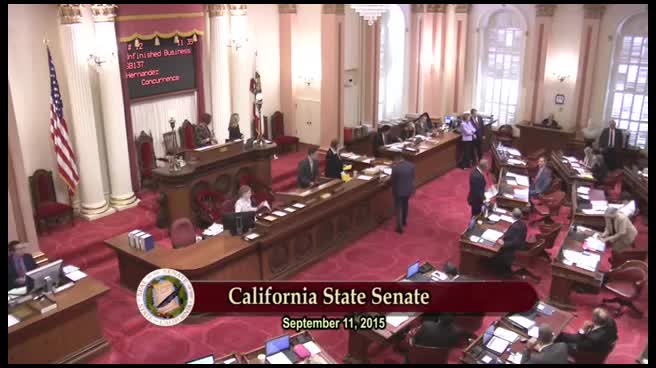 3MIN
Senate Floor
 2MIN
Assembly Floor
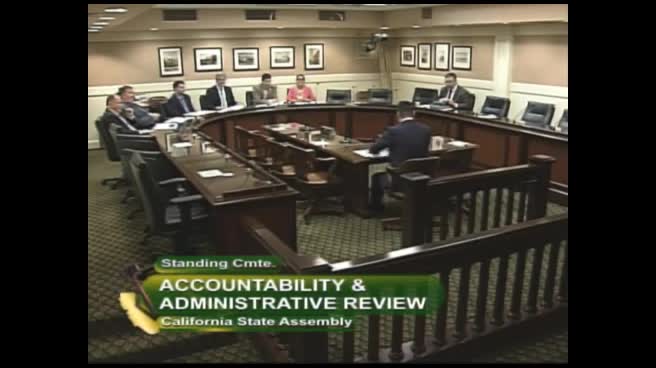 21MIN
Assembly Standing Committee on Accountability and Administrative Review
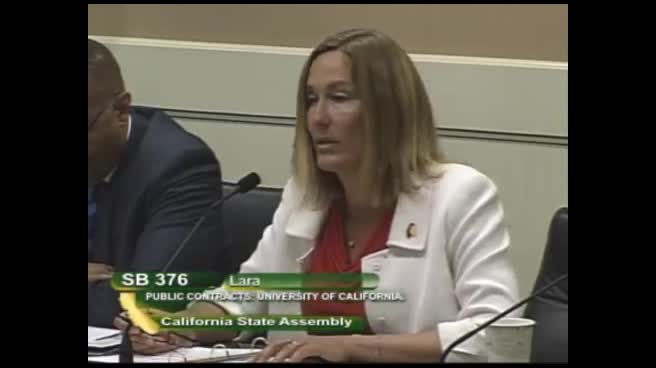 10MIN
Assembly Standing Committee on Higher Education
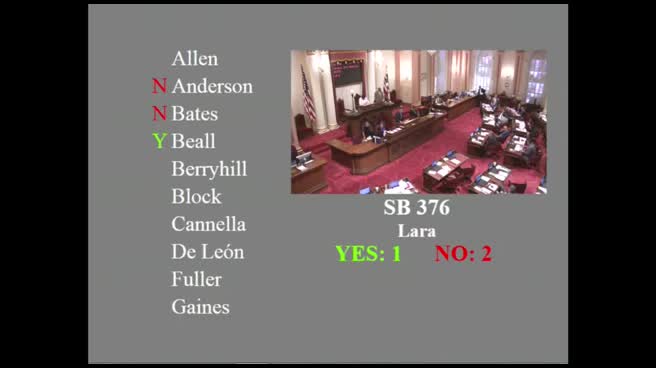 1MIN
Senate Floor
Senate Floor
 3MIN
Senate Standing Committee on Appropriations
 22MIN
Senate Standing Committee on Education
Bill Author



