SB 429: Instructional programs: Title IX instructional videos.
- Session Year: 2015-2016
- House: Senate
- Latest Version Date: 2015-04-15
Title IX of the federal Education Amendments of 1972 (Title IX) prohibits discrimination based on sex, including sexual harassment, rape, and sexual assault, in an educational institutions programs or activities.
Existing law requires the State Department of Education to post on its Internet Web site, in both English and Spanish and at a reading level that may be comprehended by pupils in high school, the information set forth in the federal regulations implementing Title IX.
This bill, to the extent that one-time funding is made available in the Budget Act of 2016, would require the State Department of Education to apportion funds to a designated county office of education, selected from applicant county offices of education, that would be the fiduciary agent for for, and responsible for the creation of, an instructional video to train school administrators administrators, designated Title IX coordinators, and other school personnel on comprehensive Title IX compliance and a Title IX pupils rights video designed for pupils and parents. The bill would require that these 2 videos be available on the departments Internet Web site and available for download to individual schoolsite and school districts district Internet Web sites. The bill would also require the department to analyze the relevant data on the success of the comprehensive Title IX compliance instructional video at the state level, as specified.
Title IX of the federal Education Amendments of 1972 (Title IX) prohibits discrimination based on sex, including sexual harassment, rape, and sexual assault, in an educational institutions programs or activities.
Existing law requires the State Department of Education to post on its Internet Web site, in both English and Spanish and at a reading level that may be comprehended by pupils in high school, the information set forth in the federal regulations implementing Title IX.
This bill, to the extent that one-time funding is made available in the Budget Act of 2016, would require the State Department of Education to apportion funds to a designated county office of education, selected from applicant county offices of education, that would be the fiduciary agent for an instructional video to train school administrators on comprehensive Title IX compliance and a Title IX pupils rights video designed for pupils and parents. The bill would require these 2 videos be available on the departments Internet Web site and available for download to individual schoolsite and school districts Internet Web sites.
The Legislature finds and declares all of the following:
(a)The goal of Title IX of the federal Education Amendments of 1972 (20 U.S.C. Sec. 1681 et. et seq.) is to provide greater levels of gender equity in schools. The results have been higher enrollment in colleges and universities, increased numbers of graduate degrees in science and mathematics, increased participation in athletics, and fairer treatment in cases of sexual and gender harassment. These benefits not only lead to higher self-esteem and enhanced leadership skills, but they also lead to higher rates of graduation and greater levels of career success. Title IX was approved in 1972, yet noncompliance with its requirements is still problematic.
(b)Title IX addresses 10 key areas: Access to Higher Education, Athletics, Career Education, Education for Pregnant and Parenting Students, Employment, Learning Environment, Mathematics and Science, Sexual Harassment, Standardized Testing, and Technology.
(c)In a November 2012 investigative report, the National Broadcasting Company (NBC) found the majority of school principals were unable to identify the Title IX coordinator, and only three principals identified themselves as being responsible for handling complaints regarding sexual and gender harassment.
(d)Equal Rights Advocates found only about 25 percent of Title IX coordinators of San Francisco Bay Area area school districts that responded to its survey received some training on Title IX related matters. A significant percentage of schools in those school districts do not cover sexual harassment in their existing training for pupils (11 percent), teachers (14 percent), and or staff/administrators (23 percent). Gender identity and gender expression were covered in less than a quarter of pupil and teacher training, and less than 20 percent of staff/administrator training. Equal opportunity in athletics was mentioned in only 11 percent of pupil training, 17 percent of teacher training, and 10 percent of staff/administrator training.
(e)A 2015 American Civil Liberties Union (ACLU) of California report found widespread unawareness among pupils and school administrators of the rights of pregnant and parenting pupils, including an extremely limited knowledge that pregnant pupils and those recovering from childbirth and related medical conditions are entitled to services available to other pupils with temporary medical conditions.
(f)In that ACLU report, only 4 percent of school districts surveyed included parenting status within the list of categories in the nondiscrimination board policy, 25 percent of pupil survey respondents indicated that they had been restricted from participating in an extracurricular activity, such as physical education or a sport, due to their pregnancy status status, and 13 percent of pupil survey respondents said that they were required by their school district to move to an alternative or continuation school as a result of their pregnancy despite the law requiring that enrollment in separate programs for parenting pupils be strictly voluntary.
(g)During Title IX training conducted by the Title IX advocacy and litigation project Fair Play for Girls in Sports, among of dozens of middle- and high-school girls attending training throughout California, approximately 80 percent of female pupils polled have had never heard of Title IX nor do did they understand how the law affords gender equity in education.
(h)Fair Play for Girls in Sports regularly receives complaints and requests for help from community members, including parents, coaches, and female athletes, regarding a lack of understanding of Title IX in their local K12 schools and a need for increased training for school administrators. Where cases have been brought against K12 schools to spur compliance with Title IX, the lack of uniform, accurate training materials has contributed to schools remaining out of compliance with the law, even after a finding of Title IX violations by the school.
(i)Since Title IX was passed 42 43 years ago, it has been the subject of over 20 proposed amendments, reviews, Supreme Court cases, and other political actions. It is a living, breathing law and it that benefits countless women and girls. The lack of knowledge and training harms pupils.
SEC. 2.Chapter 20 (commencing with Section 53340) is added to Part 28 of Division 4 of Title 2 of the Education Code, to read:20.Title IX Instructional Video53340.(a)To the extent that one-time funding is made available in the Budget Act of 2016, the department shall apportion funds to a designated county office of education to be the fiduciary agent for an instructional video to train school administrators administrators, designated Title IX coordinators, and other school personnel on comprehensive compliance with Title IX of the federal Education Amendments of 1972 (20 U.S.C. Sec. 1681 et. et seq.). The designated county office of education shall be chosen by the Superintendent from county offices of education that apply for designation. The
(b)The designated county office of education shall be in charge of the video that will responsible for the creation of the instructional video specified in subdivision (a). The instructional video shall be made available as a statewide training resource and shall lead to statewide professional development support for comprehensive Title IX compliance. The designated county office of education shall also create be responsible for the creation of a Title IX pupils rights video designed for pupils and parents. Both videos shall be available on the department departments Internet Web site and available for download to individual schoolsite and school districts district Internet Web sites.
(b)
(c)The designated county office of education, in the implementation of this chapter, shall consider and include, as appropriate, available resources for comprehensive Title IX compliance.
(c)
(d)The department shall analyze the relevant data on the success of the comprehensive Title IX compliance instructional video at the state level, by monitoring the usage of the video and ascertaining the levels of complaints filed. identifying the number of times the instructional video was downloaded or viewed, the number of complaints filed before the video was made available, and the number of complaints filed one year after the video was made available. The department shall establish a set of best practices to be made available to school districts and consortia of school districts to enhance understanding of comprehensive Title IX compliance.
The Legislature finds and declares all of the following:
(a)The goal of Title IX of the federal Education Amendments of 1972 (20 U.S.C. Sec. 1681 et. seq.) is to provide greater levels of gender equity in schools. The results have been higher enrollment in colleges and universities, increased numbers of graduate degrees in science and mathematics, increased participation in athletics, and fairer treatment in cases of sexual and gender harassment. These benefits not only lead to higher self-esteem and enhanced leadership skills, but they also lead to higher rates of graduation and greater levels of career success. Title IX was approved in 1972, yet noncompliance with its requirements is still problematic.
(b)Title IX addresses 10 key areas: Access to Higher Education, Career Education, Education for Pregnant and Parenting Students, Employment, Learning Environment, Mathematics and Science, Sexual Harassment, Standardized Testing, and Technology.
(c)In a November 2012 investigative report, the National Broadcasting Company (NBC) found the majority of school principals were unable to identify the Title IX coordinator, and only three principals identified themselves as being responsible for handling complaints regarding sexual and gender harassment.
(d)Equal Rights Advocates found only about 25 percent of Title IX coordinators of Bay Area school districts that responded to its survey received some training on Title IX related matters. A significant percentage of schools in those school districts do not cover sexual harassment in their existing training for pupils (11 percent), teachers (14 percent), and staff/administrators (23 percent). Gender identity and gender expression were covered in less than a quarter of pupil and teacher training, and less than 20 percent of staff/administrator training. Equal opportunity in athletics was mentioned in only 11 percent of pupil training, 17 percent of teacher training, and 10 percent of staff/administrator training.
(e)A 2015 American Civil Liberties Union (ACLU) of California report found widespread unawareness among pupils and school administrators of the rights of pregnant and parenting pupils, including an extremely limited knowledge that pregnant pupils and those recovering from childbirth conditions are entitled to services available to other pupils with temporary medical conditions.
(f)In that ACLU report, only 4 percent of school districts surveyed included parenting status within the list of categories in the nondiscrimination board policy, 25 percent of pupil survey respondents indicated that they had been restricted from participating in an extracurricular activity, such as physical education or a sport, due to their pregnancy status and 13 percent of pupil survey respondents said that they were required by their school district to move to an alternative or continuation school as a result of their pregnancy despite the law requiring that enrollment in separate programs for parenting pupils be strictly voluntary.
(g)During Title IX training conducted by the Title IX advocacy and litigation project Fair Play for Girls in Sports, among dozens of middle- and high-school girls attending training throughout California, approximately 80 percent of female pupils polled have never heard of Title IX nor do they understand how the law affords gender equity in education.
(h)Fair Play for Girls in Sports regularly receives complaints and requests for help from community members, including parents, coaches, and female athletes, regarding a lack of understanding of Title IX in their local K-12 schools and a need for increased training for school administrators. Where cases have been brought against K-12 schools to spur compliance with Title IX, the lack of uniform, accurate training materials has contributed to schools remaining out of compliance with the law, even after a finding of Title IX violations by the school.
(i)Since Title IX was passed 42 years ago, it has been the subject of over 20 proposed amendments, reviews, Supreme Court cases, and other political actions. It is a living, breathing law and it benefits countless women and girls. The lack of knowledge and training harms pupils.
SEC. 2.Chapter 20 (commencing with Section 53340) is added to Part 28 of Division 4 of Title 2 of the Education Code, to read:20.Title IX Instructional Video53340.(a)To the extent that one-time funding is made available in the Budget Act of 2016, the department shall apportion funds to a designated county office of education to be the fiduciary agent for an instructional video to train school administrators on comprehensive compliance with Title IX of the federal Education Amendments of 1972 (20 U.S.C. Sec. 1681 et. seq.). The designated county office of education shall be chosen by the Superintendent from county offices of education that apply for designation. The designated county office of education shall be in charge of the video that will lead to statewide professional development support for comprehensive Title IX compliance. The designated county office of education shall also create a Title IX pupils rights video designed for pupils and parents. Both videos shall be available on the department Internet Web site and available for download to individual schoolsite and school districts Internet Web sites.
(b)The designated county office of education, in the implementation of this chapter, shall consider and include, as appropriate, available resources for comprehensive Title IX compliance.
(c)The department shall analyze the relevant data on the success of the comprehensive Title IX compliance instructional video at the state level, by monitoring the usage of the video and ascertaining the levels of complaints filed. The department shall establish a set of best practices to be made available to school districts and consortia of school districts to enhance understanding of comprehensive Title IX compliance.
|
Date
|
Status
|
|---|---|
| Feb 25, 2015 | Introduced. Read first time. To Com. on RLS. for assignment. To print. |
| Feb 26, 2015 | From printer. May be acted upon on or after March 28. |
| Mar 5, 2015 | Referred to Com. on ED. |
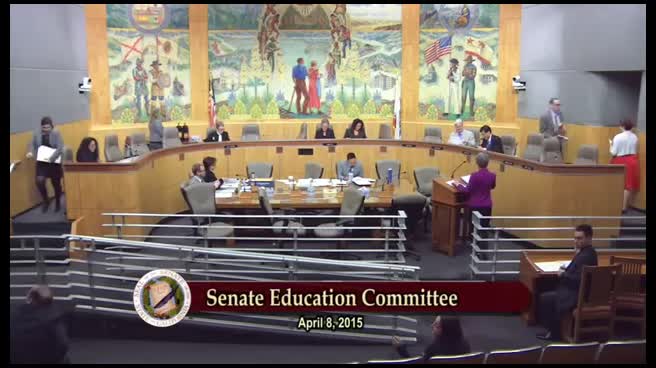
| Mar 20, 2015 | Set for hearing April 8. |
| Apr 14, 2015 | From committee: Do pass as amended and re-refer to Com. on APPR. (Ayes 7. Noes 1. Page 522.) (April 8). |
| Apr 15, 2015 | Read second time and amended. Re-referred to Com. on APPR. |
| Apr 24, 2015 | Set for hearing May 4. |
| May 4, 2015 | May 4 hearing: Placed on APPR. suspense file. |
| May 23, 2015 | Set for hearing May 28. |
| May 28, 2015 | May 28 hearing: Held in committee and under submission. |
| Feb 1, 2016 | Returned to Secretary of Senate pursuant to Joint Rule 56. |
|
Date
|
Description
|
Location
|
Votes
|
|
|---|---|---|---|---|
| May 4, 2015 | Placed on suspense file | Senate Standing Committee on Appropriations |
Passed |
|
| Apr 8, 2015 | Do pass as amended, but first amend, and re-refer to the Committee on [Appropriations] | Senate Standing Committee on Education |
Passed |
This list shows positions taken on this bill by organizations on the date displayed, which is linked to the original source.
Positions by individuals are not included.
|
Organization
|
Position
|
Date
|
|---|---|---|
| Association Of California School Administrators | * Support | Apr 8, 2015 |
| Association Of California School Administrators | * Indeterminate | Apr 8, 2015 |
| California Women's Law Center | ** Support | Apr 8, 2015 |
| Junior Leagues of California | ** Support | Apr 8, 2015 |
| Superintendent of Public Instruction, Tom Torlakson | ** Support | Apr 8, 2015 |
| u None received. | ** Against | Apr 8, 2015 |
SB 429 (Jackson) Page 2 of 2
SENATE COMMITTEE ON APPROPRIATIONS
Senator Ricardo Lara, Chair
2015 - 2016 Regular Session
SB 429 (Jackson) - Instructional programs: Title IX instructional videos
|
|
Version: April 15, 2015 |
Policy Vote: ED. 7 - 1 |
Urgency: No |
Mandate: No |
Hearing Date: May 4, 2015 |
Consultant: Jillian Kissee |
This bill meets the criteria for referral to the Suspense File.
Bill Summary: This bill requires, to the extent one-time funding is made available in the Budget Act of 2016, the Superintendent of Public Instruction to designate a county office of education to create an instructional video on Title IX of the federal Education Amendments of 1972 (Title IX) to be used for professional development, and a video on Title IX students’ rights video.
This bill also requires the California Department of Education (CDE) to analyze the success of the Title IX compliance video and establish a set of best practices to be made available to school districts.
Fiscal Impact:
Creation of videos: This bill results in costs estimated to range from $10,000 to $18,000 to develop the two instructional videos required by this bill.
CDE administration: To collect the data prescribed in this bill for determining and tracking data on the success of the videos, to develop best practices, and managing the resources posted on CDE’s website, there is an estimated one-time cost of $180,000 for two limited-term positions.
These activities would only be implemented to the extent funding is made available in the Budget Act of 2016.
Background:
Current federal law provides that, in part, "no person in the United States shall, on the basis of sex, be excluded from participation in, be denied the benefits of, or be subjected to discrimination under any educational program of activity receiving Federal financial assistance." In order to be in compliance with Federal Title IX, a school must show compliance with one of these three parts: (1) athletic participation of women and girls is proportionate to enrollment; (2) the school has a history and continuing practice of program expansion for women or girls; and (3) the school is fully meeting female athletes' interests and abilities in its present athletic program. (Title IX)
Each school district and county office of education, or a local public or private agency that receives funding from the state or federal government is required to designate a person to serve as the Title IX compliance coordinator to enforce compliance at the local level, including coordinating any complaints of non-compliance. Enforcement of compliance is initiated upon the filing of a complaint alleging a violation of Title IX.
(Title IX; California Code of Regulations, Title 5, Section 4910)
Proposed Law:
This bill requires, to the extent one-time funding is made available in the Budget Act of 2016, the Superintendent of Public Instruction to designate a county office of education to create an instructional video to train school administrators, designated Title IX coordinators, and other school personnel on comprehensive compliance with Title IX. This bill requires that the designated county office of education also be responsible for the creation of a video on Title IX students’ rights for students and parents. The videos are required to be made available on the department’s website.
This bill also requires the department to analyze the success of the Title IX compliance video by tracking the number of times the video was downloaded or viewed and the number of complaints filed before the video was made available and one year after the video was made available. Finally it requires CDE to establish a set of best practices to be made available to school districts to enhance understanding of Title IX compliance.
Related Legislation:
AB 1549 (Rendon, 2014) required the State Auditor to audit public postsecondary educational institutions for compliance with Title IX every three years. AB 1549 was held in the Senate Rules Committee.
AB 2512 (Bonilla, 2014) would have authorized, beginning January 1, 2018, school districts and county offices of education to include information relative to compliance with Title IX gender equity in the “school climate” category of local control and accountability plans. AB 2512 was vetoed by the Governor.
-- END --
SB 429 (Jackson) Page 5 of 5
SENATE COMMITTEE ON EDUCATION
Senator Carol Liu, Chair
2015 - 2016 Regular
Bill No: SB 429
Author: |
Jackson |
||
Version: |
February 25, 2015 Hearing Date: April 8, 2015 |
||
Urgency: |
No |
Fiscal: |
Yes |
Consultant: |
Lynn Lorber |
||
Subject: Instructional programs: Title IX instructional videos
SUMMARY
This bill requires the Superintendent of Public Instruction to designate a county office of education to create an instructional video on Title IX compliance and a Title IX students’ rights video.
BACKGROUND
Current federal law provides that, in part, "no person in the United States shall, on the basis of sex, be excluded from participation in, be denied the benefits of, or be subjected to discrimination under any educational program of activity receiving Federal financial assistance." In order to be in compliance with Federal Title IX, a school must show compliance with one of these three parts. The federal tests are:
Athletic participation of women and girls is proportionate to enrollment.
The school has a history and continuing practice of program expansion for women or girls.
The school is fully meeting female athletes' interests and abilities in its present athletic program. (Title IX of the Education Amendments of 1972 to the 1964 Civil Rights Act)
Current state law establishes standards virtually identical to those of Federal Title IX, with one modification: in Test 2, "history" is defined to mean the past two years. (Education Code § 230)
Each school district and county office of education, or a local public or private agency that receives funding from the state or federal government, is required to designate a person to serve as the Title IX compliance coordinator to enforce compliance at the local level, including coordinating any complaints of non-compliance. (Title IX of the Education Amendments of 1972 to the 1964 Civil Rights Act; California Code of Regulations, Title 5, Section 4910)
Enforcement of compliance is initiated upon the filing of a complaint alleging a violation of Title IX.
Title IX applies to all aspects of educational opportunities, not just athletics.
ANALYSIS
This bill requires the Superintendent of Public Instruction to designate a county office of education to create an instructional video on Title IX compliance and a Title IX students’ rights video. Specifically, this bill:
Requires the California Department of Education (CDE), to the extent that one-time funding is included in the Budget Act of 2016, to apportion funds to a designated county office of education to be the fiduciary agent for an instructional video to train school administrators on comprehensive compliance with Title IX.
Requires the designated county office of education to be “in charge” of the video that will lead to statewide professional development support for comprehensive Title IX compliance.
Requires the designated county office of education to also create a Title IX students’ rights video for students and parents.
Requires both videos to be available on CDE’s website and available for download to the websites of individual schoolsites and school districts.
Requires the designated county office of education to consider and include, as appropriate, available resources for comprehensive Title IX compliance.
Provides that the Superintendent of Public Instruction (SPI) is to choose the county office of education from those that apply for designation.
Requires the CDE to analyze the relevant data on the success of the instructional video at the state level, by monitoring the usage of the video and ascertaining the levels of complaints filed.
Requires the CDE to establish a set of best practices to be made available to school districts and consortia of districts to enhance understanding of comprehensive Title IX compliance.
States legislative findings and declarations relative to the lack of awareness about Title IX, and a lack of training on monitoring and ensuring compliance.
STAFF COMMENTS
Need for the bill. According to the author, “The Senate Judiciary Committee held an informational hearing on January 20, 2015, titled Attaining Equal Opportunity for Girls In California’s Secondary Schools: How our Schools are Complying with Title IX. According to testimony provided by both the federal Office of Civil Rights and California Department of Education, trainings held to inform schools and school districts about their Title IX requirements and procedures are well attended when made available, however, due to lack of funding and resources few trainings are provided. As demonstrated by testimony provided during the informational hearing, school districts are often unaware that Title IX requires them to appoint a Title IX coordinator at both the districts and school level, adopt and publish rules and procedures regarding complaints, and notify students, families and staff of their rights under Title IX.”
Compliance with Title IX. Current law provides that compliance is measured by the three-pronged test:
Proportionality to enrollment.
History (past two years) and continuing practice of program expansion for females.
Fully meeting female athletes' interests and abilities in its present athletic program.
Enforcement of compliance is initiated upon the filing of a complaint
alleging a violation of Title IX. Complaints
generally begin at the school district level and can proceed to the
state level and ultimately to the federal Office of Civil Rights.
Current law does not require any reporting of measures
of compliance with Title IX by K-12 schools.
Training. The federal Office of Civil Rights issued a guidance letter in 2011 reminding local educational agencies that the Title IX regulations require, among many other things, schools to ensure that employees designated as Title IX coordinators have adequate training on what constitutes sexual harassment, including sexual violence, and that they understand how the recipient’s grievance procedures operate. http://www2.ed.gov/about/offices/list/ocr/letters/colleague-201104.pdf There are no clear requirements for training on Title IX compliance in California’s statutes.
Existing resources. This bill requires the designated county office of education to consider and include, as appropriate, available resources for comprehensive Title IX compliance. There do not appear to be any resources on the California Department of Education’s (CDE) website with specific guidance or training regarding monitoring and ensuring compliance with Title IX. The CDE sent a notification to all school superintendents on September 20, 2013 identifying the State Title IX coordinator, and reminding schools of their obligations under current law to designate a Title IX coordinator, post information about the Title IX coordinator, and post policies regarding non-discrimination. This notification does not provide specific guidance or training resources. http://www.cde.ca.gov/re/di/eo/titleixnotification.asp There are several online sources for training on Title IX compliance.
Designated county office of education. This bill requires the Superintendent of Public Instruction (SPI) to select the designated county office of education from those that apply for such designation. This bill does not establish an application process nor guidance for the selection of the appropriate county office, thereby giving the SPI complete discretion to determine if the county office is capable of meeting the fiduciary responsibilities and other requirements of this bill.
Clarifying amendments. This bill requires the creation of an instructional video to train school administrators on comprehensive compliance with Title IX. Staff recommends an amendment to clarify that the video is to also serve as a training tool for designated Title IX coordinators and other school personnel.
This bill requires the designated county office of education to be “in charge of the video that will lead to statewide professional development support for comprehensive Title IX compliance.” Staff recommends an amendment to clarify that the designated county office of education is responsible for the creation of the instructional video and that the video is to be available as a statewide training resource.
This bill requires the California Department of Education (CDE) to analyze the relevant data on the success of the instructional video by monitoring the usage of the video and ascertaining the levels of complaints filed. Staff recommends an amendment to clarify that the CDE is required to identify how many times the instructional video was downloaded or viewed, and how many complaints were lodged before the video was available and how many complaints were lodged one year after the video was available.
Related and prior legislation.
RELATED LEGISLATION
AB 884 (Calderon, 2015) changes the title of the existing article in the Education Code from “Athletes Bill of Rights” to “Gender Equity in Education.” AB 884 is scheduled to be heard by the Assembly Arts, Entertainment, Sports, Tourism, and Internet Media Committee on April 7.
PRIOR LEGISLATION
SB 1349 (Jackson, Ch. 258, 2014) requires public K-12 schools that offer competitive athletics to make public information relative participation by gender in athletics.
AB 1549 (Rendon, 2014) was amended late in the legislative session to require the State Auditor to audit public postsecondary educational institutions for compliance with Title IX every three years. AB 1549 was held in the Senate Rules Committee.
AB 2512 (Bonilla, 2014) would have authorized, beginning January 1, 2018, school districts and county offices of education to include information relative to compliance with Title IX gender equity in the “school climate” category of local control and accountability plans. AB 2512 was vetoed by the Governor, whose message read:
I appreciate the author's concerns but believe that the recently enacted Local Control Funding Formula should not now be subjected to a series of amendments. The law envisions that local communities fashion the plans that work best for them. State intervention in this process is premature.
AB 2323 (Jackson, 2004) would have required the California
Department of Education to develop a Gender Equity Compliance Survey
for high schools.
AB 2323 was held in the Assembly
Appropriations Committee.
SUPPORT
American Civil Liberties Union
Association of California School Administrators
California Women’s Law Center
Fair Play for Girls in Sports, Legal Aid Society-Employment Law Center
Junior Leagues of California
Superintendent of Public Instruction, Tom Torlakson
OPPOSITION
None received.
-- END --
Bill Author

Bill Co-Author(s):