SB 431: Vehicles: driver-assistive truck platooning.
- Session Year: 2015-2016
- House: Senate
- Latest Version Date: 2015-04-21
Existing law prohibits a driver of a motor vehicle from following another vehicle more closely than is reasonable and prudent, having due regard for the speed of the vehicle and the traffic upon, and the condition of, the roadway.
This bill would require a determination of a reasonable and prudent distance between 2 vehicles, for those purposes, to take into account presence of vehicle automation technology, as described.
Existing law requires motor vehicles being driven in a caravan or motorcade outside of a business or residence district to be operated so as to allow sufficient space, and in no event less than 100 feet, between each vehicle or combination of vehicles so as to enable any other vehicle to overtake or pass.
This bill would provide that the above provision does not apply to a vehicle equipped with a driver-assistive truck platooning system, as defined, that is being driven upon a highway with 2 or more lanes of traffic in the direction of travel. a caravan or motorcade consists of 3 or more motor vehicles.
This bill would declare that it is to take effect immediately as an urgency statute.
Existing law prohibits a driver of a motor vehicle from following another vehicle more closely than is reasonable and prudent, having due regard for the speed of the vehicle and the traffic upon, and the condition of, the roadway.
This bill would require a determination of a reasonable and prudent distance between 2 vehicles, for those purposes, to take into account presence of vehicle automation technology, as described.
Existing law requires motor vehicles being driven in a caravan or motorcade outside of a business or residence district to be operated so as to allow sufficient space, and in no event less than 100 feet, between each vehicle or combination of vehicles so as to enable any other vehicle to overtake or pass.
This bill would provide that the above provision does not apply to a vehicle equipped with a driver-assistive truck platooning system, as defined, that is being driven upon a highway with 2 or more lanes of traffic in the direction of travel.
Existing law prohibits the operation of any vehicle or combination of vehicles that is not equipped as provided. Existing law also prohibits vehicles from being equipped with certain equipment, including, among others, jamming devices.
This bill would authorize the Department of Transportation to conduct a demonstration project to test the use of driver-assistive truck platooning systems with 2 vehicles in the platoon. The bill would require the Department of Transportation, if it authorizes a demonstration project pursuant to that provision, to coordinate with the Department of the California Highway Patrol to determine which types of vehicles and which streets and highways should be included in the demonstration project, provided that only streets and highways where driver-assistive truck platooning systems are likely to be frequently utilized shall be included in the demonstration project.
This bill would declare that it is to take effect immediately as an urgency statute.
(a)The driver of a motor vehicle shall not follow another vehicle more closely than is reasonable and prudent, having due regard for the speed of the vehicle and the traffic upon, and the condition of, the roadway.
(b)A determination of a reasonable and prudent distance between two vehicles for purposes of subdivision (a) shall take into account the presence of vehicle automation technology, including, but not limited to, a driver-assistive truck platooning system.
(c)For the purposes of this section, driver-assistive truck platooning system means vehicle automation technology that integrates sensor array, wireless communications, vehicle controls, and specialized software to synchronize acceleration and braking between two vehicles, while leaving each vehicles steering control and systems command in the control of its driver.
SEC. 2.Section 21705 of the Vehicle Code is amended to read:21705.(a)Motor vehicles being driven outside of a business or residence district in a caravan or motorcade, whether or not towing other vehicles, shall be operated so as to allow sufficient space, and in no event less than 100 feet, between each vehicle or combination of vehicles so as to enable any other vehicle to overtake or pass.
(b)(1)This section does not apply to a vehicle equipped with a driver-assistive truck platooning system that is being driven upon a highway with two or more lanes for traffic in the direction of travel.
(2)For the purposes of this subdivision, driver-assistive truck platooning system means vehicle automation technology that integrates sensor array, wireless communications, vehicle controls, and specialized software to synchronize acceleration and braking between two vehicles, while leaving each vehicles steering control and systems command in the control of its driver.
(b)For purposes of this section, a caravan or motorcade consists of three or more motor vehicles.
SEC. 3.This act is an urgency statute necessary for the immediate preservation of the public peace, health, or safety within the meaning of Article IV of the Constitution and shall go into immediate effect. The facts constituting the necessity are:
In order to take advantage of federal funds that are currently available to states for the purpose of testing automated vehicle technologies on roads and highways, it is necessary that this act take effect immediately.
(a)The driver of a motor vehicle shall not follow another vehicle more closely than is reasonable and prudent, having due regard for the speed of such the vehicle and the traffic upon, and the condition of, the roadway.
(b)A determination of a reasonable and prudent distance between two vehicles for purposes of subdivision (a) shall take into account the presence of vehicle automation technology, including, but not limited to, a driver-assistive truck platooning system.
(c)For the purposes of this section, driver-assistive truck platooning system means vehicle automation technology that integrates sensor array, wireless communications, vehicle controls, and specialized software to synchronize acceleration and braking between two vehicles, while leaving each vehicles steering control and systems command in the control of its driver.
SECTION 1.SEC. 2.Section 21705 of the Vehicle Code is amended to read:21705.(a)Motor vehicles being driven outside of a business or residence district in a caravan or motorcade, whether or not towing other vehicles, shall be operated so as to allow sufficient space, and in no event less than 100 feet, between each vehicle or combination of vehicles so as to enable any other vehicle to overtake or pass.
(b)(1)This section does not apply to a vehicle equipped with a driver-assistive truck platooning system that is being driven upon a highway with two or more lanes for traffic in the direction of travel.
(2)For the purposes of this subdivision, driver-assistive truck platooning system means vehicle automation technology that integrates sensor array, wireless communications, vehicle controls, and specialized software to synchronize acceleration and braking between two vehicles, while leaving each vehicles steering control and systems command in the control of its driver.
SEC. 2.Article 18 (commencing with Section 28200) is added to Chapter 5 of Division 12 of the Vehicle Code, to read:18.Driver-Assistive Truck Platooning28200.(a)The Department of Transportation may conduct a demonstration project to test the use of driver-assistive truck platooning systems with two vehicles in the platoon. If the Department of Transportation authorizes a demonstration project pursuant to this section, it shall coordinate with the Department of the California Highway Patrol to determine which types of vehicles and which streets and highways should be included in the demonstration project. Only streets and highways where driver-assistive truck platooning systems are likely to be frequently utilized shall be included in the demonstration project.
(b)For the purposes of this article, driver-assistive truck platooning systems has the same meaning as in Section 21705.
SEC. 3.This act is an urgency statute necessary for the immediate preservation of the public peace, health, or safety within the meaning of Article IV of the Constitution and shall go into immediate effect. The facts constituting the necessity are:
In order to take advantage of federal funds that are currently available to states for the purpose of testing automated vehicle technologies on roads and highways, it is necessary that this act take effect immediately.
(a)Motor vehicles being driven outside of a business or residence district in a caravan or motorcade, whether or not towing other vehicles, shall be so operated so as to allow sufficient space space, and in no event less than 100 feet feet, between each vehicle or combination of vehicles so as to enable any other vehicle to overtake or pass.
(b)(1)This section does not apply to a vehicle equipped with a driver-assistive truck platooning system that is being driven upon a highway with two or more lanes for traffic in the direction of travel.
(2)For the purposes of this subdivision, driver-assistive truck platooning system means vehicle automation technology that integrates sensor array, wireless communications, vehicle controls, and specialized software to synchronize acceleration and braking between two vehicles, while leaving each vehicles steering control and systems command in the control of its driver.
SEC. 2.Article 18 (commencing with Section 28200) is added to Chapter 5 of Division 12 of the Vehicle Code, to read:18.Driver-Assistive Truck Platooning28200.(a)The Department of Transportation may conduct a demonstration project to test the use of driver-assistive truck platooning systems with two vehicles in the platoon. If the Department of Transportation authorizes a demonstration project pursuant to this section, it shall coordinate with the Department of the California Highway Patrol to determine which types of vehicles and which streets and highways should be included in the demonstration project. Only streets and highways where driver-assistive truck platooning systems are likely to be frequently utilized shall be included in the demonstration project.
(b)For the purposes of this article, driver-assistive truck platooning systems has the same meaning as in Section 21705.
SEC. 3.This act is an urgency statute necessary for the immediate preservation of the public peace, health, or safety within the meaning of Article IV of the Constitution and shall go into immediate effect. The facts constituting the necessity are:
In order to take advantage of federal funds that are currently available to states for the purpose of testing automated vehicle technologies on roads and highways, it is necessary that this act take effect immediately.
|
Date
|
Status
|
|---|---|
| Feb 25, 2015 | Introduced. Read first time. To Com. on RLS. for assignment. To print. |
| Feb 26, 2015 | From printer. May be acted upon on or after March 28. |
| Mar 5, 2015 | Referred to Com. on T. & H. |
| Mar 10, 2015 | Set for hearing April 7. |
| Apr 1, 2015 | April 7 hearing postponed by committee. |
| Apr 2, 2015 | Set for hearing April 14. |
| Apr 6, 2015 | From committee with author's amendments. Read second time and amended. Re-referred to Com. on T. & H. |
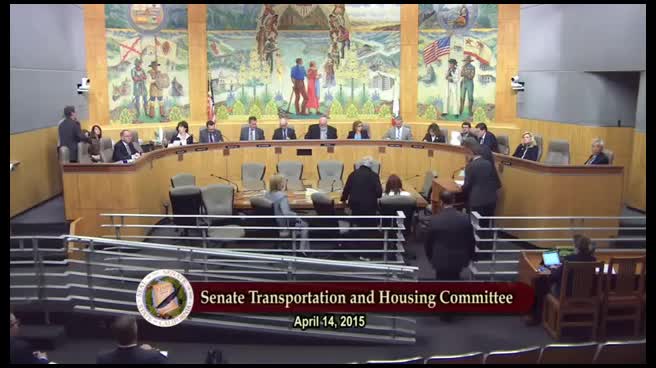
| Apr 20, 2015 | From committee: Do pass as amended. (Ayes 11. Noes 0. Page 620.) (April 14). |
| Apr 21, 2015 | Read second time and amended. Ordered to third reading. |
| Apr 27, 2015 | In Assembly. Read first time. Held at Desk. |
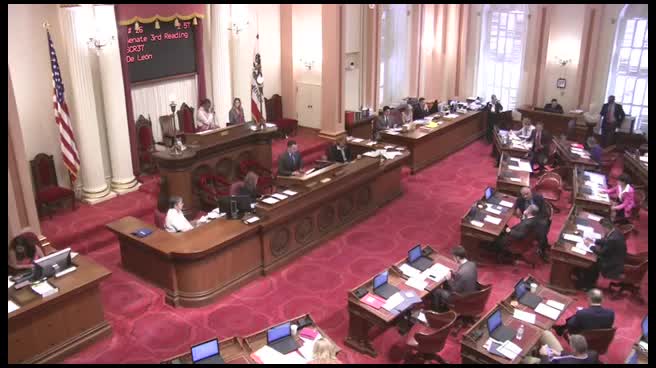
| Apr 27, 2015 | Read third time. Urgency clause adopted. Passed. (Ayes 35. Noes 0. Page 773.) Ordered to the Assembly. |
| Apr 27, 2015 | Read third time. Urgency clause adopted. Passed. (Ayes 35. Noes 0.) Ordered to the Assembly. |
| May 14, 2015 | Referred to Com. on TRANS. |
|
Date
|
Description
|
Location
|
Votes
|
|
|---|---|---|---|---|
| Apr 27, 2015 | Senate 3rd Reading SB431 Beall Urgency Clause | Senate Floor |
Passed |
|
| Apr 14, 2015 | Do pass as amended | Senate Standing Committee on Transportation and Housing |
Passed |
This list shows positions taken on this bill by organizations on the date displayed, which is linked to the original source.
Positions by individuals are not included.
|
Organization
|
Position
|
Date
|
|---|---|---|
| Motor And Equipment Manufacturers Association | ** Support | Apr 27, 2015 |
| Peloton Technology | ** Support | Apr 27, 2015 |
| United Parcel Service | ** Support | Apr 14, 2015 |
SB 431
Page 3
|
Office of Senate Floor Analyses (916) 651-1520 Fax: (916) 327-4478 |
THIRD READING
Bill No: SB 431
Amended: 4/21/15
SENATE TRANS. & HOUSING COMMITTEE: 11-0, 4/14/15
AYES: Beall, Cannella, Allen, Bates, Gaines, Galgiani, Leyva, McGuire, Mendoza, Roth, Wieckowski
SUBJECT: Vehicles: driver-assistive truck platooning
DIGEST: This bill allows vehicles equipped with a driver-assistive truck platooning system to operate less than 100 feet apart.
ANALYSIS: Existing law prohibits drivers from following other vehicles more closely than is reasonable and prudent.
This bill:
Requires that the determination of reasonable and prudent shall take into account the presence of vehicle automation technology, including driver-assistive truck platooning systems.
Clarifies the definition of “caravan” or “motorcade” as three or more vehicles.
Comments
Purpose. According to the author, this bill brings California into the 21st century in that it creates the possibility of driver-assistive truck platooning (DATP). This technology is an extension of adaptive cruise control and automated braking/active safety technologies already commercialized and adopted in U.S. trucking fleets. The author states that DATP enhances traffic safety by circumventing delays in human perception and reaction time, and also dramatically improves fuel efficiency. The bill’s sponsor contends that the California Highway Patrol (CHP) believes that two-truck platooning with DATP is not allowed under existing law. This bill, therefore, amends existing law to make it possible for trucks to utilize this technology in California. Also, because no definition exists in the Vehicle Code, the bill also clarifies that caravans and motorcades consist of three or more vehicles, consistent with the CHP’s understanding.
Truck platooning and vehicle automation. Due to the fact that drivers require time and space to react to changing driving conditions, the present system of driving on roadways requires a tremendous amount of space between vehicles. The amount of space between vehicles increases as the speed of the vehicles increases. For example, a parked car requires approximately 100 square feet of ground space. When the same vehicle is moving at 70 mph, because of the longitudinal space requirements to allow for human reaction time, it requires approximately 5,000 square feet of space on a freeway. This space requirement is even higher for trucks and commands a premium price in an already developed urban environment such as southern California.
Automated Highway Systems, or AHS, holds great promise in improving traffic flow on congested roadways and promises dramatic improvements in capacity. AHS is a vehicle- and road-based system that can drive a vehicle automatically. This is done using sensors that determine a vehicle’s lane position and the speed and location of other vehicles. Actuators on the throttle, brake, and steering wheel give the vehicle the necessary commands to safely navigate the vehicle on the roadway. AHS vehicles often also have equipment to communicate with other AHS vehicles. Automated highways are safer, more efficient, and produce lower emissions compared to the traffic flow on conventional highways. This bill furthers the development of truck platooning and AHS in California, which can provide significant benefits to the state.
FISCAL EFFECT: Appropriation: No Fiscal Com.: No Local: No
UPS
Motor and Equipment Manufacturers Association
Peloton Technology
OPPOSITION: (Verified 4/20/15)
Prepared by: Randy Chinn / T. & H. / (916) 651-4121
4/22/15 16:20:00
SB 431 (Beall) Page 3 of 3
SENATE COMMITTEE ON TRANSPORTATION AND HOUSING
Senator Jim Beall, Chair
2015 - 2016 Regular
Bill No: SB 431 Hearing Date: 4/14/2015
Author: |
Beall |
||
Version: |
2/25/2015 |
||
Urgency: |
Yes |
Fiscal: |
No |
Consultant: |
Eric Thronson |
||
SUBJECT: Vehicles: driver-assistive truck platooning
DIGEST: This bill requires an officer, when determining what a reasonable and prudent distance between two vehicles is, to take into account the presence of vehicle automation technologies.
ANALYSIS:
Existing law restricts a driver of a motor vehicle from following another vehicle more closely than is reasonable and prudent, depending on various factors such as the speed of his or her vehicle and the traffic on and condition of the roadway. Further, existing law specifies that a driver of a truck cannot follow any closer than 300 feet behind another truck, except to pass, unless travelling on a highway with two or more lanes in the same direction of travel.
In addition, existing law restricts vehicles in a caravan or motorcade from traveling any closer than 100 feet so as to enable any other vehicle to overtake or pass the caravan. Neither caravan nor motorcade, however, is defined anywhere in statute.
This bill:
Requires an officer, when determining what a reasonable and prudent distance between two vehicles is, to take into account the presence of vehicle automation technologies.
Defines a “driver-assistive truck platooning system” as a vehicle automation technology that integrates sensor array, wireless communications, vehicle controls, and specialized software to synchronize acceleration and braking between two vehicles, while leaving each vehicle’s steering control and systems command in the control of the driver.
Exempts a vehicle from the distance restriction for a caravan vehicle as long as it is equipped with a driver-assistive truck platooning system and is operating on a highway with two or more lanes in the direction of travel.
Is an urgency statute.
COMMENTS:
Purpose. According to the author, this bill brings California into the 21st century in that it creates the possibility of driver-assistive truck platooning (DATP). This technology is an extension of adaptive cruise control and automated braking/active safety technologies already commercialized and adopted in U.S. trucking fleets. The author states that DATP enhances traffic safety by circumventing delays in human perception and reaction time, and also dramatically improves fuel efficiency. The bill’s sponsor contends that the California Highway Patrol (CHP) believes that two-truck platooning with DATP is not allowed under existing law. This bill, therefore, amends existing law to make it possible for trucks to utilize this technology in California.
Truck platooning and vehicle automation. Due to the fact that drivers require time and space to react to changing driving conditions, the present system of driving on roadways requires a tremendous amount of space between vehicles. The amount of space between vehicles increases as the speed of the vehicles increases. For example, a parked car requires approximately 100 square feet of ground space. When the same vehicle is moving at 70 mph, because of the longitudinal space requirements to allow for human reaction time, it requires approximately 5,000 square feet of space on a freeway. This space requirement is even higher for trucks and commands a premium price in an already developed urban environment such as southern California.
Automated Highway Systems, or AHS, holds great promise in improving traffic flow on congested roadways and promises dramatic improvements in capacity. AHS is a vehicle- and road-based system that can drive a vehicle automatically. This is done using sensors that determine a vehicle’s lane position and the speed and location of other vehicles. Actuators on the throttle, brake, and steering wheel give the vehicle the necessary commands to safely navigate the vehicle on the roadway. AHS vehicles often also have equipment to communicate with other AHS vehicles. Automated highways are safer, more efficient, and produce lower emissions compared to the traffic flow on conventional highways. This bill furthers the development of truck platooning and AHS in California, which can provide significant benefits to the state.
What is a caravan? As stated previously, existing law restricts vehicles in a caravan or motorcade from traveling too close together. Unfortunately, existing law does not define either caravan or motorcade. This ambiguity could create some uncertainty in the development of AHS or truck platooning.
Merriam-Webster defines caravan as “a group of vehicles traveling together,” as in a train, fleet, or armada. The definition of motorcade is “a procession of motor vehicles.” It seems, in either case, that a caravan or a motorcade would consist of more than two vehicles. Further, CHP has indicated that it believes that caravans consist of more than two vehicles. This bill currently amends existing law to exempt two trucks utilizing DATP from the distance restrictions for caravans and motorcades. In order to clarify existing law, the committee may wish to amend the bill to define caravan and motorcade as meaning more than two vehicles traveling together. Amending the bill as such accomplishes the aim of this bill, to make it possible for two trucks utilizing DATP to travel closely together, but does not create a special exemption for trucks using specific technologies.
RELATED LEGISLATION:
SB 719 (Hernandez) — authorizes Caltrans to test technologies that involve motor vehicles being operated with less than 100 feet between them. SB 719 is currently pending in this committee.
FISCAL EFFECT: Appropriation: No Fiscal Com.: Yes Local: No
POSITIONS: (Communicated to the committee before noon on Wednesday,
April 8, 2015.)
SUPPORT:
Peloton Technology (Sponsor)
Motor & Equipment Manufacturers Association
United Parcel Service
OPPOSITION:
None received.
-- END --
Discussed in Hearing
 3MIN
Senate Floor
 7MIN
Senate Standing Committee on Transportation and Housing
Bill Author

Bill Co-Author(s):