SB 443: Forfeiture: assets: controlled substances.
- Session Year: 2015-2016
- House: Senate
- Latest Version Date: 2016-09-29
Existing law subjects certain property to forfeiture, such as controlled substances and equipment used to process controlled substances. Existing law allows peace officers, under specified circumstances, to seize property that is subject to forfeiture. Existing law authorizes specified public agencies to bring an action to recover expenses of seizing, eradicating, destroying, or taking remedial action with respect to any controlled substance. In a forfeiture action with regards to cash or negotiable instruments of a value of not less than $25,000, existing law requires the state or local agency to prove by clear and convincing evidence that the property is subject to forfeiture. Existing law requires seized property or the proceeds from the sale of that property to be distributed among specified entities. Existing law requires the Attorney General to publish an annual report on forfeiture within the state.
This bill would require a prosecuting agency to seek or obtain a criminal conviction for the unlawful manufacture or cultivation of any controlled substance or its precursors prior to an entry of judgment for recovery of expenses of seizing, eradicating, destroying, or taking remedial action with respect to any controlled substance. The bill would prohibit maintaining an action for recovery of expenses against a person who has been acquitted of the underlying criminal charges.
The bill would prohibit state or local law enforcement agencies from transferring seized property to a federal agency seeking adoption by the federal agency of the seized property. The bill would further prohibit state or local agencies from receiving an equitable share from a federal agency of specified seized property if a conviction for the underlying offenses is not obtained, except as specified. The bill would require notices of a forfeiture action to contain additional details, such as the rights of an interested party at a forfeiture hearing.
The bill would change the burden of proof that a state or local law enforcement agency must meet to succeed in a forfeiture action with regards to cash or negotiable instruments of a value not less than $25,000, but not more than $40,000, from a clear and convincing standard to beyond a reasonable doubt. The bill would require the Legislative Analysts Office, on or before December 31, 2019, to submit a report to the Legislature on the economic impact of this change, and the above-described prohibition on receiving an equitable share from a federal agency, on state and local law enforcement budgets. The bill would make other related changes to court forfeiture proceedings. The bill would also require the Attorney General to include additional information on forfeiture actions in the annual report.
Existing law subjects certain property to forfeiture, such as controlled substances and equipment used to process controlled substances. Existing law allows peace officers, under specified circumstances, to seize property that is subject to forfeiture. Existing law authorizes specified public agencies to bring an action to recover expenses of seizing, eradicating, destroying, or taking remedial action with respect to any controlled substance. In a forfeiture action with regards to cash or negotiable instruments of a value of not less than $25,000, existing law requires the state or local agency to prove by clear and convincing evidence that the property is subject to forfeiture. Existing law requires seized property or the proceeds from the sale of that property to be distributed among specified entities. Existing law requires the Attorney General to publish an annual report on forfeiture within the state.
This bill would require a prosecuting agency to seek or obtain a criminal conviction for the unlawful manufacture or cultivation of any controlled substance or its precursors prior to an entry of judgment for recovery of expenses of seizing, eradicating, destroying, or taking remedial action with respect to any controlled substance. The bill would prohibit maintaining an action for recovery of expenses against a person who has been acquitted of the underlying criminal charges.
The bill would prohibit state or local law enforcement agencies from transferring seized property to a federal agency seeking adoption by the federal agency of the seized property. The bill would further prohibit state or local agencies from receiving an equitable share from a federal agency of specified seized property if a conviction for the underlying offenses is not obtained, except as specified. The bill would require notices of a forfeiture action to contain additional details, such as the rights of an interested party at a forfeiture hearing.
The bill would change the burden of proof that a state or local law enforcement agency must meet to succeed in a forfeiture action with regards to cash or negotiable instruments of a value not less than $25,000, but not more than $40,000, from a clear and convincing standard to beyond a reasonable doubt and would require a criminal conviction for a related offense. doubt. The bill would require the Legislative Analysts Office, on or before December 31, 2019, to submit a report to the Legislature on the economic impact of this change, and the above-described prohibition on receiving an equitable share from a federal agency, on state and local law enforcement budgets. The bill would make other related changes to court forfeiture proceedings. The bill would also require the Attorney General to include additional information on forfeiture actions in the annual report.
Existing law subjects certain property to forfeiture, such as controlled substances and equipment used to process controlled substances. Existing law allows peace officers, under specified circumstances, to seize property that is subject to forfeiture. Existing law authorizes specified public agencies to bring an action to recover expenses of seizing, eradicating, destroying, or taking remedial action with respect to any controlled substance. In a forfeiture action with regards to cash or negotiable instruments of a value of not less than $25,000, existing law requires the state or local agency to prove by clear and convincing evidence that the property is subject to forfeiture. Existing law requires seized property or the proceeds from the sale of that property to be distributed among specified entities. Existing law requires the Attorney General to publish a yearly an annual report on forfeiture within the state.
This bill would require a prosecuting agency to seek or obtain a criminal conviction for the unlawful manufacture or cultivation of any controlled substance or its precursors prior to an entry of judgment for recovery of expenses of seizing, eradicating, destroying, or taking remedial action with respect to any controlled substance. The bill would prohibit maintaining an action for recovery of expenses against a person who has been acquitted of the underlying criminal charges.
The bill would prohibit state or local law enforcement agencies from transferring seized property to a federal agency seeking adoption by the federal agency of the seized property. The bill would further prohibit state or local agencies from receiving an equitable share from a federal agency of specified seized property if a conviction for the underlying offenses is not obtained.
The obtained, except as specified. The bill would require notices of a forfeiture action to contain additional details, such as the rights of an interested party at a forfeiture hearing. The
The bill would change the burden of proof that a state or local law enforcement agency must meet to succeed in a forfeiture action with regards to cash or negotiable instruments of a value not less than $25,000, from a clear and convincing standard to beyond a reasonable doubt. doubt and would require a criminal conviction for a related offense. The bill would require the Legislative Analysts Office, on or before December 31, 2019, to submit a report to the Legislature on the economic impact of this change, and the above-described prohibition on receiving an equitable share from a federal agency, on state and local law enforcement budgets. The bill would also make other specified related changes to court forfeiture proceedings. The bill would also require the Attorney General to include additional information on forfeiture actions in the yearly annual report.
Existing law subjects certain property to forfeiture, such as controlled substances and equipment used to process controlled substances. Existing law allows peace officers, under specified circumstances, to seize property that is subject to forfeiture. Existing law authorizes specified public agencies to bring an action to recover expenses of seizing, eradicating, destroying, or taking remedial action with respect to any controlled substance. In a forfeiture action with regards to cash or negotiable instruments of a value of not less than $25,000, existing law requires the state or local agency to prove by clear and convincing evidence that the property is subject to forfeiture. Existing law requires seized property or the proceeds from the sale of that property to be distributed among specified entities. Existing law requires the Attorney General to publish a yearly report on forfeiture within the state.
This bill would require a prosecuting agency to seek or obtain a criminal conviction for the unlawful manufacture or cultivation of any controlled substance or its precursors prior to an entry of judgment for recovery of expenses of seizing, eradicating, destroying, or taking remedial action with respect to any controlled substance. The bill would prohibit maintaining an action for recovery of expenses against a person who has been acquitted of the underlying criminal charges.
The bill would prohibit state or local law enforcement agencies from transferring seized property to a federal agency seeking adoption by the federal agency of the seized property. The bill would further prohibit state or local agencies from requesting or receiving an equitable share from a federal agency of specified seized property if a conviction for the underlying offenses is not obtained.
The bill would require notices of a forfeiture action to contain additional details, such as the rights of an interested party at a forfeiture hearing. The bill would change the burden of proof that a state or local law enforcement agency must meet to succeed in a forfeiture action with regards to cash or negotiable instruments of a value not less than $25,000, from a clear and convincing standard to beyond a reasonable doubt. The bill would also make other specified changes to court forfeiture proceedings, including allowing parties to waive the requirement that forfeiture cases be tried in conjunction with related criminal cases when the forfeiture hearing is continued or stayed. proceedings. The bill would also require the Attorney General to include additional information on forfeiture actions in the yearly report.
Existing law subjects certain property to forfeiture, such as controlled substances and equipment used to process controlled substances. Existing law allows peace officers, under specified circumstances, to seize property that is subject to forfeiture. Existing law authorizes specified public agencies to bring an action to recover expenses of seizing, eradicating, destroying, or taking remedial action with respect to any controlled substance. In a forfeiture action with regards to cash or negotiable instruments of a value of not less than $25,000, existing law requires the state or local agency to prove by clear and convincing evidence that the property is subject to forfeiture. Existing law requires seized property or the proceeds from the sale of that property to be distributed among specified entities. Existing law requires the Attorney General to publish a yearly report on forfeiture within the state.
This bill would require a prosecuting agency to seek or obtain a criminal conviction for the unlawful manufacture or cultivation of any controlled substance or its precursors prior to an entry of judgment for recovery of expenses of seizing, eradicating, destroying, or taking remedial action with respect to any controlled substance. The bill would prohibit maintaining an action for recovery of expenses against a person who has been acquitted of the underlying criminal charges.
The bill would prohibit state or local law enforcement agencies from transferring seized property to a federal agency seeking adoption by the federal agency of the seized property. The bill would also require that any property seized pursuant to any federal law that authorizes the sharing or transfer of forfeited property be distributed according to state law, thereby imposing a state-mandated local program. The bill would further prohibit state or local agencies from requesting or receiving an equitable share from a federal agency of specified seized property if a conviction for the underlying offenses is not obtained.
The bill would require notices of a forfeiture action to contain additional details, such as the rights of an interested party at a forfeiture hearing. The bill would require the court to appoint counsel for the defendant in the forfeiture proceeding if a defendant in a related criminal matter is represented by court-appointed counsel, thereby creating a state-mandated local program. The bill would change the burden of proof that a state or local law enforcement agency must meet to succeed in a forfeiture action with regards to cash or negotiable instruments of a value not less than $25,000, from a clear and convicting convincing standard to beyond a reasonable doubt. The bill would also make other specified changes to court forfeiture proceedings, including allowing parties to waive the requirement that forfeiture cases be tried in conjunction with related criminal cases when the forfeiture hearing is continued or stayed.
The bill would allow recovery of attorneys fees for defendants or claimants in a forfeiture action who substantially prevail. The bill would make specified changes to the distribution of proceeds from forfeiture actions under state law, including reducing distributions to seizing law enforcement agencies and prosecutors offices, and providing distributions to specified funds for specified purposes. stayed. The bill would also require the Attorney General to include additional information on forfeiture actions in the yearly report.
The California Constitution requires the state to reimburse local agencies and school districts for certain costs mandated by the state. Statutory provisions establish procedures for making that reimbursement.
This bill would provide that, if the Commission on State Mandates determines that the bill contains costs mandated by the state, reimbursement for those costs shall be made pursuant to these statutory provisions.
Existing law subjects certain property to forfeiture, such as controlled substances and equipment used to process controlled substances. Existing law allows peace officers, under specified circumstances, to seize property that is subject to forfeiture. Existing law authorizes specified public agencies to bring an action to recover expenses of seizing, eradicating, destroying, or taking remedial action with respect to any controlled substance. In a forfeiture action with regards to cash or negotiable instruments of a value of not less than $25,000, existing law requires the state or local agency to prove by clear and convincing evidence that the property is subject to forfeiture. Existing law requires seized property or the proceeds from the sale of that property to be distributed among specified entities. Existing law requires the Attorney General to publish a yearly report on forfeiture within the state.
This bill would require a prosecuting agency to seek or obtain a criminal conviction for the unlawful manufacture or cultivation of any controlled substance or its precursors prior to an entry of judgment for recovery of expenses of seizing, eradicating, destroying, or taking remedial action with respect to any controlled substance. The bill would prohibit maintaining an action for recovery of expenses against a person who has been acquitted of the underlying criminal charges.
The bill would prohibit state or local law enforcement agencies from transferring seized property to a federal agency seeking adoption by the federal agency of the seized property. The bill would also require that any property seized pursuant to any federal law that authorizes the sharing or transfer of forfeited property be distributed according to state law, thereby imposing a state-mandated local program. The bill would further prohibit state or local agencies from receiving requesting an equitable share from a federal agency of specified seized property if a conviction for the underlying offenses is not obtained or if federal law prohibits distributing the proceeds or property received in accordance with state law. obtained.
The bill would require notices of a forfeiture action to contain additional details, such as the rights of an interested party at a forfeiture hearing. The bill would require the court to appoint counsel for the defendant in the forfeiture proceeding if a defendant in a related criminal matter is represented by court-appointed counsel, thereby creating a state-mandated local program. The bill would change the burden of proof that a state or local law enforcement agency must meet to succeed in a forfeiture action with regards to cash or negotiable instruments of a value not less than $25,000, from a clear and convicting standard to beyond a reasonable doubt. The bill would also make other specified changes to court forfeiture proceedings, including allowing parties to waive the requirement that forfeiture cases be tried in conjunction with related criminal cases when the forfeiture hearing is continued or stayed.
The bill would allow recovery of attorneys fees for defendants or claimants in a forfeiture action who substantially prevail. The bill would make specified changes to the distribution of proceeds from forfeiture actions under state law, including reducing distributions to seizing law enforcement agencies and prosecutors offices, and providing distributions to courts, public defenders, and a specified nonprofit organization providing training in the use of laws permitting seizure and forfeiture of assets. to specified funds for specified purposes. The bill would also require the Attorney General to include additional information on forfeiture actions in the yearly report.
The California Constitution requires the state to reimburse local agencies and school districts for certain costs mandated by the state. Statutory provisions establish procedures for making that reimbursement.
This bill would provide that, if the Commission on State Mandates determines that the bill contains costs mandated by the state, reimbursement for those costs shall be made pursuant to these statutory provisions.
Existing law subjects certain property to forfeiture, such as controlled substances and equipment used to process controlled substances. Existing law allows peace officers, under specified circumstances, to seize property that is subject to forfeiture. Existing law authorizes specified public agencies to bring an action to recover expenses of seizing, eradicating, destroying, or taking remedial action with respect to any controlled substance. In a forfeiture action with regards to cash or negotiable instruments of a value of not less than $25,000, existing law requires the state or local agency to prove by clear and convincing evidence that the property is subject to forfeiture. Existing law requires seized property or the proceeds from the sale of that property to be distributed among specified entities. Existing law requires the Attorney General to publish a yearly report on forfeiture within the state.
This bill would require a prosecuting agency to seek or obtain a criminal conviction for the unlawful manufacture or cultivation of any controlled substance or its precursors prior to an entry of judgment for recovery of expenses of seizing, eradicating, destroying, or taking remedial action with respect to any controlled substance. The bill would prohibit maintaining an action for recovery of expenses against a person who has been acquitted of the underlying criminal charges.
The bill would prohibit state or local law enforcement agencies from transferring seized property to a federal agency seeking adoption by the federal agency of the seized property. The bill would also require that any property seized pursuant to any federal law that authorizes the sharing or transfer of forfeited property be distributed according to state law, thereby imposing a state-mandated local program. The bill would further prohibit state or local agencies from receiving specified seized property if a conviction for the underlying offenses is not obtained or if federal law prohibits distributing the proceeds or property received in accordance with state law.
The bill would require notices of a forfeiture action to contain additional details, such as the rights of an interested party at a forfeiture hearing. The bill would require the court to appoint counsel for the defendant in the forfeiture proceeding if a defendant in a related criminal matter is represented by court-appointed counsel, thereby creating a state-mandated local program. The bill would change the burden of proof that a state or local law enforcement agency must meet to succeed in a forfeiture action with regards to cash or negotiable instruments of a value not less than $25,000, from a clear and convicting standard to beyond a reasonable doubt.
The bill would allow recovery of attorneys fees for defendants or claimants in a forfeiture action who substantially prevail. The bill would make specified changes to the distribution of proceeds from forfeiture actions under state law, including reducing distributions to seizing law enforcement agencies and prosecutors offices, and providing distributions to courts and public defenders in the jurisdiction of the proceedings. courts, public defenders, and a specified nonprofit organization providing training in the use of laws permitting seizure and forfeiture of assets. The bill would also require the Attorney General to include additional information on forfeiture actions in the yearly report.
The California Constitution requires the state to reimburse local agencies and school districts for certain costs mandated by the state. Statutory provisions establish procedures for making that reimbursement.
This bill would provide that, if the Commission on State Mandates determines that the bill contains costs mandated by the state, reimbursement for those costs shall be made pursuant to these statutory provisions.
Existing law subjects certain property to forfeiture, such as controlled substances and equipment used to process controlled substances. Existing law allows peace officers, under specified circumstances, to seize property that is subject to forfeiture. Existing law authorizes specified public agencies to bring an action to recover expenses of seizing, eradicating, destroying, or taking remedial action with respect to any controlled substance. In a forfeiture action with regards to cash or negotiable instruments of a value of not less than $25,000, existing law requires the state or local agency to prove by clear and convincing evidence that the property is subject to forfeiture. Existing law requires seized property or the proceeds from the sale of that property to be distributed among specified entities. Existing law requires the Attorney General to publish a yearly report on forfeiture within the state.
This bill would make a technical, nonsubstantive change to those provisions.
This bill would require a prosecuting agency to seek or obtain a criminal conviction for the unlawful manufacture or cultivation of any controlled substance or its precursors prior to an entry of judgment for recovery of expenses of seizing, eradicating, destroying, or taking remedial action with respect to any controlled substance. The bill would prohibit maintaining an action for recovery of expenses against a person who has been acquitted of the underlying criminal charges.
The bill would prohibit state or local law enforcement agencies from transferring seized property to a federal agency seeking adoption by the federal agency of the seized property. The bill would also require that any property seized pursuant to any federal law that authorizes the sharing or transfer of forfeited property be distributed according to state law, thereby imposing a state-mandated local program. The bill would further prohibit state or local agencies from receiving specified seized property if a conviction for the underlying offenses is not obtained or if federal law prohibits distributing the proceeds or property received in accordance with state law.
The bill would require notices of a forfeiture action to contain additional details, such as the rights of an interested party at a forfeiture hearing. The bill would require the court to appoint counsel for the defendant in the forfeiture proceeding if a defendant in a related criminal matter is represented by court-appointed counsel, thereby creating a state-mandated local program. The bill would change the burden of proof that a state or local law enforcement agency must meet to succeed in a forfeiture action with regards to cash or negotiable instruments of a value not less than $25,000, from a clear and convicting standard to beyond a reasonable doubt.
The bill would allow recovery of attorneys fees for defendants or claimants in a forfeiture action who substantially prevail. The bill would make specified changes to the distribution of proceeds from forfeiture actions under state law, including reducing distributions to seizing law enforcement agencies and prosecutors offices, and providing distributions to courts and public defenders in the jurisdiction of the proceedings. The bill would also require the Attorney General to include additional information on forfeiture actions in the yearly report.
The California Constitution requires the state to reimburse local agencies and school districts for certain costs mandated by the state. Statutory provisions establish procedures for making that reimbursement.
This bill would provide that, if the Commission on State Mandates determines that the bill contains costs mandated by the state, reimbursement for those costs shall be made pursuant to these statutory provisions.
Existing law subjects certain property to forfeiture, such as controlled substances and equipment used to process controlled substances. Existing law allows peace officers, under specified circumstances, to seize property that is subject to forfeiture.
This bill would make a technical, nonsubstantive change to those provisions.
(a)The expenses of seizing, eradicating, destroying, or taking remedial action with respect to, any controlled substance or its precursors shall be recoverable from:
(1)Any person who manufactures or cultivates a controlled substance or its precursors in violation of this division.
(2)Any person who aids and abets or who knowingly profits in any manner from the manufacture or cultivation of a controlled substance or its precursors on property owned, leased, or possessed by the defendant, in violation of this division.
(b)The expenses of taking remedial action with respect to any controlled substance or its precursors shall also be recoverable from any person liable for the costs of that remedial action under Chapter 6.8 (commencing with Section 25300) of Division 20 of the Health and Safety Code.
(c)It shall be necessary to seek or obtain a criminal conviction for the unlawful manufacture or cultivation of any controlled substance or its precursors prior to the entry of judgment for the recovery of expenses. If criminal charges are pending against the defendant for the unlawful manufacture or cultivation of any controlled substance or its precursors, an action brought pursuant to this section shall, upon a defendants request, be continued while the criminal charges are pending.
(d)The action may be brought by the district attorney, county counsel, city attorney, the State Department of Health Care Services, or Attorney General. All expenses recovered pursuant to this section shall be remitted to the law enforcement agency which incurred them.
(e)(1)The burden of proof as to liability shall be on the plaintiff and shall be by a preponderance of the evidence in an action alleging that the defendant is liable for expenses pursuant to paragraph (1) of subdivision (a). The burden of proof as to liability shall be on the plaintiff and shall be by clear and convincing evidence in an action alleging that the defendant is liable for expenses pursuant to paragraph (2) of subdivision (a). The burden of proof as to the amount of expenses recoverable shall be on the plaintiff and shall be by a preponderance of the evidence in any action brought pursuant to subdivision (a).
(2)Notwithstanding paragraph (1), for any person convicted of a criminal charge of the manufacture or cultivation of a controlled substance or its precursors there shall be a presumption affecting the burden of proof that the person is liable.
(f)Only expenses which meet the following requirements shall be recoverable under this section:
(1)The expenses were incurred in seizing, eradicating, or destroying the controlled substance or its precursors or in taking remedial action with respect to a hazardous substance. These expenses may not include any costs incurred in use of the herbicide paraquat.
(2)The expenses were incurred as a proximate result of the defendants manufacture or cultivation of a controlled substance in violation of this division.
(3)The expenses were reasonably incurred.
(g)For purposes of this section, remedial action shall have the meaning set forth in Section 25322.
(h)For the purpose of discharge in bankruptcy, a judgment for recovery of expenses under this section shall be deemed to be a debt for willful and malicious injury by the defendant to another entity or to the property of another entity.
(i)Notwithstanding Section 526 of the Code of Civil Procedure, the plaintiff may be granted a temporary restraining order or a preliminary injunction, pending or during trial, to restrain the defendant from transferring, encumbering, hypothecating, or otherwise disposing of any assets specified by the court, if it appears by the complaint that the plaintiff is entitled to the relief demanded and it appears that the defendant may dispose of those assets to thwart enforcement of the judgment.
(j)The Legislature finds and declares that civil penalties for the recovery of expenses incurred in enforcing the provisions of this division shall not supplant criminal prosecution for violation of those provisions, but shall be a supplemental remedy to criminal enforcement.
(k)Any testimony, admission, or any other statement made by the defendant in any proceeding brought pursuant to this section, or any evidence derived from the testimony, admission, or other statement, shall not be admitted or otherwise used in any criminal proceeding arising out of the same conduct.
(l)No action shall be brought or maintained pursuant to this section against a person who has been acquitted of criminal charges for conduct that is the basis for an action under this section.
SEC. 2.Section 11471.2 is added to the Health and Safety Code, to read:11471.2.(a)State or local law enforcement authorities shall not refer or otherwise transfer property seized under state law authorizing the seizure of property to a federal agency seeking the adoption of the seized property by the federal agency for proceeding with federal forfeiture under the federal Controlled Substances Act. Nothing in this section shall be construed to prohibit the federal government, or any of its agencies, from seizing property, seeking forfeiture under federal law, or sharing federally forfeited property with state or local law enforcement agencies when those state or local agencies work with federal agencies in joint investigations arising out of federal law or federal joint task forces comprised of federal and state or local agencies. Nothing in this section shall be construed to prohibit state or local law enforcement agencies from participating in a joint law enforcement operation with federal agencies.
(b)Except as provided in this subdivision and in subdivision (c), a state or local law enforcement agency participating in a joint investigation with a federal agency shall not receive an equitable share from the federal agency of all or a portion of the forfeited property or proceeds from the sale of property forfeited pursuant to the federal Controlled Substances Act unless a defendant is convicted in an underlying or related criminal action of an offense for which property is subject to forfeiture as specified in Section 11470 or Section 11488, or an offense under the federal Controlled Substances Act that includes all of the elements of an offense for which property is subject to forfeiture as specified in Sections 11470 and 11488. In any case in which the forfeited property is cash or negotiable instruments of a value of not less than forty thousand dollars ($40,000) there shall be no requirement of a criminal conviction as a prerequisite to receipt by state or local law enforcement agencies of an equitable share from federal authorities.
(c)If the defendant has been arrested and charged in an underlying or related criminal action or proceeding for an offense described in subdivision (b) and willfully fails to appear as required, intentionally flees to evade prosecution, or is deceased, there shall be no requirement of a criminal conviction as a prerequisite to receipt by state or local law enforcement agencies of an equitable share from federal authorities.
SEC. 3.Section 11488.4 of the Health and Safety Code is amended to read:11488.4.(a)(1)Except as provided in subdivision (j), if the Department of Justice or the local governmental entity determines that the factual circumstances do warrant that the moneys, negotiable instruments, securities, or other things of value seized or subject to forfeiture come within the provisions of subdivisions (a) to (g), inclusive, of Section 11470, and are not automatically made forfeitable or subject to court order of forfeiture or destruction by another provision of this chapter, the Attorney General or district attorney shall file a petition of forfeiture with the superior court of the county in which the defendant has been charged with the underlying criminal offense or in which the property subject to forfeiture has been seized or, if no seizure has occurred, in the county in which the property subject to forfeiture is located. If the petition alleges that real property is forfeitable, the prosecuting attorney shall cause a lis pendens to be recorded in the office of the county recorder of each county in which the real property is located.
(2)A petition of forfeiture under this subdivision shall be filed as soon as practicable, but in any case within one year of the seizure of the property which is subject to forfeiture, or as soon as practicable, but in any case within one year of the filing by the Attorney General or district attorney of a lis pendens or other process against the property, whichever is earlier.
(b)Physical seizure of assets shall not be necessary in order to have that particular asset alleged to be forfeitable in a petition under this section. The prosecuting attorney may seek protective orders for any asset pursuant to Section 11492.
(c)The Attorney General or district attorney shall make service of process regarding this petition upon every individual designated in a receipt issued for the property seized. In addition, the Attorney General or district attorney shall cause a notice of the seizure, if any, and of the intended forfeiture proceeding, as well as a notice stating that any interested party may file a verified claim with the superior court of the county in which the property was seized or if the property was not seized, a notice of the initiation of forfeiture proceedings with respect to any interest in the property seized or subject to forfeiture, to be served by personal delivery or by registered mail upon any person who has an interest in the seized property or property subject to forfeiture other than persons designated in a receipt issued for the property seized. Whenever a notice is delivered pursuant to this section, it shall be accompanied by a claim form as described in Section 11488.5 and directions for the filing and service of a claim.
(d)An investigation shall be made by the law enforcement agency as to any claimant to a vehicle, boat, or airplane whose right, title, interest, or lien is of record in the Department of Motor Vehicles or appropriate federal agency. If the law enforcement agency finds that any person, other than the registered owner, is the legal owner thereof, and that ownership did not arise subsequent to the date and time of arrest or notification of the forfeiture proceedings or seizure of the vehicle, boat, or airplane, it shall forthwith send a notice to the legal owner at his or her address appearing on the records of the Department of Motor Vehicles or appropriate federal agency.
(e)When a forfeiture action is filed, the notices shall be published once a week for three successive weeks in a newspaper of general circulation in the county where the seizure was made or where the property subject to forfeiture is located.
(f)All notices shall set forth the time within which a claim of interest in the property seized or subject to forfeiture is required to be filed pursuant to Section 11488.5. The notices shall explain, in plain language, what an interested party must do and the time in which the person must act to contest the forfeiture in a hearing. The notices shall state what rights the interested party has at a hearing. The notices shall also state the legal consequences for failing to respond to the forfeiture notice.
(g)Nothing contained in this chapter shall preclude a person, other than a defendant, claiming an interest in property actually seized from moving for a return of property if that person can show standing by proving an interest in the property not assigned subsequent to the seizure or filing of the forfeiture petition.
(h)(1)If there is an underlying or related criminal action, a defendant may move for the return of the property on the grounds that there is not probable cause to believe that the property is forfeitable pursuant to subdivisions (a) to (g), inclusive, of Section 11470 and is not automatically made forfeitable or subject to court order of forfeiture or destruction by another provision of this chapter. The motion may be made prior to, during, or subsequent to the preliminary examination. If made subsequent to the preliminary examination, the Attorney General or district attorney may submit the record of the preliminary hearing as evidence that probable cause exists to believe that the underlying or related criminal violations have occurred.
(2)Within 15 days after a defendants motion is granted, the people may file a petition for a writ of mandate or prohibition seeking appellate review of the ruling.
(i)(1)With respect to property described in subdivisions (e) and (g) of Section 11470 for which forfeiture is sought and as to which forfeiture is contested, the state or local governmental entity shall have the burden of proving beyond a reasonable doubt that the property for which forfeiture is sought was used, or intended to be used, to facilitate a violation of one of the offenses enumerated in subdivision (f) or (g) of Section 11470.
(2)In the case of property described in subdivision (f) of Section 11470, except cash, negotiable instruments, or other cash equivalents of a value of not less than forty thousand dollars ($40,000), for which forfeiture is sought and as to which forfeiture is contested, the state or local governmental entity shall have the burden of proving beyond a reasonable doubt that the property for which forfeiture is sought meets the criteria for forfeiture described in subdivision (f) of Section 11470.
(3)In the case of property described in paragraphs (1) and (2), where forfeiture is contested, a judgment of forfeiture requires as a condition precedent thereto, that a defendant be convicted in an underlying or related criminal action of an offense specified in subdivision (f) or (g) of Section 11470 which offense occurred within five years of the seizure of the property subject to forfeiture or within five years of the notification of intention to seek forfeiture. If the defendant is found guilty of the underlying or related criminal offense, the issue of forfeiture shall be tried before the same jury, if the trial was by jury, or tried before the same court, if trial was by court, unless waived by all parties. The issue of forfeiture shall be bifurcated from the criminal trial and tried after conviction unless waived by all the parties.
(4)In the case of property described in subdivision (f) of Section 11470 that is cash or negotiable instruments of a value of not less than forty thousand dollars ($40,000), the state or local governmental entity shall have the burden of proving by clear and convincing evidence that the property for which forfeiture is sought is such as is described in subdivision (f) of Section 11470. There is no requirement for forfeiture thereof that a criminal conviction be obtained in an underlying or related criminal offense.
(5)If there is an underlying or related criminal action, and a criminal conviction is required before a judgment of forfeiture may be entered, the issue of forfeiture shall be tried in conjunction therewith. In such a case, the issue of forfeiture shall be bifurcated from the criminal trial and tried after conviction unless waived by the parties. Trial shall be by jury unless waived by all parties. If there is no underlying or related criminal action, the presiding judge of the superior court shall assign the action brought pursuant to this chapter for trial.
(j)The Attorney General or the district attorney of the county in which property is subject to forfeiture under Section 11470 may, pursuant to this subdivision, order forfeiture of personal property not exceeding twenty-five thousand dollars ($25,000) in value. The Attorney General or district attorney shall provide notice of proceedings under this subdivision pursuant to subdivisions (c), (d), (e), and (f), including:
(1)A description of the property.
(2)The appraised value of the property.
(3)The date and place of seizure or location of any property not seized but subject to forfeiture.
(4)The violation of law alleged with respect to forfeiture of the property.
(5)(A)The instructions for filing and serving a claim with the Attorney General or the district attorney pursuant to Section 11488.5 and time limits for filing a claim and claim form.
(B)If no claims are timely filed, the Attorney General or the district attorney shall prepare a written declaration of forfeiture of the subject property to the state and dispose of the property in accordance with Section 11489. A written declaration of forfeiture signed by the Attorney General or district attorney under this subdivision shall be deemed to provide good and sufficient title to the forfeited property. The prosecuting agency ordering forfeiture pursuant to this subdivision shall provide a copy of the declaration of forfeiture to any person listed in the receipt given at the time of seizure and to any person personally served notice of the forfeiture proceedings.
(C)If a claim is timely filed, then the Attorney General or district attorney shall file a petition of forfeiture pursuant to this section within 30 days of the receipt of the claim. The petition of forfeiture shall then proceed pursuant to other provisions of this chapter, except that no additional notice need be given and no additional claim need be filed.
(k)If in any underlying or related criminal action or proceeding, in which a petition for forfeiture has been filed pursuant to this section, and a criminal conviction is required before a judgment of forfeiture may be entered, the defendant willfully fails to appear as required, there shall be no requirement of a criminal conviction as a prerequisite to the forfeiture. In these cases, forfeiture shall be ordered as against the defendant and judgment entered upon default, upon application of the state or local governmental entity. In its application for default, the state or local governmental entity shall be required to give notice to the defendants attorney of record, if any, in the underlying or related criminal action, and to make a showing of due diligence to locate the defendant. In moving for a default judgment pursuant to this subdivision, the state or local governmental entity shall be required to establish a prima facie case in support of its petition for forfeiture.
SEC. 4.Section 11488.5 of the Health and Safety Code is amended to read:11488.5.(a)(1)Any person claiming an interest in the property seized pursuant to Section 11488 may, unless for good cause shown the court extends the time for filing, at any time within 30 days from the date of the last publication of the notice of seizure, if that person was not personally served or served by mail, or within 30 days after receipt of actual notice, file with the superior court of the county in which the defendant has been charged with the underlying or related criminal offense or in which the property was seized or, if there was no seizure, in which the property is located, a claim, verified in accordance with Section 446 of the Code of Civil Procedure, stating his or her interest in the property. An endorsed copy of the claim shall be served by the claimant on the Attorney General or district attorney, as appropriate, within 30 days of the filing of the claim. The Judicial Council shall develop and approve official forms for the verified claim that is to be filed pursuant to this section. The official forms shall be drafted in nontechnical language, in English and in Spanish, and shall be made available through the office of the clerk of the appropriate court.
(2)Any person who claims that the property was assigned to him or to her prior to the seizure or notification of pending forfeiture of the property under this chapter, whichever occurs last, shall file a claim with the court and prosecuting agency pursuant to Section 11488.5 declaring an interest in that property and that interest shall be adjudicated at the forfeiture hearing. The property shall remain under control of the law enforcement or prosecutorial agency until the adjudication of the forfeiture hearing. Seized property shall be protected and its value shall be preserved pending the outcome of the forfeiture proceedings.
(3)The clerk of the court shall not charge or collect a fee for the filing of a claim in any case in which the value of the respondent property as specified in the notice is five thousand dollars ($5,000) or less. If the value of the property, as specified in the notice, is more than five thousand dollars ($5,000), the clerk of the court shall charge the filing fee specified in Section 70611 of the Government Code.
(4)The claim of a law enforcement agency to property seized pursuant to Section 11488 or subject to forfeiture shall have priority over a claim to the seized or forfeitable property made by the Franchise Tax Board in a notice to withhold issued pursuant to Section 18817 or 26132 of the Revenue and Taxation Code.
(b)(1)If at the end of the time set forth in subdivision (a) there is no claim on file, the court, upon motion, shall declare the property seized or subject to forfeiture pursuant to subdivisions (a) to (g), inclusive, of Section 11470 forfeited to the state. In moving for a default judgment pursuant to this subdivision, the state or local governmental entity shall be required to establish a prima facie case in support of its petition for forfeiture. There is no requirement for forfeiture thereof that a criminal conviction be obtained in an underlying or related criminal offense.
(2)The court shall order the money forfeited or the proceeds of the sale of property to be distributed as set forth in Section 11489.
(c)(1)If a verified claim is filed, the forfeiture proceeding shall be set for hearing on a day not less than 30 days therefrom, and the proceeding shall have priority over other civil cases. Notice of the hearing shall be given in the same manner as provided in Section 11488.4. Such a verified claim or a claim filed pursuant to subdivision (j) of Section 11488.4 shall not be admissible in the proceedings regarding the underlying or related criminal offense set forth in subdivision (a) of Section 11488.
(2)The hearing shall be by jury, unless waived by consent of all parties.
(3)The provisions of the Code of Civil Procedure shall apply to proceedings under this chapter unless otherwise inconsistent with the provisions or procedures set forth in this chapter. However, in proceedings under this chapter, there shall be no joinder of actions, coordination of actions, except for forfeiture proceedings, or cross-complaints, and the issues shall be limited strictly to the questions related to this chapter.
(d)(1)At the hearing, the state or local governmental entity shall have the burden of establishing, pursuant to subdivision (i) of Section 11488.4, that the owner of any interest in the seized property consented to the use of the property with knowledge that it would be or was used for a purpose for which forfeiture is permitted, in accordance with the burden of proof set forth in subdivision (i) of Section 11488.4.
(2)No interest in the seized property shall be affected by a forfeiture decree under this section unless the state or local governmental entity has proven that the owner of that interest consented to the use of the property with knowledge that it would be or was used for the purpose charged. Forfeiture shall be ordered when, at the hearing, the state or local governmental entity has shown that the assets in question are subject to forfeiture pursuant to Section 11470, in accordance with the burden of proof set forth in subdivision (i) of Section 11488.4.
(e)The forfeiture hearing shall be continued upon motion of the prosecution or the defendant until after a verdict of guilty on any criminal charges specified in this chapter and pending against the defendant have been decided. The forfeiture hearing shall be conducted in accordance with Sections 190 to 222.5, inclusive, Sections 224 to 234, inclusive, Section 237, and Sections 607 to 630, inclusive, of the Code of Civil Procedure if a trial by jury, and by Sections 631 to 636, inclusive, of the Code of Civil Procedure if by the court. Unless the court or jury finds that the seized property was used for a purpose for which forfeiture is permitted, the court shall order the seized property released to the person it determines is entitled thereto.
If the court or jury finds that the seized property was used for a purpose for which forfeiture is permitted, but does not find that a person claiming an interest therein, to which the court has determined he or she is entitled, had actual knowledge that the seized property would be or was used for a purpose for which forfeiture is permitted and consented to that use, the court shall order the seized property released to the claimant.
(f)All seized property which was the subject of a contested forfeiture hearing and which was not released by the court to a claimant shall be declared by the court to be forfeited to the state, provided the burden of proof required pursuant to subdivision (i) of Section 11488.4 has been met. The court shall order the forfeited property to be distributed as set forth in Section 11489.
(g)All seized property which was the subject of the forfeiture hearing and which was not forfeited shall remain subject to any order to withhold issued with respect to the property by the Franchise Tax Board.
SEC. 5.Section 11495 of the Health and Safety Code is amended to read:11495.(a)The funds received by the law enforcement agencies under Section 11489 shall be deposited into an account maintained by the Controller, county auditor, or city treasurer. These funds shall be distributed to the law enforcement agencies at their request. The Controller, auditor, or treasurer shall maintain a record of these disbursements which records shall be open to public inspection, subject to the privileges contained in Sections 1040, 1041, and 1042 of the Evidence Code.
(b)Upon request of the governing body of the jurisdiction in which the distributions are made, the Controller, auditor, or treasurer shall conduct an audit of these funds and their use. In the case of the state, the governing body shall be the Legislature.
(c)Each year, the Attorney General shall publish a report which sets forth the following information for the state, each county, each city, and each city and county:
(1)The number of forfeiture actions initiated and administered by state or local agencies under California law, the number of cases adopted by the federal government, and the number of cases initiated by a joint federal-state action that were prosecuted under federal law.
(2)The number of cases and the administrative number or court docket number of each case for which forfeiture was ordered or declared.
(3)The number of suspects charged with a controlled substance violation.
(4)The number of alleged criminal offenses that were under federal or state law.
(5)The disposition of cases, including no charge, dropped charges, acquittal, plea agreement, jury conviction, or other.
(6)The value of the assets forfeited.
(7)The recipients of the forfeited assets, the amounts received, and the date of the disbursement.
(d)The Attorney General shall develop administrative guidelines for the collection and publication of the information required in subdivision (c).
(e)The Attorney Generals report shall cover the calendar year and shall be made no later than March 1 of each year beginning with the year after the enactment of this law.
SEC. 6.(a)The Legislative Analysts Office (LAO) shall provide a report to the Legislature containing data about the economic impact on state and local law enforcement budgets of subdivision (b) of Section 11471.2 of the Health and Safety Code and the changes to the burden of proof and conviction requirement in forfeiture proceedings in Section 3 of this act. The LAO shall report the findings on or before December 31, 2019.
(b)A report to be submitted pursuant to this section shall be submitted in compliance with Section 9795 of the Government Code.
(c)Pursuant to Section 10231.5 of the Government Code, this section is repealed on January 1, 2021.
(a)The expenses of seizing, eradicating, destroying, or taking remedial action with respect to, any controlled substance or its precursors shall be recoverable from:
(1)Any person who manufactures or cultivates a controlled substance or its precursors in violation of this division.
(2)Any person who aids and abets or who knowingly profits in any manner from the manufacture or cultivation of a controlled substance or its precursors on property owned, leased, or possessed by the defendant, in violation of this division.
(b)The expenses of taking remedial action with respect to any controlled substance or its precursors shall also be recoverable from any person liable for the costs of that remedial action under Chapter 6.8 (commencing with Section 25300) of Division 20 of the Health and Safety Code.
(c)It shall be necessary to seek or obtain a criminal conviction for the unlawful manufacture or cultivation of any controlled substance or its precursors prior to the entry of judgment for the recovery of expenses. If criminal charges are pending against the defendant for the unlawful manufacture or cultivation of any controlled substance or its precursors, an action brought pursuant to this section shall, upon a defendants request, be continued while the criminal charges are pending.
(d)The action may be brought by the district attorney, county counsel, city attorney, the State Department of Health Care Services, or Attorney General. All expenses recovered pursuant to this section shall be remitted to the law enforcement agency which incurred them.
(e)(1)The burden of proof as to liability shall be on the plaintiff and shall be by a preponderance of the evidence in an action alleging that the defendant is liable for expenses pursuant to paragraph (1) of subdivision (a). The burden of proof as to liability shall be on the plaintiff and shall be by clear and convincing evidence in an action alleging that the defendant is liable for expenses pursuant to paragraph (2) of subdivision (a). The burden of proof as to the amount of expenses recoverable shall be on the plaintiff and shall be by a preponderance of the evidence in any action brought pursuant to subdivision (a).
(2)Notwithstanding paragraph (1), for any person convicted of a criminal charge of the manufacture or cultivation of a controlled substance or its precursors there shall be a presumption affecting the burden of proof that the person is liable.
(f)Only expenses which meet the following requirements shall be recoverable under this section:
(1)The expenses were incurred in seizing, eradicating, or destroying the controlled substance or its precursors or in taking remedial action with respect to a hazardous substance. These expenses may not include any costs incurred in use of the herbicide paraquat.
(2)The expenses were incurred as a proximate result of the defendants manufacture or cultivation of a controlled substance in violation of this division.
(3)The expenses were reasonably incurred.
(g)For purposes of this section, remedial action shall have the meaning set forth in Section 25322.
(h)For the purpose of discharge in bankruptcy, a judgment for recovery of expenses under this section shall be deemed to be a debt for willful and malicious injury by the defendant to another entity or to the property of another entity.
(i)Notwithstanding Section 526 of the Code of Civil Procedure, the plaintiff may be granted a temporary restraining order or a preliminary injunction, pending or during trial, to restrain the defendant from transferring, encumbering, hypothecating, or otherwise disposing of any assets specified by the court, if it appears by the complaint that the plaintiff is entitled to the relief demanded and it appears that the defendant may dispose of those assets to thwart enforcement of the judgment.
(j)The Legislature finds and declares that civil penalties for the recovery of expenses incurred in enforcing the provisions of this division shall not supplant criminal prosecution for violation of those provisions, but shall be a supplemental remedy to criminal enforcement.
(k)Any testimony, admission, or any other statement made by the defendant in any proceeding brought pursuant to this section, or any evidence derived from the testimony, admission, or other statement, shall not be admitted or otherwise used in any criminal proceeding arising out of the same conduct.
(l)No action shall be brought or maintained pursuant to this section against a person who has been acquitted of criminal charges for conduct that is the basis for an action under this section.
SEC. 2.Section 11471.2 is added to the Health and Safety Code, to read:11471.2.(a)State or local law enforcement authorities shall not refer or otherwise transfer property seized under state law authorizing the seizure of property to a federal agency seeking the adoption of the seized property by the federal agency for proceeding with federal forfeiture under the federal Controlled Substances Act. Nothing in this section shall be construed to prohibit the federal government, or any of its agencies, from seizing property, seeking forfeiture under federal law, or sharing federally forfeited property with state or local law enforcement agencies when those state or local agencies work with federal agencies in joint investigations arising out of federal law or federal joint task forces comprised of federal and state or local agencies. Nothing in this section shall be construed to prohibit state or local law enforcement agencies from participating in a joint law enforcement operation with federal agencies.
(b)Except as provided in this subdivision and in subdivision (c), a state or local law enforcement agency participating in a joint investigation with a federal agency shall not receive an equitable share from the federal agency of all or a portion of the forfeited property or proceeds from the sale of property forfeited pursuant to the federal Controlled Substances Act unless a defendant is convicted in an underlying or related criminal action of an offense for which property is subject to forfeiture as specified in Section 11470 or Section 11488, or an offense under the federal Controlled Substances Act that includes all of the elements of an offense for which property is subject to forfeiture as specified in Sections 11470 and 11488. In any case in which the forfeited property is cash or negotiable instruments of a value of not less than forty thousand dollars ($40,000) there shall be no requirement of a criminal conviction as a prerequisite to receipt by state or local law enforcement agencies of an equitable share from federal authorities.
(c)If the defendant has been arrested and charged in an underlying or related criminal action or proceeding for an offense described in subdivision (b) and willfully fails to appear as required, intentionally flees to evade prosecution, or is deceased, there shall be no requirement of a criminal conviction as a prerequisite to receipt by state or local law enforcement agencies of an equitable share from federal authorities.
SEC. 3.Section 11488.4 of the Health and Safety Code is amended to read:11488.4.(a)(1)Except as provided in subdivision (j), if the Department of Justice or the local governmental entity determines that the factual circumstances do warrant that the moneys, negotiable instruments, securities, or other things of value seized or subject to forfeiture come within the provisions of subdivisions (a) to (g), inclusive, of Section 11470, and are not automatically made forfeitable or subject to court order of forfeiture or destruction by another provision of this chapter, the Attorney General or district attorney shall file a petition of forfeiture with the superior court of the county in which the defendant has been charged with the underlying criminal offense or in which the property subject to forfeiture has been seized or, if no seizure has occurred, in the county in which the property subject to forfeiture is located. If the petition alleges that real property is forfeitable, the prosecuting attorney shall cause a lis pendens to be recorded in the office of the county recorder of each county in which the real property is located.
(2)A petition of forfeiture under this subdivision shall be filed as soon as practicable, but in any case within one year of the seizure of the property which is subject to forfeiture, or as soon as practicable, but in any case within one year of the filing by the Attorney General or district attorney of a lis pendens or other process against the property, whichever is earlier.
(b)Physical seizure of assets shall not be necessary in order to have that particular asset alleged to be forfeitable in a petition under this section. The prosecuting attorney may seek protective orders for any asset pursuant to Section 11492.
(c)The Attorney General or district attorney shall make service of process regarding this petition upon every individual designated in a receipt issued for the property seized. In addition, the Attorney General or district attorney shall cause a notice of the seizure, if any, and of the intended forfeiture proceeding, as well as a notice stating that any interested party may file a verified claim with the superior court of the county in which the property was seized or if the property was not seized, a notice of the initiation of forfeiture proceedings with respect to any interest in the property seized or subject to forfeiture, to be served by personal delivery or by registered mail upon any person who has an interest in the seized property or property subject to forfeiture other than persons designated in a receipt issued for the property seized. Whenever a notice is delivered pursuant to this section, it shall be accompanied by a claim form as described in Section 11488.5 and directions for the filing and service of a claim.
(d)An investigation shall be made by the law enforcement agency as to any claimant to a vehicle, boat, or airplane whose right, title, interest, or lien is of record in the Department of Motor Vehicles or appropriate federal agency. If the law enforcement agency finds that any person, other than the registered owner, is the legal owner thereof, and that ownership did not arise subsequent to the date and time of arrest or notification of the forfeiture proceedings or seizure of the vehicle, boat, or airplane, it shall forthwith send a notice to the legal owner at his or her address appearing on the records of the Department of Motor Vehicles or appropriate federal agency.
(e)When a forfeiture action is filed, the notices shall be published once a week for three successive weeks in a newspaper of general circulation in the county where the seizure was made or where the property subject to forfeiture is located.
(f)All notices shall set forth the time within which a claim of interest in the property seized or subject to forfeiture is required to be filed pursuant to Section 11488.5. The notices shall explain, in plain language, what an interested party must do and the time in which the person must act to contest the forfeiture in a hearing. The notices shall state what rights the interested party has at a hearing. The notices shall also state the legal consequences for failing to respond to the forfeiture notice.
(g)Nothing contained in this chapter shall preclude a person, other than a defendant, claiming an interest in property actually seized from moving for a return of property if that person can show standing by proving an interest in the property not assigned subsequent to the seizure or filing of the forfeiture petition.
(h)(1)If there is an underlying or related criminal action, a defendant may move for the return of the property on the grounds that there is not probable cause to believe that the property is forfeitable pursuant to subdivisions (a) to (g), inclusive, of Section 11470 and is not automatically made forfeitable or subject to court order of forfeiture or destruction by another provision of this chapter. The motion may be made prior to, during, or subsequent to the preliminary examination. If made subsequent to the preliminary examination, the Attorney General or district attorney may submit the record of the preliminary hearing as evidence that probable cause exists to believe that the underlying or related criminal violations have occurred.
(2)Within 15 days after a defendants motion is granted, the people may file a petition for a writ of mandate or prohibition seeking appellate review of the ruling.
(i)(1)With respect to property described in subdivisions (e) and (g) of Section 11470 for which forfeiture is sought and as to which forfeiture is contested, the state or local governmental entity shall have the burden of proving beyond a reasonable doubt that the property for which forfeiture is sought was used, or intended to be used, to facilitate a violation of one of the offenses enumerated in subdivision (f) or (g) of Section 11470.
(2)In the case of property described in subdivision (f) of Section 11470, except cash, negotiable instruments, or other cash equivalents of a value of not less than forty thousand dollars ($40,000), for which forfeiture is sought and as to which forfeiture is contested, the state or local governmental entity shall have the burden of proving beyond a reasonable doubt that the property for which forfeiture is sought meets the criteria for forfeiture described in subdivision (f) of Section 11470.
(3)In the case of property described in paragraphs (1) and (2), where forfeiture is contested, a judgment of forfeiture requires as a condition precedent thereto, that a defendant be convicted in an underlying or related criminal action of an offense specified in subdivision (f) or (g) of Section 11470 which offense occurred within five years of the seizure of the property subject to forfeiture or within five years of the notification of intention to seek forfeiture. If the defendant is found guilty of the underlying or related criminal offense, the issue of forfeiture shall be tried before the same jury, if the trial was by jury, or tried before the same court, if trial was by court, unless waived by all parties. The issue of forfeiture shall be bifurcated from the criminal trial and tried after conviction unless waived by all the parties.
(4)In the case of property described in subdivision (f) of Section 11470 that is cash or negotiable instruments of a value of not less than forty thousand dollars ($40,000), the state or local governmental entity shall have the burden of proving by clear and convincing evidence that the property for which forfeiture is sought is such as is described in subdivision (f) of Section 11470. There is no requirement for forfeiture thereof that a criminal conviction be obtained in an underlying or related criminal offense.
(4)
(5)If there is an underlying or related criminal action, and a criminal conviction is required before a judgment of forfeiture may be entered, the issue of forfeiture shall be tried in conjunction therewith. In such a case, the issue of forfeiture shall be bifurcated from the criminal trial and tried after conviction unless waived by the parties. Trial shall be by jury unless waived by all parties. If there is no underlying or related criminal action, the presiding judge of the superior court shall assign the action brought pursuant to this chapter for trial.
(j)The Attorney General or the district attorney of the county in which property is subject to forfeiture under Section 11470 may, pursuant to this subdivision, order forfeiture of personal property not exceeding twenty-five thousand dollars ($25,000) in value. The Attorney General or district attorney shall provide notice of proceedings under this subdivision pursuant to subdivisions (c), (d), (e), and (f), including:
(1)A description of the property.
(2)The appraised value of the property.
(3)The date and place of seizure or location of any property not seized but subject to forfeiture.
(4)The violation of law alleged with respect to forfeiture of the property.
(5)(A)The instructions for filing and serving a claim with the Attorney General or the district attorney pursuant to Section 11488.5 and time limits for filing a claim and claim form.
(B)If no claims are timely filed, the Attorney General or the district attorney shall prepare a written declaration of forfeiture of the subject property to the state and dispose of the property in accordance with Section 11489. A written declaration of forfeiture signed by the Attorney General or district attorney under this subdivision shall be deemed to provide good and sufficient title to the forfeited property. The prosecuting agency ordering forfeiture pursuant to this subdivision shall provide a copy of the declaration of forfeiture to any person listed in the receipt given at the time of seizure and to any person personally served notice of the forfeiture proceedings.
(C)If a claim is timely filed, then the Attorney General or district attorney shall file a petition of forfeiture pursuant to this section within 30 days of the receipt of the claim. The petition of forfeiture shall then proceed pursuant to other provisions of this chapter, except that no additional notice need be given and no additional claim need be filed.
(k)If in any underlying or related criminal action or proceeding, in which a petition for forfeiture has been filed pursuant to this section, and a criminal conviction is required before a judgment of forfeiture may be entered, the defendant willfully fails to appear as required, there shall be no requirement of a criminal conviction as a prerequisite to the forfeiture. In these cases, forfeiture shall be ordered as against the defendant and judgment entered upon default, upon application of the state or local governmental entity. In its application for default, the state or local governmental entity shall be required to give notice to the defendants attorney of record, if any, in the underlying or related criminal action, and to make a showing of due diligence to locate the defendant. In moving for a default judgment pursuant to this subdivision, the state or local governmental entity shall be required to establish a prima facie case in support of its petition for forfeiture.
SEC. 4.Section 11488.5 of the Health and Safety Code is amended to read:11488.5.(a)(1)Any person claiming an interest in the property seized pursuant to Section 11488 may, unless for good cause shown the court extends the time for filing, at any time within 30 days from the date of the last publication of the notice of seizure, if that person was not personally served or served by mail, or within 30 days after receipt of actual notice, file with the superior court of the county in which the defendant has been charged with the underlying or related criminal offense or in which the property was seized or, if there was no seizure, in which the property is located, a claim, verified in accordance with Section 446 of the Code of Civil Procedure, stating his or her interest in the property. An endorsed copy of the claim shall be served by the claimant on the Attorney General or district attorney, as appropriate, within 30 days of the filing of the claim. The Judicial Council shall develop and approve official forms for the verified claim that is to be filed pursuant to this section. The official forms shall be drafted in nontechnical language, in English and in Spanish, and shall be made available through the office of the clerk of the appropriate court.
(2)Any person who claims that the property was assigned to him or to her prior to the seizure or notification of pending forfeiture of the property under this chapter, whichever occurs last, shall file a claim with the court and prosecuting agency pursuant to Section 11488.5 declaring an interest in that property and that interest shall be adjudicated at the forfeiture hearing. The property shall remain under control of the law enforcement or prosecutorial agency until the adjudication of the forfeiture hearing. Seized property shall be protected and its value shall be preserved pending the outcome of the forfeiture proceedings.
(3)The clerk of the court shall not charge or collect a fee for the filing of a claim in any case in which the value of the respondent property as specified in the notice is five thousand dollars ($5,000) or less. If the value of the property, as specified in the notice, is more than five thousand dollars ($5,000), the clerk of the court shall charge the filing fee specified in Section 70611 of the Government Code.
(4)The claim of a law enforcement agency to property seized pursuant to Section 11488 or subject to forfeiture shall have priority over a claim to the seized or forfeitable property made by the Franchise Tax Board in a notice to withhold issued pursuant to Section 18817 or 26132 of the Revenue and Taxation Code.
(b)(1)If at the end of the time set forth in subdivision (a) there is no claim on file, the court, upon motion, shall declare the property seized or subject to forfeiture pursuant to subdivisions (a) to (g), inclusive, of Section 11470 forfeited to the state. In moving for a default judgment pursuant to this subdivision, the state or local governmental entity shall be required to establish a prima facie case in support of its petition for forfeiture. There is no requirement for forfeiture thereof that a criminal conviction be obtained in an underlying or related criminal offense.
(2)The court shall order the money forfeited or the proceeds of the sale of property to be distributed as set forth in Section 11489.
(c)(1)If a verified claim is filed, the forfeiture proceeding shall be set for hearing on a day not less than 30 days therefrom, and the proceeding shall have priority over other civil cases. Notice of the hearing shall be given in the same manner as provided in Section 11488.4. Such a verified claim or a claim filed pursuant to subdivision (j) of Section 11488.4 shall not be admissible in the proceedings regarding the underlying or related criminal offense set forth in subdivision (a) of Section 11488.
(2)The hearing shall be by jury, unless waived by consent of all parties.
(3)The provisions of the Code of Civil Procedure shall apply to proceedings under this chapter unless otherwise inconsistent with the provisions or procedures set forth in this chapter. However, in proceedings under this chapter, there shall be no joinder of actions, coordination of actions, except for forfeiture proceedings, or cross-complaints, and the issues shall be limited strictly to the questions related to this chapter.
(d)(1)At the hearing, the state or local governmental entity shall have the burden of establishing, pursuant to subdivision (i) of Section 11488.4, that the owner of any interest in the seized property consented to the use of the property with knowledge that it would be or was used for a purpose for which forfeiture is permitted, in accordance with the burden of proof set forth in subdivision (i) of Section 11488.4.
(2)No interest in the seized property shall be affected by a forfeiture decree under this section unless the state or local governmental entity has proven that the owner of that interest consented to the use of the property with knowledge that it would be or was used for the purpose charged. Forfeiture shall be ordered when, at the hearing, the state or local governmental entity has shown that the assets in question are subject to forfeiture pursuant to Section 11470, in accordance with the burden of proof set forth in subdivision (i) of Section 11488.4.
(e)The forfeiture hearing shall be continued upon motion of the prosecution or the defendant until after a verdict of guilty on any criminal charges specified in this chapter and pending against the defendant have been decided. The forfeiture hearing shall be conducted in accordance with Sections 190 to 222.5, inclusive, Sections 224 to 234, inclusive, Section 237, and Sections 607 to 630, inclusive, of the Code of Civil Procedure if a trial by jury, and by Sections 631 to 636, inclusive, of the Code of Civil Procedure if by the court. Unless the court or jury finds that the seized property was used for a purpose for which forfeiture is permitted, the court shall order the seized property released to the person it determines is entitled thereto.
If the court or jury finds that the seized property was used for a purpose for which forfeiture is permitted, but does not find that a person claiming an interest therein, to which the court has determined he or she is entitled, had actual knowledge that the seized property would be or was used for a purpose for which forfeiture is permitted and consented to that use, the court shall order the seized property released to the claimant.
(f)All seized property which was the subject of a contested forfeiture hearing and which was not released by the court to a claimant shall be declared by the court to be forfeited to the state, provided the burden of proof required pursuant to subdivision (i) of Section 11488.4 has been met. The court shall order the forfeited property to be distributed as set forth in Section 11489.
(g)All seized property which was the subject of the forfeiture hearing and which was not forfeited shall remain subject to any order to withhold issued with respect to the property by the Franchise Tax Board.
SEC. 5.Section 11495 of the Health and Safety Code is amended to read:11495.(a)The funds received by the law enforcement agencies under Section 11489 shall be deposited into an account maintained by the Controller, county auditor, or city treasurer. These funds shall be distributed to the law enforcement agencies at their request. The Controller, auditor, or treasurer shall maintain a record of these disbursements which records shall be open to public inspection, subject to the privileges contained in Sections 1040, 1041, and 1042 of the Evidence Code.
(b)Upon request of the governing body of the jurisdiction in which the distributions are made, the Controller, auditor, or treasurer shall conduct an audit of these funds and their use. In the case of the state, the governing body shall be the Legislature.
(c)Each year, the Attorney General shall publish a report which sets forth the following information for the state, each county, each city, and each city and county:
(1)The number of forfeiture actions initiated and administered by state or local agencies under California law, the number of cases adopted by the federal government, and the number of cases initiated by a joint federal-state action that were prosecuted under federal law.
(2)The number of cases and the administrative number or court docket number of each case for which forfeiture was ordered or declared.
(3)The number of suspects charged with a controlled substance violation.
(4)The number of alleged criminal offenses that were under federal or state law.
(5)The disposition of cases, including no charge, dropped charges, acquittal, plea agreement, jury conviction, or other.
(6)The value of the assets forfeited.
(7)The recipients of the forfeited assets, the amounts received, and the date of the disbursement.
(d)The Attorney General shall develop administrative guidelines for the collection and publication of the information required in subdivision (c).
(e)The Attorney Generals report shall cover the calendar year and shall be made no later than March 1 of each year beginning with the year after the enactment of this law.
SEC. 6.(a)The Legislative Analysts Office (LAO) shall provide a report to the Legislature containing data about the economic impact on state and local law enforcement budgets of subdivision (b) of Section 11471.2 of the Health and Safety Code and the changes to the burden of proof and conviction requirement in forfeiture proceedings in Section 3 of this act. The LAO shall report the findings on or before December 31, 2019.
(b)A report to be submitted pursuant to this section shall be submitted in compliance with Section 9795 of the Government Code.
(c)Pursuant to Section 10231.5 of the Government Code, this section is repealed on January 1, 2021.
(a)The expenses of seizing, eradicating, destroying, or taking remedial action with respect to, any controlled substance or its precursors shall be recoverable from:
(1)Any person who manufactures or cultivates a controlled substance or its precursors in violation of this division.
(2)Any person who aids and abets or who knowingly profits in any manner from the manufacture or cultivation of a controlled substance or its precursors on property owned, leased, or possessed by the defendant, in violation of this division.
(b)The expenses of taking remedial action with respect to any controlled substance or its precursors shall also be recoverable from any person liable for the costs of that remedial action under Chapter 6.8 (commencing with Section 25300) of Division 20 of the Health and Safety Code.
(c)It shall be necessary to seek or obtain a criminal conviction for the unlawful manufacture or cultivation of any controlled substance or its precursors prior to the entry of judgment for the recovery of expenses. If criminal charges are pending against the defendant for the unlawful manufacture or cultivation of any controlled substance or its precursors, an action brought pursuant to this section shall, upon a defendants request, be continued while the criminal charges are pending.
(d)The action may be brought by the district attorney, county counsel, city attorney, the State Department of Health Care Services, or Attorney General. All expenses recovered pursuant to this section shall be remitted to the law enforcement agency which incurred them.
(e)(1)The burden of proof as to liability shall be on the plaintiff and shall be by a preponderance of the evidence in an action alleging that the defendant is liable for expenses pursuant to paragraph (1) of subdivision (a). The burden of proof as to liability shall be on the plaintiff and shall be by clear and convincing evidence in an action alleging that the defendant is liable for expenses pursuant to paragraph (2) of subdivision (a). The burden of proof as to the amount of expenses recoverable shall be on the plaintiff and shall be by a preponderance of the evidence in any action brought pursuant to subdivision (a).
(2)Notwithstanding paragraph (1), for any person convicted of a criminal charge of the manufacture or cultivation of a controlled substance or its precursors there shall be a presumption affecting the burden of proof that the person is liable.
(f)Only expenses which meet the following requirements shall be recoverable under this section:
(1)The expenses were incurred in seizing, eradicating, or destroying the controlled substance or its precursors or in taking remedial action with respect to a hazardous substance. These expenses may not include any costs incurred in use of the herbicide paraquat.
(2)The expenses were incurred as a proximate result of the defendants manufacture or cultivation of a controlled substance in violation of this division.
(3)The expenses were reasonably incurred.
(g)For purposes of this section, remedial action shall have the meaning set forth in Section 25322.
(h)For the purpose of discharge in bankruptcy, a judgment for recovery of expenses under this section shall be deemed to be a debt for willful and malicious injury by the defendant to another entity or to the property of another entity.
(i)Notwithstanding Section 526 of the Code of Civil Procedure, the plaintiff may be granted a temporary restraining order or a preliminary injunction, pending or during trial, to restrain the defendant from transferring, encumbering, hypothecating, or otherwise disposing of any assets specified by the court, if it appears by the complaint that the plaintiff is entitled to the relief demanded and it appears that the defendant may dispose of those assets to thwart enforcement of the judgment.
(j)The Legislature finds and declares that civil penalties for the recovery of expenses incurred in enforcing the provisions of this division shall not supplant criminal prosecution for violation of those provisions, but shall be a supplemental remedy to criminal enforcement.
(k)Any testimony, admission, or any other statement made by the defendant in any proceeding brought pursuant to this section, or any evidence derived from the testimony, admission, or other statement, shall not be admitted or otherwise used in any criminal proceeding arising out of the same conduct.
(l)No action shall be brought or maintained pursuant to this section against a person who has been acquitted of criminal charges for conduct that is the basis for an action under this section.
SEC. 2.Section 11471.2 is added to the Health and Safety Code, to read:11471.2.(a)State or local law enforcement authorities shall not refer or otherwise transfer property seized under state law authorizing the seizure of property to a federal agency seeking the adoption of the seized property by the federal agency for proceeding with federal forfeiture. forfeiture under the federal Controlled Substances Act. Nothing in this section shall be construed to prohibit the federal government, or any of its agencies, from seizing property, seeking forfeiture under federal law, or sharing federally forfeited property with state or local law enforcement agencies when those state or local agencies work with federal agencies in joint investigations arising out of federal law or federal joint task forces comprised of federal and state or local agencies. Nothing in this section shall be construed to prohibit state or local law enforcement agencies from participating in a joint law enforcement operation with federal agencies.
(b)A Except as provided in subdivision (c), a state or local law enforcement agency participating in a joint investigation with a federal agency shall not receive an equitable share from the federal agency of all or a portion of the forfeited property or proceeds from the sale of property forfeited pursuant to federal law the federal Controlled Substances Act unless a defendant is convicted in an underlying or related criminal action of an offense for which property is subject to forfeiture as specified in Section 11470 or Section 11488, or an offense under federal law the federal Controlled Substances Act that includes all of the elements of an offense for which property is subject to forfeiture as specified in Sections 11470 and 11488.
(c)If the defendant has been arrested and charged in an underlying or related criminal action or proceeding for an offense described in subdivision (b) and willfully fails to appear as required, intentionally flees to evade prosecution, or is deceased, there shall be no requirement of a criminal conviction as a prerequisite to receipt by state or local law enforcement agencies of an equitable share from federal authorities.
SEC. 3.Section 11488.4 of the Health and Safety Code is amended to read:11488.4.(a)(1)Except as provided in subdivision (j), if the Department of Justice or the local governmental entity determines that the factual circumstances do warrant that the moneys, negotiable instruments, securities, or other things of value seized or subject to forfeiture come within the provisions of subdivisions (a) to (g), inclusive, of Section 11470, and are not automatically made forfeitable or subject to court order of forfeiture or destruction by another provision of this chapter, the Attorney General or district attorney shall file a petition of forfeiture with the superior court of the county in which the defendant has been charged with the underlying criminal offense or in which the property subject to forfeiture has been seized or, if no seizure has occurred, in the county in which the property subject to forfeiture is located. If the petition alleges that real property is forfeitable, the prosecuting attorney shall cause a lis pendens to be recorded in the office of the county recorder of each county in which the real property is located.
(2)A petition of forfeiture under this subdivision shall be filed as soon as practicable, but in any case within one year of the seizure of the property which is subject to forfeiture, or as soon as practicable, but in any case within one year of the filing by the Attorney General or district attorney of a lis pendens or other process against the property, whichever is earlier.
(b)Physical seizure of assets shall not be necessary in order to have that particular asset alleged to be forfeitable in a petition under this section. The prosecuting attorney may seek protective orders for any asset pursuant to Section 11492.
(c)The Attorney General or district attorney shall make service of process regarding this petition upon every individual designated in a receipt issued for the property seized. In addition, the Attorney General or district attorney shall cause a notice of the seizure, if any, and of the intended forfeiture proceeding, as well as a notice stating that any interested party may file a verified claim with the superior court of the county in which the property was seized or if the property was not seized, a notice of the initiation of forfeiture proceedings with respect to any interest in the property seized or subject to forfeiture, to be served by personal delivery or by registered mail upon any person who has an interest in the seized property or property subject to forfeiture other than persons designated in a receipt issued for the property seized. Whenever a notice is delivered pursuant to this section, it shall be accompanied by a claim form as described in Section 11488.5 and directions for the filing and service of a claim.
(d)An investigation shall be made by the law enforcement agency as to any claimant to a vehicle, boat, or airplane whose right, title, interest, or lien is of record in the Department of Motor Vehicles or appropriate federal agency. If the law enforcement agency finds that any person, other than the registered owner, is the legal owner thereof, and that ownership did not arise subsequent to the date and time of arrest or notification of the forfeiture proceedings or seizure of the vehicle, boat, or airplane, it shall forthwith send a notice to the legal owner at his or her address appearing on the records of the Department of Motor Vehicles or appropriate federal agency.
(e)When a forfeiture action is filed, the notices shall be published once a week for three successive weeks in a newspaper of general circulation in the county where the seizure was made or where the property subject to forfeiture is located.
(f)All notices shall set forth the time within which a claim of interest in the property seized or subject to forfeiture is required to be filed pursuant to Section 11488.5. The notices shall explain, in plain language, what an interested party must do and the time in which the person must act to contest the forfeiture in a hearing. The notices shall state what rights the interested party has at a hearing. The notices shall also state the legal consequences for failing to respond to the forfeiture notice.
(g)Nothing contained in this chapter shall preclude a person, other than a defendant, claiming an interest in property actually seized from moving for a return of property if that person can show standing by proving an interest in the property not assigned subsequent to the seizure or filing of the forfeiture petition.
(h)(1)If there is an underlying or related criminal action, a defendant may move for the return of the property on the grounds that there is not probable cause to believe that the property is forfeitable pursuant to subdivisions (a) to (g), inclusive, of Section 11470 and is not automatically made forfeitable or subject to court order of forfeiture or destruction by another provision of this chapter. The motion may be made prior to, during, or subsequent to the preliminary examination. If made subsequent to the preliminary examination, the Attorney General or district attorney may submit the record of the preliminary hearing as evidence that probable cause exists to believe that the underlying or related criminal violations have occurred.
(2)Within 15 days after a defendants motion is granted, the people may file a petition for a writ of mandate or prohibition seeking appellate review of the ruling.
(i)(1)With respect to property described in subdivisions (e) and (g) of Section 11470 for which forfeiture is sought and as to which forfeiture is contested, the state or local governmental entity shall have the burden of proving beyond a reasonable doubt that the property for which forfeiture is sought was used, or intended to be used, to facilitate a violation of one of the offenses enumerated in subdivision (f) or (g) of Section 11470.
(2)In the case of property described in subdivision (f) of Section 11470, for which forfeiture is sought and as to which forfeiture is contested, the state or local governmental entity shall have the burden of proving beyond a reasonable doubt that the property for which forfeiture is sought meets the criteria for forfeiture described in subdivision (f) of Section 11470.
(3)In the case of property described in paragraphs (1) and (2), where forfeiture is contested, a judgment of forfeiture requires as a condition precedent thereto, that a defendant be convicted in an underlying or related criminal action of an offense specified in subdivision (f) or (g) of Section 11470 which offense occurred within five years of the seizure of the property subject to forfeiture or within five years of the notification of intention to seek forfeiture. If the defendant is found guilty of the underlying or related criminal offense, the issue of forfeiture shall be tried before the same jury, if the trial was by jury, or tried before the same court, if trial was by court, unless waived by all parties. The issue of forfeiture shall be bifurcated from the criminal trial and tried after conviction unless waived by all the parties.
(4)If there is an underlying or related criminal action, and a criminal conviction is required before a judgment of forfeiture may be entered, the issue of forfeiture shall be tried in conjunction therewith. In such a case, the issue of forfeiture shall be bifurcated from the criminal trial and tried after conviction unless waived by the parties. Trial shall be by jury unless waived by all parties. If there is no underlying or related criminal action, the presiding judge of the superior court shall assign the action brought pursuant to this chapter for trial.
(j)The Attorney General or the district attorney of the county in which property is subject to forfeiture under Section 11470 may, pursuant to this subdivision, order forfeiture of personal property not exceeding twenty-five thousand dollars ($25,000) in value. The Attorney General or district attorney shall provide notice of proceedings under this subdivision pursuant to subdivisions (c), (d), (e), and (f), including:
(1)A description of the property.
(2)The appraised value of the property.
(3)The date and place of seizure or location of any property not seized but subject to forfeiture.
(4)The violation of law alleged with respect to forfeiture of the property.
(5)(A)The instructions for filing and serving a claim with the Attorney General or the district attorney pursuant to Section 11488.5 and time limits for filing a claim and claim form.
(B)If no claims are timely filed, the Attorney General or the district attorney shall prepare a written declaration of forfeiture of the subject property to the state and dispose of the property in accordance with Section 11489. A written declaration of forfeiture signed by the Attorney General or district attorney under this subdivision shall be deemed to provide good and sufficient title to the forfeited property. The prosecuting agency ordering forfeiture pursuant to this subdivision shall provide a copy of the declaration of forfeiture to any person listed in the receipt given at the time of seizure and to any person personally served notice of the forfeiture proceedings.
(C)If a claim is timely filed, then the Attorney General or district attorney shall file a petition of forfeiture pursuant to this section within 30 days of the receipt of the claim. The petition of forfeiture shall then proceed pursuant to other provisions of this chapter, except that no additional notice need be given and no additional claim need be filed.
(k)If in any underlying or related criminal action or proceeding, in which a petition for forfeiture has been filed pursuant to this section, and a criminal conviction is required before a judgment of forfeiture may be entered, the defendant willfully fails to appear as required, there shall be no requirement of a criminal conviction as a prerequisite to the forfeiture. In these cases, forfeiture shall be ordered as against the defendant and judgment entered upon default, upon application of the state or local governmental entity. In its application for default, the state or local governmental entity shall be required to give notice to the defendants attorney of record, if any, in the underlying or related criminal action, and to make a showing of due diligence to locate the defendant. In moving for a default judgment pursuant to this subdivision, the state or local governmental entity shall be required to establish a prima facie case in support of its petition for forfeiture.
SEC. 4.Section 11488.5 of the Health and Safety Code is amended to read:11488.5.(a)(1)Any person claiming an interest in the property seized pursuant to Section 11488 may, unless for good cause shown the court extends the time for filing, at any time within 30 days from the date of the last publication of the notice of seizure, if that person was not personally served or served by mail, or within 30 days after receipt of actual notice, file with the superior court of the county in which the defendant has been charged with the underlying or related criminal offense or in which the property was seized or, if there was no seizure, in which the property is located, a claim, verified in accordance with Section 446 of the Code of Civil Procedure, stating his or her interest in the property. An endorsed copy of the claim shall be served by the claimant on the Attorney General or district attorney, as appropriate, within 30 days of the filing of the claim. The Judicial Council shall develop and approve official forms for the verified claim that is to be filed pursuant to this section. The official forms shall be drafted in nontechnical language, in English and in Spanish, and shall be made available through the office of the clerk of the appropriate court.
(2)Any person who claims that the property was assigned to him or to her prior to the seizure or notification of pending forfeiture of the property under this chapter, whichever occurs last, shall file a claim with the court and prosecuting agency pursuant to Section 11488.5 declaring an interest in that property and that interest shall be adjudicated at the forfeiture hearing. The property shall remain under control of the law enforcement or prosecutorial agency until the adjudication of the forfeiture hearing. Seized property shall be protected and its value shall be preserved pending the outcome of the forfeiture proceedings.
(3)The clerk of the court shall not charge or collect a fee for the filing of a claim in any case in which the value of the respondent property as specified in the notice is five thousand dollars ($5,000) or less. If the value of the property, as specified in the notice, is more than five thousand dollars ($5,000), the clerk of the court shall charge the filing fee specified in Section 70611 of the Government Code.
(4)The claim of a law enforcement agency to property seized pursuant to Section 11488 or subject to forfeiture shall have priority over a claim to the seized or forfeitable property made by the Franchise Tax Board in a notice to withhold issued pursuant to Section 18817 or 26132 of the Revenue and Taxation Code.
(b)(1)If at the end of the time set forth in subdivision (a) there is no claim on file, the court, upon motion, shall declare the property seized or subject to forfeiture pursuant to subdivisions (a) to (g), inclusive, of Section 11470 forfeited to the state. In moving for a default judgment pursuant to this subdivision, the state or local governmental entity shall be required to establish a prima facie case in support of its petition for forfeiture.
(2)The court shall order the money forfeited or the proceeds of the sale of property to be distributed as set forth in Section 11489.
(c)(1)If a verified claim is filed, the forfeiture proceeding shall be set for hearing on a day not less than 30 days therefrom, and the proceeding shall have priority over other civil cases. Notice of the hearing shall be given in the same manner as provided in Section 11488.4. Such a verified claim or a claim filed pursuant to subdivision (j) of Section 11488.4 shall not be admissible in the proceedings regarding the underlying or related criminal offense set forth in subdivision (a) of Section 11488.
(2)The hearing shall be by jury, unless waived by consent of all parties.
(3)The provisions of the Code of Civil Procedure shall apply to proceedings under this chapter unless otherwise inconsistent with the provisions or procedures set forth in this chapter. However, in proceedings under this chapter, there shall be no joinder of actions, coordination of actions, except for forfeiture proceedings, or cross-complaints, and the issues shall be limited strictly to the questions related to this chapter.
(d)(1)At the hearing, the state or local governmental entity shall have the burden of establishing, pursuant to subdivision (i) of Section 11488.4, that the owner of any interest in the seized property consented to the use of the property with knowledge that it would be or was used for a purpose for which forfeiture is permitted, in accordance with the burden of proof set forth in subdivision (i) of Section 11488.4.
(2)No interest in the seized property shall be affected by a forfeiture decree under this section unless the state or local governmental entity has proven that the owner of that interest consented to the use of the property with knowledge that it would be or was used for the purpose charged. Forfeiture shall be ordered when, at the hearing, the state or local governmental entity has shown that the assets in question are subject to forfeiture pursuant to Section 11470, in accordance with the burden of proof set forth in subdivision (i) of Section 11488.4.
(e)The forfeiture hearing shall be continued upon motion of the prosecution or the defendant until after a verdict of guilty on any criminal charges specified in this chapter and pending against the defendant have been decided. The forfeiture hearing shall be conducted in accordance with Sections 190 to 222.5, inclusive, Sections 224 to 234, inclusive, Section 237, and Sections 607 to 630, inclusive, of the Code of Civil Procedure if a trial by jury, and by Sections 631 to 636, inclusive, of the Code of Civil Procedure if by the court. Unless the court or jury finds that the seized property was used for a purpose for which forfeiture is permitted, the court shall order the seized property released to the person it determines is entitled thereto.
If the court or jury finds that the seized property was used for a purpose for which forfeiture is permitted, but does not find that a person claiming an interest therein, to which the court has determined he or she is entitled, had actual knowledge that the seized property would be or was used for a purpose for which forfeiture is permitted and consented to that use, the court shall order the seized property released to the claimant.
(f)All seized property which was the subject of a contested forfeiture hearing and which was not released by the court to a claimant shall be declared by the court to be forfeited to the state, provided the burden of proof required pursuant to subdivision (i) of Section 11488.4 has been met. The court shall order the forfeited property to be distributed as set forth in Section 11489.
(g)All seized property which was the subject of the forfeiture hearing and which was not forfeited shall remain subject to any order to withhold issued with respect to the property by the Franchise Tax Board.
SEC. 5.Section 11495 of the Health and Safety Code is amended to read:11495.(a)The funds received by the law enforcement agencies under Section 11489 shall be deposited into an account maintained by the Controller, county auditor, or city treasurer. These funds shall be distributed to the law enforcement agencies at their request. The Controller, auditor, or treasurer shall maintain a record of these disbursements which records shall be open to public inspection, subject to the privileges contained in Sections 1040, 1041, and 1042 of the Evidence Code.
(b)Upon request of the governing body of the jurisdiction in which the distributions are made, the Controller, auditor, or treasurer shall conduct an audit of these funds and their use. In the case of the state, the governing body shall be the Legislature.
(c)Each year, the Attorney General shall publish a report which sets forth the following information for the state, each county, each city, and each city and county:
(1)The number of forfeiture actions initiated and administered by state or local agencies under California law, the number of cases adopted by the federal government, and the number of cases initiated by a joint federal-state action that were prosecuted under federal law.
(2)The number of cases and the administrative number or court docket number of each case for which forfeiture was ordered or declared.
(3)The number of suspects charged with a controlled substance violation.
(4)The number of alleged criminal offenses that were under federal or state law.
(5)The disposition of cases, including no charge, dropped charges, acquittal, plea agreement, jury conviction, or other.
(6)The value of the assets forfeited.
(7)The recipients of the forfeited assets, the amounts received, and the date of the disbursement.
(d)The Attorney General shall develop administrative guidelines for the collection and publication of the information required in subdivision (c).
(e)The Attorney Generals report shall cover the calendar year and shall be made no later than March 1 of each year beginning with the year after the enactment of this law.
SEC. 6.(a)The Legislative Analysts Office (LAO) shall provide a report to the Legislature containing data about the economic impact on state and local law enforcement budgets of subdivision (b) of Section 11471.2 of the Health and Safety Code and the changes to the burden of proof and conviction requirement in forfeiture proceedings in Section 3 of this act. The LAO shall report the findings on or before December 31, 2019.
(b)A report to be submitted pursuant to this section shall be submitted in compliance with Section 9795 of the Government Code.
(c)Pursuant to Section 10231.5 of the Government Code, this section is repealed on January 1, 2021.
(a)The expenses of seizing, eradicating, destroying, or taking remedial action with respect to, any controlled substance or its precursors shall be recoverable from:
(1)Any person who manufactures or cultivates a controlled substance or its precursors in violation of this division.
(2)Any person who aids and abets or who knowingly profits in any manner from the manufacture or cultivation of a controlled substance or its precursors on property owned, leased, or possessed by the defendant, in violation of this division.
(b)The expenses of taking remedial action with respect to any controlled substance or its precursors shall also be recoverable from any person liable for the costs of that remedial action under Chapter 6.8 (commencing with Section 25300) of Division 20 of the Health and Safety Code.
(c)It shall be necessary to seek or obtain a criminal conviction for the unlawful manufacture or cultivation of any controlled substance or its precursors prior to the entry of judgment for the recovery of expenses. If criminal charges are pending against the defendant for the unlawful manufacture or cultivation of any controlled substance or its precursors, an action brought pursuant to this section shall, upon a defendants request, be continued while the criminal charges are pending.
(d)The action may be brought by the district attorney, county counsel, city attorney, the State Department of Health Care Services, or Attorney General. All expenses recovered pursuant to this section shall be remitted to the law enforcement agency which incurred them.
(e)(1)The burden of proof as to liability shall be on the plaintiff and shall be by a preponderance of the evidence in an action alleging that the defendant is liable for expenses pursuant to paragraph (1) of subdivision (a). The burden of proof as to liability shall be on the plaintiff and shall be by clear and convincing evidence in an action alleging that the defendant is liable for expenses pursuant to paragraph (2) of subdivision (a). The burden of proof as to the amount of expenses recoverable shall be on the plaintiff and shall be by a preponderance of the evidence in any action brought pursuant to subdivision (a).
(2)Notwithstanding paragraph (1), for any person convicted of a criminal charge of the manufacture or cultivation of a controlled substance or its precursors there shall be a presumption affecting the burden of proof that the person is liable.
(f)Only expenses which meet the following requirements shall be recoverable under this section:
(1)The expenses were incurred in seizing, eradicating, or destroying the controlled substance or its precursors or in taking remedial action with respect to a hazardous substance. These expenses may not include any costs incurred in use of the herbicide paraquat.
(2)The expenses were incurred as a proximate result of the defendants manufacture or cultivation of a controlled substance in violation of this division.
(3)The expenses were reasonably incurred.
(g)For purposes of this section, remedial action shall have the meaning set forth in Section 25322.
(h)For the purpose of discharge in bankruptcy, a judgment for recovery of expenses under this section shall be deemed to be a debt for willful and malicious injury by the defendant to another entity or to the property of another entity.
(i)Notwithstanding Section 526 of the Code of Civil Procedure, the plaintiff may be granted a temporary restraining order or a preliminary injunction, pending or during trial, to restrain the defendant from transferring, encumbering, hypothecating, or otherwise disposing of any assets specified by the court, if it appears by the complaint that the plaintiff is entitled to the relief demanded and it appears that the defendant may dispose of those assets to thwart enforcement of the judgment.
(j)The Legislature finds and declares that civil penalties for the recovery of expenses incurred in enforcing the provisions of this division shall not supplant criminal prosecution for violation of those provisions, but shall be a supplemental remedy to criminal enforcement.
(k)Any testimony, admission, or any other statement made by the defendant in any proceeding brought pursuant to this section, or any evidence derived from the testimony, admission, or other statement, shall not be admitted or otherwise used in any criminal proceeding arising out of the same conduct.
(l)No action shall be brought or maintained pursuant to this section against a person who has been acquitted of criminal charges for conduct that is the basis for an action under this section.
SEC. 2.Section 11471.2 is added to the Health and Safety Code, to read:11471.2.(a)State or local law enforcement authorities shall not refer or otherwise transfer property seized under state law authorizing the seizure of property to a federal agency seeking the adoption of the seized property by the federal agency for proceeding with federal forfeiture. Nothing in this section shall be construed to prohibit the federal government, or any of its agencies, from seizing property, seeking forfeiture under federal law, or sharing federally forfeited property with state or local law enforcement agencies when those state or local agencies work with federal agencies in joint investigations arising out of federal law or federal joint task forces comprised of federal and state or local agencies.
(b)A state or local law enforcement agency participating in a joint investigation with a federal agency shall not request receive an equitable share from the federal agency of all or a portion of the forfeited property or proceeds from the sale of property forfeited pursuant to federal law unless a defendant is convicted in an underlying or related criminal action of an offense for which property is subject to forfeiture as specified in Section 11470 or Section 11488, or an offense under federal law that includes all of the elements of an offense for which property is subject to forfeiture as specified in Sections 11470 and 11488.
(c)If a conviction in the underlying or related criminal action is not obtained, state or local law enforcement authorities shall not receive an equitable share from the federal agency of all or a portion of the forfeited property or proceeds from the sale of property forfeited pursuant to federal law.
SEC. 3.Section 11488.4 of the Health and Safety Code is amended to read:11488.4.(a)(1)Except as provided in subdivision (j), if the Department of Justice or the local governmental entity determines that the factual circumstances do warrant that the moneys, negotiable instruments, securities, or other things of value seized or subject to forfeiture come within the provisions of subdivisions (a) to (g), inclusive, of Section 11470, and are not automatically made forfeitable or subject to court order of forfeiture or destruction by another provision of this chapter, the Attorney General or district attorney shall file a petition of forfeiture with the superior court of the county in which the defendant has been charged with the underlying criminal offense or in which the property subject to forfeiture has been seized or, if no seizure has occurred, in the county in which the property subject to forfeiture is located. If the petition alleges that real property is forfeitable, the prosecuting attorney shall cause a lis pendens to be recorded in the office of the county recorder of each county in which the real property is located.
(2)A petition of forfeiture under this subdivision shall be filed as soon as practicable, but in any case within one year of the seizure of the property which is subject to forfeiture, or as soon as practicable, but in any case within one year of the filing by the Attorney General or district attorney of a lis pendens or other process against the property, whichever is earlier.
(b)Physical seizure of assets shall not be necessary in order to have that particular asset alleged to be forfeitable in a petition under this section. The prosecuting attorney may seek protective orders for any asset pursuant to Section 11492.
(c)The Attorney General or district attorney shall make service of process regarding this petition upon every individual designated in a receipt issued for the property seized. In addition, the Attorney General or district attorney shall cause a notice of the seizure, if any, and of the intended forfeiture proceeding, as well as a notice stating that any interested party may file a verified claim with the superior court of the county in which the property was seized or if the property was not seized, a notice of the initiation of forfeiture proceedings with respect to any interest in the property seized or subject to forfeiture, to be served by personal delivery or by registered mail upon any person who has an interest in the seized property or property subject to forfeiture other than persons designated in a receipt issued for the property seized. Whenever a notice is delivered pursuant to this section, it shall be accompanied by a claim form as described in Section 11488.5 and directions for the filing and service of a claim.
(d)An investigation shall be made by the law enforcement agency as to any claimant to a vehicle, boat, or airplane whose right, title, interest, or lien is of record in the Department of Motor Vehicles or appropriate federal agency. If the law enforcement agency finds that any person, other than the registered owner, is the legal owner thereof, and that ownership did not arise subsequent to the date and time of arrest or notification of the forfeiture proceedings or seizure of the vehicle, boat, or airplane, it shall forthwith send a notice to the legal owner at his or her address appearing on the records of the Department of Motor Vehicles or appropriate federal agency.
(e)When a forfeiture action is filed, the notices shall be published once a week for three successive weeks in a newspaper of general circulation in the county where the seizure was made or where the property subject to forfeiture is located.
(f)All notices shall set forth the time within which a claim of interest in the property seized or subject to forfeiture is required to be filed pursuant to Section 11488.5. The notices shall explain, in plain language, what an interested party must do and the time in which the person must act to contest the forfeiture in a hearing. The notices shall state what rights the interested party has at a hearing. The notices shall also state the legal consequences for failing to respond to the forfeiture notice.
(g)Nothing contained in this chapter shall preclude a person, other than a defendant, claiming an interest in property actually seized from moving for a return of property if that person can show standing by proving an interest in the property not assigned subsequent to the seizure or filing of the forfeiture petition.
(h)(1)If there is an underlying or related criminal action, a defendant may move for the return of the property on the grounds that there is not probable cause to believe that the property is forfeitable pursuant to subdivisions (a) to (g), inclusive, of Section 11470 and is not automatically made forfeitable or subject to court order of forfeiture or destruction by another provision of this chapter. The motion may be made prior to, during, or subsequent to the preliminary examination. If made subsequent to the preliminary examination, the Attorney General or district attorney may submit the record of the preliminary hearing as evidence that probable cause exists to believe that the underlying or related criminal violations have occurred.
(2)Within 15 days after a defendants motion is granted, the people may file a petition for a writ of mandate or prohibition seeking appellate review of the ruling.
(i)(1)With respect to property described in subdivisions (e) and (g) of Section 11470 for which forfeiture is sought and as to which forfeiture is contested, the state or local governmental entity shall have the burden of proving beyond a reasonable doubt that the property for which forfeiture is sought was used, or intended to be used, to facilitate a violation of one of the offenses enumerated in subdivision (f) or (g) of Section 11470.
(2)In the case of property described in subdivision (f) of Section 11470, for which forfeiture is sought and as to which forfeiture is contested, the state or local governmental entity shall have the burden of proving beyond a reasonable doubt that the property for which forfeiture is sought meets the criteria for forfeiture described in subdivision (f) of Section 11470.
(3)In the case of property described in paragraphs (1) and (2), where forfeiture is contested, a judgment of forfeiture requires as a condition precedent thereto, that a defendant be convicted in an underlying or related criminal action of an offense specified in subdivision (f) or (g) of Section 11470 which offense occurred within five years of the seizure of the property subject to forfeiture or within five years of the notification of intention to seek forfeiture. If the defendant is found guilty of the underlying or related criminal offense, the issue of forfeiture shall be tried before the same jury, if the trial was by jury, or tried before the same court, if trial was by court, unless waived by all parties. The issue of forfeiture shall be bifurcated from the criminal trial and tried after conviction unless waived by all the parties.
(4)If there is an underlying or related criminal action, and a criminal conviction is required before a judgment of forfeiture may be entered, the issue of forfeiture shall be tried in conjunction therewith. In such a case, the issue of forfeiture shall be bifurcated from the criminal trial and tried after conviction unless waived by the parties. Trial shall be by jury unless waived by all parties. If there is no underlying or related criminal action, the presiding judge of the superior court shall assign the action brought pursuant to this chapter for trial.
(j)The Attorney General or the district attorney of the county in which property is subject to forfeiture under Section 11470 may, pursuant to this subdivision, order forfeiture of personal property not exceeding twenty-five thousand dollars ($25,000) in value. The Attorney General or district attorney shall provide notice of proceedings under this subdivision pursuant to subdivisions (c), (d), (e), and (f), including:
(1)A description of the property.
(2)The appraised value of the property.
(3)The date and place of seizure or location of any property not seized but subject to forfeiture.
(4)The violation of law alleged with respect to forfeiture of the property.
(5)(A)The instructions for filing and serving a claim with the Attorney General or the district attorney pursuant to Section 11488.5 and time limits for filing a claim and claim form.
(B)If no claims are timely filed, the Attorney General or the district attorney shall prepare a written declaration of forfeiture of the subject property to the state and dispose of the property in accordance with Section 11489. A written declaration of forfeiture signed by the Attorney General or district attorney under this subdivision shall be deemed to provide good and sufficient title to the forfeited property. The prosecuting agency ordering forfeiture pursuant to this subdivision shall provide a copy of the declaration of forfeiture to any person listed in the receipt given at the time of seizure and to any person personally served notice of the forfeiture proceedings.
(C)If a claim is timely filed, then the Attorney General or district attorney shall file a petition of forfeiture pursuant to this section within 30 days of the receipt of the claim. The petition of forfeiture shall then proceed pursuant to other provisions of this chapter, except that no additional notice need be given and no additional claim need be filed.
(k)If in any underlying or related criminal action or proceeding, in which a petition for forfeiture has been filed pursuant to this section, and a criminal conviction is required before a judgment of forfeiture may be entered, the defendant willfully fails to appear as required, there shall be no requirement of a criminal conviction as a prerequisite to the forfeiture. In these cases, forfeiture shall be ordered as against the defendant and judgment entered upon default, upon application of the state or local governmental entity. In its application for default, the state or local governmental entity shall be required to give notice to the defendants attorney of record, if any, in the underlying or related criminal action, and to make a showing of due diligence to locate the defendant. In moving for a default judgment pursuant to this subdivision, the state or local governmental entity shall be required to establish a prima facie case in support of its petition for forfeiture.
SEC. 4.Section 11488.5 of the Health and Safety Code is amended to read:11488.5.(a)(1)Any person claiming an interest in the property seized pursuant to Section 11488 may, unless for good cause shown the court extends the time for filing, at any time within 30 days from the date of the last publication of the notice of seizure, if that person was not personally served or served by mail, or within 30 days after receipt of actual notice, file with the superior court of the county in which the defendant has been charged with the underlying or related criminal offense or in which the property was seized or, if there was no seizure, in which the property is located, a claim, verified in accordance with Section 446 of the Code of Civil Procedure, stating his or her interest in the property. An endorsed copy of the claim shall be served by the claimant on the Attorney General or district attorney, as appropriate, within 30 days of the filing of the claim. The Judicial Council shall develop and approve official forms for the verified claim that is to be filed pursuant to this section. The official forms shall be drafted in nontechnical language, in English and in Spanish, and shall be made available through the office of the clerk of the appropriate court.
(2)Any person who claims that the property was assigned to him or to her prior to the seizure or notification of pending forfeiture of the property under this chapter, whichever occurs last, shall file a claim with the court and prosecuting agency pursuant to Section 11488.5 declaring an interest in that property and that interest shall be adjudicated at the forfeiture hearing. The property shall remain under control of the law enforcement or prosecutorial agency until the adjudication of the forfeiture hearing. Seized property shall be protected and its value shall be preserved pending the outcome of the forfeiture proceedings.
(3)The clerk of the court shall not charge or collect a fee for the filing of a claim in any case in which the value of the respondent property as specified in the notice is five thousand dollars ($5,000) or less. If the value of the property, as specified in the notice, is more than five thousand dollars ($5,000), the clerk of the court shall charge the filing fee specified in Section 70611 of the Government Code.
(4)The claim of a law enforcement agency to property seized pursuant to Section 11488 or subject to forfeiture shall have priority over a claim to the seized or forfeitable property made by the Franchise Tax Board in a notice to withhold issued pursuant to Section 18817 or 26132 of the Revenue and Taxation Code.
(b)(1)If at the end of the time set forth in subdivision (a) there is no claim on file, the court, upon motion, shall declare the property seized or subject to forfeiture pursuant to subdivisions (a) to (g), inclusive, of Section 11470 forfeited to the state. In moving for a default judgment pursuant to this subdivision, the state or local governmental entity shall be required to establish a prima facie case in support of its petition for forfeiture.
(2)The court shall order the money forfeited or the proceeds of the sale of property to be distributed as set forth in Section 11489.
(c)(1)If a verified claim is filed, the forfeiture proceeding shall be set for hearing on a day not less than 30 days therefrom, and the proceeding shall have priority over other civil cases. Notice of the hearing shall be given in the same manner as provided in Section 11488.4. Such a verified claim or a claim filed pursuant to subdivision (j) of Section 11488.4 shall not be admissible in the proceedings regarding the underlying or related criminal offense set forth in subdivision (a) of Section 11488.
(2)The hearing shall be by jury, unless waived by consent of all parties.
(3)The provisions of the Code of Civil Procedure shall apply to proceedings under this chapter unless otherwise inconsistent with the provisions or procedures set forth in this chapter. However, in proceedings under this chapter, there shall be no joinder of actions, coordination of actions, except for forfeiture proceedings, or cross-complaints, and the issues shall be limited strictly to the questions related to this chapter.
(d)(1)At the hearing, the state or local governmental entity shall have the burden of establishing, pursuant to subdivision (i) of Section 11488.4, that the owner of any interest in the seized property consented to the use of the property with knowledge that it would be or was used for a purpose for which forfeiture is permitted, in accordance with the burden of proof set forth in subdivision (i) of Section 11488.4.
(2)No interest in the seized property shall be affected by a forfeiture decree under this section unless the state or local governmental entity has proven that the owner of that interest consented to the use of the property with knowledge that it would be or was used for the purpose charged. Forfeiture shall be ordered when, at the hearing, the state or local governmental entity has shown that the assets in question are subject to forfeiture pursuant to Section 11470, in accordance with the burden of proof set forth in subdivision (i) of Section 11488.4.
(e)The forfeiture hearing shall be continued upon motion of the prosecution or the defendant until after a verdict of guilty on any criminal charges specified in this chapter and pending against the defendant have been decided. In cases in which the forfeiture hearing, or any related civil discovery, is continued or stayed, the requirement that the forfeiture case be tried in conjunction with the related criminal case or to the same jury as in the related criminal case may be waived by the parties. The forfeiture hearing shall be conducted in accordance with Sections 190 to 222.5, inclusive, Sections 224 to 234, inclusive, Section 237, and Sections 607 to 630, inclusive, of the Code of Civil Procedure if a trial by jury, and by Sections 631 to 636, inclusive, of the Code of Civil Procedure if by the court. Unless the court or jury finds that the seized property was used for a purpose for which forfeiture is permitted, the court shall order the seized property released to the person it determines is entitled thereto.
If the court or jury finds that the seized property was used for a purpose for which forfeiture is permitted, but does not find that a person claiming an interest therein, to which the court has determined he or she is entitled, had actual knowledge that the seized property would be or was used for a purpose for which forfeiture is permitted and consented to that use, the court shall order the seized property released to the claimant.
(f)All seized property which was the subject of a contested forfeiture hearing and which was not released by the court to a claimant shall be declared by the court to be forfeited to the state, provided the burden of proof required pursuant to subdivision (i) of Section 11488.4 has been met. The court shall order the forfeited property to be distributed as set forth in Section 11489.
(g)All seized property which was the subject of the forfeiture hearing and which was not forfeited shall remain subject to any order to withhold issued with respect to the property by the Franchise Tax Board.
SEC. 5.Section 11495 of the Health and Safety Code is amended to read:11495.(a)The funds received by the law enforcement agencies under Section 11489 shall be deposited into an account maintained by the Controller, county auditor, or city treasurer. These funds shall be distributed to the law enforcement agencies at their request. The Controller, auditor, or treasurer shall maintain a record of these disbursements which records shall be open to public inspection, subject to the privileges contained in Sections 1040, 1041, and 1042 of the Evidence Code.
(b)Upon request of the governing body of the jurisdiction in which the distributions are made, the Controller, auditor, or treasurer shall conduct an audit of these funds and their use. In the case of the state, the governing body shall be the Legislature.
(c)Each year, the Attorney General shall publish a report which sets forth the following information for the state, each county, each city, and each city and county:
(1)The number of forfeiture actions initiated and administered by state or local agencies under California law, the number of cases adopted by the federal government, and the number of cases initiated by a joint federal-state action that were prosecuted under federal law.
(2)The number of cases and the administrative number or court docket number of each case for which forfeiture was ordered or declared.
(3)The number of suspects charged with a controlled substance violation.
(4)The number of alleged criminal offenses that were under federal or state law.
(5)The disposition of cases, including no charge, dropped charges, acquittal, plea agreement, jury conviction, or other.
(6)The value of the assets forfeited.
(7)The recipients of the forfeited assets, the amounts received, and the date of the disbursement.
(d)The Attorney General shall develop administrative guidelines for the collection and publication of the information required in subdivision (c).
(e)The Attorney Generals report shall cover the calendar year and shall be made no later than March 1 of each year beginning with the year after the enactment of this law.
(a)The expenses of seizing, eradicating, destroying, or taking remedial action with respect to, any controlled substance or its precursors shall be recoverable from:
(1)Any person who manufactures or cultivates a controlled substance or its precursors in violation of this division.
(2)Any person who aids and abets or who knowingly profits in any manner from the manufacture or cultivation of a controlled substance or its precursors on property owned, leased, or possessed by the defendant, in violation of this division.
(b)The expenses of taking remedial action with respect to any controlled substance or its precursors shall also be recoverable from any person liable for the costs of that remedial action under Chapter 6.8 (commencing with Section 25300) of Division 20 of the Health and Safety Code.
(c)It shall be necessary to seek or obtain a criminal conviction for the unlawful manufacture or cultivation of any controlled substance or its precursors prior to the entry of judgment for the recovery of expenses. If criminal charges are pending against the defendant for the unlawful manufacture or cultivation of any controlled substance or its precursors, an action brought pursuant to this section shall, upon a defendants request, be continued while the criminal charges are pending.
(d)The action may be brought by the district attorney, county counsel, city attorney, the State Department of Health Care Services, or Attorney General. All expenses recovered pursuant to this section shall be remitted to the law enforcement agency which incurred them.
(e)(1)The burden of proof as to liability shall be on the plaintiff and shall be by a preponderance of the evidence in an action alleging that the defendant is liable for expenses pursuant to paragraph (1) of subdivision (a). The burden of proof as to liability shall be on the plaintiff and shall be by clear and convincing evidence in an action alleging that the defendant is liable for expenses pursuant to paragraph (2) of subdivision (a). The burden of proof as to the amount of expenses recoverable shall be on the plaintiff and shall be by a preponderance of the evidence in any action brought pursuant to subdivision (a).
(2)Notwithstanding paragraph (1), for any person convicted of a criminal charge of the manufacture or cultivation of a controlled substance or its precursors there shall be a presumption affecting the burden of proof that the person is liable.
(f)Only expenses which meet the following requirements shall be recoverable under this section:
(1)The expenses were incurred in seizing, eradicating, or destroying the controlled substance or its precursors or in taking remedial action with respect to a hazardous substance. These expenses may not include any costs incurred in use of the herbicide paraquat.
(2)The expenses were incurred as a proximate result of the defendants manufacture or cultivation of a controlled substance in violation of this division.
(3)The expenses were reasonably incurred.
(g)For purposes of this section, remedial action shall have the meaning set forth in Section 25322.
(h)For the purpose of discharge in bankruptcy, a judgment for recovery of expenses under this section shall be deemed to be a debt for willful and malicious injury by the defendant to another entity or to the property of another entity.
(i)Notwithstanding Section 526 of the Code of Civil Procedure, the plaintiff may be granted a temporary restraining order or a preliminary injunction, pending or during trial, to restrain the defendant from transferring, encumbering, hypothecating, or otherwise disposing of any assets specified by the court, if it appears by the complaint that the plaintiff is entitled to the relief demanded and it appears that the defendant may dispose of those assets to thwart enforcement of the judgment.
(j)The Legislature finds and declares that civil penalties for the recovery of expenses incurred in enforcing the provisions of this division shall not supplant criminal prosecution for violation of those provisions, but shall be a supplemental remedy to criminal enforcement.
(k)Any testimony, admission, or any other statement made by the defendant in any proceeding brought pursuant to this section, or any evidence derived from the testimony, admission, or other statement, shall not be admitted or otherwise used in any criminal proceeding arising out of the same conduct.
(l)No action shall be brought or maintained pursuant to this section against a person who has been acquitted of criminal charges for conduct that is the basis for an action under this section.
SEC. 2.Section 11471.2 is added to the Health and Safety Code, to read:11471.2.(a)State or local law enforcement authorities shall not refer or otherwise transfer property seized under state law authorizing the seizure of property to a federal agency seeking the adoption of the seized property by the federal agency for proceeding with federal forfeiture. Nothing in this section shall be construed to prohibit the federal government, or any of its agencies, from seizing property, seeking forfeiture under federal law, or sharing federally forfeited property with state or local law enforcement agencies when those state or local agencies work with federal agencies in joint investigations arising out of federal law or federal joint task forces comprised of federal and state or local agencies.
(b)All property, moneys, negotiable instruments, securities, or other things of value received by any state or local law enforcement agency pursuant to any federal law that authorizes the sharing or transfer by federal agencies of all or a portion of forfeited property or the proceeds from the sale of forfeited property to a state or local law enforcement agency shall be promptly transferred, sold, and distributed as set forth in subdivision (a) of Section 11489.1.
(c)
(b)A state or local law enforcement agency participating in a joint investigation with a federal agency shall not request an equitable share from the federal agency of all or a portion of the forfeited property or proceeds from the sale of property forfeited pursuant to federal law unless a defendant is convicted in an underlying or related criminal action of an offense for which property is subject to forfeiture as specified in Section 11470 or Section 11488, or an offense under federal law that includes all of the elements of an offense for which property is subject to forfeiture as specified in Sections 11470 and 11488.
(d)
(c)If a conviction in the underlying or related criminal action is not obtained, state or local law enforcement authorities shall not request receive an equitable share from the federal agency of all or a portion of the forfeited property or proceeds from the sale of property forfeited pursuant to federal law.
SEC. 3.Section 11488.4 of the Health and Safety Code is amended to read:11488.4.(a)(1)Except as provided in subdivision (j), if the Department of Justice or the local governmental entity determines that the factual circumstances do warrant that the moneys, negotiable instruments, securities, or other things of value seized or subject to forfeiture come within the provisions of subdivisions (a) to (g), inclusive, of Section 11470, and are not automatically made forfeitable or subject to court order of forfeiture or destruction by another provision of this chapter, the Attorney General or district attorney shall file a petition of forfeiture with the superior court of the county in which the defendant has been charged with the underlying criminal offense or in which the property subject to forfeiture has been seized or, if no seizure has occurred, in the county in which the property subject to forfeiture is located. If the petition alleges that real property is forfeitable, the prosecuting attorney shall cause a lis pendens to be recorded in the office of the county recorder of each county in which the real property is located.
(2)A petition of forfeiture under this subdivision shall be filed as soon as practicable, but in any case within one year of the seizure of the property which is subject to forfeiture, or as soon as practicable, but in any case within one year of the filing by the Attorney General or district attorney of a lis pendens or other process against the property, whichever is earlier.
(b)Physical seizure of assets shall not be necessary in order to have that particular asset alleged to be forfeitable in a petition under this section. The prosecuting attorney may seek protective orders for any asset pursuant to Section 11492.
(c)The Attorney General or district attorney shall make service of process regarding this petition upon every individual designated in a receipt issued for the property seized. In addition, the Attorney General or district attorney shall cause a notice of the seizure, if any, and of the intended forfeiture proceeding, as well as a notice stating that any interested party may file a verified claim with the superior court of the county in which the property was seized or if the property was not seized, a notice of the initiation of forfeiture proceedings with respect to any interest in the property seized or subject to forfeiture, to be served by personal delivery or by registered mail upon any person who has an interest in the seized property or property subject to forfeiture other than persons designated in a receipt issued for the property seized. Whenever a notice is delivered pursuant to this section, it shall be accompanied by a claim form as described in Section 11488.5 and directions for the filing and service of a claim.
(d)An investigation shall be made by the law enforcement agency as to any claimant to a vehicle, boat, or airplane whose right, title, interest, or lien is of record in the Department of Motor Vehicles or appropriate federal agency. If the law enforcement agency finds that any person, other than the registered owner, is the legal owner thereof, and that ownership did not arise subsequent to the date and time of arrest or notification of the forfeiture proceedings or seizure of the vehicle, boat, or airplane, it shall forthwith send a notice to the legal owner at his or her address appearing on the records of the Department of Motor Vehicles or appropriate federal agency.
(e)When a forfeiture action is filed, the notices shall be published once a week for three successive weeks in a newspaper of general circulation in the county where the seizure was made or where the property subject to forfeiture is located.
(f)All notices shall set forth the time within which a claim of interest in the property seized or subject to forfeiture is required to be filed pursuant to Section 11488.5. The notices shall explain, in plain language, what an interested party must do and the time in which the person must act to contest the forfeiture in a hearing. The notices shall state what rights the interested party has at a hearing. The notices shall also state the legal consequences for failing to respond to the forfeiture notice.
(g)Nothing contained in this chapter shall preclude a person, other than a defendant, claiming an interest in property actually seized from moving for a return of property if that person can show standing by proving an interest in the property not assigned subsequent to the seizure or filing of the forfeiture petition.
(h)(1)If there is an underlying or related criminal action, a defendant may move for the return of the property on the grounds that there is not probable cause to believe that the property is forfeitable pursuant to subdivisions (a) to (g), inclusive, of Section 11470 and is not automatically made forfeitable or subject to court order of forfeiture or destruction by another provision of this chapter. The motion may be made prior to, during, or subsequent to the preliminary examination. If made subsequent to the preliminary examination, the Attorney General or district attorney may submit the record of the preliminary hearing as evidence that probable cause exists to believe that the underlying or related criminal violations have occurred.
(2)Within 15 days after a defendants motion is granted, the people may file a petition for a writ of mandate or prohibition seeking appellate review of the ruling.
(i)(1)With respect to property described in subdivisions (e) and (g) of Section 11470 for which forfeiture is sought and as to which forfeiture is contested, the state or local governmental entity shall have the burden of proving beyond a reasonable doubt that the property for which forfeiture is sought was used, or intended to be used, to facilitate a violation of one of the offenses enumerated in subdivision (f) or (g) of Section 11470.
(2)In the case of property described in subdivision (f) of Section 11470, for which forfeiture is sought and as to which forfeiture is contested, the state or local governmental entity shall have the burden of proving beyond a reasonable doubt that the property for which forfeiture is sought meets the criteria for forfeiture described in subdivision (f) of Section 11470.
(3)In the case of property described in paragraphs (1) and (2), where forfeiture is contested, a judgment of forfeiture requires as a condition precedent thereto, that a defendant be convicted in an underlying or related criminal action of an offense specified in subdivision (f) or (g) of Section 11470 which offense occurred within five years of the seizure of the property subject to forfeiture or within five years of the notification of intention to seek forfeiture. If the defendant is found guilty of the underlying or related criminal offense, the issue of forfeiture shall be tried before the same jury, if the trial was by jury, or tried before the same court, if trial was by court, unless waived by all parties. The issue of forfeiture shall be bifurcated from the criminal trial and tried after conviction unless waived by all the parties. If the defendant in the related criminal matter is represented by court-appointed counsel, the trial court shall appoint counsel for the defendant in the forfeiture proceeding.
(4)If there is an underlying or related criminal action, and a criminal conviction is required before a judgment of forfeiture may be entered, the issue of forfeiture shall be tried in conjunction therewith. In such a case, the issue of forfeiture shall be bifurcated from the criminal trial and tried after conviction unless waived by the parties. Trial shall be by jury unless waived by all parties. If there is no underlying or related criminal action, the presiding judge of the superior court shall assign the action brought pursuant to this chapter for trial.
(j)The Attorney General or the district attorney of the county in which property is subject to forfeiture under Section 11470 may, pursuant to this subdivision, order forfeiture of personal property not exceeding twenty-five thousand dollars ($25,000) in value. The Attorney General or district attorney shall provide notice of proceedings under this subdivision pursuant to subdivisions (c), (d), (e), and (f), including:
(1)A description of the property.
(2)The appraised value of the property.
(3)The date and place of seizure or location of any property not seized but subject to forfeiture.
(4)The violation of law alleged with respect to forfeiture of the property.
(5)(A)The instructions for filing and serving a claim with the Attorney General or the district attorney pursuant to Section 11488.5 and time limits for filing a claim and claim form.
(B)If no claims are timely filed, the Attorney General or the district attorney shall prepare a written declaration of forfeiture of the subject property to the state and dispose of the property in accordance with subdivision (b) of Section 11489.1. Section 11489. A written declaration of forfeiture signed by the Attorney General or district attorney under this subdivision shall be deemed to provide good and sufficient title to the forfeited property. The prosecuting agency ordering forfeiture pursuant to this subdivision shall provide a copy of the declaration of forfeiture to any person listed in the receipt given at the time of seizure and to any person personally served notice of the forfeiture proceedings.
(C)If a claim is timely filed, then the Attorney General or district attorney shall file a petition of forfeiture pursuant to this section within 30 days of the receipt of the claim. The petition of forfeiture shall then proceed pursuant to other provisions of this chapter, except that no additional notice need be given and no additional claim need be filed.
(k)If in any underlying or related criminal action or proceeding, in which a petition for forfeiture has been filed pursuant to this section, and a criminal conviction is required before a judgment of forfeiture may be entered, the defendant willfully fails to appear as required, there shall be no requirement of a criminal conviction as a prerequisite to the forfeiture. In these cases, forfeiture shall be ordered as against the defendant and judgment entered upon default, upon application of the state or local governmental entity. In its application for default, the state or local governmental entity shall be required to give notice to the defendants attorney of record, if any, in the underlying or related criminal action, and to make a showing of due diligence to locate the defendant. In moving for a default judgment pursuant to this subdivision, the state or local governmental entity shall be required to establish a prima facie case in support of its petition for forfeiture.
SEC. 4.Section 11488.5 of the Health and Safety Code is amended to read:11488.5.(a)(1)Any person claiming an interest in the property seized pursuant to Section 11488 may, unless for good cause shown the court extends the time for filing, at any time within 30 days from the date of the last publication of the notice of seizure, if that person was not personally served or served by mail, or within 30 days after receipt of actual notice, file with the superior court of the county in which the defendant has been charged with the underlying or related criminal offense or in which the property was seized or, if there was no seizure, in which the property is located, a claim, verified in accordance with Section 446 of the Code of Civil Procedure, stating his or her interest in the property. An endorsed copy of the claim shall be served by the claimant on the Attorney General or district attorney, as appropriate, within 30 days of the filing of the claim. The Judicial Council shall develop and approve official forms for the verified claim that is to be filed pursuant to this section. The official forms shall be drafted in nontechnical language, in English and in Spanish, and shall be made available through the office of the clerk of the appropriate court.
(2)Any person who claims that the property was assigned to him or to her prior to the seizure or notification of pending forfeiture of the property under this chapter, whichever occurs last, shall file a claim with the court and prosecuting agency pursuant to Section 11488.5 declaring an interest in that property and that interest shall be adjudicated at the forfeiture hearing. The property shall remain under control of the law enforcement or prosecutorial agency until the adjudication of the forfeiture hearing. Seized property shall be protected and its value shall be preserved pending the outcome of the forfeiture proceedings.
(3)The clerk of the court shall not charge or collect a fee for the filing of a claim in any case in which the value of the respondent property as specified in the notice is five thousand dollars ($5,000) or less. If the value of the property, as specified in the notice, is more than five thousand dollars ($5,000), the clerk of the court shall charge the filing fee specified in Section 70611 of the Government Code.
(4)The claim of a law enforcement agency to property seized pursuant to Section 11488 or subject to forfeiture shall have priority over a claim to the seized or forfeitable property made by the Franchise Tax Board in a notice to withhold issued pursuant to Section 18817 or 26132 of the Revenue and Taxation Code.
(b)(1)If at the end of the time set forth in subdivision (a) there is no claim on file, the court, upon motion, shall declare the property seized or subject to forfeiture pursuant to subdivisions (a) to (g), inclusive, of Section 11470 forfeited to the state. In moving for a default judgment pursuant to this subdivision, the state or local governmental entity shall be required to establish a prima facie case in support of its petition for forfeiture.
(2)The court shall order the money forfeited or the proceeds of the sale of property to be distributed as set forth in subdivision (b) of Section 11489.1. Section 11489.
(c)(1)If a verified claim is filed, the forfeiture proceeding shall be set for hearing on a day not less than 30 days therefrom, and the proceeding shall have priority over other civil cases. Notice of the hearing shall be given in the same manner as provided in Section 11488.4. Such a verified claim or a claim filed pursuant to subdivision (j) of Section 11488.4 shall not be admissible in the proceedings regarding the underlying or related criminal offense set forth in subdivision (a) of Section 11488.
(2)The hearing shall be by jury, unless waived by consent of all parties.
(3)The provisions of the Code of Civil Procedure shall apply to proceedings under this chapter unless otherwise inconsistent with the provisions or procedures set forth in this chapter. However, in proceedings under this chapter, there shall be no joinder of actions, coordination of actions, except for forfeiture proceedings, or cross-complaints, and the issues shall be limited strictly to the questions related to this chapter.
(d)(1)At the hearing, the state or local governmental entity shall have the burden of establishing, pursuant to subdivision (i) of Section 11488.4, that the owner of any interest in the seized property consented to the use of the property with knowledge that it would be or was used for a purpose for which forfeiture is permitted, in accordance with the burden of proof set forth in subdivision (i) of Section 11488.4.
(2)No interest in the seized property shall be affected by a forfeiture decree under this section unless the state or local governmental entity has proven that the owner of that interest consented to the use of the property with knowledge that it would be or was used for the purpose charged. Forfeiture shall be ordered when, at the hearing, the state or local governmental entity has shown that the assets in question are subject to forfeiture pursuant to Section 11470, in accordance with the burden of proof set forth in subdivision (i) of Section 11488.4.
(e)The forfeiture hearing shall be continued upon motion of the prosecution or the defendant until after a verdict of guilty on any criminal charges specified in this chapter and pending against the defendant have been decided. In cases in which the forfeiture hearing, or any related civil discovery, is continued or stayed, the requirement that the forfeiture case be tried in conjunction with the related criminal case or to the same jury as in the related criminal case may be waived by the parties. The forfeiture hearing shall be conducted in accordance with Sections 190 to 222.5, inclusive, Sections 224 to 234, inclusive, Section 237, and Sections 607 to 630, inclusive, of the Code of Civil Procedure if a trial by jury, and by Sections 631 to 636, inclusive, of the Code of Civil Procedure if by the court. Unless the court or jury finds that the seized property was used for a purpose for which forfeiture is permitted, the court shall order the seized property released to the person it determines is entitled thereto.
If the court or jury finds that the seized property was used for a purpose for which forfeiture is permitted, but does not find that a person claiming an interest therein, to which the court has determined he or she is entitled, had actual knowledge that the seized property would be or was used for a purpose for which forfeiture is permitted and consented to that use, the court shall order the seized property released to the claimant.
(f)All seized property which was the subject of a contested forfeiture hearing and which was not released by the court to a claimant shall be declared by the court to be forfeited to the state, provided the burden of proof required pursuant to subdivision (i) of Section 11488.4 has been met. The court shall order the forfeited property to be distributed as set forth in Section 11489.
(g)All seized property which was the subject of the forfeiture hearing and which was not forfeited shall remain subject to any order to withhold issued with respect to the property by the Franchise Tax Board.
SEC. 5.Section 11488.7 is added to the Health and Safety Code, to read:11488.7.In any forfeiture proceeding under this chapter in which the defendant or claimant substantially prevails, the defendant or claimant shall be entitled to recover reasonable attorneys fees and other litigation costs reasonably incurred by the defendant or claimant. Any final award of fees and costs shall be paid directly to the defendants or claimants attorney.
SEC. 6.Section 11489 of the Health and Safety Code is amended to read:11489.Notwithstanding Section 11502 and except as otherwise provided in Section 11473, in all cases where the property is seized pursuant to this chapter and forfeited to the state or local governmental entity and, where necessary, sold by the Department of General Services or local governmental entity, the money forfeited or the proceeds of sale shall be distributed by the state or local governmental entity as follows:
(a)To the bona fide or innocent purchaser, conditional sales vendor, or mortgagee of the property, if any, up to the amount of his or her interest in the property, when the court declaring the forfeiture orders a distribution to that person.
(b)The balance, if any, to accumulate, and to be distributed and transferred quarterly in the following manner:
(1)To the state agency or local governmental entity for all expenditures made or incurred by it in connection with the sale of the property, including expenditures for any necessary costs of notice required by Section 11488.4, and for any necessary repairs, storage, or transportation of any property seized under this chapter.
(2)The remaining funds shall be distributed as follows:
(A)Forty percent to the state, local, or state and local law enforcement entities that participated in the seizure distributed so as to reflect the proportionate contribution of each agency. Fifteen percent of the funds distributed pursuant to this subparagraph shall be deposited in a special fund maintained by the county, city, or city and county of any agency making the seizure or seeking an order for forfeiture. This fund shall be used for the sole purpose of funding programs designed to combat drug abuse and divert gang activity, and shall wherever possible involve educators, parents, community-based organizations and local businesses, and uniformed law enforcement officers. Those programs that have been evaluated as successful shall be given priority. These funds shall not be used to supplant any state or local funds that would, in the absence of this clause, otherwise be made available to the programs.
It is the intent of the Legislature to cause the development and continuation of positive intervention programs for high-risk elementary and secondary schoolage students.
(B)Twenty-four percent to the General Fund. Notwithstanding Section 13340 of the Government Code, the moneys are hereby continuously appropriated to the General Fund. Commencing January 1, 2016, all moneys deposited in the General Fund pursuant to this subparagraph, in an amount not to exceed ten million dollars ($10,000,000), shall be made available for school safety and security, upon appropriation by the Legislature, and shall be disbursed pursuant to Senate Bill 1255 of the 199394 Regular Session, as enacted.
(C)Thirty-four percent to the State Asset Forfeiture Fund for Courts and Criminal Justice Purposes, available upon appropriation by the Legislature for the purposes described in subdivision (b) of Section 11489.1.
(D)One percent to a private nonprofit organization composed of local prosecutors, which shall use these funds for the exclusive purpose of providing a statewide program of education and training for prosecutors and law enforcement officers in ethics and the proper use of laws permitting the seizure and forfeiture of assets under this chapter.
(E)One percent to a private nonprofit organization composed of local criminal defense attorneys, which shall use these funds for the exclusive purpose of providing a statewide program of education and training in the use of laws permitting the seizure and forfeiture of assets under this chapter.
(c)Notwithstanding Item 0820-101-469 of the Budget Act of 1985 (Chapter 111, Statutes of 1985), all funds allocated to the Department of Justice pursuant to subparagraph (A) of paragraph (2) of subdivision (b) shall be deposited into the Department of Justice Special Deposit FundState Asset Forfeiture Account and used for the law enforcement efforts of the state or for state or local law enforcement efforts pursuant to Section 11493.
All funds allocated to the Department of Justice by the federal government under its Federal Asset Forfeiture program authorized by the Comprehensive Crime Control Act of 1984 (Public Law 98-473) may be deposited directly into the Narcotics Assistance and Relinquishment by Criminal Offender Fund and used for state and local law enforcement efforts pursuant to Section 11493.
Funds that are not deposited pursuant to the above paragraph shall be deposited into the Department of Justice Special Deposit FundFederal Asset Forfeiture Account.
(d)All the funds distributed to the state or local governmental entity pursuant to subparagraph (A) of paragraph (2) of subdivision (b) shall not supplant any state or local funds that would, in the absence of this subdivision, be made available to support the law enforcement and prosecutorial efforts of these agencies.
The court shall order the forfeiture proceeds distributed to the state, local, or state and local governmental entities as provided in this section.
For the purposes of this section, local governmental entity means any city, county, or city and county in this state.
SEC. 7.Section 11489.1 is added to the Health and Safety Code, to read:11489.1.(a)All property, moneys, negotiable instruments, securities, or other things of value received by any state or local law enforcement agency pursuant to any federal law that authorizes the sharing or transfer of all or a portion of forfeited property or the proceeds from the sale of forfeited property to a state or local law enforcement agency shall be deposited into the State Asset Forfeiture Fund for Law Enforcement Purposes, which is hereby created in the State Treasury. Upon appropriation by the Legislature, the moneys in the State Asset Forfeiture Fund for Law Enforcement Purposes shall be allocated to law enforcement agencies statewide, based on the population of the jurisdiction served.
(b)All property, moneys, negotiable instruments, securities, or other things of value forfeited pursuant to subdivision (j) of Section 11488.4 and subparagraph (2) of subdivision (b) of Section 11488.5 shall be distributed as follows:
(1)To the state agency or local governmental entity for all expenditures made or incurred by it in connection with the sale of the property, including expenditures for any necessary costs for public notice, hearings, or for any necessary repairs, storage, or transportation of any property lawfully forfeited.
(2)The remaining funds shall be distributed as follows:
(A)Twenty-four percent to the General Fund.
(B)Seventy-six percent to the State Asset Forfeiture Fund for Courts and Criminal Justice Purposes, which is hereby created in the State Treasury. Upon appropriation by the Legislature, the moneys in the State Asset Forfeiture Fund for Courts and Criminal Justice Purposes shall be made available for the purpose of criminal and civil court functions, prosecution, public defense and indigent defense, law enforcement, crime prevention including after school programs for adolescents and drug treatment for adolescents and adults, and victim services.
SEC. 8.SEC. 5.Section 11495 of the Health and Safety Code is amended to read:11495.(a)The funds received by the law enforcement agencies under Section 11489 shall be deposited into an account maintained by the Controller, county auditor, or city treasurer. These funds shall be distributed to the law enforcement agencies at their request. The Controller, auditor, or treasurer shall maintain a record of these disbursements which records shall be open to public inspection, subject to the privileges contained in Sections 1040, 1041, and 1042 of the Evidence Code.
(b)Upon request of the governing body of the jurisdiction in which the distributions are made, the Controller, auditor, or treasurer shall conduct an audit of these funds and their use. In the case of the state, the governing body shall be the Legislature.
(c)Each year, the Attorney General shall publish a report which sets forth the following information for the state, each county, each city, and each city and county:
(1)The number of forfeiture actions initiated and administered by state or local agencies under California law, the number of cases adopted by the federal government, and the number of cases initiated by a joint federal-state action that were prosecuted under federal law.
(2)The number of cases and the administrative number or court docket number of each case for which forfeiture was ordered or declared.
(3)The number of suspects charged with a controlled substance violation.
(4)The number of alleged criminal offenses that were under federal or state law.
(5)The disposition of cases, including no charge, dropped charges, acquittal, plea agreement, jury conviction, or other.
(6)The value of the assets forfeited.
(7)The recipients of the forfeited assets, the amounts received, and the date of the disbursement.
(d)The Attorney General shall develop administrative guidelines for the collection and publication of the information required in subdivision (c).
(e)The Attorney Generals report shall cover the calendar year and shall be made no later than March 1 of each year beginning with the year after the enactment of this law.
SEC. 9.If the Commission on State Mandates determines that this act contains costs mandated by the state, reimbursement to local agencies and school districts for those costs shall be made pursuant to Part 7 (commencing with Section 17500) of Division 4 of Title 2 of the Government Code.
(a)The expenses of seizing, eradicating, destroying, or taking remedial action with respect to, any controlled substance or its precursors shall be recoverable from:
(1)Any person who manufactures or cultivates a controlled substance or its precursors in violation of this division.
(2)Any person who aids and abets or who knowingly profits in any manner from the manufacture or cultivation of a controlled substance or its precursors on property owned, leased, or possessed by the defendant, in violation of this division.
(b)The expenses of taking remedial action with respect to any controlled substance or its precursors shall also be recoverable from any person liable for the costs of that remedial action under Chapter 6.8 (commencing with Section 25300) of Division 20 of the Health and Safety Code.
(c)It shall be necessary to seek or obtain a criminal conviction for the unlawful manufacture or cultivation of any controlled substance or its precursors prior to the entry of judgment for the recovery of expenses. If criminal charges are pending against the defendant for the unlawful manufacture or cultivation of any controlled substance or its precursors, an action brought pursuant to this section shall, upon a defendants request, be continued while the criminal charges are pending.
(d)The action may be brought by the district attorney, county counsel, city attorney, the State Department of Health Care Services, or Attorney General. All expenses recovered pursuant to this section shall be remitted to the law enforcement agency which incurred them.
(e)(1)The burden of proof as to liability shall be on the plaintiff and shall be by a preponderance of the evidence in an action alleging that the defendant is liable for expenses pursuant to paragraph (1) of subdivision (a). The burden of proof as to liability shall be on the plaintiff and shall be by clear and convincing evidence in an action alleging that the defendant is liable for expenses pursuant to paragraph (2) of subdivision (a). The burden of proof as to the amount of expenses recoverable shall be on the plaintiff and shall be by a preponderance of the evidence in any action brought pursuant to subdivision (a).
(2)Notwithstanding paragraph (1), for any person convicted of a criminal charge of the manufacture or cultivation of a controlled substance or its precursors there shall be a presumption affecting the burden of proof that the person is liable.
(f)Only expenses which meet the following requirements shall be recoverable under this section:
(1)The expenses were incurred in seizing, eradicating, or destroying the controlled substance or its precursors or in taking remedial action with respect to a hazardous substance. These expenses may not include any costs incurred in use of the herbicide paraquat.
(2)The expenses were incurred as a proximate result of the defendants manufacture or cultivation of a controlled substance in violation of this division.
(3)The expenses were reasonably incurred.
(g)For purposes of this section, remedial action shall have the meaning set forth in Section 25322.
(h)For the purpose of discharge in bankruptcy, a judgment for recovery of expenses under this section shall be deemed to be a debt for willful and malicious injury by the defendant to another entity or to the property of another entity.
(i)Notwithstanding Section 526 of the Code of Civil Procedure, the plaintiff may be granted a temporary restraining order or a preliminary injunction, pending or during trial, to restrain the defendant from transferring, encumbering, hypothecating, or otherwise disposing of any assets specified by the court, if it appears by the complaint that the plaintiff is entitled to the relief demanded and it appears that the defendant may dispose of those assets to thwart enforcement of the judgment.
(j)The Legislature finds and declares that civil penalties for the recovery of expenses incurred in enforcing the provisions of this division shall not supplant criminal prosecution for violation of those provisions, but shall be a supplemental remedy to criminal enforcement.
(k)Any testimony, admission, or any other statement made by the defendant in any proceeding brought pursuant to this section, or any evidence derived from the testimony, admission, or other statement, shall not be admitted or otherwise used in any criminal proceeding arising out of the same conduct.
(l)No action shall be brought or maintained pursuant to this section against a person who has been acquitted of criminal charges for conduct which may be that is the basis for an action under this section.
SEC. 2.Section 11471.2 is added to the Health and Safety Code, to read:11471.2.(a)State or local law enforcement authorities shall not refer or otherwise transfer property seized under state law authorizing the seizure of property to a federal agency seeking the adoption of the seized property by the federal agency of the seized property. for proceeding with federal forfeiture. Nothing in this section shall be construed to prohibit the federal government, or any of its agencies, from seizing property, seeking forfeiture under federal law. law, or sharing federally forfeited property with state or local law enforcement agencies when those state or local agencies work with federal agencies in joint investigations arising out of federal law or federal joint task forces comprised of federal and state or local agencies.
(b)All property, moneys, negotiable instruments, securities, or other things of value received by any state or local law enforcement agency pursuant to any federal law that authorizes the sharing or transfer by federal agencies of all or a portion of forfeited property or the proceeds of from the sale of forfeited property to a state or local law enforcement agency shall be promptly transferred, sold, and deposited distributed as set forth in Section 11489. subdivision (a) of Section 11489.1.
(c)A state or local law enforcement agency may not receive participating in a joint investigation with a federal agency shall not request an equitable share from the federal agency of all or a portion of the forfeited property or proceeds from the sale of property forfeited pursuant to federal law unless a defendant is convicted in an underlying or related criminal action of an offense for which property is subject to forfeiture as specified in Section 11470 or Section 11488, or any an offense under federal law that includes all of the elements of an offense for which property is subject to forfeiture as specified in Section 11470. If federal law prohibits compliance with Section 11489 or if Sections 11470 and 11488.
(d)If a conviction in the underlying or related criminal action is not obtained, state law enforcement authorities shall not receive request an equitable share from the federal agency of all or a portion of the forfeited property or proceeds from the sale of forfeited property shared or transferred property forfeited pursuant to federal law.
SEC. 3.Section 11488.4 of the Health and Safety Code is amended to read:11488.4.(a)(1)Except as provided in subdivision (j), if the Department of Justice or the local governmental entity determines that the factual circumstances do warrant that the moneys, negotiable instruments, securities, or other things of value seized or subject to forfeiture come within the provisions of subdivisions (a) to (g), inclusive, of Section 11470, and are not automatically made forfeitable or subject to court order of forfeiture or destruction by another provision of this chapter, the Attorney General or district attorney shall file a petition of forfeiture with the superior court of the county in which the defendant has been charged with the underlying criminal offense or in which the property subject to forfeiture has been seized or, if no seizure has occurred, in the county in which the property subject to forfeiture is located. If the petition alleges that real property is forfeitable, the prosecuting attorney shall cause a lis pendens to be recorded in the office of the county recorder of each county in which the real property is located.
(2)A petition of forfeiture under this subdivision shall be filed as soon as practicable, but in any case within one year of the seizure of the property which is subject to forfeiture, or as soon as practicable, but in any case within one year of the filing by the Attorney General or district attorney of a lis pendens or other process against the property, whichever is earlier.
(b)Physical seizure of assets shall not be necessary in order to have that particular asset alleged to be forfeitable in a petition under this section. The prosecuting attorney may seek protective orders for any asset pursuant to Section 11492.
(c)The Attorney General or district attorney shall make service of process regarding this petition upon every individual designated in a receipt issued for the property seized. In addition, the Attorney General or district attorney shall cause a notice of the seizure, if any, and of the intended forfeiture proceeding, as well as a notice stating that any interested party may file a verified claim with the superior court of the county in which the property was seized or if the property was not seized, a notice of the initiation of forfeiture proceedings with respect to any interest in the property seized or subject to forfeiture, to be served by personal delivery or by registered mail upon any person who has an interest in the seized property or property subject to forfeiture other than persons designated in a receipt issued for the property seized. Whenever a notice is delivered pursuant to this section, it shall be accompanied by a claim form as described in Section 11488.5 and directions for the filing and service of a claim.
(d)An investigation shall be made by the law enforcement agency as to any claimant to a vehicle, boat, or airplane whose right, title, interest, or lien is of record in the Department of Motor Vehicles or appropriate federal agency. If the law enforcement agency finds that any person, other than the registered owner, is the legal owner thereof, and that ownership did not arise subsequent to the date and time of arrest or notification of the forfeiture proceedings or seizure of the vehicle, boat, or airplane, it shall forthwith send a notice to the legal owner at his or her address appearing on the records of the Department of Motor Vehicles or appropriate federal agency.
(e)When a forfeiture action is filed, the notices shall be published once a week for three successive weeks in a newspaper of general circulation in the county where the seizure was made or where the property subject to forfeiture is located.
(f)All notices shall set forth the time within which a claim of interest in the property seized or subject to forfeiture is required to be filed pursuant to Section 11488.5. The notices shall explain, in plain language, what an interested party must do and the time in which the person must act to contest the forfeiture in a hearing. The notices shall state what rights the interested party has at a hearing. The notices shall also state the legal consequences for failing to respond to the forfeiture notice.
(g)Nothing contained in this chapter shall preclude a person, other than a defendant, claiming an interest in property actually seized from moving for a return of property if that person can show standing by proving an interest in the property not assigned subsequent to the seizure or filing of the forfeiture petition.
(h)(1)If there is an underlying or related criminal action, a defendant may move for the return of the property on the grounds that there is not probable cause to believe that the property is forfeitable pursuant to subdivisions (a) to (g), inclusive, of Section 11470 and is not automatically made forfeitable or subject to court order of forfeiture or destruction by another provision of this chapter. The motion may be made prior to, during, or subsequent to the preliminary examination. If made subsequent to the preliminary examination, the Attorney General or district attorney may submit the record of the preliminary hearing as evidence that probable cause exists to believe that the underlying or related criminal violations have occurred.
(2)Within 15 days after a defendants motion is granted, the people may file a petition for a writ of mandate or prohibition seeking appellate review of the ruling.
(i)(1)With respect to property described in subdivisions (e) and (g) of Section 11470 for which forfeiture is sought and as to which forfeiture is contested, the state or local governmental entity shall have the burden of proving beyond a reasonable doubt that the property for which forfeiture is sought was used, or intended to be used, to facilitate a violation of one of the offenses enumerated in subdivision (f) or (g) of Section 11470.
(2)In the case of property described in subdivision (f) of Section 11470, for which forfeiture is sought and as to which forfeiture is contested, the state or local governmental entity shall have the burden of proving beyond a reasonable doubt that the property for which forfeiture is sought meets the criteria for forfeiture described in subdivision (f) of Section 11470.
(3)In the case of property described in paragraphs (1) and (2), where forfeiture is contested, a judgment of forfeiture requires as a condition precedent thereto, that a defendant be convicted in an underlying or related criminal action of an offense specified in subdivision (f) or (g) of Section 11470 which offense occurred within five years of the seizure of the property subject to forfeiture or within five years of the notification of intention to seek forfeiture. If the defendant is found guilty of the underlying or related criminal offense, the issue of forfeiture shall be tried before the same jury, if the trial was by jury, or tried before the same court, if trial was by court, unless waived by all parties. The issue of forfeiture shall be bifurcated from the criminal trial and tried after conviction unless waived by all the parties. If the defendant in the related criminal matter is represented by court-appointed counsel, the trial court shall appoint counsel for the defendant in the forfeiture proceeding.
(4)If there is an underlying or related criminal action, and a criminal conviction is required before a judgment of forfeiture may be entered, the issue of forfeiture shall be tried in conjunction therewith. In such a case, the issue of forfeiture shall be bifurcated from the criminal trial and tried after conviction unless waived by the parties. Trial shall be by jury unless waived by all parties. If there is no underlying or related criminal action, the presiding judge of the superior court shall assign the action brought pursuant to this chapter for trial.
(j)The Attorney General or the district attorney of the county in which property is subject to forfeiture under Section 11470 may, pursuant to this subdivision, order forfeiture of personal property not exceeding twenty-five thousand dollars ($25,000) in value. The Attorney General or district attorney shall provide notice of proceedings under this subdivision pursuant to subdivisions (c), (d), (e), and (f), including:
(1)A description of the property.
(2)The appraised value of the property.
(3)The date and place of seizure or location of any property not seized but subject to forfeiture.
(4)The violation of law alleged with respect to forfeiture of the property.
(5)(A)The instructions for filing and serving a claim with the Attorney General or the district attorney pursuant to Section 11488.5 and time limits for filing a claim and claim form.
(B)If no claims are timely filed, the Attorney General or the district attorney shall prepare a written declaration of forfeiture of the subject property to the state and dispose of the property in accordance with Section 11489. subdivision (b) of Section 11489.1. A written declaration of forfeiture signed by the Attorney General or district attorney under this subdivision shall be deemed to provide good and sufficient title to the forfeited property. The prosecuting agency ordering forfeiture pursuant to this subdivision shall provide a copy of the declaration of forfeiture to any person listed in the receipt given at the time of seizure and to any person personally served notice of the forfeiture proceedings.
(C)If a claim is timely filed, then the Attorney General or district attorney shall file a petition of forfeiture pursuant to this section within 30 days of the receipt of the claim. The petition of forfeiture shall then proceed pursuant to other provisions of this chapter, except that no additional notice need be given and no additional claim need be filed.
(k)If in any underlying or related criminal action or proceeding, in which a petition for forfeiture has been filed pursuant to this section, and a criminal conviction is required before a judgment of forfeiture may be entered, the defendant willfully fails to appear as required, there shall be no requirement of a criminal conviction as a prerequisite to the forfeiture. In these cases, forfeiture shall be ordered as against the defendant and judgment entered upon default, upon application of the state or local governmental entity. In its application for default, the state or local governmental entity shall be required to give notice to the defendants attorney of record, if any, in the underlying or related criminal action, and to make a showing of due diligence to locate the defendant. In moving for a default judgment pursuant to this subdivision, the state or local governmental entity shall be required to establish a prima facie case in support of its petition for forfeiture.
SEC. 4.Section 11488.5 of the Health and Safety Code is amended to read:11488.5.(a)(1)Any person claiming an interest in the property seized pursuant to Section 11488 may, unless for good cause shown the court extends the time for filing, at any time within 30 days from the date of the first last publication of the notice of seizure, if that person was not personally served or served by mail, or within 30 days after receipt of actual notice, file with the superior court of the county in which the defendant has been charged with the underlying or related criminal offense or in which the property was seized or, if there was no seizure, in which the property is located, a claim, verified in accordance with Section 446 of the Code of Civil Procedure, stating his or her interest in the property. An endorsed copy of the claim shall be served by the claimant on the Attorney General or district attorney, as appropriate, within 30 days of the filing of the claim. The Judicial Council shall develop and approve official forms for the verified claim that is to be filed pursuant to this section. The official forms shall be drafted in nontechnical language, in English and in Spanish, and shall be made available through the office of the clerk of the appropriate court.
(2)Any person who claims that the property was assigned to him or to her prior to the seizure or notification of pending forfeiture of the property under this chapter, whichever occurs first, last, shall file a claim with the court and prosecuting agency pursuant to Section 11488.5 declaring an interest in that property and that interest shall be adjudicated at the forfeiture hearing. The property shall remain under control of the law enforcement or prosecutorial agency until the adjudication of the forfeiture hearing. Seized property shall be protected and its value shall be preserved pending the outcome of the forfeiture proceedings.
(3)The clerk of the court shall not charge or collect a fee for the filing of a claim in any case in which the value of the respondent property as specified in the notice is five thousand dollars ($5,000) or less. If the value of the property, as specified in the notice, is more than five thousand dollars ($5,000), the clerk of the court shall charge the filing fee specified in Section 70611 of the Government Code.
(4)The claim of a law enforcement agency to property seized pursuant to Section 11488 or subject to forfeiture shall have priority over a claim to the seized or forfeitable property made by the Franchise Tax Board in a notice to withhold issued pursuant to Section 18817 or 26132 of the Revenue and Taxation Code.
(b)(1)If at the end of the time set forth in subdivision (a) there is no claim on file, the court, upon motion, shall declare the property seized or subject to forfeiture pursuant to subdivisions (a) to (g), inclusive, of Section 11470 forfeited to the state. In moving for a default judgment pursuant to this subdivision, the state or local governmental entity shall be required to establish a prima facie case in support of its petition for forfeiture.
(2)The court shall order the forfeited money forfeited or the proceeds of the sale of property to be distributed as set forth in Section 11489. subdivision (b) of Section 11489.1.
(c)(1)If a verified claim is filed, the forfeiture proceeding shall be set for hearing on a day not less than 30 days therefrom, and the proceeding shall have priority over other civil cases. Notice of the hearing shall be given in the same manner as provided in Section 11488.4. Such a verified claim or a claim filed pursuant to subdivision (j) of Section 11488.4 shall not be admissible in the proceedings regarding the underlying or related criminal offense set forth in subdivision (a) of Section 11488.
(2)The hearing shall be by jury, unless waived by consent of all parties.
(3)The provisions of the Code of Civil Procedure shall apply to proceedings under this chapter unless otherwise inconsistent with the provisions or procedures set forth in this chapter. However, in proceedings under this chapter, there shall be no joinder of actions, coordination of actions, except for forfeiture proceedings, or cross-complaints, and the issues shall be limited strictly to the questions related to this chapter.
(d)(1)At the hearing, the state or local governmental entity shall have the burden of establishing, pursuant to subdivision (i) of Section 11488.4, that the owner of any interest in the seized property consented to the use of the property with knowledge that it would be or was used for a purpose for which forfeiture is permitted, in accordance with the burden of proof set forth in subdivision (i) of Section 11488.4.
(2)No interest in the seized property shall be affected by a forfeiture decree under this section unless the state or local governmental entity has proven that the owner of that interest consented to the use of the property with knowledge that it would be or was used for the purpose charged. Forfeiture shall be ordered when, at the hearing, the state or local governmental entity has shown that the assets in question are subject to forfeiture pursuant to Section 11470, in accordance with the burden of proof set forth in subdivision (i) of Section 11488.4.
(e)The forfeiture hearing shall be continued upon motion of the prosecution or the defendant until after a verdict of guilty on any criminal charges specified in this chapter and pending against the defendant have been decided. In cases in which the forfeiture hearing, or any related civil discovery, is continued or stayed, the requirement that the forfeiture case be tried in conjunction with the related criminal case or to the same jury as in the related criminal case may be waived by the parties. The forfeiture hearing shall be conducted in accordance with Sections 190 to 222.5, inclusive, Sections 224 to 234, inclusive, Section 237, and Sections 607 to 630, inclusive, of the Code of Civil Procedure if a trial by jury, and by Sections 631 to 636, inclusive, of the Code of Civil Procedure if by the court. Unless the court or jury finds that the seized property was used for a purpose for which forfeiture is permitted, the court shall order the seized property released to the person it determines is entitled thereto.
If the court or jury finds that the seized property was used for a purpose for which forfeiture is permitted, but does not find that a person claiming an interest therein, to which the court has determined he or she is entitled, had actual knowledge that the seized property would be or was used for a purpose for which forfeiture is permitted and consented to that use, the court shall order the seized property released to the claimant.
(f)All seized property which was the subject of a contested forfeiture hearing and which was not released by the court to a claimant shall be declared by the court to be forfeited to the state, provided the burden of proof required pursuant to subdivision (i) of Section 11488.4 has been met. The court shall order the forfeited property to be distributed as set forth in Section 11489.
(g)All seized property which was the subject of the forfeiture hearing and which was not forfeited shall remain subject to any order to withhold issued with respect to the property by the Franchise Tax Board.
SEC. 4.SEC. 5.Section 11488.7 is added to the Health and Safety Code, to read:11488.7.In any forfeiture proceeding under this chapter in which the defendant or claimant substantially prevails, the defendant or claimant shall be entitled to recover reasonable attorneys fees and other litigation costs reasonably incurred by the defendant or claimant. Any final award of fees and costs shall be paid directly to the defendants or claimants attorney.
SEC. 5.SEC. 6.Section 11489 of the Health and Safety Code is amended to read:11489.Notwithstanding Section 11502 and except as otherwise provided in Section 11473, in all cases where the property is seized pursuant to this chapter and forfeited to the state or local governmental entity and, where necessary, sold by the Department of General Services or local governmental entity, the money forfeited or the proceeds of sale shall be distributed by the state or local governmental entity as follows:
(a)To the bona fide or innocent purchaser, conditional sales vendor, or mortgagee of the property, if any, up to the amount of his or her interest in the property, when the court declaring the forfeiture orders a distribution to that person.
(b)The balance, if any, to accumulate, and to be distributed and transferred quarterly in the following manner:
(1)To the state agency or local governmental entity for all expenditures made or incurred by it in connection with the sale of the property, including expenditures for any necessary costs of notice required by Section 11488.4, and for any necessary repairs, storage, or transportation of any property seized under this chapter.
(2)The remaining funds shall be distributed as follows:
(A)Fifty-four Forty percent to the state, local, or state and local law enforcement entities that participated in the seizure distributed so as to reflect the proportionate contribution of each agency.
(i)Fifteen agency. Fifteen percent of the funds distributed pursuant to this subparagraph shall be deposited in a special fund maintained by the county, city, or city and county of any agency making the seizure or seeking an order for forfeiture. This fund shall be used for the sole purpose of funding programs designed to combat drug abuse and divert gang activity, and shall wherever possible involve educators, parents, community-based organizations and local businesses, and uniformed law enforcement officers. Those programs that have been evaluated as successful shall be given priority. These funds shall not be used to supplant any state or local funds that would, in the absence of this clause, otherwise be made available to the programs.
It is the intent of the Legislature to cause the development and continuation of positive intervention programs for high-risk elementary and secondary schoolage students. Local law enforcement should work in partnership with state and local agencies and the private sector in administering these programs.
(ii)The actual distribution of funds set aside pursuant to clause (i) shall be determined by a panel consisting of the sheriff of the county, a police chief selected by the other chiefs in the county, and the district attorney and the chief probation officer of the county.
(B)Five percent to the prosecutorial agency that processes the forfeiture action.
(C)Ten percent to the court in the jurisdiction where the forfeiture proceedings are initiated.
(D)Five percent to the public defenders office or provider of court-appointed counsel in the jurisdiction where the forfeiture proceedings were initiated.
(E)
(B)Twenty-four percent to the General Fund. Notwithstanding Section 13340 of the Government Code, the moneys are hereby continuously appropriated to the General Fund. Commencing January 1, 2016, all moneys deposited in the General Fund pursuant to this subparagraph, in an amount not to exceed ten million dollars ($10,000,000), shall be made available for school safety and security, upon appropriation by the Legislature, and shall be disbursed pursuant to Senate Bill 1255 of the 199394 Regular Session, as enacted.
(C)Thirty-four percent to the State Asset Forfeiture Fund for Courts and Criminal Justice Purposes, available upon appropriation by the Legislature for the purposes described in subdivision (b) of Section 11489.1.
(F)
(D)One percent to a private nonprofit organization composed of local prosecutors, which shall use these funds for the exclusive purpose of providing a statewide program of education and training for prosecutors and law enforcement officers in ethics and the proper use of laws permitting the seizure and forfeiture of assets under this chapter.
(G)
(E)One percent to a private nonprofit organization composed of local criminal defense attorneys, which shall use these funds for the exclusive purpose of providing a statewide program of education and training in the use of laws permitting the seizure and forfeiture of assets under this chapter.
(c)Notwithstanding Item 0820-101-469 of the Budget Act of 1985 (Chapter 111, Statutes of 1985), all funds allocated to the Department of Justice pursuant to subparagraph (A) of paragraph (2) of subdivision (b) shall be deposited into the Department of Justice Special Deposit FundState Asset Forfeiture Account and used for the law enforcement efforts of the state or for state or local law enforcement efforts pursuant to Section 11493.
All funds allocated to the Department of Justice by the federal government under its Federal Asset Forfeiture program authorized by the Comprehensive Crime Control Act of 1984 (Public Law 98-473) may be deposited directly into the Narcotics Assistance and Relinquishment by Criminal Offender Fund and used for state and local law enforcement efforts pursuant to Section 11493.
Funds that are not deposited pursuant to the above paragraph shall be deposited into the Department of Justice Special Deposit FundFederal Asset Forfeiture Account.
(d)All funds distributed to the courts pursuant to subparagraph (C) of paragraph (2) of subdivision (b) shall be deposited into the Judicial Asset Forfeiture Fund, which is hereby created in the State Treasury. The moneys in the Judicial Asset Forfeiture Fund, upon appropriation by the Legislature, shall be expended for the purpose of administering the courts in the jurisdiction where the forfeiture proceeding occurred.
(e)
(d)All the funds distributed to the state or local governmental entity pursuant to subparagraphs subparagraph (A) and (B) of paragraph (2) of subdivision (b) shall not supplant any state or local funds that would, in the absence of this subdivision, be made available to support the law enforcement and prosecutorial efforts of these agencies.
The court shall order the forfeiture proceeds distributed to the state, local, or state and local governmental entities as provided in this section.
For the purposes of this section, local governmental entity means any city, county, or city and county in this state.
SEC. 7.Section 11489.1 is added to the Health and Safety Code, to read:11489.1.(a)All property, moneys, negotiable instruments, securities, or other things of value received by any state or local law enforcement agency pursuant to any federal law that authorizes the sharing or transfer of all or a portion of forfeited property or the proceeds from the sale of forfeited property to a state or local law enforcement agency shall be deposited into the State Asset Forfeiture Fund for Law Enforcement Purposes, which is hereby created in the State Treasury. Upon appropriation by the Legislature, the moneys in the State Asset Forfeiture Fund for Law Enforcement Purposes shall be allocated to law enforcement agencies statewide, based on the population of the jurisdiction served.
(b)All property, moneys, negotiable instruments, securities, or other things of value forfeited pursuant to subdivision (j) of Section 11488.4 and subparagraph (2) of subdivision (b) of Section 11488.5 shall be distributed as follows:
(1)To the state agency or local governmental entity for all expenditures made or incurred by it in connection with the sale of the property, including expenditures for any necessary costs for public notice, hearings, or for any necessary repairs, storage, or transportation of any property lawfully forfeited.
(2)The remaining funds shall be distributed as follows:
(A)Twenty-four percent to the General Fund.
(B)Seventy-six percent to the State Asset Forfeiture Fund for Courts and Criminal Justice Purposes, which is hereby created in the State Treasury. Upon appropriation by the Legislature, the moneys in the State Asset Forfeiture Fund for Courts and Criminal Justice Purposes shall be made available for the purpose of criminal and civil court functions, prosecution, public defense and indigent defense, law enforcement, crime prevention including after school programs for adolescents and drug treatment for adolescents and adults, and victim services.
SEC. 6.SEC. 8.Section 11495 of the Health and Safety Code is amended to read:11495.(a)The funds received by the law enforcement agencies under Section 11489 shall be deposited into an account maintained by the Controller, county auditor, or city treasurer. These funds shall be distributed to the law enforcement agencies at their request. The Controller, auditor, or treasurer shall maintain a record of these disbursements which records shall be open to public inspection, subject to the privileges contained in Sections 1040, 1041, and 1042 of the Evidence Code.
(b)Upon request of the governing body of the jurisdiction in which the distributions are made, the Controller, auditor, or treasurer shall conduct an audit of these funds and their use. In the case of the state, the governing body shall be the Legislature.
(c)Each year, the Attorney General shall publish a report which sets forth the following information for the state, each county, each city, and each city and county:
(1)The number of forfeiture actions initiated and administered by state or local agencies under California law, the number of cases adopted by the federal government, and the number of cases initiated by a joint federal-state action that were prosecuted under federal law.
(2)The number of cases and the administrative number or court docket number of each case for which forfeiture was ordered or declared.
(3)The number of suspects charged with a controlled substance violation.
(4)The number of alleged criminal offenses that were under federal or state law.
(5)The disposition of cases, including no charge, dropped charges, acquittal, plea agreement, jury conviction, or other.
(6)The value of the assets forfeited.
(7)The recipients of the forfeited assets, the amounts received, and the date of the disbursement.
(d)The Attorney General shall develop administrative guidelines for the collection and publication of the information required in subdivision (c).
(e)The Attorney Generals report shall cover the calendar year and shall be made no later than March 1 of each year beginning with the year after the enactment of this law.
SEC. 7.SEC. 9.If the Commission on State Mandates determines that this act contains costs mandated by the state, reimbursement to local agencies and school districts for those costs shall be made pursuant to Part 7 (commencing with Section 17500) of Division 4 of Title 2 of the Government Code.
(a)The expenses of seizing, eradicating, destroying, or taking remedial action with respect to, any controlled substance or its precursors shall be recoverable from:
(1)Any person who manufactures or cultivates a controlled substance or its precursors in violation of this division.
(2)Any person who aids and abets or who knowingly profits in any manner from the manufacture or cultivation of a controlled substance or its precursors on property owned, leased, or possessed by the defendant, in violation of this division.
(b)The expenses of taking remedial action with respect to any controlled substance or its precursors shall also be recoverable from any person liable for the costs of that remedial action under Chapter 6.8 (commencing with Section 25300) of Division 20 of the Health and Safety Code.
(c)It shall be necessary to seek or obtain a criminal conviction for the unlawful manufacture or cultivation of any controlled substance or its precursors prior to the entry of judgment for the recovery of expenses. If criminal charges are pending against the defendant for the unlawful manufacture or cultivation of any controlled substance or its precursors, an action brought pursuant to this section shall, upon a defendants request, be continued while the criminal charges are pending.
(d)The action may be brought by the district attorney, county counsel, city attorney, the State Department of Health Care Services, or Attorney General. All expenses recovered pursuant to this section shall be remitted to the law enforcement agency which incurred them.
(e)(1)The burden of proof as to liability shall be on the plaintiff and shall be by a preponderance of the evidence in an action alleging that the defendant is liable for expenses pursuant to paragraph (1) of subdivision (a). The burden of proof as to liability shall be on the plaintiff and shall be by clear and convincing evidence in an action alleging that the defendant is liable for expenses pursuant to paragraph (2) of subdivision (a). The burden of proof as to the amount of expenses recoverable shall be on the plaintiff and shall be by a preponderance of the evidence in any action brought pursuant to subdivision (a).
(2)Notwithstanding paragraph (1), for any person convicted of a criminal charge of the manufacture or cultivation of a controlled substance or its precursors there shall be a presumption affecting the burden of proof that that the person is liable.
(f)Only expenses which meet the following requirements shall be recoverable under this section:
(1)The expenses were incurred in seizing, eradicating, or destroying the controlled substance or its precursors or in taking remedial action with respect to a hazardous substance. These expenses may not include any costs incurred in use of the herbicide paraquat.
(2)The expenses were incurred as a proximate result of the defendants manufacture or cultivation of a controlled substance in violation of this division.
(3)The expenses were reasonably incurred.
(g)For purposes of this section, remedial action shall have the meaning set forth in Section 25322.
(h)For the purpose of discharge in bankruptcy, a judgment for recovery of expenses under this section shall be deemed to be a debt for willful and malicious injury by the defendant to another entity or to the property of another entity.
(i)Notwithstanding Section 526 of the Code of Civil Procedure, the plaintiff may be granted a temporary restraining order or a preliminary injunction, pending or during trial, to restrain the defendant from transferring, encumbering, hypothecating, or otherwise disposing of any assets specified by the court, if it appears by the complaint that the plaintiff is entitled to the relief demanded and it appears that the defendant may dispose of those assets to thwart enforcement of the judgment.
(j)The Legislature finds and declares that civil penalties for the recovery of expenses incurred in enforcing the provisions of this division shall not supplant criminal prosecution for violation of those provisions, but shall be a supplemental remedy to criminal enforcement.
(k)Any testimony, admission, or any other statement made by the defendant in any proceeding brought pursuant to this section, or any evidence derived from the testimony, admission, or other statement, shall not be admitted or otherwise used in any criminal proceeding arising out of the same conduct.
(l)No action shall be brought or maintained pursuant to this section against a person who has been acquitted of criminal charges for conduct which may be the basis for an action under this section.
SEC. 2.Section 11471.2 is added to the Health and Safety Code, to read:11471.2.(a)State or local law enforcement authorities shall not refer or otherwise transfer property seized under state law to a federal agency seeking the adoption by the federal agency of the seized property. Nothing in this section shall be construed to prohibit the federal government, or any of its agencies, from seeking forfeiture under federal law.
(b)All property, moneys, negotiable instruments, securities, or other things of value received by any state or local law enforcement agency pursuant to any federal law that authorizes the sharing or transfer of all or a portion of forfeited property or the proceeds of the sale of forfeited property to a state or local law enforcement agency shall be promptly transferred, sold, and deposited as set forth in Section 11489.
(c)A state or local law enforcement agency may not receive all or a portion of the forfeited property or proceeds from property forfeited pursuant to federal law unless a defendant is convicted in an underlying or related criminal action of an offense specified in Section 11470 or any offense under federal law that includes all of the elements of an offense specified in Section 11470. If federal law prohibits compliance with Section 11489 or if a conviction in the underlying or related criminal action is not obtained, state law enforcement authorities shall not receive forfeited property or proceeds from the sale of forfeited property shared or transferred pursuant to federal law.
SEC. 3.Section 11488.4 of the Health and Safety Code is amended to read:11488.4.(a)(1)Except as provided in subdivision (j), if the Department of Justice or the local governmental entity determines that the factual circumstances do warrant that the moneys, negotiable instruments, securities, or other things of value seized or subject to forfeiture come within the provisions of subdivisions (a) to (g), inclusive, of Section 11470, and are not automatically made forfeitable or subject to court order of forfeiture or destruction by another provision of this chapter, the Attorney General or district attorney shall file a petition of forfeiture with the superior court of the county in which the defendant has been charged with the underlying criminal offense or in which the property subject to forfeiture has been seized or, if no seizure has occurred, in the county in which the property subject to forfeiture is located. If the petition alleges that real property is forfeitable, the prosecuting attorney shall cause a lis pendens to be recorded in the office of the county recorder of each county in which the real property is located.
(2)A petition of forfeiture under this subdivision shall be filed as soon as practicable, but in any case within one year of the seizure of the property which is subject to forfeiture, or as soon as practicable, but in any case within one year of the filing by the Attorney General or district attorney of a lis pendens or other process against the property, whichever is earlier.
(b)Physical seizure of assets shall not be necessary in order to have that particular asset alleged to be forfeitable in a petition under this section. The prosecuting attorney may seek protective orders for any asset pursuant to Section 11492.
(c)The Attorney General or district attorney shall make service of process regarding this petition upon every individual designated in a receipt issued for the property seized. In addition, the Attorney General or district attorney shall cause a notice of the seizure, if any, and of the intended forfeiture proceeding, as well as a notice stating that any interested party may file a verified claim with the superior court of the county in which the property was seized or if the property was not seized, a notice of the initiation of forfeiture proceedings with respect to any interest in the property seized or subject to forfeiture, to be served by personal delivery or by registered mail upon any person who has an interest in the seized property or property subject to forfeiture other than persons designated in a receipt issued for the property seized. Whenever a notice is delivered pursuant to this section, it shall be accompanied by a claim form as described in Section 11488.5 and directions for the filing and service of a claim.
(d)An investigation shall be made by the law enforcement agency as to any claimant to a vehicle, boat, or airplane whose right, title, interest, or lien is of record in the Department of Motor Vehicles or appropriate federal agency. If the law enforcement agency finds that any person, other than the registered owner, is the legal owner thereof, and that ownership did not arise subsequent to the date and time of arrest or notification of the forfeiture proceedings or seizure of the vehicle, boat, or airplane, it shall forthwith send a notice to the legal owner at his or her address appearing on the records of the Department of Motor Vehicles or appropriate federal agency.
(e)When a forfeiture action is filed, the notices shall be published once a week for three successive weeks in a newspaper of general circulation in the county where the seizure was made or where the property subject to forfeiture is located.
(f)All notices shall set forth the time within which a claim of interest in the property seized or subject to forfeiture is required to be filed pursuant to Section 11488.5. The notices shall explain, in plain language, what an interested party must do and the time in which the person must act to contest the forfeiture in a hearing. The notices shall state what rights the interested party has at a hearing. The notices shall also state the legal consequences for failing to respond to the forfeiture notice.
(g)Nothing contained in this chapter shall preclude a person, other than a defendant, claiming an interest in property actually seized from moving for a return of property if that person can show standing by proving an interest in the property not assigned subsequent to the seizure or filing of the forfeiture petition.
(h)(1)If there is an underlying or related criminal action, a defendant may move for the return of the property on the grounds that there is not probable cause to believe that the property is forfeitable pursuant to subdivisions (a) to (g), inclusive, of Section 11470 and is not automatically made forfeitable or subject to court order of forfeiture or destruction by another provision of this chapter. The motion may be made prior to, during, or subsequent to the preliminary examination. If made subsequent to the preliminary examination, the Attorney General or district attorney may submit the record of the preliminary hearing as evidence that probable cause exists to believe that the underlying or related criminal violations have occurred.
(2)Within 15 days after a defendants motion is granted, the people may file a petition for a writ of mandate or prohibition seeking appellate review of the ruling.
(i)(1)With respect to property described in subdivisions (e) and (g) of Section 11470 for which forfeiture is sought and as to which forfeiture is contested, the state or local governmental entity shall have the burden of proving beyond a reasonable doubt that the property for which forfeiture is sought was used, or intended to be used, to facilitate a violation of one of the offenses enumerated in subdivision (f) or (g) of Section 11470.
(2)In the case of property described in subdivision (f) of Section 11470, for which forfeiture is sought and as to which forfeiture is contested, the state or local governmental entity shall have the burden of proving beyond a reasonable doubt that the property for which forfeiture is sought meets the criteria for forfeiture described in subdivision (f) of Section 11470.
(3)In the case of property described in paragraphs (1) and (2), a judgment of forfeiture requires as a condition precedent thereto, that a defendant be convicted in an underlying or related criminal action of an offense specified in subdivision (f) or (g) of Section 11470 which offense occurred within five years of the seizure of the property subject to forfeiture or within five years of the notification of intention to seek forfeiture. If the defendant is found guilty of the underlying or related criminal offense, the issue of forfeiture shall be tried before the same jury, if the trial was by jury, or tried before the same court, if trial was by court, unless waived by all parties. The issue of forfeiture shall be bifurcated from the criminal trial and tried after conviction unless waived by all the parties. If the defendant in the related criminal matter is represented by court-appointed counsel, the trial court shall appoint counsel for the defendant in the forfeiture proceeding.
(4)If there is an underlying or related criminal action, and a criminal conviction is required before a judgment of forfeiture may be entered, the issue of forfeiture shall be tried in conjunction therewith. Trial shall be by jury unless waived by all parties. If there is no underlying or related criminal action, the presiding judge of the superior court shall assign the action brought pursuant to this chapter for trial.
(j)The Attorney General or the district attorney of the county in which property is subject to forfeiture under Section 11470 may, pursuant to this subdivision, order forfeiture of personal property not exceeding twenty-five thousand dollars ($25,000) in value. The Attorney General or district attorney shall provide notice of proceedings under this subdivision pursuant to subdivisions (c), (d), (e), and (f), including:
(1)A description of the property.
(2)The appraised value of the property.
(3)The date and place of seizure or location of any property not seized but subject to forfeiture.
(4)The violation of law alleged with respect to forfeiture of the property.
(5)(A)The instructions for filing and serving a claim with the Attorney General or the district attorney pursuant to Section 11488.5 and time limits for filing a claim and claim form.
(B)If no claims are timely filed, the Attorney General or the district attorney shall prepare a written declaration of forfeiture of the subject property to the state and dispose of the property in accordance with Section 11489. A written declaration of forfeiture signed by the Attorney General or district attorney under this subdivision shall be deemed to provide good and sufficient title to the forfeited property. The prosecuting agency ordering forfeiture pursuant to this subdivision shall provide a copy of the declaration of forfeiture to any person listed in the receipt given at the time of seizure and to any person personally served notice of the forfeiture proceedings.
(C)If a claim is timely filed, then the Attorney General or district attorney shall file a petition of forfeiture pursuant to this section within 30 days of the receipt of the claim. The petition of forfeiture shall then proceed pursuant to other provisions of this chapter, except that no additional notice need be given and no additional claim need be filed.
(k)If in any underlying or related criminal action or proceeding, in which a petition for forfeiture has been filed pursuant to this section, and a criminal conviction is required before a judgment of forfeiture may be entered, the defendant willfully fails to appear as required, forfeiture shall be ordered as against the defendant and judgment entered upon default, upon application of the state or local governmental entity. In its application for default, the state or local governmental entity shall be required to give notice to the defendants attorney of record, if any, in the underlying or related criminal action, and to make a showing of due diligence to locate the defendant. In moving for a default judgment pursuant to this subdivision, the state or local governmental entity shall be required to establish a prima facie case in support of its petition for forfeiture.
SEC. 4.Section 11488.7 is added to the Health and Safety Code, to read:11488.7.In any forfeiture proceeding under this chapter in which the defendant or claimant substantially prevails, the defendant or claimant shall be entitled to recover reasonable attorneys fees and other litigation costs reasonably incurred by the defendant or claimant. Any final award of fees and costs shall be paid directly to the defendants or claimants attorney.
SEC. 5.Section 11489 of the Health and Safety Code is amended to read:11489.Notwithstanding Section 11502 and except as otherwise provided in Section 11473, in all cases where the property is seized pursuant to this chapter and forfeited to the state or local governmental entity and, where necessary, sold by the Department of General Services or local governmental entity, the money forfeited or the proceeds of sale shall be distributed by the state or local governmental entity as follows:
(a)To the bona fide or innocent purchaser, conditional sales vendor, or mortgagee of the property, if any, up to the amount of his or her interest in the property, when the court declaring the forfeiture orders a distribution to that person.
(b)The balance, if any, to accumulate, and to be distributed and transferred quarterly in the following manner:
(1)To the state agency or local governmental entity for all expenditures made or incurred by it in connection with the sale of the property, including expenditures for any necessary costs of notice required by Section 11488.4, and for any necessary repairs, storage, or transportation of any property seized under this chapter.
(2)The remaining funds shall be distributed as follows:
(A)Sixty Fifty-four percent to the state, local, or state and local law enforcement entities that participated in the seizure distributed so as to reflect the proportionate contribution of each agency.
(i)Fifteen percent of the funds distributed pursuant to this subparagraph shall be deposited in a special fund maintained by the county, city, or city and county of any agency making the seizure or seeking an order for forfeiture. This fund shall be used for the sole purpose of funding programs designed to combat drug abuse and divert gang activity, and shall wherever possible involve educators, parents, community-based organizations and local businesses, and uniformed law enforcement officers. Those programs that have been evaluated as successful shall be given priority. These funds shall not be used to supplant any state or local funds that would, in the absence of this clause, otherwise be made available to the programs.
It is the intent of the Legislature to cause the development and continuation of positive intervention programs for high-risk elementary and secondary schoolage students. Local law enforcement should work in partnership with state and local agencies and the private sector in administering these programs.
(ii)The actual distribution of funds set aside pursuant to clause (i) shall be determined by a panel consisting of the sheriff of the county, a police chief selected by the other chiefs in the county, and the district attorney and the chief probation officer of the county.
(B)Five percent to the prosecutorial agency that processes the forfeiture action.
(C)Ten percent to the court in the jurisdiction where the forfeiture proceedings are initiated.
(D)Five percent to the public defenders office or provider of court-appointed counsel in the jurisdiction where the forfeiture proceedings were initiated.
(E)Twenty Twenty-four percent to the General Fund. Notwithstanding Section 13340 of the Government Code, the moneys are hereby continuously appropriated to the General Fund. Commencing January 1, 2016, all moneys deposited in the General Fund pursuant to this subparagraph, in an amount not to exceed ten million dollars ($10,000,000), shall be made available for school safety and security, upon appropriation by the Legislature, and shall be disbursed pursuant to Senate Bill 1255 of the 199394 Regular Session, as enacted.
(F)One percent to a private nonprofit organization composed of local prosecutors, which shall use these funds for the exclusive purpose of providing a statewide program of education and training for prosecutors and law enforcement officers in ethics and the proper use of laws permitting the seizure and forfeiture of assets under this chapter.
(G)One percent to a private nonprofit organization composed of local criminal defense attorneys, which shall use these funds for the exclusive purpose of providing a statewide program of education and training in the use of laws permitting the seizure and forfeiture of assets under this chapter.
(c)Notwithstanding Item 0820-101-469 of the Budget Act of 1985 (Chapter 111 of the 111, Statutes of 1985), all funds allocated to the Department of Justice pursuant to subparagraph (A) of paragraph (2) of subdivision (b) shall be deposited into the Department of Justice Special Deposit FundState Asset Forfeiture Account and used for the law enforcement efforts of the state or for state or local law enforcement efforts pursuant to Section 11493.
All funds allocated to the Department of Justice by the federal government under its Federal Asset Forfeiture program authorized by the Comprehensive Crime Control Act of 1984 (Public Law 98-473) may be deposited directly into the Narcotics Assistance and Relinquishment by Criminal Offender Fund and used for state and local law enforcement efforts pursuant to Section 11493.
Funds that are not deposited pursuant to the above paragraph shall be deposited into the Department of Justice Special Deposit FundFederal Asset Forfeiture Account.
(d)All funds distributed to the courts pursuant to subparagraph (C) of paragraph (2) of subdivision (b) shall be deposited into the Judicial Asset Forfeiture Fund, which is hereby created in the State Treasury. The moneys in the Judicial Asset Forfeiture Fund, upon appropriation by the Legislature, shall be expended for the purpose of administering the courts in the jurisdiction where the forfeiture proceeding occurred.
(e)All the funds distributed to the state or local governmental entity pursuant to subparagraphs (A) and (B) of paragraph (2) of subdivision (b) shall not supplant any state or local funds that would, in the absence of this subdivision, be made available to support the law enforcement and prosecutorial efforts of these agencies.
The court shall order the forfeiture proceeds distributed to the state, local, or state and local governmental entities as provided in this section.
For the purposes of this section, local governmental entity means any city, county, or city and county in this state.
SEC. 6.Section 11495 of the Health and Safety Code is amended to read:11495.(a)The funds received by the law enforcement agencies under Section 11489 shall be deposited into an account maintained by the Controller, county auditor, or city treasurer. These funds shall be distributed to the law enforcement agencies at their request. The Controller, auditor, or treasurer shall maintain a record of these disbursements which records shall be open to public inspection, subject to the privileges contained in Sections 1040, 1041, and 1042 of the Evidence Code.
(b)Upon request of the governing body of the jurisdiction in which the distributions are made, the Controller, auditor, or treasurer shall conduct an audit of these funds and their use. In the case of the state, the governing body shall be the Legislature.
(c)Each year, the Attorney General shall publish a report which sets forth the following information for the state, each county, each city, and each city and county:
(1)The number of forfeiture actions initiated and administered by state or local agencies under California law, the number of cases adopted by the federal government, and the number of cases initiated by a joint federal-state action that were prosecuted under federal law.
(2)The number of cases and the administrative number or court docket number of each case for which forfeiture was ordered or declared.
(3)The number of suspects charged with a controlled substance violation.
(4)The number of alleged criminal offenses that were under federal or state law.
(5)The disposition of cases, including no charge, dropped charges, acquittal, plea agreement, jury conviction, or other.
(6)The value of the assets forfeited.
(7)The recipients of the forfeited assets, the amounts received, and the date of the disbursement.
(d)The Attorney General shall develop administrative guidelines for the collection and publication of the information required in subdivision (c).
(e)The Attorney Generals report shall cover the calendar year and shall be made no later than March 1 of each year beginning with the year after the enactment of this law.
SEC. 7.If the Commission on State Mandates determines that this act contains costs mandated by the state, reimbursement to local agencies and school districts for those costs shall be made pursuant to Part 7 (commencing with Section 17500) of Division 4 of Title 2 of the Government Code.
(a)The expenses of seizing, eradicating, destroying, or taking remedial action with respect to, any controlled substance or its precursors shall be recoverable from:
(1)Any person who manufactures or cultivates a controlled substance or its precursors in violation of this division.
(2)Any person who aids and abets or who knowingly profits in any manner from the manufacture or cultivation of a controlled substance or its precursors on property owned, leased, or possessed by the defendant, in violation of this division.
(b)The expenses of taking remedial action with respect to any controlled substance or its precursors shall also be recoverable from any person liable for the costs of that remedial action under Chapter 6.8 (commencing with Section 25300) of Division 20 of the Health and Safety Code.
(c)It shall not be necessary to seek or obtain a criminal conviction for the unlawful manufacture or cultivation of any controlled substance or its precursors prior to the entry of judgment for the recovery of expenses. However, if If criminal charges are pending against the defendant for the unlawful manufacture or cultivation of any controlled substance or its precursors, an action brought pursuant to this section shall, upon a defendants request, be continued while the criminal charges are pending.
(d)The action may be brought by the district attorney, county counsel, city attorney, the State Department of Health Services, or Attorney General. All expenses recovered pursuant to this section shall be remitted to the law enforcement agency which incurred them.
(e)(1)The burden of proof as to liability shall be on the plaintiff and shall be by a preponderance of the evidence in an action alleging that the defendant is liable for expenses pursuant to paragraph (1) of subdivision (a). The burden of proof as to liability shall be on the plaintiff and shall be by clear and convincing evidence in an action alleging that the defendant is liable for expenses pursuant to paragraph (2) of subdivision (a). The burden of proof as to the amount of expenses recoverable shall be on the plaintiff and shall be by a preponderance of the evidence in any action brought pursuant to subdivision (a).
(2)Notwithstanding paragraph (1), for any person convicted of a criminal charge of the manufacture or cultivation of a controlled substance or its precursors there shall be a presumption affecting the burden of proof that that person is liable.
(f)Only expenses which meet the following requirements shall be recoverable under this section:
(1)The expenses were incurred in seizing, eradicating, or destroying the controlled substance or its precursors or in taking remedial action with respect to a hazardous substance. These expenses may not include any costs incurred in use of the herbicide paraquat.
(2)The expenses were incurred as a proximate result of the defendants manufacture or cultivation of a controlled substance in violation of this division.
(3)The expenses were reasonably incurred.
(g)For purposes of this section, remedial action shall have the meaning set forth in Section 25322.
(h)For the purpose of discharge in bankruptcy, a judgment for recovery of expenses under this section shall be deemed to be a debt for willful and malicious injury by the defendant to another entity or to the property of another entity.
(i)Notwithstanding Section 526 of the Code of Civil Procedure, the plaintiff may be granted a temporary restraining order or a preliminary injunction, pending or during trial, to restrain the defendant from transferring, encumbering, hypothecating, or otherwise disposing of any assets specified by the court, if it appears by the complaint that the plaintiff is entitled to the relief demanded and it appears that the defendant may dispose of those assets to thwart enforcement of the judgment.
(j)The Legislature finds and declares that civil penalties for the recovery of expenses incurred in enforcing the provisions of this division shall not supplant criminal prosecution for violation of those provisions, but shall be a supplemental remedy to criminal enforcement.
(k)Any testimony, admission, or any other statement made by the defendant in any proceeding brought pursuant to this section, or any evidence derived from the testimony, admission, or other statement, shall not be admitted or otherwise used in any criminal proceeding arising out of the same conduct.
(l)No action shall be brought or maintained pursuant to this section against a person who has been acquitted of criminal charges for conduct which may be the basis for an action under this section if, in the criminal action, there has been a finding of factual innocence by the court pursuant to standards set forth in subdivision (b) of Section 851.8 of the Penal Code. section.
SEC. 2.Section 11471.2 is added to the Health and Safety Code, to read:11471.2.(a)State or local law enforcement authorities shall not refer or otherwise transfer property seized under state law to a federal agency seeking the adoption by the federal agency of the seized property. Nothing in this section shall be construed to prohibit the federal government, or any of its agencies, from seeking forfeiture under federal law.
(b)All property, moneys, negotiable instruments, securities, or other things of value received by any state or local law enforcement agency pursuant to any federal law that authorizes the sharing or transfer of all or a portion of forfeited property or the proceeds of the sale of forfeited property to a state or local law enforcement agency shall be promptly transferred, sold, and deposited as set forth in Section 11489.
(c)A state or local law enforcement agency may not receive all or a portion of the forfeited property or proceeds from property forfeited pursuant to federal law unless a defendant is convicted in an underlying or related criminal action of an offense specified in Section 11470 or any offense under federal law that includes all of the elements of an offense specified in Section 11470. If federal law prohibits compliance with Section 11489 or if a conviction in the underlying or related criminal action is not obtained, state law enforcement authorities shall not receive forfeited property or proceeds from the sale of forfeited property shared or transferred pursuant to federal law.
SEC. 3.Section 11488.4 of the Health and Safety Code is amended to read:11488.4.(a)(1)Except as provided in subdivision (j), if the Department of Justice or the local governmental entity determines that the factual circumstances do warrant that the moneys, negotiable instruments, securities, or other things of value seized or subject to forfeiture come within the provisions of subdivisions (a) to (g), inclusive, of Section 11470, and are not automatically made forfeitable or subject to court order of forfeiture or destruction by another provision of this chapter, the Attorney General or district attorney shall file a petition of forfeiture with the superior court of the county in which the defendant has been charged with the underlying criminal offense or in which the property subject to forfeiture has been seized or, if no seizure has occurred, in the county in which the property subject to forfeiture is located. If the petition alleges that real property is forfeitable, the prosecuting attorney shall cause a lis pendens to be recorded in the office of the county recorder of each county in which the real property is located.
A
(2)A petition of forfeiture under this subdivision shall be filed as soon as practicable, but in any case within one year of the seizure of the property which is subject to forfeiture, or as soon as practicable, but in any case within one year of the filing by the Attorney General or district attorney of a lis pendens or other process against the property, whichever is earlier.
(b)Physical seizure of assets shall not be necessary in order to have that particular asset alleged to be forfeitable in a petition under this section. The prosecuting attorney may seek protective orders for any asset pursuant to Section 11492.
(c)The Attorney General or district attorney shall make service of process regarding this petition upon every individual designated in a receipt issued for the property seized. In addition, the Attorney General or district attorney shall cause a notice of the seizure, if any, and of the intended forfeiture proceeding, as well as a notice stating that any interested party may file a verified claim with the superior court of the county in which the property was seized or if the property was not seized, a notice of the initiation of forfeiture proceedings with respect to any interest in the property seized or subject to forfeiture, to be served by personal delivery or by registered mail upon any person who has an interest in the seized property or property subject to forfeiture other than persons designated in a receipt issued for the property seized. Whenever a notice is delivered pursuant to this section, it shall be accompanied by a claim form as described in Section 11488.5 and directions for the filing and service of a claim.
(d)An investigation shall be made by the law enforcement agency as to any claimant to a vehicle, boat, or airplane whose right, title, interest, or lien is of record in the Department of Motor Vehicles or appropriate federal agency. If the law enforcement agency finds that any person, other than the registered owner, is the legal owner thereof, and such that ownership did not arise subsequent to the date and time of arrest or notification of the forfeiture proceedings or seizure of the vehicle, boat, or airplane, it shall forthwith send a notice to the legal owner at his or her address appearing on the records of the Department of Motor Vehicles or appropriate federal agency.
(e)When a forfeiture action is filed, the notices shall be published once a week for three successive weeks in a newspaper of general circulation in the county where the seizure was made or where the property subject to forfeiture is located.
(f)All notices shall set forth the time within which a claim of interest in the property seized or subject to forfeiture is required to be filed pursuant to Section 11488.5. The notices shall explain, in plain language, what an interested party must do and the time in which the person must act to contest the forfeiture in a hearing. The notices shall state what rights the interested party has at a hearing. The notices shall also state the legal consequences for failing to respond to the forfeiture notice.
(g)Nothing contained in this chapter shall preclude a person, other than a defendant, claiming an interest in property actually seized from moving for a return of property if that person can show standing by proving an interest in the property not assigned subsequent to the seizure or filing of the forfeiture petition.
(h)(1)If there is an underlying or related criminal action, a defendant may move for the return of the property on the grounds that there is not probable cause to believe that the property is forfeitable pursuant to subdivisions (a) to (g), inclusive, of Section 11470 and is not automatically made forfeitable or subject to court order of forfeiture or destruction by another provision of this chapter. The motion may be made prior to, during, or subsequent to the preliminary examination. If made subsequent to the preliminary examination, the Attorney General or district attorney may submit the record of the preliminary hearing to establish as evidence that probable cause exists to believe that the underlying or related criminal violations have occurred.
Within
(2)Within 15 days after a defendants motion is granted, the people may file a petition for a writ of mandate or prohibition seeking appellate review of the ruling.
(i)(1)With respect to property described in subdivisions (e) and (g) of Section 11470 for which forfeiture is sought and as to which forfeiture is contested, the state or local governmental entity shall have the burden of proving beyond a reasonable doubt that the property for which forfeiture is sought was used, or intended to be used, to facilitate a violation of one of the offenses enumerated in subdivision (f) or (g) of Section 11470.
(2)In the case of property described in subdivision (f) of Section 11470, except cash, negotiable instruments, or other cash equivalents of a value of not less than twenty-five thousand dollars ($25,000), for which forfeiture is sought and as to which forfeiture is contested, the state or local governmental entity shall have the burden of proving beyond a reasonable doubt that the property for which forfeiture is sought meets the criteria for forfeiture described in subdivision (f) of Section 11470.
(3)In the case of property described in paragraphs (1) and (2), a judgment of forfeiture requires as a condition precedent thereto, that a defendant be convicted in an underlying or related criminal action of an offense specified in subdivision (f) or (g) of Section 11470 which offense occurred within five years of the seizure of the property subject to forfeiture or within five years of the notification of intention to seek forfeiture. If the defendant is found guilty of the underlying or related criminal offense, the issue of forfeiture shall be tried before the same jury, if the trial was by jury, or tried before the same court, if trial was by court, unless waived by all parties. The issue of forfeiture shall be bifurcated from the criminal trial and tried after conviction unless waived by all the parties. If the defendant in the related criminal matter is represented by court-appointed counsel, the trial court shall appoint counsel for the defendant in the forfeiture proceeding.
(4)In the case of property described in subdivision (f) of Section 11470 that is cash or negotiable instruments of a value of not less than twenty-five thousand dollars ($25,000), the state or local governmental entity shall have the burden of proving by clear and convincing evidence that the property for which forfeiture is sought is such as is described in subdivision (f) of Section 11470. There is no requirement for forfeiture thereof that a criminal conviction be obtained in an underlying or related criminal offense.
(5)
(4)If there is an underlying or related criminal action, and a criminal conviction is required before a judgment of forfeiture may be entered, the issue of forfeiture shall be tried in conjunction therewith. Trial shall be by jury unless waived by all parties. If there is no underlying or related criminal action, the presiding judge of the superior court shall assign the action brought pursuant to this chapter for trial.
(j)The Attorney General or the district attorney of the county in which property is subject to forfeiture under Section 11470 may, pursuant to this subdivision, order forfeiture of personal property not exceeding twenty-five thousand dollars ($25,000) in value. The Attorney General or district attorney shall provide notice of proceedings under this subdivision pursuant to subdivisions (c), (d), (e), and (f), including:
(1)A description of the property.
(2)The appraised value of the property.
(3)The date and place of seizure or location of any property not seized but subject to forfeiture.
(4)The violation of law alleged with respect to forfeiture of the property.
(5)(A)The instructions for filing and serving a claim with the Attorney General or the district attorney pursuant to Section 11488.5 and time limits for filing a claim and claim form.
If
(B)If no claims are timely filed, the Attorney General or the district attorney shall prepare a written declaration of forfeiture of the subject property to the state and dispose of the property in accordance with Section 11489. A written declaration of forfeiture signed by the Attorney General or district attorney under this subdivision shall be deemed to provide good and sufficient title to the forfeited property. The prosecuting agency ordering forfeiture pursuant to this subdivision shall provide a copy of the declaration of forfeiture to any person listed in the receipt given at the time of seizure and to any person personally served notice of the forfeiture proceedings.
If
(C)If a claim is timely filed, then the Attorney General or district attorney shall file a petition of forfeiture pursuant to this section within 30 days of the receipt of the claim. The petition of forfeiture shall then proceed pursuant to other provisions of this chapter, except that no additional notice need be given and no additional claim need be filed.
(k)If in any underlying or related criminal action or proceeding, in which a petition for forfeiture has been filed pursuant to this section, and a criminal conviction is required before a judgment of forfeiture may be entered, the defendant willfully fails to appear as required, there shall be no requirement of a criminal conviction as a prerequisite to forfeiture. In these cases, forfeiture shall be ordered as against the defendant and judgment entered upon default, upon application of the state or local governmental entity. In its application for default, the state or local governmental entity shall be required to give notice to the defendants attorney of record, if any, in the underlying or related criminal action, and to make a showing of due diligence to locate the defendant. In moving for a default judgment pursuant to this subdivision, the state or local governmental entity shall be required to establish a prima facie case in support of its petition for forfeiture.
SEC. 4.Section 11488.7 is added to the Health and Safety Code, to read:11488.7.In any forfeiture proceeding under this chapter in which the defendant or claimant substantially prevails, the defendant or claimant shall be entitled to recover reasonable attorneys fees and other litigation costs reasonably incurred by the defendant or claimant. Any final award of fees and costs shall be paid directly to the defendants or claimants attorney.
SEC. 5.Section 11489 of the Health and Safety Code is amended to read:11489.Notwithstanding Section 11502 and except as otherwise provided in Section 11473, in all cases where the property is seized pursuant to this chapter and forfeited to the state or local governmental entity and, where necessary, sold by the Department of General Services or local governmental entity, the money forfeited or the proceeds of sale shall be distributed by the state or local governmental entity as follows:
(a)To the bona fide or innocent purchaser, conditional sales vendor, or mortgagee of the property, if any, up to the amount of his or her interest in the property, when the court declaring the forfeiture orders a distribution to that person.
(b)The balance, if any, to accumulate, and to be distributed and transferred quarterly in the following manner:
(1)To the state agency or local governmental entity for all expenditures made or incurred by it in connection with the sale of the property, including expenditures for any necessary costs of notice required by Section 11488.4, and for any necessary repairs, storage, or transportation of any property seized under this chapter.
(2)The remaining funds shall be distributed as follows:
(A)Sixty-five Sixty percent to the state, local, or state and local law enforcement entities that participated in the seizure distributed so as to reflect the proportionate contribution of each agency.
(i)Fifteen percent of the funds distributed pursuant to this subparagraph shall be deposited in a special fund maintained by the county, city, or city and county of any agency making the seizure or seeking an order for forfeiture. This fund shall be used for the sole purpose of funding programs designed to combat drug abuse and divert gang activity, and shall wherever possible involve educators, parents, community-based organizations and local businesses, and uniformed law enforcement officers. Those programs that have been evaluated as successful shall be given priority. These funds shall not be used to supplant any state or local funds that would, in the absence of this clause, otherwise be made available to the programs.
It is the intent of the Legislature to cause the development and continuation of positive intervention programs for high-risk elementary and secondary schoolage students. Local law enforcement should work in partnership with state and local agencies and the private sector in administering these programs.
(ii)The actual distribution of funds set aside pursuant to clause (i) is to shall be determined by a panel consisting of the sheriff of the county, a police chief selected by the other chiefs in the county, and the district attorney and the chief probation officer of the county.
(B)Ten Five percent to the prosecutorial agency which that processes the forfeiture action.
(C)Ten percent to the court in the jurisdiction where the forfeiture proceedings are initiated.
(D)Five percent to the public defenders office or provider of court-appointed counsel in the jurisdiction where the forfeiture proceedings were initiated.
(C)Twenty-four
(E)Twenty percent to the General Fund. Notwithstanding Section 13340 of the Government Code, the moneys are hereby continuously appropriated to the General Fund. Commencing January 1, 1995, 2016, all moneys deposited in the General Fund pursuant to this subparagraph, in an amount not to exceed ten million dollars ($10,000,000), shall be made available for school safety and security, upon appropriation by the Legislature, and shall be disbursed pursuant to Senate Bill 1255 of the 199394 Regular Session, as enacted.
(D)One percent to a private nonprofit organization composed of local prosecutors which shall use these funds for the exclusive purpose of providing a statewide program of education and training for prosecutors and law enforcement officers in ethics and the proper use of laws permitting the seizure and forfeiture of assets under this chapter.
(c)Notwithstanding Item 0820-101-469 of the Budget Act of 1985 (Chapter 111 of the Statutes of 1985), all funds allocated to the Department of Justice pursuant to subparagraph (A) of paragraph (2) of subdivision (b) shall be deposited into the Department of Justice Special Deposit FundState Asset Forfeiture Account and used for the law enforcement efforts of the state or for state or local law enforcement efforts pursuant to Section 11493.
All funds allocated to the Department of Justice by the federal government under its Federal Asset Forfeiture program authorized by the Comprehensive Crime Control Act of 1984 may be deposited directly into the Narcotics Assistance and Relinquishment by Criminal Offender Fund and used for state and local law enforcement efforts pursuant to Section 11493.
Funds which that are not deposited pursuant to the above paragraph shall be deposited into the Department of Justice Special Deposit FundFederal Asset Forfeiture Account.
(d)All funds distributed to the courts pursuant to subparagraph (C) of paragraph (2) of subdivision (b) shall be deposited into the Judicial Asset Forfeiture Fund, which is hereby created in the State Treasury. The moneys in the Judicial Asset Forfeiture Fund, upon appropriation by the Legislature, shall be expended for the purpose of administering the courts in the jurisdiction where the forfeiture proceeding occurred.
(d)
(e)All the funds distributed to the state or local governmental entity pursuant to subparagraphs (A) and (B) of paragraph (2) of subdivision (b) shall not supplant any state or local funds that would, in the absence of this subdivision, be made available to support the law enforcement and prosecutorial efforts of these agencies.
The court shall order the forfeiture proceeds distributed to the state, local, or state and local governmental entities as provided in this section.
For the purposes of this section, local governmental entity means any city, county, or city and county in this state.
(e)This section shall become operative on January 1, 1994.
SEC. 6.Section 11495 of the Health and Safety Code is amended to read:11495.(a)The funds received by the law enforcement agencies under Section 11489 shall be deposited into an account maintained by the Controller, county auditor, or city treasurer. These funds shall be distributed to the law enforcement agencies at their request. The Controller, auditor, or treasurer shall maintain a record of these disbursements which records shall be open to public inspection, subject to the privileges contained in Sections 1040, 1041, and 1042 of the Evidence Code.
(b)Upon request of the governing body of the jurisdiction in which the distributions are made, the Controller, auditor, or treasurer shall conduct an audit of these funds and their use. In the case of the state, the governing body shall be the Legislature.
(c)Each year, the Attorney General shall publish a report which sets forth the following information for the state, each county, each city, and each city and county:
(1)The number of forfeiture actions initiated. initiated and administered by state or local agencies under California law, the number of cases adopted by the federal government, and the number of cases initiated by a joint federal-state action that were prosecuted under federal law.
(2)The number of cases and the administrative number or court docket number of each case for which forfeiture was ordered or declared.
(3)The number of suspects charged with a controlled substance violation.
(4)The number of alleged criminal offenses that were under federal or state law.
(5)The disposition of cases, including no charge, dropped charges, acquittal, plea agreement, jury conviction, or other.
(3)
(6)The value of the assets forfeited.
(4)
(7)The recipients of the forfeited assets, the amounts received, and the date of the disbursement.
(d)The Attorney General shall develop administrative guidelines for the collection and publication of the information required in subdivision (c).
(e)The Attorney Generals report shall cover the calendar year and shall be made no later than March 1 of each year beginning with the year after the enactment of this law.
SEC. 7.If the Commission on State Mandates determines that this act contains costs mandated by the state, reimbursement to local agencies and school districts for those costs shall be made pursuant to Part 7 (commencing with Section 17500) of Division 4 of Title 2 of the Government Code.
SECTION 1.Section 11471 of the Health and Safety Code is amended to read:11471.(a)Property that is subject to forfeiture under this division may be seized by any peace officer upon process issued by any court having jurisdiction over the property. Seizure without process may be made if any of the following situations exist:
(1)The seizure is incident to an arrest or a search under a search warrant.
(2)The property subject to seizure has been the subject of a prior judgment in favor of the state in a criminal injunction or forfeiture proceeding based upon this division.
(3)There is probable cause to believe that the property is directly or indirectly dangerous to health or safety.
(4)There is probable cause to believe that the property was used or is intended to be used in violation of this division.
(5)Real property subject to forfeiture may not be seized, absent exigent circumstances, without notice to the interested parties and a hearing to determine that seizure is necessary to preserve the property pending the outcome of the proceedings. At the hearing, the prosecution shall bear the burden of establishing that probable cause exists for the forfeiture of the property and that seizure is necessary to preserve the property pending the outcome of the forfeiture proceedings. The court may issue seizure orders pursuant to this section if it finds that seizure is warranted or pendente lite orders pursuant to Section 11492 if it finds that the status quo or value of the property can be preserved without seizure.
(6)Where business records are seized in conjunction with the seizure of property subject to forfeiture, the seizing agency shall, upon request, provide copies of the records to the person, persons, or business entity from whom the records were seized.
(a)Property that is subject to forfeiture under this division may be seized by any peace officer upon process issued by any court having jurisdiction over the property. Seizure without process may be made if any of the following situations exist:
(a)
(1)The seizure is incident to an arrest or a search under a search warrant.
(b)
(2)The property subject to seizure has been the subject of a prior judgment in favor of the state in a criminal injunction or forfeiture proceeding based upon this division.
(c)
(3)There is probable cause to believe that the property is directly or indirectly dangerous to health or safety.
(d)
(4)There is probable cause to believe that the property was used or is intended to be used in violation of this division.
(e)
(5)Real property subject to forfeiture may not be seized, absent exigent circumstances, without notice to the interested parties and a hearing to determine that seizure is necessary to preserve the property pending the outcome of the proceedings. At the hearing, the prosecution shall bear the burden of establishing that probable cause exists for the forfeiture of the property and that seizure is necessary to preserve the property pending the outcome of the forfeiture proceedings. The court may issue seizure orders pursuant to this section if it finds that seizure is warranted or pendente lite orders pursuant to Section 11492 if it finds that the status quo or value of the property can be preserved without seizure.
(f)
(6)Where business records are seized in conjunction with the seizure of property subject to forfeiture, the seizing agency shall, upon request, provide copies of the records to the person, persons, or business entity from whom such the records were seized.
|
Date
|
Status
|
|---|---|
| May 24, 2016 | From inactive file. |
| Sep 4, 2015 | Ordered to third reading. |
| Sep 4, 2015 | Read third time and amended. |
| Sep 10, 2015 | Motion to reconsider by Assembly Member Hadley. |
| Sep 10, 2015 | Motion to reconsider made by Assembly Member Hadley. |
| Sep 10, 2015 | Read third time. Refused passage. |
| Sep 10, 2015 | Read third time. Refused passage. (Ayes 24. Noes 44. Page 2105.) |
| Sep 11, 2015 | Ordered to inactive file on request of Assembly Member Holden. |
| Sep 11, 2015 | Ordered to inactive file on request of Assembly Member Mullin. |
| Sep 11, 2015 | Reconsideration granted. |
| May 23, 2016 | Notice of intention to remove from inactive file given by Assembly Member Calderon. |
| Sep 2, 2015 | Read second time. Ordered to third reading. |
| May 24, 2016 | Ordered to third reading. |
| Jun 1, 2016 | Ordered to third reading. |
| Jun 1, 2016 | Read third time and amended. |
| Aug 4, 2016 | Ordered to third reading. |
| Aug 4, 2016 | Read third time and amended. |
| Aug 15, 2016 | Read third time. Passed. Ordered to the Senate. |
| Aug 15, 2016 | Read third time. Passed. (Ayes 69. Noes 7. Page 5825.) Ordered to the Senate. |
| Aug 19, 2016 | In Senate. Concurrence in Assembly amendments pending. |
| Aug 24, 2016 | Assembly amendments concurred in. (Ayes 39. Noes 0.) Ordered to engrossing and enrolling. |
| Aug 30, 2016 | Enrolled and presented to the Governor at 1:30 p.m. |
| Jun 1, 2015 | From committee: Do pass as amended. (Ayes 5. Noes 1.) (May 28). |
| Feb 26, 2015 | From printer. May be acted upon on or after March 28. |
| Mar 5, 2015 | Referred to Com. on RLS. |
| Apr 6, 2015 | From committee with author's amendments. Read second time and amended. Re-referred to Com. on RLS. |
| Apr 9, 2015 | Re-referred to Com. on PUB. S. |
| Apr 14, 2015 | Set for hearing April 21. |
| Apr 22, 2015 | From committee: Do pass and re-refer to Com. on APPR. (Ayes 5. Noes 2. Page 730.) (April 21). Re-referred to Com. on APPR. |
| Apr 24, 2015 | Set for hearing May 4. |
| May 4, 2015 | May 4 hearing: Placed on APPR. suspense file. |
| May 23, 2015 | Set for hearing May 28. |
| Jun 1, 2015 | From committee: Do pass as amended. (Ayes 5. Noes 1. Page 1153.) (May 28). |
| Feb 25, 2015 | Introduced. Read first time. To Com. on RLS. for assignment. To print. |
| Jun 2, 2015 | Read second time and amended. Ordered to third reading. |
| Jun 3, 2015 | Read third time. Passed. (Ayes 38. Noes 1. Page 1298.) Ordered to the Assembly. |
| Jun 3, 2015 | Read third time. Passed. (Ayes 38. Noes 1.) Ordered to the Assembly. |
| Jun 4, 2015 | In Assembly. Read first time. Held at Desk. |
| Jun 18, 2015 | Referred to Com. on PUB. S. |
| Jul 15, 2015 | From committee: Do pass as amended and re-refer to Com. on APPR. (Ayes 7. Noes 0.) (July 14). |
| Jul 16, 2015 | Read second time and amended. Re-referred to Com. on APPR. |
| Aug 19, 2015 | August 19 set for first hearing. Placed on APPR. suspense file. |
| Aug 31, 2015 | From committee: Do pass as amended. (Ayes 10. Noes 2.) (August 27). |
| Sep 1, 2015 | Read second time and amended. Ordered to second reading. |
|
Date
|
Description
|
Location
|
Votes
|
|
|---|---|---|---|---|
| Aug 24, 2016 | Unfinished Business SB443 Mitchell Concurrence | Senate Floor |
Passed |
|
| Aug 15, 2016 | SB 443 Mitchell Senate Third Reading By HADLEY | Assembly Floor |
Passed |
|
| Sep 10, 2015 | SB 443 Mitchell Senate Third Reading By HADLEY | Assembly Floor |
Failed |
|
| Aug 27, 2015 | Do pass as amended. | Assembly Standing Committee on Appropriations |
Passed |
|
| Jul 14, 2015 | Do pass as amended and be re-referred to the Committee on [Appropriations] | Assembly Standing Committee on Public Safety |
Passed |
|
| Jun 3, 2015 | Senate 3rd Reading SB443 Mitchell | Senate Floor |
Passed |
|
| May 28, 2015 | Do pass as amended | Senate Standing Committee on Appropriations |
Passed |
|
| May 4, 2015 | Placed on suspense file | Senate Standing Committee on Appropriations |
Passed |
|
| Apr 21, 2015 | Do pass, but first be re-referred to the Committee on [Appropriations] | Senate Standing Committee on Public Safety |
Passed |
This list shows positions taken on this bill by organizations on the date displayed, which is linked to the original source.
Positions by individuals are not included.
|
Organization
|
Position
|
Date
|
|---|---|---|
| 20 Law Professors | ** Support | Aug 19, 2015 |
| A New PATH | ** Support | Aug 24, 2016 |
| Act for Women and Girls | ** Support | Aug 24, 2016 |
| Alpha Project | ** Support | Aug 24, 2016 |
| American Civil Liberties Union of California | ** Support | Aug 19, 2015 |
| Americans for Safe Access | ** Support | Aug 24, 2016 |
| Americans for Tax Reform | ** Support | Aug 24, 2016 |
| Amity Foundation | ** Support | Aug 24, 2016 |
| Asian American Drug Abuse Program | ** Support | Aug 24, 2016 |
| Asian Americans Advancing Justice | ** Support | Aug 24, 2016 |
| Association of Deputy District Attorneys | ** Against | Aug 24, 2016 |
| Association of Los Angeles Deputy Sheriffs | ** Against | Aug 19, 2015 |
| Broken No More | ** Support | Aug 24, 2016 |
| California Association for Micro Enterprise Opportunity | ** Support | Aug 24, 2016 |
| California Association Of Alcohol And Drug Program Executives, Inc. | ** Support | Aug 24, 2016 |
| California Association of Black Lawyers | ** Support | Aug 24, 2016 |
| California Association Of Code Enforcement Officers | ** Against | Aug 19, 2015 |
| California College And University Police Chiefs Association | ** Against | Aug 19, 2015 |
| California District Attorneys Association | ** Against | Aug 19, 2015 |
| California Narcotic Officers' Association | * Against | May 4, 2015 |
| California Partnership | ** Support | Aug 24, 2016 |
| California Police Chiefs Association | ** Against | Aug 19, 2015 |
| California Prison Focus | ** Support | Aug 24, 2016 |
| California Public Defenders Association | ** Support | Aug 24, 2016 |
| California State Conference of the NAACP | ** Support | Aug 24, 2016 |
| California State Lodge, Fraternal Order of Police | ** Against | Aug 19, 2015 |
| California State Sheriffs' Association | ** Against | Aug 19, 2015 |
| Californians United for a Responsible Budget | ** Support | Aug 24, 2016 |
| Center for Living and Learning | ** Support | Aug 24, 2016 |
| Coalition for Humane Immigrant Rights of Los Angeles | ** Support | Aug 24, 2016 |
| Consumer Federation Of California | ** Support | Aug 24, 2016 |
| Courage Campaign | ** Support | Aug 24, 2016 |
| Dignity and Power Now | ** Support | Aug 24, 2016 |
| Drug Policy Alliance | ** Support | Aug 24, 2016 |
| Electronic Frontier Foundation | ** Support | Aug 24, 2016 |
| Ella Baker Center For Human Rights | ** Support | Aug 24, 2016 |
| FACTS Education Fund | ** Support | Aug 24, 2016 |
| Firearm Policy Coalition | ** Support | Aug 24, 2016 |
| Former Senator John Burton | ** Support | Aug 24, 2016 |
| Friends Committee on Legislation California | ** Support | Aug 24, 2016 |
| Further The Work | ** Support | Aug 24, 2016 |
| Howard Jarvis Taxpayers Association | ** Support | Aug 24, 2016 |
| Immigrant Legal Resource Center | ** Support | Aug 24, 2016 |
| Inland Empire Immigrant Youth Coalition | ** Support | Aug 24, 2016 |
| Institute for Justice | ** Support | Aug 24, 2016 |
| Justice Fellowship | ** Support | Aug 24, 2016 |
| Justice Not Jails | ** Support | Aug 24, 2016 |
| Law Enforcement Against Prohibition | ** Support | Aug 24, 2016 |
| Legal Services for Prisoners with Children | ** Support | Aug 24, 2016 |
| LIUNA Locals 777 & 792 | ** Support | Aug 19, 2015 |
| Long Beach Police Officers Association | ** Against | Aug 19, 2015 |
| Los Angeles County District Attorney'S Office | ** Against | Aug 19, 2015 |
| Los Angeles County Professional Police Officer Association | ** Against | Aug 19, 2015 |
| Los Angeles Police Protective League | ** Against | Aug 19, 2015 |
| Marijuana Policy Project | ** Support | Aug 19, 2015 |
| Nancy O'Malley, District Attorney, Alameda County | ** Against | Aug 19, 2015 |
| National Federation Of Independent Business | ** Support | Aug 24, 2016 |
| National Organization for the Reform of Marijuana Laws | ** Support | Aug 24, 2016 |
| New Way of Life Re-Entry Project | ** Support | Aug 19, 2015 |
| Page R | ** Support | Aug 19, 2015 |
| Partnership for the Advancement of New Americans | ** Support | Aug 24, 2016 |
| R Street Insitute | ** Support | Aug 19, 2015 |
| Redonda Beach Police Department | * Indeterminate | Apr 22, 2015 |
| Riverside Sheriffs' Association | * Against | May 4, 2015 |
| San Diego County Apartment Association | ** Support | Aug 24, 2016 |
| San Diego Criminal Defense Bar | ** Support | Aug 24, 2016 |
| San Diego La Raza Lawyers Association | ** Support | Aug 24, 2016 |
| San Diego LGBT Center | ** Support | Aug 24, 2016 |
| San Diego Organizing Project | ** Support | Aug 24, 2016 |
| Santa Barbara County | * Against | Aug 19, 2015 |
| United Farm Workers | ** Support | Aug 24, 2016 |
| Veterans Democratic Club of San Diego County | ** Support | Aug 24, 2016 |
| Western Center On Law And Poverty Inc. | ** Support | Aug 24, 2016 |
| Westward Liberty | ** Support | Aug 24, 2016 |
| William C. Velasquez Institute | ** Support | Aug 19, 2015 |
| William C. Velxe1squez Institute | ** Support | Aug 24, 2016 |
Office of Senate Floor Analyses (916) 651-1520 Fax: (916) 327-4478 | SB |
UNFINISHED BUSINESS
Bill No: SB 443
:
SENATE PUBLIC SAFETY COMMITTEE: 5-2, 4/21/15
AYES: Hancock, Leno, Liu, McGuire, Monning
NOES: Anderson, Stone
SENATE APPROPRIATIONS COMMITTEE: 5-1, 5/28/15
AYES: Lara, Beall, Hill, Leyva, Mendoza
NOES: Nielsen
NO VOTE RECORDED: Bates
SENATE FLOOR: 38-1, 6/3/15
AYES: Allen, Anderson, Bates, Beall, Berryhill, Block, Cannella, De León, Fuller, Gaines, Galgiani, Glazer, Hall, Hancock, Hernandez, Hertzberg, Hill, Hueso, Huff, Jackson, Lara, Leno, Liu, McGuire, Mendoza, Mitchell, Monning, Moorlach, Morrell, Nguyen, Pan, Pavley, Roth, Runner, Stone, Vidak, Wieckowski, Wolk
NOES: Leyva
NO VOTE RECORDED: Nielsen
ASSEMBLY FLOOR: 24-44, 9/10/15 - See last page for vote (FAIL)
ASSEMBLY FLOOR: 69-7, 8/15/16 - See last page for vote
SOURCE: American Civil Liberties Union
Coalition for Humane Immigrant Rights of Los Angeles
Drug Policy Alliance
Ella Baker Center for Human Rights
Institute for Justice
DIGEST: This bill requires a conviction before California law enforcement agencies can share in the proceeds of drug asset forfeiture in joint federal-state task force cases; except for seizures of cash in excess of $40,000; prohibits “adoption” by federal authorities of California law enforcement drug asset seizures; and requires additional data in the California Department of Justice report on California drug asset forfeiture.
Assembly Amendments allow California law enforcement to receive “equitable sharing” of federal asset forfeiture of the proceeds of cash in excess of $40,000 without the need for a conviction and eliminate the requirement in the bill that equitable sharing proceeds of California law enforcement shall be distributed pursuant to California law.
Existing law:
- Establishes an asset-forfeiture procedure for drug-related cases. (Health & Saf. Code §§ 11469-11495.)
- Provides that the principal objective of forfeiture is law enforcement and that forfeiture shall be conducted with due process. (Health & Saf. Code § 11469, subd. (a).)
- Sets out detailed procedures for a drug forfeiture action, including: the filing of a petition for forfeiture within one year of seizure, notice of seizure, publication of notice, the right to a jury trial, and a motion for return of property. (Health & Saf. Code § 11488.4.)
- Requires a conviction in an underlying criminal case and provides that the burden of proof in the (civil) judicial forfeiture action shall be beyond a reasonable doubt. (Health & Saf. Code § 11488.4, subd. (i)(3).)
- Does not require a conviction on an underlying drug offense where the property sought to be forfeited is cash or negotiable securities over $25,000, and allows forfeiture upon a burden of proof of “clear and convincing evidence” under these circumstances. (Health & Saf. Code § 11488.4, subd. (i)(4).)
- Allows for administrative (nonjudicial) forfeiture for cases involving personal property worth $25,000 or less. A full hearing is required if a claim as to the property is filed, as specified. (Health & Saf. Code § 11488.4, subd. (j).)
- Provides a scheme for the distribution of fund from forfeitures and seizures. Specifically, after distribution to any bona fide innocent owners and reimbursement of expenses, 65% of proceeds go to participating law enforcement agencies, 10% to the prosecutorial agency, and 24% to the General Fund. (Health & Saf. Code § 11489.)
- Requires the Department of Justice (DOJ) to publish an annual report detailing specified information on forfeiture actions. (Health & Saf. Code § 11495, subd. (c).)
This bill:
- States that it shall be necessary to obtain a criminal conviction for the unlawful manufacture or cultivation of any controlled substance or its precursors in order to recover law enforcement expenses related to the seizing or destroying of illegal drugs.
- Specifies that state and local law enforcement authorities shall not refer, or otherwise transfer, property seized under state law to a federal agency seeking the adoption of the seized property.
- Clarifies that this bill does not prohibit the federal government from seeking forfeiture under federal law, or sharing proceeds from federal forfeiture proceedings with state and local law enforcement in those situations where there are joint investigations.
- Clarifies that this bill does not prohibit state or local law enforcement from participating in joint law enforcement operation with federal agencies.
- Specifies that a state or local law enforcement agency may not receive forfeited property or proceeds from property forfeited pursuant to federal law unless a defendant is convicted in an underlying or related criminal action of a specified offense, or any offense under federal law that includes all of the elements of one of the specified California offenses. Specifies an exception to the conviction requirement if the value of the assets is greater than $40,000.
- States that if a defendant, charged with a specified criminal offense arising from a state or local joint law enforcement operation with federal agency, willfully fails to appear in court, or is deceased, there shall be no requirement of a criminal conviction in order for state or local law enforcement to receive an equitable share of any federal forfeiture proceeding.
- Requires a conviction on the related, specified criminal charge to forfeit property in every case in which a claim is filed to contest the forfeiture of property, unless the defendant in the related criminal case willfully fails to appear for court, or if the value of the assets is in excess of $40,000, as specified.
- Requires proof beyond a reasonable doubt in all forfeiture cases which are contested, except cash or negotiable instruments of $40,000 or more for which the standard is proof by clear and convincing evidence.
- Allows forfeiture of property less than $25,000 if notice of the forfeiture has been provided, as specified, and no claims have been made.
- Allows more time to make a claim contesting forfeiture.
- Allows property of $40,000 or more to be forfeited through a judicial process when no claim to the forfeited property has been made within the specified time.
- Requires, each year, the Attorney General to publish a report which sets forth the following information for the state, each county, each city, and each city and county:
- The number of forfeiture actions initiated and administered by state or local agencies under California law, the number of cases adopted by the federal government, and the number of cases initiated by a joint federal-state action that were prosecuted under federal law;
- The number of cases and the administrative number or court docket number of each case for which forfeiture was ordered or declared;
- The number of suspects charged with a controlled substance violation;
- The number of alleged criminal offenses that were under federal or state law;
- The disposition of cases, including no charge, dropped charges, acquittal, plea agreement, jury conviction, or other;
- The value of the assets forfeited; and
- The recipients of the forfeited assets, the amounts received, and the date of the disbursement.
- Requires the Legislative Analyst's Office to provide a report to the Legislature by December 31, 2020, about the economic impact on state and local law enforcement budgets because of changes to the forfeiture process proposed by this bill.
Background
According to the author, “SB 443 will reign in abuses surrounding the practice to civil asset forfeiture, and reestablish the most basic tenets of Constitutional law and values, requiring that in most cases, a defendant be convicted of an underlying crime before cash or property can be permanently seized. This bill will require that more drug asset forfeiture cases be handled under state law, rather than transferred to federal courts, and that seized assets are dispersed to local law enforcement agencies, courts, defenders, prosecutors and the General Fund, pursuant to state law.”
Federal forfeiture law is less burdensome for law enforcement and gives law enforcement more benefits than state law. For example:
Conviction: California: Conviction generally required, except where the property seized was cash in excess of $25,000. (Health & Saf. Code §11488.4, subd. (i)(3) Federal: No conviction required. (18 U.S.C. § 981.)
Burden of proof: California: Beyond a reasonable doubt for most cases. The burden is clear and convincing evidence (with no underlying conviction) in cases involving at least $25,000 in cash. (Health & Saf. Code §11488.4, subd. (i)(4).) Federal: Preponderance of the evidence. (18 U.S.C. § 983 (c)(1).)
Administrative forfeiture (limited or no court hearings): California: Only available for cases involving personal property worth $25,000 or less. (Health & Saf. Code §11488.4, subd. (i)(4).) Federal: Available for any amount of currency and personal property valued at $500,000 or less, including cars, guns, and boats. (19 U.S.C. § 1607 (a).)
Use of forfeited assets: California: No direct use of seized assets, such as vehicles or planes. (Health & Saf. Code § 11489.) Federal: Seizing agency can use the asset or transfer it to a state or local agency that participated in the proceedings. (18 U.S.C. § 881 (e)(1)(A).)
Disbursement of Forfeited Assets: California: 65% to law enforcement agency, 10% to prosecuting agency, 24% to general fund, 1% to law enforcement training. (Health & Saf. Code § 11489, subd. (b).) Federal: 80% (maximum) of seized proceeds to the agency or agencies involved in the seizure of the assets. (21 U.S.C. § 881 (e); U.S. DOJ, Guide to Equitable Sharing, p. 12.)
Exemptions for Family Property, other Limitations: California: No forfeiture of family residence partly owned by innocent party and no forfeiture of vehicle necessary for family transportation. (Health & Saf. Code §11470, subds. (e) and (g). Federal: No family exemption. California: If property subject to seizure is a boat, vehicle or other conveyance, the drugs must be of a specified weight or volume. (Health & Saf. Code §1147, subd. (e). Federal law: No weight or volume limits. (21 U.S.C. § 881 (a)(4).)
California law enforcement agencies can avoid relatively stringent state forfeiture laws by participating in joint federal-state investigations or by transferring assets seized pursuant to state law to federal authorities. This entire process is referred to as “equitable sharing,” which includes “adoption,” through which a U.S. Attorney processes a state forfeiture under federal law. To participate in equitable sharing, a California law enforcement agency must execute an agreement with U.S. DOJ and follow guidelines, including that the district attorney must consent to the transfer. Minimum value amounts vary by district. The amount of money and property disbursed to local or state law enforcement is based on “the degree of direct law enforcement effort” by each agency. (21 U.S.C. §881 (e)(3).) State and local and agencies can receive up to 80% of an adopted forfeiture.
On January 16, 2015, former United States Attorney General Holder issued an order that was widely described as effectively ending equitable sharing of federal forfeiture proceeds. However, the order did not limit equitable sharing in joint federal-state investigations. The policy prohibits wholesale “adoption” of what would otherwise solely be a state or local seizure. Adoptions account for about 3% of forfeitures. Total equitable sharing amounts to about 22% of forfeitures. (http://www.washingtonpost.com/news/the-watch/wp/2015/01/20/how-much-civil-asset-forfeiture-will-holders-new-policy-actually-prevent/.)
FISCAL EFFECT: Appropriation: Fiscal Com.: Local:
According to the Assembly Appropriations Committee, an unquantifiable revenue loss, in the millions, to state and local agencies by:
- Requiring a conviction of the underlying crime prior to asset forfeiture, and prohibiting local agency participation in federal asset distribution if there is no conviction.
- Prohibiting the transfer of property to federal agencies; thus preventing local and state agencies from receiving equitable share of seized property.
American Civil Liberties Union (co-source)
Coalition for Humane Immigrant Rights of Los Angeles (co- source)
Drug Policy Alliance (co- source)
Ella Baker Center for Human Rights (co- source)
Institute for Justice (co- source)
A New PATH
ACT for Women and Girls
Alpha Project
Americans for Safe Access
Americans for Tax Reform
Amity Foundation
Asian American Drug Abuse Program
Asian Americans Advancing Justice
Broken No More
California Association for Micro Enterprise Opportunity
California Association of Alcohol and Drug Program Executives, Inc.
California Association of Black Lawyers
California Partnership
California Prison Focus
California Public Defenders Association
California State Conference of the NAACP
Californians United for a Responsible Budget
Center for Living and Learning
Consumer Federation of California
Courage Campaign
Dignity and Power Now
Electronic Frontier Foundation
FACTS Education Fund
Firearm Policy Coalition
Former Senator John Burton
Friends Committee on Legislation California
Further the Work
Howard Jarvis Taxpayers Association
Immigrant Legal Resource Center
Inland Empire Immigrant Youth Coalition
Justice Fellowship
Justice Not Jails
Law Enforcement against Prohibition
Lawyers Committee for Civil Rights
Legal Services for Prisoners with Children
Los Angeles Regional Reentry Partnership
National Federation of Independent Business
National Organization for the Reform of Marijuana Laws
Partnership for the Advancement of New Americans
San Diego County Apartment Association
San Diego Criminal Defense Bar
San Diego La Raza Lawyers Association
San Diego LGBT Center
San Diego Organizing Project
Service Employees International Union
Tarzana Treatment Centers, Inc.
United Farm Workers
Veterans Democratic Club of San Diego County
Western Center on Law and Poverty
Westward Liberty
William C. Velásquez Institute
OPPOSITION: (Verified 8/15/16)
Association of Deputy District Attorneys
Association for Los Angeles Deputy Sheriffs
California Association of Code Enforcement Officers
California College and University Police Chiefs Association
California Narcotic Officers Association
Los Angeles County Professional Peace Officers Association
Los Angeles Police Protective League
Riverside Sheriffs’ Association
ASSEMBLY FLOOR: 24-44, 9/10/15 (FAIL)
AYES: Bloom, Bonta, Brough, Burke, Chiu, Dababneh, Cristina Garcia, Gordon, Hadley, Harper, Holden, Jones-Sawyer, Levine, Lopez, Maienschein, McCarty, Quirk, Rendon, Santiago, Mark Stone, Thurmond, Ting, Weber, Atkins
NOES: Achadjian, Alejo, Travis Allen, Baker, Bigelow, Calderon, Chang, Chávez, Chu, Cooley, Cooper, Dahle, Daly, Dodd, Frazier, Beth Gaines, Gallagher, Eduardo Garcia, Gatto, Gray, Grove, Roger Hernández, Irwin, Jones, Kim, Lackey, Linder, Low, Mathis, Mayes, Medina, Melendez, O'Donnell, Olsen, Patterson, Perea, Rodriguez, Salas, Steinorth, Wagner, Waldron, Wilk, Williams, Wood
NO VOTE RECORDED: Bonilla, Brown, Campos, Chau, Eggman, Gipson, Gomez, Gonzalez, Mullin, Nazarian, Obernolte, Ridley-Thomas
ASSEMBLY FLOOR: 69-7, 8/15/16
AYES: Travis Allen, Atkins, Baker, Bigelow, Bloom, Bonilla, Bonta, Brough, Brown, Burke, Calderon, Campos, Chang, Chau, Chávez, Chiu, Chu, Cooley, Dababneh, Dahle, Daly, Dodd, Eggman, Gallagher, Cristina Garcia, Eduardo Garcia, Gatto, Gipson, Gomez, Gonzalez, Gordon, Grove, Hadley, Harper, Holden, Irwin, Jones, Jones-Sawyer, Kim, Lackey, Levine, Linder, Lopez, Low, Maienschein, Mathis, Mayes, McCarty, Medina, Melendez, Mullin, Nazarian, Obernolte, Patterson, Quirk, Ridley-Thomas, Rodriguez, Salas, Santiago, Steinorth, Mark Stone, Thurmond, Ting, Wagner, Waldron, Weber, Wilk, Wood, Rendon
NOES: Achadjian, Arambula, Cooper, Frazier, Gray, O'Donnell, Williams
NO VOTE RECORDED: Alejo, Beth Gaines, Roger Hernández, Olsen
8/19/16 19:54:00
**** END ****
SENATE THIRD READING
STR Bill Id:SB 443
Author:(Mitchell)
As Amended Ver:August 4, 2016
Majority vote
SENATE VOTE: 38-1
Committee | Votes | Ayes | Noes |
Public Safety | 7-0 | Quirk, Melendez, Jones-Sawyer, Lackey, Lopez, Low, Santiago | |
Appropriations | 10-2 | Gomez, Bloom, Bonta, Nazarian, Eggman, Holden, Quirk, Rendon, Weber, Wood | Bigelow, Gallagher |
SUMMARY: Requires additional due process protection in cases where the State of California seeks to forfeit assets in connection with specified drug offenses and requires a criminal conviction when property/money forfeited under federal law is distributed to state or local law enforcement, unless the value of the assets is greater than $40,000.00, as specified. Specifically, this bill:
- States that it shall be necessary to obtain a criminal conviction for the unlawful manufacture or cultivation of any controlled substance or its precursors in order to recover law enforcement expenses related to the seizing or destroying of illegal drugs.
- Specifies that state and local law enforcement authorities shall not refer, or otherwise transfer, property seized under state law to a federal agency seeking the adoption of the seized property.
- Clarifies that this bill does not prohibit the federal government from seeking forfeiture under federal law, or sharing proceeds from federal forfeiture proceedings with state and local law enforcement in those situations where there are joint investigations.
- Clarifies that this bill does not prohibit state or local law enforcement from participating in joint law enforcement operation with federal agencies.
- Specifies that a state or local law enforcement agency may not receive forfeited property or proceeds from property forfeited pursuant to federal law unless a defendant is convicted in an underlying or related criminal action of a specified offense, or any offense under federal law that includes all of the elements of one of the specified California offenses. Specifies an exception to the conviction requirement if the value of the assets is greater than $40,000.
- States that if a defendant, charged with a specified criminal offense arising from a state or local joint law enforcement operation with federal agency, willfully fails to appear in court, or is deceased, there shall be no requirement of a criminal conviction in order for state or local law enforcement to receive an equitable share of any federal forfeiture proceeding.
- Requires a conviction on the related, specified criminal charge to forfeit property in every case in which a claim is filed to contest the forfeiture of property, unless the defendant in the related criminal case willfully fails to appear for court, or if the value of the assets is in excess of $40,000, as specified.
- Requires proof beyond a reasonable doubt in all forfeiture cases which are contested, except cash or negotiable instruments of $40,000 or more for which the standard is proof by clear and convincing evidence.
- Allows forfeiture of property less than $25,000 if notice of the forfeiture has been provided, as specified, and no claims have been made.
- Allows more time to make a claim contesting forfeiture.
- Allows property of $40,000 or more to be forfeited through a judicial process when no claim to the forfeited property has been made within the specified time.
- Each year, the Attorney General shall publish a report which sets forth the following information for the state, each county, each city, and each city and county:
- The number of forfeiture actions initiated and administered by state or local agencies under California law, the number of cases adopted by the federal government, and the number of cases initiated by a joint federal-state action that were prosecuted under federal law;
- The number of cases and the administrative number or court docket number of each case for which forfeiture was ordered or declared;
- The number of suspects charged with a controlled substance violation;
- The number of alleged criminal offenses that were under federal or state law;
- The disposition of cases, including no charge, dropped charges, acquittal, plea agreement, jury conviction, or other;
- The value of the assets forfeited; and
- The recipients of the forfeited assets, the amounts received, and the date of the disbursement.
- Requires the Legislative Analyst's Office to provide a report to the Legislature by December 31, 2020, about the economic impact on state and local law enforcement budgets because of changes to the forfeiture process proposed by this bill.
EXISTING LAW:
- Establishes an asset-forfeiture procedure for drug-related cases.
- Sets out detailed procedures for a drug forfeiture action, including: the filing of a petition for forfeiture within one year of seizure, notice of seizure, publication of notice, the right to a jury trial, and a motion for return of property.
- Requires a conviction in an underlying criminal case and provides that the burden of proof in the (civil) judicial forfeiture action shall be beyond a reasonable doubt in cases where the value of the forfeited property is under $25,000.
- Specifies that forfeiture does not require a conviction on an underlying drug offense where the property sought to be forfeited is cash or negotiable securities over $25,000, and allows forfeiture upon a burden of proof of "clear and convincing evidence" under these circumstances.
- Allows for administrative (non-judicial) forfeiture for cases involving personal property worth $25,000 or less. A full hearing is required if a claim as to the property is filed, as specified.
- Provides a scheme for the distribution of fund from forfeitures and seizures. Specifically, after distribution to any bona fide innocent owners and reimbursement of expenses, 65% of proceeds go to participating law enforcement agencies, 10% to the prosecutorial agency, 24% to the General Fund, and 1% to nonprofit group of prosecutors to provide forfeiture education.
- Requires the Department of Justice (DOJ) to publish an annual report detailing specified information on forfeiture actions.
FISCAL EFFECT: According to the Assembly Appropriations Committee, an unquantifiable revenue loss, in the millions, to state and local agencies by:
- Requiring a conviction of the underlying crime prior to asset forfeiture, and prohibiting local agency participation in federal asset distribution if there is no conviction.
- Prohibiting the transfer of property to federal agencies; thus preventing local and state agencies from receiving equitable share of seized property
COMMENTS: According to the author, "SB 443 will reign in abuses surrounding the practice to civil asset forfeiture, and reestablish the most basic tenets of Constitutional law and values, requiring that in most cases, a defendant be convicted of an underlying crime before cash or property can be permanently seized. This bill will require that more drug asset forfeiture cases be handled under state law, rather than transferred to federal courts, and that seized assets are dispersed to local law enforcement agencies, courts, defenders, prosecutors and the General Fund, pursuant to state law."
Please see the policy committee analysis for a full discussion of this bill.
Analysis Prepared by: David Billingsley / PUB. S. / (916) 319-3744 FN: 0003771
SENATE THIRD READING
STR Bill Id:SB 443
Author:(Mitchell)
As Amended Ver:June 1, 2016
Majority vote
SENATE VOTE: 38-1
Committee | Votes | Ayes | Noes |
Public Safety | 7-0 | Quirk, Melendez, Jones-Sawyer, Lackey, Lopez, Low, Santiago | |
Appropriations | 10-2 | Gomez, Bloom, Bonta, Nazarian, Eggman, Holden, Quirk, Rendon, Weber, Wood | Bigelow, Gallagher |
SUMMARY: Requires additional due process protection in cases where the State of California seeks to forfeit assets in connection with specified drug offenses and requires a criminal conviction when property/money forfeited under federal law is distributed to state or local law enforcement. Specifically, this bill:
- States that it shall be necessary to obtain a criminal conviction for the unlawful manufacture or cultivation of any controlled substance or its precursors in order to recover law enforcement expenses related to the seizing or destroying of illegal drugs.
- Specifies that state and local law enforcement authorities shall not refer, or otherwise transfer, property seized under state law to a federal agency seeking the adoption of the seized property.
- Clarifies that this bill does not prohibit the federal government from seeking forfeiture under federal law, or sharing proceeds from federal forfeiture proceedings with state and local law enforcement in those situations where there are joint investigations.
- Clarifies that this bill does not prohibit state or local law enforcement from participating in joint law enforcement operation with federal agencies.
- Specifies that a state or local law enforcement agency may not receive forfeited property or proceeds from property forfeited pursuant to federal law unless a defendant is convicted in an underlying or related criminal action of a specified offense, or any offense under federal law that includes all of the elements of one of the specified California offenses.
- States that if a defendant, charged with a specified criminal offense arising from a state or local joint law enforcement operation with federal agency, willfully fails to appear in court, or is deceased, there shall be no requirement of a criminal conviction in order for state or local law enforcement to receive an equitable share of any federal forfeiture proceeding.
- Requires a conviction on the related, specified criminal charge to forfeit property in every case in which a claim is filed to contest the forfeiture of property, unless the defendant in the related criminal case willfully fails to appear for court.
- Requires proof beyond a reasonable doubt in all forfeiture cases which are contested.
- Allows forfeiture of property less than $25,000 if notice of the forfeiture has been provided, as specified, and no claims have been made.
- Allows more time to make a claim contesting forfeiture.
- Allows property of $25,000 or more to be forfeited through a judicial process when no claim to the forfeited property has been made within the specified time.
- Each year, the Attorney General shall publish a report which sets forth the following information for the state, each county, each city, and each city and county:
- The number of forfeiture actions initiated and administered by state or local agencies under California law, the number of cases adopted by the federal government, and the number of cases initiated by a joint federal-state action that were prosecuted under federal law;
- The number of cases and the administrative number or court docket number of each case for which forfeiture was ordered or declared;
- The number of suspects charged with a controlled substance violation;
- The number of alleged criminal offenses that were under federal or state law;
- The disposition of cases, including no charge, dropped charges, acquittal, plea agreement, jury conviction, or other;
- The value of the assets forfeited; and
- The recipients of the forfeited assets, the amounts received, and the date of the disbursement.
- Requires the Legislative Analyst's Office to provide a report to the Legislature by December 31, 2020, about the economic impact on state and local law enforcement budgets because of changes to the forfeiture process proposed by this bill.
EXISTING LAW:
- Establishes an asset-forfeiture procedure for drug-related cases.
- Sets out detailed procedures for a drug forfeiture action, including: the filing of a petition for forfeiture within one year of seizure, notice of seizure, publication of notice, the right to a jury trial, and a motion for return of property.
- Requires a conviction in an underlying criminal case and provides that the burden of proof in the (civil) judicial forfeiture action shall be beyond a reasonable doubt in cases where the value of the forfeited property is under $25,000.
- Specifies that forfeiture does not require a conviction on an underlying drug offense where the property sought to be forfeited is cash or negotiable securities over $25,000, and allows forfeiture upon a burden of proof of "clear and convincing evidence" under these circumstances.
- Allows for administrative (non-judicial) forfeiture for cases involving personal property worth $25,000 or less. A full hearing is required if a claim as to the property is filed, as specified.
- Provides a scheme for the distribution of fund from forfeitures and seizures. Specifically, after distribution to any bona fide innocent owners and reimbursement of expenses, 65% of proceeds go to participating law enforcement agencies, 10% to the prosecutorial agency, 24% to the General Fund, and 1% to nonprofit group of prosecutors to provide forfeiture education.
- Requires the Department of Justice (DOJ) to publish an annual report detailing specified information on forfeiture actions.
FISCAL EFFECT: According to the Assembly Appropriations Committee, an unquantifiable revenue loss, in the millions, to state and local agencies by:
- Requiring a conviction of the underlying crime prior to asset forfeiture, and prohibiting local agency participation in federal asset distribution if there is no conviction.
- Prohibiting the transfer of property to federal agencies; thus preventing local and state agencies from receiving equitable share of seized property
COMMENTS: According to the author, "SB 443 will reign in abuses surrounding the practice to civil asset forfeiture, and reestablish the most basic tenets of Constitutional law and values, requiring that in most cases, a defendant be convicted of an underlying crime before cash or property can be permanently seized. This bill will require that more drug asset forfeiture cases be handled under state law, rather than transferred to federal courts, and that seized assets are dispersed to local law enforcement agencies, courts, defenders, prosecutors and the General Fund, pursuant to state law."
Analysis Prepared by: David Billingsley / PUB. S. / (916) 319-3744 FN: 0003362
SB 443
Page 3
SENATE THIRD READING
SB 443
(Mitchell)
As Amended September 4, 2015
Majority vote
SENATE VOTE: 38-1
Committee |
Votes |
Ayes |
Noes |
Public Safety |
7-0 |
Quirk, Melendez, Jones-Sawyer, Lackey, Lopez, Low, Santiago |
|
Appropriations |
10-2 |
Gomez, Bloom, Bonta, Nazarian, Eggman, Holden, Quirk, Rendon, Weber, Wood |
Bigelow, Gallagher |
SUMMARY: Requires additional due process protection in cases where the State of California seeks to forfeit assets in connection with specified drug offenses and requires a criminal conviction when property/money forfeited under federal law is distributed to state or local law enforcement. Specifically, this bill:
States that it shall be necessary to obtain a criminal conviction for the unlawful manufacture or cultivation of any controlled substance or its precursors in order to recover law enforcement expenses related to the seizing or destroying of illegal drugs.
Specifies that state and local law enforcement authorities shall not refer, or otherwise transfer, property seized under state law to a federal agency seeking the adoption of the seized property.
Clarifies that this bill does not prohibit the federal government from seeking forfeiture under federal law, or sharing proceeds from federal forfeiture proceedings with state and local law enforcement in those situations where there are joint investigations.
Specifies that a state or local law enforcement agency may not receive forfeited property or proceeds from property forfeited pursuant to federal law unless a defendant is convicted in an underlying or related criminal action of a specified offense, or any offense under federal law that includes all of the elements of one of the specified California offenses.
Requires a conviction on the related, specified criminal charge to forfeit property in every case in which a claim is filed to contest the forfeiture of property, unless the defendant in the related criminal case willfully fails to appear for court.
Requires proof beyond a reasonable doubt in all forfeiture cases which are contested.
Allows forfeiture of property less than $25,000 if notice of the forfeiture has been provided, as specified, and no claims have been made.
Allows more time to make a claim contesting forfeiture.
Allows property of $25,000 or more to be forfeited through a judicial process when no claim to the forfeited property has been made within the specified time.
Each year, the Attorney General shall publish a report which sets forth the following information for the state, each county, each city, and each city and county:
The number of forfeiture actions initiated and administered by state or local agencies under California law, the number of cases adopted by the federal government, and the number of cases initiated by a joint federal-state action that were prosecuted under federal law;
The number of cases and the administrative number or court docket number of each case for which forfeiture was ordered or declared;
The number of suspects charged with a controlled substance violation;
The number of alleged criminal offenses that were under federal or state law;
The disposition of cases, including no charge, dropped charges, acquittal, plea agreement, jury conviction, or other;
The value of the assets forfeited; and
The recipients of the forfeited assets, the amounts received, and the date of the disbursement.
EXISTING LAW:
Establishes an asset-forfeiture procedure for drug-related cases.
Sets out detailed procedures for a drug forfeiture action, including: the filing of a petition for forfeiture within one year of seizure, notice of seizure, publication of notice, the right to a jury trial, and a motion for return of property.
Requires a conviction in an underlying criminal case and provides that the burden of proof in the (civil) judicial forfeiture action shall be beyond a reasonable doubt in cases where the value of the forfeited property is under $25,000.
Specifies that forfeiture does not require a conviction on an underlying drug offense where the property sought to be forfeited is cash or negotiable securities over $25,000, and allows forfeiture upon a burden of proof of "clear and convincing evidence" under these circumstances.
Allows for administrative (non-judicial) forfeiture for cases involving personal property worth $25,000 or less. A full hearing is required if a claim as to the property is filed, as specified.
Provides a scheme for the distribution of fund from forfeitures and seizures. Specifically, after distribution to any bona fide innocent owners and reimbursement of expenses, 65% of proceeds go to participating law enforcement agencies, 10% to the prosecutorial agency, 24% to the General Fund, and 1% to nonprofit group of prosecutors to provide forfeiture education.
Requires the Department of Justice (DOJ) to publish an annual report detailing specified information on forfeiture actions.
FISCAL EFFECT: According to the Assembly Appropriations Committee, an unquantifiable revenue loss, in the millions, to state and local agencies by:
Requiring a conviction of the underlying crime prior to asset forfeiture, and prohibiting local agency participation in federal asset distribution if there is no conviction.
Prohibiting the transfer of property to federal agencies; thus preventing local and state agencies from receiving equitable share of seized property
COMMENTS: According to the author, "SB 443 will reign in abuses surrounding the practice to civil asset forfeiture, and reestablish the most basic tenets of Constitutional law and values, requiring that in most cases, a defendant be convicted of an underlying crime before cash or property can be permanently seized. This bill will require that more drug asset forfeiture cases be handled under state law, rather than transferred to federal courts, and that seized assets are dispersed to local law enforcement agencies, courts, defenders, prosecutors and the General Fund, pursuant to state law."
Analysis Prepared by: David Billingsley / PUB. S. / (916) 319-3744 FN: 0002153
SB 443
Page 3
SENATE THIRD READING
SB 443
(Mitchell)
As Amended September 1, 2015
Majority vote
SENATE VOTE: 38-1
Committee |
Votes |
Ayes |
Noes |
Public Safety |
7-0 |
Quirk, Melendez, Jones-Sawyer, Lackey, Lopez, Low, Santiago |
|
Appropriations |
10-2 |
Gomez, Bloom, Bonta, Nazarian, Eggman, Holden, Quirk, Rendon, Weber, Wood |
Bigelow, Gallagher |
SUMMARY: Requires additional due process protection in cases where the State of California seeks to forfeit assets in connection with specified drug offenses and requires a criminal conviction when property/money forfeited under federal law is distributed to state or local law enforcement. Specifically, this bill:
States that it shall be necessary to obtain a criminal conviction for the unlawful manufacture or cultivation of any controlled substance or its precursors in order to recover law enforcement expenses related to the seizing or destroying of illegal drugs.
Specifies that state and local law enforcement authorities shall not refer, or otherwise transfer, property seized under state law to a federal agency seeking the adoption of the seized property.
Clarifies that this bill does not prohibit the federal government from seeking forfeiture under federal law, or sharing proceeds from federal forfeiture proceedings with state and local law enforcement in those situations where there are joint investigations.
Specifies that a state or local law enforcement agency may not receive forfeited property or proceeds from property forfeited pursuant to federal law unless a defendant is convicted in an underlying or related criminal action of a specified offense, or any offense under federal law that includes all of the elements of one of the specified California offenses.
Requires a conviction on the related, specified criminal charge to forfeit property in every case in which a claim is filed to contest the forfeiture of property, unless the defendant in the related criminal case willfully fails to appear for court.
Requires proof beyond a reasonable doubt in all forfeiture cases which are contested.
Allows forfeiture of property less than $25,000 if notice of the forfeiture has been provided, as specified, and no claims have been made.
Allows more time to make a claim contesting forfeiture.
Allows property of $25,000 or more to be forfeited through a judicial process when no claim to the forfeited property has been made within the specified time.
Each year, the Attorney General shall publish a report which sets forth the following information for the state, each county, each city, and each city and county:
The number of forfeiture actions initiated and administered by state or local agencies under California law, the number of cases adopted by the federal government, and the number of cases initiated by a joint federal-state action that were prosecuted under federal law;
The number of cases and the administrative number or court docket number of each case for which forfeiture was ordered or declared;
The number of suspects charged with a controlled substance violation;
The number of alleged criminal offenses that were under federal or state law;
The disposition of cases, including no charge, dropped charges, acquittal, plea agreement, jury conviction, or other;
The value of the assets forfeited; and
The recipients of the forfeited assets, the amounts received, and the date of the disbursement.
EXISTING LAW:
Establishes an asset-forfeiture procedure for drug-related cases.
Sets out detailed procedures for a drug forfeiture action, including: the filing of a petition for forfeiture within one year of seizure, notice of seizure, publication of notice, the right to a jury trial, and a motion for return of property.
Requires a conviction in an underlying criminal case and provides that the burden of proof in the (civil) judicial forfeiture action shall be beyond a reasonable doubt in cases where the value of the forfeited property is under $25,000.
Specifies that forfeiture does not require a conviction on an underlying drug offense where the property sought to be forfeited is cash or negotiable securities over $25,000, and allows forfeiture upon a burden of proof of "clear and convincing evidence" under these circumstances.
Allows for administrative (non-judicial) forfeiture for cases involving personal property worth $25,000 or less. A full hearing is required if a claim as to the property is filed, as specified.
Provides a scheme for the distribution of fund from forfeitures and seizures. Specifically, after distribution to any bona fide innocent owners and reimbursement of expenses, 65% of proceeds go to participating law enforcement agencies, 10% to the prosecutorial agency, 24% to the General Fund, and 1% to nonprofit group of prosecutors to provide forfeiture education.
Requires the Department of Justice (DOJ) to publish an annual report detailing specified information on forfeiture actions.
FISCAL EFFECT: According to the Assembly Appropriations Committee, an unquantifiable revenue loss, in the millions, to state and local agencies by:
Requiring a conviction of the underlying crime prior to asset forfeiture, and prohibiting local agency participation in federal asset distribution if there is no conviction.
Prohibiting the transfer of property to federal agencies; thus preventing local and state agencies from receiving equitable share of seized property
COMMENTS: According to the author, "SB 443 will reign in abuses surrounding the practice to civil asset forfeiture, and reestablish the most basic tenets of Constitutional law and values, requiring that in most cases, a defendant be convicted of an underlying crime before cash or property can be permanently seized. This bill will require that more drug asset forfeiture cases be handled under state law, rather than transferred to federal courts, and that seized assets are dispersed to local law enforcement agencies, courts, defenders, prosecutors and the General Fund, pursuant to state law."
Analysis Prepared by: David Billingsley / PUB. S. / (916) 319-3744 FN: 0001686
Date of Hearing: August 19, 2015
ASSEMBLY COMMITTEE ON APPROPRIATIONS
Jimmy Gomez, Chair
SB 443
(Mitchell) – As Amended July 16, 2015
Policy Committee: |
Public Safety |
Vote: |
7 - 0 |
|
|
|
|
|
|
|
|
Urgency: No State Mandated Local Program: Yes Reimbursable: Yes
SUMMARY:
This bill requires additional due process protection in cases where the State of California seeks to forfeit assets in connection with specified drug offenses and changes the process concerning how money or property forfeited under federal forfeiture law is distributed to state or local law enforcement. Specifically, this bill:
Requires additional due process protection in cases where the State of California seeks to forfeit assets in connection with specified drug offenses, such as:
Prohibiting the transfer of property seized under state law to a federal agency.
Requiring a conviction in the underlying criminal case before assets can be seized.
Requiring representation by court appointed counsel in an asset forfeiture proceeding if a court appointed counsel was provided in the underlying criminal case.
Requiring claimants to be reimbursed for attorneys' fee if the claimant substantially prevails in a forfeiture proceeding.
Creates the State Asset Forfeiture Fund for Law Enforcement Purposes (SAFFFLEP ) where money or property received by state or local law enforcement based on any federal law that authorizes sharing of forfeited property will be deposited. Upon appropriation by the Legislature, requires that the money in the SAFFFLEP be distributed based on population.
Requires all property, moneys (under $25,000) and things of value seized and not claimed to be distributed as follows:
To the state agency or local government for costs incurred by it in connection with the sale of the property, including expenditures for any necessary costs for public notice, hearings, or for any necessary repairs, storage, or transportation of any property lawfully forfeited;
The remaining funds are to be distributed as follows:
Twenty-four percent (24%) to the General Fund; and,
Seventy-six percent (76%) to the State Asset Forfeiture Fund for Courts and Criminal Justice Purposes to be made available, upon appropriation by the Legislature, for purposes of criminal and civil court functions, prosecution, public defense and indigent defense, law enforcement, crime prevention including afterschool programs for adolescents and drug treatment for adolescents and adults, and victim services.
FISCAL EFFECT:
An unquantifiable revenue loss, in the millions, to state and local agencies by:
Requiring a conviction of the underlying crime prior to asset forfeiture, and prohibiting local agency participation in federal asset distribution if there is no conviction.
Prohibiting the transfer of property to federal agencies; thus preventing local and state agencies from receiving equitable share of seized property
Reducing from 65% to 40% the share of seized assets that are distributed to state and local entities based on their proportionate contribution to the case and eliminating the 10% allocation to the prosecutorial agency which process the forfeiture action. This loss is somewhat mitigated by providing 34% share to the newly created SAFFFLEP – a fund for specific activities, such as criminal and civil court functions, prosecution, public defense, law enforcement, crime prevention, etc.
Federal law does not allow for the transfer of asset forfeiture revenue to the General Fund, and it appears that the proposed per capita distribution of the SAFFFLEP is inconsistent with federal law. This provision may jeopardize California's ability to participate in the federal "equitable sharing" program.
A redistribution of reduced asset forfeiture revenue by distributing a specific asset forfeiture revenue based on population, instead of the law enforcement's agency's contribution to the case.
Increased reimbursable mandated costs in the hundreds of thousands of dollars (GF) to local public defenders' offices to provide legal representation in civil proceedings related to forfeitures.
Increased costs to state and local prosecuting agencies for attorneys' fees where the claimant substantially prevails in a forfeiture proceeding.
COMMENTS:
Purpose. According to the author, "SB 443 will reign in abuses surrounding the practice of civil asset forfeiture, and reestablish the most basic tenets of Constitutional law and values, requiring that in most cases, a defendant be convicted of an underlying crime before cash or property can be permanently seized. This bill will require that more drug asset forfeiture cases be handled under state law, rather than transferred to federal courts, and that seized assets are dispersed to local law enforcement agencies, courts, defenders, prosecutors and the General Fund, pursuant to state law.”
The intent of this bill is to remove the financial incentive for California law enforcement agencies to transfer seized assets to federal agencies, and to participate in criminal cases where there is "financial reward" for participation. SB 443 will eliminate the current fiscal incentives offered by the federal government that rewards California law enforcement agencies for steering cases into the federal process.
Background. Compared to California law, Federal law gives law enforcement more power and puts fewer burdens on the government before property is forfeited. While state law limits cases involving personal property worth $25,000 or less, under federal law administrative forfeiture is available for any amount of currency and personal property valued at $500,000 or less, including cars, guns, and boats.
Under federal law, 20% of revenue from forfeited assets is retained by the federal agency involved, and 80% is allocated to the local agencies involved in the seizure in proportion to their involvement in the case. Under state law, 24% of revenue from forfeited assets is deposited in the General Fund, after specified expenses are covered, and the remaining 76% is allocated as specified.
Argument in Support: According to Drug Policy Alliance, “From 2002 to 2013, the vast majority of assets seized by law enforcement agencies in California were steered into the federal courts. From 2002 to 2013, the annual revenue from asset forfeiture to law enforcement coffers in California pursuant to state actions, state laws and through state courts, remained stable at approximately $18.3 million dollars. However, assets seized from California residents and revenue provided to California law enforcement agencies through federal courts and pursuant to federal laws more than tripled from 2002 to over $100 million dollars per year in 2012 and 2013. SB 43 by Senator Mitchell will create conditions whereby most cases will remain in our state courts and be prosecuted according to the laws of California, which have superior due process standards and property rights protections, including protection of guiltless spouses and family members. And importantly, Senator Mitchell’s bill provides that in state law, there will be no permanent loss of property or cash without a conviction for the underlying criminal case."
Argument in Opposition: According to the Los Angeles County District Attorney’s Office, Current law does not require a criminal conviction for drug asset forfeiture where the property to be forfeited is cash or a negotiable instrument worth $25,000 or more. SB 443 would require a criminal conviction in these cases. This is problematic as many criminals fail to file a claim for large amounts of drug money in order to avoid criminal prosecution. In these cases, it is fairly clear that the seized asset is drug money but asset forfeiture would no longer be available in cases where the defendant cannot be prosecuted (possibly because he or she has fled the jurisdiction or witnesses are unavailable to testify)."
“SB 443 reduces the amount of forfeited assets that may be distributed to law enforcement and prosecutors, thus hurting our ability to fund future anti-drug efforts. Loss of these funds could make it difficult to investigate and prosecute major illicit drug operations in California."
“SB 443 provides for payment of attorney fees to the prevailing party in asset forfeiture cases. However, there is no source of revenue identified to pay these fees. This could result
in a drain upon county general funds or, alternatively, result in a
reluctance to pursue valid cases, due to the risk to the county
budget.”
Analysis Prepared by: Pedro R. Reyes / APPR. / (916) 319-2081
SB 443
Page 10
Date of Hearing: July 14, 2014
Counsel: David Billingsley
ASSEMBLY COMMITTEE ON PUBLIC SAFETY
Bill Quirk, Chair
SB 443
(Mitchell) – As Amended June 2, 2015
As Proposed to be Amended in Committee
SUMMARY:
Requires additional due process protection in cases where the State
of California seeks to forfeit assets in connection with specified
drug offenses. Changes the process concerning how money or property
forfeited under federal forfeiture law is distributed to state or
local law enforcement. Specifically, this bill:
States that it shall be necessary to obtain a criminal conviction for the unlawful manufacture or cultivation of any controlled substance or its precursors in order to recover law enforcement expenses related to the seizing or destroying of illegal drugs.
Specifies that state and local law enforcement authorities shall not refer, or otherwise transfer, property seized under state law to a federal agency seeking the adoption of the seized property.
Clarifies that language of this bill does not prohibit the federal government from seeking forfeiture under federal law, or sharing proceeds from federal forfeiture proceedings with state and local law enforcement in those situations where there are joint investigations.
States that all property, money, or other things of value received by any state or local law enforcement agency pursuant to any federal law that authorizes the sharing or transfer forfeited property to a state or local law enforcement agency shall be promptly transferred, sold, and distributed through the State Asset Forfeiture Fund for Law Enforcement Purposes.
Creates the State Asset Forfeiture Fund for Law Enforcement Purposes where money or property received by state or local law enforcement based on any federal law that authorizes sharing of forfeited property will be deposited. Money from the fund will be distributed primarily for criminal justice purposes and the courts.
Provides that the money in the State Asset Forfeiture Fund for Law Enforcement Purpose shall be distributed as follows:
To the state agency or local government for costs incurred by it in connection with the sale of the property, including expenditures for any necessary costs for public notice, hearings, or for any necessary repairs, storage, or transportation of any property lawfully forfeited;
The remaining funds shall be distributed as follows:
Twenty four percent (24%) to the General Fund; and,
Seventy six percent (76%) to the State Asset Forfeiture Fund for Courts and Criminal Justice Purposes to be made available, upon appropriation by the Legislature, for purposes of criminal and civil court functions, prosecution, public defense and indigent defense, law enforcement, crime prevention including afterschool programs for adolescents and drug treatment for adolescents and adults, and victim services.
Provides that a state or local law enforcement agency may not receive forfeited property or proceeds from property forfeited pursuant to federal law unless a defendant is convicted in an underlying or related criminal action of a specified offense, or any offense under federal law that includes all of the elements of a specified California offense.
Requires a conviction on the related, specified criminal charge to forfeit property in every case in which a claim is filed to contest the forfeiture of property, unless the defendant in the related criminal case willfully fails to appear for court.
Requires proof beyond a reasonable doubt in all forfeiture cases which are contested.
States that if the defendant in the related criminal matter is represented by court-appointed counsel, the trial court shall appoint counsel for the defendant in the forfeiture proceeding.
Specifies that in any forfeiture proceeding in which the defendant or claimant substantially prevails, the defendant or claimant shall be entitled to recover reasonable attorneys’ fees and other litigation costs reasonably incurred by the defendant or claimant.
Allows forfeiture of property less than $25,000 if notice of the forfeiture has been provided, as specified, and no claims have been made.
Specifies that property less than $25,000, which has been forfeited because no claim has been made on the property, will be disposed of in the manner required by State Asset Forfeiture Fund for Law Enforcement Purposes.
Allows more time to make a claim contesting forfeiture.
Allows property of $25,000 or more to be forfeited through a judicial process when no claim to the forfeited property has been made within the specified time. Requires property forfeited in this manner will be disposed as directed by State Asset Forfeiture Fund for Law Enforcement Purposes.
Any property forfeited after a contested forfeiture hearing with be disposed of with 40% going to state and local law enforcement groups that participated in the seizure, 24% to the general fund, 34% to the State Asset Forfeiture Fund for Courts and Criminal Justice Purposes, 1% to nonprofit group of prosecutors to provide forfeiture education, 1% to nonprofit group of criminal defense attorney to educate on forfeiture.
Each year, the Attorney General shall publish a report which sets forth the following information for the state, each county, each city, and each city and county:
The number of forfeiture actions initiated and administered by state or local agencies under California law, the number of cases adopted by the federal government, and the number of cases initiated by a joint federal-state action that were prosecuted under federal law;
The number of cases and the administrative number or court docket number of each case for which forfeiture was ordered or declared;
The number of suspects charged with a controlled substance violation;
The number of alleged criminal offenses that were under federal or state law;
The disposition of cases, including no charge, dropped charges, acquittal, plea agreement, jury conviction, or other;
The value of the assets forfeited; and,
The recipients of the forfeited assets, the amounts received, and the date of the disbursement.
EXISTING LAW:
Establishes an asset-forfeiture procedure for drug-related cases. (Health & Saf. Code, §§ 11469-11495.)
Sets out detailed procedures for a drug forfeiture action, including: the filing of a petition for forfeiture within one year of seizure, notice of seizure, publication of notice, the right to a jury trial, and a motion for return of property. (Health & Saf. Code, § 11488.4.)
Requires a conviction in an underlying criminal case and provides that the burden of proof in the (civil) judicial forfeiture action shall be beyond a reasonable doubt in cases where the value of the forfeited property is under $25,000. (Health & Saf. Code, § 11488.4, subd. (i)(3).)
Specifies that forfeiture does not require a conviction on an underlying drug offense where the property sought to be forfeited is cash or negotiable securities over $25,000, and allows forfeiture upon a burden of proof of “clear and convincing evidence” under these circumstances. (Health & Saf. Code, § 11488.4, subd. (i)(4).)
Allows for administrative (nonjudicial) forfeiture for cases involving personal property worth $25,000 or less. A full hearing is required if a claim as to the property is filed, as specified. (Health & Saf. Code, § 11488.4, subd. (j).)
Provides a scheme for the distribution of fund from forfeitures and seizures. Specifically, after distribution to any bona fide innocent owners and reimbursement of expenses, 65% of proceeds go to participating law enforcement agencies, 10% to the prosecutorial agency, 24% to the General Fund, and 1% to nonprofit group of prosecutors to provide forfeiture education. (Health & Saf. Code § 11489.)
Requires the Department of Justice (DOJ) to publish an annual report detailing specified information on forfeiture actions. (Health & Saf. Code, § 11495, subd. (c).)
FISCAL EFFECT: Unknown.
COMMENTS:
Author's Statement: According to the author, "SB 443 will reign in abuses surrounding the practice to civil asset forfeiture, and reestablish the most basic tenets of Constitutional law and values, requiring that in most cases, a defendant be convicted of an underlying crime before cash or property can be permanently seized. This bill will require that more drug asset forfeiture cases be handled under state law, rather than transferred to federal courts, and that seized assets are dispersed to local law enforcement agencies, courts, defenders, prosecutors and the General Fund, pursuant to state law.”
Differences in California and Federal Forfeiture Law: Compared to California law, Federal law gives law enforcement more power and puts fewer burdens on the government before property is forfeited. Some ways in which California and federal provisions differ are:
Administrative forfeiture: While state law limits cases involving personal property worth $25,000 or less, under federal law administrative forfeiture is available for any amount of currency and personal property valued at $500,000 or less, including cars, guns, and boats. [19 U.S.C. Section 1607(a).]
Burden of proof: Under federal civil forfeiture law, the government's burden of proof is "preponderance of the evidence." [18 U.S.C. Section 983(c)(1).] This is a lower standard than the "beyond a reasonable doubt" standard used in California.
Conviction: In contrast to California law, federal civil forfeiture law does not require a conviction in any cases. (18 U.S.C. Section 981.)
Use of forfeited assets: Under federal law, a seizing agency can use the seized asset or transfer it to a state or local agency that participated in the proceedings. [18 U.S.C. Section 881(e)(1)(A).] Direct use of the forfeited asset is disallowed under state law.
Three Exceptions to the California Requirement that Forfeiture Action Must Have a Conviction:
The forfeiture of cash or negotiable instruments whose value is at least $25,000. (Health & Saf. Code 11488.4, sud. (i)(4)-(5).)
When the defendant in the underlying criminal case is also the claimant in the forfeiture action and willfully fails to appear in the criminal case. Application for forfeiture must be approved by a judge. The prosecution must provide notice of its application for entry of default to the defense attorney and make a showing of due diligence to locate the defendant. (Health & Saf. Code 11488.4, sud. (k).)
When no one files a claim contesting the forfeiture. (Health & Saf. Code 11488.4, sud. (i)(1)-(3).)
Federal Law on Sharing Forfeiture Proceeds with State and Local Law Enforcement Agencies: Section 881(e)(3) of Title 21, United States Code, provides that: The Attorney General shall assure that any property transferred to a State or local law enforcement agency… (A) has a value that bears a reasonable relationship to the degree of direct participation of the State or local agency in the law enforcement effort resulting in the forfeiture, taking into account the total value of all property forfeited and the total law enforcement effort as a whole; and with respect to the violation of law on which the forfeiture is based; and (B) will serve to encourage further cooperation between the recipient State or local agency and Federal law enforcement agencies
The New Federal Policy on Adoption of State Forfeiture Actions will have Limited Effects: On January 16, 2015, United States Attorney General Holder issued a new policy order for all United States Attorney offices. The policy was widely described as effectively ending equitable sharing of federal forfeiture proceeds with local law enforcement agencies. However, the order did not limit equitable sharing in cases involving a joint federal-state task forces or investigations. The policy prohibits wholesale “adoption” of what would otherwise solely be a state or local seizure and forfeiture. Adoptions - counted as a subset of equitable sharing - account for about 3% of forfeiture deposits. Total equitable sharing amounts to about 22% of forfeiture deposits. Thus, approximately 85% of the proceeds of federal forfeiture that goes to state and local agencies is unaffected by the new policy.1
The policy provides:
Federal adoption of property seized by state or local law enforcement under state law is prohibited, except for property that directly relates to public safety concerns, including firearms. Ammunition, explosives and property associated with child pornography. To the extent that seizures of property other than these…categories are … considered for federal adoption…such seizures [must be approved by] the Assistant Attorney General for the Criminal Division. The prohibition … includes…seizures by state or local law enforcement of vehicles, valuable, and cash, [including currency, checks] stored value cards” and specified other categories
The policy order allows equitable sharing as follows:
This order does not apply to (1) seizures by state and local authorities working together with federal authorities in a joint task force; (2) seizures…that are the result of joint federal-state investigations or that are coordinated with federal authorities as part of ongoing federal investigations; or (3) seizures pursuant to federal search warrant, obtained from federal courts to take custody of assets originally seized under state law.
It thus appears that many seizures of property by state and local authorities are still subject to forfeiture under federal law through the equitable sharing process. It appears that joint task forces and federal-state cooperation in investigations is relatively common. Just concerning joint task force operations, the Drug Enforcement Administration website2 explains:
In 2013, the DEA State and Local Task Force Program managed
259 state and local task forces, which included Program Funded,
Provisional, HIDTA, and Tactical Diversion Squads. The difference
between funded and provisional state and local task forces is that
the financial support for funded task forces is provided by DEA
headquarters and includes additional resources for state and local
overtime. Provisional task forces are supported by the operating
budgets of DEA field division offices, without resources from DEA
headquarters, and do not include state and local overtime. These
task forces are staffed by over 2,190 DEA special agents and over
2,556 state and local officers. Participating state and local
task force officers are deputized to perform the same functions as
DEA special agents. (Italics added.)
Proposed Amendments: The proposed amendments attempt to address some of the concerns that have been articulated by district attorney offices and other stakeholders.
The proposed amendments permit forfeiture in cases where the defendant willfully fails to appear in his or her criminal court proceedings.
The proposed amendments eliminate earlier language which would have provided that 5% of the proceeds of forfeited property go to the public defender office in county in which the forfeiture proceeding was initiated. Concerns had been articulated that if public defender offices received money directly connected to their defense of forfeiture actions, there would be a conflict of interest. The proposed amendments also eliminate money going directly to the district attorney offices that processes the forfeiture action, to remove any similar conflict of interest. Similar concerns have been raised regarding law enforcement agencies who are currently the direct beneficiary of any successful forfeiture action in which they are involved.
As an alternative, the proposed amendments create the State Asset Forfeiture Fund for Law Enforcement Purposes. The proposed amendments direct that money and property forfeited through federal law which is shared with state and local law enforcement agencies be distributed through that fund. The proposed amendments also direct that money or property forfeited because no person makes a claim to challenge the forfeiture, will go through the same fund.
Forfeited property and money received by state or local law enforcement from federal authorities as part of equitable sharing or other federal program will be deposited in the State Asset Forfeiture Fund for Law Enforcement Purposes to be distributed to law enforcement agencies statewide based on the population of the jurisdiction they serve.
Forfeited property and proceeds obtained through California forfeiture process when no individual files a claim with distributed through the State Asset Forfeiture Fund for Law Enforcement Purposes in the following manner: Reimburse law enforcement agencies and local government for any costs related to the forfeited property; remaining money in the fund will to distributed to the General Fund (24%) and to the State Asset Forfeiture Fund for Courts and Criminal Justice Purposes (76%) to fund law enforcement, criminal and civil courts, prosecution and public defense, crime prevention, drug treatment and victim services.
Argument in Support: According to Drug Policy Alliance, “SB 443 would reestablish the most basic tenets of Constitutional law and values, requiring that in most cases, a defendant be convicted of an underlying crime before cash or property can be permanently seized. It will require that more drug asset forfeiture cases be handled under state law, rather than transferred to federal courts, and that seized assets are dispersed to local law enforcement agencies, courts, defenders, prosecutors and the General Fund, pursuant to state law.
“From 2002 to 2013, the vast majority of assets seized by law enforcement agencies in California were steered into the federal courts. From 2002 to 2013, the annual revenue from asset forfeiture to law enforcement coffers in California pursuant to state actions, state laws and through state courts, remained stable at approximately 18.3 million dollars. However, assets seized from California residents and revenue provided to California law enforcement agencies through federal courts and pursuant to federal laws more than tripled from 2002 to over $100 million dollars per year in 2012 and 2013. SB 43 by Senator Mitchell will create conditions whereby most cases will remain in our state courts and be prosecuted according to the laws of California, which have superior due process standards and property rights protections, including protection of guiltless spouses and family members. And importantly, Senator Mitchell’s bill provides that in state law, there will be no permanent loss of property or cash without a conviction for the underlying criminal case.
“Furthermore, SB 443 will eliminate the current fiscal incentives offered by the federal government that rewards California law enforcement agencies for steering cases into the federal process. Under current law, the federal Department of Justice of Department of Treasury may seize property and cash, and force permanent forfeiture without charging a person with any crime, or seeking a conviction. And under federal law and so-called “equitable sharing,” the local law enforcement gets an 80% slice of the forfeiture, even when there was no criminal conviction. Under Senator Mitchell’s bill, local law enforcement entities will only receive revenue from seizure and forfeiture, if the federal government convicts the defendants.
“Whatever its original intent, there is a growing bipartisan consensus that civil asset forfeiture has turned into government run amok and that reform is urgently needed to protect common people from unconstitutional overreach. Civil asset forfeiture was originally conceived as a way to drain resources away from drug ‘kingpins’, these programs have been perverted into an ongoing attack on low-income individuals and families who are unable to afford to fight the federal government in civil court. Furthermore, despite federal laws and guidelines that intended to insure non-supplantation, civil asset forfeiture has become a relied upon source of funding for law enforcement agencies all across the state. Civil asset seizure was never intended to be a primary funding source for law enforcement, and the fact that it has evolved into such has not only led to greater abuses, but also an unhealthy and growing overreliance on it.”
Argument in Opposition: According to the Los Angeles County District Attorney’s Office, “SB 443 would require that federally received asset forfeiture monies be distributed according to state rather than federal law. The language contradicts federal law and policy relative to the US Department of Justice (DOJ) Equitable Sharing Program. Our county participates in numerous coordinated efforts to address large scale unlawful narcotics operations. These efforts involve federal, state and local law enforcement. We believe that the conflict of law created by SB 443 may jeopardize our ability to share in the proceeds of recovered assets and to participate in these important anti-drug task forces.
“Current law does not require a criminal conviction for drug asset forfeiture where the property to be forfeited is cash or a negotiable instrument worth $25,000 or more. SB 443 would require a criminal conviction in these cases. This is problematic as many criminals fail to file a claim for large amounts of drug money in order to avoid criminal prosecution. In these cases, it is fairly clear that the seized asset is drug money but asset forfeiture would no longer be available in cases where the defendant cannot be prosecuted (possibly because he or she has fled the jurisdiction or witnesses are unavailable to testify).
“SB 443 reduces the amount of forfeited assets that may be distributed to law enforcement and prosecutors, thus hurting our ability to fund future anti-drug efforts. Loss of these funds could make it difficult to investigate and prosecute major illicit drug operations in California.
“SB 443 provides for a portion of asset forfeiture proceeds to go to public defenders offices and provides for the appointment of the public defender to represent the claimants when they have been appointed in the related criminal case. This will create a conflict for public defenders as they will financially benefit from forfeitures that they will now be tasked with opposing.
“SB 443 provides for payment of attorney fees to the prevailing party in asset forfeiture cases. However, there is no source of revenue identified to pay these fees. This could result in a drain upon county general funds or, alternatively, result in a reluctance to pursue valid cases, due to the risk to the county budget.”
Prior Legislation:
AB 639 (Norby), Legislative Session of 2011-2012, would have changed drug asset forfeiture law to discourage federal adoption of such cases. AB 639 died in Senate Appropriations Committee.
SB 1866 (Vasconcellos), Legislative Session of 1999-2000, would have made changes in asset forfeiture transfers, shifts distribution of money from forfeited property and required the Attorney General to publish electronic reports. SB 1866 was vetoed.
AB 114 (Burton), Chapter 314, Statutes of 1994, provided guidelines for the use of asset forfeiture.
REGISTERED SUPPORT / OPPOSITION:
Support
American Civil
Liberties Union of California (Co-Sponsor)
Drug Policy Alliance
(Co-Sponsor)
Institute for Justice (Co-Sponsor)
A New
Path
Alpha Project
Americans for
SafeAccess
Amity Foundation
Asian Americans Advancing
Justice
Asian American Drug Abuse Program
Broken No
More
California State Conference of the NAACP
California Prison
Focus
California Public Defenders Association
Californians
United for a Responsible Budget
Coalition for Humane Immigrant
Rights of Los Angeles (CHIRLA)
Courage Campaign
Dignity and
Power Now
FACTS Education Fund
Friends Committee on
Legislation of California
Further The Work
Immigrant Legal
Resource Center
Inland Empire Immigrant Youth Coalition
Justice
Fellowship
Justice Not Jails
Law Enforcement Against
Prohibition
Lawyers Committee for Civil Rights of the San
Francisco Bay Area
Legal Services for Prisoners with
Children
LIUNA Locals 777 & 792
Los Angeles Regional
reentry Partnership
Marijuana Policy Project
National
Organization for the Reform of Marijuana Laws
New Way of Life
Re-Entry Project
R Street Insitute
San Diego Organizing
Project
Tarzana Treatment Centers, Inc.
Western Center on
Law and Poverty
Westward Liberty
William C. Velasquez
Institute
20 Law Professors
Opposition
Association of
Deputy District Attorneys
Association of Los Angeles Deputy
Sheriffs
California Association of Code Enforcement
Officers
California College and University Police Chiefs
Association
California District Attorneys Association
California Police Chiefs Association
California Narcotic
Officers Association
California State Lodge, Fraternal Order of
Police
California State Sheriffs’ Association
George
Gascon, District Attorney, City and County of San Francisco
Nancy
O’Malley, District Attorney, Alameda County
Los Angeles County
District Attorney’s Office
Los Angeles County Professional
Police Officer Association
Los Angeles Police Protective
League
Long Beach Police Officers Association
Riverside
Sheriff’s Association
Sacramento County Deputy Sheriffs’
Association
San Diego County District Attorney
Ventura County
District Attorney
Analysis Prepared by: David Billingsley / PUB. S. / (916) 319-3744
1 http://www.washingtonpost.com/news/the-watch/wp/2015/01/20/how-much-civil-asset-forfeiture-will-holders-new-policy-actually-prevent/
2 http://www.dea.gov/ops/taskforces.shtml
SB 443
Page 8
|
Office of Senate Floor Analyses (916) 651-1520 Fax: (916) 327-4478 |
THIRD READING
Bill No: SB 443
Amended: 6/2/15
SENATE PUBLIC SAFETY COMMITTEE: 5-2, 4/21/15
AYES: Hancock, Leno, Liu, McGuire, Monning
NOES: Anderson, Stone
SENATE APPROPRIATIONS COMMITTEE: 5-1, 5/28/15
AYES: Lara, Beall, Hill, Leyva, Mendoza
NOES: Nielsen
SUBJECT: Forfeiture: controlled substances
Drug Policy Alliance
Institute for Justice
DIGEST: This bill: 1) requires a criminal conviction for forfeiture of alleged cash drug proceeds and assets in excess of $25,000; 2) reduces the percentage of forfeiture proceeds distributed to prosecutors, law enforcement and the General Fund; 3) distributes 5% of forfeiture proceeds to each of the courts and public defense; 4) requires that California standards be met before federal forfeiture proceeds can be distributed to a state of local law enforcement agency through equitable sharing; 5) grants a right to counsel for indigent defendants in civil drug forfeiture matters; 6) authorizes attorneys’ fees and costs for prevailing defendants in forfeiture cases; 7) prohibits adoption by federal authorities of a state forfeiture matter; and 8) requires the California Department of Justice’s annual asset forfeiture report to include data on forfeitures initiated under California law, federal adoptions, forfeiture case that were prosecuted under federal law, the number of suspects charged with drug crimes, the number of criminal charges brought under each of state and federal law and the disposition of these cases.
Existing law:
Establishes an asset-forfeiture procedure for drug-related cases. (Health & Saf. Code §§ 11469-11495.)
Provides that the principal objective of forfeiture is law enforcement and that forfeiture shall be conducted with due process. (Health & Saf. Code § 11469, subd. (a).)
Sets out detailed procedures for a drug forfeiture action, including: the filing of a petition for forfeiture within one year of seizure, notice of seizure, publication of notice, the right to a jury trial, and a motion for return of property. (Health & Saf. Code § 11488.4.)
Requires a conviction in an underlying criminal case and provides that the burden of proof in the (civil) judicial forfeiture action shall be beyond a reasonable doubt. (Health & Saf. Code § 11488.4, subd. (i)(3).)
Does not require a conviction on an underlying drug offense where the property sought to be forfeited is cash or negotiable securities over $25,000, and allows forfeiture upon a burden of proof of “clear and convincing evidence” under these circumstances. (Health & Saf. Code § 11488.4, subd. (i)(4).)
Allows for administrative (nonjudicial) forfeiture for cases involving personal property worth $25,000 or less. A full hearing is required if a claim as to the property is filed, as specified. (Health & Saf. Code § 11488.4, subd. (j).)
Provides a scheme for the distribution of fund from forfeitures and seizures. Specifically, after distribution to any bona fide innocent owners and reimbursement of expenses, 65% of proceeds go to participating law enforcement agencies, 10% to the prosecutorial agency, and 24% to the General Fund. (Health & Saf. Code § 11489.)
Requires the Department of Justice (DOJ) to publish an annual report detailing specified information on forfeiture actions. (Health & Saf. Code § 11495, subd. (c).)
This bill:
Requires a conviction for cultivation or manufacture of a controlled substance before judgment of forfeiture is entered.
Provides that a conviction is required before judgment is entered in a forfeiture matter involving cash or negotiable instruments of a value in of at least $25,000.
Provides that the prosecutor shall prove beyond a reasonable doubt that cash or negotiable instruments with a value of at least $25,000 meet the requirement for forfeiture.
Provides that if a defendant in the criminal case associated with the forfeiture action is represented by appointed counsel, counsel shall be appointed in the forfeiture action.
Provides that a defendant who prevails in a forfeiture action shall be entitled to litigation costs and attorneys’ fees.
Prohibits a state or local law enforcement agency from transferring property seized under state law for adoption by a federal agency.
Provides that any forfeited property received by state or local law enforcement agencies pursuant to federal equitable sharing or adoption laws and rules shall be deposited and distributed according to state law.
Provides that a conviction is required before forfeiture can be ordered if the defendant fails to appear in the underlying criminal action.
Provides that 54% of forfeiture proceeds shall be distributed to each state or local agency that participated in a forfeiture action, in proportion to the contribution of the agency.
Provides that 5% of forfeiture proceeds shall be distributed to the prosecuting agency that processed the forfeiture.
Provides that 10% of forfeiture proceeds shall be disbursed to the court where the forfeiture action occurred. These funds shall be deposited to the newly created “Judicial Asset Forfeiture Fund in the State Treasury and, upon legislative appropriation, expended for court administration in the county of forfeiture.
Provides that 5% of forfeiture proceeds shall be disbursed to the public defender’s office or provider of indigent defense services in the jurisdiction of the forfeiture action.
Provides that 1% of forfeiture funds shall be provided to public defender agencies for training about forfeiture law and procedures.
Requires the Attorney General to annually report on the following additional matters:
The number of forfeiture cases initiated under state law;
The number of cases adopted by the federal government;
The number of cases initiated in joint federal-state actions that were prosecuted under federal law;
The number of suspects charged with a controlled substance violation; and
The disposition of cases.
Background
Federal forfeiture law is less burdensome for law enforcement and gives law enforcement more benefits than state law. Specifically:
Conviction:
California: Conviction generally required, except where the property seized was cash in excess of $25,000. (Health & Saf. Code §11488.4, subd. (i)(3).)
Federal: No conviction required. (18 U.S.C. § 981.)
Burden of proof:
California: Beyond a reasonable doubt for most cases. The burden is clear and convincing evidence (with no underlying conviction) in cases involving at least $25,000 in cash. (Health & Saf. Code §11488.4, subd. (i)(4).)
Federal: Preponderance of the evidence. (18 U.S.C. § 983 (c)(1).)
Administrative forfeiture (limited or no court hearings):
California: Only available for cases involving personal property worth $25,000 or less. (Health & Saf. Code §11488.4, subd. (i)(4).)
Federal: Available for any amount of currency and personal property valued at $500,000 or less, including cars, guns, and boats. (19 U.S.C. § 1607 (a).)
Use of forfeited assets:
California: No direct use of seized assets, such as vehicles or planes. (Health & Saf. Code § 11489.)
Federal: Seizing agency can use the asset or transfer it to a state or local agency that participated in the proceedings. (18 U.S.C. § 881 (e)(1)(A).)
Disbursement of Forfeited Assets:
California: 65% to law enforcement agency, 10% to prosecuting agency, 24% to general fund, 1% to law enforcement training. (Health & Saf. Code § 11489, subd. (b).)
Federal: 80% (maximum) of seized proceeds to the agency or agencies involved in the seizure of the assets. (21 U.S.C. § 881 (e); U.S. DOJ, Guide to Equitable Sharing, p. 12.)
Exemptions for Family Property, other Limitations:
California: No forfeiture of family residence partly owned by innocent party and no forfeiture of vehicle necessary for family transportation. (Health & Saf. Code §11470, subds. (e) and (g).
Federal: No family exemption.
California: If property subject to seizure is a boat, vehicle or other conveyance, the drugs associated with the vehicle must be of a specified weight or volume. (Health & Saf. Code §1147, subd. (e).
Federal law: No weight or volume limits apply under federal law. (21 U.S.C. § 881 (a)(4).)
Because there is overlapping jurisdiction in drug-related crimes, California law enforcement agencies can avoid relatively stringent state forfeiture laws by participating in joint federal-state investigations or by transferring assets seized pursuant to state law to federal authorities. This entire process is referred to as “equitable sharing.” Equitable sharing includes “adoption,” through which the U.S. Attorney essentially processes a state forfeiture under federal law.
To participate in equitable sharing, a California law enforcement agency must execute an agreement with the United States Department of Justice (US DOJ). US DOJ has promulgated guidelines for forfeiture adoption, including that the district attorney must consent to the transfer. Procedurally, the local or state agency files a request to federal authorities to adopt a state seizure. Minimum value amounts apply and vary by federal court district. The amount of money and property disbursed to local or state law enforcement is based on “the degree of direct law enforcement effort” by the state or local agency. (21 U.S.C. §881 (e)(3).) State and local and agencies can receive up to 80% of the proceeds of an adopted forfeiture case.
United States Attorney General Holder has recently issued an order that prohibits adoption of local and state forfeitures, except in a case where US DOJ specifically approves the adoption. The order is administration policy and does not have the force of law. Because adoption cases involve a small percentage of equitable sharing, the new policy will have limited effects. Adoptions account for about 3% of forfeiture deposits. Total equitable sharing amounts to about 22% of forfeiture deposits. Thus, approximately 85% of the proceeds of federal forfeiture that goes to state and local agencies is unaffected by the new policy. California agencies may seek to make more seizures under the umbrella of joint federal-state task forces so that equitable sharing rule, not state law, applies. Given the much stricter standards for California forfeiture, state and local agencies may have substantial incentives to avoid California law and work with federal agencies instead.
The use of federal asset forfeiture – through adoption and equitable sharing – has increased substantially over the past 15 years, as shown by the following table:
-
FEDERAL FORFEITURE DISBURSED
STATE FORFEITURE
DISBURSED
2014 - $77 million
Data unavailable
2013 – $86
2013 - $28 million
2012 - $83
2012 - $15
2011 - $79
2011 - $18
2010 - $76
2010 - $16
2009 - $60
2009 - $38.8
2008 - $52.4
2008 - $25.5
2007 - $ 42.8
2007 - $27.6
2006 - $42.3
2006 - $25.6
2005 - $26.7
2005 - $19.9
2004 - $31.3
2004 - $22.5
2003 - $24.5
2003 - $26.6
2002 - $24
2002 - $25.6
2001 - $32.8
2001 - $25.7
2000 - $30
2000 - $21
FISCAL EFFECT: Appropriation: No Fiscal Com.: Yes Local: Yes
According to the Senate Appropriations Committee:
Potentially major revenue losses in the millions of dollars (local) annually to local law enforcement and prosecutorial agencies due to the restricted use of federal asset forfeiture and the reduced distribution percentages applied to both state and federal asset forfeiture proceeds.
Potentially significant annual revenue losses (General Fund) to state agencies, including the DOJ and the California Highway Patrol, due to the restricted use of federal forfeiture and the reduced distribution percentages applied to both state and federal forfeiture proceeds.
Potentially significant net General Fund revenue gains to the extent a greater number of asset forfeitures are executed prospectively under state versus federal law and/or to the extent asset forfeiture proceeds authorized under federal law are distributed according to state law.
Potentially significant increase in trial court workload and costs for court-appointed counsel offset in part by the specified 10 percent distribution of forfeiture proceeds to the court in the jurisdiction where the proceedings are initiated.
Minor ongoing costs to the DOJ to include additional data elements in its annual report.
ACLU (co-source)
Drug Policy Alliance (co-source)
Institute for Justice (co-source)
California District Attorneys Association
Prepared by: Jerome McGuire / PUB. S. /
6/2/15 22:31:43
SB 443 (Mitchell) Page 5 of 5
SENATE COMMITTEE ON APPROPRIATIONS
Senator Ricardo Lara, Chair
2015 - 2016 Regular Session
SB 443 (Mitchell) - Forfeiture: controlled substances
|
|
Version: April 6, 2015 |
Policy Vote: PUB. S. 5 - 2 |
Urgency: No |
Mandate: Yes |
Hearing Date: May 28, 2015 |
Consultant: Jolie Onodera |
SUSPENSE FILE. AS AMENDED.
Bill Summary:
SB 443 would revise the civil asset forfeiture process, as follows:
Requires a criminal conviction for forfeiture of alleged cash drug proceeds and assets in excess of $25,000;
Reduces the percentage of forfeiture proceeds distributed to prosecutors, law enforcement, and the General Fund, and redirect those proceeds to the courts and public defense;
Requires that state standards be met before federal forfeiture proceeds can be distributed to a state or local law enforcement agency through equitable sharing;
Requires forfeiture proceeds received through equitable sharing to be distributed according to the allocation percentages specified in state law;
Grants a right to counsel for indigent defendants in civil drug forfeiture matters;
Prohibits adoption by federal authorities of a state forfeiture matter;
Requires the Department of Justice (DOJ) annual asset forfeiture report to include specified data on forfeitures initiated under state and federal law, as specified.
Fiscal Impact (as approved May 28, 2015):
Potentially major revenue losses in the millions of dollars (Local) annually to local law enforcement and prosecutorial agencies due to the restricted use of federal asset forfeiture and the reduced distribution percentages applied to both state and federal asset forfeiture proceeds.
Potentially significant annual revenue losses (General Fund) to state agencies, including the DOJ and CHP, due to the restricted use of federal forfeiture and the reduced distribution percentages applied to both state and federal forfeiture proceeds.
Potentially significant net General Fund revenue gains to the extent a greater number of asset forfeitures are executed prospectively under state versus federal law and/or to the extent asset forfeiture proceeds authorized under federal law are distributed according to state law.
Potentially significant increase in trial court workload and costs for court-appointed counsel (General Fund*), offset in part by the specified 10 percent distribution of forfeiture proceeds (Special Fund**) to the court in the jurisdiction where the proceedings are initiated.
Minor ongoing costs to the DOJ to include additional data elements in its annual report.
*Trial Court Trust Fund
**Judicial Asset Forfeiture Fund
Background:
Existing state law establishes an asset forfeiture procedure for drug-related cases and sets out detailed procedures for a drug forfeiture action including the filing of a petition for forfeiture within one year of seizure, notice of seizure, publication of notice, the right to a jury trial, and a motion for return of property. Under existing state law, a conviction is generally required on an underlying criminal case, except where the property seized on an underlying drug offense is cash in excess of $25,000, as specified.
Existing law also requires the distribution of funds from forfeitures and seizures after the distribution to any innocent owners and reimbursement of expenditures as follows: 65 percent of proceeds to the participating law enforcement agencies, 10 percent to the prosecutorial agency, 24 percent to the General Fund, and one percent to law enforcement training. According to the DOJ’s 2013 Annual Report: Asset Forfeiture (reflecting data for the state forfeiture process), 3,293 forfeiture cases were completed and $28 million in assets were disbursed.
Federal asset forfeiture law is less stringent than state forfeiture law in a number of respects related to requirements for conviction and the burden of proof, restrictions on the use of forfeited assets, eligible exemptions, and other limitations. Additionally, under federal law, up to 80 percent of forfeiture proceeds are distributed to the seizing agencies (in comparison to 65 percent under state law), with at least 20 percent to the federal government. As there is overlapping jurisdiction in drug-related crimes, law enforcement agencies may transfer seized assets to federal authorities through federal adoption or equitable sharing agreements.
According to the U.S. DOJ’s Fiscal Year 2014 Asset Forfeiture Report to Congress, California state and local agencies received approximately $77.4 million in federal asset forfeiture proceeds. State agencies (DOJ, CHP, CDCR, Department of Fish and Wildlife) received approximately $1.7 million in equitable sharing proceeds from these federal asset forfeitures. The following table reflects the level of disbursements through the use of federal and state forfeiture for the last ten years for which both state and federal information was available:
Year |
Federal Forfeiture Disbursed Assets |
State Forfeiture Disbursed Assets |
2004 |
$31 million |
$22 million |
2005 |
$27 million |
$20 million |
2006 |
$42 million |
$26 million |
2007 |
$43 million |
$28 million |
2008 |
$52 million |
$26 million |
2009 |
$60 million |
$39 million |
2010 |
$76 million |
$16 million |
2011 |
$79 million |
$18 million |
2012 |
$83 million |
$15 million |
2013 |
$86 million |
$28 million |
On January 16, 2015, U.S. Attorney General Eric Holder issued a new policy order for all U.S. Attorney offices. While the policy prohibits wholesale federal adoption of property seized by state or local law enforcement under state law, the order did not limit equitable sharing in cases involving a joint federal-state task force or investigations. As a result, many seizures of property by state and local authorities are still subject to forfeiture under federal law through the equitable sharing process.
Proposed Law:
This bill would revise the process for use of civil asset forfeiture as follows:
Requires a criminal conviction for forfeiture of alleged cash drug proceeds and assets in excess of $25,000;
Reduces the percentage of forfeiture proceeds distributed to prosecutors, law enforcement, and the General Fund, and redirect those proceeds to the courts and public defense, as follows:
State and local law enforcement: from 65% to 60% of proceeds;
Prosecutorial agency: from 10% to 5% of proceeds;
General Fund: from 24% to 20% of proceeds;
DA training: from 1% to no distribution of proceeds;
Courts: new distribution of 10% of proceeds to be deposited in the newly created Judicial Asset Forfeiture Fund, to be available upon appropriation;
Public defender: new distribution of 5% of proceeds.
Requires that state standards be met before federal forfeiture proceeds can be distributed to a state or local law enforcement agency through equitable sharing;
Requires forfeiture proceeds received through equitable sharing to be distributed according to the allocation percentages specified in state law;
Grants a right to counsel for indigent defendants in civil drug forfeiture matters’
Prohibits adoption by federal authorities of a state forfeiture matter;
Adds the following components to the DOJ annual asset forfeiture report:
The number of forfeiture actions initiated and administered by state or local agencies under State law, the number of cases adopted by the federal government, and the number of cases initiated by a joint federal-state action that was prosecuted under federal law.
The number of suspects charged with a controlled substance violation.
The number of alleged criminal offenses that were under federal or state law.
The disposition of cases, including no charge, dropped charges, acquittal, plea agreement, jury conviction, or other.
Prior Legislation:
AB 639 (Norby) 2012 was would have prohibited a law enforcement agency from transferring assets subject to drug asset forfeiture to federal authorities unless a court made a finding that the transfer was appropriate. Usage of federal forfeiture in violation of the provisions of the bill would have made an agency liable for a fine of up to 24 percent of the value of the forfeiture to be deposited in the General Fund. This bill was held on the Suspense File of this Committee.
SB 1866 (Vasconcellos) 2000 was similar to AB 639 (Norby) and was vetoed by the Governor with the following message:
I am returning Senate Bill No. 1866 without my signature. This bill would make various changes in drug asset forfeiture law. This bill would require law enforcement agencies to obtain a court order prior to transferring seized assets to a federal agency for forfeiture. The court would be required to make certain findings prior to permitting the transfer to the federal agency. This bill would provide that a law enforcement agency that violates these provisions would be liable for a fine of up to 24% of the amount illegally transferred. The bill would provide that property is "seized" as soon as the agency takes control or possession of it.
While I support the additional due process protections that were added to California's asset forfeiture laws in 1994, I do not believe that it is appropriate to require judges to interfere with the ability of California law enforcement officers' ability to make use of federal law provisions when they deem that it is appropriate to do so. In other contexts, we encourage state and local law enforcement to make use of tougher federal law provisions. Additional due process protections have recently been added to federal forfeiture laws, and I do not believe that it is appropriate to take away law enforcement's discretionary powers to make use of these laws.
Staff Comments:
By requiring state standards be met before federal forfeiture proceeds can be distributed through equitable sharing, and by revising the allocation of asset forfeiture proceeds distributed in state and federal forfeiture cases, this bill could result in significant reductions in asset forfeiture revenues to both state and local agencies. To the extent many cases that previously resulted in federal forfeiture revenue would not meet the state standards required by this measure due to the less restrictive provisions of federal asset forfeiture law, there will not be a dollar-for-dollar redirection of federal equitable sharing proceeds to the state forfeiture program. Further, for those federal forfeitures that do meet state standards, the requirement to disburse proceeds pursuant to state law will result in less revenue to state and local agencies.
Staff notes this bill is keyed as a state-mandated local program. To the extent local agencies incur additional costs associated with distributing funds received under equitable sharing agreements according to state law, and those costs qualify as a reimbursable state mandate, local agencies could submit claims for reimbursement of those costs (General Fund). Staff notes, however, that to the extent local agencies are opting to participate with federal agencies in joint federal-state task forces or investigations, it does not appear that these costs would be subject to state reimbursement.
To the extent a greater number of asset forfeitures are executed under state law, and to the extent federal forfeiture proceeds are distributed according to the allocation provisions in state law, a net increase in revenues to the General Fund could result despite the reduced General Fund allocation from 24 percent to 20 percent of state forfeiture proceeds. According to the 2014 U.S. DOJ report on federal asset forfeiture disbursements, California state agencies received approximately $1.7 million in equitable sharing proceeds from these federal asset forfeitures, and in 2011, the DOJ received $4.5 million under equitable sharing disbursements.
For illustrative purposes, assuming state law enforcement agency revenues of $2 million from equitable sharing proceeds in any one year that would meet state standards, under state forfeiture distribution requirements, law enforcement would only receive $1.2 million (60% of total), or $800,000 less in revenues. The General Fund would be distributed 20 percent, or $400,000 (no share under equitable sharing), and the courts would receive $200,000. To the extent only 50 percent of the $2 million in equitable sharing proceeds met state standards, law enforcement would only receive $600,000, or $1.4 million less in revenues. The General Fund would be distributed $200,000.
To the extent the provisions of this bill significantly increase trial court workload and costs for court-appointed counsel (General Fund*), costs would be offset in part by the specified 10 percent distribution of forfeiture proceedings to the court in the jurisdiction where the proceedings are initiated.
Committee amendments (as adopted May 28, 2015):
Restore the General Fund share of forfeiture proceeds to 24 percent.
Provide for one percent of forfeiture proceeds to be allocated to district attorneys for training.
Provide for one percent of forfeiture proceeds to be allocated to public defenders for training.
-- END --
SB 443 (Mitchell) Page 5 of 5
SENATE COMMITTEE ON APPROPRIATIONS
Senator Ricardo Lara, Chair
2015 - 2016 Regular Session
SB 443 (Mitchell) - Forfeiture: controlled substances
|
|
Version: April 6, 2015 |
Policy Vote: PUB. S. 5 - 2 |
Urgency: No |
Mandate: Yes |
Hearing Date: May 4, 2015 |
Consultant: Jolie Onodera |
This bill meets the criteria for referral to the Suspense File.
Bill Summary:
SB 443 would revise the civil asset forfeiture process, as follows:
Requires a criminal conviction for forfeiture of alleged cash drug proceeds and assets in excess of $25,000;
Reduces the percentage of forfeiture proceeds distributed to prosecutors, law enforcement, and the General Fund, and redirect those proceeds to the courts and public defense;
Requires that state standards be met before federal forfeiture proceeds can be distributed to a state or local law enforcement agency through equitable sharing;
Requires forfeiture proceeds received through equitable sharing to be distributed according to the allocation percentages specified in state law;
Grants a right to counsel for indigent defendants in civil drug forfeiture matters;
Prohibits adoption by federal authorities of a state forfeiture matter;
Requires the Department of Justice (DOJ) annual asset forfeiture report to include specified data on forfeitures initiated under state and federal law, as specified.
Fiscal Impact:
Potentially major revenue losses in the millions of dollars (Local) annually to local law enforcement and prosecutorial agencies due to the restricted use of federal asset forfeiture and the reduced distribution percentages applied to both state and federal asset forfeiture proceeds.
Potentially significant annual revenue losses (General Fund) to state agencies, including the DOJ and CHP, due to the restricted use of federal forfeiture and the reduced distribution percentages applied to both state and federal forfeiture proceeds.
Potentially significant net General Fund revenue gains to the extent a greater number of asset forfeitures are executed prospectively under state versus federal law and/or to the extent asset forfeiture proceeds authorized under federal law are distributed according to state law.
Potentially significant increase in trial court workload and costs for court-appointed counsel (General Fund*), offset in part by the specified 10 percent distribution of forfeiture proceeds (Special Fund**) to the court in the jurisdiction where the proceedings are initiated.
Minor ongoing costs to the DOJ to include additional data elements in its annual report.
*Trial Court Trust Fund
**Judicial Asset Forfeiture Fund
Background:
Existing state law establishes an asset forfeiture procedure for drug-related cases and sets out detailed procedures for a drug forfeiture action including the filing of a petition for forfeiture within one year of seizure, notice of seizure, publication of notice, the right to a jury trial, and a motion for return of property. Under existing state law, a conviction is generally required on an underlying criminal case, except where the property seized on an underlying drug offense is cash in excess of $25,000, as specified.
Existing law also requires the distribution of funds from forfeitures and seizures after the distribution to any innocent owners and reimbursement of expenditures as follows: 65 percent of proceeds to the participating law enforcement agencies, 10 percent to the prosecutorial agency, 24 percent to the General Fund, and one percent to law enforcement training. According to the DOJ’s 2013 Annual Report: Asset Forfeiture (reflecting data for the state forfeiture process), 3,293 forfeiture cases were completed and $28 million in assets were disbursed.
Federal asset forfeiture law is less stringent than state forfeiture law in a number of respects related to requirements for conviction and the burden of proof, restrictions on the use of forfeited assets, eligible exemptions, and other limitations. Additionally, under federal law, up to 80 percent of forfeiture proceeds are distributed to the seizing agencies (in comparison to 65 percent under state law), with at least 20 percent to the federal government. As there is overlapping jurisdiction in drug-related crimes, law enforcement agencies may transfer seized assets to federal authorities through federal adoption or equitable sharing agreements.
According to the U.S. DOJ’s Fiscal Year 2014 Asset Forfeiture Report to Congress, California state and local agencies received approximately $77.4 million in federal asset forfeiture proceeds. State agencies (DOJ, CHP, CDCR, Department of Fish and Wildlife) received approximately $1.7 million in equitable sharing proceeds from these federal asset forfeitures. The following table reflects the level of disbursements through the use of federal and state forfeiture for the last ten years for which both state and federal information was available:
Year |
Federal Forfeiture Disbursed Assets |
State Forfeiture Disbursed Assets |
2004 |
$31 million |
$22 million |
2005 |
$27 million |
$20 million |
2006 |
$42 million |
$26 million |
2007 |
$43 million |
$28 million |
2008 |
$52 million |
$26 million |
2009 |
$60 million |
$39 million |
2010 |
$76 million |
$16 million |
2011 |
$79 million |
$18 million |
2012 |
$83 million |
$15 million |
2013 |
$86 million |
$28 million |
On January 16, 2015, U.S. Attorney General Eric Holder issued a new policy order for all U.S. Attorney offices. While the policy prohibits wholesale federal adoption of property seized by state or local law enforcement under state law, the order did not limit equitable sharing in cases involving a joint federal-state task force or investigations. As a result, many seizures of property by state and local authorities are still subject to forfeiture under federal law through the equitable sharing process.
Proposed Law:
This bill would revise the process for use of civil asset forfeiture as follows:
Requires a criminal conviction for forfeiture of alleged cash drug proceeds and assets in excess of $25,000;
Reduces the percentage of forfeiture proceeds distributed to prosecutors, law enforcement, and the General Fund, and redirect those proceeds to the courts and public defense, as follows:
State and local law enforcement: from 65% to 60% of proceeds;
Prosecutorial agency: from 10% to 5% of proceeds;
General Fund: from 24% to 20% of proceeds;
DA training: from 1% to no distribution of proceeds;
Courts: new distribution of 10% of proceeds to be deposited in the newly created Judicial Asset Forfeiture Fund, to be available upon appropriation;
Public defender: new distribution of 5% of proceeds.
Requires that state standards be met before federal forfeiture proceeds can be distributed to a state or local law enforcement agency through equitable sharing;
Requires forfeiture proceeds received through equitable sharing to be distributed according to the allocation percentages specified in state law;
Grants a right to counsel for indigent defendants in civil drug forfeiture matters’
Prohibits adoption by federal authorities of a state forfeiture matter;
Adds the following components to the DOJ annual asset forfeiture report:
The number of forfeiture actions initiated and administered by state or local agencies under State law, the number of cases adopted by the federal government, and the number of cases initiated by a joint federal-state action that was prosecuted under federal law.
The number of suspects charged with a controlled substance violation.
The number of alleged criminal offenses that were under federal or state law.
The disposition of cases, including no charge, dropped charges, acquittal, plea agreement, jury conviction, or other.
Prior Legislation:
AB 639 (Norby) 2012 was would have prohibited a law enforcement agency from transferring assets subject to drug asset forfeiture to federal authorities unless a court made a finding that the transfer was appropriate. Usage of federal forfeiture in violation of the provisions of the bill would have made an agency liable for a fine of up to 24 percent of the value of the forfeiture to be deposited in the General Fund. This bill was held on the Suspense File of this Committee.
SB 1866 (Vasconcellos) 2000 was similar to AB 639 (Norby) and was vetoed by the Governor with the following message:
I am returning Senate Bill No. 1866 without my signature. This bill would make various changes in drug asset forfeiture law. This bill would require law enforcement agencies to obtain a court order prior to transferring seized assets to a federal agency for forfeiture. The court would be required to make certain findings prior to permitting the transfer to the federal agency. This bill would provide that a law enforcement agency that violates these provisions would be liable for a fine of up to 24% of the amount illegally transferred. The bill would provide that property is "seized" as soon as the agency takes control or possession of it.
While I support the additional due process protections that were added to California's asset forfeiture laws in 1994, I do not believe that it is appropriate to require judges to interfere with the ability of California law enforcement officers' ability to make use of federal law provisions when they deem that it is appropriate to do so. In other contexts, we encourage state and local law enforcement to make use of tougher federal law provisions. Additional due process protections have recently been added to federal forfeiture laws, and I do not believe that it is appropriate to take away law enforcement's discretionary powers to make use of these laws.
Staff Comments:
By requiring state standards be met before federal forfeiture proceeds can be distributed through equitable sharing, and by revising the allocation of asset forfeiture proceeds distributed in state and federal forfeiture cases, this bill could result in significant reductions in asset forfeiture revenues to both state and local agencies. To the extent many cases that previously resulted in federal forfeiture revenue would not meet the state standards required by this measure due to the less restrictive provisions of federal asset forfeiture law, there will not be a dollar-for-dollar redirection of federal equitable sharing proceeds to the state forfeiture program. Further, for those federal forfeitures that do meet state standards, the requirement to disburse proceeds pursuant to state law will result in less revenue to state and local agencies.
Staff notes this bill is keyed as a state-mandated local program. To the extent local agencies incur additional costs associated with distributing funds received under equitable sharing agreements according to state law, and those costs qualify as a reimbursable state mandate, local agencies could submit claims for reimbursement of those costs (General Fund). Staff notes, however, that to the extent local agencies are opting to participate with federal agencies in joint federal-state task forces or investigations, it does not appear that these costs would be subject to state reimbursement.
To the extent a greater number of asset forfeitures are executed under state law, and to the extent federal forfeiture proceeds are distributed according to the allocation provisions in state law, a net increase in revenues to the General Fund could result despite the reduced General Fund allocation from 24 percent to 20 percent of state forfeiture proceeds. According to the 2014 U.S. DOJ report on federal asset forfeiture disbursements, California state agencies received approximately $1.7 million in equitable sharing proceeds from these federal asset forfeitures, and in 2011, the DOJ received $4.5 million under equitable sharing disbursements.
For illustrative purposes, assuming state law enforcement agency revenues of $2 million from equitable sharing proceeds in any one year that would meet state standards, under state forfeiture distribution requirements, law enforcement would only receive $1.2 million (60% of total), or $800,000 less in revenues. The General Fund would be distributed 20 percent, or $400,000 (no share under equitable sharing), and the courts would receive $200,000. To the extent only 50 percent of the $2 million in equitable sharing proceeds met state standards, law enforcement would only receive $600,000, or $1.4 million less in revenues. The General Fund would be distributed $200,000.
To the extent the provisions of this bill significantly increase trial court workload and costs for court-appointed counsel (General Fund*), costs would be offset in part by the specified 10 percent distribution of forfeiture proceedings to the court in the jurisdiction where the proceedings are initiated.
-- END --
SB 443 (Mitchell ) Page 8 of 8
SENATE COMMITTEE ON PUBLIC SAFETY
Senator Loni Hancock, Chair
2015 - 2016 Regular
Bill No: SB 443 Hearing Date: April 21, 2015
Author: |
Mitchell |
||
Version: |
April 6, 2015 |
||
Urgency: |
No |
Fiscal: |
Yes |
Consultant: |
JM |
||
Subject: Forfeiture: Controlled Substances
HISTORY
Source: Drug Policy Alliance; American Civil Liberties Union; Institute for Justice
Prior Legislation: AB 639 (Norby)
- 2012, Died in Senate Appropriations
SB 1866 (Vasconcellos) -
2000, Vetoed
SB 1255 (Hughes) - Ch. 1022, Stats. 1994
AB
114 (Burton) - Ch. 664, Stats. 1994
Support: Unknown
Opposition: California District Attorneys Association
PURPOSE
The purpose of this bill is to 1) require a criminal conviction for forfeiture of alleged cash drug proceeds and assets in excess of $25,000; 2) reduce the percentage of forfeiture proceeds distributed to prosecutors, law enforcement and the General Fund; 3) distribute 5% of forfeiture proceeds to each of the courts and public defense; 4) require that California standards be met before federal forfeiture proceeds can be distributed to a state of local law enforcement agency through equitable sharing; 5) grant a right to counsel for indigent defendants in civil drug forfeiture matters; 6) authorize attorneys’ fees and costs for prevailing defendants in forfeiture cases; 7) prohibit adoption by federal authorities of a state forfeiture matter; and 8) require the California Department of Justice’s annual asset forfeiture report to include data on forfeitures initiated under California law, federal adoptions, forfeiture case that were prosecuted under federal law, the number of suspects charged with drug crimes, the number of criminal charges brought under each of state and federal law and the disposition of these cases.
Existing law establishes an asset-forfeiture procedure for drug-related cases. (Health & Saf. Code §§ 11469-11495.)
Existing law provides that the principal objective of forfeiture is law enforcement and that forfeiture shall be conducted with due process. (Health & Saf. Code § 11469, subd. (a).)
Existing law sets out detailed procedures for a drug forfeiture action, including: the filing of a petition for forfeiture within one year of seizure, notice of seizure, publication of notice, the right to a jury trial, and a motion for return of property. (Health & Saf. Code § 11488.4.)
Existing law requires a conviction in an underlying criminal case and provides that the burden of proof in the (civil) judicial forfeiture action shall be beyond a reasonable doubt. (Health & Saf. Code § 11488.4, subd. (i)(3).)
Existing law does not require a conviction on an underlying drug offense where the property sought to be forfeited is cash or negotiable securities over $25,000, and allows forfeiture upon a burden of proof of “clear and convincing evidence” under these circumstances. (Health & Saf. Code § 11488.4, subd. (i)(4).)
Existing law allows for administrative (nonjudicial) forfeiture for cases involving personal property worth $25,000 or less. A full hearing is required if a claim as to the property is filed, as specified. (Health & Saf. Code § 11488.4, subd. (j).)
Existing law provides a scheme for the distribution of fund from forfeitures and seizures. Specifically, after distribution to any bona fide innocent owners and reimbursement of expenses, 65% of proceeds go to participating law enforcement agencies, 10% to the prosecutorial agency, and 24% to the General Fund. (Health & Saf. Code § 11489.)
Existing law requires the Department of Justice (DOJ) to publish an annual report detailing specified information on forfeiture actions. (Health & Saf. Code § 11495, subd. (c).)
This bill requires a conviction for cultivation or manufacture of a controlled substance before judgment of forfeiture is entered.
This bill provides that a conviction is required before judgment is entered in a forfeiture matter involving cash or negotiable instruments of a value in of at least $25,000.
This bill provides that the prosecutor shall prove beyond a reasonable doubt that cash or negotiable instruments with a value of at least $25,000 meet the requirement for forfeiture.
This bill provides that if a defendant in the criminal case associated with the forfeiture action is represented by appointed counsel, counsel shall be appointed in the forfeiture action.
This bill provides that a defendant who prevails in a forfeiture action shall be entitled to litigation costs and attorneys’ fees.
This bill prohibits a state or local law enforcement agency from transferring property seized under state law for adoption by a federal agency.
This bill provides that any forfeited property received by state or local law enforcement agencies pursuant to federal equitable sharing or adoption laws and rules shall be deposited and distributed according to state law.
This bill provides that a conviction is required before forfeiture can be ordered if the defendant fails to appear in the underlying criminal action.
This bill provides that 60% of forfeiture proceeds shall be distributed to each state or local agency that participated in a forfeiture action, in proportion to the contribution of the agency.
This bill provides that 5% of forfeiture proceeds shall be distributed to the prosecuting agency that processed the forfeiture.
This bill provides that 10% of forfeiture proceeds shall be disbursed to the court where the forfeiture action occurred. These funds shall be deposited to the newly created “Judicial Asset Forfeiture Fund in the State Treasury and, upon legislative appropriation, expended for court administration in the county of forfeiture.
This bill provides that 5% of forfeiture proceeds shall be disbursed to the public defender’s office or provider of indigent defense services in the jurisdiction of the forfeiture action.
This bill strikes the provision in existing law under which 1% of forfeiture proceeds are paid to a nonprofit organization of prosecutors for use in training prosecutors and law enforcement agencies in forfeiture laws and ethics.
This bill provides that 20% of forfeiture proceeds shall be deposited into the General Fund.
This bill requires the Attorney General to annually report on the following additional matters:
The number of forfeiture cases initiated under state law;
The number of cases adopted by the federal government;
The number of cases initiated in joint federal-state actions that were prosecuted under federal law;
The number of suspects charged with a controlled substance violation; and
The disposition of cases.
COMMENTS
Need for This Bill
The author’s background information includes a summary of the provisions in the bill. The summary provides:
Conviction Requirement for Seizure of Cash in Excess of $25,000: Under California’s existing forfeiture statute, the state can forfeit a person’s cash or other negotiable instruments in excess of $25,000 without first convicting the person of an underlying or related criminal offense. In contrast, a conviction is required prior to forfeiture of cash less than $25,000, real property, boats, cars, airplanes, and other personal property. This leaves California’s civil asset forfeiture law ripe for abuse by law enforcement, and permits innocent Californians to have their property taken by the government without due process. SB 443 would require a conviction as a precondition to cash forfeitures both over and under $25,000. The bill would create uniformity in California’s drug-related asset forfeiture law and ensure a more concrete connection between the forfeited property and criminal activity.
Right to Counsel in the Civil Asset Forfeiture Proceeding: Property owners have the right to challenge civil asset forfeiture actions, but indigent defendants have no right to appointed counsel. Forfeiture actions are complicated and costly to challenge, and typically require an experienced attorney. Innocent property owners who can neither afford counsel nor adequately represent themselves are often forced to give up their property simply because they cannot contend against the government. To remedy this problem, SB 443 would require the court to appoint counsel for indigent property owners in forfeiture proceedings.
Attorneys ’Fees: Current law does not provide for the recovery of attorneys’ fees for successful asset forfeiture claimants. SB 443 would allow them claimants to recover reasonable costs and attorneys’ fees.
Expanded Reporting Requirements: The Attorney General must publish an annual asset forfeiture report. To provide greater transparency and help prevent abusive practices, SB 443 would require that the report include information about the number of forfeiture actions initiated by state or local agencies under California law, the number of cases adopted by the federal government, the number of cases initiated by a joint federal-state action that were prosecuted under federal law, the number of suspects charged with a controlled substance violation, the number of alleged criminal offenses that were prosecuted under federal or state law, and the disposition of cases.
Distribution of Forfeiture Proceeds: Under existing law, 65% of asset forfeiture proceeds are distributed to law enforcement, 10% to the prosecuting agency, 24% to the general fund and 1% for training of prosecutors on asset forfeiture. (According the annual Attorney General’s Report, most counties give this money to California District Attorneys Association). Because this bill could require more resources for courts and indigent defense in forfeiture actions, this bill would reallocate some forfeitures proceeds for these purposes. Specifically, the bill would reduce proceeds to law enforcement and prosecutors to 60% and 5% respectively, reduce the General Fund allocation to 20%, eliminate the 1% to a nonprofit association of prosecuting attorneys, and allocate 10% to the courts and 5% to the public defender’s office in the jurisdiction where the forfeitures occur.
Prohibits “Adoptive Forfeitures”: Pursuant to so-called “equitable sharing” of assets transferred to federal control, local and state law enforcement may circumvent California’s more stringent asset forfeiture laws, take advantage of more lenient federal law, and receive up to 80% of the proceeds from the forfeiture action. Through this procedure, local law enforcement officers who seize property pursuant to an alleged state law violation apply to a federal agency to “adopt” the property and initiate federal forfeiture proceedings. This bill would prohibit local and state law enforcement from seeking federal adoption of seized property for federal forfeiture. It would neither affect the ability of the federal government to take possession of property or California law enforcement to engage in truly joint operations with federal agencies/
Limits Equitable Sharing in Joint Investigations: This bill provides that local and state law enforcement can only receive forfeiture proceeds pursuant to joint federal- state investigations where there is a conviction in an underlying or related criminal action for an offense that authorizes forfeiture under California law. SB 443 requires that any forfeiture proceeds paid to local and state law enforcement pursuant to joint investigations with federal agencies be distributed according to state law. SB 443 further states that, to the extent that federal law does not permit such a distribution, state and local law enforcement agencies are prohibited from receiving such funds.
The Major Differences Between California and Federal Forfeiture Law
Federal forfeiture law is less burdensome for law enforcement and gives law enforcement more benefits than state law. Some ways in which California and federal provisions differ are:
Conviction:
California: Conviction generally required, except where the property seized was cash in excess of $25,000. (Health & Saf. Code §11488.4, subd. (i)(3)
Federal: No conviction required. (18 U.S.C. § 981.)
Burden of proof:
California: Beyond a reasonable doubt for most cases. The burden is clear and convincing evidence (with no underlying conviction) in cases involving at least $25,000 in cash. (Health & Saf. Code §11488.4, subd. (i)(4).)
Federal: Preponderance of the evidence. (18 U.S.C. § 983 (c)(1).)
Administrative forfeiture (limited or no court hearings):
California: Only available for cases involving personal property worth $25,000 or less. (Health & Saf. Code §11488.4, subd. (i)(4).)
Federal: Available for any amount of currency and personal property valued at $500,000 or less, including cars, guns, and boats. (19 U.S.C. § 1607 (a).)
Use of forfeited assets:
California: No direct use of seized assets, such as vehicles or planes. (Health & Saf. Code § 11489.)
Federal: Seizing agency can use the asset or transfer it to a state or local agency that participated in the proceedings. (18 U.S.C. § 881 (e)(1)(A).)
Disbursement of Forfeited Assets:
California: 65% to law enforcement agency, 10% to prosecuting agency, 24% to general fund, 1% to law enforcement training. (Health & Saf. Code § 11489, subd. (b).)
Federal: 80% (maximum) of seized proceeds to the agency or agencies involved in the seizure of the assets. (21 U.S.C. § 881 (e); U.S. DOJ, Guide to Equitable Sharing, p. 12.)
Exemptions for Family Property, other Limitations:
California: No forfeiture of family residence partly owned by innocent party and no forfeiture of vehicle necessary for family transportation. (Health & Saf. Code §11470, subds. (e) and (g).
Federal: No family exemption
California: If property subject to seizure is a boat, vehicle or other conveyance, the drugs associated with the vehicle must be of a specified weight or volume. (Health & Saf. Code §1147, subd. (e).
Federal law: No weight or volume limits apply under federal law. (21 U.S.C. § 881 (a)(4).)
3. “Equitable Sharing” by State and Local Law Enforcement of Federal Forfeiture Proceeds, including Adoption of State Forfeitures by Federal Authorities
Because there is overlapping jurisdiction in drug-related crimes, California law enforcement agencies can avoid relatively stringent state forfeiture laws by participating in joint federal-state investigations or by transferring assets seized pursuant to state law to federal authorities. This entire process is referred to as “equitable sharing.” Equitable sharing includes “adoption,” through which the U.S. Attorney essentially processes a state forfeiture under federal law.
To participate in equitable sharing, a California law enforcement agency must execute an agreement with U.S. DOJ. DOJ has promulgated guidelines for forfeiture adoption, including that the district attorney must consent to the transfer. Procedurally, the local or state agency files a request to federal authorities to adopt a state seizure. Minimum value amounts apply and vary by federal court district. The amount of money and property disbursed to local or state law enforcement is based on “the degree of direct law enforcement effort” by the state or local agency. (21 U.S.C. §881 (e)(3).) State and local and agencies can receive up to 80% of the proceeds of an adopted forfeiture case.
As explained in Comment # 4, United States Attorney General Holder has recently issued an order that prohibits adoption of local and state forfeitures, except in a case where US DOJ specifically approves the adoption. The order is administration policy and does not have the force of law. Because adoption cases involve a small percentage of equitable sharing, the new policy will have limited effects. Further, agencies may seek to make more seizures under the umbrella of joint federal-state task forces so that equitable sharing rule, not state law, applies. Given the much stricter standards for California forfeiture, it can be argued that state and local agencies have substantial incentives to avoid California law and work with federal agencies instead.
4. The New Federal Policy on Adoption of State Forfeiture Actions will have Limited Effects
On January 16, 2015, United States Attorney General Holder issued a new policy order for all United States Attorney offices. The policy was widely described as effectively ending equitable sharing of federal forfeiture proceeds with local law enforcement agencies. However, the order did not limit equitable sharing in cases involving a joint federal-state task forces or investigations. The policy prohibits wholesale “adoption” of what would otherwise solely be a state or local seizure and forfeiture. Adoptions - counted as a subset of equitable sharing - account for about 3% of forfeiture deposits. Total equitable sharing amounts to about 22% of forfeiture deposits. Thus, approximately 85% of the proceeds of federal forfeiture that goes to state and local agencies is unaffected by the new policy.1
The policy provides:
Federal adoption of property seized by state or local law enforcement under state law is prohibited, except for property that directly relates to public safety concerns, including firearms. Ammunition, explosives and property associated with child pornography. To the extent that seizures of property other than these…categories are … considered for federal adoption…such seizures [must be approved by] the Assistant Attorney General for the Criminal Division. The prohibition … includes…seizures by state or local law enforcement of vehicles, valuable, and cash, [including currency, checks] stored value cards” and specified other categories
The policy order allows equitable sharing as follows:
This order does not apply to (1) seizures by state and local authorities working together with federal authorities in a joint task force; (2) seizures…that are the result of joint federal-state investigations or that are coordinated with federal authorities as part of ongoing federal investigations; or (3) seizures pursuant to federal search warrant, obtained from federal courts to take custody of assets originally seized under state law.
It thus appears that many seizures of property by state and local authorities are still subject to forfeiture under federal law through the equitable sharing process. It appears that joint task forces and federal-state cooperation in investigations is relatively common. Just concerning joint task force operations, the Drug Enforcement Administration website2 explains:
In 2013, the DEA State and Local Task Force Program managed 259 state and local task forces, which included Program Funded, Provisional, HIDTA, and Tactical Diversion Squads. The difference between funded and provisional state and local task forces is that the financial support for funded task forces is provided by DEA headquarters and includes additional resources for state and local overtime. Provisional task forces are supported by the operating budgets of DEA field division offices, without resources from DEA headquarters, and do not include state and local overtime. These task forces are staffed by over 2,190 DEA special agents and over 2,556 state and local officers. Participating state and local task force officers are deputized to perform the same functions as DEA special agents. (Italics added.)
5. Federal Asset Forfeiture Proceeds Disbursed to California Agencies
The use of federal asset forfeiture – through adoption and equitable sharing – has increased substantially over the past 15 years, as demonstrated by the following table.
FEDERAL FORFEITURE DISBURSED |
STATE FORFEITURE DISBURSED |
2014 - $77 million |
Data unavailable |
2013 – $86 |
2013 - $28 million |
2012 - $83 |
2012 - $15 |
2011 - $79 |
2011 - $18 |
2010 - $76 |
2010 - $16 million |
2009 - $60 |
2009 - $38.8 |
2008 - $52.4 |
2008 - $25.5 |
2007 - $ 42.8 |
2007 - $27.6 |
2006 - $42.3 |
2006 - $25.6 |
2005 - $26.7 |
2005 - $19.9 |
2004 - $31.3 |
2004 - $22.5 |
2003 - $24.5 |
2003 - $26.6 |
2002 - $24 |
2002 - $25.6 |
2001 - $32.8 |
2001 - $25.7 |
2000 - $30 |
2000 - $21 |
6. Argument in Opposition
The California District Attorneys Association argues in opposition:
One of our primary missions as an association is to provide training for prosecutors and law enforcement on the ethics and proper use of forfeiture laws. Funding for those trainings comes from Health and Safety Code Section 11489(b)(2)(D), which gives us one-percent distribution of proceeds from forfeiture actions in the state. SB 443 eliminates that distribution.
Making sure that those law enforcement officials and prosecutors who engage in the forfeiture process are well trained and ethically prepared to handle forfeiture cases is of great benefit to the public. We fail to see how getting rid of the funding mechanism for those training would be beneficial to anyone involved in forfeiture proceedings.
-- END –
1 http://www.washingtonpost.com/news/the-watch/wp/2015/01/20/how-much-civil-asset-forfeiture-will-holders-new-policy-actually-prevent/
2 http://www.dea.gov/ops/taskforces.shtml
Discussed in Hearing
 3MIN
Senate Floor
 10MIN
Assembly Floor
 1MIN
Assembly Floor
 1MIN
Assembly Floor
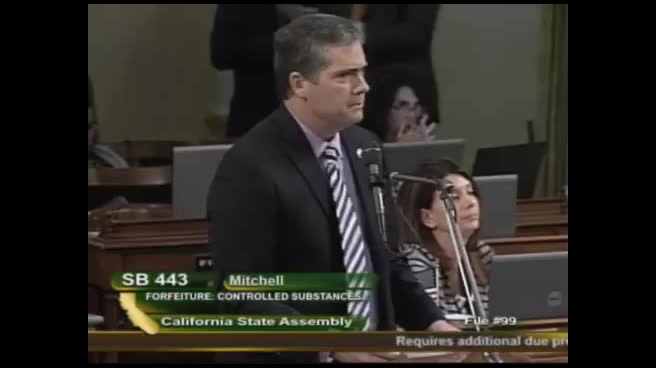 23MIN
Assembly Floor
 40SEC
Assembly Floor
 9MIN
Assembly Standing Committee on Appropriations
 13MIN
Senate Floor
Bill Author

Bill Co-Author(s):