SB 454: Water quality: oil and gas: exempted aquifer.
- Session Year: 2015-2016
- House: Senate
- Latest Version Date: 2015-06-02
Existing federal law prohibits certain oil and gas well activities that affect underground sources of drinking water unless those sources are located in an exempt exempted aquifer. Existing federal law authorizes a state delegated with the responsibility of regulating certain wells to propose that an aquifer or a portion of an aquifer be an exempt exempted aquifer and authorizes the United States Environmental Protection Agency to approve the proposal if the aquifer or a portion of the aquifer meets certain criteria. Under existing federal law, the authority to regulate those wells in California is delegated to the Division of Oil, Gas, and Geothermal Resources in the Department of Conservation.
This bill would prohibit the division from submitting a proposal for an aquifer exemption to the United States Environmental Protection Agency unless the division and the State Water Resources Control Board concur in writing that the aquifer meets specified conditions.
Existing federal law prohibits certain oil and gas well activities that affect underground sources of drinking water unless those sources are located in an exempt aquifer. Existing federal law authorizes a state delegated with the responsibility of regulating certain wells to propose that an aquifer or a portion of an aquifer be an exempt aquifer and authorizes the United States Environmental Protection Agency to approve the proposal if the aquifer or a portion of the aquifer meets certain criteria. Under existing federal law, the authority to regulate those wells in California is delegated to the Division of Oil, Gas, and Geothermal Resources in the Department of Conservation.
This bill would prohibit the division from submitting a proposal for an aquifer exemption to the United States Environmental Protection Agency unless the division and the State Water Resources Control Board concur in writing that the aquifer meets specified conditions.
The Porter-Cologne Water Quality Control Act authorizes the State Water Resources Control Board and the California regional water quality control boards to conduct inspections for violations of specified law. The act requires the state board and the regional boards to determine the types of violations that are minor violations and requires the state board to adopt regulations or state policy for water quality, as prescribed.
This bill would make nonsubstantive changes to the provision relating to minor violations.
The division shall not submit a proposal for an aquifer exemption to the United States Environmental Protection Agency under the federal Safe Drinking Water Act (42 U.S.C. Sec. 300f et seq.) and regulations implementing that act unless the division and the State Water Resources Control Board concur in writing that the aquifer meets either of the following conditions:
(a)The division determines that the aquifer is hydrocarbon bearing, as described in Section 146.4(b)(1) of Title 40 of the Code of Federal Regulations, and both of the following additional determinations are made:
(1)The division and the State Water Resources Control Board determine that the intended injection zone is geologically and hydrogeologically isolated from any other zone containing waters that may have a beneficial use.
(2)The State Water Resources Control Board determines either that the intended injection zone does not contain waters with potential beneficial uses or that the intended injection zone contains waters with potential beneficial uses and the fluids to be injected into the zone will not impact those beneficial uses.
(b)The division and the State Water Resources Control Board concur that the aquifer is nonhydrocarbon bearing and the aquifer meets all of the following conditions:
(1)The aquifer meets the criteria in Section 146.4(a) to (c), inclusive, of Title 40 of the Code of Federal Regulations.
(2)The total dissolved solids content of the water in the aquifer is greater than 3,000 milligrams per liter.
(3)The intended injection zone is geologically and hydrogeologically isolated from any other zone containing waters that may have a beneficial use.
(4)The State Water Resources Control Board determines in writing to the division and posts on the boards Internet Web site in a public and readily accessible location that the injection of fluids into the aquifer would not contaminate a source of water that currently has, or could in the future have, a beneficial use.
(5)If the aquifer contains water that is currently or potentially limited in its beneficial use due to existing contamination, the State Water Resources Control Board determines that the injection of fluids into the aquifer would not impair the limited current or potential beneficial use of the waters.
The division shall not submit a proposal for an aquifer exemption to the United States Environmental Protection Agency under the federal Safe Drinking Water Act (42 U.S.C. Sec. 300f et seq.) and regulations implementing that act unless the division and the State Water Resources Control Board concur in writing that the aquifer meets either of the following conditions:
(a)The division determines that the aquifer is hydrocarbon bearing, as described in Section 146.4(b)(1) of Title 40 of the Code of Federal Regulations, and either both of the following additional determinations is are made:
(1)The division and the State Water Resources Control Board determine that the intended injection zone is geologically and hydrogeologically isolated from any other zone containing waters that may have a beneficial use.
(2)The State Water Resources Control Board determines either that the intended injection zone does not contain waters with potential beneficial uses or that the intended injection zone contains waters with potential beneficial uses and the fluids to be injected into the zone will not impact those beneficial uses.
(b)The division determines and the State Water Resources Control Board concur that the aquifer is nonhydrocarbon bearing and the aquifer meets all of the following conditions:
(1)The aquifer meets the criteria in Section 146.4(a) to (c), inclusive, of Title 40 of the Code of Federal Regulations.
(2)The total dissolved solids content of the water in the aquifer is greater than 3,000 milligrams per liter.
(3)The division and the State Water Resources Control Board determine that the intended injection zone is geologically and hydrogeologically isolated from any other zone containing waters that may have a beneficial use.
(4)The State Water Resources Control Board determines in writing to the division and posts on the boards Internet Web site in a public and readily accessible location that the injection of fluids into the aquifer would not contaminate a source of water that currently has, or could in the future have, a beneficial use, subject to the following: use.
(A)For an aquifer situated at a depth or location that makes recovery of the water currently technologically impractical or an aquifer that is so contaminated that it would be economically or technologically impractical to render that water fit for human consumption or other beneficial use, the board shall consider and make a written determination regarding the potential for future technology to make the aquifer viable as a water source.
(B)The board shall consider and make a written determination regarding the states need to identify and develop new sources of water and how that need might affect the viability of a currently contaminated aquifer.
(5)If the aquifer contains water that is currently or potentially limited in its beneficial use due to existing contamination, the State Water Resources Control Board determines that the injection of fluids into the aquifer would not impair the limited current or potential beneficial use of the waters.
The division shall not submit a proposal for an aquifer exemption to the United States Environmental Protection Agency under the federal Safe Drinking Water Act (42 U.S.C. Sec. 300f et seq.) and regulations implementing that act unless the division and the State Water Resources Control Board concur in writing that the aquifer meets either of the following conditions:
(a)The division determines that the aquifer is hydrocarbon bearing, as described in Section 146.4(b)(1) of Title 40 of the Code of Federal Regulations, and either of the following additional determinations is made:
(1)The division and the State Water Resources Control Board determine that the intended injection zone is geologically and hydrogeologically isolated from any zone containing waters that may have a beneficial use.
(2)The State Water Resources Control Board determines that the intended injection zone contains waters with potential beneficial uses and the fluids to be injected into the zone will not impact those beneficial uses.
(b)The division determines that the aquifer is nonhydrocarbon bearing and the aquifer meets all of the following conditions:
(1)The aquifer meets the criteria in Section 146.4(a) to (c), inclusive, of Title 40 of the Code of Federal Regulations.
(2)The total dissolved solids content of the water in the aquifer is greater than 3,000 milligrams per liter.
(3)The division and the State Water Resources Control Board determine that the intended injection zone is geologically and hydrogeologically isolated from any zone containing waters that may have a beneficial use.
(4)The State Water Resources Control Board determines in writing to the division and posts on the boards Internet Web site in a public and readily accessible location that the injection of fluids into the aquifer would not contaminate a source of water that currently has, or could in the future have, a beneficial use, subject to the following:
(A)For an aquifer situated at a depth or location that makes recovery of the water currently technologically impractical or an aquifer that is so contaminated that it would be economically or technologically impractical to render that water fit for human consumption or other beneficial use, the board shall consider and make a written determination regarding the potential for future technology to make the aquifer viable as a water source.
(B)The board shall consider and make a written determination regarding the states need to identify and develop new sources of water and how that need might affect the viability of a currently contaminated aquifer.
(5)If the aquifer contains water that is currently or potentially limited in its beneficial use due to existing contamination, the State Water Resources Control Board determines that the injection of fluids into the aquifer would not impair the limited current or potential beneficial use of the waters.
SECTION 1.Section 13399 of the Water Code is amended to read:13399.(a)The Legislature hereby finds and declares that the purpose of this chapter is to establish an enforcement policy for violations of this division that the enforcement agency finds are minor when the danger they pose to, or the potential that they have for endangering, human health, safety, or welfare or the environment are taken into account.
(b)It is the intent of the Legislature in enacting this chapter to provide a more resource-efficient enforcement mechanism, faster compliance times, and the creation of a productive and cooperative working relationship between the state board, the regional boards, and the regulated community while maintaining protection of human health and safety and the environment.
(c)This chapter applies solely to the actions of the state board and the regional boards in administering this division and has no application to the administrative enforcement actions of other public agencies.
(d)The state board and each regional board shall implement this chapter by determining the types of violations of this division, or of the regulations, rules, standards, orders, permit conditions, or other requirements adopted pursuant to this division that the state board or the regional board finds are minor violations in accordance with subdivisions (e) and (f). The state board shall implement this chapter through adoption of regulations or state policy for water quality control pursuant to Article 3 (commencing with Section 13140) of Chapter 3.
(e)In determining the types of violations that are minor violations, the state board or regional board shall consider all of the following factors:
(1)The magnitude of the violation.
(2)The scope of the violation.
(3)The severity of the violation.
(4)The degree to which a violation puts human health, safety, or welfare or the environment into jeopardy.
(5)The degree to which a violation could contribute to the failure to accomplish an important goal or program objective as established by this division.
(6)The degree to which a violation may make it difficult to determine if the violator is in compliance with other requirements of this division.
(f)For purposes of this chapter, a minor violation of this division shall not include any of the following:
(1)A knowing, willful, or intentional violation of this division.
(2)A violation of this division that enables the violator to benefit economically from noncompliance, either by realizing reduced costs or by gaining a competitive advantage.
(3)A violation that is a chronic violation or that is committed by a recalcitrant violator.
(g)In determining whether a violation is chronic or a violator is recalcitrant, for purposes of paragraph (3) of subdivision (f), the state board or regional board shall consider whether there is evidence indicating that the violator has engaged in a pattern of neglect or disregard with respect to the requirements of this division or the requirements adopted pursuant to this division.
(a)The Legislature hereby finds and declares that the purpose of this chapter is to establish an enforcement policy for violations of this division that the enforcement agency finds are minor when the danger they pose to, or the potential that they have for endangering, human health, safety, or welfare or the environment are taken into account.
(b)It is the intent of the Legislature in enacting this chapter to provide a more resource-efficient enforcement mechanism, faster compliance times, and the creation of a productive and cooperative working relationship between the state board, the regional boards, and the regulated community while maintaining protection of human health and safety and the environment.
(c)This chapter applies solely to the actions of the state board and the regional boards in administering this division and has no application to the administrative enforcement actions of other public agencies.
(d)The state board and each regional board shall implement this chapter by determining the types of violations of this division, or of the regulations, rules, standards, orders, permit conditions, or other requirements adopted pursuant to this division that the state board or the regional board finds are minor violations in accordance with subdivisions (e) and (f). The state board shall implement this chapter through adoption of regulations or state policy for water quality control pursuant to Article 3 (commencing with Section 13140) of Chapter 3.
(e)In determining the types of violations that are minor violations, the state board or regional board shall consider all of the following factors:
(1)The magnitude of the violation.
(2)The scope of the violation.
(3)The severity of the violation.
(4)The degree to which a violation puts human health, safety, or welfare or the environment into jeopardy.
(5)The degree to which a violation could contribute to the failure to accomplish an important goal or program objective as established by this division.
(6)The degree to which a violation may make it difficult to determine if the violator is in compliance with other requirements of this division.
(f)For purposes of this chapter, a minor violation of this division shall not include any of the following:
(1)Any A knowing, willful, or intentional violation of this division.
(2)Any A violation of this division that enables the violator to benefit economically from noncompliance, either by realizing reduced costs or by gaining a competitive advantage.
(3)Any A violation that is a chronic violation or that is committed by a recalcitrant violator.
(g)In determining whether a violation is chronic or a violator is recalcitrant, for purposes of paragraph (3) of subdivision (f), the state board or regional board shall consider whether there is evidence indicating that the violator has engaged in a pattern of neglect or disregard with respect to the requirements of this division or the requirements adopted pursuant to this division.
|
Date
|
Status
|
|---|---|
| May 5, 2015 | Set for hearing May 11. |
| Feb 1, 2016 | Died on file pursuant to Joint Rule 56. |
| Jun 8, 2015 | Ordered to inactive file on request of Senator Allen. |
| Jun 4, 2015 | Reconsideration granted. |
| Jun 4, 2015 | Read third time. Refused passage. (Ayes 17. Noes 17.) |
| Jun 4, 2015 | Read third time. Refused passage. (Ayes 17. Noes 17. Page 1334.) |
| Jun 4, 2015 | Motion to reconsider made by Senator Allen. |
| Jun 4, 2015 | (Ayes 39. Noes 0. Page 1335.) |
| Jun 2, 2015 | Read second time and amended. Ordered to third reading. |
| Jun 1, 2015 | From committee: Do pass as amended. (Ayes 5. Noes 2.) (May 28). |
| Jun 1, 2015 | From committee: Do pass as amended. (Ayes 5. Noes 2. Page 1154.) (May 28). |
| May 23, 2015 | Set for hearing May 28. |
| May 11, 2015 | May 11 hearing: Placed on APPR. suspense file. |
| Feb 25, 2015 | Introduced. Read first time. To Com. on RLS. for assignment. To print. |
| Apr 30, 2015 | From committee: Do pass and re-refer to Com. on APPR. (Ayes 5. Noes 2.) (April 29). Re-referred to Com. on APPR. |
| Apr 30, 2015 | From committee: Do pass and re-refer to Com. on APPR. (Ayes 5. Noes 2. Page 858.) (April 29). Re-referred to Com. on APPR. |
| Apr 29, 2015 | From committee: Do pass and re-refer to Com. on E.Q. (Ayes 7. Noes 1.) (April 28). Re-referred to Com. on E.Q. |
| Apr 29, 2015 | From committee: Do pass and re-refer to Com. on E.Q. (Ayes 7. Noes 1. Page 821.) (April 28). Re-referred to Com. on E.Q. |
| Apr 23, 2015 | Set for hearing April 29 in E.Q. pending receipt. |
| Apr 21, 2015 | Set for hearing April 28. |
| Apr 21, 2015 | From committee with author's amendments. Read second time and amended. Re-referred to Com. on N.R. & W. |
| Apr 16, 2015 | Re-referred to Coms. on N.R. & W. and E.Q. |
| Apr 6, 2015 | From committee with author's amendments. Read second time and amended. Re-referred to Com. on RLS. |
| Mar 5, 2015 | Referred to Com. on RLS. |
| Feb 26, 2015 | From printer. May be acted upon on or after March 28. |
|
Date
|
Description
|
Location
|
Votes
|
|
|---|---|---|---|---|
| Jun 4, 2015 | Senate 3rd Reading SB454 Allen Reconsider | Senate Floor |
Passed |
|
| Jun 4, 2015 | Senate 3rd Reading SB454 Allen | Senate Floor |
Failed |
|
| May 28, 2015 | Do pass as amended | Senate Standing Committee on Appropriations |
Passed |
|
| May 11, 2015 | Placed on suspense file | Senate Standing Committee on Appropriations |
Passed |
|
| Apr 29, 2015 | Do pass, but first be re-referred to the Committee on [Appropriations] | Senate Standing Committee on Environmental Quality |
Passed |
|
| Apr 28, 2015 | Do pass, but first be re-referred to the Committee on [Environmental Quality] | Senate Standing Committee on Natural Resources and Water |
Passed |
This list shows positions taken on this bill by organizations on the date displayed, which is linked to the original source.
Positions by individuals are not included.
|
Organization
|
Position
|
Date
|
|---|---|---|
| African American Farmers of California | ** Against | Jun 4, 2015 |
| Anne DeMartini, Trustee, Yosemite Community College District | ** Against | Jun 4, 2015 |
| Associated Builders & Contractors of California | ** Against | Jun 4, 2015 |
| Association of Irritated Residents | ** Support | Jun 4, 2015 |
| Ballona Network | ** Support | Jun 4, 2015 |
| Buddy Mendes, Supervisor, Fresno County Board of Supervisors | ** Against | Jun 4, 2015 |
| California Asian Pacific Chamber Of Commerce | ** Against | Jun 4, 2015 |
| California Chamber Of Commerce | ** Against | Jun 4, 2015 |
| California Cotton Ginners Association | ** Against | Jun 4, 2015 |
| California Cotton Growers Association | ** Against | Jun 4, 2015 |
| California Highway Patrolling Association | * Against | Apr 29, 2015 |
| California Independent Petroleum Association | ** Against | Jun 4, 2015 |
| California League Of Conservation Voters | ** Support | Jun 4, 2015 |
| California Women for Agriculture | ** Against | Jun 4, 2015 |
| Camarillo Chamber of Commerce | ** Against | Jun 4, 2015 |
| Center For Environmental Health | ** Support | Jun 4, 2015 |
| Center for Race, Poverty and the Environment | ** Support | Jun 4, 2015 |
| Cerritos Regional Chamber of Commerce | ** Against | Jun 4, 2015 |
| Citizens for Responsible Oil and Gas | ** Support | Jun 4, 2015 |
| Clean Water Action | ** Support | Jun 4, 2015 |
| Coastal Environmental Rights Foundation | ** Support | Jun 4, 2015 |
| Earthworks | ** Support | Jun 4, 2015 |
| Environment California | ** Support | Jun 4, 2015 |
| Environmental Action Center of West Marin | ** Support | Jun 4, 2015 |
| Environmental Defense Center | ** Support | Jun 4, 2015 |
| Environmental Working Group | ** Support | Jun 4, 2015 |
| Foothill Conservancy | ** Support | Jun 4, 2015 |
| Fresnans Against Fracking | ** Support | Jun 4, 2015 |
| Independent Oil Producers Agency | ** Against | Apr 28, 2015 |
| League of Women Voters | ** Support | Jun 4, 2015 |
| Los Padres ForestWatch | ** Support | Jun 4, 2015 |
| Lost Padres Forest Watch | ** Support | Apr 28, 2015 |
| Natural Resources Defense Council | ** Support | Jun 4, 2015 |
| Planning And Conservation League | ** Support | Jun 4, 2015 |
| San Diego350 | ** Support | Jun 4, 2015 |
| Sierra Club California | ** Support | Jun 4, 2015 |
| Southern Monterey County Rural Coalition | ** Support | Jun 4, 2015 |
| The Wildlands Conservancy | ** Support | Jun 4, 2015 |
| u Ballona Network | ** Support | Apr 28, 2015 |
| West Marine Environmental Action Committee | * Support | Apr 29, 2015 |
| Western States Petroleum Association | * Against | Apr 29, 2015 |
| Wholly H2O | ** Support | Jun 4, 2015 |
SB 454
Page 10
|
Office of Senate Floor Analyses (916) 651-1520 Fax: (916) 327-4478 |
THIRD READING
Bill No: SB 454
Amended: 6/2/15
SENATE NATURAL RES. & WATER COMMITTEE: 7-1, 4/28/15
AYES: Pavley, Allen, Hertzberg, Hueso, Jackson, Monning, Wolk
NOES: Stone
NO VOTE RECORDED: Vidak
SENATE ENVIRONMENTAL QUALITY COMMITTEE: 5-2, 4/29/15
AYES: Wieckowski, Hill, Jackson, Leno, Pavley
NOES: Gaines, Bates
SENATE APPROPRIATIONS COMMITTEE: 5-2, 5/28/15
AYES: Lara, Beall, Hill, Leyva, Mendoza
NOES: Bates, Nielsen
SENATE FLOOR: 18-17, 6/4/15 (FAIL)
(ROLL CALL NOT AVAILABLE)
SUBJECT: Water quality: oil and gas: exempted aquifer
DIGEST: This bill prohibits the Division of Oil, Gas, and Geothermal Resources from submitting a proposal for an aquifer exemption to the US Environmental Protection Agency under the Underground Injection Control program unless the Division and the State Water Resources Control Board both make specified findings.
Existing law:
Provides the state’s oil and gas regulator is the Division of Oil, Gas and Geothermal Resources (division), located in the Department of Conservation.
Provides the State Water Resources Control Board (board) has statutory responsibility to protect the waters of the state and to preserve all present and anticipated beneficial uses of those waters under the state’s Porter-Cologne Water Quality Act (Water Code (WAT) §§13000 et seq.) and other law.
Provides for the federal Safe Drinking Water Act (SDWA) enacted in 1974, to protect public health by regulating the nation’s public drinking water and its sources. The US Environmental Protection Agency (US EPA) developed the Underground Injection Control (UIC) Program following passage of the SDWA in order to protect aquifers that were or could become sources of drinking water from contamination.
Specifies if primacy is sought from the US EPA to operate a UIC program, the division is the state entity that may seek primacy for oil and gas (“Class II”) wells (WAT §13263.5). Class II injection wells primarily consist of oil and gas waste disposal wells and injection wells used for “enhanced oil recovery” operations. If certain criteria are met (described below) and procedures are followed, SDWA protection of an aquifer may be lifted so a Class II injection well can inject into it. These are “exempt aquifers.”
This bill requires the division and the board to concur on aquifer exemptions submitted to the US EPA for approval, and does not allow non-hydrocarbon bearing aquifers with total dissolved solids (TDS) concentrations less than 3,000 milligrams per liter to be proposed for exemption. Specifically, this bill requires the division and the board to concur on aquifer exemption proposals as follows:
For hydrocarbon-bearing aquifers:
the intended injection zone must be hydrogeologically isolated from other zones containing waters that may have a beneficial use, and
the board must find either that the water in the injection zone has no potential beneficial use or, if it does, that the injection will not impact that use.
For non-hydrocarbon-bearing aquifers:
the intended injection zone must be hydrogeologically isolated from other zones containing water that may have a beneficial use,
the aquifer is not a source of drinking water,
the aquifer cannot and will not become a source of drinking water due to proximity to a mining area, economic or technological impracticality, mineral concentration or geothermal energy production capability,
the TDS concentration in the aquifer must exceed 3,000 milligrams per liter, and
the board determines that the injection would not contaminate a source of water that does or may have a future beneficial use, or, if the water is already contaminated, that the injection would not further impair its limited or potentially limited beneficial use.
Background
In 1981, the division applied to the US EPA to become the primary enforcing agency for the Class II UIC program in California. As part of the application, the division asked to exempt certain aquifers from protection under the SDWA. These “exempt aquifers” were not or could not become sources of drinking water, as defined (see 40 Code of Federal Regulations (CFR) §146.4, described below). Most of these aquifers were either hydrocarbon-producing, co-located with an existing oil and gas field, or were already being used for oil and gas wastewater injection.
In 1982, the US EPA signed a Memorandum of Agreement (MOA) with the Department of Conservation establishing the division’s primacy for the UIC program and, among other things, providing certain aquifers with exempt status. Under this MOA, the US EPA must approve any additional requests for aquifer exemption status, no injection is allowed into an aquifer without first obtaining exempt status (if needed), and, by mutual agreement between the division and the US EPA, the exempt status for an aquifer may be withdrawn at any time.
In the primacy agreement, the division pledged to work closely with the board. A 1988 MOA between the division and the board still in effect today requires the division to share information with the appropriate regional water quality control board about proposed UIC applications and provides an opportunity for it to comment. Additionally, the division agreed not to issue final approvals until regional board concerns are satisfied.
The criteria for aquifer exemption for Class II wells (40 CFR §146.4) are as follows:
the aquifer is not a source of drinking water,
the aquifer cannot and will not become a source of drinking water because it is economically and technologically infeasible, as defined; located over a mining area; mineral- or hydrocarbon-bearing in commercial quantities or mineral, hydrocarbon or geothermal energy producing, and
the total dissolved salts (TDS) concentration is between 3,000 and 10,000 milligrams per liter. (TDS may be approximately considered as total dissolved salts.)
In 2011, a US EPA audit of the division’s implementation of the UIC program found numerous significant problems. Although not a public part of the review, documents released recently show that questions arose during this time period about aquifer exemptions.
In the last year there have been a series of revelations showing, at best, lax management of the UIC program by the division, particularly with respect to aquifer exemptions. Division staff disregarded the division’s own agreements, guidelines and regulations and regularly approved Class II wells that injected into aquifers that required an exemption or where the aquifer’s water quality was unknown without obtaining an aquifer exemption. Some of these “non-exempt aquifers” contain or may contain good quality water. It was further revealed that two primacy agreements were in existence – one excluding 11 good water quality aquifers from exemption and the other approving their exemption.
As of today, 23 injection wells have now been shut-down due to contamination concerns stemming from the injection location, and over 2,500 injection wells continue to inject into non-exempt or “questionably” exempt aquifers. About 2,000 of these wells are injection wells used for enhanced oil recovery operations in existing oil and gas fields. The remaining 500 are waste disposal wells. In mid-May, the division and board revealed that an additional 3,600 injection wells appeared to also be improperly permitted with respect to aquifer exemptions, although the aquifers in this instance are likely to all be hydrocarbon-bearing. The board and the division are working closely together to review these injection wells. To date, no contamination of water used for domestic or irrigation purposes has been found, although the review continues. Oil and gas injection wells that pose the highest risk to wells supplying possible drinking or irrigation water are being reviewed first.
After a series of letter exchanges between the board, the division and the US EPA, a schedule for bringing all non-compliant injection wells into compliance has been established. Exempt aquifer status will either be obtained for a well’s injection zone by a date certain in the future, or the well will be shut down. This compliance schedule is in division emergency regulations approved in April and the process has started for a regular regulatory rulemaking too. The deadline for all wells is February 15, 2017 with two intermediate dates (October 15, 2015 and December 31, 2016) for higher priority wells.
Comments
Concurrence between the division and the board is appropriate for aquifer exemptions. As noted above, the board has jurisdiction over water quality, although the division has primacy for Class II UIC. In the 1988 MOA, the board clearly retains authority over water quality and at least one of the three post-primacy aquifer exemption petitions by the division to the US EPA reflected board input. The added weight of statutory concurrence may help to ensure continuing cooperation.
The bill’s potential impact on the resolution of the non-compliant wells. This bill would impact the resolution of the non-compliant wells if the division would otherwise ask the US EPA for an aquifer exemption for certain non-hydrocarbon-bearing aquifers with low saline concentrations (less than 3,000 milligrams per liter TDS) on or after January 1, 2016. Approximately 140 active wastewater disposal wells inject into aquifers with TDS concentrations of less than 3,000 milligrams per liter. The 11 aquifers of uncertain exemption also all have TDS concentrations of less than 3,000 milligrams per liter.
There are pending budget actions on the UIC program. The division and the board have asked for increased ongoing funding and personnel to address the UIC program, aquifer exemptions and other related activities.
Related Legislation
SB 248 (Pavley, 2015) reforms the division’s well history reporting and the regulations governing its UIC program. (This bill is on the Senate floor).
SB 545 (Jackson, 2015) revises and updates division’s authority and permitting practices, and reforms the handling of confidential wells (This bill was held on the Senate Appropriations Committee Suspense file).
AB 356 (Williams, 2015) provides for reform of the UIC program with an emphasis on the role of the Water Boards and require groundwater monitoring in the vicinity of UIC wells. (This bill is on the Assembly floor.)
FISCAL EFFECT: Appropriation: No Fiscal Com.: Yes Local: No
According to the Senate Appropriations Committee:
Ongoing costs of $560,000 from the Oil, Gas, and Geothermal Administrative Fund (special) to the board to consider aquifer exemptions, and
Unknown potential revenues losses to the Oil, Gas, and Geothermal Administrative Fund (special) for decreased oil production.
Association of Irritated Residents
Ballona Network
California League of Conservation Voters
Center for Race, Poverty and the Environment
Center for Environmental Health
Citizens for Responsible Oil and Gas
Clean Water Action
Coastal Environmental Rights Foundation
Earthworks
Environment California
Environmental Action Center of West Marin
Environmental Defense Center
Environmental Working Group
Foothill Conservancy
Fresnans Against Fracking
League of Women Voters
Los Padres ForestWatch
Natural Resources Defense Council
Planning and Conservation League
San Diego350
Sierra Club California
Southern Monterey County Rural Coalition
The Wildlands Conservancy
Wholly H2O
African American Farmers of California
Anne DeMartini, Trustee, Yosemite Community College District
Associated Builders & Contractors of California
Buddy Mendes, Supervisor, Fresno County Board of Supervisors
California Asian pacific Chamber of Commerce
California Chamber of Commerce
California Cotton Ginners Association
California Cotton Growers Association
California Independent Petroleum Association
California Women for Agriculture
Camarillo Chamber of Commerce
Cerritos Regional Chamber of Commerce
Chambers of Commerce Alliance of Ventura & Santa Barbara Counties
Clint Olivier, Councilmember, City of Fresno
Coastal Energy Alliance
Craig Pedersen, Supervisor, Kings County Board of Supervisors
Dick Monteith, Supervisor, Stanislaus County Board of Supervisors
Doug Verboon, Supervisor, Kings County Board of Supervisors
El Monte/South El Monte Chamber of Commerce
Frank Hotchkiss, Councilmember, City of Santa Barbara
Fresno Area Hispanic Foundation/Downtown Business Hub
Fresno County Farm Bureau
Greater Bakersfield Chamber of Commerce
Hayward Chamber of Commerce
Humboldt Taxpayer’s League
Huntington Beach Chamber of Commerce
Independent Oil Producers’ Agency
Inland Empire Economic Partnership
International Faith Based Coalition
Jim DeMartini, Supervisor, Stanislaus County Board of Supervisors
José Flores, Councilmember, City of Clovis
Justin Mendes, Councilmember, City of Hanford
Kern County Black Chamber of Commerce
Kern County Firefighters IAFF Local 1301
Kern County Hispanic Chamber of Commerce
Kern County Taxpayers Association
Kern Economic Development Corporation
Kings County Farm Bureau
Latino Community Roundtable of Stanislaus County
Lee Brand, Councilmember, City of Fresno
Louie Arrollo, former Mayor, City of Ceres
Luis Chavez, Trustee, Fresno Unified School District
Mike Spence, Councilmember, City of West Covina
Mike Welsh, School Board Member, Ceres Unified School District
Monterey County Farm Bureau
National Association of Royalty Owners
National Association of Royalty Owners – California
National Federation of Independent Business
National Hmong American Farmers
Nickel Family, LLC
Nisei Farmers League
Oxnard Chamber of Commerce
Pete Vander Poel, Supervisor, Tulare County Board of Supervisors
Peter Adam, Supervisor, Santa Barbara County Board of Supervisors
Peter Foy, Supervisor, Ventura County Board of Supervisors
Porterville Chamber of Commerce
Richard Valle, Supervisor, Kings County Board of Supervisors
Rick Farinelli, Supervisor, Madera County Board of Supervisors
Robert Silva, Mayor, City of Mendota
Rudy Mendoza, Mayor, City of Woodlake
Russ Curry, Mayor, City of Hanford
Sacramento Asian Pacific Chamber of Commerce
Sal Quintero, Councilmember, City of Fresno
San Diego East County Chamber of Commerce
San Diego Tax Fighters
San Joaquin Farm Bureau
Santa Barbara County Taxpayers Association
Santa Barbara Technology and Industry Association
Santa Fe Springs Chamber of Commerce
Santa Maria Valley Chamber of Commerce & Visitor and Convention Bureau
Steve Brandau, Councilmember, City of Fresno
Steve Nascimento, Councilmember, City of Turlock
Steve Worthley, Supervisor, Tulare County Board of Supervisors
Sylvia V. Chávez, Mayor, City of Huron
Taft Chamber of Commerce and Visitors Bureau
Terry Withrow, Supervisor, Stanislaus County Board of Supervisors
The Chamber of Commerce of the Santa Barbara Region
Tulare County Farm Bureau
Valley Industry & Commerce Association
Western Agricultural Processors Association
Western States Petroleum Association
Western United Dairymen
Four individuals
ARGUMENTS IN SUPPORT: According to the author, the division “has allowed more than 2,500 waste water disposal and injections wells to be drilled into aquifers that have not been exempted from the Safe Drinking Water Act and therefore should have been protected. The fluids being injected into these aquifers contain a toxic cocktail of chemicals, many of which are known to cause cancer and other human health problems, including benzene, arsenic and radioactive material.”
“It is clear that going forward, given California’s long-term water challenges, the state will need to access deeper aquifers and adopt technology necessary to clean aquifers currently considered polluted. Given the current water crisis, it is irresponsible and shortsighted to not protect these aquifers.”
“SB 454 puts specific criteria in place to guide [the division] in determining which of California’s protected aquifers should be eligible for consideration for an exemption. The criteria require [the division] to work jointly with the [board].”
ARGUMENTS IN OPPOSITION: According to the California Independent Petroleum Association (CIPA), “SB 454 would re-define critical components of the UIC program and the aquifer exemption definition and application process. These proposed modifications to the UIC program would compromise California’s oil production without providing any additional environmental and groundwater protections beyond those provided by the enhancements to the UIC program proposed to US EPA by the [board] and the [division].”
“SB 454 instead alters the aquifer exemption process so as to exclude certain aquifers that would otherwise be exempt under the long-standing federal criterion (sic) […] For example, SB 454 would prohibit all injection into non-hydrocarbon-bearing zones where the total dissolved solids content of the water in the aquifer is less than 3,000 milligrams per liter.” CIPA notes that aquifers with these low salt concentrations may be considered for exemption if it is economically or technologically impractical for them to be used as drinking water.
CIPA further states that “injection wells have been an integral part of California’s oil and gas operations for over 50 years” and roughly 70% of California’s oil production depends upon enhanced oil recovery using injections wells. “Without sufficient injection well options, oil wells cannot produce and oil production in California will be adversely affected.”
Prepared by: Katharine Moore / N.R. & W. / (916) 651-4116
6/4/15 16:02:47
**** END ****
SB 454
Page 10
|
Office of Senate Floor Analyses (916) 651-1520 Fax: (916) 327-4478 |
THIRD READING
Bill No: SB 454
Amended: 6/2/15
SENATE NATURAL RES. & WATER COMMITTEE: 7-1, 4/28/15
AYES: Pavley, Allen, Hertzberg, Hueso, Jackson, Monning, Wolk
NOES: Stone
NO VOTE RECORDED: Vidak
SENATE ENVIRONMENTAL QUALITY COMMITTEE: 5-2, 4/29/15
AYES: Wieckowski, Hill, Jackson, Leno, Pavley
NOES: Gaines, Bates
SENATE APPROPRIATIONS COMMITTEE: 5-2, 5/28/15
AYES: Lara, Beall, Hill, Leyva, Mendoza
NOES: Bates, Nielsen
SUBJECT: Water quality: oil and gas: exempted aquifer
DIGEST: This bill prohibits the Division of Oil, Gas, and Geothermal Resources from submitting a proposal for an aquifer exemption to the US Environmental Protection Agency under the Underground Injection Control program unless the Division and the State Water Resources Control Board both make specified findings.
Existing law:
Provides the state’s oil and gas regulator is the Division of Oil, Gas and Geothermal Resources (division), located in the Department of Conservation.
Provides the State Water Resources Control Board (board) has statutory responsibility to protect the waters of the state and to preserve all present and anticipated beneficial uses of those waters under the state’s Porter-Cologne Water Quality Act (Water Code (WAT) §§13000 et seq.) and other law.
Provides for the federal Safe Drinking Water Act (SDWA) enacted in 1974, to protect public health by regulating the nation’s public drinking water and its sources. The US Environmental Protection Agency (US EPA) developed the Underground Injection Control (UIC) Program following passage of the SDWA in order to protect aquifers that were or could become sources of drinking water from contamination.
Specifies if primacy is sought from the US EPA to operate a UIC program, the division is the state entity that may seek primacy for oil and gas (“Class II”) wells (WAT §13263.5). Class II injection wells primarily consist of oil and gas waste disposal wells and injection wells used for “enhanced oil recovery” operations. If certain criteria are met (described below) and procedures are followed, SDWA protection of an aquifer may be lifted so a Class II injection well can inject into it. These are “exempt aquifers.”
This bill requires the division and the board to concur on aquifer exemptions submitted to the US EPA for approval, and does not allow non-hydrocarbon bearing aquifers with total dissolved solids (TDS) concentrations less than 3,000 milligrams per liter to be proposed for exemption. Specifically, this bill requires the division and the board to concur on aquifer exemption proposals as follows:
For hydrocarbon-bearing aquifers:
the intended injection zone must be hydrogeologically isolated from other zones containing waters that may have a beneficial use, and
the board must find either that the water in the injection zone has no potential beneficial use or, if it does, that the injection will not impact that use.
For non-hydrocarbon-bearing aquifers:
the intended injection zone must be hydrogeologically isolated from other zones containing water that may have a beneficial use,
the aquifer is not a source of drinking water,
the aquifer cannot and will not become a source of drinking water due to proximity to a mining area, economic or technological impracticality, mineral concentration or geothermal energy production capability,
the TDS concentration in the aquifer must exceed 3,000 milligrams per liter, and
the board determines that the injection would not contaminate a source of water that does or may have a future beneficial use, or, if the water is already contaminated, that the injection would not further impair its limited or potentially limited beneficial use.
Background
In 1981, the division applied to the US EPA to become the primary enforcing agency for the Class II UIC program in California. As part of the application, the division asked to exempt certain aquifers from protection under the SDWA. These “exempt aquifers” were not or could not become sources of drinking water, as defined (see 40 Code of Federal Regulations (CFR) §146.4, described below). Most of these aquifers were either hydrocarbon-producing, co-located with an existing oil and gas field, or were already being used for oil and gas wastewater injection.
In 1982, the US EPA signed a Memorandum of Agreement (MOA) with the Department of Conservation establishing the division’s primacy for the UIC program and, among other things, providing certain aquifers with exempt status. Under this MOA, the US EPA must approve any additional requests for aquifer exemption status, no injection is allowed into an aquifer without first obtaining exempt status (if needed), and, by mutual agreement between the division and the US EPA, the exempt status for an aquifer may be withdrawn at any time.
In the primacy agreement, the division pledged to work closely with the board. A 1988 MOA between the division and the board still in effect today requires the division to share information with the appropriate regional water quality control board about proposed UIC applications and provides an opportunity for it to comment. Additionally, the division agreed not to issue final approvals until regional board concerns are satisfied.
The criteria for aquifer exemption for Class II wells (40 CFR §146.4) are as follows:
the aquifer is not a source of drinking water,
the aquifer cannot and will not become a source of drinking water because it is economically and technologically infeasible, as defined; located over a mining area; mineral- or hydrocarbon-bearing in commercial quantities or mineral, hydrocarbon or geothermal energy producing, and
the total dissolved salts (TDS) concentration is between 3,000 and 10,000 milligrams per liter. (TDS may be approximately considered as total dissolved salts.)
In 2011, a US EPA audit of the division’s implementation of the UIC program found numerous significant problems. Although not a public part of the review, documents released recently show that questions arose during this time period about aquifer exemptions.
In the last year there have been a series of revelations showing, at best, lax management of the UIC program by the division, particularly with respect to aquifer exemptions. Division staff disregarded the division’s own agreements, guidelines and regulations and regularly approved Class II wells that injected into aquifers that required an exemption or where the aquifer’s water quality was unknown without obtaining an aquifer exemption. Some of these “non-exempt aquifers” contain or may contain good quality water. It was further revealed that two primacy agreements were in existence – one excluding 11 good water quality aquifers from exemption and the other approving their exemption.
As of today, 23 injection wells have now been shut-down due to contamination concerns stemming from the injection location, and over 2,500 injection wells continue to inject into non-exempt or “questionably” exempt aquifers. About 2,000 of these wells are injection wells used for enhanced oil recovery operations in existing oil and gas fields. The remaining 500 are waste disposal wells. In mid-May, the division and board revealed that an additional 3,600 injection wells appeared to also be improperly permitted with respect to aquifer exemptions, although the aquifers in this instance are likely to all be hydrocarbon-bearing. The board and the division are working closely together to review these injection wells. To date, no contamination of water used for domestic or irrigation purposes has been found, although the review continues. Oil and gas injection wells that pose the highest risk to wells supplying possible drinking or irrigation water are being reviewed first.
After a series of letter exchanges between the board, the division and the US EPA, a schedule for bringing all non-compliant injection wells into compliance has been established. Exempt aquifer status will either be obtained for a well’s injection zone by a date certain in the future, or the well will be shut down. This compliance schedule is in division emergency regulations approved in April and the process has started for a regular regulatory rulemaking too. The deadline for all wells is February 15, 2017 with two intermediate dates (October 15, 2015 and December 31, 2016) for higher priority wells.
Comments
Concurrence between the division and the board is appropriate for aquifer exemptions. As noted above, the board has jurisdiction over water quality, although the division has primacy for Class II UIC. In the 1988 MOA, the board clearly retains authority over water quality and at least one of the three post-primacy aquifer exemption petitions by the division to the US EPA reflected board input. The added weight of statutory concurrence may help to ensure continuing cooperation.
The bill’s potential impact on the resolution of the non-compliant wells. This bill would impact the resolution of the non-compliant wells if the division would otherwise ask the US EPA for an aquifer exemption for certain non-hydrocarbon-bearing aquifers with low saline concentrations (less than 3,000 milligrams per liter TDS) on or after January 1, 2016. Approximately 140 active wastewater disposal wells inject into aquifers with TDS concentrations of less than 3,000 milligrams per liter. The 11 aquifers of uncertain exemption also all have TDS concentrations of less than 3,000 milligrams per liter.
There are pending budget actions on the UIC program. The division and the board have asked for increased ongoing funding and personnel to address the UIC program, aquifer exemptions and other related activities.
Recent related legislation
SB 248 (Pavley, 2015) This bill reforms the division’s well history reporting and the regulations governing its UIC program. (This bill is on the Senate floor).
SB 545 (Jackson, 2015) This bill revises and updates division’s authority and permitting practices, and reforms the handling of confidential wells (This bill was held on the Senate Appropriations Committee Suspense file).
AB 356 (Williams, 2015) This bill provides for reform of the UIC program with an emphasis on the role of the Water Boards and require groundwater monitoring in the vicinity of UIC wells. (This bill is on the Assembly floor.)
FISCAL EFFECT: Appropriation: No Fiscal Com.: Yes Local: No
According to the Senate Appropriations Committee, this bill has:
Ongoing costs of $560,000 from the Oil, Gas, and Geothermal Administrative Fund (special) to the board to consider aquifer exemptions, and
Unknown potential revenues losses to the Oil, Gas, and Geothermal Administrative Fund (special) for decreased oil production.
Association of Irritated Residents
Ballona Network
California League of Conservation Voters
Center for Race, Poverty and the Environment
Center for Environmental Health
Citizens for Responsible Oil and Gas
Clean Water Action
Coastal Environmental Rights Foundation
Earthworks
Environment California
Environmental Action Center of West Marin
Environmental Defense Center
Environmental Working Group
Foothill Conservancy
Fresnans Against Fracking
League of Women Voters
Los Padres ForestWatch
Natural Resources Defense Council
Planning and Conservation League
San Diego350
Sierra Club California
Southern Monterey County Rural Coalition
The Wildlands Conservancy
Wholly H2O
African American Farmers of California
Anne DeMartini, Trustee, Yosemite Community College District
Associated Builders & Contractors of California
Buddy Mendes, Supervisor, Fresno County Board of Supervisors
California Asian pacific Chamber of Commerce
California Chamber of Commerce
California Cotton Ginners Association
California Cotton Growers Association
California Independent Petroleum Association
California Women for Agriculture
Camarillo Chamber of Commerce
Cerritos Regional Chamber of Commerce
Chambers of Commerce Alliance of Ventura & Santa Barbara Counties
Clint Olivier, Councilmember, City of Fresno
Coastal Energy Alliance
Craig Pedersen, Supervisor, Kings County Board of Supervisors
Dick Monteith, Supervisor, Stanislaus County Board of Supervisors
Doug Verboon, Supervisor, Kings County Board of Supervisors
El Monte/South El Monte Chamber of Commerce
Frank Hotchkiss, Councilmember, City of Santa Barbara
Fresno Area Hispanic Foundation/Downtown Business Hub
Fresno County Farm Bureau
Greater Bakersfield Chamber of Commerce
Hayward Chamber of Commerce
Humboldt Taxpayer’s League
Huntington Beach Chamber of Commerce
Independent Oil Producers’ Agency
Inland Empire Economic Partnership
International Faith Based Coalition
Jim DeMartini, Supervisor, Stanislaus County Board of Supervisors
José Flores, Councilmember, City of Clovis
Justin Mendes, Councilmember, City of Hanford
Kern County Black Chamber of Commerce
Kern County Firefighters IAFF Local 1301
Kern County Hispanic Chamber of Commerce
Kern County Taxpayers Association
Kern Economic Development Corporation
Kings County Farm Bureau
Latino Community Roundtable of Stanislaus County
Lee Brand, Councilmember, City of Fresno
Louie Arrollo, former Mayor, City of Ceres
Luis Chavez, Trustee, Fresno Unified School District
Mike Spence, Councilmember, City of West Covina
Mike Welsh, School Board Member, Ceres Unified School District
Monterey County Farm Bureau
National Association of Royalty Owners
National Association of Royalty Owners – California
National Federation of Independent Business
National Hmong American Farmers
Nickel Family, LLC
Nisei Farmers League
Oxnard Chamber of Commerce
Pete Vander Poel, Supervisor, Tulare County Board of Supervisors
Peter Adam, Supervisor, Santa Barbara County Board of Supervisors
Peter Foy, Supervisor, Ventura County Board of Supervisors
Porterville Chamber of Commerce
Richard Valle, Supervisor, Kings County Board of Supervisors
Rick Farinelli, Supervisor, Madera County Board of Supervisors
Robert Silva, Mayor, City of Mendota
Rudy Mendoza, Mayor, City of Woodlake
Russ Curry, Mayor, City of Hanford
Sacramento Asian Pacific Chamber of Commerce
Sal Quintero, Councilmember, City of Fresno
San Diego East County Chamber of Commerce
San Diego Tax Fighters
San Joaquin Farm Bureau
Santa Barbara County Taxpayers Association
Santa Barbara Technology and Industry Association
Santa Fe Springs Chamber of Commerce
Santa Maria Valley Chamber of Commerce & Visitor and Convention Bureau
Steve Brandau, Councilmember, City of Fresno
Steve Nascimento, Councilmember, City of Turlock
Steve Worthley, Supervisor, Tulare County Board of Supervisors
Sylvia V. Chávez, Mayor, City of Huron
Taft Chamber of Commerce and Visitors Bureau
Terry Withrow, Supervisor, Stanislaus County Board of Supervisors
The Chamber of Commerce of the Santa Barbara Region
Tulare County Farm Bureau
Valley Industry & Commerce Association
Western Agricultural Processors Association
Western States Petroleum Association
Western United Dairymen
Four individuals
ARGUMENTS IN SUPPORT: According to the author, the division “has allowed more than 2,500 waste water disposal and injections wells to be drilled into aquifers that have not been exempted from the Safe Drinking Water Act and therefore should have been protected. The fluids being injected into these aquifers contain a toxic cocktail of chemicals, many of which are known to cause cancer and other human health problems, including benzene, arsenic and radioactive material.”
“It is clear that going forward, given California’s long-term water challenges, the state will need to access deeper aquifers and adopt technology necessary to clean aquifers currently considered polluted. Given the current water crisis, it is irresponsible and shortsighted to not protect these aquifers.”
“SB 454 puts specific criteria in place to guide [the division] in determining which of California’s protected aquifers should be eligible for consideration for an exemption. The criteria require [the division] to work jointly with the [board].”
ARGUMENTS IN OPPOSITION: According to the California Independent Petroleum Association (CIPA), “SB 454 would re-define critical components of the UIC program and the aquifer exemption definition and application process. These proposed modifications to the UIC program would compromise California’s oil production without providing any additional environmental and groundwater protections beyond those provided by the enhancements to the UIC program proposed to US EPA by the [board] and the [division].”
“SB 454 instead alters the aquifer exemption process so as to exclude certain aquifers that would otherwise be exempt under the long-standing federal criterion (sic) […] For example, SB 454 would prohibit all injection into non-hydrocarbon-bearing zones where the total dissolved solids content of the water in the aquifer is less than 3,000 milligrams per liter.” CIPA notes that aquifers with these low salt concentrations may be considered for exemption if it is economically or technologically impractical for them to be used as drinking water.
CIPA further states that “injection wells have been an integral part of California’s oil and gas operations for over 50 years” and roughly 70% of California’s oil production depends upon enhanced oil recovery using injections wells. “Without sufficient injection well options, oil wells cannot produce and oil production in California will be adversely affected.”
Prepared by: Katharine Moore / N.R. & W. / (916) 651-4116
6/2/15 21:38:51
**** END ****
SB 454 (Allen) Page 3 of 3
SENATE COMMITTEE ON APPROPRIATIONS
Senator Ricardo Lara, Chair
2015 - 2016 Regular Session
SB 454 (Allen) - Water quality: oil and gas: exempt aquifer
|
|
Version: April 21, 2015 |
Policy Vote: N.R. & W. 7 - 1, E.Q. 5 - 2 |
Urgency: No |
Mandate: No |
Hearing Date: May 28, 2015 |
Consultant: Marie Liu |
SUSPENSE FILE. AS AMENDED.
Bill Summary:
AB 454 would prohibit the division of Oil, Gas, and Geothermal Resources (DOGGR) from submitting a proposal for an aquifer exemption unless DOGGR and the State Water Resources Control Board (SWRCB) both make specified findings.
Fiscal Impact (as approved on May 28, 2015):
Ongoing costs of $560,000 from the Oil, Gas, and Geothermal Administrative Fund (special) to the SWRCB to consider aquifer exemptions.
Unknown potential revenues losses to the Oil, Gas, and Geothermal Administrative Fund (special) for decreased oil production.
Background:
DOGGR in the Department of Conservation is the state’s oil and gas regulator and is headed by the oil and gas supervisor. The supervisor is generally charged with overseeing the drilling, operation, maintenance, and abandonment of wells, tanks, and other facilities used in oil and gas regulation to prevent damage to life, health, property, and natural resources. Existing law requires the state’s oil and gas supervisor to produce a public annual report containing information about the state’s oil and gas production and other related material, as specified.
DOGGR sought and received “primacy” to operate the class II underground injection control (UIC) program from the US Environmental Protection Agency (US EPA) in the early 1980s. The class II UIC program is for oil and gas injection wells. These include wells used for EOR and waste disposal. As part of the application, DOGGR asked to exempt certain aquifers from protection under the Safe Drinking Water Act. These “exempt aquifers” were not or could not become sources of drinking water, as defined (see 40 Code of Federal Regulations (CFR) §146.4, described below). Most of these aquifers were either hydrocarbon-producing, co-located with an existing oil and gas field, or were already being used for oil and gas wastewater injection.
In 1982, the US EPA signed a Memorandum of Agreement (MOA) with the Department of Conservation establishing DOGGR’s primacy for the UIC program and, among other things, providing certain aquifers with exempt status. Under this MOA, (1) the US EPA must approve any additional requests for aquifer exemption status, (2) no injection is allowed into an aquifer without first obtaining exempt status (if needed), and, (3) by mutual agreement between DOGGR and the US EPA, the exempt status for an aquifer may be withdrawn at any time. In the primacy agreement, DOGGR pledged to work closely with the SWRCB. A 1988 MOA between DOGGR and the SWRCB requires the DOGGR to share information with the appropriate regional water quality control board (regional board) about proposed UIC applications and provides an opportunity for the regional board to comment. Additionally, DOGGR agrees not to issue final approvals until regional board concerns are satisfied.
In 2011, an audit of the DOGGR UIC program was completed by a US EPA contractor. One of the numerous issues raised by the audit was the need to improve the number and type of inspections by the DOGGR.
In the last 10 months there have been a series of revelations showing, at best, questionable and lax management of the UIC program by the division, particularly with respect to aquifer exemptions. DOGGR staff disregarded DOGGR’s own agreements, guidelines and regulations and regularly approved Class II wells that injected into aquifers that required exemption to be used or where the aquifer’s water quality was unknown. Some of these “non-exempt aquifers” contain or may contain good quality water. (See the March 10, 2015 joint oversight hearing on the UIC program convened by the Senate Natural Resources and Water Committee and the Senate Environmental Quality Committee for more information.)
Proposed Law:
This bill would require DOGGR and the SWRCB to make specific written findings before submitting an application to the US EPA for an aquifer exemption. Specifically, if the aquifer is hydrocarbon bearing, DOGGR and the SWRCB must find that the aquifer (1) is geologically and hydrogeologically isolated from other zones containing waters that may have a beneficial use, and (2) does not contain waters with potential beneficial uses or has a beneficial use that wouldn’t be impacted by fluids injected into the zone.
If the aquifer is not hydrocarbon bearing, DOGGR and SWRCB must find that the aquifer (1) meets the US EPA requirements for an aquifer exemption, (2) has more than 3,000 milligrams per liter total dissolved salts, (3) is geologically and hydrogeologically isolated from other zones containing waters that may have a beneficial use, and (4) would not be contaminated for current or future beneficial use. This last finding must be made by the SWRCB and posted on its website in a public and readily accessible location.
Staff Comments:
The actions required of DOGGR in this bill are largely in line with the requirements that currently exist in DOGGR’s regulations and DOGGR’s MOA with the US EPA establishing DOGGR’s primacy in implementing the UIC program with two exceptions. First, the bill requires that an aquifer being geologically and hydrogeophically isolated while currently an aquifer only needs to geologically or hydrogeologically isolated. This difference will require additional review by DOGGR at an annual cost of approximately $350,000.
The second difference between this bill and existing regulations and agreements is that existing regulations and agreements would allow for an aquifer exemption to be applied for even if it had a total dissolved solids concentration below 3,000 milligrams per liter if that aquifer was not economically recoverable or too polluted to use. Should this bill result in injection wells being shut-in, and that shut-in decreases oil production, DOGGR could have some revenue losses since well owners pay fees to the state based on oil production.
Staff notes that DOGGR currently has a budget change proposal (BCP) open for consideration by the Senate Budget Subcommittee #2 to reappropriate $1.5 million from the Oil, Gas, and Geothermal Administrative Fund for the UIC program. Approval of this BCP would give DOGGR the resources that it feels it needs to meet existing requirements. Thus, approval of the BCP would not provide funds for the activities required under this bill.
The actions required of the SWRCB in this bill are also largely in line with the MOA between DOGGR and the SWRCB regarding oil field wastewater disposal. However, the SWRCB was never appropriated funds for this purpose. As such, to implement this bill, the SWRCB would necessitate $560,000 for four PYs to review existing and future aquifer exemptions.
Staff notes that the SWRCB also has a budget change proposal for $2.1 million and 13 PYs from the Oil, Gas, and Geothermal Administrative Fund for UIC program oversight. According to the SWRCB, should this BCP be approved, it will need no additional funds needed to implement this bill.
Committee amendments (as adopted on May 28, 2015): Amend to specify that an isolated aquifer is hydrogeologically isolated.
-- END --
SB 454 (Allen) Page 3 of 3
SENATE COMMITTEE ON APPROPRIATIONS
Senator Ricardo Lara, Chair
2015 - 2016 Regular Session
SB 454 (Allen) - Water quality: oil and gas: exempt aquifer
|
|
Version: April 21, 2015 |
Policy Vote: N.R. & W. 7 - 1, E.Q. 5 - 2 |
Urgency: No |
Mandate: No |
Hearing Date: May 11, 2015 |
Consultant: Marie Liu |
This bill meets the criteria for referral to the Suspense File.
Bill Summary:
AB 454 would prohibit the division of Oil, Gas, and Geothermal Resources (DOGGR) from submitting a proposal for an aquifer exemption unless DOGGR and the State Water Resources Control Board (SWRCB) both make specified findings.
Fiscal Impact:
Up to $350,000 from the Oil, Gas, and Geothermal Administrative Fund (special) for additional aquifer evaluation by DOGGR.
Ongoing costs of $560,000 from the Oil, Gas, and Geothermal Administrative Fund (special) to the SWRCB to consider aquifer exemptions.
Unknown potential revenues losses to the Oil, Gas, and Geothermal Administrative Fund (special) for decreased oil production.
Background:
DOGGR in the Department of Conservation is the state’s oil and gas regulator and is headed by the oil and gas supervisor. The supervisor is generally charged with overseeing the drilling, operation, maintenance, and abandonment of wells, tanks, and other facilities used in oil and gas regulation to prevent damage to life, health, property, and natural resources. Existing law requires the state’s oil and gas supervisor to produce a public annual report containing information about the state’s oil and gas production and other related material, as specified.
DOGGR sought and received “primacy” to operate the class II underground injection control (UIC) program from the US Environmental Protection Agency (US EPA) in the early 1980s. The class II UIC program is for oil and gas injection wells. These include wells used for EOR and waste disposal. As part of the application, DOGGR asked to exempt certain aquifers from protection under the Safe Drinking Water Act. These “exempt aquifers” were not or could not become sources of drinking water, as defined (see 40 Code of Federal Regulations (CFR) §146.4, described below). Most of these aquifers were either hydrocarbon-producing, co-located with an existing oil and gas field, or were already being used for oil and gas wastewater injection.
In 1982, the US EPA signed a Memorandum of Agreement (MOA) with the Department of Conservation establishing DOGGR’s primacy for the UIC program and, among other things, providing certain aquifers with exempt status. Under this MOA, (1) the US EPA must approve any additional requests for aquifer exemption status, (2) no injection is allowed into an aquifer without first obtaining exempt status (if needed), and, (3) by mutual agreement between DOGGR and the US EPA, the exempt status for an aquifer may be withdrawn at any time. In the primacy agreement, DOGGR pledged to work closely with the SWRCB. A 1988 MOA between DOGGR and the SWRCB requires the DOGGR to share information with the appropriate regional water quality control board (regional board) about proposed UIC applications and provides an opportunity for the regional board to comment. Additionally, DOGGR agrees not to issue final approvals until regional board concerns are satisfied.
In 2011, an audit of the DOGGR UIC program was completed by a US EPA contractor. One of the numerous issues raised by the audit was the need to improve the number and type of inspections by the DOGGR.
In the last 10 months there have been a series of revelations showing, at best, questionable and lax management of the UIC program by the division, particularly with respect to aquifer exemptions. DOGGR staff disregarded DOGGR’s own agreements, guidelines and regulations and regularly approved Class II wells that injected into aquifers that required exemption to be used or where the aquifer’s water quality was unknown. Some of these “non-exempt aquifers” contain or may contain good quality water. (See the March 10, 2015 joint oversight hearing on the UIC program convened by the Senate Natural Resources and Water Committee and the Senate Environmental Quality Committee for more information.)
Proposed Law:
This bill would require DOGGR and the SWRCB to make specific written findings before submitting an application to the US EPA for an aquifer exemption. Specifically, if the aquifer is hydrocarbon bearing, DOGGR and the SWRCB must find that the aquifer (1) is geologically and hydrogeologically isolated from other zones containing waters that may have a beneficial use, and (2) does not contain waters with potential beneficial uses or has a beneficial use that wouldn’t be impacted by fluids injected into the zone.
If the aquifer is not hydrocarbon bearing, DOGGR and SWRCB must find that the aquifer (1) meets the US EPA requirements for an aquifer exemption, (2) has more than 3,000 milligrams per liter total dissolved salts, (3) is geologically and hydrogeologically isolated from other zones containing waters that may have a beneficial use, and (4) would not be contaminated for current or future beneficial use. This last finding must be made by the SWRCB and posted on its website in a public and readily accessible location.
Staff Comments:
The actions required of DOGGR in this bill are largely in line with the requirements that currently exist in DOGGR’s regulations and DOGGR’s MOA with the US EPA establishing DOGGR’s primacy in implementing the UIC program with two exceptions. First, the bill requires that an aquifer being geologically and hydrogeophically isolated while currently an aquifer only needs to geologically or hydrogeologically isolated. This difference will require additional review by DOGGR at an annual cost of approximately $350,000.
The second difference between this bill and existing regulations and agreements is that existing regulations and agreements would allow for an aquifer exemption to be applied for even if it had a total dissolved solids concentration below 3,000 milligrams per liter if that aquifer was not economically recoverable or too polluted to use. Should this bill result in injection wells being shut-in, and that shut-in decreases oil production, DOGGR could have some revenue losses since well owners pay fees to the state based on oil production.
Staff notes that DOGGR currently has a budget change proposal (BCP) open for consideration by the Senate Budget Subcommittee #2 to reappropriate $1.5 million from the Oil, Gas, and Geothermal Administrative Fund for the UIC program. Approval of this BCP would give DOGGR the resources that it feels it needs to meet existing requirements. Thus, approval of the BCP would not provide funds for the activities required under this bill.
The actions required of the SWRCB in this bill are also largely in line with the MOA between DOGGR and the SWRCB regarding oil field wastewater disposal. However, the SWRCB was never appropriated funds for this purpose. As such, to implement this bill, the SWRCB would necessitate $560,000 for four PYs to review existing and future aquifer exemptions.
Staff notes that the SWRCB also has a budget change proposal for $2.1 million and 13 PYs from the Oil, Gas, and Geothermal Administrative Fund for UIC program oversight. According to the SWRCB, should this BCP be approved, it will need no additional funds needed to implement this bill.
-- END --
SB 454 (Allen) Page 10 of 10
SENATE COMMITTEE ON ENVIRONMENTAL QUALITY
Senator Wieckowski, Chair
2015 - 2016 Regular
Bill No: SB 454
Author: |
Allen |
||
Version: |
4/21/2015 |
Hearing Date: |
4/29/15 |
Urgency: |
No |
Fiscal: |
Yes |
Consultant: |
Rachel Machi Wagoner |
||
SUBJECT: Water quality: oil and gas: exempt aquifer
ANALYSIS:
Existing law:
Under the federal Safe Drinking Water Act (SDWA):
Authorizes and requires the United States Environmental Protection Agency (US EPA) to regulate underground injection in order to protect underground drinking water sources.
Prohibits certain oil and gas well activities that affect underground sources of drinking water unless those sources are located in an exempt aquifer.
Authorizes US EPA to delegate primacy to states to regulate and enforce as long as the state’s regulation and enforcement is as stringent as federal law. In California the Division of Oil, Gas, and Geothermal Resources (DOGGR) in the Department of Conservation has been granted primacy by US EPA.
Authorizes primacy agencies to apply to US EPA to propose that an aquifer or a portion of an aquifer be an exempt aquifer.
Authorizes the US EPA to approve the proposal if the aquifer or a portion of the aquifer meets certain criteria.
Under the Porter-Cologne Water Quality Control Act (Porter-Cologne) the State Water Resources Control Board (SWRCB) and the regional water quality control boards have regulatory authority to protect, preserve and enhance the quality of the waters of the state.
This bill: prohibits DOGGR from submitting a proposal for an aquifer exemption to US EPA unless DOGGR and SWRCB concur in writing that the aquifer meets specified conditions.
Background
Underground Injection Wells.
There are approximately 50,000 underground injection wells in California. The majority of which are used for Enhanced Oil Recovery (EOR) operations to spur oil and gas production.
Approximately 75% of California’s oil and gas production is attributable to the use of EOR. The wastewaters produced by oil and gas extraction are disposed of in approximately 1,500 injection waste disposal wells.
Since June 2014, when a set of oil and gas waste disposal wells were ordered “shut in” by DOGGR, there have been a series of news stories released, as well as acknowledgements made by DOGGR, that numerous oil and gas related injected wells are improperly sited and present a risk of contamination to good quality ground water used for drinking water and agricultural irrigation purposes.
Why Does US EPA Regulate Injection Wells?
In 1974, Congress passed the Safe Drinking Water Act (SDWA). The SDWA required US EPA to report back to Congress on underground waste disposal practices, and develop minimum federal requirements for injection practices that protect public health by preventing injection wells from contaminating USDWs.
What is a USDW?
An underground source of drinking water (USDW) is an aquifer or a part of an aquifer that is currently used as a drinking water source or may be needed as a drinking water source in the future. Specifically, a USDW:
Supplies any public water system, or
Contains a sufficient quantity of ground water to supply a public water system, and
currently supplies drinking water for human consumption, or contains fewer than 10,000 mg/l total dissolved solids (TDS), and
Is not an exempted aquifer.
The UIC program implements this protective mandate through the UIC regulations.
How do the UIC Regulations Protect Groundwater?
The UIC program protects USDWs from endangerment by setting minimum requirements for injection wells. All injection must be authorized under either general rules or specific permits. Injection well owners and operators may not site, construct, operate, maintain, convert, plug, abandon, or conduct any other injection activity that endangers USDWs.
The purpose of the UIC requirements is to:
Ensure that injected fluids stay within the well and the intended injection zone, or
Mandate that fluids that are directly or indirectly injected into a USDW do not cause a public water system to violate drinking water standards or otherwise adversely affect public health.
Who Regulates Injection Wells?
Injection wells are overseen by either a state or Tribal Agency or one of US EPA's regional offices. States and tribes may apply for primary enforcement responsibility, or primacy, to implement the UIC program within their borders. In general, state and tribal programs must meet minimum federal UIC requirements to gain primacy. If a state or tribe does not obtain primacy, US EPA implements the program directly through one of its regional offices.
US EPA has delegated primacy for all well classes to 33 states and 3 territories; it shares responsibility in 7 states, and implements a program for all well classes in 10 states, 2 territories, the District of Columbia, and most Tribes. California has primacy for the UIC program for Class II wells. DOGGR implements this program.
DOGGR has implemented the UIC program, specific to Class II wells, for California pursuant to a primacy agreement with US EPA reached in 1982 and incorporated into federal regulations in 1983.
In California SWRCB has statutory authority and responsibility to protect ground water under both the federal Clean Water Act and Porter-Cologne. SWRCB Resolution 88-63 recognizes and incorporates aquifer exemptions with specific reference to the SDWA.
In 1988, DOGGR and SWRCB signed an MOA governing oil and gas related discharges. SWRCB retains authority over water quality independent of the MOA. The MOA lacks clarity, however, according to SWRCB emails. The terms of the MOA, as well as state statute, give DOGGR lead responsibility over Class II wells.
What is an Aquifer Exemption?
An aquifer exemption is an action by US EPA to remove an aquifer or a portion of an aquifer from protection as an underground source of drinking water under the SDWA.
What Criteria Does US EPA Use to Evaluate Aquifer Exemptions?
US EPA is responsible for the final review and approval of all aquifer exemption requests. UIC permit applicants that seek an aquifer exemption in order to conduct injection activities typically delineate the proposed exempted area and submit a package, including supporting data, to the primacy agency. States with primacy, like California, review the application and, if the information submitted supports a determination that an aquifer exemption is warranted, propose to exempt the aquifer, provide for public participation, and submit a request for approval of the exemption to US EPA.
US EPA must follow the regulatory criteria set forth in 40 CFR 146.4 in making aquifer exemption determinations. For US EPA to approve an aquifer exemption, US EPA must:
Find that the state, or where US EPA directly implements the UIC program, the applicant, has demonstrated that the aquifer or the portion of an aquifer sought for exemption does not currently serve as a source of drinking water.
Determine either that the aquifer cannot now, or will not in the future, serve as a source of drinking water, or that the total dissolved solids content of the ground water is more than 3,000 and less than 10,000 mg/l and is not reasonably expected to supply a public water system.
The regulations describe four potential reasons for making the determination that the aquifer cannot now and will not in the future serve as a source of drinking water.
The aquifer is mineral, hydrocarbon, or geothermal energy producing, or
Can be demonstrated as part of a permit application to contain minerals or hydrocarbons that are expected to be commercially producible.
The other reasons relate to the practicality and cost of accessing and treating the water for human consumption.
What is the Importance of TDS Levels in Water?
Salinity is a measure of the amount of dissolved particles and ions in water. A common measure of salinity is the level of total dissolved solids (TDS). TDS is generally expressed in units of mg/l (milligrams per liter) or ppm (parts per million). In expressions of TDS levels, milligrams per liter (mg/l) and parts per million (ppm) are equivalent units.
Salinity levels can result from hundreds of different ions, but a few make up most of the dissolved material in water: chloride and sodium, followed by calcium, nitrate, magnesium, bicarbonate and sulfate.
The higher the salinity level of water, the less likely it is to be used for purposes such as drinking and other beneficial uses. As a general rule, aquifer TDS levels increase with depth. Below is some information about water with different TDS levels:
Precipitation: 10 ppm
Freshwater lake: 10-200 ppm
Agricultural impact to sensitive crops: 500 ppm
California drinking water limit - secondary max contaminant level (taste/odor): 1,000 ppm (max)
US EPA’s regulatory definition of a USDW: 10,000 ppm
Brackish: 23,000 ppm
Seawater: 35,000 ppm
What is the Risk to Ground water Associated with Class II Wells?
As noted above, the UIC program is a part of the federal SDWA and is in place to ensure that injection wells are not located near ground water aquifers that may currently be used as or have the potential to be used in the future for drinking water.
Additionally, if a well is drilled near a USDW the following pathways of contamination put the USDW at risk:
lack of well casing integrity.
faulty cementing of the well allowing fluid movement up the annulus.
Movement from the formation itself into the confining formation (the cap, meant to separate it geologically from a USDW).
Abandoned or poorly plugged wells acting as a conduit.
Movement from one part of a formation to another (by changing the hydraulic gradient).
Injection directly into a USDW. (NOTE: this is the current problem in which California is concerned).
California is becoming ever more reliant on ground water as a source of drinking water as well as other beneficial uses, such as agriculture.
When wastewater and other fluids associated with the extraction of oil or natural gas are injected into an aquifer they can change the chemistry of and contaminate that aquifer. For this reason the SDWA criteria for injection specify that these wells cannot be drilled into aquifers where the water quality is currently or may be considered in the future high enough to use as a source of drinking water. Class II wells should only be located in areas where there is not any potential use of the aquifer as a USDW.
Injection into Non-Exempt Aquifers in California.
In 2014, SWRCB began to conduct its review as to whether or not ground water monitoring would be required around wells with well stimulation treatments, (pursuant to the requirements of SB 4 (Pavley), Chapter 313, Statutes of 2013. As SWRCB conducted its review, staff questioned the apparent exemption of numerous aquifers. In communications between SWRCB and DOGGR, it was discovered that DOGGR is approving injection wells in numerous locations where there are not exempt aquifers. SWRCB started to order ground water quality data for injection wells injecting in the wrong place.
From July 2 – September 26, 2014, DOGGR ordered a net 11 wells to be shut-in as these wells were injecting into non-exempt aquifers.
On July 17, 2014, US EPA sent a letter to DOGGR inquiring into these wells and the UIC program. The letter stated that in 2012 US EPA started a review of aquifer status and it was provided to DOGGR. This letter demanded specified information be provided from DOGGR at 30, 60 and 90 days. By 30 days, US EPA needed a status report or action plan on all Class II wells injecting into non-hydrocarbon bearing aquifers where the TDS is less than 10,000 ppm. By 60 days, US EPA required a timeline. By 90 days US EPA wanted a status report or action plan on all Class II wells injecting in to hydrocarbon-bearing aquifers that have a TDS less than 10,000 ppm.
On July 18, 2014, DOGGR issued a press release stating that DOGGR is working on complying with the letter.
On July 21, 2014, US EPA released an “enhanced coordination and communication” memo to the states on aquifer exemption requests.
On August 18, 2014, DOGGR responded to US EPA via email with draft work plan (work plan which is very similar to DOGGR’s 2012 “Road Map”).
On September 15, 2014, SWRCB sent a letter to US EPA, accompanying DOGGR’s emailed transmission. The focus of the SWRCB’s investigation outlined in the letter is where waste disposal wells are injecting into aquifers which have <3,000 ppm TDS and there is a risk to public health. SWRCB specifies a tiered priority investigation of the injection wells in question, as requested by US EPA.
SWRCB identified their first priority for investigation as those waste disposal well injection zones within 500 foot vertically of the bottom of a water well within a radius of 1 mile of the injection well. (NOTE: SWRCB is not just looking into the waste disposal wells. This applies to all the other Class II injection wells too).
Category 1a wells are 11 waste disposal wells with 108 water wells in the vicinity. To date, thallium, arsenic and nitrate levels have been found at a level greater than the MCL in 4 samples and the TDS is higher than the secondary MCL in 3 samples.
Category 1b wells are waste disposal wells injecting into aquifers of “uncertain” exemption (these are the 11 aquifers of disputed exemption). There are 19 waste disposal wells and 37 water wells (no contamination was found at the time of the letter). Please note that the water wells are not necessarily in the place that a monitoring well would be.
Category 2, are 125 waste disposal wells injecting into aquifers that either have a TDS less than 3000 ppm or the TDS is not known.
On December 22, 2014 – Because DOGGR did not meet the 90-day deadline prescribed in US EPA’s July 17, 2014 letter and only partially met the other information requests, US EPA sent a follow up letter to DOGGR and SWRCB giving them a firm deadline of February 6, 2015 to show how California will get the State’s UIC program into compliance with federal law by February, 2017.
On February 6, 2015, DOGGR sent a letter to US EPA providing a detailed plan. In the letter, DOGGR does not unequivocally advocate for shutting down all wells injecting into high water quality aquifers but commits to reviewing all of them by the deadline of February, 2017. (NOTE: SDWA provides for a review process for aquifer exemptions).
As of this letter, approximately 500 waste disposal wells and 2000 EOR wells were identified to be reviewed. The well list which was provided in September, 2014 was revised to indicate that approximately 140 waste disposal wells were identified as the highest priority for review. Many of the highest priority wells are located in the disputed 11 aquifers. Ultimately, approximately 30,000 injection wells have been identified for review.
On March 3, 2015, The California Environmental Protection Agency (CalEPA) released a report, requested by Governor Brown, asking CalEPA to conduct an independent review of the state’s Underground Injection Control program. The report:
Outlines the discrepancies in understanding about the exemption of the 11 aquifers.
States that DOGGR notified US EPA regarding the discrepancies three years ago (NOTE: As discussed above, the first primacy agreement WITHOUT the exemption was publicly stated as the governing document on DOGGR’s website until recently it was represented to legislative staff that those aquifers were not exempt in discussions regarding SB 4 in 2013.)
Asserts that both DOGGR and US EPA agreed to exempt the 11 aquifers, but may not have followed regulatory procedures.
Specifies that about a half of the active wastewater disposal wells injecting in <3,000 ppm TDS aquifers are injecting into the 11 aquifers where the exemption is in question as part of the original primacy agreement with US EPA. The remaining half is the result of permitting errors.
On March 3, 2015, in conjunction with the above-referenced report, DOGGR announced that an additional 12 injection wells were ordered to be shut in, which brings the total to 23 wells. SWRCB announced that it has issued 40 additional requests for water quality data from injection well operators.
Comments
Purpose of Bill.
According to the author, “SB 454 establishes criteria to protect California’s precious ground water aquifers from the waste pollution resulting from oil and gas extraction operations. Under the Safe Drinking Water Act, before DOGGR can permit an oil company to drill a wastewater disposal or chemical injection well into an aquifer, California must obtain an exemption from the Act for that aquifer from the United States Environmental Protection Agency (USEPA).”
The author asserts, however, that “DOGGR has allowed more than 2,500 wastewater disposal and chemical injection wells to be drilled into aquifers that have not been exempted from the Safe Drinking Act and therefore should have been protected. The fluids being injected into these aquifers contain a toxic cocktail of chemicals, including benzene, arsenic and radioactive material. Many of these chemicals are known to cause cancer and other human health problems.”
The author states that “DOGGR has proposed a plan and process to examine these aquifers and seek exemptions from the Safe Drinking Water Act for those aquifers the agencies believes qualify for an exemption. According to this proposed plan, DOGGR will request exemptions for aquifers that cannot ‘reasonably be expected to be used for beneficial uses.’ However, the criteria DOGGR is using to make this determination does not consider California’s current severe drought or the reality of future water shortages.”
The author asserts that “it is clear that going forward, given California’s long-term water challenges, the state will need to access deeper aquifers and adopt technology necessary to clean aquifers currently considered polluted. Given the current water crisis, it is irresponsible and shortsighted to not protect these aquifers.”
Oversight Hearing on UIC.
On March 10, 2015, the Senate Natural Resources & Water and Environmental Quality Committees’ Oversight Hearing on UIC. During this hearing members heard testimony from both DOGGR and SWRCB. It was clearly stated that DOGGR did not adequately conduct appropriate oversight and enforcement activities to ensure that ground water aquifers were protected from contamination pursuant to the MOA between DOGGR and SWRCB. It was clear that it was only because of SWRCB activities pursuant to SB 4 that the state became aware of the illegal injection activities in violation of SDWA.
SOURCE:
Author
SUPPORT:
Ballona Network
California League of Conservation Voters
Center for Environmental Health
Clean Water Action
Environmental Working Group
Lost Padres Forest Watch
SanDiego350
OPPOSITION:
None on file
ARGUMENTS IN SUPPORT:
The support argues that “Ground water resources play a vital role in maintaining
California’s economic and environmental sustainability. California’s 515 alluvial ground water basins and sub-basins provide close to 40% of the state’s water supply in an average year. And in dry or drought year, ground water accounts for as much as 60% of the state’s water supply. Many disadvantaged communities rely on ground water for 100% of their water supply.”
According to the support, “the recent revelation that over 2,500 oil and gas wells were permitted by DOGGR to inject wastewater and other fluids into federally protected aquifers shows that action must be taken to protect California’s ground water. These injections violate the federal Safe Drinking Water Act and fail to protect ground water that potentially could be used for drinking water, irrigation or other beneficial uses. Considering we are currently in our fourth year of extreme drought, the time to act is now.”
Supporters believe “SB 454 enhances oversight and accountability in order to ensure that only aquifers that cannot and will not have beneficial uses be used for oil and gas wastewater disposal or take on fluids for enhanced oil recovery.”
-- END --
SB 454 (Allen) Page 5 of 5
SENATE COMMITTEE ON NATURAL RESOURCES AND WATER
Senator Fran Pavley, Chair
2015 - 2016 Regular
Bill No: SB 454 Hearing Date: April 28, 2015
Author: |
Allen |
|
|
Version: |
April 21, 2015 |
||
Urgency: |
No |
Fiscal: |
Yes |
Consultant: |
Katharine Moore |
||
Subject: Water quality: oil and gas: exempt aquifer
BACKGROUND AND EXISTING LAW
The state’s oil and gas regulator is the Division of Oil, Gas and Geothermal Resources (division), located in the Department of Conservation.
The State Water Resources Control Board (board) has statutory responsibility to protect the waters of the state and to preserve all present and anticipated beneficial uses of those waters under the state’s Porter-Cologne Water Quality Act (Water Code (WAT) §§13000 et seq.) and other law.
The federal Safe Drinking Water Act (SDWA) was enacted in 1974 to protect public health by regulating the nation’s public drinking water and its sources. The US Environmental Protection Agency (US EPA) developed the Underground Injection Control (UIC) Program following passage of the SDWA in order to protect aquifers that were or could become sources of drinking water from contamination.
In 1981, the division applied to the US EPA to become the primary enforcing agency for the oil and gas well (“Class II”) portion of the UIC program in California. California law requires that the division be the state entity to seek primacy for that well class (WAT §13263.5). As part of the application, the division asked to exempt certain aquifers from protection under the SDWA. These “exempt aquifers” were not or could not become sources of drinking water, as defined (see 40 Code of Federal Regulations (CFR) §146.4, described below). Most of these aquifers were either hydrocarbon-producing, co-located with an existing oil and gas field, or were already being used for oil and gas wastewater injection.
Class II injection wells primarily consist of oil and gas waste disposal wells and injection wells used for “enhanced oil recovery” operations. For the latter, typically fluids of various forms are pumped into an oil-bearing formation in order to help produce the oil.
In 1982, the US EPA signed a Memorandum of Agreement (MOA) with the Department of Conservation establishing the division’s primacy for the UIC program and, among other things, providing certain aquifers with exempt status. Under this MOA, the US EPA must approve any additional requests for aquifer exemption status, no injection is allowed into an aquifer without first obtaining exempt status (if needed), and, by mutual agreement between the division and the US EPA, the exempt status for an aquifer may be withdrawn at any time.
In the primacy agreement, the division pledged to work closely with the board. A 1988 MOA between the division and the board still in effect today requires the division to share information with the appropriate regional water quality control board (regional board) about proposed UIC applications and provides an opportunity for the regional board to comment. Additionally, the division agrees not to issue final approvals until regional board concerns are satisfied.
In 2011, a US EPA contractor reported the results of an audit of the division’s implementation of the UIC program and found numerous significant problems. Although not a public part of the review, documents released recently show that questions arose during this time period about aquifer exemptions.
In the last 10 months there have been a series of revelations showing, at best, questionable and lax management of the UIC program by the division, particularly with respect to aquifer exemptions. Division staff disregarded the division’s own agreements, guidelines and regulations and regularly approved Class II wells that injected into aquifers that required exemption to be used or where the aquifer’s water quality was unknown. Some of these “non-exempt aquifers” contain or may contain good quality water. It was further revealed that two primacy agreements were in existence – one excluding 11 good water quality aquifers from exemption and the other approving their exemption. These 11 aquifers are now considered to have “questionable” exemption. (See the March 10, 2015 joint oversight hearing on the UIC program convened by this committee and the Senate Committee on Environmental Quality and the California Environmental Protection Agency (CalEPA) memo on the UIC program dated March 2, 2015 for more information.)
As of today, 23 injection wells have now been shut-in, and over 2,500 injection wells in the state continue to inject into non-exempt or “questionably” exempt aquifers. About 2,000 of these wells are injection wells used for enhanced oil recovery operations in existing oil and gas fields. The remaining 500 are waste disposal wells. The board and the division are working closely together to review these injection wells. To date, no contamination of water used for domestic or irrigation purposes has been found, although the review continues. Oil and gas injection wells that pose the highest risk to wells supplying possible drinking or irrigation water are being reviewed first.
After a series of letter exchanges between the board, the division and the US EPA, a schedule for bringing all 2,500 wells into compliance has been established. Exempt aquifer status will either be obtained for a well’s injection zone by a date certain in the future, or the well will be “shut-in” (i.e. shut down). For currently non-exempt aquifers, the schedule is as follows:
by October 15, 2015 – the status of non-hydrocarbon-bearing aquifers that contains less than 3,000 milligrams per liter of total dissolved solids (TDS) must be resolved,
by December 31, 2016 – the status of “questionably” exempt aquifers shall be resolved, as specified, and
by February 15, 2017 – the status of non-hydrocarbon-bearing aquifers containing from 3,000 to 10,000 milligrams per liter TDS and the status of hydrocarbon-bearing aquifers that contain less than 10,000 milligrams per liter TDS must both be resolved.
This schedule was recently the subject of emergency regulations proposed by the division (case: 2015-0409-02E).
The criteria for aquifer exemption for Class II wells (40 CFR §146.4) are as follows:
the aquifer is not a source of drinking water,
the aquifer cannot and will not become a source of drinking water because it is economically and technologically infeasible, as defined; located over a mining area; mineral- or hydrocarbon-bearing in commercial quantities or mineral, hydrocarbon or geothermal energy producing, and
the total dissolved salts concentration is between 3,000 and 10,000 milligrams per liter TDS.
PROPOSED LAW
This bill would require the division and the board to concur on aquifer exemptions submitted to the US EPA for approval, as specified.
For hydrocarbon-bearing aquifers:
the intended injection zone must be isolated from other zones containing waters that may have a beneficial use, and
the board must find either that the water in the injection zone has no potential beneficial use or, if it does, that the injection will not impact that use.
For non-hydrocarbon-bearing aquifers:
the intended injection zone must be isolated from other zones containing water that may have a beneficial use,
the aquifer is not a source of drinking water,
the aquifer cannot and will not become a source of drinking water due to proximity to a mining area, economic or technological impracticality, mineral concentration or geothermal energy production capability,
the TDS concentration in the aquifer must exceed 3,000 milligrams per liter, and
the board determines that the injection would not contaminate a source of water that does or may have a future beneficial use, or, if the water is already contaminated, that the injection would not further impair its limited or potentially limited beneficial use.
ARGUMENTS IN SUPPORT
According to the author, the division “has allowed more than 2,500 waste water disposal and injections wells to be drilled into aquifers that have not been exempted from the Safe Drinking Water Act and therefore should have been protected. The fluids being injected into these aquifers contain a toxic cocktail of chemicals, many of which are known to cause cancer and other human health problems, including benzene, arsenic and radioactive material.”
“It is clear that going forward, given California’s long-term water challenges, the state will need to access deeper aquifers and adopt technology necessary to clean aquifers currently considered polluted. Given the current water crisis, it is irresponsible and shortsighted to not protect these aquifers.”
“SB 454 puts specific criteria in place to guide [the division] in determining which of California’s protected aquifers should be eligible for consideration for an exemption. The criteria require [the division] to work jointly with the [board].”
ARGUMENTS IN OPPOSITION
According to the California Independent Petroleum Association (CIPA), “SB 454 would re-define critical components of the UIC program and the aquifer exemption definition and application process. These proposed modifications to the UIC program would compromise California’s oil production without providing any additional environmental and groundwater protections beyond those provided by the enhancements to the UIC program proposed to US EPA by the [board] and the [division].”
“SB 454 instead alters the aquifer exemption process so as to exclude certain aquifers that would otherwise be exempt under the long-standing federal criterion (sic) […] For example, SB 454 would prohibit all injection into non-hydrocarbon-bearing zones where the total dissolved solids content of the water in the aquifer is less than 3,000 milligrams per liter.” CIPA notes that aquifers with these low salt concentrations may be considered for exemption if it is economically or technologically impractical for them to be used as drinking water.
CIPA further states that “injection wells have been an integral part of California’s oil and gas operations for over 50 years” and roughly 70% of California’s oil production depends upon enhanced oil recovery using injections wells. “Without sufficient injection well options, oil wells cannot produce and oil production in California will be adversely affected.”
COMMENTS
This bill is double-referred to the Senate Committee on Environmental Quality. Aspects of this bill under that committee’s jurisdiction include water quality and the role of the board and regional boards. Should this bill pass this committee, those issues will be addressed there. (Information on water quality is provided in this analysis for completeness and context.)
Concurrence between the division and the board is appropriate for aquifer exemptions. The division and the board appear to be closely working together to resolve the problems with aquifer exemptions and on other oil and gas field-related groundwater quality issues for at least the last year. In the 1988 MOA, the board clearly retains authority over water quality and at least one of the three post-primacy aquifer exemption petitions by the division to the US EPA reflected board input. However, it is not clear that historically the two agencies have consistently worked closely together on water quality issues relevant to the state’s oil and gas fields or that division decisions that impacted or could have potentially impacted water quality were consistently vetted by the board. In fact the CalEPA memo notes that under the 1988 MOA the regional boards “generally deferred to [the division’s] determination of whether or not an aquifer was exempt without scrutinizing the applications.” The added weight of statutory concurrence may help to ensure continuing cooperation.
The bill’s potential impact on the resolution of the 2,500 wells. This bill would impact the resolution of the 2,500 wells if the division would otherwise ask the US EPA for an aquifer exemption for certain non-hydrocarbon-bearing aquifers with low saline concentrations (less than 3,000 milligrams per liter TDS) on or after January 1, 2016. According to the CalEPA memo noted above, approximately 140 active wastewater disposal wells inject into aquifers with TDS concentrations of less than 3,000 milligrams per liter. The 11 aquifers of questionable exemption also all have TDS concentrations of less than 3,000 milligrams per liter.
Not all aquifers need aquifer exemptions. Groundwater that does not meet the criteria of an Underground Source of Drinking Water (see 40 CFR §144.3) may be injected into by a Class II UIC well without obtaining an aquifer exemption. For example, an aquifer with a TDS concentration of 30,000 milligrams per liter would not need to be exempted. It is worth noting, however, that a recent US Geological Survey white paper reported that municipalities and water districts have started to consider treating water saltier than 10,000 milligrams per liter in order to produce water suitable for domestic purposes.
“Beneficial use” is broader than “domestic or irrigation purposes.” The “beneficial use” criterion is a more expansive designation than the protection of water suitable for domestic or irrigation purposes (see, for example, Public Resources Code §3106) that the division is otherwise directed to protect.
Pending budget actions. The board has asked for increased ongoing funding and personnel to address the UIC program, aquifer exemptions and other water-related oil and gas wastewater disposal issues. The division has also asked for increased funding.
Recent related legislation.
SB 248 (Pavley, 2015) This bill would reform the division’s well history reporting and the regulations governing its UIC program (before the Senate Committee on Appropriations).
SB 545 (Jackson, 2015) This bill would revise and update division’s authority and permitting practices, and reform the handling of confidential wells (before the Senate Committee on Environmental Quality).
AB 356 (Williams, 2015) This bill would provide for reform of the UIC program with an emphasis on the role of the Water Boards and require groundwater monitoring in the vicinity of UIC wells (before the Assembly Natural Resources Committee)
SUPPORT
Ballona Network
California League of Conservation Voters
Center for Environmental Health
Clean Water Action
Environmental Working Group
Los Padres Forest Watch
San Diego 350
OPPOSITION
California Independent Petroleum Association
Independent Oil Producers’ Agency
Western States Petroleum Association
-- END --
Discussed in Hearing
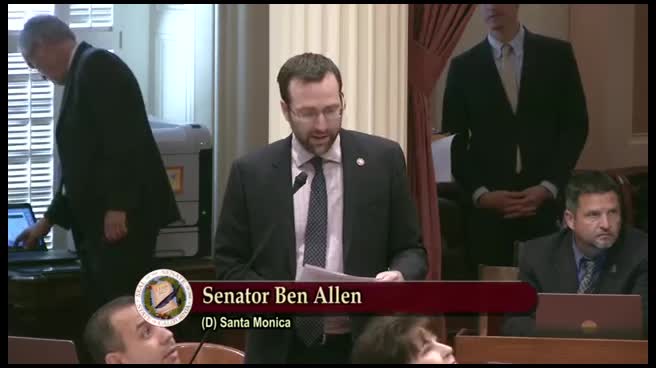 13MIN
Senate Floor
 21MIN
Senate Standing Committee on Environmental Quality
 19MIN
Senate Standing Committee on Natural Resources and Water
Bill Author

Bill Co-Author(s):