SB 457: Bobcat Protection Act of 2013.
- Session Year: 2015-2016
- House: Senate
- Latest Version Date: 2015-04-06
Existing law, the Bobcat Protection Act of 2013, makes it unlawful to trap any bobcat, or attempt to do so, or to sell or export any bobcat or part of any bobcat taken in the area surrounding Joshua Tree National Park, as specified. The act requires the Fish and Game Commission to amend its regulations to prohibit the trapping of bobcats adjacent to the boundaries of each national or state park and national monument or wildlife refuge in which bobcat trapping is prohibited. The act also requires the commission, commencing January 1, 2016, to consider whether to prohibit bobcat trapping within, and adjacent to, preserves, state conservancies, and any other public or private conservation areas identified to the commission by the public as warranting protection, and to amend its regulations accordingly, as specified. The act requires the commission to delineate the boundaries of an area in which bobcat trapping is prohibited pursuant to these provisions using readily identifiable features, such as highways or other major roads, such as those delineated for Joshua Tree National Park.
This bill would provide that these features also include, but are not limited to, landmarks, and would make other nonsubstantive changes to these provisions. may include roads instead of major roads and would provide that landmarks and geographic positions established by navigation and surveying methods may be used to delineate the boundaries of an area described above in which bobcat trapping is prohibited.
Existing law, the Bobcat Protection Act of 2013, makes it unlawful to trap any bobcat, or attempt to do so, or to sell or export any bobcat or part of any bobcat taken in the area surrounding Joshua Tree National Park, as specified. The act requires the Fish and Game Commission to amend its regulations to prohibit the trapping of bobcats adjacent to the boundaries of each national or state park and national monument or wildlife refuge in which bobcat trapping is prohibited. The act also requires the commission, commencing January 1, 2016, to consider whether to prohibit bobcat trapping within, and adjacent to, preserves, state conservancies, and any other public or private conservation areas identified to the commission by the public as warranting protection, and to amend its regulations accordingly, as specified. The act requires the commission to delineate the boundaries of an area in which bobcat trapping is prohibited pursuant to these provisions using readily identifiable features, such as highways or other major roads, such as those delineated for Joshua Tree National Park.
This bill would provide that these features also include, but are not limited to, landmarks, and would make other nonsubstantive changes to these provisions.
(a)It shall be unlawful to trap any bobcat, or attempt to do so, or to sell or export any bobcat or part of any bobcat taken in the area surrounding Joshua Tree National Park, defined as follows: East and South south of State Highway Route 62 from the intersection of Interstate 10 to the intersection of State Highway Route 177; West west of State Highway Route 177 from the intersection of State Highway Route 62 to the intersection with Interstate 10; North north of Interstate 10 from State Highway Route 177 to State Highway Route 62.
(b)(1)Through the commissions next regularly scheduled mammal hunting and trapping rulemaking process occurring after January 1, 2014, the commission shall amend its regulations to prohibit the trapping of bobcats adjacent to the boundaries of each national or state park and national monument or wildlife refuge in which bobcat trapping is prohibited.
(2)Commencing January 1, 2016, the commission shall consider whether to prohibit bobcat trapping within, and adjacent to, preserves, state conservancies, and any additional public or private conservation areas identified to the commission by the public as warranting protection. The commission, as necessary, shall amend its regulations through its next subsequently scheduled mammal hunting and trapping rulemaking process to prohibit bobcat trapping in any area determined by the commission to warrant protection.
(3)The commission shall delineate the boundaries of an area in which bobcat trapping is prohibited pursuant to paragraph (1) or (2) using readily any of the following:
(A)Readily identifiable features, including, but not limited to, highways, other major roads, or landmarks, such as those delineated for Joshua Tree National Park in subdivision (a). (a), or roads.
(B)Landmarks.
(C)Geographic positions established by navigation and surveying methods, including, but not limited to, the Global Positioning System.
(c)The prohibition on the trapping of bobcats in the areas designated pursuant to subdivisions (a) and (b) shall not apply to the taking of any bobcat by employees of the department acting in an official capacity, to a taking in accordance with the conditions of a scientific, educational, or propagation permit pursuant to Section 1002 by the holder of that permit, or to the lawful taking of bobcats found to be injuring crops or other property pursuant to Section 4152 or other provisions of this code or regulations adopted pursuant to this code.
(d)Notwithstanding Section 2016 or any other provisions of this code, it shall be unlawful to trap any bobcat, or attempt to do so, on any private land not belonging to the trapper without the express written consent of the owner of that property. The placing or possession of any trap or the possession of a bobcat or part thereof on any land is prima facie evidence of a violation of this subdivision.
(e)Consistent with the requirements of subdivision (c) of Section 4006, the commission shall set trapping license fees and associated fees, including, but not limited to, shipping tags required pursuant to Section 479 of Chapter 6 of Subdivision 2 of Division 1 of Title 14 of the California Code of Regulations, for the 201415 season, and any subsequent seasons in which bobcat trapping is allowed, at the levels necessary to fully recover all reasonable administrative and implementation costs of the department and the commission associated with the trapping of bobcats in the state, including, but not limited to, enforcement costs.
(f)This section does not limit the ability of the department or the commission to impose additional requirements, restrictions, or prohibitions related to the taking of bobcats, including a complete prohibition on the trapping of bobcats pursuant to this code.
(a)Beginning January 1, 2014, it It shall be unlawful to trap any bobcat, or attempt to do so, or to sell or export any bobcat or part of any bobcat taken in the area surrounding Joshua Tree National Park, defined as follows: East and South of State Highway 62 from the intersection of Interstate 10 to the intersection of State Highway 177; West of State Highway 177 from the intersection of State Highway 62 to the intersection with Interstate 10; North of Interstate 10 from State Highway 177 to State Highway 62.
(b)(1)Through the commissions next regularly scheduled mammal hunting and trapping rulemaking process occurring after January 1, 2014, the commission shall amend its regulations to prohibit the trapping of bobcats adjacent to the boundaries of each national or state park and national monument or wildlife refuge in which bobcat trapping is prohibited.
(2)Commencing January 1, 2016, the commission shall consider whether to prohibit bobcat trapping within, and adjacent to, preserves, state conservancies, and any additional public or private conservation areas identified to the commission by the public as warranting protection. The commission, as necessary, shall amend its regulations through its next subsequently scheduled mammal hunting and trapping rulemaking process to prohibit bobcat trapping in any area determined by the commission to warrant protection.
(3)The commission shall delineate the boundaries of an area in which bobcat trapping is prohibited pursuant to paragraph (1) or (2) using readily identifiable features, such as features, including, but not limited to, highways or, other major roads, roads, or landmarks, such as those delineated for Joshua Tree National Park in subdivision (a).
(c)The prohibition on the trapping of bobcats in the areas designated pursuant to subdivisions (a) and (b) shall not apply to the taking of any bobcat by employees of the department acting in an official capacity, to a taking in accordance with the conditions of a scientific, educational, or propagation permit pursuant to Section 1002 by the holder of that permit, or to the lawful taking of bobcats found to be injuring crops or other property pursuant to Section 4152 or other provisions of this code or regulations adopted pursuant to this code.
(d)Notwithstanding Section 2016 or any other provisions of this code, on and after January 1, 2014, code, it shall be unlawful to trap any bobcat, or attempt to do so, on any private land not belonging to the trapper without the express written consent of the owner of that property. The placing or possession of any trap or the possession of a bobcat or part thereof on any land is prima facie evidence of a violation of this subdivision.
(e)Consistent with the requirements of subdivision (c) of Section 4006, the commission shall set trapping license fees and associated fees, including, but not limited to, shipping tags required pursuant to Section 479 of Chapter 6 of Subdivision 2 of Division 1 of Title 14 of the California Code of Regulations, for the 201415 season, and any subsequent seasons in which bobcat trapping is allowed, at the levels necessary to fully recover all reasonable administrative and implementation costs of the department and the commission associated with the trapping of bobcats in the state, including, but not limited to, enforcement costs.
(f)This section does not limit the ability of the department or the commission to impose additional requirements, restrictions, or prohibitions related to the taking of bobcats, including a complete prohibition on the trapping of bobcats pursuant to this code.
|
Date
|
Status
|
|---|---|
| Feb 25, 2015 | Introduced. Read first time. To Com. on RLS. for assignment. To print. |
| Feb 26, 2015 | From printer. May be acted upon on or after March 28. |
| Mar 5, 2015 | Referred to Com. on N.R. & W. |
| Mar 18, 2015 | Set for hearing April 14. |
| Apr 6, 2015 | From committee with author's amendments. Read second time and amended. Re-referred to Com. on N.R. & W. |
| Apr 14, 2015 | April 14 set for first hearing. Testimony taken. Further hearing to be set. |
| Feb 1, 2016 | Returned to Secretary of Senate pursuant to Joint Rule 56. |
This list shows positions taken on this bill by organizations on the date displayed, which is linked to the original source.
Positions by individuals are not included.
|
Organization
|
Position
|
Date
|
|---|---|---|
| Animal Legal Defense Fund | ** Against | Apr 14, 2015 |
| California Council for Wildlife Rehabilitators | ** Against | Apr 14, 2015 |
| Center For Biological Diversity, Inc. | ** Against | Apr 14, 2015 |
| Defenders Of Wildlife | * Against | Apr 14, 2015 |
| Defenders Of Wildlife | * Indeterminate | Apr 14, 2015 |
| Environmental Protection Information Center | ** Against | Apr 14, 2015 |
| Marin Humane Society | ** Against | Apr 14, 2015 |
| Project Coyote | ** Against | Apr 14, 2015 |
| San Diego County Wildlife Federation | ** Support | Apr 14, 2015 |
| Sierra Club California | ** Against | Apr 14, 2015 |
| Tehama County | * Indeterminate | Apr 14, 2015 |
SB 457 (Nielsen) Page 4 of 4
SENATE COMMITTEE ON NATURAL RESOURCES AND WATER
Senator Fran Pavley, Chair
2015 - 2016 Regular
Bill No: SB 457 Hearing Date: April 14, 2015
Author: |
Nielsen |
|
|
Version: |
April 6, 2015 |
||
Urgency: |
No |
Fiscal: |
Yes |
Consultant: |
Katharine Moore |
||
Subject: Bobcat Protection Act of 2013
BACKGROUND AND EXISTING LAW
Bobcats are classified as non-game mammals in California and may be hunted or trapped, subject to certain restrictions, with the purchase of appropriate licenses and tags, as specified. Bobcat pelts must be tagged, and cannot be sold or transported without a specified shipping tag.
In 2013, the Legislature passed the Bobcat Protection Act of 2013 (AB 1213, Bloom, c. 748, Statutes of 2013)(Act). News stories contemporaneous with the passage of AB 1213 reported that bobcat trapping was increasing due, in part, to a booming trade in bobcat pelts. Reports indicate a single bobcat pelt can now sell for $600 with higher prices paid for exceptional pelts. During 2014, reports indicate that a recent spike in prices resulted in pelts selling for as much as $2,100 each.
AB 1213 prohibited the trapping of bobcats in and around Joshua Tree National Park and on private lands without the explicit permission of the landowner. Additionally, it directed the Fish and Game Commission (Commission) to:
start its regulatory process in 2014 to prohibit bobcat trapping adjacent to protected areas (such as state parks) where bobcat trapping is banned. The boundaries established by the commission are required to use readily identifiable features, such as highways or other major roads.
consider, starting in 2016, whether additional prohibitions on bobcat trapping in/around conservation areas are warranted, and
set trapping fees to cover the costs to the Department of Fish and Wildlife (Department) and commission of the trapping program, including enforcement.
AB 1213 also included numerous relevant legislative findings, and did not alter trapping for depredation purposes (e.g. pest control).
Although somewhat behind schedule, the commission is in the process of developing the regulations to implement AB 1213, and final action is likely by the fall of 2015. The commission will receive an update on AB 1213 implementation at its April 9, 2015 hearing. Supporting materials for that hearing note that:
the department has developed a proposal that includes proposed boundaries on bobcat trapping consistent with existing law based upon readily-identifiable features, including major roads and highways,
the regulatory proposal will include an option to implement a statewide ban on bobcat trapping per the commission’s request (see the commission’s December 3, 2014 hearing actions), and
roughly $600K in upfront and $342K in ongoing annual program costs are anticipated, and emphasize that enforcement costs continue even if a statewide trapping ban is imposed.
Letters from trappers to the commission recommend limited (one quarter mile) buffer zones around protected areas and the use of other landmarks besides roads to delineate boundaries of no trapping zones.
PROPOSED LAW
This bill would expand the definition of readily identifiable boundaries in the act to include non-major roads, landmarks, or geographic positions, such as those provided by the Global Positioning System (GPS). There are additional technical corrections.
ARGUMENTS IN SUPPORT
According to the author, the bill “clarifies the list of suggested items that the [commission] may consider while delineating boundaries of areas where bobcat trapping is prohibited.” The author continues that “the [commission] is only considering major highways and roads while drawing boundaries; the consequences of not applying other ‘readily identifiable features’ are boundary proposals that ban trapping in nearly 60 percent of California.”
ARGUMENTS IN OPPOSITION
The Center for Biological Diversity and others state, “[b]obcats should be protected both for their intrinsic value and because they are an essential part of the ecosystems they inhabit. Millions of people visit California’s parks and wildlands each year for the purpose of viewing wildlife, including bobcats, and such visitation contributes well over 3 billion dollars annually to the state’s economy. As such, the conservation and fiscal interests of the California public who overwhelmingly support the protection of bobcats surely outweigh the private profit interests of the few dozen trappers serving foreign fashion markets who would benefit from SB 457.”
They continue that “SB 457 – by changing the requirements of a rulemaking process that is already underway and is statutorily required to be completed before the changes of SB 457 would ever take effect – is untimely, unnecessary, and ultimately serves no purpose but to undermine a legislatively-directed rulemaking. Moreover, substantively, the bill would replace a clear standard for the setting of non-trapping buffer zones with one that is completely ambiguous, thereby undermining implementation and enforcement. SB 457 lacks any criteria regarding the size of the required buffers and, consequently, would allow buffers that are potentially so narrow as to be ecologically meaningless, permitting trappers to kill bobcats near the boundaries of national and state parks and thus defeating the very purpose of the protections of AB 1213.”
The Center adds that “[h]ighways were chosen to delimit the buffer, not just because they are easy to identify and understand, but also because it is an unfortunate reality in the modern world that highways and other major roads act as major impediments to wildlife movement. The bobcats that inhabit Joshua Tree and other national parks, wander freely out of the parks’ boundaries, but their home ranges rarely extend across busy highways that are nearly impossible for these animals to safely cross. Consequently, in most circumstances a highway-delimited no-trapping zone largely can protect a park’s bobcat population.” According to the Center, “[d]uring the legislative process for AB 1213, trappers suggested amendments that would replace the highway buffers with ones based on [a] short measured distance from park boundaries” which were rejected, and that SB 457 “would amend the law to allow the trappers’ previously rejected proposals to be retroactively implemented through a future commission rulemaking process.”
Additionally, the Humane Society of the United States states that bobcats rarely pose a public safety threat, and play an important predatory role in the ecosystem.
COMMENTS
Bill is premature. The commission’s regulatory development to implement AB 1213 is still underway. While one of the options proposed by the department to the commission may prohibit bobcat trapping in many parts of the state, over 70% of the commercial bobcat take, almost entirely by trapping, occurred in just five counties in the 2013 – 2014 hunting year (Inyo, Kern, Modoc, San Bernardino and Siskiyou). These counties appear, in whole or in part, to be included in the draft proposed bobcat trapping zones from the December 3, 2014 commission hearing. Additionally, should SB 457 become law, it could result in increased costs to the state should the commission be forced to re-open its regulatory proceedings.
The use of major roads as boundaries. It is not unusual for major roadways to be used in the establishment of different zones for the purposes of the commission or the department. A department presentation to the commission at its December 3, 2014 meeting noted that the use of GPS technology, while offering some perceived advantages, was contrary to statute and also presented potentially difficult enforcement issues. In contrast, the use of major roadways provided clearly defined zones that were easier to enforce, although more portions of the state were closed to bobcat trapping. The specific text of AB 1213 states that “readily identifiable features, such as highways or other major roads, such as those delineated for Joshua Tree National Park in subdivision (a).” The description of boundaries for Joshua Tree National Park uses state highways, interstates and their intersections. Other features are not used.
Recent bobcat hunting and trapping data. The most recent data (for the 2013 – 2014 year) show that trappers took almost 1300 bobcats and sport hunters took about 310. Of the approximately 822 trapping licenses issued in 2014, almost 600 of them were for pest control, not recreational trapping.
Cost recovery. The current trapping license fees for bobcats raised approximately $90,000 in 2014 according to department data (trapping licenses are about $115 for residents). This is about a factor of 6 – 7 less than the anticipated start-up costs for the bobcat trapping program as well as a factor of 3 – 4 less than anticipated annual ongoing costs.
Bobcat population data. As noted in AB 1213’s legislative findings, good bobcat population data in the state are not available. The Governor’s signing message asked the Legislature to work with the department “to secure funding to survey our bobcat population.” This has not yet occurred. The author argues in his background material for this bill that the survey should be completed, although this bill does not do so.
SUPPORT
San Diego County Wildlife Federation
OPPOSITION
Animal Legal Defense Fund
California Council for Wildlife Rehabilitators
Center for Biological Diversity
Defenders of Wildlife
Environmental Protection Information Center
The Humane Society of the United States
Marin Humane Society
Project Coyote
Sierra Club California
-- END --
Discussed in Hearing
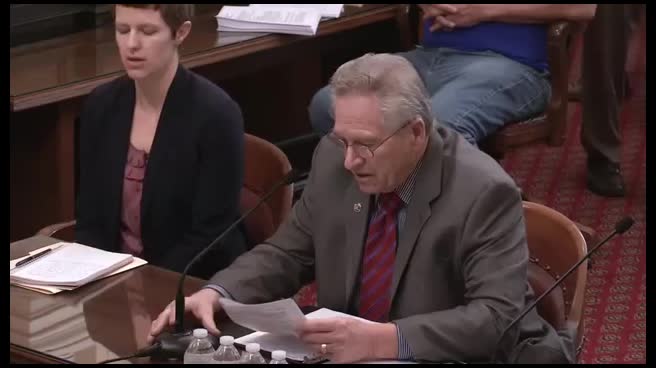 44MIN
Senate Standing Committee on Natural Resources and Water
Bill Author