SB 523: Schoolbus replacement.
- Session Year: 2015-2016
- House: Senate
- Latest Version Date: 2015-04-06
Existing law requires all moneys, except for fines and penalties, collected by the State Air Resources Board from the auction or sale of allowances as part of a market-based compliance mechanism relative to reduction of greenhouse gas emissions, commonly known as cap and trade revenues, to be deposited in the Greenhouse Gas Reduction Fund and to be used, upon appropriation by the Legislature, for specified purposes. Existing law provides various programs to fund the acquisition of schoolbuses.
This bill would create the Schoolbus Replacement for Small and Disadvantaged Communities Grant Program, and would appropriate $5 million annually from the Greenhouse Gas Reduction Fund to the State Department of Education for the program. The program would be administered by the department in conjunction with the State Air Resources Board, and would provide schoolbus replacement grants to school districts or county offices of education with an average daily attendance of less than 2,501 and with more than 50% of the pupil population qualifying for free or reduced-rate lunch programs, and to certain other eligible applicants. The bill would impose various requirements in that regard. The bill would also make legislative findings and declarations.
Under existing law, fees required by the Vehicle Code are delinquent when a vehicle is operated on a highway without those fees first having been paid and when those fees have not been paid within 20 days of the vehicles first operation, subject to specified exceptions.
This bill would increase that amount of time to 30 days.
The Legislature finds and declares all of the following:
(a)The Legislature has previously provided funding for replacement of polluting and aged schoolbuses in small and disadvantaged communities.
(b)Schoolbus replacement programs currently exist in the Bay Area and the Los Angeles Basin. For example, the Lower-Emission School Bus Program is a partnership between the State Air Resources Board and air districts, and is administered by the Bay Area Air Quality Management District in the Bay Area. The goals of that program are to reduce the exposure of schoolchildren to harmful emissions of particulate matter, oxides of nitrogen, and nonmethane hydrocarbons, which contribute to summertime smog.
(c)Air districts currently evaluate qualified projects in disproportionately impacted communities, according to regional poverty level, particulate matter exposure, toxic exposure, and disproportionate impact mapping that works to promote schoolbus replacement in densely populated areas.
(d)It is also necessary to provide funding for schoolbus replacement in less populated areas with disadvantaged communities.
SEC. 2.Section 39719.4 is added to the Health and Safety Code, to read:39719.4.(a)The Schoolbus Replacement for Small and Disadvantaged Communities Grant Program is hereby created, to be administered by the State Department of Education in conjunction with the state board. Commencing in the 201516 fiscal year, the sum of five million dollars ($5,000,000) annually is hereby appropriated from the fund to the department to fund the purchase of new schoolbuses to replace existing schoolbuses by applicants eligible under this section. Funds made available under the program shall be used to reduce greenhouse gas emissions in the state in accordance with Section 39712.
(b)(1)A school district or county office of education with an average daily attendance of less than 2,501, with more than 50 percent of the pupil population qualifying for free or reduced-price lunch programs, shall be eligible to apply to the department for a grant under this section.
(2)A school district or county office of education meeting the requirements of paragraph (1) and providing pupil transportation services through a cooperative, consortium, or joint powers agreement, shall be an eligible applicant under the program.
(3)The Division of State Special Schools of the State Department of Education shall also be an eligible applicant under the program.
(c)The State Department of Education shall develop priority categories for funds available under this section based solely on vehicle age and accumulated mileage. An eligible applicant shall submit, as evidence of the condition of the vehicle to be replaced, the most recent inspection report of the Department of the California Highway Patrol, a repair estimate made by an independent repair shop, and any other information requested by the department.
(d)The State Department of Education shall estimate the cost of a replacement schoolbus of the same capacity as the schoolbus being replaced. Program funds made available to an applicant for a schoolbus may not exceed that estimated cost. However, an applicant may use other funds available to the applicant to purchase a schoolbus that is more expensive than the model used by the department to make its cost estimate.
(e)A schoolbus purchased with funds made available by this section shall meet the requirements of federal Motor Vehicle Safety Standard 222.
(f)(1)A schoolbus that has been disposed of is not eligible for replacement under the program.
(2)For an eligible applicant with fewer than three schoolbuses, a schoolbus shall be considered disposed of for the purposes of replacement if it is designated as a temporary schoolbus. A temporary schoolbus is a schoolbus that has annual mileage of no more than 10 percent of the total average annual mileage of all nontemporary schoolbuses of that applicant measured over the prior five years.
(3)After a schoolbus is designated as a temporary schoolbus, it may only be used as a schoolbus if it is in compliance with all applicable provisions of the Vehicle Code and associated regulations.
(g)Schoolbus purchases with funds made available under the program shall be made by the Department of General Services, to the extent practicable. The title to a schoolbus purchased by the Department of General Services shall be in the name of the applicant for which the schoolbus was purchased.
(h)Funds shall be made available for schoolbuses used in special education in a proportion to total funding not less than the proportion of special education schoolbuses to the total number of schoolbuses in the state, as determined by the State Department of Education. The department may adopt regulations to implement this section in an equitable manner.
SECTION 1.Section 9552 of the Vehicle Code is amended to read:9552.(a)When a vehicle is operated on a highway of this state without the fees first having been paid as required by this code, and those fees have not been paid within 30 days of its first operation, those fees are delinquent, except as provided in subdivision (b).
(b)Fees are delinquent when an application for renewal of registration, or an application for renewal of special license plates, is made after midnight of the expiration date of the registration or special plates, or 60 days after the date the registered owner is notified by the department pursuant to Section 1661, whichever is later.
(c)When a person has received as transferee a properly endorsed certificate of ownership and the transfer fee has not been paid as required by this code within 10 days, the fee is delinquent.
(d)When a person becomes an automobile dismantler, dealer, manufacturer, manufacturer branch, distributor, distributor branch, or transporter without first having paid the license and special plate fees as required by this code, the fees are delinquent.
(a)Whenever any When a vehicle is operated upon any on a highway of this state without the fees first having been paid as required by this code, and those fees have not been paid within 20 30 days of its first operation, those fees are delinquent, except as provided in subdivision (b).
(b)Fees are delinquent whenever when an application for renewal of registration, or any an application for renewal of special license plates, is made after midnight of the expiration date of the registration or special plates, or 60 days after the date the registered owner is notified by the department pursuant to Section 1661, whichever is later.
(c)Whenever any When a person has received as transferee a properly endorsed certificate of ownership and the transfer fee has not been paid as required by this code within 10 days, the fee is delinquent.
(d)Whenever any When a person becomes an automobile dismantler, dealer, manufacturer, manufacturer branch, distributor, distributor branch, or transporter without first having paid the license and special plate fees as required by this code, the fees are delinquent.
|
Date
|
Status
|
|---|---|
| Feb 26, 2015 | Introduced. Read first time. To Com. on RLS. for assignment. To print. |
| Feb 27, 2015 | From printer. May be acted upon on or after March 29. |
| Mar 12, 2015 | Referred to Com. on T. & H. |
| Apr 6, 2015 | From committee with author's amendments. Read second time and amended. Re-referred to Com. on T. & H. |
| Apr 15, 2015 | Set for hearing April 21. |
| Apr 22, 2015 | From committee: Do pass and re-refer to Com. on RLS. (Ayes 10. Noes 0. Page 732.) (April 21). Re-referred to Com. on RLS. |
| Apr 22, 2015 | Re-referred to Com. on E.Q. |
| Apr 24, 2015 | Set for hearing April 29. |
| Apr 30, 2015 | April 29 set for first hearing canceled at the request of author. |
| Feb 1, 2016 | Returned to Secretary of Senate pursuant to Joint Rule 56. |
|
Date
|
Description
|
Location
|
Votes
|
|
|---|---|---|---|---|
| Apr 21, 2015 | Do pass, but first be re-referred to the Committee on [Rules] | Senate Standing Committee on Transportation and Housing |
Passed |
This list shows positions taken on this bill by organizations on the date displayed, which is linked to the original source.
Positions by individuals are not included.
|
Organization
|
Position
|
Date
|
|---|---|---|
| 34 Rural Counties | * Support | Apr 21, 2015 |
| American Academy of Pediatrics | * Support | Apr 21, 2015 |
| California Association Of School Transportation Officials (Casto) | * Support | Apr 21, 2015 |
| California Chamber Of Commerce | * Against | Apr 21, 2015 |
| California School Boards Association | * Support | Apr 21, 2015 |
| Mother Lode School District | * Support | Apr 21, 2015 |
| School Transportation Coalition | * Support | Apr 21, 2015 |
SB 523 (McGuire) Page 13 of 13
SENATE COMMITTEE ON ENVIRONMENTAL QUALITY
Senator Wieckowski, Chair
2015 - 2016 Regular
Bill No: SB 523
Author: |
McGuire |
||
Version: |
4/6/2015 |
Hearing Date: |
4/29/15 |
Urgency: |
No |
Fiscal: |
Yes |
Consultant: |
Rebecca Newhouse |
||
SUBJECT: Schoolbus replacement
ANALYSIS:
Existing law:
Under the California Global Warming Solutions Act of 2006 (also known as AB 32), requires the California Air Resources Board (ARB) to determine the 1990 statewide greenhouse gas (GHG) emissions level and approve a statewide GHG emissions limit that is equivalent to that level, to be achieved by 2020, and to adopt GHG emissions reductions measures by regulation. ARB is authorized to include the use of market-based mechanisms to comply with these regulations. (Health and Safety Code §38500 et seq.)
Establishes the Greenhouse Gas Reduction Fund (GGRF) in the State Treasury, requires all moneys, except for fines and penalties, collected pursuant to a market-based mechanism be deposited in the fund. (Government Code §16428.8)
Prohibits the state from approving allocations for a measure or program using GGRF monies except after determining that the use of those moneys furthers the regulatory purposes of AB 32, and requires moneys from the GGRF be used to facilitate the achievement of reductions of GHG emissions in California. (HSC §39712)
Under Proposition 1B, which was approved by the voters on November 7, 2006, enacts the Highway Safety, Traffic Reduction, Air Quality, and Port Security Bond Act of 2006. This bond act authorizes $200 million for replacing and retrofitting schoolbuses, specifically through ARB’s Lower-Emission Schoolbus Program to fund replacement schoolbuses and retrofit devices to reduce air pollution to reduce children's exposure to diesel exhaust.
Authorizes local air district boards where federal air standards are not consistently met (i.e., “nonattainment areas”) to adopt a $6 surcharge on vehicle registration, subject to certain requirements, to be used to reduce air pollution from motor vehicles, and requires a portion of that surcharge be used for the implementation of emission reduction programs from vehicular sources or off-road engines, including for projects eligible under the Carl Moyer Program, the purchase of new, or retrofit of emissions control equipment for existing, schoolbuses, the replacement of specified natural gas fuel tanks on schoolbuses, and the enhancement of deteriorating natural gas fueling dispensers of fueling infrastructure operated by a school district, and other specified projects, until January 1, 2024. (Health and Safety Code §§41081 & 44225)
Establishes the Carl Moyer Program, administered by ARB, to fund the incremental cost of cleaner-than-required vehicles, engines, and equipment and authorizes the funding of projects reducing NOx, particulate matter (PM) and reactive organic gasses emissions until January 1, 2024, after which date, only the reduction of NOx emission reduction projects will be eligible for funding (HSC §44275)
This bill:
Creates the Schoolbus Replacement Program for Small and Disadvantaged Communities Grant Program (Program), to be administered by the Department of Education (CDE) in conjunction with ARB, to fund the purchase of new schoolbuses to replace existing schoolbuses.
Specifies that the Program is funded through a continuous appropriation of $5 million from the GGRF.
Specifies that eligible applicants include:
School districts or county offices of education with an average daily attendance of less than 2,501 students, with more than 50% of the pupil population qualifying for free or reduced price lunch programs, and;
The Division of State Special Schools.
Requires CDE to develop priority categories for funds based only on vehicle age and accumulated mileage.
Requires an eligible applicant to submit the most recent inspection report of the Department of California Highway Patrol, a repair estimate, or any other information requested by the CDE, as evidence of the vehicle’s condition.
Requires the CDE to estimate the cost of a replacement schoolbus of the same capacity as the schoolbus being replaced, and program funds made available to an applicant are prohibited from exceeding that amount.
Specifies that an applicant may use other funds to purchase a schoolbus that is more expensive than the model used by the department to make its cost estimate.
Requires that any schoolbuses purchased under this program meet federal motor vehicle safety standards, as specified.
Specifies that schoolbuses that have been “disposed of” are not eligible for replacement, and specifies that for applicants with fewer than three schoolbuses, temporary schoolbuses, as defined, shall be considered “disposed of.”
Requires the Department of General Services to make schoolbus purchases with funds made available under the program, to the extent practicable, and requires that the title of the vehicle be in the name of the applicant.
Requires that funds for the program be available for schoolbuses used in special education in proportion to the number of special education schoolbuses as compared to the total number in the state.
Authorizes CDE to adopt regulations to implement the program.
Background
Health Effects of Diesel Exhaust.
In 1998, the California Environmental Protection Agency's Office of Environmental Health Hazard Assessment (OEHHA) completed a comprehensive health assessment of diesel exhaust. This assessment formed the basis for a decision by ARB to formally identify particles in diesel exhaust as a toxic air contaminant that may pose a threat to human health.
Diesel exhaust is produced when an engine burns diesel fuel. It is a complex mixture of thousands of gases and fine particles (commonly known as soot) that contains more than 40 toxic air contaminants. These include many known or suspected cancer-causing substances, such as benzene, arsenic and formaldehyde. It also contains other harmful pollutants, including nitrogen oxides (a component of smog).
Diesel engines are a major source of fine-particle pollution (also called particulate matter or PM). The elderly and people with emphysema, asthma, and chronic heart and lung disease are especially sensitive to PM. Numerous studies have linked elevated particle levels in the air to increased hospital admissions, emergency room visits, asthma attacks and premature deaths among those suffering from respiratory problems. Because children's lungs and respiratory systems are still developing, they are also more susceptible than healthy adults to fine particles. Exposure to PM is associated with increased frequency of childhood illnesses and can also reduce lung function in children.
Diesel exhaust and many individual substances contained in it have the potential to contribute to mutations in cells that can lead to cancer. In fact, long-term exposure to diesel exhaust particles poses the highest cancer risk of any toxic air contaminant evaluated by OEHHA.
Due to the harmful effects of diesel PM and children’s exposure to this exhaust from their trips to and from school in older schoolbuses, much concern has been raised regarding this public health issue. State and federal funds have been directed to provide incentives to replace and retrofit diesel buses across the state. Additionally, heavy duty diesel trucks and buses are required to reduce their diesel emissions pursuant to the state’s truck and bus rule, described below.
Truck and Bus Rule.
The
ARB adopted the On-Road Heavy-Duty Diesel Vehicles Regulation (also
known as the Truck and Bus Rule) in 2008. The regulation requires
diesel trucks and buses that operate in California to be upgraded to
reduce emissions. Newer heavier trucks and buses must meet PM filter
requirements beginning January 1, 2012. Lighter and
older heavier trucks must be replaced starting January 1, 2015.
By January 1, 2023, nearly all trucks and buses will need
to have 2010 model year engines or equivalent.
The
regulation applies to nearly all privately and federally owned diesel
fueled trucks and buses and to privately and publicly owned
schoolbuses with a gross vehicle weight rating greater than 14,000
pounds.
The regulation provides a variety of flexibility options tailored to fleets operating low-use vehicles, fleets operating in selected vocations like agricultural and construction, and small fleets of three or fewer trucks.
Amendments to the regulation adopted in April 2014 included more time to comply for rural areas with cleaner air, second and third vehicles in small fleets, as well as owners that cannot afford to comply, and adjust compliance timelines for low-use or vocations trucks, and recognized early actions already taken by fleets to comply.
Incentive Funding.
Lower-Emission Schoolbus Program.
According to ARB’s website, the primary goal of the Lower-Emission Schoolbus Program (LESBP) is to reduce school children's exposure to both cancer-causing and smog-forming pollution.
The LESBP provides financial incentives to replace high-emitting pre-1987 model year schoolbuses with lower-emitting new buses, and to equip in-use diesel schoolbuses with ARB-verified diesel retrofit devices to reduce toxic PM emissions. The LESBP provides up to $20,000 to install diesel particulate filters and up to $140,000 per bus in financial opportunities to replace an existing pre-1987 schoolbus. The primary focus has been on replacing buses manufactured prior to 1977. These buses do not meet federal motor vehicle safety standards and were not subject to oxides of nitrogen and PM emission control.
Prior to bond funding, the Program provided over $100 million in State funding for new alternative fuel and diesel schoolbuses for California’s public school districts, and retrofit devices for existing in-use diesel buses. In its first seven years, the Lower-Emission Schoolbus Program replaced about 600 pre-1987 model year public schoolbuses with new, lower-emitting models and equipped about 3,800 in-use buses with ARB-verified diesel retrofit devices.
Proposition 1B, which was approved by the voters on November 7, 2006, enacts the Highway Safety, Traffic Reduction, Air Quality, and Port Security Bond Act of 2006. This bond act authorizes $200 million for replacing and retrofitting schoolbuses, specifically through the LESBP to fund replacement schoolbuses and retrofit devices to reduce air pollution to reduce children's exposure to diesel exhaust.
Although primarily funded through bond funds, air districts may use local funds, such as motor vehicle registration fee surcharge money, to replace or retrofit schoolbuses.
The LESBP is generally administered through the local air district, however, for projects funded under the LESBP by bond funds, the San Joaquin Valley Air Pollution Control District (SJVAPCD) has partnered with ARB in acting as the implementing agency for the 18 air districts.
The replacement portion component of the program prioritizes the oldest schoolbuses for replacement. However, incentives provided for the retrofit component are awarded for 1987 buses and newer, through a non-competitive, first-come, first-served basis, until funds are depleted. ARB notes in the LESBP, that each “in-use diesel bus that is retrofitted with a Level 3 diesel particulate filter emits 85 percent less toxic PM. This strategy provides the most cost-effective air quality benefit, since a retrofit costs about 10 percent of the purchase price of a new bus.”
The Proposition 1B monies funded 1,018 schoolbus replacements and 3,479 retrofits. ARB has received all installments of bond funds for the Program, which brings the Program to 100 percent of its projected funding of approximately $196 million. The program is now funded through a small amount of federal funds, administered by the SJVAPCD on behalf of ARB.
AB 923 Air District Vehicle Registration Surcharge.
AB 923 (Firebaugh) Chapter 707, Statutes of 2003, authorizes, until January 1, 2024, local air districts with jurisdiction over areas not in attainment with federal air quality standards to increase motor vehicle registration fees by $2 to implement the Carl Moyer Program Projects, the new purchase, retrofit, repower or add-on equipment for previously unregulated agricultural sources, new purchases pursuant to the Lower-Emission Schoolbus program, and light-duty scrap or repair programs adopted by the state board.
Carl Moyer Program.
AB 1571 (Villaraigosa), Chapter 923, Statutes of 1999, established the Carl Moyer Memorial Air Quality Standards Attainment Program through which ARB provides grants to offset the incremental costs of purchasing or retrofitting engines in order to reduce specified air emissions. The Carl Moyer program originally received General Fund appropriations.
AB 923 (Firebaugh, Pavley), Chapter 707, Statutes of 2004, expanded the Carl Moyer Program to cover additional pollutants and engines and imposed a 75-cent per tire fee on tire sales to fund the Carl Moyer Program. Its provisions will sunset on January 1, 2024.
According to the Carl Moyer Program guidelines, public schoolbuses are eligible for Carl Moyer Program funding if they meet the program criteria; however, their relatively low annual miles usually allow only for minimal grant amounts.
Hybrid Vehicle Incentive Program.
AB 118 (Núñez), Chapter 750, Statutes of 2007, creates the Air Quality Improvement Program (AQIP), which the ARB administers in consultation with local air districts to provide competitive grants to fund projects to reduce criteria air pollutants, improve air quality, and support research to improve the air quality impacts of alternative fuels and vehicles, vessels, and equipment technologies.
The ARB established the Hybrid and Zero-Emission Truck and Bus Voucher Incentive Project (HVIP), pursuant to their authority under AQIP.
HVIP provides vouchers to California fleet owners to help purchase hybrid and zero-emission trucks and buses.
As the LESBP funding does not cover the cost of a typical hybrid schoolbus, HVIP permits combining funds from the LESBP and HVIP to finance up to the full cost of a new hybrid schoolbus.
SB 1204 (Lara), Chapter 524, Statutes of 2014, requires ARB to develop a new program, the California Clean Truck, Bus, and Off-Road Vehicle and Equipment Technology Program. This program, known as Zero-Emission Truck and Bus Pilot Projects, will fund development, demonstration, pre-commercial pilot, and early commercial deployment of zero- and near-zero-emission truck, bus, and off-road vehicle technologies, with prioritization of projects located in disadvantaged communities. ARB is currently holding public workgroup meetings to solicit stakeholder input.
In the 2014-15 Fiscal Year, the Legislature appropriated $200 million to ARB from the GGRF to implement a low-carbon transportation program. ARB is combining that funding with previous funding for AQIP programs from vehicle registration fees (usually about $10 million) to augment funding for programs under AQIP. ARB, in their annual investment plan for their AQIP and low-carbon incentive programs state that of that $5-10 million will be allocated for the HVIP program, and $20-25 million for the program established pursuant to SB 1204.
CEC Grants for Natural Gas Fueling Infrastructure.
AB 118 (Núñez), Chapter 750, Statutes of 2007, creates the Alternative and Renewable Fuel and Vehicle Technology Program, which the California Energy Commission (CEC) administers to provide grants, revolving loans, loan guarantees, loans, or other appropriate funding measures to public agencies, vehicle consortia, businesses, consumers, recreational boaters, and academic institutions to develop and deploy innovative technologies that transform California fuel and vehicle types to help attain the state’s climate change policies.
According to the ARFVTP Investment Plan for 2014-15, “the investment plan update reserves $1.5 million for natural gas fueling stations. While many private fleets are able to incorporate natural gas fueling infrastructure into the overall costs of their transition to natural gas, some entities cannot. This $1.5 million allocation of funding is intended primarily for these entities, such as school districts and public transit districts.”
Legislative Analyst Office Report on School Transportation Programs.
The California Department of Education’s Home-To-School Transportation (HTST) Program receives about $500 million annually, to support pupil transportation services.
In addition to the HTST program, the state historically funded a schoolbus purchasing program for districts with fewer than 2,500 students. The program focused on replacing buses that did not meet federal standards. Most funding was awarded based on the age, mileage, and condition of the buses to be replaced. In 2012-13, $4.9 million was appropriated for the program, and 32 out of 170 applicants received grants of up to $155,000 to replace a single schoolbus.
Beginning in 2013-14, the state discontinued the bus replacement program. Any district receiving bus replacement funds in 2012-13, however, had its regular HTST allocation permanently increased by that amount. That is, under current law, any district that received a one-time grant for bus replacement in 2012-13 will continue receiving this same amount but may use the freed-up funds for any transportation purpose.
A 2014 report from the Legislative Analyst’s Office reviewing school transportation in California noted that the current formula for allocating HTST funding is widely recognized as outdated and irrational, and recommended the Legislature replace it with one of several alternatives offered, including creating a broad-based program that reimburses a share of all transportation costs.
Use of Cap and Trade Auction Revenue.
ARB has conducted ten cap-and-trade auctions, generating almost $1.6 billion in proceeds to the state.
Several bills in 2012, and one in 2014, provide legislative direction for the expenditure of auction proceeds including SB 535 (De León), Chapter 830, Statutes of 2012, AB 1532 (J. Pérez), Chapter 807, Statutes of 2012, SB 1018 (Budget Committee), Chapter 39, Statutes 2012, and SB 862 (Budget Committee), Chapter 36, Statutes of 2014.
SB 535 (De León), Chapter 830, Statutes of 2012, requires that 25% of auction revenue be used to benefit disadvantaged communities and requires that 10% of auction revenue be invested in disadvantaged communities.
AB 1532 (J. Pérez), Chapter 807, Statutes of 2012, directs the Department of Finance to develop and periodically update a three-year investment plan that identifies feasible and cost-effective GHG emission reduction investments to be funded with cap-and-trade auction revenues. AB 1532 specifies that reduction of greenhouse gas emissions through strategic planning and development of sustainable infrastructure projects, are eligible investments of GGRF.
SB 1018 (Budget Committee), Chapter 39, Statutes of 2012, created the GGRF, into which all auction revenue is to be deposited. The legislation requires that before departments can spend monies from the GGRF, they must prepare a record specifying: (1) how the expenditures will be used, (2) how the expenditures will further the purposes of AB 32 (Núñez, Pavley) Chapter 488, Statutes of 2006, (3) how the expenditures will achieve GHG emission reductions, (4) how the department considered other non-GHG-related objectives, and (5) how the department will document the results of the expenditures.
SB 862 (Budget Committee), Chapter 36, Statutes of 2014, requires the ARB to develop guidelines on maximizing benefits for disadvantaged communities by agencies administering GGRF funds, and guidance for administering agencies on GHG emission reduction reporting and quantification methods.
Legal consideration of cap-and-trade auction revenues: The 2012-13 budget analysis of cap-and-trade auction revenue by the Legislative Analyst’s Office noted that, based on an opinion from the Office of Legislative Counsel, the auction revenues should be considered mitigation fee revenues, and their use requires that a clear nexus exist between an activity for which a mitigation fee is used and the adverse effects related to the activity on which that fee is levied. Therefore, in order for their use to be valid as mitigation fees, revenues from the cap-and-trade auction must be used to mitigate GHG emissions or the harms caused by GHG emissions.
In 2012, the California Chamber of Commerce filed a lawsuit against the ARB claiming that cap-and-trade auction revenues constitute illegal tax revenue. In November 2013, the superior court ruling declined to hold the auction a tax, concluding that it is more akin to a regulatory fee.
AB 32 auction revenue investment plan: The first three-year investment plan for cap-and-trade auction proceeds, submitted by Department of Finance, in consultation with ARB and other state agencies in May of 2013, identified sustainable communities and clean transportation as one of the key sectors that provide the best opportunities for achieving the legislative goals and supporting the purposes of AB 32. The plan recommended the aforementioned sector receive the largest allocation of funds from the GGRF, but did not specify a monetary amount.
Budget allocations: The 2014-15 budget allocates $832 million in GGRF revenues to a variety of transportation, energy, and resources programs aimed at reducing GHG emissions. Various agencies are in the process of implementing this funding. The budget agreement specifies how the state will allocate most cap-and-trade auction revenues in 2015-16 and beyond. For all future revenues, the legislation appropriates 25% for the state’s high-speed rail project, 20% for affordable housing and sustainable communities grants, 10% to intercity capital rail projects, and 5% for low-carbon transit operations. The remaining 40% is available for annual appropriation by the Legislature.
Comments
Purpose of Bill.
The
author states that according to the U.S. Environmental Protection
Agency (US EPA), more than half of schoolbuses have been in service
for over a decade and schoolbuses built to meet US EPA’s 2010
standards emit 95% less pollution than pre-2007 buses and are 60
times cleaner than pre-1991 buses. The author notes that older, more
polluting schoolbuses pose significant health risks to children who
typically ride these buses for one-half to two hours per day and that
emissions from older buses also have a negative impact on the
communities in which they travel. The author further states that
unlike many states, California does not require school districts to
take buses off the road after a set number of years; as a result, the
state has some of the oldest buses in the country. The author notes
that replacing schoolbuses saves $3,000 per year in fuel costs alone
and that this bill makes a modest investment that will have a
significant impact on the state’s air quality.
Does This Bill Advance the Goals of AB 32?
Any projects funded through GGRF monies are required to facilitate the achievement of GHG emission reductions and be used to advance the regulatory purposes of AB 32.
SB 523 requires $5 million from the GGRF be used to fund the purchase of new schoolbuses. The bill does not specify what type of technology the new schoolbus must use, but does prohibit the new bus from exceeding the cost estimated for a replacement schoolbus of the same “capacity” as the schoolbus being replaced. It is unclear if the requirement for the bus to be of the same “capacity,” limits the type of technology of the new schoolbus. However, the bill does specify that an applicant may use other funds to augment their GGRF funds through the program to purchase a more expensive model schoolbus. In this way, applicants may be able to purchase schoolbuses with significantly reduced GHG emissions, such as hybrids.
However, as the author states that the technology for hybrid or electric buses is cost-prohibitive for many school districts and also does not support the long commutes required in most small, disadvantaged districts, it seems the intent of the bill is to fund new diesel, and natural gas-fueled vehicles that do not have the same range constraints.
Although the state and federal government have implemented fuel efficiency and greenhouse gas emission standards for passenger vehicles, there have been no such requirements for heavy duty vehicles. How much more fuel efficient on average are new diesel schoolbuses as compared to older models? The author’s office points to information from West County Transportation Agency, which has purchased new schoolbuses, and apparently seen an improvement in gas mileage from pre- 1994 bus at 7 miles/gallon, to 13 miles/gallon for a new bus.
While new schoolbuses represent a huge gain in terms of improved air quality and diesel PM reductions, it is unclear whether purchasing new diesel schoolbuses would provide significant GHG emissions reductions over older models being replaced. Therefore, it is unclear whether this bill meets the requirements in order to be eligible for funding from the GGRF.
Some Funding Available.
As noted, the Proposition 1 funds, which were the primary funds available for the replacement and retrofit of schoolbuses, are depleted. However, the LESBP is still funded through some level of federal funding along with ARB funds. The average per year for the last three fiscal years was about $560,000. Although this funding may not go a long way towards the purchase of new buses, it could retrofit almost 30 buses per year, reducing diesel PM anywhere from 85 to 90% compared to older diesel buses. Additionally, limited Carl Moyer Program funds and AB 923 funds could also be extended through use of the funds for retrofits, instead of purchases of new vehicles.
Reforming the HTST Program.
As noted in the background, the LAO in 2014 recommended that the current approach to funding school transportation be reformed and offered several recommendations. Reforming the HTST program may be a more sustainable and effective mechanism to address the needs of school districts throughout the state in retrofitting and replacing their bus fleet.
SOURCE:
Author
SUPPORT:
American Academy of Pediatrics, California
California Association of School Transportation Officials
California School Employees Association
Lakeport Unified School District
Rural County Representatives of California
San Diego County Office of Education
School Transportation Coalition
Small School Districts’ Association
OPPOSITION:
California Chamber of Commerce
DOUBLE REFERRAL:
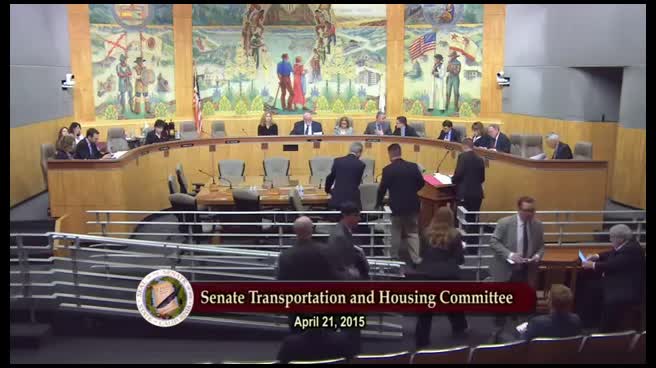
This measure was heard in the Senate Transportation and Housing Committee on April 21, 2015, and passed out of committee with a vote of 10-0.
-- END --
SB 523 (McGuire) Page 4 of 4
SENATE COMMITTEE ON TRANSPORTATION AND HOUSING
Senator Jim Beall, Chair
2015 - 2016 Regular
Bill No: SB 523 Hearing Date: 4/21/2015
Author: |
McGuire |
||
Version: |
4/6/2015 |
||
Urgency: |
No |
Fiscal: |
Yes |
Consultant: |
Erin Riches |
||
SUBJECT: Schoolbus replacement
DIGEST: This bill creates a grant program for schoolbus replacement in small school districts.
ANALYSIS:
In November 2006, voters approved Proposition 1B, the Highway Safety, Traffic Reduction, Air Quality, and Port Security Bond Act of 2006. This initiative authorized $19.9 billion in general obligation bonds for transportation programs, including $200 million for replacement and retrofit of schoolbuses. The state Air Resources Board (ARB) distributed these funds to local air districts through the existing Lower-Emission School Bus Program (LESBP). The Proposition 1B monies funded 1,018 schoolbus replacements and 3,479 retrofits. The San Joaquin Valley Air Pollution Control District now administers this program on behalf of ARB with a small amount of federal funds.
The Small School District and County Office of Education Bus Replacement Program, administered by the state Department of Education (CDE), provided funds to upgrade schoolbuses to comply with 1992 federal safety standards. Priority was given first to the purchase of new schoolbuses to replace existing buses, then to reconditioning existing buses, and lastly to purchase new schoolbuses to increase the recipient’s fleet. Eligible recipients were school districts and county offices of education with an average daily attendance (ADA) of less than 2,501 students. This program has been merged into California’s new school funding formula.
This bill:
Creates the Schoolbus Replacement for Small and Disadvantaged Communities Grant Program, to be administered by CDE and ARB, and annually appropriates $5 million from the Greenhouse Gas Reduction Fund (commonly known as cap-and-trade), beginning in fiscal year 2015-16, to the program to fund the purchase of new schoolbuses as part of the effort to reduce greenhouse gas (GHG) emissions pursuant to AB 32.
Provides that eligible recipients fall into three categories: 1) a school district or county office of education with an ADA of less than 2,501, with more than 50% of the student population qualifying for free or reduced-price lunch programs; 2) category 1 entities that provide student transportation services through a cooperative consortium or joint powers agreement; and 3) CDE’s Division of State Special Schools, which provides services for deaf, hard of hearing, blind, and visually impaired students.
Requires CDE to prioritize funds based on vehicle age and accumulated mileage. Requires an applicant to submit, as evidence of the condition of the vehicle to be replaced, the most recent California Highway Patrol inspection report, a repair estimate from an independent repair shop, and any other information requested by CDE.
Requires CDE to estimate the cost of a replacement schoolbus of the same capacity as the schoolbus being replaced; provides that an applicant may not receive program funds exceeding that cost; and provides that a schoolbus that has been disposed of is not eligible for replacement under this program.
Requires funds to be made available for special-education schoolbuses in an amount not less than the proportion of special-education schoolbuses to the total number of schoolbuses in the state, as determined by CDE.
COMMENTS:
Purpose. The author states that according to the U.S. Environmental Protection Agency (US EPA), more than half of schoolbuses have been in service for over a decade. Schoolbuses built to meet US EPA’s 2010 standards emit 95% less pollution than pre-2007 buses and are 60 times cleaner than pre-1991 buses. Older, more polluting schoolbuses pose significant health risks to children who typically ride these buses for one-half to two hours per day. Emissions from older buses also have a negative impact on the communities in which they travel. Unlike many states, California does not require school districts to take buses off the road after a set number of years; as a result, the state has some of the oldest buses in the country. The author states that replacing one schoolbus saves $3,000 per year in fuel costs alone. This bill makes a modest investment that will have a significant impact on the state’s air quality.
Assisting disadvantaged communities. This bill directs funds to small school districts in lower-income communities. Existing law (SB 535, De Leon, Chapter 830, Statutes of 2012), requires the state to allocate 25% of cap-and-trade funds to projects that benefit disadvantaged communities and at least 10% to projects located within those communities. Thus far, however, no cap-and-trade funds have been targeted to schoolbus replacement. The author notes that about 100 school districts transport more than half their students, compared to 10% in most districts. These districts tend to have smaller enrollments, be located in more rural areas, and enroll larger populations of students from low-income families compared to those with smaller student transportation programs. The author states that directing funds to school districts with low ADA and a high percentage of students qualifying for free or reduced-price lunch programs specifically targets areas that cannot afford, but most need, to replace older, high-polluting school buses.
Reducing GHG emissions. AB 32 directs cap-and-trade funds to programs that reduce GHG emissions. Diesel schoolbus emissions are primarily made up of particulate matter (PM). The author states that the technology for hybrid or electric buses, which directly reduce GHG emissions, is not only cost-prohibitive for many school districts but also does not support the long commutes required in most small, disadvantaged districts. In addition, due to lack of funding, school districts often park the bus and cut the route when a school bus becomes too old to drive or fuel costs become too expensive. This can lead to more cars on the road — and thus, increased GHG emissions — as parents are forced to drive their kids to school. Because this program will not directly reduce GHG emissions, it may not qualify for cap-and-trade funds.
How far will the money go? A quick Internet search indicates that a used diesel schoolbus costs up to $100,000 and a new diesel schoolbus costs roughly $150,000, compared to more than $250,000 for an electric bus. This program provides $5 million per year. At $100,000 per bus, this bill would theoretically fund the purchase of 50 or more used diesel buses per year — more if applicants leverage other funding sources.
Double referral. This bill has been referred to the Rules Committee for consideration of a referral to the Environmental Quality Committee.
Related Legislation:
SB 760 (Mendoza) — which this committee heard last week, establishes a new program under the Strategic Growth Council to direct cap-and-trade spending to greenspace conversion, parks, active transportation, and other projects in disadvantaged communities.
AB 156 (Perea) — pending hearing in the Assembly Natural Resources Committee, requires ARB to establish a comprehensive technical assistance program, and a three-year investment plan, to assist disadvantaged community applicants.
AB 1336 (Salas) — also in the Assembly Natural Resources Committee, requires a minimum of 40% of cap-and-trade funds to be allocated to projects that provide benefits to disadvantaged communities.
FISCAL EFFECT: Appropriation: Yes Fiscal Com.: Yes Local: No
POSITIONS: (Communicated to the committee before noon on Wednesday,
April 15, 2015.)
SUPPORT:
None received.
OPPOSITION:
None received.
-- END --
Discussed in Hearing
 11MIN
Senate Standing Committee on Transportation and Housing
Bill Author

Bill Co-Author(s):