SB 524: Private alternative boarding schools and outdoor programs.
- Session Year: 2015-2016
- House: Senate
- Latest Version Date: 2016-09-30
Existing law, the California Community Care Facilities Act, provides for the licensure and regulation of community care and residential facilities by the State Department of Social Services. Under existing law, the act does not apply to certain facilities, including, among others, any school dormitory or similar facility determined by the department. Existing law makes a violation of any of these provisions punishable as a misdemeanor.
This bill would define private alternative boarding school and private alternative outdoor program for purposes of the act and would make those facilities subject to regulation under the act. The bill would require the department, commencing January 1, 2018, to license private alternative boarding schools as group homes and, commencing January 1, 2019, to license private alternative outdoor programs as group homes. The bill would impose additional requirements on these facilities and programs, including, among others, requiring them to provide each prospective youth and his or her parent or legal guardian with an accurate written description of the programs and services to be provided and requiring their staff to receive training in specified subject areas. The bill would also establish rights for youth admitted to a private alternative boarding school or a private alternative outdoor program. The bill would require the department to adopt regulations implementing licensure of private alternative boarding schools by January 1, 2018, and to adopt regulations implementing licensure of private alternative outdoor programs by January 1, 2019, and would authorize the department to adopt emergency regulations in both instances.
By making private alternative boarding schools and private alternative outdoor programs subject to criminal penalties under the act, this bill would create new crimes, thereby imposing a state-mandated local program.
This bill would incorporate additional changes made by AB 741 and AB 1997 that would become operative only if this bill is chaptered last.
The California Constitution requires the state to reimburse local agencies and school districts for certain costs mandated by the state. Statutory provisions establish procedures for making that reimbursement.
This bill would provide that no reimbursement is required by this act for a specified reason.
Existing law, the California Community Care Facilities Act (the act), Act, provides for the licensure and regulation of community care and residential facilities by the State Department of Social Services. Under existing law, the act does not apply to certain facilities, including, among others, any school dormitory or similar facility determined by the department. Existing law makes a violation of any of these provisions punishable as a misdemeanor.
This bill would define private or public residential care facility for youth, for purposes of the act, and would make those facilities subject to regulation under the act. The bill would require the department to license and inspect these facilities as community care facilities. The bill would prohibit the department from licensing a private or public residential care facility for youth unless all therapeutic components of the programs provided at the facility are licensed by the appropriate agency or department.
The bill would require these facilities to submit to the department a training plan for facility staff to be approved by the department prior to the facility implementing the training plan. The bill would specify the minimum number of hours of staff training, specify required training content, and require the department to adopt related regulations. The bill would make a staff member of a private or public residential care facility for youth a mandated child abuse reporter.
This bill would define private alternative boarding school and private alternative outdoor program for purposes of the act and would make those facilities subject to regulation under the act. The bill would require the department, commencing January 1, 2018, to license private alternative boarding schools as group homes and, commencing January 1, 2019, to license private alternative outdoor programs as group homes. The bill would impose additional requirements on these facilities and programs, including, among others, requiring them to provide each prospective youth and his or her parent or legal guardian with an accurate written description of the programs and services to be provided and requiring their staff to receive training in specified subject areas. The bill would also establish rights for youth admitted to a private alternative boarding school or a private alternative outdoor program. The bill would require the department to adopt regulations implementing licensure of private alternative boarding schools by January 1, 2018, and to adopt regulations implementing licensure of private alternative outdoor programs by January 1, 2019, and would authorize the department to adopt emergency regulations in both instances.
By making private residential care facilities for youth alternative boarding schools and private alternative outdoor programs subject to the criminal penalties under the act, this bill would create new crimes, thereby imposing a state-mandated local program.
The California Constitution requires the state to reimburse local agencies and school districts for certain costs mandated by the state. Statutory provisions establish procedures for making that reimbursement.
This bill would provide that no reimbursement is required by this act for a specified reason.
Existing law, the California Community Care Facilities Act (the act), provides for the licensure and regulation of community care and residential facilities by the State Department of Social Services. Under existing law, the act does not apply to certain facilities, including, among others, any school dormitory or similar facility determined by the department. Existing law makes a violation of any of these provisions punishable as a misdemeanor.
This bill would define private or public residential care facility for youth, for purposes of the act, and would make those facilities subject to regulation under the act. The bill would require the department to license and inspect these facilities as community care facilities. The bill would prohibit the department from licensing a private or public residential care facility for youth unless all therapeutic components of the programs provided at the facility are licensed by the appropriate agency or department.
The bill would require these facilities to submit to the department a training plan for facility staff to be approved by the department prior to the facility implementing the training plan. The bill would specify the minimum number of hours of staff training, specify required training content, and require the department to adopt related regulations. The bill would make a staff member of a private or public residential care facility for youth a mandated child abuse reporter.
By making private residential care facilities for youth subject to the criminal penalties under the act, this bill would create new crimes, thereby imposing a state-mandated local program.
The California Constitution requires the state to reimburse local agencies and school districts for certain costs mandated by the state. Statutory provisions establish procedures for making that reimbursement.
This bill would provide that no reimbursement is required by this act for a specified reason.
Existing law, the California Community Care Facilities Act (the act), provides for the licensure and regulation of community care and residential facilities by the State Department of Social Services. Under existing law, the act does not apply to certain facilities, including, among others, any school dormitory or similar facility determined by the department. Existing law makes a violation of any of these provisions punishable as a misdemeanor.
This bill would define private or public residential care facility for youth, for purposes of the act, and would specify that make those facilities subject to regulation under the act applies to those facilities. The bill would prohibit a person, firm, partnership, association, organization, corporation, or other entity from operating, establishing, managing, conducting, or maintaining this type of facility unless the facility is licensed by the department. act. The bill would require the department to license and inspect these facilities as community care facilities. The bill would prohibit the department from licensing a private or public residential care facility for youth unless all therapeutic components of the programs provided at the facility are licensed by the appropriate agency or department. The bill would prohibit transferring a license.
This bill would require an applicant for a license to file an application on forms furnished by the department and include specified evidence and information, including, but not limited to, a criminal record clearance. The bill would authorize the department to charge a license application fee and annual regulatory fee in an amount not to exceed the costs reasonably borne by the department in licensing and regulating these facilities. The bill would make moneys from these fees available to the department, upon appropriation of the Legislature, solely for purposes of licensing and regulating these facilities. The bill would require a facility these facilities to submit to the department a training plan for facility staff to be approved by the department prior to the facility implementing the training plan. The bill would specify the minimum number of hours of staff training, specify required training content, and require the department to adopt related regulations. The bill would make a staff member of a private or public residential care facility for youth a mandated child abuse reporter.
By adding making private residential care facilities for youth subject to the criminal penalties under the act, this bill would create a new crime, crimes, thereby imposing a state-mandated local program.
The California Constitution requires the state to reimburse local agencies and school districts for certain costs mandated by the state. Statutory provisions establish procedures for making that reimbursement.
This bill would provide that no reimbursement is required by this act for a specified reason.
Existing law, the California Community Care Facilities Act (the act), provides for the licensure and regulation of community care and residential facilities by the State Department of Social Services. Under existing law, the act does not apply to certain facilities, including, among others, any school dormitory or similar facility determined by the department. Existing law makes a violation of any of these provisions punishable as a misdemeanor.
This bill would define private alternative therapeutic institution residential care facility for youth, for purposes of the act, and would specify that the act applies to those institutions. facilities. The bill would prohibit a person, firm, partnership, association, organization, or corporation corporation, or other entity from operating, establishing, managing, conducting, or maintaining this type of institution facility unless the institution facility is licensed by the department. The bill would require the department, no later than June 1, 2016, to adopt regulations establishing oversight and monitoring of private alternative therapeutic institutions for youth that, at a minimum, ensure the physical and mental well-being of youth in those institutions, and create mandated personal rights for those youth. The bill would require the department to license and inspect these facilities as community care facilities. The bill would prohibit the department from licensing a private alternative therapeutic institution residential care facility for youth unless all therapeutic components of the programs provided at the institution facility are licensed by the appropriate agency or department. By The bill would prohibit transferring a license.
This bill would require an applicant for a license to file an application on forms furnished by the department and include specified evidence and information, including, but not limited to, a criminal record clearance. The bill would authorize the department to charge a license application fee and annual regulatory fee in an amount not to exceed the costs reasonably borne by the department in licensing and regulating these facilities. The bill would make moneys from these fees available to the department, upon appropriation of the Legislature, solely for purposes of licensing and regulating these facilities. The bill would require a facility to submit to the department a training plan for facility staff to be approved by the department prior to the facility implementing the training plan. The bill would specify the minimum number of hours of staff training, specify required training content, and require the department to adopt related regulations.
By adding private alternative therapeutic institutions residential care facilities for youth to the act, this bill would create a new crime, thereby imposing a state-mandated local program.
The California Constitution requires the state to reimburse local agencies and school districts for certain costs mandated by the state. Statutory provisions establish procedures for making that reimbursement.
This bill would provide that no reimbursement is required by this act for a specified reason.
Existing law, the California Community Care Facilities Act (the act), provides for the licensure and regulation of community care and residential facilities by the State Department of Social Services. Under existing law, the act does not apply to certain facilities, including, among others, any school dormitory or similar facility determined by the department. Existing law makes a violation of any of these provisions is punishable as a misdemeanor.
This bill would define private alternative treatment and education facility therapeutic institution for youth, for purposes of the act. act, and would specify that the act applies to those institutions. The bill would prohibit a person, firm, partnership, association, organization, or corporation from operating, establishing, managing, conducting, or maintaining this type of treatment and education facility institution unless the facility institution is licenced licensed by the department and components of the program are accredited by an approved organization, as specified. department. The bill would require the department, no later than June 1, 2016, to adopt regulations establishing oversight and monitoring of private alternative therapeutic institutions for youth that, at a minimum, ensure the physical and mental well-being of youth in those institutions, and create mandated personal rights for those youth. The bill would prohibit the department from licensing a private alternative therapeutic institution for youth unless all therapeutic components of the programs provided at the institution are licensed by the appropriate agency or department. By adding private alternative treatment and education facilities therapeutic institutions for youth to the act, this bill would create a new crime, thereby imposing a state-mandated local program.
The California Constitution requires the state to reimburse local agencies and school districts for certain costs mandated by the state. Statutory provisions establish procedures for making that reimbursement.
This bill would provide that no reimbursement is required by this act for a specified reason.
Existing law, the California Community Care Facilities Act (the act), provides for the licensure and regulation of community care and residential facilities by the State Department of Social Services. Under existing law, a violation of any of these provisions is punishable as a misdemeanor.
This bill would define private alternative treatment and education facility for youth, for purposes of the act. The bill would prohibit a person, firm, partnership, association, organization, or corporation from operating, establishing, managing, conducting, or maintaining this type of treatment and education facility unless the facility is licenced by the department and components of the program are accredited by an approved organization, as specified. By adding private alternative treatment and education facilities for youth to the act, this bill would create a new crime, thereby imposing a state-mandated local program.
The California Constitution requires the state to reimburse local agencies and school districts for certain costs mandated by the state. Statutory provisions establish procedures for making that reimbursement.
This bill would provide that no reimbursement is required by this act for a specified reason.
The Legislature finds and declares all of the following:
(a)For decades, hundreds of nontraditional treatment programs that are intended to be less restrictive treatment options for children with significant behavioral issues have been established nationwide, with thousands of allegations of abuse, including death.
(b)There are currently facilities operating within California that are not licensed by the State Department of Social Services.
(c)These facilities are often owned and operated by nonprofit organizations described in Section 501(c)(3) of the Internal Revenue Code.
(d)These facilities advertise services for youth with behavioral issues to families who may feel they have no other options.
(e)Former students have formed national and local organizations to expose the trauma and abuse they experienced at these facilities.
(f)Students at these facilities are previous victims of trauma, have experienced parental rejection based on actual or perceived sexual orientation or gender identity, and have mental health and substance use issues.
(g)It is the role of the Legislature to ensure proper licensing and regulation of residential facilities for the protection and care of all citizens.
(h)It is the intent of the Legislature that the state license private alternative boarding schools and private alternative outdoor programs as community care facilities to ensure the safety of children admitted to those schools or programs.
SEC. 2.Section 1502 of the Health and Safety Code is amended to read:1502.As used in this chapter:
(a)Community care facility means any facility, place, or building that is maintained and operated to provide nonmedical residential care, day treatment, adult day care, or foster family agency services for children, adults, or children and adults, including, but not limited to, the physically handicapped, mentally impaired, incompetent persons, and abused or neglected children, and includes the following:
(1)Residential facility means any family home, group care facility, or similar facility determined by the director, for 24-hour nonmedical care of persons in need of personal services, supervision, or assistance essential for sustaining the activities of daily living or for the protection of the individual.
(2)Adult day program means any community-based facility or program that provides care to persons 18 years of age or older in need of personal services, supervision, or assistance essential for sustaining the activities of daily living or for the protection of these individuals on less than a 24-hour basis.
(3)Therapeutic day services facility means any facility that provides nonmedical care, counseling, educational or vocational support, or social rehabilitation services on less than a 24-hour basis to persons under 18 years of age who would otherwise be placed in foster care or who are returning to families from foster care. Program standards for these facilities shall be developed by the department, pursuant to Section 1530, in consultation with therapeutic day services and foster care providers.
(4)Foster family agency means any public agency or private organization engaged in the recruiting, certifying, and training of, and providing professional support to, foster parents, or in finding homes or other places for placement of children for temporary or permanent care who require that level of care. Private foster family agencies shall be organized and operated on a nonprofit basis.
(5)Foster family home means any residential facility providing 24-hour care for six or fewer foster children that is owned, leased, or rented and is the residence of the foster parent or parents, including their family, in whose care the foster children have been placed. The placement may be by a public or private child placement agency or by a court order, or by voluntary placement by a parent, parents, or guardian. It also means a foster family home described in Section 1505.2.
(6)Small family home means any residential facility, in the licensees family residence, that provides 24-hour care for six or fewer foster children who have mental disorders or developmental or physical disabilities and who require special care and supervision as a result of their disabilities. A small family home may accept children with special health care needs, pursuant to subdivision (a) of Section 17710 of the Welfare and Institutions Code. In addition to placing children with special health care needs, the department may approve placement of children without special health care needs, up to the licensed capacity.
(7)Social rehabilitation facility means any residential facility that provides social rehabilitation services for no longer than 18 months in a group setting to adults recovering from mental illness who temporarily need assistance, guidance, or counseling. Program components shall be subject to program standards pursuant to Article 1 (commencing with Section 5670) of Chapter 2.5 of Part 2 of Division 5 of the Welfare and Institutions Code.
(8)Community treatment facility means any residential facility that provides mental health treatment services to children in a group setting and that has the capacity to provide secure containment. Program components shall be subject to program standards developed and enforced by the State Department of Health Care Services pursuant to Section 4094 of the Welfare and Institutions Code.
Nothing in this section shall be construed to prohibit or discourage placement of persons who have mental or physical disabilities into any category of community care facility that meets the needs of the individual placed, if the placement is consistent with the licensing regulations of the department.
(9)Full-service adoption agency means any licensed entity engaged in the business of providing adoption services, that does all of the following:
(A)Assumes care, custody, and control of a child through relinquishment of the child to the agency or involuntary termination of parental rights to the child.
(B)Assesses the birth parents, prospective adoptive parents, or child.
(C)Places children for adoption.
(D)Supervises adoptive placements.
Private full-service adoption agencies shall be organized and operated on a nonprofit basis. As a condition of licensure to provide intercountry adoption services, a full-service adoption agency shall be accredited and in good standing according to Part 96 of Title 22 of the Code of Federal Regulations, or supervised by an accredited primary provider, or acting as an exempted provider, in compliance with Subpart F (commencing with Section 96.29) of Part 96 of Title 22 of the Code of Federal Regulations.
(10)Noncustodial adoption agency means any licensed entity engaged in the business of providing adoption services, that does all of the following:
(A)Assesses the prospective adoptive parents.
(B)Cooperatively matches children freed for adoption, who are under the care, custody, and control of a licensed adoption agency, for adoption, with assessed and approved adoptive applicants.
(C)Cooperatively supervises adoptive placements with a full-service adoptive agency, but does not disrupt a placement or remove a child from a placement.
Private noncustodial adoption agencies shall be organized and operated on a nonprofit basis. As a condition of licensure to provide intercountry adoption services, a noncustodial adoption agency shall be accredited and in good standing according to Part 96 of Title 22 of the Code of Federal Regulations, or supervised by an accredited primary provider, or acting as an exempted provider, in compliance with Subpart F (commencing with Section 96.29) of Part 96 of Title 22 of the Code of Federal Regulations.
(11)Transitional shelter care facility means any group care facility that provides for 24-hour nonmedical care of persons in need of personal services, supervision, or assistance essential for sustaining the activities of daily living or for the protection of the individual. Program components shall be subject to program standards developed by the State Department of Social Services pursuant to Section 1502.3.
(12)Transitional housing placement provider means an organization licensed by the department pursuant to Section 1559.110 and Section 16522.1 of the Welfare and Institutions Code to provide transitional housing to foster children at least 16 years of age and not more than 18 years of age, and nonminor dependents, as defined in subdivision (v) of Section 11400 of the Welfare and Institutions Code, to promote their transition to adulthood. A transitional housing placement provider shall be privately operated and organized on a nonprofit basis.
(13)Group home means a residential facility that provides 24-hour care and supervision to children, delivered at least in part by staff employed by the licensee in a structured environment. The care and supervision provided by a group home shall be nonmedical, except as otherwise permitted by law.
(14)Runaway and homeless youth shelter means a group home licensed by the department to operate a program pursuant to Section 1502.35 to provide voluntary, short-term, shelter and personal services to runaway youth or homeless youth, as defined in paragraph (2) of subdivision (a) of Section 1502.35.
(15)Enhanced behavioral supports home means a facility certified by the State Department of Developmental Services pursuant to Article 3.6 (commencing with Section 4684.80) of Chapter 6 of Division 4.5 of the Welfare and Institutions Code, and licensed by the State Department of Social Services as an adult residential facility or a group home that provides 24-hour nonmedical care to individuals with developmental disabilities who require enhanced behavioral supports, staffing, and supervision in a homelike setting. An enhanced behavioral supports home shall have a maximum capacity of four consumers, shall conform to Section 441.530(a)(1) of Title 42 of the Code of Federal Regulations, and shall be eligible for federal Medicaid home- and community-based services funding.
(16)Community crisis home means a facility certified by the State Department of Developmental Services pursuant to Article 8 (commencing with Section 4698) of Chapter 6 of Division 4.5 of the Welfare and Institutions Code, and licensed by the State Department of Social Services pursuant to Article 9.7 (commencing with Section 1567.80), as an adult residential facility, providing 24-hour nonmedical care to individuals with developmental disabilities receiving regional center service, in need of crisis intervention services, and who would otherwise be at risk of admission to the acute crisis center at Fairview Developmental Center, Sonoma Developmental Center, an acute general hospital, acute psychiatric hospital, an institution for mental disease, as described in Part 5 (commencing with Section 5900) of Division 5 of the Welfare and Institutions Code, or an out-of-state placement. A community crisis home shall have a maximum capacity of eight consumers, as defined in subdivision (a) of Section 1567.80, shall conform to Section 441.530(a)(1) of Title 42 of the Code of Federal Regulations, and shall be eligible for federal Medicaid home- and community-based services funding.
(17)Crisis nursery means a facility licensed by the department to operate a program pursuant to Section 1516 to provide short-term care and supervision for children under six years of age who are voluntarily placed for temporary care by a parent or legal guardian due to a family crisis or stressful situation.
(18)Short-term residential treatment center means a residential facility licensed by the department pursuant to Section 1562.01 and operated by any public agency or private organization that provides short-term, specialized, and intensive treatment, and 24-hour care and supervision to children. The care and supervision provided by a short-term residential treatment center shall be nonmedical, except as otherwise permitted by law.
(19)Private alternative boarding school means a group home licensed by the department to operate a program pursuant to Section 1502.2 to provide youth with 24-hour residential care and supervision, which, in addition to providing educational services to youth, provides, or holds itself out as providing, behavioral-based services to youth with social, emotional, or behavioral issues. The care and supervision provided by a private alternative boarding school shall be nonmedical, except as otherwise permitted by law.
(20)Private alternative outdoor program means a group home licensed by the department to operate a program pursuant to Section 1502.21 to provide youth with 24-hour residential care and supervision, which provides, or holds itself out as providing, behavioral-based services in an outdoor living setting to youth with social, emotional, or behavioral issues. The care and supervision provided by a private alternative outdoor program shall be nonmedical, except as otherwise permitted by law.
(b)Department or state department means the State Department of Social Services.
(c)Director means the Director of Social Services.
SEC. 2.1.Section 1502 of the Health and Safety Code is amended to read:1502.(a)As used in this chapter:
(1)Community care facility means any facility, place, or building that is maintained and operated to provide nonmedical residential care, day treatment, adult day care, or foster family agency services for children, adults, or children and adults, including, but not limited to, the physically handicapped, mentally impaired, incompetent persons, and abused or neglected children, and includes the following:
(A)Residential facility means any family home, group care facility, or similar facility determined by the director, for 24-hour nonmedical care of persons in need of personal services, supervision, or assistance essential for sustaining the activities of daily living or for the protection of the individual.
(B)Adult day program means any community-based facility or program that provides care to persons 18 years of age or older in need of personal services, supervision, or assistance essential for sustaining the activities of daily living or for the protection of these individuals on less than a 24-hour basis.
(C)Therapeutic day services facility means any facility that provides nonmedical care, counseling, educational or vocational support, or social rehabilitation services on less than a 24-hour basis to persons under 18 years of age who would otherwise be placed in foster care or who are returning to families from foster care. Program standards for these facilities shall be developed by the department, pursuant to Section 1530, in consultation with therapeutic day services and foster care providers.
(D)Foster family agency means any public agency or private organization engaged in the recruiting, certifying, and training of, and providing professional support to, foster parents, or in finding homes or other places for placement of children for temporary or permanent care who require that level of care. Private foster family agencies shall be organized and operated on a nonprofit basis.
(E)Foster family home means any residential facility providing 24-hour care for six or fewer foster children that is owned, leased, or rented and is the residence of the foster parent or parents, including their family, in whose care the foster children have been placed. The placement may be by a public or private child placement agency or by a court order, or by voluntary placement by a parent, parents, or guardian. It also means a foster family home described in Section 1505.2.
(F)Small family home means any residential facility, in the licensees family residence, that provides 24-hour care for six or fewer foster children who have mental disorders or developmental or physical disabilities and who require special care and supervision as a result of their disabilities. A small family home may accept children with special health care needs, pursuant to subdivision (a) of Section 17710 of the Welfare and Institutions Code. In addition to placing children with special health care needs, the department may approve placement of children without special health care needs, up to the licensed capacity.
(G)Social rehabilitation facility means any residential facility that provides social rehabilitation services for no longer than 18 months in a group setting to adults recovering from mental illness who temporarily need assistance, guidance, or counseling. Program components shall be subject to program standards pursuant to Article 1 (commencing with Section 5670) of Chapter 2.5 of Part 2 of Division 5 of the Welfare and Institutions Code.
(H)Community treatment facility means any residential facility that provides mental health treatment services to children in a group setting and that has the capacity to provide secure containment. Program components shall be subject to program standards developed and enforced by the State Department of Health Care Services pursuant to Section 4094 of the Welfare and Institutions Code.
(I)(i)Full-service adoption agency means any licensed entity engaged in the business of providing adoption services, that does all of the following:
(I)Assumes care, custody, and control of a child through relinquishment of the child to the agency or involuntary termination of parental rights to the child.
(II)Assesses the birth parents, prospective adoptive parents, or child.
(III)Places children for adoption.
(IV)Supervises adoptive placements.
(ii)Private full-service adoption agencies shall be organized and operated on a nonprofit basis. As a condition of licensure to provide intercountry adoption services, a full-service adoption agency shall be accredited and in good standing according to Part 96 of Title 22 of the Code of Federal Regulations, or supervised by an accredited primary provider, or acting as an exempted provider, in compliance with Subpart F (commencing with Section 96.29) of Part 96 of Title 22 of the Code of Federal Regulations.
(J)(i)Noncustodial adoption agency means any licensed entity engaged in the business of providing adoption services, that does all of the following:
(I)Assesses the prospective adoptive parents.
(II)Cooperatively matches children freed for adoption, who are under the care, custody, and control of a licensed adoption agency, for adoption, with assessed and approved adoptive applicants.
(III)Cooperatively supervises adoptive placements with a full-service adoptive agency, but does not disrupt a placement or remove a child from a placement.
(ii)Private noncustodial adoption agencies shall be organized and operated on a nonprofit basis. As a condition of licensure to provide intercountry adoption services, a noncustodial adoption agency shall be accredited and in good standing according to Part 96 of Title 22 of the Code of Federal Regulations, or supervised by an accredited primary provider, or acting as an exempted provider, in compliance with Subpart F (commencing with Section 96.29) of Part 96 of Title 22 of the Code of Federal Regulations.
(K)Transitional shelter care facility means any group care facility that provides for 24-hour nonmedical care of persons in need of personal services, supervision, or assistance essential for sustaining the activities of daily living or for the protection of the individual. Program components shall be subject to program standards developed by the State Department of Social Services pursuant to Section 1502.3.
(L)Transitional housing placement provider means an organization licensed by the department pursuant to Section 1559.110 and Section 16522.1 of the Welfare and Institutions Code to provide transitional housing to foster children at least 16 years of age and not more than 18 years of age, and nonminor dependents, as defined in subdivision (v) of Section 11400 of the Welfare and Institutions Code, to promote their transition to adulthood. A transitional housing placement provider shall be privately operated and organized on a nonprofit basis.
(M)Group home means a residential facility that provides 24-hour care and supervision to children, delivered at least in part by staff employed by the licensee in a structured environment. The care and supervision provided by a group home shall be nonmedical, except as otherwise permitted by law.
(N)Runaway and homeless youth shelter means a group home licensed by the department to operate a program pursuant to Section 1502.35 to provide voluntary, short-term shelter and personal services to runaway youth or homeless youth, as defined in paragraph (2) of subdivision (a) of Section 1502.35.
(O)Enhanced behavioral supports home means a facility certified by the State Department of Developmental Services pursuant to Article 3.6 (commencing with Section 4684.80) of Chapter 6 of Division 4.5 of the Welfare and Institutions Code, and licensed by the State Department of Social Services as an adult residential facility or a group home that provides 24-hour nonmedical care to individuals with developmental disabilities who require enhanced behavioral supports, staffing, and supervision in a homelike setting. An enhanced behavioral supports home shall have a maximum capacity of four consumers, shall conform to Section 441.530(a)(1) of Title 42 of the Code of Federal Regulations, and shall be eligible for federal Medicaid home- and community-based services funding.
(P)Community crisis home means a facility certified by the State Department of Developmental Services pursuant to Article 8 (commencing with Section 4698) of Chapter 6 of Division 4.5 of the Welfare and Institutions Code, and licensed by the State Department of Social Services pursuant to Article 9.7 (commencing with Section 1567.80), as an adult residential facility, providing 24-hour nonmedical care to individuals with developmental disabilities receiving regional center service, in need of crisis intervention services, and who would otherwise be at risk of admission to the acute crisis center at Fairview Developmental Center, Sonoma Developmental Center, an acute general hospital, acute psychiatric hospital, an institution for mental disease, as described in Part 5 (commencing with Section 5900) of Division 5 of the Welfare and Institutions Code, or an out-of-state placement. A community crisis home shall have a maximum capacity of eight consumers, as defined in subdivision (a) of Section 1567.80, shall conform to Section 441.530(a)(1) of Title 42 of the Code of Federal Regulations, and shall be eligible for federal Medicaid home- and community-based services funding.
(Q)Crisis nursery means a facility licensed by the department to operate a program pursuant to Section 1516 to provide short-term care and supervision for children under six years of age who are voluntarily placed for temporary care by a parent or legal guardian due to a family crisis or stressful situation.
(R)Short-term residential treatment center means a residential facility licensed by the department pursuant to Section 1562.01 and operated by any public agency or private organization that provides short-term, specialized, and intensive treatment, and 24-hour care and supervision to children. The care and supervision provided by a short-term residential treatment center shall be nonmedical, except as otherwise permitted by law. A short-term residential treatment center may be operated as a childrens crisis residential center.
(S)Childrens crisis residential center means a short-term residential treatment center operated specifically to divert children experiencing a mental health crisis from psychiatric hospitalization.
(T)Private alternative boarding school means a group home licensed by the department to operate a program pursuant to Section 1502.2 to provide youth with 24-hour residential care and supervision, which, in addition to providing educational services to youth, provides, or holds itself out as providing, behavioral-based services to youth with social, emotional, or behavioral issues. The care and supervision provided by a private alternative boarding school shall be nonmedical, except as otherwise permitted by law.
(U)Private alternative outdoor program means a group home licensed by the department to operate a program pursuant to Section 1502.21 to provide youth with 24-hour residential care and supervision, which provides, or holds itself out as providing, behavioral-based services in an outdoor living setting to youth with social, emotional, or behavioral issues. The care and supervision provided by a private alternative outdoor program shall be nonmedical, except as otherwise permitted by law.
(2)Department or state department means the State Department of Social Services.
(3)Director means the Director of Social Services.
(b)Nothing in this section shall be construed to prohibit or discourage placement of persons who have mental or physical disabilities into any category of community care facility that meets the needs of the individual placed, if the placement is consistent with the licensing regulations of the department.
SEC. 2.2.Section 1502 of the Health and Safety Code is amended to read:1502.As used in this chapter:
(a)Community care facility means any facility, place, or building that is maintained and operated to provide nonmedical residential care, day treatment, adult day care, or foster family agency services for children, adults, or children and adults, including, but not limited to, the physically handicapped, mentally impaired, incompetent persons, and abused or neglected children, and includes the following:
(1)Residential facility means any family home, group care facility, or similar facility determined by the department, for 24-hour nonmedical care of persons in need of personal services, supervision, or assistance essential for sustaining the activities of daily living or for the protection of the individual.
(2)Adult day program means any community-based facility or program that provides care to persons 18 years of age or older in need of personal services, supervision, or assistance essential for sustaining the activities of daily living or for the protection of these individuals on less than a 24-hour basis.
(3)Therapeutic day services facility means any facility that provides nonmedical care, counseling, educational or vocational support, or social rehabilitation services on less than a 24-hour basis to persons under 18 years of age who would otherwise be placed in foster care or who are returning to families from foster care. Program standards for these facilities shall be developed by the department, pursuant to Section 1530, in consultation with therapeutic day services and foster care providers.
(4)Foster family agency means any public agency or private organization, organized and operated on a nonprofit basis, engaged in any of the following:
(A)Recruiting, certifying, approving, and training of, and providing professional support to, foster parents and resource families.
(B)Coordinating with county placing agencies to find homes for foster children in need of care.
(C)Providing services and supports to licensed or certified foster parents, county-approved resource families, and children to the extent authorized by state and federal law.
(5)Foster family home means any residential facility providing 24-hour care for six or fewer foster children that is owned, leased, or rented and is the residence of the foster parent or parents, including their family, in whose care the foster children have been placed. The placement may be by a public or private child placement agency or by a court order, or by voluntary placement by a parent, parents, or guardian. It also means a foster family home described in Section 1505.2.
(6)Small family home means any residential facility, in the licensees family residence, that provides 24-hour care for six or fewer foster children who have mental disorders or developmental or physical disabilities and who require special care and supervision as a result of their disabilities. A small family home may accept children with special health care needs, pursuant to subdivision (a) of Section 17710 of the Welfare and Institutions Code. In addition to placing children with special health care needs, the department may approve placement of children without special health care needs, up to the licensed capacity.
(7)Social rehabilitation facility means any residential facility that provides social rehabilitation services for no longer than 18 months in a group setting to adults recovering from mental illness who temporarily need assistance, guidance, or counseling. Program components shall be subject to program standards pursuant to Article 1 (commencing with Section 5670) of Chapter 2.5 of Part 2 of Division 5 of the Welfare and Institutions Code.
(8)Community treatment facility means any residential facility that provides mental health treatment services to children in a group setting and that has the capacity to provide secure containment. Program components shall be subject to program standards developed and enforced by the State Department of Health Care Services pursuant to Section 4094 of the Welfare and Institutions Code.
Nothing in this section shall be construed to prohibit or discourage placement of persons who have mental or physical disabilities into any category of community care facility that meets the needs of the individual placed, if the placement is consistent with the licensing regulations of the department.
(9)Full-service adoption agency means any licensed entity engaged in the business of providing adoption services, that does all of the following:
(A)Assumes care, custody, and control of a child through relinquishment of the child to the agency or involuntary termination of parental rights to the child.
(B)Assesses the birth parents, prospective adoptive parents, or child.
(C)Places children for adoption.
(D)Supervises adoptive placements.
Private full-service adoption agencies shall be organized and operated on a nonprofit basis. As a condition of licensure to provide intercountry adoption services, a full-service adoption agency shall be accredited and in good standing according to Part 96 of Title 22 of the Code of Federal Regulations, or supervised by an accredited primary provider, or acting as an exempted provider, in compliance with Subpart F (commencing with Section 96.29) of Part 96 of Title 22 of the Code of Federal Regulations.
(10)Noncustodial adoption agency means any licensed entity engaged in the business of providing adoption services, that does all of the following:
(A)Assesses the prospective adoptive parents.
(B)Cooperatively matches children freed for adoption, who are under the care, custody, and control of a licensed adoption agency, for adoption, with assessed and approved adoptive applicants.
(C)Cooperatively supervises adoption placements with a full-service adoptive agency, but does not disrupt a placement or remove a child from a placement.
Private noncustodial adoption agencies shall be organized and operated on a nonprofit basis. As a condition of licensure to provide intercountry adoption services, a noncustodial adoption agency shall be accredited and in good standing according to Part 96 of Title 22 of the Code of Federal Regulations, or supervised by an accredited primary provider, or acting as an exempted provider, in compliance with Subpart F (commencing with Section 96.29) of Part 96 of Title 22 of the Code of Federal Regulations.
(11)Transitional shelter care facility means any group care facility that provides for 24-hour nonmedical care of persons in need of personal services, supervision, or assistance essential for sustaining the activities of daily living or for the protection of the individual. Program components shall be subject to program standards developed by the State Department of Social Services pursuant to Section 1502.3.
(12)Transitional housing placement provider means an organization licensed by the department pursuant to Section 1559.110 and Section 16522.1 of the Welfare and Institutions Code to provide transitional housing to foster children at least 16 years of age and not more than 18 years of age, and nonminor dependents, as defined in subdivision (v) of Section 11400 of the Welfare and Institutions Code, to promote their transition to adulthood. A transitional housing placement provider shall be privately operated and organized on a nonprofit basis.
(13)Group home means a residential facility that provides 24-hour care and supervision to children, delivered at least in part by staff employed by the licensee in a structured environment. The care and supervision provided by a group home shall be nonmedical, except as otherwise permitted by law.
(14)Runaway and homeless youth shelter means a group home licensed by the department to operate a program pursuant to Section 1502.35 to provide voluntary, short-term, shelter and personal services to runaway youth or homeless youth, as defined in paragraph (2) of subdivision (a) of Section 1502.35.
(15)Enhanced behavioral supports home means a facility certified by the State Department of Developmental Services pursuant to Article 3.6 (commencing with Section 4684.80) of Chapter 6 of Division 4.5 of the Welfare and Institutions Code, and licensed by the State Department of Social Services as an adult residential facility or a group home that provides 24-hour nonmedical care to individuals with developmental disabilities who require enhanced behavioral supports, staffing, and supervision in a homelike setting. An enhanced behavioral supports home shall have a maximum capacity of four consumers, shall conform to Section 441.530(a)(1) of Title 42 of the Code of Federal Regulations, and shall be eligible for federal Medicaid home- and community-based services funding.
(16)Community crisis home means a facility certified by the State Department of Developmental Services pursuant to Article 8 (commencing with Section 4698) of Chapter 6 of Division 4.5 of the Welfare and Institutions Code, and licensed by the State Department of Social Services pursuant to Article 9.7 (commencing with Section 1567.80), as an adult residential facility, providing 24-hour nonmedical care to individuals with developmental disabilities receiving regional center service, in need of crisis intervention services, and who would otherwise be at risk of admission to the acute crisis center at Fairview Developmental Center, Sonoma Developmental Center, an acute general hospital, acute psychiatric hospital, an institution for mental disease, as described in Part 5 (commencing with Section 5900) of Division 5 of the Welfare and Institutions Code, or an out-of-state placement. A community crisis home shall have a maximum capacity of eight consumers, as defined in subdivision (a) of Section 1567.80, shall conform to Section 441.530(a)(1) of Title 42 of the Code of Federal Regulations, and shall be eligible for federal Medicaid home- and community-based services funding.
(17)Crisis nursery means a facility licensed by the department to operate a program pursuant to Section 1516 to provide short-term care and supervision for children under six years of age who are voluntarily placed for temporary care by a parent or legal guardian due to a family crisis or stressful situation.
(18)Short-term residential therapeutic program means a residential facility operated by a public agency or private organization and licensed by the department pursuant to Section 1562.01 that provides an integrated program of specialized and intensive care and supervision, services and supports, treatment, and short-term, 24-hour care and supervision to children. The care and supervision provided by a short-term residential therapeutic program shall be nonmedical, except as otherwise permitted by law. Private short-term residential therapeutic programs shall be organized and operated on a nonprofit basis.
(19)Private alternative boarding school means a group home licensed by the department to operate a program pursuant to Section 1502.2 to provide youth with 24-hour residential care and supervision, which, in addition to providing educational services to youth, provides, or holds itself out as providing, behavioral-based services to youth with social, emotional, or behavioral issues. The care and supervision provided by a private alternative boarding school shall be nonmedical, except as otherwise permitted by law.
(20)Private alternative outdoor program means a group home licensed by the department to operate a program pursuant to Section 1502.21 to provide youth with 24-hour residential care and supervision, which provides, or holds itself out as providing, behavioral-based services in an outdoor living setting to youth with social, emotional, or behavioral issues. The care and supervision provided by a private alternative outdoor program shall be nonmedical, except as otherwise permitted by law.
(b)Department or state department means the State Department of Social Services.
(c)Director means the Director of Social Services.
SEC. 2.3.Section 1502 of the Health and Safety Code is amended to read:1502.(a)As used in this chapter:
(1)Community care facility means any facility, place, or building that is maintained and operated to provide nonmedical residential care, day treatment, adult day care, or foster family agency services for children, adults, or children and adults, including, but not limited to, the physically handicapped, mentally impaired, incompetent persons, and abused or neglected children, and includes the following:
(A)Residential facility means any family home, group care facility, or similar facility determined by the department, for 24-hour nonmedical care of persons in need of personal services, supervision, or assistance essential for sustaining the activities of daily living or for the protection of the individual.
(B)Adult day program means any community-based facility or program that provides care to persons 18 years of age or older in need of personal services, supervision, or assistance essential for sustaining the activities of daily living or for the protection of these individuals on less than a 24-hour basis.
(C)Therapeutic day services facility means any facility that provides nonmedical care, counseling, educational or vocational support, or social rehabilitation services on less than a 24-hour basis to persons under 18 years of age who would otherwise be placed in foster care or who are returning to families from foster care. Program standards for these facilities shall be developed by the department, pursuant to Section 1530, in consultation with therapeutic day services and foster care providers.
(D)Foster family agency means any public agency or private organization, organized and operated on a nonprofit basis, engaged in any of the following:
(i)Recruiting, certifying, approving, and training of, and providing professional support to, foster parents and resource families.
(ii)Coordinating with county placing agencies to find homes for foster children in need of care.
(iii)Providing services and supports to licensed or certified foster parents, county-approved resource families, and children to the extent authorized by state and federal law.
(E)Foster family home means any residential facility providing 24-hour care for six or fewer foster children that is owned, leased, or rented and is the residence of the foster parent or parents, including their family, in whose care the foster children have been placed. The placement may be by a public or private child placement agency or by a court order, or by voluntary placement by a parent, parents, or guardian. It also means a foster family home described in Section 1505.2.
(F)Small family home means any residential facility, in the licensees family residence, that provides 24-hour care for six or fewer foster children who have mental disorders or developmental or physical disabilities and who require special care and supervision as a result of their disabilities. A small family home may accept children with special health care needs, pursuant to subdivision (a) of Section 17710 of the Welfare and Institutions Code. In addition to placing children with special health care needs, the department may approve placement of children without special health care needs, up to the licensed capacity.
(G)Social rehabilitation facility means any residential facility that provides social rehabilitation services for no longer than 18 months in a group setting to adults recovering from mental illness who temporarily need assistance, guidance, or counseling. Program components shall be subject to program standards pursuant to Article 1 (commencing with Section 5670) of Chapter 2.5 of Part 2 of Division 5 of the Welfare and Institutions Code.
(H)Community treatment facility means any residential facility that provides mental health treatment services to children in a group setting and that has the capacity to provide secure containment. Program components shall be subject to program standards developed and enforced by the State Department of Health Care Services pursuant to Section 4094 of the Welfare and Institutions Code.
(I)(i)Full-service adoption agency means any licensed entity engaged in the business of providing adoption services, that does all of the following:
(I)Assumes care, custody, and control of a child through relinquishment of the child to the agency or involuntary termination of parental rights to the child.
(II)Assesses the birth parents, prospective adoptive parents, or child.
(III)Places children for adoption.
(IV)Supervises adoptive placements.
(ii)Private full-service adoption agencies shall be organized and operated on a nonprofit basis. As a condition of licensure to provide intercountry adoption services, a full-service adoption agency shall be accredited and in good standing according to Part 96 of Title 22 of the Code of Federal Regulations, or supervised by an accredited primary provider, or acting as an exempted provider, in compliance with Subpart F (commencing with Section 96.29) of Part 96 of Title 22 of the Code of Federal Regulations.
(J)(i)Noncustodial adoption agency means any licensed entity engaged in the business of providing adoption services, that does all of the following:
(I)Assesses the prospective adoptive parents.
(II)Cooperatively matches children freed for adoption, who are under the care, custody, and control of a licensed adoption agency, for adoption, with assessed and approved adoptive applicants.
(III)Cooperatively supervises adoption placements with a full-service adoptive agency, but does not disrupt a placement or remove a child from a placement.
(ii)Private noncustodial adoption agencies shall be organized and operated on a nonprofit basis. As a condition of licensure to provide intercountry adoption services, a noncustodial adoption agency shall be accredited and in good standing according to Part 96 of Title 22 of the Code of Federal Regulations, or supervised by an accredited primary provider, or acting as an exempted provider, in compliance with Subpart F (commencing with Section 96.29) of Part 96 of Title 22 of the Code of Federal Regulations.
(K)Transitional shelter care facility means any group care facility that provides for 24-hour nonmedical care of persons in need of personal services, supervision, or assistance essential for sustaining the activities of daily living or for the protection of the individual. Program components shall be subject to program standards developed by the State Department of Social Services pursuant to Section 1502.3.
(L)Transitional housing placement provider means an organization licensed by the department pursuant to Section 1559.110 and Section 16522.1 of the Welfare and Institutions Code to provide transitional housing to foster children at least 16 years of age and not more than 18 years of age, and nonminor dependents, as defined in subdivision (v) of Section 11400 of the Welfare and Institutions Code, to promote their transition to adulthood. A transitional housing placement provider shall be privately operated and organized on a nonprofit basis.
(M)Group home means a residential facility that provides 24-hour care and supervision to children, delivered at least in part by staff employed by the licensee in a structured environment. The care and supervision provided by a group home shall be nonmedical, except as otherwise permitted by law.
(N)Runaway and homeless youth shelter means a group home licensed by the department to operate a program pursuant to Section 1502.35 to provide voluntary, short-term shelter and personal services to runaway youth or homeless youth, as defined in paragraph (2) of subdivision (a) of Section 1502.35.
(O)Enhanced behavioral supports home means a facility certified by the State Department of Developmental Services pursuant to Article 3.6 (commencing with Section 4684.80) of Chapter 6 of Division 4.5 of the Welfare and Institutions Code, and licensed by the State Department of Social Services as an adult residential facility or a group home that provides 24-hour nonmedical care to individuals with developmental disabilities who require enhanced behavioral supports, staffing, and supervision in a homelike setting. An enhanced behavioral supports home shall have a maximum capacity of four consumers, shall conform to Section 441.530(a)(1) of Title 42 of the Code of Federal Regulations, and shall be eligible for federal Medicaid home- and community-based services funding.
(P)Community crisis home means a facility certified by the State Department of Developmental Services pursuant to Article 8 (commencing with Section 4698) of Chapter 6 of Division 4.5 of the Welfare and Institutions Code, and licensed by the State Department of Social Services pursuant to Article 9.7 (commencing with Section 1567.80), as an adult residential facility, providing 24-hour nonmedical care to individuals with developmental disabilities receiving regional center service, in need of crisis intervention services, and who would otherwise be at risk of admission to the acute crisis center at Fairview Developmental Center, Sonoma Developmental Center, an acute general hospital, acute psychiatric hospital, an institution for mental disease, as described in Part 5 (commencing with Section 5900) of Division 5 of the Welfare and Institutions Code, or an out-of-state placement. A community crisis home shall have a maximum capacity of eight consumers, as defined in subdivision (a) of Section 1567.80, shall conform to Section 441.530(a)(1) of Title 42 of the Code of Federal Regulations, and shall be eligible for federal Medicaid home- and community-based services funding.
(Q)Crisis nursery means a facility licensed by the department to operate a program pursuant to Section 1516 to provide short-term care and supervision for children under six years of age who are voluntarily placed for temporary care by a parent or legal guardian due to a family crisis or stressful situation.
(R)Short-term residential therapeutic program means a residential facility operated by a public agency or private organization and licensed by the department pursuant to Section 1562.01 that provides an integrated program of specialized and intensive care and supervision, services and supports, treatment, and short-term, 24-hour care and supervision to children. The care and supervision provided by a short-term residential therapeutic program shall be nonmedical, except as otherwise permitted by law. Private short-term residential therapeutic programs shall be organized and operated on a nonprofit basis. A short-term residential therapeutic program may be operated as a childrens crisis residential center.
(S)Childrens crisis residential center means a short-term residential therapeutic program operated specifically to divert children experiencing a mental health crisis from psychiatric hospitalization.
(T)Private alternative boarding school means a group home licensed by the department to operate a program pursuant to Section 1502.2 to provide youth with 24-hour residential care and supervision, which, in addition to providing educational services to youth, provides, or holds itself out as providing, behavioral-based services to youth with social, emotional, or behavioral issues. The care and supervision provided by a private alternative boarding school shall be nonmedical, except as otherwise permitted by law.
(U)Private alternative outdoor program means a group home licensed by the department to operate a program pursuant to Section 1502.21 to provide youth with 24-hour residential care and supervision, which provides, or holds itself out as providing, behavioral-based services in an outdoor living setting to youth with social, emotional, or behavioral issues. The care and supervision provided by a private alternative outdoor program shall be nonmedical, except as otherwise permitted by law.
(2)Department or state department means the State Department of Social Services.
(3)Director means the Director of Social Services.
(b)Nothing in this section shall be construed to prohibit or discourage placement of persons who have mental or physical disabilities into any category of community care facility that meets the needs of the individual placed, if the placement is consistent with the licensing regulations of the department.
SEC. 3.Section 1502.2 is added to the Health and Safety Code, to read:1502.2.(a)Commencing January 1, 2018, the department shall license private alternative boarding schools, as defined in paragraph (19) of subdivision (a) of Section 1502, as a group home pursuant to this chapter. A licensed private alternative boarding school shall comply with all provisions of this chapter that are applicable to group homes, unless otherwise indicated, and with this section.
(b)A licensed private alternative boarding school shall comply with all of the following:
(1)It shall be owned and operated on a nonprofit basis by a private nonprofit corporation or a nonprofit organization.
(2)It shall prepare and maintain a current, written plan of operation, as defined by the department.
(3)It shall offer 24-hour, nonmedical care and supervision to youth who voluntarily consent to being admitted to the program and who are voluntarily admitted by his or her parent or legal guardian.
(4)(A)It shall not admit a child younger than 12 years of age.
(B)It shall not admit a youth who has been assessed by a licensed mental health professional as seriously emotionally disturbed, unless the youth does not require care in a licensed health facility and the State Department of Health Care Services has certified the facility as a program that meets the standards to provide mental health treatment services for a child having a serious emotional disturbance, as set forth in Section 4096.5 of the Welfare and Institutions Code.
(5)It shall provide each prospective youth and his or her parent or legal guardian with an accurate written description of the programs and services to be provided. If it advertises or promotes special care, programming, or environments for persons with behavioral, emotional, or social challenges, the written description shall include how its programs and services are intended to achieve the advertised or promoted claims.
(6)It shall ensure that all individuals providing behavioral-based services to youth at the facility are licensed or certified by the appropriate agency, department, or accrediting body, as specified by the department in regulation.
(7)It shall not use secure containment or manual or mechanical restraints.
(8)If it offers access to, or holds itself out as offering access to, mental health services, it shall ensure that those services are provided by a licensed mental health provider.
(9)If it advertises or includes in its marketing materials reference to providing alcohol or substance abuse treatment, it shall ensure that the treatment is provided by a licensed or certified alcoholism or drug abuse recovery or treatment facility.
(c)A private alternative boarding school shall submit a staff training plan to the department as part of its plan of operation. In addition to the training required of group home staff, the staff training plan shall include, but not be limited to, training in all of the following subject areas:
(1)Youth rights, as described in subdivision (d).
(2)Physical and psychosocial needs of youth.
(3)Appropriate responses to emergencies, including an emergency intervention plan.
(4)Cultural competency and sensitivity in issues relating to the lesbian, gay, bisexual, and transgender communities.
(5)Laws pertaining to residential care facilities for youth.
(d)(1)A youth admitted to a licensed private alternative boarding school shall be accorded the following rights and any other rights adopted by the department in regulations, a list of which shall be publicly posted and accessible to youth. The personal rights enumerated in Section 84072 of Title 22 of the California Code of Regulations shall not apply.
(A)To be accorded dignity in his or her personal relationships with staff, youth, and other persons.
(B)To live in a safe, healthy, and comfortable environment where he or she is treated with respect.
(C)To be free from physical, sexual, emotional, or other abuse, or corporal punishment.
(D)To be granted a reasonable level of personal privacy in accommodations, personal care and assistance, and visits.
(E)To confidential care of his or her records and personal information, and to approve release of those records prior to release, except as otherwise authorized or required by law.
(F)To care, supervision, and services that meet his or her individual needs and that are delivered by staff who are sufficient in numbers, qualifications, and competency to meet his or her needs and ensure his or her safety.
(G)To be served food and beverages of the quality and in the quantity necessary to meet his or her nutritional and physical needs.
(H)(i)To present grievances and recommend changes in policies, procedures, and services to the facilitys staff, management, and governing authority, or any other person without restraint, coercion, discrimination, reprisal, or other retaliatory actions.
(ii)To have the licensee take prompt actions to respond to grievances presented pursuant to clause (i).
(I)To be able to contact parents or legal guardians, including visits and scheduled and unscheduled private telephone conversations, written correspondence, and electronic communications, unless prohibited by court order.
(J)To be fully informed, as evidenced by the youths written acknowledgment, prior to, or at the time of, admission at the facility, of all the rules governing the youths conduct and responsibilities.
(K)To receive in the admission agreement information that details the planned programs and services for the youth.
(L)To have his or her parents or legal guardians remove him or her from the facility.
(M)To consent to have visitors or telephone calls during reasonable hours, privately and without prior notice, if the visitors or telephone calls do not disrupt planned activities and are not prohibited by court order or by the youths parent or legal guardian.
(N)To be free of corporal punishment, physical restraints of any kind, and deprivation of basic necessities, including education, as a punishment, deterrent, or incentive.
(O)To have caregivers who have received instruction on cultural competency and sensitivity relating to, and best practices for, providing adequate care to lesbian, gay, bisexual, and transgender youth in out-of-home care.
(P)To be free from acts that seek to change his or her sexual orientation, including efforts to change his or her gender expressions, or to eliminate or reduce sexual or romantic attractions or feelings toward individuals of the same sex.
(Q)To have fair and equal access to all available services, placement, care, treatment, and benefits and to not be subjected to discrimination or harassment on the basis of actual or perceived race, ethnic group identification, ancestry, national origin, color, religion, sex, sexual orientation, gender identity, mental or physical disability, or HIV status.
(R)To be free from abusive, humiliating, degrading, or traumatizing actions.
(2)Paragraph (1) shall not be interpreted to require a licensed private alternative boarding school to take any action that would impair the health or safety of youth in the facility.
(e)(1)A licensed private alternative boarding school is not an eligible placement option pursuant to Section 319, 361.2, 450, or 727 of the Welfare and Institutions Code.
(2)A licensed private alternative boarding school shall not be eligible for a rate pursuant to Section 11462 of the Welfare and Institutions Code.
(f)This section does not apply to any facility operated, licensed, or certified by the Department of Corrections and Rehabilitation and its Division of Juvenile Justice, the California Conservation Corps, the Military Department, or any other governmental entity or to a boarding school that solely focuses on academics.
(g)(1)On or before January 1, 2018, the department shall adopt regulations to implement this section, in consultation with interested parties, including representatives of private alternative boarding schools, former residents of private alternative boarding schools, and advocates for youth. Until regulations are adopted and become effective pursuant to the Administrative Procedure Act, Chapter 3.5 (commencing with Section 11340) of Part 1 of Division 3 of Title 2 of the Government Code, a private alternative boarding school shall be governed by the regulations applicable to group homes, Chapter 5 (commencing with Section 84000) of Division 6 of Title 22 of the California Code of Regulations.
(2)The department may adopt emergency regulations to implement this section. The adoption, amendment, repeal, or readoption of a regulation authorized by this section is deemed to address an emergency, for purposes of Sections 11346.1 and 11349.6 of the Government Code, and the department is hereby exempted for this purpose from the requirements of subdivision (b) of Section 11346.1 of the Government Code.
(h)A private alternative boarding school operating prior to January 1, 2018, shall comply with licensing requirements on or before July 1, 2018.
(i)For the purpose of this section, youth means a person who is 12 to 17 years of age, inclusive, or a person who is 18 years of age if he or she is completing high school or its equivalent.
SEC. 4.Section 1502.21 is added to the Health and Safety Code, to read:1502.21.(a)Commencing January 1, 2019, the department shall license private alternative outdoor programs, as defined in paragraph (20) of subdivision (a) of Section 1502, as a group home pursuant to this chapter. A private alternative outdoor program shall comply with the provisions of this chapter that are applicable to group homes, unless otherwise indicated, and with this section.
(b)A licensed private alternative outdoor program shall comply with all of the following:
(1)It shall be owned and operated on a nonprofit basis by a private nonprofit corporation or a nonprofit organization.
(2)It shall prepare and maintain a current, written plan of operation, as defined by the department.
(3)It shall offer 24-hour, nonmedical care and supervision to youth who voluntarily consent to being admitted to the program and who are voluntarily admitted by his or her parent or legal guardian.
(4)It shall have a ratio of one staff person to every four youths.
(5)(A)It shall not admit a child who is younger than 12 years of age.
(B)It shall not admit a youth who has been assessed by a licensed mental health professional as seriously emotionally disturbed, unless the youth does not require care in a licensed health facility and the State Department of Health Care Services has certified the program as a program that meets the standards to provide mental health treatment services for a child having a serious emotional disturbance, as set forth in Section 4096.5 of the Welfare and Institutions Code.
(6)It shall provide each prospective youth and his or her parent or legal guardian with an accurate written description of the programs and services to be provided. If it advertises or promotes special care, programming, or environments for persons with behavioral, emotional, or social challenges, the written description shall include how its programs and services are intended to achieve the advertised or promoted claims.
(7)It shall ensure that all individuals providing behavioral-based services to youth in the program are licensed or certified by the appropriate agency, department, or accrediting body, as specified by the department in regulation.
(8)It shall not use secure containment or manual or mechanical restraints.
(9)If it offers access to, or holds itself out as offering access to, mental health services, it shall ensure that those services are provided by a licensed mental health provider.
(10)If it advertises or includes in its marketing materials reference to providing alcohol or substance abuse treatment, it shall ensure that the treatment is provided by a licensed or certified alcoholism or drug abuse recovery or treatment facility.
(c)(1)In addition to the training required of group home staff by department regulations, a staff member of a licensed private alternative outdoor program who supervises youth shall receive an additional number of hours of initial and annual training, to be determined by the department in regulations developed in consultation with stakeholders.
(2)A private alternative outdoor program shall submit a staff training plan to the department as part of its plan of operation. The staff training plan shall provide for the number of additional initial and annual training hours required by paragraph (1) and shall include, but not be limited to, training in all of the following subject areas:
(A)Youth rights, as described in subdivision (d).
(B)Physical and psychosocial needs of youth.
(C)Appropriate responses to emergencies, including an emergency intervention plan.
(D)Cultural competency and sensitivity in issues relating to the lesbian, gay, bisexual, and transgender communities.
(E)Laws pertaining to residential care facilities for youth.
(F)Low-impact camping.
(G)Navigation skills.
(H)Water, food, and shelter procurement.
(I)Recognition of poisonous plants.
(J)Wilderness first aid.
(K)Health issues related to acclimation and exposure.
(L)Report writing and log maintenance.
(d)(1)A youth admitted to a licensed private alternative outdoor program shall be accorded the following rights and any other rights adopted by the department by regulation, a list of which shall be publicly posted and accessible to youth. The personal rights enumerated in Section 84072 of Title 22 of the California Code of Regulations shall not apply.
(A)To be accorded dignity in his or her personal relationships with staff, youth, and other persons.
(B)To live in a safe, healthy, and comfortable environment where he or she is treated with respect.
(C)To be free from physical, sexual, emotional, or other abuse, or corporal punishment.
(D)To be granted a reasonable level of personal privacy in accommodations, personal care and assistance, and visits.
(E)To confidential care of his or her records and personal information, and to approve release of those records prior to release, except as otherwise authorized or required by law.
(F)To care, supervision, and services that meet his or her individual needs and that are delivered by staff who are sufficient in numbers, qualifications, and competency to meet his or her needs and ensure his or her safety.
(G)To be served food and beverages of the quality and in the quantity necessary to meet his or her nutritional and physical needs.
(H)(i)To present grievances and recommend changes in policies, procedures, and services to the programs staff, management, and governing authority, or any other person without restraint, coercion, discrimination, reprisal, or other retaliatory actions.
(ii)To have the licensee take prompt actions to respond to grievances presented pursuant to clause (i).
(I)To be able to contact parents or legal guardians, including visits and scheduled and unscheduled private telephone conversations, written correspondence, and electronic communications, unless prohibited by court order.
(J)To be fully informed, as evidenced by the youths written acknowledgment, prior to, or at the time of, admission in the program, of all the rules governing the youths conduct and responsibilities.
(K)To receive in the admission agreement information that details the planned programs and services for the youth.
(L)To have his or her parents or legal guardians remove him or her from the program.
(M)To consent to have visitors or telephone calls during reasonable hours, privately and without prior notice, provided the visitors or telephone calls do not disrupt planned activities and are not prohibited by court order or by the youths parent or legal guardian.
(N)To be free of corporal punishment, physical restraints of any kind, and deprivation of basic necessities, including education, as a punishment, deterrent, or incentive.
(O)To have caregivers who have received instruction on cultural competency and sensitivity relating to, and best practices for, providing adequate care to lesbian, gay, bisexual, and transgender youth in out-of-home care.
(P)To be free from acts that seek to change his or her sexual orientation, including efforts to change his or her gender expressions, or to eliminate or reduce sexual or romantic attractions or feelings toward individuals of the same sex.
(Q)To have fair and equal access to all available services, placement, care, treatment, and benefits and to not be subjected to discrimination or harassment on the basis of actual or perceived race, ethnic group identification, ancestry, national origin, color, religion, sex, sexual orientation, gender identity, mental or physical disability, or HIV status.
(R)To be free from abusive, humiliating, degrading, or traumatizing actions.
(2)Paragraph (1) shall not be interpreted to require a licensed private alternative outdoor program to take any action that would impair the health or safety of youth in the program.
(e)(1)A licensed private alternative outdoor program is not an eligible placement option pursuant to Section 319, 361.2, 450, or 727 of the Welfare and Institutions Code.
(2)A licensed private alternative outdoor program shall not be eligible for a rate pursuant to Section 11462 of the Welfare and Institutions Code.
(f)This section does not apply to programs operated, licensed, or certified by the Department of Corrections and Rehabilitation and its Division of Juvenile Justice, the California Conservation Corps, or the Military Department, programs operated by any governmental entity, any organized camp as defined in Section 18897, outdoor activities for youth designed to be primarily recreational, including, but not limited to, activities organized by Outward Bound, Boy Scouts, Girl Scouts, Camp Fire, or other similar organizations, or any camp exclusively serving children with a medical diagnosis for a physical condition or illness, including, but not limited to, cancer, muscular dystrophy, or burn injuries.
(g)(1)On or before January 1, 2019, the department shall adopt regulations to implement this section in consultation with interested parties, including representatives of private alternative outdoor programs, former participants in private alternative outdoor programs, and advocates for youth. Regulations adopted pursuant to this section shall be contained in the regulations applicable to group homes in Chapter 5 (commencing with Section 84000) of Division 6 of Title 22 of the California Code of Regulations.
(2)The department may adopt emergency regulations to implement this section. The adoption, amendment, repeal, or readoption of a regulation authorized by this section is deemed to address an emergency, for purposes of Sections 11346.1 and 11349.6 of the Government Code, and the department is hereby exempted for this purpose from the requirements of subdivision (b) of Section 11346.1 of the Government Code.
(h)A private alternative outdoor program operating prior January 1, 2019, shall comply with licensing requirements on or before July 1, 2019.
(i)For the purpose of this section, youth means a person who is 12 to 17 years of age, inclusive, or a person who is 18 years of age if he or she is completing high school or its equivalent.
SEC. 5.Section 1505 of the Health and Safety Code is amended to read:1505.This chapter does not apply to any of the following:
(a)Any health facility, as defined by Section 1250.
(b)Any clinic, as defined by Section 1202.
(c)Any juvenile placement facility approved by the Department of Corrections and Rehabilitation, Division of Juvenile Justice, or any juvenile hall operated by a county.
(d)Any place in which a juvenile is judicially placed pursuant to subdivision (a) of Section 727 of the Welfare and Institutions Code.
(e)Any child day care facility, as defined in Section 1596.750.
(f)(1)Any facility conducted by and for the adherents of any well-recognized church or religious denomination for the purpose of providing facilities for the care or treatment of the sick who depend solely upon prayer or spiritual means for healing in the practice of the religion of the church or denomination.
(2)A private alternative boarding school or private alternative outdoor program, as defined in subdivision (a) of Section 1502, that uses prayer or spiritual means as a component of its programming or services in addition to behavioral-based services is subject to licensure under this chapter.
(g)Any school dormitory or similar facility determined by the department, except a private alternative boarding school or private alternative outdoor program as defined in subdivision (a) of Section 1502.
(h)Any house, institution, hotel, homeless shelter, or other similar place that supplies board and room only, or room only, or board only, provided that no resident thereof requires any element of care as determined by the director.
(i)Recovery houses or other similar facilities providing group living arrangements for adults recovering from alcoholism or drug addiction where the facility provides no care or supervision.
(j)Any alcoholism or drug abuse recovery or treatment facility as defined in Section 11834.02.
(k)Any arrangement for the receiving and care of persons by a relative or any arrangement for the receiving and care of persons from only one family by a close friend of the parent, guardian, or conservator, if the arrangement is not for financial profit and occurs only occasionally and irregularly, as defined by regulations of the department. For purposes of this chapter, arrangements for the receiving and care of persons by a relative shall include relatives of the child for the purpose of keeping sibling groups together.
(l)(1)Any home of a relative caregiver of children who are placed by a juvenile court, supervised by the county welfare or probation department, and the placement of whom is approved according to subdivision (d) of Section 309 of the Welfare and Institutions Code.
(2)Any home of a nonrelative extended family member, as described in Section 362.7 of the Welfare and Institutions Code, providing care to children who are placed by a juvenile court, supervised by the county welfare or probation department, and the placement of whom is approved according to subdivision (d) of Section 309 of the Welfare and Institutions Code.
(3)On and after January 1, 2012, any supervised independent living placement for nonminor dependents, as defined in subdivision (w) of Section 11400 of the Welfare and Institutions Code, who are placed by the juvenile court, supervised by the county welfare department, probation department, Indian tribe, consortium of tribes, or tribal organization that entered into an agreement pursuant to Section 10553.1 of the Welfare and Institutions Code, and whose placement is approved pursuant to subdivision (k) of Section 11400 of the Welfare and Institutions Code.
(4)A Transitional Housing Program-Plus, as defined in subdivision (s) of Section 11400 of the Welfare and Institutions Code, that serves only eligible former foster youth over 18 years of age who have exited from the foster care system on or after their 18th birthday, and that has obtained certification from the applicable county in accordance with subdivision (c) of Section 16522 of the Welfare and Institutions Code.
(m)Any supported living arrangement for individuals with developmental disabilities, as defined in Section 4689 of the Welfare and Institutions Code.
(n)(1)Any family home agency, family home, or family teaching home as defined in Section 4689.1 of the Welfare and Institutions Code, that is vendored by the State Department of Developmental Services and that does any of the following:
(A)As a family home approved by a family home agency, provides 24-hour care for one or two adults with developmental disabilities in the residence of the family home provider or providers and the family home provider or providers family, and the provider is not licensed by the State Department of Social Services or the State Department of Public Health or certified by a licensee of the State Department of Social Services or the State Department of Public Health.
(B)As a family teaching home approved by a family home agency, provides 24-hour care for a maximum of three adults with developmental disabilities in independent residences, whether contiguous or attached, and the provider is not licensed by the State Department of Social Services or the State Department of Public Health or certified by a licensee of the State Department of Social Services or the State Department of Public Health.
(C)As a family home agency, engages in recruiting, approving, and providing support to family homes.
(2)No part of this subdivision shall be construed as establishing by implication either a family home agency or family home licensing category.
(o)Any facility in which only Indian children who are eligible under the federal Indian Child Welfare Act (Chapter 21 (commencing with Section 1901) of Title 25 of the United States Code) are placed and that is one of the following:
(1)An extended family member of the Indian child, as defined in Section 1903 of Title 25 of the United States Code.
(2)A foster home that is licensed, approved, or specified by the Indian childs tribe pursuant to Section 1915 of Title 25 of the United States Code.
(p)(1)(A)Any housing occupied by elderly or disabled persons, or both, that is initially approved and operated under a regulatory agreement pursuant to Section 202 of Public Law 86-372 (12 U.S.C. Sec. 1701q), or Section 811 of Public Law 101-625 (42 U.S.C. Sec. 8013), or whose mortgage is insured pursuant to Section 236 of Public Law 90-448 (12 U.S.C. Sec. 1715z), or that receives mortgage assistance pursuant to Section 221d (3) of Public Law 87-70 (12 U.S.C. Sec. 1715l), where supportive services are made available to residents at their option, as long as the project owner or operator does not contract for or provide the supportive services.
(B)Any housing that qualifies for a low-income housing credit pursuant to Section 252 of Public Law 99-514 (26 U.S.C. Sec. 42) or that is subject to the requirements for rental dwellings for low-income families pursuant to Section 8 of Public Law 93-383 (42 U.S.C. Sec. 1437f), and that is occupied by elderly or disabled persons, or both, where supportive services are made available to residents at their option, as long as the project owner or operator does not contract for or provide the supportive services.
(2)The project owner or operator to which paragraph (1) applies may coordinate, or help residents gain access to, the supportive services, either directly, or through a service coordinator.
(q)A resource family, as defined in Section 16519.5 of the Welfare and Institutions Code.
(r)Any similar facility determined by the director.
SEC. 6.Section 1507.6 of the Health and Safety Code is amended to read:1507.6.(a)Mental health services, as deemed necessary by the placing agency, may be provided to children in a group home. Except for the physical safety and direct care and supervision of children so placed, the State Department of Social Services and its agents shall not evaluate or have responsibility or liability for the evaluation of mental health services provided in those homes. Supervision of mental health treatment services provided to a child in a group home shall be a case management responsibility of the placing agency.
(b)(1)Psychotropic medications shall be used only in accordance with the written directions of the physician prescribing the medication and as authorized by the juvenile court pursuant to Section 369.5 or 739.5 of the Welfare and Institutions Code.
(2)The facility shall maintain in a childs records all of the following information:
(A)A copy of any court order authorizing the psychotropic medication for the child.
(B)A separate log for each psychotropic medication prescribed for the child, showing all of the following:
(i)The name of the medication.
(ii)The date of the prescription.
(iii)The quantity of medication and number of refills initially prescribed.
(iv)When applicable, any additional refills prescribed.
(v)The required dosage and directions for use as specified in writing by the physician prescribing the medication, including any changes directed by the physician.
(vi)The date and time of each dose taken by the child.
(3)This subdivision does not apply to a runaway and homeless youth shelter, as defined in Section 1502.
(4)The requirements regarding juvenile court authorization, as described in paragraph (1), and maintaining a copy of any court order, as described in subparagraph (A) of paragraph (2), shall only apply to private alternative boarding schools and private alternative outdoor programs, as defined in Section 1502, as otherwise required by applicable law.
SEC. 7.Section 1522.06 of the Health and Safety Code is amended to read:1522.06.(a)Individuals who are volunteer candidates for mentoring children in foster care settings, as defined by the department, in private alternative boarding schools, or in private alternative outdoor programs, shall be subject to a criminal background investigation prior to having unsupervised contact with the children. The criminal background check shall be initiated and conducted pursuant to either Sections 1522 and 1522.1 or Section 1596.603, as applicable. Sections 1522 and 1522.1 may be utilized by a county social services agency in cooperation with, or as a component of, a licensed foster family agency.
(b)(1)The Department of Justice shall not charge a processing fee with respect to any individual to whom subdivision (a) applies for a state-level criminal offender record information search pursuant to Section 1522.
(2)The State Department of Social Services shall not charge a fee for the cost of a criminal background investigation under Section 1522 with respect to any individual to whom subdivision (a) applies.
SEC. 8.Section 1522.44 of the Health and Safety Code is amended to read:1522.44.(a)It is the policy of the state that caregivers of children in foster care possess knowledge and skills relating to the reasonable and prudent parent standard, as defined in subdivision (c) of Section 362.05 of the Welfare and Institutions Code.
(b)Except for licensed foster family homes and certified family homes, each licensed community care facility that provides care and supervision to children and operates with staff shall designate at least one onsite staff member to apply the reasonable and prudent parent standard to decisions involving the participation of a child who is placed in the facility in age or developmentally appropriate activities in accordance with the requirements of Section 362.05 of the Welfare and Institutions Code, Section 671(a)(10) of Title 42 of the United States Code, and the regulations adopted by the department pursuant to this chapter.
(c)A licensed and certified foster parent or facility staff member, as described in subdivision (b), shall receive training related to the reasonable and prudent parent standard that is consistent with Section 671(a)(24) of Title 42 of the United States Code. This training shall include knowledge and skills relating to the reasonable and prudent parent standard for the participation of the child in age or developmentally appropriate activities, including knowledge and skills relating to the developmental stages of the cognitive, emotional, physical, and behavioral capacities of a child, and knowledge and skills relating to applying the standard to decisions such as whether to allow the child to engage in extracurricular, enrichment, cultural, and social activities, including sports, field trips, and overnight activities lasting one or more days, and to decisions involving the signing of permission slips and arranging of transportation for the child to and from extracurricular, enrichment, and social activities.
(d)This section does not apply to a runaway and homeless youth shelter, a private alternative boarding school, or a private alternative outdoor program, as those terms are defined, respectively, in subdivision (a) of Section 1502.
SEC. 8.5.Section 1522.44 of the Health and Safety Code is amended to read:1522.44.(a)It is the policy of the state that caregivers of children in foster care possess knowledge and skills relating to the reasonable and prudent parent standard, as defined in subdivision (c) of Section 362.05 of the Welfare and Institutions Code.
(b)Except for licensed foster family homes, certified family homes, and resource families approved by a foster family agency, each licensed community care facility that provides care and supervision to children and operates with staff shall designate at least one onsite staff member to apply the reasonable and prudent parent standard to decisions involving the participation of a child who is placed in the facility in age or developmentally appropriate activities in accordance with the requirements of Section 362.05 of the Welfare and Institutions Code, Section 671(a)(10) of Title 42 of the United States Code, and the regulations adopted by the department pursuant to this chapter.
(c)A licensed and certified foster parent, resource family, or facility staff member, as described in subdivision (b), shall receive training related to the reasonable and prudent parent standard that is consistent with Section 671(a)(24) of Title 42 of the United States Code. This training shall include knowledge and skills relating to the reasonable and prudent parent standard for the participation of the child in age or developmentally appropriate activities, including knowledge and skills relating to the developmental stages of the cognitive, emotional, physical, and behavioral capacities of a child, and knowledge and skills relating to applying the standard to decisions such as whether to allow the child to engage in extracurricular, enrichment, cultural, and social activities, including sports, field trips, and overnight activities lasting one or more days, and to decisions involving the signing of permission slips and arranging of transportation for the child to and from extracurricular, enrichment, and social activities.
(d)This section does not apply to a runaway and homeless youth shelter, a private alternative boarding school, or a private alternative outdoor program, as those terms are defined, respectively, in subdivision (a) of Section 1502.
SEC. 9.Section 1523.1 of the Health and Safety Code is amended to read:1523.1.(a)(1)An application fee adjusted by facility and capacity shall be charged by the department for the issuance of a license. After initial licensure, a fee shall be charged by the department annually on each anniversary of the effective date of the license. The fees are for the purpose of financing the activities specified in this chapter. Fees shall be assessed as follows, subject to paragraph (2):
Fee
Schedule | |||
Facility Type | Capacity | Initial | Annual |
Foster Family and | $3,025 | $1,513 | |
Adult Day Programs | 115 | $182 | $91 |
1630 | $303 | $152 | |
3160 | $605 | $303 | |
6175 | $758 | $378 | |
7690 | $908 | $454 | |
91120 | $1,210 | $605 | |
121+ | $1,513 | $757 | |
Other Community | 13 | $454 | $454 |
46 | $908 | $454 | |
715 | $1,363 | $681 | |
1630 | $1,815 | $908 | |
3149 | $2,270 | $1,135 | |
5074 | $2,725 | $1,363 | |
75100 | $3,180 | $1,590 | |
101150 | $3,634 | $1,817 | |
151200 | $4,237 | $2,119 | |
201250 | $4,840 | $2,420 | |
251300 | $5,445 | $2,723 | |
301350 | $6,050 | $3,025 | |
351400 | $6,655 | $3,328 | |
401500 | $7,865 | $3,933 | |
501600 | $9,075 | $4,538 | |
601700 | $10,285 | $5,143 | |
701+ | $12,100 | $6,050 | |
(2)(A)The Legislature finds that all revenues generated by fees for licenses computed under this section and used for the purposes for which they were imposed are not subject to Article XIIIB of the California Constitution.
(B)The department, at least every five years, shall analyze initial application fees and annual fees issued by it to ensure the appropriate fee amounts are charged. The department shall recommend to the Legislature that fees established by the Legislature be adjusted as necessary to ensure that the amounts are appropriate.
(b)(1)In addition to fees set forth in subdivision (a), the department shall charge the following fees:
(A)A fee that represents 50 percent of an established application fee when an existing licensee moves the facility to a new physical address.
(B)A fee that represents 50 percent of the established application fee when a corporate licensee changes who has the authority to select a majority of the board of directors.
(C)A fee of twenty-five dollars ($25) when an existing licensee seeks to either increase or decrease the licensed capacity of the facility.
(D)An orientation fee of fifty dollars ($50) for attendance by any individual at a department-sponsored orientation session.
(E)A probation monitoring fee equal to the current annual fee, in addition to the current annual fee for that category and capacity for each year a license has been placed on probation as a result of a stipulation or decision and order pursuant to the administrative adjudication procedures of the Administrative Procedure Act (Chapter 4.5 (commencing with Section 11400) and Chapter 5 (commencing with Section 11500) of Part 1 of Division 3 of Title 2 of the Government Code).
(F)A late fee that represents an additional 50 percent of the established current annual fee when any licensee fails to pay the current annual licensing fee on or before the due date as indicated by postmark on the payment.
(G)A fee to cover any costs incurred by the department for processing payments including, but not limited to, bounced check charges, charges for credit and debit transactions, and postage due charges.
(H)A plan of correction fee of two hundred dollars ($200) when any licensee does not implement a plan of correction on or prior to the date specified in the plan.
(I)Additional fees established by the department by regulation for private alternative boarding schools and private alternative outdoor programs, as necessary to regulate those licensees.
(2)Foster family homes shall be exempt from the fees imposed pursuant to this subdivision.
(3)Foster family agencies shall be annually assessed eighty-eight dollars ($88) for each home certified by the agency.
(4)No local jurisdiction shall impose any business license, fee, or tax for the privilege of operating a facility licensed under this chapter which serves six or fewer persons.
(c)(1)The revenues collected from licensing fees pursuant to this section shall be utilized by the department for the purpose of ensuring the health and safety of all individuals provided care and supervision by licensees and to support activities of the licensing program, including, but not limited to, monitoring facilities for compliance with licensing laws and regulations pursuant to this chapter, and other administrative activities in support of the licensing program, when appropriated for these purposes. The revenues collected shall be used in addition to any other funds appropriated in the Budget Act in support of the licensing program. The department shall adjust the fees collected pursuant to this section as necessary to ensure that they do not exceed the costs described in this paragraph.
(2)The department shall not utilize any portion of these revenues sooner than 30 days after notification in writing of the purpose and use of this revenue, as approved by the Director of Finance, to the Chairperson of the Joint Legislative Budget Committee, and the chairpersons of the committee in each house that considers appropriations for each fiscal year. The department shall submit a budget change proposal to justify any positions or any other related support costs on an ongoing basis.
(d)A facility may use a bona fide business check to pay the license fee required under this section.
(e)The failure of an applicant or licensee to pay all applicable and accrued fees and civil penalties shall constitute grounds for denial or forfeiture of a license.
SEC. 9.5.Section 1523.1 of the Health and Safety Code is amended to read:1523.1.(a)(1)An application fee adjusted by facility and capacity shall be charged by the department for the issuance of a license. After initial licensure, a fee shall be charged by the department annually on each anniversary of the effective date of the license. The fees are for the purpose of financing the activities specified in this chapter. Fees shall be assessed as follows, subject to paragraph (2):
Fee
Schedule | |||
Facility Type | Capacity | Initial | Annual |
Foster Family and | $3,025 | $1,513 | |
Adult Day Programs | 115 | $182 | $91 |
1630 | $303 | $152 | |
3160 | $605 | $303 | |
6175 | $758 | $378 | |
7690 | $908 | $454 | |
91120 | $1,210 | $605 | |
121+ | $1,513 | $757 | |
Other Community | 13 | $454 | $454 |
46 | $908 | $454 | |
715 | $1,363 | $681 | |
1630 | $1,815 | $908 | |
3149 | $2,270 | $1,135 | |
5074 | $2,725 | $1,363 | |
75100 | $3,180 | $1,590 | |
101150 | $3,634 | $1,817 | |
151200 | $4,237 | $2,119 | |
201250 | $4,840 | $2,420 | |
251300 | $5,445 | $2,723 | |
301350 | $6,050 | $3,025 | |
351400 | $6,655 | $3,328 | |
401500 | $7,865 | $3,933 | |
501600 | $9,075 | $4,538 | |
601700 | $10,285 | $5,143 | |
701+ | $12,100 | $6,050 | |
(2)(A)The Legislature finds that all revenues generated by fees for licenses computed under this section and used for the purposes for which they were imposed are not subject to Article XIIIB of the California Constitution.
(B)The department, at least every five years, shall analyze initial application fees and annual fees issued by it to ensure the appropriate fee amounts are charged. The department shall recommend to the Legislature that fees established by the Legislature be adjusted as necessary to ensure that the amounts are appropriate.
(b)(1)In addition to fees set forth in subdivision (a), the department shall charge the following fees:
(A)A fee that represents 50 percent of an established application fee when an existing licensee moves the facility to a new physical address.
(B)A fee that represents 50 percent of the established application fee when a corporate licensee changes who has the authority to select a majority of the board of directors.
(C)A fee of twenty-five dollars ($25) when an existing licensee seeks to either increase or decrease the licensed capacity of the facility.
(D)An orientation fee of fifty dollars ($50) for attendance by any individual at a department-sponsored orientation session.
(E)A probation monitoring fee equal to the current annual fee, in addition to the current annual fee for that category and capacity for each year a license has been placed on probation as a result of a stipulation or decision and order pursuant to the administrative adjudication procedures of the Administrative Procedure Act (Chapter 4.5 (commencing with Section 11400) and Chapter 5 (commencing with Section 11500) of Part 1 of Division 3 of Title 2 of the Government Code).
(F)A late fee that represents an additional 50 percent of the established current annual fee when any licensee fails to pay the current annual licensing fee on or before the due date as indicated by postmark on the payment.
(G)A fee to cover any costs incurred by the department for processing payments including, but not limited to, bounced check charges, charges for credit and debit transactions, and postage due charges.
(H)A plan of correction fee of two hundred dollars ($200) when any licensee does not implement a plan of correction on or prior to the date specified in the plan.
(I)Additional fees established by the department by regulation for private alternative boarding schools and private alternative outdoor programs, as necessary to regulate those licensees.
(2)Foster family homes and resource family homes approved by a foster family agency shall be exempt from the fees imposed pursuant to this subdivision.
(3)Foster family agencies shall be annually assessed eighty-eight dollars ($88) for each certified family home and resource family certified or approved by the agency.
(4)No local jurisdiction shall impose any business license, fee, or tax for the privilege of operating a facility licensed under this chapter which serves six or fewer persons.
(c)(1)The revenues collected from licensing fees pursuant to this section shall be utilized by the department for the purpose of ensuring the health and safety of all individuals provided care and supervision by licensees and to support activities of the licensing program, including, but not limited to, monitoring facilities for compliance with licensing laws and regulations pursuant to this chapter, and other administrative activities in support of the licensing program, when appropriated for these purposes. The revenues collected shall be used in addition to any other funds appropriated in the Budget Act in support of the licensing program. The department shall adjust the fees collected pursuant to this section as necessary to ensure that they do not exceed the costs described in this paragraph.
(2)The department shall not utilize any portion of these revenues sooner than 30 days after notification in writing of the purpose and use of this revenue, as approved by the Director of Finance, to the Chairperson of the Joint Legislative Budget Committee, and the chairpersons of the committee in each house that considers appropriations for each fiscal year. The department shall submit a budget change proposal to justify any positions or any other related support costs on an ongoing basis.
(d)A facility may use a bona fide business check to pay the license fee required under this section.
(e)The failure of an applicant or licensee to pay all applicable and accrued fees and civil penalties shall constitute grounds for denial or forfeiture of a license.
SEC. 10.Section 1538.8 of the Health and Safety Code is amended to read:1538.8.(a)(1)In order to review and evaluate the use of psychotropic medications in group homes, the department shall compile, to the extent feasible and not otherwise prohibited by law and based on information received from the State Department of Health Care Services, at least annually, information concerning each group home, including, but not limited to, the child welfare psychotropic medication measures developed by the department and the following Healthcare Effectiveness Data and Information Set (HEDIS) measures related to psychotropic medications:
(A)Follow-Up Care for Children Prescribed Attention Deficit Hyperactivity Disorder Medication (HEDIS ADD), which measures the number of children 6 to 12 years of age, inclusive, who have a visit with a provider with prescribing authority within 30 days of the new prescription.
(B)Use of Multiple Concurrent Antipsychotics in Children and Adolescents (HEDIS APC), which does both of the following:
(i)Measures the number of children receiving an antipsychotic medication for at least 60 out of 90 days and the number of children who additionally receive a second antipsychotic medication that overlaps with the first.
(ii)Reports a total rate and age stratifications including 6 to 11 years of age, inclusive, and 12 to 17 years of age, inclusive.
(C)Use of First-Line Psychosocial Care for Children and Adolescents on Antipsychotics (HEDIS APP), which measures whether a child has received psychosocial services 90 days before through 30 days after receiving a new prescription for an antipsychotic medication.
(D)Metabolic Monitoring for Children and Adolescents on Antipsychotics (HEDIS APM), which does both of the following:
(i)Measures testing for glucose or HbA1c and lipid or cholesterol of a child who has received at least two different antipsychotic prescriptions on different days.
(ii)Reports a total rate and age stratifications including 6 to 11 years of age, inclusive, and 12 to 17 years of age, inclusive.
(2)The department shall post the list of data to be collected pursuant to this subdivision on the departments Internet Web site.
(b)The data in subdivision (a) concerning psychotropic medication, mental health services, and placement shall be drawn from existing data maintained by the State Department of Health Care Services and the State Department of Social Services and shared pursuant to a data sharing agreement meeting the requirements of all applicable state and federal laws and regulations.
(c)This section does not apply to a runaway and homeless youth shelter, a private alternative boarding school, or a private alternative outdoor program, as those terms are defined, respectively, in Section 1502.
SEC. 10.5.Section 1538.8 of the Health and Safety Code is amended to read:1538.8.(a)(1)In order to review and evaluate the use of psychotropic medications in group homes and short-term residential therapeutic programs, the department shall compile, to the extent feasible and not otherwise prohibited by law and based on information received from the State Department of Health Care Services, at least annually, information concerning each group home and short-term residential therapeutic program, including, but not limited to, the child welfare psychotropic medication measures developed by the department and the following Healthcare Effectiveness Data and Information Set (HEDIS) measures related to psychotropic medications:
(A)Follow-Up Care for Children Prescribed Attention Deficit Hyperactivity Disorder Medication (HEDIS ADD), which measures the number of children 6 to 12 years of age, inclusive, who have a visit with a provider with prescribing authority within 30 days of the new prescription.
(B)Use of Multiple Concurrent Antipsychotics in Children and Adolescents (HEDIS APC), which does both of the following:
(i)Measures the number of children receiving an antipsychotic medication for at least 60 out of 90 days and the number of children who additionally receive a second antipsychotic medication that overlaps with the first.
(ii)Reports a total rate and age stratifications including 6 to 11 years of age, inclusive, and 12 to 17 years of age, inclusive.
(C)Use of First-Line Psychosocial Care for Children and Adolescents on Antipsychotics (HEDIS APP), which measures whether a child has received psychosocial services 90 days before through 30 days after receiving a new prescription for an antipsychotic medication.
(D)Metabolic Monitoring for Children and Adolescents on Antipsychotics (HEDIS APM), which does both of the following:
(i)Measures testing for glucose or HbA1c and lipid or cholesterol of a child who has received at least two different antipsychotic prescriptions on different days.
(ii)Reports a total rate and age stratifications including 6 to 11 years of age, inclusive, and 12 to 17 years of age, inclusive.
(2)The department shall post the list of data to be collected pursuant to this subdivision on the departments Internet Web site.
(b)The data in subdivision (a) concerning psychotropic medication, mental health services, and placement shall be drawn from existing data maintained by the State Department of Health Care Services and the State Department of Social Services and shared pursuant to a data sharing agreement meeting the requirements of all applicable state and federal laws and regulations.
(c)This section does not apply to a runaway and homeless youth shelter, a private alternative boarding school, or a private alternative outdoor program, as those terms are defined, respectively, in Section 1502.
SEC. 11.Section 1538.9 of the Health and Safety Code is amended to read:1538.9.(a)(1)(A)The department shall consult with the State Department of Health Care Services and stakeholders to establish a methodology for identifying those group homes providing care under the AFDC-FC program pursuant to Sections 11460 and 11462 of the Welfare and Institutions Code that have levels of psychotropic drug utilization warranting additional review. The methodology shall be adopted on or before July 1, 2016.
(B)Every three years after adopting the methodology developed under subparagraph (A), or earlier if needed, the department shall consult with the State Department of Health Care Services and stakeholders and revise the methodology, if necessary.
(2)If the department, applying the methodology described in paragraph (1), determines that a facility appears to have levels of psychotropic drug utilization warranting additional review, it shall inspect the facility at least once a year.
(3)The inspection of the facility shall include, but not be limited to, a review of the following:
(A)Plan of operation, policies, procedures, and practices.
(B)Child-to-staff ratios.
(C)Staff qualifications and training.
(D)Implementation of childrens needs and services plan.
(E)Availability of psychosocial and other alternative treatments to the use of psychotropic medications.
(F)Other factors that the department determines contribute to levels of psychotropic drug utilization that warrant additional review.
(G)Confidential interviews of children residing in the facility at the time of the inspection.
(4)The inspection of the facility may include, but is not limited to, the following:
(A)Confidential interviews of children who resided in the facility within the last six months.
(B)Confidential discussions with physicians identified as prescribing the medications.
(b)Following an inspection conducted pursuant to this section, the department, as it deems appropriate, may do either or both of the following:
(1)Share relevant information and observations with county placing agencies, social workers, probation officers, the court, dependency counsel, or the Medical Board of California, as applicable.
(2)Share relevant information and observations with the facility and require the facility to submit a plan, within 30 days of receiving the information and observations from the department, to address any identified risks within the control of the facility related to psychotropic medication. The department shall approve the plan and verify implementation of the plan to determine whether those risks have been remedied.
(c)(1)Notwithstanding the rulemaking provisions of the Administrative Procedure Act (Chapter 3.5 (commencing with Section 11340) of Part 1 of Division 3 of Title 2 of the Government Code), until emergency regulations are filed with the Secretary of State, the department may implement this section through all-county letters or similar instructions.
(2)On or before January 1, 2017, the department shall adopt regulations to implement this section. The initial adoption, amendment, or repeal of a regulation authorized by this subdivision is deemed to address an emergency, for purposes of Sections 11346.1 and 11349.6 of the Government Code, and the department is hereby exempted for that purpose from the requirements of subdivision (b) of Section 11346.1 of the Government Code. After the initial adoption, amendment, or repeal of an emergency regulation pursuant to this section, the department may twice request approval from the Office of Administrative Law to readopt the regulation as an emergency regulation pursuant to Section 11346.1 of the Government Code. The department shall adopt final regulations on or before January 1, 2018.
(d)Nothing in this section does any of the following:
(1)Replaces or alters other requirements for responding to complaints and making inspections or visits to group homes, including, but not limited to, those set forth in Sections 1534 and 1538.
(2)Prevents or precludes the department from taking any other action permitted under any other law, including any regulation adopted pursuant to this chapter.
(e)This section does not apply to a runaway and homeless youth shelter, a private alternative boarding school, or a private alternative outdoor program, as those terms are defined, respectively, in Section 1502.
SEC. 11.5.Section 1538.9 of the Health and Safety Code is amended to read:1538.9.(a)(1)(A)The department shall consult with the State Department of Health Care Services and stakeholders to establish a methodology for identifying those group homes providing care under the AFDC-FC program pursuant to Sections 11460 and 11462 of the Welfare and Institutions Code that have levels of psychotropic drug utilization warranting additional review. The methodology shall be adopted on or before July 1, 2016.
(B)Every three years after adopting the methodology developed under subparagraph (A), or earlier if needed, the department shall consult with the State Department of Health Care Services and stakeholders and revise the methodology, if necessary.
(2)If the department, applying the methodology described in paragraph (1), determines that a facility appears to have levels of psychotropic drug utilization warranting additional review, it shall inspect the facility at least once a year.
(3)The inspection of the facility shall include, but not be limited to, a review of the following:
(A)Plan of operation, policies, procedures, and practices.
(B)Child-to-staff ratios.
(C)Staff qualifications and training.
(D)Implementation of childrens needs and services plan.
(E)Availability of psychosocial and other alternative treatments to the use of psychotropic medications.
(F)Other factors that the department determines contribute to levels of psychotropic drug utilization that warrant additional review.
(G)Confidential interviews of children residing in the facility at the time of the inspection.
(4)The inspection of the facility may include, but is not limited to, the following:
(A)Confidential interviews of children who resided in the facility within the last six months.
(B)Confidential discussions with physicians identified as prescribing the medications.
(b)Following an inspection conducted pursuant to this section, the department, as it deems appropriate, may do either or both of the following:
(1)Share relevant information and observations with county placing agencies, social workers, probation officers, the court, dependency counsel, or the Medical Board of California, as applicable.
(2)Share relevant information and observations with the facility and require the facility to submit a plan, within 30 days of receiving the information and observations from the department, to address any identified risks within the control of the facility related to psychotropic medication. The department shall approve the plan and verify implementation of the plan to determine whether those risks have been remedied.
(c)(1)Notwithstanding the rulemaking provisions of the Administrative Procedure Act (Chapter 3.5 (commencing with Section 11340) of Part 1 of Division 3 of Title 2 of the Government Code), until emergency regulations are filed with the Secretary of State, the department may implement this section through all-county letters or similar instructions.
(2)On or before January 1, 2017, the department shall adopt regulations to implement this section. The initial adoption, amendment, or repeal of a regulation authorized by this subdivision is deemed to address an emergency, for purposes of Sections 11346.1 and 11349.6 of the Government Code, and the department is hereby exempted for that purpose from the requirements of subdivision (b) of Section 11346.1 of the Government Code. After the initial adoption, amendment, or repeal of an emergency regulation pursuant to this section, the department may twice request approval from the Office of Administrative Law to readopt the regulation as an emergency regulation pursuant to Section 11346.1 of the Government Code. The department shall adopt final regulations on or before January 1, 2018.
(d)Nothing in this section does any of the following:
(1)Replaces or alters other requirements for responding to complaints and making inspections or visits to group homes, including, but not limited to, those set forth in Sections 1534 and 1538.
(2)Prevents or precludes the department from taking any other action permitted under any other law, including any regulation adopted pursuant to this chapter.
(e)The methodology developed pursuant to this section shall apply to short-term residential therapeutic programs, as defined in Section 1502, in a manner determined by the department.
(f)This section does not apply to a runaway and homeless youth shelter, a private alternative boarding school, or a private alternative outdoor program, as those terms are defined, respectively, in Section 1502.
SEC. 12.(a)(1)Section 2.1 of this bill incorporates amendments to Section 1502 of the Health and Safety Code proposed by both this bill and Assembly Bill 741. It shall only become operative if (A) both bills are enacted and become effective on or before January 1, 2017, (B) each bill amends Section 1502 of the Health and Safety Code, (C) Assembly Bill 1997 is not enacted or as enacted does not amend that section, and (D) this bill is enacted after Assembly Bill 741, in which case Sections 2, 2.2, and 2.3 of this bill shall not become operative.
(2)Section 2.2 of this bill incorporates amendments to Section 1502 of the Health and Safety Code proposed by both this bill and Assembly Bill 1997. It shall only become operative if (A) both bills are enacted and become effective on or before January 1, 2017, (B) each bill amends Section 1502 of the Health and Safety Code, (C) Assembly Bill 741 is not enacted or as enacted does not amend that section, and (D) this bill is enacted after Assembly Bill 1997, in which case Sections 2, 2.1, and 2.3 of this bill shall not become operative.
(3)Section 2.3 of this bill incorporates amendments to Section 1502 of the Health and Safety Code proposed by this bill, Assembly Bill 741, and Assembly Bill 1997. It shall only become operative if (A) all three bills are enacted and become effective on or before January 1, 2017, (B) all three bills amend Section 1502 of the Health and Safety Code, and (C) this bill is enacted after Assembly Bill 741 and Assembly Bill 1997, in which case Sections 2, 2.1, and 2.2 of this bill shall not become operative.
(b)Section 8.5 of this bill incorporates amendments to Section 1522.44 of the Health and Safety Code proposed by both this bill and Assembly Bill 1997. It shall only become operative if (1) both bills are enacted and become effective on or before January 1, 2017, (2) each bill amends Section 1522.44 of the Health and Safety Code, and (3) this bill is enacted after Assembly Bill 1997, in which case Section 8 of this bill shall not become operative.
(c)Section 9.5 of this bill incorporates amendments to Section 1523.1 of the Health and Safety Code proposed by both this bill and Assembly Bill 1997. It shall only become operative if (1) both bills are enacted and become effective on or before January 1, 2017, (2) each bill amends Section 1523.1 of the Health and Safety Code, and (3) this bill is enacted after Assembly Bill 1997, in which case Section 9 of this bill shall not become operative.
(d)Section 10.5 of this bill incorporates amendments to Section 1538.8 of the Health and Safety Code proposed by both this bill and Assembly Bill 1997. It shall only become operative if (1) both bills are enacted and become effective on or before January 1, 2017, (2) each bill amends Section 1538.8 of the Health and Safety Code, and (3) this bill is enacted after Assembly Bill 1997, in which case Section 10 of this bill shall not become operative.
(e)Section 11.5 of this bill incorporates amendments to Section 1538.9 of the Health and Safety Code proposed by both this bill and Assembly Bill 1997. It shall only become operative if (1) both bills are enacted and become effective on or before January 1, 2017, (2) each bill amends Section 1538.9 of the Health and Safety Code, and (3) this bill is enacted after Assembly Bill 1997, in which case Section 11 of this bill shall not become operative.
SEC. 13.No reimbursement is required by this act pursuant to Section 6 of Article XIIIB of the California Constitution because the only costs that may be incurred by a local agency or school district will be incurred because this act creates a new crime or infraction, eliminates a crime or infraction, or changes the penalty for a crime or infraction, within the meaning of Section 17556 of the Government Code, or changes the definition of a crime within the meaning of Section 6 of Article XIIIB of the California Constitution.
The Legislature finds and declares all of the following:
(a)For decades, hundreds of nontraditional treatment programs that are intended to be less restrictive treatment options for children with significant behavioral issues have been established nationwide, with thousands of allegations of abuse, including death.
(b)There are currently facilities operating within California that are not licensed by the State Department of Social Services.
(c)These facilities are often owned and operated by nonprofit organizations described in Section 501(c)(3) of the Internal Revenue Code.
(d)These facilities advertise services for youth with behavioral issues to families who may feel they have no other options.
(e)Former students have formed national and local organizations to expose the trauma and abuse they experienced at these facilities.
(f)Students at these facilities are previous victims of trauma, have experienced parental rejection based on actual or perceived sexual orientation or gender identity, and have mental health and substance use issues.
(g)It is the role of the Legislature to ensure proper licensing and regulation of residential facilities for the protection and care of all citizens.
(h)It is the intent of the Legislature that the state license private alternative boarding schools and private alternative outdoor programs as community care facilities to ensure the safety of children admitted to those schools or programs.
SEC. 2.Section 1502 of the Health and Safety Code is amended to read:1502.As used in this chapter:
(a)Community care facility means any facility, place, or building that is maintained and operated to provide nonmedical residential care, day treatment, adult day care, or foster family agency services for children, adults, or children and adults, including, but not limited to, the physically handicapped, mentally impaired, incompetent persons, and abused or neglected children, and includes the following:
(1)Residential facility means any family home, group care facility, or similar facility determined by the director, for 24-hour nonmedical care of persons in need of personal services, supervision, or assistance essential for sustaining the activities of daily living or for the protection of the individual.
(2)Adult day program means any community-based facility or program that provides care to persons 18 years of age or older in need of personal services, supervision, or assistance essential for sustaining the activities of daily living or for the protection of these individuals on less than a 24-hour basis.
(3)Therapeutic day services facility means any facility that provides nonmedical care, counseling, educational or vocational support, or social rehabilitation services on less than a 24-hour basis to persons under 18 years of age who would otherwise be placed in foster care or who are returning to families from foster care. Program standards for these facilities shall be developed by the department, pursuant to Section 1530, in consultation with therapeutic day services and foster care providers.
(4)Foster family agency means any public agency or private organization engaged in the recruiting, certifying, and training of, and providing professional support to, foster parents, or in finding homes or other places for placement of children for temporary or permanent care who require that level of care. Private foster family agencies shall be organized and operated on a nonprofit basis.
(5)Foster family home means any residential facility providing 24-hour care for six or fewer foster children that is owned, leased, or rented and is the residence of the foster parent or parents, including their family, in whose care the foster children have been placed. The placement may be by a public or private child placement agency or by a court order, or by voluntary placement by a parent, parents, or guardian. It also means a foster family home described in Section 1505.2.
(6)Small family home means any residential facility, in the licensees family residence, that provides 24-hour care for six or fewer foster children who have mental disorders or developmental or physical disabilities and who require special care and supervision as a result of their disabilities. A small family home may accept children with special health care needs, pursuant to subdivision (a) of Section 17710 of the Welfare and Institutions Code. In addition to placing children with special health care needs, the department may approve placement of children without special health care needs, up to the licensed capacity.
(7)Social rehabilitation facility means any residential facility that provides social rehabilitation services for no longer than 18 months in a group setting to adults recovering from mental illness who temporarily need assistance, guidance, or counseling. Program components shall be subject to program standards pursuant to Article 1 (commencing with Section 5670) of Chapter 2.5 of Part 2 of Division 5 of the Welfare and Institutions Code.
(8)Community treatment facility means any residential facility that provides mental health treatment services to children in a group setting and that has the capacity to provide secure containment. Program components shall be subject to program standards developed and enforced by the State Department of Health Care Services pursuant to Section 4094 of the Welfare and Institutions Code.
Nothing in this section shall be construed to prohibit or discourage placement of persons who have mental or physical disabilities into any category of community care facility that meets the needs of the individual placed, if the placement is consistent with the licensing regulations of the department.
(9)Full-service adoption agency means any licensed entity engaged in the business of providing adoption services, that does all of the following:
(A)Assumes care, custody, and control of a child through relinquishment of the child to the agency or involuntary termination of parental rights to the child.
(B)Assesses the birth parents, prospective adoptive parents, or child.
(C)Places children for adoption.
(D)Supervises adoptive placements.
Private full-service adoption agencies shall be organized and operated on a nonprofit basis. As a condition of licensure to provide intercountry adoption services, a full-service adoption agency shall be accredited and in good standing according to Part 96 of Title 22 of the Code of Federal Regulations, or supervised by an accredited primary provider, or acting as an exempted provider, in compliance with Subpart F (commencing with Section 96.29) of Part 96 of Title 22 of the Code of Federal Regulations.
(10)Noncustodial adoption agency means any licensed entity engaged in the business of providing adoption services, that does all of the following:
(A)Assesses the prospective adoptive parents.
(B)Cooperatively matches children freed for adoption, who are under the care, custody, and control of a licensed adoption agency, for adoption, with assessed and approved adoptive applicants.
(C)Cooperatively supervises adoptive placements with a full-service adoptive agency, but does not disrupt a placement or remove a child from a placement.
Private noncustodial adoption agencies shall be organized and operated on a nonprofit basis. As a condition of licensure to provide intercountry adoption services, a noncustodial adoption agency shall be accredited and in good standing according to Part 96 of Title 22 of the Code of Federal Regulations, or supervised by an accredited primary provider, or acting as an exempted provider, in compliance with Subpart F (commencing with Section 96.29) of Part 96 of Title 22 of the Code of Federal Regulations.
(11)Transitional shelter care facility means any group care facility that provides for 24-hour nonmedical care of persons in need of personal services, supervision, or assistance essential for sustaining the activities of daily living or for the protection of the individual. Program components shall be subject to program standards developed by the State Department of Social Services pursuant to Section 1502.3.
(12)Transitional housing placement provider means an organization licensed by the department pursuant to Section 1559.110 and Section 16522.1 of the Welfare and Institutions Code to provide transitional housing to foster children at least 16 years of age and not more than 18 years of age, and nonminor dependents, as defined in subdivision (v) of Section 11400 of the Welfare and Institutions Code, to promote their transition to adulthood. A transitional housing placement provider shall be privately operated and organized on a nonprofit basis.
(13)Group home means a residential facility that provides 24-hour care and supervision to children, delivered at least in part by staff employed by the licensee in a structured environment. The care and supervision provided by a group home shall be nonmedical, except as otherwise permitted by law.
(14)Runaway and homeless youth shelter means a group home licensed by the department to operate a program pursuant to Section 1502.35 to provide voluntary, short-term, shelter and personal services to runaway youth or homeless youth, as defined in paragraph (2) of subdivision (a) of Section 1502.35.
(15)Enhanced behavioral supports home means a facility certified by the State Department of Developmental Services pursuant to Article 3.6 (commencing with Section 4684.80) of Chapter 6 of Division 4.5 of the Welfare and Institutions Code, and licensed by the State Department of Social Services as an adult residential facility or a group home that provides 24-hour nonmedical care to individuals with developmental disabilities who require enhanced behavioral supports, staffing, and supervision in a homelike setting. An enhanced behavioral supports home shall have a maximum capacity of four consumers, shall conform to Section 441.530(a)(1) of Title 42 of the Code of Federal Regulations, and shall be eligible for federal Medicaid home- and community-based services funding.
(16)Community crisis home means a facility certified by the State Department of Developmental Services pursuant to Article 8 (commencing with Section 4698) of Chapter 6 of Division 4.5 of the Welfare and Institutions Code, and licensed by the State Department of Social Services pursuant to Article 9.7 (commencing with Section 1567.80), as an adult residential facility, providing 24-hour nonmedical care to individuals with developmental disabilities receiving regional center service, in need of crisis intervention services, and who would otherwise be at risk of admission to the acute crisis center at Fairview Developmental Center, Sonoma Developmental Center, an acute general hospital, acute psychiatric hospital, an institution for mental disease, as described in Part 5 (commencing with Section 5900) of Division 5 of the Welfare and Institutions Code, or an out-of-state placement. A community crisis home shall have a maximum capacity of eight consumers, as defined in subdivision (a) of Section 1567.80, shall conform to Section 441.530(a)(1) of Title 42 of the Code of Federal Regulations, and shall be eligible for federal Medicaid home- and community-based services funding.
(17)Crisis nursery means a facility licensed by the department to operate a program pursuant to Section 1516 to provide short-term care and supervision for children under six years of age who are voluntarily placed for temporary care by a parent or legal guardian due to a family crisis or stressful situation.
(18)Short-term residential treatment center means a residential facility licensed by the department pursuant to Section 1562.01 and operated by any public agency or private organization that provides short-term, specialized, and intensive treatment, and 24-hour care and supervision to children. The care and supervision provided by a short-term residential treatment center shall be nonmedical, except as otherwise permitted by law.
(19)Private alternative boarding school means a group home licensed by the department to operate a program pursuant to Section 1502.2 to provide youth with 24-hour residential care and supervision, which, in addition to providing educational services to youth, provides, or holds itself out as providing, behavioral-based services to youth with social, emotional, or behavioral issues. The care and supervision provided by a private alternative boarding school shall be nonmedical, except as otherwise permitted by law.
(20)Private alternative outdoor program means a group home licensed by the department to operate a program pursuant to Section 1502.21 to provide youth with 24-hour residential care and supervision, which provides, or holds itself out as providing, behavioral-based services in an outdoor living setting to youth with social, emotional, or behavioral issues. The care and supervision provided by a private alternative outdoor program shall be nonmedical, except as otherwise permitted by law.
(b)Department or state department means the State Department of Social Services.
(c)Director means the Director of Social Services.
SEC. 2.1.Section 1502 of the Health and Safety Code is amended to read:1502.(a)As used in this chapter:
(a)
(1)Community care facility means any facility, place, or building that is maintained and operated to provide nonmedical residential care, day treatment, adult day care, or foster family agency services for children, adults, or children and adults, including, but not limited to, the physically handicapped, mentally impaired, incompetent persons, and abused or neglected children, and includes the following:
(1)
(A)Residential facility means any family home, group care facility, or similar facility determined by the director, for 24-hour nonmedical care of persons in need of personal services, supervision, or assistance essential for sustaining the activities of daily living or for the protection of the individual.
(2)
(B)Adult day program means any community-based facility or program that provides care to persons 18 years of age or older in need of personal services, supervision, or assistance essential for sustaining the activities of daily living or for the protection of these individuals on less than a 24-hour basis.
(3)
(C)Therapeutic day services facility means any facility that provides nonmedical care, counseling, educational or vocational support, or social rehabilitation services on less than a 24-hour basis to persons under 18 years of age who would otherwise be placed in foster care or who are returning to families from foster care. Program standards for these facilities shall be developed by the department, pursuant to Section 1530, in consultation with therapeutic day services and foster care providers.
(4)
(D)Foster family agency means any public agency or private organization engaged in the recruiting, certifying, and training of, and providing professional support to, foster parents, or in finding homes or other places for placement of children for temporary or permanent care who require that level of care. Private foster family agencies shall be organized and operated on a nonprofit basis.
(5)
(E)Foster family home means any residential facility providing 24-hour care for six or fewer foster children that is owned, leased, or rented and is the residence of the foster parent or parents, including their family, in whose care the foster children have been placed. The placement may be by a public or private child placement agency or by a court order, or by voluntary placement by a parent, parents, or guardian. It also means a foster family home described in Section 1505.2.
(6)
(F)Small family home means any residential facility, in the licensees family residence, that provides 24-hour care for six or fewer foster children who have mental disorders or developmental or physical disabilities and who require special care and supervision as a result of their disabilities. A small family home may accept children with special health care needs, pursuant to subdivision (a) of Section 17710 of the Welfare and Institutions Code. In addition to placing children with special health care needs, the department may approve placement of children without special health care needs, up to the licensed capacity.
(7)
(G)Social rehabilitation facility means any residential facility that provides social rehabilitation services for no longer than 18 months in a group setting to adults recovering from mental illness who temporarily need assistance, guidance, or counseling. Program components shall be subject to program standards pursuant to Article 1 (commencing with Section 5670) of Chapter 2.5 of Part 2 of Division 5 of the Welfare and Institutions Code.
(8)
(H)Community treatment facility means any residential facility that provides mental health treatment services to children in a group setting and that has the capacity to provide secure containment. Program components shall be subject to program standards developed and enforced by the State Department of Health Care Services pursuant to Section 4094 of the Welfare and Institutions Code.
Nothing in this section shall be construed to prohibit or discourage placement of persons who have mental or physical disabilities into any category of community care facility that meets the needs of the individual placed, if the placement is consistent with the licensing regulations of the department.
(9)
(I)(i)Full-service adoption agency means any licensed entity engaged in the business of providing adoption services, that does all of the following:
(A)
(I)Assumes care, custody, and control of a child through relinquishment of the child to the agency or involuntary termination of parental rights to the child.
(B)
(II)Assesses the birth parents, prospective adoptive parents, or child.
(C)
(III)Places children for adoption.
(D)
(IV)Supervises adoptive placements.
Private
(ii)Private full-service adoption agencies shall be organized and operated on a nonprofit basis. As a condition of licensure to provide intercountry adoption services, a full-service adoption agency shall be accredited and in good standing according to Part 96 of Title 22 of the Code of Federal Regulations, or supervised by an accredited primary provider, or acting as an exempted provider, in compliance with Subpart F (commencing with Section 96.29) of Part 96 of Title 22 of the Code of Federal Regulations.
(10)
(J)(i)Noncustodial adoption agency means any licensed entity engaged in the business of providing adoption services, that does all of the following:
(A)
(I)Assesses the prospective adoptive parents.
(B)
(II)Cooperatively matches children freed for adoption, who are under the care, custody, and control of a licensed adoption agency, for adoption, with assessed and approved adoptive applicants.
(C)
(III)Cooperatively supervises adoptive placements with a full-service adoptive agency, but does not disrupt a placement or remove a child from a placement.
Private
(ii)Private noncustodial adoption agencies shall be organized and operated on a nonprofit basis. As a condition of licensure to provide intercountry adoption services, a noncustodial adoption agency shall be accredited and in good standing according to Part 96 of Title 22 of the Code of Federal Regulations, or supervised by an accredited primary provider, or acting as an exempted provider, in compliance with Subpart F (commencing with Section 96.29) of Part 96 of Title 22 of the Code of Federal Regulations.
(11)
(K)Transitional shelter care facility means any group care facility that provides for 24-hour nonmedical care of persons in need of personal services, supervision, or assistance essential for sustaining the activities of daily living or for the protection of the individual. Program components shall be subject to program standards developed by the State Department of Social Services pursuant to Section 1502.3.
(12)
(L)Transitional housing placement provider means an organization licensed by the department pursuant to Section 1559.110 and Section 16522.1 of the Welfare and Institutions Code to provide transitional housing to foster children at least 16 years of age and not more than 18 years of age, and nonminor dependents, as defined in subdivision (v) of Section 11400 of the Welfare and Institutions Code, to promote their transition to adulthood. A transitional housing placement provider shall be privately operated and organized on a nonprofit basis.
(13)
(M)Group home means a residential facility that provides 24-hour care and supervision to children, delivered at least in part by staff employed by the licensee in a structured environment. The care and supervision provided by a group home shall be nonmedical, except as otherwise permitted by law.
(14)
(N)Runaway and homeless youth shelter means a group home licensed by the department to operate a program pursuant to Section 1502.35 to provide voluntary, short-term, short-term shelter and personal services to runaway youth or homeless youth, as defined in paragraph (2) of subdivision (a) of Section 1502.35.
(15)
(O)Enhanced behavioral supports home means a facility certified by the State Department of Developmental Services pursuant to Article 3.6 (commencing with Section 4684.80) of Chapter 6 of Division 4.5 of the Welfare and Institutions Code, and licensed by the State Department of Social Services as an adult residential facility or a group home that provides 24-hour nonmedical care to individuals with developmental disabilities who require enhanced behavioral supports, staffing, and supervision in a homelike setting. An enhanced behavioral supports home shall have a maximum capacity of four consumers, shall conform to Section 441.530(a)(1) of Title 42 of the Code of Federal Regulations, and shall be eligible for federal Medicaid home- and community-based services funding.
(16)
(P)Community crisis home means a facility certified by the State Department of Developmental Services pursuant to Article 8 (commencing with Section 4698) of Chapter 6 of Division 4.5 of the Welfare and Institutions Code, and licensed by the State Department of Social Services pursuant to Article 9.7 (commencing with Section 1567.80), as an adult residential facility, providing 24-hour nonmedical care to individuals with developmental disabilities receiving regional center service, in need of crisis intervention services, and who would otherwise be at risk of admission to the acute crisis center at Fairview Developmental Center, Sonoma Developmental Center, an acute general hospital, acute psychiatric hospital, an institution for mental disease, as described in Part 5 (commencing with Section 5900) of Division 5 of the Welfare and Institutions Code, or an out-of-state placement. A community crisis home shall have a maximum capacity of eight consumers, as defined in subdivision (a) of Section 1567.80, shall conform to Section 441.530(a)(1) of Title 42 of the Code of Federal Regulations, and shall be eligible for federal Medicaid home- and community-based services funding.
(17)
(Q)Crisis nursery means a facility licensed by the department to operate a program pursuant to Section 1516 to provide short-term care and supervision for children under six years of age who are voluntarily placed for temporary care by a parent or legal guardian due to a family crisis or stressful situation.
(18)
(R)Short-term residential treatment center means a residential facility licensed by the department pursuant to Section 1562.01 and operated by any public agency or private organization that provides short-term, specialized, and intensive treatment, and 24-hour care and supervision to children. The care and supervision provided by a short-term residential treatment center shall be nonmedical, except as otherwise permitted by law. A short-term residential treatment center may be operated as a childrens crisis residential center.
(S)Childrens crisis residential center means a short-term residential treatment center operated specifically to divert children experiencing a mental health crisis from psychiatric hospitalization.
(T)Private alternative boarding school means a group home licensed by the department to operate a program pursuant to Section 1502.2 to provide youth with 24-hour residential care and supervision, which, in addition to providing educational services to youth, provides, or holds itself out as providing, behavioral-based services to youth with social, emotional, or behavioral issues. The care and supervision provided by a private alternative boarding school shall be nonmedical, except as otherwise permitted by law.
(U)Private alternative outdoor program means a group home licensed by the department to operate a program pursuant to Section 1502.21 to provide youth with 24-hour residential care and supervision, which provides, or holds itself out as providing, behavioral-based services in an outdoor living setting to youth with social, emotional, or behavioral issues. The care and supervision provided by a private alternative outdoor program shall be nonmedical, except as otherwise permitted by law.
(b)
(2)Department or state department means the State Department of Social Services.
(c)
(3)Director means the Director of Social Services.
(b)Nothing in this section shall be construed to prohibit or discourage placement of persons who have mental or physical disabilities into any category of community care facility that meets the needs of the individual placed, if the placement is consistent with the licensing regulations of the department.
SEC. 2.2.Section 1502 of the Health and Safety Code is amended to read:1502.As used in this chapter:
(a)Community care facility means any facility, place, or building that is maintained and operated to provide nonmedical residential care, day treatment, adult day care, or foster family agency services for children, adults, or children and adults, including, but not limited to, the physically handicapped, mentally impaired, incompetent persons, and abused or neglected children, and includes the following:
(1)Residential facility means any family home, group care facility, or similar facility determined by the director, department, for 24-hour nonmedical care of persons in need of personal services, supervision, or assistance essential for sustaining the activities of daily living or for the protection of the individual.
(2)Adult day program means any community-based facility or program that provides care to persons 18 years of age or older in need of personal services, supervision, or assistance essential for sustaining the activities of daily living or for the protection of these individuals on less than a 24-hour basis.
(3)Therapeutic day services facility means any facility that provides nonmedical care, counseling, educational or vocational support, or social rehabilitation services on less than a 24-hour basis to persons under 18 years of age who would otherwise be placed in foster care or who are returning to families from foster care. Program standards for these facilities shall be developed by the department, pursuant to Section 1530, in consultation with therapeutic day services and foster care providers.
(4)Foster family agency means any public agency or private organization engaged in the recruiting, certifying, and training of, and providing professional support to, foster parents, or in finding homes or other places for placement of children for temporary or permanent care who require that level of care. Private foster family agencies shall be organized and operated on a nonprofit basis. organization, organized and operated on a nonprofit basis, engaged in any of the following:
(A)Recruiting, certifying, approving, and training of, and providing professional support to, foster parents and resource families.
(B)Coordinating with county placing agencies to find homes for foster children in need of care.
(C)Providing services and supports to licensed or certified foster parents, county-approved resource families, and children to the extent authorized by state and federal law.
(5)Foster family home means any residential facility providing 24-hour care for six or fewer foster children that is owned, leased, or rented and is the residence of the foster parent or parents, including their family, in whose care the foster children have been placed. The placement may be by a public or private child placement agency or by a court order, or by voluntary placement by a parent, parents, or guardian. It also means a foster family home described in Section 1505.2.
(6)Small family home means any residential facility, in the licensees family residence, that provides 24-hour care for six or fewer foster children who have mental disorders or developmental or physical disabilities and who require special care and supervision as a result of their disabilities. A small family home may accept children with special health care needs, pursuant to subdivision (a) of Section 17710 of the Welfare and Institutions Code. In addition to placing children with special health care needs, the department may approve placement of children without special health care needs, up to the licensed capacity.
(7)Social rehabilitation facility means any residential facility that provides social rehabilitation services for no longer than 18 months in a group setting to adults recovering from mental illness who temporarily need assistance, guidance, or counseling. Program components shall be subject to program standards pursuant to Article 1 (commencing with Section 5670) of Chapter 2.5 of Part 2 of Division 5 of the Welfare and Institutions Code.
(8)Community treatment facility means any residential facility that provides mental health treatment services to children in a group setting and that has the capacity to provide secure containment. Program components shall be subject to program standards developed and enforced by the State Department of Health Care Services pursuant to Section 4094 of the Welfare and Institutions Code.
Nothing in this section shall be construed to prohibit or discourage placement of persons who have mental or physical disabilities into any category of community care facility that meets the needs of the individual placed, if the placement is consistent with the licensing regulations of the department.
(9)Full-service adoption agency means any licensed entity engaged in the business of providing adoption services, that does all of the following:
(A)Assumes care, custody, and control of a child through relinquishment of the child to the agency or involuntary termination of parental rights to the child.
(B)Assesses the birth parents, prospective adoptive parents, or child.
(C)Places children for adoption.
(D)Supervises adoptive placements.
Private full-service adoption agencies shall be organized and operated on a nonprofit basis. As a condition of licensure to provide intercountry adoption services, a full-service adoption agency shall be accredited and in good standing according to Part 96 of Title 22 of the Code of Federal Regulations, or supervised by an accredited primary provider, or acting as an exempted provider, in compliance with Subpart F (commencing with Section 96.29) of Part 96 of Title 22 of the Code of Federal Regulations.
(10)Noncustodial adoption agency means any licensed entity engaged in the business of providing adoption services, that does all of the following:
(A)Assesses the prospective adoptive parents.
(B)Cooperatively matches children freed for adoption, who are under the care, custody, and control of a licensed adoption agency, for adoption, with assessed and approved adoptive applicants.
(C)Cooperatively supervises adoptive adoption placements with a full-service adoptive agency, but does not disrupt a placement or remove a child from a placement.
Private noncustodial adoption agencies shall be organized and operated on a nonprofit basis. As a condition of licensure to provide intercountry adoption services, a noncustodial adoption agency shall be accredited and in good standing according to Part 96 of Title 22 of the Code of Federal Regulations, or supervised by an accredited primary provider, or acting as an exempted provider, in compliance with Subpart F (commencing with Section 96.29) of Part 96 of Title 22 of the Code of Federal Regulations.
(11)Transitional shelter care facility means any group care facility that provides for 24-hour nonmedical care of persons in need of personal services, supervision, or assistance essential for sustaining the activities of daily living or for the protection of the individual. Program components shall be subject to program standards developed by the State Department of Social Services pursuant to Section 1502.3.
(12)Transitional housing placement provider means an organization licensed by the department pursuant to Section 1559.110 and Section 16522.1 of the Welfare and Institutions Code to provide transitional housing to foster children at least 16 years of age and not more than 18 years of age, and nonminor dependents, as defined in subdivision (v) of Section 11400 of the Welfare and Institutions Code, to promote their transition to adulthood. A transitional housing placement provider shall be privately operated and organized on a nonprofit basis.
(13)Group home means a residential facility that provides 24-hour care and supervision to children, delivered at least in part by staff employed by the licensee in a structured environment. The care and supervision provided by a group home shall be nonmedical, except as otherwise permitted by law.
(14)Runaway and homeless youth shelter means a group home licensed by the department to operate a program pursuant to Section 1502.35 to provide voluntary, short-term, shelter and personal services to runaway youth or homeless youth, as defined in paragraph (2) of subdivision (a) of Section 1502.35.
(15)Enhanced behavioral supports home means a facility certified by the State Department of Developmental Services pursuant to Article 3.6 (commencing with Section 4684.80) of Chapter 6 of Division 4.5 of the Welfare and Institutions Code, and licensed by the State Department of Social Services as an adult residential facility or a group home that provides 24-hour nonmedical care to individuals with developmental disabilities who require enhanced behavioral supports, staffing, and supervision in a homelike setting. An enhanced behavioral supports home shall have a maximum capacity of four consumers, shall conform to Section 441.530(a)(1) of Title 42 of the Code of Federal Regulations, and shall be eligible for federal Medicaid home- and community-based services funding.
(16)Community crisis home means a facility certified by the State Department of Developmental Services pursuant to Article 8 (commencing with Section 4698) of Chapter 6 of Division 4.5 of the Welfare and Institutions Code, and licensed by the State Department of Social Services pursuant to Article 9.7 (commencing with Section 1567.80), as an adult residential facility, providing 24-hour nonmedical care to individuals with developmental disabilities receiving regional center service, in need of crisis intervention services, and who would otherwise be at risk of admission to the acute crisis center at Fairview Developmental Center, Sonoma Developmental Center, an acute general hospital, acute psychiatric hospital, an institution for mental disease, as described in Part 5 (commencing with Section 5900) of Division 5 of the Welfare and Institutions Code, or an out-of-state placement. A community crisis home shall have a maximum capacity of eight consumers, as defined in subdivision (a) of Section 1567.80, shall conform to Section 441.530(a)(1) of Title 42 of the Code of Federal Regulations, and shall be eligible for federal Medicaid home- and community-based services funding.
(17)Crisis nursery means a facility licensed by the department to operate a program pursuant to Section 1516 to provide short-term care and supervision for children under six years of age who are voluntarily placed for temporary care by a parent or legal guardian due to a family crisis or stressful situation.
(18)Short-term residential treatment center therapeutic program means a residential facility operated by a public agency or private organization and licensed by the department pursuant to Section 1562.01 and operated by any public agency or private organization that provides short-term, specialized, and intensive treatment, and that provides an integrated program of specialized and intensive care and supervision, services and supports, treatment, and short-term, 24-hour care and supervision to children. The care and supervision provided by a short-term residential treatment center therapeutic program shall be nonmedical, except as otherwise permitted by law. Private short-term residential therapeutic programs shall be organized and operated on a nonprofit basis.
(19)Private alternative boarding school means a group home licensed by the department to operate a program pursuant to Section 1502.2 to provide youth with 24-hour residential care and supervision, which, in addition to providing educational services to youth, provides, or holds itself out as providing, behavioral-based services to youth with social, emotional, or behavioral issues. The care and supervision provided by a private alternative boarding school shall be nonmedical, except as otherwise permitted by law.
(20)Private alternative outdoor program means a group home licensed by the department to operate a program pursuant to Section 1502.21 to provide youth with 24-hour residential care and supervision, which provides, or holds itself out as providing, behavioral-based services in an outdoor living setting to youth with social, emotional, or behavioral issues. The care and supervision provided by a private alternative outdoor program shall be nonmedical, except as otherwise permitted by law.
(b)Department or state department means the State Department of Social Services.
(c)Director means the Director of Social Services.
SEC. 2.3.Section 1502 of the Health and Safety Code is amended to read:1502.(a)As used in this chapter:
(a)
(1)Community care facility means any facility, place, or building that is maintained and operated to provide nonmedical residential care, day treatment, adult day care, or foster family agency services for children, adults, or children and adults, including, but not limited to, the physically handicapped, mentally impaired, incompetent persons, and abused or neglected children, and includes the following:
(1)
(A)Residential facility means any family home, group care facility, or similar facility determined by the director, department, for 24-hour nonmedical care of persons in need of personal services, supervision, or assistance essential for sustaining the activities of daily living or for the protection of the individual.
(2)
(B)Adult day program means any community-based facility or program that provides care to persons 18 years of age or older in need of personal services, supervision, or assistance essential for sustaining the activities of daily living or for the protection of these individuals on less than a 24-hour basis.
(3)
(C)Therapeutic day services facility means any facility that provides nonmedical care, counseling, educational or vocational support, or social rehabilitation services on less than a 24-hour basis to persons under 18 years of age who would otherwise be placed in foster care or who are returning to families from foster care. Program standards for these facilities shall be developed by the department, pursuant to Section 1530, in consultation with therapeutic day services and foster care providers.
(4)
(D)Foster family agency means any public agency or private organization engaged in the recruiting, certifying, and training of, and providing professional support to, foster parents, or in finding homes or other places for placement of children for temporary or permanent care who require that level of care. Private foster family agencies shall be organized and operated on a nonprofit basis. organization, organized and operated on a nonprofit basis, engaged in any of the following:
(i)Recruiting, certifying, approving, and training of, and providing professional support to, foster parents and resource families.
(ii)Coordinating with county placing agencies to find homes for foster children in need of care.
(iii)Providing services and supports to licensed or certified foster parents, county-approved resource families, and children to the extent authorized by state and federal law.
(5)
(E)Foster family home means any residential facility providing 24-hour care for six or fewer foster children that is owned, leased, or rented and is the residence of the foster parent or parents, including their family, in whose care the foster children have been placed. The placement may be by a public or private child placement agency or by a court order, or by voluntary placement by a parent, parents, or guardian. It also means a foster family home described in Section 1505.2.
(6)
(F)Small family home means any residential facility, in the licensees family residence, that provides 24-hour care for six or fewer foster children who have mental disorders or developmental or physical disabilities and who require special care and supervision as a result of their disabilities. A small family home may accept children with special health care needs, pursuant to subdivision (a) of Section 17710 of the Welfare and Institutions Code. In addition to placing children with special health care needs, the department may approve placement of children without special health care needs, up to the licensed capacity.
(7)
(G)Social rehabilitation facility means any residential facility that provides social rehabilitation services for no longer than 18 months in a group setting to adults recovering from mental illness who temporarily need assistance, guidance, or counseling. Program components shall be subject to program standards pursuant to Article 1 (commencing with Section 5670) of Chapter 2.5 of Part 2 of Division 5 of the Welfare and Institutions Code.
(8)
(H)Community treatment facility means any residential facility that provides mental health treatment services to children in a group setting and that has the capacity to provide secure containment. Program components shall be subject to program standards developed and enforced by the State Department of Health Care Services pursuant to Section 4094 of the Welfare and Institutions Code.
Nothing in this section shall be construed to prohibit or discourage placement of persons who have mental or physical disabilities into any category of community care facility that meets the needs of the individual placed, if the placement is consistent with the licensing regulations of the department.
(9)
(I)(i)Full-service adoption agency means any licensed entity engaged in the business of providing adoption services, that does all of the following:
(A)
(I)Assumes care, custody, and control of a child through relinquishment of the child to the agency or involuntary termination of parental rights to the child.
(B)
(II)Assesses the birth parents, prospective adoptive parents, or child.
(C)
(III)Places children for adoption.
(D)
(IV)Supervises adoptive placements.
Private
(ii)Private full-service adoption agencies shall be organized and operated on a nonprofit basis. As a condition of licensure to provide intercountry adoption services, a full-service adoption agency shall be accredited and in good standing according to Part 96 of Title 22 of the Code of Federal Regulations, or supervised by an accredited primary provider, or acting as an exempted provider, in compliance with Subpart F (commencing with Section 96.29) of Part 96 of Title 22 of the Code of Federal Regulations.
(10)
(J)(i)Noncustodial adoption agency means any licensed entity engaged in the business of providing adoption services, that does all of the following:
(A)
(I)Assesses the prospective adoptive parents.
(B)
(II)Cooperatively matches children freed for adoption, who are under the care, custody, and control of a licensed adoption agency, for adoption, with assessed and approved adoptive applicants.
(C)
(III)Cooperatively supervises adoptive adoption placements with a full-service adoptive agency, but does not disrupt a placement or remove a child from a placement.
Private
(ii)Private noncustodial adoption agencies shall be organized and operated on a nonprofit basis. As a condition of licensure to provide intercountry adoption services, a noncustodial adoption agency shall be accredited and in good standing according to Part 96 of Title 22 of the Code of Federal Regulations, or supervised by an accredited primary provider, or acting as an exempted provider, in compliance with Subpart F (commencing with Section 96.29) of Part 96 of Title 22 of the Code of Federal Regulations.
(11)
(K)Transitional shelter care facility means any group care facility that provides for 24-hour nonmedical care of persons in need of personal services, supervision, or assistance essential for sustaining the activities of daily living or for the protection of the individual. Program components shall be subject to program standards developed by the State Department of Social Services pursuant to Section 1502.3.
(12)
(L)Transitional housing placement provider means an organization licensed by the department pursuant to Section 1559.110 and Section 16522.1 of the Welfare and Institutions Code to provide transitional housing to foster children at least 16 years of age and not more than 18 years of age, and nonminor dependents, as defined in subdivision (v) of Section 11400 of the Welfare and Institutions Code, to promote their transition to adulthood. A transitional housing placement provider shall be privately operated and organized on a nonprofit basis.
(13)
(M)Group home means a residential facility that provides 24-hour care and supervision to children, delivered at least in part by staff employed by the licensee in a structured environment. The care and supervision provided by a group home shall be nonmedical, except as otherwise permitted by law.
(14)
(N)Runaway and homeless youth shelter means a group home licensed by the department to operate a program pursuant to Section 1502.35 to provide voluntary, short-term, short-term shelter and personal services to runaway youth or homeless youth, as defined in paragraph (2) of subdivision (a) of Section 1502.35.
(15)
(O)Enhanced behavioral supports home means a facility certified by the State Department of Developmental Services pursuant to Article 3.6 (commencing with Section 4684.80) of Chapter 6 of Division 4.5 of the Welfare and Institutions Code, and licensed by the State Department of Social Services as an adult residential facility or a group home that provides 24-hour nonmedical care to individuals with developmental disabilities who require enhanced behavioral supports, staffing, and supervision in a homelike setting. An enhanced behavioral supports home shall have a maximum capacity of four consumers, shall conform to Section 441.530(a)(1) of Title 42 of the Code of Federal Regulations, and shall be eligible for federal Medicaid home- and community-based services funding.
(16)
(P)Community crisis home means a facility certified by the State Department of Developmental Services pursuant to Article 8 (commencing with Section 4698) of Chapter 6 of Division 4.5 of the Welfare and Institutions Code, and licensed by the State Department of Social Services pursuant to Article 9.7 (commencing with Section 1567.80), as an adult residential facility, providing 24-hour nonmedical care to individuals with developmental disabilities receiving regional center service, in need of crisis intervention services, and who would otherwise be at risk of admission to the acute crisis center at Fairview Developmental Center, Sonoma Developmental Center, an acute general hospital, acute psychiatric hospital, an institution for mental disease, as described in Part 5 (commencing with Section 5900) of Division 5 of the Welfare and Institutions Code, or an out-of-state placement. A community crisis home shall have a maximum capacity of eight consumers, as defined in subdivision (a) of Section 1567.80, shall conform to Section 441.530(a)(1) of Title 42 of the Code of Federal Regulations, and shall be eligible for federal Medicaid home- and community-based services funding.
(17)
(Q)Crisis nursery means a facility licensed by the department to operate a program pursuant to Section 1516 to provide short-term care and supervision for children under six years of age who are voluntarily placed for temporary care by a parent or legal guardian due to a family crisis or stressful situation.
(18)
(R)Short-term residential treatment center therapeutic program means a residential facility operated by a public agency or private organization and licensed by the department pursuant to Section 1562.01 and operated by any public agency or private organization that provides short-term, specialized, and intensive treatment, and that provides an integrated program of specialized and intensive care and supervision, services and supports, treatment, and short-term, 24-hour care and supervision to children. The care and supervision provided by a short-term residential treatment center therapeutic program shall be nonmedical, except as otherwise permitted by law. Private short-term residential therapeutic programs shall be organized and operated on a nonprofit basis. A short-term residential therapeutic program may be operated as a childrens crisis residential center.
(S)Childrens crisis residential center means a short-term residential therapeutic program operated specifically to divert children experiencing a mental health crisis from psychiatric hospitalization.
(T)Private alternative boarding school means a group home licensed by the department to operate a program pursuant to Section 1502.2 to provide youth with 24-hour residential care and supervision, which, in addition to providing educational services to youth, provides, or holds itself out as providing, behavioral-based services to youth with social, emotional, or behavioral issues. The care and supervision provided by a private alternative boarding school shall be nonmedical, except as otherwise permitted by law.
(U)Private alternative outdoor program means a group home licensed by the department to operate a program pursuant to Section 1502.21 to provide youth with 24-hour residential care and supervision, which provides, or holds itself out as providing, behavioral-based services in an outdoor living setting to youth with social, emotional, or behavioral issues. The care and supervision provided by a private alternative outdoor program shall be nonmedical, except as otherwise permitted by law.
(b)
(2)Department or state department means the State Department of Social Services.
(c)
(3)Director means the Director of Social Services.
(b)Nothing in this section shall be construed to prohibit or discourage placement of persons who have mental or physical disabilities into any category of community care facility that meets the needs of the individual placed, if the placement is consistent with the licensing regulations of the department.
SEC. 3.Section 1502.2 is added to the Health and Safety Code, to read:1502.2.(a)Commencing January 1, 2018, the department shall license private alternative boarding schools, as defined in paragraph (19) of subdivision (a) of Section 1502, as a group home pursuant to this chapter. A licensed private alternative boarding school shall comply with all provisions of this chapter that are applicable to group homes, unless otherwise indicated, and with this section.
(b)A licensed private alternative boarding school shall comply with all of the following:
(1)It shall be owned and operated on a nonprofit basis by a private nonprofit corporation or a nonprofit organization.
(2)It shall prepare and maintain a current, written plan of operation, as defined by the department.
(3)It shall offer 24-hour, nonmedical care and supervision to youth who voluntarily consent to being admitted to the program and who are voluntarily admitted by his or her parent or legal guardian.
(4)(A)It shall not admit a child younger than 12 years of age.
(B)It shall not admit a youth who has been assessed by a licensed mental health professional as seriously emotionally disturbed, unless the youth does not require care in a licensed health facility and the State Department of Health Care Services has certified the facility as a program that meets the standards to provide mental health treatment services for a child having a serious emotional disturbance, as set forth in Section 4096.5 of the Welfare and Institutions Code.
(5)It shall provide each prospective youth and his or her parent or legal guardian with an accurate written description of the programs and services to be provided. If it advertises or promotes special care, programming, or environments for persons with behavioral, emotional, or social challenges, the written description shall include how its programs and services are intended to achieve the advertised or promoted claims.
(6)It shall ensure that all individuals providing behavioral-based services to youth at the facility are licensed or certified by the appropriate agency, department, or accrediting body, as specified by the department in regulation.
(7)It shall not use secure containment or manual or mechanical restraints.
(8)If it offers access to, or holds itself out as offering access to, mental health services, it shall ensure that those services are provided by a licensed mental health provider.
(9)If it advertises or includes in its marketing materials reference to providing alcohol or substance abuse treatment, it shall ensure that the treatment is provided by a licensed or certified alcoholism or drug abuse recovery or treatment facility.
(c)A licensed private alternative boarding school shall submit a staff training plan to the department as part of its plan of operation. In addition to the training required of group home staff, the staff training plan shall include, but not be limited to, training in all of the following subject areas:
(1)Youth rights, as described in subdivision (d).
(2)Physical and psychosocial needs of youth.
(3)Appropriate responses to emergencies, including an emergency intervention plan.
(4)Cultural competency and sensitivity in issues relating to the lesbian, gay, bisexual, and transgender communities.
(5)Laws pertaining to residential care facilities for youth.
(d)(1)A youth admitted to a licensed private alternative boarding school shall be accorded the following rights and any other rights adopted by the department in regulations, a list of which shall be publicly posted and accessible to youth. The personal rights enumerated in Section 84072 of Title 22 of the California Code of Regulations shall not apply.
(A)To be accorded dignity in his or her personal relationships with staff, youth, and other persons.
(B)To live in a safe, healthy, and comfortable environment where he or she is treated with respect.
(C)To be free from physical, sexual, emotional, or other abuse, or corporal punishment.
(D)To be granted a reasonable level of personal privacy in accommodations, personal care and assistance, and visits.
(E)To confidential care of his or her records and personal information, and to approve release of those records prior to release, except as otherwise authorized or required by law.
(F)To care, supervision, and services that meet his or her individual needs and that are delivered by staff who are sufficient in numbers, qualifications, and competency to meet his or her needs and ensure his or her safety.
(G)To be served food and beverages of the quality and in the quantity necessary to meet his or her nutritional and physical needs.
(H)(i)To present grievances and recommend changes in policies, procedures, and services to the facilitys staff, management, and governing authority, or any other person without restraint, coercion, discrimination, reprisal, or other retaliatory actions.
(ii)To have the licensee take prompt actions to respond to grievances presented pursuant to clause (i).
(I)To be able to contact parents or legal guardians, including visits and scheduled and unscheduled private telephone conversations, written correspondence, and electronic communications, unless prohibited by court order.
(J)To be fully informed, as evidenced by the youths written acknowledgment, prior to, or at the time of, admission at the facility, of all the rules governing the youths conduct and responsibilities.
(K)To receive in the admission agreement information that details the planned programs and services for the youth.
(L)To have his or her parents or legal guardians remove him or her from the facility.
(M)To consent to have visitors or telephone calls during reasonable hours, privately and without prior notice, if the visitors or telephone calls do not disrupt planned activities and are not prohibited by court order or by the youths parent or legal guardian.
(N)To be free of corporal punishment, physical restraints of any kind, and deprivation of basic necessities, including education, as a punishment, deterrent, or incentive.
(O)To have caregivers who have received instruction on cultural competency and sensitivity relating to, and best practices for, providing adequate care to lesbian, gay, bisexual, and transgender youth in out-of-home care.
(P)To be free from acts that seek to change his or her sexual orientation, including efforts to change his or her gender expressions, or to eliminate or reduce sexual or romantic attractions or feelings toward individuals of the same sex.
(Q)To have fair and equal access to all available services, placement, care, treatment, and benefits and to not be subjected to discrimination or harassment on the basis of actual or perceived race, ethnic group identification, ancestry, national origin, color, religion, sex, sexual orientation, gender identity, mental or physical disability, or HIV status.
(R)To be free from abusive, humiliating, degrading, or traumatizing actions.
(2)Paragraph (1) shall not be interpreted to require a licensed private alternative boarding school to take any action that would impair the health or safety of youth in the facility.
(e)(1)A licensed private alternative boarding school is not an eligible placement option pursuant to Section 319, 361.2, 450, or 727 of the Welfare and Institutions Code.
(2)A licensed private alternative boarding school shall not be eligible for a rate pursuant to Section 11462 of the Welfare and Institutions Code.
(f)This section does not apply to any facility operated, licensed, or certified by the Department of Corrections and Rehabilitation and its Division of Juvenile Justice, the California Conservation Corps, the Military Department, or any other governmental entity or to a boarding school that solely focuses on academics.
(g)(1)On or before January 1, 2018, the department shall adopt regulations to implement this section, in consultation with interested parties, including representatives of private alternative boarding schools, former residents of private alternative boarding schools, and advocates for youth. Until regulations are adopted and become effective pursuant to the Administrative Procedure Act, Chapter 3.5 (commencing with Section 11340) of Part 1 of Division 3 of Title 2 of the Government Code, a private alternative boarding school shall be governed by the regulations applicable to group homes, Chapter 5 (commencing with Section 84000) of Division 6 of Title 22 of the California Code of Regulations.
(2)The department may adopt emergency regulations to implement this section. The adoption, amendment, repeal, or readoption of a regulation authorized by this section is deemed to address an emergency, for purposes of Sections 11346.1 and 11349.6 of the Government Code, and the department is hereby exempted for this purpose from the requirements of subdivision (b) of Section 11346.1 of the Government Code.
(h)A private alternative boarding school operating prior to January 1, 2018, shall comply with licensing requirements on or before July 1, 2018.
(i)For the purpose of this section, youth means a person who is 12 to 17 years of age, inclusive, or a person who is 18 years of age if he or she is completing high school or its equivalent.
SEC. 4.Section 1502.21 is added to the Health and Safety Code, to read:1502.21.(a)Commencing January 1, 2019, the department shall license private alternative outdoor programs, as defined in paragraph (20) of subdivision (a) of Section 1502, as a group home pursuant to this chapter. A private alternative outdoor program shall comply with the provisions of this chapter that are applicable to group homes, unless otherwise indicated, and with this section.
(b)A licensed private alternative outdoor program shall comply with all of the following:
(1)It shall be owned and operated on a nonprofit basis by a private nonprofit corporation or a nonprofit organization.
(2)It shall prepare and maintain a current, written plan of operation, as defined by the department.
(3)It shall offer 24-hour, nonmedical care and supervision to youth who voluntarily consent to being admitted to the program and who are voluntarily admitted by his or her parent or legal guardian.
(4)It shall have a ratio of one staff person to every four youths.
(5)(A)It shall not admit a child who is younger than 12 years of age.
(B)It shall not admit a youth who has been assessed by a licensed mental health professional as seriously emotionally disturbed, unless the youth does not require care in a licensed health facility and the State Department of Health Care Services has certified the program as a program that meets the standards to provide mental health treatment services for a child having a serious emotional disturbance, as set forth in Section 4096.5 of the Welfare and Institutions Code.
(6)It shall provide each prospective youth and his or her parent or legal guardian with an accurate written description of the programs and services to be provided. If it advertises or promotes special care, programming, or environments for persons with behavioral, emotional, or social challenges, the written description shall include how its programs and services are intended to achieve the advertised or promoted claims.
(7)It shall ensure that all individuals providing behavioral-based services to youth in the program are licensed or certified by the appropriate agency, department, or accrediting body, as specified by the department in regulation.
(8)It shall not use secure containment or manual or mechanical restraints.
(9)If it offers access to, or holds itself out as offering access to, mental health services, it shall ensure that those services are provided by a licensed mental health provider.
(10)If it advertises or includes in its marketing materials reference to providing alcohol or substance abuse treatment, it shall ensure that the treatment is provided by a licensed or certified alcoholism or drug abuse recovery or treatment facility.
(c)(1)In addition to the training required of group home staff by department regulations, a staff member of a licensed private alternative outdoor program who supervises youth shall receive an additional number of hours of initial and annual training, to be determined by the department in regulations developed in consultation with stakeholders.
(2)A licensed private alternative outdoor program shall submit a staff training plan to the department as part of its plan of operation. The staff training plan shall provide for the number of additional initial and annual training hours required by paragraph (1) and shall include, but not be limited to, training in all of the following subject areas:
(A)Youth rights, as described in subdivision (d).
(B)Physical and psychosocial needs of youth.
(C)Appropriate responses to emergencies, including an emergency intervention plan.
(D)Cultural competency and sensitivity in issues relating to the lesbian, gay, bisexual, and transgender communities.
(E)Laws pertaining to residential care facilities for youth.
(F)Low-impact camping.
(G)Navigation skills.
(H)Water, food, and shelter procurement.
(I)Recognition of poisonous plants.
(J)Wilderness first aid.
(K)Health issues related to acclimation and exposure.
(L)Report writing and log maintenance.
(d)(1)A youth admitted to a licensed private alternative outdoor program shall be accorded the following rights and any other rights adopted by the department by regulation, a list of which shall be publicly posted and accessible to youth. The personal rights enumerated in Section 84072 of Title 22 of the California Code of Regulations shall not apply.
(A)To be accorded dignity in his or her personal relationships with staff, youth, and other persons.
(B)To live in a safe, healthy, and comfortable environment where he or she is treated with respect.
(C)To be free from physical, sexual, emotional, or other abuse, or corporal punishment.
(D)To be granted a reasonable level of personal privacy in accommodations, personal care and assistance, and visits.
(E)To confidential care of his or her records and personal information, and to approve release of those records prior to release, except as otherwise authorized or required by law.
(F)To care, supervision, and services that meet his or her individual needs and that are delivered by staff who are sufficient in numbers, qualifications, and competency to meet his or her needs and ensure his or her safety.
(G)To be served food and beverages of the quality and in the quantity necessary to meet his or her nutritional and physical needs.
(H)(i)To present grievances and recommend changes in policies, procedures, and services to the programs staff, management, and governing authority, or any other person without restraint, coercion, discrimination, reprisal, or other retaliatory actions.
(ii)To have the licensee take prompt actions to respond to grievances presented pursuant to clause (i).
(I)To be able to contact parents or legal guardians, including visits and scheduled and unscheduled private telephone conversations, written correspondence, and electronic communications, unless prohibited by court order.
(J)To be fully informed, as evidenced by the youths written acknowledgment, prior to, or at the time of, admission in the program, of all the rules governing the youths conduct and responsibilities.
(K)To receive in the admission agreement information that details the planned programs and services for the youth.
(L)To have his or her parents or legal guardians remove him or her from the program.
(M)To consent to have visitors or telephone calls during reasonable hours, privately and without prior notice, provided the visitors or telephone calls do not disrupt planned activities and are not prohibited by court order or by the youths parent or legal guardian.
(N)To be free of corporal punishment, physical restraints of any kind, and deprivation of basic necessities, including education, as a punishment, deterrent, or incentive.
(O)To have caregivers who have received instruction on cultural competency and sensitivity relating to, and best practices for, providing adequate care to lesbian, gay, bisexual, and transgender youth in out-of-home care.
(P)To be free from acts that seek to change his or her sexual orientation, including efforts to change his or her gender expressions, or to eliminate or reduce sexual or romantic attractions or feelings toward individuals of the same sex.
(Q)To have fair and equal access to all available services, placement, care, treatment, and benefits and to not be subjected to discrimination or harassment on the basis of actual or perceived race, ethnic group identification, ancestry, national origin, color, religion, sex, sexual orientation, gender identity, mental or physical disability, or HIV status.
(R)To be free from abusive, humiliating, degrading, or traumatizing actions.
(2)Paragraph (1) shall not be interpreted to require a licensed private alternative outdoor program to take any action that would impair the health or safety of youth in the program.
(e)(1)A licensed private alternative outdoor program is not an eligible placement option pursuant to Section 319, 361.2, 450, or 727 of the Welfare and Institutions Code.
(2)A licensed private alternative outdoor program shall not be eligible for a rate pursuant to Section 11462 of the Welfare and Institutions Code.
(f)This section does not apply to programs operated, licensed, or certified by the Department of Corrections and Rehabilitation and its Division of Juvenile Justice, the California Conservation Corps, or the Military Department, programs operated by any governmental entity, any organized camp as defined in Section 18897, outdoor activities for youth designed to be primarily recreational, including, but not limited to, activities organized by Outward Bound, Boy Scouts, Girl Scouts, Camp Fire, or other similar organizations, or any camp exclusively serving children with a medical diagnosis for a physical condition or illness, including, but not limited to, cancer, muscular dystrophy, or burn injuries.
(g)(1)On or before January 1, 2019, the department shall adopt regulations to implement this section in consultation with interested parties, including representatives of private alternative outdoor programs, former participants in private alternative outdoor programs, and advocates for youth. Regulations adopted pursuant to this section shall be contained in the regulations applicable to group homes in Chapter 5 (commencing with Section 84000) of Division 6 of Title 22 of the California Code of Regulations.
(2)The department may adopt emergency regulations to implement this section. The adoption, amendment, repeal, or readoption of a regulation authorized by this section is deemed to address an emergency, for purposes of Sections 11346.1 and 11349.6 of the Government Code, and the department is hereby exempted for this purpose from the requirements of subdivision (b) of Section 11346.1 of the Government Code.
(h)A private alternative outdoor program operating prior January 1, 2019, shall comply with licensing requirements on or before July 1, 2019.
(i)For the purpose of this section, youth means a person who is 12 to 17 years of age, inclusive, or a person who is 18 years of age if he or she is completing high school or its equivalent.
SEC. 5.Section 1505 of the Health and Safety Code is amended to read:1505.This chapter does not apply to any of the following:
(a)Any health facility, as defined by Section 1250.
(b)Any clinic, as defined by Section 1202.
(c)Any juvenile placement facility approved by the Department of Corrections and Rehabilitation, Division of Juvenile Justice, or any juvenile hall operated by a county.
(d)Any place in which a juvenile is judicially placed pursuant to subdivision (a) of Section 727 of the Welfare and Institutions Code.
(e)Any child day care facility, as defined in Section 1596.750.
(f)(1)Any facility conducted by and for the adherents of any well-recognized church or religious denomination for the purpose of providing facilities for the care or treatment of the sick who depend solely upon prayer or spiritual means for healing in the practice of the religion of the church or denomination.
(2)A private alternative boarding school or private alternative outdoor program, as defined in subdivision (a) of Section 1502, that uses prayer or spiritual means as a component of its programming or services in addition to behavioral based services is subject to licensure under this chapter.
(g)Any school dormitory or similar facility determined by the department, except a private alternative boarding school or private alternative outdoor program as defined in subdivision (a) of Section 1502.
(h)Any house, institution, hotel, homeless shelter, or other similar place that supplies board and room only, or room only, or board only, provided that no resident thereof requires any element of care as determined by the director.
(i)Recovery houses or other similar facilities providing group living arrangements for adults recovering from alcoholism or drug addiction where the facility provides no care or supervision.
(j)Any alcoholism or drug abuse recovery or treatment facility as defined in Section 11834.02.
(k)Any arrangement for the receiving and care of persons by a relative or any arrangement for the receiving and care of persons from only one family by a close friend of the parent, guardian, or conservator, if the arrangement is not for financial profit and occurs only occasionally and irregularly, as defined by regulations of the department. For purposes of this chapter, arrangements for the receiving and care of persons by a relative shall include relatives of the child for the purpose of keeping sibling groups together.
(l)(1)Any home of a relative caregiver of children who are placed by a juvenile court, supervised by the county welfare or probation department, and the placement of whom is approved according to subdivision (d) of Section 309 of the Welfare and Institutions Code.
(2)Any home of a nonrelative extended family member, as described in Section 362.7 of the Welfare and Institutions Code, providing care to children who are placed by a juvenile court, supervised by the county welfare or probation department, and the placement of whom is approved according to subdivision (d) of Section 309 of the Welfare and Institutions Code.
(3)On and after January 1, 2012, any supervised independent living placement for nonminor dependents, as defined in subdivision (w) of Section 11400 of the Welfare and Institutions Code, who are placed by the juvenile court, supervised by the county welfare department, probation department, Indian tribe, consortium of tribes, or tribal organization that entered into an agreement pursuant to Section 10553.1 of the Welfare and Institutions Code, and whose placement is approved pursuant to subdivision (k) of Section 11400 of the Welfare and Institutions Code.
(4)A Transitional Housing Program-Plus, as defined in subdivision (s) of Section 11400 of the Welfare and Institutions Code, that serves only eligible former foster youth over 18 years of age who have exited from the foster care system on or after their 18th birthday, and that has obtained certification from the applicable county in accordance with subdivision (c) of Section 16522 of the Welfare and Institutions Code.
(m)Any supported living arrangement for individuals with developmental disabilities, as defined in Section 4689 of the Welfare and Institutions Code.
(n)(1)Any family home agency, family home, or family teaching home as defined in Section 4689.1 of the Welfare and Institutions Code, that is vendored by the State Department of Developmental Services and that does any of the following:
(A)As a family home approved by a family home agency, provides 24-hour care for one or two adults with developmental disabilities in the residence of the family home provider or providers and the family home provider or providers family, and the provider is not licensed by the State Department of Social Services or the State Department of Public Health or certified by a licensee of the State Department of Social Services or the State Department of Public Health.
(B)As a family teaching home approved by a family home agency, provides 24-hour care for a maximum of three adults with developmental disabilities in independent residences, whether contiguous or attached, and the provider is not licensed by the State Department of Social Services or the State Department of Public Health or certified by a licensee of the State Department of Social Services or the State Department of Public Health.
(C)As a family home agency, engages in recruiting, approving, and providing support to family homes.
(2)No part of this subdivision shall be construed as establishing by implication either a family home agency or family home licensing category.
(o)Any facility in which only Indian children who are eligible under the federal Indian Child Welfare Act (Chapter 21 (commencing with Section 1901) of Title 25 of the United States Code) are placed and that is one of the following:
(1)An extended family member of the Indian child, as defined in Section 1903 of Title 25 of the United States Code.
(2)A foster home that is licensed, approved, or specified by the Indian childs tribe pursuant to Section 1915 of Title 25 of the United States Code.
(p)(1)(A)Any housing occupied by elderly or disabled persons, or both, that is initially approved and operated under a regulatory agreement pursuant to Section 202 of Public Law 86-372 (12 U.S.C. Sec. 1701q), or Section 811 of Public Law 101-625 (42 U.S.C. Sec. 8013), or whose mortgage is insured pursuant to Section 236 of Public Law 90-448 (12 U.S.C. Sec. 1715z), or that receives mortgage assistance pursuant to Section 221d (3) of Public Law 87-70 (12 U.S.C. Sec. 1715l), where supportive services are made available to residents at their option, as long as the project owner or operator does not contract for or provide the supportive services.
(B)Any housing that qualifies for a low-income housing credit pursuant to Section 252 of Public Law 99-514 (26 U.S.C. Sec. 42) or that is subject to the requirements for rental dwellings for low-income families pursuant to Section 8 of Public Law 93-383 (42 U.S.C. Sec. 1437f), and that is occupied by elderly or disabled persons, or both, where supportive services are made available to residents at their option, as long as the project owner or operator does not contract for or provide the supportive services.
(2)The project owner or operator to which paragraph (1) applies may coordinate, or help residents gain access to, the supportive services, either directly, or through a service coordinator.
(q)A resource family, as defined in Section 16519.5 of the Welfare and Institutions Code.
(r)Any similar facility determined by the director.
SEC. 6.Section 1507.6 of the Health and Safety Code is amended to read:1507.6.(a)Mental health services, as deemed necessary by the placing agency, may be provided to children in a group home. Except for the physical safety and direct care and supervision of children so placed, the State Department of Social Services and its agents shall not evaluate or have responsibility or liability for the evaluation of mental health services provided in those homes. Supervision of mental health treatment services provided to a child in a group home shall be a case management responsibility of the placing agency.
(b)(1)Psychotropic medications shall be used only in accordance with the written directions of the physician prescribing the medication and as authorized by the juvenile court pursuant to Section 369.5 or 739.5 of the Welfare and Institutions Code.
(2)The facility shall maintain in a childs records all of the following information:
(A)A copy of any court order authorizing the psychotropic medication for the child.
(B)A separate log for each psychotropic medication prescribed for the child, showing all of the following:
(i)The name of the medication.
(ii)The date of the prescription.
(iii)The quantity of medication and number of refills initially prescribed.
(iv)When applicable, any additional refills prescribed.
(v)The required dosage and directions for use as specified in writing by the physician prescribing the medication, including any changes directed by the physician.
(vi)The date and time of each dose taken by the child.
(3)This subdivision does not apply to a runaway and homeless youth shelter, as defined in Section 1502.
(4)The requirements regarding juvenile court authorization, as described in paragraph (1), and maintaining a copy of any court order, as described in subparagraph (A) of paragraph (2), shall only apply to private alternative boarding schools and private alternative outdoor programs, as defined in Section 1502, as otherwise required by applicable law.
SEC. 7.Section 1522.06 of the Health and Safety Code is amended to read:1522.06.(a)Individuals who are volunteer candidates for mentoring children in foster care settings, as defined by the department, in private alternative boarding schools, or in private alternative outdoor programs, shall be subject to a criminal background investigation prior to having unsupervised contact with the children. The criminal background check shall be initiated and conducted pursuant to either Sections 1522 and 1522.1 or Section 1596.603, as applicable. Sections 1522 and 1522.1 may be utilized by a county social services agency in cooperation with, or as a component of, a licensed foster family agency.
(b)(1)The Department of Justice shall not charge a processing fee with respect to any individual to whom subdivision (a) applies for a state-level criminal offender record information search pursuant to Section 1522.
(2)The State Department of Social Services shall not charge a fee for the cost of a criminal background investigation under Section 1522 with respect to any individual to whom subdivision (a) applies.
SEC. 8.Section 1522.44 of the Health and Safety Code is amended to read:1522.44.(a)It is the policy of the state that caregivers of children in foster care possess knowledge and skills relating to the reasonable and prudent parent standard, as defined in subdivision (c) of Section 362.05 of the Welfare and Institutions Code.
(b)Except for licensed foster family homes and certified family homes, each licensed community care facility that provides care and supervision to children and operates with staff shall designate at least one onsite staff member to apply the reasonable and prudent parent standard to decisions involving the participation of a child who is placed in the facility in age or developmentally appropriate activities in accordance with the requirements of Section 362.05 of the Welfare and Institutions Code, Section 671(a)(10) of Title 42 of the United States Code, and the regulations adopted by the department pursuant to this chapter.
(c)A licensed and certified foster parent or facility staff member, as described in subdivision (b), shall receive training related to the reasonable and prudent parent standard that is consistent with Section 671(a)(24) of Title 42 of the United States Code. This training shall include knowledge and skills relating to the reasonable and prudent parent standard for the participation of the child in age or developmentally appropriate activities, including knowledge and skills relating to the developmental stages of the cognitive, emotional, physical, and behavioral capacities of a child, and knowledge and skills relating to applying the standard to decisions such as whether to allow the child to engage in extracurricular, enrichment, cultural, and social activities, including sports, field trips, and overnight activities lasting one or more days, and to decisions involving the signing of permission slips and arranging of transportation for the child to and from extracurricular, enrichment, and social activities.
(d)This section does not apply to a runaway and homeless youth shelter, a private alternative boarding school, or a private alternative outdoor program, as those terms are defined, respectively, in subdivision (a) of Section 1502.
SEC. 8.5.Section 1522.44 of the Health and Safety Code is amended to read:1522.44.(a)It is the policy of the state that caregivers of children in foster care possess knowledge and skills relating to the reasonable and prudent parent standard, as defined in subdivision (c) of Section 362.05 of the Welfare and Institutions Code.
(b)Except for licensed foster family homes and homes, certified family homes, and resource families approved by a foster family agency, each licensed community care facility that provides care and supervision to children and operates with staff shall designate at least one onsite staff member to apply the reasonable and prudent parent standard to decisions involving the participation of a child who is placed in the facility in age or developmentally appropriate activities in accordance with the requirements of Section 362.05 of the Welfare and Institutions Code, Section 671(a)(10) of Title 42 of the United States Code, and the regulations adopted by the department pursuant to this chapter.
(c)A licensed and certified foster parent parent, resource family, or facility staff member, as described in subdivision (b), shall receive training related to the reasonable and prudent parent standard that is consistent with Section 671(a)(24) of Title 42 of the United States Code. This training shall include knowledge and skills relating to the reasonable and prudent parent standard for the participation of the child in age or developmentally appropriate activities, including knowledge and skills relating to the developmental stages of the cognitive, emotional, physical, and behavioral capacities of a child, and knowledge and skills relating to applying the standard to decisions such as whether to allow the child to engage in extracurricular, enrichment, cultural, and social activities, including sports, field trips, and overnight activities lasting one or more days, and to decisions involving the signing of permission slips and arranging of transportation for the child to and from extracurricular, enrichment, and social activities.
(d)This section does not apply to a runaway and homeless youth shelters as defined in paragraph (14) of shelter, a private alternative boarding school, or a private alternative outdoor program, as those terms are defined, respectively, in subdivision (a) of Section 1502.
SEC. 9.Section 1523.1 of the Health and Safety Code is amended to read:1523.1.(a)(1)An application fee adjusted by facility and capacity shall be charged by the department for the issuance of a license. After initial licensure, a fee shall be charged by the department annually on each anniversary of the effective date of the license. The fees are for the purpose of financing the activities specified in this chapter. Fees shall be assessed as follows, subject to paragraph (2):
Fee
Schedule | |||
Facility Type | Capacity | Initial | Annual |
Foster Family and | $3,025 | $1,513 | |
Adult Day Programs | 115 | $182 | $91 |
1630 | $303 | $152 | |
3160 | $605 | $303 | |
6175 | $758 | $378 | |
7690 | $908 | $454 | |
91120 | $1,210 | $605 | |
121+ | $1,513 | $757 | |
Other Community | 13 | $454 | $454 |
46 | $908 | $454 | |
715 | $1,363 | $681 | |
1630 | $1,815 | $908 | |
3149 | $2,270 | $1,135 | |
5074 | $2,725 | $1,363 | |
75100 | $3,180 | $1,590 | |
101150 | $3,634 | $1,817 | |
151200 | $4,237 | $2,119 | |
201250 | $4,840 | $2,420 | |
251300 | $5,445 | $2,723 | |
301350 | $6,050 | $3,025 | |
351400 | $6,655 | $3,328 | |
401500 | $7,865 | $3,933 | |
501600 | $9,075 | $4,538 | |
601700 | $10,285 | $5,143 | |
701+ | $12,100 | $6,050 | |
(2)(A)The Legislature finds that all revenues generated by fees for licenses computed under this section and used for the purposes for which they were imposed are not subject to Article XIIIB of the California Constitution.
(B)The department, at least every five years, shall analyze initial application fees and annual fees issued by it to ensure the appropriate fee amounts are charged. The department shall recommend to the Legislature that fees established by the Legislature be adjusted as necessary to ensure that the amounts are appropriate.
(b)(1)In addition to fees set forth in subdivision (a), the department shall charge the following fees:
(A)A fee that represents 50 percent of an established application fee when an existing licensee moves the facility to a new physical address.
(B)A fee that represents 50 percent of the established application fee when a corporate licensee changes who has the authority to select a majority of the board of directors.
(C)A fee of twenty-five dollars ($25) when an existing licensee seeks to either increase or decrease the licensed capacity of the facility.
(D)An orientation fee of fifty dollars ($50) for attendance by any individual at a department-sponsored orientation session.
(E)A probation monitoring fee equal to the current annual fee, in addition to the current annual fee for that category and capacity for each year a license has been placed on probation as a result of a stipulation or decision and order pursuant to the administrative adjudication procedures of the Administrative Procedure Act (Chapter 4.5 (commencing with Section 11400) and Chapter 5 (commencing with Section 11500) of Part 1 of Division 3 of Title 2 of the Government Code).
(F)A late fee that represents an additional 50 percent of the established current annual fee when any licensee fails to pay the current annual licensing fee on or before the due date as indicated by postmark on the payment.
(G)A fee to cover any costs incurred by the department for processing payments including, but not limited to, bounced check charges, charges for credit and debit transactions, and postage due charges.
(H)A plan of correction fee of two hundred dollars ($200) when any licensee does not implement a plan of correction on or prior to the date specified in the plan.
(I)Additional fees established by the department by regulation for private alternative boarding schools and private alternative outdoor programs, as necessary to regulate those licensees.
(2)Foster family homes shall be exempt from the fees imposed pursuant to this subdivision.
(3)Foster family agencies shall be annually assessed eighty-eight dollars ($88) for each home certified by the agency.
(4)No local jurisdiction shall impose any business license, fee, or tax for the privilege of operating a facility licensed under this chapter which serves six or fewer persons.
(c)(1)The revenues collected from licensing fees pursuant to this section shall be utilized by the department for the purpose of ensuring the health and safety of all individuals provided care and supervision by licensees and to support activities of the licensing program, including, but not limited to, monitoring facilities for compliance with licensing laws and regulations pursuant to this chapter, and other administrative activities in support of the licensing program, when appropriated for these purposes. The revenues collected shall be used in addition to any other funds appropriated in the Budget Act in support of the licensing program. The department shall adjust the fees collected pursuant to this section as necessary to ensure that they do not exceed the costs described in this paragraph.
(2)The department shall not utilize any portion of these revenues sooner than 30 days after notification in writing of the purpose and use of this revenue, as approved by the Director of Finance, to the Chairperson of the Joint Legislative Budget Committee, and the chairpersons of the committee in each house that considers appropriations for each fiscal year. The department shall submit a budget change proposal to justify any positions or any other related support costs on an ongoing basis.
(d)A facility may use a bona fide business check to pay the license fee required under this section.
(e)The failure of an applicant or licensee to pay all applicable and accrued fees and civil penalties shall constitute grounds for denial or forfeiture of a license.
SEC. 9.5.Section 1523.1 of the Health and Safety Code is amended to read:1523.1.(a)(1)An application fee adjusted by facility and capacity shall be charged by the department for the issuance of a license. After initial licensure, a fee shall be charged by the department annually on each anniversary of the effective date of the license. The fees are for the purpose of financing the activities specified in this chapter. Fees shall be assessed as follows, subject to paragraph (2):
Fee Schedule | |||
Facility Type | Capacity | Initial | Annual |
Foster Family and | $3,025 | $1,513 | |
Adult Day Programs | 115 | $182 | $91 |
1630 | $303 | $152 | |
3160 | $605 | $303 | |
6175 | $758 | $378 | |
7690 | $908 | $454 | |
91120 | $1,210 | $605 | |
121+ | $1,513 | $757 | |
Other Community | 13 | $454 | $454 |
46 | $908 | $454 | |
715 | $1,363 | $681 | |
1630 | $1,815 | $908 | |
3149 | $2,270 | $1,135 | |
5074 | $2,725 | $1,363 | |
75100 | $3,180 | $1,590 | |
101150 | $3,634 | $1,817 | |
151200 | $4,237 | $2,119 | |
201250 | $4,840 | $2,420 | |
251300 | $5,445 | $2,723 | |
301350 | $6,050 | $3,025 | |
351400 | $6,655 | $3,328 | |
401500 | $7,865 | $3,933 | |
501600 | $9,075 | $4,538 | |
601700 | $10,285 | $5,143 | |
701+ | $12,100 | $6,050 | |
(2)(A)The Legislature finds that all revenues generated by fees for licenses computed under this section and used for the purposes for which they were imposed are not subject to Article XIIIB of the California Constitution.
(B)The department, at least every five years, shall analyze initial application fees and annual fees issued by it to ensure the appropriate fee amounts are charged. The department shall recommend to the Legislature that fees established by the Legislature be adjusted as necessary to ensure that the amounts are appropriate.
(b)(1)In addition to fees set forth in subdivision (a), the department shall charge the following fees:
(A)A fee that represents 50 percent of an established application fee when an existing licensee moves the facility to a new physical address.
(B)A fee that represents 50 percent of the established application fee when a corporate licensee changes who has the authority to select a majority of the board of directors.
(C)A fee of twenty-five dollars ($25) when an existing licensee seeks to either increase or decrease the licensed capacity of the facility.
(D)An orientation fee of fifty dollars ($50) for attendance by any individual at a department-sponsored orientation session.
(E)A probation monitoring fee equal to the current annual fee, in addition to the current annual fee for that category and capacity for each year a license has been placed on probation as a result of a stipulation or decision and order pursuant to the administrative adjudication procedures of the Administrative Procedure Act (Chapter 4.5 (commencing with Section 11400) and Chapter 5 (commencing with Section 11500) of Part 1 of Division 3 of Title 2 of the Government Code).
(F)A late fee that represents an additional 50 percent of the established current annual fee when any licensee fails to pay the current annual licensing fee on or before the due date as indicated by postmark on the payment.
(G)A fee to cover any costs incurred by the department for processing payments including, but not limited to, bounced check charges, charges for credit and debit transactions, and postage due charges.
(H)A plan of correction fee of two hundred dollars ($200) when any licensee does not implement a plan of correction on or prior to the date specified in the plan.
(I)Additional fees established by the department by regulation for private alternative boarding schools and private alternative outdoor programs, as necessary to regulate those licensees.
(2)Foster family homes and resource family homes approved by a foster family agency shall be exempt from the fees imposed pursuant to this subdivision.
(3)Foster family agencies shall be annually assessed eighty-eight dollars ($88) for each home certified certified family home and resource family certified or approved by the agency.
(4)No local jurisdiction shall impose any business license, fee, or tax for the privilege of operating a facility licensed under this chapter which serves six or fewer persons.
(c)(1)The revenues collected from licensing fees pursuant to this section shall be utilized by the department for the purpose of ensuring the health and safety of all individuals provided care and supervision by licensees and to support activities of the licensing program, including, but not limited to, monitoring facilities for compliance with licensing laws and regulations pursuant to this chapter, and other administrative activities in support of the licensing program, when appropriated for these purposes. The revenues collected shall be used in addition to any other funds appropriated in the Budget Act in support of the licensing program. The department shall adjust the fees collected pursuant to this section as necessary to ensure that they do not exceed the costs described in this paragraph.
(2)The department shall not utilize any portion of these revenues sooner than 30 days after notification in writing of the purpose and use of this revenue, as approved by the Director of Finance, to the Chairperson of the Joint Legislative Budget Committee, and the chairpersons of the committee in each house that considers appropriations for each fiscal year. The department shall submit a budget change proposal to justify any positions or any other related support costs on an ongoing basis.
(d)A facility may use a bona fide business check to pay the license fee required under this section.
(e)The failure of an applicant or licensee to pay all applicable and accrued fees and civil penalties shall constitute grounds for denial or forfeiture of a license.
SEC. 10.Section 1538.8 of the Health and Safety Code is amended to read:1538.8.(a)(1)In order to review and evaluate the use of psychotropic medications in group homes, the department shall compile, to the extent feasible and not otherwise prohibited by law and based on information received from the State Department of Health Care Services, at least annually, information concerning each group home, including, but not limited to, the child welfare psychotropic medication measures developed by the department and the following Healthcare Effectiveness Data and Information Set (HEDIS) measures related to psychotropic medications:
(A)Follow-Up Care for Children Prescribed Attention Deficit Hyperactivity Disorder Medication (HEDIS ADD), which measures the number of children 6 to 12 years of age, inclusive, who have a visit with a provider with prescribing authority within 30 days of the new prescription.
(B)Use of Multiple Concurrent Antipsychotics in Children and Adolescents (HEDIS APC), which does both of the following:
(i)Measures the number of children receiving an antipsychotic medication for at least 60 out of 90 days and the number of children who additionally receive a second antipsychotic medication that overlaps with the first.
(ii)Reports a total rate and age stratifications including 6 to 11 years of age, inclusive, and 12 to 17 years of age, inclusive.
(C)Use of First-Line Psychosocial Care for Children and Adolescents on Antipsychotics (HEDIS APP), which measures whether a child has received psychosocial services 90 days before through 30 days after receiving a new prescription for an antipsychotic medication.
(D)Metabolic Monitoring for Children and Adolescents on Antipsychotics (HEDIS APM), which does both of the following:
(i)Measures testing for glucose or HbA1c and lipid or cholesterol of a child who has received at least two different antipsychotic prescriptions on different days.
(ii)Reports a total rate and age stratifications including 6 to 11 years of age, inclusive, and 12 to 17 years of age, inclusive.
(2)The department shall post the list of data to be collected pursuant to this subdivision on the departments Internet Web site.
(b)The data in subdivision (a) concerning psychotropic medication, mental health services, and placement shall be drawn from existing data maintained by the State Department of Health Care Services and the State Department of Social Services and shared pursuant to a data sharing agreement meeting the requirements of all applicable state and federal laws and regulations.
(c)This section does not apply to a runaway and homeless youth shelter, a private alternative boarding school, or a private alternative outdoor program, as those terms are defined, respectively, in Section 1502.
SEC. 10.5.Section 1538.8 of the Health and Safety Code is amended to read:1538.8.(a)(1)In order to review and evaluate the use of psychotropic medications in group homes, homes and short-term residential therapeutic programs, the department shall compile, to the extent feasible and not otherwise prohibited by law and based on information received from the State Department of Health Care Services, at least annually, information concerning each group home, home and short-term residential therapeutic program, including, but not limited to, the child welfare psychotropic medication measures developed by the department and the following Healthcare Effectiveness Data and Information Set (HEDIS) measures related to psychotropic medications:
(A)Follow-Up Care for Children Prescribed Attention Deficit Hyperactivity Disorder Medication (HEDIS ADD), which measures the number of children 6 to 12 years of age, inclusive, who have a visit with a provider with prescribing authority within 30 days of the new prescription.
(B)Use of Multiple Concurrent Antipsychotics in Children and Adolescents (HEDIS APC), which does both of the following:
(i)Measures the number of children receiving an antipsychotic medication for at least 60 out of 90 days and the number of children who additionally receive a second antipsychotic medication that overlaps with the first.
(ii)Reports a total rate and age stratifications including 6 to 11 years of age, inclusive, and 12 to 17 years of age, inclusive.
(C)Use of First-Line Psychosocial Care for Children and Adolescents on Antipsychotics (HEDIS APP), which measures whether a child has received psychosocial services 90 days before through 30 days after receiving a new prescription for an antipsychotic medication.
(D)Metabolic Monitoring for Children and Adolescents on Antipsychotics (HEDIS APM), which does both of the following:
(i)Measures testing for glucose or HbA1c and lipid or cholesterol of a child who has received at least two different antipsychotic prescriptions on different days.
(ii)Reports a total rate and age stratifications including 6 to 11 years of age, inclusive, and 12 to 17 years of age, inclusive.
(2)The department shall post the list of data to be collected pursuant to this subdivision on the departments Internet Web site.
(b)The data in subdivision (a) concerning psychotropic medication, mental health services, and placement shall be drawn from existing data maintained by the State Department of Health Care Services and the State Department of Social Services and shared pursuant to a data sharing agreement meeting the requirements of all applicable state and federal laws and regulations.
(c)This section does not apply to a runaway and homeless youth shelter, as defined a private alternative boarding school, or a private alternative outdoor program, as those terms are defined, respectively, in Section 1502.
SEC. 11.Section 1538.9 of the Health and Safety Code is amended to read:1538.9.(a)(1)(A)The department shall consult with the State Department of Health Care Services and stakeholders to establish a methodology for identifying those group homes providing care under the AFDC-FC program pursuant to Sections 11460 and 11462 of the Welfare and Institutions Code that have levels of psychotropic drug utilization warranting additional review. The methodology shall be adopted on or before July 1, 2016.
(B)Every three years after adopting the methodology developed under subparagraph (A), or earlier if needed, the department shall consult with the State Department of Health Care Services and stakeholders and revise the methodology, if necessary.
(2)If the department, applying the methodology described in paragraph (1), determines that a facility appears to have levels of psychotropic drug utilization warranting additional review, it shall inspect the facility at least once a year.
(3)The inspection of the facility shall include, but not be limited to, a review of the following:
(A)Plan of operation, policies, procedures, and practices.
(B)Child-to-staff ratios.
(C)Staff qualifications and training.
(D)Implementation of childrens needs and services plan.
(E)Availability of psychosocial and other alternative treatments to the use of psychotropic medications.
(F)Other factors that the department determines contribute to levels of psychotropic drug utilization that warrant additional review.
(G)Confidential interviews of children residing in the facility at the time of the inspection.
(4)The inspection of the facility may include, but is not limited to, the following:
(A)Confidential interviews of children who resided in the facility within the last six months.
(B)Confidential discussions with physicians identified as prescribing the medications.
(b)Following an inspection conducted pursuant to this section, the department, as it deems appropriate, may do either or both of the following:
(1)Share relevant information and observations with county placing agencies, social workers, probation officers, the court, dependency counsel, or the Medical Board of California, as applicable.
(2)Share relevant information and observations with the facility and require the facility to submit a plan, within 30 days of receiving the information and observations from the department, to address any identified risks within the control of the facility related to psychotropic medication. The department shall approve the plan and verify implementation of the plan to determine whether those risks have been remedied.
(c)(1)Notwithstanding the rulemaking provisions of the Administrative Procedure Act (Chapter 3.5 (commencing with Section 11340) of Part 1 of Division 3 of Title 2 of the Government Code), until emergency regulations are filed with the Secretary of State, the department may implement this section through all-county letters or similar instructions.
(2)On or before January 1, 2017, the department shall adopt regulations to implement this section. The initial adoption, amendment, or repeal of a regulation authorized by this subdivision is deemed to address an emergency, for purposes of Sections 11346.1 and 11349.6 of the Government Code, and the department is hereby exempted for that purpose from the requirements of subdivision (b) of Section 11346.1 of the Government Code. After the initial adoption, amendment, or repeal of an emergency regulation pursuant to this section, the department may twice request approval from the Office of Administrative Law to readopt the regulation as an emergency regulation pursuant to Section 11346.1 of the Government Code. The department shall adopt final regulations on or before January 1, 2018.
(d)Nothing in this section does any of the following:
(1)Replaces or alters other requirements for responding to complaints and making inspections or visits to group homes, including, but not limited to, those set forth in Sections 1534 and 1538.
(2)Prevents or precludes the department from taking any other action permitted under any other law, including any regulation adopted pursuant to this chapter.
(e)This section does not apply to a runaway and homeless youth shelter, a private alternative boarding school, or a private alternative outdoor program, as those terms are defined, respectively, in Section 1502.
SEC. 11.5.Section 1538.9 of the Health and Safety Code is amended to read:1538.9.(a)(1)(A)The department shall consult with the State Department of Health Care Services and stakeholders to establish a methodology for identifying those group homes providing care under the AFDC-FC program pursuant to Sections 11460 and 11462 of the Welfare and Institutions Code that have levels of psychotropic drug utilization warranting additional review. The methodology shall be adopted on or before July 1, 2016.
(B)Every three years after adopting the methodology developed under subparagraph (A), or earlier if needed, the department shall consult with the State Department of Health Care Services and stakeholders and revise the methodology, if necessary.
(2)If the department, applying the methodology described in paragraph (1), determines that a facility appears to have levels of psychotropic drug utilization warranting additional review, it shall inspect the facility at least once a year.
(3)The inspection of the facility shall include, but not be limited to, a review of the following:
(A)Plan of operation, policies, procedures, and practices.
(B)Child-to-staff ratios.
(C)Staff qualifications and training.
(D)Implementation of childrens needs and services plan.
(E)Availability of psychosocial and other alternative treatments to the use of psychotropic medications.
(F)Other factors that the department determines contribute to levels of psychotropic drug utilization that warrant additional review.
(G)Confidential interviews of children residing in the facility at the time of the inspection.
(4)The inspection of the facility may include, but is not limited to, the following:
(A)Confidential interviews of children who resided in the facility within the last six months.
(B)Confidential discussions with physicians identified as prescribing the medications.
(b)Following an inspection conducted pursuant to this section, the department, as it deems appropriate, may do either or both of the following:
(1)Share relevant information and observations with county placing agencies, social workers, probation officers, the court, dependency counsel, or the Medical Board of California, as applicable.
(2)Share relevant information and observations with the facility and require the facility to submit a plan, within 30 days of receiving the information and observations from the department, to address any identified risks within the control of the facility related to psychotropic medication. The department shall approve the plan and verify implementation of the plan to determine whether those risks have been remedied.
(c)(1)Notwithstanding the rulemaking provisions of the Administrative Procedure Act (Chapter 3.5 (commencing with Section 11340) of Part 1 of Division 3 of Title 2 of the Government Code), until emergency regulations are filed with the Secretary of State, the department may implement this section through all-county letters or similar instructions.
(2)On or before January 1, 2017, the department shall adopt regulations to implement this section. The initial adoption, amendment, or repeal of a regulation authorized by this subdivision is deemed to address an emergency, for purposes of Sections 11346.1 and 11349.6 of the Government Code, and the department is hereby exempted for that purpose from the requirements of subdivision (b) of Section 11346.1 of the Government Code. After the initial adoption, amendment, or repeal of an emergency regulation pursuant to this section, the department may twice request approval from the Office of Administrative Law to readopt the regulation as an emergency regulation pursuant to Section 11346.1 of the Government Code. The department shall adopt final regulations on or before January 1, 2018.
(d)Nothing in this section does any of the following:
(1)Replaces or alters other requirements for responding to complaints and making inspections or visits to group homes, including, but not limited to, those set forth in Sections 1534 and 1538.
(2)Prevents or precludes the department from taking any other action permitted under any other law, including any regulation adopted pursuant to this chapter.
(e)The methodology developed pursuant to this section shall apply to short-term residential therapeutic programs, as defined in Section 1502, in a manner determined by the department.
(e)
(f)This section does not apply to a runaway and homeless youth shelter, as defined a private alternative boarding school, or a private alternative outdoor program, as those terms are defined, respectively, in Section 1502.
SEC. 12.(a)(1)Section 2.1 of this bill incorporates amendments to Section 1502 of the Health and Safety Code proposed by both this bill and Assembly Bill 741. It shall only become operative if (A) both bills are enacted and become effective on or before January 1, 2017, (B) each bill amends Section 1502 of the Health and Safety Code, (C) Assembly Bill 1997 is not enacted or as enacted does not amend that section, and (D) this bill is enacted after Assembly Bill 741, in which case Sections 2, 2.2, and 2.3 of this bill shall not become operative.
(2)Section 2.2 of this bill incorporates amendments to Section 1502 of the Health and Safety Code proposed by both this bill and Assembly Bill 1997. It shall only become operative if (A) both bills are enacted and become effective on or before January 1, 2017, (B) each bill amends Section 1502 of the Health and Safety Code, (C) Assembly Bill 741 is not enacted or as enacted does not amend that section, and (D) this bill is enacted after Assembly Bill 1997, in which case Sections 2, 2.1, and 2.3 of this bill shall not become operative.
(3)Section 2.3 of this bill incorporates amendments to Section 1502 of the Health and Safety Code proposed by this bill, Assembly Bill 741, and Assembly Bill 1997. It shall only become operative if (A) all three bills are enacted and become effective on or before January 1, 2017, (B) all three bills amend Section 1502 of the Health and Safety Code, and (C) this bill is enacted after Assembly Bill 741 and Assembly Bill 1997, in which case Sections 2, 2.1, and 2.2 of this bill shall not become operative.
(b)Section 8.5 of this bill incorporates amendments to Section 1522.44 of the Health and Safety Code proposed by both this bill and Assembly Bill 1997. It shall only become operative if (1) both bills are enacted and become effective on or before January 1, 2017, (2) each bill amends Section 1522.44 of the Health and Safety Code, and (3) this bill is enacted after Assembly Bill 1997, in which case Section 8 of this bill shall not become operative.
(c)Section 9.5 of this bill incorporates amendments to Section 1523.1 of the Health and Safety Code proposed by both this bill and Assembly Bill 1997. It shall only become operative if (1) both bills are enacted and become effective on or before January 1, 2017, (2) each bill amends Section 1523.1 of the Health and Safety Code, and (3) this bill is enacted after Assembly Bill 1997, in which case Section 9 of this bill shall not become operative.
(d)Section 10.5 of this bill incorporates amendments to Section 1538.8 of the Health and Safety Code proposed by both this bill and Assembly Bill 1997. It shall only become operative if (1) both bills are enacted and become effective on or before January 1, 2017, (2) each bill amends Section 1538.8 of the Health and Safety Code, and (3) this bill is enacted after Assembly Bill 1997, in which case Section 10 of this bill shall not become operative.
(e)Section 11.5 of this bill incorporates amendments to Section 1538.9 of the Health and Safety Code proposed by both this bill and Assembly Bill 1997. It shall only become operative if (1) both bills are enacted and become effective on or before January 1, 2017, (2) each bill amends Section 1538.9 of the Health and Safety Code, and (3) this bill is enacted after Assembly Bill 1997, in which case Section 11 of this bill shall not become operative.
SEC. 12.SEC. 13.No reimbursement is required by this act pursuant to Section 6 of Article XIIIB of the California Constitution because the only costs that may be incurred by a local agency or school district will be incurred because this act creates a new crime or infraction, eliminates a crime or infraction, or changes the penalty for a crime or infraction, within the meaning of Section 17556 of the Government Code, or changes the definition of a crime within the meaning of Section 6 of Article XIIIB of the California Constitution.
The Legislature finds and declares all of the following:
(a)For decades, hundreds of nontraditional treatment programs that are intended to be less restrictive treatment options for children with significant behavioral issues have been established nationwide, with thousands of allegations of abuse, including death.
(b)There are currently facilities operating within California that are not licensed by the State Department of Social Services.
(c)These facilities are often owned and operated by nonprofit organizations described in Section 501(c)(3) of the Internal Revenue Code.
(d)These facilities advertise services for youth with behavioral issues to families who may feel they have no other options.
(e)Former students have formed national and local organizations to expose the trauma and abuse they experienced at these facilities.
(f)Students at these facilities are previous victims of trauma, have experienced parental rejection based on actual or perceived sexual orientation or gender identity, and have mental health and substance use issues.
(g)It is the role of the Legislature to ensure proper licensing and regulation of residential facilities for the protection and care of all citizens.
(h)It is the intent of the Legislature that the state license private or public residential care for youth alternative boarding schools and private alternative outdoor programs as a community care facility facilities to ensure the safety of children residing in those facilities. admitted to those schools or programs.
SEC. 2.Section 1502 of the Health and Safety Code is amended to read:1502.As used in this chapter:
(a)Community care facility means any facility, place, or building that is maintained and operated to provide nonmedical residential care, day treatment, adult day care, or foster family agency services for children, adults, or children and adults, including, but not limited to, the physically handicapped, mentally impaired, incompetent persons, and abused or neglected children, and includes the following:
(1)Residential facility means any family home, group care facility, or similar facility determined by the director, for 24-hour nonmedical care of persons in need of personal services, supervision, or assistance essential for sustaining the activities of daily living or for the protection of the individual.
(2)Adult day program means any community-based facility or program that provides care to persons 18 years of age or older in need of personal services, supervision, or assistance essential for sustaining the activities of daily living or for the protection of these individuals on less than a 24-hour basis.
(3)Therapeutic day services facility means any facility that provides nonmedical care, counseling, educational or vocational support, or social rehabilitation services on less than a 24-hour basis to persons under 18 years of age who would otherwise be placed in foster care or who are returning to families from foster care. Program standards for these facilities shall be developed by the department, pursuant to Section 1530, in consultation with therapeutic day services and foster care providers.
(4)Foster family agency means any organization engaged in the recruiting, certifying, and training of, and providing professional support to, foster parents, or in finding homes or other places for placement of children for temporary or permanent care who require that level of care as an alternative to a group home. Private foster family agencies shall be organized and operated on a nonprofit basis.
(5)Foster family home means any residential facility providing 24-hour care for six or fewer foster children that is owned, leased, or rented and is the residence of the foster parent or parents, including their family, in whose care the foster children have been placed. The placement may be by a public or private child placement agency or by a court order, or by voluntary placement by a parent, parents, or guardian. It also means a foster family home described in Section 1505.2.
(6)Small family home means any residential facility, in the licensees family residence, that provides 24-hour care for six or fewer foster children who have mental disorders or developmental or physical disabilities and who require special care and supervision as a result of their disabilities. A small family home may accept children with special health care needs, pursuant to subdivision (a) of Section 17710 of the Welfare and Institutions Code. In addition to placing children with special health care needs, the department may approve placement of children without special health care needs, up to the licensed capacity.
(7)Social rehabilitation facility means any residential facility that provides social rehabilitation services for no longer than 18 months in a group setting to adults recovering from mental illness who temporarily need assistance, guidance, or counseling. Program components shall be subject to program standards pursuant to Article 1 (commencing with Section 5670) of Chapter 2.5 of Part 2 of Division 5 of the Welfare and Institutions Code.
(8)Community treatment facility means any residential facility that provides mental health treatment services to children in a group setting and that has the capacity to provide secure containment. Program components shall be subject to program standards developed and enforced by the State Department of Health Care Services pursuant to Section 4094 of the Welfare and Institutions Code.
Nothing in this section shall be construed to prohibit or discourage placement of persons who have mental or physical disabilities into any category of community care facility that meets the needs of the individual placed, if the placement is consistent with the licensing regulations of the department.
(9)Full-service adoption agency means any licensed entity engaged in the business of providing adoption services, that does all of the following:
(A)Assumes care, custody, and control of a child through relinquishment of the child to the agency or involuntary termination of parental rights to the child.
(B)Assesses the birth parents, prospective adoptive parents, or child.
(C)Places children for adoption.
(D)Supervises adoptive placements.
Private full-service adoption agencies shall be organized and operated on a nonprofit basis. As a condition of licensure to provide intercountry adoption services, a full-service adoption agency shall be accredited and in good standing according to Part 96 of Title 22 of the Code of Federal Regulations, or supervised by an accredited primary provider, or acting as an exempted provider, in compliance with Subpart F (commencing with Section 96.29) of Part 96 of Title 22 of the Code of Federal Regulations.
(10)Noncustodial adoption agency means any licensed entity engaged in the business of providing adoption services, that does all of the following:
(A)Assesses the prospective adoptive parents.
(B)Cooperatively matches children freed for adoption, who are under the care, custody, and control of a licensed adoption agency, for adoption, with assessed and approved adoptive applicants.
(C)Cooperatively supervises adoptive placements with a full-service adoptive agency, but does not disrupt a placement or remove a child from a placement.
Private noncustodial adoption agencies shall be organized and operated on a nonprofit basis. As a condition of licensure to provide intercountry adoption services, a noncustodial adoption agency shall be accredited and in good standing according to Part 96 of Title 22 of the Code of Federal Regulations, or supervised by an accredited primary provider, or acting as an exempted provider, in compliance with Subpart F (commencing with Section 96.29) of Part 96 of Title 22 of the Code of Federal Regulations.
(11)Transitional shelter care facility means any group care facility that provides for 24-hour nonmedical care of persons in need of personal services, supervision, or assistance essential for sustaining the activities of daily living or for the protection of the individual. Program components shall be subject to program standards developed by the State Department of Social Services pursuant to Section 1502.3.
(12)Transitional housing placement provider means an organization licensed by the department pursuant to Section 1559.110 and Section 16522.1 of the Welfare and Institutions Code to provide transitional housing to foster children at least 16 years of age and not more than 18 years of age, and nonminor dependents, as defined in subdivision (v) of Section 11400 of the Welfare and Institutions Code, to promote their transition to adulthood. A transitional housing placement provider shall be privately operated and organized on a nonprofit basis.
(13)Group home means a residential facility that provides 24-hour care and supervision to children, delivered at least in part by staff employed by the licensee in a structured environment. The care and supervision provided by a group home shall be nonmedical, except as otherwise permitted by law.
(14)Runaway and homeless youth shelter means a group home licensed by the department to operate a program pursuant to Section 1502.35 to provide voluntary, short-term, shelter and personal services to runaway youth or homeless youth, as defined in paragraph (2) of subdivision (a) of Section 1502.35.
(15)Enhanced behavioral supports home means a facility certified by the State Department of Developmental Services pursuant to Article 3.6 (commencing with Section 4684.80) of Chapter 6 of Division 4.5 of the Welfare and Institutions Code, and licensed by the State Department of Social Services as an adult residential facility or a group home that provides 24-hour nonmedical care to individuals with developmental disabilities who require enhanced behavioral supports, staffing, and supervision in a homelike setting. An enhanced behavioral supports home shall have a maximum capacity of four consumers, shall conform to Section 441.530(a)(1) of Title 42 of the Code of Federal Regulations, and shall be eligible for federal Medicaid home- and community-based services funding.
(16)Community crisis home means a facility certified by the State Department of Developmental Services pursuant to Article 8 (commencing with Section 4698) of Chapter 6 of Division 4.5 of the Welfare and Institutions Code, and licensed by the State Department of Social Services pursuant to Article 9.7 (commencing with Section 1567.80), as an adult residential facility, providing 24-hour nonmedical care to individuals with developmental disabilities receiving regional center service, in need of crisis intervention services, and who would otherwise be at risk of admission to the acute crisis center at Fairview Developmental Center, Sonoma Developmental Center, an acute general hospital, acute psychiatric hospital, an institution for mental disease, as described in Part 5 (commencing with Section 5900) of Division 5 of the Welfare and Institutions Code, or an out-of-state placement. A community crisis home shall have a maximum capacity of eight consumers, as defined in subdivision (a) of Section 1567.80, shall conform to Section 441.530(a)(1) of Title 42 of the Code of Federal Regulations, and shall be eligible for federal Medicaid home- and community-based services funding.
(17)Crisis nursery means a facility licensed by the department to operate a program pursuant to Section 1516 to provide short-term care and supervision for children under six years of age who are voluntarily placed for temporary care by a parent or legal guardian due to a family crisis or stressful situation.
(18)Private or public residential care facility for youth means a facility or program licensed by the department to operate pursuant to Section 1502.2 to provide nonmedical care, counseling, or educational or vocational support to persons under 18 years of age with social, emotional, behavioral, or mental health issues or disorders.
(b)Department or state department means the State Department of Social Services.
(c)Director means the Director of Social Services.
SEC. 3.Section 1502.2 is added to the Health and Safety Code, to read:1502.2.(a)The department shall license a private or public residential care facility for youth as a community care facility pursuant to this chapter. A private or public residential care facility for youth may provide any of the following:
(1)A program with wilderness or outdoor experience, expedition, or intervention.
(2)A boot camp experience or other experience designed to simulate characteristics of basic military training or correctional regimes.
(3)A therapeutic boarding school.
(4)A behavior modification program.
(b)The department shall not license a private or public residential care facility for youth unless all therapeutic components of the programs provided at the facility are licensed by the appropriate agency or department.
(c)(1)A staff member of a private or public residential care facility for youth who supervises residents shall receive appropriate training consisting of 10 hours within the first four weeks of employment and 8 hours annually thereafter. This training shall be administered while the staff is working at the facility, or in a classroom setting, or a combination of those settings.
(2)A staff member of a private or public residential care facility for youth is a mandated child abuse reporter, as described in subdivision (a) of Section 11165.7 of the Penal Code.
(3)A private or public residential care facility for youth shall submit its training plan to the department and shall implement the training plan only after the department has approved the plan. The training plan shall include, but not be limited to, all of the following subject areas:
(A)Residents rights as described in subdivision (d).
(B)Psychosocial needs of youth.
(C)Appropriate response to emergencies.
(D)Physical needs for youth residents.
(E)Cultural competency and sensitivity in issues relating to the underserved, lesbian, gay, bisexual, and transgender communities.
(F)Laws and regulations pertaining to community care facilities and programs of private or public residential care facilities for youth.
(G)The department shall adopt regulations that establish additional subject matter required to be included in this training.
(d)A resident of a private or public residential care facility for youth has all of the following rights, a list of which shall be publically posted and accessible to residents:
(1)To be accorded dignity in his or her personal relationships with staff, residents, and other persons.
(2)To be granted a reasonable level of personal privacy in accommodations, medical care, personal care and assistance, visits, written and electronic communications, and telephone conversations.
(3)To confidential care of his or her records and personal information, and to approve release of those records prior to their release, except as otherwise authorized or required by law.
(4)To care, supervision, and services that meet his or her individual needs and are delivered by staff that are sufficient in numbers, qualifications, and competency to meet his or her needs and ensure his or her safety.
(5)To be served food of the quality and in the quantity necessary to meet his or her nutritional needs.
(6)(A)To present grievances and recommend changes in policies, procedures, and services to the facilitys staff, management, and governing authority, and any other person without restraint, coercion, discrimination, reprisal, or other retaliatory actions.
(B)To have the licensee take prompt actions to respond to those grievances.
(7)To have frequent contact with parents or guardians, including scheduled and unscheduled telephone conversations, unrestricted written correspondence, and electronic communications.
(8)To be fully informed, as evidenced by the residents written acknowledgment, prior to, or at the time of, admission to the facility, of all the rules governing the residents conduct and responsibilities.
(9)To receive in the admission agreement, information that details the planned treatments and care for the resident.
(10)For custodial parents or guardians to remove the resident from the facility.
(11)To consent to have a relative or other person of the residents choosing visit or telephone during reasonable hours, privately and without prior notice.
(12)To be free of corporal punishment, deprivation of basic necessities, including education, as a punishment, deterrent, or incentive, and physical restraints of any kind.
(13)To receive supportive mental and emotional health-related services from trained staff who are licensed or are overseen by licensed mental health professionals.
(14)To be free from abusive, humiliating, degrading, or traumatizing actions.
(e)(1)A private or public residential care facility for youth shall not accept for placement, or provide care or supervision to, a child assessed as seriously emotionally disturbed, unless the State Department of Health Care Services has certified the facility as a program that meets the standards to provide mental health treatment services for a seriously emotionally disturbed child set forth in Section 4096.5 of the Welfare and Institutions Code.
(2)Seriously emotionally disturbed has the meaning defined in paragraph (2) of subdivision (a) of Section 5600.3 of the Welfare and Institutions Code.
(f)Unless a private or public residential care facility for youth has been licensed as an alcoholism or drug abuse recovery or treatment facility pursuant to Section 11834.01, the facility shall not advertise or promote services designed to promote the treatment of, or maintain recovery from, alcohol or drug use, which services include one or more of the following types of treatment:
(1)Detoxification.
(2)Group sessions.
(3)Individual sessions.
(4)Educational sessions.
(5)Alcoholism or drug abuse recovery or treatment planning.
(g)A private or public residential care facility for youth shall not provide secure containment or use restraints of any kind unless the program components are subject to program standards developed and enforced by the State Department of Health Care Services pursuant to Section 4094 of the Welfare and Institutions Code.
(h)A private or public residential care facility for youth is not an eligible placement option pursuant to Section 319, 361.2, 450, or 727 of the Welfare and Institutions Code.
(i)A private or public residential care facility for youth is not eligible for a rate pursuant to Section 11462 of the Welfare and Institutions Code.
(j)A private or public residential care facility for youth shall not accept for residential placement a child younger than 12 years of age.
(k)A licensee of a private or public residential care facility for youth that advertises or promotes special care, programming, or environments for persons with a mental health, emotional, or social challenge, shall provide each prospective resident and his or her parent or guardian an accurate narrative description of these programs and services. The facility shall provide the description in writing prior to admitting the prospective resident.
SEC. 2.Section 1502 of the Health and Safety Code is amended to read:1502.As used in this chapter:
(a)Community care facility means any facility, place, or building that is maintained and operated to provide nonmedical residential care, day treatment, adult day care, or foster family agency services for children, adults, or children and adults, including, but not limited to, the physically handicapped, mentally impaired, incompetent persons, and abused or neglected children, and includes the following:
(1)Residential facility means any family home, group care facility, or similar facility determined by the director, for 24-hour nonmedical care of persons in need of personal services, supervision, or assistance essential for sustaining the activities of daily living or for the protection of the individual.
(2)Adult day program means any community-based facility or program that provides care to persons 18 years of age or older in need of personal services, supervision, or assistance essential for sustaining the activities of daily living or for the protection of these individuals on less than a 24-hour basis.
(3)Therapeutic day services facility means any facility that provides nonmedical care, counseling, educational or vocational support, or social rehabilitation services on less than a 24-hour basis to persons under 18 years of age who would otherwise be placed in foster care or who are returning to families from foster care. Program standards for these facilities shall be developed by the department, pursuant to Section 1530, in consultation with therapeutic day services and foster care providers.
(4)Foster family agency means any public agency or private organization engaged in the recruiting, certifying, and training of, and providing professional support to, foster parents, or in finding homes or other places for placement of children for temporary or permanent care who require that level of care. Private foster family agencies shall be organized and operated on a nonprofit basis.
(5)Foster family home means any residential facility providing 24-hour care for six or fewer foster children that is owned, leased, or rented and is the residence of the foster parent or parents, including their family, in whose care the foster children have been placed. The placement may be by a public or private child placement agency or by a court order, or by voluntary placement by a parent, parents, or guardian. It also means a foster family home described in Section 1505.2.
(6)Small family home means any residential facility, in the licensees family residence, that provides 24-hour care for six or fewer foster children who have mental disorders or developmental or physical disabilities and who require special care and supervision as a result of their disabilities. A small family home may accept children with special health care needs, pursuant to subdivision (a) of Section 17710 of the Welfare and Institutions Code. In addition to placing children with special health care needs, the department may approve placement of children without special health care needs, up to the licensed capacity.
(7)Social rehabilitation facility means any residential facility that provides social rehabilitation services for no longer than 18 months in a group setting to adults recovering from mental illness who temporarily need assistance, guidance, or counseling. Program components shall be subject to program standards pursuant to Article 1 (commencing with Section 5670) of Chapter 2.5 of Part 2 of Division 5 of the Welfare and Institutions Code.
(8)Community treatment facility means any residential facility that provides mental health treatment services to children in a group setting and that has the capacity to provide secure containment. Program components shall be subject to program standards developed and enforced by the State Department of Health Care Services pursuant to Section 4094 of the Welfare and Institutions Code.
Nothing in this section shall be construed to prohibit or discourage placement of persons who have mental or physical disabilities into any category of community care facility that meets the needs of the individual placed, if the placement is consistent with the licensing regulations of the department.
(9)Full-service adoption agency means any licensed entity engaged in the business of providing adoption services, that does all of the following:
(A)Assumes care, custody, and control of a child through relinquishment of the child to the agency or involuntary termination of parental rights to the child.
(B)Assesses the birth parents, prospective adoptive parents, or child.
(C)Places children for adoption.
(D)Supervises adoptive placements.
Private full-service adoption agencies shall be organized and operated on a nonprofit basis. As a condition of licensure to provide intercountry adoption services, a full-service adoption agency shall be accredited and in good standing according to Part 96 of Title 22 of the Code of Federal Regulations, or supervised by an accredited primary provider, or acting as an exempted provider, in compliance with Subpart F (commencing with Section 96.29) of Part 96 of Title 22 of the Code of Federal Regulations.
(10)Noncustodial adoption agency means any licensed entity engaged in the business of providing adoption services, that does all of the following:
(A)Assesses the prospective adoptive parents.
(B)Cooperatively matches children freed for adoption, who are under the care, custody, and control of a licensed adoption agency, for adoption, with assessed and approved adoptive applicants.
(C)Cooperatively supervises adoptive placements with a full-service adoptive agency, but does not disrupt a placement or remove a child from a placement.
Private noncustodial adoption agencies shall be organized and operated on a nonprofit basis. As a condition of licensure to provide intercountry adoption services, a noncustodial adoption agency shall be accredited and in good standing according to Part 96 of Title 22 of the Code of Federal Regulations, or supervised by an accredited primary provider, or acting as an exempted provider, in compliance with Subpart F (commencing with Section 96.29) of Part 96 of Title 22 of the Code of Federal Regulations.
(11)Transitional shelter care facility means any group care facility that provides for 24-hour nonmedical care of persons in need of personal services, supervision, or assistance essential for sustaining the activities of daily living or for the protection of the individual. Program components shall be subject to program standards developed by the State Department of Social Services pursuant to Section 1502.3.
(12)Transitional housing placement provider means an organization licensed by the department pursuant to Section 1559.110 and Section 16522.1 of the Welfare and Institutions Code to provide transitional housing to foster children at least 16 years of age and not more than 18 years of age, and nonminor dependents, as defined in subdivision (v) of Section 11400 of the Welfare and Institutions Code, to promote their transition to adulthood. A transitional housing placement provider shall be privately operated and organized on a nonprofit basis.
(13)Group home means a residential facility that provides 24-hour care and supervision to children, delivered at least in part by staff employed by the licensee in a structured environment. The care and supervision provided by a group home shall be nonmedical, except as otherwise permitted by law.
(14)Runaway and homeless youth shelter means a group home licensed by the department to operate a program pursuant to Section 1502.35 to provide voluntary, short-term, shelter and personal services to runaway youth or homeless youth, as defined in paragraph (2) of subdivision (a) of Section 1502.35.
(15)Enhanced behavioral supports home means a facility certified by the State Department of Developmental Services pursuant to Article 3.6 (commencing with Section 4684.80) of Chapter 6 of Division 4.5 of the Welfare and Institutions Code, and licensed by the State Department of Social Services as an adult residential facility or a group home that provides 24-hour nonmedical care to individuals with developmental disabilities who require enhanced behavioral supports, staffing, and supervision in a homelike setting. An enhanced behavioral supports home shall have a maximum capacity of four consumers, shall conform to Section 441.530(a)(1) of Title 42 of the Code of Federal Regulations, and shall be eligible for federal Medicaid home- and community-based services funding.
(16)Community crisis home means a facility certified by the State Department of Developmental Services pursuant to Article 8 (commencing with Section 4698) of Chapter 6 of Division 4.5 of the Welfare and Institutions Code, and licensed by the State Department of Social Services pursuant to Article 9.7 (commencing with Section 1567.80), as an adult residential facility, providing 24-hour nonmedical care to individuals with developmental disabilities receiving regional center service, in need of crisis intervention services, and who would otherwise be at risk of admission to the acute crisis center at Fairview Developmental Center, Sonoma Developmental Center, an acute general hospital, acute psychiatric hospital, an institution for mental disease, as described in Part 5 (commencing with Section 5900) of Division 5 of the Welfare and Institutions Code, or an out-of-state placement. A community crisis home shall have a maximum capacity of eight consumers, as defined in subdivision (a) of Section 1567.80, shall conform to Section 441.530(a)(1) of Title 42 of the Code of Federal Regulations, and shall be eligible for federal Medicaid home- and community-based services funding.
(17)Crisis nursery means a facility licensed by the department to operate a program pursuant to Section 1516 to provide short-term care and supervision for children under six years of age who are voluntarily placed for temporary care by a parent or legal guardian due to a family crisis or stressful situation.
(18)Short-term residential treatment center means a residential facility licensed by the department pursuant to Section 1562.01 and operated by any public agency or private organization that provides short-term, specialized, and intensive treatment, and 24-hour care and supervision to children. The care and supervision provided by a short-term residential treatment center shall be nonmedical, except as otherwise permitted by law.
(19)Private alternative boarding school means a group home licensed by the department to operate a program pursuant to Section 1502.2 to provide youth with 24-hour residential care and supervision, which, in addition to providing educational services to youth, provides, or holds itself out as providing, behavioral-based services to youth with social, emotional, or behavioral issues. The care and supervision provided by a private alternative boarding school shall be nonmedical, except as otherwise permitted by law.
(20)Private alternative outdoor program means a group home licensed by the department to operate a program pursuant to Section 1502.21 to provide youth with 24-hour residential care and supervision, which provides, or holds itself out as providing, behavioral-based services in an outdoor living setting to youth with social, emotional, or behavioral issues. The care and supervision provided by a private alternative outdoor program shall be nonmedical, except as otherwise permitted by law.
(b)Department or state department means the State Department of Social Services.
(c)Director means the Director of Social Services.
SEC. 3.Section 1502.2 is added to the Health and Safety Code, to read:1502.2.(a)Commencing January 1, 2018, the department shall license private alternative boarding schools, as defined in paragraph (19) of subdivision (a) of Section 1502, as a group home pursuant to this chapter. A licensed private alternative boarding school shall comply with all provisions of this chapter that are applicable to group homes, unless otherwise indicated, and with this section.
(b)A licensed private alternative boarding school shall comply with all of the following:
(1)It shall be owned and operated on a nonprofit basis by a private nonprofit corporation or a nonprofit organization.
(2)It shall prepare and maintain a current, written plan of operation, as defined by the department.
(3)It shall offer 24-hour, nonmedical care and supervision to youth who voluntarily consent to being admitted to the program and who are voluntarily admitted by his or her parent or legal guardian.
(4)(A)It shall not admit a child younger than 12 years of age.
(B)It shall not admit a youth who has been assessed by a licensed mental health professional as seriously emotionally disturbed, unless the youth does not require care in a licensed health facility and the State Department of Health Care Services has certified the facility as a program that meets the standards to provide mental health treatment services for a child having a serious emotional disturbance, as set forth in Section 4096.5 of the Welfare and Institutions Code.
(5)It shall provide each prospective youth and his or her parent or legal guardian with an accurate written description of the programs and services to be provided. If it advertises or promotes special care, programming, or environments for persons with behavioral, emotional, or social challenges, the written description shall include how its programs and services are intended to achieve the advertised or promoted claims.
(6)It shall ensure that all individuals providing behavioral-based services to youth at the facility are licensed or certified by the appropriate agency, department, or accrediting body, as specified by the department in regulation.
(7)It shall not use secure containment or manual or mechanical restraints.
(8)If it offers access to, or holds itself out as offering access to, mental health services, it shall ensure that those services are provided by a licensed mental health provider.
(9)If it advertises or includes in its marketing materials reference to providing alcohol or substance abuse treatment, it shall ensure that the treatment is provided by a licensed or certified alcoholism or drug abuse recovery or treatment facility.
(c)A licensed private alternative boarding school shall submit a staff training plan to the department as part of its plan of operation. In addition to the training required of group home staff, the staff training plan shall include, but not be limited to, training in all of the following subject areas:
(1)Youth rights, as described in subdivision (d).
(2)Physical and psychosocial needs of youth.
(3)Appropriate responses to emergencies, including an emergency intervention plan.
(4)Cultural competency and sensitivity in issues relating to the lesbian, gay, bisexual, and transgender communities.
(5)Laws pertaining to residential care facilities for youth.
(d)(1)A youth admitted to a licensed private alternative boarding school shall be accorded the following rights and any other rights adopted by the department in regulations, a list of which shall be publicly posted and accessible to youth. The personal rights enumerated in Section 84072 of Title 22 of the California Code of Regulations shall not apply.
(A)To be accorded dignity in his or her personal relationships with staff, youth, and other persons.
(B)To live in a safe, healthy, and comfortable environment where he or she is treated with respect.
(C)To be free from physical, sexual, emotional, or other abuse, or corporal punishment.
(D)To be granted a reasonable level of personal privacy in accommodations, personal care and assistance, and visits.
(E)To confidential care of his or her records and personal information, and to approve release of those records prior to release, except as otherwise authorized or required by law.
(F)To care, supervision, and services that meet his or her individual needs and that are delivered by staff who are sufficient in numbers, qualifications, and competency to meet his or her needs and ensure his or her safety.
(G)To be served food and beverages of the quality and in the quantity necessary to meet his or her nutritional and physical needs.
(H)(i)To present grievances and recommend changes in policies, procedures, and services to the facilitys staff, management, and governing authority, or any other person without restraint, coercion, discrimination, reprisal, or other retaliatory actions.
(ii)To have the licensee take prompt actions to respond to grievances presented pursuant to clause (i).
(I)To be able to contact parents or legal guardians, including visits and scheduled and unscheduled private telephone conversations, written correspondence, and electronic communications, unless prohibited by court order.
(J)To be fully informed, as evidenced by the youths written acknowledgment, prior to, or at the time of, admission at the facility, of all the rules governing the youths conduct and responsibilities.
(K)To receive in the admission agreement information that details the planned programs and services for the youth.
(L)To have his or her parents or legal guardians remove him or her from the facility.
(M)To consent to have visitors or telephone calls during reasonable hours, privately and without prior notice, if the visitors or telephone calls do not disrupt planned activities and are not prohibited by court order or by the youths parent or legal guardian.
(N)To be free of corporal punishment, physical restraints of any kind, and deprivation of basic necessities, including education, as a punishment, deterrent, or incentive.
(O)To have caregivers who have received instruction on cultural competency and sensitivity relating to, and best practices for, providing adequate care to lesbian, gay, bisexual, and transgender youth in out-of-home care.
(P)To be free from acts that seek to change his or her sexual orientation, including efforts to change his or her gender expressions, or to eliminate or reduce sexual or romantic attractions or feelings toward individuals of the same sex.
(Q)To have fair and equal access to all available services, placement, care, treatment, and benefits and to not be subjected to discrimination or harassment on the basis of actual or perceived race, ethnic group identification, ancestry, national origin, color, religion, sex, sexual orientation, gender identity, mental or physical disability, or HIV status.
(R)To be free from abusive, humiliating, degrading, or traumatizing actions.
(2)Paragraph (1) shall not be interpreted to require a licensed private alternative boarding school to take any action that would impair the health or safety of youth in the facility.
(e)(1)A licensed private alternative boarding school is not an eligible placement option pursuant to Section 319, 361.2, 450, or 727 of the Welfare and Institutions Code.
(2)A licensed private alternative boarding school shall not be eligible for a rate pursuant to Section 11462 of the Welfare and Institutions Code.
(f)This section does not apply to any facility operated, licensed, or certified by the Department of Corrections and Rehabilitation and its Division of Juvenile Justice, the California Conservation Corps, the Military Department, or any other governmental entity or to a boarding school that solely focuses on academics.
(g)(1)On or before January 1, 2018, the department shall adopt regulations to implement this section, in consultation with interested parties, including representatives of private alternative boarding schools, former residents of private alternative boarding schools, and advocates for youth. Until regulations are adopted and become effective pursuant to the Administrative Procedure Act, Chapter 3.5 (commencing with Section 11340) of Part 1 of Division 3 of Title 2 of the Government Code, a private alternative boarding school shall be governed by the regulations applicable to group homes, Chapter 5 (commencing with Section 84000) of Division 6 of Title 22 of the California Code of Regulations.
(2)The department may adopt emergency regulations to implement this section. The adoption, amendment, repeal, or readoption of a regulation authorized by this section is deemed to address an emergency, for purposes of Sections 11346.1 and 11349.6 of the Government Code, and the department is hereby exempted for this purpose from the requirements of subdivision (b) of Section 11346.1 of the Government Code.
(h)A private alternative boarding school operating prior to January 1, 2018, shall comply with licensing requirements on or before July 1, 2018.
(i)For the purpose of this section, youth means a person who is 12 to 17 years of age, inclusive, or a person who is 18 years of age if he or she is completing high school or its equivalent.
SEC. 4.Section 1502.21 is added to the Health and Safety Code, to read:1502.21.(a)Commencing January 1, 2019, the department shall license private alternative outdoor programs, as defined in paragraph (20) of subdivision (a) of Section 1502, as a group home pursuant to this chapter. A private alternative outdoor program shall comply with the provisions of this chapter that are applicable to group homes, unless otherwise indicated, and with this section.
(b)A licensed private alternative outdoor program shall comply with all of the following:
(1)It shall be owned and operated on a nonprofit basis by a private nonprofit corporation or a nonprofit organization.
(2)It shall prepare and maintain a current, written plan of operation, as defined by the department.
(3)It shall offer 24-hour, nonmedical care and supervision to youth who voluntarily consent to being admitted to the program and who are voluntarily admitted by his or her parent or legal guardian.
(4)It shall have a ratio of one staff person to every four youths.
(5)(A)It shall not admit a child who is younger than 12 years of age.
(B)It shall not admit a youth who has been assessed by a licensed mental health professional as seriously emotionally disturbed, unless the youth does not require care in a licensed health facility and the State Department of Health Care Services has certified the program as a program that meets the standards to provide mental health treatment services for a child having a serious emotional disturbance, as set forth in Section 4096.5 of the Welfare and Institutions Code.
(6)It shall provide each prospective youth and his or her parent or legal guardian with an accurate written description of the programs and services to be provided. If it advertises or promotes special care, programming, or environments for persons with behavioral, emotional, or social challenges, the written description shall include how its programs and services are intended to achieve the advertised or promoted claims.
(7)It shall ensure that all individuals providing behavioral-based services to youth in the program are licensed or certified by the appropriate agency, department, or accrediting body, as specified by the department in regulation.
(8)It shall not use secure containment or manual or mechanical restraints.
(9)If it offers access to, or holds itself out as offering access to, mental health services, it shall ensure that those services are provided by a licensed mental health provider.
(10)If it advertises or includes in its marketing materials reference to providing alcohol or substance abuse treatment, it shall ensure that the treatment is provided by a licensed or certified alcoholism or drug abuse recovery or treatment facility.
(c)(1)In addition to the training required of group home staff by department regulations, a staff member of a licensed private alternative outdoor program who supervises youth shall receive an additional number of hours of initial and annual training, to be determined by the department in regulations developed in consultation with stakeholders.
(2)A licensed private alternative outdoor program shall submit a staff training plan to the department as part of its plan of operation. The staff training plan shall provide for the number of additional initial and annual training hours required by paragraph (1) and shall include, but not be limited to, training in all of the following subject areas:
(A)Youth rights, as described in subdivision (d).
(B)Physical and psychosocial needs of youth.
(C)Appropriate responses to emergencies, including an emergency intervention plan.
(D)Cultural competency and sensitivity in issues relating to the lesbian, gay, bisexual, and transgender communities.
(E)Laws pertaining to residential care facilities for youth.
(F)Low-impact camping.
(G)Navigation skills.
(H)Water, food, and shelter procurement.
(I)Recognition of poisonous plants.
(J)Wilderness first aid.
(K)Health issues related to acclimation and exposure.
(L)Report writing and log maintenance.
(d)(1)A youth admitted to a licensed private alternative outdoor program shall be accorded the following rights and any other rights adopted by the department by regulation, a list of which shall be publicly posted and accessible to youth. The personal rights enumerated in Section 84072 of Title 22 of the California Code of Regulations shall not apply.
(A)To be accorded dignity in his or her personal relationships with staff, youth, and other persons.
(B)To live in a safe, healthy, and comfortable environment where he or she is treated with respect.
(C)To be free from physical, sexual, emotional, or other abuse, or corporal punishment.
(D)To be granted a reasonable level of personal privacy in accommodations, personal care and assistance, and visits.
(E)To confidential care of his or her records and personal information, and to approve release of those records prior to release, except as otherwise authorized or required by law.
(F)To care, supervision, and services that meet his or her individual needs and that are delivered by staff who are sufficient in numbers, qualifications, and competency to meet his or her needs and ensure his or her safety.
(G)To be served food and beverages of the quality and in the quantity necessary to meet his or her nutritional and physical needs.
(H)(i)To present grievances and recommend changes in policies, procedures, and services to the programs staff, management, and governing authority, or any other person without restraint, coercion, discrimination, reprisal, or other retaliatory actions.
(ii)To have the licensee take prompt actions to respond to grievances presented pursuant to clause (i).
(I)To be able to contact parents or legal guardians, including visits and scheduled and unscheduled private telephone conversations, written correspondence, and electronic communications, unless prohibited by court order.
(J)To be fully informed, as evidenced by the youths written acknowledgment, prior to, or at the time of, admission in the program, of all the rules governing the youths conduct and responsibilities.
(K)To receive in the admission agreement information that details the planned programs and services for the youth.
(L)To have his or her parents or legal guardians remove him or her from the program.
(M)To consent to have visitors or telephone calls during reasonable hours, privately and without prior notice, provided the visitors or telephone calls do not disrupt planned activities and are not prohibited by court order or by the youths parent or legal guardian.
(N)To be free of corporal punishment, physical restraints of any kind, and deprivation of basic necessities, including education, as a punishment, deterrent, or incentive.
(O)To have caregivers who have received instruction on cultural competency and sensitivity relating to, and best practices for, providing adequate care to lesbian, gay, bisexual, and transgender youth in out-of-home care.
(P)To be free from acts that seek to change his or her sexual orientation, including efforts to change his or her gender expressions, or to eliminate or reduce sexual or romantic attractions or feelings toward individuals of the same sex.
(Q)To have fair and equal access to all available services, placement, care, treatment, and benefits and to not be subjected to discrimination or harassment on the basis of actual or perceived race, ethnic group identification, ancestry, national origin, color, religion, sex, sexual orientation, gender identity, mental or physical disability, or HIV status.
(R)To be free from abusive, humiliating, degrading, or traumatizing actions.
(2)Paragraph (1) shall not be interpreted to require a licensed private alternative outdoor program to take any action that would impair the health or safety of youth in the program.
(e)(1)A licensed private alternative outdoor program is not an eligible placement option pursuant to Section 319, 361.2, 450, or 727 of the Welfare and Institutions Code.
(2)A licensed private alternative outdoor program shall not be eligible for a rate pursuant to Section 11462 of the Welfare and Institutions Code.
(f)This section does not apply to programs operated, licensed, or certified by the Department of Corrections and Rehabilitation and its Division of Juvenile Justice, the California Conservation Corps, or the Military Department, programs operated by any governmental entity, any organized camp as defined in Section 18897, outdoor activities for youth designed to be primarily recreational, including, but not limited to, activities organized by Outward Bound, Boy Scouts, Girl Scouts, Camp Fire, or other similar organizations, or any camp exclusively serving children with a medical diagnosis for a physical condition or illness, including, but not limited to, cancer, muscular dystrophy, or burn injuries.
(g)(1)On or before January 1, 2019, the department shall adopt regulations to implement this section in consultation with interested parties, including representatives of private alternative outdoor programs, former participants in private alternative outdoor programs, and advocates for youth. Regulations adopted pursuant to this section shall be contained in the regulations applicable to group homes in Chapter 5 (commencing with Section 84000) of Division 6 of Title 22 of the California Code of Regulations.
(2)The department may adopt emergency regulations to implement this section. The adoption, amendment, repeal, or readoption of a regulation authorized by this section is deemed to address an emergency, for purposes of Sections 11346.1 and 11349.6 of the Government Code, and the department is hereby exempted for this purpose from the requirements of subdivision (b) of Section 11346.1 of the Government Code.
(h)A private alternative outdoor program operating prior January 1, 2019, shall comply with licensing requirements on or before July 1, 2019.
(i)For the purpose of this section, youth means a person who is 12 to 17 years of age, inclusive, or a person who is 18 years of age if he or she is completing high school or its equivalent.
SEC. 4.SEC. 5.Section 1505 of the Health and Safety Code is amended to read:1505.This chapter does not apply to any of the following:
(a)Any health facility, as defined by Section 1250.
(b)Any clinic, as defined by Section 1202.
(c)Any juvenile placement facility approved by the Department of Corrections and Rehabilitation, Division of Juvenile Justice, or any juvenile hall operated by a county.
(d)Any place in which a juvenile is judicially placed pursuant to subdivision (a) of Section 727 of the Welfare and Institutions Code.
(e)Any child day care facility, as defined in Section 1596.750.
(f)Any facility conducted by and for the adherents of any well-recognized church or religious denomination for the purpose of providing facilities for the care or treatment of the sick who depend solely upon prayer or spiritual means for healing in the practice of the religion of the church or denomination, except a private or public residential care facility for youth as defined in subdivision (a) of Section 1502. denomination.
(g)Any school dormitory or similar facility determined by the department, except a private or public residential care facility for youth alternative boarding school or private alternative outdoor program as defined in subdivision (a) of Section 1502.
(h)Any house, institution, hotel, homeless shelter, or other similar place that supplies board and room only, or room only, or board only, provided that no resident thereof requires any element of care as determined by the director.
(i)Recovery houses or other similar facilities providing group living arrangements for adults recovering from alcoholism or drug addiction where the facility provides no care or supervision.
(j)Any alcoholism or drug abuse recovery or treatment facility serving adults as defined by Section 11834.11. as defined in Section 11834.02.
(k)Any arrangement for the receiving and care of persons by a relative or any arrangement for the receiving and care of persons from only one family by a close friend of the parent, guardian, or conservator, if the arrangement is not for financial profit and occurs only occasionally and irregularly, as defined by regulations of the department. For purposes of this chapter, arrangements for the receiving and care of persons by a relative shall include relatives of the child for the purpose of keeping sibling groups together.
(l)(1)Any home of a relative caregiver of children who are placed by a juvenile court, supervised by the county welfare or probation department, and the placement of whom is approved according to subdivision (d) of Section 309 of the Welfare and Institutions Code.
(2)Any home of a nonrelative extended family member, as described in Section 362.7 of the Welfare and Institutions Code, providing care to children who are placed by a juvenile court, supervised by the county welfare or probation department, and the placement of whom is approved according to subdivision (d) of Section 309 of the Welfare and Institutions Code.
(3)On and after January 1, 2012, any supervised independent living placement for nonminor dependents, as defined in subdivision (w) of Section 11400 of the Welfare and Institutions Code, who are placed by the juvenile court, supervised by the county welfare department, probation department, Indian tribe, consortium of tribes, or tribal organization that entered into an agreement pursuant to Section 10553.1 of the Welfare and Institutions Code, and whose placement is approved pursuant to subdivision (k) of Section 11400 of the Welfare and Institutions Code.
(4)A Transitional Housing Program-Plus, as defined in subdivision (s) of Section 11400 of the Welfare and Institutions Code, that serves only eligible former foster youth over 18 years of age who have exited from the foster care system on or after their 18th birthday, and that has obtained certification from the applicable county in accordance with subdivision (c) of Section 16522 of the Welfare and Institutions Code.
(m)Any supported living arrangement for individuals with developmental disabilities, as defined in Section 4689 of the Welfare and Institutions Code.
(n)(1)Any family home agency, family home, or family teaching home as defined in Section 4689.1 of the Welfare and Institutions Code, that is vendored by the State Department of Developmental Services and that does any of the following:
(A)As a family home approved by a family home agency, provides 24-hour care for one or two adults with developmental disabilities in the residence of the family home provider or providers and the family home provider or providers family, and the provider is not licensed by the State Department of Social Services or the State Department of Public Health or certified by a licensee of the State Department of Social Services or the State Department of Public Health.
(B)As a family teaching home approved by a family home agency, provides 24-hour care for a maximum of three adults with developmental disabilities in independent residences, whether contiguous or attached, and the provider is not licensed by the State Department of Social Services or the State Department of Public Health or certified by a licensee of the State Department of Social Services or the State Department of Public Health.
(C)As a family home agency, engages in recruiting, approving, and providing support to family homes.
(2)No part of this subdivision shall be construed as establishing by implication either a family home agency or family home licensing category.
(o)Any facility in which only Indian children who are eligible under the federal Indian Child Welfare Act (Chapter 21 (commencing with Section 1901) of Title 25 of the United States Code) are placed and that is one of the following:
(1)An extended family member of the Indian child, as defined in Section 1903 of Title 25 of the United States Code.
(2)A foster home that is licensed, approved, or specified by the Indian childs tribe pursuant to Section 1915 of Title 25 of the United States Code.
(p)(1)(A)Any housing occupied by elderly or disabled persons, or both, that is initially approved and operated under a regulatory agreement pursuant to Section 202 of Public Law 86-372 (12 U.S.C. Sec. 1701q), or Section 811 of Public Law 101-625 (42 U.S.C. Sec. 8013), or whose mortgage is insured pursuant to Section 236 of Public Law 90-448 (12 U.S.C. Sec. 1715z), or that receives mortgage assistance pursuant to Section 221d (3) of Public Law 87-70 (12 U.S.C. Sec. 1715l), where supportive services are made available to residents at their option, as long as the project owner or operator does not contract for or provide the supportive services.
(B)Any housing that qualifies for a low-income housing credit pursuant to Section 252 of Public Law 99-514 (26 U.S.C. Sec. 42) or that is subject to the requirements for rental dwellings for low-income families pursuant to Section 8 of Public Law 93-383 (42 U.S.C. Sec. 1437f), and that is occupied by elderly or disabled persons, or both, where supportive services are made available to residents at their option, as long as the project owner or operator does not contract for or provide the supportive services.
(2)The project owner or operator to which paragraph (1) applies may coordinate, or help residents gain access to, the supportive services, either directly, or through a service coordinator.
(q)A resource family, as defined in Section 16519.5 of the Welfare and Institutions Code.
(r)Any similar facility determined by the director.
SEC. 6.Section 1507.6 of the Health and Safety Code is amended to read:1507.6.(a)Mental health services, as deemed necessary by the placing agency, may be provided to children in a group home. Except for the physical safety and direct care and supervision of children so placed, the State Department of Social Services and its agents shall not evaluate or have responsibility or liability for the evaluation of mental health services provided in those homes. Supervision of mental health treatment services provided to a child in a group home shall be a case management responsibility of the placing agency.
(b)(1)Psychotropic medications shall be used only in accordance with the written directions of the physician prescribing the medication and as authorized by the juvenile court pursuant to Section 369.5 or 739.5 of the Welfare and Institutions Code.
(2)The facility shall maintain in a childs records all of the following information:
(A)A copy of any court order authorizing the psychotropic medication for the child.
(B)A separate log for each psychotropic medication prescribed for the child, showing all of the following:
(i)The name of the medication.
(ii)The date of the prescription.
(iii)The quantity of medication and number of refills initially prescribed.
(iv)When applicable, any additional refills prescribed.
(v)The required dosage and directions for use as specified in writing by the physician prescribing the medication, including any changes directed by the physician.
(vi)The date and time of each dose taken by the child.
(3)This subdivision does not apply to a runaway and homeless youth shelter, as defined in Section 1502.
(4)The requirements regarding juvenile court authorization, as described in paragraph (1), and maintaining a copy of any court order, as described in subparagraph (A) of paragraph (2), shall only apply to private alternative boarding schools and private alternative outdoor programs, as defined in Section 1502, as otherwise required by applicable law.
SEC. 7.Section 1522.06 of the Health and Safety Code is amended to read:1522.06.(a)Individuals who are volunteer candidates for mentoring children in foster care settings, as defined by the department, in private alternative boarding schools, or in private alternative outdoor programs, shall be subject to a criminal background investigation prior to having unsupervised contact with the children. The criminal background check shall be initiated and conducted pursuant to either Sections 1522 and 1522.1 or Section 1596.603, as applicable. Sections 1522 and 1522.1 may be utilized by a county social services agency in cooperation with, or as a component of, a licensed foster family agency.
(b)(1)The Department of Justice shall not charge a processing fee with respect to any individual to whom subdivision (a) applies for a state-level criminal offender record information search pursuant to Section 1522.
(2)The State Department of Social Services shall not charge a fee for the cost of a criminal background investigation under Section 1522 with respect to any individual to whom subdivision (a) applies.
SEC. 8.Section 1522.44 of the Health and Safety Code is amended to read:1522.44.(a)It is the policy of the state that caregivers of children in foster care possess knowledge and skills relating to the reasonable and prudent parent standard, as defined in subdivision (c) of Section 362.05 of the Welfare and Institutions Code.
(b)Except for licensed foster family homes and certified family homes, each licensed community care facility that provides care and supervision to children and operates with staff shall designate at least one onsite staff member to apply the reasonable and prudent parent standard to decisions involving the participation of a child who is placed in the facility in age or developmentally appropriate activities in accordance with the requirements of Section 362.05 of the Welfare and Institutions Code, Section 671(a)(10) of Title 42 of the United States Code, and the regulations adopted by the department pursuant to this chapter.
(c)A licensed and certified foster parent or facility staff member, as described in subdivision (b), shall receive training related to the reasonable and prudent parent standard that is consistent with Section 671(a)(24) of Title 42 of the United States Code. This training shall include knowledge and skills relating to the reasonable and prudent parent standard for the participation of the child in age or developmentally appropriate activities, including knowledge and skills relating to the developmental stages of the cognitive, emotional, physical, and behavioral capacities of a child, and knowledge and skills relating to applying the standard to decisions such as whether to allow the child to engage in extracurricular, enrichment, cultural, and social activities, including sports, field trips, and overnight activities lasting one or more days, and to decisions involving the signing of permission slips and arranging of transportation for the child to and from extracurricular, enrichment, and social activities.
(d)This section does not apply to a runaway and homeless youth shelters as defined in paragraph (14) of subdivision (a) of Section 1502. shelter, a private alternative boarding school, or a private alternative outdoor program, as those terms are defined, respectively, in subdivision (a) of Section 1502.
SEC. 9.Section 1523.1 of the Health and Safety Code is amended to read:1523.1.(a)(1)An application fee adjusted by facility and capacity shall be charged by the department for the issuance of a license. After initial licensure, a fee shall be charged by the department annually on each anniversary of the effective date of the license. The fees are for the purpose of financing the activities specified in this chapter. Fees shall be assessed as follows, subject to paragraph (2):
Fee Schedule | |||
Facility Type | Capacity | Initial | Annual |
Foster Family and | $3,025 | $1,513 | |
Adult Day Programs | 115 | $182 | $91 |
1630 | $303 | $152 | |
3160 | $605 | $303 | |
6175 | $758 | $378 | |
7690 | $908 | $454 | |
91120 | $1,210 | $605 | |
121+ | $1,513 | $757 | |
Other Community | 13 | $454 | $454 |
46 | $908 | $454 | |
715 | $1,363 | $681 | |
1630 | $1,815 | $908 | |
3149 | $2,270 | $1,135 | |
5074 | $2,725 | $1,363 | |
75100 | $3,180 | $1,590 | |
101150 | $3,634 | $1,817 | |
151200 | $4,237 | $2,119 | |
201250 | $4,840 | $2,420 | |
251300 | $5,445 | $2,723 | |
301350 | $6,050 | $3,025 | |
351400 | $6,655 | $3,328 | |
401500 | $7,865 | $3,933 | |
501600 | $9,075 | $4,538 | |
601700 | $10,285 | $5,143 | |
701+ | $12,100 | $6,050 | |
(2)(A)The Legislature finds that all revenues generated by fees for licenses computed under this section and used for the purposes for which they were imposed are not subject to Article XIIIB of the California Constitution.
(B)The department, at least every five years, shall analyze initial application fees and annual fees issued by it to ensure the appropriate fee amounts are charged. The department shall recommend to the Legislature that fees established by the Legislature be adjusted as necessary to ensure that the amounts are appropriate.
(b)(1)In addition to fees set forth in subdivision (a), the department shall charge the following fees:
(A)A fee that represents 50 percent of an established application fee when an existing licensee moves the facility to a new physical address.
(B)A fee that represents 50 percent of the established application fee when a corporate licensee changes who has the authority to select a majority of the board of directors.
(C)A fee of twenty-five dollars ($25) when an existing licensee seeks to either increase or decrease the licensed capacity of the facility.
(D)An orientation fee of fifty dollars ($50) for attendance by any individual at a department-sponsored orientation session.
(E)A probation monitoring fee equal to the current annual fee, in addition to the current annual fee for that category and capacity for each year a license has been placed on probation as a result of a stipulation or decision and order pursuant to the administrative adjudication procedures of the Administrative Procedure Act (Chapter 4.5 (commencing with Section 11400) and Chapter 5 (commencing with Section 11500) of Part 1 of Division 3 of Title 2 of the Government Code).
(F)A late fee that represents an additional 50 percent of the established current annual fee when any licensee fails to pay the current annual licensing fee on or before the due date as indicated by postmark on the payment.
(G)A fee to cover any costs incurred by the department for processing payments including, but not limited to, bounced check charges, charges for credit and debit transactions, and postage due charges.
(H)A plan of correction fee of two hundred dollars ($200) when any licensee does not implement a plan of correction on or prior to the date specified in the plan.
(I)Additional fees established by the department by regulation for private alternative boarding schools and private alternative outdoor programs, as necessary to regulate those licensees.
(2)Foster family homes shall be exempt from the fees imposed pursuant to this subdivision.
(3)Foster family agencies shall be annually assessed eighty-eight dollars ($88) for each home certified by the agency.
(4)No local jurisdiction shall impose any business license, fee, or tax for the privilege of operating a facility licensed under this chapter which serves six or fewer persons.
(c)(1)The revenues collected from licensing fees pursuant to this section shall be utilized by the department for the purpose of ensuring the health and safety of all individuals provided care and supervision by licensees and to support activities of the licensing program, including, but not limited to, monitoring facilities for compliance with licensing laws and regulations pursuant to this chapter, and other administrative activities in support of the licensing program, when appropriated for these purposes. The revenues collected shall be used in addition to any other funds appropriated in the Budget Act in support of the licensing program. The department shall adjust the fees collected pursuant to this section as necessary to ensure that they do not exceed the costs described in this paragraph.
(2)The department shall not utilize any portion of these revenues sooner than 30 days after notification in writing of the purpose and use of this revenue, as approved by the Director of Finance, to the Chairperson of the Joint Legislative Budget Committee, and the chairpersons of the committee in each house that considers appropriations for each fiscal year. The department shall submit a budget change proposal to justify any positions or any other related support costs on an ongoing basis.
(d)A facility may use a bona fide business check to pay the license fee required under this section.
(e)The failure of an applicant or licensee to pay all applicable and accrued fees and civil penalties shall constitute grounds for denial or forfeiture of a license.
SEC. 10.Section 1538.8 of the Health and Safety Code is amended to read:1538.8.(a)(1)In order to review and evaluate the use of psychotropic medications in group homes, the department shall compile, to the extent feasible and not otherwise prohibited by law and based on information received from the State Department of Health Care Services, at least annually, information concerning each group home, including, but not limited to, the child welfare psychotropic medication measures developed by the department and the following Healthcare Effectiveness Data and Information Set (HEDIS) measures related to psychotropic medications:
(A)Follow-Up Care for Children Prescribed Attention Deficit Hyperactivity Disorder Medication (HEDIS ADD), which measures the number of children 6 to 12 years of age, inclusive, who have a visit with a provider with prescribing authority within 30 days of the new prescription.
(B)Use of Multiple Concurrent Antipsychotics in Children and Adolescents (HEDIS APC), which does both of the following:
(i)Measures the number of children receiving an antipsychotic medication for at least 60 out of 90 days and the number of children who additionally receive a second antipsychotic medication that overlaps with the first.
(ii)Reports a total rate and age stratifications including 6 to 11 years of age, inclusive, and 12 to 17 years of age, inclusive.
(C)Use of First-Line Psychosocial Care for Children and Adolescents on Antipsychotics (HEDIS APP), which measures whether a child has received psychosocial services 90 days before through 30 days after receiving a new prescription for an antipsychotic medication.
(D)Metabolic Monitoring for Children and Adolescents on Antipsychotics (HEDIS APM), which does both of the following:
(i)Measures testing for glucose or HbA1c and lipid or cholesterol of a child who has received at least two different antipsychotic prescriptions on different days.
(ii)Reports a total rate and age stratifications including 6 to 11 years of age, inclusive, and 12 to 17 years of age, inclusive.
(2)The department shall post the list of data to be collected pursuant to this subdivision on the departments Internet Web site.
(b)The data in subdivision (a) concerning psychotropic medication, mental health services, and placement shall be drawn from existing data maintained by the State Department of Health Care Services and the State Department of Social Services and shared pursuant to a data sharing agreement meeting the requirements of all applicable state and federal laws and regulations.
(c)This section does not apply to a runaway and homeless youth shelter, as defined in Section 1502. a private alternative boarding school, or a private alternative outdoor program, as those terms are defined, respectively, in Section 1502.
SEC. 11.Section 1538.9 of the Health and Safety Code is amended to read:1538.9.(a)(1)(A)The department shall consult with the State Department of Health Care Services and stakeholders to establish a methodology for identifying those group homes providing care under the AFDC-FC program pursuant to Sections 11460 and 11462 of the Welfare and Institutions Code that have levels of psychotropic drug utilization warranting additional review. The methodology shall be adopted on or before July 1, 2016.
(B)Every three years after adopting the methodology developed under subparagraph (A), or earlier if needed, the department shall consult with the State Department of Health Care Services and stakeholders and revise the methodology, if necessary.
(2)If the department, applying the methodology described in paragraph (1), determines that a facility appears to have levels of psychotropic drug utilization warranting additional review, it shall inspect the facility at least once a year.
(3)The inspection of the facility shall include, but not be limited to, a review of the following:
(A)Plan of operation, policies, procedures, and practices.
(B)Child-to-staff ratios.
(C)Staff qualifications and training.
(D)Implementation of childrens needs and services plan.
(E)Availability of psychosocial and other alternative treatments to the use of psychotropic medications.
(F)Other factors that the department determines contribute to levels of psychotropic drug utilization that warrant additional review.
(G)Confidential interviews of children residing in the facility at the time of the inspection.
(4)The inspection of the facility may include, but is not limited to, the following:
(A)Confidential interviews of children who resided in the facility within the last six months.
(B)Confidential discussions with physicians identified as prescribing the medications.
(b)Following an inspection conducted pursuant to this section, the department, as it deems appropriate, may do either or both of the following:
(1)Share relevant information and observations with county placing agencies, social workers, probation officers, the court, dependency counsel, or the Medical Board of California, as applicable.
(2)Share relevant information and observations with the facility and require the facility to submit a plan, within 30 days of receiving the information and observations from the department, to address any identified risks within the control of the facility related to psychotropic medication. The department shall approve the plan and verify implementation of the plan to determine whether those risks have been remedied.
(c)(1)Notwithstanding the rulemaking provisions of the Administrative Procedure Act (Chapter 3.5 (commencing with Section 11340) of Part 1 of Division 3 of Title 2 of the Government Code), until emergency regulations are filed with the Secretary of State, the department may implement this section through all-county letters or similar instructions.
(2)On or before January 1, 2017, the department shall adopt regulations to implement this section. The initial adoption, amendment, or repeal of a regulation authorized by this subdivision is deemed to address an emergency, for purposes of Sections 11346.1 and 11349.6 of the Government Code, and the department is hereby exempted for that purpose from the requirements of subdivision (b) of Section 11346.1 of the Government Code. After the initial adoption, amendment, or repeal of an emergency regulation pursuant to this section, the department may twice request approval from the Office of Administrative Law to readopt the regulation as an emergency regulation pursuant to Section 11346.1 of the Government Code. The department shall adopt final regulations on or before January 1, 2018.
(d)Nothing in this section does any of the following:
(1)Replaces or alters other requirements for responding to complaints and making inspections or visits to group homes, including, but not limited to, those set forth in Sections 1534 and 1538.
(2)Prevents or precludes the department from taking any other action permitted under any other law, including any regulation adopted pursuant to this chapter.
(e)This section does not apply to a runaway and homeless youth shelter, as defined in Section 1502. a private alternative boarding school, or a private alternative outdoor program, as those terms are defined, respectively, in Section 1502.
SEC. 5.SEC. 12.No reimbursement is required by this act pursuant to Section 6 of Article XIIIB of the California Constitution because the only costs that may be incurred by a local agency or school district will be incurred because this act creates a new crime or infraction, eliminates a crime or infraction, or changes the penalty for a crime or infraction, within the meaning of Section 17556 of the Government Code, or changes the definition of a crime within the meaning of Section 6 of Article XIIIB of the California Constitution.
The Legislature finds and declares all of the following:
(a)For decades, hundreds of nontraditional treatment programs that are intended to be less restrictive treatment options for children with significant behavioral issues have been established nationwide, with thousands of allegations of abuse, including death.
(b)There are currently facilities operating within California that are not licensed by the State Department of Social Services.
(c)These facilities are often owned and operated by nonprofit organizations described in Section 501(c)(3) of the Internal Revenue Code.
(d)These facilities advertise services for youth with behavioral issues to families who may feel they have no other options.
(e)Former students have formed national and local organizations to expose the trauma and abuse they experienced at these facilities.
(f)Students at these facilities are previous victims of trauma, have experienced parental rejection based on actual or perceived sexual orientation or gender identity, and have mental health and substance use issues.
(g)It is the role of the Legislature to ensure proper licensing and regulation of residential facilities for the protection and care of all citizens.
(h)It is the intent of the Legislature that the state license private or public residential care for youth as a community care facility to ensure the safety of children residing in those facilities.
SEC. 2.Section 1502 of the Health and Safety Code is amended to read:1502.As used in this chapter:
(a)Community care facility means any facility, place, or building that is maintained and operated to provide nonmedical residential care, day treatment, adult day care, or foster family agency services for children, adults, or children and adults, including, but not limited to, the physically handicapped, mentally impaired, incompetent persons, and abused or neglected children, and includes the following:
(1)Residential facility means any family home, group care facility, or similar facility determined by the director, for 24-hour nonmedical care of persons in need of personal services, supervision, or assistance essential for sustaining the activities of daily living or for the protection of the individual.
(2)Adult day program means any community-based facility or program that provides care to persons 18 years of age or older in need of personal services, supervision, or assistance essential for sustaining the activities of daily living or for the protection of these individuals on less than a 24-hour basis.
(3)Therapeutic day services facility means any facility that provides nonmedical care, counseling, educational or vocational support, or social rehabilitation services on less than a 24-hour basis to persons under 18 years of age who would otherwise be placed in foster care or who are returning to families from foster care. Program standards for these facilities shall be developed by the department, pursuant to Section 1530, in consultation with therapeutic day services and foster care providers.
(4)Foster family agency means any organization engaged in the recruiting, certifying, and training of, and providing professional support to, foster parents, or in finding homes or other places for placement of children for temporary or permanent care who require that level of care as an alternative to a group home. Private foster family agencies shall be organized and operated on a nonprofit basis.
(5)Foster family home means any residential facility providing 24-hour care for six or fewer foster children that is owned, leased, or rented and is the residence of the foster parent or parents, including their family, in whose care the foster children have been placed. The placement may be by a public or private child placement agency or by a court order, or by voluntary placement by a parent, parents, or guardian. It also means a foster family home described in Section 1505.2.
(6)Small family home means any residential facility, in the licensees family residence, that provides 24-hour care for six or fewer foster children who have mental disorders or developmental or physical disabilities and who require special care and supervision as a result of their disabilities. A small family home may accept children with special health care needs, pursuant to subdivision (a) of Section 17710 of the Welfare and Institutions Code. In addition to placing children with special health care needs, the department may approve placement of children without special health care needs, up to the licensed capacity.
(7)Social rehabilitation facility means any residential facility that provides social rehabilitation services for no longer than 18 months in a group setting to adults recovering from mental illness who temporarily need assistance, guidance, or counseling. Program components shall be subject to program standards pursuant to Article 1 (commencing with Section 5670) of Chapter 2.5 of Part 2 of Division 5 of the Welfare and Institutions Code.
(8)Community treatment facility means any residential facility that provides mental health treatment services to children in a group setting and that has the capacity to provide secure containment. Program components shall be subject to program standards developed and enforced by the State Department of Health Care Services pursuant to Section 4094 of the Welfare and Institutions Code.
Nothing in this section shall be construed to prohibit or discourage placement of persons who have mental or physical disabilities into any category of community care facility that meets the needs of the individual placed, if the placement is consistent with the licensing regulations of the department.
(9)Full-service adoption agency means any licensed entity engaged in the business of providing adoption services, that does all of the following:
(A)Assumes care, custody, and control of a child through relinquishment of the child to the agency or involuntary termination of parental rights to the child.
(B)Assesses the birth parents, prospective adoptive parents, or child.
(C)Places children for adoption.
(D)Supervises adoptive placements.
Private full-service adoption agencies shall be organized and operated on a nonprofit basis. As a condition of licensure to provide intercountry adoption services, a full-service adoption agency shall be accredited and in good standing according to Part 96 of Title 22 of the Code of Federal Regulations, or supervised by an accredited primary provider, or acting as an exempted provider, in compliance with Subpart F (commencing with Section 96.29) of Part 96 of Title 22 of the Code of Federal Regulations.
(10)Noncustodial adoption agency means any licensed entity engaged in the business of providing adoption services, that does all of the following:
(A)Assesses the prospective adoptive parents.
(B)Cooperatively matches children freed for adoption, who are under the care, custody, and control of a licensed adoption agency, for adoption, with assessed and approved adoptive applicants.
(C)Cooperatively supervises adoptive placements with a full-service adoptive agency, but does not disrupt a placement or remove a child from a placement.
Private noncustodial adoption agencies shall be organized and operated on a nonprofit basis. As a condition of licensure to provide intercountry adoption services, a noncustodial adoption agency shall be accredited and in good standing according to Part 96 of Title 22 of the Code of Federal Regulations, or supervised by an accredited primary provider, or acting as an exempted provider, in compliance with Subpart F (commencing with Section 96.29) of Part 96 of Title 22 of the Code of Federal Regulations.
(11)Transitional shelter care facility means any group care facility that provides for 24-hour nonmedical care of persons in need of personal services, supervision, or assistance essential for sustaining the activities of daily living or for the protection of the individual. Program components shall be subject to program standards developed by the State Department of Social Services pursuant to Section 1502.3.
(12)Transitional housing placement provider means an organization licensed by the department pursuant to Section 1559.110 and Section 16522.1 of the Welfare and Institutions Code to provide transitional housing to foster children at least 16 years of age and not more than 18 years of age, and nonminor dependents, as defined in subdivision (v) of Section 11400 of the Welfare and Institutions Code, to promote their transition to adulthood. A transitional housing placement provider shall be privately operated and organized on a nonprofit basis.
(13)Group home means a residential facility that provides 24-hour care and supervision to children, delivered at least in part by staff employed by the licensee in a structured environment. The care and supervision provided by a group home shall be nonmedical, except as otherwise permitted by law.
(14)Runaway and homeless youth shelter means a group home licensed by the department to operate a program pursuant to Section 1502.35 to provide voluntary, short-term, shelter and personal services to runaway youth or homeless youth, as defined in paragraph (2) of subdivision (a) of Section 1502.35.
(15)Enhanced behavioral supports home means a facility certified by the State Department of Developmental Services pursuant to Article 3.6 (commencing with Section 4684.80) of Chapter 6 of Division 4.5 of the Welfare and Institutions Code, and licensed by the State Department of Social Services as an adult residential facility or a group home that provides 24-hour nonmedical care to individuals with developmental disabilities who require enhanced behavioral supports, staffing, and supervision in a homelike setting. An enhanced behavioral supports home shall have a maximum capacity of four consumers, shall conform to Section 441.530(a)(1) of Title 42 of the Code of Federal Regulations, and shall be eligible for federal Medicaid home- and community-based services funding.
(16)Community crisis home means a facility certified by the State Department of Developmental Services pursuant to Article 8 (commencing with Section 4698) of Chapter 6 of Division 4.5 of the Welfare and Institutions Code, and licensed by the State Department of Social Services pursuant to Article 9.7 (commencing with Section 1567.80), as an adult residential facility, providing 24-hour nonmedical care to individuals with developmental disabilities receiving regional center service, in need of crisis intervention services, and who would otherwise be at risk of admission to the acute crisis center at Fairview Developmental Center, Sonoma Developmental Center, an acute general hospital, acute psychiatric hospital, an institution for mental disease, as described in Part 5 (commencing with Section 5900) of Division 5 of the Welfare and Institutions Code, or an out-of-state placement. A community crisis home shall have a maximum capacity of eight consumers, as defined in subdivision (a) of Section 1567.80, shall conform to Section 441.530(a)(1) of Title 42 of the Code of Federal Regulations, and shall be eligible for federal Medicaid home- and community-based services funding.
(17)Crisis nursery means a facility licensed by the department to operate a program pursuant to Section 1516 to provide short-term care and supervision for children under six years of age who are voluntarily placed for temporary care by a parent or legal guardian due to a family crisis or stressful situation.
(18)Private or public residential care facility for youth means a facility or program licensed by the department to operate pursuant to Section 1502.2 to provide nonmedical care, counseling, or educational or vocational support to persons under 18 years of age with social, emotional, behavioral, or mental health issues or disorders.
(b)Department or state department means the State Department of Social Services.
(c)Director means the Director of Social Services.
SEC. 3.Section 1502.2 is added to the Health and Safety Code, to read:1502.2.(a)The department shall license a private or public residential care facility for youth as a community care facility pursuant to this chapter. A private or public residential care facility for youth may provide any of the following:
(1)A program with wilderness or outdoor experience, expedition, or intervention.
(2)A boot camp experience or other experience designed to simulate characteristics of basic military training or correctional regimes.
(3)A therapeutic boarding school.
(4)A behavior modification program.
(b)The department shall not license a private or public residential care facility for youth unless all therapeutic components of the programs provided at the facility are licensed by the appropriate agency or department.
(c)(1)A staff member of a private or public residential care facility for youth who supervises residents shall receive appropriate training consisting of 10 hours within the first four weeks of employment and 8 hours annually thereafter. This training shall be administered while the staff is working at the facility, or in a classroom setting, or a combination of those settings.
(2)A staff member of a private or public residential care facility for youth is a mandated child abuse reporter, as described in subdivision (a) of Section 11165.7 of the Penal Code.
(3)A private or public residential care facility for youth shall submit its training plan to the department and shall implement the training plan only after the department has approved the plan. The training plan shall include, but not be limited to, all of the following subject areas:
(A)Residents rights as described in subdivision (d).
(B)Psychosocial needs of youth.
(C)Appropriate response to emergencies.
(D)Physical needs for youth residents.
(E)Cultural competency and sensitivity in issues relating to the underserved, lesbian, gay, bisexual, and transgender communities.
(F)Laws and regulations pertaining to community care facilities and programs of private or public residential care facilities for youth.
(G)The department shall adopt regulations that establish additional subject matter required to be included in this training.
(d)A resident of a private or public residential care facility for youth has all of the following rights, a list of which shall be publically posted and accessible to residents:
(1)To be accorded dignity in his or her personal relationships with staff, residents, and other persons.
(2)To be granted a reasonable level of personal privacy in accommodations, medical care, personal care and assistance, visits, written and electronic communications, and telephone conversations.
(3)To confidential care of his or her records and personal information, and to approve release of those records prior to their release, except as otherwise authorized or required by law.
(4)To care, supervision, and services that meet his or her individual needs and are delivered by staff that are sufficient in numbers, qualifications, and competency to meet his or her needs and ensure his or her safety.
(5)To be served food of the quality and in the quantity necessary to meet his or her nutritional needs.
(6)(A)To present grievances and recommend changes in policies, procedures, and services to the facilitys staff, management, and governing authority, and any other person without restraint, coercion, discrimination, reprisal, or other retaliatory actions.
(B)To have the licensee take prompt actions to respond to those grievances.
(7)To have frequent contact with parents or guardians, including scheduled and unscheduled telephone conversations, unrestricted written correspondence, and electronic communications.
(8)To be fully informed, as evidenced by the residents written acknowledgment, prior to, or at the time of, admission to the facility, of all the rules governing the residents conduct and responsibilities.
(9)To receive in the admission agreement, information that details the planned treatments and care for the resident.
(10)For custodial parents or guardians to remove the resident from the facility.
(11)To consent to have a relative or other person of the residents choosing visit or telephone during reasonable hours, privately and without prior notice.
(12)To be free of corporal punishment, deprivation of basic necessities, including education, as a punishment, deterrent, or incentive, and physical restraints of any kind.
(13)To receive supportive mental and emotional health-related services from trained staff who are licensed or are overseen by licensed mental health professionals.
(14)To be free from abusive, humiliating, degrading, or traumatizing actions.
(e)(1)A private or public residential care facility for youth shall not accept for placement, or provide care or supervision to, a child assessed as seriously emotionally disturbed, unless the State Department of Health Care Services has certified the facility as a program that meets the standards to provide mental health treatment services for a seriously emotionally disturbed child set forth in Section 4096.5 of the Welfare and Institutions Code.
(2)Seriously emotionally disturbed has the meaning defined in paragraph (2) of subdivision (a) of Section 5600.3 of the Welfare and Institutions Code.
(f)Unless a private or public residential care facility for youth has been licensed as an alcoholism or drug abuse recovery or treatment facility pursuant to Section 11834.01, the facility shall not advertise or promote services designed to promote the treatment of, or maintain recovery from, alcohol or drug use, which services include one or more of the following types of treatment:
(1)Detoxification.
(2)Group sessions.
(3)Individual sessions.
(4)Educational sessions.
(5)Alcoholism or drug abuse recovery or treatment planning.
(g)A private or public residential care facility for youth shall not provide secure containment or use restraints of any kind unless the program components are subject to program standards developed and enforced by the State Department of Health Care Services pursuant to Section 4094 of the Welfare and Institutions Code.
(h)A private or public residential care facility for youth is not an eligible placement option pursuant to Section 319, 361.2, 450, or 727 of the Welfare and Institutions Code.
(i)A private or public residential care facility for youth is not eligible for a rate pursuant to Section 11462 of the Welfare and Institutions Code.
(j)A private or public residential care facility for youth shall not accept for residential placement a child younger than 12 years of age.
(k)A licensee of a private or public residential care facility for youth that advertises or promotes special care, programming, or environments for persons with a mental health, emotional, or social challenge, shall provide each prospective resident and his or her parent or guardian an accurate narrative description of these programs and services. The facility shall provide the description in writing prior to admitting the prospective resident.
SEC. 4.Section 1505 of the Health and Safety Code is amended to read:1505.This chapter does not apply to any of the following:
(a)Any health facility, as defined by Section 1250.
(b)Any clinic, as defined by Section 1202.
(c)Any juvenile placement facility approved by the Department of Corrections and Rehabilitation, Division of Juvenile Justice, or any juvenile hall operated by a county.
(d)Any place in which a juvenile is judicially placed pursuant to subdivision (a) of Section 727 of the Welfare and Institutions Code.
(e)Any child day care facility, as defined in Section 1596.750.
(f)Any facility conducted by and for the adherents of any well-recognized church or religious denomination for the purpose of providing facilities for the care or treatment of the sick who depend solely upon prayer or spiritual means for healing in the practice of the religion of the church or denomination. denomination, except a private or public residential care facility for youth as defined in subdivision (a) of Section 1502.
(g)Any school dormitory or similar facility determined by the department, except a private or public residential care facility for youth as defined in subdivision (a) of Section 1502.2 1502.
(h)Any house, institution, hotel, homeless shelter, or other similar place that supplies board and room only, or room only, or board only, provided that no resident thereof requires any element of care as determined by the director.
(i)Recovery houses or other similar facilities providing group living arrangements for adults recovering from alcoholism or drug addiction where the facility provides no care or supervision.
(j)Any alcoholism or drug abuse recovery or treatment facility serving adults as defined by Section 11834.11.
(k)Any arrangement for the receiving and care of persons by a relative or any arrangement for the receiving and care of persons from only one family by a close friend of the parent, guardian, or conservator, if the arrangement is not for financial profit and occurs only occasionally and irregularly, as defined by regulations of the department. For purposes of this chapter, arrangements for the receiving and care of persons by a relative shall include relatives of the child for the purpose of keeping sibling groups together.
(l)(1)Any home of a relative caregiver of children who are placed by a juvenile court, supervised by the county welfare or probation department, and the placement of whom is approved according to subdivision (d) of Section 309 of the Welfare and Institutions Code.
(2)Any home of a nonrelative extended family member, as described in Section 362.7 of the Welfare and Institutions Code, providing care to children who are placed by a juvenile court, supervised by the county welfare or probation department, and the placement of whom is approved according to subdivision (d) of Section 309 of the Welfare and Institutions Code.
(3)On and after January 1, 2012, any supervised independent living placement for nonminor dependents, as defined in subdivision (w) of Section 11400 of the Welfare and Institutions Code, who are placed by the juvenile court, supervised by the county welfare department, probation department, Indian tribe, consortium of tribes, or tribal organization that entered into an agreement pursuant to Section 10553.1 of the Welfare and Institutions Code, and whose placement is approved pursuant to subdivision (k) of Section 11400 of the Welfare and Institutions Code.
(4)A Transitional Housing Program-Plus, as defined in subdivision (s) of Section 11400 of the Welfare and Institutions Code, that serves only eligible former foster youth over 18 years of age who have exited from the foster care system on or after their 18th birthday, and that has obtained certification from the applicable county in accordance with subdivision (c) of Section 16522 of the Welfare and Institutions Code.
(m)Any supported living arrangement for individuals with developmental disabilities, as defined in Section 4689 of the Welfare and Institutions Code.
(n)(1)Any family home agency, family home, or family teaching home as defined in Section 4689.1 of the Welfare and Institutions Code, that is vendored by the State Department of Developmental Services and that does any of the following:
(A)As a family home approved by a family home agency, provides 24-hour care for one or two adults with developmental disabilities in the residence of the family home provider or providers and the family home provider or providers family, and the provider is not licensed by the State Department of Social Services or the State Department of Public Health or certified by a licensee of the State Department of Social Services or the State Department of Public Health.
(B)As a family teaching home approved by a family home agency, provides 24-hour care for a maximum of three adults with developmental disabilities in independent residences, whether contiguous or attached, and the provider is not licensed by the State Department of Social Services or the State Department of Public Health or certified by a licensee of the State Department of Social Services or the State Department of Public Health.
(C)As a family home agency, engages in recruiting, approving, and providing support to family homes.
(2)No part of this subdivision shall be construed as establishing by implication either a family home agency or family home licensing category.
(o)Any facility in which only Indian children who are eligible under the federal Indian Child Welfare Act (Chapter 21 (commencing with Section 1901) of Title 25 of the United States Code) are placed and that is one of the following:
(1)An extended family member of the Indian child, as defined in Section 1903 of Title 25 of the United States Code.
(2)A foster home that is licensed, approved, or specified by the Indian childs tribe pursuant to Section 1915 of Title 25 of the United States Code.
(p)(1)(A)Any housing occupied by elderly or disabled persons, or both, that is initially approved and operated under a regulatory agreement pursuant to Section 202 of Public Law 86-372 (12 U.S.C. Sec. 1701q), or Section 811 of Public Law 101-625 (42 U.S.C. Sec. 8013), or whose mortgage is insured pursuant to Section 236 of Public Law 90-448 (12 U.S.C. Sec. 1715z), or that receives mortgage assistance pursuant to Section 221d (3) of Public Law 87-70 (12 U.S.C. Sec. 1715l), where supportive services are made available to residents at their option, as long as the project owner or operator does not contract for or provide the supportive services.
(B)Any housing that qualifies for a low-income housing credit pursuant to Section 252 of Public Law 99-514 (26 U.S.C. Sec. 42) or that is subject to the requirements for rental dwellings for low-income families pursuant to Section 8 of Public Law 93-383 (42 U.S.C. Sec. 1437f), and that is occupied by elderly or disabled persons, or both, where supportive services are made available to residents at their option, as long as the project owner or operator does not contract for or provide the supportive services.
(2)The project owner or operator to which paragraph (1) applies may coordinate, or help residents gain access to, the supportive services, either directly, or through a service coordinator.
(q)A resource family, as defined in Section 16519.5 of the Welfare and Institutions Code.
(r)Any similar facility determined by the director.
SEC. 5.No reimbursement is required by this act pursuant to Section 6 of Article XIIIB of the California Constitution because the only costs that may be incurred by a local agency or school district will be incurred because this act creates a new crime or infraction, eliminates a crime or infraction, or changes the penalty for a crime or infraction, within the meaning of Section 17556 of the Government Code, or changes the definition of a crime within the meaning of Section 6 of Article XIIIB of the California Constitution.
The Legislature finds and declares all of the following:
(a)Since the 1990s, For decades, hundreds of nontraditional treatment programs that are intended to be less restrictive treatment options for children with significant behavioral issues have been established nationwide, with thousands of allegations of abuse, including death.
(b)There are currently facilities operating within California that are not licensed by the State Department of Social Services.
(c)These facilities are often owned and operated by nonprofit organizations described in Section 501(c)(3) of the Internal Revenue Code.
(d)These facilities advertise services for youth with behavioral issues to families who may feel they have no other options.
(e)Former students have formed national and local organizations to expose the trauma and abuse they experienced at these facilities.
(f)Students at these facilities are previous victims of trauma, have experienced parental rejection based on actual or perceived sexual orientation or gender identity, and have mental health and substance use issues.
(g)It is the role of the Legislature to ensure proper licensing and regulation of residential facilities for the protection and care of all citizens.
(h)It is the intent of the Legislature that the state license private or public residential care for youth as a community care facility to ensure the safety of children residing in those facilities.
SEC. 2.Section 1502 of the Health and Safety Code is amended to read:1502.As used in this chapter:
(a)Community care facility means any facility, place, or building that is maintained and operated to provide nonmedical residential care, day treatment, adult day care, or foster family agency services for children, adults, or children and adults, including, but not limited to, the physically handicapped, mentally impaired, incompetent persons, and abused or neglected children, and includes the following:
(1)Residential facility means any family home, group care facility, or similar facility determined by the director, for 24-hour nonmedical care of persons in need of personal services, supervision, or assistance essential for sustaining the activities of daily living or for the protection of the individual.
(2)Adult day program means any community-based facility or program that provides care to persons 18 years of age or older in need of personal services, supervision, or assistance essential for sustaining the activities of daily living or for the protection of these individuals on less than a 24-hour basis.
(3)Therapeutic day services facility means any facility that provides nonmedical care, counseling, educational or vocational support, or social rehabilitation services on less than a 24-hour basis to persons under 18 years of age who would otherwise be placed in foster care or who are returning to families from foster care. Program standards for these facilities shall be developed by the department, pursuant to Section 1530, in consultation with therapeutic day services and foster care providers.
(4)Foster family agency means any organization engaged in the recruiting, certifying, and training of, and providing professional support to, foster parents, or in finding homes or other places for placement of children for temporary or permanent care who require that level of care as an alternative to a group home. Private foster family agencies shall be organized and operated on a nonprofit basis.
(5)Foster family home means any residential facility providing 24-hour care for six or fewer foster children that is owned, leased, or rented and is the residence of the foster parent or parents, including their family, in whose care the foster children have been placed. The placement may be by a public or private child placement agency or by a court order, or by voluntary placement by a parent, parents, or guardian. It also means a foster family home described in Section 1505.2.
(6)Small family home means any residential facility, in the licensees family residence, that provides 24-hour care for six or fewer foster children who have mental disorders or developmental or physical disabilities and who require special care and supervision as a result of their disabilities. A small family home may accept children with special health care needs, pursuant to subdivision (a) of Section 17710 of the Welfare and Institutions Code. In addition to placing children with special health care needs, the department may approve placement of children without special health care needs, up to the licensed capacity.
(7)Social rehabilitation facility means any residential facility that provides social rehabilitation services for no longer than 18 months in a group setting to adults recovering from mental illness who temporarily need assistance, guidance, or counseling. Program components shall be subject to program standards pursuant to Article 1 (commencing with Section 5670) of Chapter 2.5 of Part 2 of Division 5 of the Welfare and Institutions Code.
(8)Community treatment facility means any residential facility that provides mental health treatment services to children in a group setting and that has the capacity to provide secure containment. Program components shall be subject to program standards developed and enforced by the State Department of Health Care Services pursuant to Section 4094 of the Welfare and Institutions Code.
Nothing in this section shall be construed to prohibit or discourage placement of persons who have mental or physical disabilities into any category of community care facility that meets the needs of the individual placed, if the placement is consistent with the licensing regulations of the department.
(9)Full-service adoption agency means any licensed entity engaged in the business of providing adoption services, that does all of the following:
(A)Assumes care, custody, and control of a child through relinquishment of the child to the agency or involuntary termination of parental rights to the child.
(B)Assesses the birth parents, prospective adoptive parents, or child.
(C)Places children for adoption.
(D)Supervises adoptive placements.
Private full-service adoption agencies shall be organized and operated on a nonprofit basis. As a condition of licensure to provide intercountry adoption services, a full-service adoption agency shall be accredited and in good standing according to Part 96 of Title 22 of the Code of Federal Regulations, or supervised by an accredited primary provider, or acting as an exempted provider, in compliance with Subpart F (commencing with Section 96.29) of Part 96 of Title 22 of the Code of Federal Regulations.
(10)Noncustodial adoption agency means any licensed entity engaged in the business of providing adoption services, that does all of the following:
(A)Assesses the prospective adoptive parents.
(B)Cooperatively matches children freed for adoption, who are under the care, custody, and control of a licensed adoption agency, for adoption, with assessed and approved adoptive applicants.
(C)Cooperatively supervises adoptive placements with a full-service adoptive agency, but does not disrupt a placement or remove a child from a placement.
Private noncustodial adoption agencies shall be organized and operated on a nonprofit basis. As a condition of licensure to provide intercountry adoption services, a noncustodial adoption agency shall be accredited and in good standing according to Part 96 of Title 22 of the Code of Federal Regulations, or supervised by an accredited primary provider, or acting as an exempted provider, in compliance with Subpart F (commencing with Section 96.29) of Part 96 of Title 22 of the Code of Federal Regulations.
(11)Transitional shelter care facility means any group care facility that provides for 24-hour nonmedical care of persons in need of personal services, supervision, or assistance essential for sustaining the activities of daily living or for the protection of the individual. Program components shall be subject to program standards developed by the State Department of Social Services pursuant to Section 1502.3.
(12)Transitional housing placement provider means an organization licensed by the department pursuant to Section 1559.110 and Section 16522.1 of the Welfare and Institutions Code to provide transitional housing to foster children at least 16 years of age and not more than 18 years of age, and nonminor dependents, as defined in subdivision (v) of Section 11400 of the Welfare and Institutions Code, to promote their transition to adulthood. A transitional housing placement provider shall be privately operated and organized on a nonprofit basis.
(13)Group home means a residential facility that provides 24-hour care and supervision to children, delivered at least in part by staff employed by the licensee in a structured environment. The care and supervision provided by a group home shall be nonmedical, except as otherwise permitted by law.
(14)Runaway and homeless youth shelter means a group home licensed by the department to operate a program pursuant to Section 1502.35 to provide voluntary, short-term, shelter and personal services to runaway youth or homeless youth, as defined in paragraph (2) of subdivision (a) of Section 1502.35.
(15)Enhanced behavioral supports home means a facility certified by the State Department of Developmental Services pursuant to Article 3.6 (commencing with Section 4684.80) of Chapter 6 of Division 4.5 of the Welfare and Institutions Code, and licensed by the State Department of Social Services as an adult residential facility or a group home that provides 24-hour nonmedical care to individuals with developmental disabilities who require enhanced behavioral supports, staffing, and supervision in a homelike setting. An enhanced behavioral supports home shall have a maximum capacity of four consumers, shall conform to Section 441.530(a)(1) of Title 42 of the Code of Federal Regulations, and shall be eligible for federal Medicaid home- and community-based services funding.
(16)Community crisis home means a facility certified by the State Department of Developmental Services pursuant to Article 8 (commencing with Section 4698) of Chapter 6 of Division 4.5 of the Welfare and Institutions Code, and licensed by the State Department of Social Services pursuant to Article 9.7 (commencing with Section 1567.80), as an adult residential facility, providing 24-hour nonmedical care to individuals with developmental disabilities receiving regional center service, in need of crisis intervention services, and who would otherwise be at risk of admission to the acute crisis center at Fairview Developmental Center, Sonoma Developmental Center, an acute general hospital, acute psychiatric hospital, an institution for mental disease, as described in Part 5 (commencing with Section 5900) of Division 5 of the Welfare and Institutions Code, or an out-of-state placement. A community crisis home shall have a maximum capacity of eight consumers, as defined in subdivision (a) of Section 1567.80, shall conform to Section 441.530(a)(1) of Title 42 of the Code of Federal Regulations, and shall be eligible for federal Medicaid home- and community-based services funding.
(17)Crisis nursery means a facility licensed by the department to operate a program pursuant to Section 1516 to provide short-term care and supervision for children under six years of age who are voluntarily placed for temporary care by a parent or legal guardian due to a family crisis or stressful situation.
(18)Private or public residential care facility for youth means a facility or program licensed by the department to operate pursuant to Section 1502.2 to provide nonmedical care, counseling, or educational or vocational support to persons under 18 years of age with social, emotional, behavioral, or mental health issues or disorders.
(b)Department or state department means the State Department of Social Services.
(c)Director means the Director of Social Services.
SEC. 2.SEC. 3.Section 1502.2 is added to the Health and Safety Code, to read:1502.2.(a) As used in this section, the following definitions apply:
(1)Administrator means the individual designated by the licensee to act on behalf of the licensee in the overall management of the facility. The licensee, if an individual, and the administrator may be one and the same person.
(2)Department means the State Department of Social Services.
(3)Director means the Director of Social Services.
(4)License means a basic permit to operate a private residential care facility for youth.
(5)Private residential care facility for youth means any 24-hour residential facility or program operated by a private entity providing nonmedical care, counseling, educational or vocational support to persons from 12 to 18 years of age with social, emotional, behavioral, or mental health issues or disorders, including a program that provides any of the following:
1502.2.(a)The department shall license a private or public residential care facility for youth as a community care facility pursuant to this chapter. A private or public residential care facility for youth may provide any of the following:
(A)
(1)A program with wilderness or outdoor experience, expedition, or intervention.
(B)
(2)A boot camp experience or other experience designed to simulate characteristics of basic military training or correctional regimes.
(C)
(3)A therapeutic boarding school.
(D)
(4)A behavior modification program.
(b)(1)A person, firm, partnership, association, organization, corporation, or other entity shall not operate, establish, manage, conduct, or maintain a private residential care facility for youth, unless the facility is licensed by the department.
(2)The department shall license and inspect a private residential care facility for youth as a community care facility. A license is not transferable.
(c)
(b)The department shall not license a private or public residential care facility for youth unless all therapeutic components of the programs provided at the facility are licensed by the appropriate agency or department.
(d)Any person desiring issuance of a license for a private residential care facility for youth under this chapter shall file an application on forms furnished by the department. The application shall include, but not be limited to, all of the following:
(1)Evidence satisfactory to the department of the ability of the applicant to comply with this section and any rules and regulations adopted by the department under this section.
(2)(A)Evidence satisfactory to the department that the applicant is of reputable and responsible character.
(B)The evidence under this paragraph shall include, but is not limited to, all of the following:
(i)(I)A criminal record clearance pursuant to Section 1522. The law enforcement agency from which a criminal record is requested may charge a reasonable fee sufficient to cover its cost in providing the criminal record in accordance with this paragraph.
(II)The department shall review the criminal record to determine whether the applicant has ever been convicted of a crime other than a minor traffic violation or arrested for any crime specified in subdivision (c) of Section 290 of the Penal Code, or for violating Section 245, 273ab, or 273.5, subdivision (b) of Section 273a, or, prior to January 1, 1994, paragraph (2) of Section 273a, of the Penal Code, or for any crime for which the department is prohibited from granting a criminal record exemption. If the applicant has been convicted of one of these crimes, the department shall not license the applicant.
(ii)Employment history.
(iii)Character references.
(C)If the applicant is a firm, association, organization, partnership, business trust, corporation, or other entity, the evidence required by this paragraph shall be submitted for members or shareholders of the entity and the person who will act as administrator.
(3)Evidence satisfactory to the department that the applicant has sufficient financial resources to maintain the standards of service required by this section.
(4)Disclosure of any revocation or other disciplinary action taken, or in the process of being taken, against a license held or previously held by the applicant.
(5)Evidence satisfactory to the department of the applicants ability to meet regulatory requirements for the level of care the facility intends to provide.
(6)Evidence satisfactory to the department of adequate knowledge of supportive services and other community supports that may be necessary to meet the needs of youth residents.
(7)Designation by the applicant of the individual who shall be the administrator of the facility, including, if the applicant is an individual, whether the licensee shall also be the administrator.
(8)A signed statement that the individual submitting the application for a license has read and understands the laws and regulations governing a private residential care facility for youth.
(9)Any other information as may be required by the department for the proper administration and enforcement of this chapter.
(10)The facilities plan of operation in accordance with Section 80022 of Title 22 of the California Code of Regulations.
(e)The department shall notify a prospective applicant for licensure of all of the following:
(1)At the time of the initial request for information regarding the application for licensure, that, prior to obtaining a license, the facility shall secure and maintain a fire clearance approval from the appropriate local fire enforcing agency or the State Fire Marshall, whichever has primary fire protection jurisdiction.
(2)The provisions of Section 13235 relating to the fire safety clearance application.
(3) That the fire clearance shall be in accordance with state and local fire safety regulations.
(f)(1)The department shall deny an application to issue a license if the applicant fails to cooperate with the department in completing the application.
(2) An applicant shall have failed to cooperate if the applicant has not provided the information described in this section and in applicable regulations of the department, or has not provided that information in the form requested by the department.
(g)Any duly authorized officer, employee, or agent of the department may, upon presentation of proper identification, enter and inspect any place within a private residential care facility for youth providing personal care, supervision, or services at any time, with or without advance notice, to secure compliance with, or to prevent a violation of, this chapter.
(h)(1)The department may charge an application fee, adjusted by capacity, for the issuance of a license to operate a private residential care facility for youth, in an amount not to exceed the costs reasonably borne by the department in licensing these facilities.
(2)The department may charge a regulatory fee on each annual anniversary of the effective date of the license, in an amount not to exceed the costs reasonably borne by the department in regulating these facilities.
(3)Fee moneys collected pursuant to this subdivision shall be available to the department, upon appropriation of the Legislature, solely for the purposes of this section.
(i)(1)The Legislature finds and declares that the quality of services provided to residents of a private residential care facility for youth is dependent upon the training and skills of the staff. It is the intent of the Legislature in enacting this section to ensure that a direct-care staff member has the knowledge and proficiency to carry out the tasks of his or her job.
(2)
(c)(1)A staff member of a private or public residential care facility for youth who supervises residents shall receive appropriate training consisting of 10 hours within the first four weeks of employment and 8 hours annually thereafter. This training shall be administered while the staff is working at the facility, or in a classroom setting, or a combination of those settings.
(2)A staff member of a private or public residential care facility for youth is a mandated child abuse reporter, as described in subdivision (a) of Section 11165.7 of the Penal Code.
(3)A private or public residential care facility for youth shall submit its training plan to the department and shall implement the training plan only after the department has approved the plan. The training plan shall include, but not be limited to, all of the following subject areas:
(A)Residents rights as described in subdivision (j). (d).
(B)Psychosocial needs of youth.
(C)Appropriate response to emergencies.
(D)Physical needs for youth residents.
(E)Cultural competency and sensitivity in issues relating to the underserved, lesbian, gay, bisexual, and transgender communities.
(F)Laws and regulations pertaining to community care facilities and programs of private or public residential care facilities for youth.
(G)The department shall adopt regulations that establish additional subject matter required to be included in this training.
(j)
(d)A resident of a private or public residential care facility for youth has all of the following rights: rights, a list of which shall be publically posted and accessible to residents:
(1)To be accorded dignity in his or her personal relationships with staff, residents, and other persons.
(2)To be granted a reasonable level of personal privacy in accommodations, medical care, personal care and assistance, visits, written and electronic communications, and telephone conversations.
(3)To confidential care of his or her records and personal information, and to approve release of those records prior to their release, except as otherwise authorized or required by law.
(4)To care, supervision, and services that meet his or her individual needs and are delivered by staff that are sufficient in numbers, qualifications, and competency to meet his or her needs and ensure his or her safety.
(5)To be served food of the quality and in the quantity necessary to meet his or her nutritional needs.
(6)(A)To present grievances and recommend changes in policies, procedures, and services to the facilitys staff, management, and governing authority, and any other person without restraint, coercion, discrimination, reprisal, or other retaliatory actions.
(B)To have the licensee take prompt actions to respond to those grievances.
(7)To have frequent contact with parents or guardians, including scheduled and unscheduled telephone conversations, unrestricted written correspondence, and electronic communications.
(8)To be fully informed, as evidenced by the residents written acknowledgment, prior to, or at the time of, admission to the facility, of all the rules governing the residents conduct and responsibilities.
(9)To receive in the admission agreement, information that details the planned treatments and care for the resident.
(10)For custodial parents or guardians to remove the resident from the facility.
(11)To consent to have a relative or other person of the residents choosing visit or telephone during reasonable hours, privately and without prior notice.
(12)To be free of corporal punishment, deprivation of basic necessities, including education, as a punishment, deterrent, or incentive, and physical restraints of any kind.
(13)To receive supportive mental and emotional health-related services from trained staff who are licensed or are overseen by licensed mental health professionals.
(14)To be free from abusive, humiliating, degrading, or traumatizing actions.
(k)
(e)(1)A private or public residential care facility for youth shall not accept for placement, or provide care or supervision to, a child assessed as seriously emotionally disturbed, unless the State Department of Health Care Services has certified the facility as a program that meets the standards to provide mental health treatment services for a seriously emotionally disturbed child set forth in Section 4096.5 of the Welfare and Institutions Code.
(2)Seriously emotionally disturbed has the meaning defined in paragraph (2) of subdivision (a) of Section 5600.3 of the Welfare and Institutions Code.
(l)
(f)Unless a private or public residential care facility for youth has been licensed as an alcoholism or drug abuse recovery or treatment facility pursuant to Section 11834.01, the facility shall not advertise or promote services designed to promote the treatment of, or maintain recovery from, alcohol or drug use, which services include one or more of the following types of treatment:
(1)Detoxification.
(2)Group sessions.
(3)Individual sessions.
(4)Educational sessions.
(5)Alcoholism or drug abuse recovery or treatment planning.
(m)
(g)A private or public residential care facility for youth shall not provide secure containment or use restraints of any kind unless the program components are subject to program standards developed and enforced by the State Department of Health Care Services pursuant to Section 4094 of the Welfare and Institutions Code.
(n)
(h)A private or public residential care facility for youth is not an eligible placement option pursuant to Section 319, 361.2, 450, or 727 of the Welfare and Institutions Code.
(o)
(i)A private or public residential care facility for youth is not eligible for a rate pursuant to Section 11462 of the Welfare and Institutions Code.
(p)
(j)A private or public residential care facility for youth shall not accept for residential placement a child younger than 12 years of age.
(q)
(k)A licensee of a private or public residential care facility for youth that advertises or promotes special care, programming, or environments for persons with a mental health, emotional, or social challenge, shall provide each prospective resident and his or her parent or guardian an accurate narrative description of these programs and services. The facility shall provide the description in writing prior to admitting the prospective resident.
SEC. 3.SEC. 4.Section 1505 of the Health and Safety Code is amended to read:1505.This chapter does not apply to any of the following:
(a)Any health facility, as defined by Section 1250.
(b)Any clinic, as defined by Section 1202.
(c)Any juvenile placement facility approved by the Department of Corrections and Rehabilitation, Division of Juvenile Justice, or any juvenile hall operated by a county.
(d)Any place in which a juvenile is judicially placed pursuant to subdivision (a) of Section 727 of the Welfare and Institutions Code.
(e)Any child day care facility, as defined in Section 1596.750.
(f)Any facility conducted by and for the adherents of any well-recognized church or religious denomination for the purpose of providing facilities for the care or treatment of the sick who depend solely upon prayer or spiritual means for healing in the practice of the religion of the church or denomination.
(g)Any school dormitory or similar facility determined by the department, except a private or public residential care facility for youth as defined in Section 1502.2.
(h)Any house, institution, hotel, homeless shelter, or other similar place that supplies board and room only, or room only, or board only, provided that no resident thereof requires any element of care as determined by the director.
(i)Recovery houses or other similar facilities providing group living arrangements for adults recovering from alcoholism or drug addiction where the facility provides no care or supervision.
(j)Any alcoholism or drug abuse recovery or treatment facility serving adults as defined by Section 11834.11.
(k)Any arrangement for the receiving and care of persons by a relative or any arrangement for the receiving and care of persons from only one family by a close friend of the parent, guardian, or conservator, if the arrangement is not for financial profit and occurs only occasionally and irregularly, as defined by regulations of the department. For purposes of this chapter, arrangements for the receiving and care of persons by a relative shall include relatives of the child for the purpose of keeping sibling groups together.
(l)(1)Any home of a relative caregiver of children who are placed by a juvenile court, supervised by the county welfare or probation department, and the placement of whom is approved according to subdivision (d) of Section 309 of the Welfare and Institutions Code.
(2)Any home of a nonrelative extended family member, as described in Section 362.7 of the Welfare and Institutions Code, providing care to children who are placed by a juvenile court, supervised by the county welfare or probation department, and the placement of whom is approved according to subdivision (d) of Section 309 of the Welfare and Institutions Code.
(3)On and after January 1, 2012, any supervised independent living placement for nonminor dependents, as defined in subdivision (w) of Section 11400 of the Welfare and Institutions Code, who are placed by the juvenile court, supervised by the county welfare department, probation department, Indian tribe, consortium of tribes, or tribal organization that entered into an agreement pursuant to Section 10553.1 of the Welfare and Institutions Code, and whose placement is approved pursuant to subdivision (k) of Section 11400 of the Welfare and Institutions Code.
(4)A Transitional Housing Program-Plus, as defined in subdivision (s) of Section 11400 of the Welfare and Institutions Code, that serves only eligible former foster youth over 18 years of age who have exited from the foster care system on or after their 18th birthday, and that has obtained certification from the applicable county in accordance with subdivision (c) of Section 16522 of the Welfare and Institutions Code.
(m)Any supported living arrangement for individuals with developmental disabilities, as defined in Section 4689 of the Welfare and Institutions Code.
(n)(1)Any family home agency, family home, or family teaching home as defined in Section 4689.1 of the Welfare and Institutions Code, that is vendored by the State Department of Developmental Services and that does any of the following:
(A)As a family home approved by a family home agency, provides 24-hour care for one or two adults with developmental disabilities in the residence of the family home provider or providers and the family home provider or providers family, and the provider is not licensed by the State Department of Social Services or the State Department of Public Health or certified by a licensee of the State Department of Social Services or the State Department of Public Health.
(B)As a family teaching home approved by a family home agency, provides 24-hour care for a maximum of three adults with developmental disabilities in independent residences, whether contiguous or attached, and the provider is not licensed by the State Department of Social Services or the State Department of Public Health or certified by a licensee of the State Department of Social Services or the State Department of Public Health.
(C)As a family home agency, engages in recruiting, approving, and providing support to family homes.
(2)No part of this subdivision shall be construed as establishing by implication either a family home agency or family home licensing category.
(o)Any facility in which only Indian children who are eligible under the federal Indian Child Welfare Act (Chapter 21 (commencing with Section 1901) of Title 25 of the United States Code) are placed and that is one of the following:
(1)An extended family member of the Indian child, as defined in Section 1903 of Title 25 of the United States Code.
(2)A foster home that is licensed, approved, or specified by the Indian childs tribe pursuant to Section 1915 of Title 25 of the United States Code.
(p)(1)(A)Any housing occupied by elderly or disabled persons, or both, that is initially approved and operated under a regulatory agreement pursuant to Section 202 of Public Law 86-372 (12 U.S.C. Sec. 1701q), or Section 811 of Public Law 101-625 (42 U.S.C. Sec. 8013), or whose mortgage is insured pursuant to Section 236 of Public Law 90-448 (12 U.S.C. Sec. 1715z), or that receives mortgage assistance pursuant to Section 221d (3) of Public Law 87-70 (12 U.S.C. Sec. 1715l), where supportive services are made available to residents at their option, as long as the project owner or operator does not contract for or provide the supportive services.
(B)Any housing that qualifies for a low-income housing credit pursuant to Section 252 of Public Law 99-514 (26 U.S.C. Sec. 42) or that is subject to the requirements for rental dwellings for low-income families pursuant to Section 8 of Public Law 93-383 (42 U.S.C. Sec. 1437f), and that is occupied by elderly or disabled persons, or both, where supportive services are made available to residents at their option, as long as the project owner or operator does not contract for or provide the supportive services.
(2)The project owner or operator to which paragraph (1) applies may coordinate, or help residents gain access to, the supportive services, either directly, or through a service coordinator.
(q)A resource family, as defined in Section 16519.5 of the Welfare and Institutions Code.
(r)Any similar facility determined by the director.
SEC. 4.SEC. 5.No reimbursement is required by this act pursuant to Section 6 of Article XIIIB of the California Constitution because the only costs that may be incurred by a local agency or school district will be incurred because this act creates a new crime or infraction, eliminates a crime or infraction, or changes the penalty for a crime or infraction, within the meaning of Section 17556 of the Government Code, or changes the definition of a crime within the meaning of Section 6 of Article XIIIB of the California Constitution.
The Legislature finds and declares all of the following:
(a)Since the 1990s, hundreds of nontraditional treatment programs that are intended to be less restrictive treatment options for children with significant behavioral issues have been established nationwide, with thousands of allegations of abuse, including death.
(b)There are currently facilities operating within California that are not licensed by the State Department of Social Services.
(c)These facilities are often owned and operated by nonprofit organizations described in Section 501(c)(3) of the Internal Revenue Code.
(d)These facilities advertise services for youth with behavioral issues to families who may feel they have no other options.
(e)Former students have formed national and local organizations to expose the trauma and abuse they experienced at these facilities.
(f)Students at these facilities are previous victims of trauma, have experienced parental rejection based on actual or perceived sexual orientation or gender identity, and have mental health and substance use issues.
(g)It is the role of the Legislature to ensure proper licensing and regulation of residential facilities for the protection and care of all citizens.
(h)It is the intent of the Legislature that the state license private residential care for youth as a community care facility to ensure the safety of children residing in those facilities.
SEC. 2.Section 1502.2 is added to the Health and Safety Code, to read:1502.2.(a)Private alternative therapeutic institution As used in this section, the following definitions apply:
(1)Administrator means the individual designated by the licensee to act on behalf of the licensee in the overall management of the facility. The licensee, if an individual, and the administrator may be one and the same person.
(2)Department means the State Department of Social Services.
(3)Director means the Director of Social Services.
(4)License means a basic permit to operate a private residential care facility for youth.
(5)Private residential care facility for youth means any 24-hour residential facility or program operated by a private entity with a focus on serving providing nonmedical care, counseling, educational or vocational support to persons from 12 to 18 years of age and younger with social, emotional, behavioral, or mental health issues or disorders, and that including a program that provides any of the following:
(1)
(A)A program with wilderness or outdoor experience, expedition, or intervention.
(2)
(B)A boot camp experience or other experience designed to simulate characteristics of basic military training or correctional regimes.
(3)
(C)A therapeutic boarding school.
(4)
(D)A behavior modification program.
(b)(1)A person, firm, partnership, association, organization, or corporation corporation, or other entity shall not operate, establish, manage, conduct, or maintain a private alternative therapeutic institution residential care facility for youth, unless the facility is licensed by the department.
(c)The department shall adopt regulations no later than June 1, 2016, establishing oversight and monitoring of private alternative therapeutic institutions for youth that, at a minimum, ensure the physical and mental well-being of youth in those institutions, and create mandated personal rights for those youth.
(d)The
(2)The department shall license and inspect a private residential care facility for youth as a community care facility. A license is not transferable.
(c)The department shall not license a private alternative therapeutic institution residential care facility for youth unless all therapeutic components of the programs provided at the institution facility are licensed by the appropriate agency or department.
(d)Any person desiring issuance of a license for a private residential care facility for youth under this chapter shall file an application on forms furnished by the department. The application shall include, but not be limited to, all of the following:
(1)Evidence satisfactory to the department of the ability of the applicant to comply with this section and any rules and regulations adopted by the department under this section.
(2)(A)Evidence satisfactory to the department that the applicant is of reputable and responsible character.
(B)The evidence under this paragraph shall include, but is not limited to, all of the following:
(i)(I)A criminal record clearance pursuant to Section 1522. The law enforcement agency from which a criminal record is requested may charge a reasonable fee sufficient to cover its cost in providing the criminal record in accordance with this paragraph.
(II)The department shall review the criminal record to determine whether the applicant has ever been convicted of a crime other than a minor traffic violation or arrested for any crime specified in subdivision (c) of Section 290 of the Penal Code, or for violating Section 245, 273ab, or 273.5, subdivision (b) of Section 273a, or, prior to January 1, 1994, paragraph (2) of Section 273a, of the Penal Code, or for any crime for which the department is prohibited from granting a criminal record exemption. If the applicant has been convicted of one of these crimes, the department shall not license the applicant.
(ii)Employment history.
(iii)Character references.
(C)If the applicant is a firm, association, organization, partnership, business trust, corporation, or other entity, the evidence required by this paragraph shall be submitted for members or shareholders of the entity and the person who will act as administrator.
(3)Evidence satisfactory to the department that the applicant has sufficient financial resources to maintain the standards of service required by this section.
(4)Disclosure of any revocation or other disciplinary action taken, or in the process of being taken, against a license held or previously held by the applicant.
(5)Evidence satisfactory to the department of the applicants ability to meet regulatory requirements for the level of care the facility intends to provide.
(6)Evidence satisfactory to the department of adequate knowledge of supportive services and other community supports that may be necessary to meet the needs of youth residents.
(7)Designation by the applicant of the individual who shall be the administrator of the facility, including, if the applicant is an individual, whether the licensee shall also be the administrator.
(8)A signed statement that the individual submitting the application for a license has read and understands the laws and regulations governing a private residential care facility for youth.
(9)Any other information as may be required by the department for the proper administration and enforcement of this chapter.
(10)The facilities plan of operation in accordance with Section 80022 of Title 22 of the California Code of Regulations.
(e)The department shall notify a prospective applicant for licensure of all of the following:
(1)At the time of the initial request for information regarding the application for licensure, that, prior to obtaining a license, the facility shall secure and maintain a fire clearance approval from the appropriate local fire enforcing agency or the State Fire Marshall, whichever has primary fire protection jurisdiction.
(2)The provisions of Section 13235 relating to the fire safety clearance application.
(3) That the fire clearance shall be in accordance with state and local fire safety regulations.
(f)(1)The department shall deny an application to issue a license if the applicant fails to cooperate with the department in completing the application.
(2) An applicant shall have failed to cooperate if the applicant has not provided the information described in this section and in applicable regulations of the department, or has not provided that information in the form requested by the department.
(g)Any duly authorized officer, employee, or agent of the department may, upon presentation of proper identification, enter and inspect any place within a private residential care facility for youth providing personal care, supervision, or services at any time, with or without advance notice, to secure compliance with, or to prevent a violation of, this chapter.
(h)(1)The department may charge an application fee, adjusted by capacity, for the issuance of a license to operate a private residential care facility for youth, in an amount not to exceed the costs reasonably borne by the department in licensing these facilities.
(2)The department may charge a regulatory fee on each annual anniversary of the effective date of the license, in an amount not to exceed the costs reasonably borne by the department in regulating these facilities.
(3)Fee moneys collected pursuant to this subdivision shall be available to the department, upon appropriation of the Legislature, solely for the purposes of this section.
(i)(1)The Legislature finds and declares that the quality of services provided to residents of a private residential care facility for youth is dependent upon the training and skills of the staff. It is the intent of the Legislature in enacting this section to ensure that a direct-care staff member has the knowledge and proficiency to carry out the tasks of his or her job.
(2)A staff member of a private residential care facility for youth who supervises residents shall receive appropriate training consisting of 10 hours within the first four weeks of employment and eight hours annually thereafter. This training shall be administered while the staff is working at the facility, or in a classroom setting, or a combination of those settings.
(3)A facility shall submit its training plan to the department and shall implement the training plan only after the department has approved the plan. The training plan shall include, but not be limited to, all of the following subject areas:
(A) Residents rights as described in subdivision (j).
(B)Psychosocial needs of youth.
(C)Appropriate response to emergencies.
(D)Physical needs for youth residents.
(E)Cultural competency and sensitivity in issues relating to the underserved, lesbian, gay, bisexual, and transgender communities.
(F)Laws and regulations pertaining to community care facilities and programs of private residential care facilities for youth.
(G)The department shall adopt regulations that establish additional subject matter required to be included in this training.
(j)A resident of a private residential care facility for youth has all of the following rights:
(1)To be accorded dignity in his or her personal relationships with staff, residents, and other persons.
(2)To be granted a reasonable level of personal privacy in accommodations, medical care, personal care and assistance, visits, written and electronic communications, and telephone conversations.
(3)To confidential care of his or her records and personal information, and to approve release of those records prior to their release, except as otherwise authorized or required by law.
(4)To care, supervision, and services that meet his or her individual needs and are delivered by staff that are sufficient in numbers, qualifications, and competency to meet his or her needs and ensure his or her safety.
(5)To be served food of the quality and in the quantity necessary to meet his or her nutritional needs.
(6)(A)To present grievances and recommend changes in policies, procedures, and services to the facilitys staff, management, and governing authority, and any other person without restraint, coercion, discrimination, reprisal, or other retaliatory actions.
(B)To have the licensee take prompt actions to respond to those grievances.
(7)To have frequent contact with parents or guardians, including scheduled and unscheduled telephone conversations, unrestricted written correspondence, and electronic communications.
(8)To be fully informed, as evidenced by the residents written acknowledgment, prior to, or at the time of, admission to the facility, of all the rules governing the residents conduct and responsibilities.
(9)To receive in the admission agreement, information that details the planned treatments and care for the resident.
(10)For parents or guardians to remove the resident from the facility.
(11)To consent to have a relative or other person of the residents choosing visit or telephone during reasonable hours, privately and without prior notice.
(12)To be free of corporal punishment, deprivation of basic necessities, including education, as a punishment, deterrent, or incentive, and physical restraints of any kind.
(13)To receive supportive mental and emotional health-related services from trained staff who are licensed or are overseen by licensed mental health professionals.
(14)To be free from abusive, humiliating, degrading, or traumatizing actions.
(k)(1)A private residential care facility for youth shall not accept for placement, or provide care or supervision to, a child assessed as seriously emotionally disturbed, unless the State Department of Health Care Services has certified the facility as a program meets the standards to provide mental health treatment services for a seriously emotionally disturbed child set forth in Section 4096.5 of the Welfare and Institutions Code.
(2)Seriously emotionally disturbed has the meaning defined in paragraph (2) of subdivision (a) of Section 5600.3 of the Welfare and Institutions Code.
(l)Unless a private residential care facility for youth has been licensed as an alcoholism or drug abuse recovery or treatment facility pursuant to Section 11834.01, the facility shall not advertise or promote services designed to promote the treatment of, or maintain recovery from, alcohol or drug use, which services include one or more of the following types of treatment:
(1)Detoxification.
(2)Group sessions.
(3)Individual sessions.
(4)Educational sessions.
(5)Alcoholism or drug abuse recovery or treatment planning.
(m)A private residential care facility for youth shall not provide secure containment or use restraints of any kind unless the program components are subject to program standards developed and enforced by the State Department of Health Care Services pursuant to Section 4094 of the Welfare and Institutions Code.
(n)A private residential care facility for youth is not an eligible placement option pursuant to Section 319, 361.2, 450, or 727 of the Welfare and Institutions Code.
(o)A private residential care facility for youth is not eligible for a rate pursuant to Section 11462 of the Welfare and Institutions Code.
(p)A private residential care facility for youth shall not accept for residential placement a child younger than 12 years of age.
(q)A licensee of a private residential care facility for youth that advertises or promotes special care, programming, or environments for persons with a mental health, emotional, or social challenge, shall provide each prospective resident and his or her parent or guardian an accurate narrative description of these programs and services. The facility shall provide the description in writing prior to admitting the prospective resident.
SEC. 3.Section 1505 of the Health and Safety Code is amended to read:1505.This chapter does not apply to any of the following:
(a)Any health facility, as defined by Section 1250.
(b)Any clinic, as defined by Section 1202.
(c)Any juvenile placement facility approved by the Department of Corrections and Rehabilitation, Division of Juvenile Justice, or any juvenile hall operated by a county.
(d)Any place in which a juvenile is judicially placed pursuant to subdivision (a) of Section 727 of the Welfare and Institutions Code.
(e)Any child day care facility, as defined in Section 1596.750.
(f)Any facility conducted by and for the adherents of any well-recognized church or religious denomination for the purpose of providing facilities for the care or treatment of the sick who depend solely upon prayer or spiritual means for healing in the practice of the religion of the church or denomination.
(g)Any school dormitory or similar facility determined by the department, except a private alternative therapeutic institution residential care facility for youth as defined in Section 1502.2.
(h)Any house, institution, hotel, homeless shelter, or other similar place that supplies board and room only, or room only, or board only, provided that no resident thereof requires any element of care as determined by the director.
(i)Recovery houses or other similar facilities providing group living arrangements for persons adults recovering from alcoholism or drug addiction where the facility provides no care or supervision.
(j)Any alcoholism or drug abuse recovery or treatment facility serving adults as defined by Section 11834.11.
(k)Any arrangement for the receiving and care of persons by a relative or any arrangement for the receiving and care of persons from only one family by a close friend of the parent, guardian, or conservator, if the arrangement is not for financial profit and occurs only occasionally and irregularly, as defined by regulations of the department. For purposes of this chapter, arrangements for the receiving and care of persons by a relative shall include relatives of the child for the purpose of keeping sibling groups together.
(l)(1)Any home of a relative caregiver of children who are placed by a juvenile court, supervised by the county welfare or probation department, and the placement of whom is approved according to subdivision (d) of Section 309 of the Welfare and Institutions Code.
(2)Any home of a nonrelative extended family member, as described in Section 362.7 of the Welfare and Institutions Code, providing care to children who are placed by a juvenile court, supervised by the county welfare or probation department, and the placement of whom is approved according to subdivision (d) of Section 309 of the Welfare and Institutions Code.
(3)On and after January 1, 2012, any supervised independent living placement for nonminor dependents, as defined in subdivision (w) of Section 11400 of the Welfare and Institutions Code, who are placed by the juvenile court, supervised by the county welfare department, probation department, Indian tribe, consortium of tribes, or tribal organization that entered into an agreement pursuant to Section 10553.1 of the Welfare and Institutions Code, and whose placement is approved pursuant to subdivision (k) of Section 11400 of the Welfare and Institutions Code.
(4)A Transitional Housing Program-Plus, as defined in subdivision (s) of Section 11400 of the Welfare and Institutions Code, that serves only eligible former foster youth over 18 years of age who have exited from the foster care system on or after their 18th birthday, and that has obtained certification from the applicable county in accordance with subdivision (c) of Section 16522 of the Welfare and Institutions Code.
(m)Any supported living arrangement for individuals with developmental disabilities, as defined in Section 4689 of the Welfare and Institutions Code.
(n)(1)Any family home agency, family home, or family teaching home as defined in Section 4689.1 of the Welfare and Institutions Code, that is vendored by the State Department of Developmental Services and that does any of the following:
(A)As a family home approved by a family home agency, provides 24-hour care for one or two adults with developmental disabilities in the residence of the family home provider or providers and the family home provider or providers family, and the provider is not licensed by the State Department of Social Services or the State Department of Public Health or certified by a licensee of the State Department of Social Services or the State Department of Public Health.
(B)As a family teaching home approved by a family home agency, provides 24-hour care for a maximum of three adults with developmental disabilities in independent residences, whether contiguous or attached, and the provider is not licensed by the State Department of Social Services or the State Department of Public Health or certified by a licensee of the State Department of Social Services or the State Department of Public Health.
(C)As a family home agency, engages in recruiting, approving, and providing support to family homes.
(2)No part of this subdivision shall be construed as establishing by implication either a family home agency or family home licensing category.
(o)Any facility in which only Indian children who are eligible under the federal Indian Child Welfare Act (Chapter 21 (commencing with Section 1901) of Title 25 of the United States Code) are placed and that is one of the following:
(1)An extended family member of the Indian child, as defined in Section 1903 of Title 25 of the United States Code.
(2)A foster home that is licensed, approved, or specified by the Indian childs tribe pursuant to Section 1915 of Title 25 of the United States Code.
(p)(1)(A)Any housing occupied by elderly or disabled persons, or both, that is initially approved and operated under a regulatory agreement pursuant to Section 202 of Public Law 86-372 (12 U.S.C. Sec. 1701q), or Section 811 of Public Law 101-625 (42 U.S.C. Sec. 8013), or whose mortgage is insured pursuant to Section 236 of Public Law 90-448 (12 U.S.C. Sec. 1715z), or that receives mortgage assistance pursuant to Section 221d (3) of Public Law 87-70 (12 U.S.C. Sec. 1715l), where supportive services are made available to residents at their option, as long as the project owner or operator does not contract for or provide the supportive services.
(B)Any housing that qualifies for a low-income housing credit pursuant to Section 252 of Public Law 99-514 (26 U.S.C. Sec. 42) or that is subject to the requirements for rental dwellings for low-income families pursuant to Section 8 of Public Law 93-383 (42 U.S.C. Sec. 1437f), and that is occupied by elderly or disabled persons, or both, where supportive services are made available to residents at their option, as long as the project owner or operator does not contract for or provide the supportive services.
(2)The project owner or operator to which paragraph (1) applies may coordinate, or help residents gain access to, the supportive services, either directly, or through a service coordinator.
(q)A resource family, as defined in Section 16519.5 of the Welfare and Institutions Code.
(r)Any similar facility determined by the director.
SEC. 4.No reimbursement is required by this act pursuant to Section 6 of Article XIIIB of the California Constitution because the only costs that may be incurred by a local agency or school district will be incurred because this act creates a new crime or infraction, eliminates a crime or infraction, or changes the penalty for a crime or infraction, within the meaning of Section 17556 of the Government Code, or changes the definition of a crime within the meaning of Section 6 of Article XIIIB of the California Constitution.
The Legislature finds and declares all of the following:
(a)Since the 1990s, hundreds of nontraditional treatment programs that are intended to be less restrictive treatment options for children with significant behavioral issues have been established nationwide, with thousands of allegations of abuse, including death.
(b)There are currently facilities operating within California that are not licensed by the State Department of Social Services.
(c)These facilities are often owned and operated by nonprofit organizations described in Section 501(c)(3) of the Internal Revenue Code.
(d)These facilities advertise services for youth with behavioral issues to families who may feel they have no other options.
(e)Former students have formed national and local organizations to expose the trauma and abuse they experienced at these facilities.
(f)Students at these facilities are previous victims of trauma, have experienced parental rejection based on actual or perceived sexual orientation or gender identity, and have mental health and substance use issues.
(g)It is the role of the Legislature to ensure proper licensing and regulation of residential facilities for the protection and care of all citizens.
SEC. 2.Section 1502.2 is added to the Health and Safety Code, to read:1502.2.(a)Private alternative treatment and education facility therapeutic institution for youth means any residential facility or program operated by a private entity with a focus on serving children persons 18 years of age and younger with emotional, behavioral, or mental health issues or disorders, and that provides any of the following:
(1)A program with wilderness or outdoor experience, expedition, or intervention.
(2)A boot camp experience or other experience designed to simulate characteristics of basic military training or correctional regimes.
(3)A therapeutic boarding school.
(4)A behavior modification program.
(b)A person, firm, partnership, association, organization, or corporation shall not operate, establish, manage, conduct, or maintain a private alternative treatment and education facility therapeutic institution for youth, unless the facility is licensed by the department and all components of the program are accredited by an independent nonprofit accrediting organization approved by the department.
(c)A private alternative treatment and education facility for youth shall, at a minimum, afford each student, resident, or participant the rights guaranteed in Section 84072 of Title 22 of the California Code of Regulations.
(d)A resolution, bylaw, rule, ordinance, or any other act or authority permitting or authorizing the operation of a private alternative treatment and education facility for youth that does not comply with this section is void and unenforceable.
(c)The department shall adopt regulations no later than June 1, 2016, establishing oversight and monitoring of private alternative therapeutic institutions for youth that, at a minimum, ensure the physical and mental well-being of youth in those institutions, and create mandated personal rights for those youth.
(d)The department shall not license a private alternative therapeutic institution for youth unless all therapeutic components of the programs provided at the institution are licensed by the appropriate agency or department.
SEC. 3.Section 1505 of the Health and Safety Code is amended to read:1505.This chapter does not apply to any of the following:
(a)Any health facility, as defined by Section 1250.
(b)Any clinic, as defined by Section 1202.
(c)Any juvenile placement facility approved by the Department of Corrections and Rehabilitation, Division of Juvenile Justice, or any juvenile hall operated by a county.
(d)Any place in which a juvenile is judicially placed pursuant to subdivision (a) of Section 727 of the Welfare and Institutions Code.
(e)Any child day care facility, as defined in Section 1596.750.
(f)Any facility conducted by and for the adherents of any well-recognized church or religious denomination for the purpose of providing facilities for the care or treatment of the sick who depend upon prayer or spiritual means for healing in the practice of the religion of the church or denomination.
(g)Any school dormitory or similar facility determined by the department. department, except a private alternative therapeutic institution for youth as defined in Section 1502.2.
(h)Any house, institution, hotel, homeless shelter, or other similar place that supplies board and room only, or room only, or board only, provided that no resident thereof requires any element of care as determined by the director.
(i)Recovery houses or other similar facilities providing group living arrangements for persons recovering from alcoholism or drug addiction where the facility provides no care or supervision.
(j)Any alcoholism or drug abuse recovery or treatment facility as defined by Section 11834.11.
(k)Any arrangement for the receiving and care of persons by a relative or any arrangement for the receiving and care of persons from only one family by a close friend of the parent, guardian, or conservator, if the arrangement is not for financial profit and occurs only occasionally and irregularly, as defined by regulations of the department. For purposes of this chapter, arrangements for the receiving and care of persons by a relative shall include relatives of the child for the purpose of keeping sibling groups together.
(l)(1)Any home of a relative caregiver of children who are placed by a juvenile court, supervised by the county welfare or probation department, and the placement of whom is approved according to subdivision (d) of Section 309 of the Welfare and Institutions Code.
(2)Any home of a nonrelative extended family member, as described in Section 362.7 of the Welfare and Institutions Code, providing care to children who are placed by a juvenile court, supervised by the county welfare or probation department, and the placement of whom is approved according to subdivision (d) of Section 309 of the Welfare and Institutions Code.
(3)On and after January 1, 2012, any supervised independent living placement for nonminor dependents, as defined in subdivision (w) of Section 11400 of the Welfare and Institutions Code, who are placed by the juvenile court, supervised by the county welfare department, probation department, Indian tribe, consortium of tribes, or tribal organization that entered into an agreement pursuant to Section 10553.1 of the Welfare and Institutions Code, and whose placement is approved pursuant to subdivision (k) of Section 11400 of the Welfare and Institutions Code.
(4)A Transitional Housing Program-Plus, as defined in subdivision (s) of Section 11400 of the Welfare and Institutions Code, that serves only eligible former foster youth over 18 years of age who have exited from the foster care system on or after their 18th birthday, and that has obtained certification from the applicable county in accordance with subdivision (c) of Section 16522 of the Welfare and Institutions Code.
(m)Any supported living arrangement for individuals with developmental disabilities, as defined in Section 4689 of the Welfare and Institutions Code.
(n)(1)Any family home agency, family home, or family teaching home as defined in Section 4689.1 of the Welfare and Institutions Code, that is vendored by the State Department of Developmental Services and that does any of the following:
(A)As a family home approved by a family home agency, provides 24-hour care for one or two adults with developmental disabilities in the residence of the family home provider or providers and the family home provider or providers family, and the provider is not licensed by the State Department of Social Services or the State Department of Public Health or certified by a licensee of the State Department of Social Services or the State Department of Public Health.
(B)As a family teaching home approved by a family home agency, provides 24-hour care for a maximum of three adults with developmental disabilities in independent residences, whether contiguous or attached, and the provider is not licensed by the State Department of Social Services or the State Department of Public Health or certified by a licensee of the State Department of Social Services or the State Department of Public Health.
(C)As a family home agency, engages in recruiting, approving, and providing support to family homes.
(2)No part of this subdivision shall be construed as establishing by implication either a family home agency or family home licensing category.
(o)Any facility in which only Indian children who are eligible under the federal Indian Child Welfare Act (Chapter 21 (commencing with Section 1901) of Title 25 of the United States Code) are placed and that is one of the following:
(1)An extended family member of the Indian child, as defined in Section 1903 of Title 25 of the United States Code.
(2)A foster home that is licensed, approved, or specified by the Indian childs tribe pursuant to Section 1915 of Title 25 of the United States Code.
(p)(1)(A)Any housing occupied by elderly or disabled persons, or both, that is initially approved and operated under a regulatory agreement pursuant to Section 202 of Public Law 86-372 (12 U.S.C. Sec. 1701q), or Section 811 of Public Law 101-625 (42 U.S.C. Sec. 8013), or whose mortgage is insured pursuant to Section 236 of Public Law 90-448 (12 U.S.C. Sec. 1715z), or that receives mortgage assistance pursuant to Section 221d (3) of Public Law 87-70 (12 U.S.C. Sec. 1715l), where supportive services are made available to residents at their option, as long as the project owner or operator does not contract for or provide the supportive services.
(B)Any housing that qualifies for a low-income housing credit pursuant to Section 252 of Public Law 99-514 (26 U.S.C. Sec. 42) or that is subject to the requirements for rental dwellings for low-income families pursuant to Section 8 of Public Law 93-383 (42 U.S.C. Sec. 1437f), and that is occupied by elderly or disabled persons, or both, where supportive services are made available to residents at their option, as long as the project owner or operator does not contract for or provide the supportive services.
(2)The project owner or operator to which paragraph (1) applies may coordinate, or help residents gain access to, the supportive services, either directly, or through a service coordinator.
(q)A resource family, as defined in Section 16519.5 of the Welfare and Institutions Code
(r)Any similar facility determined by the director.
SEC. 3.SEC. 4.No reimbursement is required by this act pursuant to Section 6 of Article XIIIB of the California Constitution because the only costs that may be incurred by a local agency or school district will be incurred because this act creates a new crime or infraction, eliminates a crime or infraction, or changes the penalty for a crime or infraction, within the meaning of Section 17556 of the Government Code, or changes the definition of a crime within the meaning of Section 6 of Article XIIIB of the California Constitution.
The Legislature finds and declares all of the following:
(a)Since the 1990s, hundreds of nontraditional treatment programs that are intended to be less restrictive treatment options for children with significant behavioral issues have been established nationwide, with thousands of allegations of abuse, including death.
(b)There are currently facilities operating within California that are not licensed by the State Department of Social Services.
(c)These facilities are often owned and operated by nonprofit organizations described in Section 501(c)(3) of the Internal Revenue Code.
(d)These facilities advertise services for youth with behavioral issues to families who may feel they have no other options.
(e)Former students have formed national and local organizations to expose the trauma and abuse they experienced at these facilities.
(f)Students at these facilities are previous victims of trauma, have experienced parental rejection based on actual or perceived sexual orientation or gender identity, and have mental health and substance use issues.
(g)It is the role of the Legislature to ensure proper licensing and regulation of residential facilities for the protection and care of all citizens.
SEC. 2.Section 1502.2 is added to the Health and Safety Code, to read:1502.2.(a)Private alternative treatment and education facility for youth means any residential facility or program operated by a private entity with a focus on serving children with emotional, behavioral, or mental health issues or disorders, and that provides any of the following:
(1)A program with wilderness or outdoor experience, expedition, or intervention.
(2)A boot camp experience or other experience designed to simulate characteristics of basic military training or correctional regimes.
(3)A therapeutic boarding school.
(4)A behavior modification program.
(b)A person, firm, partnership, association, organization, or corporation shall not operate, establish, manage, conduct, or maintain a private alternative treatment and education facility for youth, unless the facility is licensed by the department and all components of the program are accredited by an independent nonprofit accrediting organization approved by the department.
(c)A private alternative treatment and education facility for youth shall, at a minimum, afford each student, resident, or participant the rights guaranteed in Section 84072 of Title 22 of the California Code of Regulations.
(d)A resolution, bylaw, rule, ordinance, or any other act or authority permitting or authorizing the operation of a private alternative treatment and education facility for youth that does not comply with this section is void and unenforceable.
SEC. 3.No reimbursement is required by this act pursuant to Section 6 of Article XIIIB of the California Constitution because the only costs that may be incurred by a local agency or school district will be incurred because this act creates a new crime or infraction, eliminates a crime or infraction, or changes the penalty for a crime or infraction, within the meaning of Section 17556 of the Government Code, or changes the definition of a crime within the meaning of Section 6 of Article XIIIB of the California Constitution.
|
Date
|
Status
|
|---|---|
| Aug 24, 2016 | Read third time. Passed. Ordered to the Senate. |
| Aug 28, 2015 | Read second time. Ordered to third reading. |
| Sep 2, 2015 | Ordered to inactive file on request of Assembly Member Holden. |
| Aug 1, 2016 | Notice of intention to remove from inactive file given by Assembly Member Calderon. |
| Aug 2, 2016 | From inactive file. |
| Aug 2, 2016 | Ordered to third reading. |
| Aug 4, 2016 | Ordered to third reading. |
| Aug 4, 2016 | Read third time and amended. |
| Aug 19, 2016 | Ordered to third reading. |
| Aug 19, 2016 | Read third time and amended. |
| Aug 19, 2016 | Read third time and amended. (Ayes 49. Noes 20. Page 5984.) |
| Aug 28, 2015 | From committee: Do pass. (Ayes 16. Noes 0.) (August 27). |
| Aug 25, 2016 | In Senate. Concurrence in Assembly amendments pending. |
| Aug 26, 2016 | From committee: Be re-referred to Com. on HUMAN S. pursuant to Senate Rule 29.10(d). (Ayes 5. Noes 0. Page 5448.) Re-referred to Com. on HUMAN S. |
| Aug 26, 2016 | From committee: Be re-referred to Com. on HUMAN S. pursuant to Senate Rule 29.10(d). (Ayes 5. Noes 0.) Re-referred to Com. on HUMAN S. |
| Aug 26, 2016 | From committee: That the Assembly amendments be concurred in. (Ayes 3. Noes 2. Page 5457.) |
| Aug 26, 2016 | From committee: That the Assembly amendments be concurred in. (Ayes 3. Noes 2.) |
| Aug 26, 2016 | Re-referred to Com. on RLS. pursuant to Senate Rule 29.10(d). |
| Aug 29, 2016 | Assembly amendments concurred in. (Ayes 26. Noes 10.) Ordered to engrossing and enrolling. |
| Aug 29, 2016 | Assembly amendments concurred in. (Ayes 26. Noes 11. Page 5479.) Ordered to engrossing and enrolling. |
| Sep 8, 2016 | Enrolled and presented to the Governor at 5 p.m. |
| May 28, 2015 | From committee: Do pass. (Ayes 5. Noes 0.) (May 28). |
| Feb 27, 2015 | From printer. May be acted upon on or after March 29. |
| Mar 12, 2015 | Referred to Com. on HUMAN S. |
| Mar 27, 2015 | Set for hearing April 28. |
| Apr 14, 2015 | From committee with author's amendments. Read second time and amended. Re-referred to Com. on HUMAN S. |
| May 4, 2015 | From committee: Do pass as amended and re-refer to Com. on APPR. (Ayes 4. Noes 0. Page 817.) (April 28). |
| May 5, 2015 | Read second time and amended. Re-referred to Com. on APPR. |
| May 8, 2015 | Set for hearing May 18. |
| May 18, 2015 | May 18 hearing: Placed on APPR. suspense file. |
| May 23, 2015 | Set for hearing May 28. |
| May 28, 2015 | From committee: Do pass. (Ayes 5. Noes 0. Page 1155.) (May 28). |
| Feb 26, 2015 | Introduced. Read first time. To Com. on RLS. for assignment. To print. |
| May 28, 2015 | Read second time. Ordered to third reading. |
| Jun 1, 2015 | Read third time. Passed. (Ayes 35. Noes 1. Page 1191.) Ordered to the Assembly. |
| Jun 1, 2015 | Read third time. Passed. (Ayes 35. Noes 1.) Ordered to the Assembly. |
| Jun 2, 2015 | In Assembly. Read first time. Held at Desk. |
| Jun 18, 2015 | Referred to Com. on HUM. S. |
| Jul 8, 2015 | From committee with author's amendments. Read second time and amended. Re-referred to Com. on HUM. S. |
| Jul 15, 2015 | From committee: Do pass and re-refer to Com. on APPR. (Ayes 7. Noes 0.) (July 14). Re-referred to Com. on APPR. |
| Aug 17, 2015 | From committee with author's amendments. Read second time and amended. Re-referred to Com. on APPR. |
| Aug 19, 2015 | August 19 set for first hearing. Placed on APPR. suspense file. |
|
Date
|
Description
|
Location
|
Votes
|
|
|---|---|---|---|---|
| Aug 29, 2016 | Unfinished Business SB524 Lara Concurrence | Senate Floor |
Passed |
|
| Aug 26, 2016 | That the Assembly amendments be concurred in | Senate Standing Committee on Human Services |
Passed |
|
| Aug 24, 2016 | SB 524 Lara Senate Third Reading By LOW | Assembly Floor |
Passed |
|
| Aug 19, 2016 | SB 524 Lara Senate Third Reading Amend By LOW Set #1 | Assembly Floor |
Passed |
|
| Aug 27, 2015 | Do pass. | Assembly Standing Committee on Appropriations |
Passed |
|
| Jul 14, 2015 | Do pass and be re-referred to the Committee on [Appropriations] | Assembly Standing Committee on Human Services |
Passed |
|
| Jun 1, 2015 | Senate 3rd Reading SB524 Lara | Senate Floor |
Passed |
|
| May 28, 2015 | Do pass | Senate Standing Committee on Appropriations |
Passed |
|
| May 18, 2015 | Placed on suspense file | Senate Standing Committee on Appropriations |
Passed |
|
| Apr 28, 2015 | Do pass as amended, but first amend, and re-refer to the Committee on [Appropriations] | Senate Standing Committee on Human Services |
Passed |
This list shows positions taken on this bill by organizations on the date displayed, which is linked to the original source.
Positions by individuals are not included.
|
Organization
|
Position
|
Date
|
|---|---|---|
| AIDS Project LA | ** Support | Aug 29, 2016 |
| Aids Project Los Angeles | ** Support | Jul 14, 2015 |
| American Civil Liberties Union of California | * Support | Jul 14, 2015 |
| Buenstar Human Services Inc. | ** Support | Aug 29, 2016 |
| CA Alliance of Child and Family Services | ** Support | Aug 29, 2016 |
| CA LGBT Health and Human Services Network | ** Support | Aug 29, 2016 |
| City Council of the City of West Hollywood | ** Support | Jul 14, 2015 |
| City of LA | ** Support | Aug 29, 2016 |
| City of West Hollywood | ** Support | Aug 29, 2016 |
| EQCA | ** Support | Aug 29, 2016 |
| F.A.C.E.S.S. | ** Against | Aug 29, 2016 |
| Gender Health Center | ** Support | Aug 29, 2016 |
| LGBTQ Center of Long Beach | ** Support | Aug 29, 2016 |
| Los Angeles LGBT Center | * Support | Jul 14, 2015 |
| Los Angeles LGBT Center, co-sponsor | * Support | Jul 14, 2015 |
| Los Angeles, City Of | ** Support | Jul 14, 2015 |
| Mental Health America of Northern California | * Support | Jul 14, 2015 |
| Mout Diablo Unified School District | * Support | Jul 14, 2015 |
| North Hollywood Resident | * Support | Jul 14, 2015 |
| Riverview Christian Academy | ** Against | Aug 29, 2016 |
| Sacramento LGBT Center | ** Support | Aug 29, 2016 |
| Sacramento LGBT Community Center | ** Support | Jul 14, 2015 |
| SIA Organization | ** Support | Aug 29, 2016 |
| Stonewall Democratic Club | ** Support | Aug 29, 2016 |
| Survivors of Institutional Abuse | * Support | Jul 14, 2015 |
| Transgender Law Center | ** Support | Aug 29, 2016 |
| WWASP Survivors | ** Support | Aug 29, 2016 |
SENATE COMMITTEE ON HUMAN SERVICES
Senator McGuire, Chair
2015 - 2016 Regular
Bill No: SB 524
Author: | Lara | ||
Version: | August 19, 2016 | Hearing Date: | August 26, 2016 |
Urgency: | No | Fiscal: | Yes |
Consultant: | Mareva Brown | ||
Subject: Private alternative boarding schools and outdoor programs
Hearing subject to Joint Rule 29.10
SUMMARY
This bill establishes the licensure categories of “private alternative boarding school” and “private alternative outdoor program” and would make those facilities subject to regulation under the Community Care Licensing Act as of January 1, 2018 and January 1, 2019, respectively. The bill would also establish rights for youth admitted to a private alternative boarding school or a private alternative outdoor program and would require each prospective youth and his or her parent or guardian be provided with an accurate written description of the programs. The bill requires training in specified subject areas, and makes other regulatory changes.
ABSTRACT
Existing law:
- Establishes the California Community Care Facilities Act to provide for the licensure and regulation of community care facilities by California Department of Social Services (CDSS). (HSC 1500, et seq.)
- Defines "community care facility" to mean any facility, place, or building that is maintained and operated to provide nonmedical residential care, day treatment, adult day care, or foster family agency services for children, adults, or children and adults, including, but not limited to, individuals with physical disabilities or mental impairments and abused or neglected children. Includes within this definition, among a number of other facilities: group homes, foster family homes, small family homes, full-service adoption agencies, noncustodial adoption agencies, and transitional shelters. (HSC 1502)
- Defines “residential facility” to mean a family home, group care facility, or similar facility providing 24-hour nonmedical care to persons in need of personal services, supervision, or assistance that is essential for sustaining the activities of daily living, or for the protection of the individual. (HSC 1502 (a)(1))
- Prohibits the operation of an unlicensed community care facility, defined as a facility providing, or representing that it provides, care or supervision; or a facility which accepts residents demonstrating the need for care and supervision; or which represents itself as a licensed community care facility, that is not exempted from licensure. (HSC 1503.5)
- Exempts specified facilities from the requirements of the Community Care Facilities Act, including a health facility or clinic, as defined, a juvenile placement facility approved by the Department of Corrections and Rehabilitation, Division of Juvenile Justice or any juvenile hall operated by a county, any child day care facility, foster homes, any facility conducted for the adherents of any well-recognized church or religious denomination who depend upon prayer or spiritual means for healing in the practice of the church or denomination, any school dormitory or similar facility determined by the department, any facility that supplies board and room only, or room only, recovery houses providing group living arrangements, and others. (HSC 1505)
This bill:
- Makes various legislative findings and declarations, including:
- For decades, hundreds of nontraditional treatment programs that are intended to be less restrictive treatment options for children with significant behavioral issues have been established nationwide, with thousands of allegations of abuse, including death.
- There are currently facilities operating within California that are not licensed by CDSS.
- These facilities are often owned and operated by nonprofit organizations described in Section 501(c)(3) of the Internal Revenue Code.
- These facilities advertise services for youth with behavioral issues to families who may feel they have no other options.
- Former students have formed national and local organizations to expose the trauma and abuse they experienced at these facilities.
- Students at these facilities are previous victims of trauma, have experienced parental rejection based on actual or perceived sexual orientation or gender identity, and have mental health and substance use issues.
- It is the role of the Legislature to ensure proper licensing and regulation of residential facilities for the protection and care of all citizens.
- It is the intent of the Legislature that the state license private alternative boarding schools and private alternative outdoor programs as community care facilities to ensure the safety of children admitted to those schools or programs
- Adds to statute the licensure category of “private alternative boarding school” and defines it as a group home licensed by CDSS to provide youth with 24-hour residential care and supervision, which, in addition to providing educational services to youth, provides, or holds itself out as providing, behavioral-based services to youth with social, emotional, or behavioral issues.
- Adds to statute the licensure category of “private alternative outdoor program” and defines it to mean a group home licensed by CDSS to operate a program to provide youth with 24-hour residential care and supervision, which provides, or holds itself out as providing, behavioral-based services in an outdoor living setting to youth with social, emotional, or behavioral issues, as specified.
- Requires that the care and supervision provided by private alternative boarding schools and private alternative outdoor programs be nonmedical, except as otherwise permitted by law.
- Requires a private alternative boarding school or private alternative outdoor program to comply with all statutory provisions applicable to group homes, unless otherwise indicated, and requires the facility to do all of the following:
- Be owned and operated on a nonprofit basis by a private nonprofit corporation or a nonprofit organization.
- Prepare and maintain a current, written plan of operation, as defined by CDSS.
- Offer 24-hour, nonmedical care and supervision to youth who voluntarily consent to being admitted to the program and who are voluntarily admitted by his or her parent or legal guardian.
- Not admit a child younger than 12 years of age.
- Not admit a youth who has been assessed by a licensed mental health professional as seriously emotionally disturbed, unless the youth does not require care in a licensed health facility and the facility is certified to provide appropriate mental health treatment, as specified.
- Provide each prospective youth and his or her parent or legal guardian with an accurate written description of the programs and services to be provided. If it advertises or promotes special care, programming, or environments for persons with behavioral, emotional, or social challenges, the written description shall include how its programs and services are intended to achieve the advertised or promoted claims.
- Ensure that all individuals providing behavioral-based services to youth at the facility are licensed or certified by the appropriate agency, department, or accrediting body, as specified by the department in regulation.
- Not employ secure containment or manual or mechanical restraints.
- If it offers access to, or holds itself out as offering access to, mental health services, it shall ensure that those services are provided by a licensed mental health provider.
- If it advertises or includes in its marketing materials reference to providing alcohol or substance abuse treatment, it shall ensure that the treatment is provided by a licensed or certified alcoholism or drug abuse recovery or treatment facility.
- Requires a staffing ratio in private alternative outdoor programs be one staff person to every four youths.
- Requires that a staff member of a licensed private alternative outdoor program who supervises youth receive an additional number of hours of initial and annual training, to be determined by CDSS in regulations developed in consultation with stakeholders in addition to the training required of group home staff by CDSS regulations.
- Requires a private alternative boarding school or private alternative outdoor program to submit a staff training plan to CDSS as part of its plan of operation. In addition to other required training, as specified, requires training in all of the following subject areas:
- Youth rights, as specified.
- Physical and psychosocial needs of youth.
- Appropriate responses to emergencies, including an emergency intervention plan.
- Cultural competency and sensitivity in issues relating to the lesbian, gay, bisexual, and transgender communities.
- Laws pertaining to residential care facilities for youth.
- Additionally requires training in the following areas for staff of private alternative outdoor programs:
- Low-impact camping.
- Navigation skills.
- Water, food, and shelter procurement.
- Recognition of poisonous plants.
- Wilderness first aid.
- Health issues related to acclimation and exposure.
- Report writing and log maintenance.
- Requires youths admitted to a licensed private alternative boarding school or private alternative outdoor program to be accorded the following rights and any other rights adopted by CDSS, as specified. Requires the list of rights to be publicly posted and accessible to youth, and specifies that the youth’s rights shall not require a licensee to take any action that would impair the health or safety of youth in the facility. Exempts these providers from adhering to the existing bill of rights for foster children in group homes, as specified in regulation.
- To be accorded dignity in his or her personal relationships with staff, youth, and other persons.
- To live in a safe, healthy, and comfortable environment where he or she is treated with respect.
- To be free from physical, sexual, emotional, or other abuse, or corporal punishment.
- To be granted a reasonable level of personal privacy in accommodations, personal care and assistance, and visits.
- To confidential care of his or her records and personal information, and to approve release of those records prior to release, except as otherwise authorized or required by law.
- To care, supervision, and services that meet his or her individual needs and that are delivered by staff that are sufficient in numbers, qualifications, and competency to meet his or her needs and ensure his or her safety.
- To be served food and beverages of the quality and in the quantity necessary to meet his or her nutritional and physical needs.
- To present grievances and recommend changes in policies, procedures, and services to the program’s staff, management, and governing authority, or any other person without restraint, coercion, discrimination, reprisal, or other retaliatory actions, and too have the licensee take prompt actions to respond to those grievances.
- To be able to contact parents or legal guardians, including visits and scheduled and unscheduled private telephone conversations, written correspondence, and electronic communications, unless prohibited by court order.
- To be fully informed, as evidenced by the youth’s written acknowledgment, prior to, or at the time of, admission in the program, of all the rules governing the youth’s conduct and responsibilities.
- To receive in the admission agreement information that details the planned programs and services for the youth.
- To have his or her parents or legal guardians remove him or her from the program.
- To consent to have visitors or telephone calls during reasonable hours, privately and without prior notice, provided the visitors or telephone calls do not disrupt planned activities and are not prohibited by court order or by the youth’s parent or legal guardian.
- To be free of corporal punishment, physical restraints of any kind, and deprivation of basic necessities, including education, as a punishment, deterrent, or incentive.
- To have caregivers who have received instruction on cultural competency and sensitivity relating to, and best practices for, providing adequate care to lesbian, gay, bisexual, and transgender youth in out-of-home care.
- To be free from acts that seek to change his or her sexual orientation, including efforts to change his or her gender expressions, or to eliminate or reduce sexual or romantic attractions or feelings toward individuals of the same sex.
- To have fair and equal access to all available services, placement, care, treatment, and benefits and to not be subjected to discrimination or harassment on the basis of actual or perceived race, ethnic group identification, ancestry, national origin, color, religion, sex, sexual orientation, gender identity, mental or physical disability, or HIV status.
- To be free from abusive, humiliating, degrading, or traumatizing actions.
- Prohibits placement of youth in either of these new licensing categories from the child welfare or probation systems and prohibits the payment of a rate for a Short Term Residential Therapeutic Program to either of these facility types.
- Exempts the licensure requirements of a private alternative boarding school from applying to any facility operated, licensed, or certified by the Department of Corrections and Rehabilitation (CDCR) and its Division of Juvenile Justice, the California Conservation Corps, the Military Department, or any other governmental entity or to a boarding school that solely focuses on academics.
- Exempts the licensure requirements of a private alternative outdoor program from applying to programs operated, licensed, or certified by CDCR and its Division of Juvenile Justice, the California Conservation Corps, or the Military Department, programs operated by any governmental entity, any organized camp, as defined, outdoor activities for youth designed to be primarily recreational, including, but not limited to, activities organized by Outward Bound, Boy Scouts, Girl Scouts, Camp Fire, or other similar organizations, or any camp exclusively serving children with a medical diagnosis for a physical condition or illness, including, but not limited to, cancer, muscular dystrophy, or burn injuries.
- Permits CDSS to adopt emergency regulations and requires CDSS to adopt regulations by January 1, 2018 for private alternative boarding schools, and by January 1, 2019 for private alternative outdoor programs in consultation with stakeholders, as specified, and requires that existing programs in each of these categories be compliant with new regulations no later than six months after those dates.
- Requires that private alternative boarding schools and private alternative outdoor programs be governed by specified existing group home regulations until new regulations are adoptive and become effective.
- Defines “youth” as a person who is 12 to 17 years of age, inclusive, or a person who is 18 years of age if he or she is completing high school or its equivalent.
- Requires individuals who are volunteer candidates for mentoring children in private alternative boarding schools or in private alternative outdoor programs to be subject to a criminal background investigation, as specified, prior to having unsupervised contact with the children.
- Restricts the existing licensure exemption for spiritual programs by removing the exemption for a private alternative boarding school or private alternative outdoor program that uses prayer or spiritual means as a component of its programming or services in addition to behavioral based services, thus making those facilities subject to licensure.
- Specifies that the existing licensure exemption for a school dormitory or similar facility does not include a private alternative boarding school or private alternative outdoor program.
- Exempts such facilities from requirements of the “reasonable and prudent parent standard” as required for foster homes and group homes.
- Permits CDSS to set licensure fees via regulation for both types of new programs.
- Exempts private alternative boarding schools and private alternative outdoor programs from participating in psychotropic medication monitoring and oversight measures currently required for child welfare placements, as specified.
- Contains chaptering language to resolve conflicts with AB 1997 and AB 741, as specified
FISCAL IMPACT
A fiscal analysis of the current version of this bill has not been completed.
BACKGROUND AND DISCUSSION
Purpose of the bill:
According to the author, residential boarding schools currently are exempt from state licensing and do not have oversight “beyond filing a one-page affidavit with the Department of Education.” The author states that the lack of oversight and regulation over private institutions for youth has opened the door to abuse and that parents and guardians often have no idea that a facility is not subject to rigorous licensure standards. “Tragically, many young people have experienced horrendous abuse, neglect, and even death at unregulated boot camps, wilderness camps, and residential institutions,” the author states. “Survivors report being denied medical care, corporal punishment, solitary confinement, and discrimination due to sexual orientation.”
This bill seeks to license and regulate residential facilities and programs aimed at serving youth with social, emotional, behavioral, or mental health issues or disorders. “By requiring CDSS to license private alternative treatment facilities, like boot camps, wilderness camps and others, this bill will protect youth from abuse and neglect in institutions.”
Background
The Community Care Licensing Division of CDSS licenses and regulates a variety of community care facilities, defined as a facility maintained and operated to provide nonmedical residential care, day treatment, adult day care, or foster family agency services for children, adults, or children and adults, including, but not limited to, the physically handicapped, mentally impaired, incompetent persons, and abused or neglected children. CCL also licenses and regulates child care centers, residential care facilities for the elderly (RCFEs), and other facilities. Approximately 65,000 care facilities are licensed in the state, with the capacity to serve 1.3 million Californians.
Private Children’s Residential Facilities
Private, self-described “therapeutic boarding schools,” “wilderness programs,” “residential treatment centers,” or “reform schools” are 24-hour residential facilities serving children and adolescents who face emotional, mental, academic, physical or social challenges. In some instances, facilities may be licensed as a residential group home or a residential community treatment facility. However, CDSS reports there are facilities and programs in the state that are unlicensed and either relying on the exemption for “school dormitories” provided for in statute (HSC 1505) or because there is no licensing provision for wilderness camps or boot camps. Additionally, numerous programs advertise a presence in California, maintaining corporate offices in-state, with the facility itself located in another state such as Utah or Texas, which have minimal regulatory oversight.
According to the National Association of Therapeutic Schools and Programs (NATSAP), its members “provide residential, therapeutic and/or education services to children, adolescents and young adults entrusted to them by parents and guardians. The common mission of NATSAP members is to promote the healthy growth, learning, motivation, and personal well-being of program participants. The objective of member therapeutic and educational programs is to provide excellent treatment for program participants; treatment that is rooted in concern for their well-being and growth; respect for them as human beings; and sensitivity to their individual needs and integrity.”[1]
Safety and Abuse Concerns
Various wilderness programs have been the subject of lawsuits and accusations of abuse and neglect including incidents of “sexualized role play.” In 2004, a 14-year-old boy died in a wilderness program after hiking several miles in 90-degree weather. Reportedly, a combination of excessive heat, a constrictive uniform, and the boy’s obesity caused his body to overheat. He suffered severe heatstroke requiring immediate medical attention but program staffers ignored complaints and the youth died an hour later at the hospital. In 2012, a mother filed a lawsuit alleging that her 15-year-old daughter was subjected to hours of stress positions, threats of suffocation, exposure to animal abuse and regular public humiliation. The case was dismissed under the two-year statute of limitations that applies for claims involving a health care provider.
General Accounting Office report
A U.S. General Accounting Office report entitled, “Residential Facilities: Improved Data and Enhanced Oversight Would Help Safeguard the Well-Being of Youth with Behavioral and Emotional Challenges” from May, 2008 evaluated regulatory oversight of residential facilities serving children, including private facilities receiving no government funding. The report identified gaps in regulatory oversight and licensure of private residential facilities serving youth and states:
“All states have processes in place to license and monitor certain types of residential facilities, but our survey identified several gaps that exempt certain types of facilities from oversight and allow some of the common causes of youth death and maltreatment to go unaddressed. These gaps include the fact that some types of government-operated and private facilities are exempt from licensing requirements, licensing requirements do not always address the primary causes of youth death and maltreatment, and state agencies inconsistently monitor facilities and share their monitoring results.” (page19)
“The lack of licensing for all facilities serving youth has several consequences. Within individual states, facility operators may bypass state licensing requirements by self-identifying their business as a type that is exempt from state licensing. (p 23) … Facility licensing is also important because parents and others considering placing youth in private facilities at their own expense do not always have the information they need to screen facilities and make an informed decision. In our testimony on private facilities last October, we described cases in which program leaders told parents their programs could provide services that they were not qualified to offer, claimed to have credentials in therapy or medicine that they did not have, and led parents to trust them with youth who had serious mental disabilities. One national association for programs serving youth with behavioral and emotional difficulties testified before Congress that state licensing was important because the field does not currently have the capacity to certify facility integrity.”
Alliance for the Safe, Therapeutic and Appropriate use of Residential Treatment
The Alliance for the Safe, Therapeutic and Appropriate use of Residential Treatment (ASTART) a self-described “community of professionals, family members and survivors working to protect children from abuse and neglect in residential programs” states that private therapeutic boarding schools and residential programs for youth often isolate children from parents and advocates. The organization’s website states that contact with parents and the outside world often are limited and that “survivors consistently report that scheduled calls with parents are permitted only rarely, if at all, and are strictly monitored and controlled. Calls are never granted at the request of the child who feels they may be in danger. Mail, if allowed, is censored and/or withheld.” The organization also states that teens almost never see their parents—a few days a year at most—and family members are rarely, if ever, allowed to visit.
ASTART also describes harsh, confrontational “rap” groups held several times a week in which residents are “forced to accuse and yell at each other.” One student becomes the focus of verbal attacks by the group.
Related legislation:
SB 1089 (Liu 2012) sought to license and regulate “private nontraditional alternative treatment facilities for youth” and was similar to this bill. It was held in the Assembly Appropriations Committee.
PRIOR VOTES
Assembly Floor: | 49 - 20 |
Assembly Appropriations Committee: | 16 - 0 |
Assembly Human Services Committee: | 7 - 0 |
Senate Floor: 35 – 1
Senate Appropriations Committee: 5 – 0
Senate Human Services Committee: 4 – 0
COMMENTS
Senate Rule 29.10 Hearing
SB 524 is back before this committee pursuant to Senate Rule 29.10(d), following amendments taken in the Assembly on Aug. 4. An earlier version of SB 524 was heard and passed by this committee on a 4-0 vote on April 28, 2015. The prior version of this bill was on the inactive file on the Assembly floor until August 2, and amended with current language. While the underlying policy and statutory code section remain essentially unchanged, amendments substantially rewrite the policy and licensure requirements within this bill. Additional amendments on Aug. 19th add chaptering language and limit the exemption for religious camps to be licensed.
This Committee may take only one of two actions on SB 524 – either pass it to the floor or hold it in committee. It cannot be amended.
POSITIONS
Support:
AIDS Project LA
Buenstar Human Services Inc.
CA Alliance of Child and Family Services
CA LGBT Health and Human Services Network
City of LA
City of West Hollywood
EQCA
Gender Health Center
LGBTQ Center of Long Beach
Sacramento LGBT Center
SIA Organization
Stonewall Democratic Club
Transgender Law Center
WWASP Survivors
Oppose:
Riverview Christian Academy
F.A.C.E.S.S.
-- END --
http://www.natsap.org/natsap-principles/ ↑
Office of Senate Floor Analyses (916) 651-1520 Fax: (916) 327-4478 | SB |
UNFINISHED BUSINESS
Bill No: SB 524
:
SENATE HUMAN SERVICES COMMITTEE: 4-0, 4/28/15
AYES: McGuire, Berryhill, Hancock, Liu
NO VOTE RECORDED: Nguyen
SENATE APPROPRIATIONS COMMITTEE: 5-0, 5/28/15
AYES: Lara, Beall, Hill, Leyva, Mendoza
NO VOTE RECORDED: Bates, Nielsen
SENATE HUMAN SERVICES COMMITTEE: 3-2, 8/26/16 (Pursuant to Senate Rule 29.10)
AYES: McGuire, Hancock, Liu
NOES: Berryhill, Nguyen
SENATE FLOOR: 35-1, 6/1/15
AYES: Allen, Anderson, Bates, Beall, Berryhill, Block, Cannella, De León, Fuller, Galgiani, Glazer, Hall, Hancock, Hernandez, Hertzberg, Hill, Hueso, Huff, Jackson, Lara, Leno, Leyva, Liu, McGuire, Mendoza, Mitchell, Monning, Moorlach, Nguyen, Pan, Pavley, Roth, Vidak, Wieckowski, Wolk
NOES: Morrell
NO VOTE RECORDED: Gaines, Nielsen, Runner, Stone
ASSEMBLY FLOOR: 54-23, 8/24/16 - See last page for vote
SOURCE: Los Angeles LGBT Center
DIGEST: This bill establishes the licensure categories of “private alternative boarding school” and “private alternative outdoor program” and makes those facilities subject to regulation under the Community Care Licensing Act as specified. This bill establishes rights for youth admitted to a private alternative boarding school or a private alternative outdoor program and requires each prospective youth and his or her parent or guardian be provided with an accurate written description of the programs. This bill requires training in specified subject areas, and makes other regulatory changes.
Assembly Amendments substantially revise the licensure requirements and create separate licensure categories for these two types of facilities.
Existing law:
- Establishes the California Community Care Facilities Act to provide for the licensure and regulation of community care facilities by California Department of Social Services (CDSS). (HSC 1500, et seq.)
- Defines "community care facility" to mean any facility, place, or building that is maintained and operated to provide nonmedical residential care, day treatment, adult day care, or foster family agency services for children, adults, or children and adults, including, but not limited to, individuals with physical disabilities or mental impairments and abused or neglected children. Includes within this definition, group homes, foster family homes, full-service adoption agencies, noncustodial adoption agencies, transitional shelters, and others. (HSC 1502)
- Defines “residential facility” as a family home, group care facility, or similar facility providing 24-hour nonmedical care to persons in need of personal services, supervision, or assistance that is essential for sustaining the activities of daily living, or for the protection of the individual. (HSC 1502 (a)(1))
- Prohibits the operation of an unlicensed community care facility which provides or represents that it provides, care or supervision, or which represents itself as a community care facility that is not exempted from licensure. (HSC 1503.5)
- Exempts specified facilities from the Act, including a health facility or clinic, a juvenile placement facility approved by the Department of Corrections and Rehabilitation, a county-operated juvenile hall, child day care facilities, foster homes, a facility conducted for the adherents of any well-recognized church or religious denomination who depend upon prayer or spiritual means for healing in the practice of the church or denomination, a school dormitory, facilities that supply board and room only, recovery houses, and others. (HSC 1505)
This bill:
- Makes various legislative findings and declarations, including about the risks of unlicensed behavioral treatment facilities.
- Adds to statute the licensure category of “private alternative boarding school” and defines it as a group home licensed by CDSS to provide youth with 24-hour residential care and supervision, which, in addition to providing educational services to youth, provides, or holds itself out as providing, behavioral-based services to youth with social, emotional, or behavioral issues.
- Adds to statute the licensure category of “private alternative outdoor program” and defines it to mean a group home licensed by CDSS to operate a program to provide youth with 24-hour residential care and supervision, which provides, or holds itself out as providing, behavioral-based services in an outdoor living setting to youth with social, emotional, or behavioral issues, as specified.
- Requires that the care and supervision provided by private alternative boarding schools and private alternative outdoor programs be nonmedical, except as otherwise permitted by law.
- Requires a private alternative boarding school or private alternative outdoor program to comply with all statutory provisions applicable to group homes, unless otherwise indicated, and requires the facility to do all of the following:
- Be owned and operated on a nonprofit basis and prepare and maintain a current, written plan of operation, as defined by CDSS.
- Offer 24-hour, nonmedical care and supervision to youth who voluntarily consent to being admitted to the program and who are voluntarily admitted by a parent or legal guardian.
- Not admit a child younger than 12 years of age or employ secure containment or manual or mechanical restraints.
- Not admit a youth who has been assessed by a licensed mental health professional as seriously emotionally disturbed, unless the youth does not require care in a licensed health facility and the facility is certified to provide appropriate mental health treatment, as specified.
- Provide each prospective youth and his or her parent or legal guardian with an accurate written description of the programs and services to be provided, including a written description of how advertised special programming or services are intended to achieve the promoted claims, as specified.
- Ensure that all individuals providing behavioral-based services to youth at the facility are licensed or certified by the appropriate agency, department, or accrediting body, as specified by the department in regulation, and that
- If it offers access to, or holds itself out as offering access to, mental health service or alcohol or substance abuse treatments, it shall ensure that those services are provided by a licensed or certified provider of those services.
- Requires a staffing ratio in private alternative outdoor programs be one staff person to every four youths, and requires that staff who supervise youth receive an additional number of hours of initial and annual training, to be determined by CDSS in regulations developed in consultation with stakeholders in addition to the training required of group home staff by CDSS regulations.
- Requires a private alternative boarding school or private alternative outdoor program to submit a staff training plan to CDSS as part of its plan of operation. In addition to other required training, as specified, requires training in youth rights, the physical and psychosocial needs of youth, appropriate responses to emergencies, as specified, cultural competency and sensitivity in issues relating to the lesbian, gay, bisexual, and transgender communities, and laws pertaining to residential care facilities for youth.
- Requires, additionally, training in the following areas for staff of private alternative outdoor programs:
a) Low-impact camping.
b) Navigation skills.
c) Water, food, and shelter procurement.
d) Recognition of poisonous plants.
e) Wilderness first aid.
f) Health issues related to acclimation and exposure.
g) Report writing and log maintenance.
- Exempts providers from adhering to the existing bill of rights for foster children in group homes, as specified in regulation. Instead, requires youths admitted to a licensed private alternative boarding school or private alternative outdoor program to be accorded specified rights, and requires the list of rights to be publicly posted and accessible to youth. Specifies that the youth’s rights shall not require a licensee to take any action that would impair the health or safety of youth in the facility. Included in these rights are:
- To be accorded dignity in his or her personal relationships with staff, youth, and other persons, and to be free from physical, sexual, emotional, or other abuse, or corporal punishment, physical restraints of any kind, and deprivation of basic necessities, as a punishment, deterrent, or incentive.
- To live in a safe, healthy, and comfortable environment where he or she is treated with respect, and to be granted a reasonable level of personal privacy, as specified.
- To be served food and beverages of the quality and in the quantity necessary to meet his or her nutritional and physical needs.
- To be able to contact parents or legal guardians, including visits and scheduled and unscheduled private telephone conversations, written correspondence, and electronic communications, as specified.
- To have his or her parents or legal guardians remove him or her from the program.
- To consent to have visitors or telephone calls during reasonable hours, privately and without prior notice, provided the visitors or telephone calls do not disrupt planned activities and are not prohibited by court order or by the youth’s parent or legal guardian.
- To have caregivers who have received instruction on cultural competency and sensitivity relating to, and best practices for, providing adequate care to lesbian, gay, bisexual, and transgender youth in out-of-home care.
- To be free from acts that seek to change his or her sexual orientation, including efforts to change gender expressions, or to eliminate or reduce sexual or romantic attractions or feelings toward individuals of the same sex.
- To be free from abusive, humiliating, degrading, or traumatizing actions.
- Prohibits placement of youth in either of these new licensing categories from the child welfare or probation systems and prohibits the payment of a rate for a Short Term Residential Therapeutic Program.
- Exempts the licensure requirements of a private alternative boarding school from applying to any facility operated, licensed, or certified by the Department of Corrections and Rehabilitation and its Division of Juvenile Justice, the California Conservation Corps, the Military Department, or any other governmental entity or to a boarding school that solely focuses on academics.
- Exempts the licensure requirements of a private alternative outdoor program from applying to those same programs, as well as to any organized camp, as defined, outdoor activities for youth designed to be primarily recreational, including, but not limited to, activities organized by Outward Bound, Boy Scouts, Girl Scouts, Camp Fire, and others, as specified.
- Permits CDSS to adopt emergency regulations and requires adoption of regulations by January 1, 2018, for private alternative boarding schools, and by January 1, 2019, for private alternative outdoor programs in consultation with stakeholders, as specified, and requires that existing programs in each of these categories be compliant with new regulations no later than six months after those dates. In the meantime, requires that these programs be governed by specified existing group home regulations.
- Requires individuals who are volunteer candidates for mentoring children in these facilities to be subject to a criminal background investigation, prior to having unsupervised contact with the children.
- Restricts the existing licensure exemption for spiritual programs by removing the exemption for a private alternative boarding school or private alternative outdoor program that uses prayer or spiritual means as a component of its programming or services in addition to behavioral based services, thus making those facilities subject to licensure. Similarly, specifies that the existing licensure exemption for a school dormitory or similar facility does not include a private alternative boarding school or private alternative outdoor program.
- Permits CDSS to set licensure fees via regulation for both types of new programs.
- Exempts private alternative boarding schools and private alternative outdoor programs from participating in psychotropic medication monitoring and oversight measures currently required for child welfare placements, as specified, and exempts such facilities from requirements of the “reasonable and prudent parent standard,” required for foster homes and group homes.
Background
The Community Care Licensing Division (CCL) of CDSS licenses and regulates a variety of facilities which provide nonmedical residential care, day treatment, adult day care, or foster family agency services for children, adults, or children and adults. CCL also licenses and regulates child care centers, residential care facilities for the elderly, and other facilities. Approximately 65,000 care facilities are licensed in the state, with the capacity to serve 1.3 million Californians.
Private Children’s Residential Facilities. Private, self-described “therapeutic boarding schools,” “wilderness programs,” “residential treatment centers,” or “reform schools” are 24-hour residential facilities serving children and adolescents who face emotional, mental, academic, physical or social challenges. In some instances, facilities may be licensed as a residential group home or a residential community treatment facility. However, CDSS reports there are facilities and programs in the state that are unlicensed and either relying on the exemption for “school dormitories” provided for in statute (HSC 1505) or because there is no licensing provision for wilderness camps or boot camps.
Safety and Abuse Concern. Various wilderness programs have been the subject of lawsuits and accusations of abuse and neglect including incidents of “sexualized role play.” In 2004, a 14-year-old boy died in a wilderness program after hiking several miles in 90-degree weather. Reportedly, a combination of excessive heat, a constrictive uniform, and the boy’s obesity caused his body to overheat. He suffered severe heatstroke requiring immediate medical attention but program staffers ignored complaints and the youth died an hour later at the hospital. In 2012, a mother filed a lawsuit alleging that her 15-year-old daughter was subjected to hours of stress positions, threats of suffocation, exposure to animal abuse and regular public humiliation.
General Accounting Office report. A U.S. General Accounting Office report entitled, “Residential Facilities: Improved Data and Enhanced Oversight Would Help Safeguard the Well-Being of Youth with Behavioral and Emotional Challenges” from May, 2008, evaluated regulatory oversight of residential facilities serving children, including private facilities receiving no government funding. The report identified significant gaps in regulatory oversight and licensure of private residential facilities serving youth.
Related/Prior Legislation
SB 1089 (Liu, 2012) sought to license and regulate “private nontraditional alternative treatment facilities for youth” and was similar to this bill. It was held in the Assembly Appropriations Committee
FISCAL EFFECT: Appropriation: Fiscal Com.: Local:
Los Angeles LGBT Center (source)
AIDS Project LA
Buenstar Human Services Inc.
California Alliance of Child and Family Services
California LGBT Health and Human Services Network
City of Los Angeles
City of West Hollywood
Equality California
Gender Health Center
LGBTQ Center of Long Beach
Sacramento LGBT Center
SIA Organization
Stonewall Democratic Club
Transgender Law Center
WWASP Survivors
OPPOSITION: (Verified 8/26/16)
Freeing American Children from Exploitation and Sexual Slavery
Riverview Christian Academy
ARGUMENTS IN SUPPORT: According to the author, residential boarding schools currently are exempt from state licensing and do not have oversight “beyond filing a one-page affidavit with the Department of Education.” The author states that the lack of oversight and regulation has opened the door to abuse and parents and guardians often have no idea that a facility is not subject to rigorous licensure standards. “Tragically, many young people have experienced horrendous abuse, neglect, and even death at unregulated boot camps, wilderness camps, and residential institutions,” the author states.
ARGUMENTS IN OPPOSITION: The organization Freeing American Children from Exploitation and Sexual Slavery writes that the bill will imperil sex trafficked minors by eliminating alternatives to group homes, where “a majority of recruitment of minors into sex trafficking” takes place. It further states that CCL’s oversight of group homes has been poor and that CCL will not have the ability to successfully manage all the private residential schools in California.
ASSEMBLY FLOOR: 54-23, 8/24/16
AYES: Alejo, Arambula, Atkins, Baker, Bloom, Bonilla, Bonta, Brown, Burke, Calderon, Campos, Chau, Chiu, Chu, Cooley, Cooper, Dababneh, Daly, Dodd, Eggman, Frazier, Cristina Garcia, Eduardo Garcia, Gatto, Gipson, Gomez, Gonzalez, Gordon, Roger Hernández, Holden, Irwin, Jones-Sawyer, Levine, Lopez, Low, Maienschein, Mayes, McCarty, Medina, Mullin, Nazarian, O'Donnell, Quirk, Ridley-Thomas, Rodriguez, Salas, Santiago, Mark Stone, Thurmond, Ting, Weber, Williams, Wood, Rendon
NOES: Achadjian, Travis Allen, Bigelow, Brough, Chang, Chávez, Dahle, Beth Gaines, Gallagher, Gray, Grove, Harper, Jones, Lackey, Mathis, Melendez, Obernolte, Olsen, Patterson, Steinorth, Wagner, Waldron, Wilk
NO VOTE RECORDED: Hadley, Kim, Linder
8/26/16 14:26:50
**** END ****
SENATE THIRD READING
STR Bill Id:SB 524
Author:(Lara)
As Amended Ver:August 19, 2016
Majority vote
SENATE VOTE: 35-1
Committee | Votes | Ayes | Noes |
Human Services | 7-0 | Chu, Mayes, Calderon, Lopez, Maienschein, Mark Stone, Thurmond | |
Appropriations | 16-0 | Gomez, Bigelow, Bloom, Bonta, Calderon, Chang, Nazarian, Eggman, Eduardo Garcia, Holden, Jones, Quirk, Rendon, Wagner, Weber, Wood |
SUMMARY: Establishes two new types of community care facilities – private alternative boarding schools and private alternative outdoor programs – and provides for their licensure and regulation. Specifically, this bill:
- Makes Legislative findings and declarations related to nontraditional treatment programs for children, including that such facilities: receive numerous allegations of abuse, including death; currently operate unlicensed in California; advertise services for youth who may feel they have no other options; and have students who may have been previous victims of trauma, experienced parental rejection based on actual or perceived sexual orientation or gender identity, and have mental health and substance use issues. Further, states the intent of the Legislature that the state license private alternative boarding schools and private alternative outdoor programs as community care facilities to ensure the safety of children admitted to those schools or programs.
- Defines "private alternative boarding school" to mean a group home licensed by the Department of Social Services (DSS) to operate a program to provide youth with 24-hour residential care and supervision that provides, or holds itself out as providing, behavioral-based services to youth with social, emotional, or behavioral issues in addition to educational services, as specified.
- Defines "private alternative outdoor program" to mean a group home licensed by DSS to operate a program to provide youth with 24-hour residential care and supervision that provides, or holds itself out as providing, behavioral-based services in an outdoor living setting to youth with social, emotional, or behavioral issues, as specified.
- Defines "youth" to mean a person who is between the ages of 12 and 17, or a person who is 18 years of age if he/she is completing high school or its equivalent.
- Requires DSS to, as of January 1, 2018, license private alternative boarding schools as group homes, as specified.
- Requires DSS to, as of January 1, 2019, license private alternative outdoor programs as groups homes, as specified.
- Requires licensed private alternative boarding schools and licensed private alternative outdoor programs to do all of the following:
- Be owned or operated on a nonprofit basis, as specified;
- Prepare and maintain a current, written plan of operation, as defined by DSS;
- Offer 24-hour, nonmedical care and supervision to youth who voluntarily consent to admission and who are voluntarily admitted by his/her parent or legal guardian;
- Not admit a child under 12 years of age or a child who has been assessed by a licensed mental health professional to be seriously emotionally disturbed, except as specified;
- Provide each prospective youth and his/her parent or legal guardian with specified written information regarding the programs and services offered;
- Ensure that all individuals providing behavioral-based services are licensed or certified, as specified;
- Not use secure containment or manual or mechanical restraints; and
- Ensure that any mental health services offered are provided by a licensed mental health provider and that any alcohol or substance abuse treatment advertised are provided by a licensed or certified alcoholism or drug abuse recovery or treatment facility.
- Requires licensed private alternative outdoor programs to have a ratio of one staff person to every four youths.
- Requires a private alternative boarding school to submit a staff training plan to DSS as part of its plan of operation and requires this plan to include training on specified topics, such as the physical and psychosocial needs of youth, in addition to training already required of group home staff.
- Requires a private alternative outdoor program to submit a staff training plan to DSS as part of its plan of operation and requires this plan to include training on specified topics in addition to training already required of group home staff, including by not limited to training on low-impact camping, navigation skills, and related. Further, requires a staff member of a licensed private alternative outdoor program who supervises youth to receive an additional number of hours of initial and annual training hours, as specified.
- Delineates rights to be accorded a youth, alongside any other rights adopted by DSS in regulations, admitted to a licensed private alternative boarding school or licensed private alternative outdoor program, as specified and including by not limited to the right to be able to contact his/her parent(s) or legal guardian(s) and to be free from acts that seek to change his/her sexual orientation, as specified.
- Prohibits licensed private alternative boarding schools and licensed private alternative outdoor programs from being eligible child welfare system placements, as specified, and from receiving group home foster care reimbursement rates.
- Excludes certain facilities, including but not limited to those operated, licensed, or certified by the Department of Corrections and Rehabilitation and its Division of Juvenile Justice, the California Conservation Corps, or the Military Department, from licensure as private alternative boarding schools or private alternative outdoor programs, as specified.
- Requires DSS to develop regulations, as specified, for private alternative boarding schools by January 1, 2018, and for private alternative outdoor programs by January 1, 2019, and further permits DSS to adopt emergency regulations, as specified.
- Requires a private alternative boarding school operating prior to January 1, 2018, to comply with licensing requirements by July 1, 2018, and requires a private alternative outdoor program operating prior to January 1, 2019, to comply with licensing requirements by July 1, 2019.
- Requires individuals who are volunteer candidates for mentoring children in private alternative boarding schools or in private alternative outdoor programs to be subject to a criminal background investigation, as specified, prior to having unsupervised contact with the children.
- Requires DSS to charge additional fees it establishes by regulation as necessary to regulate licenses for private alternative boarding schools and private alternative outdoor programs.
- Exempts private alternative boarding schools and private alternative outdoor programs from existing requirements regarding the collection, review, and evaluation of data and information on the administration of psychotropic medications in group homes, as specified.
- Clarifies that a private alternative boarding school or private alternative outdoor program that uses prayer or spiritual means as a component of its programming or services in addition to behavioral based services is subject to licensure, as specified.
- Makes conforming technical changes.
EXISTING LAW:
- Establishes the California Community Care Facilities Act to provide for the licensure and regulation of community care facilities. (Health and Safety Code (HSC) Section 1500 et seq.)
- Defines "community care facility" to mean any facility, place, or building that is maintained and operated to provide nonmedical residential care, day treatment, adult day care, or foster family agency services for children, adults, or children and adults, including, but not limited to, individuals with physical disabilities or mental impairments and abused or neglected children. Includes within this definition, among a number of other facilities: group homes, foster family homes, small family homes, full-service adoption agencies, noncustodial adoption agencies, and transitional shelters. (HSC Section 1502)
- Requires community care facilities operating in California, as specified, to have a valid license. (HSC Section 1503.5)
FISCAL EFFECT: Unknown.
COMMENTS:
Residential facilities for youth with emotional and behavioral challenges: In 2008, the United States General Accountability Office (GAO) released a report entitled, "Residential Facilities: Improved Data and Enhanced Oversight Would Help Safeguard the Well-Being of Youth with Behavioral and Emotional Challenges." This report described the proliferation since the 1990s of residential facilities serving youth with behavioral and emotional challenges. These facilities include boarding schools and academies, boot camps, and wilderness camps. Some such facilities have spawned reports of health and safety risks for the youth who attend them. According to the GAO report, "annual investigations by the Civil Rights Division within the Department of Justice, have detailed incidents of abuse and neglect, which in some cases have been severe enough to result in hospitalization or death."
Regarding the licensure and regulation of these types of facilities, the 2008 GAO report observed that:
States are primarily responsible for ensuring the well-being of youth in facilities and other settings, and states vary in how they license and monitor facilities in accordance with individual state standards of care. In addition, in return for receiving funds under various federal grant programs, state agencies agree to comply with federal program requirements, including those related to youth well-being. These programs generally fall under the purview of three federal agencies: The Department of Health and Human Services (HHS) provides funds to states for child welfare, mental health, and substance abuse; the Department of Justice (DOJ), for serving delinquent youth; and the Department of Education (Education), for educating youth. These agencies have authority to hold states accountable for state-operated or private facilities that serve youth under federally funded state programs. However, the federal government does not have oversight authority for other private facilities that serve only youth placed and funded by parents or other private entities.
Nonetheless, the federal government has taken note of these types of facilities and the potentially associated problems. The existence of a GAO report on the issue is a testament to this, as were bills introduced in Congress. While it ultimately didn't pass, the "Stop Child Abuse in Residential Programs for Teens Act" was introduced in 2013 (H.R. 1981) and 2014 (S. 2054). This Act would have required certain standards and enforcement provisions for the prevention of child abuse and neglect in residential programs.
Need for this bill: According to the author:
Tragically, many young people have experienced horrendous abuse, neglect, and even death at unregulated boot camps, wilderness camps, and residential institutions. Survivors report being denied medical care, corporal punishment, solitary confinement, discrimination due to sexual orientation. Often parents and guardians have no idea that the facility they are sending their child to is not held to any standards and does not have any oversight.
The current lack of oversight and regulations over these private institutions has opened up California's most vulnerable youth to abuse. While private institutions should retain the right to offer the unique programs they specialize in, all children regardless of where they are should have their essential health and safety needs met.
Analysis Prepared by: Daphne Hunt / HUM. S. / (916) 319-2089 FN: 0004585
SENATE THIRD READING
STR Bill Id:SB 524
Author:(Lara)
As Amended Ver:August 4, 2016
Majority vote
SENATE VOTE: 35-1
Committee | Votes | Ayes | Noes |
Human Services | 7-0 | Chu, Mayes, Calderon, Lopez, Maienschein, Mark Stone, Thurmond | |
Appropriations | 16-0 | Gomez, Bigelow, Bloom, Bonta, Calderon, Chang, Nazarian, Eggman, Eduardo Garcia, Holden, Jones, Quirk, Rendon, Wagner, Weber, Wood |
SUMMARY: Establishes two new types of community care facilities – private alternative boarding schools and private alternative outdoor programs – and provides for their licensure and regulation. Specifically, this bill:
- Makes Legislative findings and declarations related to nontraditional treatment programs for children, including that such facilities: receive numerous allegations of abuse, including death; currently operate unlicensed in California; advertise services for youth who may feel they have no other options; and have students who may have been previous victims of trauma, experienced parental rejection based on actual or perceived sexual orientation or gender identity, and have mental health and substance use issues. Further, states the intent of the Legislature that the state license private alternative boarding schools and private alternative outdoor programs as community care facilities to ensure the safety of children admitted to those schools or programs.
- Defines "private alternative boarding school" to mean a group home licensed by the Department of Social Services (DSS) to operate a program to provide youth with 24-hour residential care and supervision that provides, or holds itself out as providing, behavioral-based services to youth with social, emotional, or behavioral issues in addition to educational services, as specified.
- Defines "private alternative outdoor program" to mean a group home licensed by DSS to operate a program to provide youth with 24-hour residential care and supervision that provides, or holds itself out as providing, behavioral-based services in an outdoor living setting to youth with social, emotional, or behavioral issues, as specified.
- Defines "youth" to mean a person who is between the ages of 12 and 17, or a person who is 18 years of age if he/she is completing high school or its equivalent.
- Requires DSS to, as of January 1, 2018, license private alternative boarding schools as group homes, as specified.
- Requires DSS to, as of January 1, 2019, license private alternative outdoor programs as groups homes, as specified.
- Requires licensed private alternative boarding schools and licensed private alternative outdoor programs to do all of the following:
- Be owned or operated on a nonprofit basis, as specified;
- Prepare and maintain a current, written plan of operation, as defined by DSS;
- Offer 24-hour, nonmedical care and supervision to youth who voluntarily consent to admission and who are voluntarily admitted by his/her parent or legal guardian;
- Not admit a child under 12 years of age or a child who has been assessed by a licensed mental health professional to be seriously emotionally disturbed, except as specified;
- Provide each prospective youth and his/her parent or legal guardian with specified written information regarding the programs and services offered;
- Ensure that all individuals providing behavioral-based services are licensed or certified, as specified;
- Not use secure containment or manual or mechanical restraints; and
- Ensure that any mental health services offered are provided by a licensed mental health provider and that any alcohol or substance abuse treatment advertised are provided by a licensed or certified alcoholism or drug abuse recovery or treatment facility.
- Requires licensed private alternative outdoor programs to have a ratio of one staff person to every four youths.
- Requires a licensed private alternative boarding school to submit a staff training plan to DSS as part of its plan of operation and requires this plan to include training on specified topics, such as the physical and psychosocial needs of youth, in addition to training already required of group home staff.
- Requires a licensed private alternative outdoor program to submit a staff training plan to DSS as part of its plan of operation and requires this plan to include training on specified topics in addition to training already required of group home staff, including by not limited to training on low-impact camping, navigation skills, and related. Further, requires a staff member of a licensed private alternative outdoor program who supervises youth to receive an additional number of hours of initial and annual training hours, as specified.
- Delineates rights to be accorded a youth, alongside any other rights adopted by DSS in regulations, admitted to a licensed private alternative boarding school or licensed private alternative outdoor program, as specified and including by not limited to the right to be able to contact his/her parent(s) or legal guardian(s) and to be free from acts that seek to change his/her sexual orientation, as specified.
- Prohibits licensed private alternative boarding schools and licensed private alternative outdoor programs from being eligible child welfare system placements, as specified, and from receiving group home foster care reimbursement rates.
- Excludes certain facilities, including but not limited to those operated, licensed, or certified by the Department of Corrections and Rehabilitation and its Division of Juvenile Justice, the California Conservation Corps, or the Military Department, from licensure as private alternative boarding schools or private alternative outdoor programs, as specified.
- Requires DSS to develop regulations, as specified, for private alternative boarding schools by January 1, 2018, and for private alternative outdoor programs by January 1, 2019, and further permits DSS to adopt emergency regulations, as specified.
- Requires a private alternative boarding school operating prior to January 1, 2018, to comply with licensing requirements by July 1, 2018, and requires a private alternative outdoor program operating prior to January 1, 2019, to comply with licensing requirements by July 1, 2019.
- Requires individuals who are volunteer candidates for mentoring children in private alternative boarding schools or in private alternative outdoor programs to be subject to a criminal background investigation, as specified, prior to having unsupervised contact with the children.
- Requires DSS to charge additional fees it establishes by regulation as necessary to regulate licenses for private alternative boarding schools and private alternative outdoor programs.
- Exempts private alternative boarding schools and private alternative outdoor programs from existing requirements regarding the collection, review, and evaluation of data and information on the administration of psychotropic medications in group homes, as specified.
- Makes conforming technical changes.
EXISTING LAW:
- Establishes the California Community Care Facilities Act to provide for the licensure and regulation of community care facilities. (Health and Safety Code (HSC) Section 1500 et seq.)
- Defines "community care facility" to mean any facility, place, or building that is maintained and operated to provide nonmedical residential care, day treatment, adult day care, or foster family agency services for children, adults, or children and adults, including, but not limited to, individuals with physical disabilities or mental impairments and abused or neglected children. Includes within this definition, among a number of other facilities: group homes, foster family homes, small family homes, full-service adoption agencies, noncustodial adoption agencies, and transitional shelters. (HSC Section 1502)
- Requires community care facilities operating in California, as specified, to have a valid license. (HSC Section 1503.5)
FISCAL EFFECT: Unknown.
COMMENTS:
Residential facilities for youth with emotional and behavioral challenges: In 2008, the United States General Accountability Office (GAO) released a report entitled, "Residential Facilities: Improved Data and Enhanced Oversight Would Help Safeguard the Well-Being of Youth with Behavioral and Emotional Challenges." This report described the proliferation since the 1990s of residential facilities serving youth with behavioral and emotional challenges. These facilities include boarding schools and academies, boot camps, and wilderness camps. Some such facilities have spawned reports of health and safety risks for the youth who attend them. According to the GAO report, "annual investigations by the Civil Rights Division within the Department of Justice, have detailed incidents of abuse and neglect, which in some cases have been severe enough to result in hospitalization or death."
Regarding the licensure and regulation of these types of facilities, the 2008 GAO report observed that:
States are primarily responsible for ensuring the well-being of youth in facilities and other settings, and states vary in how they license and monitor facilities in accordance with individual state standards of care. In addition, in return for receiving funds under various federal grant programs, state agencies agree to comply with federal program requirements, including those related to youth well-being. These programs generally fall under the purview of three federal agencies: The Department of Health and Human Services (HHS) provides funds to states for child welfare, mental health, and substance abuse; the Department of Justice (DOJ), for serving delinquent youth; and the Department of Education (Education), for educating youth. These agencies have authority to hold states accountable for state-operated or private facilities that serve youth under federally funded state programs. However, the federal government does not have oversight authority for other private facilities that serve only youth placed and funded by parents or other private entities.
Nonetheless, the federal government has taken note of these types of facilities and the potentially associated problems. The existence of a GAO report on the issue is a testament to this, as were bills introduced in Congress. While it ultimately didn't pass, the "Stop Child Abuse in Residential Programs for Teens Act" was introduced in 2013 (H.R. 1981) and 2014 (S. 2054). This Act would have required certain standards and enforcement provisions for the prevention of child abuse and neglect in residential programs.
Need for this bill: According to the author:
Tragically, many young people have experienced horrendous abuse, neglect, and even death at unregulated boot camps, wilderness camps, and residential institutions. Survivors report being denied medical care, corporal punishment, solitary confinement, discrimination due to sexual orientation. Often parents and guardians have no idea that the facility they are sending their child to is not held to any standards and does not have any oversight.
The current lack of oversight and regulations over these private institutions has opened up California's most vulnerable youth to abuse. While private institutions should retain the right to offer the unique programs they specialize in, all children regardless of where they are should have their essential health and safety needs met.
Analysis Prepared by: Daphne Hunt / HUM. S. / (916) 319-2089 FN: 0003819
SB 524
Page 4
SENATE THIRD READING
SB 524
(Lara)
As Amended August 17, 2015
Majority vote
SENATE VOTE: 35-1
Committee |
Votes |
Ayes |
Noes |
Human Services |
7-0 |
Chu, Mayes, Calderon, Lopez, Maienschein, Mark Stone, Thurmond |
|
Appropriations |
16-0 |
Gomez, Bigelow, Bloom, Bonta, Calderon, Chang, Nazarian, Eggman, Eduardo Garcia, Holden, Jones, Quirk, Rendon, Wagner, Weber, Wood |
|
SUMMARY: Establishes a new type of community care facility – a private or public residential care facility for youth – and provides for its licensure and regulation. Specifically, this bill:
Makes Legislative findings and declarations related to nontraditional treatment programs for children, including that such facilities: receive numerous allegations of abuse, including death; currently operate unlicensed in California; advertise services for youth who may feel they have no other options; and have students who may have been previous victims of trauma, experienced parental rejection based on actual or perceived sexual orientation or gender identity, and have mental health and substance use issues. Further, states the intent of the Legislature that the state license private or public residential care facilities for youth as community care facilities to ensure the safety of children residing in those facilities.
Defines "private or public residential care facility for youth" as a facility or program licensed by the Department of Social Services (DSS) as a community care facility to provide nonmedical care, counseling, or education or vocational support to persons under the age of 18 with social, emotional, behavioral, or mental health issues or disorders. Further, specifies that a private or public residential care facility for youth may provide any of the following: a program with wilderness or outdoor experience, expedition, or intervention; a boot camp or related experience; a therapeutic boarding school; or a behavior modification program.
Requires DSS to license a private or public residential care facility for youth as a community care facility.
Prohibits DSS from licensing a private or public residential care facility for youth unless all therapeutic components of the programs provided are appropriately licensed.
Requires staff members of private or public residential care facility for youth who supervise residents to receive training, as specified. Further, specifies components to be included in a private or public residential care facility for youth's training plan, including components that DSS shall establish by adopting regulations, and requires the facility to submit its training plan to DSS for approval prior to implementing it.
States that a staff member of a private or public residential care facility for youth is a mandated child abuse reporter, pursuant to current law.
Enumerates rights of residents of private or public residential care facilities for youth, including, but not limited to, the right to: be free of corporal punishment, deprivation of basic necessities, including education, as a punishment, deterrent, or incentive, and physical restraints of any kind; be free from abusive, humiliating, degrading, or traumatizing actions; be accorded dignity in his or her relationships; and have frequent contact with parents or guardians. Further, requires a list of these rights to be publically posted and accessible to residents.
Prohibits a private or public residential care facility for youth from accepting for placement or providing services to a child assessed as seriously emotionally disturbed, with exceptions as specified.
Prohibits a private or public residential care facility for youth from advertising or otherwise promoting services, as specified, related to alcohol or drug use treatment unless the facility has been licensed accordingly.
Prohibits a private or public residential care facility for youth from using secure containment or restraints of any kind, with specified exceptions.
States that a private or public residential care facility for youth is not an eligible placement option for dependents or wards of the court, and is not eligible for a foster care group home rate.
Prohibits a private or public residential care facility for youth from accepting for residential placement any child under the age of 12.
Requires a licensee of a private or public residential care facility for youth that advertises or otherwise promotes special care, programming, or environments for persons with mental health, emotional, or social challenges to provide prospective residents and their parents or guardians with a written description of its programs and services prior to admission.
Makes conforming technical changes.
EXISTING LAW:
Establishes the California Community Care Facilities Act to provide for the licensure and regulation of community care facilities. (Health and Safety Code (HSC) Section 1500 et seq.)
Defines "community care facility" to mean any facility, place, or building that is maintained and operated to provide nonmedical residential care, day treatment, adult day care, or foster family agency services for children, adults, or children and adults, including, but not limited to, individuals with physical disabilities or mental impairments and abused or neglected children. Includes within this definition, among a number of other facilities: group homes, foster family homes, small family homes, full-service adoption agencies, noncustodial adoption agencies, and transitional shelters. (HSC Section 1502)
Requires community care facilities operating in California, as specified, to have a valid license. (HSC Section 1503.5)
FISCAL EFFECT: According to the Assembly Appropriations Committee, this bill may result in the following costs:
One-time costs to DSS potentially in excess of $250,000 (General Fund) to develop two sets of regulations for the new licensure category, for the establishment of the new regulatory category as well as for the training plan requirements for these programs.
Potentially significant ongoing costs likely in excess of $500,000 (General Fund) to the DSS Community Care Licensing (CCL) Division to license, monitor, and inspect additional facilities, to be offset by the authority to charge both application and regulatory fees. Ongoing costs would be dependent on the number of entities impacted statewide, which is unknown and difficult to ascertain, making it difficult to understand the full cost implications of this bill. To the extent the number of new licensees is significant, CCL would require additional field staff for monitoring and oversight.
Potential non-reimbursable local enforcement costs, offset to a degree by fine revenue to the extent licensing and regulatory violations are enforced and prosecuted.
COMMENTS:
Residential facilities for youth with emotional and behavioral challenges: In 2008, the United States General Accountability Office (GAO) released a report entitled, "Residential Facilities: Improved Data and Enhanced Oversight Would Help Safeguard the Well-Being of Youth with Behavioral and Emotional Challenges." This reported described the proliferation since the 1990s of residential facilities serving youth with behavioral and emotional challenges. These facilities include boarding schools and academies, boot camps, and wilderness camps. Some such facilities have spawned reports of health and safety risks for the youth who attend them. According to the GAO report, "annual investigations by the Civil Rights Division within the Department of Justice, have detailed incidents of abuse and neglect, which in some cases have been severe enough to result in hospitalization or death."
Regarding the licensure and regulation of these types of facilities, the 2008 GAO report observed that:
States are primarily responsible for ensuring the well-being of youth in facilities and other settings, and states vary in how they license and monitor facilities in accordance with individual state standards of care. In addition, in return for receiving funds under various federal grant programs, state agencies agree to comply with federal program requirements, including those related to youth well-being. These programs generally fall under the purview of three federal agencies: The Department of Health and Human Services (HHS) provides funds to states for child welfare, mental health, and substance abuse; the Department of Justice (DOJ), for serving delinquent youth; and the Department of Education (Education), for educating youth. These agencies have authority to hold states accountable for state-operated or private facilities that serve youth under federally funded state programs. However, the federal government does not have oversight authority for other private facilities that serve only youth placed and funded by parents or other private entities.
Nonetheless, the federal government has taken note of these types of facilities and the potentially associated problems. The existence of a GAO report on the issue is a testament to this, as were bills introduced in Congress. While it ultimately didn't pass, the "Stop Child Abuse in Residential Programs for Teens Act" was introduced in 2013 (H.R. 1981) and 2014 (S. 2054). This Act would have required certain standards and enforcement provisions for the prevention of child abuse and neglect in residential programs.
Need for this bill: According to the author:
Tragically, many young people have experienced horrendous abuse, neglect, and even death at unregulated boot camps, wilderness camps, and residential institutions. Survivors report being denied medical care, corporal punishment, solitary confinement, discrimination due to sexual orientation. Often parents and guardians have no idea that the facility they are sending their child to is not held to any standards and does not have any oversight.
The current lack of oversight and regulations over these private institutions has opened up California's most vulnerable youth to abuse. While private institutions should retain the right to offer the unique programs they specialize in, all children regardless of where they are should have their essential health and safety needs met.
Analysis Prepared by: Daphne Hunt / HUM. S. / (916) 319-2089 FN: 0001606
Date of Hearing: August 19, 2015
ASSEMBLY COMMITTEE ON APPROPRIATIONS
Jimmy Gomez, Chair
SB 524
(Lara) – As Amended August 17, 2015
Policy Committee: |
Human Services |
Vote: |
7 - 0 |
|
|
|
|
|
|
|
|
Urgency: No State Mandated Local Program: Yes Reimbursable: No
SUMMARY: This bill would establish the new community care licensure category of “private or public residential care facility for youth,” to be licensed and regulated by the Department of Social Services (DSS), to regulate the operation of residential facilities and programs focused on serving youth with emotional, behavioral, or mental health issues, as specified. Among its provisions, this bill:
Defines “private or public residential care facility for youth” as a facility or program licensed by DSS as a community care facility to provide nonmedical care, counseling, or education or vocational support to persons under the age of 18 with social, emotional, behavioral, or mental health issues or disorders. Further, specifies that a private or public residential care facility for youth may provide any of the following: a program with wilderness or outdoor experience, expedition, or intervention; a boot camp or related experience; a therapeutic boarding school; or a behavior modification program.
Requires DSS to license a private or public residential care facility for youth as a community care facility, and prohibits DSS from licensing such a facility unless all therapeutic components of the programs provided are appropriately licensed.
Requires staff members of private or public residential care facility for youth who supervise residents to receive training, as specified. Further, specifies components to be included in a training plan, including components that DSS shall establish by adopting regulations, and requires the facility to submit its training plan to DSS for approval prior to implementing it.
States that a staff member of a private or public residential care facility for youth is a mandated child abuse reporter, pursuant to current law.
Enumerates rights of residents of private or public residential care facilities for youth, and requires a list of these rights to be publically posted and accessible to residents.
FISCAL EFFECT:
One-time costs to DSS potentially in excess of $250,000 (GF) to develop two sets of regulations for the new licensure category, for the establishment of the new regulatory category as well as for the training plan requirements for these programs.
Potentially significant ongoing costs likely in excess of $500,000 (GF) to the DSS Community Care Licensing (CCL) Division to license, monitor, and inspect additional facilities, to be offset by the authority to charge both application and regulatory fees. Ongoing costs would be dependent on the number of entities impacted statewide, which is unknown and difficult to ascertain, making it difficult to understand the full cost implications of this bill. To the extent the number of new licensees is significant, CCL would require additional field staff for monitoring and oversight.
Potential non-reimbursable local enforcement costs, offset to a degree by fine revenue to the extent licensing and regulatory violations are enforced and prosecuted.
COMMENTS:
Purpose. According to the author, “Tragically, many young people have experienced horrendous abuse, neglect, and even death at unregulated boot camps, wilderness camps, and residential institutions. Survivors report being denied medical care, corporal punishment, solitary confinement, discrimination due to sexual orientation. Often parents and guardians have no idea that the facility they are sending their child to is not held to any standards and does not have any oversight. The current lack of oversight and regulations over these private institutions has opened up California’s most vulnerable youth to abuse. While private institutions should retain the right to offer the unique programs they specialize in, all children regardless of where they are should have their essential health and safety needs met.”
This bill seeks to license and regulate residential facilities and programs aimed at serving youth with social, emotional, behavioral, or mental health issues or disorders.
Background. CCL licenses and regulates a variety of community care facilities, defined as “any facility, place, or building that is maintained and operated to provide nonmedical residential care, day treatment, adult day care, or foster family agency services for children, adults, or children and adults, including, but not limited to, the physically handicapped, mentally impaired, incompetent persons, and abused or neglected children.”
There are a number of different types of community care facilities, including adult day programs, foster family agencies, foster family homes, social rehabilitation facilities, transitional shelters, group homes, runaway and homeless youth shelters, and others. CCL also licenses and regulates child care centers, residential care facilities for the elderly (RCFEs), and other facilities. Currently, approximately 65,000 care facilities are licensed in the state, with the capacity to serve 1.3 million Californians.
Treatment programs for troubled youth, commonly referred to as youth “boot camps,” wilderness therapy programs, therapeutic boarding schools, or behavior modification programs, have been the subject of controversy within California and nationwide for several years. These non-traditional treatment programs are intended to provide less restrictive options for children with significant behavioral issues and provide a range of services, including drug and alcohol treatment, military-style discipline, and psychological counseling.
Prior Legislation. SB 1089 (Liu), 2012, sought to license and regulate “private nontraditional alternative treatment facilities for youth” and was similar to this bill, but more narrow in scope. It was held on this Committee's Suspense file.
Analysis Prepared by: Jennifer Swenson / APPR. / (916) 319-2081
SB 524
Page 6
Date of Hearing: July 14, 2015
ASSEMBLY COMMITTEE ON HUMAN SERVICES
Kansen Chu, Chair
SB 524
(Lara) – As Amended July 8, 2015
SENATE VOTE: 35-1
SUBJECT: Private residential care facilities for youth.
SUMMARY: Establishes a new type of community care facility – a private or public residential care facility for youth – and provides for its licensure and regulation.
Specifically, this bill:
Makes Legislative findings and declarations related to nontraditional treatment programs for children, including that such facilities: receive numerous allegations of abuse, including death; currently operate unlicensed in California; advertise services for youth who may feel they have no other options; and have students who may have been previous victims of trauma, experienced parental rejection based on actual or perceived sexual orientation or gender identity, and have mental health and substance use issues. Further, states the intent of the Legislature that the state license private or public residential care facilities for youth as community care facilities to ensure the safety of children residing in those facilities.
Defines “private or public residential care facility for youth” as a facility or program licensed by the Department of Social Services (DSS) as a community care facility to provide nonmedical care, counseling, or education or vocational support to persons under the age of 18 with social, emotional, behavioral, or mental health issues or disorders. Further, specifies that a private or public residential care facility for youth may provide any of the following: a program with wilderness or outdoor experience, expedition, or intervention; a boot camp or related, experience; a therapeutic boarding school; or a behavior modification program.
Requires DSS to license a private or public residential care facility for youth as a community care facility.
Prohibits DSS from licensing a private or public residential care facility for youth unless all therapeutic components of the programs provided are appropriately licensed.
Requires staff members of private or public residential care facility for youth who supervise residents to receive training, as specified. Further, specifies components to be included in a private or public residential care facility for youth’s training plan, including components that DSS shall establish by adopting regulations, and requires the facility to submit its training plan to DSS for approval prior to implementing it.
States that a staff member of a private or public residential care facility for youth is a mandated child abuse reporter, pursuant to current law.
Enumerates rights of residents of private or public residential care facilities for youth, including, but not limited to, the right to: be free of corporal punishment, deprivation of basic necessities, including education, as a punishment, deterrent, or incentive, and physical restraints of any kind; be free from abusive, humiliating, degrading, or traumatizing actions; be accorded dignity in his or her relationships; and have frequent contact with parents or guardians. Further, requires a list of these rights to be publically posted and accessible to residents.
Prohibits a private or public residential care facility for youth from accepting for placement or providing services to a child assessed as seriously emotionally disturbed, with exceptions as specified.
Prohibits a private or public residential care facility for youth from advertising or otherwise promoting services, as specified, related to alcohol or drug use treatment unless the facility has been licensed accordingly.
Prohibits a private or public residential care facility for youth from using secure containment or restraints of any kind, with specified exceptions.
States that a private or public residential care facility for youth is not an eligible placement option for dependents or wards of the court, and is not eligible for a foster care group home rate.
Prohibits a private or public residential care facility for youth from accepting for residential placement any child under the age of 12.
Requires a licensee of a private or public residential care facility for youth that advertises or otherwise promotes special care, programming, or environments for persons with mental health, emotional, or social challenges to provide prospective residents and their parents or guardians with a written description of its programs and services prior to admission.
Makes conforming technical changes.
EXISTING LAW:
Establishes the California Community Care Facilities Act to provide for the licensure and regulation of community care facilities. (HSC 1500 et seq.)
Defines “community care facility” to mean any facility, place, or building that is maintained and operated to provide nonmedical residential care, day treatment, adult day care, or foster family agency services for children, adults, or children and adults, including, but not limited to, individuals with physical disabilities or mental impairments and abused or neglected children. Includes within this definition, among a number of other facilities: group homes, foster family homes, small family homes, full-service adoption agencies, noncustodial adoption agencies, and transitional shelters. (HSC 1502)
Requires community care facilities operating in California, as specified, to have a valid license. (HSC 1503.5)
Requires DSS to conduct unannounced visits of each licensed community care facility, except for foster family homes, and requires that no facility or center be visited less frequently than once every five years. Further requires DSS to conduct annual unannounced visits of licensed facilities under specified circumstances, such as when a licensee is on probation. Additionally requires annual visits of a random sample of at least 20% of facilities and centers not subject to annual inspections for specified circumstances and states that, should the total citations for this 20% of facilities and centers exceed the previous year’s by 10%, the random sample subject to annual inspection shall increase in the next year by 10%. Because of this trigger, 30% of eligible facilities and centers are now randomly sampled each year for inspection. (HSC 1534)
FISCAL EFFECT: According to the May 18, 2015, analysis by the Senate Appropriations Committee, this bill may result in the following costs:
One-time costs potentially in excess of $250,000 (General Fund) to develop two sets of regulations for the new licensure category, for the establishment of the new regulatory category as well as for the training plan requirements for these programs.
Potentially significant ongoing costs in excess of $500,000 (General Fund) to the DSS Community Care Licensing Division (CCLD) to license, monitor, and inspect additional facilities, to be offset by the authority to charge both application and regulatory fees. Ongoing costs would be dependent on the number of entities impacted statewide, which is unknown. To the extent the number of new licensees is significant would require additional field staff for monitoring and oversight.
Potential non-reimbursable local enforcement costs, offset to a degree by fine revenue to the extent licensing and regulatory violations are enforced and prosecuted.
COMMENTS:
Licensing and oversight of community care facilities: CCLD licenses and regulates a variety of community care facilities, defined as “any facility, place, or building that is maintained and operated to provide nonmedical residential care, day treatment, adult day care, or foster family agency services for children, adults, or children and adults, including, but not limited to, the physically handicapped, mentally impaired, incompetent persons, and abused or neglected children.” There are a number of different types of community care facilities, including: adult day programs, foster family agencies, foster family homes, social rehabilitation facilities, transitional shelters, group homes, runaway and homeless youth shelters, and others. CCLD also licenses and regulates child care centers, residential care facilities for the elderly (RCFEs), and other facilities. Currently, approximately 65,000 care facilities are licensed in the state, with the capacity to serve 1.3 million Californians.
CCLD conducts random inspections of 30% of facilities annually, and each facility must be visited at least once every five years. Some exceptions triggering more frequent inspections exist, and federal funding requires approximately10% of facilities to be inspected annually. Approximately 500 licensing analysts are employed by CCLD to conduct inspections and complaint investigations.
Prior to 2004, annual inspections were required for most facilities; the 2003-04 state budget reduced this to once every five years. The last two state budgets enhanced supports and made changes related to inspections. The 2014-15 budget included a 10% increase in annual licensing and application fees, and investments in quality enhancement, including increased staff, training, a quality assurance unit, and centralization of application and complaint processes. The 2015-16 budget adopted further supports and reforms, including enacting upcoming changes to the frequency of inspections: starting in January 2017, DSS will increase inspections to once every three years for all facilities, then to once every two years for all facilities except child care by 2018, then to annually for adult day care facilities and RCFEs by 2019.
Residential facilities for youth with emotional and behavioral challenges: In 2008, the United States General Accountability Office (GAO) released a report entitled, “Residential Facilities: Improved Data and Enhanced Oversight Would Help Safeguard the Well-Being of Youth with Behavioral and Emotional Challenges.” This reported described the proliferation since the 1990s of residential facilities serving youth with behavioral and emotional challenges. These facilities include boarding schools and academies, boot camps, and wilderness camps. Some such facilities have spawned reports of health and safety risks for the youth who attend them. According to the GAO report, “annual investigations by the Civil Rights Division within the Department of Justice, have detailed incidents of abuse and neglect, which in some cases have been severe enough to result in hospitalization or death.”
These facilities may also carry out concerning (and in some cases, illegal) practices such as “conversion therapy.” For example, a sponsor of this bill, the Los Angeles LGBT Center, reports that, “Many LGBT young people have been sent to these institutions to change their sexual orientation or gender identity. These institutions exist across the state and provide services in a range of settings, from residential boarding school facilities to military style academies and boot camps.”
Regarding the licensure and regulation of these types of facilities, the 2008 GAO report observed that:
“States are primarily responsible for ensuring the well-being of youth in facilities and other settings, and states vary in how they license and monitor facilities in accordance with individual state standards of care. In addition, in return for receiving funds under various federal grant programs, state agencies agree to comply with federal program requirements, including those related to youth well-being. These programs generally fall under the purview of three federal agencies: The Department of Health and Human Services (HHS) provides funds to states for child welfare, mental health, and substance abuse; the Department of Justice (DOJ), for serving delinquent youth; and the Department of Education (Education), for educating youth. These agencies have authority to hold states accountable for state-operated or private facilities that serve youth under federally funded state programs. However, the federal government does not have oversight authority for other private facilities that serve only youth placed and funded by parents or other private entities.”
Nonetheless, the federal government has taken note of these types of facilities and the potentially associated problems. The existence of a GAO report on the issue is a testament to this, as were bills introduced in Congress. While it ultimately didn’t pass, the “Stop Child Abuse in Residential Programs for Teens Act” was introduced in 2013 (H.R. 1981) and 2014 (S. 2054). This Act would have required certain standards and enforcement provisions for the prevention of child abuse and neglect in residential programs.
Need for this bill: Reports of abuse and neglect taking place in certain residential facilities for youth – including accounts of highly troubling practices of discrimination and so-called “conversion” related to sexual orientation and gender identity – raise the question of how such programs are able to continue unlicensed and unregulated. The current lack of licensure requirements also makes it difficult to even get a sense of how many and what types of these facilities exist across the state, and the impacts (positive or negative) on the youth who attend them.
The 2008 GAO report found that, “States could take action to improve the well-being of youth in residential facilities through their licensing processes, contract provisions, or accreditation requirements. Expanding licensing coverage would allow states to establish minimum standards for youth in all facilities, but may require state legislation to provide necessary authority, as well as increased funding for oversight and enforcement.”
According to the author:
“Tragically, many young people have experienced horrendous abuse, neglect, and even death at unregulated boot camps, wilderness camps, and residential institutions. Survivors report being denied medical care, corporal punishment, solitary confinement, discrimination due to sexual orientation. Often parents and guardians have no idea that the facility they are sending their child to is not held to any standards and does not have any oversight.
The current lack of oversight and regulations over these private institutions has opened up California’s most vulnerable youth to abuse. While private institutions should retain the right to offer the unique programs they specialize in, all children regardless of where they are should have their essential health and safety needs met.”
PRIOR LEGISLATION
SB 1089 (Liu), 2012, sought to license and regulate “private nontraditional alternative treatment facilities for youth.” It died in the Assembly Appropriations Committee.
REGISTERED SUPPORT / OPPOSITION:
Support
AIDS Project Los Angeles (APLA)
American Civil Liberties Union of California
BIENESTAR Human Services Inc.
California Alliance of Child and Family Services
California LGBT Health & Human Services Network
City Council of the City of West Hollywood
City of Los Angeles
Equality California (EQCA)
Gender Health Center
Los Angeles LGBT Center, co-sponsor
Sacramento LGBT Community Center
SIA Organization
Stonewall Democratic Club
Transgender Law Center
WWASP Survivors
Opposition
None on file.
Analysis Prepared by: Daphne Hunt / HUM. S. / (916) 319-2089
SB 524
Page 7
|
Office of Senate Floor Analyses (916) 651-1520 Fax: (916) 327-4478 |
THIRD READING
Bill No: SB 524
Amended: 5/5/15
SENATE HUMAN SERVICES COMMITTEE: 4-0, 4/28/15
AYES: McGuire, Berryhill, Hancock, Liu
NO VOTE RECORDED: Nguyen
SENATE APPROPRIATIONS COMMITTEE: 5-0, 5/28/15
AYES: Lara, Beall, Hill, Leyva, Mendoza
NO VOTE RECORDED: Bates, Nielsen
SUBJECT: Private residential care facilities for youth
SOURCE: Los Angeles LGBT Center
DIGEST: This bill establishes a new community care licensure category of “private residential care facility for youth,” to regulate a residential facility or program operated by a private entity with a focus on serving persons 18 years of age and younger with emotional, behavioral, or mental health issues or disorders, as specified.
Existing law:
Establishes the Community Care Facilities Act, which provides for the licensure and regulation by the California Department of Social Services (CDSS) of nonmedical residential and non-residential facilities for mentally ill, developmentally and physically disabled individuals, and children and adults who require care or services. (HSC Section 1500 et seq.)
Defines “residential facility” as a family home, group care facility, or similar facility providing 24-hour nonmedical care to persons in need of personal services, supervision, or assistance that is essential for sustaining the activities of daily living, or for the protection of the individual. (HSC Section 1502 (a) (1))
Prohibits the operation of an unlicensed community care facility, defined as a facility providing, or representing that it provides, care or supervision; or a facility which accepts residents demonstrating the need for care and supervision; or which represents itself as a licensed community care facility, that is not exempted from licensure. (HSC Section 1503.5)
Exempts specified facilities from the requirements of the Community Care Facilities Act, including a health facility or clinic, as defined, a juvenile placement facility approved by the Department of Corrections and Rehabilitation, Division of Juvenile Justice or any juvenile hall operated by a county, any child day care facility, foster homes, any facility conducted for the adherents of any well-recognized church or religious denomination who depend upon prayer or spiritual means for healing in the practice of the church or denomination, any school dormitory or similar facility determined by CDSS, any facility that supplies board and room only, or room only, recovery houses providing group living arrangements, and others. (HSC Section 1505)
This bill:
Makes legislative findings and declarations regarding private nontraditional treatment programs serving youth with behavioral issues, noting thousands of allegations of abuse, including death, and that former students have formed national and local organizations to expose the trauma and abuse they experienced at such facilities.
Defines “private residential care facility for youth” (PRCFY) to mean any 24-hour residential facility or program operated by a private entity providing nonmedical care, counseling, educational or vocational support to persons age 12 to 18 years of age with social, emotional, behavioral, or mental health issues or disorders including a program that provides any of the following:
A program with wilderness or outdoor experience, expedition, or intervention.
A boot camp experience or other experience designed to simulate characteristics of basic military training or correctional regimes.
A therapeutic boarding school.
A behavior modification program.
Prohibits a person or specified entity from operating, establishing, managing, conducting, or maintaining a PRCFY, unless the facility is licensed by CDSS.
Requires the CDSS to license and inspect a PRCFY as a community care facility.
Prohibits CDSS from licensing a PRCFY unless all therapeutic components of the programs provided at the facility are licensed by the appropriate agency or department.
Requires a person desiring issuance of a license for PRCFY to file an application that includes specified information and evidence.
Requires the above evidence to include a criminal record clearance, as specified, employment history, and character references, among others.
Authorizes CDSS to charge an application fee, adjusted by capacity, for the issuance of a license to operate a PRCFY, in an amount not to exceed the costs reasonably borne by CDSS in licensing these facilities.
Requires a staff member of a PRCFY who supervises residents to receive appropriate training including 10 hours within the first four weeks of employment and eight hours annually thereafter.
Requires a PRCFY to submit its training plan to CDSS, and require the training include the following subject areas:
Resident’s rights, as specified.
Psychosocial needs of youth.
Appropriate response to emergencies.
Physical needs for youth residents.
Cultural competency and sensitivity in issues relating to underserved, lesbian, gay, bisexual and transgender communities.
Laws and regulations pertaining to community care facilities and programs of PRCFY.
Enumerates 14 rights of a resident of a PRCFY including:
To be accorded dignity in his or her personal relationships with staff, residents, and other persons;
To have frequent contact with parents or guardians, including scheduled and unscheduled telephone conversations, unrestricted written correspondence, and electronic communications;
To be free of corporal punishment, deprivation of basic necessities, including education, as a punishment, deterrent, or incentive, and physical restraints of any kind; and
To receive supportive mental and emotional health-related services from trained staff who are licensed or are overseen by licensed mental health professionals.
Provides that a PRCFY shall not accept for residential placement a child younger than 12 years of age.
Prohibits a PRCFY from accepting for placement, or provide care or supervision to, a child assessed as seriously emotionally disturbed, unless the Department of Health Care Services (DHCS) has certified the facility as a program meets the standards to provide mental health treatment services for a seriously emotionally disturbed child, as specified.
Prohibits a PRCFY from advertising or promoting services designed to promote the treatment of, or maintain recovery from, alcohol or drug use, unless the facility has been licensed as an alcoholism or drug abuse recovery or treatment facility, as specified.
Prohibits a PRCFY from providing secure containment or from using restraints of any kind unless the program components are subject to program standards developed and enforced by DHCS, as specified.
Provides that PRCFY for youth is not an eligible placement option for dependent children and youth, or wards and is not eligible for a rate pursuant to Section 11462 of the Welfare and Institutions Code.
Background
Private children’s residential facilities. Private, self-described “therapeutic boarding schools,” “wilderness programs,” “residential treatment centers,” or “reform schools” are 24-hour residential facilities serving children and adolescents who face emotional, mental, academic, physical or social challenges. Such facilities are intended to provide a less-restrictive alternative to incarceration or hospitalization, or an intervention for troubled youth. In some instances, facilities may be licensed as a residential group home or a residential community treatment facility. However, an unknown number of unlicensed facilities and programs operate in the state, relying on the licensure exemption for “school dormitories” or because there is no licensing provision for to wilderness camps or boot camps.
General Accounting Office report. A 2008 US General Accounting Office report entitled, “Residential Facilities: Improved Data and Enhanced Oversight Would Help Safeguard the Well-Being of Youth with Behavioral and Emotional Challenges” evaluated regulatory oversight of residential facilities serving children, including private facilities receiving no government funding. The report identified gaps in regulatory oversight and licensure of private residential facilities serving youth and states:
“…while states often regulate publicly funded programs, a number of states do not license or otherwise regulate private programs. Because programs determine how to describe themselves, especially in their marketing materials, there is no standard definition for 'wilderness therapy program,' 'boot camp,' or other terms used to describe the types of programs and facilities considered to be part of this industry.”
“Facility licensing is also important because parents and others considering placing youth in private facilities at their own expense do not always have the information they need to screen facilities and make an informed decision. In our testimony on private facilities last October, we described cases in which program leaders told parents their programs could provide services that they were not qualified to offer, claimed to have credentials in therapy or medicine that they did not have, and led parents to trust them with youth who had serious mental disabilities. One national association for programs serving youth with behavioral and emotional difficulties testified before Congress that state licensing was important because the field does not currently have the capacity to certify facility integrity.”
Safety and abuse concerns. Private residential facilities for youth have been the subject of numerous lawsuits and accusations of abuse and neglect including incidents of “sexualized role play.” In 2004, a 14-year-old boy died in wilderness program after hiking several miles in 90-degree weather. The child had suffered severe heatstroke requiring immediate medical attention however program staffers reportedly ignored complaints and the youth died an hour later at the hospital. In 2012, a mother sued a facility alleging that her 15-year-old daughter was subjected to hours of stress positions, threats of suffocation, exposure to animal abuse and regular public humiliation.
The Alliance for the Safe, Therapeutic and Appropriate use of Residential Treatment states it has received hundreds of personal accounts of abuse in residential programs for teens including “traumatic transportation to the program, harsh and cruel punishment, inadequate education, unqualified staff, short stays that grow into multi-year confinements, and lack of access to parents and advocates to whom they might report abuse.” Additionally the organization states that facilities rely on deceptive marketing practices to enroll children.
FISCAL EFFECT: Appropriation: No Fiscal Com.: Yes Local: Yes
According to the Senate Appropriations Committee, this bill will result in expected one-time costs potentially in excess of $250,000 (General Fund) to develop two sets of regulations for the new licensure category, for the establishment of the new regulatory category as well as for the training plan requirements for these programs. Additionally, there are potentially significant ongoing costs in excess of $500,000 (General Fund) to the CDSS Community Care Licensing Division to license, monitor, and inspect additional facilities, to be offset by the authority to charge both application and regulatory fees. Ongoing costs will be dependent on the number of entities impacted statewide, which is unknown. To the extent the number of new licensees is significant, it will require additional field staff for monitoring and oversight.
The Senate Appropriations Committee additionally estimates potential non-reimbursable local enforcement costs, offset to a degree by fine revenue to the extent licensing and regulatory violations are enforced and prosecuted.
Los Angeles LGBT Center (source)
American Civil Liberties Union of California
Equality California
Gender Health Center
LGBTQ Center of Long Beach
Transgender Law Center
WWASP Survivors
OPPOSITION: (Verified 5/28/15)
None received
ARGUMENTS IN SUPPORT: According to the author, in recent decades hundreds of alternative treatment institutions have been established for youth with emotional or behavioral problems nationwide and abroad. The author states that many young people have experienced abuse, neglect, and even death at these unregulated institutions. According to the author, survivors report being denied medical care, and subjected to corporal punishment, solitary confinement, gender and sexual orientation discrimination, and non-medically sound therapeutic practices. The author notes that children’s residential facilities that receive state or federal funding are required to be licensed by the state and that the current lack of oversight of private residential institutions has left California’s youth vulnerable to abuse.
Prepared by: Sara Rogers / HUMAN S. / (916) 651-1524
5/30/15 16:57:51
**** END ****
SB 524 (Lara) Page 4 of 4
SENATE COMMITTEE ON APPROPRIATIONS
Senator Ricardo Lara, Chair
2015 - 2016 Regular Session
SB 524 (Lara) - Private residential care facilities for youth
|
|
Version: May 5, 2015 |
Policy Vote: HUMAN S. 4 - 0 |
Urgency: No |
Mandate: Yes |
Hearing Date: May 18, 2015 |
Consultant: Jolie Onodera |
This bill meets the criteria for referral to the Suspense File.
Bill Summary:
SB 524 would establish the new community care licensure category of “private residential care facility for youth,” to be licensed and regulated by the Department of Social Services (DSS), to regulate the operation of private residential facilities and programs focused on serving youth with emotional, behavioral, or mental health issues, as specified.
Fiscal Impact:
One-time costs potentially in excess of $250,000 (General Fund) to develop two sets of regulations for the new licensure category, for the establishment of the new regulatory category as well as for the training plan requirements for these programs.
Potentially significant ongoing costs in excess of $500,000 (General Fund) to the DSS Community Care Licensing (CCL) Division to license, monitor, and inspect additional facilities, to be offset by the authority to charge both application and regulatory fees. Ongoing costs would be dependent on the number of entities impacted statewide, which is unknown. To the extent the number of new licensees is significant would require additional field staff for monitoring and oversight.
Potential non-reimbursable local enforcement costs, offset to a degree by fine revenue to the extent licensing and regulatory violations are enforced and prosecuted.
Background:
Current law establishes various licensing and regulation requirements for child day care facilities under the California Child Day Care Facilities Act. Under existing law, numerous programs are exempt from child care licensing statutes, including but not limited to: health facilities, clinics, school dormitory or similar facilities, as specified, public recreation programs, extended day care programs operated by public/private schools, any alcoholism or drug abuse recovery or treatment facility, as defined, facilities conducted by and for the adherents of any well-recognized church or religious denomination for the purpose of providing facilities for the care or treatment of the sick who depend on prayer or spiritual means for healing in the practice of the religion of the church or denomination, child care programs operating under specified time restrictions, and juvenile programs administered by the Department of Corrections and Rehabilitation (CDCR), as specified. (Health and Safety Code § 1505.)
Treatment programs for troubled youth, commonly referred to as youth “boot camps,” wilderness therapy programs, therapeutic boarding schools, or behavior modification programs, have been the subject of controversy within California and nationwide for several years. These non-traditional treatment programs are intended to provide less restrictive options for children with significant behavioral issues and provide a range of services, including drug and alcohol treatment, military-style discipline, and psychological counseling. A 2007 Government Accountability Office (GAO) report, “Residential Treatment Programs: Concerns Regarding Abuse and Death in Certain Programs for Troubled Youth,” identified thousands of allegations of abuse, some of which involved death, at such programs. The GAO report noted no single federal agency regulating such programs, and a variety of approaches ranging from statutory regulations that require licensing to no oversight at the state level.
“…while states often regulate publicly funded programs, a number of states do not license or otherwise regulate private programs. Because programs determine how to describe themselves, especially in their marketing materials, there is no standard definition for 'wilderness therapy program,' 'boot camp,' or other terms used to describe the types of programs and facilities considered to be part of this industry." (GAO, Residential Treatment Programs, 2007, p. 3)
A subsequent GAO report entitled, “Residential Facilities: State and Federal Oversight Gaps May Increase Risk to Youth Well-Being (April 2008),” noted:
All states have processes in place to license and monitor certain residential facilities, but our survey identified several gaps that allow some of the common causes of youth maltreatment and death to go unaddressed. These gaps include the fact that some types of government and private facilities are exempt from licensing requirements, licensing standards do not always address the primary causes of youth maltreatment and death, and state agencies inconsistently monitor and enforce facility compliance and share their monitoring results. (p. 8)
One reason that private residential facilities may be exempt from licensing requirements is that state agencies do not have the necessary statutory or regulatory authority. Regarding residential schools and academies, for example, all agencies in 15 of the 33 states that responded to all three agency surveys reported that they did not have either the authority or the regulatory responsibility to license these facilities. The lack of licensing for all facilities serving youth has several consequences, in that there are no commonly accepted definitions of facility types. Within individual states, facility operators may bypass state licensing requirements by self-identifying their business as a type that is exempt from state licensing. In Texas, for example, a residential program self-identified as a private boarding school is not regulated by the state licensing agency, but the same facility would require a license if it self-identified as a residential treatment center or therapeutic camp. Inconsistent licensing practices across states can have implications as well. For example, a 2007 directory showed that Utah, which only recently implemented licensing requirements covering wilderness camps, was home to over 25 percent of registered wilderness programs in the United States. Facility licensing is also important because parents and others considering placing youth in private facilities at their own expense do not always have the information they need to screen facilities and make an informed decision. (p. 9)
Proposed Law:
This bill would create the new licensure category of “private residential care facility for youth,” as follows:
Defines “private residential care facility for youth,” as any 24-hour residential facility or program operated by a private entity providing nonmedical care, counseling, educational or vocational support to persons from 12 to 18 years of age with social, emotional, behavioral, or mental health issues or disorders, including a program that provides any of the following:
A program with wilderness or outdoor experience, expedition, or intervention.
A boot camp experience or other experience designed to simulate characteristics of basic military training or correctional regimes.
A therapeutic boarding school.
A behavior modification program.
Prohibits a person, firm, partnership, association, organization, corporation, or other entity from operating, establishing, managing, conducting, or maintaining a private residential care facility for youth, unless the facility is licensed by DSS.
Requires DSS to license and inspect a private residential care facility for youth as a community care facility. Specifies that a license is not transferable.
Prohibits DSS from licensing a private residential care facility for youth unless all therapeutic components of the programs provided at the facility are licensed by the appropriate agency or department.
Requires any person desiring issuance of a license for a private residential care facility for youth under this chapter to file an application on forms furnished by the DSS to include specified information.
Authorizes DSS to charge an application fee, adjusted by capacity, for the issuance of a license to operate a private residential care facility for youth, in an amount not to exceed the costs reasonably borne by the DSS in licensing these facilities.
Authorizes DSS to charge a regulatory fee on each annual anniversary of the effective date of the license, in an amount not to exceed the costs reasonably borne by the DSS in regulating these facilities.
Provides that fee moneys collected shall be available to the DSS, upon appropriation of the Legislature, solely for the purposes of this bill’s provisions.
Requires staff members of a private residential care facility for youth who supervise residents to receive appropriate training consisting of 10 hours within the first four weeks of employment and eight hours annually thereafter.
Requires a facility to submit its training plan to DSS and to implement the training plan only after DSS has approved the plan. Requires the DSS to adopt regulations that establish additional subject matter required to be included in this training.
Provides that a private residential care facility for youth shall not accept for residential placement a child younger than 12 years of age.
Requires a licensee of a private residential care facility for youth that advertises or promotes special care, programming, or environments for persons with a mental health, emotional, or social challenge, to provide each prospective resident and his or her parent or guardian an accurate narrative description of these programs and services. Requires the facility to provide the description in writing prior to admitting the prospective resident.
Makes conforming changes in existing law to specify these facilities are no longer exempt from licensure.
Related Legislation:
SB 1089 (Liu) 2012 would have defined “private nontraditional alternative treatment facility for youth” as any residential or nonresidential facility or program operated by an organization that provides aggressive nontraditional punitive, retaliatory, aversive, or military style behavioral treatment or intervention services for youth, and prohibits their use in California without accreditation by specific entities. This bill was held on the Suspense File of the Assembly Committee on Appropriations.
-- END --
SB 524 (Lara) Page 16 of 16
SENATE COMMITTEE ON HUMAN SERVICES
Senator McGuire, Chair
2015 - 2016 Regular
Bill No: SB 524
Author: |
Lara |
||
Version: |
April 14, 2015 |
Hearing Date: |
April 28, 2015 |
Urgency: |
No |
Fiscal: |
Yes |
Consultant: |
Sara Rogers |
||
Subject: Private alternative therapeutic institutions for youth
SUMMARY
This bill will establish the licensure and regulation category of “private alternative therapeutic institution for youth,” defined to mean any residential facility or program operated by a private entity with a focus on serving persons 18 years of age and younger with emotional, behavioral, or mental health issues or disorders, as specified.
ABSTRACT
Existing law:
Establishes the Community Care Facilities Act, which provides for the licensure and regulation by the California Department of Social Services (CDSS) of nonmedical residential and non-residential facilities for mentally ill, developmentally and physically disabled individuals, and children and adults who require care or services. (HSC Section 1500 et seq.)
Defines “residential facility” to mean a family home, group care facility, or similar facility providing 24-hour nonmedical care to persons in need of personal services, supervision, or assistance that is essential for sustaining the activities of daily living, or for the protection of the individual. (HSC 1502 (a) (1))
Prohibits the operation of an unlicensed community care facility, defined as a facility providing, or representing that it provides, care or supervision; or a facility which accepts residents demonstrating the need for care and supervision; or which represents itself as a licensed community care facility, that is not exempted from licensure. (HSC 1503.5)
Exempts specified facilities from the requirements of the Community Care Facilities Act, including a health facility or clinic, as defined, a juvenile placement facility approved by the Department of Corrections and Rehabilitation, Division of Juvenile Justice or any juvenile hall operated by a county, any child day care facility, foster homes, any facility conducted for the adherents of any well-recognized church or religious denomination who depend upon prayer or spiritual means for healing in the practice of the church or denomination, any school dormitory or similar facility determined by the department, any facility that supplies board and room only, or room only, recovery houses providing group living arrangements, and others. (HSC 1505)
This bill:
Makes legislative findings and declarations regarding private nontraditional treatment programs serving youth with behavioral issues, noting thousands of allegations of abuse, including death, and that former students have formed national and local organizations to expose the trauma and abuse they experienced at such facilities.
Defines “private alternative therapeutic institution for youth” to mean any residential facility or program operated by a private entity with a focus on serving persons 18 years of age and younger with emotional, behavioral, or mental health issues or disorders which provides the following:
A program with wilderness or outdoor experience, expedition, or intervention.
A boot camp experience or other experience designed to simulate characteristics of basic military training or correctional regimes.
A therapeutic boarding school.
A behavior modification program.
Prohibits a person or specified entity from operating, establishing, managing, conducting, or maintaining a private alternative therapeutic institution for youth, unless the facility is licensed by the department.
Requires CDSS to adopt regulations no later than June 1, 2016, establishing oversight and monitoring of private alternative therapeutic institutions for youth that, at a minimum, ensure the physical and mental well-being of youth in those institutions, and create mandated personal rights for those youth.
Provides that a school dormitory or similar facility that is a private alternative therapeutic institution for youth, as defined, is not exempt from licensure.
FISCAL IMPACT
This bill has not been analyzed by a fiscal committee.
BACKGROUND AND DISCUSSION
Purpose of the bill:
According to the author, in recent decades hundreds of alternative treatment institutions have been established for youth with emotional or behavioral problems nationwide and abroad. The author states that such institutions exist across the state and provide services in a range of settings, from residential boarding school facilities to military style academies and boot camps, and offer a range of services such as behavioral programs, emotional counseling, or drug and alcohol treatment.
The author further states that many young people have experienced abuse, neglect, and even death at these unregulated institutions. According to the author, survivors report being denied medical care, and subjected to corporal punishment, solitary confinement, gender and sexual orientation discrimination, and non-medically sound therapeutic practices. The author notes that children’s residential facilities that receive state or federal funding are required to be licensed by the state. However, according to the author, children sent by their parents or guardians to participate in private programs do not experience the same protections. The author further states that, currently in California, residential boarding schools are exempt from state licensing and do not have any oversight beyond filing a one-page affidavit with the California Department of Education. The current lack of oversight and regulations over private institutions has opened up California’s vulnerable youth to abuse, according to the author.
Private Children’s Residential Facilities
Private, self-described “therapeutic boarding schools,” “wilderness programs,” “residential treatment centers,” or “reform schools” are 24-hour residential facilities serving children and adolescents who face emotional, mental, academic, physical or social challenges. In some instances, facilities may be licensed as a residential group home or a residential community treatment facility. However, there are facilities and programs in the state that are unlicensed and either relying on the exemption for “school dormitories” provided for in statute (HSC 1505) or because there is no licensing provision pertaining to wilderness camps or boot camps. Additionally, numerous programs advertise a presence in California, maintaining corporate offices in-state, with the facility itself located another state such as Utah or Texas, which have minimal regulatory oversight.
According to the National Association of Therapeutic Schools and Programs (NATSAP), its members “provide residential, therapeutic and/or education services to children, adolescents and young adults entrusted to them by parents and guardians. The common mission of NATSAP members is to promote the healthy growth, learning, motivation, and personal well-being of program participants. The objective of member therapeutic and educational programs is to provide excellent treatment for program participants; treatment that is rooted in concern for their well-being and growth; respect for them as human beings; and sensitivity to their individual needs and integrity.”1
One for-profit corporation operating over two dozen facilities nationwide, for example, recently operated an unlicensed year-round 24-hour residential facility in Reedley, marketed as serving teens struggling with their weight. The Reedley campus was a self-described college preparatory school for grades 8-12, that promised families that children enrolled “achieve immediate and dramatic weight loss from thorough Diet and Activity Management,” and that they “undergo behavioral change through intensive cognitive-behavioral therapy, retraining the brain to make better decisions with regard to diet and physical activity as well as addressing other behavioral issues that may be causing (or resulting from) the weight.”2
Safety and Abuse Concerns
Aspen Education Group, which operates more than two dozen facilities across the nation, including one in California, has been the subject of numerous lawsuits and accusations of abuse and neglect including incidents of “sexualized role play.”
In 2004, a 14-year-old boy died in an Aspen wilderness program after hiking several miles in 90-degree weather. Reportedly, “a combination of excessive heat, a constrictive uniform, and Matthew's obesity caused his body to overheat. He suffered severe heatstroke requiring immediate medical attention however program staffers ignored complaints and the youth died an hour later at the hospital. In 2012, a mother sued Aspen alleging that her 15-year-old daughter was subjected to hours of stress positions, threats of suffocation, exposure to animal abuse and regular public humiliation. On December 11, 2013, the case was dismissed under the two-year statute of limitations that applies for claims involving a health care provider.
General Accounting Office report
A US General Accounting Office report entitled, “Residential Facilities: Improved Data and Enhanced Oversight Would Help Safeguard the Well-Being of Youth with Behavioral and Emotional Challenges” from May, 2008 evaluated regulatory oversight of residential facilities serving children, including private facilities receiving no government funding. The report identified gaps in regulatory oversight and licensure of private residential facilities serving youth and states:
Licensing all facilities, public or private, can help ensure that residential facilities meet the relevant standards for protecting youth well-being...
Facility licensing is also important because parents and others considering placing youth in private facilities at their own expense do not always have the information they need to screen facilities and make an informed decision. In our testimony on private facilities last October, we described cases in which program leaders told parents their programs could provide services that they were not qualified to offer, claimed to have credentials in therapy or medicine that they did not have, and led parents to trust them with youth who had serious mental disabilities. One national association for programs serving youth with behavioral and emotional difficulties testified before Congress that state licensing was important because the field does not currently have the capacity to certify facility integrity.
Weaknesses in the current federal-state regulatory structure have failed to safeguard the civil rights and well-being of some of the nation’s most vulnerable youth.
Alliance for the Safe, Therapeutic and Appropriate use of Residential Treatment
The Alliance for the Safe, Therapeutic and Appropriate use of Residential Treatment (ASTART) a self-described “community of professionals, family members and survivors working to protect children from abuse and neglect in residential programs” states that private therapeutic boarding schools and residential programs for youth often isolate children from parents and advocates. The organization states that contact with parents and the outside world is often limited and that “survivors consistently report that scheduled calls with parents are permitted only rarely, if at all, and are strictly monitored and controlled. Calls are never granted at the request of the child who feels they may be in danger. Mail, if allowed, is censored and/or withheld. The teens almost never see their parents—a few days a year at most—and family members are rarely, if ever, allowed to visit.
Additionally, ASTART states that “nearly all youth we’ve talked to who were confined in these facilities tell us they were required to attend harsh, confrontational group “rap” groups two to three times per week for two to four hours. In these sessions they were forced to accuse and yell at each other. One student becomes the focus of debasing verbal attacks by the group. The attacks go on until the teen is humiliated and sobbing. Survivors tell us that when they did not participate in attacking another teen, they risked being attacked themselves. These abusive “group therapy” sessions take the place of up to 12 hours of class time each week.”
Related legislation:
SB 1089 (Liu, 2010) would have defined “private nontraditional alternative treatment facility for youth,” as any residential or nonresidential facility or program operated by an organization that provides aggressive nontraditional punitive, retaliatory, aversive, or military style behavioral treatment or intervention services for youth, and prohibits their use in California without accreditation by specific entities. Failed passage in the Assembly Appropriations Committee 2012.
COMMENTS
The author proposes the following amendments to provide additional direction to CDSS in establishing regulatory oversight of these facilities. These amendments provide for a new licensing category “private residential care facilities for youth” as defined, and establishing a series of rights for youth residents, as specified, and clarifying that facilities providing certain mental health and drug dependency services be certified by the California Department of Health Care Services in accordance with requirements applicable to other community care facilities.
Staff recommends the author continue discussions with CDSS to clarify regulatory provisions pertaining to the licensing of wilderness camps that do not have a brick-and-mortar facility serving residents.
POSITIONS
Support:
American Civil Liberties Union of California
Equality California
Gender Health Center
LGBTQ Center of Long Beach
Transgender Law Center
WWASP Survivors
Opposition:
None.
Amendments Mock-up for 2015-2016 SB-524 (Lara (S))
*********Amendments are in BOLD*********
Mock-up based on Version Number 98 - Amended Senate 4/14/15
The people of the State of California do enact as follows:
SECTION 1. The Legislature finds and declares all of the following:
(a) Since the 1990s, hundreds of nontraditional treatment programs that are intended to be less restrictive treatment options for children with significant behavioral issues have been established nationwide, with thousands of allegations of abuse, including death.
(b) There are currently facilities operating within California that are not licensed by the State Department of Social Services.
(c) These facilities are often owned and operated by nonprofit organizations described in Section 501(c)(3) of the Internal Revenue Code.
(d) These facilities advertise services for youth with behavioral issues to families who may feel they have no other options.
(e) Former students have formed national and local organizations to expose the trauma and abuse they experienced at these facilities.
(f) Students at these facilities are previous victims of trauma, have experienced parental rejection based on actual or perceived sexual orientation or gender identity, and have mental health and substance use issues.
(g) It is the role of the Legislature to ensure proper licensing and regulation of residential facilities for the protection and care of all citizens.
(h) It is the intent of the legislature that the State of California license private residential care for youth as a community care facility to ensure the safety of children residing in such facilities.
SEC. 2. Section 1502.2 is added to the Health and Safety Code, to read:
1502.2.
(a) For purposes of this section, the following definitions apply:
(1) “Administrator” means the individual designated by the licensee to act on behalf of the licensee in the overall management of the facility. The licensee, if an individual, and the administrator may be one and the same person.
(2) “Department” means the State Department of Social Services.
(3) “Director” means the Director of Social Services.
(4) “License” means a basic permit to operate a private residential care facility for youth.
(5) “Private
alternative therapeutic institution residential
care facility for youth” means any 24-hour
residential facility or program operated by a private entity
providing nonmedical care, counseling, educational or
vocational support to with a focus on
serving persons 18 years of age and younger with
social, emotional, behavioral, or mental health
issues or disorders, and that
including a program that provides any of the
following:
(1) A program with wilderness or outdoor experience, expedition, or intervention.
(2) A boot camp experience or other experience designed to simulate characteristics of basic military training or correctional regimes.
(3) A therapeutic boarding school.
(4) A behavior modification program.
(b) (1)
A person, firm, partnership, association, organization, or
corporation shall not operate, establish, manage, conduct, or
maintain a private alternative therapeutic institution
residential care facility for
youth, unless the facility is licensed by the department.
(c) The
department shall adopt regulations no later than June 1, 2016,
establishing oversight and monitoring of private alternative
therapeutic institutions for youth that, at a minimum, ensure the
physical and mental well-being of youth in those institutions, and
create mandated personal rights for those youth.
(2) The department shall inspect and license private residential care facilities for youth as a community care facility. A license is not transferable.
(d) (c)
The department shall not license a private alternative
therapeutic institution residential
care facility for youth unless all therapeutic components
of the programs provided at the institution are licensed by the
appropriate agency or department.
(d) Any person or entity desiring issuance of a license for a private residential care facility for youth under this chapter shall file an application on forms furnished by the department. The application shall include, but not be limited to, all of the following:
(1) Evidence satisfactory to the department of the ability of the applicant to comply with this section and any rules and regulations adopted by the department under this section.
(2) (A) Evidence satisfactory to the department that the applicant is of reputable and responsible character.
(B) The evidence shall include, but not be limited to, all of the following:
(i)(I) A criminal record clearance pursuant to Section 1522. The law enforcement agency from which a criminal record is requested may charge a reasonable fee sufficient to cover its cost in providing the criminal record in accordance with this paragraph.
(II) The department shall review the criminal record to determine whether the applicant has ever been convicted of a crime other than a minor traffic violation or arrested for any crime specified in subdivision (c) of Section 290 of the Penal Code, or for violating Section 245, 273ab, or 273.5, subdivision (b) of Section 273a, or, prior to January 1, 1994, paragraph (2) of Section 273a, of the Penal Code, or for any crime for which the department is prohibited from granting a criminal record exemption. If the applicant has been convicted of one of these crimes, the department shall not license the applicant.
(ii) Employment history.
(iii) Character references.
(C) If the applicant is a firm, association, organization, partnership, business trust, corporation, or company, the evidence required by this paragraph shall be submitted for members or shareholders of the entity and the person who will act as administrator.
(3) Evidence satisfactory to the department that the applicant has sufficient financial resources to maintain the standards of service required by this section and regulations adopted pursuant to this section.
(4) Disclosure of any revocation or other disciplinary action taken, or in the process of being taken, against a license held or previously held by applicant.
(5) Evidence satisfactory to the department of the applicant’s ability to meet regulatory requirements for the level of care the applicant intends to provide.
(6) Evidence satisfactory to the department of adequate knowledge of supportive services and other community supports which may be necessary to meet the needs of youth residents.
(7) Designation by the applicant of the individual who will be the administrator of the facility, including, if the applicant is an individual, whether or not the licensee will also be the administrator.
(8) A signed statement that the person desiring issuance of a license has read and understood the private residential care facility for youth statutes and regulations.
(9) Any other information as may be required by the department for the proper administration and enforcement of this chapter.
(10) The facilities plan of operation in accordance with Section 80022 of Title 22 of the California Code of Regulations.
(e) A prospective applicant for licensure shall be notified at the time of the initial request for information regarding application for licensure that, prior to obtaining licensure, the facility shall secure and maintain a fire clearance approval from the local fire enforcing agency, as defined in Section 13244, or the State Fire Marshal, whichever has primary fire protection jurisdiction. The prospective applicant shall be notified of the provisions of Section 13235, relating to the fire safety clearance application. The prospective applicant for licensure shall be notified that the fire clearance shall be in accordance with state and local fire safety regulations.
(f) Failure of the applicant to cooperate with the department in the completion of the application shall result in the denial of the application. Failure to cooperate means that the information described in this section and in regulations of the department has not been provided, or not provided in the form requested by the department, or both.
(g) Any duly authorized officer, employee, or agent of the department may, upon presentation of proper identification, enter and inspect any place providing personal care, supervision, and services at any time, with or without advance notice, to secure compliance with, or to prevent a violation of, this chapter.
(h) (1) The department may charge a reasonable application fee adjusted by facility and capacity for the issuance of a license to operate private residential care facilities for youth.
(2) The department may also charge an annual regulatory fee on each anniversary of the effective date of the license.
(3) The Legislature finds that all revenues generated by fees for licenses computed under this section and used for the purposes for which they were imposed are not subject to Article XIII B of the California Constitution.
(i) (1) The Legislature finds that the quality of services provided to residents of a private residential care facility for youth is dependent upon the training and skills of staff. It is the intent of the Legislature in enacting this section to ensure that a direct-care staff member has the knowledge and proficiency to carry out the tasks of his or her job.
(2) A staff members of a private residential care facility for youth who supervises residents shall receive appropriate training. This training shall consist of 10 hours of training within the first four weeks of employment and eight hours annually thereafter. This training shall be administered on the job, or in a classroom setting, or any combination of the two. The department shall establish the subject matter required for this training.
(3) The training shall be approved by the department and shall include, but not be limited to, all of the following:
(A) Residents’ rights as described in subdivision (j).
(B) Psychosocial needs of youth.
(C) Appropriate response to emergencies.
(4) Physical needs for youth residents.
(5) Cultural competency and sensitivity in issues relating to the underserved, lesbian, gay, bisexual, and transgender community.
(6) Laws and regulations pertaining to community care facilities and private residential care programs for youth.
(j) Residents of a private residential care facility for youth shall have all of the following rights:
(1) To be accorded dignity in their personal relationships with staff, residents, and other persons.
(2) To be granted a reasonable level of personal privacy in accommodations, medical care, personal care and assistance, visits, written and electronic communications, and telephone conversations.
(3) To confidential care of their records and personal information and to approve their release, except as authorized by law.
(4) To care, supervision, and services that meet their individual needs and are delivered by staff that are sufficient in numbers, qualifications, and competency to meet their needs and ensure their safety.
(5) To be served food of the quality and in the quantity necessary to meet their nutritional needs.
(6) To present grievances and recommend changes in policies, procedures, and services to the staff of the facility, the facility’s management and governing authority, and to any other person without restraint, coercion, discrimination, reprisal, or other retaliatory actions. The licensee shall take prompt actions to respond to residents’ grievances.
(7) To have frequent contact with parents or guardians including scheduled and unscheduled phone calls, unrestricted correspondence, and electronic communications.
(8) To be fully informed, as evidenced by the resident’s written acknowledgement, prior to or at the time of admission, of all rules governing residents’ conduct and responsibilities.
(9) To receive in the admission agreement information that details the planned treatments and care for the resident.
(10) For parents or guardians to remove youth from a facility.
(11) To consent to have relatives and other individuals of the resident’s choosing visit or call during reasonable hours, privately and without prior notice.
(12) To be free of corporal punishment, depravation of basic necessities, including education, as a punishment or incentive, and physical restraints of any kind.
(13) To receive supportive mental and emotional health-related services from trained staff who are licensed or are overseen by licensed mental health professionals.
(14) To be free from abusive, humiliating, degrading and traumatizing activities.
(k) A community care facility licensed as a private residential care facility for youth pursuant to this chapter shall not accept for placement, and provide care and supervision to, a child assessed as seriously emotionally disturbed unless the facility has been certified by the State Department of Social Services pursuant to Section 4096.5 of the Welfare and Institutions Code as a program that provides mental health treatment services for seriously emotionally disturbed children.
(1) “Seriously emotionally disturbed” means the same as paragraph (2) of subdivision (a) of Section 5600.3 of the Welfare and Institutions Code.
(l) A community care facility licensed as a private residential care facility for youth shall not advertise or promote services designed to promote treatment and maintain recovery from alcohol or drug problems which includes one or more of the following: detoxification, group sessions, individual sessions, educational sessions, and/or alcoholism or drug abuse recovery or treatment planning unless the facility has been licensed as an alcoholism or drug abuse recovery or treatment facility pursuant to Section 11834.01.
(m) A community care facility licensed as a private residential care facility for youth shall not provide secure containment or use restraints of any kind unless the program components are subject to program standards developed and enforced by the State Department of Mental Health pursuant to Section 4094 of the Welfare and Institutions Code.
(n) A community care facility licensed as a private residential care facility for youth is not an eligible placement option pursuant to Sections 319, 361.2, 450, and 727 of the Welfare and Institutions Code.
(o) A community care facility licensed as a private residential care facility for youth shall not be eligible for a rate pursuant to Section 11462 of the Welfare and Institutions Code.
(p) A community care facility licensed as a private residential care facility for youth shall not accept children under the age of 12 for residential placement.
(q) A licensee of a private residential care facility for youth that advertises or promotes special care, programming, or environments for persons with a mental health, emotional, or social related challenge, shall provide to each prospective resident and their parent or guardian an accurate narrative description of these programs and services. The description shall be provided in writing prior to admission.
SEC. 3. Section 1505 of the Health and Safety Code is amended to read:
1505. This chapter does not apply to any of the following:
(a) Any health facility, as defined by Section 1250.
(b) Any clinic, as defined by Section 1202.
(c) Any juvenile placement facility approved by the Department of Corrections and Rehabilitation, Division of Juvenile Justice, or any juvenile hall operated by a county.
(d) Any place in which a juvenile is judicially placed pursuant to subdivision (a) of Section 727 of the Welfare and Institutions Code.
(e) Any child day care facility, as defined in Section 1596.750.
(f) Any facility conducted by and for the adherents of any well-recognized church or religious denomination for the purpose of providing facilities for the care or treatment of the sick who depend solely upon prayer or spiritual means for healing in the practice of the religion of the church or denomination.
(g) Any
school dormitory or similar facility determined by the department,
except a private alternative therapeutic institution
residential care facility for
youth as defined in Section 1502.2.
(h) Any house, institution, hotel, homeless shelter, or other similar place that supplies board and room only, or room only, or board only, provided that no resident thereof requires any element of care as determined by the director.
(i) Recovery
houses or other similar facilities providing group living
arrangements for persons adults
recovering from alcoholism or drug addiction where the facility
provides no care or supervision.
(j) Any alcoholism or drug abuse recovery or treatment facility serving adults, as defined by Section 11834.11.
(k) Any arrangement for the receiving and care of persons by a relative or any arrangement for the receiving and care of persons from only one family by a close friend of the parent, guardian, or conservator, if the arrangement is not for financial profit and occurs only occasionally and irregularly, as defined by regulations of the department. For purposes of this chapter, arrangements for the receiving and care of persons by a relative shall include relatives of the child for the purpose of keeping sibling groups together.
(l) (1) Any home of a relative caregiver of children who are placed by a juvenile court, supervised by the county welfare or probation department, and the placement of whom is approved according to subdivision (d) of Section 309 of the Welfare and Institutions Code.
(2) Any home of a nonrelative extended family member, as described in Section 362.7 of the Welfare and Institutions Code, providing care to children who are placed by a juvenile court, supervised by the county welfare or probation department, and the placement of whom is approved according to subdivision (d) of Section 309 of the Welfare and Institutions Code.
(3) On and after January 1, 2012, any supervised independent living placement for nonminor dependents, as defined in subdivision (w) of Section 11400 of the Welfare and Institutions Code, who are placed by the juvenile court, supervised by the county welfare department, probation department, Indian tribe, consortium of tribes, or tribal organization that entered into an agreement pursuant to Section 10553.1 of the Welfare and Institutions Code, and whose placement is approved pursuant to subdivision (k) of Section 11400 of the Welfare and Institutions Code.
(4) A Transitional Housing Program-Plus, as defined in subdivision (s) of Section 11400 of the Welfare and Institutions Code, that serves only eligible former foster youth over 18 years of age who have exited from the foster care system on or after their 18th birthday, and that has obtained certification from the applicable county in accordance with subdivision (c) of Section 16522 of the Welfare and Institutions Code.
(m) Any supported living arrangement for individuals with developmental disabilities, as defined in Section 4689 of the Welfare and Institutions Code.
(n) (1) Any family home agency, family home, or family teaching home as defined in Section 4689.1 of the Welfare and Institutions Code, that is vendored by the State Department of Developmental Services and that does any of the following:
(A) As a family home approved by a family home agency, provides 24-hour care for one or two adults with developmental disabilities in the residence of the family home provider or providers and the family home provider or providers’ family, and the provider is not licensed by the State Department of Social Services or the State Department of Public Health or certified by a licensee of the State Department of Social Services or the State Department of Public Health.
(B) As a family teaching home approved by a family home agency, provides 24-hour care for a maximum of three adults with developmental disabilities in independent residences, whether contiguous or attached, and the provider is not licensed by the State Department of Social Services or the State Department of Public Health or certified by a licensee of the State Department of Social Services or the State Department of Public Health.
(C) As a family home agency, engages in recruiting, approving, and providing support to family homes.
(2) No part of this subdivision shall be construed as establishing by implication either a family home agency or family home licensing category.
(o) Any facility in which only Indian children who are eligible under the federal Indian Child Welfare Act (Chapter 21 (commencing with Section 1901) of Title 25 of the United States Code) are placed and that is one of the following:
(1) An extended family member of the Indian child, as defined in Section 1903 of Title 25 of the United States Code.
(2) A foster home that is licensed, approved, or specified by the Indian child’s tribe pursuant to Section 1915 of Title 25 of the United States Code.
(p) (1) (A) Any housing occupied by elderly or disabled persons, or both, that is initially approved and operated under a regulatory agreement pursuant to Section 202 of Public Law 86-372 (12 U.S.C. Sec. 1701q), or Section 811 of Public Law 101-625 (42 U.S.C. Sec. 8013), or whose mortgage is insured pursuant to Section 236 of Public Law 90-448 (12 U.S.C. Sec. 1715z), or that receives mortgage assistance pursuant to Section 221d (3) of Public Law 87-70 (12 U.S.C. Sec. 1715l), where supportive services are made available to residents at their option, as long as the project owner or operator does not contract for or provide the supportive services.
(B) Any housing that qualifies for a low-income housing credit pursuant to Section 252 of Public Law 99-514 (26 U.S.C. Sec. 42) or that is subject to the requirements for rental dwellings for low-income families pursuant to Section 8 of Public Law 93-383 (42 U.S.C. Sec. 1437f), and that is occupied by elderly or disabled persons, or both, where supportive services are made available to residents at their option, as long as the project owner or operator does not contract for or provide the supportive services.
(2) The project owner or operator to which paragraph (1) applies may coordinate, or help residents gain access to, the supportive services, either directly, or through a service coordinator.
(q) A resource family, as defined in Section 16519.5 of the Welfare and Institutions Code
(r) Any similar facility determined by the director.
SEC. 4. No reimbursement is required by this act pursuant to Section 6 of Article XIII B of the California Constitution because the only costs that may be incurred by a local agency or school district will be incurred because this act creates a new crime or infraction, eliminates a crime or infraction, or changes the penalty for a crime or infraction, within the meaning of Section 17556 of the Government Code, or changes the definition of a crime within the meaning of Section 6 of Article XIII B of the California Constitution.
1 http://www.natsap.org/natsap-principles/
2 National Assoc of Therapeutic Schools. 2011 Directory.
http://n.b5z.net/i/u/10044700/f/NATSAP_2011.pdf
Discussed in Hearing
 4MIN
Senate Floor
 1MIN
Assembly Floor
 55SEC
Assembly Floor
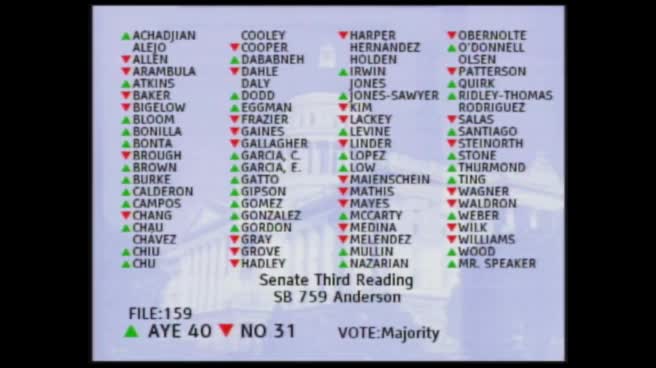 35SEC
Assembly Floor
 12MIN
Assembly Standing Committee on Human Services
 3MIN
Senate Floor
 2MIN
Senate Standing Committee on Appropriations
Bill Author