SB 641: Debt buying: default judgment.
- Session Year: 2015-2016
- House: Senate
- Latest Version Date: 2015-10-11
(1)Existing law, the Fair Debt Buying Practices Act, regulates the practice of buying charged-off consumer debt, as defined, sold or resold on or after January 1, 2014, for collection purposes and prescribes the circumstances pursuant to which the debt buyer may bring suit. The act prohibits a court from entering a default or other judgment in an action initiated by a debt buyer against a debtor unless business records, authenticated through a sworn declaration, are submitted by the debt buyer to the court to establish the facts required to be alleged, as specified.
This bill would permit a person to serve and file a notice of motion and motion to set aside a default or default judgment and for leave to defend an action relating to debt, if service of a summons did not result in actual notice to the person in time to defend an action brought by a debt buyer and a default or default judgment has been entered against the person in the action. The bill would require the person to make this service and filing within 6 years after entry of the default judgment or 180 days of the first actual notice of the action, whichever is earlier, except in cases of identity theft or mistaken identity, in which case the service and filing is to be made within 180 days of the first actual notice of the action. The bill would prescribe requirements regarding documents to be submitted to a court in instances of identity theft or mistaken identity. The bill would prescribe requirements for the filing, which would include an affidavit submitted to the court under oath stating that the persons lack of actual notice in time to defend the action was not caused by his or her avoidance of service or inexcusable neglect. By expanding the crime of perjury, the bill would impose a state-mandated local program. The bill would permit a court to set aside the default or default judgment on whatever terms as may be just and allow the party to defend the action. The bill would apply to a judgment entered on and after January 1, 2010, except as specified.
(2)The California Constitution requires the state to reimburse local agencies and school districts for certain costs mandated by the state. Statutory provisions establish procedures for making that reimbursement.
This bill would provide that no reimbursement is required by this act for a specified reason.
(1)Existing law, the Fair Debt Buying Practices Act, regulates the practice of buying charged-off consumer debt, as defined, sold or resold on or after January 1, 2014, for collection purposes and prescribes the circumstances pursuant to which the debt buyer may bring suit. The act prohibits a court from entering a default or other judgment in an action initiated by a debt buyer against a debtor unless business records, authenticated through a sworn declaration, are submitted by the debt buyer to the court to establish the facts required to be alleged, as specified.
This bill would permit a person to serve and file a notice of motion and motion to set aside a default or default judgment and for leave to defend an action relating to debt, if service of a summons did not result in actual notice to the person in time to defend an action brought by a debt buyer and a default or default judgment has been entered against the person in the action. The bill would require the person to make this service and filing within 6 years after entry of the default judgment or 180 days of the first actual notice of the action, whichever is earlier, except in cases of identity theft or mistaken identity, in which case the service and filing is to be made within 180 days of the first actual notice of the action. The bill would prescribe requirements regarding documents to be submitted to a court in instances of identity theft or mistaken identity. The bill would prescribe requirements for the filing, which would include an affidavit submitted to the court under oath stating that the persons lack of actual notice in time to defend the action was not caused by his or her avoidance of service or inexcusable neglect. By expanding the crime of perjury, the bill would impose a state-mandated local program. The bill would permit a court to set aside the default or default judgment on whatever terms as may be just and allow the party to defend the action. The bill would apply to a judgment entered on and after January 1, 2010, except as specified.
(2)The California Constitution requires the state to reimburse local agencies and school districts for certain costs mandated by the state. Statutory provisions establish procedures for making that reimbursement.
This bill would provide that no reimbursement is required by this act for a specified reason.
(1)Existing law, the Fair Debt Buying Practices Act, regulates the practice of buying charged-off consumer debt, as defined, sold or resold on or after January 1, 2014, for collection purposes and prescribes the circumstances pursuant to which the debt buyer may bring suit. The act prohibits a court from entering a default or other judgment in an action initiated by a debt buyer against a debtor unless business records, authenticated through a sworn declaration, are submitted by the debt buyer to the court to establish the facts required to be alleged, as specified.
This bill would permit a person to serve and file a notice of motion and motion to set aside a default or default judgment and for leave to defend an action relating to debt, if service of a summons did not result in actual notice to the person in time to defend an action brought by a debt buyer and a default or default judgment has been entered against the person in the action. The bill would require the person to make this service and filing within 6 years after entry of the default judgment or 180 days of the first actual notice of the action, whichever is earlier, except in cases of identity theft or mistaken identity, in which case the service and filing is to be made within 180 days of the first actual notice of the action. The bill would prescribe requirements regarding documents to be submitted to a court in instances of identity theft or mistaken identity. The bill would prescribe requirements for the filing, which would include an affidavit submitted to the court under oath showing stating that the persons lack of actual notice in time to defend the action was not caused by his or her avoidance of service or inexcusable neglect. By expanding the crime of perjury, the bill would impose a state-mandated local program. The bill would permit a court to set aside the default or default judgment on whatever terms as may be just and allow the party to defend the action. The bill would apply to a judgment entered on and after January 1, 2010, except as specified.
(2)The California Constitution requires the state to reimburse local agencies and school districts for certain costs mandated by the state. Statutory provisions establish procedures for making that reimbursement.
This bill would provide that no reimbursement is required by this act for a specified reason.
(1)Existing law, the Fair Debt Buying Practices Act, regulates the practice of buying charged-off consumer debt, as defined, sold or resold on or after January 1, 2014, for collection purposes and prescribes the circumstances pursuant to which the debt buyer may bring suit. The act prohibits a court from entering a default or other judgment in an action initiated by a debt buyer against a debtor unless business records, authenticated through a sworn declaration, are submitted by the debt buyer to the court to establish the facts required to be alleged, as specified.
This bill would permit a debtor person to serve and file a notice of motion and motion to set aside a default or default judgment and for leave to defend an action relating to debt, if service of a summons did not result in actual notice to the debtor person in time to defend an action brought by a debt buyer and a default or default judgment has been entered against the debtor person in the action. The bill would require a debtor the person to make this service and filing within 6 years after entry of the default judgment or 180 days of the first actual notice of the action, whichever is earlier. earlier, except in cases of identity theft or mistaken identity, in which case the service and filing is to be made within 180 days of the first actual notice of the action. The bill would prescribe requirements for the filing, which would include an affidavit submitted to the court under oath and showing that the partys persons lack of actual notice in time to defend the action was not caused by his or her avoidance of service or inexcusable neglect. By expanding the crime of perjury, the bill would impose a state-mandated local program. The bill would permit a court to set aside the default or default judgment on whatever terms as may be just and allow the party to defend the action. The bill would apply to a judgment entered on and after January 1. 2010. 1, 2010, except as specified.
(2)The California Constitution requires the state to reimburse local agencies and school districts for certain costs mandated by the state. Statutory provisions establish procedures for making that reimbursement.
This bill would provide that no reimbursement is required by this act for a specified reason.
(1)Existing law, the Fair Debt Buying Practices Act, regulates the practice of buying charged-off consumer debt, as defined, sold or resold on or after January 1, 2014, for collection purposes and prescribes the circumstances pursuant to which the debt buyer may bring suit. The act prohibits a court from entering a default or other judgment in an action initiated by a debt buyer against a debtor unless business records, authenticated through a sworn declaration, are submitted by the debt buyer to the court to establish the facts required to be alleged, as specified.
This bill would permit a debtor to serve and file a notice of motion and motion to set aside a default or default judgment and for leave to defend an action relating to debt, if service of a summons did not result in actual notice to the debtor in time to defend an action brought by a 3rd party debt buyer and a default or default judgment has been entered against the debtor in the action. The bill would require a debtor to make this service and filing within 6 years after entry of the default judgment or 180 days of the first actual notice of the action. action, whichever is earlier. The bill would prescribe requirements for the filing, which would include an affidavit submitted to the court under oath and that the partys lack of actual notice in time to defend the action was not caused by his or her avoidance of service or inexcusable neglect. By expanding the crime of perjury, the bill would impose a state-mandated local program. The bill would permit a court to set aside the default or default judgment on whatever terms as may be just and allow the party to defend the action. The bill would state that its provisions apply to all consumer debt, regardless of the date it was sold. a judgment entered on and after January 1. 2010.
(2)The California Constitution requires the state to reimburse local agencies and school districts for certain costs mandated by the state. Statutory provisions establish procedures for making that reimbursement.
This bill would provide that no reimbursement is required by this act for a specified reason.
(1)Existing law, the Fair Debt Buying Practices Act, regulates the practice of buying charged-off consumer debt, as defined, sold or resold on or after January 1, 2014, for collection purposes and prescribes the circumstances pursuant to which the debt buyer may bring suit. The act prohibits a court from entering a default or other judgment in an action initiated by a debt buyer against a debtor unless business records, authenticated through a sworn declaration, are submitted by the debt buyer to the court to establish the facts required to be alleged, as specified.
This bill would permit a debtor to serve and file a notice of motion and motion to set aside a default or default judgment and for leave to defend an action relating to debt, if service of a summons did not result in actual notice to the debtor in time to defend an action brought by a 3rd party debt buyer and a default or default judgment has been entered against the debtor in the action. The bill would require a debtor to make this service and filing within 180 days of the first actual notice of the action. The bill would prescribe requirements for the filing, which would include an affidavit submitted to the court under oath and that the partys lack of actual notice in time to defend the action was not caused by his or her avoidance of service or inexcusable neglect. By expanding the crime of perjury, the bill would impose a state-mandated local program. The bill would permit a court to set aside the default or default judgment on whatever terms as may be just and allow the party to defend the action. The bill would state that its provisions apply to all consumer debt, regardless of the date it was sold.
(2)The California Constitution requires the state to reimburse local agencies and school districts for certain costs mandated by the state. Statutory provisions establish procedures for making that reimbursement.
This bill would provide that no reimbursement is required by this act for a specified reason.
(a)(1)Notwithstanding Section 473.5 of the Code of Civil Procedure, if service of a summons has not resulted in actual notice to a person in time to defend an action brought by a debt buyer and a default or default judgment has been entered against the person in the action, the person may serve and file a notice of motion and motion to set aside the default or default judgment and for leave to defend the action.
(2)Except as provided in paragraph (3), the notice of motion shall be served and filed within a reasonable time, but in no event exceeding the earlier of:
(A)Six years after entry of the default or default judgment against the person.
(B)One hundred eighty days of the first actual notice of the action.
(3)(A)Notwithstanding paragraph (2), in the case of identity theft or mistaken identity, the notice of motion shall be served and filed within a reasonable time, but in no event exceeding 180 days of the first actual notice of the action.
(B)(i)In the case of identity theft, the person alleging that he or she is a victim of identity theft shall provide the court with either a copy of a Federal Trade Commission Identity Theft Victims Complaint and Affidavit or a copy of a police report filed by the person alleging that he or she is the victim of an identity theft crime, including, but not limited to, a violation of Section 530.5 of the Penal Code, for the specific debt associated with the judgment.
(ii)In the case of mistaken identity, the moving party shall provide relevant information or documentation to support the claim that he or she is not the party named in the judgment or is not the person who incurred or owes the debt.
(b)A notice of motion to set aside a default or default judgment and for leave to defend the action shall designate as the time for making the motion a date prescribed by Section 1005 of the Code of Civil Procedure, and it shall be accompanied by an affidavit stating under oath that the persons lack of actual notice in time to defend the action was not caused by his or her avoidance of service or inexcusable neglect. The person shall serve and file with the notice a copy of the answer, motion, or other pleading proposed to be filed in the action. Either party may introduce, and the court may consider, evidence in support of its motion or opposition, including evidence relating to the process server who appears on the proof of service of the summons and complaint.
(c)Upon a finding by the court that the motion was made within the period permitted by subdivision (a) and that the persons lack of actual notice in time to defend the action was not caused by his or her avoidance of service or inexcusable neglect, the court may set aside the default or default judgment on whatever terms as may be just and allow the party to defend the action. If the validity of the judgment is not challenged, the court may select an appropriate remedy other than setting aside the default or default judgment.
(d)This section shall apply to a default or default judgment entered on or after January 1, 2010, except in the case of identity theft or mistaken identity, in which case this section shall apply regardless of the date of the default or default judgment.
(e)This section shall not limit the equitable authority of the court or other available remedies under law.
SEC. 2.No reimbursement is required by this act pursuant to Section 6 of Article XIIIB of the California Constitution because the only costs that may be incurred by a local agency or school district will be incurred because this act creates a new crime or infraction, eliminates a crime or infraction, or changes the penalty for a crime or infraction, within the meaning of Section 17556 of the Government Code, or changes the definition of a crime within the meaning of Section 6 of Article XIIIB of the California Constitution.
(a)(1)Notwithstanding Section 473.5 of the Code of Civil Procedure, if service of a summons has not resulted in actual notice to a person in time to defend an action brought by a debt buyer and a default or default judgment has been entered against the person in the action, the person may serve and file a notice of motion and motion to set aside the default or default judgment and for leave to defend the action.
(2)Except as provided in paragraph (3), the notice of motion shall be served and filed within a reasonable time, but in no event exceeding the earlier of:
(A)Six years after entry of the default or default judgment against the person.
(B)One hundred eighty days of the first actual notice of the action.
(3)(A)Notwithstanding paragraph (2), in the case of identity theft or mistaken identity, the notice of motion shall be served and filed within a reasonable time, but in no event exceeding 180 days of the first actual notice of the action.
(B)(i)In the case of identity theft, the person alleging that he or she is a victim of identity theft shall provide the court with either a copy of a Federal Trade Commission Identity Theft Victims Complaint and Affidavit or a copy of a police report filed by the person alleging that he or she is the victim of an identity theft crime, including, but not limited to, a violation of Section 530.5 of the Penal Code, for the specific debt associated with the judgment.
(ii)In the case of mistaken identity, the moving party shall provide relevant information or documentation to support the claim that he or she is not the party named in the judgment or is not the person who incurred or owes the debt.
(b)A notice of motion to set aside a default or default judgment and for leave to defend the action shall designate as the time for making the motion a date prescribed by Section 1005 of the Code of Civil Procedure, and it shall be accompanied by an affidavit stating under oath that the persons lack of actual notice in time to defend the action was not caused by his or her avoidance of service or inexcusable neglect. The person shall serve and file with the notice a copy of the answer, motion, or other pleading proposed to be filed in the action. Either party may introduce, and the court may consider, evidence in support of its motion or opposition, including evidence relating to the process server who appears on the proof of service of the summons and complaint.
(c)Upon a finding by the court that the motion was made within the period permitted by subdivision (a) and that the persons lack of actual notice in time to defend the action was not caused by his or her avoidance of service or inexcusable neglect, the court may set aside the default or default judgment on whatever terms as may be just and allow the party to defend the action. If the validity of the judgment is not challenged, the court may select an appropriate remedy other than setting aside the default or default judgment.
(d)This section shall apply to a default or default judgment entered on or after January 1, 2010, except in the case of identity theft or mistaken identity, in which case this section shall apply regardless of the date of the default or default judgment.
(e)This section shall not limit the equitable authority of the court or other available remedies under law.
SEC. 2.No reimbursement is required by this act pursuant to Section 6 of Article XIIIB of the California Constitution because the only costs that may be incurred by a local agency or school district will be incurred because this act creates a new crime or infraction, eliminates a crime or infraction, or changes the penalty for a crime or infraction, within the meaning of Section 17556 of the Government Code, or changes the definition of a crime within the meaning of Section 6 of Article XIIIB of the California Constitution.
(a)(1)Notwithstanding Section 473.5 of the Code of Civil Procedure, if service of a summons has not resulted in actual notice to a person in time to defend an action brought by a debt buyer and a default or default judgment has been entered against the person in the action, the person may serve and file a notice of motion and motion to set aside the default or default judgment and for leave to defend the action.
(2)Except as provided in paragraph (3), the notice of motion shall be served and filed within a reasonable time, but in no event exceeding the earlier of:
(A)Six years after entry of the default or default judgment against the person.
(B)One hundred eighty days of the first actual notice of the action.
(3)(A)Notwithstanding paragraph (2), in the case of identity theft or mistaken identity, the notice of motion shall be served and filed within a reasonable time, but in no event exceeding 180 days of the first actual notice of the action.
(B)(i)In the case of identity theft, the person alleging that he or she is a victim of identity theft shall provide the court with either a copy of a Federal Trade Commission Identity Theft Victims Complaint and Affidavit or a copy of a police report filed by the person alleging that he or she is the victim of an identity theft crime, including, but not limited to, a violation of Section 530.5 of the Penal Code, for the specific debt associated with the judgment.
(ii)In the case of mistaken identity, the moving party shall provide relevant information or documentation to support the claim that he or she is not the party named in the judgment or is not the person who incurred or owes the debt.
(b)A notice of motion to set aside a default or default judgment and for leave to defend the action shall designate as the time for making the motion a date prescribed by Section 1005 of the Code of Civil Procedure, and it shall be accompanied by an affidavit showing stating under oath that the persons lack of actual notice in time to defend the action was not caused by his or her avoidance of service or inexcusable neglect. The person shall serve and file with the notice a copy of the answer, motion, or other pleading proposed to be filed in the action. In contesting the motion to set aside the judgment or default judgment, a debt buyer may introduce, and the court may consider, evidence relating to the document retention policies of Either party may introduce, and the court may consider, evidence in support of its motion or opposition, including evidence relating to the process server who appears on the proof of service of the summons and complaint.
(c)Upon a finding by the court that the motion was made within the period permitted by subdivision (a) and that the persons lack of actual notice in time to defend the action was not caused by his or her avoidance of service or inexcusable neglect, the court may set aside the default or default judgment on whatever terms as may be just and allow the party to defend the action. If the validity of the judgment is not challenged, the court may select an appropriate remedy other than setting aside the default or default judgment.
(d)This section shall apply to a default or default judgment entered on or after January 1, 2010, except in the case of identity theft or mistaken identity, in which case this section shall apply regardless of the date of the default or default judgment.
(e)This section shall not limit the equitable authority of the court or other available remedies under law.
SEC. 2.No reimbursement is required by this act pursuant to Section 6 of Article XIIIB of the California Constitution because the only costs that may be incurred by a local agency or school district will be incurred because this act creates a new crime or infraction, eliminates a crime or infraction, or changes the penalty for a crime or infraction, within the meaning of Section 17556 of the Government Code, or changes the definition of a crime within the meaning of Section 6 of Article XIIIB of the California Constitution.
(a)(1)Notwithstanding Section 473.5 of the Code of Civil Procedure, if service of a summons has not resulted in actual notice to a debtor person in time to defend an action brought by a debt buyer and a default or default judgment has been entered against the debtor person in the action, the debtor person may serve and file a notice of motion and motion to set aside the default or default judgment and for leave to defend the action. The
(2)Except as provided in paragraph (3), the notice of motion shall be served and filed within the earlier of:
(1)Six a reasonable time, but in no event exceeding the earlier of:
(A)Six years after entry of the default or default judgment against the debtor. person.
(2)Within 180
(B)One hundred eighty days of the first actual notice of the action.
(3)Notwithstanding paragraph (2), in the case of identity theft or mistaken identity, the notice of motion shall be served and filed within a reasonable time, but in no event exceeding 180 days of the first actual notice of the action.
(b)A notice of motion to set aside a default or default judgment and for leave to defend the action shall designate as the time for making the motion a date prescribed by Section 1005 of the Code of Civil Procedure, and it shall be accompanied by an affidavit showing under oath that the partys persons lack of actual notice in time to defend the action was not caused by his or her avoidance of service or inexcusable neglect. The party person shall serve and file with the notice a copy of the answer, motion, or other pleading proposed to be filed in the action. In contesting the motion to set aside the judgment or default judgment, a debt buyer may introduce, and the court may consider, evidence relating to the document retention policies of the process server who appears on the proof of service of the summons and complaint.
(c)Upon a finding by the court that the motion was made within the period permitted by subdivision (a) and that debtors the persons lack of actual notice in time to defend the action was not caused by his or her avoidance of service or inexcusable neglect, the court may set aside the default or default judgment on whatever terms as may be just and allow the party to defend the action. If the validity of the judgment is not challenged, the court may select an appropriate remedy other than setting aside the default or default judgment.
(d)This section shall apply to a default or default judgment entered on or after January 1, 2010. 2010, except in the case of identity theft or mistaken identity, in which case this section shall apply regardless of the date of the default or default judgment.
(e)This section shall not limit the equitable authority of the court or other available remedies under law.
SEC. 2.No reimbursement is required by this act pursuant to Section 6 of Article XIIIB of the California Constitution because the only costs that may be incurred by a local agency or school district will be incurred because this act creates a new crime or infraction, eliminates a crime or infraction, or changes the penalty for a crime or infraction, within the meaning of Section 17556 of the Government Code, or changes the definition of a crime within the meaning of Section 6 of Article XIIIB of the California Constitution.
(a)Notwithstanding Section 473.5 of the Code of Civil Procedure, if service of a summons has not resulted in actual notice to a debtor in time to defend an action brought by a third party debt buyer and a default or default judgment has been entered against the debtor in the action, the debtor may serve and file a notice of motion and motion to set aside the default or default judgment and for leave to defend the action within action. The notice of motion shall be served and filed within the earlier of:
(1)Six years after entry of the default or default judgment against the debtor.
(2)Within 180 days of the first actual notice of the action.
(b)A notice of motion to set aside a default or default judgment and for leave to defend the action shall designate as the time for making the motion a date prescribed by Section 1005 of the Code of Civil Procedure, and it shall be accompanied by an affidavit showing under oath that the partys lack of actual notice in time to defend the action was not caused by his or her avoidance of service or inexcusable neglect. The party shall serve and file with the notice a copy of the answer, motion, or other pleading proposed to be filed in the action.
(c)Upon a finding by the court that the motion was made within the period permitted by subdivision (a) and that debtors lack of actual notice in time to defend the action was not caused by his or her avoidance of service or inexcusable neglect, the court may set aside the default or default judgment on whatever terms as may be just and allow the party to defend the action.
(d)This section shall not be limited by the time period specified in Section 1788.50 and shall be applied to debt buyers with respect to all consumer debt, regardless of the date it was sold. apply to a default or default judgment entered on or after January 1, 2010.
SEC. 2.No reimbursement is required by this act pursuant to Section 6 of Article XIIIB of the California Constitution because the only costs that may be incurred by a local agency or school district will be incurred because this act creates a new crime or infraction, eliminates a crime or infraction, or changes the penalty for a crime or infraction, within the meaning of Section 17556 of the Government Code, or changes the definition of a crime within the meaning of Section 6 of Article XIIIB of the California Constitution.
(a)Notwithstanding Section 473.5 of Code of Civil Procedure, if service of a summons has not resulted in actual notice to a debtor in time to defend an action brought by a third party debt buyer and a default or default judgment has been entered against the debtor in the action, the debtor may serve and file a notice of motion and motion to set aside the default or default judgment and for leave to defend the action within 180 days of the first actual notice of the action.
(b)A notice of motion to set aside a default or default judgment and for leave to defend the action shall designate as the time for making the motion a date prescribed by Section 1005 of the Code of Civil Procedure, and it shall be accompanied by an affidavit showing under oath that the partys lack of actual notice in time to defend the action was not caused by his or her avoidance of service or inexcusable neglect. The party shall serve and file with the notice a copy of the answer, motion, or other pleading proposed to be filed in the action.
(c)Upon a finding by the court that the motion was made within the period permitted by subdivision (a) and that debtors lack of actual notice in time to defend the action was not caused by his or her avoidance of service or inexcusable neglect, the court may set aside the default or default judgment on whatever terms as may be just and allow the party to defend the action.
(d)This section shall not be limited by the time period specified in Section 1788.50 and shall be applied to debt buyers with respect to all consumer debt, regardless of the date it was sold.
SEC. 2.No reimbursement is required by this act pursuant to Section 6 of Article XIIIB of the California Constitution because the only costs that may be incurred by a local agency or school district will be incurred because this act creates a new crime or infraction, eliminates a crime or infraction, or changes the penalty for a crime or infraction, within the meaning of Section 17556 of the Government Code, or changes the definition of a crime within the meaning of Section 6 of Article XIIIB of the California Constitution.
|
Date
|
Status
|
|---|---|
| Jul 15, 2015 | From committee: Do pass as amended and re-refer to Com. on APPR. (Ayes 7. Noes 3.) (July 14). |
| Oct 11, 2015 | Chaptered by Secretary of State. Chapter 804, Statutes of 2015. |
| Oct 11, 2015 | Approved by the Governor. |
| Sep 15, 2015 | Enrolled and presented to the Governor at 9:30 a.m. |
| Sep 10, 2015 | Assembly amendments concurred in. (Ayes 28. Noes 11.) Ordered to engrossing and enrolling. |
| Sep 10, 2015 | Assembly amendments concurred in. (Ayes 28. Noes 11. Page 2676.) Ordered to engrossing and enrolling. |
| Sep 10, 2015 | Assembly amendments concurred in. (Ayes 27. Noes 11.) Ordered to engrossing and enrolling. |
| Sep 9, 2015 | Read third time. Passed. (Ayes 45. Noes 26. Page 3029.) Ordered to the Senate. |
| Sep 9, 2015 | Read third time. Passed. Ordered to the Senate. |
| Sep 9, 2015 | In Senate. Concurrence in Assembly amendments pending. |
| Aug 27, 2015 | Read third time and amended. |
| Aug 27, 2015 | Ordered to third reading. |
| Aug 20, 2015 | Read second time. Ordered to third reading. |
| Aug 19, 2015 | From committee: Do pass. (Ayes 11. Noes 5.) (August 19). |
| Jul 16, 2015 | Read second time and amended. Re-referred to Com. on APPR. |
| Feb 27, 2015 | Introduced. To Com. on RLS. for assignment. To print. |
| Jul 8, 2015 | Read second time and amended. Re-referred to Com. on JUD. |
| Jul 7, 2015 | From committee: Do pass as amended and re-refer to Com. on JUD. (Ayes 7. Noes 2.) (July 6). |
| Jun 18, 2015 | Referred to Coms. on B. & F. and JUD. |
| May 22, 2015 | Read third time. Passed. (Ayes 29. Noes 10.) Ordered to the Assembly. |
| May 22, 2015 | Read third time. Passed. (Ayes 29. Noes 10. Page 1062.) Ordered to the Assembly. |
| May 22, 2015 | In Assembly. Read first time. Held at Desk. |
| May 5, 2015 | Read second time. Ordered to third reading. |
| May 4, 2015 | From committee: Be ordered to second reading pursuant to Senate Rule 28.8. |
| Apr 24, 2015 | Set for hearing May 4. |
| Apr 22, 2015 | From committee: Do pass and re-refer to Com. on APPR. (Ayes 5. Noes 2. Page 728.) (April 21). Re-referred to Com. on APPR. |
| Apr 10, 2015 | Set for hearing April 21. |
| Mar 12, 2015 | Referred to Com. on JUD. |
| Mar 2, 2015 | Read first time. |
| Mar 2, 2015 | From printer. May be acted upon on or after April 1. |
|
Date
|
Description
|
Location
|
Votes
|
|
|---|---|---|---|---|
| Sep 10, 2015 | Unfinished Business SB641 Wieckowski Concurrence | Senate Floor |
Passed |
|
| Sep 9, 2015 | SB 641 Wieckowski Senate Third Reading By STONE | Assembly Floor |
Passed |
|
| Aug 19, 2015 | Do pass. | Assembly Standing Committee on Appropriations |
Passed |
|
| Jul 14, 2015 | Do pass as amended and be re-referred to the Committee on [Appropriations] | Assembly Standing Committee on Judiciary |
Passed |
|
| Jul 6, 2015 | Do pass as amended and be re-referred to the Committee on [Judiciary] | Assembly 1st Extraordinary Session on Finance |
Passed |
|
| May 22, 2015 | Senate 3rd Reading SB641 Wieckowski | Senate Floor |
Passed |
|
| Apr 21, 2015 | Do pass, but first be re-referred to the Committee on [Appropriations] | Senate Standing Committee on Judiciary |
Passed |
This list shows positions taken on this bill by organizations on the date displayed, which is linked to the original source.
Positions by individuals are not included.
|
Organization
|
Position
|
Date
|
|---|---|---|
| Attorney General Kamala Harris | ** Support | Sep 9, 2015 |
| Bay Area Legal Aid | ** Support | Sep 9, 2015 |
| Boiler Makers International Union | * Support | Jun 26, 2018 |
| California Association Of Collectors | ** Against | Sep 9, 2015 |
| California Bankers Association | ** Against | Sep 9, 2015 |
| California Creditors Bar Association | ** Against | Sep 9, 2015 |
| California Professional Firefighters | ** Support | Sep 9, 2015 |
| California Reinvestment Coalition | ** Support | Sep 9, 2015 |
| Californians with Disabilities Rights | * Support | Jul 14, 2015 |
| Center for Responsible Lending | ** Support | Sep 9, 2015 |
| Center of Responsible Lending | * Support | Jul 14, 2015 |
| Consumer Federation Of California | ** Support | Jul 14, 2015 |
| Consumers Union | ** Support | Sep 9, 2015 |
| Dba International | ** Against | Sep 9, 2015 |
| East Bay Community Law Center | ** Support | Sep 9, 2015 |
| Encore Capital Group | * Against | Jul 14, 2015 |
| Health Access California | * Against | Jun 26, 2018 |
| Katharine & George Alexander Community Law Center | ** Support | Sep 9, 2015 |
| Los Angeles Democratic Party Chairman Eric Bauman | ** Support | Sep 9, 2015 |
| National Consumer Law Center | ** Support | Sep 9, 2015 |
| National Employment Law Project | ** Support | Sep 9, 2015 |
| PRA Group | * Against | Jul 14, 2015 |
| Public Counsel | ** Support | Sep 9, 2015 |
| Public Good | ** Support | Sep 9, 2015 |
| Simnsa Health Plan | * Support | Jun 26, 2018 |
| State Treasurer John Chiang | ** Support | Sep 9, 2015 |
| UDW AFSCME Local 3930 | * Support | Jun 26, 2018 |
| Western Center On Law And Poverty Inc. | ** Support | Jul 14, 2015 |
| Western Center on Law and Proverty | ** Support | Jul 14, 2015 |
SB 641
Page 9
|
Office of Senate Floor Analyses (916) 651-1520 Fax: (916) 327-4478 |
UNFINISHED BUSINESS
Bill No: SB 641
Amended: 8/27/15
SENATE JUDICIARY COMMITTEE: 5-2, 4/21/15
AYES: Jackson, Hertzberg, Leno, Monning, Wieckowski
NOES: Moorlach, Anderson
SENATE APPROPRIATIONS COMMITTEE: Senate Rule 28.8
SENATE FLOOR: 29-10, 5/22/15
AYES: Allen, Beall, Block, Cannella, De León, Galgiani, Hall, Hancock, Hernandez, Hertzberg, Hill, Hueso, Huff, Jackson, Lara, Leno, Leyva, Liu, McGuire, Mendoza, Mitchell, Monning, Pan, Pavley, Roth, Stone, Vidak, Wieckowski, Wolk
NOES: Anderson, Bates, Berryhill, Fuller, Gaines, Moorlach, Morrell, Nguyen, Nielsen, Runner
ASSEMBLY FLOOR: 45-26, 9/9/15 - See last page for vote
SUBJECT: Debt buying: default judgment
DIGEST: This bill adds a provision to the Fair Debt Buying Practices Act (FDBPA) to provide consumers, in limited circumstances involving actions brought by debt buyers, extended time to file a motion to set aside a default or default judgment and for leave to defend an action relating to debt, if the service of summons did not result in actual notice to the consumer in time to defend the action. This bill requires, except in cases of identity theft or mistaken identity, that the consumer serve and file the notice of motion within a reasonable time, but in no event exceeding the earlier of either: (1) six years after entry of the default or default judgment; or (2) 180 days of the first actual notice of the action, as specified.
Assembly Amendments (1) require that service and filing of the motion be made within a reasonable amount of time; (2) limit the scope of the bill to defaults or default judgments entered on or after January 1, 2010; (3) allow for the introduction and consideration of evidence in support of or against the motion; and 4) make other clarifying changes.
Existing law:
Provides that the FDBPA regulates the activities of a person or entity (debt buyer) that has bought charged-off consumer loans for collection purposes.
Provides that a debt buyer shall not bring suit or initiate an arbitration or other legal proceeding to collect a consumer debt if the applicable statute of limitations on the debt buyer’s claim has expired.
Requires that in an action brought by a debt buyer on consumer debt, specified facts must be alleged in the complaint.
Provides that in an action initiated by a debt buyer, no default or other judgment may be entered against a debtor unless business records, authenticated through a sworn declaration, are submitted by the debt buyer to the court to establish the specific facts required to be alleged, above.
Provides that no default or other judgment may be entered against a debtor unless a copy of the contract or other document described, as specified, authenticated through a sworn declaration, has been submitted by the debt buyer to the court.
Provides that in any action on a consumer debt, if a debt buyer plaintiff seeks a default judgment and has not complied with the FDBPA, the court shall not enter a default judgment for the plaintiff and may dismiss the action.
Provides that, except as provided in the FDBPA, the above default judgment provisions are not intended to modify or otherwise amend existing procedures established under Section 585 of the Code of Civil Procedure (which provides a procedure for judgment to be had if a defendant fails to answer or otherwise respond to a complaint).
Provides, under the Code of Civil Procedure, that when service of a summons has not resulted in actual notice to a party in time to defend the action and a default or default judgment has been entered against him or her in the action, he or she may serve and file a notice of motion to set aside the default or default judgment and for leave to defend the action within a reasonable time, but in no event exceeding the earlier of: (a) two years after entry of a default judgment against him or her; or (b) 180 days after service on him or her of a written notice that the default or default judgment has been entered.
Requires that a notice of motion to set aside a default or default judgment and for leave to defend the action, above, designate as the time for making the motion a date prescribed under a specified provision (which sets forth the statutory timelines for filing and serving specified noticed motions, opposing papers, and reply papers), and that the notice be accompanied by an affidavit showing under oath that the party’s lack of actual notice in time to defend the action was not caused by his or her avoidance of service or inexcusable neglect. The party must serve and file with the notice a copy.
Provides that upon a finding by the court that the motion was made within the time period permitted, above, and that his or her lack of actual notice in time to defend the action was not caused by his or her avoidance of service or inexcusable neglect, the court may set aside the default or default judgment on whatever terms as may be just and allow the party to defend the action.
This bill:
Creates a limited exception to the current timelines to bring a motion to set aside a default or default judgment and for leave to defend the action under the FDBPA. Provides that if service of a summons has not resulted in actual notice to a person in time to defend an action brought by a debt buyer and a default or default judgment has been entered against the person in the action, the person may serve and file a notice of motion and motion to set aside the default or default judgment and for leave to defend the action.
Requires, generally, that the notice of motion be served and filed within a reasonable time, but in no event exceeding the earlier of:
Six years after entry of the default or default judgment against the person.
One hundred eighty days of the first actual notice of the action.
Requires, notwithstanding the above, that in the case of identity theft or mistaken identity, the notice of motion be served and filed within a reasonable time, but in no event exceeding 180 days of the first actual notice of the action. In the case of identity theft, the person alleging that he or she is a victim of identity theft must provide the court specified documentation. In the case of mistaken identity, the moving party must provide relevant information or documentation to support the claim that he or she is not the party named in the judgment or is not the person who incurred or owes the debt.
Provides that a notice of this motion shall designate as the time for making the motion a date prescribed under existing law, and shall be accompanied by an affidavit stating under oath that the party’s lack of actual notice in time to defend the action was not caused by his or her avoidance of service or inexcusable neglect. The party must serve and file with the notice a copy of the answer, motion, or other pleading proposed to be filed in the action. Permits either party to introduce, and permits the court to consider, evidence in support of its motion or opposition, including evidence relating to the process server who appears on the proof of service of the summons and complaint.
Provides upon a finding by the court that the motion was made within the periods permitted by the bill, above, and that a person’s lack of actual notice in time to defend the action was not caused by his or her avoidance of service or inexcusable neglect, the court may set aside the default or default judgment on whatever terms as may be just and allow the party to defend the action. If the validity of the judgment is not challenged, the court may select an appropriate remedy other than setting aside the default or default judgment.
Provides that the above provisions apply to a default or default judgment entered on or after January 1, 2010, except in the case of identity theft or mistaken identity, in which case these provisions shall apply regardless of the date of the default or default judgment.
Provides that the above provisions shall not limit the equitable authority of the court or other available remedies under law.
Background
Debt buyers are companies that purchase delinquent or charged-off debts from a creditor for a fraction of the face value of the debt. Those companies have become subject to increased scrutiny due to numerous complaints on behalf of consumers. In July 2010, the Federal Trade Commission (FTC) issued a report, Repairing a Broken System, examining debt collection litigation and arbitration proceedings that concluded the “system for resolving consumer debt collection disputes is broken” and recommended significant reforms.
In 2012, the federal Consumer Financial Protection Bureau (CFPB) published a rule allowing for federal supervision of the larger consumer debt collectors. (CFPB, Consumer Financial Protection Bureau to Oversee Debt Collectors (Oct. 24, 2012).) The CFPB noted that, “[a]pproximately 30 million Americans have, on average, $1,500 of debt subject to collection. Debt collectors often report consumers’ collection status to the credit bureaus. If they get the information wrong, this can be the difference between getting approved or denied for such financial products as a mortgage or a car loan.”
As a matter of state law, in response to these and other issues concerning debt buying practices, the Legislature enacted SB 233 (Leno, Chapter 64, Statutes of 2013), the FDBPA, to further regulate the activities of persons and entities that purchase “charged-off consumer debt.” At the time SB 233 was being considered, the bill’s sponsor, the Attorney General, recognized that such concerns are compounded by the fact that a very high percentage of debt collection litigation result in default judgments, where consumers do not appear to present whatever defenses may be available to them. Accordingly, that bill included provisions that prohibit a default or other judgment from being entered against a debtor, unless business records, authenticated through a sworn declaration, are submitted by the debt buyer to the court to establish the information that is alleged in the complaint, and unless a copy of the contract or other document evidencing the debtor’s agreement to the debt, authenticated through a sworn declaration, has been submitted to the court.
Under existing law, an individual may set aside a default judgment (which is a judgment entered against a defendant who has failed to plead or otherwise defend against the plaintiff’s claim) if they did not receive notice in time to defend the action. A motion to set aside the default judgment must be filed within the earlier of two years after the entry of a default judgment, or, 180 days after written notice that a default judgment has been entered. This bill, sponsored by Public Good, creates a separate default judgment rule to extend the time that a consumer would have to bring a motion to set aside a default judgment entered against them in an action brought by a debt buyer.
Comments
As stated by the author:
There are far more default judgments in collection cases brought by debt buyers against consumers than there are in any other type of case. Yet despite increased education and media attention around this issue, the number of default judgments in collection cases remains very high in California. For example, in Sacramento County Superior Court, collections cases resulted in default judgments in 74 [percent] of cases filed in 2013 and 79.3 [percent] for cases filed in the first [five] months of 2014. [ . . . ]
Prior to the passage of California’s Fair Debt Buying Practices Act (FDBPA) in 2013, debt buyers were not required to provide the Court with any evidence that the Defendant being sued actually owed the debt. [ . . . ] For many consumers with default judgments entered against them, the first time they are made aware they have been sued on a debt is when they are served post-judgment with a notice of wage garnishment.
Although the FDBPA has made great strides in reforming debt collection litigation, it has no effect on default judgments entered before January 1, 2014. It’s these default judgments—ones obtained before the FDBPA was signed into law—that SB 641 will affect. [ . . . ] Moreover, it now appears that at least certain debt buyers are purposely waiting for the two-year mark to pass after having obtained a default judgment and only then seeking a garnishment order, leaving consumers no recourse to challenge the validity of the debt.
SB 641 will allow a consumer, in limited circumstances, to file a motion to set aside a default judgment that is more than two years old so the consumer may challenge the validity of the debt in court and try the case on the merits. The effect of SB 641 is limited to cases brought by [ . . . ] debt buyers.
FISCAL EFFECT: Appropriation: No Fiscal Com.: Yes Local: Yes
According to the Assembly Appropriations Committee, minor and absorbable costs to the Judicial Council; potential increase in caseload, though likely modest, to state courts.
Public Good (source)
Attorney General Kamala Harris
State Treasurer John Chiang
Bay Area Legal Aid
California Labor Federation
California Professional Firefighters
California Reinvestment Coalition
Center for Responsible Lending
Consumers for Auto Reliability and Safety
Consumers Union
East Bay Community Law Center
Katharine & George Alexander Community Law Center
Los Angeles Democratic Party Chairman Eric Bauman
National Consumer Law Center
National Employment Law Project
Public Counsel
Western Center on Law & Poverty
California Association of Collectors
California Bankers Association
California Creditors Bar Association
DBA International
ARGUMENTS IN SUPPORT: Bay Area Legal Aid, in support, notes that they frequently see default judgments granted in cases “wherein the underlying accounts were fraudulent, the result of identity theft, or otherwise incorrect and the defendant was ‘served’ at a location that they did not live or work. Nonetheless these defendants are often precluded from setting aside the judgment by an arbitrarily imposed deadline. This law would provide individuals with an opportunity to have their issues heard regarding both service of the summons and complaint and the underlying debt collection lawsuit. For the working poor living paycheck to paycheck a default judgment, with its accompanying wage garnishment and bank account levies, can lead directly to homelessness and other severe consequences.” Bay Area Legal Aid argues that this bill will prevent abuse by debt buyers where the vast majority of debt collection lawsuits result in default judgments; provide relief for low-income wage earners facing collection on unsubstantiated default judgments and give low income litigants the chance to have their cases heard on the merits; and resolve an unsettled area of law where some courts recognize the principle that judgments that are void for lack of service may be set aside after two years under existing law.
Public Counsel emphasizes that “[o]nly consumers who lack actual knowledge of debt buyer suits will have recourse under the new law. They will have to act within a reasonable time after learning about the lawsuit. In addition, they will have to submit an affidavit sworn under penalty of perjury that their lack of notice did not result from avoidance of service or inexcusable neglect, and then will have to defend the action on the merits. This new bill is no free ticket out of debt.”
ARGUMENTS IN OPPOSITION: DBA International (DBA) and the California Association of Collectors (CAC) write in opposition to this bill in part because they believe existing law provides an adequate methodology to vacate judgments when an individual contends they did not receive actual notice in time to defend an action. Moreover, they assert that, even if the time period under existing law has expired, “any litigant still has the ability to file an independent action in equity seeking to set aside the judgment.” DBA and CAC also oppose on the following grounds:
This bill allows for discriminatory treatment of default judgments obtained by companies in one industry (namely, debt buying companies) and, furthermore, would “create a highly unusual fact pattern where a default judgment obtained by a bank would be subject to the two year period contained [under existing law] and the mere act of selling the judgment on the secondary market (with no other factual changes) would subject that judgment to significantly lower thresholds to vacate in perpetuity.”
This bill questions the competency of the judiciary, given that a court cannot enter judgment by default in favor of anyone (including debt buying companies) unless the court is satisfied that the defendant has been properly served the defendant has failed to respond, and the plaintiff has put forth sufficient evidence to base the judgment upon. “There simply is no basis for imposing on the industry higher levels of evidentiary requirements for a default judgment [as required under the FDBPA] and then pairing it with the lowest threshold to vacate default judgments via the provisions of SB 641.”
This bill conflicts with document retention and destruction policies and rule of law concerning judgments. “The effect of a judgment is to fold all data, documentation, and evidence concerning the legitimacy of the underlying obligation into the judgment. Absent a fraud on the court . . . a judgment is a legally binding document that stands in place of all that existed prior to the judgment.” Due to companies’ mandatory data and document retention and destruction policies that are based on current law, insofar as this bill allows motions to be filed to vacate five or even 10 year old judgments, this bill “would all but virtually guarantee that some of the evidence which was reviewed by the court no longer exists due to mandated destruction policies.”
This bill creates the potential to inundate the courts as a result of zealous legal representation that uses every available legal option the law permits, regardless of the legitimacy of service or high quality of the evidence considered by the court at the time of [default] judgment.
ASSEMBLY FLOOR: 45-26, 9/9/15
AYES: Bloom, Bonilla, Bonta, Burke, Calderon, Campos, Chau, Chiu, Chu, Cooley, Dababneh, Dodd, Eggman, Cristina Garcia, Eduardo Garcia, Gatto, Gipson, Gomez, Gonzalez, Gordon, Hadley, Roger Hernández, Holden, Irwin, Jones-Sawyer, Levine, Linder, Lopez, Low, McCarty, Medina, Mullin, Nazarian, Quirk, Rendon, Ridley-Thomas, Rodriguez, Salas, Santiago, Mark Stone, Thurmond, Ting, Weber, Williams, Atkins
NOES: Achadjian, Travis Allen, Baker, Bigelow, Chang, Chávez, Dahle, Beth Gaines, Gallagher, Gray, Grove, Harper, Jones, Kim, Lackey, Maienschein, Mathis, Mayes, Melendez, Obernolte, Olsen, Patterson, Steinorth, Wagner, Waldron, Wilk
NO VOTE RECORDED: Alejo, Brough, Brown, Cooper, Daly, Frazier, O'Donnell, Perea, Wood
Prepared by: Ronak Daylami / JUD. / (916) 651-4113
9/9/15 19:28:11
SB 641
Page 6
SENATE THIRD READING
SB 641
(Wieckowski)
As Amended August 27, 2015
Majority vote
SENATE VOTE: 29-10
Committee |
Votes |
Ayes |
Noes |
Banking |
7-2 |
Dababneh, Chau, Gatto, Low, Perea, Ridley-Thomas, Mark Stone |
Travis Allen, Kim |
Judiciary |
7-3 |
Mark Stone, Weber, Alejo, Chau, Chiu, Cristina Garcia, Thurmond |
Wagner, Gallagher, Maienschein |
Appropriations |
11-5 |
Gomez, Bloom, Bonta, Calderon, Eggman, Eduardo Garcia, Holden, Quirk, Rendon, Weber, Wood |
Bigelow, Chang, Gallagher, Jones, Wagner |
SUMMARY: Adds a new provision to the California Fair Debt Buying Practices Act (FDBPA). Specifically, this bill:
Provides that if service of a summons has not resulted in actual notice to an alleged debtor in time to defend an action brought by a debt buyer and a default or default judgment has been entered against the alleged debtor in the action, the alleged debtor may serve and file a notice of motion and motion to set aside the default or default judgment and for leave to defend the action.
Requires the notice of motion to be served and filed within a reasonable time, but in no event exceeding the earlier of: a) six years after entry of the default or default judgment against the debtor; or b) 180 days of the first actual notice of the action.
Provides, notwithstanding 2) above, that in the case of identity theft, mistaken identity, the notice of motion shall be served and filed within a reasonable time, but in no event exceeding 180 days of the first actual notice of the action.
Provides that in the case of a debtor claiming the disputed debt arose from identity theft, the person alleging that he or she is a victim of identity theft shall provide the court with either a copy of a Federal Trade Commission (FTC) Identity Theft Victim's Complaint and Affidavit or a copy of a police report filed by the person alleging they are a victim of identity theft.
States that in the case of mistaken identity regarding a person that owes a debt the moving party shall provide relevant information or documentation to support the claim that he or she is not the party named in the judgment or is not the person who incurred or owes the debt.
Provides that either party to the action may introduce evidence in support of its motion or opposition, including evidence relating to the process server who appears on the proof of service of summons and complaint.
Requires the notice of motion to set aside a default or default judgment and for leave to defend the action to designate as the time for making the motion a date prescribed by Code of Civil Procedure Section 1005, and requires the notice of motion to be accompanied by an affidavit showing under oath that the alleged debtor's lack of actual notice in time to defend the action was not caused by his or her avoidance of service or inexcusable neglect. Further requires the alleged debtor to serve and file with the notice a copy of the answer, motion, or other pleading proposed to be filed in the action.
Provides that, upon a finding by the court that the motion was made within the permissible time period and that the alleged debtor's lack of actual notice in time to defend the action was not caused by his or her avoidance of service or inexcusable neglect, the court may set aside the default or default judgment on whatever terms as may be just and allow the party to defend the action.
Allows the court to select an appropriate remedy other than setting aside the default or default judgment in cases where the validity of the judgment is not challenged.
Establishes that these provisions apply to a default or default judgment entered on or after January 1, 2010, except in the case of identity theft, mistaken identity, or other instance in which the alleged debtor is not legally responsible for the debt, in which case these provisions shall apply regardless of the date of the default judgment.
Clarifies that nothing in this bill shall limit the equitable authority of the court or other available remedies under law.
EXISTING STATE LAW:
Establishes the FDBPA which regulates the activities of a person or entity that has bought charged-off consumer loans for collection purposes. The FDBPA is limited to debt buyers with respect to all consumer debt sold or resold on or after January 1, 2014. (Civil Code Section 1788.50 et seq.)
Provides that a debt buyer shall not bring suit or initiate an arbitration or other legal proceeding to collect a consumer debt if the applicable statute of limitations on the debt buyer's claim has expired.
Requires that in an action brought by a debt buyer on consumer debt, certain facts must be alleged in the complaint, including, among others:
The date of default or the date of the last payment;
The name and an address of the charge-off creditor at the time of charge off and the charge-off creditor's account number associated with the debt. The charge-off creditor's name and address shall be in sufficient form so as to reasonably identify the charge-off creditor;
The name and last known address of the debtor as they appeared in the charge-off creditor's records prior to the sale of the debt. If the debt was sold prior to January 1, 2014, the debtor's name and last known address as they appeared in the debt owner's records on December 31, 2013, shall be sufficient; and,
The names and addresses of all persons or entities that purchased the debt after charge off, including the plaintiff debt buyer. The names and addresses shall be in sufficient form so as to reasonably identify each such purchaser.
Provides that in an action initiated by a debt buyer, no default or other judgment may be entered against a debtor unless business records, authenticated through a sworn declaration, are submitted by the debt buyer to the court to establish the specific facts required to be alleged, above. Existing law further provides that no default or other judgment may be entered against a debtor unless a copy of the contract or other document described, as specified, authenticated through a sworn declaration, has been submitted by the debt buyer to the court.
Provides that in any action on a consumer debt, if a debt buyer plaintiff seeks a default judgment and has not complied with the requirements of the FDBPA, the court shall not enter a default judgment for the plaintiff and may, in its discretion, dismiss the action.
Provides that, except as provided in the FDBPA, the above default judgment provisions are not intended to modify or otherwise amend existing procedures established under Code of Civil Procedure Section 585 (which provides a procedure for judgment to be had if a defendant fails to answer or otherwise respond to a complaint).
Provides that when service of a summons has not resulted in actual notice to a party in time to defend the action and a default or default judgment has been entered against him or her in the action, he or she may serve and file a notice of motion to set aside the default or default judgment and for leave to defend the action. Existing law requires that the notice of motion be served and filed within a reasonable time, but in no event exceeding the earlier of: a) two years after entry of a default judgment against him or her; or b) 180 days after service on him or her of a written notice that the default or default judgment has been entered. (Code of Civil Procedure Section 473.5 et. seq.)
Requires that a notice of motion to set aside a default or default judgment and for leave to defend the action designate as the time for making the motion a date prescribed under a specified provision (which sets forth the statutory timelines for filing and serving specified noticed motions, opposing papers, and reply papers), and that the notice be accompanied by an affidavit showing under oath that the party's lack of actual notice in time to defend the action was not caused by his or her avoidance of service or inexcusable neglect. The party shall serve and file with the notice a copy of the answer, motion, or other pleading proposed to be filed in the action.
Provides that upon a finding by the court that the motion was made within the period permitted by subdivision 3)a) above, and that his or her lack of actual notice in time to defend the action was not caused by his or her avoidance of service or inexcusable neglect, it may set aside the default or default judgment on whatever terms as may be just and allow the party to defend the action.
Provides the Rosenthal Fair Debt Collection Practices Act, generally prohibits deceptive, dishonest, unfair and unreasonable debt collection practices by debt collectors, and regulates the form and content of communications by debt collectors to debtors and others. (Civil Code Division 3, Part 4, Title 1.6C, commencing with Section 1788.)
EXISTING FEDERAL LAW regulates the collection of debt through, among other things, the Fair Debt Collection Practices Act; Fair Credit Reporting Act; and the Gramm-Leach-Bliley Act.
FISCAL EFFECT: According to Assembly Appropriations Committee, minor and absorbable costs to Judicial Council; potential increase in caseload, though likely modest, to state courts.
COMMENTS: This bill would allow a consumer, in limited circumstances, to file a motion to set aside a default judgment that is more than two years old so the consumer may challenge the validity of the debt in court and try the case on the merits. The measure is limited to cases brought by debt buyers.
Simply stated, debt buyers are companies that purchase delinquent charged-off debts from a creditor for a fraction of the face value of the debt.
FDBPA: The FDBPA was established through legislation SB 233 (Leno), Chapter 64, Statutes of 2014, which went into effect on January 1, 2014. The FDBPA regulates the practice of buying charged-off consumer debt, sold or resold on or after January 1, 2014, for collection purposes and prescribes the circumstances pursuant to which the debt buyer may bring suit. The FDBPA prohibits a court from entering a default or other judgment in an action initiated by a debt buyer against a debtor unless business records, authenticated through a sworn declaration are submitted by the debt buyer to the court to establish the facts.
The California Code of Civil Procedure Section 473.5 permits a party to ask a court to set aside a default judgment that has been entered against him or her so that he or she may defend the case on the merits only if:
The original service of summons did not result in actual notice to the party in time to defend the action;
The default judgment is not more than two years old; and,
One hundred eighty days has not passed since the party was served with actual written notice of the default judgment.
Need for this bill: According to the author:
There are far more default judgments in collection cases brought by debt buyers against consumers than there are in any other type of case. Yet despite increased education and media attention around this issue, the number of default judgments in collection cases remains very high in California. For example, in Sacramento County Superior Court, collections cases resulted in default judgments in 74% of cases filed in 2013 and 79.3% for cases filed in the first 5 months of 2014.
The FTC, among others, has called for state legislation to deal with the frequency of default judgments and lack of notice provided to defendants in debt collection lawsuits brought by debt buyers.
Prior to the passage of FDBPA in 2013, debt buyers were not required to provide the Court with any evidence that the Defendant being sued actually owed the debt. The now famous story of Senator Lou Correa receiving a notice of wage garnishment for a debt owed by a different person is not an anomaly. For many consumers with default judgments entered against them, the first time they are made aware they have been sued on a debt is when they are served post-judgment with a notice of wage garnishment.
Although the FDBPA has made great strides in reforming debt collection litigation, it has no effect on default judgments entered before January 1, 2014. It's these default judgments – ones obtained before the FDBPA was signed into law – that SB 641 will affect.
Currently, it is enormously difficult to set aside a default judgment that is more than two years old, and like Senator Correa, most Californians who have faced unjust wage garnishment cannot make use of the current exceptions.
Moreover, it now appears that at least certain debt buyers are purposely waiting for the two-year mark to pass after having obtained a default judgment and only then seeking a garnishment order, leaving consumers no recourse to challenge the validity of the debt.
Background: Existing law requires that a defendant to an action against whom a default judgment has been entered bring any motion to set aside the default judgment within the shorter of two time periods: 1) two years after the date of entry of a default judgment against him or her; or 2) 180 days after service on him or her of a written notice that the default or default judgment has been entered. This remedy is available only where service of a summons has not resulted in actual notice to the defendant in time to defend the action and the defendant's lack of actual notice was not caused by his or her avoidance of service or inexcusable neglect.
This bill creates a separate default judgment rule that potentially extends the amount of time a consumer defendant in a debt buying action has to bring a motion to set aside a default judgment. Specifically, this bill would permit a debtor to serve and file a notice of motion and motion to set aside the default or default judgment and for leave to defend the action within 180 days of the first actual notice of the action or within six years after entry of the default judgment.
Recent amendments establish clear parameters for a court to consider in the case of identity theft and mistaken identity. The person claiming that they do not a owe debt because they were a victim of identity theft would need to provide the court with the FTC Identity Theft Victim's Complaint and Affidavit or a copy of the police report field by the person claiming they were a victim. In the case of mistaken identity the person would need to provide documentation to the court that the person was not a party to the debt. While these amendments establish reasonable standards opponents are still opposed due to the retroactive date of 2010 which was established in the Assembly Banking and Finance Committee and is a limitation of the original language of the bill which did not include a date limitation.
Process of a Debt Buying for nonpayment of debt:
Debt buyers sue for the nonpayment of debt- the lawsuit starts with a complaint
The lawsuit starts when the debt buyer, files a "complaint" (sometimes called a "petition") with the court. The complaint will list consumer as a defendant, and perhaps someone else too (like a spouse or someone who cosigned the loan or account). It will also state why the debt buyer is suing, and what the debt buyer wants – usually, the debt buyer wants reimbursement for the money consumer owes, plus interest, and sometimes attorneys' fees and court costs.
Service of the Summons and Complaint
The debt buyer must "serve" the consumer with a copy of the complaint, along with a "summons." The summons notifies the consumer that the consumer is being sued, and usually provides additional information such as when the consumer needs to file a formal response in court.
Most courts require the debt buyer to "serve" the documents by handing them to the consumer personally. Debt buyers most often hire a professional process server or a local sheriff to "serve" the consumer. If the server can’t find the consumer, often he or she can leave the summons and complaint with another adult at the consumer's house or business and then mail a copy to the consumer.
Often, courts allow debt buyers to mail the consumer the summons and complaint, along with a form for the consumer to sign acknowledging that the consumer received the papers. If the consumer signs and returns the form, the consumer will have been deemed "served."
Where Will the Creditor File the Lawsuit?
The debt buyer may sue the consumer in state civil court (these courts can have many types of names: municipal court, superior court, justice court, county court, to name just a few), or, if the consumer owes money to the federal government, in federal court.
Responding to the Lawsuit
Usually, a consumer has about 20 days to 30 days to file a written response to the lawsuit. The document filed is often called the "answer." A consumer prepares the answer and determines whether or not to hire an attorney.
What happens if a consumer does not respond?
If a consumer does not meet the filing deadline, the debt buyer will likely ask the court to enter a default judgment. Sometimes, the court will award the amount the debt buyer requests in the default judgment, some courts will review the papers carefully to make sure the amount is justified, and still others might require the debt buyer to present evidence before awarding any money.
California Courts: California courts have a long standing policy of trying cases on the merits when at all possible. "The policy of law is to have every litigated case tried on its merits and court looks with disfavor on party attempting to take advantage of his adversary's mistake, surprise, inadvertence or neglect by procuring default judgment, regardless of merits of such party's case." Denke v. Bowes (App. 1947) 77 Cal. App. 2d 642.
Analysis Prepared by: Mark Farouk / B. & F. / (916) 319-3081 FN: 0001569
SB 641
Page 6
SENATE THIRD READING
SB 641
(Wieckowski)
As Amended July 16, 2015
Majority vote
SENATE VOTE: 29-10
Committee |
Votes |
Ayes |
Noes |
Banking |
7-2 |
Dababneh, Chau, Gatto, Low, Perea, Ridley-Thomas, Mark Stone |
Travis Allen, Kim |
Judiciary |
7-3 |
Mark Stone, Weber, Alejo, Chau, Chiu, Cristina Garcia, Thurmond |
Wagner, Gallagher, Maienschein |
Appropriations |
11-5 |
Gomez, Bloom, Bonta, Calderon, Eggman, Eduardo Garcia, Holden, Quirk, Rendon, Weber, Wood |
Bigelow, Chang, Gallagher, Jones, Wagner |
SUMMARY: Adds a new provision to the California Fair Debt Buying Practices Act (FDBPA). Specifically, this bill:
Provides that if service of a summons has not resulted in actual notice to an alleged debtor in time to defend an action brought by a debt buyer and a default or default judgment has been entered against the alleged debtor in the action, the alleged debtor may serve and file a notice of motion and motion to set aside the default or default judgment and for leave to defend the action.
Requires the notice of motion to be served and filed within a reasonable time, but in no event exceeding the earlier of: a) six years after entry of the default or default judgment against the debtor; or b) 180 days of the first actual notice of the action.
Notwithstanding 2) above, provides that in the case of identity theft, mistaken identity, the notice of motion shall be served and filed within a reasonable time, but in no event exceeding 180 days of the first actual notice of the action.
Requires the notice of motion to set aside a default or default judgment and for leave to defend the action to designate as the time for making the motion a date prescribed by Code of Civil Procedure Section 1005, and requires the notice of motion to be accompanied by an affidavit showing under oath that the alleged debtor's lack of actual notice in time to defend the action was not caused by his or her avoidance of service or inexcusable neglect. Further requires the alleged debtor to serve and file with the notice a copy of the answer, motion, or other pleading proposed to be filed in the action.
Allows a debt buyer, in contesting the motion to set aside a default judgment, to introduce, and the court to consider, evidence relating to the document retention policies of the process server who appears on the proof of service of the summons and complaint.
Provides that, upon a finding by the court that the motion was made within the permissible time period and that the alleged debtor's lack of actual notice in time to defend the action was not caused by his or her avoidance of service or inexcusable neglect, the court may set aside the default or default judgment on whatever terms as may be just and allow the party to defend the action.
Allows the court to select an appropriate remedy other than setting aside the default or default judgment in cases where the validity of the judgment is not challenged.
Establishes that these provisions apply to a default or default judgment entered on or after January 1, 2010, except in the case of identity theft, mistaken identity, or other instance in which the alleged debtor is not legally responsible for the debt, in which case these provisions shall apply regardless of the date of the default judgment.
Clarifies that nothing in this bill shall limit the equitable authority of the court or other available remedies under law.
EXISTING STATE LAW:
Establishes the FDBPA which regulates the activities of a person or entity that has bought charged-off consumer loans for collection purposes. The FDBPA is limited to debt buyers with respect to all consumer debt sold or resold on or after January 1, 2014. (Civil Code Section 1788.50 et seq.)
Provides that a debt buyer shall not bring suit or initiate an arbitration or other legal proceeding to collect a consumer debt if the applicable statute of limitations on the debt buyer's claim has expired.
Requires that in an action brought by a debt buyer on consumer debt, certain facts must be alleged in the complaint, including, among others:
The date of default or the date of the last payment;
The name and an address of the charge-off creditor at the time of charge off and the charge-off creditor's account number associated with the debt. The charge-off creditor's name and address shall be in sufficient form so as to reasonably identify the charge-off creditor;
The name and last known address of the debtor as they appeared in the charge-off creditor's records prior to the sale of the debt. If the debt was sold prior to January 1, 2014, the debtor's name and last known address as they appeared in the debt owner's records on December 31, 2013, shall be sufficient; and,
The names and addresses of all persons or entities that purchased the debt after charge off, including the plaintiff debt buyer. The names and addresses shall be in sufficient form so as to reasonably identify each such purchaser.
Provides that in an action initiated by a debt buyer, no default or other judgment may be entered against a debtor unless business records, authenticated through a sworn declaration, are submitted by the debt buyer to the court to establish the specific facts required to be alleged, above. Existing law further provides that no default or other judgment may be entered against a debtor unless a copy of the contract or other document described, as specified, authenticated through a sworn declaration, has been submitted by the debt buyer to the court.
Provides that in any action on a consumer debt, if a debt buyer plaintiff seeks a default judgment and has not complied with the requirements of the FDBPA, the court shall not enter a default judgment for the plaintiff and may, in its discretion, dismiss the action.
Provides that, except as provided in the FDBPA, the above default judgment provisions are not intended to modify or otherwise amend existing procedures established under Code of Civil Procedure Section 585 (which provides a procedure for judgment to be had if a defendant fails to answer or otherwise respond to a complaint).
Provides that when service of a summons has not resulted in actual notice to a party in time to defend the action and a default or default judgment has been entered against him or her in the action, he or she may serve and file a notice of motion to set aside the default or default judgment and for leave to defend the action. Existing law requires that the notice of motion be served and filed within a reasonable time, but in no event exceeding the earlier of: a) two years after entry of a default judgment against him or her; or b) 180 days after service on him or her of a written notice that the default or default judgment has been entered. (Code of Civil Procedure Section 473.5 et. seq.)
Requires that a notice of motion to set aside a default or default judgment and for leave to defend the action designate as the time for making the motion a date prescribed under a specified provision (which sets forth the statutory timelines for filing and serving specified noticed motions, opposing papers, and reply papers), and that the notice be accompanied by an affidavit showing under oath that the party's lack of actual notice in time to defend the action was not caused by his or her avoidance of service or inexcusable neglect. The party shall serve and file with the notice a copy of the answer, motion, or other pleading proposed to be filed in the action.
Provides that upon a finding by the court that the motion was made within the period permitted by subdivision 3a) above, and that his or her lack of actual notice in time to defend the action was not caused by his or her avoidance of service or inexcusable neglect, it may set aside the default or default judgment on whatever terms as may be just and allow the party to defend the action.
Provides the Rosenthal Fair Debt Collection Practices Act, generally prohibits deceptive, dishonest, unfair and unreasonable debt collection practices by debt collectors, and regulates the form and content of communications by debt collectors to debtors and others. (Civil Code Division 3, Part 4, Title 1.6C, commencing with Section 1788.)
EXISTING FEDERAL LAW regulates the collection of debt through, among other things, the Fair Debt Collection Practices Act; Fair Credit Reporting Act; and the Gramm-Leach-Bliley Act.
FISCAL EFFECT: According to Assembly Appropriations Committee, minor and absorbable costs to Judicial Council; potential increase in caseload, though likely modest, to state courts.
COMMENTS: This bill would allow a consumer, in limited circumstances, to file a motion to set aside a default judgment that is more than two years old so the consumer may challenge the validity of the debt in court and try the case on the merits. The measure is limited to cases brought by debt buyers.
Simply stated, debt buyers are companies that purchase delinquent charged-off debts from a creditor for a fraction of the face value of the debt.
FDBPA: The FDBPA was established through legislation SB 233 (Leno), Chapter 64, Statutes of 2014, which went into effect on January 1, 2014. The FDBPA regulates the practice of buying charged-off consumer debt, sold or resold on or after January 1, 2014, for collection purposes and prescribes the circumstances pursuant to which the debt buyer may bring suit. The FDBPA prohibits a court from entering a default or other judgment in an action initiated by a debt buyer against a debtor unless business records, authenticated through a sworn declaration are submitted by the debt buyer to the court to establish the facts.
The California Code of Civil Procedure Section 473.5 permits a party to ask a court to set aside a default judgment that has been entered against him or her so that he or she may defend the case on the merits only if:
The original service of summons did not result in actual notice to the party in time to defend the action;
The default judgment is not more than two years old; and,
One hundred eighty days has not passed since the party was served with actual written notice of the default judgment.
Need for this bill: According to the author:
There are far more default judgments in collection cases brought by debt buyers against consumers than there are in any other type of case. Yet despite increased education and media attention around this issue, the number of default judgments in collection cases remains very high in California. For example, in Sacramento County Superior Court, collections cases resulted in default judgments in 74% of cases filed in 2013 and 79.3% for cases filed in the first 5 months of 2014.
The Federal Trade Commission, among others, has called for state legislation to deal with the frequency of default judgments and lack of notice provided to defendants in debt collection lawsuits brought by debt buyers.
Prior to the passage of FDBPA in 2013, debt buyers were not required to provide the Court with any evidence that the Defendant being sued actually owed the debt. The now famous story of Senator Lou Correa receiving a notice of wage garnishment for a debt owed by a different person is not an anomaly. For many consumers with default judgments entered against them, the first time they are made aware they have been sued on a debt is when they are served post-judgment with a notice of wage garnishment.
Although the FDBPA has made great strides in reforming debt collection litigation, it has no effect on default judgments entered before January 1, 2014. It's these default judgments – ones obtained before the FDBPA was signed into law – that SB 641 will affect.
Currently, it is enormously difficult to set aside a default judgment that is more than two years old, and like Senator Correa, most Californians who have faced unjust wage garnishment cannot make use of the current exceptions.
Moreover, it now appears that at least certain debt buyers are purposely waiting for the two-year mark to pass after having obtained a default judgment and only then seeking a garnishment order, leaving consumers no recourse to challenge the validity of the debt.
Background: Existing law requires that a defendant to an action against whom a default judgment has been entered bring any motion to set aside the default judgment within the shorter of two time periods: 1) two years after the date of entry of a default judgment against him or her; or 2) 180 days after service on him or her of a written notice that the default or default judgment has been entered. This remedy is available only where service of a summons has not resulted in actual notice to the defendant in time to defend the action and the defendant’s lack of actual notice was not caused by his or her avoidance of service or inexcusable neglect.
This bill creates a separate default judgment rule that potentially extends the amount of time a consumer defendant in a debt buying action has to bring a motion to set aside a default judgment. Specifically, this bill would permit a debtor to serve and file a notice of motion and motion to set aside the default or default judgment and for leave to defend the action within 180 days of the first actual notice of the action or within six years after entry of the default judgment.
When this bill was heard in the Assembly Banking and Finance Committee on July 6th, 2015, amendments were accepted to establish a six-year limit on when a default judgment could be challenge. Subsequent amendments taken in the Judiciary Committee erased this 6 year limit in cases of identity theft or mistaken identity. The language of this bill does not establish any parameters for establishing that the debtor is victim of identity theft or mistaken identity. Without clarification it is unclear how a court would make a determination that a debtor is factually a victim of identity theft or that the judgment was a result of mistaken identity.
Process of a Debt Buyer for nonpayment of debt:
Debt buyers sue for the nonpayment of debt- the lawsuit starts with a complaint
The lawsuit starts when the debt buyer, files a "complaint" (sometimes called a "petition") with the court. The complaint will list consumer as a defendant, and perhaps someone else too (like a spouse or someone who cosigned the loan or account). It will also state why the debt buyer is suing, and what the debt buyer wants – usually, the debt buyer wants reimbursement for the money consumer owes, plus interest, and sometimes attorneys' fees and court costs.
Service of the Summons and Complaint
The debt buyer must "serve" the consumer with a copy of the complaint, along with a "summons." The summons notifies the consumer that the consumer is being sued, and usually provides additional information such as when the consumer needs to file a formal response in court.
Most courts require the debt buyer to "serve" the documents by handing them to the consumer personally. Debt buyers most often hire a professional process server or a local sheriff to "serve" the consumer. If the server can’t find the consumer, often he or she can leave the summons and complaint with another adult at the consumer's house or business and then mail a copy to the consumer.
Often, courts allow debt buyers to mail the consumer the summons and complaint, along with a form for the consumer to sign acknowledging that the consumer received the papers. If the consumer signs and returns the form, the consumer will have been deemed "served."
Where Will the Creditor File the Lawsuit?
The debt buyer may sue the consumer in state civil court (these courts can have many types of names: municipal court, superior court, justice court, county court, to name just a few), or, if the consumer owes money to the federal government, in federal court.
Responding to the Lawsuit
Usually, a consumer has about 20 days to 30 days to file a written response to the lawsuit. The document filed is often called the "answer." A consumer prepares the answer and determines whether or not to hire an attorney.
What happens if a consumer does not respond?
If a consumer does not meet the filing deadline, the debt buyer will likely ask the court to enter a default judgment. Sometimes, the court will award the amount the debt buyer requests in the default judgment, some courts will review the papers carefully to make sure the amount is justified, and still others might require the debt buyer to present evidence before awarding any money.
California Courts: California courts have a long standing policy of trying cases on the merits when at all possible. "The policy of law is to have every litigated case tried on its merits and court looks with disfavor on party attempting to take advantage of his adversary's mistake, surprise, inadvertence or neglect by procuring default judgment, regardless of merits of such party's case." Denke v. Bowes (App. 1947) 77 Cal. App. 2d 642.
Analysis Prepared by: Mark Farouk / B. & F. / (916) 319-3081 FN: 0001403
Date of Hearing: August 19, 2015
ASSEMBLY COMMITTEE ON APPROPRIATIONS
Jimmy Gomez, Chair
SB 641
(Wieckowski) – As Amended July 16, 2015
Policy Committee: |
Banking and Finance |
Vote: |
7 - 2 |
|
Judiciary |
|
7 - 3 |
Urgency: No State Mandated Local Program: Yes Reimbursable: No
SUMMARY:
This bill amends the Fair Debt Buying Practices Act to allow an alleged debtor, seeking to defend an action brought by a debt buyer, to make a motion to set aside a default judgment entered against the alleged debtor on or after January 1, 2010 if service of process did not result in actual notice to the alleged debtor.
The bill requires the motion to set aside be filed within the earlier of: (a) six years from the entry of the default judgment; or (b) 180 days of the first actual notice of the action. However, in the case of identity theft or mistaken identity of the alleged debtor, the motion to set aside must be filed within 180 days of the first actual notice of the action regardless of when default judgment was entered.
FISCAL EFFECT:
Minor and absorbable costs to Judicial Council; potential increase in caseload, though likely modest, to state courts.
COMMENTS:
1) Purpose. According to the author, prior to the enactment of the Fair Debt Buying Practices Act in 2013 (FDBPA), debt buyers were not required to provide courts with evidence that defendants actually owed the debts acquired. The author contends that for many consumers with default judgments entered against them, the first time they become aware of the suit or judgment was upon notice of wage garnishment. The author indicates the FDBPA made important changes to debt buying practices, but did not affect default judgments entered before January 1, 2014. Current law makes it difficult to set aside default judgments more than 2 years old, and the author contends some debt buyers wait for 2 years before seeking a garnishment order to avoid potential challenges.
2) Debt Buying Practices. In 2010, the Federal Trade Commission (FTC) issued a report indicating collection actions against debtors do not provide sufficient information to defendants or courts about the underlying debts and the buyer's right to collect. The report found very few consumers defended or otherwise participated in debt collection litigation, noted concern over the number of default judgments, and recommended reforms to court procedures and debt buying practices to increase the ability of consumers to participate in debt collection litigation. The FDBPA was enacted in response to the FTC report and reformed the state's complaint and collection process for charged-off consumer debt.
3) Opposition. Opponents highlight that the bill allows consumers to claim they did not receive actual notice for several years after the entry of default judgment, and in the case of claims of identity theft or mistaken identity, for an unlimited number of years. With no time limitations, opponents argue collectors will be required to maintain case and service documents in perpetuity. Opponents also argue the retroactive application of the bill risks unsettling cases where documentation has already been destroyed, and will result in additional caseload to the state's courts. Lastly, opponents assert this bill seeks to solve a problem with respect to service of process, not default judgments in debt collection cases, and therefore should apply to all judicial proceedings.
Analysis Prepared by: Joel Tashjian / APPR. / (916) 319-2081
SB 641
Page 11
Date of Hearing: July 14, 2015
ASSEMBLY COMMITTEE ON JUDICIARY
Mark Stone, Chair
SB 641
(Wieckowski) – As Amended July 8, 2015
As Proposed to be Amended
SENATE VOTE: 29-10
SUBJECT: DEBT BUYING: DEFAULT JUDGMENTS
KEY ISSUES:
SHould a person WHO DID NOT RECEIVE ACTUAL NOTICE IN TIME TO DEFEND AN ACTION BROUGHT BY A DEBT BUYER AND WHO HAS HAD A DEFAULT JUDGMENT ENTERED AGAINST HIM OR HER BE PERMITTED TO TIMELY FILE A MOTION TO SET ASIDE Any DEFAULT JUDGMENT ENTERED ON OR AFTER JANUARY 1, 2010?
IN THE CASE OF IDENTITY THEFT, MISTAKEN IDENTITY OR OTHER INSTANCE IN WHICH THE person AGAINST WHOM THE DEFAULT JUDGMENT WAS OBTAINED IS NOT LEGALLY RESPONSIBLE FOR THE ALLEGED DEBT, SHOULD HE OR SHE BE PERMITTED TO TIMELY FILE A MOTION TO SET ASIDE THE DEFAULT JUDGMENT, REGARDLESS OF THE AGE OF the JUDGMENT?
SYNOPSIS
According to the author, prior to the passage of California’s Fair Debt Buying Practices Act (FDBPA) in 2013, debt buyers were not required to provide the court with any evidence that the defendant being sued actually owed the debt. For many consumers with default judgments entered against them, the author contends, the first time they are made aware they have been sued on a debt is when they are served post-judgment with a notice of wage garnishment. This bill is supported by a number of legal aid organizations, who have submitted accounts of many of their own clients who have directly experienced similar situations, as well as the challenge of setting aside a default judgment. Although the FDBPA established several new protections against improper default judgments, it only has prospective effect and does not apply to default judgments entered before January 1, 2014. According to the author, this bill is intended to provide greater access to justice for this group of people who are struggling to cope with default judgments entered before January 1, 2014, i.e. those obtained before the FDBPA went into effect at the start of 2014. The Committee notes that the ability to file a motion seeking simply to get into court to contest enforcement of a debt one does not legally owe is an important form of access to justice in itself. Proponents contend that this bill increases access to justice—helping people "get their day in court"—by making it possible for people to get before a judge to produce evidence demonstrating they are not legally responsible for the debt, without the relatively greater obstacle posed by finding an attorney willing to file an independent action in equity.
This bill creates a separate default judgment rule, within the FDBPA, that potentially extends the amount of time a consumer defendant in a debt buying action has to bring a motion to set aside a default judgment. Specifically, the bill would permit a debtor to serve and file a notice of motion and motion to set aside the default or default judgment and for leave to defend the action within 180 days of the first actual notice of the action, as long as the 180th day does not fall after the six-year anniversary of entry of the default or default judgment. In response to various concerns articulated by the debt buying industry and by fellow legislators on the Banking and Judiciary Committees, the author proposes a number of author's amendments as follows. As proposed to be amended, the bill provides that in the case of identity theft, mistaken identity, or other instances in which the alleged debtor is not legally responsible for the debt, he or she may file a motion to set aside the default judgment regardless of when the judgment was entered as long as it is filed within 180 days he or she received first actual notice (in most cases, practically speaking, upon wage garnishment or bank levy.) In addition, the proposed author's amendments: (1) allow courts greater flexibility to fashion an appropriate remedy for cases where set-aside of a default may not be the most narrowly tailored remedy; (2) specifically allow the courts to consider evidence relating to document retention policies of process servers if that is an issue in the case; (3) clarify that this bill does not limit a person's ability to pursue an independent action in equity, nor does it limit any other remedies available under law.
Despite these proposed amendments, the bill continues to be opposed by the debt buying industry, collectors, and bankers. In negotiations with the author and the Committee, these opponents made it clear that they would only consider removing their opposition if the bill were amended to apply only to default judgments obtained after January 1, 2014, essentially making the bill prospective in application. The author reiterates that the bill is intended to address demonstrated problems arising from default judgments obtained, often without rigorous due process, before the FDBPA went into effect on January 1, 2014. The Committee also notes that the amendment sought by the debt buyers would necessarily require the author and this Committee to disregard and negate the amendments agreed to by the author at the insistence of the chair of the Banking Committee when this bill was up for vote in that committee. Accordingly, the author has limited his proposed amendments to only those described in this analysis, declined to take the opposition's 2014-based amendment, and as a result the bill continues to be opposed by the debt buying industry, collectors, and bankers. This bill previously passed off the Senate Floor with bipartisan support in the form of four Republican "Aye" votes, and will be referred to Appropriations Committee should it be approved here.
SUMMARY: Amends the Fair Debt Buying Practices Act to allow a person, seeking to defend an action brought by a debt buyer, to make a motion to set aside a default judgment obtained against him or her if certain conditions are met. Specifically, this bill:
Provides that, notwithstanding Section 473.5 of the Code of Civil Procedure, if service of a summons has not resulted in actual notice to an alleged debtor in time to defend an action brought by a debt buyer and a default or default judgment has been entered against the alleged debtor in the action, the alleged debtor may serve and file a notice of motion and motion to set aside the default or default judgment and for leave to defend the action.
Requires the notice of motion to be served and filed within a reasonable time, but in no event exceeding the earlier of: (a) six years after entry of the default or default judgment against the debtor; or (b) 180 days of the first actual notice of the action.
Notwithstanding 2) above, provides that in the case of identity theft, mistaken identity, or other instance in which the alleged debtor is not legally responsible for the debt, the notice of motion shall be served and filed within a reasonable time, but in no event exceeding 180 days of the first actual notice of the action.
Requires the notice of motion to set aside a default or default judgment and for leave to defend the action to designate as the time for making the motion a date prescribed by Section 1005 of the Code of Civil Procedure, and requires the notice of motion to be accompanied by an affidavit showing under oath that the alleged debtor's lack of actual notice in time to defend the action was not caused by his or her avoidance of service or inexcusable neglect. Further requires the alleged debtor to serve and file with the notice a copy of the answer, motion, or other pleading proposed to be filed in the action.
Allows a debt buyer, in contesting the motion to set aside a default judgment, to introduce, and the court to consider, evidence relating to the document retention policies of the process server who appears on the proof of service of the summons and complaint.
Provides that, upon a finding by the court that the motion was made within the permissible time period and that the alleged debtor’s lack of actual notice in time to defend the action was not caused by his or her avoidance of service or inexcusable neglect, the court may set aside the default or default judgment on whatever terms as may be just and allow the party to defend the action.
Allows the court to select an appropriate remedy other than setting aside the default or default judgment in cases where the validity of the judgment is not challenged.
Establishes that these provisions apply to a default or default judgment entered on or after January 1, 2010, except in the case of identity theft, mistaken identity, or other instance in which the alleged debtor is not legally responsible for the debt, in which case these provisions shall apply regardless of the date of the default judgment.
Clarifies that nothing in this bill shall limit the equitable authority of the court or other available remedies under law.
EXISTING LAW:
Provides that when service of a summons has not resulted in actual notice to a party in time to defend the action and a default or default judgment has been entered against him or her in the action, he or she may serve and file a notice of motion to set aside the default or default judgment and for leave to defend the action. (Code of Civil Procedure Section 473.5(a).)
Requires that the notice of motion be served and filed within a reasonable time, but in no event exceeding the earlier of: (1) two years after entry of a default judgment against him or her; or (2) 180 days after service on him or her of a written notice that the default or default judgment has been entered. (Code of Civil Procedure Section 473.5(a).)
Requires that a notice of motion to set aside a default or default judgment and for leave to defend the action be accompanied by an affidavit showing under oath that the party’s lack of actual notice in time to defend the action was not caused by his or her avoidance of service or inexcusable neglect, and requires the moving party to serve and file with the notice a copy of the answer, motion, or other pleading proposed to be filed in the action. (Code of Civil Procedure Section 473.5(b).)
Provides that upon a finding by the court that the motion was made within the permitted period of time, and that his or her lack of actual notice in time to defend the action was not caused by his or her avoidance of service or inexcusable neglect, the court may set aside the default or default judgment on whatever terms as may be just and allow the party to defend the action. (Code of Civil Procedure Section 473.5(c).)
Pursuant to the Rosenthal Fair Debt Collection Practices Act, generally prohibits deceptive, dishonest, unfair and unreasonable debt collection practices by debt collectors, and regulates the form and content of communications by debt collectors to debtors and others. (Title 1.6C of Part 4 of Division 3 of the Civil Code, commencing with Section 1788.)
Pursuant to the Fair Debt Buying Practices Act (FDBPA) (Civil Code Section 1788.50 et seq):
Regulates the activities of entities that have bought charged-off consumer loans for collection purposes (hereafter "debt buyers"), and limits the application of the FDBPA to debt buyers with respect to all consumer debt sold or resold on or after January 1, 2014. (Civil Code Section 1788.50(d).)
Provides that a debt buyer shall not bring suit or initiate arbitration or any other legal proceeding to collect a consumer debt if the applicable statute of limitations on the debt buyer’s claim has expired. (Civil Code Section 1788.58.)
Requires that in an action brought by a debt buyer on consumer debt, certain facts must be alleged in the complaint, including, among others:
The date of default or the date of the last payment;
The name and an address of the charge-off creditor at the time of charge off and the charge-off creditor’s account number associated with the debt.
The name and last known address of the debtor as they appeared in the charge-off creditor’s records prior to the sale of the debt; and
The names and addresses of all persons or entities that purchased the debt after charge off, including the plaintiff debt buyer, appearing in sufficient form so as to reasonably identify each such purchaser. (Civil Code Section 1788.58(a), paragraphs (5) to (8).)
Provides that in an action initiated by a debt buyer, no default or other judgment may be entered against a debtor unless business records, authenticated through a sworn declaration, are submitted by the debt buyer to the court to establish the specific facts required to be alleged, above. Further provides that no default or other judgment may be entered against a debtor unless a copy of the contract or other document described, as specified, authenticated through a sworn declaration, has been submitted by the debt buyer to the court. (Civil Code Section 1788.60, subd. (a) and (b).)
Provides that in any action on a consumer debt, if a debt buyer plaintiff seeks a default judgment and has not complied with the requirements of the FDBPA, the court shall not enter a default judgment for the plaintiff and may, in its discretion, dismiss the action. (Civil Code Sec. 1788.60(c).)
FISCAL EFFECT: As currently in print this bill is keyed fiscal.
COMMENTS: According to the author:
Prior to the passage of California’s Fair Debt Buying Practices Act (FDBPA) in 2013, debt buyers were not required to provide the Court with any evidence that the Defendant being sued actually owed the debt. The now famous story of Senator Lou Correa receiving a notice of wage garnishment for a debt owed by a different person is not an anomaly. For many consumers with default judgments entered against them, the first time they are made aware they have been sued on a debt is when they are served post-judgment with a notice of wage garnishment. Although the FDBPA has made great strides in reforming debt collection litigation, it has no effect on default judgments entered before January 1, 2014. It’s these default judgments—ones obtained before the FDBPA was signed into law—that SB 641 will affect.
Currently, it is enormously difficult to set aside a default judgment that is more than two years old, and like Senator Correa, most Californians who have faced unjust wage garnishment cannot make use of the current exceptions. Moreover, it now appears that at least certain debt buyers are purposely waiting for the two-year mark to pass after having obtained a default judgment and only then seeking a garnishment order, leaving consumers no recourse to challenge the validity of the debt.
Background on the Fair Debt Buyers Practice Act, landmark legislation prospectively addressing problems with default judgments. In 2010, the Federal Trade Commission (FTC) issued an extensive report in which it found that complaints filed by debt collectors to initiate collection actions against debtors do not provide sufficient information to the defendant-debtor or the court about the underlying debt or the collector's right to collect. The FTC’s report explained that “the function of debt collection complaints in a notice pleading system is to provide sufficient information so that: (1) consumers can determine whether to admit or deny the complaint allegations and assert affirmative defenses in their answers; and (2) judges can determine whether to grant a motion for a more definite statement or enter a default judgment.” (FTC, "Repairing A Broken System: Protecting Consumers in Debt Collection Litigation and Arbitration", July 2010.) The FTC report makes a number of findings and recommended reforms; for example:
The report finds very few consumers defend or otherwise participate in debt collection litigation. The FTC therefore recommends state and local governments consider making a variety of reforms to service of process, pleading, and court rules and practices to increase the ability of consumers to defend or otherwise participate in debt collection litigation.
The report also finds complaints and attachments in debt collection cases often do not provide adequate information for consumers to answer complaints or for judges to rule on motions for default judgment. The FTC therefore recommends that courts more rigorously apply existing rules to require that collectors provide adequate information and that jurisdictions consider adopting rules mandating the information which must be included in or attached to the complaint.
In response to the problems highlighted by the FTC report and other reported problems with the debt collection and debt buying industries, the Legislature enacted SB 233 (Leno, Ch. 64, Stats. 2013), the Fair Debt Buying Practices Act, to further regulate the activities of entities that purchase “charged-off consumer debt.” As this Committee's analysis of SB 233 explained at the time, the FDBPA was "not intended to affect the legal enforceability, or collectability, of a charged-off consumer debt, but is intended to impose enforceable standards upon the collection and litigation of consumer debt that has been purchased by a debt buyer following the consumer debt’s charge off by a creditor."
Among other things, the FDBPA requires the complaint in any collection suit to allege, among other things, the nature of the underlying debt and the consumer transactions from which it is derived, and that the debt buyer is the sole owner of the debt at issue or has the right to collect the debt. The Act requires the complaint to also allege the same specific factual information about the debt that the debt buyer is required to possess in order to initiate a written contact with the debtor. Because many of the complaints filed by debt buyers were reportedly form complaints containing little information useful to the person being sued, the Act helps ensure that in the future, the complaint provides essential information about the underlying debt at issue to not only the consumer being sued, but the court itself, which needs reliable information if it is to enter a judgment for either party.
The FTC’s report noted concern about the number of default judgments, and recommended that states take steps to “increase consumer participation in debt collection litigation to help decrease the prevalence of default judgments.” Accordingly, the Act prohibits entry of a default or other judgment against the debtor unless the debt buyer submits to the court: (1) authenticated business records establishing the factual information about the debt that the debt buyer is required to possess and allege in the complaint; and (2) a copy of a contract or other document evidencing the debtor's agreement to the debt, or responsibility for incurring the debt. In addition, if a debt buyer seeks a default judgment but has not complied with the requirements of the Act, the court is prohibited from entering a default judgment for the debt buyer and instead may, in its discretion, dismiss the action. In short, when the Act became effective at the start of 2014, it created a strong incentive going forward for the debt buyer to provide all required information to the court prior to pursuing a default judgment.
Examples of default judgment cases offered by proponents where the ability to file a motion under this bill would increase access to justice for the person wrongly garnished or levied.
Bay Area Legal Aid, writing in support, contends that they frequently see default judgments granted in cases “wherein the underlying accounts were fraudulent, the result of identity theft, or otherwise incorrect and the defendant was ‘served’ at a location that they did not live or work. Nonetheless these defendants are often precluded from setting aside the judgment by an arbitrarily imposed deadline. This law would provide individuals with an opportunity to have their issues heard regarding both service of the summons and complaint and the underlying debt collection lawsuit." They further state:
(Here are) some examples of Bay Area Legal Aid clients who have been affected by the practice of debt buyers waiting two years before attempting to collect on defaulted debt collection judgments through wage garnishment or bank levy. Our clients do not learn of these default judgments until their wages are garnished or their bank funds are frozen and at that point it is too late for them to file a motion to set aside the default under the two year limit.
1. A Limited English Proficient client had a default judgment by LVNV Funding LLC entered in 2011. Our client was never served, and the Proof of Service lists an address that she never lived at. She learned of the judgment when LVNV, through its attorneys Hunt & Henriques, levied our client's bank account in 2014.
2. We had two clients with default judgements by Cavalry entered in 2009. One client had their wages garnished in 2011 by Cavalry through its attorney Winn Law Group, the other client had their bank account levied in 2011. Neither of these clients were served with the original summons and complaint. In one client's case, the Proof of Service claimed personal service but described our client's age, race, and gender incorrectly.
3. Finally, we had a client with a default judgment from Palisades Collection, LLC entered in 2006. The address of alleged service was not our client's address, and she did not find out about the judgment until 2014 when her bank account was levied.
The East Bay Community Law Center describes another such example, as follows:
[Our client] came to East Bay Community Law Center with a notice of wage garnishment based on a default judgment obtained in 2002 by a debt buyer for a credit card she had never applied for or received. She had never lived at the address on the credit card statements, and was allegedly “personally served” with the lawsuit at an address she had vacated 6 months earlier. The first she heard of the default judgment was when her wages were garnished 12 years later. The proceeding was disastrous for [our client]; she fell behind in her rent and risks being evicted because 25% of her wages are being garnished for a debt that is not and never was hers."
Finally, Public Good describes another example to illustrate the need for this bill, stating:
"Maryann” lives in Northern California. She has never even visited Los Angeles. Yet in 2009, a debt buyer allegedly served her at a Los Angeles residence. The Los Angeles Superior Court entered a default judgment against Maryann. Wage garnishment—in Northern California—commenced in 2015, and that was how Maryann learned about the lawsuit. In fact, Maryann did not owe this credit card debt: she has only one line of credit, which is in good standing.
Because more than two years have passed since the court entered judgment, current law affords Maryann no relief unless she files a new lawsuit to challenge the judgment. Consumers like Maryann rarely have the ability or resources to bring suit on their own. If they do, their lawsuits often burden the courts. SB 641 will create an accessible, efficient remedy for people like Maryann who have been bushwhacked by a judgment through no fault of their own.
The ability to file a motion seeking to get into court to contest enforcement of a debt one does not legally owe is an important form of access to justice in itself. Existing law, Section 473.5 of the Code of Civil Procedure, provides that a defendant to an action against whom a default judgment has been entered must bring any motion to set aside the default judgment within the shorter of two time periods: (1) two years after the date of entry of a default judgment against him or her; or (2) 180 days after service on him or her of a written notice that the default or default judgment has been entered. This remedy is available only where service of a summons has not resulted in actual notice to the defendant in time to defend the action and the defendant’s lack of actual notice was not caused by his or her avoidance of service or inexcusable neglect.
This bill creates a separate default judgment rule, within the FDBPA, that potentially extends the amount of time a consumer defendant in a debt buying action has to bring a motion to set aside a default judgment. The bill's language, even after recent amendments in Assembly Banking Committee, hews closely to the parameters of CCP Section 473.5 in order to promote consistency and familiarity among litigants and the court. Specifically, the bill would permit a debtor to serve and file a notice of motion and motion to set aside the default or default judgment and for leave to defend the action within 180 days of the first actual notice of the action, as long as the 180th day does not fall after the six-year anniversary of entry of the default or default judgment (an increase over two years, as recently established by the Banking Committee amendments.)
The bill does not, however, alter the limited availability of this remedy (to set aside a default judgment) to only those situations where: (1) service of a summons has not resulted in actual notice to the defendant in time to defend the action; and (2) the defendant’s lack of actual notice was not caused by his or her avoidance of service or inexcusable neglect. As with existing CCP Section 473.5, the notice must be accompanied with an affidavit showing under oath that the alleged debtor's lack of actual notice in time to defend the action was not caused by his or her avoidance of service or inexcusable neglect. (Compare CCP Section 473.5(b) to SB 641’s proposed subdivision (b).) Likewise, as with existing law, the court would not be permitted to set aside the default judgment unless it finds that the motion was made within the appropriate time limit and that the defendant’s lack of notice in time to defend the action was not caused by his or her avoidance of service or inexcusable neglect. (Compare CCP Section 473.5(c) to SB 641’s proposed subdivision (c).)
Encore Capital Group, a debt buying company in opposition to the bill, asserts that the bill is unnecessary because CCP Section 473.5 already provides a way for a person to seek a default judgment to be set aside. However, as discussed above, the bill now provides a less limited alternative to the relief offered by Section 473.5 because, with respect to actions brought by a debt buyer, it now provides for a six-year, rather than two-year, time period from entry of default. Arguably, this makes the bill more valuable before rather than less valuable, by offering an alternative path to access to justice.
Encore also notes that "even if the [two year] time period set forth in [CCP] Section 473.5 has already expired, any litigant still has the ability to file an independent action in equity seeking to set aside the judgment. (See, e.g., Groves v. Peterson, 100 Cal. App. 4th 659 (2002) [independent action in equity, filed seven years after judgment was entered, was allowed to proceed].") In response, the author contends that although it is true that an independent action in equity may be available, it is: (1) far more costly to initiate; (2) a less efficient use of court time and resources; (3) almost all such cases would require considerable assistance from legal counsel to be effective; and most importantly, (4) people who are getting their wages garnished cannot afford to wait the year or so that it normally takes for a new lawsuit to be resolved.
Committee staff agrees that, as a practical matter, it is a greater challenge for most people to find an attorney willing to help them file a new independent action in equity, as compared to simply filing a motion in the existing case. In that key respect, the ability to file a motion seeking to get into court to contest enforcement of a debt one does not legally owe is an important form of access to justice in itself. This bill increases access to justice—helping people "get their day in court"—by making it possible for people to get before a judge to produce evidence demonstrating they are not legally responsible for the debt, without the relatively greater obstacle posed by hiring an attorney to file an independent action in equity and starting over with a new case in the judicial system.
Author's proposed amendments permit a category of "wrongly identified" persons—i.e. those who do not legally owe the debt-- to file a motion to set aside a default judgment of any age within 180 days of first actual notice. As currently in print, the bill requires the notice of motion to be served and filed, without exception, within the earlier of: (1) six years after entry of the default or default judgment against the debtor; or (2) within 180 days of the first actual notice of the action. The author notes that this applies equally to people correctly identified as the debtor but who were never properly served ("right debtor, not served properly") as well as people who are wrongly identified as the debtor ("wrong debtor") because of identity theft, mistaken identity, or other circumstance that may have arisen through no fault of their own when the default judgment was obtained years ago and subsequently resold several times over to various debt buyers. Discussions among proponents of the bill, opponents of the bill, and members of the Banking and Judiciary Committees yielded a familiar sentiment over time that suggested one possible area of consensus: namely, that a "wrong debtor" deserves to get into court as quickly as possible to get relief from collection efforts for a debt for which they are not legally responsible. Debt buyers have expressed they have no desire to continue to garnish the wages of anyone who is misidentified or who is not legally responsible for the debt. The Committee notes that stopping garnishment of the wrong person, although potentially quick to achieve in a non-judicial manner (See, e.g. Civil Code Section 1788.18 under the Rosenthal Act, allowing debt collectors to evaluate and determine whether to stop collections for reported cases of identity theft) is still not equivalent to judicial relief enforceable by a court order.
In short, the author contends that even if two years (or for that matter six years) have elapsed since a default judgment was entered, so-called "wrong debtors", who by definition do not owe the debt, should not be limited to filing an independent action in equity because a two- or six-year statutory time limit bars them from a more accessible route to justice, namely filing a motion in the existing case to set aside the judgment. Accordingly, the author proposes to amend the bill to provide that in the case of identity theft, mistaken identity, or other instance in which the alleged debtor is not legally responsible for the debt, the notice of motion shall be served and filed within a reasonable time, but in no event exceeding 180 days of the first actual notice of the action. In other words, the "wrong debtor" must still file the motion within 180 days of first actual notice of the action (practically speaking, in most cases, upon wage garnishment), but as proposed to be amended, the six-year limit would no longer bar the "wrong debtor" from making the motion in the case when the default judgment is over six years old.
Author's proposed amendment to allow courts greater flexibility to fashion an appropriate remedy for cases where the set-aside of a default may not be the most narrowly tailored remedy. When this bill was heard in Assembly Banking Committee, on more than one occasion the question was asked whether a motion to set aside the default judgment was necessarily the right relief to be granted in every case before the court, or might such action, if granted, unnecessarily impose the "death penalty" upon an underlying default judgment that might still be valid as to the person who actually owes the debt, but not the "wrong debtor" making the motion. In other words, the issue is whether the relief is appropriately tailored to the facts of the particular case.
The Committee notes that in the case of Senator Lou Correa, the Senator gained actual notice of the underlying action when he discovered that his wages paid by the State Senate were being (wrongly) garnished for a debt (which he did not owe). In his case, Senator Correa was not the person who owed the debt (which was owed, in fact, by someone named Luis Correa); was never properly served; and, importantly, was not the person against whom the default judgment was obtained (again, Luis Correa). Nevertheless, his Senate wages were wrongly garnished. The author and sponsor report that Senator Correa's situation is not typical of the cases that they see because, in the more common case, the person whose wages are being wrongly garnished is also the person against whom the default judgment is obtained (unlike Senator Correa). Nevertheless, this example does illustrate the situation where the default judgment against Luis Correa (who was served and who is the true debtor) is still presumably valid against Luis Correa and therefore need not be invalidated as a result of the Court granting a motion by Senator Correa to set aside the judgment.
In response to such concerns that the proposed motion to set aside the default is not always the appropriate action for every fact pattern, the author proposes to amend the bill to allow the court to select an appropriate remedy other than setting aside the default judgment in cases where the validity of the judgment is not challenged. Put another way, in cases where the issue is whether proper service of process was achieved, rather than whether the underlying judgment is valid because the facts suggest mistaken identity, the author's proposed amendments would allow the court greater flexibility to devise an appropriate, more narrowly tailored remedy based on the facts of the case. The author further proposes an amendment to clarify that this bill does not limit a person's ability to pursue an independent action in equity, nor does it limit any other remedies available to the person under law.
Author's proposed amendments specifically allow the courts to consider evidence relating to document retention policies of process servers. Opponents of the bill express strong concern that the bill creates irresolvable conflicts with document retention and destruction policies employed by debt buyers or the process servers who work for them. As Encore Capital explains:
In order to defend the service of the summons and complaint, debt buying companies need additional information from the process servers they hire. This is additional information that the courts do not have because it is not in the Proof of Service form that is filed with the court. Our process servers store the additional details regarding the service of summons and depending on their document retention policy, the necessary additional information may or may not be available as time goes on. . . Without ever being on notice that it was necessary to maintain service documents under the six year retroactive timeline proposed in this bill, debt buying companies would be unable to defend against a potential onslaught of motions to vacate valid judgments.
When this bill was heard in Assembly Banking Committee, there was considerable debate over what evidentiary documents about the default judgment or service of process may or may not be in the court's file, and may or may not be dispositive of presumed issues in the case. Generally speaking, on principle the Committee favors an approach of streamlining access to justice—allowing people to be heard in court -- and trusting the court to weigh whatever evidence is presented to it by the parties and then come to a just and appropriate decision. In furtherance of this principle and in response to the concerns expressed by the opposition, the author proposes to amend the bill to specifically allow the debt buyer to introduce, and the court to consider, evidence relating to the document retention policies of the process server who appears in court to prove service of the summons and complaint.
REGISTERED SUPPORT / OPPOSITION:
Support
East Bay Community Law Center (EBCLC) (sponsor)
American Civil Liberties Union (ACLU)
Bay Area Legal Aid
California Reinvestment Coalition (CRC)
Center for Responsible Lending (CRL)
Consumer Federation of California (CFC)
Consumers for Auto Reliability and Safety (CARS)
Consumers Union
National Employment Law Project (NELP)
Public Counsel
Western Center on Law and Poverty (WCLP)
Opposition
California Association of Collectors (CAC)
California Bankers Association (CBA)
California Creditors Bar Association (CCBA)
DBA International (DBA)
Encore Capital Group
Analysis Prepared by: Anthony Lew / JUD. / (916) 319-2334
SB 641
Page 10
Date of Hearing: July 6, 2015
ASSEMBLY COMMITTEE ON BANKING AND FINANCE
Matthew Dababneh, Chair
SB 641
(Wieckowski) – As Introduced February 27, 2015
SENATE VOTE: 29-10
SUBJECT: Debt buying: default judgment.
SUMMARY: Adds a new provision to the California Fair Debt Buying Practices Act (FDBPA). Specifically, this bill:
Provides if a service of summons has not resulted in actual notice to a debtor in time to defend an action brought by a third party debt buyer and a default or default judgment has been entered against the debtor, the debtor may serve and file a notice of motion and motion to set aside the default or default judgment and for leave to defend the action within 180 days of the first actual notice of the action.
Provides that a notice of motion to set aside a default or default judgment and for leave to defend the action shall designate as the time for making the motion a date prescribed under existing law, and it shall be accompanied by an affidavit showing under oath that the party’s lack of actual notice in time to defend the action was not caused by his or her avoidance of service or inexcusable neglect. The party shall serve and file with the notice a copy of the answer, motion, or other pleading proposed to be filed in the action.
Provides upon a finding by the court that the motion was made within the period permitted by subdivision (a) and that debtor’s lack of actual notice in time to defend the action was not caused by his or her avoidance of service or inexcusable neglect, the court may set aside the default or default judgment on whatever terms as may be just and allow the party to defend the action.
Specifies that these provisions shall not be limited by the time period in Civil Code, Section 1788.50 (which limits the applicability of the FDBPA to debt buyers with respect to all consumer debt sold or resold on or after January 1, 2014) and shall be applied to debt buyers with respect to all consumer debt, regardless of the date it was sold.
EXISTING STATE LAW:
Establishes the FDBPA which regulates the activities of a person or entity that has bought charged-off consumer loans for collection purposes. The FDBPA is limited to debt buyers with respect to all consumer debt sold or resold on or after January 1, 2014. (Civil Code, Sections 1788.50 et seq.)
Provides that a debt buyer shall not bring suit or initiate an arbitration or other legal proceeding to collect a consumer debt if the applicable statute of limitations on the debt buyer’s claim has expired.
Requires that in an action brought by a debt buyer on consumer debt, certain facts must be alleged in the complaint, including, among others:
The date of default or the date of the last payment;
The name and an address of the charge-off creditor at the time of charge off and the charge-off creditor’s account number associated with the debt. The charge-off creditor’s name and address shall be in sufficient form so as to reasonably identify the charge-off creditor;
The name and last known address of the debtor as they appeared in the charge-off creditor’s records prior to the sale of the debt. If the debt was sold prior to January 1, 2014, the debtor’s name and last known address as they appeared in the debt owner’s records on December 31, 2013, shall be sufficient; and,
The names and addresses of all persons or entities that purchased the debt after charge off, including the plaintiff debt buyer. The names and addresses shall be in sufficient form so as to reasonably identify each such purchaser.
Provides that in an action initiated by a debt buyer, no default or other judgment may be entered against a debtor unless business records, authenticated through a sworn declaration, are submitted by the debt buyer to the court to establish the specific facts required to be alleged, above. Existing law further provides that no default or other judgment may be entered against a debtor unless a copy of the contract or other document described, as specified, authenticated through a sworn declaration, has been submitted by the debt buyer to the court.
Provides that in any action on a consumer debt, if a debt buyer plaintiff seeks a default judgment and has not complied with the requirements of the FDBPA, the court shall not enter a default judgment for the plaintiff and may, in its discretion, dismiss the action.
Provides that, except as provided in the FDBPA, the above default judgment provisions are not intended to modify or otherwise amend existing procedures established under Section 585 of the Code of Civil Procedure (which provides a procedure for judgment to be had if a defendant fails to answer or otherwise respond to a complaint).
Provides that when service of a summons has not resulted in actual notice to a party in time to defend the action and a default or default judgment has been entered against him or her in the action, he or she may serve and file a notice of motion to set aside the default or default judgment and for leave to defend the action. Existing law requires that the notice of motion be served and filed within a reasonable time, but in no event exceeding the earlier of: (1) two years after entry of a default judgment against him or her; or (2) 180 days after service on him or her of a written notice that the default or default judgment has been entered. (Code of Civil Procedure, Section 473.5 et. seq.)
Requires that a notice of motion to set aside a default or default judgment and for leave to defend the action designate as the time for making the motion a date prescribed under a specified provision (which sets forth the statutory timelines for filing and serving specified noticed motions, opposing papers, and reply papers), and that the notice be accompanied by an affidavit showing under oath that the party’s lack of actual notice in time to defend the action was not caused by his or her avoidance of service or inexcusable neglect. The party shall serve and file with the notice a copy of the answer, motion, or other pleading proposed to be filed in the action.
Provides that upon a finding by the court that the motion was made within the period permitted by subdivision (a), above, and that his or her lack of actual notice in time to defend the action was not caused by his or her avoidance of service or inexcusable neglect, it may set aside the default or default judgment on whatever terms as may be just and allow the party to defend the action.
Provides the Rosenthal Fair Debt Collection Practices Act, generally prohibits deceptive, dishonest, unfair and unreasonable debt collection practices by debt collectors, and regulates the form and content of communications by debt collectors to debtors and others. (Title 1.6C of Part 4 of Division 3 of the Civil Code, commencing with Section 1788.)
EXISTING FEDERAL LAW regulates the collection of debt through, among other things, the Fair Debt Collection Practices Act; Fair Credit Reporting Act; and the Gramm-Leach-Bliley Act.
FISCAL EFFECT: Unknown
COMMENTS:
SB 641 would allow a consumer, in limited circumstances, to file a motion to set aside a default judgment that is more than 2 years old so the consumer may challenge the validity of the debt in court and try the case on the merits. The measure is limited to cases brought by debt buyers.
Simply stated, debt buyers are companies that purchase delinquent charged-off debts from a creditor for a fraction of the face value of the debt.
FDBPA
The FDBPA was established through legislation SB 233 (Leno) which went into effect on January 1, 2014. The FDBPA regulates the practice of buying charged-off consumer debt, sold or resold on or after January 1, 2014 for collection purposes and prescribes the circumstances pursuant to which the debt buyer may bring suit. The FDBPA prohibits a court from entering a default or other judgment in an action initiated by a debt buyer against a debtor unless business records, authenticated through a sworn declaration are submitted by the debt buyer to the court to establish the facts.
The California Code of Civil Procedure, section 473.5 permits a party to ask a court to set aside a default judgment that has been entered against him or her so that he or she may defend the case on the merits only if:
The original service of summons did not result in actual notice to the party in time to defend the action;
The default judgment is not more than two years old; and,
180 days has not passed since the party was served with actual written notice of the default judgment.
Need for the bill:
According to the author:
"There are far more default judgments in collection cases brought by debt buyers against consumers than there are in any other type of case. Yet despite increased education and media attention around this issue, the number of default judgments in collection cases remains very high in California. For example, in Sacramento County Superior Court, collections cases resulted in default judgments in 74% of cases filed in 2013 and 79.3% for cases filed in the first 5 months of 2014.
The Federal Trade Commission, among others, has called for state legislation to deal with the frequency of default judgments and lack of notice provided to defendants in debt collection lawsuits brought by debt buyers.
Prior to the passage of FDBPA in 2013, debt buyers were not required to provide the Court with any evidence that the Defendant being sued actually owed the debt. The now famous story of Senator Lou Correa receiving a notice of wage garnishment for a debt owed by a different person is not an anomaly. For many consumers with default judgments entered against them, the first time they are made aware they have been sued on a debt is when they are served post-judgment with a notice of wage garnishment.
Although the FDBPA has made great strides in reforming debt collection litigation, it has no effect on default judgments entered before January 1, 2014. It’s these default judgments—ones obtained before the FDBPA was signed into law—that SB 641 will affect.
Currently, it is enormously difficult to set aside a default judgment that is more than two years old, and like Senator Correa, most Californians who have faced unjust wage garnishment cannot make use of the current exceptions.
Moreover, it now appears that at least certain debt buyers are purposely waiting for the two-year mark to pass after having obtained a default judgment and only then seeking a garnishment order, leaving consumers no recourse to challenge the validity of the debt."
A consumer example provided by the author (name has been changed to preserve confidentiality):
"Ms. Rivera came to East Bay Community Law Center with a notice of wage garnishment based on a default judgment obtained in 2002 by a debt buyer for a credit card she had never applied for or received. She had never lived at the address on the credit card statements, and was allegedly “personally served” with the lawsuit at an address she had vacated 6 months earlier. The first she heard of the default judgment was when her wages were garnished 12 years later. The proceeding was disastrous for Ms. Rivers; she fell behind in her rent and risks being evicted because 25% of her wages are being garnished for a debt that is not and never was hers."
Background:
Existing law requires that a defendant to an action against whom a default judgment has been entered bring any motion to set aside the default judgment within the shorter of two time periods: (1) two years after the date of entry of a default judgment against him or her; or (2) 180 days after service on him or her of a written notice that the default or default judgment has been entered. This remedy is available only where service of a summons has not resulted in actual notice to the defendant in time to defend the action and the defendant’s lack of actual notice was not caused by his or her avoidance of service or inexcusable neglect.
SB 641 creates a separate default judgment rule that potentially extends the amount of time a consumer defendant in a debt buying action has to bring a motion to set aside a default judgment. Specifically, the bill would permit a debtor to serve and file a notice of motion and motion to set aside the default or default judgment and for leave to defend the action within 180 days of the first actual notice of the action. This 180-day time limit could fall after the two year limit otherwise prescribed under existing law. The bill does not, however, alter the limited availability of this remedy (to set aside a default judgment) to only those situations where: (1) service of a summons has not resulted in actual notice to the defendant in time to defend the action; and (2) the defendant’s lack of actual notice was not caused by his or her avoidance of service or inexcusable neglect. As with existing law, the notice must be accompanied with an affidavit showing under oath that the defendant’s (here, the debtor) lack of actual notice in time to defend the action was not caused by his or her avoidance of service or inexcusable neglect. Likewise, as with existing law, the court would not be permitted to set aside the default judgment unless it finds that the motion was made within the appropriate time limit and that the defendant’s lack of notice in time to defend the action was not caused by his or her avoidance of service or inexcusable neglect.
Process of a Debt Buyer for nonpayment of debt:
Debt buyers sue for the nonpayment of debt- the lawsuit starts with a complaint
The lawsuit starts when the debt buyer, files a “complaint” (sometimes called a “petition”) with the court. The complaint will list consumer as a defendant, and perhaps someone else too (like a spouse or someone who cosigned the loan or account). It will also state why the debt buyer is suing, and what the debt buyer wants – usually, the debt buyer wants reimbursement for the money consumer owes, plus interest, and sometimes attorneys’ fees and court costs.
Service of the Summons and Complaint
The debt buyer must “serve” the consumer with a copy of the complaint, along with a “summons.” The summons notifies the consumer that the consumer is being sued, and usually provides additional information such as when the consumer needs to file a formal response in court.
Most courts require the debt buyer to “serve” the documents by handing them to the consumer personally. Debt buyers most often hire a professional process server or a local sheriff to "serve" the consumer. If the server can’t find the consumer, often he or she can leave the summons and complaint with another adult at the consumer's house or business and then mail a copy to the consumer.
Often, courts allow debt buyers to mail the consumer the summons and complaint, along with a form for the consumer to sign acknowledging that the consumer received the papers. If the consumer signs and returns the form, the consumer will have been deemed “served.”
Where Will the Creditor File the Lawsuit?
The debt buyer may sue the consumer in state civil court (these courts can have many types of names: municipal court, superior court, justice court, county court, to name just a few), or, if the consumer owes money to the federal government, in federal court.
Responding to the Lawsuit
Usually, a consumer has about 20 to 30 days to file a written response to the lawsuit. The document filed is often called the “answer.” A consumer prepares the answer and determines whether or not to hire an attorney.
What happens if a consumer does not respond?
If a consumer does not meet the filing deadline, the debt buyer will likely ask the court to enter a default judgment. Sometimes, the court will award the amount the debt buyer requests in the default judgment, some courts will review the papers carefully to make sure the amount is justified, and still others might require the debt buyer to present evidence before awarding any money.
California Courts:
California courts have a long standing policy of trying cases on the merits when at all possible. "The policy of law is to have every litigated case tried on its merits and court looks with disfavor on party attempting to take advantage of his adversary's mistake, surprise, inadvertence or neglect by procuring default judgment, regardless of merits of such party's case." Denke v. Bowes (App. 1947) 77 Cal. App. 2d 642.
Federal Trade Commission (FTC)
In January 2013, the FTC released a study titled, "The Structures and Practices of the Debt Buying Industry." The study found the following:
This was the most extensive empirical study of the debt buying industry. The FTC examined 90 million consumer accounts purchased by nine of the largest debt buyers. The accounts had a face value of $143 billion and the debt buyers spend nearly $6.5 billion to acquire them.
Debt buyers received documentation for accounts purchased for a small percentage of the debts. Only 12% of the sample accounts studied by the FTC of accounts purchased by debt buyers came with any account documents. When considering all of the accounts purchased during the study period, an estimated 6% of accounts debt buyers purchased came with any sorts of documentation.
Debt buyers rarely obtained information about collection history or dispute history for the accounts they purchase-information that the FTC concluded is very relevant to debt buyers in assisting them in determining whether consumer actually owe the debts, whether they are attempting to collect from the right person, and whether the amounts are accurate.
Debt buyers have some information about the account but fail to share it with the consumer. Information that would help the consumer understand the origins of the debt, including the name of the original creditor, account number and date of last payment is available to the debt buyer but generally not included in validation letters.
Debt buyers verified disputed debts aged 6 years or more only 36% of the time compared with a 58% verification rate for debts 3 or fewer years old. It makes sense that for older accounts, debt buyers did not verify disputed debt as frequently- the information necessary to verify a debt is less likely to be available, particularly if the debt has been sold and resold many times. In Oregon, the statute of limitations for cases like one brought by debt buyers is 6 years.
The Commission reiterated its concern over the risk of default judgments on debt beyond the statute of limitations- " As the Commission has noted, because 90% or more of the consumers sued in these actions do not appear in court to defend, filing these actions creates a risk that consumers will be subject to a default judgment on a time-barred debt."
These findings raise serious concerns about lawsuits brought by debt buyers to collect on the accounts they purchase. Debt buyers are bringing suits and obtaining default judgments in state court at an alarmingly high rate. However, based on some of the findings from this 2013 report, there are valid questions as to whether debt buyers can prove ownership of the debt, the alleged debtor, and the accuracy of the amount claimed to be owed.
The FTC reiterated its findings from its 2010 report that "debt collection complaints often do not contain sufficient information to allow consumers to admit or deny the allegation and assert affirmative defenses." This finding, among others, led the FTC to conclude in 2010 that "the system for resolving consumer debt disputes through litigation is seriously flawed." In its most recent report, the FTC did not let debt buyers off the hook as they claim- "the sufficiently and accuracy of the information used in the collection of debts remains a significant consumer protection concern."
Consumer Financial Protection Bureau (CFPB)
On October 24, 2012, the CFPB published a rule to allow the agency to federally supervise the larger consumer debt collectors. (CFPB, Consumer Financial Protection Bureau to Oversee Debt Collectors (Oct. 24, 2012) <http://www.consumerfinance.gov/newsroom/consumer-financial-protection-bureau-to-oversee-debt-collectors/> [as of Apr. 9, 2015].) The CFPB noted that, “[a]pproximately 30 million Americans have, on average, $1,500 of debt subject to collection. Debt collectors often report consumers’ collection status to the credit bureaus. If they get the information wrong, this can be the difference between getting approved or denied for such financial products as a mortgage or a car loan.”
Arguments in support:
SB 641 puts important due process protections in place by permitting consumers to move to set aside default judgments obtained by debt buyers within 180 days after the first actual notice of lawsuit. This important protection would ensure that consumers can defend themselves in situations where they received no initial notice of a lawsuit through no fault of their own. SB 641, like section 473.5 of the Code of Civil Procedure, requires a consumer to swear, under penalty of perjury, that her lack of actual notice in time to defend the action was not caused by avoidance of service or inexcusable neglect.
The reforms in SB 641 are sorely needed. Many Californians are not aware that a debt buyer has filed a lawsuit against them until their wages are garnished or their bank accounts are levied. Under the current law, if more than two years have passed since the entry of a default judgment, a consumer may have no way to stop a garnishment or levy short of bringing an entirely new action- even if she never knew about the lawsuit or the supposed debt in question.
Default judgments entered against consumers by debt buyers come at a great cost to consumers, courts, and county sheriffs' offices. Numerous reports have documents the rise in the use of litigation by debt buyers as a mechanism to collect debt from consumers. With this increased litigation has come a concomitant rise in certain debt buyers engaging in unfair practices that echo the worst excesses of the debt collection industry, such as hiring process servers known to falsify proofs of service in order to obtain default judgments against consumers without providing notice.
Only consumers who lack actual knowledge of debt buyer suits will have recourse under the new law. They will have to act within a reasonable time after learning about the lawsuit. In addition, they will have to submit an affidavit sworn under penalty of perjury that their lack of notice did not result from avoidance of service or inexcusable neglect, and then will have to defend the action on the merits. This new bill is no free ticket out of debt.
Arguments in opposition:
No time limitation- the bill could conceivably allow a consumer to claim they did not receive "actual notice" at any point in time in the future. This would require companies to maintain documents, including those containing personally identifiable information in perpetuity, despite public policy to destroy such information at the earliest possible date.
Retroactive application-The bill would ask those who successfully argued their case before a court to reproduce evidence already provided and folded into the judgment. Depending on the age of the judgment, many of the supporting documents and evidence may have been legally destroyed pursuant to corporate and government mandated document retention and destruction policies. If a policy change of this significance is adopted, it should only be applied prospectively so as to allow for compliance.
The stated problem and the bill's proposed resolution are misaligned- the stated problem involves the process serving profession whereas the bill's solution focuses on the client- but only for one industry. Since debt buying company's contract with the same process services used by other companies, industries, government agencies, and members of the public, any failure to process would be systematic in nature and not limited to one industry. The Judicial Council's Form POS-010 requires a process server to swear under the penalty of perjury that they have served the correct individual. SB 641 requires the individual seeking to vacate a judgment to submit an affidavit indicating under oath that they lacked actual notice of service. Both individuals are swearing they are telling the truth and yet the facts would suggest otherwise. What is notable is that neither individual is a debt buying company.
The legislation would restrict the availability of affordable credit. Research by the Federal Reserve Bank of Philadelphia has established that laws making it harder to collect on delinquent debt lead to higher interest rates and less credit available to consumers in the state.
Previous Legislation:
SB 233 (Leno, Chapter 64, Statutes of 2013) Enacted the FDBPA imposing various requirements on practices that may be used to collect on purchased consumer debt.
SB 890 (Leno, 2012 Legislative Session) Failed passage in Assembly Banking Committee. That bill contained provisions substantially similar to this bill and was the author's attempt last year to enact the Fair Debt Buying Practices Act. One notable difference was the change of the definition of “debt buyer.” SB 233 has removed language that would have included parent, subsidiary, and other affiliates in the definition.
AB 350 (Lieu, 2009 Legislative Session) Failed passage in Senate Judiciary. This bill would have enacted the Debt Settlement Service Act for the purpose of licensing debt settlement service providers.
Double-referral:
Should this measure pass out of the Assembly Banking and Finance Committee it will move on to the Assembly Judiciary Committee.
Recommended Amendments:
After a number of meetings and discussions with the opposition and supporters of the measure, the committee believes a number of issues need to be addressed.
Retroactive application
The committee is
recommending that the measure not be retroactive indefinitely and
proposes a date of January 1, 2010. Therefore all judgments entered
on or after this date would fall under the measure.
2 Year Period to Set Aside
The committee believes the 2 year period for a consumer to set aside a default judgment should be extended to 6 years for actions brought by debt buyers.
Technical Amendment:
On page 2, line 5, delete "third party"
REGISTERED SUPPORT / OPPOSITION:
Support
East Bay Community Law Center (EBCLC) – Sponsor
American Civil Liberties Union (ACLU)
Bay Area Legal Aid (BayLegal)
California Reinvestment Coalition (CRC)
Center for Responsible Lending (CRL)
Consumer Federation of California (CFC)
Consumers for Auto Reliability and Safety (CARS)
Consumers Union
National Employment Law Project (NELP)
Public Counsel
Western Center on Law and Proverty
1 Individual
Opposition
California Association of Collectors (CAC)
California Bankers Association (CBA)
California Creditors Bar Association (CCBA)
DBA International (DBA)
Encore Capitol Group
Analysis Prepared by: Kathleen O'Malley / B. & F. / (916) 319-3081
SB 641
Page 9
|
Office of Senate Floor Analyses (916) 651-1520 Fax: (916) 327-4478 |
THIRD READING
Bill No: SB 641
Introduced: 2/27/15
SENATE JUDICIARY COMMITTEE: 5-2, 4/21/15
AYES: Jackson, Hertzberg, Leno, Monning, Wieckowski
NOES: Moorlach, Anderson
SENATE APPROPRIATIONS COMMITTEE: Senate Rule 28.8
SUBJECT: Debt buying: default judgment
DIGEST: This bill adds a provision to the Fair Debt Buying Practices Act (FDBPA) to provide that, notwithstanding existing law’s timelines for serving a notice of motion to set aside the default or default judgment and for leave to defend the action, if a service of summons has not resulted in actual notice to a debtor in time to defend an action brought by a third party debt buyer and a default or default judgment has been entered against the debtor in the action, the debtor may serve and file a notice of motion and a motion to set aside the default or default judgment and for leave to defend the action within 180 days of the first actual notice of the action, as specified. This bill provides that this extended timeline to file a notice of motion and motion to set aside the default or default judgment would apply to debt buyers with respect to all consumer debt, regardless of the date it was sold, despite the limited application of the FDBPA to debt buyers with respect to all consumer debt sold or resold on or after January 1, 2014.
Existing law:
The FDBPA regulates the activities of a person or entity (debt buyer) that has bought charged-off consumer loans for collection purposes.
Provides that a debt buyer shall not bring suit or initiate an arbitration or other legal proceeding to collect a consumer debt if the applicable statute of limitations on the debt buyer’s claim has expired.
Requires that in an action brought by a debt buyer on consumer debt, specified facts must be alleged in the complaint.
Provides that in an action initiated by a debt buyer, no default or other judgment may be entered against a debtor unless business records, authenticated through a sworn declaration, are submitted by the debt buyer to the court to establish the specific facts required to be alleged, above.
Provides that no default or other judgment may be entered against a debtor unless a copy of the contract or other document described, as specified, authenticated through a sworn declaration, has been submitted by the debt buyer to the court.
Provides that in any action on a consumer debt, if a debt buyer plaintiff seeks a default judgment and has not complied with the FDBPA, the court shall not enter a default judgment for the plaintiff and may dismiss the action.
Provides that, except as provided in the FDBPA, the above default judgment provisions are not intended to modify or otherwise amend existing procedures established under Section 585 of the Code of Civil Procedure (which provides a procedure for judgment to be had if a defendant fails to answer or otherwise respond to a complaint).
Provides, under the Code of Civil Procedure, that when service of a summons has not resulted in actual notice to a party in time to defend the action and a default or default judgment has been entered against him or her in the action, he or she may serve and file a notice of motion to set aside the default or default judgment and for leave to defend the action within a reasonable time, but in no event exceeding the earlier of: (a) two years after entry of a default judgment against him or her; or (b) 180 days after service on him or her of a written notice that the default or default judgment has been entered.
Requires that a notice of motion to set aside a default or default judgment and for leave to defend the action, above, designate as the time for making the motion a date prescribed under a specified provision (which sets forth the statutory timelines for filing and serving specified noticed motions, opposing papers, and reply papers), and that the notice be accompanied by an affidavit showing under oath that the party’s lack of actual notice in time to defend the action was not caused by his or her avoidance of service or inexcusable neglect. The party shall serve and file with the notice a copy.
Provides that upon a finding by the court that the motion was made within the time period permitted, above, and that his or her lack of actual notice in time to defend the action was not caused by his or her avoidance of service or inexcusable neglect, the court may set aside the default or default judgment on whatever terms as may be just and allow the party to defend the action.
This bill:
Specifies within the FDBPA that, notwithstanding the above Code of Civil Procedure timelines for bringing a motion to set aside a default or default judgment and for leave to defend the action, if service of a summons has not resulted in actual notice to a debtor in time to defend an action brought by a third party debt buyer and a default or default judgment has been entered against the debtor in the action, the debtor may serve and file a notice of motion and motion to set aside the default or default judgment and for leave to defend the action within 180 days of the first actual notice of the action.
Provides that a notice of this motion shall designate as the time for making the motion a date prescribed under existing law, and shall be accompanied by an affidavit showing under oath that the party’s lack of actual notice in time to defend the action was not caused by his or her avoidance of service or inexcusable neglect. The party must serve and file with the notice a copy of the answer, motion, or other pleading proposed to be filed in the action.
Provides upon a finding by the court that the motion was made within the period permitted by subdivision (a) and that debtor’s lack of actual notice in time to defend the action was not caused by his or her avoidance of service or inexcusable neglect, the court may set aside the default or default judgment on whatever terms as may be just and allow the party to defend the action.
Provides that the above provisions shall not be limited by the time period specified in the FDBPA (which limits the applicability of the FDBPA to debt buyers with respect to all consumer debt sold or resold on or after January 1, 2014) and shall be applied to debt buyers with respect to all consumer debt, regardless of the date it was sold.
Background
Debt buyers are companies that purchase delinquent or charged-off debts from a creditor for a fraction of the face value of the debt. Those companies have become subject to increased scrutiny due to numerous complaints on behalf of consumers. In 2010, the Federal Trade Commission (FTC) issued a report examining debt collection litigation and arbitration proceedings that concluded the “system for resolving consumer debt collection disputes is broken” and recommended significant reforms. (FTC, Repairing a Broken System (July 2010) at p. i.) The FTC noted that:
. . . very few consumers defend or otherwise participate in debt collection litigation. The Commission therefore recommends state and local governments consider making a variety of reforms to service of process, pleading, and court rules and practices to increase the ability of consumers to defend or otherwise participate in debt collection litigation. The report also finds complaints and attachments in debt collection cases often do not provide adequate information for consumers to answer complaints or for judges to rule on motions for default judgment. The FTC therefore recommends that courts more rigorously apply existing rules to require that collectors provide adequate information and that jurisdictions consider adopting rules mandating the information which must be included in or attached to the complaint. The report additionally finds that state statutes of limitations on filing actions to recover on debt are sometimes variable and complex, and generally not understood by consumers. The Commission suggests that states consider modifying their laws to make it simpler to determine the applicable statute of limitations, and to require that collectors provide consumers with important information about their legal rights when collecting debt they know or should know is time-barred. (Id. at p. 2.)
In 2012, the federal Consumer Financial Protection Bureau (CFPB) published a rule allowing for federal supervision of the larger consumer debt collectors. (CFPB, Consumer Financial Protection Bureau to Oversee Debt Collectors (Oct. 24, 2012) .) The CFPB noted that, “[a]pproximately 30 million Americans have, on average, $1,500 of debt subject to collection. Debt collectors often report consumers’ collection status to the credit bureaus. If they get the information wrong, this can be the difference between getting approved or denied for such financial products as a mortgage or a car loan.”
As a matter of state law, in response to these and other issues concerning debt buying practices, the Legislature enacted SB 233 (Leno, Chapter 64, Statutes of 2013), the FDBPA, to further regulate the activities of persons and entities that purchase “charged-off consumer debt.” At the time SB 233 was being considered, the bill’s sponsor, the Attorney General, recognized that such concerns are compounded by the fact that a very high percentage of debt collection litigation result in default judgments, where consumers do not appear to present whatever defenses may be available to them. Accordingly, that bill included provisions that prohibit a default or other judgment from being entered against a debtor, unless business records, authenticated through a sworn declaration, are submitted by the debt buyer to the court to establish the information that is alleged in the complaint, and unless a copy of the contract or other document evidencing the debtor’s agreement to the debt, authenticated through a sworn declaration, has been submitted to the court. Moreover, SB 233 prohibited buyers from bringing suit or initiating other legal proceedings to collect a debt if the applicable statute of limitations on the debt buyer’s claim has expired.
Under existing law, an individual may set aside a default judgment (which is a judgment entered against a defendant who has failed to plead or otherwise defend against the plaintiff’s claim) if they did not receive notice in time to defend the action. A motion to set aside the default judgment must be filed within the earlier of two years after the entry of a default judgment, or, 180 days after written notice that a default judgment has been entered. This bill, sponsored by Public Good, creates a separate default judgment rule to extend the time that a consumer would have to bring a motion to set aside a default judgment entered against them in an action brought by a third party debt buyer.
Comment
As stated by the author:
There are far more default judgments in collection cases brought by debt buyers against consumers than there are in any other type of case. Yet despite increased education and media attention around this issue, the number of default judgments in collection cases remains very high in California. For example, in Sacramento County Superior Court, collections cases resulted in default judgments in 74 [percent] of cases filed in 2013 and 79.3 [percent] for cases filed in the first [five] months of 2014. [ . . . ]
Prior to the passage of California’s Fair Debt Buying Practices Act (FDBPA) in 2013, debt buyers were not required to provide the Court with any evidence that the Defendant being sued actually owed the debt. [ . . . ] For many consumers with default judgments entered against them, the first time they are made aware they have been sued on a debt is when they are served post-judgment with a notice of wage garnishment.
Although the FDBPA has made great strides in reforming debt collection litigation, it has no effect on default judgments entered before January 1, 2014. It’s these default judgments—ones obtained before the FDBPA was signed into law—that SB 641 will affect. [ . . . ] Moreover, it now appears that at least certain debt buyers are purposely waiting for the two-year mark to pass after having obtained a default judgment and only then seeking a garnishment order, leaving consumers no recourse to challenge the validity of the debt.
SB 641 will allow a consumer, in limited circumstances, to file a motion to set aside a default judgment that is more than two years old so the consumer may challenge the validity of the debt in court and try the case on the merits. The effect of SB 641 is limited to cases brought by third party debt buyers.
FISCAL EFFECT: Appropriation: No Fiscal Com.: Yes Local: Yes
Public Good (source)
Bay Area Legal Aid
California Reinvestment Coalition
Center for Responsible Lending
Consumers for Auto Reliability and Safety
Consumers Union
East Bay Community Law Center
Public Counsel
California Association of Collectors
DBA International
ARGUMENTS IN SUPPORT: Public Good provides the following example of the problem with the current default judgment rule for actions involving third party debt buying of consumer debt:
. . . “Maryann” lives in Northern California. She has never even visited Los Angeles. Yet[,] in 2009, a debt buyer allegedly served her at a Los Angeles residence. The Los Angeles Superior Court entered a default judgment against Maryann. Wage garnishment—in Northern California—commenced in 2015, and that was how Maryann learned about the lawsuit. In fact, Maryann did not owe this credit card debt: she has only one line of credit, which is in good standing. Because more than two years have passed since the court entered judgment, current law affords Maryann no relief unless she files a new lawsuit to challenge the judgment. Consumers like Maryann rarely have the ability or resources to bring suit on their own. If they do, their lawsuits often burden the courts. SB 641 will create an accessible, efficient remedy for people like Maryann who have been bushwhacked by a judgment through no fault of their own.
Bay Area Legal Aid, in support, notes that they frequently see default judgments granted in cases “wherein the underlying accounts were fraudulent, the result of identity theft, or otherwise incorrect and the defendant was ‘served’ at a location that they did not live or work. Nonetheless these defendants are often precluded from setting aside the judgment by an arbitrarily imposed deadline. This law would provide individuals with an opportunity to have their issues heard regarding both service of the summons and complaint and the underlying debt collection lawsuit. For the working poor living paycheck to paycheck a default judgment, with its accompanying wage garnishment and bank account levies, can lead directly to homelessness and other severe consequences.” Bay Area Legal Aid argues that this bill will prevent abuse by debt buyers where the vast majority of debt collection lawsuits result in default judgments; provide relief for low-income wage earners facing collection on unsubstantiated default judgments and give low income litigants the chance to have their cases heard on the merits; and resolve an unsettled area of law where some courts recognize the principle that judgments that are void for lack of service may be set aside after two years under existing law.
Public
Counsel emphasizes that “[o]nly consumers who lack actual knowledge
of debt buyer suits will have recourse under the new law. They will
have to act within a reasonable time after learning about the
lawsuit. In addition, they will have to submit an affidavit sworn
under penalty of perjury that their lack of notice did not result
from avoidance of service or inexcusable neglect, and then will have
to defend the action on the merits. This new bill is no free ticket
out of debt.”
ARGUMENTS IN OPPOSITION: DBA International (DBA) and the California Association of Collectors (CAC) oppose this bill in part because they believe existing law provides an adequate methodology to vacate judgments when an individual contends they did not receive actual notice in time to defend an action. Moreover, they assert that, even if the time period under existing law has expired, “any litigant still has the ability to file an independent action in equity seeking to set aside the judgment.” DBA and CAC also oppose on the following grounds:
This bill allows for discriminatory treatment of default judgments obtained by companies in one industry, namely debt buying companies. “Defaults obtained by debt buying companies are not inherently suspect—in fact, given the requirements of the industries national certification program, California’s [FDBPA], and the requirements of federal agencies such as the Consumer Financial Protection Bureau (CFPB), Federal Trade Commission (FTC), United States Comptroller of the Currency (OCC)[,] it can be argued that debt buying companies are in fact more capable of compliance than many companies for which this bill does not apply. Furthermore, this bill would create a highly unusual fact pattern where a default judgment obtained by a bank would be subject to the two year period contained [under existing law] and the mere act of selling the judgment on the secondary market (with no other factual changes) would subject that judgment to significantly lower thresholds to vacate in perpetuity.
This bill questions the competency of the judiciary, given that a court cannot enter judgment by default in favor of anyone (including debt buying companies) unless the court is satisfied that the defendant has been properly served the defendant has failed to respond, and the plaintiff has put forth sufficient evidence to base the judgment upon. “There simply is no basis for imposing on the industry higher levels of evidentiary requirements for a default judgment [as required under the FDBPA] and then pairing it with the lowest threshold to vacate default judgments via the provisions of SB 641.”
This bill conflicts with document retention and destruction policies and rule of law concerning judgments. “The effect of a judgment is to fold all data, documentation, and evidence concerning the legitimacy of the underlying obligation into the judgment. Absent a fraud on the court . . . a judgment is a legally binding document that stands in place of all that existed prior to the judgment.” Due to companies’ mandatory data and document retention and destruction policies that are based on current law, insofar as this bill allows motions to be filed to vacate five or even 10 year old judgments, this bill “would all but virtually guarantee that some of the evidence which was reviewed by the court no longer exists due to mandated destruction policies.”
This bill creates the potential to inundate the courts as a result of zealous legal representation that uses every available legal option the law permits, regardless of the legitimacy of service or high quality of the evidence considered by the court at the time of [default] judgment.
Prepared by: Ronak Daylami / JUD. / (916) 651-4113
5/8/15 16:39:19
SB 641
Page 9
|
Office of Senate Floor Analyses (916) 651-1520 Fax: (916) 327-4478 |
THIRD READING
Bill No: SB 641
Introduced: 2/27/15
SENATE JUDICIARY COMMITTEE: 5-2, 4/21/15
AYES: Jackson, Hertzberg, Leno, Monning, Wieckowski
NOES: Moorlach, Anderson
SENATE APPROPRIATIONS COMMITTEE: Senate Rule 28.8
SUBJECT: Debt buying: default judgment
DIGEST: This bill adds a provision to the Fair Debt Buying Practices Act (FDBPA) to provide that, notwithstanding existing law’s timelines for serving a notice of motion to set aside the default or default judgment and for leave to defend the action, if a service of summons has not resulted in actual notice to a debtor in time to defend an action brought by a third party debt buyer and a default or default judgment has been entered against the debtor in the action, the debtor may serve and file a notice of motion and a motion to set aside the default or default judgment and for leave to defend the action within 180 days of the first actual notice of the action, as specified. This bill provides that this extended timeline to file a notice of motion and motion to set aside the default or default judgment would apply to debt buyers with respect to all consumer debt, regardless of the date it was sold, despite the limited application of the FDBPA to debt buyers with respect to all consumer debt sold or resold on or after January 1, 2014.
Existing law:
The FDBPA regulates the activities of a person or entity (debt buyer) that has bought charged-off consumer loans for collection purposes.
Provides that a debt buyer shall not bring suit or initiate an arbitration or other legal proceeding to collect a consumer debt if the applicable statute of limitations on the debt buyer’s claim has expired.
Requires that in an action brought by a debt buyer on consumer debt, specified facts must be alleged in the complaint.
Provides that in an action initiated by a debt buyer, no default or other judgment may be entered against a debtor unless business records, authenticated through a sworn declaration, are submitted by the debt buyer to the court to establish the specific facts required to be alleged, above.
Provides that no default or other judgment may be entered against a debtor unless a copy of the contract or other document described, as specified, authenticated through a sworn declaration, has been submitted by the debt buyer to the court.
Provides that in any action on a consumer debt, if a debt buyer plaintiff seeks a default judgment and has not complied with the FDBPA, the court shall not enter a default judgment for the plaintiff and may dismiss the action.
Provides that, except as provided in the FDBPA, the above default judgment provisions are not intended to modify or otherwise amend existing procedures established under Section 585 of the Code of Civil Procedure (which provides a procedure for judgment to be had if a defendant fails to answer or otherwise respond to a complaint).
Provides, under the Code of Civil Procedure, that when service of a summons has not resulted in actual notice to a party in time to defend the action and a default or default judgment has been entered against him or her in the action, he or she may serve and file a notice of motion to set aside the default or default judgment and for leave to defend the action within a reasonable time, but in no event exceeding the earlier of: (a) two years after entry of a default judgment against him or her; or (b) 180 days after service on him or her of a written notice that the default or default judgment has been entered.
Requires that a notice of motion to set aside a default or default judgment and for leave to defend the action, above, designate as the time for making the motion a date prescribed under a specified provision (which sets forth the statutory timelines for filing and serving specified noticed motions, opposing papers, and reply papers), and that the notice be accompanied by an affidavit showing under oath that the party’s lack of actual notice in time to defend the action was not caused by his or her avoidance of service or inexcusable neglect. The party shall serve and file with the notice a copy.
Provides that upon a finding by the court that the motion was made within the time period permitted, above, and that his or her lack of actual notice in time to defend the action was not caused by his or her avoidance of service or inexcusable neglect, the court may set aside the default or default judgment on whatever terms as may be just and allow the party to defend the action.
This bill:
Specifies within the FDBPA that, notwithstanding the above Code of Civil Procedure timelines for bringing a motion to set aside a default or default judgment and for leave to defend the action, if service of a summons has not resulted in actual notice to a debtor in time to defend an action brought by a third party debt buyer and a default or default judgment has been entered against the debtor in the action, the debtor may serve and file a notice of motion and motion to set aside the default or default judgment and for leave to defend the action within 180 days of the first actual notice of the action.
Provides that a notice of this motion shall designate as the time for making the motion a date prescribed under existing law, and shall be accompanied by an affidavit showing under oath that the party’s lack of actual notice in time to defend the action was not caused by his or her avoidance of service or inexcusable neglect. The party must serve and file with the notice a copy of the answer, motion, or other pleading proposed to be filed in the action.
Provides upon a finding by the court that the motion was made within the period permitted by subdivision (a) and that debtor’s lack of actual notice in time to defend the action was not caused by his or her avoidance of service or inexcusable neglect, the court may set aside the default or default judgment on whatever terms as may be just and allow the party to defend the action.
Provides that the above provisions shall not be limited by the time period specified in the FDBPA (which limits the applicability of the FDBPA to debt buyers with respect to all consumer debt sold or resold on or after January 1, 2014) and shall be applied to debt buyers with respect to all consumer debt, regardless of the date it was sold.
Background
Debt buyers are companies that purchase delinquent or charged-off debts from a creditor for a fraction of the face value of the debt. Those companies have become subject to increased scrutiny due to numerous complaints on behalf of consumers. In 2010, the Federal Trade Commission (FTC) issued a report examining debt collection litigation and arbitration proceedings that concluded the “system for resolving consumer debt collection disputes is broken” and recommended significant reforms. (FTC, Repairing a Broken System (July 2010) at p. i.) The FTC noted that:
. . . very few consumers defend or otherwise participate in debt collection litigation. The Commission therefore recommends state and local governments consider making a variety of reforms to service of process, pleading, and court rules and practices to increase the ability of consumers to defend or otherwise participate in debt collection litigation. The report also finds complaints and attachments in debt collection cases often do not provide adequate information for consumers to answer complaints or for judges to rule on motions for default judgment. The FTC therefore recommends that courts more rigorously apply existing rules to require that collectors provide adequate information and that jurisdictions consider adopting rules mandating the information which must be included in or attached to the complaint. The report additionally finds that state statutes of limitations on filing actions to recover on debt are sometimes variable and complex, and generally not understood by consumers. The Commission suggests that states consider modifying their laws to make it simpler to determine the applicable statute of limitations, and to require that collectors provide consumers with important information about their legal rights when collecting debt they know or should know is time-barred. (Id. at p. 2.)
In 2012, the federal Consumer Financial Protection Bureau (CFPB) published a rule allowing for federal supervision of the larger consumer debt collectors. (CFPB, Consumer Financial Protection Bureau to Oversee Debt Collectors (Oct. 24, 2012) .) The CFPB noted that, “[a]pproximately 30 million Americans have, on average, $1,500 of debt subject to collection. Debt collectors often report consumers’ collection status to the credit bureaus. If they get the information wrong, this can be the difference between getting approved or denied for such financial products as a mortgage or a car loan.”
As a matter of state law, in response to these and other issues concerning debt buying practices, the Legislature enacted SB 233 (Leno, Chapter 64, Statutes of 2013), the FDBPA, to further regulate the activities of persons and entities that purchase “charged-off consumer debt.” At the time SB 233 was being considered, the bill’s sponsor, the Attorney General, recognized that such concerns are compounded by the fact that a very high percentage of debt collection litigation result in default judgments, where consumers do not appear to present whatever defenses may be available to them. Accordingly, that bill included provisions that prohibit a default or other judgment from being entered against a debtor, unless business records, authenticated through a sworn declaration, are submitted by the debt buyer to the court to establish the information that is alleged in the complaint, and unless a copy of the contract or other document evidencing the debtor’s agreement to the debt, authenticated through a sworn declaration, has been submitted to the court. Moreover, SB 233 prohibited buyers from bringing suit or initiating other legal proceedings to collect a debt if the applicable statute of limitations on the debt buyer’s claim has expired.
Under existing law, an individual may set aside a default judgment (which is a judgment entered against a defendant who has failed to plead or otherwise defend against the plaintiff’s claim) if they did not receive notice in time to defend the action. A motion to set aside the default judgment must be filed within the earlier of two years after the entry of a default judgment, or, 180 days after written notice that a default judgment has been entered. This bill, sponsored by Public Good, creates a separate default judgment rule to extend the time that a consumer would have to bring a motion to set aside a default judgment entered against them in an action brought by a third party debt buyer.
Comment
As stated by the author:
There are far more default judgments in collection cases brought by debt buyers against consumers than there are in any other type of case. Yet despite increased education and media attention around this issue, the number of default judgments in collection cases remains very high in California. For example, in Sacramento County Superior Court, collections cases resulted in default judgments in 74 [percent] of cases filed in 2013 and 79.3 [percent] for cases filed in the first [five] months of 2014. [ . . . ]
Prior to the passage of California’s Fair Debt Buying Practices Act (FDBPA) in 2013, debt buyers were not required to provide the Court with any evidence that the Defendant being sued actually owed the debt. [ . . . ] For many consumers with default judgments entered against them, the first time they are made aware they have been sued on a debt is when they are served post-judgment with a notice of wage garnishment.
Although the FDBPA has made great strides in reforming debt collection litigation, it has no effect on default judgments entered before January 1, 2014. It’s these default judgments—ones obtained before the FDBPA was signed into law—that SB 641 will affect. [ . . . ] Moreover, it now appears that at least certain debt buyers are purposely waiting for the two-year mark to pass after having obtained a default judgment and only then seeking a garnishment order, leaving consumers no recourse to challenge the validity of the debt.
SB 641 will allow a consumer, in limited circumstances, to file a motion to set aside a default judgment that is more than two years old so the consumer may challenge the validity of the debt in court and try the case on the merits. The effect of SB 641 is limited to cases brought by third party debt buyers.
FISCAL EFFECT: Appropriation: No Fiscal Com.: Yes Local: Yes
Public Good (source)
Bay Area Legal Aid
California Reinvestment Coalition
Center for Responsible Lending
Consumers Union
East Bay Community Law Center
Public Counsel
California Association of Collectors
DBA International
ARGUMENTS IN SUPPORT: Public Good provides the following example of the problem with the current default judgment rule for actions involving third party debt buying of consumer debt:
. . . “Maryann” lives in Northern California. She has never even visited Los Angeles. Yet[,] in 2009, a debt buyer allegedly served her at a Los Angeles residence. The Los Angeles Superior Court entered a default judgment against Maryann. Wage garnishment—in Northern California—commenced in 2015, and that was how Maryann learned about the lawsuit. In fact, Maryann did not owe this credit card debt: she has only one line of credit, which is in good standing. Because more than two years have passed since the court entered judgment, current law affords Maryann no relief unless she files a new lawsuit to challenge the judgment. Consumers like Maryann rarely have the ability or resources to bring suit on their own. If they do, their lawsuits often burden the courts. SB 641 will create an accessible, efficient remedy for people like Maryann who have been bushwhacked by a judgment through no fault of their own.
Bay Area Legal Aid, in support, notes that they frequently see default judgments granted in cases “wherein the underlying accounts were fraudulent, the result of identity theft, or otherwise incorrect and the defendant was ‘served’ at a location that they did not live or work. Nonetheless these defendants are often precluded from setting aside the judgment by an arbitrarily imposed deadline. This law would provide individuals with an opportunity to have their issues heard regarding both service of the summons and complaint and the underlying debt collection lawsuit. For the working poor living paycheck to paycheck a default judgment, with its accompanying wage garnishment and bank account levies, can lead directly to homelessness and other severe consequences.” Bay Area Legal Aid argues that this bill will prevent abuse by debt buyers where the vast majority of debt collection lawsuits result in default judgments; provide relief for low-income wage earners facing collection on unsubstantiated default judgments and give low income litigants the chance to have their cases heard on the merits; and resolve an unsettled area of law where some courts recognize the principle that judgments that are void for lack of service may be set aside after two years under existing law.
Public
Counsel emphasizes that “[o]nly consumers who lack actual knowledge
of debt buyer suits will have recourse under the new law. They will
have to act within a reasonable time after learning about the
lawsuit. In addition, they will have to submit an affidavit sworn
under penalty of perjury that their lack of notice did not result
from avoidance of service or inexcusable neglect, and then will have
to defend the action on the merits. This new bill is no free ticket
out of debt.”
ARGUMENTS IN OPPOSITION: DBA International (DBA) and the California Association of Collectors (CAC) oppose this bill in part because they believe existing law provides an adequate methodology to vacate judgments when an individual contends they did not receive actual notice in time to defend an action. Moreover, they assert that, even if the time period under existing law has expired, “any litigant still has the ability to file an independent action in equity seeking to set aside the judgment.” DBA and CAC also oppose on the following grounds:
This bill allows for discriminatory treatment of default judgments obtained by companies in one industry, namely debt buying companies. “Defaults obtained by debt buying companies are not inherently suspect—in fact, given the requirements of the industries national certification program, California’s [FDBPA], and the requirements of federal agencies such as the Consumer Financial Protection Bureau (CFPB), Federal Trade Commission (FTC), United States Comptroller of the Currency (OCC)[,] it can be argued that debt buying companies are in fact more capable of compliance than many companies for which this bill does not apply. Furthermore, this bill would create a highly unusual fact pattern where a default judgment obtained by a bank would be subject to the two year period contained [under existing law] and the mere act of selling the judgment on the secondary market (with no other factual changes) would subject that judgment to significantly lower thresholds to vacate in perpetuity.
This bill questions the competency of the judiciary, given that a court cannot enter judgment by default in favor of anyone (including debt buying companies) unless the court is satisfied that the defendant has been properly served the defendant has failed to respond, and the plaintiff has put forth sufficient evidence to base the judgment upon. “There simply is no basis for imposing on the industry higher levels of evidentiary requirements for a default judgment [as required under the FDBPA] and then pairing it with the lowest threshold to vacate default judgments via the provisions of SB 641.”
This bill conflicts with document retention and destruction policies and rule of law concerning judgments. “The effect of a judgment is to fold all data, documentation, and evidence concerning the legitimacy of the underlying obligation into the judgment. Absent a fraud on the court . . . a judgment is a legally binding document that stands in place of all that existed prior to the judgment.” Due to companies’ mandatory data and document retention and destruction policies that are based on current law, insofar as this bill allows motions to be filed to vacate five or even 10 year old judgments, this bill “would all but virtually guarantee that some of the evidence which was reviewed by the court no longer exists due to mandated destruction policies.”
This bill creates the potential to inundate the courts as a result of zealous legal representation that uses every available legal option the law permits, regardless of the legitimacy of service or high quality of the evidence considered by the court at the time of [default] judgment.
Prepared by: Ronak Daylami / JUD. / (916) 651-4113
5/6/15 17:17:43
SB 641 (Wieckowski)
Page 13 of 13
Senator Hannah-Beth Jackson, Chair
2015 - 2016 Regular Session
SB 641 (Wieckowski)
Version: February 27, 2015
Hearing Date: April 21, 2015
Fiscal: Yes
Urgency: No
RD
SUBJECT
Debt buying: default judgment
DESCRIPTION
Existing law provides that when service of a summons has not resulted in actual notice to a party in time to defend the action and a default or default judgment has been entered against him or her in the action, that party may serve and file a notice of motion to set aside the default or default judgment and for leave to defend the action, as specified. Existing law requires that the notice of this motion be served and filed within a reasonable time, but in no event exceeding the earlier of: (1) two years after entry of a default judgment against him or her; or (2) 180 days after service on him or her of a written notice that the default or default judgment has been entered.
This bill would add a provision to the Fair Debt Buying Practices Act (FDBPA) to provide that, notwithstanding the above, if a service of summons has not resulted in actual notice to a debtor in time to defend an action brought by a third party debt buyer and a default or default judgment has been entered against the debtor in the action, the debtor may serve and file a notice of motion and a motion to set aside the default or default judgment and for leave to defend the action within 180 days of the first actual notice of the action, as specified. This bill would provide that this extended timeline to file a notice of motion and motion to set aside the default or default judgment would apply to debt buyers with respect to all consumer debt, regardless of the date it was sold, despite the limited application of the FDBPA to debt buyers with respect to all consumer debt sold or resold on or after January 1, 2014.
BACKGROUND
Debt buyers are companies that purchase delinquent or charged-off debts from a creditor for a fraction of the face value of the debt. Those companies have become subject to increased scrutiny due to numerous complaints on behalf of consumers. The Federal Trade Commission (FTC) issued a report in July 2010 examining debt collection litigation and arbitration proceedings that concluded the “system for resolving consumer debt collection disputes is broken” and recommended significant reforms. (Federal Trade Commission, Repairing a Broken System (July 2010) <http://www.ftc.
gov/os/2010/07/debtcollectionreport.pdf > [as of Apr. 9, 2015] at p. i.) The FTC noted that:
. . . very few consumers defend or otherwise participate in debt collection litigation. The Commission therefore recommends state and local governments consider making a variety of reforms to service of process, pleading, and court rules and practices to increase the ability of consumers to defend or otherwise participate in debt collection litigation. The report also finds complaints and attachments in debt collection cases often do not provide adequate information for consumers to answer complaints or for judges to rule on motions for default judgment. The FTC therefore recommends that courts more rigorously apply existing rules to require that collectors provide adequate information and that jurisdictions consider adopting rules mandating the information which must be included in or attached to the complaint. The report additionally finds that state statutes of limitations on filing actions to recover on debt are sometimes variable and complex, and generally not understood by consumers. The Commission suggests that states consider modifying their laws to make it simpler to determine the applicable statute of limitations, and to require that collectors provide consumers with important information about their legal rights when collecting debt they know or should know is time-barred. (Id. at p. 2.)
Additionally, on October 24, 2012, the federal Consumer Financial Protection Bureau (CFPB) published a rule to allow the agency to federally supervise the larger consumer debt collectors. (CFPB, Consumer Financial Protection Bureau to Oversee Debt Collectors (Oct. 24, 2012) <http://www.consumerfinance.gov/newsroom/consumer-financial-protection-bureau-to-oversee-debt-collectors/> [as of Apr. 9, 2015].) The CFPB noted that, “[a]pproximately 30 million Americans have, on average, $1,500 of debt subject to collection. Debt collectors often report consumers’ collection status to the credit bureaus. If they get the information wrong, this can be the difference between getting approved or denied for such financial products as a mortgage or a car loan.”
As a matter of state law, in response to these and other issues concerning debt buying practices, the Legislature enacted SB 233 (Leno, Ch. 64, Stats. 2013), the Fair Debt Buying Practices Act, to further regulate the activities of persons and entities that purchase “charged-off consumer debt.” At the time SB 233 was being considered, the bill’s sponsor, the Attorney General, recognized that such concerns are compounded by the fact that a very high percentage of debt collection litigation result in default judgments, where consumers do not appear to present whatever defenses may be available to them. Accordingly, that bill included provisions that prohibit a default or other judgment from being entered against a debtor, unless business records, authenticated through a sworn declaration, are submitted by the debt buyer to the court to establish the information that is alleged in the complaint, and unless a copy of the contract or other document evidencing the debtor’s agreement to the debt, authenticated through a sworn declaration, has been submitted by the debt buyer to the court. Moreover, SB 233 prohibited buyer from bringing suit or initiating arbitration or other legal proceeding to collect a consumer debt if the applicable statute of limitations on the debt buyer’s claim has expired. Significantly, the Legislature limited the application of FDBPA to debt buyers with respect to consumer debt sold or resold on or after January 1, 2014.
Under existing law, an individual may set aside a default judgment (which is a judgment entered against a defendant who has failed to plead or otherwise defend against the plaintiff’s claim) if they did not receive notice in time to defend the action. A motion to set aside the default judgment must be filed within the earlier of two years after the entry of a default judgment, or, 180 days after written notice that a default judgment has been entered. This bill, sponsored by Public Good, would create a separate default judgment rule to extend the time that a consumer would have to bring a motion to set aside a default judgment entered against them in an action brought by a third party debt buyer.
CHANGES TO EXISTING LAW
Existing law, the Fair Debt Buying Practices Act (FDBPA), regulates the activities of a person or entity (debt buyer) that has bought charged-off consumer loans for collection purposes. (Civ. Code Sec. 1788.50 et seq.) Existing law limits the application of the FDBPA to debt buyers with respect to all consumer debt sold or resold on or after January 1, 2014. (Civ. Code Sec. 1788.50(d).)
Existing law provides that a debt buyer shall not bring suit or initiate an arbitration or other legal proceeding to collect a consumer debt if the applicable statute of limitations on the debt buyer’s claim has expired. (Civ. Code Sec. 1788.58.)
Existing law requires that in an action brought by a debt buyer on consumer debt, certain facts must be alleged in the complaint, including, among others:
the date of default or the date of the last payment;
the name and an address of the charge-off creditor at the time of charge off and the charge-off creditor’s account number associated with the debt. The charge-off creditor’s name and address shall be in sufficient form so as to reasonably identify the charge-off creditor;
the name and last known address of the debtor as they appeared in the charge-off creditor’s records prior to the sale of the debt. If the debt was sold prior to January 1, 2014, the debtor’s name and last known address as they appeared in the debt owner’s records on December 31, 2013, shall be sufficient; and
the names and addresses of all persons or entities that purchased the debt after charge off, including the plaintiff debt buyer. The names and addresses shall be in sufficient form so as to reasonably identify each such purchaser. (Civ. Code Sec. 1788.58(a)(5)-(8).)
Existing law provides that in an action initiated by a debt buyer, no default or other judgment may be entered against a debtor unless business records, authenticated through a sworn declaration, are submitted by the debt buyer to the court to establish the specific facts required to be alleged, above. Existing law further provides that no default or other judgment may be entered against a debtor unless a copy of the contract or other document described, as specified, authenticated through a sworn declaration, has been submitted by the debt buyer to the court. (Civ. Code Sec. 1788.60(a), (b).)
Existing law provides that in any action on a consumer debt, if a debt buyer plaintiff seeks a default judgment and has not complied with the requirements of the FDBPA, the court shall not enter a default judgment for the plaintiff and may, in its discretion, dismiss the action. (Civ. Code Sec. 1788.60(c).)
Existing law provides that, except as provided in the FDBPA, the above default judgment provisions are not intended to modify or otherwise amend existing procedures established under Section 585 of the Code of Civil Procedure (which provides a procedure for judgment to be had if a defendant fails to answer or otherwise respond to a complaint). (Civ. Code Sec. 1788.60(d).)
Existing law, the Code of Civil Procedure, provides that when service of a summons has not resulted in actual notice to a party in time to defend the action and a default or default judgment has been entered against him or her in the action, he or she may serve and file a notice of motion to set aside the default or default judgment and for leave to defend the action. Existing law requires that the notice of motion be served and filed within a reasonable time, but in no event exceeding the earlier of: (1) two years after entry of a default judgment against him or her; or (2) 180 days after service on him or her of a written notice that the default or default judgment has been entered. (Code Civ. Proc. Sec. 473.5(a).)
Existing law requires that a notice of motion to set aside a default or default judgment and for leave to defend the action designate as the time for making the motion a date prescribed under a specified provision (which sets forth the statutory timelines for filing and serving specified noticed motions, opposing papers, and reply papers), and that the notice be accompanied by an affidavit showing under oath that the party’s lack of actual notice in time to defend the action was not caused by his or her avoidance of service or inexcusable neglect. The party shall serve and file with the notice a copy of the answer, motion, or other pleading proposed to be filed in the action. (Code Civ. Proc. Sec. 473.5(b).)
Existing law provides that upon a finding by the court that the motion was made within the period permitted by subdivision (a), above, and that his or her lack of actual notice in time to defend the action was not caused by his or her avoidance of service or inexcusable neglect, it may set aside the default or default judgment on whatever terms as may be just and allow the party to defend the action. (Code Civ. Proc. Sec. 473.5(c).)
This bill would provide in the FDBPA that, notwithstanding the Code of Civil Procedure provisions above, if service of a summons has not resulted in actual notice to a debtor in time to defend an action brought by a third party debt buyer and a default or default judgment has been entered against the debtor in the action, the debtor may serve and file a notice of motion and motion to set aside the default or default judgment and for leave to defend the action within 180 days of the first actual notice of the action.
This bill would provide that a notice of motion to set aside a default or default judgment and for leave to defend the action shall designate as the time for making the motion a date prescribed under existing law, and it shall be accompanied by an affidavit showing under oath that the party’s lack of actual notice in time to defend the action was not caused by his or her avoidance of service or inexcusable neglect. The party shall serve and file with the notice a copy of the answer, motion, or other pleading proposed to be filed in the action.
This bill would provide upon a finding by the court that the motion was made within the period permitted by subdivision (a) and that debtor’s lack of actual notice in time to defend the action was not caused by his or her avoidance of service or inexcusable neglect, the court may set aside the default or default judgment on whatever terms as may be just and allow the party to defend the action.
This bill would provide that these provisions shall not be limited by the time period specified in Section 1788.50 (which limits the applicability of the FDBPA to debt buyers with respect to all consumer debt sold or resold on or after January 1, 2014) and shall be applied to debt buyers with respect to all consumer debt, regardless of the date it was sold.
COMMENT
1. Stated need for the bill
According to the author:
There are far more default judgments in collection cases brought by debt buyers against consumers than there are in any other type of case. Yet despite increased education and media attention around this issue, the number of default judgments in collection cases remains very high in California. For example, in Sacramento County Superior Court, collections cases resulted in default judgments in 74 [percent] of cases filed in 2013 and 79.3 [percent] for cases filed in the first [five] months of 2014. [ . . . ]
Prior to the passage of California’s Fair Debt Buying Practices Act (FDBPA) in 2013, debt buyers were not required to provide the Court with any evidence that the Defendant being sued actually owed the debt. [ . . . ] For many consumers with default judgments entered against them, the first time they are made aware they have been sued on a debt is when they are served post-judgment with a notice of wage garnishment.
Although the FDBPA has made great strides in reforming debt collection litigation, it has no effect on default judgments entered before January 1, 2014. It’s these default judgments—ones obtained before the FDBPA was signed into law—that SB 641 will affect. [ . . . ] Moreover, it now appears that at least certain debt buyers are purposely waiting for the two-year mark to pass after having obtained a default judgment and only then seeking a garnishment order, leaving consumers no recourse to challenge the validity of the debt.
SB 641 will allow a consumer, in limited circumstances, to file a motion to set aside a default judgment that is more than two years old so the consumer may challenge the validity of the debt in court and try the case on the merits. The effect of SB 641 is limited to cases brought by third party debt buyers.
Bay Area Legal Aid, in support, notes that they frequently see default judgments granted in cases “wherein the underlying accounts were fraudulent, the result of identity theft, or otherwise incorrect and the defendant was ‘served’ at a location that they did not live or work. Nonetheless these defendants are often precluded from setting aside the judgment by an arbitrarily imposed deadline. This law would provide individuals with an opportunity to have their issues heard regarding both service of the summons and complaint and the underlying debt collection lawsuit. For the working poor living paycheck to paycheck a default judgment, with its accompanying wage garnishment and bank account levies, can lead directly to homelessness and other severe consequences.” Bay Area Legal Aid argues that the bill will prevent abuse by debt buyers where the vast majority of debt collection lawsuits result in default judgments; provide relief for low-income wage earners facing collection on unsubstantiated default judgments and give low income litigants the chance to have their cases heard on the merits; and resolve an unsettled area of law where some courts recognize the principle that judgments that are void for lack of service may be set aside after two years under California Code of Civil Procedure Section 473(d).1
2. Bill would promote hearing consumer debt actions on the merits where default judgment was entered against a party who had no actual notice of the action until it was too late to avail themselves of the existing remedy
Existing law requires that a defendant to an action against whom a default judgment has been entered bring any motion to set aside the default judgment within the shorter of two time periods: (1) two years after the date of entry of a default judgment against him or her; or (2) 180 days after service on him or her of a written notice that the default or default judgment has been entered. This remedy is available only where service of a summons has not resulted in actual notice to the defendant in time to defend the action and the defendant’s lack of actual notice was not caused by his or her avoidance of service or inexcusable neglect. (See Civ. Code Sec. 473.5.)
This bill creates a separate default judgment rule that potentially extends the amount of time a consumer defendant in a third party debt buying action has to bring a motion to set aside a default judgment. Specifically, the bill would permit a debtor to serve and file a notice of motion and motion to set aside the default or default judgment and for leave to defend the action within 180 days of the first actual notice of the action. This 180-day time limit could fall after the two year limit otherwise prescribed under existing law. The bill does not, however, alter the limited availability of this remedy (to set aside a default judgment) to only those situations where: (1) service of a summons has not resulted in actual notice to the defendant in time to defend the action; and (2) the defendant’s lack of actual notice was not caused by his or her avoidance of service or inexcusable neglect. As with existing law, the notice must be accompanied with an affidavit showing under oath that the defendant’s (here, the debtor) lack of actual notice in time to defend the action was not caused by his or her avoidance of service or inexcusable neglect. (Compare Code Civ. Proc. Sec. 473.5(b) to SB 641’s proposed subdivision (b).) Likewise, as with existing law, the court would not be permitted to set aside the default judgment unless it finds that the motion was made within the appropriate time limit and that the defendant’s lack of notice in time to defend the action was not caused by his or her avoidance of service or inexcusable neglect. (Compare Code Civ. Proc. Sec. 473.5(c) to SB 641’s proposed subdivision (c).)
Staff notes that, even in cases not involving third party debt buyer actions, there is a possibility under existing law that a default judgment could erroneously be entered against a person who does not have actual notice of the action until after the time period to bring a motion to set aside the default judgment has passed. It is for this reason that existing law already includes provisions to set aside a default judgment when the individual did not receive actual notice. While finality of judgments is preferred for a variety of reasons, such as judicial economy and efficiency, and this preference is recognized by existing limits on appeals of judgments, and legal concepts such as “res judicata” (a defense barring the same parties from litigating a second lawsuit on the same claim, where final judgment on the merits has been rendered), that is not necessarily the case in default judgments where the defendant lacked notice of the matter and was unable to defend him or herself in a trial on the merits. A default judgment is not a judgment made upon the merits and is valid only insofar as the defendant had notice of the action and neglected to avail itself of its opportunity to defend against the action in accordance with requirements and timelines set by law. As argued by the author, “California courts have a long standing policy of trying cases on the merits when at all possible. ‘The policy of law is to have every litigated case tried on its merits[;] and [it] looks with disfavor on [a] party [who, regardless of the merits of his case,] attempt[s] to take advantage of [the] mistake, surprise, inadvertence or neglect [of his adversary]’ Denke v. Bowes (1947) 77 Cal.App.2d 642[, 645 (internal citation omitted)].”
3. Current time frames to move to set aside a default judgment are particularly inadequate and harmful as applied to defendants in third party debt buying actions
This bill seeks to specifically address the problem posed by default judgments obtained by third party debt buyers against a party who had no actual notice of the action through no fault of his or her own. As noted in the Background and in Comment 1 above, in third party debt buying actions, particularly those brought prior to the enactment of the FDBPA, it is reportedly not uncommon for the defendant debtor to not even know of the action until after execution of the judgment is sought—which can fall after the earlier of the two time periods specified under existing law (i.e. (1) two years after the date of entry of a default judgment against him or her; or (2) 180 days after service on him or her of a written notice that the default or default judgment has been entered.) Public Good provides an example of the problem with the current default judgment rule for actions involving third party debt buying of consumer debt:
. . . “Maryann” lives in Northern California. She has never even visited Los Angeles. Yet[,] in 2009, a debt buyer allegedly served her at a Los Angeles residence. The Los Angeles Superior Court entered a default judgment against Maryann. Wage garnishment—in Northern California—commenced in 2015, and that was how Maryann learned about the lawsuit. In fact, Maryann did not owe this credit card debt: she has only one line of credit, which is in good standing.
Because more than two years
have passed since the court entered judgment, current law affords
Maryann no relief unless she files a new lawsuit to challenge the
judgment. Consumers like Maryann rarely have the ability or
resources to bring suit on their own. If they do, their lawsuits
often burden the courts. SB 641 will create an accessible, efficient
remedy for people like Maryann who have been bushwhacked by a
judgment through no fault of their own.
Similarly, the author cites a case where an individual received a notice of wage garnishment based on a default judgment obtained in 2002 by a debt buyer for a credit card that the individual never applied for or received. “She had never lived at the address on the credit card statements, and was allegedly ‘personally served’ with the lawsuit at the address she had vacated [six] months earlier. The first she heard of the default judgment was when her wages were garnished 12 years later. The proceeding was disastrous for [this individual]; she fell behind in her rent and risks being evicted because 25 [percent] of her wages are being garnished for a debt that is not and never was hers.”
Public Counsel emphasizes that “[o]nly consumers who lack actual knowledge of debt buyer suits will have recourse under the new law. They will have to act within a reasonable time after learning about the lawsuit. In addition, they will have to submit an affidavit sworn under penalty of perjury that their lack of notice did not result from avoidance of service or inexcusable neglect, and then will have to defend the action on the merits. This new bill is no free ticket out of debt.”
While the bill does not limit the applicability of the extended period to bring a motion to set aside a default judgment to those situations allegedly involving the “wrong” debtor, arguably, the policy preference to have these matters tried on the merits where the defendant had no actual notice of the action until after the statutory time period to bring a motion to set aside the default judgment applies regardless of whether or not the debtor in question is the “right” or “wrong” debtor.
4. Bill would apply to debt buyers with respect to any consumer debt, regardless of when that debt was sold
While existing law, the FDBPA, applies only to debt buyers with respect to all consumer debt sold or resold on or after January 1, 2014, this bill would provide that the extended timeline to file a notice of motion and motion to set aside the default or default judgment would apply to debt buyers with respect to all consumer debt, regardless of the date it was sold. Staff notes that the January 1, 2014 date is significant because default judgments for debt sold or resold after that date are subject to the restrictions imposed by SB 233 (Leno, Ch. 64, Stats. 2013). (See Background.)
While the application of this bill to all default judgments obtained by debt buyers could theoretically open a significant number of cases, that number is dramatically reduced because the bill only applies where an individual has not received actual notice. For example, if a defendant had actual notice of a 2010 default judgment in 2014, that claim could not be brought after the enactment of this bill as 180 days would have passed since the defendant received actual notice. However, if the default judgment was entered in 2013 and a debt buyer waits until the end of this year to seek wage garnishment to ensure that the two year mark passes (a practice that the author asserts some debt buyers are engaging in) before the defendant receives “actual notice,” this bill could feasibly help those defendants. Stated another way, for those individuals, this bill could give parties who were subject to default judgments the first real opportunity to defend themselves against consumer debt actions that they had no notice of until after it was too late to bring a motion to set aside the judgment. This opportunity for due process would be particularly significant to consumers who had default judgments entered against them where they did not owe the underlying debt or the debt was otherwise time-barred.
Insofar as the bill applies to older (pre-FDBPA) default judgments, concerns about default judgments would only be compounded by the fact that the default judgment feasibly was entered in a case where the debt was otherwise time-barred. As reflected in the FTC report (see Background) on debt buying practices issued prior to the enactment of the FDBPA, the FTC shared concerns that certain collectors “regularly sue consumers on time-barred debts.” That practice was exacerbated by the practical reality that many consumers do not defend themselves against these suits, even when the action would be barred by the statute of limitations. The FTC further asserted that “[b]ecause an expired statute of limitations is an affirmative defense in most states, collectors have no obligation to allege in the complaint that the debt is not time-barred, and many collectors do not include this information. If consumers do not defend, there is no one to raise the defense that the debt is time-barred. Indeed, some judges who participated in the roundtables stated that, even if a debt collection action appears to be time-barred, it would be improper for courts to consider affirmative defenses that no party had raised. As a result, some courts appear to be granting default judgments on time-barred debt.” (Federal Trade Commission, Repairing a Broken System (July 2010) <http://www.ftc.gov/os/2010/07/debtcollectionreport.pdf > [as of May 3, 2013] at p. 30.)
5. Oppose unless amended
DBA International (DBA) and the California Association of Collectors (CAC) take an oppose unless amended position on this bill. They write that they share the author’s goal of wanting to ensure that all parties that are subject to an action before a court of law have a properly served summons so as to have sufficient notice to defend the action, but that they would like to see the Legislature adopt best practices associated with service of summons, similar to that adopted in other jurisdictions in furtherance of that goal instead. As currently drafted, DBA and CAC oppose this bill in part because they believe existing law already provides an adequate methodology to vacate judgments when an individual contends they did not receive actual notice in time to defend an action – namely, Section 473.5 of the Code of Civil Procedure. Moreover, they assert that, even if the time period under existing law has expired, “any litigant still has the ability to file an independent action in equity seeking to set aside the judgment.”
DBA and CAC also oppose the bill on the following grounds:
This bill allows for discriminatory treatment of default judgments obtained by companies in one industry, namely debt buying companies. “Defaults obtained by debt buying companies are not inherently suspect—in fact, given the requirements of the industries national certification program, California’s [FDBPA], and the requirements of federal agencies such as the Consumer Financial Protection Bureau (CFPB), Federal Trade Commission (FTC), United States Comptroller of the Currency (OCC)[,] it can be argued that debt buying companies are in fact more capable of compliance than many companies for which this bill does not apply. Furthermore, this bill would create a highly unusual fact pattern where a default judgment obtained by a bank would be subject to the two year period contained [under existing law] and the mere act of selling the judgment on the secondary market (with no other factual changes) would subject that judgment to significantly lower thresholds to vacate in perpetuity.
The bill questions the competency of the judiciary, given that a court cannot enter judgment by default in favor of anyone (including debt buying companies) unless the court is satisfied that the defendant has been properly served the defendant has failed to respond, and the plaintiff has put forth sufficient evidence to base the judgment upon. “There simply is no basis for imposing on the industry higher levels of evidentiary requirements for a default judgment [as required under the FDBPA] and then pairing it with the lowest threshold to vacate default judgments via the provisions of SB 641.”
The bill conflicts with document retention and destruction policies and rule of law concerning judgments. “The effect of a judgment is to fold all data, documentation, and evidence concerning the legitimacy of the underlying obligation into the judgment. Absent a fraud on the court . . . a judgment is a legally binding document that stands in place of all that existed prior to the judgment.” Due to companies’ mandatory data and document retention and destruction policies that are based on current law, insofar as the bill allows motions to be filed to vacate five or even 10 year old judgments, the bill “would all but virtually guarantee that some of the evidence which was reviewed by the court no longer exists due to mandated destruction policies.”
This bill creates the potential to inundate the courts as a result of zealous legal representation that uses every available legal option the law permits, regardless of the legitimacy of service or high quality of the evidence considered by the court at the time of [default] judgment.
The author in response argues that an independent action in equity is available in some circumstances, it is: (1) more costly to consumers; (2) a less efficient use of court time and resources; (3) almost all such cases would require considerable assistance from legal counsel to be effective; and most importantly, (4) people who are getting their wages garnished and bank accounts levied cannot afford to wait the year or so that it normally takes for a new lawsuit to be resolved.
The author also asserts that “despite the opposition’s claim to the contrary, there is ample reason to treat default judgments obtained by debt buyers different than other default judgments. While supporters are seeing many cases brought by debt buyers where consumers were having their wages garnished without getting an opportunity to challenge the validity of the debt, there has been no similar outcry that other industries are misusing the court system in the same fashion—thus the bill was narrowly tailored to this industry.”
Additionally, the author believes that the opposition’s argument that the FDBPA ensures all default judgments have been legitimately obtained is flawed as that act does not apply to default judgments obtained before 2014. Further, the author argues that insofar as destruction policies are “mandated,” the solution is for the company to change its internal policy to reflect amendments to law or new debt collection practices and ensure that they retain proof of debts in cases where a default judgment was obtained. “Moreover, when consumers get notice through wage garnishment and come to court to set aside a default judgment, the case can be settled or litigated and both parties can get a real, and equitable, final judgment. At that time debt buyers would be free to resume their document destruction policies.
Lastly, as to the opposition’s claim that SB 641 will inundate courts because consumers’ “zealous legal representation” will use “every legal option the law permits, regardless of the legitimacy of the service” the author notes the following: (1) most consumers in these circumstances do not have, and cannot afford, zealous legal counsel; (2) this claim ignores that SB 641 requires a party asking the court to set aside a default judgment to file a sworn affidavit that he or she was never served with actual notice of the debt; and, (3) motions to set aside default judgments would not inundate courts any more than independent actions in equity.
Support: Bay Area Legal Aid; California Reinvestment Coalition; Center for Responsible Lending; Consumers Union; East Bay Community Law Center (EBCLC); Public Counsel
Opposition: California Association of Collectors (oppose unless amended); DBA International (oppose unless amended)
HISTORY
Source: Public Good
Related Pending Legislation: None Known
Prior Legislation: SB 233 (Leno, Ch. 64, Stats. 2013) See Background.
**************
1 That section provides that a court may, upon motion of the injured party, or its own motion, correct clerical mistakes in its judgment or orders as entered, so as to conform to the judgment or order directed, and may, on motion of either party after notice to the other party, set aside any void judgment or order.
Discussed in Hearing
 19MIN
Assembly Standing Committee on Health
 1MIN
Senate Floor
 6MIN
Assembly Floor
 54SEC
Assembly Floor
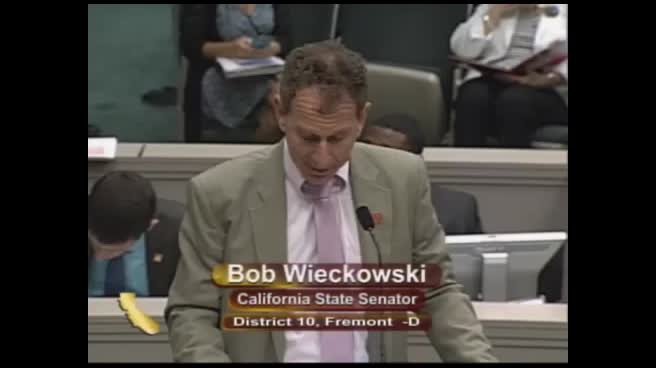 4MIN
Assembly Standing Committee on Appropriations
 39MIN
Assembly Standing Committee on Judiciary
 7MIN
Senate Floor
Bill Author
Bill Co-Author(s):