SB 660: Public Utilities Commission.
- Session Year: 2015-2016
- House: Senate
- Latest Version Date: 2015-09-15
(1)The California Constitution establishes the Public Utilities Commission, with jurisdiction over all public utilities. The California Constitution grants the commission certain general powers over all public utilities, subject to control by the Legislature, and authorizes the Legislature, unlimited by the other provisions of the California Constitution, to confer additional authority and jurisdiction upon the commission that is cognate and germane to the regulation of public utilities. Existing law requires the Governor to designate the president of the commission from among its members and requires the president to direct the executive director, the attorney, and other staff of the commission, except for the Office of Ratepayer Advocates.
This bill would authorize the commission to delegate specific management and internal oversight functions to committees composed of 2 commissioners. The bill would require the commission to appoint a chief administrative law judge who would be responsible for the oversight of the administrative law judge division and would require the chief administrative law judge to organize, coordinate, supervise, and direct the operations of the administrative law judge division as directed by the commission, consistent with commission policies and priorities.
Existing law requires the executive director to keep a full and true record of all proceedings of the commission.
This bill would delete that requirement and would instead require the chief administrative law judge to keep a full and true record of all proceedings of the commission.
(2)Existing law requires the commission, upon initiating a hearing, to assign one or more commissioners to oversee the case and an administrative law judge, where appropriate. Existing law requires the assigned commissioner to prepare and issue, by order or ruling, a scoping memo that describes the issues to be considered and the applicable timetable for resolution. Existing law requires the commission to adopt procedures on the disqualification of administrative law judges due to bias or prejudice similar to those of other state agencies and superior courts.
This bill would require the commission to additionally adopt procedures on disqualification of commissioners due to bias or prejudice similar to those of other state agencies and superior courts. For ratesetting or adjudicatory proceedings, the bill would require a commissioner or an administrative law judge to be disqualified for bias or prejudice based on specified criteria. The bill would require that the commission procedures prohibit a commissioner or administrative law judge from ruling on a motion made by a party to a proceeding to disqualify the commissioner or administrative law judge due to bias or prejudice.
(3)The Public Utilities Act requires the commission to determine whether a proceeding requires a hearing and, if so, to determine whether the matter requires a quasi-legislative, an adjudication, or a ratesetting hearing. For these purposes, quasi-legislative cases are cases that establish policy rulemakings and investigations, which may establish rules affecting an entire industry, adjudication cases are enforcement cases and complaints, except those challenging the reasonableness of any rates or charges, and ratesetting cases are cases in which rates are established for a specific company, including general rate cases, performance-based ratemaking, and other ratesetting mechanisms. The act regulates communications in hearings before the commission and defines ex parte communication to mean any oral or written communication between a decisionmaker and a person with an interest in a matter before the commission concerning substantive, but not procedural, issues that does not occur in a public hearing, workshop, or other public proceeding, or on the official record of the proceeding on the matter. Existing law defines person with an interest to mean, among other things, a person with a financial interest in a matter before the commission, or an agent or employee of the person with a financial interest, or a person receiving consideration for representing the person with a financial interest. Existing law requires the commission, by regulation, to adopt and publish a definition of the terms decisionmaker and persons for those purposes, along with any requirements for written reporting of ex parte communications and appropriate sanctions for noncompliance with any rule proscribing ex parte communications. The act provides that ex parte communications are prohibited in adjudication cases and are prohibited in ratesetting cases, with certain exceptions. The act requires that ex parte communications be permitted in quasi-legislative cases, without any restrictions. The commissions Rules of Practice and Procedure define a decisionmaker as any commissioner, the Chief Administrative Law Judge, any Assistant Chief Administrative Law Judge, the assigned administrative law judge, or the Law and Motion Administrative Law Judge. The Rules of Practice and Procedure provide that communications with a commissioners personal advisors are subject to all of the restrictions on, and reporting requirements applicable to, ex parte communications, except that oral communications with an advisor in ratesetting proceedings are permitted without the restrictions.
This bill would require that the commission determine whether every proceeding, not just those requiring a hearing, is a quasi-legislative, adjudication, or ratesetting proceeding. The bill would delete the provision that an ex parte communication concerns a substantive, but not a procedural matter, and instead would provide that an ex parte communication concerns any matter that the commission has not specified in its Rules of Practice and Procedure as being a procedural matter and that does not occur in a public hearing, workshop, or other public proceeding, or on the official record of the proceeding on the matter. The bill would prohibit the commission from considering as a procedural matter communications between an interested person and a decisionmaker regarding which commissioner or administrative law judge may be assigned to a matter before the commission. The bill would define a person involved in issuing credit ratings or advising entities or persons who may invest in the shares or operations of any party to a proceeding as an interested person. The bill would require that the commission, by rule, adopt and publish a definition of decisionmakers, that would be required to include certain individuals in the commission. The bill would require the commission to establish and maintain a communications log summarizing all oral or written ex parte communications that occur between an interested person and any decisionmaker. The bill would require the commission to post the communications log on its Internet Web site.
This bill would require that a decisionmaker, in an adjudication or ratesetting case, who makes or receives a prohibited ex parte communication, or who receives an ex parte communication that was not timely reported, to disclose certain information regarding the communication in the record of the proceeding before the commission takes a vote on the matter. If a prohibited ex parte communication is not disclosed until after the commission has issued a decision on the matter to which the communication pertained, a party not participating in the communication would be authorized to file a petition to rescind or modify the decision. The bill would require the commission to render decisions based upon the record in a case and would provide that an ex parte communication not be part of the record of the proceeding.
This bill would provide that ex parte communications are permitted in quasi-legislative proceedings, but would require that they be reported within 3 working days in the communications log maintained by the commission.
This bill would require the commission to additionally prohibit communications concerning procedural issues in adjudication cases between parties or persons with an interest and decisionmakers, except for the assigned administrative law judge.
Under existing law, the exceptions to the prohibition upon ex parte communications in ratesetting proceedings authorize a commissioner to permit oral ex parte communications if all interested parties are invited and given not less than 3 days notice. If an ex parte communication meeting is granted to any party, it is required that all other parties also be granted individual ex parte meetings of a substantially equal period of time and that all parties be sent a notice of that authorization at the time the request is granted, at least 3 days prior to the meeting. The exceptions authorize a commissioner to permit written ex parte communications by any party provided that copies of the communication are transmitted to all parties.
This bill would delete the requirement that if an ex parte communication meeting is granted to any party in a ratesetting proceeding, that all other parties also be granted individual ex parte meetings of a substantially equal period of time and that all parties be sent a notice of that authorization at the time the request is granted, at least 3 days prior to the meeting. The bill would prohibit oral communications concerning procedural matters in ratesetting cases between parties or persons with an interest and decisionmakers other than the assigned administrative law judge, except that a commissioner would be authorized to permit an oral communication relative to procedural matters if all interested parties are invited and given not less than 3 days notice. The bill would prohibit written ex parte communications concerning procedural matters in ratesetting cases between parties or persons with an interest and decisionmakers other than the assigned administrative law judge, except that a commissioner would be authorized to permit a written communication relative to procedural issues by any party provided that copies of the communication are transmitted to all parties on the same day.
This bill would expressly make the prohibitions upon ex parte communications that relate to adjudicatory or ratesetting proceedings applicable to ex parte communications that occur at conferences, as defined. The bill would also make the requirements that pertain to ex parte communications that relate to quasi-legislative proceedings applicable to ex parte communications that occur at conferences.
This bill would authorize the commission to impose civil sanctions, including civil penalties, on any entity or person, other than a decisionmaker or employee of the commission, that violates ex parte communication requirements. The bill would authorize the Attorney General to bring an enforcement action in the Superior Court of the City and County of San Francisco against a decisionmaker or employee of the commission who violates the ex parte communication requirements.
This bill would incorporate additional changes in Section 308 of the Public Utilities Code, proposed by SB 48, to be operative only if SB 48 and this bill are both chaptered and become effective on or before January 1, 2016, and this bill is chaptered last.
Under existing law, a violation of the Public Utilities Act or any order, decision, rule, direction, demand, or requirement of the commission is a crime.
Because the provisions of this bill would be a part of the act and because a violation of an order or decision of the commission implementing its requirements would be a crime, the bill would impose a state-mandated local program by expanding the application of a crime.
The California Constitution requires the state to reimburse local agencies and school districts for certain costs mandated by the state. Statutory provisions establish procedures for making that reimbursement.
This bill would provide that no reimbursement is required by this act for a specified reason.
(1)The California Constitution establishes the Public Utilities Commission, with jurisdiction over all public utilities. The California Constitution grants the commission certain general powers over all public utilities, subject to control by the Legislature, and authorizes the Legislature, unlimited by the other provisions of the California Constitution, to confer additional authority and jurisdiction upon the commission that is cognate and germane to the regulation of public utilities. Existing law requires the Governor to designate the president of the commission from among its members and requires the president to direct the executive director, the attorney, and other staff of the commission, except for the Office of Ratepayer Advocates.
This bill would authorize the commission to delegate specific management and internal oversight functions to committees composed of 2 commissioners. The bill would require the commission to appoint a chief administrative law judge who would be responsible for the commissions executive and administrative management and oversight of the administrative law judge division and would require the chief administrative law judge to organize, coordinate, supervise, and direct the operations of the administrative law judge division as directed by the commission, consistent with commission policies and priorities.
Existing law requires the executive director to keep a full and true record of all proceedings of the commission.
This bill would delete that requirement and would instead require the chief administrative law judge to keep a full and true record of all proceedings of the commission.
(2)Existing law requires the commission, upon initiating a hearing, to assign one or more commissioners to oversee the case and an administrative law judge, where appropriate. Existing law requires the assigned commissioner to prepare and issue, by order or ruling, a scoping memo that describes the issues to be considered and the applicable timetable for resolution. Existing law requires the commission to adopt procedures on the disqualification of administrative law judges due to bias or prejudice similar to those of other state agencies and superior courts.
This bill would require the commission to additionally adopt procedures on disqualification of commissioners due to bias or prejudice similar to those of other state agencies and superior courts. For ratesetting or adjudicatory proceedings, the bill would require a commissioner or an administrative law judge to be disqualified for bias or prejudice based on specified criteria. The bill would require that the commission procedures prohibit a commissioner or administrative law judge from ruling on a motion made by a party to a proceeding to disqualify the commissioner or administrative law judge due to bias or prejudice.
(3)The Public Utilities Act requires the commission to determine whether a proceeding requires a hearing and, if so, to determine whether the matter requires a quasi-legislative, an adjudication, or a ratesetting hearing. For these purposes, quasi-legislative cases are cases that establish policy rulemakings and investigations, which may establish rules affecting an entire industry, adjudication cases are enforcement cases and complaints, except those challenging the reasonableness of any rates or charges, and ratesetting cases are cases in which rates are established for a specific company, including general rate cases, performance-based ratemaking, and other ratesetting mechanisms. The act regulates communications in hearings before the commission and defines ex parte communication to mean any oral or written communication between a decisionmaker and a person with an interest in a matter before the commission concerning substantive, but not procedural, issues that does not occur in a public hearing, workshop, or other public proceeding, or on the official record of the proceeding on the matter. Existing law defines person with an interest to mean, among other things, a person with a financial interest in a matter before the commission, or an agent or employee of the person with a financial interest, or a person receiving consideration for representing the person with a financial interest. Existing law requires the commission, by regulation, to adopt and publish a definition of the terms decisionmaker and persons for those purposes, along with any requirements for written reporting of ex parte communications and appropriate sanctions for noncompliance with any rule proscribing ex parte communications. The act provides that ex parte communications are prohibited in adjudication cases and are prohibited in ratesetting cases, with certain exceptions. The act requires that ex parte communications be permitted in quasi-legislative cases, without any restrictions. The commissions Rules of Practice and Procedure define a decisionmaker as any commissioner, the Chief Administrative Law Judge, any Assistant Chief Administrative Law Judge, the assigned administrative law judge, or the Law and Motion Administrative Law Judge. The Rules of Practice and Procedure provide that communications with a commissioners personal advisors are subject to all of the restrictions on, and reporting requirements applicable to, ex parte communications, except that oral communications with an advisor in ratesetting proceedings are permitted without the restrictions.
This bill would require that the commission determine whether every proceeding, not just those requiring a hearing, is a quasi-legislative, adjudication, or ratesetting proceeding. The bill would delete the provision that an ex parte communication concerns a substantive, but not a procedural matter, and instead would provide that an ex parte communication concerns any matter that the commission has not specified in its Rules of Practice and Procedure as being a procedural matter and that does not occur in a public hearing, workshop, or other public proceeding, or on the official record of the proceeding on the matter. The bill would prohibit the commission from considering as a procedural matter communications between an interested person and a decisionmaker regarding which commissioner or administrative law judge may be assigned to a matter before the commission. The bill would define a person involved in issuing credit ratings or advising entities or persons who may invest in the shares or operations of any party to a proceeding as an interested person. The bill would require that the commission, by rule, adopt and publish a definition of decisionmakers, that would be required to include certain individuals in the commission. The bill would require the commission to establish and maintain a communications log summarizing all oral or written ex parte communications that occur between an interested person and the commission, the attorney for the commission, the executive director of the commission, the personal staff of a commissioner, if the staff is acting in a policy or legal advisory capacity, the chief administrative law judge, or the administrative law judge assigned to the proceeding. any decisionmaker. The bill would require the commission to post the communications log on its Internet Web site.
This bill would require that a decisionmaker, in an adjudication or ratesetting case, who makes or receives a prohibited ex parte communication, or who receives an ex parte communication that was not timely reported, to disclose certain information regarding the communication in the record of the proceeding before the commission takes a vote on the matter. If a prohibited ex parte communication is not disclosed until after the commission has issued a decision on the matter to which the communication pertained, a party not participating in the communication would be authorized to file a petition to rescind or modify the decision. The bill would require the commission to render decisions based upon the record in a case and would provide that an ex parte communication not be part of the record of the proceeding.
This bill would provide that ex parte communications are permitted in quasi-legislative proceedings, but would require that they be reported within 3 working days in the communications log maintained by the commission.
This bill would require the commission to additionally prohibit communications concerning procedural issues in adjudication cases between parties or persons with an interest and decisionmakers, except for the assigned administrative law judge.
Under existing law, the exceptions to the prohibition upon ex parte communications in ratesetting proceedings authorize a commissioner to permit oral ex parte communications if all interested parties are invited and given not less than 3 days notice. If an ex parte communication meeting is granted to any party, it is required that all other parties also be granted individual ex parte meetings of a substantially equal period of time and that all parties be sent a notice of that authorization at the time the request is granted, at least 3 days prior to the meeting. The exceptions authorize a commissioner to permit written ex parte communications by any party provided that copies of the communication are transmitted to all parties.
This bill would delete the requirement that if an ex parte communication meeting is granted to any party in a ratesetting proceeding, that all other parties also be granted individual ex parte meetings of a substantially equal period of time and that all parties be sent a notice of that authorization at the time the request is granted, at least 3 days prior to the meeting. The bill would prohibit oral communications concerning procedural matters in ratesetting cases between parties or persons with an interest and decisionmakers other than the assigned administrative law judge, except that a commissioner would be authorized to permit an oral communication relative to procedural matters if all interested parties are invited and given not less than 3 days notice. The bill would prohibit written ex parte communications concerning procedural matters in ratesetting cases between parties or persons with an interest and decisionmakers other than the assigned administrative law judge, except that a commissioner would be authorized to permit a written communication relative to procedural issues by any party provided that copies of the communication are transmitted to all parties on the same day.
This bill would expressly make the prohibitions upon ex parte communications that relate to adjudicatory or ratesetting proceedings applicable to ex parte communications that occur at conferences, as defined. The bill would also make the requirements that pertain to ex parte communications that relate to quasi-legislative proceedings applicable to ex parte communications that occur at conferences.
This bill would authorize the commission to impose civil sanctions, including civil penalties, on any entity or person, other than a decisionmaker or employee of the commission, that violates ex parte communication requirements. The bill would authorize the Attorney General to bring an enforcement action in the Superior Court of the City and County of San Francisco against a decisionmaker or employee of the commission who violates the ex parte communication requirements.
This bill would incorporate additional changes in Section 308 of the Public Utilities Code, proposed by SB 48, to be operative only if SB 48 and this bill are both chaptered and become effective on or before January 1, 2016, and this bill is chaptered last.
Under existing law, a violation of the Public Utilities Act or any order, decision, rule, direction, demand, or requirement of the commission is a crime.
Because the provisions of this bill would be a part of the act and because a violation of an order or decision of the commission implementing its requirements would be a crime, the bill would impose a state-mandated local program by expanding the application of a crime.
The California Constitution requires the state to reimburse local agencies and school districts for certain costs mandated by the state. Statutory provisions establish procedures for making that reimbursement.
This bill would provide that no reimbursement is required by this act for a specified reason.
(1)The California Constitution establishes the Public Utilities Commission, with jurisdiction over all public utilities. The California Constitution grants the commission certain general powers over all public utilities, subject to control by the Legislature, and authorizes the Legislature, unlimited by the other provisions of the California Constitution, to confer additional authority and jurisdiction upon the commission that is cognate and germane to the regulation of public utilities. Existing law requires the Governor to designate the president of the commission from among its members and requires the president to direct the executive director, the attorney, and other staff of the commission, except for the Office of Ratepayer Advocates. Existing law authorizes the executive director and the attorney to undertake certain actions if directed or authorized by the president, except as otherwise directed or authorized by vote of the commission.
This bill would repeal the requirement that the president direct the executive director, the attorney, and other commission staff. The bill would delete the authority of the president to direct or authorize the executive director and attorney to undertake certain actions, and would instead require that they be directed or authorized to undertake those actions by the commission. The bill would authorize the commission to delegate specific management and internal oversight functions to committees composed of 2 commissioners. The bill would require the commission to vote in an open meeting on the assignment or reassignment of proceeding to one or more commissioners. The bill would require the commission to appoint a chief administrative law judge who would be responsible for the commissions executive and administrative management and oversight of the administrative law judge division and would require the chief administrative law judge to organize, coordinate, supervise, and direct the operations of the administrative law judge division as directed by the commission, consistent with commission policies and priorities.
Existing law requires the executive director to keep a full and true record of all proceedings of the commission.
This bill would delete that requirement and would instead require the chief administrative law judge to keep a full and true record of all proceedings of the commission.
(2)Existing law requires the commission, upon initiating a hearing, to assign one or more commissioners to oversee the case and an administrative law judge, where appropriate. Existing law requires the assigned commissioner to prepare and issue, by order or ruling, a scoping memo that describes the issues to be considered and the applicable timetable for resolution. Existing law requires the commission to adopt procedures on the disqualification of administrative law judges due to bias or prejudice similar to those of other state agencies and superior courts.
This bill would require the commission to additionally adopt procedures on disqualification of commissioners due to bias or prejudice similar to those of other state agencies and superior courts. For ratesetting or adjudicatory proceedings, the bill would require a commissioner or an administrative law judge to be disqualified if there is an appearance of for bias or prejudice based on specified criteria. The bill would require that the commission procedures prohibit a commissioner or administrative law judge from ruling on a motion made by a party to a proceeding to disqualify the commissioner or administrative law judge due to bias or prejudice.
(3)The Public Utilities Act requires the commission to determine whether a proceeding requires a hearing and, if so, to determine whether the matter requires a quasi-legislative, an adjudication, or a ratesetting hearing. For these purposes, quasi-legislative cases are cases that establish policy rulemakings and investigations, which may establish rules affecting an entire industry, adjudication cases are enforcement cases and complaints, except those challenging the reasonableness of any rates or charges, and ratesetting cases are cases in which rates are established for a specific company, including general rate cases, performance-based ratemaking, and other ratesetting mechanisms. The act regulates communications in hearings before the commission and defines ex parte communication to mean any oral or written communication between a decisionmaker and a person with an interest in a matter before the commission concerning substantive, but not procedural, issues that does not occur in a public hearing, workshop, or other public proceeding, or on the official record of the proceeding on the matter. Existing law defines person with an interest to mean, among other things, a person with a financial interest in a matter before the commission, or an agent or employee of the person with a financial interest, or a person receiving consideration for representing the person with a financial interest. Existing law requires the commission, by regulation, to adopt and publish a definition of the terms decisionmaker and persons for those purposes, along with any requirements for written reporting of ex parte communications and appropriate sanctions for noncompliance with any rule proscribing ex parte communications. The act provides that ex parte communications are prohibited in adjudication cases and are prohibited in ratesetting cases, with certain exceptions. The act requires that ex parte communications be permitted in quasi-legislative cases, without any restrictions. The commissions Rules of Practice and Procedure define a decisionmaker as any commissioner, the Chief Administrative Law Judge, any Assistant Chief Administrative Law Judge, the assigned administrative law judge, or the Law and Motion Administrative Law Judge. The Rules of Practice and Procedure provide that communications with a commissioners personal advisors are subject to all of the restrictions on, and reporting requirements applicable to, ex parte communications, except that oral communications with an advisor in ratesetting proceedings are permitted without the restrictions.
This bill would require that the commission determine whether every proceeding, not just those requiring a hearing, is a quasi-legislative, adjudication, or ratesetting proceeding. The bill would delete the provision that an ex parte communication concerns a substantive, but not a procedural matter, and instead would provide that an ex parte communication concerns any matter that the commission has not specified in its Rules of Practice and Procedure as being a procedural matter and that does not occur in a public hearing, workshop, or other public proceeding, or on the official record of the proceeding on the matter. The bill would prohibit the commission from considering as a procedural matter communications between an interested person and a decisionmaker regarding which commissioner or administrative law judge may be assigned to a matter before the commission. The bill would define a person involved in issuing credit ratings or advising entities or persons who may invest in the shares or operations of any party to a proceeding as an interested person. The bill would require that the commission, by rule, adopt and publish a definition of decisionmakers, that would be required to include certain individuals in the commission. The bill would require decisionmakers to periodically report summary logs of ex parte communications with interested persons in compliance with rules established by the commission, and included in the commissions Rules of Practice and Procedure, and the commission to establish and maintain a communications log summarizing all oral or written ex parte communications that occur between an interested person and the commission, the attorney for the commission, the executive director of the commission, the personal staff of a commissioner, if the staff is acting in a policy or legal advisory capacity, the chief administrative law judge, or the administrative law judge assigned to the proceeding. The bill would require the commission to post those summary logs the communications log on its Internet Web site.
This bill would require that a decisionmaker, in an adjudication or ratesetting case, who makes or receives a prohibited ex parte communication, or who receives an ex parte communication that was not timely reported, to disclose certain information regarding the communication in the record of the proceeding before the commission takes a vote on the matter. If a prohibited ex parte communication is not disclosed until after the commission has issued a decision on the matter to which the communication pertained, a party not participating in the communication would be authorized to file a petition to rescind or modify the decision. The bill would require the commission to render decisions based upon the record in a case and would provide that an ex parte communication not be part of the record of the proceeding.
This bill would provide that ex parte communications are permitted in quasi-legislative proceedings, but would require that they be reported within 3 working days of the communication by filing a Notice of Ex Parte Communication with the commission in accordance with procedures established by the commission for the service of that notice and containing specified information. in the communications log maintained by the commission.
This bill would require the commission to additionally prohibit communications concerning procedural issues in adjudication cases between parties or persons with an interest and decisionmakers, except for the assigned administrative law judge.
Under existing law, the exceptions to the prohibition upon ex parte communications in ratesetting proceedings authorize a commissioner to permit oral ex parte communications if all interested parties are invited and given not less than 3 days notice. If an ex parte communication meeting is granted to any party, it is required that all other parties also be granted individual ex parte meetings of a substantially equal period of time and that all parties be sent a notice of that authorization at the time the request is granted, at least 3 days prior to the meeting. The exceptions authorize a commissioner to permit written ex parte communications by any party provided that copies of the communication are transmitted to all parties.
This bill would delete the requirement that if an ex parte communication meeting is granted to any party in a ratesetting proceeding, that all other parties also be granted individual ex parte meetings of a substantially equal period of time and that all parties be sent a notice of that authorization at the time the request is granted, at least 3 days prior to the meeting. The bill would prohibit oral communications concerning procedural matters in ratesetting cases between parties or persons with an interest and decisionmakers other than the assigned administrative law judge, except that a commissioner would be authorized to permit an oral communication relative to procedural matters if all interested parties are invited and given not less than 3 days notice. The bill would prohibit written ex parte communications concerning procedural matters in ratesetting cases between parties or persons with an interest and decisionmakers other than the assigned administrative law judge, except that a commissioner would be authorized to permit a written communication relative to procedural issues by any party provided that copies of the communication are transmitted to all parties on the same day.
This bill would expressly make the prohibitions upon ex parte communications that relate to adjudicatory or ratesetting proceedings applicable to ex parte communications that occur at conferences, as defined. The bill would also make the requirements that pertain to ex parte communications that relate to quasi-legislative proceedings applicable to ex parte communications that occur at conferences.
This bill would authorize the commission to impose civil sanctions, including civil penalties, on any entity or person, other than a decisionmaker or employee of the commission, that violates ex parte communication requirements. The bill would authorize the Attorney General to bring an enforcement action in the Superior Court of the City and County of San Francisco against a decisionmaker or employee of the commission who violates the ex parte communication requirements.
Under existing law, a violation of the Public Utilities Act or any order, decision, rule, direction, demand, or requirement of the commission is a crime.
Because the provisions of this bill would be a part of the act and because a violation of an order or decision of the commission implementing its requirements would be a crime, the bill would impose a state-mandated local program by expanding the application of a crime.
The California Constitution requires the state to reimburse local agencies and school districts for certain costs mandated by the state. Statutory provisions establish procedures for making that reimbursement.
This bill would provide that no reimbursement is required by this act for a specified reason.
(1)The California Constitution establishes the Public Utilities Commission, with jurisdiction over all public utilities. The California Constitution grants the commission certain general powers over all public utilities, subject to control by the Legislature, and authorizes the Legislature, unlimited by the other provisions of the California Constitution, to confer additional authority and jurisdiction upon the commission that is cognate and germane to the regulation of public utilities. Existing law requires the Governor to designate the president of the commission from among its members and requires the president to direct the executive director, the attorney, and other staff of the commission, except for the Office of Ratepayer Advocates. Existing law authorizes the executive director and the attorney to undertake certain actions if directed or authorized by the president, except as otherwise directed or authorized by vote of the commission.
This bill would repeal the requirement that the president direct the executive director, the attorney, and other commission staff. The bill would delete the authority of the president to direct or authorize the executive director and attorney to undertake certain actions, and would instead require that they be directed or authorized to undertake those actions by the commission. The bill would authorize the commission to delegate specific management and internal oversight functions to committees composed of 2 commissioners. The bill would require the commission to vote in an open meeting on the assignment or reassignment of proceeding to one or more commissioners.
(2)Existing law requires the commission, upon initiating a hearing, to assign one or more commissioners to oversee the case and an administrative law judge, where appropriate. Existing law requires the assigned commissioner to prepare and issue, by order or ruling, a scoping memo that describes the issues to be considered and the applicable timetable for resolution. Existing law requires the commission to adopt procedures on the disqualification of administrative law judges due to bias or prejudice similar to those of other state agencies and superior courts.
This bill would require the commission to additionally adopt procedures on disqualification of commissioners due to bias or prejudice similar to those of other state agencies and superior courts. For ratesetting or adjudicatory proceedings, the bill would require a commissioner or an administrative law judge to be disqualified if there is an appearance of bias or prejudice based on specified criteria. The bill would require that the commission procedures prohibit a commissioner or administrative law judge from ruling on a motion made by a party to a proceeding to disqualify the commissioner or administrative law judge due to bias or prejudice.
(3)The Public Utilities Act requires the commission to determine whether a proceeding requires a hearing and, if so, to determine whether the matter requires a quasi-legislative, an adjudication, or a ratesetting hearing. For these purposes, quasi-legislative cases are cases that establish policy rulemakings and investigations, which may establish rules affecting an entire industry, adjudication cases are enforcement cases and complaints, except those challenging the reasonableness of any rates or charges, and ratesetting cases are cases in which rates are established for a specific company, including general rate cases, performance-based ratemaking, and other ratesetting mechanisms. The act regulates communications in hearings before the commission and defines ex parte communication to mean any oral or written communication between a decisionmaker and a person with an interest in a matter before the commission concerning substantive, but not procedural, issues that does not occur in a public hearing, workshop, or other public proceeding, or on the official record of the proceeding on the matter. Existing law defines person with an interest to mean, among other things, a person with a financial interest in a matter before the commission, or an agent or employee of the person with a financial interest, or a person receiving consideration for representing the person with a financial interest. Existing law requires the commission, by regulation, to adopt and publish a definition of the terms decisionmaker and persons for those purposes, along with any requirements for written reporting of ex parte communications and appropriate sanctions for noncompliance with any rule proscribing ex parte communications. The act provides that ex parte communications are prohibited in adjudication cases and are prohibited in ratesetting cases, with certain exceptions. The act requires that ex parte communications be permitted in quasi-legislative cases, without any restrictions. The commissions Rules of Practice and Procedure define a decisionmaker as any commissioner, the Chief Administrative Law Judge, any Assistant Chief Administrative Law Judge, the assigned administrative law judge, or the Law and Motion Administrative Law Judge. The Rules of Practice and Procedure provide that communications with a commissioners personal advisors are subject to all of the restrictions on, and reporting requirements applicable to, ex parte communications, except that oral communications with an advisor in ratesetting proceedings are permitted without the restrictions.
This bill would delete the provision that an ex parte communication concerns a substantive, but not a procedural matter, and instead would provide that an ex parte communication concerns any matter that the commission has not specified in its Rules of Practice and Procedure as being a procedural matter. The bill would prohibit the commission from considering as a procedural matter communications between an interested person and a decisionmaker regarding which commissioner or administrative law judge may be assigned to a matter before the commission. The bill would define a person involved in issuing credit ratings or advising entities or persons who may invest in the shares or operations of any party to a proceeding as an interested person. The bill would require that the commission, by rule, adopt and publish a definition of decisionmakers, that would be required to include certain individuals in the commission. The bill would require decisionmakers to periodically report summary logs of ex parte communications with interested persons in compliance with rules established by the commission, and included in the commissions Rules of Practice and Procedure, and would require the commission to post those summary logs on its Internet Web site.
This bill would require that a decisionmaker, in an adjudication or ratesetting case, who makes or receives a prohibited ex parte communication, or who receives an ex parte communication that was not timely reported, to disclose certain information regarding the communication in the record of the proceeding before the commission takes a vote on the matter. The bill would require the commission to render decisions based upon the record in a case and would provide that an ex parte communication not be part of the record of the proceeding.
This bill would provide that ex parte communications are permitted in quasi-legislative proceedings, but would require that they be reported within 3 working days of the communication by filing a Notice of Ex Parte Communication with the commission in accordance with procedures established by the commission for the service of that notice and containing specified information.
This bill would require the commission to additionally prohibit communications concerning procedural issues in adjudication cases between parties or persons with an interest and decisionmakers, except for the assigned administrative law judge.
Under existing law, the exceptions to the prohibition upon ex parte communications in ratesetting proceedings authorize a commissioner to permit oral ex parte communications if all interested parties are invited and given not less than 3 days notice. If an ex parte communication meeting is granted to any party, it is required that all other parties also be granted individual ex parte meetings of a substantially equal period of time and that all parties be sent a notice of that authorization at the time the request is granted, at least 3 days prior to the meeting. The exceptions authorize a commissioner to permit written ex parte communications by any party provided that copies of the communication are transmitted to all parties.
This bill would delete the requirement that if an ex parte communication meeting is granted to any party in a ratesetting proceeding, that all other parties also be granted individual ex parte meetings of a substantially equal period of time and that all parties be sent a notice of that authorization at the time the request is granted, at least 3 days prior to the meeting. The bill would prohibit oral communications concerning procedural matters in ratesetting cases between parties or persons with an interest and decisionmakers other than the assigned administrative law judge, except that a commissioner would be authorized to permit an oral communication relative to procedural matters if all interested parties are invited and given not less than 3 days notice. The bill would prohibit written ex parte communications concerning procedural matters in ratesetting cases between parties or persons with an interest and decisionmakers other than the assigned administrative law judge, except that a commissioner would be authorized to permit a written communication relative to procedural issues by any party provided that copies of the communication are transmitted to all parties on the same day.
This bill would authorize the commission to impose civil sanctions, including civil penalties, on any entity or person, other than a decisionmaker or employee of the commission, that violates ex parte communication requirements. The bill would authorize the Attorney General to bring an enforcement action in the Superior Court of the City and County of San Francisco against a decisionmaker or employee of the commission who violates the ex parte communication requirements.
Under existing law, a violation of the Public Utilities Act or any order, decision, rule, direction, demand, or requirement of the commission is a crime.
Because the provisions of this bill would be a part of the act and because a violation of an order or decision of the commission implementing its requirements would be a crime, the bill would impose a state-mandated local program by expanding the application of a crime.
The California Constitution requires the state to reimburse local agencies and school districts for certain costs mandated by the state. Statutory provisions establish procedures for making that reimbursement.
This bill would provide that no reimbursement is required by this act for a specified reason.
(1)The California Constitution establishes the Public Utilities Commission, with jurisdiction over all public utilities. The California Constitution grants the commission certain general powers over all public utilities, subject to control by the Legislature, and authorizes the Legislature, unlimited by the other provisions of the California Constitution, to confer additional authority and jurisdiction upon the commission that is cognate and germane to the regulation of public utilities. Existing law requires the Governor to designate the president of the commission from among its members and requires the president to direct the executive director, the attorney, and other staff of the commission, except for the Office of Ratepayer Advocates. Existing law authorizes the executive director and the attorney to undertake certain actions if directed or authorized by the president, except as otherwise directed or authorized by vote of the commission.
This bill would repeal the requirement that the president direct the executive director, the attorney, and other commission staff. The bill would delete the authority of the president to direct or authorize the executive director and attorney to undertake certain actions, and would instead require that they be directed or authorized to undertake those actions by the commission. The bill would authorize the commission to delegate specific management and internal oversight functions to committees composed of 2 commissioners. The bill would require the commission to vote in an open meeting on the assignment or reassignment of proceeding to one or more commissioners.
(2)Existing law requires the commission, upon initiating a hearing, to assign one or more commissioners to oversee the case and an administrative law judge, where appropriate. Existing law requires the assigned commissioner to prepare and issue, by order or ruling, a scoping memo that describes the issues to be considered and the applicable timetable for resolution. Existing law requires the commission, commission to adopt procedures on the disqualification of administrative law judges due to bias or prejudice similar to those of other state agencies and superior courts.
This bill would require the commission to additionally adopt procedures on disqualification of commissioners due to bias or prejudice similar to those of other state agencies and superior courts. For ratesetting or adjudicatory proceedings, the bill would require a commissioner or an administrative law judge to be disqualified if there is an appearance of bias or prejudice based on specified criteria. The bill would prohibit require that the commission procedures from authorizing prohibit a commissioner or administrative law judge from ruling on a motion made by a party to a proceeding to disqualify the commissioner or administrative law judge due to bias or prejudice.
(3)The Public Utilities Act requires the commission to determine whether a proceeding requires a hearing and, if so, to determine whether the matter requires a quasi-legislative, an adjudication, or a ratesetting hearing. For these purposes, quasi-legislative cases are cases that establish policy rulemakings and investigations, which may establish rules affecting an entire industry, adjudication cases are enforcement cases and complaints, except those challenging the reasonableness of any rates or charges, and ratesetting cases are cases in which rates are established for a specific company, including general rate cases, performance-based ratemaking, and other ratesetting mechanisms. The act regulates communications in hearings before the commission and defines ex parte communication to mean any oral or written communication between a decisionmaker and a person with an interest in a matter before the commission concerning substantive, but not procedural, issues that does not occur in a public hearing, workshop, or other public proceeding, or on the official record of the proceeding on the matter. Existing law defines person with an interest to mean, among other things, a person with a financial interest in a matter before the commission, or an agent or employee of the person with a financial interest, or a person receiving consideration for representing the person with a financial interest. Existing law requires the commission, by regulation, to adopt and publish a definition of the terms decisionmaker and persons for those purposes, along with any requirements for written reporting of ex parte communications and appropriate sanctions for noncompliance with any rule proscribing ex parte communications. The act provides that ex parte communications are prohibited in adjudication cases and are prohibited in ratesetting cases, with certain exceptions. The act requires that ex parte communications be permitted in quasi-legislative cases, without any restrictions. The commissions Rules of Practice and Procedure define a decisionmaker as any commissioner, the Chief Administrative Law Judge, any Assistant Chief Administrative Law Judge, the assigned administrative law judge, or the Law and Motion Administrative Law Judge. The Rules of Practice and Procedure provide that communications with a commissioners commissioners personal advisors are subject to all of the restrictions on, and reporting requirements applicable to, ex parte communications, except that oral communications with an advisor in ratesetting proceedings are permitted without the restrictions.
This bill would delete the provision that an ex parte communication concerns a substantive, but not a procedural matter, and instead would provide that an ex parte communication concerns any matter that the commission has not specified in its Rules of Practice and Procedure as being a procedural matter that is an appropriate subject for ex parte communication. The bill would require the commission to specify those procedural matters that are appropriate subjects for ex parte communications in its Rules of Practice and Procedure. matter. The bill would prohibit the commission from considering as a procedural matter communications between an interested person and a decisionmaker regarding which commissioner or administrative law judge may be assigned to a matter before the commission. The bill would define a person involved in issuing credit ratings or advising entities or persons who may invest in the shares or operations of any party to a proceeding as a person with a financial interest. an interested person. The bill would require that the commission, by rule, adopt and publish a definition of decisionmakers, that would be required to include each commissioner, the attorney for the commission, the executive director of the commission, the personal staff of each commissioner, including each advisor to a commissioner, the administrative law judge assigned to the proceeding, the director of the Energy Division, the director of the Communications Division, the director of the Water and Audits Division, and the director of the Safety and Enforcement Division. certain individuals in the commission. The bill would require communications between a person with an interest who is not a party to a commission proceeding and a decisionmaker to be reported by the decisionmaker but would not require the communications to be reported by the person with an interest who is not a party to a commission proceeding. decisionmakers to periodically report summary logs of ex parte communications with interested persons in compliance with rules established by the commission, and included in the commissions Rules of Practice and Procedure, and would require the commission to post those summary logs on its Internet Web site.
This bill would require that a decisionmaker decisionmaker, in an adjudication or ratesetting case, who makes or receives a prohibited ex parte communication, or who learns that a permissible receives an ex parte communication that was not reported as required, timely reported, to disclose the content of certain information regarding the communication in the record of the proceeding. proceeding before the commission takes a vote on the matter. The bill would require the commission to establish rules for how to handle prohibited ex parte communications, including rules requiring reporting the person initiating the communication and whether the person persisted in continuing the communication after being advised that the communication was prohibited. The bill would require the commission to render decisions based upon the record in a case and would provide that an ex parte communication not be part of the record of any proceeding and not be considered, or relied upon, for purposes of the commissions resolution of contested issues. the proceeding.
This bill would provide that ex parte communications are permitted in quasi-legislative proceedings, but would require that they be reported within 3 working days of the communication by filing a Notice of Ex Parte Communication with the commission in accordance with procedures established by the commission for the service of that notice. notice and containing specified information.
This bill would require the commission to additionally prohibit communications concerning procedural issues in adjudication cases between parties or persons with an interest and decisionmakers, except for the assigned administrative law judge.
The
Under existing law, the exceptions to the prohibition upon ex parte communications in ratesetting proceedings authorize a commissioner to permit oral ex parte communications if all interested parties are invited and given not less than 3 days notice. If an ex parte communication meeting is granted to any party, it is required that all other parties also be granted individual ex parte meetings of a substantially equal period of time and that all parties be sent a notice of that authorization at the time the request is granted, at least 3 days prior to the meeting. The exceptions authorize a commissioner to permit written ex parte communications by any party provided that copies of the communication are transmitted to all parties.
This bill would delete the requirement that if an ex parte communication meeting is granted to any party in a ratesetting proceeding, that all other parties also be granted individual ex parte meetings of a substantially equal period of time and that all parties be sent a notice of that authorization at the time the request is granted, at least 3 days prior to the meeting. The bill would prohibit oral communications concerning procedural issues matters in ratesetting cases between parties or persons with an interest and decisionmakers other than the assigned administrative law judge, except that a commissioner would be authorized to permit an oral communication relative to procedural issues matters if all interested parties are invited and given not less than 3 days notice. The bill would prohibit written ex parte communications concerning procedural issues matters in ratesetting cases between parties or persons with an interest and decisionmakers other than the assigned administrative law judge, except that a commissioner would be authorized to permit a written communication relative to procedural issues by any party provided that copies of the communication are transmitted to all parties on the same day.
This bill would make any violation of the ex parte communications requirements by any person punishable by an unspecified fine or by imprisonment, or by both that fine and imprisonment, thereby imposing a state-mandated local program by creating new crimes. authorize the commission to impose civil sanctions, including civil penalties, on any entity or person, other than a decisionmaker or employee of the commission, that violates ex parte communication requirements. The bill would authorize the Attorney General to bring an enforcement action in the Superior Court of the City and County of San Francisco against a decisionmaker or employee of the commission who violates the ex parte communication requirements.
Under existing law, a violation of the Public Utilities Act or any order, decision, rule, direction, demand, or requirement of the commission is a crime.
Because the provisions of this bill would be a part of the act and because a violation of an order or decision of the commission implementing its requirements would be a crime, the bill would impose a state-mandated local program by expanding the application of a crime.
The California Constitution requires the state to reimburse local agencies and school districts for certain costs mandated by the state. Statutory provisions establish procedures for making that reimbursement.
This bill would provide that no reimbursement is required by this act for a specified reason.
The
(1)The California Constitution establishes the Public Utilities Commission, with jurisdiction over all public utilities. The California Constitution authorizes the commission to establish rules for all public utilities, subject to control by the Legislature, and to establish its own procedures, subject to statutory limitations or directions and constitutional requirements of due process. grants the commission certain general powers over all public utilities, subject to control by the Legislature, and authorizes the Legislature, unlimited by the other provisions of the California Constitution, to confer additional authority and jurisdiction upon the commission that is cognate and germane to the regulation of public utilities. Existing law requires the Governor to designate the president of the commission from among its members and requires the president to direct the executive director, the attorney, and other staff of the commission, except for the Office of Ratepayer Advocates. Existing law authorizes the executive director and the attorney to undertake certain actions if directed or authorized by the president, except as otherwise directed or authorized by vote of the commission.
This bill would repeal the requirement that the president direct the executive director, the attorney, and other commission staff. The bill would delete the authority of the president to direct or authorize the executive director and attorney to undertake certain actions, and would instead require that they be directed or authorized to undertake those actions by the commission. The bill would authorize the commission to delegate specific management and internal oversight functions to committees composed of 2 commissioners. The bill would require the commission to vote in an open meeting on the assignment or reassignment of proceeding to one or more commissioners.
(2)Existing law requires the commission, upon initiating a hearing, to assign one or more commissioners to oversee the case and an administrative law judge, where appropriate. Existing law requires the assigned commissioner to prepare and issue, by order or ruling, a scoping memo that describes the issues to be considered and the applicable timetable for resolution. Existing law requires the commission, to adopt procedures on the disqualification of administrative law judges due to bias or prejudice similar to those of other state agencies and superior courts.
This bill would require the commission to additionally adopt procedures on disqualification of commissioners due to bias or prejudice similar to those of other state agencies and superior courts. For ratesetting or adjudicatory proceedings, the bill would require a commissioner or an administrative law judge to be disqualified if there is an appearance of bias or prejudice based on specified criteria. The bill would prohibit commission procedures from authorizing a commissioner or administrative law judge from ruling on a motion made by a party to a proceeding to disqualify the commissioner or administrative law judge due to bias or prejudice.
The
(3)The Public Utilities Act requires the commission to determine whether a proceeding requires a hearing and, if so, to determine whether the matter requires a quasi-legislative, an adjudication, or a ratesetting hearing. For these purposes, quasi-legislative cases are cases that establish policy rulemakings and investigations, which may establish rules affecting an entire industry, adjudication cases are enforcement cases and complaints, except those challenging the reasonableness of any rates or charges, and ratesetting cases are cases in which rates are established for a specific company, including general rate cases, performance-based ratemaking, and other ratesetting mechanisms. Existing law requires the commission, upon initiating a hearing, to assign one or more commissioners to oversee the case and an administrative law judge, where appropriate. The act regulates communications in hearings before the commission and defines ex parte communication to mean any oral or written communication between a decisionmaker and a person with an interest in a matter before the commission concerning substantive, but not procedural, issues that does not occur in a public hearing, workshop, or other public proceeding, or on the official record of the proceeding on the matter. Existing law defines person with an interest to mean, among other things, a person with a financial interest in a matter before the commission, or an agent or employee of the person with a financial interest, or a person receiving consideration for representing the person with a financial interest. Existing law requires the commission, by regulation, to adopt and publish a definition of the terms decisionmaker and persons for those purposes, along with any requirements for written reporting of ex parte communications and appropriate sanctions for noncompliance with any rule proscribing ex parte communications. The act provides that ex parte communications are prohibited in adjudication cases and are prohibited in ratesetting cases, with certain exceptions. The act requires that ex parte communications be permitted in quasi-legislative cases, without any restrictions. The commissions Rules of Practice and Procedure define a decisionmaker as any commissioner, the Chief Administrative Law Judge, any Assistant Chief Administrative Law Judge, the assigned administrative law judge, or the Law and Motion Administrative Law Judge. The Rules of Practice and Procedure provide that communications with a commissioners personal advisors are subject to all of the restrictions on, and reporting requirements applicable to, ex parte communications, except that oral communications with an advisor in ratesetting proceedings are permitted without the restrictions.
This bill would delete the provision that an ex parte communication concerns a substantive, but not a procedural matter, and instead would provide that an ex parte communication concerns any matter that the commission has not specified as being a procedural matter that is an appropriate subject for ex parte communication. The bill would require the commission to specify those procedural matters that are appropriate subjects for ex parte communications in its Rules of Practice and Procedure. The bill would define a person involved in issuing credit ratings or advising entities or persons who may invest in the shares or operations of any party to a proceeding as a person with a financial interest. The bill would require that the commission, by rule, adopt and publish a definition of decisionmakers, that would be required to include commissioners, each advisor to a commissioner, and an administrative law judge assigned to the proceeding, thereby making the restrictions on ex parte communications applicable to an advisor to a commissioner in a ratesetting proceeding. each commissioner, the attorney for the commission, the executive director of the commission, the personal staff of each commissioner, including each advisor to a commissioner, the administrative law judge assigned to the proceeding, the director of the Energy Division, the director of the Communications Division, the director of the Water and Audits Division, and the director of the Safety and Enforcement Division. The bill would require communications between a person with an interest who is not a party to a commission proceeding and a decisionmaker to be reported by the decisionmaker but would not require the communications to be reported by the person with an interest who is not a party to a commission proceeding.
This bill would require that a decisionmaker who makes or receives a prohibited ex parte communication, or who learns that a permissible ex parte communication was not reported as required, to disclose the content of the communication in the record of the proceeding. The bill would require the commission to establish rules for how to handle prohibited ex parte communications, including rules requiring reporting the person initiating the communication and whether the person persisted in continuing the communication after being advised that the communication was prohibited. The bill would require that an ex parte communication not be part of the record of any proceeding and not be considered, or relied upon, for purposes of the commissions resolution of contested issues.
This bill would provide that ex parte communications are permitted in quasi-legislative proceedings, but would require that they be reported within 3 working days of the communication by filing a Notice of Ex Parte Communication with the commission in accordance with procedures established by the commission for the service of that notice.
This bill would require the commission to additionally prohibit communications concerning procedural issues in adjudication cases between parties or persons with an interest and decisionmakers, except for the assigned administrative law judge.
The exceptions to the prohibition upon ex parte communications in ratesetting proceedings authorize a commissioner to permit oral ex parte communications if all interested parties are invited and given not less than 3 days notice. If an ex parte communication meeting is granted to any party, it is required that all other parties also be granted individual ex parte meetings of a substantially equal period of time and that all parties be sent a notice of that authorization at the time the request is granted, at least 3 days prior to the meeting. The exceptions authorize a commissioner to permit written ex parte communications by any party provided that copies of the communication are transmitted to all parties.
This bill would delete the requirement that if an ex parte communication meeting is granted to any party, party in a ratesetting proceeding, that all other parties also be granted individual ex parte meetings of a substantially equal period of time and that all parties be sent a notice of that authorization at the time the request is granted, at least 3 days prior to the meeting. The bill would prohibit oral communications concerning procedural issues in ratesetting cases between parties or persons with an interest and decisionmakers other than the assigned administrative law judge, except that a commissioner would be authorized to permit an oral communication relative to procedural issues if all interested parties are invited and given not less than 3 days notice. The bill would prohibit written ex parte communications concerning procedural issues in ratesetting cases between parties or persons with an interest and decisionmakers other than the assigned administrative law judge, except that a commissioner would be authorized to permit a written communication relative to procedural issues by any party provided that copies of the communication are transmitted to all parties on the same day.
This bill would make any violation of the ex parte communications requirements by any person punishable by an unspecified fine or by imprisonment, or by both that fine and imprisonment, thereby imposing a state-mandated local program by creating new crimes.
Under existing law, a violation of the Public Utilities Act or any order, decision, rule, direction, demand, or requirement of the commission is a crime.
Because the provisions of this bill would be a part of the act and because a violation of an order or decision of the commission implementing its requirements would be a crime, the bill would impose a state-mandated local program by expanding the application of a crime.
The California Constitution requires the state to reimburse local agencies and school districts for certain costs mandated by the state. Statutory provisions establish procedures for making that reimbursement.
This bill would provide that no reimbursement is required by this act for a specified reason.
The California Constitution establishes the Public Utilities Commission, with jurisdiction over all public utilities. The California Constitution authorizes the commission to establish rules for all public utilities, subject to control by the Legislature, and to establish its own procedures, subject to statutory limitations or directions and constitutional requirements of due process.
The Public Utilities Act requires the commission to determine whether a proceeding requires a hearing and, if so, to determine whether the matter requires a quasi-legislative, an adjudication, or a ratesetting hearing. For these purposes, quasi-legislative cases are cases that establish policy rulemakings and investigations, which may establish rules affecting an entire industry, adjudication cases are enforcement cases and complaints, except those challenging the reasonableness of any rates or charges, and ratesetting cases are cases in which rates are established for a specific company, including general rate cases, performance-based ratemaking, and other ratesetting mechanisms. Existing law requires the commission, upon initiating a hearing, to assign one or more commissioners to oversee the case and an administrative law judge, where appropriate. The act regulates communications in hearings before the commission and defines ex parte communication to mean any oral or written communication between a decisionmaker and a person with an interest in a matter before the commission concerning substantive, but not procedural, issues that does not occur in a public hearing, workshop, or other public proceeding, or on the official record of the proceeding on the matter. Existing law requires the commission, by regulation, to adopt and publish requirements for written reporting of ex parte communications and appropriate sanctions for noncompliance with any rule proscribing ex parte communications. The act provides that ex parte communications are prohibited in adjudication cases and are prohibited in ratesetting cases, with certain exceptions. The act requires that ex parte communications be permitted in quasi-legislative cases, without any restrictions. The commissions Rules of Practice and Procedure define a decisionmaker as any commissioner, the Chief Administrative Law Judge, any Assistant Chief Administrative Law Judge, the assigned administrative law judge, or the Law and Motion Administrative Law Judge. The Rules of Practice and Procedure provide that communications with a commissioners personal advisors are subject to all of the restrictions on, and reporting requirements applicable to, ex parte communications, except that oral communications with an advisor in ratesetting proceedings are permitted without the restrictions.
This bill would require that the commission, by rule, adopt and publish a definition of decisionmakers, that would be required to include commissioners, each advisor to a commissioner, and an administrative law judge assigned to the proceeding, thereby making the restrictions on ex parte communications applicable to an advisor to a commissioner in a ratesetting proceeding.
This bill would require that a decisionmaker who makes or receives a prohibited ex parte communication, or who learns that a permissible ex parte communication was not reported as required, to disclose the content of the communication in the record of the proceeding.
This bill would provide that ex parte communications are permitted in quasi-legislative proceedings, but would require that they be reported within 3 working days of the communication by filing a Notice of Ex Parte Communication with the commission in accordance with procedures established by the commission for the service of that notice.
The exceptions to the prohibition upon ex parte communications in ratesetting proceedings authorize a commissioner to permit oral ex parte communications if all interested parties are invited and given not less than 3 days notice. If an ex parte communication meeting is granted to any party, it is required that all other parties also be granted individual ex parte meetings of a substantially equal period of time and that all parties be sent a notice of that authorization at the time the request is granted, at least 3 days prior to the meeting. The exceptions authorize a commissioner to permit written ex parte communications by any party provided that copies of the communication are transmitted to all parties.
This bill would delete the requirement that if an ex parte communication meeting is granted to any party, that all other parties also be granted individual ex parte meetings of a substantially equal period of time and that all parties be sent a notice of that authorization at the time the request is granted, at least 3 days prior to the meeting. The bill would prohibit oral communications concerning procedural issues in ratesetting cases between parties or persons with an interest and decisionmakers other than the assigned administrative law judge, except that a commissioner would be authorized to permit an oral communication relative to procedural issues if all interested parties are invited and given not less than 3 days notice. The bill would prohibit written ex parte communications concerning procedural issues in ratesetting cases between parties or persons with an interest and decisionmakers other than the assigned administrative law judge, except that a commissioner would be authorized to permit a written communication relative to procedural issues by any party provided that copies of the communication are transmitted to all parties on the same day.
This bill would make any violation of the ex parte communications requirements by any person punishable by an unspecified fine or by imprisonment, or by both that fine and imprisonment, thereby imposing a state-mandated local program by creating new crimes.
Under existing law, a violation of the Public Utilities Act or any order, decision, rule, direction, demand, or requirement of the commission is a crime.
Because the provisions of this bill would be a part of the act and because a violation of an order or decision of the commission implementing its requirements would be a crime, the bill would impose a state-mandated local program by expanding the application of a crime.
The California Constitution requires the state to reimburse local agencies and school districts for certain costs mandated by the state. Statutory provisions establish procedures for making that reimbursement.
This bill would provide that no reimbursement is required by this act for a specified reason.
The California Constitution establishes the Public Utilities Commission, with jurisdiction over all public utilities. The California Constitution authorizes the commission to establish rules for all public utilities, subject to control by the Legislature, and to establish its own procedures, subject to statutory limitations or directions and constitutional requirements of due process.
The Public Utilities Act requires the commission to determine whether a proceeding requires a hearing and, if so, to determine whether the matter requires a quasi-legislative, an adjudication, or a ratesetting hearing. For these purposes, quasi-legislative cases are cases that establish policy rulemakings and investigations which may establish rules affecting an entire industry, adjudication cases are enforcement cases and complaints except those challenging the reasonableness of any rates or charges, and ratesetting cases are cases in which rates are established for a specific company, including general rate cases, performance-based ratemaking, and other ratesetting mechanisms. Existing law requires the commission, upon initiating a hearing, to assign one or more commissioners to oversee the case and an administrative law judge, where appropriate. The act regulates communications in hearings before the commission and defines ex parte communication to mean any oral or written communication between a decisionmaker and a person with an interest in a matter before the commission concerning substantive, but not procedural, issues that does not occur in a public hearing, workshop, or other public proceeding, or on the official record of the proceeding on the matter. Existing law requires the commission, by regulation, to adopt and publish requirements for written reporting of ex parte communications and appropriate sanctions for noncompliance with any rule proscribing ex parte communications. The act provides that ex parte communications are prohibited in adjudication cases and are prohibited in ratesetting cases, with certain exceptions. The act requires that ex parte communications be permitted in quasi-legislative cases, without any restrictions. The commissions Rules of Practice and Procedure define a decisionmaker as any commissioner, the Chief Administrative Law Judge, any Assistant Chief Administrative Law Judge, the assigned administrative law judge, or the Law and Motion Administrative Law Judge. The Rules of Practice and Procedure provide that communications with a commissioners personal advisors are subject to all of the restrictions on, and reporting requirements applicable to, ex parte communications, except that oral communications with an advisor in ratesetting proceedings are permitted without the restrictions.
This bill would require that the commission, by rule, adopt and publish a definition of decisionmakers, that would be required to include commissioners, each advisor to a commissioner, and an administrative law judge assigned to the proceeding, thereby making the restrictions on ex parte communications applicable to an advisor to a commissioner in a ratesetting proceeding.
Under existing law, a violation of the Public Utilities Act or any order, decision, rule, direction, demand, or requirement of the commission is a crime.
Because the provisions of this bill would be a part of the act and because a violation of an order or decision of the commission implementing its requirements would be a crime, the bill would impose a state-mandated local program by expanding the application of a crime.
The California Constitution requires the state to reimburse local agencies and school districts for certain costs mandated by the state. Statutory provisions establish procedures for making that reimbursement.
This bill would provide that no reimbursement is required by this act for a specified reason.
The commission may delegate specific management and internal oversight functions to committees composed of two commissioners. Committees shall meet regularly with staff and shall report to the commission for additional guidance or approval of decisions pertaining to the operations of the commission.
SEC. 2.Section 307.5 is added to the Public Utilities Code, to read:307.5.(a)The commission shall appoint a chief administrative law judge, who shall hold office at the pleasure of the commission.
(b)The chief administrative law judge shall be responsible for the oversight of the administrative law judge division and shall organize, coordinate, supervise, and direct the operations of the division as directed by the commission, consistent with commission policies and priorities.
(c)The chief administrative law judge shall keep a full and true record of all proceedings of the commission.
SEC. 3.Section 308 of the Public Utilities Code is amended to read:308.(a)The commission shall appoint an executive director, who shall hold office during its pleasure. The executive director shall be responsible for the commissions executive and administrative duties and shall organize, coordinate, supervise, and direct the operations and affairs of the commission and expedite all matters within the commissions jurisdiction.
(b)The executive director shall issue all necessary process, writs, warrants, and notices, and perform any other duties as the commission prescribes. The president or, by vote, the commission may authorize the executive director to dismiss complaints or applications when all parties are in agreement thereto, in accordance with rules that the commission may prescribe.
(c)The commission may appoint assistant executive directors who may serve warrants and other process in any county or city and county of this state.
SEC. 3.5.Section 308 of the Public Utilities Code is amended to read:308.(a)The commission shall appoint an executive director, who shall hold office during its pleasure. The executive director shall be responsible for the commissions executive and administrative duties and shall organize, coordinate, supervise, and direct the operations and affairs of the commission and expedite all matters within the commissions jurisdiction.
(b)The executive director shall issue all necessary process, writs, warrants, and notices, and perform any other duties the commission prescribes. The commission may authorize the executive director to dismiss complaints or applications when all parties are in agreement thereto, in accordance with rules that the commission may prescribe.
(c)The commission may appoint assistant executive directors who may serve warrants and other process in any county or city and county of this state.
SEC. 4.Section 309.6 of the Public Utilities Code is amended to read:309.6.(a)The commission shall adopt procedures on the disqualification of commissioners and administrative law judges due to bias or prejudice similar to those of other state agencies and superior courts.
(b)(1)For ratesetting and adjudicatory proceedings, a commissioner or administrative law judge shall be disqualified for bias or prejudice based on any of the following:
(A)Actions taken during the proceeding.
(B)Private communications before the commencement of the proceeding to influence the request for relief sought by any party to the proceeding.
(C)Actions demonstrating any commitment to provide relief to a party.
(2)Past work experience by the commissioner or administrative law judge shall not be a sufficient basis for demonstrating bias or prejudice pursuant to paragraph (1).
(c)The commission procedures shall prohibit a commissioner or administrative law judge from ruling on a motion made by a party to a proceeding to disqualify the commissioner or administrative law judge due to bias or prejudice.
(d)The commission shall develop the procedures with the opportunity for public review and comment.
SEC. 5.Section 1701.1 of the Public Utilities Code is amended to read:1701.1.(a)The commission shall determine whether each proceeding is a quasi-legislative, an adjudication, or a ratesetting proceeding and, consistent with due process, public policy, and statutory requirements, determine whether the proceeding requires a hearing. The commissions decision as to the nature of the proceeding shall be subject to a request for rehearing within 10 days of the date of that decision. If that decision is not appealed to the commission within that time period it shall not be subsequently subject to judicial review. Only those parties who have requested a rehearing within that time period shall subsequently have standing for judicial review and that review shall only be available at the conclusion of the proceeding. The commission shall render its decision regarding the rehearing within 30 days. The commission shall establish rules regarding ex parte communication on case categorization issues.
(b)The commission upon initiating an adjudication proceeding or ratesetting proceeding shall assign one or more commissioners to oversee the case and an administrative law judge where appropriate. The assigned commissioner shall schedule a prehearing conference. The assigned commissioner shall prepare and issue by order or ruling a scoping memo that describes the issues to be considered and the applicable timetable for resolution. The administrative law judge shall either preside and conduct, or assist the assigned commissioner or commissioners in presiding and conducting, any evidentiary or adjudication hearing that may be required.
(c)The commission upon initiating a quasi-legislative proceeding shall assign one or more commissioners to oversee the case and an administrative law judge, where appropriate, who may be assisted by a technical advisory staff member in conducting the proceeding. The assigned commissioner shall prepare and issue by order or ruling a scoping memo that describes the issues to be considered and the applicable timetable for resolution.
(d)(1)Quasi-legislative cases, for purposes of this article, are cases that establish policy, including, but not limited to, rulemakings and investigations which may establish rules affecting an entire industry.
(2)Adjudication cases, for purposes of this article, are enforcement cases and complaints except those challenging the reasonableness of any rates or charges as specified in Section 1702.
(3)Ratesetting cases, for purposes of this article, are cases in which rates are established for a specific company, including, but not limited to, general rate cases, performance-based ratemaking, and other ratesetting mechanisms.
(4)All-party conference, for purposes of this article, is a public hearing held on the record before a quorum of commissioners at which parties to a proceeding shall have the right to participate and let their views be heard regarding any factual, legal, or policy issue in the proceeding.
(e)(1)(A)Ex parte communication, for purposes of this article, means any oral or written communication between a decisionmaker and an interested person concerning any matter before the commission that the commission has not specified in its Rules of Practice and Procedure as being a procedural matter and that does not occur in a public hearing, workshop, or other public proceeding, or on the official record of the proceeding on the matter. The commission shall specify in its Rules of Practice and Procedure, enacted by rulemaking, the types of issues considered procedural matters under this article. Any communication between an interested person and a decisionmaker regarding which commissioner or administrative law judge may be assigned to a matter before the commission shall not be deemed to be a procedural matter and shall be an ex parte communication subject to this article.
(B)Interested person, for purposes of this article, means any of the following:
(i)Any applicant, an agent or an employee of the applicant, or a person receiving consideration for representing the applicant, or a party to the proceeding on any matter before the commission.
(ii)Any person with a financial interest, as described in Article 1 (commencing with Section 87100) of Chapter 7 of Title 9 of the Government Code, in a matter before the commission, or an agent or employee of the person with a financial interest, or a person receiving consideration for representing the person with a financial interest. A person involved in issuing credit ratings or advising entities or persons who may invest in the shares or operations of any party to a proceeding is a person with a financial interest.
(iii)A representative acting on behalf of any civic, environmental, neighborhood, business, labor, trade, or similar organization who intends to influence the decision of a commission member on a matter before the commission.
(iv)Other categories of individuals deemed by the commission, by rule, to be an interested person.
(2)The commission shall by rule adopt and publish a definition of decisionmakers and interested persons for purposes of this article, along with any requirements for written reporting of ex parte communications and appropriate sanctions for noncompliance with any rule proscribing ex parte communications. The definition of decisionmakers shall include, but is not limited to, each commissioner; the attorney for the commission; the executive director of the commission; the personal staff of a commissioner if the staff is acting in a policy or legal advisory capacity; the chief administrative law judge of the commission; and the administrative law judge assigned to the proceeding.
(3)For adjudication and ratesetting cases, the rules shall provide that ex parte communications shall be prohibited, as required by this article. The rules shall provide that if an ex parte communication occurs that is prohibited by this article, whether initiated by a decisionmaker or an interested person, all of the following shall be required:
(A)The interested person shall report the communication within one working day of the communication by filing a notice with the commission that includes all the following:
(i)The date, time, and location of the communication, whether the communication was oral, or written, or a combination of both, and the communication medium utilized.
(ii)The identity of the decisionmaker, the identity of the person initiating the communication, and any other persons present.
(iii)A complete and comprehensive description of the interested persons and the decisionmakers communication and its content.
(iv)A copy of any written material or text used during the communication.
(B)Any decisionmaker who participated in the communication shall comply with both of the following:
(i)If the interested person who participated in the communication has not timely submitted the notice required by subparagraph (A), the decisionmaker shall promptly prepare and file a notice that includes the information required by subparagraph (A).
(ii)If the interested person has timely submitted the notice required by subparagraph (A), the decisionmaker shall either promptly file a notice affirming the factual representations made by the interested person in the notice or promptly file a notice correcting or supplementing the factual representations made by the interested person.
(4)The commission shall not take any vote on a matter where a notice has been filed pursuant to subparagraph (A) or (B) of paragraph (3) until all parties to the proceeding have been provided a reasonable opportunity to respond to the communication.
(5)If a prohibited ex parte communication is not disclosed as required by this subdivision until after the commission has issued a decision on the matter to which the prohibited communication pertained, a party not participating in the communication may file a petition to rescind or modify the decision. The party may seek a finding that the ex parte communication was prohibited and significantly influenced the decisions process or outcome as part of any petition to rescind or modify the decision. The commission shall process the petition in accordance with the commissions procedures for petitions for modification and shall issue a decision on the petition no later than 180 days after the filing of the petition.
(6)(A)Ex parte communications that occur at conferences that are related to an adjudication or ratesetting proceeding shall be prohibited consistent with the ex parte communications requirements of this article.
(B)Ex parte communications that occur at conferences and that are related to a quasi-legislative proceeding shall be governed by the ex parte communication disclosure requirements developed by the commission.
(C)For purposes of this section, ex parte communications that occur at conferences includes, but is not limited to, communications in a private setting or during meals, entertainment events, and tours, and informal discussions among conference attendees.
(7)The commission shall render its decisions based on the evidence in the record. Ex parte communications shall not be a part of the record of the proceedings.
(f)The commission may meet in a closed session to discuss administrative matters so long as no collective consensus is reached or vote taken on any matter requiring a vote of the commissioners. The commission shall, by rule, adopt and publish a definition of administrative matters for purposes of this section.
SEC. 6.Section 1701.2 of the Public Utilities Code is amended to read:1701.2.If the commission pursuant to Section 1701.1 has determined that an adjudication case requires a hearing, the procedures prescribed by this section shall be applicable.
(a)The assigned commissioner or the assigned administrative law judge shall hear the case in the manner described in the scoping memo. The scoping memo shall designate whether the assigned commissioner or the assigned administrative law judge shall preside in the case.
(b)The commission shall provide by rule for peremptory challenges and challenges for cause of the administrative law judge. Challenges for cause shall include, but not be limited to, financial interests and prejudice. The rule shall provide that all parties are entitled to one peremptory challenge of the assignment of the administrative law judge in all cases. All parties are entitled to unlimited peremptory challenges in any case in which the administrative law judge has within the previous 12 months served in any capacity in an advocacy position at the commission, been employed by a regulated public utility, or has represented a party or has been an interested person in the case.
(c)The assigned commissioner or the administrative law judge shall prepare and file a decision setting forth recommendations, findings, and conclusions. The decision shall be filed with the commission and served upon all parties to the action or proceeding without undue delay, not later than 60 days after the matter has been submitted for decision. The decision of the assigned commissioner or the administrative law judge shall become the decision of the commission if no further action is taken within 30 days. Any party may appeal the decision to the commission, provided that the appeal is made within 30 days of the issuance of the decision. The commission may itself initiate a review of the proposed decision on any grounds.
(d)Upon request made by a majority of parties, the commission shall hold an all-party conference before a quorum of commissioners, in all adjudication cases in which an appeal has been filed, at which all parties have an opportunity to be heard, unless all parties waive this requirement and a majority of commissioners concur with that waiver. The commission shall adopt rules for implementation of this requirement, which shall provide for the broadest participation by parties to the proceeding that the commission can reasonably accommodate, consistent with the commissioners other duties and responsibilities.
(e)The commissions decision shall be supported by findings of fact on all issues material to the decision, and the findings of fact shall be based on the record developed by the assigned commissioner or the administrative law judge. A decision different from that of the assigned commissioner or the administrative law judge shall be accompanied by a written explanation of each of the changes made to the decision.
(f)Notwithstanding Section 307, an officer, employee, or agent of the commission that is personally involved in the prosecution or in the supervision of the prosecution of an adjudication case before the commission shall not participate in the decision of the case, or in the decision of any factually related adjudicatory proceeding, including participation in or advising the commission as to findings of fact, conclusions of law, or orders. An officer, employee, or agent of the commission that is personally involved in the prosecution or in the supervision of the prosecution of an adjudication case may participate in reaching a settlement of the case, but shall not participate in the decision of the commission to accept or reject the settlement, except as a witness or counsel in an open hearing or a hearing closed pursuant to subdivision (h). The Legislature finds that the commission performs both prosecutorial and adjudicatory functions in an adjudication case and declares its intent that an officer, employee, or agent of the commission, including its attorneys, may perform only one of those functions in any adjudication case or factually related adjudicatory proceeding.
(g)(1)Ex parte communications shall be prohibited in adjudication cases.
(2)Any oral or written communications concerning procedural matters in adjudication cases between interested persons and decisionmakers, except the assigned administrative law judge, shall be prohibited.
(h)Notwithstanding any other law, the commission may meet in a closed hearing to consider the decision that is being appealed. The vote on the appeal shall be in a public meeting and shall be accompanied with an explanation of the appeal decision.
(i)Adjudication cases shall be resolved within 12 months of initiation unless the commission makes findings why that deadline cannot be met and issues an order extending that deadline. In the event that a rehearing of an adjudication case is granted, the parties shall have an opportunity for final oral argument.
(j)(1)The commission may determine that the respondent lacks, or may lack, the ability to pay potential penalties or fines or to pay restitution that may be ordered by the commission.
(2)If the commission determines that a respondent lacks, or may lack, the ability to pay, the commission may order the respondent to demonstrate, to the satisfaction of the commission, sufficient ability to pay potential penalties, fines, or restitution that may be ordered by the commission. The respondent shall demonstrate the ability to pay, or make other financial arrangements satisfactory to the commission, within seven days of the commission commencing an adjudication case. The commission may delegate to the attorney to the commission the determination of whether a sufficient showing has been made by the respondent of an ability to pay.
(3)Within seven days of the commissions determination of the respondents ability to pay potential penalties, fines, or restitution, the respondent shall be entitled to an impartial review by an administrative law judge of the sufficiency of the showing made by the respondent of the respondents ability to pay. The review by an administrative law judge of the ability of the respondent to pay shall become part of the record of the adjudication and is subject to the commissions consideration in its order resolving the adjudication case. The administrative law judge may enter temporary orders modifying any financial requirement made of the respondent pending the review by the administrative law judge.
(4)A respondent that is a public utility regulated under a rate of return or rate of margin regulatory structure or that has gross annual revenues of more than one hundred million dollars ($100,000,000) generated within California is presumed to be able to pay potential penalties or fines or to pay restitution that may be ordered by the commission, and, therefore, paragraphs (1) to (3), inclusive, do not apply to that respondent.
SEC. 7.Section 1701.3 of the Public Utilities Code is amended to read:1701.3.If the commission pursuant to Section 1701.1 has determined that a ratesetting case requires a hearing, the procedures prescribed by this section shall be applicable.
(a)The assigned commissioner shall determine prior to the first hearing whether the commissioner or the assigned administrative law judge shall be designated as the principal hearing officer. The principal hearing officer shall be present for more than one-half of the hearing days. The decision of the principal hearing officer shall be the proposed decision.
(b)An alternate decision may be issued by the assigned commissioner or the assigned administrative law judge who is not the principal hearing officer. Any alternate decision may be filed with the commission and served upon all parties to the proceeding any time prior to issuance of a final decision by the commission, consistent with the requirements of Section 311.
(c)The commission shall establish a procedure for any party to request the presence of a commissioner at a hearing. The assigned commissioner shall be present at the closing arguments of the case.
(d)The principal hearing officer shall present the proposed decision to the full commission in a public meeting. The alternate decision, if any, shall also be presented to the full commission at that public meeting.
(e)The presentation to the full commission shall contain a record of the number of days of the hearing, the number of days that each commissioner was present, and whether the decision was completed on time.
(f)The commission shall provide by regulation for peremptory challenges and challenges for cause of the administrative law judge. Challenges for cause shall include, but not be limited to, financial interests and prejudice. All parties shall be entitled to unlimited peremptory challenges in any case in which the administrative law judge has within the previous 12 months served in any capacity in an advocacy position at the commission, been employed by a regulated public utility, or has represented a party or has been an interested person in the case.
(g)(1)Ex parte communications are prohibited in ratesetting cases.
(A)Oral communications may be permitted by a decisionmaker if all parties are invited and given not less than three working days notice.
(B)Written ex parte communications by any interested person may be permitted provided that copies of the communication are transmitted to all parties on the same day as the original communication. Written ex parte communications shall not be part of the record of the proceeding.
(C)The commission may establish a period during which no oral or written all-party communications may be permitted and the commission may meet in closed session during that period, which shall not in any circumstance exceed 14 days. If the commission holds the decision, it may permit all-party communications during the first half of the interval between the hold date and the date that the decision is calendared for final decision. The commission may meet in closed session for the second half of that interval.
(2)Oral communications concerning a procedural matter in ratesetting cases between interested persons and decisionmakers, except the assigned administrative law judge, are prohibited, except that an oral communication may be permitted at any time by any decisionmaker if all parties are invited and given not less than three working days notice.
(3)Written communications concerning a procedural matter in ratesetting cases between interested persons and decisionmakers, except the assigned administrative law judge, are prohibited, except that a decisionmaker may permit a written communication by any party if copies of the communication are transmitted to all parties on the same day.
(h)Upon request made by a majority of parties, the commission shall hold an all-party conference before a quorum of commissioners, after the proposed decision is issued in all contested ratesetting cases, at which all parties have an opportunity to be heard, unless all parties waive this requirement and a majority of commissioners concur with that waiver. The commission shall adopt rules for implementation of this requirement, which shall provide for the broadest participation by parties to the proceeding that the commission can reasonably accommodate, consistent with the commissioners other duties and responsibilities.
(i)The commission may, in issuing its decision, adopt, modify, or set aside the proposed decision or any part of the decision based on evidence in the record. The final decision of the commission shall be issued not later than 60 days after the issuance of the proposed decision. Under extraordinary circumstances the commission may extend this date for a reasonable period. The 60-day period shall be extended for 30 days if any alternate decision is proposed pursuant to Section 311.
SEC. 8.Section 1701.4 of the Public Utilities Code is amended to read:1701.4.If the commission pursuant to Section 1701.1 has determined that a quasi-legislative case requires a hearing, the procedures prescribed by this section shall be applicable.
(a)The assigned administrative law judge and any assigned technical advisory staff shall act as an assistant to the assigned commissioner in quasi-legislative cases. The assigned commissioner shall prepare the proposed rule or order with the assistance of the administrative law judge and any assigned technical advisory staff. The assigned commissioner shall present the proposed rule or order to the full commission in a public meeting. The report shall include the number of days of hearing and the number of days that the commissioner was present.
(b)Ex parte communications shall be permitted. Any ex parte communication shall be reported in compliance with Section 1701.6. No reporting shall be required for written ex parte communications that are transmitted to all parties on the same day as the original communication.
(c)Upon request made by a majority of parties, the commission shall hold an all-party conference before a quorum of commissioners, after the proposed decision is issued in all contested quasi-legislative cases, unless all parties waive this requirement and a majority of commissioners concur with that waiver. The commission shall adopt rules for implementation of this requirement, which shall provide for the broadest participation by parties to the proceeding that the commission can reasonably accommodate, consistent with the commissioners other duties and responsibilities.
(d)The commission may, in issuing its rule or order, adopt, modify, or set aside the proposed decision or any part of the rule or order. The final rule or order of the commission shall be issued not later than 60 days after the issuance of the proposed rule or order. Under extraordinary circumstances the commission may extend this date for a reasonable period. The 60-day period shall be extended for 30 days if any alternate rule or order is proposed pursuant to Section 311.
SEC. 9.Section 1701.5 of the Public Utilities Code is amended to read:1701.5.(a)Except as specified in subdivision (b), in a ratesetting or quasi-legislative case, the commission shall resolve the issues raised in the scoping memo within 18 months of the date the proceeding is initiated, unless the commission makes a written determination that the deadline cannot be met, including findings as to the reason, and issues an order extending the deadline.
(b)Notwithstanding subdivision (a), the commission may specify in a scoping memo a resolution date later than 18 months from the date the proceeding is initiated, if that scoping memo includes specific reasons for the necessity of a later date and the commissioner assigned to the case approves the date.
SEC. 10.Section 1701.6 is added to the Public Utilities Code, to read:1701.6.(a)The commission shall establish and maintain a communications log summarizing all oral and written ex parte communications, as defined in Section 1701.1.
(b)The communications log shall include a summary of all oral and written communications that meet the definition of an ex parte communication that occur between an interested person and any decisionmaker.
(c)Each record of a communication in the communication log shall include the date of each communication, the persons involved in the communication, and, to the extent known, any proceedings that were the subject of each communication. Ex parte communications in the summary log shall be reported no later than three working days after the communication.
(d)The communication log shall be made available to the public on the commissions Internet Web site not later than July 1, 2016.
SEC. 11.Section 1701.7 is added to the Public Utilities Code, to read:1701.7.(a)In addition to any penalty, fine, or other punishment applicable pursuant to Article 11 (commencing with Section 2100), the commission may assess civil sanctions upon any entity or person, other than a decisionmaker or employee of the commission, who violates, fails to comply with, or procures, aids, or abets any violation of, the ex parte communication requirements of this article or those adopted by the commission pursuant to this article. The civil sanctions may include civil penalties, adverse consequences in commission proceedings, or other appropriate commission orders directed at the entity, person, or both the entity and person, committing the violation.
(b)(1)Except as provided in paragraph (2), a civil penalty assessed shall not exceed fifty thousand dollars ($50,000) per violation. Each day of a continuing violation is a separate violation. If the violation consists of engaging in a communication that is prohibited by the ex parte communication requirements, each day that the violation is not disclosed to the commission and to parties of record in the formal proceeding in which the communication occurred shall constitute a separate violation.
(2)If the entity or person may obtain, by violating the ex parte communication requirements, financial benefits that exceed the maximum amount of civil penalty allowable pursuant to paragraph (1), the commission may impose a civil penalty up to the amount of those financial benefits.
(c)Civil penalties assessed pursuant to subdivision (b) upon entities whose rates are determined by the commission shall be in the form of credits to the customers of that entity. Civil penalties collected from other entities shall be deposited in the General Fund.
(d)In determining the appropriate civil sanctions, the commission shall consider the following factors:
(1)The severity of the violation.
(2)The conduct of the entity or person, including the level of experience of the entity or person in participating in commission proceedings and whether the entity or person knowingly violated the ex parte communication requirements.
(3)The financial resources of the entity or person.
(4)The totality of the circumstances in furtherance of the public interest.
SEC. 12.Section 1701.8 is added to the Public Utilities Code, to read:1701.8.(a)The Attorney General may bring an enforcement action in the Superior Court for the City and County of San Francisco against a decisionmaker or employee of the commission who violates, fails to comply with, or procures, aids, or abets any violation of, the ex parte communication requirements in this article or those adopted by the commission pursuant to this article. The court shall expedite its review of the action to provide effective and timely relief.
(b)Notwithstanding Section 1759, in an enforcement action brought pursuant to this section, the court may grant appropriate relief, including disqualification of the decisionmaker from one or more proceedings and civil penalties as provided in Section 2111.
(c)In determining the appropriate relief, the court may consider the following factors:
(1)The severity of the violation.
(2)The conduct of the decisionmaker or employee, including whether the decisionmaker or employee knowingly violated the ex parte communication requirements.
(3)The financial resources of the decisionmaker or employee.
(4)The totality of the circumstances in furtherance of the public interest.
(d)The Attorney General may compromise the enforcement action subject to approval by the court.
(e)Civil penalties collected pursuant to this section shall be deposited into the Litigation Deposits Fund established pursuant to Article 9 (commencing with Section 16425) of Chapter 2 of Part 2 of Division 4 of Title 2 of the Government Code.
SEC. 13.Section 3.5 of this bill incorporates amendments to Section 308 of the Public Utilities Code proposed by both this bill and Senate Bill 48. It shall only become operative if (1) both bills are enacted and become effective on or before January 1, 2016, (2) each bill amends Section 308 of the Public Utilities Code, and (3) this bill is enacted after Senate Bill 48, in which case Section 3 of this bill shall not become operative.
SEC. 14.No reimbursement is required by this act pursuant to Section 6 of Article XIIIB of the California Constitution because the only costs that may be incurred by a local agency or school district will be incurred because this act creates a new crime or infraction, eliminates a crime or infraction, or changes the penalty for a crime or infraction, within the meaning of Section 17556 of the Government Code, or changes the definition of a crime within the meaning of Section 6 of Article XIIIB of the California Constitution.
(a)The commission may delegate specific management and internal oversight functions to committees composed of two commissioners. Committees shall meet regularly with staff and shall report to the commission for additional guidance or approval of decisions pertaining to the operations of the commission.
(b)The commission shall vote in an open meeting on the assignment or reassignment of any proceeding to one or more commissioners.
SEC. 2.Section 307.5 is added to the Public Utilities Code, to read:307.5.(a)The commission shall appoint a chief administrative law judge, who shall hold office at the pleasure of the commission.
(b)The chief administrative law judge shall be responsible for the commissions executive and administrative management and oversight of the administrative law judge division and shall organize, coordinate, supervise, and direct the operations of the division as directed by the commission, consistent with commission policies and priorities.
(c)The chief administrative law judge shall keep a full and true record of all proceedings of the commission.
SEC. 3.Section 308 of the Public Utilities Code is amended to read:308.(a)The commission shall appoint an executive director, who shall hold office during its pleasure. The executive director shall be responsible for the commissions executive and administrative duties and shall organize, coordinate, supervise, and direct the operations and affairs of the commission and expedite all matters within the commissions jurisdiction.
(b)The executive director shall issue all necessary process, writs, warrants, and notices, and perform any other duties as the commission prescribes. The president or, by vote, the commission may authorize the executive director to dismiss complaints or applications when all parties are in agreement thereto, in accordance with rules that the commission may prescribe.
(c)The commission may appoint assistant executive directors who may serve warrants and other process in any county or city and county of this state.
SEC. 3.5.Section 308 of the Public Utilities Code is amended to read:308.(a)The commission shall appoint an executive director, who shall hold office during its pleasure. The executive director shall be responsible for the commissions executive and administrative duties and shall organize, coordinate, supervise, and direct the operations and affairs of the commission and expedite all matters within the commissions jurisdiction.
(b)The executive director shall keep a full and true record of all proceedings of the commission, issue all necessary process, writs, warrants, and notices, and perform such any other duties as the president, or vote of the commission, prescribes. The president the commission prescribes. The commission may authorize the executive director to dismiss complaints or applications when all parties are in agreement thereto, in accordance with rules that the commission may prescribe.
(c)The commission may appoint assistant executive directors who may serve warrants and other process in any county or city and county of this state.
SEC. 4.Section 309.6 of the Public Utilities Code is amended to read:309.6.(a)The commission shall adopt procedures on the disqualification of commissioners and administrative law judges due to bias or prejudice similar to those of other state agencies and superior courts.
(b)(1)For ratesetting and adjudicatory proceedings, a commissioner or administrative law judge shall be disqualified for bias or prejudice based on any of the following:
(A)Actions taken during the proceeding.
(B)Private communications before the commencement of the proceeding to influence the request for relief sought by any party to the proceeding.
(C)Actions demonstrating any commitment to provide relief to a party.
(2)Past work experience by the commissioner or administrative law judge shall not be a sufficient basis for demonstrating bias or prejudice pursuant to paragraph (1).
(c)The commission procedures shall prohibit a commissioner or administrative law judge from ruling on a motion made by a party to a proceeding to disqualify the commissioner or administrative law judge due to bias or prejudice.
(d)The commission shall develop the procedures with the opportunity for public review and comment.
SEC. 5.Section 1701.1 of the Public Utilities Code is amended to read:1701.1.(a)The commission, consistent with due process, public policy, and statutory requirements, shall determine whether a proceeding requires a hearing. The commission shall determine whether each proceeding is a quasi-legislative, an adjudication, or a ratesetting proceeding. proceeding and, consistent with due process, public policy, and statutory requirements, determine whether the proceeding requires a hearing. The commissions decision as to the nature of the proceeding shall be subject to a request for rehearing within 10 days of the date of that decision. If that decision is not appealed to the commission within that time period it shall not be subsequently subject to judicial review. Only those parties who have requested a rehearing within that time period shall subsequently have standing for judicial review and that review shall only be available at the conclusion of the proceeding. The commission shall render its decision regarding the rehearing within 30 days. The commission shall establish rules regarding ex parte communication on case categorization issues.
(b)The commission upon initiating an adjudication hearing proceeding or ratesetting hearing proceeding shall assign one or more commissioners to oversee the case and an administrative law judge where appropriate. The assigned commissioner shall schedule a prehearing conference. The assigned commissioner shall prepare and issue by order or ruling a scoping memo that describes the issues to be considered and the applicable timetable for resolution. The administrative law judge shall either preside and conduct, or assist the assigned commissioner or commissioners in presiding and conducting, any evidentiary or adjudication hearing that may be required.
(c)The commission upon initiating a quasi-legislative hearing proceeding shall assign one or more commissioners to oversee the case and an administrative law judge judge, where appropriate, who may be assisted by a technical advisory staff member in conducting the proceeding. The assigned commissioner shall prepare and issue by order or ruling a scoping memo that describes the issues to be considered and the applicable timetable for resolution.
(d)(1)Quasi-legislative cases, for purposes of this article, are cases that establish policy, including, but not limited to, rulemakings and investigations which may establish rules affecting an entire industry.
(2)Adjudication cases, for purposes of this article, are enforcement cases and complaints except those challenging the reasonableness of any rates or charges as specified in Section 1702.
(3)Ratesetting cases, for purposes of this article, are cases in which rates are established for a specific company, including, but not limited to, general rate cases, performance-based ratemaking, and other ratesetting mechanisms.
(4)En banc hearing, All party conference, for purposes of this article, is a public hearing held on the record before a quorum of commissioners at which parties to a proceeding shall have the right to participate and let their views be heard regarding any factual, legal, or policy issue in the proceeding.
(e)(1)(A)Ex parte communication, for purposes of this article, means any oral or written communication between a decisionmaker and an interested person concerning any matter before the commission that the commission has not specified in its Rules of Practice and Procedure as being a procedural matter and that does not occur in a public hearing, workshop, or other public proceeding, or on the official record of the proceeding on the matter. The commission shall specify in its Rules of Practice and Procedure, enacted by rulemaking, the types of issues considered procedural matters under this article. Any communication between an interested person and a decisionmaker regarding which commissioner or administrative law judge may be assigned to a matter before the commission shall not be deemed to be a procedural matter and shall be an ex parte communication subject to this article.
(B)Interested person, for purposes of this article, means any of the following:
(i)Any applicant, an agent or an employee of the applicant, or a person receiving consideration for representing the applicant, or a party to the proceeding on any matter before the commission.
(ii)Any person with a financial interest, as described in Article 1 (commencing with Section 87100) of Chapter 7 of Title 9 of the Government Code, in a matter before the commission, or an agent or employee of the person with a financial interest, or a person receiving consideration for representing the person with a financial interest. A person involved in issuing credit ratings or advising entities or persons who may invest in the shares or operations of any party to a proceeding is a person with a financial interest.
(iii)A representative acting on behalf of any civic, environmental, neighborhood, business, labor, trade, or similar organization who intends to influence the decision of a commission member on a matter before the commission.
(iv)Other categories of individuals deemed by the commission, by rule, to be an interested person.
(2)The commission shall by rule adopt and publish a definition of decisionmakers and interested persons for purposes of this section, article, along with any requirements for written reporting of ex parte communications and appropriate sanctions for noncompliance with any rule proscribing ex parte communications. The definition of decisionmakers shall include, but is not limited to, each commissioner; the attorney for the commission; the executive director of the commission; the personal staff of a commissioner if the staff is acting in a policy or legal advisory capacity; the chief administrative law judge of the commission; and the administrative law judge assigned to the proceeding.
(3)For adjudication and ratesetting cases, the rules shall provide that ex parte communications shall be prohibited, as required by this article. The rules shall provide that if an ex parte communication occurs that is prohibited by this article, whether initiated by a decisionmaker or an interested person, all of the following shall be required:
(A)The interested person shall report the communication within one working day of the communication by filing a notice with the commission that includes all the following:
(i)The date, time, and location of the communication, whether the communication was oral, or written, or a combination of both, and the communication medium utilized.
(ii)The identity of the decisionmaker, the identity of the person initiating the communication, and any other persons present.
(iii)A complete and comprehensive description of the interested persons and the decisionmakers communication and its content.
(iv)A copy of any written material or text used during the communication.
(B)Any decisionmaker who participated in the communication shall comply with both of the following:
(i)If the interested person who participated in the communication has not timely submitted the notice required by subparagraph (A), the decisionmaker shall promptly prepare and file a notice that includes the information required by subparagraph (A).
(ii)If the interested person has timely submitted the notice required by subparagraph (A), the decisionmaker shall either promptly file a notice affirming the factual representations made by the interested person in the notice or promptly file a notice correcting or supplementing the factual representations made by the interested person.
(4)The commission shall not take any vote on a matter where a notice has been filed pursuant to subparagraph (A) or (B) of paragraph (3) until all parties to the proceeding have been provided a reasonable opportunity to respond to the communication.
(5)If a prohibited ex parte communication is not disclosed as required by this subdivision until after the commission has issued a decision on the matter to which the prohibited communication pertained, a party not participating in the communication may file a petition to rescind or modify the decision. The party may seek a finding that the ex parte communication was prohibited and significantly influenced the decisions process or outcome as part of any petition to rescind or modify the decision. The commission shall process the petition in accordance with the commissions procedures for petitions for modification and shall issue a decision on the petition no later than 180 days after the filing of the petition.
(6)(A)Ex parte communications that occur at conferences that are related to an adjudication or ratesetting proceeding shall be prohibited consistent with the ex parte communications requirements of this article.
(B)Ex parte communications that occur at conferences and that are related to a quasi-legislative proceeding shall be governed by the ex parte communication disclosure requirements developed by the commission.
(C)For purposes of this section, ex parte communications that occur at conferences includes, but is not limited to, communications in a private setting or during meals, entertainment events, and tours, and informal discussions among conference attendees.
(7)The commission shall render its decisions based on the evidence in the record. Ex parte communications shall not be a part of the record of the proceedings.
(f)The commission may meet in a closed session to discuss administrative matters not related to a proceeding before the commission, so long as no collective consensus is reached or vote taken on any matter requiring a vote of the commissioners. The commission shall, by rule, adopt and publish a definition of administrative matters for purposes of this section.
SEC. 6.Section 1701.2 of the Public Utilities Code is amended to read:1701.2.If the commission pursuant to Section 1701.1 has determined that an adjudication case requires a hearing, the procedures prescribed by this section shall be applicable.
(a)The assigned commissioner or the assigned administrative law judge shall hear the case in the manner described in the scoping memo. The scoping memo shall designate whether the assigned commissioner or the assigned administrative law judge shall preside in the case.
(b)The commission shall provide by rule for peremptory challenges and challenges for cause of the administrative law judge. Challenges for cause shall include, but not be limited to, financial interests and prejudice. The rule shall provide that all parties are entitled to one peremptory challenge of the assignment of the administrative law judge in all cases. All parties are entitled to unlimited peremptory challenges in any case in which the administrative law judge has within the previous 12 months served in any capacity in an advocacy position at the commission, been employed by a regulated public utility, or has represented a party or has been an interested person in the case.
(c)The assigned commissioner or the administrative law judge shall prepare and file a decision setting forth recommendations, findings, and conclusions. The decision shall be filed with the commission and served upon all parties to the action or proceeding without undue delay, not later than 60 days after the matter has been submitted for decision. The decision of the assigned commissioner or the administrative law judge shall become the decision of the commission if no further action is taken within 30 days. Any party may appeal the decision to the commission, provided that the appeal is made within 30 days of the issuance of the decision. The commission may itself initiate a review of the proposed decision on any grounds.
(d)The Upon request made by a majority of parties, the commission shall hold an en banc hearing all-party conference before a quorum of commissioners, in all adjudication cases in which an appeal has been filed, at which all parties have an opportunity to be heard, unless all parties waive this requirement and a majority of commissioners concur with that waiver. The commission shall adopt rules for implementation of this requirement, which shall provide for the broadest participation by parties to the proceeding that the commission can reasonably accommodate, consistent with the commissioners other duties and responsibilities.
(e)The commissions decision shall be supported by findings of fact on all issues material to the decision, and the findings of fact shall be based on the record developed by the assigned commissioner or the administrative law judge. A decision different from that of the assigned commissioner or the administrative law judge shall be accompanied by a written explanation of each of the changes made to the decision.
(f)Notwithstanding Section 307, an officer, employee, or agent of the commission that is personally involved in the prosecution or in the supervision of the prosecution of an adjudication case before the commission shall not participate in the decision of the case, or in the decision of any factually related adjudicatory proceeding, including participation in or advising the commission as to findings of fact, conclusions of law, or orders. An officer, employee, or agent of the commission that is personally involved in the prosecution or in the supervision of the prosecution of an adjudication case may participate in reaching a settlement of the case, but shall not participate in the decision of the commission to accept or reject the settlement, except as a witness or counsel in an open hearing or a hearing closed pursuant to subdivision (h). The Legislature finds that the commission performs both prosecutorial and adjudicatory functions in an adjudication case and declares its intent that an officer, employee, or agent of the commission, including its attorneys, may perform only one of those functions in any adjudication case or factually related adjudicatory proceeding.
(g)(1)Ex parte communications shall be prohibited in adjudication cases.
(2)Any oral or written communications concerning procedural matters in adjudication cases between interested persons and decisionmakers, except the assigned administrative law judge, shall be prohibited.
(h)Notwithstanding any other law, the commission may meet in a closed hearing to consider the decision that is being appealed. The vote on the appeal shall be in a public meeting and shall be accompanied with an explanation of the appeal decision.
(i)Adjudication cases shall be resolved within 12 months of initiation unless the commission makes findings why that deadline cannot be met and issues an order extending that deadline. In the event that a rehearing of an adjudication case is granted, the parties shall have an opportunity for final oral argument.
(j)(1)The commission may determine that the respondent lacks, or may lack, the ability to pay potential penalties or fines or to pay restitution that may be ordered by the commission.
(2)If the commission determines that a respondent lacks, or may lack, the ability to pay, the commission may order the respondent to demonstrate, to the satisfaction of the commission, sufficient ability to pay potential penalties, fines, or restitution that may be ordered by the commission. The respondent shall demonstrate the ability to pay, or make other financial arrangements satisfactory to the commission, within seven days of the commission commencing an adjudication case. The commission may delegate to the attorney to the commission the determination of whether a sufficient showing has been made by the respondent of an ability to pay.
(3)Within seven days of the commissions determination of the respondents ability to pay potential penalties, fines, or restitution, the respondent shall be entitled to an impartial review by an administrative law judge of the sufficiency of the showing made by the respondent of the respondents ability to pay. The review by an administrative law judge of the ability of the respondent to pay shall become part of the record of the adjudication and is subject to the commissions consideration in its order resolving the adjudication case. The administrative law judge may enter temporary orders modifying any financial requirement made of the respondent pending the review by the administrative law judge.
(4)A respondent that is a public utility regulated under a rate of return or rate of margin regulatory structure or that has gross annual revenues of more than one hundred million dollars ($100,000,000) generated within California is presumed to be able to pay potential penalties or fines or to pay restitution that may be ordered by the commission, and, therefore, paragraphs (1) to (3), inclusive, do not apply to that respondent.
SEC. 7.Section 1701.3 of the Public Utilities Code is amended to read:1701.3.If the commission pursuant to Section 1701.1 has determined that a ratesetting case requires a hearing, the procedures prescribed by this section shall be applicable.
(a)The assigned commissioner shall determine prior to the first hearing whether the commissioner or the assigned administrative law judge shall be designated as the principal hearing officer. The principal hearing officer shall be present for more than one-half of the hearing days. The decision of the principal hearing officer shall be the proposed decision.
(b)An alternate decision may be issued by the assigned commissioner or the assigned administrative law judge who is not the principal hearing officer. Any alternate decision may be filed with the commission and served upon all parties to the proceeding any time prior to issuance of a final decision by the commission, consistent with the requirements of Section 311.
(c)The commission shall establish a procedure for any party to request the presence of a commissioner at a hearing. The assigned commissioner shall be present at the closing arguments of the case.
(d)The principal hearing officer shall present the proposed decision to the full commission in a public meeting. The alternate decision, if any, shall also be presented to the full commission at that public meeting.
(e)The presentation to the full commission shall contain a record of the number of days of the hearing, the number of days that each commissioner was present, and whether the decision was completed on time.
(f)The commission shall provide by regulation for peremptory challenges and challenges for cause of the administrative law judge. Challenges for cause shall include, but not be limited to, financial interests and prejudice. All parties shall be entitled to unlimited peremptory challenges in any case in which the administrative law judge has within the previous 12 months served in any capacity in an advocacy position at the commission, been employed by a regulated public utility, or has represented a party or has been an interested person in the case.
(g)(1)Ex parte communications are prohibited in ratesetting cases.
(A)Oral communications may be permitted by a decisionmaker if all parties are invited and given not less than three working days notice.
(B)Written ex parte communications by any interested person may be permitted provided that copies of the communication are transmitted to all parties on the same day as the original communication. Written ex parte communications shall not be part of the record of the proceeding.
(C)The commission may establish a period during which no oral or written all-party communications may be permitted and the commission may meet in closed session during that period, which shall not in any circumstance exceed 14 days. If the commission holds the decision, it may permit all-party communications during the first half of the interval between the hold date and the date that the decision is calendared for final decision. The commission may meet in closed session for the second half of that interval.
(2)Oral communications concerning a procedural matter in ratesetting cases between interested persons and decisionmakers, except the assigned administrative law judge, are prohibited, except that an oral communication may be permitted at any time by any decisionmaker if all parties are invited and given not less than three working days notice.
(3)Written communications concerning a procedural matter in ratesetting cases between interested persons and decisionmakers, except the assigned administrative law judge, are prohibited, except that a decisionmaker may permit a written communication by any party if copies of the communication are transmitted to all parties on the same day.
(h)The Upon request made by a majority of parties, the commission shall hold an en banc hearing all-party conference before a quorum of commissioners, after the proposed decision is issued in all contested ratesetting cases, at which all parties have an opportunity to be heard, unless all parties waive this requirement and a majority of commissioners concur with that waiver. The commission shall adopt rules for implementation of this requirement, which shall provide for the broadest participation by parties to the proceeding that the commission can reasonably accommodate, consistent with the commissioners other duties and responsibilities.
(i)The commission may, in issuing its decision, adopt, modify, or set aside the proposed decision or any part of the decision based on evidence in the record. The final decision of the commission shall be issued not later than 60 days after the issuance of the proposed decision. Under extraordinary circumstances the commission may extend this date for a reasonable period. The 60-day period shall be extended for 30 days if any alternate decision is proposed pursuant to Section 311.
SEC. 8.Section 1701.4 of the Public Utilities Code is amended to read:1701.4.If the commission pursuant to Section 1701.1 has determined that a quasi-legislative case requires a hearing, the procedures prescribed by this section shall be applicable.
(a)The assigned administrative law judge and any assigned technical advisory staff shall act as an assistant to the assigned commissioner in quasi-legislative cases. The assigned commissioner shall prepare the proposed rule or order with the assistance of the administrative law judge. judge and any assigned technical advisory staff. The assigned commissioner shall present the proposed rule or order to the full commission in a public meeting. The report shall include the number of days of hearing and the number of days that the commissioner was present.
(b)Ex parte communications shall be permitted. Any ex parte communication shall be reported in compliance with Section 1701.6. No reporting shall be required for written ex parte communications that are transmitted to all parties on the same day as the original communication.
(c)The Upon request made by a majority of parties, the commission shall hold an en banc hearing all-party conference before a quorum of commissioners, after the proposed decision is issued in all contested quasi-legislative cases, unless all parties waive this requirement and a majority of commissioners concur with that waiver. The commission shall adopt rules for implementation of this requirement, which shall provide for the broadest participation by parties to the proceeding that the commission can reasonably accommodate, consistent with the commissioners other duties and responsibilities.
(d)The commission may, in issuing its rule or order, adopt, modify, or set aside the proposed decision or any part of the rule or order. The final rule or order of the commission shall be issued not later than 60 days after the issuance of the proposed rule or order. Under extraordinary circumstances the commission may extend this date for a reasonable period. The 60-day period shall be extended for 30 days if any alternate rule or order is proposed pursuant to Section 311.
SEC. 9.Section 1701.5 of the Public Utilities Code is amended to read:1701.5.(a)Except as specified in subdivision (b), in a ratesetting or quasi-legislative case, the commission shall resolve the issues raised in the scoping memo within 18 months of the date the proceeding is initiated, unless the commission makes a written determination that the deadline cannot be met, including findings as to the reason, and issues an order extending the deadline. No single order may extend the deadline for more than 60 days.
(b)Notwithstanding subdivision (a), the commission may specify in a scoping memo a resolution date later than 18 months from the date the proceeding is initiated, if that scoping memo includes specific reasons for the necessity of a later date and the commissioner assigned to the case approves the date.
SEC. 10.Section 1701.6 is added to the Public Utilities Code, to read:1701.6.(a)The commission shall establish and maintain a communications log summarizing all oral or and written ex parte communications, as defined in Section 1701.1.
(b)The communications log shall include a summary of all oral and written communications that meet the definition of an ex parte communication that occur between an interested person and any of the following officials: decisionmaker.
(1)A commissioner.
(2)The attorney for the commission.
(3)The executive director of the commission.
(4)The personal staff of a commissioner, if the staff is acting in a policy or legal advisory capacity.
(5)The chief administrative law judge of the commission.
(6)The administrative law judge assigned to the proceeding.
(c)Each record of a communication in the communication log shall include the date of each communication, the persons involved in the communication, the topics discussed, and, to the extent known, any proceedings that were the subject of each communication. Ex parte communications in the summary log shall be reported no later than three working days after the communication.
(d)The communication log shall be made available to the public on the commissions Internet Web site not later than July 1, 2016.
SEC. 11.Section 1701.7 is added to the Public Utilities Code, to read:1701.7.(a)In addition to any penalty, fine, or other punishment applicable pursuant to Article 11 (commencing with Section 2100), the commission may assess civil sanctions upon any entity or person, other than a decisionmaker or employee of the commission, who violates, fails to comply with, or procures, aids, or abets any violation of, the ex parte communication requirements of this article or those adopted by the commission pursuant to this article. The civil sanctions may include civil penalties, adverse consequences in commission proceedings, or other appropriate commission orders directed at the entity, person, or both the entity and person, committing the violation.
(b)(1)Except as provided in paragraph (2), a civil penalty assessed shall not exceed fifty thousand dollars ($50,000) per violation. Each day of a continuing violation is a separate violation. If the violation consists of engaging in a communication that is prohibited by the ex parte communication requirements, each day that the violation is not disclosed to the commission and to parties of record in the formal proceeding in which the communication occurred shall constitute a separate violation.
(2)If the entity or person may obtain, by violating the ex parte communication requirements, financial benefits that exceed the maximum amount of civil penalty allowable pursuant to paragraph (1), the commission may impose a civil penalty up to the amount of those financial benefits.
(c)Civil penalties assessed pursuant to subdivision (b) upon entities whose rates are determined by the commission shall be in the form of credits to the customers of that entity. Civil penalties collected from other entities shall be deposited in the General Fund.
(d)In determining the appropriate civil sanctions, the commission shall consider the following factors:
(1)The severity of the violation.
(2)The conduct of the entity or person, including the level of experience of the entity or person in participating in commission proceedings and whether the entity or person knowingly violated the ex parte communication requirements.
(3)The financial resources of the entity or person.
(4)The totality of the circumstances in furtherance of the public interest.
SEC. 12.Section 1701.8 is added to the Public Utilities Code, to read:1701.8.(a)The Attorney General may bring an enforcement action in the Superior Court for the City and County of San Francisco against a decisionmaker or employee of the commission who violates, fails to comply with, or procures, aids, or abets any violation of, the ex parte communication requirements in this article or those adopted by the commission pursuant to this article. The court shall expedite its review of the action to provide effective and timely relief.
(b)Notwithstanding Section 1759, in an enforcement action brought pursuant to this section, the court may grant appropriate relief, including disqualification of the decisionmaker from one or more proceedings and civil penalties as provided in Section 2111.
(c)In determining the appropriate relief, the court may consider the following factors:
(1)The severity of the violation.
(2)The conduct of the decisionmaker or employee, including whether the decisionmaker or employee knowingly violated the ex parte communication requirements.
(3)The financial resources of the decisionmaker or employee.
(4)The totality of the circumstances in furtherance of the public interest.
(d)The Attorney General may compromise the enforcement action subject to approval by the court.
(e)Civil penalties collected pursuant to this section shall be deposited into the Litigation Deposits Fund established pursuant to Article 9 (commencing with Section 16425) of Chapter 2 of Part 2 of Division 4 of Title 2 of the Government Code.
SEC. 13.Section 3.5 of this bill incorporates amendments to Section 308 of the Public Utilities Code proposed by both this bill and Senate Bill 48. It shall only become operative if (1) both bills are enacted and become effective on or before January 1, 2016, (2) each bill amends Section 308 of the Public Utilities Code, and (3) this bill is enacted after Senate Bill 48, in which case Section 3 of this bill shall not become operative.
SEC. 13.SEC. 14.No reimbursement is required by this act pursuant to Section 6 of Article XIIIB of the California Constitution because the only costs that may be incurred by a local agency or school district will be incurred because this act creates a new crime or infraction, eliminates a crime or infraction, or changes the penalty for a crime or infraction, within the meaning of Section 17556 of the Government Code, or changes the definition of a crime within the meaning of Section 6 of Article XIIIB of the California Constitution.
The Governor shall designate a president of the commission from among the members of the commission. The president shall preside at all meetings and sessions of the commission.
SEC. 2.SECTION 1.Section 305.5 is added to the Public Utilities Code, to read:305.5.(a)The commission shall direct the executive director, the attorney, and other staff of the commission, except for the staff of the Office of Ratepayer Advocates described in Section 309.5, in performance of their duties. may delegate specific management and internal oversight functions to committees composed of two commissioners. Committees shall meet regularly with staff and shall report to the commission for additional guidance or approval of decisions pertaining to the operations of the commission.
(b)The commission may delegate specific management and internal oversight functions to committees composed of two commissioners. Committees shall meet regularly with staff and shall report to the commission for additional guidance or approval of decisions pertaining to the operations of the commission.
(c)
(b)The commission shall vote in an open meeting on the assignment or reassignment of any proceeding to one or more commissioners.
SEC. 3.Section 307 of the Public Utilities Code is amended to read:307.(a)The commission may appoint as attorney to the commission an attorney at law of this state, who shall hold office during the pleasure of the commission.
(b)The attorney shall represent and appear for the people of the State of California and the commission in all actions and proceedings involving any question under this part or under any order or act of the commission. If directed to do so by the commission, the attorney shall intervene, if possible, in any action or proceeding in which any such question is involved.
(c)The attorney shall commence, prosecute, and expedite the final determination of all actions and proceedings directed or authorized by the commission, advise the commission and each commissioner, when so requested, in regard to all matters in connection with the powers and duties of the commission and the members thereof, and generally perform all duties and services as attorney to the commission that the commission may require of him or her.
SEC. 2.Section 307.5 is added to the Public Utilities Code, to read:307.5.(a)The commission shall appoint a chief administrative law judge, who shall hold office at the pleasure of the commission.
(b)The chief administrative law judge shall be responsible for the commissions executive and administrative management and oversight of the administrative law judge division and shall organize, coordinate, supervise, and direct the operations of the division as directed by the commission, consistent with commission policies and priorities.
(c)The chief administrative law judge shall keep a full and true record of all proceedings of the commission.
SEC. 4.SEC. 3.Section 308 of the Public Utilities Code is amended to read:308.(a)The commission shall appoint an executive director, who shall hold office during its pleasure. The executive director shall be responsible for the commissions executive and administrative duties and shall organize, coordinate, supervise, and direct the operations and affairs of the commission and expedite all matters within the commissions jurisdiction.
(b)The executive director shall keep a full and true record of all proceedings of the commission, issue all necessary process, writs, warrants, and notices, and perform any other duties as the commission prescribes. The commission president or, by vote, the commission may authorize the executive director to dismiss complaints or applications when all parties are in agreement thereto, in accordance with rules that the commission may prescribe.
(c)The commission may appoint assistant executive directors who may serve warrants and other process in any county or city and county of this state.
SEC. 5.SEC. 4.Section 309.6 of the Public Utilities Code is amended to read:309.6.(a)The commission shall adopt procedures on the disqualification of commissioners and administrative law judges due to bias or prejudice similar to those of other state agencies and superior courts.
(b)(1)For ratesetting and adjudicatory proceedings, a commissioner or administrative law judge shall be disqualified if there is an appearance of for bias or prejudice based on any of the following:
(A)Actions taken during the proceeding.
(B)Private communications before the commencement of the proceeding to influence the request for relief sought by any party to the proceeding.
(C)Actions demonstrating any commitment to provide relief to a party.
(2)Past work experience by the commissioner or administrative law judge shall not be a sufficient basis for demonstrating an appearance of bias or prejudice pursuant to paragraph (1).
(c)The commission procedures shall prohibit a commissioner or administrative law judge from ruling on a motion made by a party to a proceeding to disqualify the commissioner or administrative law judge due to bias or prejudice.
(d)The commission shall develop the procedures with the opportunity for public review and comment.
SEC. 6.SEC. 5.Section 1701.1 of the Public Utilities Code is amended to read:1701.1.(a)The commission, consistent with due process, public policy, and statutory requirements, shall determine whether a proceeding requires a hearing. The commission shall determine whether the matter requires each proceeding is a quasi-legislative, an adjudication, or a ratesetting hearing. proceeding. The commissions decision as to the nature of the proceeding shall be subject to a request for rehearing within 10 days of the date of that decision. If that decision is not appealed to the commission within that time period it shall not be subsequently subject to judicial review. Only those parties who have requested a rehearing within that time period shall subsequently have standing for judicial review and that review shall only be available at the conclusion of the proceeding. The commission shall render its decision regarding the rehearing within 30 days. The commission shall establish rules regarding ex parte communication on case categorization issues.
(b)The commission upon initiating a an adjudication hearing or ratesetting hearing shall assign one or more commissioners to oversee the case and an administrative law judge where appropriate. The assigned commissioner shall schedule a prehearing conference. The assigned commissioner shall prepare and issue by order or ruling a scoping memo that describes the issues to be considered and the applicable timetable for resolution. The administrative law judge shall either preside and conduct, or assist the assigned commissioner or commissioners in presiding and conducting, any evidentiary or adjudication hearing that may be required.
(c)The commission upon initiating a quasi-legislative hearing shall assign one or more commissioners to oversee the case and an administrative law judge who may be assisted by a technical advisory staff member in conducting the proceeding. The assigned commissioner shall prepare and issue by order or ruling a scoping memo that describes the issues to be considered and the applicable timetable for resolution.
(c)
(d)(1)Quasi-legislative cases, for purposes of this article, are cases that establish policy, including, but not limited to, rulemakings and investigations which may establish rules affecting an entire industry.
(2)Adjudication cases, for purposes of this article, are enforcement cases and complaints except those challenging the reasonableness of any rates or charges as specified in Section 1702.
(3)Ratesetting cases, for purposes of this article, are cases in which rates are established for a specific company, including, but not limited to, general rate cases, performance-based ratemaking, and other ratesetting mechanisms.
(4)En banc hearing, for purposes of this article, is a public hearing held on the record before a quorum of commissioners at which parties to a proceeding shall have the right to participate and let their views be heard regarding any factual, legal, or policy issue in the proceeding.
(d)
(e)(1)(A)Ex parte communication, for purposes of this article, means any oral or written communication between a decisionmaker and an interested person concerning any matter before the commission that the commission has not specified in its Rules of Practice and Procedure as being a procedural matter and that does not occur in a public hearing, workshop, or other public proceeding, or on the official record of the proceeding on the matter. The commission shall specify in its Rules of Practice and Procedure, enacted by rulemaking, the types of communications issues considered procedural matters under this article. Any communication between an interested person and a decisionmaker regarding which commissioner or administrative law judge may be assigned to a matter before the commission shall not be deemed to be a procedural matter and shall be an ex parte communication subject to this article.
(B)Interested person, for purposes of this article, means any of the following:
(i)Any applicant, an agent or an employee of the applicant, or a person receiving consideration for representing the applicant, or a party to the proceeding on any matter before the commission.
(ii)Any person with a financial interest, as described in Article 1 (commencing with Section 87100) of Chapter 7 of Title 9 of the Government Code, in a matter before the commission, or an agent or employee of the person with a financial interest, or a person receiving consideration for representing the person with a financial interest. A person involved in issuing credit ratings or advising entities or persons who may invest in the shares or operations of any party to a proceeding is a person with a financial interest.
(iii)A representative acting on behalf of any civic, environmental, neighborhood, business, labor, trade, or similar organization who intends to influence the decision of a commission member on a matter before the commission.
(iv)Other categories of individuals deemed by the commission, by rule, to be an interested person.
(2)The commission shall by rule adopt and publish a definition of decisionmakers and interested persons for purposes of this section, along with any requirements for written reporting of ex parte communications and appropriate sanctions for noncompliance with any rule proscribing ex parte communications. The definition of decisionmakers shall include, but is not limited to, each commissioner; the attorney for the commission; the executive director of the commission; the personal staff of a commissioner if the staff is acting in a policy or legal advisory capacity; the Chief Administrative Law Judge chief administrative law judge of the commission; and the administrative law judge assigned to the proceeding; and the director of the Energy Division, the director of the Communications Division, the director of the Water and Audits Division, and the director of the Safety and Enforcement Division, where those directors are acting in an advisory capacity in the proceeding.
(3)For quasi-legislative cases, the rules shall provide that ex parte communications that are required to be reported shall be reported by the interested person, whether the communication was initiated by the interested person or the decisionmaker.
(4)For quasi-legislative cases, ex parte communications shall be reported by an interested person within three working days of the communication by filing a Notice of Ex Parte Communication with the commission in accordance with the procedures established by the commission for the service of that notice. The notice shall include the following information:
(A)The date, time, and location of the communication, whether it was oral, written, or a combination, and the communications medium utilized.
(B)The person initiating the communication, including a decisionmaker, when applicable, and the identity of the recipient and any persons present during the communication.
(C)A complete and comprehensive description of the interested persons and the decisionmakers communication and its content, to which shall be attached a copy of any written material or text used during the communication.
(5)
(3)For adjudication and ratesetting cases, the rules shall provide that if a prohibited ex parte communications shall be prohibited, as required by this article. The rules shall provide that if an ex parte communication occurs, occurs that is prohibited by this article, whether initiated by a decisionmaker or an interested person, all of the following shall be required:
(A)The interested person participating in the communication shall report the communication within one working day of the communication by filing a Notice of Prohibited Ex Parte Communication notice with the commission in accordance with the procedures established by the commission for the service of that notice. The notice shall include the information required by paragraph (4). that includes all the following:
(i)The date, time, and location of the communication, whether the communication was oral, or written, or a combination of both, and the communication medium utilized.
(ii)The identity of the decisionmaker, the identity of the person initiating the communication, and any other persons present.
(iii)A complete and comprehensive description of the interested persons and the decisionmakers communication and its content.
(iv)A copy of any written material or text used during the communication.
(B)A Any decisionmaker who participated in the prohibited communication shall comply with both of the following:
(i)If the interested person who participated in the communication has not timely submitted the Notice of Prohibited Ex Parte Communication notice required by subparagraph (A), the decisionmaker shall promptly prepare and file a Decisionmakers Notice of Prohibited Ex Parte Communication with the commission in accordance with the procedures established by the commission for the service of that notice. The notice shall include the information required by paragraph (4). notice that includes the information required by subparagraph (A).
(ii)If the interested person has timely submitted the Notice of Prohibited Ex Parte Communication notice required by subparagraph (A), the decisionmaker shall review the interested persons submitted notice. If the decisionmaker believes that the interested persons submitted notice is not accurate or does not meet the requirements of paragraph (4), the decisionmaker shall promptly file a notice that corrects or supplements the interested persons submitted notice in accordance with the procedures established by the commission for the service of that notice. If the decisionmaker believes that the interested persons submitted notice is accurate and meets the requirements of paragraph (4), the decisionmaker shall promptly file a notice that indicates his or her concurrence with the interested persons submitted notice in accordance with the procedures established by the commission. either promptly file a notice affirming the factual representations made by the interested person in the notice or promptly file a notice correcting or supplementing the factual representations made by the interested person.
(6)
(4)The commission shall not take any vote on a matter to which a prohibited ex parte communication is known to have occurred until the notices required by this subdivision have been made and where a notice has been filed pursuant to subparagraph (A) or (B) of paragraph (3) until all parties to the proceeding have been provided a reasonable opportunity to respond to the prohibited ex parte communication.
(7)
(5)If the a prohibited ex parte communication is not disclosed as required by this subdivision until after the commission has issued a decision on the matter to which the prohibited communication pertained, the commission shall provide a reasonable time for a party to a party not participating in the communication may file a petition to rescind or modify the decision. The party may seek a finding that the ex parte communication was prohibited and significantly influenced the decisions process or outcome as part of any petition to rescind or modify the decision. The commission shall process the petition in accordance with the commissions procedures for petitions for modification and shall issue a decision on the petition no later than 180 days after the filing of the petition.
(8)A decisionmaker shall periodically report summary logs of ex parte communications with interested persons in compliance with rules established by the commission to be included in its Rules of Practice and Procedure. The commission shall post the summary logs on its Internet Web site. A summary log, at a minimum, shall include information required in paragraph (3) and in subparagraphs (A) and (B) of paragraph (4) and the relevant proceedings discussed. If a decisionmaker believes that a Notice of Ex Parte Communication submitted by an interested person in a quasi-legislative case is inaccurate or fails to meet the requirements of paragraphs (3) and (4), the decisionmaker may include corrected or supplemental information in the summary log and shall also provide notice of any corrected or supplemental information in the proceeding to which it pertains in accordance with the procedures established by the commission for the service of that information. The commission shall enable the posting of summary logs on its Internet Web site not later than July 1, 2016.
(9)
(6)(A)Ex parte communications that occur at conferences, including open session communications, shall be governed by the provisions of this article and any rules adopted by the commission pursuant to conferences that are related to an adjudication or ratesetting proceeding shall be prohibited consistent with the ex parte communications requirements of this article.
(B)Notwithstanding subparagraph (A), the commission may adopt rules for inclusion in the commissions Rules of Practice and Procedure specific to open session communications if the rules do both of the following:
(i)Open session communications relating to a pending adjudication case or a pending ratesetting case shall be prohibited.
(ii)Open session communications relating to a pending quasi-legislative case may be permitted if the commissions rules require that permitted open session communications are promptly disclosed in the proceeding to which the communication relates and require that parties to the proceeding are allowed a reasonable opportunity to respond to the communication before the commission may vote on any matter to which the communication pertained.
(C)For purposes of this section, open session communication means an ex parte communication made in a speech, comment, or writing delivered to all attendees of a noticed session of a conference. All other ex parte communications at a conference, including, but not limited to, communications in a private setting or during meals, entertainment events, tours, and informal discussions among conference attendees, are not included in the definition of open session communication.
(B)Ex parte communications that occur at conferences and that are related to a quasi-legislative proceeding shall be governed by the ex parte communication disclosure requirements developed by the commission.
(C)For purposes of this section, ex parte communications that occur at conferences includes, but is not limited to, communications in a private setting or during meals, entertainment events, and tours, and informal discussions among conference attendees.
(10)
(7)The commission shall render its decisions based on the evidence in the record. Ex parte communications shall not be a part of the record of the proceedings.
(f)The commission may meet in a closed session to discuss administrative matters not related to a proceeding before the commission, so long as no collective consensus is reached or vote taken on any matter requiring a vote of the commissioners.
SEC. 7.SEC. 6.Section 1701.2 of the Public Utilities Code is amended to read:1701.2.(a)If If the commission pursuant to Section 1701.1 has determined that an adjudication case requires a hearing, the procedures prescribed by this section shall be applicable. The
(a)The assigned commissioner or the assigned administrative law judge shall hear the case in the manner described in the scoping memo. The scoping memo shall designate whether the assigned commissioner or the assigned administrative law judge shall preside in the case. The
(b)The commission shall provide by rule for peremptory challenges and challenges for cause of the administrative law judge. Challenges for cause shall include, but not be limited to, financial interests and prejudice. The rule shall provide that all parties are entitled to one peremptory challenge of the assignment of the administrative law judge in all cases. All parties are entitled to unlimited peremptory challenges in any case in which the administrative law judge has within the previous 12 months served in any capacity in an advocacy position at the commission, been employed by a regulated public utility, or has represented a party or has been an interested person in the case. The
(c)The assigned commissioner or the administrative law judge shall prepare and file a decision setting forth recommendations, findings, and conclusions. The decision shall be filed with the commission and served upon all parties to the action or proceeding without undue delay, not later than 60 days after the matter has been submitted for decision. The decision of the assigned commissioner or the administrative law judge shall become the decision of the commission if no further action is taken within 30 days. Any party may appeal the decision to the commission, provided that the appeal is made within 30 days of the issuance of the decision. The commission may itself initiate a review of the proposed decision on any grounds. The commission
(d)The commission shall hold an en banc hearing before a quorum of commissioners, in all adjudication cases in which an appeal has been filed, at which all parties have an opportunity to be heard, unless all parties waive this requirement and a majority of commissioners concur with that waiver. The commission shall adopt rules for implementation of this requirement, which shall provide for the broadest participation by parties to the proceeding that the commission can reasonably accommodate, consistent with the commissioners other duties and responsibilities.
(e)The commissions decision shall be supported by findings of fact on all issues material to the decision, and the findings of fact shall be based on the record developed by the assigned commissioner or the administrative law judge. A decision different from that of the assigned commissioner or the administrative law judge shall be accompanied by a written explanation of each of the changes made to the decision.
(b)
(f)Notwithstanding Section 307, an officer, employee, or agent of the commission that is personally involved in the prosecution or in the supervision of the prosecution of an adjudication case before the commission shall not participate in the decision of the case, or in the decision of any factually related adjudicatory proceeding, including participation in or advising the commission as to findings of fact, conclusions of law, or orders. An officer, employee, or agent of the commission that is personally involved in the prosecution or in the supervision of the prosecution of an adjudication case may participate in reaching a settlement of the case, but shall not participate in the decision of the commission to accept or reject the settlement, except as a witness or counsel in an open hearing or a hearing closed pursuant to subdivision (d). (h). The Legislature finds that the commission performs both prosecutorial and adjudicatory functions in an adjudication case and declares its intent that an officer, employee, or agent of the commission, including its attorneys, may perform only one of those functions in any adjudication case or factually related adjudicatory proceeding.
(c)
(g)(1)Ex parte communications shall be prohibited in adjudication cases.
(2)Any oral or written communications concerning procedural matters in adjudication cases between interested persons and decisionmakers, except the assigned administrative law judge, shall be prohibited.
(d)
(h)Notwithstanding any other law, the commission may meet in a closed hearing to consider the decision that is being appealed. The vote on the appeal shall be in a public meeting and shall be accompanied with an explanation of the appeal decision.
(e)
(i)Adjudication cases shall be resolved within 12 months of initiation unless the commission makes findings why that deadline cannot be met and issues an order extending that deadline. In the event that a rehearing of an adjudication case is granted, the parties shall have an opportunity for final oral argument.
(f)
(j)(1)The commission may determine that the respondent lacks, or may lack, the ability to pay potential penalties or fines or to pay restitution that may be ordered by the commission.
(2)If the commission determines that a respondent lacks, or may lack, the ability to pay, the commission may order the respondent to demonstrate, to the satisfaction of the commission, sufficient ability to pay potential penalties, fines, or restitution that may be ordered by the commission. The respondent shall demonstrate the ability to pay, or make other financial arrangements satisfactory to the commission, within seven days of the commission commencing an adjudication case. The commission may delegate to the attorney to the commission the determination of whether a sufficient showing has been made by the respondent of an ability to pay.
(3)Within seven days of the commissions determination of the respondents ability to pay potential penalties, fines, or restitution, the respondent shall be entitled to an impartial review by an administrative law judge of the sufficiency of the showing made by the respondent of the respondents ability to pay. The review by an administrative law judge of the ability of the respondent to pay shall become part of the record of the adjudication and is subject to the commissions consideration in its order resolving the adjudication case. The administrative law judge may enter temporary orders modifying any financial requirement made of the respondent pending the review by the administrative law judge.
(4)A respondent that is a public utility regulated under a rate of return or rate of margin regulatory structure or that has gross annual revenues of more than one hundred million dollars ($100,000,000) generated within California is presumed to be able to pay potential penalties or fines or to pay restitution that may be ordered by the commission, and, therefore, paragraphs (1) to (3), inclusive, do not apply to that respondent.
SEC. 8.SEC. 7.Section 1701.3 of the Public Utilities Code is amended to read:1701.3.(a)If If the commission pursuant to Section 1701.1 has determined that a ratesetting case requires a hearing, the procedures prescribed by this section shall be applicable. The
(a)The assigned commissioner shall determine prior to the first hearing whether the commissioner or the assigned administrative law judge shall be designated as the principal hearing officer. The principal hearing officer shall be present for more than one-half of the hearing days. The decision of the principal hearing officer shall be the proposed decision. An
(b)An alternate decision may be issued by the assigned commissioner or the assigned administrative law judge who is not the principal hearing officer. The Any alternate decision may be filed with the commission and served upon all parties to the proceeding any time prior to issuance of a final decision by the commission, consistent with the requirements of Section 311.
(c)The commission shall establish a procedure for any party to request the presence of a commissioner at a hearing. The assigned commissioner shall be present at the closing arguments of the case. The
(d)The principal hearing officer shall present the proposed decision to the full commission in a public meeting. The alternate decision, if any, shall also be presented to the full commission at that public meeting. The alternate decision shall be filed with the commission and shall be served on all parties simultaneously with the proposed decision.
The
(e)The presentation to the full commission shall contain a record of the number of days of the hearing, the number of days that each commissioner was present, and whether the decision was completed on time.
(b)
(f)The commission shall provide by regulation for peremptory challenges and challenges for cause of the administrative law judge. Challenges for cause shall include, but not be limited to, financial interests and prejudice. All parties shall be entitled to unlimited peremptory challenges in any case in which the administrative law judge has within the previous 12 months served in any capacity in an advocacy position at the commission, been employed by a regulated public utility, or has represented a party or has been an interested person in the case.
(c)
(g)(1)Ex parte communications are prohibited in ratesetting cases.
(A)Oral communications may be permitted without any reporting obligation at any time by any by a decisionmaker if all parties are invited and given not less than three working days notice.
(B)Written ex parte communications by any interested person may be permitted without any reporting requirement provided that copies of the communication are transmitted to all parties on the same day as the original communication. Written ex parte communications shall not be part of the record of the proceeding.
(C)The commission may establish a period during which no oral or written all-party communications may be permitted and the commission may meet in closed session during that period, which shall not in any circumstance exceed 14 days. If the commission holds the decision, it may permit all-party communications during the first half of the interval between the hold date and the date that the decision is calendared for final decision. The commission may meet in closed session for the second half of that interval.
(2)Oral communications concerning a procedural matter in ratesetting cases between interested persons and decisionmakers, except the assigned administrative law judge, are prohibited, except that an oral communication may be permitted at any time by any decisionmaker if all parties are invited and given not less than three working days notice.
(3)Written communications concerning a procedural matter in ratesetting cases between interested persons and decisionmakers, except the assigned administrative law judge, are prohibited, except that a decisionmaker may permit a written communication by any party if copies of the communication are transmitted to all parties on the same day.
(d)Any party has the right to present a final oral argument of its case before the commission. Those requests shall be scheduled in a timely manner. A quorum of the commission shall be present for the final oral arguments.
(h)The commission shall hold an en banc hearing before a quorum of commissioners, after the proposed decision is issued in all contested ratesetting cases, at which all parties have an opportunity to be heard, unless all parties waive this requirement and a majority of commissioners concur with that waiver. The commission shall adopt rules for implementation of this requirement, which shall provide for the broadest participation by parties to the proceeding that the commission can reasonably accommodate, consistent with the commissioners other duties and responsibilities.
(e)
(i)The commission may, in issuing its decision, adopt, modify, or set aside the proposed decision or any part of the decision based on evidence in the record. The final decision of the commission shall be issued not later than 60 days after the issuance of the proposed decision. Under extraordinary circumstances the commission may extend this date for a reasonable period. The 60-day period shall be extended for 30 days if any alternate decision is proposed pursuant to Section 311.
SEC. 9.SEC. 8.Section 1701.4 of the Public Utilities Code is amended to read:1701.4.(a)If If the commission pursuant to Section 1701.1 has determined that a quasi-legislative case requires a hearing, the procedures prescribed by this section shall be applicable. The
(a)The assigned administrative law judge shall act as an assistant to the assigned commissioner in quasi-legislative cases. The assigned commissioner shall be present for formal hearings. The assigned commissioner shall prepare the proposed rule or order with the assistance of the administrative law judge. The assigned commissioner shall present the proposed rule or order to the full commission in a public meeting. The report shall include the number of days of hearing and the number of days that the commissioner was present.
(b)Ex parte communications shall be permitted. Any ex parte communication shall be reported by an interested person in accordance with subdivision (d) of Section 1701.1 and the procedures established by the commission for the service of that notice. in compliance with Section 1701.6. No reporting shall be required for written ex parte communications that are transmitted to all parties on the same day as the original communication.
(c)Any party has the right to present a final oral argument of its case before the commission. Those requests shall be scheduled in a timely manner. A quorum of the commission shall be present for the final oral arguments.
(c)The commission shall hold an en banc hearing before a quorum of commissioners, after the proposed decision is issued in all contested quasi-legislative cases, unless all parties waive this requirement and a majority of commissioners concur with that waiver. The commission shall adopt rules for implementation of this requirement, which shall provide for the broadest participation by parties to the proceeding that the commission can reasonably accommodate, consistent with the commissioners other duties and responsibilities.
(d)The commission may, in issuing its rule or order, adopt, modify, or set aside the proposed decision or any part of the rule or order. The final rule or order of the commission shall be issued not later than 60 days after the issuance of the proposed rule or order. Under extraordinary circumstances the commission may extend this date for a reasonable period. The 60-day period shall be extended for 30 days if any alternate rule or order is proposed pursuant to Section 311.
SEC. 9.Section 1701.5 of the Public Utilities Code is amended to read:1701.5.(a)Except as specified in subdivision (b), in a ratesetting or quasi-legislative case, the commission shall resolve the issues raised in the scoping memo within 18 months of the date the scoping memo is issued, proceeding is initiated, unless the commission makes a written determination that the deadline cannot be met, including findings as to the reason, and issues an order extending the deadline. No single order may extend the deadline for more than 60 days.
(b)Notwithstanding subdivision (a), the commission may specify in a scoping memo a resolution date later than 18 months from the date the scoping memo is issued, proceeding is initiated, if that scoping memo includes specific reasons for the necessity of a later date and the commissioner assigned to the case approves the date.
SEC. 10.Section 1701.6 is added to the Public Utilities Code, to read:1701.6.(a)The commission shall establish and maintain a communications log summarizing all oral or written ex parte communications, as defined in Section 1701.1.
(b)The communications log shall include a summary of all oral and written communications that meet the definition of an ex parte communication that occur between an interested person and any of the following officials:
(1)A commissioner.
(2)The attorney for the commission.
(3)The executive director of the commission.
(4)The personal staff of a commissioner, if the staff is acting in a policy or legal advisory capacity.
(5)The chief administrative law judge of the commission.
(6)The administrative law judge assigned to the proceeding.
(c)Each record of a communication in the communication log shall include the date of each communication, the persons involved in the communication, the topics discussed, and, to the extent known, any proceedings that were the subject of each communication. Ex parte communications in the summary log shall be reported no later than three working days after the communication.
(d)The communication log shall be made available to the public on the commissions Internet Web site not later than July 1, 2016.
SEC. 10.SEC. 11.Section 1701.6 1701.7 is added to the Public Utilities Code, to read:1701.6.1701.7.(a)In addition to any penalty, fine, or other punishment applicable pursuant to Article 11 (commencing with Section 2100), the commission may assess civil sanctions upon any entity or person, other than a decisionmaker or employee of the commission, who violates, fails to comply with, or procures, aids, or abets any violation of, the ex parte communication requirements of this article or those adopted by the commission pursuant to this article. The civil sanctions may include civil penalties, adverse consequences in commission proceedings, or other appropriate commission orders directed at the entity, person, or both the entity and person, committing the violation.
(b)(1)Except as provided in paragraph (2), a civil penalty assessed shall not exceed fifty thousand dollars ($50,000) per violation. Each day of a continuing violation is a separate violation. If the violation consists of engaging in a communication that is prohibited by the ex parte communication requirements, each day that the violation is not disclosed to the commission and to parties of record in the formal proceeding in which the communication occurred shall constitute a separate violation. If the violation consists of failing to file a required notice of a permissible ex parte communication or filing a notice of a permissible ex parte communication that is inaccurate or incomplete, each day that the violation is not remedied shall constitute a separate violation.
(2)If the entity or person may obtain, by violating the ex parte communication requirements, financial benefits that exceed the maximum amount of civil penalty allowable pursuant to paragraph (1), the commission may impose a civil penalty up to the amount of those financial benefits.
(c)Civil penalties assessed pursuant to subdivision (b) upon entities whose rates are determined by the commission shall be in the form of credits to the customers of that entity. Civil penalties collected from other entities shall be deposited in the General Fund.
(d)In determining the appropriate civil sanctions, the commission shall consider the following factors:
(1)The severity of the violation.
(2)The conduct of the entity or person, including the level of experience of the entity or person in participating in commission proceedings. proceedings and whether the entity or person knowingly violated the ex parte communication requirements.
(3)The financial resources of the entity or person.
(4)The totality of the circumstances in furtherance of the public interest.
SEC. 11.SEC. 12.Section 1701.7 1701.8 is added to the Public Utilities Code, to read:1701.7.1701.8.(a)The Attorney General may bring an enforcement action in the Superior Court for the City and County of San Francisco against a decisionmaker or employee of the commission who violates, fails to comply with, or procures, aids, or abets any violation of, the ex parte communication requirements in this article or those adopted by the commission pursuant to this article. The court shall expedite its review of the action to provide effective and timely relief.
(b)(1)Notwithstanding Notwithstanding Section 1759, in an enforcement action brought pursuant to this section, the court may grant appropriate relief, including disqualification of the decisionmaker from one or more proceedings and civil penalties not to exceed fifty thousand dollars ($50,000) for each violation. as provided in Section 2111.
(2)If the decisionmaker or employee may obtain, by violating the ex parte communication requirements, financial benefits that exceed the civil penalties provided in paragraph (1), the court may impose a civil penalty up to the amount of those financial benefits.
(c)In determining the appropriate relief, the court may consider the following factors:
(1)The severity of the violation.
(2)The conduct of the decisionmaker or employee, including whether the decisionmaker or employee knowingly violated the ex parte communication requirements.
(3)The financial resources of the decisionmaker or employee.
(4)The totality of the circumstances in furtherance of the public interest.
(d)The Attorney General may compromise the enforcement action subject to approval by the court.
(e)Civil penalties collected pursuant to this section shall be deposited into the Litigation Deposits Fund established pursuant to Article 9 (commencing with Section 16425) of Chapter 2 of Part 2 of Division 4 of Title 2 of the Government Code.
SEC. 12.SEC. 13.No reimbursement is required by this act pursuant to Section 6 of Article XIIIB of the California Constitution because the only costs that may be incurred by a local agency or school district will be incurred because this act creates a new crime or infraction, eliminates a crime or infraction, or changes the penalty for a crime or infraction, within the meaning of Section 17556 of the Government Code, or changes the definition of a crime within the meaning of Section 6 of Article XIIIB of the California Constitution.
The Governor shall designate a president of the commission from among the members of the commission. The president shall preside at all meetings and sessions of the commission.
SEC. 2.Section 305.5 is added to the Public Utilities Code, to read:305.5.(a)The commission shall direct the executive director, the attorney, and other staff of the commission, except for the staff of the Office of Ratepayer Advocates described in Section 309.5, in performance of their duties.
(b)The commission may delegate specific management and internal oversight functions to committees composed of two commissioners. Committees shall meet regularly with staff and shall report to the commission for additional guidance or approval of decisions pertaining to the operations of the commission.
(c)The commission shall vote in an open meeting on the assignment or reassignment of any proceeding to one or more commissioners.
SEC. 3.Section 307 of the Public Utilities Code is amended to read:307.(a)The commission may appoint as attorney to the commission an attorney at law of this state, who shall hold office during the pleasure of the commission.
(b)The attorney shall represent and appear for the people of the State of California and the commission in all actions and proceedings involving any question under this part or under any order or act of the commission. If directed to do so by the commission, the attorney shall intervene, if possible, in any action or proceeding in which any such question is involved.
(c)The attorney shall commence, prosecute, and expedite the final determination of all actions and proceedings directed or authorized by the commission, advise the commission and each commissioner, when so requested, in regard to all matters in connection with the powers and duties of the commission and the members thereof, and generally perform all duties and services as attorney to the commission that the commission may require of him or her.
SEC. 4.Section 308 of the Public Utilities Code is amended to read:308.(a)The commission shall appoint an executive director, who shall hold office during its pleasure. The executive director shall be responsible for the commissions executive and administrative duties and shall organize, coordinate, supervise, and direct the operations and affairs of the commission and expedite all matters within the commissions jurisdiction.
(b)The executive director shall keep a full and true record of all proceedings of the commission, issue all necessary process, writs, warrants, and notices, and perform any other duties as the commission prescribes. The commission may authorize the executive director to dismiss complaints or applications when all parties are in agreement thereto, in accordance with rules that the commission may prescribe.
(c)The commission may appoint assistant executive directors who may serve warrants and other process in any county or city and county of this state.
SEC. 5.Section 309.6 of the Public Utilities Code is amended to read:309.6.(a)The commission shall adopt procedures on the disqualification of commissioners and administrative law judges due to bias or prejudice similar to those of other state agencies and superior courts.
(b)(1)For ratesetting and adjudicatory proceedings, a commissioner or administrative law judge shall be disqualified if there is an appearance of bias or prejudice based on any of the following:
(A)Actions taken during the proceeding.
(B)Private communications before the commencement of the proceeding to influence the request for relief sought by any party to the proceeding.
(C)Actions demonstrating any commitment to provide relief to a party.
(2)Past work experience by the commissioner or administrative law judge shall not be a sufficient basis for demonstrating an appearance of bias or prejudice pursuant to paragraph (1).
(c)The commission procedures shall prohibit a commissioner or administrative law judge from ruling on a motion made by a party to a proceeding to disqualify the commissioner or administrative law judge due to bias or prejudice.
(d)The commission shall develop the procedures with the opportunity for public review and comment.
SEC. 6.Section 311 of the Public Utilities Code is amended to read:311.(a)The commission, each commissioner, the executive director, and the assistant executive directors may administer oaths, certify to all official acts, and issue subpoenas for the attendance of witnesses and the production of papers, waybills, books, accounts, documents, and testimony in any inquiry, investigation, hearing, or proceeding in any part of the state.
(b)The administrative law judges may administer oaths, examine witnesses, issue subpoenas, and receive evidence, under rules that the commission adopts.
(c)The evidence in any hearing shall be taken by the commissioner or the administrative law judge designated for that purpose. The commissioner or the administrative law judge may receive and exclude evidence offered in the hearing in accordance with the rules of practice and procedure of the commission.
(d)Consistent with the procedures contained in Sections 1701.1, 1701.2, 1701.3, and 1701.4, the assigned commissioner or the administrative law judge shall prepare and file an opinion setting forth recommendations, findings, and conclusions. The opinion of the assigned commissioner or the administrative law judge is the proposed decision and a part of the public record in the proceeding. The proposed decision of the assigned commissioner or the administrative law judge shall be filed with the commission and served upon all parties to the action or proceeding without undue delay, not later than 90 days after the matter has been submitted for decision. The commission shall issue its decision not sooner than 30 days following filing and service of the proposed decision by the assigned commissioner or the administrative law judge, except that the 30-day period may be reduced or waived by the commission in an unforeseen emergency situation or upon the stipulation of all parties to the proceeding or as otherwise provided by law. The commission may, in issuing its decision, adopt, modify, or set aside the proposed decision or any part of the decision. Where the modification is of a decision in an adjudicatory hearing it shall be based upon the evidence in the record. Every finding, opinion, and order made in the proposed decision and approved or confirmed by the commission shall, upon that approval or confirmation, be the finding, opinion, and order of the commission.
(e)(1)Any item appearing on the commissions public agenda as an alternate item to a proposed decision or to a decision subject to subdivision (g) shall be served upon all parties to the proceeding without undue delay and shall be subject to public review and comment before it may be voted upon. For purposes of this subdivision, alternate means either a substantive revision to a proposed decision that materially changes the resolution of a contested issue or any substantive addition to the findings of fact, conclusions of law, or ordering paragraphs. The commission shall adopt rules that provide for the time and manner of review and comment and the rescheduling of the item on a subsequent public agenda, except that the item may not be rescheduled for consideration sooner than 30 days following service of the alternative item upon all parties. The alternate item shall be accompanied by a digest that clearly explains the substantive revisions to the proposed decision. The commissions rules may provide that the time and manner of review and comment on an alternate item may be reduced or waived by the commission in an unforeseen emergency situation.
(2)In a proceeding in which both a proposed decision and an alternate have been served upon the parties and comments have been received on the proposed decision or alternate, or both, if substantive revisions are made to the proposed decision or alternate that was previously served upon the parties and made available for comment, the substantively revised proposed decision or substantively revised alternate shall be served upon all parties to the proceeding and shall be made publicly available on the commissions Internet Web site, noted on the docket sheet for the proceeding, for not less than five full working days prior to it being acted upon by the commission. Any party to the proceeding or interested member of the public may file comments with the commission addressing any substantively revised aspect of the proposed decision or alternate prior to it being acted upon by the commission.
(f)The commission may specify that the administrative law judge assigned to a proceeding involving an electrical, gas, telephone, railroad, or water corporation, or a highway carrier, initiated by customer or subscriber complaint need not prepare, file, and serve an opinion, unless the commission finds that to do so is required in the public interest in a particular case.
(g)(1)Prior to voting on any commission decision not subject to subdivision (d), the decision shall be served on parties and subject to at least 30 days public review and comment. Any alternate to any commission decision shall be subject to the same requirements as provided for alternate decisions under subdivision (e). For purposes of this subdivision, decision also includes resolutions, including resolutions on advice letter filings.
(2)The 30-day period may be reduced or waived in an unforeseen emergency situation, upon the stipulation of all parties in the proceeding, for an uncontested matter in which the decision grants the relief requested, or for an order seeking temporary injunctive relief.
(3)This subdivision does not apply to uncontested matters that pertain solely to water corporations, or to orders instituting investigations or rulemakings, categorization resolutions under Sections 1701.1 to 1701.4, inclusive, or orders authorized by law to be considered in executive session. Consistent with regulatory efficiency and the need for adequate prior notice and comment on commission decisions, the commission may adopt rules, after notice and comment, establishing additional categories of decisions subject to waiver or reduction of the time period in this section.
(h)Notwithstanding any other provision of law, amendments, revisions, or modifications by the commission of its Rules of Practice and Procedure, shall be submitted to the Office of Administrative Law for prior review in accordance with Sections 11349, 11349.3, 11349.4, 11349.5, 11349.6, and 11350.3 of, and subdivisions (a) and (b) of Section 11349.1 of, the Government Code. If the commission adopts an emergency revision to its Rules of Practice and Procedure based upon a finding that the revision is necessary for the preservation of the public peace, health and safety, or general welfare, this emergency revision shall only be reviewed by the Office of Administrative Law in accordance with subdivisions (b) to (d), inclusive, of Section 11349.6 of the Government Code. The emergency revision shall become effective upon filing with the Secretary of State and shall remain in effect for no more than 120 days. A petition for writ of review pursuant to Section 1756 of a commission decision amending, revising, or modifying its Rules of Practice and Procedure shall not be filed until the regulation has been approved by the Office of Administrative Law, the Governor, or a court pursuant to Section 11350.3 of the Government Code. If the period for filing the petition for writ of review would otherwise have already commenced under Section 1733 or 1756 at the time of that approval, then the period for filing the petition for writ of review shall continue until 30 days after the date of that approval. Nothing in this subdivision shall require the commission to comply with Article 5 (commencing with Section 11346) of Chapter 3.5 of Part 1 of Division 3 of Title 2 of the Government Code. This subdivision is only intended to provide for the Office of Administrative Law review of procedural commission decisions relating to commission Rules of Practice and Procedure, and not general orders, resolutions, or other substantive regulations.
(i)The commission shall immediately notify the Legislature whenever the commission reduces or waives the time period for public review and comment due to an unforseen emergency situation, as provided in subdivision (d), (e), or (g).
SEC. 7.SEC. 6.Section 1701.1 of the Public Utilities Code is amended to read:1701.1.(a)The commission, consistent with due process, public policy, and statutory requirements, shall determine whether a proceeding requires a hearing. The commission shall determine whether the matter requires a quasi-legislative, an adjudication, or a ratesetting hearing. The commissions decision as to the nature of the proceeding shall be subject to a request for rehearing within 10 days of the date of that decision. If that decision is not appealed to the commission within that time period it shall not be subsequently subject to judicial review. Only those parties who have requested a rehearing within that time period shall subsequently have standing for judicial review and that review shall only be available at the conclusion of the proceeding. The commission shall render its decision regarding the rehearing within 30 days. The commission shall establish rules regarding ex parte communication on case categorization issues.
(b)The commission upon initiating a hearing shall assign one or more commissioners to oversee the case and an administrative law judge where appropriate. The assigned commissioner shall schedule a prehearing conference. The assigned commissioner shall prepare and issue by order or ruling a scoping memo that describes the issues to be considered and the applicable timetable for resolution.
(c)(1)Quasi-legislative cases, for purposes of this article, are cases that establish policy, including, but not limited to, rulemakings and investigations which may establish rules affecting an entire industry.
(2)Adjudication cases, for purposes of this article, are enforcement cases and complaints except those challenging the reasonableness of any rates or charges as specified in Section 1702.
(3)Ratesetting cases, for purposes of this article, are cases in which rates are established for a specific company, including, but not limited to, general rate cases, performance-based ratemaking, and other ratesetting mechanisms.
(d)(1)(A)Ex parte communication, for purposes of this article, means any oral or written communication between a decisionmaker and an interested person concerning any matter that the commission has not specified in its Rules of Practice and Procedure as being a procedural matter and that does not occur in a public hearing, workshop, or other public proceeding, or on the official record of the proceeding on the matter. The commission shall specify in its Rules of Practice and Procedure, enacted by rulemaking, the types of communications considered procedural matters under this article. Any communication between an interested person and a decisionmaker regarding which commissioner or administrative law judge may be assigned to a matter before the commission shall not be deemed to be a procedural matter and shall be an ex parte communication subject to this article.
(B)Interested person, for purposes of this article, means any of the following:
(i)Any applicant, an agent or an employee of the applicant, or a person receiving consideration for representing the applicant, or a party to the proceeding on any matter before the commission.
(ii)Any person with a financial interest, as described in Article 1 (commencing with Section 87100) of Chapter 7 of Title 9 of the Government Code, in a matter before the commission, or an agent or employee of the person with a financial interest, or a person receiving consideration for representing the person with a financial interest. A person involved in issuing credit ratings or advising entities or persons who may invest in the shares or operations of any party to a proceeding is a person with a financial interest.
(iii)A representative acting on behalf of any civic, environmental, neighborhood, business, labor, trade, or similar organization who intends to influence the decision of a commission member on a matter before the commission.
(iv)Other categories of individuals deemed by the commission, by rule, to be an interested person.
(2)The commission shall by rule adopt and publish a definition of decisionmakers and interested persons for purposes of this section, along with any requirements for written reporting of ex parte communications and appropriate sanctions for noncompliance with any rule proscribing ex parte communications. The definition of decisionmakers shall include, but is not limited to, each commissioner; the attorney for the commission; the executive director of the commission; the personal staff of a commissioner if the staff is acting in a policy or legal advisory capacity; the Chief Administrative Law Judge of the commission; the administrative law judge assigned to the proceeding; and the director of the Energy Division, the director of the Communications Division, the director of the Water and Audits Division, and the director of the Safety and Enforcement Division, where those directors are acting in an advisory capacity in the proceeding.
(3)For quasi-legislative cases, the rules shall provide that ex parte communications that are required to be reported shall be reported by the interested person, whether the communication was initiated by the interested person or the decisionmaker.
(4)For quasi-legislative cases, ex parte communications shall be reported by an interested person within three working days of the communication by filing a Notice of Ex Parte Communication with the commission in accordance with the procedures established by the commission for the service of that notice. The notice shall include the following information:
(A)The date, time, and location of the communication, whether it was oral, written, or a combination, and the communications medium utilized.
(B)The person initiating the communication, including a decisionmaker, when applicable, and the identity of the recipient and any persons present during the communication.
(C)A complete and comprehensive description of the interested persons and the decisionmakers communication and its content, to which shall be attached a copy of any written material or text used during the communication.
(5)For adjudication and ratesetting cases, the rules shall provide that if a prohibited ex parte communication occurs, whether initiated by a decisionmaker or an interested person, all of the following shall be required:
(A)The interested person participating in the communication shall report the communication within one working day of the communication by filing a Notice of Prohibited Ex Parte Communication with the commission in accordance with the procedures established by the commission for the service of that notice. The notice shall include the information required by paragraph (4).
(B)A decisionmaker who participated in the prohibited communication shall comply with both of the following:
(i)If the interested person who participated in the communication has not timely submitted the Notice of Prohibited Ex Parte Communication required by subparagraph (A), the decisionmaker shall promptly prepare and file a Decisionmakers Notice of Prohibited Ex Parte Communication with the commission in accordance with the procedures established by the commission for the service of that notice. The notice shall include the information required by paragraph (4).
(ii)If the interested person has timely submitted the Notice of Prohibited Ex Parte Communication required by subparagraph (A), the decisionmaker shall review the interested persons submitted notice. If the decisionmaker believes that the interested persons submitted notice is not accurate or does not meet the requirements of paragraph (4), the decisionmaker shall promptly file a notice that corrects or supplements the interested persons submitted notice in accordance with the procedures established by the commission for the service of that notice. If the decisionmaker believes that the interested persons submitted notice is accurate and meets the requirements of paragraph (4), the decisionmaker shall promptly file a notice that indicates his or her concurrence with the interested persons submitted notice in accordance with the procedures established by the commission.
(6)The commission shall not take any vote on a matter to which a prohibited ex parte communication is known to have occurred until the notices required by this subdivision have been made and all parties to the proceeding have been provided a reasonable opportunity to respond to the prohibited ex parte communication.
(7)If the prohibited ex parte communication is not disclosed as required by this subdivision until after the commission has issued a decision on the matter to which the prohibited communication pertained, the commission shall provide a reasonable time for a party to file a petition to rescind or modify the decision. The commission shall process the petition in accordance with the commissions procedures for petitions for modification and shall issue a decision on the petition no later than 180 days after the filing of the petition.
(8)A decisionmaker shall periodically report summary logs of ex parte communications with interested persons in compliance with rules established by the commission to be included in its Rules of Practice and Procedure. The commission shall post the summary logs on its Internet Web site. A summary log, at a minimum, shall include information required in paragraph (3) and in subparagraphs (A) and (B) of paragraph (4) and the relevant proceedings discussed. If a decisionmaker believes that a Notice of Ex Parte Communication submitted by an interested person in a quasi-legislative case is inaccurate or fails to meet the requirements of paragraphs (3) and (4), the decisionmaker may include corrected or supplemental information in the summary log and shall also provide notice of any corrected or supplemental information in the proceeding to which it pertains in accordance with the procedures established by the commission for the service of that information. The commission shall enable the posting of summary logs on its Internet Web site not later than July 1, 2016.
(9)(A)Ex parte communications that occur at conferences, including open session communications, shall be governed by the provisions of this article and any rules adopted by the commission pursuant to this article.
(B)Notwithstanding subparagraph (A), the commission may adopt rules for inclusion in the commissions Rules of Practice and Procedure specific to open session communications if the rules do both of the following:
(i)Open session communications relating to a pending adjudication case or a pending ratesetting case shall be prohibited.
(ii)Open session communications relating to a pending quasi-legislative case may be permitted if the commissions rules require that permitted open session communications are promptly disclosed in the proceeding to which the communication relates and require that parties to the proceeding are allowed a reasonable opportunity to respond to the communication before the commission may vote on any matter to which the communication pertained.
(C)For purposes of this section, open session communication means an ex parte communication made in a speech, comment, or writing delivered to all attendees of a noticed session of a conference. All other ex parte communications at a conference, including, but not limited to, communications in a private setting or during meals, entertainment events, tours, and informal discussions among conference attendees, are not included in the definition of open session communication.
(10)The commission shall render its decisions based on the evidence in the record. Ex parte communications shall not be a part of the record of the proceedings.
SEC. 8.SEC. 7.Section 1701.2 of the Public Utilities Code is amended to read:1701.2.(a)If the commission pursuant to Section 1701.1 has determined that an adjudication case requires a hearing, the procedures prescribed by this section shall be applicable. The assigned commissioner or the assigned administrative law judge shall hear the case in the manner described in the scoping memo. The scoping memo shall designate whether the assigned commissioner or the assigned administrative law judge shall preside in the case. The commission shall provide by rule for peremptory challenges and challenges for cause of the administrative law judge. Challenges for cause shall include, but not be limited to, financial interests and prejudice. The rule shall provide that all parties are entitled to one peremptory challenge of the assignment of the administrative law judge in all cases. All parties are entitled to unlimited peremptory challenges in any case in which the administrative law judge has within the previous 12 months served in any capacity in an advocacy position at the commission, been employed by a regulated public utility, or has represented a party or has been an interested person in the case. The assigned commissioner or the administrative law judge shall prepare and file a decision setting forth recommendations, findings, and conclusions. The decision shall be filed with the commission and served upon all parties to the action or proceeding without undue delay, not later than 60 days after the matter has been submitted for decision. The decision of the assigned commissioner or the administrative law judge shall become the decision of the commission if no further action is taken within 30 days. Any party may appeal the decision to the commission, provided that the appeal is made within 30 days of the issuance of the decision. The commission may itself initiate a review of the proposed decision on any grounds. The commission decision shall be based on the record developed by the assigned commissioner or the administrative law judge. A decision different from that of the assigned commissioner or the administrative law judge shall be accompanied by a written explanation of each of the changes made to the decision.
(b)Notwithstanding Section 307, an officer, employee, or agent of the commission that is personally involved in the prosecution or in the supervision of the prosecution of an adjudication case before the commission shall not participate in the decision of the case, or in the decision of any factually related adjudicatory proceeding, including participation in or advising the commission as to findings of fact, conclusions of law, or orders. An officer, employee, or agent of the commission that is personally involved in the prosecution or in the supervision of the prosecution of an adjudication case may participate in reaching a settlement of the case, but shall not participate in the decision of the commission to accept or reject the settlement, except as a witness or counsel in an open hearing or a hearing closed pursuant to subdivision (d). The Legislature finds that the commission performs both prosecutorial and adjudicatory functions in an adjudication case and declares its intent that an officer, employee, or agent of the commission, including its attorneys, may perform only one of those functions in any adjudication case or factually related adjudicatory proceeding.
(c)(1)Ex parte communications shall be prohibited in adjudication cases.
(2)Any oral or written communications concerning procedural matters in adjudication cases between interested persons and decisionmakers, except the assigned administrative law judge, shall be prohibited.
(d)Notwithstanding any other law, the commission may meet in a closed hearing to consider the decision that is being appealed. The vote on the appeal shall be in a public meeting and shall be accompanied with an explanation of the appeal decision.
(e)Adjudication cases shall be resolved within 12 months of initiation unless the commission makes findings why that deadline cannot be met and issues an order extending that deadline. In the event that a rehearing of an adjudication case is granted, the parties shall have an opportunity for final oral argument.
(f)(1)The commission may determine that the respondent lacks, or may lack, the ability to pay potential penalties or fines or to pay restitution that may be ordered by the commission.
(2)If the commission determines that a respondent lacks, or may lack, the ability to pay, the commission may order the respondent to demonstrate, to the satisfaction of the commission, sufficient ability to pay potential penalties, fines, or restitution that may be ordered by the commission. The respondent shall demonstrate the ability to pay, or make other financial arrangements satisfactory to the commission, within seven days of the commission commencing an adjudication case. The commission may delegate to the attorney to the commission the determination of whether a sufficient showing has been made by the respondent of an ability to pay.
(3)Within seven days of the commissions determination of the respondents ability to pay potential penalties, fines, or restitution, the respondent shall be entitled to an impartial review by an administrative law judge of the sufficiency of the showing made by the respondent of the respondents ability to pay. The review by an administrative law judge of the ability of the respondent to pay shall become part of the record of the adjudication and is subject to the commissions consideration in its order resolving the adjudication case. The administrative law judge may enter temporary orders modifying any financial requirement made of the respondent pending the review by the administrative law judge.
(4)A respondent that is a public utility regulated under a rate of return or rate of margin regulatory structure or that has gross annual revenues of more than one hundred million dollars ($100,000,000) generated within California is presumed to be able to pay potential penalties or fines or to pay restitution that may be ordered by the commission, and, therefore, paragraphs (1) to (3), inclusive, do not apply to that respondent.
SEC. 9.SEC. 8.Section 1701.3 of the Public Utilities Code is amended to read:1701.3.(a)If the commission pursuant to Section 1701.1 has determined that a ratesetting case requires a hearing, the procedures prescribed by this section shall be applicable. The assigned commissioner shall determine prior to the first hearing whether the commissioner or the assigned administrative law judge shall be designated as the principal hearing officer. The principal hearing officer shall be present for more than one-half of the hearing days. The decision of the principal hearing officer shall be the proposed decision. An alternate decision may be issued by the assigned commissioner or the assigned administrative law judge who is not the principal hearing officer. The commission shall establish a procedure for any party to request the presence of a commissioner at a hearing. The assigned commissioner shall be present at the closing arguments of the case. The principal hearing officer shall present the proposed decision to the full commission in a public meeting. The alternate decision, if any, shall also be presented to the full commission at that public meeting. The alternate decision shall be filed with the commission and shall be served on all parties simultaneously with the proposed decision.
The presentation to the full commission shall contain a record of the number of days of the hearing, the number of days that each commissioner was present, and whether the decision was completed on time.
(b)The commission shall provide by regulation for peremptory challenges and challenges for cause of the administrative law judge. Challenges for cause shall include, but not be limited to, financial interests and prejudice. All parties shall be entitled to unlimited peremptory challenges in any case in which the administrative law judge has within the previous 12 months served in any capacity in an advocacy position at the commission, been employed by a regulated public utility, or has represented a party or has been an interested person in the case.
(c)(1)Ex parte communications are prohibited in ratesetting cases.
(A)Oral communications may be permitted without any reporting obligation at any time by any decisionmaker if all parties are invited and given not less than three working days notice.
(B)Written ex parte communications by any interested person may be permitted without any reporting requirement provided that copies of the communication are transmitted to all parties on the same day as the original communication. Written ex parte communications shall not be part of the record of the proceeding.
(2)Oral communications concerning a procedural matter in ratesetting cases between interested persons and decisionmakers, except the assigned administrative law judge, are prohibited, except that an oral communication may be permitted at any time by any decisionmaker if all parties are invited and given not less than three working days notice.
(3)Written communications concerning a procedural matter in ratesetting cases between interested persons and decisionmakers, except the assigned administrative law judge, are prohibited, except that a decisionmaker may permit a written communication by any party if copies of the communication are transmitted to all parties on the same day.
(d)Any party has the right to present a final oral argument of its case before the commission. Those requests shall be scheduled in a timely manner. A quorum of the commission shall be present for the final oral arguments.
(e)The commission may, in issuing its decision, adopt, modify, or set aside the proposed decision or any part of the decision based on evidence in the record. The final decision of the commission shall be issued not later than 60 days after the issuance of the proposed decision. Under extraordinary circumstances the commission may extend this date for a reasonable period. The 60-day period shall be extended for 30 days if any alternate decision is proposed pursuant to Section 311.
SEC. 10.SEC. 9.Section 1701.4 of the Public Utilities Code is amended to read:1701.4.(a)If the commission pursuant to Section 1701.1 has determined that a quasi-legislative case requires a hearing, the procedures prescribed by this section shall be applicable. The assigned administrative law judge shall act as an assistant to the assigned commissioner in quasi-legislative cases. The assigned commissioner shall be present for formal hearings. The assigned commissioner shall prepare the proposed rule or order with the assistance of the administrative law judge. The assigned commissioner shall present the proposed rule or order to the full commission in a public meeting. The report shall include the number of days of hearing and the number of days that the commissioner was present.
(b)Ex parte communications shall be permitted. Any ex parte communication shall be reported by an interested person in accordance with subdivision (d) of Section 1701.1 and the procedures established by the commission for the service of that notice. No reporting shall be required for written ex parte communications that are transmitted to all parties on the same day as the original communication.
(c)Any party has the right to present a final oral argument of its case before the commission. Those requests shall be scheduled in a timely manner. A quorum of the commission shall be present for the final oral arguments.
(d)The commission may, in issuing its rule or order, adopt, modify, or set aside the proposed decision or any part of the rule or order. The final rule or order of the commission shall be issued not later than 60 days after the issuance of the proposed rule or order. Under extraordinary circumstances the commission may extend this date for a reasonable period. The 60-day period shall be extended for 30 days if any alternate rule or order is proposed pursuant to Section 311.
SEC. 11.SEC. 10.Section 1701.6 is added to the Public Utilities Code, to read:1701.6.(a)In addition to any penalty, fine, or other punishment applicable pursuant to Article 11 (commencing with Section 2100), the commission may assess civil sanctions upon any entity or person, other than a decisionmaker or employee of the commission, who violates, fails to comply with, or procures, aids, or abets any violation of, the ex parte communication requirements of this article or those adopted by the commission pursuant to this article. The civil sanctions may include civil penalties, adverse consequences in commission proceedings, or other appropriate commission orders directed at the entity, person, or both the entity and person, committing the violation.
(b)(1)Except as provided in paragraph (2), a civil penalty assessed shall not exceed fifty thousand dollars ($50,000) per violation. Each day of a continuing violation is a separate violation. If the violation consists of engaging in a communication that is prohibited by the ex parte communication requirements, each day that the violation is not disclosed to the commission and to parties of record in the formal proceeding in which the communication occurred shall constitute a separate violation. If the violation consists of failing to file a required notice of a permissible ex parte communication or filing a notice of a permissible ex parte communication that is inaccurate or incomplete, each day that the violation is not remedied shall constitute a separate violation.
(2)If the entity or person may obtain, by violating the ex parte communication requirements, financial benefits that exceed the maximum amount of civil penalty allowable pursuant to paragraph (1), the commission may impose a civil penalty up to the amount of those financial benefits.
(c)Civil penalties assessed pursuant to subdivision (b) upon entities whose rates are determined by the commission shall be in the form of credits to the customers of that entity. Civil penalties collected from other entities shall be deposited in the General Fund.
(d)In determining the appropriate civil sanctions, the commission shall consider the following factors:
(1)The severity of the violation.
(2)The conduct of the entity or person, including the level of experience of the entity or person in participating in commission proceedings.
(3)The financial resources of the entity or person.
(4)The totality of the circumstances in furtherance of the public interest.
SEC. 12.SEC. 11.Section 1701.7 is added to the Public Utilities Code, to read:1701.7.(a)The Attorney General may bring an enforcement action in the Superior Court for the City and County of San Francisco against a decisionmaker or employee of the commission who violates, fails to comply with, or procures, aids, or abets any violation of, the ex parte communication requirements in this article or those adopted by the commission pursuant to this article. The court shall expedite its review of the action to provide effective and timely relief.
(b)(1)Notwithstanding Section 1759, in an enforcement action brought pursuant to this section, the court may grant appropriate relief, including disqualification of the decisionmaker from one or more proceedings and civil penalties not to exceed fifty thousand dollars ($50,000) for each violation.
(2)If the decisionmaker or employee may obtain, by violating the ex parte communication requirements, financial benefits that exceed the civil penalties provided in paragraph (1), the court may impose a civil penalty up to the amount of those financial benefits.
(c)In determining the appropriate relief, the court may consider the following factors:
(1)The severity of the violation.
(2)The conduct of the decisionmaker or employee, including whether the decisionmaker or employee knowingly violated the ex parte communication requirements.
(3)The financial resources of the decisionmaker or employee.
(4)The totality of the circumstances in furtherance of the public interest.
(d)The Attorney General may compromise the enforcement action subject to approval by the court.
(e)Civil penalties collected pursuant to this section shall be deposited into the Litigation Deposits Fund established pursuant to Article 9 (commencing with Section 16425) of Chapter 2 of Part 2 of Division 4 of Title 2 of the Government Code.
SEC. 13.SEC. 12.No reimbursement is required by this act pursuant to Section 6 of Article XIIIB of the California Constitution because the only costs that may be incurred by a local agency or school district will be incurred because this act creates a new crime or infraction, eliminates a crime or infraction, or changes the penalty for a crime or infraction, within the meaning of Section 17556 of the Government Code, or changes the definition of a crime within the meaning of Section 6 of Article XIIIB of the California Constitution.
The Governor shall designate a president of the commission from among the members of the commission. The president shall preside at all meetings and sessions of the commission.
SEC. 2.Section 305.5 is added to the Public Utilities Code, to read:305.5.(a)The commission shall direct the executive director, the attorney, and other staff of the commission, except for the staff of the Office of Ratepayer Advocates described in Section 309.5, in performance of their duties.
(b)The commission may delegate specific management and internal oversight functions to committees composed of two commissioners. Committees shall meet regularly with staff and shall report to the commission for additional guidance or approval of decisions pertaining to the operations of the commission.
(c)The commission shall vote in an open meeting on the assignment or reassignment of any proceeding to one or more commissioners.
SEC. 3.Section 307 of the Public Utilities Code is amended to read:307.(a)The commission may appoint as attorney to the commission an attorney at law of this state, who shall hold office during the pleasure of the commission.
(b)The attorney shall represent and appear for the people of the State of California and the commission in all actions and proceedings involving any question under this part or under any order or act of the commission. If directed to do so by the commission, the attorney shall intervene, if possible, in any action or proceeding in which any such question is involved.
(c)The attorney shall commence, prosecute, and expedite the final determination of all actions and proceedings directed or authorized by the commission, advise the commission and each commissioner, when so requested, in regard to all matters in connection with the powers and duties of the commission and the members thereof, and generally perform all duties and services as attorney to the commission that the commission may require of him or her.
SEC. 4.Section 308 of the Public Utilities Code is amended to read:308.(a)The commission shall appoint an executive director, who shall hold office during its pleasure. The executive director shall be responsible for the commissions executive and administrative duties and shall organize, coordinate, supervise, and direct the operations and affairs of the commission and expedite all matters within the commissions jurisdiction.
(b)The executive director shall keep a full and true record of all proceedings of the commission, issue all necessary process, writs, warrants, and notices, and perform any other duties as the commission prescribes. The commission may authorize the executive director to dismiss complaints or applications when all parties are in agreement thereto, in accordance with rules that the commission may prescribe.
(c)The commission may appoint assistant executive directors who may serve warrants and other process in any county or city and county of this state.
SEC. 5.Section 309.6 of the Public Utilities Code is amended to read:309.6.(a)The commission shall adopt procedures on the disqualification of commissioners and administrative law judges due to bias or prejudice similar to those of other state agencies and superior courts.
(b)(1)For ratesetting and adjudicatory proceedings, a commissioner or administrative law judge shall be disqualified if there is an appearance of bias or prejudice based on any of the following:
(A)Actions taken during the proceeding.
(B)Private communications before the commencement of the proceeding to influence the request for relief sought by any party to the proceeding.
(C)Actions demonstrating any commitment to provide relief to a party.
(2)Past work experience by the commissioner or administrative law judge shall not be a sufficient basis for demonstrating an appearance of bias or prejudice pursuant to paragraph (1).
(c)The commission procedures shall not authorize prohibit a commissioner or administrative law judge to rule from ruling on a motion made by a party to a proceeding to disqualify the commissioner or administrative law judge due to bias or prejudice.
(d)The commission shall develop the procedures with the opportunity for public review and comment.
SEC. 6.Section 311 of the Public Utilities Code is amended to read:311.(a)The commission, each commissioner, the executive director, and the assistant executive directors may administer oaths, certify to all official acts, and issue subpoenas for the attendance of witnesses and the production of papers, waybills, books, accounts, documents, and testimony in any inquiry, investigation, hearing, or proceeding in any part of the state.
(b)The administrative law judges may administer oaths, examine witnesses, issue subpoenas, and receive evidence, under rules that the commission adopts.
(c)The evidence in any hearing shall be taken by the commissioner or the administrative law judge designated for that purpose. The commissioner or the administrative law judge may receive and exclude evidence offered in the hearing in accordance with the rules of practice and procedure of the commission.
(d)Consistent with the procedures contained in Sections 1701.1, 1701.2, 1701.3, and 1701.4, the assigned commissioner or the administrative law judge shall prepare and file an opinion setting forth recommendations, findings, and conclusions. The opinion of the assigned commissioner or the administrative law judge is the proposed decision and a part of the public record in the proceeding. The proposed decision of the assigned commissioner or the administrative law judge shall be filed with the commission and served upon all parties to the action or proceeding without undue delay, not later than 90 days after the matter has been submitted for decision. The commission shall issue its decision not sooner than 30 days following filing and service of the proposed decision by the assigned commissioner or the administrative law judge, except that the 30-day period may be reduced or waived by the commission in an unforeseen emergency situation or upon the stipulation of all parties to the proceeding or as otherwise provided by law. The commission may, in issuing its decision, adopt, modify, or set aside the proposed decision or any part of the decision. Where the modification is of a decision in an adjudicatory hearing it shall be based upon the evidence in the record. Every finding, opinion, and order made in the proposed decision and approved or confirmed by the commission shall, upon that approval or confirmation, be the finding, opinion, and order of the commission.
(e)(1)Any item appearing on the commissions public agenda as an alternate item to a proposed decision or to a decision subject to subdivision (g) shall be served upon all parties to the proceeding without undue delay and shall be subject to public review and comment before it may be voted upon. For purposes of this subdivision, alternate means either a substantive revision to a proposed decision that materially changes the resolution of a contested issue or any substantive addition to the findings of fact, conclusions of law, or ordering paragraphs. The commission shall adopt rules that provide for the time and manner of review and comment and the rescheduling of the item on a subsequent public agenda, except that the item may not be rescheduled for consideration sooner than 30 days following service of the alternative item upon all parties. The alternate item shall be accompanied by a digest that clearly explains the substantive revisions to the proposed decision. The commissions rules may provide that the time and manner of review and comment on an alternate item may be reduced or waived by the commission in an unforeseen emergency situation.
(2)In a proceeding in which both a proposed decision and an alternate have been served upon the parties and comments have been received on the proposed decision or alternate, or both, if substantive revisions are made to the proposed decision or alternate that was previously served upon the parties and made available for comment, the substantively revised proposed decision or substantively revised alternate shall be served upon all parties to the proceeding and shall be made publicly available on the commissions Internet Web site, noted on the docket sheet for the proceeding, for not less than five full working days prior to it being acted upon by the commission. Any party to the proceeding or interested member of the public may file comments with the commission addressing any substantively revised aspect of the proposed decision or alternate prior to it being acted upon by the commission.
(f)The commission may specify that the administrative law judge assigned to a proceeding involving an electrical, gas, telephone, railroad, or water corporation, or a highway carrier, initiated by customer or subscriber complaint need not prepare, file, and serve an opinion, unless the commission finds that to do so is required in the public interest in a particular case.
(g)(1)Prior to voting on any commission decision not subject to subdivision (d), the decision shall be served on parties and subject to at least 30 days public review and comment. Any alternate to any commission decision shall be subject to the same requirements as provided for alternate decisions under subdivision (e). For purposes of this subdivision, decision also includes resolutions, including resolutions on advice letter filings.
(2)The 30-day period may be reduced or waived in an unforeseen emergency situation, upon the stipulation of all parties in the proceeding, for an uncontested matter in which the decision grants the relief requested, or for an order seeking temporary injunctive relief.
(3)This subdivision does not apply to uncontested matters that pertain solely to water corporations, or to orders instituting investigations or rulemakings, categorization resolutions under Sections 1701.1 to 1701.4, inclusive, or orders authorized by law to be considered in executive session. Consistent with regulatory efficiency and the need for adequate prior notice and comment on commission decisions, the commission may adopt rules, after notice and comment, establishing additional categories of decisions subject to waiver or reduction of the time period in this section.
(h)Notwithstanding any other provision of law, amendments, revisions, or modifications by the commission of its Rules of Practice and Procedure, shall be submitted to the Office of Administrative Law for prior review in accordance with Sections 11349, 11349.3, 11349.4, 11349.5, 11349.6, and 11350.3 of, and subdivisions (a) and (b) of Section 11349.1 of, the Government Code. If the commission adopts an emergency revision to its Rules of Practice and Procedure based upon a finding that the revision is necessary for the preservation of the public peace, health and safety, or general welfare, this emergency revision shall only be reviewed by the Office of Administrative Law in accordance with subdivisions (b) to (d), inclusive, of Section 11349.6 of the Government Code. The emergency revision shall become effective upon filing with the Secretary of State and shall remain in effect for no more than 120 days. A petition for writ of review pursuant to Section 1756 of a commission decision amending, revising, or modifying its Rules of Practice and Procedure shall not be filed until the regulation has been approved by the Office of Administrative Law, the Governor, or a court pursuant to Section 11350.3 of the Government Code. If the period for filing the petition for writ of review would otherwise have already commenced under Section 1733 or 1756 at the time of that approval, then the period for filing the petition for writ of review shall continue until 30 days after the date of that approval. Nothing in this subdivision shall require the commission to comply with Article 5 (commencing with Section 11346) of Chapter 3.5 of Part 1 of Division 3 of Title 2 of the Government Code. This subdivision is only intended to provide for the Office of Administrative Law review of procedural commission decisions relating to commission Rules of Practice and Procedure, and not general orders, resolutions, or other substantive regulations.
(i)The commission shall immediately notify the Legislature whenever the commission reduces or waives the time period for public review and comment due to an unforseen emergency situation, as provided in subdivision (d), (e), or (g).
SEC. 6.SEC. 7.Section 1701.1 of the Public Utilities Code is amended to read:1701.1.(a)The commission, consistent with due process, public policy, and statutory requirements, shall determine whether a proceeding requires a hearing. The commission shall determine whether the matter requires a quasi-legislative, an adjudication, or a ratesetting hearing. The commissions decision as to the nature of the proceeding shall be subject to a request for rehearing within 10 days of the date of that decision. If that decision is not appealed to the commission within that time period it shall not be subsequently subject to judicial review. Only those parties who have requested a rehearing within that time period shall subsequently have standing for judicial review and that review shall only be available at the conclusion of the proceeding. The commission shall render its decision regarding the rehearing within 30 days. The commission shall establish rules regarding ex parte communication on case categorization issues.
(b)The commission upon initiating a hearing shall assign one or more commissioners to oversee the case and an administrative law judge where appropriate. The assigned commissioner shall schedule a prehearing conference. The assigned commissioner shall prepare and issue by order or ruling a scoping memo that describes the issues to be considered and the applicable timetable for resolution.
(c)(1)Quasi-legislative cases, for purposes of this article, are cases that establish policy, including, but not limited to, rulemakings and investigations which may establish rules affecting an entire industry.
(2)Adjudication cases, for purposes of this article, are enforcement cases and complaints except those challenging the reasonableness of any rates or charges as specified in Section 1702.
(3)Ratesetting cases, for purposes of this article, are cases in which rates are established for a specific company, including, but not limited to, general rate cases, performance-based ratemaking, and other ratesetting mechanisms.
(d)(1)(A)Ex parte communication, for purposes of this article, means any oral or written communication between a decisionmaker and a person with an interest in a matter before the commission an interested person concerning any matter that the commission has not specified in its Rules of Practice and Procedure as being a procedural matter that is an appropriate subject for ex parte communication, and that does not occur in a public hearing, workshop, or other public proceeding, or on the official record of the proceeding on the matter. The commission shall specify those procedural matters that are appropriate subjects for ex parte communications in its Rules of Practice and Procedure. Person with an interest, Procedure, enacted by rulemaking, the types of communications considered procedural matters under this article. Any communication between an interested person and a decisionmaker regarding which commissioner or administrative law judge may be assigned to a matter before the commission shall not be deemed to be a procedural matter and shall be an ex parte communication subject to this article.
(B)Interested person, for purposes of this article, means any of the following:
(A)
(i)Any applicant, an agent or an employee of the applicant, or a person receiving consideration for representing the applicant, or a participant in party to the proceeding on any matter before the commission.
(B)
(ii)Any person with a financial interest, as described in Article 1 (commencing with Section 87100) of Chapter 7 of Title 9 of the Government Code, in a matter before the commission, or an agent or employee of the person with a financial interest, or a person receiving consideration for representing the person with a financial interest. A person involved in issuing credit ratings or advising entities or persons who may invest in the shares or operations of any party to a proceeding is a person with a financial interest.
(C)
(iii)A representative acting on behalf of any civic, environmental, neighborhood, business, labor, trade, or similar organization who intends to influence the decision of a commission member on a matter before the commission.
(iv)Other categories of individuals deemed by the commission, by rule, to be an interested person.
(2)The commission shall by rule adopt and publish a definition of decisionmakers and interested persons for purposes of this section, along with any requirements for written reporting of ex parte communications and appropriate sanctions for noncompliance with any rule proscribing ex parte communications. The definition of decisionmakers shall include, but is not limited to, each commissioner, commissioner; the attorney for the commission, commission; the executive director of the commission, commission; the personal staff of each commissioner, including each advisor to a commissioner, a commissioner if the staff is acting in a policy or legal advisory capacity; the Chief Administrative Law Judge of the commission; the administrative law judge assigned to the proceeding, proceeding; and the director of the Energy Division, the director of the Communications Division, the director of the Water and Audits Division, and the director of the Safety and Enforcement Division. The Division, where those directors are acting in an advisory capacity in the proceeding.
(3)For quasi-legislative cases, the rules shall provide that reportable ex parte communications that are required to be reported shall be reported by the party, interested person, whether the communication was initiated by the party interested person or the decisionmaker. However, communications between a person with an interest who is not a party to a commission proceeding and a decisionmaker shall be reported by the decisionmaker in accordance with procedures established pursuant to this section and shall not be required to be reported by the person with an interest who is not a party to a commission proceeding. Communications
(4)For quasi-legislative cases, ex parte communications shall be reported by an interested person within three working days of the communication by filing a Notice of Ex Parte Communication with the commission in accordance with the procedures established by the commission for the service of that notice. The notice shall include the following information:
(A)The date, time, and location of the communication, whether it was oral, written, or a combination, and the communications medium utilized.
(B)The identity of the recipient and the person initiating the communication, as well as the identity of including a decisionmaker, when applicable, and the identity of the recipient and any persons present during the communication.
(C)A complete and comprehensive description of the partys, but not the decisionmakers, interested persons and the decisionmakers communication and its content, to which shall be attached a copy of any written material or text used during the communication.
(3)Any decisionmaker who makes or receives a prohibited ex parte communication, or who learns that a permissible ex parte communication was not reported pursuant to paragraph (2), shall disclose the content of the communication in the record of the proceeding. The commission shall establish rules for how to handle prohibited ex parte communications, including rules requiring reporting the person initiating the communication and whether the person persisted in continuing the communication after being advised that the communication was prohibited.
(4)An ex parte communication shall not be part of the record of any proceeding and shall not be considered, or relied upon, for purposes of the commissions resolution of contested issues.
(5)For adjudication and ratesetting cases, the rules shall provide that if a prohibited ex parte communication occurs, whether initiated by a decisionmaker or an interested person, all of the following shall be required:
(A)The interested person participating in the communication shall report the communication within one working day of the communication by filing a Notice of Prohibited Ex Parte Communication with the commission in accordance with the procedures established by the commission for the service of that notice. The notice shall include the information required by paragraph (4).
(B)A decisionmaker who participated in the prohibited communication shall comply with both of the following:
(i)If the interested person who participated in the communication has not timely submitted the Notice of Prohibited Ex Parte Communication required by subparagraph (A), the decisionmaker shall promptly prepare and file a Decisionmakers Notice of Prohibited Ex Parte Communication with the commission in accordance with the procedures established by the commission for the service of that notice. The notice shall include the information required by paragraph (4).
(ii)If the interested person has timely submitted the Notice of Prohibited Ex Parte Communication required by subparagraph (A), the decisionmaker shall review the interested persons submitted notice. If the decisionmaker believes that the interested persons submitted notice is not accurate or does not meet the requirements of paragraph (4), the decisionmaker shall promptly file a notice that corrects or supplements the interested persons submitted notice in accordance with the procedures established by the commission for the service of that notice. If the decisionmaker believes that the interested persons submitted notice is accurate and meets the requirements of paragraph (4), the decisionmaker shall promptly file a notice that indicates his or her concurrence with the interested persons submitted notice in accordance with the procedures established by the commission.
(6)The commission shall not take any vote on a matter to which a prohibited ex parte communication is known to have occurred until the notices required by this subdivision have been made and all parties to the proceeding have been provided a reasonable opportunity to respond to the prohibited ex parte communication.
(7)If the prohibited ex parte communication is not disclosed as required by this subdivision until after the commission has issued a decision on the matter to which the prohibited communication pertained, the commission shall provide a reasonable time for a party to file a petition to rescind or modify the decision. The commission shall process the petition in accordance with the commissions procedures for petitions for modification and shall issue a decision on the petition no later than 180 days after the filing of the petition.
(8)A decisionmaker shall periodically report summary logs of ex parte communications with interested persons in compliance with rules established by the commission to be included in its Rules of Practice and Procedure. The commission shall post the summary logs on its Internet Web site. A summary log, at a minimum, shall include information required in paragraph (3) and in subparagraphs (A) and (B) of paragraph (4) and the relevant proceedings discussed. If a decisionmaker believes that a Notice of Ex Parte Communication submitted by an interested person in a quasi-legislative case is inaccurate or fails to meet the requirements of paragraphs (3) and (4), the decisionmaker may include corrected or supplemental information in the summary log and shall also provide notice of any corrected or supplemental information in the proceeding to which it pertains in accordance with the procedures established by the commission for the service of that information. The commission shall enable the posting of summary logs on its Internet Web site not later than July 1, 2016.
(9)(A)Ex parte communications that occur at conferences, including open session communications, shall be governed by the provisions of this article and any rules adopted by the commission pursuant to this article.
(B)Notwithstanding subparagraph (A), the commission may adopt rules for inclusion in the commissions Rules of Practice and Procedure specific to open session communications if the rules do both of the following:
(i)Open session communications relating to a pending adjudication case or a pending ratesetting case shall be prohibited.
(ii)Open session communications relating to a pending quasi-legislative case may be permitted if the commissions rules require that permitted open session communications are promptly disclosed in the proceeding to which the communication relates and require that parties to the proceeding are allowed a reasonable opportunity to respond to the communication before the commission may vote on any matter to which the communication pertained.
(C)For purposes of this section, open session communication means an ex parte communication made in a speech, comment, or writing delivered to all attendees of a noticed session of a conference. All other ex parte communications at a conference, including, but not limited to, communications in a private setting or during meals, entertainment events, tours, and informal discussions among conference attendees, are not included in the definition of open session communication.
(10)The commission shall render its decisions based on the evidence in the record. Ex parte communications shall not be a part of the record of the proceedings.
SEC. 7.SEC. 8.Section 1701.2 of the Public Utilities Code is amended to read:1701.2.(a)If the commission pursuant to Section 1701.1 has determined that an adjudication case requires a hearing, the procedures prescribed by this section shall be applicable. The assigned commissioner or the assigned administrative law judge shall hear the case in the manner described in the scoping memo. The scoping memo shall designate whether the assigned commissioner or the assigned administrative law judge shall preside in the case. The commission shall provide by rule for peremptory challenges and challenges for cause of the administrative law judge. Challenges for cause shall include, but not be limited to, financial interests and prejudice. The rule shall provide that all parties are entitled to one peremptory challenge of the assignment of the administrative law judge in all cases. All parties are entitled to unlimited peremptory challenges in any case in which the administrative law judge has within the previous 12 months served in any capacity in an advocacy position at the commission, been employed by a regulated public utility, or has represented a party or has been a party of interest an interested person in the case. The assigned commissioner or the administrative law judge shall prepare and file a decision setting forth recommendations, findings, and conclusions. The decision shall be filed with the commission and served upon all parties to the action or proceeding without undue delay, not later than 60 days after the matter has been submitted for decision. The decision of the assigned commissioner or the administrative law judge shall become the decision of the commission if no further action is taken within 30 days. Any interested party may appeal the decision to the commission, provided that the appeal is made within 30 days of the issuance of the decision. The commission may itself initiate a review of the proposed decision on any grounds. The commission decision shall be based on the record developed by the assigned commissioner or the administrative law judge. A decision different from that of the assigned commissioner or the administrative law judge shall be accompanied by a written explanation of each of the changes made to the decision.
(b) Notwithstanding Section 307, an officer, employee, or agent of the commission that is personally involved in the prosecution or in the supervision of the prosecution of an adjudication case before the commission shall not participate in the decision of the case, or in the decision of any factually related adjudicatory proceeding, including participation in or advising the commission as to findings of fact, conclusions of law, or orders. An officer, employee, or agent of the commission that is personally involved in the prosecution or in the supervision of the prosecution of an adjudication case may participate in reaching a settlement of the case, but shall not participate in the decision of the commission to accept or reject the settlement, except as a witness or counsel in an open hearing or a hearing closed pursuant to subdivision (d). The Legislature finds that the commission performs both prosecutorial and adjudicatory functions in an adjudication case and declares its intent that an officer, employee, or agent of the commission, including its attorneys, may perform only one of those functions in any adjudication case or factually related adjudicatory proceeding.
(c)(1)Ex parte communications shall be prohibited in adjudication cases.
(2)Any oral or written communications concerning procedural issues matters in adjudication cases between parties or persons with an interest interested persons and decisionmakers, except the assigned administrative law judge, shall be prohibited.
(d)Notwithstanding any other law, the commission may meet in a closed hearing to consider the decision that is being appealed. The vote on the appeal shall be in a public meeting and shall be accompanied with an explanation of the appeal decision.
(e)Adjudication cases shall be resolved within 12 months of initiation unless the commission makes findings why that deadline cannot be met and issues an order extending that deadline. In the event that a rehearing of an adjudication case is granted, the parties shall have an opportunity for final oral argument.
(f)(1)The commission may determine that the respondent lacks, or may lack, the ability to pay potential penalties or fines or to pay restitution that may be ordered by the commission.
(2)If the commission determines that a respondent lacks, or may lack, the ability to pay, the commission may order the respondent to demonstrate, to the satisfaction of the commission, sufficient ability to pay potential penalties, fines, or restitution that may be ordered by the commission. The respondent shall demonstrate the ability to pay, or make other financial arrangements satisfactory to the commission, within seven days of the commission commencing an adjudication case. The commission may delegate to the attorney to the commission the determination of whether a sufficient showing has been made by the respondent of an ability to pay.
(3)Within seven days of the commissions determination of the respondents ability to pay potential penalties, fines, or restitution, the respondent shall be entitled to an impartial review by an administrative law judge of the sufficiency of the showing made by the respondent of the respondents ability to pay. The review by an administrative law judge of the ability of the respondent to pay shall become part of the record of the adjudication and is subject to the commissions consideration in its order resolving the adjudication case. The administrative law judge may enter temporary orders modifying any financial requirement made of the respondent pending the review by the administrative law judge.
(4)A respondent that is a public utility regulated under a rate of return or rate of margin regulatory structure or that has gross annual revenues of more than one hundred million dollars ($100,000,000) generated within California is presumed to be able to pay potential penalties or fines or to pay restitution that may be ordered by the commission, and, therefore, paragraphs (1) to (3), inclusive, do not apply to that respondent.
SEC. 8.SEC. 9.Section 1701.3 of the Public Utilities Code is amended to read:1701.3.(a)If the commission pursuant to Section 1701.1 has determined that a ratesetting case requires a hearing, the procedures prescribed by this section shall be applicable. The assigned commissioner shall determine prior to the first hearing whether the commissioner or the assigned administrative law judge shall be designated as the principal hearing officer. The principal hearing officer shall be present for more than one-half of the hearing days. The decision of the principal hearing officer shall be the proposed decision. An alternate decision may be issued by the assigned commissioner or the assigned administrative law judge who is not the principal hearing officer. The commission shall establish a procedure for any party to request the presence of a commissioner at a hearing. The assigned commissioner shall be present at the closing arguments of the case. The principal hearing officer shall present the proposed decision to the full commission in a public meeting. The alternate decision, if any, shall also be presented to the full commission at that public meeting. The alternate decision shall be filed with the commission and shall be served on all parties simultaneously with the proposed decision.
The presentation to the full commission shall contain a record of the number of days of the hearing, the number of days that each commissioner was present, and whether the decision was completed on time.
(b)The commission shall provide by regulation for peremptory challenges and challenges for cause of the administrative law judge. Challenges for cause shall include, but not be limited to, financial interests and prejudice. All parties shall be entitled to unlimited peremptory challenges in any case in which the administrative law judge has within the previous 12 months served in any capacity in an advocacy position at the commission, been employed by a regulated public utility, or has represented a party or has been a party of interest an interested person in the case.
(c)(1)Ex parte communications are prohibited in ratesetting cases. However, oral ex parte
(A)Oral communications may be permitted without any reporting obligation at any time by any commissioner decisionmaker if all interested parties are invited and given not less than three working days notice. Written ex parte
(B)Written ex parte communications by any interested person may be permitted by any party without any reporting requirement provided that copies of the communication are transmitted to all parties on the same day. day as the original communication. Written ex parte communications shall not be part of the record of the proceeding.
(2)Oral communications concerning procedural issues a procedural matter in ratesetting cases between parties or persons with an interest interested persons and decisionmakers, except the assigned administrative law judge, are prohibited, except that an oral communication may be permitted at any time by any commissioner decisionmaker if all interested parties are invited and given not less than three working days notice.
(3)Written communications concerning procedural issues a procedural matter in ratesetting cases between parties or persons with an interest interested persons and decisionmakers, except the assigned administrative law judge, are prohibited, except that a commissioner decisionmaker may permit a written communication by any party if copies of the communication are transmitted to all parties on the same day.
(d)Any party has the right to present a final oral argument of its case before the commission. Those requests shall be scheduled in a timely manner. A quorum of the commission shall be present for the final oral arguments.
(e)The commission may, in issuing its decision, adopt, modify, or set aside the proposed decision or any part of the decision based on evidence in the record. The final decision of the commission shall be issued not later than 60 days after the issuance of the proposed decision. Under extraordinary circumstances the commission may extend this date for a reasonable period. The 60-day period shall be extended for 30 days if any alternate decision is proposed pursuant to Section 311.
SEC. 9.SEC. 10.Section 1701.4 of the Public Utilities Code is amended to read:1701.4.(a)If the commission pursuant to Section 1701.1 has determined that a quasi-legislative case requires a hearing, the procedures prescribed by this section shall be applicable. The assigned administrative law judge shall act as an assistant to the assigned commissioner in quasi-legislative cases. The assigned commissioner shall be present for formal hearings. The assigned commissioner shall prepare the proposed rule or order with the assistance of the administrative law judge. The assigned commissioner shall present the proposed rule or order to the full commission in a public meeting. The report shall include the number of days of hearing and the number of days that the commissioner was present.
(b)Ex parte communications shall be permitted. Any ex parte communication shall be reported within three working days of the communication by filing a Notice of Ex Parte Communication with the commission by an interested person in accordance with subdivision (d) of Section 1701.1 and the procedures established by the commission for the service of that notice. No reporting shall be required for written ex parte communications that are transmitted to all parties on the same day as the original communication.
(c)Any party has the right to present a final oral argument of its case before the commission. Those requests shall be scheduled in a timely manner. A quorum of the commission shall be present for the final oral arguments.
(d)The commission may, in issuing its rule or order, adopt, modify, or set aside the proposed decision or any part of the rule or order. The final rule or order of the commission shall be issued not later than 60 days after the issuance of the proposed rule or order. Under extraordinary circumstances the commission may extend this date for a reasonable period. The 60-day period shall be extended for 30 days if any alternate rule or order is proposed pursuant to Section 311.
SEC. 10Section 1701.6 is added to the Public Utilities Code, to read:1701.6.A violation of the ex parte communications requirements of this article by any person is punishable by a fine not to exceed ____, or by imprisonment, or by both that fine and imprisonment.
SEC. 11.Section 1701.6 is added to the Public Utilities Code, to read:1701.6.(a)In addition to any penalty, fine, or other punishment applicable pursuant to Article 11 (commencing with Section 2100), the commission may assess civil sanctions upon any entity or person, other than a decisionmaker or employee of the commission, who violates, fails to comply with, or procures, aids, or abets any violation of, the ex parte communication requirements of this article or those adopted by the commission pursuant to this article. The civil sanctions may include civil penalties, adverse consequences in commission proceedings, or other appropriate commission orders directed at the entity, person, or both the entity and person, committing the violation.
(b)(1)Except as provided in paragraph (2), a civil penalty assessed shall not exceed fifty thousand dollars ($50,000) per violation. Each day of a continuing violation is a separate violation. If the violation consists of engaging in a communication that is prohibited by the ex parte communication requirements, each day that the violation is not disclosed to the commission and to parties of record in the formal proceeding in which the communication occurred shall constitute a separate violation. If the violation consists of failing to file a required notice of a permissible ex parte communication or filing a notice of a permissible ex parte communication that is inaccurate or incomplete, each day that the violation is not remedied shall constitute a separate violation.
(2)If the entity or person may obtain, by violating the ex parte communication requirements, financial benefits that exceed the maximum amount of civil penalty allowable pursuant to paragraph (1), the commission may impose a civil penalty up to the amount of those financial benefits.
(c)Civil penalties assessed pursuant to subdivision (b) upon entities whose rates are determined by the commission shall be in the form of credits to the customers of that entity. Civil penalties collected from other entities shall be deposited in the General Fund.
(d)In determining the appropriate civil sanctions, the commission shall consider the following factors:
(1)The severity of the violation.
(2)The conduct of the entity or person, including the level of experience of the entity or person in participating in commission proceedings.
(3)The financial resources of the entity or person.
(4)The totality of the circumstances in furtherance of the public interest.
SEC. 12.Section 1701.7 is added to the Public Utilities Code, to read:1701.7.(a)The Attorney General may bring an enforcement action in the Superior Court for the City and County of San Francisco against a decisionmaker or employee of the commission who violates, fails to comply with, or procures, aids, or abets any violation of, the ex parte communication requirements in this article or those adopted by the commission pursuant to this article. The court shall expedite its review of the action to provide effective and timely relief.
(b)(1)Notwithstanding Section 1759, in an enforcement action brought pursuant to this section, the court may grant appropriate relief, including disqualification of the decisionmaker from one or more proceedings and civil penalties not to exceed fifty thousand dollars ($50,000) for each violation.
(2)If the decisionmaker or employee may obtain, by violating the ex parte communication requirements, financial benefits that exceed the civil penalties provided in paragraph (1), the court may impose a civil penalty up to the amount of those financial benefits.
(c)In determining the appropriate relief, the court may consider the following factors:
(1)The severity of the violation.
(2)The conduct of the decisionmaker or employee, including whether the decisionmaker or employee knowingly violated the ex parte communication requirements.
(3)The financial resources of the decisionmaker or employee.
(4)The totality of the circumstances in furtherance of the public interest.
(d)The Attorney General may compromise the enforcement action subject to approval by the court.
(e)Civil penalties collected pursuant to this section shall be deposited into the Litigation Deposits Fund established pursuant to Article 9 (commencing with Section 16425) of Chapter 2 of Part 2 of Division 4 of Title 2 of the Government Code.
SEC. 11.SEC. 13.No reimbursement is required by this act pursuant to Section 6 of Article XIIIB of the California Constitution because the only costs that may be incurred by a local agency or school district will be incurred because this act creates a new crime or infraction, eliminates a crime or infraction, or changes the penalty for a crime or infraction, within the meaning of Section 17556 of the Government Code, or changes the definition of a crime within the meaning of Section 6 of Article XIIIB of the California Constitution.
The Governor shall designate a president of the commission from among the members of the commission. The president shall direct the executive director, the attorney, and other staff of the commission, except for the staff of the division described in Section 309.5, in the performance of their duties, in accordance with commission policies and guidelines. The president shall preside at all meetings and sessions of the commission.
SEC. 2.Section 305.5 is added to the Public Utilities Code, to read:305.5.(a)The commission shall direct the executive director, the attorney, and other staff of the commission, except for the staff of the Office of Ratepayer Advocates described in Section 309.5, in performance of their duties.
(b)The commission may delegate specific management and internal oversight functions to committees composed of two commissioners. Committees shall meet regularly with staff and shall report to the commission for additional guidance or approval of decisions pertaining to the operations of the commission.
(c)The commission shall vote in an open meeting on the assignment or reassignment of any proceeding to one or more commissioners.
SEC. 3.Section 307 of the Public Utilities Code is amended to read:307.(a)The commission may appoint as attorney to the commission an attorney at law of this state, who shall hold office during the pleasure of the commission.
(b)The attorney shall represent and appear for the people of the State of California and the commission in all actions and proceedings involving any question under this part or under any order or act of the commission. If directed to do so by the president, except as otherwise directed by vote of the commission, the attorney shall intervene, if possible, in any action or proceeding in which any such question is involved.
(c)The attorney shall commence, prosecute, and expedite the final determination of all actions and proceedings directed or authorized by the president, except as otherwise directed or authorized by vote of the commission, advise the commission and each commissioner, when so requested, in regard to all matters in connection with the powers and duties of the commission and the members thereof, and generally perform all duties and services as attorney to the commission that the president, or vote of the commission, commission may require of him. him or her.
SEC. 4.Section 308 of the Public Utilities Code is amended to read:308.(a)The commission shall appoint an executive director, who shall hold office during its pleasure. The executive director shall be responsible for the commissions executive and administrative duties and shall organize, coordinate, supervise, and direct the operations and affairs of the commission and expedite all matters within the commissions jurisdiction.
(b)The executive director shall keep a full and true record of all proceedings of the commission, issue all necessary process, writs, warrants, and notices, and perform such any other duties as the president, or vote of the commission, prescribes. The president commission prescribes. The commission may authorize the executive director to dismiss complaints or applications when all parties are in agreement thereto, in accordance with rules that the commission may prescribe.
(c)The commission may appoint assistant executive directors who may serve warrants and other process in any county or city and county of this state.
SEC. 5.Section 309.6 of the Public Utilities Code is amended to read:309.6.(a)The commission shall adopt procedures on the disqualification of commissioners and administrative law judges due to bias or prejudice similar to those of other state agencies and superior courts.
(b)(1)For ratesetting and adjudicatory proceedings, a commissioner or administrative law judge shall be disqualified if there is an appearance of bias or prejudice based on any of the following:
(A)Actions taken during the proceeding.
(B)Private communications before the commencement of the proceeding to influence the request for relief sought by any party to the proceeding.
(C)Actions demonstrating any commitment to provide relief to a party.
(2)Past work experience by the commissioner or administrative law judge shall not be a sufficient basis for demonstrating an appearance of bias or prejudice pursuant to paragraph (1).
(c)The commission procedures shall not authorize a commissioner or administrative law judge to rule on a motion made by a party to a proceeding to disqualify the commissioner or administrative law judge due to bias or prejudice.
(b)
(d)The commission shall develop the procedures with the opportunity for public review and comment.
SECTION 1.SEC. 6.Section 1701.1 of the Public Utilities Code is amended to read:1701.1.(a)The commission, consistent with due process, public policy, and statutory requirements, shall determine whether a proceeding requires a hearing. The commission shall determine whether the matter requires a quasi-legislative, an adjudication, or a ratesetting hearing. The commissions decision as to the nature of the proceeding shall be subject to a request for rehearing within 10 days of the date of that decision. If that decision is not appealed to the commission within that time period it shall not be subsequently subject to judicial review. Only those parties who have requested a rehearing within that time period shall subsequently have standing for judicial review and that review shall only be available at the conclusion of the proceeding. The commission shall render its decision regarding the rehearing within 30 days. The commission shall establish rules regarding ex parte communication on case categorization issues.
(b)The commission upon initiating a hearing shall assign one or more commissioners to oversee the case and an administrative law judge where appropriate. The assigned commissioner shall schedule a prehearing conference. The assigned commissioner shall prepare and issue by order or ruling a scoping memo that describes the issues to be considered and the applicable timetable for resolution.
(c)(1)Quasi-legislative cases, for purposes of this article, are cases that establish policy, including, but not limited to, rulemakings and investigations which may establish rules affecting an entire industry.
(2)Adjudication cases, for purposes of this article, are enforcement cases and complaints except those challenging the reasonableness of any rates or charges as specified in Section 1702.
(3)Ratesetting cases, for purposes of this article, are cases in which rates are established for a specific company, including, but not limited to, general rate cases, performance-based ratemaking, and other ratesetting mechanisms.
(d)(1)Ex parte communication, for purposes of this article, means any oral or written communication between a decisionmaker and a person with an interest in a matter before the commission concerning substantive, but not procedural issues, any matter that the commission has not specified as being a procedural matter that is an appropriate subject for ex parte communication, that does not occur in a public hearing, workshop, or other public proceeding, or on the official record of the proceeding on the matter. The commission shall specify those procedural matters that are appropriate subjects for ex parte communications in its Rules of Practice and Procedure. Person with an interest, for purposes of this article, means any of the following:
(A)Any applicant, an agent or an employee of the applicant, or a person receiving consideration for representing the applicant, or a participant in the proceeding on any matter before the commission.
(B)Any person with a financial interest, as described in Article 1 (commencing with Section 87100) of Chapter 7 of Title 9 of the Government Code, in a matter before the commission, or an agent or employee of the person with a financial interest, or a person receiving consideration for representing the person with a financial interest. A person involved in issuing credit ratings or advising entities or persons who may invest in the shares or operations of any party to a proceeding is a person with a financial interest.
(C)A representative acting on behalf of any civic, environmental, neighborhood, business, labor, trade, or similar organization who intends to influence the decision of a commission member on a matter before the commission.
(2)The commission shall by rule adopt and publish a definition of decisionmakers and persons for purposes of this section, along with any requirements for written reporting of ex parte communications and appropriate sanctions for noncompliance with any rule proscribing ex parte communications. The definition of decisionmakers shall include, but is not limited to, each commissioner, the attorney for the commission, the executive director of the commission, the personal staff of each commissioner, including each advisor to a commissioner, the administrative law judge assigned to the proceeding, the director of the Energy Division, the director of the Communications Division, the director of the Water and Audits Division, and the director of the Safety and Enforcement Division. The rules shall provide that reportable communications shall be reported by the party, whether the communication was initiated by the party or the decisionmaker. The definition of decisionmakers shall include, but is not limited to, commissioners, each advisor to a commissioner appointed pursuant to Section 309.1, and an administrative law judge assigned to the proceeding. However, communications between a person with an interest who is not a party to a commission proceeding and a decisionmaker shall be reported by the decisionmaker in accordance with procedures established pursuant to this section and shall not be required to be reported by the person with an interest who is not a party to a commission proceeding. Communications shall be reported within three working days of the communication by filing a Notice of Ex Parte Communication with the commission in accordance with the procedures established by the commission for the service of that notice. The notice shall include the following information:
(A)The date, time, and location of the communication, whether it was oral, written, or a combination, and the communications medium utilized.
(B)The identity of the recipient and the person initiating the communication, as well as the identity of any persons present during the communication.
(C)A description of the partys, but not the decisionmakers, communication and its content, to which shall be attached a copy of any written material or text used during the communication.
(3)Any decisionmaker who makes or receives a prohibited ex parte communication, or who learns that a permissible ex parte communication was not reported pursuant to paragraph (2), shall disclose the content of the communication in the record of the proceeding. The commission shall establish rules for how to handle prohibited ex parte communications, including rules requiring reporting the person initiating the communication and whether the person persisted in continuing the communication after being advised that the communication was prohibited.
(4)An ex parte communication shall not be part of the record of any proceeding and shall not be considered, or relied upon, for purposes of the commissions resolution of contested issues.
SEC. 7.Section 1701.2 of the Public Utilities Code is amended to read:1701.2.(a)If the commission pursuant to Section 1701.1 has determined that an adjudication case requires a hearing, the procedures prescribed by this section shall be applicable. The assigned commissioner or the assigned administrative law judge shall hear the case in the manner described in the scoping memo. The scoping memo shall designate whether the assigned commissioner or the assigned administrative law judge shall preside in the case. The commission shall provide by rule for peremptory challenges and challenges for cause of the administrative law judge. Challenges for cause shall include, but not be limited to, financial interests and prejudice. The rule shall provide that all parties are entitled to one peremptory challenge of the assignment of the administrative law judge in all cases. All parties are entitled to unlimited peremptory challenges in any case in which the administrative law judge has within the previous 12 months served in any capacity in an advocacy position at the commission, been employed by a regulated public utility, or has represented a party or has been a party of interest in the case. The assigned commissioner or the administrative law judge shall prepare and file a decision setting forth recommendations, findings, and conclusions. The decision shall be filed with the commission and served upon all parties to the action or proceeding without undue delay, not later than 60 days after the matter has been submitted for decision. The decision of the assigned commissioner or the administrative law judge shall become the decision of the commission if no further action is taken within 30 days. Any interested party may appeal the decision to the commission, provided that the appeal is made within 30 days of the issuance of the decision. The commission may itself initiate a review of the proposed decision on any grounds. The commission decision shall be based on the record developed by the assigned commissioner or the administrative law judge. A decision different from that of the assigned commissioner or the administrative law judge shall be accompanied by a written explanation of each of the changes made to the decision.
(b) Notwithstanding Section 307, an officer, employee, or agent of the commission that is personally involved in the prosecution or in the supervision of the prosecution of an adjudication case before the commission shall not participate in the decision of the case, or in the decision of any factually related adjudicatory proceeding, including participation in or advising the commission as to findings of fact, conclusions of law, or orders. An officer, employee, or agent of the commission that is personally involved in the prosecution or in the supervision of the prosecution of an adjudication case may participate in reaching a settlement of the case, but shall not participate in the decision of the commission to accept or reject the settlement, except as a witness or counsel in an open hearing or a hearing closed pursuant to subdivision (d). The Legislature finds that the commission performs both prosecutorial and adjudicatory functions in an adjudication case and declares its intent that an officer, employee, or agent of the commission, including its attorneys, may perform only one of those functions in any adjudication case or factually related adjudicatory proceeding.
(c)(1)Ex parte communications shall be prohibited in adjudication cases.
(2)Any oral or written communications concerning procedural issues in adjudication cases between parties or persons with an interest and decisionmakers, except the assigned administrative law judge, shall be prohibited.
(d)Notwithstanding any other law, the commission may meet in a closed hearing to consider the decision that is being appealed. The vote on the appeal shall be in a public meeting and shall be accompanied with an explanation of the appeal decision.
(e)Adjudication cases shall be resolved within 12 months of initiation unless the commission makes findings why that deadline cannot be met and issues an order extending that deadline. In the event that a rehearing of an adjudication case is granted, the parties shall have an opportunity for final oral argument.
(f)(1)The commission may determine that the respondent lacks, or may lack, the ability to pay potential penalties or fines or to pay restitution that may be ordered by the commission.
(2)If the commission determines that a respondent lacks, or may lack, the ability to pay, the commission may order the respondent to demonstrate, to the satisfaction of the commission, sufficient ability to pay potential penalties, fines, or restitution that may be ordered by the commission. The respondent shall demonstrate the ability to pay, or make other financial arrangements satisfactory to the commission, within seven days of the commission commencing an adjudication case. The commission may delegate to the attorney to the commission the determination of whether a sufficient showing has been made by the respondent of an ability to pay.
(3)Within seven days of the commissions determination of the respondents ability to pay potential penalties, fines, or restitution, the respondent shall be entitled to an impartial review by an administrative law judge of the sufficiency of the showing made by the respondent of the respondents ability to pay. The review by an administrative law judge of the ability of the respondent to pay shall become part of the record of the adjudication and is subject to the commissions consideration in its order resolving the adjudication case. The administrative law judge may enter temporary orders modifying any financial requirement made of the respondent pending the review by the administrative law judge.
(4)A respondent that is a public utility regulated under a rate of return or rate of margin regulatory structure or that has gross annual revenues of more than one hundred million dollars ($100,000,000) generated within California is presumed to be able to pay potential penalties or fines or to pay restitution that may be ordered by the commission, and, therefore, paragraphs (1) to (3), inclusive, do not apply to that respondent.
SEC. 2.SEC. 8.Section 1701.3 of the Public Utilities Code is amended to read:1701.3.(a)If the commission pursuant to Section 1701.1 has determined that a ratesetting case requires a hearing, the procedures prescribed by this section shall be applicable. The assigned commissioner shall determine prior to the first hearing whether the commissioner or the assigned administrative law judge shall be designated as the principal hearing officer. The principal hearing officer shall be present for more than one-half of the hearing days. The decision of the principal hearing officer shall be the proposed decision. An alternate decision may be issued by the assigned commissioner or the assigned administrative law judge who is not the principal hearing officer. The commission shall establish a procedure for any party to request the presence of a commissioner at a hearing. The assigned commissioner shall be present at the closing arguments of the case. The principal hearing officer shall present the proposed decision to the full commission in a public meeting. The alternate decision, if any, shall also be presented to the full commission at that public meeting. The alternate decision shall be filed with the commission and shall be served on all parties simultaneously with the proposed decision.
The presentation to the full commission shall contain a record of the number of days of the hearing, the number of days that each commissioner was present, and whether the decision was completed on time.
(b)The commission shall provide by regulation for peremptory challenges and challenges for cause of the administrative law judge. Challenges for cause shall include, but not be limited to, financial interests and prejudice. All parties shall be entitled to unlimited peremptory challenges in any case in which the administrative law judge has within the previous 12 months served in any capacity in an advocacy position at the commission, been employed by a regulated public utility, or has represented a party or has been a party of interest in the case.
(c)(1)Ex parte communications are prohibited in ratesetting cases. However, oral ex parte communications may be permitted at any time by any commissioner if all interested parties are invited and given not less than three days notice. Written ex parte communications may be permitted by any party provided that copies of the communication are transmitted to all parties on the same day.
(2)Oral communications concerning procedural issues in ratesetting cases between parties or persons with an interest and decisionmakers, except the assigned administrative law judge, are prohibited, except that an oral communication may be permitted at any time by any commissioner if all interested parties are invited and given not less than three days notice.
(3)Written communications concerning procedural issues in ratesetting cases between parties or persons with an interest and decisionmakers, except the assigned administrative law judge, are prohibited, except that a commissioner may permit a written communication by any party if copies of the communication are transmitted to all parties on the same day.
(d)Any party has the right to present a final oral argument of its case before the commission. Those requests shall be scheduled in a timely manner. A quorum of the commission shall be present for the final oral arguments.
(e)The commission may, in issuing its decision, adopt, modify, or set aside the proposed decision or any part of the decision based on evidence in the record. The final decision of the commission shall be issued not later than 60 days after the issuance of the proposed decision. Under extraordinary circumstances the commission may extend this date for a reasonable period. The 60-day period shall be extended for 30 days if any alternate decision is proposed pursuant to Section 311.
SEC. 3.SEC. 9.Section 1701.4 of the Public Utilities Code is amended to read:1701.4.(a)If the commission pursuant to Section 1701.1 has determined that a quasi-legislative case requires a hearing, the procedures prescribed by this section shall be applicable. The assigned administrative law judge shall act as an assistant to the assigned commissioner in quasi-legislative cases. The assigned commissioner shall be present for formal hearings. The assigned commissioner shall prepare the proposed rule or order with the assistance of the administrative law judge. The assigned commissioner shall present the proposed rule or order to the full commission in a public meeting. The report shall include the number of days of hearing and the number of days that the commissioner was present.
(b)Ex parte communications shall be permitted. Any ex parte communication shall be reported within three working days of the communication by filing a Notice of Ex Parte Communication with the commission in accordance with procedures established by the commission for the service of that notice.
(c)Any party has the right to present a final oral argument of its case before the commission. Those requests shall be scheduled in a timely manner. A quorum of the commission shall be present for the final oral arguments.
(d)The commission may, in issuing its rule or order, adopt, modify, or set aside the proposed decision or any part of the rule or order. The final rule or order of the commission shall be issued not later than 60 days after the issuance of the proposed rule or order. Under extraordinary circumstances the commission may extend this date for a reasonable period. The 60-day period shall be extended for 30 days if any alternate rule or order is proposed pursuant to Section 311.
SEC. 4.SEC. 10Section 1701.6 is added to the Public Utilities Code, to read:1701.6.A violation of the ex parte communications requirements of this article by any person is punishable by a fine not to exceed ____, or by imprisonment, or by both that fine and imprisonment.
SEC. 5.SEC. 11.No reimbursement is required by this act pursuant to Section 6 of Article XIIIB of the California Constitution because the only costs that may be incurred by a local agency or school district will be incurred because this act creates a new crime or infraction, eliminates a crime or infraction, or changes the penalty for a crime or infraction, within the meaning of Section 17556 of the Government Code, or changes the definition of a crime within the meaning of Section 6 of Article XIIIB of the California Constitution.
(a)The commission, consistent with due process, public policy, and statutory requirements, shall determine whether a proceeding requires a hearing. The commission shall determine whether the matter requires a quasi-legislative, an adjudication, or a ratesetting hearing. The commissions decision as to the nature of the proceeding shall be subject to a request for rehearing within 10 days of the date of that decision. If that decision is not appealed to the commission within that time period it shall not be subsequently subject to judicial review. Only those parties who have requested a rehearing within that time period shall subsequently have standing for judicial review and that review shall only be available at the conclusion of the proceeding. The commission shall render its decision regarding the rehearing within 30 days. The commission shall establish rules regarding ex parte communication on case categorization issues.
(b)The commission upon initiating a hearing shall assign one or more commissioners to oversee the case and an administrative law judge where appropriate. The assigned commissioner shall schedule a prehearing conference. The assigned commissioner shall prepare and issue by order or ruling a scoping memo that describes the issues to be considered and the applicable timetable for resolution.
(c)(1)Quasi-legislative cases, for purposes of this article, are cases that establish policy, including, but not limited to, rulemakings and investigations which may establish rules affecting an entire industry.
(2)Adjudication cases, for purposes of this article, are enforcement cases and complaints except those challenging the reasonableness of any rates or charges as specified in Section 1702.
(3)Ratesetting cases, for purposes of this article, are cases in which rates are established for a specific company, including, but not limited to, general rate cases, performance-based ratemaking, and other ratesetting mechanisms.
(d)(1)Ex parte communication, for purposes of this article, means any oral or written communication between a decisionmaker and a person with an interest in a matter before the commission concerning substantive, but not procedural issues, that does not occur in a public hearing, workshop, or other public proceeding, or on the official record of the proceeding on the matter. Person with an interest, for purposes of this article, means any of the following:
(A)Any applicant, an agent or an employee of the applicant, or a person receiving consideration for representing the applicant, or a participant in the proceeding on any matter before the commission.
(B)Any person with a financial interest, as described in Article 1 (commencing with Section 87100) of Chapter 7 of Title 9 of the Government Code, in a matter before the commission, or an agent or employee of the person with a financial interest, or a person receiving consideration for representing the person with a financial interest.
(C)A representative acting on behalf of any civic, environmental, neighborhood, business, labor, trade, or similar organization who intends to influence the decision of a commission member on a matter before the commission.
(2)The commission shall by rule adopt and publish a definition of decisionmakers and persons for purposes of this section, along with any requirements for written reporting of ex parte communications and appropriate sanctions for noncompliance with any rule proscribing ex parte communications. The rules shall provide that reportable communications shall be reported by the party, whether the communication was initiated by the party or the decisionmaker. The definition of decisionmakers shall include, but is not limited to, commissioners, each advisor to a commissioner appointed pursuant to Section 309.1, and an administrative law judge assigned to the proceeding. Communications shall be reported within three working days of the communication by filing a Notice of Ex Parte Communication with the commission in accordance with the procedures established by the commission for the service of that notice. The notice shall include the following information:
(A)The date, time, and location of the communication, whether it was oral, written, or a combination, and the communications medium utilized.
(B)The identity of the recipient and the person initiating the communication, as well as the identity of any persons present during the communication.
(C)A description of the partys, but not the decisionmakers, communication and its content, to which shall be attached a copy of any written material or text used during the communication.
(3)Any decisionmaker who makes or receives a prohibited ex parte communication, or who learns that a permissible ex parte communication was not reported pursuant to paragraph (2), shall disclose the content of the communication in the record of the proceeding.
SEC. 2.Section 1701.3 of the Public Utilities Code is amended to read:1701.3.(a)If the commission pursuant to Section 1701.1 has determined that a ratesetting case requires a hearing, the procedures prescribed by this section shall be applicable. The assigned commissioner shall determine prior to the first hearing whether the commissioner or the assigned administrative law judge shall be designated as the principal hearing officer. The principal hearing officer shall be present for more than one-half of the hearing days. The decision of the principal hearing officer shall be the proposed decision. An alternate decision may be issued by the assigned commissioner or the assigned administrative law judge who is not the principal hearing officer. The commission shall establish a procedure for any party to request the presence of a commissioner at a hearing. The assigned commissioner shall be present at the closing arguments of the case. The principal hearing officer shall present the proposed decision to the full commission in a public meeting. The alternate decision, if any, shall also be presented to the full commission at that public meeting. The alternate decision shall be filed with the commission and shall be served on all parties simultaneously with the proposed decision.
The presentation to the full commission shall contain a record of the number of days of the hearing, the number of days that each commissioner was present, and whether the decision was completed on time.
(b)The commission shall provide by regulation for peremptory challenges and challenges for cause of the administrative law judge. Challenges for cause shall include, but not be limited to, financial interests and prejudice. All parties shall be entitled to unlimited peremptory challenges in any case in which the administrative law judge has within the previous 12 months served in any capacity in an advocacy position at the commission, been employed by a regulated public utility, or has represented a party or has been a party of interest in the case.
(c)(1)Ex parte communications are prohibited in ratesetting cases. However, oral ex parte communications may be permitted at any time by any commissioner if all interested parties are invited and given not less than three days notice. Written ex parte communications may be permitted by any party provided that copies of the communication are transmitted to all parties on the same day. If an ex parte communication meeting is granted to any party, all other parties shall also be granted individual ex parte meetings of a substantially equal period of time and shall be sent a notice of that authorization at the time that the request is granted. In no event shall that notice be less than three days. The commission may establish a period during which no oral or written ex parte communications shall be permitted and may meet in closed session during that period, which shall not in any circumstance exceed 14 days. If the commission holds the decision, it may permit ex parte communications during the first half of the interval between the hold date and the date that the decision is calendared for final decision. The commission may meet in closed session for the second half of that interval.
(2)Oral communications concerning procedural issues in ratesetting cases between parties or persons with an interest and decisionmakers, except the assigned administrative law judge, are prohibited, except that an oral communication may be permitted at any time by any commissioner if all interested parties are invited and given not less than three days notice.
(3)Written communications concerning procedural issues in ratesetting cases between parties or persons with an interest and decisionmakers, except the assigned administrative law judge, are prohibited, except that a commissioner may permit a written communication by any party if copies of the communication are transmitted to all parties on the same day.
(d)Any party has the right to present a final oral argument of its case before the commission. Those requests shall be scheduled in a timely manner. A quorum of the commission shall be present for the final oral arguments.
(e)The commission may, in issuing its decision, adopt, modify, or set aside the proposed decision or any part of the decision based on evidence in the record. The final decision of the commission shall be issued not later than 60 days after the issuance of the proposed decision. Under extraordinary circumstances the commission may extend this date for a reasonable period. The 60-day period shall be extended for 30 days if any alternate decision is proposed pursuant to Section 311.
SEC. 3.Section 1701.4 of the Public Utilities Code is amended to read:1701.4.(a)If the commission pursuant to Section 1701.1 has determined that a quasi-legislative case requires a hearing, the procedures prescribed by this section shall be applicable. The assigned administrative law judge shall act as an assistant to the assigned commissioner in quasi-legislative cases. The assigned commissioner shall be present for formal hearings. The assigned commissioner shall prepare the proposed rule or order with the assistance of the administrative law judge. The assigned commissioner shall present the proposed rule or order to the full commission in a public meeting. The report shall include the number of days of hearing and the number of days that the commissioner was present.
(b)Ex parte communications shall be permitted without any restrictions. permitted. Any ex parte communication shall be reported within three working days of the communication by filing a Notice of Ex Parte Communication with the commission in accordance with procedures established by the commission for the service of that notice.
(c)Any party has the right to present a final oral argument of its case before the commission. Those requests shall be scheduled in a timely manner. A quorum of the commission shall be present for the final oral arguments.
(d)The commission may, in issuing its rule or order, adopt, modify, or set aside the proposed decision or any part of the rule or order. The final rule or order of the commission shall be issued not later than 60 days after the issuance of the proposed rule or order. Under extraordinary circumstances the commission may extend this date for a reasonable period. The 60-day period shall be extended for 30 days if any alternate rule or order is proposed pursuant to Section 311.
SEC. 4.Section 1701.6 is added to the Public Utilities Code, to read:1701.6.A violation of the ex parte communications requirements of this article by any person is punishable by a fine not to exceed ____, or by imprisonment, or by both that fine and imprisonment.
SEC. 2.SEC. 5.No reimbursement is required by this act pursuant to Section 6 of Article XIIIB of the California Constitution because the only costs that may be incurred by a local agency or school district will be incurred because this act creates a new crime or infraction, eliminates a crime or infraction, or changes the penalty for a crime or infraction, within the meaning of Section 17556 of the Government Code, or changes the definition of a crime within the meaning of Section 6 of Article XIIIB of the California Constitution.
(a)The commission, consistent with due process, public policy, and statutory requirements, shall determine whether a proceeding requires a hearing. The commission shall determine whether the matter requires a quasi-legislative, an adjudication, or a ratesetting hearing. The commissions decision as to the nature of the proceeding shall be subject to a request for rehearing within 10 days of the date of that decision. If that decision is not appealed to the commission within that time period it shall not be subsequently subject to judicial review. Only those parties who have requested a rehearing within that time period shall subsequently have standing for judicial review and that review shall only be available at the conclusion of the proceeding. The commission shall render its decision regarding the rehearing within 30 days. The commission shall establish regulations rules regarding ex parte communication on case categorization issues.
(b)The commission upon initiating a hearing shall assign one or more commissioners to oversee the case and an administrative law judge where appropriate. The assigned commissioner shall schedule a prehearing conference. The assigned commissioner shall prepare and issue by order or ruling a scoping memo that describes the issues to be considered and the applicable timetable for resolution.
(c)(1)Quasi-legislative cases, for purposes of this article, are cases that establish policy, including, but not limited to, rulemakings and investigations which may establish rules affecting an entire industry.
(2)Adjudication cases, for purposes of this article, are enforcement cases and complaints except those challenging the reasonableness of any rates or charges as specified in Section 1702.
(3)Ratesetting cases, for purposes of this article, are cases in which rates are established for a specific company, including, but not limited to, general rate cases, performance-based ratemaking, and other ratesetting mechanisms.
(4)
(d)(1)Ex parte communication, for purposes of this article, means any oral or written communication between a decisionmaker and a person with an interest in a matter before the commission concerning substantive, but not procedural issues, that does not occur in a public hearing, workshop, or other public proceeding, or on the official record of the proceeding on the matter. Person with an interest, for purposes of this article, means any of the following:
(A)Any applicant, an agent or an employee of the applicant, or a person receiving consideration for representing the applicant, or a participant in the proceeding on any matter before the commission.
(B)Any person with a financial interest, as described in Article 1 (commencing with Section 87100) of Chapter 7 of Title 9 of the Government Code, in a matter before the commission, or an agent or employee of the person with a financial interest, or a person receiving consideration for representing the person with a financial interest.
(C)A representative acting on behalf of any civic, environmental, neighborhood, business, labor, trade, or similar organization who intends to influence the decision of a commission member on a matter before the commission.
The
(2)The commission shall by regulation rule adopt and publish a definition of decisionmakers and persons for purposes of this section, along with any requirements for written reporting of ex parte communications and appropriate sanctions for noncompliance with any rule proscribing ex parte communications. The regulation rules shall provide that reportable communications shall be reported by the party, whether the communication was initiated by the party or the decisionmaker. The definition of decisionmakers shall include, but is not limited to, commissioners, each advisor to a commissioner appointed pursuant to Section 309.1, and an administrative law judge assigned to the proceeding. Communications shall be reported within three working days of the communication by filing a Notice of Ex Parte Communication with the commission in accordance with the procedures established by the commission for the service of that notice. The notice shall include the following information:
(i)
(A)The date, time, and location of the communication, and whether it was oral, written, or a combination. combination, and the communications medium utilized.
(ii)
(B)The identity of the recipient and the person initiating the communication, as well as the identity of any persons present during the communication.
(iii)
(C)A description of the partys, but not the decisionmakers, communication and its content, to which shall be attached a copy of any written material or text used during the communication.
SEC. 2.No reimbursement is required by this act pursuant to Section 6 of Article XIIIB of the California Constitution because the only costs that may be incurred by a local agency or school district will be incurred because this act creates a new crime or infraction, eliminates a crime or infraction, or changes the penalty for a crime or infraction, within the meaning of Section 17556 of the Government Code, or changes the definition of a crime within the meaning of Section 6 of Article XIIIB of the California Constitution.
|
Date
|
Status
|
|---|---|
| Sep 4, 2015 | Read third time and amended. |
| Jul 7, 2015 | From committee with author's amendments. Read second time and amended. Re-referred to Com. on U. & C. |
| Aug 17, 2015 | (Received at desk July 17 pursuant to JR 61(a)(10)) |
| Aug 17, 2015 | From committee: Do pass as amended and re-refer to Com. on APPR. (Ayes 15. Noes 0.) (July 13). |
| Aug 18, 2015 | Read second time and amended. Re-referred to Com. on APPR. |
| Aug 19, 2015 | From committee with author's amendments. Read second time and amended. Re-referred to Com. on APPR. |
| Aug 26, 2015 | August 26 set for first hearing. Placed on APPR. suspense file. |
| Aug 27, 2015 | Joint Rule 62(a) suspended. |
| Aug 28, 2015 | From committee: Do pass. (Ayes 17. Noes 0.) (August 27). |
| Aug 28, 2015 | Read second time. Ordered to third reading. |
| Sep 4, 2015 | Ordered to third reading. |
| Jun 29, 2015 | July 6 set for first hearing canceled at the request of author. |
| Sep 10, 2015 | In Senate. Concurrence in Assembly amendments pending. |
| Sep 10, 2015 | Read third time. Passed. Ordered to the Senate. |
| Sep 10, 2015 | Read third time. Passed. (Ayes 80. Noes 0. Page 3092.) Ordered to the Senate. |
| Sep 11, 2015 | Assembly amendments concurred in. (Ayes 40. Noes 0. Page 2753.) Ordered to engrossing and enrolling. |
| Sep 11, 2015 | Assembly amendments concurred in. (Ayes 40. Noes 0.) Ordered to engrossing and enrolling. |
| Sep 16, 2015 | Enrolled and presented to the Governor at 4:45 p.m. |
| Oct 9, 2015 | In Senate. Consideration of Governor's veto pending. |
| Oct 9, 2015 | Vetoed by the Governor. |
| Apr 25, 2016 | Last day to consider Governors veto pursuant to Joint Rule 58.5. |
| Apr 25, 2016 | Last day to consider Governor’s veto pursuant to Joint Rule 58.5. |
| May 8, 2015 | Set for hearing May 18. |
| Mar 2, 2015 | From printer. May be acted upon on or after April 1. |
| Mar 2, 2015 | Read first time. |
| Mar 12, 2015 | Referred to Com. on E., U., & C. |
| Mar 24, 2015 | Set for hearing April 21. |
| Apr 15, 2015 | From committee with author's amendments. Read second time and amended. Re-referred to Com. on E., U., & C. |
| Apr 21, 2015 | April 21 hearing postponed by committee. |
| Apr 22, 2015 | Set for hearing April 27. |
| May 5, 2015 | From committee: Do pass as amended and re-refer to Com. on APPR. (Ayes 7. Noes 2. Page 795.) (April 27). |
| May 5, 2015 | From committee: Do pass as amended and re-refer to Com. on APPR. (Ayes 7. Noes 2.) (April 27). |
| May 6, 2015 | Read second time and amended. Re-referred to Com. on APPR. |
| Feb 27, 2015 | Introduced. To Com. on RLS. for assignment. To print. |
| May 18, 2015 | May 18 hearing: Placed on APPR. suspense file. |
| May 23, 2015 | Set for hearing May 28. |
| May 28, 2015 | From committee: Do pass. (Ayes 5. Noes 2. Page 1158.) (May 28). |
| May 28, 2015 | From committee: Do pass. (Ayes 5. Noes 2.) (May 28). |
| May 28, 2015 | Read second time. Ordered to third reading. |
| Jun 2, 2015 | In Assembly. Read first time. Held at Desk. |
| Jun 2, 2015 | Read third time. Passed. (Ayes 29. Noes 7. Page 1259.) Ordered to the Assembly. |
| Jun 2, 2015 | Read third time. Passed. (Ayes 29. Noes 7.) Ordered to the Assembly. |
| Jun 18, 2015 | Referred to Com. on U. & C. |
|
Date
|
Description
|
Location
|
Votes
|
|
|---|---|---|---|---|
| Sep 11, 2015 | Unfinished Business SB660 Leno Concurrence | Senate Floor |
Passed |
|
| Sep 10, 2015 | SB 660 Leno Senate Third Reading By RENDON | Assembly Floor |
Passed |
|
| Aug 27, 2015 | Do pass. | Assembly Standing Committee on Appropriations |
Passed |
|
| Jul 13, 2015 | Do pass as amended and be re-referred to the Committee on [Appropriations] | Assembly Standing Committee on Utilities and Commerce |
Passed |
|
| Jun 2, 2015 | Senate 3rd Reading SB660 Leno | Senate Floor |
Passed |
|
| May 28, 2015 | Do pass | Senate Standing Committee on Appropriations |
Passed |
|
| May 18, 2015 | Placed on suspense file | Senate Standing Committee on Appropriations |
Passed |
|
| Apr 27, 2015 | Do pass as amended, but first amend, and re-refer to the Committee on [Appropriations] | Senate Standing Committee on Energy, Utilities and Communications |
Passed |
This list shows positions taken on this bill by organizations on the date displayed, which is linked to the original source.
Positions by individuals are not included.
|
Organization
|
Position
|
Date
|
|---|---|---|
| Barbara O' Connor | ** Against | Jul 13, 2015 |
| Barbara R. Barkovich | ** Against | Jul 13, 2015 |
| California Bus Association | ** Support | Sep 10, 2015 |
| California Environmental Justice Alliance | ** Support | Sep 10, 2015 |
| Center for Accessible Technology | ** Support | Sep 10, 2015 |
| Consumer Federation Of California | ** Support | Sep 10, 2015 |
| Goodin MacBride Squeri Day & Lamprey | * Indeterminate | Apr 27, 2015 |
| Goodin, MacBride, Squeri & Day, LLP | * Indeterminate | Jul 13, 2015 |
| Michael B. Day | ** Against | Jul 13, 2015 |
| National Asian American Coalition | * Indeterminate | Jul 13, 2015 |
| Privacy Rights Clearinghouse | ** Support | Sep 10, 2015 |
| Ralph Cavanagh | ** Against | Jul 13, 2015 |
| San Diego Area Congregations for Change | ** Support | Sep 10, 2015 |
| Sierra Club California | ** Support | Sep 10, 2015 |
| The Greenlining Institute | ** Support | Sep 10, 2015 |
| The Utility Reform Network | ** Support | Sep 10, 2015 |
| William Kissinger | ** Against | Jul 13, 2015 |
| William Schulte | ** Against | Jul 13, 2015 |
SB 660
Page 8
|
Office of Senate Floor Analyses (916) 651-1520 Fax: (916) 327-4478 |
SB 660 |
VETO
Bill No: SB 660
Author: Leno (D) and Hueso (D)
Amended: 9/6/15
SENATE ENERGY, U. & C. COMMITTEE: 7-2, 4/27/15
AYES: Hueso, Cannella, Hertzberg, Hill, Leyva, McGuire, Wolk
NOES: Fuller, Morrell
NO VOTE RECORDED: Lara, Pavley
SENATE APPROPRIATIONS COMMITTEE: 5-2, 5/28/15
AYES: Lara, Beall, Hill, Leyva, Mendoza
NOES: Bates, Nielsen
SENATE FLOOR: 29-7, 6/2/15
AYES: Allen, Anderson, Beall, Block, Cannella, De León, Galgiani, Glazer, Hall, Hancock, Hernandez, Hertzberg, Hill, Hueso, Jackson, Lara, Leno, Leyva, Liu, McGuire, Mendoza, Mitchell, Monning, Moorlach, Pan, Pavley, Roth, Wieckowski, Wolk
NOES: Berryhill, Gaines, Huff, Morrell, Nguyen, Nielsen, Stone
NO VOTE RECORDED: Bates, Fuller, Runner, Vidak
SENATE FLOOR: 40-0, 9/11/15
AYES: Allen, Anderson, Bates, Beall, Berryhill, Block, Cannella, De León, Fuller, Gaines, Galgiani, Glazer, Hall, Hancock, Hernandez, Hertzberg, Hill, Hueso, Huff, Jackson, Lara, Leno, Leyva, Liu, McGuire, Mendoza, Mitchell, Monning, Moorlach, Morrell, Nguyen, Nielsen, Pan, Pavley, Roth, Runner, Stone, Vidak, Wieckowski, Wolk
ASSEMBLY FLOOR: 80-0, 9/10/15 - See last page for vote
SUBJECT: Public Utilities Commission
DIGEST: This bill proposes a suite of reforms of the
governance, rules, operations and procedures of the California Public
Utilities Commission (CPUC), including: reform of the laws and rules
related to ex parte communications; criteria and process for
disqualification of commissioners to a proceeding; and authorizes the
commission to appoint the chief administrative law judge.
Existing law:
Establishes the CPUC with five members appointed by the governor and confirmed by the Senate and empowers the CPUC to regulate privately owned public utilities in California. (Article XII of the California Constitution; Public Utilities Code §301 et seq.)
Requires the Governor to designate one of the commissioners as president, who is authorized to direct and prescribe duties of an attorney (general counsel), executive director, and other staff and preside at CPUC meetings. (Public Utilities Code §305)
Authorizes the CPUC to appoint a general counsel to represent the CPUC in all actions, to commence, prosecute or intervene in proceedings as directed by the president, and to advise the CPUC and each commissioner on all matters. (Public Utilities Code §307)
Authorizes the executive director to employ officers, Administrative Law Judges (ALJs), and other staff to perform the duties and exercise powers conferred on the CPUC. (Public Utilities Code §309)
Requires the CPUC to adopt procedures on the disqualification of ALJs due to bias or prejudice. (Public Utilities Code §309.6)
Requires the CPUC to determine the nature of a proceeding, specifically whether it is quasi-legislative, ratesetting, or adjudicatory and establishes definitions and rules related to each. (Public Utilities Code §1701 et seq.)
Directs the CPUC to adopt by regulation rules to define decisionmakers and persons of interests for purposes of applying ex parte communication rules. (Public Utilities Code §1701.1)
Prohibits ex parte communication in adjudication cases. (Public Utilities Code §1701.2)
Prohibits ex parte communication in ratesetting cases, but permits oral ex parte communication if (a) all-parties are invited with no less than three day notice (b) written ex communication provided copies are transmitted to all parties, and (c) when an ex parte meeting is granted to a party, all other parties are also granted individual ex parte. (Public Utilities Code §1701.3)
Provides that ex parte communication in quasi-legislative cases is permitted without restriction. (Public Utilities Code §1701.4)
Establishes rules for state agencies to ensure meetings are open, public and available to all, as noted in the Bagley-Keene Open Meeting Act. Restricts a majority of members of a state governing body, including the CPUC, from meeting without proper notice, public access, and transparency. (Government Code §11120)
This bill:
Reforms and expands ex parte communications rules for proceedings, including prohibiting these communications in ratesetting proceedings and allowing these communications in quasi-legislative proceedings with disclosure requirements on decisionmakers.
Requires the CPUC to define decisionmaker to include commissioners, their personal staff advisors, the general counsel, the executive director, the Chief ALJ and assigned ALJ.
Requires the CPUC to adopt procedures for disqualification of commissioners due to bias or prejudice similar to those of ALJs and specifies criteria for such action in ratesetting and adjudicatory proceedings.
Requires the CPUC to specify procedural matters that do not constitute an ex parte communication in its rules and practice and procedures.
Requires the CPUC to appoint a Chief ALJ to be responsible for executive and administrative management and oversight of the Administrative Law Division. Requires the Chief ALJ, rather than the executive director, to keep a true and full record of all commission proceedings.
Authorizes the CPUC to delegate specific management and internal oversight functions to committees comprised of two commissioners.
Prohibits interested parties from oral or written ex parte communications related to procedural issues, except with the presiding ALJ.
Makes a violation of the ex parte communications rules enforceable by the Attorney General with consideration for the severity of the violation.
Background
The CPUC quasi-independent, but still accountable to the Legislature. The CPUC was established by constitutional amendment as part of the sweep of progressive reforms in the early 1900s. Article XII of the California Constitution grants the CPUC authority to regulate public utilities "subject to control of the Legislature" and grants the Legislature "plenary power" to confer authority and jurisdiction upon the CPUC, with the intent that the CPUC be accountable to the Legislature.
Emails demonstrate “Culture of Conversation.” During the summer and fall of 2014, PG&E, bowing to legal pressure from the City of San Bruno, began to release a growing number of emails between the utility and CPUC officials. PG&E released 65,000 emails from over a five-year period that PG&E says it believes “violated CPUC rules governing ex parte communications.” The initial release of emails revealed efforts by PG&E executives to influence the CPUC’s assignment of the administrative law judge to the San Bruno proceeding. Many of the other emails exposed regular, private, familiar communications between PG&E and certain CPUC commissioners, including former CPUC President Michael Peevey and current commissioner Peter Florio, as well as senior CPUC officials.
Criminal investigations opened. Since PG&E’s initial release of the emails, both the state Attorney General and the United States Department of Justice have opened investigations into communications between the CPUC and regulated entities. PG&E has fired three senior executives. A senior CPUC official has resigned, while other top CPUC officials – including longtime CPUC President Michael Peevey and Executive Director Paul Clannon – have retired under pressure. Investigators working with the Attorney General’s Office have raided the CPUC offices and the homes of former CPUC Commissioner President Peevey and PG&E former-Vice President Brian Cherry.
San Onofre Nuclear Generating Stations (SONGS). In early February, after a newspaper published details of the search warrant, Southern California Edison disclosed a meeting that occurred two years prior in Warsaw, Poland between then-CPUC President Peevey and a utility executive in which they discussed how to resolve the shutdown plans for SONGS. The facility had a failed steam generator that required SONGS to be permanently retired. In November 2014, the CPUC approved a settlement agreement between utilities and ratepayer advocates that split the costs of retiring the facility and the associated replacement power, with ratepayers shouldering $3.3 billion of the $4.7 billion total costs.
Ex parte communications. Substantive communication outside of the public record that occurs between a decisionmaker and a party with an interest in a CPUC proceeding are known as “ex parte” communications. Statute recognizes that ex parte communications can conflict with the need for public decision at the CPUC. The current law directs the CPUC to adopt regulations requiring reporting of ex parte communications. Statute does not require a CPUC decisionmaker to report ex parte communication with an interested party. Statute directs CPUC to identify each of its proceedings according to one of three categories – adjudicatory, quasi-legislative, and ratesetting – and provides ex parte rules applicable to each type of proceeding.
Party of One. The CPUC’s laws and rules governing ex parte communication are unique among other state agencies, and also among similar agencies across the nation. Many of the experts who presented at the March 11th oversight hearing of the Senate Energy, Utilities and Communication Committee noted that rules governing ex parte communications in ratesetting proceedings may be the most permissive as compared to other agencies, such as the Federal Regulatory Energy Commission and other states’ ratesetting agencies. The law is less clear in ratesetting proceedings, a major function of the CPUC, both stating that ex parte communication is prohibited, while allowing for a number of exceptions. Many of the presenters at the March 11th, 2015 hearing advocated for doing away with ex parte communication because of the lack of fairness, the un-level playing field, the time and resources that are required of commissioners and others. However, some interested parties have expressed concerns that doing away with ex parte communications may further challenge interests with a less prominent issue in a ratesetting proceeding to have their concerns heard.
Disqualification of commissioners. The law directs the CPUC to establish rules to address incidents when an ALJ may be disqualified from a proceeding. However, no similar mention is made of addressing concerns of bias by commissioners. In recent times, any motions to recuse a commissioner from a proceeding due to a party’s claim that there is undue bias have been denied. After the release of the PG&E emails, the City of San Bruno motioned for a recusal of then-CPUC President Peevey. That motion was denied. The ALJ at the time stated that “No specific rule sets forth a procedure for addressing motions to seek the recusal of a Commissioner for cause.”
Related Legislation
AB 825 (Rendon, 2015), which was vetoed, would have proposed a suite of reforms of the CPUC to make the agency more accessible and transparent to the public.
AB 1023 (Rendon, 2015), which was vetoed, would have proposed to codify the summary log requirements currently required at the CPUC for ratesetting proceedings and extend those requirements to quasi-legislative proceedings.
SB 48 (Hill, 2015), which was vetoed, would have proposed a suite of reforms of the CPUC, including modifying the role of the president, meeting location requirements, and other reforms.
SB 215 (Leno, 2015) proposes a suite of reforms of the CPUC related to governance and operations, including disqualification of commissioners to proceedings, modifying the role of the president, and other reforms. Many of the provisions of this bill were amended into SB 660. The bill is currently in the Senate Energy, Utilities and Communications Committee.
FISCAL EFFECT: Appropriation: No Fiscal Com.: Yes Local: Yes
According to the Assembly Appropriations Committee, increased CPUC costs of an estimated $900,000 including $430,000 limited – term and $470,000 ongoing costs, to implement and enforce the provisions of the bill and hold additional public meetings, as necessary (Public Utilities Reimbursement Account).
California Bus Association
California Environmental Justice Alliance
Center for Accessible Technology
Consumer Federation of California
Privacy Rights Clearinghouse
San Diego Area Congregations for Change
Sierra Club California
The Greenlining Institute
The Utility Reform Network
OPPOSITION: (Verified 11/4/15)
None received
ARGUMENTS IN SUPPORT: The authors state that decision-making based upon the public record is central to the work of the CPUC whose decisions are addressed in proceedings more akin to a judicial process in a courtroom setting and unlike other state agencies or bodies. The recent release of 65,000 emails has demonstrated a cozy relationship between some of the commissioners and staff at the CPUC and the regulated utilities. These exchanges have severely undermined the public’s trust in the agency. While in some cases rules may have been broken, it is also evident that the problems at the CPUC are more systemic than solely a personality or an individual. There is a need to strengthen and clarify rules governing ex parte communication to preserve the public trust and prevent future scandals. Furthermore, the authors state that there is an insufficient role for CPUC commissioners other than the president to direct management of the CPUC and an unreasonable process with unduly restrictive standards for determining whether a commissioner should be disqualified due to prejudice.
GOVERNOR'S VETO MESSAGE:
I am returning Senate Bill 660 and Assembly Bill 1023 without my signature.
These bills aim to improve the public accessibility and transparency in decision-making at the Public Utilities Commission.
There are many important and needed reforms in this package of bills. Unfortunately, taken together there are various technical and conflicting issues that make the over fifty proposed reforms unworkable. Some prudent prioritization is needed.
These reforms should include greater public access through technology improvements, incorporating public comments into the record, more Commission meetings outside of San Francisco, amending Section 583 of the Public Utilities Code to require more information to be publicly available, facilitating greater deliberation among Commissioners through Bagley-Keene reform to improve decisionmaking and some tightening of the rules on ex-parte communications.
I am directing my office to work with the authors on drafting these reforms and to ensure the Commission receives the necessary resources to implement them swiftly and effectively.
ASSEMBLY FLOOR: 80-0, 9/10/15
AYES: Achadjian, Alejo, Travis Allen, Baker, Bigelow, Bloom, Bonilla, Bonta, Brough, Brown, Burke, Calderon, Campos, Chang, Chau, Chávez, Chiu, Chu, Cooley, Cooper, Dababneh, Dahle, Daly, Dodd, Eggman, Frazier, Beth Gaines, Gallagher, Cristina Garcia, Eduardo Garcia, Gatto, Gipson, Gomez, Gonzalez, Gordon, Gray, Grove, Hadley, Harper, Roger Hernández, Holden, Irwin, Jones, Jones-Sawyer, Kim, Lackey, Levine, Linder, Lopez, Low, Maienschein, Mathis, Mayes, McCarty, Medina, Melendez, Mullin, Nazarian, Obernolte, O'Donnell, Olsen, Patterson, Perea, Quirk, Rendon, Ridley-Thomas, Rodriguez, Salas, Santiago, Steinorth, Mark Stone, Thurmond, Ting, Wagner, Waldron, Weber, Wilk, Williams, Wood, Atkins
Prepared by: Nidia Bautista / E., U., & C. / (916) 651-4107
11/13/15 16:03:39
**** END ****
SB 660
Page 8
|
Office of Senate Floor Analyses (916) 651-1520 Fax: (916) 327-4478 |
UNFINISHED BUSINESS
Bill No: SB 660
Author: Leno (D) and Hueso (D)
Amended: 9/4/15
SENATE ENERGY, U. & C. COMMITTEE: 7-2, 4/27/15
AYES: Hueso, Cannella, Hertzberg, Hill, Leyva, McGuire, Wolk
NOES: Fuller, Morrell
NO VOTE RECORDED: Lara, Pavley
SENATE APPROPRIATIONS COMMITTEE: 5-2, 5/28/15
AYES: Lara, Beall, Hill, Leyva, Mendoza
NOES: Bates, Nielsen
SENATE FLOOR: 29-7, 6/2/15
AYES: Allen, Anderson, Beall, Block, Cannella, De León, Galgiani, Glazer, Hall, Hancock, Hernandez, Hertzberg, Hill, Hueso, Jackson, Lara, Leno, Leyva, Liu, McGuire, Mendoza, Mitchell, Monning, Moorlach, Pan, Pavley, Roth, Wieckowski, Wolk
NOES: Berryhill, Gaines, Huff, Morrell, Nguyen, Nielsen, Stone
NO VOTE RECORDED: Bates, Fuller, Runner, Vidak
ASSEMBLY FLOOR: 80-0, 9/10/15 - See last page for vote
SUBJECT: Public Utilities Commission
DIGEST: This bill proposes a suite of reforms of the governance, rules, operations and procedures of the California Public Utilities Commission (CPUC), including: reform of the laws and rules related to ex parte communications; criteria and process for disqualification of commissioners to a proceeding; and authorizes the commission to appoint the chief administrative law judge.
Assembly Amendments remove provisions of this bill that (1) limit the powers of the president of the agency, (2) require the commission to vote in an open meeting on the assignment or reassignment of any proceeding; and narrow other provisions. The amendments also add provisions, including: (1) authorizing the commission to appoint the Chief Administrative Law Judge (ALJ); (2) requiring a summary log to disclose ex parte communications in quasi-legislative proceedings; and other provisions.
Existing law:
Establishes the CPUC with five members appointed by the governor and confirmed by the Senate and empowers the CPUC to regulate privately owned public utilities in California. (Article XII of the California Constitution; Public Utilities Code §301 et seq.)
Requires the Governor to designate one of the commissioners as president, who is authorized to direct and prescribe duties of an attorney (general counsel), executive director, and other staff and preside at CPUC meetings. (Public Utilities Code §305)
Authorizes the CPUC to appoint a general counsel to represent the CPUC in all actions, to commence, prosecute or intervene in proceedings as directed by the president, and to advise the CPUC and each commissioner on all matters. (Public Utilities Code §307)
Authorizes the executive director to employ officers, ALJs, and other staff to perform the duties and exercise powers conferred on the CPUC. (Public Utilities Code §309)
Requires the CPUC to adopt procedures on the disqualification of ALJs due to bias or prejudice. (Public Utilities Code §309.6)
Requires the CPUC to determine the nature of a proceeding, specifically whether it is quasi-legislative, ratesetting, or adjudicatory and establishes definitions and rules related to each. (Public Utilities Code §1701 et seq.)
Directs the CPUC to adopt by regulation rules to define decisionmakers and persons of interests for purposes of applying ex parte communication rules. (Public Utilities Code §1701.1)
Prohibits ex parte communication in adjudication cases. (Public Utilities Code §1701.2)
Prohibits ex parte communication in ratesetting cases, but permits oral ex parte communication if (a) all-parties are invited with no less than three day notice (b) written ex communication provided copies are transmitted to all parties, and (c) when an ex parte meeting is granted to a party, all other parties are also granted individual ex parte. (Public Utilities Code §1701.3)
Provides that ex parte communication in quasi-legislative cases is permitted without restriction. (Public Utilities Code §1701.4)
Establishes rules for state agencies to ensure meetings are open, public and available to all, as noted in the Bagley-Keene Open Meeting Act. Restricts a majority of members of a state governing body, including the CPUC, from meeting without proper notice, public access, and transparency. (Government Code §11120)
This bill:
Reforms and expands ex parte communications rules for proceedings, including prohibiting these communications in ratesetting proceedings and allowing these communications in quasi-legislative proceedings with disclosure requirements on decisionmakers.
Requires the CPUC to define decisionmaker to include commissioners, their personal staff advisors, the general counsel, the executive director, the Chief ALJ and assigned ALJ.
Requires the CPUC to adopt procedures for disqualification of commissioners due to bias or prejudice similar to those of ALJs and specifies criteria for such action in ratesetting and adjudicatory proceedings.
Requires the CPUC to specify procedural matters that do not constitute an ex parte communication in its rules and practice and procedures.
Requires the CPUC to appoint a Chief ALJ to be responsible for executive and administrative management and oversight of the Administrative Law Division. Requires the Chief ALJ, rather than the executive director, to keep a true and full record of all commission proceedings.
Authorizes the CPUC to delegate specific management and internal oversight functions to committees comprised of two commissioners.
Prohibits interested parties from oral or written ex parte communications related to procedural issues, except with the presiding ALJ.
Makes a violation of the ex parte communications rules enforceable by the Attorney General with consideration for the severity of the violation.
Background
The CPUC quasi-independent, but still accountable to the Legislature. The CPUC was established by constitutional amendment as part of the sweep of progressive reforms in the early 1900s. Article XII of the California Constitution grants the CPUC authority to regulate public utilities "subject to control of the Legislature" and grants the Legislature "plenary power" to confer authority and jurisdiction upon the CPUC, with the intent that the CPUC be accountable to the Legislature.
Emails demonstrate “Culture of Conversation.” During the summer and fall of 2014, PG&E, bowing to legal pressure from the City of San Bruno, began to release a growing number of emails between the utility and CPUC officials. PG&E released 65,000 emails from over a five-year period that PG&E says it believes “violated CPUC rules governing ex parte communications.” The initial release of emails revealed efforts by PG&E executives to influence the CPUC’s assignment of the administrative law judge to the San Bruno proceeding. Many of the other emails exposed regular, private, familiar communications between PG&E and certain CPUC commissioners, including former CPUC President Michael Peevey and current commissioner Peter Florio, as well as senior CPUC officials.
Criminal investigations opened. Since PG&E’s initial release of the emails, both the state Attorney General and the United States Department of Justice have opened investigations into communications between the CPUC and regulated entities. PG&E has fired three senior executives. A senior CPUC official has resigned, while other top CPUC officials – including longtime CPUC President Michael Peevey and Executive Director Paul Clannon – have retired under pressure. Investigators working with the Attorney General’s Office have raided the CPUC offices and the homes of former CPUC Commissioner President Peevey and PG&E former-Vice President Brian Cherry.
San Onofre Nuclear Generating Stations (SONGS). In early February, after a newspaper published details of the search warrant, Southern California Edison disclosed a meeting that occurred two years prior in Warsaw, Poland between then-CPUC President Peevey and a utility executive in which they discussed how to resolve the shutdown plans for SONGS. The facility had a failed steam generator that required SONGS to be permanently retired. In November 2014, the CPUC approved a settlement agreement between utilities and ratepayer advocates that split the costs of retiring the facility and the associated replacement power, with ratepayers shouldering $3.3 billion of the $4.7 billion total costs.
Ex parte communications. Substantive communication outside of the public record that occurs between a decisionmaker and a party with an interest in a CPUC proceeding are known as “ex parte” communications. Statute recognizes that ex parte communications can conflict with the need for public decision at the CPUC. The current law directs the CPUC to adopt regulations requiring reporting of ex parte communications. Statute does not require a CPUC decisionmaker to report ex parte communication with an interested party. Statute directs CPUC to identify each of its proceedings according to one of three categories – adjudicatory, quasi-legislative, and ratesetting – and provides ex parte rules applicable to each type of proceeding.
Party of One. The CPUC’s laws and rules governing ex parte communication are unique among other state agencies, and also among similar agencies across the nation. Many of the experts who presented at the March 11th oversight hearing of the Senate Energy, Utilities and Communication Committee noted that rules governing ex parte communications in ratesetting proceedings may be the most permissive as compared to other agencies, such as the Federal Regulatory Energy Commission and other states’ ratesetting agencies. The law is less clear in ratesetting proceedings, a major function of the CPUC, both stating that ex parte communication is prohibited, while allowing for a number of exceptions. Many of the presenters at the March 11th, 2015 hearing advocated for doing away with ex parte communication because of the lack of fairness, the un-level playing field, the time and resources that are required of commissioners and others. However, some interested parties have expressed concerns that doing away with ex parte communications may further challenge interests with a less prominent issue in a ratesetting proceeding to have their concerns heard.
Disqualification of commissioners. The law directs the CPUC to establish rules to address incidents when an ALJ may be disqualified from a proceeding. However, no similar mention is made of addressing concerns of bias by commissioners. In recent times, any motions to recuse a commissioner from a proceeding due to a party’s claim that there is undue bias have been denied. After the release of the PG&E emails, the City of San Bruno motioned for a recusal of then-CPUC President Peevey. That motion was denied. The ALJ at the time stated that “No specific rule sets forth a procedure for addressing motions to seek the recusal of a Commissioner for cause.”
Related Legislation
AB 825 (Rendon, 2015) proposes a suite of reforms of the CPUC to make the agency more accessible and transparent to the public. The bill is currently headed to the Assembly Floor for concurrence.
AB 1023 (Rendon, 2015) proposes to codify the summary log requirements currently required at the CPUC for ratesetting proceedings and extends those requirements to quasi-legislative proceedings. The bill is currently on the Senate Floor.
SB 48 (Hill, 2015) proposes a suite of reforms of the CPUC, including modifying the role of the president, meeting location requirements, and other reforms. The bill is currently on the Assembly Floor.
SB 215 (Leno, 2015) proposes a suite of reforms of the CPUC related to governance and operations, including disqualification of commissioners to proceedings, modifying the role of the president, and other reforms. Many of the provisions of this bill were amended into SB 660. The bill is currently in the Senate Energy, Utilities and Communications Committee.
FISCAL EFFECT: Appropriation: No Fiscal Com.: Yes Local: Yes
According to the Assembly Appropriations Committee, increased CPUC costs of an estimated $900,000 including $430,000 limited – term and $470,000 ongoing costs, to implement and enforce the provisions of this bill and hold additional public meetings, as necessary (Public Utilities Reimbursement Account).
California Bus Association
California Environmental Justice Alliance
Center for Accessible Technology
Consumer Federation of California
Privacy Rights Clearinghouse
San Diego Area Congregations for Change
Sierra Club California
The Greenlining Institute
The Utility Reform Network
OPPOSITION: (Verified 9/10/15)
None received
ARGUMENTS IN SUPPORT: The authors state that decision-making based upon the public record is central to the work of the CPUC whose decisions are addressed in proceedings more akin to a judicial process in a courtroom setting and unlike other state agencies or bodies. The recent release of 65,000 emails has demonstrated a cozy relationship between some of the commissioners and staff at the CPUC and the regulated utilities. These exchanges have severely undermined the public’s trust in the agency. While in some cases rules may have been broken, it is also evident that the problems at the CPUC are more systemic than solely a personality or an individual. There is a need to strengthen and clarify rules governing ex parte communication to preserve the public trust and prevent future scandals. Furthermore, the authors state that there is an insufficient role for CPUC commissioners other than the president to direct management of the CPUC and an unreasonable process with unduly restrictive standards for determining whether a commissioner should be disqualified due to prejudice.
ASSEMBLY FLOOR: 80-0, 9/10/15
AYES: Achadjian, Alejo, Travis Allen, Baker, Bigelow, Bloom, Bonilla, Bonta, Brough, Brown, Burke, Calderon, Campos, Chang, Chau, Chávez, Chiu, Chu, Cooley, Cooper, Dababneh, Dahle, Daly, Dodd, Eggman, Frazier, Beth Gaines, Gallagher, Cristina Garcia, Eduardo Garcia, Gatto, Gipson, Gomez, Gonzalez, Gordon, Gray, Grove, Hadley, Harper, Roger Hernández, Holden, Irwin, Jones, Jones-Sawyer, Kim, Lackey, Levine, Linder, Lopez, Low, Maienschein, Mathis, Mayes, McCarty, Medina, Melendez, Mullin, Nazarian, Obernolte, O'Donnell, Olsen, Patterson, Perea, Quirk, Rendon, Ridley-Thomas, Rodriguez, Salas, Santiago, Steinorth, Mark Stone, Thurmond, Ting, Wagner, Waldron, Weber, Wilk, Williams, Wood, Atkins
Prepared by: Nidia Bautista / E., U., & C. / (916) 651-4107
9/10/15 23:28:16
**** END ****
SB 660
Page 2
SENATE THIRD READING
SB 660
(Leno and Hueso)
As Amended September 4, 2015
Majority vote
SENATE VOTE: 29-7
Committee |
Votes |
Ayes |
Noes |
Utilities |
15-0 |
Rendon, Patterson, Achadjian, Bonilla, Burke, Dahle, Eggman, Cristina Garcia, Hadley, Roger Hernández, Obernolte, Quirk, Santiago, Ting, Williams |
|
Appropriations |
17-0 |
Gomez, Bigelow, Bloom, Bonta, Calderon, Chang, Nazarian, Eggman, Gallagher, Eduardo Garcia, Holden, Jones, Quirk, Rendon, Wagner, Weber, Wood |
|
SUMMARY: Proposes reforms to the governance and operations of the California Public Utilities Commission (CPUC). Specifically, this bill:
Requires the CPUC to appoint a Chief Administrative Law Judge (ALJ) to be responsible for executive and administrative management and oversight of the Administrative Law Division. Authorizes the CPUC to delegate management and oversight functions to committees of two commissioners.
Requires the Chief ALJ, rather than the CPUC President, to keep a true and full record of all Commission proceedings.
Requires the CPUC to adopt procedures for the disqualification of commissioners due to bias or prejudice. Requires a commissioner or ALJ to be disqualified from ratesetting or adjudicatory proceedings for bias or prejudice based on specified criteria.
Authorizes the CPUC to delegate management and oversight functions to committees of two commissioners, and requires the full Commission to vote in an open meeting when assigning commissioners to a new proceeding.
Modifies and expands ex parte communication rules and prohibitions.
Authorizes the CPUC to impose civil penalties on anyone who violates ex parte provisions. Authorizes the Attorney General to bring enforcement actions on CPUC decisionmakers and employees in the San Francisco Superior Court.
Makes other technical and clarifying changes to address chaptering out conflicts.
FISCAL EFFECT: According to the Assembly Appropriations Committee, this bill would have increased CPUC costs of an estimated $900,000, including $430,000 limited-term and $470,000 ongoing costs, to implement and enforce the provisions of the bill and hold additional public meetings, as necessary.
COMMENTS:
Author's Statement: "[The] release of emails related to the San Bruno disaster and the San Onofre nuclear plant closing has revealed serious flaws in the management structure and operations of the [CPUC]. These emails have amply demonstrated that the relationships between the Commission and its regulated utilities are too close, and too informal, to inspire confidence that rate payers and non-utility interests are adequately represented by the Commission… In this high-powered, high-stakes environment, we must protect the impartiality of the Commission, not only in adherence to basic fairness, but also to ensure public confidence in CPUC decisions. What we face today is an erosion of public trust in the institution Californians rely upon to protect life safety and to keep utility monopolies in check. SB 660 will crack down on abuses of power, biased decisions, and secret communications; and bring new ethical standards and meaningful change to the CPUC."
Background: California Constitution Article XII establishes the CPUC and grants it the authority to regulate public utilities. The CPUC is governed by five full-time commissioners appointed by the Governor and confirmed by the State Senate. Commissioners are appointed for six-year terms and can only be removed by the Legislature. Beginning in 2014, Pacific Gas & Electric began releasing over 65,000 emails from a five-year period between utility executives and CPUC officials. The emails revealed discussions on subjects the CPUC was deliberating within a number of proceedings, many of which arguably violated CPUC’s rules governing ex parte communications, including emails pertaining to the selection of ALJs for ratesetting cases.
This bill proposes a suite of reforms on the governance and operations of the CPUC, including the delegation of oversight functions to commissioners and the Chief ALJ, as specified. In addition, this bill would require the CPUC to adopt procedures for the disqualification of commissioners due to bias or prejudice, as specified.
Ex Parte Communications: Ex parte communication is defined under the Public Utilities Code as "any oral or written communication between a decision maker and a person with an interest in a matter before the Commission concerning substantive, but not procedural issues, that does not occur in a public hearing, workshop, or other public proceeding, or on the official record of the proceeding on the matter." The purpose of ex parte communications is to ensure fairness and transparency in a decision-making process by preventing one party from gaining an unfair advantage. For regulatory agencies, ex parte communications are necessary to maintain the integrity of the decision-making process and the public's perception of fairness. This bill modifies and expands ex parte communication rules and prohibitions, and specifies penalties for violations.
Analysis Prepared by: Edmond Cheung / U. & C. / (916) 319-2083 FN: 0002167
SB 660
Page 2
SENATE THIRD READING
SB 660
(Leno and Hueso)
As Amended August 19, 2015
Majority vote
SENATE VOTE: 29-7
Committee |
Votes |
Ayes |
Noes |
Utilities |
15-0 |
Rendon, Patterson, Achadjian, Bonilla, Burke, Dahle, Eggman, Cristina Garcia, Hadley, Roger Hernández, Obernolte, Quirk, Santiago, Ting, Williams |
|
Appropriations |
17-0 |
Gomez, Bigelow, Bloom, Bonta, Calderon, Chang, Nazarian, Eggman, Gallagher, Eduardo Garcia, Holden, Jones, Quirk, Rendon, Wagner, Weber, Wood |
|
SUMMARY: This bill proposes a suite of reforms on the governance and operations of the California Public Utilities Commission (CPUC). Specifically, this bill:
Requires the CPUC to appoint a Chief Administrative Law Judge (ALJ) to be responsible for executive and administrative management and oversight of the Administrative Law Division. Authorizes the CPUC to delegate management and oversight functions to committees of two commissioners.
Requires the Chief ALJ, rather than the CPUC President, to keep a true and full record of all Commission proceedings.
Requires the CPUC to adopt procedures for the disqualification of Commissioners due to bias or prejudice. Requires a commissioner or ALJ to be disqualified from ratesetting or adjudicatory proceedings for bias or prejudice based on specified criteria.
Authorizes the CPUC to delegate management and oversight functions to committees of two commissioners, and requires the full Commission to vote in an open meeting when assigning commissioners to a new proceeding.
Modifies and expands ex parte communication rules and prohibitions.
Authorizes the CPUC to impose civil penalties on anyone who violates ex parte provisions. Authorizes the Attorney General to bring enforcement actions on CPUC decisionmakers and employees in the San Francisco Superior Court.
FISCAL EFFECT: According to the Assembly Appropriations Committee, this bill would have increased CPUC costs of an estimated $900,000, including $430,000 limited-term and $470,000 ongoing costs, to implement and enforce the provisions of this bill and hold additional public meetings, as necessary.
COMMENTS:
Author’s Statement: "[The] release of emails related to the San Bruno disaster and the San Onofre nuclear plant closing has revealed serious flaws in the management structure and operations of the [CPUC]. These emails have amply demonstrated that the relationships between the Commission and its regulated utilities are too close, and too informal, to inspire confidence that rate payers and non-utility interests are adequately represented by the Commission … In this high-powered, high-stakes environment, we must protect the impartiality of the Commission, not only in adherence to basic fairness, but also to ensure public confidence in CPUC decisions. What we face today is an erosion of public trust in the institution Californians rely upon to protect life safety and to keep utility monopolies in check. SB 660 will crack down on abuses of power, biased decisions, and secret communications; and bring new ethical standards and meaningful change to the CPUC."
Background: California Constitution Article XII establishes the CPUC and grants it the authority to regulate public utilities. The CPUC is governed by five full-time commissioners appointed by the Governor and confirmed by the State Senate. Commissioners are appointed for six-year terms and can only be removed by the Legislature. Beginning in 2014, Pacific Gas and Electric Company (PG&E) began releasing over 65,000 emails from a five-year period between utility executives and CPUC officials. The emails revealed discussions on subjects the CPUC was deliberating within a number of proceedings, many of which arguably violated CPUC's rules governing ex parte communications, including emails pertaining to the selection of ALJs for ratesetting cases.
This bill proposes a suite of reforms on the governance and operations of the CPUC, including the delegation of oversight functions to commissioners and the Chief ALJ, as specified. In addition, this bill would require the CPUC to adopt procedures for the disqualification of commissioners due to bias or prejudice, as specified.
Ex Parte Communications: Ex parte communication is defined under the Public Utilities Code as "any oral or written communication between a decision maker and a person with an interest in a matter before the Commission concerning substantive, but not procedural issues, that does not occur in a public hearing, workshop, or other public proceeding, or on the official record of the proceeding on the matter." The purpose of ex parte communications is to ensure fairness and transparency in a decision-making process by preventing one party from gaining an unfair advantage. For regulatory agencies, ex parte communications are necessary to maintain the integrity of the decision-making process and the public’s perception of fairness. This bill modifies and expands ex parte communication rules and prohibitions, and specifies penalties for violations.
Analysis Prepared by: Edmond Cheung / U. & C. / (916) 319-2083 FN: 0001692
Date of Hearing: August 26, 2015
ASSEMBLY COMMITTEE ON APPROPRIATIONS
Jimmy Gomez, Chair
SB 660
(Leno) – As Amended August 19, 2015
Policy Committee: |
Utilities and Commerce |
Vote: |
15 - 0 |
|
|
|
|
|
|
|
|
Urgency: No State Mandated Local Program: Yes Reimbursable: No
SUMMARY:
This bill modifies the governance and operations of the California Public Utilities Commission (PUC). Specifically, this bill:
Requires the PUC to appoint a Chief Administrative Law Judge (ALJ) to be responsible for executive and administrative management and oversight of the Administrative Law Division. Authorizes the PUC to delegate management and oversight functions to committees of two Commissioners,
Requires the Chief ALJ, rather than the PUC President, to keep a true and full record of all Commission proceedings.
Requires the PUC to adopt procedures for the disqualification of Commissioners due to bias or prejudice. Requires a Commissioner or ALJ to be disqualified from ratesetting or adjudicatory proceedings for bias or prejudice based on specified criteria.
Authorizes the PUC to delegate management and oversight functions to committees of two Commissioners, and requires the full Commission to vote in an open meeting when assigning Commissioners to a new proceeding.
Modifies and expands ex parte communication rules and prohibitions.
Authorizes the PUC to impose civil penalties on anyone who violates ex parte provisions. Authorizes the Attorney General to bring enforcement actions on PUC desionmakers and employees in the San Francisco Superior Court.
FISCAL EFFECT:
Increased PUC costs of an estimated $900,000 including $430,000 limited – term and $470,000 ongoing costs, to implement and enforce the provisions of the bill and hold additional public meetings, as necessary (Public Utilities Reimbursement Account).
COMMENTS:
Purpose. According to the author, recent events and on-going revelations about the internal workings of the PUC indicate operational reforms are necessary. This bill modifies the powers of the PUC President, creates new standards for considering whether a Commissioner should be recused from decisionmaking based on bias or prejudice, and sets new rules for ex parte communication.
Background. The PUC is established in the California Constitution and is governed by five full-time Commissioners, appointed by the governor and confirmed by the Senate. It is staffed by approximately 1,000 individuals who, together, regulate privately owned electric, natural gas, telecommunications, water, railroad, rail transit, and passenger transportation companies. Staff includes four personal advisors to each Commissioner, except five to the president, as well as the 42 judges of the Administrative Law Division – attorneys, engineers and accountants who prepare the docket for all official filings, including maintenance of the official record of proceedings.
The PUC is subject to the Bagley-Keene Open Meetings Act, which requires a state body to take actions only at a public meeting following the public posting of an agenda describing the item for proposed action at least 10 days prior to the meeting. Any private congregation of a majority of the members of a state body at the same time and place to hear, discuss, or deliberate upon any item that is within its jurisdiction is unlawful. However, only the Supreme Court and the Court of Appeal have the jurisdiction over any order or decision of the PUC, including Bagley-Keene Open meeting requirements.
PUC Deficiencies. The PUC has recently undergone a number of audits related to its budget, transportation program, natural gas pipeline safety program, and other internal functions. The audit findings raised questions regarding the PUC’s ability to manage its core functions. An audit by the State Auditor in March of 2014 found the Commission lacks adequate process for the sufficient oversight of utility balancing accounts to protect ratepayers from unfair rate increases.
A recent report commissioned by the PUC found ex parte communications to be frequent, pervasive, and at least sometimes outcome-determinative in ratesetting cases.
This bill addresses audit findings of mismanagement of public funds, poor safety oversight, ex-parte communication violations, and failed governance.
Analysis Prepared by: Jennifer Galehouse / APPR. / (916) 319-2081
SB 660
Page 13
Date of Hearing: July 13, 2015
ASSEMBLY COMMITTEE ON UTILITIES AND COMMERCE
Anthony Rendon, Chair
SB 660
(Leno) – As Amended July 7, 2015
SENATE VOTE: 29-7
SUBJECT: Public Utilities Commission.
SUMMARY: This bill proposes a suite of reforms on the governance and operations of the California Public Utilities Commission (CPUC), including, among others, modifying the powers of the president, establishing rules for the disqualification of commissioners or administrative law judges (ALJ), modifying rules related to ex parte communications, and specifies penalties for violations. Specifically, this bill:
Repeals certain powers granted to the President of the CPUC, including the ability to direct the executive director, the attorney, and other staff of the Commission.
Delegates the CPUC to direct the executive director, the attorney, and other staff of the Commission, and authorizes it to delegate specific management and internal oversight functions, as specified.
Requires the CPUC to adopt procedures on the disqualification of commissioners and ALJs in ratesetting and adjudicatory proceedings if there is an appearance of bias or prejudice based on any of the following:
Actions taken during the proceeding,
Private communications before the commencement of the proceeding to influence the request for relief sought by any party to the proceeding, or
Actions demonstrating any commitment to provide relief to a party.
Specifies that past work experience by the commissioner or ALJ is not sufficient basis from demonstrating an appearance of bias or prejudice.
Requires the CPUC to establish procedures to prohibit a commissioner or ALJ from ruling on a motion to a proceeding to disqualify the commissioner or ALJ due to bias or prejudice.
Requires the CPUC, in a proceeding in which both a proposed decision and an alternate have been served upon the parties, and comments have been received on the proposed decision or alternate, or both, to serve upon all parties the substantively revised proposed decision or substantively revised alternate, and make available on the CPUC’s website, noted on the docket sheet for the proceeding, not less than five full working days prior to being acted upon by the Commission, as specified.
Defines “ex parte communication” to mean any oral or written communication between a decision maker and an interested person concerning any matter that the Commission has not specified in its Rules of Practice and Procedures as being a procedural matter and that does not occur in a public hearing, workshop, or other public proceeding, or on the official record of the proceeding on the matter.
Requires the CPUC to specify in its Rules of Practice and Procedures to establish the types of communications considered procedural.
Specifies that any communication between an interested person and a decision maker regarding which commissioner or ALJ may be assigned to a matter before the CPUC is not a procedural matter and is an ex parte communication.
Defines “a person with a financial interest” to include a person involved in issuing credit ratings or advising entities, or a person who may invest in the shares or operations of any party to a proceeding, as well as any other categories of individual deemed by the CPUC, by rule, to be an interested person.
Requires the CPUC to adopt, by rule, a definition of decision makers and interested persons, along with any requirements and sanctions for written reporting of ex parte communications and noncompliance with proscribed ex parte communications rules.
Specifies that the definition of decision makers includes, but is not limited to, each commissioner, the attorney for the CPUC, the executive director of the CPUC, the personal staff of a commissioner if the staff is acting in a policy or legal advisory capacity, the Chief ALJ, the ALJ assigned to the proceeding, and the director of the Energy Division, the director of the Communications Division, the director of the Water and Audits Division, and the director of the Safety and Enforcement Division where those directors are acting in an advisory capacity in the proceeding.
Requires ex parte communications for quasi-legislative cases to be reported by the interested person, whether the communication was initiated by the interested person or the decision maker, as specified.
Requires the notice of ex parte communications for quasi-legislative cases to be reported by an interested person within three working days of the communication by filing a “Notice of Ex Parte Communication,” as specified.
Requires the notice of ex parte communications for quasi-legislative cases to include:
The date, time, and location of the communication, whether it was oral, written, or a combination, and the communications medium utilized,
The person initiating the communication, including a decision maker, when applicable, and the identity of the recipient and any persons present during the communication, and
A complete and comprehensive description of the interested persons and decision makers’ communication and its content, and to attach a copy of any written material or text used during the communication.
Requires an interested person participating in the communication in adjudication and ratesetting cases, if a prohibited ex parte communication occurs, whether initiated by a decision maker or an interested person, to report the communication within one working day of the communication by filing a “Notice of Prohibited Ex Parte Communication” with the CPUC, as specified.
Requires a decision maker who participated in the communication for adjudication and ratesetting case to promptly prepare and file a “Decisionmaker Notice of Prohibited Ex Parte Communication” with the CPUC, as specified, if the interested person who participated in the communication has not timely submitted the “Notice of Prohibited Ex Parte Communication.”
Requires the decision maker to review the interest person’s submitted notice and, if the decision maker believes that the notice is not accurate or does not meet the specified requirements, to promptly file a notice that corrects or supplements the interested person’s submitted notice, as specified.
Requires the decision maker to review the interested person’s submitted notice and, if the decision maker believes the notice is accurate and meets the specified requirements, to file a notice that indicates his or her concurrence with the interested person, as specified.
Prohibits the CPUC from taking any vote on a matter to which a prohibited ex parte communication is known to have occurred until the notices have been made and all parties to the proceeding have been provided a reasonable opportunity to respond to the prohibited ex parte communication.
Requires the CPUC to provide a reasonable time for a party to file a petition to rescind or modify a decision, as specified, if a prohibited ex parte communication is not disclosed until after the CPUC issued a decision on the matter to which the prohibited communication pertained.
Requires a decision maker to periodically report summary logs of ex parte communications with interested persons, as specified, including any corrected or supplemental information, as specified, and post the summary logs on its website not later than July 1, 2016.
Establishes rules governing ex parte communication that occur at conferences, including open session communications, as defined, including communications relating to adjudication, ratesetting, and quasi-legislative cases.
Defines “open session communications” to mean an ex parte communication made in a speech, comment, or writing delivered to all attendees of a noticed session of a conference, and specifies that all other ex parte communications at a conference, as specified, is not an open session communication.
Prohibits open session communications relating to a pending adjudication or ratesetting case.
Permits open session communications relating to a pending quasi-legislative case if the CPUC’s rules requires that permitted open session communications are promptly disclosed in the proceeding to which the communications relates, and requires that parties to the proceeding are allowed a reasonable opportunity to respond to the communication before the CPUC may vote on any matter to which the communication pertained.
Specifies that ex parte communications are not part of the record of the proceedings.
Specifies that any oral or written communication concerning procedural matters in adjudication cases between interested person and decision makers, except the assigned ALJ, is prohibited.
Prohibits ex parte communications in ratesetting cases.
Specifies that oral communications in ratesetting cases are permitted without any reporting obligation by any decision maker if all parties are invited and given at least three days’ notice.
Specifies that written communication by any interested person in ratesetting cases are permitted without any reporting obligation if copies of the communication are transmitted to all parties on the same day as the original communication.
Specifies that oral communications concerning procedural matters in ratesetting cases between interested persons and decision makers, except the assigned ALJ, are prohibited, unless a decision maker invites all parties and give at least three working days’ notice.
Specifies that written communications concerning procedural matters in ratesetting cases between interested persons and decision makers, except the assigned ALJ, are prohibited, unless copies of the communication are transmitted to all parties on the same day.
Specifies that ex parte communications are permitted in quasi-legislative cases and is to be reported by an interested person, as specified.
Specifies that no reporting is required for written ex parte communications in quasi-legislative cases that are transmitted to all parties on the same day as the original communication.
Authorizes the CPUC to assess, as specified, civil sanctions upon any entity or persons, other than a decision maker or employee of the CPUC, up to $50,000 per violation, or up to the amount of financial benefits, and specifies that each day of continuing violation or that the violation is not disclosed constitutes a separate violation.
Authorizes the Attorney General (AG) to bring an enforcement action against a decision maker or employee of the CPUC for violations, as specified.
Authorizes the courts to grant appropriate relief, as specified, including disqualification of the decision maker from one or more proceedings and civil penalties not to exceed $50,000 for each violation, or up to the amount of financial benefits.
EXISTING LAW:
Establishes the CPUC with five members appointed by the Governor and confirmed by the Senate, empowers it to regulate privately-owned public utilities in California, and specifies that the Legislature may prescribe additional classes of private corporations or other person as public utilities. (Article XII of the California Constitution and Public Utilities Code Section 301)
Requires the Governor to designate a president of the CPUC from among members of the Commission, and requires the president to direct the executive director, the attorney, and other staff of the CPUC, except for the staff of the division specified, in the performance of their duties, in accordance with Commission policies and guidelines, and preside at all meetings and sessions of the CPUC. (Public Utilities Code Section 305)
Requires the CPUC to adopt procedures on the disqualification of ALJs due to bias or prejudice, similar to those of other state agencies and superior courts, and to develop the procedures with the opportunity for public review and comment. (Public Utilities Code Section 309.6)
Exempts the CPUC from the Administrative Procedure Act (APA). (Public Utilities Code Section 1701)
Requires the CPUC to determine whether a proceeding requires a hearing, and to determine whether the matter requires a quasi-legislative, adjudication, or a ratesetting hearing, and to establish regulations regarding ex parte communication on case categorization issues. (Public Utilities Code Section 1701.1)
Defines “ex parte communication” to mean any oral or written communication between a decision maker and a person with an interest in a matter before the CPUC concerning substantive, but not procedural issues, which does not occur in a public hearing, workshop, or other public proceeding, or on the official record of the proceeding on the matter. (Public Utilities Code Section 1701.1)
Prohibits ex parte communications in adjudication cases. (Public Utilities Code Section 1701.2)
Prohibits ex parte communications in ratesetting cases, but permits oral ex parte communications at any time by any commissioner if all interested parties are invited and given not less than three days’ notice. Also permits written ex parte communications by any party if copies of the communication are transmitted to all parties on the same day. Requires the CPUC, if an ex parte communication meeting is granted to any party, to also grant all other parties individual ex parte meetings of a substantially equal period of time and to send notice of that authorization at the time that request is granted, but not less than three days. (Public Utilities Code Section 1701.3)
Provides that ex parte communications in quasi-legislative cases is permitted without any restrictions. (Public Utilities Code Section 1701.4)
FISCAL EFFECT: According to the Senate Appropriations Committee on the prior version of this bill, this bill would have cost pressures of $190,000 annually to the Public Utilities Reimbursement Account for additional staff to support the activities of the committees. In addition, this bill would have one time costs of $160,000 annually for two years to the Public Utilities Reimbursement Account for a proceeding to determine rules for the disqualification of ALJs or commissioners from a case. Furthermore, this bill would have one time costs of $160,000 annually for two years, and followed by on-going costs of $235,000 annually to the Public Utilities Reimbursement Account for the creation and implementation of new ex parte rules.
COMMENTS:
Author’s Statement: “[The] release of emails related to the San Bruno disaster and the San Onofre nuclear plant closing has revealed serious flaws in the management structure and operations of the [CPUC]. These emails have amply demonstrated that the relationships between the Commission and its regulated utilities are too close, and too informal, to inspire confidence that rate payers and non-utility interests are adequately represented by the Commission. In response to these events, the CPUC’s top management asked the law firm of Strumwasser & Woocher LLP to assess current laws and practices related to ex parte communications and to compare the Commission’s rules with best practices regarding ex parte communications from other utility regulators … Many of the Strumwasser report’s recommendations are included in SB 660 … In this high-powered, high-stakes environment, we must protect the impartiality of the Commission, not only in adherence to basic fairness, but also to ensure public confidence in CPUC decisions. What we face today is an erosion of public trust in the institution Californians rely upon to protect life safety and to keep utility monopolies in check. SB 660 will crack down on abuses of power, biased decisions, and secret communications; and bring new ethical standards and meaningful change to the CPUC.”
Background: Article XII of the California Constitution establishes the CPUC and grants it the authority to regulate public utilities. The CPUC is governed by five full-time commissioners appointed by the Governor and confirmed by the State Senate. Commissioners are appointed for six-year terms and can only be removed by the Legislature. The CPUC is staffed by approximately 1,000 individuals who, together, regulate privately-owned electric, natural gas, telecommunications, water, railroad, rail transit, and passenger transportation companies. CPUC staff includes 4 personal advisors to each commissioner, 5 to the president, as well as the 42 judges of the Administrative Law Division - attorneys, engineers, and accountants who prepare the docket for all CPUC official filings, including maintenance of the official record of proceedings.
On September 9, 2010, a natural gas pipeline owned by the Pacific Gas and Electric Company (PG&E) exploded in a residential neighborhood in the City of San Bruno, killing eight people, injuring dozens, and destroying thirty-eight houses. The subsequent investigation found that PG&E had been mismanaging their pipeline for decades, and had failed to adequately test the strength and durability of the pipeline. However, the incident also exposed the CPUC’s complete lack of oversight, allowing PG&E to exploit a very lax system of regulation and review. As a result of the investigation, the CPUC levied $2.25 billion in fines against PG&E to be used to enhance safety practices and oversight. PG&E protested this recommendation, and the CPUC referred the proposed penalty against PG&E to the Administrative Law Division for assignment to an ALJ. The ALJ was to review the recommendation and propose a final decision on the matter, which the CPUC would later vote to adopt, modify, or reject.
Beginning in 2014, PG&E began releasing over 65,000 emails from a 5 year period between utility executives and CPUC officials. The emails revealed discussions on subjects the CPUC was deliberating within a number of proceedings, many of which arguably violated CPUC’s rules governing ex parte communications, including emails pertaining to the selection of ALJs for ratesetting cases. Many of the emails exposed regular, private, familiar communications between PG&E and certain CPUC commissioners, including former CPUC President Michael Peevey. In September 2015, the California AG opened an independent investigation on the CPUC over issues relating to the 2010 San Bruno pipeline explosion and the selection of an ALJ for a ratesetting case.
Accountability and the Presidency: Currently, the Governor designates a president of the CPUC from among members of the Commission, and requires the president to direct the executive director, the attorney, and other staff of the CPUC in the performance of their duties, in accordance with CPUC policies and guidelines, and preside at all meetings and session of the CPUC. These responsibilities were tasked to the president through SB 33 (Peace, Chapter 509, Statutes of 1999), which sought to explicitly centralize accountability for the functions of the CPUC in light of the CPUCs failure to find the proper balance of competing public interests following the restructuring of the electric and gas markets. However, in light of the recent investigation by the AG surrounding improper communications between former CPUC President Peevey and regulated utilities, questions have been raised on whether or not centralizing power under the President has had the desired effect of making the CPUC more accountable.
This bill would repeal the powers given to the president of the CPUC, and instead designate the CPUC to direct the executive director, the attorney, and other staff of the Commission. The Commission may delegate specific management and internal oversight functions to committees composed of two commissioners and shall meet regularly with staff and report to the CPUC for additional guidance or approval of decisions pertaining to the operations of the CPUC. The bill would require the CPUC to vote in an open meeting on the assignment or reassignment of any proceeding to one or more commissioners.
Disqualification: Current law requires the CPUC to adopt procedures on the disqualification of commissioners and ALJs due to bias or prejudice similar to those of other state agencies and superior courts. For adjudicatory proceedings, a commissioner or ALJ may be disqualified if there is even an “appearance of bias.” For quasi-legislative and ratesetting proceedings, a commissioner or ALJ may be disqualified if there is a “clear and convincing showing that the agency member has an unalterably closed mind on matters critical to the disposition of the proceeding.” However, the difficulties associated with demonstrating in a “clear and convincing” manner that an agency member has an “unalterably” closed mind makes it extremely difficult to remove a commissioner or ALJ from a proceeding. Furthermore, the commissioner in question is still allowed to vote on the decision on whether or not he or she should be removed. The issue came to light after PG&E released its emails exposing former President Peevey’s communications with PG&E regarding issues relating to the San Bruno pipeline explosion. Subsequently, in July 2014, the City of San Bruno filed a motion seeking to disqualify President Peevey as the assigned commissioner in the proceeding. President Peevey removed himself from the proceedings in September 2014, and in October 2014 announced that he would not seek reappointment to the CPUC when his terms expired.
This bill would specify that for ratesetting and adjudicatory proceedings, a commissioner or ALJ can be disqualified if there is an appearance of bias or prejudice based on (1) actions taken during the proceeding, (2) private communications before the commencement of the proceeding to influence the request for relief sought by any part to the proceeding, or (3) actions demonstrating any commitment to provide relief to a party. The bill specifies that past work experience by the commissioner or ALJ is not sufficient basis for demonstrating an appearance of bias or prejudice, and would prohibit the commissioner or ALJ in question from ruling on the motion to disqualify the commissioner or ALJ.
Ex Parte Communications: Ex parte communication is defined under the Public Utilities Code as “any oral or written communication between a decision maker and a person with an interest in a matter before the Commission concerning substantive, but not procedural issues, that does not occur in a public hearing, workshop, or other public proceeding, or on the official record of the proceeding on the matter.” The purpose of ex parte communications is to ensure fairness and transparency in a decision-making process by preventing one party from gaining an unfair advantage. This could include giving one party increased access or communication with decision makers, which could include additional information not available to other parties, therefore prohibiting other parties from rebutting or providing counterarguments, and potentially giving one party disproportionate weight in the decision-making process over another. For regulatory agencies, ex parte communications are necessary to maintain the integrity of the decision-making process and the public’s perception of fairness.
In general, most state departments and agencies follow the APA, which prohibits all communications, direct or indirect, regarding any issue in a proceeding while the proceeding is pending, unless proper notice and opportunity is to all parties to participate in the communication. However, the CPUC is exempt from the APA, and instead establishes its own rules and procedures regarding ex parte communications in quasi-legislative, adjudication, and ratesetting cases.
Substantive vs. Procedural Matters: Rules and procedures governing ex parte communications are applicable to matters before the CPUC concerning substantive issues. Issues considered procedural are not subject to the ex parte communication rules and procedures; however, there is no clarity in what issues are considered procedural and what are considered substantive. In general, the CPUC states that a substantive issue is a factual, legal, or policy issue that will be resolved by the Commission’s decision on the matter. Procedural issues are issues such as schedules, locations, and formats and dates for filings and submissions. The issue came to light when PG&E released emails exposed staff meetings between CPUC and PG&E over the selection of a favorable ALJ for the San Bruno ratesetting proceeding and whether or not this was considered a procedural issue or a substantive issue.
This bill would require the CPUC to enact rules and procedures that explicitly specify what are considered procedural matters. The bill specifies that any communication between an interested person and a decision maker regarding which commissioner or ALJ may be assigned to a matter before the Commission is not a procedural matter and subject to the CPUC’s ex parte communications rules.
Decision Makers and Interested Persons: The rules and procedures governing ex parte communications apply to decision makers and interested persons. Yet there still lacks clarity to what constitutes a decision maker and interested person. According to the CPUC, decision makers include the Commissioners, the Chief ALJ, any Assistant Chief ALJ, any ALJ assigned to a proceeding, and any designated Law and Motion ALJ. The Commissioners' personal advisors are not defined as "decision makers," but communications with them are governed by most of the same rules that apply to decision makers. Interested persons include any party to the proceeding, any person with a financial interest in the proceeding, as specified, any formally organized association who intends to influence a decision maker, and any representative of such persons.
This bill would define a person with financial interest to include a person involved in issuing credit ratings or advising entities or persons who may invest in the share or operation of any party to a proceeding. The purpose is to ensure that those who might have a financial interest in the stock value of any party in a proceeding and might have an incentive to influence decision makers on the degree of punishment or reward in a proceeding are included in the definition of an interested person. In addition, this bill requires the CPUC to establish rules and procedures defining a decision maker to include, but not limited to, each commissioner, the attorney for the CPUC, the executive director of the CPUC, the personal staff of a commissioner if the staff is acting in a policy or legal advisory capacity, the Chief ALJ, the ALJ assigned to the proceeding, and the director of the Energy Division, Communications Division, Water and Audits Division, and Safety and Enforcement Division, if those directors are acting in an advisory capacity in the proceeding.
Ex Parte Communications in Quasi-Legislative Cases: Quasi-legislative cases are cases that establish policy, including, but not limited to, rulemakings and investigations which may establish rules affecting an entire industry. For quasi-legislative cases, ex parte communications are permitted without restriction, but the CPUC may adopt rules or regulations requiring written reporting. Reportable communications are to be reported by the party, whether the communication was initiated by the party or the decision maker and reported within three working days of the communication.
This bill would require ex parte communications in quasi-legislative cases to be reported by an interested person within three working days of the communications by filing a “Notice of Ex Parte Communication,” regardless if the communication was initiated by the interested person or the decision maker. The notice shall include the following:
The date, time, and location of the communication, whether it was oral, written, or a combination, and the communications medium utilized;
The person initiating the communication, including a decision maker, when applicable, and the identity of the recipient and any persons present during the communication; and
A complete and comprehensive description of the interested persons and decision maker’s communication and its content, and to attach a copy of any written material or text used during the communication.
Ex Parte Communications in Adjudication Cases: Adjudication cases are enforcement cases and complaints, except those challenging the reasonableness of any rates or charges, as specified. Ex parte communications are prohibited in adjudication cases.
This bill would further specify that any oral or written communication concerning procedural matters in adjudication cases between interested person and decision makers, except the ALJ, is prohibited.
Ex Parte Communications in Ratesetting Cases: Ratesetting cases are cases in which rates are established for a specific company, including, but not limited to, general rate cases, performance-based ratemaking, and other ratesetting mechanisms. Current law prohibits ex parte communications in ratesetting cases, but with exceptions. It permits oral ex parte communications at any time by any commissioner if all interested parties are invited and given at least three days’ notice, and permits written ex parte communications by any party if copies of the communication are transmitted to all parties on the same day. Current law also requires the CPUC, if an ex parte communication meeting is granted to any party, to also grant all other parties individual ex parte meetings of a substantially equal period of time and to send notice of that authorization at the time that request is granted, at least three days in advance.
This bill would specify that oral ex parte communications in quasi-legislative and judicial cases is permitted without a reporting obligation by any decision maker if all parties are invited and given at least three work days’ notice, and written ex parte communications are permitted without any reporting requirement if copies of the communication are transmitted to all parties on the same day as the original communication. It is unclear why these same provisions would not also be permitted in ratesetting cases without the specified requirements, if the parties comply with reporting obligations.
This bill prohibits oral communications concerning procedural matters in ratesetting cases between an interested person and decision maker, except with the assigned ALJ, unless all parties are invited and given three working days’ notice. Furthermore, this bill prohibits written communications concerning procedural matters in ratesetting cases between interested persons and decision makers, except the ALJ, unless copies of the written communication are transmitted to all parties on the same day.
Prohibited Ex Parte Communications: As mentioned previously, because the purpose of ex parte communications is to ensure fairness and transparency in a decision-making process by preventing one party from gaining an unfair advantage, the lack of knowledge that an ex parte communication has occurred potentially gives one party’s position disproportionate weight in the decision-making process over another. To ensure the integrity of the decision-making process in the event a prohibited ex parte communication was discovered, such as with the PG&E emails, this bill seeks to establish rules and procedures governing such communications.
If a prohibited ex parte communication occurs, this bill requires, for adjudication and ratesetting cases, the interested person to report to the Commission within one working day of the communication by filing a “Notice of Prohibited Ex Parte Communication,” as specified, regardless if the communication was initiated by a decision maker or an interested person. If the interested person has not submitted the notice in a timely manner, this bill requires the decision maker to promptly prepare and file a “Decisionmaker’s Notice of Prohibited Ex Parte Communication” with the CPUC, as specified. If a timely notice was filed by the interested person, this bill requires the decision maker to review the notice and, if he or she believes the notice is not accurate, to file a notice that corrects or supplements the interested person’s notice. If the decision maker reviews the notice and believes that the notice is accurate, he or she shall file a notice indicating that he or she concurs with the interested party’s notice.
Furthermore, in light of the AGs investigation, question have arisen over whether decisions made regarding the San Bruno pipeline explosion and the closure of the San Onofre Nuclear Power Station were made by commissioners whose relationship with regulated entities gave the entities an unfair advantage in influencing the final outcome of those proceedings. This bill prohibits the CPUC from taking any vote on a matter in which a prohibited ex parte communication is known to have occurred until the notice has been made and all parties to the proceeding have been provided a reasonable opportunity to respond to the prohibited communication. However, if a decision has already been made on the proceeding before the prohibited ex parte communication was discovered, this bill would require the CPUC to provide a reasonable time for a party to file a petition to rescind or modify the decision, as specified.
Ex Parte Communications at Conferences: This bill further seeks to establish rules and procedures governing ex parte communications that occur at conferences, including open session communications, as a way to ensure that ex parte communications rules and procedures apply in conferences regardless if multiple parties of a proceeding and commissioners are present at the conference.
This bill defines “open session communication” to mean an ex parte communication made in a speech, comment, or writing delivered to all attendees of a noticed session of a conference, and specifies that all other ex parte communications at a conference, as specified, is not an open session communication. This bill prohibits open session communications relating to a pending adjudication or ratesetting case, but permits open session communications in quasi-legislative cases if the CPUC rules require that the communications are promptly disclosed in the appropriate proceeding and all parties in the proceeding are allowed a reasonable opportunity to respond to the communication before the vote.
Summary Logs: On October 18, 2014, the CPUC Executive Director issued a memo implementing new reporting procedures for communications between certain CPUC staff and CPUC-regulated entities. The memo was issued in order to enhance the transparency of the CPUC’s process and its accountability to the public. The memo directed Division Directors and above, as well as voluntarily asked commissioners, their advisors, and the Chief ALJ to provide a communications log summarizing all oral or written ex parte communications that occur between themselves and CPUC-regulated entities who are interested persons to a ratesetting or adjudicatory proceeding. The communications log must include the date of each communication, the persons involved, and to the extent known, any proceedings that were the subject of each communication. The communications log must be provided on a weekly basis and be made available on the CPUC’s website.
This bill would require a decision maker to periodically report summary logs of ex parte communications, as specified, and post those logs on its website by July 1, 2016. This bill requires if a decision maker believes that a quasi-legislative ex parte communication notice is inaccurate, he or she may include a corrected or supplemental information in the summary log and notice the corrected or supplemental information in the appropriate proceeding.
Sanctions and Penalties: This bill would authorizes the CPUC to assess civil sanctions upon any regulated entity or person, other than a decision maker or employee of the CPUC, that violates or fails to comply with the ex parte communication requirements, of up to $50,000 per violation, or up to the maximum amount of financial benefits the entity or person obtain by violating the ex parte communication requirements. The bill specifies that each day of continuing violation or each day that a violation is not disclosed to the Commission constitute a separate violation.
If a decision maker or employee of the CPUC violates or fails to comply with ex parte communication requirements, this bill would authorize the AG to bring an enforcement action to the superior court. The court may grant appropriate relief, including disqualifying the decision marker from one or more proceedings, as well as civil penalties up to $50,000 or the maximum amount of financial benefit the entity or person obtained by violating the ex parte communication requirements.
Notice for Substantively Revised Provisions: This bill also includes a provision that would require the CPUC, in any proceeding in which a proposed decision or alternate has been substantively revised, to post the revised proposed decision or alternate on its website, and note it on the docket sheet for the proceeding for at least five working days before a vote. This provision is in response to the CPUC’s passage of a residential electric rate reform plan on July 3, 2015. Typically, CPUC proposed decisions must wait at least 30 days before they can be voted on. However, the Commission can continue to make revisions to the proposal within the 30 days. This provision seeks to provide parties an opportunity to review a final proposed decision. The lack of proper notice to the public on a final proposed decision allows parties to mislead the public on the facts of the decision. It is unclear that five days would be enough time for the public or parties to fully dissect some proposed decisions and instead this provision could further serve to delay decisions. This issue warrants greater discussion.
The author may wish to delete this provision from the bill to have more discussion:
311. (e) (2) In
a proceeding in which both a proposed decision and an alternate have
been served upon the parties and comments have been received on the
proposed decision or alternate, or both, if substantive revisions are
made to the proposed decision or alternate that was previously served
upon the parties and made available for comment, the substantively
revised proposed decision or substantively revised alternate shall be
served upon all parties to the proceeding and shall be made publicly
available on the commission’s Internet Web site, noted on the
docket sheet for the proceeding, for not less than five full working
days prior to it being acted upon by the commission. Any party to
the proceeding or interested member of the public may file comments
with the commission addressing any substantively revised aspect of
the proposed decision or alternate prior to it being acted upon by
the commission.
Arguments in Support: According to the Utility Reform Network (TURN), the sponsor of the bill, “In our March 11, 2015, testimony before the Senate Energy, Utilities and Communications Committee, TURN highlighted key concerns with the current ex parte rules at the [CPUC], identified possible solutions, and discussed the need for statutory reforms. Most importantly, TURN urged the Legislature to recognize that the CPUC is very unlikely to reform itself and real reform will require changes to state law. Many of the concerns identified in this testimony are addressed in SB 660. One of the most significant elements in SB 660 is a change to the legal framework governing the disqualification of Commissioners due to prejudice or bias. [In addition,] SB 660 is also needed to democratize the organization of the CPUC by allowing all Commissioners to share the management and oversight of the agency … Finally, SB 660 closes a number of loopholes relating to ex parte communications in order to promote public dialogue at the CPUC and limit opportunities for private, unreported communications between interested parties and an array of CPUC decision makers.”
Related Legislation:
AB 825 (Rendon) 2015: This bill proposes a suite of reforms to the CPUC largely directed at increased transparency of the activities of the agency, including expanding the roles and responsibilities of the public advisor, specifying additional requirements of commissioners, increased transparency of electric utilities’ procurement, among others.
AB 1023 (Rendon) 2015: This bill would require the CPUC to establish and maintain a weekly communications log summarizing all oral or written ex parte communications, as specified.
SB 48 (Hill) 2015: This bill proposes a suite of reforms of the governance and operations on the CPUC, including, among others, modifying the powers of the president, requiring sessions in Sacramento, applying the Code of Ethics from the APA to ALJs.
Prior Legislation:
SB 33 (Peace) 1999: Transfers authority from the CPUC to the Governor to designate a president of the CPUC and requires the president to direct the staff of the CPUC, as specified. Chaptered by Secretary of State – Chapter 509, Statues of 1999.
REGISTERED SUPPORT / OPPOSITION:
Support
The Utility Reform Network (Sponsor)
California Environmental Justice Alliance
Center for Accessible Technology
Consumer Federation of California
The Greenlining Institute
Privacy Rights Clearinghouse
San Diego Area Congregations for Change
Opposition
Barbara R. Barkovich (Unless Amended)
Ralph Cavanagh (Unless Amended)
Michael B. Day (Unless Amended)
William Kissinger (Unless Amended)
Barbara O’ Connor (Unless Amended)
William Schulte (Unless Amended)
Analysis Prepared by: Edmond Cheung / U. & C. / (916) 319-2083
SB 660
Page 12
|
Office of Senate Floor Analyses (916) 651-1520 Fax: (916) 327-4478 |
THIRD READING
Bill No: SB 660
Author: Leno (D) and Hueso (D)
Amended: 5/6/15
SENATE ENERGY, U. & C. COMMITTEE: 7-2, 4/27/15
AYES: Hueso, Cannella, Hertzberg, Hill, Leyva, McGuire, Wolk
NOES: Fuller, Morrell
NO VOTE RECORDED: Lara, Pavley
SENATE APPROPRIATIONS COMMITTEE: 5-2, 5/28/15
AYES: Lara, Beall, Hill, Leyva, Mendoza
NOES: Bates, Nielsen
SUBJECT: Public Utilities Commission
DIGEST: This bill proposes a suite of reforms of the governance, rules and procedures of the California Public Utilities Commission (CPUC), including: the laws and rules related to ex parte communications; modifying the powers of the president; and criteria and process for disqualification of commissioners to a proceeding.
Existing law:
Establishes the CPUC with five members appointed by the Governor and confirmed by the Senate and empowers the CPUC to regulate privately owned public utilities in California. Specifies that the Legislature may prescribe that additional classes of private corporations or other persons are public utilities. (Article XII of the California Constitution; Public Utilities Code §301 et seq.)
Requires the Governor to designate one of the commissioners as president, who is authorized to direct and prescribe duties of an attorney (general counsel), executive director, and other staff and preside at CPUC meetings. (Public Utilities Code §305)
Authorizes the CPUC to appoint a general counsel to represent the CPUC in all actions, to commence, prosecute or intervene in proceedings as directed by the president, and to advise the CPUC and each commissioner on all matters. (Public Utilities Code §307)
Requires the CPUC to adopt procedures on the disqualification of administrative law judges (ALJs) due to bias or prejudice. (Public Utilities Code §309.6)
Requires the CPUC to determine the nature of a proceeding, specifically whether it is quasi-legislative, ratesetting, or adjudicatory and establishes definitions and rules related to each. (Public Utilities Code §1701 et seq.)
Directs the CPUC to adopt by regulation rules to define decisionmakers and persons of interests for purposes of applying ex parte communication rules. (Public Utilities Code §1701.1)
Prohibits ex parte communication in adjudication cases. (Public Utilities Code §1701.2)
Prohibits ex parte communication in ratesetting cases, but permits oral ex parte communication if (a) all-parties are invited with no less than three day notice (b) written ex communication provided copies are transmitted to all parties, and (c) when an ex parte meeting is granted to a party, all other parties are also granted individual ex parte. (Public Utilities Code §1701.3)
Provides that ex parte communication in quasi-legislative cases is permitted without restriction. (Public Utilities Code §1701.4)
Establishes rules for state agencies to ensure meetings are open, public and available to all, as noted in the Bagley-Keene Open Meeting Act. Restricts a majority of members of a state governing body, including the CPUC, from meeting without proper notice, public access, and transparency. (Government Code §11120)
This bill:
Modifies the role and powers of the president of the CPUC, including repealing the authority of the president to solely direct the executive director, the attorney, and other CPUC staff.
Authorizes the CPUC to delegate specific management and internal oversight functions to committees comprised of two commissioners.
Requires the CPUC to vote in an open meeting on the assignment or reassignment of any proceeding.
Requires the CPUC to adopt procedures for disqualification of commissioners due to bias or prejudice similar to those of ALJs and specifies criteria for such action, including private communications with a party in ratesetting and adjudicatory proceedings.
Requires the CPUC to specify procedural matters that do not constitute an ex parte communication in its rules and practice and procedures.
Requires rules governing ex parte communication for those with financial interest to include persons involved in issuing a credit ratings or advising entities or persons who may invest in the shares or operations of a party to a proceeding.
Requires the CPUC to adopt by rule a definition of decisionmakers, for the purposes of ex parte communications, that includes: commissioners, the attorney for the CPUC, the executive director, the personal staff advisors to the commissioners, the ALJ assigned to the proceeding, and the directors of the CPUC divisions.
Requires a decisionmaker who receives an ex parte communication from an interested party to report the communication.
Requires the CPUC to establish rules for handling prohibited ex parte communications.
Requires a decisionmaker who receives a prohibited ex parte communication to report and file a notice.
Prohibits ex parte communication from being part of the record of any proceeding and prohibit its consideration in the CPUC’s resolution of contested issues.
Prohibits, in adjudication proceedings, any oral or written communication between a party or person of interest and a decision maker concerning procedural matters, except the assigned ALJ.
Eliminates, in ratesetting cases, the ability to have individual ex parte meetings and prohibits communications regarding procedural matters with a decisionmaker, except the assigned ALJ, or where written copies are distributed to all parties or conducted in a meeting open and noticed to all parties.
Requires, in quasi-legislative proceedings, that ex parte communication are reported within three working days.
Clarifies the statute to prohibit ex parte communication in ratesetting proceedings.
Prohibits interested parties from oral or written ex parte communications related to procedural issues, except with the presiding ALJ.
Makes a violation of the ex parte communications rules punishable by an unspecified fine or by imprisonment, or both.
Background
CPUC in 2015. The CPUC is governed by five full-time commissioners, appointed by the Governor and confirmed by the Senate, and staffed by approximately 1,000 individuals who, together, regulate privately owned electric, natural gas, telecommunications, water, railroad, rail transit, and passenger transportation companies. CPUC staff includes four personal advisors to each commissioner, except five to the president, as well as the 42 judges of the Administrative Law Division – attorneys, engineers, and accountants who prepare the docket for all CPUC official filings, including maintenance of the official record of proceedings.
Fatal explosion in San Bruno. On September 9, 2010, a natural gas pipeline owned by Pacific Gas and Electric Company (PG&E) exploded in residential neighborhood in the City of San Bruno. Eight people died, dozens were injured, 38 houses were destroyed and many more were damaged. The investigations by the National Transportation Safety Board (NTSB) and an independent review panel appointed by the CPUC found that PG&E mismanaged their pipeline over decades, failed to adequately test the strength of the pipeline and, more generally, valued profits over safety. These same investigations also noted the CPUC’s inadequate oversight of PG&E.
Following the investigation, in May of 2013, the Safety and Enforcement Division (SED) of the CPUC formally recommended the CPUC to levy fines of $2.25 billion against PG&E, the full amount of which to be used to enhance safety. PG&E protested, contending they neither could have nor should have known the gas pipeline was installed incorrectly and that SED based the amount of the recommended penalty on “the deeply flawed analysis of one consultant.” The CPUC referred the SED’s proposed penalty against PG&E to the Administrative Law Division for assignment to an ALJ. The ALJ was to review the recommendation and, eventually, propose a final decision on the matter, including how any fines would be allocated among PG&E’s shareholders and ratepayers. Eventually, the five commissioners of the CPUC would vote on whether to adopt, modify, or reject the ALJ’s proposed decision.
On April 9, 2015, the CPUC approved a decision of $1.6 billion against PG&E for the San Bruno explosion, specifically a $300 million fine to the General Fund, $850 million assessed on shareholders for gas pipeline safety improvements, $400 million disallowance/bill credit, and an estimated $50 million for additional remedies for pipeline safety.
Emails demonstrate “Culture of Conversation”. During the summer and fall of 2014, PG&E, bowing to legal pressure from the City of San Bruno, began to release a growing number of emails between the utility and CPUC officials. PG&E released 65,000 emails from over a five-year period many of which PG&E says it believes “violated CPUC rules governing ex parte communications.” The initial release of emails revealed efforts by PG&E executives to influence the CPUC’s assignment of ALJ to a ratesetting proceeding stemming from the San Bruno explosion. Many of the other emails exposed regular, private, familiar communications between PG&E and certain CPUC commissioners, including former CPUC President Michael Peevey and current Commissioner Mike Florio, as well as senior CPUC officials.
Criminal investigations opened. Since PG&E’s initial release of the emails, both the state Attorney General and the United States Department of Justice have opened investigations into communications between the CPUC and regulated entities. PG&E has fired three senior executives. A senior CPUC official has resigned, while other top CPUC officials – including longtime CPUC President Michael Peevey and Executive Director Paul Clannon – have retired under pressure. Attorneys in CPUC’s legal division requested CPUC commissioner’s direct staff on how to properly cooperate with ongoing law enforcement investigations and to ensure CPUC staff preserves evidence relative to the investigations. Investigators working with the Attorney General’s Office have raided the CPUC offices and the homes of former CPUC Commissioner President Peevey and PG&E former-Vice President Brian Cherry. In early February, only after a newspaper published details of the search warrant, Southern California Edison disclosed a meeting that occurred two years prior in Warsaw, Poland between then-CPUC President Peevey and a utility executive in which they discussed how to resolve the shutdown plans for San Onofre Nuclear Generating Station.
Ex parte communications. Substantive communication outside of the public record that occurs between a decisionmaker and a party with an interest in a CPUC proceeding are known as “ex parte” communications. Statute recognizes that ex parte communications can conflict with the need for public decision at the CPUC. The current law directs the CPUC to adopt regulations requiring reporting of ex parte communications. The regulations are to require the interested party to report the communication within three working days of the communication and include:
The date, time, and location of the communication, and whether it was oral, written, or a combination.
The identity of the recipient and the person initiating the communication, as well as the identity of any persons present during the communication.
A description of the party’s, but not the decisionmaker’s, communication and its content.
Statute does not require a CPUC decisionmaker to report ex parte communication with an interested party.
Statute directs CPUC to identify each of its proceedings according to one of three categories – adjudicatory, quasi-legislative, and ratesetting – and provides ex parte rules applicable to each type of proceeding. The types of proceedings and the statutory ex parte rules applicable to each are:
Adjudication cases – enforcement cases and complaints, except those challenging the reasonableness of rates or charges. Statute expressly prohibits ex parte communication related to an adjudicatory proceeding.
Quasi-legislative cases – those that establish policy, including, but not limited to, rulemakings and investigations which may establish rules affecting an entire industry. Statute expressly allows for ex parte communication without restriction in these types of proceedings.
Ratesetting cases – cases in which rates are established for a specific company. Statute expressly prohibits ex parte communication related to ratesetting cases. However, despite the prohibition, statue provides circumstances in which ex parte communication is permitted and procedures for reporting and managing such communication.
The CPUC has adopted regulations regarding ex parte communications. The regulations define ex parte communication as oral or written communication that: (1) concerns any substantive issue in a formal proceeding, (2) takes place between an interested person and a decisionmaker, and (3) does not occur in a public hearing, workshop, or other public forum noticed by ruling or order in the proceeding, or on the record of the proceeding. The regulations define “decisionmaker” as any commissioner, the chief ALJ, any assistant chief ALJ, the assigned ALJ, or the law and motion ALJ. The ex parte regulations applicable to decisionmakers are also applicable to commissioners “personal advisors,” with certain exceptions regarding ratesetting proceedings.
The CPUC’s ex parte regulations generally conform to statutory requirements and prohibitions. The regulations prohibit ex parte communications in adjudicatory proceedings and allow them without restriction in quasi-legislative proceedings. Notably, the regulations explicitly prohibit ex parte communications regarding assignment of ALJs. Regarding ratesetting proceedings, however, the regulations depart from statute in that they make no mention of a general prohibition on ex parte communications in ratesetting proceedings. Rather, the regulations describe, in detail, circumstances in which ex parte communications are authorized and the reporting requirements for such communication.
Changing role of president. Legislation proposed over the years, and some enacted, has been aimed at improving CPUC accountability. Concurrent with the 1996 electric restructuring, a series of procedural reforms were enacted to improve the accountability of individual commissioners by requiring each commissioner to spend more time in hearings and to take "ownership" of draft decisions.
SB 33 (Peace, Chapter 509, Statutes of 1999) attempted to address a perceived lack of accountability by commissioners by centralizing more authority with the president. Prior to that time, the CPUC president was elected by commissioners. The commissioners, prior to SB 33, also appointed the attorney and executive director, who performed at the direction of the CPUC. SB 33 put the executive director and general counsel directly under the control of the president and authorized the Governor to appoint the president.
Since then, a series of bills have sought to limit the power of the CPUC president, but none of those bills were chaptered. The most recent effort was a bill introduced in 2013, SB 611 (Hill) which proposed several reforms of the CPUC, including limiting the role of the president. The bill was subsequently amended and chaptered with unrelated language.
Audits reveal CPUC’s efforts are lacking. In recent years, the CPUC has undergone a number of audits related to its budget, transportation program, natural gas pipeline safety program and others. The findings of these audits have raised concerns about the ability of CPUC to manage even some of its core functions. A March 2014 audit by the State Auditor found that “the CPUC lacks adequate processes for sufficient oversight of utility balancing accounts to protect ratepayers from unfair rate increases.” The NTSB San Bruno investigation report and subsequent audits found that CPUC’s oversight of the utilities’ natural gas pipeline safety efforts needs improvements.
The CPUC quasi-independent, but still accountable to the Legislature. The CPUC was established by constitutional amendment as part of the sweep of progressive reforms in the early 1900s. Then-Governor Hiram Johnson pushed for reforms of the Railroad Commission, which became today’s CPUC, as a largely independent agency that would guard against the corrupting influence of railroads. In demonstration of its independence, the CPUC was located in San Francisco, a distance from the state capitol in Sacramento. Article XII of the California Constitution grants the CPUC authority to regulate public utilities "subject to control of the Legislature" and grants the Legislature "plenary power" to confer authority and jurisdiction upon the CPUC, with the intent that the CPUC be accountable to the Legislature. The CPUC has historically been afforded much independence. Commissioners are appointed for staggered six-year terms to limit the potential for a single governor to appoint a majority of commissioners within a four-year gubernatorial term. The Legislature, not the Governor, may remove a commissioner.
Disqualification of commissioners. The law directs the CPUC to establish rules to address incidents when an ALJ may be disqualified from a proceeding. However, no similar mention is made of addressing concerns of bias by commissioners. In recent times, any motions to recuse a commissioner from a proceeding due to a party’s claim that there is undue bias have been denied. After the release of the PG&E emails, the City of San Bruno motioned for a recusal of then-CPUC President Peevey. That motion was denied. The ALJ at the time stated that “No specific rule sets forth a procedure for addressing motions to seek the recusal of a Commissioner for cause.”
Comments
Party of one. The CPUC’s laws and rules governing ex parte communication are unique among other state agencies, and also among similar agencies across the nation. Many of the experts who presented at the March 11th oversight hearing of the Senate Energy, Utilities and Communication Committee noted that rules governing ex parte communications in ratesetting proceedings may be the most permissive as compared to other agencies, such as the Federal Regulatory Energy Commission and other states’ ratesetting agencies. Much of what the CPUC does are ratesetting cases, including general rate cases, power plant contracts, proposed service changes, public purpose programs and others. Yet, the law is less clear in ratesetting proceedings, both stating that ex parte communication is prohibited, while allowing for a number of exceptions. Many of the presenters at the March 11, 2015 hearing advocated for doing away with ex parte communication because of the lack of fairness, the un-level playing field, the time and resources that are required of commissioners and others. However, some interested parties have expressed concerns that doing away with ex parte communications may further challenge interests with a less prominent issue in a ratesetting proceeding to have their concerns heard.
Does the harm outweigh the good? A one-on-one meeting between a commissioner and an interested party can provide the benefit of better understanding the concerns and interests of the party. The extensive workload of commissioners makes it difficult to stay abreast of each of the proceedings and ex parte communications may provide a benefit to quickly get up to speed. However, the harm of such meetings, which are subject to little scrutiny or minimal rebuttal, may be more than any benefit they may provide. Furthermore, the commissioners have other tools available to them to meet with parties, including all-party meetings which provide for opportunities for stakeholders to engage and make their case in front of the commissioner.
Powers of the president. This bill proposes to remove many of the changes instituted under SB 33 which sought to centralize the power of the CPUC president, with the exception of maintaining the provisions in SB 33 which require the Governor to appoint the president. There are many models of governance across state agencies. Some agencies have presidents or chairs of boards with many more powers than their colleagues on the board or CPUC, while others share authority jointly via a majority vote. Under the SB 33 changes, the CPUC structure became more similar to that of the California Energy Commission. However, as the release of emails have demonstrated, the lines between a president overseeing the CPUC and a president injecting oneself in the operations of the CPUC have become rather blurred in recent years. For an agency with such a large workload on a wide range of topics, it is imperative that the five member governing board of the CPUC share responsibilities among each other in a matter that empowers each, but also provides for clarity as to their role as overseeing the CPUC versus that of the staff in managing and operationalizing decisions.
Disqualification of commissioners. While the law provides that the CPUC establish regulations regarding the disqualification of ALJs due to bias or prejudice for a proceeding, there is no such requirements in the statute related to presiding commissioners. Instead, the CPUC has a practice, based on past decisions, of allowing a commissioner to vote on the decision whether to they should be recused from the proceeding. The Utility Reform Network (TURN) has experienced some situations in which its efforts to disqualify a commissioner for a proceeding where TURN believes there is bias or prejudice have been thwarted. They suggest that the practice at the CPUC whereby there must be “clear and convincing” evidence that the commissioner has an “unalterable closed mind on the matters critical to the disposition of the proceeding” is much too high of a threshold.
Related Legislation
SB 48 (Hill, 2015) proposes a suite of reforms of the CPUC, including modifying the role of the president, meeting location requirements, and other reforms. The language related to removing the powers of the president were amended in Senate Energy, Utilities and Communications Committee to be identical in SB 48 and SB 660. The bill passed the Senate Appropriations Committee on a vote of 7-0.
SB 215 (Leno, 2015) proposed a suite of reforms of the CPUC related to governance and operations, including disqualification of commissioners to proceedings, modifying the role of the president, and other reforms. Many of the provisions of this bill were amended into SB 660. The bill is currently in the Senate Energy, Utilities and Communications Committee.
FISCAL EFFECT: Appropriation: No Fiscal Com.: Yes Local: Yes
According to the Senate Appropriations Committee:
Cost pressures of $190,000 annually to the Public Utilities Reimbursement Account (special) for additional staff to support the activities of committees.
One-time costs of $160,000 annually for two years to the Public Utilities Reimbursement Account (special) for a proceeding to determine rules for ALJ or commissioner disqualification from a case.
One-time costs of $160,000 annually for two years and followed by on-going costs of $235,000 annually to the Public Utilities Reimbursement Account (special) for the creation and implementation of new ex parte rules.
California Bus Association
California Environmental Justice Alliance
Center for Accessible Technology
Consumer Federation of California
Privacy Rights Clearinghouse
San Diego Area Congregations for Change
Sierra Club California
The Greenlining Institute
The Utility Reform Network
OPPOSITION: (Verified 5/29/15)
None received
ARGUMENTS IN SUPPORT: The authors state that decisionmaking based upon the public record is central to the work of the CPUC whose decisions are addressed in proceedings more akin to a judicial process in a courtroom setting and unlike other state agencies or bodies. The recent release of 65,000 emails has demonstrated a cozy relationship between some of the commissioners and staff at the CPUC and the regulated utilities. These exchanges have severely undermined the public’s trust in the agency. While in some cases rules may have been broken, it is also evident that the problems at the CPUC are more systemic than solely a personality or an individual. There is a need to strengthen and clarify rules governing ex parte communication to preserve the public trust and prevent future scandals. Furthermore, the authors state that the there is an insufficient role for CPUC commissioners other than the president to direct management of the CPUC and an unreasonable process with unduly restrictive standards for determining whether a commissioner should be disqualified due to prejudice.
Prepared by: Nidia Bautista / E., U., & C. / (916) 651-4107
5/31/15 9:01:49
**** END ****
SB 660 (Leno) Page 4 of 4
SENATE COMMITTEE ON APPROPRIATIONS
Senator Ricardo Lara, Chair
2015 - 2016 Regular Session
SB 660 (Leno) - Public Utilities Commission.
|
|
Version: May 6, 2015 |
Policy Vote: E., U., & C. 7 - 2 |
Urgency: No |
Mandate: Yes |
Hearing Date: May 18, 2015 |
Consultant: Marie Liu |
This bill meets the criteria for referral to the Suspense File.
Bill Summary:
SB 660 would make changes to the ex parte communications at the CPUC.
Fiscal Impact:
Cost pressures of $190,000 annually to the Public Utilities Reimbursement Account (special) for additional staff to support the activities of committees.
One-time costs of $160,000 annually for two years to the Public Utilities Reimbursement Account (special) for a proceeding to determine rules for ALJ or commissioner disqualification from a case.
One-time costs of $160,000 annually for two years and followed by on-going costs of $235,000 annually to the Public Utilities Reimbursement Account (special) for the creation and implementation of new ex parte rules.
Background:
The CPUC is governed by five members appointed by the Governor and approved by the Senate Rules Committee. The CPUC is generally empowered to regulate privately owned public utilities in California. Policies and actions of the CPUC are generally made through a proceeding. Each proceeding is assigned a lead commissioner and an administrative law judge (ALJ). ALJs prepare proposed decisions which may be adopted in whole or in part by the commission.
Substantive communications outside of the public record that occurs between a decisionmaker and a party with an interest in a CPUC proceeding are known as “ex parte” communications. As these communications can conflict with the need for public decision making, the CPUC is required under the existing law to have regulations that require the reporting of ex parte communications within three working days of the communication having occurred. These regulations require specific information about the communication including the form which it occurred, the identity of the recipient and the person initiating the communication and the names of any other parties present, as well as a description of the communication. The requirement to report ex parte communication falls with the interested party, not the CPUC decisionmaker.
The CPUC has three types of proceedings, which is its regulator and decision making process, each of which have different existing ex parte communication rules.
Adjudication Cases: Ex parte communications are prohibited.
Ratesetting Cases: Ex parte communications are prohibited except under specified conditions. Oral ex parte communications is allowed with a commissioner if all interested parties are invited and given at least three days’ notice. Written ex parte communication is permitted if copies are transmitted to all parties on the same day. If an individual ex parte communication meeting is granted to any party, all other parties shall also be granted individual meetings of similar duration.
Quasi-legislative Cases: Ex parte communications are allowed without restriction.
Proposed Law:
This bill would make a number of changes to clarify, make consistent, and strengthen ex parte communications at the CPUC. Specifically, this bill would:
Remove the president’s ability to solely direct the executive director, the attorney, and other staff of the commission and instead require the staff to be directed by the entire commission.
Authorize the commission to delegate specific management and internal oversight functions to committees comprised of two commissioners.
Require the commission to vote in an open meeting on the assignment or reassignment of any proceeding.
Require the CPUC to adopt procedures on the disqualification of commissioners and require that a commissioner or ALJ be disqualified under specified conditions.
Require the commission to specify procedural matters that do not constitute an ex parte communication in its Rules of Practice and Proceedure.
Adds specificity as to who is a person with a financial interest and who is a decision maker for the purposes of determining ex parte communications.
Require reporting of ex parte communications by the decisionmaker
Require the CPUC to establish rules for handling prohibited ex parte communications.
Prohibit ex parte communication from being part of the record of any proceeding and prohibit its consideration in the CPUC’s resolution of contested issues.
In an adjudication proceeding, explicitly prohibit any oral or written communication concerning procedural issues between parties or persons with an interest and decisionmakers except the assigned ALJ
In a ratesetting proceeding, continue to allow written and oral communication under specified conditions, but would prohibit ex parte communication regarding procedural issues except with the assigned ALJ or with a commissioner under specified conditions.
In a quasi-legislative proceeding, continue to allow ex parte communications but require all such communications to be reported within three working days with the commission in accordance with procedures established by the CPUC.
Make a violation of the ex parte communications rules punishable by an unspecified fine or by imprisonment, or both.
Related Legislation:
SB 48 (Hill) would make various changes to the internal governance, annual reporting requirements, and meeting requirements of the CPUC. SB 48 will be heard by the Senate Appropriations Committee on May 18, 2015.
Staff Comments:
This bill will change the internal governance of the CPUC by specifying that the executive director, chief counsel, and staff operated under the direction of the commission as a whole, not just the president. The CPUC notes potential costs, ranging from minimal to hundreds of thousands of dollars, associated with this change as more decisions would need to be made in meetings in order for the commission to provide direction. Staff notes that historically the commission was responsible for directing the staff. This changed in 1999 with the passage of SB 33 (Peace) which gave the president the sole power to direct staff in an attempt to improve accountability. Given that there were no potential savings anticipated with the empowering of the president when SB 33 was heard by the Assembly Appropriations Committee, staff assumes that the costs of removing the powers of the president are likely to be minor and absorbable.
This bill would authorize the creation of committees comprised of two commissioners. The CPUC notes that the CPUC has initiated such committees recently and has experienced some procedural difficulties, such as assuring that the Bagley-Keene Open Meetings Act is being followed. The CPUC believes that the committees would best be implemented with two additional staff- one to maintain public access to these committees and one to support subject matter staff. As this bill authorizes, but does not require the creation of these committees, such staff costs would be cost pressures.
The CPUC would need to conduct a proceeding to adopt the procedures by which an ALJ or commissioner may be disqualified from a case. The CPUC estimates that it would need one ALJ for two years for this purpose at an annual cost of $160,000.
This bill would require a number of modifications to the CPUC’s existing ex parte rules. The CPUC estimates that it would incur one-time proceeding costs to make the changes required by this bill. Once the rules are updated, the CPUC estimates that it will need additional staff to track, manage, and report ex parte communications especially since reporting of ex parte communications would be the responsibility of both the decisionmaker and the interested party.
This bill largely restricts discussions of procedural issues with the assigned ALJ. The CPUC notes that this will likely have minor and absorbable costs. Staff notes that the CPUC has a public advisor’s office which is to provide procedural information and advice to individuals and groups who want to participate in CPUC proceedings.
By establishing a fine for prohibited ex parte communications, the CPUC may incur legal costs. These costs would be based on the frequency of violations.
This bill constitutes a state mandate as it creates a new crime. However, under the California Constitution, costs associated with this mandate are not reimbursable.
-- END --
SB 660 (Hueso) Page 8 of 8
SENATE COMMITTEE ON ENERGY, UTILITIES AND COMMUNICATIONS
Senator Ben Hueso, Chair
2015 - 2016 Regular
Bill No: SB 660 Hearing Date: 4/27/2015
Author: |
Hueso |
||
Version: |
4/15/2015 As Amended |
||
Urgency: |
No |
Fiscal: |
Yes |
Consultant: |
Nidia Bautista |
||
SUBJECT: Public Utilities Commission: proceedings: ex parte communications
DIGEST: This bill proposes reforms to the laws and rules related to ex parte communications at the CPUC, including amending rules related to ratesetting and quasi-legislative proceedings and establishing penalties.
ANALYSIS:
Existing law:
Establishes the California Public Utilities Commission (CPUC) with five members appointed by the governor and confirmed by the Senate and empowers the CPUC to regulate privately owned public utilities in California. Specifies that the Legislature may prescribe that additional classes of private corporations or other persons are public utilities. (Article XII of the California Constitution; Public Utilities Code §301 et seq.)
Requires the governor to designate one of the commissioners as president, who is authorized to direct and prescribe duties of an attorney (general counsel), executive director, and other staff and preside at CPUC meetings. (Public Utilities Code §305)
Directs the CPUC to adopt by regulation rules to define decisionmakers and persons of interests for purposes of applying ex parte communication rules. (Public Utilities Code §1701.1)
Requires the CPUC to determine the nature of a proceeding, specifically whether it is quasi-legislative, ratesetting, or adjudicatory and establishes definitions and rules related to each. (Public Utilities Code §1701 et seq.)
Prohibits ex parte communication in adjudication cases. (Public Utilities Code §1701.2)
Prohibits ex parte communication in ratesetting cases, but permits oral ex parte communication if (1) all-parties are invited with no less than three day notice (2) written ex communication provided copies are transmitted to all parties, and (3) when an ex parte meeting is granted to a party, all other parties are also granted individual ex parte. (Public Utilities Code §1701.3)
Provides that ex parte communication in quasi-legislative cases is permitted without restriction. (Public Utilities Code §1701.4)
This bill:
Requires the CPUC to adopt by rule a definition of decisionmakers that includes commissioners, the personal staff advisors to the commissioners and an administrative law judge (ALJ) assigned to the proceeding.
Requires that a decisionmaker who receives a prohibited ex parte communication is required to report and file a notice within three working days.
Requires ex parte communication in quasi-legislative proceedings are reported within three working days.
Clarifies the statute to prohibit ex parte communication in ratesetting proceedings.
Prohibits interested parties from oral or written ex parte communications related to procedural issues, except with the presiding ALJ.
Makes a violation of the ex parte communications rules punishable by an unspecified fine or by imprisonment, or both.
Background
CPUC in 2015 – The CPUC is governed by five full-time commissioners, appointed by the governor and confirmed by the Senate, and staffed by approximately 1,000 individuals who, together, regulate privately owned electric, natural gas, telecommunications, water, railroad, rail transit, and passenger transportation companies. CPUC staff includes four personal advisors to each commissioner, except five to the president, as well as the 42 judges of the Administrative Law Division – attorneys, engineers and accountants who prepare the docket for all CPUC official filings, including maintenance of the official record of proceedings.
Fatal Explosion in San Bruno – On September 9, 2010, a natural gas pipeline owned by Pacific Gas and Electric Company (PG&E) exploded in residential neighborhood in the City of San Bruno. Eight people died, dozens were injured, 38 houses were destroyed and many more were damaged. The investigations by the National Transportation Safety Board (NTSB) and an independent review panel appointed by the CPUC found that PG&E mismanaged their pipeline over decades, failed to adequately test the strength of the pipeline and, more generally, valued profits over safety. These same investigations also noted the CPUC’s inadequate oversight of the PG&E.
Following the investigation, in May of 2013, the Safety and Enforcement Division (SED) of the CPUC formally recommended the CPUC to levy fines of $2.25 billion against PG&E, the full amount of which to be used to enhance safety. PG&E protested, contending they neither could have nor should have known the gas pipeline was installed incorrectly and that SED based the amount of the recommended penalty on “the deeply flawed analysis of one consultant.” The CPUC referred the SED’s proposed penalty against PG&E to the Administrative Law Division for assignment to an ALJ. The ALJ was to review the recommendation and, eventually, propose a final decision on the matter, including how any fines would be allocated among PG&E’s shareholders and ratepayers. Eventually, the five commissioners of the CPUC would vote on whether to adopt, modify, or reject the ALJ’s proposed decision.
Emails Demonstrate “Culture of Conversation” – During the summer and fall of 2014, PG&E, bowing to legal pressure from the City of San Bruno, began to release a growing number of emails between the utility and CPUC officials. PG&E released 65,000 emails from over a five year period many of which PG&E says it believes “violated CPUC rules governing ex parte communications.” The initial release of emails revealed efforts by PG&E executives to influence the CPUC’s assignment of ALJ to a San Bruno related proceeding. Many of the other emails exposed regular, private, familiar communications between PG&E and certain CPUC commissioners, including former CPUC President Michael Peevey and current Commissioner Mike Florio, as well as senior CPUC officials.
Criminal Investigation Opened – Since PG&E’s initial release of the emails, both the state Attorney General and the United States Department of Justice have opened investigations into communications between the CPUC and regulated entities. PG&E has fired three senior executives. A senior CPUC official has resigned, while other top CPUC officials – including longtime CPUC President Michael Peevey and Executive Director Paul Clannon – have retired under pressure. Attorneys in CPUC’s legal division requested CPUC commissioners direct staff on how to properly cooperate with ongoing law enforcement investigations and to ensure CPUC staff preserves evidence relative to the investigations. Investigators working with the Attorney General’s Office have raided the CPUC offices and the homes of former CPUC Commissioner President Peevey and PG&E former-Vice President Brian Cherry. In early February, only after a newspaper published details of the search warrant, Southern California Edison disclosed a meeting that occurred a year prior in Warsaw, Poland between then-CPUC President Peevey and a utility executive in which they discussed how to resolve the shutdown plans for San Onofre Nuclear Generating Station (SONGS).
Ex Parte Communications – Substantive communication outside of the public record that occurs between a decisionmaker and a party with an interest in a CPUC proceeding are known as “ex parte” communications. Statute recognizes that ex parte communications can conflict with the need for public decision at the CPUC. The current law directs the CPUC to adopt regulations requiring reporting of ex parte communications. The regulations are to require the interested party to report the communication within three working days of the communication and include:
The date, time, and location of the communication, and whether it was oral, written, or a combination.
The identity of the recipient and the person initiating the communication, as well as the identity of any persons present during the communication.
A description of the party’s, but not the decisionmaker’s, communication and its content.
Statute does not require a CPUC decisionmaker to report ex parte communication with an interested party.
Statute directs CPUC to identify each of its proceedings according to one of three categories – adjudicatory, quasi-legislative, and ratesetting – and provides ex parte rules applicable to each type of proceeding. The types of proceedings and the statutory ex parte rules applicable to each are:
Adjudication cases – enforcement cases and complaints, except those challenging the reasonableness of rates or charges. Statute expressly prohibits ex parte communication related to an adjudicatory proceeding.
Quasi-legislative cases – those that establish policy, including, but not limited to, rulemakings and investigations which may establish rules affecting an entire industry. Statute expressly allows for ex parte communication without restriction in these types of proceedings.
Ratesetting cases – cases in which rates are established for a specific company. Statute expressly prohibits ex parte communication related to ratesetting cases. However, despite the prohibition, statue provides circumstances in which ex parte communication is permitted and procedures for reporting and managing such communication.
The CPUC has adopted regulations regarding ex parte communications. The regulations define ex parte communication as oral or written communication that: (1) concerns any substantive issue in a formal proceeding, (2) takes place between an interested person and a decisionmaker, and (3) does not occur in a public hearing, workshop, or other public forum noticed by ruling or order in the proceeding, or on the record of the proceeding. The regulations define “decisionmaker” as any commissioner, the chief administrative law judge, any assistant chief administrative law judge, the assigned administrative law judge, or the law and motion administrative law judge. The ex parte regulations applicable to decisionmakers are also applicable to commissioners “personal advisors,” with certain exceptions regarding ratesetting proceedings.
The CPUC’s ex parte regulations generally conform to statutory requirements and prohibitions. The regulations prohibit ex parte communications in adjudicatory proceedings and allow them without restriction in quasi-legislative proceedings. Notably, the regulations explicitly prohibit ex parte communications regarding assignment of ALJs. Regarding ratesetting proceedings, however, the regulations depart from statute in that they make no mention of a general prohibition on ex parte communications in ratesetting proceedings. Rather, the regulations describe, in detail, circumstances in which ex parte communications are authorized and the reporting requirements for such communication.
Comments
Party of One – The CPUC’s laws and rules governing ex parte communication are unique among other state agencies, and also among similar agencies across the nation. Many of the presenters at the March 11th oversight hearing of this committee, when discussing ex parte communications, noted that rules governing ex parte communications in ratesetting proceedings may be the most permissive as compared to other agencies, such as the Federal Regulatory Energy Commission (FERC) and other state’s ratesetting agencies. Much of what the CPUC does is ratesetting cases, including general rate cases, power plant contracts, proposed service changes, public purpose programs and others. Yet, ratesetting cases are where the law is less clear, both stating that ex parte communication is prohibited, while allowing for a number of exceptions. Many of the presenters at the March 11th hearing advocated for doing away with ex parte communication because of the lack of fairness, the unlevel playing field, the time and resources that are required of commissioners and others. However, some interested parties have expressed concerns that doing away with ex parte communications may further challenge interests with a less prominent issue in a ratesetting proceeding to have their concerns heard.
Does the Harm Outweigh the Good? – A one-on-one meeting between a commissioner and an interested party can provide the benefit of better understanding the concerns and interests of the party. The extensive workload of commissioners makes it difficult to stay abreast of each of the proceedings and ex parte communications may provide the benefit. However, the harm of such meetings which are subject to little scrutiny or minimal rebuttal may be more than any benefit they may provide. Furthermore, the commissioners have other tools available to them to meet with parties, including all-party meetings which provide for opportunities for stakeholders to engage and make their case. In many cases, restating what was submitted in written documents.
The current language in the bill merits further clarification regarding under what circumstances a decisionmaker must report ex parte communication.
The author and committee may wish to amend the bill to clarify under what circumstances a decisionmaker must report ex parte communication.
Each of the three bills addressing reform of the CPUC has varying definitions for who would be considered a decisionmaker.
The author and committee may wish to amend the bill to incorporate all definitions of decisionmaker included in the other bills: executive director, general counsel, and directors of divisions.
Public Utilities Code §309.1 has been used in the past to reference each commissioner’s personal staff advisors. However, based on current practice, the referenced section, noting one advisor per commissioner, is not consistent with the current practice of four personal staff advisors to each commissioner and five to the president.
The author and committee may wish to amend the bill to clarify which of the commissioners’ advisors are referenced.
The author and committee may wish to amend the bill to require the CPUC to establish rules regarding how a prohibitive ex parte communication should be handled and to strike out the language in the bill referencing a decision maker “making” a prohibitive ex parte communication.
In addition to the above referenced amendments, the author and committee may wish to amend the bill to add sections of SB 215 (Leno) related to: the powers of the president (in alignment with SB 48 (Hill)); expanding the definition of “interested person” to include representative of the financial industry; reporting by the decisionmaker of ex parte communication; requiring the CPUC to establish rules regarding disqualification of commissioners from a proceeding; and the prohibition of ex parte communication related to non-procedural matters in adjudication cases.
Prior/Related Legislation
SB 48 (Hill) proposes a suite of reforms of the CPUC, including modifying the role of the president, ex parte communication rules, meeting location requirements, and other reforms.
SB 215 (Leno) proposes a suite of reforms of the CPUC related to governance and operations, including disqualification of commissioners to proceedings, modifying the role of the president, and other reforms.
FISCAL EFFECT: Appropriation: No Fiscal Com.: Yes Local: Yes
SUPPORT:
California Bus Association
Sierra Club California
The Utility Reform Network
OPPOSITION:
None received
ARGUMENTS IN SUPPORT: The author states that decisionmaking based upon the public record is central to the work of the CPUC whose decisions are addressed in proceedings more akin to a judicial process in a courtroom setting and unlike other state agencies or bodies. The recent release of 65,000 emails has demonstrated a cozy relationship between some of the commissioners and staff at the CPUC and the regulated utilities. These exchanges have severely undermined the public’s trust in the agency. While in some cases rules may have been broken, it is also evident that the problems at the CPUC are more systemic than solely a personality or an individual. There is a need to strengthen and clarify rules governing ex parte communication to preserve the public trust and prevent future scandals.
-- END --
SB 660 (Hueso) Page 7 of 7
SENATE COMMITTEE ON ENERGY, UTILITIES AND COMMUNICATIONS
Senator Ben Hueso, Chair
2015 - 2016 Regular
Bill No: SB 660 Hearing Date: 4/21/2015
Author: |
Hueso |
||
Version: |
4/15/2015 As Amended |
||
Urgency: |
No |
Fiscal: |
Yes |
Consultant: |
Nidia Bautista |
||
SUBJECT: Public Utilities Commission: proceedings: ex parte communications
DIGEST: This bill proposes reforms to the laws and rules related to ex parte communications at the CPUC, including amending rules related to ratesetting and quasi-legislative proceedings and establishing penalties.
ANALYSIS:
Existing law:
Establishes the California Public Utilities Commission (CPUC) with five members appointed by the governor and confirmed by the Senate and empowers the CPUC to regulate privately-owned public utilities in California. Specifies that the Legislature may prescribe that additional classes of private corporations or other persons are public utilities. (Article XII of the California Constitution; Public Utilities Code §301 et seq.)
Requires the governor to designate one of the commissioners as president, who is authorized to direct and prescribe duties of an attorney (general counsel), executive director, and other staff and preside at CPUC meetings. (Public Utilities Code §305)
Directs the CPUC to adopt by regulation rules to define decisionmakers and persons of interests for purposes of applying ex parte communication rules. (Public Utilities Code §1701.1)
Requires the CPUC to determine the nature of a proceeding, specifically whether it is quasi-legislative, ratesetting, or adjudicatory and establishes definitions and rules related to each. (Public Utilities Code §1701 et seq.)
Prohibits ex parte communication in adjudication cases. (Public Utilities Code §1701.2)
Prohibits ex parte communication in ratesetting cases, but permits oral ex parte communication if (1) all-parties are invited with no less than three day notice (2) written ex communication provided copies are transmitted to all parties, and (3) when an ex parte meeting is granted to a party, all other parties are also granted individual ex parte. (Public Utilities Code §1701.3)
Provides that ex parte communication in quasi-legislative cases is permitted without restriction. (Public Utilities Code §1701.4)
This bill:
Requires the CPUC to adopt by rule a definition of decisionmakers that includes commissioners, the personal staff advisors to the commissioners and an administrative law judge (ALJ) assigned to the proceeding.
Requires that a decisionmaker who receives a prohibited ex parte communication is required to report and file a notice within three working days.
Requires ex parte communication in quasi-legislative proceedings are reported within three working days.
Clarifies the statute to prohibit ex parte communication in ratesetting proceedings.
Prohibits interested parties from oral or written ex parte communications related to procedural issues, except with the presiding ALJ.
Makes a violation of the ex parte communications rules punishable by an unspecified fine or by imprisonment, or both.
Background
CPUC in 2015. The CPUC is governed by five full-time commissioners, appointed by the governor and confirmed by the Senate, and staffed by approximately 1,000 individuals who, together, regulate privately owned electric, natural gas, telecommunications, water, railroad, rail transit, and passenger transportation companies. CPUC staff includes four personal advisors to each commissioner, except five to the president, as well as the 42 judges of the Administrative Law Division – attorneys, engineers and accountants who prepare the docket for all CPUC official filings, including maintenance of the official record of proceedings.
Fatal Explosion in San Bruno. On September 9, 2010, a natural gas pipeline owned by Pacific Gas and Electric Company (PG&E) exploded in residential neighborhood in the City of San Bruno. Eight people died, dozens were injured, 38 houses were destroyed and many more were damaged. The investigations by the National Transportation Safety Board (NTSB) and an independent review panel appointed by the CPUC found that PG&E mismanaged their pipeline over decades, failed to adequately test the strength of the pipeline and, more generally, valued profits over safety. These same investigations also noted the CPUC’s inadequate oversight of the PG&E.
Following the investigation, in May of 2013, the Safety and Enforcement Division (SED) of the CPUC formally recommended the CPUC to levy fines of $2.25 billion against PG&E, the full amount of which to be used to enhance safety. PG&E protested, contending they neither could have nor should have known the gas pipeline was installed incorrectly and that SED based the amount of the recommended penalty on “the deeply flawed analysis of one consultant.” The CPUC referred the SED’s proposed penalty against PG&E to the Administrative Law Division for assignment to an ALJ. The ALJ was to review the recommendation and, eventually, propose a final decision on the matter, including how any fines would be allocated among PG&E’s shareholders and ratepayers. Eventually, the five commissioners of the CPUC would vote on whether to adopt, modify, or reject the ALJ’s proposed decision.
Emails Demonstrate “Culture of Conversation”. During the summer and fall of 2014, PG&E, bowing to legal pressure from the City of San Bruno, began to release a growing number of emails between the utility and CPUC officials. PG&E released 65,000 emails from over a five year period many of which PG&E says it believes “violated CPUC rules governing ex parte communications.” The initial release of emails revealed efforts by PG&E executives to influence the CPUC’s assignment of ALJ to a San Bruno related proceeding. Many of the other emails exposed regular, private, familiar communications between PG&E and certain CPUC commissioners, including former CPUC President Michael Peevey and current Commissioner Mike Florio, as well as senior CPUC officials.
Criminal Investigation Opened. Since PG&E’s initial release of the emails, both the state Attorney General and the United States Department of Justice have opened investigations into communications between the CPUC and regulated entities. PG&E has fired three senior executives. A senior CPUC official has resigned, while other top CPUC officials – including longtime CPUC President Michael Peevey and Executive Director Paul Clannon – have retired under pressure. Attorneys in CPUC’s legal division requested CPUC commissioners direct staff on how to properly cooperate with ongoing law enforcement investigations and to ensure CPUC staff preserves evidence relative to the investigations. Investigators working with the Attorney General’s Office have raided the CPUC offices and the homes of former CPUC Commissioner President Peevey and PG&E former-Vice President Brian Cherry. In early February, only after a newspaper published details of the search warrant, Southern California Edison disclosed a meeting that occurred a year prior in Warsaw, Poland between then-CPUC President Peevey and a utility executive in which they discussed how to resolve the shutdown plans for San Onofre Nuclear Generating Station (SONGS).
Ex Parte Communications. Substantive communication outside of the public record that occurs between a decisionmaker and a party with an interest in a CPUC proceeding are known as “ex parte” communications. Statute recognizes that ex parte communications can conflict with the need for public decision at the CPUC. The current law directs the CPUC to adopt regulations requiring reporting of ex parte communications. The regulations are to require the interested party to report the communication within three working days of the communication and include:
The date, time, and location of the communication, and whether it was oral, written, or a combination.
The identity of the recipient and the person initiating the communication, as well as the identity of any persons present during the communication.
A description of the party’s, but not the decisionmaker’s, communication and its content.
Statute does not require a CPUC decisionmaker to report ex parte communication with an interested party.
Statute directs CPUC to identify each of its proceedings according to one of three categories – adjudicatory, quasi-legislative, and ratesetting – and provides ex parte rules applicable to each type of proceeding. The types of proceedings and the statutory ex parte rules applicable to each are:
Adjudication cases – enforcement cases and complaints, except those challenging the reasonableness of rates or charges. Statute expressly prohibits ex parte communication related to an adjudicatory proceeding.
Quasi-legislative cases – those that establish policy, including, but not limited to, rulemakings and investigations which may establish rules affecting an entire industry. Statute expressly allows for ex parte communication without restriction in these types of proceedings.
Ratesetting cases – cases in which rates are established for a specific company. Statute expressly prohibits ex parte communication related to ratesetting cases. However, despite the prohibition, statue provides circumstances in which ex parte communication is permitted and procedures for reporting and managing such communication.
The CPUC has adopted regulations regarding ex parte communications. The regulations define ex parte communication as oral or written communication that: (1) concerns any substantive issue in a formal proceeding, (2) takes place between an interested person and a decisionmaker, and (3) does not occur in a public hearing, workshop, or other public forum noticed by ruling or order in the proceeding, or on the record of the proceeding. The regulations define “decisionmaker” as any commissioner, the chief administrative law judge, any assistant chief administrative law judge, the assigned administrative law judge, or the law and motion administrative law judge. The ex parte regulations applicable to decisionmakers are also applicable to commissioners “personal advisors,” with certain exceptions regarding ratesetting proceedings.
The CPUC’s ex parte regulations generally conform to statutory requirements and prohibitions. The regulations prohibit ex parte communications in adjudicatory proceedings and allow them without restriction in quasi-legislative proceedings. Notably, the regulations explicitly prohibit ex parte communications regarding assignment of ALJs. Regarding ratesetting proceedings, however, the regulations depart from statute in that they make no mention of a general prohibition on ex parte communications in ratesetting proceedings. Rather, the regulations describe, in detail, circumstances in which ex parte communications are authorized and the reporting requirements for such communication.
Comments
Party of One – The CPUC’s laws and rules governing ex parte communication are unique among other state agencies, and also among similar agencies across the nation. Many of the presenters at the March 11th oversight hearing of this committee, when discussing ex parte communications, noted that rules governing ex parte communications in ratesetting proceedings may be the most permissive as compared to other agencies, such as the Federal Regulatory Energy Commission (FERC) and other state’s ratesetting agencies. Much of what the CPUC does is ratesetting cases, including general rate cases, power plant contracts, proposed service changes, public purpose programs and others. Yet, ratesetting cases are where the law is less clear, both stating that ex parte communication is prohibited, while allowing for a number of exceptions. Many of the presenters at the March 11th hearing advocated for doing away with ex parte communication because of the lack of fairness, the unlevel playing field, the time and resources that are required of commissioners and others. However, some interested parties have expressed concerns that doing away with ex parte communications may further challenge interests with a less prominent issue in a ratesetting proceeding to have their concerns heard.
Does the Harm Outweigh the Good? – A one-on-one meeting between a commissioner and an interested party can provide the benefit of better understanding the concerns and interests of the party. The extensive workload of commissioners makes it difficult to stay abreast of each of the proceedings and ex parte communications may provide the benefit. However, the harm of such meetings which are subject to little scrutiny or minimal rebuttal may be more than any benefit they may provide. Furthermore, the commissioners have other tools available to them to meet with parties, including all-party meetings which provide for opportunities for stakeholders to engage and make their case. In many cases, restating what was submitted in written documents.
The current language in the bill merits further clarification regarding under what circumstances a decisionmaker must report ex parte communication.
The author and committee may wish to amend the bill to clarify under what circumstances a decisionmaker must report ex parte communication.
Each of the three bills addressing reform of the CPUC has varying definitions for who would be considered a decisionmaker.
The author and committee may wish to amend the bill to incorporate all definitions of decisionmaker included in the other bills: attorney and directors of divisions (while noting the instances where a director of the Safety and Enforcement Division may also serve a party in a proceeding).
Public Utilities Code §309.1 has been used in the past to reference each commissioner’s personal staff advisors. However, based on current practice, the referenced section, noting one advisor per commissioner, is not consistent with the current practice of four personal staff advisors to each commissioner and five to the president.
The author and committee may wish to amend the bill to clarify which of the commissioners’ advisors are referenced.
Prior/Related Legislation
SB 48 (Hill) proposes a suite of reforms of the CPUC, including modifying the role of the president, ex parte communication rules, meeting location requirements, and other reforms.
SB 215 (Leno) proposes a suite of reforms of the CPUC related to governance and operations, including disqualification of commissioners to proceedings, modifying the role of the president, and other reforms.
FISCAL EFFECT: Appropriation: No Fiscal Com.: Yes Local: Yes
SUPPORT:
California Bus Association
Sierra Club California
OPPOSITION:
None received
ARGUMENTS IN SUPPORT: The author states that decisionmaking based upon the public record is central to the work of the CPUC whose decisions are addressed in proceedings more akin to a judicial process in a courtroom setting and unlike other state agencies or bodies. The recent release of 65,000 emails has demonstrated a cozy relationship between some of the commissioners and staff at the CPUC and the regulated utilities. These exchanges have severely undermined the public’s trust in the agency. While in some cases rules may have been broken, it is also evident that the problems at the CPUC are more systemic than solely a personality or an individual. There is a need to strengthen and clarify rules governing ex parte communication to preserve the public trust and prevent future scandals.
-- END --
Discussed in Hearing
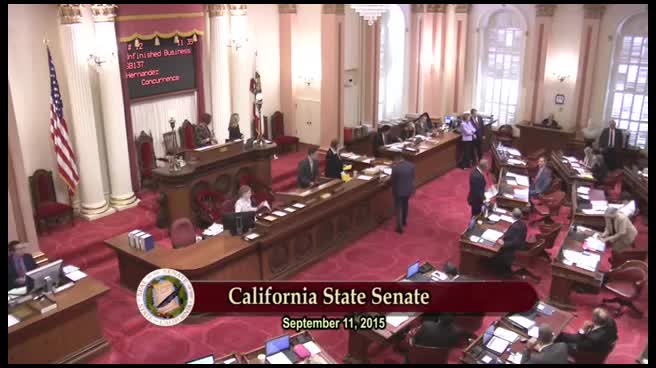 2MIN
Senate Floor
 1MIN
Assembly Floor
 1MIN
Assembly Floor
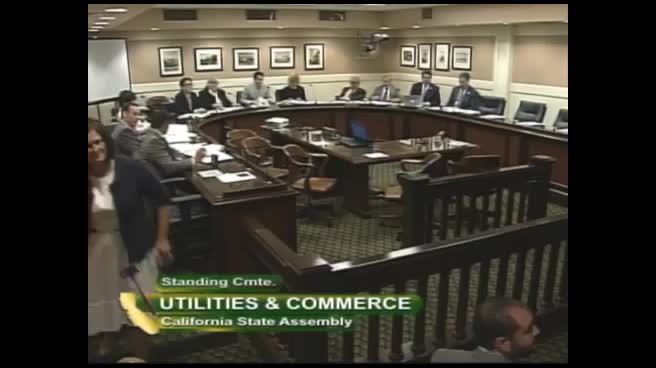 34MIN
Assembly Standing Committee on Utilities and Commerce
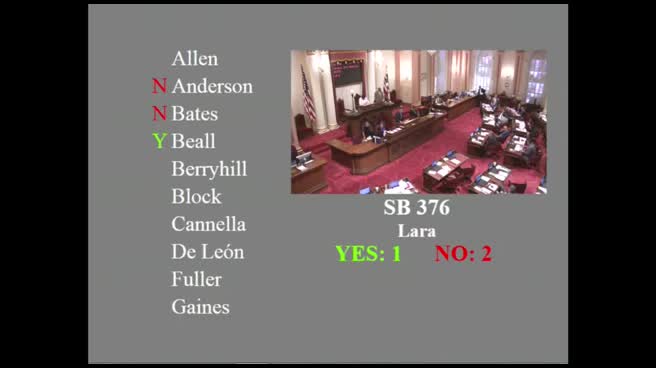 9MIN
Senate Floor
 13MIN