SB 693: Public contracts: skilled and trained workforce.
- Session Year: 2015-2016
- House: Senate
- Latest Version Date: 2016-09-28
Existing law establishes specific instances where a public entity is required to obtain an enforceable commitment that a bidder, contractor, or other entity will use a skilled and trained workforce to complete a contract or project.
This bill would establish provisions to be generally applicable when a public entity is required by statute or regulation to obtain an enforceable commitment that a bidder, contractor, or other entity will use a skilled and trained workforce to complete a contract or project. The bill would also authorize a public entity to require that a bidder, contractor, or other entity use a skilled and trained workforce to complete a contract or project.
Existing law relating to school facilities provides for the lease of property and prohibits the governing board of a school district from entering into specific lease agreements for the construction of buildings for the use of the school district with any entity unless the entity provides to the governing board an enforceable commitment that the entity and its subcontractors at every tier will use a skilled and trained workforce to perform all work on the project or contract that falls within an apprenticeable occupation in the building and construction trades.
Existing law relating to school facilities, operative July 1, 2016, and until January 1, 2025, also authorizes a school district, with the approval of the governing board of the school district, to procure design-build contracts for certain public works projects, as provided, and prohibits a design-build entity from being prequalified or shortlisted unless the entity provides a similar enforceable commitment to the school district with respect to the use of a skilled and trained workforce.
Existing law relating to the Department of General Services and the Department of Corrections and Rehabilitation authorizes the Director of General Services and the Secretary of the Department of Corrections and Rehabilitation to procure design-build contracts for certain public works projects, as provided, and prohibits a design-build entity from being prequalified or shortlisted unless the entity provides a similar enforceable commitment to the departments with respect to the use of a skilled and trained workforce.
Existing law relating to local agencies authorizes a local agency to procure design-build contracts for certain public works projects, as provided, and prohibits a design-build entity from being prequalified or shortlisted unless the entity provides a similar enforceable commitment to a local agency with respect to the use of a skilled and trained workforce.
Existing law, until January 1, 2021, establishes a pilot program to authorize the Los Angeles Unified School District to use a best value procurement method for bid evaluation and selection for certain public projects (LAUSD pilot program). The LAUSD pilot program precludes the prequalification or shortlisting of a best value entity unless the entity provides a similar enforceable commitment to the governing board of the district with respect to the use of a skilled and trained workforce.
Existing law establishes a pilot program to allow the Counties of Alameda, Los Angeles, Riverside, San Bernardino, San Diego, Solano, and Yuba to select a bidder on the basis of best value, as defined, for specific construction projects (pilot program for counties). The pilot program for counties precludes the prequalification or shortlisting of a best value contractor unless the contractor provides a similar enforceable commitment to the county with respect to the use of a skilled and trained workforce.
This bill would revise those provisions specifically applicable to school facilities, the Department of General Services, the Department of Corrections and Rehabilitation, and local agency design-build projects, the LAUSD pilot program, and the pilot program for counties to require, instead, an enforceable commitment for the use of a skilled and trained workforce in accordance with the above-described generally applicable provisions for the use of a skilled and trained workforce, unless there is a prescribed project labor agreement.
The bill, except as specified, would not apply to contracts advertised for bid or awarded before January 1, 2017.
The California Constitution requires local agencies, for the purpose of ensuring public access to the meetings of public bodies and the writings of public officials and agencies, to comply with a statutory enactment that amends or enacts laws relating to public records or open meetings and contains findings demonstrating that the enactment furthers the constitutional requirements relating to this purpose.
This bill would make legislative findings to that effect.
Existing law establishes specific instances where a public entity is required to obtain an enforceable commitment that a bidder, contractor, or other entity will use a skilled and trained workforce to complete a contract or project.
This bill would establish provisions to be generally applicable when a public entity is required by statute or regulation to obtain an enforceable commitment that a bidder, contractor, or other entity will use a skilled and trained workforce to complete a contract or project. The bill would also authorize a public entity to require that a bidder, contractor, or other entity use a skilled and trained workforce to complete a contract or project.
Existing law relating to school facilities provides for the lease of property and prohibits the governing board of a school district from entering into specific lease agreements for the construction of buildings for the use of the school district with any entity unless the entity provides to the governing board an enforceable commitment that the entity and its subcontractors at every tier will use a skilled and trained workforce to perform all work on the project or contract that falls within an apprenticeable occupation in the building and construction trades.
Existing law relating to school facilities, operative July 1, 2016, and until January 1, 2025, also authorizes a school district, with the approval of the governing board of the school district, to procure design-build contracts for certain public works projects, as provided, and prohibits a design-build entity from being prequalified or shortlisted unless the entity provides a similar enforceable commitment to the school district with respect to the use of a skilled and trained workforce.
Existing law relating to the Department of General Services and the Department of Corrections and Rehabilitation authorizes the Director of General Services and the Secretary of the Department of Corrections and Rehabilitation to procure design-build contracts for certain public works projects, as provided, and prohibits a design-build entity from being prequalified or shortlisted unless the entity provides a similar enforceable commitment to the departments with respect to the use of a skilled and trained workforce.
Existing law relating to local agencies authorizes a local agency to procure design-build contracts for certain public works projects, as provided, and prohibits a design-build entity from being prequalified or shortlisted unless the entity provides a similar enforceable commitment to a local agency with respect to the use of a skilled and trained workforce.
Existing law, until January 1, 2021, establishes a pilot program to authorize the Los Angeles Unified School District to use a best value procurement method for bid evaluation and selection for certain public projects (LAUSD pilot program). The LAUSD pilot program precludes the prequalification or shortlisting of a best value entity unless the entity provides a similar enforceable commitment to the governing board of the district with respect to the use of a skilled and trained workforce.
Existing law establishes a pilot program to allow the Counties of Alameda, Los Angeles, Riverside, San Bernardino, San Diego, Solano, and Yuba to select a bidder on the basis of best value, as defined, for specific construction projects (pilot program for counties). The pilot program for counties precludes the prequalification or shortlisting of a best value contractor unless the contractor provides a similar enforceable commitment to the county with respect to the use of a skilled and trained workforce.
This bill would revise those provisions specifically applicable to school facilities, the Department of General Services, the Department of Corrections and Rehabilitation, and local agency design-build projects, the LAUSD pilot program, and the pilot program for counties to require, instead, an enforceable commitment for the use of a skilled and trained workforce in accordance with the above-described generally applicable provisions for the use of a skilled and trained workforce, unless there is a prescribed project labor agreement.
The bill, except as specified, would not apply to contracts advertised for bid or awarded before January 1, 2016. 2017.
The California Constitution requires local agencies, for the purpose of ensuring public access to the meetings of public bodies and the writings of public officials and agencies, to comply with a statutory enactment that amends or enacts laws relating to public records or open meetings and contains findings demonstrating that the enactment furthers the constitutional requirements relating to this purpose.
This bill would make legislative findings to that effect.
Existing law establishes specific instances where a public entity is required to obtain an enforceable commitment that a bidder, contractor, or other entity will use a skilled and trained workforce to complete a contract or project.
This bill would establish provisions to be generally applicable when a public entity is required by statute or regulation to obtain an enforceable commitment that a bidder, contractor, or other entity will use a skilled and trained workforce to complete a contract or project. The bill would also authorize a public entity to require that a bidder, contractor, or other entity use a skilled and trained workforce to complete a contract or project.
Existing law relating to school facilities provides for the lease of property and prohibits the governing board of a school district from entering into specific lease agreements for the construction of buildings for the use of the school district with any entity unless the entity provides to the governing board an enforceable commitment that the entity and its subcontractors at every tier will use a skilled and trained workforce to perform all work on the project or contract that falls within an apprenticeable occupation in the building and construction trades.
Existing law relating to school facilities, operative July 1, 2016, and until January 1, 2025, also authorizes a school district, with the approval of the governing board of the school district, to procure design-build contracts for certain public works projects, as provided, and prohibits a design-build entity from being prequalified or shortlisted unless the entity provides a similar enforceable commitment to the school district with respect to the use of a skilled and trained workforce.
Existing law, until January 1, 2021, establishes a pilot program to authorize the Los Angeles Unified School District to use a best value procurement method for bid evaluation and selection for certain public projects (LAUSD pilot program). The LAUSD pilot program precludes the prequalification or shortlisting of a best value entity unless the entity provides a similar enforceable commitment to the governing board of the district with respect to the use of a skilled and trained workforce.
Existing law establishes a pilot program to allow the Counties of Alameda, Los Angeles, Riverside, San Bernardino, San Diego, Solano, and Yuba to select a bidder on the basis of best value, as defined, for specific construction projects (pilot program for counties). The pilot program for counties precludes the prequalification or shortlisting of a best value contractor unless the contractor provides a similar enforceable commitment to the county with respect to the use of a skilled and trained workforce.
This bill would revise those provisions specifically applicable to school facilities, the LAUSD pilot program, and the pilot program for counties to require, instead, an enforceable commitment for the use of a skilled and trained workforce in accordance with the above-described generally applicable provisions for the use of a skilled and trained workforce, unless there is a prescribed project labor agreement.
The bill, except as specified, would not apply to contracts advertised for bid or awarded before January 1, 2016.
The California Constitution requires local agencies, for the purpose of ensuring public access to the meetings of public bodies and the writings of public officials and agencies, to comply with a statutory enactment that amends or enacts laws relating to public records or open meetings and contains findings demonstrating that the enactment furthers the constitutional requirements relating to this purpose.
This bill would make legislative findings to that effect.
Existing law establishes the State Energy Resources Conservation and Development Commission, commonly known as the Energy Commission. Existing law prescribes certain qualifications for members of the Energy Commission, including a prohibition against receiving a substantial portion of income from specified energy-related entities in the 2 years preceding appointment to the Energy Commission. Existing law prohibits members of the Energy Commission from being employed by an electric utility or applicant or, within 2 years after the member ceases to be a member of the Energy Commission, a person who engages in the sale or manufacture of a major component of a facility. Existing law prohibits a member of the Energy Commission from holding any other elected or appointed public office or position, except as specified. Existing law prohibits persons with specified relationships to a member or employee of the Energy Commission from appearing in proceedings and other matters in which the Energy Commission is a party or has a direct and substantial interest. Existing law prohibits a member or employee of the Energy Commission from participating personally and substantially as a member or employee of the Energy Commission in particular matters in which to his or her knowledge, he or she, his or her spouse, minor child, or partner, or any organization in which he or she is serving, or has served, has a direct or indirect financial interest. Existing law makes the violation of these provisions a felony subject to fine of not more than $10,000 or imprisonment, or both.
This bill would increase the maximum fine to $50,000 for a violation of those provisions.
The procurement process for design-build projects shall progress as follows:
(a)(1)The school district shall prepare a set of documents setting forth the scope and estimated price of the project. The documents may include, but are not limited to, the size, type, and desired design character of the project, performance specifications covering the quality of materials, equipment, workmanship, preliminary plans or building layouts, or any other information deemed necessary to describe adequately the school districts needs. The performance specifications and any plans shall be prepared by a design professional who is duly licensed and registered in California.
(2)The documents shall not include a design-build-operate contract for a project. The documents, however, may include operations during a training or transition period, but shall not include long-term operations for a project.
(b)The school district shall prepare and issue a request for qualifications in order to prequalify, or develop a short-list of, the design-build entities whose proposals shall be evaluated for final selection. The request for qualifications shall include, but is not limited to, all of the following elements:
(1)Identification of the basic scope and needs of the project or contract, the expected cost range, the methodology that will be used by the school district to evaluate proposals, the procedure for final selection of the design-build entity, and any other information deemed necessary by the school district to inform interested parties of the contracting opportunity.
(2)Significant factors that the school district reasonably expects to consider in evaluating qualifications, including technical design and construction expertise, acceptable safety record, and all other nonprice-related factors.
(3)A standard template request for statements of qualifications prepared by the school district. In preparing the standard template, the school district may consult with the construction industry, the building trades and surety industry, and other school districts interested in using the authorization provided by this chapter. The template shall require the following information:
(A)If the design-build entity is a privately held corporation, limited liability company, partnership, or joint venture, a listing of all of the shareholders, partners, or members known at the time of statement of qualification submission who will perform work on the project.
(B)Evidence that the members of the design-build team have completed, or demonstrated the experience, competency, capability, and capacity to complete, projects of similar size, scope, or complexity, and that the proposed key personnel have sufficient experience and training to competently manage and complete the design and construction of the project, and a financial statement that ensures that the design-build entity has the capacity to complete the project.
(C)The licenses, registration, and credentials required to design and construct the project, including, but not limited to, information on the revocation or suspension of any license, credential, or registration.
(D)Evidence that establishes that the design-build entity has the capacity to obtain all required payment and performance bonding, liability insurance, and errors and omissions insurance.
(E)Information concerning workers compensation experience history and a worker safety program.
(F)If the proposed design-build entity is a corporation, limited liability company, partnership, joint venture, or other legal entity, a copy of the organizational documents or agreement committing to form the organization.
(G)An acceptable safety record. A proposers safety record shall be deemed acceptable if its experience modification rate for the most recent three-year period is an average of 1.00 or less, and its average total recordable injury or illness rate and average lost work rate for the most recent three-year period does not exceed the applicable statistical standards for its business category, or if the proposer is a party to an alternative dispute resolution system, as provided for in Section 3201.5 of the Labor Code.
(4)(A)The information required under this subdivision shall be certified under penalty of perjury by the design-build entity and its general partners or joint venture members.
(B)Information required under this subdivision that is not otherwise a public record under the California Public Records Act (Chapter 3.5 (commencing with Section 6250) of Division 7 of Title 1 of the Government Code) shall not be open to public inspection.
(c)(1)A design-build entity shall not be prequalified or shortlisted unless the entity provides an enforceable commitment to the school district that the entity and its subcontractors at every tier will use a skilled and trained workforce to perform all work on the project or contract that falls within an apprenticeable occupation in the building and construction trades, in accordance with Chapter 2.9 (commencing with Section 2600) of Part 1 of Division 2 of the Public Contract Code.
(2)This subdivision shall not apply if any of the following requirements are met:
(A)The school district has entered into a project labor agreement that will bind all contractors and subcontractors performing work on the project or contract to use a skilled and trained workforce, and the entity agrees to be bound by that project labor agreement.
(B)The project or contract is being performed under the extension or renewal of a project labor agreement that was entered into by the school district prior to January 1, 2017.
(C)The entity has entered into a project labor agreement that will bind the entity and all its subcontractors at every tier performing the project or contract to use a skilled and trained workforce.
(3)For purposes of this subdivision, project labor agreement has the same meaning as in paragraph (1) of subdivision (b) of Section 2500 of the Public Contract Code.
(d)Based on the documents prepared as described in subdivision (a), the school district shall prepare a request for proposals that invites prequalified or short-listed entities to submit competitive sealed proposals in the manner prescribed by the school district. The request for proposals shall include, but need not be limited to, the following elements:
(1)Identification of the basic scope and needs of the project or contract, the estimated cost of the project, the methodology that will be used by the school district to evaluate proposals, whether the contract will be awarded on the basis of low bid or best value, and any other information deemed necessary by the school district to inform interested parties of the contracting opportunity.
(2)Significant factors that the school district reasonably expects to consider in evaluating proposals, including, but not limited to, cost or price and all nonprice-related factors.
(3)The relative importance or the weight assigned to each of the factors identified in the request for proposals.
(4)Where a best value selection method is used, the school district may reserve the right to request proposal revisions and hold discussions and negotiations with responsive proposers, in which case the school district shall so specify in the request for proposals and shall publish separately or incorporate into the request for proposals applicable procedures to be observed by the school district to ensure that any discussions or negotiations are conducted in good faith.
(e)For those projects utilizing low bid as the final selection method, the competitive bidding process shall result in lump-sum bids by the prequalified or short-listed design-build entities, and awards shall be made to the design-build entity that is the lowest responsible bidder.
(f)For those projects utilizing best value as a selection method, the design-build competition shall progress as follows:
(1)Competitive proposals shall be evaluated by using only the criteria and selection procedures specifically identified in the request for proposals. The following minimum factors, however, shall be weighted as deemed appropriate by the school district:
(A)Price, unless a stipulated sum is specified.
(B)Technical design and construction expertise.
(C)Life-cycle costs over 15 or more years.
(2)Pursuant to subdivision (d), the school district may hold discussions or negotiations with responsive proposers using the process articulated in the school districts request for proposals.
(3)When the evaluation is complete, the responsive proposers shall be ranked based on a determination of value provided, provided that no more than three proposers are required to be ranked.
(4)The award of the contract shall be made to the responsible design-build entity whose proposal is determined by the school district to have offered the best value to the public.
(5)Notwithstanding any other provision of law, upon issuance of a contract award, the school district shall publicly announce its award, identifying the design-build entity to which the award is made, along with a statement regarding the basis of the award.
(6)The statement regarding the school districts contract award, described in paragraph (5), and the contract file shall provide sufficient information to satisfy an external audit.
SEC. 2.Section 17407.5 of the Education Code is amended to read:17407.5.(a)The governing board of a school district shall not enter into an agreement pursuant to Section 17406 or 17407 with any entity unless the entity provides to the governing board of the school district an enforceable commitment that the entity and its subcontractors at every tier will use a skilled and trained workforce to perform all work on the project or contract that falls within an apprenticeable occupation in the building and construction trades, in accordance with Chapter 2.9 (commencing with Section 2600) of Part 1 of Division 2 of the Public Contract Code.
(b)Subdivision (a) shall not apply if any of the following requirements are met:
(1)The governing board of the school district has entered into a project labor agreement that will bind all contractors and subcontractors performing work on the project or contract to use a skilled and trained workforce and the entity agrees to be bound by that project labor agreement.
(2)The project or contract is being performed under the extension or renewal of a project labor agreement that was entered into by the school district prior to January 1, 2017.
(3)The entity has entered into a project labor agreement that will bind the entity and all its subcontractors at every tier performing the project or contract to use a skilled and trained workforce.
(c)For purposes of this section, project labor agreement has the same meaning as in paragraph (1) of subdivision (b) of Section 2500 of the Public Contract Code.
SEC. 3.Section 25536.7 of the Health and Safety Code is amended to read:25536.7.(a)(1)An owner or operator of a stationary source that is engaged in activities described in Code 324110 or 325110 of the North American Industry Classification System (NAICS), as that code read on January 1, 2014, and with one or more covered processes that is required to prepare and submit an RMP pursuant to this article, when contracting for the performance of construction, alteration, demolition, installation, repair, or maintenance work at the stationary source, shall require that its contractors and any subcontractors use a skilled and trained workforce to perform all onsite work within an apprenticeable occupation in the building and construction trades. This section shall not apply to oil and gas extraction operations.
(2)The Chief of the Division of Apprenticeship Standards of the Department of Industrial Relations may approve a curriculum of in-person classroom and laboratory instruction for approved advanced safety training for workers at high hazard facilities. That safety training may be provided by an apprenticeship program approved by the chief or by instruction provided by the Chancellor of the California Community Colleges. The chief shall approve a curriculum in accordance with this paragraph by January 1, 2016, and shall periodically revise the curriculum to reflect current best practices. Upon receipt of certification from the apprenticeship program or community college, the chief shall issue a certificate to a worker who completes the approved curriculum.
(3)For purposes of paragraph (2) of subdivision (b) of Section 3075 of the Labor Code, a stationary source covered by this section shall be considered in determining whether existing apprenticeship programs do not have the capacity, or have neglected or refused, to dispatch sufficient apprentices to qualified employers who are willing to abide by the applicable apprenticeship standards.
(4)This section shall not apply to contracts awarded before January 1, 2014, unless the contract is extended or renewed after that date.
(5)(A)This section shall not apply to the employees of the owner or operator of the stationary source or prevent the owner or operator of the stationary source from using its own employees to perform any work that has not been assigned to contractors while the employees of the contractor are present and working.
(B)An apprenticeship program approved by the chief may enroll, with advanced standing, applicants with relevant prior work experience at a stationary source that is subject to this section, in accordance with the approved apprenticeship standards of the program.
(6)The criteria of subparagraph (A) of paragraph (10) of subdivision (b), subparagraph (C) of paragraph (10) of subdivision (b), and subparagraph (B) of paragraph (11) of subdivision (b) shall not apply to either of the following:
(A)To the extent that the contractor has requested qualified workers from the local hiring halls that dispatch workers in the apprenticeable occupation and, due to workforce shortages, the contractor is unable to obtain sufficient qualified workers within 48 hours of the request, Saturdays, Sundays, and holidays excepted. This section shall not prevent contractors from obtaining workers from any source.
(B)To the extent that compliance is impracticable because an emergency requires immediate action to prevent harm to public health or safety or to the environment, but the criteria shall apply as soon as the emergency is over or it becomes practicable for contractors to obtain a qualified workforce.
(7)The requirement specified in paragraph (1) for a skilled and trained workforce, as defined in paragraph (11) of subdivision (b), shall apply to each individual contractors and subcontractors onsite workforce.
(8)This section does not make the construction, alteration, demolition, installation, repair, or maintenance work at a stationary source that is subject to this section a public work, within the meaning of Chapter 1 (commencing with Section 1720) of Part 7 of Division 2 of the Labor Code. This section does not preclude the use of an alternative workweek schedule adopted pursuant to Section 511 or 514 of the Labor Code.
(b)As used in this section:
(1)Apprenticeable occupation means an occupation for which the chief has approved an apprenticeship program pursuant to Section 3075 of the Labor Code.
(2)Approved advanced safety training for workers at high hazard facilities means a curriculum approved by the chief pursuant to paragraph (2) of subdivision (a).
(3)Building and construction trades has the same meaning as in Section 3075.5 of the Labor Code.
(4)Chief means the Chief of the Division of the Apprenticeship Standards of the Department of Industrial Relations.
(5)Construction, alteration, demolition, installation, repair, and maintenance have the same meanings as in Sections 1720 and 1771 of the Labor Code.
(6)Graduate of an apprenticeship program means either of the following:
(A)An individual that has been issued a certificate of completion under the authority of the California Apprenticeship Council for completing an apprenticeship program approved by the chief pursuant to Section 3075 of the Labor Code.
(B)An individual that has completed an apprenticeship program located outside California and approved for federal purposes pursuant to the apprenticeship regulations adopted by the federal Secretary of Labor.
(7)Onsite work shall not include catalyst handling and loading, chemical cleaning, or inspection and testing that was not within the scope of a prevailing wage determination issued by the Director of Industrial Relations as of January 1, 2013.
(8)Prevailing hourly wage rate means the general prevailing rate of per diem wages, as determined by the Director of Industrial Relations pursuant to Sections 1773 and 1773.9 of the Labor Code, but does not include shift differentials, travel and subsistence, or holiday pay. Notwithstanding subdivision (c) of Section 1773.1 of the Labor Code, the requirement that employer payments not reduce the obligation to pay the hourly straight time or overtime wages found to be prevailing shall not apply if otherwise provided in a bona fide collective bargaining agreement covering the worker.
(9)Registered apprentice means an apprentice registered in an apprenticeship program approved by the chief pursuant to Section 3075 of the Labor Code who is performing work covered by the standards of that apprenticeship program and receiving the supervision required by the standards of that apprenticeship program.
(10)Skilled journeyperson means a worker who meets all of the following criteria:
(A)The worker either graduated from an apprenticeship program for the applicable occupation that was approved by the chief, or has at least as many hours of on-the-job experience in the applicable occupation that would be required to graduate from an apprenticeship program for the applicable occupation that is approved by the chief.
(B)The worker is being paid at least a rate equivalent to the prevailing hourly wage rate for a journeyperson in the applicable occupation and geographic area.
(C)The worker has completed within the prior two calendar years at least 20 hours of approved advanced safety training for workers at high hazard facilities. This requirement applies only to work performed on or after January 1, 2018.
(11)Skilled and trained workforce means a workforce that meets both of the following criteria:
(A)All the workers are either registered apprentices or skilled journeypersons.
(B)(i)As of January 1, 2014, at least 30 percent of the skilled journeypersons are graduates of an apprenticeship program for the applicable occupation.
(ii)As of January 1, 2015, at least 45 percent of the skilled journeypersons are graduates of an apprenticeship program for the applicable occupation.
(iii)As of January 1, 2016, at least 60 percent of the skilled journeypersons are graduates of an apprenticeship program for the applicable occupation.
SEC. 4.Chapter 2.9 (commencing with Section 2600) is added to Part 1 of Division 2 of the Public Contract Code, to read:2.9.Skilled and Trained Workforce Requirements2600.(a)This chapter applies when a public entity is required by statute or regulation to obtain an enforceable commitment that a bidder, contractor, or other entity will use a skilled and trained workforce to complete a contract or project.
(b)A public entity may require a bidder, contractor, or other entity to use a skilled and trained workforce to complete a contract or project regardless of whether the public entity is required to do so by a statute or regulation.
2601.For purposes of this chapter:
(a)Apprenticeable occupation means an occupation for which the Chief of the Division of Apprenticeship Standards of the Department of Industrial Relations had approved an apprenticeship program pursuant to Section 3075 of the Labor Code before January 1, 2014.
(b)Chief means the Chief of the Division of Apprenticeship Standards of the Department of Industrial Relations.
(c)Graduate of an apprenticeship program means either of the following:
(1)An individual that has been issued a certificate of completion under the authority of the California Apprenticeship Council for completing an apprenticeship program approved by the chief pursuant to Section 3075 of the Labor Code.
(2)An individual that has completed an apprenticeship program located outside California and approved for federal purposes pursuant to the apprenticeship regulations adopted by the federal Secretary of Labor.
(d)Skilled and trained workforce means a workforce that meets all of the following conditions:
(1)All the workers performing work in an apprenticeable occupation in the building and construction trades are either skilled journeypersons or apprentices registered in an apprenticeship program approved by the chief.
(2)(A)For work performed on or after January 1, 2017, at least 30 percent of the skilled journeypersons employed to perform work on the contract or project by every contractor and each of its subcontractors at every tier are graduates of an apprenticeship program for the applicable occupation.
(B)For work performed on or after January 1, 2018, at least 40 percent of the skilled journeypersons employed to perform work on the contract or project by every contractor and each of its subcontractors at every tier are graduates of an apprenticeship program for the applicable occupation.
(C)For work performed on or after January 1, 2019, at least 50 percent of the skilled journeypersons employed to perform work on the contract or project by every contractor and each of its subcontractors at every tier are graduates of an apprenticeship program for the applicable occupation.
(D)For work performed on or after January 1, 2020, at least 60 percent of the skilled journeypersons employed to perform work on the contract or project by every contractor and each of its subcontractors at every tier are graduates of an apprenticeship program for the applicable occupation.
(3)For an apprenticeable occupation in which no apprenticeship program had been approved by the chief before January 1, 1995, up to one-half of the graduation percentage requirements of paragraph (2) may be satisfied by skilled journeypersons who commenced working in the apprenticeable occupation before the chiefs approval of an apprenticeship program for that occupation in the county in which the project is located.
(4)The apprenticeship graduation percentage requirements of paragraph (2) are satisfied if, in a particular calendar month, either of the following is true:
(A)At least the required percentage of the skilled journeypersons employed by the contractor or subcontractor to perform work on the contract or project meet the graduation percentage requirement.
(B)For the hours of work performed by skilled journeypersons employed by the contractor or subcontractor on the contract or project, the percentage of hours performed by skilled journeypersons who met the graduation requirement is at least equal to the required graduation percentage.
(5)The contractor or subcontractor need not meet the apprenticeship graduation requirements of paragraph (2) if, during the calendar month, the contractor or subcontractor employs skilled journeypersons to perform fewer than 10 hours of work on the contract or project.
(6)A subcontractor need not meet the apprenticeship graduation requirements of paragraph (2) if both of the following requirements are met:
(A)The subcontractor was not a listed subcontractor under Section 4104 or a substitute for a listed subcontractor.
(B)The subcontract does not exceed one-half of 1 percent of the price of the prime contract.
(e)Skilled journeyperson means a worker who either:
(1)Graduated from an apprenticeship program for the applicable occupation that was approved by the chief or located outside California and approved for federal purposes pursuant to the apprenticeship regulations adopted by the federal Secretary of Labor.
(2)Has at least as many hours of on-the-job experience in the applicable occupation as would be required to graduate from an apprenticeship program for the applicable occupation that is approved by the chief.
2602.(a)When a contractor, bidder, or other entity is required to provide an enforceable commitment that a skilled and trained workforce will be used to complete a contract or project, the commitment shall be made in an enforceable agreement with the public entity or other awarding body that provides both of the following:
(1)The contractor, bidder, or other entity, and its contractors and subcontractors at every tier, will comply with this chapter.
(2)The contractor, bidder, or other entity will provide to the public entity or other awarding body, on a monthly basis while the project or contract is being performed, a report demonstrating compliance with this chapter.
(b)If the contractor, bidder, or other entity fails to provide the monthly report required by this section, or provides a report that is incomplete, the public agency or other awarding body shall withhold further payments until a complete report is provided.
(c)If a monthly report does not demonstrate compliance with this chapter, the public agency or other awarding body shall withhold further payments until the contractor, bidder, or other entity provides a plan to achieve substantial compliance with this chapter, with respect to the relevant apprenticeable occupation, prior to completion of the contract or project.
(d)A monthly report provided to the public agency or other awarding body shall be a public record under the California Public Records Act (Chapter 3.5 (commencing with Section 6250) of Division 7 of Title 1 of the Government Code) and shall be open to public inspection.
SEC. 5.Section 10191 of the Public Contract Code is amended to read:10191.The procurement process for the design-build projects shall progress as follows:
(a)(1)The director shall prepare a set of documents setting forth the scope and estimated price of the project. The documents may include, but need not be limited to, the size, type, and desired design character of the project, performance specifications covering the quality of materials, equipment, workmanship, preliminary plans or building layouts, or any other information deemed necessary to describe adequately the departments needs. The performance specifications and any plans shall be prepared by a design professional who is duly licensed and registered in California.
(2)The documents shall not include a design-build-operate contract for any project. The documents, however, may include operations during a training or transition period but shall not include long-term operations for any project.
(b)The director shall prepare and issue a request for qualifications in order to prequalify or short-list the design-build entities whose proposals shall be evaluated for final selection. The request for qualifications shall include, but need not be limited to, the following elements:
(1)Identification of the basic scope and needs of the project or contract, the expected cost range, the methodology that will be used by the department to evaluate proposals, the procedure for final selection of the design-build entity, and any other information deemed necessary by the director to inform interested parties of the contracting opportunity.
(2)Significant factors that the department reasonably expects to consider in evaluating qualifications, including technical design and construction expertise, and all other nonprice-related factors.
(3)A standard template request for statements of qualifications prepared by the department. In preparing the standard template, the department may consult with the construction industry, the building trades and surety industry, and other agencies interested in using the authorization provided by this article. The template shall require the following information:
(A)If the design-build entity is a privately held corporation, limited liability company, partnership, or joint venture, a listing of all of the shareholders, partners, or members known at the time of statement of qualification submission who will perform work on the project.
(B)Evidence that the members of the design-build team have completed, or demonstrated the experience, competency, capability, and capacity to complete projects of similar size, scope, or complexity, and that proposed key personnel have sufficient experience and training to competently manage and complete the design and construction of the project, and a financial statement that ensures that the design-build entity has the capacity to complete the project.
(C)The licenses, registration, and credentials required to design and construct the project, including, but not limited to, information on the revocation or suspension of any license, credential, or registration.
(D)Evidence that establishes that the design-build entity has the capacity to obtain all required payment and performance bonding, liability insurance, and errors and omissions insurance.
(E)Information concerning workers compensation experience history and a worker safety program.
(F)If the proposed design-build entity is a corporation, limited liability company, partnership, joint venture, or other legal entity, a copy of the organizational documents or agreement committing to form the organization.
(G)An acceptable safety record. A proposers safety record shall be deemed acceptable if its experience modification rate for the most recent three-year period is an average of 1.00 or less, and its average total recordable injury or illness rate and average lost work rate for the most recent three-year period does not exceed the applicable statistical standards for its business category or if the proposer is a party to an alternative dispute resolution system as provided for in Section 3201.5 of the Labor Code.
(4)(A)The information required under this subdivision shall be certified under penalty of perjury by the design-build entity and its general partners or joint venture members.
(B)Information required under this subdivision that is not otherwise a public record under the California Public Records Act (Chapter 3.5 (commencing with Section 6250) of Division 7 of Title 1 of the Government Code) shall not be open to public inspection.
(c)(1)A design-build entity shall not be prequalified or shortlisted unless the entity provides an enforceable commitment to the director that the entity and its subcontractors at every tier will use a skilled and trained workforce to perform all work on the project or contract that falls within an apprenticeable occupation in the building and construction trades, in accordance with Chapter 2.9 (commencing with Section 2600) of Part 1.
(2)This subdivision shall not apply if any of the following requirements are met:
(A)The department has entered into a project labor agreement that will bind all contractors and subcontractors performing work on the project or contract to use a skilled and trained workforce, and the entity agrees to be bound by that project labor agreement.
(B)The project or contract is being performed under the extension or renewal of a project labor agreement that was entered into by the department prior to January 1, 2017.
(C)The entity has entered into a project labor agreement that will bind the entity and all its subcontractors at every tier performing the project or contract to use a skilled and trained workforce.
(3)For purposes of this subdivision, project labor agreement has the same meaning as in paragraph (1) of subdivision (b) of Section 2500.
(d)Based on the documents prepared as described in subdivision (a), the director shall prepare a request for proposals that invites prequalified or short-listed entities to submit competitive sealed proposals in the manner prescribed by the department. The request for proposals shall include, but need not be limited to, the following elements:
(1)Identification of the basic scope and needs of the project or contract, the estimated cost of the project, the methodology that will be used by the department to evaluate proposals, whether the contract will be awarded on the basis of low bid or best value, and any other information deemed necessary by the department to inform interested parties of the contracting opportunity.
(2)Significant factors that the department reasonably expects to consider in evaluating proposals, including, but not limited to, cost or price and all nonprice-related factors.
(3)The relative importance or the weight assigned to each of the factors identified in the request for proposals.
(4)Where a best value selection method is used, the department may reserve the right to request proposal revisions and hold discussions and negotiations with responsive proposers, in which case the department shall so specify in the request for proposals and shall publish separately or incorporate into the request for proposals applicable procedures to be observed by the department to ensure that any discussions or negotiations are conducted in good faith.
(e)For those projects utilizing low bid as the final selection method, the competitive bidding process shall result in lump-sum bids by the prequalified or short-listed design-build entities, and awards shall be made to the design-build entity that is the lowest responsible bidder.
(f)For those projects utilizing best value as a selection method, the design-build competition shall progress as follows:
(1)Competitive proposals shall be evaluated by using only the criteria and selection procedures specifically identified in the request for proposals. The following minimum factors, however, shall be weighted as deemed appropriate by the department:
(A)Price, unless a stipulated sum is specified.
(B)Technical design and construction expertise.
(C)Life-cycle costs over 15 or more years.
(2)Pursuant to subdivision (d), the department may hold discussions or negotiations with responsive proposers using the process articulated in the departments request for proposals.
(3)When the evaluation is complete, the responsive proposers shall be ranked based on a determination of value provided, provided that no more than three proposers are required to be ranked.
(4)The award of the contract shall be made to the responsible design-build entity whose proposal is determined by the director to have offered the best value to the public.
(5)Notwithstanding any other provision of this code, upon issuance of a contract award, the director shall publicly announce its award, identifying the design-build entity to which the award is made, along with a statement regarding the basis of the award.
(6)The statement regarding the directors contract award, described in paragraph (5), and the contract file shall provide sufficient information to satisfy an external audit.
SEC. 6.Section 20119.1 of the Public Contract Code is amended to read:20119.1.As used in this article:
(a)Best value means a procurement process whereby the selected bidder may be selected on the basis of objective criteria for evaluating the qualifications of bidders with the resulting selection representing the best combination of price and qualifications.
(b)Best value contract means a competitively bid contract entered into pursuant to this article.
(c)Best value contractor means a properly licensed person, firm, or corporation that submits a bid for and is awarded a best value contract.
(d)Best value score means the resulting score when the school district divides the bidders price by the bidders qualification score.
(e)Demonstrated management competency means the experience, competency, capability, and capacity of the proposed management staffing to complete projects of similar size, scope, or complexity.
(f)Financial condition means the financial resources needed to perform the contract. The criteria used to evaluate a bidders financial condition shall include, at a minimum, capacity to obtain all required payment bonds and required insurance.
(g)Governing board or governing board of the school district means the governing board of the Los Angeles Unified School District.
(h)Labor compliance means the ability to comply with, and past conformance with, contract and statutory requirements for the payment of wages and qualifications of the workforce. The criteria used to evaluate a bidders labor compliance shall include, at a minimum, the bidders ability to comply with the apprenticeship requirements of the California Apprenticeship Council and the Department of Industrial Relations, its past conformance with such requirements, and its past conformance with requirements to pay prevailing wages on public works projects.
(i)Project has the same meaning as public project as defined in subdivision (c) of Section 22002.
(j)Qualifications means financial condition, relevant experience, demonstrated management competency, labor compliance, the safety record of the bidder, and, to the extent relevant, the preceding qualifications as they pertain to all subcontractors proposed to be used by the bidder for designated portions of the work.
(k)Relevant experience means the experience, competency, capability, and capacity to complete projects of similar size, scope, or complexity.
(l)Safety record shall be deemed acceptable if a contractors experience modification rate for the most recent three-year period is an average of 1.00 or less, and its average total recordable injury or illness rate and average lost work rate for the most recent three-year period do not exceed the applicable statistical standards for its business category or if the bidder is a party to an alternative dispute resolution system as provided for in Section 3201.5 of the Labor Code.
(m)School district means the Los Angeles Unified School District.
SEC. 7.Section 20119.3 of the Public Contract Code is amended to read:20119.3.The governing board of the school district shall proceed in accordance with the following when awarding best value contracts under this article:
(a)The school district shall prepare a solicitation for bids and give notice pursuant to Section 20112.
(b)(1)The school district shall establish a procedure to prequalify bidders as required by this code. Information submitted by the bidder as part of the evaluation process shall not be open to public inspection to the extent that information is exempt from disclosure under the California Public Records Act (Chapter 3.5 (commencing with Section 6250) of Division 7 of Title 1 of the Government Code).
(2)A best value entity shall not be prequalified or shortlisted unless the entity provides an enforceable commitment to the governing board that the entity and its subcontractors at every tier will use a skilled and trained workforce to perform all work on the project or contract that falls within an apprenticeable occupation in the building and construction trades, in accordance with Chapter 2.9 (commencing with Section 2600) of Part 1.
(3)Paragraph (2) shall not apply if any of the following requirements are met:
(A)The school district has entered into a project labor agreement that will bind all contractors and subcontractors performing work on the project or contract to use a skilled and trained workforce, and the entity agrees to be bound by that project labor agreement.
(B)The project or contract is being performed under the extension or renewal of a project labor agreement that was entered into by the school district prior to January 1, 2017.
(C)The entity has entered into a project labor agreement that will bind the entity and all its subcontractors at every tier performing the project or contract to use a skilled and trained workforce.
(4)For purposes of this subdivision, project labor agreement has the same meaning as in paragraph (1) of subdivision (b) of Section 2500.
(c)Each solicitation for bids shall do all of the following:
(1)Invite prequalified bidders to submit sealed bids in the manner prescribed by this article.
(2)Include a section identifying and describing the following:
(A)Criteria that the school district will consider in evaluating the qualifications of the bidders.
(B)The methodology and rating or weighting system that will be used by the school district in evaluating bids.
(C)The relative importance or weight assigned to the criteria for evaluating the qualifications of bidders identified in the request for bids.
(d)Final evaluation of the bidders shall be done in a manner that prevents the identity of the bidders and the cost or price information from being revealed in evaluating the qualifications of the bidders prior to completion of qualification scoring.
SEC. 8.Section 20155.2 of the Public Contract Code is repealed.SEC. 9.Section 20155.4 of the Public Contract Code is amended to read:20155.4.(a)A best value contractor shall not be prequalified or shortlisted unless the contractor provides an enforceable commitment to the county that the contractor and its subcontractors at every tier will use a skilled and trained workforce to perform all work on the project or contract that falls within an apprenticeable occupation in the building and construction trades, in accordance with Chapter 2.9 (commencing with Section 2600) of Part 1.
(b)This section shall not apply if any of the following requirements are met:
(1)The county has entered into a project labor agreement that will bind all contractors and subcontractors performing work on the project or contract to use a skilled and trained workforce, and the contractor agrees to be bound by that project labor agreement.
(2)The project or contract is being performed under the extension or renewal of a project labor agreement that was entered into by the county prior to January 1, 2017.
(3)The contractor has entered into a project labor agreement that will bind the contractor and all its subcontractors at every tier performing the project or contract to use a skilled and trained workforce.
(c)For purposes of this section, project labor agreement has the same meaning as in paragraph (1) of subdivision (b) of Section 2500.
SEC. 10.Section 22164 of the Public Contract Code is amended to read:22164.The procurement process for the design-build projects shall progress as follows:
(a)(1)The local agency shall prepare a set of documents setting forth the scope and estimated price of the project. The documents may include, but need not be limited to, the size, type, and desired design character of the project, performance specifications covering the quality of materials, equipment, workmanship, preliminary plans or building layouts, or any other information deemed necessary to describe adequately the local agencys needs. The performance specifications and any plans shall be prepared by a design professional who is duly licensed and registered in California.
(2)The documents shall not include a design-build-operate contract for any project. The documents, however, may include operations during a training or transition period but shall not include long-term operations for any project.
(b)The local agency shall prepare and issue a request for qualifications in order to prequalify or short-list the design-build entities whose proposals shall be evaluated for final selection. The request for qualifications shall include, but need not be limited to, the following elements:
(1)Identification of the basic scope and needs of the project or contract, the expected cost range, the methodology that will be used by the local agency to evaluate proposals, the procedure for final selection of the design-build entity, and any other information deemed necessary by the local agency to inform interested parties of the contracting opportunity.
(2)Significant factors that the local agency reasonably expects to consider in evaluating qualifications, including technical design and construction expertise, acceptable safety record, and all other nonprice-related factors.
(3)A standard template request for statements of qualifications prepared by the local agency. In preparing the standard template, the local agency may consult with the construction industry, the building trades and surety industry, and other local agencies interested in using the authorization provided by this article. The template shall require the following information:
(A)If the design-build entity is a privately held corporation, limited liability company, partnership, or joint venture, a listing of all of the shareholders, partners, or members known at the time of statement of qualification submission who will perform work on the project.
(B)Evidence that the members of the design-build team have completed, or demonstrated the experience, competency, capability, and capacity to complete projects of similar size, scope, or complexity, and that proposed key personnel have sufficient experience and training to competently manage and complete the design and construction of the project, and a financial statement that ensures that the design-build entity has the capacity to complete the project.
(C)The licenses, registration, and credentials required to design and construct the project, including, but not limited to, information on the revocation or suspension of any license, credential, or registration.
(D)Evidence that establishes that the design-build entity has the capacity to obtain all required payment and performance bonding, liability insurance, and errors and omissions insurance.
(E)Information concerning workers compensation experience history and a worker safety program.
(F)If the proposed design-build entity is a corporation, limited liability company, partnership, joint venture, or other legal entity, a copy of the organizational documents or agreement committing to form the organization.
(G)An acceptable safety record. A proposers safety record shall be deemed acceptable if its experience modification rate for the most recent three-year period is an average of 1.00 or less, and its average total recordable injury or illness rate and average lost work rate for the most recent three-year period does not exceed the applicable statistical standards for its business category or if the proposer is a party to an alternative dispute resolution system as provided for in Section 3201.5 of the Labor Code.
(4)(A)The information required under this subdivision shall be certified under penalty of perjury by the design-build entity and its general partners or joint venture members.
(B)Information required under this subdivision that is not otherwise a public record under the California Public Records Act (Chapter 3.5 (commencing with Section 6250) of Division 7 of Title 1 of the Government Code) shall not be open to public inspection.
(c)(1)A design-build entity shall not be prequalified or shortlisted unless the entity provides an enforceable commitment to the local agency that the entity and its subcontractors at every tier will use a skilled and trained workforce to perform all work on the project or contract that falls within an apprenticeable occupation in the building and construction trades, in accordance with Chapter 2.9 (commencing with Section 2600) of Part 1.
(2)This subdivision shall not apply if any of the following requirements are met:
(A)The local agency has entered into a project labor agreement that will bind all contractors and subcontractors performing work on the project or contract to use a skilled and trained workforce, and the entity agrees to be bound by that project labor agreement.
(B)The project or contract is being performed under the extension or renewal of a project labor agreement that was entered into by the local agency prior to January 1, 2017.
(C)The entity has entered into a project labor agreement that will bind the entity and all its subcontractors at every tier performing the project or contract to use a skilled and trained workforce.
(3)For purposes of this subdivision, project labor agreement has the same meaning as in paragraph (1) of subdivision (b) of Section 2500.
(d)Based on the documents prepared as described in subdivision (a), the local agency shall prepare a request for proposals that invites prequalified or short-listed entities to submit competitive sealed proposals in the manner prescribed by the local agency. The request for proposals shall include, but need not be limited to, the following elements:
(1)Identification of the basic scope and needs of the project or contract, the estimated cost of the project, the methodology that will be used by the local agency to evaluate proposals, whether the contract will be awarded on the basis of low bid or best value, and any other information deemed necessary by the local agency to inform interested parties of the contracting opportunity.
(2)Significant factors that the local agency reasonably expects to consider in evaluating proposals, including, but not limited to, cost or price and all nonprice-related factors.
(3)The relative importance or the weight assigned to each of the factors identified in the request for proposals.
(4)Where a best value selection method is used, the local agency may reserve the right to request proposal revisions and hold discussions and negotiations with responsive proposers, in which case the local agency shall so specify in the request for proposals and shall publish separately or incorporate into the request for proposals applicable procedures to be observed by the local agency to ensure that any discussions or negotiations are conducted in good faith.
(e)For those projects utilizing low bid as the final selection method, the competitive bidding process shall result in lump-sum bids by the prequalified or short-listed design-build entities, and awards shall be made to the design-build entity that is the lowest responsible bidder.
(f)For those projects utilizing best value as a selection method, the design-build competition shall progress as follows:
(1)Competitive proposals shall be evaluated by using only the criteria and selection procedures specifically identified in the request for proposals. The following minimum factors, however, shall be weighted as deemed appropriate by the local agency:
(A)Price, unless a stipulated sum is specified.
(B)Technical design and construction expertise.
(C)Life-cycle costs over 15 or more years.
(2)Pursuant to subdivision (d), the local agency may hold discussions or negotiations with responsive proposers using the process articulated in the local agencys request for proposals.
(3)When the evaluation is complete, the responsive proposers shall be ranked based on a determination of value provided, provided that no more than three proposers are required to be ranked.
(4)The award of the contract shall be made to the responsible design-build entity whose proposal is determined by the local agency to have offered the best value to the public.
(5)Notwithstanding any other provision of this code, upon issuance of a contract award, the local agency shall publicly announce its award, identifying the design-build entity to which the award is made, along with a statement regarding the basis of the award.
(6)The statement regarding the local agencys contract award, described in paragraph (5), and the contract file shall provide sufficient information to satisfy an external audit.
SEC. 11.(a)The amendments made by this act shall not apply to contracts that were advertised for bid or awarded before January 1, 2017.
(b)For contracts advertised for bid or awarded before January 1, 2017, for which an entity or contractor provided an enforceable commitment to a school district or county regarding the use of a skilled and trained workforce, pursuant to Section 17250.25 or 17407.5 of the Education Code or Section 20119.3 or 20155.4 of the Public Contract Code, the school district or county may grant a request by the entity or contractor that made the enforceable commitment to comply instead with this act.
SEC. 12.The Legislature finds and declares that Section 3 of this act, which adds Chapter 2.9 (commencing with Section 2600) to Part 1 of Division 2 of the Public Contract Code, furthers, within the meaning of paragraph (7) of subdivision (b) of Section 3 of Article I of the California Constitution, the purposes of that constitutional section as it relates to the right of public access to the meetings of local public bodies or the writings of local public officials and local agencies. Pursuant to paragraph (7) of subdivision (b) of Section 3 of Article I of the California Constitution, the Legislature makes the following findings:
Because this act expressly subjects local public entities to the California Public Records Act (Chapter 3.5 (commencing with Section 6250) of Division 7 of Title 1 of the Government Code) for monthly reports to the awarding body on compliance with skilled and trained workforce requirements for public contracts, the act furthers the purpose of Section 3 of Article I of the California Constitution.
The procurement process for design-build projects shall progress as follows:
(a)(1)The school district shall prepare a set of documents setting forth the scope and estimated price of the project. The documents may include, but are not limited to, the size, type, and desired design character of the project, performance specifications covering the quality of materials, equipment, workmanship, preliminary plans or building layouts, or any other information deemed necessary to describe adequately the school districts needs. The performance specifications and any plans shall be prepared by a design professional who is duly licensed and registered in California.
(2)The documents shall not include a design-build-operate contract for a project. The documents, however, may include operations during a training or transition period, but shall not include long-term operations for a project.
(b)The school district shall prepare and issue a request for qualifications in order to prequalify, or develop a short-list of, the design-build entities whose proposals shall be evaluated for final selection. The request for qualifications shall include, but is not limited to, all of the following elements:
(1)Identification of the basic scope and needs of the project or contract, the expected cost range, the methodology that will be used by the school district to evaluate proposals, the procedure for final selection of the design-build entity, and any other information deemed necessary by the school district to inform interested parties of the contracting opportunity.
(2)Significant factors that the school district reasonably expects to consider in evaluating qualifications, including technical design and construction expertise, acceptable safety record, and all other nonprice-related factors.
(3)A standard template request for statements of qualifications prepared by the school district. In preparing the standard template, the school district may consult with the construction industry, the building trades and surety industry, and other school districts interested in using the authorization provided by this chapter. The template shall require the following information:
(A)If the design-build entity is a privately held corporation, limited liability company, partnership, or joint venture, a listing of all of the shareholders, partners, or members known at the time of statement of qualification submission who will perform work on the project.
(B)Evidence that the members of the design-build team have completed, or demonstrated the experience, competency, capability, and capacity to complete, projects of similar size, scope, or complexity, and that the proposed key personnel have sufficient experience and training to competently manage and complete the design and construction of the project, and a financial statement that ensures that the design-build entity has the capacity to complete the project.
(C)The licenses, registration, and credentials required to design and construct the project, including, but not limited to, information on the revocation or suspension of any license, credential, or registration.
(D)Evidence that establishes that the design-build entity has the capacity to obtain all required payment and performance bonding, liability insurance, and errors and omissions insurance.
(E)Information concerning workers compensation experience history and a worker safety program.
(F)If the proposed design-build entity is a corporation, limited liability company, partnership, joint venture, or other legal entity, a copy of the organizational documents or agreement committing to form the organization.
(G)An acceptable safety record. A proposers safety record shall be deemed acceptable if its experience modification rate for the most recent three-year period is an average of 1.00 or less, and its average total recordable injury or illness rate and average lost work rate for the most recent three-year period does not exceed the applicable statistical standards for its business category, or if the proposer is a party to an alternative dispute resolution system, as provided for in Section 3201.5 of the Labor Code.
(4)(A)The information required under this subdivision shall be certified under penalty of perjury by the design-build entity and its general partners or joint venture members.
(B)Information required under this subdivision that is not otherwise a public record under the California Public Records Act (Chapter 3.5 (commencing with Section 6250) of Division 7 of Title 1 of the Government Code) shall not be open to public inspection.
(c)(1)A design-build entity shall not be prequalified or shortlisted unless the entity provides an enforceable commitment to the school district that the entity and its subcontractors at every tier will use a skilled and trained workforce to perform all work on the project or contract that falls within an apprenticeable occupation in the building and construction trades, in accordance with Chapter 2.9 (commencing with Section 2600) of Part 1 of Division 2 of the Public Contract Code.
(2)This subdivision shall not apply if either: any of the following requirements are met:
(A)The school district has entered into a project labor agreement that will bind all contractors and subcontractors performing work on the project or contract to use a skilled and trained workforce, and the entity agrees to be bound by that project labor agreement.
(B)The project or contract is being performed under the extension or renewal of a project labor agreement that was entered into by the school district prior to January 1, 2017.
(B)
(C)The entity has entered into a project labor agreement that will bind the entity and all its subcontractors at every tier performing the project or contract. contract to use a skilled and trained workforce.
(3)For purposes of this subdivision, project labor agreement has the same meaning as in paragraph (1) of subdivision (b) of Section 2500 of the Public Contract Code.
(d)Based on the documents prepared as described in subdivision (a), the school district shall prepare a request for proposals that invites prequalified or short-listed entities to submit competitive sealed proposals in the manner prescribed by the school district. The request for proposals shall include, but need not be limited to, the following elements:
(1)Identification of the basic scope and needs of the project or contract, the estimated cost of the project, the methodology that will be used by the school district to evaluate proposals, whether the contract will be awarded on the basis of low bid or best value, and any other information deemed necessary by the school district to inform interested parties of the contracting opportunity.
(2)Significant factors that the school district reasonably expects to consider in evaluating proposals, including, but not limited to, cost or price and all nonprice-related factors.
(3)The relative importance or the weight assigned to each of the factors identified in the request for proposals.
(4)Where a best value selection method is used, the school district may reserve the right to request proposal revisions and hold discussions and negotiations with responsive proposers, in which case the school district shall so specify in the request for proposals and shall publish separately or incorporate into the request for proposals applicable procedures to be observed by the school district to ensure that any discussions or negotiations are conducted in good faith.
(e)For those projects utilizing low bid as the final selection method, the competitive bidding process shall result in lump-sum bids by the prequalified or short-listed design-build entities, and awards shall be made to the design-build entity that is the lowest responsible bidder.
(f)For those projects utilizing best value as a selection method, the design-build competition shall progress as follows:
(1)Competitive proposals shall be evaluated by using only the criteria and selection procedures specifically identified in the request for proposals. The following minimum factors, however, shall be weighted as deemed appropriate by the school district:
(A)Price, unless a stipulated sum is specified.
(B)Technical design and construction expertise.
(C)Life-cycle costs over 15 or more years.
(2)Pursuant to subdivision (d), the school district may hold discussions or negotiations with responsive proposers using the process articulated in the school districts request for proposals.
(3)When the evaluation is complete, the responsive proposers shall be ranked based on a determination of value provided, provided that no more than three proposers are required to be ranked.
(4)The award of the contract shall be made to the responsible design-build entity whose proposal is determined by the school district to have offered the best value to the public.
(5)Notwithstanding any other provision of law, upon issuance of a contract award, the school district shall publicly announce its award, identifying the design-build entity to which the award is made, along with a statement regarding the basis of the award.
(6)The statement regarding the school districts contract award, described in paragraph (5), and the contract file shall provide sufficient information to satisfy an external audit.
SEC. 2.Section 17407.5 of the Education Code is amended to read:17407.5.(a)The governing board of a school district shall not enter into an agreement pursuant to Section 17406 or 17407 with any entity unless the entity provides to the governing board of the school district an enforceable commitment that the entity and its subcontractors at every tier will use a skilled and trained workforce to perform all work on the project or contract that falls within an apprenticeable occupation in the building and construction trades, in accordance with Chapter 2.9 (commencing with Section 2600) of Part 1 of Division 2 of the Public Contract Code.
(b)Subdivision (a) shall not apply if either: any of the following requirements are met:
(1)The governing board of the school district has entered into a project labor agreement that will bind all contractors and subcontractors performing work on the project or contract to use a skilled and trained workforce and the entity agrees to be bound by that project labor agreement.
(2)The project or contract is being performed under the extension or renewal of a project labor agreement that was entered into by the school district prior to January 1, 2017.
(2)
(3)The entity has entered into a project labor agreement that will bind the entity and all its subcontractors at every tier performing the project or contract. contract to use a skilled and trained workforce.
(c)For purposes of this section, project labor agreement has the same meaning as in paragraph (1) of subdivision (b) of Section 2500 of the Public Contract Code.
SEC. 3.Section 25536.7 of the Health and Safety Code is amended to read:25536.7.(a)(1)An owner or operator of a stationary source that is engaged in activities described in Code 324110 or 325110 of the North American Industry Classification System (NAICS), as that code read on January 1, 2014, and with one or more covered processes that is required to prepare and submit an RMP pursuant to this article, when contracting for the performance of construction, alteration, demolition, installation, repair, or maintenance work at the stationary source, shall require that its contractors and any subcontractors use a skilled and trained workforce to perform all onsite work within an apprenticeable occupation in the building and construction trades. This section shall not apply to oil and gas extraction operations.
(2)The Chief of the Division of Apprenticeship Standards of the Department of Industrial Relations may approve a curriculum of in-person classroom and laboratory instruction for approved advanced safety training for workers at high hazard facilities. That safety training may be provided by an apprenticeship program approved by the chief or by instruction provided by the Chancellor of the California Community Colleges. The chief shall approve a curriculum in accordance with this paragraph by January 1, 2016, and shall periodically revise the curriculum to reflect current best practices. Upon receipt of certification from the apprenticeship program or community college, the chief shall issue a certificate to a worker who completes the approved curriculum.
(3)For purposes of paragraph (2) of subdivision (b) of Section 3075 of the Labor Code, a stationary source covered by this section shall be considered in determining whether existing apprenticeship programs do not have the capacity, or have neglected or refused, to dispatch sufficient apprentices to qualified employers who are willing to abide by the applicable apprenticeship standards.
(4)This section shall not apply to contracts awarded before January 1, 2014, unless the contract is extended or renewed after that date.
(5)(A)This section shall not apply to the employees of the owner or operator of the stationary source or prevent the owner or operator of the stationary source from using its own employees to perform any work that has not been assigned to contractors while the employees of the contractor are present and working.
(B)An apprenticeship program approved by the chief may enroll, with advanced standing, applicants with relevant prior work experience at a stationary source that is subject to this section, in accordance with the approved apprenticeship standards of the program.
(6)The criteria of subparagraph (A) of paragraph (9) (10) of subdivision (b), subparagraph (C) of paragraph (9) (10) of subdivision (b), and subparagraph (B) of paragraph (10) (11) of subdivision (b) shall not apply to either of the following:
(A)To the extent that the contractor has requested qualified workers from the local hiring halls that dispatch workers in the apprenticeable occupation and, due to workforce shortages, the contractor is unable to obtain sufficient qualified workers within 48 hours of the request, Saturdays, Sundays, and holidays excepted. This section shall not prevent contractors from obtaining workers from any source.
(B)To the extent that compliance is impracticable because an emergency requires immediate action to prevent harm to public health or safety or to the environment, but the criteria shall apply as soon as the emergency is over or it becomes practicable for contractors to obtain a qualified workforce.
(7)The requirement specified in paragraph (1) for a skilled and trained workforce, as defined in paragraph (10) (11) of subdivision (b), shall apply to each individual contractors and subcontractors onsite workforce.
(8)This section does not make the construction, alteration, demolition, installation, repair, or maintenance work at a stationary source that is subject to this section a public work, within the meaning of Chapter 1 (commencing with Section 1720) of Part 7 of Division 2 of the Labor Code. This section does not preclude the use of an alternative workweek schedule adopted pursuant to Section 511 or 514 of the Labor Code.
(b)As used in this section:
(1)Apprenticeable occupation means an occupation for which the chief has approved an apprenticeship program pursuant to Section 3075 of the Labor Code.
(2)Approved advanced safety training for workers at high hazard facilities means a curriculum approved by the chief pursuant to paragraph (2) of subdivision (a).
(3)Building and construction trades has the same meaning as in Section 3075.5 of the Labor Code.
(4)Chief means the Chief of the Division of the Apprenticeship Standards of the Department of Industrial Relations.
(5)Construction, alteration, demolition, installation, repair, and maintenance have the same meanings as in Sections 1720 and 1771 of the Labor Code.
(6)Graduate of an apprenticeship program means either of the following:
(A)An individual that has been issued a certificate of completion under the authority of the California Apprenticeship Council for completing an apprenticeship program approved by the chief pursuant to Section 3075 of the Labor Code.
(B)An individual that has completed an apprenticeship program located outside California and approved for federal purposes pursuant to the apprenticeship regulations adopted by the federal Secretary of Labor.
(6)
(7)Onsite work shall not include catalyst handling and loading, chemical cleaning, or inspection and testing that was not within the scope of a prevailing wage determination issued by the Director of Industrial Relations as of January 1, 2013.
(7)
(8)Prevailing hourly wage rate means the general prevailing rate of per diem wages, as determined by the Director of Industrial Relations pursuant to Sections 1773 and 1773.9 of the Labor Code, but does not include shift differentials, travel and subsistence, or holiday pay. Notwithstanding subdivision (c) of Section 1773.1 of the Labor Code, the requirement that employer payments not reduce the obligation to pay the hourly straight time or overtime wages found to be prevailing shall not apply if otherwise provided in a bona fide collective bargaining agreement covering the worker.
(8)
(9)Registered apprentice means an apprentice registered in an apprenticeship program approved by the chief pursuant to Section 3075 of the Labor Code who is performing work covered by the standards of that apprenticeship program and receiving the supervision required by the standards of that apprenticeship program.
(9)
(10)Skilled journeyperson means a worker who meets all of the following criteria:
(A)The worker either graduated from an apprenticeship program for the applicable occupation that was approved by the chief, or has at least as many hours of on-the-job experience in the applicable occupation that would be required to graduate from an apprenticeship program for the applicable occupation that is approved by the chief.
(B)The worker is being paid at least a rate equivalent to the prevailing hourly wage rate for a journeyperson in the applicable occupation and geographic area.
(C)The worker has completed within the prior two calendar years at least 20 hours of approved advanced safety training for workers at high hazard facilities. This requirement applies only to work performed on or after January 1, 2018.
(10)
(11)Skilled and trained workforce means a workforce that meets both of the following criteria:
(A)All the workers are either registered apprentices or skilled journeypersons.
(B)(i)As of January 1, 2014, at least 30 percent of the skilled journeypersons are graduates of an apprenticeship program for the applicable occupation that was either approved by the chief pursuant to Section 3075 of the Labor Code or located outside California and approved for federal purposes pursuant to the apprenticeship regulations adopted by the federal Secretary of Labor. occupation.
(ii)As of January 1, 2015, at least 45 percent of the skilled journeypersons are graduates of an apprenticeship program for the applicable occupation that was either approved by the chief pursuant to Section 3075 of the Labor Code or located outside California and approved for federal purposes pursuant to the apprenticeship regulations adopted by the federal Secretary of Labor. occupation.
(iii)As of January 1, 2016, at least 60 percent of the skilled journeypersons are graduates of an apprenticeship program for the applicable occupation that was either approved by the chief pursuant to Section 3075 of the Labor Code or located outside California and approved for federal purposes pursuant to the apprenticeship regulations adopted by the federal Secretary of Labor. occupation.
SEC. 3.SEC. 4.Chapter 2.9 (commencing with Section 2600) is added to Part 1 of Division 2 of the Public Contract Code, to read:2.9.Skilled and Trained Workforce Requirements2600.(a)This chapter applies when a public entity is required by statute or regulation to obtain an enforceable commitment that a bidder, contractor, or other entity will use a skilled and trained workforce to complete a contract or project.
(b)A public entity may require a bidder, contractor, or other entity to use a skilled and trained workforce to complete a contract or project regardless of whether the public entity is required to do so by a statute or regulation.
2601.For purposes of this chapter:
(a)Apprenticeable occupation means an occupation for which the Chief of the Division of Apprenticeship Standards of the Department of Industrial Relations had approved an apprenticeship program pursuant to Section 3075 of the Labor Code before January 1, 2014.
(b)Chief means the Chief of the Division of Apprenticeship Standards of the Department of Industrial Relations.
(c)Graduate of an apprenticeship program means either of the following:
(1)An individual that has been issued a certificate of completion under the authority of the California Apprenticeship Council for completing an apprenticeship program approved by the chief pursuant to Section 3075 of the Labor Code.
(2)An individual that has completed an apprenticeship program located outside California and approved for federal purposes pursuant to the apprenticeship regulations adopted by the federal Secretary of Labor.
(c)
(d)Skilled and trained workforce means a workforce that meets all of the following conditions:
(1)All the workers performing work in an apprenticeable occupation in the building and construction trades are either skilled journeypersons or apprentices registered in an apprenticeship program approved by the chief.
(2)(A)For work performed on or after January 1, 2017, at least 30 percent of the skilled journeypersons employed to perform work on the contract or project by every contractor and each of its subcontractors at every tier are graduates of an apprenticeship program for the applicable occupation that was either approved by the chief pursuant to Section 3075 of the Labor Code or located outside California and approved for federal purposes pursuant to the apprenticeship regulations adopted by the federal Secretary of Labor. occupation.
(B)For work performed on or after January 1, 2018, at least 40 percent of the skilled journeypersons employed to perform work on the contract or project by every contractor and each of its subcontractors at every tier are graduates of an apprenticeship program for the applicable occupation that was either approved by the chief pursuant to Section 3075 of the Labor Code or located outside California and approved for federal purposes pursuant to the apprenticeship regulations adopted by the federal Secretary of Labor. occupation.
(C)For work performed on or after January 1, 2019, at least 50 percent of the skilled journeypersons employed to perform work on the contract or project by every contractor and each of its subcontractors at every tier are graduates of an apprenticeship program for the applicable occupation that was either approved by the chief pursuant to Section 3075 of the Labor Code or located outside California and approved for federal purposes pursuant to the apprenticeship regulations adopted by the federal Secretary of Labor. occupation.
(D)For work performed on or after January 1, 2020, at least 60 percent of the skilled journeypersons employed to perform work on the contract or project by every contractor and each of its subcontractors at every tier are graduates of an apprenticeship program for the applicable occupation that was either approved by the chief pursuant to Section 3075 of the Labor Code or located outside California and approved for federal purposes pursuant to the apprenticeship regulations adopted by the federal Secretary of Labor. occupation.
(3)For an apprenticeable occupation in which no apprenticeship program had been approved by the chief before January 1, 1995, up to one-half of the graduation percentage requirements of paragraph (2) may be satisfied by skilled journeypersons who commenced working in the apprenticeable occupation before the chiefs approval of an apprenticeship program for that occupation in the county in which the project is located.
(4)The apprenticeship graduation percentage requirements of paragraph (2) are satisfied if, in a particular calendar month, either of the following is true:
(A)At least the required percentage of the skilled journeypersons employed by the contractor or subcontractor to perform work on the contract or project meet the graduation percentage requirement.
(B)For the hours of work performed by skilled journeypersons employed by the contractor or subcontractor on the contract or project, the percentage of hours performed by skilled journeypersons who met the graduation requirement is at least equal to the required graduation percentage.
(5)The contractor or subcontractor need not meet the apprenticeship graduation requirements of paragraph (2) if, during the calendar month, the contractor or subcontractor employs skilled journeypersons to perform fewer than 10 hours of work on the contract or project.
(6)A subcontractor need not meet the apprenticeship graduation requirements of paragraph (2) if both of the following requirements are met:
(A)The subcontractor was not a listed subcontractor under Section 4104 or a substitute for a listed subcontractor.
(B)The subcontract does not exceed one-half of 1 percent of the price of the prime contract.
(d)
(e)Skilled journeyperson means a worker who either:
(1)Graduated from an apprenticeship program for the applicable occupation that was approved by the chief or located outside California and approved for federal purposes pursuant to the apprenticeship regulations adopted by the federal Secretary of Labor.
(2)Has at least as many hours of on-the-job experience in the applicable occupation as would be required to graduate from an apprenticeship program for the applicable occupation that is approved by the chief.
2602.(a)When a contractor, bidder, or other entity is required to provide an enforceable commitment that a skilled and trained workforce will be used to complete a contract or project, the commitment shall be made in an enforceable agreement with the public entity or other awarding body that provides both of the following:
(1)The contractor, bidder, or other entity, and its contractors and subcontractors at every tier, will comply with this chapter.
(2)The contractor, bidder, or other entity will provide to the public entity or other awarding body, on a monthly basis while the project or contract is being performed, a report demonstrating compliance with this chapter.
(b)If the contractor, bidder, or other entity fails to provide the monthly report required by this section, or provides a report that is incomplete, the public agency or other awarding body shall withhold further payments until a complete report is provided.
(c)If a monthly report does not demonstrate compliance with this chapter, the public agency or other awarding body shall withhold further payments until the contractor, bidder, or other entity provides a plan to achieve substantial compliance with this chapter, with respect to the relevant apprenticeable occupation, prior to completion of the contract or project.
(d)A monthly report provided to the public agency or other awarding body shall be a public record under the California Public Records Act (Chapter 3.5 (commencing with Section 6250) of Division 7 of Title 1 of the Government Code) and shall be open to public inspection.
SEC. 5.Section 10191 of the Public Contract Code is amended to read:10191.The procurement process for the design-build projects shall progress as follows:
(a)(1)The director shall prepare a set of documents setting forth the scope and estimated price of the project. The documents may include, but need not be limited to, the size, type, and desired design character of the project, performance specifications covering the quality of materials, equipment, workmanship, preliminary plans or building layouts, or any other information deemed necessary to describe adequately the departments needs. The performance specifications and any plans shall be prepared by a design professional who is duly licensed and registered in California.
(2)The documents shall not include a design-build-operate contract for any project. The documents, however, may include operations during a training or transition period but shall not include long-term operations for any project.
(b)The director shall prepare and issue a request for qualifications in order to prequalify or short-list the design-build entities whose proposals shall be evaluated for final selection. The request for qualifications shall include, but need not be limited to, the following elements:
(1)Identification of the basic scope and needs of the project or contract, the expected cost range, the methodology that will be used by the department to evaluate proposals, the procedure for final selection of the design-build entity, and any other information deemed necessary by the director to inform interested parties of the contracting opportunity.
(2)Significant factors that the department reasonably expects to consider in evaluating qualifications, including technical design and construction expertise, and all other nonprice-related factors.
(3)A standard template request for statements of qualifications prepared by the department. In preparing the standard template, the department may consult with the construction industry, the building trades and surety industry, and other agencies interested in using the authorization provided by this article. The template shall require the following information:
(A)If the design-build entity is a privately held corporation, limited liability company, partnership, or joint venture, a listing of all of the shareholders, partners, or members known at the time of statement of qualification submission who will perform work on the project.
(B)Evidence that the members of the design-build team have completed, or demonstrated the experience, competency, capability, and capacity to complete projects of similar size, scope, or complexity, and that proposed key personnel have sufficient experience and training to competently manage and complete the design and construction of the project, and a financial statement that ensures that the design-build entity has the capacity to complete the project.
(C)The licenses, registration, and credentials required to design and construct the project, including, but not limited to, information on the revocation or suspension of any license, credential, or registration.
(D)Evidence that establishes that the design-build entity has the capacity to obtain all required payment and performance bonding, liability insurance, and errors and omissions insurance.
(E)Information concerning workers compensation experience history and a worker safety program.
(F)If the proposed design-build entity is a corporation, limited liability company, partnership, joint venture, or other legal entity, a copy of the organizational documents or agreement committing to form the organization.
(G)An acceptable safety record. A proposers safety record shall be deemed acceptable if its experience modification rate for the most recent three-year period is an average of 1.00 or less, and its average total recordable injury or illness rate and average lost work rate for the most recent three-year period does not exceed the applicable statistical standards for its business category or if the proposer is a party to an alternative dispute resolution system as provided for in Section 3201.5 of the Labor Code.
(4)(A)The information required under this subdivision shall be certified under penalty of perjury by the design-build entity and its general partners or joint venture members.
(B)Information required under this subdivision that is not otherwise a public record under the California Public Records Act (Chapter 3.5 (commencing with Section 6250) of Division 7 of Title 1 of the Government Code) shall not be open to public inspection.
(c)(1)A design-build entity shall not be prequalified or shortlisted unless the entity provides an enforceable commitment to the director that the entity and its subcontractors at every tier will use a skilled and trained workforce to perform all work on the project or contract that falls within an apprenticeable occupation in the building and construction trades. trades, in accordance with Chapter 2.9 (commencing with Section 2600) of Part 1.
(1)For purposes of this subdivision:
(A)Apprenticeable occupation means an occupation for which the chief had approved an apprenticeship program pursuant to Section 3075 of the Labor Code prior to January 1, 2014.
(B)Skilled and trained workforce means a workforce that meets all of the following conditions:
(i)All the workers are either skilled journeypersons or apprentices registered in an apprenticeship program approved by the Chief of the Division of Apprenticeship Standards.
(ii)(I)As of January 1, 2016, at least 20 percent of the skilled journeypersons employed to perform work on the contract or project by the entity and each of its subcontractors at every tier are graduates of an apprenticeship program for the applicable occupation that was either approved by the Chief of the Division of Apprenticeship Standards pursuant to Section 3075 of the Labor Code or located outside California and approved for federal purposes pursuant to the apprenticeship regulations adopted by the federal Secretary of Labor.
(II)As of January 1, 2017, at least 30 percent of the skilled journeypersons employed to perform work on the contract or project by the entity and each of its subcontractors at every tier are graduates of an apprenticeship program for the applicable occupation that was either approved by the Chief of the Division of Apprenticeship Standards pursuant to Section 3075 of the Labor Code or located outside California and approved for federal purposes pursuant to the apprenticeship regulations adopted by the federal Secretary of Labor.
(III)As of January 1, 2018, at least 40 percent of the skilled journeypersons employed to perform work on the contract or project by the entity and each of its subcontractors at every tier are graduates of an apprenticeship program for the applicable occupation that was either approved by the Chief of the Division of Apprenticeship Standards pursuant to Section 3075 of the Labor Code or located outside California and approved for federal purposes pursuant to the apprenticeship regulations adopted by the federal Secretary of Labor.
(IV)As of January 1, 2019, at least 50 percent of the skilled journeypersons employed to perform work on the contract or project by the entity and each of its subcontractors at every tier are graduates of an apprenticeship program for the applicable occupation that was either approved by the Chief of the Division of Apprenticeship Standards pursuant to Section 3075 of the Labor Code or located outside California and approved for federal purposes pursuant to the apprenticeship regulations adopted by the federal Secretary of Labor.
(V)As of January 1, 2020, at least 60 percent of the skilled journeypersons employed to perform work on the contract or project by the entity and each of its subcontractors at every tier are graduates of an apprenticeship program for the applicable occupation that was either approved by the Chief of the Division of Apprenticeship Standards pursuant to Section 3075 of the Labor Code or located outside California and approved for federal purposes pursuant to the apprenticeship regulations adopted by the federal Secretary of Labor.
(iii)For an apprenticeable occupation in which no apprenticeship program had been approved by the chief prior to January 1, 1995, up to one-half of the graduation percentage requirements of clause (ii) may be satisfied by skilled journeypersons who commenced working in the apprenticeable occupation prior to the chiefs approval of an apprenticeship program for that occupation in the county in which the project is located.
(C)Skilled journeyperson means a worker who either:
(i)Graduated from an apprenticeship program for the applicable occupation that was approved by the chief or located outside California and approved for federal purposes pursuant to the apprenticeship regulations adopted by the federal Secretary of Labor.
(ii)Has at least as many hours of on-the-job experience in the applicable occupation as would be required to graduate from an apprenticeship program for the applicable occupation that is approved by the chief.
(2)An entitys commitment that a skilled and trained workforce will be used to perform the project or contract may be established by any of the following:
(A)The entitys agreement with the director that the entity and its subcontractors at every tier will comply with the requirements of this subdivision and that the entity will provide the director with evidence, on a monthly basis while the project or contract is being performed, that the entity and its subcontractors are complying with the requirements of this subdivision.
(B)If the director has entered into a project labor agreement that will bind all contractors and subcontractors performing work on the project or contract and that includes the requirements of this subdivision, the entitys agreement that it will become a party to that project labor agreement.
(C)Evidence that the entity has entered into a project labor agreement that includes the requirements of this subdivision and that will bind the entity and all its subcontractors at every tier performing the project or contract.
(2)This subdivision shall not apply if any of the following requirements are met:
(A)The department has entered into a project labor agreement that will bind all contractors and subcontractors performing work on the project or contract to use a skilled and trained workforce, and the entity agrees to be bound by that project labor agreement.
(B)The project or contract is being performed under the extension or renewal of a project labor agreement that was entered into by the department prior to January 1, 2017.
(C)The entity has entered into a project labor agreement that will bind the entity and all its subcontractors at every tier performing the project or contract to use a skilled and trained workforce.
(3)For purposes of this subdivision, project labor agreement has the same meaning as in paragraph (1) of subdivision (b) of Section 2500.
(d)Based on the documents prepared as described in subdivision (a), the director shall prepare a request for proposals that invites prequalified or short-listed entities to submit competitive sealed proposals in the manner prescribed by the department. The request for proposals shall include, but need not be limited to, the following elements:
(1)Identification of the basic scope and needs of the project or contract, the estimated cost of the project, the methodology that will be used by the department to evaluate proposals, whether the contract will be awarded on the basis of low bid or best value, and any other information deemed necessary by the department to inform interested parties of the contracting opportunity.
(2)Significant factors that the department reasonably expects to consider in evaluating proposals, including, but not limited to, cost or price and all nonprice-related factors.
(3)The relative importance or the weight assigned to each of the factors identified in the request for proposals.
(4)Where a best value selection method is used, the department may reserve the right to request proposal revisions and hold discussions and negotiations with responsive proposers, in which case the department shall so specify in the request for proposals and shall publish separately or incorporate into the request for proposals applicable procedures to be observed by the department to ensure that any discussions or negotiations are conducted in good faith.
(e)For those projects utilizing low bid as the final selection method, the competitive bidding process shall result in lump-sum bids by the prequalified or short-listed design-build entities, and awards shall be made to the design-build entity that is the lowest responsible bidder.
(f)For those projects utilizing best value as a selection method, the design-build competition shall progress as follows:
(1)Competitive proposals shall be evaluated by using only the criteria and selection procedures specifically identified in the request for proposals. The following minimum factors, however, shall be weighted as deemed appropriate by the department:
(A)Price, unless a stipulated sum is specified.
(B)Technical design and construction expertise.
(C)Life-cycle costs over 15 or more years.
(2)Pursuant to subdivision (d), the department may hold discussions or negotiations with responsive proposers using the process articulated in the departments request for proposals.
(3)When the evaluation is complete, the responsive proposers shall be ranked based on a determination of value provided, provided that no more than three proposers are required to be ranked.
(4)The award of the contract shall be made to the responsible design-build entity whose proposal is determined by the director to have offered the best value to the public.
(5)Notwithstanding any other provision of this code, upon issuance of a contract award, the director shall publicly announce its award, identifying the design-build entity to which the award is made, along with a statement regarding the basis of the award.
(6)The statement regarding the directors contract award, described in paragraph (5), and the contract file shall provide sufficient information to satisfy an external audit.
SEC. 4.SEC. 6.Section 20119.1 of the Public Contract Code is amended to read:20119.1.As used in this article:
(a)Best value means a procurement process whereby the selected bidder may be selected on the basis of objective criteria for evaluating the qualifications of bidders with the resulting selection representing the best combination of price and qualifications.
(b)Best value contract means a competitively bid contract entered into pursuant to this article.
(c)Best value contractor means a properly licensed person, firm, or corporation that submits a bid for and is awarded a best value contract.
(d)Best value score means the resulting score when the school district divides the bidders price by the bidders qualification score.
(e)Demonstrated management competency means the experience, competency, capability, and capacity of the proposed management staffing to complete projects of similar size, scope, or complexity.
(f)Financial condition means the financial resources needed to perform the contract. The criteria used to evaluate a bidders financial condition shall include, at a minimum, capacity to obtain all required payment bonds and required insurance.
(g)Governing board or governing board of the school district means the governing board of the Los Angeles Unified School District.
(h)Labor compliance means the ability to comply with, and past conformance with, contract and statutory requirements for the payment of wages and qualifications of the workforce. The criteria used to evaluate a bidders labor compliance shall include, at a minimum, the bidders ability to comply with the apprenticeship requirements of the California Apprenticeship Council and the Department of Industrial Relations, its past conformance with such requirements, and its past conformance with requirements to pay prevailing wages on public works projects.
(i)Project has the same meaning as public project as defined in subdivision (c) of Section 22002.
(j)Qualifications means financial condition, relevant experience, demonstrated management competency, labor compliance, the safety record of the bidder, and, to the extent relevant, the preceding qualifications as they pertain to all subcontractors proposed to be used by the bidder for designated portions of the work.
(k)Relevant experience means the experience, competency, capability, and capacity to complete projects of similar size, scope, or complexity.
(l)Safety record shall be deemed acceptable if a contractors experience modification rate for the most recent three-year period is an average of 1.00 or less, and its average total recordable injury or illness rate and average lost work rate for the most recent three-year period do not exceed the applicable statistical standards for its business category or if the bidder is a party to an alternative dispute resolution system as provided for in Section 3201.5 of the Labor Code.
(m)School district means the Los Angeles Unified School District.
SEC. 5.SEC. 7.Section 20119.3 of the Public Contract Code is amended to read:20119.3.The governing board of the school district shall proceed in accordance with the following when awarding best value contracts under this article:
(a)The school district shall prepare a solicitation for bids and give notice pursuant to Section 20112.
(b)(1)The school district shall establish a procedure to prequalify bidders as required by this code. Information submitted by the bidder as part of the evaluation process shall not be open to public inspection to the extent that information is exempt from disclosure under the California Public Records Act (Chapter 3.5 (commencing with Section 6250) of Division 7 of Title 1 of the Government Code).
(2)A best value entity shall not be prequalified or shortlisted unless the entity provides an enforceable commitment to the governing board that the entity and its subcontractors at every tier will use a skilled and trained workforce to perform all work on the project or contract that falls within an apprenticeable occupation in the building and construction trades, in accordance with Chapter 2.9 (commencing with Section 2600) of Part 1.
(3)Paragraph (2) shall not apply if either: any of the follow requirements are met:
(A)The school district has entered into a project labor agreement that will bind all contractors and subcontractors performing work on the project or contract to use a skilled and trained workforce, and the entity agrees to be bound by that project labor agreement.
(B)The project or contract is being performed under the extension or renewal of a project labor agreement that was entered into by the school district prior to January 1, 2017.
(B)
(C)The entity has entered into a project labor agreement that will bind the entity and all its subcontractors at every tier performing the project or contract. contract to use a skilled and trained workforce.
(4)For purposes of this subdivision, project labor agreement has the same meaning as in paragraph (1) of subdivision (b) of Section 2500.
(c)Each solicitation for bids shall do all of the following:
(1)Invite prequalified bidders to submit sealed bids in the manner prescribed by this article.
(2)Include a section identifying and describing the following:
(A)Criteria that the school district will consider in evaluating the qualifications of the bidders.
(B)The methodology and rating or weighting system that will be used by the school district in evaluating bids.
(C)The relative importance or weight assigned to the criteria for evaluating the qualifications of bidders identified in the request for bids.
(d)Final evaluation of the bidders shall be done in a manner that prevents the identity of the bidders and the cost or price information from being revealed in evaluating the qualifications of the bidders prior to completion of qualification scoring.
SEC. 6.SEC. 8.Section 20155.2 of the Public Contract Code is repealed.SEC. 7.SEC. 9.Section 20155.4 of the Public Contract Code is amended to read:20155.4.(a)A best value contractor shall not be prequalified or shortlisted unless the contractor provides an enforceable commitment to the county that the contractor and its subcontractors at every tier will use a skilled and trained workforce to perform all work on the project or contract that falls within an apprenticeable occupation in the building and construction trades, in accordance with Chapter 2.9 (commencing with Section 2600) of Part 1.
(b)This section shall not apply if either: any of the following requirements are met:
(1)The county has entered into a project labor agreement that will bind all contractors and subcontractors performing work on the project or contract to use a skilled and trained workforce, and the contractor agrees to be bound by that project labor agreement.
(2)The project or contract is being performed under the extension or renewal of a project labor agreement that was entered into by the county prior to January 1, 2017.
(2)
(3)The contractor has entered into a project labor agreement that will bind the contractor and all its subcontractors at every tier performing the project or contract. contract to use a skilled and trained workforce.
(c)For purposes of this section, project labor agreement has the same meaning as in paragraph (1) of subdivision (b) of Section 2500.
SEC. 10.Section 22164 of the Public Contract Code is amended to read:22164.The procurement process for the design-build projects shall progress as follows:
(a)(1)The local agency shall prepare a set of documents setting forth the scope and estimated price of the project. The documents may include, but need not be limited to, the size, type, and desired design character of the project, performance specifications covering the quality of materials, equipment, workmanship, preliminary plans or building layouts, or any other information deemed necessary to describe adequately the local agencys needs. The performance specifications and any plans shall be prepared by a design professional who is duly licensed and registered in California.
(2)The documents shall not include a design-build-operate contract for any project. The documents, however, may include operations during a training or transition period but shall not include long-term operations for any project.
(b)The local agency shall prepare and issue a request for qualifications in order to prequalify or short-list the design-build entities whose proposals shall be evaluated for final selection. The request for qualifications shall include, but need not be limited to, the following elements:
(1)Identification of the basic scope and needs of the project or contract, the expected cost range, the methodology that will be used by the local agency to evaluate proposals, the procedure for final selection of the design-build entity, and any other information deemed necessary by the local agency to inform interested parties of the contracting opportunity.
(2)Significant factors that the local agency reasonably expects to consider in evaluating qualifications, including technical design and construction expertise, acceptable safety record, and all other nonprice-related factors.
(3)A standard template request for statements of qualifications prepared by the local agency. In preparing the standard template, the local agency may consult with the construction industry, the building trades and surety industry, and other local agencies interested in using the authorization provided by this article. The template shall require the following information:
(A)If the design-build entity is a privately held corporation, limited liability company, partnership, or joint venture, a listing of all of the shareholders, partners, or members known at the time of statement of qualification submission who will perform work on the project.
(B)Evidence that the members of the design-build team have completed, or demonstrated the experience, competency, capability, and capacity to complete projects of similar size, scope, or complexity, and that proposed key personnel have sufficient experience and training to competently manage and complete the design and construction of the project, and a financial statement that ensures that the design-build entity has the capacity to complete the project.
(C)The licenses, registration, and credentials required to design and construct the project, including, but not limited to, information on the revocation or suspension of any license, credential, or registration.
(D)Evidence that establishes that the design-build entity has the capacity to obtain all required payment and performance bonding, liability insurance, and errors and omissions insurance.
(E)Information concerning workers compensation experience history and a worker safety program.
(F)If the proposed design-build entity is a corporation, limited liability company, partnership, joint venture, or other legal entity, a copy of the organizational documents or agreement committing to form the organization.
(G)An acceptable safety record. A proposers safety record shall be deemed acceptable if its experience modification rate for the most recent three-year period is an average of 1.00 or less, and its average total recordable injury or illness rate and average lost work rate for the most recent three-year period does not exceed the applicable statistical standards for its business category or if the proposer is a party to an alternative dispute resolution system as provided for in Section 3201.5 of the Labor Code.
(4)(A)The information required under this subdivision shall be certified under penalty of perjury by the design-build entity and its general partners or joint venture members.
(B)Information required under this subdivision that is not otherwise a public record under the California Public Records Act (Chapter 3.5 (commencing with Section 6250) of Division 7 of Title 1 of the Government Code) shall not be open to public inspection.
(c)(1)A design-build entity shall not be prequalified or shortlisted unless the entity provides an enforceable commitment to the local agency that the entity and its subcontractors at every tier will use a skilled and trained workforce to perform all work on the project or contract that falls within an apprenticeable occupation in the building and construction trades. trades, in accordance with Chapter 2.9 (commencing with Section 2600) of Part 1.
(1)For purposes of this subdivision:
(A)Apprenticeable occupation means an occupation for which the chief had approved an apprenticeship program pursuant to Section 3075 of the Labor Code prior to January 1, 2014.
(B)Skilled and trained workforce means a workforce that meets all of the following conditions:
(i)All the workers are either skilled journeypersons or apprentices registered in an apprenticeship program approved by the Chief of the Division of Apprenticeship Standards.
(ii)(I)As of January 1, 2016, at least 20 percent of the skilled journeypersons employed to perform work on the contract or project by the entity and each of its subcontractors at every tier are graduates of an apprenticeship program for the applicable occupation that was either approved by the Chief of the Division of Apprenticeship Standards pursuant to Section 3075 of the Labor Code or located outside California and approved for federal purposes pursuant to the apprenticeship regulations adopted by the federal Secretary of Labor.
(II)As of January 1, 2017, at least 30 percent of the skilled journeypersons employed to perform work on the contract or project by the entity and each of its subcontractors at every tier are graduates of an apprenticeship program for the applicable occupation that was either approved by the Chief of the Division of Apprenticeship Standards pursuant to Section 3075 of the Labor Code or located outside California and approved for federal purposes pursuant to the apprenticeship regulations adopted by the federal Secretary of Labor.
(III)As of January 1, 2018, at least 40 percent of the skilled journeypersons employed to perform work on the contract or project by the entity and each of its subcontractors at every tier are graduates of an apprenticeship program for the applicable occupation that was either approved by the Chief of the Division of Apprenticeship Standards pursuant to Section 3075 of the Labor Code or located outside California and approved for federal purposes pursuant to the apprenticeship regulations adopted by the federal Secretary of Labor.
(IV)As of January 1, 2019, at least 50 percent of the skilled journeypersons employed to perform work on the contract or project by the entity and each of its subcontractors at every tier are graduates of an apprenticeship program for the applicable occupation that was either approved by the Chief of the Division of Apprenticeship Standards pursuant to Section 3075 of the Labor Code or located outside California and approved for federal purposes pursuant to the apprenticeship regulations adopted by the federal Secretary of Labor.
(V)As of January 1, 2020, at least 60 percent of the skilled journeypersons employed to perform work on the contract or project by the entity and each of its subcontractors at every tier are graduates of an apprenticeship program for the applicable occupation that was either approved by the Chief of the Division of Apprenticeship Standards pursuant to Section 3075 of the Labor Code or located outside California and approved for federal purposes pursuant to the apprenticeship regulations adopted by the federal Secretary of Labor.
(iii)For an apprenticeable occupation in which no apprenticeship program had been approved by the chief prior to January 1, 1995, up to one-half of the graduation percentage requirements of clause (ii) may be satisfied by skilled journeypersons who commenced working in the apprenticeable occupation prior to the chiefs approval of an apprenticeship program for that occupation in the county in which the project is located.
(C)Skilled journeyperson means a worker who either:
(i)Graduated from an apprenticeship program for the applicable occupation that was approved by the chief or located outside California and approved for federal purposes pursuant to the apprenticeship regulations adopted by the federal Secretary of Labor.
(ii)Has at least as many hours of on-the-job experience in the applicable occupation as would be required to graduate from an apprenticeship program for the applicable occupation that is approved by the chief.
(2)An entitys commitment that a skilled and trained workforce will be used to perform the project or contract may be established by any of the following:
(A)The entitys agreement with the local agency that the entity and its subcontractors at every tier will comply with the requirements of this subdivision and that the entity will provide the local agency with evidence, on a monthly basis while the project or contract is being performed, that the entity and its subcontractors are complying with the requirements of this subdivision.
(B)If the local agency has entered into a project labor agreement that will bind all contractors and subcontractors performing work on the project or contract and that includes the requirements of this subdivision, the entitys agreement that it will become a party to that project labor agreement.
(C)Evidence that the entity has entered into a project labor agreement that includes the requirements of this subdivision and that will bind the entity and all its subcontractors at every tier performing the project or contract.
(2)This subdivision shall not apply if any of the following requirements are met:
(A)The local agency has entered into a project labor agreement that will bind all contractors and subcontractors performing work on the project or contract to use a skilled and trained workforce, and the entity agrees to be bound by that project labor agreement.
(B)The project or contract is being performed under the extension or renewal of a project labor agreement that was entered into by the local agency prior to January 1, 2017.
(C)The entity has entered into a project labor agreement that will bind the entity and all its subcontractors at every tier performing the project or contract to use a skilled and trained workforce.
(3)For purposes of this subdivision, project labor agreement has the same meaning as in paragraph (1) of subdivision (b) of Section 2500.
(d)Based on the documents prepared as described in subdivision (a), the local agency shall prepare a request for proposals that invites prequalified or short-listed entities to submit competitive sealed proposals in the manner prescribed by the local agency. The request for proposals shall include, but need not be limited to, the following elements:
(1)Identification of the basic scope and needs of the project or contract, the estimated cost of the project, the methodology that will be used by the local agency to evaluate proposals, whether the contract will be awarded on the basis of low bid or best value, and any other information deemed necessary by the local agency to inform interested parties of the contracting opportunity.
(2)Significant factors that the local agency reasonably expects to consider in evaluating proposals, including, but not limited to, cost or price and all nonprice-related factors.
(3)The relative importance or the weight assigned to each of the factors identified in the request for proposals.
(4)Where a best value selection method is used, the local agency may reserve the right to request proposal revisions and hold discussions and negotiations with responsive proposers, in which case the local agency shall so specify in the request for proposals and shall publish separately or incorporate into the request for proposals applicable procedures to be observed by the local agency to ensure that any discussions or negotiations are conducted in good faith.
(e)For those projects utilizing low bid as the final selection method, the competitive bidding process shall result in lump-sum bids by the prequalified or short-listed design-build entities, and awards shall be made to the design-build entity that is the lowest responsible bidder.
(f)For those projects utilizing best value as a selection method, the design-build competition shall progress as follows:
(1)Competitive proposals shall be evaluated by using only the criteria and selection procedures specifically identified in the request for proposals. The following minimum factors, however, shall be weighted as deemed appropriate by the local agency:
(A)Price, unless a stipulated sum is specified.
(B)Technical design and construction expertise.
(C)Life-cycle costs over 15 or more years.
(2)Pursuant to subdivision (d), the local agency may hold discussions or negotiations with responsive proposers using the process articulated in the local agencys request for proposals.
(3)When the evaluation is complete, the responsive proposers shall be ranked based on a determination of value provided, provided that no more than three proposers are required to be ranked.
(4)The award of the contract shall be made to the responsible design-build entity whose proposal is determined by the local agency to have offered the best value to the public.
(5)Notwithstanding any other provision of this code, upon issuance of a contract award, the local agency shall publicly announce its award, identifying the design-build entity to which the award is made, along with a statement regarding the basis of the award.
(6)The statement regarding the local agencys contract award, described in paragraph (5), and the contract file shall provide sufficient information to satisfy an external audit.
SEC. 8.SEC. 11.(a)The amendments made by this act shall not apply to contracts that were advertised for bid or awarded before January 1, 2017.
(b)For contracts advertised for bid or awarded before January 1, 2017, for which an entity or contractor provided an enforceable commitment to a school district or county regarding the use of a skilled and trained workforce, pursuant to Section 17250.25 or 17407.5 of the Education Code or Section 20119.3 or 20155.4 of the Public Contract Code, the school district or county may grant a request by the entity or contractor that made the enforceable commitment to comply instead with this act.
SEC. 9.SEC. 12.The Legislature finds and declares that Section 3 of this act, which adds Chapter 2.9 (commencing with Section 2600) to Part 1 of Division 2 of the Public Contract Code, furthers, within the meaning of paragraph (7) of subdivision (b) of Section 3 of Article I of the California Constitution, the purposes of that constitutional section as it relates to the right of public access to the meetings of local public bodies or the writings of local public officials and local agencies. Pursuant to paragraph (7) of subdivision (b) of Section 3 of Article I of the California Constitution, the Legislature makes the following findings:
Because this act expressly subjects local public entities to the California Public Records Act (Chapter 3.5 (commencing with Section 6250) of Division 7 of Title 1 of the Government Code) for monthly reports to the awarding body on compliance with skilled and trained workforce requirements for public contracts, the act furthers the purpose of Section 3 of Article I of the California Constitution.
The procurement process for design-build projects shall progress as follows:
(a)(1)The school district shall prepare a set of documents setting forth the scope and estimated price of the project. The documents may include, but are not limited to, the size, type, and desired design character of the project, performance specifications covering the quality of materials, equipment, workmanship, preliminary plans or building layouts, or any other information deemed necessary to describe adequately the school districts needs. The performance specifications and any plans shall be prepared by a design professional who is duly licensed and registered in California.
(2)The documents shall not include a design-build-operate contract for a project. The documents, however, may include operations during a training or transition period, but shall not include long-term operations for a project.
(b)The school district shall prepare and issue a request for qualifications in order to prequalify, or develop a short-list of, the design-build entities whose proposals shall be evaluated for final selection. The request for qualifications shall include, but is not limited to, all of the following elements:
(1)Identification of the basic scope and needs of the project or contract, the expected cost range, the methodology that will be used by the school district to evaluate proposals, the procedure for final selection of the design-build entity, and any other information deemed necessary by the school district to inform interested parties of the contracting opportunity.
(2)Significant factors that the school district reasonably expects to consider in evaluating qualifications, including technical design and construction expertise, acceptable safety record, and all other nonprice-related factors.
(3)A standard template request for statements of qualifications prepared by the school district. In preparing the standard template, the school district may consult with the construction industry, the building trades and surety industry, and other school districts interested in using the authorization provided by this chapter. The template shall require the following information:
(A)If the design-build entity is a privately held corporation, limited liability company, partnership, or joint venture, a listing of all of the shareholders, partners, or members known at the time of statement of qualification submission who will perform work on the project.
(B)Evidence that the members of the design-build team have completed, or demonstrated the experience, competency, capability, and capacity to complete, projects of similar size, scope, or complexity, and that the proposed key personnel have sufficient experience and training to competently manage and complete the design and construction of the project, and a financial statement that ensures that the design-build entity has the capacity to complete the project.
(C)The licenses, registration, and credentials required to design and construct the project, including, but not limited to, information on the revocation or suspension of any license, credential, or registration.
(D)Evidence that establishes that the design-build entity has the capacity to obtain all required payment and performance bonding, liability insurance, and errors and omissions insurance.
(E)Information concerning workers compensation experience history and a worker safety program.
(F)If the proposed design-build entity is a corporation, limited liability company, partnership, joint venture, or other legal entity, a copy of the organizational documents or agreement committing to form the organization.
(G)An acceptable safety record. A proposers safety record shall be deemed acceptable if its experience modification rate for the most recent three-year period is an average of 1.00 or less, and its average total recordable injury or illness rate and average lost work rate for the most recent three-year period does not exceed the applicable statistical standards for its business category, or if the proposer is a party to an alternative dispute resolution system, as provided for in Section 3201.5 of the Labor Code.
(4)(A)The information required under this subdivision shall be certified under penalty of perjury by the design-build entity and its general partners or joint venture members.
(B)Information required under this subdivision that is not otherwise a public record under the California Public Records Act (Chapter 3.5 (commencing with Section 6250) of Division 7 of Title 1 of the Government Code) shall not be open to public inspection.
(c)(1)A design-build entity shall not be prequalified or shortlisted unless the entity provides an enforceable commitment to the school district that the entity and its subcontractors at every tier will use a skilled and trained workforce to perform all work on the project or contract that falls within an apprenticeable occupation in the building and construction trades. trades, in accordance with Chapter 2.9 (commencing with Section 2600) of Part 1 of Division 2 of the Public Contract Code.
(1)For purposes of this subdivision:
(A)Apprenticeable occupation means an occupation for which the Chief of the Division of Apprenticeship Standards had approved an apprenticeship program pursuant to Section 3075 of the Labor Code before January 1, 2014.
(B)Skilled and trained workforce means a workforce that meets all of the following conditions:
(i)All the workers are either skilled journeypersons or apprentices registered in an apprenticeship program approved by the Chief of the Division of Apprenticeship Standards.
(ii)(I)As of July 1, 2016, at least 20 percent of the skilled journeypersons employed to perform work on the contract or project by the entity and each of its subcontractors at every tier are graduates of an apprenticeship program for the applicable occupation that was either approved by the Chief of the Division of Apprenticeship Standards pursuant to Section 3075 of the Labor Code or located outside California and approved for federal purposes pursuant to the apprenticeship regulations adopted by the federal Secretary of Labor.
(II)As of July 1, 2017, at least 30 percent of the skilled journeypersons employed to perform work on the contract or project by the entity and each of its subcontractors at every tier are graduates of an apprenticeship program for the applicable occupation that was either approved by the Chief of the Division of Apprenticeship Standards pursuant to Section 3075 of the Labor Code or located outside California and approved for federal purposes pursuant to the apprenticeship regulations adopted by the federal Secretary of Labor.
(III)As of July 1, 2018, at least 40 percent of the skilled journeypersons employed to perform work on the contract or project by the entity and each of its subcontractors at every tier are graduates of an apprenticeship program for the applicable occupation that was either approved by the Chief of the Division of Apprenticeship Standards pursuant to Section 3075 of the Labor Code or located outside California and approved for federal purposes pursuant to the apprenticeship regulations adopted by the federal Secretary of Labor.
(IV)As of July 1, 2019, at least 50 percent of the skilled journeypersons employed to perform work on the contract or project by the entity and each of its subcontractors at every tier are graduates of an apprenticeship program for the applicable occupation that was either approved by the Chief of the Division of Apprenticeship Standards pursuant to Section 3075 of the Labor Code or located outside California and approved for federal purposes pursuant to the apprenticeship regulations adopted by the federal Secretary of Labor.
(V)As of July 1, 2020, at least 60 percent of the skilled journeypersons employed to perform work on the contract or project by the entity and each of its subcontractors at every tier are graduates of an apprenticeship program for the applicable occupation that was either approved by the Chief of the Division of Apprenticeship Standards pursuant to Section 3075 of the Labor Code or located outside California and approved for federal purposes pursuant to the apprenticeship regulations adopted by the federal Secretary of Labor.
(iii)For an apprenticeable occupation in which no apprenticeship program had been approved by the Chief of the Division of Apprenticeship Standards before January 1, 1995, up to one-half of the graduation percentage requirements of clause (ii) may be satisfied by skilled journeypersons who commenced working in the apprenticeable occupation prior to the chiefs approval of an apprenticeship program for that occupation in the county in which the project is located.
(C)Skilled journeyperson means a worker who either:
(i)Graduated from an apprenticeship program for the applicable occupation that was approved by the Chief of the Division of Apprenticeship Standards or located outside California and approved for federal purposes pursuant to the apprenticeship regulations adopted by the federal Secretary of Labor.
(ii)Has at least as many hours of on-the-job experience in the applicable occupation as would be required to graduate from an apprenticeship program for the applicable occupation that is approved by the chief.
(2)An entitys commitment that a skilled and trained workforce will be used to perform the project or contract may be established by any of the following:
(A)The entitys agreement with the school district that the entity and its subcontractors at every tier will comply with the requirements of this subdivision and that the entity will provide the school district with evidence, on a monthly basis while the project or contract is being performed, that the entity and its subcontractors are complying with the requirements of this subdivision.
(B)If the school district has entered into a project labor agreement that will bind all contractors and subcontractors performing work on the project or contract and that includes the requirements of this subdivision, the entitys agreement that it will become a party to that project labor agreement.
(C)Evidence that the entity has entered into a project labor agreement that includes the requirements of this subdivision and that will bind the entity and all its subcontractors at every tier performing the project or contract.
(2)This subdivision shall not apply if either:
(A)The school district has entered into a project labor agreement that will bind all contractors and subcontractors performing work on the project or contract and the entity agrees to be bound by that project labor agreement.
(B)The entity has entered into a project labor agreement that will bind the entity and all its subcontractors at every tier performing the project or contract.
(3)For purposes of this subdivision, project labor agreement has the same meaning as in paragraph (1) of subdivision (b) of Section 2500 of the Public Contract Code.
(d)Based on the documents prepared as described in subdivision (a), the school district shall prepare a request for proposals that invites prequalified or short-listed entities to submit competitive sealed proposals in the manner prescribed by the school district. The request for proposals shall include, but need not be limited to, the following elements:
(1)Identification of the basic scope and needs of the project or contract, the estimated cost of the project, the methodology that will be used by the school district to evaluate proposals, whether the contract will be awarded on the basis of low bid or best value, and any other information deemed necessary by the school district to inform interested parties of the contracting opportunity.
(2)Significant factors that the school district reasonably expects to consider in evaluating proposals, including, but not limited to, cost or price and all nonprice-related factors.
(3)The relative importance or the weight assigned to each of the factors identified in the request for proposals.
(4)Where a best value selection method is used, the school district may reserve the right to request proposal revisions and hold discussions and negotiations with responsive proposers, in which case the school district shall so specify in the request for proposals and shall publish separately or incorporate into the request for proposals applicable procedures to be observed by the school district to ensure that any discussions or negotiations are conducted in good faith.
(e)For those projects utilizing low bid as the final selection method, the competitive bidding process shall result in lump-sum bids by the prequalified or short-listed design-build entities, and awards shall be made to the design-build entity that is the lowest responsible bidder.
(f)For those projects utilizing best value as a selection method, the design-build competition shall progress as follows:
(1)Competitive proposals shall be evaluated by using only the criteria and selection procedures specifically identified in the request for proposals. The following minimum factors, however, shall be weighted as deemed appropriate by the school district:
(A)Price, unless a stipulated sum is specified.
(B)Technical design and construction expertise.
(C)Life-cycle costs over 15 or more years.
(2)Pursuant to subdivision (d), the school district may hold discussions or negotiations with responsive proposers using the process articulated in the school districts request for proposals.
(3)When the evaluation is complete, the responsive proposers shall be ranked based on a determination of value provided, provided that no more than three proposers are required to be ranked.
(4)The award of the contract shall be made to the responsible design-build entity whose proposal is determined by the school district to have offered the best value to the public.
(5)Notwithstanding any other provision of law, upon issuance of a contract award, the school district shall publicly announce its award, identifying the design-build entity to which the award is made, along with a statement regarding the basis of the award.
(6)The statement regarding the school districts contract award, described in paragraph (5), and the contract file shall provide sufficient information to satisfy an external audit.
SEC. 2.Section 17407.5 of the Education Code is amended to read:17407.5.(a)The governing board of a school district shall not enter into an agreement pursuant to Section 17406 or 17407 with any entity unless the entity provides to the governing board of the school district an enforceable commitment that the entity and its subcontractors at every tier will use a skilled and trained workforce to perform all work on the project or contract that falls within an apprenticeable occupation in the building and construction trades. trades, in accordance with Chapter 2.9 (commencing with Section 2600) of Part 1 of Division 2 of the Public Contract Code.
(b)For purposes of this section:
(1)Apprenticeable occupation means an occupation for which the Chief of the Division of Apprenticeship Standards of the Department of Industrial Relations had approved an apprenticeship program pursuant to Section 3075 of the Labor Code before January 1, 2014.
(2)Chief means the Chief of the Division of Apprenticeship Standards of the Department of Industrial Relations.
(3)Skilled and trained workforce means a workforce that meets all of the following conditions:
(A)All the workers are either skilled journeypersons or apprentices registered in an apprenticeship program approved by the chief.
(B)(i)As of January 1, 2016, at least 30 percent of the skilled journeypersons employed to perform work on the contract or project by the entity and each of its subcontractors at every tier are graduates of an apprenticeship program for the applicable occupation that was either approved by the chief pursuant to Section 3075 of the Labor Code or located outside California and approved for federal purposes pursuant to the apprenticeship regulations adopted by the federal Secretary of Labor.
(ii)As of January 1, 2017, at least 40 percent of the skilled journeypersons employed to perform work on the contract or project by the entity and each of its subcontractors at every tier are graduates of an apprenticeship program for the applicable occupation that was either approved by the chief pursuant to Section 3075 of the Labor Code or located outside California and approved for federal purposes pursuant to the apprenticeship regulations adopted by the federal Secretary of Labor.
(iii)As of January 1, 2018, at least 50 percent of the skilled journeypersons employed to perform work on the contract or project by the entity and each of its subcontractors at every tier are graduates of an apprenticeship program for the applicable occupation that was either approved by the chief pursuant to Section 3075 of the Labor Code or located outside California and approved for federal purposes pursuant to the apprenticeship regulations adopted by the federal Secretary of Labor.
(iv)As of January 1, 2019, at least 60 percent of the skilled journeypersons employed to perform work on the contract or project by the entity and each of its subcontractors at every tier are graduates of an apprenticeship program for the applicable occupation that was either approved by the chief pursuant to Section 3075 of the Labor Code or located outside California and approved for federal purposes pursuant to the apprenticeship regulations adopted by the federal Secretary of Labor.
(C)For an apprenticeable occupation in which no apprenticeship program had been approved by the chief before January 1, 1995, up to one-half of the graduation percentage requirements of subparagraph (B) may be satisfied by skilled journeypersons who commenced working in the apprenticeable occupation before the chiefs approval of an apprenticeship program for that occupation in the county in which the project is located.
(4)Skilled journeyperson means a worker who either:
(A)Graduated from an apprenticeship program for the applicable occupation that was approved by the chief or located outside California and approved for federal purposes pursuant to the apprenticeship regulations adopted by the federal Secretary of Labor.
(B)Has at least as many hours of on-the-job experience in the applicable occupation as would be required to graduate from an apprenticeship program for the applicable occupation that is approved by the chief.
(c)An entitys commitment that a skilled and trained workforce will be used to perform the project or contract may be established by any of the following:
(1)(A)The entitys agreement with the governing board of the school district that the entity and its subcontractors at every tier will comply with the requirements of this section and that the entity will provide to the governing board of the school district, on a monthly basis while the project or contract is being performed, a report demonstrating that the entity and its subcontractors are complying with the requirements of this section.
(B)If the entity fails to provide to the governing board of the school district the monthly report pursuant to subparagraph (A), the governing board of the school district shall immediately cease making payments to the entity pursuant to the instrument or agreement described in Section 17406 or 17407.
(C)The monthly report provided to the governing board of the school district pursuant to this paragraph shall be a public record under the California Public Records Act (Chapter 3.5 (commencing with Section 6250) of Division 7 of Title 1 of the Government Code), and shall be open to public inspection.
(2)If the governing board of a school district has entered into a project labor agreement that will bind all contractors and subcontractors performing work on the project or contract and that includes the requirements of this section, the entitys agreement that it will become a party to that project labor agreement.
(3)Evidence that the entity has entered into a project labor agreement that includes the requirements of this section and that will bind the entity and all its subcontractors at every tier performing the project or contract.
(b)Subdivision (a) shall not apply if either:
(1)The governing board of the school district has entered into a project labor agreement that will bind all contractors and subcontractors performing work on the project or contract and the entity agrees to be bound by that project labor agreement.
(2)The entity has entered into a project labor agreement that will bind the entity and all its subcontractors at every tier performing the project or contract.
(c)For purposes of this section, project labor agreement has the same meaning as in paragraph (1) of subdivision (b) of Section 2500 of the Public Contract Code.
SEC. 3.Chapter 2.9 (commencing with Section 2600) is added to Part 1 of Division 2 of the Public Contract Code, to read:2.9.Skilled and Trained Workforce Requirements2600.(a)This chapter applies when a public entity is required by statute or regulation to obtain an enforceable commitment that a bidder, contractor, or other entity will use a skilled and trained workforce to complete a contract or project.
(b)A public entity may require a bidder, contractor, or other entity to use a skilled and trained workforce to complete a contract or project regardless of whether the public entity is required to do so by a statute or regulation.
2601.For purposes of this chapter:
(a)Apprenticeable occupation means an occupation for which the Chief of the Division of Apprenticeship Standards of the Department of Industrial Relations had approved an apprenticeship program pursuant to Section 3075 of the Labor Code before January 1, 2014.
(b)Chief means the Chief of the Division of Apprenticeship Standards of the Department of Industrial Relations.
(c)Skilled and trained workforce means a workforce that meets all of the following conditions:
(1)All the workers performing work in an apprenticeable occupation in the building and construction trades are either skilled journeypersons or apprentices registered in an apprenticeship program approved by the chief.
(2)(A)For work performed on or after January 1, 2017, at least 30 percent of the skilled journeypersons employed to perform work on the contract or project by every contractor and each of its subcontractors at every tier are graduates of an apprenticeship program for the applicable occupation that was either approved by the chief pursuant to Section 3075 of the Labor Code or located outside California and approved for federal purposes pursuant to the apprenticeship regulations adopted by the federal Secretary of Labor.
(B)For work performed on or after January 1, 2018, at least 40 percent of the skilled journeypersons employed to perform work on the contract or project by every contractor and each of its subcontractors at every tier are graduates of an apprenticeship program for the applicable occupation that was either approved by the chief pursuant to Section 3075 of the Labor Code or located outside California and approved for federal purposes pursuant to the apprenticeship regulations adopted by the federal Secretary of Labor.
(C)For work performed on or after January 1, 2019, at least 50 percent of the skilled journeypersons employed to perform work on the contract or project by every contractor and each of its subcontractors at every tier are graduates of an apprenticeship program for the applicable occupation that was either approved by the chief pursuant to Section 3075 of the Labor Code or located outside California and approved for federal purposes pursuant to the apprenticeship regulations adopted by the federal Secretary of Labor.
(D)For work performed on or after January 1, 2020, at least 60 percent of the skilled journeypersons employed to perform work on the contract or project by every contractor and each of its subcontractors at every tier are graduates of an apprenticeship program for the applicable occupation that was either approved by the chief pursuant to Section 3075 of the Labor Code or located outside California and approved for federal purposes pursuant to the apprenticeship regulations adopted by the federal Secretary of Labor.
(3)For an apprenticeable occupation in which no apprenticeship program had been approved by the chief before January 1, 1995, up to one-half of the graduation percentage requirements of paragraph (2) may be satisfied by skilled journeypersons who commenced working in the apprenticeable occupation before the chiefs approval of an apprenticeship program for that occupation in the county in which the project is located.
(4)The apprenticeship graduation percentage requirements of paragraph (2) are satisfied if, in a particular calendar month, either of the following is true:
(A)At least the required percentage of the skilled journeypersons employed by the contractor or subcontractor to perform work on the contract or project meet the graduation percentage requirement.
(B)For the hours of work performed by skilled journeypersons employed by the contractor or subcontractor on the contract or project, the percentage of hours performed by skilled journeypersons who met the graduation requirement is at least equal to the required graduation percentage.
(5)The contractor or subcontractor need not meet the apprenticeship graduation requirements of paragraph (2) if, during the calendar month, the contractor or subcontractor employs skilled journeypersons to perform fewer than 10 hours of work on the contract or project.
(d)Skilled journeyperson means a worker who either:
(1)Graduated from an apprenticeship program for the applicable occupation that was approved by the chief or located outside California and approved for federal purposes pursuant to the apprenticeship regulations adopted by the federal Secretary of Labor.
(2)Has at least as many hours of on-the-job experience in the applicable occupation as would be required to graduate from an apprenticeship program for the applicable occupation that is approved by the chief.
2602.(a)When a contractor, bidder, or other entity is required to provide an enforceable commitment that a skilled and trained workforce will be used to complete a contract or project, the commitment shall be made in an enforceable agreement with the public entity or other awarding body that provides both of the following:
(1)The contractor, bidder, or other entity, and its contractors and subcontractors at every tier, will comply with this chapter.
(2)The contractor, bidder, or other entity will provide to the public entity or other awarding body, on a monthly basis while the project or contract is being performed, a report demonstrating compliance with this chapter.
(b)If the contractor, bidder, or other entity fails to provide the monthly report required by this section, or provides a report that is incomplete, the public agency or other awarding body shall withhold further payments until a complete report is provided.
(c)If a monthly report does not demonstrate compliance with this chapter, the public agency or other awarding body shall withhold further payments until the contractor, bidder, or other entity provides a plan to achieve substantial compliance with this chapter, with respect to the relevant apprenticeable occupation, prior to completion of the contract or project.
(d)A monthly report provided to the public agency or other awarding body shall be a public record under the California Public Records Act (Chapter 3.5 (commencing with Section 6250) of Division 7 of Title 1 of the Government Code) and shall be open to public inspection.
SEC. 4.Section 20119.1 of the Public Contract Code is amended to read:20119.1.As used in this article:
(a)Apprenticeable occupation means an occupation for which the Chief of the Division of Apprenticeship Standards had approved an apprenticeship program pursuant to Section 3075 of the Labor Code prior to January 1, 2015.
(b)
(a)Best value means a procurement process whereby the selected bidder may be selected on the basis of objective criteria for evaluating the qualifications of bidders with the resulting selection representing the best combination of price and qualifications.
(c)
(b)Best value contract means a competitively bid contract entered into pursuant to this article.
(d)
(c)Best value contractor means a properly licensed person, firm, or corporation that submits a bid for and is awarded a best value contract.
(e)
(d)Best value score means the resulting score when the school district divides the bidders price by the bidders qualification score.
(f)
(e)Demonstrated management competency means the experience, competency, capability, and capacity of the proposed management staffing to complete projects of similar size, scope, or complexity.
(g)
(f)Financial condition means the financial resources needed to perform the contract. The criteria used to evaluate a bidders financial condition shall include, at a minimum, capacity to obtain all required payment bonds and required insurance.
(h)
(g)Governing board or governing board of the school district means the governing board of the Los Angeles Unified School District.
(i)
(h)Labor compliance means the ability to comply with, and past conformance with, contract and statutory requirements for the payment of wages and qualifications of the workforce. The criteria used to evaluate a bidders labor compliance shall include, at a minimum, the bidders ability to comply with the apprenticeship requirements of the California Apprenticeship Council and the Department of Industrial Relations, its past conformance with such requirements, and its past conformance with requirements to pay prevailing wages on public works projects.
(j)
(i)Project has the same meaning as public project as defined in subdivision (c) of Section 22002.
(k)
(j)Qualifications means financial condition, relevant experience, demonstrated management competency, labor compliance, the safety record of the bidder, and, to the extent relevant, the preceding qualifications as they pertain to all subcontractors proposed to be used by the bidder for designated portions of the work.
(l)
(k)Relevant experience means the experience, competency, capability, and capacity to complete projects of similar size, scope, or complexity.
(m)
(l)Safety record shall be deemed acceptable if a contractors experience modification rate for the most recent three-year period is an average of 1.00 or less, and its average total recordable injury or illness rate and average lost work rate for the most recent three-year period do not exceed the applicable statistical standards for its business category or if the bidder is a party to an alternative dispute resolution system as provided for in Section 3201.5 of the Labor Code.
(n)
(m)School district means the Los Angeles Unified School District.
(o)Skilled and trained workforce means a workforce that meets all of the following conditions:
(1)All the workers are either skilled journeypersons or apprentices registered in an apprenticeship program approved by the Chief of the Division of Apprenticeship Standards.
(2)(A)As of January 1, 2016, at least 20 percent of the skilled journeypersons employed to perform work on the contract or project by the entity and each of its subcontractors at every tier are graduates of an apprenticeship program for the applicable occupation that was either approved by the Chief of the Division of Apprenticeship Standards pursuant to Section 3075 of the Labor Code or located outside California and approved for federal purposes pursuant to the apprenticeship regulations adopted by the United States Secretary of Labor.
(B)As of January 1, 2017, at least 30 percent of the skilled journeypersons employed to perform work on the contract or project by the entity and each of its subcontractors at every tier are graduates of an apprenticeship program for the applicable occupation that was either approved by the Chief of the Division of Apprenticeship Standards pursuant to Section 3075 of the Labor Code or located outside California and approved for federal purposes pursuant to the apprenticeship regulations adopted by the United States Secretary of Labor.
(C)As of January 1, 2018, at least 40 percent of the skilled journeypersons employed to perform work on the contract or project by the entity and each of its subcontractors at every tier are graduates of an apprenticeship program for the applicable occupation that was either approved by the Chief of the Division of Apprenticeship Standards pursuant to Section 3075 of the Labor Code or located outside California and approved for federal purposes pursuant to the apprenticeship regulations adopted by the United States Secretary of Labor.
(D)As of January 1, 2019, at least 50 percent of the skilled journeypersons employed to perform work on the contract or project by the entity and each of its subcontractors at every tier are graduates of an apprenticeship program for the applicable occupation that was either approved by the Chief of the Division of Apprenticeship Standards pursuant to Section 3075 of the Labor Code or located outside California and approved for federal purposes pursuant to the apprenticeship regulations adopted by the United States Secretary of Labor.
(E)As of January 1, 2020, at least 60 percent of the skilled journeypersons employed to perform work on the contract or project by the entity and each of its subcontractors at every tier are graduates of an apprenticeship program for the applicable occupation that was either approved by the Chief of the Division of Apprenticeship Standards pursuant to Section 3075 of the Labor Code or located outside California and approved for federal purposes pursuant to the apprenticeship regulations adopted by the United States Secretary of Labor.
(3)For an apprenticeable occupation in which no apprenticeship program had been approved by the chief prior to January 1, 1995, up to one-half of the graduation percentage requirements of paragraph (2) may be satisfied by skilled journeypersons who commenced working in the apprenticeable occupation prior to the chiefs approval of an apprenticeship program for that occupation in the county in which the project is located.
(p)Skilled journeyperson means a worker who either:
(1)Graduated from an apprenticeship program for the applicable occupation that was approved by the chief or located outside California and approved for federal purposes pursuant to the apprenticeship regulations adopted by the federal Secretary of Labor.
(2)Has at least as many hours of on-the-job experience in the applicable occupation as would be required to graduate from an apprenticeship program for the applicable occupation that is approved by the chief.
SEC. 5.Section 20119.3 of the Public Contract Code is amended to read:20119.3.The governing board of the school district shall proceed in accordance with the following when awarding best value contracts under this article:
(a)The school district shall prepare a solicitation for bids and give notice pursuant to Section 20112.
(b)(1)The school district shall establish a procedure to prequalify bidders as required by this code. Information submitted by the bidder as part of the evaluation process shall not be open to public inspection to the extent that information is exempt from disclosure under the California Public Records Act (Chapter 3.5 (commencing with Section 6250) of Division 7 of Title 1 of the Government Code).
(2)A best value entity shall not be prequalified or shortlisted unless the entity provides an enforceable commitment to the governing board that the entity and its subcontractors at every tier will use a skilled and trained workforce to perform all work on the project or contract that falls within an apprenticeable occupation in the building and construction trades. trades, in accordance with Chapter 2.9 (commencing with Section 2600) of Part 1.
(3)An entitys commitment that a skilled and trained workforce will be used to perform the project or contract may be established by any of the following:
(A)The entitys agreement with the school district that the entity and its subcontractors at every tier will comply with the requirements of this subdivision and that the entity will provide the governing board of the school district with evidence, on a monthly basis while the project or contract is being performed, that the entity and its subcontractors are complying with the requirements of this subdivision.
(B)If the governing board has entered into a project labor agreement that will bind all contractors and subcontractors performing work on the project or contract and that includes the requirements of this subdivision, the entitys agreement that it will become a party to that project labor agreement.
(C)Evidence that the entity has entered into a project labor agreement that includes the requirements of this subdivision and that will bind the entity and all its subcontractors at every tier performing the project or contract.
(3)Paragraph (2) shall not apply if either:
(A)The school district has entered into a project labor agreement that will bind all contractors and subcontractors performing work on the project or contract and the entity agrees to be bound by that project labor agreement.
(B)The entity has entered into a project labor agreement that will bind the entity and all its subcontractors at every tier performing the project or contract.
(4)For purposes of this subdivision, project labor agreement has the same meaning as in paragraph (1) of subdivision (b) of Section 2500.
(c)Each solicitation for bids shall do all of the following:
(1)Invite prequalified bidders to submit sealed bids in the manner prescribed by this article.
(2)Include a section identifying and describing the following:
(A)Criteria that the school district will consider in evaluating the qualifications of the bidders.
(B)The methodology and rating or weighting system that will be used by the school district in evaluating bids.
(C)The relative importance or weight assigned to the criteria for evaluating the qualifications of bidders identified in the request for bids.
(d)Final evaluation of the bidders shall be done in a manner that prevents the identity of the bidders and the cost or price information from being revealed in evaluating the qualifications of the bidders prior to completion of qualification scoring.
SEC. 6.Section 20155.2 of the Public Contract Code is repealed.20155.2.As used in this article:
(a)Apprenticeable occupation means an occupation for which the Chief of the Division of Apprenticeship Standards had approved an apprenticeship program pursuant to Section 3075 of the Labor Code prior to January 1, 2014.
(b)Skilled and trained workforce means a workforce that meets all of the following conditions:
(1)All the workers are either skilled journeypersons or apprentices registered in an apprenticeship program approved by the Chief of the Division of Apprenticeship Standards.
(2)(A) As of January 1, 2016, at least 20 percent of the skilled journeypersons employed to perform work on the contract or project by the entity and each of its subcontractors at every tier are graduates of an apprenticeship program for the applicable occupation that was either approved by the Chief of the Division of Apprenticeship Standards pursuant to Section 3075 of the Labor Code or located outside California and approved for federal purposes pursuant to the apprenticeship regulations adopted by the United States Secretary of Labor.
(B)As of January 1, 2017, at least 30 percent of the skilled journeypersons employed to perform work on the contract or project by the entity and each of its subcontractors at every tier are graduates of an apprenticeship program for the applicable occupation that was either approved by the Chief of the Division of Apprenticeship Standards pursuant to Section 3075 of the Labor Code or located outside California and approved for federal purposes pursuant to the apprenticeship regulations adopted by the United States Secretary of Labor.
(C)As of January 1, 2018, at least 40 percent of the skilled journeypersons employed to perform work on the contract or project by the entity and each of its subcontractors at every tier are graduates of an apprenticeship program for the applicable occupation that was either approved by the Chief of the Division of Apprenticeship Standards pursuant to Section 3075 of the Labor Code or located outside California and approved for federal purposes pursuant to the apprenticeship regulations adopted by the United States Secretary of Labor.
(D)As of January 1, 2019, at least 50 percent of the skilled journeypersons employed to perform work on the contract or project by the entity and each of its subcontractors at every tier are graduates of an apprenticeship program for the applicable occupation that was either approved by the Chief of the Division of Apprenticeship Standards pursuant to Section 3075 of the Labor Code or located outside California and approved for federal purposes pursuant to the apprenticeship regulations adopted by the United States Secretary of Labor.
(E)As of January 1, 2020, at least 60 percent of the skilled journeypersons employed to perform work on the contract or project by the entity and each of its subcontractors at every tier are graduates of an apprenticeship program for the applicable occupation that was either approved by the Chief of the Division of Apprenticeship Standards pursuant to Section 3075 of the Labor Code or located outside California and approved for federal purposes pursuant to the apprenticeship regulations adopted by the United States Secretary of Labor.
(F)For an apprenticeable occupation in which no apprenticeship program had been approved by the Chief of the Division of Apprenticeship Standards prior to January 1, 1995, up to one-half of the graduation percentage requirements of subparagraphs (A) to (E), inclusive, may be satisfied by skilled journeypersons who commenced working in the apprenticeable occupation prior to the chiefs approval of an apprenticeship program for that occupation in the county in which the project is located.
(c)Skilled journeyperson means a worker who either:
(1)Graduated from an apprenticeship program for the applicable occupation that was approved by the Chief of the Division of Apprenticeship Standards or located outside California and approved for federal purposes pursuant to the apprenticeship regulations adopted by the United States Secretary of Labor.
(2)Has at least as many hours of on-the-job experience in the applicable occupation as would be required to graduate from an apprenticeship program for the applicable occupation that is approved by the Chief of the Division of Apprenticeship Standards.
SEC. 7.Section 20155.4 of the Public Contract Code is amended to read:20155.4.(a)A best value contractor shall not be prequalified or shortlisted unless the contractor provides an enforceable commitment to the county that the contractor and its subcontractors at every tier will use a skilled and trained workforce to perform all work on the project or contract that falls within an apprenticeable occupation in the building and construction trades. trades, in accordance with Chapter 2.9 (commencing with Section 2600) of Part 1.
(b)A contractors commitment that a skilled and trained workforce will be used to perform the project or contract may be established by any of the following:
(1)The contractors agreement with the county that the contractor and its subcontractors at every tier will comply with the requirements of this section and that the contractor will provide the county with evidence, on a monthly basis while the project or contract is being performed, that the contractor and its subcontractors are complying with the requirements of this section.
(2)If the county has entered into a project labor agreement that will bind all contractors and subcontractors performing work on the project or contract, and that includes the requirements of this section, the contractors agreement that it will become a party to that project labor agreement.
(3)Evidence that the contractor has entered into a project labor agreement that includes the requirements of this section and that will bind the contractor and all its subcontractors at every tier performing the project or contract.
(b)This section shall not apply if either:
(1)The county has entered into a project labor agreement that will bind all contractors and subcontractors performing work on the project or contract and the contractor agrees to be bound by that project labor agreement.
(2)The contractor has entered into a project labor agreement that will bind the contractor and all its subcontractors at every tier performing the project or contract.
(c)For purposes of this section, project labor agreement has the same meaning as in paragraph (1) of subdivision (b) of Section 2500.
SEC. 8.(a)The amendments made by this act shall not apply to contracts that were advertised for bid or awarded before January 1, 2017.
(b)For contracts advertised for bid or awarded before January 1, 2017, for which an entity or contractor provided an enforceable commitment to a school district or county regarding the use of a skilled and trained workforce, pursuant to Section 17250.25 or 17407.5 of the Education Code or Section 20119.3 or 20155.4 of the Public Contract Code, the school district or county may grant a request by the entity or contractor that made the enforceable commitment to comply instead with this act.
SEC. 9.The Legislature finds and declares that Section 3 of this act, which adds Chapter 2.9 (commencing with Section 2600) to Part 1 of Division 2 of the Public Contract Code, furthers, within the meaning of paragraph (7) of subdivision (b) of Section 3 of Article I of the California Constitution, the purposes of that constitutional section as it relates to the right of public access to the meetings of local public bodies or the writings of local public officials and local agencies. Pursuant to paragraph (7) of subdivision (b) of Section 3 of Article I of the California Constitution, the Legislature makes the following findings:
Because this act expressly subjects local public entities to the California Public Records Act for monthly reports to the awarding body on compliance with skilled and trained workforce requirements for public contracts, the act furthers the purpose of Section 3 of Article I of the California Constitution.
SECTION 1.Section 25205 of the Public Resources Code is amended to read:25205.(a)A person shall not be a member of the commission who, during the two years prior to appointment on the commission, received any substantial portion of his or her income directly or indirectly from any electric utility, or who engages in sale or manufacture of any major component of any facility. A member of the commission shall not be employed by any electric utility, applicant, or, within two years after he or she ceases to be a member of the commission, by any person who engages in the sale or manufacture of any major component of any facility.
(b)Except as provided in Section 25202, the members of the commission shall not hold any other elected or appointed public office or position.
(c)The members of the commission and all employees of the commission shall comply with all applicable provisions of Section 19251 of the Government Code.
(d)A person who is a member or employee of the commission shall not participate personally and substantially as a member or employee of the commission, through decision, approval, disapproval, recommendation, the rendering of advice, investigation, or otherwise, in a judicial or other proceeding, hearing, application, request for a ruling, or other determination, contract, claim, controversy, study, plan, or other particular matter in which, to his or her knowledge, he or she, his or her spouse, minor child, or partner, or any organization, except a governmental agency or educational or research institution qualifying as a nonprofit organization under state or federal income tax law, in which he or she is serving, or has served as officer, director, trustee, partner, or employee while serving as a member or employee of the commission or within two years prior to his or her appointment as a member of the commission, has a direct or indirect financial interest.
(e)A person who is a partner, employer, or employee of a member or employee of the commission shall not act as an attorney, agent, or employee for any person other than the state in connection with any judicial or other proceeding, hearing, application, request for a ruling, or other determination, contract, claim, controversy, study, plan, or other particular matter in which the commission is a party or has a direct and substantial interest.
(f)The provisions of this section shall not apply if the Attorney General finds that the interest of the member or employee of the commission is not so substantial as to be deemed likely to affect the integrity of the services that the state may expect from the member or employee.
(g)Any person who violates any provision of this section is guilty of a felony and shall be subject to a fine of not more than fifty thousand dollars ($50,000) or imprisonment pursuant to subdivision (h) of Section 1170 of the Penal Code, or both that fine and imprisonment.
(h)The amendment of subdivision (d) of this section enacted by the 197576 Regular Session of the Legislature does not constitute a change in, but is declaratory of, existing law.
(a)No A person shall not be a member of the commission who, during the two years prior to appointment on the commission, received any substantial portion of his or her income directly or indirectly from any electric utility, or who engages in sale or manufacture of any major component of any facility. A member of the commission shall not be employed by any electric utility, applicant, or, within two years after he or she ceases to be a member of the commission, by any person who engages in the sale or manufacture of any major component of any facility.
(b)Except as provided in Section 25202, the members of the commission shall not hold any other elected or appointed public office or position.
(c)The members of the commission and all employees of the commission shall comply with all applicable provisions of Section 19251 of the Government Code.
(d)A person who is a member or employee of the commission shall not participate personally and substantially as a member or employee of the commission, through decision, approval, disapproval, recommendation, the rendering of advice, investigation, or otherwise, in a judicial or other proceeding, hearing, application, request for a ruling, or other determination, contract, claim, controversy, study, plan, or other particular matter in which, to his or her knowledge, he or she, his or her spouse, minor child, or partner, or any organization, except a governmental agency or educational or research institution qualifying as a nonprofit organization under state or federal income tax law, in which he or she is serving, or has served as officer, director, trustee, partner, or employee while serving as a member or employee of the commission or within two years prior to his or her appointment as a member of the commission, has a direct or indirect financial interest.
(e)A person who is a partner, employer, or employee of a member or employee of the commission shall not act as an attorney, agent, or employee for any person other than the state in connection with any judicial or other proceeding, hearing, application, request for a ruling, or other determination, contract, claim, controversy, study, plan, or other particular matter in which the commission is a party or has a direct and substantial interest.
(f)The provisions of this section shall not apply if the Attorney General finds that the interest of the member or employee of the commission is not so substantial as to be deemed likely to affect the integrity of the services which that the state may expect from the member or employee.
(g)Any person who violates any provision of this section is guilty of a felony and shall be subject to a fine of not more than ten fifty thousand dollars ($10,000) ($50,000) or imprisonment pursuant to subdivision (h) of Section 1170 of the Penal Code, or both that fine and imprisonment.
(h)The amendment of subdivision (d) of this section enacted by the 197576 Regular Session of the Legislature does not constitute a change in, but is declaratory of, existing law.
|
Date
|
Status
|
|---|---|
| Jun 27, 2016 | Read second time and amended. Re-referred to Com. on APPR. |
| Aug 30, 2016 | Enrolled and presented to the Governor at 1:30 p.m. |
| Aug 24, 2016 | Assembly amendments concurred in. (Ayes 27. Noes 12.) Ordered to engrossing and enrolling. |
| Aug 23, 2016 | Set for hearing August 23. |
| Aug 23, 2016 | From committee: That the Assembly amendments be concurred in. (Ayes 4. Noes 1.) |
| Aug 23, 2016 | From committee: That the Assembly amendments be concurred in. (Ayes 4. Noes 1. Page 5317.) |
| Aug 22, 2016 | Re-referred to Com. on RLS. pursuant to Senate Rule 29.10(d). |
| Aug 22, 2016 | From committee: Be re-referred to Com. on L. & I.R. pursuant to Senate Rule 29.10(d). (Ayes 5. Noes 0.) Re-referred to Com. on L. & I.R. |
| Aug 22, 2016 | From committee: Be re-referred to Com. on L. & I.R. pursuant to Senate Rule 29.10(d). (Ayes 5. Noes 0. Page 5217.) Re-referred to Com. on L. & I.R. |
| Aug 19, 2016 | In Senate. Concurrence in Assembly amendments pending. |
| Aug 18, 2016 | Read third time. Passed. (Ayes 64. Noes 14. Page 5888.) Ordered to the Senate. |
| Aug 18, 2016 | Read third time. Passed. Ordered to the Senate. |
| Aug 4, 2016 | Read second time. Ordered to third reading. |
| Aug 3, 2016 | From committee: Do pass. (Ayes 16. Noes 4.) (August 3). |
| Feb 27, 2015 | Introduced. To Com. on RLS. for assignment. To print. |
| Jun 23, 2016 | From committee: Do pass as amended and re-refer to Com. on APPR. (Ayes 6. Noes 1.) (June 22). |
| May 9, 2016 | From committee: Be re-referred to Com. on L. & E. (Ayes 10. Noes 0.) (May 9). Re-referred to Com. on L. & E. |
| May 2, 2016 | Re-referred to Com. on RLS. pursuant to Assembly Rule 96. |
| Apr 18, 2016 | From committee with author's amendments. Read second time and amended. Re-referred to Com. on U. & C. |
| May 18, 2015 | Referred to Com. on U. & C. |
| Apr 13, 2015 | Read third time. Passed. (Ayes 31. Noes 1. Page 557.) Ordered to the Assembly. |
| Apr 13, 2015 | In Assembly. Read first time. Held at Desk. |
| Apr 8, 2015 | Read second time. Ordered to third reading. |
| Apr 7, 2015 | From committee: Do pass. (Ayes 9. Noes 0. Page 509.) (April 7). |
| Mar 24, 2015 | Set for hearing April 7. |
| Mar 19, 2015 | Referred to Com. on E., U., & C. |
| Mar 2, 2015 | Read first time. |
| Mar 2, 2015 | From printer. May be acted upon on or after April 1. |
|
Date
|
Description
|
Location
|
Votes
|
|
|---|---|---|---|---|
| Aug 24, 2016 | Unfinished Business SB693 Hueso Concurrence | Senate Floor |
Passed |
|
| Aug 23, 2016 | That the Assembly amendments be concurred in | Senate Standing Committee on Labor and Industrial Relations |
Passed |
|
| Aug 18, 2016 | SB 693 Hueso Senate Third Reading By RIDLEY-THOMAS | Assembly Floor |
Passed |
|
| Aug 3, 2016 | Do pass. | Assembly Standing Committee on Appropriations |
Passed |
|
| Jun 22, 2016 | Do pass as amended and be re-referred to the Committee on [Appropriations] | Assembly Standing Committee on Labor and Employment |
Passed |
|
| May 9, 2016 | Be re-referred to the Committee on [Labor and Employment] | Assembly Standing Committee on Rules |
Passed |
|
| Apr 13, 2015 | Senate 3rd Reading SB693 Hueso | Senate Floor |
Passed |
|
| Apr 7, 2015 | Do pass | Senate Standing Committee on Energy, Utilities and Communications |
Passed |
This list shows positions taken on this bill by organizations on the date displayed, which is linked to the original source.
Positions by individuals are not included.
|
Organization
|
Position
|
Date
|
|---|---|---|
| Air Conditioning Sheet Metal Association | ** Support | Aug 24, 2016 |
| Air-Conditioning & Refrigeration Contractors Association | ** Support | Aug 24, 2016 |
| California Chapters of National Electrical Contractors Association | ** Support | Aug 24, 2016 |
| California Labor Federation, Afl-Cio | * Support | Aug 23, 2016 |
| California Legislative Conference Of Plumbing, Heating & Piping Industry | * Support | Aug 23, 2016 |
| California State Association Of Electrical Workers | ** Support | Aug 24, 2016 |
| California State Pipe Trades Council | ** Support | Aug 24, 2016 |
| California's Coalition for Adequate School Housing | ** Support | Aug 24, 2016 |
| Finishing Contractors Association Of Southern California | ** Support | Aug 24, 2016 |
| International Union of Elevator Constructors | ** Support | Aug 24, 2016 |
| Los Angeles Unified School District | * Support | Aug 3, 2016 |
| Northern California Allied Trades | ** Support | Aug 24, 2016 |
| Pro-Craft Construction, Inc. | ** Against | Aug 24, 2016 |
| State Building & Construction Trades Council Of California | * Support | Aug 23, 2016 |
| United Contractors | ** Support | Aug 24, 2016 |
| Wall and Ceiling Alliance | ** Support | Aug 24, 2016 |
| Western Electrical Contractors Association | ** Against | Aug 24, 2016 |
| Western States Council Of Sheet Metal Workers | ** Support | Aug 24, 2016 |
Office of Senate Floor Analyses (916) 651-1520 Fax: (916) 327-4478 | SB |
UNFINISHED BUSINESS
Bill No: SB 693
:
SENATE ENERGY, U. & C. COMMITTEE: 9-0, 4/7/15
AYES: Hueso, Cannella, Hertzberg, Hill, Lara, Leyva, McGuire, Pavley, Wolk
NO VOTE RECORDED: Fuller, Morrell
SENATE FLOOR: 31-1, 4/13/15
AYES: Allen, Bates, Beall, Block, Cannella, De León, Galgiani, Hall, Hancock, Hernandez, Hill, Hueso, Huff, Jackson, Lara, Leno, Leyva, McGuire, Mendoza, Mitchell, Monning, Moorlach, Morrell, Nguyen, Nielsen, Pan, Roth, Stone, Vidak, Wieckowski, Wolk
NOES: Anderson
NO VOTE RECORDED: Berryhill, Fuller, Gaines, Hertzberg, Liu, Pavley, Runner
SENATE LABOR AND IND. REL. COMMITTEE: 4-1, 8/23/16 (Pursuant to Senate Rule 29.10)
AYES: Mendoza, Jackson, Leno, Mitchell
NOES: Stone
ASSEMBLY FLOOR: 64-14, 8/18/16 - See last page for vote
SOURCE: State Building and Construction Trades Council
DIGEST: This bill consolidates the "skilled and trained workforce" requirements of various provisions of existing law related to alternative construction delivery methods, defines the terms of these requirements, and makes other conforming changes.
Assembly Amendments gutted and amended this bill’s original subject matter dealing with the State Energy Resources Conservation and Development Commission and conflicts of interest, and replace it with the issue of public contracts and the utilization of a skilled and trained workforce.
Existing law:
- Lays out the following definitions regarding “alternative construction delivery methods” and related bidding for public contracts in school districts:
- "Best value" is a procurement process where the lowest responsible bidder may be selected on the basis of objective criteria and may include, but need not be limited to, price, features, functions, life-cycle costs, and among others.
- "Design-build" means a procurement process in which both the design and construction of a project are performed by a single entity.
- "Design-build entity" means a corporation, limited partnership, partnership, or other association that is able to provide appropriately-licensed contracting, architectural, and engineering services as needed pursuant to a design-build contract. (Education Code §17250.15)
- Defines a skilled and trained workforce as workers who are either registered apprentices or skilled journeypersons. Such journeypersons are graduates of programs in which they have received applicable training and education approved by the Chief of the Division of Apprenticeship Standards (DAS) of the Department of Industrial Relations (DIR), or approved for federal purposes under federal apprenticeship regulations (Health and Safety Code §25536.7, Public Contract Code §20119.1 and §20155.2, among others).
- Specifies that a design-build entity shall not be prequalified or shortlisted for such public contracts unless it provides an enforceable commitment to the school district that the entity will use a skilled and trained workforce to perform all work on the project or contract that falls within an apprenticeable occupation (as defined) in the building and construction trades. Existing law lays down additional related definitions and requirements, including the use of binding project labor agreements (PLAs) as evidence of an entity’s commitment to utilizing a skilled and trained workforce (Education Code §17250.25).
- States that the governing board of a school district shall not enter into a “lease/leaseback” agreement, as defined, with any entity unless the governing board is provided with an enforceable commitment that the entity will use a skilled and trained workforce to perform all work on the project or contract that falls within an apprenticeable occupation in the building and construction trades. Existing law lays down additional related definitions and requirements, including the use of binding PLAs as evidence of an entity’s commitment to utilizing a skilled and trained workforce (Education Code §17407.5)
- Stipulates that when the governing board of a school district awards “best value” contracts, a contractor’s commitment to a skilled and trained workforce can be established by providing the governing board with monthly evidence of compliance, or by being party to a PLA, entered into by the governing board, that binds all of its contractors to the use of a skilled and trained workforce (Public Contract Code §20119.3).
- Specifies that a design-build entity shall not be prequalified or shortlisted under the procurement process for public contracts unless it provides an enforceable commitment to the Director of the Department of General Services or the Secretary of the Department of Corrections and Rehabilitation that the entity and will use a skilled and trained workforce to perform all work on the project or contract that falls within an apprenticeable occupation in the building and construction trades. Existing law lays down additional related definitions and requirements, including the use of binding PLAs as evidence of an entity’s commitment to utilizing a skilled and trained workforce (Public Contract Code §10191).
- Allows local agencies under specified conditions to procure design-build contracts for certain public works projects, but prohibits contractor prequalification or shortlisting unless the entity and its subcontractors provide the local agency with an enforceable commitment to use a skilled and trained workforce to perform all work on the project or contract that falls within an apprenticeable occupation in the building and construction trades. Existing law lays down additional related definitions and requirements, including the use of binding PLAs as evidence of an entity’s commitment to utilizing a skilled and trained workforce (Public Contract Code §22164).
- Authorizes a pilot program in the Los Angeles Unified School District to utilize best value procurement methods for certain public projects but forbids contractor prequalification or shortlisting unless the entity provides the governing board of the school district with and enforceable commitment to use a skilled and trained workforce (Public Contract Code §20119-20119.7).
- Authorizes a pilot program allowing the counties of Alameda, Los Angeles, Riverside, San Bernardino, San Diego, Solano, and Yuba District to utilize best value procurement methods for certain public projects but forbids contractor prequalification or shortlisting unless the entity provides the governing board of the school district with and enforceable commitment to use a skilled and trained workforce (Public Contract Code §20155-20155.9).
This bill:
- Authorizes a public entity to require a bidder, contractor or other entity to use a skilled and trained workforce to complete a contract or project regardless of whether the public entity is required to do so by a statute or regulation.
- Deletes various provisions of existing law in order to establish a new comprehensive section of the Public Contract Code applicable whenever a public entity is required by statute or regulation to obtain an enforceable commitment that a bidder, contractor, or other entity will use a skilled and trained workforce to complete a contract or project, with the following provisions:
- Defines a "skilled and trained workforce" as a workforce that meets all of the following conditions:
- All the workers performing work in an apprenticeable occupation in the building and construction trades are either skilled journeypersons or apprentices registered in a state-approved apprenticeship program.
- For work performed on or after January 1, 2017, at least 30% of the skilled journeypersons are graduates of an apprenticeship program, as specified.
- For work performed on or after January 1, 2018, at least 40% of the skilled journeypersons are graduates of an apprenticeship program, as specified.
- For work performed on or after January 1, 2019, at least 50% of the skilled journeypersons are graduates of an apprenticeship program, as specified.
- For work performed on or after January 1, 2020, at least 60% of the skilled journeypersons are graduates of an apprenticeship program, as specified.
- Defines "graduate of an apprenticeship program" to mean either of the following:
- The individual has been issued a certificate of completion under the authority of the California Apprenticeship Council for completing an approved apprenticeship program.
- The individual completed an apprenticeship program located outside California and approved for federal purposes, as specified.
- Provides that the apprenticeship graduate requirements are satisfied if, in a particular calendar month, either of the following is true:
- At least the required percentage of skilled journeypersons employed by the contractor or subcontractor meet the specified graduate requirements.
- For the hours of work performed by skilled journeypersons employed by the contractor or subcontractor, the percentage of hours performed is at least equal to the required graduate percentage.
- Exempts a contractor or subcontractor from the apprenticeship graduation requirements if, during the calendar month the employed skilled journeypersons perform fewer than 10 hours of work on the contract or project.
- Provides that a subcontractor need not meet the apprenticeship graduate requirements if both of the following are true:
- The subcontractor was not listed as a subcontractor or a substitute for a listed subcontractor.
- The subcontract does not exceed one-half of 1% of the price of the prime contract.
- Provides that when a contractor, bidder, or other entity is required to provide a commitment that a skilled and trained workforce will be used, the commitment shall be made in an enforceable agreement that provides specified provisions, including a monthly compliance report that shall be a public record.
- Provides that if the entity fails to provide the monthly report, the public agency or other awarding body shall withhold further payment until a complete report is provided.
- Provides that if a monthly report does not demonstrate compliance with these requirements, the public agency or other awarding body shall withhold further payments until the entity provides a plan to achieve substantial compliance prior to completion of the contract or project.
- Provides that these requirements shall not apply if any of the following is true:
- The entity has entered into, and agrees to abide by, a PLA that will bind all contractors and subcontractors performing work on the project or contract to use a skilled and trained workforce.
- The project or contract is being performed under the extension or renewal of a PLA that was entered into prior to January 1, 2017.
- The entity has entered into a project labor agreement that will bind the entity and all its subcontractors at every tier to use a skilled and trained workforce.
- Defines a "skilled and trained workforce" as a workforce that meets all of the following conditions:
- Amends provisions of existing law related to construction and related work performed by contract at specified stationary sources (petroleum refineries and petrochemical manufacturing facilities) to do the following:
- Specify that those provisions do not preclude the use of an alternative workweek schedule adopted pursuant to existing law.
- Incorporate the same definition of "graduate of an apprenticeship program" described above.
- Make other technical changes.
- Provides that the amendments made by this bill shall not apply to contracts that were advertised for bid or awarded before January 1, 2017.
- Provides that for contracts advertised for bid or awarded before January 1, 2017, for which an entity or contractor provided an enforceable commitment regarding the use of a skilled and trained workforce, the entity may grant a request by the entity or contractor to instead comply with the requirements of this bill.
- Makes related legislative findings and declarations.
FISCAL EFFECT: Appropriation: Fiscal Com.: Local:
According to the Assembly Appropriations Committee, this bill would result in administrative costs to the Division of Apprenticeship Standards (DAS) of approximately $123,000 in the first year and $116,000 ongoing (special funds), to respond to skilled workforce requirement inquires.
State Building and Construction Trades Council (source)
Air Conditioning Sheet Metal Association
Air-Conditioning & Refrigeration Contractors Association
California Chapters of National Electrical Contractors Association
California Labor Federation
California Legislative Conference of the Plumbing, Heating, and Piping Industry
California State Association of Electrical Workers
California State Pipe Trades Council
California’s Coalition for Adequate School Housing
Finishing Contractors Association of Southern California
International Union of Elevator Constructors
Northern California Allied Trades
United Contractors
Wall and Ceiling Alliance
Western States Council of Sheet Metal Workers
OPPOSITION: (Verified 8/23/16)
Pro-Craft Construction, Inc.
Western Electrical Contractors Association
ARGUMENTS IN SUPPORT: The State Building and Construction Trades Council, contend that SB 693 will unify state statutes regarding a "skilled and trained workforce" for public construction contracts using certain alternative delivery methods. They believe that this bill will consolidate the statutes, ease compliance and implementation issues, such as establishing streamlined reporting requirements and clarifications to enforcement provisions. They argue that consolidation of the statutes will provide uniformity and will ensure the statute can be appropriately amended in the future should there be any changes needed. Additionally, the Coalition for Adequate School Housing states that SB 693 will clarify the relationship between project labor agreements and the skilled workforce requirements for design-build, best-value, and lease-leaseback school facility projects. The bill also makes these provisions consistent for all three of the project methods. They also argue that these changes will assist school districts with clarification to implement these school construction methods appropriately.
ARGUMENTS IN OPPOSITION: Opponents contend that provisions of the bill related to project labor agreements create loopholes for evading the skilled and trained workforce requirements of prior legislation. They contend that if the use of a skilled and trained workforce is truly a value to contracting, then it should apply to all construction of a particular type and not exempt certain projects simply because of the existence of a project labor agreement. According to opponents, if a PLA was entered into within the last year or two, it should have included the skilled and trained workforce requirement, but that this is not so under SB 693. Furthermore, they assert that if older PLAs are in place prior to 2014, any extension or renewal of these PLAs should include the skilled and trained workforce requirement. Opponents believe that if the use of a skilled and trained workforce is truly a value to contracting then it should apply to all construction of a particular type, not only to some projects but not others, simply because of the existence of a PLA.
ASSEMBLY FLOOR: 64-14, 8/18/16
AYES: Achadjian, Alejo, Arambula, Atkins, Baker, Bloom, Bonilla, Bonta, Brown, Burke, Calderon, Campos, Chang, Chau, Chiu, Chu, Cooley, Cooper, Dababneh, Daly, Dodd, Eggman, Frazier, Gallagher, Cristina Garcia, Eduardo Garcia, Gatto, Gipson, Gomez, Gonzalez, Gordon, Gray, Hadley, Holden, Irwin, Jones-Sawyer, Kim, Lackey, Levine, Linder, Lopez, Low, Maienschein, McCarty, Medina, Mullin, Nazarian, O'Donnell, Olsen, Quirk, Ridley-Thomas, Rodriguez, Salas, Santiago, Steinorth, Mark Stone, Thurmond, Ting, Waldron, Weber, Wilk, Williams, Wood, Rendon
NOES: Travis Allen, Bigelow, Brough, Chávez, Dahle, Beth Gaines, Grove, Harper, Jones, Mathis, Melendez, Obernolte, Patterson, Wagner
NO VOTE RECORDED: Roger Hernández, Mayes
8/24/16 9:44:40
**** END ****
Office of Senate Floor Analyses (916) 651-1520 Fax: (916) 327-4478 | SB |
UNFINISHED BUSINESS
Bill No: SB 693
:
SENATE ENERGY, U. & C. COMMITTEE: 9-0, 4/7/15
AYES: Hueso, Cannella, Hertzberg, Hill, Lara, Leyva, McGuire, Pavley, Wolk
NO VOTE RECORDED: Fuller, Morrell
SENATE FLOOR: 31-1, 4/13/15
AYES: Allen, Bates, Beall, Block, Cannella, De León, Galgiani, Hall, Hancock, Hernandez, Hill, Hueso, Huff, Jackson, Lara, Leno, Leyva, McGuire, Mendoza, Mitchell, Monning, Moorlach, Morrell, Nguyen, Nielsen, Pan, Roth, Stone, Vidak, Wieckowski, Wolk
NOES: Anderson
NO VOTE RECORDED: Berryhill, Fuller, Gaines, Hertzberg, Liu, Pavley, Runner
SENATE LABOR AND IND. REL. COMMITTEE: 4-1, 8/23/16 (Pursuant to Senate Rule 29.10)
AYES: Mendoza, Jackson, Leno, Mitchell
NOES: Stone
ASSEMBLY FLOOR: 64-14, 8/18/16 - See last page for vote
SOURCE: State Building and Construction Trades Council
DIGEST: This bill consolidates the "skilled and trained workforce" requirements of various provisions of existing law related to alternative construction delivery methods, defines the terms of these requirements, and makes other conforming changes.
Assembly Amendments gutted and amended this bill’s original subject matter dealing with the State Energy Resources Conservation and Development Commission and conflicts of interest, and replace it with the issue of public contracts and the utilization of a skilled and trained workforce.
Existing law:
- Lays out the following definitions regarding “alternative construction delivery methods” and related bidding for public contracts in school districts:
- "Best value" is a procurement process where the lowest responsible bidder may be selected on the basis of objective criteria and may include, but need not be limited to, price, features, functions, life-cycle costs, and among others.
- "Design-build" means a procurement process in which both the design and construction of a project are performed by a single entity.
- "Design-build entity" means a corporation, limited partnership, partnership, or other association that is able to provide appropriately-licensed contracting, architectural, and engineering services as needed pursuant to a design-build contract. (Education Code §17250.15)
- Defines a skilled and trained workforce as workers who are either registered apprentices or skilled journeypersons. Such journeypersons are graduates of programs in which they have received applicable training and education approved by the Chief of the Division of Apprenticeship Standards (DAS) of the Department of Industrial Relations (DIR), or approved for federal purposes under federal apprenticeship regulations (Health and Safety Code §25536.7, Public Contract Code §20119.1 and §20155.2, among others).
- Specifies that a design-build entity shall not be prequalified or shortlisted for such public contracts unless it provides an enforceable commitment to the school district that the entity will use a skilled and trained workforce to perform all work on the project or contract that falls within an apprenticeable occupation (as defined) in the building and construction trades. Existing law lays down additional related definitions and requirements, including the use of binding project labor agreements (PLAs) as evidence of an entity’s commitment to utilizing a skilled and trained workforce (Education Code §17250.25).
- States that the governing board of a school district shall not enter into a “lease/leaseback” agreement, as defined, with any entity unless the governing board is provided with an enforceable commitment that the entity will use a skilled and trained workforce to perform all work on the project or contract that falls within an apprenticeable occupation in the building and construction trades. Existing law lays down additional related definitions and requirements, including the use of binding PLAs as evidence of an entity’s commitment to utilizing a skilled and trained workforce (Education Code §17407.5)
- Stipulates that when the governing board of a school district awards “best value” contracts, a contractor’s commitment to a skilled and trained workforce can be established by providing the governing board with monthly evidence of compliance, or by being party to a PLA, entered into by the governing board, that binds all of its contractors to the use of a skilled and trained workforce (Public Contract Code §20119.3).
- Specifies that a design-build entity shall not be prequalified or shortlisted under the procurement process for public contracts unless it provides an enforceable commitment to the Director of the Department of General Services or the Secretary of the Department of Corrections and Rehabilitation that the entity and will use a skilled and trained workforce to perform all work on the project or contract that falls within an apprenticeable occupation in the building and construction trades. Existing law lays down additional related definitions and requirements, including the use of binding PLAs as evidence of an entity’s commitment to utilizing a skilled and trained workforce (Public Contract Code §10191).
- Allows local agencies under specified conditions to procure design-build contracts for certain public works projects, but prohibits contractor prequalification or shortlisting unless the entity and its subcontractors provide the local agency with an enforceable commitment to use a skilled and trained workforce to perform all work on the project or contract that falls within an apprenticeable occupation in the building and construction trades. Existing law lays down additional related definitions and requirements, including the use of binding PLAs as evidence of an entity’s commitment to utilizing a skilled and trained workforce (Public Contract Code §22164).
- Authorizes a pilot program in the Los Angeles Unified School District to utilize best value procurement methods for certain public projects but forbids contractor prequalification or shortlisting unless the entity provides the governing board of the school district with and enforceable commitment to use a skilled and trained workforce (Public Contract Code §20119-20119.7).
- Authorizes a pilot program allowing the counties of Alameda, Los Angeles, Riverside, San Bernardino, San Diego, Solano, and Yuba District to utilize best value procurement methods for certain public projects but forbids contractor prequalification or shortlisting unless the entity provides the governing board of the school district with and enforceable commitment to use a skilled and trained workforce (Public Contract Code §20155-20155.9).
This bill:
- Authorizes a public entity to require a bidder, contractor or other entity to use a skilled and trained workforce to complete a contract or project regardless of whether the public entity is required to do so by a statute or regulation.
- Deletes various provisions of existing law in order to establish a new comprehensive section of the Public Contract Code applicable whenever a public entity is required by statute or regulation to obtain an enforceable commitment that a bidder, contractor, or other entity will use a skilled and trained workforce to complete a contract or project, with the following provisions:
- Defines a "skilled and trained workforce" as a workforce that meets all of the following conditions:
- All the workers performing work in an apprenticeable occupation in the building and construction trades are either skilled journeypersons or apprentices registered in a state-approved apprenticeship program.
- For work performed on or after January 1, 2017, at least 30% of the skilled journeypersons are graduates of an apprenticeship program, as specified.
- For work performed on or after January 1, 2018, at least 40% of the skilled journeypersons are graduates of an apprenticeship program, as specified.
- For work performed on or after January 1, 2019, at least 50% of the skilled journeypersons are graduates of an apprenticeship program, as specified.
- For work performed on or after January 1, 2020, at least 60% of the skilled journeypersons are graduates of an apprenticeship program, as specified.
- Defines "graduate of an apprenticeship program" to mean either of the following:
- The individual has been issued a certificate of completion under the authority of the California Apprenticeship Council for completing an approved apprenticeship program.
- The individual completed an apprenticeship program located outside California and approved for federal purposes, as specified.
- Provides that the apprenticeship graduate requirements are satisfied if, in a particular calendar month, either of the following is true:
- At least the required percentage of skilled journeypersons employed by the contractor or subcontractor meet the specified graduate requirements.
- For the hours of work performed by skilled journeypersons employed by the contractor or subcontractor, the percentage of hours performed is at least equal to the required graduate percentage.
- Exempts a contractor or subcontractor from the apprenticeship graduation requirements if, during the calendar month the employed skilled journeypersons perform fewer than 10 hours of work on the contract or project.
- Provides that a subcontractor need not meet the apprenticeship graduate requirements if both of the following are true:
- The subcontractor was not listed as a subcontractor or a substitute for a listed subcontractor.
- The subcontract does not exceed one-half of 1% of the price of the prime contract.
- Provides that when a contractor, bidder, or other entity is required to provide a commitment that a skilled and trained workforce will be used, the commitment shall be made in an enforceable agreement that provides specified provisions, including a monthly compliance report that shall be a public record.
- Provides that if the entity fails to provide the monthly report, the public agency or other awarding body shall withhold further payment until a complete report is provided.
- Provides that if a monthly report does not demonstrate compliance with these requirements, the public agency or other awarding body shall withhold further payments until the entity provides a plan to achieve substantial compliance prior to completion of the contract or project.
- Provides that these requirements shall not apply if any of the following is true:
- The entity has entered into, and agrees to abide by, a PLA that will bind all contractors and subcontractors performing work on the project or contract to use a skilled and trained workforce.
- The project or contract is being performed under the extension or renewal of a PLA that was entered into prior to January 1, 2017.
- The entity has entered into a project labor agreement that will bind the entity and all its subcontractors at every tier to use a skilled and trained workforce.
- Defines a "skilled and trained workforce" as a workforce that meets all of the following conditions:
- Amends provisions of existing law related to construction and related work performed by contract at specified stationary sources (petroleum refineries and petrochemical manufacturing facilities) to do the following:
- Specify that those provisions do not preclude the use of an alternative workweek schedule adopted pursuant to existing law.
- Incorporate the same definition of "graduate of an apprenticeship program" described above.
- Make other technical changes.
- Provides that the amendments made by this bill shall not apply to contracts that were advertised for bid or awarded before January 1, 2017.
- Provides that for contracts advertised for bid or awarded before January 1, 2017, for which an entity or contractor provided an enforceable commitment regarding the use of a skilled and trained workforce, the entity may grant a request by the entity or contractor to instead comply with the requirements of this bill.
- Makes related legislative findings and declarations.
FISCAL EFFECT: Appropriation: Fiscal Com.: Local:
According to the Assembly Appropriations Committee, this bill would result in administrative costs to the Division of Apprenticeship Standards (DAS) of approximately $123,000 in the first year and $116,000 ongoing (special funds), to respond to skilled workforce requirement inquires.
State Building and Construction Trades Council (source)
Air Conditioning Sheet Metal Association
Air-Conditioning & Refrigeration Contractors Association
California Chapters of National Electrical Contractors Association
California Labor Federation
California Legislative Conference of the Plumbing, Heating, and Piping Industry
California State Association of Electrical Workers
California State Pipe Trades Council
California’s Coalition for Adequate School Housing
Finishing Contractors Association of Southern California
International Union of Elevator Constructors
Northern California Allied Trades
United Contractors
Wall and Ceiling Alliance
Western States Council of Sheet Metal Workers
OPPOSITION: (Verified 8/23/16)
Pro-Craft Construction, Inc.
Western Electrical Contractors Association
The State Building and Construction Trades Council, contend that SB 693 will unify state statutes regarding a "skilled and trained workforce" for public construction contracts using certain alternative delivery methods. They believe that this bill will consolidate the statutes, ease compliance and implementation issues, such as establishing streamlined reporting requirements and clarifications to enforcement provisions. They argue that consolidation of the statutes will provide uniformity and will ensure the statute can be appropriately amended in the future should there be any changes needed. Additionally, the Coalition for Adequate School Housing states that SB 693 will clarify the relationship between project labor agreements and the skilled workforce requirements for design-build, best-value, and lease-leaseback school facility projects. The bill also makes these provisions consistent for all three of the project methods. They also argue that these changes will assist school districts with clarification to implement these school construction methods appropriately.ARGUMENTS IN OPPOSITION: Opponents contend that provisions of the bill related to project labor agreements create loopholes for evading the skilled and trained workforce requirements of prior legislation. They contend that if the use of a skilled and trained workforce is truly a value to contracting, then it should apply to all construction of a particular type and not exempt certain projects simply because of the existence of a project labor agreement. According to opponents, if a PLA was entered into within the last year or two, it should have included the skilled and trained workforce requirement, but that this is not so under SB 693. Furthermore, they assert that if older PLAs are in place prior to 2014, any extension or renewal of these PLAs should include the skilled and trained workforce requirement. Opponents believe that if the use of a skilled and trained workforce is truly a value to contracting then it should apply to all construction of a particular type, not only to some projects but not others, simply because of the existence of a PLA.
ASSEMBLY FLOOR: 64-14, 8/18/16
AYES: Achadjian, Alejo, Arambula, Atkins, Baker, Bloom, Bonilla, Bonta, Brown, Burke, Calderon, Campos, Chang, Chau, Chiu, Chu, Cooley, Cooper, Dababneh, Daly, Dodd, Eggman, Frazier, Gallagher, Cristina Garcia, Eduardo Garcia, Gatto, Gipson, Gomez, Gonzalez, Gordon, Gray, Hadley, Holden, Irwin, Jones-Sawyer, Kim, Lackey, Levine, Linder, Lopez, Low, Maienschein, McCarty, Medina, Mullin, Nazarian, O'Donnell, Olsen, Quirk, Ridley-Thomas, Rodriguez, Salas, Santiago, Steinorth, Mark Stone, Thurmond, Ting, Waldron, Weber, Wilk, Williams, Wood, Rendon
NOES: Travis Allen, Bigelow, Brough, Chávez, Dahle, Beth Gaines, Grove, Harper, Jones, Mathis, Melendez, Obernolte, Patterson, Wagner
NO VOTE RECORDED: Roger Hernández, Mayes
8/23/16 19:54:38
**** END ****
SENATE COMMITTEE ON LABOR AND INDUSTRIAL RELATIONS
Senator Tony Mendoza, Chair
2015 - 2016 Regular
Bill No: SB 693 Hearing Date: August 23, 2016
Author: | Hueso | ||
Version: | June 27, 2016 | ||
Urgency: | No | Fiscal: | Yes |
Consultant: | Brandon Seto | ||
Subject: Public contracts: skilled and trained workforce
KEY ISSUE
Should the Legislature consolidate the "skilled and trained workforce" requirements of various provisions of existing law related to alternative construction delivery methods, as well as define the terms of these requirements, and make other conforming changes?
ANALYSIS
Existing law
- Lays out the following definitions regarding “alternative construction delivery methods” and related bidding for public contracts in school districts:
- "Best value" is a procurement process where the lowest responsible bidder may be selected on the basis of objective criteria and may include, but need not be limited to, price, features, functions, life-cycle costs, and among others.
- "Design-build" means a procurement process in which both the design and construction of a project are performed by a single entity.
- "Design-build entity" means a corporation, limited partnership, partnership, or other association that is able to provide appropriately-licensed contracting, architectural, and engineering services as needed pursuant to a design-build contract.
(Education Code §17250.15)
- Defines a skilled and trained workforce as workers who are either registered apprentices or skilled journeypersons. Such journeypersons are graduates of programs in which they have received applicable training and education approved by the Chief of the Division of Apprenticeship Standards (DAS) of the Department of Industrial Relations (DIR), or approved for federal purposes under federal apprenticeship regulations (Health and Safety Code §25536.7, Public Contract Code §20119.1 and §20155.2, among others).
- Defines an “apprenticeable occupation” as one for which the Chief of the DAS has approved an apprenticeship program in the building and construction trades (Public Contract Code §20119.1 and §20155.2 and Labor Code §3075, among others).
- Specifies that a design-build entity shall not be prequalified or shortlisted for such public contracts unless it provides an enforceable commitment to the school district that the entity will use a skilled and trained workforce to perform all work on the project or contract that falls within an apprenticeable occupation in the building and construction trades. Existing law lays down additional related definitions and requirements, including the use of binding project labor agreements (PLAs) as evidence of an entity’s commitment to utilizing a skilled and trained workforce (Education Code §17250.25).
- States that the governing board of a school district shall not enter into a “lease/leaseback” agreement, as defined, with any entity unless the governing board is provided with an enforceable commitment that the entity will use a skilled and trained workforce to perform all work on the project or contract that falls within an apprenticeable occupation in the building and construction trades. Existing law lays down additional related definitions and requirements, including the use of binding PLAs as evidence of an entity’s commitment to utilizing a skilled and trained workforce (Education Code §17407.5)
- Stipulates that when the governing board of a school district awards “best value” contracts, a contractor’s commitment to a skilled and trained workforce can be established by providing the governing board with monthly evidence of compliance, or by being party to a project labor agreement, entered into by the governing board, that binds all of its contractors to the use of a skilled and trained workforce (Public Contract Code §20119.3).
- Specifies that a design-build entity shall not be prequalified or shortlisted under the procurement process for public contracts unless it provides an enforceable commitment to the Director of the Department of General Services or the Secretary of the Department of Corrections and Rehabilitation that the entity and will use a skilled and trained workforce to perform all work on the project or contract that falls within an apprenticeable occupation in the building and construction trades. Existing law lays down additional related definitions and requirements, including the use of binding PLAs as evidence of an entity’s commitment to utilizing a skilled and trained workforce (Public Contract Code §10191).
- Allows local agencies under specified conditions to procure design-build contracts for certain public works projects, but prohibits contractor prequalification or shortlisting unless the entity and its subcontractors provide the local agency with an enforceable commitment to use a skilled and trained workforce to perform all work on the project or contract that falls within an apprenticeable occupation in the building and construction trades. Existing law lays down additional related definitions and requirements, including the use of binding PLAs as evidence of an entity’s commitment to utilizing a skilled and trained workforce (Public Contract Code §22164).
- Authorizes a pilot program in the Los Angeles Unified School District to utilize best value procurement methods for certain public projects but forbids contractor prequalification or shortlisting unless the entity provides the governing board of the school district with and enforceable commitment to use a skilled and trained workforce. Existing law lays down additional related definitions and requirements, including the use of binding PLAs as evidence of an entity’s commitment to utilizing a skilled and trained workforce (Public Contract Code §20119-20119.7).
- Authorizes a pilot program allowing the counties of Alameda, Los Angeles, Riverside, San Bernardino, San Diego, Solano, and Yuba District to utilize best value procurement methods for certain public projects but forbids contractor prequalification or shortlisting unless the entity provides the governing board of the school district with and enforceable commitment to use a skilled and trained workforce. Existing law lays down additional related definitions and requirements, including the use of binding PLAs as evidence of an entity’s commitment to utilizing a skilled and trained workforce (Public Contract Code §20155-20155.9).
This Bill
- Authorizes a public entity to require a bidder, contractor or other entity to use a skilled and trained workforce to complete a contract or project regardless of whether the public entity is required to do so by a statute or regulation.
- Deletes various provisions of existing law in order to establish a new comprehensive section of the Public Contract Code applicable whenever a public entity is required by statute or regulation to obtain an enforceable commitment that a bidder, contractor, or other entity will use a skilled and trained workforce to complete a contract or project, with the following provisions:
- Defines a "skilled and trained workforce" as a workforce that meets all of the following conditions:
- All the workers performing work in an apprenticeable occupation in the building and construction trades are either skilled journeypersons or apprentices registered in a state-approved apprenticeship program.
- For work performed on or after January 1, 2017, at least 30% of the skilled journeypersons are graduates of an apprenticeship program, as specified.
- For work performed on or after January 1, 2018, at least 40% of the skilled journeypersons are graduates of an apprenticeship program, as specified.
- For work performed on or after January 1, 2019, at least 50% of the skilled journeypersons are graduates of an apprenticeship program, as specified.
- For work performed on or after January 1, 2020, at least 60% of the skilled journeypersons are graduates of an apprenticeship program, as specified.
- Defines "graduate of an apprenticeship program" to mean either of the following:
- The individual has been issued a certificate of completion under the authority of the California Apprenticeship Council for completing an approved apprenticeship program.
- The individual completed an apprenticeship program located outside California and approved for federal purposes, as specified.
- Provides that the apprenticeship graduate requirements are satisfied if, in a particular calendar month, either of the following is true:
- At least the required percentage of skilled journeypersons employed by the contractor or subcontractor meet the specified graduate requirements.
- For the hours of work performed by skilled journeypersons employed by the contractor or subcontractor, the percentage of hours performed is at least equal to the required graduate percentage.
- Exempts a contractor or subcontractor from the apprenticeship graduation requirements if, during the calendar month the employed skilled journeypersons perform fewer than 10 hours of work on the contract or project.
- Provides that a subcontractor need not meet the apprenticeship graduate requirements if both of the following are true:
- The subcontractor was not listed as a subcontractor or a substitute for a listed subcontractor.
- The subcontract does not exceed one-half of 1% of the price of the prime contract.
- Provides that when a contractor, bidder, or other entity is required to provide a commitment that a skilled and trained workforce will be used, the commitment shall be made in an enforceable agreement that provides specified provisions, including a monthly compliance report that shall be a public record.
- Provides that if the entity fails to provide the monthly report, the public agency or other awarding body shall withhold further payment until a complete report is provided.
- Provides that if a monthly report does not demonstrate compliance with these requirements, the public agency or other awarding body shall withhold further payments until the entity provides a plan to achieve substantial compliance prior to completion of the contract or project.
- Provides that these requirements shall not apply if any of the following is true:
- The entity has entered into, and agrees to abide by, a project labor agreement that will bind all contractors and subcontractors performing work on the project or contract to use a skilled and trained workforce.
- The project or contract is being performed under the extension or renewal of a project labor agreement that was entered into prior to January 1, 2017.
- The entity has entered into a project labor agreement that will bind the entity and all its subcontractors at every tier to use a skilled and trained workforce.
- Defines a "skilled and trained workforce" as a workforce that meets all of the following conditions:
- Amends provisions of existing law related to construction and related work performed by contract at specified stationary sources (petroleum refineries and petrochemical manufacturing facilities) to do the following:
- Specify that those provisions do not preclude the use of an alternative workweek schedule adopted pursuant to existing law.
- Incorporate the same definition of "graduate of an apprenticeship program" described above.
- Make other technical changes.
- Provides that the amendments made by this bill shall not apply to contracts that were advertised for bid or awarded before January 1, 2017.
- Provides that for contracts advertised for bid or awarded before January 1, 2017, for which an entity or contractor provided an enforceable commitment regarding the use of a skilled and trained workforce, the entity may grant a request by the entity or contractor to instead comply with the requirements of this bill.
- Makes related legislative findings and declarations.
COMMENTS
1. Need for this bill?
According to the author, beginning in 2014, the Legislature passed and the Governor signed legislation requiring a skilled and trained workforce on design-build, lease/leaseback, and best-value construction projects. The author believes that consolidation of the statutes will provide uniformity and will ensure the statute can be appropriately amended in the future should there be any changes needed. Various statutes have incorporated the skilled and trained workforce language and graduation requirements. Among them are (please see also: “Prior Legislation”):
SB 785 (Wolk, 2014) which allows for the design-build construction delivery method to be utilized for Department of General Services, Department of Corrections, cities, counties, special districts and transit districts. AB 566 (O’Donnell, 2015) reforms the use of the lease/leaseback construction method. AB 1358 (Dababneh, 2015) extends the sunset for school districts to use design-build method until 2025. AB 1185 (Ridley-Thomas, 2015) authorizes a pilot program for the use of the “best value” contracting method at Los Angeles Unified School District for projects over $1 million. SB 762 (Wolk, 2015) authorizes a pilot program granting the Counties of Alameda, Los Angeles, Riverside, San Bernardino, San Diego, Solano and Yuba to utilize the "best value" contracting method for projects above $1 million.
The author goes on to state that these bills require contractors and sub-contractors at every tier to employ a “skilled and trained workforce” defined as journeypersons who have graduated from state-approved apprenticeship programs. Four of these bills (SB 785, AB 1358, AB 1185 and SB 762) all require the percentages of a skilled and trained workforce to be: 20% in 2016, 30% in 2017, 40% in 2018, 50% in 2019, 60% in 2020. For AB 566 the percentages are slightly different: 30% in 2016, 40% in 2017, 50% in 2018, and 60% in 2019.
The author believes that these requirements ensure that a high level of competency will be required of the workers who actually build these projects, which in turn results in public agencies and taxpayers receiving the highest quality construction and the hiring of graduates of regional apprenticeship programs and California residents.
2. Proponent Arguments:
The State Building and Construction Trades Council, contend that SB 693 will unify state statutes regarding a "skilled and trained workforce" for public construction contracts using certain alternative delivery methods. They believe that this bill will consolidate the statutes, ease compliance and implementation issues, such as establishing streamlined reporting requirements and clarifications to enforcement provisions. They argue that consolidation of the statutes will provide uniformity and will ensure the statute can be appropriately amended in the future should there be any changes needed. Additionally, the Coalition for Adequate School Housing states that SB 693 will clarify the relationship between project labor agreements and the skilled workforce requirements for design-build, best-value, and lease-leaseback school facility projects. The bill also makes these provisions consistent for all three of the project methods. They also argue that these changes will assist school districts with clarification to implement these school construction methods appropriately.
3. Opponent Arguments:
Opponents contend that provisions of the bill related to project labor agreements create loopholes for evading the skilled and trained workforce requirements of prior legislation. They contend that if the use of a skilled and trained workforce is truly a value to contracting, then it should apply to all construction of a particular type and not exempt certain projects simply because of the existence of a project labor agreement. According to opponents, if a PLA was entered into within the last year or two, it should have included the skilled and trained workforce requirement, but that this is not so under SB 693. Furthermore, they assert that if older PLAs are in place prior to 2014, any extension or renewal of these PLAs should include the skilled and trained workforce requirement. Opponents believe that if the use of a skilled and trained workforce is truly a value to contracting then it should apply to all construction of a particular type, not only to some projects but not others, simply because of the existence of a PLA.
4. Prior Legislation:
AB 566 (O’Donnell ) Chapter 214, Statutes of 2015 - Required school districts using the “lease/leaseback” construction method to use a skilled and trained workforce.
AB 1358 (Dababneh) Chapter 752, Statutes of 2015 – Aligned the process for school districts awarding contracts through the “design-build” method with the design-build process established for state and local agencies. Also, extends the sunset date for school districts to use the design-build method until 2025.
AB 1185 (Ridley-Thomas) Chapter 786, Statutes of 2015 – Authorized a pilot program for the use of the “best value” contracting method in the Los Angeles Unified School District for projects over $1 million.
SB 762 (Wolk) Chapter 627, Statutes of 2015 - Authorized a pilot program granting the Counties of Alameda, Los Angeles, Riverside, San Bernardino, San Diego, Solano and Yuba the ability to utilize the “best value” contracting method for public works projects above $1 million.
SB 785 (Wolk) Chapter 931, Statutes of 2014 – Repealed certain existing law authorizing the Department of General Services (DGS), the Department of Corrections and Rehabilitation (CDCR), and specified that local agencies use the “design-build” procurement process, and enacted more uniform provisions authorizing DGS, CDCR, and most local agencies to use the “design-build” procurement process for certain public works projects.
SUPPORT
State Building and Construction Trades Council (Sponsor)
Air Conditioning Sheet Metal Association
Air-Conditioning & Refrigeration Contractors Association
California Chapters of National Electrical Contractors Association
California Labor Federation
California Legislative Conference of the Plumbing, Heating, and Piping Industry
California State Association of Electrical Workers
California State Pipe Trades Council
California’s Coalition for Adequate School Housing
Finishing Contractors Association of Southern California
International Union of Elevator Constructors
Northern California Allied Trades
United Contractors
Wall and Ceiling Alliance
Western States Council of Sheet Metal Workers
OPPOSITION
Pro-Craft Construction, Inc.
Western Electrical Contractors Association
-- END --
SENATE THIRD READING
STR Bill Id:SB 693
Author:(Hueso)
As Amended Ver:June 27, 2016
Majority vote
SENATE VOTE: 31-1
Committee | Votes | Ayes | Noes |
Labor | 6-1 | Roger Hernández, Chu, Linder, McCarty, O'Donnell, Thurmond | Patterson |
Appropriations | 16-4 | Gonzalez, Bloom, Bonilla, Bonta, Calderon, Chang, Daly, Eggman, Gallagher, Eduardo Garcia, Holden, Quirk, Santiago, Weber, Wood, Chau | Bigelow, Jones, Obernolte, Wagner |
SUMMARY: Consolidates "skilled and trained workforce" requirements of various provisions of existing law related to alternative construction delivery methods, and makes other changes. Specifically, this bill:
- Authorizes a public entity to require a bidder, contractor or other entity to use a "skilled and trained workforce" to complete a contract or project regardless of whether the public entity is required to do so by a statute or regulation.
- Deletes various provisions of exiting law and instead establishes a new comprehensive section of the Public Contract Code applicable whenever a public entity is required by statute or regulation to obtain an enforceable commitment that a bidder, contractor, or other entity will use a "skilled and trained workforce" to complete a contract or project, with the following provisions:
- Defines a "skilled and trained workforce" to mean a workforce that meets all of the following conditions:
- All the workers performing work in an apprenticeable occupation in the building and construction trades are either skilled journeypersons or apprentices registered in a state-approved apprenticeship program.
- For work performed on or after January 1, 2017, at least 30% of the skilled journeypersons are graduates of an apprenticeship program, as specified.
- For work performed on or after January 1, 2018, at least 40% of the skilled journeypersons are graduates of an apprenticeship program, as specified.
- For work performed on or after January 1, 2019, at least 50% of the skilled journeypersons are graduates of an apprenticeship program, as specified.
- For work performed on or after January 1, 2020, at least 60% of the skilled journeypersons are graduates of an apprenticeship program, as specified.
- Defines "graduate of an apprenticeship program" to mean either of the following:
- The individual has been issued a certificate of completion under the authority of the California Apprenticeship Council for completing an approved apprenticeship program.
- The individual completed an apprenticeship program located outside California and approved for federal purposes, as specified.
- Provides that the apprenticeship graduation requirements are satisfied if, in a particular calendar month, either of the following is true:
- At least the required of skilled journeypersons employed by the contractor or subcontractor meet the graduation percentage requirement.
- For the hours of work performed by skilled journeypersons employed by the contractor or subcontractor, the percentage of hours performed by skilled journeypersons who met the graduation requirement is at least equal to the required graduation percentage.
- Provides that the contractor or subcontractor need not meet the apprenticeship graduation requirements if, during the calendar month the contractor or subcontractor employs skilled journeypersons to perform fewer than 10 hours of work on the contract or project.
- Provides that a subcontractor need not meet the apprenticeship graduation requirements if both of the following are true:
- The subcontractor was not listed as a subcontractor or a substitute for a listed subcontractor.
- The subcontract does not exceed one-half of 1% of the price of the prime contract.
- Provides that when a contractor, bidder, or other entity is required to provide an enforceable commitment that a skilled and trained workforce will be used, the commitment shall be made in an enforceable agreement that provides specified provisions, including a monthly report demonstrating compliance with these requirements, which shall be a public record.
- Provides that if the entity fails to provide the monthly report, the public agency or other awarding body shall withhold further payment until a complete report is provided.
- Provides that if a monthly report does not demonstrate compliance with these requirements, the public agency or other awarding body shall withhold further payments until the entity provides a plan to achieve substantial compliance prior to completion of the contract or project.
- Provides that these requirements shall not apply if any of the following is true:
- The entity has entered into a project labor agreement that will bind all contractors and subcontractors performing work on the project or contract to use a skilled and trained workforce and the entity agrees to be bound by that project labor agreement.
- The project or contract is being performed under the extension or renewal of a project labor agreement that was entered into by the entity prior to January 1, 2017.
- The entity has entered into a project labor agreement that will bind the entity and all its subcontractors at every tier to use a skilled and trained workforce.
- Defines a "skilled and trained workforce" to mean a workforce that meets all of the following conditions:
- Amends provisions of existing law related to construction and related work performed by contract at specified stationary sources (petroleum refineries and petrochemical manufacturing facilities) to do the following:
- Specify that those provisions to not preclude the use of an alternative workweek schedule adopted pursuant to existing law.
- Incorporate the same definition of "graduate of an apprenticeship program" described above.
- Make other technical changes.
- Provides that the amendments made by this bill shall not apply to contracts that were advertised for bid or awarded before January 1, 2017.
- Provides that for contracts advertised for bid or awarded before January 1, 2017, for which an entity or contractor provided an enforceable commitment regarding the use of a skilled and trained workforce, the entity may grant a request by the entity or contractor to instead comply with the requirements of this bill.
- Makes related legislative findings and declarations.
FISCAL EFFECT: According to the Assembly Appropriations Committee, this bill would result in administrative costs to the Division of Apprenticeship Standards (DAS) of approximately $123,000 in the first year and $116,000 ongoing (special funds), to respond to skilled workforce requirement inquires.
COMMENTS: This bill is sponsored by the State Building and Construction Trades Council, who states that it is intended to unify the state statutes regarding a "skilled and trained workforce" for public construction contracts using certain alternative delivery methods. They contend that this bill will consolidate the statutes, ease compliance and implementation issues, such as establishing streamlined reporting requirements and clarifications to enforcement provisions. They argue that consolidation of the statutes will provide uniformity and will ensure the statute can be appropriately amended in the future should there be any changes needed.
Similarly, the Coalition for Adequate School Housing (CASH) supports this bill, stating that it will clarify the relationship between project labor agreements and the skilled workforce requirements for design-build, best-value, and lease-leaseback school facility projects. The bill also makes these provisions consistent for all three of the project methods. They argue that these changes will assist school districts with clarification to appropriately implement these school construction methods.
Opponents contend that provisions of the bill related to project labor agreements create "loopholes" for evading the skilled and trained workforce requirements of prior legislation. They contend that if the use of a skilled and trained workforce is truly a value to contracting, then it should apply to all construction of a particular type and not exempt certain projects simply because of the existence of a project labor agreement.
Analysis Prepared by: Ben Ebbink / L. & E. / (916) 319-2091 FN: 0003704
Date of Hearing: August 3, 2016
ASSEMBLY COMMITTEE ON APPROPRIATIONS
Lorena Gonzalez, Chair
SBPCA Bill Id:SB 693
Author:(Hueso) – As Amended Ver:June 27, 2016
Policy Committee: | Rules | Vote: | 10 - 0 |
Labor and Employment | 6 - 1 | ||
|
|
Urgency: No State Mandated Local Program: No Reimbursable: No
SUMMARY: This bill consolidates "skilled and trained workforce" requirements of various provisions of existing law related to alternative construction delivery methods. Specifically, this bill:
- Authorizes a public entity to require a bidder, contractor or other entity to use a "skilled and trained workforce" to complete a contract or project regardless of whether the public entity is required to do so by a statute or regulation.
- Deletes various provisions of exiting law relative to "skilled and trained workforce" and instead establishes a new comprehensive section of the Public Contract Code applicable whenever any public entity is required by statute or regulation to obtain an enforceable commitment that a bidder, contractor, or other entity will use a skilled and trained workforce.
- Defines a "skilled and trained workforce" to mean a workforce that meets all of the following conditions:
- All the workers performing work in an apprenticeable occupation in the building and construction trades are either skilled journeypersons or apprentices registered in a state-approved apprenticeship program.
- For work performed on or after January 1, 2017, at least 30 percent of the skilled journeypersons are graduates of an apprenticeship program, as specified.
- For work performed on or after January 1, 2018, at least 40 percent of the skilled journeypersons are graduates of an apprenticeship program, as specified.
- For work performed on or after January 1, 2019, at least 50 percent of the skilled journeypersons are graduates of an apprenticeship program, as specified.
- For work performed on or after January 1, 2020, at least 60 percent of the skilled journeypersons are graduates of an apprenticeship program, as specified.
- Provides that a subcontractor need not meet the apprenticeship graduation requirements if the subcontractor was not listed as a subcontractor or a substitute for a listed subcontractor and the subcontract does not exceed one-half of one percent of the price of the prime contract.
- Specifies, if the entity fails to provide the monthly report (currently required under existing law), or the report does not demonstrate compliance with the use of skilled and trained workforce, the public agency or other awarding body must withhold further payment until a complete report is provided or plans for compliance are provided.
- Clarifies provisions of existing law related to construction and related work performed at petroleum refineries and petrochemical manufacturing facilities do not preclude the use of an alternative workweek schedule, consistent with existing law.
- Specifies amendments made by this bill do not apply to contracts that were advertised for bid or awarded before January 1, 2017.
FISCAL EFFECT:
Administrative costs to the Department of Industrial Relations (DIR) Division of Apprenticeship Standards (DAS) of approximately $123,000 in the first year and $116,000 ongoing (special funds), to respond to skilled workforce requirement inquires. According to DIR, the DAS has experienced an increase in calls from awarding bodies and contractors regarding recently enacted skilled workforce requirements. This bill expands the scope of awarding bodies that would be authorized to institute a skilled workforce requirement and would likely increase the number of compliance inquiries.
COMMENTS:
- Purpose. Over the last few years, the Legislature passed and the Governor signed several bills requiring use of a "skilled and trained workforce" on projects that utilize design-build, lease/leaseback, and best-value construction models. The State Building and Construction Trades Council are sponsoring this bill to unify existing statutes with regard to the use of a skilled and trained workforce. The purpose of the bill is to ease compliance and implementation issues, streamline reporting requirements, and clarify enforcement provisions.
The Coalition for Adequate School Housing (CASH) also supports this bill, stating that it will streamline processes and clarify the relationship between project labor agreements and the skilled workforce requirements for design-build, best-value, and lease-leaseback school facility projects. These changes will assist school districts with appropriate implement of these school construction methods.
- Prior related legislation.
- SB 54 (Hancock), Chapter 795, Statutes of 2013, requires an owner or operator of specified stationary sources (petroleum refineries and petrochemical manufacturing facilities), when contracting for the performance of construction, maintenance and related work, to require that its contractors and any subcontractors use a “skilled and trained workforce” to perform all onsite work within an apprenticeable occupation in the building and construction trades.
- SB 785 (Wolk), Chapter 931, Statutes of 2014, enacted uniform provisions for the Department of General Services, the California Department of Corrections and Rehabilitation, local agencies, cities and counties using the design-build method.
- AB 566 (O'Donnell), Chapter 214, Statutes of 2015, prohibits a governing board of a school district from entering into a lease-leaseback or lease-to-own contract unless the entity commits that the entity and its subcontractors at every tier will use a skilled and trained workforce.
- AB 1358 (Dababneh), Chapter 752, Statutes of 2015, aligned the process for school districts awarding contracts through the design-build method with the design-build process established for state and local agencies.
- AB 1185 (Ridley-Thomas), Chapter 784, Statutes of 2015, authorized the Los Angeles Unified School District to utilize a best value procurement process as a pilot project until January 1, 2021, for construction projects over $1 million.
- SB 762 (Wolk), Chapter 627, Statutes of 2015, allows seven counties to award construction contracts through a “best value” procurement process and modifies the definitions of “best value” in statutes allowing the state and local government officials to use the design-build contracting method for some public works.
Analysis Prepared by: Misty Feusahrens / APPR. / (916) 319-2081
Date of Hearing: June 22, 2016
ASSEMBLY COMMITTEE ON LABOR AND EMPLOYMENT
Roger Hernández, Chair
SBPCA Bill Id:SB 693
Author:(Hueso) – As Proposed to be Amended Ver:June 22, 2016
SENATE VOTE: (vote not relevant)
SUBJECT: Public contracts: skilled and trained workforce
SUMMARY: Consolidates "skilled and trained workforce" requirements of various provisions of existing law related to alternative construction delivery methods, and makes other changes. Specifically, this bill:
- Authorizes a public entity to require a bidder, contractor or other entity to use a "skilled and trained workforce" to complete a contract or project regardless of whether the public entity is required to do so by a statute or regulation.
- Deletes various provisions of exiting law and instead establishes a new comprehensive section of the Public Contract Code applicable whenever a public entity is required by statute or regulation to obtain an enforceable commitment that a bidder, contractor, or other entity will use a "skilled and trained workforce" to complete a contract or project, with the following provisions:
- Defines a "skilled and trained workforce" to mean a workforce that meets all of the following conditions:
- All the workers performing work in an apprenticeable occupation in the building and construction trades are either skilled journeypersons or apprentices registered in a state-approved apprenticeship program.
- For work performed on or after January 1, 2017, at least 30 percent of the skilled journeypersons are graduates of an apprenticeship program, as specified.
- For work performed on or after January 1, 2018, at least 40 percent of the skilled journeypersons are graduates of an apprenticeship program, as specified.
- For work performed on or after January 1, 2019, at least 50 percent of the skilled journeypersons are graduates of an apprenticeship program, as specified.
- For work performed on or after January 1, 2020, at least 60 percent of the skilled journeypersons are graduates of an apprenticeship program, as specified.
- Defines "graduate of an apprenticeship program" to mean either of the following:
- The individual has been issued a certificate of completion under the authority of the California Apprenticeship Council for completing an approved apprenticeship program.
- The individual completed an apprenticeship program located outside California and approved for federal purposes, as specified.
- Provides that the apprenticeship graduation requirements are satisfied if, in a particular calendar month, either of the following is true:
- At least the required of skilled journeypersons employed by the contractor or subcontractor meet the graduation percentage requirement.
- For the hours of work performed by skilled journeypersons employed by the contractor or subcontractor, the percentage of hours performed by skilled journeypersons who met the graduation requirement is at least equal to the required graduation percentage.
- Provides that the contractor or subcontractor need not meet the apprenticeship graduation requirements if, during the calendar month the contractor or subcontractor employs skilled journeypersons to perform fewer than 10 hours of work on the contract or project.
- Provides that a subcontractor need not meet the apprenticeship graduation requirements if both of the following are true:
- The subcontractor was not listed as a subcontractor or a substitute for a listed subcontractor.
- The subcontract does not exceed one-half of one percent of the price of the prime contract.
- Provides that when a contractor, bidder, or other entity is required to provide an enforceable commitment that a skilled and trained workforce will be used, the commitment shall be made in an enforceable agreement that provides specified provisions, including a monthly report demonstrating compliance with these requirements, which shall be a public record.
- Provides that if the entity fails to provide the monthly report, the public agency or other awarding body shall withhold further payment until a complete report is provided.
- Provides that if a monthly report does not demonstrate compliance with these requirements, the public agency or other awarding body shall withhold further payments until the entity provides a plan to achieve substantial compliance prior to completion of the contract or project.
- Provides that these requirements shall not apply if any of the following is true:
- The entity has entered into a project labor agreement that will bind all contractors and subcontractors performing work on the project or contract to use a skilled and trained workforce and the entity agrees to be bound by that project labor agreement.
- The project or contract is being performed under the extension or renewal of a project labor agreement that was entered into by the entity prior to January 1, 2017.
- The entity has entered into a project labor agreement that will bind the entity and all its subcontractors at every tier to use a skilled and trained workforce.
- Defines a "skilled and trained workforce" to mean a workforce that meets all of the following conditions:
- Amends provisions of existing law related to construction and related work performed by contract at specified stationary sources (petroleum refineries and petrochemical manufacturing facilities) to do the following:
- Specify that those provisions to not preclude the use of an alternative workweek schedule adopted pursuant to existing law.
- Incorporate the same definition of "graduate of an apprenticeship program" described above.
- Make other technical changes.
- Specify that those provisions to not preclude the use of an alternative workweek schedule adopted pursuant to existing law.
- Provides that the amendments made by this bill shall not apply to contracts that were advertised for bid or awarded before January 1, 2017.
- Provides that for contracts advertised for bid or awarded before January 1, 2017, for which an entity or contractor provided an enforceable commitment regarding the use of a skilled and trained workforce, the entity may grant a request by the entity or contractor to instead comply with the requirements of this bill.
- Makes related legislative findings and declarations.
FISCAL EFFECT: Unknown
COMMENTS: This bill is sponsored by the State Building and Construction Trades Council, who states that it is intended to unify the state statutes regarding a "skilled and trained workforce" for public construction contracts using certain alternative delivery methods. They contend that this bill will consolidate the statutes, ease compliance and implementation issues, such as establishing streamlined reporting requirements and clarifications to enforcement provisions. They argue that consolidation of the statutes will provide uniformity and will ensure the statute can be appropriately amended in the future should there be any changes needed.
Brief Background on Design-Build, Lease/Leaseback and "Best Value" Construction Delivery Methods
State law generally requires public agencies to invite bids for construction projects and then award contracts to the lowest responsible bidder. This design-bid-build method is the traditional approach to public works construction.
Design-Build
Under the design-build (DB) method, a single contract covers the design and construction of a project with a single company or consortium that acts as both the project designer and builder. The DB entity arranges all architectural, engineering, and construction services, and is responsible for delivering the project at a guaranteed price and schedule based upon performance criteria set by the public agency. The DB method can be set by the public agency. The DB method can be faster and, therefore, cheaper, than the design-bid-build method, but it requires a higher level of management sophistication since design and construction may occur simultaneously.
Lease/Leaseback
Under current law, school districts are required to competitively bid any public works contract over $15,000 and award the contract to the lowest responsible bidder. Lease-leaseback is a process whereby a governing board of a school district may, without advertising for bid, rent district property for a minimum of $1 a year, to any person, firm or corporation. The person, firm or corporation constructs the school building and rents the facility back to the school district. At the end of the lease, the district resumes title to the building and site. In practice, some school districts have used state and local bond funds to make construction payments during construction. The lease is terminated when the building is constructed.
In a lease-to-own agreement, the governing board of a school district, through a bidding process, may enter into a contract with a person, firm, or corporation with the lowest bid, under which that entity that receives the contract will construct the building on a designated site and lease the property to the school district. The school district gets the title at the end of the lease. While this method helps expedite the construction of a project, it allows school districts to bypass the bidding process.
"Best Value"
As discussed above, the design-bid-build method is the traditional, and most widely-used, approach to public works construction. However, during the past two decades, the Legislature has gradually expanded local governments’ authority to procure construction projects using various alternatives to the design-bid-build project delivery method. These alternative methods include:
- Design-build contracting, which allows local officials to procure both design and construction services from a single company before the development of complete plans and specifications; and,
- Construction manager at-risk contracting, which allows local officials to retain a construction manager, who provides pre-construction services during the design period, becomes the general contractor during the construction process, and is responsible for delivering the project within an agreed upon price, thereby assuming the risk for cost-overruns.
These alternative procurement methods allow local governments to evaluate bids on a best-value basis. Best value contracting has generally been recognized as a viable alternative for construction projects. Traditionally, construction projects have been bid out and awarded based upon a lowest-cost approach. Best value, a competitive contracting process, allows projects to be awarded to the contractor offering the best combination of price AND qualifications, instead of just the lowest bid. In addition to submitting bids for project cost, prospective design-build teams also submit technical proposals. The technical proposals are evaluated based on objective criteria, and scores are compiled. The scores are then used to weigh or adjust the submitted bid price. The contract is awarded to the design-build team with the best value.
Best value contracting is also allowed on a limited basis for goods and services, and for procuring technology, telecommunications and related equipment.
Recent Legislation Regarding "Skilled and Trained Workforce"
Beginning in 2014, the Legislature passed and the Governor signed various bills requiring a "skilled and trained workforce" on these design-build, lease/leaseback, and best-value construction projects. These bills generally require contractors and subcontractors on such projects to employ a "skilled and trained workforce" defined as journeypersons who have graduated from state-approved apprenticeship programs.
In 2014, SB 785 (Wolk) enacted uniform provisions for the Department of General Services, the California Department of Corrections and Rehabilitation, local agencies, cities and counties using the design-build method. Subsequent legislation added similar requirements to lease-leaseback (AB 566 from 2015), school construction design-build (AB 1358 from 2015) and the best value project delivery method (AB 1185 and SB 762 both from 2015).
Four of these bills require the percentage of a "skilled and trained workforce" to be 20 percent in 2016, 30 percent in 2017, 40 percent in 2018, 50 percent in 2019, and 60% in 2020. AB 566 contained slightly different percentages – 30 percent in 2016, 40 percent in 2017, 50 percent in 2018, and 60 percent in 2019.
This bill would delete the specific "skilled and trained workforce" requirements in these respective statutes and instead enact one comprehensive and consistent section of the law that will apply to each of these alternative delivery methods.
Changes Proposed to SB 54 (Hancock) of 2013
SB 54 (Hancock) of 2013 enacted specified provisions related to construction and related work performed by contract at specified stationary sources. Specifically, SB 54 requires an owner or operator of specified stationary sources (petroleum refineries and petrochemical manufacturing facilities), when contracting for the performance of construction, maintenance and related work, to require that its contractors and any subcontractors use a “skilled and trained workforce” to perform all onsite work within an apprenticeable occupation in the building and construction trades.
This bill proposes to make a number of changes to those provisions of existing law. First, this bill specifies that those provisions to not preclude the use of an alternative workweek schedule adopted pursuant to existing law. Second, this bill incorporates the same definition of "graduate of an apprenticeship program" described above to the requirements of SB 54. Finally, this bill makes other technical changes to the provisions enacted by SB 54.
Arguments in Support
The sponsor of this bill, the State Building and Construction Trades Council, argues that since the design-build and best-value alternative delivery methods are tools, which at times may be more efficient than other construction methods, they require a higher level of management sophistication and quality construction to ensure the general public's investment in public works is maximized and protected. The skilled and trained workforce requirements ensure the use of the most highly trained workforce available in order to deliver a project on time, on or under budget and to hire local workers that have graduated from regional apprenticeship programs on these projects.
The sponsor argues that this bill does not expand the authorization for alternative delivery methods it simply consolidates and provides uniformity to the skilled and trained workforce statutes and some clarification to assist local and state agencies with implementation. Furthermore, the bill includes a transition provision to provide that changes made by this Act do not apply to contracts advertised for bid or awarded prior to January 1, 2017.
The sponsor argues that this bill will improve the implementation of statutes already adopted by the Legislature that provide efficiency, quality and a better construction product for taxpayers by requiring that a highly skilled and qualified workforce, most likely made of California residents, will deliver these projects.
Similarly, the Coalition for Adequate School Housing (CASH) supports this bill, stating that it will clarify the relationship between project labor agreements and the skilled workforce requirements for design-build, best-value, and lease-leaseback school facility projects. The bill also makes these provisions consistent for all three of the project methods. They argue that these changes will assist school districts with clarification to appropriately implement these school construction methods.
REGISTERED SUPPORT / OPPOSITION:
Support
Air Conditioning Sheet Metal Association
Air-conditioning & Refrigeration Contractors Association
California Chapters of the National Electrical Contractors Association
California Legislative Conference of the Plumbing, Heating and Piping Industry
California State Association of Electrical Workers
California State Pipe Trades Council
Coalition for Adequate School Housing
Finishing Contractors Association of Southern California
International Union of Elevator Constructors
Northern California Allied Trades
State Building and Construction Trades Council (sponsor)
United Contractors
Wall and Ceiling Alliance
Western States Council of Sheet Metal Workers
Oppose
Pro-Craft Construction Inc.
Analysis Prepared by: Ben Ebbink / L. & E. / (916) 319-2091
SB 693
Page 2
|
Office of Senate Floor Analyses (916) 651-1520 Fax: (916) 327-4478 |
THIRD READING
Bill No: SB 693
Introduced: 2/27/15
SENATE ENERGY, U. & C. COMMITTEE: 9-0, 4/7/15
AYES: Hueso, Cannella, Hertzberg, Hill, Lara, Leyva, McGuire, Pavley, Wolk
NO VOTE RECORDED: Fuller, Morrell
SUBJECT: State Energy Resources Conservation and Development Commission: qualifications: conflicts of interest
DIGEST: This bill increases, from $10,000 to $50,000, the maximum monetary penalty for violation of the conflict-of-interest and incompatible-activities provisions of the statute that created the California Energy Commission (CEC).
Existing law:
The Warren-Alquist Act, which created the CEC, specifies conflict-of-interest and incompatible-activities provisions applicable only to members of the CEC. Among other restrictions, the Act restricts a person from becoming a commissioner of the CEC who, for two years prior to appointment, received a substantial portion of his or her income, directly or indirectly, from any electric utility, or who engaged in the sale or manufacture of any major component of any electric “facility.” It also restricts a person who ceases to be a commissioner from ever working for an electric utility or an applicant before the CEC, or, for two years after that person ceases to be a commissioner, from being employed by any person who engages in the sale or manufacture of any major component of any electric facility. Violation of these provisions is a felony, punishable by a fine of not more than $10,000, imprisonment, or both. (Public Resources Code §25205 et seq.)
The Political Reform Act generally prohibits financial conflicts-of-interests of public officials in public contracting and post-agency employment, and further prohibits the holding of incompatible public offices. The Political Reform Act applies to members of the CEC, as it does most other public officials. (Government Code §81000 et seq.)
This bill increases, from $10,000 to $50,000, the maximum monetary penalty for violation of the conflict-of-interest and incompatible-activities provisions of the statute that created the CEC.
FISCAL EFFECT: Appropriation: No Fiscal Com.: No Local: No
None received
None received
ARGUMENTS IN SUPPORT: The author contends that the integrity of our state’s energy agencies is paramount, a fact highlighted by recent events. The author believes that the stiff penalty provisions in the Warren-Alquist Act have effectively safeguarded the CEC for decades; however, as the penalty amount has not changed in 31 years, the stiffness of those penalties may have waned. The author intends this update of the Warren-Alquist Act to ensure the Act maintains its dissuasive power.
Prepared by: Jay Dickenson / E., U., & C. / (916) 651-4107
4/8/15 15:13:16
**** END ****
SB 693 (Hueso) Page 2 of 2
SENATE COMMITTEE ON ENERGY, UTILITIES AND COMMUNICATIONS
Senator Ben Hueso, Chair
2015 - 2016 Regular
Bill No: SB 693 Hearing Date: 4/7/2015
Author: |
Hueso |
||
Version: |
2/27/2015 As Introduced |
||
Urgency: |
No |
Fiscal: |
No |
Consultant: |
Jay Dickenson |
||
SUBJECT: State Energy Resources Conservation and Development Commission: qualifications: conflicts of interest.
DIGEST: This bill increases, from $10,000 to $50,000, the maximum monetary penalty for violation of the conflict-of-interest and incompatible-activities provisions of the statute that created the California Energy Commission (CEC).
ANALYSIS:
Existing law:
The Warren-Alquist Act, which created the CEC, specifies conflict-of-interest and incompatible-activities provisions applicable only to members of the CEC. Among other restrictions, the Act restricts a person from becoming a commissioner of the CEC who, for two years prior to appointment, received a substantial portion of his or her income, directly or indirectly, from any electric utility, or who engaged in the sale or manufacture of any major component of any electric “facility.” It also restricts a person who ceases to be a commissioner from ever working for an electric utility or an applicant before the CEC, or, for two years after that person ceases to be a commissioner, from being employed by any person who engages in the sale or manufacture of any major component of any electric facility. Violation of these provisions is a felony, punishable by a fine of not more than $10,000, imprisonment, or both. (Public Resources Code §25205 et seq.)
The Political Reform Act generally prohibits financial conflicts-of-interests of public officials in public contracting and post-agency employment, and further prohibits the holding of incompatible public offices. The Political Reform Act applies to members of the CEC, as it does most other public officials. (Government Code §81000 et seq.)
Background
The Warren-Alquist Act was enacted in 1974. The Act created the CEC and laid out the commission’s general responsibilities. Warren-Alquist specifies a CEC membership of five commissioners with prescribed expertise. It also proscribes certain conflicts-of-interest and incompatible activities provisions meant to ensure the ethical, public-spirited conduct of members of the CEC. The act also has teeth: violation of its provisions is a felony, subject to a maximum fine of $10,000, imprisonment, or both. The amount of the fine has not been adjusted since passage of the Warren-Alquist Act 31 years ago.
Prior/Related Legislation
AB 2661 (Bradford, 2014) would have moved the Warren-Alquist Act conflict-of-interest and incompatible activities provisions to the Government Code and harmonized them with the Political Reform Act. The bill also would have further restricted eligibility to serve on the CEC. The bill was vetoed by the Governor.
FISCAL EFFECT: Appropriation: No Fiscal Com.: No Local: No
SUPPORT:
None on file.
OPPOSITION:
None on file.
ARGUMENTS IN SUPPORT: The author contends that the integrity of our state’s energy agencies is paramount, a fact highlighted by recent events. The author believes that the stiff penalty provisions in the Warren-Alquist Act have effectively safeguarded the CEC for decades; however, as the penalty amount has not changed in 31 years, the stiffness of those penalties may have waned. The author intends this update of the Warren-Alquist Act to ensure the Act maintains its dissuasive power.
-- END --
Discussed in Hearing
 2MIN
Senate Floor
 17MIN
Senate Standing Committee on Labor and Industrial Relations
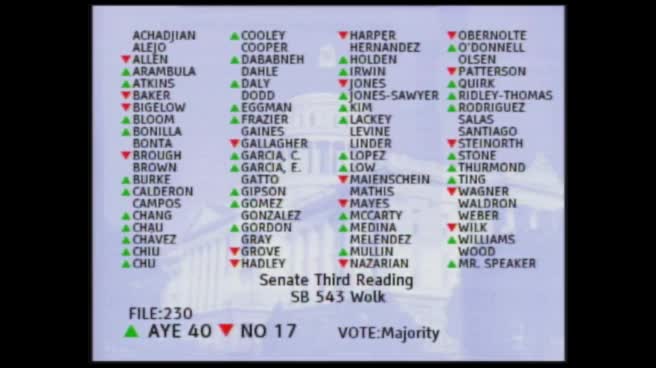 2MIN
Assembly Floor
 2MIN
Assembly Standing Committee on Appropriations
 2MIN
Senate Floor
 2MIN
Senate Standing Committee on Energy, Utilities and Communications
Bill Author

Bill Co-Author(s):