SB 696: Insurance: principle-based valuation.
- Session Year: 2015-2016
- House: Senate
- Latest Version Date: 2015-10-08
Existing law governs the issuance of life and disability insurance and authorizes the Insurance Commissioner to regulate those insurers. Existing law requires every life and disability insurer doing business in this state to annually submit the opinion of a qualified actuary as to whether the reserves and related actuarial items held in support of the policies and contracts specified by the commissioner by regulation are computed appropriately, are based on assumptions that satisfy contractual provisions, are consistent with prior reported amounts, and comply with applicable state law. Among other things, existing law requires insurers to calculate the minimum standard for the valuation of those policies and contracts using specified mortality tables approved by the commissioner, sets forth the applicable interest rates, and establishes the reserve requirements for various types of life and disability policies and contracts.
This bill would explicitly refer to the body of laws imposing those requirements, as specified, as the Standard Valuation Law. The bill would require the commissioner and companies engaging in specified activities relating to the business of life insurance to incorporate the methodology employed by a specified manual of valuation instructions adopted by the National Association of Insurance Commissioners in making determinations relating to reserve requirements and the minimum standard of valuation for policies and contracts, as specified. The bill would require a company to establish reserves using a principle-based valuation that meets specified conditions in the valuation manual, including quantifying the benefits, guarantees, and funding associated with the contracts, and would require the company to develop and file with the commissioner, upon request, a principle-based valuation report. The bill would require a company to submit mortality, morbidity, policyholder behavior, or expense experience and other data as prescribed in the valuation manual.
This bill would authorize the commissioner to impose an annual assessment on each insurance company, based on the companys gross annual life insurance premium written by the insurer in California during the immediately preceding year, thereby imposing a tax. The bill would exempt certain information submitted by a company to the commissioner from disclosure pursuant to the California Public Records Act and would provide that it is not subject to subpoena or discovery or admissible in evidence in any private civil action. The bill would also authorize the commissioner to hire and assign Department of Insurance staff, and retain nondepartmental actuaries and other consultants, to assist the commissioner in implementing principle-based valuation.
This bill would provide that the valuation manual would not be operative until the commissioner certifies that adequate funding has been appropriated by the Legislature, and all other necessary resources, including, but not limited to, adequate staff, are available and sufficient to enable the commissioner to carry out the duties required by specified provisions of the bill. The bill would require the commissioner to make that certification by submitting a letter to the Chairs of the Assembly Committee on Insurance and the Senate Committee on Insurance stating that the funding and other necessary resources are available and sufficient to carry out those duties. The bill would also require the commissioner to post a notice on the departments Internet Web site immediately after submitting that certification letter stating that the certification letter has been submitted and that the provisions of the valuation manual are in effect.
Existing constitutional provisions require that a statute that limits the right of access to the meetings of public bodies or the writings of public officials and agencies be adopted with findings demonstrating the interest protected by the limitation and the need for protecting that interest.
This bill would make legislative findings to that effect.
This bill would include a change in state statute that would result in a taxpayer paying a higher tax within the meaning of Section 3 of Article XIIIA of the California Constitution, and thus would require for passage the approval of 2/3 of the membership of each house of the Legislature.
Discussed in Hearing
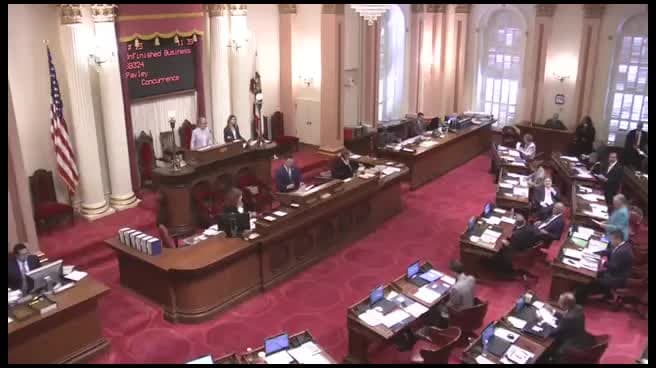 2MIN
2MINSenate Floor
 1MIN
1MINAssembly Floor
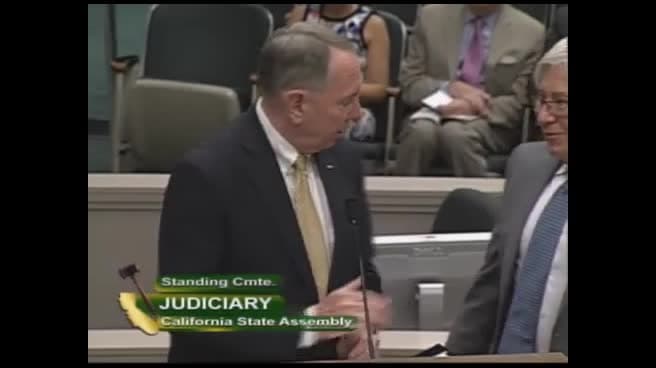 7MIN
7MINAssembly Standing Committee on Judiciary
 3MIN
3MIN