SB 778: Automotive repair: oil changes: notification to customers.
- Session Year: 2015-2016
- House: Senate
- Latest Version Date: 2016-09-02
Existing law, the Automotive Repair Act, provides for the registration and regulation of automotive repair dealers by the Bureau of Automotive Repair (bureau), which is under the supervision and control of the Director of Consumer Affairs (director). Existing law requires repair dealers to give the customer a written estimated price for labor and parts necessary for a specific job. Existing law defines terms for purposes of these provisions. Existing law makes a violation of that act, except as specified, punishable as a misdemeanor.
This bill would recast these provisions as the Automotive Repair and Maintenance Act and would provide for the registration and regulation of automotive maintenance providers, as defined, in a manner similar to the provisions regarding automotive repair dealers. The bill would establish fee requirements as well as procedures to be implemented by the director for granting, suspending, or revoking the registration of an automotive maintenance provider. The bill would require an automotive maintenance provider to provide a customer with a detailed written invoice for work performed and to maintain records specified by regulations adopted under these provisions. The bill would require the bureau to design and approve a sign to be placed in each automotive provider location containing information for contacting the bureau if the customer has questions about the service provided. The bill would define various terms for purposes of these provisions and would recast the definition of repair of motor vehicles to delete the listing of various types of excluded minor services and to specify that minor services do not include the changing of propulsive batteries. The bill would similarly recast the definition of automotive technician to delete provisions describing the specific work to be performed by an automotive technician. The bill, commencing January 1, 2018, would define additional terms relating to automotive repair and servicing work for purposes of these provisions. The bill would require the director to adopt regulations prior to January 1, 2018, defining minor services for these purposes. The bill would provide that the regulations adopted by the director, prior to January 1, 2018, defining minor services continue in effect on and after January 1, 2018, as specified. The bill would prohibit a facility from registering as both an automotive repair dealer and an automotive service provider, as specified. The bill would authorize the Department of Consumer Affairs to purchase motor vehicles for the purposes of enforcing these provisions, as specified. The bill would require an automotive repair dealer or an automotive maintenance provider performing oil change services to use the manufacturers published oil drain schedule, except as specified, when recommending an oil change to a customer. The bill would require that an automotive repair dealer or automotive maintenance provider include a written explanation for any recommendation for oil change at an interval other than the interval recommended by the manufacturer, and to include a specified notice to the customer with regard to the manufacturers published oil change recommendations. The bill would permit a customer to choose any oil drain interval that he or she chooses and have that interval reflected in any future recommendations by the automotive repair dealer or automotive maintenance provider. The bill would expand the definition of an existing crime by including automotive maintenance providers within these provisions, thereby imposing a state-mandated local program.
The bill would make the operation of its provisions contingent upon the enactment of AB 873 of the 201516 Regular Session.
The California Constitution requires the state to reimburse local agencies and school districts for certain costs mandated by the state. Statutory provisions establish procedures for making that reimbursement.
This bill would provide that no reimbursement is required by this act for a specified reason.
Existing law, the Automotive Repair Act, provides for the registration and regulation of automotive repair dealers by the Bureau of Automotive Repair (bureau), which is under the supervision and control of the Director of Consumer Affairs (director). Existing law requires repair dealers to give the customer a written estimated price for labor and parts necessary for a specific job. Existing law defines terms for purposes of these provisions. Existing law makes a violation of that act, except as specified, punishable as a misdemeanor.
This bill would recast these provisions as the Automotive Repair and Maintenance Act and would provide for the registration and regulation of automotive maintenance providers, as defined, in a manner similar to the provisions regarding automotive repair dealers. The bill would establish fee requirements as well as procedures to be implemented by the director for granting, suspending, or revoking the registration of an automotive maintenance provider. The bill would require an automotive maintenance provider to provide a customer with a detailed written invoice for work performed and to maintain records specified by regulations adopted under these provisions. The bill would require the bureau to design and approve a sign to be placed in each automotive provider location containing information for contacting the bureau if the customer has questions about the service provided. The bill would define various terms for purposes of these provisions and would recast the definition of repair of motor vehicles to delete the listing of various types of excluded minor services and to specify that minor services do not include the changing of propulsive batteries. The bill would similarly recast the definition of automotive technician to delete provisions describing the specific work to be performed by an automotive technician. The bill, commencing January 1, 2018, would define additional terms relating to automotive repair and servicing work for purposes of these provisions. This bill would require the director to adopt regulations prior to January 1, 2018, defining minor services for these purposes. This bill would provide that the regulations adopted by the director, prior to January 1, 2018, defining minor services continue in effect on and after January 1, 2018, as specified. The bill would prohibit a facility from registering as both an automotive repair dealer and an automotive service provider, as specified. The bill would authorize the Department of Consumer Affairs to purchase motor vehicles for the purposes of enforcing these provisions, as specified. The bill would require an automotive repair dealer or an automotive maintenance provider performing oil change services to use the manufacturers published oil drain schedule, except as specified, when recommending an oil change to a customer. The bill would require that an automotive repair dealer or automotive maintenance provider include a written explanation for any recommendation for oil change at an interval other than the interval recommended by the manufacturer, and to include a specified notice to the customer with regard to the manufacturers published oil change recommendations. The bill would permit a customer to choose any oil drain interval that he or she chooses and have that interval reflected in any future recommendations by the automotive repair dealer or automotive maintenance provider. The bill would define various terms for purposes of these provisions. The bill would expand the definition of an existing crime by including automotive maintenance providers within these provisions, thereby imposing a state-mandated local program.
The bill would make the operation of its provisions contingent upon the enactment of AB 873 of the 201516 Regular Session.
The California Constitution requires the state to reimburse local agencies and school districts for certain costs mandated by the state. Statutory provisions establish procedures for making that reimbursement.
This bill would provide that no reimbursement is required by this act for a specified reason.
Existing law, the Automotive Repair Act, provides for the registration and regulation of automotive repair dealers by the Bureau of Automotive Repair, Repair (bureau), which is under the supervision and control of the Director of Consumer Affairs. Affairs (director). Existing law requires repair dealers to give the customer a written estimated price for labor and parts necessary for a specific job. Existing law defines terms for purposes of these provisions. Existing law makes a violation of that act, except as specified, punishable as a misdemeanor.
This bill would recast these provisions as the Automotive Repair and Maintenance Act and would provide for the registration and regulation of automotive maintenance providers, as defined, in a manner similar to the provisions regarding automotive repair dealers. The bill would establish fee requirements as well as procedures to be implemented by the director for granting, suspending, or revoking the registration of an automotive maintenance provider. The bill would require an automotive maintenance provider to provide a customer with a detailed written invoice for work performed and to maintain records specified by regulations adopted under these provisions. The bill would require the bureau to design and approve a sign to be placed in each automotive provider location containing information for contacting the bureau if the customer has questions about the service provided. The bill would require an automotive repair dealer or an automotive maintenance provider performing oil change services to use the manufacturers published oil drain schedule, except as specified, when recommending an oil change to a customer. The bill would require that an automotive repair dealer or automotive maintenance provider include a written explanation for any recommendation for oil change at an interval other than the interval recommended by the manufacturer, and to include a specified notice to the customer with regard to the manufacturers published oil change recommendations. The bill would permit a customer to choose any oil drain interval that he or she chooses and have that interval reflected in any future recommendations by the automotive repair dealer. The bill would expand the definition of repair of motor vehicles to include lubricating vehicles and replacing oil filters and would specify that a person who performs these services is an automotive technician. dealer or automotive maintenance provider. The bill would also define other define various terms for purposes of these provisions. The bill would expand the definition of an existing crime by placing new requirements on automotive repair dealers, including automotive maintenance providers within these provisions, thereby imposing a state-mandated local program.
The California Constitution requires the state to reimburse local agencies and school districts for certain costs mandated by the state. Statutory provisions establish procedures for making that reimbursement.
This bill would provide that no reimbursement is required by this act for a specified reason.
Existing law, the Automotive Repair Act, provides for the registration and regulation of automotive repair dealers by the Bureau of Automotive Repair, which is under the supervision and control of the Director of Consumer Affairs. Existing law requires repair dealers to give the customer a written estimated price for labor and parts necessary for a specific job. Existing law defines terms for purposes of these provisions. Existing law makes a violation of that act, except as specified, punishable as a misdemeanor.
This bill would require an automotive repair dealer performing oil change services to notify a customer, who is purchasing an oil change, of the recommended oil drain interval, oil grade, and viscosity specified in the maintenance schedule of the vehicles owners manual. The bill would also require, except as specified, an automotive repair dealer to use the oil drain interval specified in the maintenance schedule of the vehicles owners manual if the automotive repair dealer is recommending the date or mileage for the next oil change, as described. use the manufacturers published oil drain schedule, except as specified, when recommending an oil change to a customer. The bill would require that an automotive repair dealer include a written explanation for any recommendation for oil change at an interval other than the interval recommended by the manufacturer, and to include a specified notice to the customer with regard to the manufacturers published oil change recommendations. The bill would permit a customer to choose any oil drain interval that he or she chooses and have that interval reflected in any future recommendations by the automotive repair dealer. The bill would expand the definition of repair of motor vehicles to include lubricating vehicles and replacing oil filters and would specify that a person who performs these services is an automotive technician. The bill would also define other terms for purposes of these provisions. The bill would expand the definition of an existing crime by placing new requirements on automotive repair dealers, thereby imposing a state-mandated local program.
The California Constitution requires the state to reimburse local agencies and school districts for certain costs mandated by the state. Statutory provisions establish procedures for making that reimbursement.
This bill would provide that no reimbursement is required by this act for a specified reason.
Existing law, the California Oil Recycling Enhancement Act, establishes a program, to encourage the recycling of oil, administered by the Department of Resources Recycling and Recovery. A violation of the act is a crime. the Automotive Repair Act, provides for the registration and regulation of automotive repair dealers by the Bureau of Automotive Repair, which is under the supervision and control of the Director of Consumer Affairs. Existing law requires repair dealers to give the customer a written estimated price for labor and parts necessary for a specific job. Existing law makes a violation of that act, except as specified, punishable as a misdemeanor.
This bill, on and after January 1, 2018, bill would require all automotive oil sold in this state to be certified by the oil manufacturer to achieve a minimum useful life of 10,000 miles when used in accordance with the automobile manufacturers recommendations, and to meet current automotive industry standards. A violation of these provisions would be a crime, an automotive repair dealer to notify a customer, who is purchasing an oil change, of the recommended oil drain interval, oil grade, and viscosity specified in the maintenance schedule of the vehicles owners manual. The bill would also require, except as specified, an automotive repair dealer to use the oil drain interval specified in the maintenance schedule of the vehicles owners manual if the automotive repair dealer is recommending the date or mileage for the next oil change, as described. The bill would expand the definition of an existing crime by placing new requirements on automotive repair dealers, thereby imposing a state-mandated local program.
The California Constitution requires the state to reimburse local agencies and school districts for certain costs mandated by the state. Statutory provisions establish procedures for making that reimbursement.
This bill would provide that no reimbursement is required by this act for a specified reason.
Existing law, the California Oil Recycling Enhancement Act, establishes a program, to encourage the recycling of oil, administered by the Department of Resources Recycling and Recovery. A violation of the act is a crime.
This bill, on and after January 1, 2018, would require all automotive oil sold in this state to be certified by the oil manufacturer to achieve a minimum useful life of 10,000 miles when used in accordance with the automobile manufacturers recommendations, and to meet current automotive industry standards. The bill would require the Secretary for Environmental Protection, by January 1, 2017, to establish a minimum standard for automotive oil, as specified, for California environmentally preferable lubricants. The bill, on and after January 1, 2020, would require at least 25% of the cumulative annual volume of ingredients used to manufacture automotive oil sold in the state by oil manufacturers to meet the California environmentally preferable lubricant definition, increasing to not less than 50% on and after January 1, 2030, unless the secretary makes a finding that compliance is not feasible due to insufficient supply. A violation of these provisions would be a crime, thereby imposing a state-mandated local program.
The California Constitution requires the state to reimburse local agencies and school districts for certain costs mandated by the state. Statutory provisions establish procedures for making that reimbursement.
This bill would provide that no reimbursement is required by this act for a specified reason.
Existing law requires the Secretary of the Natural Resources Agency to establish a central public registry of all conservation easements held or required by the state, or purchased with state grant funds provided by an agency, department, or division of the state on or after January 1, 2000, as prescribed. Existing law requires the registry to be updated biennially.
This bill would require the registry to be updated biennially, or more frequently at the discretion of the secretary.
The Legislature finds and declares all of the following:
(a)Used automotive oil is one of the largest sources of hazardous waste generated in California. While California has a robust recycling program in place, about 40 percent of automotive oil can never be collected for recycling because it is lost in use, either burned in the combustion chamber or dripped onto streets and parking lots. Of the oil that is collected, only a small percentage is actually rerefined into new automotive oil.
(b)Oil quality and engine technology have evolved significantly in recent years. New motor oil formulations reduce repairs, prolong engine life, improve fuel economy, and enable significantly longer oil change intervals than outdated 3,000-mile-oil-change marketing campaigns.
(c)Most automakers currently specify oil change intervals at either 7,500 or 10,000 miles for late model vehicles operated under normal conditions, with intervals as high as 15,000 miles in some cars. Motor oils that meet current industry standards, such as those specified by the American Petroleum Institute (API) or standards specified by the manufacturer, will have the capability to meet current automaker oil change interval recommendations.
(d)Vehicle manufacturers may specify shorter oil change intervals for older vehicles or vehicles operated under severe conditions, including, but not limited to, extreme hot or cold temperatures, extensive idling in stop-and-go traffic, frequent short trips, hauling heavy loads, and towing.
(e)Changing oil more often than what is specified in the vehicle manufacturers published maintenance schedule wastes oil and money and compounds the environmental impact, especially to water.
(f)It is the intent of the Legislature to ensure that the oil drain interval recommended by an automotive repair dealer or an automotive maintenance provider be in accordance with the vehicle manufacturers published maintenance schedule in order to prevent deceiving or misleading consumers with unnecessary and costly oil changes.
(g)It is further the intent of the Legislature to source-reduce the amount of used automotive oil that is generated in California in order to reduce our dependence on petroleum products, avoid damage to the environment and threats to public health, and be consistent with the states hierarchy for waste management practices pursuant to Section 40051 of the Public Resources Code.
SEC. 2.Section 9880 of the Business and Professions Code is amended to read:9880.This chapter constitutes the chapter on automotive repair dealers and automotive maintenance providers. It may be cited as the Automotive Repair and Maintenance Act.
SEC. 3.Section 9880.1 of the Business and Professions Code is amended to read:9880.1.The following definitions apply for the purposes of this chapter:
(a)Automotive repair dealer means a person who, for compensation, engages in the business of repairing or diagnosing malfunctions of motor vehicles.
(b)Chief means the Chief of the Bureau of Automotive Repair.
(c)Bureau means the Bureau of Automotive Repair.
(d)Motor vehicle means a passenger vehicle required to be registered with the Department of Motor Vehicles and all motorcycles whether or not required to be registered by the Department of Motor Vehicles.
(e)Repair of motor vehicles means all maintenance of and repairs to motor vehicles performed by an automotive repair dealer including automotive body repair work, but excluding those repairs made pursuant to a commercial business agreement and also excluding repairing tires, changing tires, lubricating vehicles, installing light bulbs, batteries, except propulsive batteries, windshield wiper blades and other minor accessories, cleaning, adjusting, and replacing spark plugs, replacing fan belts, oil, and air filters, and other minor services, which the director, by regulation, determines are customarily performed by gasoline service stations.
No service shall be designated as minor, for purposes of this section, if the director finds that performance of the service requires mechanical expertise, has given rise to a high incidence of fraud or deceptive practices, or involves a part of the vehicle essential to its safe operation.
(f)Person includes a firm, partnership, association, limited liability company, or corporation.
(g)An automotive technician is an employee of an automotive repair dealer or is that dealer, if the employer or dealer repairs motor vehicles and who for salary or wage performs maintenance, diagnostics, repair, removal, or installation of any integral component parts of an engine, driveline, chassis, or body of any vehicle, but excluding repairing tires, changing tires, lubricating vehicles, installing light bulbs, batteries, except propulsive batteries, windshield wiper blades, and other minor accessories; cleaning, replacing fan belts, air filters; and other minor services which the director, by regulation, determines are customarily performed by a gasoline service station.
(h)Director means the Director of Consumer Affairs.
(i)Commercial business agreement means an agreement, whether in writing or oral, entered into between a business or commercial enterprise and an automobile repair dealer, prior to the repair which is requested being made, which agreement contemplates a continuing business arrangement under which the automobile repair dealer is to repair any vehicle covered by the agreement, but does not mean any warranty or extended service agreement normally given by an automobile repair facility to its customers.
(j)Customer means the person presenting a motor vehicle for repair and authorizing the repairs to that motor vehicle. Customer shall not mean the automotive repair dealer providing the repair services or an insurer involved in a claim that includes the motor vehicle being repaired or an employee or agent or a person acting on behalf of the dealer or insurer.
(k)Automotive maintenance provider means a person who, for compensation, engages in the business of the preventive automotive maintenance services associated with fluid and filter changes, fluid treatments, and belt and windshield wiper blade replacement.
(l)Minor services means services provided by an automotive maintenance provider.
(m)Prior to January 1, 2018, the director shall adopt comprehensive regulations defining minor services as used in this section.
(n)This section shall remain in effect only until January 1, 2018, and as of that date is repealed, unless a later enacted statute, that is enacted before January 1, 2018, deletes or extends that date.
SEC. 4.Section 9880.1 is added to the Business and Professions Code, to read:9880.1.The following definitions apply for the purposes of this chapter:
(a)Automotive repair dealer means a person who, for compensation, engages in the business of repairing or diagnosing malfunctions of motor vehicles.
(b)Chief means the Chief of the Bureau of Automotive Repair.
(c)Bureau means the Bureau of Automotive Repair.
(d)Motor vehicle means a passenger vehicle required to be registered with the Department of Motor Vehicles and all motorcycles whether or not required to be registered by the Department of Motor Vehicles.
(e)(1)Repair of motor vehicles means all maintenance of and repairs to motor vehicles performed by an automotive repair dealer including automotive body repair work, but excluding those repairs made pursuant to a commercial business agreement, minor services as determined through regulations adopted by the director, and roadside services.
(2)No service shall be designated as minor, for purposes of this section, if the director finds that performance of the service requires mechanical expertise, has given rise to a high incidence of fraud or deceptive practices, or involves a part of the vehicle essential to its safe operation. Minor services shall not include the changing of propulsive batteries.
(f)Person includes a firm, partnership, association, limited liability company, or corporation.
(g)An automotive technician is an employee of an automotive repair dealer or is that dealer who for a salary or wage repairs motor vehicles as set forth in subdivision (e).
(h)Director means the Director of Consumer Affairs.
(i)Commercial business agreement means an agreement, whether in writing or oral, entered into between a business or commercial enterprise and an automobile repair dealer, prior to the repair which is requested being made, which agreement contemplates a continuing business arrangement under which the automobile repair dealer is to repair any vehicle covered by the agreement, but does not mean any warranty or extended service agreement normally given by an automobile repair facility to its customers.
(j)Roadside services means the services performed upon a motor vehicle for the purpose of transporting the vehicle or to permit it to be operated under its own power, by or on behalf of a motor club holding a certificate of authority pursuant to Chapter 2 (commencing with Section 12160) of Part 5 of Division 2 of the Insurance Code or by an operator of a tow truck, as defined in Section 615 of the Vehicle Code, that is owned or operated by a person or entity who possesses a valid motor carrier permit, as described in Section 34620 of the Vehicle Code, and is enrolled in the Basic Inspection of Terminals program, as described in Section 34501.12 of the Vehicle Code.
(k)Customer means the person presenting a motor vehicle for repair and authorizing the repairs to that motor vehicle. Customer shall not mean the automotive repair dealer providing the repair services or an insurer involved in a claim that includes the motor vehicle being repaired or an employee or agent or a person acting on behalf of the dealer or insurer.
(l)Automotive maintenance provider means a person who, for compensation, engages in the business of the preventative automotive maintenance services associated with fluid and filter changes, fluid treatments, and belt and windshield wiper blade replacement.
(m)Minor services means services provided by an automotive maintenance provider.
(n)The regulations adopted by the director, prior to January 1, 2018, defining minor services for the purposes of this section shall continue in effect on and after January 1, 2018. The director may, thereafter, amend or repeal those regulations, as he or she deems necessary and consistent with this chapter.
(o)This section shall become operative January 1, 2018.
SEC. 5.Section 9880.2 is added to the Business and Professions Code, to read:9880.2.(a)There is the Department of Consumer Affairs an enforcement program charged with the responsibility of investigating violations of this chapter, the Motor Vehicle Inspection Program (Article 1 (commencing with Section 44000) of Chapter 5 of Part 5 of Division 26 of the Health and Safety Code) and any regulations adopted thereto.
(b)For the sole purpose of such investigations, the department may purchase vehicles of various makes, models, and condition, and vehicles purchased for investigations pursuant to this section shall not be subject to Chapter 8.3 (commencing with Section 25722) of Division 15 of the Public Resources Code. After purchase, the department may prepare the vehicle for use in an investigation by disabling, modifying, or otherwise changing the vehicles emission control system components or any other part or parts of the vehicle. To complete the investigation, the department may purchase or attempt to purchase repairs, services, or parts from those entities licensed or registered by the department. The funds for such preparation and purchases are not subject to the monetary limit specified in Section 16404 of the Government Code, but the department shall comply with all other provisions of that section. The department shall implement the safeguards necessary to ensure the proper use and disbursement of the funds utilized pursuant to this section.
(c)To avoid unnecessary delays and to promote prompt enforcement, motor vehicles purchased pursuant to this section are exempt from existing laws, rules, resolutions, or procedures that are otherwise applicable to the acquisition of motor vehicles to be used by a state agency. The department shall maintain an inventory of these vehicles and shall dispose of them, when appropriate, in a manner consistent with applicable laws and regulations. Any records associated with the purchase of these vehicles shall not be subject to public disclosure.
SEC. 6.Section 9880.4 is added to the Business and Professions Code, to read:9880.4.A facility registered with the director is prohibited from registering as both an automotive repair dealer and an automotive maintenance provider. A business that maintains multiple facilities may register the facilities separately with the individual facilities registered as an automotive repair dealer or an automotive maintenance provider.
SEC. 7.Article 3.5 (commencing with Section 9884.23) is added to Chapter 20.3 of Division 3 of the Business and Professions Code, to read:3.5.Automotive Maintenance Provider Registration9884.23.(a)An automotive maintenance provider shall pay the fee required by this chapter for each place of business operated by the provider in this state and shall register with the director upon forms prescribed by the director. The forms shall contain sufficient information to identify the automotive maintenance provider, including name, address of each location, a statement by the provider that each location is in an area that, pursuant to local zoning ordinances, permits the operation of a facility for the maintenance of motor vehicles, the providers retail sellers permit number, if a permit is required under the Sales and Use Tax Law (Part 1 (commencing with Section 6001) of Division 2 of the Revenue and Taxation Code), and other identifying data that are prescribed by the director. If the business is to be carried on under a fictitious name, the fictitious name shall be stated. To the extent prescribed by the director, an automotive maintenance provider shall identify the owners, directors, officers, partners, members, trustees, managers, and any other persons who directly or indirectly control or conduct the business. The forms shall include a statement signed by the provider under penalty of perjury that the information provided is true.
(b)A state agency is not authorized or required by this section to enforce a city, county, regional, air pollution control district, or air quality management district rule or regulation regarding the site or operation of a facility that provides maintenance to motor vehicles.
9884.24.A business maintaining more than one automotive maintenance facility shall be permitted to file a single application annually that, along with the other information required by this chapter, clearly indicates the location of, and the individual in charge of, each facility. In that case, fees shall be paid for each location.
9884.25.Upon receipt of the properly completed form and the required fee, the director shall issue the registration and send a proof of issuance to the automotive maintenance provider. The director shall by regulation prescribe conditions that he or she determines are necessary to ensure future compliance with the parts of this chapter specific to automotive maintenance providers, pursuant to which a person whose registration has previously been revoked or denied or who has committed acts prohibited by Section 9884.30 while an automotive maintenance provider or automotive technician, or while an employee, partner, officer, or member of an automotive maintenance provider, may have his or her registration issued.
9884.26.Every automotive maintenance provider registration shall cease to be valid one year from the last day of the month in which registration was issued unless the automotive maintenance provider has paid the renewal fee required by this chapter.
9884.27.An automotive maintenance provider registration shall cease to be valid when the director finds that any of the information provided by the form specified in Section 9884.23 for automotive maintenance providers, which the director by regulation deems material, ceases to be current.
9884.28.An automotive maintenance provider registration that is not renewed within three years following its expiration shall not be renewed, restored, or reinstated thereafter, and the delinquent registration shall be canceled immediately upon expiration of the three-year period.
An automotive maintenance provider whose registration has been canceled by operation of this section shall obtain a new registration only if he or she again meets the requirements set forth in this chapter relating to registration, is not subject to denial under Section 480, and pays the applicable fees.
An expired registration may be renewed at any time within three years after its expiration upon the filing of an application for renewal on a form prescribed by the bureau and the payment of all accrued renewal and delinquency fees. Renewal under this section shall be effective on the date on which the application is filed and all renewal and delinquency fees are paid. If so renewed, the registration shall continue in effect through the expiration date of the current registration year as provided in Section 9884.26, at which time the registration shall be subject to renewal.
9884.29.It is unlawful for any person to be an automotive maintenance provider unless that person has registered in accordance with this chapter and unless that registration is currently valid.
9884.30.(a)The director, where the automotive maintenance provider cannot show there was a bona fide error, may deny, suspend, revoke, or place on probation the registration of an automotive maintenance provider for any of the following acts or omissions related to the conduct of the business of the automotive maintenance provider that are performed by the automotive maintenance provider or any automotive technician, employee, partner, officer, or member of the automotive maintenance provider:
(1)Making or authorizing in any manner or by any means whatever any statement written or oral which is untrue or misleading and which is known, or which by the exercise of reasonable care should be known, to be untrue or misleading.
(2)Any other conduct that constitutes fraud.
(3)Conduct constituting gross negligence.
(4)Failure in any material respect to comply with the provisions of this chapter specific to automotive maintenance providers or regulations adopted pursuant to it.
(5)Any willful departure from or disregard of accepted trade standards for automotive maintenance in any material respect.
(6)Making false promises of a character likely to influence, persuade, or induce a customer to authorize the maintenance of automobiles.
(7)Upon denying a registration, the director shall notify the applicant thereof, in writing, by personal service or mail addressed to the address of the applicant set forth in the application, and the applicant shall be given a hearing under Section 9884.33 if, within 30 days thereafter, he or she files with the bureau a written request for a hearing; otherwise the denial is deemed affirmed.
(b)Except as provided for in subdivision (c), if an automotive maintenance provider operates more than one place of business in this state, the director pursuant to subdivision (a) shall only suspend, revoke, or place on probation the registration of the specific place of business which has violated any of the provisions of this chapter. This violation, or action by the director, shall not affect in any manner the right of the automotive maintenance provider to operate his or her other places of business.
(c)Notwithstanding subdivision (b), the director may suspend, revoke, or place on probation the registration for all places of business operated in this state by an automotive maintenance provider upon a finding that the provider has, or is, engaged in a course of repeated and willful violations of this chapter specific to automotive maintenance providers or regulations adopted pursuant to it.
9884.31.All work done by an automotive maintenance provider shall be recorded on an invoice and shall describe all service work done and parts supplied. Service work and parts shall be listed separately on the invoice, which shall also state separately the subtotal prices for service work and for parts, not including sales tax, and shall state separately the sales tax, if any, applicable to each. One copy of the invoice shall be given to the customer and one copy shall be retained either in hard copy or digitally by the automotive maintenance provider.
9884.32.Each automotive maintenance provider shall maintain any records that are required by regulations adopted to carry out the parts of this chapter specific to automotive maintenance providers. Those records shall be open for reasonable inspection by the chief or other law enforcement officials. All of those records shall be maintained for at least three years.
9884.33.All proceedings to deny, suspend, revoke, or place on probation a registration of an automotive maintenance provider shall be conducted pursuant to Chapter 5 (commencing with Section 11500) of Part 1 of Division 3 of Title 2 of the Government Code.
9884.34.The expiration of a valid registration shall not prevent the director or chief of jurisdiction from proceeding with any investigation or disciplinary proceeding against an automotive maintenance provider or rendering a decision invalidating a registration temporarily or permanently.
9884.35.The superior court in and for the county wherein any person carries on, or attempts to carry on, a business as an automotive maintenance provider or as an automotive technician in violation of the provisions of this chapter specific to automotive maintenance providers or any regulation made pursuant to this chapter shall, on application of the director or the chief, issue an injunction or other appropriate order restraining such conduct. This section shall be cumulative to and shall not prohibit the enforcement of any other law.
The proceedings under this section shall be governed by Chapter 3 (commencing with Section 525) of Title 7 of Part 2 of the Code of Civil Procedure, except that the director or chief shall not be required to allege facts necessary to show or tending to show lack of an adequate remedy at law or irreparable injury.
9884.36.The director may file charges with the district attorney or city attorney against any automotive maintenance provider who violates the provisions of this chapter specific to automotive maintenance providers or any regulation made pursuant to the provisions of this chapter specific to automotive maintenance providers.
9884.37.The bureau shall design and approve of a sign which shall be placed in all automotive maintenance provider locations in a place and manner conspicuous to the public. That sign shall give notice that inquiries concerning service may be made to the bureau and shall contain the telephone number and Internet Web site address of the bureau. The sign shall also give notice that the customer is entitled to a return of replaced parts upon his or her request at the time the work order is taken.
9884.38.Nothing in the provisions of this chapter shall prohibit the bringing of a civil action against an automotive maintenance provider by an individual.
9884.39.The bureau may adopt, amend, or repeal in accordance with the provisions of Chapter 4.5 (commencing with Section 11400) of Part 1 of Division 3 of Title 2 of the Government Code such regulations as may be reasonably necessary to carry out the provisions of this chapter specific to automotive maintenance providers.
9884.40.All accusations against automotive maintenance providers shall be filed within three years after the performance of the act or omission alleged as the ground for disciplinary action, except that with respect to an accusation alleging fraud or misrepresentation as a ground for disciplinary action, the accusation may be filed within two years after the discovery, by the bureau, of the alleged facts constituting the fraud or misrepresentation.
9884.41.(a)Notwithstanding any other law, the director may, in his or her sole discretion, issue a probationary automotive maintenance provider registration to an applicant subject to terms and conditions deemed appropriate by the director, including, but not limited to, the following:
(1)Continuing medical, psychiatric, or psychological treatment.
(2)Ongoing participation in a specified rehabilitation program.
(3)Abstention from the use of alcohol or drugs.
(4)Compliance with all provisions of this chapter.
(b)(1)Notwithstanding any other law, and for purposes of this section, when deciding whether to issue a probationary registration the director shall request that an applicant with a dismissed conviction provide proof of that dismissal and shall give special consideration to applicants whose convictions have been dismissed pursuant to Section 1203.4 or 1203.4a of the Penal Code.
(2)The director shall also take into account and consider any other reasonable documents or individual character references provided by the applicant that may serve as evidence of rehabilitation as deemed appropriate by the director.
(c)The director may modify or terminate the terms and conditions imposed on the probationary registration upon receipt of a petition from the applicant or registrant.
(d)For purposes of issuing a probationary registration to qualified new applicants, the director shall develop standard terms of probation that shall include, but not be limited to, the following:
(1)A three-year limit on the individual probationary registration.
(2)A process to obtain a standard registration for applicants who were issued a probationary registration.
(3)Supervision requirements.
(4)Compliance and quarterly reporting requirements.
9884.42.(a)Notwithstanding any other law, the director may revoke, suspend, or deny at any time any automotive maintenance provider registration required by this chapter on any of the grounds for disciplinary action provided in this chapter. The proceedings under this chapter shall be conducted in accordance with Chapter 5 (commencing with Section 11500) of Part 1 of Division 3 of Title 2 of the Government Code, and the director shall have all the powers granted therein.
(b)The director may deny a registration to an applicant on any of the grounds specified in Section 480.
(c)In addition to the requirements provided in Sections 485 and 486, upon denial of an application for registration to an applicant, the director shall provide a statement of reasons for the denial that does all of the following:
(1)Evaluates evidence of rehabilitation submitted by the applicant, if any.
(2)Provides the directors criteria relating to rehabilitation, formulated pursuant to Section 482, that takes into account the age and severity of the offense and the evidence relating to participation in treatment or other rehabilitation programs.
(3)If the directors decision was based on the applicants prior criminal conviction, justifies the directors denial of a registration and conveys the reasons why the prior criminal conviction is substantially related to the qualifications, functions, or duties of a registered automotive maintenance provider.
(d)(1)If the denial of a registration is due at least in part to the applicants state or federal criminal history record, the director shall, in addition to the information provided pursuant to paragraph (3) of subdivision (c), provide to the applicant a copy of his or her criminal history record if the applicant makes a written request to the director for a copy, specifying an address to which it is to be sent.
(A)The state or federal criminal history record shall not be modified or altered from its form or content as provided by the Department of Justice.
(B)The criminal history record shall be provided in such a manner as to protect the confidentiality and privacy of the applicants criminal history record, and the criminal history record shall not be made available by the director to any employer.
(C)The director shall retain a copy of the applicants written request and a copy of the response sent to the applicant, which shall include the date and the address to which the response was sent.
(2)The director shall make that information available upon request by the Department of Justice or the Federal Bureau of Investigation.
(e)Notwithstanding Section 487, the director shall conduct a hearing of a registration denial within 90 days of receiving an applicants request for a hearing. For all other hearing requests, the director shall determine when the hearing shall be conducted.
SEC. 8.Section 9886.3 of the Business and Professions Code is amended to read:9886.3.The fees prescribed by this chapter shall be set by the director in an amount estimated to provide for the administration of this chapter within the limits of the following schedule:
(a)The automotive repair dealer or automotive maintenance provider registration fee is not more than two hundred dollars ($200) for each place of business in this state.
(b)The annual renewal fee for an automotive repair dealer or automotive maintenance provider registration shall not be more than two hundred dollars ($200) for each place of business in this state, if renewed prior to its expiration date.
(c)The renewal fee for a registration that is not renewed prior to its expiration date shall be 11/2 times the renewal fee required for a registration renewal prior to its expiration date, but not more than the renewal fee plus fifty dollars ($50).
SEC. 9.Article 12 (commencing with Section 9890) is added to Chapter 20.3 of Division 3 of the Business and Professions Code, to read:12.Oil Change9890.(a)Except as indicated in subdivision (b), if an automotive repair dealer or an automotive maintenance provider performing oil change services recommends a date or mileage for an oil drain interval, the recommended date or mileage shall follow the vehicle manufacturer published maintenance schedule.
(b)If an automotive repair dealer or an automotive maintenance provider recommends a date or mileage for an oil drain interval that deviates from the vehicle manufacturers published maintenance schedule for reasons, including, but not limited to, compliance with paragraph (c), the basis for the date or mileage recommendation shall be noted on the final invoice or on a document attached to the final invoice.
(c)Nothing in this section shall be construed as prohibiting the customer from selecting any date or mileage for an oil drain interval of his or her choice and having that choice reflected on future recommendations from an automotive repair dealer or an automotive maintenance provider.
(d)For purposes of this section, recommended or recommendation shall mean any written recommendation, including, but not limited to, a recommendation of an oil drain interval in the form of a window sticker or a key tag, or through programmable settings in the vehicles oil life indicator.
(e)For purposes of this section, recommended or recommendation shall not mean written communications or advertisements that do not suggest timing or mileage for an oil drain interval or resetting a preset or nonprogrammable oil life indicator or an oil life monitor based on a mathematical algorithm of the vehicles usage.
(f)When an automotive repair dealer or an automotive maintenance provider performs an oil change service, the dealer shall include the following oil change disclosure statement on the final invoice or on a document attached to the final invoice:
It is important to change your oil at the proper intervals. Your vehicle manufacturer publishes oil change intervals in your owners manual and on the manufacturers Web site.
SEC. 10.
This act shall become operative only if Assembly Bill 873 of the 201516 Regular Session, relating to automotive repair, is enacted and becomes effective on January 1, 2017.
SEC. 11.No reimbursement is required by this act pursuant to Section 6 of Article XIIIB of the California Constitution because the only costs that may be incurred by a local agency or school district will be incurred because this act creates a new crime or infraction, eliminates a crime or infraction, or changes the penalty for a crime or infraction, within the meaning of Section 17556 of the Government Code, or changes the definition of a crime within the meaning of Section 6 of Article XIIIB of the California Constitution.
The Legislature finds and declares all of the following:
(a)Used automotive oil is one of the largest sources of hazardous waste generated in California. While California has a robust recycling program in place, about 40 percent of automotive oil can never be collected for recycling because it is lost in use, either burned in the combustion chamber or dripped onto streets and parking lots. Of the oil that is collected, only a small percentage is actually rerefined into new automotive oil.
(b)Oil quality and engine technology have evolved significantly in recent years. New motor oil formulations reduce repairs, prolong engine life, improve fuel economy, and enable significantly longer oil change intervals than outdated 3,000-mile-oil-change marketing campaigns.
(c)Most automakers currently specify oil change intervals at either 7,500 or 10,000 miles for late model vehicles operated under normal conditions, with intervals as high as 15,000 miles in some cars. Motor oils that meet current industry standards, such as those specified by the American Petroleum Institute (API) or standards specified by the manufacturer, will have the capability to meet current automaker oil change interval recommendations.
(d)Vehicle manufacturers may specify shorter oil change intervals for older vehicles or vehicles operated under severe conditions, including, but not limited to, extreme hot or cold temperatures, extensive idling in stop-and-go traffic, frequent short trips, hauling heavy loads, and towing.
(e)Changing oil more often than what is specified in the vehicle manufacturers published maintenance schedule wastes oil and money and compounds the environmental impact, especially to water.
(f)It is the intent of the Legislature to ensure that the oil drain interval recommended by an automotive repair dealer or an automotive maintenance provider be in accordance with the vehicle manufacturers published maintenance schedule in order to prevent deceiving or misleading consumers with unnecessary and costly oil changes.
(g)It is further the intent of the Legislature to source-reduce the amount of used automotive oil that is generated in California in order to reduce our dependence on petroleum products, avoid damage to the environment and threats to public health, and be consistent with the states hierarchy for waste management practices pursuant to Section 40051 of the Public Resources Code.
SEC. 2.Section 9880 of the Business and Professions Code is amended to read:9880.This chapter constitutes the chapter on automotive repair dealers and automotive maintenance providers. It may be cited as the Automotive Repair and Maintenance Act.
SEC. 3.Section 9880.1 of the Business and Professions Code is amended to read:9880.1.The following definitions apply for the purposes of this chapter:
(a)Automotive repair dealer means a person who, for compensation, engages in the business of repairing or diagnosing malfunctions of motor vehicles.
(b)Chief means the Chief of the Bureau of Automotive Repair.
(c)Bureau means the Bureau of Automotive Repair.
(d)Motor vehicle means a passenger vehicle required to be registered with the Department of Motor Vehicles and all motorcycles whether or not required to be registered by the Department of Motor Vehicles.
(e)Repair of motor vehicles means all maintenance of and repairs to motor vehicles performed by an automotive repair dealer including automotive body repair work, but excluding those repairs made pursuant to a commercial business agreement and also excluding repairing tires, changing tires, lubricating vehicles, installing light bulbs, batteries, except propulsive batteries, windshield wiper blades and other minor accessories, cleaning, adjusting, and replacing spark plugs, replacing fan belts, oil, and air filters, and other minor services, which the director, by regulation, determines are customarily performed by gasoline service stations.
No service shall be designated as minor, for purposes of this section, if the director finds that performance of the service requires mechanical expertise, has given rise to a high incidence of fraud or deceptive practices, or involves a part of the vehicle essential to its safe operation.
(f)Person includes a firm, partnership, association, limited liability company, or corporation.
(g)An automotive technician is an employee of an automotive repair dealer or is that dealer, if the employer or dealer repairs motor vehicles and who for salary or wage performs maintenance, diagnostics, repair, removal, or installation of any integral component parts of an engine, driveline, chassis chassis, or body of any vehicle, but excluding repairing tires, changing tires, lubricating vehicles, installing light bulbs, batteries, except propulsive batteries, windshield wiper blades, and other minor accessories; cleaning, replacing fan belts, air filters; and other minor services which the director, by regulation, determines are customarily performed by a gasoline service station.
(h)Director means the Director of Consumer Affairs.
(i)Commercial business agreement means an agreement, whether in writing or oral, entered into between a business or commercial enterprise and an automobile repair dealer, prior to the repair which is requested being made, which agreement contemplates a continuing business arrangement under which the automobile repair dealer is to repair any vehicle covered by the agreement, but does not mean any warranty or extended service agreement normally given by an automobile repair facility to its customers.
(j)Customer means the person presenting a motor vehicle for repair and authorizing the repairs to that motor vehicle. Customer shall not mean the automotive repair dealer providing the repair services or an insurer involved in a claim that includes the motor vehicle being repaired or an employee or agent or a person acting on behalf of the dealer or insurer.
(k)Automotive maintenance provider means a person who, for compensation, engages in the business of the preventive automotive maintenance services associated with fluid and filter changes, fluid treatments, and belt and windshield wiper blade replacement.
(l)Minor services means services provided by an automotive maintenance provider.
(m)Prior to January 1, 2018, the director shall adopt comprehensive regulations defining minor services as used in this section.
(n)This section shall remain in effect only until January 1, 2018, and as of that date is repealed, unless a later enacted statute, that is enacted before January 1, 2018, deletes or extends that date.
SEC. 4.Section 9880.1 is added to the Business and Professions Code, to read:9880.1.The following definitions apply for the purposes of this chapter:
(a)Automotive repair dealer means a person who, for compensation, engages in the business of repairing or diagnosing malfunctions of motor vehicles.
(b)Chief means the Chief of the Bureau of Automotive Repair.
(c)Bureau means the Bureau of Automotive Repair.
(d)Motor vehicle means a passenger vehicle required to be registered with the Department of Motor Vehicles and all motorcycles whether or not required to be registered by the Department of Motor Vehicles.
(e)(1)Repair of motor vehicles means all maintenance of and repairs to motor vehicles performed by an automotive repair dealer including automotive body repair work, but excluding those repairs made pursuant to a commercial business agreement, minor services as determined through regulations adopted by the director, and roadside services.
(2)No service shall be designated as minor, for purposes of this section, if the director finds that performance of the service requires mechanical expertise, has given rise to a high incidence of fraud or deceptive practices, or involves a part of the vehicle essential to its safe operation. Minor services shall not include the changing of propulsive batteries.
(f)Person includes a firm, partnership, association, limited liability company, or corporation.
(g)An automotive technician is an employee of an automotive repair dealer or is that dealer who for a salary or wage repairs motor vehicles as set forth in subdivision (e).
(h)Director means the Director of Consumer Affairs.
(i)Commercial business agreement means an agreement, whether in writing or oral, entered into between a business or commercial enterprise and an automobile repair dealer, prior to the repair which is requested being made, which agreement contemplates a continuing business arrangement under which the automobile repair dealer is to repair any vehicle covered by the agreement, but does not mean any warranty or extended service agreement normally given by an automobile repair facility to its customers.
(j)Roadside services means the services performed upon a motor vehicle for the purpose of transporting the vehicle or to permit it to be operated under its own power, by or on behalf of a motor club holding a certificate of authority pursuant to Chapter 2 (commencing with Section 12160) of Part 5 of Division 2 of the Insurance Code or by an operator of a tow truck, as defined in Section 615 of the Vehicle Code, that is owned or operated by a person or entity who possesses a valid motor carrier permit, as described in Section 34620 of the Vehicle Code, and is enrolled in the Basic Inspection of Terminals program, as described in Section 34501.12 of the Vehicle Code.
(k)Customer means the person presenting a motor vehicle for repair and authorizing the repairs to that motor vehicle. Customer shall not mean the automotive repair dealer providing the repair services or an insurer involved in a claim that includes the motor vehicle being repaired or an employee or agent or a person acting on behalf of the dealer or insurer.
(l)Automotive maintenance provider means a person who, for compensation, engages in the business of the preventative automotive maintenance services associated with fluid and filter changes, fluid treatments, and belt and windshield wiper blade replacement.
(m)Minor services means services provided by an automotive maintenance provider.
(n)The regulations adopted by the director, prior to January 1, 2018, defining minor services for the purposes of this section shall continue in effect on and after January 1, 2018. The director may, thereafter, amend or repeal those regulations, as he or she deems necessary and consistent with this chapter.
(o)This section shall become operative January 1, 2018.
SEC. 5.Section 9880.2 is added to the Business and Professions Code, to read:9880.2.(a)There is the Department of Consumer Affairs an enforcement program charged with the responsibility of investigating violations of this chapter, the Motor Vehicle Inspection Program (Article 1 (commencing with Section 44000) of Chapter 5 of Part 5 of Division 26 of the Health and Safety Code) and any regulations adopted thereto.
(b)For the sole purpose of such investigations, the department may purchase vehicles of various makes, models, and condition, and vehicles purchased for investigations pursuant to this section shall not be subject to Chapter 8.3 (commencing with Section 25722) of Division 15 of the Public Resources Code. After purchase, the department may prepare the vehicle for use in an investigation by disabling, modifying, or otherwise changing the vehicles emission control system components or any other part or parts of the vehicle. To complete the investigation, the department may purchase or attempt to purchase repairs, services, or parts from those entities licensed or registered by the department. The funds for such preparation and purchases are not subject to the monetary limit specified in Section 16404 of the Government Code, but the department shall comply with all other provisions of that section. The department shall implement the safeguards necessary to ensure the proper use and disbursement of the funds utilized pursuant to this section.
(c)To avoid unnecessary delays and to promote prompt enforcement, motor vehicles purchased pursuant to this section are exempt from existing laws, rules, resolutions, or procedures that are otherwise applicable to the acquisition of motor vehicles to be used by a state agency. The department shall maintain an inventory of these vehicles and shall dispose of them, when appropriate, in a manner consistent with applicable laws and regulations. Any records associated with the purchase of these vehicles shall not be subject to public disclosure.
SEC. 6.Section 9880.4 is added to the Business and Professions Code, to read:9880.4.A facility registered with the director is prohibited from registering as both an automotive repair dealer and an automotive maintenance provider. A business that maintains multiple facilities may register the facilities separately with the individual facilities registered as an automotive repair dealer or an automotive maintenance provider.
SEC. 4.SEC. 7.Article 3.5 (commencing with Section 9884.23) is added to Chapter 20.3 of Division 3 of the Business and Professions Code, to read:3.5.Automotive Maintenance Provider Registration9884.23.(a)An automotive maintenance provider shall pay the fee required by this chapter for each place of business operated by the provider in this state and shall register with the director upon forms prescribed by the director. The forms shall contain sufficient information to identify the automotive maintenance provider, including name, address of each location, a statement by the provider that each location is in an area that, pursuant to local zoning ordinances, permits the operation of a facility for the maintenance of motor vehicles, the providers retail sellers permit number, if a permit is required under the Sales and Use Tax Law (Part 1 (commencing with Section 6001) of Division 2 of the Revenue and Taxation Code), and other identifying data that are prescribed by the director. If the business is to be carried on under a fictitious name, the fictitious name shall be stated. To the extent prescribed by the director, an automotive maintenance provider shall identify the owners, directors, officers, partners, members, trustees, managers, and any other persons who directly or indirectly control or conduct the business. The forms shall include a statement signed by the provider under penalty of perjury that the information provided is true.
(b)A state agency is not authorized or required by this section to enforce a city, county, regional, air pollution control district, or air quality management district rule or regulation regarding the site or operation of a facility that provides maintenance to motor vehicles.
9884.24.A business maintaining more than one automotive maintenance facility shall be permitted to file a single application annually that, along with the other information required by this chapter, clearly indicates the location of, and the individual in charge of, each facility. In that case, fees shall be paid for each location.
9884.25.Upon receipt of the properly completed form and the required fee, the director shall issue the registration and send a proof of issuance to the automotive maintenance provider. The director shall by regulation prescribe conditions that he or she determines are necessary to ensure future compliance with the parts of this chapter specific to automotive maintenance providers, pursuant to which a person whose registration has previously been revoked or denied or who has committed acts prohibited by Section 9884.30 while an automotive maintenance provider or automotive technician, or while an employee, partner, officer, or member of an automotive maintenance provider, may have his or her registration issued.
9884.26.Every automotive maintenance provider registration shall cease to be valid one year from the last day of the month in which registration was issued unless the automotive maintenance provider has paid the renewal fee required by this chapter.
9884.27.An automotive maintenance provider registration shall cease to be valid when the director finds that any of the information provided by the form specified in Section 9884.23 for automotive maintenance providers, which the director by regulation deems material, ceases to be current.
9884.28.An automotive maintenance provider registration that is not renewed within three years following its expiration shall not be renewed, restored, or reinstated thereafter, and the delinquent registration shall be canceled immediately upon expiration of the three-year period.
An automotive maintenance provider whose registration has been canceled by operation of this section shall obtain a new registration only if he or she again meets the requirements set forth in this chapter relating to registration, is not subject to denial under Section 480, and pays the applicable fees.
An expired registration may be renewed at any time within three years after its expiration upon the filing of an application for renewal on a form prescribed by the bureau and the payment of all accrued renewal and delinquency fees. Renewal under this section shall be effective on the date on which the application is filed and all renewal and delinquency fees are paid. If so renewed, the registration shall continue in effect through the expiration date of the current registration year as provided in Section 9884.26, at which time the registration shall be subject to renewal.
9884.29.It is unlawful for any person to be an automotive maintenance provider unless that person has registered in accordance with this chapter and unless that registration is currently valid.
9884.30.(a)The director, where the automotive maintenance provider cannot show there was a bona fide error, may deny, suspend, revoke, or place on probation the registration of an automotive maintenance provider for any of the following acts or omissions related to the conduct of the business of the automotive maintenance provider that are performed by the automotive maintenance provider or any automotive technician, employee, partner, officer, or member of the automotive maintenance provider. provider:
(1)Making or authorizing in any manner or by any means whatever any statement written or oral which is untrue or misleading and which is known, or which by the exercise of reasonable care should be known, to be untrue or misleading.
(2)Any other conduct that constitutes fraud.
(3)Conduct constituting gross negligence.
(4)Failure in any material respect to comply with the provisions of this chapter specific to automotive maintenance providers or regulations adopted pursuant to it.
(5)Any willful departure from or disregard of accepted trade standards for automotive maintenance in any material respect.
(6)Making false promises of a character likely to influence, persuade, or induce a customer to authorize the maintenance of automobiles.
(7)Upon denying a registration, the director shall notify the applicant thereof, in writing, by personal service or mail addressed to the address of the applicant set forth in the application, and the applicant shall be given a hearing under Section 9884.33 if, within 30 days thereafter, he or she files with the bureau a written request for a hearing; otherwise the denial is deemed affirmed.
(b)Except as provided for in subdivision (c), if an automotive maintenance provider operates more than one place of business in this state, the director pursuant to subdivision (a) shall only suspend, revoke, or place on probation the registration of the specific place of business which has violated any of the provisions of this chapter. This violation, or action by the director, shall not affect in any manner the right of the automotive maintenance provider to operate his or her other places of business.
(c)Notwithstanding subdivision (b), the director may suspend, revoke, or place on probation the registration for all places of business operated in this state by an automotive maintenance provider upon a finding that the provider has, or is, engaged in a course of repeated and willful violations of this chapter specific to automotive maintenance providers or regulations adopted pursuant to it.
9884.31.All work done by an automotive maintenance provider shall be recorded on an invoice and shall describe all service work done and parts supplied. Service work and parts shall be listed separately on the invoice, which shall also state separately the subtotal prices for service work and for parts, not including sales tax, and shall state separately the sales tax, if any, applicable to each. One copy of the invoice shall be given to the customer and one copy shall be retained either in hard copy or digitally by the automotive maintenance provider.
9884.32.Each automotive maintenance provider shall maintain any records that are required by regulations adopted to carry out the parts of this chapter specific to automotive maintenance providers. Those records shall be open for reasonable inspection by the chief or other law enforcement officials. All of those records shall be maintained for at least three years.
9884.33.All proceedings to deny, suspend, revoke, or place on probation a registration of an automotive maintenance provider shall be conducted pursuant to Chapter 5 (commencing with Section 11500) of Part 1 of Division 3 of Title 2 of the Government Code.
9884.34.The expiration of a valid registration shall not prevent the director or chief of jurisdiction from proceeding with any investigation or disciplinary proceeding against an automotive maintenance provider or rendering a decision invalidating a registration temporarily or permanently.
9884.35.The superior court in and for the county wherein any person carries on, or attempts to carry on, a business as an automotive maintenance provider or as an automotive technician in violation of the provisions of this chapter specific to automotive maintenance providers or any regulation made pursuant to this chapter shall, on application of the director or the chief, issue an injunction or other appropriate order restraining such conduct. This section shall be cumulative to and shall not prohibit the enforcement of any other law.
The proceedings under this section shall be governed by Chapter 3 (commencing with Section 525) of Title 7 of Part 2 of the Code of Civil Procedure, except that the director or chief shall not be required to allege facts necessary to show or tending to show lack of an adequate remedy at law or irreparable injury.
9884.36.The director may file charges with the district attorney or city attorney against any automotive maintenance provider who violates the provisions of this chapter specific to automotive maintenance providers or any regulation made pursuant to the provisions of this chapter specific to automotive maintenance providers.
9884.37.The bureau shall design and approve of a sign which shall be placed in all automotive maintenance provider locations in a place and manner conspicuous to the public. That sign shall give notice that inquiries concerning service may be made to the bureau and shall contain the telephone number and Internet Web site address of the bureau. The sign shall also give notice that the customer is entitled to a return of replaced parts upon his or her request at the time the work order is taken.
9884.38.Nothing in the provisions of this chapter shall prohibit the bringing of a civil action against an automotive maintenance provider by an individual.
9884.39.The bureau may adopt, amend, or repeal in accordance with the provisions of Chapter 4.5 (commencing with Section 11400) of Part 1 of Division 3 of Title 2 of the Government Code such regulations as may be reasonably necessary to carry out the provisions of this chapter specific to automotive maintenance providers in the protection of the public from fraudulent or misleading advertising by an automotive maintenance provider, including the formulation of definitions, to the extent feasible, of the terms fraud, guarantee, and negligence, and words of like import, and of guidelines for the suspension and revocation of licenses. The bureau shall distribute to each registered automotive maintenance provider copies of this chapter and of the regulations adopted pursuant to this chapter. providers.
9884.40.All accusations against automotive maintenance providers shall be filed within three years after the performance of the act or omission alleged as the ground for disciplinary action, except that with respect to an accusation alleging fraud or misrepresentation as a ground for disciplinary action, the accusation may be filed within two years after the discovery, by the bureau, of the alleged facts constituting the fraud or misrepresentation.
9884.41.(a)Notwithstanding any other law, the director may, in his or her sole discretion, issue a probationary automotive maintenance provider registration to an applicant subject to terms and conditions deemed appropriate by the director, including, but not limited to, the following:
(1)Continuing medical, psychiatric, or psychological treatment.
(2)Ongoing participation in a specified rehabilitation program.
(3)Abstention from the use of alcohol or drugs.
(4)Compliance with all provisions of this chapter.
(b)(1)Notwithstanding any other law law, and for purposes of this section, when deciding whether to issue a probationary registration the director shall request that an applicant with a dismissed conviction provide proof of that dismissal and shall give special consideration to applicants whose convictions have been dismissed pursuant to Section 1203.4 or 1203.4a of the Penal Code.
(2)The director shall also take into account and consider any other reasonable documents or individual character references provided by the applicant that may serve as evidence of rehabilitation as deemed appropriate by the director.
(c)The director may modify or terminate the terms and conditions imposed on the probationary registration upon receipt of a petition from the applicant or registrant.
(d)For purposes of issuing a probationary registration to qualified new applicants, the director shall develop standard terms of probation that shall include, but not be limited to, the following:
(1)A three-year limit on the individual probationary registration.
(2)A process to obtain a standard registration for applicants who were issued a probationary registration.
(3)Supervision requirements.
(4)Compliance and quarterly reporting requirements.
9884.42.(a)Notwithstanding any other law, the director may revoke, suspend, or deny at any time any automotive maintenance provider registration required by this chapter on any of the grounds for disciplinary action provided in this chapter. The proceedings under this chapter shall be conducted in accordance with Chapter 5 (commencing with Section 11500) of Part 1 of Division 3 of Title 2 of the Government Code, and the director shall have all the powers granted therein.
(b)The director may deny a registration to an applicant on any of the grounds specified in Section 480.
(c)In addition to the requirements provided in Sections 485 and 486, upon denial of an application for registration to an applicant, the director shall provide a statement of reasons for the denial that does all of the following:
(1)Evaluates evidence of rehabilitation submitted by the applicant, if any.
(2)Provides the directors criteria relating to rehabilitation, formulated pursuant to Section 482, that takes into account the age and severity of the offense and the evidence relating to participation in treatment or other rehabilitation programs.
(3)If the directors decision was based on the applicants prior criminal conviction, justifies the directors denial of a registration and conveys the reasons why the prior criminal conviction is substantially related to the qualifications, functions, or duties of a registered automotive maintenance provider.
(d)(1)If the denial of a registration is due at least in part to the applicants state or federal criminal history record, the director shall, in addition to the information provided pursuant to paragraph (3) of subdivision (c), provide to the applicant a copy of his or her criminal history record if the applicant makes a written request to the director for a copy, specifying an address to which it is to be sent.
(A)The state or federal criminal history record shall not be modified or altered from its form or content as provided by the Department of Justice.
(B)The criminal history record shall be provided in such a manner as to protect the confidentiality and privacy of the applicants criminal history record, and the criminal history record shall not be made available by the director to any employer.
(C)The director shall retain a copy of the applicants written request and a copy of the response sent to the applicant, which shall include the date and the address to which the response was sent.
(2)The director shall make that information available upon request by the Department of Justice or the Federal Bureau of Investigation.
(e)Notwithstanding Section 487, the director shall conduct a hearing of a registration denial within 90 days of receiving an applicants request for a hearing. For all other hearing requests, the director shall determine when the hearing shall be conducted.
9884.43.Notwithstanding any other law, nothing prevents a business from being registered as both an automotive repair dealer pursuant to Section 9884 and an automotive maintenance provider pursuant to Section 9884.23 and from operating as both at the same facility.
SEC. 5.SEC. 8.Section 9886.3 of the Business and Professions Code is amended to read:9886.3.The fees prescribed by this chapter shall be set by the director in an amount estimated to provide for the administration of this chapter within the limits of the following schedule:
(a)The automotive repair dealer or automotive maintenance provider registration fee is not more than two hundred dollars ($200) for each place of business in this state.
(b)The annual renewal fee for an automotive repair dealer or automotive maintenance provider registration shall not be more than two hundred dollars ($200) for each place of business in this state, if renewed prior to its expiration date.
(c)The renewal fee for a registration that is not renewed prior to its expiration date shall be 11/2 times the renewal fee required for a registration renewal prior to its expiration date, but not more than the renewal fee plus fifty dollars ($50).
SEC. 6.SEC. 9.Article 12 (commencing with Section 9890) is added to Chapter 20.3 of Division 3 of the Business and Professions Code, to read:12.Oil Change9890.(a)Except as indicated in subdivision (b), if an automotive repair dealer or an automotive maintenance provider performing oil change services recommends a date or mileage for an oil drain interval, the recommended date or mileage shall follow the vehicle manufacturer published maintenance schedule.
(b)If an automotive repair dealer or an automotive maintenance provider recommends a date or mileage for an oil drain interval that deviates from the vehicle manufacturers published maintenance schedule for reasons, including, but not limited to, compliance with paragraph (c), the basis for the date or mileage recommendation shall be noted on the final invoice or on a document attached to the final invoice.
(c)Nothing in this section shall be construed as prohibiting the customer from selecting any date or mileage for an oil drain interval of his or her choice and having that choice reflected on future recommendations from an automotive repair dealer or an automotive maintenance provider.
(d)For purposes of this section, recommended or recommendation shall mean any written recommendation, including, but not limited to, a recommendation of an oil drain interval in the form of a window sticker or a key tag, or through programmable settings in the vehicles oil life indicator.
(e)For purposes of this section, recommended or recommendation shall not mean written communications or advertisements that do not suggest timing or mileage for an oil drain interval or resetting a preset or nonprogrammable oil life indicator or an oil life monitor based on a mathematical algorithm of the vehicles usage.
(f)When an automotive repair dealer or an automotive maintenance provider performs an oil change service, the dealer shall include the following oil change disclosure statement on the final invoice or on a document attached to the final invoice:
It is important to change your oil at the proper intervals. Your vehicle manufacturer publishes oil change intervals in your owners manual and on the manufacturers Web site. site.
SEC. 10.
This act shall become operative only if Assembly Bill 873 of the 201516 Regular Session, relating to automotive repair, is enacted and becomes effective on January 1, 2017.
SEC. 7.SEC. 11.No reimbursement is required by this act pursuant to Section 6 of Article XIIIB of the California Constitution because the only costs that may be incurred by a local agency or school district will be incurred because this act creates a new crime or infraction, eliminates a crime or infraction, or changes the penalty for a crime or infraction, within the meaning of Section 17556 of the Government Code, or changes the definition of a crime within the meaning of Section 6 of Article XIIIB of the California Constitution.
The Legislature finds and declares all of the following:
(a)Used automotive oil is one of the largest sources of hazardous waste generated in California. While California has a robust recycling program in place, about 40 percent of automotive oil can never be collected for recycling because it is lost in use, either burned in the combustion chamber or dripped onto streets and parking lots. Of the oil that is collected, only a small percentage is actually rerefined into new automotive oil.
(b)Oil quality and engine technology have evolved significantly in recent years. New motor oil formulations reduce repairs, prolong engine life, improve fuel economy, and enable significantly longer oil change intervals than outdated 3,000-mile-oil-change marketing campaigns.
(c)Most automakers currently specify oil change intervals at either 7,500 or 10,000 miles, miles for late model vehicles operated under normal conditions, with intervals as high as 15,000 miles in some cars. Motor oils that meet current industry standards, such as those specified by the American Petroleum Institute (API) or standards specified by the manufacturer, will have the capability to meet current automaker oil change interval recommendations.
(d)Vehicle manufacturers may specify shorter oil change intervals for older vehicles or vehicles operated under severe conditions, including, but not limited to, extreme hot or cold temperatures, extensive idling in stop-and-go traffic, frequent short trips, hauling heavy loads, and towing.
(d)
(e)Changing oil more often than what is specified by the automaker in the vehicles owners manual in the vehicle manufacturers published maintenance schedule wastes oil and money and compounds the environmental impact, especially to water.
(e)
(f)It is the intent of the Legislature to ensure that the oil drain interval recommended by an automotive repair dealer or an automotive maintenance provider be in accordance with the vehicle manufacturers published maintenance schedule of the vehicles owners manual and with the recommended oil grade and viscosity in order to prevent deceiving or misleading consumers with unnecessary and costly oil changes.
(f)
(g)It is further the intent of the Legislature to source-reduce the amount of used automotive oil that is generated in California in order to reduce our dependence on petroleum products, avoid damage to the environment and threats to public health, and be consistent with the states hierarchy for waste management practices pursuant to Section 40051 of the Public Resources Code.
SEC. 2.Section 9880 of the Business and Professions Code is amended to read:9880.This chapter constitutes the chapter on automotive repair dealers. dealers and automotive maintenance providers. It may be cited as the Automotive Repair and Maintenance Act.
SEC. 2.SEC. 3.Section 9880.1 of the Business and Professions Code is amended to read:9880.1.The following definitions apply for the purposes of this chapter:
(a)Automotive repair dealer means a person who, for compensation, engages in the business of repairing or diagnosing malfunctions of motor vehicles.
(b)Chief means the Chief of the Bureau of Automotive Repair.
(c)Bureau means the Bureau of Automotive Repair.
(d)Motor vehicle means a passenger vehicle required to be registered with the Department of Motor Vehicles and all motorcycles whether or not required to be registered by the Department of Motor Vehicles.
(e)Repair of motor vehicles means all maintenance of and repairs to motor vehicles performed by an automotive repair dealer including automotive body repair work, but excluding those repairs made pursuant to a commercial business agreement and also excluding repairing tires, changing tires, lubricating vehicles, installing light bulbs, batteries, windshield wiper blades and other minor accessories, cleaning, adjusting, and replacing spark plugs, replacing fan belts, oil, and air filters, and other minor services, which the director, by regulation, determines are customarily performed by gasoline service stations.
No service shall be designated as minor, for purposes of this section, if the director finds that performance of the service requires mechanical expertise, has given rise to a high incidence of fraud or deceptive practices, or involves a part of the vehicle essential to its safe operation.
(f)Person includes firm, partnership, association, limited liability company, or corporation.
(g)An automotive technician is an employee of an automotive repair dealer or is that dealer, if the employer or dealer repairs motor vehicles and who for salary or wage performs maintenance, diagnostics, repair, removal, or installation of any integral component parts of an engine, driveline, chassis or body of any vehicle, but excluding repairing tires, changing tires, lubricating vehicles, installing light bulbs, batteries, windshield wiper blades, and other minor accessories; cleaning, replacing fan belts, air filters; and other minor services which the director, by regulation, determines are customarily performed by a gasoline service station.
(h)Director means the Director of Consumer Affairs.
(i)Commercial business agreement means an agreement, whether in writing or oral, entered into between a business or commercial enterprise and an automobile repair dealer, prior to the repair which is requested being made, which agreement contemplates a continuing business arrangement under which the automobile repair dealer is to repair any vehicle covered by the agreement, but does not mean any warranty or extended service agreement normally given by an automobile repair facility to its customers.
(j)Customer means the person presenting a motor vehicle for repair and authorizing the repairs to that motor vehicle. Customer shall not mean the automotive repair dealer providing the repair services or an insurer involved in a claim that includes the motor vehicle being repaired or an employee or agent or a person acting on behalf of the dealer or insurer.
(k)Automotive maintenance provider means a person who, for compensation, engages in the business of the preventative automotive maintenance services associated with fluid and filter changes, fluid treatments, and belt and windshield wiper blade replacement.
SEC. 4.Article 3.5 (commencing with Section 9884.23) is added to Chapter 20.3 of Division 3 of the Business and Professions Code, to read:3.5.Automotive Maintenance Provider Registration9884.23.(a)An automotive maintenance provider shall pay the fee required by this chapter for each place of business operated by the provider in this state and shall register with the director upon forms prescribed by the director. The forms shall contain sufficient information to identify the automotive maintenance provider, including name, address of each location, a statement by the provider that each location is in an area that, pursuant to local zoning ordinances, permits the operation of a facility for the maintenance of motor vehicles, the providers retail sellers permit number, if a permit is required under the Sales and Use Tax Law (Part 1 (commencing with Section 6001) of Division 2 of the Revenue and Taxation Code), and other identifying data that are prescribed by the director. If the business is to be carried on under a fictitious name, the fictitious name shall be stated. To the extent prescribed by the director, an automotive maintenance provider shall identify the owners, directors, officers, partners, members, trustees, managers, and any other persons who directly or indirectly control or conduct the business. The forms shall include a statement signed by the provider under penalty of perjury that the information provided is true.
(b)A state agency is not authorized or required by this section to enforce a city, county, regional, air pollution control district, or air quality management district rule or regulation regarding the site or operation of a facility that provides maintenance to motor vehicles.
9884.24.A business maintaining more than one automotive maintenance facility shall be permitted to file a single application annually that, along with the other information required by this chapter, clearly indicates the location of, and the individual in charge of, each facility. In that case, fees shall be paid for each location.
9884.25.Upon receipt of the properly completed form and the required fee, the director shall issue the registration and send a proof of issuance to the automotive maintenance provider. The director shall by regulation prescribe conditions that he or she determines are necessary to ensure future compliance with the parts of this chapter specific to automotive maintenance providers, pursuant to which a person whose registration has previously been revoked or denied or who has committed acts prohibited by Section 9884.30 while an automotive maintenance provider or automotive technician, or while an employee, partner, officer, or member of an automotive maintenance provider, may have his or her registration issued.
9884.26.Every automotive maintenance provider registration shall cease to be valid one year from the last day of the month in which registration was issued unless the automotive maintenance provider has paid the renewal fee required by this chapter.
9884.27.An automotive maintenance provider registration shall cease to be valid when the director finds that any of the information provided by the form specified in Section 9884.23 for automotive maintenance providers, which the director by regulation deems material, ceases to be current.
9884.28.An automotive maintenance provider registration that is not renewed within three years following its expiration shall not be renewed, restored, or reinstated thereafter, and the delinquent registration shall be canceled immediately upon expiration of the three-year period.
An automotive maintenance provider whose registration has been canceled by operation of this section shall obtain a new registration only if he or she again meets the requirements set forth in this chapter relating to registration, is not subject to denial under Section 480, and pays the applicable fees.
An expired registration may be renewed at any time within three years after its expiration upon the filing of an application for renewal on a form prescribed by the bureau and the payment of all accrued renewal and delinquency fees. Renewal under this section shall be effective on the date on which the application is filed and all renewal and delinquency fees are paid. If so renewed, the registration shall continue in effect through the expiration date of the current registration year as provided in Section 9884.26, at which time the registration shall be subject to renewal.
9884.29.It is unlawful for any person to be an automotive maintenance provider unless that person has registered in accordance with this chapter and unless that registration is currently valid.
9884.30.(a)The director, where the automotive maintenance provider cannot show there was a bona fide error, may deny, suspend, revoke, or place on probation the registration of an automotive maintenance provider for any of the following acts or omissions related to the conduct of the business of the automotive maintenance provider that are performed by the automotive maintenance provider or any automotive technician, employee, partner, officer, or member of the automotive maintenance provider.
(1)Making or authorizing in any manner or by any means whatever any statement written or oral which is untrue or misleading and which is known, or which by the exercise of reasonable care should be known, to be untrue or misleading.
(2)Any other conduct that constitutes fraud.
(3)Conduct constituting gross negligence.
(4)Failure in any material respect to comply with the provisions of this chapter specific to automotive maintenance providers or regulations adopted pursuant to it.
(5)Any willful departure from or disregard of accepted trade standards for automotive maintenance in any material respect.
(6)Making false promises of a character likely to influence, persuade, or induce a customer to authorize the maintenance of automobiles.
(7)Upon denying a registration, the director shall notify the applicant thereof, in writing, by personal service or mail addressed to the address of the applicant set forth in the application, and the applicant shall be given a hearing under Section 9884.33 if, within 30 days thereafter, he or she files with the bureau a written request for a hearing; otherwise the denial is deemed affirmed.
(b)Except as provided for in subdivision (c), if an automotive maintenance provider operates more than one place of business in this state, the director pursuant to subdivision (a) shall only suspend, revoke, or place on probation the registration of the specific place of business which has violated any of the provisions of this chapter. This violation, or action by the director, shall not affect in any manner the right of the automotive maintenance provider to operate his or her other places of business.
(c)Notwithstanding subdivision (b), the director may suspend, revoke, or place on probation the registration for all places of business operated in this state by an automotive maintenance provider upon a finding that the provider has, or is, engaged in a course of repeated and willful violations of this chapter specific to automotive maintenance providers or regulations adopted pursuant to it.
9884.31.All work done by an automotive maintenance provider shall be recorded on an invoice and shall describe all service work done and parts supplied. Service work and parts shall be listed separately on the invoice, which shall also state separately the subtotal prices for service work and for parts, not including sales tax, and shall state separately the sales tax, if any, applicable to each. One copy of the invoice shall be given to the customer and one copy shall be retained either in hard copy or digitally by the automotive maintenance provider.
9884.32.Each automotive maintenance provider shall maintain any records that are required by regulations adopted to carry out the parts of this chapter specific to automotive maintenance providers. Those records shall be open for reasonable inspection by the chief or other law enforcement officials. All of those records shall be maintained for at least three years.
9884.33.All proceedings to deny, suspend, revoke, or place on probation a registration of an automotive maintenance provider shall be conducted pursuant to Chapter 5 (commencing with Section 11500) of Part 1 of Division 3 of Title 2 of the Government Code.
9884.34.The expiration of a valid registration shall not prevent the director or chief of jurisdiction from proceeding with any investigation or disciplinary proceeding against an automotive maintenance provider or rendering a decision invalidating a registration temporarily or permanently.
9884.35.The superior court in and for the county wherein any person carries on, or attempts to carry on, a business as an automotive maintenance provider or as an automotive technician in violation of the provisions of this chapter specific to automotive maintenance providers or any regulation made pursuant to this chapter shall, on application of the director or the chief, issue an injunction or other appropriate order restraining such conduct. This section shall be cumulative to and shall not prohibit the enforcement of any other law.
The proceedings under this section shall be governed by Chapter 3 (commencing with Section 525) of Title 7 of Part 2 of the Code of Civil Procedure, except that the director or chief shall not be required to allege facts necessary to show or tending to show lack of an adequate remedy at law or irreparable injury.
9884.36.The director may file charges with the district attorney or city attorney against any automotive maintenance provider who violates the provisions of this chapter specific to automotive maintenance providers or any regulation made pursuant to the provisions of this chapter specific to automotive maintenance providers.
9884.37.The bureau shall design and approve of a sign which shall be placed in all automotive maintenance provider locations in a place and manner conspicuous to the public. That sign shall give notice that inquiries concerning service may be made to the bureau and shall contain the telephone number and Internet Web site address of the bureau. The sign shall also give notice that the customer is entitled to a return of replaced parts upon his or her request at the time the work order is taken.
9884.38.Nothing in the provisions of this chapter shall prohibit the bringing of a civil action against an automotive maintenance provider by an individual.
9884.39.The bureau may adopt, amend, or repeal in accordance with the provisions of Chapter 4.5 (commencing with Section 11400) of Part 1 of Division 3 of Title 2 of the Government Code such regulations as may be reasonably necessary to carry out the provisions of this chapter specific to automotive maintenance providers in the protection of the public from fraudulent or misleading advertising by an automotive maintenance provider, including the formulation of definitions, to the extent feasible, of the terms fraud, guarantee, and negligence, and words of like import, and of guidelines for the suspension and revocation of licenses. The bureau shall distribute to each registered automotive maintenance provider copies of this chapter and of the regulations adopted pursuant to this chapter.
9884.40.All accusations against automotive maintenance providers shall be filed within three years after the performance of the act or omission alleged as the ground for disciplinary action, except that with respect to an accusation alleging fraud or misrepresentation as a ground for disciplinary action, the accusation may be filed within two years after the discovery, by the bureau, of the alleged facts constituting the fraud or misrepresentation.
9884.41.(a)Notwithstanding any other law, the director may, in his or her sole discretion, issue a probationary automotive maintenance provider registration to an applicant subject to terms and conditions deemed appropriate by the director, including, but not limited to, the following:
(1)Continuing medical, psychiatric, or psychological treatment.
(2)Ongoing participation in a specified rehabilitation program.
(3)Abstention from the use of alcohol or drugs.
(4)Compliance with all provisions of this chapter.
(b)(1)Notwithstanding any other law and for purposes of this section, when deciding whether to issue a probationary registration the director shall request that an applicant with a dismissed conviction provide proof of that dismissal and shall give special consideration to applicants whose convictions have been dismissed pursuant to Section 1203.4 or 1203.4a of the Penal Code.
(2)The director shall also take into account and consider any other reasonable documents or individual character references provided by the applicant that may serve as evidence of rehabilitation as deemed appropriate by the director.
(c)The director may modify or terminate the terms and conditions imposed on the probationary registration upon receipt of a petition from the applicant or registrant.
(d)For purposes of issuing a probationary registration to qualified new applicants, the director shall develop standard terms of probation that shall include, but not be limited to, the following:
(1)A three-year limit on the individual probationary registration.
(2)A process to obtain a standard registration for applicants who were issued a probationary registration.
(3)Supervision requirements.
(4)Compliance and quarterly reporting requirements.
9884.42.(a)Notwithstanding any other law, the director may revoke, suspend, or deny at any time any automotive maintenance provider registration required by this chapter on any of the grounds for disciplinary action provided in this chapter. The proceedings under this chapter shall be conducted in accordance with Chapter 5 (commencing with Section 11500) of Part 1 of Division 3 of Title 2 of the Government Code, and the director shall have all the powers granted therein.
(b)The director may deny a registration to an applicant on any of the grounds specified in Section 480.
(c)In addition to the requirements provided in Sections 485 and 486, upon denial of an application for registration to an applicant, the director shall provide a statement of reasons for the denial that does all of the following:
(1)Evaluates evidence of rehabilitation submitted by the applicant, if any.
(2)Provides the directors criteria relating to rehabilitation, formulated pursuant to Section 482, that takes into account the age and severity of the offense and the evidence relating to participation in treatment or other rehabilitation programs.
(3)If the directors decision was based on the applicants prior criminal conviction, justifies the directors denial of a registration and conveys the reasons why the prior criminal conviction is substantially related to the qualifications, functions, or duties of a registered automotive maintenance provider.
(d)(1)If the denial of a registration is due at least in part to the applicants state or federal criminal history record, the director shall, in addition to the information provided pursuant to paragraph (3) of subdivision (c), provide to the applicant a copy of his or her criminal history record if the applicant makes a written request to the director for a copy, specifying an address to which it is to be sent.
(A)The state or federal criminal history record shall not be modified or altered from its form or content as provided by the Department of Justice.
(B)The criminal history record shall be provided in such a manner as to protect the confidentiality and privacy of the applicants criminal history record, and the criminal history record shall not be made available by the director to any employer.
(C)The director shall retain a copy of the applicants written request and a copy of the response sent to the applicant, which shall include the date and the address to which the response was sent.
(2)The director shall make that information available upon request by the Department of Justice or the Federal Bureau of Investigation.
(e)Notwithstanding Section 487, the director shall conduct a hearing of a registration denial within 90 days of receiving an applicants request for a hearing. For all other hearing requests, the director shall determine when the hearing shall be conducted.
9884.43.Notwithstanding any other law, nothing prevents a business from being registered as both an automotive repair dealer pursuant to Section 9884 and an automotive maintenance provider pursuant to Section 9884.23 and from operating as both at the same facility.
SEC. 5.Section 9886.3 of the Business and Professions Code is amended to read:9886.3.The fees prescribed by this chapter shall be set by the director in an amount estimated to provide for the administration of this chapter within the limits of the following schedule:
(a)The automotive repair dealer or automotive maintenance provider registration fee is not more than two hundred dollars ($200), ($200) for each place of business in this state.
(b)The annual renewal fee for an automotive repair dealer or automotive maintenance provider registration shall not be more than two hundred dollars ($200) for each place of business in this state, if renewed prior to its expiration date.
(c)The renewal fee for a registration that is not renewed prior to its expiration date shall be 11/2 times the renewal fee required for a registration renewal prior to its expiration date, but not more than the renewal fee plus fifty dollars ($50).
SEC. 3.SEC. 6.Article 12 (commencing with Section 9890) is added to Chapter 20.3 of Division 3 of the Business and Professions Code, to read:12.Oil Change9890.(a)Except as indicated in subdivision (b), if an automotive repair dealer or an automotive maintenance provider performing oil change services recommends a date or mileage for an oil drain interval, the recommended date or mileage shall follow the vehicle manufacturer published maintenance schedule.
(b)If an automotive repair dealer or an automotive maintenance provider recommends a date or mileage for an oil drain interval that deviates from the vehicle manufacturers published maintenance schedule for reasons, including, but not limited to, compliance with paragraph (c), the basis for the date or mileage recommendation shall be noted on the final invoice or on a document attached to the final invoice.
(c)Nothing in this section shall be construed as prohibiting the customer from selecting any date or mileage for an oil drain interval of his or her choice and having that choice reflected on future recommendations from an automotive repair dealer. dealer or an automotive maintenance provider.
(d)For purposes of this section, recommended or recommendation shall mean any written recommendation, including, but not limited to, a recommendation of an oil drain interval in the form of a window sticker or a key tag, or through programmable settings in the vehicles oil life indicator.
(e)For purposes of this section, recommended or recommendation shall not mean resetting a preset or nonprogrammable oil life indicator or an oil life monitor based on a mathematical algorithm of the vehicles usage.
(f)When an automotive repair dealer or an automotive maintenance provider performs an oil change service, the dealer shall include the following oil change disclosure statement on the final invoice or on a document attached to the final invoice:
It is important to change your oil at the proper intervals. Your vehicle manufacturer publishes oil change intervals in your owners manual and on the manufacturers Web site.
SEC. 4.SEC. 7.
No reimbursement is required by this act pursuant to Section 6 of Article XIIIB of the California Constitution because the only costs that may be incurred by a local agency or school district will be incurred because this act creates a new crime or infraction, eliminates a crime or infraction, or changes the penalty for a crime or infraction, within the meaning of Section 17556 of the Government Code, or changes the definition of a crime within the meaning of Section 6 of Article XIIIB of the California Constitution.
The Legislature finds and declares all of the following:
(a)Used automotive oil is one of the largest sources of hazardous waste generated in California. While California has a robust recycling program in place, about 40 percent of automotive oil can never be collected for recycling because it is lost in use, either burned in the combustion chamber or dripped onto streets and parking lots. Of the oil that is collected, only a small percentage is actually rerefined into new automotive oil.
(b)Oil quality and engine technology have evolved significantly in recent years. New motor oil formulations reduce repairs, prolong engine life, improve fuel economy, and enable significantly longer oil change intervals than outdated 3,000-mile-oil-change marketing campaigns.
(c)Most automakers currently specify oil change intervals at either 7,500 or 10,000 miles, with intervals as high as 15,000 miles in some cars. Motor oils that meet current American Petroleum Institute (API) standards will have the capability to meet the current automaker oil change interval recommendations.
(d)Changing oil more often than what is specified by the automaker in the vehicles owners manual wastes oil and money and compounds the environmental impact, especially to water.
(e)It is the intent of the Legislature to ensure that the oil drain interval recommended by an automotive repair dealer be in accordance with the maintenance schedule of the vehicles owners manual and with the recommended oil grade and viscosity in order to prevent deceiving or misleading consumers with unnecessary and costly oil changes.
(f)It is further the intent of the Legislature to source-reduce the amount of used automotive oil that is generated in California in order to reduce our dependence on petroleum products, avoid damage to the environment and threats to public health, and be consistent with the states hierarchy for waste management practices pursuant to Section 40051 of the Public Resources Code.
SEC. 2.Section 9880.1 of the Business and Professions Code is amended to read:9880.1.The following definitions apply for the purposes of this chapter:
(a)Automotive repair dealer means a person who, for compensation, engages in the business of repairing or diagnosing malfunctions of motor vehicles.
(b)Chief means the Chief of the Bureau of Automotive Repair.
(c)Bureau means the Bureau of Automotive Repair.
(d)Motor vehicle means a passenger vehicle required to be registered with the Department of Motor Vehicles and all motorcycles whether or not required to be registered by the Department of Motor Vehicles.
(e)Repair of motor vehicles means all maintenance of and repairs to motor vehicles performed by an automotive repair dealer including automotive body repair work, but excluding those repairs made pursuant to a commercial business agreement and also excluding repairing tires, changing tires, lubricating vehicles, installing light bulbs, batteries, windshield wiper blades and other minor accessories, cleaning, adjusting, and replacing spark plugs, replacing fan belts, oil, and air filters, and other minor services, which the director, by regulation, determines are customarily performed by gasoline service stations.
No service shall be designated as minor, for purposes of this section, if the director finds that performance of the service requires mechanical expertise, has given rise to a high incidence of fraud or deceptive practices, or involves a part of the vehicle essential to its safe operation.
(f)Person includes firm, partnership, association, limited liability company, or corporation.
(g)An automotive technician is an employee of an automotive repair dealer or is that dealer, if the employer or dealer repairs motor vehicles and who for salary or wage performs maintenance, diagnostics, repair, removal, or installation of any integral component parts of an engine, driveline, chassis or body of any vehicle, but excluding repairing tires, changing tires, lubricating vehicles, installing light bulbs, batteries, windshield wiper blades, and other minor accessories; cleaning, replacing fan belts, oil and air filters; and other minor services which the director, by regulation, determines are customarily performed by a gasoline service station.
(h)Director means the Director of Consumer Affairs.
(i)Commercial business agreement means an agreement, whether in writing or oral, entered into between a business or commercial enterprise and an automobile repair dealer, prior to the repair which is requested being made, which agreement contemplates a continuing business arrangement under which the automobile repair dealer is to repair any vehicle covered by the agreement, but does not mean any warranty or extended service agreement normally given by an automobile repair facility to its customers.
(j)Customer means the person presenting a motor vehicle for repair and authorizing the repairs to that motor vehicle. Customer shall not mean the automotive repair dealer providing the repair services or an insurer involved in a claim that includes the motor vehicle being repaired or an employee or agent or a person acting on behalf of the dealer or insurer.
SEC. 2.SEC. 3.Article 12 (commencing with Section 9890) is added to Chapter 20.3 of Division 3 of the Business and Professions Code, to read:12.Oil Change9890.(a)Prior to performing any work, an automotive repair dealer shall notify a customer purchasing an oil change of the recommended oil drain interval, oil grade, and viscosity specified in the maintenance schedule of the vehicles owners manual.
(b)Except as provided in subdivision (c), if the automotive repair dealer recommends the date or mileage for the next oil change, the automotive repair dealer shall follow the oil drain interval specified in the maintenance schedule of the vehicles owners manual when making that recommendation to the customer verbally, in the form of a window sticker, thorough settings in a vehicles oil sensor, or any other means.
(c)If a customer chooses an oil for the oil change that has a recommended drain interval different from the oil drain interval specified in the maintenance schedule of the vehicles owner manual, the customer may choose to have that different drain interval used for purposes of subdivision (b).
9890.(a)Except as indicated in subdivision (b), if an automotive repair dealer performing oil change services recommends a date or mileage for an oil drain interval, the recommended date or mileage shall follow the vehicle manufacturer published maintenance schedule.
(b)If an automotive repair dealer recommends a date or mileage for an oil drain interval that deviates from the vehicle manufacturers published maintenance schedule for reasons, including, but not limited to, compliance with paragraph (c), the basis for the date or mileage recommendation shall be noted on the final invoice or on a document attached to the final invoice.
(c)Nothing in this section shall be construed as prohibiting the customer from selecting any date or mileage for an oil drain interval of his or her choice and having that choice reflected on future recommendations from an automotive repair dealer.
(d)For purposes of this section, recommended or recommendation shall mean any written recommendation, including, but not limited to, a recommendation of an oil drain interval in the form of a window sticker or a key tag, or through programmable settings in the vehicles oil life indicator.
(e)For purposes of this section, recommended or recommendation shall not mean resetting a preset or nonprogrammable oil life indicator or an oil life monitor based on a mathematical algorithm of the vehicles usage.
(f)When an automotive repair dealer performs an oil change service, the dealer shall include the following oil change disclosure statement on the final invoice or on a document attached to the final invoice:
It is important to change your oil at the proper intervals. Your vehicle manufacturer publishes oil change intervals in your owners manual and on the manufacturers Web site.
SEC. 3.SEC. 4.
No reimbursement is required by this act pursuant to Section 6 of Article XIIIB of the California Constitution because the only costs that may be incurred by a local agency or school district will be incurred because this act creates a new crime or infraction, eliminates a crime or infraction, or changes the penalty for a crime or infraction, within the meaning of Section 17556 of the Government Code, or changes the definition of a crime within the meaning of Section 6 of Article XIIIB of the California Constitution.
The Legislature finds and declares all of the following:
(a)Used automotive oil is one of the largest sources of hazardous waste generated in California. While California has a robust recycling program in place, about 40% 40 percent of automotive oil can never be collected for recycling because it is lost in use, either burned in the combustion chamber or dripped onto streets and parking lots. Of the oil that is collected, only a small percentage is actually rerefined into new automotive oil.
(b)Some brands and types of automotive oil currently sold in California fail to meet minimum quality standards for modern automobiles and their use may result in vehicle damage and voiding of vehicle manufacturer warranties.
(c)It is the intent of the Legislature to ensure that all automotive oil marketed to consumers in this state meets minimum quality standards.
(b)Oil quality and engine technology have evolved significantly in recent years. New motor oil formulations reduce repairs, prolong engine life, improve fuel economy, and enable significantly longer oil change intervals than outdated 3,000-mile-oil-change marketing campaigns.
(c)Most automakers currently specify oil change intervals at either 7,500 or 10,000 miles, with intervals as high as 15,000 miles in some cars. Motor oils that meet current American Petroleum Institute (API) standards will have the capability to meet the current automaker oil change interval recommendations.
(d)Changing oil more often than what is specified by the automaker in the vehicles owners manual wastes oil and money and compounds the environmental impact, especially to water.
(e)It is the intent of the Legislature to ensure that the oil drain interval recommended by an automotive repair dealer be in accordance with the maintenance schedule of the vehicles owners manual and with the recommended oil grade and viscosity in order to prevent deceiving or misleading consumers with unnecessary and costly oil changes.
(d)
(f)It is further the intent of the Legislature to source-reduce the amount of used automotive oil that is generated in California in order to reduce our dependence on petroleum products, avoid damage to the environment and threats to public health, and be consistent with the states hierarchy for waste management practices pursuant to Section 40051 of the Public Resources Code.
SEC. 2.Section 48610.2 is added to the Public Resources Code, to read:48610.2.Automotive oil means oil intended for use in an internal combustion gasoline or diesel engine used in passenger cars, light-duty trucks, or vans.
SEC. 3.Article 4.5 (commencing with Section 48635) is added to Chapter 4 of Part 7 of Division 30 of the Public Resources Code, to read:4.5.Automotive Oil48635.On and after January 1, 2018, all automotive oil sold in this state shall be certified by the oil manufacturer to achieve a minimum useful life of 10,000 miles when used in accordance with the automobile manufacturers recommendations and shall meet current automotive industry standards.
SEC. 2.Article 12 (commencing with Section 9890) is added to Chapter 20.3 of Division 3 of the Business and Professions Code, to read:12.Oil Change9890.(a)Prior to performing any work, an automotive repair dealer shall notify a customer purchasing an oil change of the recommended oil drain interval, oil grade, and viscosity specified in the maintenance schedule of the vehicles owners manual.
(b)Except as provided in subdivision (c), if the automotive repair dealer recommends the date or mileage for the next oil change, the automotive repair dealer shall follow the oil drain interval specified in the maintenance schedule of the vehicles owners manual when making that recommendation to the customer verbally, in the form of a window sticker, thorough settings in a vehicles oil sensor, or any other means.
(c)If a customer chooses an oil for the oil change that has a recommended drain interval different from the oil drain interval specified in the maintenance schedule of the vehicles owner manual, the customer may choose to have that different drain interval used for purposes of subdivision (b).
SEC. 4.SEC. 3.No reimbursement is required by this act pursuant to Section 6 of Article XIIIB of the California Constitution because the only costs that may be incurred by a local agency or school district will be incurred because this act creates a new crime or infraction, eliminates a crime or infraction, or changes the penalty for a crime or infraction, within the meaning of Section 17556 of the Government Code, or changes the definition of a crime within the meaning of Section 6 of Article XIIIB of the California Constitution.
The Legislature finds and declares all of the following:
(a)Used automotive oil is one of the largest sources of hazardous waste generated in California. While California has a robust recycling program in place, about 40% of automotive oil can never be collected for recycling because it is lost in use, either burned in the combustion chamber or dripped onto streets and parking lots. Of the oil that is collected, only a small percentage is actually rerefined into new automotive oil.
(b)Some brands and types of automotive oil currently sold in California fail to meet minimum quality standards for modern automobiles and their use may result in vehicle damage and voiding of vehicle manufacturer warranties.
(c)It is the intent of the Legislature to ensure that all automotive oil marketed to consumers in this state meets minimum quality standards.
(d)It is the intent of the Legislature to source-reduce the amount of used automotive oil that is generated in California in order to reduce our dependence on petroleum products, avoid damage to the environment and threats to public health, and to be consistent with the states hierarchy for waste management practices pursuant to Section 40051 of the Public Resources Code.
SEC. 2.Section 48610.2 is added to the Public Resources Code, to read:48610.2.Automotive oil means oil intended for use in an internal combustion gasoline or diesel engine used in passenger cars, light-duty trucks, or vans.
SEC. 3.Article 4.5 (commencing with Section 48635) is added to Chapter 4 of Part 7 of Division 30 of the Public Resources Code, to read:4.5.Automotive Oil48635.On and after January 1, 2018, all automotive oil sold in this state shall be certified by the oil manufacturer to achieve a minimum useful life of 10,000 miles when used in accordance with the automobile manufacturers recommendations and shall meet current automotive industry standards.
48636.(a)On or before January 1, 2017, the Secretary for Environmental Protection, in consultation with other appropriate agencies and interested parties, shall establish a minimum standard for automotive oil for California environmentally preferable lubricants. The standard shall meet or exceed the requirements of the Environmentally Acceptable Lubricant Standards established by the United States Environmental Protection Agency pursuant to document 800-R-11-002.
(b)On and after January 1, 2020, oil manufacturers whose automotive oil is sold in this state shall ensure that at least 25 percent of the cumulative annual volume of ingredients used to manufacture the automotive oil sold in the state meets the standard established pursuant to subdivision (a). On or after January 1, 2030, that percentage shall be at least 50 percent. These requirements shall not apply if the secretary makes a finding that compliance is not feasible due to insufficient availability of automotive oil certified to meet those standards.
SEC. 4.No reimbursement is required by this act pursuant to Section 6 of Article XIIIB of the California Constitution because the only costs that may be incurred by a local agency or school district will be incurred because this act creates a new crime or infraction, eliminates a crime or infraction, or changes the penalty for a crime or infraction, within the meaning of Section 17556 of the Government Code, or changes the definition of a crime within the meaning of Section 6 of Article XIIIB of the California Constitution.
The Legislature finds and declares all of the following:
(a)Used automotive oil is one of the largest sources of hazardous waste generated in California. While California has a robust recycling program in place, about 40% of automotive oil can never be collected for recycling because it is lost in use, either burned in the combustion chamber or dripped onto streets and parking lots. Of the oil that is collected, only a small percentage is actually rerefined into new automotive oil.
(b)Some brands and types of automotive oil currently sold in California fail to meet minimum quality standards for modern automobiles and their use may result in vehicle damage and voiding of vehicle manufacturer warranties.
(c)It is the intent of the Legislature to ensure that all automotive oil marketed to consumers in this state meets minimum quality standards.
(d)It is the intent of the Legislature to source-reduce the amount of used automotive oil that is generated in California in order to reduce our dependence on petroleum products, avoid damage to the environment and threats to public health, and to be consistent with the states hierarchy for waste management practices pursuant to Section 40051 of the Public Resources Code.
SEC. 2.Section 48610.2 is added to the Public Resources Code, to read:48610.2.Automotive oil means oil intended for use in an internal combustion gasoline or diesel engine used in passenger cars, light duty trucks, or vans.
SEC. 3.Article 4.5 (commencing with Section 48635) is added to Chapter 4 of Part 7 of Division 30 of the Public Resources Code, to read:4.5.Automotive Oil48635.On and after January 1, 2018, all automotive oil sold in this state shall be certified by the oil manufacturer to achieve a minimum useful life of 10,000 miles when used in accordance with the automobile manufacturers recommendations and shall meet current automotive industry standards.
48636.(a)On or before January 1, 2017, the Secretary for Environmental Protection, in consultation with other appropriate agencies and interested parties, shall establish a minimum standard for automotive oil for California environmentally preferable lubricants. The standard shall meet or exceed the requirements of the Environmentally Acceptable Lubricant Standards established by the United States Environmental Protection Agency pursuant to document 800-R-11-002.
(b)On and after January 1, 2020, oil manufacturers whose automotive oil is sold in this state shall ensure that at least 25 percent of the cumulative annual volume of ingredients used to manufacture the automotive oil sold in the state meets the standard established pursuant to subdivision (a). On or after January 1, 2030, that percentage shall be at least 50 percent. These requirements shall not apply if the secretary makes a finding that compliance is not feasible due to insufficient availability of automotive oil certified to meet those standards.
SEC. 4.No reimbursement is required by this act pursuant to Section 6 of Article XIIIB of the California Constitution because the only costs that may be incurred by a local agency or school district will be incurred because this act creates a new crime or infraction, eliminates a crime or infraction, or changes the penalty for a crime or infraction, within the meaning of Section 17556 of the Government Code, or changes the definition of a crime within the meaning of Section 6 of Article XIIIB of the California Constitution.
SECTION 1.Section 5096.520 of the Public Resources Code is amended to read:5096.520.(a)The Secretary of the Natural Resources Agency shall establish a central public registry of all conservation easements held or required by the state, or purchased with state grant funds provided by an agency, department, or division of the state on or after January 1, 2000. In constructing the registry, the Natural Resources Agency shall draw upon the Department of General Services property inventory, and other information held by a state agency, department, division, or other sources.
(b)For the purposes of this section, conservation easement means any limitation in a recorded instrument that contains an easement, restriction, covenant, condition, or offer to dedicate, that has been executed by or on behalf of the owner of the land that is subject to that limitation and is binding upon successive owners of the land, and the purpose of which is to retain land predominantly in its natural, scenic, historical, agricultural, forested, or open-space condition. Conservation easement includes a conservation easement as defined in Section 815.1 of the Civil Code, an open-space easement as defined in Section 51075 of the Government Code, and an agricultural conservation easement as defined in Section 10211.
(c)The registry shall only include the following information on each conservation easement that is listed in the registry:
(1)The assessors parcel numbers for the property covered by the easement.
(2)The purpose of the easement.
(3)The location of the easement, identified by county and nearest city.
(4)The identity of the easementholder.
(5)The size of the easement in acres.
(6)The date the easement transaction was recorded.
(7)The amount of funding provided by the agency, department, or division of the state holding or requiring the easement or providing state grant funds for the easement.
(d)An agency, department, or division of the state with conservation easements that are held or required by the state or purchased with state grant funds shall enter and keep current the information specified in subdivision (c) for those easements in the registry established pursuant to this section.
(e)The Secretary of the Natural Resources Agency shall make the registry available for use by the general public. Only the information relating to paragraphs (2) to (6), inclusive, of subdivision (c) regarding conservation easements held or required by the state, or purchased with state grant funds provided by an agency, department, or division of the state on or after January 1, 2006, shall be provided by the Secretary of the Natural Resources Agency on the Internet. Personal identifying information shall not be posted on the Internet. The registry shall be updated biennially, or more frequently at the discretion of the secretary.
(a)The Secretary of the Natural Resources Agency shall establish a central public registry of all conservation easements held or required by the state, or purchased with state grant funds provided by an agency, department, or division of the state on or after January 1, 2000. In constructing the registry, the Natural Resources Agency shall draw upon the Department of General Services property inventory, and other information held by a state agency, department, division, or other sources.
(b)For the purposes of this section, conservation easement means any limitation in a recorded instrument that contains an easement, restriction, covenant, condition, or offer to dedicate, that has been executed by or on behalf of the owner of the land that is subject to that limitation and is binding upon successive owners of the land, and the purpose of which is to retain land predominantly in its natural, scenic, historical, agricultural, forested, or open-space condition. Conservation easement includes a conservation easement as defined in Section 815.1 of the Civil Code, an open-space easement as defined in Section 51075 of the Government Code, and an agricultural conservation easement as defined in Section 10211.
(c)The registry shall only include the following information on each conservation easement that is listed in the registry:
(1)The assessors parcel numbers for the property covered by the easement.
(2)The purpose of the easement.
(3)The location of the easement, identified by county and nearest city.
(4)The identity of the easementholder.
(5)The size of the easement in acres.
(6)The date the easement transaction was recorded.
(7)The amount of funding provided by the agency, department, or division of the state holding or requiring the easement or providing state grant funds for the easement.
(d)An agency, department, or division of the state with conservation easements that are held or required by the state or purchased with state grant funds shall enter and keep current the information specified in subdivision (c) for those easements in the registry established pursuant to this section.
(e)On or before January 1, 2009, the The Secretary of the Natural Resources Agency shall make the registry available for use by the general public. Only the information pertaining relating to paragraphs (2) to (6), inclusive, of subdivision (c) regarding conservation easements held or required by the state, or purchased with state grant funds provided by an agency, department, or division of the state on or after January 1, 2006, shall be provided by the Secretary of the Natural Resources Agency on the Internet. Personal identifying information shall not be posted on the Internet. The registry shall be updated biennially biennially, or more frequently at the discretion of the secretary.
|
Date
|
Status
|
|---|---|
| Aug 22, 2016 | In Senate. Concurrence in Assembly amendments pending. |
| Jan 25, 2016 | Read third time. Passed. (Ayes 22. Noes 12. Page 2944.) Ordered to the Assembly. |
| Jan 26, 2016 | In Assembly. Read first time. Held at Desk. |
| Apr 28, 2016 | Referred to Coms. on P. & C.P. and B. & P. |
| Jun 9, 2016 | From committee with author's amendments. Read second time and amended. Re-referred to Com. on P. & C.P. |
| Jun 14, 2016 | From committee: Do pass and re-refer to Com. on B. & P. (Ayes 8. Noes 0.) (June 14). Re-referred to Com. on B. & P. |
| Jun 23, 2016 | From committee with author's amendments. Read second time and amended. Re-referred to Com. on B. & P. |
| Jun 28, 2016 | From committee: Do pass and re-refer to Com. on APPR. (Ayes 14. Noes 1.) (June 28). Re-referred to Com. on APPR. |
| Aug 3, 2016 | August 3 set for first hearing. Placed on APPR. suspense file. |
| Aug 12, 2016 | From committee: Do pass. (Ayes 17. Noes 3.) (August 11). |
| Aug 15, 2016 | Read second time. Ordered to third reading. |
| Aug 19, 2016 | Ordered to third reading. |
| Aug 19, 2016 | Read third time and amended. |
| Jan 20, 2016 | Read second time. Ordered to third reading. |
| Aug 22, 2016 | Read third time. Passed. Ordered to the Senate. |
| Aug 22, 2016 | Read third time. Passed. (Ayes 66. Noes 10. Page 6057.) Ordered to the Senate. |
| Aug 23, 2016 | From committee: Be re-referred to Com. on B., P. & E.D. pursuant to Senate Rule 29.10(d). (Ayes 5. Noes 0. Page 5268.) Re-referred to Com. on B., P. & E.D. |
| Aug 23, 2016 | From committee: Be re-referred to Com. on B., P. & E.D. pursuant to Senate Rule 29.10(d). (Ayes 5. Noes 0.) Re-referred to Com. on B., P. & E.D. |
| Aug 23, 2016 | Re-referred to Com. on RLS. pursuant to Senate Rule 29.10(d). |
| Aug 24, 2016 | Set for hearing August 25. |
| Aug 25, 2016 | From committee: That the Assembly amendments be concurred in. (Ayes 7. Noes 2. Page 5436.) |
| Aug 25, 2016 | From committee: That the Assembly amendments be concurred in. (Ayes 7. Noes 2.) |
| Aug 29, 2016 | Assembly amendments concurred in. (Ayes 28. Noes 10.) Ordered to engrossing and enrolling. |
| Aug 29, 2016 | Assembly amendments concurred in. (Ayes 29. Noes 10. Page 5471.) Ordered to engrossing and enrolling. |
| Sep 8, 2016 | Enrolled and presented to the Governor at 5 p.m. |
| May 5, 2015 | Set for hearing May 11. |
| Mar 2, 2015 | From printer. May be acted upon on or after April 1. |
| Mar 2, 2015 | Read first time. |
| Mar 19, 2015 | Referred to Com. on N.R. & W. |
| Apr 6, 2015 | From committee with author's amendments. Read second time and amended. Re-referred to Com. on N.R. & W. |
| Apr 7, 2015 | Re-referred to Com. on RLS. |
| Apr 7, 2015 | Withdrawn from committee. |
| Apr 16, 2015 | Re-referred to Com. on E.Q. |
| Apr 17, 2015 | Set for hearing April 29. |
| Apr 20, 2015 | From committee with author's amendments. Read second time and amended. Re-referred to Com. on E.Q. |
| Apr 30, 2015 | From committee: Do pass and re-refer to Com. on APPR. (Ayes 4. Noes 1. Page 859.) (April 29). Re-referred to Com. on APPR. |
| Apr 30, 2015 | From committee: Do pass and re-refer to Com. on APPR. (Ayes 4. Noes 1.) (April 29). Re-referred to Com. on APPR. |
| Feb 27, 2015 | Introduced. To Com. on RLS. for assignment. To print. |
| May 11, 2015 | May 11 hearing: Placed on APPR. suspense file. |
| May 23, 2015 | Set for hearing May 28. |
| May 28, 2015 | May 28 hearing: Held in committee and under submission. |
| Jan 4, 2016 | From committee with author's amendments. Read second time and amended. Re-referred to Com. on APPR. |
| Jan 4, 2016 | Re-referred to Com. on RLS. |
| Jan 4, 2016 | Withdrawn from committee. |
| Jan 6, 2016 | Re-referred to Com. on B., P. & E.D. |
| Jan 7, 2016 | Set for hearing January 11. |
| Jan 11, 2016 | From committee: Do pass and re-refer to Com. on APPR. (Ayes 5. Noes 1. Page 2879.) (January 11). Re-referred to Com. on APPR. |
| Jan 13, 2016 | Set for hearing January 19. |
| Jan 19, 2016 | From committee: Be ordered to second reading pursuant to Senate Rule 28.8. |
|
Date
|
Description
|
Location
|
Votes
|
|
|---|---|---|---|---|
| Aug 29, 2016 | Unfinished Business SB778 Allen Concurrence | Senate Floor |
Passed |
|
| Aug 25, 2016 | That the Assembly amendments be concurred in | Senate Standing Committee on Business, Professions and Economic Development |
Passed |
|
| Aug 22, 2016 | SB 778 Allen Senate Third Reading By SALAS | Assembly Floor |
Passed |
|
| Aug 11, 2016 | Do pass. | Assembly Standing Committee on Appropriations |
Passed |
|
| Jun 28, 2016 | Do pass and be re-referred to the Committee on [Appropriations] | Assembly Standing Committee on Business and Professions |
Passed |
|
| Jun 14, 2016 | Do pass and be re-referred to the Committee on [Business and Professions] | Assembly Standing Committee on Privacy and Consumer Protection |
Passed |
|
| Jan 25, 2016 | Senate 3rd Reading SB778 Allen | Senate Floor |
Passed |
|
| Jan 11, 2016 | Do pass, but first be re-referred to the Committee on [Appropriations] | Senate Standing Committee on Business, Professions and Economic Development |
Passed |
|
| May 11, 2015 | Placed on suspense file | Senate Standing Committee on Appropriations |
Passed |
|
| Apr 29, 2015 | Do pass, but first be re-referred to the Committee on [Appropriations] | Senate Standing Committee on Environmental Quality |
Passed |
This list shows positions taken on this bill by organizations on the date displayed, which is linked to the original source.
Positions by individuals are not included.
|
Organization
|
Position
|
Date
|
|---|---|---|
| American Logistics Company | ** Support | Apr 29, 2015 |
| American Lung Association | ** Support | Apr 29, 2015 |
| Auto Care Association | ** Against | Jun 28, 2016 |
| Auto Care National Group | * Support | Jun 28, 2016 |
| Automobile Club of Southern California | * Indeterminate | Aug 25, 2016 |
| Automotive Oil Change Association | ** Support | Aug 29, 2016 |
| Blue River Advisors | ** Support | Apr 29, 2015 |
| California Automotive Wholesalers' Association | * Support | Aug 25, 2016 |
| California Chamber Of Commerce | * Against | Apr 29, 2015 |
| California chapters of SWANA | * Support | Aug 25, 2016 |
| California Coastal Coalition | ** Support | Apr 29, 2015 |
| California League Of Conservation Voters | ** Support | Aug 29, 2016 |
| California Manufacturers And Technology Association | * Against | Apr 29, 2015 |
| California Product Steward Counsel | ** Support | Jan 25, 2016 |
| California Product Stewardship Council | ** Support | Aug 29, 2016 |
| Californians Against Waste | ** Support | Aug 29, 2016 |
| CALPIRG | ** Support | Aug 29, 2016 |
| CarMax Auto Superstores | ** Support | Aug 29, 2016 |
| Clean Green Technologies | ** Support | Apr 29, 2015 |
| Clean Harbors, Inc. | * Against | Apr 29, 2015 |
| Clean Water Action | ** Support | Aug 29, 2016 |
| Coalition For Clean Air | * Support | Apr 29, 2015 |
| Coastal Environmental Rights Foundation | ** Support | Apr 29, 2015 |
| Colorado Ocean Coalition | ** Support | Apr 29, 2015 |
| Consumer Federation Of California | ** Support | Aug 29, 2016 |
| County of San Francisco | * Support | Apr 29, 2015 |
| Environment California | ** Support | Apr 29, 2015 |
| Friends of the River | ** Support | Apr 29, 2015 |
| Honda | ** Support | Aug 29, 2016 |
| Integrated Services, Inc. | ** Against | Jun 28, 2016 |
| Integrated Waste | ** Support | Aug 29, 2016 |
| Kp Public Affairs | * Support | Jun 28, 2016 |
| LivBlue | ** Support | Apr 29, 2015 |
| Management Task Force | ** Support | Aug 29, 2016 |
| Marine Watch International | ** Support | Apr 29, 2015 |
| Mission Blue | ** Support | Apr 29, 2015 |
| Napa Recycling & Waste Services | ** Support | Apr 29, 2015 |
| Natural Resources Defense Council | ** Support | Aug 29, 2016 |
| Natural Resources Defense Counsel | ** Support | Jan 25, 2016 |
| New Car Dealers Association | ** Against | Jan 25, 2016 |
| Northern California Recycling Association | ** Support | Aug 29, 2016 |
| Oil Changers | * Support | Aug 25, 2016 |
| Roost LA | ** Support | Apr 29, 2015 |
| Service Station Dealers of America and Allied Trades | ** Against | Jun 28, 2016 |
| Sierra Club California | ** Support | Aug 29, 2016 |
| Solid Waste Association of North America | ** Support | Jun 28, 2016 |
| StopWaste | ** Support | Jun 28, 2016 |
| StopWaste LA County Solid Waste Management Committee | ** Support | Aug 29, 2016 |
| Strategic Ocean Solutions | ** Support | Apr 29, 2015 |
| Surfrider Foundation | ** Support | Apr 29, 2015 |
| Sylvia Earle Alliance | ** Support | Apr 29, 2015 |
| T2e Energy | ** Support | Apr 29, 2015 |
| The TerraMar Project | ** Support | Apr 29, 2015 |
| Tire Industry Association | ** Against | Jun 28, 2016 |
| Tri-CED Community Recycling | ** Support | Aug 29, 2016 |
| Turtle Island Restoration Network | ** Support | Apr 29, 2015 |
| West Marin Environmental Action Committee | ** Support | Apr 29, 2015 |
| Western Cities Petroleum Association | * Against | Apr 29, 2015 |
| Wholly H2O | ** Support | Apr 29, 2015 |
| Wildcoast | ** Support | Apr 29, 2015 |
| Wildcoast Costasalvaje | ** Support | Aug 29, 2016 |
Office of Senate Floor Analyses (916) 651-1520 Fax: (916) 327-4478 | SB |
VETO
Bill No: SB 778
:
SENATE ENVIRONMENTAL QUALITY COMMITTEE: 4-1, 4/29/15
AYES: Hill, Jackson, Leno, Pavley
NOES: Gaines
NO VOTE RECORDED: Wieckowski, Bates
SENATE BUS., PROF. & ECON. DEV. COMMITTEE: 5-1, 1/11/16
AYES: Hill, Block, Hernandez, Jackson, Wieckowski
NOES: Bates
NO VOTE RECORDED: Berryhill, Galgiani, Mendoza
SENATE APPROPRIATIONS COMMITTEE: Senate Rule 28.8
SENATE FLOOR: 22-12, 1/25/16
AYES: Allen, Beall, Block, De León, Glazer, Hall, Hancock, Hernandez, Hill, Jackson, Lara, Leno, Leyva, Liu, McGuire, Mendoza, Mitchell, Monning, Pan, Pavley, Roth, Wieckowski
NOES: Anderson, Berryhill, Cannella, Fuller, Gaines, Huff, Moorlach, Morrell, Nguyen, Nielsen, Runner, Vidak
NO VOTE RECORDED: Bates, Galgiani, Hertzberg, Hueso, Stone, Wolk
SENATE BUS., PROF. & ECON. DEV. COMMITTEE: 7-2, 8/25/16 (Pursuant to Senate Rule 29.10)
AYES: Hill, Block, Galgiani, Hernandez, Jackson, Mendoza, Wieckowski
NOES: Bates, Gaines
SENATE FLOOR: 29-10, 8/29/16
AYES: Allen, Beall, Block, Cannella, De León, Galgiani, Glazer, Hall, Hancock, Hernandez, Hertzberg, Hill, Hueso, Huff, Jackson, Lara, Leno, Leyva, Liu, McGuire, Mendoza, Mitchell, Monning, Nielsen, Pan, Pavley, Roth, Wieckowski, Wolk
NOES: Anderson, Bates, Berryhill, Fuller, Gaines, Moorlach, Morrell, Nguyen, Stone, Vidak
ASSEMBLY FLOOR: 66-10, 8/22/16 - See last page for vote
SOURCE: Californians Against Waste
DIGEST: This bill requires an automotive repair dealer (ARD) who performs oil change services to use the manufacturer’s published oil drain schedule, except as specified, when recommending an oil change to a customer; establishes a new registration type under the Bureau of Automotive Repair (BAR) for automotive maintenance providers (AMPs); subjects AMPs to the oil changing requirements and other select ARD requirements, as specified; adds a contingent enactment provision with AB 873 (Jones); adds chaptering out amendments with AB 873 (Jones); and makes other conforming changes.
Existing law:
- Establishes the BAR under the supervision and control of the Director of the DCA to enforce and administer the Automotive Repair Act (Act). (Business and Professions Code (BPC) §§ 9880-9889.68)
- Defines an "automotive repair dealer" as a person who engages in the business of repairing or diagnosing malfunctions of motor vehicles for compensation.
(BPC § 9880.1(a)) - Defines the “repair of motor vehicles” to mean all maintenance of, and repairs to, motor vehicles, except the following services: (BPC § 9880.1)
- Repairing tires;
- Changing tires;
- Lubricating vehicles;
- Installing light bulbs, batteries, windshield wiper blades and other minor accessories;
- Cleaning, adjusting and replacing spark plugs;
- Replacing fan belts, oil and air filters; and,
- Other minor services that the director determines to be customarily performed by a gasoline service station.
- Provides that the Director shall not designate a service as minor if the Director finds that performance of the service requires mechanical expertise, has given rise to a high incidence of fraud or deceptive practices or involves a part of the vehicle essential to its safe operation. (BPC § 9880.1(e))
- Makes it unlawful for any person to engage in the work of an ARD unless the person has a current, valid registration in accordance with the Act. (BPC § 9884.6)
- Makes a violation of the ARD provisions of the Act, which include among other things prohibitions on making untrue or misleading statements; committing fraud or gross negligence; and willful disregard for accepted trade standards for good and workmanlike repair; a misdemeanor punishable by a fine of up to $1,000 or six months imprisonment, or both. (BPC §§ 9884.7, 9889.20)
This bill:
- Makes several findings and declarations regarding waste of automotive oil and oil change intervals, including that to reduce waste, it is the intent of the Legislature to ensure that an ARD or AMP follows a vehicle manufacturer’s published maintenance schedule unless the manufacture specifies conditions that require shorter oil change intervals.
- Amends the title of the Automotive Repair Act to the Automotive Repair and Maintenance Act.
- Defines “Automotive Maintenance Provider” as a person who, for compensation, engages in the business of the preventative automotive maintenance services associated with fluid and filter changes, fluid treatments, and belt and windshield wiper blade replacement.
- Defines “minor services” as services provided by an AMP.
- Provides that, in order to avoid unnecessary delays to promote prompt enforcement, motor vehicles purchased pursuant to this section are exempt from existing laws, rules, resolutions, or procedures that are otherwise applicable to the acquisition of motor vehicles to be used by a state agency.
- Authorizes DCA to purchase vehicles of various makes, models, and condition for investigative purposes, as specified.
- Prohibits a facility registered with the Director from registering as both an automotive repair dealer and an automotive maintenance provider. Provides a business that maintains multiple facilities to register the facilities separately with the individual facilities registered as an automotive repair dealer or an automotive maintenance provider.
- Authorizes BAR to adopt, amend, or repeal regulations to regulate AMPs.
- Defines “recommended” or “recommendation” to mean any written recommendation, including, but not limited to, a recommendation of an oil drain interval in the form of a window sticker or a key tag, or through programmable settings in the vehicle’s oil life indicator.
- Provides that “recommended” or “recommendation” does not mean written communications or advertisements that do not suggest timing or mileage for an oil drain interval or resetting a preset or nonprogrammable oil life indicator or an oil life monitor based on a mathematical algorithm of the vehicle’s usage.
- Requires an ARD or an AMP who performs oil change services and recommends a date or mileage for an oil drain interval to follow the vehicle manufacturer published maintenance schedule, except as specified.
- Provides that, if an ARD or an AMP recommends a date or mileage for an oil drain interval that deviates from the vehicle manufacturer’s published maintenance schedule for reasons, including, but not limited to, compliance with a consumer’s preference, the basis for the date or mileage recommendation shall be noted on the final invoice or on a document attached to the final invoice.
- Specifies that none of the oil change requirements under this bill shall be construed as prohibiting the customer from selecting any date or mileage for an oil drain interval of his or her choice and having that choice reflected on future recommendations from an ARD or an AMP.
- Specifies that, when an ARD or an AMP performs an oil change service, the dealer shall include the following oil change disclosure statement on the final invoice or on a document attached to the final invoice:
“It is important to change your oil at the proper intervals. Your vehicle manufacturer publishes oil change intervals in your owner’s manual and on the manufacturer’s Web site.”
- Subjects AMPs to the same registration requirements as ARD’s and makes conforming changes. Excludes language and provisions specific to the repair of motor vehicles, including:
- Repair specific terms, such as “install” or “retrofit”;
- The requirement for compliance with Penal Code § 551 relating to referrals and agreements with insurance companies;
- Requirements relating to repair-specific estimates and repair-specific activities; and
- The prohibition against liens without a valid registration.
- Requires the AMP registration and renewal fee be no more than $200 for each place of business in the state.
- Adds a contingent enactment provision with AB 873 (Jones).
- Incorporates the language contained in AB 873 (Jones) of the current legislative session to avoid chaptering conflicts.
- Makes other conforming changes.
Background
According to the Author, “For decades, drivers have been told that taking proper care of their vehicle means getting the oil changed every three months or 3,000 miles. While this may have been true 30 years ago, advances in motor oil and engine technology have allowed drivers to extend oil change intervals greatly. Most vehicles built since 2000 call for an oil change at intervals of 7,500 or greater. Further, many new vehicles require the use high quality motor oil that can last 10,000 or even 25,000 miles between changes. However, most busy car owners rarely read their owner's manuals; and therefore, have no idea how often they should change their oil. They simply follow the windshield reminder sticker, which stubbornly insists on following the outdated 3,000 miles change interval. In fact, a 2012 survey by CalRecycle indicated almost 10 million Californians change their motor oil every 3,000 miles or less. This means Californians are unnecessarily wasting money and needlessly wasting oil simply because they are cautiously following the recommendations of their repair dealer. [This bill] will finally put an end to this wasteful practice by requiring any shop performing oil changes to follow the manufacturer’s maintenance schedule when recommending how soon to return for the next oil change.”
Enforcement by BAR. Currently, the BAR regulates the automotive repair industry and enforces the Act. The primary purposes of the Act are to protect consumers from unethical and illegal behavior by the automotive repair industry and improve consumer confidence in the California auto repair industry.
The Act mandates a statewide automotive repair consumer protection program, including the requirement that ARDs be registered and regulated by BAR. The Act also gives the BAR the authority to license and regulate official stations and mechanics in the areas of lamp, brake, and smog device inspection and repair.
The Act protects consumers by requiring all ARD’s, including lamp, brake, and smog stations to: (1) post a sign with information for consumers; (2) provide written estimates that detail the parts and labor to be provided; (3) obtain authorization from their customers prior to commencing any repair services; and (4) provide customers with itemized invoices that detail the parts provided and the labor performed. The Act further requires the BAR to mediate complaints, investigate violations, and take action against ARDs and licensed technicians that fail to comply with the Act or regulations adopted under the Act.
However, existing law exempts those performing minor services, which at the time of the enactment of the Act, were services typically performed at gas stations, such as oil changes, replacing light bulbs, and changing air filters. The rationale for excluding these services was that they were simple services that carried a lower risk of serious consumer harm.
As a result, individuals who only perform oil changes are not currently regulated by the BAR. While the BAR can send cease and desist letters to individuals suspected of performing automotive repairs, without an ARD registration, the BAR is unable to refer cases to the Office of the Attorney General or the district attorney and take any administrative disciplinary action since no registration requirements exist for those who provide oil change services.
To allow the BAR to enforce the oil changing requirements under this bill, this bill creates a new category of registrants called AMPs. According to the Author, the purpose of generating a new type of registration is to avoid overburdening those who do not perform major repairs (maintenance only). Specifically, creating a new category creates a clear delineation of the scope of the work an ARD or AMP may perform and the requirements. The delineation may relieve unforeseen issues with liability, insurance, and other regulatory compliance and risk management concerns.
Also, it is important to note, that the creation of the new AMP registration has been wholly vetted and discussed by all stakeholders, including industry representatives, the Administration, and both houses’ Business and Professions Committees.
FISCAL EFFECT: Appropriation: Fiscal Com.: Local:
According to the Assembly Appropriations Committee analysis dated August 3, 2016, BAR will incur costs to fund 15 two-year limited-term positions to promulgate regulations and for inspection-related activities, as well as ongoing costs to process AMP registration applications, and costs for the Office of Administrative Hearings. The analysis does note that the costs will be offset by additional fee revenue stemming from approximately 2,500 new AMP registrants.
Californians Against Waste (source)
Automotive Oil Change Association
Biosynthetic Technologies
California League of Conservation Voters
California Product Stewardship Council
CALPIRG
CarMax Auto Superstores
Clean Water Action
Consumer Federation of California
Consumers for Auto Reliability and Safety
Honda
Management Task Force
Natural Resources Defense Council
Northern California Recycling Association
Oil Changers, Inc.
Sierra Club California
StopWaste
LA County Solid Waste Management Committee/Integrated Waste Management Task Force
The Solid Waste Association of North America
Tri-CED Community Recycling
Wildcoast Costasalvaje
OPPOSITION: (Verified 10/11/16)
None received
ARGUMENTS IN SUPPORT: Californians Against Waste (sponsor) and others similarly write in support, “Used motor oil, which is insoluble and contains heavy metals and toxic chemicals, if improperly disposed can enter our oceans and fresh waters via the storm water systems, endangering humans, fish and wildlife. In addition, one gallon of used motor oil can foul the taste of 1 million gallons of water. This hazardous waste is also often burned as fuel, creating dangerous air pollution. While California has a motor oil collection and recycling program, source reduction makes the best environmental and economic sense.
It is particularly important that the bill apply equally to currently unlicensed facilities that perform oil changes, and require them to properly register with the [BAR], become licensed, and comply with all applicable laws. Given the stakes involved, ensuring compliance with environmental and consumer protections is important enough to warrant uniform enforcement of the law.”
GOVERNOR'S VETO MESSAGE:
I am returning Senate Bill 778 without my signature.
This bill creates a new registration category for oil change stations under the Bureau of Automotive Repair.
I believe that, before a new registration program is enacted, a more comprehensive review is needed. AB 873, which I signed, provides just that process.
ASSEMBLY FLOOR: 66-10, 8/22/16
AYES: Alejo, Arambula, Atkins, Baker, Bloom, Bonilla, Bonta, Brown, Burke, Calderon, Campos, Chang, Chau, Chávez, Chiu, Chu, Cooley, Cooper, Dababneh, Daly, Dodd, Eggman, Frazier, Cristina Garcia, Eduardo Garcia, Gatto, Gipson, Gomez, Gonzalez, Gordon, Gray, Roger Hernández, Holden, Irwin, Jones, Jones-Sawyer, Kim, Lackey, Levine, Linder, Lopez, Low, Maienschein, Mathis, McCarty, Medina, Mullin, Nazarian, O'Donnell, Olsen, Quirk, Ridley-Thomas, Rodriguez, Salas, Santiago, Steinorth, Mark Stone, Thurmond, Ting, Wagner, Waldron, Weber, Wilk, Williams, Wood, Rendon
NOES: Achadjian, Travis Allen, Bigelow, Brough, Beth Gaines, Gallagher, Grove, Harper, Obernolte, Patterson
NO VOTE RECORDED: Dahle, Hadley, Mayes, Melendez
10/17/16 14:50:06
**** END ****
Office of Senate Floor Analyses (916) 651-1520 Fax: (916) 327-4478 | SB |
UNFINISHED BUSINESS
Bill No: SB 778
:
SENATE ENVIRONMENTAL QUALITY COMMITTEE: 4-1, 4/29/15
AYES: Hill, Jackson, Leno, Pavley
NOES: Gaines
NO VOTE RECORDED: Wieckowski, Bates
SENATE BUS., PROF. & ECON. DEV. COMMITTEE: 5-1, 1/11/16
AYES: Hill, Block, Hernandez, Jackson, Wieckowski
NOES: Bates
NO VOTE RECORDED: Berryhill, Galgiani, Mendoza
SENATE APPROPRIATIONS COMMITTEE: Senate Rule 28.8
SENATE BUS., PROF. & ECON. DEV. COMMITTEE: 7-2, 8/25/16 (Pursuant to Senate Rule 29.10)
AYES: Hill, Block, Galgiani, Hernandez, Jackson, Mendoza, Wieckowski
NOES: Bates, Gaines
SENATE FLOOR: 22-12, 1/25/16
AYES: Allen, Beall, Block, De León, Glazer, Hall, Hancock, Hernandez, Hill, Jackson, Lara, Leno, Leyva, Liu, McGuire, Mendoza, Mitchell, Monning, Pan, Pavley, Roth, Wieckowski
NOES: Anderson, Berryhill, Cannella, Fuller, Gaines, Huff, Moorlach, Morrell, Nguyen, Nielsen, Runner, Vidak
NO VOTE RECORDED: Bates, Galgiani, Hertzberg, Hueso, Stone, Wolk
ASSEMBLY FLOOR: 66-10, 8/22/16 - See last page for vote
SOURCE: Californians Against Waste
DIGEST: This bill requires an automotive repair dealer (ARD) who performs oil change services to use the manufacturer’s published oil drain schedule, except as specified, when recommending an oil change to a customer; establishes a new registration type under the Bureau of Automotive Repair (BAR) for automotive maintenance providers (AMPs); subjects AMPs to the oil changing requirements and other select ARD requirements, as specified; adds a contingent enactment provision with AB 873 (Jones); adds chaptering out amendments with AB 873 (Jones); and makes other conforming changes.
Assembly Amendments require oil change businesses to register with the BAR as AMPs; remove the requirement that an ARD notify the consumer, prior to performing any work, of the recommended oil drain interval, oil grade, and viscosity as specified in the vehicle's owner's manual; require the ARD to include a specify disclosure statement in the final invoice when performing an oil change regarding oil change intervals; apply oil change notification requirements to AMPs; and authorize the Department of Consumer Affairs (DCA) to purchase vehicles that do not meet fuel-efficiency standards for investigation and enforcement purposes, as specified.
Existing law:
- Establishes the BAR under the supervision and control of the Director of the DCA to enforce and administer the Automotive Repair Act (Act). (Business and Professions Code (BPC) §§ 9880-9889.68)
- Defines an "automotive repair dealer" as a person who engages in the business of repairing or diagnosing malfunctions of motor vehicles for compensation.
(BPC § 9880.1(a)) - Defines the “repair of motor vehicles” to mean all maintenance of, and repairs to, motor vehicles, except the following services: (BPC § 9880.1)
- Repairing tires;
- Changing tires;
- Lubricating vehicles;
- Installing light bulbs, batteries, windshield wiper blades and other minor accessories;
- Cleaning, adjusting and replacing spark plugs;
- Replacing fan belts, oil and air filters; and,
- Other minor services that the director determines to be customarily performed by a gasoline service station.
- Provides that the Director shall not designate a service as minor if the Director finds that performance of the service requires mechanical expertise, has given rise to a high incidence of fraud or deceptive practices or involves a part of the vehicle essential to its safe operation. (BPC § 9880.1(e))
- Makes it unlawful for any person to engage in the work of an ARD unless the person has a current, valid registration in accordance with the Act. (BPC § 9884.6)
- Makes a violation of the ARD provisions of the Act, which include among other things prohibitions on making untrue or misleading statements; committing fraud or gross negligence; and willful disregard for accepted trade standards for good and workmanlike repair; a misdemeanor punishable by a fine of up to $1,000 or six months imprisonment, or both. (BPC §§ 9884.7, 9889.20)
This bill:
- Makes several findings and declarations regarding waste of automotive oil and oil change intervals, including that to reduce waste, it is the intent of the Legislature to ensure that an ARD or AMP follows a vehicle manufacturer’s published maintenance schedule unless the manufacture specifies conditions that require shorter oil change intervals.
- Amends the title of the Automotive Repair Act to the Automotive Repair and Maintenance Act.
- Defines “Automotive Maintenance Provider” as a person who, for compensation, engages in the business of the preventative automotive maintenance services associated with fluid and filter changes, fluid treatments, and belt and windshield wiper blade replacement.
- Defines “minor services” as services provided by an AMP.
- Provides that, in order to avoid unnecessary delays to promote prompt enforcement, motor vehicles purchased pursuant to this section are exempt from existing laws, rules, resolutions, or procedures that are otherwise applicable to the acquisition of motor vehicles to be used by a state agency.
- Authorizes DCA to purchase vehicles of various makes, models, and condition for investigative purposes, as specified.
- Prohibits a facility registered with the Director from registering as both an automotive repair dealer and an automotive maintenance provider. Provides a business that maintains multiple facilities to register the facilities separately with the individual facilities registered as an automotive repair dealer or an automotive maintenance provider.
- Authorizes BAR to adopt, amend, or repeal regulations to regulate AMPs.
- Defines “recommended” or “recommendation” to mean any written recommendation, including, but not limited to, a recommendation of an oil drain interval in the form of a window sticker or a key tag, or through programmable settings in the vehicle’s oil life indicator.
- Provides that “recommended” or “recommendation” does not mean written communications or advertisements that do not suggest timing or mileage for an oil drain interval or resetting a preset or nonprogrammable oil life indicator or an oil life monitor based on a mathematical algorithm of the vehicle’s usage.
- Requires an ARD or an AMP who performs oil change services and recommends a date or mileage for an oil drain interval to follow the vehicle manufacturer published maintenance schedule, except as specified.
- Provides that, if an ARD or an AMP recommends a date or mileage for an oil drain interval that deviates from the vehicle manufacturer’s published maintenance schedule for reasons, including, but not limited to, compliance with a consumer’s preference, the basis for the date or mileage recommendation shall be noted on the final invoice or on a document attached to the final invoice.
- Specifies that none of the oil change requirements under this bill shall be construed as prohibiting the customer from selecting any date or mileage for an oil drain interval of his or her choice and having that choice reflected on future recommendations from an ARD or an AMP.
- Specifies that, when an ARD or an AMP performs an oil change service, the dealer shall include the following oil change disclosure statement on the final invoice or on a document attached to the final invoice:
“It is important to change your oil at the proper intervals. Your vehicle manufacturer publishes oil change intervals in your owner’s manual and on the manufacturer’s Web site.”
- Subjects AMPs to the same registration requirements as ARD’s and makes conforming changes. Excludes language and provisions specific to the repair of motor vehicles, including:
- Repair specific terms, such as “install” or “retrofit”;
- The requirement for compliance with Penal Code § 551 relating to referrals and agreements with insurance companies;
- Requirements relating to repair-specific estimates and repair-specific activities; and
- The prohibition against liens without a valid registration.
- Requires the AMP registration and renewal fee be no more than $200 for each place of business in the state.
- Adds a contingent enactment provision with AB 873 (Jones).
- Incorporates the language contained in AB 873 (Jones) of the current legislative session to avoid chaptering conflicts.
- Makes other conforming changes.
Background
According to the Author, “For decades, drivers have been told that taking proper care of their vehicle means getting the oil changed every three months or 3,000 miles. While this may have been true 30 years ago, advances in motor oil and engine technology have allowed drivers to extend oil change intervals greatly. Most vehicles built since 2000 call for an oil change at intervals of 7,500 or greater. Further, many new vehicles require the use high quality motor oil that can last 10,000 or even 25,000 miles between changes. However, most busy car owners rarely read their owner's manuals; and therefore, have no idea how often they should change their oil. They simply follow the windshield reminder sticker, which stubbornly insists on following the outdated 3,000 miles change interval. In fact, a 2012 survey by CalRecycle indicated almost 10 million Californians change their motor oil every 3,000 miles or less. This means Californians are unnecessarily wasting money and needlessly wasting oil simply because they are cautiously following the recommendations of their repair dealer. [This bill] will finally put an end to this wasteful practice by requiring any shop performing oil changes to follow the manufacturer’s maintenance schedule when recommending how soon to return for the next oil change.”
Enforcement by BAR. Currently, the BAR regulates the automotive repair industry and enforces the Act. The primary purposes of the Act are to protect consumers from unethical and illegal behavior by the automotive repair industry and improve consumer confidence in the California auto repair industry.
The Act mandates a statewide automotive repair consumer protection program, including the requirement that ARDs be registered and regulated by BAR. The Act also gives the BAR the authority to license and regulate official stations and mechanics in the areas of lamp, brake, and smog device inspection and repair.
The Act protects consumers by requiring all ARD’s, including lamp, brake, and smog stations to: (1) post a sign with information for consumers; (2) provide written estimates that detail the parts and labor to be provided; (3) obtain authorization from their customers prior to commencing any repair services; and (4) provide customers with itemized invoices that detail the parts provided and the labor performed. The Act further requires the BAR to mediate complaints, investigate violations, and take action against ARDs and licensed technicians that fail to comply with the Act or regulations adopted under the Act.
However, existing law exempts those performing minor services, which at the time of the enactment of the Act were services typically performed at gas stations, such as oil changes, replacing light bulbs, and changing air filters. The rationale for excluding these services was that they were simple services that carried a lower risk of serious consumer harm.
As a result, individuals who only perform oil changes are not currently regulated by the BAR. While the BAR can send cease and desist letters to individuals suspected of performing automotive repairs without an ARD registration, without a registration to tie an administrative disciplinary proceeding to, the BAR is limited to referring cases to the Office of the Attorney General or the district attorney.
To allow the BAR to enforce the oil changing requirements under this bill, this bill creates a new category of registrants called AMPs. According to the Author, the purpose of generating a new type of registration is to avoid overburdening those who do not perform major repairs (maintenance only). Specifically, creating a new category creates a clear delineation of the scope of the work an ARD or AMP may perform and the requirements. The delineation may relieve unforeseen issues with liability, insurance, and other regulatory compliance and risk management concerns.
Also, it is important to note, that the creation of the new AMP registration has been wholly vetted and discussed by all stakeholders, including industry representatives, the Administration, and both houses’ Business and Professions Committees.
FISCAL EFFECT: Appropriation: Fiscal Com.: Local:
According to the Assembly Appropriations Committee analysis dated August 3, 2016, BAR will incur costs to fund 15 two-year limited-term positions to promulgate regulations and for inspection-related activities, as well as ongoing costs to process AMP registration applications, and costs for the Office of Administrative Hearings. The analysis does note that the costs will be offset by additional fee revenue stemming from approximately 2,500 new AMP registrants.
Californians Against Waste (source)
Automotive Oil Change Association
Biosynthetic Technologies
California League of Conservation Voters
California Product Stewardship Council
CALPIRG
CarMax Auto Superstores
Clean Water Action
Consumer Federation of California
Consumers for Auto Reliability and Safety
Honda
Management Task Force
Natural Resources Defense Council
Northern California Recycling Association
Oil Changers, Inc.
Sierra Club California
StopWaste
LA County Solid Waste Management Committee/Integrated Waste Management Task Force
The Solid Waste Association of North America
Tri-CED Community Recycling
Wildcoast Costasalvaje
OPPOSITION: (Verified 8/25/16)
None received
ARGUMENTS IN SUPPORT: Californians Against Waste (sponsor) and others similarly write in support, “Used motor oil, which is insoluble and contains heavy metals and toxic chemicals, if improperly disposed can enter our oceans and fresh waters via the storm water systems, endangering humans, fish and wildlife. In addition, one gallon of used motor oil can foul the taste of 1 million gallons of water. This hazardous waste is also often burned as fuel, creating dangerous air pollution. While California has a motor oil collection and recycling program, source reduction makes the best environmental and economic sense.
It is particularly important that the bill apply equally to currently unlicensed facilities that perform oil changes, and require them to properly register with the [BAR], become licensed, and comply with all applicable laws. Given the stakes involved, ensuring compliance with environmental and consumer protections is important enough to warrant uniform enforcement of the law.”
ASSEMBLY FLOOR: 66-10, 8/22/16
AYES: Alejo, Arambula, Atkins, Baker, Bloom, Bonilla, Bonta, Brown, Burke, Calderon, Campos, Chang, Chau, Chávez, Chiu, Chu, Cooley, Cooper, Dababneh, Daly, Dodd, Eggman, Frazier, Cristina Garcia, Eduardo Garcia, Gatto, Gipson, Gomez, Gonzalez, Gordon, Gray, Roger Hernández, Holden, Irwin, Jones, Jones-Sawyer, Kim, Lackey, Levine, Linder, Lopez, Low, Maienschein, Mathis, McCarty, Medina, Mullin, Nazarian, O'Donnell, Olsen, Quirk, Ridley-Thomas, Rodriguez, Salas, Santiago, Steinorth, Mark Stone, Thurmond, Ting, Wagner, Waldron, Weber, Wilk, Williams, Wood, Rendon
NOES: Achadjian, Travis Allen, Bigelow, Brough, Beth Gaines, Gallagher, Grove, Harper, Obernolte, Patterson
NO VOTE RECORDED: Dahle, Hadley, Mayes, Melendez
8/29/16 9:22:57
**** END ****
SENATE COMMITTEE ON
BUSINESS, PROFESSIONS AND ECONOMIC DEVELOPMENT
Senator Jerry Hill, Chair
2015 - 2016 Regular
Bill No: SB 778 Hearing Date: August 25, 2016
Author: | Allen | ||
Version: |
| ||
Urgency: | Fiscal: | ||
Consultant: | |||
Subject: Automotive repair: oil changes: notification to customers
SUMMARY:
Requires an automotive repair dealer (ARD) who performs oil change services to use the manufacturer’s published oil drain schedule, except as specified, when recommending an oil change to a customer; establishes a new registration type under the Bureau of Automotive Repair (BAR) for automotive maintenance providers (AMPs); subjects AMPs to the oil changing requirements and other select ARD requirements, as specified; adds a contingent enactment provision with AB 873 (Jones); adds chaptering out amendments with AB 873 (Jones); and makes other conforming changes.
NOTE: The Assembly Floor Amendments as of 8/19/16 constitute a rewrite and this measure has been referred to this Committee pursuant to Senate Rule 29.10 (d) for consideration. The Committee may, by a vote of the majority, either: (1) hold the bill, or (2) return the bill to the Senate floor for consideration of the bill as amended in the Assembly.
The Assembly amendments require oil change businesses to register with the BAR as AMPs; remove the requirement that an ARD notify the consumer, prior to performing any work, of the recommended oil drain interval, oil grade, and viscosity as specified in the vehicle's owner's manual; require the ARD to include a specify disclosure statement in the final invoice when performing an oil change regarding oil change intervals; apply oil change notification requirements to AMPs; and authorize the Department of Consumer Affairs to purchase vehicles that do not meet fuel-efficiency standards for investigation and enforcement purposes, as specified.
Existing law:
- Establishes the BAR under the supervision and control of the Director of the DCA to enforce and administer the Automotive Repair Act (Act). (Business and Professions Code (BPC) §§ 9880-9889.68)
- Defines an "automotive repair dealer" as a person who engages in the business of repairing or diagnosing malfunctions of motor vehicles for compensation.
(BPC § 9880.1(a)) - Defines the “repair of motor vehicles” to mean all maintenance of, and repairs to, motor vehicles, except the following services: (BPC § 9880.1)
- Repairing tires;
- Changing tires;
- Lubricating vehicles;
- Installing light bulbs, batteries, windshield wiper blades and other minor accessories;
- Cleaning, adjusting and replacing spark plugs;
- Replacing fan belts, oil and air filters; and,
- Other minor services that the director determines to be customarily performed by a gasoline service station.
- Provides that the Director shall not designate a service as minor if the Director finds that performance of the service requires mechanical expertise, has given rise to a high incidence of fraud or deceptive practices or involves a part of the vehicle essential to its safe operation. (BPC § 9880.1(e))
- Defines “automotive technician” as a dealer, or a person employed by a dealer, who performs maintenance, diagnostics, repair, removal, or installation of specified integral automotive components, excluding the services excluded from the definition of “repair of motor vehicles.” (BPC § 9880.1(g))
- Makes it unlawful for any person to engage in the work of an ARD unless the person has a current, valid registration in accordance with the Act. (BPC § 9884.6)
- Requires ARDs to do all of the following:
- Register with BAR annually, which includes paying a $200 annual registration fee per ARD facility location in the state; (BPC §§ 9884-9884.6, 9886.3)
- Post a sign at each location containing a notice that customers have the right to request and receive any car parts that were replaced as part of the service and the phone number and website address of BAR; (BPC § 9884.17)
- Provide an estimate of parts and labor before performing services;
(BPC § 9884.9) - Provide an invoice after performing services; and, (BPC § 9884.8)
- Maintain its transaction records for three years. (BPC § 9884.11)
- Requires “auto body repair shops,” as defined, to register with the BAR using the ARD registration form, and indicate that the shop is registering as an “auto body repair shop” not an ARD. (BPC §§ 9889.51-9889.52)
- Exempts wholesale parts suppliers from BAR registration, but requires wholesale parts suppliers to provide customers with a “written description of the services to be performed” and a notice to each customer stating that the business is not regulated by BAR and including BAR’s toll-free consumer phone number. (BPC 9880.2(d))
- Makes a violation of the ARD provisions of the Act, which include among other things prohibitions on making untrue or misleading statements; committing fraud or gross negligence; and willful disregard for accepted trade standards for good and workmanlike repair; a misdemeanor punishable by a fine of up to $1,000 or six months imprisonment, or both. (BPC §§ 9884.7, 9889.20)
- Authorizes the BAR to promulgate regulations and to enforce violations of the Act against registered and unregistered ARDs by: investigating on its own initiative or in response to a consumer complaint; gathering evidence of violations; suggesting measures to compensate for damages suffered; issuing citations and notices of abatement; pursuing administrative disciplinary proceedings against registered ARDs and suspected unregistered ARDs; pursuing disciplinary proceedings against registered ARDs, including registration denial, suspension, revocation, or probation proceedings using the administrative hearing process; pursuing injunctive relief against registered and unregistered ARDs in superior court; and filing criminal charges with the district attorney or city attorney against a registered or unregistered ARD. (BPC §§ 9882.(a), 9882.5, 9884.7, 9882.12-9882.15, 9884.19, 9884.22)
This bill:
- Makes several findings and declarations regarding waste of automotive oil and oil change intervals, including that to reduce waste, it is the intent of the Legislature to ensure that an ARD or AMP follows a vehicle manufacturer’s published maintenance schedule unless the manufacture specifies conditions that require shorter oil change intervals.
- Amends the title of the Automotive Repair Act to the Automotive Repair and Maintenance Act.
- Defines “Automotive Maintenance Provider” as a person who, for compensation, engages in the business of the preventative automotive maintenance services associated with fluid and filter changes, fluid treatments, and belt and windshield wiper blade replacement.
- Defines “minor services” as services provided by an AMP.
- Provides that, in order to avoid unnecessary delays to promote prompt enforcement, motor vehicles purchased pursuant to this section are exempt from existing laws, rules, resolutions, or procedures that are otherwise applicable to the acquisition of motor vehicles to be used by a state agency.
- Authorizes DCA to purchase vehicles of various makes, models, and condition for investigative purposes, as specified.
- Prohibits a facility registered with the Director from registering as both an automotive repair dealer and an automotive maintenance provider. Provides a business that maintains multiple facilities to register the facilities separately with the individual facilities registered as an automotive repair dealer or an automotive maintenance provider.
- Authorizes BAR to adopt, amend, or repeal regulations to regulate AMPs.
- Defines “recommended” or “recommendation” to mean any written recommendation, including, but not limited to, a recommendation of an oil drain interval in the form of a window sticker or a key tag, or through programmable settings in the vehicle’s oil life indicator.
- Provides that “recommended” or “recommendation” does not mean written communications or advertisements that do not suggest timing or mileage for an oil drain interval or resetting a preset or nonprogrammable oil life indicator or an oil life monitor based on a mathematical algorithm of the vehicle’s usage.
- Requires an ARD or an AMP who performs oil change services and recommends a date or mileage for an oil drain interval to follow the vehicle manufacturer published maintenance schedule, except as specified.
- Provides that, if an ARD or an AMP recommends a date or mileage for an oil drain interval that deviates from the vehicle manufacturer’s published maintenance schedule for reasons, including, but not limited to, compliance with a consumer’s preference, the basis for the date or mileage recommendation shall be noted on the final invoice or on a document attached to the final invoice.
- Specifies that none of the oil change requirements under this bill shall be construed as prohibiting the customer from selecting any date or mileage for an oil drain interval of his or her choice and having that choice reflected on future recommendations from an ARD or an AMP.
- Specifies that, when an ARD or an AMP performs an oil change service, the dealer shall include the following oil change disclosure statement on the final invoice or on a document attached to the final invoice:
“It is important to change your oil at the proper intervals. Your vehicle manufacturer publishes oil change intervals in your owner’s manual and on the manufacturer’s Web site.”
- Subjects AMPs to the same registration requirements as ARD’s and makes conforming changes. Excludes language and provisions specific to the repair of motor vehicles, including:
- Repair specific terms, such as “install” or “retrofit”;
- The requirement for compliance with Penal Code § 551 relating to referrals and agreements with insurance companies;
- Requirements relating to repair-specific estimates and repair-specific activities; and
- The prohibition against liens without a valid registration.
- Requires the AMP registration and renewal fee be no more than $200 for each place of business in the state.
- Adds a contingent enactment provision with AB 873 (Jones).
- Incorporates the language contained in AB 873 (Jones) of the current legislative session to avoid chaptering conflicts.
- Makes other conforming changes.
FISCAL EFFECT: According to the Assembly Appropriations Committee analysis dated August 3, 2016, BAR will incur costs to fund 15 two-year limited-term positions to promulgate regulations and for inspection-related activities, as well as ongoing costs to process AMP registration applications, and costs for the Office of Administrative Hearings. The analysis does note that the costs will be offset by additional fee revenue stemming from approximately 2,500 new AMP registrants.
COMMENTS:
- Purpose. Californians Against Waste is the sponsor of this measure. According to the Author, “For decades, drivers have been told that taking proper care of their vehicle means getting the oil changed every three months or 3,000 miles. While this may have been true 30 years ago, advances in motor oil and engine technology have allowed drivers to extend oil change intervals greatly. Most vehicles built since 2000 call for an oil change at intervals of 7,500 or greater. Further, many new vehicles require the use high quality motor oil that can last 10,000 or even 25,000 miles between changes. However, most busy car owners rarely read their owner's manuals; and therefore, have no idea how often they should change their oil. They simply follow the windshield reminder sticker, which stubbornly insists on following the outdated 3,000 miles change interval. In fact, a 2012 survey by CalRecycle indicated almost 10 million Californians change their motor oil every 3,000 miles or less. This means Californians are unnecessarily wasting money and needlessly wasting oil simply because they are cautiously following the recommendations of their repair dealer. [This bill] will finally put an end to this wasteful practice by requiring any shop performing oil changes to follow the manufacturer’s maintenance schedule when recommending how soon to return for the next oil change.”
- Background. According to an article published by Edmunds, a web-based automotive information provider, a Jiffy Lube customer who buys high quality oil but follows the window sticker recommendation of “three months or 3,000 miles” would waste $369 and 15.2 quarts of useable oil every year (“Stop Changing Your Oil! Breaking the 3,000 Mile Habit”, Edmunds, April 23, 2013). Over five years of the car's life and 60,000 miles of driving, this would amount to $1,847 and 125 quarts of wasted oil.
Further, while California has a motor oil collection and recycling program, only about half of used oil is recycled. In February 2016, the California Department of Resources Recycling and Recovery (CalRecycle) released a report entitled Used Oil Life Cycle Assessment Report to the Legislature which examined the agency’s oil recycling program and suggested improvements to decrease the amount of oil negatively impacting the environment. One of the policy recommendations in the report states, “Service stations that change customer oil would be required to indicate the next recommended oil change service based on the manufacturer’s recommended drain interval for their particular vehicle (windshield reminder stickers) rather than the typical 3,000 miles.” According to CalRecycle, “Changing motor oil according to the manufacturer specifications would reduce motor-oil demand in California by about 10 million gallons a year.”
This bill would adopt CalRecycle’s policy recommendation by requiring all car repair and oil change shops to make oil change recommendations based on the manufacturer’s published maintenance schedule. Specifically, this bill requires car repair and maintenance shops to make recommendations for oil changes based on the specific vehicle manufacturer’s published oil change interval for a given car, rather than using a one-size-fits-all sticker or notice that recommends “three months or 3,000 miles.” If the shop makes a recommendation that deviates from the manufacturer’s published schedule, then this bill requires the shop to write basis for that deviation on the customer’s invoice, or on a document attached to the invoice.
- Enforcement by BAR. Currently, the BAR regulates the automotive repair industry and enforces the Act. The primary purposes of the Act are to protect consumers from unethical and illegal behavior by the automotive repair industry and improve consumer confidence in the California auto repair industry.
The Act mandates a statewide automotive repair consumer protection program, including the requirement that ARDs be registered and regulated by BAR. The Act also gives the BAR the authority to license and regulate official stations and mechanics in the areas of lamp, brake, and smog device inspection and repair.
The Act protects consumers by requiring all ARD’s, including lamp, brake, and smog stations to: (1) post a sign with information for consumers; (2) provide written estimates that detail the parts and labor to be provided; (3) obtain authorization from their customers prior to commencing any repair services; and (4) provide customers with itemized invoices that detail the parts provided and the labor performed. The Act further requires the BAR to mediate complaints, investigate violations, and take action against ARDs and licensed technicians that fail to comply with the Act or regulations adopted under the Act.
However, existing law exempts those performing minor services, which at the time of the enactment of the Act were services typically performed at gas stations, such as oil changes, replacing light bulbs, and changing air filters. The rationale for excluding these services was that they were simple services that carried a lower risk of serious consumer harm.
As a result, individuals who only perform oil changes are not currently regulated by the BAR. While the BAR can send cease and desist letters to individuals suspected of performing automotive repairs without an ARD registration, without a registration to tie an administrative disciplinary proceeding to, the BAR is limited to referring cases to the Office of the Attorney General or the district attorney.
To allow the BAR to enforce the oil changing requirements under this bill, this bill creates a new category of registrants called AMPs. According to the Author, the purpose of generating a new type of registration is to avoid overburdening those who do not perform major repairs (maintenance only). Specifically, creating a new category creates a clear delineation of the scope of the work an ARD or AMP may perform and the requirements. The delineation may relieve unforeseen issues with liability, insurance, and other regulatory compliance and risk management concerns.
Also, it is important to note, that the creation of the new AMP registration has been wholly vetted and discussed by all stakeholders, including industry representatives, the Administration, and both houses’ Business and Professions Committees.
- Letter to the Journal. Currently, this measure tasks BAR to promulgate regulations to determine what are considered “minor services”. The bill additionally defines “minor services” as services provided by an AMP. To avoid confusion, the letter clarifies that minor services are not solely limited to the services performed by an AMP, but also services the Director may deem minor. In other words, the definition of “minor services” aims to clarify that the services performed by AMPs are not regulated as an ARD.
- Current Legislation. AB 873 (Jones) requires the Director of DCA to promulgate regulations by 2018 that would revise the list of services excluded from the current statutory definition of “repair.” AB 873 would also give DCA the authority to update that list to keep up with technology. This bill has a contingent enactment provision with this measure. (Status: This bill is currently on the Senate Floor).
AB 1174 (Bonilla) would require the Bureau to adopt regulations on its complaint, investigation, and mediation process, and would require the Bureau to track and retain data on every mediation attempted and completed for each ARD. The bill also would require the Bureau to study the feasibility, effectiveness, and impact of requiring all service workers who are employed by ARDs to be licensed or certified by the Bureau and report to the Legislature by July 1, 2018. (Status: This bill is currently re-referred to the Assembly Committee on Business and Professions pursuant to AR 77.2).
- Prior Legislation. SB 202 (Galgiani) of 2013, would have deleted repairing and changing tires from the list of repair services exempt from registration as an automotive repair dealer under the Bureau, as specified. (Status: This bill was held in the Assembly Committee on Appropriations).
AB 2065 (Galgiani) of 2012, was similar to SB 202 (Galgiani) of 2013. (Status: This bill was held in the Assembly Committee on Appropriations).
SB 546 (Lowenthal, Chapter 353, Statutes of 2009) made broad changes to the California Oil Recycling Enhancement Act to encourage the best re-use of used oil and reduce air pollution from the use of used oil, including: raising the fee paid by lubricating oil manufacturers from $0.16 to $0.26 per gallon; increasing the incentives paid for recycling used oil; increasing the testing requirements for used oil transporters; and requiring a life-cycle analysis of used oil.
- Arguments in Support. Californians Against Waste (sponsor) and others similarly write in support, “Used motor oil, which is insoluble and contains heavy metals and toxic chemicals, if improperly disposed can enter our oceans and fresh waters via the storm water systems, endangering humans, fish and wildlife. In addition, one gallon of used motor oil can foul the taste of 1 million gallons of water. This hazardous waste is also often burned as fuel, creating dangerous air pollution. While California has a motor oil collection and recycling program, source reduction makes the best environmental and economic sense.
It is particularly important that the bill apply equally to currently unlicensed facilities that perform oil changes, and require them to properly register with the [BAR], become licensed, and comply with all applicable laws. Given the stakes involved, ensuring compliance with environmental and consumer protections is important enough to warrant uniform enforcement of the law.”
SUPPORT AND OPPOSITION:
Support:
Californians Against Waste (Sponsor)
Automotive Oil Change Association
Biosynthetic Technologies
California League of Conservation Voters
California Product Stewardship Council
CALPIRG
CarMax Auto Superstores
Clean Water Action
Consumer Federation of California
Consumers for Auto Reliability and Safety
Honda
Management Task Force
Natural Resources Defense Council
Northern California Recycling Association
Oil Changers, Inc.
Sierra Club California
StopWaste
LA County Solid Waste Management Committee/Integrated Waste Management Task Force
The Solid Waste Association of North America
Tri-CED Community Recycling
Wildcoast Costasalvaje
Opposition:
None on file as of August 23, 2016.
-- END --
SENATE THIRD READING
STR Bill Id:SB 778
Author:(Allen)
As Amended Ver:August 19, 2016
Majority vote
SENATE VOTE: 22-12
Committee | Votes | Ayes | Noes |
Privacy | 8-0 | Chau, Wilk, Calderon, Cooper, Dababneh, Gatto, Gordon, Low |
|
Business & Professions | 14-1 | Salas, Baker, Bloom, Campos, Chávez, Dodd, Eggman, Gatto, Gomez, Holden, Jones, Mullin, Ting, Wood | Brough |
Appropriations | 17-3 | Gonzalez, Bloom, Bonilla, Bonta, Calderon, Chang, Daly, Eggman, Eduardo Garcia, Holden, Jones, Quirk, Santiago, Wagner, Weber, Wood, McCarty | Bigelow, Gallagher, Obernolte |
SUMMARY: Requires an automotive repair dealer (ARD) who performs oil change services to use the manufacturer's published oil drain schedule, except as specified, when recommending an oil change to a customer; establishes a new registration type under the Bureau of Automotive Repair (BAR) for automotive maintenance providers (AMPs); subjects AMPs to the oil changing requirements and other select ARD requirements, as specified; and makes other conforming changes. Specifically, this bill:
- Makes several findings and declarations regarding waste of automotive oil and oil change intervals, including that to reduce waste, it is the intent of the Legislature to ensure that an ARD or AMP follows a vehicle manufacturer's published maintenance schedule unless the manufacture specifies conditions that require shorter oil change intervals.
- Amends the title of the Automotive Repair Act to the Automotive Repair and Maintenance Act.
- Defines "Automotive Maintenance Provider" as a person who, for compensation, engages in the business of the preventative automotive maintenance services associated with fluid and filter changes, fluid treatments, and belt and windshield wiper blade replacement.
- Defines "recommended" or "recommendation" to mean any written recommendation, including, but not limited to, a recommendation of an oil drain interval in the form of a window sticker or a key tag, or through programmable settings in the vehicle's oil life indicator.
- Provides that "recommended" or "recommendation" does not mean resetting a preset or nonprogrammable oil life indicator or an oil life monitor based on a mathematical algorithm of the vehicle's usage.
- Requires an ARD or an AMP who performs oil change services and recommends a date or mileage for an oil drain interval to follow the vehicle manufacturer published maintenance schedule, except as specified.
- Provides that, if an ARD or an AMP recommends a date or mileage for an oil drain interval that deviates from the vehicle manufacturer's published maintenance schedule for reasons, including, but not limited to, compliance with a consumer's preference, the basis for the date or mileage recommendation shall be noted on the final invoice or on a document attached to the final invoice.
- Specifies that written communications and advertisements that do not suggest a date or mileage interval are not a recommendation.
- Specifies that none of the oil change requirements under this bill shall be construed as prohibiting the customer from selecting any date or mileage for an oil drain interval of his or her choice and having that choice reflected on future recommendations from an ARD or an AMP.
- Specifies that, when an ARD or an AMP performs an oil change service, the dealer shall include the following oil change disclosure statement on the final invoice or on a document attached to the final invoice: "It is important to change your oil at the proper intervals. Your vehicle manufacturer publishes oil change intervals in your owner's manual and on the manufacturer's Web site."
- Subjects AMPs to the same registration requirements as ARD's and makes conforming changes. Excludes language and provisions specific to the repair of motor vehicles, including repair specific terms, such as "install" or "retrofit"; the requirement for compliance with Penal Code Section 551 relating to referrals and agreements with insurance companies; requirements relating to repair-specific estimates and repair-specific activities; and the prohibition against liens without a valid registration.
- Specifies that a facility cannot register as both an "automotive repair dealer" and an "automotive maintenance provider."
- Codifies DCA's current process for purchasing vehicles for enforcement actions against automotive repair dealers and automotive maintenance providers.
- Incorporates the language contained in AB 873 (Jones) of the current legislative session to avoid chaptering conflicts.
- Makes the enactment of this bill contingent on the enactment of AB 873 (Jones).
- Makes other technical and conforming changes.
FISCAL EFFECT: According to the Assembly Appropriations Committee:
- Major costs of $1.7 million in 2017-18 and $1.5 million in 2018-19 (special funds) to the Bureau to fund 15.0 two-year limited-term positions to promulgate regulations and for inspection-related activities.
- Minor costs for licensing of $78,000 in 2017-18 and $70,000 annually ongoing to the Bureau to fund 1.0 Program Technician II to process AMP registration applications.
- Ongoing costs of $185,000 for Attorney General (AG) and $36,000 for the Office of Administrative Hearings beginning in 2017-18.
- Costs will partially offset by approximately $500,000 per year in additional fee revenue from approximately 2,500 new AMP registrants.
COMMENTS: This bill is intended to protect consumers and the environment by ensuring that all drivers receive accurate information about when they need to change the oil in their cars, so they can avoid needless oil changes, save time and money, and reduce oil waste. The bill would prohibit auto dealers, repair shops, and maintenance shops from using window stickers and other written reminders that recommend oil changes more frequently than the vehicle manufacturer recommends. This bill is sponsored by Californians Against Waste.
According to an article published by Edmunds, a Web-based automotive information provider, a Jiffy Lube customer who buys high quality oil but follows the window sticker recommendation of "three months or 3,000 miles" would waste $369 and 15.2 quarts of useable oil every year. Over five years of the car's life and 60,000 miles of driving, this would amount to $1,847 and 125 quarts of wasted oil.
This bill establishes a new registration scheme under the BAR for AMPs, which is similar to the registration scheme for ARDs.
The enactment of this bill is contingent on the enactment of AB 873 (Jones), which deletes the current list of minor repairs exempted from registration with the Bureau of Automotive Repair (BAR), effective January 1, 2018, and requires the director of the Department of Consumer Affairs (DCA), prior to January 1, 2018, to adopt regulations defining a new list; excludes propulsive batteries from the current list of minor services; and excludes motor clubs and operators of tow trucks from the definition of roadside services.
Analysis Prepared by: Jennie Bretschneider / P. & C.P. / (916) 319-2200 FN: 0004618
SENATE THIRD READING
STR Bill Id:SB 778
Author:(Allen)
As Amended Ver:June 23, 2016
Majority vote
SENATE VOTE: 22-12
Committee | Votes | Ayes | Noes |
Privacy | 8-0 | Chau, Wilk, Calderon, Cooper, Dababneh, Gatto, Gordon, Low | |
Business & Professions | 14-1 | Salas, Baker, Bloom, Campos, Chávez, Dodd, Eggman, Gatto, Gomez, Holden, Jones, Mullin, Ting, Wood | Brough |
Appropriations | 17-3 | Gonzalez, Bloom, Bonilla, Bonta, Calderon, Chang, Daly, Eggman, Eduardo Garcia, Holden, Jones, Quirk, Santiago, Wagner, Weber, Wood, McCarty | Bigelow, Gallagher, Obernolte |
SUMMARY: Requires an automotive repair dealer (ARD) who performs oil change services to use the manufacturer's published oil drain schedule, except as specified, when recommending an oil change to a customer; establishes a new registration type under the Bureau of Automotive Repair (BAR) for automotive maintenance providers (AMPs); subjects AMPs to the oil changing requirements and other select ARD requirements, as specified; and makes other conforming changes. Specifically, this bill:
- Makes several findings and declarations regarding waste of automotive oil and oil change intervals, including that to reduce waste, it is the intent of the Legislature to ensure that an ARD or AMP follows a vehicle manufacturer's published maintenance schedule unless the manufacture specifies conditions that require shorter oil change intervals.
- Amends the title of the Automotive Repair Act to the Automotive Repair and Maintenance Act.
- Defines "Automotive Maintenance Provider" as a person who, for compensation, engages in the business of the preventative automotive maintenance services associated with fluid and filter changes, fluid treatments, and belt and windshield wiper blade replacement.
- Defines "recommended" or "recommendation" to mean any written recommendation, including, but not limited to, a recommendation of an oil drain interval in the form of a window sticker or a key tag, or through programmable settings in the vehicle's oil life indicator.
- Provides that "recommended" or "recommendation" does not mean resetting a preset or nonprogrammable oil life indicator or an oil life monitor based on a mathematical algorithm of the vehicle's usage.
- Requires an ARD or an AMP who performs oil change services and recommends a date or mileage for an oil drain interval to follow the vehicle manufacturer published maintenance schedule, except as specified.
- Provides that, if an ARD or an AMP recommends a date or mileage for an oil drain interval that deviates from the vehicle manufacturer's published maintenance schedule for reasons, including, but not limited to, compliance with a consumer's preference, the basis for the date or mileage recommendation shall be noted on the final invoice or on a document attached to the final invoice.
- Specifies that none of the oil change requirements under this bill shall be construed as prohibiting the customer from selecting any date or mileage for an oil drain interval of his or her choice and having that choice reflected on future recommendations from an ARD or an AMP.
- Specifies that, when an ARD or an AMP performs an oil change service, the dealer shall include the following oil change disclosure statement on the final invoice or on a document attached to the final invoice: "It is important to change your oil at the proper intervals. Your vehicle manufacturer publishes oil change intervals in your owner's manual and on the manufacturer's Web site."
- Subjects AMPs to the same registration requirements as ARDs and makes conforming changes. Excludes language and provisions specific to the repair of motor vehicles, including repair specific terms, such as "install" or "retrofit"; the requirement for compliance with Penal Code Section 551 relating to referrals and agreements with insurance companies; requirements relating to repair-specific estimates and repair-specific activities; and the prohibition against liens without a valid registration.
- Makes other conforming changes.
FISCAL EFFECT: According to the Assembly Appropriations Committee:
- Major costs of $1.7 million in 2017-18 and $1.5 million in 2018-19 (special funds) to the Bureau to fund 15.0 two-year limited-term positions to promulgate regulations and for inspection-related activities.
- Minor costs for licensing of $78,000 in 2017-18 and $70,000 annually ongoing to the Bureau to fund 1.0 Program Technician II to process AMP registration applications.
- Ongoing costs of $185,000 for Attorney General (AG) and $36,000 for the Office of Administrative Hearings beginning in 2017-18.
- Costs will partially offset by approximately $500,000 per year in additional fee revenue from approximately 2,500 new AMP registrants.
COMMENTS: This bill is intended to protect consumers and the environment by ensuring that all drivers receive accurate information about when they need to change the oil in their cars, so they can avoid needless oil changes, save time and money, and reduce oil waste. The bill would prohibit auto dealers, repair shops, and maintenance shops from using window stickers and other written reminders that recommend oil changes more frequently than the vehicle manufacturer recommends. This bill is sponsored by Californians Against Waste.
According to an article published by Edmunds, a Web-based automotive information provider, a Jiffy Lube customer who buys high quality oil but follows the window sticker recommendation of "three months or 3,000 miles" would waste $369 and 15.2 quarts of useable oil every year. Over five years of the car's life and 60,000 miles of driving, this would amount to $1,847 and 125 quarts of wasted oil.
This bill establishes a new registration scheme under the Bureau of Automotive Repair (BAR) for AMPs. Because the BAR will be responsible for implementing the new registration program, the Legislature should continue to work with the BAR to ensure there are no fiscal, administrative, or technological barriers to implementation. Because the language of the new AMP registration is based largely on the existing ARD provisions, there may be a need to make minor changes to statute in the coming years as the program is developed and implemented.
Analysis Prepared by: Jennie Bretschneider / P. & C.P. / (916) 319-2200 FN: 0004096
Date of Hearing: August 3, 2016
ASSEMBLY COMMITTEE ON APPROPRIATIONS
Lorena Gonzalez, Chair
SBPCA Bill Id:SB 778
Author:(Allen) – As Amended Ver:June 23, 2016
Policy Committee: | Privacy and Consumer Protection | Vote: | 8 - 0 |
Business and Professions | 14 - 1 | ||
|
|
Urgency: No State Mandated Local Program: Yes Reimbursable: No
SUMMARY:
This bill requires an automotive repair dealer (ARD) who performs oil change services to use the manufacturer’s published oil drain schedule, except as specified, when recommending an oil change to a customer; establishes a new registration type under the Bureau of Automotive Repair (Bureau) for automotive maintenance providers (AMPs); and subjects AMPs to the oil changing requirements and other select ARD requirements, as specified.
FISCAL EFFECT:
- Major costs of $1.7 million in 2017-18 and $1.5 million in 2018-19 (special funds) to the Bureau to fund 15.0 two-year limited-term positions to promulgate regulations and for inspection-related activities.
- Minor costs for licensing of $78,000 in 2017-18 and $70,000 annually ongoing to the Bureau to fund 1.0 Program Technician II to process AMP registration applications.
- Ongoing costs of $185,000 for Attorney General (AG) and $36,000 for the Office of Administrative Hearings beginning in 2017-18.
- Costs will partially offset by approximately $500,000 per year in additional fee revenue from approximately 2,500 new AMP registrants.
COMMENTS:
- Purpose. According to the author, “For decades, drivers have been told that taking proper care of their vehicle means getting the oil changed every three months or 3,000 miles. While this may have been true 30 years ago, advances in motor oil and engine technology have allowed drivers to extend oil change intervals greatly. Most vehicles built since 2000 call for an oil change at intervals of 7,500 or greater. Further, many new vehicles require the use high quality motor oil that can last 10,000 or even 25,000 miles between changes. However, most busy car owners rarely read their owner's manuals; and therefore, have no idea how often they should change their oil. They simply follow the windshield reminder sticker, which stubbornly insists on following the outdated 3,000 miles change interval. In fact, a 2012 survey by CalRecycle indicated almost 10 million Californians change their motor oil every 3,000 miles or less. This means Californians are unnecessarily wasting money and needlessly wasting oil simply because they are cautiously following the recommendations of their repair dealer. This bill will finally put an end to this wasteful practice by requiring any shop performing oil changes to follow the manufacturer’s maintenance schedule when recommending how soon to return for the next oil change.”
- Background. The Bureau regulates the automotive repair industry and enforces the Automotive Repair Act (Act). The primary purposes of the Act are to protect consumers from unethical and illegal behavior by the automotive repair industry and to improve consumer confidence in the California auto repair industry.
Under current law, new car dealers as well as independent car dealers that service and repair cars have to register with the Bureau as ARDs. However, so-called “oil change shops” that only provide "vehicle maintenance" services, such as oil changes and lubrication, do not have to register as ARDs because the services they provide are not defined as “repairs” in statute – raising the question of how these provisions would be evenly enforced. In response, this bill changes the statutory definitions of “repair” and “automotive technician” to include oil changes and vehicle lubrication, which would effectively require all oil change shops to register with the Bureau as ARDs and be subject to Bureau oversight. Current law allows BAR to investigate and cite registered and unregistered ARDs, pursue administrative remedies, such as fines and registration revocation, and file criminal charges in superior court against ARDs. Current law makes it a misdemeanor for an ARD to violate any of ARA's provisions.
In recent years, the Bureau and the Legislature have grappled with the question of whether vehicle maintenance services, such as oil changes and tire repairs, should be regulated by the Bureau. In its 2014 sunset review hearing, the Bureau suggested that because of advances in automotive technology, many car maintenance services now require specialized repair skills and may require the removal of automotive systems, engine components, and electrical equipment.
AB 1665 (Jones) of 2014 would have deleted the repair and changing tires from the list of excluded minor services, but the bill was vetoed by the Governor in order to give the Bureau the opportunity to include more stakeholder input and decide which other automotive repair services require regulation. In 2015, the Bureau held an industry workshop where industry stakeholders and the Bureau representatives discussed a range of issues including major/minor services, compliance with advertising requirements, and the definition of roadside services.
- Oil Recycling. California has a motor oil collection and recycling program, but only about half of used oil is recycled. In February 2016, the California Department of Resources Recycling and Recovery (CalRecycle) released a report entitled Used Oil Life Cycle Assessment Report to the Legislature. One of the policy recommendations in the report states, “Service stations that change customer oil would be required to indicate the next recommended oil change service based on the manufacturer’s recommended drain interval for their particular vehicle (windshield reminder stickers) rather than the typical 3,000 miles.” According to CalRecycle, “Changing motor oil according to the manufacturer specifications would reduce motor-oil demand in California by about 10 million gallons a year.”
This bill would adopt CalRecycle’s policy recommendation by requiring all car repair and oil change shops to make oil change recommendations based on the manufacturer’s published maintenance schedule.
- Current Legislation.
- AB 873 (Jones), pending in the Senate Appropriations Committee, requires the Director of DCA to promulgate regulations by 2018 that would revise the list of services excluded from the current statutory definition of “repair.” AB 873 would also give DCA the authority to update that list to keep up with technology.
- AB 1174 (Bonilla), pending in the Senate Appropriations Committee, would require the Bureau to adopt regulations on its complaint, investigation, and mediation process, and would require the Bureau to track and retain data on every mediation attempted and completed for each ARD. The bill also would require the Bureau to study the feasibility, effectiveness, and impact of requiring all service workers who are employed by ARDs to be licensed or certified by the Bureau and report to the Legislature by July 1, 2018.
- Prior Legislation. In addition to the 2014 Jones bill mentioned in Comment #2 above:
- SB 202 (Galgiani) of 2013, would have deleted repairing and changing tires from the list of repair services exempt from registration as an automotive repair dealer under the Bureau, as specified. This bill was held on this Committee's Suspense file.
- AB 2065 (Galgiani) of 2012, was similar to SB 202 (Galgiani) of 2013. This bill was held on this Committee's Suspense file.
- SB 546 (Lowenthal), Chapter 353, Statutes of 2009, made broad changes to the California Oil Recycling Enhancement Act to encourage the best re-use of used oil and reduce air pollution from the use of used oil, including: raising the fee paid by lubricating oil manufacturers from $0.16 to $0.26 per gallon; increasing the incentives paid for recycling used oil; increasing the testing requirements for used oil transporters; and requiring a life-cycle analysis of used oil.
Analysis Prepared by: Jennifer Swenson / APPR. / (916) 319-2081
Date of Hearing:
ASSEMBLY COMMITTEE ON BUSINESS AND PROFESSIONS
Rudy Salas, Chair
SBPCA Bill Id:
Author:() – As Ver:
SENATE VOTE:
NOTE: This bill is double-referred, having been previously heard by the Assembly Committee on Privacy and Consumer Protection on June 14, 2016 and approved on a 8-0 vote.
SUBJECT:
SUMMARY: Requires an automotive repair dealer (ARD) who performs oil change services to use the manufacturer’s published oil drain schedule, except as specified, when recommending an oil change to a customer; establishes a new registration type under the Bureau of Automotive Repair (BAR) for automotive maintenance providers (AMPs); subjects AMPs to the oil changing requirements and other select ARD requirements, as specified; and makes other conforming changes.
EXISTING LAW:
- Establishes the BAR under the supervision and control of the Director of the DCA to enforce and administer the Automotive Repair Act (Act). (Business and Professions Code (BPC) §§ 9880-9889.68)
- Defines an "automotive repair dealer" as a person who engages in the business of repairing or diagnosing malfunctions of motor vehicles for compensation. (BPC § 9880.1(a))
- Defines the “repair of motor vehicles” to mean all maintenance of, and repairs to, motor vehicles, except the following services: (BPC § 9880.1)
- Repairing tires;
- Changing tires;
- Lubricating vehicles;
- Installing light bulbs, batteries, windshield wiper blades and other minor accessories;
- Cleaning, adjusting and replacing spark plugs;
- Replacing fan belts, oil and air filters; and,
- Other minor services that the director determines to be customarily performed by a gasoline service station.
- Provides that the Director shall not designate a service as minor if the director finds that performance of the service requires mechanical expertise, has given rise to a high incidence of fraud or deceptive practices or involves a part of the vehicle essential to its safe operation. (BPC § 9880.1(e))
- Defines “automotive technician” as a dealer, or a person employed by a dealer, who performs maintenance, diagnostics, repair, removal or installation of specified integral automotive components, excluding the services excluded from the definition of “repair of motor vehicles.” (BPC § 9880.1(g))
- Makes it unlawful for any person to engage in the work of an ARD unless the person has a current, valid registration in accordance with the Act. (BPC § 9884.6)
- Requires ARDs to do all of the following:
- Register with BAR annually, which includes paying a $200 annual registration fee per ARD facility location in the state; (BPC §§ 9884-9884.6, 9886.3)
- Post a sign at each location containing a notice that customers have the right to request and receive any car parts that were replaced as part of the service and the phone number and website address of BAR; (BPC § 9884.17)
- Provide an estimate of parts and labor before performing services; (BPC § 9884.9)
- Provide an invoice after performing services; and, (BPC § 9884.8)
- Maintain its transaction records for three years. (BPC § 9884.11)
- Requires “auto body repair shops,” as defined, to register with the BAR using the ARD registration form, and indicate that the shop is registering as an “auto body repair shop” not an ARD. (BPC §§ 9889.51-9889.52)
- Exempts wholesale parts suppliers from BAR registration, but requires wholesale parts suppliers to provide customers with a “written description of the services to be performed” and a notice to each customer stating that the business is not regulated by BAR and including BAR’s toll-free consumer phone number. (BPC 9880.2(d))
- Makes a violation of the ARD provisions of the Act, which include among other things prohibitions on making untrue or misleading statements; committing fraud or gross negligence; and willful disregard for accepted trade standards for good and workmanlike repair; a misdemeanor punishable by a fine of up to $1,000 or six months imprisonment, or both. (BPC §§ 9884.7, 9889.20)
- Authorizes the BAR to promulgate regulations and to enforce violations of the Act against registered and unregistered ARDs by: investigating on its own initiative or in response to a consumer complaint; gathering evidence of violations; suggesting measures to compensate for damages suffered; issuing citations and notices of abatement; pursuing administrative disciplinary proceedings against registered ARDs and suspected unregistered ARDs; pursuing disciplinary proceedings against registered ARDs, including registration denial, suspension, revocation, or probation proceedings using the administrative hearing process; pursuing injunctive relief against registered and unregistered ARDs in superior court; and filing criminal charges with the district attorney or city attorney against a registered or unregistered ARD. (BPC §§ 9882.(a), 9882.5, 9884.7, 9882.12-9882.15, 9884.19, 9884.22)
THIS BILL:
- Makes several findings and declarations regarding waste of automotive oil and oil change intervals, including that to reduce waste, it is the intent of the Legislature to ensure that an ARD or AMP follows a vehicle manufacturer’s published maintenance schedule unless the manufacture specifies conditions that require shorter oil change intervals.
- Amends the title of the Automotive Repair Act to the Automotive Repair and Maintenance Act.
- Defines “Automotive Maintenance Provider” as a person who, for compensation, engages in the business of the preventative automotive maintenance services associated with fluid and filter changes, fluid treatments, and belt and windshield wiper blade replacement.
- Defines “recommended” or “recommendation” to mean any written recommendation, including, but not limited to, a recommendation of an oil drain interval in the form of a window sticker or a key tag, or through programmable settings in the vehicle’s oil life indicator.
- Provides that “recommended” or “recommendation” does not mean resetting a preset or nonprogrammable oil life indicator or an oil life monitor based on a mathematical algorithm of the vehicle’s usage.
- Requires an ARD or an AMP who performs oil change services and recommends a date or mileage for an oil drain interval to follow the vehicle manufacturer published maintenance schedule, except as specified.
- Provides that, if an ARD or an AMP recommends a date or mileage for an oil drain interval that deviates from the vehicle manufacturer’s published maintenance schedule for reasons, including, but not limited to, compliance with a consumer’s preference, the basis for the date or mileage recommendation shall be noted on the final invoice or on a document attached to the final invoice.
- Specifies that none of the oil change requirements under this bill shall be construed as prohibiting the customer from selecting any date or mileage for an oil drain interval of his or her choice and having that choice reflected on future recommendations from an ARD or an AMP.
- Specifies that, when an ARD or an AMP performs an oil change service, the dealer shall include the following oil change disclosure statement on the final invoice or on a document attached to the final invoice:
“It is important to change your oil at the proper intervals. Your vehicle manufacturer publishes oil change intervals in your owner’s manual and on the manufacturer’s Web site.”
- Subjects AMPs to the same registration requirements as ARD’s and makes conforming changes. Excludes language and provisions specific to the repair of motor vehicles, including:
- Repair specific terms, such as “install” or “retrofit”;
- The requirement for compliance with Penal Code § 551 relating to referrals and agreements with insurance companies;
- Requirements relating to repair-specific estimates and repair-specific activities; and
- The prohibition against liens without a valid registration.
- Makes other conforming changes.
FISCAL EFFECT: According to the Senate Committee on Appropriations May 11, 2016 analysis, pursuant to Senate Rule 28.8, this bill will result in negligible state costs.
COMMENTS:
Purpose. This bill is sponsored by Californians Against Waste. According to the author, “For decades, drivers have been told that taking proper care of their vehicle means getting the oil changed every three months or 3,000 miles. While this may have been true 30 years ago, advances in motor oil and engine technology have allowed drivers to extend oil change intervals greatly. Most vehicles built since 2000 call for an oil change at intervals of 7,500 or greater. Further, many new vehicles require the use high quality motor oil that can last 10,000 or even 25,000 miles between changes. However, most busy car owners rarely read their owner's manuals; and therefore, have no idea how often they should change their oil. They simply follow the windshield reminder sticker, which stubbornly insists on following the outdated 3,000 miles change interval. In fact, a 2012 survey by CalRecycle indicated almost 10 million Californians change their motor oil every 3,000 miles or less. This means Californians are unnecessarily wasting money and needlessly wasting oil simply because they are cautiously following the recommendations of their repair dealer. [This bill] will finally put an end to this wasteful practice by requiring any shop performing oil changes to follow the manufacturer’s maintenance schedule when recommending how soon to return for the next oil change.”
Background. According to an article published by Edmunds, a web-based automotive information provider, a Jiffy Lube customer who buys high quality oil but follows the window sticker recommendation of “three months or 3,000 miles” would waste $369 and 15.2 quarts of useable oil every year (“Stop Changing Your Oil! Breaking the 3,000 Mile Habit”, Edmunds, April 23, 2013). Over five years of the car's life and 60,000 miles of driving, this would amount to $1,847 and 125 quarts of wasted oil.
Further, while California has a motor oil collection and recycling program, only about half of used oil is recycled. In February 2016, the California Department of Resources Recycling and Recovery (CalRecycle) released a report entitled Used Oil Life Cycle Assessment Report to the Legislature which examined the agency’s oil recycling program and suggested improvements to decrease the amount of oil negatively impacting the environment. One of the policy recommendations in the report states, “Service stations that change customer oil would be required to indicate the next recommended oil change service based on the manufacturer’s recommended drain interval for their particular vehicle (windshield reminder stickers) rather than the typical 3,000 miles.” According to CalRecycle, “Changing motor oil according to the manufacturer specifications would reduce motor-oil demand in California by about 10 million gallons a year.”
This bill would adopt CalRecycle’s policy recommendation by requiring all car repair and oil change shops to make oil change recommendations based on the manufacturer’s published maintenance schedule. Specifically, this bill requires car repair and maintenance shops to make recommendations for oil changes based on the specific vehicle manufacturer’s published oil change interval for a given car, rather than using a one-size-fits-all sticker or notice that recommends “three months or 3,000 miles.” If the shop makes a recommendation that deviates from the manufacturer’s published schedule, then this bill requires the shop to write basis for that deviation on the customer’s invoice, or on a document attached to the invoice.
Enforcement by BAR. Currently, the BAR regulates the automotive repair industry and enforces the Act. The primary purposes of the Act are to protect consumers from unethical and illegal behavior by the automotive repair industry and improve consumer confidence in the California auto repair industry.
The Act mandates a statewide automotive repair consumer protection program, including the requirement that ARDs be registered and regulated by BAR. The Act also gives the BAR the authority to license and regulate official stations and mechanics in the areas of lamp, brake, and smog device inspection and repair.
The Act protects consumers by requiring all ARD’s, including lamp, brake, and smog stations to: (1) post a sign with information for consumers; (2) provide written estimates that detail the parts and labor to be provided; (3) obtain authorization from their customers prior to commencing any repair services; and (4) provide customers with itemized invoices that detail the parts provided and the labor performed. The Act further requires the BAR to mediate complaints, investigate violations, and take action against ARDs and licensed technicians that fail to comply with the Act or regulations adopted under the Act.
However, existing law exempts those performing minor services, which at the time of the enactment of the Act were services typically performed at gas stations, such as oil changes, replacing light bulbs, and changing air filters. The rationale for excluding these services was that they were simple services that carried a lower risk of serious consumer harm.
As a result, individuals who only perform oil changes are not currently regulated by the BAR. While the BAR can send cease and desist letters to individuals suspected of performing automotive repairs without an ARD registration, without a registration to tie an administrative disciplinary proceeding to, the BAR is limited to referring cases to the Office of the Attorney General or the district attorney.
To allow the BAR to enforce the oil changing requirements under this bill, this bill creates a new category of registrants called AMPs. According to the author, the purpose of generating a new type of registration is to avoid overburdening those who do not perform repairs (maintenance only). Specifically, creating a new category creates a clear delineation of the scope of the work an ARD or AMP may perform and the requirements. The delineation may relieve unforeseen issues with liability, insurance, and other regulatory compliance and risk management concerns.
Current Related Legislation. AB 873 (Jones) of the current Legislative Session, deletes the current list of minor repairs exempted from registration with the BAR, effective January 1, 2018, and requires the Director of the DCA, prior to January 1, 2018, to adopt regulations defining a new list; excludes propulsive batteries from the current list of minor services; and excludes motor clubs and operators of tow trucks from the definition of roadside services. STATUS: This bill is currently pending in the Senate Business, Professions and Economic Development Committee.
AB 1174 (Bonilla) of the current Legislative Session, would require the BAR to adopt regulations on its complaint, investigation, and mediation process and would require the BAR to track and retain data on every mediation attempted and completed for each ARD. The bill also would require the BAR to study the feasibility, effectiveness, and impact of requiring all service workers who are employed by ARDs to be licensed or certified by the BAR and report to the Legislature by July 1, 2018. STATUS: This bill is currently pending in the Senate Committee on Business, Professions and Economic Development.
Prior Related Legislation. AB 1665 (Jones) of 2014, would have deleted “repairing tires” and “changing tires” from the list of repair services exempt from registration as an automotive repair dealer under the BAR. It would have also required an ARD to be capable of diagnosing and servicing vehicles, as specified. NOTE: This bill was vetoed by Governor Brown, writing “The legislature conducted an oversight hearing that highlighted the need for the [BAR] to update its regulations to better reflect changes in automotive technology that have occurred in recent decades. As a result, the legislature passed [the] bill to require businesses that change or repair tires for compensation to register as automotive repair dealers. Before a new licensing scheme is enacted, a more comprehensive review is needed. I am directing the [BAR] to work with interested parties to determine which, if any, automotive repair services merit further regulation.”
SB 202 (Galgiani) of 2013, would have deleted repairing and changing tires from the list of repair services exempt from registration as an automotive repair dealer under the BAR. However, it would have excluded tire services provided by or on behalf of a motor club holding a specified certificate of authority or an operator of a tow truck owned or operated by a person or entity possessing a valid motor carrier permit from the definitions of “repair of motor vehicles” and “automotive technician.” NOTE: This bill was held in the Assembly Committee on Appropriations.
AB 2065 (Galgiani) of 2012, was similar to SB 202 (Galgiani) of 2013. NOTE: This bill was held in the Assembly Committee on Appropriations.
SB 546 (Lowenthal), Chapter 353, Statutes of 2009, made broad changes to the California Oil Recycling Enhancement Act to encourage the best re-use of used oil and reduce air pollution from the use of used oil, including: raising the fee paid by lubricating oil manufacturers from $0.16 to $0.26 per gallon; increasing the incentives paid for recycling used oil; increasing the testing requirements for used oil transporters; and requiring a life-cycle analysis of used oil.
ARGUMENTS IN SUPPORT:
Californians Against Waste (sponsor) and others similarly write in support, “Used motor oil, which is insoluble and contains heavy metals and toxic chemicals, if improperly disposed can enter our oceans and fresh waters via the storm water systems, endangering humans, fish and wildlife. In addition, one gallon of used motor oil can foul the taste of 1 million gallons of water. This hazardous waste is also often burned as fuel, creating dangerous air pollution. While California has a motor oil collection and recycling program, source reduction makes the best environmental and economic sense.
It is particularly important that the bill apply equally to currently unlicensed facilities that perform oil changes, and require them to properly register with the [BAR], become licensed, and comply with all applicable laws. Given the stakes involved, ensuring compliance with environmental and consumer protections is important enough to warrant uniform enforcement of the law.”
ARGUMENTS IN OPPOSITION:
None on file.
IMPLEMENTATION ISSUES:
This bill establishes a new registration scheme under the BAR. Because the BAR will be responsible for implementing the new registration program, the author should continue to work with the BAR to ensure there are no fiscal, administrative, or technological barriers to implementation.
Further, the author should continue to work with stakeholders to ensure that the proper conforming changes have been made. Specifically, because the language of the new AMP registration is based largely off of the existing ARD provisions, there may be more duplicative requirements to fix.
REGISTERED SUPPORT:
Californians Against Waste (sponsor)
Automotive Oil Change Association
Biosynthetic Technologies
Californians Against Waste
California Product Stewardship Council
CALPIRG and CALPIRG Education Fund
Clean Water Action
Consumer Federation of California
Natural Resources Defense Council
Sierra Club California
Tri-CED Community Recycling
WILDCOAST
REGISTERED OPPOSITION:
None on file.
Analysis Prepared by: Vincent Chee / B. & P. / (916) 319-3301
Date of Hearing: June 14, 2016
ASSEMBLY COMMITTEE ON PRIVACY AND CONSUMER PROTECTION
Ed Chau, Chair
SBPCA Bill Id:SB 778
Author:(Allen) – As Amended Ver:June 9, 2016
SENATE VOTE: 22-12
SUBJECT: Automotive repair: oil changes: notification to customers
SUMMARY: Requires oil change shops to register as Automotive Repair Dealers (ARDs) with the Department of Consumer Affairs' Bureau of Automotive Repair (BAR), and further requires ARDs that recommend to consumers the date or mileage for the next oil change to follow the oil drain interval specified in the vehicle manufacturer’s published maintenance schedule, with certain exceptions. Specifically, this bill:
- Deletes oil replacement and vehicle lubrication from the list of vehicle maintenance services that are excluded from the definitions of “repair of motor vehicles” and “automotive technician” so that oil replacement and vehicle lubrication are considered a “repair” under current law.
- Requires oil change shops to register as ARDs with BAR, as a practical result of redefining oil replacement and vehicle lubrication as vehicle “repairs.”
- Requires an ARD that performs an oil change and recommends a date or mileage for an oil drain interval to follow the vehicle manufacturer published maintenance schedule.
- Allows an ARD to make a recommendation that deviates from the published maintenance schedule if the ARD notes the basis for the deviation on the final invoice or a document attached to the invoice.
- Specifies that the bill does not prohibit a customer from selecting an oil change interval of their own choice.
- Defines the terms “recommended” and “recommendation” to mean any written recommendation including, but not limited to, a window sticker, a key tag, or by programming the settings in the vehicle’s oil life indicator, but clarifies that resetting a preset or nonprogrammable oil life indicator or monitor does not constitute a “recommendation.”
- Requires an ARD that performs an oil change to include the following statutory disclosure on the final invoice or document attached to the final invoice: “It is important to change your oil at the proper intervals. Your vehicle manufacturer publishes oil change intervals in your owner’s manual and on the manufacturer’s website.”
- Makes legislative findings and declarations of legislative intent regarding the environmental protection and consumer protection benefits of these provisions.
EXISTING LAW:
- Establishes the Automotive Repair Act (ARA) and BAR under the supervision and control of the Director of the Department of Consumer Affairs (DCA) for the purpose of regulating the business of automotive repair. (Business and Professions Code (BPC) Section 9880, et seq.)
- Defines an "automotive repair dealer" (ARD) as “a person who, for compensation, engages in the business of repairing or diagnosing malfunctions of motor vehicles.” (BPC 9880.1(a))
- Defines the “repair of motor vehicles” to mean “all maintenance of, and repairs to, motor vehicles,” except the following:
- Repairing tires;
- Changing tires;
- Lubricating vehicles;
- Installing light bulbs, batteries, windshield wiper blades, and other minor accessories;
- Cleaning, adjusting, and replacing spark plugs;
- Replacing fan belts, oil, and air filters; and
- Other minor services the Director of DCA determines to be customarily performed by a gasoline service station. (BPC 9880.1(e))
- Requires ARDs to do all of the following:
- Register with BAR annually, which includes paying a $200 annual registration fee per ARD facility location in the state. (BPC 9884-9884.6, 9886.3);
- Post a sign at each location containing a notice that customers have the right to request and receive any car parts that were replaced as part of the service and the phone number and website address of BAR (BPC 9884.17);
- Provide an estimate of parts and labor before performing services (BPC 9884.9);
- Provide an invoice after performing services (BPC 9884.8); and
- Maintain its transaction records for three years. (BPC 9884.11).
- Requires “auto body repair shops,” as defined, to register with BAR using the ARD registration form but indicating that the shop is registering as an “auto body repair shop” not an ARD. (BPC 9889.51 - 9889.52)
- Exempts wholesale parts suppliers from BAR registration, but requires wholesale parts suppliers to provide customers with a “written description of the services to be performed” and a notice to each customer stating that the business is not regulated by BAR and including BAR’s toll-free consumer phone number. (BPC 9880.2(d))
- Makes a violation of the ARD provisions of ARA, which include among other things prohibitions on making untrue or misleading statements; committing fraud or gross negligence; and willful disregard for accepted trade standards for good and workmanlike repair; a misdemeanor punishable by a fine of up to $1,000 or six months imprisonment, or both. (BPC 9884.7 and 9889.20)
- Authorizes BAR to promulgate regulations and to enforce violations of the ARA against registered and unregistered ARDs by: investigating on its own initiative or in response to a consumer complaint; gathering evidence of violations; suggesting measures to compensate for damages suffered; issuing citations and notices of abatement; pursuing administrative disciplinary proceedings against registered ARDs (and unregistered ARDs who in BAR’s opinion should be registered); pursuing disciplinary proceedings against a registered ARDs, including registration denial, suspension, revocation or probation proceedings using the administrative hearing process; pursuing injunctive relief against registered and unregistered ARDs in superior court; and filing criminal charges with the district attorney or city attorney against a registered or unregistered ARD. (BPC 9882.(a), 9882.5, 9884.7, 9882.12-9882.15, 9884.19, 9884.22)
- Gives the Director of DCA the discretion to remove a service designation as “minor” if the Director finds that the service “requires mechanical expertise, has given rise to a high incidence of fraud or deceptive practices or involves a part of the vehicle essential to its safe operation.” (BPC 9880.1(e))
- Defines “automotive technician” as an “employee of an automotive repair dealer or is that dealer, if the employer or dealer repairs motor vehicles and who for salary or wage performs maintenance, diagnostics, repair, removal, or installation of any integral component parts of an engine, driveline, chassis or body of any vehicle, but excluding repairing tires, changing tires, lubricating vehicles, installing light bulbs, batteries, windshield wiper blades, and other minor accessories; cleaning, replacing fan belts, oil and air filters; and other minor services which the director, by regulation, determines are customarily performed by a gasoline service station." [Emphasis added] (BPC 9880.1(g))
FISCAL EFFECT: According to the Senate Appropriations Committee analysis of a prior (April 20, 2015) version of this bill, "unknown costs, possibly in the hundreds of thousands of dollars, from the General Fund and various special funds for increased automotive oil costs for the state’s automotive fleet."
COMMENTS:
- Purpose of this bill. This bill is intended to protect consumers and the environment by ensuring that all drivers receive accurate information about when they need to change the oil in their cars, so they can avoid needless oil changes, save time and money, and reduce oil waste. The bill would prohibit auto dealers, repair shops, and maintenance shops from using window stickers and other written reminders that recommend oil changes more frequently than the vehicle manufacturer recommends. This bill is sponsored by Californians Against Waste.
- Author's statement. According to the author, “For decades, drivers have been told that taking proper care of their vehicle means getting the oil changed every three months or 3,000 miles. While this may have been true 30 years ago, advances in motor oil and engine technology have allowed drivers to extend oil change intervals greatly. Most vehicles built since 2000 call for an oil change at intervals of 7,500 [miles] or greater. Further, many new vehicles require the use [of] high quality motor oil that can last 10,000 or even 25,000 miles between changes.
“Most busy car owners rarely read their owner's manuals; and therefore, have no idea how often they should change their oil. They simply follow the windshield reminder sticker, which stubbornly insists on following the outdated 3,000 miles change interval. In fact, a 2012 survey by CalRecycle indicated almost 10 million Californians change their motor oil every 3,000 miles or less. This means Californians are unnecessarily wasting money and needlessly wasting oil simply because they are cautiously following the recommendations of their repair dealer. [This bill] will finally put an end to this wasteful practice by requiring automotive repair dealers to follow the manufacturer’s maintenance schedule when recommending how soon to return for the next oil change.
“The bill also ensures that all shops that perform oil changes will be regulated by the Bureau of Automotive Repair (BAR), leveling the playing field for millions of small businesses that are currently registered and regulated. This will ensure all shops follow the statutory and regulatory requirements in place to protect customers from fraud and overselling of parts or service.”
- Automotive oil changes and recommended change intervals. Changing the oil in a motor vehicle is necessary to protect the engine, keeping vital engine parts well lubricated so that they do not overheat or wear too quickly. An engine cannot function without it and going too long between oil changes can cause permanent damage to an engine over time. Depending on the vehicle and the type of oil used, the intervals for required oil changes vary. Many newer models require an oil change every 5,000 miles and some models require a change every 15,000 miles.
Oil change information is located in a vehicle owner’s manual and many automakers post their manuals online. In addition, CalRecycle has an easily accessible, interactive webpage where consumers can see how often they should change oil based on the make, model, and year of the car.
Automaker oil change recommendations differ depending on driving conditions as well as car make, model and year. According to car manufacturers, for driving conditions sometimes called “severe” (e.g. extensive idling or stop and go traffic; extreme weather or humidity; repeated short-distance trips of less than five miles; or towing a trailer or hauling heavy materials), the manufacturer recommends oil should be changed more frequently or at shorter mileage intervals than for conditions considered normal or ideal.
Some automakers have installed oil life monitors in their vehicles with varying capabilities – the basic versions are maintenance reminders based on mileage while the more advanced systems take information from various sensors throughout the vehicle and use an algorithm to predict the life of the oil. These systems are calibrated to work with the factory-recommended oil. Although these systems take the guess work out of knowing when the next oil service should be, many consumers have preconceived notions about oil change intervals, such as all cars need oil changed every 3,000 miles.
- Protecting consumers and the environment. According to an article published by Edmunds, a web-based automotive information provider, a Jiffy Lube customer who buys high quality oil but follows the window sticker recommendation of “three months or 3,000 miles” would waste $369 and 15.2 quarts of useable oil every year. Over five years of the car's life and 60,000 miles of driving, this would amount to $1,847 and 125 quarts of wasted oil. (“Stop Changing Your Oil! Breaking the 3,000 Mile Habit” Edmunds, April 23, 2013.)
While California has a motor oil collection and recycling program, only about half of used oil is recycled. In February 2016, the California Department of Resources Recycling and Recovery (CalRecycle) released a report entitled “Used Oil Life Cycle Assessment Report to the Legislature” which examined the agency’s oil recycling program and suggested improvements to decrease the amount of oil negatively impacting the environment. One of the policy recommendations in the report includes “Service stations that change customer oil would be required to indicate the next recommended oil change service based on the manufacturer’s recommended drain interval for their particular vehicle (windshield reminder stickers) rather than the typical 3,000 miles.” According to CalRecycle, “Changing motor oil according to the manufacturer specifications would reduce motor-oil demand in California by about 10 million gallons a year.”
This bill would adopt CalRecycle’s policy recommendation by requiring all car repair and oil change shops to make oil change recommendations based on the manufacturer’s published maintenance schedule. Specifically, this bill requires car repair and maintenance shops to make recommendations for oil changes based on the specific vehicle manufacturer’s published oil change interval for a given car, rather than using a one-size-fits-all sticker or notice that recommends “three months or 3,000 miles.” If the shop makes a recommendation that deviates from the manufacturer’s published schedule, then this bill requires the shop to write basis for that deviation on the customer’s invoice, or on a document attached to the invoice.
The bill also requires shops to educate consumers about the vehicle manufacturer’s published intervals by including the following statement on every oil change invoice: “It is important to change your oil at the proper intervals. Your vehicle manufacturer publishes oil change intervals in your owner’s manual and on the manufacturer’s website.”
- How will this bill be enforced? Under current law, new car dealers as well as independent car dealers that service and repair cars have to register with BAR as ARDs. However, so-called “oil change shops” that only provide "vehicle maintenance" services, such as oil changes and lubrication, do not have to register as ARDs because the services they provide are not defined as “repairs” in statute – raising the question of how these provisions would be evenly enforced.
In response, this bill changes the statutory definitions of “repair” and “automotive technician” to include oil changes and vehicle lubrication, which would effectively require all oil change shops to register with BAR as ARDs and be subject to BAR oversight if this bill becomes law.
The author contends that oil change shops should be required to register as ARDs because this gives BAR direct authority to enforce these provisions against all businesses in California that provide oil change services. The author also argues that this bill ensures an even playing field for all businesses because BAR will have the same enforcement authority against all businesses that change oil in California.
Current law allows BAR to investigate and cite registered and unregistered ARDs, pursue administrative remedies such as fines and registration revocation, and file criminal charges in superior court against ARDs. Current law makes it a misdemeanor for an ARD to violate any of ARA's provisions. Because this bill amends ARA, a violation of this bill would be a misdemeanor.
Interestingly, ARA specifically prohibits ARDs from making untrue or misleading statements or committing fraud. Some industry representatives contend that even without this bill, BAR could already pursue an action for making misleading statements or fraud against a registered ARD that places a sticker on every car or prints a notice on every invoice telling consumers to return for service within 3 months or 3,000 miles.
- Does this bill step into the debate over whether BAR should regulate car maintenance shops? In recent years, BAR and the Legislature have grappled with the question of whether vehicle maintenance services, such as oil changes and tire repairs, should be regulated by BAR. In its 2014 sunset review hearing, BAR suggested that because of advances in automotive technology, many car maintenance services now require specialized repair skills and may require the removal of automotive systems, engine components, and electrical equipment.
AB 1665 (Jones) of 2014 would have deleted the repair and changing tires from the list of excluded minor services, but the bill was vetoed by the Governor in order to give BAR the opportunity to include more stakeholder input and decide which other automotive repair services require regulation. In 2015, BAR held an industry workshop where industry stakeholders and BAR representatives discussed a range of issues including major/minor services, compliance with advertising requirements, and the definition of roadside services.
This year the Legislature is also considering AB 873 (Jones), which is sponsored by DCA and currently pending in the Senate Business, Professions and Economic Development Committee. AB 873 requires the Director of DCA to promulgate regulations by 2018 that would revise the list of services excluded from the current statutory definition of “repair.” AB 873 would also give DCA the authority to update that list to keep up with technology.
This bill proposes changing the definition of “repair” in statute to specifically include oil changes and vehicle lubrication services, so that if this bill were passed and signed, on January 1, 2017, all shops – including oil change shops – would have to comply with the bill and be subject to BAR enforcement actions if they do not.
If both AB 873 and this bill are signed into law, DCA could theoretically adopt regulations that again change the definition of repair to specify that oil changes are “minor” repairs, eliminating the need for oil change shops to be registered with and regulated by BAR. However, this is unlikely given BAR’s suggestion at its sunset review hearing, as noted above, that many services now excluded from the definition of “repair” should be included due to advances in car technology.
- What would the impact of BAR oversight be? Representatives of the oil change industry, who oppose this bill, contend that requiring oil change shops to register with BAR as ARDs is unnecessary and unfair, given that they do not diagnose and repair malfunctioning vehicles, but rather simply provide maintenance services, such as oil changes.
Supporters of the bill contend that without BAR oversight and BAR’s ability to discipline ARDs through the administrative hearing process, it would be difficult to enforce the provisions of this bill because BAR would have to rely on an overworked city attorney or district attorney to pursue an action in criminal court to enforce these provisions. Absent egregious circumstances, a violation of this bill likely would not make it to the top of a city attorney’s or D.A.’s priority list of cases to pursue. - Oil change industry arguments against BAR oversight. From a business standpoint, oil change industry representatives have underscored that it would be difficult to stay in business if they are required to register as ARDs because profit margins in the industry are very small, approximately 10%. Similar to some other industries, such as the supermarket industry, the oil change industry business model is based on the ability to serve a high volume of consumers at a very small profit margin.
Oil change industry representatives also contend that registration as an ARD would trigger a 40% increase in liability insurance costs alone, due to being officially categorized as a “repair” shop which carries a much higher risk for liability insurance purposes.
In addition, the cost of creating new systems to prepare printed estimates of “parts and labor” before each oil or lubrication service, and the cost of annual registration of $200 for each shop location each year, would further reduce already narrow margins, according to industry representatives. - Discussions over the exact form of regulatory oversight may continue. In its current version, this bill requires oil change shops to register with BAR as ARDs. If the bill passes this Committee, it will be heard next in the Assembly Business & Professions Committee, which has been working with BAR and the industry on potentially developing a new regulatory scheme for minor repair and maintenance services.
The author’s office has stated an interest in continuing the conversation with stakeholders on how best to balance the need to enforce this bill across all businesses that provide oil change services and the potential impact this bill could have if oil change shops in California have to register with BAR as “repair” shops, i.e., ARDs. One option under consideration is whether a new registration category should be added, so that oil change shops could simply register as “maintenance service” shops rather than ARDs. - Arguments in support. According to the bill’s sponsor, Californians Against Waste, “Used motor oil, which is insoluble and contains heavy metals and toxic chemicals, if improperly disposed can enter our oceans and fresh waters via the storm water systems, endangering humans, fish and wildlife. In addition, one gallon of used motor oil can foul the taste of 1 million gallons of water. This hazardous waste is also often burned as fuel, creating dangerous air pollution. While California has a motor oil collection and recycling program, source reduction makes the best environmental and economic sense. In addition to saving consumers money by reducing oil changes, [this bill] will reduce greenhouse gas emissions by reducing our consumption of petroleum."
According to Consumers for Auto Reliability and Safety, “Oil technology has changed enormously over the last 30 years making the 3,000 mile oil change unnecessary in nearly all vehicles. The majority of automakers today call for oil changes at either 7,500 or 10,000 miles, and the interval can go as high as 15,000 miles in some cars. And yet, a 2012 survey by CalRecycle indicates almost 10 million Californians change their motor oil every 3,000 miles or less. It is for this very reason that CalRecycle launched their “Check Your Number” campaign to encourage drivers to rethink their current driving habits and only change the motor oil as needed. While consumer education is important, many maintenance facilities, including those specializing in oil changes, continue to promote the old standards, perpetuating the myth. It is particularly important that the bill apply equally to currently unlicensed facilities that perform oil changes, and require them to properly register with the Bureau of Automotive Repair, become licensed, and comply with all applicable laws. Given the stakes involved, ensuring compliance with environmental and consumer protections is important enough to warrant uniform licensing and uniform enforcement of the law.” - Arguments in opposition. The Automotive Oil Change Association (AOCA), which represents the lube and oil change industry, including 54 California companies at two hundred locations, states that it “must respectfully oppose SB 778 unless amended to protect the existence of true automotive maintenance providers (AMPs) by creating a specific category to distinguish them from repair facilities. Failure to do so would be catastrophic for AMPs’ business model and ultimately result in significant increases in consumer costs and time spent trying to obtain basic preventive automotive maintenance services.
“The current exception for preventative maintenance services, including oil changes, in the Automotive Repair Act of 1971, represents a core principal of that Act, which is to protect and promote consumer access to the preventative maintenance services historically associated with full service gasoline stations at the time the Act was written. Checking and changing oil was the hallmark of that maintenance category.
“Failure to create a separate AMP category will destroy a highly effective business model that provides services consumers need most, faster, in more convenient locations, and at less cost than typical repair industry competitors. In order to accomplish this, AMPs generally operate on a 7-10% profit margin…[P]ushing AMPs to become “automotive repair dealers” would also change their risk category for insurance purposes, raising their total rates up to 40%.
…As the name indicates, AMPs do only automotive maintenance services associated with fluid and filter changes, fluid treatments, and belt and windshield wiper blade replacement—a nearly identical category of the core preventative maintenance services originally recognized as deserving exception in the ARA.”
- Related legislation. AB 873 (Jones) deletes the current list of minor repairs exempted from registration with BAR, effective January 1, 2018, and requires the Director of DCA, prior to January 1, 2018, to adopt regulations defining a new list; excludes propulsive batteries from the current list of minor services; and excludes motor clubs and operators of tow trucks from the definition of roadside services. AB 873 is currently pending in the Senate Business, Professions and Economic Development Committee.
AB 1174 (Bonilla) would require BAR to adopt regulations on its complaint, investigation, and mediation process and would require BAR to track and retain data on every mediation attempted and completed for each ARD. The bill also would require BAR to study the feasibility, effectiveness, and impact of requiring all service workers who are employed by ARDs to be licensed or certified by BAR and report to the Legislature on this by July 1, 2018. AB 1174 is currently pending in the Senate Business, Professions and Economic Development Committee.
- Prior legislation. AB 1665 (Jones) of 2014 would have deleted “repairing tires” and “changing tires” from the list of repair services exempt from registration as an automotive repair dealer under the BAR. It would have also required an ARD to be capable of diagnosing and servicing vehicles, as specified. AB 1665 was vetoed by Governor Brown.
SB 202 (Galgiani) of 2013 would have deleted repairing and changing tires from the list of repair services exempt from registration as an automotive repair dealer under the BAR. However, it would have excluded tire services provided by or on behalf of a motor club holding a specified certificate of authority or an operator of a tow truck owned or operated by a person or entity possessing a valid motor carrier permit from the definitions of “repair of motor vehicles” and “automotive technician.” SB 202 was held in the Assembly Appropriations Committee.
AB 2065 (Galgiani) of 2012 was similar to SB 202 (Galgiani) of 2013. AB 2065 was held in the Assembly Appropriations Committee.
SB 546 (Lowenthal), Chapter 353, Statutes of 2009, made broad changes to the California Oil Recycling Enhancement Act to encourage the best re-use of used oil and reduce air pollution from the use of used oil, including: raising the fee paid by lubricating oil manufacturers from $0.16 to $0.26 per gallon; increasing the incentives paid for recycling used oil; increasing the testing requirements for used oil transporters; and requiring a life-cycle analysis of used oil.
- Double-referral. This bill was double-referred to the Assembly Business & Professions Committee, where it will be heard if passed by this Committee.
REGISTERED SUPPORT / OPPOSITION:
Support
Californians Against Waste (sponsor)
Biosynthetic Technologies
California League of Conservation Voters
California Product Stewardship Council
CALPIRG
CarMax Auto Superstores
Clean Water Action
Consumer Federation of California
Consumers for Auto Reliability and Safety
Honda
Natural Resources Defense Council
Sierra Club California
Solid Waste Association of North America
StopWaste
Opposition
Automotive Oil Change Association (AOCA)
Auto Care Association
California Automotive Wholesalers’ Association
Integrated Services, Inc.
Service Station Dealers of America and Allied Trades
Tire Industry Association
802 individuals
Analysis Prepared by: Jennie Bretschneider / P. & C.P. / (916) 319-2200
Office of Senate Floor Analyses (916) 651-1520 Fax: (916) 327-4478 | SB |
THIRD READING
Bill No: SB 778
:
SENATE ENVIRONMENTAL QUALITY COMMITTEE: 4-1, 4/29/15
AYES: Hill, Jackson, Leno, Pavley
NOES: Gaines
NO VOTE RECORDED: Wieckowski, Bates
SENATE BUS, PROF. & ECON. DEV. COMMITTEE: 5-1, 1/11/16
AYES: Hill, Block, Hernandez, Jackson, Wieckowski
NOES: Bates
NO VOTE RECORDED: Berryhill, Galgiani, Mendoza
SENATE APPROPRIATIONS COMMITTEE: Senate Rule 28.8
SOURCE: Californians Against Waste
DIGEST: This bill requires that, when an automotive repair dealer recommends the date or mileage for the next oil change, the automotive repair dealer follow the oil drain interval specified in the maintenance schedule of the vehicle’s owner’s manual when making that recommendation to the customer verbally, in the form of a window sticker, through settings in a vehicle’s oil sensor, or any other means, as specified.
Existing law:
- Establishes the Automotive Repair Act and the Bureau of Automotive Repair (BAR) under the supervision and control of the Director of the Department of Consumer Affairs (DCA). (Business and Professions Code (BPC) § 9880 et seq.)
- Regulates the business of automotive repair and makes it unlawful for any person to be an automotive repair dealer unless registered with the BAR.
(BPC § 9880-9889.68) - Defines the “repair of motor vehicles” to mean all maintenance of, and repairs to, motor vehicles, except the following services: (BPC § 9880.1(e))
- Repairing tires;
- Changing tires;
- Lubricating vehicles;
- Installing light bulbs, batteries, windshield wiper blades, and other minor accessories;
- Cleaning, adjusting, and replacing spark plugs;
- Replacing fan belts, oil, and air filters; and
- Other minor services the Director of DCA determines to be customarily performed by a gasoline service station.
- Defines an "automotive repair dealer" as a person who engages in the business of repairing or diagnosing malfunctions of motor vehicles for compensation.
(BPC § 9880.1(a)) - States that the Director shall not designate a service as minor if the Director of DCA finds that performance of the service requires mechanical expertise, has given rise to a high incidence of fraud or deceptive practices or involves a part of the vehicle essential to its safe operation. (BPC § 9880.1(e))
- Pursuant to The California Oil Recycling Enhancement Act:
(Public Resources Code § 48600 et seq.): - Establishes a program to encourage the recycling of used oil.
- Authorizes the Department of Resources Recycling and Recovery (CalRecycle) to award grants to and work with local governments, non-profit entities, and private companies in order to develop and advance certain developments in lubricating oil, such as oil recycling, collection, research, testing, and re-refining.
- Charges a fee on all oil sold in California to fund local curbside oil pickup programs, local collection facilities, and rebates to oil manufacturers.
- Provides that a person convicted of violating the California Oil Recycling Enhancement Act is guilty of an infraction, which is punishable by a fine of not more than $100/day for each day the violation occurs.
This bill:
- Makes numerous findings and declarations regarding the use of automotive oil in California, the development of oil quality and engine technology, and the goal of reducing the use of automotive oil in California.
- Requires, prior to performing any work, an automotive repair dealer to notify a customer purchasing an oil change of the recommended oil drain interval, oil grade, and viscosity specified in the maintenance schedule of the vehicle’s owner’s manual.
- Requires that, if an automotive repair dealer recommends the date or mileage for the next oil change, the automotive repair dealer will follow the oil drain interval specified in the maintenance schedule of the vehicle’s owner’s manual when making that recommendation to the customer verbally, in the form of a window sticker, through settings in a vehicle’s oil sensor, or any other means, as specified.
- Authorizes a customer to choose a different drain interval used for purposes of
Item #3, above, if a customer purchases oil for the oil change that has a recommended drain interval different from the oil drain interval specified in the maintenance schedule of the vehicle’s owner manual.
Background
The Californians Against Waste is the Sponsor of the bill. According to the Author, “Oil chemistry and engine technology have evolved over the past 5 decades, with lubricants that can last up to 15,000 miles. In fact, most cars today call for an oil change at 7,500 or more miles. However, a 2012 survey by CalRecycle shows that almost 10 million Californians change their motor oil every 3,000 miles or less. This is partly because of the ingrained myth that all vehicles must have their oil changed every 3000 miles, but it is also because some automotive repair shops still recommend, through window stickers and other means, that drivers have their oil changed every 3,000 miles. Ensuring that auto repair dealers follow the manufacturer’s recommendations when listing the date or mileage for the customer’s next oil change will reduce the amount of oil waste generated and save consumers dollars.”
Types of Oil. Oil comes in a variety of types – conventional motor oil, premium conventional oil, semi-synthetic, full-synthetic, or high-mileage.
- Conventional oil. This is the oil used in bulk at dealerships and is the cheapest at auto stores. It is fossil fuel oil. Conventional oil tends to break down and separate more quickly than synthetic oil [due to heat and elements].
- Full-synthetic oil. This oil is made for high-tech engines. If these oils pass stringent special tests, it means they have superior, longer-lasting performance in critical areas, such as viscosity index and protection against engine deposits. They flow better at low temperatures and maintain peak lubrication at high temperatures. Although it is considered an excellent quality oil, synthetics are about three times as expensive as conventional oil and not always necessary for some engines. However, some engines call for synthetic only such as Corvette, BMW and Mercedes-Benz.
According to Popular Mechanics, petroleum-type engine oil contains a mixture of several different types of base oil. Oil companies typically pick from a selection of five groups, each of which is produced in a different way and in different viscosities. The more expensive groups are more highly processed, in some cases with methods that produce a lubricant that can be classified as a synthetic. The full synthetics contain chemicals that may be derived from petroleum, but are altered so much that they are not considered natural oil anymore.
In general, synthetic oils have a lower environmental impact, higher vehicle performance, and can extend the time between oil changes.
- Synthetic Blend Oil. This oil is a mix of synthetic and conventional oils, which is formulated to provide protection for heavier loads and high temperatures. This generally means they are less volatile and evaporate less, which reduces oil loss. They are less expensive than full-synthetic oils.
- High-Mileage Oil. This oil is formulated for vehicles with higher mileage. They may have higher viscosities, higher dose of anti-wear additives, and are formulated with seal conditioners that flow into the pores of the seals to restore their shape and increase their flexibility. High-mileage oils have ingredients to take care of older engines, like conditioners, seal swells, antioxidants, detergents and wear or friction additives. Typically they use a viscosity modifier that is durable and will not lose viscosity very easily. These oils need to stay thicker longer to protect engine parts.
Extended-Life Oils. Many oil companies are releasing extended-life oils that are guaranteed for specific mileage listed on the bottle. For example, Mobil’s most advanced fully synthetic product is guaranteed for 15,000 miles. The company recommends it for vehicles that are beyond their warranty period because many automakers will void the warranty if the owner does not follow the manufacturer’s recommended service intervals.
Automotive Oil Changes. Changing the oil in a motor vehicle is necessary to protect the engine, keeping vital engine parts well lubricated so that they do not overheat. An engine cannot function without it and going too long between oil changes can cause permanent damage to an engine over time.
Depending on the vehicle, the intervals for required oil changes vary. For example, many newer models require an oil change at least every 5,000 miles; some require every 15,000 miles.
Oil change information is located in a vehicle owner’s manual and many automakers post their manuals online. Automaker oil change recommendations differ depending on driving conditions as well as car make, model and year. According to car manufacturers, for driving conditions considered “severe” (e.g. extensive idling or stop and go traffic; extreme weather or humidity; repeated short-distance trips of less than five miles; or towing a trailer or hauling heavy materials), the oil should be changed more frequently or at shorter mileage intervals than for conditions considered normal.
In addition, some automakers have installed oil life monitors in their vehicles with varying capabilities – the basic versions are maintenance reminders based on mileage while the more advanced systems take information from various sensors throughout the vehicle and use an algorithm to predict the life of the oil. These systems are calibrated to work with the factory-recommended oil. Although these systems take the guess work out of knowing when the next oil service should be, many people have preconceived notions about oil change intervals such as all cars need the oil changed every 3,000 miles.
Educating the Vehicle Owner. Oil change information is in the maintenance section of a vehicle owner’s manual. Also, many automakers have put their manuals online. In addition, CalRecycle has an easily accessible, interactive webpage to see how often one should change the oil for a car based on the make, model, and year of the car.
Many cars today require a minimum oil change of every 5,000 or 7,500 miles. Ford Motor Company recommends oil changes for many of its new vehicles at 10,000 miles. Some cars commonly seen on the road require an oil change every 15,000 miles.
According to CalRecycle, “[c]hanging motor oil according to the manufacturer specifications would reduce motor-oil demand in California by about 10 million gallons a year.” (Jerry Hirsch, “State hopes to break car owners’ habit of changing oil too often,” Los Angeles Times, December 15, 2011).
Prior to the January 4, 2016 amendments, this bill faced a policy concern in the Senate Committee on Environmental Quality about whether educating the vehicle owner was a more effective way to reduce oil waste. With the new amendments, the bill addresses the concerns and explicitly requires the automotive repair dealer to notify the customer of the recommended oil change interval listed in the vehicle’s owner’s manual and change the oil at that interval, unless otherwise specified.
Ongoing Litigation. Currently, the California Attorney General, on behalf of BAR, filed an accusation against numerous Jiffy Lube stations across the state. The accusation lists various causes for discipline including failure to provide a copy of the signed estimate, departure from trade standards, fraud, false and misleading records, unfair competition, and untrue and misleading statements.
FISCAL EFFECT: Appropriation: Fiscal Com.: Local:
Californians Against Waste (source)
Biosynthetic Technologies
California League of Conservation Voters
California Product Steward Counsel
California Public Interest Research Group
Clean Water Action
Consumer Federation of California
Consumers for Auto Reliability and Safety
Honda
Natural Resources Defense Counsel
Wildcoast Costasalvaje
Sierra Club of California
OPPOSITION: (Verified 1/19/16)
New Car Dealers Association
ARGUMENTS IN SUPPORT: Proponents of this bill assert that “oil technology has changed enormously over the last 30 years making the 3,000-mile
oil change unnecessary in nearly all vehicles. The majority of automakers today call for oil changes at either 7,500 or 10,000 miles. And yet, a 2012 survey by CalRecycle indicates that almost 10 million Californians change their motor oil every 3,000 miles or less. If improperly disposed of, used motor oil, which is insoluble and contains heavy metals and toxic chemicals, can enter our oceans and fresh waters via the storm water systems, endangering humans, fish and wildlife. Also, one gallon of used motor oil can foul the taste of 1 million gallons of water. Used oil is considered a hazardous waste, and is often burned as fuel, creating dangerous air pollution.”
ARGUMENTS IN OPPOSITION: Opponents of this measure underscore that “while the intention of SB 778 is to protect consumers and the environment from unnecessary and costly oil changes, this measure is premature, unnecessary and will not solve the bill’s stated objective…unfortunately SB 778 has several practice problems that will result in regulatory uncertainty and lead to costly litigation.”
1/20/16 15:40:06
**** END ****
SENATE COMMITTEE ON
BUSINESS, PROFESSIONS AND ECONOMIC DEVELOPMENT
Senator Jerry Hill, Chair
2015 - 2016 Regular
Bill No: SB 778 Hearing Date: January 11, 2016
Author: | Allen | ||
Version: | January 4, 2016 | ||
Urgency: | Fiscal: | ||
Consultant: | |||
Subject: Automotive repair: oil changes: notification to customers.
SUMMARY:
Requires that, when an automotive repair dealer recommends the date or mileage for the next oil change, the automotive repair dealer follow the oil drain interval specified in the maintenance schedule of the vehicle’s owner’s manual when making that recommendation to the customer verbally, in the form of a window sticker, through settings in a vehicle’s oil sensor, or any other means, as specified.
Existing law:
- Establishes the Automotive Repair Act and the Bureau of Automotive Repair (BAR) under the supervision and control of the Director of the Department of Consumer Affairs (DCA). (Business and Professions Code (BPC) § 9880 et seq.)
- Regulates the business of automotive repair and makes it unlawful for any person to be an automotive repair dealer unless registered with the BAR. (BPC § 9880-9889.68)
- Defines the “repair of motor vehicles” to mean all maintenance of, and repairs to, motor vehicles, except the following services: (BPC § 9880.1(e))
- Repairing tires;
- Changing tires;
- Lubricating vehicles;
- Installing light bulbs, batteries, windshield wiper blades, and other minor accessories;
- Cleaning, adjusting, and replacing spark plugs;
- Replacing fan belts, oil, and air filters; and
- Other minor services the Director of DCA determines to be customarily performed by a gasoline service station.
- Defines an "automotive repair dealer" as a person who engages in the business of repairing or diagnosing malfunctions of motor vehicles for compensation.
(BPC § 9880.1(a)) - States that the Director shall not designate a service as minor if the Director of DCA finds that performance of the service requires mechanical expertise, has given rise to a high incidence of fraud or deceptive practices or involves a part of the vehicle essential to its safe operation. (BPC § 9880.1(e))
- Pursuant to The California Oil Recycling Enhancement Act:
(Public Resources Code § 48600 et seq.): - Establishes a program to encourage the recycling of used oil.
- Authorizes the Department of Resources Recycling and Recovery (CalRecycle) to award grants to and work with local governments, non-profit entities, and private companies in order to develop and advance certain developments in lubricating oil, such as oil recycling, collection, research, testing, and re-refining.
- Charges a fee on all oil sold in California to fund local curbside oil pickup programs, local collection facilities, and rebates to oil manufacturers.
- Provides that a person convicted of violating the California Oil Recycling Enhancement Act is guilty of an infraction, which is punishable by a fine of not more than $100/day for each day the violation occurs.
This bill:
- Makes numerous findings and declarations regarding the use of automotive oil in California, the development of oil quality and engine technology, and the goal of reducing the use of automotive oil in California.
- Requires, prior to performing any work, an automotive repair dealer to notify a customer purchasing an oil change of the recommended oil drain interval, oil grade, and viscosity specified in the maintenance schedule of the vehicle’s owner’s manual.
- Requires that, if an automotive repair dealer recommends the date or mileage for the next oil change, the automotive repair dealer will follow the oil drain interval specified in the maintenance schedule of the vehicle’s owner’s manual when making that recommendation to the customer verbally, in the form of a window sticker, through settings in a vehicle’s oil sensor, or any other means, as specified.
- Authorizes a customer to choose a different drain interval used for purposes of
Item #3, above, if a customer purchases oil for the oil change that has a recommended drain interval different from the oil drain interval specified in the maintenance schedule of the vehicle’s owner manual.
FISCAL EFFECT:
Unknown. This bill has been keyed fiscal by Legislative Counsel.
COMMENTS:
- Purpose. The Californians Against Waste is the Sponsor of the bill. According to the Author, “Oil chemistry and engine technology have evolved over the past 5 decades, with lubricants that can last up to 15,000 miles. In fact, most cars today call for an oil change at 7,500 or more miles. However, a 2012 survey by CalRecycle shows that almost 10 million Californians change their motor oil every 3,000 miles or less. This is partly because of the ingrained myth that all vehicles must have their oil changed every 3000 miles, but it is also because some automotive repair shops still recommend, through window stickers and other means, that drivers have their oil changed every 3,000 miles. Ensuring that auto repair dealers follow the manufacturer’s recommendations when listing the date or mileage for the customer’s next oil change will reduce the amount of oil waste generated and save consumers dollars.”
- Types of Oil. Oil comes in a variety of types – conventional motor oil, premium conventional oil, semi-synthetic, full-synthetic, or high-mileage.
Conventional oil. This is the oil used in bulk at dealerships and is the cheapest at auto stores. It is fossil fuel oil. Conventional oil tends to break down and separate more quickly than synthetic oil [due to heat and elements].
Full-synthetic oil. This oil is made for high-tech engines. If these oils pass stringent special tests, it means they have superior, longer-lasting performance in critical areas, such as viscosity index and protection against engine deposits. They flow better at low temperatures and maintain peak lubrication at high temperatures. Although it is considered an excellent quality oil, synthetics are about three times as expensive as conventional oil and not always necessary for some engines. However, some engines call for synthetic only such as Corvette, BMW and Mercedes-Benz.
According to Popular Mechanics, petroleum-type engine oil contains a mixture of several different types of base oil. Oil companies typically pick from a selection of five groups, each of which is produced in a different way and in different viscosities. The more expensive groups are more highly processed, in some cases with methods that produce a lubricant that can be classified as a synthetic. The full synthetics contain chemicals that may be derived from petroleum, but are altered so much that they are not considered natural oil anymore.
In general, synthetic oils have a lower environmental impact, higher vehicle performance, and can extend the time between oil changes.
Synthetic Blend Oil. This oil is a mix of synthetic and conventional oils, which is formulated to provide protection for heavier loads and high temperatures. This generally means they are less volatile and evaporate less, which reduces oil loss. They are less expensive than full-synthetic oils.
High-Mileage Oil. This oil is formulated for vehicles with higher mileage. They may have higher viscosities, higher dose of anti-wear additives, and are formulated with seal conditioners that flow into the pores of the seals to restore their shape and increase their flexibility. High-mileage oils have ingredients to take care of older engines, like conditioners, seal swells, antioxidants, detergents and wear or friction additives. Typically they use a viscosity modifier that is durable and will not lose viscosity very easily. These oils need to stay thicker longer to protect engine parts.
- Extended-Life Oils. Many oil companies are releasing extended-life oils that are guaranteed for specific mileage listed on the bottle. For example, Mobil’s most advanced fully synthetic product is guaranteed for 15,000 miles. The company recommends it for vehicles that are beyond their warranty period because many automakers will void the warranty if the owner does not follow the manufacturer’s recommended service intervals.
- Automotive Oil Changes. Changing the oil in a motor vehicle is necessary to protect the engine, keeping vital engine parts well lubricated so that they do not overheat. An engine cannot function without it and going too long between oil changes can cause permanent damage to an engine over time.
Depending on the vehicle, the intervals for required oil changes vary. For example, many newer models require an oil change at least every 5,000 miles; some require every 15,000 miles.
Oil change information is located in a vehicle owner’s manual and many automakers post their manuals online. Automaker oil change recommendations differ depending on driving conditions as well as car make, model and year. According to car manufacturers, for driving conditions considered “severe” (e.g. extensive idling or stop and go traffic; extreme weather or humidity; repeated short-distance trips of less than five miles; or towing a trailer or hauling heavy materials), the oil should be changed more frequently or at shorter mileage intervals than for conditions considered normal.
In addition, some automakers have installed oil life monitors in their vehicles with varying capabilities – the basic versions are maintenance reminders based on mileage while the more advanced systems take information from various sensors throughout the vehicle and use an algorithm to predict the life of the oil. These systems are calibrated to work with the factory-recommended oil. Although these systems take the guess work out of knowing when the next oil service should be, many people have preconceived notions about oil change intervals such as all cars need the oil changed every 3,000 miles. - Used Oil. Used Oil in California. According to CalRecycle, in 2005, the latest year for which statistics are available, approximately 153.5 million gallons of used oil is generated annually. 59 percent of that oil was recycled.
Used Oil Can Harm the Environment. According to CalRecycle, used oil can contain such contaminants as lead, magnesium, copper, zinc, chromium, arsenic, chloride, cadmium, and chlorinated compounds. Used motor oil poses a great risk to the environment – oil poured down drains or onto the ground can work its way into ground and surface waters causing serious pollution because it is insoluble, persistent and contains heavy metal and toxic chemicals. Used oil that is not recycled often finds its way into California’s waterways – lakes, streams, and ocean – via the stormwater system. Used oil in waterways threatens fish, waterfowl, insects, and aquatic life. One gallon of used oil can foul the taste of 1 million gallons of water. Federal reports indicate that used motor oil accounts for more than 40 percent of the total oil pollution in the nation’s harbors and waterways.
- Educating the Vehicle Owner. Oil change information is in the maintenance section of a vehicle owner’s manual. Also, many automakers have put their manuals online. In addition, CalRecycle has an easily accessible, interactive webpage to see how often one should change the oil for a car based on the make, model, and year of the car.
Many cars today require a minimum oil change of every 5,000 or 7,500 miles. Ford Motor Company recommends oil changes for many of its new vehicles at 10,000 miles. Some cars commonly seen on the road require an oil change every 15,000 miles.
According to CalRecycle, “[c]hanging motor oil according to the manufacturer specifications would reduce motor-oil demand in California by about 10 million gallons a year.” (Jerry Hirsch, “State hopes to break car owners’ habit of changing oil too often,” Los Angeles Times, December 15, 2011).
Prior to the January 4, 2016 amendments, this bill faced a policy concern in the Senate Committee on Environmental Quality about whether educating the vehicle owner was a more effective way to reduce oil waste. With the new amendments, the bill addresses the concerns and explicitly requires the automotive repair dealer to notify the customer of the recommended oil change interval listed in the vehicle’s owner’s manual and change the oil at that interval, unless otherwise specified.
- Ongoing Litigation. Currently, the California Attorney General, on behalf of BAR, filed an accusation against numerous Jiffy Lube stations across the state. The accusation lists various causes for discipline including failure to provide a copy of the signed estimate, departure from trade standards, fraud, false and misleading records, unfair competition, and untrue and misleading statements.
- Prior Legislation. SB 916 (Correa, 2014) would have specified that synthetic oil included oil composed of biobased feedstock for the purposes of regulating disposal and recycling of used oil; would have prohibited on and after January 1, 2017, the sale of lubricating oil in the state unless the lubricating oil met certain requirements, including meeting or exceeding minimal standards for biodegradability.
(Status: This bill was amended to address firearms).
SB 546 (Lowenthal, Chapter 353, Statutes of 2009) made broad changes to the California Oil Recycling Enhancement Act to encourage the best re-use of used oil and reduce air pollution from the use of used oil, including: raising the fee paid by lubricating oil manufacturers from $0.16 to $0.26 per gallon; increasing the incentives paid for recycling used oil; increasing the testing requirements for used oil transporters; and, requiring a life-cycle analysis of used oil.
- Policy Issue: Should all facilities that provide oil changes be included in this bill? As amended, the bill only covers licensed automotive repair dealers (e.g. Jiffy Lube) and not quick lube/oil shops (e.g. such as Oil Changer) that solely provide oil changes.
Current law exempts independent shops from registering with BAR because an oil change service is considered a minor service, as are tires and battery services (BPC § 9880.1(e)). Namely, these quick lube/oil businesses will not be impacted because they are not regulated by BAR. If the bill is attempting to reduce the use of automotive oil, and make customers more aware of when an oil change should be made, the Author may wish to revise some of the language used in Section 2 of the bill.
However, it should be noted that AB 873 (Jones), which is currently in this Committee, may achieve the goal of including all oil change services under BAR oversight if passed by the Legislature and signed by the Governor. AB 873 is sponsored by the Department of Consumer Affairs and seeks to update what is considered a major and minor service under BAR. If AB 873 is passed, it is possible that oil changes may be considered a major service since performance of the service has given rise to a high incidence of fraud or deceptive practices (e.g. ongoing litigation with Attorney General and Jiffy Lube). By re-categorizing oil changes as a major repair, BAR would be able to take action against all facilities that oversell oil services.
- Arguments in Support. According to CALPIRG, “bringing oil change shop recommendations in line with automaker recommendations for oil change intervals would protect consumers from this [unnecessary and costly oil changes] deceptive and misleading practice.”
SUPPORT AND OPPOSITION:
Support:
Californians Against Waste (Sponsor)
CALPIRG
Opposition:
None on file as of January 6, 2016.
-- END --
SB 778 (Allen) Page 2 of 2
SENATE COMMITTEE ON APPROPRIATIONS
Senator Ricardo Lara, Chair
2015 - 2016 Regular Session
SB 778 (Allen) - Automotive oil source reduction.
|
|
Version: April 20, 2015 |
Policy Vote: E.Q. 4 - 1 |
Urgency: No |
Mandate: Yes |
Hearing Date: May 11, 2015 |
Consultant: Marie Liu |
This bill meets the criteria for referral to the Suspense File.
Bill Summary:
SB 778 would require that, by January 1, 2018, all automotive oil sold in the state be certified by the oil manufacturer to achieve a minimum useful life of 10,000 miles.
Fiscal Impact:
Unknown costs, possibly in the hundreds of thousands of dollars, from the General Fund and various special funds for increased automotive oil costs for the state’s automotive fleet.
Background:
Under the existing California Oil Recycling Enhancement Act (PRC §48600 et seq.), the Department of Resources Recycling and Recovery (CalRecycle) is authorized to develop and advance developments in lubricating oil, such as oil recycling, collection, research, testing, and re-refining. This program also provides financial support to local curbside oil pickup programs, local collection facilities, and rebates to oil manufactures with fees assessed on all oil sold in California.
Proposed Law:
This bill would require that all automotive oil sold in the state after January 1, 2018 be certified by the oil manufacturer to achieve a minimum useful life of 10,000 miles when used in accordance with the automobile manufacturers’ recommendations. The oil would also be required to meet current automotive industry standards.
Staff Comments:
This bill requires an oil manufacturer to “certify” its minimum life. However, the bill is silent as to whom the oil manufacturer is certifying to. According the author’s office, the intent of this bill is to require the certification be done by the American Petroleum Institute (API). According to API’s website, “API’s Engine Oil Licensing and Certification system (EOLCS) is a voluntary licensing and certification program that authorizes engine oil marketers who meet specified requirements to use the API Engine Oil Quality Marks.” Staff recommends that this intent be clarified. In the absence of such amendments, the bill could be interpreted to require CalRecycle to develop a certification process for automotive oil. CalRecycle would be the responsible agency because this bill is written as a change to the California Oil Recycling Enhancement Act which is administered by CalRecycle.
Staff notes that, as discussed by the Environmental Quality Committee, the Department of Food and Agriculture maintains and enforces minimum quality specifications for most petroleum and automotive products under its Petroleum Products Program.
This bill would also likely impact the cost to maintain the state’s automotive fleet. To achieve the mileage standard under this bill, oil manufacturers will have to move towards synthetic-blend oils or full-synthetic oil. While these oils have a longer useful life, full-synthetic oils are about three times as expensive as conventional oil. At least some of the higher oil costs could be offset by less frequent oil changes; however, staff notes that DGS follows manufacturers recommended replacement intervals so the long-term benefits of full-synthetic oil required by this bill will only be achieved if it is consistent with the vehicle’s maintenance schedule.
-- END --
SB 778 (Allen) Page 9 of 9
SENATE COMMITTEE ON ENVIRONMENTAL QUALITY
Senator Wieckowski, Chair
2015 - 2016 Regular
Bill No: SB 778
Author: |
Allen |
||
Version: |
4/20/2015 |
Hearing Date: |
4/29/2015 |
Urgency: |
No |
Fiscal: |
Yes |
Consultant: |
Joanne Roy |
||
SUBJECT: Automotive oil source reduction
ANALYSIS:
Existing law:
Pursuant to the California Oil Recycling Enhancement Act (Act), (Public Resources Code §48600 et seq.):
Establishes a program to encourage the recycling of used oil.
Authorizes the Department of Resources Recycling and Recovery (CalRecycle) to award grants to and work with local governments, non-profit entities, and private companies in order to develop and advance certain developments in lubricating oil, such as oil recycling, collection, research, testing, and re-refining.
Charges a fee on all oil sold in California to fund local curbside oil pickup programs, local collection facilities, and rebates to oil manufacturers.
Provides that a person convicted of violating the Act is guilty of an infraction, which is punishable by a fine of not more than $100/day for each day the violation occurs.
This bill:
Requires
all automotive oil sold in this state be certified by the oil
manufacturer to achieve a minimum useful life of 10,000 miles on and
after January 1, 2018.
Background
Types of Oil.
Oil comes in a variety – conventional motor oil, premium conventional oil, semi-synthetic, full-synthetic, or high-mileage.
Conventional oil. This is the oil used in bulk at dealerships and is the cheapest at auto stores. It is fossil fuel oil. Conventional oil tends to break down and separate more quickly than synthetic oil [due to heat and elements].
Full-synthetic oil. This oil is made for high-tech engines. If these oils pass stringent special tests, it means they have superior, longer-lasting performance in critical areas, such as viscosity index and protection against engine deposits. They flow better at low temperatures and maintain peak lubrication at high temperatures. Although it is considered an excellent quality oil, synthetics are about three times as expensive as conventional oil and not always necessary for some engines. However, some engines call for synthetic only such as Corvette, BMW and Mercedes-Benz.
According to Popular Mechanics, petroleum-type engine oil contains a mixture of several different types of base oil. Oil companies typically pick from a selection of five groups, each of which is produced in a different way and in different viscosities. The more expensive groups are more highly processed, in some cases with methods that produce a lubricant that can be classified as a synthetic. The full synthetics contain chemicals that may be derived from petroleum but are altered so much that they are not considered natural oil anymore.
In general, synthetic oils have a lower environmental impact, higher vehicle performance, and can extend the time between oil changes.
Synthetic Blend Oil. This oil is a mix of synthetic and conventional oils, which is formulated to provide protection for heavier loads and high temperatures. This generally means they are less volatile and evaporate less, which reduces oil loss. They are less expensive than full-synthetic oils.
High-Mileage Oil. This oil is formulated for vehicles with higher mileage. They may have higher viscosities, higher dose of antiwear additives, and are formulated with seal conditioners that flow into the pores of the seals to restore their shape and increase their flexibility. High-mileage oils have ingredients to take care of older engines, like conditioners, seal swells, antioxidants, detergents and wear or friction additives. Typically they use a viscosity modifier that is durable and will not lose viscosity very easily. These oils need to stay thicker longer to protect engine parts.
Oil Additives.
Oil is comprised of base oil package and additives. Base oil package in any oil makes up anywhere from 70 to 95% of the mix, the rest comprised of additives. Use of additives can improve and maintain oil performance. Manufacturers add in various chemicals and minerals to change how the oil works within an engine, including viscosity-index improvers, detergents, dispersants, antiwear agents, friction modifiers, pour-point depressants, antioxidants, foam inhibitors, and rust/corrosion inhibitors. For example, in high-mileage oil, the manufacturers may add a higher level of anti-wear agents, corrosion inhibitors and seal conditioners to maximize an aging engine so that it can run longer.
Extended-Life Oils.
Many oil companies are releasing extended-life oils that are guaranteed for specific mileage listed on the bottle. For example, Mobil’s most advanced fully synthetic product is guaranteed for 15,000 miles. The company recommends it for vehicles that are beyond their warranty period because many automakers will void the warranty if the owner does not follow the manufacturer’s recommended service intervals.
Automotive Oil Changes.
Changing the oil in a motor vehicle is necessary to protect the engine, keeping vital engine parts well lubricated so that they do not overheat. An engine cannot function without it and going too long between oil changes can cause permanent damage to an engine over time.
Depending on the vehicle, the intervals for required oil changes vary. For example, many newer models require an oil change at least every 5,000 miles; some require every 15,000 miles.
Oil change information is located in a vehicle owner’s manual and many automakers post their manuals online. Automaker oil change recommendations differ depending on driving conditions as well as car make, model and year. According to car manufacturers, for driving conditions considered “severe” (e.g. extensive idling or stop and go traffic; extreme weather or humidity; repeated short-distance trips of less than five miles; or towing a trailer or hauling heavy materials), the oil should be changed more frequently or at shorter mileage intervals than for conditions considered normal.
In addition, some automakers have installed oil life monitors in their vehicles with varying capabilities – the basic versions are maintenance reminders based on mileage while the more advanced systems take information from various sensors throughout the vehicle and use an algorithm to predict the life of the oil. These systems are calibrated to work with the factory-recommended oil. Although these systems take the guess work out of knowing when the next oil service should be, many people have preconceived notions about oil change intervals such as all cars need the oil changed every 3,000 miles.
Used Oil.
Used Oil in California.
According to CalRecycle, in 2005, the latest year for which statistics are available, approximately 153.5 million gallons of used oil is generated annually. 59% of that oil was recycled.
Used Oil Can Harm the Environment.
According to CalRecycle, can contain such contaminants as lead, magnesium, copper, zinc, chromium, arsenic, chloride, cadmium, and chlorinated compounds. Used motor oil poses a great risk to the environment – oil poured down drains or onto the ground can work its way into ground and surface waters causing serious pollution because it is insoluble, persistent and contains heavy metal and toxic chemicals. Used oil that is not recycled often finds its way into California’s waterways – lakes, streams, and ocean – via the stormwater system. Used oil in waterways threatens fish, waterfowl, insects, and aquatic life. One gallon of used oil can foul the taste of 1 million gallons of water. Federal reports indicate that used motor oil accounts for more than 40% of the total oil pollution in the nation’s harbors and waterways.
Comments
Purpose of Bill.
According to the author, “Every major motor oil brand offers higher quality, synthetic oils that are better for engines, and are far more environmentally friendly than conventional oils. Higher quality oils reduce waste and pollution and, if used more widely, can increase gas mileage in vehicles equivalent to taking a half a million cars off the road in California. Yet only 20% of the oil sold in the state is of this higher quality. SB 778 requires all motor oil sold in the State to meet quality standards which will be measurably better for vehicles and the environment than conventional oils.
“Many drivers spend 2-3% more on gasoline because lower quality motor oil causes a decrease in gas mileage. This poor quality oil also requires drivers to change their oil 2 – 3 times more often compared to higher quality synthetic oil, at recommended intervals of 3,000 – 5,000 miles, costing consumers more and producing an unnecessary amount of oil waste. Low quality motor oil can also cause increased engine wear, costing drivers hundreds of dollars in unneeded repairs.
“The high frequency of oil changes caused by low quality motor oil makes used motor oil one of the largest hazardous waste streams in California. Over 115 million gallons of motor oil are sold in the state each year; and only half of it is recycled with the other half ending up in the waste stream, polluting our waterways and ocean, or burning off, causing air pollution. Also, according [to] the Petroleum Quality Institute of America, some of the motor oil on store shelves is of such poor quality that it could potentially damage a car’s engine. In fact, six states have banned motor oil that is not quality certified, brands such as Black Knight, Lube State and MaxiGuard MG.
“Higher quality oils provide a greater level of protection for an engine, protect the engine longer, are better for the environment, and are already offered by every major motor oil brand, effectively protect engines from wear with oil change intervals at 15,000 miles or longer.”
Does the Proposed Solution Match the Problem?
The author states, "Roughly 40% of motor oil can never be collected for recycling because it is lost in use, either burned in the combustion chamber or dripped onto streets and parking lots. This presents a serious environmental problem because traditional motor oil is insoluble and contains heavy metals and toxic chemicals. This toxic-laden oil makes its way into lakes, streams, and oceans via the stormwater system and endangers fish, waterfowl, insects, and other aquatic life. "
This bill requires all automotive oil sold in California to meet a 10,000 mile interval standard by 2018. The intent of the bill is to reduce the amount of used oil that is generated by elongating the useful lifespan of automotive oil in cars.
Notion of Every 3,000 Miles.
Regardless of the quality of the motor oil being put into the car, reduction of the amount of used oil generated more directly correlates to the quantity of oil consumed.
It is not uncommon for people to believe that a car should have its oil changed every 3,000 miles. In 2011, CalRecycle found that nearly half of California drivers were still changing their oil at 3,000 mile intervals or sooner. This long-held notion can result in unnecessary oil changes as well as more used oil to dispose.
A question arises as to whether changing the specifications in motor oil sold will reduce the actual amount of oil consumed.
Educating the Vehicle Owner.
Oil change information is in the maintenance section of a vehicle owner’s manual. Also, many automakers have put their manuals online. In addition, CalRecycle has an easily accessible, interactive webpage to see how often one should change the oil for a car based on the make, model, and year of the car.
Many cars nowadays require a minimum oil change of every 5,000 or 7,500 miles. Ford Motor Company recommends oil changes for many of its new vehicles at 10,000 miles. Some cars commonly seen on the road require an oil change every 15,000 miles. However, if a person does not read the owner’s manual or check online for the manufacturer recommendation, and habitually changes the oil every 3,000 miles, how much impact will setting a minimum standard of 10,000 miles for oil have?
According to CalRecycle, “[c]hanging motor oil according to the manufacturer specifications would reduce motor-oil demand in California by about 10 million gallons a year.” (Jerry Hirsch, “State hopes to break car owners’ habit of changing oil too often,” Los Angeles Times, December 15, 2011).
A question arises as to whether the goal of reducing the amount of used oil generated can be more effectively achieved through the education of vehicle owners rather than requiring a minimum standard on oil sold.
Possible Unintended Consequences:
Potential Voiding of Car’s Warranty.
Most vehicles sold include warranties by the manufacturers, dealerships, and/or insurance companies. A warranty is an agreement between the manufacturer, dealership, or insurance company and the customer that should something break, malfunction, or otherwise go wrong with the vehicle within a certain period of time or miles driven, then the manufacturer, dealership, or insurance company will repair or replace the component at no additional cost to the customer. Usually, such agreements require the customer to regularly maintain the vehicle like changing the oil on specified intervals such as every 5,000 miles. It may be possible that the owner accidentally voids the warranty if he/she follows the mileage on the bottle of the lubricant oil rather than as prescribed by the vehicle manual or warranty agreement.
The Infrequently Driven Vehicle.
For a “weekend” vehicle or one that is driven for low miles, oil maintenance may not directly correlate with the owner’s manual and maintenance may have to occur more than expected. Over time, oil becomes contaminated by gases that blow by the pistons – the longer the oil sits with that contamination, the more it degrades. So, regardless of the oil, which would have a useful life of 10,000 miles, the oil change interval would likely have to occur more frequently in the case of a “weekend” car. It is questionable whether this bill would have an effect on reducing the amount of oil used for such vehicles.
Is the California Oil Recycling Enhancement Act the Right Place?
This bill requires, on and after 2018, all automotive oil sold in this state to be certified by the oil manufacturer to achieve a minimum useful life of 10,000 miles when used in accordance with the automobile manufacturers’ recommendations and must meet current automotive industry standards.
SB 778 proposes to place this requirement in the California Oil Recycling Enhancement Act, which is located in the Public Resources Code. The act establishes a program to encourage the recycling of used oil and authorizes CalRecycle to award grants to and work with local governments and other entities to develop and make environmental advancements for the end of the lifecycle of oil.
Within the Petroleum Products Program, the California Department of Food and Agriculture maintains and enforces the minimum quality specification for most petroleum and automotive products sold in the state, as well as regulates the advertising and labeling of these products. Standards for lubricating oils are located in the Business and Professions Code §13460 et seq.
This bill places mandates on automotive oil at the beginning of the lifecycle, what must go into the car, and the level of performance required for the use of the product. To keep consistency with existing law dealing with this type of product, the author may wish to consider moving the provisions of this bill to the Business and Professions Code relating to standards for lubricating oils.
Related/Prior
Legislation
SB
916 (Correa) (2014) would have specified that synthetic oil included
oil composed of biobased feedstock for the purposes of regulating
disposal and recycling of used oil; would have prohibited on and
after January 1, 2017, the sale of lubricating oil in the state
unless the lubricating oil met certain requirements, including
meeting or exceeding minimal standards for biodegradability. (NOTE:
SB 916 was subsequently amended to address firearms).
SB
546 (Lowenthal), Chapter 353, Statutes of 2009, made broad changes to
the Act to encourage the best re-use of used oil and reduce air
pollution from the use of used oil, including: raising the fee paid
by lubricating oil manufacturers from $0.16 to $0.26 per gallon;
increasing the incentives paid for recycling used oil; increasing the
testing requirements for used oil transporters; and, requiring a
life-cycle analysis of used oil.
SOURCE:
Californians Against Waste
SUPPORT:
American Logistics Company
American Lung Association
Blue River Advisors
California Coastal Coalition
California League of Conservation Voters
Clean Green Technologies
Coalition for Clean Air
Coastal Environmental Rights Foundation
Colorado Ocean Coalition
Environment California
Friends of the River
LivBlue
Marine Watch International
Mission Blue/Sylvia Earle Alliance
Napa Recycling & Waste Services
Roost LA
Sierra Club California
Solazyme, Inc.
StopWaste
Strategic Ocean Solutions
Surfrider Foundation
T2e Energy
The TerraMar Project
Turtle Island Restoration Network
West Marin Environmental Action Committee
Wholly H2O
Wildcoast
OPPOSITION:
None on file
-- END --
Discussed in Hearing
 4MIN
Senate Floor
 5MIN
Senate Standing Committee on Business, Professions and Economic Development
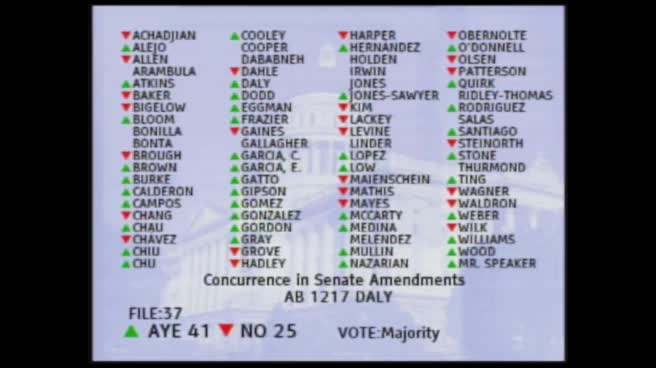 2MIN
Assembly Floor
 59SEC
Assembly Floor
 10MIN
Assembly Standing Committee on Business and Professions
 8MIN
Senate Floor
 32MIN
Senate Standing Committee on Business, Professions and Economic Development
 42MIN
Senate Standing Committee on Environmental Quality
Bill Author

Bill Co-Author(s):