SCA 12: University of California: California residents.
- Session Year: 2015-2016
- House: Senate
- Latest Version Date: 2016-04-13
Existing provisions of the California Constitution provide that the University of California constitutes a public trust, and require that the university be administered by the Regents of the University of California, a corporation in the form of a board, with full powers of organization and government, subject to legislative control only for specified purposes. These provisions require that corporation to have all the powers necessary or convenient for the effective administration of its trust.
This measure would require the regents to act in the best interests of the people of California and to honor a their fiduciary duty to California residents who aspire to attend the University of California. The measure would require the regents to ensure that specified data about in-state students, out-of-state students, and international students is reported, as specified, no later than July 1, 2017, by all University of California campuses on their Internet Web sites or using a successor technology. The measure would require the average statistical profiles of out-of-state and international freshman students enrolled at each campus of the university to be no lower than the average statistical profiles of in-state freshman students. The measure would authorize statutory implementation of the duty of the regents to report information to the public under this measure to maximize transparency and ensure compliance. California by ensuring that priority in admissions is given to applicants who are California residents.
Existing provisions of the California Constitution provide that the University of California constitutes a public trust, and require that the university be administered by the Regents of the University of California, a corporation in the form of a board, with full powers of organization and government, subject to legislative control only for specified purposes. These provisions require that corporation to have all the powers necessary or convenient for the effective administration of its trust.
This measure would require the regents to honor a fiduciary duty to California residents who aspire to attend the University of California. The measure would require the regents to ensure that specified data about in-state students, out-of-state students, and international students is reported, as specified, no later than July 1, 2017, by all University of California campuses on their Internet Web sites or using a successor technology. The measure would require the average statistical profiles of out-of-state and international freshman students enrolled at each campus of the university to be no lower than the average statistical profiles of in-state freshman students. The measure would authorize statutory implementation of the duty of the regents to report information to the public under this measure to maximize transparency and ensure compliance.
Resolved by the Senate, the Assembly concurring, That the Legislature of the State of California at its 201516 Regular Session commencing on the first day of December 2014, two-thirds of the membership of each house concurring, hereby proposes to the people of the State of California, that the Constitution of the State be amended as follows:
(a)The University of California shall constitute a public trust, to be administered by the existing corporation known as The Regents of the University of California, with full powers of organization and government, subject only to that legislative control as may be necessary to ensure the security of its funds and compliance with the terms of the endowments of the university and competitive bidding procedures as may be made applicable to the university by statute for the letting of construction contracts, sales of real property, and purchasing of materials, goods, and services. The corporation shall be in form a board composed of seven ex officio members, which shall be: the Governor, the Lieutenant Governor, the Speaker of the Assembly, the Superintendent of Public Instruction, the president and the vice president of the alumni association of the university, and the acting president of the university, and 18 appointive members appointed by the Governor and approved by the Senate, a majority of the membership concurring.
(b)(1)The terms of the members appointed prior to November 5, 1974, shall be 16 years; the terms of two appointive members to expire as heretofore on March 1 of every even-numbered calendar year, and two members shall be appointed for terms commencing on March 1, 1976, and on March 1 of each year thereafter; provided that no such appointments shall be made for terms to commence on March 1, 1979, or on March 1 of each fourth year thereafter, to the end that no appointment to the regents for a newly commencing term shall be made during the first year of any gubernatorial term of office. The terms of the members appointed for terms commencing on and after March 1, 1976, shall be 12 years.
(2)In case of any vacancy, the term of office of the appointee to fill such vacancy, who shall be appointed by the Governor and approved by the Senate, a majority of the membership concurring, shall be for the balance of the term for which that vacancy exists.
(c)The members of the board may, in their discretion, following procedures established by them and after consultation with representatives of faculty and students of the university, including appropriate officers of the academic senate and student governments, appoint to the board either or both of the following persons as members with all rights of participation: a member of the faculty at a campus of the university or of another institution of higher education; a person enrolled as a student at a campus of the university for each regular academic term during his or her service as a member of the board. Any person so appointed shall serve for not less than one year commencing on July 1.
(d)Regents shall be able persons broadly reflective of the economic, cultural, and social diversity of the State, including ethnic minorities and women. However, it is not intended that formulas or specific ratios be applied in the selection of regents.
(e)In the selection of the regents, the Governor shall consult an advisory committee composed as follows: The Speaker of the Assembly and two public members appointed by the Speaker, the President pro Tempore of the Senate and two public members appointed by the Senate Committee on Rules, two public members appointed by the Governor, the chairperson of the regents of the university, an alumnus of the university chosen by the alumni association of the university, a student of the university chosen by the Council of Student Body Presidents, and a member of the faculty of the university chosen by the academic senate of the university. Public members shall serve for four years, except that one each of the initially appointed members selected by the Speaker of the Assembly, the President pro Tempore of the Senate, and the Governor shall be appointed to serve for two years; student, alumni, and faculty members shall serve for one year and may not be regents of the university at the time of their service on the advisory committee.
(f)The Regents of the University of California shall be vested with the legal title and the management and disposition of the property of the university and of property held for its benefit, and shall have the power to take and hold, either by purchase or by donation, or gift, testamentary or otherwise, or in any other manner, without restriction, all real and personal property for the benefit of the university or incidentally to its conduct. However, sales of university real property shall be subject to competitive bidding procedures that may be provided by statute. The corporation shall also have all the powers necessary or convenient for the effective administration of its trust, including the power to sue and to be sued, to use a seal, and to delegate to its committees or to the faculty of the university, or to others, the authority or functions as it may deem wise. The regents shall receive all funds derived from the sale of lands pursuant to the act of Congress of July 2, 1862, and any subsequent acts amendatory thereof. The university shall be entirely independent of all political or sectarian influence and kept free therefrom in the appointment of its regents and in the administration of its affairs, and no person shall be debarred admission to any department of the university on account of race, religion, ethnic heritage, or sex.
(g)Meetings of the Regents of the University of California shall be public, with exceptions and notice requirements as may be provided by statute.
(h)(1)As administrators of a public trust, the regents shall act in the best interests of the people of California, and California. The regents shall honor a their fiduciary duty to California residents who aspire to take advantage of the University of Californias promise of a high-quality college education. education by ensuring that priority in admissions is given to applicants who are California residents.
(2)No later than July 1, 2017, the regents shall ensure that all campuses of the University of California report, on their Internet Web sites, or report using a successor technology, uniform application, admission, and freshman class profiles including, but not necessarily limited to, all standardized test scores and grade-point averages presented in the same statistical format employed pursuant to the Common Data Set Initiative or a successor database. Separate uniform statistical profiles shall be reported for California students, out-of-state students, and international students enrolled at each campus.
(3)The average statistical profile of out-of-state and international freshman students enrolled at each campus of the University of California shall be no lower than the average statistical profile of in-state freshman students at that campus.
(4)The information required to be reported under paragraph (2) shall be updated on at least an annual basis.
(5)Notwithstanding subdivision (a), the duty of the regents to report information to the public under this subdivision shall be self-executing, but subject to statutory implementation and audit requirements to maximize transparency and ensure compliance.
Resolved by the Senate, the Assembly concurring, That the Legislature of the State of California at its 201516 Regular Session commencing on the first day of December 2014, two-thirds of the membership of each house concurring, hereby proposes to the people of the State of California, that the Constitution of the State be amended as follows:
(a)The University of California shall constitute a public trust, to be administered by the existing corporation known as The Regents of the University of California, with full powers of organization and government, subject only to such that legislative control as may be necessary to insure ensure the security of its funds and compliance with the terms of the endowments of the university and such competitive bidding procedures as may be made applicable to the university by statute for the letting of construction contracts, sales of real property, and purchasing of materials, goods, and services. Said The corporation shall be in form a board composed of seven ex officio members, which shall be: the Governor, the Lieutenant Governor, the Speaker of the Assembly, the Superintendent of Public Instruction, the president and the vice president of the alumni association of the university university, and the acting president of the university, and 18 appointive members appointed by the Governor and approved by the Senate, a majority of the membership concurring; provided, however that the present appointive members shall hold office until the expiration of their present terms. concurring.
(b)(1)The terms of the members appointed prior to November 5, 1974, shall be 16 years; the terms of two appointive members to expire as heretofore on March 1st 1 of every even-numbered calendar year, and two members shall be appointed for terms commencing on March 1, 1976, and on March 1 of each year thereafter; provided that no such appointments shall be made for terms to commence on March 1, 1979, or on March 1 of each fourth year thereafter, to the end that no appointment to the regents for a newly commencing term shall be made during the first year of any gubernatorial term of office. The terms of the members appointed for terms commencing on and after March 1, 1976, shall be 12 years. During the period of transition until the time when the appointive membership is comprised exclusively of persons serving for terms of 12 years, the total number of appointive members may exceed the numbers specified in the preceeding paragraph.
In
(2)In case of any vacancy, the term of office of the appointee to fill such vacancy, who shall be appointed by the Governor and approved by the Senate, a majority of the membership concurring, shall be for the balance of the term for which such that vacancy exists.
(c)The members of the board may, in their discretion, following procedures established by them and after consultation with representatives of faculty and students of the university, including appropriate officers of the academic senate and student governments, appoint to the board either or both of the following persons as members with all rights of participation: a member of the faculty at a campus of the university or of another institution of higher education; a person enrolled as a student at a campus of the university for each regular academic term during his or her service as a member of the board. Any person so appointed shall serve for not less than one year commencing on July 1.
(d)Regents shall be able persons broadly reflective of the economic, cultural, and social diversity of the State, including ethnic minorities and women. However, it is not intended that formulas or specific ratios be applied in the selection of regents.
(e)In the selection of the Regents, regents, the Governor shall consult an advisory committee composed as follows: The Speaker of the Assembly and two public members appointed by the Speaker, the President Pro pro Tempore of the Senate and two public members appointed by the Rules Committee of the Senate, Senate Committee on Rules, two public members appointed by the Governor, the chairman chairperson of the regents of the university, an alumnus of the university chosen by the alumni association of the university, a student of the university chosen by the Council of Student Body Presidents, and a member of the faculty of the university chosen by the academic senate of the university. Public members shall serve for four years, except that one each of the initially appointed members selected by the Speaker of the Assembly, the President Pro pro Tempore of the Senate, and the Governor shall be appointed to serve for two years; student, alumni, and faculty members shall serve for one year and may not be regents of the university at the time of their service on the advisory committee.
(f)The Regents of the University of California shall be vested with the legal title and the management and disposition of the property of the university and of property held for its benefit benefit, and shall have the power to take and hold, either by purchase or by donation, or gift, testamentary or otherwise, or in any other manner, without restriction, all real and personal property for the benefit of the university or incidentally to its conduct; provided, however, that conduct. However, sales of university real property shall be subject to such competitive bidding procedures as that may be provided by statute. Said The corporation shall also have all the powers necessary or convenient for the effective administration of its trust, including the power to sue and to be sued, to use a seal, and to delegate to its committees or to the faculty of the university, or to others, such the authority or functions as it may deem wise. The Regents regents shall receive all funds derived from the sale of lands pursuant to the act of Congress of July 2, 1862, and any subsequent acts amendatory thereof. The university shall be entirely independent of all political or sectarian influence and kept free therefrom in the appointment of its regents and in the administration of its affairs, and no person shall be debarred admission to any department of the university on account of race, religion, ethnic heritage, or sex.
(g)Meetings of the Regents of the University of California shall be public, with exceptions and notice requirements as may be provided by statute.
(h)(1)As administrators of a public trust, the regents shall act in the best interests of the people of California, and shall honor a fiduciary duty to California residents who aspire to take advantage of the University of Californias promise of a high-quality college education.
(2)No later than July 1, 2017, the regents shall ensure that all campuses of the University of California report, on their Internet Web sites, or report using a successor technology, uniform application, admission, and freshman class profiles including, but not necessarily limited to, all standardized test scores and grade-point averages presented in the same statistical format employed pursuant to the Common Data Set Initiative or a successor database. Separate uniform statistical profiles shall be reported for California students, out-of-state students, and international students enrolled at each campus.
(3)The average statistical profile of out-of-state and international freshman students enrolled at each campus of the University of California shall be no lower than the average statistical profile of in-state freshman students at that campus.
(4)The information required to be reported under paragraph (2) shall be updated on at least an annual basis.
(5)Notwithstanding subdivision (a), the duty of the regents to report information to the public under this subdivision shall be self-executing, but subject to statutory implementation and audit requirements to maximize transparency and ensure compliance.
|
Date
|
Status
|
|---|---|
| Feb 19, 2016 | Introduced. To Com. on RLS. for assignment. To print. |
| Feb 22, 2016 | From printer. May be acted upon on or after March 23. |
| Feb 22, 2016 | Read first time. |
| Mar 3, 2016 | Referred to Coms. on ED., JUD., and E. & C.A. |
| Apr 8, 2016 | Set for hearing April 20. |
| Apr 13, 2016 | From committee with author's amendments. Read second time and amended. Re-referred to Com. on ED. |
| Apr 20, 2016 | From committee: Be adopted and re-refer to Com. on E. & C.A. (Ayes 6. Noes 0. Page 3608.) (April 20). Re-referred to Com. on E. & C.A. |
| Apr 20, 2016 | From committee: Be adopted and re-refer to Com. on E. & C.A. (Ayes 6. Noes 0.) (April 20). Re-referred to Com. on E. & C.A. |
| Apr 20, 2016 | Re-referred to Com. on JUD. |
| Apr 20, 2016 | Withdrawn from committee. |
| Apr 27, 2016 | Set for hearing May 3. |
| May 4, 2016 | May 3 set for first hearing.Testimony taken. |
|
Date
|
Description
|
Location
|
Votes
|
|
|---|---|---|---|---|
| Apr 20, 2016 | Be adopted, but first be re-referred to the Committee on [Elections and Constitutional Amendments] | Senate Standing Committee on Education |
Passed |
This list shows positions taken on this bill by organizations on the date displayed, which is linked to the original source.
Positions by individuals are not included.
|
Organization
|
Position
|
Date
|
|---|---|---|
| u None received on this version. | ** Against | Apr 20, 2016 |
| University of California | * Indeterminate | May 3, 2016 |
Senator Hannah-Beth Jackson, Chair
2015-2016 Regular Session
Bill No: SCA 12 (Author:Runner and Huff)
Version: April 13, 2016
Hearing Date: May 3, 2016
Fiscal: Yes
Urgency: No
Consultant: RD
SUBJECT
University of California: California residents
DESCRIPTION
This measure proposes a constitutional amendment that would require the Regents of the University of California, as administrators of a public trust, to act in the best interests of the people of California. This measure would require the regents to honor their fiduciary duty to California residents who aspire to take advantage of the University of California’s promise of a high-quality college education by ensuring that priority in admissions is given to applicants who are California residents. This measure would make other technical or non-substantive changes.
BACKGROUND
On March 29, 2016, the California State Auditor released a report entitled, The University of California: Its Admissions and Financial Decisions have Disadvantaged California Resident Students. According to that report:
The University of California (university) is one of the premier public university systems in the nation, enrolling more than 252,000 students at its 10 campuses as of the fall of 2014. As a public institution, the university should serve primarily those who provide for its financial and civic support—California residents. However, over the past several years, the university has failed to put the needs of residents first. In response to reduced state funding, it has made substantial efforts to enroll more nonresident students, who pay significantly more annual tuition and mandatory fees than resident students—$37,000 compared to $12,240 in academic year 2014-15. The results are stark: From academic years 2010-11 through 2014-15, total nonresident enrollment at the university increased by 82 percent, or 18,000 students, while resident enrollment decreased by 2,200 students, or 1 percent.
The report lists among its key findings that the university has undermined its commitment to residents in an effort to increase its revenue by recruiting and enrolling non-residents and specifically cites the following:
- total nonresident enrollment increased by 82 percent (or 18,000), while resident enrollment decreased by 1 percent (or 2,200 students) from academic years 2010-11 through 2014-15;
- from academic years 2005-06 through 2014–15, nonresident undergraduate enrollment increased 432 percent while during the same time period resident enrollment increased only 10 percent. In academic year 2014–15, nearly one-third of the students the university admitted were nonresidents;
- despite a 52 percent increase in resident applicants, resident enrollment increased by only 10 percent over the last 10 years while non-resident enrollment increased by 432 percent;
- total nonresident enrollment increased by 82 percent, while resident enrollment decreased by 1 percent;
- the University modified its admission standard for non-residents and admitted nearly 16,000 non-residents over the past three years with lower academic qualifications than the median for admitted residents; and
- from academic years 2005-06 through 2014-15, the university’s campuses denied admission to nearly 4,300 residents whose academic scores met or exceeded all of the median scores for nonresidents whom the university admitted to the campus of their choice. (See California State Auditor, Report 2015-107, The University of California: Its Admissions and Financial Decisions Have Disadvantaged California Resident Students (Mar. 29, 2016) <https://www.auditor.ca.gov/pdfs/reports/2015-107.pdf> [as of Apr. 27, 2016].)
This measure now seeks to put forth of the California voters a constitutional amendment to require the regents of the University of California to honor their fiduciary duty to California residents who aspire to take advantage of the University of California’s promise of a high-quality college education by ensuring that priority in admissions is given to applicants who are California residents.
This bill was heard in the Senate Education Committee on April 20, 2016, and approved on a vote of 6-0.
CHANGES TO EXISTING LAW
Existing federal law, the U.S. Constitution’s Privileges or Immunities Clause, provides that no State shall make or enforce any law which shall abridge the privileges or immunities of citizens of the United States. (U.S. Const., 14th Amend., Sec. 1, cl. 2.)
Existing federal law, the U.S. Constitution’s Commerce Clause, grants Congress the power to regulate commerce “with foreign nations, and among the several states, and with the Indian Tribes.” (U.S. Const., art. 1, Sec. 8, cl. 3.) The dormant Commerce Clause is inferred from that clause under the theory that this grant of power implies a negative converse—a restriction prohibiting a state from passing legislation that improperly burdens or discriminates against interstate commerce.
Existing law, Article IX of the California Constitution, establishes the UC as a public trust to be administered by the Regents of the UC and grants the Regents full powers of organization and government, subject only to such legislative control as may be necessary to ensure security of its funds, compliance with the terms of its endowments, statutory requirements around competitive bidding and contracts, sales of property and the purchase of materials, goods, and services. (Cal. Const. art. IX, Sec. (9)(a).)
This measure would, contingent upon voter approval, amend the California Constitution to require the Regents of the University of California, as administrators of a public trust, to act in the best interests of the people of California. This measure would require the regents to honor their fiduciary duty to California residents who aspire to take advantage of the University of California’s promise of a high-quality college education by ensuring that priority in admissions is given to applicants who are California residents.
This measure would make other technical or non-substantive changes.
COMMENT
1. Stated need for the bill
According to the author:
The UC includes on its admissions website the following notice:
As a public institution, we prioritize admission for California residents. Notwithstanding this declaration, California students and parents share a growing perception that seats at the University of California are being sold to the highest bidder; that California students are being passed over for less qualified non-residents who are willing to pay more. In recent years the nine undergraduate campuses of the University of California system have attracted an ever growing number of out of state and international students applying for freshman seats. In 2014 and again in 2015 the number of California students enrolling as freshman declined while the number of both out of state and international freshman increased. Between 2010 and 2015 the system-wide number of California undergraduates has declined marginally while the number of nonresident undergraduates has surged by more than 20,000 students. The nonresident fees paid by these students provide the University of California almost $500,000,000.00 (half a billion dollars) in additional revenue each year.
The [proposed] constitutional provision will read: As administrators of a public trust, the regents shall act in the best interests of the people of California. The regents shall honor their fiduciary duty to California residents who aspire to take advantage of the University of California’s promise of a high-quality college education by ensuring that priority in admissions is given to applicants who are California residents.
2. Fourteenth Amendment’s Privileges or Immunities Clause: right to travel
This measure, if approved by the voters, would require that the state’s public universities give priority to California residents (over non-residents). The Supreme Court has long recognized that the Constitution, together with the nature of the federal union, protects the right to travel throughout the U.S., uninhibited by statutes, rules, or regulations that unreasonably burden or restrict this movement. In Saenz v. Roe (1999) 526 U.S. 489, 500 the Court detailed that the right encompasses at least three components: (1) the right to enter and to leave another state; (2) the right to be treated as a welcome visitor rather than an unfriendly alien when temporarily present in the second State; and, (3) for travelers who elect to become permanent residents, the right to be treated like other (longer) citizens of that State.
This third aspect of travel (the right of new residents to be treated the same as longer residents of the state) is protected by the 14th Amendment’s privileges or immunities clause. (Id. at 502.) Thus, it is constitutionally impermissible for a state to enact durational residency requirements for the purpose of inhibiting the migration by needy persons into the state. Further, the Court has held that a classification having the effect of imposing a penalty on the exercise of the right to travel violates the Equal Protection Clause unless it is shown to be necessary to promote a compelling governmental interest. (Id. at 499.) In Saenz, specifically, the Court held that while the plaintiffs were new to California, they had the right to be treated the same as long-time residents, noting that there was no reason for the state to fear that citizens of other states would take advantage of California’s relatively generous welfare benefits because the proceeds of each welfare check would be consumed while the plaintiffs remained within the state. Even still, however, the Court distinguished welfare benefits them from a “readily portable benefit, such as a divorce or a college education,” for which durational residency requirements have been upheld in other cases. (Id. at 505, citing Sosna v. Iowa (1975) 419 U.S. 393; Vlandis v. Kline (1973) 412 U.S. 441.)
Notably, this bill does not have a durational requirement of residency—it merely requires that a person be a California resident. The Court has repeatedly distinguished residency requirements, which provide a benefit to current residents that is not available to nonresidents, from durational residency requirements. (See Chemerinksy, Constitutional Law Principles and Policies (2011) 4th Edition, p. 888.) Accordingly, it is unlikely that this bill would be deemed to infringe upon the right to travel.
3. Dormant Commerce Clause
The dormant Commerce Clause is the principle that state and local laws are unconstitutional if they place an undue burden on interstate commerce. While there is no constitutional amendment that expressly makes this declaration, the Supreme Court has inferred this principle from the grant of power to Congress to regulate commerce among the states under Article I, Section 8 of the U.S. Constitution. The modern approach to the clause gives the court significant discretion and involves a balancing of the benefits of the law against the burdens it imposes on interstate commerce. How the balancing is done, however, depends on whether the law discriminates against out-of-staters or treats in-staters and out-of-staters alike. (Chemerinksy, Constitutional Law Principles and Policies (2011) 4th Edition, p.439-440.)
Accordingly, the dormant Commerce Clause usually involves the following analysis: First, does the state law discriminate against interstate commerce by treating out-of-staters differently than in-staters, and thus burden interstate commerce? Second, if the law does not discriminate, then the presumption is in favor of upholding the law and it will be invalidated only if it is shown that the burden on interstate commerce outweighs the benefits of the law. Third, if the law is discriminatory, then there is a strong presumption against the law and a court will uphold it only if it is necessary to achieve an important governmental purpose. The court will also look at whether there were alternative nondiscriminatory means available. (Id. at 441.)
“The central rationale for the rule against discrimination is to prohibit state or municipal laws whose object is local economic protectionism, laws that would excite those jealousies and retaliatory measures the Constitution was designed to prevent.” (C&A Carbone v. Town of Clarkstown (1994) 511 U.S. 383, 389.) Accordingly, as reflected above, in a dormant Commerce Clause case, a court is initially concerned with whether the law facially discriminates against out-of-state actors or has the effect of favoring in-state economic interests over out-of-state interests. Discriminatory laws are almost always declared unconstitutional, and will be allowed only if the bill is necessary (the least restrictive means), to achieve a nonprotectionist purpose, under a strict scrutiny analysis. (Chemerinksy at 460.)
Here, while the proposed measure would discriminate under the first prong of the test above, following the third prong, there is arguably an important governmental interest in ensuring that state residents have access to an affordable, high-quality, public, higher education institution. In other words, it does not appear that the bill is solely about economic protectionism which would be in violation of the dormant commerce clause. Whether this proposed constitutional amendment furthers that interest in the least restrictive manner would likely depend on what constitutes “priority.” (See Comment 4.) Arguably, whether or not this measure would be considered sufficiently narrow to the bill’s stated compelling interest is ultimately a question for the courts.
4. Priority
Given that this bill sets forth a constitutional amendment before the voters, and not legislation that could be readily clarified when problems of interpretation arise, the authors may wish to consider adding further clarity as to what “priority” means and when “priority” must be given. Would priority mean preference if all other things are equal between two candidates? Or might it mean accepting all California resident applicants before admitting any non-residents? As a matter of public policy, absolute clarity is arguably a necessity as these public universities could foreseeably face suit for failure to meet their fiduciary duty to California’s students. Moreover, to ensure that this constitutional amendment would withstand a challenge under the federal constitution’s dormant commerce clause also likely depends upon the specificity of this term.
Support: None Known
Opposition: None Known
HISTORY
Source: Author
Related Pending Legislation: None Known
Prior Legislation: SCA 22 (Rubio, 2012) would have proposed a state Constitutional Amendment to add a new section to Article IX of the State Constitution that would require that out-of state undergraduate students make up no more than 10 percent of the total undergraduate enrollment, and no more than 10 percent of the incoming class at each campus of the University of California, beginning with the 2013-14 academic year. The bill died in the Senate Education Committee without a hearing.
Prior Vote: Senate Education Committee (Ayes 6, Noes 0)
**************
SENATE COMMITTEE ON EDUCATION
Senator Carol Liu, Chair
2015 - 2016 Regular
Bill No: SCA 12
Author: | and Huff | ||
Version: | April 13, 2016 Hearing Date: April 20, 2016 | ||
Urgency: | No | Fiscal: | Yes |
Consultant: | Kathleen Chavira | ||
Subject: University of California: students
NOTE: This measure has been referred to the Committees on Education and Elections and Constitutional Amendments. A "do pass" motion should include referral to the Elections and Constitutional Amendments Committee.
SUMMARY
This measure proposes to modify Article IX of the State Constitution to require the Regents of the University of California (UC) to ensure that priority in admissions is given to applicants who are California residents.
BACKGROUND
The California Constitution establishes the UC, a public trust to be administered by the Regents of the UC and grants the Regents full powers of organization and government, subject only to such legislative control as may be necessary to insure security of its funds, compliance with the terms of its endowments, statutory requirements around competitive bidding and contracts, sales of property and the purchase of materials, goods and services. (Article IX, Section (9)(a) of the California Constitution)
ANALYSIS
This constitutional amendment proposes to place before the voters a change to the California Constitution to require that the Regents act in the best interests of the people of California and honor a fiduciary duty to California residents, as specified by ensuring that priority in admissions is given to applicants who are California residents.
STAFF COMMENTS
- Need for the bill. According to the author, while UC admission websites proclaim that the UC prioritizes admission of California residents, at several UC campuses non-residents are granted admission at a dramatically higher rate than California students. Increasingly, students and parents share the perception that California students are being passed over for less qualified non-residents willing to pay more. This constitutional amendment would reiterate that the primary purpose and obligation of the UC is to serve the students of California.
- Current status of out-of-state admissions. The UC reports that for the 2014-15 academic year, 13 percent of its undergraduates systemwide were non-residents. The UC also notes that the average for other comparable public institutions nationally is 26 percent. The chart below summarizes the level of enrollment of non-residents at all University of California (UC) campuses for the 2012 and 2013 academic years. According to the UC, non-resident enrollment for 2015-16 was capped at those campuses that have seen the largest growth, Berkeley (25 percent), Los Angeles (19 percent), and San Diego (17 percent) was directed to cap their enrollment of non-residents at 20 percent.
- BSA Audit. On March 29, 2016, the California State Auditor released a report, The University of California, Its admissions and Financial Decisions have Disadvantaged California Resident Students. The report lists as its key findings that the university has undermined its commitment to residents in an effort to increase its revenue by recruiting and enrolling non-residents. The report specifically cites that:
- Despite a 52 percent increase in resident applicants, resident enrollment increased by only 10 percent over the last 10 years while non-resident enrollment increased by 432 percent.
- The University lowered the admission standard for non-residents and admitted nearly 16,000 non-residents over the past three years with academic scores that fell below the median of admitted residents.
- Admitted residents were increasingly denied their campus of choice, yet admitted non-residents were always admitted to one of their campuses of choice.
- Mandatory fees doubled for residents while they increased for non-residents at a much lower rate.
According to the report, in 2011, the UC Board on Admissions and Relations with Schools (BOARS) eliminated wording in its 2009 nonresident undergraduate admissions principles that nonresidents "should demonstrate stronger admission criteria than CA residents by generally being in the upper half of those ordinarily eligible" for admission. BOARS revised its principles to state that admitted nonresidents should "compare favorably to California residents admitted" and left application of this standard to campuses.
In response, the UC asserts that its admissions policies overwhelmingly favor Californians, and that state funding determines how many California residents the UC enrolls.
- Constitutional amendment requirements. As a proposed Constitutional
Amendment, this measure would not go into effect unless approved by the majority of voters at a statewide election. This proposal requires a 2/3 vote of each house in order to be submitted to the voters. It does not require approval by the Governor.
- Conflicting Legislation? Legislative counsel has noted a potential conflict between this bill, and SCA 1 (Lara), also on the Committee’s agenda today, as both propose changes to Section 9, Article IX of the California Constitution. While the provisions of each proposed Constitutional amendment do not appear to be in conflict, this bill has been referred to the Senate Committee on Elections and Constitutional Amendments which has jurisdiction over bills to amend the constitution and can appropriately determine any necessary amendments to address a conflict.
- Related legislation? While this Committee has heard several bills that propose to restrict undergraduate non-resident enrollment this measure imposes no such restriction. In response to recent policies adopted by the UC in regard to non-resident admissions, this bill imposes a broad responsibility on the Regents to ensure that California resident students who apply to the UC are extended priority in admissions.
SUPPORT
None received.
OPPOSITION
None received on this version.
-- END –
Discussed in Hearing
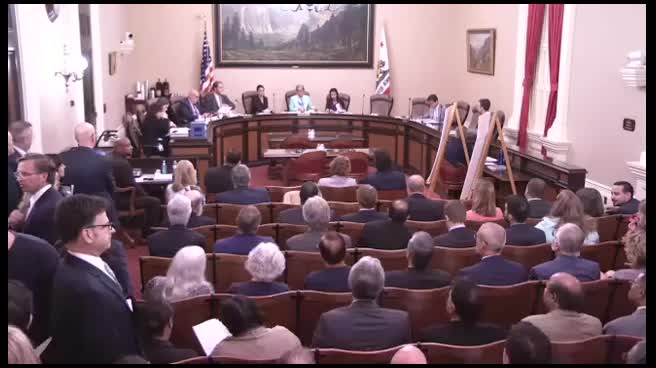
Senate Standing Committee on Judiciary
 7MIN
Senate Standing Committee on Education


Bill Co-Author(s):
