AB 1081: Sales and use taxes: exclusion: low-emission motor vehicle: trade-in.
- Session Year: 2017-2018
- House: Assembly
- Latest Version Date: 2017-04-24
Existing sales and use tax laws impose taxes on retailers measured by gross receipts from the sale of tangible personal property sold at retail in this state, or on the storage, use, or other consumption in this state of tangible personal property purchased from a retailer for storage, use, or other consumption in this state, measured by sales price. The Sales and Use Tax Law defines the terms gross receipts and sales price.
This bill bill, before January 1, 2023, would exclude from the terms gross receipts and sales price the value of a motor vehicle traded in for a qualified motor vehicle, as defined, if the value of the trade-in motor vehicle is separately stated on the invoice or bill of sale or similar document provided to the purchaser.
The Bradley-Burns Uniform Local Sales and Use Tax Law authorizes counties and cities to impose local sales and use taxes in conformity with the Sales and Use Tax Law, and existing laws authorize districts, as specified, to impose transactions and use taxes in accordance with the Transactions and Use Tax Law, which generally conforms to the Sales and Use Tax Law. Amendments to the Sales and Use Tax Law are automatically incorporated into the local tax laws.
This bill would specify that this exclusion shall would not apply to local sales and use taxes or taxes, transactions and use taxes. taxes, and specified state taxes from which revenues are deposited into the Local Public Safety Fund, the Local Revenue Fund, or the Local Revenue Fund 2011.
This bill would take effect immediately as a tax levy, but its operative date would depend on its effective date.
Existing sales and use tax laws impose taxes on retailers measured by gross receipts from the sale of tangible personal property sold at retail in this state, or on the storage, use, or other consumption in this state of tangible personal property purchased from a retailer for storage, use, or other consumption in this state, measured by sales price. The Sales and Use Tax Law defines the terms gross receipts and sales price.
This bill would exclude from the terms gross receipts and sales price the value of a motor vehicle traded in for a qualified motor vehicle, as defined, if the value of the trade-in motor vehicle is separately stated on the invoice or bill of sale or similar document provided to the purchaser.
The Bradley-Burns Uniform Local Sales and Use Tax Law authorizes counties and cities to impose local sales and use taxes in conformity with the Sales and Use Tax Law, and existing laws authorize districts, as specified, to impose transactions and use taxes in accordance with the Transactions and Use Tax Law, which generally conforms to the Sales and Use Tax Law. Amendments to the Sales and Use Tax Law are automatically incorporated into the local tax laws.
Existing law requires the state to reimburse cities and counties for revenue losses caused by the enactment of sales and use tax exemptions.This bill would provide that, notwithstanding these provisions, no appropriation is made and the state shall not reimburse cities and counties for sales and use tax revenues lost by them pursuant to this bill.This bill would specify that this exclusion shall not apply to local sales and use taxes or transactions and use taxes.
This bill would take effect immediately as a tax levy, but its operative date would depend on its effective date.
Existing sales and use tax laws impose taxes on retailers measured by gross receipts from the sale of tangible personal property sold at retail in this state, or on the storage, use, or other consumption in this state of tangible personal property purchased from a retailer for storage, use, or other consumption in this state, measured by sales price. The Sales and Use Tax Law defines the terms gross receipts and sales price.
This bill would exclude from the terms gross receipts and sales price the value of a motor vehicle traded in for a qualified motor vehicle, as defined, if the value of the trade-in motor vehicle is separately stated on the invoice or bill of sale or similar document provided to the purchaser.
The Bradley-Burns Uniform Local Sales and Use Tax Law authorizes counties and cities to impose local sales and use taxes in conformity with the Sales and Use Tax Law, and existing laws authorize districts, as specified, to impose transactions and use taxes in accordance with the Transactions and Use Tax Law, which generally conforms to the Sales and Use Tax Law. Amendments to the Sales and Use Tax Law are automatically incorporated into the local tax laws.
Existing law requires the state to reimburse cities and counties for revenue losses caused by the enactment of sales and use tax exemptions.
This bill would provide that, notwithstanding these provisions, no appropriation is made and the state shall not reimburse cities and counties for sales and use tax revenues lost by them pursuant to this bill.
This bill would take effect immediately as a tax levy, but its operative date would depend on its effective date.
The Legislature finds and declares all of the following:
(a)California is at the forefront of battling climate change, and a main pillar of the states climate strategy is reducing greenhouse gas emissions to 1990 levels.
(b)To help achieve this greenhouse gas emissions goal, the State Air Resources Board has required large vehicle manufacturers to produce a certain amount of zero-emission vehicles as a percentage of the overall number of vehicles the manufacturer makes for sale in the state. The present mandate is 15.4 percent of new vehicles delivered for sale by 2025.
(c)To reinforce this mandate, Governor Brown issued Executive Order B-16-2012, which set a long-term target of 1,500,000 zero-emission vehicles on the road by 2025, with the hope and expectation that the market for these vehicles will become mainstream and self-sustaining for individuals, businesses, and public fleets.
(d)The widespread adoption and purchase of zero-emission vehicles can help the environment and further the states goals by mitigating emissions and easing air pollution.
(e)To be effective in cutting emissions and cleaning up air pollution, zero-emission and partial-zero-emission vehicles must attract consumers who would otherwise choose a traditional gasoline-fueled car.
(f)The current market for zero-emission vehicles has excessive barriers, including the high relative purchase price associated with zero-emission vehicles, limited range capability, inadequate charging infrastructure, resale value, length of commute, and existing low gas prices.
(g)In 2015, Californias new car dealers sold over 2,000,000 new vehicles with a combined 3.1 percent of those sales comprising zero-emission vehicles and partial-zero-emission vehicles. That represents a drop in market share for these vehicles, which was 3.2 percent in 2014.
(h)Using 2015s 2,000,000 new vehicle sales as an estimate of 2025 vehicle sales by covered manufacturers, the 15.4 percent mandate by the State Air Resources Board would require 308,000 zero-emission vehicles and partial-zero-emission vehicles be delivered for sale in the state that year. If the current 41.5 percent of new vehicle sales will continue to be made up of sport utility vehicles, pickups, and vans, over 25 percent of the remaining 1,201,000 passenger vehicles delivered for sale just nine years from now must be electric or plug-in electric vehicles.
(i)California has long focused on increasing disadvantaged communities access to environmentally friendly technologies and green transportation options to benefit the health of residents and to enhance air quality.
(j)Compared to gasoline-fueled vehicles, alternative-fueled vehicles reduce the countrys dependence on foreign oil and substantially lower consumers fuel costs.
(k)Automakers and new car dealers face numerous inherent market challenges when introducing and retailing the alternative-fueled vehicles required by the State Air Resources Boards vehicle mandates, including complex incentives, uncertain policy support, purchase price disparity, lengthy sales transactions, low gasoline prices, poor after-sale electric vehicle infrastructure, and sophisticated, constantly changing technology.
(l)Incentives, such as rebates, tax credits, and high occupancy vehicle lane access for zero- and partial-emission vehicles, are crucial for continuing consumer interest in these vehicles, but greater investments are needed to significantly affect consumer buying behavior and the overall alternative-fueled vehicle marketplace, especially when it comes to economically disadvantaged communities.
(m)California has not tried sales tax incentives for the purchase or lease of alternative-fueled vehicles. However, sales tax incentives have been useful in other consumer products. California continues to be one of a few states that includes the value of a trade-in vehicle in the price of the vehicle, thus imposing tax measured by the full price of the vehicle purchased.
(n)Accordingly, it is the intent of the Legislature in enacting this act to provide a sales tax incentive that will help move customer demand of zero-emission vehicles and achieve the adoption of alternative-fueled vehicles to meet the states greenhouse gas emissions goals.
SEC. 2.Section 6011 of the Revenue and Taxation Code is amended to read:6011.(a)Sales price means the total amount for which tangible personal property is sold or leased or rented, as the case may be, valued in money, whether paid in money or otherwise, without any deduction on account of any of the following:
(1)The cost of the property sold.
(2)The cost of materials used, labor or service cost, interest charged, losses, or any other expenses.
(3)The cost of transportation of the property, except as excluded by other provisions of this section.
(b)The total amount for which the property is sold or leased or rented includes all of the following:
(1)Any services that are a part of the sale.
(2)Any amount for which credit is given to the purchaser by the seller.
(3)The amount of any tax imposed by the United States upon producers and importers of gasoline and the amount of any tax imposed pursuant to Part 2 (commencing with Section 7301) of this division.
(c)Sales price does not include any of the following:
(1)Cash discounts allowed and taken on sales.
(2)The amount charged for property returned by customers when that entire amount is refunded either in cash or credit, but this exclusion shall not apply in any instance when the customer, in order to obtain the refund, is required to purchase other property at a price greater than the amount charged for the property that is returned. For the purpose of this section, refund or credit of the entire amount shall be deemed to be given when the purchase price less rehandling and restocking costs are refunded or credited to the customer. The amount withheld for rehandling and restocking costs may be a percentage of the sales price determined by the average cost of rehandling and restocking returned merchandise during the previous accounting cycle.
(3)The amount charged for labor or services rendered in installing or applying the property sold.
(4)(A)The amount of any tax (not including, however, any manufacturers or importers excise tax, except as provided in subparagraph (B)) imposed by the United States upon or with respect to retail sales whether imposed upon the retailer or the consumer.
(B)The amount of manufacturers or importers excise tax imposed pursuant to Section 4081 of the Internal Revenue Code for which the purchaser certifies that he or she is entitled to either a direct refund or credit against his or her income tax for the federal excise tax paid or for which the purchaser issues a certificate pursuant to Section 6245.5.
(5)The amount of any tax imposed by any city, county, city and county, or rapid transit district within the State of California upon or with respect to retail sales of tangible personal property, measured by a stated percentage of sales price or gross receipts, whether imposed upon the retailer or the consumer.
(6)The amount of any tax imposed by any city, county, city and county, or rapid transit district within the State of California with respect to the storage, use or other consumption in that city, county, city and county, or rapid transit district of tangible personal property measured by a stated percentage of sales price or purchase price, whether the tax is imposed upon the retailer or the consumer.
(7)Separately stated charges for transportation from the retailers place of business or other point from which shipment is made directly to the purchaser, but the exclusion shall not exceed a reasonable charge for transportation by facilities of the retailer or the cost to the retailer of transportation by other than facilities of the retailer. However, if the transportation is by facilities of the retailer, or the property is sold for a delivered price, this exclusion shall be applicable solely with respect to transportation which occurs after the purchase of the property is made.
(8)Charges for transporting landfill from an excavation site to a site specified by the purchaser, either if the charge is separately stated and does not exceed a reasonable charge or if the entire consideration consists of payment for transportation.
(9)The amount of any motor vehicle, mobilehome, or commercial coach fee or tax imposed by and paid the State of California that has been added to or is measured by a stated percentage of the sales or purchase price of a motor vehicle, mobilehome, or commercial coach.
(10)(A)The amount charged for intangible personal property transferred with tangible personal property in any technology transfer agreement, if the technology transfer agreement separately states a reasonable price for the tangible personal property.
(B)If the technology transfer agreement does not separately state a price for the tangible personal property, and the tangible personal property or like tangible personal property has been previously sold or leased, or offered for sale or lease, to third parties at a separate price, the price at which the tangible personal property was sold, leased, or offered to third parties shall be used to establish the retail fair market value of the tangible personal property subject to tax. The remaining amount charged under the technology transfer agreement is for the intangible personal property transferred.
(C)If the technology transfer agreement does not separately state a price for the tangible personal property, and the tangible personal property or like tangible personal property has not been previously sold or leased, or offered for sale or lease, to third parties at a separate price, the retail fair market value shall be equal to 200 percent of the cost of materials and labor used to produce the tangible personal property subject to tax. The remaining amount charged under the technology transfer agreement is for the intangible personal property transferred.
(D)For purposes of this paragraph, technology transfer agreement means any agreement under which a person who holds a patent or copyright interest assigns or licenses to another person the right to make and sell a product or to use a process that is subject to the patent or copyright interest.
(11)The amount of any tax imposed upon diesel fuel pursuant to Part 31 (commencing with Section 60001).
(12)(A)The amount of tax imposed by any Indian tribe within the State of California with respect to a retail sale of tangible personal property measured by a stated percentage of the sales or purchase price, whether the tax is imposed upon the retailer or the consumer.
(B)The exclusion authorized by subparagraph (A) shall only apply to those retailers who are in substantial compliance with this part.
(13)(A)The Before January 1, 2023, the value of a motor vehicle traded in for a qualified motor vehicle if the value of the trade-in motor vehicle is separately stated on the invoice or bill of sale or similar document provided to the purchaser.
(B)For purposes of this paragraph, qualified motor vehicle means a motor vehicle that meets either of the following:
(i)Californias super ultra-low emission vehicle (SULEV) standard for exhaust emissions and the federal inherently low-emission vehicle (ILEV) evaporative emission standard, as defined in Part 88 (commencing with Section 88.101-94) of Title 40 of the Code of Federal Regulations as that part read on January 1, 2017.
(ii)Californias enhanced advanced technology partial zero-emission vehicle (enhanced AT PZEV) standard or transitional zero-emission vehicle (TZEV) standard.
(C)(i) Notwithstanding any provision of the Bradley-Burns Uniform Local Sales and Use Tax Law (Part 1.5 (commencing with Section 7200)) or the Transactions and Use Tax Law (Part 1.6 (commencing with Section 7251)), the exclusion established by this paragraph shall not apply with respect to any tax levied by a county, city, or district pursuant to, or in accordance with, either of those laws.
(ii)Notwithstanding subparagraph (A), the exclusion established by this paragraph shall not apply with respect to any tax levied pursuant to Section 6051.2 or 6201.2, any tax levied pursuant to Section 6051 or 6201 that is deposited into the State Treasury to the credit of the Local Revenue Fund 2011 pursuant to Section 6051.15 or 6201.15, or any tax levied pursuant to Section 35 of Article XIII of the California Constitution.
SEC. 3.Section 6012 of the Revenue and Taxation Code is amended to read:6012.(a)Gross receipts mean the total amount of the sale or lease or rental price, as the case may be, of the retail sales of retailers, valued in money, whether received in money or otherwise, without any deduction on account of any of the following:
(1)The cost of the property sold. However, in accordance with any rules and regulations as the board may prescribe, a deduction may be taken if the retailer has purchased property for some other purpose than resale, has reimbursed his or her vendor for tax which the vendor is required to pay to the state or has paid the use tax with respect to the property, and has resold the property prior to making any use of the property other than retention, demonstration, or display while holding it for sale in the regular course of business. If that deduction is taken by the retailer, no refund or credit will be allowed to his or her vendor with respect to the sale of the property.
(2)The cost of the materials used, labor or service cost, interest paid, losses, or any other expense.
(3)The cost of transportation of the property, except as excluded by other provisions of this section.
(4)The amount of any tax imposed by the United States upon producers and importers of gasoline and the amount of any tax imposed pursuant to Part 2 (commencing with Section 7301) of this division.
(b)The total amount of the sale or lease or rental price includes all of the following:
(1)Any services that are a part of the sale.
(2)All receipts, cash, credits and property of any kind.
(3)Any amount for which credit is allowed by the seller to the purchaser.
(c)Gross receipts do not include any of the following:
(1)Cash discounts allowed and taken on sales.
(2)Sale price of property returned by customers when that entire amount is refunded either in cash or credit, but this exclusion shall not apply in any instance when the customer, in order to obtain the refund, is required to purchase other property at a price greater than the amount charged for the property that is returned. For the purpose of this section, refund or credit of the entire amount shall be deemed to be given when the purchase price less rehandling and restocking costs are refunded or credited to the customer. The amount withheld for rehandling and restocking costs may be a percentage of the sales price determined by the average cost of rehandling and restocking returned merchandise during the previous accounting cycle.
(3)The price received for labor or services used in installing or applying the property sold.
(4)(A)The amount of any tax (not including, however, any manufacturers or importers excise tax, except as provided in subparagraph (B)) imposed by the United States upon or with respect to retail sales whether imposed upon the retailer or the consumer.
(B)The amount of manufacturers or importers excise tax imposed pursuant to Section 4081 of the Internal Revenue Code for which the purchaser certifies that he or she is entitled to either a direct refund or credit against his or her income tax for the federal excise tax paid or for which the purchaser issues a certificate pursuant to Section 6245.5.
(5)The amount of any tax imposed by any city, county, city and county, or rapid transit district within the State of California upon or with respect to retail sales of tangible personal property measured by a stated percentage of sales price or gross receipts whether imposed upon the retailer or the consumer.
(6)The amount of any tax imposed by any city, county, city and county, or rapid transit district within the State of California with respect to the storage, use or other consumption in that city, county, city and county, or rapid transit district of tangible personal property measured by a stated percentage of sales price or purchase price, whether the tax is imposed upon the retailer or the consumer.
(7)Separately stated charges for transportation from the retailers place of business or other point from which shipment is made directly to the purchaser, but the exclusion shall not exceed a reasonable charge for transportation by facilities of the retailer or the cost to the retailer of transportation by other than facilities of the retailer. However, if the transportation is by facilities of the retailer, or the property is sold for a delivered price, this exclusion shall be applicable solely with respect to transportation which occurs after the sale of the property is made to the purchaser.
(8)Charges for transporting landfill from an excavation site to a site specified by the purchaser, either if the charge is separately stated and does not exceed a reasonable charge or if the entire consideration consists of payment for transportation.
(9)The amount of any motor vehicle, mobilehome, or commercial coach fee or tax imposed by and paid to the State of California that has been added to or is measured by a stated percentage of the sales or purchase price of a motor vehicle, mobilehome, or commercial coach.
(10)(A)The amount charged for intangible personal property transferred with tangible personal property in any technology transfer agreement, if the technology transfer agreement separately states a reasonable price for the tangible personal property.
(B)If the technology transfer agreement does not separately state a price for the tangible personal property, and the tangible personal property or like tangible personal property has been previously sold or leased, or offered for sale or lease, to third parties at a separate price, the price at which the tangible personal property was sold, leased, or offered to third parties shall be used to establish the retail fair market value of the tangible personal property subject to tax. The remaining amount charged under the technology transfer agreement is for the intangible personal property transferred.
(C)If the technology transfer agreement does not separately state a price for the tangible personal property, and the tangible personal property or like tangible personal property has not been previously sold or leased, or offered for sale or lease, to third parties at a separate price, the retail fair market value shall be equal to 200 percent of the cost of materials and labor used to produce the tangible personal property subject to tax. The remaining amount charged under the technology transfer agreement is for the intangible personal property transferred.
(D)For purposes of this paragraph, technology transfer agreement means any agreement under which a person who holds a patent or copyright interest assigns or licenses to another person the right to make and sell a product or to use a process that is subject to the patent or copyright interest.
(11)The amount of any tax imposed upon diesel fuel pursuant to Part 31 (commencing with Section 60001).
(12)(A)The amount of tax imposed by any Indian tribe within the State of California with respect to a retail sale of tangible personal property measured by a stated percentage of the sales or purchase price, whether the tax is imposed upon the retailer or the consumer.
(B)The exclusion authorized by subparagraph (A) shall only apply to those retailers who are in substantial compliance with this part.
For purposes of the sales tax, if the retailers establish to the satisfaction of the board that the sales tax has been added to the total amount of the sale price and has not been absorbed by them, the total amount of the sale price shall be deemed to be the amount received exclusive of the tax imposed. Section 1656.1 of the Civil Code shall apply in determining whether or not the retailers have absorbed the sales tax.
(13)(A)The Before January 1, 2023, the value of a motor vehicle traded in for a qualified motor vehicle if the value of the trade-in motor vehicle is separately stated on the invoice or bill of sale or similar document provided to the purchaser.
(B)For purposes of this paragraph, qualified motor vehicle means a motor vehicle that meets either of the following:
(i)Californias super ultra-low emission vehicle (SULEV) standard for exhaust emissions and the federal inherently low-emission vehicle (ILEV) evaporative emission standard, as defined in Part 88 (commencing with Section 88.101-94) of Title 40 of the Code of Federal Regulations as that part read on January 1, 2017.
(ii)Californias enhanced advanced technology partial zero-emission vehicle (enhanced AT PZEV) standard or transitional zero-emission vehicle (TZEV) standard.
(C)(i)Notwithstanding any provision of the Bradley-Burns Uniform Local Sales and Use Tax Law (Part 1.5 (commencing with Section 7200)) or the Transactions and Use Tax Law (Part 1.6 (commencing with Section 7251)), the exclusion established by this paragraph shall not apply with respect to any tax levied by a county, city, or district pursuant to, or in accordance with, either of those laws.
(ii)Notwithstanding subparagraph (A), the exclusion established by this paragraph shall not apply with respect to any tax levied pursuant to Section 6051.2 or 6201.2, any tax levied pursuant to Section 6051 or 6201 that is deposited into the State Treasury to the credit of the Local Revenue Fund 2011 pursuant to Section 6051.15 or 6201.15, or any tax levied pursuant to Section 35 of Article XIII of the California Constitution.
SEC. 4.This act provides for a tax levy within the meaning of Article IV of the California Constitution and shall go into immediate effect. However, the provisions of this act shall become operative on the first day of the first calendar quarter commencing more than 90 days after the effective date of this act.
The Legislature finds and declares all of the following:
(a)California is at the forefront of battling climate change, and a main pillar of the states climate strategy is reducing greenhouse gas emissions to 1990 levels.
(b)To help achieve this greenhouse gas emissions goal, the State Air Resources Board has required large vehicle manufacturers to produce a certain amount of zero-emission vehicles as a percentage of the overall number of vehicles the manufacturer makes for sale in the state. The present mandate is 15.4 percent of new vehicles delivered for sale by 2025.
(c)To reinforce this mandate, Governor Brown issued Executive Order B-16-2012, which set a long-term target of 1,500,000 zero-emission vehicles on the road by 2025, with the hope and expectation that the market for these vehicles will become mainstream and self-sustaining for individuals, businesses, and public fleets.
(d)The widespread adoption and purchase of zero-emission vehicles can help the environment and further the states goals by mitigating emissions and easing air pollution.
(e)To be effective in cutting emissions and cleaning up air pollution, zero-emission and partial-zero-emission vehicles must attract consumers who would otherwise choose a traditional gasoline-fueled car.
(f)The current market for zero-emission vehicles has excessive barriers, including the high relative purchase price associated with zero-emission vehicles, limited range capability, inadequate charging infrastructure, resale value, length of commute, and existing low gas prices.
(g)In 2015, Californias new car dealers sold over 2,000,000 new vehicles with a combined 3.1 percent of those sales comprising zero-emission vehicles and partial-zero-emission vehicles. That represents a drop in market share for these vehicles, which was 3.2 percent in 2014.
(h)Using 2015s 2,000,000 new vehicle sales as an estimate of 2025 vehicle sales by covered manufacturers, the 15.4 percent mandate by the State Air Resources Board would require 308,000 zero-emission vehicles and partial-zero-emission vehicles be delivered for sale in the state that year. If the current 41.5 percent of new vehicle sales will continue to be made up of sport utility vehicles, pickups, and vans, over 25 percent of the remaining 1,201,000 passenger vehicles delivered for sale just nine years from now must be electric or plug-in electric vehicles.
(i)California has long focused on increasing disadvantaged communities access to environmentally friendly technologies and green transportation options to benefit the health of residents and to enhance air quality.
(j)Compared to gasoline-fueled vehicles, alternative-fueled vehicles reduce the countrys dependence on foreign oil and substantially lower consumers fuel costs.
(k)Automakers and new car dealers face numerous inherent market challenges when introducing and retailing the alternative-fueled vehicles required by the State Air Resources Boards vehicle mandates, including complex incentives, uncertain policy support, purchase price disparity, lengthy sales transactions, low gasoline prices, poor after-sale electric vehicle infrastructure, and sophisticated, constantly changing technology.
(l)Incentives, such as rebates, tax credits, and high occupancy vehicle lane access for zero- and partial-emission vehicles, are crucial for continuing consumer interest in these vehicles, but greater investments are needed to significantly affect consumer buying behavior and the overall alternative-fueled vehicle marketplace, especially when it comes to economically disadvantaged communities.
(m)California has not tried sales tax incentives for the purchase or lease of alternative-fueled vehicles. However, sales tax incentives have been useful in other consumer products. California continues to be one of a few states that includes the value of a trade-in vehicle in the price of the vehicle, thus imposing tax measured by the full price of the vehicle purchased.
(m)(n)Accordingly, it is the intent of the Legislature in enacting this act to provide a sales tax incentive that will help move customer demand of zero-emission vehicles and achieve the adoption of alternative-fueled vehicles to meet the states greenhouse gas emissions goals.
SEC. 2.Section 6011 of the Revenue and Taxation Code is amended to read:6011.(a)Sales price means the total amount for which tangible personal property is sold or leased or rented, as the case may be, valued in money, whether paid in money or otherwise, without any deduction on account of any of the following:
(1)The cost of the property sold.
(2)The cost of materials used, labor or service cost, interest charged, losses, or any other expenses.
(3)The cost of transportation of the property, except as excluded by other provisions of this section.
(b)The total amount for which the property is sold or leased or rented includes all of the following:
(1)Any services that are a part of the sale.
(2)Any amount for which credit is given to the purchaser by the seller.
(3)The amount of any tax imposed by the United States upon producers and importers of gasoline and the amount of any tax imposed pursuant to Part 2 (commencing with Section 7301) of this division.
(c)Sales price does not include any of the following:
(1)Cash discounts allowed and taken on sales.
(2)The amount charged for property returned by customers when that entire amount is refunded either in cash or credit, but this exclusion shall not apply in any instance when the customer, in order to obtain the refund, is required to purchase other property at a price greater than the amount charged for the property that is returned. For the purpose of this section, refund or credit of the entire amount shall be deemed to be given when the purchase price less rehandling and restocking costs are refunded or credited to the customer. The amount withheld for rehandling and restocking costs may be a percentage of the sales price determined by the average cost of rehandling and restocking returned merchandise during the previous accounting cycle.
(3)The amount charged for labor or services rendered in installing or applying the property sold.
(4)(A)The amount of any tax (not including, however, any manufacturers or importers excise tax, except as provided in subparagraph (B)) imposed by the United States upon or with respect to retail sales whether imposed upon the retailer or the consumer.
(B)The amount of manufacturers or importers excise tax imposed pursuant to Section 4081 of the Internal Revenue Code for which the purchaser certifies that he or she is entitled to either a direct refund or credit against his or her income tax for the federal excise tax paid or for which the purchaser issues a certificate pursuant to Section 6245.5.
(5)The amount of any tax imposed by any city, county, city and county, or rapid transit district within the State of California upon or with respect to retail sales of tangible personal property, measured by a stated percentage of sales price or gross receipts, whether imposed upon the retailer or the consumer.
(6)The amount of any tax imposed by any city, county, city and county, or rapid transit district within the State of California with respect to the storage, use or other consumption in that city, county, city and county, or rapid transit district of tangible personal property measured by a stated percentage of sales price or purchase price, whether the tax is imposed upon the retailer or the consumer.
(7)Separately stated charges for transportation from the retailers place of business or other point from which shipment is made directly to the purchaser, but the exclusion shall not exceed a reasonable charge for transportation by facilities of the retailer or the cost to the retailer of transportation by other than facilities of the retailer. However, if the transportation is by facilities of the retailer, or the property is sold for a delivered price, this exclusion shall be applicable solely with respect to transportation which occurs after the purchase of the property is made.
(8)Charges for transporting landfill from an excavation site to a site specified by the purchaser, either if the charge is separately stated and does not exceed a reasonable charge or if the entire consideration consists of payment for transportation.
(9)The amount of any motor vehicle, mobilehome, or commercial coach fee or tax imposed by and paid the State of California that has been added to or is measured by a stated percentage of the sales or purchase price of a motor vehicle, mobilehome, or commercial coach.
(10)(A)The amount charged for intangible personal property transferred with tangible personal property in any technology transfer agreement, if the technology transfer agreement separately states a reasonable price for the tangible personal property.
(B)If the technology transfer agreement does not separately state a price for the tangible personal property, and the tangible personal property or like tangible personal property has been previously sold or leased, or offered for sale or lease, to third parties at a separate price, the price at which the tangible personal property was sold, leased, or offered to third parties shall be used to establish the retail fair market value of the tangible personal property subject to tax. The remaining amount charged under the technology transfer agreement is for the intangible personal property transferred.
(C)If the technology transfer agreement does not separately state a price for the tangible personal property, and the tangible personal property or like tangible personal property has not been previously sold or leased, or offered for sale or lease, to third parties at a separate price, the retail fair market value shall be equal to 200 percent of the cost of materials and labor used to produce the tangible personal property subject to tax. The remaining amount charged under the technology transfer agreement is for the intangible personal property transferred.
(D)For purposes of this paragraph, technology transfer agreement means any agreement under which a person who holds a patent or copyright interest assigns or licenses to another person the right to make and sell a product or to use a process that is subject to the patent or copyright interest.
(11)The amount of any tax imposed upon diesel fuel pursuant to Part 31 (commencing with Section 60001).
(12)(A)The amount of tax imposed by any Indian tribe within the State of California with respect to a retail sale of tangible personal property measured by a stated percentage of the sales or purchase price, whether the tax is imposed upon the retailer or the consumer.
(B)The exclusion authorized by subparagraph (A) shall only apply to those retailers who are in substantial compliance with this part.
(13)(A)The value of a motor vehicle traded in for a qualified motor vehicle if the value of the trade-in motor vehicle is separately stated on the invoice or bill of sale or similar document provided to the purchaser.
(B)For purposes of this paragraph, qualified motor vehicle means a motor vehicle that meets either of the following:
(i)Californias super ultra-low emission vehicle (SULEV) standard for exhaust emissions and the federal inherently low-emission vehicle (ILEV) evaporative emission standard, as defined in Part 88 (commencing with Section 88.101-94) of Title 40 of the Code of Federal Regulations as that part read on January 1, 2017.
(ii)Californias enhanced advanced technology partial zero-emission vehicle (enhanced AT PZEV) standard or transitional zero-emission vehicle (TZEV) standard.
(C)Notwithstanding any provision of the Bradley-Burns Uniform Local Sales and Use Tax Law (Part 1.5 (commencing with Section 7200)) or the Transactions and Use Tax Law (Part 1.6 (commencing with Section 7251)), the exclusion established by this paragraph shall not apply with respect to any tax levied by a county, city, or district pursuant to, or in accordance with, either of those laws.
SEC. 3.Section 6012 of the Revenue and Taxation Code is amended to read:6012.(a)Gross receipts mean the total amount of the sale or lease or rental price, as the case may be, of the retail sales of retailers, valued in money, whether received in money or otherwise, without any deduction on account of any of the following:
(1)The cost of the property sold. However, in accordance with any rules and regulations as the board may prescribe, a deduction may be taken if the retailer has purchased property for some other purpose than resale, has reimbursed his or her vendor for tax which the vendor is required to pay to the state or has paid the use tax with respect to the property, and has resold the property prior to making any use of the property other than retention, demonstration, or display while holding it for sale in the regular course of business. If that deduction is taken by the retailer, no refund or credit will be allowed to his or her vendor with respect to the sale of the property.
(2)The cost of the materials used, labor or service cost, interest paid, losses, or any other expense.
(3)The cost of transportation of the property, except as excluded by other provisions of this section.
(4)The amount of any tax imposed by the United States upon producers and importers of gasoline and the amount of any tax imposed pursuant to Part 2 (commencing with Section 7301) of this division.
(b)The total amount of the sale or lease or rental price includes all of the following:
(1)Any services that are a part of the sale.
(2)All receipts, cash, credits and property of any kind.
(3)Any amount for which credit is allowed by the seller to the purchaser.
(c)Gross receipts do not include any of the following:
(1)Cash discounts allowed and taken on sales.
(2)Sale price of property returned by customers when that entire amount is refunded either in cash or credit, but this exclusion shall not apply in any instance when the customer, in order to obtain the refund, is required to purchase other property at a price greater than the amount charged for the property that is returned. For the purpose of this section, refund or credit of the entire amount shall be deemed to be given when the purchase price less rehandling and restocking costs are refunded or credited to the customer. The amount withheld for rehandling and restocking costs may be a percentage of the sales price determined by the average cost of rehandling and restocking returned merchandise during the previous accounting cycle.
(3)The price received for labor or services used in installing or applying the property sold.
(4)(A)The amount of any tax (not including, however, any manufacturers or importers excise tax, except as provided in subparagraph (B)) imposed by the United States upon or with respect to retail sales whether imposed upon the retailer or the consumer.
(B)The amount of manufacturers or importers excise tax imposed pursuant to Section 4081 of the Internal Revenue Code for which the purchaser certifies that he or she is entitled to either a direct refund or credit against his or her income tax for the federal excise tax paid or for which the purchaser issues a certificate pursuant to Section 6245.5.
(5)The amount of any tax imposed by any city, county, city and county, or rapid transit district within the State of California upon or with respect to retail sales of tangible personal property measured by a stated percentage of sales price or gross receipts whether imposed upon the retailer or the consumer.
(6)The amount of any tax imposed by any city, county, city and county, or rapid transit district within the State of California with respect to the storage, use or other consumption in that city, county, city and county, or rapid transit district of tangible personal property measured by a stated percentage of sales price or purchase price, whether the tax is imposed upon the retailer or the consumer.
(7)Separately stated charges for transportation from the retailers place of business or other point from which shipment is made directly to the purchaser, but the exclusion shall not exceed a reasonable charge for transportation by facilities of the retailer or the cost to the retailer of transportation by other than facilities of the retailer. However, if the transportation is by facilities of the retailer, or the property is sold for a delivered price, this exclusion shall be applicable solely with respect to transportation which occurs after the sale of the property is made to the purchaser.
(8)Charges for transporting landfill from an excavation site to a site specified by the purchaser, either if the charge is separately stated and does not exceed a reasonable charge or if the entire consideration consists of payment for transportation.
(9)The amount of any motor vehicle, mobilehome, or commercial coach fee or tax imposed by and paid to the State of California that has been added to or is measured by a stated percentage of the sales or purchase price of a motor vehicle, mobilehome, or commercial coach.
(10)(A)The amount charged for intangible personal property transferred with tangible personal property in any technology transfer agreement, if the technology transfer agreement separately states a reasonable price for the tangible personal property.
(B)If the technology transfer agreement does not separately state a price for the tangible personal property, and the tangible personal property or like tangible personal property has been previously sold or leased, or offered for sale or lease, to third parties at a separate price, the price at which the tangible personal property was sold, leased, or offered to third parties shall be used to establish the retail fair market value of the tangible personal property subject to tax. The remaining amount charged under the technology transfer agreement is for the intangible personal property transferred.
(C)If the technology transfer agreement does not separately state a price for the tangible personal property, and the tangible personal property or like tangible personal property has not been previously sold or leased, or offered for sale or lease, to third parties at a separate price, the retail fair market value shall be equal to 200 percent of the cost of materials and labor used to produce the tangible personal property subject to tax. The remaining amount charged under the technology transfer agreement is for the intangible personal property transferred.
(D)For purposes of this paragraph, technology transfer agreement means any agreement under which a person who holds a patent or copyright interest assigns or licenses to another person the right to make and sell a product or to use a process that is subject to the patent or copyright interest.
(11)The amount of any tax imposed upon diesel fuel pursuant to Part 31 (commencing with Section 60001).
(12)(A)The amount of tax imposed by any Indian tribe within the State of California with respect to a retail sale of tangible personal property measured by a stated percentage of the sales or purchase price, whether the tax is imposed upon the retailer or the consumer.
(B)The exclusion authorized by subparagraph (A) shall only apply to those retailers who are in substantial compliance with this part.
For purposes of the sales tax, if the retailers establish to the satisfaction of the board that the sales tax has been added to the total amount of the sale price and has not been absorbed by them, the total amount of the sale price shall be deemed to be the amount received exclusive of the tax imposed. Section 1656.1 of the Civil Code shall apply in determining whether or not the retailers have absorbed the sales tax.
(13)(A)The value of a motor vehicle traded in for a qualified motor vehicle if the value of the trade-in motor vehicle is separately stated on the invoice or bill of sale or similar document provided to the purchaser.
(B)For purposes of this paragraph, qualified motor vehicle means a motor vehicle that meets either of the following:
(i)Californias super ultra-low emission vehicle (SULEV) standard for exhaust emissions and the federal inherently low-emission vehicle (ILEV) evaporative emission standard, as defined in Part 88 (commencing with Section 88.101-94) of Title 40 of the Code of Federal Regulations as that part read on January 1, 2017.
(ii)Californias enhanced advanced technology partial zero-emission vehicle (enhanced AT PZEV) standard or transitional zero-emission vehicle (TZEV) standard.
(C)Notwithstanding any provision of the Bradley-Burns Uniform Local Sales and Use Tax Law (Part 1.5 (commencing with Section 7200)) or the Transactions and Use Tax Law (Part 1.6 (commencing with Section 7251)), the exclusion established by this paragraph shall not apply with respect to any tax levied by a county, city, or district pursuant to, or in accordance with, either of those laws.
SEC. 4.Notwithstanding Section 2230 of the Revenue and Taxation Code, no appropriation is made by this act and the state shall not reimburse any local agency for any sales and use tax revenues lost by it under this act.SEC. 5.SEC. 4.This act provides for a tax levy within the meaning of Article IV of the California Constitution and shall go into immediate effect. However, the provisions of this act shall become operative on the first day of the first calendar quarter commencing more than 90 days after the effective date of this act.
The Legislature finds and declares all of the following:
(a)California is at the forefront of battling climate change, and a main pillar of the states climate strategy is reducing greenhouse gas emissions to 1990 levels.
(b)To help achieve this greenhouse gas emissions goal, the State Air Resources Board has required large vehicle manufacturers to produce a certain amount of zero-emission vehicles as a percentage of the overall number of vehicles the manufacturer makes for sale in the state. The present mandate is 15.4 percent of new vehicles delivered for sale by 2025.
(c)To reinforce this mandate, Governor Brown issued Executive Order B-16-2012, which set a long-term target of 1,500,000 zero-emission vehicles on the road by 2025, with the hope and expectation that the market for these vehicles will become mainstream and self-sustaining for individuals, businesses, and public fleets.
(d)The widespread adoption and purchase of zero-emission vehicles can help the environment and further the states goals by mitigating emissions and easing air pollution.
(e)To be effective in cutting emissions and cleaning up air pollution, zero-emission and partial-zero-emission vehicles must attract consumers who would otherwise choose a traditional gasoline-fueled car.
(f)The current market for zero-emission vehicles has excessive barriers, including the high relative purchase price associated with zero-emission vehicles, limited range capability, inadequate charging infrastructure, resale value, length of commute, and existing low gas prices.
(g)In 2015, Californias new car dealers sold over 2,000,000 new vehicles with a combined 3.1 percent of those sales comprising zero-emission vehicles and partial-zero-emission vehicles. That represents a drop in market share for these vehicles, which was 3.2 percent in 2014.
(h)Using 2015s 2,000,000 new vehicle sales as an estimate of 2025 vehicle sales by covered manufacturers, the 15.4 percent mandate by the State Air Resources Board would require 308,000 zero-emission vehicles and partial-zero-emission vehicles be delivered for sale in the state that year. If the current 41.5 percent of new vehicle sales will continue to be made up of sport utility vehicles, pickups, and vans, over 25 percent of the remaining 1,201,000 passenger vehicles delivered for sale just nine years from now must be electric or plug-in electric vehicles.
(i)California has long focused on increasing disadvantaged communities access to environmentally friendly technologies and green transportation options to benefit the health of residents and to enhance air quality.
(j)Compared to gasoline-fueled vehicles, alternative-fueled vehicles reduce the countrys dependence on foreign oil and substantially lower consumers fuel costs.
(k)Automakers and new car dealers face numerous inherent market challenges when introducing and retailing the alternative-fueled vehicles required by the State Air Resources Boards vehicle mandates, including complex incentives, uncertain policy support, purchase price disparity, lengthy sales transactions, low gasoline prices, poor after-sale electric vehicle infrastructure, and sophisticated, constantly changing technology.
(l)Incentives, such as rebates, tax credits, and high occupancy vehicle lane access for zero- and partial-emission vehicles, are crucial for continuing consumer interest in these vehicles, but greater investments are needed to significantly affect consumer buying behavior and the overall alternative-fueled vehicle marketplace, especially when it comes to economically disadvantaged communities.
(m)California has not tried sales tax incentives for the purchase or lease of alternative-fueled vehicles. However, sales tax incentives have been useful in other consumer products. California continues to be one of a few states that includes the value of a trade-in vehicle in the price of the vehicle, thus imposing tax measured by the full price of the vehicle purchased.
(m)Accordingly, it is the intent of the Legislature in enacting this act to provide a sales tax incentive that will help move customer demand of zero-emission vehicles and achieve the adoption of alternative-fueled vehicles to meet the states greenhouse gas emissions goals.
SEC. 2.Section 6011 of the Revenue and Taxation Code is amended to read:6011.(a)Sales price means the total amount for which tangible personal property is sold or leased or rented, as the case may be, valued in money, whether paid in money or otherwise, without any deduction on account of any of the following:
(1)The cost of the property sold.
(2)The cost of materials used, labor or service cost, interest charged, losses, or any other expenses.
(3)The cost of transportation of the property, except as excluded by other provisions of this section.
(b)The total amount for which the property is sold or leased or rented includes all of the following:
(1)Any services that are a part of the sale.
(2)Any amount for which credit is given to the purchaser by the seller.
(3)The amount of any tax imposed by the United States upon producers and importers of gasoline and the amount of any tax imposed pursuant to Part 2 (commencing with Section 7301) of this division.
(c)Sales price does not include any of the following:
(1)Cash discounts allowed and taken on sales.
(2)The amount charged for property returned by customers when that entire amount is refunded either in cash or credit, but this exclusion shall not apply in any instance when the customer, in order to obtain the refund, is required to purchase other property at a price greater than the amount charged for the property that is returned. For the purpose of this section, refund or credit of the entire amount shall be deemed to be given when the purchase price less rehandling and restocking costs are refunded or credited to the customer. The amount withheld for rehandling and restocking costs may be a percentage of the sales price determined by the average cost of rehandling and restocking returned merchandise during the previous accounting cycle.
(3)The amount charged for labor or services rendered in installing or applying the property sold.
(4)(A)The amount of any tax (not including, however, any manufacturers or importers excise tax, except as provided in subparagraph (B)) imposed by the United States upon or with respect to retail sales whether imposed upon the retailer or the consumer.
(B)The amount of manufacturers or importers excise tax imposed pursuant to Section 4081 or 4091 of the Internal Revenue Code for which the purchaser certifies that he or she is entitled to either a direct refund or credit against his or her income tax for the federal excise tax paid or for which the purchaser issues a certificate pursuant to Section 6245.5.
(5)The amount of any tax imposed by any city, county, city and county, or rapid transit district within the State of California upon or with respect to retail sales of tangible personal property, measured by a stated percentage of sales price or gross receipts, whether imposed upon the retailer or the consumer.
(6)The amount of any tax imposed by any city, county, city and county, or rapid transit district within the State of California with respect to the storage, use or other consumption in that city, county, city and county, or rapid transit district of tangible personal property measured by a stated percentage of sales price or purchase price, whether the tax is imposed upon the retailer or the consumer.
(7)Separately stated charges for transportation from the retailers place of business or other point from which shipment is made directly to the purchaser, but the exclusion shall not exceed a reasonable charge for transportation by facilities of the retailer or the cost to the retailer of transportation by other than facilities of the retailer. However, if the transportation is by facilities of the retailer, or the property is sold for a delivered price, this exclusion shall be applicable solely with respect to transportation which occurs after the purchase of the property is made.
(8)Charges for transporting landfill from an excavation site to a site specified by the purchaser, either if the charge is separately stated and does not exceed a reasonable charge or if the entire consideration consists of payment for transportation.
(9)The amount of any motor vehicle, mobilehome, or commercial coach fee or tax imposed by and paid the State of California that has been added to or is measured by a stated percentage of the sales or purchase price of a motor vehicle, mobilehome, or commercial coach.
(10)(A)The amount charged for intangible personal property transferred with tangible personal property in any technology transfer agreement, if the technology transfer agreement separately states a reasonable price for the tangible personal property.
(B)If the technology transfer agreement does not separately state a price for the tangible personal property, and the tangible personal property or like tangible personal property has been previously sold or leased, or offered for sale or lease, to third parties at a separate price, the price at which the tangible personal property was sold, leased, or offered to third parties shall be used to establish the retail fair market value of the tangible personal property subject to tax. The remaining amount charged under the technology transfer agreement is for the intangible personal property transferred.
(C)If the technology transfer agreement does not separately state a price for the tangible personal property, and the tangible personal property or like tangible personal property has not been previously sold or leased, or offered for sale or lease, to third parties at a separate price, the retail fair market value shall be equal to 200 percent of the cost of materials and labor used to produce the tangible personal property subject to tax. The remaining amount charged under the technology transfer agreement is for the intangible personal property transferred.
(D)For purposes of this paragraph, technology transfer agreement means any agreement under which a person who holds a patent or copyright interest assigns or licenses to another person the right to make and sell a product or to use a process that is subject to the patent or copyright interest.
(11)The amount of any tax imposed upon diesel fuel pursuant to Part 31 (commencing with Section 60001).
(12)(A)The amount of tax imposed by any Indian tribe within the State of California with respect to a retail sale of tangible personal property measured by a stated percentage of the sales or purchase price, whether the tax is imposed upon the retailer or the consumer.
(B)The exclusion authorized by subparagraph (A) shall only apply to those retailers who are in substantial compliance with this part.
(13)(A)The value of a motor vehicle traded in for a qualified motor vehicle if the value of the trade-in motor vehicle is separately stated on the invoice or bill of sale or similar document provided to the purchaser.
(B)For purposes of this paragraph, qualified motor vehicle means a motor vehicle that meets either of the following:
(i)Californias super ultra-low emission vehicle (SULEV) standard for exhaust emissions and the federal inherently low-emission vehicle (ILEV) evaporative emission standard, as defined in Part 88 (commencing with Section 88.101-94) of Title 40 of the Code of Federal Regulations as that part read on January 1, 2017.
(ii)Californias enhanced advanced technology partial zero-emission vehicle (enhanced AT PZEV) standard or transitional zero-emission vehicle (TZEV) standard.
SEC. 3.Section 6012 of the Revenue and Taxation Code is amended to read:6012.(a)Gross receipts mean the total amount of the sale or lease or rental price, as the case may be, of the retail sales of retailers, valued in money, whether received in money or otherwise, without any deduction on account of any of the following:
(1)The cost of the property sold. However, in accordance with any rules and regulations as the board may prescribe, a deduction may be taken if the retailer has purchased property for some other purpose than resale, has reimbursed his or her vendor for tax which the vendor is required to pay to the state or has paid the use tax with respect to the property, and has resold the property prior to making any use of the property other than retention, demonstration, or display while holding it for sale in the regular course of business. If that deduction is taken by the retailer, no refund or credit will be allowed to his or her vendor with respect to the sale of the property.
(2)The cost of the materials used, labor or service cost, interest paid, losses, or any other expense.
(3)The cost of transportation of the property, except as excluded by other provisions of this section.
(4)The amount of any tax imposed by the United States upon producers and importers of gasoline and the amount of any tax imposed pursuant to Part 2 (commencing with Section 7301) of this division.
(b)The total amount of the sale or lease or rental price includes all of the following:
(1)Any services that are a part of the sale.
(2)All receipts, cash, credits and property of any kind.
(3)Any amount for which credit is allowed by the seller to the purchaser.
(c)Gross receipts do not include any of the following:
(1)Cash discounts allowed and taken on sales.
(2)Sale price of property returned by customers when that entire amount is refunded either in cash or credit, but this exclusion shall not apply in any instance when the customer, in order to obtain the refund, is required to purchase other property at a price greater than the amount charged for the property that is returned. For the purpose of this section, refund or credit of the entire amount shall be deemed to be given when the purchase price less rehandling and restocking costs are refunded or credited to the customer. The amount withheld for rehandling and restocking costs may be a percentage of the sales price determined by the average cost of rehandling and restocking returned merchandise during the previous accounting cycle.
(3)The price received for labor or services used in installing or applying the property sold.
(4)(A)The amount of any tax (not including, however, any manufacturers or importers excise tax, except as provided in subparagraph (B)) imposed by the United States upon or with respect to retail sales whether imposed upon the retailer or the consumer.
(B)The amount of manufacturers or importers excise tax imposed pursuant to Section 4081 or 4091 of the Internal Revenue Code for which the purchaser certifies that he or she is entitled to either a direct refund or credit against his or her income tax for the federal excise tax paid or for which the purchaser issues a certificate pursuant to Section 6245.5.
(5)The amount of any tax imposed by any city, county, city and county, or rapid transit district within the State of California upon or with respect to retail sales of tangible personal property measured by a stated percentage of sales price or gross receipts whether imposed upon the retailer or the consumer.
(6)The amount of any tax imposed by any city, county, city and county, or rapid transit district within the State of California with respect to the storage, use or other consumption in that city, county, city and county, or rapid transit district of tangible personal property measured by a stated percentage of sales price or purchase price, whether the tax is imposed upon the retailer or the consumer.
(7)Separately stated charges for transportation from the retailers place of business or other point from which shipment is made directly to the purchaser, but the exclusion shall not exceed a reasonable charge for transportation by facilities of the retailer or the cost to the retailer of transportation by other than facilities of the retailer. However, if the transportation is by facilities of the retailer, or the property is sold for a delivered price, this exclusion shall be applicable solely with respect to transportation which occurs after the sale of the property is made to the purchaser.
(8)Charges for transporting landfill from an excavation site to a site specified by the purchaser, either if the charge is separately stated and does not exceed a reasonable charge or if the entire consideration consists of payment for transportation.
(9)The amount of any motor vehicle, mobilehome, or commercial coach fee or tax imposed by and paid to the State of California that has been added to or is measured by a stated percentage of the sales or purchase price of a motor vehicle, mobilehome, or commercial coach.
(10)(A)The amount charged for intangible personal property transferred with tangible personal property in any technology transfer agreement, if the technology transfer agreement separately states a reasonable price for the tangible personal property.
(B)If the technology transfer agreement does not separately state a price for the tangible personal property, and the tangible personal property or like tangible personal property has been previously sold or leased, or offered for sale or lease, to third parties at a separate price, the price at which the tangible personal property was sold, leased, or offered to third parties shall be used to establish the retail fair market value of the tangible personal property subject to tax. The remaining amount charged under the technology transfer agreement is for the intangible personal property transferred.
(C)If the technology transfer agreement does not separately state a price for the tangible personal property, and the tangible personal property or like tangible personal property has not been previously sold or leased, or offered for sale or lease, to third parties at a separate price, the retail fair market value shall be equal to 200 percent of the cost of materials and labor used to produce the tangible personal property subject to tax. The remaining amount charged under the technology transfer agreement is for the intangible personal property transferred.
(D)For purposes of this paragraph, technology transfer agreement means any agreement under which a person who holds a patent or copyright interest assigns or licenses to another person the right to make and sell a product or to use a process that is subject to the patent or copyright interest.
(11)The amount of any tax imposed upon diesel fuel pursuant to Part 31 (commencing with Section 60001).
(12)(A)The amount of tax imposed by any Indian tribe within the State of California with respect to a retail sale of tangible personal property measured by a stated percentage of the sales or purchase price, whether the tax is imposed upon the retailer or the consumer.
(B)The exclusion authorized by subparagraph (A) shall only apply to those retailers who are in substantial compliance with this part.
For purposes of the sales tax, if the retailers establish to the satisfaction of the board that the sales tax has been added to the total amount of the sale price and has not been absorbed by them, the total amount of the sale price shall be deemed to be the amount received exclusive of the tax imposed. Section 1656.1 of the Civil Code shall apply in determining whether or not the retailers have absorbed the sales tax.
(13)(A)The value of a motor vehicle traded in for a qualified motor vehicle if the value of the trade-in motor vehicle is separately stated on the invoice or bill of sale or similar document provided to the purchaser.
(B)For purposes of this paragraph, qualified motor vehicle means a motor vehicle that meets either of the following:
(i)Californias super ultra-low emission vehicle (SULEV) standard for exhaust emissions and the federal inherently low-emission vehicle (ILEV) evaporative emission standard, as defined in Part 88 (commencing with Section 88.101-94) of Title 40 of the Code of Federal Regulations as that part read on January 1, 2017.
(ii)Californias enhanced advanced technology partial zero-emission vehicle (enhanced AT PZEV) standard or transitional zero-emission vehicle (TZEV) standard.
SEC. 4.Notwithstanding Section 2230 of the Revenue and Taxation Code, no appropriation is made by this act and the state shall not reimburse any local agency for any sales and use tax revenues lost by it under this act.
SEC. 5.This act provides for a tax levy within the meaning of Article IV of the California Constitution and shall go into immediate effect. However, the provisions of this act shall become operative on the first day of the first calendar quarter commencing more than 90 days after the effective date of this act.
|
Date
|
Status
|
|---|---|
| Feb 1, 2018 | From committee: Filed with the Chief Clerk pursuant to Joint Rule 56. |
| Jan 31, 2018 | Died pursuant to Art. IV, Sec. 10(c) of the Constitution. |
| May 26, 2017 | In committee: Held under submission. |
| May 3, 2017 | In committee: Set, first hearing. Referred to APPR. suspense file. |
| Apr 25, 2017 | Re-referred to Com. on APPR. |
| Apr 24, 2017 | Read second time and amended. |
| Apr 20, 2017 | From committee: Amend, and do pass as amended and re-refer to Com. on APPR. (Ayes 9. Noes 1.) (April 17). |
| Apr 3, 2017 | Re-referred to Com. on REV. & TAX. |
| Mar 30, 2017 | From committee chair, with author's amendments: Amend, and re-refer to Com. on REV. & TAX. Read second time and amended. |
| Mar 27, 2017 | In committee: Set, first hearing. Hearing canceled at the request of author. |
| Mar 6, 2017 | Referred to Com. on REV. & TAX. |
| Feb 17, 2017 | From printer. May be heard in committee March 19. |
| Feb 16, 2017 | Read first time. To print. |
|
Date
|
Description
|
Location
|
Votes
|
|
|---|---|---|---|---|
| Apr 17, 2017 | Do pass as amended and be re-referred to the Committee on [Appropriations] | Assembly Standing Committee on Revenue and Taxation |
Passed |
This list shows positions taken on this bill by organizations on the date displayed, which is linked to the original source.
Positions by individuals are not included.
|
Organization
|
Position
|
Date
|
|---|---|---|
| Association of Global Automakers | ** Support | Mar 24, 2017 |
| California New Car Dealers Association | ** Support | Apr 21, 2017 |
| California State Association Of Counties | ** Against | Mar 24, 2017 |
| California Tax Reform Association | ** Against | Apr 21, 2017 |
| League Of California Cities | ** Against | Mar 24, 2017 |
| Southern California Edison | ** Support | Mar 24, 2017 |
Date of Hearing: May 3, 2017
ASSEMBLY COMMITTEE ON APPROPRIATIONS
Lorena Gonzalez Fletcher, Chair
ABPCA Bill Id:AB 1081
Author:(Burke) – As Amended Ver:April 24, 2017
Policy Committee: | Revenue and Taxation | Vote: | 9 - 1 |
|
| ||
|
|
Urgency: Yes State Mandated Local Program: No Reimbursable: No
SUMMARY:
This bill provides a partial Sales and Use Tax (SUT) exclusion for the purchase of qualified clean air vehicles. This exclusion, which is available on taxable years beginning on or after January 1, 2017 and before January 1, 2023, is worth the trade-in value of another vehicle that is applied to the purchase price of the qualified clean air vehicle, as defined.
FISCAL EFFECT:
Estimated General Fund (GF) revenue loss of $6 million in 2017-18 and $12 million each year thereafter.
COMMENTS:
- Purpose. According to the author, AB 1081 will help remove barriers to faster adoption of clear air vehicles. This will help meet the state’s goal of having 1.5 million zero emission vehicles (ZEVs) on the road by 2025.
- How AB 1081 works. This bill exempts a portion of the purchase price of a clean air vehicle if another vehicle is traded in to offset its cost. For example, if a consumer purchases a clean air vehicle for $40,000 from a dealer and trades in his or her existing car that is worth $10,000, then the $10,000 portion of the new car’s cost is not subject to the GF share of the SUT that would normally be collected. The consumer would still pay all applicable sales and use taxes on the remaining $30,000 cost of the car. In total, this consumer would save $397.50 in sales taxes from this purchase as a result of AB 1081.
- Existing incentives. Federal, state, and local governments provide a myriad of subsidies for alternative fuel vehicles. There is a federal tax credit of $2,500 to $7,500 for the purchase of an electric vehicle depending on its battery capacity. Under the Clean Vehicle Rebate Project, ZEV hydrogen fuel cell vehicles qualify for a $5,000 rebate; ZEV battery electric vehicles qualify for a $2,500 rebate; and plug-in hybrid electric vehicles qualify for a $1,500 rebate. Non-cash incentives such as unrestricted access to California HOV lanes, reduced reliance on gas, and free parking and recharging at businesses and workplaces also motivate alternative fuel vehicle consumers.
- Fiscal implications of tax expenditures. Existing law provides various credits, deductions, exclusions, and exemptions for particular taxpayer groups. These features of tax law are referred to as "expenditures" since they are generally enacted to accomplish some governmental purpose and there is a determinable cost associated with each (in the form of foregone revenues). One ongoing concern about tax expenditures is the lack of control over revenue losses, since the number of taxpayers taking advantage of any given tax expenditure can vary each year. This bill enacts a new tax expenditure program, in the form of a partial SUT exclusion, to encourage the purchase of a clean air vehicle.
- Related legislation AB 1341 (Calderon), which provides a partial SUT exclusion and a Personal Income Tax (PIT) credit and deduction for purchasing ZEVs or near-ZEVs is pending in this committee. SB 79 (Allen), which provides a SUT exemption for used electric vehicle purchases, is pending hearing by the Senate Appropriations Committee.
- Prior legislation. AB 1851 (Gray), AB 1710 (Calderon), and AB 945 (Ting), of the 2015-16 Legislative Session, all would have created tax incentives for the purchasing of ZEVs or near-ZEVs. Those bills were held on this committee’s Suspense File.
Analysis Prepared by: Luke Reidenbach / APPR. / (916) 319-2081
Date of Hearing: April 17, 2017
ASSEMBLY COMMITTEE ON REVENUE AND TAXATION
Sebastian Ridley-Thomas, Chair
ABPCA Bill Id:AB 1081 (
Author:Burke) – As Amended Ver:March 30, 2017
Majority vote. Tax levy. Fiscal committee.
SUBJECT: Sales and use taxes: exclusion: low-emission motor vehicle: trade-in
SUMMARY: Provides a partial Sales and Use Tax (SUT) exclusion for the purchase of a qualified motor vehicle (QMV). Specifically, this bill:
- Makes findings and declarations regarding the intent of the Legislature to provide a sales tax incentive that will help move customer demand for zero-emission vehicles (ZEVs) and achieve the adoption of alternative-fueled vehicles to meet the state's greenhouse gas (GHG) emissions goals.
- Excludes, from the sales price or gross receipts on which the SUT is imposed, the value of a motor vehicle traded in for a QMV when calculating the state portion of SUT due.
- Specifies that the value of the trade-in motor vehicle must be separately stated on the QMV invoice, bill of sale, or similar document in order for the SUT exclusion to apply.
- Defines a QMV as a motor vehicle that meets either of the following:
- California's super ultra-low emission vehicle standard for exhaust emissions and the federal inherently low-emission vehicle evaporative emission standard, as defined in Part 88 of Title 40 of the Code of Federal Regulations as that part read on January 1, 2017; or,
- California's enhanced advanced technology partial zero-emission vehicle standard or transitional zero-emission vehicle standard.
- Provides that the exclusion shall not apply with respect to any tax levied by a county, city, or district pursuant to the Bradley-Burns Uniform Local SUT Law or the Transactions and Use Tax (TUT) Law.
- Provides for a tax levy that would take immediate effect, except its operative date is specified to be the first day of the first calendar quarter commencing more than 90 days after its effective date.
EXISTING LAW:
- Imposes a SUT on the sale of, or the storage, use, or other consumption of, tangible personal property (TPP), unless specifically exempted.
- Provides that the SUT must be computed based on the sales price or gross receipts of TPP, unless specifically excluded.
- Authorizes cities and counties to impose a local SUT, pursuant to the Bradley-Burns Uniform Local SUT Law, fixed at 1.25% of the sales price or gross receipts of TPP.
- Authorizes cities and counties to impose TUTs for general or special purposes if approved by the requisite threshold of voters. The TUT Law is administered in conformity with the SUT Law.
- Grants the California Air Resources Board (CARB) authority for monitoring and regulating sources emitting GHGs, including the use of market-based compliance mechanisms (cap-and-trade).
- Establishes the Air Quality Improvement Program (AQIP) administered by CARB for funding projects related to the reduction of air pollutants and improvement of air quality. Pursuant to the AQIP, CARB established the Clean Vehicle Rebate Project (CVRP) to promote the production and use of ZEVs and the Hybrid and Zero-Emission Truck and Bus Voucher Incentive Project to help California fleets purchase hybrid and zero-emission trucks and buses.
FISCAL EFFECT: The State Board of Equalization (BOE) estimates state revenue losses of $18.5 million annually.
COMMENTS:
- Author's Statement: The author has provided the following statement in support of this bill:
Given that the transportation sector represents a significant percentage of California's Greenhouse Gas Emissions and that these emissions result in serious health issues with many Californians, we have led the nation with our policies, investments, and our ambitious goal of 1.5 million ZEVs on our roads by the year 2025. Our policies have driven investments in technologies which have made owning a ZEV a reality for many Californians. Unfortunately, there are still barriers to consumers for the adoption of ZEVs including cost, financing, and range anxiety as a result of a lack of an adequate charging network. AB 1081 is a critical piece for incentivizing the trade in of clunkers for the adoption and purchase of ZEVs.
- Arguments in Support: The California New Car Dealers Association states that "we have a long way to go to achieve CARB's ZEV target in just eight years" and that "approximately 6.3 million California vehicles are at least 15 years old and these older vehicles represent about 29% of the vehicle fleet, but account for 75% of the pollution from automobiles. Accordingly, "incentivizing consumers to trade-in older vehicles at licensed vehicle dealers via sales tax incentives can improve air quality, reduce global greenhouse gas emissions from vehicles and enhance the effectiveness of the state's new motor vehicle emissions programs by bringing more cleaner vehicles into the on-road fleet earlier."
- Arguments in Opposition: The California Tax Reform Association states that the Legislature has "rejected many proposals over the years to limit the sales tax on vehicles by the amount of trade in" because of "their revenue loss to the General Fund but also because they directly benefit auto dealers". Furthermore, "low-income people have less access to higher-priced cars, and the incentive used here is not likely to change that, particularly since their trade-ins are likely to be less valuable."
- Committee Staff Comments:
- California's Eroding SUT Base: The SUT represents the state's second largest source of General Fund (GF) revenues. Nevertheless, the past 60 years have seen a dramatic reduction in the state's reliance on the SUT and a corresponding increase in its reliance on personal income tax revenues. In fiscal year (FY) 2014-15, SUT revenues were estimated to comprise 23% of the state's GF revenues, down from nearly 60% in FY 1950-51.
The SUT Law was enacted in a very different era. In the 1930s, California's economy was largely dominated by manufacturing, and residents mostly bought and sold tangible goods. Thus, in establishing the base for a new consumption tax, it made sense to impose the tax on sales of TPP, defined as personal property that may be "seen, weighed, measured, felt, or touched." Over the past 80 years, however, California's economy has seen dramatic growth in the service and information sectors, resulting in a significant erosion of the SUT base. For example, the Commission on the 21st Century Economy noted that spending on taxable goods represented 34.6% of personal income in 2008, down from 55.4% in 1980. As a result, tax experts and economists from across the political spectrum argue that California should expand its SUT base.
It could be argued that, while well-intentioned, additional SUT exclusions and exemptions further erode an already shrinking SUT base. This, in turn, increases fiscal pressures to maintain or even increase California's relatively high SUT rate. High rates arguably promote non-compliance and encourage out-of-state purchases, placing California retailers at a competitive disadvantage. High rates also risk impacting consumer decision-making, which runs counter to widely accepted principles of sound tax policy.
- Partial State SUT Exclusion for QMVs: This bill provides a partial state SUT exclusion for QMVs if a consumer trades in an older vehicle at the time of purchasing a QMV. "QMVs" are generally defined as vehicles that qualify for either the white or green HOV lane stickers (battery electric, hydrogen fuel cell, and certified compressed natural gas vehicles, or plug-in hybrid electric vehicles, respectively). Some car models considered QMVs include the Tesla Model S, BMW i3, Nissan Leaf, and the Chevrolet Volt. According to the author's office, the intent of this bill is to provide a SUT exclusion on the sale or lease of new or used QMVs.
The benefit provided by the exclusion is calculated by subtracting the trade-in value of the older vehicle from the purchase price of the QMV. For example, the 2017 Tesla Model S has a manufacturer's suggested retail price (MSRP) of $68,000. If a consumer trades in his/her old BMW and receives $13,000 for the vehicle, $13,000 would be excluded when calculating the state portion of SUT due. However, the local portion of SUT would still apply to the excluded amount and is thus calculated on the full value of the new vehicle. Under the current 7.25% SUT rate in California, of which 1.25% is imposed pursuant to the Bradley-Burns Uniform Local SUT Law, this means that the consumer would pay the full tax rate of 7.25% on the net value of $55,000 ($3,987.50), and the 1.25% local portion of SUT on the otherwise excluded value of $13,000 ($162.50). Assuming also that the Tesla Model S is purchased in a local jurisdiction where additional TUTs are not imposed, the consumer would pay $4,150 instead of $4,930 in SUT, a savings of $780.
- State-Only SUT Exclusions Complicated to Administer: The SUT exclusion for QMVs proposed by this bill would only apply to the state portion of the SUT. The following is a table detailing how the SUT revenue is distributed between the state and local jurisdictions:
Rate | Jurisdiction | Purpose/Authority |
|---|---|---|
3.9375% | State | State general purposes |
0.5000% | State | Local Public Safety Fund to support local public safety services |
0.5000% | State | Local Revenue Fund to support local health and social services programs (1991 Realignment) |
1.0625% | State | Local Revenue Fund 2011 (Realignment of local public safety services) |
1.2500% | Local | 1.00% General city or county operations 0.25% County transportation purposes |
7.2500% | Total Statewide Rate |
In addition to the 7.25% statewide rate, 31 counties, 131 cities, and 7 towns in California impose one or more local taxes in conformity with the TUT Law. As such, the local portion of the SUT, and any TUTs imposed by the city or county in which the QMV is purchased, would still be calculated on the full value of the QMV without application of the exclusion. According to the BOE, most SUT exemptions and exclusions apply to the total applicable SUT. However, several exemptions exist in which only the state portion of the SUT is exempt, such as the farm equipment and machinery exemption. These partial exemptions are difficult for both retailers and the BOE to administer as they complicate both return preparation and processing, and errors attributable to these partial exemptions occur frequently.
- What Is a "Tax Expenditure"? Existing law provides various credits, deductions, exclusions, and exemptions for particular taxpayer groups. In the late 1960s, United States Treasury officials began arguing that these features of the tax law should be referred to as "expenditures," since they are generally enacted to accomplish some governmental purpose and there is a determinable cost associated with each (in the form of forgone revenues). This bill would enact a new tax expenditure program in the form of a partial SUT exclusion for QMVs.
- Tax Expenditure vs. Direct Expenditure: As the Department of Finance notes in its annual Tax Expenditure Report, there are several key differences between tax expenditures and direct expenditures. First, tax expenditures are reviewed less frequently than direct expenditures once they are put in place. This can offer taxpayers greater certainty, but it can also result in tax expenditures remaining part of the tax code without demonstrating any public benefit. Second, there is generally no control over the amount of revenue losses associated with any given tax expenditure. Finally, it should also be noted that, once enacted, it takes a two-thirds vote to rescind an existing tax expenditure absent a sunset date.
This bill does not include a sunset date. With regard to ZEVs, gas price increases and technological efficiencies that improve vehicle performance and reduce MSRP may naturally stimulate more demand without need for a long-term tax expenditure. The Committee may wish to consider including a sunset date to allow for proper legislative review of the benefits and costs of this tax expenditure in the future.
- One More Incentive? Federal, state, and local governments provide a myriad of subsidies for alternative fuel vehicles. There is a federal tax credit of $2,500 to $7,500 for the purchase of an electric vehicle depending on its battery capacity. Under the CVRP, ZEV hydrogen fuel cell vehicles qualify for a $5,000 rebate; ZEV battery electric vehicles qualify for a $2,500 rebate; and plug-in hybrid electric vehicles qualify for a $1,500 rebate. Non-cash incentives such as unrestricted access to California HOV lanes, reduced reliance on gas, and free parking and recharging at businesses and workplaces also motivate alternative fuel vehicle consumers.
While making the SUT exclusion contingent on trading in an older vehicle may at least help take conventional vehicles associated with high GHG emissions off the road, this benefit would be reduced if the traded-in vehicle is subsequently resold to another driver. It is unclear what the marginal benefit may be in creating one more incentive for purchasing a ZEV.
- Related Legislation:
- AB 1341 (Calderon) would provide a partial SUT exclusion and a Personal Income Tax (PIT) credit for purchasing ZEVs or near-ZEVs. AB 1341 is pending hearing by the Committee on Transportation.
- SB 79 (Allen) would provide a SUT exemption for used electric vehicle purchases. SB 79 is pending hearing by the Senate Committee on Environmental Quality.
- Prior Legislation:
- AB 1851 (Gray), of the 2015-16 Legislative Session, was substantially similar to this bill, and also created numerous non-tax incentives for purchasing QMVs. AB 1851 was held on the Committee on Appropriations' Suspense File.
- AB 1710 (Calderon), of the 2015-16 Legislative Session, would have provided a partial SUT exclusion and a PIT credit and deduction for purchasing ZEVs or near-ZEVs. AB 1710 was held on the Committee on Appropriations' Suspense File.
- AB 945 (Ting), of the 2015-16 Legislative Session, would have provided a partial SUT exemption for specified QMVs. AB 945 was held on the Committee on Appropriations' Suspense File.
REGISTERED SUPPORT / OPPOSITION:
Support
California New Car Dealers Association
Opposition
California Tax Reform Association
Analysis Prepared by: Irene Ho / REV. & TAX. / (916) 319-2098
Date of Hearing: March 27, 2017
ASSEMBLY COMMITTEE ON REVENUE AND TAXATION
Sebastian Ridley-Thomas, Chair
ABPCA Bill Id:AB 1081 (
Author:Burke) – As Introduced Ver:February 16, 2017
Majority vote. Tax levy. Fiscal committee.
SUBJECT: Sales and use taxes: exclusion: low-emission motor vehicle: trade-in
SUMMARY: Provides a partial Sales and Use Tax (SUT) exclusion for the purchase of a qualified motor vehicle (QMV). Specifically, this bill:
- Makes findings and declarations regarding the intent of the Legislature to provide a sales tax incentive that will help move customer demand for zero-emission vehicles (ZEVs) and achieve the adoption of alternative-fueled vehicles to meet the state's greenhouse gas (GHG) emissions goals.
- Excludes, from the sales price or gross receipts on which SUT is imposed, the value of a motor vehicle traded in for a QMV.
- Specifies that the value of the trade-in motor vehicle must be separately stated on the QMV invoice, bill of sale, or similar document in order for the SUT exclusion to apply.
- Defines a QMV as a motor vehicle that meets either of the following:
- California's super ultra-low emission vehicle standard for exhaust emissions and the federal inherently low-emission vehicle evaporative emission standard, as defined in Part 88 of Title 40 of the Code of Federal Regulations as that part read on January 1, 2017; or,
- California's enhanced advanced technology partial zero-emission vehicle standard or transitional zero-emission vehicle standard.
- Provides that no appropriation is made by this act, and that local agencies will not be reimbursed for any SUT revenues lost.
- Provides for a tax levy that would take immediate effect, except its operative date is specified to be the first day of the first calendar quarter commencing more than 90 days after its effective date.
EXISTING LAW:
- Imposes a SUT on the sale of, or the storage, use, or other consumption of, tangible personal property (TPP), unless specifically exempted.
- Provides that the SUT must be computed based on the sales price or gross receipts of the TPP, unless specifically excluded.
- Specifies that a portion of the SUT fund city and county government, and authorizes cities and counties to impose additional Transactions and Use Taxes (TUTs).
- Grants the California Air Resources Board (CARB) authority for monitoring and regulating sources emitting GHGs, including the use of market-based compliance mechanisms (cap-and-trade).
- Establishes the Air Quality Improvement Program (AQIP) administered by CARB for funding projects related to the reduction of air pollutants and improvement of air quality. Pursuant to the AQIP, CARB established the Clean Vehicle Rebate Project (CVRP) to promote the production and use of ZEVs and the Hybrid and Zero-Emission Truck and Bus Voucher Incentive Project to help California fleets purchase hybrid and zero-emission trucks and buses.
FISCAL EFFECT: The State Board of Equalization's estimate of General Fund (GF) revenue losses from this bill is pending.
COMMENTS:
- The author has provided the following statement in support of this bill:
Given that the transportation sector represents a significant percentage of California's Greenhouse Gas Emissions and that these emissions result in serious health issues with many Californians, we have led the nation with our policies, investments, and our ambitious goal of 1.5 million ZEVs on our roads by the year 2025. Our policies have driven investments in technologies which have made owning a ZEV a reality for many Californians. Unfortunately, there are still barriers to consumers for the adoption of ZEVs including cost, financing, and range anxiety as a result of a lack of an adequate charging network. AB 1081 is a critical piece for incentivizing the trade in of clunkers for the adoption and purchase of ZEVs.
- The California New Car Dealers Association states that "we have a long way to go to achieve CARB's ZEV target in just eight years" and that "approximately 6.3 million California vehicles are at least 15 years old and these older vehicles represent about 29% of the vehicle fleet, but account for 75% of the pollution from automobiles. Accordingly, "incentivizing consumers to trade-in older vehicles at licensed vehicle dealers via sales tax incentives can improve air quality, reduce global greenhouse gas emissions from vehicles and enhance the effectiveness of the state's new motor vehicle emissions programs by bringing more cleaner vehicles into the on-road fleet earlier."
- The California Tax Reform Association states that the Legislature has "rejected many proposals over the years to limit the sales tax on vehicles by the amount of trade in" because of "their revenue loss to the General Fund but also because they directly benefit auto dealers." Furthermore, "low-income people have less access to higher-priced cars, and the incentive used here is not likely to change that, particularly since their trade-ins are likely to be less valuable."
Additionally, the League of California Cities and the California State Association of Counties state their opposition to this bill unless it is amended "to remove the threat of local revenue loss to cities and counties."
- Committee Staff Comments:
- California's Eroding SUT Base: The SUT represents the state's second largest source of GF revenues. Nevertheless, the past 60 years have seen a dramatic reduction in the state's reliance on the SUT and a corresponding increase in its reliance on personal income tax revenues. In fiscal year (FY) 2014-15, SUT revenues were estimated to comprise 23% of the state's GF revenues, down from nearly 60% in FY 1950-51.
The SUT Law was enacted in a very different era. In the 1930s, California's economy was largely dominated by manufacturing, and residents mostly bought and sold tangible goods. Thus, in establishing the base for a new consumption tax, it made sense to impose the tax on sales of TPP, defined as personal property that may be "seen, weighed, measured, felt, or touched." Over the past 80 years, however, California's economy has seen dramatic growth in the service and information sectors, resulting in a significant erosion of the SUT base. For example, the Commission on the 21st Century Economy noted that spending on taxable goods represented 34.6% of personal income in 2008, down from 55.4% in 1980. As a result, tax experts and economists from across the political spectrum argue that California should expand its SUT base.
It could be argued that, while well-intentioned, additional SUT exclusions and exemptions further erode an already shrinking SUT base. This, in turn, increases fiscal pressures to maintain or even increase California's relatively high SUT rate. High rates arguably promote non-compliance and encourage out-of-state purchases, placing California retailers at a competitive disadvantage. High rates also risk impacting consumer decision-making, which runs counter to widely accepted principles of sound tax policy.
- SUT Exclusion for QMVs: This bill provides a partial SUT exclusion for QMVs if a consumer trades in an older vehicle at the time of purchasing a QMV. "QMVs" are generally defined as vehicles that qualify for either the white or green HOV lane stickers (battery electric, hydrogen fuel cell, and certified compressed natural gas vehicles, or plug-in hybrid electric vehicles, respectively). Some car models considered QMVs include the Tesla Model S, BMW i3, Nissan Leaf, and the Chevrolet Volt. According to the author's office, the intent of this bill is to provide a SUT exclusion on the sale or lease of new or used QMVs.
The exclusion is calculated by subtracting the trade-in value of the older vehicle from the purchase price of the QMV. For example, the 2017 Tesla Model S has a manufacturer's suggested retail price (MSRP) of $68,000. If a consumer trades in their old BMW and receives $13,000 for the car, then $13,000 would be excluded for SUT purposes. The consumer would only pay SUT on the differential value - in this case, $55,000. Under the 7.25% SUT rate in California, assuming the Tesla Model S is purchased in a local jurisdiction where additional local TUT is not imposed, the consumer would pay $3,987.50 instead of $4,930 in SUT, a savings of $942.50.
- What Is a "Tax Expenditure"? Existing law provides various credits, deductions, exclusions, and exemptions for particular taxpayer groups. In the late 1960s, United States Treasury officials began arguing that these features of the tax law should be referred to as "expenditures," since they are generally enacted to accomplish some governmental purpose and there is a determinable cost associated with each (in the form of forgone revenues). This bill would enact a new tax expenditure program in the form of a partial SUT exclusion for QMVs.
- Tax Expenditure vs. Direct Expenditure: As the Department of Finance notes in its annual Tax Expenditure Report, there are several key differences between tax expenditures and direct expenditures. First, tax expenditures are reviewed less frequently than direct expenditures once they are put in place. This can offer taxpayers greater certainty, but it can also result in tax expenditures remaining part of the tax code without demonstrating any public benefit. Second, there is generally no control over the amount of revenue losses associated with any given tax expenditure. Finally, it should also be noted that, once enacted, it takes a two-thirds vote to rescind an existing tax expenditure absent a sunset date.
This bill does not include a sunset date. With regard to ZEVs, gas price increases and technological efficiencies that improve vehicle performance and reduce MSRP may naturally stimulate more demand without need for a long-term tax expenditure. The Committee may wish to consider including a sunset date to allow for proper legislative review of the benefits and costs of this tax expenditure in the future.
- One More Incentive? Federal, state, and local governments provide a myriad of subsidies for alternative fuel vehicles. There is a federal tax credit of $2,500 to $7,500 for the purchase of an EV depending on its battery capacity. Under the CVRP, ZEV hydrogen fuel cell vehicles qualify for a $5,000 rebate; ZEV battery electric vehicles qualify for a $2,500 rebate; and plug-in hybrid electric vehicles qualify for a $1,500 rebate. Non-cash incentives such as unrestricted access to California HOV lanes, reduced reliance on gas, and free parking and recharging at businesses and workplaces also motivate alternative fuel vehicle consumers.
While making the SUT exclusion contingent on trading in an older vehicle may at least help take conventional vehicles associated with high GHG emissions off the road, this benefit would be reduced if the traded-in vehicle is subsequently resold to another driver. It is unclear what the marginal benefit may be in creating one more incentive for purchasing a ZEV.
- Related Legislation:
- AB 1341 (Calderon) would provide a partial SUT exclusion and a Personal Income Tax (PIT) credit and deduction for purchasing ZEVs or near-ZEVs. AB 1341 is pending hearing by the Committee on Transportation.
- SB 79 (Allen) would provide a SUT exemption for used electric vehicle purchases. SB 79 is pending hearing by the Senate Committee on Governance and Finance.
- Prior Legislation:
- AB 1851 (Gray), of the 2015-16 Legislative Session, was substantially similar to this bill, and also created numerous non-tax incentives for purchasing QMVs. AB 1851 was held on the Committee on Appropriations' Suspense File.
- AB 1710 (Calderon), of the 2015-16 Legislative Session, would have provided a partial SUT exclusion and a PIT credit and deduction for purchasing ZEVs or near-ZEVs. AB 1710 was held on the Committee on Appropriations’ Suspense File.
- AB 945 (Ting), of the 2015-16 Legislative Session, would have provided a partial SUT exemption for specified QMVs. AB 945 was held on the Committee on Appropriations' Suspense File.
REGISTERED SUPPORT / OPPOSITION:
Support
Association of Global Automakers
California New Car Dealers Association
Southern California Edison
Opposition
California State Association of Counties (Unless Amended)
California Tax Reform Association
League of California Cities (Unless Amended)
Analysis Prepared by: Irene Ho / REV. & TAX. / (916) 319-2098
Discussed in Hearing
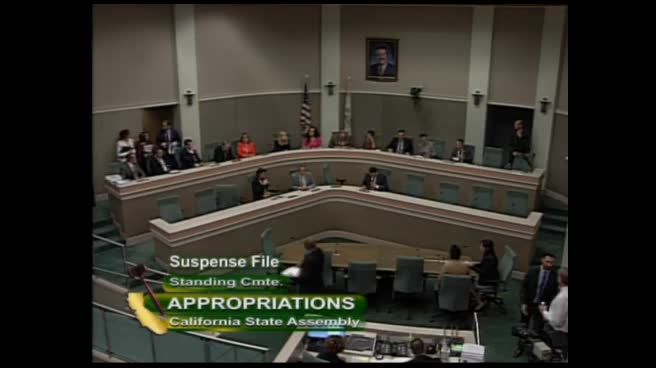 1H
Assembly Standing Committee on Appropriations
 8MIN
Assembly Standing Committee on Revenue and Taxation
Bill Author