AB 1138: Sale of cats or dogs.
- Session Year: 2017-2018
- House: Assembly
- Latest Version Date: 2017-09-07
Existing law regulates the sale of dogs and cats in this state, including provisions governing the retail sale of dogs and cats.
This bill would make it unlawful for specified people and entities, in specified mediums, to advertise, call attention to, or give publicity to the sale or transfer of a dog or cat for which the statements about or pictures of the dog or cat are made or presented without the actual intent to sell or offer the exact dog or cat advertised or the statements about the dog or cat being advertised or offered for sale are known to be untrue or misleading. The bill would make a violation of these provisions a misdemeanor punishable by imprisonment in the county jail not exceeding 6 months, or by a fine not exceeding $2,500, or by both that imprisonment and fine.
The California Constitution requires the state to reimburse local agencies and school districts for certain costs mandated by the state. Statutory provisions establish procedures for making that reimbursement.
This bill would provide that no reimbursement is required by this act for a specified reason.
Existing law regulates the sale of dogs and cats in this state, including provisions governing the retail sale of dogs and cats.
This bill would make it unlawful for specified people and entities, in specified mediums, to advertise, call attention to, or give publicity to the sale or transfer of a dog or cat for which, among other things, the advertised dog or cat is not actually available for purchase by the public, pictures or descriptions of the dog or cat are not of the dog or cat actually available for purchase, which the statements about or pictures of the dog or cat are made or presented without the actual intent to sell or offer the exact dog or cat advertised or the statements about the dog or cat being advertised or offered for sale are known to be untrue or misleading. The bill would make a violation of these provisions a misdemeanor punishable by imprisonment in the county jail not exceeding 6 months, or by a fine not exceeding $2,500, or by both that imprisonment and fine.
The California Constitution requires the state to reimburse local agencies and school districts for certain costs mandated by the state. Statutory provisions establish procedures for making that reimbursement.
This bill would provide that no reimbursement is required by this act for a specified reason.
Existing law regulates the sale of dogs and cats in this state, including provisions governing the retail sale of dogs and cats.
This bill would make it unlawful for specified people and entities, in specified mediums, to advertise, call attention to, or give publicity to the sale or transfer of a dog or cat for which, among other things, the advertised dog or cat is not actually available for purchase by the public, pictures or descriptions of the dog or cat are not of the dog or cat actually available for purchase, or statements about the dog or cat being advertised or offered for sale are known to be untrue or misleading. The bill would make a violation of these provisions a misdemeanor punishable by imprisonment in the county jail not exceeding 6 months, or by a fine not exceeding $2,500, or by both that imprisonment and fine.
The California Constitution requires the state to reimburse local agencies and school districts for certain costs mandated by the state. Statutory provisions establish procedures for making that reimbursement.
This bill would provide that no reimbursement is required by this act for a specified reason.
Existing law requires a person seeking to bring a dog into this state or importing dogs into this state for the purpose of resale or change of ownership to obtain a health certificate with respect to that dog that has been completed by a licensed veterinarian and is dated within 10 days prior to the date on which the dog is brought into the state, as specified.This bill would make technical, nonsubstantive changes to those provisions.Existing law requires a person seeking to bring a dog into this state or importing dogs into this state for the purpose of resale or change of ownership to obtain a health certificate with respect to that dog that has been completed by a licensed veterinarian and is dated within 10 days prior to the date on which the dog is brought into the state, as specified.
This bill would make technical, nonsubstantive changes to those provisions.
(a)It is unlawful for any person, firm, or corporation, in any newspaper, magazine, circular, form letter, or any open publication, published, distributed, or circulated in the State of California, including over the Internet, or on any billboard, card, label, or other advertising medium, or by means of any other advertising device, to advertise, call attention to, or give publicity to, the sale or transfer of a dog or cat for which any of the following apply:
(1)Statements about the dog or cat being advertised or offered for sale are known, or by exercise of reasonable care should be known, to be untrue or misleading.
(2)Statements about or pictures of the dog or cat are made or presented without the actual intent to sell or offer the exact dog or cat so advertised, pictured, or offered.
(b)In addition to any other penalty provided by law, any violation of this section is a misdemeanor punishable by imprisonment in the county jail not exceeding six months, or by a fine not exceeding two thousand five hundred dollars ($2,500), or by both that imprisonment and fine.
SEC. 2.No reimbursement is required by this act pursuant to Section 6 of Article XIIIB of the California Constitution because the only costs that may be incurred by a local agency or school district will be incurred because this act creates a new crime or infraction, eliminates a crime or infraction, or changes the penalty for a crime or infraction, within the meaning of Section 17556 of the Government Code, or changes the definition of a crime within the meaning of Section 6 of Article XIIIB of the California Constitution.
(a)It is unlawful for any person, firm, or corporation, in any newspaper, magazine, circular, form letter, or any open publication, published, distributed, or circulated in the State of California, including over the Internet, or on any billboard, card, label, or other advertising medium, or by means of any other advertising device, to advertise, call attention to, or give publicity to, the sale or transfer of a dog or cat for which any of the following apply:
(1)The advertised dog or cat is not actually available for purchase by the public at the time of the advertisement or offer.(2)Pictures or descriptions of a dog or cat are not of the dog or cat actually available for purchase by the public at the time of the advertisement or offer.(3)(1)Statements about the dog or cat being advertised or offered for sale are known, or by exercise of reasonable care should be known, to be untrue or misleading.
(4)(2)Statements about or pictures of the dog or cat are made or presented without the actual intent to sell or offer the exact dog or cat so advertised advertised, pictured, or offered.
(b)In addition to any other penalty provided by law, any violation of this section is a misdemeanor punishable by imprisonment in the county jail not exceeding six months, or by a fine not exceeding two thousand five hundred dollars ($2,500), or by both that imprisonment and fine.
SEC. 2.No reimbursement is required by this act pursuant to Section 6 of Article XIIIB of the California Constitution because the only costs that may be incurred by a local agency or school district will be incurred because this act creates a new crime or infraction, eliminates a crime or infraction, or changes the penalty for a crime or infraction, within the meaning of Section 17556 of the Government Code, or changes the definition of a crime within the meaning of Section 6 of Article XIIIB of the California Constitution.
(a)It is unlawful for any person, firm, or corporation, in any newspaper, magazine, circular, form letter, or any open publication, published, distributed, or circulated in the State of California, including over the Internet, or on any billboard, card, label, or other advertising medium, or by means of any other advertising device, to advertise, call attention to, or give publicity to, the sale or transfer of a dog or cat for which any of the following apply:
(1)The advertised dog or cat is not actually available for purchase by the public at the time of the advertisement or offer.
(2)Pictures or descriptions of a dog or cat are not of the dog or cat actually available for purchase by the public at the time of the advertisement or offer.
(3)Statements about the dog or cat being advertised or offered for sale are known, or by exercise of reasonable care should be known, to be untrue or misleading.
(4)Statements about the dog or cat are made without the actual intent to sell or offer the exact dog or cat so advertised or offered.
(b)In addition to any other penalty provided by law, any violation of this section is a misdemeanor punishable by imprisonment in the county jail not exceeding six months, or by a fine not exceeding two thousand five hundred dollars ($2,500), or by both that imprisonment and fine.
SEC. 2.No reimbursement is required by this act pursuant to Section 6 of Article XIIIB of the California Constitution because the only costs that may be incurred by a local agency or school district will be incurred because this act creates a new crime or infraction, eliminates a crime or infraction, or changes the penalty for a crime or infraction, within the meaning of Section 17556 of the Government Code, or changes the definition of a crime within the meaning of Section 6 of Article XIIIB of the California Constitution.
SECTION 1.Section 121720 of the Health and Safety Code is amended to read:121720.(a)(1)A person seeking to bring a dog into this state or importing dogs into this state for the purpose of resale or change of ownership shall obtain a health certificate with respect to that dog that has been completed by a licensed veterinarian and is dated within 10 days prior to the date on which the dog is brought into the state.(2)The person seeking to bring the dog into this state or importing dogs into this state for the purpose of resale or change of ownership shall submit the health certificate to the county health department as provided in subdivision (c). The person shall submit the health certificate to the county health department by any method accepted by the receiving agency, including, but not limited to, electronic transmission and facsimile.(b)Completion of a United States Department of Agriculture Animal and Plant Health Inspection Service Form 7001, known as the United States Interstate and International Certificate of Health Examination for Small Animals, shall satisfy the requirement of subdivision (a). A different form of canine health certificate acceptable to the receiving agency shall also satisfy the requirement of subdivision (a).(c)It shall be the responsibility of the person importing the dog into this state for the purpose of resale or change of ownership to send the health certificate to the county health department where the dog is to be offered for sale or to the county of residence of the individual purchasing or receiving a dog directly from a source outside of California.(d)The receiving agency may use the information on the health certificate as it deems appropriate.(a)(1)A person seeking to bring a dog into this state or importing dogs into this state for the purpose of resale or change of ownership shall obtain a health certificate with respect to that dog that has been completed by a licensed veterinarian and is dated within 10 days prior to the date on which the dog is brought into the state.
(2)The person seeking to bring the dog into this state or importing dogs into this state for the purpose of resale or change of ownership shall submit the health certificate to the county health department as provided in subdivision (c). The person shall submit the health certificate to the county health department by any method accepted by the receiving agency, including, but not limited to, electronic transmission and facsimile.
(b)Completion of a United States Department of Agriculture Animal and Plant Health Inspection Service Form 7001, known as the United States Interstate and International Certificate of Health Examination for Small Animals, shall satisfy the requirement of subdivision (a). A different form of canine health certificate acceptable to the receiving agency shall also satisfy the requirement of subdivision (a).
(c)It shall be the responsibility of persons the person importing dogs the dog into this state for the purpose of resale or change of ownership to send the health certificate to the county health department where the dog is to be offered for sale or to the county of residence of the individual purchasing or receiving a dog directly from a source outside of California.
(d)The receiving agency may use the information on the health certificate as it deems appropriate.
|
Date
|
Status
|
|---|---|
| Jan 12, 2018 | Stricken from file. |
| Jan 3, 2018 | Consideration of Governor's veto pending. |
| Oct 13, 2017 | Vetoed by Governor. |
| Sep 13, 2017 | Enrolled and presented to the Governor at 4 p.m. |
| Sep 5, 2017 | In Assembly. Ordered to Engrossing and Enrolling. |
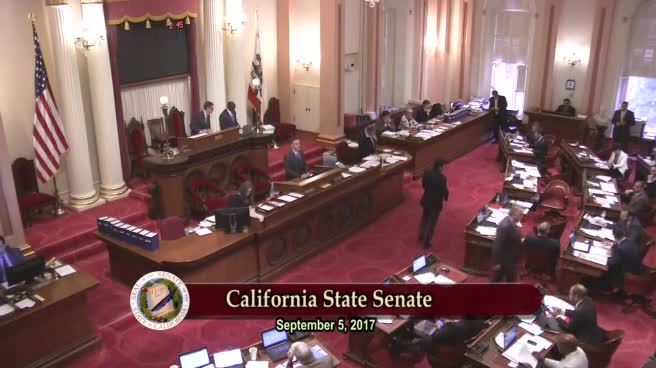
| Sep 5, 2017 | Read third time. Passed. Ordered to the Assembly. |
| Aug 22, 2017 | Read second time. Ordered to third reading. |
| Aug 21, 2017 | From committee: Be ordered to second reading pursuant to Senate Rule 28.8. |
| Jul 12, 2017 | From committee: Do pass and re-refer to Com. on APPR. (Ayes 6. Noes 0.) (July 11). Re-referred to Com. on APPR. |
| Jun 19, 2017 | From committee: Do pass and re-refer to Com. on PUB. S. (Ayes 9. Noes 0.) (June 19). Re-referred to Com. on PUB. S. |
| Jun 1, 2017 | Referred to Coms. on B., P. & E.D. and PUB. S. |
| May 18, 2017 | In Senate. Read first time. To Com. on RLS. for assignment. |
| May 18, 2017 | Read third time. Passed. Ordered to the Senate. (Ayes 69. Noes 0. Page 1619.) |
| May 11, 2017 | Read second time. Ordered to Consent Calendar. |
| May 10, 2017 | From committee: Do pass. To Consent Calendar. (Ayes 17. Noes 0.) (May 10). |
| Apr 26, 2017 | From committee: Do pass and re-refer to Com. on APPR. (Ayes 9. Noes 0.) (April 25). Re-referred to Com. on APPR. |
| Apr 18, 2017 | Re-referred to Com. on P. & C.P. |
| Apr 17, 2017 | From committee chair, with author's amendments: Amend, and re-refer to Com. on P. & C.P. Read second time and amended. |
| Mar 29, 2017 | Re-referred to Com. on P. & C.P. |
| Mar 28, 2017 | From committee chair, with author's amendments: Amend, and re-refer to Com. on P. & C.P. Read second time and amended. |
| Mar 27, 2017 | Referred to Com. on P. & C.P. |
| Feb 19, 2017 | From printer. May be heard in committee March 21. |
| Feb 17, 2017 | Read first time. To print. |
|
Date
|
Description
|
Location
|
Votes
|
|
|---|---|---|---|---|
| Sep 5, 2017 | Assembly 3rd Reading AB1138 Maienschein By Bradford | Senate Floor |
Passed |
|
| Jul 11, 2017 | Do pass, but first be re-referred to the Committee on [Appropriations] | Senate Standing Committee on Public Safety |
Passed |
|
| Jun 19, 2017 | Do pass, but first be re-referred to the Committee on [Public Safety] | Senate Standing Committee on Business, Professions and Economic Development |
Passed |
|
| May 18, 2017 | AB 1138 MAIENSCHEIN Consent Calendar Second Day Regular Session | Assembly Floor |
Passed |
|
| May 10, 2017 | Do pass. To Consent Calendar. | Assembly Standing Committee on Appropriations |
Passed |
|
| Apr 25, 2017 | Do pass and be re-referred to the Committee on [Appropriations] | Assembly Standing Committee on Privacy and Consumer Protection |
Passed |
This list shows positions taken on this bill by organizations on the date displayed, which is linked to the original source.
Positions by individuals are not included.
|
Organization
|
Position
|
Date
|
|---|---|---|
| American Society For The Prevention Of Cruelty To Animals (Aspca) | * Support | Jul 11, 2017 |
| Best Friends Animal Society | ** Support | Aug 23, 2017 |
| Humane Society Veterinary Medical Association | ** Support | Aug 23, 2017 |
| San Diego Humane Society | ** Support | Aug 23, 2017 |
| San Francisco SBCA | ** Support | Jul 11, 2017 |
| San Francisco Spca | ** Support | Aug 23, 2017 |
| State Humane Association of California | ** Support | Aug 23, 2017 |
| The Humane Society of the United States | ** Support | Aug 23, 2017 |
GOVERNOR'S VETO
GV Bill Id:AB 1138
Author:(Maienschein)
As Enrolled Ver:September 7, 2017
2/3 vote
Committee | Votes | Ayes | Noes |
Privacy | 9-0 | Chau, Baker, Berman, Gloria, Dababneh, Irwin, Kalra, Obernolte, Reyes | |
Appropriations | 17-0 | Gonzalez Fletcher, Bigelow, Bloom, Bocanegra, Bonta, Brough, Calderon, Chau, Eggman, Fong, Friedman, Gallagher, Eduardo Garcia, Gray, Muratsuchi, Obernolte, Reyes |
|
ASSEMBLY: | 69-0 | (May 18, 2017) | SENATE: | 40-0 | (September 5, 2017) |
Original Committee Reference: P. & C.P.
SUBJECT: Sale of cats or dogs
SUMMARY: Prohibits false or misleading advertising related to the sale of dogs and cats. Specifically, this bill:
- Prohibits any person, firm or corporation from advertising the sale or transfer or a dog or cat for which any of the following apply:
- Statements about the dog or cat are known to be untrue or misleading; or,
- Statements about or pictures of the dog or cat are made without the intent to sell the exact dog or cat advertised, pictured, or offered.
- Violations of these provisions are considered a misdemeanor punishable by imprisonment in the county jail not exceeding six months, or by a fine not exceeding $2,500, or by both that imprisonment and fine.
- Declares that no reimbursement is required because the only costs that may be incurred by a local agency or school district will be incurred because this bill creates a new crime or infraction, eliminates a crime or infraction, changes the penalty for a crime or infraction, or changes the definition of a crime, as specified.
FISCAL EFFECT: According to the Assembly Appropriations Committee, nonreimbursable local incarceration costs, potentially offset to some extent by fine revenue.
COMMENTS:
This bill is intended to raise consumer awareness of misleading animal sale practices by prohibiting false advertising specifically as it relates to the sale of cats and dogs. This bill is sponsored by the American Society for the Prevention of Cruelty to Animals.
According to the author, "Despite laws prohibiting false advertising, online buyers of dogs and cats commonly fall victim to it. The internet has made it much easier for sellers to use deceptive practices, including the source and health of the pet and, at times, even the existence of the pet. Buyers are saddled with unanticipated veterinary costs and are devastated when a happy event turns to a costly and emotional outcome. Many consumers do not seem to understand that they have remedies under the law for deceptive marketing. AB 1138 would clarify the law to ensure that deceived buyers know that they have a remedy under California laws."
According to the author, unscrupulous breeders often post false or misleading information about the health, appearance, and source of pets being advertised for sale. Some advertisements use "bait and switch" tactics which could result in the unintended purchase of animals with significant health issues. The Federal Trade Commission (FTC) and the Better Business Bureau (BBB) have issued several statements warning consumers about online pet scams. The FTC recommends not using a money transfer service, asking for detailed information, and doing a reverse image search of the photo to see if it appears in older ads. Consumers can find information about company names or websites of online pet scammers on the BBB website and on the International Pet and Animal Transportation Association website.
In California, news outlets have reported several online pet purchasing scams. Several stories documented legal action against the perpetrator while others described money lost to online scammers. In November 2016, the Sacramento Bee reported that a Sacramento-area woman had been sentenced to one year in jail for operating an online business selling malnourished dogs. The woman was sentenced for felony animal cruelty, operating without a license and multiple other charges related to selling puppies from South Korea.
In 2016, 13 California consumers registered complaints with the BBB documenting online scams related to pet purchases. Eleven consumers reported paying for pets that never arrived. While it is clear that some consumers have fallen victim to these unscrupulous tactics, no comprehensive data has been identified or provided to document the full extent of the problem.
Under current law, false or misleading advertising of pet sales can be prosecuted as a misdemeanor, punishable by up to six months in county jail, a fine of up to $2,500 or both. This bill would specifically address certain forms of false advertising arguably already covered by existing law, and would apply an identical penalty.
Additionally, other measures exist to protect the health and safety of pets. The Polanco-Lockyer Pet Breeder Warranty Act and Lockyer-Polanco-Farr Pet Protection Act, provisions within the Health and Safety Code, outline specific health and safety standards for the housing and sale of pets. The Pet Protection Act ensures purchaser protection for the sale of ill or sick animals and provides disclosures to individuals about where the animal was bred. These laws protect animals, inform consumers, and specify penalties for violating the provisions.
This bill creates a new misdemeanor for the false or misleading advertising related to the sale of dogs and cats.
Existing law already makes it unlawful to make fraudulent, deceptive, untrue, or misleading advertisements. A violation of existing law is a misdemeanor punishable by imprisonment in county jail not exceeding six months, or by a fine not exceeding $2,500, or both. The creation of a new crime is not necessary.
Analysis Prepared by: Jennifer Chase / P. & C.P. / (916) 319-2200 FN: 0002497
Office of Senate Floor Analyses (916) 651-1520 Fax: (916) 327-4478 | AB |
THIRD READING
Bill No: AB 1138
:
SENATE BUS., PROF. & ECON. DEV. COMMITTEE: 9-0, 6/19/17
AYES: Hill, Fuller, Dodd, Galgiani, Glazer, Hernandez, Newman, Pan, Wilk
SENATE PUBLIC SAFETY COMMITTEE: 6-0, 7/11/17
AYES: Anderson, Bradford, Jackson, Mitchell, Stone, Wiener
NO VOTE RECORDED: Skinner
SENATE APPROPRIATIONS COMMITTEE: Senate Rule 28.8
ASSEMBLY FLOOR: 69-0, 5/18/17 (Consent) - See last page for vote
SOURCE: American Society for the Prevention of Cruelty to Animals
DIGEST:
This bill makes it unlawful for specified people and entities, in specified advertising mediums, including the Internet, to advertise, call attention to, or give publicity to the sale or transfer of a dog or cat for which the statements about, or the pictures of the dog or cat are made or presented without the actual intent to sell or offer the exact dog or cat advertised, or the statements about the dog or cat being advertised or offered for sale are known to be untrue or misleading.
Existing law:
- Protects, generally, consumers from unlawful, unfair and fraudulent business practices. (Business and Professions Code (BPC) § 17200, et seq.)
- Provides that it is unlawful for any person, as specified, to dispose of real or personal property or to perform services or to induce the public to enter into any obligation and to make or disseminate or cause to be made or disseminated to the public in any newspaper or other publication, or any other advertising device, or in any other manner or means, including over the Internet, any statement concerning that real or personal property or those services concerning any circumstances or matter of fact connected with the proposed performance or disposition thereof which is untrue or misleading, and which is known or should be known to be untrue or misleading. Also provides that it is unlawful for any person, as specified, to make or disseminate or cause to be made or disseminated any such statement as part of a plan or scheme with the intent not to sell that personal property or those services, professional or otherwise, so advertised at the price stated therein, or as so advertised. Violations of this provision can result in a misdemeanor punishable by imprisonment in the county jail not exceeding six months, by a fine not exceeding $2,500 or both. (BPC § 17500)
- Specifies a number of violations that are separately articulated due to specific public policy need and extends the prohibition on untrue or misleading advertising to all media platforms, including online advertisement, and furthermore specifies unfair or deceptive acts or practices which are deemed unlawful when they result in the sale or lease of goods or services to any consumer, including providing misrepresentation of the source, quality, and characteristics of the personal property being advertised. (BPC § 17500 et seq. and Civil Code (CC) § 1770)
- Requires a person seeking to bring a dog into California for resale or change or ownership to obtain a health certificate from a licensed veterinarian, dated within 10 days prior to the dog’s arrival, and submit the certificate to the county health department, as specified. (Health and Safety Code (HSC) § 121720-121723)
- Establishes the Lockyer-Polanco-Farr Pet Protection Act, related to the retail sale of dogs and cats. Requires that pet dealers possess a permit in order to sell dogs and cats and provide consumers disclosures related to the pet, including breeder information, health records, and any known health condition. Requires that breeders maintain facilities and care requirements for pets. Specifies civil penalties for violating these sections. (HSC §§ 122125-122220)
- Establishes the Polanco-Lockyer Pet Breeder Warranty Act, related to the sale of dogs by breeders. Defines a dog breeder as a person, firm, partnership, corporation that has sold, transferred or given away 20 or more dogs within one year that were bred and reared on the premises. Specifies information to disclose to the consumer, including records of diseases or illness. Requires dog breeders to maintain the health and safety of the dogs and prohibits them from knowingly selling a dog that is ill. (HSC §§ 122045-122110)
- Prohibits pet stores from selling dogs or cats that are less than eight weeks old. (HSC § 122359)
This bill:
- Makes it unlawful for any person, firm or corporation to advertise, call attention to, or give publicity to, in any advertising medium as specified, including over the Internet, the sale or transfer of a dog or cat for which any of the following apply:
- Statements about the dog or cat being advertised or offered for sale are known to be untrue or misleading; or,
- Statements about or pictures of the dog or cat are made or presented without the intent to sell the exact dog or cat so advertised, pictured, or offered.
- Provides that in addition to any other penalty provided by law, violations of these provisions are considered a misdemeanor punishable by imprisonment in the county jail not exceeding six months, or by a fine not exceeding $2,500, or by both imprisonment and a fine.
This bill is sponsored by the American Society for the Prevention of Cruelty to Animals (ASPCA). According to the ASPCA, the incidents of advertising false or misleading information regarding the health, appearance, characteristics, source, and in some cases, the very existence of the pet being advertised for sale has proliferated with the use of the Internet. The sellers of pets, which may include out-of-state pet breeders, puppy mills and pet brokers, are using widely disseminated and accessible sales platforms to advertise the sale of dogs and cats. “While California broadly regulates false and misleading advertising practices, these cases stand apart in that the ‘goods’ at issue are each highly unique, the harm to the ‘good[s]’ results in unethical cruelty to an animal, and a consumer may be put in a position of absorbing exorbitant, unanticipated costs as a result of undisclosed health conditions and/or other falsified characteristics of the pet. Unscrupulous sellers depend on advertisements to hook new, naïve, and emotional buyers that are seeking that special companion. Absent an explicit law calling out this highly unethical practice, malicious sellers are advertising without fear of recourse under existing false advertising statutes. Many consumers do not seem to understand that they have remedies under the law for deceptive marketing. AB 1138 would clarify this so that deceived buyers know they have a remedy under California law and so that sellers think twice about utilizing deceptive practices.”
Untrue or Misleading Advertising of Pets. According to the author, while the Internet has made life easier in so many ways, it has also exposed the public to myriad opportunities for unethical business practices. Historically, pet sales were primarily local in nature, with a buyer having an opportunity to personally view and inspect a puppy or kitten prior to purchasing the new pet. However, pet breeders and puppy mills are increasingly using the Internet to advertise the sale of dogs and cats. In these cases, the geographic distance between buyer and seller often prevents an inspection of the facility and the animal from occurring. As such, advertising practices that leverage the lack of transparency have proliferated. Correspondingly, the number of scams associated with pet sales has multiplied.
As indicated by the author, in 2016, a Federal Trade Commission official stated in an interview that there had been “tens of thousands of complaints filed” with the FTC about online dog scams. A quick online search of the Internet bears this out. There are innumerable articles about victims and perpetrators, and blogs, and warnings posted by groups such as the American Association of Retired People and the Better Business Bureau and numerous animal welfare organizations. The stories of abuse range from standard “bait and switch” scams in which consumers are asked to wire money in order to purchase a dog or cat that doesn’t likely exist, to posting false information, such as the source, characteristics, or photos of pets that are actually for sale, but in which the consumer ultimately gets a pet different than what they anticipated.
The author states that the worst of these are cases are those in which sellers fail to disclose significant health conditions of the dog or cat being sold. In several highly publicized cases, dogs with the highly contagious parvovirus have been shipped to unwitting buyers. The Parvovirus causes the animal to experience extreme cases of vomiting and diarrhea creating situations in which animals are forced to endure unspeakable cruelty during shipping. And, when the buyers have received their new pet, they are immediately put in a crisis situation that requires them to expend hundreds or even thousands of dollars to try to save their new pet. In several cases, the animals have been euthanized.
The author further states that the Internet has allowed unethical out-of-state sellers to access California consumers in a way that wasn’t feasible prior to the medium. The act of advertising is the hook that allows these sellers to flourish in the California market in a manner that it otherwise would not be able to. The fraud, animal cruelty, and other illegal acts are contingent upon accessing the market through false advertising. While the incidents of false advertising are generally addressed under existing law, the Code does call out numerous very specific examples of where additional protections have been deemed necessary. In some cases, the provisions of regulation are extensive. Some examples include advertising related to: the location of floral arrangement providers, door to door sales, recreation therapists, goods labeled as produced by the blind, funeral caskets, unassembled toys, refurbished picture tubes for T.V.s, energy conservation products, grant deed copy services, and the composition of music groups. The harm created by false advertising related to pet sales rises to the level of public importance of any of these areas of specific regulations for a number of reasons, including:
- The potential harm and suffering of an animal.
- Immediate costs associated with health issues.
- Inability to expect what is not a uniform product.
- Consumer choice – unfair competition.
Current Legal Remedies. Under current law, false or misleading advertising of pet sales can be prosecuted as a misdemeanor, punishable by up to six months in county jail, a fine of up to $2,500 or both. This bill specifically addresses certain forms of false advertising for the sale of dogs and cats and applies an identical penalty.
Additionally, other measures exist to protect the health and safety of pets. The Polanco-Lockyer Pet Breeder Warranty Act and Lockyer-Polanco-Farr Pet Protection Act, provisions within the Health and Safety Code, outline specific health and safety standards for the housing and sale of pets to consumers. The Pet Protection Act ensures purchaser protection for the sale of ill or sick animals and provides disclosures to individuals about where the animal was bred. These laws protect animals, inform consumers, and specify certain remedies such as return of the animal if ill to the pet store or to obtain reimbursement for veterinary costs and civil penalties against the pet store for violating the provisions.
The ASPCA also sponsored legislation (AB 1809, Maienschein, Chapter 498, Statutes of 2014) to deal with the importation of dogs into California for the purpose of resale or change of ownership and requires the person seeking to bring a dog into this state for that purpose to obtain a health certificate from a licensed veterinarian and submit that certificate to the local county health department. A person who violates this requirement can be subject to an infraction, punishable by a fine not to exceed $250 for each dog for which a violation has occurred.
FISCAL EFFECT: Appropriation: Fiscal Com.: Local:
American Society for the Prevention of Cruelty to Animals (source)
Best Friends Animal Society
Humane Society Veterinary Medical Association
San Diego Humane Society
San Francisco SPCA
State Humane Association of California
The Humane Society of the United States
OPPOSITION: (Verified 8/22/17)
None received
ARGUMENTS IN SUPPORT: The ASPCA as the sponsor, and the State Humane Association of California (SHAC) are both concerned that online pet sales are allowing for the proliferation of inhumane breeding practices that are detrimental to both the animal and to consumers. They both argue that the Internet has allowed for an explosion of unscrupulous sellers marketing and selling pets to unsuspecting consumers. While the ASPCA is unable to definitively inventory the number of online sellers, an informal search yielded a myriad of advertisements selling pets, sight unseen. These sellers range from standalone “puppy brokerage” Web sites like Puppyfinder.com and Nextdaypets.com, which purport to link their network of “responsible breeders” to consumers, providing payment and shipping services to individuals advertising pets on generic marketplace sites like Oodle, Inc. and eBay classifieds. Sites like Craigslist and Facebook have implemented some limitations on pet sales, but these rules can easily be skirted and often are.
The ASPCA and SHAC indicate that while California broadly regulates false and misleading advertising practices, unscrupulous breeders regularly post false or misleading information regarding the health, appearance, and characteristics of the pet being advertised for sale. These advertisements are a classic “bait and switch” in which the consumer does not get the animal that they have seen advertised and may purchase a pet with significant undisclosed health issues that result in costly veterinary bills. The ASPCA and SHAC believe that this bill could help to deter false and deceptive advertising practices related to pet sales and would provide a specific remedy for unwitting consumers that fall victim to these unscrupulous practices.
The Humane Society of the United States (HSUS), the San Diego Humane Society, Best Friends Animal Society and San Francisco SPCA are also in support of this bill for the reasons as stated above and are concerned that many people fall prey to online advertising which promises more than it delivers. Commercial operations where large number of breeding animals are kept in wire cages with limited opportunities to engage in their natural behavior market themselves as home-based, family businesses and imply the kind of love and care that pet lovers want to believe goes into bringing every purpose-bred kitten and puppy into the world. There are ample examples all over the Internet of Web sites and advertisements that describe an idyllic situation, as argued by these animal groups, but where local or federal authorities have needed to intervene to stop criminal animal neglect and abuse. Because purchases of pets in these situations occur sight-unseen in many instances, the customer usually has to rely on the accuracy of the breeder’s advertisement. And too often, marketing includes photos and descriptions that are purposefully misleading – in spite of a general California law against fraudulent advertising and pet lemon laws aimed at requiring accurate disclosure. AB 1138 addresses this issue head-on by explicitly prohibiting deceptive advertising, requiring that photos and descriptions used be for the exact pet.
ASSEMBLY FLOOR: 69-0, 5/18/17
AYES: Acosta, Travis Allen, Arambula, Baker, Berman, Bigelow, Bloom, Bocanegra, Bonta, Brough, Burke, Caballero, Cervantes, Chávez, Chen, Chiu, Choi, Chu, Cooley, Cooper, Cunningham, Dababneh, Dahle, Daly, Eggman, Flora, Fong, Gallagher, Cristina Garcia, Eduardo Garcia, Gomez, Gonzalez Fletcher, Gray, Grayson, Harper, Irwin, Jones-Sawyer, Kalra, Kiley, Lackey, Levine, Limón, Low, Maienschein, Mathis, Mayes, McCarty, Medina, Melendez, Muratsuchi, Nazarian, Obernolte, O'Donnell, Patterson, Quirk, Quirk-Silva, Reyes, Ridley-Thomas, Rodriguez, Rubio, Salas, Steinorth, Mark Stone, Thurmond, Ting, Voepel, Waldron, Weber, Wood
NO VOTE RECORDED: Aguiar-Curry, Calderon, Chau, Frazier, Friedman, Gipson, Gloria, Holden, Mullin, Santiago, Rendon
8/23/17 11:02:34
**** END ****
SENATE COMMITTEE ON PUBLIC SAFETY
Senator Nancy Skinner, Chair
2017 - 2018 Regular
Bill No: AB 1138 Hearing Date: July 11, 2017
Author: | Maienschein | ||
Version: | April 17, 2017 | ||
Urgency: | No | Fiscal: | Yes |
Consultant: | NG | ||
Subject: Sale of Cats or Dogs
HISTORY
Source: American Society for the Prevention of Cruelty to Animals
Prior Legislation: AB 1491(Caballero) in Senate & Senate Judiciary Committee, 2017
AB 485 (O’Donnell) in Senate Committee Business, Professions, and Economic Development, 2017
AB 1347 (Caballero) Chapter 703, Statutes of 2007
AB 2826 (Ridley-Thomas) Voted by Governor, 2006
Support: Best Friends Animal Society; Humane Society of the United States; Humane Society Veterinary Medical Association; San Francisco Society for the Prevention of Cruelty to Animals; San Diego Humane Society; State Humane Association of California
Opposition: None known
Assembly Floor Vote: 69 - 0
PURPOSE
The purpose of this bill is to prohibit untrue or misleading advertising related to the sale of dogs and cats, and prohibits advertisement without the intent to sell advertised dogs or cats.
Existing law generally protects consumers against unlawful, unfair, fraudulent business act or practice, and unfair, deceptive, untrue, or misleading advertisement. (Business and Professions Code § 17200, et seq.)
Existing law states that false advertising, with intent directly or indirectly to dispose of real or personal property or to perform services, professional or otherwise, or anything of any nature whatsoever or to induce the public to enter into any obligation relating thereto, as part of a plan or scheme with the intent not to sell that personal property or those services, professional or otherwise, so advertised at the price stated therein, or as advertised is a misdemeanor punishable by imprisonment in a county jail not exceeding six months, or by a fine not exceeding $2,500, or by both that imprisonment and fine. (Business and Professions Code § 17500)
Existing law establishes the Lockyer-Polanco-Farr Pet Protection Act, related to the retail sale of dogs and cats. The Act requires that pet dealers possess a permit in order to sell dogs and cats. (Health & Safety Code (HSC) § 122125, subd. (a) & (b).)
Existing law requires pet dealers to disclose information, in written format, regarding a cat or dog’s health condition, breed, date of birth, physical characteristics, existing record of any veterinarian treatment, as specified, among others, to the purchaser of each dog or cat at the time of a sale. (HSC § 122140)
Existing law requires pet dealers to maintain a healthy and sanitary condition for dogs and cats, as specified. (HSC § 122155)
Existing law provides a civil penalty for violating the Lockyer-Polanco-Farr Pet Protection Act punishable up to one thousand dollars per violation. (HSC § 122150, subd. (a).)
This bill provides that is unlawful for any person, firm, or corporation, in any newspaper, magazine, circular, form letter, or any open publication, published, distributed, or circulated, including over the Internet, or any billboard, card, label, or other advertising medium, or by means of any other advertising device, to advertise the sale or transfer of a dog or cat for which any of the following apply:
- Statements about the dog or cat being advertise or offered for sale are known, or reasonably should be known, to be untrue or misleading; and
- Statements about or pictures of the dog or cat are made or presented without the actual intent to sell or offer the exact dog or cat advertised, pictured, or offered.
This bill provides that, in addition to any other penalty provided by the law, the violation of the any section of the bill constitutes a misdemeanor punishable by imprisonment in the county jail not exceeding six months, or by fine not exceeding $2,500, or by both that imprisonment and fine.
COMMENTS
1. Need for This Bill
According to the author:
While the internet has made life easier in so many ways, it has also exposed the public to myriad opportunities for unethical business practices. Historically, pet sales were primarily local in nature, with a buyer having an opportunity to personally view and inspect a puppy or kitten prior to purchasing the new pet. However, pet breeders and puppy mills are increasingly using the internet to advertise the sale of dogs and cats. In these cases, the geographic distance between buyer and seller often prevents an inspection of the facility and the animal from occurring. As such, advertising practices that leverage the lack of transparency have proliferated. Correspondingly, the number of scams associated with pet sales has multiplied.
In 2016, a Federal Trade Commission official stated in an interview that there had been “tens of thousands of complaints filed” with the FTC online dog scams. A quick online search of the internet bears this out. There are innumerable articles about victims and perpetrators, and blogs, and warnings posted by groups such as the AARP, BBB, and numerous animal welfare organizations. The stories of abuse range from standard “bait and switch” scams in which consumers are asked to wire money in order to purchase a dog or cat that doesn’t likely exist - to posting false information, such as the source, characteristics, or photos of pets that are actually for sale, but in which the consumer ultimately gets a pet different than what they anticipated.
The worst of these are cases are those in which sellers fail to disclose significant health conditions of the dog or cat being sold. In several highly publicized cases, dogs with the highly contagious parvovirus have been shipped to unwitting buyers. The parvovirus causes the animal to experience extreme cases of vomiting and diarrhea creating situations in which animals are forced to endure unspeakable cruelty during shipping. And, when the buyers have received their new pet, they are immediately put in a crisis situation to that requires them to expend hundreds or even thousands of dollars to try to save their new pet. In several cases, the animals have been euthanized.
The internet has allowed unethical out of state sellers to access California consumers in a way that wasn’t feasible prior to the medium. The act of advertising is the hook that allows these sellers to flourish in the California market in a manner that it otherwise would not be able to. The fraud, animal cruelty, and other illegal acts are contingent upon accessing the market through false advertising.
While the incidents of false advertising are generally addressed under existing law, the Code does call out numerous very specific examples of where additional protections have been deemed necessary. In some cases, the provisions of regulation are extensive. Some examples these include advertising related to: the location of floral arrangement providers, door to door sales, recreation therapists, goods labeled as produced by the blind, funeral caskets, unassembled toys, refurbished picture tubes for T.V.s, energy conservation products, grant deed copy services, and the composition of music groups. The harm created by false advertising related to pet sales rises to the level of public importance of any of these areas of specific regulations for a number of reasons, including:
- The potential harm and suffering of an animal
- Immediate costs associated with health issues
- Inability to expect what is not a uniform product
- Consumer choice – unfair competition
2. What this Bill Does
Current law provides that false or misleading advertising can generally be prosecuted as a misdemeanor, punishable by up to six months in county jail, or a fine of up to $2,500, or both. This bill creates a new misdemeanor by specifying that particular forms of false advertisement regarding the sale of dog or cats are unlawful, and would apply an identical penalty as existing law.
3. Argument in Support
The Humane Society of the United States, the San Diego Human Society, the Best Friends Animal Society, and the San Francisco Society for the Prevention of Cruelty to Animals jointly state, in support:
Too often, especially in online/internet advertising, photos and descriptions of pets marketed for sale are deceptively inaccurate. It is not uncommon, unfortunately, for large-scale “puppy mills” in particular, to market available puppies using photos of dogs other than those individuals being offered for sale. Such deceptive advertising is used to draw customers in, preying on an emotional response, taking their money and then delivering a dog that bears little resemblance to the photographed animal, who may have other behavioral or medical issues that do no match descriptions provided in advertisements, and leaving the customer without realistic recourse…
Many internet pet purchases occur sight-unseen, either because there is a significant geographical distance between the buyer and seller or due to the unwillingness of the breeder to let the customer meet the pet on their property before buying them. As a result, the customer usually has to rely on the accuracy of the breeder’s advertisement. And too often, marketing includes photos and descriptions that are purposefully misleading—in spite of a general California law against fraudulent advertising and pet lemon laws aimed at requiring accurate disclosure.
AB 1138 addresses this issue head-on by explicitly prohibiting deceptive advertising, requiring that photos and descriptions used be for the exact pet that is being offered for sale, and providing customers with a remedy in the cases these provisions are violated.
– END –
SENATE COMMITTEE ON
BUSINESS, PROFESSIONS AND ECONOMIC DEVELOPMENT
Senator Jerry Hill, Chair
2017 - 2018 Regular
Bill No: AB 1138 Hearing Date: June 19, 2017
Author: | Maienschein | ||
Version: | Amended | ||
Urgency: | Fiscal: | ||
Consultant: | |||
Subject: Sale of cats or dogs
SUMMARY:
Makes it unlawful for specified people and entities, in specified advertising mediums, including the Internet, to advertise, call attention to, or give publicity to the sale or transfer of a dog or cat for which the statements about, or the pictures of the dog are cat are made or presented without the actual intent to sell or offer the exact dog or cat advertised, or the statements about the dog or cat being advertised or offered for sale are known to be untrue or misleading.
Existing law:
- Generally protects consumers from unlawful, unfair and fraudulent business practices. (Business and Professions Code (BPC) § 17200, et seq.)
- Provides that it is unlawful for any person, as specified, to dispose of real or personal property or to perform services or to induce the public to enter into any obligation and to make or disseminate or cause to be made or disseminated to the public in any newspaper or other publication, or any other advertising device, or in any other manner or means, including over the Internet, any statement concerning that real or personal property or those services concerning any circumstances or matter of fact connected with the proposed performance or disposition thereof which is untrue or misleading, and which is known or should be known to be untrue or misleading. Also provides that it is unlawful for any person, as specified, to make or disseminate or cause to be made or disseminated any such statement as part of a plan or scheme with the intent not to sell that personal property or those services, professional or otherwise, so advertised at the price stated therein, or as so advertised. Violations of this provision can result in a misdemeanor punishable by imprisonment in the county jail not exceeding six months, by a fine not exceeding $2,500 or both. (BPC § 17500)
- Specifies a number of violations that are separately articulated due to specific public policy need and extends the prohibition on untrue or misleading advertising to all media platforms, including online advertisement, and furthermore specifies unfair or deceptive acts or practices which are deemed unlawful when they result in the sale or lease of goods or services to any consumer, including providing misrepresentation of the source, quality, and characteristics of the personal property being advertised. (BPC § 17500 et seq. and Civil Code (CC) § 1770)
- Requires a person seeking to bring a dog into California for resale or change or ownership to obtain a health certificate from a licensed veterinarian, dated within 10 days prior to the dog’s arrival, and submit the certificate to the county health department, as specified. (Health and Safety Code (HSC) § 121720-121723)
- Establishes the Lockyer-Polanco-Farr Pet Protection Act, related to the retail sale of dogs and cats. Requires that pet dealers possess a permit in order to sell dogs and cats and provide consumers disclosures related to the pet, including breeder information, health records, and any known health condition. Requires that breeders maintain facilities and care requirements for pets. Specifies civil penalties for violating these sections. (HSC §§ 122125-122220)
- Establishes the Polanco-Lockyer Pet Breeder Warranty Act, related to the sale of dogs by breeders. Defines a dog breeder as a person, firm, partnership, corporation that has sold, transferred or given away 20 or more dogs within one year that were bred and reared on the premises. Specifies information to disclose to the consumer, including records of diseases or illness. Requires dog breeders to maintain the health and safety of the dogs and prohibits them from knowingly selling a dog that is ill. (HSC §§ 122045-122110)
- Prohibits pet stores from selling dogs or cats that are less than eight weeks old. (HSC § 122359)
This bill:
- Makes it unlawful for any person, firm or corporation to advertise, call attention to, or give publicity to, in any advertising medium as specified, including over the Internet, the sale or transfer or a dog or cat for which any of the following apply:
- Statements about the dog or cat being advertised or offered for sale are known to be untrue or misleading; or,
- Statements about or pictures of the dog or cat are made or presented without the intent to sell the exact dog or cat so advertised, pictured, or offered.
- Provides that in addition to any other penalty provided by law, violations of these provisions are considered a misdemeanor punishable by imprisonment in the county jail not exceeding six months, or by a fine not exceeding $2,500, or by both imprisonment and a fine.
FISCAL EFFECT: This bill is keyed fiscal by Legislative Counsel. According to the Assembly Committee on Appropriations analysis dated May 10, 2017, this bill would result in non-reimbursable local incarceration costs, potentially offset to some extent by fine revenue.
COMMENTS:
- Purpose. This bill is sponsored by the American Society for the Prevention of Cruelty to Animals (ASPCA). According to the ASPCA, the incidents of advertising false or misleading information regarding the health, appearance, characteristics, source, and in some cases, the very existence of the pet being advertised for sale has proliferated with the use of the Internet. The sellers of pets, which may include out-of-state pet breeders, puppy mills and pet brokers, are using widely disseminated and accessible sales platforms to advertise the sale of dogs and cats. “While California broadly regulates false and misleading advertising practices, these cases stand apart in that the “goods” at issue are each highly unique, the harm to the “good[s]” results in unethical cruelty to an animal, and a consumer may be put in a position of absorbing exorbitant, unanticipated costs as a result of undisclosed health conditions and/or other falsified characteristics of the pet. Unscrupulous sellers depend on advertisements to hook new, naïve, and emotional buyers that are seeking that special companion. Absent an explicit law calling out this highly unethical practice, malicious sellers are advertising without fear of recourse under existing false advertising statutes. Many consumers do not seem to understand that they have remedies under the law for deceptive marketing. AB 1138 would clarify this so that deceived buyers know they have a remedy under California law and so that sellers think twice about utilizing deceptive practices.”
- Untrue or Misleading Advertising of Pets. According to the Author, while the Internet has made life easier in so many ways, it has also exposed the public to myriad opportunities for unethical business practices. Historically, pet sales were primarily local in nature, with a buyer having an opportunity to personally view and inspect a puppy or kitten prior to purchasing the new pet. However, pet breeders and puppy mills are increasingly using the Internet to advertise the sale of dogs and cats. In these cases, the geographic distance between buyer and seller often prevents an inspection of the facility and the animal from occurring. As such, advertising practices that leverage the lack of transparency have proliferated. Correspondingly, the number of scams associated with pet sales has multiplied.
As indicated by the Author, in 2016, a Federal Trade Commission official stated in an interview that there had been “tens of thousands of complaints filed” with the FTC about online dog scams. A quick online search of the Internet bears this out. There are innumerable articles about victims and perpetrators, and blogs, and warnings posted by groups such as the American Association of Retired People and the Better Business Bureau and numerous animal welfare organizations. The stories of abuse range from standard “bait and switch” scams in which consumers are asked to wire money in order to purchase a dog or cat that doesn’t likely exist, to posting false information, such as the source, characteristics, or photos of pets that are actually for sale, but in which the consumer ultimately gets a pet different than what they anticipated.
The Author states that the worst of these are cases are those in which sellers fail to disclose significant health conditions of the dog or cat being sold. In several highly publicized cases, dogs with the highly contagious parvovirus have been shipped to unwitting buyers. The Parvovirus causes the animal to experience extreme cases of vomiting and diarrhea creating situations in which animals are forced to endure unspeakable cruelty during shipping. And, when the buyers have received their new pet, they are immediately put in a crisis situation to that requires them to expend hundreds or even thousands of dollars to try to save their new pet. In several cases, the animals have been euthanized.
The Author further states that the Internet has allowed unethical out-of-state sellers to access California consumers in a way that wasn’t feasible prior to the medium. The act of advertising is the hook that allows these sellers to flourish in the California market in a manner that it otherwise would not be able to. The fraud, animal cruelty, and other illegal acts are contingent upon accessing the market through false advertising. While the incidents of false advertising are generally addressed under existing law, the Code does call out numerous very specific examples of where additional protections have been deemed necessary. In some cases, the provisions of regulation are extensive. Some examples these include advertising related to: the location of floral arrangement providers, door to door sales, recreation therapists, goods labeled as produced by the blind, funeral caskets, unassembled toys, refurbished picture tubes for T.V.s, energy conservation products, grant deed copy services, and the composition of music groups. The harm created by false advertising related to pet sales rises to the level of public importance of any of these areas of specific regulations for a number of reasons, including:
- The potential harm and suffering of an animal.
- Immediate costs associated with health issues.
- Inability to expect what is not a uniform product.
- Consumer choice – unfair competition.
- Current Legal Remedies. Under current law, false or misleading advertising of pet sales can be prosecuted as a misdemeanor, punishable by up to six months in county jail, a fine of up to $2,500 or both. This bill would specifically address certain forms of false advertising for the sale of dogs and cats and would apply an identical penalty.
Additionally, other measures exist to protect the health and safety of pets. The Polanco-Lockyer Pet Breeder Warranty Act and Lockyer-Polanco-Farr Pet Protection Act, provisions within the Health and Safety Code, outline specific health and safety standards for the housing and sale of pets to consumers. The Pet Protection Act ensures purchaser protection for the sale of ill or sick animals and provides disclosures to individuals about where the animal was bred. These laws protect animals, inform consumers, and specify certain remedies such as return of the animal if ill to the pet store or to obtain reimbursement for veterinary costs and civil penalties against the pet store for violating the provisions.
The ASPCA also sponsored legislation (AB 1809 (Maienschein), Chapter 498, Statutes of 2014) to deal the importation of dogs into California for the purpose of resale or change of ownership and requires the person seeking to bring a dog into this state for that purpose obtain a health certificate from a licensed veterinarian and submit that certificate to the local county health department. A person who violates this requirement can be subject to an infraction, punishable by a fine not to exceed $250 dollars for each dog for which a violation has occurred. - Related Legislation This Year. AB 485 (O’Donnell) prevents a pet store operator from selling a dog, cat or rabbit unless the animal was obtained from a public animal control agency, shelter, or humane society. (Status: This bill is currently scheduled to be heard in this Committee on April 26, 2017.)
AB 1491 (Caballero) provides that pet leasing contracts, a form of rent-to-own leasing arrangements with consumers, as void as against public policy on or after January 1, 2018. (Status: This bill is currently scheduled to be heard in this Committee on April 19, 2017.)
- Prior Related Legislation. AB 1809 (Maienschein, Chapter 498, Statutes of 2014) requires a person seeking to bring a dog into California for resale or change of ownership to obtain a health certificate from a licensed veterinarian, dated within 10 days prior to the dog’s arrival, and submit the certificate to the county health department, as specified.
AB 1347 (Caballero, Chapter 703, Statutes of 2007) established the Pet Store Animal Care Act, which created procedures for the care and maintenance of animals in the custody of a pet store and placed limitations on the sale of animals suspected to have a contagious condition.
AB 2862 (Ridley-Thomas) of 2006 would have required the Department of Consumer Affairs to adopt regulations to regulate the care and handling of animals sold to the general public at retail outlets. (Status: The measure was vetoed by Governor Schwarzenneger who indicated in this veto message that “The bill mandates the creation of a state program without providing the authority or funding source to develop or enforce the new laws. The Department is funded by the licensing fees of the professionals it regulates, such as doctors, dentists and accountants. It is not legal for the Department to use these license fees to implement or enforce this bill.”)
- Arguments in Support. The ASPCA as the Sponsor, and the State Humane Association of California (SHAC), are in support of this measure. They are both concerned that online pet sales are allowing for the proliferation of inhumane breeding practices that are detrimental to both the animal and to consumers. The both argue that the Internet has allowed for an explosion of unscrupulous sellers marketing and selling pets to unsuspecting consumers. While the ASPCA is unable to definitively inventory the number of online sellers, an informal search yielded a myriad of advertisements selling pets, sight unseen. These sellers range from standalone “puppy brokerage” websites like Puppyfinder.com and Nextdaypets.com, which purport to link their network of “responsible breeders” to consumers, providing payment and shipping services to individuals advertising pets on generic marketplace sites like oodle, Inc. and ebay classifieds. Sites like Craiglist and Facebook have implemented some limitations on pet sales, but these rules can easily be skirted and often are.
The ASPCA and SHAC indicate that while California broadly regulates false and misleading advertising practices, unscrupulous breeders regularly post false or misleading information regarding the health, appearance, and characteristics of the pet being advertised for sale. These advertisements are a classic “bait and switch” in which the consumer does not get the animal that they have seen advertised and may purchase a pet with significant undisclosed health issues that result in costly veterinary bills. The ASPCA and SHAC believe that this bill could help to deter false and deceptive advertising practices related to pet sales and would provide a specific remedy for unwitting consumers that fall victim to these unscrupulous practices.
The Humane Society of the United States (HSUS), the San Diego Humane Society, Best Friends Animal Society and San Francisco SPCA are also in support of this measure for the reasons as stated above and are concerned that many people fall prey to online advertising which promises more than it delivers. Commercial operations where large number of breeding animals are kept in wire cages with limited opportunities to engage in their natural behavior market themselves as home-based, family businesses and imply the kind of love and care that pet lovers want to believe goes into bringing every purpose-bred kitten and puppy into the world. There are ample examples all over the Internet of web sites and advertisements that describe an idyllic situation, as argued by these animal groups, but where local or federal authorities have needed to intervene to stop criminal animal neglect and abuse. Because purchases of pets in these situations occur sight-unseen in many instances, the customer usually has to rely on the accuracy of the breeder’s advertisement. And too often, marketing includes photos and descriptions that are purposefully misleading – in spite of a general California law against fraudulent advertising and pet lemon laws aimed at requiring accurate disclosure. AB 1138 addresses this issue head-on by explicitly prohibiting deceptive advertising, requiring that photos and descriptions used be for the exact pet.
NOTE:
Double-referral to Senate Committee on Public Safety, second.
SUPPORT AND OPPOSITION:
Support:
American Society for the Prevention of Cruelty to Animals (ASPCA) (Sponsor)
Best Friends Animal Society
San Diego Humane Society
San Francisco SPCA
State Humane Association of California
The Humane Society of the United States
Opposition:
None on file as of June 13, 2017.
-- END --
Date of Hearing: May 10, 2017
ASSEMBLY COMMITTEE ON APPROPRIATIONS
Lorena Gonzalez Fletcher, Chair
ABPCA Bill Id:AB 1138
Author:(Maienschein) – As Amended Ver:April 17, 2017
Policy Committee: | Privacy and Consumer Protection | Vote: | 9 - 0 |
|
| ||
|
|
Urgency: No State Mandated Local Program: Yes Reimbursable: No
SUMMARY:
This bill prohibits false or misleading advertising, as specified, related to the sale of dogs and cats and makes violations of this provision a misdemeanor punishable by up to six months in county jail and/or a fine of up to $2,500.
FISCAL EFFECT:
Nonreimbursable local incarceration costs, potentially offset to some extent by fine revenue.
COMMENTS:
Background and Purpose. According to the author, “Despite laws prohibiting false advertising, online buyers of dogs and cats commonly fall victim to it. The internet has made it much easier for sellers to use deceptive practices, including the source and health of the pet and, at times, even the existence of the pet. Buyers are saddled with unanticipated veterinary costs and are devastated when a happy event turns to a costly and emotional outcome. Many consumers do not seem to understand that they have remedies under the law for deceptive marketing. AB 1138 would clarify the law to ensure that deceived buyers know that they have a remedy under California laws.”
Analysis Prepared by: Jessica Peters / APPR. / (916) 319-2081
Date of Hearing: April 25, 2017
ASSEMBLY COMMITTEE ON PRIVACY AND CONSUMER PROTECTION
Ed Chau, Chair
ABPCA Bill Id:AB 1138 (
Author:Maienschein) – As Amended Ver:April 17, 2017
SUBJECT: Sale of cats or dogs
SUMMARY: Prohibits false or misleading advertising related to the sale of dogs and cats. Specifically, this bill:
- Prohibits any person, firm or corporation from advertising the sale or transfer or a dog or cat for which any of the following apply:
- Statements about the dog or cat are known to be untrue or misleading; or,
- Statements about or pictures of the dog or cat are made without the intent to sell the exact dog or cat advertised, pictured, or offered.
- Violations of these provisions are considered a misdemeanor punishable by imprisonment in the county jail not exceeding six months, or by a fine not exceeding $2,500, or by both that imprisonment and fine.
- Declares that no reimbursement is required because the only costs that may be incurred by a local agency or school district will be incurred because this bill creates a new crime or infraction, eliminates a crime or infraction, changes the penalty for a crime or infraction, or changes the definition of a crime, as specified.
EXISTING LAW:
- Generally protects consumers from unlawful, unfair and fraudulent business practices. (Business and Professions Code (BPC) Section 17200, et seq.)
- Generally protects consumers and competitors against false or misleading advertising. Violations of this provision can result in a misdemeanor punishable by imprisonment in the county jail not exceeding six months, by a fine not exceeding $2,500 or both. (BPC 17500, et seq.)
- Establishes the Lockyer-Polanco-Farr Pet Protection Act, related to the retail sale of dogs and cats. Requires that pet dealers possess a permit in order to sell dogs and cats and provide consumers disclosures related to the pet, including breeder information, health records, and any known health condition. Requires that breeders maintain facilities and care requirements for pets. Specifies civil penalties for violating these sections. (Health and Safety Code (HSC) Section 122125-122220)
- Establishes the Polanco-Lockyer Pet Breeder Warranty Act, related to the sale of dogs by breeders. Defines a dog breeder as a person, firm, partnership, corporation that has sold, transferred or given away 20 or more dogs within one year that were bred and reared on the premises. Specifies information to disclose to the consumer, including records of diseases or illness. Requires dog breeders to maintain the health and safety of the dogs and prohibits them from knowingly selling a dog that is ill. (HSC 122045-122110)
- Prohibits pet stores from selling dogs or cats that are less than eight weeks old. (HSC 122359)
FISCAL EFFECT: Unknown
COMMENTS:
- Purpose of the bill: This bill is intended to raise consumer awareness of misleading animal sale practices by prohibiting false advertising specifically as it relates to the sale of cats and dogs. AB 1138 is sponsored by the American Society for the Prevention of Cruelty to Animals (ASPCA).
- Author’s statement: According to the author, “Despite laws prohibiting false advertising, online buyers of dogs and cats commonly fall victim to it. The internet has made it much easier for sellers to use deceptive practices, including the source and health of the pet and, at times, even the existence of the pet. Buyers are saddled with unanticipated veterinary costs and are devastated when a happy event turns to a costly and emotional outcome. Many consumers do not seem to understand that they have remedies under the law for deceptive marketing. AB 1138 would clarify the law to ensure that deceived buyers know that they have a remedy under California laws.”
- False advertising of pets: According to the author, unscrupulous breeders often post false or misleading information about the health, appearance, and source of pets being advertised for sale. Some advertisements use “bait and switch” tactics which could result in the unintended purchase of animals with significant health issues. The Federal Trade Commission (FTC) and the Better Business Bureau (BBB) have issued several statements warning consumers about online pet scams. The FTC recommends not using a money transfer service, asking for detailed information, and doing a reverse image search of the photo to see if it appears in older ads. Consumers can find information about company names or websites of online pet scammers on the BBB website and on the International Pet and Animal Transportation Association website.
In California, news outlets have reported several online pet purchasing scams. Several stories documented legal action against the perpetrator while others described money lost to online scammers. In November 2016, the Sacramento Bee reported that a Sacramento-area woman had been sentenced to one year in jail for operating an online business selling malnourished dogs. The woman was sentenced for felony animal cruelty, operating without a license and multiple other charges related to selling puppies from South Korea.
In 2016, thirteen California consumers registered complaints with the BBB documenting online scams related to pet purchases. Eleven consumers reported paying for pets that never arrived. While it is clear that some consumers have fallen victim to these unscrupulous tactics, no comprehensive data has been identified or provided to document the full extent of the problem.
- Current legal remedies: Under current law, false or misleading advertising of pet sales can be prosecuted as a misdemeanor, punishable by up to six months in county jail, a fine of up to $2,500 or both. This bill would specifically address certain forms of false advertising arguably already covered by existing law, and would apply an identical penalty.
Additionally, other measures exist to protect the health and safety of pets. The Polanco-Lockyer Pet Breeder Warranty Act and Lockyer-Polanco-Farr Pet Protection Act, provisions within the Health and Safety Code, outline specific health and safety standards for the housing and sale of pets. The Pet Protection Act ensures purchaser protection for the sale of ill or sick animals and provides disclosures to individuals about where the animal was bred. These laws protect animals, inform consumers, and specify penalties for violating the provisions.
Legal action has been taken in California against a pet store accused of selling sick dogs. In September 2011, the Animal Legal Defense Fund filed a class action lawsuit against Barkworks, a southern California pet store. The lawsuit alleges that the company violated consumer protection laws by tricking consumers into buying sick dogs.
- Arguments in support: According to several groups in support, “Many internet pet purchases occur sight-unseen, either because there is a geographical distance between the buyer and seller or due to the unwillingness of the breeder to let the customer meet the pet on their property before buying them. As a result, the customer usually has to rely on the accuracy of the breeder’s advertisement. And too often, marketing includes photos and descriptions that are purposefully misleading- in spite of a general California law against fraudulent advertising and pet lemon laws aimed at requiring accurate disclosures.”
“AB 1138 addresses this issue head-on by explicitly prohibiting deceptive advertising, requiring that photos and descriptions used by for the exact pet that is being offered for sale, and providing customers with a remedy in the case these provisions are violated.”
- Related legislation: AB 1491 (Caballero) prevents pet leasing contracts, a form of rent-to-own leasing, from being valid on or after January 1, 2018. This bill is pending vote on the Assembly Floor.
AB 485 (O’Donnell) prevents a pet store operator from selling a dog, cat or rabbit unless the animal was obtained from a public animal control agency, shelter, or humane society. This bill is currently pending in the Assembly Appropriations Committee.
- Previous legislation: AB 1347 (Caballero) Chapter 703, Statutes of 2007, established the Pet Store Animal Care Act, which created procedures for the care and maintenance of animals in the custody of a pet store and placed limitations on the sale of animals suspected to have a contagious condition.
AB 2862 (Ridley-Thomas, 2006) which was vetoed by Governor Schwarzenegger, would have required the Department of Consumer Affairs to adopt regulations to regulate the care and handling of animals sold to the general public at retail outlets.
REGISTERED SUPPORT / OPPOSITION:
Support
American Society for the Prevention of Cruelty to Animals (ASPCA) (sponsor)
Best Friends Animal Society
San Diego Humane Society
San Francisco SPCA
State Humane Association of California
The Humane Society of the United States
Opposition
None on file.
Analysis Prepared by: Jennifer Chase / P. & C.P. / (916) 319-2200
Discussed in Hearing
 2MIN
Senate Floor
 9MIN
Senate Standing Committee on Public Safety
 8MIN
Senate Standing Committee on Business, Professions and Economic Development
 11MIN
Assembly Standing Committee on Privacy and Consumer Protection
Bill Author

Bill Co-Author(s):