AB 1145: Conversion of existing overhead electric and communication facilities to underground locations: cable television corporations and cable operators.
- Session Year: 2017-2018
- House: Assembly
- Latest Version Date: 2017-10-14
Existing law authorizes the Department of Transportation and any person maintaining any utility facility, as defined, to enter into a contract providing for or apportioning the obligations and costs to be borne by each party as to specified removals or relocations of utility facilities.
This bill would include within the definition of utility facilities for these purposes any pole, poleline, pipe, pipeline, conduit, cable, aqueduct, or other structure or appurtenance used to provide cable service or video service, as defined in the Digital Infrastructure and Video Competition Act of 2006.
The Improvement Act of 1911 authorizes the initiation of special assessment proceedings for the conversion of overhead electric and communication facilities to underground locations upon either the filing of a petition or a determination by the local legislative body that the city or a public utility has voluntarily agreed to pay over 50% of all costs of conversion, excluding costs of users connections to underground electric or communication facilities. Existing law authorizes an agreement entered into as part of those proceedings to allocate duties between a city and an electricity or communication provider regarding, among other things, the planning and specifications of, and contributions of labor, materials, and money to, the conversion of those electric and communication facilities to underground locations.
This bill would additionally make these provisions applicable to cable television facilities and cable operators.
Because this bill would create new duties for local entities, it would impose a state-mandated local program.
The California Constitution requires the state to reimburse local agencies and school districts for certain costs mandated by the state. Statutory provisions establish procedures for making that reimbursement.
This bill would provide that, if the Commission on State Mandates determines that the bill contains costs mandated by the state, reimbursement for those costs shall be made pursuant to the statutory provisions noted above.
Existing law authorizes the Department of Transportation and any person maintaining any utility facility, as defined, to enter into a contract providing for or apportioning the obligations and costs to be borne by each party as to specified removals or relocations of utility facilities.
This bill would include with the definition of utility facilities for these purposes any pole, poleline, pipe, pipeline, conduit, cable, aqueduct, or other structure or appurtenance used to provide cable service or video service, as defined in the Digital Infrastructure and Video Competition Act of 2006.
The Improvement Act of 1911 authorizes the initiation of special assessment proceedings for the conversion of overhead electric and communication facilities to underground locations upon either the filing of a petition or a determination by the local legislative body that the city or a public utility has voluntarily agreed to pay over 50% of all costs of conversion, excluding costs of users connections to underground electric or communications facilities. Existing law authorizes an agreement entered into as part of those proceedings to allocate duties between a city and an electricity or communication provider regarding, among other things, the planning and specifications of, and contributions of labor, materials, and money to, the conversion of those electric and communication facilities to underground locations.
This bill would additionally make these provisions applicable to cable television facilities and cable operators.
The California Constitution requires the state to reimburse local agencies and school districts for certain costs mandated by the state. Statutory provisions establish procedures for making that reimbursement.
This bill would provide that, if the Commission on State Mandates determines that the bill contains costs mandated by the state, reimbursement for those costs shall be made pursuant to the statutory provisions noted above.
Existing law authorizes the Department of Transportation and any person maintaining any utility facility, as defined, to enter into a contract providing for or apportioning the obligations and costs to be borne by each party as to specified removals or relocations of utility facilities. Under existing law, person, for these purposes, means any person, firm, partnership, association, corporation, organization, limited liability company, business trust, city, county, public corporation, or public district.
This bill would expressly include a cable television corporation as a person for these purposes. include with the definition of utility facilities for these purposes any pole, poleline, pipe, pipeline, conduit, cable, aqueduct, or other structure or appurtenance used to provide cable service or video service, as defined in the Digital Infrastructure and Video Competition Act of 2006.
The Improvement Act of 1911 authorizes the initiation of special assessment proceedings for the conversion of overhead electric and communication facilities to underground locations upon either the filing of a petition or a determination by the local legislative body that the city or a public utility has voluntarily agreed to pay over 50% of all costs of conversion, excluding costs of users connections to underground electric or communications facilities. Existing law authorizes an agreement entered into as part of those proceedings to allocate duties between a city and an electricity or communication provider regarding, among other things, the planning and specifications of, and contributions of labor, materials, and money to, the conversion of those electric and communication facilities to underground locations.
This bill would additionally make these provisions applicable to cable television facilities and a cable operator and, where overhead electric or communications facilities that are to be converted to underground pursuant to these provisions are owned by a city or municipal government, would require the legislative body initiating the conversion proceeding to reimburse the costs incurred by a cable operator for relocation. cable operators.
The California Constitution requires the state to reimburse local agencies and school districts for certain costs mandated by the state. Statutory provisions establish procedures for making that reimbursement.
This bill would provide that, if the Commission on State Mandates determines that the bill contains costs mandated by the state, reimbursement for those costs shall be made pursuant to the statutory provisions noted above.
Existing law authorizes the Department of Transportation and any person maintaining any utility facility, as defined, to enter into a contract providing for or apportioning the obligations and costs to be borne by each party as to specified removals or relocations of utility facilities. Under existing law, person, for these purposes, means any person, firm, partnership, association, corporation, organization, limited liability company, business trust, city, county, public corporation, or public district.
This bill would expressly include a cable television corporation as a person for these purposes.
The Improvement Act of 1911 authorizes the initiation of special assessment proceedings for the conversion of overhead electric and communication facilities to underground locations upon either the filing of a petition or a determination by the local legislative body that the city or a public utility has voluntarily agreed to pay over 50% of all costs of conversion, excluding costs of users connections to underground electric or communications facilities. Existing law authorizes an agreement entered into as part of those proceedings to allocate duties between a city and an electricity or communication provider regarding, among other things, the planning and specifications of, and contributions of labor, materials, and money to, the conversion of those electric and communication facilities to underground locations.
This bill would additionally make these provisions applicable to cable television facilities and a cable operator and, where overhead electric or communications facilities that are to be converted to underground pursuant to these provisions are owned by a city or municipal government, would require the legislative body initiating the conversion proceeding to reimburse the costs incurred by a cable operator for relocation.
The California Constitution requires the state to reimburse local agencies and school districts for certain costs mandated by the state. Statutory provisions establish procedures for making that reimbursement.
This bill would provide that, if the Commission on State Mandates determines that the bill contains costs mandated by the state, reimbursement for those costs shall be made pursuant to the statutory provisions noted above.
Existing law authorizes the Department of Transportation and any person maintaining any utility facility, as defined, to enter into a contract providing for or apportioning the obligations and costs to be borne by each party as to specified removals or relocations of utility facilities. Under existing law, person, for these purposes, means any person, firm, partnership, association, corporation, organization, limited liability company, business trust, city, county, public corporation, or public district.
This bill would expressly include a cable television corporation as a person for these purposes.
The Improvement Act of 1911 authorizes the initiation of special assessment proceedings for the conversion of overhead electric and communication facilities to underground locations upon either the filing of a petition or a determination by the local legislative body that the city or a public utility has voluntarily agreed to pay over 50% of all costs of conversion, excluding costs of users connections to underground electric or communications facilities. Existing law authorizes an agreement entered into as part of those proceedings to allocate duties between a city and an electricity or communication provider regarding, among other things, the planning and specifications of, and contributions of labor, materials, and money to, the conversion of those electric and communication facilities to underground locations.
This bill would additionally make these provisions applicable to cable television facilities and a cable operator and, where overhead electric or communications facilities that are to be converted to underground are owned by a city or municipal government, would require the legislative body initiating the conversion proceeding to reimburse the costs incurred by a cable operator for relocation.
The California Constitution requires the state to reimburse local agencies and school districts for certain costs mandated by the state. Statutory provisions establish procedures for making that reimbursement.
This bill would provide that, if the Commission on State Mandates determines that the bill contains costs mandated by the state, reimbursement for those costs shall be made pursuant to the statutory provisions noted above.
The Improvement Act of 1911 authorizes the initiation of special assessment proceedings for the conversion of overhead electric and communication facilities conversion to underground locations upon either the filing of a petition or a determination by the local legislative body that the local government city or a public utility has voluntarily agreed to pay over 50% of all costs of conversion, excluding costs of users connections to underground electric or communications facilities. Existing law authorizes an agreement entered into as part of those proceedings to allocate duties between a city and an electricity or communication provider regarding, among other things, the planning and specifications of, and contributions of labor, materials, and money to, the conversion of those electric and communication facilities to underground locations.
This bill would additionally make these provisions applicable to cable television facilities and a cable operator and, where overhead electric or communications facilities that are to be converted to underground are owned by a city or municipal government, would require that the legislative body initiating the conversion proceeding to reimburse the costs incurred by a cable operator for relocation.
The California Constitution requires the state to reimburse local agencies and school districts for certain costs mandated by the state. Statutory provisions establish procedures for making that reimbursement.
This bill would provide that, if the Commission on State Mandates determines that the bill contains costs mandated by the state, reimbursement for those costs shall be made pursuant to the statutory provisions noted above.
Existing law authorizes a relocation agreement between certain utilities, cable television corporations, or cable operators and the Santa Clara Valley Transportation Authority, entered into in connection with a transit or transportation capital improvement project.
This bill would, unless otherwise prohibited by law or expressly governed by a contract in force as of January 1, 2018, require and if the state or a local government to reimburse a utility for the reasonable relocation costs incurred by the utility to relocate its facilities as a result of with appropriate jurisdiction directs a utility to relocate its facilities from an easement or right-of-way granted by the state or local government, and the relocation is for a construction project financed from any voter-approved bond act of the state or local government, respectively. respectively, require the state or local government to reimburse the utility for the reasonable costs of that relocation. The bill would require the state or local government to make the reimbursement only if it determines after consultation and public hearings that the relocation is in the general public interest, and only if the utility has applied to recover those relocation costs through all other applicable regulatory processes and those applications have been denied. The bill would require a utility claiming reimbursement to submit a verified itemized claim to the state or a local government for reimbursement of relocation costs within 180 days after each calendar quarter in which the utility incurs the relocation costs. utilitys final application to recover those costs through any other applicable regulatory processes is denied. The bill would require the state or local government to review each verified itemized claim, to reimburse the utility for reasonably incurred relocation costs within 90 days after receipt of the verified itemized claim, and to reimburse verified itemized claims for reimbursement of relocation costs from all affected utilities in the order of receipt. By placing additional duties upon local governments, the bill would impose a state-mandated local program.
The Improvement Act of 1911 authorizes the initiation of special assessment proceedings for overhead electric and communication facilities conversion to underground locations upon a determination by the local legislative body that the local government or a public utility has voluntarily agreed to pay over 50% of all costs of conversion, excluding costs of users connections to underground electric or communications facilities.
This bill would additionally make these provisions applicable to cable television facilities and a cable operator and, where overhead electric or communications facilities that are to be converted to underground are owned by a city or municipal government, would require that the legislative body initiating the conversion proceeding reimburse the costs incurred by a cable operator for relocation.
The California Constitution requires the state to reimburse local agencies and school districts for certain costs mandated by the state. Statutory provisions establish procedures for making that reimbursement.
This bill would provide that, if the Commission on State Mandates determines that the bill contains costs mandated by the state, reimbursement for those costs shall be made pursuant to the statutory provisions noted above.
Existing law authorizes a relocation agreement between certain utilities, cable television corporations, or cable operators and the Santa Clara Valley Transportation Authority, entered into in connection with a transit or transportation capital improvement project.
This bill would, unless otherwise prohibited by law or expressly governed by a contract in force as of January 1, 2018, require the state or a local government to reimburse a utility for the reasonable relocation costs incurred by the utility to relocate its facilities as a result of a construction project financed from any voter-approved bond act of the state or local government, respectively. The bill would require a utility claiming reimbursement to submit a verified itemized claim to the state or a local government for reimbursement of relocation costs within 180 days after each calendar quarter in which the utility incurs the relocation costs. The bill would require the state or local government to review each verified itemized claim, to reimburse the utility for reasonably incurred relocation costs within 90 days after receipt of the verified itemized claim, and to reimburse verified itemized claims for reimbursement of relocation costs from all affected utilities in the order of receipt. By placing additional duties upon local governments, the bill would impose a state-mandated local program.
The Improvement Act of 1911 authorizes the initiation of special assessment proceedings for overhead electric and communication facilities conversion to underground locations upon a determination by the local legislative body that the local government or a public utility has voluntarily agreed to pay over 50% of all costs of conversion, excluding costs of users connections to underground electric or communications facilities.
This bill would additionally make these provisions applicable to cable television facilities and a cable operator and, where overhead electric or communications facilities that are to be converted to underground are owned by a city or municipal government, would require that the legislative body initiating the conversion proceeding reimburse the costs incurred by a cable operator for relocation.
The California Constitution requires the state to reimburse local agencies and school districts for certain costs mandated by the state. Statutory provisions establish procedures for making that reimbursement.
This bill would provide that, if the Commission on State Mandates determines that the bill contains costs mandated by the state, reimbursement for those costs shall be made pursuant to the statutory provisions noted above.
(a)Person, in addition to the definition in Section 19, includes any city, county, public corporation, or public district.
(b)Utility facility means any pole, poleline, pipe, pipeline, conduit, cable, aqueduct, or other structure or appurtenance thereof used for public or privately owned utility services, used to provide cable service or video service, as defined in Section 5830 of the Public Utilities Code, or used by any mutual organization supplying water or telephone service to its members.
(c)Utility means any person maintaining any utility facility.
(d)Freeway includes any toll bridge, including approaches, under the jurisdiction of the commission.
SEC. 2.Section 5896.2 of the Streets and Highways Code is amended to read:5896.2.As used in this chapter, the following words and phrases, and any variants thereof, are defined as follows:
Cable operator has the same meaning as defined in Section 5830 of the Public Utilities Code.
Cable television service has the same meaning as cable service as defined in Section 5830 of the Public Utilities Code.
Communication service means the transmission of intelligence by electrical means, including, but not limited to, telephone, telegraph, messenger-call, clock, police, fire alarm, and traffic control circuits, and circuits for the transmission of television or radio signals.
Convert or conversion means the removal of all, or any part, of any existing overhead electric or communication facilities and the replacement thereof with underground electric or communication facilities constructed at the same or different locations.
Electric service means the distribution of electricity for heat, light, or power.
Electric or communication facilities means any works or improvements used or useful in providing electrical, cable television, or communication service, including, but not limited to, poles, supports, tunnels, manholes, vaults, conduits, pipes, wires, conductors, guys, stubs, platforms, crossarms, braces, transformers, insulators, cutouts, switches, capacitors, meters, communication circuits, appliances, attachments, and appurtenances, other than those owned or used by, or provided for, any railroad or pipeline, and located upon or above the right-of-way of the railroad or pipeline. Electric facilities does not include any facilities used or intended to be used for the transmission of electric energy at nominal voltages in excess of 35,000 volts.
Overhead electric or communication facilities means electrical, cable television, or communication facilities located, in whole or in part, above the surface of the ground.
Underground electric or communication facilities means electrical, cable television, or communication facilities located, in whole or in part, beneath the surface of the ground.
Public agency means any city, county, district, or public corporation (other than the one conducting the proceedings) that provides electric or communication service to the public by means of electric or communication facilities.
Public utility means any person or corporation that provides electric or communication service to the public by means of electric or communication facilities.
SEC. 3.Section 5896.5 of the Streets and Highways Code is amended to read:5896.5.Proceedings for a conversion shall be initiated by either a petition or by a determination of the legislative body.
(a)In order to initiate proceedings, a petition shall:
(1)Describe the proposed assessment district, as provided in Section 5181.
(2)Generally describe the proposed conversion.
(3)Request that proceedings for such conversion be taken pursuant to this division.
(b)In order to initiate proceedings, the legislative body shall determine that the city, a public utility, or a cable operator has voluntarily agreed to pay over 50 percent of all costs of conversion, excluding costs of users connections to underground electric or communication facilities.
(c)The city shall not pay a different percentage of the costs of conversion incurred by a public utility and by a cable operator associated with the same proceeding. The payment shall be made on a nondiscriminatory basis.
SEC. 4.Section 5896.9 of the Streets and Highways Code is amended to read:5896.9.(a)In a proceeding for a conversion, the city and any public utility, cable operator, or public agency supplying electric service, cable television service, or communication service within the city, by agreement, may provide that, upon confirmation of the assessment, the public utility, cable operator, or public agency shall have legal title to the electric or communication facilities, which shall thereafter constitute part of a system of the public utility or public agency and be used, operated, maintained, and managed by it as part of its system.
(b)Subject to any rules, regulations, or tariffs applicable to any public utility, cable operator, or public agency, the agreement also may provide, among other things, for any of the following: the supplying or approval by the public utility, cable operator, or public agency of plans and specifications; a contribution of labor, materials, or money by the public utility, cable operator, or public agency; the performance by the public utility, cable operator, or public agency of all, or any part, of the work or improvement; and payment to the public utility, cable operator, or public agency for any work or improvement performed or service rendered by it.
(c)Any agreement shall be made prior to the adoption of the resolution ordering the work. If the proceedings are abandoned, the agreement shall be given no further force or effect. To the extent that the agreement provides that all, or any part, of the work or improvement is to be performed by the public utility, cable operator, or public agency, the provisions of this division requiring competitive bidding and the award of the contract to the lowest responsible bidder shall be inapplicable.
(d)Nothing in this chapter precludes the city, cable operator, or the public utility, in the event of disagreement regarding any provision of the proposed agreement, from seeking review of the disagreement by the Public Utilities Commission.
SEC. 5.Section 5896.10 of the Streets and Highways Code is amended to read:5896.10.If the work or improvement consists solely of a conversion, and the work or improvement is performed by a public utility, cable operator, or public agency, the resolution of intention shall provide that (a)the warrant, assessment, and diagram or (b)any bonds issued or to be issued to represent unpaid assessments, or both (a) and (b), shall be sold as the legislative body directs. The purchaser, and any successors, shall have the same rights and liens as the contractor to collect and enforce the assessments and all bonds issued to represent unpaid assessments. If the work and improvement consists, in part, of a conversion and, in part, of other types of work or improvement under this division, the legislative body may provide, in the resolution of intention, that the costs and expenses of conversion are part of the incidental expenses to be advanced to the city by the contractor and to be included in the assessment. Any payments made upon assessments, any proceeds from the sale of the warrant, assessment, and diagram or bonds, and any incidental expenses so advanced to the city may be used by the city for the purpose of making payments to a public utility, cable operator, or public agency pursuant to an agreement made under Section 5896.9.
SEC. 6.Section 5896.14 of the Streets and Highways Code is amended to read:5896.14.(a)Subject to applicable rules, regulations, tariffs, or ordinances, all electric or communication facilities, including connections to the owners premises, located upon any lot or parcel of land within the assessment district shall be constructed, reconstructed, relocated, or converted by the owner of the lot or parcel at his or her own expense. This work may be done by the contractor, or the public utility, cable operator, public agency, or city performing the conversion work, and the cost thereof included in the assessment to be levied upon the lot or parcel, provided that the owner shall execute a written request therefor and file it with the clerk. Any such request shall expressly authorize the contractor, public utility, cable operator, public agency, or city, and the respective officers, agents, and employees of each, to enter upon the lot or parcel for that purpose and shall waive any right of protest or objection in respect of the doing of that work and the inclusion of the cost thereof in the assessment.
(b)The provisions of this chapter shall not be deemed to diminish any right of an owner of a lot or parcel of land to contract any portion of work on his or her premises.
SEC. 7.If the Commission on State Mandates determines that this act contains costs mandated by the state, reimbursement to local agencies and school districts for those costs shall be made pursuant to Part 7 (commencing with Section 17500) of Division 4 of Title 2 of the Government Code.
(a)Person, in addition to the definition in Section 19, includes any city, county, public corporation, or public district. Person includes a cable television corporation, as defined in Section 216.4 of the Public Utilities Code.
(b)Utility facility means any pole, poleline, pipe, pipeline, conduit, cable, aqueduct, or other structure or appurtenance thereof used for public or privately owned utility services services, used to provide cable service or video service, as defined in Section 5830 of the Public Utilities Code, or used by any mutual organization supplying water or telephone service to its members.
(c)Utility means any person maintaining any utility facility.
(d)Freeway includes any toll bridge, including approaches, under the jurisdiction of the commission.
SEC. 2.Section 5896.2 of the Streets and Highways Code is amended to read:5896.2.As used in this chapter, the following words and phrases, and any variants thereof, are defined as follows:
Cable operator has the same meaning as defined in Section 5830 of the Public Utilities Code.
Cable television service has the same meaning as cable service as defined in Section 5830 of the Public Utilities Code.
Communication service means the transmission of intelligence by electrical means, including, but not limited to, telephone, telegraph, messenger-call, clock, police, fire alarm, and traffic control circuits, and circuits for the transmission of television or radio signals.
Convert or conversion means the removal of all, or any part, of any existing overhead electric or communication facilities and the replacement thereof with underground electric or communication facilities constructed at the same or different locations.
Electric service means the distribution of electricity for heat, light, or power.
Electric or communication facilities means any works or improvements used or useful in providing electrical, cable television, or communication service, including, but not limited to, poles, supports, tunnels, manholes, vaults, conduits, pipes, wires, conductors, guys, stubs, platforms, crossarms, braces, transformers, insulators, cutouts, switches, capacitors, meters, communication circuits, appliances, attachments, and appurtenances, other than those owned or used by, or provided for, any railroad or pipeline, and located upon or above the right-of-way of the railroad or pipeline. Electric facilities does not include any facilities used or intended to be used for the transmission of electric energy at nominal voltages in excess of 35,000 volts.
Overhead electric or communication facilities means electrical, cable television, or communication facilities located, in whole or in part, above the surface of the ground.
Underground electric or communication facilities means electrical, cable television, or communication facilities located, in whole or in part, beneath the surface of the ground.
Public agency means any city, county, district, or public corporation (other than the one conducting the proceedings) that provides electric or communication service to the public by means of electric or communication facilities.
Public utility means any person or corporation that provides electric or communication service to the public by means of electric or communication facilities.
SEC. 3.Section 5896.5 of the Streets and Highways Code is amended to read:5896.5.Proceedings for a conversion shall be initiated by either a petition or by a determination of the legislative body.
(a)In order to initiate proceedings, a petition shall:
(1)Describe the proposed assessment district, as provided in Section 5181.
(2)Generally describe the proposed conversion.
(3)Request that proceedings for such conversion be taken pursuant to this division.
(b)In order to initiate proceedings, the legislative body shall determine that the city, a public utility, or a cable operator has voluntarily agreed to pay over 50 percent of all costs of conversion, excluding costs of users connections to underground electric or communication facilities.
SEC. 4.Section 5896.9 of the Streets and Highways Code is amended to read:5896.9.(a)In a proceeding for a conversion, the city and any public utility, cable operator, or public agency supplying electric service, cable television service, or communication service within the city, by agreement, may provide that, upon confirmation of the assessment, the public utility, cable operator, or public agency shall have legal title to the electric or communication facilities, which shall thereafter constitute part of a system of the public utility or public agency and be used, operated, maintained, and managed by it as part of its system.
(b)Subject to any rules, regulations, or tariffs applicable to any public utility, cable operator, or public agency, the agreement also may provide, among other things, for any of the following: the supplying or approval by the public utility, cable operator, or public agency of plans and specifications; a contribution of labor, materials, or money by the public utility, cable operator, or public agency; the performance by the public utility, cable operator, or public agency of all, or any part, of the work or improvement; and payment to the public utility, cable operator, or public agency for any work or improvement performed or service rendered by it.
(c)Any agreement shall be made prior to the adoption of the resolution ordering the work. If the proceedings are abandoned, the agreement shall be given no further force or effect. To the extent that the agreement provides that all, or any part, of the work or improvement is to be performed by the public utility, cable operator, or public agency, the provisions of this division requiring competitive bidding and the award of the contract to the lowest responsible bidder shall be inapplicable.
(d)Nothing in this chapter precludes the city, cable operator, or the public utility, in the event of disagreement regarding any provision of the proposed agreement, from seeking review of the disagreement by the Public Utilities Commission.
SEC. 5.Section 5896.10 of the Streets and Highways Code is amended to read:5896.10.If the work or improvement consists solely of a conversion, and the work or improvement is performed by a public utility, cable operator, or public agency, the resolution of intention shall provide that (a)the warrant, assessment, and diagram or (b)any bonds issued or to be issued to represent unpaid assessments, or both (a) and (b), shall be sold as the legislative body directs. The purchaser, and any successors, shall have the same rights and liens as the contractor to collect and enforce the assessments and all bonds issued to represent unpaid assessments. If the work and improvement consists, in part, of a conversion and, in part, of other types of work or improvement under this division, the legislative body may provide, in the resolution of intention, that the costs and expenses of conversion are part of the incidental expenses to be advanced to the city by the contractor and to be included in the assessment. Any payments made upon assessments, any proceeds from the sale of the warrant, assessment, and diagram or bonds, and any incidental expenses so advanced to the city may be used by the city for the purpose of making payments to a public utility, cable operator, or public agency pursuant to an agreement made under Section 5896.9.
SEC. 6.Section 5896.12 is added to the Streets and Highways Code, to read:5896.12.Notwithstanding Section 5896.11 or 5896.13, for a conversion of electric or communications facilities, pursuant to this chapter, that are owned by a city or municipal utility, the legislative body initiating the conversion proceeding shall reimburse the costs incurred by a cable operator for relocation, consistent with Section 5896.5.SEC. 7.SEC. 6.Section 5896.14 of the Streets and Highways Code is amended to read:5896.14.(a)Subject to applicable rules, regulations, tariffs, or ordinances, all electric or communication facilities, including connections to the owners premises, located upon any lot or parcel of land within the assessment district shall be constructed, reconstructed, relocated, or converted by the owner of the lot or parcel at his or her own expense. This work may be done by the contractor, or the public utility, cable operator, public agency, or city performing the conversion work, and the cost thereof included in the assessment to be levied upon the lot or parcel, provided that the owner shall execute a written request therefor and file it with the clerk. Any such request shall expressly authorize the contractor, public utility, cable operator, public agency, or city, and the respective officers, agents, and employees of each, to enter upon the lot or parcel for that purpose and shall waive any right of protest or objection in respect of the doing of that work and the inclusion of the cost thereof in the assessment.
(b)The provisions of this chapter shall not be deemed to diminish any right of an owner of a lot or parcel of land to contract any portion of work on his or her premises.
SEC. 8.SEC. 7.If the Commission on State Mandates determines that this act contains costs mandated by the state, reimbursement to local agencies and school districts for those costs shall be made pursuant to Part 7 (commencing with Section 17500) of Division 4 of Title 2 of the Government Code.
(a)Person, in addition to the definition in Section 19, includes any city, county, public corporation, or public district. Person includes a cable television corporation, as defined in Section 216.4 of the Public Utilities Code.
(b)Utility facility means any pole, poleline, pipe, pipeline, conduit, cable, aqueduct, or other structure or appurtenance thereof used for public or privately owned utility services or used by any mutual organization supplying water or telephone service to its members.
(c)Utility means any person maintaining any utility facility.
(d)Freeway includes any toll bridge, including approaches, under the jurisdiction of the commission.
SEC. 2.Section 5896.2 of the Streets and Highways Code is amended to read:5896.2.As used in this chapter, the following words and phrases, and any variants thereof, are defined as follows:
Cable operator has the same meaning as defined in Section 5830 of the Public Utilities Code.
Cable television service has the same meaning as cable service as defined in Section 5830 of the Public Utilities Code.
Communication service means the transmission of intelligence by electrical means, including, but not limited to, telephone, telegraph, messenger-call, clock, police, fire alarm, and traffic control circuits, and circuits for the transmission of television or radio signals.
Convert or conversion means the removal of all, or any part, of any existing overhead electric or communication facilities and the replacement thereof with underground electric or communication facilities constructed at the same or different locations.
Electric service means the distribution of electricity for heat, light, or power.
Electric or communication facilities means any works or improvements used or useful in providing electrical, cable television, or communication service, including, but not limited to, poles, supports, tunnels, manholes, vaults, conduits, pipes, wires, conductors, guys, stubs, platforms, crossarms, braces, transformers, insulators, cutouts, switches, capacitors, meters, communication circuits, appliances, attachments, and appurtenances, other than those owned or used by, or provided for, any railroad or pipeline, and located upon or above the right-of-way of the railroad or pipeline. Electric facilities does not include any facilities used or intended to be used for the transmission of electric energy at nominal voltages in excess of 35,000 volts.
Overhead electric or communication facilities means electrical, cable television, or communication facilities located, in whole or in part, above the surface of the ground.
Underground electric or communication facilities means electrical, cable television, or communication facilities located, in whole or in part, beneath the surface of the ground.
Public agency means any city, county, district, or public corporation (other than the one conducting the proceedings) that provides electric or communication service to the public by means of electric or communication facilities.
Public utility means any person or corporation that provides electric or communication service to the public by means of electric or communication facilities.
SEC. 3.Section 5896.5 of the Streets and Highways Code is amended to read:5896.5.Proceedings for a conversion shall be initiated by either a petition or by a determination of the legislative body.
(a)In order to initiate proceedings, a petition shall:
(1)Describe the proposed assessment district, as provided in Section 5181.
(2)Generally describe the proposed conversion.
(3)Request that proceedings for such conversion be taken pursuant to this division.
(b)In order to initiate proceedings, the legislative body shall determine that the city, a public utility, or a cable operator has voluntarily agreed to pay over 50 percent of all costs of conversion, excluding costs of users connections to underground electric or communication facilities.
SEC. 4.Section 5896.9 of the Streets and Highways Code is amended to read:5896.9.(a)In a proceeding for a conversion, the city and any public utility, cable operator, or public agency supplying electric service, cable television service, or communication service within the city, by agreement, may provide that, upon confirmation of the assessment, the public utility, cable operator, or public agency shall have legal title to the electric or communication facilities, which shall thereafter constitute part of a system of the public utility or public agency and be used, operated, maintained, and managed by it as part of its system.
(b)Subject to any rules, regulations, or tariffs applicable to any public utility, cable operator, or public agency, the agreement also may provide, among other things, for any of the following: the supplying or approval by the public utility, cable operator, or public agency of plans and specifications; a contribution of labor, materials, or money by the public utility, cable operator, or public agency; the performance by the public utility, cable operator, or public agency of all, or any part, of the work or improvement; and payment to the public utility, cable operator, or public agency for any work or improvement performed or service rendered by it.
(c)Any agreement shall be made prior to the adoption of the resolution ordering the work. If the proceedings are abandoned, the agreement shall be given no further force or effect. To the extent that the agreement provides that all, or any part, of the work or improvement is to be performed by the public utility, cable operator, or public agency, the provisions of this division requiring competitive bidding and the award of the contract to the lowest responsible bidder shall be inapplicable.
(d)Nothing in this chapter precludes the city, cable operator, or the public utility, in the event of disagreement regarding any provision of the proposed agreement, from seeking review of the disagreement by the Public Utilities Commission.
SEC. 5.Section 5896.10 of the Streets and Highways Code is amended to read:5896.10.If the work or improvement consists solely of a conversion, and the work or improvement is performed by a public utility, cable operator, or public agency, the resolution of intention shall provide that (a)the warrant, assessment, and diagram or (b)any bonds issued or to be issued to represent unpaid assessments, or both (a) and (b), shall be sold as the legislative body directs. The purchaser, and any successors, shall have the same rights and liens as the contractor to collect and enforce the assessments and all bonds issued to represent unpaid assessments. If the work and improvement consists, in part, of a conversion and, in part, of other types of work or improvement under this division, the legislative body may provide, in the resolution of intention, that the costs and expenses of conversion are part of the incidental expenses to be advanced to the city by the contractor and to be included in the assessment. Any payments made upon assessments, any proceeds from the sale of the warrant, assessment, and diagram or bonds, and any incidental expenses so advanced to the city may be used by the city for the purpose of making payments to a public utility, cable operator, or public agency pursuant to an agreement made under Section 5896.9.
SEC. 6.Section 5896.12 is added to the Streets and Highways Code, to read:5896.12.Notwithstanding Section 5896.11 or 5896.13, for a conversion of electric or communications facilities facilities, pursuant to this chapter, that are owned by a city or municipal utility, the legislative body initiating the conversion proceeding shall reimburse the costs incurred by a cable operator for relocation, consistent with Section 5896.5.
SEC. 7.Section 5896.14 of the Streets and Highways Code is amended to read:5896.14.(a)Subject to applicable rules, regulations, tariffs, or ordinances, all electric or communication facilities, including connections to the owners premises, located upon any lot or parcel of land within the assessment district shall be constructed, reconstructed, relocated, or converted by the owner of the lot or parcel at his or her own expense. This work may be done by the contractor, or the public utility, cable operator, public agency, or city performing the conversion work, and the cost thereof included in the assessment to be levied upon the lot or parcel, provided that the owner shall execute a written request therefor and file it with the clerk. Any such request shall expressly authorize the contractor, public utility, cable operator, public agency, or city, and the respective officers, agents, and employees of each, to enter upon the lot or parcel for that purpose and shall waive any right of protest or objection in respect of the doing of that work and the inclusion of the cost thereof in the assessment.
(b)The provisions of this chapter shall not be deemed to diminish any right of an owner of a lot or parcel of land to contract any portion of work on his or her premises.
SEC. 8.If the Commission on State Mandates determines that this act contains costs mandated by the state, reimbursement to local agencies and school districts for those costs shall be made pursuant to Part 7 (commencing with Section 17500) of Division 4 of Title 2 of the Government Code.
(a)Person, in addition to the definition in Section 19, includes any city, county, public corporation, or public district. Person includes a cable television corporation, as defined in Section 216.4 of the Public Utilities Code.
(b)Utility facility means any pole, poleline, pipe, pipeline, conduit, cable, aqueduct, or other structure or appurtenance thereof used for public or privately owned utility services or used by any mutual organization supplying water or telephone service to its members.
(c)Utility means any person maintaining any utility facility.
(d)Freeway includes any toll bridge, including approaches, under the jurisdiction of the commission.
SECTION 1.SEC. 2.Section 5896.2 of the Streets and Highways Code is amended to read:5896.2.As used in this chapter, the following words and phrases, and any variants thereof, are defined as follows:
Cable operator has the same meaning as defined in Section 5830 of the Public Utilities Code.
Cable television service has the same meaning as cable service as defined in Section 5830 of the Public Utilities Code.
Communication service means the transmission of intelligence by electrical means, including, but not limited to, telephone, telegraph, messenger-call, clock, police, fire alarm, and traffic control circuits, and circuits for the transmission of television or radio signals.
Convert or conversion means the removal of all, or any part, of any existing overhead electric or communication facilities and the replacement thereof with underground electric or communication facilities constructed at the same or different locations.
Electric service means the distribution of electricity for heat, light, or power.
Electric or communication facilities means any works or improvements used or useful in providing electrical, cable television, or communication service, including, but not limited to, poles, supports, tunnels, manholes, vaults, conduits, pipes, wires, conductors, guys, stubs, platforms, crossarms, braces, transformers, insulators, cutouts, switches, capacitors, meters, communication circuits, appliances, attachments, and appurtenances, other than those owned or used by, or provided for, any railroad or pipeline, and located upon or above the right-of-way of the railroad or pipeline. Electric facilities does not include any facilities used or intended to be used for the transmission of electric energy at nominal voltages in excess of 35,000 volts.
Overhead electric or communication facilities means electrical, cable television, or communication facilities located, in whole or in part, above the surface of the ground.
Underground electric or communication facilities means electrical, cable television, or communication facilities located, in whole or in part, beneath the surface of the ground.
Public agency means any city, county, district, or public corporation (other than the one conducting the proceedings) that provides electric or communication service to the public by means of electric or communication facilities.
Public utility means any person or corporation that provides electric or communication service to the public by means of electric or communication facilities.
SEC. 2.SEC. 3.Section 5896.5 of the Streets and Highways Code is amended to read:5896.5.Proceedings for a conversion shall be initiated by either a petition or by a determination of the legislative body.
(a)In order to initiate proceedings, a petition shall:
(1)Describe the proposed assessment district, as provided in Section 5181.
(2)Generally describe the proposed conversion.
(3)Request that proceedings for such conversion be taken pursuant to this division.
(b)In order to initiate proceedings, the legislative body shall determine that the city, a public utility, or a cable operator has voluntarily agreed to pay over 50 percent of all costs of conversion, excluding costs of users connections to underground electric or communication facilities.
SEC. 3.SEC. 4.Section 5896.9 of the Streets and Highways Code is amended to read:5896.9.(a)In a proceeding for a conversion, the city and any public utility, cable operator, or public agency supplying electric service, cable television service, or communication service within the city, by agreement, may provide that, upon confirmation of the assessment, the public utility, cable operator, or public agency shall have legal title to the electric or communication facilities, which shall thereafter constitute part of a system of the public utility or public agency and be used, operated, maintained, and managed by it as part of its system.
(b)Subject to any rules, regulations, or tariffs applicable to any public utility, cable operator, or public agency, the agreement also may provide, among other things, for any of the following: the supplying or approval by the public utility, cable operator, or public agency of plans and specifications; a contribution of labor, materials, or money by the public utility, cable operator, or public agency; the performance by the public utility, cable operator, or public agency of all, or any part, of the work or improvement; and payment to the public utility, cable operator, or public agency for any work or improvement performed or service rendered by it.
(c)Any agreement shall be made prior to the adoption of the resolution ordering the work. If the proceedings are abandoned, the agreement shall be given no further force or effect. To the extent that the agreement provides that all, or any part, of the work or improvement is to be performed by the public utility, cable operator, or public agency, the provisions of this division requiring competitive bidding and the award of the contract to the lowest responsible bidder shall be inapplicable.
(d)Nothing in this chapter precludes the city, cable operator, or the public utility, in the event of disagreement regarding any provision of the proposed agreement, from seeking review of the disagreement by the Public Utilities Commission.
SEC. 4.SEC. 5.Section 5896.10 of the Streets and Highways Code is amended to read:5896.10.If the work or improvement consists solely of a conversion, and the work or improvement is performed by a public utility, cable operator, or public agency, the resolution of intention shall provide that (a)the warrant, assessment, and diagram or (b)any bonds issued or to be issued to represent unpaid assessments, or both (a) and (b), shall be sold as the legislative body directs. The purchaser, and any successors, shall have the same rights and liens as the contractor to collect and enforce the assessments and all bonds issued to represent unpaid assessments. If the work and improvement consists, in part, of a conversion and, in part, of other types of work or improvement under this division, the legislative body may provide, in the resolution of intention, that the costs and expenses of conversion is are part of the incidental expenses to be advanced to the city by the contractor and to be included in the assessment. Any payments made upon assessments, any proceeds from the sale of the warrant, assessment, and diagram or bonds, and any incidental expenses so advanced to the city may be used by the city for the purpose of making payments to a public utility, cable operator, or public agency pursuant to an agreement made under Section 5896.9.
SEC. 5.SEC. 6.Section 5896.12 is added to the Streets and Highways Code, to read:5896.12.Notwithstanding Section 5896.11 or 5896.13, for a conversion of electric or communications facilities that are owned by a city or municipal utility, the legislative body initiating the conversion proceeding shall reimburse the costs incurred by a cable operator for relocation, consistent with Section 5896.5.
SEC. 6.SEC. 7.Section 5896.14 of the Streets and Highways Code is amended to read:5896.14.(a)Subject to applicable rules, regulations, tariffs, or ordinances, all electric or communication facilities, including connections to the owners premises, located upon any lot or parcel of land within the assessment district shall be constructed, reconstructed, relocated, or converted by the owner of such the lot or parcel at his or her own expense. This work may be done by the contractor, or the public utility, cable operator, public agency, or city performing the conversion work, and the cost thereof included in the assessment to be levied upon the lot or parcel, provided that the owner shall execute a written request therefor and file it with the clerk. Any such request shall expressly authorize the contractor, public utility, cable operator, public agency, or city, and the respective officers, agents, and employees of each, to enter upon the lot or parcel for that purpose and shall waive any right of protest or objection in respect of the doing of that work and the inclusion of the cost thereof in said the assessment.
(b)The provisions of this chapter shall not be deemed to diminish any right of an owner of a lot or parcel of land to contract any portion of work on his or her premises.
SEC. 7.SEC. 8.If the Commission on State Mandates determines that this act contains costs mandated by the state, reimbursement to local agencies and school districts for those costs shall be made pursuant to Part 7 (commencing with Section 17500) of Division 4 of Title 2 of the Government Code.
As used in this chapter, the following words and phrases, and any variants thereof, are defined as follows:
Cable operator has the same meaning as defined in Section 5830 of the Public Utilities Code.
Cable television service has the same meaning as cable service as defined in Section 5830 of the Public Utilities Code.
Communication service means the transmission of intelligence by electrical means, including, but not limited to, telephone, telegraph, messenger-call, clock, police, fire alarm, and traffic control circuits, and circuits for the transmission of television or radio signals.
Convert or conversion means the removal of all, or any part, of any existing overhead electric or communication facilities and the replacement thereof with underground electric or communication facilities constructed at the same or different locations.
Electric service means the distribution of electricity for heat, light, or power.
Electric or communication facilities means any works or improvements used or useful in providing electrical, cable television, or communication service, including, but not limited to, poles, supports, tunnels, manholes, vaults, conduits, pipes, wires, conductors, guys, stubs, platforms, crossarms, braces, transformers, insulators, cutouts, switches, capacitors, meters, communication circuits, appliances, attachments, and appurtenances, other than those owned or used by, or provided for, any railroad or pipeline, and located upon or above the right-of-way of the railroad or pipeline. Electric facilities does not include any facilities used or intended to be used for the transmission of electric energy at nominal voltages in excess of 35,000 volts.
Overhead electric or communication facilities means electrical, cable television, or communication facilities located, in whole or in part, above the surface of the ground.
Underground electric or communication facilities means electrical, cable television, or communication facilities located, in whole or in part, beneath the surface of the ground.
Public agency means any city, county, district, or public corporation (other than the one conducting the proceedings) that provides electric or communication service to the public by means of electric or communication facilities.
Public utility means any person or corporation that provides electric or communication service to the public by means of electric or communication facilities.
SEC. 2.Section 5896.5 of the Streets and Highways Code is amended to read:5896.5.Proceedings for a conversion shall be initiated by either a petition or by a determination of the legislative body.
(a)In order to initiate proceedings, a petition shall:
(1)Describe the proposed assessment district, as provided in Section 5181.
(2)Generally describe the proposed conversion.
(3)Request that proceedings for such conversion be taken pursuant to this division.
(b)In order to initiate proceedings, the legislative body shall determine that the city or city, a public utility utility, or a cable operator has voluntarily agreed to pay over 50 percent of all costs of conversion, excluding costs of users connections to underground electric or communication facilities.
SEC. 3.Section 5896.9 of the Streets and Highways Code is amended to read:5896.9.(a)In a proceeding for a conversion, the city and any public utility, cable operator, or public agency supplying electric service, cable television service, or communication service within the city, by agreement, may provide that, upon confirmation of the assessment, the public utility, cable operator, or public agency shall have legal title to the electric or communication facilities, which shall thereafter constitute part of a system of the public utility or public agency and be used, operated, maintained, and managed by it as part of its system.
(b)Subject to any rules, regulations, or tariffs applicable to any public utility, cable operator, or public agency, the agreement also may provide, among other things, for any of the following: the supplying or approval by the public utility, cable operator, or public agency of plans and specifications; a contribution of labor, materials, or money by the public utility, cable operator, or public agency; the performance by the public utility, cable operator, or public agency of all, or any part, of the work or improvement; and payment to the public utility, cable operator, or public agency for any work or improvement performed or service rendered by it.
(c)Any agreement shall be made prior to the adoption of the resolution ordering the work. If the proceedings are abandoned, the agreement shall be given no further force or effect. To the extent that the agreement provides that all, or any part, of the work or improvement is to be performed by the public utility, cable operator, or public agency, the provisions of this division requiring competitive bidding and the award of the contract to the lowest responsible bidder shall be inapplicable.
(d)Nothing in this chapter precludes the city, cable operator, or the public utility, in the event of disagreement regarding any provision of the proposed agreement, from seeking review of the disagreement by the Public Utilities Commission.
SEC. 4.Section 5896.10 of the Streets and Highways Code is amended to read:5896.10.If the work or improvement consists solely of a conversion, and the work or improvement is performed by a public utility, cable operator, or public agency, the resolution of intention shall provide that (a)the warrant, assessment, and diagram or (b)any bonds issued or to be issued to represent unpaid assessments, or both (a) and (b), shall be sold as the legislative body directs. The purchaser, and any successors, shall have the same rights and liens as the contractor to collect and enforce the assessments and all bonds issued to represent unpaid assessments. If the work and improvement consists, in part, of a conversion and, in part, of other types of work or improvement under this division, the legislative body may provide, in the resolution of intention, that the costs and expenses of conversion is part of the incidental expenses to be advanced to the city by the contractor and to be included in the assessment. Any payments made upon assessments, any proceeds from the sale of the warrant, assessment, and diagram or bonds, and any incidental expenses so advanced to the city may be used by the city for the purpose of making payments to a public utility, cable operator, or public agency pursuant to an agreement made under Section 5896.9.
SEC. 5.Section 5896.12 is added to the Streets and Highways Code, to read:5896.12.Notwithstanding Section 5896.11 or 5896.13, for a conversion of electric or communications facilities that are owned by a city or municipal utility, the legislative body initiating the conversion proceeding shall reimburse the costs incurred by a cable operator for relocation, consistent with Section 5896.5.
SEC. 6.Section 5896.14 of the Streets and Highways Code is amended to read:5896.14.(a)Subject to applicable rules, regulations, tariffs, or ordinances, all electric or communication facilities, including connections to the owners premises, located upon any lot or parcel of land within the assessment district shall be constructed, reconstructed, relocated, or converted by the owner of such lot or parcel at his or her own expense. This work may be done by the contractor, or the public utility, cable operator, public agency, or city performing the conversion work, and the cost thereof included in the assessment to be levied upon the lot or parcel, provided that the owner shall execute a written request therefor and file it with the clerk. Any such request shall expressly authorize the contractor, public utility, cable operator, public agency, or city, and the respective officers, agents, and employees of each, to enter upon the lot or parcel for that purpose and shall waive any right of protest or objection in respect of the doing of that work and the inclusion of the cost thereof in said assessment.
(b)The provisions of this chapter shall not be deemed to diminish any right of an owner of a lot or parcel of land to contract any portion of work on his or her premises.
SEC. 7.If the Commission on State Mandates determines that this act contains costs mandated by the state, reimbursement to local agencies and school districts for those costs shall be made pursuant to Part 7 (commencing with Section 17500) of Division 4 of Title 2 of the Government Code.
(a)For purposes of this chapter, a utility shall mean all of the following:
(1)An electric corporation.
(2)A water corporation.
(3)A facilities-based telephone corporation.
(4)A telecommunications carrier, as defined in Section 153 of Title 47 of the United States Code.
(5)A gas corporation.
(6)A local publicly owned electric utility and a publicly owned gas utility.
(7)A special district that owns or operates utilities.
(b)This chapter shall also apply to the following entities which, for the limited purposes of this chapter, are deemed to be a utility:
(1)A cable television corporation.
(2)A cable operator, as defined in Section 5830.
(c)For purposes of this chapter, local government means a charter or general law city, county, or city and county, a special district, school district, political subdivision, or other local public agency, or a joint powers authority formed pursuant to the Joint Exercise of Powers Act (Chapter 5 (commencing with Section 6500) of Division 7 of Title 1 of the Government Code), but shall not mean the state, any agency or department of the state other than an individual campus of the University of California or the California State University, the federal government, any federal department or agency, or another state.
(d)For purposes of this chapter, relocation costs means all costs of relocating a utilitys facilities that the utility incurs as a direct result of the construction and operation of a construction project. Relocation costs do not include profit, but may include a reasonable allocation of general overhead expenses.
7012.(a)(1)Unless otherwise prohibited by law or expressly governed by a contract in force as of January 1, 2018, if the state or a local government shall reimburse a utility for the reasonable relocation costs incurred by the utility to relocate its facilities as a result of with appropriate jurisdiction directs a utility to relocate its facilities from an easement or right-of-way granted by the state or local government, and the relocation is for a construction project financed from any voter-approved bond act of the state or local government, respectively. respectively, the state or local government shall reimburse the utility for the reasonable costs of that relocation.
(2)The state or local government shall make the reimbursement only if it determines, after consultation with the utility and holding public hearings on the subject, that the relocation is in the general public interest for at least one of the following reasons:
(A)The relocation avoids or eliminates an unusually heavy concentration of overhead electric or communication facilities.
(B)The existing right-of-way involves a street or road with a high volume of pedestrian or vehicular traffic.
(C)The relocation benefits a civic area, public recreation area, or area of unusual scenic interest.
(D)The relocation is necessary to accommodate a state or local capital infrastructure project.
(E)The relocation is necessary for public safety.
(F)The existing right-of-way involves a street or road that is considered an arterial street or major collector as described by the state Office of Planning and Researchs general plan guidelines adopted pursuant to Section 65040.2 of the Government Code.
(3)The state or local government shall make the reimbursement only if the utility has applied to recover those relocation costs through all other applicable regulatory processes and those applications have been denied.
(4)The state or local government shall not allocate more than 5 percent of the total amount of moneys from the voter-approved bond act that resulted in the relocation to relocation costs.
(b)If the utility has existing land rights, including a utility easement, for the facilities that are required to be relocated as a result of the construction project, the state or a local government shall provide the utility, at the states or local governments expense, with equal land rights in the new location of the relocated facilities. If the utilitys existing facilities are located in the right-of-way under a permit, the state or local government shall provide the utility, at the states or local governments expense, rights in the new location of the relocated facilities equivalent to the utilitys existing rights under the permit.
(c)A utility shall submit a verified itemized claim to the state or a local government for reimbursement of relocation costs pursuant to this chapter within 180 days after each calendar quarter in which the utility incurs the relocation costs. utilitys final application to recover those costs through any other applicable regulatory processes is denied, as described in paragraph (3) of subdivision (a).
(d)Upon receipt of a verified itemized claim for reimbursement of relocation costs, the state or a local government shall do all of the following:
(1)Review each verified itemized claim. The review may include an audit conducted pursuant to generally accepted accounting principles. Upon written request, the utility shall make its relevant books and records reasonably available to the state or local government to review for purposes of the audit.
(2)Reimburse the utility for the reasonably incurred relocation costs within 90 days after receipt of the verified itemized claim. This time period is tolled for any period during which the utility fails to make its relevant books and records reasonably available to the state or local government to review for purposes of an audit pursuant to paragraph (1).
(3)Reimburse verified itemized claims for reimbursement of relocation costs from all affected utilities in the order of receipt.
7014.This chapter does not prohibit the state or a local government from complying with other applicable law, or with an agreement, that requires the state or local government to reimburse a utility for relocation costs.
SEC. 2.Section 5896.2 of the Streets and Highways Code is amended to read:5896.2.As used in this chapter, the following words and phrases, and any variants thereof, are defined as follows:
Cable operator has the same meaning as defined in Section 5830 of the Public Utilities Code.
Cable television service has the same meaning as cable service as defined in Section 5830 of the Public Utilities Code.
Communication service means the transmission of intelligence by electrical means, including, but not limited to, telephone, telegraph, messenger-call, clock, police, fire alarm, and traffic control circuits, and circuits for the transmission of television or radio signals.
Convert or conversion means the removal of all, or any part, of any existing overhead electric or communication facilities and the replacement thereof with underground electric or communication facilities constructed at the same or different locations.
Electric service means the distribution of electricity for heat, light, or power.
Electric or communication facilities means any works or improvements used or useful in providing electrical, cable television, or communication service, including, but not limited to, poles, supports, tunnels, manholes, vaults, conduits, pipes, wires, conductors, guys, stubs, platforms, crossarms, braces, transformers, insulators, cutouts, switches, capacitors, meters, communication circuits, appliances, attachments, and appurtenances, other than those owned or used by, or provided for, any railroad or pipeline, and located upon or above the right-of-way of the railroad or pipeline. Electric facilities does not include any facilities used or intended to be used for the transmission of electric energy at nominal voltages in excess of 35,000 volts.
Overhead electric or communication facilities means electrical, cable television, or communication facilities located, in whole or in part, above the surface of the ground.
Underground electric or communication facilities means electrical, cable television, or communication facilities located, in whole or in part, beneath the surface of the ground.
Public agency means any city, county, district, or public corporation (other than the one conducting the proceedings) that provides electric or communication service to the public by means of electric or communication facilities.
Public utility means any person or corporation that provides electric or communication service to the public by means of electric or communication facilities.
SEC. 3.Section 5896.9 of the Streets and Highways Code is amended to read:5896.9.(a)In a proceeding for a conversion, the city and any public utility, cable operator, or public agency supplying electric service, cable television service, or communication service within the city, by agreement, may provide that, upon confirmation of the assessment, the public utility, cable operator, or public agency shall have legal title to the electric or communication facilities, which shall thereafter constitute part of a system of the public utility or public agency and be used, operated, maintained, and managed by it as part of its system.
(b)Subject to any rules, regulations, or tariffs applicable to any public utility, cable operator, or public agency, the agreement also may provide, among other things, for any of the following: the supplying or approval by the public utility, cable operator, or public agency of plans and specifications; a contribution of labor, materials, or money by the public utility, cable operator, or public agency; the performance by the public utility, cable operator, or public agency of all, or any part, of the work or improvement; and payment to the public utility, cable operator, or public agency for any work or improvement performed or service rendered by it.
(c)Any agreement shall be made prior to the adoption of the resolution ordering the work. If the proceedings are abandoned, the agreement shall be given no further force or effect. To the extent that the agreement provides that all, or any part, of the work or improvement is to be performed by the public utility, cable operator, or public agency, the provisions of this division requiring competitive bidding and the award of the contract to the lowest responsible bidder shall be inapplicable.
(d)Nothing in this chapter precludes the city, cable operator, or the public utility, in the event of disagreement regarding any provision of the proposed agreement, from seeking review of the disagreement by the Public Utilities Commission.
SEC. 4.Section 5896.10 of the Streets and Highways Code is amended to read:5896.10.If the work or improvement consists solely of a conversion, and the work or improvement is performed by a public utility, cable operator, or public agency, the resolution of intention shall provide that (a)the warrant, assessment assessment, and diagram or (b)any bonds issued or to be issued to represent unpaid assessments, or both (a) and (b), shall be sold as the legislative body directs. The purchaser, and any successors, shall have the same rights and liens as the contractor to collect and enforce the assessments and all bonds issued to represent unpaid assessments. If the work and improvement consists, in part, of a conversion and, in part, of other types of work or improvement under this division, the legislative body may provide, in the resolution of intention, that the costs and expenses of conversion is part of the incidental expenses to be advanced to the city by the contractor and to be included in the assessment. Any payments made upon assessments, any proceeds from the sale of the warrant, assessment, and diagram or bonds, and any incidental expenses so advanced to the city may be used by the city for the purpose of making payments to a public utility, cable operator, or public agency pursuant to an agreement made under Section 5896.9.
SEC. 5.Section 5896.12 is added to the Streets and Highways Code, to read:5896.12.Notwithstanding Section 5896.11 or 5896.13, for a conversion of electric or communications facilities that are owned by a city or municipal utility, the legislative body initiating the conversion proceeding shall reimburse the costs incurred by a cable operator for relocation, consistent with Section 5896.5.
SEC. 6.Section 5896.14 of the Streets and Highways Code is amended to read:5896.14.(a)Subject to applicable rules, regulations, tariffs tariffs, or ordinances, all electric or communication facilities, including connections to the owners premises, located upon any lot or parcel of land within the assessment district shall be constructed, reconstructed, relocated, or converted by the owner of such lot or parcel at his own expense. This work may be done by the contractor, or the public utility, cable operator, public agency, or city performing the conversion work, and the cost thereof included in the assessment to be levied upon the lot or parcel, provided that the owner shall execute a written request therefor and file it with the clerk. Any such request shall expressly authorize the contractor, public utility, cable operator, public agency, or city, and the respective officers, agents, and employees of each, to enter upon the lot or parcel for that purpose and shall waive any right of protest or objection in respect of the doing of that work and the inclusion of the cost thereof in said assessment.
(b)The provisions of this chapter shall not be deemed to diminish any right of an owner of a lot or parcel of land to contract any portion of work on his or her premises.
SEC. 7.If the Commission on State Mandates determines that this act contains costs mandated by the state, reimbursement to local agencies and school districts for those costs shall be made pursuant to Part 7 (commencing with Section 17500) of Division 4 of Title 2 of the Government Code.
(a)For purposes of this chapter, a utility shall mean all of the following:
(1)An electric corporation.
(2)A water corporation.
(3)A facilities-based telephone corporation.
(4)A telecommunications carrier, as defined in Section 153 of Title 47 of the United States Code.
(5)A gas corporation.
(6)A local publicly owned electric utility and a publicly owned gas utility.
(7)A special district that owns or operates utilities.
(b)This chapter shall also apply to the following entities which, for the limited purposes of this chapter, are deemed to be a utility:
(1)A cable television corporation.
(2)A cable operator, as defined in Section 5830.
(c)For purposes of this chapter, local government means a charter or general law city, county, or city and county, a special district, school district, political subdivision, or other local public agency, or a joint powers authority formed pursuant to the Joint Exercise of Powers Act (Chapter 5 (commencing with Section 6500) of Division 7 of Title 1 of the Government Code), but shall not mean the state, any agency or department of the state other than an individual campus of the University of California or the California State University, the federal government, any federal department or agency, or another state.
(d)For purposes of this chapter, relocation costs means all costs of relocating a utilitys facilities that the utility incurs as a direct result of the construction and operation of a construction project. Relocation costs do not include profit, but may include a reasonable allocation of general overhead expenses.
7012.(a)Unless otherwise prohibited by law or expressly governed by a contract in force as of January 1, 2018, the state or a local government shall reimburse a utility for the reasonable relocation costs incurred by the utility to relocate its facilities as a result of a construction project financed from any voter-approved bond act of the state or local government, respectively.
(b)If the utility has existing land rights, including a utility easement, for the facilities that are required to be relocated as a result of the construction project, the state or a local government shall provide the utility, at the states or local governments expense, with equal land rights in the new location of the relocated facilities. If the utilitys existing facilities are located in the right-of-way under a permit, the state or local government shall provide the utility, at the states or local governments expense, rights in the new location of the relocated facilities equivalent to the utilitys existing rights under the permit.
(c)A utility shall submit a verified itemized claim to the state or a local government for reimbursement of relocation costs pursuant to this chapter within 180 days after each calendar quarter in which the utility incurs the relocation costs.
(d)Upon receipt of a verified itemized claim for reimbursement of relocation costs, the state or a local government shall do all of the following:
(1)Review each verified itemized claim. The review may include an audit conducted pursuant to generally accepted accounting principles. Upon written request, the utility shall make its relevant books and records reasonably available to the state or local government to review for purposes of the audit.
(2)Reimburse the utility for the reasonably incurred relocation costs within 90 days after receipt of the verified itemized claim. This time period is tolled for any period during which the utility fails to make its relevant books and records reasonably available to the state or local government to review for purposes of an audit pursuant to paragraph (1).
(3)Reimburse verified itemized claims for reimbursement of relocation costs from all affected utilities in the order of receipt.
7014.This chapter does not prohibit the state or a local government from complying with other applicable law, or with an agreement, that requires the state or local government to reimburse a utility for relocation costs.
SEC. 2.Section 5896.2 of the Streets and Highways Code is amended to read:5896.2.As used in this chapter, the following words and phrases (and phrases, and any variants thereof) mean: thereof, are defined as follows:
Cable operator has the same meaning as defined in Section 5830 of the Public Utilities Code.
Cable television service has the same meaning as cable service as defined in Section 5830 of the Public Utilities Code.
Communication service means the transmission of intelligence by electrical means, including, but not limited to, telephone, telegraph, messenger-call, clock, police, fire alarm, and traffic control circuits, and circuits for the transmission of standard television or radio signals.
Convert or conversion means the removal of all, or any part, of any existing overhead electric or communication facilities and the replacement thereof with underground electric or communication facilities constructed at the same or different locations.
Electric service means the distribution of electricity for heat, light, or power.
Electric or communication facilities means any works or improvements used or useful in providing electric electrical, cable television, or communication service, including, but not limited to, poles, supports, tunnels, manholes, vaults, conduits, pipes, wires, conductors, guys, stubs, platforms, crossarms, braces, transformers, insulators, cutouts, switches, capacitors, meters, communication circuits, appliances, attachments, and appurtenances, other than those owned or used by, or provided for, any railroad or pipeline, and located upon or above the right-of-way of the railroad or pipeline. Electric facilities does not include any facilities used or intended to be used for the transmission of electric energy at nominal voltages in excess of 35,000 volts.
Overhead electric or communication facilities means electric electrical, cable television, or communication facilities located, in whole or in part, above the surface of the ground.
Underground electric or communication facilities means electric electrical, cable television, or communication facilities located, in whole or in part, beneath the surface of the ground.
Public agency means any city, county, district, or public corporation (other than the one conducting the proceedings) that provides electric or communication service to the public by means of electric or communication facilities.
Public utility means any person or corporation that provides electric or communication service to the public by means of electric or communication facilities.
SEC. 3.Section 5896.9 of the Streets and Highways Code is amended to read:5896.9.(a)In a proceeding for a conversion, the city and any public utility utility, cable operator, or public agency supplying electric service, cable television service, or communication service within the city, by agreement, may provide that, upon confirmation of the assessment, the public utility utility, cable operator, or public agency shall have legal title to the electric or communication facilities, which shall thereafter constitute part of a system of the public utility or public agency and be used, operated, maintained, and managed by it as part of its system.
Subject(b)Subject to any rules, regulations, or tariffs applicable to any public utility utility, cable operator, or public agency, the agreement also may provide, among other things, for any of the following: the supplying or approval by the public utility utility, cable operator, or public agency of plans and specifications; a contribution of labor, materials, or money by the public utility utility, cable operator, or public agency; the performance by the public utility utility, cable operator, or public agency of all, or any part, of the work or improvement; and payment to the public utility utility, cable operator, or public agency for any work or improvement performed or service rendered by it.
Any(c)Any agreement shall be made prior to the adoption of the resolution ordering the work. If the proceedings are abandoned, the agreement shall be given no further force or effect. To the extent that the agreement provides that all, or any part, of the work or improvement is to be performed by the public utility utility, cable operator, or public agency, the provisions of this division requiring competitive bidding and the award of the contract to the lowest responsible bidder shall be inapplicable.
Nothing(d)Nothing in this chapter precludes the city city, cable operator, or the public utility, in the event of disagreement regarding any provision of the proposed agreement, from seeking review of the disagreement by the Public Utilities Commission.
SEC. 4.Section 5896.10 of the Streets and Highways Code is amended to read:5896.10.If the work or improvement consists solely of a conversion, and the work or improvement is performed by a public utility utility, cable operator, or public agency, the resolution of intention shall provide that (a)the warrant, assessment and diagram or (b)any bonds issued or to be issued to represent unpaid assessments, or both (a) and (b), shall be sold as the legislative body directs. The purchaser, and any successors, shall have the same rights and liens as the contractor to collect and enforce the assessments and all bonds issued to represent unpaid assessments. If the work and improvement consists, in part, of a conversion and, in part, of other types of work or improvement under this division, the legislative body may provide, in the resolution of intention, that the costs and expenses of conversion is part of the incidental expenses to be advanced to the city by the contractor and to be included in the assessment. Any payments made upon assessments, any proceeds from the sale of the warrant, assessment, and diagram or bonds, and any incidental expenses so advanced to the city may be used by the city for the purpose of making payments to a public utility utility, cable operator, or public agency pursuant to an agreement made under Section 5896.9.
SEC. 5.Section 5896.12 is added to the Streets and Highways Code, to read:5896.12.Notwithstanding Section 5896.11 or 5896.13, for a conversion of electric or communications facilities that are owned by a city or municipal utility, the legislative body initiating the conversion proceeding shall reimburse the costs incurred by a cable operator for relocation, consistent with Section 5896.5.
SEC. 6.Section 5896.14 of the Streets and Highways Code is amended to read:5896.14.(a)Subject to applicable rules, regulations, tariffs or ordinances, all electric or communication facilities, including connections to the owners premises, located upon any lot or parcel of land within the assessment district shall be constructed, reconstructed, relocated relocated, or converted by the owner of such lot or parcel at his own expense. Such This work may be done by the contractor, or the public utility, cable operator, public agency agency, or city performing the conversion work, and the cost thereof included in the assessment to be levied upon such the lot or parcel provided, parcel, provided that the owner shall execute a written request therefor and file the same it with the clerk. Any such request shall expressly authorize the contractor, public utility, cable operator, public agency agency, or city, and their the respective officers, agents agents, and employees employees of each, to enter upon such the lot or parcel for such that purpose and shall waive any right of protest or objection in respect of the doing of such that work and the inclusion of the cost thereof in said assessment.
The(b)The provisions of this chapter shall not be deemed to diminish any right of an owner of a lot or parcel of land to contract any portion of work on his or her premises.
SEC. 7.If the Commission on State Mandates determines that this act contains costs mandated by the state, reimbursement to local agencies and school districts for those costs shall be made pursuant to Part 7 (commencing with Section 17500) of Division 4 of Title 2 of the Government Code.
|
Date
|
Status
|
|---|---|
| Oct 14, 2017 | Chaptered by Secretary of State - Chapter 792, Statutes of 2017. |
| Oct 14, 2017 | Approved by the Governor. |
| Sep 12, 2017 | Enrolled and presented to the Governor at 2:30 p.m. |
| Sep 5, 2017 | Senate amendments concurred in. To Engrossing and Enrolling. (Ayes 77. Noes 0.). |
| Aug 31, 2017 | In Assembly. Concurrence in Senate amendments pending. May be considered on or after September 2 pursuant to Assembly Rule 77. |
| Aug 31, 2017 | Read third time. Passed. Ordered to the Assembly. |
| Aug 23, 2017 | Ordered to special consent calendar. |
| Aug 22, 2017 | Read second time. Ordered to third reading. |
| Aug 21, 2017 | From committee: Do pass. (Ayes 7. Noes 0.) (August 21). |
| Jul 17, 2017 | Read second time and amended. Re-referred to Com. on APPR. |
| Jul 13, 2017 | From committee: Amend, and do pass as amended and re-refer to Com. on APPR. (Ayes 7. Noes 0.) (July 12). |
| Jul 5, 2017 | From committee chair, with author's amendments: Amend, and re-refer to committee. Read second time, amended, and re-referred to Com. on GOV. & F. |
| Jun 28, 2017 | Read second time and amended. Re-referred to Com. on GOV. & F. |
| Jun 27, 2017 | From committee: Amend, and do pass as amended and re-refer to Com. on GOV. & F. (Ayes 9. Noes 0.) (June 20). |
| Jun 13, 2017 | From committee chair, with author's amendments: Amend, and re-refer to committee. Read second time, amended, and re-referred to Com. on E., U. & C. |
| Jun 8, 2017 | Referred to Coms. on E., U. & C. and GOV. & F. |
| May 26, 2017 | In Senate. Read first time. To Com. on RLS. for assignment. |
| May 26, 2017 | Read third time. Passed. Ordered to the Senate. (Ayes 76. Noes 0. Page 1713.) |
| May 18, 2017 | Read second time. Ordered to third reading. |
| May 17, 2017 | From committee: Do pass. (Ayes 17. Noes 0.) (May 17). |
| May 2, 2017 | Re-referred to Com. on APPR. |
| May 1, 2017 | Read second time and amended. |
| Apr 27, 2017 | From committee: Amend, and do pass as amended and re-refer to Com. on APPR. (Ayes 9. Noes 0.) (April 26). |
| Apr 18, 2017 | Re-referred to Com. on L. GOV. |
| Apr 17, 2017 | Read second time and amended. |
| Apr 6, 2017 | From committee: Amend, and do pass as amended and re-refer to Com. on L. GOV. (Ayes 13. Noes 0.) (April 5). |
| Mar 9, 2017 | Referred to Coms. on C. & C. and L. GOV. |
| Feb 19, 2017 | From printer. May be heard in committee March 21. |
| Feb 17, 2017 | Read first time. To print. |
|
Date
|
Description
|
Location
|
Votes
|
|
|---|---|---|---|---|
| Sep 5, 2017 | AB 1145 QUIRK Concurrence in Senate Amendments | Assembly Floor |
Passed |
|
| Aug 31, 2017 | Special Consent Calendar # AB1145 | Senate Floor |
Passed |
|
| Aug 21, 2017 | Do pass | Senate Standing Committee on Appropriations |
Passed |
|
| Jul 12, 2017 | Do pass as amended, but first amend, and re-refer to the Committee on [Appropriations] | Senate Standing Committee on Governance and Finance |
Passed |
|
| Jun 20, 2017 | Do pass as amended, but first amend, and re-refer to the Committee on [Governance and Finance] | Senate Standing Committee on Energy, Utilities and Communications |
Passed |
|
| May 26, 2017 | AB 1145 QUIRK Assembly Third Reading | Assembly Floor |
Passed |
|
| May 17, 2017 | Do pass. | Assembly Standing Committee on Appropriations |
Passed |
|
| Apr 26, 2017 | Do pass as amended and be re-referred to the Committee on [Appropriations] | Assembly Standing Committee on Local Government |
Passed |
|
| Apr 5, 2017 | Do pass as amended and be re-referred to the Committee on [Local Government] | Assembly Standing Committee on Communications and Conveyance |
Passed |
This list shows positions taken on this bill by organizations on the date displayed, which is linked to the original source.
Positions by individuals are not included.
|
Organization
|
Position
|
Date
|
|---|---|---|
| California Cable & Telecommunications Association | ** Support | Aug 22, 2017 |
| California State Association Of Counties | * Against | Apr 26, 2017 |
| Charter Communications | ** Support | Aug 22, 2017 |
| City Of Anaheim. | ** Against | Jul 7, 2017 |
| Comcast | ** Support | Aug 22, 2017 |
| Cox Communications Inc. | * Support | Apr 5, 2017 |
| Rural County Representatives of California | ** Against | Apr 25, 2017 |
| South Orange County Economic Coalition | ** Support | Aug 22, 2017 |
| Urban Counties of California | ** Against | Apr 25, 2017 |
CONCURRENCE IN SENATE AMENDMENTS
CSA1 Bill Id:AB 1145
Author:(Quirk)
As Amended Ver:July 17, 2017
Majority vote
ASSEMBLY: | 76-0 | (May 26, 2017) | SENATE: | 37-0 | (August 31, 2017) |
Original Committee Reference: C. & C.
SUMMARY: Includes cable television facilities and operators to existing statutes governing assessments created for the purposes of converting overhead electric and communications facilities to underground locations.
The Senate amendments:
- Includes within the definition of a "utility facility," specified structures or appurtenance used to provide cable service or video services, as specified.
- Prohibits a city from paying a different percentage of the costs of conversion incurred by a public utility and by a cable operator associated with the same proceeding. Specifies that the payment shall be made on a nondiscriminatory basis.
- Makes additional technical and clarifying changes.
EXISTING LAW:
- Defines a "public utility" to include every common carrier, toll bridge corporation, pipeline corporation, gas corporation, electrical corporation, telephone corporation, telegraph corporation, water corporation, sewer system corporation, and heat corporation, where the service is performed for, or the commodity is delivered to, the public or any portion thereof. (Public Utilities Code (PUC) Section 215.7)
- Defines "cable operator" as any person or group of persons that either provides cable service over a cable system and directly, or through one or more affiliates, owns a significant interest in a cable system; or that otherwise controls or is responsible for, through any arrangement, the management and operation of a cable system, as specified. (PUC Section 5830)
- Defines "cable television corporation" to mean any corporation or firm which transmits television programs by cable to subscribers for a fee. (PUC Section 216.2)
- Requires all charges demanded or received by any public utility, or by any two or more public utilities, for any product or commodity furnished or to be furnished or any service rendered or to be rendered to be just and reasonable. Specifies that every unjust or unreasonable charge demanded or received for such product or commodity or service is unlawful. (PUC Section 451)
- Authorizes the city and any public utility or public agency supplying electric or communication service within the city, in a proceeding for a conversion, by agreement, to provide that, upon confirmation of the assessment, the public utility or public agency shall have legal title to the electric or communication facilities, which shall thereafter constitute part of a system of the public utility or public agency and be used, operated, maintained, and managed by it as part of its system. (Streets and Highways Code (SHC) Section 5896.9)
- Requires the legislative body, in order to initiate proceedings for a conversion, to determine that the city or a public utility has voluntarily agreed to pay over 50% of all costs of conversion, excluding costs of users' connections to underground electric or communication facilities. (SHC Section 5896.5)
- Requires all electric or communication facilities, including connections to the owner's premises, located upon any lot or parcel of land within the assessment district to be constructed, reconstructed, relocated or converted by the owner of such lot or parcel at his own expense, as specified. (SHC Section 5896.14)
FISCAL EFFECT: According to the Senate Appropriations Committee, this bill would have minor, if any, direct state costs. However, to the extent that this bill changes the Department of Transportation's cost share policies, it could result in significant ongoing costs.
COMMENTS:
- Author's Statement: "AB 1145 does the following: Creates fairness for all utility service providers. When local or state governments selectively reimburse only certain utility companies for forced facilities relocations but not for others, such as cable operators, the customers for the non-reimbursed utility service providers end up paying twice, shouldering more of the costs associated for all forced facility relocations […] Provides accountability for capital improvement projects. When local governments have 'skin in the game' and are responsible for keeping costs in line with their project budgets, local governments will ensure relocation costs are reasonable and planned appropriately. Creates greater efficiency among all parties for local capital improvement projects."
- Background: Undergrounding is the process of replacing overhead lines that provide services such as electricity or communications with lines underground. Undergrounding is typically done for aesthetic purposes, but serves the benefit of making such lines less susceptible to damage from being exposed to the elements, hence reducing the cost of fixing damaged lines overtime.
- Undergrounding for Cable Facilities: Under the Improvement Act of 1911, cities, counties and other municipal governments are authorizes to designate areas within which public agencies officials and individual property owners may enter into contractual assessments to finance a wide range of public infrastructure projects, including undergrounding projects. Current law requires a legislative body to determine that the city or a public utility has voluntarily agreed to pay over 50% of all costs of conversion, excluding costs of users' connections to underground electric or communication facilities in order to initiate proceedings. This bill adds cable television facilities and operators to existing statutes requiring cities to reimburse utilities for costs of undergrounding of city-owned overhead electric or communications facilities when the city initiates the conversation, and to the statutes governing the Department of Transportation’s undergrounding reimbursements.
Analysis Prepared by: Edmond Cheung / C. & C. / (916) 319-2637 FN: 0001383
Office of Senate Floor Analyses (916) 651-1520 Fax: (916) 327-4478 | AB |
THIRD READING
Bill No: AB 1145
:
SENATE ENERGY, U. & C. COMMITTEE: 9-0, 6/20/17
AYES: Hueso, Morrell, Bradford, Cannella, Hill, Skinner, Stern, Vidak, Wiener
NO VOTE RECORDED: Hertzberg, McGuire
SENATE GOVERNANCE & FIN. COMMITTEE: 7-0, 7/12/17
AYES: McGuire, Nguyen, Beall, Hernandez, Hertzberg, Lara, Moorlach
SENATE APPROPRIATIONS COMMITTEE: 7-0, 8/21/17
AYES: Lara, Bates, Beall, Bradford, Hill, Nielsen, Wiener
ASSEMBLY FLOOR: 76-0, 5/26/17 - See last page for vote
SOURCE: California Cable & Telecommunications Association
DIGEST:
This bill adds cable television facilities and operators to the provisions in law that require (1) cities to reimburse utilities for costs of undergrounding of city-owned overhead electric or communications facilities when the city initiates the conversion and (2) to the statutes governing the Department of Transportation’s undergrounding reimbursements.
Existing law:
- Defines a “public utility” to include every common carrier, toll bridge corporation, pipeline corporation, gas corporation, electrical corporation, telephone corporation, telegraph corporation, water corporation, sewer system corporation, and heat corporation, where the service is performed for, or the commodity is delivered to, the public or any portion thereof. (Public Utilities Code §216)
- Defines “cable operator” as any person or group of persons that either provides cable service over a cable system and directly, or through one or more affiliates, owns a significant interest in a cable system; or that otherwise controls or is responsible for, through any arrangement, the management and operation of a cable system, as specified. (Public Utilities Code §5830(b))
- Defines “cable television corporation” to mean any corporation or firm which transmits television programs by cable to subscribers for a fee. (Public Utilities Code §216.4)
- Requires all charges demanded or received by any public utility, or by any two or more public utilities, for any product or commodity furnished or to be furnished or any service rendered or to be rendered to be just and reasonable. Specifies that every unjust or unreasonable charge demanded or received for such product or commodity or service is unlawful. (Public Utilities Code §451)
- Requires the California Public Utilities Commission (CPUC) to prescribe rules for the performance of any service or the furnishing of any commodity of the character furnished or supplied by any public utility, and, on proper demand and tender of rates, requires the public utility to furnish such commodity or render such service within the time and upon the conditions provided in such rules. (Public Utilities Code §761)
- Defines “communication service” to mean the transmission of intelligence by electrical means, including, but not limited to, telephone, telegraph, and circuits for the transmission of standard television, and others. (Streets and Highways Code §5896.2)
- Defines “public utility” to include any person or corporation that provides electric or communication service to the public by means of electric or communication facilities. (Streets and Highways Code §5896.2)
- Authorizes the city and any public utility or public agency supplying electric or communication service within the city, in a proceeding for a conversion, by agreement, to provide that, upon confirmation of the assessment, the public utility or public agency shall have legal title to the electric or communication facilities, which shall thereafter constitute part of a system of the public utility or public agency and be used, operated, maintained, and managed by it as part of its system. (Streets and Highways Code §5896.9)
- Requires the legislative body, in order to initiate proceedings for a conversion, to determine that the city or a public utility has voluntarily agreed to pay over 50 percent of all costs of conversion, excluding costs of users’ connections to underground electric or communication facilities. (Streets and Highways Code §5896.5)
- Requires all electric or communication facilities, including connections to the owner’s premises, located upon any lot or parcel of land within the assessment district to be constructed, reconstructed, relocated or converted by the owner of such lot or parcel at his own expense, as specified. (Streets and Highways Code §5896.14)
- Defines “person” to include any city, county, public corporation, or public district as it relates to the code section regarding reimbursements from the California Department of Transportation for utility facility removals or relocations. (Streets and Highways Code §700)
This bill:
- Includes, expressly, cable service operators as a utility facility for purposes of entering into a contract with the Department of Transportation that provides for the apportioning of obligations and costs to be borne by each party related to the removals or relocations of utility facilities.
- Prohibits a city from paying a different percentage of the costs of conversion incurred by a public utility and by a cable operator associated with the same proceeding. Requires the payment is made on a nondiscriminatory basis.
- Adds cable television facilities and cable operators to the provisions in law that require cities to reimburse utilities for costs of undergrounding of city-owned overhead electric or communications facilities when a the city initiates the conversion.
- Requires reimbursement to local agencies and school districts by the state if the Commission on State Mandates determines that this bill contains costs mandated by the state.
Background
Undergrounding of electric or communications facilities. Undergrounding is the process of replacing overhead lines that provide services such as electricity or communications with lines underground. Undergrounding is typically done for aesthetic or safety purposes in order to remove the visible overhead lines and poles or to reduce the risk of damage or fire from being exposed to the elements. Undergrounding is generally much more expensive relative to overhead infrastructure – on the order of 10 times or more. However, operating costs may be less assuming the underground results in a reduced need to repair damaged lines.
The Improvement Act of 1911. Under the Improvement Act (Act), cities, counties and other municipal governments are authorized to designate areas within which public agencies officials and individual property owners may enter into contractual assessments to finance a wide range of public infrastructure projects. An assessment district is formed as an alternative method for financing public improvements by a sponsoring local government agency. One type of assessment district that the Act authorizes is an underground utility district (UUD), which is formed for the purposes of converting above ground infrastructure to below ground. UUDs are formed via petition or by a determination of the legislative body. Current law requires a legislative body to determine that the city or a public utility has voluntarily agreed to pay over 50 percent of all costs of conversion, excluding costs of users' connections to underground electric or communication facilities in order to initiate proceedings.
Adding cable service. This bill adds cable television facilities and operators to existing statutes governing assessments created for the purpose of undergrounding. This bill explicitly requires the local legislative body initiating the conversion proceeding to reimburse the costs incurred by the cable operator for relocation, as specified. However, the definitions in the statutes related to these conversions would seem to already cover cable companies, in so far as, the definition for communication service includes those that provide standard television signals and the definition for public utility in this section includes those that provide communication service. According to Legislative Counsel, this section of the statutes was last touched in 1986 and includes definitions similar to those found in statutes in other states that date back to the 1940s. While the definitions in this section seem to include cable corporations, cable companies argue that in practice they have not received this cost apportionment benefits of this section for conversions.
Privileges, but none of the responsibilities. California Cable & Telecommunications Association argues this bill provides parity and fairness as to how cable is treated vis-á-vis utilities. However, if one is interested in providing parity, there are many more obligations that come with the privileges of operating a utility, including rate regulation and regulatory oversight by the CPUC, of which cable is currently largely exempted. The current federal debate regarding the Open Internet Rules adopted by the Federal Communications Commission (FCC) under President Obama Administration included the classification of cable services as internet service providers as common carriers under Title 2 of the Communications Act of 1934. Certainly, such classification would provide for additional responsibilities and benefits of operating as a public utility. Under the Trump Administration the FCC and the President have noted their desire to undo the Open Internet Rules, leaving the issue currently unresolved.
FISCAL EFFECT: Appropriation: Fiscal Com.: Local:
According to the Senate Appropriations Committee, there are minor, if any, direct state costs. However, to the extent that this bill changes the Department of Transportation’s cost share policies, it could result in significant ongoing costs.
California Cable & Telecommunications Association (source)
Charter Communications
Comcast
COX
South Orange County Economic Coalition
OPPOSITION: (Verified 8/22/17)
None received
ARGUMENTS IN SUPPORT: According to the author:
The California Improvement Act of 1911 requires local governments provide all other utilities with partial reimbursement for the forced relocation of their facilities. This century-old provision does not include any reimbursement for the forced relocation of cable facilities.
When local or state governments selectively reimburse only certain utility companies for forced facilities relocations but not for others, such as cable operators, the customers for the non-reimbursed utility service providers (through rates, surcharges) end up paying twice, shouldering more of the costs associated for all forced facility relocations. The financial responsibility for ALL forced facilities relocation costs should be equally shared among ALL individuals living in a community where the capital improvement project is to be completed, making sure that no utility service provider customers have to pay twice.
AB 1145 creates parity for all utility service providers by allowing cable companies to use the same process as utility companies for reimbursements in the creation of underground utility districts.
ASSEMBLY FLOOR: 76-0, 5/26/17
AYES: Acosta, Aguiar-Curry, Travis Allen, Arambula, Baker, Berman, Bigelow, Bloom, Bocanegra, Bonta, Brough, Burke, Caballero, Calderon, Cervantes, Chávez, Chen, Chiu, Choi, Chu, Cooley, Cooper, Cunningham, Dababneh, Dahle, Daly, Flora, Fong, Frazier, Friedman, Gallagher, Cristina Garcia, Eduardo Garcia, Gipson, Gloria, Gomez, Gonzalez Fletcher, Gray, Grayson, Harper, Holden, Irwin, Jones-Sawyer, Kalra, Kiley, Lackey, Levine, Limón, Low, Maienschein, Mathis, Mayes, McCarty, Medina, Melendez, Mullin, Muratsuchi, Nazarian, Obernolte, O'Donnell, Patterson, Quirk, Quirk-Silva, Reyes, Ridley-Thomas, Rodriguez, Rubio, Salas, Santiago, Mark Stone, Thurmond, Ting, Voepel, Weber, Wood, Rendon
NO VOTE RECORDED: Chau, Eggman, Steinorth, Waldron
8/22/17 16:31:52
**** END ****
SENATE COMMITTEE ON APPROPRIATIONS
Senator Ricardo Lara, Chair
2017 - 2018 Regular Session
AB 1145 (Quirk) - Conversion of existing overhead electric and communication facilities to underground locations: cable television corporations and cable operators
Version: July 17, 2017 | Policy Vote: E., U., & C. 9 - 0, GOV. & F. 7 - 0 |
Urgency: No | Mandate: Yes |
Hearing Date: August 21, 2017 | Consultant: Narisha Bonakdar |
This bill does not meet the criteria for referral to the Suspense File.
Bill Summary:
AB 1145 adds cable operators to the statutes governing utility undergrounding.
Fiscal Impact:
Minor, if any, direct state costs. However, to the extent that this bill changes the Department of Transportation’s (CalTrans) cost share policies, it could result in significant ongoing costs.
Background:
Undergrounding of Electric or Communications Facilities. Undergrounding is the process of replacing overhead lines that provide services such as electricity or communications with lines underground. Undergrounding is typically done for aesthetic or safety purposes in order to remove the visible overhead lines and poles or to reduce the risk of damage or fire from being exposed to the elements. Undergrounding is generally much more expensive relative to overhead infrastructure – on the order of ten times or more. However, operating costs may be less assuming the underground results in a reduced need to repair damaged lines.
The Improvement Act of 1911. Under the Improvement Act (Act), cities, counties and other municipal governments are authorized to designate areas within which public agencies officials and individual property owners may enter into contractual assessments to finance a wide range of public infrastructure projects. An assessment district is formed as an alternative method for financing public improvements by a sponsoring local government agency. One type of assessment district that the Act authorizes is an underground utility district (UUD), which is formed for the purposes of converting above ground infrastructure to below ground. UUDs are formed via petition or by a determination of the legislative body. Current law requires a legislative body to determine that the city or a public utility has voluntarily agreed to pay over 50 percent of all costs of conversion, excluding costs of users' connections to underground electric or communication facilities in order to initiate proceedings.
Proposed Law:
This bill
- Adds cable operators (in addition to the city or a public utility) to the statutes governing utility undergrounding.
- Provides that in order to initiate proceedings to convert overhead facilities to underground facilities, the city council must find that the city, a public utility, or a cable operator has voluntarily agreed to pay over 50 percent of all costs of conversion, excluding costs of users’ connections to underground electric or communication facilities.
- Adds “cable television service” to the definitions of “overhead electric or communication facility” and “underground electric or communication facility,” makes other conforming changes and defines “cable operator” and “cable television service” through cross-references to existing definitions in law.
- Prohibits a city from paying a different percentage of the costs of conversion incurred by a public utility and by a cable operator associated with the same proceeding. The payment shall be made on a nondiscriminatory basis.
- Defines “utility facility” in the statutes that require Caltrans to reimburse utilities for relocation costs.
Staff Comments:
CalTrans Fiscal. CalTrans indicates minor, if any fiscal impact, stating that the authority granted in this bill is duplicative of Section 700 of the Streets and Highways Code. As such, cable television corporations can currently request a Freeway Master Contract and negotiate the allocation of liability and cost. CalTrans indicates that Cable television corporations and utilities are treated the same. Current department policy requires utilities to relocate at their own expense.
Privileges, But None of the Responsibilities. The sponsors argue this bill would provide parity and fairness as to how cable is treated vis-á-vis utilities. However, if one is interested in providing parity, there are many more obligations that come with the privileges of operating a utility, including rate regulation and regulatory oversight by the CPUC, of which cable is currently largely exempted. The current federal debate regarding the Open Internet Rules adopted by the Federal Communications Commission (FCC) under President Obama Administration included the classification of cable services as internet service providers as common carriers under Title 2 of the Communications Act of 1934. Certainly, such classification would provide for additional responsibilities and benefits of operating as a public utility. Under the Trump Administration the FCC and the President have noted their desire to undo the Open Internet Rules, leaving the issue currently unresolved.
-- END --
SENATE COMMITTEE ON GOVERNANCE AND FINANCE
Senator Mike McGuire, Chair
2017 - 2018 Regular
Bill No: | AB 1145 | Hearing Date: | 7/12/17 |
Author: | Quirk | Tax Levy: | No |
Version: | 7/5/17 | Fiscal: | Yes |
Consultant: | Favorini-Csorba | ||
Conversion of existing overhead electric and communication facilities to underground locations: cable television corporations and cable operators
Adds cable operators to the statutes governing undergrounding of electric and communications facilities.
Background
Public Improvement Act of 1911. The Public Improvement Act of 1911 allows cities and counties to levy benefit assessments to charge property owners in a defined area, or “district,” for a public improvement or service that provides a special benefit to their property. A wide range of improvements may be funded, including: transportation systems, sidewalks, parks, water and sewer systems, fire protection, flood control facilities, and other necessary improvements. The amount of the assessment must be directly related to the amount of the benefit that the property receives.
In order to form a benefit assessment district, a local agency must provide notice to affected property owners, hold a public hearing, and adopt a resolution of intention that, among other things, identifies the facilities to be funded and the cost of those facilities, and describes the boundaries of the district to pay the cost of the improvements. The local agency must hear protests, and if a majority of property owners protest, the proceedings stop. The process to form a benefit assessment district may be initiated by petition or by independent action of the local agency’s legislative body.
After property owners petition local officials, or after local officials have adopted their resolution, an engineer must study the proposed improvements, estimate costs, diagram the proposed district boundaries, and calculate a fair allocation of the benefit assessments among the benefited parcels in direct proportion to the amount of special benefit each receives. The local agency then holds another hearing to receive comments on the proposed benefit assessment.
Proposition 218 (1996) placed additional requirements on local governments that want to levy benefit assessments. In order to impose a benefit assessment, a weighted majority of property owners, based on the amount each owner would have to pay, must approve the assessment. The local agency must mail a ballot to each property owner in the proposed assessment district and tally the returned ballots at a public hearing after at least 45 days’ notice.
Utility Regulation. Article XII of the California Constitution establishes the California Public Utilities Commission (CPUC) and grants it the authority to regulate public utilities. One of its responsibilities is to provide oversight over electric and gas utility infrastructure, as well as other infrastructure-related policy and programs. These include interconnection, reliability and distribution, infrastructure safety, and undergrounding.
Public utilities provide essential public services, such as electricity, natural gas, water, and sewage, and are subject to various forms of public control and regulations under the PUC. As part of its authority, the CPUC approves the amount each investor-owned utility (IOU) can collect from its customers based on the cost of operating, maintaining, and financing the infrastructure used to run the utility, and the cost of its procured fuel and power.
Although the CPUC has some limited regulatory authority over the communication services industry, such as oversight over universal service programs, it does not set rates for cable companies. Instead, under the Digital Infrastructure and Video Competition Act (DIVCA), cable companies wishing to build new video and broadband infrastructure must apply for a state-issued franchise to cover a service territory to operate (AB 2987, Nunez, 2006). DIVCA left most standard requirements of a franchise in place and under the control of local governments, but required all video providers to offer and fund public, educational, and government channels. In addition, cable companies must pay franchise fees to local governments of up to 5% of gross revenues.
Utility Undergrounding. The Improvement Act of 1911 authorizes the creation of benefit assessment districts to fund the relocation of overhead electric and phone lines to underground conduits (called “undergrounding”). The first municipal ordinance directing the conversion of overhead utilities by undergrounding was adopted by the Los Angeles City Council in 1907. In 1967, the CPUC adopted rules for each of the utilities regarding undergrounding procedures and cost shares between utility ratepayers and local governments. Under CPUC rules, new developments must install underground utilities, paid for by developers. The CPUC rules also provide for the conversion of overhead facilities to underground facilities. Although the specific rules vary, Electric Tariff Rule 20 (Rule 20) governs electric utilities (other similar rules govern telephone companies). Rule 20 contains several classes of undergrounding projects—A, B, and C. Where the undergrounding is in the public interest, Rule 20A applies. Under Rule 20A, utility ratepayers bear the majority of the cost of the conversion: between 80-100% of total costs. A project falls under Rule 20A if it has a public benefit and does any of the following:
- Eliminate an unusually heavy concentration of overhead lines;
- Involve a street or road with a high volume of public traffic;
- Benefit a civic or public recreation area or area of unusual scenic interest; and,
- Be listed as an arterial street or major collector as defined in the Governor’s Office of Planning and Research Guidelines.
The determination of what is considered a public benefit is made by the local government, after holding public hearings, in consultation with the utilities.
Under Tariff Rule 20A, the CPUC annually establishes a maximum amount of ratepayer revenue that can be spent on undergrounding electrical wires in each electric utility’s service area based on the jurisdictions’ shares of meters relative to all meters in the service area. This amount is then allocated to each city and county in the service area and is available for undergrounding projects in their jurisdiction. Cities and counties accumulate credits for unspent amounts of their annual allocations that can be applied to future undergrounding projects. Jurisdictions can also mortgage, or use advances, of up to five years of future annual allocations for undergrounding projects.
Rule 20B projects are typically done in conjunction with larger developments, with the majority of the cost funded by developers or applicants. Under Rule 20B, ratepayers may only fund up to 20% of the project cost. Finally, Rule 20C covers all other projects, which are usually smaller projects where costs are borne almost entirely by the applicants, with minimal contributions by ratepayers.
According to the CPUC, approximately 2,500 miles of overhead utility lines have been converted in California since its inception, and utilities underground less than 100 miles per year of the 152,000 miles of overhead distribution lines in California. The costs of undergrounding can be significant, ranging from $93,000 per mile for rural construction to $5 million per mile for urban construction.
Local governments may form undergrounding districts under the Public Improvement Act of 1911 to pay their share, if any, of undergrounding costs. The legislative body of the local agency may initiate proceedings for undergrounding by their own action or in response to a petition by landowners. To initiate proceedings, the legislative body must find that either the public utility or the city has voluntarily agreed to pay over 50 percent of the costs of the conversion (excluding the cost of users’ connections to underground facilities). The public utility and the city may agree on which entity provides the plans, contributes labor, materials, or money, or performs the work. If there is a disagreement over any provision of the proposed agreement, the city or public utility can ask the CPUC to review it. Any work on parcels within the undergrounding district must be paid for by the property owner.
The Streets and Highways Code also requires the California Department of Transportation (Caltrans) to pay the reasonable costs when it requires a public utility to remove or relocate any facilities that are located within the right of way of a freeway.
Because cable companies often use utility poles for their own lines and communications infrastructure, an underground conversion project can result in substantial costs. Current law does not require local governments to reimburse cable companies for these costs, even in cases of undergrounding for aesthetic or other reasons not related to public safety or welfare. Furthermore, since cable companies are not utilities, Caltrans is not required to reimburse them for the cost of removing or relocating their facilities. Cable companies want to benefit from the same provisions requiring reimbursement for undergrounding and relocation of facilities within the right of way of freeways.
Proposed Law
Assembly Bill 1145 adds cable operators (in addition to the city or a public utility) to the statutes governing utility undergrounding. AB 1145 provides that in order to initiate proceedings to convert overhead facilities to underground facilities, the city council must find that the city, a public utility, or a cable operator has voluntarily agreed to pay over 50 percent of all costs of conversion, excluding costs of users’ connections to underground electric or communication facilities. AB 1145 also adds “cable television service” to the definitions of “overhead electric or communication facility” and “underground electric or communication facility,” makes other conforming changes and defines “cable operator” and “cable television service” through cross-references to existing definitions in law.
AB 1145 also defines “utility facility” in the statutes that require Caltrans to reimburse utilities for relocation costs.
State Revenue Impact
No estimate.
Comments
1. Purpose of the bill. Local governments underground utility facilities for a number of reasons: excessive density of overhead lines, improving high traffic areas, benefiting an area of unusual scenic interest, or simply to respond to the aesthetic preferences of constituents in residential areas. When lines are moved underground for reasons other than the public interest, local governments must bear the costs that public utilities incur to effectuate that conversion. But the cable companies that use electric poles to host their own infrastructure—and pay rent for the privilege—have to bear all the costs of the conversion, even though they already pay franchise fees to the local government for access to the right of way. Moreover, utilities get to charge their ratepayers for the conversion costs, while cable companies face intense competition that makes it difficult to pass along their costs. AB 1145 ensures that cable companies don’t have to pay twice for access to the right of way by incorporating them into statutes that allow utilities to recover costs from local governments and Caltrans. It also encourages local governments and Caltrans to consider the full cost of their actions when contemplating undergrounding projects. AB 1145 protects consumers from bearing unnecessary costs and treats cable companies on par with the other entities that have overhead electric or communications facilities.
2. Another one bites the dust. Local revenue sources are dwindling: this is just one of several bills that the Committee has seen this year that redirect local revenues to the benefit of private entities. Others include: SB 182 (Bradford), which would scale back the ability of local governments to require business licenses and associated fees from drivers for transportation network companies such as Uber and Lyft; SB 649 (Hueso), which would lower the lease rates that local governments may charge to wireless carriers for the use of streetlights and other vertical infrastructure; and AB 1414 (Friedman), which would lower the cap on permit fees for solar energy systems that local governments may charge. While individually these revenue sources may not be major contributors to local government budgets, a continuation of this trend may force cutbacks or impact service delivery. Should the Legislature authorize further hits to local government resources?
3. Fair’s fair. Under current law, the rules for how much the city and the utility must contribute to the cost of an undergrounding project are set by the CPUC. Depending on the specifics of the project, the cost may be entirely borne by the utility, the local government, or somewhere in between. Cable companies are not subject to these same rules, but want to benefit from the same provisions of law. But without the CPUC to set the rates, there’s no independent entity requiring cable companies to contribute anything towards undergrounding costs, even in cases where the undergrounding is in the public interest. In order to ensure that cable companies are reimbursed in a manner that is consistent with the way that public utilities are reimbursed, the Committee may wish to consider amending AB 1145 to require the same cost shares for cable companies as is required for other utilities on the same project.
4. Mandate. The California Constitution generally requires the state to reimburse local agencies for their costs when the state imposes new programs or additional duties on them. According to the Legislative Counsel’s Office, AB 1145 creates a new state-mandated local program. AB 1145 says that if the Commission on State Mandates determines that it creates a state-mandated local program, the state must reimburse local agencies by following the existing statutory process for mandate claims.
5. Incoming! The Senate Energy, Utilities, and Communications Committee passed AB 1145 by a vote of 9-0 on June 20th, 2017.
Assembly Actions
Assembly Communications and Conveyance Committee: 13-0
Assembly Local Government Committee: 9-0
Assembly Appropriations Committee: 17-0
Assembly Floor: 76-0
Support and Opposition
(7/7/17)
Support: California Cable & Telecommunications Association (sponsor); Charter Communications; Cox Communications; Comcast; South Orange County Economic Coalition.
Opposition: City of Anaheim.
-- END --
SENATE COMMITTEE ON ENERGY, UTILITIES AND COMMUNICATIONS
Senator Ben Hueso, Chair
2017 - 2018 Regular
Bill No: Hearing Date: 6/20/2017
Author: | |||
Version: | As Amended | ||
Urgency: | Fiscal: | ||
Consultant: | |||
SUBJECT:
DIGEST: This bill adds cable television facilities and cable operators to the provisions in law that require cities to reimburse utilities for costs of undergrounding of city-owned overhead electric or communications facilities when the city initiates the conversion.
ANALYSIS:
Existing law:
- Defines a “public utility” to include every common carrier, toll bridge corporation, pipeline corporation, gas corporation, electrical corporation, telephone corporation, telegraph corporation, water corporation, sewer system corporation, and heat corporation, where the service is performed for, or the commodity is delivered to, the public or any portion thereof. (Public Utilities Code §216)
- Defines “cable operator” as any person or group of persons that either provides cable service over a cable system and directly, or through one or more affiliates, owns a significant interest in a cable system; or that otherwise controls or is responsible for, through any arrangement, the management and operation of a cable system, as specified. (Public Utilities Code §5830(b))
- Defines “cable television corporation” to mean any corporation or firm which transmits television programs by cable to subscribers for a fee. (Public Utilities Code §216.4)
- Requires all charges demanded or received by any public utility, or by any two or more public utilities, for any product or commodity furnished or to be furnished or any service rendered or to be rendered to be just and reasonable. Specifies that every unjust or unreasonable charge demanded or received for such product or commodity or service is unlawful. (Public Utilities Code §451)
- Requires the California Public Utilities Commission (CPUC) to prescribe rules for the performance of any service or the furnishing of any commodity of the character furnished or supplied by any public utility, and, on proper demand and tender of rates, requires the public utility to furnish such commodity or render such service within the time and upon the conditions provided in such rules. (Public Utilities Code §761)
- Defines “communication service” to mean the transmission of intelligence by electrical means, including, but not limited to, telephone, telegraph, and circuits for the transmission of standard television, and others. (Streets and Highways Code §5896.2)
- Defines “public utility” to include any person or corporation that provides electric or communication service to the public by means of electric or communication facilities. (Streets and Highways Code §5896.2)
- Authorizes the city and any public utility or public agency supplying electric or communication service within the city, in a proceeding for a conversion, by agreement, to provide that, upon confirmation of the assessment, the public utility or public agency shall have legal title to the electric or communication facilities, which shall thereafter constitute part of a system of the public utility or public agency and be used, operated, maintained, and managed by it as part of its system. (Streets and Highways Code §5896.9)
- Requires the legislative body, in order to initiate proceedings for a conversion, to determine that the city or a public utility has voluntarily agreed to pay over 50 percent of all costs of conversion, excluding costs of users’ connections to underground electric or communication facilities. (Streets and Highways Code §5896.5)
- Requires all electric or communication facilities, including connections to the owner’s premises, located upon any lot or parcel of land within the assessment district to be constructed, reconstructed, relocated or converted by the owner of such lot or parcel at his own expense, as specified. (Streets and Highways Code §5896.14)
- Defines “person” to include any city, county, public corporation, or public district as it relates to the code section regarding reimbursements from the California Department of Transportation for utility facility removals or relocations. (Streets and Highways Code §700)
This bill:
- Expressly includes cable television corporations as a person for purposes of entering into a contract with the Department of Transportation that provides for the apportioning of obligations and costs to be borne by each party related to the removals or relocations of utility facilities.
- Adds cable television facilities and cable operators to the provisions in law that require cities to reimburse utilities for costs of undergrounding of city-owned overhead electric or communications facilities when a the city initiates the conversion.
Background
Undergrounding of Electric or Communications Facilities. Undergrounding is the process of replacing overhead lines that provide services such as electricity or communications with lines underground. Undergrounding is typically done for aesthetic or safety purposes in order to remove the visible overhead lines and poles or to reduce the risk of damage or fire from being exposed to the elements. Undergrounding is generally much more expensive relative to overhead infrastructure – on the order of ten times or more. However, operating costs may be less assuming the underground results in a reduced need to repair damaged lines.
The Improvement Act of 1911. Under the Improvement Act (Act), cities, counties and other municipal governments are authorized to designate areas within which public agencies officials and individual property owners may enter into contractual assessments to finance a wide range of public infrastructure projects. An assessment district is formed as an alternative method for financing public improvements by a sponsoring local government agency. One type of assessment district that the Act authorizes is an underground utility district (UUD), which is formed for the purposes of converting above ground infrastructure to below ground. UUDs are formed via petition or by a determination of the legislative body. Current law requires a legislative body to determine that the city or a public utility has voluntarily agreed to pay over 50 percent of all costs of conversion, excluding costs of users' connections to underground electric or communication facilities in order to initiate proceedings.
Adding Cable Service. This bill adds cable television facilities and operators to existing statutes governing assessments created for the purpose of undergrounding. This bill would explicitly require the local legislative body initiating the conversion proceeding to reimburse the costs incurred by the cable operator for relocation, as specified. However, the definitions in the statutes related to these conversions would seem to already cover cable companies, in so far as, the definition for communication service includes those that provide standard television signals and the definition for public utility in this section includes those that provide communication service. According to Legislative Counsel, this section of the statutes was last touched in 1986 and includes definitions similar to those found in statutes in other states that date back to the 1940s. While the definitions in this section seem to include cable corporations, cable companies argue that in practice they have not received this cost apportionment benefits of this section for conversions.
Privileges, But None of the Responsibilities. The sponsors argue this bill would provide parity and fairness as to how cable is treated vis-á-vis utilities.
However, if one is interested in providing parity, there are many more obligations that come with the privileges of operating a utility, including rate regulation and regulatory oversight by the CPUC, of which cable is currently largely exempted. The current federal debate regarding the Open Internet Rules adopted by the Federal Communications Commission (FCC) under President Obama Administration included the classification of cable services as internet service providers as common carriers under Title 2 of the Communications Act of 1934. Certainly, such classification would provide for additional responsibilities and benefits of operating as a public utility. Under the Trump Administration the FCC and the President have noted their desire to undo the Open Internet Rules, leaving the issue currently unresolved.
There are likely additional issues related to costs shifts for taxpayers that can be better addressed in the Governance and Finance Committee.
Clarifying Amendments. The Sacrament Municipal Utility District has requested, and the author has agreed, to a technical amendment in Section 5 of this bill.
Sec. 5. Section 5896.12. Notwithstanding Section 5896.11 or 5896.13, for a conversion of electric or communications facilities, pursuant to this Chapter, that are owned by a city or municipal utility, the legislative body initiating the proceeding shall reimburse the costs incurred by a cable operator for relocation, consistent with Section 5896.5.
Double Referral. Should this bill be approved by this committee, it will be re-referred to the Senate Committee on Governance and Finance for its consideration.
FISCAL EFFECT: Appropriation: Fiscal Com.: Local:
SUPPORT:
California Cable & Telecommunications Association (Source)
Charter Communications
Comcast
COX
South Orange County Economic Coalition
OPPOSITION:
None received
ARGUMENTS IN SUPPORT: According to the author:
The California Improvement Act of 1911 requires local governments provide all other utilities with partial reimbursement for the forced relocation of their facilities. This century-old provision does not include any reimbursement for the forced relocation of cable facilities.
When local or state governments selectively reimburse only certain utility companies for forced facilities relocations but not for others, such as cable operators, the customers for the non-reimbursed utility service providers (through rates, surcharges) end up paying twice, shouldering more of the costs associated for all forced facility relocations. The financial responsibility for ALL forced facilities relocation costs should be equally shared among ALL individuals living in a community where the capital improvement project is to be completed, making sure that no utility service provider customers have to pay twice.
AB 1145 creates parity for all utility service providers by allowing cable companies to use the same process as utility companies for reimbursements in the creation of underground utility districts.
-- END --
ASSEMBLY THIRD READING
ATR Bill Id:AB 1145
Author:(Quirk)
As Amended Ver:May 1, 2017
Majority vote
Committee | Votes | Ayes | Noes |
Communications | 13-0 | Santiago, Obernolte, Bonta, Cervantes, Dababneh, Eduardo Garcia, Holden, Lackey, Low, Maienschein, Patterson, Rodriguez, Wood | |
Local Government | 9-0 | Aguiar-Curry, Waldron, Bloom, Caballero, Gonzalez Fletcher, Grayson, Lackey, Ridley-Thomas, Voepel | |
Appropriations | 17-0 | Gonzalez Fletcher, Bigelow, Bloom, Levine, Bonta, Brough, Calderon, Quirk, Eggman, Fong, Thurmond, Gallagher, Eduardo Garcia, Gray, Muratsuchi, Obernolte, Reyes |
SUMMARY: Includes cable television facilities and operators to existing statutes governing assessments created for the purpose of converting overhead electric and communication facilities to underground locations. This bill requires the legislative body initiating the conversion proceeding to reimburse the costs incurred by the cable operator for relocation.
FISCAL EFFECT: According to the Assembly Appropriations Committee, this bill would have minor potentially reimbursable state-mandated costs to a city or a county for the legislative body to determine when a cable operator has voluntarily agreed to pay over 50% of the cost of conversion. It is doubtful that the actual cost to make the determination will exceed the $1,000 threshold to submit a mandate claim. Also, there is no reimbursable state-mandate cost to reimburse a cable operator for relocation if the legislative body initiated the conversion.
COMMENTS:
- Author's Statement: "AB 1145 does the following: Creates fairness for all utility service providers. When local or state governments selectively reimburse only certain utility companies for forced facilities relocations but not for others, such as cable operators, the customers for the non-reimbursed utility service providers end up paying twice, shouldering more of the costs associated for all forced facility relocations […] Provides accountability for capital improvement projects. When local governments have 'skin in the game' and are responsible for keeping costs in line with their project budgets, local governments will ensure relocation costs are reasonable and planned appropriately. Creates greater efficiency among all parties for local capital improvement projects."
- Background: Under the Improvement Act of 1911 (the Act), cities, counties and other municipal governments are authorizes to designate areas within which public agencies officials and individual property owners may enter into contractual assessments to finance a wide range of public infrastructure projects. An assessment district is formed as an alternative method for financing public improvements by a sponsoring local government agency.
- Underground Utility Districts: Undergrounding is the process of replacing overhead lines that provide services such as electricity or communications with lines underground. Undergrounding is typically done for aesthetic purposes, but serves the benefit of making such lines less susceptible to damage from being exposed to the elements, hence reducing the cost of fixing damaged lines overtime. One type of assessment district that the Act authorizes is an underground utility district (UUD), which is formed for the purposes of undergrounding. UUDs are formed via petition or by a determination of the legislative body. Current law requires a legislative body to determine that the city or a public utility has voluntarily agreed to pay over 50% of all costs of conversion, excluding costs of users' connections to underground electric or communication facilities in order to initiate proceedings. The statutes governing the formation of a UUD provide the following definitions:
- "Electric and communication facilities" means "any works or improvements used or useful in providing electric or communication service." This existing definition does not include cable television service; and,
- "Public utility" means "any person or corporation that provides electric or communication service to the public by means of electric or communication facilities." This existing definition does not include any person or corporation that provides cable television service to the public by means of cable television facilities.
This bill adds cable television facilities and operators to existing statutes governing assessments created for the purpose of undergrounding. This bill requires the legislative body initiating the conversion proceeding to reimburse the costs incurred by the cable operator for relocation, as specified.
Analysis Prepared by: Edmond Cheung / C. & C. / (916) 319-2637 FN: 0000492
Date of Hearing: May 17, 2017
ASSEMBLY COMMITTEE ON APPROPRIATIONS
Lorena Gonzalez Fletcher, Chair
ABPCA Bill Id:AB 1145
Author:(Quirk) – As Amended Ver:May 1, 2017
Policy Committee: | Communications and Conveyance | Vote: | 13 - 0 |
Local Government | 9 - 0 | ||
|
|
Urgency: No State Mandated Local Program: Yes Reimbursable: No
SUMMARY:
This bill adds cable television facilities and operators to existing statutes governing assessments created for the purpose of converting overhead electric and communication facilities to underground locations where the overhead facilities are owned by a city or municipal government. This bill requires the legislative body initiating the conversion proceeding to reimburse the costs incurred by the cable operator for relocation.
FISCAL EFFECT:
Minor potentially reimbursable state-mandated costs (GF) to a city or a county for the legislative body to determine when a cable operator has voluntarily agreed to pay over 50% of the cost of conversion. It is doubtful that the actual cost to make the determination will exceed the $1,000 threshold to submit a mandate claim. Also, there is no reimbursable state-mandate cost to reimburse a cable operator for relocation if the legislative body initiated the conversion.
COMMENTS:
Purpose and Background. Current law, the Improvement Act of 1911 (Act), specifies that cities, counties and other municipal governments (local agencies) may form an assessment district for the purpose of converting existing overhead electric and communication facilities to underground locations, and defines "electric and communication facilities" to mean "any works or improvements used or useful in providing electric or communication service." However, this existing definition does not include cable television service. AB 1145 extends the application of several statutes to include cable operator and cable television service providers.
Current law requires a legislative body, in order to initiate proceedings, to determine that the city or a public utility has voluntarily agreed to pay over 50% of all costs of conversion, excluding costs of users’ connections to underground electric or communication facilities. AB 1145 also authorizes a cable operator to agree to pay over 50% of the costs of conversion.
According to the author, AB 1145 provides fairness for all utility service providers and increases local government accountability.
Analysis Prepared by: Jennifer Galehouse / APPR. / (916) 319-2081
Date of Hearing: April 26, 2017
ASSEMBLY COMMITTEE ON LOCAL GOVERNMENT
Cecilia Aguiar-Curry, Chair
ABPCA Bill Id:AB 1145 (
Author:Quirk) – As Amended Ver:April 17, 2017
SUBJECT: Compensation of utilities for relocation costs.
SUMMARY: Requires the state or a local government to reimburse a cable television corporation or operator for relocation costs incurred as a result of a construction project financed from any voter-approved bond, and adds cable operators to existing statutes governing assessment districts that are created for the purpose of converting overhead electric and communication facilities to underground locations. Specifically, this bill:
- Creates a new chapter in the Public Utilities Code, which provides for the following:
- Requires, unless otherwise prohibited by law or expressly governed by a contract in force as of January 1, 2018, if the state or a local government with appropriate jurisdiction directs a utility to relocate its facilities from an easement or right-of-way granted by the state or local government, and the relocation is for a construction project financed from any voter-approved bond act of the state or local government, respectively, the state or local government to reimburse the utility for the reasonable costs of that relocation;
- Requires the state or local government to make the reimbursement only if it determines, after consultation with the utility and holding public hearings on the subject, that the relocation is in the general public interest for at least one of the following reasons:
- The relocation avoids or eliminates an unusually heavy concentration of overhead electric or communication facilities;
- The existing right-of-way involves a street or road with a high volume of pedestrian or vehicular traffic;
- The relocation benefits a civic area, public recreation area, or area of unusual scenic interest;
- The relocation is necessary to accommodate a state or local capital infrastructure project;
- The relocation is necessary for public safety; or,
- The existing right-of-way involves a street or road that is considered an arterial street or major collector as described by the state Office of Planning and Research’s (OPR) general plan guidelines, as specified;
- Requires the state or local government to make the reimbursement only if the utility has applied to recover those relocation costs through all other applicable regulatory processes and those applications have been denied;
- Prohibits the state or local government from allocating more than 5% of the total amount of moneys from the voter-approved bond act that resulted in the relocation to relocation costs;
- Requires, if the utility has existing land rights, including a utility easement, for the facilities that are required to be relocated as a result of the construction project, the state or a local government to provide the utility, at the state’s or local government’s expense, with equal land rights in the new location of the relocated facilities;
- Requires, if the utility’s existing facilities are located in the right-of-way under a permit, the state or local government to provide the utility, at the state’s or local government’s expense, rights in the new location of the relocated facilities equivalent to the utility’s existing rights under the permit;
- Requires a utility to submit a verified itemized claim to the state or a local government for reimbursement of relocation costs within 180 days after each calendar quarter in which the utility’s final application to recover those costs through any other applicable regulatory processes is denied, as specified;
- Requires, upon receipt of a verified itemized claim for reimbursement of relocation costs, the state or a local government to do all of the following:
- Review each verified itemized claim. The review may include an audit conducted pursuant to generally accepted accounting principles. Upon written request, the utility shall make its relevant books and records reasonably available to the state or local government to review for purposes of the audit;
- Reimburse the utility for the reasonably incurred relocation costs within 90 days after receipt of the verified itemized claim. This time period is tolled for any period during which the utility fails to make its relevant books and records reasonably available to the state or local government to review for purposes of the audit; and,
- Reimburse verified itemized claims for reimbursement of relocation costs from all affected utilities in the order of receipt;
- Provides that this chapter does not prohibit the state or a local government from complying with other applicable law, or with an agreement, that requires the state or local government to reimburse a utility for relocation costs;
- Defines, for purposes of this chapter, a "utility" to mean all of the following:
- An electric corporation;
- A water corporation;
- A facilities-based telephone corporation;
- A telecommunications carrier, as defined in Section 153 of Title 47 of the United States Code;
- A gas corporation;
- A local publicly owned electric utility and a publicly owned gas utility; and,
- A special district that owns or operates utilities;
- Provides that this chapter shall also apply to the following entities which, for the limited purposes of this chapter, are deemed to be a utility:
- A cable television corporation;
- A cable operator, as defined in existing sections of the Public Utilities Code;
- Defines, for purposes of this chapter, "local government" to mean a charter or general law city, county, or city and county, a special district, school district, political subdivision, or other local public agency, or a joint powers authority formed pursuant to the Joint Exercise of Powers Act, but shall not mean the state, any agency or department of the state other than an individual campus of the University of California (UC) or the California State University (CSU), the federal government, any federal department or agency, or another state; and,
- Defines, for purposes of this chapter, "relocation costs" to mean all costs of relocating a utility’s facilities that the utility incurs as a direct result of the construction and operation of a construction project. Relocation costs do not include profit, but may include a reasonable allocation of general overhead expenses.
- Makes the following changes to Streets and Highways Code sections governing assessment districts that are formed for the purposes of converting existing overhead electric and communication facilities to underground locations:
- Adds the following definitions:
- "Cable operator" has the same meaning as defined in existing sections of the Public Utilities Code, as specified;
- "Cable television service" has the same meaning as "cable service" as defined in existing sections of the Public Utilities Code, as specified;
- Adds cable operators and cable television service to the statutes, thereby allowing cable operators to recover their costs in the same manner as public utilities when required to convert their existing overhead facilities to underground locations pursuant to the assessment district process; and,
- Requires, for a conversion of electric or communications facilities that are owned by a city or municipal utility, the legislative body initiating the conversion proceeding to reimburse the costs incurred by a cable operator for relocation, as specified.
- Adds the following definitions:
- Provides that, if the Commission on State Mandates determines that this bill contains costs mandated by the state, reimbursement to local agencies and school districts for those costs shall be made pursuant to current law governing state mandated local costs.
EXISTING LAW:
- Provides, pursuant to the Public Utilities Code, the following:
- Provides the following definitions:
- "Public utility" means "every common carrier, toll bridge corporation, pipeline corporation, gas corporation, electrical corporation, telephone corporation, telegraph corporation, water corporation, sewer system corporation, and heat corporation, where the service is performed for, or the commodity is delivered to, the public or any portion thereof." This definition does not include cable operator or cable television corporations;
- "Cable operator" means "any person or group of persons that either provides cable service over a cable system and directly, or through one or more affiliates, owns a significant interest in a cable system; or that otherwise controls or is responsible for, through any arrangement, the management and operation of a cable system," as specified; and,
- "Cable television corporation" means "any corporation or firm which transmits television programs by cable to subscribers for a fee;"
- Requires all charges demanded or received by any public utility, or by any two or more public utilities, for any product or commodity furnished or to be furnished or any service rendered or to be rendered to be just and reasonable. Specifies that every unjust or unreasonable charge demanded or received for such product or commodity or service is unlawful; and,
- Requires the California Public Utilities Commission (PUC) to prescribe rules for the performance of any service or the furnishing of any commodity of the character furnished or supplied by any public utility, and, on proper demand and tender of rates, requires the public utility to furnish such commodity or render such service within the time and upon the conditions provided in such rules.
- Provides the following definitions:
- Provides, pursuant to the Streets and Highways Code, the following:
- Allows, pursuant to the Improvement Act of 1911 (Act), cities, counties and other municipal governments (local agencies) to determine that it would be convenient, advantageous, and in the public interest to designate an area within which public agency officials and individual property owners may enter into voluntary contractual assessments to finance the installation of specified improvements that are permanently fixed to those owners’ real property, as specified;
- Specifies within the Act that local agencies may form an assessment district for the purpose of converting existing overhead electric and communication facilities to underground locations, and defines "electric and communication facilities" to mean "any works or improvements used or useful in providing electric or communication service." This existing definition does not include cable television service;
- Requires proceedings for a conversion to be initiated by either a petition, or by a determination of the legislative body;
- Requires a legislative body, in order to initiate proceedings, to determine that the city or a public utility has voluntarily agreed to pay over 50% of all costs of conversion, excluding costs of users’ connections to underground electric or communication facilities; and,
- Defines, for purposes of forming a conversion assessment district, "public utility" to mean "any person or corporation that provides electric or communication service to the public by means of electric or communication facilities." This existing definition does not include any person or corporation that provides cable television service to the public by means of cable television facilities.
FISCAL EFFECT: This bill is keyed fiscal and contains a state-mandated local program.
COMMENTS:
- Bill Summary. This bill requires state and local agencies to reimburse utilities (defined in this bill to include cable operators and cable television corporations) for the reasonable costs of relocation when the public agency directs these entities to relocate their facilities due to a construction project financed from any voter-approved bond act. Relocation costs do not include profit, but may include a reasonable allocation of general overhead expenses.
This bill requires reimbursement only if: the public agency determines, after consulting with the utility and holding public hearings, that the relocation is in the general public interest for at least one of six specified reasons; and, the utility has applied to recover its costs through all other applicable regulatory processes and those applications have been denied. The public agency must not allocate more than 5% of the total bond funds to relocation costs.
If the utility has existing land rights for the facilities that must be relocated, the public agency must provide, at its own expense, the utility with equal land rights in the new location. If the utility's existing facilities are located in a right-of-way under a permit, the public agency must provide, at its own expense, equivalent rights in the new location.
Utilities must submit their claims for reimbursement within 180 days after each calendar quarter in which the utility's final application to recover costs through any other applicable regulatory process is denied. Public agencies must reimburse the utility within 90 days after receipt of the utility's claim. The local agencies that would have to comply with these provisions include charter or general law cities or counties, special districts, school districts, political subdivisions or other local public agencies, joint powers authorities, and individual campuses of the UC or the CSU.
This bill also adds cable operators and cable television service to the statutes that govern the formation of assessment districts that are created for the purpose of converting overhead electric and communication facilities to underground locations, with one exception: cable operators have not been added to the section that requires a legislative body, in order to initiate proceedings, to determine that the city or a public utility has voluntarily agreed to pay over 50% of all costs of conversion, excluding costs of users’ connections to underground electric or communication facilities.
This bill is sponsored by the California Cable and Telecommunications Association.
- Author's Statement. According to the author, this bill "creates FAIRNESS for all utility service providers. When local or state governments selectively reimburse only certain utility companies for forced facilities relocations but not for others, such as cable operators, the customers for the non-reimbursed utility service providers (through rates, surcharges) end up paying twice, shouldering more of the costs associated for all forced facility relocations. The financial responsibility for ALL forced facilities relocation costs should be equally shared among ALL individuals living in a community where the capital improvement project is to be completed, making sure that no utility service provider customers have to pay twice.
"(This bill also) provides ACCOUNTABILITY for capital improvement projects. When local governments have 'skin in the game' and are responsible for keeping costs in line with their project budgets, local governments will ensure relocation costs are reasonable and planned appropriately. (This bill also) creates greater EFFICIENCY among all parties for local capital improvement projects. This bill will allow communication companies to work collaboratively with cities and towns on their projects instead of spending needless hours haggling over movement of facilities."
- Background. According to the PUC, California has approximately 25,526 miles of transmission lines, and approximately 239,557 miles of distribution lines, of which approximately 152,000 miles of distribution lines are overhead. Utilities convert less than 100 miles per year to underground locations. Pacific Gas and Electric, Southern California Edison, and San Diego Gas and Electric serve approximately 11.4 million electric accounts. Therefore, $126 million dollars’ worth of projects completed in 2012 implies each electric account would pay approximately $11 per year or $1 per month for undergrounding.
- Regulation of Utilities. Article XII of the California Constitution establishes the PUC and grants it the authority to regulate public utilities. One of its responsibilities is to provide oversight over electric and gas utility infrastructure, as well as other infrastructure-related policy and programs. These include interconnection, reliability and distribution, infrastructure safety, and undergrounding.
Public utilities provide essential public services, such as electricity, natural gas, water, and sewage, and are subject to various forms of public control and regulations under the PUC. As part of its authority, the PUC approves the amount each investor owned utility (IOU) can collect from its customers based on the cost of operating, maintaining and financing the infrastructure used to run the utility, and the cost of its procured fuel and power. Such utilities undergo General Rate Case (GRC) proceedings at the PUC, which authorizes the amounts IOUs can recover from their customers in rates for the costs of owning, operating, and maintaining their facilities. GRCs generally occur on a three year cycle for each IOU, and less frequently for multi-jurisdictional utilities.
Although the PUC has some limited rate-of-return regulatory authority over the communication services industry, including oversight over universal service programs, cable companies offer subscriber-based television and communication services through a range of connections to the home beyond the traditional coaxial cable regulations of the PUC. Pursuant to the Digital Infrastructure and Video Competition Act (DIVCA), cable companies wishing to build new video and broadband infrastructure must apply for a state-issued franchise to cover a service territory to operate. DIVCA left most standard requirements of a franchise in place and under the control of local governments, but required all video providers to offer and fund public, educational, and government channels.
There has been growing debate over the governance of communication services, including whether or not internet and cable communication services should be considered essential services and, hence, regulated as a public utility.
- Assessment Districts. Existing law, pursuant to the Act, authorizes local agencies to designate areas within which legislative bodies and willing property owners may enter into contractual assessments to finance a wide range of public infrastructure projects. Assessment districts, which have been in existence since the early 1900’s, have been used on a widespread basis as an alternative method for financing public improvements.
An assessment district is created by a sponsoring local government agency, such as a city or county. The usual procedure for forming a district begins with a petition signed by owners of the property who want the public improvement. The proposed district will include all properties that will directly benefit from the improvements to be constructed. A public hearing is held, at which time property owners have the opportunity to protest the assessment district.
Once approved, property owners have the opportunity to prepay the assessment prior to bond issuance. After this cash payment period is over, a special assessment lien is recorded against each property with an unpaid assessment. These parcel owners then pay their total assessment through annual installments on the county property tax bill. Property owners have a right to prepay the remaining balance of the assessment at any time, including applicable prepayment fees.
- Assessment Districts for Undergrounding. One type of assessment district that the Act authorizes is for the purpose of converting existing overhead electric and communication facilities to underground locations, commonly called "undergrounding." These districts are usually called underground utility districts (UUDs). The statutes governing the process for forming a UUD were originally enacted in 1966 and have been added to or amended over the years, but have not been touched since 1986.
These statutes allow proceedings for the formation of a UUD to be initiated via petition or by a determination of the legislative body. In the latter case, the legislative body must determine that the city or a public utility has voluntarily agreed to pay over 50% of all costs of conversion, excluding costs of users’ connections to underground electric or communication facilities. The statutes governing the formation of a UUD provide the following definitions:
- "Electric and communication facilities" means "any works or improvements used or useful in providing electric or communication service." This existing definition does not include cable television service; and,
- "Public utility" means "any person or corporation that provides electric or communication service to the public by means of electric or communication facilities." This existing definition does not include any person or corporation that provides cable television service to the public by means of cable television facilities.
- Tariff Rule 20. Tariff Rule 20 (Rule 20) is the vehicle for the implementation of the underground conversion programs. Under Rule 20, the PUC requires the utility to allocate a certain amount of money each year for conversion projects. Upon completion of an undergrounding project, the utility records its cost in its electric plant account for inclusion in its rate base. The PUC then authorizes the utility to recover the cost from ratepayers until the project is fully depreciated. Rule 20 provides three levels – A, B, and C – of progressively diminishing ratepayer funding for the projects.
Rule 20A projects are typically initiated by a city or county and occur in areas of a community that are used by the public. Under Rule 20A, ratepayers pay 80-100% of project costs. Because ratepayers contribute the bulk of the costs of Rule 20A programs through utility rates, the projects must have a public benefit and meet the following criteria:
- Eliminate an unusually heavy concentration of overhead lines;
- Involve a street or road with a high volume of public traffic;
- Benefit a civic or public recreation area or area of unusual scenic interest; and,
- Be listed as an arterial street or major collector as defined in OPR's general plan guidelines.
The determination of what is considered a public benefit is made by the local government, after holding public hearings, in consultation with the utilities.
Rule 20B projects are typically done in conjunction with larger developments, with the majority of the cost funded by developers or applicants. Under Rule 20B, ratepayers may only fund up to 20% of the project cost. Finally, Rule 20C projects are usually smaller projects where costs are borne almost entirely by the applicants, with minimal contributions by ratepayers. Oftentimes projects that require undergrounding of utility lines include attaching equipment and lines from other communications services.
- Rule 20A. Rule 20A established a credit system through which local government could work with IOUs on undergrounding. The program allows utilities to be compensated for planning, design and construction costs without the need for municipal funding by linking Rule 20A credits to utility revenue via GRC proceedings. A municipality that has developed a conversion plan and established a UUD is given an annual allocation of credits by the utility. These allocations are then set aside by the municipality and, when the cumulative balance of credits is sufficient to cover the cost of a conversion project, the municipality and its utility can move forward with the planning, design and construction for undergrounding.
Currently, there are more than 500 local jurisdictions that receive an annual allocation of credits from their utility. When first developed, Rule 20A was recognized as a new and unique program but with uncertainty over its implementation and impact. This program sought to establish a structured means of allowing overhead conversion projects in a consistent manner throughout the state with the costs covered by utility ratepayers. Over the past 49 years, it is estimated that 2,500 miles of overhead utility lines have been converted in California under the program. Recipient communities may either bank (accumulate) their allotments, or borrow (mortgage) future undergrounding allocations for five years at most.
- PUC Review of Rule 20A. The PUC's Division of Policy and Planning produced a report in November of last year reviewing Rule 20A. This report found the following performance issues with the 20A program:
"While Rule 20A has been effective in meeting its original goal of facilitating conversion projects that are in the public interest, credits have been allocated annually to municipalities over many years using a formula that does not take into account whether a municipality has any planned overhead conversion projects. As a result, sizable credit balances have built up over the years, cumulatively totaling to over $1 billion in liabilities and pose a potential financial risk to utility ratepayers.
"Concurrently, some cities and counties have had projects where project costs exceeded their accrued credit balance for that municipality, resulting in a negative credit balance or debt, with utility costs not being compensated and in some cases taken as a loss, in one case resulting in a utility writing of over $20 million in losses. In addition, municipalities have been engaged in a secondary, unregulated, credit market, where Rule 20A credits are loaned from one municipality to other municipalities so that the borrower may build up credit balances to cover their conversion project costs. The fact that municipalities feel compelled to create this credit market indicates that the current program is not meeting local needs."
Based on this review, the PUC's Policy and Planning Division and the Energy Division recommend that the PUC take the following actions:
- Establish triennial program performance review of the Rule 20A Program if it is maintained in its current form;
- Conduct a financial audit of each utility’s administration of Rule20A program. This audit should examine: 1) how utilities determine allocations amounts from year to year for each municipal account; 2) whether municipalities are receiving credits but have no intentions of or need for participating in the program; 3) why so many projects have cost overruns; and, 4) how best to resolve current deficits, and prevent future overruns;
- Request municipalities that intend to conduct conversion projects in the next five to ten years but do not meet program criteria to indicate whether they still have an interest in participating in the program and to specify actions to meet program criteria;
- For jurisdictions that do not meet program criteria and do not plan to pursue any conversion projects in the next five to ten years, the respective utility should suspend these accounts with no annual allocations to those municipalities until such time when they indicate an interest in conversion projects with supporting documentation and approvals. For those credits that would have gone to suspended accounts, the utilities should redistribute these credits to the remaining active accounts;
- Issue an Order Instituting Rulemaking to initiate a proceeding to either update Rule 20A to incorporate appropriate program and project management improvements that will improve performance or replace with a program that is administratively less burdensome and more responsive and accountable in its support of municipal conversion projects; and,
- Prepare Performance Reviews of the other Rule 20 programs.
- Policy Considerations. The Committee may wish to consider the following:
- Section 1. Section 1 of this bill establishes a requirement that a state or local agency reimburse a utility for its costs of relocation for any construction project financed by bonds. Section 1 requires a utility to apply to recover those relocation costs through "all other applicable regulatory processes" before submitting a reimbursement claim to a state or local agency. Section 1 defines "utility" to include utilities that are regulated by the PUC and, for the purpose of this section only, to also include cable television corporations and cable operators. Section 1 defines local agencies to include the following entities: charter or general law cities or counties, special districts, school districts, political subdivisions or other local public agencies, joint powers authorities, and individual campuses of the UC or the CSU. Section 1 of this bill poses the following policy considerations:
- Broad Application. Section 1 applies very broadly, not only regarding the range of affected state and local agencies, but also regarding the scope of projects affected. The Committee may wish to consider whether a more narrow approach should be advanced on an initial basis, with some feedback mechanism for future legislative review and possible expansion.
- Utility or not a Utility? There is ongoing debate, at the state and national level, regarding whether cable providers should be considered utilities. Section 1 of this bill treats cable companies as a utility for the purpose of recovering relocation costs, although cable companies do not have to comply with the same requirements imposed on PUC-regulated utilities, such as obligations to serve. The Committee may wish to consider whether Section 1 of the bill is premature, given the unresolved questions regarding whether cable providers should be regulated as utilities, and whether it is equitable to provide cable providers with the same benefits as utilities without requiring the same level of regulation.
- Cost Shift. Section 1 of this bill shifts some of the cost burden from ratepayers to the general taxpayer. Although Section 1 requires a utility to attempt to recover relocation costs through "all other applicable regulatory processes" before submitting a reimbursement claim to a state or local agency, it isn't clear what "applicable regulatory process" cable operators would follow or how much their ratepayers would be expected to contribute, if any, to the costs of relocation before the remaining costs would be submitted for reimbursement. The Committee may wish to consider if this cost shift is merited.
- Appropriate Use of Bond Funds and Local Control. Section 1 of this bill would have bond proceeds pay for the relocation costs of utilities and cable companies. The committee may wish to consider the potential impacts of such a policy and whether that decision should remain in the hands of the state or local agency issuing the bonds.
- Sections 2-6: Internal Consistency. Sections 2-6 of this bill make changes to the existing process for creating a UUD by allowing cable companies to use the same process as utility companies. The amendments to these sections, which otherwise add cable operators to the statutes, leave out a section that requires a legislative body, in order to initiate proceedings for the creation of a UUD, to determine that the city or a public utility has voluntarily agreed to pay over 50% of all costs of conversion, as specified. For the sake of consistency, cable operators should also be included in this section.
- Section 1. Section 1 of this bill establishes a requirement that a state or local agency reimburse a utility for its costs of relocation for any construction project financed by bonds. Section 1 requires a utility to apply to recover those relocation costs through "all other applicable regulatory processes" before submitting a reimbursement claim to a state or local agency. Section 1 defines "utility" to include utilities that are regulated by the PUC and, for the purpose of this section only, to also include cable television corporations and cable operators. Section 1 defines local agencies to include the following entities: charter or general law cities or counties, special districts, school districts, political subdivisions or other local public agencies, joint powers authorities, and individual campuses of the UC or the CSU. Section 1 of this bill poses the following policy considerations:
- Committee Amendments. The Committee may wish to consider amending the bill as follows, to address the policy considerations raised above: delete Section 1 of the bill; and, include cable operators in Streets and Highways code section 5896.5 (b).
- Arguments in Support. The California Cable and Telecommunications Association, sponsor of this bill, states, "More and more cities and their residents are choosing to pursue the undergrounding of overhead facilities for a variety of reasons, including aesthetic and safety concerns. When overhead electric lines are moved underground, cable and telephone companies that have attached to the electric utility poles incur additional costs to go underground as well. While the Improvement Act of 1911 authorizes special districts to reimburse utility operators for the forced undergrounding of overhead electrical or communication facilities, the century old act excludes cable infrastructure. AB 1145 would modernize this act by recognizing that cable operators are also eligible for such reimbursement.
"To meet the state’s growing housing and transportation infrastructure demands, utilities and cable operators are continually asked to relocate their above-ground and subsurface infrastructure to accommodate government-related infrastructure projects. Existing law authorizes the state, through relocation agreements, to reimburse public utilities for reasonable relocation costs incurred as a result of a state highway construction project. Many local governments also provide such reimbursement for public utilities. However, cable operators are excluded from such reimbursement because they are not public utilities.
"AB 1145 would, effective January 1, 2018, authorize a state or local government to reimburse any utility, including cable operators, for the reasonable relocation costs incurred by the utility to relocate its facilities as a result of a construction project financed from any voter-approved bond act. While most local governments have already adopted this policy and include such authorization in the measure authorizing the bond, that authorization may not include cable operators. As such, cable customers who will be required to pay the cost of the bond may also be burdened with having to pay an additional cost for the relocation of the cable facilities. AB 1145 would ensure that government policies related to the reimbursement of cost for relocating facilities are applied equability to all consumers living in a community where the capital improvement is to be completed so that consumers do not have to pay twice."
- Arguments in Opposition. The California State Association of Counties, the Rural County Representatives of California, and the Urban Counties of California, in opposition, write, "This bill would…result in state and local taxpayers paying for utility relocation costs that have traditionally been borne by utility providers…Section 1 of the bill requires reimbursement to utilities for relocations necessitated by projects funded by voter-approved bonds. These provisions conflict with existing law governing utility relocation costs, as well as franchise agreements and encroachment permits that typically require utilities within the public right-of-way to relocate at their own expense, unless narrow exceptions apply…it is unclear why public utilities and cable operators that benefit from the use of the public right-of-way should be relieved of their historic responsibility to relocate their facilities when required by a construction project.
"While undergrounding projects are typically undertaken for aesthetic reasons, or to eliminate visibility and/or traffic safety concerns, section one applies much more broadly to relocations required by a construction project. There is a policy basis for requiring local governments to defray utility undergrounding costs for more elective purposes, such as improving aesthetics, but this logic does not apply to relocations that are necessary due to state or local construction projects.
"Sections two through six of the bill amend existing law governing undergrounding projects. The PUC established Rule 20 to determine how costs for eligible undergrounding projects are allocated between the local agency initiating the project and public utilities. Cable operators are not public utilities, so a similar framework does not exist for undergrounding cable facilities. AB 1145 would require local governments to fully reimburse cable providers for their relocation costs, but the Rule 20 program allocates costs between utilities and local governments, with utilities paying 80% of undergrounding costs in many cases (Rule 20A). In closing, we would note that this subject matter has been heavily litigated over the years related to public utilities and relocations. By requiring local governments to reimburse cable for relocations, this bill is precedent setting and could result in additional litigation."
- Double-Referral. This bill was heard in the Assembly Communications and Conveyance Committee, where it passed on a 13-0 vote on April 5, 2017.
REGISTERED SUPPORT / OPPOSITION:
Support
California Cable and Telecommunications Association [SPONSOR]
Charter Communications
Comcast
Cox
South Orange County Economic Coalition
Opposition
California State Association of Counties
Rural County Representatives of California
Urban Counties of California
Analysis Prepared by: Angela Mapp / L. GOV. / (916) 319-3958
Date of Hearing: April 5, 2017
ASSEMBLY COMMITTEE ON COMMUNICATIONS AND CONVEYANCE
Miguel Santiago, Chair
ABPCA Bill Id:AB 1145 (
Author:Quirk) – As Introduced Ver:February 17, 2017
SUBJECT: Compensation of utilities for relocation costs
SUMMARY: Requires the state or a local government to reimburse a cable television corporation or operator reasonable relocation costs incurred as a result of construction project financed from any voter-approved bond. Specifically, this bill:
- Requires the state or a local government to reimburse a utility for the reasonable relocation costs incurred by the utility to relocate its facilities as a result of a construction project financed from any voter-approved bond act of the state or local government.
- Defines “relocation cost” to mean all costs of relocating a utility’s facilities that the utility incurs as a direct result of the construction and operation of a construction project. Relocation costs do not include profits, but may include a reasonable allocation of general overhead expenses.
- Specifies that a cable television corporation or a cable operator, as specified, is deemed a utility under provisions of the bill.
- Requires the state or a local government to provide the utility, at the state’s or local government’s expense, with equal land rights in the new location of the relocated facilities, if the utility has existing land rights, including a utility easement, for the facilities that are required to be relocated as a result of the construction project.
- Requires the state or local government to provide the utility, at the state’s or local government’s expense, rights in the new location of the relocated facilities equivalent to the utility’s existing rights under the permit, if the utility’s existing facilities relocated in the right-of-way under a permit.
- Requires a utility to submit a verified itemized claim to the state or a local government for reimbursement of relocation costs within 180 days after each calendar quarter in which the utility incurs the relocation costs.
- Requires, upon receipt of a verified itemized claims for reimbursement of relocation costs, the state or a local government to do all of the following:
- Review each verified itemized claim. The review may include an audit conducted pursuant to generally accepted accounting principles, upon written request, the utility shall make its relevant books and records reasonably available to the state or local government to review for the purposes of the audit;
- Reimburse the utility for the reasonable incurred relocation costs within 90 days after receipt of the verified itemized claim, as specified; and,
- Reimburse verified itemized claims for reimbursement of relocation costs from all affected utilities in the order of receipt.
EXISTING LAW:
- Defines a “public utility” to include every common carrier, toll bridge corporation, pipeline corporation, gas corporation, electrical corporation, telephone corporation, telegraph corporation, water corporation, sewer system corporation, and heat corporation, where the service is performed for, or the commodity is delivered to, the public or any portion thereof. (Public Utilities Code (PUC) Section 215.7)
- Defines “cable operator” as any person or group of persons that either provides cable service over a cable system and directly, or through one or more affiliates, owns a significant interest in a cable system; or that otherwise controls or is responsible for, through any arrangement, the management and operation of a cable system, as specified. (PUC Section 5830)
- Defines “cable television corporation” to mean any corporation or firm which transmits television programs by cable to subscribers for a fee. (PUC Section 216.2)
- Requires all charges demanded or received by any public utility, or by any two or more public utilities, for any product or commodity furnished or to be furnished or any service rendered or to be rendered to be just and reasonable. Specifies that every unjust or unreasonable charge demanded or received for such product or commodity or service is unlawful. (PUC Section 451)
- Requires the California Public Utilities Commission (CPUC) to prescribe rules for the performance of any service or the furnishing of any commodity of the character furnished or supplied by any public utility, and, on proper demand and tender of rates, requires the public utility to furnish such commodity or render such service within the time and upon the conditions provided in such rules. (PUC Section 761)
- Authorizes the city and any public utility or public agency supplying electric or communication service within the city, in a proceeding for a conversion, by agreement, to provide that, upon confirmation of the assessment, the public utility or public agency shall have legal title to the electric or communication facilities, which shall thereafter constitute part of a system of the public utility or public agency and be used, operated, maintained, and managed by it as part of its system. (Streets and Highways Code (SHC) Section 5896.9)
- Requires the legislative body, in order to initiate proceedings for a conversion, to determine that the city or a public utility has voluntarily agreed to pay over 50 percent of all costs of conversion, excluding costs of users’ connections to underground electric or communication facilities. (SHC Section 5896.5)
- Requires all electric or communication facilities, including connections to the owner’s premises, located upon any lot or parcel of land within the assessment district to be constructed, reconstructed, relocated or converted by the owner of such lot or parcel at his own expense, as specified. (SHC Section 5896.14)
FISCAL EFFECT: Unknown. This bill is keyed fiscal by the Legislative Counsel.
COMMENTS:
- Author’s Statement: “AB 1145 does the following: Creates fairness for all utility service providers. When local or state governments selectively reimburse only certain utility companies for forced facilities relocations but not for others, such as cable operators, the customers for the non-reimbursed utility service providers end up paying twice, shouldering more of the costs associated for all forced facility relocations […] Provides accountability for capital improvement projects. When local governments have ‘skin in the game’ and are responsible for keeping costs in line with their project budgets, local governments will ensure relocation costs are reasonable and planned appropriately. Creates greater efficiency among all parties for local capital improvement projects. This bill will allow communication companies to work collaboratively with cities and towns on their projects instead of spending needless hours haggling over movement of facilities.”
- Background: Article XII of the California Constitution establishes the CPUC and grants it the authority to regulate public utilities. Amongst its responsibilities, the CPUC provide oversight over electric and gas utility infrastructure, as well as other infrastructure related policy and programs, including interconnection, reliability and distribution, undergrounding and infrastructure safety. Public utilities provide essential public services, such as electricity, natural gas, water, and sewage, and are subject to various forms of public control and regulations under the CPUC. As part of its authority, the CPUC approves the amount each investor owned utility (IOU) can collect from its customers based on the cost of operating, maintaining and financing the infrastructure used to run the utility, and on the cost of its procured fuel and power. Such utilities undergo General Rate Case (GRC) proceedings at the CPUC who authorizes the amounts they can charge their customer for the cost to own, operate, and maintain their facilities in rates. GRCs generally occur on a three year cycle for each IOU, and less frequently for multi-jurisdictional utilities.
Although the CPUC has some limited rate of return regulatory authority over the communication services industry including oversight over universal service programs, cable companies offer subscriber based television and communication services through a range of connections to the home beyond the traditional coaxial cable regulations of the CPUC. Pursuant to the Digital Infrastructure and Video Competition Act (DIVCA), cable companies wishing to build new video and broadband infrastructure must apply for a state issued franchise to cover a service territory to operate. DIVCA left most standard requirements of a franchise in place and under the control of local governments, but required all video providers to offer and funding for public, educational, and government channels. There has been growing debate over the governance of communication services, including whether or not internet and cable communication services should be considered essential services and, hence, regulated as a public utility.
- Undergrounding: Undergrounding is the process of replacing overhead lines that provide services such as electricity or communications with lines underground. Undergrounding is typically done for aesthetic purposes, but serves the benefit of making such lines less susceptible to damage from being exposed to the elements, hence reducing the cost of fixing damaged lines overtime. For example, power-line fires in less developed areas combined with fire-weather condition such as strong winds, low humidity, and elevated temperatures, have the potential of turning utility fires into rapidly spreading mega fires resulting in great damage and cost to communities. Although undergrounding may reduce the cost of maintenance overtime, the initial cost of undergrounding is more expensive. In addition, aside from cost, undergrounding carries with it its own risk in terms of safety, access, and maintenance. For example, whereas overhead electric system cables can rely on air to provide insulation, underground electric system cables must be coved by insulation material to protect it from the buildup of flammable gas and water damage in order to reduce the potential for explosions, as was see in 2015 when several fires in underground vaults caused power outages throughout the City of Long Beach.
- Tariff Rule 20: To facilitate the conversion of overhead cables to underground facilities, the CPUC established Tariff Rule 20 which creates criteria’s to assist public utilities undergrounding projects through ratepayer funds. Rule 20 provides three levels of progressively diminishing ratepayer funding. Rule 20A projects are typically initiate by a city or county and occur in areas of a community that are used by the public. Under Rule 20A, ratepayers contribute the bulk of the cost (80% of project or more) if the project meets certain public interest criteria’s including: eliminate an unusually heavy concentration of overhead lines, involve a street or road with a high volume of public tariff, benefit a civic or public recreation area or area of unusual scenic interest, or be listed as an arterial street or major collector, as specified. The determination of what is considered general interest is made by the local government, after holding public hearings, in consultation with the utilities.
Rule 20B projects are typically done in conjunction with larger developments with the majority of the cost funded by developers or applicants. Under Rule 20B, ratepayer may fund up to 20% of project cost. Finally, Rule 20C projects are usually smaller projects involving property owners. Under Rule 20C, project costs are de minimis and borne almost entirely by the applicants. Oftentimes projects that require undergrounding of utility lines typically include attaching equipment and lines from other communications services. However, because cable companies are not classified as public utilities, whereas, a traditional public utility may be able to recoup their relocation cost through Rule 20 or their GRC proceedings. Cable corporations cannot.
This bill classifies cable television corporations and operators as public utilities for the sole purpose of receiving relocation cost for construction projects financed from any voter-approved bond act of the state or local government. The bill creates a specified process for cable corporations and operators to submit verified itemized claims, and requires the state and local government to reimburse utilities for the cost of relocating a utility’s facilities that the utility incurs a direct result of the construction project, as specified. It is unclear why private cable corporations should be able to receive the benefits of public funds, but be exempted from any rate of return or other regulations similar to traditional public utilities.
The author may wish to consider an amendment to require public utilities to first apply for reimbursement through its eligible regulatory process.
The author may also wish to consider an amendment to better align the reimbursement process for cable corporations and operators with those established under Rule 20 for eligible public utilities.
- Relocation Cost: This bill requires local government to reimburse a utility for the reasonable relocation cost incurred by the utility to relocate its facilities as a result of any voter approved bond act construction project. In addition, the bill requires the state or local government to provide the utility at the state’s or local governments expense equal land rights in a new location of the relocation facilities if the utility has existing land rights for the facilities that are required to be relocated. It is unknown what amount future voter-approved bond acts might be or the cost of the resulting relocation projects. Arguably, funds from any voter-approved bond are intended for a specified purposes approved by the voters. Although cable corporations or operators currently have to bear the entire cost of relocation, the majority of the bond should still be dedicated to the specified purpose.
The author may wish to consider an amendment to limit the amount of any voter-approved bond that can be paid for relocation cost to five percent of the total dollar amount of the voter-approved bond proceeds.
- Suggested Amendment:
7012. (a) Unless otherwise prohibited by law or expressly governed by a contract in force as of January 1, 2018, the state or a local government shall reimburse a utility for the reasonable relocation costs incurred by the utility to relocate, at the direction of the state or local government entity with the appropriate jurisdiction, its facilities from an existing state or local government right-of-way or easement as a result of a construction project financed from any voter-approved bond act of the state or local government, respectively.
7012 (x) Reasonable utility relocation costs shall be for projects that are in the public interest by meeting one or more of the following criteria:
(i) Eliminate an unusually heavy concentration of overhead lines;
(ii) Involve a street or road with a high volume of public traffic;
(iii) Benefit a civic or public recreation area or area of unusual scenic interest;
(iv) Are necessary to accommodate a state or local capital infrastructure project;
(v) Are necessary for public safety; or,
(iv) Be listed as an arterial street or major collector as defined in the Governor’s Office of Planning and Research Guidelines.
(x) The determination of “general public interest” under these criteria is made by the local government, after holding public hearings, in consultation with the utilities.
7012 (x) Prior to the state or local government reimbursing a public utility for facilities relocation costs, the public utility shall first apply for recovery of their relocation costs through its regulatory process, if applicable. Only after being denied regulatory cost recovery shall the public utility apply for reimbursement from the state or local government for reimbursement from project bond proceeds.
7012 (x) The reimbursement limitation for paid claims of utility relocation costs is not more than five percent of the total dollar amount of all voter-approved bond proceeds.
- Arguments in Support: According to the California Cable & Telecommunications Association, “[AB 1145] would provide for a fair and equitable cost reimbursement process when cable operators are required by local or state governments to relocate or underground their facilities […] More and more cities and their residents are choosing to pursue the undergrounding of overhead facilities for a variety of reasons, including aesthetic and safety concerns. When overhead electric lines are moved underground, cable and telephone companies that have attached to the electric utility poles incur additional costs to go underground as well […] AB 1145 would ensure that government policies related to the reimbursement of cost for relocating facilities are applied equability to all consumers living in a community where the capital improvement is to be completed so that consumers do not have to pay twice.”
- Double-referral: This bill is double referred, and if passed by this Committee, will be referred to the Assembly Committee on Local Government.
REGISTERED SUPPORT / OPPOSITION:
Support
California Cable and Telecommunications Association (sponsor)
Charter Communications
Cox Communications
Comcast
Opposition
None on file.
Analysis Prepared by: Edmond Cheung / C. & C. /
Discussed in Hearing
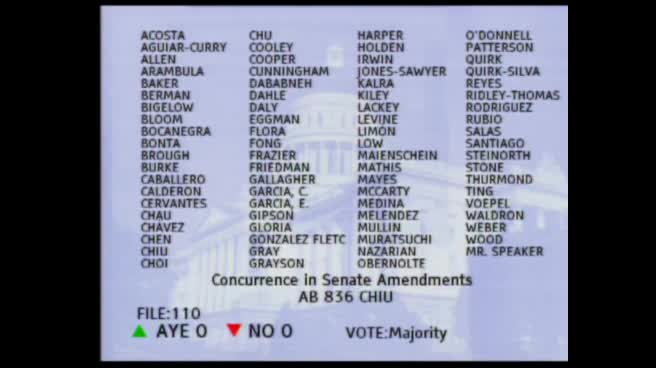 41SEC
Assembly Floor
 2MIN
Senate Standing Committee on Appropriations
 6MIN
Senate Standing Committee on Governance and Finance
 8MIN
Senate Standing Committee on Energy, Utilities and Communications
 1MIN
Assembly Floor
 1MIN
Assembly Standing Committee on Appropriations
 5MIN
Assembly Standing Committee on Local Government
 6MIN
Assembly Standing Committee on Communications and Conveyance
Bill Author

Bill Co-Author(s):