AB 1180: Los Angeles County Flood Control District: taxes, fees, and charges.
- Session Year: 2017-2018
- House: Assembly
- Latest Version Date: 2017-10-09
Existing law, the Los Angeles County Flood Control Act, establishes the Los Angeles County Flood Control District and authorizes the district to control and conserve the flood, storm, and other wastewater of the district. Existing law authorizes the district to impose a fee or charge, in compliance with Article XIIID of the California Constitution, to pay the costs and expenses of carrying out projects and providing services to improve water quality and reduce stormwater and urban runoff pollution in the district in accordance with specified criteria. The act requires that any fees imposed be levied and collected together with taxes for county purposes, and the revenues paid into the county treasury to the credit of the district, and requires the county board of supervisors to expend the funds to pay for those costs and expenses, to be allocated as prescribed.
This bill would authorize the district to levy a tax, in compliance with the applicable provisions of Article XIIIC of the California Constitution, or impose a fee or charge, in compliance with the applicable provisions of Article XIIID of the California Constitution, to pay the costs and expenses of carrying out projects and programs to increase stormwater capture and reduce stormwater and urban runoff pollution in the district, and would specify that projects funded by the revenues from the tax, fee, or charge may include projects providing multiple benefits that increase water supply, improve water quality, and, where appropriate, provide community enhancements, as prescribed. The bill would revise certain provisions prescribing the allocation of those revenues derived from any tax, fee, or charge imposed pursuant to the above-described provisions for those water projects and programs.
Existing law, the Los Angeles County Flood Control Act, establishes the Los Angeles County Flood Control District and authorizes the district to control and conserve the flood, storm, and other wastewater of the district. Existing law authorizes the district to impose a fee or charge, in compliance with Article XIIID of the California Constitution, to pay the costs and expenses of carrying out projects and providing services to improve water quality and reduce stormwater and urban runoff pollution in the district in accordance with specified criteria. The act requires that any fees imposed be levied and collected together with taxes for county purposes, and the revenues paid into the county treasury to the credit of the district, and requires the county board of supervisors to expend the funds to pay for those costs and expenses, to be allocated as prescribed.
This bill would authorize the district to levy a tax, in compliance with the applicable provision provisions of Article XIIIC of the California Constitution, or impose a fee or charge, in compliance with the applicable provisions of Article XIIID of the California Constitution, to pay the costs and expenses of carrying out projects and programs to increase stormwater capture and reduce stormwater and urban runoff pollution in the district, and would specify that projects funded by the revenues from the tax, fee, or charge may include projects providing multiple benefits that increase water supply, improve water quality, and, where appropriate, provide community enhancements, as prescribed. The bill would revise certain provisions prescribing the allocation of those revenues derived from any tax, fee, or charge imposed pursuant to the above-described provisions for those water projects and programs.
Existing law, the Los Angeles County Flood Control Act, establishes the Los Angeles County Flood Control District and authorizes the district to control and conserve the flood, storm, and other wastewater of the district. Existing law authorizes the district to impose a fee or charge, in compliance with Article XIIID of the California Constitution, to pay the costs and expenses of carrying out projects and providing services to improve water quality and reduce stormwater and urban runoff pollution in the district in accordance with specified criteria. The act requires that any fees imposed be levied and collected together with taxes for county purposes, and the revenues paid into the county treasury to the credit of the district, and requires the county board of supervisors to expend the funds to pay for those costs and expenses, to be allocated as prescribed.
This bill would authorize the district to levy a tax, in compliance with the applicable provision of Article XIIIC of the California Constitution, or impose a fee or charge, in compliance with the applicable provisions of Article XIIID of the California Constitution, to pay the costs and expenses of carrying out projects and programs to increase stormwater capture and reduce stormwater and urban runoff pollution in the district, and would specify that projects funded by the revenues from the tax, fee, or charge may include projects providing multiple benefits that increase water supply, improve water quality, and, where appropriate, provide community enhancements, as prescribed. The bill would revise certain provisions prescribing the allocation of those revenues derived from any tax, fee, or charge imposed pursuant to the above-described provisions for those water projects and programs.
The hazardous waste control laws require the Department of Toxic Substances Control to regulate the handling and management of hazardous materials and hazardous waste. Existing law, known as the Green Chemistry program, requires the department to adopt regulations to establish a process to identify and prioritize chemicals or chemical ingredients in consumer products that may be considered as being chemicals of concern. Existing law requires the department to adopt regulations that establish a process for evaluating chemicals of concern in consumer products, and their potential alternatives, to determine how best to limit exposure or to reduce the level of hazard posed by chemicals of concern, as specified. Existing law requires the regulations adopted to specify the range of regulatory responses that the department may take following the completion of the analysis of alternatives. Under its regulatory authority, the department has adopted the 201517 Priority Product Work Plan, which describes categories from which the department will select priority products for which safer alternatives are to be evaluated.This bill would require the department to revise the 201517 Priority Product Work Plan, and subsequent work plans, as necessary, to include motor vehicle tires that contain zinc oxide substances for consideration and evaluation as potential priority products under the Green Chemistry program. The bill would require the department, on or before January 1, 2021, to begin adoption of Green Chemistry regulations for those motor vehicle tires.The hazardous waste control laws require the Department of Toxic Substances Control to regulate the handling and management of hazardous materials and hazardous waste. Existing law, known as the Green Chemistry program, requires the department to adopt regulations to establish a process to identify and prioritize chemicals or chemical ingredients in consumer products that may be considered as being chemicals of concern. Existing law requires the department to adopt regulations that establish a process for evaluating chemicals of concern in consumer products, and their potential alternatives, to determine how best to limit exposure or to reduce the level of hazard posed by chemicals of concern, as specified. Existing law requires the regulations adopted to specify the range of regulatory responses that the department may take following the completion of the analysis of alternatives. Under its regulatory authority, the department has adopted the 201517 Priority Product Work Plan, which describes categories from which the department will select priority products for which safer alternatives are to be evaluated.
This bill would require the department to revise the 201517 Priority Product Work Plan, and subsequent work plans, as necessary, to include motor vehicle tires that contain zinc oxide substances for consideration and evaluation as potential priority products under the Green Chemistry program. The bill would require the department, on or before January 1, 2021, to begin adoption of Green Chemistry regulations for those motor vehicle tires.
The California Tire Recycling Act, until January 1, 2024, requires a person who purchases a new tire to pay a California tire fee of $1.75 per tire, for deposit, except for 1 1/2% retained by retailers and as provided below, in the California Tire Recycling Management Fund, for expenditure by the Department of Resources Recycling and Recovery upon appropriation by the Legislature for prescribed purposes related to disposal and use of used tires. Commencing January 1, 2024, existing law reduces the California tire fee to $0.75 per tire and changes the retailers, share to 3%.Existing law, until January 1, 2024, requires that $0.75 per tire on which the California tire fee is imposed be deposited in the Air Pollution Control Fund with these moneys to be available upon appropriation by the Legislature for use by the State Air Resources Board and local air districts to fund programs and projects that mitigate or remediate air pollution caused by tires in the state, as provided.This bill would increase the California tire fee by $1.50. The bill would deposit the additional moneys in the Stormwater Permit Compliance Fund, which would be established by the bill, and would make the moneys available to the State Water Resources Control Board Division of Financial Assistance. The bill would continuously appropriate moneys in the fund for competitive grants for projects and programs for municipal storm sewer system permit compliance requirements that would prevent or remediate zinc pollutants caused by tires in the state and for an annual audit of the fund. Money in the fund would be available upon appropriation for the administrative expenses of the fund, not to exceed 3% of the overall revenue annually deposited in the fund, except as specified.This bill would make conforming changes.This bill would declare that it is to take effect immediately as an urgency statute.The California Tire Recycling Act, until January 1, 2024, requires a person who purchases a new tire to pay a California tire fee of $1.75 per tire, for deposit, except for 1 1/2% retained by retailers and as provided below, in the California Tire Recycling Management Fund, for expenditure by the Department of Resources Recycling and Recovery upon appropriation by the Legislature for prescribed purposes related to disposal and use of used tires. Commencing January 1, 2024, existing law reduces the California tire fee to $0.75 per tire and changes the retailers, share to 3%.
Existing law, until January 1, 2024, requires that $0.75 per tire on which the California tire fee is imposed be deposited in the Air Pollution Control Fund with these moneys to be available upon appropriation by the Legislature for use by the State Air Resources Board and local air districts to fund programs and projects that mitigate or remediate air pollution caused by tires in the state, as provided.
This bill would increase the California tire fee by $1.50. The bill would deposit the additional moneys in the Stormwater Permit Compliance Fund, which would be established by the bill, and would make the moneys available to the State Water Resources Control Board Division of Financial Assistance. The bill would continuously appropriate moneys in the fund for competitive grants for projects and programs for municipal storm sewer system permit compliance requirements that would prevent or remediate zinc pollutants caused by tires in the state and for an annual audit of the fund. Money in the fund would be available upon appropriation for the administrative expenses of the fund, not to exceed 3% of the overall revenue annually deposited in the fund, except as specified.
This bill would make conforming changes.
This bill would declare that it is to take effect immediately as an urgency statute.
The California Tire Recycling Act, until January 1, 2024, requires a person who purchases a new tire to pay a California tire fee of $1.75 per tire, for deposit, except for 1 1/2% retained by retailers and as provided below, in the California Tire Recycling Management Fund, for expenditure by the Department of Resources Recycling and Recovery upon appropriation by the Legislature for prescribed purposes related to disposal and use of used tires. Commencing January 1, 2024, existing law reduces the California tire fee to $0.75 per tire and changes the retailers, share to 3%.
Existing law, until January 1, 2024, requires that $0.75 per tire on which the California tire fee is imposed be deposited in the Air Pollution Control Fund with these moneys to be available upon appropriation by the Legislature for use by the State Air Resources Board and local air districts to fund programs and projects that mitigate or remediate air pollution caused by tires in the state, as provided.
This bill would increase the California tire fee by $1.50. The bill would deposit the additional moneys in the Stormwater Permit Compliance Fund, which would be established by the bill, and would make the moneys available to the State Water Resources Control Board Division of Financial Assistance. The bill would continuously appropriate moneys in the fund for competitive grants for projects and programs for municipal storm sewer system permit compliance requirements that would prevent or remediate zinc pollutants caused by tires in the state and for an annual audit of the fund. Money in the fund would be available upon appropriation for the administrative expenses of the fund, not to exceed 3% of the overall revenue annually deposited in the fund, except as specified.
This bill would make conforming changes.
This bill would declare that it is to take effect immediately as an urgency statute.
The objects and purposes of this act are to provide for the control and conservation of the flood, storm and other waste waters of said district, and to conserve these waters for beneficial and useful purposes by spreading, storing, retaining or causing to percolate into the soil within the district, or to save or conserve in any manner, all or any of these waters, and to protect from damage from flood or storm waters, the harbors, waterways, public highways and property in the district, and to provide for public use of navigable waterways under the districts control that are suitable for recreational and educational purposes, when these purposes are not inconsistent with the use thereof by the district for flood control and water conservation.
The Los Angeles County Flood Control District is hereby declared to be a body corporate and politic, and has all the following powers:
1.To have perpetual succession.
2.To sue and be sued in the name of the district in all actions and proceedings in all courts and tribunals of competent jurisdiction.
3.To adopt a seal and alter it at pleasure.
4.To take by grant, purchase, gift, devise or lease, hold, use, enjoy, and to lease or dispose of real or personal property of every kind within or without the district necessary to the full exercise of its power.
5.To acquire or contract to acquire lands, rights-of-way, easements, privileges and property of every kind, and construct, maintain and operate any and all works or improvements within or without the district necessary or proper to carry out any of the objects or purposes of this act, and to complete, extend, add to, repair or otherwise improve any works or improvements acquired by it as herein authorized. Construction or improvement of existing facilities may involve landscaping and other aesthetic treatment in order that the facility will be compatible with existing or planned development in the area of improvement.
6.To exercise the right of eminent domain, either within or without the district, to take any property necessary to carry out any of the objects or purposes of this act.
7.To incur indebtedness, and to issue bonds in the manner herein provided.
7a.To borrow money from the United States of America, any agency or department thereof, or from any nonprofit corporation, organized under the laws of this state, to which the Reconstruction Finance Corporation, a corporation organized and existing under and by virtue of an act of Congress, entitled Reconstruction Finance Corporation Act, or other agency, or department, of the United States government, has authorized, or shall hereafter authorize, a loan to enable nonprofit corporation to lend money to the Los Angeles County Flood Control District, for any flood control work authorized under this act, and to repay the same, in annual installments, over a period of not to exceed twenty (20) years, with interest at a rate of not to exceed four and one-fourth per centum (41/4%) per annum, payable semiannually, and, without the necessity of an election when authorized by resolution of the board of supervisors, as evidences of that indebtedness, the district is hereby authorized to execute and deliver a note, or a series of notes, or bonds, or other evidences of indebtedness, signed by the chairperson of the board of supervisors of the district, which notes, bonds, or other evidences of indebtedness, shall be negotiable instruments if so declared in the resolution of the board of supervisors providing for their issuance, and notes, bonds, or other evidences of indebtedness, may have interest coupons attached to evidence interest payments, signed by the facsimile signature of the chairperson of the board. All applications for these loans shall specify the particular flood control work or projects for which the funds will be expended, and when received, the money shall be deposited in a special fund, and shall be expended for those purposes only which are described and referred to in the applications. If a surplus remains after the completion of the work, the surplus shall be applied to the payment of the note, notes, bonds, or other evidences of indebtedness, executed as aforesaid, for the loan including interest coupons. The board of supervisors shall annually levy a tax upon the taxable real property of the district, clearly sufficient to pay the interest and installments of principal, as the same shall become due and payable, under any loan made pursuant to the authority of this section, and to create and maintain a reserve fund to assure the prompt payment thereof, as may be provided by resolution of the board of supervisors. However, the amount of taxes levied in any year, pursuant to this subsection, shall, pro tanto, reduce the authority of the board of supervisors, during any year, to levy taxes under Section 14 of this act, but this proviso shall not be a limitation upon the power and duty to levy and collect taxes under this subsection. Notwithstanding any other provisions of law, interest earned on funds representing the proceeds of bonds of the district shall be deposited and retained in the reserve fund of the district to meet the principal and interest falling due on these bonds.
Notwithstanding anything in this subsection to the contrary, the total amount the district may borrow under the authority of any or all of the provisions of this subsection is limited to and shall not exceed in the aggregate the sum of four million five hundred thousand dollars ($4,500,000).
7b.The power granted in the next preceding subsection is hereby extended to authorize the issuance and sale of bonds or other evidences of indebtedness of the district to the County of Los Angeles and the purchase thereof by the county in accordance with An act authorizing the investment and reinvestment and disposition of any surplus moneys in the treasury of any county, city and county, incorporated city or town or municipal utility district or flood control district, approved April 23, 1913, as amended; all subject to the provisions and limitations of the next preceding subsection relative to the disposition and use of funds, interest rate, period of repayment, tax rate and mode of issuance. The total amount of bonds or other evidence of indebtedness, in the aggregate, which the district may issue and sell under the authority of subsection 7a and of this subsection is limited to and shall not exceed four million five hundred thousand dollars ($4,500,000).
8.To cause taxes to be levied and collected for the purpose of paying any obligation of the district in the manner provided in this section.
8a.To levy a tax, in compliance with the applicable provisions of Article XIIIC of the California Constitution, or impose a fee or charge, in compliance with the applicable provisions of Article XIIID of the California Constitution, to pay the costs and expenses of carrying out projects and programs to increase stormwater capture and reduce stormwater and urban runoff pollution in the district in accordance with criteria established by the ordinance adopted pursuant to subsection 8c. Projects and programs funded by the revenues from the tax, fee, or charge may include projects providing multiple benefits that increase water supply, improve water quality, and, where appropriate, provide community enhancements such as the greening of schools, parks, and wetlands, and increased public access to rivers, lakes, and streams. Any tax, fee, or charge that is levied or imposed pursuant to this subsection shall be levied and collected together with, and not separately from, taxes for county purposes, and the revenues derived from the tax, fee, or charge shall be paid into the county treasury to the credit of the district, and the board of supervisors shall expend these funds to pay for costs and expenses in accordance with this subsection.
8b.The district shall allocate the revenues derived from any tax, fee, or charge imposed pursuant to subsection 8a as follows:
(A)Ten percent shall be allocated to the district for implementation and administration of projects and programs described in subsection 8a, and for payment of the costs incurred in connection with the levy and collection of the tax, fee, or charge and the distribution of the funds generated by imposition of the tax, fee, or charge, in accordance with the procedures established by the ordinance adopted pursuant to subsection 8c.
(B)Forty percent shall be allocated to cities within the boundaries of the district and to the County of Los Angeles, in the same proportion as the amount of revenues collected within each jurisdiction and within the unincorporated territories, to be expended by those cities within the cities respective jurisdictions and by the County of Los Angeles within the unincorporated territories that are within the boundaries of the district, for the implementation, operation and maintenance, and administration of projects and programs described in subsection 8a, in accordance with the procedures established by the ordinance adopted pursuant to subsection 8c.
(C)Fifty percent shall be allocated to pay for the implementation, operation and maintenance, and administration of watershed-based projects and programs described in subsection 8a, including projects and programs identified in regional plans such as stormwater resource plans developed in accordance with Part 2.3 (commencing with Section 10560) of Division 6 of the Water Code, watershed management programs developed pursuant to waste discharge requirements for municipal separate storm sewer system (MS4) discharges within the coastal watersheds of the County of Los Angeles, issued by the Los Angeles Regional Water Quality Control Board, and other regional water management plans, as appropriate, in accordance with the procedures established by the ordinance adopted pursuant to subsection 8c.
8c.The governing board of the district shall adopt an ordinance to establish criteria and procedures to implement the authority granted pursuant to subsections 8a and 8b.
9.To make contracts, and to employ for temporary services only, expert appraisers, consultants and technical advisers, and to do all acts necessary for the full exercise of all powers vested in the district, or any of the officers thereof, by this act.
10.To grant or otherwise convey to counties, cities and counties, cities or towns easements for street and highway purposes, over, along, upon, in, through, across or under any real property owned by the Los Angeles County Flood Control District.
11.To remove, carry away and dispose of any rubbish, trash, debris or other inconvenient matter that may be dislodged, transported, conveyed or carried by means of, through, in, or along the works and structures operated or maintained hereunder and deposited upon the property of the district or elsewhere.
12.To pay premiums on bonds of contractors required under any contract if the amount payable to the contractor exceeds five million dollars ($5,000,000); provided, that the specifications in these cases shall specifically so provide and state that the bidder shall not include in his or her bids the cost of furnishing the required bonds.
13.To lease, sell or dispose of any property (or any interest therein) whenever in the judgment of the board of supervisors of the property, or any interest therein or part thereof, is no longer required for the purposes of the district, or may be leased for any purpose without interfering with the use of the same for the purposes of the district, and to pay any compensation received therefor into the general fund of the district and use the same for the purposes of this act. However, nothing herein shall authorize the board of supervisors or other governing body of the district or any officer thereof to sell, lease or otherwise dispose of any water, water right, reservoir space or storage capacity or any interest or space therein except to public agencies for recreational purposes when the use is not inconsistent with the use thereof by the district for flood control and water conservation purposes; or except as provided by Section 17 of this act. However, the district may grant and convey to the United States of America, or to any federal agency authorized to accept and pay for the land or interests in land, all lands and interests in land, now owned or hereafter acquired, lying within any channel, dam or reservoir site, improved or constructed, in whole or in part, with federal funds, upon payment to the district of sums equivalent to actual expenditures made by it in acquiring the lands and interests in land so conveyed and deemed reasonable by the Secretary of War and the Chief of Engineers.
14.To provide, by agreement with other public agencies or private persons or entities or otherwise, for the recreational use of the lands, facilities, and works of the district which shall not interfere, or be inconsistent, with the primary use and purpose of the lands, facilities, and works by the district.
15.In addition to its other powers, the district shall have the power to preserve, enhance, and add recreational features to its properties and upon a finding by the board of supervisors that the acquisition is necessary for those purposes, to acquire, preserve, enhance, and add recreational features to lands or interests in lands contiguous to its properties, for the protection, preservation, and use of the scenic beauty and natural environment for the properties or the lands and to collect admission or use fees for the recreational features where deemed appropriate.
The district by or through its board of supervisors, or other board or officers at any time succeeding to the duties or functions of its board of supervisors, is hereby authorized and empowered to warrant and defend the title to all land and interests therein so conveyed to the United States of America or to any agency and its respective assigns; to covenant and agree to indemnify and keep indemnified and to hold and save harmless and exonerated the United States of America or any agency, to which lands or any interest therein are so conveyed by the district, from and against all demands, claims, liabilities, liens, actions, suits, charges, costs, loss, damages, expenses and attorneys fees of whatsoever kind or nature, resulting from, arising out of or occasioned by any defect or defects whatsoever in the title to any land or interest in land so conveyed by the district; to reimburse and save harmless and exonerated the United States of America or any agency for any and all amounts, paid, and expenses incurred, in the compromise or settlement of any demands, claims, liabilities, liens, actions, suits, charges, costs, loss, damages, expenses and attorneys fees of whatsoever kind or nature, resulting from, arising out of or occasioned by any claim to or defect or defects whatsoever in the title to any land or interests in land so conveyed by the district; to pay all just compensation, costs and expenses, which may be incurred in any condemnation proceeding deemed necessary by the United States of America or that agency, in order to perfect title to any land or interests in land, including without limitation all attorneys fees, court costs and fees, costs of abstracts and other evidences of title, and all other costs, expenses or damages incurred or suffered by the United States of America or that agency; and consent is hereby given to the bringing of suit or other legal proceedings against the district by the United States of America or that agency, as the case may be, in the proper district court of the United States, upon any cause of action arising out of any conveyance, contract or covenant made or entered into by the district pursuant to the authority granted in this act, or to enforce any claims, damages, loss or expenses arising out of or resulting from any defect whatsoever in the title to the land or any interest therein or any claims of others in or to the land or interest therein.
The objects and purposes of this act are to provide for the control and conservation of the flood, storm and other waste waters of said district, and to conserve these waters for beneficial and useful purposes by spreading, storing, retaining or causing to percolate into the soil within the district, or to save or conserve in any manner, all or any of these waters, and to protect from damage from flood or storm waters, the harbors, waterways, public highways and property in the district, and to provide for public use of navigable waterways under the districts control that are suitable for recreational and educational purposes, when these purposes are not inconsistent with the use thereof by the district for flood control and water conservation.
The Los Angeles County Flood Control District is hereby declared to be a body corporate and politic, and has all the following powers:
1.To have perpetual succession.
2.To sue and be sued in the name of the district in all actions and proceedings in all courts and tribunals of competent jurisdiction.
3.To adopt a seal and alter it at pleasure.
4.To take by grant, purchase, gift, devise or lease, hold, use, enjoy, and to lease or dispose of real or personal property of every kind within or without the district necessary to the full exercise of its power.
5.To acquire or contract to acquire lands, rights-of-way, easements, privileges and property of every kind, and construct, maintain and operate any and all works or improvements within or without the district necessary or proper to carry out any of the objects or purposes of this act, and to complete, extend, add to, repair or otherwise improve any works or improvements acquired by it as herein authorized. Construction or improvement of existing facilities may involve landscaping and other aesthetic treatment in order that the facility will be compatible with existing or planned development in the area of improvement.
6.To exercise the right of eminent domain, either within or without the district, to take any property necessary to carry out any of the objects or purposes of this act.
7.To incur indebtedness, and to issue bonds in the manner herein provided.
7a.To borrow money from the United States of America, any agency or department thereof, or from any nonprofit corporation, organized under the laws of this state, to which the Reconstruction Finance Corporation, a corporation organized and existing under and by virtue of an act of Congress, entitled Reconstruction Finance Corporation Act, or other agency, or department, of the United States government, has authorized, or shall hereafter authorize, a loan to enable nonprofit corporation to lend money to the Los Angeles County Flood Control District, for any flood control work authorized under this act, and to repay the same, in annual installments, over a period of not to exceed twenty (20) years, with interest at a rate of not to exceed four and one-fourth per centum (41/4%) per annum, payable semiannually, and, without the necessity of an election when authorized by resolution of the board of supervisors, as evidences of that indebtedness, the district is hereby authorized to execute and deliver a note, or a series of notes, or bonds, or other evidences of indebtedness, signed by the chairperson of the board of supervisors of the district, which notes, bonds, or other evidences of indebtedness, shall be negotiable instruments if so declared in the resolution of the board of supervisors providing for their issuance, and notes, bonds, or other evidences of indebtedness, may have interest coupons attached to evidence interest payments, signed by the facsimile signature of the chairperson of the board. All applications for these loans shall specify the particular flood control work or projects for which the funds will be expended, and when received, the money shall be deposited in a special fund, and shall be expended for those purposes only which are described and referred to in the applications. If a surplus remains after the completion of the work, the surplus shall be applied to the payment of the note, notes, bonds, or other evidences of indebtedness, executed as aforesaid, for the loan including interest coupons. The board of supervisors shall annually levy a tax upon the taxable real property of the district, clearly sufficient to pay the interest and installments of principal, as the same shall become due and payable, under any loan made pursuant to the authority of this section, and to create and maintain a reserve fund to assure the prompt payment thereof, as may be provided by resolution of the board of supervisors. However, the amount of taxes levied in any year, pursuant to this subsection, shall, pro tanto, reduce the authority of the board of supervisors, during any year, to levy taxes under Section 14 of this act, but this proviso shall not be a limitation upon the power and duty to levy and collect taxes under this subsection. Notwithstanding any other provisions of law, interest earned on funds representing the proceeds of bonds of the district shall be deposited and retained in the reserve fund of the district to meet the principal and interest falling due on these bonds.
Notwithstanding anything in this subsection to the contrary, the total amount the district may borrow under the authority of any or all of the provisions of this subsection is limited to and shall not exceed in the aggregate the sum of four million five hundred thousand dollars ($4,500,000).
7b.The power granted in the next preceding subsection is hereby extended to authorize the issuance and sale of bonds or other evidences of indebtedness of the district to the County of Los Angeles and the purchase thereof by the county in accordance with An act authorizing the investment and reinvestment and disposition of any surplus moneys in the treasury of any county, city and county, incorporated city or town or municipal utility district or flood control district, approved April 23, 1913, as amended; all subject to the provisions and limitations of the next preceding subsection relative to the disposition and use of funds, interest rate, period of repayment, tax rate and mode of issuance. The total amount of bonds or other evidence of indebtedness, in the aggregate, which the district may issue and sell under the authority of subsection 7a and of this subsection is limited to and shall not exceed four million five hundred thousand dollars ($4,500,000).
8.To cause taxes to be levied and collected for the purpose of paying any obligation of the district in the manner provided in this section.
8a.To levy a tax, in compliance with the applicable provisions of Article XIIIC of the California Constitution, or impose a fee or charge, in compliance with the applicable provisions of Article XIIID of the California Constitution, to pay the costs and expenses of carrying out projects and programs to increase stormwater capture and reduce stormwater and urban runoff pollution in the district in accordance with criteria established by the ordinance adopted pursuant to subsection 8c. Projects and programs funded by the revenues from the tax, fee, or charge may include projects providing multiple benefits that increase water supply, improve water quality, and, where appropriate, provide community enhancements such as the greening of schools, parks, and wetlands, and increased public access to rivers, lakes, and streams. Any tax, fee, or charge that is levied or imposed pursuant to this subsection shall be levied and collected together with, and not separately from, taxes for county purposes, and the revenues derived from the tax, fee, or charge shall be paid into the county treasury to the credit of the district, and the board of supervisors shall expend these funds to pay for costs and expenses in accordance with this subsection.
8b.The district shall allocate the revenues derived from any tax, fee, or charge imposed pursuant to subsection 8a as follows:
(A)Ten percent shall be allocated to the district for implementation and administration of projects and programs described in subsection 8a, and for payment of the costs incurred in connection with the levy and collection of the tax, fee, or charge and the distribution of the funds generated by imposition of the tax, fee, or charge, in accordance with the procedures established by the ordinance adopted pursuant to subsection 8c.
(B)Forty percent shall be allocated to cities within the boundaries of the district and to the County of Los Angeles, in the same proportion as the amount of revenues collected within each jurisdiction and within the unincorporated territories, to be expended by those cities within the cities respective jurisdictions and by the County of Los Angeles within the unincorporated territories that are within the boundaries of the district, for the implementation, operation and maintenance, and administration of projects and programs described in subsection 8a, in accordance with the procedures established by the ordinance adopted pursuant to subsection 8c.
(C)Fifty percent shall be allocated to pay for the implementation, operation and maintenance, and administration of watershed-based regional projects and programs, programs described in subsection 8a, including projects and programs identified in regional plans such as stormwater resource plans developed in accordance with Part 2.3 (commencing with Section 10560) of Division 6 of the Water Code, watershed management programs developed pursuant to waste discharge requirements for municipal separate storm sewer system (MS4) discharges within the coastal watersheds of the County of Los Angeles, issued by the Los Angeles Regional Water Quality Control Board, and other regional water management plans, as appropriate, in accordance with the procedures established by the ordinance adopted pursuant to subsection 8c.
8c.The governing board of the district shall adopt an ordinance to establish criteria and procedures to implement the authority granted pursuant to subsections 8a and 8b.
9.To make contracts, and to employ for temporary services only, expert appraisers, consultants and technical advisers, and to do all acts necessary for the full exercise of all powers vested in the district, or any of the officers thereof, by this act.
10.To grant or otherwise convey to counties, cities and counties, cities or towns easements for street and highway purposes, over, along, upon, in, through, across or under any real property owned by the Los Angeles County Flood Control District.
11.To remove, carry away and dispose of any rubbish, trash, debris or other inconvenient matter that may be dislodged, transported, conveyed or carried by means of, through, in, or along the works and structures operated or maintained hereunder and deposited upon the property of the district or elsewhere.
12.To pay premiums on bonds of contractors required under any contract if the amount payable to the contractor exceeds five million dollars ($5,000,000); provided, that the specifications in these cases shall specifically so provide and state that the bidder shall not include in his or her bids the cost of furnishing the required bonds.
13.To lease, sell or dispose of any property (or any interest therein) whenever in the judgment of the board of supervisors of the property, or any interest therein or part thereof, is no longer required for the purposes of the district, or may be leased for any purpose without interfering with the use of the same for the purposes of the district, and to pay any compensation received therefor into the general fund of the district and use the same for the purposes of this act. However, nothing herein shall authorize the board of supervisors or other governing body of the district or any officer thereof to sell, lease or otherwise dispose of any water, water right, reservoir space or storage capacity or any interest or space therein except to public agencies for recreational purposes when the use is not inconsistent with the use thereof by the district for flood control and water conservation purposes; or except as provided by Section 17 of this act. However, the district may grant and convey to the United States of America, or to any federal agency authorized to accept and pay for the land or interests in land, all lands and interests in land, now owned or hereafter acquired, lying within any channel, dam or reservoir site, improved or constructed, in whole or in part, with federal funds, upon payment to the district of sums equivalent to actual expenditures made by it in acquiring the lands and interests in land so conveyed and deemed reasonable by the Secretary of War and the Chief of Engineers.
14.To provide, by agreement with other public agencies or private persons or entities or otherwise, for the recreational use of the lands, facilities, and works of the district which shall not interfere, or be inconsistent, with the primary use and purpose of the lands, facilities, and works by the district.
15.In addition to its other powers, the district shall have the power to preserve, enhance, and add recreational features to its properties and upon a finding by the board of supervisors that the acquisition is necessary for those purposes, to acquire, preserve, enhance, and add recreational features to lands or interests in lands contiguous to its properties, for the protection, preservation, and use of the scenic beauty and natural environment for the properties or the lands and to collect admission or use fees for the recreational features where deemed appropriate.
The district by or through its board of supervisors, or other board or officers at any time succeeding to the duties or functions of its board of supervisors, is hereby authorized and empowered to warrant and defend the title to all land and interests therein so conveyed to the United States of America or to any agency and its respective assigns; to covenant and agree to indemnify and keep indemnified and to hold and save harmless and exonerated the United States of America or any agency, to which lands or any interest therein are so conveyed by the district, from and against all demands, claims, liabilities, liens, actions, suits, charges, costs, loss, damages, expenses and attorneys fees of whatsoever kind or nature, resulting from, arising out of or occasioned by any defect or defects whatsoever in the title to any land or interest in land so conveyed by the district; to reimburse and save harmless and exonerated the United States of America or any agency for any and all amounts, paid, and expenses incurred, in the compromise or settlement of any demands, claims, liabilities, liens, actions, suits, charges, costs, loss, damages, expenses and attorneys fees of whatsoever kind or nature, resulting from, arising out of or occasioned by any claim to or defect or defects whatsoever in the title to any land or interests in land so conveyed by the district; to pay all just compensation, costs and expenses, which may be incurred in any condemnation proceeding deemed necessary by the United States of America or that agency, in order to perfect title to any land or interests in land, including without limitation all attorneys fees, court costs and fees, costs of abstracts and other evidences of title, and all other costs, expenses or damages incurred or suffered by the United States of America or that agency; and consent is hereby given to the bringing of suit or other legal proceedings against the district by the United States of America or that agency, as the case may be, in the proper district court of the United States, upon any cause of action arising out of any conveyance, contract or covenant made or entered into by the district pursuant to the authority granted in this act, or to enforce any claims, damages, loss or expenses arising out of or resulting from any defect whatsoever in the title to the land or any interest therein or any claims of others in or to the land or interest therein.
The objects and purposes of this act are to provide for the control and conservation of the flood, storm and other waste waters of said district, and to conserve these waters for beneficial and useful purposes by spreading, storing, retaining or causing to percolate into the soil within the district, or to save or conserve in any manner, all or any of these waters, and to protect from damage from flood or storm waters, the harbors, waterways, public highways and property in the district, and to provide for public use of navigable waterways under the districts control that are suitable for recreational and educational purposes, when these purposes are not inconsistent with the use thereof by the district for flood control and water conservation.
The Los Angeles County Flood Control District is hereby declared to be a body corporate and politic, and has all the following powers:
1.To have perpetual succession.
2.To sue and be sued in the name of the district in all actions and proceedings in all courts and tribunals of competent jurisdiction.
3.To adopt a seal and alter it at pleasure.
4.To take by grant, purchase, gift, devise or lease, hold, use, enjoy, and to lease or dispose of real or personal property of every kind within or without the district necessary to the full exercise of its power.
5.To acquire or contract to acquire lands, rights-of-way, easements, privileges and property of every kind, and construct, maintain and operate any and all works or improvements within or without the district necessary or proper to carry out any of the objects or purposes of this act, and to complete, extend, add to, repair or otherwise improve any works or improvements acquired by it as herein authorized. Construction or improvement of existing facilities may involve landscaping and other aesthetic treatment in order that the facility will be compatible with existing or planned development in the area of improvement.
6.To exercise the right of eminent domain, either within or without the district, to take any property necessary to carry out any of the objects or purposes of this act.
7.To incur indebtedness, and to issue bonds in the manner herein provided.
7a.To borrow money from the United States of America, any agency or department thereof, or from any nonprofit corporation, organized under the laws of this state, to which the Reconstruction Finance Corporation, a corporation organized and existing under and by virtue of an act of Congress, entitled Reconstruction Finance Corporation Act, or other agency, or department, of the United States government, has authorized, or shall hereafter authorize, a loan to enable nonprofit corporation to lend money to the Los Angeles County Flood Control District, for any flood control work authorized under this act, and to repay the same, in annual installments, over a period of not to exceed twenty (20) years, with interest at a rate of not to exceed four and one-fourth per centum (41/4%) per annum, payable semiannually, and, without the necessity of an election when authorized by resolution of the board of supervisors, as evidences of that indebtedness, the district is hereby authorized to execute and deliver a note, or a series of notes, or bonds, or other evidences of indebtedness, signed by the chairperson of the board of supervisors of the district, which notes, bonds, or other evidences of indebtedness, shall be negotiable instruments if so declared in the resolution of the board of supervisors providing for their issuance, and notes, bonds, or other evidences of indebtedness, may have interest coupons attached to evidence interest payments, signed by the facsimile signature of the chairperson of the board. All applications for these loans shall specify the particular flood control work or projects for which the funds will be expended, and when received, the money shall be deposited in a special fund, and shall be expended for those purposes only which are described and referred to in the applications. If a surplus remains after the completion of the work, the surplus shall be applied to the payment of the note, notes, bonds, or other evidences of indebtedness, executed as aforesaid, for the loan including interest coupons. The board of supervisors shall annually levy a tax upon the taxable real property of the district, clearly sufficient to pay the interest and installments of principal, as the same shall become due and payable, under any loan made pursuant to the authority of this section, and to create and maintain a reserve fund to assure the prompt payment thereof, as may be provided by resolution of the board of supervisors. However, the amount of taxes levied in any year, pursuant to this subsection, shall, pro tanto, reduce the authority of the board of supervisors, during any year, to levy taxes under Section 14 of this act, but this proviso shall not be a limitation upon the power and duty to levy and collect taxes under this subsection. Notwithstanding any other provisions of law, interest earned on funds representing the proceeds of bonds of the district shall be deposited and retained in the reserve fund of the district to meet the principal and interest falling due on these bonds.
Notwithstanding anything in this subsection to the contrary, the total amount the district may borrow under the authority of any or all of the provisions of this subsection is limited to and shall not exceed in the aggregate the sum of four million five hundred thousand dollars ($4,500,000).
7b.The power granted in the next preceding subsection is hereby extended to authorize the issuance and sale of bonds or other evidences of indebtedness of the district to the County of Los Angeles and the purchase thereof by the county in accordance with An act authorizing the investment and reinvestment and disposition of any surplus moneys in the treasury of any county, city and county, incorporated city or town or municipal utility district or flood control district, approved April 23, 1913, as amended; all subject to the provisions and limitations of the next preceding subsection relative to the disposition and use of funds, interest rate, period of repayment, tax rate and mode of issuance. The total amount of bonds or other evidence of indebtedness, in the aggregate, which the district may issue and sell under the authority of subsection 7a and of this subsection is limited to and shall not exceed four million five hundred thousand dollars ($4,500,000).
8.To cause taxes to be levied and collected for the purpose of paying any obligation of the district in the manner provided in this section.
8a.To levy a tax, in compliance with the applicable provisions of Article XIIIC of the California Constitution, or impose a fee or charge, in compliance with the applicable provisions of Article XIIID of the California Constitution, to pay the costs and expenses of carrying out projects and programs to increase stormwater capture and reduce stormwater and urban runoff pollution in the district in accordance with criteria established by the ordinance adopted pursuant to subsection 8c. Projects and programs funded by the revenues from the tax, fee, or charge may include projects providing multiple benefits that increase water supply, improve water quality, and, where appropriate, provide community enhancements such as the greening of schools, parks, and wetlands, and increased public access to rivers, lakes, and streams. Any tax, fee, or charge that is levied or imposed pursuant to this subsection shall be levied and collected together with, and not separately from, taxes for county purposes, and the revenues derived from the tax, fee, or charge shall be paid into the county treasury to the credit of the district, and the board of supervisors shall expend these funds to pay for costs and expenses in accordance with this subsection.
8b.The district shall allocate the revenues derived from any tax, fee, or charge imposed pursuant to subsection 8a as follows:
(A)Ten percent shall be allocated to the district for implementation and administration of projects and programs described in subsection 8a, and for payment of the costs incurred in connection with the levy and collection of the tax, fee, or charge and the distribution of the funds generated by imposition of the tax, fee, or charge, in accordance with the procedures established by the ordinance adopted pursuant to subsection 8c.
(B)Forty percent shall be allocated to cities within the boundaries of the district and to the County of Los Angeles, in the same proportion as the amount of revenues collected within each jurisdiction and within the unincorporated territories, to be expended by those cities within the cities respective jurisdictions and by the County of Los Angeles within the unincorporated territories that are within the boundaries of the district, for the implementation, operation and maintenance, and administration of projects and programs described in subsection 8a, in accordance with the procedures established by the ordinance adopted pursuant to subsection 8c.
(C)Fifty percent shall be allocated to pay for the implementation, operation and maintenance, and administration of watershed-based regional projects and programs, including projects and programs identified in stormwater resource plans developed in accordance with Part 2.3 (commencing with Section 10560) of Division 6 of the Water Code, watershed management programs developed pursuant to waste discharge requirements for municipal separate storm sewer system (MS4) discharges within the coastal watersheds of the County of Los Angeles, issued by the Los Angeles Regional Water Quality Control Board, and other water management plans, as appropriate, in accordance with the procedures established by the ordinance adopted pursuant to subsection 8c.
8c.The governing board of the district shall adopt an ordinance to establish criteria and procedures to implement the authority granted pursuant to subsections 8a and 8b.
9.To make contracts, and to employ for temporary services only, expert appraisers, consultants and technical advisers, and to do all acts necessary for the full exercise of all powers vested in the district, or any of the officers thereof, by this act.
10.To grant or otherwise convey to counties, cities and counties, cities or towns easements for street and highway purposes, over, along, upon, in, through, across or under any real property owned by the Los Angeles County Flood Control District.
11.To remove, carry away and dispose of any rubbish, trash, debris or other inconvenient matter that may be dislodged, transported, conveyed or carried by means of, through, in, or along the works and structures operated or maintained hereunder and deposited upon the property of the district or elsewhere.
12.To pay premiums on bonds of contractors required under any contract if the amount payable to the contractor exceeds five million dollars ($5,000,000); provided, that the specifications in these cases shall specifically so provide and state that the bidder shall not include in his or her bids the cost of furnishing the required bonds.
13.To lease, sell or dispose of any property (or any interest therein) whenever in the judgment of the board of supervisors of the property, or any interest therein or part thereof, is no longer required for the purposes of the district, or may be leased for any purpose without interfering with the use of the same for the purposes of the district, and to pay any compensation received therefor into the general fund of the district and use the same for the purposes of this act. However, nothing herein shall authorize the board of supervisors or other governing body of the district or any officer thereof to sell, lease or otherwise dispose of any water, water right, reservoir space or storage capacity or any interest or space therein except to public agencies for recreational purposes when the use is not inconsistent with the use thereof by the district for flood control and water conservation purposes; or except as provided by Section 17 of this act. However, the district may grant and convey to the United States of America, or to any federal agency authorized to accept and pay for the land or interests in land, all lands and interests in land, now owned or hereafter acquired, lying within any channel, dam or reservoir site, improved or constructed, in whole or in part, with federal funds, upon payment to the district of sums equivalent to actual expenditures made by it in acquiring the lands and interests in land so conveyed and deemed reasonable by the Secretary of War and the Chief of Engineers.
14.To provide, by agreement with other public agencies or private persons or entities or otherwise, for the recreational use of the lands, facilities, and works of the district which shall not interfere, or be inconsistent, with the primary use and purpose of the lands, facilities, and works by the district.
15.In addition to its other powers, the district shall have the power to preserve, enhance, and add recreational features to its properties and upon a finding by the board of supervisors that the acquisition is necessary for those purposes, to acquire, preserve, enhance, and add recreational features to lands or interests in lands contiguous to its properties, for the protection, preservation, and use of the scenic beauty and natural environment for the properties or the lands and to collect admission or use fees for the recreational features where deemed appropriate.
The district by or through its board of supervisors, or other board or officers at any time succeeding to the duties or functions of its board of supervisors, is hereby authorized and empowered to warrant and defend the title to all land and interests therein so conveyed to the United States of America or to any agency and its respective assigns; to covenant and agree to indemnify and keep indemnified and to hold and save harmless and exonerated the United States of America or any agency, to which lands or any interest therein are so conveyed by the district, from and against all demands, claims, liabilities, liens, actions, suits, charges, costs, loss, damages, expenses and attorneys fees of whatsoever kind or nature, resulting from, arising out of or occasioned by any defect or defects whatsoever in the title to any land or interest in land so conveyed by the district; to reimburse and save harmless and exonerated the United States of America or any agency for any and all amounts, paid, and expenses incurred, in the compromise or settlement of any demands, claims, liabilities, liens, actions, suits, charges, costs, loss, damages, expenses and attorneys fees of whatsoever kind or nature, resulting from, arising out of or occasioned by any claim to or defect or defects whatsoever in the title to any land or interests in land so conveyed by the district; to pay all just compensation, costs and expenses, which may be incurred in any condemnation proceeding deemed necessary by the United States of America or that agency, in order to perfect title to any land or interests in land, including without limitation all attorneys fees, court costs and fees, costs of abstracts and other evidences of title, and all other costs, expenses or damages incurred or suffered by the United States of America or that agency; and consent is hereby given to the bringing of suit or other legal proceedings against the district by the United States of America or that agency, as the case may be, in the proper district court of the United States, upon any cause of action arising out of any conveyance, contract or covenant made or entered into by the district pursuant to the authority granted in this act, or to enforce any claims, damages, loss or expenses arising out of or resulting from any defect whatsoever in the title to the land or any interest therein or any claims of others in or to the land or interest therein.
The objects and purposes of this act are to provide for the control and conservation of the flood, storm and other waste waters of said district, and to conserve these waters for beneficial and useful purposes by spreading, storing, retaining or causing to percolate into the soil within the district, or to save or conserve in any manner, all or any of these waters, and to protect from damage from flood or storm waters, the harbors, waterways, public highways and property in the district, and to provide for public use of navigable waterways under the districts control that are suitable for recreational and educational purposes, when these purposes are not inconsistent with the use thereof by the district for flood control and water conservation.
The Los Angeles County Flood Control District is hereby declared to be a body corporate and politic, and has all the following powers:
1.To have perpetual succession.
2.To sue and be sued in the name of the district in all actions and proceedings in all courts and tribunals of competent jurisdiction.
3.To adopt a seal and alter it at pleasure.
4.To take by grant, purchase, gift, devise or lease, hold, use, enjoy, and to lease or dispose of real or personal property of every kind within or without the district necessary to the full exercise of its power.
5.To acquire or contract to acquire lands, rights-of-way, easements, privileges and property of every kind, and construct, maintain and operate any and all works or improvements within or without the district necessary or proper to carry out any of the objects or purposes of this act, and to complete, extend, add to, repair or otherwise improve any works or improvements acquired by it as herein authorized. Construction or improvement of existing facilities may involve landscaping and other aesthetic treatment in order that the facility will be compatible with existing or planned development in the area of improvement.
6.To exercise the right of eminent domain, either within or without the district, to take any property necessary to carry out any of the objects or purposes of this act.
7.To incur indebtedness, and to issue bonds in the manner herein provided.
7a.To borrow money from the United States of America, any agency or department thereof, or from any nonprofit corporation, organized under the laws of this state, to which the Reconstruction Finance Corporation, a corporation organized and existing under and by virtue of an act of Congress, entitled Reconstruction Finance Corporation Act, or other agency, or department, of the United States government, has authorized, or shall hereafter authorize, a loan to enable nonprofit corporation to lend money to the Los Angeles County Flood Control District, for any flood control work authorized under this act, and to repay the same, in annual installments, over a period of not to exceed twenty (20) years, with interest at a rate of not to exceed four and one-fourth per centum (41/4%) per annum, payable semiannually, and, without the necessity of an election when authorized by resolution of the board of supervisors, as evidences of that indebtedness, the district is hereby authorized to execute and deliver a note, or a series of notes, or bonds, or other evidences of indebtedness, signed by the chairperson of the board of supervisors of the district, which notes, bonds, or other evidences of indebtedness, shall be negotiable instruments if so declared in the resolution of the board of supervisors providing for their issuance, and notes, bonds, or other evidences of indebtedness, may have interest coupons attached to evidence interest payments, signed by the facsimile signature of the chairperson of the board. All applications for these loans shall specify the particular flood control work or projects for which the funds will be expended, and when received, the money shall be deposited in a special fund, and shall be expended for those purposes only which are described and referred to in the applications. If a surplus remains after the completion of the work, the surplus shall be applied to the payment of the note, notes, bonds, or other evidences of indebtedness, executed as aforesaid, for the loan including interest coupons. The board of supervisors shall annually levy a tax upon the taxable real property of the district, clearly sufficient to pay the interest and installments of principal, as the same shall become due and payable, under any loan made pursuant to the authority of this section, and to create and maintain a reserve fund to assure the prompt payment thereof, as may be provided by resolution of the board of supervisors. However, the amount of taxes levied in any year, pursuant to this subsection, shall, pro tanto, reduce the authority of the board of supervisors, during any year, to levy taxes under Section 14 of this act, but this proviso shall not be a limitation upon the power and duty to levy and collect taxes under this subsection. Notwithstanding any other provisions of law, interest earned on funds representing the proceeds of bonds of the district shall be deposited and retained in the reserve fund of the district to meet the principal and interest falling due on these bonds.
Notwithstanding anything in this subsection to the contrary, the total amount the district may borrow under the authority of any or all of the provisions of this subsection is limited to and shall not exceed in the aggregate the sum of four million five hundred thousand dollars ($4,500,000).
7b.The power granted in the next preceding subsection is hereby extended to authorize the issuance and sale of bonds or other evidences of indebtedness of the district to the County of Los Angeles and the purchase thereof by the county in accordance with An act authorizing the investment and reinvestment and disposition of any surplus moneys in the treasury of any county, city and county, incorporated city or town or municipal utility district or flood control district, approved April 23, 1913, as amended; all subject to the provisions and limitations of the next preceding subsection relative to the disposition and use of funds, interest rate, period of repayment, tax rate and mode of issuance. The total amount of bonds or other evidence of indebtedness, in the aggregate, which the district may issue and sell under the authority of subsection 7a and of this subsection is limited to and shall not exceed four million five hundred thousand dollars ($4,500,000).
8.To cause taxes to be levied and collected for the purpose of paying any obligation of the district in the manner provided in this section.
8a.To levy a tax, in compliance with the applicable provisions of Article XIIIC of the California Constitution, or impose a fee or charge, in compliance with the applicable provisions of Article XIIID of the California Constitution, to pay the costs and expenses of carrying out projects and providing services to improve water quality programs to increase stormwater capture and reduce stormwater and urban runoff pollution in the district in accordance with criteria established by the ordinance adopted pursuant to subsection 8c. Projects and programs funded by the revenues from the tax, fee, or charge may include projects providing multiple benefits that increase water supply, improve water quality, and, where appropriate, provide community enhancements such as the greening of schools, parks, and wetlands, and increased public access to rivers, lakes, and streams. Any fee tax, fee, or charge that is levied or imposed pursuant to this subsection shall be levied and collected together with, and not separately from, taxes for county purposes, and the revenues derived from the fees tax, fee, or charge shall be paid into the county treasury to the credit of the district, and the board of supervisors shall expend these funds to pay for costs and expenses in accordance with this subsection.
8b.The district shall allocate the revenues derived from any fee tax, fee, or charge imposed pursuant to subsection 8a as follows:
(A)Ten percent shall be allocated to the district for implementation and administration of water quality programs, as determined by the district, including activities such as planning, water quality monitoring, and any other related activities, projects and programs described in subsection 8a, and for payment of the costs incurred in connection with the levy and collection of the fee tax, fee, or charge and the distribution of the funds generated by imposition of the fee, as tax, fee, or charge, in accordance with the procedures established by the ordinance adopted pursuant to subsection 8c.
(B)Forty percent shall be allocated to cities within the boundaries of the district and to the County of Los Angeles, in the same proportion as the amount of fees revenues collected within each jurisdiction and within the unincorporated territories, to be expended by those cities within the cities respective jurisdictions and by the County of Los Angeles within the unincorporated territories that are within the boundaries of the district, for water quality improvement programs, as the implementation, operation and maintenance, and administration of projects and programs described in subsection 8a, in accordance with the procedures established by the ordinance adopted pursuant to subsection 8c.
(C)Fifty percent shall be allocated to nine watershed authority groups that shall be authorized pay for the implementation, operation and maintenance, and administration of watershed-based regional projects and programs, including projects and programs identified in stormwater resource plans developed in accordance with Part 2.3 (commencing with Section 10560) of Division 6 of the Water Code, watershed management programs developed pursuant to waste discharge requirements for municipal separate storm sewer system (MS4) discharges within the coastal watersheds of the County of Los Angeles, issued by the Los Angeles Regional Water Quality Control Board, and other water management plans, as appropriate, in accordance with the procedures established by the ordinance adopted pursuant to subsection 8c, in the same proportion as the amount of fees collected within each watershed, to implement collaborative water quality improvement plans or programs in the watersheds as established by the ordinance adopted pursuant to subsection 8c. Those nine watershed authority groups shall be established for the Ballona Creek, Dominguez Channel, Upper Los Angeles River, Lower Los Angeles River, Rio Hondo, Upper San Gabriel River, Lower San Gabriel River, Santa Clara River, and Santa Monica Bay watersheds. The watershed authority groups shall be established pursuant to Article 1 (commencing with Section 6500) of Chapter 5 of Division 7 of Title 1 of the Government Code. The implementation of a collaborative water quality improvement plan or program by a watershed authority group shall require the consent of any watershed authority group member whose jurisdiction comprises more than 40 percent of the total land area in a watershed. 8c.
8c.The governing board of the district shall adopt an ordinance to establish procedures to implement the authority granted pursuant to subsections 8a and 8b.
9.To make contracts, and to employ for temporary services only, expert appraisers, consultants and technical advisers, and to do all acts necessary for the full exercise of all powers vested in the district, or any of the officers thereof, by this act.
10.To grant or otherwise convey to counties, cities and counties, cities or towns easements for street and highway purposes, over, along, upon, in, through, across or under any real property owned by the Los Angeles County Flood Control District.
11.To remove, carry away and dispose of any rubbish, trash, debris or other inconvenient matter that may be dislodged, transported, conveyed or carried by means of, through, in, or along the works and structures operated or maintained hereunder and deposited upon the property of the district or elsewhere.
12.To pay premiums on bonds of contractors required under any contract if the amount payable to the contractor exceeds five million dollars ($5,000,000); provided, that the specifications in these cases shall specifically so provide and state that the bidder shall not include in his or her bids the cost of furnishing the required bonds.
13.To lease, sell or dispose of any property (or any interest therein) whenever in the judgment of the board of supervisors of the property, or any interest therein or part thereof, is no longer required for the purposes of the district, or may be leased for any purpose without interfering with the use of the same for the purposes of the district, and to pay any compensation received therefor into the general fund of the district and use the same for the purposes of this act. However, nothing herein shall authorize the board of supervisors or other governing body of the district or any officer thereof to sell, lease or otherwise dispose of any water, water right, reservoir space or storage capacity or any interest or space therein except to public agencies for recreational purposes when the use is not inconsistent with the use thereof by the district for flood control and water conservation purposes; or except as provided by Section 17 of this act. However, the district may grant and convey to the United States of America, or to any federal agency authorized to accept and pay for the land or interests in land, all lands and interests in land, now owned or hereafter acquired, lying within any channel, dam or reservoir site, improved or constructed, in whole or in part, with federal funds, upon payment to the district of sums equivalent to actual expenditures made by it in acquiring the lands and interests in land so conveyed and deemed reasonable by the Secretary of War and the Chief of Engineers.
14.To provide, by agreement with other public agencies or private persons or entities or otherwise, for the recreational use of the lands, facilities, and works of the district which shall not interfere, or be inconsistent, with the primary use and purpose of the lands, facilities, and works by the district.
15.In addition to its other powers, the district shall have the power to preserve, enhance, and add recreational features to its properties and upon a finding by the board of supervisors that the acquisition is necessary for those purposes, to acquire, preserve, enhance, and add recreational features to lands or interests in lands contiguous to its properties, for the protection, preservation, and use of the scenic beauty and natural environment for the properties or the lands and to collect admission or use fees for the recreational features where deemed appropriate.
The district by or through its board of supervisors, or other board or officers at any time succeeding to the duties or functions of its board of supervisors, is hereby authorized and empowered to warrant and defend the title to all land and interests therein so conveyed to the United States of America or to any agency and its respective assigns; to covenant and agree to indemnify and keep indemnified and to hold and save harmless and exonerated the United States of America or any agency, to which lands or any interest therein are so conveyed by the district, from and against all demands, claims, liabilities, liens, actions, suits, charges, costs, loss, damages, expenses and attorneys fees of whatsoever kind or nature, resulting from, arising out of or occasioned by any defect or defects whatsoever in the title to any land or interest in land so conveyed by the district; to reimburse and save harmless and exonerated the United States of America or any agency for any and all amounts, paid, and expenses incurred, in the compromise or settlement of any demands, claims, liabilities, liens, actions, suits, charges, costs, loss, damages, expenses and attorneys fees of whatsoever kind or nature, resulting from, arising out of or occasioned by any claim to or defect or defects whatsoever in the title to any land or interests in land so conveyed by the district; to pay all just compensation, costs and expenses, which may be incurred in any condemnation proceeding deemed necessary by the United States of America or that agency, in order to perfect title to any land or interests in land, including without limitation all attorneys fees, court costs and fees, costs of abstracts and other evidences of title, and all other costs, expenses or damages incurred or suffered by the United States of America or that agency; and consent is hereby given to the bringing of suit or other legal proceedings against the district by the United States of America or that agency, as the case may be, in the proper district court of the United States, upon any cause of action arising out of any conveyance, contract or covenant made or entered into by the district pursuant to the authority granted in this act, or to enforce any claims, damages, loss or expenses arising out of or resulting from any defect whatsoever in the title to the land or any interest therein or any claims of others in or to the land or interest therein.
SECTION 1.Section 25253.7 is added to the Health and Safety Code, to read:25253.7.(a)The department shall revise its 201517 Priority Product Work Plan, and subsequent priority product work plans, as necessary, to include motor vehicle tires, as that term may be defined by the department, that contain zinc oxide substances for consideration and evaluation as potential priority products.(b)On or before January 1, 2020, the department shall identify motor vehicle tires that contain zinc oxide substances as draft priority products. On or before January 1, 2021, the department shall begin adoption of regulations in accordance with this article for the identified motor vehicle tires containing zinc oxide.(a)The department shall revise its 201517 Priority Product Work Plan, and subsequent priority product work plans, as necessary, to include motor vehicle tires, as that term may be defined by the department, that contain zinc oxide substances for consideration and evaluation as potential priority products.
(b)On or before January 1, 2020, the department shall identify motor vehicle tires that contain zinc oxide substances as draft priority products. On or before January 1, 2021, the department shall begin adoption of regulations in accordance with this article for the identified motor vehicle tires containing zinc oxide.
SECTION 1.Section 42885 of the Public Resources Code, as amended by Section 31 of Chapter 401 of the Statutes of 2013, is amended to read:42885.(a)For purposes of this section, California tire fee means the fee imposed pursuant to this section.(b)(1)A person who purchases a new tire, as defined in subdivision (g), shall pay a California tire fee of three dollars and twenty-five cents ($3.25) per tire.(2)The retail seller shall charge the retail purchaser the amount of the California tire fee as a charge that is separate from, and not included in, any other fee, charge, or other amount paid by the retail purchaser.(3)(A)The retail seller shall collect the California tire fee from the retail purchaser at the time of sale and may retain 11/2 percent of the fee as reimbursement for any costs associated with the collection of the fee.(B)The retail seller shall remit the remainder to the state on a quarterly schedule for deposit in the California Tire Recycling Management Fund, which is hereby created in the State Treasury, the Air Pollution Control Fund, and the Stormwater Permit Compliance Fund, established pursuant to Section 42888.5. Of this amount, for each tire subject to the California tire fee, seventy-five cents ($0.75) shall be deposited in the Air Pollution Control Fund pursuant to Section 42889, one dollar and fifty cents ($1.50) shall be deposited in the Stormwater Permit Compliance Fund, and the balance shall be deposited in the California Tire Recycling Management Fund.(c)The department, or its agent authorized pursuant to Section 42882, shall be reimbursed for its costs of collection, auditing, and making refunds associated with the California Tire Recycling Management Fund, but not to exceed 3 percent of the total annual revenue deposited in the fund.(d)The California tire fee imposed pursuant to subdivision (b) shall be separately stated by the retail seller on the invoice given to the customer at the time of sale. Any other disposal or transaction fee charged by the retail seller related to the tire purchase shall be identified separately from the California tire fee.(e)A person or business that knowingly, or with reckless disregard, makes a false statement or representation in a document used to comply with this section is liable for a civil penalty for each violation or, for continuing violations, for each day that the violation continues. Liability under this section may be imposed in a civil action and shall not exceed twenty-five thousand dollars ($25,000) for each violation.(f)In addition to the civil penalty that may be imposed pursuant to subdivision (e), the department may impose an administrative penalty in an amount not to exceed five thousand dollars ($5,000) for each violation of a separate provision or, for continuing violations, for each day that the violation continues, on a person who intentionally or negligently violates a permit, rule, regulation, standard, or requirement issued or adopted pursuant to this chapter. The department shall adopt regulations that specify the amount of the administrative penalty and the procedure for imposing an administrative penalty pursuant to this subdivision.(g)For purposes of this section, new tire means a pneumatic or solid tire intended for use with on-road or off-road motor vehicles, motorized equipment, construction equipment, or farm equipment that is sold separately from the motorized equipment, or a new tire sold with a new or used motor vehicle, as defined in Section 42803.5, including the spare tire, construction equipment, or farm equipment. New tire does not include retreaded, reused, or recycled tires.(h)The California tire fee shall not be imposed on a tire sold with, or sold separately for use on, any of the following:(1)A self-propelled wheelchair.(2)A motorized tricycle or motorized quadricycle, as defined in Section 407 of the Vehicle Code.(3)A vehicle that is similar to a motorized tricycle or motorized quadricycle and is designed to be operated by a person who, by reason of the persons physical disability, is otherwise unable to move about as a pedestrian.(i)This section shall remain in effect only until January 1, 2024, and as of that date is repealed, unless a later enacted statute that is enacted before January 1, 2024, deletes or extends that date.SEC. 2.Section 42885 of the Public Resources Code, as amended by Section 32 of Chapter 401 of the Statutes of 2013, is amended to read:42885.(a)For purposes of this section, California tire fee means the fee imposed pursuant to this section.(b)(1)A person who purchases a new tire, as defined in subdivision (g), shall pay a California tire fee of two dollars and twenty-five cents ($2.25) per tire.(2)The retail seller shall charge the retail purchaser the amount of the California tire fee as a charge that is separate from, and not included in, any other fee, charge, or other amount paid by the retail purchaser.(3)(A)The retail seller shall collect the California tire fee from the retail purchaser at the time of sale and may retain 3 percent of the fee as reimbursement for any costs associated with the collection of the fee.(B)The retail seller shall remit the remainder to the state on a quarterly schedule for deposit in the California Tire Recycling Management Fund, which is hereby created in the State Treasury, and the Stormwater Permit Compliance Fund, established pursuant to Section 42888.5. Of this amount, for each tire subject to the California tire fee, one dollar and fifty cents ($1.50) shall be deposited in the Stormwater Permit Compliance Fund and the balance shall be deposited in the California Tire Recycling Management Fund.(c)The department, or its agent authorized pursuant to Section 42882, shall be reimbursed for its costs of collection, auditing, and making refunds associated with the California Tire Recycling Management Fund, but not to exceed 3 percent of the total annual revenue deposited in the fund.(d)The California tire fee imposed pursuant to subdivision (b) shall be separately stated by the retail seller on the invoice given to the customer at the time of sale. Any other disposal or transaction fee charged by the retail seller related to the tire purchase shall be identified separately from the California tire fee.(e)A person or business that knowingly, or with reckless disregard, makes a false statement or representation in a document used to comply with this section is liable for a civil penalty for each violation or, for continuing violations, for each day that the violation continues. Liability under this section may be imposed in a civil action and shall not exceed twenty-five thousand dollars ($25,000) for each violation.(f)In addition to the civil penalty that may be imposed pursuant to subdivision (e), the department may impose an administrative penalty in an amount not to exceed five thousand dollars ($5,000) for each violation of a separate provision or, for continuing violations, for each day that the violation continues, on a person who intentionally or negligently violates a permit, rule, regulation, standard, or requirement issued or adopted pursuant to this chapter. The department shall adopt regulations that specify the amount of the administrative penalty and the procedure for imposing an administrative penalty pursuant to this subdivision.(g)For purposes of this section, new tire means a pneumatic or solid tire intended for use with on-road or off-road motor vehicles, motorized equipment, construction equipment, or farm equipment that is sold separately from the motorized equipment, or a new tire sold with a new or used motor vehicle, as defined in Section 42803.5, including the spare tire, construction equipment, or farm equipment. New tire does not include retreaded, reused, or recycled tires.(h)The California tire fee shall not be imposed on a tire sold with, or sold separately for use on, any of the following:(1)A self-propelled wheelchair.(2)A motorized tricycle or motorized quadricycle, as defined in Section 407 of the Vehicle Code.(3)A vehicle that is similar to a motorized tricycle or motorized quadricycle and is designed to be operated by a person who, by reason of the persons physical disability, is otherwise unable to move about as a pedestrian.(i)This section shall become operative on January 1, 2024.SEC. 3.Section 42888.5 is added to the Public Resources Code, to read:42888.5.The Stormwater Permit Compliance Fund is hereby established in the State Treasury. Moneys in the Stormwater Permit Compliance Fund shall be available as follows:(a)Notwithstanding Section 13340 of the Government Code, moneys in the fund shall be continuously appropriated, without regard to fiscal year, to the following entities for the following purposes:(1)To the State Water Resources Control Board Division of Financial Assistance for competitive grants to fund projects and programs for municipal separate storm sewer system permit compliance requirements that would prevent or remediate zinc pollutants caused by tires in the state. Grants that are issued under this subparagraph shall address zinc impairments and zinc total maximum daily loads under the federal Clean Water Act (33 U.S.C. Sec. 1251), and priority shall be given to applicants with zinc levels that exceed the total maximum daily loads. Grants issued under this subparagraph are authorized for the development, administration, and operation of a program to fund a municipal permittees compliance with municipal separate storm sewer system permit requirements and the costs associated with that program. (2)To the Department of Finance for an annual audit of the Stormwater Permit Compliance Fund on the financial status of the Stormwater Permit Compliance Fund as of June 30. The audit shall be submitted to the State Water Resources Control Board and shall be posted on the State Water Resources Control Boards Division of Financial Assistance Internet Web site.(b)Moneys in the fund shall be available upon appropriation by the Legislature for the administrative overhead cost of the Stormwater Permit Compliance Fund, not to exceed 3 percent of the total revenue deposited in the Stormwater Permit Compliance Fund annually, or an amount otherwise specified in the annual Budget Act. If moneys for administrative expenses are not timely appropriated, those expenses shall be advanced from the Stormwater Permit Compliance Fund. Expenses advanced pursuant to this paragraph shall be reimbursed in full to the Stormwater Permit Compliance Fund upon enactment of an annual Budget Act that appropriates those moneys.SEC. 4.Section 42889 of the Public Resources Code, as amended by Section 152 of Chapter 35 of the Statutes of 2014, is amended to read:42889.(a)Of the moneys collected pursuant to subparagraph (B) of paragraph (3) of subdivision (b) of Section 42885, the amount designated there for deposit in the Air Pollution Control Fund shall be transferred by the State Board of Equalization to that fund. The state board shall expend those moneys, or allocate those moneys to the districts for expenditure, to fund programs and projects that mitigate or remediate air pollution caused by tires in the state, to the extent that the state board or the applicable district determines that the program or project remediates air pollution harms created by tires upon which the fee described in Section 42885 is imposed.(b)The moneys remitted pursuant to subparagraph (B) of paragraph (3) of subdivision (b) of Section 42885 that are designated for deposit in the California Tire Recycling Management Fund shall be used to fund the waste tire program, and shall be appropriated to the department in the annual Budget Act in a manner consistent with the five-year plan adopted and updated by the department. These moneys shall be expended for the payment of refunds under this chapter and for the following purposes:(1)To pay the administrative overhead cost of this chapter, not to exceed 6 percent of the total revenue deposited in the fund annually, or an amount otherwise specified in the annual Budget Act.(2)To pay the costs of administration associated with collection, making refunds, and auditing revenues in the fund, not to exceed 3 percent of the total revenue deposited in the fund, as provided in subdivision (c) of Section 42885.(3)To pay the costs associated with operating the tire recycling program specified in Article 3 (commencing with Section 42870).(4)To pay the costs associated with the development and enforcement of regulations relating to the storage of waste tires and used tires. The department shall consider designating a city, county, or city and county as the enforcement authority of regulations relating to the storage of waste tires and used tires, as provided in subdivision (c) of Section 42850, and regulations relating to the hauling of waste and used tires, as provided in subdivision (b) of Section 42963. If the department designates a local entity for that purpose, the department shall provide sufficient, stable, and noncompetitive funding to that entity for that purpose, based on available resources, as provided in the five-year plan adopted and updated as provided in subdivision (a) of Section 42885.5. The department may consider and create, as appropriate, financial incentives for citizens who report the illegal hauling or disposal of waste tires as a means of enhancing local and statewide waste tire and used tire enforcement programs.(5)To pay the costs of cleanup, abatement, removal, or other remedial action related to waste tire stockpiles throughout the state, including all approved costs incurred by other public agencies involved in these activities by contract with the department. Not less than six million five hundred thousand dollars ($6,500,000) shall be expended by the department during each of the following fiscal years for this purpose: 200102 to 200607, inclusive.(6)To make studies and conduct research directed at promoting and developing alternatives to the landfill disposal of waste tires.(7)To assist in developing markets and new technologies for used tires and waste tires. The departments expenditure of funds for purposes of this subdivision shall reflect the priorities for waste management practices specified in subdivision (a) of Section 40051.(8)To pay the costs associated with implementing and operating a waste tire and used tire hauler program and manifest system pursuant to Chapter 19 (commencing with Section 42950).(9)To pay the costs to create and maintain an emergency reserve, which shall not exceed one million dollars ($1,000,000).(10)To pay the costs of cleanup, abatement, or other remedial action related to the disposal of waste tires in implementing and operating the Farm and Ranch Solid Waste Cleanup and Abatement Grant Program established pursuant to Chapter 2.5 (commencing with Section 48100) of Part 7.(11)To fund border region activities specified in paragraph (8) of subdivision (b) of Section 42885.5.(12)For expenditure pursuant to paragraph (3) of subdivision (a) of, and paragraph (3) of subdivision (b) of, Section 17001.(c)This section shall remain in effect only until January 1, 2024, and as of that date is repealed, unless a later enacted statute that is enacted before January 1, 2024, deletes or extends that date.SEC. 5.Section 42889 of the Public Resources Code, as amended by Section 153 of Chapter 35 of the Statutes of 2014, is amended to read:42889.The moneys remitted pursuant to subparagraph (B) of paragraph (3) of subdivision (b) of Section 42885 that are not for deposit in the Stormwater Permit Compliance Fund shall be used to fund the waste tire program and shall be appropriated to the department in the annual Budget Act. The moneys in the fund shall be expended for the payment of refunds under this chapter and for the following purposes:(a)To pay the administrative overhead cost of this chapter, not to exceed 5 percent of the total revenue deposited in the fund annually, or an amount otherwise specified in the annual Budget Act.(b)To pay the costs of administration associated with collection, making refunds, and auditing revenues in the fund, not to exceed 3 percent of the total revenue deposited in the fund, as provided in subdivision (c) of Section 42885.(c)To pay the costs associated with operating the tire recycling program specified in Article 3 (commencing with Section 42870).(d)To pay the costs associated with the development and enforcement of regulations relating to the storage of waste tires and used tires. The department shall consider designating a city, county, or city and county as the enforcement authority of regulations relating to the storage of waste tires and used tires, as provided in subdivision (c) of Section 42850, and regulations relating to the hauling of waste tires and used tires, as provided in subdivision (b) of Section 42963. If the department designates a local entity for that purpose, the department shall provide sufficient, stable, and noncompetitive funding to that entity for that purpose, based on available resources, as provided in the five-year plan adopted and updated as provided in subdivision (a) of Section 42885.5. The department may consider and create, as appropriate, financial incentives for citizens who report the illegal hauling or disposal of waste tires as a means of enhancing local and statewide waste tire and used tire enforcement programs.(e)To pay the costs of cleanup, abatement, removal, or other remedial action related to waste tire stockpiles throughout the state, including all approved costs incurred by other public agencies involved in these activities by contract with the department. Not less than six million five hundred thousand dollars ($6,500,000) shall be expended by the department during each of the following fiscal years for this purpose: 200102 to 200607, inclusive.(f)To fund border region activities specified in paragraph (8) of subdivision (b) of Section 42885.5.(g)For expenditure pursuant to paragraph (3) of subdivision (a) of, and paragraph (3) of subdivision (b) of, Section 17001.(h)This section shall become operative on January 1, 2024.SEC. 6.This act is an urgency statute necessary for the immediate preservation of the public peace, health, or safety within the meaning of Article IV of the California Constitution and shall go into immediate effect. The facts constituting the necessity are:To help grant recipients achieve municipal separate storm sewer system permit compliance requirements that would prevent or remediate zinc pollutants caused by tires in the state at the earliest possible time, it is necessary that this act take effect immediately.(a)For purposes of this section, California tire fee means the fee imposed pursuant to this section.
(b)(1)A person who purchases a new tire, as defined in subdivision (g), shall pay a California tire fee of three dollars and twenty-five cents ($3.25) per tire.
(2)The retail seller shall charge the retail purchaser the amount of the California tire fee as a charge that is separate from, and not included in, any other fee, charge, or other amount paid by the retail purchaser.
(3)(A)The retail seller shall collect the California tire fee from the retail purchaser at the time of sale and may retain 11/2 percent of the fee as reimbursement for any costs associated with the collection of the fee.
(B)The retail seller shall remit the remainder to the state on a quarterly schedule for deposit in the California Tire Recycling Management Fund, which is hereby created in the State Treasury, the Air Pollution Control Fund, and the Stormwater Permit Compliance Fund, established pursuant to Section 42888.5. Of this amount, for each tire subject to the California Tire Fee, tire fee, seventy-five cents ($0.75) shall be deposited in the Air Pollution Control Fund pursuant to Section 42889, one dollar and fifty cents ($1.50) shall be deposited in the Stormwater Permit Compliance Fund, and the balance shall be deposited in the California Tire Recycling Management Fund.
(c)The department, or its agent authorized pursuant to Section 42882, shall be reimbursed for its costs of collection, auditing, and making refunds associated with the California Tire Recycling Management Fund, but not to exceed 3 percent of the total annual revenue deposited in the fund.
(d)The California tire fee imposed pursuant to subdivision (b) shall be separately stated by the retail seller on the invoice given to the customer at the time of sale. Any other disposal or transaction fee charged by the retail seller related to the tire purchase shall be identified separately from the California tire fee.
(e)A person or business that knowingly, or with reckless disregard, makes a false statement or representation in a document used to comply with this section is liable for a civil penalty for each violation or, for continuing violations, for each day that the violation continues. Liability under this section may be imposed in a civil action and shall not exceed twenty-five thousand dollars ($25,000) for each violation.
(f)In addition to the civil penalty that may be imposed pursuant to subdivision (e), the department may impose an administrative penalty in an amount not to exceed five thousand dollars ($5,000) for each violation of a separate provision or, for continuing violations, for each day that the violation continues, on a person who intentionally or negligently violates a permit, rule, regulation, standard, or requirement issued or adopted pursuant to this chapter. The department shall adopt regulations that specify the amount of the administrative penalty and the procedure for imposing an administrative penalty pursuant to this subdivision.
(g)For purposes of this section, new tire means a pneumatic or solid tire intended for use with on-road or off-road motor vehicles, motorized equipment, construction equipment, or farm equipment that is sold separately from the motorized equipment, or a new tire sold with a new or used motor vehicle, as defined in Section 42803.5, including the spare tire, construction equipment, or farm equipment. New tire does not include retreaded, reused, or recycled tires.
(h)The California tire fee shall not be imposed on a tire sold with, or sold separately for use on, any of the following:
(1)A self-propelled wheelchair.
(2)A motorized tricycle or motorized quadricycle, as defined in Section 407 of the Vehicle Code.
(3)A vehicle that is similar to a motorized tricycle or motorized quadricycle and is designed to be operated by a person who, by reason of the persons physical disability, is otherwise unable to move about as a pedestrian.
(i)This section shall remain in effect only until January 1, 2024, and as of that date is repealed, unless a later enacted statute that is enacted before January 1, 2024, deletes or extends that date.
SEC. 2.Section 42885 of the Public Resources Code, as amended by Section 32 of Chapter 401 of the Statutes of 2013, is amended to read:42885.(a)For purposes of this section, California tire fee means the fee imposed pursuant to this section.
(b)(1)A person who purchases a new tire, as defined in subdivision (g), shall pay a California tire fee of two dollars and twenty-five cents ($2.25) per tire.
(2)The retail seller shall charge the retail purchaser the amount of the California tire fee as a charge that is separate from, and not included in, any other fee, charge, or other amount paid by the retail purchaser.
(3)(A)The retail seller shall collect the California tire fee from the retail purchaser at the time of sale and may retain 3 percent of the fee as reimbursement for any costs associated with the collection of the fee.
(B)The retail seller shall remit the remainder to the state on a quarterly schedule for deposit in the California Tire Recycling Management Fund, which is hereby created in the State Treasury, and the Stormwater Permit Compliance Fund, established pursuant to Section 42888.5. Of this amount, for each tire subject to the California Tire Fee, tire fee, one dollar and fifty cents ($1.50) shall be deposited in the Stormwater Permit Compliance Fund and the balance shall be deposited in the California Tire Recycling Management Fund.
(c)The department, or its agent authorized pursuant to Section 42882, shall be reimbursed for its costs of collection, auditing, and making refunds associated with the California Tire Recycling Management Fund, but not to exceed 3 percent of the total annual revenue deposited in the fund.
(d)The California tire fee imposed pursuant to subdivision (b) shall be separately stated by the retail seller on the invoice given to the customer at the time of sale. Any other disposal or transaction fee charged by the retail seller related to the tire purchase shall be identified separately from the California tire fee.
(e)A person or business that knowingly, or with reckless disregard, makes a false statement or representation in a document used to comply with this section is liable for a civil penalty for each violation or, for continuing violations, for each day that the violation continues. Liability under this section may be imposed in a civil action and shall not exceed twenty-five thousand dollars ($25,000) for each violation.
(f)In addition to the civil penalty that may be imposed pursuant to subdivision (e), the department may impose an administrative penalty in an amount not to exceed five thousand dollars ($5,000) for each violation of a separate provision or, for continuing violations, for each day that the violation continues, on a person who intentionally or negligently violates a permit, rule, regulation, standard, or requirement issued or adopted pursuant to this chapter. The department shall adopt regulations that specify the amount of the administrative penalty and the procedure for imposing an administrative penalty pursuant to this subdivision.
(g)For purposes of this section, new tire means a pneumatic or solid tire intended for use with on-road or off-road motor vehicles, motorized equipment, construction equipment, or farm equipment that is sold separately from the motorized equipment, or a new tire sold with a new or used motor vehicle, as defined in Section 42803.5, including the spare tire, construction equipment, or farm equipment. New tire does not include retreaded, reused, or recycled tires.
(h)The California tire fee shall not be imposed on a tire sold with, or sold separately for use on, any of the following:
(1)A self-propelled wheelchair.
(2)A motorized tricycle or motorized quadricycle, as defined in Section 407 of the Vehicle Code.
(3)A vehicle that is similar to a motorized tricycle or motorized quadricycle and is designed to be operated by a person who, by reason of the persons physical disability, is otherwise unable to move about as a pedestrian.
(i)This section shall become operative on January 1, 2024.
SEC. 3.Section 42888.5 is added to the Public Resources Code, to read:42888.5.(a)The Stormwater Permit Compliance Fund is hereby established in the State Treasury. Moneys in the Stormwater Permit Compliance Fund shall be available to the State Water Resources Control Board Division of Financial Assistance as follows:
(1)(a)Notwithstanding Section 13340 of the Government Code, moneys in the fund shall be continuously appropriated, without regard to fiscal year, to the following entities for the following purposes:
(A)Competitive(1)To the State Water Resources Control Board Division of Financial Assistance for competitive grants to fund projects and programs for municipal separate storm sewer system permit compliance requirements that would prevent or remediate zinc pollutants caused by tires in the state. Grants that are issued under this subparagraph shall address zinc impairments and zinc total maximum daily loads under the federal Clean Water Act (33 U.S.C. Sec. 1251), and priority shall be given to applicants with zinc levels that exceed the total maximum daily loads. Grants issued under this subparagraph are authorized for the development, administration, and operation of a program to fund a municipal permittees compliance with municipal separate storm sewer system permit requirements and the costs associated with that program.
(B)An(2)To the Department of Finance for an annual audit of the Stormwater Permit Compliance Fund on the financial status of the Stormwater Permit Compliance Fund as of June 30. The audit shall be submitted to the State Water Resources Control Board and shall be posted on the State Water Resources Control Boards Division of Financial Assistance Internet Web site.
(2)(b)Moneys in the fund shall be available upon appropriation by the Legislature for the administrative overhead cost of the Stormwater Permit Compliance Fund, not to exceed 3 percent of the total revenue deposited in the Stormwater Permit Compliance Fund annually, or an amount otherwise specified in the annual Budget Act. If moneys for administrative expenses are not timely appropriated, those expenses shall be advanced from the Stormwater Permit Compliance Fund. Expenses advanced pursuant to this paragraph shall be reimbursed in full to the Stormwater Permit Compliance Fund upon enactment of an annual Budget Act that appropriates those moneys.
(b)Except as provided in paragraph (2) of subdivision (a), moneys in the fund shall not be used or borrowed for any other purpose.SEC. 4.Section 42889 of the Public Resources Code, as amended by Section 152 of Chapter 35 of the Statutes of 2014, is amended to read:42889.(a)Of the moneys collected pursuant to subparagraph (B) of paragraph (3) of subdivision (b) of Section 42885, the amount designated there for deposit in the Air Pollution Control Fund shall be transferred by the State Board of Equalization to that fund. The state board shall expend those moneys, or allocate those moneys to the districts for expenditure, to fund programs and projects that mitigate or remediate air pollution caused by tires in the state, to the extent that the state board or the applicable district determines that the program or project remediates air pollution harms created by tires upon which the fee described in Section 42885 is imposed.
(b)The moneys remitted pursuant to subparagraph (B) of paragraph (3) of subdivision (b) of Section 42885 that are designated for deposit in the California Tire Recycling Management Fund shall be used to fund the waste tire program, and shall be appropriated to the department in the annual Budget Act in a manner consistent with the five-year plan adopted and updated by the department. These moneys shall be expended for the payment of refunds under this chapter and for the following purposes:
(1)To pay the administrative overhead cost of this chapter, not to exceed 6 percent of the total revenue deposited in the fund annually, or an amount otherwise specified in the annual Budget Act.
(2)To pay the costs of administration associated with collection, making refunds, and auditing revenues in the fund, not to exceed 3 percent of the total revenue deposited in the fund, as provided in subdivision (c) of Section 42885.
(3)To pay the costs associated with operating the tire recycling program specified in Article 3 (commencing with Section 42870).
(4)To pay the costs associated with the development and enforcement of regulations relating to the storage of waste tires and used tires. The department shall consider designating a city, county, or city and county as the enforcement authority of regulations relating to the storage of waste tires and used tires, as provided in subdivision (c) of Section 42850, and regulations relating to the hauling of waste and used tires, as provided in subdivision (b) of Section 42963. If the department designates a local entity for that purpose, the department shall provide sufficient, stable, and noncompetitive funding to that entity for that purpose, based on available resources, as provided in the five-year plan adopted and updated as provided in subdivision (a) of Section 42885.5. The department may consider and create, as appropriate, financial incentives for citizens who report the illegal hauling or disposal of waste tires as a means of enhancing local and statewide waste tire and used tire enforcement programs.
(5)To pay the costs of cleanup, abatement, removal, or other remedial action related to waste tire stockpiles throughout the state, including all approved costs incurred by other public agencies involved in these activities by contract with the department. Not less than six million five hundred thousand dollars ($6,500,000) shall be expended by the department during each of the following fiscal years for this purpose: 200102 to 200607, inclusive.
(6)To make studies and conduct research directed at promoting and developing alternatives to the landfill disposal of waste tires.
(7)To assist in developing markets and new technologies for used tires and waste tires. The departments expenditure of funds for purposes of this subdivision shall reflect the priorities for waste management practices specified in subdivision (a) of Section 40051.
(8)To pay the costs associated with implementing and operating a waste tire and used tire hauler program and manifest system pursuant to Chapter 19 (commencing with Section 42950).
(9)To pay the costs to create and maintain an emergency reserve, which shall not exceed one million dollars ($1,000,000).
(10)To pay the costs of cleanup, abatement, or other remedial action related to the disposal of waste tires in implementing and operating the Farm and Ranch Solid Waste Cleanup and Abatement Grant Program established pursuant to Chapter 2.5 (commencing with Section 48100) of Part 7.
(11)To fund border region activities specified in paragraph (8) of subdivision (b) of Section 42885.5.
(12)For expenditure pursuant to paragraph (3) of subdivision (a) of, and paragraph (3) of subdivision (b) of, Section 17001.
(c)This section shall remain in effect only until January 1, 2024, and as of that date is repealed, unless a later enacted statute that is enacted before January 1, 2024, deletes or extends that date.
SEC. 5.Section 42889 of the Public Resources Code, as amended by Section 153 of Chapter 35 of the Statutes of 2014, is amended to read:42889.The moneys remitted pursuant to subparagraph (B) of paragraph (3) of subdivision (b) of Section 42885 that are not for deposit in the Stormwater Permit Compliance Fund shall be used to fund the waste tire program and shall be appropriated to the department in the annual Budget Act. The moneys in the fund shall be expended for the payment of refunds under this chapter and for the following purposes:
(a)To pay the administrative overhead cost of this chapter, not to exceed 5 percent of the total revenue deposited in the fund annually, or an amount otherwise specified in the annual Budget Act.
(b)To pay the costs of administration associated with collection, making refunds, and auditing revenues in the fund, not to exceed 3 percent of the total revenue deposited in the fund, as provided in subdivision (c) of Section 42885.
(c)To pay the costs associated with operating the tire recycling program specified in Article 3 (commencing with Section 42870).
(d)To pay the costs associated with the development and enforcement of regulations relating to the storage of waste tires and used tires. The department shall consider designating a city, county, or city and county as the enforcement authority of regulations relating to the storage of waste tires and used tires, as provided in subdivision (c) of Section 42850, and regulations relating to the hauling of waste tires and used tires, as provided in subdivision (b) of Section 42963. If the department designates a local entity for that purpose, the department shall provide sufficient, stable, and noncompetitive funding to that entity for that purpose, based on available resources, as provided in the five-year plan adopted and updated as provided in subdivision (a) of Section 42885.5. The department may consider and create, as appropriate, financial incentives for citizens who report the illegal hauling or disposal of waste tires as a means of enhancing local and statewide waste tire and used tire enforcement programs.
(e)To pay the costs of cleanup, abatement, removal, or other remedial action related to waste tire stockpiles throughout the state, including all approved costs incurred by other public agencies involved in these activities by contract with the department. Not less than six million five hundred thousand dollars ($6,500,000) shall be expended by the department during each of the following fiscal years for this purpose: 200102 to 200607, inclusive.
(f)To fund border region activities specified in paragraph (8) of subdivision (b) of Section 42885.5.
(g)For expenditure pursuant to paragraph (3) of subdivision (a) of, and paragraph (3) of subdivision (b) of, Section 17001.
(h)This section shall become operative on January 1, 2024.
SEC. 6.This act is an urgency statute necessary for the immediate preservation of the public peace, health, or safety within the meaning of Article IV of the California Constitution and shall go into immediate effect. The facts constituting the necessity are:
To help grant recipients achieve municipal separate storm sewer system permit compliance requirements that would prevent or remediate zinc pollutants caused by tires in the state at the earliest possible time, it is necessary that this act take effect immediately.
(a)For purposes of this section, California tire fee means the fee imposed pursuant to this section.
(b)(1)A person who purchases a new tire, as defined in subdivision (g), shall pay a California tire fee of one dollar and seventy-five cents ($1.75) three dollars and twenty-five cents ($3.25) per tire.
(2)The retail seller shall charge the retail purchaser the amount of the California tire fee as a charge that is separate from, and not included in, any other fee, charge, or other amount paid by the retail purchaser.
(3)(A)The retail seller shall collect the California tire fee from the retail purchaser at the time of sale and may retain 11/2 percent of the fee as reimbursement for any costs associated with the collection of the fee. The
(B)The retail seller shall remit the remainder to the state on a quarterly schedule for deposit in the California Tire Recycling Management Fund, which is hereby created in the State Treasury. Treasury, the Air Pollution Control Fund, and the Stormwater Permit Compliance Fund, established pursuant to Section 42888.5. Of this amount, for each tire subject to the California Tire Fee, seventy-five cents ($0.75) shall be deposited in the Air Pollution Control Fund pursuant to Section 42889, one dollar and fifty cents ($1.50) shall be deposited in the Stormwater Permit Compliance Fund, and the balance shall be deposited in the California Tire Recycling Management Fund.
(c)The department, or its agent authorized pursuant to Section 42882, shall be reimbursed for its costs of collection, auditing, and making refunds associated with the California Tire Recycling Management Fund, but not to exceed 3 percent of the total annual revenue deposited in the fund.
(d)The California tire fee imposed pursuant to subdivision (b) shall be separately stated by the retail seller on the invoice given to the customer at the time of sale. Any other disposal or transaction fee charged by the retail seller related to the tire purchase shall be identified separately from the California tire fee.
(e)A person or business who that knowingly, or with reckless disregard, makes a false statement or representation in a document used to comply with this section is liable for a civil penalty for each violation or, for continuing violations, for each day that the violation continues. Liability under this section may be imposed in a civil action and shall not exceed twenty-five thousand dollars ($25,000) for each violation.
(f)In addition to the civil penalty that may be imposed pursuant to subdivision (e), the department may impose an administrative penalty in an amount not to exceed five thousand dollars ($5,000) for each violation of a separate provision or, for continuing violations, for each day that the violation continues, on a person who intentionally or negligently violates a permit, rule, regulation, standard, or requirement issued or adopted pursuant to this chapter. The department shall adopt regulations that specify the amount of the administrative penalty and the procedure for imposing an administrative penalty pursuant to this subdivision.
(g)For purposes of this section, new tire means a pneumatic or solid tire intended for use with onroad on-road or off-road motor vehicles, motorized equipment, construction equipment, or farm equipment that is sold separately from the motorized equipment, or a new tire sold with a new or used motor vehicle, as defined in Section 42803.5, including the spare tire, construction equipment, or farm equipment. New tire does not include retreaded, reused, or recycled tires.
(h)The California tire fee shall not be imposed on a tire sold with, or sold separately for use on, any of the following:
(1)A self-propelled wheelchair.
(2)A motorized tricycle or motorized quadricycle, as defined in Section 407 of the Vehicle Code.
(3)A vehicle that is similar to a motorized tricycle or motorized quadricycle and is designed to be operated by a person who, by reason of the persons physical disability, is otherwise unable to move about as a pedestrian.
(i)This section shall remain in effect only until January 1, 2024, and as of that date is repealed, unless a later enacted statute, that is enacted before January 1, 2024, deletes or extends that date.
This section shall remain in effect only until January 1, 2024, and as of that date is repealed, unless a later enacted statute that is enacted before January 1, 2024, deletes or extends that date.
SEC. 2.Section 42885 of the Public Resources Code, as amended by Section 32 of Chapter 401 of the Statutes of 2013, is amended to read:42885.(a)For purposes of this section, California tire fee means the fee imposed pursuant to this section.
(b)(1)Every A person who purchases a new tire, as defined in subdivision (g), shall pay a California tire fee of seventy-five cents ($0.75) two dollars and twenty-five cents ($2.25) per tire.
(2)The retail seller shall charge the retail purchaser the amount of the California tire fee as a charge that is separate from, and not included in, any other fee, charge, or other amount paid by the retail purchaser.
(3)(A)The retail seller shall collect the California tire fee from the retail purchaser at the time of sale and may retain 3 percent of the fee as reimbursement for any costs associated with the collection of the fee. The
(B)The retail seller shall remit the remainder to the state on a quarterly schedule for deposit in the California Tire Recycling Management Fund, which is hereby created in the State Treasury. Treasury, and the Stormwater Permit Compliance Fund, established pursuant to Section 42888.5. Of this amount, for each tire subject to the California Tire Fee, one dollar and fifty cents ($1.50) shall be deposited in the Stormwater Permit Compliance Fund and the balance shall be deposited in the California Tire Recycling Management Fund.
(c)The department, or its agent authorized pursuant to Section 42882, shall be reimbursed for its costs of collection, auditing, and making refunds associated with the California Tire Recycling Management Fund, but not to exceed 3 percent of the total annual revenue deposited in the fund.
(d)The California tire fee imposed pursuant to subdivision (b) shall be separately stated by the retail seller on the invoice given to the customer at the time of sale. Any other disposal or transaction fee charged by the retail seller related to the tire purchase shall be identified separately from the California tire fee.
(e)Any A person or business who that knowingly, or with reckless disregard, makes any a false statement or representation in any a document used to comply with this section is liable for a civil penalty for each violation or, for continuing violations, for each day that the violation continues. Liability under this section may be imposed in a civil action and shall not exceed twenty-five thousand dollars ($25,000) for each violation.
(f)In addition to the civil penalty that may be imposed pursuant to subdivision (e), the department may impose an administrative penalty in an amount not to exceed five thousand dollars ($5,000) for each violation of a separate provision or, for continuing violations, for each day that the violation continues, on any a person who intentionally or negligently violates any a permit, rule, regulation, standard, or requirement issued or adopted pursuant to this chapter. The department shall adopt regulations that specify the amount of the administrative penalty and the procedure for imposing an administrative penalty pursuant to this subdivision.
(g)For purposes of this section, new tire means a pneumatic or solid tire intended for use with onroad on-road or off-road motor vehicles, motorized equipment, construction equipment, or farm equipment that is sold separately from the motorized equipment, or a new tire sold with a new or used motor vehicle, as defined in Section 42803.5, including the spare tire, construction equipment, or farm equipment. New tire does not include retreaded, reused, or recycled tires.
(h)The California tire fee may shall not be imposed on any a tire sold with, or sold separately for use on, any of the following:
(1)Any A self-propelled wheelchair.
(2)Any A motorized tricycle or motorized quadricycle, as defined in Section 407 of the Vehicle Code.
(3)Any A vehicle that is similar to a motorized tricycle or motorized quadricycle and is designed to be operated by a person who, by reason of the persons physical disability, is otherwise unable to move about as a pedestrian.
(i)This section shall become operative on January 1, 2024.
SEC. 3.Section 42888.5 is added to the Public Resources Code, to read:42888.5.(a)The Stormwater Permit Compliance Fund is hereby established in the State Treasury. Moneys in the Stormwater Permit Compliance Fund shall be available to the State Water Resources Control Board Division of Financial Assistance as follows:
(1)Notwithstanding Section 13340 of the Government Code, moneys in the fund shall be continuously appropriated, without regard to fiscal year, for the following purposes:
(A)Competitive grants to fund projects and programs for municipal separate storm sewer system permit compliance requirements that would prevent or remediate zinc pollutants caused by tires in the state. Grants that are issued under this subparagraph shall address zinc impairments and zinc total maximum daily loads under the federal Clean Water Act (33 U.S.C. Sec. 1251), and priority shall be given to applicants with zinc levels that exceed the total maximum daily loads. Grants issued under this subparagraph are authorized for the development, administration, and operation of a program to fund a municipal permittees compliance with municipal separate storm sewer system permit requirements and the costs associated with that program.
(B)An annual audit of the Stormwater Permit Compliance Fund on the financial status of the Stormwater Permit Compliance Fund as of June 30. The audit shall be submitted to the State Water Resources Control Board and shall be posted on the State Water Resources Control Boards Division of Financial Assistance Internet Web site.
(2)Moneys in the fund shall be available upon appropriation by the Legislature for the administrative overhead cost of the Stormwater Permit Compliance Fund, not to exceed 3 percent of the total revenue deposited in the Stormwater Permit Compliance Fund annually, or an amount otherwise specified in the annual Budget Act. If moneys for administrative expenses are not timely appropriated, those expenses shall be advanced from the Stormwater Permit Compliance Fund. Expenses advanced pursuant to this paragraph shall be reimbursed in full to the Stormwater Permit Compliance Fund upon enactment of an annual Budget Act that appropriates those moneys.
(b)Except as provided in paragraph (2) of subdivision (a), moneys in the fund shall not be used or borrowed for any other purpose.
SEC. 4.Section 42889 of the Public Resources Code, as amended by Section 152 of Chapter 35 of the Statutes of 2014, is amended to read:42889.(a)Of the moneys collected pursuant to subparagraph (B) of paragraph (3) of subdivision (b) of Section 42885, an amount equal to seventy-five cents ($0.75) per tire on which the fee is imposed the amount designated there for deposit in the Air Pollution Control Fund shall be transferred by the State Board of Equalization to the Air Pollution Control Fund. that fund. The state board shall expend those moneys, or allocate those moneys to the districts for expenditure, to fund programs and projects that mitigate or remediate air pollution caused by tires in the state, to the extent that the state board or the applicable district determines that the program or project remediates air pollution harms created by tires upon which the fee described in Section 42885 is imposed.
(b)The remaining moneys collected remitted pursuant to subparagraph (B) of paragraph (3) of subdivision (b) of Section 42885 that are designated for deposit in the California Tire Recycling Management Fund shall be used to fund the waste tire program, and shall be appropriated to the department in the annual Budget Act in a manner consistent with the five-year plan adopted and updated by the department. These moneys shall be expended for the payment of refunds under this chapter and for the following purposes:
(1)To pay the administrative overhead cost of this chapter, not to exceed 6 percent of the total revenue deposited in the fund annually, or an amount otherwise specified in the annual Budget Act.
(2)To pay the costs of administration associated with collection, making refunds, and auditing revenues in the fund, not to exceed 3 percent of the total revenue deposited in the fund, as provided in subdivision (c) of Section 42885.
(3)To pay the costs associated with operating the tire recycling program specified in Article 3 (commencing with Section 42870).
(4)To pay the costs associated with the development and enforcement of regulations relating to the storage of waste tires and used tires. The department shall consider designating a city, county, or city and county as the enforcement authority of regulations relating to the storage of waste tires and used tires, as provided in subdivision (c) of Section 42850, and regulations relating to the hauling of waste and used tires, as provided in subdivision (b) of Section 42963. If the department designates a local entity for that purpose, the department shall provide sufficient, stable, and noncompetitive funding to that entity for that purpose, based on available resources, as provided in the five-year plan adopted and updated as provided in subdivision (a) of Section 42885.5. The department may consider and create, as appropriate, financial incentives for citizens who report the illegal hauling or disposal of waste tires as a means of enhancing local and statewide waste tire and used tire enforcement programs.
(5)To pay the costs of cleanup, abatement, removal, or other remedial action related to waste tire stockpiles throughout the state, including all approved costs incurred by other public agencies involved in these activities by contract with the department. Not less than six million five hundred thousand dollars ($6,500,000) shall be expended by the department during each of the following fiscal years for this purpose: 200102 to 200607, inclusive.
(6)To make studies and conduct research directed at promoting and developing alternatives to the landfill disposal of waste tires.
(7)To assist in developing markets and new technologies for used tires and waste tires. The departments expenditure of funds for purposes of this subdivision shall reflect the priorities for waste management practices specified in subdivision (a) of Section 40051.
(8)To pay the costs associated with implementing and operating a waste tire and used tire hauler program and manifest system pursuant to Chapter 19 (commencing with Section 42950).
(9)To pay the costs to create and maintain an emergency reserve, which shall not exceed one million dollars ($1,000,000).
(10)To pay the costs of cleanup, abatement, or other remedial action related to the disposal of waste tires in implementing and operating the Farm and Ranch Solid Waste Cleanup and Abatement Grant Program established pursuant to Chapter 2.5 (commencing with Section 48100) of Part 7.
(11)To fund border region activities specified in paragraph (8) of subdivision (b) of Section 42885.5.
(12)For expenditure pursuant to paragraph (3) of subdivision (a) of, and paragraph (3) of subdivision (b) of, Section 17001.
(c)This section shall remain in effect only until January 1, 2024, and as of that date is repealed, unless a later enacted statute that is enacted before January 1, 2024, deletes or extends that date.
SEC. 5.Section 42889 of the Public Resources Code, as amended by Section 153 of Chapter 35 of the Statutes of 2014, is amended to read:42889.Funding for The moneys remitted pursuant to subparagraph (B) of paragraph (3) of subdivision (b) of Section 42885 that are not for deposit in the Stormwater Permit Compliance Fund shall be used to fund the waste tire program and shall be appropriated to the department in the annual Budget Act. The moneys in the fund shall be expended for the payment of refunds under this chapter and for the following purposes:
(a)To pay the administrative overhead cost of this chapter, not to exceed 5 percent of the total revenue deposited in the fund annually, or an amount otherwise specified in the annual Budget Act.
(b)To pay the costs of administration associated with collection, making refunds, and auditing revenues in the fund, not to exceed 3 percent of the total revenue deposited in the fund, as provided in subdivision (b) (c) of Section 42885.
(c)To pay the costs associated with operating the tire recycling program specified in Article 3 (commencing with Section 42870).
(d)To pay the costs associated with the development and enforcement of regulations relating to the storage of waste tires and used tires. The department shall consider designating a city, county, or city and county as the enforcement authority of regulations relating to the storage of waste tires and used tires, as provided in subdivision (c) of Section 42850, and regulations relating to the hauling of waste and used tires, as provided in subdivision (b) of Section 42963. If the department designates a local entity for that purpose, the department shall provide sufficient, stable, and noncompetitive funding to that entity for that purpose, based on available resources, as provided in the five-year plan adopted and updated as provided in subdivision (a) of Section 42885.5. The department may consider and create, as appropriate, financial incentives for citizens who report the illegal hauling or disposal of waste tires as a means of enhancing local and statewide waste tire and used tire enforcement programs.
(e)To pay the costs of cleanup, abatement, removal, or other remedial action related to waste tire stockpiles throughout the state, including all approved costs incurred by other public agencies involved in these activities by contract with the department. Not less than six million five hundred thousand dollars ($6,500,000) shall be expended by the department during each of the following fiscal years for this purpose: 200102 to 200607, inclusive.
(f)To fund border region activities specified in paragraph (8) of subdivision (b) of Section 42885.5.
(g)For expenditure pursuant to paragraph (3) of subdivision (a) of, and paragraph (3) of subdivision (b) of, Section 17001.
(h)This section shall become operative on January 1, 2024.
SEC. 6.This act is an urgency statute necessary for the immediate preservation of the public peace, health, or safety within the meaning of Article IV of the California Constitution and shall go into immediate effect. The facts constituting the necessity are:
To help grant recipients achieve municipal separate storm sewer system permit compliance requirements that would prevent or remediate zinc pollutants caused by tires in the state at the earliest possible time, it is necessary that this act shall take effect immediately.
|
Date
|
Status
|
|---|---|
| Oct 9, 2017 | Chaptered by Secretary of State - Chapter 617, Statutes of 2017. |
| Oct 9, 2017 | Approved by the Governor. |
| Sep 21, 2017 | Enrolled and presented to the Governor at 3:30 p.m. |
| Sep 13, 2017 | Senate amendments concurred in. To Engrossing and Enrolling. |
| Sep 12, 2017 | From committee: That the Senate amendments be concurred in. (Ayes 6. Noes 2.) (September 12). |
| Sep 5, 2017 | Re-referred to Com. on L. GOV. pursuant to Assembly Rule 77.2. |
| Aug 31, 2017 | In Assembly. Concurrence in Senate amendments pending. May be considered on or after September 2 pursuant to Assembly Rule 77. |
| Aug 31, 2017 | Read third time. Passed. Ordered to the Assembly. |
| Aug 21, 2017 | Read second time and amended. Ordered to third reading. |
| Jul 20, 2017 | From committee: Amend, and do pass as amended. (Ayes 5. Noes 2.) (July 19). |
| Jul 6, 2017 | Re-referred to Com. on GOV. & F. |
| Jul 3, 2017 | From committee chair, with author's amendments: Amend, and re-refer to committee. Read second time, amended, and re-referred to Com. on RLS. |
| Jun 27, 2017 | Withdrawn from committee. |
| Jun 26, 2017 | From committee chair, with author's amendments: Amend, and re-refer to committee. Read second time, amended, and re-referred to Com. on EQ. |
| Jun 14, 2017 | Referred to Com. on EQ. |
| Jun 1, 2017 | In Senate. Read first time. To Com. on RLS. for assignment. |
| May 31, 2017 | Read third time. Passed. Ordered to the Senate. (Ayes 47. Noes 25. Page 1995.) |
| May 30, 2017 | Read second time and amended. Ordered returned to second reading. |
| May 26, 2017 | From committee: Amend, and do pass as amended. (Ayes 11. Noes 6.) (May 26). |
| May 10, 2017 | In committee: Set, first hearing. Referred to APPR. suspense file. |
| Apr 26, 2017 | From committee: Do pass and re-refer to Com. on APPR. (Ayes 4. Noes 2.) (April 25). Re-referred to Com. on APPR. |
| Apr 20, 2017 | Re-referred to Com. on E.S. & T.M. |
| Apr 19, 2017 | Read second time and amended. |
| Apr 18, 2017 | From committee: Amend, and do pass as amended and re-refer to Com. on E.S. & T.M. (Ayes 7. Noes 3.) (April 17). |
| Mar 30, 2017 | In committee: Hearing postponed by committee. |
| Mar 9, 2017 | Referred to Coms. on NAT. RES. and E.S. & T.M. |
| Feb 19, 2017 | From printer. May be heard in committee March 21. |
| Feb 17, 2017 | Read first time. To print. |
|
Date
|
Description
|
Location
|
Votes
|
|
|---|---|---|---|---|
| Sep 13, 2017 | AB 1180 HOLDEN Concurrence in Senate Amendments | Assembly Floor |
Passed |
|
| Sep 12, 2017 | With recommendation: That Senate amendments be concurred in. | Assembly Standing Committee on Local Government |
Passed |
|
| Aug 31, 2017 | Assembly 3rd Reading AB1180 Holden et al. By Hernandez | Senate Floor |
Passed |
|
| Jul 19, 2017 | Do pass as amended | Senate Standing Committee on Governance and Finance |
Passed |
|
| May 31, 2017 | AB 1180 HOLDEN Assembly Third Reading | Assembly Floor |
Passed |
|
| May 26, 2017 | Do pass as amended. | Assembly Standing Committee on Appropriations |
Passed |
|
| Apr 25, 2017 | Do pass and be re-referred to the Committee on [Appropriations] | Assembly Standing Committee on Environmental Safety and Toxic Materials |
Passed |
|
| Apr 17, 2017 | Do pass as amended and be re-referred to the Committee on [Environmental Safety and Toxic Materials] | Assembly Standing Committee on Natural Resources |
Passed |
This list shows positions taken on this bill by organizations on the date displayed, which is linked to the original source.
Positions by individuals are not included.
|
Organization
|
Position
|
Date
|
|---|---|---|
| 319-3958 Fn: 0001384 | ** Against | Aug 31, 2017 |
| 319-3958 Fn: 0002292 | ** Against | Sep 12, 2017 |
| Amigos de los Rios | ** Support | Sep 11, 2017 |
| Arroyo Seco Foundation | ** Against | Sep 11, 2017 |
| Asian Pacific Policy and Planning Council | ** Support | Sep 11, 2017 |
| Bike San Gabriel Valley | ** Support | Sep 11, 2017 |
| Building Industry Association Of Socal | ** Against | Aug 29, 2017 |
| Building Owners & Managers Of Greater La | ** Against | Aug 29, 2017 |
| California New Car Dealers Association | ** Against | Apr 23, 2017 |
| California Taxpayers Association | ** Against | Sep 11, 2017 |
| City of Arcadia | ** Support | Apr 23, 2017 |
| City Of Azusa | ** Support | Apr 23, 2017 |
| City of Carson | ** Support | Apr 23, 2017 |
| City of Claremont | ** Support | Apr 23, 2017 |
| City of Glendale | ** Support | Apr 14, 2017 |
| City of Glendora | ** Against | Sep 11, 2017 |
| City of Hermosa Beach | ** Support | Apr 23, 2017 |
| City Of Inglewood | ** Support | Apr 23, 2017 |
| City of La Mirada | ** Support | Apr 23, 2017 |
| City of Lakewood | ** Support | Aug 29, 2017 |
| City of Malibu | ** Support | Aug 29, 2017 |
| City of Monrovia | ** Support | Apr 14, 2017 |
| City of Norwalk | ** Support | Apr 23, 2017 |
| City of Pasadena | ** Support | Aug 29, 2017 |
| City of Rolling Hills Estates | ** Support | Aug 29, 2017 |
| City Of Signal Hill | ** Support | Apr 23, 2017 |
| City of South Pasadena | ** Support | Aug 29, 2017 |
| Climate Resolve | ** Support | Sep 11, 2017 |
| community hiking club | ** Support | Sep 11, 2017 |
| Consejo de Federaciones Mexicanas | ** Support | Sep 11, 2017 |
| Construction Industry Coalition On Water Quality | ** Against | Sep 11, 2017 |
| Cordoba Corporation Day One | ** Support | Sep 11, 2017 |
| County Of Los Angeles | * Support | Sep 12, 2017 |
| Day One | ** Support | Aug 29, 2017 |
| Food & Water Watch | ** Support | Sep 11, 2017 |
| Gla) | ** Against | Sep 11, 2017 |
| Heal The Bay | ** Support | Sep 11, 2017 |
| Howard Jarvis Taxpayers Association | ** Against | Sep 11, 2017 |
| L. GOV. | ** Against | Sep 12, 2017 |
| LAANE | ** Support | Sep 11, 2017 |
| League Of Cities La Division | ** Support | Aug 29, 2017 |
| Long Beachcity Of | * Support | Sep 12, 2017 |
| Los Angeles Beautification Team | ** Support | Sep 11, 2017 |
| Los Angeles County Business Federation | ** Against | Sep 11, 2017 |
| Los Angeles Waterkeeper | ** Support | Sep 11, 2017 |
| mia lehrer + associates | ** Support | Sep 11, 2017 |
| Naipo | ** Against | Sep 11, 2017 |
| National Parks Conservation Association | ** Support | Sep 11, 2017 |
| Pasadena Chamber of Commerce | ** Against | Sep 11, 2017 |
| Rubber Manufacturers Association | * Against | Apr 17, 2017 |
| San Gabriel Mountains Forever | ** Support | Sep 11, 2017 |
| San Gabriel Valley Bike Coalition | ** Support | Aug 29, 2017 |
| San Gabriel Valley Council Of Governments | ** Support | Apr 23, 2017 |
| Sierra Club California | ** Support | Apr 23, 2017 |
| The California Railroad Industry | ** Against | Sep 11, 2017 |
| The Nature Conservancy | * Support | Sep 12, 2017 |
| the River Project | ** Support | Sep 11, 2017 |
| The Trust For Public Land | ** Support | Sep 11, 2017 |
| Treepeople | ** Support | Sep 11, 2017 |
| Trust for Public Land | ** Support | Aug 29, 2017 |
CONCURRENCE IN SENATE AMENDMENTS
CSA2 Bill Id:AB 1180
Author:(Holden)
As Amended Ver:August 21, 2017
Majority vote
ASSEMBLY: |
| (May 31, 2017)) | SENATE: | 23-13 | (August 31, 2017) |
(vote not relevant)
COMMITTEE VOTE: | 6-2 | (September 12, 2017) | RECOMMENDATION: | concur |
(L. Gov.)
Original Committee Reference: NAT. RES.
SUMMARY: Authorizes the Los Angeles County Flood Control District (District) to levy a special tax to manage stormwater.
The Senate amendments delete the Assembly version of this bill, and instead:
- Authorize the District to levy a tax, subject to the California Constitution Article XIII C (voter approval for local tax levy), to fund projects and programs to increase stormwater capture and reduce stormwater runoff pollution.
- Authorize the revenues from a tax, fee, or charge to fund programs and projects that provide multiple benefits that increase water supply, improve water quality, and where appropriate, provide community enhancements, such as the greening of schools, parks, and wetlands, and increase public access to rivers, lakes, and streams.
- Require the District to allocate revenues from any tax pursuant to the allocation formula in existing law.
- Modify the allocation formula for the District's revenues, as follows:
- 10% to the District to implement and administer eligible stormwater projects and programs, as specified in 2), above, and to pay the District's costs for levying and collecting the fee and distributing revenues;
- 40% to Los Angeles County and to the cities within the District, divided proportionally among each jurisdiction, to be expended for eligible stormwater projects and programs; and,
- 50% to pay for the implementation, operation and maintenance, and administration of watershed-based regional projects and programs, including those identified in stormwater resource plans, and watershed management programs developed pursuant to waste discharge requirements for municipal separate storm sewer system (MS4) discharges, and deletes the proportional allocation to nine watershed authority groups.
- Require the District's governing board, the Los Angeles County Board of Supervisors (Board of Supervisors), to adopt an ordinance to establish criteria and procedures to implement the allocation of any tax, fee, or charge proceeds.
- Make other technical and conforming changes.
EXISTING LAW:
- Establishes the District to provide for the control and conservation of flood, storm and other waste waters.
- Authorizes the District to levy ad valorem taxes or assessments or property related fees, in compliance with Article XIII D of the Constitution.
- Requires the District to allocate revenues, as follows:
- 10% to the District to implement and administer water quality programs and to pay the District's costs for levying and collecting the fee and distributing revenues;
- 40% to Los Angeles County and to the cities within the District, divided proportionally among each jurisdiction, to be expended for water quality improvement programs; and,
- 50% to nine watershed authority groups that the District must authorize by ordinance, divided proportionally among each watershed, to implement collaborative water quality improvement plans or programs in the watersheds.
- Requires nine watershed authority groups to be established under the Joint Exercise of Powers Act for the following watersheds: Ballona Creek, Dominguez Channel, Upper Los Angeles River, Lower Los Angeles River, Rio Hondo, Upper San Gabriel River, Lower San Gabriel River, Santa Clara River, and Santa Monica Bay.
FISCAL EFFECT: None
COMMENTS:
- Background. The District is a special act special district that provides flood control and water quality services to 85 cities and most of the unincorporated area in Los Angeles County, covering 3,000 square miles and 2.1 million parcels of land [SB 459 (Benedict and Carr), Chapter 755, Statutes of 1915]. The District is governed by the Board of Supervisors.
Existing law authorizes the District to levy ad valorem taxes to repay indebtedness, as well as assessments. In 2010, the Legislature also authorized the District to levy a fee or charge anywhere within the District's territory, in compliance with the California Constitution Article XIII D, to pay the costs and expenses of carrying out projects and providing services to improve water quality and reduce stormwater and urban runoff pollution [AB 2554 (Brownley), Chapter 602, Statutes of 2010]. AB 2554 (Brownley) established an allocation formula for fee revenue and required nine watershed authority groups to be established under the Joint Exercise of Powers Act.
Los Angeles County has not successfully used the authority provided by AB 2554. In 2012, the Board of Supervisors began an effort to levy a fee as authorized by AB 2554. The proposed fee, "Clean Water, Clean Beaches" measure, would have raised $295 million per year to fund stormwater management, based on the amount of stormwater runoff from each parcel in the county. However, following two protest hearings in 2013, the Board of Supervisors declined to take further steps towards adopting the fee. Because no fee was levied, the nine watershed authority groups were never formed because they were intended to implement projects funded by AB 2554 fee revenues.
- Bill Summary. This bill authorizes the District to levy a special tax, subject to the applicable provisions of the California Constitution Article XIIIC, to fund projects and programs to increase stormwater capture and reduce stormwater runoff pollution. This bill also expands the eligible uses of proceeds from any tax, fee, or charge, which may include projects providing multiple benefits that increase water supply, improve water quality, or provide appropriate community enhancements. The bill retains the allocation of revenues established in AB 2554 with some modifications to reflect the expansion of uses of the revenue to fund stormwater projects and programs and to delete the provisions related to the nine watershed joint power authority groups. This bill is sponsored by Los Angeles County.
- Author's Statement. According to the author, this bill "would amend the LA County Flood Control Act to authorize the [District] to levy a tax to pay for projects and programs to increase stormwater capture or reduce stormwater and urban runoff pollution. This would include projects that provide multiple benefits that increase water supply, improve water quality, provide community enhancements, such as the greening of schools, parks and wetlands, and increased public access to rivers, lakes and streams, including the LA and San Gabriel Rivers."
- Financing Water Infrastructure. Local governments in California provide most water related services in the state, which include water service, sewer service, flood control, and stormwater management. A Public Policy Institute of California (PPIC) report, Paying for Water in California, outlines four sources of funding currently used for water in California:
- Fees, which include water and waste water bills, property assessments or fees, developer or connection fees, and permitting fees;
- Taxes, which include both general and special taxes, including parcel taxes;
- Fines and penalties, which include excessive pumping on groundwater or directly to customers in violation of rationing restrictions during drought emergencies; and,
- Bonds, which include general obligation and revenue bonds. Local agencies frequently point to the series of constitutional reforms, Proposition 13 (1978), Proposition 218 (1996), and Proposition 26 (2010), that have made it increasingly more difficult to generate the necessary revenue to fund the costs of providing water and other essential services.
Local governments face several barriers to funding for stormwater and dry weather runoff projects due to the constitutional requirements for special taxes, benefit assessments, and property-related fees. Many of the local governments that operate MS4 (Municipal Separate Storm System) systems differ from water and wastewater utilities that existed prior to the passage of Proposition 218, which have in place service fees. On the other hand, many stormwater programs in cities and counties are funded by the general fund, primarily through property and local sales taxes. As regulatory burdens continue to increase, financially strapped local governments are forced to examine alternative funding mechanisms and regional strategies to address MS4 costs. For example, the costs in Los Angeles County alone are cited to be over $20 billion dollars.
In light of these barriers, this Committee has heard a number of bills seeking to aide local government faced with financing the increasing costs of managing stormwater and urban runoff. These bills included proposed constitutional changes, clarifying definitions in the Proposition 218 Omnibus Implementation Act, and granting authority to additional special districts to treat and manage stormwater.
- Support Arguments. Los Angeles County states, "While the [District] has the authority to levy a fee to pay for water quality projects, AB 1180 is necessary to expand the [District's] authority to levy a tax, should the Board place a measure on the ballot for voter approval. The County's Department of Public Works notes that tax revenues would be allocated to municipalities to develop stormwater projects and programs and also would fund regional, watershed-based projects and programs."
- Opposition Arguments. The Construction Industry Coalition on Water Quality argues, "Members of our industry have been working with the County of Los Angeles for four years to craft a ballot measure that will achieve real stormwater pollution reductions. We object to this last-minute effort to grant the County authority without input from the stakeholders who will be writing the checks to pay for this measure."
Analysis Prepared by: Misa Lennox / L. GOV. / (916) 319-3958 FN: 0002292
Date of Hearing: September 12, 2017
ASSEMBLY COMMITTEE ON LOCAL GOVERNMENT
Cecilia Aguiar-Curry, Chair
ABPCA Bill Id:AB 1180 (
Author:Holden) – As Amended Ver:July 3, 2017
SUBJECT: Los Angeles County Flood Control District: taxes, fees, and charges.
SUMMARY: Authorizes the Los Angeles County Flood Control District (District) to levy a special tax to manage stormwater.
The Senate amendments delete the Assembly version of this bill, and instead:
- Authorize the District to levy a tax, subject to the California Constitution Article XIII C (voter approval for local tax levy), to fund projects and programs to increase stormwater capture and reduce stormwater runoff pollution.
- Authorize the revenues from a tax, fee, or charge to fund programs and projects that provide multiple benefits that increase water supply, improve water quality, and where appropriate, provide community enhancements, such as the greening of schools, parks, and wetlands, and increase public access to rivers, lakes, and streams.
- Require the District to allocate revenues from any tax pursuant to the allocation formula in existing law.
- Modify the allocation formula for the District's revenues, as follows:
- 10% to the District to implement and administer eligible stormwater projects and programs, as specified in 2), above, and to pay the District's costs for levying and collecting the fee and distributing revenues;
- 40% to Los Angeles County and to the cities within the District, divided proportionally among each jurisdiction, to be expended for eligible stormwater projects and programs; and,
- 50% to pay for the implementation, operation and maintenance, and administration of watershed-based regional projects and programs, including those identified in stormwater resource plans, and watershed management programs developed pursuant to waste discharge requirements for municipal separate storm sewer system (MS4) discharges, and deletes the proportional allocation to nine watershed authority groups.
- Require the District's governing board, the Los Angeles County Board of Supervisors (Board of Supervisors), to adopt an ordinance to establish criteria and procedures to implement the allocation of any tax, fee, or charge proceeds.
- Make other technical and conforming changes.
EXISTING LAW:
- Establishes the District to provide for the control and conservation of flood, storm and other waste waters.
- Authorizes the District to levy ad valorem taxes or assessments or property related fees, in compliance with Article XIII D of the Constitution.
- Requires the District to allocate revenues, as follows:
- 10% to the District to implement and administer water quality programs and to pay the District's costs for levying and collecting the fee and distributing revenues;
- 40% to Los Angeles County and to the cities within the District, divided proportionally among each jurisdiction, to be expended for water quality improvement programs; and,
- 50% to nine watershed authority groups that the District must authorize by ordinance, divided proportionally among each watershed, to implement collaborative water quality improvement plans or programs in the watersheds.
- Requires nine watershed authority groups to be established under the Joint Exercise of Powers Act for the following watersheds: Ballona Creek, Dominguez Channel, Upper Los Angeles River, Lower Los Angeles River, Rio Hondo, Upper San Gabriel River, Lower San Gabriel River, Santa Clara River, and Santa Monica Bay.
FISCAL EFFECT: None
COMMENTS:
- Background. The District is a special act special district that provides flood control and water quality services to 85 cities and most of the unincorporated area in Los Angeles County, covering 3,000 square miles and 2.1 million parcels of land [SB 459 (Benedict and Carr), Chapter 755, Statutes of 1915]. The District is governed by the Board of Supervisors.
Existing law authorizes the District to levy ad valorem taxes to repay indebtedness, as well as assessments. In 2010, the Legislature also authorized the District to levy a fee or charge anywhere within the District's territory, in compliance with the California Constitution Article XIII D, to pay the costs and expenses of carrying out projects and providing services to improve water quality and reduce stormwater and urban runoff pollution [AB 2554 (Brownley), Chapter 602, Statutes of 2010]. AB 2554 (Brownley) established an allocation formula for fee revenue and required nine watershed authority groups to be established under the Joint Exercise of Powers Act.
Los Angeles County has not successfully used the authority provided by AB 2554. In 2012, the Board of Supervisors began an effort to levy a fee as authorized by AB 2554. The proposed fee, "Clean Water, Clean Beaches" measure, would have raised $295 million per year to fund stormwater management, based on the amount of stormwater runoff from each parcel in the county. However, following two protest hearings in 2013, the Board of
Supervisors declined to take further steps towards adopting the fee. Because no fee was
levied, the nine watershed authority groups were never formed because they were intended to implement projects funded by AB 2554 fee revenues.
- Bill Summary. This bill authorizes the District to levy a special tax, subject to the applicable provisions of the California Constitution Article XIIIC, to fund projects and
programs to increase stormwater capture and reduce stormwater runoff pollution. This bill also expands the eligible uses of proceeds from any tax, fee, or charge, which may include projects providing multiple benefits that increase water supply, improve water quality, or provide appropriate community enhancements. The bill retains the allocation of revenues established in AB 2554 with some modifications to reflect the expansion of uses of the revenue to fund stormwater projects and programs and to delete the provisions related to the nine watershed joint power authority groups. This bill is sponsored by Los Angeles County. - Author's Statement. According to the author, this bill "would amend the LA County Flood Control Act to authorize the [District] to levy a tax to pay for projects and programs to increase stormwater capture or reduce stormwater and urban runoff pollution. This would include projects that provide multiple benefits that increase water supply, improve water quality, provide community enhancements, such as the greening of schools, parks and wetlands, and increased public access to rivers, lakes and streams, including the LA and San Gabriel Rivers."
- Financing Water Infrastructure. Local governments in California provide most water related services in the state, which include water service, sewer service, flood control, and stormwater management. A Public Policy Institute of California (PPIC) report, Paying for Water in California, outlines four sources of funding currently used for water in California:
- Fees, which include water and waste water bills, property assessments or fees, developer or connection fees, and permitting fees;
- Taxes, which include both general and special taxes, including parcel taxes;
- Fines and penalties, which include excessive pumping on groundwater or directly to customers in violation of rationing restrictions during drought emergencies; and,
- Bonds, which include general obligation and revenue bonds. Local agencies frequently point to the series of constitutional reforms, Proposition 13 (1978), Proposition 218 (1996), and Proposition 26 (2010), that have made it increasingly more difficult to generate the necessary revenue to fund the costs of providing water and other essential services.
- Fees, which include water and waste water bills, property assessments or fees, developer or connection fees, and permitting fees;
Local governments face several barriers to funding for stormwater and dry weather runoff projects due to the constitutional requirements for special taxes, benefit assessments, and property-related fees. Many of the local governments that operate MS4 (Municipal Separate Storm System) systems differ from water and wastewater utilities that existed prior to the passage of Proposition 218, which have in place service fees. On the other hand, many
stormwater programs in cities and counties are funded by the general fund, primarily through property and local sales taxes. As regulatory burdens continue to increase, financially
strapped local governments are forced to examine alternative funding mechanisms and regional strategies to address MS4 costs. For example, the costs in Los Angeles County alone are cited to be over $20 billion dollars.
In light of these barriers, this Committee has heard a number of bills seeking to aide local government faced with financing the increasing costs of managing stormwater and urban
runoff. These bills included proposed constitutional changes, clarifying definitions in the Proposition 218 Omnibus Implementation Act, and granting authority to additional special districts to treat and manage stormwater.
- Support Arguments. Los Angeles County states, "While the [District] has the authority to levy a fee to pay for water quality projects, AB 1180 is necessary to expand the [District's] authority to levy a tax, should the Board place a measure on the ballot for voter approval. The County's Department of Public Works notes that tax revenues would be allocated to municipalities to develop stormwater projects and programs and also would fund regional, watershed-based projects and programs."
- Opposition Arguments. The Construction Industry Coalition on Water Quality argues, "Members of our industry have been working with the County of Los Angeles for four years to craft a ballot measure that will achieve real stormwater pollution reductions. We object to this last-minute effort to grant the County authority without input from the stakeholders who will be writing the checks to pay for this measure."
REGISTERED SUPPORT / OPPOSITION:
Support
County of Los Angeles [SPONSOR]
Amigos de los Rios
Asian Pacific Policy and Planning Council
Bike San Gabriel Valley
Cities of Lakewood, Malibu, Rolling Hills Estates, Pasadena, and South Pasadena
Climate Resolve
Community Hiking Club
Consejo de Federaciones Mexicanas
Cordoba Corporation
Day One
Food & Water Watch
Heal the Bay
LAANE (Los Angeles Alliance for a New Economy)
Los Angeles Beautification Team
Los Angeles County Division of the League of California Cities
Los Angeles Waterkeeper
Mia Lehrer + Associates
National Parks Conservation Association
San Gabriel Mountains Forever
The Nature Conservancy
The River Project
The Trust for Public Land
TreePeople
Opposition
Arroyo Seco Foundation
Building Owners and Managers of Greater Los Angeles (BOMA/GLA)
California Taxpayers Association
City of Glendora (unless amended)
Construction Industry Coalition on Water Quality
Howard Jarvis Taxpayers Association
Los Angeles County Business Federation (BizFed) (unless amended)
Los Angeles-Ventura Chapter of the Building Industry Association of Southern California, Inc. (BIA-LAV) (unless amended)
NAIPO (Commercial Real Estate Development Association)
Pasadena Chamber of Commerce
The California Railroad Industry
Analysis Prepared by: Misa Lennox / L. GOV. / (916) 319-3958
CONCURRENCE IN SENATE AMENDMENTS
CSA1 Bill Id:AB 1180
Author:(Holden)
As Amended Ver:August 21, 2017
Majority vote
ASSEMBLY: | 47-25 | (May 31, 2017) | SENATE: |
|
|
(Vote Not Relevant)
Original Committee Reference: NAT. RES.
SUMMARY: Authorizes the Los Angeles County Flood Control District (District) to levy a tax to manage stormwater.
The Senate amendments delete the Assembly version of this bill, and instead:
- Authorize the Los Angeles County Flood Control District to levy a tax, subject to the California Constitution Article XIII C, to manage stormwater.
- Authorize the revenues from a tax, fee, or charge to fund programs and projects that provide multiple benefits that increase water supply, improve water quality, and where appropriate, provide community enhancements such as the greening of schools, parks, and wetlands, and increase public access to rivers, lakes, and streams.
- Require the District to allocate revenues from any tax pursuant to the allocation formula in existing law.
- Modify the allocation formula for the District's revenues, as follows:
- 10% to the District to implement and administer eligible stormwater projects and programs and to pay the District's costs for levying and collecting the fee and distributing revenues;
- 40% to Los Angeles County and to the cities within the District, divided proportionally among each jurisdiction, to be expended for eligible stormwater projects and programs; and,
- 50% to pay for the implementation, operation and maintenance, and administration of watershed-based regional projects and programs, including those identified in stormwater resource plans, and watershed management programs developed pursuant to waste discharge requirements for municipal separate storm sewer system (MS4) discharges, and deletes the proportional allocation to nine watershed authority groups.
- Require the District's governing board, the Los Angeles County Board of Supervisors, to adopt an ordinance to establish criteria and procedures to implement the allocation of any tax, fee, or charge proceeds.
- Make other technical and conforming changes.
EXISTING LAW:
- Establishes the District to provide for the control and conservation of flood, storm and other waste waters.
- Authorizes the District to levy taxes or assessments on all taxable property within the District, after a vote of property owners.
- Requires the District to allocate the revenues as follows:
- 10% to the District to implement and administer water quality programs and to pay the District's costs for levying and collecting the fee and distributing revenues;
- 40% to Los Angeles County and to the cities within the District, divided proportionally among each jurisdiction, to be expended for water quality improvement programs; and,
- 50% to nine watershed authority groups that the District must authorize by ordinance, divided proportionally among each watershed, to implement collaborative water quality improvement plans or programs in the watersheds.
- Requires nine watershed authority groups to be established under the Joint Exercise of Powers Act for the following watersheds: Ballona Creek, Dominguez Channel, Upper Los Angeles River, Lower Los Angeles River, Rio Hondo, Upper San Gabriel River, Lower San Gabriel River, Santa Clara River, and Santa Monica Bay.
AS PASSED BY THE ASSEMBLY, this bill required the Department of Toxic Substances Control to regulate zinc oxide substances in motor vehicle tires under the Green Chemistry program.
FISCAL EFFECT: None
COMMENTS:
- Background. The District is a special act special district that provides flood control and water quality services to 85 cities and most of the unincorporated area in Los Angeles County, covering 3,000 square miles and 2.1 million parcels of land (SB 459 (Benedict and Carr), Chapter 755, Statutes of 1915). The District is governed by the Los Angeles County Board of Supervisors (Board of Supervisors).
Existing law authorizes the District to levy ad valorem taxes to repay indebtedness, as well as assessments. In 2010, the Legislature also authorized the District to levy a fee or charge anywhere within the District's territory, in compliance with the California Constitution Article XIII D, to pay the costs and expenses of carrying out projects and providing services to improve water quality and reduce stormwater and urban runoff pollution (AB 2554, (Brownley), Chapter 602, Statutes of 2010). AB 2554 (Brownley) established an allocation formula for fee revenue and required nine watershed authority groups to be established under the Joint Exercise of Powers Act.
Los Angeles County has not successfully used the authority provided by AB 2554. In 2012, the Board of Supervisors began an effort to levy a fee as authorized by AB 2554. The proposed fee, "Clean Water, Clean Beaches" measure would have raised $295 million per year to fund stormwater management, scaled based on the amount of stormwater runoff from each parcel in the county. However, following two protest hearings in 2013, the Board of Supervisors declined to take further steps towards adopting the fee. Because no fee was levied, the nine watershed authority groups were never formed because they were intended to implement projects funded by AB 2554 fee revenues.
- Bill Summary. This bill authorizes the District to levy a special tax, subject to the applicable provisions of the California Constitution Article XIIIC, to fund specified stormwater projects and programs. This bill also expands the eligible uses of proceeds from any tax, fee, or charge to include stormwater projects and programs to increase stormwater capture and reduce stormwater and urban runoff pollution in the District, and projects providing multiple benefits that increase water supply, improve water quality, or provide appropriate community enhancements. The bill retains the allocation of revenues established in AB 2554 with some modifications to reflect the expansion of uses of the revenue to fund stormwater projects and programs and to delete the provisions related to the nine watershed joint power authority groups. This bill is sponsored by Los Angeles County.
- Author's Statement. According to the author, this bill "would amend the LA County Flood Control Act to authorize the LA County Flood Control District to levy a tax to pay for projects and programs to increase stormwater capture or reduce stormwater and urban runoff pollution. This would include projects that provide multiple benefits that increase water supply, improve water quality, provide community enhancements such as the greening of schools, parks and wetlands, and increased public access to rivers, lakes and streams, including the LA and San Gabriel Rivers."
- Support Arguments. Los Angeles County states, "While the [District] has the authority to levy a fee to pay for water quality projects, AB 1180 is necessary to expand the [District's] authority to levy a tax, should the Board place a measure on the ballot for voter approval. The County's Department of Public Works notes that tax revenues would be allocated to municipalities to develop stormwater projects and programs and also would fund regional, watershed-based projects and programs."
- Opposition Arguments. Howard Jarvis Taxpayers Association argues "The District already has authority in AB 2554 (2010) to impose benefit assessments with a majority vote of property owners. Seeking additional authority to impose additional regressive sales and parcel taxes is not warranted and will only make property ownership in Los Angeles County more expensive."
- New Provisions. The provisions of this bill have not been heard in an Assembly policy committee this legislative session.
Analysis Prepared by: Misa Lennox / L. GOV. / (916) 319-3958 FN: 0001384
Office of Senate Floor Analyses (916) 651-1520 Fax: (916) 327-4478 | AB |
THIRD READING
Bill No: AB 1180
:
SENATE GOVERNANCE & FIN. COMMITTEE: 5-2, 7/19/17
AYES: McGuire, Beall, Hernandez, Hertzberg, Lara
NOES: Nguyen, Moorlach
ASSEMBLY FLOOR: Not relevant
DIGEST:
This bill allows Los Angeles County Flood Control District to levy special taxes to manage stormwater.
Existing law:
- Imposes a collection of voter–approval requirements for local taxes and fees, specifically:
- Requires general taxes—those imposed for general revenue purposes and not dedicated to a specific use—to be approved by a majority of local voters, while special taxes—taxes levied to fund a specific purpose, including any taxes levied by a special district—require approval of two-thirds of local voters. All parcel taxes must be approved as special taxes.
- Defines, under Proposition 218 (1996), a property-related fee or charge as any levy other than an ad valorem tax, a special tax, or an assessment imposed by an agency on a parcel or on a person as an incident of property ownership, including a user fee or charge for a property-related service.
- Requires new or increased property-related fees to be approved by:
- A majority-vote of the affected property owners; or,
- Two-thirds registered voter approval; or,
- Weighted ballot approval by the affected property owners.
- Exempts property-related fees for sewer, water, or refuse collection services from the above voter-approval requirements.
- Directs the State Water Resources Control Board to regulate discharges of pollutants to water bodies, including stormwater discharges and urban runoff.
- Creates the Los Angeles County Flood Control District (District) to provide flood control and water quality services.
- Provides that the District is governed ex officio by the Los Angeles County Board of Supervisors.
- Authorizes the District to levy a fee or charge anywhere within the District’s territory to pay the costs and expenses of carrying out projects and providing services to improve water quality and reduce stormwater and urban runoff pollution in the District (AB 2554, Brownley, Chapter 602, Statutes of 2010).
- Requires the District to allocate the revenues from a fee as follows:
- 10% to the District to implement and administer water quality programs and to pay the District’s costs for levying and collecting the fee and distributing revenues.
- 40% to Los Angeles County and to the cities within the District, divided proportionally among each jurisdiction based on the amount of revenue generated in that jurisdiction, to be expended for water quality improvement programs.
- 50% to nine watershed authority groups that the District must authorize by ordinance, divided proportionally among each watershed, to implement collaborative water quality improvement plans or programs in the watersheds.
This bill:
- Allows the District to levy a tax, in compliance with the applicable provisions of Article XIIIC of the California Constitution, to fund certain stormwater activities.
- Requires the tax to be levied in accordance with an ordinance adopted by the Board of Supervisors, collected with other county taxes, deposited in the county treasury, and allocated in the same manner as provided in existing law for fees or charges levied by the district.
- Expands the eligible uses of proceeds from any tax, fee, or charge to include stormwater projects and programs to increase stormwater capture and reduce stormwater and urban runoff pollution in the District, and projects providing multiple benefits that increase water supply, improve water quality, or provide appropriate community enhancements.
- Retains the allocation of revenues established in AB 2554 with some modifications, specifically:
- 10% to the District to implement and administer eligible stormwater projects and programs and to pay the District’s costs for levying and collecting the fee and distributing revenues.
- 40% to Los Angeles County and to the cities within the District, divided proportionally among each jurisdiction, to be expended for eligible stormwater projects and programs.
- 50% to pay for the implementation, operation and maintenance, and administration of watershed-based regional projects and programs, including those identified in various regional plans to manage stormwater and other appropriate plans, in accordance (instead of being allocated proportionally among nine watershed authority groups as under existing law).
- Requires any proceeds from a tax, fee, or charge to be allocated and expended consistent with criteria and procedures established by the Board of Supervisors.
- Makes other technical changes.
Background
Los Angeles County Flood Control District. Formed in 1915 (SB 459, Benedict and Carr), the District is a special act special district that provides flood control and water quality services to 85 cities and most of the unincorporated area in Los Angeles County, covering 3,000 square miles and 2.1 million parcels of land.
In 2010, the Legislature authorized the District to levy a fee or charge anywhere within the District’s territory, in compliance with Article XIII D of the California Constitution, to pay the costs and expenses of carrying out projects and providing services to improve water quality and reduce stormwater and urban runoff pollution in the District (AB 2554, Brownley, 2010).
Los Angeles County has not successfully used its fee authority provided by AB 2554. In 2012, the Board of Supervisors began an effort to levy a fee as authorized by AB 2554. However, following two protest hearings in 2013, the Board of Supervisors declined to take further steps towards adopting the fee. Because no fee was ever levied, the nine watershed authority groups that AB 2554 envisioned were never formed because they were intended to implement projects funded by AB 2554 fee revenues.
State and federal water quality regulators have imposed increasingly costly requirements on cities and counties to clean up their storm water discharge under the Municipal Separate Storm Sewer System (MS4) permitting program. Local governments that fail to comply can face fines of up to $250,000 per day.
The most recent MS4 permit for the Los Angeles County area, which was adopted in late 2012 by the Los Angeles Regional Water Quality Control Board, established a different framework and planning process for managing stormwater in Los Angeles County at the watershed scale. The costs of complying with the most recent MS4 permit for the Los Angeles County area are expected to exceed $20 billion over the next 20 years.
Facing increasing regulatory pressure to better manage stormwater in the county and the looming costs of complying with the MS4 permit, the Los Angeles County Board of Supervisors approved a motion in May 2017 to work on developing a stormwater capture program. In 2018, the Board will consider whether to place a parcel tax on the ballot to support that program. While the District has the ability to levy fees and ad-valorem taxes, it does not have the ability to levy special taxes.
Comments
- Purpose of the bill. The District covers more than 3,000 square miles and includes the vast majority of drainage infrastructure within incorporated and unincorporated Los Angeles County. Storm water and urban runoff drain into the District’s system and ultimately into the Pacific Ocean, carrying trash, bacteria, and other pollutants. Aging infrastructure, increasingly stringent clean water laws, and unmet drainage needs require the District to invest in costly flood protection, water quality, and water conservation projects that threaten to overwhelm its existing revenue streams. Failing to comply with stormwater regulations will mean that Los Angeles area cities and the county could face stiff fines from water regulators. But given past challenges in adopting fees, new methods for raising funds are needed. AB 1180 gives the District, with voter approval, an additional tool to establish a stable and long-term revenue stream for constructing and maintaining watershed management projects. It allows the District to levy special taxes, including parcel taxes, to fund much-needed regional projects. It also updates the Los Angeles County Flood Control Act to reflect the approach to stormwater management prescribed in the most recent MS4 permit for the Los Angeles County area. AB 1180 encourages the development of regional projects that can provide economies of scale when compared to projects in individual cities or counties. Any tax would have to be approved by two-thirds of local voters—AB 1180 simply gives the District another option.
- Another brick in the wall. The District already has the authority to impose benefit assessments, which need weighted majority property owner approval, property-related fees that must tie to the cost of service to the parcel, and ad valorem taxes to repay indebtedness. AB 1180 authorizes yet another way for the District to exact monies from taxpayers. This tax would not need to bear any relation to the actual impact a property owner has on stormwater runoff. Rather than expose the taxpayers to an additional—and potentially regressive—parcel tax, should the District rely on its existing sources or live within its means?
- Credit where credit’s due. A number of business entities argue that the bill is incomplete and request the following amendments:
- Strong, independent oversight of expenditures and cost effectiveness.
- Legislative authority for the Los Angeles Regional Water Quality Control Board to accept funding from this source to complete an update to the Basin Plan.
- A requirement that all funds be used for MS4 compliance.
- Establishment of a pollution credit trading program with the approval of the Regional Board.
FISCAL EFFECT: Appropriation: Fiscal Com.: Local:
County of Los Angeles (source)
Amigos de los Rios
Asian Pacific Policy & Planning Council
City of Lakewood
City of Malibu
City of Pasadena
City of Rolling Hills Estates
City of South Pasadena
Climate Resolve
Community Hiking Club
Consejo de Federaciones Mexicanas
Day One
Food & Water Watch
Heal the Bay
Los Angeles Alliance for a New Economy
Los Angeles Beautification Team
Los Angeles Waterkeeper
League of Cities LA Division
Mia Lehrer + Associates
National Parks Conservation Association
San Gabriel Mountains Forever
San Gabriel Valley Bike Coalition
The Nature Conservancy
The River Project
TreePeople
Trust for Public Land
OPPOSITION: (Verified 8/29/17)
Arroyo Seco Foundation
Building Industry Association of SoCal
Building Owners & Managers of Greater LA
City of Glendora
Howard Jarvis Taxpayers Association
Los Angeles County Business Federation
SoCal Chapter of NAIOP, the Commercial Real Estate Development Association
8/29/17 10:32:22
**** END ****
SENATE COMMITTEE ON GOVERNANCE AND FINANCE
Senator Mike McGuire, Chair
2017 - 2018 Regular
Bill No: | AB 1180 | Hearing Date: | 7/19/17 |
Author: | Holden | Tax Levy: | No |
Version: | 7/3/17 | Fiscal: | No |
Consultant: | Favorini-Csorba | ||
Los Angeles County Flood Control District: taxes, fees, and charges
Allows Los Angeles County Flood Control District to levy special taxes to manage stormwater.
Background
Article XIIC of the California Constitution imposes a collection of voter–approval requirements for local taxes. Under Article XIIIC, any local government charge or exaction is a tax unless it falls into one of seven specified exemptions, and all taxes must be classified as either a general tax or a special tax. General taxes—those imposed for general revenue purposes and not dedicated to a specific use—must be approved by a majority of local voters, while special taxes—taxes levied to fund a specific purpose, including any taxes levied by a special district—requires approval of two-thirds of local voters. All parcel taxes must be approved as special taxes.
Proposition 218 (1996) added Article XIIID to the California Constitution, which defines a property-related fee or charge as any levy other than an ad valorem tax, a special tax, or an assessment imposed by an agency on a parcel or on a person as an incident of property ownership, including a user fee or charge for a property-related service.
Before a local government can charge a new property-related fee, or increase an existing one, Proposition 218 requires local officials to:
- Identify the parcels to be charged.
- Calculate the fee for each parcel.
- Notify the parcels’ owners in writing about the fees and the hearing.
- Hold a public hearing to consider and count protests.
- Abandon the fees if a majority of the parcels’ owners protest.
Further, new or increased property-related fees require:
- A majority-vote of the affected property owners; or,
- Two-thirds registered voter approval; or,
- Weighted ballot approval by the affected property owners.
Proposition 218’s vote requirements don’t apply to property-related fees for sewer, water, or refuse collection services, but the measures didn’t define those terms. Thus, determining what services fall within the definition of “water” and “sewer” services has been the subject of litigation. An appellate court decision in Howard Jarvis Taxpayers Association v. City of Salinas 98 Cal. App. 4th 1351 (2002) found that a city’s charges on developed parcels to fund storm water management were property-related fees and were not covered by the exemption for sewer or water services. The court reasoned that the definition of “sewer” in Proposition 218 was ambiguous and that in light of Proposition 218’s intent to be construed liberally to enhance taxpayer consent, fees for storm water management should require voter approval.
Drainage from impervious surfaces produces urban runoff, stormwater discharges, and water pollution. To protect rivers and oceans, the federal Clean Water Act requires the states to reduce pollution from urban runoff. Most stormwater discharges require National Pollutant Discharge Elimination System permits from the federal Environmental Protection Agency. In California, the State Water Resources Control Board (SWRCB) and the Regional Water Quality Control Boards (RWQCBs) are pushing counties, cities, and special districts to reduce urban runoff and stormwater discharges.
Los Angeles County Flood Control District. Formed in 1915 (SB 459, Benedict and Carr), the Los Angeles County Flood Control District is a special act special district that provides flood control and water quality services to 85 cities and most of the unincorporated area in Los Angeles County, covering 3,000 square miles and 2.1 million parcels of land. The District is governed ex officio by the Los Angeles County Board of Supervisors.
The Legislature has authorized counties, cities, sanitary districts, county sanitation districts, sewer maintenance districts, and other districts responsible for sanitary sewers and sewerage systems to impose fees in connection with storm drainage services and facilities (SB 682, Mello, 1991). In 2005, the Legislature authorized the Ventura County Watershed Protection District to impose property related fees to fund storm drainage services and facilities (AB 554, Nava, 2005). The District has statutory authorization to levy ad valorem taxes to repay indebtedness, as well as assessments.
In 2010, the Legislature also authorized the District to levy a fee or charge anywhere within the District’s territory, in compliance with Article XIII D of the California Constitution, to pay the costs and expenses of carrying out projects and providing services to improve water quality and reduce stormwater and urban runoff pollution in the District (AB 2554, Brownley, 2010).
AB 2554 required the District to allocate the revenues from a fee as follows:
- 10% to the District to implement and administer water quality programs and to pay the District’s costs for levying and collecting the fee and distributing revenues.
- 40% to Los Angeles County and to the cities within the District, divided proportionally among each jurisdiction based on the amount of revenue generated in that jurisdiction, to be expended for water quality improvement programs.
- 50% to nine watershed authority groups that the District must authorize by ordinance, divided proportionally among each watershed, to implement collaborative water quality improvement plans or programs in the watersheds.
AB 2554 required nine watershed authority groups to be established under the Joint Exercise of Powers Act for the following watersheds: Ballona Creek, Dominguez Channel, Upper Los Angeles River, Lower Los Angeles River, Rio Hondo, Upper San Gabriel River, Lower San Gabriel River, Santa Clara River, and Santa Monica Bay.
Los Angeles County has not successfully used the authority provided by AB 2554. In 2012, the Board of Supervisors began an effort to levy a fee as authorized by AB 2554. This fee, called the “Clean Water, Clean Beaches” measure would have raised $295 million per year to fund stormwater management, scaled based on the amount of stormwater runoff from each parcel in the county. However, following two protest hearings in 2013, the Board of Supervisors declined to take further steps towards adopting the fee. Opponents of the fee, primarily from the business community, argued that specific projects need to be identified, that there should be a sunset on the fee, and that greater credit should be given to those entities that undertake voluntary efforts to reduce runoff on their property. Because no fee was ever levied, the nine watershed authority groups that AB 2554 envisioned were never formed because they were intended to implement projects funded by AB 2554 fee revenues.
Since the 2002 Salinas decision, state and federal water quality regulators have imposed increasingly costly requirements on cities and counties to clean up their storm water discharge under the Municipal Separate Storm Sewer System (MS4) permitting program. Local governments that fail to comply can face fines of up to $250,000 per day.
The most recent MS4 permit for the Los Angeles County area, which was adopted in late 2012 by the Los Angeles RWQCB, established a different framework for managing stormwater in Los Angeles County. Specifically, the 2012 MS4 permit requires that permittees (the District, Los Angeles County, and 84 of the 88 cities within the county) either prepare individual plans or participate in the preparation of Watershed Management Programs (WMPs) or Enhanced Watershed Management Programs (EWMPs) developed by groups of permittees with common interests. These plans are intended to meet the requirements of the permit at a watershed scale by identifying strategies, control measures, and best management practices to manage and treat stormwater and protect the bodies of water that receive stormwater from pollutants carried in runoff. The EWMPs and WMPs identify regional projects as well as projects within individual jurisdictions. The Los Angeles RWQCB has approved 32 WMPs, EWMPs, or individual plans for cleaning up stormwater in the county. The costs of complying with the most recent MS4 permit for the Los Angeles County area are expected to exceed $20 billion over the next 20 years.
Facing increasing regulatory pressure to better manage stormwater in the county and the looming costs of complying with the MS4 permit, the Los Angeles County Board of Supervisors approved a motion in May 2017 to work on developing a stormwater capture program. In 2018, the Board will consider whether to place a parcel tax on the ballot to support that program. While the District has the ability to levy fees and ad-valorem taxes, it does not have the ability to levy special taxes. The Board wants the Legislature to grant the District the ability to levy special taxes, subject to the voter approval requirements of Article XIIIC of the California Constitution, and to update the District’s principal act to reflect changes to stormwater regulations since the passage of AB 2554.
Proposed Law
Assembly Bill 1180 allows the District to levy a tax, in compliance with the applicable provisions of Article XIIIC of the California Constitution, to fund certain stormwater activities. The tax must be levied in accordance with an ordinance adopted by the Board of Supervisors, collected with other county taxes, deposited in the county treasury, and allocated in the same manner as provided in existing law for fees or charges levied by the district.
AB 1180 also expands the eligible uses of proceeds from any tax, fee, or charge to include stormwater projects and programs to increase stormwater capture and reduce stormwater and urban runoff pollution in the District, and projects providing multiple benefits that increase water supply, improve water quality, or provide appropriate community enhancements. The bill retains the allocation of revenues established in AB 2554 with some modifications, specifically:
- 10% to the District to implement and administer eligible stormwater projects and programs and to pay the District’s costs for levying and collecting the fee and distributing revenues.
- 40% to Los Angeles County and to the cities within the District, divided proportionally among each jurisdiction, to be expended for eligible stormwater projects and programs.
- 50% to pay for the implementation, operation and maintenance, and administration of watershed-based regional projects and programs, including those identified in stormwater resource plans, WMPs and EWMPs, and other appropriate plans, in accordance (instead of being allocated proportionally among nine watershed authority groups as under existing law).
AB 1180 requires any proceeds from a tax, fee, or charge to be allocated and expended consistent with criteria and procedures established by the Board of Supervisors.
AB 1180 makes other technical changes.
State Revenue Impact
No estimate.
Comments
1. Purpose of the bill. The Los Angeles County Flood Control District covers more than 3,000 square miles and includes the vast majority of drainage infrastructure within incorporated and unincorporated Los Angeles County. Storm water and urban runoff drain into the District’s system and ultimately into the Pacific Ocean, carrying trash, bacteria, and other pollutants. Aging infrastructure, increasingly stringent clean water laws, and unmet drainage needs require the District to invest in costly flood protection, water quality, and water conservation projects that threaten to overwhelm its existing revenue streams. Failing to comply with stormwater regulations will mean that Los Angeles area cities and the county could face stiff fines from water regulators. But given past challenges in adopting fees, new methods for raising funds are needed. AB 1180 gives the District, with voter approval, an additional tool to establish a stable and long-term revenue stream for constructing and maintaining watershed management projects. It allows the District to levy special taxes, including parcel taxes, to fund much-needed regional projects. It also updates the Los Angeles County Flood Control Act to reflect the approach to stormwater management prescribed in the most recent MS4 permit for the Los Angeles County area. AB 1180 encourages the development of regional projects that can provide economies of scale when compared to projects in individual cities or counties. Any tax would have to be approved by two-thirds of local voters—AB 1180 simply gives the District another option.
2. Another brick in the wall. The District already has the authority to impose benefit assessments, which need weighted majority property owner approval, property-related fees that must tie to the cost of service to the parcel, and ad valorem taxes to repay indebtedness. AB 1180 authorizes yet another way for the District to exact monies from taxpayers. This tax would not need to bear any relation to the actual impact a property owner has on stormwater runoff. Rather than expose the taxpayers to an additional—and potentially regressive—parcel tax, should the District rely on its existing sources or live within its means?
3. Another way. In recent years, the Senate Governance and Finance Committee has considered other proposals to help local governments finance the increasing costs of managing stormwater and urban runoff. SB 231 (Hertzberg), which the Committee approved at its April 5th hearing by a vote of 5-2, would define “sewer” for the purposes of Proposition 218 to include storm drainage, exempting these fees from voter approval. SB 231 is currently pending on the Assembly Floor. SCA 18 (Liu, 2009) and SCA 12 (Torlakson, 2006) would have added stormwater and urban runoff services to the list of property-related fees (water, sewer, and refuse collection) that do not require electoral approval. SB 231, SCA 18, and SCA 12 would effectively overturn the 2002 Salinas decision. AB 938 (Calderon, 2006) would have allowed local officials to charge regulatory fees to implement new watershed plans, thereby sidestepping the constitutional question about whether stormwater runoff fees are property-related fees—at least until the passage of Proposition 26 (2010), which prohibits regulatory fees from funding anything but the costs of administering a program. Finally, the state’s cap-and-trade program for greenhouse gases controls carbon pollution and raises funds for mitigation activities. A recent appellate court decision held that this system is neither a fee nor a tax: the Third District Court of Appeals recently upheld the ability of the state to auction off allowances to emit greenhouse gases, finding that businesses that did so purchased the allowances voluntarily and that the allowances provided a benefit (California Chamber of Commerce v. State Air Resources Bd., (2017) 10 Cal. App. 5th 604). Could a similar cap-and-trade system control stormwater pollution and runoff within Los Angeles County and raise funds for stormwater projects?
4. Technical amendments. The Committee may wish to consider the following technical amendments to AB 1180:
- On p. 6, line 17, strike out “regional projects and programs” and insert “projects and programs described in subsection 8a”.
- On p. 6, line 18, after “identified in” insert “regional plans such as”.
- On p. 6, at the end of line 24, insert “regional”.
5. Gut and amend. As introduced, AB 1180 contained language relating to hazardous materials. The Committee never heard that version of the bill. The June 26th amendments deleted the bill's contents and inserted the language relating to the Los Angeles County Flood Control District.
Assembly Actions
Not relevant to the July 3rd version of the bill.
Support and Opposition
(7/13/17)
Support: County of Los Angeles (sponsor); Amigos de los Rios; Asian Pacific Policy & Planning Council; City of Lakewood; City of Malibu; Climate Resolve; Community Hiking Club; Consejo de Federaciones Mexicanas; Day One; Food & Water Watch; Heal the Bay; LA Alliance for a New Economy (LAANE); LA Beautification Team; LA Waterkeeper; League of Cities LA Division; Mia Lehrer + Associates; National Parks Conservation Association; San Gabriel Mountains Forever; San Gabriel Valley Bike Coalition; The Nature Conservancy; The River Project; TreePeople; Trust for Public Land.
Opposition: Howard Jarvis Taxpayers Association.
-- END --
ASSEMBLY THIRD READING
ATR Bill Id:AB 1180
Author:(Holden)
As Amended Ver:
Majority vote
Committee | Votes | Ayes | Noes |
Natural Resources | 7-3 | Cristina Garcia, Chau, Eggman, Limón, McCarty, Muratsuchi, Mark Stone | Acosta, Travis Allen, Harper |
Environmental Safety | 4-2 | Quirk, Cristina Garcia, Friedman, Holden | Dahle, Chen |
Appropriations | 11-6 | Gonzalez Fletcher, Bloom, Bocanegra, Bonta, Calderon, McCarty, Quirk, Friedman, Eduardo Garcia, Muratsuchi, Reyes | Bigelow, Brough, Fong, Gallagher, Gray, Obernolte |
SUMMARY: Requires the Department of Toxic Substances Control (DTSC) to regulate zinc oxide substances in motor vehicle tires under the Green Chemistry program. Specifically, this bill:
- Requires DTSC to revise its 2015–17 Priority Product Work Plan, and subsequent work plans, as necessary, to include motor vehicle tires, as that term may be defined by DTSC, containing zinc oxide substances for consideration and evaluation as a potential priority product.
- Requires DTSC, on or before January 1, 2020, to identify motor vehicle tires containing zinc oxide substances as draft priority products.
3) Requires DTSC, on or before January 1, 2021, to begin the adoption of regulations, in accordance with Green Chemistry statutes, for the identified motor vehicle tires containing zinc oxide.
EXISTING LAW:
- Requires DTSC, on or before January 1, 2011, to adopt regulations to establish a process to identify and prioritize those chemicals or chemical ingredients in consumer products that may be considered a chemical of concern. (Health and Safety Code (HSC) Section 25252 (a))
- Requires DTSC, on or before January 1, 2011, to adopt regulations to evaluate chemicals of concern and their potential alternatives in consumer products and to determine how best to limit exposure or to reduce the level of hazard posed by the chemical of concern in the product. (HSC Section 25253(a)(1))
- Authorizes DTSC to take specified regulatory actions to limit exposure or to reduce the level of hazard posed by a chemical of concern. (HSC Section 25253(b))
- Requires DTSC to revise its 2015–17 Priority Product Work Plan to include lead acid batteries for consideration and evaluation as a potential priority product. (HSC Section 25253.5)
FISCAL EFFECT: According to the Assembly Appropriations Committee, enactment of this bill could result in unknown costs to DTSC, likely less than $250,000 annually, to analyze tires containing zinc oxide under the green chemistry program.
COMMENTS: Regulating stormwater: Zinc is listed as a candidate chemical under DTSC's Green Chemistry regulation. Exposure to zine oxide can cause metal fume fever which is a flu-like illness with symptoms including headache, fever and chills, aches, chest tightness, and cough. For nearly two decades, the California State Water Resources Control Board (State Water Board) has regulated the runoff and treatment of stormwater from industrial and municipal sources in California, into storm drains, rivers, streams, lakes, wetlands, and the ocean. The federal Clean Water Act requires the State Water Board and regional water boards to regulate the discharge of storm water from a number of sources. Stormwater discharges in California are regulated through National Pollutant Discharge Elimination System (NPDES) permits. One of the major challenges for local municipalities in dealing with stormwater has been zinc from automotive tires.
Tire-derived zinc stormwater pollution: According to the report, "Zinc Sources in California Urban Runoff" prepared for the California Stormwater Quality Association on April 2015, the major sources of zinc in urban runoff are outdoor zinc surfaces (including galvanized surfaces) and tire wear debris. The report states, "Elevated zinc concentrations in urban runoff must be addressed for Clean Water Act compliance in many California urban areas, particularly in the Los Angeles and San Diego regions, which have multiple Total Maximum Daily Loads (TMDLs) for zinc. Treating urban runoff to achieve compliance, while theoretically feasible, could cost billions of dollars statewide. Controlling zinc at its source is a promising alternative. If multiple California agencies determine that zinc reductions are necessary for Clean Water Act compliance and cannot reasonably be achieved from other sources, the potential to reduce zinc concentrations in tires should be evaluated. One option of controlling zinc at its source is to examine the possibility of petitioning DTSC to require evaluation of zinc in tires under its Safer Consumer Products Regulations."
The California Green Chemistry regulation: The California legislature passed, and Governor Schwarzenegger signed, the Green Chemistry law AB 1879 (Feuer), Chapter 559, Statues of 2008 and SB 509 (Simitian), Chapter 560, Statues of 2008. The laws authorize and require DTSC to adopt regulations to identify and prioritize chemicals of concern in consumer products, and their possible alternatives, and to take regulatory action to best protect people and the environment. In response, DTSC promulgated the Safer Consumer Products Regulations. According to DTSC, the regulations provide for a continuous four-step, science-based, ongoing process to identify safer consumer product alternatives.
This bill requires DTSC, on or before January 1, 2020, to identify motor vehicle tires containing zinc as draft priority products, and requires DTSC, on or before January 1, 2021, to begin the adoption of regulations, in accordance with Green Chemistry statutes, for the identified motor vehicle tires containing zinc as priority products.
Analysis Prepared by: Josh Tooker / E.S. & T.M. / (916) 319-3965 FN: 0000863
Date of Hearing: May 10, 2017
ASSEMBLY COMMITTEE ON APPROPRIATIONS
Lorena Gonzalez Fletcher, Chair
ABPCA Bill Id:AB 1180
Author:(Holden) – As Amended Ver:April 19, 2017
Policy Committee: | Natural Resources | Vote: | 7 - 3 |
Environmental Safety and Toxic Materials | 4 - 2 | ||
|
|
Urgency: Yes State Mandated Local Program: No Reimbursable: No
SUMMARY:
This bill increases the California tire fee from $1.75 to $3.25, and directs the additional revenue to be available for grants for municipal stormwater projects that mitigate zinc pollution from tires.
FISCAL EFFECT:
- Initial increased revenues are projected to be approximately $55 million per year (Stormwater Permit Compliance Fund).
- Increased SWRCB administrative costs are capped at 3% of annual appropriation (Stormwater Permit Compliance Fund).
- Minor costs for Cal Recycle to contract with the Board of Equalization for collection (Stormwater Permit Compliance Fund.)
COMMENTS:
- Purpose. According to the author, stormwater runoff and pollution are common causes to the high cost of water infrastructure, as sophisticated systems are required to test and treat for potential pollutants. This bill adds $1.50 to the tire fee to create funds to offer competitive grants for statewide and regional projects and programs to address the effect of metals and contaminants in water.
- Background. In order to comply with federal and state permitting requirements, California communities are tasked with reducing the amount of zinc in stormwater. According to the California Stormwater Quality Association report, Zinc Sources in California Urban Runoff, tires are a "major source" of zinc in urban runoff, along with outdoor zinc surfaces, other vehicle-related items like brake pads and wheel weights, zinc pesticides, and industrial sources. Nearly all rubber products contain zinc oxide, which accelerates the vulcanization (i.e., makes the rubber more durable). A typical passenger tire contains about 100 grams of zinc oxide. Other zinc compounds may also be used in passenger tires. As a car is driven, abrasion creates small rubber particles called "tire wear debris." The debris is ground into the pavement as vehicles drive over the road surface. Eventually, they are lifted into the air or washed off the road surface by rain. Whichever route it takes, this debris generally settles into roadside soils, with the greatest concentration occurring within 6 meters of the road, but measurable levels exist up to 30 meters away. Recycled tires products can also contain zinc compounds. Shredded tires and crumb rubber products manufactured from recycled tires, including playground surfacing and rubberized asphalt concrete, can contribute to zinc runoff.
An October 2014 report on stormwater funding options, prepared for the California Contract Cities Association and the League of California Cities, Los Angeles Division, identifies a "per tire" zinc control fee to fund local government costs associated with mitigating zinc pollution. This bill is consistent with this recommendation.
Analysis Prepared by: Jennifer Galehouse / APPR. / (916) 319-2081
Date of Hearing: April 25, 2017
ASSEMBLY COMMITTEE ON ENVIRONMENTAL SAFETY AND TOXIC MATERIALS
Bill Quirk, Chair
ABPCA Bill Id:AB 1180 (
Author:Holden) – As Amended Ver:April 19, 2017
SUBJECT: California tire fee: Stormwater Permit Compliance Fund
SUMMARY: Increases the California tire fee from $1.75 to $3.25, and directs the additional revenue to be available for grants for municipal stormwater projects that mitigate zinc pollution from tires. Specifically, this bill:
1) Increases the California tire fee from $1.75 to $3.25: directs the additional revenue to the Stormwater Permit Compliance Fund (Fund), to be administered by the California Water Resources Control Board (State Water Board); and, requires the State Water Board to provide grants for municipal stormwater projects that mitigate zinc pollution from tires.
2) Directs the money from the tire fee as follows: seventy-five cents ($0.75) to the Air Pollution Control Fund, one dollar ($1.00) to the California Tire Recycling Management Fund, and one dollar and fifty cents ($1.50) to the Stormwater Permit Compliance Fund.
3) Authorizes the State Water Board to use funds in the Stormwater Permit Compliance Fund for competitive grants to fund projects and programs for a municipal storm sewer system compliance requirement that would prevent or remediate zinc pollutants caused by tires.
4) Provides that this is an urgency in order to help grant recipients achieve municipal storm sewer system permit compliance requirements that would prevent or remediate zinc pollutants caused by tires at the earliest possible time.
EXISTING LAW:
1) Enacts the "California tire fee" and requires a person who purchases a new tire to pay a California tire fee of one dollar and seventy-five cents ($1.75) per tire. (Public Resources Code (PRC) § 42885)
2) Authorizes the Department of Resources, Recycling, and Recovery (CalRecycle) to awards grants, subsides, rebates, and loans, from the tire fee, to businesses or other enterprises and public entities that result in reduced landfill disposal of used whole tires and reduced illegal disposal or stockpiling of used whole tires. (PRC § 42872)
3) Pursuant to the Porter-Cologne Water Quality Control Act, prohibits the discharge of pollutants to surface waters unless the discharger obtains a permit from the State Water Board. (Water Code (WC) § 1300 et seq.)
4) Requires the State Water Board to establish an online resource center that addresses measures available for municipalities to comply municipal stormwater permit requirements. (WC § 13383.9)
5) Establishes the federal Clean Water Act to regulate discharges of pollutants into the waters of the United States and regulate quality standards for surface waters. (33 United States Code (U.S.C.) §1251 et seq.)
6) Establishes the national pollutant discharge elimination system (NPDES) permit program to prescribe waste discharge requirements which, among other things, regulate the discharge of pollutants in storm water, including municipal storm water systems. (33 U.S.C. § 1251 et seq.)
FISCAL EFFECT: Unknown.
COMMENTS:
Need for the bill: According to the author, "Assembly Bill 1180 establishes the Stormwater Permit Compliance Fund within the State Treasury. This bill also increases the California tire fee by $1.50 to raise revenue to fund projects and programs for municipal separate storm sewer system permit compliance requirements that would limit zinc pollutants caused by tires or other sources. Local governments have to go as far as employing costly reverse osmosis methods to fully filter out pollutants from water to make it potable. This bill seeks to provide funding relief for local and regional governments to comply with federal EPA standards and foster projects that address the need for better stormwater retention and cleaner water. "
Stormwater: Stormwater is runoff from rain or snow melt that runs off surfaces such as rooftops, paved streets, highways or parking lots, carrying with it pollutants such as oil, pesticides, herbicides, sediment, trash, bacteria, and metals. The runoff can then drain directly into a local stream, lake, or bay. Often, the runoff drains into storm drains which eventually drain untreated into a local body of water. Both the United States Environmental Protection Agency (US EPA) and the Regional Water Quality Control Boards (Regional Water Board) have determined that stormwater and urban runoff are significant sources of water pollution that can threaten aquatic life and public health. However, stormwater may also act as a resource and recharge to groundwater when properly managed.
Regulating stormwater: For nearly two decades, the State Water Board has regulated runoff and treatment of storm water from industrial and municipal sources in California, including storm drains, rivers, streams, lakes, wetlands, and the ocean.
The federal Clean Water Act requires the State Water Board and regional water boards to regulate the discharge of storm water from a number of sources. Stormwater discharges in California are regulated through NPDES permits.
Tired derived zinc stormwater pollution: According to the report, "Zinc Sources in California Urban Runoff" prepared for the California Stormwater Quality Association on April 2015, the major sources of zinc in urban runoff are outdoor zinc surfaces (including galvanized surfaces) and tire wear debris. The report states, "Elevated zinc concentrations in urban runoff must be addressed for Clean Water Act compliance in many California urban areas, particularly in the Los Angeles and San Diego regions, which have multiple Total Maximum Daily Loads (TMDLs) for zinc. Treating urban runoff to achieve compliance, while theoretically feasible, could cost billions of dollars statewide. Controlling zinc at its source is a promising alternative. For outdoor zinc surfaces, both source control and on-site treatment of concentrated runoff appear to be technically feasible. Reducing zinc from tires will pose a greater challenge, as low-zinc and zinc-free products have little market presence and tire wear debris is widely dispersed across urban environments, making it very difficult to collect…Examine the possibility of petitioning the California Department of Toxic Substances Control (DTSC) to require evaluation of zinc in tires under its Safer Consumer Products Regulations. If multiple California agencies determine that zinc reductions are necessary for Clean Water Act compliance and cannot reasonably be achieved from other sources, the potential to reduce zinc concentrations in tires should be evaluated."
Municipal Separate Storm Sewer Systems (MS4) Permitting Program: The Municipal Storm Water Permitting Program regulates storm water discharges from MS4 permits, which are issued in two phases. Under Phase I, NPDES storm water permits were issued for medium (serving between 100,000 and 250,000 people) and large (serving 250,000 people) municipalities. Most of these permits are issued to a group of co-permittees encompassing an entire metropolitan area. These permits are reissued as the permits expire. The Phase I MS4 permits require the discharger to develop and implement a Storm Water Management Plan/Program with the goal of reducing the discharge of pollutants to the maximum extent practicable (MEP). The management programs specify what best management practices (BMPs) will be used to address certain program areas. The program areas include public education and outreach; illicit discharge detection and elimination; construction and post-construction; and, good housekeeping for municipal operations. In general, medium and large municipalities are required to conduct monitoring.
Under Phase II, the State Water Board issues a General Permit for the Discharge of Storm Water from Small MS4s to provide permit coverage for smaller municipalities (population less than 100,000), including non-traditional Small MS4s, which are facilities such as military bases, public campuses, prisons and hospital complexes.
Los Angeles Regional Water Quality Board: The MS4 permit for the Los Angeles area adopted by the Los Angeles Regional Water Quality Control Board (Regional Board) in 1996 allowed permittees to be in compliance with the permit as long as they were, in good faith, implementing the permit’s iterative process of evaluating and improving the BMPs where necessary to comply with water quality standards. This was viewed as following the MEP standard.
However, several court challenges to this MS4 permit called the "good faith" standard into question, and the 2001 revised permit for the Los Angeles area did not contain the same standard. Instead, the Regional Board determined that MS4 permits must meet water quality standards and the NPDES permits must include limitations necessary to meet those standards.
Federal and state law provide steep penalties for non-compliance with provisions in a discharge permit. The Clean Water Act authorizes civil penalties of up to $37,500 per day per violation of permit conditions and also criminal penalties. California’s Porter-Cologne Water Quality Act contains penalties for violation of discharge permit requirements, authorizing a penalty of up to $25,000 per day per violation. However, according to the author, the cost to meet these water quality standards is also high.
Existing efforts to make resources available: In January 2014, in the midst of the state's ongoing four-year drought, Governor Jerry Brown released the California Water Action Plan that called for multiple-benefit storm water management solutions. To accomplish this, the state and regional water boards are working on multiple paths by providing financial assistance and working cooperatively with local agencies to encourage multiple benefit storm water projects for achieving regulatory compliance and supplemental water supplies.
The State Water Board has adopted the Storm Water Resource Plan Guidelines to provide guidance for entities preparing a Storm Water Resource Plan, and the Storm Water Grant Program Guidelines to assist interested applicants with obtaining grant funds for multiple-benefit storm water projects.
Proposition 1 Water Bond: The Water Quality, Supply, and Infrastructure Improvement Act of 2014, also known as Proposition 1 (AB 1471, Rendon, Chapter 188, Statutes of 2014), approved by the voters on November 4, 2014, authorized $200 million to the State Water Board for providing matching grants to public agencies, nonprofit organizations, public utilities, state and federally recognized Indian tribes, and mutual water companies for multi-benefit storm water projects.
Green Chemistry: The California legislature passed the Green Chemistry Law in 2008. The law authorizes and requires DTSC to adopt regulations to identify and prioritize chemicals in consumer products. When ingredient toxicity is considered in the product development stage, concerns can be addressed more effectively. This approach results in safer ingredients and designs, and provides opportunities for California industry to once again demonstrate its innovative spirit by making safer products that meet consumer demand throughout the world. In compliance with the Green Chemistry Law, DTSC adopted the Safer Consumer Products regulations, October 1, 2013. The goals of the regulatory program are to: reduce toxic chemicals in consumer products; create new business opportunities in the emerging safer consumer products industry; and help consumers and businesses identify what is in the products they buy for their families and customers.
Why additional resources are still needed: Despite the Proposition 1 funding, local governments need more assistance to comply with storm water requirements. Many jurisdictions in Southern California are struggling to comply with new standards and upcoming enforcement of MS4 permits. While Proposition 1 offered limited funds to help, the cost remains prohibitive. AB 1180 will provide millions of dollars per year in grant assistance for municipalities to be able to comply with their stormwater permits.
Related legislation:
1) AB 509 (Frazier). Establishes the Tire Recycling Incentive Program (TRIP) Act to provide incentives for tire recycling activities in California. Establishes a new tire regulatory fee, set by CalRecycle, to cover its regulatory costs associated with waste and used tire management. This bill passed the Assembly Natural Resources Committee on April 17 and is pending action in the Assembly Appropriations Committee.
2) SB 1260 (Allen, Chapter 153, Statutes of 2016). Requires the State Water Board to make information available online for compliance with municipal storm water permit requirements.
3) AJR 44 (Holden, Resolution Chapter 145, Statutes of 2016). Urges the federal government to provide greater financial support for local agencies implementing a federal mandate to improve storm water quality, including, but not limited to, by passing legislation strengthening the Clean Water State Revolving Fund and creating new grant programs to assist in funding storm water projects.
REGISTERED SUPPORT / OPPOSITION:
Support
City of Arcadia
City of Azusa
City of Carson
City of Claremont
City of Glendora
City of Hermosa Beach
City of Inglewood
City of Lakewood
City of La Mirada
City of Norwalk
City of Pasadena
City of Signal Hill
League of California Cities
Los Angeles Division of the League of California Cities
San Gabriel Valley Council of Governments
Sierra Club California
Opposition
California New Car Dealers Association
Analysis Prepared by: Josh Tooker / E.S. & T.M. /
Date of Hearing: April 17, 2017
ASSEMBLY COMMITTEE ON NATURAL RESOURCES
Cristina Garcia, Chair
ABPCA Bill Id:AB 1180 (
Author:Holden) – As Introduced Ver:February 17, 2017
SUBJECT: California tire fee: Stormwater Permit Compliance Fund
SUMMARY: Increases the California tire fee from $1.75 to $3.25 and directs the additional revenue to the Stormwater Permit Compliance Fund (Fund), which is continuously appropriated to provide grants for municipal stormwater projects that mitigate zinc pollution.
EXISTING LAW:
- Pursuant to the California Integrated Waste Management Act of 1989, establishes a state policy goal that 75% of solid waste generated be diverted from landfill disposal by 2020.
- Establishes the California Tire Recycling Act, which:
- Requires a person who purchases a new tire to pay a California tire fee of $1.75 for each new tire purchased in the state. One dollar of the tire fee is deposited into the Tire Recycling Fund for oversight, enforcement, and market development grants relating to waste tire management and recycling. The remaining $0.75 is deposited into the Air Pollution Control Fund for programs and projects that mitigate or remediate air pollution caused by tires.
- Reduces the fee on January 1, 2024 to $0.75 per tire, to be deposited into the Tire Recycling Fund.
- Authorizes CalRecycle to award grants, loans, subsidies, and rebates and pay incentives for various purposes related to reducing landfill disposal of waste tires.
- Requires the Department of Resources Recycling and Recovery (CalRecycle) to adopt a Five Year Plan, which must be updated every two years, that establishes goals and priorities for the waste tire program.
- Defines "waste tire generator" as any person whose act or process produces any amount of waste or used tires, or causes a waste or used tire hauler to transport those waste or used tires, or otherwise causes waste or used tires to become subject to regulation.
- Requires a person who purchases a new tire to pay a California tire fee of $1.75 for each new tire purchased in the state. One dollar of the tire fee is deposited into the Tire Recycling Fund for oversight, enforcement, and market development grants relating to waste tire management and recycling. The remaining $0.75 is deposited into the Air Pollution Control Fund for programs and projects that mitigate or remediate air pollution caused by tires.
- Establishes the federal Clean Water Act to regulate discharges of pollutants into the waters of the United States and regulate quality standards for surface waters.
- Pursuant to the Porter-Cologne Water Quality Control Act, prohibits the discharge of pollutants to surface waters unless the discharger obtains a permit from the State Water Resources Control Board (SWRCB).
- Establishes the National Pollutant Discharge Elimination System (NPDES) permit program requiring SWRCB and the nine California regional water quality control boards (regional boards) to prescribe waste discharge requirements which, among other things, regulate the discharge of pollutants in stormwater, including municipal stormwater systems.
- Requires SWRCB to develop a comprehensive guidance document for evaluating and measuring the effectiveness of municipal stormwater management programs and permits.
THIS BILL:
- Establishes the Fund in the State Treasury.
- Increases the California tire fee from $1.75 to $3.25 and directs the increase to the Fund.
- Specifies that the Fund be continuously appropriated to SWRCB as follows:
- Competitive grants to fund projects and programs for municipal separate stormwater system permit compliance requirements that prevent or remediate zinc pollutants caused by tires in the state. Specifies that priority be given to applicants with zinc levels that exceed the total maximum daily loads (TMDLs).
- An annual audit of the Fund to be submitted to SWRCB and posted on its website.
- Competitive grants to fund projects and programs for municipal separate stormwater system permit compliance requirements that prevent or remediate zinc pollutants caused by tires in the state. Specifies that priority be given to applicants with zinc levels that exceed the total maximum daily loads (TMDLs).
- Upon appropriation by the Legislature, specifies that up to 3% of the moneys in the Fund be awarded to SWRCB for administration, as specified.
- Specifies that moneys in the Fund may not be used or borrowed for any other purpose.
FISCAL EFFECT: Unknown
COMMENTS:
- Author's statement:
The state as a whole, especially Southern California, continues to be seriously affected by the drought. In response, major investments in water infrastructure have been made to capture stormwater and remove contaminants for broad use. Stormwater runoff and pollution are common causes to the high cost of water infrastructure, as sophisticated systems are required to test and treat for potential pollutants. Among other metals and biological contaminants, one common pollutant to stormwater is zinc. A report of the status of water quality funding made note that zinc is a high-level water quality threat to the current collection of stormwater.
AB 1180 creates the [Fund] to offer competitive grants for statewide and regional projects and programs that address the effect of metals and contaminants in water. To raise revenue for the Fund, this bill will add $1.50 to the California tire fee, increasing the fee to $3.25 per tire.
- Waste tire management. According to CalRecycle, approximately 40 million waste tires are generated in California every year. CalRecycle's diversion goal is 90%. According to the California Waste Tire Market Report: 2015, after reaching an all-time high of 92.9% waste tire diversion in 2012, the recycling rate dropped to 80.9% in 2015. Of the 44.2 million tires generated: 10.1 million were exported (for fuel or reuse); 7.6 million were recycled as crumb rubber; 1.2 million were used in civil engineering projects; 6.7 million were reused (either sold as used tires or retreaded); 8.6 million were used as tire-derived fuel in cement kilns or at co-generation facilities; 1.5 million were used as cover at landfills; and 8.5 million were disposed in landfills.
CalRecycle's "affiliated goals" to achieve its 90% diversion rate for tires are: 1) develop long-term, sustainable, and diversified market demand for California tire-derived products; 2) ensure the protection of public health, safety, and the environment while developing a safe and high-quality supply infrastructure to meet that demand; and, 3) foster information flow and technology and product development so that environmental protection and diversion goals are achieved with supply and demand in balance.
The California tire fee is currently $1.75 per tire, of which $1 is deposited into the Tire Recycling Fund and $0.75 is deposited into the Air Pollution Control Fund. In 2024, the tire fee will decrease by $1 and the entire $0.75 will be directed to the Tire Recycling Fund.
- Stormwater management. Stormwater is runoff from rain or snow melt that runs off surfaces and can carry with it pollutants, such as oil, pesticides, herbicides, sediment, trash, bacteria, and metals. Generally the runoff drains into storm drains, which drain untreated into local bodies of water. Both the US Environmental Protection Agency and regional boards have determined that stormwater and urban runoff are significant sources of water pollution that can threaten aquatic life and public health. However, stormwater may also act as a resource and recharge to groundwater when properly managed.
For nearly two decades, SWRCB and regional boards have regulated runoff and treatment of stormwater from industrial and municipal sources in California. The federal Clean Water Act requires SWRCB and regional boards to regulate the discharge of stormwater from a number of sources. Stormwater discharges in California are regulated through NPDES permits.
In January 2014, in the midst of the state's ongoing four-year drought, Governor Jerry Brown released the California Water Action Plan that called for multiple-benefit stormwater management solutions. To accomplish this, SWRCB and regional boards have been working cooperatively with local agencies to encourage multiple benefit stormwater projects to achieve regulatory compliance and supplemental water supplies.
SWRCB's Storm Water Resource Plan Guidelines provide guidance for entities preparing a Storm Water Resource Plan, and the Storm Water Grant Program Guidelines to assist interested applicants with obtaining grant funds for multiple-benefit stormwater projects.
The Water Quality, Supply, and Infrastructure Improvement Act of 2014, also known as Proposition 1 [AB 1471 (Rendon) Chapter 188, Statutes of 2014], approved by the voters on November 4, 2014, authorized $200 million to SWRCB to provide matching grants to public agencies, nonprofit organizations, public utilities, state and federally recognized Indian tribes, and mutual water companies for multi-benefit stormwater projects. Despite the Proposition 1 funding, local governments need assistance to comply with stormwater requirements. Many jurisdictions in Southern California are struggling to comply with new standards and new permit requirements. While Proposition 1 offered limited funds to help, the cost remains prohibitive.
- Stormwater impacts from tires. In order to comply with federal and state permitting requirements, California communities are tasked with reducing the amount of zinc in stormwater. According to the California Stormwater Quality Association report, Zinc Sources in California Urban Runoff, tires are a "major source" of zinc in urban runoff, along with outdoor zinc surfaces, other vehicle-related items like brake pads and wheel weights, zinc pesticides, and industrial sources. Nearly all rubber products contain zinc oxide, which accelerates the vulcanization (i.e., makes the rubber more durable). A typical passenger tire contains about 100 grams of zinc oxide. Other zinc compounds may also be used in passenger tires. As a car is driven, abrasion creates small rubber particles called "tire wear debris." The debris is ground into the pavement as vehicles drive over the road surface. Eventually, they are lifted into the air or washed off the road surface by rain. Whichever route it takes, this debris generally settles into roadside soils, with the greatest concentration occurring within 6 meters of the road, but measurable levels exist up to 30 meters away. Recycled tires products can also contain zinc compounds. Shredded tires and crumb rubber products manufactured from recycled tires, including playground surfacing and rubberized asphalt concrete, can contribute to zinc runoff.
An October 2014 report on stormwater funding options prepared for the California Contract Cities Association and the League of California Cities, Los Angeles Division identifies a "per tire" zinc control fee to fund local government costs associated with mitigating zinc pollution. This bill is consistent with this recommendation.
- Suggested amendments:
- This bill requires that an annual audit of the Fund be submitted to SWRCB annually; however, the bill does not specify what entity performs the audit. The committee may wish to amend the bill to specify that audits be conducted by the Department of Finance.
- This bill includes a provision that prohibits moneys in the Fund from being "used or borrowed for any other purpose." The courts have consistently ruled that Article IV of the California Constitution prevents any Legislature from "binding the hands" of future Legislatures. In order to avoid any possible constitutional issues, the committee may wish to amend the bill to remove this provision on page 7, lines 8-10 of the bill.
- Related legislation. AB 509 (Frazier) establishes the Tire Recycling Incentive Program Act to provide incentives for tire recycling activities in California and creates a new tire regulatory fee to cover its regulatory costs associated with waste and used tire management. This bill is scheduled to be heard by this committee on April 17th.
- Double referral. This bill has also been referred to the Environmental Safety and Toxic Materials Committee, which has jurisdiction over stormwater management.
REGISTERED SUPPORT / OPPOSITION:
Support
City of Arcadia
City of Azusa
City of Glendale
City of Glendora
City of Hermosa Beach
City of La Mirada
City of Lakewood
City of Monrovia
City of Norwalk
City of Pasadena
City of Signal Hill
League of California Cities
San Gabriel Valley Council of Governments
Sierra Club California
Opposition
Rubber Manufacturers Association
Analysis Prepared by: Elizabeth MacMillan / NAT. RES. /
Discussed in Hearing
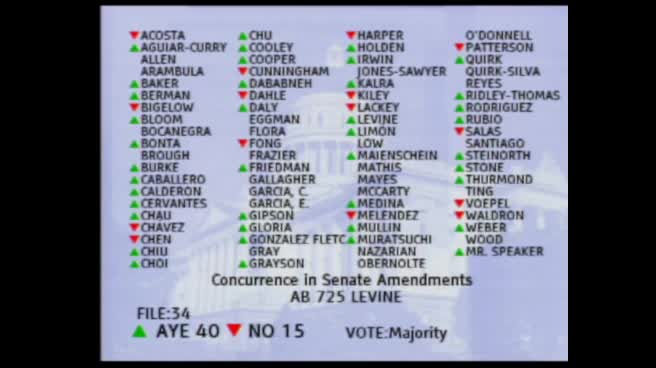 2MIN
Assembly Floor
 10MIN
Assembly Standing Committee on Local Government
 2MIN
Senate Floor
 4MIN
Senate Standing Committee on Governance and Finance
 3MIN
Assembly Floor
 1H
Assembly Standing Committee on Appropriations
 12MIN
Assembly Standing Committee on Environmental Safety and Toxic Materials
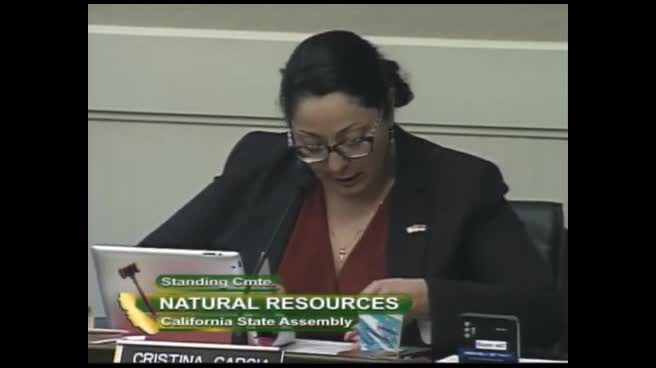 16MIN
Assembly Standing Committee on Natural Resources
Bill Author

Bill Co-Author(s):
