AB 1320: State prisons: private, for-profit administration services.
- Session Year: 2017-2018
- House: Assembly
- Latest Version Date: 2017-09-15
Existing law establishes the Department of Corrections and Rehabilitation and sets forth its powers and duties regarding the administration of correctional facilities and the care and custody of inmates. Existing law, until January 1, 2020, authorizes the Secretary of the Department of Corrections and Rehabilitation to enter into one or more agreements with private entities to obtain secure housing capacity in the state or in another state, upon terms and conditions deemed necessary and appropriate to the secretary. Existing law, until January 1, 2020, authorizes the secretary to enter into agreements for the transfer of prisoners to, or placement of prisoners in, community correctional centers, and to enter into contracts to provide housing, sustenance, and supervision for inmates placed in community correctional centers.
This bill would prohibit the department from entering into a contract with an out-of state, private, for-profit prison on or after January 1, 2018, and would prohibit the department from renewing a contract with an out-of-state, private, for-profit prison on or after January 1, 2020. The bill would also prohibit, after January 1, 2021, any state prison inmate or other person under the jurisdiction of the department from being housed in any out-of-state, private, for-profit prison facility.
Existing law establishes the Department of Corrections and Rehabilitation and sets forth its powers and duties regarding the administration of correctional facilities and the care and custody of inmates. Existing law, until January 1, 2020, authorizes the Secretary of the Department of Corrections and Rehabilitation to enter into one or more agreements with private entities to obtain secure housing capacity in the state or in another state, upon terms and conditions deemed necessary and appropriate to the secretary. Existing law, until January 1, 2020, authorizes the secretary to enter into agreements for the transfer of prisoners to, or placement of prisoners in, community correctional centers, and to enter into contracts to provide housing, sustenance, and supervision for inmates placed in community correctional centers.
This bill would prohibit the department from contracting entering into a contract with a an out-of state, private, for-profit prison on or after January 1, 2028 2018, and would prohibit the department from entering into or renewing a contract with a an out-of-state, private, for-profit prison on or after January 1, 2018. 2020. The bill would also require on or before prohibit, after January 1, 2028, all 2021, any state prison inmates and other persons inmate or other person under the jurisdiction of the department to be removed from being housed in any out-of-state, private, for-profit prison facilities. facility.
Existing law establishes the Department of Corrections and Rehabilitation and sets forth its powers and duties regarding the administration of correctional facilities and the care and custody of inmates. Existing law, until January 1, 2020, authorizes the Secretary of the Department of Corrections and Rehabilitation to enter into one or more agreements with private entities to obtain secure housing capacity in the state or in another state, upon terms and conditions deemed necessary and appropriate to the secretary. Existing law, until January 1, 2020, authorizes the secretary to enter into agreements for the transfer of prisoners to, or placement of prisoners in, community correctional centers, and to enter into contracts to provide housing, sustenance, and supervision for inmates placed in community correctional centers.
This bill would prohibit the department from contracting with a private, for-profit prison on or after January 1, 2028 and would prohibit the renewal of contracts with for-profit prisons in effect on department from entering into or renewing a contract with a private, for-profit prison on or after January 1, 2018. The bill would also require on or before January 1, 2028, all state prison inmates and other persons under the jurisdiction of the department to be removed from private, for-profit prison facilities.
Existing law establishes the Department of Corrections and Rehabilitation and sets forth its powers and duties regarding the administration of correctional facilities and the care and custody of inmates. Existing law, until January 1, 2020, authorizes the Secretary of the Department of Corrections and Rehabilitation to enter into one or more agreements with private entities to obtain secure housing capacity in the state or in another state, upon terms and conditions deemed necessary and appropriate to the secretary. Existing law, until January 1, 2020, authorizes the secretary to enter into agreements for the transfer of prisoners to, or placement of prisoners in, community correctional centers, and to enter into contracts to provide housing, sustenance, and supervision for inmates placed in community correctional centers.
This bill would prohibit the department from contracting with a private, for-profit prison on or after January 1, 2028 and would prohibit the renewal of contracts with for-profit prisons in effect on January 1, 2018. The bill would also require on or before January 1, 2028, all state prison inmates and other persons under the jurisdiction of the department to be removed from private, for-profit prison facilities.
Existing law establishes categories of peace officers with varying powers and authority to make arrests.This bill would state the intent of the Legislature to enact legislation pertaining to public safety and law enforcement.Existing law establishes categories of peace officers with varying powers and authority to make arrests.
This bill would state the intent of the Legislature to enact legislation pertaining to public safety and law enforcement.
(a)Subject to Section 5003.1, the Secretary of the Department of Corrections and Rehabilitation may enter into one or more agreements to obtain secure housing capacity within the state. These agreements may be entered into with private entities and may be in the form of a lease or an operating agreement. The secretary may procure and enter these agreements on terms and conditions he or she deems necessary and appropriate. Notwithstanding any other law, any process, regulation, requirement, including any state governmental reviews or approvals, or third-party approval that is required under statutes that relate to the procurement and implementation of those agreements is hereby waived, however, an agreement shall not contain terms, either directly or indirectly, that involve the repayment of any debt issuance or other financing and, consistent with state law, shall provide that payment of that agreement is subject to appropriation.
(b)Subject to Section 5003.1, the Secretary of the Department of Corrections and Rehabilitation may enter into one or more agreements to obtain secure housing capacity in another state. These agreements may be entered into with private entities and may be in the form of an operating agreement or other contract. The secretary may procure and enter these agreements on terms and conditions he or she deems necessary and appropriate. Notwithstanding any other law, any process, regulation, requirement, including any state governmental reviews or approvals, or third-party approval that is required under statutes that relate to the procurement and implementation of those agreements is hereby waived, however, no agreement shall contain terms, either directly or indirectly, that involve the repayment of any debt issuance or other financing and, consistent with state law, shall provide that payment of that agreement is subject to appropriation. This subdivision does not authorize the department to operate a facility out of state.
(c)The provisions of Division 13 (commencing with Section 21000) of the Public Resources Code do not apply to this section.
(d)This section shall remain in effect only until January 1, 2020, and as of that date is repealed, unless a later enacted statute, that is enacted before January 1, 2020, deletes or extends that date.
SEC. 2.Section 5003.1 is added to the Penal Code, to read:5003.1.(a)The department shall not enter into a contract with a private, for-profit prison facility located outside of the state, on or after January 1, 2018.
(b)The department shall not renew an existing contract with a private, for-profit prison facility located outside of the state, on or after January 1, 2020.
(c)After January 1, 2021, no state prison inmate or other person under the jurisdiction of the department shall be housed in a private, for-profit prison facility located outside of the state.
(a)Subject to Section 5003.1, the Secretary of the Department of Corrections and Rehabilitation may enter into one or more agreements to obtain secure housing capacity within the state. These agreements may be entered into with private entities and may be in the form of a lease or an operating agreement. The secretary may procure and enter these agreements on terms and conditions he or she deems necessary and appropriate. Notwithstanding any other law, any process, regulation, requirement, including any state governmental reviews or approvals, or third-party approval that is required under statutes that relate to the procurement and implementation of those agreements is hereby waived, however, no agreement an agreement shall not contain terms, either directly or indirectly, that involve the repayment of any debt issuance or other financing and, consistent with state law, shall provide that payment of that agreement is subject to appropriation.
(b)Subject to Section 5003.1, the Secretary of the Department of Corrections and Rehabilitation may enter into one or more agreements to obtain secure housing capacity in another state. These agreements may be entered into with private entities and may be in the form of an operating agreement or other contract. The secretary may procure and enter these agreements on terms and conditions he or she deems necessary and appropriate. Notwithstanding any other law, any process, regulation, requirement, including any state governmental reviews or approvals, or third-party approval that is required under statutes that relate to the procurement and implementation of those agreements is hereby waived, however, no agreement shall contain terms, either directly or indirectly, that involve the repayment of any debt issuance or other financing and, consistent with state law, shall provide that payment of that agreement is subject to appropriation. This subdivision does not authorize the department to operate a facility out of state.
(c)The provisions of Division 13 (commencing with Section 21000) of the Public Resources Code do not apply to this section.
(d)This section shall remain in effect only until January 1, 2020, and as of that date is repealed, unless a later enacted statute, that is enacted before January 1, 2020, deletes or extends that date.
SEC. 2.Section 5003.1 is added to the Penal Code, to read:5003.1.(a)The department shall not enter into a contract with a private, for-profit prison facility located outside of the state, on or after January 1, 2018.
(b)The department shall not renew an existing contract with a private, for-profit prison facility located outside of the state, on or after January 1, 2020.
(c)After January 1, 2021, no state prison inmate or other person under the jurisdiction of the department shall be housed in a private, for-profit prison facility located outside of the state.
(a)Subject to Section 5003.1, the Secretary of the Department of Corrections and Rehabilitation may enter into one or more agreements to obtain secure housing capacity within the state. These agreements may be entered into with private entities and may be in the form of a lease or an operating agreement. The secretary may procure and enter these agreements on terms and conditions he or she deems necessary and appropriate. Notwithstanding any other law, any process, regulation, requirement, including any state governmental reviews or approvals, or third-party approval that is required under statutes that relate to the procurement and implementation of those agreements is hereby waived, however, no agreement shall contain terms, either directly or indirectly, that involve the repayment of any debt issuance or other financing and, consistent with state law, shall provide that payment of that agreement is subject to appropriation.
(b)Subject to Section 5003.1, the Secretary of the Department of Corrections and Rehabilitation may enter into one or more agreements to obtain secure housing capacity in another state. These agreements may be entered into with private entities and may be in the form of an operating agreement or other contract. The secretary may procure and enter these agreements on terms and conditions he or she deems necessary and appropriate. Notwithstanding any other law, any process, regulation, requirement, including any state governmental reviews or approvals, or third-party approval that is required under statutes that relate to the procurement and implementation of those agreements is hereby waived, however, no agreement shall contain terms, either directly or indirectly, that involve the repayment of any debt issuance or other financing and, consistent with state law, shall provide that payment of that agreement is subject to appropriation. This subdivision does not authorize the department to operate a facility out of state.
(c)The provisions of Division 13 (commencing with Section 21000) of the Public Resources Code do not apply to this section.
(d)This section shall remain in effect only until January 1, 2020, and as of that date is repealed, unless a later enacted statute, that is enacted before January 1, 2020, deletes or extends that date.
SEC. 2.Section 5003.1 is added to the Penal Code, to read:5003.1.(a)The department shall not enter into a contract with a private, for-profit prison facility located outside of the state, on or after January 1, 2028. 2018.
(b)The department shall not renew or enter into a new an existing contract with a private, for-profit prison facility located outside of the state, on or after January 1, 2018. 2020.
(c)On or before After January 1, 2028, all 2021, no state prison inmates and other persons inmate or other person under the jurisdiction of the department shall be removed from housed in a private, for-profit prison facilities. facility located outside of the state.
(a)Subject to Section 5003.1, the Secretary of the Department of Corrections and Rehabilitation may enter into one or more agreements to obtain secure housing capacity within the state. These agreements may be entered into with private entities and may be in the form of a lease or an operating agreement. The secretary may procure and enter these agreements on terms and conditions he or she deems necessary and appropriate. Notwithstanding any other law, any process, regulation, requirement, including any state governmental reviews or approvals, or third-party approval that is required under statutes that relate to the procurement and implementation of those agreements is hereby waived, however, no agreement shall contain terms, either directly or indirectly, that involve the repayment of any debt issuance or other financing and, consistent with state law, shall provide that payment of that agreement is subject to appropriation.
(b)Subject to Section 5003.1, the Secretary of the Department of Corrections and Rehabilitation may enter into one or more agreements to obtain secure housing capacity in another state. These agreements may be entered into with private entities and may be in the form of an operating agreement or other contract. The secretary may procure and enter these agreements on terms and conditions he or she deems necessary and appropriate. Notwithstanding any other law, any process, regulation, requirement, including any state governmental reviews or approvals, or third-party approval that is required under statutes that relate to the procurement and implementation of those agreements is hereby waived, however, no agreement shall contain terms, either directly or indirectly, that involve the repayment of any debt issuance or other financing and, consistent with state law, shall provide that payment of that agreement is subject to appropriation. This subdivision does not authorize the department to operate a facility out of state.
(c)The provisions of Division 13 (commencing with Section 21000) of the Public Resources Code do not apply to this section.
(d)This section shall remain in effect only until January 1, 2020, and as of that date is repealed, unless a later enacted statute, that is enacted before January 1, 2020, deletes or extends that date.
SEC. 2.Section 5003.1 is added to the Penal Code, to read:5003.1.(a)The department shall not contract with a private, for-profit prison facility on or after January 1, 2028.
(b)The department shall not renew a contract in effect on January 1, 2018, renew or enter into a new contract with a private, for-profit prison facility. facility on or after January 1, 2018.
(c)On or before January 1, 2028, all state prison inmates and other persons under the jurisdiction of the department shall be removed from private, for-profit prison facilities.
(a)The Subject to Section 5003.1, the Secretary of the Department of Corrections and Rehabilitation may enter into one or more agreements to obtain secure housing capacity within the state. These agreements may be entered into with private entities and may be in the form of a lease or an operating agreement. The secretary may procure and enter these agreements on terms and conditions he or she deems necessary and appropriate. Notwithstanding any other law, any process, regulation, requirement, including any state governmental reviews or approvals, or third-party approval that is required under statutes that relate to the procurement and implementation of those agreements is hereby waived, however, no agreement shall contain terms, either directly or indirectly, that involve the repayment of any debt issuance or other financing and, consistent with state law, shall provide that payment of that agreement is subject to appropriation.
(b)The Subject to Section 5003.1, the Secretary of the Department of Corrections and Rehabilitation may enter into one or more agreements to obtain secure housing capacity in another state. These agreements may be entered into with private entities and may be in the form of an operating agreement or other contract. The secretary may procure and enter these agreements on terms and conditions he or she deems necessary and appropriate. Notwithstanding any other law, any process, regulation, requirement, including any state governmental reviews or approvals, or third-party approval that is required under statutes that relate to the procurement and implementation of those agreements is hereby waived, however, no agreement shall contain terms, either directly or indirectly, that involve the repayment of any debt issuance or other financing and, consistent with state law, shall provide that payment of that agreement is subject to appropriation. This subdivision does not authorize the department to operate a facility out of state.
(c)The provisions of Division 13 (commencing with Section 21000) of the Public Resources Code do not apply to this section.
(d)This section shall remain in effect only until January 1, 2020, and as of that date is repealed, unless a later enacted statute, that is enacted before January 1, 2020, deletes or extends that date.
SEC. 2.Section 5003.1 is added to the Penal Code, to read:5003.1.(a)The department shall not contract with a private, for-profit prison facility on or after January 1, 2028.
(b)The department shall not renew a contract in effect on January 1, 2018, with a private, for-profit prison facility.
(c)On or before January 1, 2028, all state prison inmates and other persons under the jurisdiction of the department shall be removed from private, for-profit prison facilities.
SECTION 1.It is the intent of the Legislature to enact legislation pertaining to public safety and law enforcement.It is the intent of the Legislature to enact legislation pertaining to public safety and law enforcement.
|
Date
|
Status
|
|---|---|
| Jan 12, 2018 | Stricken from file. |
| Jan 3, 2018 | Consideration of Governor's veto pending. |
| Oct 5, 2017 | Vetoed by Governor. |
| Sep 25, 2017 | Enrolled and presented to the Governor at 12 p.m. |
| Sep 14, 2017 | Senate amendments concurred in. To Engrossing and Enrolling. |
| Sep 14, 2017 | Senate amendments concurred in. To Engrossing and Enrolling. (Ayes 61. Noes 18. Page 3380.). |
| Sep 13, 2017 | Assembly Rule 77(a) suspended. |
| Sep 13, 2017 | In Assembly. Concurrence in Senate amendments pending. May be considered on or after September 15 pursuant to Assembly Rule 77. |
| Sep 12, 2017 | Read third time. Passed. Ordered to the Assembly. |
| Sep 11, 2017 | Read second time. Ordered to third reading. |
| Sep 8, 2017 | Read third time and amended. Ordered to second reading. |
| Sep 5, 2017 | Read second time. Ordered to third reading. |
| Sep 1, 2017 | From committee: Do pass. (Ayes 5. Noes 2.) (September 1). |
| Jul 17, 2017 | In committee: Referred to APPR. suspense file. |
| Jun 27, 2017 | From committee: Do pass and re-refer to Com. on APPR. (Ayes 6. Noes 1.) (June 27). Re-referred to Com. on APPR. |
| Jun 14, 2017 | Referred to Com. on PUB. S. |
| Jun 5, 2017 | In Senate. Read first time. To Com. on RLS. for assignment. |
| Jun 1, 2017 | Read third time. Passed. Ordered to the Senate. (Ayes 62. Noes 16. Page 2073.) |
| May 30, 2017 | Read second time and amended. Ordered returned to second reading. |
| May 26, 2017 | From committee: Amend, and do pass as amended. (Ayes 12. Noes 5.) (May 26). |
| May 10, 2017 | In committee: Set, first hearing. Referred to APPR. suspense file. |
| Apr 19, 2017 | Re-referred to Com. on APPR. |
| Apr 18, 2017 | Read second time and amended. |
| Apr 17, 2017 | From committee: Amend, and do pass as amended and re-refer to Com. on APPR. (Ayes 5. Noes 0.) (April 4). |
| Mar 22, 2017 | Re-referred to Com. on PUB. S. |
| Mar 21, 2017 | From committee chair, with author's amendments: Amend, and re-refer to Com. on PUB. S. Read second time and amended. |
| Mar 20, 2017 | Referred to Com. on PUB. S. |
| Feb 19, 2017 | From printer. May be heard in committee March 21. |
| Feb 17, 2017 | Read first time. To print. |
|
Date
|
Description
|
Location
|
Votes
|
|
|---|---|---|---|---|
| Sep 14, 2017 | AB 1320 BONTA Concurrence in Senate Amendments | Assembly Floor |
Passed |
|
| Sep 12, 2017 | Assembly 3rd Reading AB1320 Bonta et al. By Beall | Senate Floor |
Passed |
|
| Sep 1, 2017 | Do pass | Senate Standing Committee on Appropriations |
Passed |
|
| Jul 17, 2017 | Placed on suspense file | Senate Standing Committee on Appropriations |
Passed |
|
| Jun 27, 2017 | Do pass, but first be re-referred to the Committee on [Appropriations] | Senate Standing Committee on Public Safety |
Passed |
|
| Jun 1, 2017 | AB 1320 BONTA Assembly Third Reading | Assembly Floor |
Passed |
|
| May 26, 2017 | Do pass as amended. | Assembly Standing Committee on Appropriations |
Passed |
|
| Apr 4, 2017 | Do pass as amended and be re-referred to the Committee on [Appropriations] | Assembly Standing Committee on Public Safety |
Passed |
This list shows positions taken on this bill by organizations on the date displayed, which is linked to the original source.
Positions by individuals are not included.
|
Organization
|
Position
|
Date
|
|---|---|---|
| American Federation Of State, County & Municiple Employees (Afscme) | * Support | Apr 4, 2017 |
| Association For Los Angeles Deputy Sheriffs | * Support | Apr 4, 2017 |
| California Attorneys For Criminal Justice | ** Support | Sep 9, 2017 |
| California Civil Liberties Advocacy | ** Support | Sep 9, 2017 |
| California Correctional Peace Officers Association | ** Support | Sep 9, 2017 |
| California Public Defenders Association | ** Support | Sep 9, 2017 |
| Corrections Corporation Of America | * Indeterminate | Apr 4, 2017 |
| Los Angeles County Professional Peace Officers Association | ** Support | Sep 9, 2017 |
| National Association of Social Workers | ** Support | Sep 9, 2017 |
| Riverside Sheriffs' Association | ** Support | Sep 9, 2017 |
| Seiu - Local 1000 | ** Support | Sep 9, 2017 |
GOVERNOR'S VETO
GV Bill Id:AB 1320
Author:(Bonta)
As Enrolled Ver:September 15, 2017
2/3 vote
ASSEMBLY: | 62-16 | (June 1, 2017) | SENATE: | 35-5 | (September 12, 2017) |
ASSEMBLY: | 61-18 | (September 14, 2017) |
Original Committee Reference: PUB. S.
SUMMARY: Prohibits the California Department of Corrections and Rehabilitation (CDCR) from entering into or renewing contracts with private prisons located out of state by specified dates, and eliminates their use by January 1, 2021.
The Senate amendments make a technical change.
EXISTING LAW:
- Authorizes the Secretary of CDCR to enter into agreements with private entities to obtain secure housing capacity within California. Sunsets this authority on January 1, 2020.
- Authorizes the Secretary of CDCR to enter into agreements with private entities to obtain secure housing capacity in another state.
- Prohibits CDCR from operating its own facility outside of California.
- Allows the Secretary of CDCR to enter into an agreement with a city, county, or city and county, to permit transfer of prisoners in the custody of the secretary to a jail or other adult correctional facility. Sunsets this authority on January 1, 2020.
AS PASSED BY THE ASSEMBLY, this bill:
- Prohibited CDCR from entering into a contract with a private, for-profit prison located out of state on or after January 1, 2018.
- Prohibited CDCR from renewing existing contracts with private, for-profit prisons located out of state on or after January 1, 2020.
- Required all state prison inmates under the jurisdiction of CDCR to be removed from for-profit prison facilities located out of state by January 1, 2021.
FISCAL EFFECT: According to the Senate Appropriations Committee, unknown, potentially-major costs in the tens of millions of dollars to hundreds of millions of dollars (General Fund), depending on the effect of Proposition 57 (2016) on the state prison population numbers and the different options available to the state to comply with the court-ordered population cap.
COMMENTS: According to the author, "Current law authorizes the California Department of Corrections and Rehabilitation to contract with private, for-profit prison corporations to house inmates both in and out-of-state. Private, for-profit prison companies profit from incarcerating human beings. These out of state companies have no incentive to invest in the rehabilitation of California prisoners. As a for-profit corporation, they are built and incentivized to maximize their profits and minimize their costs through the warehousing of inmates. They have a fiduciary duty to serve their shareholders instead of the people of California.
"Under the Governor's proposed 2017-2018 budget, the state plans to spend roughly $247 million on for-profit prisons. California currently houses approximately 6,000 inmates in ten privately operated prisons, including two located out-of-state in Arizona and Mississippi.
"AB 1320 will end the renewal of contracts with for-profit prisons by 2018 and completely phase out their use by 2028. AB 1320 will also help to redirect our criminal justice system to value and prioritize effective rehabilitative programs, which will ideally minimize recidivism rates and maximize successes for inmates upon their reentry into society.
"Eliminating contracts with for-profit, private prisons will not solve all the issues that need reforming within our criminal justice system. However, it is a powerful step that signals our renewed focus on creating public policies that enable Californians to thrive and once again become contributing members of our state."
This bill prohibits, as of 2021, the California Department of Corrections and Rehabilitation from contracting with private prisons located out of state.
I agree that out-of-state inmates should be returned to California as soon as possible, which is why the administration's 2017-18 budget outlines a plan to accomplish this goal. In order, however, to maintain the prison population at or below 137.5% of design capacity, as required by the Federal courts, the Department of Corrections and Rehabilitation needs to maintain maximum flexibility in the short term.
Analysis Prepared by: Sandy Uribe / PUB. S. / (916) 319-3744 FN: 0002433
CONCURRENCE IN SENATE AMENDMENTS
CSA1 Bill Id:AB 1320
Author:(Bonta)
As Amended Ver:September 8, 2017
Majority vote
ASSEMBLY: | 62-16 | (June 1, 2017) | SENATE: | 35-5 | (September 12, 2017) |
Original Committee Reference: PUB. S.
SUMMARY: Prohibits the California Department of Corrections and Rehabilitation (CDCR) from entering into or renewing contracts with private prisons located out of state by specified dates, and eliminates their use by January 1, 2021.
The Senate amendments make a technical change.
EXISTING LAW:
- Authorizes the Secretary of CDCR to enter into agreements with private entities to obtain secure housing capacity within California. Sunsets this authority on January 1, 2020.
- Authorizes the Secretary of CDCR to enter into agreements with private entities to obtain secure housing capacity in another state.
- Prohibits CDCR from operating its own facility outside of California.
- Allows the Secretary of CDCR to enter into an agreement with a city, county, or city and county, to permit transfer of prisoners in the custody of the secretary to a jail or other adult correctional facility. Sunsets this authority on January 1, 2020.
AS PASSED BY THE ASSEMBLY, this bill:
- Prohibited CDCR from entering into a contract with a private, for-profit prison located out of state on or after January 1, 2018.
- Prohibited CDCR from renewing existing contracts with private, for-profit prisons located out of state on or after January 1, 2020.
- Required all state prison inmates under the jurisdiction of CDCR to be removed from for-profit prison facilities located out of state by January 1, 2021.
FISCAL EFFECT: According to the Senate Appropriations Committee, unknown, potentially-major costs in the tens of millions of dollars to hundreds of millions of dollars (General Fund), depending on the effect of Proposition 57 (2016) on the state prison population numbers and the different options available to the state to comply with the court-ordered population cap.
COMMENTS: According to the author, "Current law authorizes the California Department of Corrections and Rehabilitation to contract with private, for-profit prison corporations to house inmates both in and out-of-state. Private, for-profit prison companies profit from incarcerating human beings. These out of state companies have no incentive to invest in the rehabilitation of California prisoners. As a for-profit corporation, they are built and incentivized to maximize their profits and minimize their costs through the warehousing of inmates. They have a fiduciary duty to serve their shareholders instead of the people of California.
"Under the Governor's proposed 2017-2018 budget, the state plans to spend roughly $247 million on for-profit prisons. California currently houses approximately 6,000 inmates in ten privately operated prisons, including two located out-of-state in Arizona and Mississippi.
"AB 1320 will end the renewal of contracts with for-profit prisons by 2018 and completely phase out their use by 2028. AB 1320 will also help to redirect our criminal justice system to value and prioritize effective rehabilitative programs, which will ideally minimize recidivism rates and maximize successes for inmates upon their reentry into society.
"Eliminating contracts with for-profit, private prisons will not solve all the issues that need reforming within our criminal justice system. However, it is a powerful step that signals our renewed focus on creating public policies that enable Californians to thrive and once again become contributing members of our state."
Analysis Prepared by: Sandy Uribe / PUB. S. / (916) 319-3744 FN: 0002251
Office of Senate Floor Analyses (916) 651-1520 Fax: (916) 327-4478 | AB |
THIRD READING
Bill No: AB 1320
:
SENATE PUBLIC SAFETY COMMITTEE: 6-1, 6/27/17
AYES: Skinner, Bradford, Jackson, Mitchell, Stone, Wiener
NOES: Anderson
SENATE APPROPRIATIONS COMMITTEE: 5-2, 9/1/17
AYES: Lara, Beall, Bradford, Hill, Wiener
NOES: Bates, Nielsen
ASSEMBLY FLOOR: 62-16, 6/1/17 - See last page for vote
DIGEST:
This bill prohibits the California Department of Corrections and Rehabilitation (CDCR) from entering into or renewing contracts with private prisons located out of state by specified dates, and eliminates their use by January 1, 2021.
Senate Floor Amendments of 9/8/17 add an additional co-author.
Existing law:
- Authorizes the Secretary of CDCR to enter into agreements with private entities to obtain secure housing capacity within California. Sunsets this authority on January 1, 2020. (Pen. Code § 2915, subds. (a) & (d).)
- Authorizes the Secretary of CDCR to enter into agreements with private entities to obtain secure housing capacity in another state. (Pen. Code § 2915, subds. (b) & (d).)
- Prohibits CDCR from operating its own facility outside of California. (Pen. Code § 2915, subd. (b).)
- Allows the Secretary of CDCR to enter into an agreement with a city, county, or city and county, to permit transfer of prisoners in the custody of the secretary to a jail or other adult correctional facility. Sunsets this authority on January 1, 2020. (Pen. Code § 2010, subds. (a) & (h).)
This bill:
- Prohibits CDCR from entering into a contract with a private, for-profit prison located out of state on or after January 1, 2018.
- Prohibits CDCR from renewing existing contracts with private, for-profit prisons located out of state on or after January 1, 2020.
- Requires all state prison inmates under the jurisdiction of CDCR to be removed from for-profit prison facilities located out of state by January 1, 2021.
Background:
In January 2010, a three-judge panel issued a ruling ordering the State of California to reduce its prison population to 137.5% of design capacity because overcrowding was the primary reason that CDCR was unable to provide inmates with constitutionally adequate healthcare. (Coleman/Plata vs. Schwarzenegger (2010) No. Civ S-90-0520 LKK JFM P/NO. C01-1351 THE.) The United States Supreme Court upheld the decision, declaring that “without a reduction in overcrowding, there will be no efficacious remedy for the unconstitutional care of the sick and mentally ill” inmates in California’s prisons. (Brown v. Plata (2011) 131 S.Ct. 1910, 1939; 179 L.Ed.2d 969, 999.)
After continued litigation, on February 10, 2014, the federal court ordered California to reduce its in-state adult institution population to 137.5% of design capacity by February 28, 2016, as follows: 143% of design bed capacity by June 30, 2014; 141.5% of design bed capacity by February 28, 2015; and, 137.5% of design bed capacity by February 28, 2016.
CDCR is currently in compliance with the three-judge panel’s order on the prison population.
CDCR’s February 2017 monthly report on the prison population notes that the in-state adult institution population is currently 114,124 inmates, which amounts to 134.1% of design capacity. While CDCR is currently in compliance with the three-judge panel’s order on the prison population, the state needs to maintain a “durable solution” to prison overcrowding “consistently demanded” by the court. (Opinion Re: Order Granting in Part and Denying in Part Defendants’ Request For Extension of December 31, 2013 Deadline, NO. 2:90-cv-0520 LKK DAD (PC), 3-Judge Court, Coleman v. Brown, Plata v. Brown (2-10-14).)
The Governor’s January proposed budget for 2017-2018 anticipates that “[t]he adult inmate average daily population is projected to decrease from 129,015 in 2016-17 to 128,159 in 2017-18, a decrease of 856 inmates, or 0.7 percent. …The decrease in the adult inmate population is due to a projected reduction related to the implementation of Proposition 57, the Public Safety and Rehabilitation Act of 2016, which offsets a projected increase in felon admissions.”
However, as of February 28, 2017, there were currently 6,072 inmates under the jurisdiction of CDCR housed in for-profit prisons in California. Additionally, there are still 4,400 prisoners being housed out of state, in Mississippi and Arizona. (http://www.cdcr.ca.gov/Reports_Research/Offender_Information_Services_Branch/Monthly/TPOP1A/TPOP1Ad1702.pdf )
This bill prohibits the housing of prisoners in for-profit prisons, both in and out of state, by January 1, 2028. Additionally, contracts could not be renewed after January 1, 2018. New contracts could also not be entered into as of that day. This bill does not prohibit CDCR from contracting with city and county jails.
FISCAL EFFECT: Appropriation: Fiscal Com.: Local:
According to the Senate Appropriations Committee, unknown, potentially-major costs in the tens of millions of dollars to hundreds of millions of dollars (General Fund), depending on the effect of Proposition 57 (2016) on the state prison population numbers and the different options available to the state to comply with the court-ordered population cap.
AFSCME
California Attorneys for Criminal Justice
California Civil Liberties Advocacy
California Correctional Peace Officers Association
California Public Defenders Association
Los Angeles County Professional Peace Officers Association
National Association of Social Workers
Riverside Sheriffs’ Association
SEIU – Local 1000
None received
ARGUMENTS IN SUPPORT: According to the Los Angeles County Professional Peace Officers Association, “California houses more than 9,000 inmates in ten privately-operated, for-profit prisons, including two located out-of-state in Arizona and Mississippi. For the 2017-2018 fiscal year, the Governor has proposed to set aside $247,053 million for contracted private, for-profit correctional facilities.
“Studies show a heightened level of violence against prisoners in private institutions. This may reflect in part the higher rate of staff turnover in private prisons, which can result in inexperienced guards walking the tiers. The ability of private prison companies to capture taxpayer dollars results in handsome rewards for their top executives. The ACLU reported, in 2010, CCA’s President and CEO received more than $3.2 million in executive compensation, and GEO’s Chairman and CEO received nearly $3.5 million.
“Not only does privatization fail to save taxpayer money, but private prison companies, as for-profit institutions, are strongly incentivized to cut corners and thereby maximize profits, which may come at the expense of public safety and the well-being of prisoners.”
ASSEMBLY FLOOR: 62-16, 6/1/17
AYES: Aguiar-Curry, Arambula, Baker, Berman, Bloom, Bocanegra, Bonta, Burke, Caballero, Calderon, Cervantes, Chau, Chávez, Chen, Chiu, Chu, Cooley, Cooper, Cunningham, Dababneh, Daly, Eggman, Flora, Frazier, Friedman, Cristina Garcia, Eduardo Garcia, Gipson, Gloria, Gomez, Gonzalez Fletcher, Gray, Grayson, Holden, Irwin, Jones-Sawyer, Kalra, Lackey, Levine, Limón, Low, Maienschein, Mayes, McCarty, Medina, Mullin, Muratsuchi, Nazarian, O'Donnell, Quirk, Quirk-Silva, Reyes, Rodriguez, Rubio, Salas, Santiago, Mark Stone, Thurmond, Ting, Weber, Wood, Rendon
NOES: Acosta, Travis Allen, Bigelow, Brough, Dahle, Fong, Gallagher, Harper, Kiley, Mathis, Melendez, Obernolte, Patterson, Steinorth, Voepel, Waldron
NO VOTE RECORDED: Choi, Ridley-Thomas
Prepared by: Gabe Caswell / PUB. S. /
9/9/17 16:13:40
**** END ****
Office of Senate Floor Analyses (916) 651-1520 Fax: (916) 327-4478 | AB |
THIRD READING
Bill No: AB 1320
:
SENATE PUBLIC SAFETY COMMITTEE: 6-1, 6/27/17
AYES: Skinner, Bradford, Jackson, Mitchell, Stone, Wiener
NOES: Anderson
SENATE APPROPRIATIONS COMMITTEE: 5-2, 9/1/17
AYES: Lara, Beall, Bradford, Hill, Wiener
NOES: Bates, Nielsen
ASSEMBLY FLOOR: 62-16, 6/1/17 - See last page for vote
DIGEST:
This bill prohibits the California Department of Corrections and Rehabilitation (CDCR) from entering into or renewing contracts with private prisons located out of state by specified dates, and eliminates their use by January 1, 2021.
Existing law:
- Authorizes the Secretary of CDCR to enter into agreements with private entities to obtain secure housing capacity within California. Sunsets this authority on January 1, 2020. (Pen. Code § 2915, subds. (a) & (d).)
- Authorizes the Secretary of CDCR to enter into agreements with private entities to obtain secure housing capacity in another state. (Pen. Code § 2915, subds. (b) & (d).)
- Prohibits CDCR from operating its own facility outside of California. (Pen. Code § 2915, subd. (b).)
- Allows the Secretary of CDCR to enter into an agreement with a city, county, or city and county, to permit transfer of prisoners in the custody of the secretary to a jail or other adult correctional facility. Sunsets this authority on January 1, 2020. (Pen. Code § 2010, subds. (a) & (h).)
This bill:
- Prohibits CDCR from entering into a contract with a private, for-profit prison located out of state on or after January 1, 2018.
- Prohibits CDCR from renewing existing contracts with private, for-profit prisons located out of state on or after January 1, 2020.
- Requires all state prison inmates under the jurisdiction of CDCR to be removed from for-profit prison facilities located out of state by January 1, 2021.
Background
In January 2010, a three-judge panel issued a ruling ordering the State of California to reduce its prison population to 137.5% of design capacity because overcrowding was the primary reason that CDCR was unable to provide inmates with constitutionally adequate healthcare. (Coleman/Plata vs. Schwarzenegger (2010) No. Civ S-90-0520 LKK JFM P/NO. C01-1351 THE.) The United States Supreme Court upheld the decision, declaring that “without a reduction in overcrowding, there will be no efficacious remedy for the unconstitutional care of the sick and mentally ill” inmates in California’s prisons. (Brown v. Plata (2011) 131 S.Ct. 1910, 1939; 179 L.Ed.2d 969, 999.)
After continued litigation, on February 10, 2014, the federal court ordered California to reduce its in-state adult institution population to 137.5% of design capacity by February 28, 2016, as follows: 143% of design bed capacity by June 30, 2014; 141.5% of design bed capacity by February 28, 2015; and, 137.5% of design bed capacity by February 28, 2016.
CDCR is currently in compliance with the three-judge panel’s order on the prison population.
CDCR’s February 2017 monthly report on the prison population notes that the in-state adult institution population is currently 114,124 inmates, which amounts to 134.1% of design capacity. While CDCR is currently in compliance with the three-judge panel’s order on the prison population, the state needs to maintain a “durable solution” to prison overcrowding “consistently demanded” by the court. (Opinion Re: Order Granting in Part and Denying in Part Defendants’ Request For Extension of December 31, 2013 Deadline, NO. 2:90-cv-0520 LKK DAD (PC), 3-Judge Court, Coleman v. Brown, Plata v. Brown (2-10-14).)
The Governor’s January proposed budget for 2017-2018 anticipates that “[t]he adult inmate average daily population is projected to decrease from 129,015 in 2016-17 to 128,159 in 2017-18, a decrease of 856 inmates, or 0.7 percent. …The decrease in the adult inmate population is due to a projected reduction related to the implementation of Proposition 57, the Public Safety and Rehabilitation Act of 2016, which offsets a projected increase in felon admissions.”
However, as of February 28, 2017, there were currently 6,072 inmates under the jurisdiction of CDCR housed in for-profit prisons in California. Additionally, there are still 4,400 prisoners being housed out of state, in Mississippi and Arizona. (http://www.cdcr.ca.gov/Reports_Research/Offender_Information_Services_Branch/Monthly/TPOP1A/TPOP1Ad1702.pdf )
This bill prohibits the housing of prisoners in for-profit prisons, both in and out of state, by January 1, 2028. Additionally, contracts could not be renewed after January 1, 2018. New contracts could also not be entered into as of that day. This bill does not prohibit CDCR from contracting with city and county jails.
FISCAL EFFECT: Appropriation: Fiscal Com.: Local:
According to the Senate Appropriations Committee, unknown, potentially-major costs in the tens of millions of dollars to hundreds of millions of dollars (General Fund), depending on the effect of Proposition 57 (2016) on the state prison population numbers and the different options available to the state to comply with the court-ordered population cap.
AFSCME
California Attorneys for Criminal Justice
California Civil Liberties Advocacy
California Correctional Peace Officers Association
California Public Defenders Association
Los Angeles County Professional Peace Officers Association
National Association of Social Workers
Riverside Sheriffs’ Association
SEIU – Local 1000
None received
ARGUMENTS IN SUPPORT: According to the Los Angeles County Professional Peace Officers Association, “California houses more than 9,000 inmates in ten privately-operated, for-profit prisons, including two located out-of-state in Arizona and Mississippi. For the 2017-2018 fiscal year, the Governor has proposed to set aside $247,053 million for contracted private, for-profit correctional facilities.
“Studies show a heightened level of violence against prisoners in private institutions. This may reflect in part the higher rate of staff turnover in private prisons, which can result in inexperienced guards walking the tiers. The ability of private prison companies to capture taxpayer dollars results in handsome rewards for their top executives. The ACLU reported, in 2010, CCA’s President and CEO received more than $3.2 million in executive compensation, and GEO’s Chairman and CEO received nearly $3.5 million.
“Not only does privatization fail to save taxpayer money, but private prison companies, as for-profit institutions, are strongly incentivized to cut corners and thereby maximize profits, which may come at the expense of public safety and the well-being of prisoners.”
ASSEMBLY FLOOR: 62-16, 6/1/17
AYES: Aguiar-Curry, Arambula, Baker, Berman, Bloom, Bocanegra, Bonta, Burke, Caballero, Calderon, Cervantes, Chau, Chávez, Chen, Chiu, Chu, Cooley, Cooper, Cunningham, Dababneh, Daly, Eggman, Flora, Frazier, Friedman, Cristina Garcia, Eduardo Garcia, Gipson, Gloria, Gomez, Gonzalez Fletcher, Gray, Grayson, Holden, Irwin, Jones-Sawyer, Kalra, Lackey, Levine, Limón, Low, Maienschein, Mayes, McCarty, Medina, Mullin, Muratsuchi, Nazarian, O'Donnell, Quirk, Quirk-Silva, Reyes, Rodriguez, Rubio, Salas, Santiago, Mark Stone, Thurmond, Ting, Weber, Wood, Rendon
NOES: Acosta, Travis Allen, Bigelow, Brough, Dahle, Fong, Gallagher, Harper, Kiley, Mathis, Melendez, Obernolte, Patterson, Steinorth, Voepel, Waldron
NO VOTE RECORDED: Choi, Ridley-Thomas
Prepared by: Gabe Caswell / PUB. S. /
9/4/17 12:19:26
**** END ****
SENATE COMMITTEE ON APPROPRIATIONS
Senator Ricardo Lara, Chair
2017 - 2018 Regular Session
AB 1320 (Bonta) - State prisons: private, for-profit administration services
Version: May 30, 2017 | Policy Vote: PUB. S. 6 - 1 |
Urgency: No | Mandate: No |
Hearing Date: July 17, 2017 | Consultant: Shaun Naidu |
This bill meets the criteria for referral to the Suspense File.
Bill Summary:
AB 1320 would prohibit the Department of Corrections and Rehabilitation (CDCR) from entering into or renewing contracts with private out-of-state prisons and eventually eliminate their use.
Fiscal Impact:
Unknown, potentially-major costs in the tens of millions of dollars to hundreds of millions of dollars (General Fund), depending on the effect of Proposition 57 (2016) on the state prison population numbers and the different options available to the state to comply with the court-ordered population cap. See comments below.
Background:
Until January 1, 2020, CDCR is authorized to enter into one or more agreements with private entities to obtain secure housing capacity in the state or in another state, upon terms and conditions deemed necessary and appropriate to the secretary. Until January 1, 2020, CDCR is authorized to enter into agreements for the transfer of prisoners to, or placement of prisoners in, community correctional centers, and to enter into contracts to provide housing, sustenance, and supervision for inmates placed in community correctional centers.
In January 2010, a three-judge court ordered the state to reduce its prison population to 137.5 percent of design capacity by June 2013 because overcrowding was the primary reason that CDCR was unable to provide inmates with constitutionally-adequate healthcare. The order was affirmed by the U.S. Supreme Court in 2011. Currently, CDCR is in compliance with the three-judge court’s order. The department’s February 2017 monthly report on the prison population notes that the in-state adult institution population currently is 114,124 inmates, which amounts to 134.1 percent of design capacity.
The state currently uses two out-of-state private, for-profit prisons to hold CDCR inmates. The La Palma Correctional Facility in Eloy, Arizona has a budgeted capacity of 3,020 inmates. The Tallahatchie County Correctional Facility in Tutwiler, Mississippi has a budgeted capacity of 1,880 inmates. The contracts for both facilities are set to expire on June 30, 2019.
Proposed Law:
This bill would prohibit CDCR from entering into a contract with an out-of-state, private, for-profit prison starting January 1, 2018 and would prohibit the department from renewing a contract with such a facility starting January 1, 2020. The bill also would prohibit any state prison inmate or other person under CDCR jurisdiction from being housed in any out-of-state, private, for-profit prison facility after January 1, 2021.
Prior Legislation:
SB 1289 (Lara, 2016) would have prohibited local governments and law enforcement from contracting with companies that operate for-profit immigration detention facilities, starting January 1, 2018, and required these facilities to uphold national standards for humane treatment of detainees. SB 1289 was vetoed by the governor.
SB 843 (Committee on Budget and Fiscal Review, Ch. 43, Stats. 2016) extended the authority of CDCR to contract with in-state and out-of-state for-profit prison through January 1, 2020.
SB 105 (Steinberg, Ch. 310, Stats. 2013) authorized the state, through January 1, 2017, to act expeditiously in contracting with private and public entities to house inmates inside and outside of the state.
Staff Comments:
At this time, there are a number of unknown considerations that could affect this bill’s fiscal impact. The impact of this measure will vary depending on (1) the extent to which it necessitates the transfer of out-of-state inmates who occupy existing contract beds to CDCR facilities that operate at higher costs; (2) the extent to which it necessitates the construction of additional state owned and operated housing capacity to maintain compliance with the court-ordered population cap; (3) the ability of the state to obtain additional in-state contract capacity if needed in lieu of out-of-state capacity and as an alternative to new construction; (4) the extent to which it spurs the existing lawsuit related to prison overcrowding and prompts additional litigation if there is a return to overcrowding conditions; and (5) the extent to which it results in the court-appointed compliance officer releasing inmates from state prison.
The construction and activation of new beds likely would result in significant one-time General Fund costs in the hundreds of millions of dollars and on-going operational General Fund costs likely in the tens of millions of dollars. This bill does not preclude the use of in-state private, for-profit prisons. At the present time, CDCR’s in-state contract capacity has reached its maximum. It also is unclear whether CDCR could identify and secure additional in-state contract capacity, if it were needed. Absent the construction of additional capacity or identifying additional in-state contract capacity, the court would order its compliance officer to release inmates from prison. CDCR likely would bear any costs arising from the work of the compliance officer and any administrative costs associated with the execution of the officer’s responsibilities. Additionally, there likely would be some workload impact on CDCR’s case records unit to the extent it is involved in identifying which inmates pose the least risk to public safety if this is a concern of the compliance officer. The release of inmates from CDCR institutions, however, necessarily would be followed by an in-kind reduction in costs since the department would no longer be housing these same inmates. The full extent of any savings would depend on the number of inmates necessary to be released in order to achieve compliance with the court-ordered cap and also would be offset potentially by an increased workload to the extent that the released inmates add to the supervised parole population.
Proposition 57:
The speed with which Proposition 57 reduces the inmate population and thereby facilitates the return of out-of-state inmates could drive several cost concerns. If Proposition 57 allows for all out-of-state inmates to return to California by January 1, 2020, then this bill would have no immediate fiscal impact. If not, and depending on how many out-state-inmates remained, the fiscal impact could be considerable, especially if CDCR would be required to build additional state owned and operated beds to accommodate the remaining population.
Litigation:
The litigation surrounding prison overcrowding has been on-going for decades and at significant expense to the state. A return to overcrowding conditions would almost immediately prompt new court filings, litigation, and new court orders. Overcrowding conditions and further litigation would endanger the state’s existing termination efforts and is likely to extend the timeline for its ultimate conclusion. In addition to this on-going litigation, a return to overcrowding conditions may prompt the filing of new lawsuits against the state.
-- END --
SENATE COMMITTEE ON PUBLIC SAFETY
Senator Nancy Skinner, Chair
2017 - 2018 Regular
Bill No: AB 1320 Hearing Date: June 27, 2017
Author: | Bonta | ||
Version: | May 30, 2017 | ||
Urgency: | No | Fiscal: | Yes |
Consultant: | GC | ||
Subject: State Prisons: Private, For-Profit Administration Services
HISTORY
Source: Author
Prior Legislation: SB 1289 (Lara), 2016, vetoed.
SB 843 (Budget Committee), Ch. 43, Stats. of 2016
SB 105 (Steinberg), Ch. 310, Stats. of 2013
Support: AFSCME; California Attorneys for Criminal Justice; California Civil Liberties Advocacy; California Correctional Peace Officers Association; California Public Defenders Association; Los Angeles County Professional Peace Officers Association; National Association of Social Workers; SEIU – Local 1000
Opposition: None known
Assembly Floor Vote: 62 - 16
PURPOSE
The purpose of this bill is to prohibit the California Department of Corrections and Rehabilitation (CDCR) from entering into or renewing contracts with private prisons located out of state by specified dates, and eliminates their use by January 1, 2021.
Existing law authorizes the Secretary of CDCR to enter into agreements with private entities to obtain secure housing capacity within California. Sunsets this authority on January 1, 2020. (Pen. Code, § 2915, subds. (a) & (d).)
Existing law authorizes the Secretary of CDCR to enter into agreements with private entities to obtain secure housing capacity in another state. (Pen. Code, § 2915, subds. (b) & (d).)
Existing law prohibits CDCR from operating its own facility outside of California. (Pen. Code, § 2915, subd. (b).)
Existing law allows the Secretary of CDCR to enter into an agreement with a city, county, or city and county, to permit transfer of prisoners in the custody of the secretary to a jail or other adult correctional facility. Sunsets this authority on January 1, 2020. (Pen. Code, § 2010, subds. (a) & (h).)
This bill prohibits CDCR from entering into a contract with a private, for-profit prison located out of state on or after January 1, 2018.
This bill prohibits CDCR from renewing existing contracts with private, for-profit prisons located out of state on or after January 1, 2020.
This bill requires all state prison inmates under the jurisdiction of CDCR to be removed from for-profit prison facilities located out of state by January 1, 2021.
COMMENTS
1. Need for This Bill
According to the author:
Current law authorizes the California Department of Corrections and Rehabilitation (CDCR) to contract with private, for-profit prison corporations to house inmates both in and out-of-state.
Contracting with out-of-state private prisons was a temporary solution to address the severe problem of inmate overcrowding, to comply with a federal court order to reduce the prison population to 137.5% of design capacity, and avoid the early release of inmates.
On February 10, 2014 the Court also ordered the state to seek ways to reduce the number of inmates housed in the out of state prisons to the extent feasible.
As a result of voter initiatives like Proposition 47 and Proposition 57, there is a decline in inmate population that allows room for the transfer of out-of-state inmates to in-state facilities, in accordance with the Court order.
California currently houses inmates in two out-of-state privately operated for-profit prisons, located in Arizona and Mississippi. The out-of-state inmate population has decreased from approximately 9,000 in 2014 to 4,272 inmates in May 2017.
As of May 2017, California’s inmate population was at a 135% of design capacity, which falls under the 137.5% population cap ordered by the three-judge court panel in 2009.
Now that we are under the court ordered cap and will be seeing inmate reductions due to Proposition 57 and other measures, it is time to establish a timeline to phase out the use of out-of-state private, for-profit prisons.
AB 1320 will begin to redirect our criminal justice system to invest in and prioritize effective rehabilitative programs, which will minimize recidivism rates and maximize successes for inmates upon their reentry into society.
2. Court-Ordered Limits on Prison Overcrowding
In January 2010, a three-judge panel issued a ruling ordering the State of California to reduce its prison population to 137.5% of design capacity because overcrowding was the primary reason that CDCR was unable to provide inmates with constitutionally adequate healthcare. (Coleman/Plata vs. Schwarzenegger (2010) No. Civ S-90-0520 LKK JFM P/NO. C01-1351 THE.) The United State Supreme Court upheld the decision, declaring that “without a reduction in overcrowding, there will be no efficacious remedy for the unconstitutional care of the sick and mentally ill” inmates in California’s prisons. (Brown v. Plata (2011) 131 S.Ct. 1910, 1939; 179 L.Ed.2d 969, 999.)
After continued litigation, on February 10, 2014, the federal court ordered California to reduce its in-state adult institution population to 137.5% of design capacity by February 28, 2016, as follows: 143% of design bed capacity by June 30, 2014; 141.5% of design bed capacity by February 28, 2015; and, 137.5% of design bed capacity by February 28, 2016.
CDCR is currently in compliance with the three-judge panel’s order on the prison population.
CDCR’s February 2017 monthly report on the prison population notes that the in-state adult institution population is currently 114,124 inmates, which amounts to 134.1% of design capacity. While CDCR is currently in compliance with the three-judge panel’s order on the prison population, the state needs to maintain a “durable solution” to prison overcrowding “consistently demanded” by the court. (Opinion Re: Order Granting in Part and Denying in Part Defendants’ Request For Extension of December 31, 2013 Deadline, NO. 2:90-cv-0520 LKK DAD (PC), 3-Judge Court, Coleman v. Brown, Plata v. Brown (2-10-14).)
The Governor’s January proposed budget for 2017-2018 anticipates that “[t]he adult inmate average daily population is projected to decrease from 129,015 in 2016-17 to 128,159 in 2017-18, a decrease of 856 inmates, or 0.7 percent. …The decrease in the adult inmate population is due to a projected reduction related to the implementation of Proposition 57, the Public Safety and Rehabilitation Act of 2016, which offsets a projected increase in felon admissions. (http://ebudget.ca.gov/2017-18/pdf/GovernorsBudget/5210.pdf )
However, as of February 28, 2017, there were currently 6,072 inmates under the jurisdiction of CDCR housed in for-profit prisons in California. Additionally, there are still 4,400 prisoners being housed out of state, in Mississippi and Arizona. (http://www.cdcr.ca.gov/Reports_Research/Offender_Information_Services_Branch/Monthly/TPOP1A/TPOP1Ad1702.pdf )
This bill would prohibit the housing of prisoners in for-profit prisons, both in and out of state, by January 1, 2028. Additionally, contracts could not be renewed after January 1, 2018. New contracts could also not be entered into as of that day. This bill does not prohibit CDCR from contracting with city and county jails.
CDCR has provided this Committee with the following information regarding contract term dates:
CONTRACT | CONTRACT TERM |
In-State Private | |
Golden State MCCF | November 1, 2013 – June 30, 2018 |
Desert Valley MCCF | September 20, 2013 – June 30, 2018 |
Central Valley MCCF | September 20, 2013 – June 30, 2018 |
McFarland (Females) | April 1, 2014 – June 30, 2018 |
Out-of-State Private | |
Tallahatchie (Mississippi) | January 7, 2008 – June 30, 2019 |
La Palma (Arizona) | January 7, 2008 – June 30, 2019 |
Will CDCR be able to maintain a durable solution to prison overcrowding without housing inmates in private, for-profit facilities within the timelines established in this bill?
3. Concerns with Private Prisons
The U.S. Department of Justice’s Office of the Inspector General conducted an investigation of private prisons and issued a report last year. The investigation found that private prisons were less safe than federal prisons, poorly administered, and provided limited long-term savings for the federal government. For example, the contract prisons confiscated eight times as many contraband cell phones annually on average as the federal institutions. Private prisons also had higher rates of assaults, both by inmates on other inmates and by inmates on staff. Additionally, two of the three contract prisons inspected by the Inspector General’s Office discovered they were improperly housing new inmates in Special Housing Units (SHU), which are normally used for disciplinary or administrative segregation, until beds became available in general population housing. (See Review of the Federal Bureau of Prisons’ Monitoring of Contract Prisons, August 2016, <https://oig.justice.gov/reports/2016/e1606.pdf#page=2.> )
As a result, under the Obama Administration, the U.S. Department of Justice announced that it would end its reliance on for-profit prisons run by companies such as Corrections Corporation of America and Geo Group.[1]
It should be noted that the for-profit prisons inspected by the U.S. Department of Justice were operated by three private corporations: Corrections Corporation of America, GEO Group, Inc., and Management and Training Corporation. CDCR has informed this Committee that it also contracts with GEO Group and the Corrections Corporation of America. The out of state prisons are owned by Corrections Corporation of America, and the Geo Group has the contracts for all the in state beds.
4. Lack of Transparency
For-profit detention facilities are accountable to their shareholders and not the people of the State of California. For example, for-profit detention facilities claim exemptions to the public disclosure requirements under the Freedom of Information Act (FOIA) (5 U.S.C. Sec. 552) because they are private corporations, which makes the potentially unlawful conduct occurring within the facility hidden from discovery. These private detention facilities similarly claim an exemption to California’s State counterpart, the California Public Records Act (CPRA) (Gov. Code Sec 6250 et seq).
5. Argument in Support
According to the Los Angeles County Professional Peace Officers Association:
California houses more than 9,000 inmates in ten privately-operated, for-profit prisons, including two located out-of-state in Arizona and Mississippi. For the 2017-2018 fiscal year, the Governor has proposed to set aside $247,053 million for contracted private, for-profit correctional facilities.
Studies show a heightened level of violence against prisoners in private institutions. This may reflect in part the higher rate of staff turnover in private prisons, which can result in inexperienced guards walking the tiers. The ability of private prison companies to capture taxpayer dollars results in handsome rewards for their top executives. The ACLU reported, in 2010, CCA’s President and CEO received more than $3.2 million in executive compensation, and GEO’s Chairman and CEO received nearly $3.5 million.
Not only does privatization fail to save taxpayer money, but private prison companies, as for-profit institutions, are strongly incentivized to cut corners and thereby maximize profits, which may come at the expense of public safety and the well-being of prisoners.
-- END –
The newly-appointed Attorney General, Jeff Sessions, has rescinded the order. (http://www.npr.org/sections/thetwo-way/2017/02/23/516916688/private-prisons-back-in-mix-for-federal-inmates-as-sessions-rescinds-order ) ↑
ASSEMBLY THIRD READING
ATR Bill Id:AB 1320
Author:(Bonta)
As Amended Ver:May 30, 2017
Majority vote
Committee | Votes | Ayes | Noes |
Public Safety | 5-0 | Jones-Sawyer, Gonzalez Fletcher, Quirk, Rubio, Santiago | |
Appropriations | 12-5 | Gonzalez Fletcher, Bloom, Bocanegra, Bonta, Calderon, McCarty, Quirk, Friedman, Eduardo Garcia, Gray, Muratsuchi, Reyes | Bigelow, Brough, Fong, Gallagher, Obernolte |
SUMMARY: Prohibits the California Department of Corrections and Rehabilitation (CDCR) from entering into or renewing contracts with private prisons located out of state by specified dates, and eliminates their use by January 1, 2021. Specifically, this bill:
- Prohibits CDCR from entering into a contract with a private, for-profit prison located out of state on or after January 1, 2018.
- Prohibits CDCR from renewing existing contracts with private, for-profit prisons located out of state on or after January 1, 2020.
- Requires all state prison inmates under the jurisdiction of CDCR to be removed from for-profit prison facilities located out of state by January 1, 2021.
EXISTING LAW:
- Authorizes the Secretary of CDCR to enter into agreements with private entities to obtain secure housing capacity within California. Sunsets this authority on January 1, 2020.
- Authorizes the Secretary of CDCR to enter into agreements with private entities to obtain secure housing capacity in another state.
- Prohibits CDCR from operating its own facility outside of California.
- Allows the Secretary of CDCR to enter into an agreement with a city, county, or city and county, to permit transfer of prisoners in the custody of the secretary to a jail or other adult correctional facility. Sunsets this authority on January 1, 2020.
FISCAL EFFECT: According to the Assembly Appropriations Committee:
- Millions of dollars (GF) to CDCR to construct additional facilities around the State to absorb the 7,300 inmate population currently housed in private institutions, approximately 4,900 out-of-state. CDCR is currently under court order to reduce its population at each of the facilities. CDCR does not currently have the capacity to absorb 7,300 inmates.
- Annual operating cost of $127.4 million to $225.4 million (GF) to CDCR. The annual cost for a contract bed is $29,000, if the average cost to house an inmate in a state facility is $55,000 to $75,000, the difference to house the 7,300 inmates will be the additional operations costs. However the actual cost will depend on how CDCR responds to the return of its contracted bed population, which may include the early release of some lower-risk inmates.
COMMENTS: According to the author, "Current law authorizes the California Department of Corrections and Rehabilitation to contract with private, for-profit prison corporations to house inmates both in and out-of-state. Private, for-profit prison companies profit from incarcerating human beings. These out of state companies have no incentive to invest in the rehabilitation of California prisoners. As a for-profit corporation, they are built and incentivized to maximize their profits and minimize their costs through the warehousing of inmates. They have a fiduciary duty to serve their shareholders instead of the people of California.
"Under the Governor's proposed 2017-2018 budget, the state plans to spend roughly $247 million on for-profit prisons. California currently houses approximately 6,000 inmates in ten privately operated prisons, including two located out-of-state in Arizona and Mississippi.
"AB 1320 will end the renewal of contracts with for-profit prisons by 2018 and completely phase out their use by 2028. AB 1320 will also help to redirect our criminal justice system to value and prioritize effective rehabilitative programs, which will ideally minimize recidivism rates and maximize successes for inmates upon their reentry into society.
"Eliminating contracts with for-profit, private prisons will not solve all the issues that need reforming within our criminal justice system. However, it is a powerful step that signals our renewed focus on creating public policies that enable Californians to thrive and once again become contributing members of our state."
Analysis Prepared by: Sandy Uribe / PUB. S. / (916) 319-3744 FN: 0000603
Date of Hearing: May 10, 2017
ASSEMBLY COMMITTEE ON APPROPRIATIONS
Lorena Gonzalez Fletcher, Chair
ABPCA Bill Id:AB 1320
Author:(Bonta) – As Amended Ver:April 18, 2017
Policy Committee: | Public Safety | Vote: | 5 - 0 |
|
| ||
|
|
Urgency: No State Mandated Local Program: No Reimbursable: No
SUMMARY:
This bill prohibits the California Department of Corrections and Rehabilitation (CDCR) from entering into, or renewing contracts with private prisons after January 1, 2018, and eliminates their use by January 1, 2028; all inmates under the jurisdiction of CDCR will be removed from for-profit prison facilities by January 1, 2028.
FISCAL EFFECT:
- Millions of dollars (GF) for CDCR to construct additional facilities around the State to absorb the 7,300 inmate population currently housed in private institutions, approximately 2,400 in-state and 4,900 out-of-state. CDCR is currently under court order to reduce its population at each of the facilities. CDCR does not currently have the capacity to absorb 7,300 inmates.
- Annual operating costs of $190 million to $336 million (GF) to CDCR. The annual cost for a contract bed is $29,000, if the average cost to house an inmate in a state facility is $55,000 to $75,000, the difference to house the 7,300 inmates will be the additional operations costs. This figure could be higher if in-state contracts for non-traditional placements, such as the California City Correctional Center, were included. However the actual cost will depend on how CDCR responds to the return of its contracted bed population, which may include the early release of some lower-risk inmates.
COMMENTS:
- Purpose. The author is concerned that for profit prisons are incentivized to warehouse inmates, and less incentivized to invest in rehabilitation. The author believes this bill will help redirect our criminal justice system to prioritize rehabilitation programs to maximize success for inmates and reduce recidivism. The author states, “Eliminating contracts with for-profit, private prisons will not solve all the issues that need reforming within our criminal justice system. However, it is a powerful step that signals our renewed focus on creating public policies that enable Californians to thrive and once again become contributing members of our state.”
- Background. Current law authorizes the CDCR to contract with private, for-profit prison corporations to house inmates both in and out-of-state. The concern has been raised in the past that for-profit detention facilities are accountable to their shareholders and not the people of the State of California.
In January 2010, a three-judge panel issued a ruling ordering the State of California to reduce its prison population to 137.5% of design capacity because overcrowding was the primary reason that CDCR was unable to provide inmates with constitutionally adequate healthcare (Coleman/Plata vs. Schwarzenegger). CDCR is currently in compliance with the three-judge panel’s order on the prison population. CDCR’s February 2017 monthly report on the prison population notes that the in-state adult institution population is currently 114,124 inmates, which amounts to 134.1% of design capacity.
The Plata/Coleman litigation had been on-going for decades and at significant expense to CDCR and the State. A return to overcrowding conditions would almost immediately prompt new court filings, litigation, and new court orders. Overcrowding conditions and further litigation would endanger the State’s existing termination efforts, and is likely to extend the timeline for its ultimate conclusion. In addition to this on-going litigation, a return to overcrowding conditions may prompt the filing of new lawsuits against the state. Therefore, CDCR will need to build additional facilities, or allow for an early release of its current inmate population, to accommodate the additional inmates.
- Support. According to the Los Angeles County Professional Peace Officers Association, “The ability of private prison companies to capture taxpayer dollars results in handsome rewards for their top executives. The ACLU reported, in 2010, CCA’s President and CEO received more than $3.2 million in executive compensation, and GEO’s Chairman and CEO received nearly $3.5 million.”
- Prior Legislation. SB 105 (Steinberg), Chapter 310, Statutes of 2013, authorized the state to act expeditiously in contracting with private and public entities to house inmates inside of California as well as outside of California. This bill included a January 1, 2017, sunset provision.
SB 843 (Committee on Budget), Chapter 43, Statutes of 2016, extended the authority of CDCR to contract with in state, and out-of-state, for-profit prison through January 1, 2020.
Analysis Prepared by: Pedro Reyes / APPR. / (916) 319-2081
Date of Hearing:
Counsel: Sandra Uribe
ASSEMBLY COMMITTEE ON PUBLIC SAFETY
Reginald Byron Jones-Sawyer, Sr., Chair
ABPCA Bill Id:AB 1320
Author:(Bonta) – As Amended Ver:March 21, 2017
As Proposed to be Amended in Committee
SUMMARY:
Prohibits the California Department of Corrections and Rehabilitation (CDCR) from entering into, or renewing contracts with private prisons after January 1, 2018, and eliminates their use by January 1, 2028. Specifically, this bill:
- Prohibits CDCR from entering into, and renewing contracts with, for-profit prisons on or after January 1, 2018.
- Prohibits CDCR from contracting with for-profit prisons by January 1, 2028.
- Requires all state prison inmates under the jurisdiction of CDCR to be removed from for-profit prison facilities on or before January 1, 2028.
EXISTING LAW:
- Authorizes the Secretary of CDCR to enter into agreements with private entities to obtain secure housing capacity within California. Sunsets this authority on January 1, 2020. (Pen. Code, § 2915, subds. (a) & (d).)
- Authorizes the Secretary of CDCR to enter into agreements with private entities to obtain secure housing capacity in another state. (Pen. Code, § 2915, subds. (b) & (d).)
- Prohibits CDCR from operating its own facility outside of California. (Pen. Code, § 2915, subd. (b).)
- Allows the Secretary of CDCR to enter into an agreement with a city, county, or city and county, to permit transfer of prisoners in the custody of the secretary to a jail or other adult correctional facility. Sunsets this authority on January 1, 2020. (Pen. Code, § 2010, subds. (a) & (h).)
FISCAL EFFECT:
Unknown
COMMENTS:
- Author's Statement: According to the author, “Current law authorizes the California Department of Corrections and Rehabilitation to contract with private, for-profit prison corporations to house inmates both in and out-of-state. Private, for-profit prison companies profit from incarcerating human beings. These out of state companies have no incentive to invest in the rehabilitation of California prisoners. As a for-profit corporation, they are built and incentivized to maximize their profits and minimize their costs through the warehousing of inmates. They have a fiduciary duty to serve their shareholders instead of the people of California.
“Under the Governor’s proposed 2017-2018 budget, the state plans to spend roughly $247 million on for-profit prisons. California currently houses approximately 6,000 inmates in ten privately operated prisons, including two located out-of-state in Arizona and Mississippi.
“AB 1320 will end the renewal of contracts with for-profit prisons by 2018 and completely phase out their use by 2028. AB 1320 will also help to redirect our criminal justice system to value and prioritize effective rehabilitative programs, which will ideally minimize recidivism rates and maximize successes for inmates upon their reentry into society.
“Eliminating contracts with for-profit, private prisons will not solve all the issues that need reforming within our criminal justice system. However, it is a powerful step that signals our renewed focus on creating public policies that enable Californians to thrive and once again become contributing members of our state.” - Court-Ordered Limits on Prison Overcrowding: In January 2010, a three-judge panel issued a ruling ordering the State of California to reduce its prison population to 137.5% of design capacity because overcrowding was the primary reason that CDCR was unable to provide inmates with constitutionally adequate healthcare. (Coleman/Plata vs. Schwarzenegger (2010) No. Civ S-90-0520 LKK JFM P/NO. C01-1351 THE.) The United State Supreme Court upheld the decision, declaring that “without a reduction in overcrowding, there will be no efficacious remedy for the unconstitutional care of the sick and mentally ill” inmates in California’s prisons. (Brown v. Plata (2011) 131 S.Ct. 1910, 1939; 179 L.Ed.2d 969, 999.)
After continued litigation, on February 10, 2014, the federal court ordered California to reduce its in-state adult institution population to 137.5% of design capacity by February 28, 2016, as follows: 143% of design bed capacity by June 30, 2014; 141.5% of design bed capacity by February 28, 2015; and, 137.5% of design bed capacity by February 28, 2016.
CDCR is currently in compliance with the three-judge panel’s order on the prison population.
CDCR’s February 2017 monthly report on the prison population notes that the in-state adult institution population is currently 114,124 inmates, which amounts to 134.1% of design capacity. While CDCR is currently in compliance with the three-judge panel’s order on the prison population, the state needs to maintain a “durable solution” to prison overcrowding “consistently demanded” by the court. (Opinion Re: Order Granting in Part and Denying in Part Defendants’ Request For Extension of December 31, 2013 Deadline, NO. 2:90-cv-0520 LKK DAD (PC), 3-Judge Court, Coleman v. Brown, Plata v. Brown (2-10-14).)
The Governor’s January proposed budget for 2017-2018 anticipates that “[t]he adult inmate average daily population is projected to decrease from 129,015 in 2016-17 to 128,159 in 2017-18, a decrease of 856 inmates, or 0.7 percent. …The decrease in the adult inmate population is due to a projected reduction related to the implementation of Proposition 57, the Public Safety and Rehabilitation Act of 2016, which offsets a projected increase in felon admissions. (http://ebudget.ca.gov/2017-18/pdf/GovernorsBudget/5210.pdf )
However, as of February 28, 2017, there were currently 6,072 inmates under the jurisdiction of CDCR housed in for-profit prisons in California. Additionally, there are still 4,400 prisoners being housed out of state, in Mississippi and Arizona. (http://www.cdcr.ca.gov/Reports_Research/Offender_Information_Services_Branch/Monthly/TPOP1A/TPOP1Ad1702.pdf )
This bill would prohibit the housing of prisoners in for-profit prisons, both in and out of state, by January 1, 2028. Additionally, contracts could not be renewed after January 1, 2018. New contracts could also not be entered into as of that day. This bill does not prohibit CDCR from contracting with city and county jails.
CDCR has provided this Committee with the following information regarding contract term dates:
CONTRACT | CONTRACT TERM |
In-State Private | |
Golden State MCCF | November 1, 2013 – June 30, 2018 |
Desert Valley MCCF | September 20, 2013 – June 30, 2018 |
Central Valley MCCF | September 20, 2013 – June 30, 2018 |
McFarland (Females) | April 1, 2014 – June 30, 2018 |
Out-of-State Private | |
Tallahatchie (Mississippi) | January 7, 2008 – June 30, 2019 |
La Palma (Arizona) | January 7, 2008 – June 30, 2019 |
Will CDCR be able to maintain a durable solution to prison overcrowding without housing inmates in private, for-profit facilities within the timelines established in this bill?
- Concerns with Private Prisons: The U.S. Department of Justice’s Office of the Inspector General conducted an investigation of private prisons and issued a report last year. The investigation found that private prisons were less safe than federal prisons, poorly administered, and provided limited long-term savings for the federal government. For example, the contract prisons confiscated eight times as many contraband cell phones annually on average as the federal institutions. Private prisons also had higher rates of assaults, both by inmates on other inmates and by inmates on staff. Additionally, two of the three contract prisons inspected by the Inspector General’s Office discovered they were improperly housing new inmates in Special Housing Units (SHU), which are normally used for disciplinary or administrative segregation, until beds became available in general population housing. (See Review of the Federal Bureau of Prisons’ Monitoring of Contract Prisons, August 2016, <https://oig.justice.gov/reports/2016/e1606.pdf#page=2.> )
As a result, under the Obama Administration, the U.S. Department of Justice announced that it would end its reliance on for-profit prisons run by companies such as Corrections Corporation of America and Geo Group.[1]
It should be noted that the for-profit prisons inspected by the U.S. Department of Justice were operated by three private corporations: Corrections Corporation of America, GEO Group, Inc., and Management and Training Corporation. CDCR has informed this Committee that it also contracts with GEO Group and the Corrections Corporation of America. The out of state prisons are owned by Corrections Corporation of America, and the Geo Group has the contracts for all the in state beds. - Lack of Transparency: For-profit detention facilities are accountable to their shareholders and not the people of the State of California. For example, for-profit detention facilities claim exemptions to the public disclosure requirements under the Freedom of Information Act (FOIA) (5 U.S.C. Sec. 552) because they are private corporations, which makes the potentially unlawful conduct occurring within the facility hidden from discovery. These private detention facilities similarly claim an exemption to California’s State counterpart, the California Public Records Act (CPRA) (Gov. Code Sec 6250 et seq).
- Argument in Support: According to the Los Angeles County Professional Peace Officers Association, “California houses more than 9,000 inmates in ten privately-operated, for-profit prisons, including two located out-of-state in Arizona and Mississippi. For the 2017-2018 fiscal year, the Governor has proposed to set aside $247,053 million for contracted private, for-profit correctional facilities.
“Studies show a heightened level of violence against prisoners in private institutions. This may reflect in part the higher rate of staff turnover in private prisons, which can result in inexperienced guards walking the tiers. The ability of private prison companies to capture taxpayer dollars results in handsome rewards for their top executives. The ACLU reported, in 2010, CCA’s President and CEO received more than $3.2 million in executive compensation, and GEO’s Chairman and CEO received nearly $3.5 million.
“Not only does privatization fail to save taxpayer money, but private prison companies, as for-profit institutions, are strongly incentivized to cut corners and thereby maximize profits, which may come at the expense of public safety and the well-being of prisoners.” - Prior Legislation:
- SB 1289 (Lara), of the 2015-2016 Legislative Session, would have prohibited local governments and law enforcement from contracting with companies that operate for-profit immigration detention facilities, starting January 1, 2018, and requires these facilities to uphold national standards for humane treatment of detainees. SB 1289 was vetoed.
- SB 843 (Committee on Budget), Chapter 43, Statutes of 2016, extended the authority of CDCR to contract with in state, and out-of-state, for-profit prison through January 1, 2020.
- SB 105 (Steinberg), Chapter 310, Statutes of 2013, authorized the state to act expeditiously in contracting with private and public entities to house inmates inside of California as well as outside of California. Sunset this authority January 1, 2017.
- SB 1289 (Lara), of the 2015-2016 Legislative Session, would have prohibited local governments and law enforcement from contracting with companies that operate for-profit immigration detention facilities, starting January 1, 2018, and requires these facilities to uphold national standards for humane treatment of detainees. SB 1289 was vetoed.
REGISTERED SUPPORT / OPPOSITION:
Support
California Civil Liberties Advocacy
California Attorneys for Criminal Justice
California Public Defenders Association
Los Angeles County Professional Peace Officers Association
Opposition
None
Analysis Prepared by:
Sandy Uribe / PUB. S. /
The newly-appointed Attorney General, Jeff Sessions, has rescinded the order. (http://www.npr.org/sections/thetwo-way/2017/02/23/516916688/private-prisons-back-in-mix-for-federal-inmates-as-sessions-rescinds-order ) ↑
Discussed in Hearing
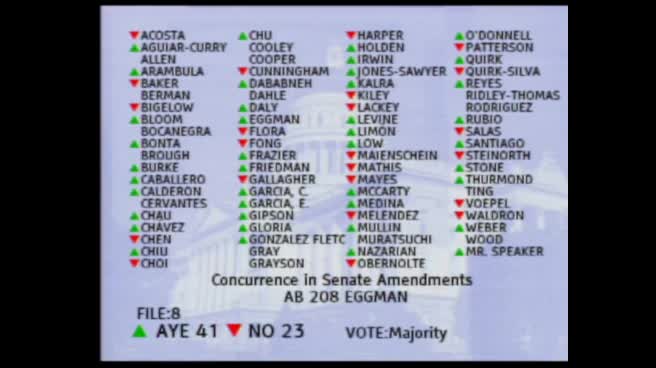 1MIN
Assembly Floor
 4MIN
Senate Floor
 1H
Senate Standing Committee on Appropriations
 10MIN
Assembly Floor
 1H
Assembly Standing Committee on Appropriations
 20MIN
Assembly Standing Committee on Public Safety
 16MIN
Assembly Standing Committee on Public Safety
Bill Author


