AB 1414: Solar energy systems: permits.
- Session Year: 2017-2018
- House: Assembly
- Latest Version Date: 2017-10-15
Existing law, for purposes of provisions governing property rights, defines the term solar energy system to mean any solar collector or other solar energy device whose primary purpose is to provide for the collection, storage, and distribution of solar energy for space heating or cooling, or for water heating, or any structural design feature of a building, whose primary purpose is to provide for the collection, storage, and distribution of solar energy for electricity generation, space heating or cooling, or water heating.
This bill would revise the definition of solar energy system to specify that a design feature additionally includes any photovoltaic device or technology that is integrated into a building, including, but not limited to, photovoltaic windows, siding, and roofing shingles or tiles.
Existing law requires a city, county, or city and county to administratively approve applications to install solar energy systems through the issuance of a building permit or similar nondiscretionary permit. Existing law, until January 1, 2018, prohibits permit fees for rooftop solar energy systems that produce direct current electricity, as specified, by a city, county, city and county, or charter city from exceeding the estimated reasonable cost of providing the service for which the fee is charged, which cannot exceed $500 plus $15 per kilowatt for each kilowatt above 15kW for residential permits and, for commercial permits, $1,000 for systems up to 50kW plus $7 per kW for each kW between 51kW and 250kW, plus $5 per kW for each kW above 250kW. Existing law authorizes permit fees that exceed these charges if, as part of a written finding and adopted resolution or ordinance, the city, county, city and county, or charter city provides substantial evidence, as specified, of the reasonable cost to issue the permit.
This bill would extend the applicability of the above-described limit on fees to all solar energy systems and would extend the repeal date to January 1, 2025. This bill would revise and reduce the maximum permit fees, as specified, for photovoltaic and thermal systems. This bill would authorize permit fees that exceed these charges if the city, county, city and county, or charter city provides substantial evidence, as part of a written finding and adopted resolution or ordinance, of the reasonable cost to issue the permit. The bill would require the written finding to include consideration of any reduction in permit or inspection costs. By requiring local agencies to perform additional duties for an extended period, the bill would impose a state-mandated local program.
The California Constitution requires the state to reimburse local agencies and school districts for certain costs mandated by the state. Statutory provisions establish procedures for making that reimbursement.
This bill would provide that no reimbursement is required by this act for a specified reason.
Existing law, for purposes of provisions governing property rights, defines the term solar energy system to mean any solar collector or other solar energy device whose primary purpose is to provide for the collection, storage, and distribution of solar energy for space heating or cooling, or for water heating, or any structural design feature of a building, whose primary purpose is to provide for the collection, storage, and distribution of solar energy for electricity generation, space heating or cooling, or water heating.
This bill would revise the definition of solar energy system to specify that a design feature additionally includes any photovoltaic device or technology that is integrated into a building, including, but not limited to, photovoltaic windows, siding, and roofing shingles or tiles.
Existing law requires a city, county, or city and county to administratively approve applications to install solar energy systems through the issuance of a building permit or similar nondiscretionary permit. Existing law, until January 1, 2018, prohibits permit fees for rooftop solar energy systems that produce direct current electricity, as specified, by a city, county, city and county, or charter city from exceeding the estimated reasonable cost of providing the service for which the fee is charged, which cannot exceed $500 plus $15 per kilowatt for each kilowatt above 15kW for residential permits and, for commercial permits, $1,000 for systems up to 50kW plus $7 per kW for each kW between 51kW and 250kW, plus $5 per kW for each kW above 250kW. Existing law authorizes permit fees that exceed these charges if, as part of a written finding and adopted resolution or ordinance, the city, county, city and county, or charter city provides substantial evidence, as specified, of the reasonable cost to issue the permit.
This bill would extend the applicability of the above-described limit on fees to all solar energy systems and would extend the repeal date to January 1, 2025. This bill would revise and reduce the maximum permit fees, as specified, for photovoltaic and thermal systems. This bill would authorize permit fees that exceed these charges if the city, county, city and county, or charter city provides substantial evidence, as part of a written finding and adopted resolution or ordinance, of the reasonable cost to issue the permit and the duration of the charge for this excess amount is not more than 5 years from the date of the adoption of the resolution or ordinance that first established the permit fee. permit. The bill would require the written finding to include consideration of any reduction in permit or inspection costs. By requiring local agencies to perform additional duties for an extended period, the bill would impose a state-mandated local program.
The California Constitution requires the state to reimburse local agencies and school districts for certain costs mandated by the state. Statutory provisions establish procedures for making that reimbursement.
This bill would provide that no reimbursement is required by this act for a specified reason.
Existing law, for purposes of provisions governing property rights, defines the term solar energy system to mean any solar collector or other solar energy device whose primary purpose is to provide for the collection, storage, and distribution of solar energy for space heating or cooling, or for water heating, or any structural design feature of a building, whose primary purpose is to provide for the collection, storage, and distribution of solar energy for electricity generation, space heating or cooling, or water heating.
This bill would revise the definition of solar energy system to specify that a design feature additionally includes any photovoltaic device or technology that is integrated into a building, including, but not limited to, photovoltaic windows, siding, and roofing shingles or tiles.
Existing law requires a city, county, or city and county to administratively approve applications to install solar energy systems through the issuance of a building permit or similar nondiscretionary permit. Existing law, until January 1, 2018, prohibits permit fees for rooftop solar energy systems that produce direct current electricity, as specified, by a city, county, city and county, or charter city from exceeding the estimated reasonable cost of providing the service for which the fee is charged, which cannot exceed $500 plus $15 per kilowatt for each kilowatt above 15kW for residential permits and, for commercial permits, $1,000 for systems up to 50kW plus $7 per kW for each kW between 51kW and 250kW, plus $5 per kW for each kW above 250kW. Existing law authorizes permit fees that exceed these charges if, as part of a written finding and adopted resolution or ordinance, the city, county, city and county, or charter city provides substantial evidence, as specified, of the reasonable cost to issue the permit.
This bill would extend the applicability of the above-described limit on fees to all solar energy systems and would extend the repeal date to January 1, 2025. This bill would revise and reduce the maximum permit fees, as specified, for photovoltaic and thermal systems. This bill would authorize permit fees that exceed these charges if the city, county, city and county, or charter city provides substantial evidence, as part of a written finding and adopted resolution or ordinance, of the reasonable cost to issue the permit and the duration of the charge for this excess amount is not more than 5 years from the date of the adoption of the resolution or ordinance that first established the permit fee. The bill would require this ordinance to fully describe the permitting process, including requirements for electronic submission, with electronic signature, of permit applications and supporting materials and single inspection requirements for small residential rooftop solar energy systems. The bill would require the written finding to include consideration of any reduction in permit or inspection costs. By requiring local agencies to perform additional duties for an extended period, the bill would impose a state-mandated local program.
The California Constitution requires the state to reimburse local agencies and school districts for certain costs mandated by the state. Statutory provisions establish procedures for making that reimbursement.
This bill would provide that no reimbursement is required by this act for a specified reason.
Existing law requires a city, county, or city and county to administratively approve applications to install solar energy systems through the issuance of a building permit or similar nondiscretionary permit. Existing law, until January 1, 2018, prohibits permit fees for rooftop solar energy systems that produce direct current electricity, as specified, by a city, county, city and county, or charter city from exceeding the estimated reasonable cost of providing the service for which the fee is charged, which cannot exceed $500 plus $15 per kilowatt for each kilowatt above 15kW for residential permits and, for commercial permits, $1,000 for systems up to 50kW plus $7 per kW for each kW between 51kW and 250kW, plus $5 per kW for each kW above 250kW. Existing law authorizes permit fees that exceed these charges if, as part of a written finding and adopted resolution or ordinance, the city, county, city and county, or charter city provides substantial evidence, as specified, of the reasonable cost to issue the permit.
This bill would extend the applicability of the above-described limit on fees to all solar energy systems and would remove extend the repeal date, thus continuing these provisions in effect indefinitely. date to January 1, 2025. This bill would revise and reduce the maximum permit fees, as specified, for photovoltaic and thermal systems. This bill would authorize permit fees that exceed these charges if the city, county, city and county, or charter city provides substantial evidence, as part of a written finding and adopted resolution or ordinance, of the reasonable cost to issue the permit and the duration of the charge for this excess amount is not more than two 5 years from the date of the adoption of the resolution or ordinance that first established the permit fee. The bill would require this ordinance to fully describe the permitting process, including requirements for electronic submission, with electronic signature, of permit applications and supporting materials and single inspection requirements for small residential rooftop solar energy systems. The bill would require this the written finding to include consideration of any reduction in permit or inspection costs. By requiring local agencies to perform additional duties indefinitely, for an extended period, the bill would impose a state-mandated local program.
The California Constitution requires the state to reimburse local agencies and school districts for certain costs mandated by the state. Statutory provisions establish procedures for making that reimbursement.
This bill would provide that no reimbursement is required by this act for a specified reason.
Existing law requires a city, county, or city and county to administratively approve applications to install solar energy systems through the issuance of a building permit or similar nondiscretionary permit. Existing law, until January 1, 2018, prohibits permit fees for rooftop solar energy systems that produce direct current electricity, as specified, by a city, county, city and county, or charter city from exceeding the estimated reasonable cost of providing the service for which the fee is charged, which cannot exceed $500 plus $15 per kilowatt for each kilowatt above 15kW for residential permits and, for commercial permits, $1,000 for systems up to 50kW plus $7 per kW for each kW between 51kW and 250kW, plus $5 per kW for each kW above 250kW. Existing law authorizes permit fees that exceed these charges if, as part of a written finding and adopted resolution or ordinance, the city, county, city and county, or charter city provides substantial evidence, as specified, of the reasonable cost to issue the permit.
This bill would extend the applicability of the above-described limit on fees to all solar energy systems and would remove the repeal date, thus continuing these provisions in effect indefinitely. This bill would revise and reduce the maximum permit fees, as specified, for photovoltaic and thermal systems. This bill would authorize commercial permit fees that exceed these charges if the city, county, city and county, or charter city provides substantial evidence, as part of a written finding and adopted resolution or ordinance, of the reasonable cost to issue the permit and the duration of the charge for this excess amount is not more than two years from the date of the adoption of the resolution or ordinance that first established the permit fee. The bill would require this ordinance to fully describe the permitting process, including requirements for electronic submission, with electronic signature, of permit applications and supporting materials and single inspection requirements for small residential rooftop solar energy systems. The bill would require this written finding to include consideration of any reduction in permit or inspection costs. By requiring local agencies to perform additional duties indefinitely, the bill would impose a state-mandated local program.
The California Constitution requires the state to reimburse local agencies and school districts for certain costs mandated by the state. Statutory provisions establish procedures for making that reimbursement.
This bill would provide that no reimbursement is required by this act for a specified reason.
(a)The right of receiving sunlight as specified in subdivision 18 of Section 801 shall be referred to as a solar easement. Solar easement means the right of receiving sunlight across real property of another for any solar energy system.
As used in this section, solar energy system means either of the following:
(1)Any solar collector or other solar energy device whose primary purpose is to provide for the collection, storage, and distribution of solar energy for space heating, space cooling, electric generation, or water heating.
(2)A structural design feature of a building, including either of the following:
(A)Any design feature whose primary purpose is to provide for the collection, storage, and distribution of solar energy for electricity generation, space heating or cooling, or for water heating.
(B)Any photovoltaic device or technology that is integrated into a building, including, but not limited to, photovoltaic windows, siding, and roofing shingles or tiles.
(b)Any instrument creating a solar easement shall include, at a minimum, all of the following:
(1)A description of the dimensions of the easement expressed in measurable terms, such as vertical or horizontal angles measured in degrees, or the hours of the day on specified dates during which direct sunlight to a specified surface of a solar collector, device, or structural design feature may not be obstructed, or a combination of these descriptions.
(2)The restrictions placed upon vegetation, structures, and other objects that would impair or obstruct the passage of sunlight through the easement.
(3)The terms or conditions, if any, under which the easement may be revised or terminated.
SEC. 2.The heading of Chapter 7.5 (commencing with Section 66015) of Division 1 of Title 7 of the Government Code is amended to read:7.5.Fees for Solar Energy SystemsSEC. 3.Section 66015 of the Government Code is amended to read:66015.(a)For a residential solar energy system:
(1)A city, county, city and county, or charter city shall not charge a residential permit fee that exceeds the estimated reasonable cost of providing the service for which the fee is charged. Except as provided in paragraph (2), for photovoltaic systems, that fee shall not exceed four hundred fifty dollars ($450) plus fifteen dollars ($15) per kilowatt for each kilowatt above 15kW. Except as provided in paragraph (2), for thermal systems, that fee shall not exceed four hundred fifty dollars ($450) plus fifteen dollars ($15) per kilowatt thermal for each kilowatt thermal above 10kWth.
(2)Notwithstanding paragraph (1), a city, county, city and county, or charter city may charge a residential permit fee for a solar energy system that exceeds the fees specified in paragraph (1) if the city, county, city and county, or charter city, as part of a written finding and an adopted resolution or ordinance, provides substantial evidence of the reasonable cost to issue the permit.
(b)For a commercial solar energy system:
(1)A city, county, city and county, or charter city shall not charge a commercial permit fee that exceeds the estimated reasonable cost of providing the service for which the fee is charged. Except as provided in paragraph (2), for photovoltaic systems, the fee shall not exceed one thousand dollars ($1,000) for systems up to 50kW plus seven dollars ($7) per kilowatt for each kilowatt between 51kW and 250kW, plus five dollars ($5) per kilowatt for each kilowatt above 250kW. Except as provided in paragraph (2), for thermal systems, the fee shall not exceed one thousand dollars ($1,000) for systems up to 30kWth, plus seven dollars ($7) per kilowatt thermal for each kilowatt thermal between 30kWth and 260kWth, plus five dollars ($5) per kilowatt thermal for each kilowatt thermal above 260kWth.
(2)Notwithstanding paragraph (1), a city, county, city and county, or charter city may charge a commercial permit fee for a solar energy system that exceeds the applicable fee specified in paragraph (1) if the city, county, city and county, or charter city, as part of a written finding and an adopted resolution or ordinance, provides substantial evidence of the reasonable cost to issue the permit.
(c)A written finding adopted pursuant to paragraph (2) of subdivision (a) or (b) shall include all of the following:
(1)A determination that the municipality has adopted appropriate ordinances, permit fees, and processes to streamline the submittal and approval of permits for solar energy systems pursuant to the practices and policies in state guidelines, the checklists and standard plans in the California Solar Permitting Guidebook, and model ordinances.
(2)A calculation related to the administrative cost of issuing a solar permit that includes consideration of any reduction in costs to issue the permit or inspect a solar energy system pursuant to Section 65850.5.
(3)A description of how the higher fee will result in a quick and streamlined approval process.
(d)For purposes of this section, administrative costs means the costs incurred in connection with the review, approval, and issuance of the permit, and the hourly site inspection and followup costs, and may also include an amortization of the costs incurred in connection with producing a written finding and adopting an ordinance or resolution pursuant to subdivision (a) or (b).
(e)For purposes of this section, residential permit fee means the sum of all charges levied by a city, county, city and county, or charter city in connection with the application for a solar energy system.
(f)For purposes of this section, solar energy system has the same meaning as defined in Section 801.5 of the Civil Code.
(g)It is the intent of the Legislature that a city, county, city and county, or charter city that meets the obligations of subdivisions (a) and (b) receive priority access to state funds for the purposes of distributed energy generation planning, permitting, training, or implementation.
(h)This section shall remain in effect only until January 1, 2025, and as of that date is repealed.
SEC. 4.No reimbursement is required by this act pursuant to Section 6 of Article XIIIB of the California Constitution because a local agency or school district has the authority to levy service charges, fees, or assessments sufficient to pay for the program or level of service mandated by this act, within the meaning of Section 17556 of the Government Code.
(a)The right of receiving sunlight as specified in subdivision 18 of Section 801 shall be referred to as a solar easement. Solar easement means the right of receiving sunlight across real property of another for any solar energy system.
As used in this section, solar energy system means either of the following:
(1)Any solar collector or other solar energy device whose primary purpose is to provide for the collection, storage, and distribution of solar energy for space heating, space cooling, electric generation, or water heating.
(2)A structural design feature of a building, including either of the following:
(A)Any design feature whose primary purpose is to provide for the collection, storage, and distribution of solar energy for electricity generation, space heating or cooling, or for water heating.
(B)Any photovoltaic device or technology that is integrated into a building, including, but not limited to, photovoltaic windows, siding, and roofing shingles or tiles.
(b)Any instrument creating a solar easement shall include, at a minimum, all of the following:
(1)A description of the dimensions of the easement expressed in measurable terms, such as vertical or horizontal angles measured in degrees, or the hours of the day on specified dates during which direct sunlight to a specified surface of a solar collector, device, or structural design feature may not be obstructed, or a combination of these descriptions.
(2)The restrictions placed upon vegetation, structures, and other objects that would impair or obstruct the passage of sunlight through the easement.
(3)The terms or conditions, if any, under which the easement may be revised or terminated.
SEC. 2.The heading of Chapter 7.5 (commencing with Section 66015) of Division 1 of Title 7 of the Government Code is amended to read:7.5.Fees for Solar Energy SystemsSEC. 3.Section 66015 of the Government Code is amended to read:66015.(a)For a residential solar energy system:
(1)A city, county, city and county, or charter city shall not charge a residential permit fee that exceeds the estimated reasonable cost of providing the service for which the fee is charged. Except as provided in paragraph (2), for photovoltaic systems, that fee shall not exceed four hundred fifty dollars ($450) plus fifteen dollars ($15) per kilowatt for each kilowatt above 15kW. Except as provided in paragraph (2), for thermal systems, that fee shall not exceed four hundred fifty dollars ($450) plus fifteen dollars ($15) per kilowatt thermal for each kilowatt thermal above 10kWth.
(2)Notwithstanding paragraph (1), a city, county, city and county, or charter city may charge a residential permit fee for a solar energy system that exceeds the fees specified in paragraph (1) if both of the following conditions are met:
(A)The the city, county, city and county, or charter city, as part of a written finding and an adopted resolution or ordinance, provides substantial evidence of the reasonable cost to issue the permit.
(B)The duration of the charge for this excess amount is not more than five years from the date of adoption of the resolution or ordinance that first establishes the residential permit fee.(b)For a commercial solar energy system:
(1)A city, county, city and county, or charter city shall not charge a commercial permit fee that exceeds the estimated reasonable cost of providing the service for which the fee is charged. Except as provided in paragraph (2), for photovoltaic systems, the fee shall not exceed one thousand dollars ($1,000) for systems up to 50kW plus seven dollars ($7) per kilowatt for each kilowatt between 51kW and 250kW, plus five dollars ($5) per kilowatt for each kilowatt above 250kW. Except as provided in paragraph (2), for thermal systems, the fee shall not exceed one thousand dollars ($1,000) for systems up to 30kWth, plus seven dollars ($7) per kilowatt thermal for each kilowatt thermal between 30kWth and 260kWth, plus five dollars ($5) per kilowatt thermal for each kilowatt thermal above 260kWth.
(2)Notwithstanding paragraph (1), a city, county, city and county, or charter city may charge a commercial permit fee for a solar energy system that exceeds the applicable fee specified in paragraph (1) if both of the following conditions are met:
(A)The the city, county, city and county, or charter city, as part of a written finding and an adopted resolution or ordinance, provides substantial evidence of the reasonable cost to issue the permit.
(B)The duration of the charge for this excess amount is not more than five years from the date of adoption of the resolution or ordinance that first establishes the commercial permit fee.(c)A written finding adopted pursuant to paragraph (2) of subdivision (a) or (b) shall include all of the following:
(1)A determination that the municipality has adopted appropriate ordinances, permit fees, and processes to streamline the submittal and approval of permits for solar energy systems pursuant to the practices and policies in state guidelines, the checklists and standard plans in the California Solar Permitting Guidebook, and model ordinances.
(2)A calculation related to the administrative cost of issuing a solar permit that includes consideration of any reduction in costs to issue the permit or inspect a solar energy system pursuant to Section 65850.5.
(3)A description of how the higher fee will result in a quick and streamlined approval process.
(d)For purposes of this section, administrative costs means the costs incurred in connection with the review, approval, and issuance of the permit, and the hourly site inspection and followup costs, and may also include an amortization of the costs incurred in connection with producing a written finding and adopting an ordinance or resolution pursuant to subdivision (a) or (b).
(e)For purposes of this section, residential permit fee means the sum of all charges levied by a city, county, city and county, or charter city in connection with the application for a solar energy system.
(f)For purposes of this section, solar energy system has the same meaning as defined in Section 801.5 of the Civil Code.
(g)It is the intent of the Legislature that a city, county, city and county, or charter city that meets the obligations of subdivisions (a) and (b) receive priority access to state funds for the purposes of distributed energy generation planning, permitting, training, or implementation.
(h)This section shall remain in effect only until January 1, 2025, and as of that date is repealed.
SEC. 4.No reimbursement is required by this act pursuant to Section 6 of Article XIIIB of the California Constitution because a local agency or school district has the authority to levy service charges, fees, or assessments sufficient to pay for the program or level of service mandated by this act, within the meaning of Section 17556 of the Government Code.
(a)The right of receiving sunlight as specified in subdivision 18 of Section 801 shall be referred to as a solar easement. Solar easement means the right of receiving sunlight across real property of another for any solar energy system.
As used in this section, solar energy system means either of the following:
(1)Any solar collector or other solar energy device whose primary purpose is to provide for the collection, storage, and distribution of solar energy for space heating, space cooling, electric generation, or water heating.
(2)A structural design feature of a building, including either of the following:
(A)Any design feature whose primary purpose is to provide for the collection, storage, and distribution of solar energy for electricity generation, space heating or cooling, or for water heating.
(B)Any photovoltaic device or technology that is integrated into a building, including, but not limited to, photovoltaic windows, siding, and roofing shingles or tiles.
(b)Any instrument creating a solar easement shall include, at a minimum, all of the following:
(1)A description of the dimensions of the easement expressed in measurable terms, such as vertical or horizontal angles measured in degrees, or the hours of the day on specified dates during which direct sunlight to a specified surface of a solar collector, device, or structural design feature may not be obstructed, or a combination of these descriptions.
(2)The restrictions placed upon vegetation, structures, and other objects that would impair or obstruct the passage of sunlight through the easement.
(3)The terms or conditions, if any, under which the easement may be revised or terminated.
SEC. 2.The heading of Chapter 7.5 (commencing with Section 66015) of Division 1 of Title 7 of the Government Code is amended to read:7.5.Fees for Solar Energy SystemsSEC. 3.Section 66015 of the Government Code is amended to read:66015.(a)For a residential solar energy system:
(1)A city, county, city and county, or charter city shall not charge a residential permit fee that exceeds the estimated reasonable cost of providing the service for which the fee is charged. Except as provided in paragraph (2), for photovoltaic systems, that fee shall not exceed four hundred fifty dollars ($400) ($450) plus fifteen dollars ($15) per kilowatt for each kilowatt above 15kW. Except as provided in paragraph (2), for thermal systems, that fee shall not exceed four hundred fifty dollars ($400) ($450) plus fifteen dollars ($15) per kilowatt thermal for each kilowatt thermal above 10kWth.
(2)Notwithstanding paragraph (1), a city, county, city and county, or charter city may charge a residential permit fee for a solar energy system that exceeds the fees specified in paragraph (1) if both of the following conditions are met:
(A)The city, county, city and county, or charter city, as part of a written finding and an adopted resolution or ordinance, provides substantial evidence of the reasonable cost to issue the permit.
(B)The duration of the charge for this excess amount is not more than five years from the date of adoption of the resolution or ordinance that first establishes the residential permit fee.
(b)For a commercial solar energy system:
(1)A city, county, city and county, or charter city shall not charge a commercial permit fee that exceeds the estimated reasonable cost of providing the service for which the fee is charged. Except as provided in paragraph (2), for photovoltaic systems, the fee shall not exceed one thousand dollars ($1,000) for systems up to 50kW plus seven dollars ($7) per kilowatt for each kilowatt between 51kW and 250kW, plus five dollars ($5) per kilowatt for each kilowatt above 250kW. Except as provided in paragraph (2), for thermal systems, the fee shall not exceed one thousand dollars ($1,000) for systems up to 30kWth, plus seven dollars ($7) per kilowatt thermal for each kilowatt thermal between 30kWth and 260kWth, plus five dollars ($5) per kilowatt thermal for each kilowatt thermal above 260kWth.
(2)Notwithstanding paragraph (1), a city, county, city and county, or charter city may charge a commercial permit fee for a solar energy system that exceeds the applicable fee specified in paragraph (1) if both of the following conditions are met:
(A)The city, county, city and county, or charter city, as part of a written finding and an adopted resolution or ordinance, provides substantial evidence of the reasonable cost to issue the permit.
(B)The duration of the charge for this excess amount is not more than five years from the date of adoption of the resolution or ordinance that first establishes the commercial permit fee.
(c)An ordinance adopted pursuant to paragraph (2) of subdivision (a) shall fully describe the permitting process, including requirements for electronic submission, with electronic signature, of a permit application and supporting materials and single inspection requirements for small residential rooftop solar energy systems pursuant to subdivisions (g) and (h) of Section 65850.5.(d)(c)A written finding adopted pursuant to paragraph (2) of subdivision (a) or (b) shall include all of the following:
(1)A determination that the municipality has adopted appropriate ordinances, permit fees, and processes to streamline the submittal and approval of permits for solar energy systems pursuant to the practices and policies in state guidelines, the checklists and standard plans in the California Solar Permitting Guidebook, and model ordinances.
(2)A calculation related to the administrative cost of issuing a solar permit that includes consideration of any reduction in costs to issue the permit or inspect a solar energy system pursuant to Section 65850.5.
(3)A description of how the higher fee will result in a quick and streamlined approval process.
(e)(d)For purposes of this section, administrative costs means the costs incurred in connection with the review, approval, and issuance of the permit, and the hourly site inspection and followup costs, and may also include an amortization of the costs incurred in connection with producing a written finding and adopting an ordinance or resolution pursuant to subdivision (a) or (b).
(f)(e)For purposes of this section, residential permit fee means the sum of all charges levied by a city, county, city and county, or charter city in connection with the application for a solar energy system.
(g)(f)For purposes of this section, solar energy system has the same meaning as defined in Section 801.5 of the Civil Code.
(h)(g)It is the intent of the Legislature that a city, county, city and county, or charter city that meets the obligations of subdivisions (a) and (b) receive priority access to state funds for the purposes of distributed energy generation planning, permitting, training, or implementation.
(i)(h)This section shall remain in effect only until January 1, 2025, and as of that date is repealed.
SEC. 4.No reimbursement is required by this act pursuant to Section 6 of Article XIIIB of the California Constitution because a local agency or school district has the authority to levy service charges, fees, or assessments sufficient to pay for the program or level of service mandated by this act, within the meaning of Section 17556 of the Government Code.
(a)The right of receiving sunlight as specified in subdivision 18 of Section 801 shall be referred to as a solar easement. Solar easement means the right of receiving sunlight across real property of another for any solar energy system.
As used in this section, solar energy system means either of the following:
(1)Any solar collector or other solar energy device whose primary purpose is to provide for the collection, storage, and distribution of solar energy for space heating, space cooling, electric generation, or water heating.
(2)Any A structural design feature of a building, whose including either of the following:
(A)Any design feature whose primary purpose is to provide for the collection, storage, and distribution of solar energy for electricity generation, space heating or cooling, or for water heating.
(B)Any photovoltaic device or technology that is integrated into a building, including, but not limited to, photovoltaic windows, siding, and roofing shingles or tiles.
(b)Any instrument creating a solar easement shall include, at a minimum, all of the following:
(1)A description of the dimensions of the easement expressed in measurable terms, such as vertical or horizontal angles measured in degrees, or the hours of the day on specified dates during which direct sunlight to a specified surface of a solar collector, device, or structural design feature may not be obstructed, or a combination of these descriptions.
(2)The restrictions placed upon vegetation, structures, and other objects that would impair or obstruct the passage of sunlight through the easement.
(3)The terms or conditions, if any, under which the easement may be revised or terminated.
SECTION 1.SEC. 2.The heading of Chapter 7.5 (commencing with Section 66015) of Division 1 of Title 7 of the Government Code is amended to read:7.5.Fees for Solar Energy SystemsSEC. 2.SEC. 3.Section 66015 of the Government Code is amended to read:66015.(a)For a residential solar energy system:
(1)A city, county, city and county, or charter city shall not charge a residential permit fee that exceeds the estimated reasonable cost of providing the service for which the fee is charged. Except as provided in paragraph (2), for photovoltaic systems, that fee shall not exceed four hundred dollars ($400) plus fifteen dollars ($15) per kilowatt for each kilowatt above 15kW. Except as provided in paragraph (2), for thermal systems, that fee shall not exceed four hundred dollars ($400) plus fifteen dollars ($15) per kilowatt thermal for each kilowatt thermal above 10kWth.
(2)Notwithstanding paragraph (1), a city, county, city and county, or charter city may charge a residential permit fee for a solar energy system that exceeds the fees specified in paragraph (1) if both of the following conditions are met:
(A)The city, county, city and county, or charter city, as part of a written finding and an adopted resolution or ordinance, provides substantial evidence of the reasonable cost to issue the permit.
(B)The duration of the charge for this excess amount is not more than five years from the date of adoption of the resolution or ordinance that first establishes the residential permit fee.
(b)For a commercial solar energy system:
(1)A city, county, city and county, or charter city shall not charge a commercial permit fee that exceeds the estimated reasonable cost of providing the service for which the fee is charged. Except as provided in paragraph (2), for photovoltaic systems, the fee shall not exceed one thousand dollars ($1,000) for systems up to 50kW plus seven dollars ($7) per kilowatt for each kilowatt between 51kW and 250kW, plus five dollars ($5) per kilowatt for each kilowatt above 250kW. Except as provided in paragraph (2), for thermal systems, the fee shall not exceed one thousand dollars ($1,000) for systems up to 30kWth, plus seven dollars ($7) per kilowatt thermal for each kilowatt thermal between 30kWth and 260kWth, plus five dollars ($5) per kilowatt thermal for each kilowatt thermal above 260kWth.
(2)Notwithstanding paragraph (1), a city, county, city and county, or charter city may charge a commercial permit fee for a solar energy system that exceeds the applicable fee specified in paragraph (1) if both of the following conditions are met:
(A)The city, county, city and county, or charter city, as part of a written finding and an adopted resolution or ordinance, provides substantial evidence of the reasonable cost to issue the permit.
(B)The duration of the charge for this excess amount is not more than five years from the date of adoption of the resolution or ordinance that first establishes the commercial permit fee.
(c)An ordinance adopted pursuant to paragraph (2) of subdivision (a) shall fully describe the permitting process, including requirements for electronic submission, with electronic signature, of a permit application and supporting materials and single inspection requirements for small residential rooftop solar energy systems pursuant to subdivisions (g) and (h) of Section 65850.5.
(d) A written finding adopted pursuant to paragraph (2) of subdivision (a) or (b) shall include all of the following:
(1)A determination that the municipality has adopted appropriate ordinances, permit fees, and processes to streamline the submittal and approval of permits for solar energy systems pursuant to the practices and policies in state guidelines, the checklists and standard plans in the California Solar Permitting Guidebook, and model ordinances.
(2)A calculation related to the administrative cost of issuing a solar permit that includes consideration of any reduction in costs to issue the permit or inspect a solar energy system pursuant to Section 65850.5.
(3)A description of how the higher fee will result in a quick and streamlined approval process.
(e) For purposes of this section, administrative costs means the costs incurred in connection with the review, approval, and issuance of the permit, and the hourly site inspection and followup costs, and may also include an amortization of the costs incurred in connection with producing a written finding and adopting an ordinance or resolution pursuant to subdivision (a) or (b).
(f) For purposes of this section, residential permit fee means the sum of all charges levied by a city, county, city and county, or charter city in connection with the application for a solar energy system.
(g)For purposes of this section, solar energy system has the same meaning as defined in Section 801.5 of the Civil Code.
(g)(h)It is the intent of the Legislature that a city, county, city and county, or charter city that meets the obligations of subdivisions (a) and (b) receive priority access to state funds for the purposes of distributed energy generation planning, permitting, training, or implementation.
(h)(i)This section shall remain in effect only until January 1, 2025, and as of that date is repealed.
SEC. 3.SEC. 4.No reimbursement is required by this act pursuant to Section 6 of Article XIIIB of the California Constitution because a local agency or school district has the authority to levy service charges, fees, or assessments sufficient to pay for the program or level of service mandated by this act, within the meaning of Section 17556 of the Government Code.
(a)For a residential solar energy system:
(1)A city, county, city and county, or charter city shall not charge a residential permit fee that exceeds the estimated reasonable cost of providing the service for which the fee is charged. Except as provided in paragraph (2), for photovoltaic systems, that fee shall not exceed three hundred fifty dollars ($350) four hundred dollars ($400) plus fifteen dollars ($15) per kilowatt for each kilowatt above 15kW. Except as provided in paragraph (2), for thermal systems, that fee shall not exceed three hundred fifty dollars ($350) four hundred dollars ($400) plus fifteen dollars ($15) per kilowatt thermal for each kilowatt thermal above 10kWth.
(2)Notwithstanding paragraph (1), a city, county, city and county, or charter city may charge a residential permit fee for a solar energy system that exceeds the fees specified in paragraph (1) if, if both of the following conditions are met:
(A)The city, county, city and county, or charter city, as part of a written finding and an adopted resolution or ordinance, it provides substantial evidence of the reasonable cost to issue the permit and the permit.
(B)The duration of the charge for this excess amount is not more than two five years from the date of adoption of the resolution or ordinance that first establishes the residential permit fee.
(b)For a commercial solar energy system:
(1)A city, county, city and county, or charter city shall not charge a commercial permit fee that exceeds the estimated reasonable cost of providing the service for which the fee is charged. Except as provided in paragraph (2), for photovoltaic systems, the fee shall not exceed one thousand dollars ($1,000) for systems up to 50kW plus seven dollars ($7) per kilowatt for each kilowatt between 51kW and 250kW, plus five dollars ($5) per kilowatt for each kilowatt above 250kW. Except as provided in paragraph (2), for thermal systems, the fee shall not exceed one thousand dollars ($1,000) for systems up to 30kWth, plus seven dollars ($7) per kilowatt thermal for each kilowatt thermal between 30kWth and 260kWth, plus five dollars ($5) per kilowatt thermal for each kilowatt thermal above 260kWth.
(2)Notwithstanding paragraph (1), a city, county, city and county, or charter city may charge a commercial permit fee for a solar energy system that exceeds the applicable fee specified in paragraph (1) if, if both of the following conditions are met:
(A)The city, county, city and county, or charter city, as part of a written finding and an adopted resolution or ordinance, it provides substantial evidence of the reasonable cost to issue the permit and the permit.
(B)The duration of the charge for this excess amount is not more than two five years from the date of adoption of the resolution or ordinance that first establishes the commercial permit fee.
(c)An ordinance adopted pursuant to paragraph (2) of subdivision (a) shall fully describe the permitting process, including requirements for electronic submission, with electronic signature, of a permit application and supporting materials and single inspection requirements for small residential rooftop solar energy systems pursuant to subdivisions (g) and (h) of Section 65850.5.
(d) A written finding adopted pursuant to paragraph (2) of subdivision (a) or (b) shall include all of the following:
(1)A determination that the municipality has adopted appropriate ordinances, permit fees, and processes to streamline the submittal and approval of permits for solar energy systems pursuant to the practices and policies in state guidelines, the checklists and standard plans in the California Solar Permitting Guidebook, and model ordinances.
(2)A calculation related to the administrative cost of issuing a solar permit that includes consideration of any reduction in costs to issue the permit or inspect a solar energy system pursuant to Section 65850.5.
(3)A description of how the higher fee will result in a quick and streamlined approval process.
(e) For purposes of this section, administrative costs means the costs incurred in connection with the review, approval, and issuance of the permit, and the hourly site inspection and followup costs, and may also include an amortization of the costs incurred in connection with producing a written finding and adopting an ordinance or resolution pursuant to subdivision (a) or (b).
(f) For purposes of this section, residential permit fee means the sum of all charges levied by a city, county, city and county, or charter city in connection with the application for a solar energy system.
(g)It is the intent of the Legislature that a city, county, city and county, or charter city that meets the obligations of subdivisions (a) and (b) receive priority access to state funds for the purposes of distributed energy generation planning, permitting, training, or implementation.
(h)This section shall remain in effect only until January 1, 2025, and as of that date is repealed.
SEC. 3.No reimbursement is required by this act pursuant to Section 6 of Article XIIIB of the California Constitution because a local agency or school district has the authority to levy service charges, fees, or assessments sufficient to pay for the program or level of service mandated by this act, within the meaning of Section 17556 of the Government Code.
(a)For a residential solar energy system:
(1)A city, county, city and county, or charter city shall not charge a residential permit fee that exceeds the estimated reasonable cost of providing the service for which the fee is charged. Except as provided in paragraph (2), for photovoltaic systems, that fee shall not exceed three hundred fifty dollars ($350) plus fifteen dollars ($15) per kilowatt for each kilowatt above 15kW. Except as provided in paragraph (2), for thermal systems, that fee shall not exceed three hundred fifty dollars ($350) plus fifteen dollars ($15) per kilowatt thermal for each kilowatt thermal above 10kWth.
(2)Notwithstanding paragraph (1), a city, county, city and county, or charter city may charge a residential permit fee for a solar energy system that exceeds the fees specified in paragraph (1) if, as part of a written finding and an adopted resolution or ordinance, it provides substantial evidence of the reasonable cost to issue the permit. permit and the duration of the charge for this excess amount is not more than two years from the date of adoption of the resolution or ordinance that first establishes the residential permit fee.
(b)For a commercial solar energy system:
(1)A city, county, city and county, or charter city shall not charge a commercial permit fee that exceeds the estimated reasonable cost of providing the service for which the fee is charged. Except as provided in paragraph (2), for photovoltaic systems, the fee shall not exceed one thousand dollars ($1,000) for systems up to 50kW plus seven dollars ($7) per kilowatt for each kilowatt between 51kW and 250kW, plus five dollars ($5) per kilowatt for each kilowatt above 250kW. Except as provided in paragraph (2), for thermal systems, the fee shall not exceed one thousand dollars ($1,000) for systems up to 30kWth, plus seven dollars ($7) per kilowatt thermal for each kilowatt thermal between 30kWth and 260kWth, plus five dollars ($5) per kilowatt thermal for each kilowatt thermal above 260kWth.
(2)Notwithstanding paragraph (1), a city, county, city and county, or charter city may charge a commercial permit fee for a solar energy system that exceeds the applicable fee specified in paragraph (1) if, as part of a written finding and an adopted resolution or ordinance, it provides substantial evidence of the reasonable cost to issue the permit and the duration of the charge for this excess amount is not more than two years from the date of adoption of the resolution or ordinance that first establishes the commercial permit fee.
(c)An ordinance adopted pursuant to paragraph (2) of subdivision (a) or (b) shall fully describe the permitting process, including requirements for electronic submission, with electronic signature, of a permit application and supporting materials and single inspection requirements for small residential rooftop solar energy systems pursuant to subdivisions (g) and (h) of Section 65850.5.
(d)A written finding adopted pursuant to paragraph (2) of subdivision (a) or (b) shall include all of the following:
(1)A determination that the municipality has adopted appropriate ordinances, permit fees, and processes to streamline the submittal and approval of permits for solar energy systems pursuant to the practices and policies in state guidelines, the checklists and standard plans in the California Solar Permitting Guidebook, and model ordinances.
(2)A calculation related to the administrative cost of issuing a solar permit that includes consideration of any reduction in costs to issue the permit or inspect a solar energy system pursuant to Section 65850.5.
(3)A description of how the higher fee will result in a quick and streamlined approval process.
(e)For purposes of this section, administrative costs means the costs incurred in connection with the review, approval, and issuance of the permit, and the hourly site inspection and followup costs, and may also include an amortization of the costs incurred in connection with producing a written finding and adopting an ordinance or resolution pursuant to subdivision (a) or (b).
(f)For purposes of this section, residential permit fee means the sum of all charges levied by a city, county, city and county, or charter city in connection with the application for a solar energy system.
(g)It is the intent of the Legislature that a city, county, city and county, or charter city that meets the obligations of subdivisions (a) and (b) receive priority access to state funds for the purposes of distributed energy generation planning, permitting, training, or implementation.
SEC. 3.No reimbursement is required by this act pursuant to Section 6 of Article XIIIB of the California Constitution because a local agency or school district has the authority to levy service charges, fees, or assessments sufficient to pay for the program or level of service mandated by this act, within the meaning of Section 17556 of the Government Code.
(a)For a residential rooftop solar energy system that produces direct current electricity: system:
(1)A city, county, city and county, or charter city shall not charge a residential permit fee that exceeds the estimated reasonable cost of providing the service for which the fee is charged. Except as provided in paragraph (2), for photovoltaic systems, that fee shall not exceed five hundred three hundred fifty dollars ($500) ($350) plus fifteen dollars ($15) per kilowatt for each kilowatt above 15kW. Except as provided in paragraph (2), for thermal systems, that fee shall not exceed three hundred fifty dollars ($350) plus fifteen dollars ($15) per kilowatt thermal for each kilowatt thermal above 10kWth.
(2)Notwithstanding paragraph (1), a city, county, city and county, or charter city may charge a residential permit fee for a rooftop solar energy system that exceeds the fees specified in paragraph (1) if, as part of a written finding and an adopted resolution or ordinance, it provides substantial evidence of the reasonable cost to issue the permit.
(b)For a commercial rooftop solar energy system that produces direct current electricity: system:
(1)A city, county, city and county, or charter city shall not charge a commercial permit fee that exceeds the estimated reasonable cost of providing the service for which the fee is charged. Except as provided in paragraph (2), for photovoltaic systems, the fee shall not exceed one thousand dollars ($1,000) for systems up to 50kW plus seven dollars ($7) per kilowatt for each kilowatt between 51kW and 250kW, plus five dollars ($5) per kilowatt for each kilowatt above 250kW. Except as provided in paragraph (2), for thermal systems, the fee shall not exceed one thousand dollars ($1,000) for systems up to 30kWth, plus seven dollars ($7) per kilowatt thermal for each kilowatt thermal between 30kWth and 260kWth, plus five dollars ($5) per kilowatt thermal for each kilowatt thermal above 260 kWth.
(2)Notwithstanding paragraph (1), a city, county, city and county, or charter city may charge a commercial permit fee for a rooftop solar energy system that exceeds the applicable fee specified in paragraph (1) if, as part of a written finding and an adopted resolution or ordinance, it provides substantial evidence of the reasonable cost to issue the permit. permit and the duration of the charge for this excess amount is not more than two years from the date of adoption of the resolution or ordinance that first establishes the commercial permit fee.
(c)An ordinance adopted pursuant to paragraph (2) of subdivision (a) or (b) shall fully describe the permitting process, including requirements for electronic submission, with electronic signature, of a permit application and supporting materials and single inspection requirements for small residential rooftop solar energy systems pursuant to subdivisions (g) and (h) of Section 65850.5.
(c)(d)A written finding adopted pursuant to paragraph (2) of subdivision (a) or (b) shall include all of the following:
(1)A determination that the municipality has adopted appropriate ordinances, permit fees, and processes to streamline the submittal and approval of permits for solar energy systems pursuant to the practices and policies in state guidelines guidelines, the checklists and standard plans in the California Solar Permitting Guidebook, and model ordinances.
(2)A calculation related to the administrative cost of issuing a solar rooftop permit. permit that includes consideration of any reduction in costs to issue the permit or inspect a solar energy system pursuant to Section 65850.5.
(3)A description of how the higher fee will result in a quick and streamlined approval process.
(d)(e)For purposes of this section, administrative costs means the costs incurred in connection with the review, approval, and issuance of the permit, and the hourly site inspection and followup costs, and may also include an amortization of the costs incurred in connection with producing a written finding and adopting an ordinance or resolution pursuant to subdivision (a) or (b).
(e)(f)For purposes of this section, residential permit fee means the sum of all charges levied by a city, county, city and county, or charter city in connection with the application for a rooftop solar energy system.
(f)(g)It is the intent of the Legislature that a city, county, city and county, or charter city that meets the obligations of subdivisions (a) and (b) receive priority access to state funds for the purposes of distributed energy generation planning, permitting, training, or implementation.
(g)This chapter shall remain in effect only until January 1, 2018, and as of that date is repealed.SEC. 3.No reimbursement is required by this act pursuant to Section 6 of Article XIIIB of the California Constitution because a local agency or school district has the authority to levy service charges, fees, or assessments sufficient to pay for the program or level of service mandated by this act, within the meaning of Section 17556 of the Government Code.
|
Date
|
Status
|
|---|---|
| Oct 15, 2017 | Chaptered by Secretary of State - Chapter 849, Statutes of 2017. |
| Oct 15, 2017 | Approved by the Governor. |
| Sep 19, 2017 | Enrolled and presented to the Governor at 3 p.m. |
| Sep 11, 2017 | Senate amendments concurred in. To Engrossing and Enrolling. |
| Sep 6, 2017 | In Assembly. Concurrence in Senate amendments pending. May be considered on or after September 8 pursuant to Assembly Rule 77. |
| Sep 6, 2017 | Read third time. Passed. Ordered to the Assembly. |
| Aug 22, 2017 | Read second time. Ordered to third reading. |
| Aug 21, 2017 | From committee: Be ordered to second reading pursuant to Senate Rule 28.8. |
| Jul 20, 2017 | From committee chair, with author's amendments: Amend, and re-refer to committee. Read second time, amended, and re-referred to Com. on APPR. |
| Jul 13, 2017 | In committee: Set, first hearing. Hearing canceled at the request of author. |
| Jul 11, 2017 | From committee chair, with author's amendments: Amend, and re-refer to committee. Read second time, amended, and re-referred to Com. on APPR. |
| Jul 5, 2017 | From committee: Do pass and re-refer to Com. on APPR. (Ayes 6. Noes 1.) (July 5). Re-referred to Com. on APPR. |
| Jun 14, 2017 | From committee chair, with author's amendments: Amend, and re-refer to committee. Read second time, amended, and re-referred to Com. on GOV. & F. |
| Jun 8, 2017 | Referred to Com. on GOV. & F. |
| May 30, 2017 | In Senate. Read first time. To Com. on RLS. for assignment. |
| May 30, 2017 | Read third time. Passed. Ordered to the Senate. (Ayes 61. Noes 12. Page 1799.) |
| May 25, 2017 | Read second time. Ordered to third reading. |
| May 24, 2017 | From committee: Do pass. (Ayes 13. Noes 3.) (May 24). |
| May 17, 2017 | In committee: Hearing postponed by committee. |
| Apr 26, 2017 | Re-referred to Com. on APPR. |
| Apr 25, 2017 | Read second time and amended. |
| Apr 24, 2017 | From committee: Amend, and do pass as amended and re-refer to Com. on APPR. (Ayes 5. Noes 3.) (April 19). |
| Mar 23, 2017 | Re-referred to Com. on L. GOV. |
| Mar 22, 2017 | From committee chair, with author's amendments: Amend, and re-refer to Com. on L. GOV. Read second time and amended. |
| Mar 20, 2017 | Referred to Com. on L. GOV. |
| Feb 19, 2017 | From printer. May be heard in committee March 21. |
| Feb 17, 2017 | Read first time. To print. |
|
Date
|
Description
|
Location
|
Votes
|
|
|---|---|---|---|---|
| Sep 11, 2017 | AB 1414 FRIEDMAN Concurrence in Senate Amendments | Assembly Floor |
Passed |
|
| Sep 6, 2017 | Assembly 3rd Reading AB1414 Friedman By McGuire | Senate Floor |
Passed |
|
| Jul 5, 2017 | Do pass, but first be re-referred to the Committee on [Appropriations] | Senate Standing Committee on Governance and Finance |
Passed |
|
| May 30, 2017 | AB 1414 FRIEDMAN Assembly Third Reading | Assembly Floor |
Passed |
|
| May 24, 2017 | Do pass. | Assembly Standing Committee on Appropriations |
Passed |
|
| Apr 19, 2017 | Do pass as amended and be re-referred to the Committee on [Appropriations] | Assembly Standing Committee on Local Government |
Passed |
This list shows positions taken on this bill by organizations on the date displayed, which is linked to the original source.
Positions by individuals are not included.
|
Organization
|
Position
|
Date
|
|---|---|---|
| American Planning Association California | ** Against | Aug 23, 2017 |
| Audubon California | ** Support | Aug 23, 2017 |
| California League Of Conservation Voters | ** Support | Aug 23, 2017 |
| California Solar Energy Industries Association | ** Support | Aug 23, 2017 |
| California State Association Of Counties | ** Against | Aug 23, 2017 |
| Center for Sustainable Energy | ** Support | Aug 23, 2017 |
| Coalition For Clean Air | ** Support | Aug 23, 2017 |
| Environment California | ** Support | Aug 23, 2017 |
| Greater San Fernando Valley Chamber of Commerce | ** Support | Aug 23, 2017 |
| League Of California Cities | ** Against | Aug 23, 2017 |
| Rural County Representatives of California | ** Against | Aug 23, 2017 |
| Sierra Club California | ** Support | Aug 23, 2017 |
| Silicon Valley Leadership Group | ** Support | Aug 23, 2017 |
| Solar City | ** Support | Aug 23, 2017 |
| Sunrun | ** Support | Aug 23, 2017 |
| Tesla | ** Support | Aug 23, 2017 |
| Urban Counties of California | ** Against | Aug 23, 2017 |
| VALLEY INDUSTRY AND COMMERCE ASSOCIATION | ** Support | Aug 23, 2017 |
| Voices for Progress | ** Support | Aug 23, 2017 |
CONCURRENCE IN SENATE AMENDMENTS
CSA1 Bill Id:AB 1414
Author:(Friedman)
As Amended Ver:July 20, 2017
Majority vote
ASSEMBLY: | 61-12 | (May 30, 2017) | SENATE: | 29-11 | (September 6, 2017) |
Original Committee Reference: L. GOV.
SUMMARY: Reduces the maximum permit fee a city or a county may charge for residential rooftop solar energy systems, applies these caps and commercial permit fee caps to a broader range of solar energy systems, and makes additional changes to existing law governing permit fees for rooftop solar energy systems and to the Solar Rights Act of 1978.
The Senate amendments:
- Change the meaning of "solar energy system" within the definition of "solar easement" provided in the Solar Rights Act of 1978 (Solar Rights Act), to specify that a "solar energy system" includes any photovoltaic (PV) device or technology that is integrated into a building, including, but not limited to, PV windows, siding, and roofing shingles or tiles.
- Add a cross-reference to the amended definition of "solar energy system" described in 1), above, to apply to the provisions of this bill.
- Change the bill's reduction of the maximum permit fee that a city or a county may charge for a solar energy system from $400 to $450.
- Strike language that prohibited the duration of excess permit fees from extending more than five years from the date of adoption of the resolution or ordinance that first establishes the excess fee.
- Strike language that required an ordinance adopted for excess permit fees to fully describe the permitting process, including requirements for electronic submission, with electronic signature, of a permit application and supporting materials and single inspection requirements for small residential rooftop solar energy systems pursuant to specified existing law.
FISCAL EFFECT: According to the Senate Appropriations Committee, pursuant to Senate Rule 28.8, negligible state costs.
COMMENTS:
- Bill Summary. This bill makes a number of changes to existing law governing permit fees for rooftop solar energy systems. This bill expands a provision that prohibits cities and counties from charging a fee that exceeds the estimated reasonable cost of providing the service for which the fee is charged when permitting PV rooftop solar energy systems, by applying this prohibition to solar energy systems generally. This change additionally encompasses installations of PV energy systems on areas other than a rooftop, and installations of solar thermal systems.
This bill also reduces the maximum allowable permit fee that a city or a county may charge for a residential rooftop solar energy system. The existing fee cap is $500. This bill reduces the fee cap to $450. This bill also applies this cap beyond rooftop solar PV installations only, to include any PV systems and solar thermal systems, with specified size limitations. This bill maintains the existing permit fee cap of $1,000 on commercial rooftop solar energy systems, but also applies this cap beyond rooftop solar PV installations to include PV systems generally and solar thermal systems, also with specified size limitations.
This bill continues to allow a city or a county to charge a permit fee that exceeds the specified caps if the city or county makes a written finding and adopts a resolution or ordinance that provides substantial evidence of the reasonable cost to issue the permit. However, this bill requires additional elements in the written finding. This bill extends the January 1, 2018, sunset date in existing law governing permit fees for rooftop solar energy systems to January 1, 2025, thereby making those provisions as amended by this bill effective until that time.
This bill also amends the meaning of "solar energy system" within the Solar Rights Act's definition of "solar easement," to specify that a "solar energy system" includes any PV device or technology that is integrated into a building, including, but not limited to, PV windows, siding, and roofing shingles or tiles. The bill adds a cross-reference to this amended definition, to apply to the provisions of this bill. This bill is sponsored by the author.
- Author's Statement. According to the author, "In California's 540 local jurisdictions solar permitting costs vary widely – even for the exact same system in neighboring cities. To encourage access to solar across all income levels and in all communities, to drive down the costs of solar, and to help meet the state's clean energy and climate goals, SB 1222 (Leno), Chapter 614, in 2012 capped residential and commercial permit fees for rooftop solar PV systems at $500, and at $1,000 for systems 15 kW and 50 kW, respectively. Additionally, SB 1222, which sunsets in 2018, authorized higher fees for larger systems and for those jurisdictions that adopted a streamlined permit process based on state-sanctioned best practices.
"However, based on data from the California Solar Energy Industries Association (CALSEIA), building permit fees for residential rooftop solar installations continue to vary widely – from $0 up to $850, with an average fee of roughly $350. As the installed cost of solar has decreased, more Californians across the economic spectrum are going solar. Since 2014, 53% of residential solar installations were in zip codes with median incomes of $55,000 - $70,000 per year. Despite this progress, the 'soft costs' of installation, including permitting and interconnection, have not decreased as rapidly as hardware costs and continue to be a barrier to greater solar adoption. According to the Lawrence Berkeley National Laboratory, these soft costs comprise over half of total installation costs. Reducing permit fees will help drive down the overall costs for all types of solar installations and increase the accessibility of solar to even more Californians."
- Background. The California Legislature enacted the Solar Rights Act in 1978 to protect a homeowner's right to install a solar energy system by limiting a homeowner association's ability to object to such installations through its covenants, conditions and restrictions (CC&Rs). The Solar Rights Act allows CC&Rs to include provisions that impose reasonable restrictions on solar energy systems. Reasonable restrictions include those that: do not significantly increase the cost of the solar system; do not significantly decrease the system's efficiency or specified performance; and, allow for an alternative system of comparable cost, efficiency and benefits.
AB 2473 (Wolk), Chapter 789, Statutes of 2004, updated the Solar Rights Act by specifying standards for what constitutes "significant" increases in solar energy system costs or decreases in those systems' efficiency. The bill also declared that solar energy system installation is a matter of statewide concern, and made a local government's grant of permission to install a solar energy system ministerial rather than discretionary, unless the permitting agency has good cause to believe doing so would create an adverse impact on public health or safety, in which case an application for a discretionary permit may be required. The local government cannot refuse to approve that application unless it makes detailed written findings based on substantial evidence that granting the permit will create specific adverse impacts on public health or safety. If conditions are placed on an approval to mitigate public health or safety impacts, the required mitigation must be designed to accomplish its goal at the lowest possible cost.
- Solar Easements and Definition of Solar Energy System. The Solar Rights Act also established the legal right to a solar easement to protect access to sunlight across adjacent properties, and defined which solar energy systems are covered by its provisions. The Solar Rights Act currently defines "solar energy system" to mean either of the following:
- Any solar collector or other solar energy device whose primary purpose is to provide for the collection, storage, and distribution of solar energy for space heating, space cooling, electric generation, or water heating; or,
- Any structural design feature of a building, whose primary purpose is to provide for the collection, storage, and distribution of solar energy for electricity generation, space heating or cooling, or for water heating.
- Local Permit Fees. Current law prohibits local agencies from charging fees for permit processing and inspection that exceed the reasonable cost of providing the service for which the fee is charged. Fee revenue must only be used to defray the cost of permit processing and enforcement and cannot be used for general revenue purposes.
Proposition 26 amended the California Constitution Article XIII C to broaden the definition of what constitutes a tax to include many payments previously considered fees or charges. The language of Proposition 26 lists seven exceptions to what constitutes a local tax, including three that are relevant to this bill. Article XIII C excludes from the new definition of "tax":
- A charge imposed for a specific benefit conferred or privilege granted directly to the payer that is not provided to those not charged, and which does not exceed the reasonable costs to the local government of conferring the benefit or granting the privilege;
- A charge imposed for a specific government service or product provided directly to the payer that is not provided to those not charged, and which does not exceed the reasonable costs to the local government of providing the service or product; and,
- A charge imposed for the reasonable regulatory costs to a local government for issuing licenses and permits, performing investigations, inspections, and audits, enforcing agricultural marketing orders, and the administrative enforcement and adjudication thereof.
Proposition 26 also added the following language regarding the burden of proof: "The local government bears the burden of proving by a preponderance of the evidence that a levy, charge, or other exaction is not a tax, that the amount is not more than necessary to cover the reasonable costs of governmental activity, and that the manner in which those costs are allocated to a payor bear a fair or reasonable relationship to the payor's burdens on, or benefits received from the governmental activity."
- Soft Costs of Solar Energy Systems. It is widely acknowledged that the cost of installing solar energy systems in California and the United States has dropped dramatically over the past decade. Initial reductions were attributed to cheaper solar panels. In recent years, though, this decline has been due to decreasing soft costs. Soft costs include sales taxes, supply chain costs, installer/developer profit, indirect corporate costs, transaction/financing costs, customer acquisition, permitting, and other non-hardware costs. Although soft costs have been declining, they have not dropped as dramatically as hard costs and now account for one-half to two-thirds of the total system price for residential, small and large commercial PV systems.
According to the United States Department of Energy's SunShot Initiative, permit fees constituted a very small percentage of all soft costs during the first half of 2012. Nonetheless, permitting has been identified as a soft cost that can be reduced to help spur additional investment in solar energy systems. According to the 2014 edition of the Solar Guidebook, "While the cost of solar hardware has declined significantly over the past several years, the 'soft' costs including permitting have remained high, in part due to difficult and widely varying permitting requirements in different jurisdictions."
- Solar Energy System Permit Fees. SB 1222 (Leno), Chapter 614, Statutes of 2012, placed caps on the amount of permit fees a city or county can charge for residential or commercial rooftop solar energy systems. For a residential rooftop solar energy system, a city or county may not charge a permit fee that exceeds $500 (plus $15 per kW for each kW above 15kW). SB 1222 bill also prohibited, for a commercial rooftop solar energy system, a city or county from charging a permit fee that exceeds $1,000 for systems up to 50kW (plus $7 kW for each kW between 51kW and 250 kW, and $5 per kW for each kW above 250 kW). These caps are limited specifically to rooftop PV systems, and do not apply to PV systems installed elsewhere on a building, or to solar thermal systems.
SB 1222 allowed a city or county to charge permit fees exceeding these caps, provided the city or county made a written finding and adopted a resolution or ordinance showing substantial evidence of the reasonable cost to issue the permit. SB 1222 contained a sunset date of January 1, 2018.
- Solar Energy System Permit Process. AB 2188 (Muratsuchi), Chapter 521, Statutes of 2014, required every city and county, by September 30, 2015, to adopt an ordinance that creates an expedited, streamlined permitting process for small residential rooftop solar energy systems. AB 2188 defined "small rooftop solar energy systems" as systems that meet all of the following:
- A solar energy system that is no larger than 10 kW alternating current nameplate rating or 30 kW thermal;
- A solar energy system that conforms to all applicable state fire, structural, electrical, and other building codes as adopted or amended by the city, county, or city and county and applicable safety and performance standards established by the California Electrical Code, the Institute of Electrical and Electronics Engineers, and accredited testing laboratories such as Underwriters Laboratories and, where applicable, rules of the Public Utilities Commission regarding safety and reliability;
- A solar energy system that is installed on a single or duplex family dwelling; and,
- A solar panel or module array that does not exceed the maximum legal building height.
AB 2188 required each city and county to develop a checklist of all requirements that allow rooftop solar energy systems to be eligible for expedited review, and requires all complete applications that meet the requirement for expedited review, and meet the requirements of the checklist, to be approved and all permits and authorizations to be issued.
AB 2188 also required each city and county to publish its application checklist and document requirements on a publicly accessible Internet Web site if the local agency maintains one, and to allow for the electronic signature on all forms, applications and other documents. In developing its ordinance, each city or county must substantially conform its expedited, streamlined permitting process with the recommendations for expedited permitting, including the checklists and standard plans contained in the most current version of the Solar Guidebook adopted by the Governor's Office of Planning and Research.
A city or county is allowed to adopt an ordinance that modifies the checklists and standards found in the Solar Guidebook due to unique climactic, geological, seismological, or topographical conditions. If a city or county determines that it is unable to authorize the acceptance of an electronic signature on all documents in lieu of a wet signature, the city or county must state, in the required ordinance, the reasons for its inability to accept electronic signatures. In this case, acceptance of an electronic signature is not required.
AB 2188 required all cities and counties to accept permit applications and all associated documents via email, the internet, or facsimile. The bill also specified that only one inspection is required for small residential rooftop solar energy systems that qualify for expedited review, as specified.
- Solar Thermal vs. PV. Solar thermal electric energy generation concentrates the light from the sun to create heat. This heat is used to run a heat engine, which turns a generator to make electricity. The working fluid that is heated by the concentrated sunlight can be a liquid or a gas. Different working fluids include water, oil, salts, air, nitrogen, helium, etc. Different engine types include steam engines, gas turbines, Stirling engines, etc. All of these engines can be quite efficient, often between 30% and 40%, and are capable of producing 10's to 100's of megawatts of power. Solar thermal power is usually used for water heating.
PV energy conversion directly converts the sun's light into electricity. This means that solar panels are only effective during daylight hours because storing electricity is not a particularly efficient process. Heat storage is a far easier and efficient method, which is what makes solar thermal so attractive for large-scale energy production. Heat can be stored during the day and then converted into electricity at night. Solar thermal plants that have storage capacities can drastically improve both the economics and the dispatchability of solar electricity.
- Building-Integrated PV. Building-integrated PV (BIPV) are dual-purpose: they serve as both the outer layer of a structure and generate electricity for on-site use or export to the grid. BIPV systems can provide savings in materials and electricity costs, reduce pollution, and add to the architectural appeal of a building. Though they can be added to a structure as a retrofit, the greatest value for BIPV systems is realized by including them in the initial building design. By substituting PV for standard materials during the initial construction, builders can reduce the incremental cost of PV systems and eliminate costs and design issues for separate mounting systems.
BIPV systems are planned during the architectural design stage and are added during initial construction. Building-added PV (BAPV) is planned and built during a retrofit. Both BIPV and BAPV lack the racks and mounting equipment of traditional PV systems. Most designers of integrated solar system will consider the array of solar technologies and their possible uses compared to the specific needs of building occupants. For example, semi-transparent thin-film PV can allow for natural day lighting and solar thermal systems can capture heat energy to generate usable hot water or provide space heating and cooling capacity.
BIPVs have many applications, including facades, glazing and rooftop material that replaces roofing material or, in some cases, the roof itself. Some companies offer an integrated, single-piece solar rooftop made with laminated glass; others offer solar "shingles," which can be mounted in place of regular roof shingles.
- Policy Considerations. The Legislature may wish to consider the following:
- Too Much, Too Soon? SB 1222, which established the existing caps on rooftop solar PV systems, has been in effect for just over four years. SB 2188 has been effective for an even shorter time period, since September of 2015. While the existing sunset date of January 1, 2018, in SB 1222 needs to be addressed this year in order for those provisions to remain in effect, this bill makes greater changes to that law. The Legislature may wish to consider whether the multiple expansions of SB 1222 contained in this bill are appropriate now and all at once, rather than incrementally over time.
- Limits on Types of Solar Installations. Both SB 1222 and AB 2188 contained specific limitations on the types of solar installations that are subject to permit fee caps and expedited permitting. SB 1222 is limited to rooftop PV, while AB 2188 is limited to small residential rooftop PV or solar thermal. While this bill automatically allows higher permit fees for larger systems, the Legislature may wish to consider the impact of applying permit caps to solar thermal systems and to PV installations that are not rooftop systems.
- Arguments in Support. The California Solar Energy Industries Association, in support, writes, "AB 1414 would increase clean energy benefits for California by extending the objectives established in 2012 by SB 1222 (Leno), which sunsets in 2018. SB 1222 set reasonable limits on residential and commercial building permit fees for rooftop solar PV systems. AB 1414 would extend the sunset to 2025 and expand eligible technologies, which will enable greater solar adoption, further reduce greenhouse gases, and support job growth. The bill would also revise and extend existing law regarding solar permit fees charged by local jurisdictions for residential and commercial solar PV and solar thermal projects to ensure reasonable and consistent statewide fees reflecting the costs to issue such permits...
"Unfortunately, the 'soft costs' of solar installation – including permitting and interconnection – still remain stubbornly high comprising over half of total installation costs according to the Lawrence Berkeley National Laboratory. Studies show that as the installed cost of solar decreases, more Californians across the economic spectrum adopt solar. By lowering the solar permit fee cap…AB 1414 will widen the accessibility of solar to even more Californians…California continues to lead the clean energy economy, particularly with innovative solar policies. This bill would reinforce California's leadership."
- Arguments in Opposition. The League of California Cities, California State Association of Counties, Rural County Representatives of California, Urban Counties of California and American Planning Association, California Chapter, in opposition, state, "Under both Proposition 26 and the Mitigation Fee Act, local permit fees may not exceed the reasonable cost of providing the service. Any proposed fee that exceeds the reasonable cost is required to be approved by voters. Permit fees vary by jurisdiction. This variation is due to issues such as the size and type of the solar installation, installations that require multiple on-site inspections until all building requirements are met, additional engineering costs required due to inadequate roof structures, and distance for inspector to travel to building sites. No other cap exists on permit fees because of the recognized need for local government protocols that are sufficient to ensure the safety of the public.
"Local governments should not be required to subsidize permit activities with general funds. Many local governments already lower their building permit fees for solar systems by subsidizing their permit costs with funds from their General Fund. This is an individual decision by the city or county based on local budget priorities. The ordinance proposed in AB 1414 does not alleviate our concerns. In theory, the ordinance provided for in AB 1414 would allow a city or county to recover costs above the cap. However, these costs are not easily quantifiable ahead of time. A major driver of cost is incomplete plans that require multiple inspections, which a local government cannot control or predict. When combined with the substantial evidence standard with which the ordinance must comply, this process may be unworkable for most cost drivers."
Analysis Prepared by: Angela Mapp / L. GOV. / (916) 319-3958 FN: 0001443
Office of Senate Floor Analyses (916) 651-1520 Fax: (916) 327-4478 | AB |
THIRD READING
Bill No: AB 1414
:
SENATE GOVERNANCE & FIN. COMMITTEE: 6-1, 7/5/17
AYES: McGuire, Nguyen, Beall, Hernandez, Hertzberg, Lara
NOES: Moorlach
SENATE APPROPRIATIONS COMMITTEE: Senate Rule 28.8
ASSEMBLY FLOOR: 61-12, 5/30/17 - See last page for vote
DIGEST:
This bill, until January 1, 2025, lowers a cap on local government permit fees for rooftop solar energy systems and extends the cap to cover solar thermal systems.
Existing law:
- Provides for the adoption and administration of zoning laws, ordinances, rules, and regulations by counties and cities.
- Provides that, notwithstanding any other provision of law, when a local agency charges fees for zoning variances, zoning changes, use permits, building inspections, building permits, and other specified fees, those fees may not exceed the estimated reasonable cost of providing the service for which the fee is charged, unless a question regarding the amount of the fee charged in excess of the estimated reasonable cost of providing the services or materials is submitted to, and approved by, a popular vote of two-thirds of those electors voting on the issue.
- Specifies that the fees listed in 2), above, may include the costs reasonably necessary to prepare and revise the plans and policies that a local agency is required to adopt before it can make any necessary findings and determinations.
- Enacts the Solar Rights Act and declares that it is the policy of the state to promote and encourage the use of solar energy systems and to remove obstacles to their installation.
- Prohibits, for a residential or a commercial rooftop solar photovoltaic (PV) energy system, a city or county from charging a residential or a commercial permit fee that exceeds the estimated reasonable cost of providing the service for which the fee is charged.
- Caps the fees that a city or a county may charge for permit fees for rooftop solar PV energy systems as follows:
- A residential permit fee for a residential rooftop solar energy system may not exceed $500 plus $15 per kilowatt (kW) for each kW above 15kW; and,
- A commercial permit fee for a commercial rooftop solar energy system may not exceed $1,000 for systems up to 50kW plus $7 per kW for each kW between 51kW and 250kW, plus $5 per kW for each kW above 250kW.
- Allows a city or a county to charge a permit fee that exceeds the limits outlined in 6), above if it provides substantial evidence of the reasonable cost to issue the permit, as part of a written finding and an adopted resolution or ordinance. The written finding must include all of the following:
- A determination that the municipality has adopted appropriate ordinances, permit fees, and processes to streamline the submittal and approval of permits for solar energy systems pursuant to the practices and policies in state guidelines and model ordinances;
- A calculation related to the administrative cost of issuing a solar rooftop permit; and,
- A description of how the higher fee will result in a quick and streamlined approval process.
- Repeals the provisions outlined in 5) through 7), above, on January 1, 2018.
- Requires every city or county to adopt an ordinance that creates an expedited permitting process for small, residential rooftop solar energy systems, as specified, and defines "small residential rooftop solar energy system" to mean all of the following:
- A solar energy system that is no larger than 10 kW alternating current nameplate rating or 30 kW thermal;
- A solar energy system that conforms to all applicable state fire, structural, electrical, and other building codes as adopted or amended by the city, county, or city and county and meets all applicable safety and performance standards established by the California Electrical Code, the Institute of Electrical and Electronics Engineers, and accredited testing laboratories such as Underwriters Laboratories and, where applicable, rules of the Public Utilities Commission regarding safety and reliability;
- A solar energy system that is installed on a single or duplex family dwelling; and,
- A solar panel or module array that does not exceed the maximum legal building height as defined by the authority having jurisdiction.
This bill:
- Extends the January 1, 2018, sunset date on the cap on residential and commercial solar PV system permit fees to January 1, 2025, and lowers the cap on residential systems of 15kW or less to $450 (from $500 in existing law).
- Extends the above caps to cover PV systems that are not located on a rooftop and caps permit fees for solar thermal systems. These caps are set at:
- $450 plus $15 per kilowatt thermal (kWth) for each kWth above 10kWth for residential systems.
- $1,000 for commercial systems of up to 30kWth, plus $7 per kWth for each kWth between 30kWth and 260kWth, plus $5 per kWth for each kWth above 260kWth.
- Allows a city, county, or city and county to charge permit fees that exceed these caps if they make a finding supported by substantial evidence that the reasonable cost to issue the permit is higher than these amounts. The ordinance must also take into account any reductions in permitting cost due to adopting the streamlined processes under AB 2188.
- Amends the definition of solar energy system in the Solar Rights Act to include any photovoltaic device or technology that is integrated into a building, including, but not limited to, photovoltaic windows, siding, and roofing shingles or tiles.
Background
The cost of installing solar energy systems in California and the United States has dropped dramatically over the past decade. Initial reductions were attributed to cheaper solar panels. In recent years, though, this decline has been due to decreasing soft costs. Soft costs include sales taxes, supply chain costs, installer and developer profit, indirect corporate costs, transaction and financing costs, customer acquisition, permitting, and other non-hardware costs. Although soft costs have been declining, they have not dropped as dramatically as hard costs. A 2013 Lawrence Berkeley National Laboratory report notes that in 2010, soft costs comprised 50-60% of the total system price for residential solar PV systems.
According to the U.S. Department of Energy, permit fees constitute a very small percentage of all soft costs—on the order of 3%. Nonetheless, permitting has been identified as a soft cost that can be reduced to help spur additional investment in solar energy systems.
In order to address some of the soft costs of solar systems, the Legislature capped building permit fees for residential and commercial rooftop solar energy systems (SB 1222, Leno, Chapter 614, Statutes of 2012). In 2014, the Legislature took steps to further reduce these costs by specifically requiring local governments to streamline their permitting processes for certain solar systems (AB 2188, Muratsuchi, Chapter 521, Statutes of 2014). Despite these measures, some solar firms argue that soft costs remain a barrier to greater adoption of solar energy systems.
Comments
- Purpose of the bill. California has set a goal of procuring 50% of its electricity from renewable sources by 2030. One important way piece of reaching this goal is to facilitate smaller-scale deployments of solar PV and solar thermal energy systems at residential and commercial sites. But California’s 540 cities and counties have widely varying permitting costs and processes that contribute to the “soft costs” of a solar installation. According to a Lawrence Berkeley National Laboratory report, in 2010 the difference between a high-cost jurisdiction and a low cost jurisdiction was as much as 4-12% of the cost of a solar energy system. Recent efforts have attempted to lower these soft costs: SB 1222 (Leno, 2012) capped local government permit fees and AB 2188 (Murasutchi, 2014) required local governments to adopt streamlined permitting processes for small residential systems. However, soft costs have not fallen as quickly as the hard costs—the cost of the technology itself—because not all jurisdictions comply with requirements in state law to streamline permitting of solar energy systems. In addition, SB 1222’s cap on permit fees sunsets on January 1, 2018. AB 1414 addresses these issues through a carrot and stick approach. It lowers residential permit fees to $450 through January 1, 2025 and still allows local governments to charge higher fees if they justify the cost. It also includes previously excluded solar energy systems, including thermal energy systems and photovoltaic systems not mounted on rooftops, under these caps. AB 1414 will preserve the progress that has been made to date on easing the installation of residential and commercial solar installations and ensure greater compliance with laws already on the books.
- The sun never sets. SB 1222 and AB 2188 were designed to directly lower costs the time and effort that solar installers or customers need to put into setting up a solar energy system. From the perspective of solar installers, SB 1222 has succeeded: the median cost of a permit for a rooftop solar energy system in California is $350, according to data provided by the California Solar Energy Industry Association, and only 12 cities or counties have permit fees higher than $500. AB 1414 will force some jurisdictions to lower their fees and use precious General Fund dollars to provide a $50 discount on permit fees for solar energy systems that typically cost tens of thousands of dollars. Furthermore, these costs may not be worth the benefit: because permit fees make up a small fraction of the overall cost of a solar energy system, lowering these fees even further as proposed by AB 1414 may not result in many additional solar system installations over what would have otherwise occurred. Finally, local government fee revenues are already constrained by the California Constitution, which holds that they cannot exceed the reasonable cost of providing the service.
FISCAL EFFECT: Appropriation: Fiscal Com.: Local:
Audubon California
California League of Conservation Voters
California Solar Energy Industries Association
Center for Sustainable Energy
Coalition for Clean Air
Environment California
Greater San Fernando Valley Chamber of Commerce
Sierra Club California
Silicon Valley Leadership Group
Solar City
Sunrun
Tesla
Valley Industry and Commerce Association
Voices for Progress
OPPOSITION: (Verified 8/23/17)
American Planning Association California
California State Association of Counties
League of California Cities
Rural County Representatives of California
Urban Counties of California
ASSEMBLY FLOOR: 61-12, 5/30/17
AYES: Aguiar-Curry, Travis Allen, Arambula, Baker, Berman, Bloom, Bocanegra, Bonta, Burke, Calderon, Cervantes, Chávez, Chiu, Chu, Cooley, Cunningham, Dababneh, Daly, Flora, Fong, Frazier, Friedman, Cristina Garcia, Eduardo Garcia, Gipson, Gloria, Gomez, Gonzalez Fletcher, Gray, Grayson, Harper, Holden, Irwin, Jones-Sawyer, Kalra, Levine, Limón, Low, Maienschein, McCarty, Medina, Mullin, Muratsuchi, Nazarian, O'Donnell, Patterson, Quirk, Quirk-Silva, Reyes, Ridley-Thomas, Rodriguez, Rubio, Salas, Santiago, Steinorth, Mark Stone, Thurmond, Ting, Weber, Wood, Rendon
NOES: Acosta, Bigelow, Brough, Caballero, Dahle, Kiley, Lackey, Mathis,
Melendez, Obernolte, Voepel, Waldron
NO VOTE RECORDED: Chau, Chen, Choi, Cooper, Eggman, Gallagher, Mayes
8/23/17 15:10:12
**** END ****
SENATE COMMITTEE ON GOVERNANCE AND FINANCE
Senator Mike McGuire, Chair
2017 - 2018 Regular
Bill No: | AB 1414 | Hearing Date: | 7/5/17 |
Author: | Friedman | Tax Levy: | No |
Version: | 6/14/17 | Fiscal: | Yes |
Consultant: | Favorini-Csorba | ||
Solar energy systems: permits
Lowers a cap on local government permit fees for rooftop solar energy systems and extends the cap to cover solar thermal systems.
Background
Solar Energy Systems. The Solar Rights Act of 1978 (AB 3250, Levine) established a homeowner’s right to install a solar energy system—defined to include devices or structural design features that collect, store, and distribute solar energy for heating, cooling, and electricity generation—by limiting the ability of a homeowners association or other non-public entity to prohibit such an installation through its covenants, conditions, and restrictions (CC&Rs). The Solar Rights Act allows CC&Rs to include provisions that impose reasonable restrictions on solar energy systems. Reasonable restrictions include those that: do not significantly increase the cost of the solar system; do not significantly decrease the system’s efficiency or specified performance; and, allow for an alternative system of comparable cost, efficiency and benefits. "Significant" is further defined as those restrictions that increase the system’s cost by more than 20% or decrease the system’s efficiency by more than 20%. The Act also limited the authority of a local agency to place unreasonable restrictions on the use of solar energy systems.
In recent years, California has taken further steps to reduce barriers to deploying solar energy systems. The Legislature modified the Solar Rights Act in 2008 to further restrict limits on the installation of solar electricity generation systems and require, in writing, a reason from a homeowners association if denying permission to install a solar energy system on a home (AB 2180, Wolk, 2008). The Legislature also declared solar energy system installation to be a matter of statewide concern, and made a local government's grant of permission to install a solar energy system ministerial rather than discretionary, unless the permitting agency has good cause to believe doing so would create an adverse impact on public health or safety (AB 2473, Wolk, 2004). The local government cannot refuse to approve that application unless it makes detailed written findings based on substantial evidence that granting the permit will create specific adverse impacts on public health or safety. If conditions are placed on an approval to mitigate public health or safety impacts, the required mitigation must be designed to accomplish its goal at the lowest possible cost.
The cost of installing solar energy systems in California and the United States has dropped dramatically over the past decade. Initial reductions were attributed to cheaper solar panels. In recent years, though, this decline has been due to decreasing soft costs. Soft costs include sales taxes, supply chain costs, installer and developer profit, indirect corporate costs, transaction and financing costs, customer acquisition, permitting, and other non-hardware costs. Although soft costs have been declining, they have not dropped as dramatically as hard costs. A 2013 Lawrence Berkeley National Laboratory report notes that in 2010, soft costs comprised 50-60% of the total system price for residential solar PV systems.
According to the U.S. Department of Energy, permit fees constitute a very small percentage of all soft costs—on the order of 3%. Nonetheless, permitting has been identified as a soft cost that can be reduced to help spur additional investment in solar energy systems.
Lower Fees for Solar Permitting. When a local agency charges fees for building permits (or other regulatory fees), Article XIIIC, §1 of the California Constitution prohibits those fees from exceeding the estimated reasonable cost of issuing licenses, administrative costs, and enforcement of the program for which the fee is charged. Building permit fees generally pay for the cost of the project plan examination by city and county departments and on-site inspection, but can also include the costs reasonably necessary to prepare and revise the plans and policies that a local agency is required to adopt before it can make any necessary findings and determinations. Fees charged in excess of the estimated reasonable cost of providing the services are taxes and must be approved by a 2/3 vote of the public.
In order to address some of the soft costs of solar systems, the Legislature capped building permit fees for residential and commercial rooftop solar energy systems (SB 1222, Leno, 2012). Under SB 1222, a city or county, including charter cities, may not charge a permit fee that exceeds the following fees:
Base Fee | Additional Fee | |
Residential | $500 for systems up to 15kW |
|
Commercial | $1,000 for systems up to 50kW |
|
These caps are limited specifically to rooftop photovoltaic (PV) systems that convert solar energy to electricity, and do not apply to PV systems installed elsewhere on a building, or to solar thermal systems. SB 1222 allows a city or county to charge permit fees exceeding these caps, provided the city or county made a written finding and adopted a resolution or ordinance showing substantial evidence of the reasonable cost to issue the permit. The city or county must also include a determination that it has adopted appropriate ordinances to streamline the application and approval process in line with guidelines issued by the Office of Planning and Research (OPR). SB 1222 contained a sunset date of January 1, 2018.
Streamlined Permitting. Although exact procedures vary by location, the approval procedure for a solar permit is similar to the procedure for approving a building permit. Typically, the solar installation company or customer submits an electrical diagram and roof layout plan to the city or county planning department. If the plan is approved, the installer or customer pays a permit fee and starts the installation project.
In 2014, the Legislature took steps to further reduce soft costs by specifically requiring local governments to streamline their permitting processes for certain solar systems (AB 2188, Muratsuchi). AB 2188 requires every city and county, including charter cities, to adopt on or before September 30, 2015 an ordinance that creates an expedited, streamlined permitting process for small residential rooftop solar energy systems, defined as systems that:
- Are no larger than 10 kW for PV systems or 30 kW for thermal systems;
- Meet all building and safety codes as well as local building height requirements, and;
- Are installed on a single family or duplex family dwelling.
AB 2188 requires each city and county to develop a checklist of all requirements that allow rooftop solar energy systems to be eligible for expedited review, and requires all complete applications that meet the requirements of the checklist to be approved. A city or county must publish its application checklist and document requirements on a publicly accessible Internet Web site if the local agency maintains one, and to allow for the electronic signature on all forms, applications and other documents unless the city or county determines that it is unable to accept electronic signatures. Cities and counties must accept permit applications and all associated documents via email, the internet, or fax. The permitting process must generally conform to procedures identified in the “Solar Guidebook” developed by OPR, with modifications allowed only due to unique climactic, geological, seismological, or topographical conditions. Under AB 2188, only one inspection may be required for small residential rooftop solar energy systems that qualify for expedited review.
Despite these measures to reduce soft costs, some solar firms argue that they remain a barrier to greater adoption of solar energy systems. They want the Legislature to extend the duration and lower the amount of the cap on permit fees for solar energy systems, include other types of solar systems under the cap, and add assurances that local governments are streamlining their solar permitting processes.
Proposed Law
Assembly Bill 1414 extends the January 1, 2018, sunset date on the cap on residential and commercial solar PV system permit fees to January 1, 2025, and lowers the cap on residential systems of 15kW or less to $400 (from $500 in existing law). AB 1414 extends these caps to cover PV systems that are not located on a rooftop.
AB 1414 additionally caps permit fees for solar thermal systems. These caps are set at:
- $400 plus $15 per kilowatt thermal (kWth) for each kWth above 10kWth for residential systems.
- $1,000 for commercial systems of up to 30kWth, plus $7 per kWth for each kWth between 30kWth and 260kWth, plus $5 per kWth for each kWth above 260kWth.
AB 1414 allows a city, county, or city and county to charge permit fees that exceed these caps if they make a finding supported by substantial evidence that the reasonable cost to issue the permit is higher than these amounts, and if the duration of the charge for this excess amount is not more than five years from the date of adoption of the resolution or ordinance that first establishes the permit fee. Any ordinance adopting a fee that exceeds the $400 cap for residential solar energy systems must also fully describe the permitting process, including requirements for electronic submission, with electronic signature, of a permit application and supporting materials, as well as compliance with the streamlined permitting process required by AB 2188. The ordinance must also take into account any reductions in permitting cost due to adopting the streamlined processes under AB 2188.
AB 1414 also amends the definition of solar energy system in the Solar Rights Act to include any photovoltaic device or technology that is integrated into a building, including, but not limited to, photovoltaic windows, siding, and roofing shingles or tiles.
State Revenue Impact
No estimate.
Comments
1. Purpose of the bill. California has set a goal of procuring 50% of its electricity from renewable sources by 2030. One important way piece of reaching this goal is to facilitate smaller-scale deployments of solar PV and solar thermal energy systems at residential and commercial sites. But California’s 540 cities and counties have widely varying permitting costs and processes that contribute to the “soft costs” of a solar installation. According to a Lawrence Berkeley National Laboratory report, in 2010 the difference between a high-cost jurisdiction and a low cost jurisdiction was as much as 4-12% of the cost of a solar energy system. Recent efforts have attempted to lower these soft costs: SB 1222 (Leno, 2012) capped local government permit fees and AB 2188 (Murasutchi, 2014) required local governments to adopt streamlined permitting processes for small residential systems. However, soft costs have not fallen as quickly as the hard costs—the cost of the technology itself—because not all jurisdictions comply with requirements in state law to streamline permitting of solar energy systems. In addition, SB 1222’s cap on permit fees sunsets on January 1, 2018. AB 1414 addresses these issues through a carrot and stick approach. It lowers residential permit fees through January 1, 2025 to just above the average fee being charged today, but it allows local governments to charge higher fees if they fully describe their streamlined process under AB 2188. It also includes previously excluded solar energy systems, including thermal energy systems and photovoltaic systems not mounted on rooftops, under these caps. AB 1414 will preserve the progress that has been made to date on easing the installation of residential and commercial solar installations and ensure greater compliance with laws already on the books.
2. The sun never sets. SB 1222 and AB 2188 were designed to directly lower costs the time and effort that solar installers or customers need to put into setting up a solar energy system. From the perspective of solar installers, SB 1222 has succeeded: the median cost of a permit for a rooftop solar energy system in California is $350, according to data provided by the California Solar Energy Industry Association, and only 12 cities or counties have permit fees higher than $500. However, 134 jurisdictions—about a quarter of all cities and counties in the state—have permit fees that exceed the $400 cap established by AB 1414. These jurisdictions face the prospect of lowering their fees and using precious General Fund dollars to provide a $100 discount on permit fees for solar energy systems that typically cost tens of thousands of dollars. Furthermore, these costs may not be worth the benefit: because permit fees make up a small fraction of the overall cost of a solar energy system, lowering these fees even further as proposed by AB 1414 may not result in many additional solar system installations over what would have otherwise occurred. Finally, local government fee revenues are already constrained by the California Constitution, which holds that they cannot exceed the reasonable cost of providing the service. The Committee may wish to consider amending AB 1414 to extend the sunset on the fee caps for residential systems at a higher rate than currently proposed in the bill.
3. Steal my sunshine. Many of the large solar energy system providers have developed sophisticated financial arrangements to take advantage of state and federal tax breaks, help property owners avoid triggering reassessment, and make solar power more affordable compared to buying electricity from the grid. These arrangements often involve leasing a system to a homeowner, who pays a predictable monthly fee that is based on the cost of electricity in the jurisdiction. A utility customer leasing a system may not see all of the line items that undergird this amount, making it difficult for them to see whether or not the savings from reduced permitting costs are being passed onto them. In addition, there is some indication that the residential solar energy market does not behave competitively: according to a 2017 report by the National Renewable Energy Laboratory, the largest 1% of installers accounted for 60% of installed systems, and the prices of large installers were 10% higher than their smaller competitors, contrary to what would be expected due to economies of scale. According to the study, these results point to imperfect competition in this market. As a result, the largest installers may not have an incentive to pass along cost savings to the consumer without competitive pressure. AB 1414 may lower permit fees, but there may be no way to ensure that the customer benefits instead of the installer.
4. Let’s be clear. AB 1414 allows a city or county to increase its solar energy system permit fees above the caps if the duration of the increased charge is no more than five years from the date of adoption of the resolution or ordinance that first establishes the permit fee. However, this provision could be interpreted to only allow a local government to adopt a fee that exceeds the caps in the bill for five years from the date any permit fee for solar energy systems was first imposed—which could have occurred decades ago. In order to ensure that local governments may continue to adopt higher fees if necessary, the Committee may wish to consider amending AB 1414 to delete “first” from the provisions establishing this five year period for the caps.
5. The best disinfectant? Data on other soft costs following the implementation of AB 2188 is limited—the Lawrence Berkeley National Laboratory study on the soft costs of solar energy system permitting used data from 2010, which doesn’t reflect either SB 1222’s or AB 2188’s effects. Supporters of the bill argue that 63% of the cities and counties in California are out of compliance with at least one of AB 2188’s requirements and therefore a tighter linkage between adopting higher fees and compliance with AB 2188 is needed. AB 1414 provides this linkage by requiring local governments to fully describe their permitting process, including how they comply with AB 2188, in order to adopt an ordinance that increases fees over the maximum allowed in state law. However, it is unclear why a jurisdiction that flouts laws already on the books would adhere to the requirements in this bill. Meanwhile, this provision potentially penalizes good actors—some jurisdictions adopt fee schedules for all their fees in a single ordinance or resolution. Fully describing solar permitting in the same ordinance may unnecessarily complicate this process. The Committee may wish to consider amending AB 1414 to delete this duplicative requirement.
6. Mandate. The California Constitution generally requires the state to reimburse local agencies for their costs when the state imposes new programs or additional duties on them. According to the Legislative Counsel’s Office, AB 1414 creates a new state-mandated local program because it extends the period over which local officials would have to perform additional duties. But this bill disclaims the state's responsibility for reimbursing local agencies by including findings and declarations that local agencies may levy fees to cover the costs of the program.
7. Related legislation. AB 546 (Chiu), which the Committee will also hear at its July 5th, 2017 hearing, would require cities and counties to post online any documentation required for permitting of battery-based energy storage systems that are located on the retail side of a utility interconnection.
Assembly Actions
Assembly Local Government Committee: 5-3
Assembly Appropriations Committee: 13-3
Assembly Floor: 61-12
Support and Opposition
(>)
Support: Audubon California; California League of Conservation Voters; California Solar Energy Industries Association; Center for Sustainable Energy; Coalition for Clean Air; Environment California; Greater San Fernando Valley Chamber of Commerce; Sierra Club California; Silicon Valley Leadership Group; Solar City; Sunrun; Tesla; Valley Industry and Commerce Association; Voices for Progress.
Opposition: American Planning Association California; California State Association of Counties; League of California Cities; Rural County Representatives of California; Urban Counties of California.
-- END --
ASSEMBLY THIRD READING
ATR Bill Id:AB 1414
Author:(Friedman)
As Amended Ver:April 25, 2017
Majority vote
Committee | Votes | Ayes | Noes |
Local Government | 5-3 | Aguiar-Curry, Bloom, Gonzalez Fletcher, Grayson, Ridley-Thomas | Waldron, Lackey, Voepel |
Appropriations | 13-3 | Gonzalez Fletcher, Bloom, Bocanegra, Bonta, Gloria, Chau, Quirk, Fong, Friedman, Eduardo Garcia, Jones-Sawyer, Muratsuchi, Reyes | Bigelow, Brough, Obernolte |
SUMMARY: Reduces the maximum permit fee a city or a county may charge for residential rooftop solar energy systems, applies these caps and commercial permit fee caps to a broader range of solar energy systems, and makes additional changes to existing law governing permit fees for rooftop solar energy systems. Specifically, this bill:
- Expands a provision in existing law that prohibits a city, county, city and county, or charter city (city or county) from charging a fee that exceeds the estimated reasonable cost of providing the service for which the fee is charged when permitting a rooftop solar energy system that produces direct current electricity (photovoltaic or "PV" systems), by applying this prohibition to solar energy systems generally (which encompasses installations of PV solar energy systems on areas other than a rooftop, and installations of solar thermal systems).
- Reduces the maximum allowable permit fee that a city or a county may charge for a residential rooftop solar energy system from $500 to $400, and applies this cap to a broader array of residential solar energy system installations as follows:
- For PV systems, the fee shall not exceed $400 plus $15 per kilowatt (kW) for each kW above 15kW; and,
- For thermal systems, the fee shall not exceed $400 plus $15 per kW thermal (kWth) for each kWth above 10kWth.
- Maintains an existing $1,000 cap on commercial rooftop solar energy systems and applies this cap to a broader array of commercial solar energy system installations as follows:
- For PV systems, the fee shall not exceed $1,000 for systems up to 50kW plus $7 per kW for each kW between 51kW and 250kW, plus $5 per kW for each kW above 250kW; and,
- For thermal systems, the fee shall not exceed $1,000 for systems up to 30kWth, plus $7 per kWth for each kWth between 30kWth and 260kWth, plus $5 per kWth for each kWth above 260kWth.
- Maintains an existing provision that allows a city or county to charge a residential or commercial permit fee for a rooftop solar energy system that exceeds the fee caps specified in 2) and 3), above, if the city or county provides substantial evidence of the reasonable cost to issue the permit, as part of a written finding and an adopted resolution or ordinance.
- Prohibits the duration of any excess permit fee specified in 4), above, from extending more than five years from the date of adoption of the resolution or ordinance that first establishes the excess fee.
- Requires an ordinance adopted pursuant to 4), above, for residential solar energy systems to fully describe the permitting process, including requirements for electronic submission, with electronic signature, of a permit application and supporting materials and single inspection requirements for small residential rooftop solar energy systems pursuant to existing law governing expedited permitting for small residential rooftop solar energy systems, as specified.
- Requires a written finding adopted pursuant to 4), above, to include the following:
- A determination that the municipality has adopted appropriate ordinances, permit fees, and processes to streamline the submittal and approval of permits for solar energy systems pursuant to the checklists and standard plans in the California Solar Permitting Guidebook (Solar Guidebook); and,
- A calculation related to the administrative cost of issuing a solar permit that includes consideration of any reduction in costs to issue the permit or inspect a solar energy system pursuant to existing law governing expedited permitting for small residential rooftop solar energy systems, as specified.
- Extends the January 1, 2018, sunset date in existing law governing permit fees for rooftop solar energy systems to January 1, 2025, thereby making those provisions as amended by this bill effective until that time.
- Provides that no reimbursement is required by this bill pursuant to the California Constitution because a local agency has the authority to levy service charges, fees, or assessments sufficient to pay for the program or level of service mandated by this bill.
FISCAL EFFECT: According to the Assembly Appropriations Committee, non-reimbursable costs to cities and counties. Cities and counties have authority to levy fees or service charges to cover their costs.
COMMENTS:
- Bill Summary. This bill makes a number of changes to existing law governing permit fees for rooftop solar energy systems. This bill expands a provision that prohibits cities and counties from charging a fee that exceeds the estimated reasonable cost of providing the service for which the fee is charged when permitting PV rooftop solar energy systems, by applying this prohibition to solar energy systems generally. This change additionally encompasses installations of PV energy systems on areas other than a rooftop, and installations of solar thermal systems.
This bill also reduces the maximum allowable permit fee that a city or a county may charge for a residential rooftop solar energy system. The existing fee cap is $500. This bill reduces the fee cap to $400. This bill also applies this cap beyond rooftop solar PV installations only, to include any PV systems and solar thermal systems, with specified size limitations. This bill maintains the existing permit fee cap of $1,000 on commercial rooftop solar energy systems, but also applies this cap beyond rooftop solar PV installations to include PV systems generally and solar thermal systems, also with specified size limitations.
This bill continues to allow a city or a county to charge a permit fee that exceeds the specified caps if the city or county makes a written finding and adopts a resolution or ordinance that provides substantial evidence of the reasonable cost to issue the permit. However, this bill additionally prohibits the duration of any excess permit fee from extending more than five years from the date the resolution or ordinance that establishes the excess fee is adopted. Effectively, this bill will require cities and counties to revisit any such ordinance every five years.
This bill also requires an excess-permit-fee ordinance for residential solar energy systems to "fully describe the permitting process, including requirements for electronic submission, with electronic signature, of a permit application and supporting materials and single inspection requirements for small residential rooftop solar energy systems" pursuant to existing law that requires expedited permitting for small residential rooftop solar energy systems.
This bill also requires additional elements in the written finding that must be adopted before a city or county can charge permit fees that exceed the caps in existing law and this bill. This bill extends the January 1, 2018, sunset date in existing law governing permit fees for rooftop solar energy systems to January 1, 2025, thereby making those provisions as amended by this bill effective until that time.
This bill is sponsored by the author.
- Author's Statement. According to the author, "In California's 540 local jurisdictions solar permitting costs vary widely – even for the exact same system in neighboring cities. To encourage access to solar across all income levels and in all communities, to drive down the costs of solar, and to help meet the state's clean energy and climate goals, SB 1222 (Leno) in 2012 capped residential and commercial permit fees for rooftop solar PV systems at $500, and at $1,000 for systems 15 kW and 50 kW, respectively. Additionally, SB 1222, which sunsets in 2018, authorized higher fees for larger systems and for those jurisdictions that adopted a streamlined permit process based on state-sanctioned best practices.
"However, based on data from the California Solar Energy Industries Association (CALSEIA), building permit fees for residential rooftop solar installations continue to vary widely – from $0 up to $850, with an average fee of roughly $350. As the installed cost of solar has decreased, more Californians across the economic spectrum are going solar. Since 2014, 53% of residential solar installations were in zip codes with median incomes of $55,000 - $70,000 per year. Despite this progress, the 'soft costs' of installation, including permitting and interconnection, have not decreased as rapidly as hardware costs and continue to be a barrier to greater solar adoption. According to the Lawrence Berkeley National Laboratory, these soft costs comprise over half of total installation costs. Reducing permit fees will help drive down the overall costs for all types of solar installations and increase the accessibility of solar to even more Californians.
"In 2014, another permit-related bill, AB 2188 (Muratsuchi) helped standardize permit requirements for small residential rooftop solar PV and solar thermal systems by requiring local jurisdictions to adopt streamlined requirements based on the California Solar Permitting Guidebook, developed by the Governor's Office of Planning and Research. While many jurisdictions have made progress in complying with AB 2188, others have either not complied or failed to implement important elements (e.g., electronic submittal of permit applications) required by the law, perhaps due to resource constraints. AB 1414 helps address this challenge by authorizing jurisdictions to temporarily impose higher fees in order to recoup the costs of full compliance with AB 2188. Given all of those reasons, AB 1414 revises and extends a critical law that helps lower the cost of solar for homes and businesses across the state. Given the sunset of SB 1222 at the end of 2017, there is a clear urgency to pass AB 1414."
- Background. The California Legislature enacted the Solar Rights Act in 1978 to protect a homeowner's right to install a solar energy system by limiting a homeowner association's ability to object to such installations through its covenants, conditions and restrictions (CC&Rs). The Solar Rights Act allows CC&Rs to include provisions that impose reasonable restrictions on solar energy systems. Reasonable restrictions include those that: do not significantly increase the cost of the solar system; do not significantly decrease the system's efficiency or specified performance; and, allow for an alternative system of comparable cost, efficiency and benefits. "Significant" is further defined as those restrictions that increase the system's cost by more than 20% or decrease the system's efficiency by more than 20%.
AB 2473 (Wolk), Chapter 789, Statutes of 2004, updated the Solar Rights Act by specifying standards for what constitutes "significant" increases in solar energy system costs or decreases in those systems' efficiency. The bill also declared that solar energy system installation is a matter of statewide concern, and made a local government's grant of permission to install a solar energy system ministerial rather than discretionary, unless the permitting agency has good cause to believe doing so would create an adverse impact on public health or safety, in which case an application for a discretionary permit may be required. The local government cannot refuse to approve that application unless it makes detailed written findings based on substantial evidence that granting the permit will create specific adverse impacts on public health or safety. If conditions are placed on an approval to mitigate public health or safety impacts, the required mitigation must be designed to accomplish its goal at the lowest possible cost.
In 2005, the California Public Utilities Commission through regulations established subsidy programs for the installation of solar PV systems administered by the California Energy Commission. These programs, known collectively as the California Solar Initiative, provide $3.2 billion in subsidies through rebates for the installation of PV projects. In 2006, the Legislature passed SB 1 (Murray), Chapter 132, Statutes of 2006, the Governor's Million Solar Homes Program, which established the goal of installing 3,000 megawatts of solar generation capacity, establishing a self-sufficient solar industry, and placing PV systems on 50% of new homes in 13 years.
- Local Permit Fees. Current law prohibits local agencies from charging fees for permit processing and inspection that exceed the reasonable cost of providing the service for which the fee is charged. Fee revenue must only be used to defray the cost of permit processing and enforcement and cannot be used for general revenue purposes.
Proposition 26 amended the California Constitution Article XIII C to broaden the definition of what constitutes a tax to include many payments previously considered fees or charges. The language of Proposition 26 lists seven exceptions to what constitutes a local tax, including three that are relevant to this bill. Article XIII C excludes from the new definition of "tax":
- A charge imposed for a specific benefit conferred or privilege granted directly to the payer that is not provided to those not charged, and which does not exceed the reasonable costs to the local government of conferring the benefit or granting the privilege;
- A charge imposed for a specific government service or product provided directly to the payer that is not provided to those not charged, and which does not exceed the reasonable costs to the local government of providing the service or product; and,
- A charge imposed for the reasonable regulatory costs to a local government for issuing licenses and permits, performing investigations, inspections, and audits, enforcing agricultural marketing orders, and the administrative enforcement and adjudication thereof.
Proposition 26 also added the following language regarding the burden of proof: "The local government bears the burden of proving by a preponderance of the evidence that a levy, charge, or other exaction is not a tax, that the amount is not more than necessary to cover the reasonable costs of governmental activity, and that the manner in which those costs are allocated to a payor bear a fair or reasonable relationship to the payor's burdens on, or benefits received from the governmental activity."
- Soft Costs of Solar Energy Systems. It is widely acknowledged that the cost of installing solar energy systems in California and the United States has dropped dramatically over the past decade. Initial reductions were attributed to cheaper solar panels. In recent years, though, this decline has been due to decreasing soft costs. Soft costs include sales taxes, supply chain costs, installer/developer profit, indirect corporate costs, transaction/financing costs, customer acquisition, permitting, and other non-hardware costs. Although soft costs have been declining, they have not dropped as dramatically as hard costs and now account for one-half to two-thirds of the total system price for residential, small and large commercial PV systems.
According to the United States Department of Energy's SunShot Initiative, permit fees constituted a very small percentage of all soft costs during the first half of 2012. Nonetheless, permitting has been identified as a soft cost that can be reduced to help spur additional investment in solar energy systems. According to the 2014 edition of the Solar Guidebook, "While the cost of solar hardware has declined significantly over the past several years, the 'soft' costs including permitting have remained high, in part due to difficult and widely varying permitting requirements in different jurisdictions."
- Solar Energy System Permit Fees. SB 1222 (Leno), Chapter 614, Statutes of 2012, placed caps on the amount of permit fees a city or county can charge for residential or commercial rooftop solar energy systems. For a residential rooftop solar energy system, a city or county may not charge a permit fee that exceeds $500 (plus $15 per kW for each kW above 15kW). SB 1222 bill also prohibited, for a commercial rooftop solar energy system, a city or county from charging a permit fee that exceeds $1,000 for systems up to 50kW (plus $7 kW for each kW between 51kW and 250 kW, and $5 per kW for each kW above 250 kW). These caps are limited specifically to rooftop PV systems, and do not apply to PV systems installed elsewhere on a building, or to solar thermal systems.
SB 1222 allowed a city or county to charge permit fees exceeding these caps, provided the city or county made a written finding and adopted a resolution or ordinance showing substantial evidence of the reasonable cost to issue the permit. SB 1222 contained a sunset date of January 1, 2018.
- Solar Energy System Permit Process. AB 2188 (Muratsuchi), Chapter 521, Statutes of 2014, required every city and county, by September 30, 2015, to adopt an ordinance that creates an expedited, streamlined permitting process for small residential rooftop solar energy systems. AB 2188 defined "small rooftop solar energy systems" as systems that meet all of the following:
- A solar energy system that is no larger than 10 kW alternating current nameplate rating or 30 kW thermal;
- A solar energy system that conforms to all applicable state fire, structural, electrical, and other building codes as adopted or amended by the city, county, or city and county and applicable safety and performance standards established by the California Electrical Code, the Institute of Electrical and Electronics Engineers, and accredited testing laboratories such as Underwriters Laboratories and, where applicable, rules of the Public Utilities Commission regarding safety and reliability;
- A solar energy system that is installed on a single or duplex family dwelling; and,
- A solar panel or module array that does not exceed the maximum legal building height.
AB 2188 required each city and county to develop a checklist of all requirements that allow rooftop solar energy systems to be eligible for expedited review, and requires all complete applications that meet the requirement for expedited review, and meet the requirements of the checklist, to be approved and all permits and authorizations to be issued.
AB 2188 also required each city and county to publish its application checklist and document requirements on a publicly accessible Internet Web site if the local agency maintains one, and to allow for the electronic signature on all forms, applications and other documents. In developing its ordinance, each city or county must substantially conform its expedited, streamlined permitting process with the recommendations for expedited permitting, including the checklists and standard plans contained in the most current version of the Solar Guidebook adopted by the Governor's Office of Planning and Research.
A city or county is allowed to adopt an ordinance that modifies the checklists and standards found in the Solar Guidebook due to unique climactic, geological, seismological, or topographical conditions. If a city or county determines that it is unable to authorize the acceptance of an electronic signature on all documents in lieu of a wet signature, the city or county must state, in the required ordinance, the reasons for its inability to accept electronic signatures. In this case, acceptance of an electronic signature is not required.
AB 2188 required all cities and counties to accept permit applications and all associated documents via email, the internet, or facsimile. The bill also specified that only one inspection is required for small residential rooftop solar energy systems that qualify for expedited review, as specified.
- Solar Thermal vs. Photovoltaic. Solar thermal electric energy generation concentrates the light from the sun to create heat. This heat is used to run a heat engine, which turns a generator to make electricity. The working fluid that is heated by the concentrated sunlight can be a liquid or a gas. Different working fluids include water, oil, salts, air, nitrogen, helium, etc. Different engine types include steam engines, gas turbines, Stirling engines, etc. All of these engines can be quite efficient, often between 30% and 40%, and are capable of producing 10's to 100's of megawatts of power. Solar thermal power is usually used for water heating.
Photovoltaic, or PV energy conversion, directly converts the sun's light into electricity. This means that solar panels are only effective during daylight hours because storing electricity is not a particularly efficient process. Heat storage is a far easier and efficient method, which is what makes solar thermal so attractive for large-scale energy production. Heat can be stored during the day and then converted into electricity at night. Solar thermal plants that have storage capacities can drastically improve both the economics and the dispatchability of solar electricity.
- Building-Integrated PV. Building-integrated photovoltaics (BIPV) are dual-purpose: they serve as both the outer layer of a structure and generate electricity for on-site use or export to the grid. BIPV systems can provide savings in materials and electricity costs, reduce pollution, and add to the architectural appeal of a building. Though they can be added to a structure as a retrofit, the greatest value for BIPV systems is realized by including them in the initial building design. By substituting PV for standard materials during the initial construction, builders can reduce the incremental cost of PV systems and eliminate costs and design issues for separate mounting systems.
Building-integrated PV systems are planned during the architectural design stage and are added during initial construction. Building-added PV (BAPV) is planned and built during a retrofit. Both BIPV and BAPV lack the racks and mounting equipment of traditional PV systems. Most designers of integrated solar system will consider the array of solar technologies and their possible uses compared to the specific needs of building occupants. For example, semi-transparent thin-film PV can allow for natural day lighting and solar thermal systems can capture heat energy to generate usable hot water or provide space heating and cooling capacity.
BIPVs have many applications, including facades, glazing and rooftop material that replaces roofing material or, in some cases, the roof itself. Some companies offer an integrated, single-piece solar rooftop made with laminated glass; others offer solar "shingles," which can be mounted in place of regular roof shingles.
- Policy Considerations. The Legislature may wish to consider the following:
- Too Much, Too Soon? SB 1222, which established the existing caps on rooftop solar PV systems, has been in effect for just over four years. SB 2188 has been effective for an even shorter time period, since September of 2015. While the existing sunset date of January 1, 2018, in SB 1222 needs to be addressed this year in order for those provisions to remain in effect, this bill makes greater changes to that law. The Legislature may wish to consider whether the multiple expansions of SB 1222 contained in this bill are appropriate now and all at once, rather than incrementally over time.
- Limits on Types of Solar Installations. Both SB 1222 and AB 2188 contained specific limitations on the types of solar installations that are subject to permit fee caps and expedited permitting. SB 1222 is limited to rooftop PV, while AB 2188 is limited to small residential rooftop PV or solar thermal. While this bill automatically allows higher permit fees for larger systems, the Legislature may wish to consider the impact of applying permit caps to solar thermal systems and to PV installations that are not rooftop systems.
- Local Ordinance Limitation. This bill effectively requires cities and counties to revisit every five years any ordinance they adopt to impose permit fees that exceed the caps contained in this bill and current law. The Legislature may wish to consider whether this is a reasonable requirement to place on California's local governments.
- Compliance with AB 2188. The stated intent of this bill is to require cities and counties to comply with the requirements of AB 2188 if they wish to adopt an ordinance that allows them to charge higher permit fees for residential solar energy systems. The language in this bill is unclear with regard to this intent. The Legislature may wish to consider whether this language needs to be clarified.
- Related Legislation. AB 546 (Chiu) of the current legislative session requires cities and counties to accept electronic submissions of permit applications for advanced energy storage installations, and requires the creation of a California Energy Storage Permitting Guidebook. AB 546 is pending in the Assembly.
- Arguments in Support. The California Solar Energy Industries Association, in support, writes, "AB 1414 would increase clean energy benefits for California by extending the objectives established in 2012 by SB 1222 (Leno), which sunsets in 2018. SB 1222 set reasonable limits on residential and commercial building permit fees for rooftop solar photovoltaic (PV) systems. AB 1414 would extend the sunset to 2025 and expand eligible technologies, which will enable greater solar adoption, further reduce greenhouse gases, and support job growth. The bill would also revise and extend existing law regarding solar permit fees charged by local jurisdictions for residential and commercial solar photovoltaic (PV) and solar thermal projects to ensure reasonable and consistent statewide fees reflecting the costs to issue such permits, while incentivizing jurisdictions to streamline and standardize permit requirements.
"AB 1414 would also lower the permit fee cap to $400 for residential installations. Unfortunately, the 'soft costs' of solar installation – including permitting and interconnection – still remain stubbornly high comprising over half of total installation costs according to the Lawrence Berkeley National Laboratory. Studies show that as the installed cost of solar decreases, more Californians across the economic spectrum adopt solar. By lowering the solar permit fee cap to $400 for residential installations, AB 1414 will widen the accessibility of solar to even more Californians.
"This bill will also authorize local jurisdictions to assess permit fees above the $400 cap for residential PV and thermal systems, if they adopt an ordinance to streamline their permitting process consistent with existing law. In 2014, AB 2188 (Muratsuchi) required local jurisdictions to streamline solar permitting processes consistent with the California Solar Permitting Guidebook. Some jurisdictions have yet to comply or have failed to implement important elements of the law. AB 1414 targets this problem and enables jurisdictions to access additional resources to recoup the costs of full compliance with AB 2188. California continues to lead the clean energy economy, particularly with innovative solar policies. This bill would reinforce California’s leadership."
- Arguments in Opposition. The League of California Cities, California State Association of Counties, Rural County Representatives of California, Urban Counties of California and American Planning Association, California Chapter, in opposition, state, "Our organizations support expanding access to renewable energy resources, including solar, however, we are troubled by the proposal to cap permit fees for all solar installations. Local building permit fees can and do vary by jurisdiction due to issues such as the size and type of the solar installation, installations that require multiple on-site inspections until all building requirements are met, additional engineering costs required due to inadequate roof structures, and distance for inspectors to travel to building sites. Aside from rooftop solar, no other cap exists on permit fees because of the recognized need for local government protocols that are sufficient to ensure the safety of the public. Whether intended or unintended, this measure creates barriers for cities and counties to charge permit fees that cover their costs. We do not believe the state should undermine local decisions by setting the level of the fee in statute.
"The ability of local governments to impose fees are already limited. Under both Proposition 26 and the Mitigation Fee Act, when a local government imposes a permit fee, it may not exceed the estimated reasonable cost of providing the service. If a local government fee exceeds the reasonable cost, then the local government is required to submit the fee to the voters. Cities and counties each set their own fees and many utilize the permit fees that are based on the State Building Standards Code because they find those fees reflect the reasonable costs of providing the related services. In addition, many local governments already lower their building permit fees for solar systems by subsidizing their permit costs with funds from their General Fund. This is an individual decision by the city or county based on local budget priorities.
"California cities and counties have long been supportive of residential solar as a way for community members to be both energy efficient and environmentally friendly. However, we believe a broad cap on permit fees will not be an effective tool. Instead, we believe the Governor's Office of Planning and Research California Solar Permitting Guidebook, as well as guidance from the California County Planning Directors Association on solar energy facility permit streamlining, provides a strong base of information and guidance for local agencies to appropriately permit residential solar systems. While we appreciate the desire to encourage lower building permit fees for solar systems, the approach taken in AB 1414 would hamstring the ability of local governments to inspect and conduct other activities associated with permitting. For these reasons, our organizations oppose AB 1414."
Analysis Prepared by: Angela Mapp / L. GOV. / (916) 319-3958 FN: 0000490
Date of Hearing: May 24, 2017
ASSEMBLY COMMITTEE ON APPROPRIATIONS
Lorena Gonzalez Fletcher, Chair
ABPCA Bill Id:AB 1414
Author:(Friedman) – As Amended Ver:April 25, 2017
Policy Committee: | Local Government | Vote: | 5 - 3 |
|
| ||
|
|
Urgency: No State Mandated Local Program: Yes Reimbursable: No
SUMMARY:
This bill reduces the maximum permit fee a city or a county may charge for residential rooftop solar energy systems, applies these caps and commercial permit fee caps to a broader range of solar energy systems, and makes additional changes to existing law governing permit fees for rooftop solar energy systems. Specifically, this bill:
- Expands existing law that prohibits a city, county, city and county, or charter city (city or county) from charging a fee that exceeds the estimated reasonable cost of providing the service when permitting a rooftop solar energy system that produces direct current electricity (photovoltaic or "PV" systems), by applying this prohibition to solar energy systems generally (which encompasses installations of PV solar energy systems on areas other than a rooftop, and installations of solar thermal systems).
- Reduces the maximum allowable permit fee that a city or a county may charge for a residential rooftop solar energy system from $500 to $400, and applies this cap to a broader array of residential solar energy system installations as specified.
- Maintains an existing $1,000 cap on commercial rooftop solar energy systems and applies this cap to a broader array of commercial solar energy system installations as specified.
- Prohibits the duration of any excess permit fee from extending more than five years from the date of adoption of the resolution or ordinance that first establishes the excess fee.
- Requires an ordinance adopted for residential solar energy systems to fully describe the permitting process, as specified.
- Extends the existing January 1, 2018, sunset date to January 1, 2025.
FISCAL EFFECT:
Non-reimbursable costs to cities and counties. Cities and counties have authority to levy fees or service charges to cover their costs.
COMMENTS:
- Purpose. According to the author, "In California’s 540 local jurisdictions solar permitting costs vary widely – even for the exact same system in neighboring cities. To encourage access to solar across all income levels and in all communities, to drive down the costs of solar, and to help meet the state’s clean energy and climate goals, SB 1222 (Leno) in 2012 capped residential and commercial permit fees for rooftop solar PV systems at $500, and at $1,000 for systems 15 kW and 50 kW, respectively. Additionally, SB 1222, which sunsets in 2018, authorized higher fees for larger systems and for those jurisdictions that adopted a streamlined permit process based on state-sanctioned best practices."
- Background. The California Legislature enacted the Solar Rights Act in 1978 to protect a homeowner’s right to install a solar energy system by limiting a homeowner association's ability to object to such installations through its covenants, conditions and restrictions (CC&Rs). The Solar Rights Act allows CC&Rs to include provisions that impose reasonable restrictions on solar energy systems.
AB 2473 (Wolk), Chapter 789, Statutes of 2004, updated the Solar Rights Act by specifying standards for what constitutes "significant" increases in solar energy system costs or decreases in those systems' efficiency. The bill also declared that solar energy system installation is a matter of statewide concern, and made a local government's grant of permission to install a solar energy system ministerial rather than discretionary. The local government cannot refuse to approve that application unless it makes detailed written findings based on substantial evidence that granting the permit will create specific adverse impacts on public health or safety. If conditions are placed on an approval to mitigate public health or safety impacts, the required mitigation must be designed to accomplish its goal at the lowest possible cost.
In 2005, the California Public Utilities Commission through regulations established subsidy programs for the installation of solar PV systems administered by the California Energy Commission. These programs, known collectively as the California Solar Initiative, have provided $3.2 billion in subsidies through rebates for the installation of PV projects. In 2006, the Legislature passed SB 1 (Murray), Chapter 132, Statutes of 2006, the Governor's Million Solar Homes Program, which established the goal of installing 3,000 megawatts of solar generation capacity, establishing a self-sufficient solar industry, and placing PV systems on 50% of new homes in 13 years.
- Arguments in Support. The California Solar Energy Industries Association, in support, writes, "AB 1414 would increase clean energy benefits for California by making permanent the objectives established in 2012 by SB 1222 (Leno), which sunsets in 2018. SB 1222 set reasonable limits on residential and commercial building permit fees for rooftop solar photovoltaic (PV) systems. AB 1414 would [extend] the 2018 sunset and expand eligible technologies, which will enable greater solar adoption, further reduce greenhouse gases, and support job growth. The bill would also revise and extend existing law regarding solar permit fees charged by local jurisdictions for solar photovoltaic (PV) and solar thermal projects to ensure reasonable and consistent statewide fees reflecting the costs to issue such permits, while incentivizing jurisdictions to streamline and standardize permit requirements."
- Arguments in Opposition. Local government opposition, states, "Our organizations support expanding access to renewable energy resources, including solar, however, we are troubled by the proposal to cap permit fees for all solar installations. Local building permit fees can and do vary by jurisdiction due to issues such as the size and type of the solar installation, installations that require multiple on-site inspections until all building requirements are met, additional engineering costs required due to inadequate roof structures, and distance for inspectors to travel to building sites. Aside from rooftop solar, no other cap exists on permit fees because of the recognized need for local government protocols that are sufficient to ensure the safety of the public. Whether intended or unintended, this measure creates barriers for cities and counties to charge permit fees that cover their costs. We do not believe the state should undermine local decisions by setting the level of the fee in statute."
- Related Legislation. AB 546 (Chiu) requires cities and counties to accept electronic submissions of permit applications for advanced energy storage installations, and requires the creation of a California Energy Storage Permitting Guidebook. This bill is currently in this Committee on Suspense.
Analysis Prepared by: Jennifer Swenson / APPR. / (916) 319-2081
Date of Hearing: April 19, 2017
ASSEMBLY COMMITTEE ON LOCAL GOVERNMENT
Cecilia Aguiar-Curry, Chair
ABPCA Bill Id:AB 1414 (
Author:Friedman) – As Amended Ver:March 22, 2017
SUBJECT: Solar energy systems: permits.
SUMMARY: Reduces the maximum permit fee a city or a county may charge for residential rooftop solar energy systems, applies these caps and commercial permit fee caps to a broader range of solar energy systems, and makes additional changes to existing law governing permit fees for rooftop solar energy systems. Specifically, this bill:
- Expands a provision in existing law that prohibits a city, county, city and county, or charter city (city or county) from charging a fee that exceeds the estimated reasonable cost of providing the service for which the fee is charged when permitting a rooftop solar energy system that produces direct current electricity (photovoltaic or "PV" systems), by applying this prohibition to solar energy systems generally (which encompasses installations of PV solar energy systems on areas other than a rooftop, and installations of solar thermal systems).
- Reduces the maximum allowable permit fee that a city or a county may charge for a residential rooftop solar energy system from $500 to $350, and applies this cap to a broader array of residential solar energy system installations as follows:
- For PV systems, the fee shall not exceed $350 plus $15 per kilowatt (kW) for each kW above 15kW; and,
- For thermal systems, the fee shall not exceed $350 plus $15 per kW thermal (kWth) for each kWth above 10kWth.
- Maintains an existing $1,000 cap on commercial rooftop solar energy systems and applies this cap to a broader array of commercial solar energy system installations as follows:
- For PV systems, the fee shall not exceed $1,000 for systems up to 50kW plus $7 per kW for each kW between 51kW and 250kW, plus $5 per kW for each kW above 250kW; and,
- For thermal systems, the fee shall not exceed $1,000 for systems up to 30kWth, plus $7 per kWth for each kWth between 30kWth and 260kWth, plus $5 per kWth for each kWth above 260kWth.
- Maintains an existing provision that allows a city or county to charge a residential or commercial permit fee for a rooftop solar energy system that exceeds the fee caps specified in 2) and 3), above, if the city or county provides substantial evidence of the reasonable cost to issue the permit, as part of a written finding and an adopted resolution or ordinance.
- Prohibits the duration of any excess permit fee specified in 4), above, from extending more than two years from the date of adoption of the resolution or ordinance that first establishes the excess fee.
- Requires an ordinance adopted pursuant to 4), above, for residential solar energy systems to fully describe the permitting process, including requirements for electronic submission, with electronic signature, of a permit application and supporting materials and single inspection requirements for small residential rooftop solar energy systems pursuant to existing law governing expedited permitting for small residential rooftop solar energy systems, as specified.
- Requires a written finding adopted pursuant to 4), above, to include the following:
- A determination that the municipality has adopted appropriate ordinances, permit fees, and processes to streamline the submittal and approval of permits for solar energy systems pursuant to the checklists and standard plans in the California Solar Permitting Guidebook (Solar Guidebook); and,
- A calculation related to the administrative cost of issuing a solar rooftop permit that includes consideration of any reduction in costs to issue the permit or inspect a solar energy system pursuant to existing law governing expedited permitting for small residential rooftop solar energy systems, as specified.
- Deletes the January 1, 2018, sunset date in existing law governing permit fees for rooftop solar energy systems, thereby making those provisions as amended by this bill permanent.
- Provides that no reimbursement is required by this bill pursuant to the California Constitution because a local agency has the authority to levy service charges, fees, or assessments sufficient to pay for the program or level of service mandated by this bill.
EXISTING LAW:
- Provides for the adoption and administration of zoning laws, ordinances, rules, and regulations by counties and cities.
- Provides that, notwithstanding any other provision of law, when a local agency charges fees for zoning variances, zoning changes, use permits, building inspections, building permits, and other specified fees, those fees may not exceed the estimated reasonable cost of providing the service for which the fee is charged, unless a question regarding the amount of the fee charged in excess of the estimated reasonable cost of providing the services or materials is submitted to, and approved by, a popular vote of two-thirds of those electors voting on the issue.
- Specifies that the fees listed in 2), above, may include the costs reasonably necessary to prepare and revise the plans and policies that a local agency is required to adopt before it can make any necessary findings and determinations.
- Enacts the Solar Rights Act and declares that it is the policy of the state to promote and encourage the use of solar energy systems and to remove obstacles to their installation.
- Prohibits, for a residential or a commercial rooftop solar PV energy system, a city or county from charging a residential or a commercial permit fee that exceeds the estimated reasonable cost of providing the service for which the fee is charged.
- Caps the fees that a city or a county may charge for permit fees for rooftop solar PV energy systems as follows:
- A residential permit fee for a residential rooftop solar energy system may not exceed $500 plus $15 per kW for each kW above 15kW; and,
- A commercial permit fee for a commercial rooftop solar energy system may not exceed $1,000 for systems up to 50kW plus $7 per kW for each kW between 51kW and 250kW, plus $5 per kW for each kW above 250kW.
- Allows a city or a county to charge a permit fee that exceeds the limits outlined in 6), above if it provides substantial evidence of the reasonable cost to issue the permit, as part of a written finding and an adopted resolution or ordinance. The written finding must include all of the following:
- A determination that the municipality has adopted appropriate ordinances, permit fees, and processes to streamline the submittal and approval of permits for solar energy systems pursuant to the practices and policies in state guidelines and model ordinances;
- A calculation related to the administrative cost of issuing a solar rooftop permit; and,
- A description of how the higher fee will result in a quick and streamlined approval process.
- Provides the following definitions for purposes of the provisions outlined in 5) through 7), above:
- "Administrative costs" means the costs incurred in connection with the review, approval, and issuance of the permit, and the hourly site inspection and follow-up costs, and may also include an amortization of the costs incurred in connection with producing a written finding and adopting an ordinance or resolution pursuant to the above provisions; and,
- "Residential permit fee" means the sum of all charges levied by a city or county in connection with the application for a rooftop solar energy system.
- Repeals the provisions outlined in 5) through 8), above, on January 1, 2018.
- Requires every city or county to adopt an ordinance that creates an expedited permitting process for small, residential rooftop solar energy systems, as specified, and defines "small residential rooftop solar energy system" to mean all of the following:
- A solar energy system that is no larger than 10 kW alternating current nameplate rating or 30 kW thermal;
- A solar energy system that conforms to all applicable state fire, structural, electrical, and other building codes as adopted or amended by the city, county, or city and county and meets all applicable safety and performance standards established by the California Electrical Code, the Institute of Electrical and Electronics Engineers, and accredited testing laboratories such as Underwriters Laboratories and, where applicable, rules of the Public Utilities Commission regarding safety and reliability;
- A solar energy system that is installed on a single or duplex family dwelling; and,
- A solar panel or module array that does not exceed the maximum legal building height as defined by the authority having jurisdiction.
FISCAL EFFECT: This bill is keyed fiscal and contains a state-mandated local program.
COMMENTS:
- Bill Summary. This bill makes a number of changes to existing law governing permit fees for rooftop solar energy systems. This bill expands a provision that prohibits cities and counties from charging a fee that exceeds the estimated reasonable cost of providing the service for which the fee is charged when permitting PV rooftop solar energy systems, by applying this prohibition to solar energy systems generally. This change additionally encompasses installations of PV energy systems on areas other than a rooftop, and installations of solar thermal systems.
This bill also reduces the maximum allowable permit fee that a city or a county may charge for a residential rooftop solar energy system. The existing fee cap is $500. This bill reduces the fee cap to $350. This bill also applies this cap beyond rooftop solar PV installations only, to include any PV systems and solar thermal systems, with specified size limitations. This bill maintains the existing permit fee cap of $1,000 on commercial rooftop solar energy systems, but also applies this cap beyond rooftop solar PV installations to include PV systems generally and solar thermal systems, also with specified size limitations.
This bill continues to allow a city or a county to charge a permit fee that exceeds the specified caps if the city or county makes a written finding and adopts a resolution or ordinance that provides substantial evidence of the reasonable cost to issue the permit. However, this bill additionally prohibits the duration of any excess permit fee from extending more than two years from the date the resolution or ordinance that establishes the excess fee is adopted. Effectively, this bill will require cities and counties to revisit any such ordinance every two years.
This bill also requires an excess-permit-fee ordinance for residential solar energy systems to "fully describe the permitting process, including requirements for electronic submission, with electronic signature, of a permit application and supporting materials and single inspection requirements for small residential rooftop solar energy systems" pursuant to existing law that requires expedited permitting for small residential rooftop solar energy systems.
This bill also requires additional elements in the written finding that must be adopted before a city or county can charge permit fees that exceed the caps in existing law and this bill. This bill deletes the January 1, 2018, sunset date in existing law governing permit fees for rooftop solar energy systems, thereby making those provisions as amended by this bill permanent.
This bill is sponsored by the author.
- Author's Statement. According to the author, "In California’s 540 local jurisdictions solar permitting costs vary widely – even for the exact same system in neighboring cities. To encourage access to solar across all income levels and in all communities, to drive down the costs of solar, and to help meet the state’s clean energy and climate goals, SB 1222 (Leno) in 2012 capped residential and commercial permit fees for rooftop solar PV systems at $500, and at $1,000 for systems 15 kW and 50 kW, respectively. Additionally, SB 1222, which sunsets in 2018, authorized higher fees for larger systems and for those jurisdictions that adopted a streamlined permit process based on state-sanctioned best practices.
"However, based on data from the California Solar Energy Industries Association (CALSEIA), building permit fees for residential rooftop solar installations continue to vary widely – from $0 up to $850, with an average fee of roughly $350. As the installed cost of solar has decreased, more Californians across the economic spectrum are going solar. Since 2014, 53% of residential solar installations were in zip codes with median incomes of $55,000 - $70,000 per year. Despite this progress, the 'soft costs' of installation, including permitting and interconnection, have not decreased as rapidly as hardware costs and continue to be a barrier to greater solar adoption. According to the Lawrence Berkeley National Laboratory, these soft costs comprise over half of total installation costs. Reducing permit fees will help drive down the overall costs for all types of solar installations and increase the accessibility of solar to even more Californians.
"In 2014, another permit-related bill, AB 2188 (Muratsuchi) helped standardize permit requirements for small residential rooftop solar PV and solar thermal systems by requiring local jurisdictions to adopt streamlined requirements based on the California Solar Permitting Guidebook, developed by the Governor’s Office of Planning and Research. While many jurisdictions have made progress in complying with AB 2188, others have either not complied or failed to implement important elements (e.g., electronic submittal of permit applications) required by the law, perhaps due to resource constraints. AB 1414 helps address this challenge by authorizing jurisdictions to temporarily impose higher fees in order to recoup the costs of full compliance with AB 2188. Given all of those reasons, AB 1414 revises and extends a critical law that helps lower the cost of solar for homes and businesses across the state. Given the sunset of SB 1222 at the end of 2017, there is a clear urgency to pass AB 1414."
- Background. The California Legislature enacted the Solar Rights Act in 1978 to protect a homeowner’s right to install a solar energy system by limiting a homeowner association's ability to object to such installations through its covenants, conditions and restrictions (CC&Rs). The Solar Rights Act allows CC&Rs to include provisions that impose reasonable restrictions on solar energy systems. Reasonable restrictions include those that: do not significantly increase the cost of the solar system; do not significantly decrease the system’s efficiency or specified performance; and, allow for an alternative system of comparable cost, efficiency and benefits. "Significant" is further defined as those restrictions that increase the system’s cost by more than 20% or decrease the system’s efficiency by more than 20%.
AB 2473 (Wolk), Chapter 789, Statutes of 2004, updated the Solar Rights Act by specifying standards for what constitutes "significant" increases in solar energy system costs or decreases in those systems' efficiency. The bill also declared that solar energy system installation is a matter of statewide concern, and made a local government's grant of permission to install a solar energy system ministerial rather than discretionary, unless the permitting agency has good cause to believe doing so would create an adverse impact on public health or safety, in which case an application for a discretionary permit may be required. The local government cannot refuse to approve that application unless it makes detailed written findings based on substantial evidence that granting the permit will create specific adverse impacts on public health or safety. If conditions are placed on an approval to mitigate public health or safety impacts, the required mitigation must be designed to accomplish its goal at the lowest possible cost.
In 2005, the California Public Utilities Commission through regulations established subsidy programs for the installation of solar PV systems administered by the California Energy Commission. These programs, known collectively as the California Solar Initiative, provide $3.2 billion in subsidies through rebates for the installation of PV projects. In 2006, the Legislature passed SB 1 (Murray), Chapter 132, Statutes of 2006, the Governor's Million Solar Homes Program, which established the goal of installing 3,000 megawatts of solar generation capacity, establishing a self-sufficient solar industry, and placing PV systems on 50% of new homes in 13 years.
- Local Permit Fees. Current law prohibits local agencies from charging fees for permit processing and inspection that exceed the reasonable cost of providing the service for which the fee is charged. Fee revenue must only be used to defray the cost of permit processing and enforcement and cannot be used for general revenue purposes.
Proposition 26 amended Article XIII C of the California Constitution to broaden the definition of what constitutes a tax to include many payments previously considered fees or charges. The language of Proposition 26 lists seven exceptions to what constitutes a local tax, including three that are relevant to this bill. Article XIII C excludes from the new definition of "tax":
- A charge imposed for a specific benefit conferred or privilege granted directly to the payer that is not provided to those not charged, and which does not exceed the reasonable costs to the local government of conferring the benefit or granting the privilege;
- A charge imposed for a specific government service or product provided directly to the payer that is not provided to those not charged, and which does not exceed the reasonable costs to the local government of providing the service or product; and,
- A charge imposed for the reasonable regulatory costs to a local government for issuing licenses and permits, performing investigations, inspections, and audits, enforcing agricultural marketing orders, and the administrative enforcement and adjudication thereof.
Proposition 26 also added the following language regarding the burden of proof: "The local government bears the burden of proving by a preponderance of the evidence that a levy, charge, or other exaction is not a tax, that the amount is not more than necessary to cover the reasonable costs of governmental activity, and that the manner in which those costs are allocated to a payor bear a fair or reasonable relationship to the payor's burdens on, or benefits received from the governmental activity."
- Soft Costs of Solar Energy Systems. It is widely acknowledged that the cost of installing solar energy systems in California and the United States has dropped dramatically over the past decade. Initial reductions were attributed to cheaper solar panels. In recent years, though, this decline has been due to decreasing soft costs. Soft costs include sales taxes, supply chain costs, installer/developer profit, indirect corporate costs, transaction/financing costs, customer acquisition, permitting, and other non-hardware costs. Although soft costs have been declining, they have not dropped as dramatically as hard costs and now account for one-half to two-thirds of the total system price for residential, small and large commercial PV systems.
According to the U.S. Department of Energy's SunShot Initiative, permit fees constituted a very small percentage of all soft costs during the first half of 2012. Nonetheless, permitting has been identified as a soft cost that can be reduced to help spur additional investment in solar energy systems. According to the 2014 edition of the Solar Guidebook, "While the cost of solar hardware has declined significantly over the past several years, the 'soft' costs including permitting have remained high, in part due to difficult and widely varying permitting requirements in different jurisdictions."
- Solar Energy System Permit Fees. SB 1222 (Leno), Chapter 614, Statutes of 2012, placed caps on the amount of permit fees a city or county can charge for residential or commercial rooftop solar energy systems. For a residential rooftop solar energy system, a city or county may not charge a permit fee that exceeds $500 (plus $15 per kW for each kW above 15kW). SB 1222 bill also prohibited, for a commercial rooftop solar energy system, a city or county from charging a permit fee that exceeds $1,000 for systems up to 50kW (plus $7 kW for each kW between 51kW and 250 kW, and $5 per kW for each kW above 250 kW). These caps are limited specifically to rooftop PV systems, and do not apply to PV systems installed elsewhere on a building, or to solar thermal systems.
SB 1222 allowed a city or county to charge permit fees exceeding these caps, provided the city or county made a written finding and adopted a resolution or ordinance showing substantial evidence of the reasonable cost to issue the permit. SB 1222 contained a sunset date of January 1, 2018.
- Solar Energy System Permit Process. AB 2188 (Muratsuchi), Chapter 521, Statutes of 2014, required every city and county, by September 30, 2015, to adopt an ordinance that creates an expedited, streamlined permitting process for small residential rooftop solar energy systems. AB 2188 defined "small rooftop solar energy systems" as systems that meet all of the following:
- A solar energy system that is no larger than 10 kW alternating current nameplate rating or 30 kW thermal;
- A solar energy system that conforms to all applicable state fire, structural, electrical, and other building codes as adopted or amended by the city, county, or city and county and applicable safety and performance standards established by the California Electrical Code, the Institute of Electrical and Electronics Engineers, and accredited testing laboratories such as Underwriters Laboratories and, where applicable, rules of the Public Utilities Commission regarding safety and reliability;
- A solar energy system that is installed on a single or duplex family dwelling; and,
- A solar panel or module array that does not exceed the maximum legal building height.
AB 2188 required each city and county to develop a checklist of all requirements that allow rooftop solar energy systems to be eligible for expedited review, and requires all complete applications that meet the requirement for expedited review, and meet the requirements of the checklist, to be approved and all permits and authorizations to be issued.
AB 2188 also required each city and county to publish its application checklist and document requirements on a publicly accessible Internet Web site if the local agency maintains one, and to allow for the electronic signature on all forms, applications and other documents. In developing its ordinance, each city or county must substantially conform its expedited, streamlined permitting process with the recommendations for expedited permitting, including the checklists and standard plans contained in the most current version of the Solar Guidebook adopted by the Governor’s Office of Planning and Research.
A city or county is allowed to adopt an ordinance that modifies the checklists and standards found in the Solar Guidebook due to unique climactic, geological, seismological, or topographical conditions. If a city or county determines that it is unable to authorize the acceptance of an electronic signature on all documents in lieu of a wet signature, the city or county must state, in the required ordinance, the reasons for its inability to accept electronic signatures. In this case, acceptance of an electronic signature is not required.
AB 2188 required all cities and counties to accept permit applications and all associated documents via email, the internet, or facsimile. The bill also specified that only one inspection is required for small residential rooftop solar energy systems that qualify for expedited review, as specified.
- Solar Thermal vs. Photovoltaic. Solar thermal electric energy generation concentrates the light from the sun to create heat. This heat is used to run a heat engine, which turns a generator to make electricity. The working fluid that is heated by the concentrated sunlight can be a liquid or a gas. Different working fluids include water, oil, salts, air, nitrogen, helium, etc. Different engine types include steam engines, gas turbines, Stirling engines, etc. All of these engines can be quite efficient, often between 30% and 40%, and are capable of producing 10's to 100's of megawatts of power. Solar thermal power is usually used for water heating.
Photovoltaic, or PV energy conversion, directly converts the sun's light into electricity. This means that solar panels are only effective during daylight hours because storing electricity is not a particularly efficient process. Heat storage is a far easier and efficient method, which is what makes solar thermal so attractive for large-scale energy production. Heat can be stored during the day and then converted into electricity at night. Solar thermal plants that have storage capacities can drastically improve both the economics and the dispatchability of solar electricity.
- Building-Integrated PV. Building-integrated photovoltaics (BIPV) are dual-purpose: they serve as both the outer layer of a structure and generate electricity for on-site use or export to the grid. BIPV systems can provide savings in materials and electricity costs, reduce pollution, and add to the architectural appeal of a building. Though they can be added to a structure as a retrofit, the greatest value for BIPV systems is realized by including them in the initial building design. By substituting PV for standard materials during the initial construction, builders can reduce the incremental cost of PV systems and eliminate costs and design issues for separate mounting systems.
Building-integrated PV systems are planned during the architectural design stage and are added during initial construction. Building-added PV (BAPV) is planned and built during a retrofit. Both BIPV and BAPV lack the racks and mounting equipment of traditional PV systems. Most designers of integrated solar system will consider the array of solar technologies and their possible uses compared to the specific needs of building occupants. For example, semi-transparent thin-film PV can allow for natural day lighting and solar thermal systems can capture heat energy to generate usable hot water or provide space heating and cooling capacity.
BIPVs have many applications, including facades, glazing and rooftop material that replaces roofing material or, in some cases, the roof itself. Some companies offer an integrated, single-piece solar rooftop made with laminated glass; others offer solar “shingles,” which can be mounted in place of regular roof shingles.
- Policy Considerations. The Committee may wish to consider the following:
- Too Much, Too Soon? SB 1222, which established the existing caps on rooftop solar PV systems, has been in effect for just over four years. SB 2188 has been effective for an even shorter time period, since September of 2015. While the existing sunset date of January 1, 2018, in SB 1222 needs to be addressed this year in order for those provisions to remain in effect, this bill makes far greater changes to that law. The Committee may wish to consider whether the multiple expansions of SB 1222 contained in this bill are appropriate now and all at once, rather than incrementally over time.
- Limits on Types of Solar Installations. Both SB 1222 and AB 2188 contained specific limitations on the types of solar installations that are subject to permit fee caps and expedited permitting. SB 1222 is limited to rooftop PV, while AB 2188 is limited to small residential rooftop PV or solar thermal. While this bill automatically allows higher permit fees for larger systems, the Committee may wish to consider the impact of applying permit caps to solar thermal systems and to PV installations that are not rooftop systems.
- Local Ordinance Limitation. This bill effectively requires cities and counties to revisit every two years any ordinance they adopt to impose permit fees that exceed the caps contained in this bill and current law. The Committee may wish to consider whether this is a reasonable requirement to place on California's local governments.
- Compliance with AB 2188. The stated intent of this bill is to require cities and counties to comply with the requirements of AB 2188 if they wish to adopt an ordinance that allows them to charge higher permit fees for residential solar energy systems. The language in this bill is unclear with regard to this intent. The Committee may wish to consider whether this language needs to be clarified.
- Committee Amendments. The Committee may wish to consider amending the bill as follows, to address some of the policy considerations raised above:
- More Modest Decrease of Residential Cap. Change this bill's cap for residential solar permit fees to $400;
- Reduce Burden on Local Agencies. Allow any excess permitting fees that a city or county adopts via resolution or ordinance to remain in effect for five years, rather than two years as proposed by this bill; and,
- Retain Legislative Review. Add a sunset date of January 1, 2025, to allow the Legislature to evaluate the impact of the provisions of this bill.
- Related Legislation. AB 546 (Chiu) requires cities and counties to accept electronic submissions of permit applications for advanced energy storage installations, and requires the creation of a California Energy Storage Permitting Guidebook.
- Arguments in Support. The California Solar Energy Industries Association, in support, writes, "AB 1414 would increase clean energy benefits for California by making permanent the objectives established in 2012 by SB 1222 (Leno), which sunsets in 2018. SB 1222 set reasonable limits on residential and commercial building permit fees for rooftop solar photovoltaic (PV) systems. AB 1414 would remove the 2018 sunset and expand eligible technologies, which will enable greater solar adoption, further reduce greenhouse gases, and support job growth. The bill would also revise and extend existing law regarding solar permit fees charged by local jurisdictions for residential and commercial solar photovoltaic (PV) and solar thermal projects to ensure reasonable and consistent statewide fees reflecting the costs to issue such permits, while incentivizing jurisdictions to streamline and standardize permit requirements.
"AB 1414 would also lower the permit fee cap to $350 for residential installations, reflecting the average permit fee among California’s 540 local jurisdictions. Unfortunately, the “soft costs” of solar installation – including permitting and interconnection – still remain stubbornly high comprising over half of total installation costs according to the Lawrence Berkeley National Laboratory. Studies show that as the installed cost of solar decreases, more Californians across the economic spectrum adopt solar. By lowering the solar permit fee cap to $350 for residential installations, AB 1414 will widen the accessibility of solar to even more Californians.
"This bill will also authorize local jurisdictions to assess permit fees above the $350 cap for residential PV and thermal systems, if they adopt an ordinance to streamline their permitting process consistent with existing law. In 2014, AB 2188 (Muratsuchi) required local jurisdictions to streamline solar permitting processes consistent with the California Solar Permitting Guidebook. Some jurisdictions have yet to comply or have failed to implement important elements of the law. AB 1414 targets this problem and enables jurisdictions to access additional resources to recoup the costs of full compliance with AB 2188. California continues to lead the clean energy economy, particularly with innovative solar policies. This bill would reinforce California’s leadership."
- Arguments in Opposition. The League of California Cities, California State Association of Counties, Rural County Representatives of California, Urban Counties of California and American Planning Association, California Chapter, in opposition, state, "Our organizations support expanding access to renewable energy resources, including solar, however, we are troubled by the proposal to cap permit fees for all solar installations. Local building permit fees can and do vary by jurisdiction due to issues such as the size and type of the solar installation, installations that require multiple on-site inspections until all building requirements are met, additional engineering costs required due to inadequate roof structures, and distance for inspectors to travel to building sites. Aside from rooftop solar, no other cap exists on permit fees because of the recognized need for local government protocols that are sufficient to ensure the safety of the public. Whether intended or unintended, this measure creates barriers for cities and counties to charge permit fees that cover their costs. We do not believe the state should undermine local decisions by setting the level of the fee in statute.
"The ability of local governments to impose fees are already limited. Under both Proposition 26 and the Mitigation Fee Act, when a local government imposes a permit fee, it may not exceed the estimated reasonable cost of providing the service. If a local government fee exceeds the reasonable cost, then the local government is required to submit the fee to the voters. Cities and counties each set their own fees and many utilize the permit fees that are based on the State Building Standards Code because they find those fees reflect the reasonable costs of providing the related services. In addition, many local governments already lower their building permit fees for solar systems by subsidizing their permit costs with funds from their General Fund. This is an individual decision by the city or county based on local budget priorities.
"California cities and counties have long been supportive of residential solar as a way for community members to be both energy efficient and environmentally friendly. However, we believe a broad cap on permit fees will not be an effective tool. Instead, we believe the Governor’s Office of Planning and Research California Solar Permitting Guidebook, as well as guidance from the California County Planning Directors Association on solar energy facility permit streamlining, provides a strong base of information and guidance for local agencies to appropriately permit residential solar systems. While we appreciate the desire to encourage lower building permit fees for solar systems, the approach taken in AB 1414 would hamstring the ability of local governments to inspect and conduct other activities associated with permitting. For these reasons, our organizations oppose AB 1414."
REGISTERED SUPPORT / OPPOSITION:
Support
Audubon California
California League of Conservation Voters
California Solar Energy Industries Association
Center for Sustainable Energy
Coalition for Clean Air
Environment California
Sierra Club California
SolarCity
Sunrun, Inc.
Voices for Progress
Opposition
American Planning Association, California Chapter
California State Association of Counties
League of California Cities
Rural County Representatives of California
Urban Counties of California
Analysis Prepared by: Angela Mapp / L. GOV. / (916) 319-3958
Discussed in Hearing
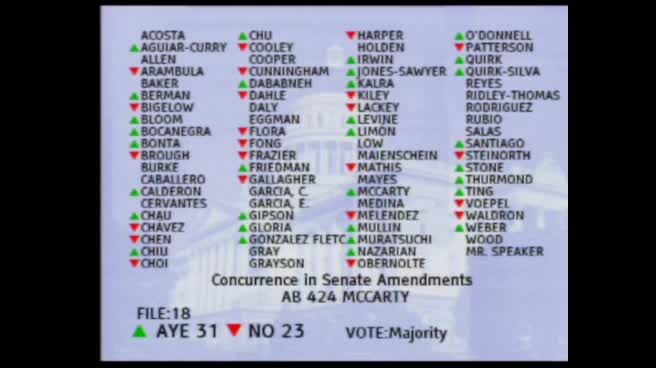 1MIN
Assembly Floor
 2MIN
Senate Floor
 9MIN
Senate Standing Committee on Governance and Finance
 3MIN
Assembly Floor
 8MIN
Assembly Standing Committee on Appropriations
 9MIN
Assembly Standing Committee on Local Government
 6MIN
Assembly Standing Committee on Local Government
Bill Author

Bill Co-Author(s):