AB 1464: California State University: tenure-track positions.
- Session Year: 2017-2018
- House: Assembly
- Latest Version Date: 2017-02-17
Existing law establishes the California State University, under the administration of the Trustees of the California State University, as one of the segments of public postsecondary education in this state. The California State University (CSU) comprises, and provides instruction at, 23 institutions of higher education throughout the state.
This bill would express legislative findings and declarations relating to the CSU faculty.
This bill would require the Office of the CSU Chancellor, together with the Academic Senate of the CSU and the California Faculty Association, to implement an executive plan developed pursuant to a specified concurrent resolution of the Legislature to increase the percentage of tenured and tenure-track CSU faculty to 75%. The bill would specify, for each academic year from 201819 to 202526, inclusive, target numbers of new tenure-track positions. The bill would require additional conditions to be met in implementing this executive plan. Commencing with the 201819 academic year, the bill would further require CSU to issue annual reports relating to implementation efforts, funding, and effective strategies and best practices, as specified.
The Legislature finds and declares all of the following:
(a)The faculty of the California State University must comply with the highest standards of educational achievement, experience, and professional conduct, as exemplified by the advanced degrees, and other academic honors, that they have earned.
(b)The appointment of fully qualified faculty members ensures that the students of the California State University receive instruction and guidance from individuals with the education, background, and experience to be recognized as experts in their fields of academic endeavor.
(c)Tenured and tenure-track faculty bear the primary responsibility for student advising, program development and revision, and participation in shared governance.
(d)Before tenure may be awarded to a member of the California State University faculty, that person must possess a record of demonstrated excellence in the performance of his or her professional duties.
(e)Students enrolled at the California State University must be provided the full range of academic services by the most qualified faculty members that the university can employ.
(f)Tenured faculty of the California State University who have recently retired have often been replaced by faculty members in temporary appointments rather than by tenure-track faculty.
(g)In September 2001, Assembly Concurrent Resolution 73 (Strom-Martin) was adopted by the Legislature. In 2002, the Academic Senate of the California State University, the California Faculty Association, and the California State University worked together to produce a plan to increase the percentage of tenured and tenure-track faculty in the CSU to 75 percent over an eight-year period. This plan was never implemented.
(h)In 2013, the Academic Senate of the California State University adopted Resolution AS-3142-13/FA, which urged the prioritization of ACR 73 with an urgent call for forward movement in achieving its goals.
SEC. 2.Section 89501.5 is added to the Education Code, to read:89501.5.(a)The Office of the Chancellor of the California State University, together with the Academic Senate of the California State University and the California Faculty Association, shall implement the executive plan developed pursuant to Resolution Chapter 121 of the Statutes of 2001 (ACR 73 (Strom-Martin)) to increase the percentage of tenured and tenure-track faculty in the California State University to 75 percent of total faculty by 2026.
(b)In implementing the executive plan developed pursuant to Resolution Chapter 121 of the Statutes of 2001, the California State University shall meet or exceed the following annual tenure-track new position targets, consistent with the terms and provisions of the July 2002 California State University ACR 73 implementation report and meeting the conditions of subdivision (c):
(1)In the 201819 academic year, 774 new positions.
(2)In the 201920 academic year, 720 new positions.
(3)In the 202021 academic year, 770 new positions.
(4)In the 202122 academic year, 818 new positions.
(5)In the 202223 academic year, 819 new positions.
(6)In the 202324 academic year, 865 new positions.
(7)In the 202425 academic year, 877 new positions.
(8)In the 202526 academic year, 915 new positions.
(c)In implementing the executive plan developed pursuant to Resolution Chapter 121 of the Statutes of 2001, the university shall do all of the following:
(1)Raise the percentage of tenured and tenure-track faculty to at least 75 percent, with the unit of measurement to be jointly developed by the entities described above.
(2)Provide that no lecturers currently employed by the university will lose their jobs as a result of implementing the plan.
(3)Provide that qualified lecturers will be seriously considered for tenure-track positions.
(4)Invest in the continued improvement of faculty diversity so that the California State University (CSU) faculty can better reflect the diversity of the student body and population of California, and facilitate student success by providing mentors and role models who understand the challenges that CSU students face.
(d)Plan implementation shall begin by July 1, 2018, and the California State University shall issue an annual report describing implementation efforts underway and goals achieved to the relevant policy and fiscal committees of the Legislature by May 1 of each academic year, commencing with the 201819 academic year.
(e)Commencing with the 201819 academic year, as part of the May Revision each year, the California State University shall report to the budget committees of the Legislature any funding that will be dedicated to implementing the coming fiscal years portion of the plan.
(f)Commencing with the 201819 academic year, the California State University, the California Faculty Association, and the Academic Senate of the California State University shall jointly develop an annual report of effective strategies and best practices campuses are using to achieve the goals detailed above, including, but not necessarily limited to, both of the following:
(1)A summary of strategies that have been implemented in the prior year and their fiscal and hiring impacts.
(2)Incentives for university departments that convert lecturer positions to tenure track.
REVISIONS: HeadingLine 2.|
Date
|
Status
|
|---|---|
| Feb 1, 2018 | From committee: Filed with the Chief Clerk pursuant to Joint Rule 56. |
| Jan 31, 2018 | Died pursuant to Art. IV, Sec. 10(c) of the Constitution. |
| May 26, 2017 | In committee: Held under submission. |
| May 3, 2017 | In committee: Set, first hearing. Referred to APPR. suspense file. |
| Apr 19, 2017 | Coauthors revised. |
| Mar 13, 2017 | Referred to Com. on HIGHER ED. |
| Feb 19, 2017 | From printer. May be heard in committee March 21. |
| Feb 17, 2017 | Read first time. To print. |
|
Date
|
Description
|
Location
|
Votes
|
|
|---|---|---|---|---|
| Apr 18, 2017 | Do pass and be re-referred to the Committee on [Appropriations] | Assembly Standing Committee on Higher Education |
Passed |
This list shows positions taken on this bill by organizations on the date displayed, which is linked to the original source.
Positions by individuals are not included.
|
Organization
|
Position
|
Date
|
|---|---|---|
| Cal State University | * Support | Apr 18, 2017 |
| California Faculty Associaiton | * Support | Apr 18, 2017 |
| California Labor Federation, Afl-Cio | * Support | Apr 18, 2017 |
| SEIU California | * Support | Apr 18, 2017 |
Date of Hearing: May 3, 2017
ASSEMBLY COMMITTEE ON APPROPRIATIONS
Lorena Gonzalez Fletcher, Chair
ABPCA Bill Id:AB 1464
Author:(Weber) – As Introduced Ver:February 17, 2017
Policy Committee: | Higher Education | Vote: | 10 - 3 |
|
| ||
|
|
Urgency: No State Mandated Local Program: No Reimbursable: No
SUMMARY:
This bill codifies a plan into statute to achieve 75% density of tenured and tenure-track faculty at the California State University (CSU). Specifically, this bill:
- Requires the CSU Chancellor's Office, in collaboration with the Academic Senate of the CSU (ASCSU), and the California Faculty Association (CFA), to implement the executive plan developed pursuant to ACR 73 (Strom-Martin), Resolution Chapter 121 of the Statutes of 2001, to increase the percentage of tenured and tenure-track faculty in the CSU to 75% of total faculty by 2026.
- Requires that plan implementation begin by July 1, 2018, and that CSU issue an annual report describing implementation efforts underway and goals achieved to the relevant policy and fiscal committees of the Legislature by May 1 of each academic year, commencing with the 2018–19 academic year.
- Requires, commencing with the 2018–19 academic year, the CSU, the CFA, and the ASCSU to jointly develop an annual report of effective strategies and best practices campuses are using to achieve the goals.
FISCAL EFFECT:
Approximately $1.2 billion to meet the 75% tenure-track faculty goal by 2026. CSU estimates $748 million in cost associated salaries and benefits for hiring 6,559 tenured faculty. Costs also include support packages, which include moving expenses, start-up funds, professional travel and reassigned time. According to the CSU Faculty Recruitment and Retention Survey, the average support package is $50,000 per faculty. To meet this goal, CSU will also incur approximately $98 million (over 8 years) in recruitment cost, since only 30% of CSU lecturers hold doctorates, which is a minimum qualification for most tenure-track positions.
Approximately $1.8 million in reporting costs ($230,000 annually or $10,000 per campus) to comply with reports to the Legislature every May Revision and annually. Each campus would have to provide annual data and modeling to the Chancellor’s office in order to comply with the reporting requirements of the bill.
Substantial unknown costs associated with capital outlay costs including office space, office equipment, and research/lab equipment. CSU notes that many of their campuses are already at capacity.
COMMENTS:
Background and Purpose. Assembly Concurrent Resolution 73 (Strom-Martin), Resolution Chapter 121, Statutes of 2001, urged the CSU, the Academic Senate of the CSU, and CFA, to collaborate and develop a plan in order to achieve improved tenured faculty density at the CSU. This plan was completed in 2002 and itemized an eight-year schedule of new hires and lecturer conversions to shift tenure density at the CSU to the goal of 75% for tenured and tenured-track faculty.
According to a January 2017 ASCSU Resolution entitled, "Advice to the CSU Tenure Density Task Force", tenure density is defined as the number of tenure track faculty (Full-Time Equivalent – FTE) divided by the total number of instructional faculty, and is usually expressed as a percentage. The ASCSU contends that the decline in tenure-density over time has decreased the CSU's capacity to serve their students.
A Tenure Density Task Force was assembled in the Fall of 2016 by CSU Chancellor White; during one of the task force meetings, the Chancellor and the ASCSU discussed the topic of tenure density and its significance. It was noted that as it stands, the majority of classes taught in the CSU system are taught by non-tenure track faculty; and, as a system, the CSU tenure density was at 55.4% in 2015, falling from 66.1% in 2009. Additionally, it was reported that on some CSU campuses, the tenure density is below 40%.
According to the author, this measure takes the 2002 joint report of the CSU, ASCSU, and CFA and codifies its goals. The measure seeks to place into statute an eight-year strategy to improve tenured and tenure-track density at the CSU, with a target of 75% tenure density, by the year 2026.
Analysis Prepared by: Daisy Gonzales / APPR. / (916) 319-2081
Date of Hearing: April 18, 2017
ASSEMBLY COMMITTEE ON HIGHER EDUCATION
Jose Medina, Chair
ABPCA Bill Id:AB 1464 (
Author:Weber) – As Introduced Ver:February 17, 2017
SUBJECT: California State University: tenure-track positions.
SUMMARY: Codifies a plan into statute to achieve 75 percent density of tenured and tenure-track faculty at the California State University (CSU). Specifically, this bill:
- Makes various findings and declarations, including, but not limited to the following: a) the faculty of the CSU must comply with the highest standards of educational achievement, experience, and professional conduct, as exemplified by the advanced degrees, and other academic honors, that they have earned; and, b) in 2013, the Academic Senate of the California State University adopted Resolution AS-3142-13/FA, which urged “the prioritization of ACR 73 with an urgent call for forward movement in achieving its goals.”
- Requires the CSU Chancellor's Office, in collaboration with the Academic Senate of the CSU (ASCSU), and the California Faculty Association (CFA), to implement the executive plan developed pursuant to Resolution Chapter 121 of the Statutes of 2001 (ACR 73 (Strom-Martin)) to increase the percentage of tenured and tenure-track faculty in the CSU to 75 percent of total faculty by 2026.
- Requires that in implementing the executive plan developed pursuant to Resolution Chapter 121 of the Statutes of 2001, the CSU shall meet or exceed the following annual tenure-track new position targets, as specified:
- In the 2018–19 academic year, 774 new positions;
- In the 2019–20 academic year, 720 new positions;
- In the 2020–21 academic year, 770 new positions;
- In the 2021–22 academic year, 818 new positions;
- In the 2022–23 academic year, 819 new positions;
- In the 2023–24 academic year, 865 new positions;
- In the 2024–25 academic year, 877 new positions; and,
- In the 2025–26 academic year, 915 new positions.
- Stipulates that in implementing the plan, the CSU shall also do all of the following:
- Raise the percentage of tenured and tenure-track faculty to at least 75 percent, with the unit of measurement to be jointly developed by the entities as described in number 2 above;
- Provide that no lecturers currently employed by the university will lose their jobs as a result of implementing the plan;
- Provide that qualified lecturers will be seriously considered for tenure-track positions; and,
- Invest in the continued improvement of faculty diversity so that the CSU faculty can better reflect the diversity of the student body and population of California, and facilitate student success by providing mentors and role models who understand the challenges that CSU students face.
- Requires that plan implementation begin by July 1, 2018, and that CSU issue an annual report describing implementation efforts underway and goals achieved to the relevant policy and fiscal committees of the Legislature by May 1 of each academic year, commencing with the 2018–19 academic year.
- Requires, commencing with the 2018–19 academic year, as part of the May Revision each year, the CSU to report to the budget committees of the Legislature any funding that will be dedicated to implementing the coming fiscal year’s portion of the plan.
- Requires, commencing with the 2018–19 academic year, the CSU, the CFA, and the ASCSU to jointly develop an annual report of effective strategies and best practices campuses are using to achieve the goals, as specified, including, but not necessarily limited to, both of the following:
- A summary of strategies that have been implemented in the prior year and their fiscal and hiring impacts; and,
- Incentives for university departments that convert lecturer positions to tenure track.
EXISTING LAW:
- Confers upon the CSU Trustees the powers, duties, and functions with respect to the management, administration, and control of the CSU system (Education Code (EC) Section 66606).
- Expresses the Legislature's wishes to recognize and make efforts to address the longstanding policy of the California Community Colleges (CCC) Board of Governors (BOG) that at least 75 percent of the hours of credit instruction in the CCC, as a system, should be taught by full-time (F/T) instructors; and, authorizes community college districts with less than 75 percent F/T instructors, to apply a portion of their "program improvement" funds toward reaching the 75 percent goal (commonly referred as "75/25") (EC Section 87482.6).
To note, the state has stopped providing program improvement funds and the BOG has since required CCDs to provide a portion of their growth funds to hiring more F/T faculty.
FISCAL EFFECT: Unknown.
COMMENTS: Background. Assembly Concurrent Resolution 73 (Strom-Martin), Resolution Chapter 121, Statutes of 2001, urged the CSU, the Academic Senate of the CSU, and CFA, to collaborate and develop a plan in order to achieve improved tenured faculty density at the CSU. This plan was completed in 2002 and itemized an eight-year schedule of new hires and lecturer conversions to shift tenure density at the CSU to the goal of 75 percent for tenured and tenured-track faculty.
According to a January 2017 ASCSU Resolution entitled, "Advice to the CSU Tenure Density Task Force", tenure density is defined as the number of tenure track faculty (Full-Time Equivalent – FTE) divided by the total number of instructional faculty, and is usually expressed as a percentage. To note, it is a relevant metric of what percentage of the faculty are permanent employees (i.e. on the tenure-track). It also gives an indication of how many full-time equivalent students (FTES) per tenure-track faculty members exists in the system.
The ASCSU contends that the decline in tenure-density over time has decreased the CSU's capacity to serve their students.
Current progress of CSU increasing the percentage of tenured and tenured track faculty. A Tenure Density Task Force was assembled in the fall of 2016 by CSU Chancellor White; during one of the task force meetings, the Chancellor and the ASCSU discussed the topic of tenure density and its significance. It was noted that as it stands, the majority of classes taught in the CSU system are taught by non-tenure track faculty; and, as a system, the CSU tenure density was at 55.4 percent in 2015, falling from 66.1 percent in 2009. Additionally, it was reported that on some CSU campuses, the tenure density is below 40 percent. The number of tenure track faculty fell from 10,383.6 to 9952.8 during that same time period. However, during that same time period, the number of FTES grew from 358,662 in 2009 to 405,928 in 2015. To note, the number of FTES per tenure-track faculty member rose from 34.5 to 40.7 during that six-year period.
According to CFA, the tenure density by headcount for CSU instructional faculty systemwide last year was 40 percent.
Purpose of this measure. According to the author, this measure takes the 2002 joint report of the CSU, ASCSU, and CFA and codifies its goals. The measure seeks to place into statute an eight-year strategy to improve tenured and tenure-track density at the CSU, with a target of 75 percent tenure density, by the year 2026.
Arguments in support. The CFA, sponsors of this measure, argues that increasing the number and percentage of faculty with full-time, tenured or tenure-track positions will have a positive impact on CSU's students and instruction. Additionally, CFA states, "The CSU administration has tremendous flexibility to hire into temporary positions, as seen by the fact that more than 15,000 (60 percent) of the faculty are in temporary jobs." Lastly, CFA contends that this measure does not transform campus hiring decision-making, except in that it requires more of it.
Arguments in opposition. The CSU, argues that while it shares the goal of increasing tenure density, despite requests for ongoing state support year after year, without the state providing sufficient funding to ensure attainment of the goals (as called for in ACR 73) it is not in a financial position to fully implement the goals called up on ACR 73 or this measure. Additionally, CSU states, "The successful achievement of our tenure density goals can only be accomplished through an ongoing partnership with the state to provide the necessary resources."
Policy considerations. This measure seeks to codify goals, pursuant to a report by the CSU, ASCSU, and CFA. It is rare that goals are codified in the Education Code. To note, the goals of this measure appear to be very prescriptive on a year to year basis.
The Committee may wish to consider if it is prudent to codify the goals itemized in this measure.
Additionally, the CSU has raised concerns about the provision in the measure that "qualified lecturers be given serious consideration for tenure-track positions," due to their findings that "approximately 30 percent of CSU lecturers hold the minimum requirement to be considered for tenure-track faculty", and that those "lecturers that meet the minimum qualifications are far less diverse".
Committee staff understands that the intent of this bill is to insure that if a lecturer is qualified to be hired on the tenure-track and they apply for a tenure-track position, that the lecturer is given "serious consideration". If the lecturer is not qualified, consideration would not need to be given.
Moving forward, the author and sponsors may wish to continue to work with the CSU and ASCSU in determining how best to stipulate and implement the lecturer provision of this measure.
REGISTERED SUPPORT / OPPOSITION:
Support
California Faculty Association (sponsor)
Service Employees International Union
Opposition
California State University
Analysis Prepared by: Jeanice Warden / HIGHER ED. / (916) 319-3960
Discussed in Hearing
 1H
Assembly Standing Committee on Appropriations
 31MIN
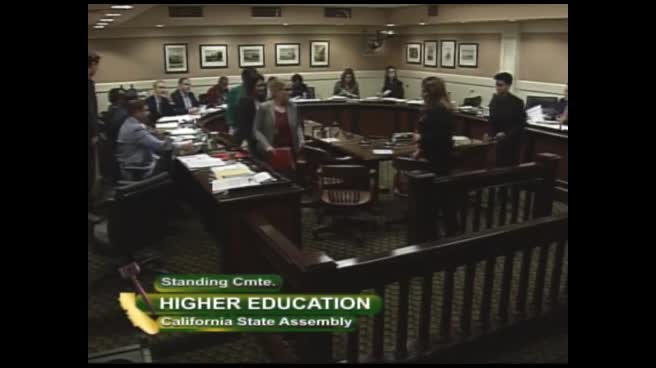
Assembly Standing Committee on Higher Education
Bill Author