AB 1482: Interdistrict attendance: pupils who are English learners, eligible for a free or reduced-price meal, and foster youth.
- Session Year: 2017-2018
- House: Assembly
- Latest Version Date: 2017-04-17
Existing law authorizes the governing boards of 2 or more school districts to enter into an agreement, for a term not to exceed 5 school years, for the interdistrict attendance of pupils who are residents of the school districts. Existing law, regardless of whether there is an agreement or permit, prohibits a school district of residence from prohibiting the transfer of a pupil who is a child of an active military duty parent to the school district of proposed enrollment if the school district of proposed enrollment approves the application for transfer.
This bill would also prohibit a school district of residence from prohibiting the transfer of a pupil who is an English learner, eligible for a free or reduced-price meal, or a foster youth.
Existing law, the Safe Neighborhoods and Schools Act, enacted by Proposition 47, as approved by the voters at the November 4, 2014, statewide general election, among other things, established the Safe Neighborhoods and Schools Fund, a continuously appropriated fund, which is funded by savings that accrue to the state from the implementation of the act. The act provides that, among other purposes, 25% of the funds shall be disbursed to the State Department of Education to administer a grant program to public agencies aimed at improving outcomes for public school pupils by reducing truancy and supporting pupils who are at risk of dropping out of school or are victims of crime.Existing law establishes the Learning Communities for School Success Program for the purpose of implementing that grant program described above, subject to an appropriation to the Safe Neighborhoods and Schools Fund in the annual Budget Act or another statute for the purposes of the program. Existing law requires the department to submit an interim report of preliminary evaluation findings to the Legislature on or before January 31, 2019, and to submit a final evaluation of the program to the Legislature on or before January 31, 2020.This bill would change the dates those reports are due from January 31 to January 1 of the respective year. The bill also would repeal duplicative provisions regarding the Learning Communities for School Success Program.Existing law, the Safe Neighborhoods and Schools Act, enacted by Proposition 47, as approved by the voters at the November 4, 2014, statewide general election, among other things, established the Safe Neighborhoods and Schools Fund, a continuously appropriated fund, which is funded by savings that accrue to the state from the implementation of the act. The act provides that, among other purposes, 25% of the funds shall be disbursed to the State Department of Education to administer a grant program to public agencies aimed at improving outcomes for public school pupils by reducing truancy and supporting pupils who are at risk of dropping out of school or are victims of crime.
Existing law establishes the Learning Communities for School Success Program for the purpose of implementing that grant program described above, subject to an appropriation to the Safe Neighborhoods and Schools Fund in the annual Budget Act or another statute for the purposes of the program. Existing law requires the department to submit an interim report of preliminary evaluation findings to the Legislature on or before January 31, 2019, and to submit a final evaluation of the program to the Legislature on or before January 31, 2020.
This bill would change the dates those reports are due from January 31 to January 1 of the respective year. The bill also would repeal duplicative provisions regarding the Learning Communities for School Success Program.
(a)(1)The governing boards of two or more school districts may enter into an agreement, for a term not to exceed five school years, for the interdistrict attendance of pupils who are residents of the school districts. The agreement may provide for the admission to a school district other than the school district of residence of a pupil who requests a permit to attend a school district that is a party to the agreement and that maintains schools and classes in kindergarten or any of grades 1 to 12, inclusive, to which the pupil requests admission. Once a pupil in kindergarten or any of grades 1 to 12, inclusive, is enrolled in a school pursuant to this chapter, the pupil shall not have to reapply for an interdistrict transfer, and the governing board of the school district of enrollment shall allow the pupil to continue to attend the school in which he or she is enrolled, except as specified in paragraphs (2) and (4).
(2)The agreement shall stipulate the terms and conditions under which interdistrict attendance shall be permitted or denied. The agreement may contain standards for reapplication agreed to by the school district of residence and the school district of enrollment that differ from the requirements prescribed by paragraph (1). The agreement may stipulate terms and conditions established by the school district of residence and the school district of enrollment under which the permit may be revoked.
(3)The supervisor of attendance of the school district of residence shall issue an individual permit verifying the school districts approval, pursuant to policies of the governing board of the school district and terms of the agreement for the transfer. A permit shall be valid upon concurring endorsement by the designee of the governing board of the school district of proposed enrollment. The stipulation of the terms and conditions under which the permit may be revoked is the responsibility of the school district of enrollment.
(4)Notwithstanding paragraph (2), a school district of residence or school district of enrollment shall not rescind existing transfer permits for pupils entering grade 11 or 12 in the subsequent school year.
(b)A pupil who has been determined by personnel of either the school district of residence or the school district of proposed enrollment to have been the victim of an act of bullying, as defined in subdivision (r) of Section 48900, committed by a pupil of the school district of residence shall, at the request of the person having legal custody of the pupil, be given priority for interdistrict attendance under any existing interdistrict attendance agreement or, in the absence of an agreement, be given additional consideration for the creation of an interdistrict attendance agreement.
(c)In addition to the requirements of subdivision (e) of Section 48915.1, and regardless of whether an agreement exists or a permit is issued pursuant to this section, any school district may admit a pupil expelled from another school district in which the pupil continues to reside.
(d)(1)Notwithstanding any other law, and regardless of whether an agreement exists or a permit is issued pursuant to this section, a school district of residence shall not prohibit the transfer of a pupil who is an English learner, eligible for a free or reduced-price meal, or a foster youth, or who is a child of an active military duty parent to a school district of proposed enrollment if the school district of proposed enrollment approves the application for transfer.
(2)(A)For purposes of this subdivision, active military duty parent means a parent with full-time military duty status in the active uniformed service of the United States, including members of the National Guard and the State Military Reserve on active duty orders pursuant to Chapter 1209 (commencing with Section 12301) and Chapter 1211 (commencing with Section 12401) of Part II of Subtitle E of Title 10 of the United States Code.
(B)For purposes of this subdivision, parent means the natural or adoptive parent or guardian of a dependent child.
SECTION 1.Article 10 (commencing with Section 33430) of Chapter 3 of Part 20 of Division 2 of Title 2 of the Education Code, as added by Section 2 of Chapter 533 of the Statutes of 2016, is repealed.SEC. 2.Section 33434 of the Education Code, as added by Section 2 of Chapter 397 of the Statutes of 2016, is amended to read:33434.(a)A local educational agency that receives grant funding pursuant to this article shall evaluate and report to the governing board of the school district, the county board of education, or its chartering authority, as applicable, and the department the results of the activities it undertakes pursuant to this article. The department shall compile information from grantee reports as part of an overall evaluation of the grant program implementation. The department shall assess the benefits of participation in the program and identify the pupil and school outcomes associated with the strategies and programs implemented by grantees. The department shall submit an interim report of preliminary evaluation findings to the Legislature on or before January 1, 2019, and a final evaluation report to the Legislature on or before January 1, 2020.(b)(1)A report to be submitted pursuant to subdivision (a) shall be submitted in compliance with Section 9795 of the Government Code.(2)Pursuant to Section 10231.5 of the Government Code, this section is repealed on January 31, 2024.(a)A local educational agency that receives grant funding pursuant to this article shall evaluate and report to the governing board of the school district, the county board of education, or its chartering authority, as applicable, and the department the results of the activities it undertakes pursuant to this article. The department shall compile information from grantee reports as part of an overall evaluation of the grant program implementation. The department shall assess the benefits of participation in the program and identify the pupil and school outcomes associated with the strategies and programs implemented by grantees. The department shall submit an interim report of preliminary evaluation findings to the Legislature on or before January 31, 1, 2019, and a final evaluation report to the Legislature on or before January 31, 1, 2020.
(b)(1)A report to be submitted pursuant to subdivision (a) shall be submitted in compliance with Section 9795 of the Government Code.
(2)Pursuant to Section 10231.5 of the Government Code, this section is repealed on January 31, 2024.
|
Date
|
Status
|
|---|---|
| Feb 1, 2018 | From committee: Filed with the Chief Clerk pursuant to Joint Rule 56. |
| Jan 31, 2018 | Died pursuant to Art. IV, Sec. 10(c) of the Constitution. |
| May 10, 2017 | In committee: Set, first hearing. Failed passage. Reconsideration granted. |
| Apr 26, 2017 | In committee: Hearing postponed by committee. |
| Apr 18, 2017 | Re-referred to Com. on ED. |
| Apr 17, 2017 | From committee chair, with author's amendments: Amend, and re-refer to Com. on ED. Read second time and amended. |
| Mar 16, 2017 | Referred to Com. on ED. |
| Feb 19, 2017 | From printer. May be heard in committee March 21. |
| Feb 17, 2017 | Read first time. To print. |
|
Date
|
Description
|
Location
|
Votes
|
|
|---|---|---|---|---|
| May 10, 2017 | Reconsideration. | Assembly Standing Committee on Education |
Passed |
|
| May 10, 2017 | Do pass and be re-referred to the Committee on [Appropriations] | Assembly Standing Committee on Education |
Failed |
This list shows positions taken on this bill by organizations on the date displayed, which is linked to the original source.
Positions by individuals are not included.
|
Organization
|
Position
|
Date
|
|---|---|---|
| California School Boards Association | ** Against | May 9, 2017 |
| Edvoice | ** Support | May 9, 2017 |
| Parent Revolution | * Support | May 10, 2017 |
Date of Hearing: May 10, 2017
ASSEMBLY COMMITTEE ON EDUCATION
Patrick O'Donnell, Chair
ABPCA Bill Id:AB 1482 (
Author:Kiley) – As Amended Ver:April 17, 2017
SUBJECT: Interdistrict attendance: pupils who are English learners, eligible for a free or reduced-price meal, and foster youth
SUMMARY: Prohibits a school district of residence from denying the transfer of a pupil who is an English learner (EL), eligible for a free or reduced-price meal, or a foster youth to a district of proposed enrollment if the school district of proposed enrollment approves the application for transfer.
EXISTING LAW:
- Requires a pupil between the ages of 6 through 18 to attend school in the school district where either parent or legal guardian resides except as specified.
- Establishes the following exceptions to the requirement that pupils attend their school district of residence:
- Permits a pupil to attend a school district where a parent or guardian physically works a minimum of 10 hours per week;
- Permits a pupil to attend another district pursuant to an agreement entered into between the district of residence and the district of attendance;
- Permits, without approval of the district of residence, a pupil of a military family to attend another district;
- Permits, without approval of the district of residence; the transfer of any pupil to a district whose governing board has, by the adoption of a resolution, declared itself to be a "district of choice;" and
- Permits, without approval of the district of residence, the transfer of a pupil who is enrolled in a school that is among the 1,000 schools with the lowest Academic Performance Index (API) scores.
FISCAL EFFECT: This bill is keyed nonfiscal
COMMENTS: In general, existing law requires a pupil to attend a school within his or her district of residence, but there are several exceptions to this requirement:
Interdistrict Transfer/Reciprocal Agreement. An interdistrict transfer/reciprocal agreement is used when parents/guardians wish to enroll a pupil at a school in another district. An interdistrict transfer/reciprocal agreement must be approved by the pupil's district of residence and the district to which the pupil seeks to transfer. Both districts must approve the agreement before it becomes valid. If a request for an interdistrict transfer/reciprocal agreement is denied, the pupil’s parents/guardians may file an appeal to the county office of education.
Parent/guardian employment. Existing law permits a school district to deem a pupil to have complied with the residency requirements for school attendance in the district if at least one parent/guardian of the pupil is physically employed within the boundaries of that district for at least 10 hours per week. Once admitted to residency, the pupil’s transfer may be revoked only if the parent ceases to be employed within the boundaries of the district. As a resident, the pupil does not have to re-apply for the transfer to be valid.
Open enrollment. The Open Enrollment Act provides an option to pupils attending low-achieving schools within their district of residence to enroll in schools with higher API scores in another district. The Superintendent of Public Instruction (SPI) creates an annual list of 1,000 low-API schools, and parents of pupils attending any of these schools may apply for admission to a higher achieving school. Although the API has been suspended since 2013, the SPI is still required to compile the annual list of 1,000 low-performing schools based on the latest available scores. Accordingly, the California Department of Education (CDE) cautions parents that the statutorily-required list may not reflect the current performance of schools.
Districts of Choice. The governing board of any school district may elect to accept interdistrict transfers under the District of Choice provision. Under this provision, the school district of choice determines the number of transfer pupils it is willing to accept and must ensure that pupils admitted are selected through a random, unbiased process that prohibits an evaluation of whether or not the pupil should be enrolled based on his or her academic or athletic performance. Statutory provisions for the District of Choice program sunset on July 1, 2017. AB 185 (O'Donnell), which is currently pending in the Assembly Appropriations Committee, changes the sunset date to July 1, 2023 and contains other programmatic changes.
Military families. Existing law permits pupils from military families to enroll in a district other than their district of residence without the approval of their district of residence. This provision was enacted by AB 306 (Hadley, Chapter 771, Statutes of 2015). This bill amends the law enacted by AB 306 by extending its provisions to pupils who are EL, low income (LI, as defined by eligibility for free or reduced-price meals), or in foster care. These pupils are referred to as "unduplicated" for purposes of the local control funding formula (LCFF), because they generate additional funding for the districts in which they are enrolled, but pupils who fall into more than one of these categories are only counted once for funding purposes (that is, the formula uses an unduplicated count.
Impact of unduplicated pupils on district funding. The LCFF provides funding to all school districts in three parts:
- Basic grant, which is the same amount per average daily attendance (ADA) for all school districts and charter school for these four grade spans: K-3, 4-6, 7-8, and 9-12;
- Supplemental grant, which provides an additional 20% of the base grant for each unduplicated pupil enrolled in the district; and
- Concentration factor, which provides an additional 50% of the base grant for each unduplicated pupil enrolled in the district that is in excess of 55% of the district's enrollment.
The following table shows the dollar amount that would be allocated pursuant to the LCFF to each district in 2017-18, according to the Legislative Analyst:
LCFF per Pupil Funding Rates | |||||
2017-18 Rates Based on Governor's January Budget | |||||
Grade Span | Base | Supplemental | Base + Supplemental | Concentration | Base + Supplemental + Concentration |
K- Grade 3 | $7,626 | $1,525 | $9,151 | $3,813 | $12,964 |
Grades 4-6 | 7,011 | 1,402 | 8,413 | 3,505 | 11,918 |
Grades 7-8 | 7,220 | 1,444 | 8,664 | 3,610 | 12,274 |
Grades 9-12 | 8,583 | 1,717 | 10,300 | 4,291 | 14,591 |
The shaded columns show the funding that would follow pupils across school district boundaries under this bill. In some cases, this bill could result in some districts exceeding the 55% threshold for the concentration factor and other districts dropping below the concentration factor threshold, depending on the direction of inter-district transfers. The financial loss or gain could be significant for those districts. Because nearly 55% of the state's pupils would be eligible to transfer to another district under this bill, it could result in substantial financial disruption statewide. Although this bill is keyed nonfiscal, it could have a significant impact on the distribution of Proposition 98 funds among local education agencies.
No protection against discrimination or selective admissions. Existing inter-district transfer programs have rules that protect against selective admissions or screening out pupils based on disability, academic performance, athletic ability, or any other criterion. For example, the following rules apply to districts of choice (DOC):
- If the number of applicants exceeds the number of transfers a DOC selects to accept, then the applicants approved shall be determined by a random drawing held in public.
- A district of residence may prohibit the transfer of pupils if it would have a negative impact on its court-ordered or voluntary desegregation program or the racial/ethnic balance of the district.
- A DOC may not reject a transfer based on a determination that the additional cost of educating that pupil may exceed state aid.
Existing law that permits the transfer of a pupil to a district that serves a geographic area in which a parent or legal guardian is employed prohibits districts from refusing a transfer on the basis of ethnicity, race, sex, parental income, scholastic achievement, or any other arbitrary consideration. This bill does not contain any of these prohibitions against discrimination or selective admissions. In fact, statutory provisions allowing two or more districts to enter into interdistrict attendance agreements require the agreement to stipulate the terms and conditions under which interdistrict attendance will be permitted and denied. This bill specifically exempts the transfer of unduplicated pupils from the terms of any such agreement. Under this bill, therefore, a district could actively recruit and accept pupils on the basis of athletic or academic ability or other desired attribute, and deny a transfer request to pupils that may be low achievers or that the district believes may be too costly to enroll and serve. While the stated objective of this bill is to give parents choices, the actual choice to accept or reject a transfer would belong to the district.
Disruptive impact on school district budgets. The dollar amount in the table on page 3 represents average funding per pupil that each district receives. They do not, however, reflect the marginal cost or savings of enrolling one more or one fewer pupil. Marginal costs are lower than average costs. For example, an additional high school pupil who is an English learner will generate an additional $10,300 or $14,591 for that district (depending on whether the concentration factor threshold has been met), but the additional cost of accommodating that new pupil will be significantly less than either of those dollar amounts. Conversely, a district that loses that pupil will see its revenue decline more than its marginal savings from no longer having that pupil enrolled. This would reduce resources available to all remaining pupils in the district.
Because enrollment is virtually the only source of revenue for districts, they would have an incentive to actively recruit transfers from other districts to take advantage of the fact that the increase in funding would be higher than their increased costs, and districts that lose enrollment would have a diminished ability to serve their remaining pupils, because the funding loss would exceed the savings. Because the bill does not require districts of residence to approve or even be informed of transfers, those districts could build budgets and retain staffing levels based on pupils who unexpectedly do not show up at the beginning of the school year. On a large enough scale, the decision to transfer to another district is not a purely private one, because of the cumulative impact it would have on the remaining pupils in the district of residence.
EL or low income status may change. Pupils who are English learners may be reclassified as English proficient, and pupils who are eligible for a free or reduced-price meal may lose that eligibility if their family circumstances change. Under this bill, pupils who are no longer EL or low income, but have already transferred to another district, would be able to continue to attend that district. This is because the provisions of this bill are embedded in a section of the Education Code that provides that, once a pupil has transferred, he or she does not have to reapply for a transfer in subsequent years.
Erosion of local control. The LCFF is predicated on the "principle of subsidiarity," which is the idea that matters ought to be handled by the smallest, lowest or least centralized unit of government. Political decisions should be taken at a local level if possible, rather than by a central authority. This assumes that local jurisdictions have some level of independence from each other, so that a decision made by one jurisdiction applies only (or at least primarily) to itself and not also to other local jurisdictions.
This is not always the case with school districts, however. The District of Choice program and the charter school approval process empower school district governing boards to make decisions that have a direct impact on the enrollment, and therefore the budgets of other districts. This bill adds to this by allowing all districts essentially to become a district of choice with respect to unduplicated pupils, if they choose, but without having to abide by the rules of the DOC program. The decision of a district to accept transfers diminishes the control that neighboring districts have over their budgets. While the LCFF gives districts more authority over budget expenditures, this bill reduces district control over the size of their budgets. Districts losing enrollment would have no information on the number of pupils who are transferring out in any given year, which would complicate the processes of multi-year planning, establishing budget priorities, investing in enhanced programs and services, and projecting staffing needs. Districts serving large numbers of EL and low income students are likely to be most affected by this.
This bill serves the same purpose as the DOC program, but without the protections. The committee may wish to consider whether this bill is necessary given the existence of the District of Choice program. Under that program, the district of residence cannot veto a transfer request, which is the objective of this bill. Any district can declare itself to be a district of choice, and there is no limit to the number of districts that may do so. Therefore, a district that desires to accept transfers from a district of residence that does not approve them simply needs to declare itself to be a district of choice. As such, approval from the district of residence would not be needed.
Unlike this bill, however, the DOC program prohibits discriminatory practices in the approval of applications to transfer. The DOC program also caps the number of pupils that can transfer out of a district of residence. This is to reduce budgetary instability and minimize the impact programs and services to the remaining pupils in the districts of residence. AB 185 (O'Donnell) extends the DOC program to July 1, 2023 and, among other things, contains reforms designed to increase access to the program for low income pupils. AB 185 passed this committee 7-0 and is currently in the Assembly Appropriations Committee.
Unintended consequences. The author's office indicates that a primary purpose of this bill is to provide educational options for EL and low income pupils who are not well served by their neighborhood schools. While some pupils may take advantage of this option, most, in all likelihood, would not. This will lead to the further impoverishment of schools serving low income neighborhoods, because the loss of revenue to those schools will exceed the cost savings that result from pupils transferring out. The committee may wish to consider the balance between the potential positive impact on pupils who transfer and the potential negative impact on the pupils who remain in the district of residence.
Arguments in support. Supports argue that this bill is needed, because many requests for inter-district transfers are denied by the district of residence. Although a denial may be appealed to the county board of education, many families do not have the resources or skills to pursue it.
Arguments in opposition. Opponents argue that, "the bill could also disrupt district planning and budgeting, which would undermine the stability of the district and hurt programs and services for the very students the bill is designed to help."
REGISTERED SUPPORT / OPPOSITION:
Support
EdVoice
Parent Revolution
Opposition
California School Boards Association
Analysis Prepared by: Rick Pratt / ED. / (916) 319-2087
Discussed in Hearing
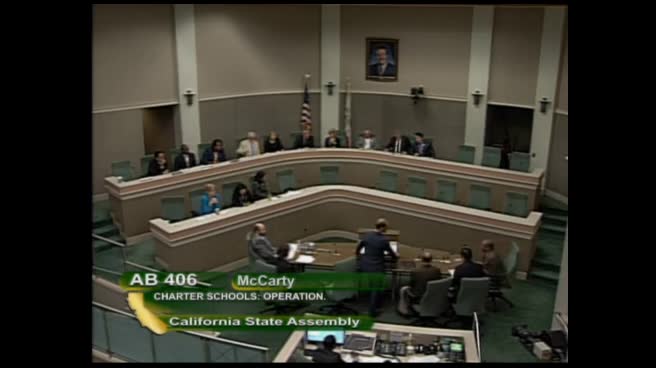 43MIN
Assembly Standing Committee on Education
Bill Author

Bill Co-Author(s):