AB 1604: CalWORKs: welfare-to-work: education.
- Session Year: 2017-2018
- House: Assembly
- Latest Version Date: 2017-09-26
Existing law establishes the California Work Opportunity and Responsibility to Kids (CalWORKs) program, under which each county provides cash assistance and other benefits to qualified low-income families using federal, state, and county funds. Existing law requires a recipient of CalWORKs to participate in certain welfare-to-work activities as a condition of eligibility and requires the county to assign a CalWORKs recipient who lacks a high school diploma or its equivalent to participate in adult basic education, if the recipient has completed job search activities but did not find employment and the education is needed to become employed. Existing law also requires, in order for a recipient to engage in adult basic education in satisfaction of welfare-to-work requirements, the county to perform an assessment and develop a welfare-to-work plan that includes participation in the educational activity.
This bill would instead provide that after the county determines that a CalWORKs recipient has received specified services, but has not received his or her high school diploma or its equivalent, the recipient may participate in a high school equivalency program in order to complete a high school equivalency test recognized by the State Department of Education. The bill would prohibit a county from requiring the recipient to participate in an assessment before the recipient may engage in a high school equivalency program in satisfaction of welfare-to-work requirements under those circumstances. The bill would require a recipient who has not received his or her high school diploma or its equivalent to be offered a welfare-to-work plan to participate in a high school education program or high school equivalency program, as specified. If the recipient declines to participate in the specified educational activities, and chooses instead to participate in job club or job search activities, or other activities, the bill would require the recipient to make that election, in writing, on the welfare-to-work plan. By imposing additional administrative duties on counties, this bill would create a state-mandated local program.
The California Constitution requires the state to reimburse local agencies and school districts for certain costs mandated by the state. Statutory provisions establish procedures for making that reimbursement.
This bill would provide that, if the Commission on State Mandates determines that the bill contains costs mandated by the state, reimbursement for those costs shall be made pursuant to the statutory provisions noted above.
Existing law establishes the California Work Opportunity and Responsibility to Kids (CalWORKs) program, under which each county provides cash assistance and other benefits to qualified low-income families using federal, state, and county funds. Existing law requires a recipient of CalWORKs to participate in certain welfare-to-work activities as a condition of eligibility and requires the county to assign a CalWORKs recipient who lacks a high school diploma or its equivalent to participate in adult basic education, if the recipient has completed job search activities but did not find employment and the education is needed to become employed. Existing law also requires, in order for a recipient to engage in adult basic education in satisfaction of welfare-to-work requirements, the county to perform an assessment and develop a welfare-to-work plan that includes participation in the educational activity.
This bill would instead provide that if after the county determines that a CalWORKs recipient has received specified services, but has not received his or her high school diploma or its equivalent, the recipient may participate in a high school equivalency program in order to complete a high school equivalency test recognized by the State Department of Education, and would make a related conforming change. Education. The bill would prohibit a county from requiring the recipient to participate in an assessment before the recipient may engage in a high school equivalency program in satisfaction of welfare-to-work requirements under those circumstances. The bill would require a recipient who has not received his or her high school diploma or its equivalent to be offered a welfare-to-work plan to participate in a high school education program or high school equivalency program, as specified. If the recipient elects not declines to participate in the specified educational activities, and to instead chooses instead to participate in job club or job search activities, or other activities, the bill would require the recipient to make that election, in writing, on the welfare-to-work plan. By imposing additional administrative duties on counties, this bill would create a state-mandated local program.
The California Constitution requires the state to reimburse local agencies and school districts for certain costs mandated by the state. Statutory provisions establish procedures for making that reimbursement.
This bill would provide that, if the Commission on State Mandates determines that the bill contains costs mandated by the state, reimbursement for those costs shall be made pursuant to the statutory provisions noted above.
Existing law establishes the California Work Opportunity and Responsibility to Kids (CalWORKs) program, under which each county provides cash assistance and other benefits to qualified low-income families using federal, state, and county funds. Existing law requires a recipient of CalWORKs to participate in certain welfare-to-work activities as a condition of eligibility and requires the county to assign a CalWORKs recipient who lacks a high school diploma or its equivalent to participate in adult basic education, if the recipient has completed job search activities but did not find employment and the education is needed to become employed. Existing law also requires, in order for a recipient to engage in adult basic education in satisfaction of welfare-to-work requirements, the county to perform an assessment and develop a welfare-to-work plan that includes participation in the educational activity.
This bill would instead provide that if the county determines that a CalWORKs recipient has not received his or her high school diploma or its equivalent, the recipient may participate in a high school equivalency program in order to complete a high school equivalency test recognized by the State Department of Education for a period of 12 months. The bill would authorize the 12-month period to be extended under prescribed circumstances. The bill would authorize a recipient to participate in a high school equivalency program in lieu of participating in a job search or job club, as specified, and would prohibit a county from requiring the recipient to participate in an assessment before the recipient may engage in a high school equivalency program in satisfaction of welfare-to-work requirements. The bill would also Education, and would make a related conforming change. The bill would require a recipient who has not received his or her high school diploma or its equivalent to be offered a welfare-to-work plan to participate in a high school education program or high school equivalency program, as specified. If the recipient elects not to participate in the specified educational activities, and to instead participate in job club or job search activities, the bill would require the recipient to make that election, in writing, on the welfare-to-work plan.
Existing law establishes the California Work Opportunity and Responsibility to Kids (CalWORKs) program, under which each county provides cash assistance and other benefits to qualified low-income families using federal, state, and county funds. Existing law requires a recipient of CalWORKs to participate in certain welfare-to-work activities as a condition of eligibility and requires the county to assign a CalWORKs recipient who lacks a high school diploma or its equivalent to participate in adult basic education, if the recipient has completed job search activities but did not find employment and the education is needed to become employed. Existing law also requires, in order for a recipient to engage in adult basic education in satisfaction of welfare-to-work requirements, the county to perform an assessment and develop a welfare-to-work plan that includes participation in the educational activity.
This bill would instead provide that if the county determines that a CalWORKs recipient has not received his or her high school diploma or its equivalent, the recipient may participate in a high school equivalency program in order to complete a high school equivalency test recognized by the State Department of Education. Education for a period of 12 months. The bill would authorize the 12-month period to be extended under prescribed circumstances. The bill would authorize a recipient to participate in a high school equivalency program in lieu of participating in a job search or job club, as specified, and would prohibit a county from requiring the recipient to participate in an assessment before the recipient may engage in a high school equivalency program in satisfaction of welfare-to-work requirements. The bill would also make a related conforming change.
Existing law establishes the California Work Opportunity and Responsibility to Kids (CalWORKs) program, under which each county provides cash assistance and other benefits to qualified low-income families using federal, state, and county funds. Existing law requires a recipient of CalWORKs to participate in certain welfare-to-work activities as a condition of eligibility and requires the county to assign a CalWORKs recipient who lacks a high school diploma or its equivalent to participate in adult basic education, if the recipient has completed job search activities but did not find employment and the education is needed to become employed. Existing law also requires, in order for a recipient to engage in adult basic education in satisfaction of welfare-to-work requirements, the county to perform an assessment and develop a welfare-to-work plan that includes participation in the educational activity.
This bill would instead provide that if the county determines that a CalWORKs recipient has not received his or her high school diploma or its equivalent, the recipient may participate in a high school equivalency program in order to complete a high school equivalency test recognized by the State Department of Education. The bill would authorize a recipient to participate in a high school equivalency program in lieu of participating in a job search or job club, as specified, and would prohibit a county from requiring the recipient to participate in an assessment before the recipient may engage in a high school equivalency program in satisfaction of welfare-to-work requirements.
Subsequent to the commencement of the receipt of aid under this chapter, the sequence of employment-related activities required of recipients under this article, unless exempted under Section 11320.3, shall be as follows:
(a)Orientation and appraisal.Recipients shall, and applicants may, at the option of a county and with the consent of the applicant, receive orientation to the welfare-to-work program provided under this article and receive appraisal pursuant to Section 11325.2.
(b)(1)After orientation and appraisal, recipients shall participate in job search and job club pursuant to Section 11325.22, family stabilization pursuant to Section 11325.24, or substance abuse, mental health, or domestic violence services, unless the county determines that the recipient should first go to assessment pursuant to subdivision (c).
(2)A recipient who has not received his or her high school diploma or its equivalent shall be offered a welfare-to-work plan pursuant to Section 11325.21 to participate in a high school education program or high school equivalency program, as described in Section 11325.3. If the recipient declines to participate in the educational activities described in this paragraph, and to instead participate in job club or job search activities as described in Section 11325.22, or other activities, if eligible, such as mental health or substance abuse services, as described in paragraph (1), the recipient shall make that election, in writing, on the welfare-to-work plan.
(c)Assessment.If employment is not found during the period provided for pursuant to subdivision (b), or at any time the county determines that participation in job search for the period specified in subdivision (a) of Section 11325.22 is not likely to lead to employment or that, based on information gathered during the appraisal, further information is needed to make an effective determination regarding the recipients next welfare-to-work activity, the recipient shall be referred to assessment, as provided for in Section 11325.4. Following assessment, the county and the recipient shall develop a welfare-to-work plan, as specified in Section 11325.21. The plan shall specify the activities provided for in Section 11322.6 to which the recipient shall be assigned, and the supportive services, as provided for pursuant to Section 11323.2, with which the recipient will be provided.
(d)Work activities.A recipient who has signed a welfare-to-work plan pursuant to Section 11325.21 shall participate in work activities, as described in this article.
SEC. 2.Section 11325.3 is added to the Welfare and Institutions Code, to read:11325.3.(a)After a recipient has received services described in paragraph (1) of subdivision (b) of Section 11320.1 for which the county deemed the recipient eligible, other than job club or job search activities, if it is determined that the recipient has not received his or her high school diploma or its equivalent, the recipient shall be eligible to participate in a high school equivalency program in order to complete the High School Equivalency Test, General Education Development Test, Test Assessing Secondary Completion, or any other high school equivalency test recognized by the State Department of Education.
(b)This section does not require a recipient to participate in a high school equivalency program. A recipient may choose to engage in a job club or a job search pursuant to paragraph (1) of subdivision (b) of Section 11320.1, if he or she declines to participate in a high school equivalency program, in writing, as described in paragraph (2) of subdivision (b) of Section 11320.1.
(c)Recipients eligible pursuant to this section shall not be required to participate in an assessment pursuant to Section 11325.4 prior to, or as a condition of, participation in a high school equivalency program.
SEC. 3.If the Commission on State Mandates determines that this act contains costs mandated by the state, reimbursement to local agencies and school districts for those costs shall be made pursuant to Part 7 (commencing with Section 17500) of Division 4 of Title 2 of the Government Code.
Subsequent to the commencement of the receipt of aid under this chapter, the sequence of employment-related activities required of recipients under this article, unless exempted under Section 11320.3, shall be as follows:
(a)Orientation and appraisal.Recipients shall, and applicants may, at the option of a county and with the consent of the applicant, receive orientation to the welfare-to-work program provided under this article and receive appraisal pursuant to Section 11325.2.
(b)(1)After orientation and appraisal, recipients shall participate in job search and job club pursuant to Section 11325.22, family stabilization pursuant to Section 11325.24, a high school equivalency program pursuant to Section 11325.3, or substance abuse, mental health, or domestic violence services, unless the county determines that the recipient should first go to assessment pursuant to subdivision (d). (c).
(c)(2)A recipient who has not received his or her high school diploma or its equivalent shall be offered a welfare-to-work plan pursuant to Section 11325.21 to participate in a high school education program or high school equivalency program pursuant to program, as described in Section 11325.3. If the recipient elects not declines to participate in the educational activities described in this subdivision, paragraph, and to instead participate in job club or job search activities as described in Section 11325.22, or other activities, if eligible, such as mental health or substance abuse services, as described in paragraph (1), the recipient shall make that election, in writing, on the welfare-to-work plan.
(d)(c)Assessment.If employment is not found during the period provided for pursuant to subdivision (b), or at any time the county determines that participation in job search for the period specified in subdivision (a) of Section 11325.22 is not likely to lead to employment or that, based on information gathered during the appraisal, further information is needed to make an effective determination regarding the recipients next welfare-to-work activity, the recipient shall be referred to assessment, as provided for in Section 11325.4. Following assessment, the county and the recipient shall develop a welfare-to-work plan, as specified in Section 11325.21. The plan shall specify the activities provided for in Section 11322.6 to which the recipient shall be assigned, and the supportive services, as provided for pursuant to Section 11323.2, with which the recipient will be provided.
(e)(d)Work activities.A recipient who has signed a welfare-to-work plan pursuant to Section 11325.21 shall participate in work activities, as described in this article.
SEC. 2.Section 11325.3 is added to the Welfare and Institutions Code, to read:11325.3.(a)If, in the course of appraisal pursuant to Section 11325.2, After a recipient has received services described in paragraph (1) of subdivision (b) of Section 11320.1 for which the county deemed the recipient eligible, other than job club or job search activities, if it is determined that the recipient has not received his or her high school diploma or its equivalent, the recipient shall be eligible, pursuant to subdivision (b) of Section 11320.1, eligible to participate in a high school equivalency program in order to complete the High School Equivalency Test, General Education Development Test, Test Assessing Secondary Completion, or any other high school equivalency test recognized by the State Department of Education.
(b)This section does not require a recipient to participate in a high school equivalency program. A recipient may choose to engage in a job club or a job search pursuant to subdivision (c) of Section 11320.1. paragraph (1) of subdivision (b) of Section 11320.1, if he or she declines to participate in a high school equivalency program, in writing, as described in paragraph (2) of subdivision (b) of Section 11320.1.
(c)Recipients eligible pursuant to this section shall not be required to participate in an assessment pursuant to Section 11325.4 prior to, or as a condition of, participation in a high school equivalency program.
SEC. 3.If the Commission on State Mandates determines that this act contains costs mandated by the state, reimbursement to local agencies and school districts for those costs shall be made pursuant to Part 7 (commencing with Section 17500) of Division 4 of Title 2 of the Government Code.
Subsequent to the commencement of the receipt of aid under this chapter, the sequence of employment-related activities required of recipients under this article, unless exempted under Section 11320.3, shall be as follows:
(a)Orientation and appraisal.Recipients shall, and applicants may, at the option of a county and with the consent of the applicant, receive orientation to the welfare-to-work program provided under this article and receive appraisal pursuant to Section 11325.2.
(b)After orientation and appraisal, recipients shall participate in job search and job club pursuant to Section 11325.22, family stabilization pursuant to Section 11325.24, a high school equivalency program pursuant to Section 11325.3, or substance abuse, mental health, or domestic violence services, unless the county determines that the recipient should first go to assessment pursuant to subdivision (c). (d).
(c)A recipient who has not received his or her high school diploma or its equivalent shall be offered a welfare-to-work plan pursuant to Section 11325.21 to participate in a high school education program or high school equivalency program pursuant to Section 11325.3. If the recipient elects not to participate in the educational activities described in this subdivision, and to instead participate in job club or job search activities as described in Section 11325.22, the recipient shall make that election, in writing, on the welfare-to-work plan.
(c)(d)Assessment.If employment is not found during the period provided for pursuant to subdivision (b), or at any time the county determines that participation in job search for the period specified in subdivision (a) of Section 11325.22 is not likely to lead to employment or that, based on information gathered during the appraisal, further information is needed to make an effective determination regarding the recipients next welfare-to-work activity, the recipient shall be referred to assessment, as provided for in Section 11325.4. Following assessment, the county and the recipient shall develop a welfare-to-work plan, as specified in Section 11325.21. The plan shall specify the activities provided for in Section 11322.6 to which the recipient shall be assigned, and the supportive services, as provided for pursuant to Section 11323.2, with which the recipient will be provided.
(d)(e)Work activities.A recipient who has signed a welfare-to-work plan pursuant to Section 11325.21 shall participate in work activities, as described in this article.
SEC. 2.Section 11325.3 is added to the Welfare and Institutions Code, to read:11325.3.(a)(1)If, in the course of appraisal pursuant to Section 11325.2, it is determined that the recipient has not received his or her high school diploma or its equivalent, the recipient shall be eligible eligible, pursuant to subdivision (b) of Section 11320.1, to participate in a high school equivalency program in order to complete the High School Equivalency Test, General Education Development Test, Test Assessing Secondary Completion, or any other high school equivalency test recognized by the State Department of Education for a period of up to 12 months, provided that the recipient supplies evidence of participation to his or her caseworker. Education.
(2)The 12-month time period provided for under this subdivision may be extended if a recipient is making satisfactory progress in his or her high school equivalency program, as determined by the entity offering the program, for the period of time that entity determines is necessary for completion of the program.(b)This section does not require a recipient to participate in a high school equivalency program. A recipient may choose to engage in a job club or a job search pursuant to Section 11325.22. subdivision (c) of Section 11320.1.
(c)Recipients eligible pursuant to this section shall not be required to participate in an assessment pursuant to Section 11325.4 prior to, or as a condition of, participation in a high school equivalency program.
Subsequent to the commencement of the receipt of aid under this chapter, the sequence of employment-related activities required of recipients under this article, unless exempted under Section 11320.3, shall be as follows:
(a)Orientation and appraisal.Recipients shall, and applicants may, at the option of a county and with the consent of the applicant, receive orientation to the welfare-to-work program provided under this article and receive appraisal pursuant to Section 11325.2.
(b)After orientation and appraisal, recipients shall participate in job search and job club pursuant to Section 11325.22, family stabilization pursuant to Section 11325.24, a high school equivalency program pursuant to Section 11325.3, or substance abuse, mental health, or domestic violence services, unless the county determines that the recipient should first go to assessment pursuant to subdivision (c).
(c)Assessment.If employment is not found during the period provided for pursuant to subdivision (b), or at any time the county determines that participation in job search for the period specified in subdivision (a) of Section 11325.22 is not likely to lead to employment or that, based on information gathered during the appraisal, further information is needed to make an effective determination regarding the recipients next welfare-to-work activity, the recipient shall be referred to assessment, as provided for in Section 11325.4. Following assessment, the county and the recipient shall develop a welfare-to-work plan, as specified in Section 11325.21. The plan shall specify the activities provided for in Section 11322.6 to which the recipient shall be assigned, and the supportive services, as provided for pursuant to Section 11323.2, with which the recipient will be provided.
(d)Work activities.A recipient who has signed a welfare-to-work plan pursuant to Section 11325.21 shall participate in work activities, as described in this article.
(e)This section shall become operative on January 1, 2014.SECTION 1.SEC. 2.Section 11325.3 is added to the Welfare and Institutions Code, to read:11325.3.(a)(1)If, in the course of appraisal pursuant to Section 11325.2, it is determined that the recipient has not received his or her high school diploma or its equivalent, the recipient shall be eligible to participate in a high school equivalency program in order to complete the High School Equivalency Test, General Education Development Test, Test Assessing Secondary Completion, or any other high school equivalency test recognized by the State Department of Education. Education for a period of up to 12 months, provided that the recipient supplies evidence of participation to his or her caseworker.
(2)The 12-month time period provided for under this subdivision may be extended if a recipient is making satisfactory progress in his or her high school equivalency program, as determined by the entity offering the program, for the period of time that entity determines is necessary for completion of the program.
(b)This section does not require a recipient to participate in a high school equivalency program. A recipient may choose to engage in a job club or a job search pursuant to Section 11325.22.
(c)Recipients eligible pursuant to this section shall not be required to participate in an assessment pursuant to Section 11325.4 prior to, or as a condition of, participation in a high school equivalency program.
(a)If, in the course of appraisal pursuant to Section 11325.2, it is determined that the recipient has not received his or her high school diploma or its equivalent, the recipient shall be eligible to participate in a high school equivalency program in order to complete the High School Equivalency Test, General Education Development Test, Test Assessing Secondary Completion, or any other high school equivalency test recognized by the State Department of Education.
(b)This section does not require a recipient to participate in a high school equivalency program. A recipient may choose to engage in a job club or a job search pursuant to Section 11325.22.
(c)Recipients eligible pursuant to this section shall not be required to participate in an assessment pursuant to Section 11325.4 prior to, or as a condition of, participation in a high school equivalency program.
|
Date
|
Status
|
|---|---|
| Sep 26, 2017 | Chaptered by Secretary of State - Chapter 303, Statutes of 2017. |
| Sep 26, 2017 | Approved by the Governor. |
| Sep 21, 2017 | Enrolled and presented to the Governor at 3:30 p.m. |
| Sep 13, 2017 | Assembly Rule 77(a) suspended. |
| Sep 13, 2017 | In Assembly. Concurrence in Senate amendments pending. May be considered on or after September 15 pursuant to Assembly Rule 77. |
| Sep 12, 2017 | Read third time. Passed. Ordered to the Assembly. |
| Sep 11, 2017 | Read second time. Ordered to third reading. |
| Sep 8, 2017 | Read third time and amended. Ordered to second reading. |
| Jul 11, 2017 | Read second time. Ordered to third reading. |
| Jul 10, 2017 | From committee: Be ordered to second reading pursuant to Senate Rule 28.8. |
| Jun 28, 2017 | From committee chair, with author's amendments: Amend, and re-refer to committee. Read second time, amended, and re-referred to Com. on APPR. |
| Jun 19, 2017 | In committee: Set, first hearing. Hearing canceled at the request of author. |
| Jun 14, 2017 | From committee: Do pass and re-refer to Com. on APPR. (Ayes 4. Noes 0.) (June 13). Re-referred to Com. on APPR. |
| Jun 1, 2017 | Referred to Coms. on HUMAN S. and APPR. |
| May 22, 2017 | In Senate. Read first time. To Com. on RLS. for assignment. |
| May 22, 2017 | Read third time. Passed. Ordered to the Senate. (Ayes 77. Noes 0. Page 1663.) |
| May 17, 2017 | Read second time. Ordered to Consent Calendar. |
| May 16, 2017 | Read second time and amended. Ordered returned to second reading. |
| May 15, 2017 | From committee: Amend, and do pass as amended. To Consent Calendar. (Ayes 7. Noes 0.) (May 9). |
| Mar 16, 2017 | Referred to Com. on HUM. S. |
| Feb 19, 2017 | From printer. May be heard in committee March 21. |
| Feb 17, 2017 | Read first time. To print. |
|
Date
|
Description
|
Location
|
Votes
|
|
|---|---|---|---|---|
| Sep 13, 2017 | AB 1604 Nazarian Concurrence in Senate Amendments | Assembly Floor |
Passed |
|
| Sep 12, 2017 | Assembly 3rd Reading AB1604 Nazarian By Nguyen | Senate Floor |
Passed |
|
| Jun 13, 2017 | Do pass, but first be re-referred to the Committee on [Appropriations] | Senate Standing Committee on Human Services |
Passed |
|
| May 22, 2017 | AB 1604 NAZARIAN Consent Calendar Second Day Regular Session | Assembly Floor |
Passed |
|
| May 9, 2017 | Do pass as amended. To Consent Calendar. | Assembly Standing Committee on Human Services |
Passed |
This list shows positions taken on this bill by organizations on the date displayed, which is linked to the original source.
Positions by individuals are not included.
|
Organization
|
Position
|
Date
|
|---|---|---|
| California Alternative Payment Program Association | ** Support | Sep 11, 2017 |
| California Association Of Food Banks | ** Support | May 5, 2017 |
| California Catholic Conference | ** Support | Sep 11, 2017 |
| California Federation Of Teachers | ** Support | Sep 11, 2017 |
| California Immigrant Policy Center | ** Support | Sep 11, 2017 |
| Children'S Defense Fund | ** Support | Sep 11, 2017 |
| Coalition of California Welfare Rights Organizations | ** Support | Sep 11, 2017 |
| County Welfare Directors Association of California | ** Support | Sep 11, 2017 |
| Courage Campaign | ** Support | Sep 11, 2017 |
| National Association of Social Workers | ** Support | Sep 11, 2017 |
| National Association Of Social Workers, California Chapter | ** Support | May 5, 2017 |
| Parent Voices California | ** Support | Sep 11, 2017 |
| The Women's Foundation of California | ** Support | Sep 11, 2017 |
| western center on law and poverty | ** Support | Sep 11, 2017 |
CONCURRENCE IN SENATE AMENDMENTS
CSA1 Bill Id:AB 1604
Author:(Nazarian)
As Amended Ver:September 8, 2017
Majority vote
ASSEMBLY: | 77-0 | (May 22, 2017) | SENATE: | 39-0 | (September 12, 2017) |
Original Committee Reference: HUM. S.
SUMMARY: Permits a California Work Opportunity and Responsibility to Kids (CalWORKs) recipient to participate in a high school equivalency program prior to participation in other specified CalWORKs activities.
Specifically, this bill:
- Requires a CalWORKs recipient who has not yet received his or her high school diploma or its equivalent to be offered a welfare-to-work plan to participate in a high school education program or equivalency program, as specified.
- Requires a CalWORKs recipient who has not yet received his or her high school diploma or its equivalent to elect, in writing, on the welfare-to-work plan to not participate in a high school education program or equivalency program and instead participate in job club, job search, or other specified activities if he or she wishes to not participate in these educational activities.
- Requires a CalWORKs recipient to be eligible to participate in a high school equivalency program if it is determined that he or she, after receiving any supportive services for which he or she was deemed eligible by the county, has not yet received his or her high school diploma or its equivalent, as specified.
- Specifies that the provisions of this bill do not require a recipient to participate in a high school equivalency program and that the recipient may choose to engage in a job club or job search if he or she declines in writing to participate in a high school equivalency program, as specified.
- Prohibits eligible recipients from being required to participate in a CalWORKs assessment, as specified, prior to or as a condition of participation in a high school equivalency program.
- Makes technical amendments.
The Senate amendments:
- Delete language that included participation in a high school equivalency program among the list of permissible welfare-to-work activities a CalWORKs participant is required to engage in after orientation and appraisal, as specified.
- Add language requiring a CalWORKs recipient who has not yet received his or her high school diploma or its equivalent to be offered a welfare-to-work plan, as specified, to participate in a high school education program or equivalency program.
- Add language requiring a CalWORKs recipient who has not yet received his or her high school diploma or its equivalent to elect, in writing, on the welfare-to-work plan to not participate in a high school education program or equivalency program and instead participate in job club, job search, or other activities, as specified, if he or she wishes to not participate in these educational activities.
- Specify that the requirement that a recipient for whom it is determined a high school education has not yet been obtained be eligible to participate in a high school equivalency program becomes effective after the recipient has received any supportive services for which he or she is eligible, as specified.
- Delete language limiting a recipient's ability to participate in high school education activities, pursuant to this bill, to 12 months, except in specified circumstances.
- Clarify that a recipient is not required to participate in a high school equivalency program if he or she has declined to do so in writing, as specified.
- Make technical amendments.
EXISTING LAW:
- Establishes under federal law the Temporary Assistance for Needy Families (TANF) program to provide aid and welfare-to-work services to eligible families and, in California, provides that TANF funds for welfare-to-work services are administered through the CalWORKs program. (42 United States Code Section 601 et seq., Welfare and Institutions Code Section (WIC) 11200 et seq.)
- Establishes income, asset, and real property limits used to determine eligibility for the CalWORKs program, including net income below the Maximum Aid Payment (MAP), based on family size and county of residence, which is around 40% of the Federal Poverty Level. (WIC 11150 to 11160, 11450 et seq.)
- Establishes a 48-month lifetime limit on CalWORKs benefits for eligible adults, including a period beyond the "24 month clock" during which a recipient must meet federal work requirements in order to retain eligibility. (WIC 11454, 11322.85)
- Requires all individuals 16 years of age or older, unless they are otherwise exempt, to participate in welfare-to-work activities as a condition of eligibility for CalWORKs. (WIC 11320.3, 11322.6)
- Establishes the number of weekly hours of welfare-to-work participation necessary to remain eligible for aid, including requirements for an unemployed parent in a two-parent assistance unit, as specified. (WIC 11322.8)
- Requires the county to conduct an appraisal at the time a recipient enters the CalWORKs welfare-to-work program that gathers and provides information on the recipient's employment and educational history, language barriers, and need for supportive services, among other factors, and requires the county, if the results of the appraisal indicate that the individual may face barriers that impair his or her ability to participate in work activities, to refer the individual for an evaluation and services, as specified. (WIC 11325.2)
- Requires all CalWORKs participants, unless exempted, to, following an appraisal, be assigned to participate in up to four consecutive weeks of job search activities, which may include the use of job clubs to identify the participant's qualifications, as specified. (WIC 11325.22 (a))
- Requires, upon referral to assessment, a CalWORKs participant to work with the county welfare department to develop and come to agreement upon a welfare-to-work plan based on that assessment, as specified. (WIC 11325.4)
FISCAL EFFECT: Unknown.
COMMENTS:
CalWORKs: The CalWORKs program provides monthly income assistance and employment-related services aimed at moving children out of poverty and helping families meet basic needs. Federal funding for CalWORKs comes from the TANF block grant. The average 2016-17 monthly CalWORKs cash grant is $533.67 per household, and the maximum monthly grant amount for a family of three, if the family has no other income and lives in a high-cost county, is currently $714, yielding an amount of $8,568 per year. The current federal poverty threshold for a family of three is $20,420 per year. According to recent data from the Department of Social Services (DSS), over 508,000 families rely on CalWORKs, including close to one million children.
Welfare-to-Work requirements: Welfare-to-work activities within the CalWORKs program include public or private sector subsidized or unsubsidized employment; on-the-job training; community service; secondary school, adult basic education and vocational education and training when the education is needed for the recipient to become employed; specific mental health, substance abuse, or domestic violence services if they are necessary to obtain or retain employment; and a number of other activities necessary to assist a recipient in obtaining unsubsidized employment.
Unless they are exempt, single parent adults with a child under the age of six must participate for 20 hours per week in welfare-to-work activities, single parent adults with no children under six years old must participate for at least 30 hours per week in welfare-to-work activities, and the minimum participation requirement for two-parent families is 35 hours per week. After receiving aid for up to a maximum of 24 months, adults without an exemption must meet federal work requirements, with more restrictive employment settings and allowable employment activities. If a CalWORKs recipient who is not exempt from participation does not meet his or her welfare-to-work requirements, the recipient is sanctioned for noncompliance, and that recipient's portion of the family's grant is subtracted from the amount provided to the family to meet basic needs.
CalWORKs time limits: Passage of the Personal Responsibility and Work Opportunity Reconciliation Act of 1996 (PRWORA) marked the end of the previous Aid to Families with Dependent Children (AFDC) program and the beginning of the block-granted TANF program, under which CalWORKs was established in California state law. Among the numerous programmatic changes included within the TANF program was a requirement that eligible parents work or participate in work training or other activities that lead to employment. The TANF program provides a great deal of flexibility in how states implement their respective programs, including the ability for states to establish more truncated time limits than the 60-month lifetime limit on aid for adult recipients authorized within it. As of 2011, California has limited aid to adult CalWORKs recipients to a lifetime limit of 48 months.
Education, employment, and earnings: Data for 2016 from the U.S. Bureau of Labor Statistics regarding adults ages 25 and over with full-time jobs indicate that those without a high school diploma or equivalent saw median weekly earnings of $504, compared to their counterparts with a high school diploma whose median weekly earnings were $692. Among the same population, the unemployment rate for those without a high school diploma was 7.4%, compared to 5.2% for those with a high school diploma. The same dataset indicates that acquisition of an associate's degree further improves outcomes: median weekly earnings were $819 and the unemployment rate was 3.6%. For those with a bachelor's degree, median weekly earnings were $1,156, and the unemployment rate was 2.7%.
High school education for the CalWORKs population: According to DSS, in Federal Fiscal Year 2015, 58.7% of heads-of-household in CalWORKs assistance units participating in welfare-to-work had completed high school or the equivalent. DSS reports that 3,587 associate's degrees were earned by CalWORKs recipients in 2014-15 and 3,905 were earned in 2015-16 (note that one individual may have received more than one degree in a given year).
Need for this bill: The author states that: "According to the Department of Social Services, over 41% of CalWORKs recipients who are heads of household participating in welfare-to-work do not have a high school diploma or its equivalent. Access to education can be vital for many of those individuals. On the other hand, while a single parent's annual income is estimated to increase by $8,000 after attaining a high school diploma or its equivalent, some CalWORKs recipients may need to enter the job club or job search immediately if their circumstances require it. [This bill] would establish the right of a CalWORKs recipient to participate in a high school equivalency program, if it has been determined that the recipient has not received his or her high school diploma or its equivalent. The bill provides flexibility in the CalWORKs program that assists individuals facing a variety of difficulties by allowing them to choose the option that works best for them."
RELATED AND PRIOR LEGISLATION:
AB 227 (Mayes), of the current legislative session, creates the California Work Opportunity and Responsibility to Kids (CalWORKs) Educational Opportunity and Attainment Program to offer education grants and stipends to eligible CalWORKs participants who complete certain educational programs. It was held in the Senate Human Services Committee.
AB 273 (Aguiar-Curry), of the current legislative session, clarifies that engagement in English as a second language and high school or high school equivalency educational programs meets criteria for establishing eligibility for subsidized child care programs. It is currently in Engrossing and Enrolling.
AB 818 (Burke), Chapter 141, Statutes of 2017, clarifies that a high school education or its equivalent, and education obtained subsequent to the acquisition of a high school diploma or its equivalent, is presumed to meaningfully increase the likelihood of employment for purposes of a recipient requesting an extension of the CalWORKs 24-month clock.
AB 1994 (Lopez), of 2016, would have created the CalED program to provide a one-time $500 supplement to eligible CalWORKs participants upon successful completion of a high school equivalency examination. It died in the Assembly Appropriations Committee.
AB 2058 (Mayes), of 2016, would have created the California Work Opportunity and Responsibility to Kids (CalWORKs) Educational Opportunity and Attainment Program to offer education grants to eligible CalWORKs participants who complete certain educational programs. It died in the Assembly Appropriations Committee.
AB 2448 (Burke), of 2016, would have changed CalWORKs requirements regarding permissible welfare-to-work activities to facilitate a recipient's completion of a high school equivalency program. It was vetoed by the Governor.
Analysis Prepared by: Daphne Hunt / HUM. S. / (916) 319-2089 FN: 0002341
Office of Senate Floor Analyses (916) 651-1520 Fax: (916) 327-4478 | AB |
THIRD READING
Bill No: AB 1604
: 9/8/17 in Senate
SENATE HUMAN SERVICES COMMITTEE: 4-0, 6/13/17
AYES: Wiener, Glazer, Newman, Nguyen
NO VOTE RECORDED: Berryhill
SENATE APPROPRIATIONS COMMITTEE: Senate Rule 28.8
ASSEMBLY FLOOR: 77-0, 5/22/17 (Consent) - See last page for vote
SOURCE: Coalition of California Welfare Rights Organizations
Western Center on Law and Poverty
DIGEST:
This bill modifies the conditions under which a California Work Opportunity and Responsibility to Kids (CalWORKs) recipient who has not received his or her high school diploma or its equivalent may participate in a high school education program or high school equivalency program.
Senate Floor Amendments of 9/8/17 (1) prohibit a county from requiring a CalWORKs recipient to participate in assessment before the recipient may engage in a high school education or equivalency program; (2) permit a recipient who has not received a high school diploma or equivalent and who declines to participate in a high school education or equivalency program to choose instead to participate in certain specified services, such as mental health or substance abuse services; (3) provide that for a recipient who has not received his or her high school diploma or its equivalent but has received certain specified services, that recipient shall be eligible to participate in a high school equivalency program, as specified; and (4) make other technical changes.
ANALYSIS: Existing federal law establishes the federal Temporary Assistance for Needy Families (TANF) program, which permits states to implement the program under a state plan.
Existing state law:
- Establishes the CalWORKs program to provide cash assistance and other social services for low-income families through the federal TANF program. Under CalWORKs, each county provides assistance through a combination of state, county and federal TANF funds.
- Establishes income, asset and real property limits to determine eligibility for CalWORKs program participants, including net income below the Maximum Aid Payment, based on family size and county of residence which is around 40 percent of the Federal Poverty Level.
- Establishes a 48-month lifetime limit on CalWORKs benefits for eligible adults, including a “24-month time clock” (24 cumulative, but not necessarily consecutive, months) during which a recipient has a broader range of permissible activities in which he or she can participate, and after which, a recipient must meet the more stringent federal work requirements in order to retain eligibility.
- Requires, generally, a recipient of CalWORKs benefits to participate in welfare-to-work (WTW) activities as a condition of eligibility for aid.
- Mandates the sequence of employment-related activities a CalWORKs participant must engage in subsequent to the receipt of aid, unless otherwise exempted.
- Requires the county to conduct an appraisal at the time a recipient enters the CalWORKs WTW program that gathers and provides information on the recipient’s employment and educational history, language barriers, and need for supportive services, among other factors, and requires the county, if the results of the appraisal indicate that the individual may face barriers that impair his or her ability to participate in work activities, to refer the individual for an evaluation and services, as specified.
- Requires all recipients over 16 years of age, unless they are otherwise exempt, to participate in specified WTW activities as a condition of eligibility for CalWORKs.
- Requires, upon referral to assessment, a CalWORKs participant to work with the county welfare department to develop and come to agreement upon a WTW plan based on that assessment, as specified.
- Establishes qualifying WTW activities to include employment, on-the-job training, community service, adult basic education, and other specified activities.
- Establishes the number of weekly hours of WTW participation necessary to remain eligible for aid.
- Requires all CalWORKs participants, unless exempted, to, be assigned to participate in up to four consecutive weeks of job search activities, which may include the use of job clubs to identify the participant’s qualifications, as specified.
This bill:
- Provides that participation in a high school equivalency program can take place immediately after orientation and appraisal, and in lieu of job search, job club, family stabilization or other specified CalWORKs activities.
- Requires a recipient who has not received his or her high school diploma or its equivalent to be offered a WTW plan to participate in a high school education program or high school equivalency program, as specified. If the recipient declines to participate in the educational activities and to instead participate in job club or job search, or other eligible activities, such as mental health or substance abuse services, requires that the recipient make that election, in writing, on the WTW plan.
- Provides that for a recipient who has not received his or her high school diploma or its equivalent but has received certain specified services, other than job club or job search, that recipient shall be eligible to participate in a high school equivalency program, as specified.
- Specifies that the provisions of this bill do not require a recipient to participate in a high school equivalency program and that the recipient may choose to engage in a job club or job search in writing, as specified.
- Prohibits eligible recipients from being required to participate in a CalWORKs assessment, as specified, prior to or as a condition of participation in a high school equivalency program.
Background
The author reports that 61 percent of CalWORKs recipients who are heads of household do not have a high school diploma or its equivalent. According to the author, “Access to education can be vital for many of those individuals. On the other hand, while a single parent’s annual income is estimated to increase by $8,000 after attaining a high school diploma or its equivalent, some CalWORKs recipients may need to enter the job club or job search immediately if their circumstances require it.” Per the author, AB 1604 establishes the right of a CalWORKs recipient to participate in a high school equivalency program. “The bill provides flexibility in the CalWORKs program that assists individuals facing a variety of difficulties by allowing them to choose the option that works best for them,” the author states.
CalWORKs
One of California’s essential anti-poverty strategies is the CalWORKs program, which provides cash assistance to approximately 500,000 families – including more than one million children. The CalWORKs program provides monthly income assistance and employment-related services aimed at moving children out of poverty and helping families meet basic needs. The CalWORKs program is funded with a mix of federal TANF money, state, and county funds. The California Department of Social Services (CDSS) is the designated state agency responsible for program supervision at the state level. The counties are responsible for administering the caseloads at the local level.
In order to be eligible for CalWORKs, families must meet income and asset tests. A family of three would qualify if their monthly income is no more than $1,282. According to the CalWORKs Annual Summary, the average CalWORKs grant in Fiscal Year 2016-17 was $514 per month. At this rate, a family of three receives $17.13 per day to meet basic needs, including rent, clothing, utility bills, food, and anything else a family needs to ensure children can be cared for at home and safely remain with their families. This grant amount puts the annual household income at $6,168 per year. Federal Poverty Guidelines show that 100 percent of poverty for a family of three is more than three times that – at $20,160 per year.
Adult benefits in the CalWORKs program are contingent upon participation in WTW activities.
WTW Requirements
State law provides for a cumulative 48-month lifetime limit on cash aid for adults. During those 48 months, adults may receive a total of 24 months of WTW services and activities. WTW activities include subsidized and unsubsidized employment, community service, adult basic education, community college, job skills, training, mental health counseling, substance abuse treatment and other activities necessary to assist recipients in obtaining employment.
Unless they are exempt, an adult in a one-parent assistance unit is required to participate in WTW activities for an average of 30 hours per week during the month or an average of 20 hours per week for a parent with a child under age six. In a two-parent assistance unit, one or both adults must participate in WTW activities for a combined average of 35 hours per week.
Once the 24 months of WTW activities have been exhausted, adults must meet stricter federal work participation requirements (20, 30, or 35 hours weekly, depending on family composition) unless they are exempt or receive an extension. If a CalWORKs recipient who is not exempt from participation does not meet the WTW requirements, the recipient may be sanctioned, and that recipient’s portion of the family’s grant may be subtracted from the amount provided to the family. Counties have the authority to grant extensions to the 24-month time clock to up to 20 percent of their caseload of adult CalWORKs recipients who have been participating for between 24 and 48 months.
According to the Annual Summary of the CalWORKs program, the vast majority of CalWORKs recipients subject to the WTW 24-month time clock have time remaining on their clocks. However, per the report, the number of CalWORKs recipients who will have months tick and/or exhaust their WTW 24-month time clock will increase in the next 12 months. CDSS estimates that, on average, 1,460 cases per month will reach the end of their 24-month time clock in Fiscal Year 2016-17 and 4,120 cases per month will time out in Fiscal Year 2017-18.
CDSS further estimates that, “Of the cases that utilize their entire welfare-to-work 24-month time clock, 20 percent will receive an extension and 36 percent will begin meeting work requirements. The remaining 44 percent will enter the noncompliance process and have an adult(s) removed from aid.” CDSS predicts that, on average, 430 cases will be removed from aid each month in FY 2016-17 and 740 will be removed from aid each month in FY 2017-18. If these numbers prove to be true, more than 14,000 adults will have their CalWORKs aid terminated during the two fiscal years.
Education, Employment, and Earnings
Graduation from high school is strongly correlated with a higher likelihood of employment and greater earning potential. High school dropouts are far more likely to experience reduced job opportunities, unemployment, incarceration, or require government assistance as compared to high school graduates.
According to a report issued by U.S. Department of Labor’s Bureau of Labor Statistics, in 2014, 18.3 percent of the working poor had not obtained a high school diploma and 8.3 percent of the working poor had obtained a high school diploma, but no college education.
The Public Policy Institute of California estimates that between 49 and 59 percent of the CalWORKs adult population has not completed high school. The CalWORKs Annual Summary reports that in Federal Fiscal Year 2015, 58.7 percent of CalWORKs heads-of-household that participated in WTW had completed high school or the equivalent.
Related/Prior Legislation
AB 227 (Mayes, 2017) creates the CalWORKs Educational Opportunity and Attainment Program to offer education grants and stipends to eligible CalWORKs participants who complete certain educational programs. This is a two-year bill.
AB 818 (Burke, 2017) clarifies that a high school education or its equivalent, and education obtained subsequent to the acquisition of a high school diploma or its equivalent, is presumed to meaningfully increase the likelihood of employment for purposes of a recipient requesting an extension of the CalWORKs 24-month clock.
FISCAL EFFECT: Appropriation: Fiscal Com.: Local: Yes
Coalition of California Welfare Rights Organizations (co-source)
Western Center on Law and Poverty (co-source)
California Alternative Payment Program Association
California Catholic Conference
California Federation of Teachers
California Immigrant Policy Center
Children’s Defense Fund
County Welfare Directors Association of California
Courage Campaign
National Association of Social Workers
Parent Voices California
The Women’s Foundation of California
OPPOSITION: (Verified 9/11/17)
None received
ARGUMENTS IN SUPPORT: Arguing in support of this bill, the Coalition of California Welfare Rights Organizations states, “AB 1604 is designed to increase the percentage of CalWORKs beneficiaries who obtain a high school diploma or GED. AB 1604 would leave it up to the beneficiary to make the decision to enroll into a WTW activity designed to obtain a high school diploma or its equivalency. The beneficiary can decline enrollment in high school diploma or its equivalency and go to job club at his or her option.”
ASSEMBLY FLOOR: 77-0, 5/22/17
AYES: Acosta, Aguiar-Curry, Travis Allen, Arambula, Baker, Berman, Bigelow, Bloom, Bocanegra, Brough, Burke, Caballero, Calderon, Cervantes, Chau, Chávez, Chiu, Choi, Chu, Cooley, Cooper, Cunningham, Dababneh, Dahle, Daly, Eggman, Flora, Fong, Frazier, Friedman, Gallagher, Cristina Garcia, Eduardo Garcia, Gipson, Gloria, Gomez, Gonzalez Fletcher, Gray, Grayson, Harper, Holden, Irwin, Jones-Sawyer, Kalra, Kiley, Lackey, Levine, Limón, Low, Maienschein, Mathis, Mayes, McCarty, Medina, Melendez, Mullin, Muratsuchi, Obernolte, O'Donnell, Patterson, Quirk, Quirk-Silva, Reyes, Ridley-Thomas, Rodriguez, Rubio, Salas, Santiago, Steinorth, Mark Stone, Thurmond, Ting, Voepel, Waldron, Weber, Wood, Rendon
NO VOTE RECORDED: Bonta, Chen, Nazarian
9/11/17 20:07:34
**** END ****
Office of Senate Floor Analyses (916) 651-1520 Fax: (916) 327-4478 | AB |
THIRD READING
Bill No: AB 1604
:
SENATE HUMAN SERVICES COMMITTEE: 4-0, 6/13/17
AYES: Wiener, Glazer, Newman, Nguyen
NO VOTE RECORDED: Berryhill
SENATE APPROPRIATIONS COMMITTEE: Senate Rule 28.8
ASSEMBLY FLOOR: 77-0, 5/22/17 (Consent) - See last page for vote
SOURCE: Coalition of California Welfare Rights Organizations
Western Center on Law and Poverty
DIGEST:
This bill provides that if the county determines that a the California Work Opportunity and Responsibility to Kids (CalWORKs) recipient has not received his or her high school diploma or its equivalent, the recipient may participate in a high school equivalency program in order to complete a high school equivalency test. This bill provides that if the recipient elects not to participate in the specified educational activities, and to instead participate in job club or job search activities, the recipient is required to make that election, in writing, on the welfare-to-work (WTW) plan.
ANALYSIS: Existing federal law establishes the federal Temporary Assistance for Needy Families (TANF) program, which permits states to implement the program under a state plan. (42 USC 601 et seq.)
Existing state law:
- Establishes the CalWORKs program to provide cash assistance and other social services for low-income families through the federal TANF program. Under CalWORKs, each county provides assistance through a combination of state, county and federal TANF funds. (WIC 10530, 11200)
- Establishes income, asset and real property limits to determine eligibility for CalWORKs program participants, including net income below the Maximum Aid Payment (MAP), based on family size and county of residence which is around 40 percent of the Federal Poverty Level. (WIC 11150 et seq., 11450 et seq.)
- Establishes a 48-month lifetime limit on CalWORKs benefits for eligible adults, including a “24-month time clock” (24 cumulative, but not necessarily consecutive, months) during which a recipient has a broader range of permissible activities in which he or she can participate, and after which, a recipient must meet the more stringent federal work requirements in order to retain eligibility. (WIC 11454, 11322.85)
- Requires, generally, a recipient of CalWORKs benefits to participate in WTW activities as a condition of eligibility for aid. (WIC 11320 et seq.)
- Mandates the sequence of employment-related activities a CalWORKs participant must engage in subsequent to the receipt of aid, unless otherwise exempted under Section 11320.3. (WIC 11320.1)
- Requires the county to conduct an appraisal at the time a recipient enters the CalWORKs WTW program that gathers and provides information on the recipient’s employment and educational history, language barriers, and need for supportive services, among other factors, and requires the county, if the results of the appraisal indicate that the individual may face barriers that impair his or her ability to participate in work activities, to refer the individual for an evaluation and services, as specified. (WIC 11325.2)
- Requires all recipients over 16 years of age, unless they are otherwise exempt, to participate in specified WTW activities as a condition of eligibility for CalWORKs. (WIC 11320.3)
- Requires, upon referral to assessment, a CalWORKs participant to work with the county welfare department to develop and come to agreement upon a WTW plan based on that assessment, as specified. (WIC 11325.4)
- Establishes qualifying WTW activities to include employment, on-the-job training, community service, adult basic education, and other specified activities. (WIC 11322.6)
- Establishes the number of weekly hours of WTW participation necessary to remain eligible for aid. (WIC 11322.8)
- Requires all CalWORKs participants, unless exempted, to, be assigned to participate in up to four consecutive weeks of job search activities, which may include the use of job clubs to identify the participant’s qualifications, as specified. (WIC 11325.22 (a))
This bill:
- Provides that participation in a high school equivalency program can take place immediately after orientation and appraisal, and in lieu of job search, job club, family stabilization or other specified CalWORKs activities.
- Requires a recipient who has not received his or her high school diploma or its equivalent to be offered a WTW plan to participate in a high school education program or high school equivalency program, as specified. If the recipient elects not to participate in the educational activities and to instead participate in job club or job search activities, requires that the recipient make that election, in writing, on the WTW plan.
- Requires that a recipient who has not received his or her high school diploma or its equivalent to be eligible to participate in a high school equivalency program in order to complete the High School Equivalency Test, General Education Development Test, Test Assessing Secondary Completion, or any other high school equivalency test recognized by the State Department of Education.
- Specifies that the provisions of this bill do not require a recipient to participate in a high school equivalency program and that the recipient may choose to engage in a job club or job search, as specified.
- Prohibits eligible recipients from being required to participate in a CalWORKs assessment, as specified, prior to or as a condition of participation in a high school equivalency program.
Background
The author reports that 61 percent of CalWORKs recipients who are heads of household do not have a high school diploma or its equivalent. According to the author, “Access to education can be vital for many of those individuals. On the other hand, while a single parent’s annual income is estimated to increase by $8,000 after attaining a high school diploma or its equivalent, some CalWORKs recipients may need to enter the job club or job search immediately if their circumstances require it.” Per the author, AB 1604 establishes the right of a CalWORKs recipient to participate in a high school equivalency program. “The bill provides flexibility in the CalWORKs program that assists individuals facing a variety of difficulties by allowing them to choose the option that works best for them,” the author states.
CalWORKs
One of California’s essential anti-poverty strategies is the CalWORKs program, which provides cash assistance to approximately 500,000 families – including more than one million children. The CalWORKs program provides monthly income assistance and employment-related services aimed at moving children out of poverty and helping families meet basic needs. The CalWORKs program is funded with a mix of federal TANF money, state, and county funds. The California Department of Social Services (CDSS) is the designated state agency responsible for program supervision at the state level. The counties are responsible for administering the caseloads at the local level.
In order to be eligible for CalWORKs, families must meet income and asset tests. A family of three would qualify if their monthly income is no more than $1,282. According to the CalWORKs Annual Summary, the average CalWORKs grant in Fiscal Year 2016-17 was $514 per month. At this rate, a family of three receives $17.13 per day to meet basic needs, including rent, clothing, utility bills, food, and anything else a family needs to ensure children can be cared for at home and safely remain with their families. This grant amount puts the annual household income at $6,168 per year. Federal Poverty Guidelines show that 100 percent of poverty for a family of three is more than three times that – at $20,160 per year.
Adult benefits in the CalWORKs program are contingent upon participation in WTW activities.
WTW Requirements
State law provides for a cumulative 48-month lifetime limit on cash aid for adults. During those 48 months, adults may receive a total of 24 months of WTW services and activities. WTW activities include subsidized and unsubsidized employment, community service, adult basic education, community college, job skills, training, mental health counseling, substance abuse treatment and other activities necessary to assist recipients in obtaining employment.
Unless they are exempt, an adult in a one-parent assistance unit is required to participate in WTW activities for an average of 30 hours per week during the month or an average of 20 hours per week for a parent with a child under age six. In a two-parent assistance unit, one or both adults must participate in WTW activities for a combined average of 35 hours per week.
Once the 24 months of WTW activities have been exhausted, adults must meet stricter federal work participation requirements (20, 30, or 35 hours weekly, depending on family composition) unless they are exempt or receive an extension. If a CalWORKs recipient who is not exempt from participation does not meet the WTW requirements, the recipient may be sanctioned, and that recipient’s portion of the family’s grant may be subtracted from the amount provided to the family. Counties have the authority to grant extensions to the 24-month time clock to up to 20 percent of their caseload of adult CalWORKs recipients who have been participating for between 24 and 48 months.
According to the Annual Summary of the CalWORKs program, the vast majority of CalWORKs recipients subject to the WTW 24-month time clock have time remaining on their clocks. However, per the report, the number of CalWORKs recipients who will have months tick and/or exhaust their WTW 24-month time clock will increase in the next 12 months. CDSS estimates that, on average, 1,460 cases per month will reach the end of their 24-month time clock in Fiscal Year 2016-17 and 4,120 cases per month will time out in Fiscal Year 2017-18.
CDSS further estimates that, “Of the cases that utilize their entire welfare-to-work 24-month time clock, 20 percent will receive an extension and 36 percent will begin meeting work requirements. The remaining 44 percent will enter the noncompliance process and have an adult(s) removed from aid.” CDSS predicts that, on average, 430 cases will be removed from aid each month in FY 2016-17 and 740 will be removed from aid each month in FY 2017-18. If these numbers prove to be true, more than 14,000 adults will have their CalWORKs aid terminated during the two fiscal years.
Education, Employment, and Earnings
Graduation from high school is strongly correlated with a higher likelihood of employment and greater earning potential. High school dropouts are far more likely to experience reduced job opportunities, unemployment, incarceration, or require government assistance as compared to high school graduates.
According to a report issued by U.S. Department of Labor’s Bureau of Labor Statistics, in 2014, 18.3 percent of the working poor had not obtained a high school diploma and 8.3 percent of the working poor had obtained a high school diploma, but no college education.
The Public Policy Institute of California estimates that between 49 and 59 percent of the CalWORKs adult population has not completed high school. The CalWORKs Annual Summary reports that in Federal Fiscal Year 2015, 58.7 percent of CalWORKs heads-of-household that participated in WTW had completed high school or the equivalent.
Related/Prior Legislation
AB 227 (Mayes, 2017) creates the CalWORKs Educational Opportunity and Attainment Program to offer education grants and stipends to eligible CalWORKs participants who complete certain educational programs. This is a two-year bill.
AB 818 (Burke, 2017) clarifies that a high school education or its equivalent, and education obtained subsequent to the acquisition of a high school diploma or its equivalent, is presumed to meaningfully increase the likelihood of employment for purposes of a recipient requesting an extension of the CalWORKs 24-month clock. The bill is pending on the Senate Floor.
FISCAL EFFECT: Appropriation: Fiscal Com.: Local:
Coalition of California Welfare Rights Organizations (co-source)
Western Center on Law and Poverty (co-source)
California Alternative Payment Program Association
California Catholic Conference
California Federation of Teachers
California Immigrant Policy Center
Children’s Defense Fund
County Welfare Directors Association of California
Courage Campaign
National Association of Social Workers
Parent Voices California
The Women’s Foundation of California
OPPOSITION: (Verified 7/12/17)
None received
ARGUMENTS IN SUPPORT: Arguing in support of this bill, the Coalition of California Welfare Rights Organizations states, “AB 1604 is designed to increase the percentage of CalWORKs beneficiaries who obtain a high school diploma or GED. AB 1604 would leave it up to the beneficiary to make the decision to enroll into a WTW activity designed to obtain a high school diploma or its equivalency. The beneficiary can decline enrollment in high school diploma or its equivalency and go to job club at his or her option.”
ASSEMBLY FLOOR: 77-0, 5/22/17
AYES: Acosta, Aguiar-Curry, Travis Allen, Arambula, Baker, Berman, Bigelow, Bloom, Bocanegra, Brough, Burke, Caballero, Calderon, Cervantes, Chau, Chávez, Chiu, Choi, Chu, Cooley, Cooper, Cunningham, Dababneh, Dahle, Daly, Eggman, Flora, Fong, Frazier, Friedman, Gallagher, Cristina Garcia, Eduardo Garcia, Gipson, Gloria, Gomez, Gonzalez Fletcher, Gray, Grayson, Harper, Holden, Irwin, Jones-Sawyer, Kalra, Kiley, Lackey, Levine, Limón, Low, Maienschein, Mathis, Mayes, McCarty, Medina, Melendez, Mullin, Muratsuchi, Obernolte, O'Donnell, Patterson, Quirk, Quirk-Silva, Reyes, Ridley-Thomas, Rodriguez, Rubio, Salas, Santiago, Steinorth, Mark Stone, Thurmond, Ting, Voepel, Waldron, Weber, Wood, Rendon
NO VOTE RECORDED: Bonta, Chen, Nazarian
7/12/17 15:29:38
**** END ****
SENATE COMMITTEE ON HUMAN SERVICES
Senator Wiener, Chair
2017 - 2018 Regular
Bill No: AB 1604
Author: | Nazarian | ||
Version: | May 16, 2017 | Hearing Date: | June 13, 2017 |
Urgency: | No | Fiscal: | Yes |
Consultant: | Taryn Smith | ||
Subject: CalWORKs: welfare-to-work: education
SUMMARY
This bill permits a California Work Opportunity and Responsibility to Kids (CalWORKs) recipient to participate in a high school equivalency program, prior to participation in other specified CalWORKs activities, for a period of 12 months. It also authorizes the 12-month period to be extended under prescribed circumstances.
ABSTRACT
Existing law:
- Establishes the federal Temporary Assistance for Needy Families (TANF) program, which permits states to implement the program under a state plan. (42 USC 601 et seq.)
- Establishes in state law the California Work Opportunity and Responsibility to Kids (CalWORKs) program to provide cash assistance and other social services for low-income families through the federal TANF program. Under CalWORKs, each county provides assistance through a combination of state, county and federal TANF funds. (WIC 10530, 11200)
- Establishes income, asset and real property limits to determine eligibility for CalWORKs program participants, including net income below the Maximum Aid Payment (MAP), based on family size and county of residence which is around 40 percent of the Federal Poverty Level. (WIC 11150 et seq., 11450 et seq.)
- Establishes a 48-month lifetime limit on CalWORKs benefits for eligible adults, including a “24-month time clock” (24 cumulative, but not necessarily consecutive, months) during which a recipient has a broader range of permissible activities in which he or she can participate, and after which, a recipient must meet the more stringent federal work requirements in order to retain eligibility. (WIC 11454, 11322.85)
- Generally requires a recipient of CalWORKs benefits to participate in welfare-to-work activities as a condition of eligibility for aid. (WIC 11320 et seq.)
- Mandates the sequence of employment-related activities a CalWORKs participant must engage in subsequent to the receipt of aid, unless otherwise exempted under Section 11320.3. (WIC 11320.1)
- Requires the county to conduct an appraisal at the time a recipient enters the CalWORKs welfare-to-work program that gathers and provides information on the recipient’s employment and educational history, language barriers, and need for supportive services, among other factors, and requires the county, if the results of the appraisal indicate that the individual may face barriers that impair his or her ability to participate in work activities, to refer the individual for an evaluation and services, as specified. (WIC 11325.2)
- Requires all recipients over 16 years of age, unless they are otherwise exempt, to participate in specified welfare-to-work activities as a condition of eligibility for CalWORKs. (WIC 11320.3)
- Requires, upon referral to assessment, a CalWORKs participant to work with the county welfare department to develop and come to agreement upon a welfare-to-work plan based on that assessment, as specified. (WIC 11325.4)
- Establishes qualifying welfare-to-work activities to include employment, on-the-job training, community service, adult basic education, and other specified activities. (WIC 11322.6)
- Establishes the number of weekly hours of welfare-to-work participation necessary to remain eligible for aid. (WIC 11322.8)
- Requires all CalWORKs participants, unless exempted, to, be assigned to participate in up to four consecutive weeks of job search activities, which may include the use of job clubs to identify the participant’s qualifications, as specified. (WIC 11325.22 (a))
This bill:
- Provides that participation in a high school equivalency program can take place immediately after orientation and appraisal, and in lieu of job search, job club, family stabilization or other specified CalWORKs activities.
- Requires a CalWORKs recipient to be eligible to participate in a high school equivalency program if it is determined during the course of appraisal that he or she has not yet received his or her high school diploma or its equivalent, for a period of up to 12 months, provided that the recipient supplies evidence of participation to his or her caseworker, as specified.
- Provides that the 12-month time period may be extended if a recipient is making satisfactory progress in his or her high school equivalency program, as determined by the entity offering the program, for the period of time that entity determines is necessary for completion of the program.
- Specifies that the provisions of this bill do not require a recipient to participate in a high school equivalency program and that the recipient may choose to engage in a job club or job search, as specified.
- Prohibits eligible recipients from being required to participate in a CalWORKs assessment, as specified, prior to or as a condition of participation in a high school equivalency program.
FISCAL IMPACT
This bill was not keyed as fiscal in the Assembly, so it has not been analyzed by a fiscal committee. However, it has been keyed as a fiscal bill in the Senate.
BACKGROUND AND DISCUSSION
Purpose of the bill:
The author reports that 61 percent of CalWORKs recipients who are heads of household do not have a high school diploma or its equivalent. According to the author, “Access to education can be vital for many of those individuals. On the other hand, while a single parent’s annual income is estimated to increase by $8,000 after attaining a high school diploma or its equivalent, some CalWORKs recipients may need to enter the job club or job search immediately if their circumstances require it.” Per the author, AB 1604 would establish the right of a CalWORKs recipient to participate in a high school equivalency program. “The bill provides flexibility in the CalWORKs program that assists individuals facing a variety of difficulties by allowing them to choose the option that works best for them,” the author states.
Poverty
The United States Census Bureau reports that, in 2015, the national poverty rate for children under age 18 was 19.7 percent and the poverty rate for people aged 18 to 64 was at 12.4 percent and for people aged 65 and older was at 8.8 percent.
According to the California Poverty Measure, which accounts for the cost of living and a range of family needs and resources, including social safety net benefits, 20.6 percent of Californians lacked enough resources—which was about $30,000 per year for a family of four—to meet basic needs in 2014. At 23 percent, the poverty was highest among children.
CalWORKs
One of California’s essential anti-poverty strategies is the CalWORKs program, which provides cash assistance to approximately 500,000 families – including more than 1 million children. The CalWORKs program provides monthly income assistance and employment-related services aimed at moving children out of poverty and helping families meet basic needs. The CalWORKs program is funded with a mix of federal TANF money, state, and county funds. CDSS is the designated state agency responsible for program supervision at the state level. The counties are responsible for administering the caseloads at the local level.
In order to be eligible for CalWORKs, families must meet income and asset tests. A family of three would qualify if their monthly income is no more than $1,282. In addition, children must be deprived of parental support and care due to the incapacity, death or absence of a parent or unemployment of the principal wage-earner. According to the CalWORKs Annual Summary, the average CalWORKs grant in Fiscal Year 2016-17 was $514 per month. At this rate, a family of three receives $17.13 per day. This equates to $5.71 per family member, per day to meet basic needs, including rent, clothing, utility bills, food, and anything else a family needs to ensure children can be cared for at home and safely remain with their families. This grant amount puts the annual household income at $6,168 per year. Federal Poverty Guidelines show that 100 percent of poverty for a family of three is more than three times that – at $20,160 per year.
Adult benefits in the CalWORKs program are contingent upon participation in welfare-to-work activities.
Welfare-to-Work Requirements
State law provides for a cumulative 48-month lifetime limit on cash aid for adults. During those 48 months, adults may receive a total of 24 months of Welfare-to-Work (WTW) services and activities. WTW activities include subsidized and unsubsidized employment, community service, adult basic education, community college, job skills, training, mental health counseling, substance abuse treatment and other activities necessary to assist recipients in obtaining employment.
Unless they are exempt, an adult in a one-parent assistance unit is required to participate in WTW activities for an average of 30 hours per week during the month or an average of 20 hours per week for a parent with a child under age six. In a two-parent assistance unit, one or both adults must participate in WTW activities for a combined average of 35 hours per week.
Once the 24 months of WTW activities have been exhausted, adults must meet stricter federal work participation requirements (20, 30, or 35 hours weekly, depending on family composition) unless they are exempt or receive an extension. If a CalWORKs recipient who is not exempt from participation does not meet the WTW requirements, the recipient may be sanctioned, and that recipient’s portion of the family’s grant may be subtracted from the amount provided to the family. Counties have the authority to grant extensions to the 24-month time clock to up to 20 percent of their caseload of adult CalWORKs recipients who have been participating for between 24 and 48 months.
According to CDSS’ Annual Summary of the CalWORKs program, the vast majority of CalWORKs recipients subject to the welfare-to-work 24-month time clock have months remaining on their clocks. However, the report states that the number of CalWORKs recipients who will have months tick and/or exhaust their welfare-to-work 24-month time clock will increase in the next 12 months. CDSS estimates that, on average, 1,460 cases per month will reach the end of their 24-month time clock in Fiscal Year 2016-17 and 4,120 cases per month will time out in fiscal year 2017-18.
CDSS further estimates that, “Of the cases that utilize their entire welfare-to-work 24-month time clock, 20 percent will receive an extension and 36 percent will begin meeting work requirements. The remaining 44 percent will enter the noncompliance process and have an adult(s) removed from aid.” CDSS predicts that, on average, 430 cases will be removed from aid each month in FY 2016-17 and 740 will be removed from aid each month in FY 2017-18. If these numbers prove to be true, more than 14,000 adults will have their CalWORKs aid terminated during the two fiscal years.
Education, employment, and earnings
Graduation from high school is strongly correlated with a higher likelihood of employment and greater earning potential. High school dropouts are far more likely to experience reduced job opportunities, unemployment, incarceration, or require government assistance as compared to high school graduates.
According to a report issued by US Department of Labor’s Bureau of Labor Statistics, in 2014, 18.3 percent of the working poor had not obtained a high school diploma and 8.3 percent of the working poor had obtained a high school diploma, but no college education.[1]
Also according to the Bureau of Labor Statistics, full-time workers age 25 and older without a high school diploma had median weekly earnings of $494 in the first quarter of 2016. That compares with a median of $679 for high school graduates who never attended college and $782 for workers with some college or an associate degree.[2] The national unemployment rate in January 2017 was 4.8 percent. For people with less than a high school diploma, the unemployment rate was 7.7 percent and for high school graduate with no college it was 5.3 percent. [3]
The Public Policy Institute of California estimates that between 49 and 59 percent of the CalWORKs adult population has not completed high school. The CalWORKs Annual Summary reports that in Federal Fiscal Year 2015, 58.7 percent of CalWORKs heads-of-household that participated in WTW had completed high school or the equivalent. For sanctioned cases, in which one or more adult is removed from support due to non-compliance with the WTW program, 40.7 percent heads-of-household had completed high school or equivalent. For exempt cases, in which the participant is excused from WTW requirements, 51.6 percent of heads-of-household had completed high school or equivalent.
Related legislation:
AB 227 (Mayes, 2017) creates the California Work Opportunity and Responsibility to Kids (CalWORKs) Educational Opportunity and Attainment Program to offer education grants and stipends to eligible CalWORKs participants who complete certain educational programs. It is pending committee assignment in the Senate Rules Committee.
AB 818 (Burke, 2017) clarifies that a high school education or its equivalent, and education obtained subsequent to the acquisition of a high school diploma or its equivalent, is presumed to meaningfully increase the likelihood of employment for purposes of a recipient requesting an extension of the CalWORKs 24-month clock. It is scheduled to be heard on June 13, 2017 in Senate Human Services Committee.
AB 1994 (Lopez, 2016) would have created the CalED program to provide a one-time $500 supplement to eligible CalWORKs participants upon successful completion of a high school equivalency examination. It was held in the Assembly Appropriations Committee.
AB 2448 (Burke, 2016) would have changed CalWORKs requirements regarding permissible welfare-to-work activities to facilitate a recipient’s completion of a high school equivalency program. It was vetoed by the Governor.
SB 1041 (Senate Committee on Budget and Fiscal Review, Chapter 47, Statutes of 2012) adopted a number of changes to the CalWORKs program, including the establishment of the 24-month time clock.
COMMENTS
Upon receipt of cash aid, most new CalWORKs recipients follow the WTW plan in the following sequential steps: orientation, appraisal, job search, assessment, and development of a WTW plan. The 24-month clock begins “ticking” with the WTW plan.
Currently, CalWORKs recipients may participate in job search and job club, family stabilization, or substance abuse, mental health, or domestic violence services prior to developing the WTW plan. This bill adds participation in a high school equivalency program to the list of activities that all CalWORKs recipients may engage in prior to participating in WTW and prior to initiation of the 24-month clock, with certain time restrictions.
PRIOR VOTES
Assembly Floor: | 77-0 |
Assembly Human Services Committee: | 7 - 0 |
POSITIONS
Support:
Coalition of California Welfare Rights Organizations (Sponsor)
Western Center on Law and Poverty (Sponsor)
California Alternative Payment Program Association
California Catholic Conference
California Immigrant Policy Center
Children’s Defense Fund
Courage Campaign
National Association of Social Workers
Parent Voices California
The Women’s Foundation of California
Oppose:
None received.
-- END --
http://www.bls.gov/opub/reports/working-poor/2014/home.htm ↑
https://www.bls.gov/opub/ted/2016/weekly-earnings-by-educational-attainment-in-first-quarter-2016.htm ↑
https://www.bls.gov/opub/ted/2017/unemployment-rate-2-point-5-percent-for-college-grads-7-point-7-percent-for-high-school-dropouts-january-2017.htm ↑
Date of Hearing: May 5, 2017
ASSEMBLY COMMITTEE ON HUMAN SERVICES
Blanca Rubio, Chair
ABPCA Bill Id:AB 1604 (
Author:Nazarian) – As Introduced Ver:February 17, 2017
SUBJECT: CalWORKs: welfare-to-work: education
SUMMARY: Permits a California Work Opportunity and Responsibility to Kids (CalWORKs) recipient to participate in a high school equivalency program prior to participation in other specified CalWORKs activities.
Specifically, this bill:
- Requires a CalWORKs recipient to be eligible to participate in a high school equivalency program if it is determined during the course of appraisal that he or she has not yet received his or her high school diploma or its equivalent, as specified.
- Specifies that the provisions of this bill do not require a recipient to participate in a high school equivalency program and that the recipient may choose to engage in a job club or job search, as specified.
- Prohibits eligible recipients from being required to participate in a CalWORKs assessment, as specified, prior to or as a condition of participation in a high school equivalency program.
EXISTING LAW:
- Establishes under federal law the Temporary Assistance for Needy Families (TANF) program to provide aid and welfare-to-work services to eligible families and, in California, provides that TANF funds for welfare-to-work services are administered through the CalWORKs program. (42 U.S.C. 601 et seq., WIC 11200 et seq.)
- Establishes income, asset, and real property limits used to determine eligibility for the CalWORKs program, including net income below the Maximum Aid Payment (MAP), based on family size and county of residence, which is around 40% of the Federal Poverty Level. (WIC 11150 to 11160, 11450 et seq.)
- Establishes a 48-month lifetime limit on CalWORKs benefits for eligible adults, including a period beyond the “24 month clock” during which a recipient must meet federal work requirements in order to retain eligibility. (WIC 11454, 11322.85)
- Requires all individuals 16 years of age or older, unless they are otherwise exempt, to participate in welfare-to-work activities as a condition of eligibility for CalWORKs. (WIC 11320.3, 11322.6)
- Establishes the number of weekly hours of welfare-to-work participation necessary to remain eligible for aid, including requirements for an unemployed parent in a two-parent assistance unit, as specified. (WIC 11322.8)
- Requires the county to conduct an appraisal at the time a recipient enters the CalWORKs welfare-to-work program that gathers and provides information on the recipient’s employment and educational history, language barriers, and need for supportive services, among other factors, and requires the county, if the results of the appraisal indicate that the individual may face barriers that impair his or her ability to participate in work activities, to refer the individual for an evaluation and services, as specified. (WIC 11325.2)
- Requires all CalWORKs participants, unless exempted, to, following an appraisal, be assigned to participate in up to four consecutive weeks of job search activities, which may include the use of job clubs to identify the participant’s qualifications, as specified. (WIC 11325.22 (a))
- Requires, upon referral to assessment, a CalWORKs participant to work with the county welfare department to develop and come to agreement upon a welfare-to-work plan based on that assessment, as specified. (WIC 11325.4)
FISCAL EFFECT: This bill was keyed non-fiscal by Legislative Counsel.
COMMENTS:
CalWORKs: The CalWORKs program provides monthly income assistance and employment-related services aimed at moving children out of poverty and helping families meet basic needs. Federal funding for CalWORKs comes from the TANF block grant. The average 2016-17 monthly CalWORKs cash grant is $533.67 per household, and the maximum monthly grant amount for a family of three, if the family has no other income and lives in a high-cost county, is currently $714, yielding an amount of $8,568 per year. The current federal poverty threshold for a family of three is $20,420 per year. According to recent data from the Department of Social Services (DSS), over 508,000 families rely on CalWORKs, including close to one million children.
Welfare-to-Work requirements: Welfare-to-work activities within the CalWORKs program include public or private sector subsidized or unsubsidized employment; on-the-job training; community service; secondary school, adult basic education and vocational education and training when the education is needed for the recipient to become employed; specific mental health, substance abuse, or domestic violence services if they are necessary to obtain or retain employment; and a number of other activities necessary to assist a recipient in obtaining unsubsidized employment.
Unless they are exempt, single parent adults with a child under the age of 6 must participate for 20 hours per week in welfare-to-work activities, single parent adults with no children under 6 years old must participate for at least 30 hours per week in welfare-to-work activities, and the minimum participation requirement for two-parent families is 35 hours per week. After receiving aid for up to a maximum of 24 months, adults without an exemption must meet federal work requirements, with more restrictive employment settings and allowable employment activities. If a CalWORKs recipient who is not exempt from participation does not meet his or her welfare-to-work requirements, the recipient is sanctioned for noncompliance, and that recipient’s portion of the family’s grant is subtracted from the amount provided to the family to meet basic needs.
CalWORKs time limits: Passage of the Personal Responsibility and Work Opportunity Reconciliation Act of 1996 (PRWORA) marked the end of the previous Aid to Families with Dependent Children (AFDC) program and the beginning of the block-granted TANF program, under which CalWORKs was established in California state law. Among the numerous programmatic changes included within the TANF program was a requirement that eligible parents work or participate in work training or other activities that lead to employment. The TANF program provides a great deal of flexibility in how states implement their respective programs, including the ability for states to establish more truncated time limits than the 60-month lifetime limit on aid for adult recipients authorized within it. As of 2011, California has limited aid to adult CalWORKs recipients to a lifetime limit of 48 months.
Education, employment, and earnings: Data for 2016 from the U.S. Bureau of Labor Statistics regarding adults ages 25 and over with full-time jobs indicate that those without a high school diploma or equivalent saw median weekly earnings of $504, compared to their counterparts with a high school diploma whose median weekly earnings were $692. Among the same population, the unemployment rate for those without a high school diploma was 7.4%, compared to 5.2% for those with a high school diploma. The same dataset indicates that acquisition of an associate’s degree further improves outcomes: median weekly earnings were $819 and the unemployment rate was 3.6%. For those with a bachelor’s degree, median weekly earnings were $1,156, and the unemployment rate was 2.7%.
High school education for the CalWORKs population: According to DSS, in Federal Fiscal Year 2015, 58.7% of heads-of-household in CalWORKs assistance units participating in welfare-to-work had completed high school or the equivalent. DSS reports that 3,587 associate’s degrees were earned by CalWORKs recipients in 2014-15 and 3,905 were earned in 2015-16 (note that one individual may have received more than one degree in a given year).
Need for this bill: The author states that: “According to the Department of Social Services, over 41% of CalWORKs recipients who are heads of household participating in welfare-to-work do not have a high school diploma or its equivalent. Access to education can be vital for many of those individuals. On the other hand, while a single parent’s annual income is estimated to increase by $8,000 after attaining a high school diploma or its equivalent, some CalWORKs recipients may need to enter the job club or job search immediately if their circumstances require it. [This bill] would establish the right of a CalWORKs recipient to participate in a high school equivalency program, if it has been determined that the recipient has not received his or her high school diploma or its equivalent. The bill provides flexibility in the CalWORKs program that assists individuals facing a variety of difficulties by allowing them to choose the option that works best for them.”
Recommended amendments: In order to ensure that CalWORKs recipients are able to maximize the benefits of the program and successfully develop and participate in a welfare-to-work plan, it would be beneficial to establish timeframes and documentation requirements related to the provisions of this bill. Therefore, committee staff recommends the following amendments, beginning on line 10 of page 2 of the bill:
SECTION 1. Section 11325.3 is added to the Welfare and
2
Institutions Code, to read:
3
11325.3. (a) If, in the course of appraisal pursuant to Section
4
11325.2, it is determined that the recipient has not received his or
5
her high school diploma or its equivalent, the recipient shall be
6
eligible to participate in a high school equivalency program in
7
order to complete the High School Equivalency Test, General
8
Education Development Test, Test Assessing Secondary
9
Completion, or any other high school equivalency test recognized
10
by the State Department of Education for a period of up to 12 months and contingent upon the recipient supplying evidence of participation to his or her caseworker.
- The 12-month time limit specified in this subdivision may be extended in instances where a recipient is making satisfactory progress in his or her high school equivalency program, as defined by the entity offering that program, for a period of time necessary for completion of the program, as specified by the entity offering that program.
11
(b) This section does not require a recipient to participate in a
12
high school equivalency program. A recipient may choose to
13
engage in a job club or a job search pursuant to Section 11325.22.
14
(c) Recipients eligible pursuant to this section shall not be
15
required to participate in an assessment pursuant to Section 11325.4
16
prior to, or as a condition of, participation in a high school
17
equivalency program.
In order to clarify that participation in a high school equivalency program can take place immediately after orientation and appraisal, and in lieu of job search or job club, committee staff recommends the following amendments to Section 11320.1 of the Welfare and Institutions Code:
11320.1.
Subsequent to the commencement of the receipt of aid under this chapter, the sequence of employment-related activities required of recipients under this article, unless exempted under Section 11320.3, shall be as follows:
(a) Orientation and appraisal. Recipients shall, and applicants may, at the option of a county and with the consent of the applicant, receive orientation to the welfare-to-work program provided under this article and receive appraisal pursuant to Section 11325.2.
(b) After orientation and appraisal, recipients shall participate in job search and job club pursuant to Section 11325.22, family stabilization pursuant to Section 11325.24, a high school equivalency program pursuant to Section 11325.3, or substance abuse, mental health, or domestic violence services, unless the county determines that the recipient should first go to assessment pursuant to subdivision (c).
(c) Assessment. If employment is not found during the period provided for pursuant to subdivision (b), or at any time the county determines that participation in job search for the period specified in subdivision (a) of Section 11325.22 is not likely to lead to employment or that, based on information gathered during the appraisal, further information is needed to make an effective determination regarding the recipient’s next welfare-to-work activity, the recipient shall be referred to assessment, as provided for in Section 11325.4. Following assessment, the county and the recipient shall develop a welfare-to-work plan, as specified in Section 11325.21. The plan shall specify the activities provided for in Section 11322.6 to which the recipient shall be assigned, and the supportive services, as provided for pursuant to Section 11323.2, with which the recipient will be provided.
(d) Work activities. A recipient who has signed a welfare-to-work plan pursuant to Section 11325.21 shall participate in work activities, as described in this article.
(e) This section shall become operative on January 1, 2014.
RELATED AND PRIOR LEGISLATION:
AB 227 (Mayes), 2017, creates the California Work Opportunity and Responsibility to Kids (CalWORKs) Educational Opportunity and Attainment Program to offer education grants and stipends to eligible CalWORKs participants who complete certain educational programs. It is awaiting hearing in the Assembly Appropriations Committee.
AB 273 (Aguiar-Curry), 2017, clarifies that engagement in English as a second language and high school or high school equivalency educational programs meets criteria for establishing eligibility for subsidized child care programs. It is awaiting hearing in the Assembly Appropriations Committee.
AB 818 (Burke), 2017, clarifies that a high school education or its equivalent, and education obtained subsequent to the acquisition of a high school diploma or its equivalent, is presumed to meaningfully increase the likelihood of employment for purposes of a recipient requesting an extension of the CalWORKs 24-month clock. It is currently in the Senate Rules Committee awaiting referral.
AB 1994 (Lopez), 2016, would have created the CalED program to provide a one-time $500 supplement to eligible CalWORKs participants upon successful completion of a high school equivalency examination. It died in the Assembly Appropriations Committee.
AB 2058 (Mayes), 2016, would have created the California Work Opportunity and Responsibility to Kids (CalWORKs) Educational Opportunity and Attainment Program to offer education grants to eligible CalWORKs participants who complete certain educational programs. It died in the Assembly Appropriations Committee.
AB 2448 (Burke), 2016, would have changed CalWORKs requirements regarding permissible welfare-to-work activities to facilitate a recipient’s completion of a high school equivalency program. It was vetoed by the Governor.
REGISTERED SUPPORT / OPPOSITION:
Support
Coalition of California Welfare Rights Organizations, Inc. (Sponsor)
California Alternative Payment Program Association
California Association of Food Banks
California Catholic Conference
California Immigrant Policy Center
Children’s Defense Fund – California
National Association of Social Workers, California Chapter
Western Center on Law and Poverty (Sponsor)
Opposition
None on file.
Analysis Prepared by: Daphne Hunt / HUM. S. /
Discussed in Hearing
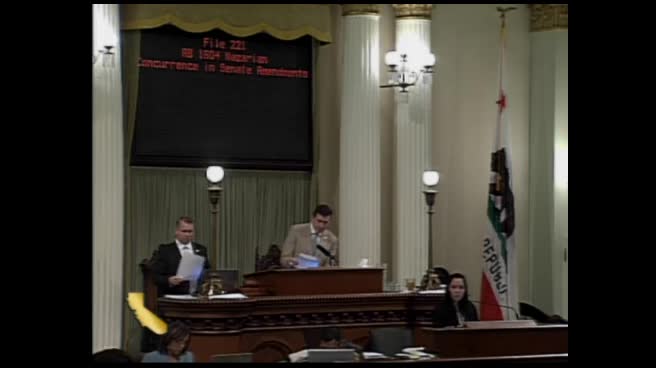 1MIN
Assembly Floor
 1MIN
Senate Floor
 2MIN
Senate Standing Committee on Education
Bill Author

Bill Co-Author(s):