AB 1661: School accountability: federal compliance with accountability requirements.
- Session Year: 2017-2018
- House: Assembly
- Latest Version Date: 2018-09-22
Commencing with the 201718 school year, the federal Elementary and Secondary Education Act of 1965, as amended by the federal Every Student Succeeds Act, requires the state to identify schools for comprehensive support and improvement pursuant to specified accountability system requirements. The federal Every Student Succeeds Act provides for the allotment of formula grants to states for various activities to support effective educational instruction.
This bill would update cross-references to the federal Elementary and Secondary Education Act as amended by the federal Every Student Succeeds Act and make various conforming changes, including to provisions relating to foster youth and provisions relating to parent and family engagement programs. By imposing additional requirements on school districts and county offices of education in regards to written parent and family engagement programs, and to the extent other changes are in addition to what is required by federal law, the bill would impose a state-mandated local program.
The California Constitution requires the state to reimburse local agencies and school districts for certain costs mandated by the state. Statutory provisions establish procedures for making that reimbursement.
This bill would provide that with regard to certain mandates no reimbursement is required by this act for a specified reason.
With regard to any other mandates, this bill would provide that, if the Commission on State Mandates determines that the bill contains costs so mandated by the state, reimbursement for those costs shall be made pursuant to the statutory provisions noted above.
Commencing with the 201718 school year, the federal Elementary and Secondary Education Act of 1965, as amended by the federal Every Student Succeeds Act, requires the state to identify schools for comprehensive support and improvement pursuant to specified accountability system requirements. The federal Every Student Succeeds Act provides for the allotment of formula grants to states for various activities to support effective educational instruction.
This bill would update cross-references to the federal Elementary and Secondary Education Act as amended by the federal Every Student Succeeds Act and make various conforming changes, including to provisions relating to foster youth and provisions relating to parent and family engagement programs. By adding imposing additional requirements on school districts and county offices of education in regards to written parent and family engagement programs, and to the extent other changes are in addition to what is required by federal law, the bill would impose a state-mandated local program.
The California Constitution requires the state to reimburse local agencies and school districts for certain costs mandated by the state. Statutory provisions establish procedures for making that reimbursement.
This bill would provide that with regard to certain mandates no reimbursement is required by this act for a specified reason.
With regard to any other mandates, this bill would provide that, if the Commission on State Mandates determines that the bill contains costs so mandated by the state, reimbursement for those costs shall be made pursuant to the statutory provisions noted above.
Commencing with the 201718 school year, the federal Elementary and Secondary Education Act of 1965, as amended by the federal Every Student Succeeds Act, requires the state to identify schools for comprehensive support and improvement pursuant to specified accountability system requirements. The federal Every Student Succeeds Act provides for the allotment of formula grants to states for various activities to support effective educational instruction.
This bill would update cross-references to the federal Elementary and Secondary Education Act as amended by the federal Every Student Succeeds Act and make various conforming changes, including to the English Learner and Immigrant Pupil Federal Conformity Act, provisions relating to foster youth and migrant children, and provisions relating to parent and family engagement programs. By adding requirements on school districts and county offices of education in regards to written parent and family engagement programs, and to the extent other changes are in addition to what is required by federal law, the bill would impose a state-mandated local program.
The California Constitution requires the state to reimburse local agencies and school districts for certain costs mandated by the state. Statutory provisions establish procedures for making that reimbursement.
This bill would provide that with regard to certain mandates no reimbursement is required by this act for a specified reason.
With regard to any other mandates, this bill would provide that, if the Commission on State Mandates determines that the bill contains costs so mandated by the state, reimbursement for those costs shall be made pursuant to the statutory provisions noted above.
Commencing with the 201718 school year, the federal Elementary and Secondary Education Act of 1965, as amended by the federal Every Student Succeeds Act, requires the state to identify schools for comprehensive support and improvement pursuant to specified accountability system requirements. The federal Every Student Succeeds Act provides for the allotment of formula grants to states for various activities to support effective educational instruction.
This bill would update cross-references to the federal Elementary and Secondary Education Act as amended by the federal Every Student Succeeds Act and make various conforming changes, including to the English Learner and Immigrant Pupil Federal Conformity Act, provisions relating to foster youth and migrant children, and provisions relating to parent and family engagement programs. By adding requirements on school districts and county offices of education in regards to written parent and family engagement programs, thereby imposing and to the extent other changes are in addition to what is required by federal law, the bill would impose a state-mandated local program.
The California Constitution requires the state to reimburse local agencies and school districts for certain costs mandated by the state. Statutory provisions establish procedures for making that reimbursement.This bill would provide that no reimbursement is required by this act for a specified reason.The California Constitution requires the state to reimburse local agencies and school districts for certain costs mandated by the state. Statutory provisions establish procedures for making that reimbursement.
This bill would provide that with regard to certain mandates no reimbursement is required by this act for a specified reason.
With regard to any other mandates, this bill would provide that, if the Commission on State Mandates determines that the bill contains costs so mandated by the state, reimbursement for those costs shall be made pursuant to the statutory provisions noted above.
Commencing with the 201718 school year, the federal Elementary and Secondary Education Act of 1965, as amended by the federal Every Student Succeeds Act, requires the state to identify schools for comprehensive support and improvement pursuant to specified accountability system requirements. The federal Every Student Succeeds Act provides for the allotment of formula grants to states for various activities to support effective educational instruction.
This bill would repeal the Reading First Plan, the Early Warning Program, the Education Technology Grant Act of 2002, and the No Child Left Behind Liaison Team. The bill would make various conforming changes and would update cross-references to the federal Elementary and Secondary Education Act as amended by the federal Every Student Succeeds Act. Act and make various conforming changes, including adding requirements on school districts and county offices of education in regards to written parent and family engagement programs, thereby imposing a state-mandated local program.
The California Constitution requires the state to reimburse local agencies and school districts for certain costs mandated by the state. Statutory provisions establish procedures for making that reimbursement.This bill would provide that, if the Commission on State Mandates determines that the bill contains costs mandated by the state, reimbursement for those costs shall be made pursuant to the statutory provisions noted above.The California Constitution requires the state to reimburse local agencies and school districts for certain costs mandated by the state. Statutory provisions establish procedures for making that reimbursement.
This bill would provide that no reimbursement is required by this act for a specified reason.
Existing law required, on or before July 1, 2014, requires the governing boards of school districts and county boards of education to adopt a local control and accountability plan using a state template adopted by the State Board of Education. Education and requires the local control and accountability plan to be updated before July 1 of each year. Existing law requires the local control and accountability plan to include, among other things, a description of annual goals for all pupils and specified subgroups of pupils to be achieved for each state priority, as specified, and a description of the specific actions the school district or county superintendent of schools will take to achieve those goals.
Existing law requires the Superintendent of Public Instruction, with the approval of the State Board of Education, to develop an Academic Performance Index to measure the performance of schools and school districts, especially the academic performance of pupils.
This bill would repeal the Academic Performance Index and instead require the Superintendent to develop, subject to approval by the state board, a multiple measures public school accountability system, based on the specified state priorities, to measure the performance of schools and school districts, especially the academic performance of pupils. priorities, for school districts, county offices of education, charter schools, and individual schoolsites. The bill would require the multiple measures accountability system to be based on specified performance standards and to address the accountability requirements in the federal Elementary and Secondary Education Act, as specified. The bill would revise reporting requirements in that connection and would make conforming and other related changes and update cross-references. By imposing additional duties on local educational agencies, the bill would impose a state-mandated local program.
Existing law establishes the Reading First Plan to provide reading instruction to pupils in kindergarten and grades 1 to 3, inclusive, and to special education pupils in kindergarten and grades 1 to 12, inclusive, and provides funding for the program from moneys allocated from the former federal No child Left Behind Act of 2001. Existing law establishes the Early Warning Program for purposes of implementing provisions of the former federal No Child Left Behind Act of 2001. Existing law establishes the Education Technology Grant Act of 2002 for purposes of implementing specified provisions of the former federal No Child Left Behind Act of 2001. Existing law also establishes the No Child Left Behind Liaison Team to advise the Superintendent and the state board on matters related to the former federal No Child Left Behind Act of 2001.
This bill would repeal the Reading First Plan, the Early Warning Program, the Education Technology Grant Act of 2002, and the No Child Left Behind Liaison Team. The bill would make various conforming changes and would update cross-references to the federal Elementary and Secondary Education Act as amended by the federal Every Student Succeeds Act.
The California Constitution requires the state to reimburse local agencies and school districts for certain costs mandated by the state. Statutory provisions establish procedures for making that reimbursement.
This bill would provide that, if the Commission on State Mandates determines that the bill contains costs mandated by the state, reimbursement for those costs shall be made pursuant to the statutory provisions noted above.
Existing law required, on or before July 1, 2014, the governing boards of school districts and county boards of education to adopt a local control and accountability plan using a state template adopted by the State Board of Education. Existing law requires the local control and accountability plan to include, among other things, a description of annual goals for all pupils and specified subgroups of pupils to be achieved for each state priority, as specified, and a description of the specific actions the school district or county superintendent of schools will take to achieve those goals.
Existing law requires the Superintendent of Public Instruction, with the approval of the State Board of Education, to develop an Academic Performance Index to measure the performance of schools and school districts, especially the academic performance of pupils.
This bill would require the Superintendent to develop, subject to approval by the state board, a multiple measures accountability system, based on the specified state priorities, to measure the performance of schools and school districts, especially the academic performance of pupils.
The Legislature hereby finds and declares all of the following:
(a)Despite a substantial increase in school funding over the last five years, a significant percentage of the school-aged population, particularly in large urban areas, is learning well below the statewide average and is making only marginal progress at best.
(b)Parental involvement and support in the education of children is an integral part of improving academic achievement. Educational research has established that properly constructed parent involvement programs can play an important and effective role in the participation of parents in their childrens schools and in raising pupil achievement levels.
(c)The federal government has recognized the critical role of parents in the educational process and requires parental and family engagement programs as a condition of eligibility for funds under the federal Elementary and Secondary Education Act (20 U.S.C. Sec. 6301 et seq.).
(d)The state board has also adopted a policy urging the creation of parent involvement programs in all schools.
(e)The local control funding formula legislation adopts parental involvement as one of its key components.
(f)Research and experience have demonstrated that these programs succeed only when certain components are made part of the program.
SEC. 2.Section 11501 of the Education Code is amended to read:11501.It is the intent of the Legislature in enacting this chapter to ensure that parent and family engagement programs are properly designed and implemented and to provide a focus and structure for these programs based on prior experience and research while maintaining sufficient local flexibility to design a program that best meets the needs of the local community.
SEC. 3.Section 11502 of the Education Code is amended to read:11502.It is the purpose and goal of this chapter to do all of the following:
(a)To engage parents and family members positively in their childrens education by providing assistance and training on topics such as state academic standards and assessments to develop knowledge and skills to use at home to support their childrens academic efforts at school and their childrens development as responsible future members of our society.
(b)To inform parents that they can directly affect the success of their childrens learning, by providing parents with techniques and strategies that they may utilize to improve their childrens academic success and to assist their children in learning at home.
(c)To build consistent and effective two-way communication between family members and the school so that parents and family members may know when and how to assist their children in support of classroom learning activities.
(d)To train teachers, school administrators, specialized instructional support personnel, and other staff to communicate effectively with parents as equal partners.
(e)To integrate and coordinate parent and family engagement activities with the local control and accountability plan adopted pursuant to Section 47606.5, 52060, or 52066, as applicable, with other programs.
SEC. 4.Section 11503 of the Education Code is amended to read:11503.The governing board of each school district and county office of education shall establish a written parent and family engagement program for each school in the district that receives funds under the federal Elementary and Secondary Education Act (20 U.S.C. Sec. 6301 et seq.), as amended by the federal Every Student Succeeds Act (Public Law 11495). That program shall contain at least the following elements:
(a)Procedures to ensure that parents and family members are consulted and participate in the planning, design, implementation, and evaluation of the program.
(b)Procedures to involve parents and family members in developing the Local Educational Agency Plan and school support and improvement plans under Section 6312 of Title 20 of the United States Code.
(c)Procedures to provide assistance and support necessary to build schools capacity to plan and implement effective parent and family engagement activities.
(d)Procedures to train teachers, school administrators, and other staff on outreach and effective communication with parents and family members as equal partners.
(e)Regular and periodic programs throughout the school year that provide for training, instruction, and information on all of the following:
(1)Parental and family member ability to directly affect the success of their childrens learning through the support they give their children at home and at school.
(2)Explanation of curriculum, state academic achievement standards, and state and local assessments.
(3)Home activities, strategies, and materials that can be used to assist and enhance the learning of children both at home and at school.
(4)Skills to assist parents and family members in understanding the development needs of their children and in understanding how to provide positive discipline for, and build healthy relationships with, their children.
(5)Developing consistent and effective communications between the school and the parents and family members concerning the progress of the children in school and concerning school programs.
(f)An annual statement identifying specific objectives of the program consistent with the requirements of this section.
(g)An annual review and assessment of the programs progress in meeting those objectives. Parents shall be made aware of the existence of this review and assessment through regular school communications mechanisms and shall be given a copy upon the parents request.
SEC. 5.Section 12030 of the Education Code is amended to read:12030.The people of the State of California accept the provisions of, and each of the funds provided by, the act of Congress titled An act to strengthen the national defense and to encourage and assist in the expansion and improvement of educational programs to meet critical national needs; and for other purposes (National Defense Education Act of 1958), approved September 2, 1958, and the federal Elementary and Secondary Education Act (20 U.S.C. Sec. 6301 et seq.), as amended by the federal Every Student Succeeds Act (Public Law 11495).
SEC. 6.Section 12032 of the Education Code is amended to read:12032.The state board is designated as the state educational agency to carry out the purposes and the provisions of these acts of Congress. The state board is hereby vested with authority to prepare and submit to the United States Secretary of Education any state plan required by these acts of Congress, to prepare and submit amendments to the state plans, and to administer the state plans or amendments thereto, in accordance with these acts of Congress and any rules and regulations adopted thereunder. The state board is hereby vested with all necessary power and authority to cooperate with the government of the United States, or any agency or agencies thereof in the administration of these acts of Congress and the rules and regulations adopted thereunder.
SEC. 7.Section 33318.5 of the Education Code is amended to read:33318.5.(a)In addition to the dropout rate the department compiles pursuant to the federal Every Student Succeeds Act (Public Law 11495), the department shall compile an attrition rate for high school pupils in the state pursuant to the formula specified in subdivision (b).
(b)The attrition rate is the difference between the number of pupils who enrolled in grade 9 in a particular year and the number of pupils who, four years later, receive a diploma of graduation from high school, divided by the number of pupils who enrolled in grade 9 in the particular year.
SEC. 8.Section 33370 of the Education Code is amended to read:33370.(a)There is hereby created within the department an American Indian Education Unit, which shall provide technical support to, and proper administrative oversight of, American Indian education programs established by the state in order to ensure that American Indian pupils in California public schools are able to meet the challenging academic standards of the federal Elementary and Secondary Education Act (20 U.S.C. Sec. 6301 et seq.) and that those programs reflect the cultural and educational standards stated in Executive Order No. 13336, 69 Federal Register 25295 (May 5, 2004), relating to American Indian and Alaska Native Education.
(b)The Superintendent shall appoint an American Indian Education Unit Manager who shall oversee the American Indian Education Unit.
(c)The duties of the American Indian Education Unit shall include the development of clear, consistent, and effective operating policies and procedures that include measures to ensure that the learning needs of American Indian pupils are being adequately addressed.
(d)The department shall ensure that staff are properly trained in the application of the policies adopted pursuant to subdivision (c) and that the policies are consistent with the legislative intent relating to the California American Indian Education Program and with Section 11019.6 of, subdivisions (d) and (f) of Section 11340 of, and Section 11342.2 of, the Government Code.
(e)The department shall prescribe the following:
(1)The data that California American Indian education centers shall report on an annual basis in order to measure program performance.
(2)On or before January 1, 2011, and again on or before January 1, 2016, the department shall conduct an evaluation of the centers to determine whether to renew the application of each existing center or instead to approve an application to establish a new center.
(3)A description of the consequences for failing to submit the data.
(f)The department shall adopt policies that include:
(1)An equitable process that will be used to select centers that will receive grant awards and determine their respective funding amounts.
(2)Establish a prompt timeframe for disbursing approved payments to the centers.
(3)A monitoring process and plan to ensure that fiscal and program information reported by the centers is accurate and complete, including a process for corrective action and investigation by the department for noncompliance. The process shall be based upon consistent and equitable principles.
(4)The incorporation of culturally responsive methodologies in order to ensure that an optimal educational program for American Indian pupils is supported and maintained.
(5)Ensuring respect for the federal trust and sovereign nation status of California American Indian tribes.
(g)The Superintendent, with input from existing California American Indian education center directors, shall appoint an American Indian Education Oversight Committee by January 30, 2007, composed of at least seven educators, four of whom shall be California American Indian education center directors. If the Superintendent is unable to find a qualified individual to fill a vacancy in one of the four positions for center directors within 30 days of the vacancy arising, he or she may fill the vacancy with an educator who is not a center director. All members shall possess proven knowledge of current educational policies relating to, and issues faced by, American Indian communities in California. This committee shall provide input and advice to the Superintendent on all aspects of American Indian education programs established by the state.
SEC. 9.Section 48853.5 of the Education Code is amended to read:48853.5.(a)This section applies to a foster child. Foster child means a child who has been removed from his or her home pursuant to Section 309 of the Welfare and Institutions Code, is the subject of a petition filed under Section 300 or 602 of the Welfare and Institutions Code, or has been removed from his or her home and is the subject of a petition filed under Section 300 or 602 of the Welfare and Institutions Code.
(b)The department, in consultation with the California Foster Youth Education Task Force, shall develop a standardized notice of the educational rights of foster children, as specified in Sections 48850 to this section, inclusive, and Sections 48911, 48915.5, 49069.5, 49076, 51225.1, and 51225.2. The notice shall include complaint process information, as applicable. The department shall make the notice available to educational liaisons for foster children for dissemination by posting the notice on its Internet Web site. Any version of this notice prepared for use by foster children shall also include, to the greatest extent practicable, the rights established pursuant to Section 16001.9 of the Welfare and Institutions Code. In developing the notice that includes the rights in Section 16001.9 of the Welfare and Institutions Code, the department shall consult with the Office of the State Foster Care Ombudsperson.
(c)Each local educational agency shall designate a staff person as the educational liaison for foster children. In a school district that operates a foster children services program pursuant to Chapter 11.3 (commencing with Section 42920) of Part 24 of Division 3, the educational liaison shall be affiliated with the local foster children services program. The educational liaison shall do both of the following:
(1)Ensure and facilitate the proper educational placement, enrollment in school, and checkout from school of foster children.
(2)Assist foster children when transferring from one school to another school or from one school district to another school district in ensuring proper transfer of credits, records, and grades.
(d)If so designated by the superintendent of the local educational agency, the educational liaison shall notify a foster childs attorney and the appropriate representative of the county child welfare agency of pending expulsion proceedings if the decision to recommend expulsion is a discretionary act, pending proceedings to extend a suspension until an expulsion decision is rendered if the decision to recommend expulsion is a discretionary act, and, if the foster child is an individual with exceptional needs, pending manifestation determinations pursuant to Section 1415(k) of Title 20 of the United States Code if the local educational agency has proposed a change in placement due to an act for which the decision to recommend expulsion is at the discretion of the principal or the district superintendent of schools.
(e)This section does not grant authority to the educational liaison that supersedes the authority granted under state and federal law to a parent or legal guardian retaining educational rights, a responsible adult appointed by the court to represent the child pursuant to Section 361 or 726 of the Welfare and Institutions Code, a surrogate parent, or a foster parent exercising the authority granted under Section 56055. The role of the educational liaison is advisory with respect to placement decisions and determination of the school of origin.
(f)(1)At the initial detention or placement, or any subsequent change in placement of a foster child, the local educational agency serving the foster child shall allow the foster child to continue his or her education in the school of origin for the duration of the jurisdiction of the court.
(2)If the jurisdiction of the court is terminated before the end of an academic year, the local educational agency shall allow a former foster child who is in kindergarten or any of grades 1 to 8, inclusive, to continue his or her education in the school of origin through the duration of the academic school year.
(3)(A)If the jurisdiction of the court is terminated while a foster child is in high school, the local educational agency shall allow the former foster child to continue his or her education in the school of origin through graduation.
(B)For purposes of this paragraph, a school district is not required to provide transportation to a former foster child who has an individualized education program that does not require transportation as a related service and who changes residence but remains in his or her school of origin pursuant to this paragraph, unless the individualized education program team determines that transportation is a necessary related service.
(4)To ensure that the foster child has the benefit of matriculating with his or her peers in accordance with the established feeder patterns of school districts, if the foster child is transitioning between school grade levels, the local educational agency shall allow the foster child to continue in the school district of origin in the same attendance area, or, if the foster child is transitioning to a middle school or high school, and the school designated for matriculation is in another school district, to the school designated for matriculation in that school district.
(5)(A)Paragraphs (2), (3), and (4) do not require a school district to provide transportation services to allow a foster child to attend a school or school district, unless there is an agreement with a local child welfare agency that the school district assumes part or all of the transportation costs in accordance with Section 6312(c)(5) of Title 20 of the United States Code, or unless otherwise required under federal law. This paragraph does not prohibit a school district from, at its discretion, providing transportation services to allow a foster child to attend a school or school district.
(B)In accordance with Section 6312(c)(5) of Title 20 of the United States Code, local educational agencies shall collaborate with local child welfare agencies to develop and implement clear written procedures to address the transportation needs of foster youth to maintain them in their school of origin, when it is in the best interest of the foster youth.
(6)The educational liaison, in consultation with, and with the agreement of, the foster child and the person holding the right to make educational decisions for the foster child, may recommend, in accordance with the foster childs best interests, that the foster childs right to attend the school of origin be waived and the foster child be enrolled in a public school that pupils living in the attendance area in which the foster child resides are eligible to attend.
(7)Before making a recommendation to move a foster child from his or her school of origin, the educational liaison shall provide the foster child and the person holding the right to make educational decisions for the foster child with a written explanation stating the basis for the recommendation and how the recommendation serves the foster childs best interests.
(8)(A)If the educational liaison, in consultation with the foster child and the person holding the right to make educational decisions for the foster child, agrees that the best interests of the foster child would best be served by his or her transfer to a school other than the school of origin, the foster child shall immediately be enrolled in the new school.
(B)The new school shall immediately enroll the foster child even if the foster child has outstanding fees, fines, textbooks, or other items or moneys due to the school last attended or is unable to produce clothing or records normally required for enrollment, such as previous academic records, medical records, including, but not limited to, records or other proof of immunization history pursuant to Chapter 1 (commencing with Section 120325) of Part 2 of Division 105 of the Health and Safety Code, proof of residency, other documentation, or school uniforms.
(C)Within two business days of the foster childs request for enrollment, the educational liaison for the new school shall contact the school last attended by the foster child to obtain all academic and other records. The last school attended by the foster child shall provide all required records to the new school regardless of any outstanding fees, fines, textbooks, or other items or moneys owed to the school last attended. The educational liaison for the school last attended shall provide all records to the new school within two business days of receiving the request.
(9)If a dispute arises regarding the request of a foster child to remain in the school of origin, the foster child has the right to remain in the school of origin pending resolution of the dispute. The dispute shall be resolved in accordance with the existing dispute resolution process available to a pupil served by the local educational agency.
(10)The local educational agency and the county placing agency are encouraged to collaborate to ensure maximum use of available federal moneys, explore public-private partnerships, and access any other funding sources to promote the well-being of foster children through educational stability.
(11)It is the intent of the Legislature that this subdivision shall not supersede or exceed other laws governing special education services for eligible foster children.
(g)For purposes of this section, school of origin means the school that the foster child attended when permanently housed or the school in which the foster child was last enrolled. If the school the foster child attended when permanently housed is different from the school in which the foster child was last enrolled, or if there is some other school that the foster child attended with which the foster child is connected and that the foster child attended within the immediately preceding 15 months, the educational liaison, in consultation with, and with the agreement of, the foster child and the person holding the right to make educational decisions for the foster child, shall determine, in the best interests of the foster child, the school that shall be deemed the school of origin.
(h)This section does not supersede other law governing the educational placements in juvenile court schools, as described in Section 48645.1, by the juvenile court under Section 602 of the Welfare and Institutions Code.
(i)(1)A complaint of noncompliance with the requirements of this section may be filed with the local educational agency under the Uniform Complaint Procedures set forth in Chapter 5.1 (commencing with Section 4600) of Division 1 of Title 5 of the California Code of Regulations.
(2)A complainant not satisfied with the decision of a local educational agency may appeal the decision to the department pursuant to Chapter 5.1 (commencing with Section 4600) of Division 1 of Title 5 of the California Code of Regulations and shall receive a written decision regarding the appeal within 60 days of the departments receipt of the appeal.
(3)If a local educational agency finds merit in a complaint, or the Superintendent finds merit in an appeal, the local educational agency shall provide a remedy to the affected pupil.
(4)Information regarding the requirements of this section shall be included in the annual notification distributed to, among others, pupils, parents or guardians of pupils, employees, and other interested parties pursuant to Section 4622 of Title 5 of the California Code of Regulations.
SEC. 10.Section 49558 of the Education Code is amended to read:49558.(a)All applications and records concerning any individual made or kept by any public officer or agency in connection with the administration of any provision of this code relating to free or reduced-price meal eligibility shall be confidential, and may not be open to examination for any purpose not directly connected with the administration of any free or reduced-price meal program, or any investigation, prosecution, or criminal or civil proceeding conducted in connection with the administration of any free or reduced-price meal program.
(b)Notwithstanding subdivision (a), a public officer or agency may allow school district employees, who are authorized by the governing board of the school district, to disclose from the individual meal records only the pupils name and school meal eligibility status, solely for purposes of disaggregation of academic achievement data or to identify pupils eligible for public school choice and direct pupil services pursuant to the federal Elementary and Secondary Education Act (20 U.S.C. Sec. 6301 et seq.), if the public agency ensures the following:
(1)The public agency has adopted a policy that allows for the use of individual records for these purposes.
(2)No individual indicators of participation in any free or reduced-price meal program are maintained in the permanent record of any pupil, unless otherwise allowed by law.
(3)No public release of information regarding individual pupil participation in any free or reduced-price meal program is permitted.
(4)All other confidentiality provisions required by law are met.
(5)The information collected regarding individual pupils certified to participate in the free or reduced-price meal program is destroyed when it is no longer needed for its intended purpose.
(c)Notwithstanding subdivision (a), the school districts and county superintendents of schools may release information on the School Lunch Program application to the local agency that determines eligibility under the Medi-Cal program if the child is approved for free meals and if the applicant consents to the sharing of information pursuant to Section 49557.2.
(d)Notwithstanding subdivision (a), the school districts and county superintendents of schools may release information on the School Lunch Program application to the local agency that determines eligibility under the CalFresh program or to an agency that determines eligibility for nutrition assistance programs authorized by Chapter 2 (commencing with Section 210.1) of Subtitle B of Title 7 of the Code of Federal Regulations, if the child is approved for free or reduced-price meals and if the applicant consents to the sharing of information pursuant to Section 49557.3.
(e)Notwithstanding subdivision (a), a school district, charter school, or county office of education may release the name and eligibility status of a pupil participating in the free or reduced-price meal program as follows:
(1)To the Superintendent for purposes of determining funding allocations under the local control funding formula and for assessing the accountability of that funding.
(2)Upon request, to another school district, charter school, or county office of education that is serving a pupil living in the same household as an enrolled pupil for purposes related to free or reduced-price meal program eligibility and for data used in local control funding formula calculations.
(f)Information released pursuant to subdivision (c), (d), or (e) shall adhere to all of the following requirements:
(1)Individual indicators of participation in a free or reduced-price meal program shall not be maintained in the permanent record of any pupil, unless otherwise authorized by law.
(2)The public release of information regarding individual pupil participation in a free or reduced-price meal program is not permitted.
(3)All other confidentiality requirements imposed by law or regulation are met.
SEC. 11.Section 51749.5 of the Education Code is amended to read:51749.5.(a)Notwithstanding any other law, and commencing with the 201516 school year, a school district, charter school, or county office of education may, for pupils enrolled in kindergarten and grades 1 to 12, inclusive, provide independent study courses pursuant to the following conditions:
(1)The governing board or body of a participating school district, charter school, or county office of education adopts policies, at a public meeting, that comply with the requirements of this section and any applicable regulations adopted by the state board.
(2)A signed learning agreement is completed and on file pursuant to Section 51749.6.
(3)Courses are taught under the general supervision of certificated employees who hold the appropriate subject matter credential pursuant to Section 44300 or 44865, or subdivision (l) of Section 47605, and are employed by the school district, charter school, or county office of education at which the pupil is enrolled, or by a school district, charter school, or county office of education that has a memorandum of understanding to provide the instruction in coordination with the school district, charter school, or county office of education at which the pupil is enrolled.
(4)(A)Courses are annually certified, by school district, charter school, or county office of education governing board or body resolution, to be of the same rigor and educational quality as equivalent classroom-based courses, and shall be aligned to all relevant local and state content standards.
(B)This certification shall, at a minimum, include the duration, number of equivalent daily instructional minutes for each schoolday that a pupil is enrolled, number of equivalent total instructional minutes, and number of course credits for each course. This information shall be consistent with that of equivalent classroom-based courses.
(5)Pupils enrolled in courses authorized by this section shall meet the applicable age requirements established pursuant to Sections 46300.1, 46300.4, 47612, and 47612.1.
(6)Pupils enrolled in courses authorized by this section shall meet the applicable residency and enrollment requirements established pursuant to Sections 46300.2, 47612, 48204, and 51747.3.
(7)(A)Certificated employees and each pupil shall communicate in person, by telephone, or by any other live visual or audio connection no less than twice per calendar month to assess whether each pupil is making satisfactory educational progress.
(B)For purposes of this section, satisfactory educational progress includes, but is not limited to, applicable statewide accountability measures and the completion of assignments, examinations, or other indicators that evidence that the pupil is working on assignments, learning required concepts, and progressing toward successful completion of the course, as determined by certificated employees providing instruction.
(C)If satisfactory educational progress is not being made, certificated employees providing instruction shall notify the pupil and, if the pupil is less than 18 years of age, the pupils parent or legal guardian, and conduct an evaluation to determine whether it is in the best interest of the pupil to remain in the course or whether he or she should be referred to an alternative program, which may include, but is not limited to, a regular school program. A written record of the findings of an evaluation made pursuant to this subdivision shall be treated as a mandatory interim pupil record. The record shall be maintained for a period of three years from the date of the evaluation and, if the pupil transfers to another California public school, the record shall be forwarded to that school.
(D)Written or computer-based evidence of satisfactory educational progress, as defined in subparagraph (B), shall be retained for each course and pupil. At a minimum, this evidence shall include a grade book or summary document that, for each course, lists all assignments, examinations, and associated grades.
(8)A proctor shall administer examinations.
(9)(A)Statewide testing results for pupils enrolled in any course authorized pursuant to this section shall be reported and assigned to the school or charter school at which the pupil is enrolled, and to any school district, charter school, or county office of education within which that schools or charter schools testing results are aggregated.
(B)Statewide testing results for pupils enrolled in a course or courses pursuant to this section shall be disaggregated for purposes of comparing the testing results of those pupils to the testing results of pupils enrolled in classroom-based courses.
(10)A pupil shall not be required to enroll in courses authorized by this section.
(11)The pupil-to-certificated-employee ratio limitations established pursuant to Section 51745.6 are applicable to courses authorized by this section.
(12)For each pupil, the combined equivalent daily instructional minutes for enrolled courses authorized by this section and enrolled courses authorized by all other laws and regulations shall meet the minimum instructional day requirements applicable to the local educational agency. Pupils enrolled in courses authorized by this section shall be offered the minimum annual total equivalent instructional minutes pursuant to Sections 46200 to 46208, inclusive, and Section 47612.5.
(13)Courses required for high school graduation or for admission to the University of California or California State University shall not be offered exclusively through independent study.
(14)A pupil participating in independent study shall not be assessed a fee prohibited by Section 49011.
(15)A pupil shall not be prohibited from participating in independent study solely on the basis that he or she does not have the materials, equipment, or Internet access that are necessary to participate in the independent study course.
(b)For purposes of computing average daily attendance for each pupil enrolled in one or more courses authorized by this section, the following computations shall apply:
(1)(A)For each schoolday, add the combined equivalent daily instructional minutes, as certified in paragraph (4) of subdivision (a), for courses authorized by this section in which the pupil is enrolled.
(B)For each schoolday, add the combined daily instructional minutes of courses authorized by all other laws and regulations in which the pupil is enrolled and for which the pupil meets applicable attendance requirements.
(C)For each schoolday, add the sum of subparagraphs (A) and (B).
(2)If subparagraph (C) of paragraph (1) meets applicable minimum schoolday requirements for each schoolday, and all other requirements in this section have been met, credit each schoolday that the pupil is demonstrating satisfactory educational progress pursuant to the requirements of this section, with up to one school day of attendance.
(3)(A)Using credited schoolday attendance pursuant to paragraph (2), calculate average daily attendance pursuant to Section 41601 or 47612, whichever is applicable, for each pupil.
(B)The average daily attendance computed pursuant to this subdivision shall not result in more than one unit of average daily attendance per pupil.
(4)Notwithstanding any other law, average daily attendance computed for pupils enrolled in courses authorized by this section shall not be credited with average daily attendance other than what is specified in this section.
(5)If more than 10 percent of the total average daily attendance of a school district, charter school, or county office of education is claimed pursuant to this section, then the amount of average daily attendance for all pupils enrolled by that school district, charter school, or county office of education in courses authorized pursuant to this section that is in excess of 10 percent of the total average daily attendance for the school district, charter school, or county office of education shall be reduced by either (A) the statewide average rate of absence for elementary school districts for kindergarten and grades 1 to 8, inclusive, or (B) the statewide average rate of absence for high school districts for grades 9 to 12, inclusive, as applicable, as calculated by the department for the prior fiscal year, with the resultant figures and ranges rounded to the nearest 10th.
(c)For purposes of this section, equivalent total instructional minutes means the same number of minutes as required for an equivalent classroom-based course.
(d)Nothing in this section shall be deemed to prohibit the right to collectively bargain any subject within the scope of representation pursuant to Section 3543.2 of the Government Code.
(e)(1)The Superintendent shall conduct an evaluation of independent study courses offered pursuant to this section and report the findings to the Legislature and the Director of Finance no later than September 1, 2019. The report shall, at a minimum, compare the academic performance of pupils in independent study with demographically similar pupils enrolled in equivalent classroom-based courses.
(2)The requirement for submitting a report imposed under paragraph (1) is inoperative on September 1, 2023, pursuant to Section 10231.5 of the Government Code.
(3)A report to be submitted pursuant to paragraph (1) shall be submitted in compliance with Section 9795 of the Government Code.
SEC. 12.Section 52063 of the Education Code is amended to read:52063.(a)(1)The governing board of a school district shall establish a parent advisory committee to provide advice to the governing board of the school district and the superintendent of the school district regarding the requirements of this article.
(2)A parent advisory committee shall include parents or legal guardians of pupils to whom one or more of the definitions in Section 42238.01 apply.
(3)This subdivision shall not require the governing board of the school district to establish a new parent advisory committee if the governing board of the school district already has established a parent advisory committee that meets the requirements of this subdivision, including any committee established to meet the requirements of the federal Elementary and Secondary Education Act, as amended by the federal Every Student Succeeds Act (Public Law 114-95), pursuant to Section 1116 of Subpart 1 of Part A of Title I of that act.
(b)(1)The governing board of a school district shall establish an English learner parent advisory committee if the enrollment of the school district includes at least 15 percent English learners and the school district enrolls at least 50 pupils who are English learners.
(2)This subdivision shall not require the governing board of the school district to establish a new English learner parent advisory committee if the governing board of the school district already has established a committee that meets the requirements of this subdivision.
SEC. 13.Section 52069 of the Education Code is amended to read:52069.(a)(1)A county superintendent of schools shall establish a parent advisory committee to provide advice to the county board of education and the county superintendent of schools regarding the requirements of this article.
(2)A parent advisory committee shall include parents or legal guardians of pupils to whom one or more of the definitions in Section 42238.01 apply.
(3)This subdivision shall not require the county superintendent of schools to establish a new parent advisory committee if the county superintendent of schools already has established a parent advisory committee that meets the requirements of this subdivision, including any committee established to meet the requirements of the federal Elementary and Secondary Education Act (20 U.S.C. Sec. 6301 et seq.) pursuant to Section 6312 of that act.
(b)(1)A county superintendent of schools shall establish an English learner parent advisory committee if the enrollment of the pupils in the schools and programs operated by the county superintendent of schools includes at least 15 percent English learners and the schools and programs operated by the county superintendent of schools enroll at least 50 pupils who are English learners.
(2)This subdivision shall not require the county superintendent of schools to establish a new English learner parent advisory committee if the county superintendent of schools already has established a committee that meets the requirements of this subdivision.
SEC. 14.No reimbursement is required by this act pursuant to Section 6 of Article XIIIB of the California Constitution because this act implements a federal law or regulation and results in costs mandated by the federal government, within the meaning of Section 17556 of the Government Code.
However, if the Commission on State Mandates determines that this act contains other costs mandated by the state, reimbursement to local agencies and school districts for those costs shall be made pursuant to Part 7 (commencing with Section 17500) of Division 4 of Title 2 of the Government Code.
The Legislature hereby finds and declares all of the following:
(a)Despite a substantial increase in school funding over the last five years, a significant percentage of the school-aged population, particularly in large urban areas, is learning well below the statewide average and is making only marginal progress at best.
(b)Parental involvement and support in the education of children is an integral part of improving academic achievement. Educational research has established that properly constructed parent involvement programs can play an important and effective role in the participation of parents in their childrens schools and in raising pupil achievement levels.
(c)The federal government has recognized the critical role of parents in the educational process and requires parental and family engagement programs as a condition of eligibility for funds under the federal Elementary and Secondary Education Act (20 U.S.C. Sec. 6301 et seq.).
(d)The state board has also adopted a policy urging the creation of parent involvement programs in all schools.
(e)The local control funding formula legislation adopts parental involvement as one of its key components.
(f)Research and experience have demonstrated that these programs succeed only when certain components are made part of the program.
SEC. 2.Section 11501 of the Education Code is amended to read:11501.It is the intent of the Legislature in enacting this chapter to ensure that parent and family engagement programs are properly designed and implemented and to provide a focus and structure for these programs based on prior experience and research while maintaining sufficient local flexibility to design a program that best meets the needs of the local community.
SEC. 3.Section 11502 of the Education Code is amended to read:11502.It is the purpose and goal of this chapter to do all of the following:
(a)To engage parents and family members positively in their childrens education by providing assistance and training on topics such as state academic standards and assessments to develop knowledge and skills to use at home to support their childrens academic efforts at school and their childrens development as responsible future members of our society.
(b)To inform parents that they can directly affect the success of their childrens learning, by providing parents with techniques and strategies that they may utilize to improve their childrens academic success and to assist their children in learning at home.
(c)To build consistent and effective two-way communication between family members and the school so that parents and family members may know when and how to assist their children in support of classroom learning activities.
(d)To train teachers, school administrators, specialized instructional support personnel, and other staff to communicate effectively with parents as equal partners.
(e)To integrate and coordinate parent and family engagement activities with the local control and accountability plan adopted pursuant to Section 47606.5, 52060, or 52066, as applicable, with other programs.
SEC. 4.Section 11503 of the Education Code is amended to read:11503.The governing board of each school district and county office of education shall establish a written parent and family engagement program for each school in the district that receives funds under the federal Elementary and Secondary Education Act (20 U.S.C. Sec. 6301 et seq.), as amended by the federal Every Student Succeeds Act (Public Law 11495). That program shall contain at least the following elements:
(a)Procedures to ensure that parents and family members are consulted and participate in the planning, design, implementation, and evaluation of the program.
(b)Procedures to involve parents and family members in developing the Local Educational Agency Plan and school support and improvement plans under Section 6312 of Title 20 of the United States Code.
(c)Procedures to provide assistance and support necessary to build schools capacity to plan and implement effective parent and family engagement activities.
(d)Procedures to train teachers, school administrators, and other staff on outreach and effective communication with parents and family members as equal partners.
(e)Regular and periodic programs throughout the school year that provide for training, instruction, and information on all of the following:
(1)Parental and family member ability to directly affect the success of their childrens learning through the support they give their children at home and at school.
(2)Explanation of curriculum, state academic achievement standards, and state and local assessments.
(3)Home activities, strategies, and materials that can be used to assist and enhance the learning of children both at home and at school.
(4)Skills to assist parents and family members in understanding the development needs of their children and in understanding how to provide positive discipline for, and build healthy relationships with, their children.
(5)Developing consistent and effective communications between the school and the parents and family members concerning the progress of the children in school and concerning school programs.
(f)An annual statement identifying specific objectives of the program consistent with the requirements of this section.
(g)An annual review and assessment of the programs progress in meeting those objectives. Parents shall be made aware of the existence of this review and assessment through regular school communications mechanisms and shall be given a copy upon the parents request.
SEC. 5.Section 12030 of the Education Code is amended to read:12030.The people of the State of California accept the provisions of, and each of the funds provided by, the act of Congress titled An act to strengthen the national defense and to encourage and assist in the expansion and improvement of educational programs to meet critical national needs; and for other purposes (National Defense Education Act of 1958), approved September 2, 1958, and the federal Elementary and Secondary Education Act (20 U.S.C. Sec. 6301 et seq.), as amended by the federal Every Student Succeeds Act (Public Law 11495).
SEC. 6.Section 12032 of the Education Code is amended to read:12032.The state board is designated as the state educational agency to carry out the purposes and the provisions of these acts of Congress. The state board is hereby vested with authority to prepare and submit to the United States Secretary of Education any state plan required by these acts of Congress, to prepare and submit amendments to the state plans, and to administer the state plans or amendments thereto, in accordance with these acts of Congress and any rules and regulations adopted thereunder. The state board is hereby vested with all necessary power and authority to cooperate with the government of the United States, or any agency or agencies thereof in the administration of these acts of Congress and the rules and regulations adopted thereunder.
SEC. 7.Section 33318.5 of the Education Code is amended to read:33318.5.(a)In addition to the dropout rate the department compiles pursuant to the federal Every Student Succeeds Act (Public Law 11495), the department shall compile an attrition rate for high school pupils in the state pursuant to the formula specified in subdivision (b).
(b)The attrition rate is the difference between the number of pupils who enrolled in grade 9 in a particular year and the number of pupils who, four years later, receive a diploma of graduation from high school, divided by the number of pupils who enrolled in grade 9 in the particular year.
SEC. 8.Section 33370 of the Education Code is amended to read:33370.(a)There is hereby created within the department an American Indian Education Unit, which shall provide technical support to, and proper administrative oversight of, American Indian education programs established by the state in order to ensure that American Indian pupils in California public schools are able to meet the challenging academic standards of the federal Elementary and Secondary Education Act (20 U.S.C. Sec. 6301 et seq.) and that those programs reflect the cultural and educational standards stated in Executive Order No. 13336, 69 Federal Register 25295 (May 5, 2004), relating to American Indian and Alaska Native Education.
(b)The Superintendent shall appoint an American Indian Education Unit Manager who shall oversee the American Indian Education Unit.
(c)The duties of the American Indian Education Unit shall include the development of clear, consistent, and effective operating policies and procedures that include measures to ensure that the learning needs of American Indian pupils are being adequately addressed.
(d)The department shall ensure that staff are properly trained in the application of the policies adopted pursuant to subdivision (c) and that the policies are consistent with the legislative intent relating to the California American Indian Education Program and with Section 11019.6 of, subdivisions (d) and (f) of Section 11340 of, and Section 11342.2 of, the Government Code.
(e)The department shall prescribe the following:
(1)The data that California American Indian education centers shall report on an annual basis in order to measure program performance.
(2)On or before January 1, 2011, and again on or before January 1, 2016, the department shall conduct an evaluation of the centers to determine whether to renew the application of each existing center or instead to approve an application to establish a new center.
(3)A description of the consequences for failing to submit the data.
(f)The department shall adopt policies that include:
(1)An equitable process that will be used to select centers that will receive grant awards and determine their respective funding amounts.
(2)Establish a prompt timeframe for disbursing approved payments to the centers.
(3)A monitoring process and plan to ensure that fiscal and program information reported by the centers is accurate and complete, including a process for corrective action and investigation by the department for noncompliance. The process shall be based upon consistent and equitable principles.
(4)The incorporation of culturally responsive methodologies in order to ensure that an optimal educational program for American Indian pupils is supported and maintained.
(5)Ensuring respect for the federal trust and sovereign nation status of California American Indian tribes.
(g)The Superintendent, with input from existing California American Indian education center directors, shall appoint an American Indian Education Oversight Committee by January 30, 2007, composed of at least seven educators, four of whom shall be California American Indian education center directors. If the Superintendent is unable to find a qualified individual to fill a vacancy in one of the four positions for center directors within 30 days of the vacancy arising, he or she may fill the vacancy with an educator who is not a center director. All members shall possess proven knowledge of current educational policies relating to, and issues faced by, American Indian communities in California. This committee shall provide input and advice to the Superintendent on all aspects of American Indian education programs established by the state.
SEC. 9.Section 48853.5 of the Education Code is amended to read:48853.5.(a)This section applies to a foster child. Foster child means a child who has been removed from his or her home pursuant to Section 309 of the Welfare and Institutions Code, is the subject of a petition filed under Section 300 or 602 of the Welfare and Institutions Code, or has been removed from his or her home and is the subject of a petition filed under Section 300 or 602 of the Welfare and Institutions Code.
(b)The department, in consultation with the California Foster Youth Education Task Force, shall develop a standardized notice of the educational rights of foster children, as specified in Sections 48850 to this section, inclusive, and Sections 48911, 48915.5, 49069.5, 49076, 51225.1, and 51225.2. The notice shall include complaint process information, as applicable. The department shall make the notice available to educational liaisons for foster children for dissemination by posting the notice on its Internet Web site. Any version of this notice prepared for use by foster children shall also include, to the greatest extent practicable, the rights established pursuant to Section 16001.9 of the Welfare and Institutions Code. In developing the notice that includes the rights in Section 16001.9 of the Welfare and Institutions Code, the department shall consult with the Office of the State Foster Care Ombudsperson.
(c)Each local educational agency shall designate a staff person as the educational liaison for foster children. In a school district that operates a foster children services program pursuant to Chapter 11.3 (commencing with Section 42920) of Part 24 of Division 3, the educational liaison shall be affiliated with the local foster children services program. The educational liaison shall do both of the following:
(1)Ensure and facilitate the proper educational placement, enrollment in school, and checkout from school of foster children.
(2)Assist foster children when transferring from one school to another school or from one school district to another school district in ensuring proper transfer of credits, records, and grades.
(d)If so designated by the superintendent of the local educational agency, the educational liaison shall notify a foster childs attorney and the appropriate representative of the county child welfare agency of pending expulsion proceedings if the decision to recommend expulsion is a discretionary act, pending proceedings to extend a suspension until an expulsion decision is rendered if the decision to recommend expulsion is a discretionary act, and, if the foster child is an individual with exceptional needs, pending manifestation determinations pursuant to Section 1415(k) of Title 20 of the United States Code if the local educational agency has proposed a change in placement due to an act for which the decision to recommend expulsion is at the discretion of the principal or the district superintendent of schools.
(e)This section does not grant authority to the educational liaison that supersedes the authority granted under state and federal law to a parent or legal guardian retaining educational rights, a responsible adult appointed by the court to represent the child pursuant to Section 361 or 726 of the Welfare and Institutions Code, a surrogate parent, or a foster parent exercising the authority granted under Section 56055. The role of the educational liaison is advisory with respect to placement decisions and determination of the school of origin.
(f)(1)At the initial detention or placement, or any subsequent change in placement of a foster child, the local educational agency serving the foster child shall allow the foster child to continue his or her education in the school of origin for the duration of the jurisdiction of the court.
(2)If the jurisdiction of the court is terminated before the end of an academic year, the local educational agency shall allow a former foster child who is in kindergarten or any of grades 1 to 8, inclusive, to continue his or her education in the school of origin through the duration of the academic school year.
(3)(A)If the jurisdiction of the court is terminated while a foster child is in high school, the local educational agency shall allow the former foster child to continue his or her education in the school of origin through graduation.
(B)For purposes of this paragraph, a school district is not required to provide transportation to a former foster child who has an individualized education program that does not require transportation as a related service and who changes residence but remains in his or her school of origin pursuant to this paragraph, unless the individualized education program team determines that transportation is a necessary related service.
(4)To ensure that the foster child has the benefit of matriculating with his or her peers in accordance with the established feeder patterns of school districts, if the foster child is transitioning between school grade levels, the local educational agency shall allow the foster child to continue in the school district of origin in the same attendance area, or, if the foster child is transitioning to a middle school or high school, and the school designated for matriculation is in another school district, to the school designated for matriculation in that school district.
(5)(A)Paragraphs (2), (3), and (4) do not require a school district to provide transportation services to allow a foster child to attend a school or school district, unless there is an agreement with a local child welfare agency that the school district assumes part or all of the transportation costs in accordance with Section 6312(c)(5) of Title 20 of the United States Code, or unless otherwise required under federal law. This paragraph does not prohibit a school district from, at its discretion, providing transportation services to allow a foster child to attend a school or school district.
(B)In accordance with Section 6312(c)(5) of Title 20 of the United States Code, local educational agencies shall collaborate with local child welfare agencies to develop and implement clear written procedures to address the transportation needs of foster youth to maintain them in their school of origin, when it is in the best interest of the foster youth.
(6)The educational liaison, in consultation with, and with the agreement of, the foster child and the person holding the right to make educational decisions for the foster child, may recommend, in accordance with the foster childs best interests, that the foster childs right to attend the school of origin be waived and the foster child be enrolled in a public school that pupils living in the attendance area in which the foster child resides are eligible to attend.
(7)Before making a recommendation to move a foster child from his or her school of origin, the educational liaison shall provide the foster child and the person holding the right to make educational decisions for the foster child with a written explanation stating the basis for the recommendation and how the recommendation serves the foster childs best interests.
(8)(A)If the educational liaison, in consultation with the foster child and the person holding the right to make educational decisions for the foster child, agrees that the best interests of the foster child would best be served by his or her transfer to a school other than the school of origin, the foster child shall immediately be enrolled in the new school.
(B)The new school shall immediately enroll the foster child even if the foster child has outstanding fees, fines, textbooks, or other items or moneys due to the school last attended or is unable to produce clothing or records normally required for enrollment, such as previous academic records, medical records, including, but not limited to, records or other proof of immunization history pursuant to Chapter 1 (commencing with Section 120325) of Part 2 of Division 105 of the Health and Safety Code, proof of residency, other documentation, or school uniforms.
(C)Within two business days of the foster childs request for enrollment, the educational liaison for the new school shall contact the school last attended by the foster child to obtain all academic and other records. The last school attended by the foster child shall provide all required records to the new school regardless of any outstanding fees, fines, textbooks, or other items or moneys owed to the school last attended. The educational liaison for the school last attended shall provide all records to the new school within two business days of receiving the request.
(9)If a dispute arises regarding the request of a foster child to remain in the school of origin, the foster child has the right to remain in the school of origin pending resolution of the dispute. The dispute shall be resolved in accordance with the existing dispute resolution process available to a pupil served by the local educational agency.
(10)The local educational agency and the county placing agency are encouraged to collaborate to ensure maximum use of available federal moneys, explore public-private partnerships, and access any other funding sources to promote the well-being of foster children through educational stability.
(11)It is the intent of the Legislature that this subdivision shall not supersede or exceed other laws governing special education services for eligible foster children.
(g)For purposes of this section, school of origin means the school that the foster child attended when permanently housed or the school in which the foster child was last enrolled. If the school the foster child attended when permanently housed is different from the school in which the foster child was last enrolled, or if there is some other school that the foster child attended with which the foster child is connected and that the foster child attended within the immediately preceding 15 months, the educational liaison, in consultation with, and with the agreement of, the foster child and the person holding the right to make educational decisions for the foster child, shall determine, in the best interests of the foster child, the school that shall be deemed the school of origin.
(h)This section does not supersede other law governing the educational placements in juvenile court schools, as described in Section 48645.1, by the juvenile court under Section 602 of the Welfare and Institutions Code.
(i)(1)A complaint of noncompliance with the requirements of this section may be filed with the local educational agency under the Uniform Complaint Procedures set forth in Chapter 5.1 (commencing with Section 4600) of Division 1 of Title 5 of the California Code of Regulations.
(2)A complainant not satisfied with the decision of a local educational agency may appeal the decision to the department pursuant to Chapter 5.1 (commencing with Section 4600) of Division 1 of Title 5 of the California Code of Regulations and shall receive a written decision regarding the appeal within 60 days of the departments receipt of the appeal.
(3)If a local educational agency finds merit in a complaint, or the Superintendent finds merit in an appeal, the local educational agency shall provide a remedy to the affected pupil.
(4)Information regarding the requirements of this section shall be included in the annual notification distributed to, among others, pupils, parents or guardians of pupils, employees, and other interested parties pursuant to Section 4622 of Title 5 of the California Code of Regulations.
SEC. 10.Section 49558 of the Education Code is amended to read:49558.(a)All applications and records concerning any individual made or kept by any public officer or agency in connection with the administration of any provision of this code relating to free or reduced-price meal eligibility shall be confidential, and may not be open to examination for any purpose not directly connected with the administration of any free or reduced-price meal program, or any investigation, prosecution, or criminal or civil proceeding conducted in connection with the administration of any free or reduced-price meal program.
(b)Notwithstanding subdivision (a), a public officer or agency may allow school district employees, who are authorized by the governing board of the school district, to disclose from the individual meal records only the pupils name and school meal eligibility status, solely for purposes of disaggregation of academic achievement data or to identify pupils eligible for public school choice and direct pupil services pursuant to the federal Elementary and Secondary Education Act (20 U.S.C. Sec. 6301 et seq.), if the public agency ensures the following:
(1)The public agency has adopted a policy that allows for the use of individual records for these purposes.
(2)No individual indicators of participation in any free or reduced-price meal program are maintained in the permanent record of any pupil, unless otherwise allowed by law.
(3)No public release of information regarding individual pupil participation in any free or reduced-price meal program is permitted.
(4)All other confidentiality provisions required by law are met.
(5)The information collected regarding individual pupils certified to participate in the free or reduced-price meal program is destroyed when it is no longer needed for its intended purpose.
(c)Notwithstanding subdivision (a), the school districts and county superintendents of schools may release information on the School Lunch Program application to the local agency that determines eligibility under the Medi-Cal program if the child is approved for free meals and if the applicant consents to the sharing of information pursuant to Section 49557.2.
(d)Notwithstanding subdivision (a), the school districts and county superintendents of schools may release information on the School Lunch Program application to the local agency that determines eligibility under the CalFresh program or to an agency that determines eligibility for nutrition assistance programs authorized by Chapter 2 (commencing with Section 210.1) of Subtitle B of Title 7 of the Code of Federal Regulations, if the child is approved for free or reduced-price meals and if the applicant consents to the sharing of information pursuant to Section 49557.3.
(e)Notwithstanding subdivision (a), a school district, charter school, or county office of education may release the name and eligibility status of a pupil participating in the free or reduced-price meal program as follows:
(1)To the Superintendent for purposes of determining funding allocations under the local control funding formula and for assessing the accountability of that funding.
(2)Upon request, to another school district, charter school, or county office of education that is serving a pupil living in the same household as an enrolled pupil for purposes related to free or reduced-price meal program eligibility and for data used in local control funding formula calculations.
(f)Information released pursuant to subdivision (c), (d), or (e) shall adhere to all of the following requirements:
(1)Individual indicators of participation in a free or reduced-price meal program shall not be maintained in the permanent record of any pupil, unless otherwise authorized by law.
(2)The public release of information regarding individual pupil participation in a free or reduced-price meal program is not permitted.
(3)All other confidentiality requirements imposed by law or regulation are met.
SEC. 11.Section 51749.5 of the Education Code is amended to read:51749.5.(a)Notwithstanding any other law, and commencing with the 201516 school year, a school district, charter school, or county office of education may, for pupils enrolled in kindergarten and grades 1 to 12, inclusive, provide independent study courses pursuant to the following conditions:
(1)The governing board or body of a participating school district, charter school, or county office of education adopts policies, at a public meeting, that comply with the requirements of this section and any applicable regulations adopted by the state board.
(2)A signed learning agreement is completed and on file pursuant to Section 51749.6.
(3)Courses are taught under the general supervision of certificated employees who hold the appropriate subject matter credential pursuant to Section 44300 or 44865, or subdivision (l) of Section 47605, and are employed by the school district, charter school, or county office of education at which the pupil is enrolled, or by a school district, charter school, or county office of education that has a memorandum of understanding to provide the instruction in coordination with the school district, charter school, or county office of education at which the pupil is enrolled.
(4)(A)Courses are annually certified, by school district, charter school, or county office of education governing board or body resolution, to be of the same rigor and educational quality as equivalent classroom-based courses, and shall be aligned to all relevant local and state content standards.
(B)This certification shall, at a minimum, include the duration, number of equivalent daily instructional minutes for each schoolday that a pupil is enrolled, number of equivalent total instructional minutes, and number of course credits for each course. This information shall be consistent with that of equivalent classroom-based courses.
(5)Pupils enrolled in courses authorized by this section shall meet the applicable age requirements established pursuant to Sections 46300.1, 46300.4, 47612, and 47612.1.
(6)Pupils enrolled in courses authorized by this section shall meet the applicable residency and enrollment requirements established pursuant to Sections 46300.2, 47612, 48204, and 51747.3.
(7)(A)Certificated employees and each pupil shall communicate in person, by telephone, or by any other live visual or audio connection no less than twice per calendar month to assess whether each pupil is making satisfactory educational progress.
(B)For purposes of this section, satisfactory educational progress includes, but is not limited to, applicable statewide accountability measures and the completion of assignments, examinations, or other indicators that evidence that the pupil is working on assignments, learning required concepts, and progressing toward successful completion of the course, as determined by certificated employees providing instruction.
(C)If satisfactory educational progress is not being made, certificated employees providing instruction shall notify the pupil and, if the pupil is less than 18 years of age, the pupils parent or legal guardian, and conduct an evaluation to determine whether it is in the best interest of the pupil to remain in the course or whether he or she should be referred to an alternative program, which may include, but is not limited to, a regular school program. A written record of the findings of an evaluation made pursuant to this subdivision shall be treated as a mandatory interim pupil record. The record shall be maintained for a period of three years from the date of the evaluation and, if the pupil transfers to another California public school, the record shall be forwarded to that school.
(D)Written or computer-based evidence of satisfactory educational progress, as defined in subparagraph (B), shall be retained for each course and pupil. At a minimum, this evidence shall include a grade book or summary document that, for each course, lists all assignments, examinations, and associated grades.
(8)A proctor shall administer examinations.
(9)(A)Statewide testing results for pupils enrolled in any course authorized pursuant to this section shall be reported and assigned to the school or charter school at which the pupil is enrolled, and to any school district, charter school, or county office of education within which that schools or charter schools testing results are aggregated.
(B)Statewide testing results for pupils enrolled in a course or courses pursuant to this section shall be disaggregated for purposes of comparing the testing results of those pupils to the testing results of pupils enrolled in classroom-based courses.
(10)A pupil shall not be required to enroll in courses authorized by this section.
(11)The pupil-to-certificated-employee ratio limitations established pursuant to Section 51745.6 are applicable to courses authorized by this section.
(12)For each pupil, the combined equivalent daily instructional minutes for enrolled courses authorized by this section and enrolled courses authorized by all other laws and regulations shall meet the minimum instructional day requirements applicable to the local educational agency. Pupils enrolled in courses authorized by this section shall be offered the minimum annual total equivalent instructional minutes pursuant to Sections 46200 to 46208, inclusive, and Section 47612.5.
(13)Courses required for high school graduation or for admission to the University of California or California State University shall not be offered exclusively through independent study.
(14)A pupil participating in independent study shall not be assessed a fee prohibited by Section 49011.
(15)A pupil shall not be prohibited from participating in independent study solely on the basis that he or she does not have the materials, equipment, or Internet access that are necessary to participate in the independent study course.
(b)For purposes of computing average daily attendance for each pupil enrolled in one or more courses authorized by this section, the following computations shall apply:
(1)(A)For each schoolday, add the combined equivalent daily instructional minutes, as certified in paragraph (4) of subdivision (a), for courses authorized by this section in which the pupil is enrolled.
(B)For each schoolday, add the combined daily instructional minutes of courses authorized by all other laws and regulations in which the pupil is enrolled and for which the pupil meets applicable attendance requirements.
(C)For each schoolday, add the sum of subparagraphs (A) and (B).
(2)If subparagraph (C) of paragraph (1) meets applicable minimum schoolday requirements for each schoolday, and all other requirements in this section have been met, credit each schoolday that the pupil is demonstrating satisfactory educational progress pursuant to the requirements of this section, with up to one school day of attendance.
(3)(A)Using credited schoolday attendance pursuant to paragraph (2), calculate average daily attendance pursuant to Section 41601 or 47612, whichever is applicable, for each pupil.
(B)The average daily attendance computed pursuant to this subdivision shall not result in more than one unit of average daily attendance per pupil.
(4)Notwithstanding any other law, average daily attendance computed for pupils enrolled in courses authorized by this section shall not be credited with average daily attendance other than what is specified in this section.
(5)If more than 10 percent of the total average daily attendance of a school district, charter school, or county office of education is claimed pursuant to this section, then the amount of average daily attendance for all pupils enrolled by that school district, charter school, or county office of education in courses authorized pursuant to this section that is in excess of 10 percent of the total average daily attendance for the school district, charter school, or county office of education shall be reduced by either (A) the statewide average rate of absence for elementary school districts for kindergarten and grades 1 to 8, inclusive, or (B) the statewide average rate of absence for high school districts for grades 9 to 12, inclusive, as applicable, as calculated by the department for the prior fiscal year, with the resultant figures and ranges rounded to the nearest 10th.
(c)For purposes of this section, equivalent total instructional minutes means the same number of minutes as required for an equivalent classroom-based course.
(d)Nothing in this section shall be deemed to prohibit the right to collectively bargain any subject within the scope of representation pursuant to Section 3543.2 of the Government Code.
(e)(1)The Superintendent shall conduct an evaluation of independent study courses offered pursuant to this section and report the findings to the Legislature and the Director of Finance no later than September 1, 2019. The report shall, at a minimum, compare the academic performance of pupils in independent study with demographically similar pupils enrolled in equivalent classroom-based courses.
(2)The requirement for submitting a report imposed under paragraph (1) is inoperative on September 1, 2023, pursuant to Section 10231.5 of the Government Code.
(3)A report to be submitted pursuant to paragraph (1) shall be submitted in compliance with Section 9795 of the Government Code.
SEC. 12.Section 52063 of the Education Code is amended to read:52063.(a)(1)The governing board of a school district shall establish a parent advisory committee to provide advice to the governing board of the school district and the superintendent of the school district regarding the requirements of this article.
(2)A parent advisory committee shall include parents or legal guardians of pupils to whom one or more of the definitions in Section 42238.01 apply.
(3)This subdivision shall not require the governing board of the school district to establish a new parent advisory committee if the governing board of the school district already has established a parent advisory committee that meets the requirements of this subdivision, including any committee established to meet the requirements of the federal Elementary and Secondary Education Act, as amended by the federal Every Student Succeeds Act (Public Law 114-95), pursuant to Section 1116 of Subpart 1 of Part A of Title I of that act.
(b)(1)The governing board of a school district shall establish an English learner parent advisory committee if the enrollment of the school district includes at least 15 percent English learners and the school district enrolls at least 50 pupils who are English learners.
(2)This subdivision shall not require the governing board of the school district to establish a new English learner parent advisory committee if the governing board of the school district already has established a committee that meets the requirements of this subdivision.
SEC. 13.Section 52064 of the Education Code is amended to read:52064.(a)On or before March 31, 2014, the state board shall adopt templates for the following purposes:(1)For use by school districts to meet the requirements of Sections 52060 to 52063, inclusive.(2)For use by county superintendents of schools to meet the requirements of Sections 52066 to 52069, inclusive.(3)For use by charter schools to meet the requirements of Section 47606.5.(b)The templates developed by the state board shall allow a school district, county superintendent of schools, or charter school to complete a single local control and accountability plan to meet the requirements of this article and the requirements of the federal Elementary and Secondary Education Act of 1965 (20 U.S.C. Sec. 6301 et seq.) related to local educational agency plans pursuant to Section 6312 of Title 20 of the United States Code. The state board shall also take steps to minimize duplication of effort at the local level to the greatest extent possible. The template shall include guidance for school districts, county superintendents of schools, and charter schools to report both of the following:(1)A listing and description of expenditures for the 201415 fiscal year, and each fiscal year thereafter, implementing the specific actions included in the local control and accountability plan.(2)A listing and description of expenditures for the 201415 fiscal year, and each fiscal year thereafter, that will serve the pupils to whom one or more of the definitions in Section 42238.01 apply and pupils redesignated as fluent English proficient.(c)If possible, the templates identified in paragraph (2) of subdivision (a) for use by county superintendents of schools shall allow a county superintendent of schools to develop a single local control and accountability plan that would also satisfy the requirements of Section 48926.(d)The state board shall adopt the template pursuant to the requirements of the Administrative Procedure Act (Chapter 3.5 (commencing with Section 11340) of Part 1 of Division 3 of Title 2 of the Government Code). The state board may adopt emergency regulations for purposes of implementing this section. The adoption of emergency regulations shall be deemed an emergency and necessary for the immediate preservation of the public peace, health, safety, or general welfare.(e)Notwithstanding subdivision (d), the state board may adopt or revise the template in accordance with the requirements of the Bagley-Keene Open Meeting Act (Article 9 (commencing with Section 11120) of Chapter 1 of Part 1 of Division 3 of Title 2 of the Government Code). When adopting the template pursuant to the requirements of the Bagley-Keene Open Meeting Act, the state board shall present the template at a regular meeting and may only take action to adopt the template at a subsequent regular meeting. This subdivision shall become inoperative on January 31, 2019.(f)Revisions to a template shall be approved by the state board by January 31 before the fiscal year during which the template is to be used by a school district, county superintendent of schools, or charter school.(g)The adoption of a template or evaluation rubric by the state board shall not create a requirement for a governing board of a school district, a county board of education, or a governing body of a charter school to submit a local control and accountability plan to the state board, unless otherwise required by federal law. The Superintendent shall not require a local control and accountability plan to be submitted by a governing board of a school district or the governing body of a charter school to the state board. The state board may adopt a template or evaluation rubric that would authorize a school district or a charter school to submit to the state board only the sections of the local control and accountability plan required by federal law.SEC. 14.SEC. 13.Section 52069 of the Education Code is amended to read:52069.(a)(1)A county superintendent of schools shall establish a parent advisory committee to provide advice to the county board of education and the county superintendent of schools regarding the requirements of this article.
(2)A parent advisory committee shall include parents or legal guardians of pupils to whom one or more of the definitions in Section 42238.01 apply.
(3)This subdivision shall not require the county superintendent of schools to establish a new parent advisory committee if the county superintendent of schools already has established a parent advisory committee that meets the requirements of this subdivision, including any committee established to meet the requirements of the federal Elementary and Secondary Education Act (20 U.S.C. Sec. 6301 et seq.) pursuant to Section 6312 of that act.
(b)(1)A county superintendent of schools shall establish an English learner parent advisory committee if the enrollment of the pupils in the schools and programs operated by the county superintendent of schools includes at least 15 percent English learners and the schools and programs operated by the county superintendent of schools enroll at least 50 pupils who are English learners.
(2)This subdivision shall not require the county superintendent of schools to establish a new English learner parent advisory committee if the county superintendent of schools already has established a committee that meets the requirements of this subdivision.
SEC. 15.SEC. 14.No reimbursement is required by this act pursuant to Section 6 of Article XIIIB of the California Constitution because this act implements a federal law or regulation and results in costs mandated by the federal government, within the meaning of Section 17556 of the Government Code.
However, if the Commission on State Mandates determines that this act contains other costs mandated by the state, reimbursement to local agencies and school districts for those costs shall be made pursuant to Part 7 (commencing with Section 17500) of Division 4 of Title 2 of the Government Code.
The Legislature hereby finds and declares all of the following:
(a)Despite a substantial increase in school funding over the last five years, a significant percentage of the school-aged population, particularly in large urban areas, is learning well below the statewide average and is making only marginal progress at best.
(b)Parental involvement and support in the education of children is an integral part of improving academic achievement. Educational research has established that properly constructed parent involvement programs can play an important and effective role in the participation of parents in their childrens schools and in raising pupil achievement levels.
(c)The federal government has recognized the critical role of parents in the educational process and requires parental and family engagement programs as a condition of eligibility for funds under the federal Elementary and Secondary Education Act (20 U.S.C. Sec. 6301 et seq.).
(d)The state board has also adopted a policy urging the creation of parent involvement programs in all schools.
(e)The local control funding formula legislation adopts parental involvement as one of its key components.
(f)Research and experience have demonstrated that these programs succeed only when certain components are made part of the program.
SEC. 11.SEC. 2.Section 11501 of the Education Code is amended to read:11501.It is the intent of the Legislature in enacting this chapter to ensure that parent and family engagement programs are properly designed and implemented and to provide a focus and structure for these programs based on prior experience and research while maintaining sufficient local flexibility to design a program that best meets the needs of the local community.
SEC. 12.SEC. 3.Section 11502 of the Education Code is amended to read:11502.It is the purpose and goal of this chapter to do all of the following:
(a)To engage parents and family members positively in their childrens education by providing assistance and training on topics such as state academic standards and assessments to develop knowledge and skills to use at home to support their childrens academic efforts at school and their childrens development as responsible future members of our society.
(b)To inform parents that they can directly affect the success of their childrens learning, by providing parents with techniques and strategies that they may utilize to improve their childrens academic success and to assist their children in learning at home.
(c)To build consistent and effective two-way communication between family members and the school so that parents and family members may know when and how to assist their children in support of classroom learning activities.
(d)To train teachers, school administrators, specialized instructional support personnel, and other staff to communicate effectively with parents as equal partners.
(e)To integrate and coordinate parent and family engagement activities with the local control and accountability plan adopted pursuant to Section 47606.5, 52060, or 52066, as applicable, with other programs.
SEC. 13.SEC. 4.Section 11503 of the Education Code is amended to read:11503.The governing board of each school district and county office of education shall establish a written parent and family engagement program for each school in the district that receives funds under the federal Elementary and Secondary Education Act (20 U.S.C. Sec. 6301 et seq.), as amended by the federal Every Student Succeeds Act (Public Law 11495). That program shall contain at least the following elements:
(a)Procedures to ensure that parents and family members are consulted and participate in the planning, design, implementation, and evaluation of the program.
(b)Procedures to involve parents and family members in developing the Local Educational Agency Plan and school support and improvement plans under Section 6312 of Title 20 of the United States Code.
(c)Procedures to provide assistance and support necessary to build schools capacity to plan and implement effective parent and family engagement activities.
(d)Procedures to train teachers, school administrators, and other staff on outreach and effective communication with parents and family members as equal partners.
(e)Regular and periodic programs throughout the school year that provide for training, instruction, and information on all of the following:
(1)Parental and family member ability to directly affect the success of their childrens learning through the support they give their children at home and at school.
(2)Explanation of curriculum, state academic achievement standards, and state and local assessments.
(3)Home activities, strategies, and materials that can be used to assist and enhance the learning of children both at home and at school.
(4)Skills to assist parents and family members in understanding the development needs of their children and in understanding how to provide positive discipline for, and build healthy relationships with, their children.
(5)Developing consistent and effective communications between the school and the parents and family members concerning the progress of the children in school and concerning school programs.
(f)An annual statement identifying specific objectives of the program consistent with the requirements of this section.
(g)An annual review and assessment of the programs progress in meeting those objectives. Parents shall be made aware of the existence of this review and assessment through regular school communications mechanisms and shall be given a copy upon the parents request.
SEC. 14.SEC. 5.Section 12030 of the Education Code is amended to read:12030.The people of the State of California accept the provisions of, and each of the funds provided by, the act of Congress titled An act to strengthen the national defense and to encourage and assist in the expansion and improvement of educational programs to meet critical national needs; and for other purposes (National Defense Education Act of 1958), approved September 2, 1958, and the federal Elementary and Secondary Education Act (20 U.S.C. Sec. 6301 et seq.), as amended by the federal Every Student Succeeds Act (Public Law 11495).
SEC. 15.SEC. 6.Section 12032 of the Education Code is amended to read:12032.The state board is designated as the state educational agency to carry out the purposes and the provisions of these acts of Congress. The state board is hereby vested with authority to prepare and submit to the United States Secretary of Education any state plan required by these acts of Congress, to prepare and submit amendments to the state plans, and to administer the state plans or amendments thereto, in accordance with these acts of Congress and any rules and regulations adopted thereunder. The state board is hereby vested with all necessary power and authority to cooperate with the government of the United States, or any agency or agencies thereof in the administration of these acts of Congress and the rules and regulations adopted thereunder.
SEC. 16.SEC. 7.Section 33318.5 of the Education Code is amended to read:33318.5.(a)In addition to the dropout rate the department compiles pursuant to the federal Every Student Succeeds Act (Public Law 11495), the department shall compile an attrition rate for high school pupils in the state pursuant to the formula specified in subdivision (b).
(b)The attrition rate is the difference between the number of pupils who enrolled in grade 9 in a particular year and the number of pupils who, four years later, receive a diploma of graduation from high school, divided by the number of pupils who enrolled in grade 9 in the particular year.
SEC. 17.SEC. 8.Section 33370 of the Education Code is amended to read:33370.(a)There is hereby created within the department an American Indian Education Unit, which shall provide technical support to, and proper administrative oversight of, American Indian education programs established by the state in order to ensure that American Indian pupils in California public schools are able to meet the challenging academic standards of the federal Elementary and Secondary Education Act (20 U.S.C. Sec. 6301 et seq.) and that those programs reflect the cultural and educational standards stated in Executive Order No. 13336, 69 Federal Register 25295 (May 5, 2004), relating to American Indian and Alaska Native Education.
(b)The Superintendent shall appoint an American Indian Education Unit Manager who shall oversee the American Indian Education Unit.
(c)The duties of the American Indian Education Unit shall include the development of clear, consistent, and effective operating policies and procedures that include measures to ensure that the learning needs of American Indian pupils are being adequately addressed.
(d)The department shall ensure that staff are properly trained in the application of the policies adopted pursuant to subdivision (c) and that the policies are consistent with the legislative intent relating to the California American Indian Education Program and with Section 11019.6 of, subdivisions (d) and (f) of Section 11340 of, and Section 11342.2 of, the Government Code.
(e)The department shall prescribe the following:
(1)The data that California American Indian education centers shall report on an annual basis in order to measure program performance.
(2)On or before January 1, 2011, and again on or before January 1, 2016, the department shall conduct an evaluation of the centers to determine whether to renew the application of each existing center or instead to approve an application to establish a new center.
(3)A description of the consequences for failing to submit the data.
(f)The department shall adopt policies that include:
(1)An equitable process that will be used to select centers that will receive grant awards and determine their respective funding amounts.
(2)Establish a prompt timeframe for disbursing approved payments to the centers.
(3)A monitoring process and plan to ensure that fiscal and program information reported by the centers is accurate and complete, including a process for corrective action and investigation by the department for noncompliance. The process shall be based upon consistent and equitable principles.
(4)The incorporation of culturally responsive methodologies in order to ensure that an optimal educational program for American Indian pupils is supported and maintained.
(5)Ensuring respect for the federal trust and sovereign nation status of California American Indian tribes.
(g)The Superintendent, with input from existing California American Indian education center directors, shall appoint an American Indian Education Oversight Committee by January 30, 2007, composed of at least seven educators, four of whom shall be California American Indian education center directors. If the Superintendent is unable to find a qualified individual to fill a vacancy in one of the four positions for center directors within 30 days of the vacancy arising, he or she may fill the vacancy with an educator who is not a center director. All members shall possess proven knowledge of current educational policies relating to, and issues faced by, American Indian communities in California. This committee shall provide input and advice to the Superintendent on all aspects of American Indian education programs established by the state.
SEC. 18.SEC. 9.Section 48853.5 of the Education Code is amended to read:48853.5.(a)This section applies to a foster child. Foster child means a child who has been removed from his or her home pursuant to Section 309 of the Welfare and Institutions Code, is the subject of a petition filed under Section 300 or 602 of the Welfare and Institutions Code, or has been removed from his or her home and is the subject of a petition filed under Section 300 or 602 of the Welfare and Institutions Code.
(b)The department, in consultation with the California Foster Youth Education Task Force, shall develop a standardized notice of the educational rights of foster children, as specified in Sections 48850 to this section, inclusive, and Sections 48911, 48915.5, 49069.5, 49076, 51225.1, and 51225.2. The notice shall include complaint process information, as applicable. The department shall make the notice available to educational liaisons for foster children for dissemination by posting the notice on its Internet Web site. Any version of this notice prepared for use by foster children shall also include, to the greatest extent practicable, the rights established pursuant to Section 16001.9 of the Welfare and Institutions Code. In developing the notice that includes the rights in Section 16001.9 of the Welfare and Institutions Code, the department shall consult with the Office of the State Foster Care Ombudsperson.
(c)Each local educational agency shall designate a staff person as the educational liaison for foster children. In a school district that operates a foster children services program pursuant to Chapter 11.3 (commencing with Section 42920) of Part 24 of Division 3, the educational liaison shall be affiliated with the local foster children services program. The educational liaison shall do both of the following:
(1)Ensure and facilitate the proper educational placement, enrollment in school, and checkout from school of foster children.
(2)Assist foster children when transferring from one school to another school or from one school district to another school district in ensuring proper transfer of credits, records, and grades.
(d)If so designated by the superintendent of the local educational agency, the educational liaison shall notify a foster childs attorney and the appropriate representative of the county child welfare agency of pending expulsion proceedings if the decision to recommend expulsion is a discretionary act, pending proceedings to extend a suspension until an expulsion decision is rendered if the decision to recommend expulsion is a discretionary act, and, if the foster child is an individual with exceptional needs, pending manifestation determinations pursuant to Section 1415(k) of Title 20 of the United States Code if the local educational agency has proposed a change in placement due to an act for which the decision to recommend expulsion is at the discretion of the principal or the district superintendent of schools.
(e)This section does not grant authority to the educational liaison that supersedes the authority granted under state and federal law to a parent or legal guardian retaining educational rights, a responsible adult appointed by the court to represent the child pursuant to Section 361 or 726 of the Welfare and Institutions Code, a surrogate parent, or a foster parent exercising the authority granted under Section 56055. The role of the educational liaison is advisory with respect to placement decisions and determination of the school of origin.
(f)(1)At the initial detention or placement, or any subsequent change in placement of a foster child, the local educational agency serving the foster child shall allow the foster child to continue his or her education in the school of origin for the duration of the jurisdiction of the court.
(2)If the jurisdiction of the court is terminated before the end of an academic year, the local educational agency shall allow a former foster child who is in kindergarten or any of grades 1 to 8, inclusive, to continue his or her education in the school of origin through the duration of the academic school year.
(3)(A)If the jurisdiction of the court is terminated while a foster child is in high school, the local educational agency shall allow the former foster child to continue his or her education in the school of origin through graduation.
(B)For purposes of this paragraph, a school district is not required to provide transportation to a former foster child who has an individualized education program that does not require transportation as a related service and who changes residence but remains in his or her school of origin pursuant to this paragraph, unless the individualized education program team determines that transportation is a necessary related service.
(4)To ensure that the foster child has the benefit of matriculating with his or her peers in accordance with the established feeder patterns of school districts, if the foster child is transitioning between school grade levels, the local educational agency shall allow the foster child to continue in the school district of origin in the same attendance area, or, if the foster child is transitioning to a middle school or high school, and the school designated for matriculation is in another school district, to the school designated for matriculation in that school district.
(5)(A)Paragraphs (2), (3), and (4) do not require a school district to provide transportation services to allow a foster child to attend a school or school district, unless there is an agreement with a local child welfare agency that the school district assumes part or all of the transportation costs in accordance with Section 6312(c)(5) of Title 20 of the United States Code, or unless otherwise required under federal law. This paragraph does not prohibit a school district from, at its discretion, providing transportation services to allow a foster child to attend a school or school district.
(B)In accordance with Section 6312(c)(5) of Title 20 of the United States Code, local educational agencies shall collaborate with local child welfare agencies to develop and implement clear written procedures to address the transportation needs of foster youth to maintain them in their school of origin, when it is in the best interest of the foster youth.
(6)The educational liaison, in consultation with, and with the agreement of, the foster child and the person holding the right to make educational decisions for the foster child, may recommend, in accordance with the foster childs best interests, that the foster childs right to attend the school of origin be waived and the foster child be enrolled in a public school that pupils living in the attendance area in which the foster child resides are eligible to attend.
(7)Before making a recommendation to move a foster child from his or her school of origin, the educational liaison shall provide the foster child and the person holding the right to make educational decisions for the foster child with a written explanation stating the basis for the recommendation and how the recommendation serves the foster childs best interests.
(8)(A)If the educational liaison, in consultation with the foster child and the person holding the right to make educational decisions for the foster child, agrees that the best interests of the foster child would best be served by his or her transfer to a school other than the school of origin, the foster child shall immediately be enrolled in the new school.
(B)The new school shall immediately enroll the foster child even if the foster child has outstanding fees, fines, textbooks, or other items or moneys due to the school last attended or is unable to produce clothing or records normally required for enrollment, such as previous academic records, medical records, including, but not limited to, records or other proof of immunization history pursuant to Chapter 1 (commencing with Section 120325) of Part 2 of Division 105 of the Health and Safety Code, proof of residency, other documentation, or school uniforms.
(C)Within two business days of the foster childs request for enrollment, the educational liaison for the new school shall contact the school last attended by the foster child to obtain all academic and other records. The last school attended by the foster child shall provide all required records to the new school regardless of any outstanding fees, fines, textbooks, or other items or moneys owed to the school last attended. The educational liaison for the school last attended shall provide all records to the new school within two business days of receiving the request.
(9)If a dispute arises regarding the request of a foster child to remain in the school of origin, the foster child has the right to remain in the school of origin pending resolution of the dispute. The dispute shall be resolved in accordance with the existing dispute resolution process available to a pupil served by the local educational agency.
(10)The local educational agency and the county placing agency are encouraged to collaborate to ensure maximum use of available federal moneys, explore public-private partnerships, and access any other funding sources to promote the well-being of foster children through educational stability.
(11)It is the intent of the Legislature that this subdivision shall not supersede or exceed other laws governing special education services for eligible foster children.
(g)For purposes of this section, school of origin means the school that the foster child attended when permanently housed or the school in which the foster child was last enrolled. If the school the foster child attended when permanently housed is different from the school in which the foster child was last enrolled, or if there is some other school that the foster child attended with which the foster child is connected and that the foster child attended within the immediately preceding 15 months, the educational liaison, in consultation with, and with the agreement of, the foster child and the person holding the right to make educational decisions for the foster child, shall determine, in the best interests of the foster child, the school that shall be deemed the school of origin.
(h)This section does not supersede other law governing the educational placements in juvenile court schools, as described in Section 48645.1, by the juvenile court under Section 602 of the Welfare and Institutions Code.
(i)(1)A complaint of noncompliance with the requirements of this section may be filed with the local educational agency under the Uniform Complaint Procedures set forth in Chapter 5.1 (commencing with Section 4600) of Division 1 of Title 5 of the California Code of Regulations.
(2)A complainant not satisfied with the decision of a local educational agency may appeal the decision to the department pursuant to Chapter 5.1 (commencing with Section 4600) of Division 1 of Title 5 of the California Code of Regulations and shall receive a written decision regarding the appeal within 60 days of the departments receipt of the appeal.
(3)If a local educational agency finds merit in a complaint, or the Superintendent finds merit in an appeal, the local educational agency shall provide a remedy to the affected pupil.
(4)Information regarding the requirements of this section shall be included in the annual notification distributed to, among others, pupils, parents or guardians of pupils, employees, and other interested parties pursuant to Section 4622 of Title 5 of the California Code of Regulations.
SEC. 19.SEC. 10.Section 49558 of the Education Code is amended to read:49558.(a)All applications and records concerning any individual made or kept by any public officer or agency in connection with the administration of any provision of this code relating to free or reduced-price meal eligibility shall be confidential, and may not be open to examination for any purpose not directly connected with the administration of any free or reduced-price meal program, or any investigation, prosecution, or criminal or civil proceeding conducted in connection with the administration of any free or reduced-price meal program.
(b)Notwithstanding subdivision (a), a public officer or agency may allow school district employees, who are authorized by the governing board of the school district, to disclose from the individual meal records only the pupils name and school meal eligibility status, solely for purposes of disaggregation of academic achievement data or to identify pupils eligible for public school choice and direct pupil services pursuant to the federal Elementary and Secondary Education Act (20 U.S.C. Sec. 6301 et seq.), if the public agency ensures the following:
(1)The public agency has adopted a policy that allows for the use of individual records for these purposes.
(2)No individual indicators of participation in any free or reduced-price meal program are maintained in the permanent record of any pupil, unless otherwise allowed by law.
(3)No public release of information regarding individual pupil participation in any free or reduced-price meal program is permitted.
(4)All other confidentiality provisions required by law are met.
(5)The information collected regarding individual pupils certified to participate in the free or reduced-price meal program is destroyed when it is no longer needed for its intended purpose.
(c)Notwithstanding subdivision (a), the school districts and county superintendents of schools may release information on the School Lunch Program application to the local agency that determines eligibility under the Medi-Cal program if the child is approved for free meals and if the applicant consents to the sharing of information pursuant to Section 49557.2.
(d)Notwithstanding subdivision (a), the school districts and county superintendents of schools may release information on the School Lunch Program application to the local agency that determines eligibility under the CalFresh program or to an agency that determines eligibility for nutrition assistance programs authorized by Chapter 2 (commencing with Section 210.1) of Subtitle B of Title 7 of the Code of Federal Regulations, if the child is approved for free or reduced-price meals and if the applicant consents to the sharing of information pursuant to Section 49557.3.
(e)Notwithstanding subdivision (a), a school district, charter school, or county office of education may release the name and eligibility status of a pupil participating in the free or reduced-price meal program as follows:
(1)To the Superintendent for purposes of determining funding allocations under the local control funding formula and for assessing the accountability of that funding.
(2)Upon request, to another school district, charter school, or county office of education that is serving a pupil living in the same household as an enrolled pupil for purposes related to free or reduced-price meal program eligibility and for data used in local control funding formula calculations.
(f)Information released pursuant to subdivision (c), (d), or (e) shall adhere to all of the following requirements:
(1)Individual indicators of participation in a free or reduced-price meal program shall not be maintained in the permanent record of any pupil, unless otherwise authorized by law.
(2)The public release of information regarding individual pupil participation in a free or reduced-price meal program is not permitted.
(3)All other confidentiality requirements imposed by law or regulation are met.
SEC. 20.SEC. 11.Section 51749.5 of the Education Code is amended to read:51749.5.(a)Notwithstanding any other law, and commencing with the 201516 school year, a school district, charter school, or county office of education may, for pupils enrolled in kindergarten and grades 1 to 12, inclusive, provide independent study courses pursuant to the following conditions:
(1)The governing board or body of a participating school district, charter school, or county office of education adopts policies, at a public meeting, that comply with the requirements of this section and any applicable regulations adopted by the state board.
(2)A signed learning agreement is completed and on file pursuant to Section 51749.6.
(3)Courses are taught under the general supervision of certificated employees who hold the appropriate subject matter credential pursuant to Section 44300 or 44865, or subdivision (l) of Section 47605, and are employed by the school district, charter school, or county office of education at which the pupil is enrolled, or by a school district, charter school, or county office of education that has a memorandum of understanding to provide the instruction in coordination with the school district, charter school, or county office of education at which the pupil is enrolled.
(4)(A)Courses are annually certified, by school district, charter school, or county office of education governing board or body resolution, to be of the same rigor and educational quality as equivalent classroom-based courses, and shall be aligned to all relevant local and state content standards.
(B)This certification shall, at a minimum, include the duration, number of equivalent daily instructional minutes for each schoolday that a pupil is enrolled, number of equivalent total instructional minutes, and number of course credits for each course. This information shall be consistent with that of equivalent classroom-based courses.
(5)Pupils enrolled in courses authorized by this section shall meet the applicable age requirements established pursuant to Sections 46300.1, 46300.4, 47612, and 47612.1.
(6)Pupils enrolled in courses authorized by this section shall meet the applicable residency and enrollment requirements established pursuant to Sections 46300.2, 47612, 48204, and 51747.3.
(7)(A)Certificated employees and each pupil shall communicate in person, by telephone, or by any other live visual or audio connection no less than twice per calendar month to assess whether each pupil is making satisfactory educational progress.
(B)For purposes of this section, satisfactory educational progress includes, but is not limited to, applicable statewide accountability measures and the completion of assignments, examinations, or other indicators that evidence that the pupil is working on assignments, learning required concepts, and progressing toward successful completion of the course, as determined by certificated employees providing instruction.
(C)If satisfactory educational progress is not being made, certificated employees providing instruction shall notify the pupil and, if the pupil is less than 18 years of age, the pupils parent or legal guardian, and conduct an evaluation to determine whether it is in the best interest of the pupil to remain in the course or whether he or she should be referred to an alternative program, which may include, but is not limited to, a regular school program. A written record of the findings of an evaluation made pursuant to this subdivision shall be treated as a mandatory interim pupil record. The record shall be maintained for a period of three years from the date of the evaluation and, if the pupil transfers to another California public school, the record shall be forwarded to that school.
(D)Written or computer-based evidence of satisfactory educational progress, as defined in subparagraph (B), shall be retained for each course and pupil. At a minimum, this evidence shall include a grade book or summary document that, for each course, lists all assignments, examinations, and associated grades.
(8)A proctor shall administer examinations.
(9)(A)Statewide testing results for pupils enrolled in any course authorized pursuant to this section shall be reported and assigned to the school or charter school at which the pupil is enrolled, and to any school district, charter school, or county office of education within which that schools or charter schools testing results are aggregated.
(B)Statewide testing results for pupils enrolled in a course or courses pursuant to this section shall be disaggregated for purposes of comparing the testing results of those pupils to the testing results of pupils enrolled in classroom-based courses.
(10)A pupil shall not be required to enroll in courses authorized by this section.
(11)The pupil-to-certificated-employee ratio limitations established pursuant to Section 51745.6 are applicable to courses authorized by this section.
(12)For each pupil, the combined equivalent daily instructional minutes for enrolled courses authorized by this section and enrolled courses authorized by all other laws and regulations shall meet the minimum instructional day requirements applicable to the local educational agency. Pupils enrolled in courses authorized by this section shall be offered the minimum annual total equivalent instructional minutes pursuant to Sections 46200 to 46208, inclusive, and Section 47612.5.
(13)Courses required for high school graduation or for admission to the University of California or California State University shall not be offered exclusively through independent study.
(14)A pupil participating in independent study shall not be assessed a fee prohibited by Section 49011.
(15)A pupil shall not be prohibited from participating in independent study solely on the basis that he or she does not have the materials, equipment, or Internet access that are necessary to participate in the independent study course.
(b)For purposes of computing average daily attendance for each pupil enrolled in one or more courses authorized by this section, the following computations shall apply:
(1)(A)For each schoolday, add the combined equivalent daily instructional minutes, as certified in paragraph (4) of subdivision (a), for courses authorized by this section in which the pupil is enrolled.
(B)For each schoolday, add the combined daily instructional minutes of courses authorized by all other laws and regulations in which the pupil is enrolled and for which the pupil meets applicable attendance requirements.
(C)For each schoolday, add the sum of subparagraphs (A) and (B).
(2)If subparagraph (C) of paragraph (1) meets applicable minimum schoolday requirements for each schoolday, and all other requirements in this section have been met, credit each schoolday that the pupil is demonstrating satisfactory educational progress pursuant to the requirements of this section, with up to one school day of attendance.
(3)(A)Using credited schoolday attendance pursuant to paragraph (2), calculate average daily attendance pursuant to Section 41601 or 47612, whichever is applicable, for each pupil.
(B)The average daily attendance computed pursuant to this subdivision shall not result in more than one unit of average daily attendance per pupil.
(4)Notwithstanding any other law, average daily attendance computed for pupils enrolled in courses authorized by this section shall not be credited with average daily attendance other than what is specified in this section.
(5)If more than 10 percent of the total average daily attendance of a school district, charter school, or county office of education is claimed pursuant to this section, then the amount of average daily attendance for all pupils enrolled by that school district, charter school, or county office of education in courses authorized pursuant to this section that is in excess of 10 percent of the total average daily attendance for the school district, charter school, or county office of education shall be reduced by either (A) the statewide average rate of absence for elementary school districts for kindergarten and grades 1 to 8, inclusive, or (B) the statewide average rate of absence for high school districts for grades 9 to 12, inclusive, as applicable, as calculated by the department for the prior fiscal year, with the resultant figures and ranges rounded to the nearest 10th.
(c)For purposes of this section, equivalent total instructional minutes means the same number of minutes as required for an equivalent classroom-based course.
(d)Nothing in this section shall be deemed to prohibit the right to collectively bargain any subject within the scope of representation pursuant to Section 3543.2 of the Government Code.
(e)(1)The Superintendent shall conduct an evaluation of independent study courses offered pursuant to this section and report the findings to the Legislature and the Director of Finance no later than September 1, 2019. The report shall, at a minimum, compare the academic performance of pupils in independent study with demographically similar pupils enrolled in equivalent classroom-based courses.
(2)The requirement for submitting a report imposed under paragraph (1) is inoperative on September 1, 2023, pursuant to Section 10231.5 of the Government Code.
(3)A report to be submitted pursuant to paragraph (1) shall be submitted in compliance with Section 9795 of the Government Code.
SEC. 21.SEC. 12.Section 52063 of the Education Code is amended to read:52063.(a)(1)The governing board of a school district shall establish a parent advisory committee to provide advice to the governing board of the school district and the superintendent of the school district regarding the requirements of this article.
(2)A parent advisory committee shall include parents or legal guardians of pupils to whom one or more of the definitions in Section 42238.01 apply.
(3)This subdivision shall not require the governing board of the school district to establish a new parent advisory committee if the governing board of the school district already has established a parent advisory committee that meets the requirements of this subdivision, including any committee established to meet the requirements of the federal Elementary and Secondary Education Act, as amended by the federal Every Student Succeeds Act (Public Law 114-95), pursuant to Section 1116 of Subpart 1 of Part A of Title I of that act.
(b)(1)The governing board of a school district shall establish an English learner parent advisory committee if the enrollment of the school district includes at least 15 percent English learners and the school district enrolls at least 50 pupils who are English learners.
(2)This subdivision shall not require the governing board of the school district to establish a new English learner parent advisory committee if the governing board of the school district already has established a committee that meets the requirements of this subdivision.
SEC. 22.Section 52064 of the Education Code is amended to read:52064.(a)On or before March 31, 2014, the state board shall adopt templates for the following purposes:(1)For use by school districts to meet the requirements of Sections 52060 to 52063, inclusive.(2)For use by county superintendents of schools to meet the requirements of Sections 52066 to 52069, inclusive.(3)For use by charter schools to meet the requirements of Section 47606.5.(b)The templates developed by the state board shall allow a school district, county superintendent of schools, or charter school to complete a single local control and accountability plan to meet the requirements of this article and the requirements of the federal Elementary and Secondary Education Act of 1965 (20 U.S.C. Sec. 6301 et seq.) related to local educational agency plans pursuant to Section 6312 of that act. The state board shall also take steps to minimize duplication of effort at the local level to the greatest extent possible. The template shall include guidance for school districts, county superintendents of schools, and charter schools to report both of the following:(1)A listing and description of expenditures for the 201415 fiscal year, and each fiscal year thereafter, implementing the specific actions included in the local control and accountability plan.(2)A listing and description of expenditures for the 201415 fiscal year, and each fiscal year thereafter, that will serve the pupils to whom one or more of the definitions in Section 42238.01 apply and pupils redesignated as fluent English proficient.(c)If possible, the templates identified in paragraph (2) of subdivision (a) for use by county superintendents of schools shall allow a county superintendent of schools to develop a single local control and accountability plan that would also satisfy the requirements of Section 48926.(d)The state board shall adopt the template pursuant to the requirements of the Administrative Procedure Act (Chapter 3.5 (commencing with Section 11340) of Part 1 of Division 3 of Title 2 of the Government Code). The state board may adopt emergency regulations for purposes of implementing this section. The adoption of emergency regulations shall be deemed an emergency and necessary for the immediate preservation of the public peace, health, safety, or general welfare.(e)Notwithstanding subdivision (d), the state board may adopt or revise the template in accordance with the requirements of the Bagley-Keene Open Meeting Act (Article 9 (commencing with Section 11120) of Chapter 1 of Part 1 of Division 3 of Title 2 of the Government Code). When adopting the template pursuant to the requirements of the Bagley-Keene Open Meeting Act, the state board shall present the template at a regular meeting and may only take action to adopt the template at a subsequent regular meeting. This subdivision shall become inoperative on December 31, 2018.(f)Revisions to a template shall be approved by the state board by January 31 before the fiscal year during which the template is to be used by a school district, county superintendent of schools, or charter school.(g)The adoption of a template or evaluation rubric by the state board shall not create a requirement for a governing board of a school district, a county board of education, or a governing body of a charter school to submit a local control and accountability plan to the state board, unless otherwise required by federal law. The Superintendent shall not require a local control and accountability plan to be submitted by a governing board of a school district or the governing body of a charter school to the state board. The state board may adopt a template or evaluation rubric that would authorize a school district or a charter school to submit to the state board only the sections of the local control and accountability plan required by federal law.SEC. 13.Section 52064 of the Education Code is amended to read:52064.(a)On or before March 31, 2014, the state board shall adopt templates for the following purposes:
(1)For use by school districts to meet the requirements of Sections 52060 to 52063, inclusive.
(2)For use by county superintendents of schools to meet the requirements of Sections 52066 to 52069, inclusive.
(3)For use by charter schools to meet the requirements of Section 47606.5.
(b)The templates developed by the state board shall allow a school district, county superintendent of schools, or charter school to complete a single local control and accountability plan to meet the requirements of this article and the requirements of the federal No Child Left Behind Act of 2001 Elementary and Secondary Education Act of 1965 (20 U.S.C. Sec. 6301 et seq.) related to local educational agency plans pursuant to Section 1112 of Subpart 1 of Part A of Title I of Public Law 107-110. 6312 of Title 20 of the United States Code. The state board shall also take steps to minimize duplication of effort at the local level to the greatest extent possible. The template shall include guidance for school districts, county superintendents of schools, and charter schools to report both of the following:
(1)A listing and description of expenditures for the 201415 fiscal year, and each fiscal year thereafter, implementing the specific actions included in the local control and accountability plan.
(2)A listing and description of expenditures for the 201415 fiscal year, and each fiscal year thereafter, that will serve the pupils to whom one or more of the definitions in Section 42238.01 apply and pupils redesignated as fluent English proficient.
(c)If possible, the templates identified in paragraph (2) of subdivision (a) for use by county superintendents of schools shall allow a county superintendent of schools to develop a single local control and accountability plan that would also satisfy the requirements of Section 48926.
(d)The state board shall adopt the template pursuant to the requirements of the Administrative Procedure Act (Chapter 3.5 (commencing with Section 11340) of Part 1 of Division 3 of Title 2 of the Government Code). The state board may adopt emergency regulations for purposes of implementing this section. The adoption of emergency regulations shall be deemed an emergency and necessary for the immediate preservation of the public peace, health, safety, or general welfare.
(e)Notwithstanding subdivision (d), the state board may adopt or revise the template in accordance with the requirements of the Bagley-Keene Open Meeting Act (Article 9 (commencing with Section 11120) of Chapter 1 of Part 1 of Division 3 of Title 2 of the Government Code). When adopting the template pursuant to the requirements of the Bagley-Keene Open Meeting Act, the state board shall present the template at a regular meeting and may only take action to adopt the template at a subsequent regular meeting. This subdivision shall become inoperative on January 31, 2019.
(f)Revisions to a template shall be approved by the state board by January 31 before the fiscal year during which the template is to be used by a school district, county superintendent of schools, or charter school.
(g)The adoption of a template or evaluation rubric by the state board shall not create a requirement for a governing board of a school district, a county board of education, or a governing body of a charter school to submit a local control and accountability plan to the state board, unless otherwise required by federal law. The Superintendent shall not require a local control and accountability plan to be submitted by a governing board of a school district or the governing body of a charter school to the state board. The state board may adopt a template or evaluation rubric that would authorize a school district or a charter school to submit to the state board only the sections of the local control and accountability plan required by federal law.
SEC. 23.SEC. 14.Section 52069 of the Education Code is amended to read:52069.(a)(1)A county superintendent of schools shall establish a parent advisory committee to provide advice to the county board of education and the county superintendent of schools regarding the requirements of this article.
(2)A parent advisory committee shall include parents or legal guardians of pupils to whom one or more of the definitions in Section 42238.01 apply.
(3)This subdivision shall not require the county superintendent of schools to establish a new parent advisory committee if the county superintendent of schools already has established a parent advisory committee that meets the requirements of this subdivision, including any committee established to meet the requirements of the federal Elementary and Secondary Education Act (20 U.S.C. Sec. 6301 et seq.) pursuant to Section 6312 of that act.
(b)(1)A county superintendent of schools shall establish an English learner parent advisory committee if the enrollment of the pupils in the schools and programs operated by the county superintendent of schools includes at least 15 percent English learners and the schools and programs operated by the county superintendent of schools enroll at least 50 pupils who are English learners.
(2)This subdivision shall not require the county superintendent of schools to establish a new English learner parent advisory committee if the county superintendent of schools already has established a committee that meets the requirements of this subdivision.
SEC. 24.Section 54440 of the Education Code is amended to read:54440.The Legislature finds and declares all of the following:(a)A significant number of children under 21 years of age whose parents are migratory agricultural workers or migratory fishermen reside in California for at least a part of each year. These children, from among the least affluent segments of American society, tend to move frequently, attend school irregularly, and suffer health problems and language barriers. This results in many becoming early school dropouts, poorly prepared to enter the workforce or for academic success and upward social mobility.(b)The problems of children of migratory agricultural parents and of migratory fisherman parents are of such magnitude and severity that local school districts have been unable to solve them with the resources normally available. It is, therefore, necessary for the state to aid local school districts through regional coordinating offices and the provision of special programs of educational and related services for these children.SEC. 25.Section 54441 of the Education Code is amended to read:54441.The definitions set forth in this section shall govern the interpretation of this article.(a)Migratory child means a child or youth who made a qualifying move in the preceding 36 months either (1) as a migratory agricultural worker or a migratory fisher or (2) with or to join a parent or spouse who is a migratory agricultural worker or a migratory fisher.(b)Former migratory child means a child who was formerly eligible as a migratory child and may be served for one additional year, but only if comparable services are not available through other programs.(c)Migratory agricultural worker means an individual who made a qualifying move in the preceding 36 months and, after doing so, engaged in new temporary or seasonal employment or personal subsistence in agriculture, which may be dairy work or the initial processing of raw agricultural products. If an individual did not engage in that new employment soon after a qualifying move, the individual may be considered a migratory agricultural worker if the individual actively sought that new employment and has a recent history of moves for temporary agricultural employment.(d)Migratory fisher means an individual who made a qualifying move in the preceding 36 months and, after doing so, engaged in new temporary or seasonal employment or personal subsistence in fishing. If the individual did not engage in that new employment soon after the move, the individual may be considered a migratory fisher if the individual actively sought that new employment and has a recent history of moves for temporary or seasonal fishing employment.(e)Qualifying move means a move due to economic necessity from one residence to another residence and from one school district to another school district, except wherein a qualifying move is from one administrative area to another within that school district or in the case of a school district of more than 15,000 square miles, wherein a qualifying move is a distance of 20 miles or more to a temporary residency.(f)Operating agency means a local educational agency operating under a subgrant of state migrant education funding, or a public or private agency under a special arrangement with the department to carry out a migrant education program.(g)Migrant region means an operating agency comprised of a county or a combination of counties, or a public or private nonprofit agency not controlled in whole or part by a school district, or a combination of counties and agencies, meeting the criteria of subdivision (a) of Section 54444.1.(h)Quality control means the development of program quality standards by the state and the conduct of quality review procedures and processes at the operating agency, school district, and school level by state and other professional staff and parents, in conjunction with other interested parties, on a regular basis to assure the maintenance of high quality migrant education programs.(i)Supplementary services means services provided to migratory children that are above the services already provided by a school or school district to other children of that school or school district.(j)Average monthly enrollments means the average monthly number of pupils who are enrolled in a migrant education program. Average monthly enrollments shall be computed by totaling the number of migrant pupils reported by an operating agency during the months of September to June, inclusive, and dividing that total by 10.(k)Department means the State Department of Education.(l)Superintendent means the Superintendent of Public Instruction.SEC. 26.Section 54441.5 of the Education Code is amended to read:54441.5.With the concurrence of the childs parent, a child who has been identified as a migratory child may be deemed a migratory child for the period during which the child meets the qualifying definition. Priority for the provision of services shall be consistent with federal statutes and regulations governing migrant education programs.SEC. 27.Section 54442 of the Education Code is amended to read:54442.The state board shall adopt a state plan for services to migrant children. The plan shall include all of the following:(a)Identified migrant pupil needs and strategies to address these needs, so that migrant pupils have the same opportunity to meet the states challenging academic standards, help migratory children overcome educational disruption, cultural and language barriers, social isolation, various health-related problems, and other factors that inhibit the ability of these children to succeed in school, and help migratory pupils benefit from state and local systemic changes. Measurable program goals and objectives shall be specified to evaluate the programs impact.(b)Instructional activities on a regular and extended year basis. These activities shall be designed to identify, assess, and address the unique needs of migrant children. Special emphasis shall be given to oral and written communications, reading, and mathematics. Small group or individual instruction and tutorial services shall be provided to assist migrant children to attain normal progress rates in all subject areas. All instructional services shall be provided as supplements to regular programs of instruction provided by the public schools for all children.(c)Health and welfare services. These services shall be designed to identify, assess, and provide treatment for conditions that interfere with the education and learning of migrant children, including dental, emotional, or environmental conditions. To the extent possible, existing community resources will be utilized to provide these services.(d)Preservice and in-service education of professional and nonprofessional personnel. This education shall be planned to prepare school administrators, teachers, aides, and other personnel to meet the unique needs of migrant children.(e)Supportive services, including transportation, family liaison, and other services necessary to the success of the programs.(f)Child development activities, including, but not limited to, social, sensorimotor, conceptual and language development, and perceptual discrimination activities for migrant infants and prekindergarten children who are too young to participate in instructional services normally provided by the public schools.(g)The active involvement of parents, teachers, and community representatives in the local implementation of migrant education programs, including the development of the state service delivery plan.(h)Integration of local, state, and federal services and programs, such as Title III of the federal Every Student Succeeds Act (20 U.S.C. Sec. 6801 et seq.), available to migratory pupils.SEC. 28.Section 54443 of the Education Code is amended to read:54443.(a)In providing services to migratory children, operating agencies shall give priority to those migratory children who made a qualifying move within the previous one-year period and who are either of the following:(1)Failing, or most at risk of failing, to meet the challenging state academic standards.(2)Have dropped out of school.(b)A project may provide instructional or supporting services to former migratory children only if the participation of these children does not prevent the participation of migratory children in the same preschool or school-aged group, and does not dilute the effectiveness of the state migrant education program for migratory children.(c)Eligibility provisions shall be determined in a manner consistent with federal statutes and regulations.SEC. 29.Section 54443.1 of the Education Code is amended to read:54443.1.Migrant education programs shall include all of the following:(a)An individual assessment of the educational and relevant health needs of each participating pupil within 30 days of enrollment. This assessment shall include state assessments concurrently provided pursuant to Sections 60640 and 60810.(b)A general needs assessment developed in compliance with federal requirements summarizing the needs of the population to be served.(c)A comprehensive program to meet the educational, health, and related needs of participating pupils that is supplemental to the program the operating agency is otherwise required to provide. The program shall include, but need not be limited to, the following:(1)Academic instruction.(2)Bilingual and crosscultural instruction.(3)Career technical instruction.(4)Counseling and career education services.(5)Preschool services in accordance with Section 54443.(6)Other educational services that are not available in sufficient quantity or quality to eligible migratory children.(7)The acquisition of instructional materials and equipment necessary to adequately provide the appropriate services.(8)Other related services to meet the unique needs of eligible migratory children that are necessary to enable these children to effectively participate in instructional services.(9)Outreach activities for migratory children and their families to inform those children and families of other educational, health, nutrition, and social services to help connect them to those services.(d)A brief individual learning plan listing the services to be provided to each pupil shall be provided in writing or at a parent conference to the parent or guardian of each participating pupil, annually and each time the pupil moves to a new school district.(e)Staffing and staff development plans and practices to meet the needs of pupils and implement the program.(f)Parent and community involvement as specified in Section 54444.2.(g)Annual review of pupil progress and overall program effectiveness.(h)School districts and other education agencies shall be eligible to apply for funding to serve migrant pupils upon application to their respective region, or, if they meet the criteria established in subdivision (b) of Section 54444.1, to the department. Operating agencies shall include in their application a description of how the entities will coordinate the planning, budgeting, and operation of the migrant education programs with the planning, budgeting, and operation of other federal and state education programs addressing the needs of the same or similar pupils of the operating agency. If the application meets state and federal requirements, negotiations for an appropriate service agreement shall begin involving the parties listed in subdivision (a) or (b) of Section 54444.1.SEC. 30.Section 54444 of the Education Code is amended to read:54444.In implementing the plan adopted by the state board, the Superintendent is authorized to do both of the following:(a)Contract with county superintendents of school or local educational agencies to supply services to migrant children residing within specified geographical regions.(b)Enter into agreements or otherwise cooperate with other states or agencies of the state or the federal government in providing or coordinating services to migrant children, including the Mini-Corps Program, as well as participation in or utilization of the Migrant Student Information Network System, or other equivalent information systems as may be used by the state.SEC. 31.Section 54444.1 of the Education Code is amended to read:54444.1.(a)In implementing the state plan for services to migrant children, the Superintendent shall establish the service regional system as the primary method for the delivery of services to migrant children. The Superintendent shall review and approve plans for the establishment of service regions and shall incorporate the following criteria in the approval of regional plans:(1)The boundaries of regions shall include all geographic areas with migrant and seasonal agricultural workers and fishermen.(2)Regional service centers shall be located in areas with high concentrations of migrant and seasonal agricultural workers and fishermen. Regional headquarters shall be located as follows:(A)In areas requiring large numbers of these workers for a period of at least two consecutive months during each year.(B)In areas that normally contract for migrant and seasonal agricultural workers with families rather than single adults.(C)In areas where migrant and seasonal agricultural workers are involved in the transition from hand labor to mechanization.(3)Regions shall be located in each geographic area of the state, except areas within the boundaries of directly funded districts.(4)Except areas within the boundaries of directly funded districts, regions shall be contiguous to one another and should have no less than 1,500 migratory children. In no event shall a county be split among two separate regions in order to meet the requirements of this paragraph.(5)Regions shall be organized so as to provide quality services to all affected parties and maintain fiscal procedures in conformity with requirements adopted by the department.(6)The boundaries of regions shall be drawn in a manner that avoids excessive commuting by personnel or by participants in the programs, not to exceed 100 miles from the schoolsite to the operating agency.(7)If a proposed region cannot meet the criteria established in paragraph (4) or (6), it may request that the criteria be waived by the state board. The waiver request shall be based upon a study, conducted by the entities, including their respective parent advisory councils, comprising the proposed region, that explains why the waiver is required and that describes likely outcomes if the waiver is not granted.(b)(1)An agency meeting the criteria set forth in this subdivision and subdivision (f) of Section 54441 may apply to the department for designation as a region. The application shall be in a format with sufficient information and at times designated by the Superintendent. The application shall include documentation of active participation, review and comment by the appropriate parent advisory councils, and signatures by parent advisory council chairpersons that the review and comment has taken place, and shall further include documentation that the agencies and parent representative comprising the proposed region have met as a group before submission of the application and have agreed upon the formation of, and participation in, the region and a general delineation of the services that will be provided in the region.(2)Directly funded districts shall be invited by the regions to participate in regional activities and meetings. Staff and parent advisory council members in the districts shall also be invited to regional inservice activities and conferences.(c)The department may directly fund local educational agencies, in whole or in part, to provide services to eligible migrant children if it is cost effective to do so; if the applicant agency serves not less than 1,500, nor more than 8,000, migratory children; has sufficient programmatic and fiscal resources to deliver an effective migrant education program; is in compliance with the federal and state requirements regarding migrant education programs; maintains an ongoing and functional parent advisory council that has voted on a biennial basis to approve the participation in the directly funded program, including the approval of a majority of the members who are the parents of migrant children; and maintains fiscal procedures in conformity with the requirements adopted by the department. All districts that are directly funded on January 1, 1982, may continue to be funded directly, provided that the districts comply with the criteria prescribed by this subdivision, except for the size criterion.(d)(1)The responsibilities of the various parties involved in the delivery of services to migrant children shall be set forth in a service agreement. A service agreement shall be a legally binding contract signed by the duly constituted authorities at the state, county, district, or private or public nonprofit agencies, or a combination thereof. In the regional delivery system, there shall be two parties to every service agreement; the region and the district or other operating agencies in which the eligible migrant pupils are enrolled. When a district or agency is funded directly by the state, the parties to the service agreement shall include the department and the district or operating agency in which the eligible migrant pupils are enrolled. The basic responsibilities of these three parties shall be as specified in Section 54444.4.(2)The parties, whether regional or directly funded, shall take the necessary steps to ensure the effective involvement of the migrant parent advisory committee for that district or agency. Representatives of the migrant parent advisory committee shall have the right to be present and participate in all deliberations between the parties regarding the service agreement or any subsequent changes to the service agreement. The service agreement shall include a signed statement from the officers of the migrant parent advisory committee signifying that the participation has occurred.(e)The Superintendent shall develop an annual operating calendar for regions and directly funded districts, including dates for the submission and approval of applications and service agreements. Any changes in regional boundaries for the subsequent fiscal year shall be made and approved by December 31 of the current year. Any changes in funding allocations for regions shall be made by December 31 of the current year or immediately after notification of a federal grant award.(f)The Superintendent shall preserve the supplemental nature of the migrant education program. The program shall be maintained outside the supervision or above the administrative level of the consolidated application programs. The Superintendent shall not incorporate the migrant education program into the consolidated application process, except as provided below:(1)Directly funded districts may apply for migrant education funds as part of their consolidated application provided the district parent advisory council on migrant education approves the inclusion.(2)A copy of the districts annual application for migrant education funds as required by subdivision (h) of Section 54443.1 shall be attached to the districts annual consolidated application.SEC. 32.Section 54444.3 of the Education Code is amended to read:54444.3.(a)Each operating agency receiving federal Title I, Part C Migrant Education funding shall conduct summer school programs for eligible migrant children in kindergarten and grades 1 to 12, inclusive. The summer school programs shall respond to the individual needs of participating pupils and shall build on and be consistent with the instructional programs offered to these pupils during the regular school year. Each summer school program shall be funded, to the extent that funds are available, by federal funds earmarked for migrant education programs, and shall meet the following criteria:(1)That the program has been established with the prior written approval of the Superintendent based upon the submission of an application that is in the form prescribed and furnished by the Superintendent. Each application shall designate the persons who will exercise administrative or supervisorial responsibilities for the summer school program and shall be submitted before the establishment of the summer school program.(2)That the summer school program contains coursework that is of the same level of difficulty in each subject as that provided to pupils enrolled in regular classes of instruction within the school district in the preceding year.(3)That instructional programs are taught by staff with cultural training or background and understanding of the unique needs of migrant children, and who are properly credentialed for the subjects and grade levels to which they are assigned.(4)That the summer school program supplements other summer school programs, whether required or optional and whether federally or state funded, operated by the school district, including the programs for graduating high school seniors, children with disabilities, pupils enrolled in grade 11, pupils enrolled in grades 7 to 12 who do not meet the school districts adopted proficiency standards, and eligible compensatory education pupils.(b)(1)Each school district, county office of education, and community college district shall, upon request, make facilities available at cost for the operation of migrant summer school programs whenever they are available. Where available, these facilities shall be suitable for the summer climate. The Superintendent may allow neighboring districts to jointly offer facilities if he or she determines that the use of one districts facilities for an area will adequately meet the needs of the migrant summer school program for the entire area.(2)If the Superintendent determines that requests from prospective users of these facilities were denied without just cause, the Superintendent shall reduce the districts or county superintendents entitlement from Section A of the State School Fund by an amount equal to one thousand dollars ($1,000) or four times the costs to the prospective user for alternative facilities for the entire period for which the facilities were requested, whichever is greater.SEC. 33.Section 54444.4 of the Education Code is amended to read:54444.4.(a)The responsibilities of parent advisory councils at the district, regional, and state levels shall include, but are not limited to, all of the following:(1)The establishment of migrant education program goals, objectives, and priorities.(2)The review of annual needs and year-end assessment, as well as program activities, for each school, and a review of individualized educational plans.(3)Advice on the selection and development of migrant education program staff.(4)Active involvement in the planning and negotiation of program applications and service agreements required under Section 54444.1.(5)All other responsibilities required under state and federal laws or regulations.(b)The responsibilities of the school districts or other agencies operating programs for migrant pupils include, but are not limited to, all of the following:(1)Providing services in compliance with applicable state and federal laws or regulations.(2)Providing information to parents.(3)Providing support to instructional staff.(c)The responsibilities of the region include, but are not limited to, the following:(1)Providing funding to operating agencies within its jurisdiction in accordance with service agreements.(2)Providing technical assistance to operating agencies operating under service agreements.(3)Providing interagency coordination to improve the services available to participating pupils.(4)Providing training for the parents and members of district, regional, and school parent advisory councils.(5)Providing or arranging for staff development services for migrant education staff at the school and district levels.(6)Providing direct services required pursuant to a service agreement entered into by the region.(d)The responsibilities of the state board and the department shall be as set forth in the State Plan for Migrant Education developed under Section 54442.SEC. 34.SEC. 15.No reimbursement is required by this act pursuant to Section 6 of Article XIIIB of the California Constitution because this act implements a federal law or regulation and results in costs mandated by the federal government, within the meaning of Section 17556 of the Government Code.
However, if the Commission on State Mandates determines that this act contains other costs mandated by the state, reimbursement to local agencies and school districts for those costs shall be made pursuant to Part 7 (commencing with Section 17500) of Division 4 of Title 2 of the Government Code.
(a)This chapter shall be known, and may be cited, as the English Learner and Immigrant Pupil Federal Conformity Act.
(b)The purpose of this chapter is to ensure that instructional services are provided to pupils with limited English proficiency learners in conformity with federal requirements that are designed to ensure that all pupils have reasonable access to educational opportunities that are necessary in order for the pupils to achieve at high levels in English and in the other core curriculum areas of instruction.
(c)This chapter is intended to be declaratory of Title III of the federal No Child Left Behind Act of 2001 Every Student Succeeds Act (20 U.S.C. Sec. 6301 6801 et seq.) and is intended to assist local educational agencies in understanding the requirements and funding formulas to provide allowable services. It is the intent of the Legislature that, to the extent federal law is amended, this chapter will be amended to conform to those changes.
(d)The requirements of this chapter apply only to local educational agencies that receive federal funds pursuant to Title III of the federal No Child Left Behind Act of 2001. Every Student Succeeds Act (Public Law 114-95).
SEC. 2.Section 435 of the Education Code is amended to read:435.For purposes of this chapter, the following terms have the following meanings:
(a)English learner or pupil of limited English proficiency means a pupil an individual (1) who is 3 to 21, inclusive, years of age, (2) who is enrolled or preparing to enroll in an elementary or secondary school, (3) either (A) who was not born in the United States or whose native language is a language other than English or English, (B) who is a Native American, Alaska Native, or native resident of the outlying areas, and who comes from an environment where a language other than English has had a significant impact on the individuals level of English language proficiency, or (C) who is migratory and whose native language is a language other than English and who comes from an environment where a language other than English is dominant; dominant, and (4) whose difficulties in speaking, reading, writing, or understanding the English language may be sufficient to deny the individual the ability to meet the states proficient level of achievement on state assessments, challenging academic standards, the ability to successfully achieve in classrooms where the language of instruction is English, or the opportunity to participate fully in society.
(b)Immigrant pupil children and youth means a pupil individuals who was were born in a country other than the United States and who has attended a kindergarten class or any of grades 1 to 12, inclusive, in a school in the United States for three or fewer years. States, are 3 to 21, inclusive, years of age, and have not been attending one or more schools in one or more states for more than three full academic years.
(c)English learner with a disability means an English learner who is also a child with a disability, as that term is defined in Section 1401 of Title 20 of the United States Code.
(c)(d)Federal No Child Left Behind Act of 2001 Elementary and Secondary Education Act of 1965 means Public Law Number 107-110 114-95 (20 U.S.C. Sec. 6801, 6301 et seq.).
SEC. 3.Section 436 is added to the Education Code, to read:436.A pupil shall not be admitted to, or excluded from, any federally assisted education program on the basis of a surname or language-minority status.
SEC. 4.Section 440 of the Education Code is amended to read:440.(a)A local educational agency shall provide instructional services to limited-English-proficient pupils English learners and immigrant pupils children and youth in conformity with Section 6801 Sections 6811 and following of Title 20 of the United States Code.
(b)In accordance with Section 7012 6312 of Title 20 of the United States Code, each parent or guardian of a pupil an English learner enrolled in a public school shall receive notice of the assessment of his or her childs English language proficiency not later than 30 days after the start of the school year. For children who have not been identified as English learners before the beginning of the school year, the local educational agency shall notify the childs parent or guardian during the first two weeks of the child being identified as an English learner. The notice shall be provided to parents or guardians in an understandable and uniform format, in a language the parents or guardians can understand, to the extent practicable and consistent with Section 48985, and shall include all of the following:
(1)The reason reasons for the childs classification as limited an English proficient. learner and in need of placement in a language acquisition program.
(2)The level of English proficiency. proficiency, how that level was assessed, and the status of the childs academic achievement.
(3)A description of the program for the English language development instruction, language acquisition program, including a description of all of the following:
(A)The methods of instruction used in the program and the methods used in other available programs, including how such programs differ in content, instructional goals, and the use of English and a native language in instruction.
(A)(B)The manner in which the program will meet the educational strengths and needs of the child.
(B)(C)The manner in which the program will help the child develop his or her English proficiency and meet age appropriate academic standards. standards for grade promotion and graduation.
(C)(D)The states specific exit requirements for the program, from English learner status, the expected rate of transition from the program into classrooms that are not tailored for limited-English-proficient children, English learners, and the expected rate of graduation from secondary school school, including four-year and extended-year adjusted cohort graduation rates, for the program if funds available under Sections 6801 and following of Title 20 of the United States Code are used for children in secondary schools.
(D)Where the child has been identified as having exceptional needs,(E)In the case of an English learner with a disability, the manner in which the program meets the requirements of the childs individualized education plan. program.
(4)Information regarding a parent or guardians option to decline to allow the child to become enrolled in the program or to choose to allow the child to become enrolled in an alternative program.(4)Information pertaining to parental rights that includes written guidance detailing the right that parents or guardians have to have their child immediately removed from that program upon their request and detailing the options that parents or guardians have to decline to enroll their child in that program, or to choose another program or method of instruction, if available, such as a language acquisition program pursuant to Section 310.
(5)Information designed to assist a parent or guardian in selecting among available programs, if more than one program is offered.
SEC. 5.Section 441 of the Education Code is repealed.441.A local educational agency that receives federal funds for a language instruction program and that fails to make progress on the annual pupil achievement objectives in any fiscal year shall inform each parent or guardian of each pupil identified for participation in that program, or participating in that program, within 30 days of the occurrence of the failure, as required pursuant to Section 7012 (b) of Title 20 of the United States Code.SEC. 6.Section 441 is added to the Education Code, to read:441.(a)In accordance with Section 6312(e)(3)(C) of Title 20 of the United States Code, a local educational agency receiving funds under Sections 6801 and following of Title 20 of the United States Code shall implement an effective means of outreach to parents or guardians of English learners to inform the parents or guardians how they can do both of the following:
(1)Be involved in the education of their children.
(2)Be active participants in assisting their children to do all of the following:
(A)Attain English proficiency.
(B)Achieve at high levels within a well-rounded education.
(C)Meet the challenging state academic standards expected of all pupils.
(b)This outreach shall include holding regular meetings for the purpose of formulating and responding to recommendations from parents or guardians, and sending out notice of opportunity for those meetings. Local educational agencies may fulfill parent or guardian outreach in accordance with paragraph (1) of subdivision (b) of Section 52063.
SEC. 7.Section 443 of the Education Code is amended to read:443.(a)In accordance with Section 6826 of Title 20 of the United States Code, an eligible local educational agency desiring a subgrant pursuant to Section 6824 of Title 20 of the United States Code shall submit a plan to the State Department of Education department at the time, in the manner, and containing the information, that the State Department of Education department may require.
(b)The plan submitted shall do the following:
(1)Describe the programs and activities to be developed, implemented, and administered.
(2)Describe how the agency will use the subgrant funds to meet all annual measurable achievement objectives for limited-English-proficient pupils English learners in English proficiency and in meeting challenging state academic content and pupil academic achievement standards.
(3)Describe how the agency will hold elementary schools and secondary schools accountable for all of the following:(A)Meeting the annual measurable achievement objectives.(B)Making adequate yearly progress for limited-English-proficient pupils.(C)Annually measuring the English proficiency of limited-English-proficient pupils so that pupils served develop proficiency in English while meeting state academic content and pupil academic achievement standards.(3)Describe how the agency will ensure that schools receiving subgrant funds assist English learners in achieving English proficiency based on the states English language proficiency assessment and meeting the states challenging academic standards.
(4)Describe how the agency will promote parental parental, family, and community participation in programs for limited-English-proficient pupils. engagement in the education of English learners.
(5)Contain an assurance that the agency consulted with teachers, researchers, school administrators, and parents, and, if appropriate, with education-related community groups and nonprofit organizations, community members, parents or guardians and family members, public or private entities, and institutions of higher education, in developing the plan.
(6)Describe how language instruction education programs carried out under the subgrant will ensure that limited-English-proficient pupils being served by the programs develop English proficiency.(6)Contain an assurance that the agency is complying with all portions of Title 20 of the United States Code and is not in violation of any state law, including state constitutional law, regarding the education of English learners.
(7)Contain an assurance that the agency will, if applicable, coordinate activities and share relevant data under the plan with local Head Start and Early Head Start agencies, including migrant and seasonal Head Start agencies, and other early childhood education providers.
SEC. 8.Section 444 of the Education Code is amended to read:444.In accordance with Section 6826 (c) of Title 20 of the United States Code, a local educational agency that receives a federal subgrant pursuant to Sections 6801 and following of Title 20 of the United States Code shall include in its plan a certification that all teachers in any language instruction education program for limited-English-proficient pupils English learners that is, or will be, funded under Part A of Title III of the federal No Child Left Behind Act of 2001 Elementary and Secondary Education Act (20 U.S.C. Sec. 6301 et seq.), as amended by the federal Every Student Succeeds Act (Public Law 114-95), are fluent in English and any other language used for instruction, including having written and oral communication skills.
SEC. 9.Section 446 of the Education Code is amended to read:446.In compliance with Section 6824 of Title 20 of the United States Code, the Superintendent of Public Instruction may shall not award a subgrant in an amount that is less than ten thousand dollars ($10,000). A local educational agency may form a consortium with one or more other local educational agencies to apply for federal Title III funds as a consortium, if the grant to the consortium is ten thousand dollars ($10,000) or more. A consortium shall include only those entities specified by Section 6871 of Title 20 of the United States Code. If a consortium applies for a subgrant, it shall be awarded to the local lead educational agency on behalf of all of the members of the consortium. The members of the consortium shall collectively develop and approve a memorandum of understanding for the implementation of the programs and services they will provide with these funds.
SECTION 1.SEC. 10.Section 11500 of the Education Code is amended to read:11500.The Legislature hereby finds and declares all of the following:
(a)Despite a substantial increase in school funding over the last five years, a significant percentage of the school-aged population, particularly in large urban areas, is learning well below the statewide average and is making only marginal progress at best.
(b)Parental involvement and support in the education of children is an integral part of improving academic achievement. Educational research has established that properly constructed parent involvement programs can play an important and effective role in the participation of parents in their childrens schools and in raising pupil achievement levels.
(c)The federal government has recognized the critical role of parents in the educational process and requires parental and family engagement programs as a condition of eligibility for funds under the federal Elementary and Secondary Education Act (20 U.S.C. Sec. 6301 et seq.).
(d)The state board has also adopted a policy urging the creation of parent involvement programs in all schools.
(e)The local control funding formula legislation adopts parental involvement as one of its key components.
(f)Research and experience have demonstrated that these programs succeed only when certain components are made part of the program.
SEC. 2.SEC. 11.Section 11501 of the Education Code is amended to read:11501.It is the intent of the Legislature in enacting this chapter to ensure that parent and family engagement programs are properly designed and implemented and to provide a focus and structure for these programs based on prior experience and research while maintaining sufficient local flexibility to design a program that best meets the needs of the local community.
SEC. 3.SEC. 12.Section 11502 of the Education Code is amended to read:11502.It is the purpose and goal of this chapter to do all of the following:
(a)To engage parents and family members positively in their childrens education by providing assistance and training on topics such as state academic standards and assessments to develop knowledge and skills to use at home to support their childrens academic efforts at school and their childrens development as responsible future members of our society.
(b)To inform parents that they can directly affect the success of their childrens learning, by providing parents with techniques and strategies that they may utilize to improve their childrens academic success and to assist their children in learning at home.
(c)To build consistent and effective two-way communication between family members and the school so that parents and family members may know when and how to assist their children in support of classroom learning activities.
(d)To train teachers, school administrators, specialized instructional support personnel, and other staff to communicate effectively with parents as equal partners.
(e)To integrate and coordinate parent and family engagement activities with the local control and accountability plan adopted pursuant to Section 47606.5, 52060, or 52066, as applicable, with other programs.
SEC. 4.SEC. 13.Section 11503 of the Education Code is amended to read:11503.The governing board of each school district and county office of education shall establish a written parent and family engagement program for each school in the district that receives funds under the federal Elementary and Secondary Education Act (20 U.S.C. Sec. 6301 et seq.), as amended by the federal Every Student Succeeds Act (Public Law 11495). That program shall contain at least the following elements:
(a)Procedures to ensure that parents and family members are consulted and participate in the planning, design, implementation, and evaluation of the program.
(b)Procedures to involve parents and family members in developing the Local Educational Agency Plan and school support and improvement plans under Section 6312 of Title 20 of the United States Code.
(c)Procedures to provide assistance and support necessary to build schools capacity to plan and implement effective parent and family engagement activities.
(d)Procedures to train teachers, school administrators, and other staff on outreach and effective communication with parents and family members as equal partners.
(e)Regular and periodic programs throughout the school year that provide for training, instruction, and information on all of the following:
(1)Parental and family member ability to directly affect the success of their childrens learning through the support they give their children at home and at school.
(2)Explanation of curriculum, state academic achievement standards, and state and local assessments.
(3)Home activities, strategies, and materials that can be used to assist and enhance the learning of children both at home and at school.
(4)Skills to assist parents and family members in understanding the development needs of their children and in understanding how to provide positive discipline for, and build healthy relationships with, their children.
(5)Developing consistent and effective communications between the school and the parents and family members concerning the progress of the children in school and concerning school programs.
(f)An annual statement identifying specific objectives of the program consistent with the requirements of this section.
(g)An annual review and assessment of the programs progress in meeting those objectives. Parents shall be made aware of the existence of this review and assessment through regular school communications mechanisms and shall be given a copy upon the parents request.
SEC. 5.SEC. 14.Section 12030 of the Education Code is amended to read:12030.The people of the State of California accept the provisions of, and each of the funds provided by, the act of Congress titled An act to strengthen the national defense and to encourage and assist in the expansion and improvement of educational programs to meet critical national needs; and for other purposes (National Defense Education Act of 1958), approved September 2, 1958, and the federal Elementary and Secondary Education Act (20 U.S.C. Sec. 6301 et seq.), as amended by the federal Every Student Succeeds Act (Public Law 11495).
SEC. 6.SEC. 15.Section 12032 of the Education Code is amended to read:12032.The state board is designated as the state educational agency to carry out the purposes and the provisions of these acts of Congress. The state board is hereby vested with authority to prepare and submit to the United States Secretary of Education any state plan required by these acts of Congress, to prepare and submit amendments to the state plans, and to administer the state plans or amendments thereto, in accordance with these acts of Congress and any rules and regulations adopted thereunder. The state board is hereby vested with all necessary power and authority to cooperate with the government of the United States, or any agency or agencies thereof in the administration of these acts of Congress and the rules and regulations adopted thereunder.
SEC. 7.Section 32289 of the Education Code is amended to read:32289.A complaint of noncompliance with the school safety planning requirements may be filed with the department under the Uniform Complaint Procedures as set forth in Chapter 5.1 (commencing with Section 4600) of Title 5 of the California Code of Regulations.SEC. 8.SEC. 16.Section 33318.5 of the Education Code is amended to read:33318.5.(a)In addition to the dropout rate the department compiles pursuant to the federal Every Student Succeeds Act (Public Law 11495), the department shall compile an attrition rate for high school pupils in the state pursuant to the formula specified in subdivision (b).
(b)The attrition rate is the difference between the number of pupils who enrolled in grade 9 in a particular year and the number of pupils who, four years later, receive a diploma of graduation from high school, divided by the number of pupils who enrolled in grade 9 in the particular year.
SEC. 9.SEC. 17.Section 33370 of the Education Code is amended to read:33370.(a)There is hereby created within the department an American Indian Education Unit, which shall provide technical support to, and proper administrative oversight of, American Indian education programs established by the state in order to ensure that American Indian pupils in California public schools are able to meet the challenging academic standards of the federal Elementary and Secondary Education Act (20 U.S.C. Sec. 6301 et seq.) and that those programs reflect the cultural and educational standards stated in Executive Order No. 13336, 69 Federal Register 25295 (May 5, 2004), relating to American Indian and Alaska Native Education.
(b)The Superintendent shall appoint an American Indian Education Unit Manager who shall oversee the American Indian Education Unit.
(c)The duties of the American Indian Education Unit shall include the development of clear, consistent, and effective operating policies and procedures that include measures to ensure that the learning needs of American Indian pupils are being adequately addressed.
(d)The department shall ensure that staff are properly trained in the application of the policies adopted pursuant to subdivision (c) and that the policies are consistent with the legislative intent relating to the California American Indian Education Program and with Section 11019.6 of, subdivisions (d) and (f) of Section 11340 of, and Section 11342.2 of, the Government Code.
(e)The department shall prescribe the following:
(1)The data that California American Indian education centers shall report on an annual basis in order to measure program performance.
(2)On or before January 1, 2011, and again on or before January 1, 2016, the department shall conduct an evaluation of the centers to determine whether to renew the application of each existing center or instead to approve an application to establish a new center.
(3)A description of the consequences for failing to submit the data.
(f)The department shall adopt policies that include:
(1)An equitable process that will be used to select centers that will receive grant awards and determine their respective funding amounts.
(2)Establish a prompt timeframe for disbursing approved payments to the centers.
(3)A monitoring process and plan to ensure that fiscal and program information reported by the centers is accurate and complete, including a process for corrective action and investigation by the department for noncompliance. The process shall be based upon consistent and equitable principles.
(4)The incorporation of culturally responsive methodologies in order to ensure that an optimal educational program for American Indian pupils is supported and maintained.
(5)Ensuring respect for the federal trust and sovereign nation status of California American Indian tribes.
(g)The Superintendent, with input from existing California American Indian education center directors, shall appoint an American Indian Education Oversight Committee by January 30, 2007, composed of at least seven educators, four of whom shall be California American Indian education center directors. If the Superintendent is unable to find a qualified individual to fill a vacancy in one of the four positions for center directors within 30 days of the vacancy arising, he or she may fill the vacancy with an educator who is not a center director. All members shall possess proven knowledge of current educational policies relating to, and issues faced by, American Indian communities in California. This committee shall provide input and advice to the Superintendent on all aspects of American Indian education programs established by the state.
SEC. 18.Section 48853.5 of the Education Code is amended to read:48853.5.(a)This section applies to a foster child. Foster child means a child who has been removed from his or her home pursuant to Section 309 of the Welfare and Institutions Code, is the subject of a petition filed under Section 300 or 602 of the Welfare and Institutions Code, or has been removed from his or her home and is the subject of a petition filed under Section 300 or 602 of the Welfare and Institutions Code.
(b)The department, in consultation with the California Foster Youth Education Task Force, shall develop a standardized notice of the educational rights of foster children, as specified in Sections 48850 to this section, inclusive, and Sections 48911, 48915.5, 49069.5, 49076, 51225.1, and 51225.2. The notice shall include complaint process information, as applicable. The department shall make the notice available to educational liaisons for foster children for dissemination by posting the notice on its Internet Web site. Any version of this notice prepared for use by foster children shall also include, to the greatest extent practicable, the rights established pursuant to Section 16001.9 of the Welfare and Institutions Code. In developing the notice that includes the rights in Section 16001.9 of the Welfare and Institutions Code, the department shall consult with the Office of the State Foster Care Ombudsperson.
(c)Each local educational agency shall designate a staff person as the educational liaison for foster children. In a school district that operates a foster children services program pursuant to Chapter 11.3 (commencing with Section 42920) of Part 24 of Division 3, the educational liaison shall be affiliated with the local foster children services program. The educational liaison shall do both of the following:
(1)Ensure and facilitate the proper educational placement, enrollment in school, and checkout from school of foster children.
(2)Assist foster children when transferring from one school to another school or from one school district to another school district in ensuring proper transfer of credits, records, and grades.
(d)If so designated by the superintendent of the local educational agency, the educational liaison shall notify a foster childs attorney and the appropriate representative of the county child welfare agency of pending expulsion proceedings if the decision to recommend expulsion is a discretionary act, pending proceedings to extend a suspension until an expulsion decision is rendered if the decision to recommend expulsion is a discretionary act, and, if the foster child is an individual with exceptional needs, pending manifestation determinations pursuant to Section 1415(k) of Title 20 of the United States Code if the local educational agency has proposed a change in placement due to an act for which the decision to recommend expulsion is at the discretion of the principal or the district superintendent of schools.
(e)This section does not grant authority to the educational liaison that supersedes the authority granted under state and federal law to a parent or legal guardian retaining educational rights, a responsible adult appointed by the court to represent the child pursuant to Section 361 or 726 of the Welfare and Institutions Code, a surrogate parent, or a foster parent exercising the authority granted under Section 56055. The role of the educational liaison is advisory with respect to placement decisions and determination of the school of origin.
(f)(1)At the initial detention or placement, or any subsequent change in placement of a foster child, the local educational agency serving the foster child shall allow the foster child to continue his or her education in the school of origin for the duration of the jurisdiction of the court.
(2)If the jurisdiction of the court is terminated before the end of an academic year, the local educational agency shall allow a former foster child who is in kindergarten or any of grades 1 to 8, inclusive, to continue his or her education in the school of origin through the duration of the academic school year.
(3)(A)If the jurisdiction of the court is terminated while a foster child is in high school, the local educational agency shall allow the former foster child to continue his or her education in the school of origin through graduation.
(B)For purposes of this paragraph, a school district is not required to provide transportation to a former foster child who has an individualized education program that does not require transportation as a related service and who changes residence but remains in his or her school of origin pursuant to this paragraph, unless the individualized education program team determines that transportation is a necessary related service.
(4)To ensure that the foster child has the benefit of matriculating with his or her peers in accordance with the established feeder patterns of school districts, if the foster child is transitioning between school grade levels, the local educational agency shall allow the foster child to continue in the school district of origin in the same attendance area, or, if the foster child is transitioning to a middle school or high school, and the school designated for matriculation is in another school district, to the school designated for matriculation in that school district.
(5)(A)Paragraphs (2), (3), and (4) do not require a school district to provide transportation services to allow a foster child to attend a school or school district, unless there is an agreement with a local child welfare agency that the school district assumes part or all of the transportation costs in accordance with Section 6312(c)(5) of Title 20 of the United States Code, or otherwise required under federal law. This paragraph does not prohibit a school district from, at its discretion, providing transportation services to allow a foster child to attend a school or school district.
(B)In accordance with Section 6312(c)(5) of Title 20 of the United States Code, local educational agencies shall collaborate with local child welfare agencies to develop clear written procedures to address the transportation needs of foster youth to maintain them in their school of origin, when it is in the best interest of the foster youth.
(6)The educational liaison, in consultation with, and with the agreement of, the foster child and the person holding the right to make educational decisions for the foster child, may recommend, in accordance with the foster childs best interests, that the foster childs right to attend the school of origin be waived and the foster child be enrolled in a public school that pupils living in the attendance area in which the foster child resides are eligible to attend.
(7)Before making a recommendation to move a foster child from his or her school of origin, the educational liaison shall provide the foster child and the person holding the right to make educational decisions for the foster child with a written explanation stating the basis for the recommendation and how the recommendation serves the foster childs best interests.
(8)(A)If the educational liaison, in consultation with the foster child and the person holding the right to make educational decisions for the foster child, agrees that the best interests of the foster child would best be served by his or her transfer to a school other than the school of origin, the foster child shall immediately be enrolled in the new school.
(B)The new school shall immediately enroll the foster child even if the foster child has outstanding fees, fines, textbooks, or other items or moneys due to the school last attended or is unable to produce clothing or records normally required for enrollment, such as previous academic records, medical records, including, but not limited to, records or other proof of immunization history pursuant to Chapter 1 (commencing with Section 120325) of Part 2 of Division 105 of the Health and Safety Code, proof of residency, other documentation, or school uniforms.
(C)Within two business days of the foster childs request for enrollment, the educational liaison for the new school shall contact the school last attended by the foster child to obtain all academic and other records. The last school attended by the foster child shall provide all required records to the new school regardless of any outstanding fees, fines, textbooks, or other items or moneys owed to the school last attended. The educational liaison for the school last attended shall provide all records to the new school within two business days of receiving the request.
(9)If a dispute arises regarding the request of a foster child to remain in the school of origin, the foster child has the right to remain in the school of origin pending resolution of the dispute. The dispute shall be resolved in accordance with the existing dispute resolution process available to a pupil served by the local educational agency.
(10)The local educational agency and the county placing agency are encouraged to collaborate to ensure maximum use of available federal moneys, explore public-private partnerships, and access any other funding sources to promote the well-being of foster children through educational stability.
(11)It is the intent of the Legislature that this subdivision shall not supersede or exceed other laws governing special education services for eligible foster children.
(g)For purposes of this section, school of origin means the school that the foster child attended when permanently housed or the school in which the foster child was last enrolled. If the school the foster child attended when permanently housed is different from the school in which the foster child was last enrolled, or if there is some other school that the foster child attended with which the foster child is connected and that the foster child attended within the immediately preceding 15 months, the educational liaison, in consultation with, and with the agreement of, the foster child and the person holding the right to make educational decisions for the foster child, shall determine, in the best interests of the foster child, the school that shall be deemed the school of origin.
(h)This section does not supersede other law governing the educational placements in juvenile court schools, as described in Section 48645.1, by the juvenile court under Section 602 of the Welfare and Institutions Code.
(i)(1)A complaint of noncompliance with the requirements of this section may be filed with the local educational agency under the Uniform Complaint Procedures set forth in Chapter 5.1 (commencing with Section 4600) of Division 1 of Title 5 of the California Code of Regulations.
(2)A complainant not satisfied with the decision of a local educational agency may appeal the decision to the department pursuant to Chapter 5.1 (commencing with Section 4600) of Division 1 of Title 5 of the California Code of Regulations and shall receive a written decision regarding the appeal within 60 days of the departments receipt of the appeal.
(3)If a local educational agency finds merit in a complaint, or the Superintendent finds merit in an appeal, the local educational agency shall provide a remedy to the affected pupil.
(4)Information regarding the requirements of this section shall be included in the annual notification distributed to, among others, pupils, parents or guardians of pupils, employees, and other interested parties pursuant to Section 4622 of Title 5 of the California Code of Regulations.
SEC. 10.SEC. 19.Section 49558 of the Education Code is amended to read:49558.(a)All applications and records concerning any individual made or kept by any public officer or agency in connection with the administration of any provision of this code relating to free or reduced-price meal eligibility shall be confidential, and may not be open to examination for any purpose not directly connected with the administration of any free or reduced-price meal program, or any investigation, prosecution, or criminal or civil proceeding conducted in connection with the administration of any free or reduced-price meal program.
(b)Notwithstanding subdivision (a), a public officer or agency may allow school district employees, who are authorized by the governing board of the school district, to disclose from the individual meal records only the pupils name and school meal eligibility status, solely for purposes of disaggregation of academic achievement data or to identify pupils eligible for public school choice and direct pupil services pursuant to the federal Elementary and Secondary Education Act (20 U.S.C. Sec. 6301 et seq.), if the public agency ensures the following:
(1)The public agency has adopted a policy that allows for the use of individual records for these purposes.
(2)No individual indicators of participation in any free or reduced-price meal program are maintained in the permanent record of any pupil, unless otherwise allowed by law.
(3)No public release of information regarding individual pupil participation in any free or reduced-price meal program is permitted.
(4)All other confidentiality provisions required by law are met.
(5)The information collected regarding individual pupils certified to participate in the free or reduced-price meal program is destroyed when it is no longer needed for its intended purpose.
(c)Notwithstanding subdivision (a), the school districts and county superintendents of schools may release information on the School Lunch Program application to the local agency that determines eligibility under the Medi-Cal program if the child is approved for free meals and if the applicant consents to the sharing of information pursuant to Section 49557.2.
(d)Notwithstanding subdivision (a), the school districts and county superintendents of schools may release information on the School Lunch Program application to the local agency that determines eligibility under the CalFresh program or to an agency that determines eligibility for nutrition assistance programs authorized by Chapter 2 (commencing with Section 210.1) of Subtitle B of Title 7 of the Code of Federal Regulations, if the child is approved for free or reduced-price meals and if the applicant consents to the sharing of information pursuant to Section 49557.3.
(e)Notwithstanding subdivision (a), a school district, charter school, or county office of education may release the name and eligibility status of a pupil participating in the free or reduced-price meal program as follows:
(1)To the Superintendent for purposes of determining funding allocations under the local control funding formula and for assessing the accountability of that funding.
(2)Upon request, to another school district, charter school, or county office of education that is serving a pupil living in the same household as an enrolled pupil for purposes related to free or reduced-price meal program eligibility and for data used in local control funding formula calculations.
(f)Information released pursuant to subdivision (c), (d), or (e) shall adhere to all of the following requirements:
(1)Individual indicators of participation in a free or reduced-price meal program shall not be maintained in the permanent record of any pupil, unless otherwise authorized by law.
(2)The public release of information regarding individual pupil participation in a free or reduced-price meal program is not permitted.
(3)All other confidentiality requirements imposed by law or regulation are met.
SEC. 11.SEC. 20.Section 51749.5 of the Education Code is amended to read:51749.5.(a)Notwithstanding any other law, and commencing with the 201516 school year, a school district, charter school, or county office of education may, for pupils enrolled in kindergarten and grades 1 to 12, inclusive, provide independent study courses pursuant to the following conditions:
(1)The governing board or body of a participating school district, charter school, or county office of education adopts policies, at a public meeting, that comply with the requirements of this section and any applicable regulations adopted by the state board.
(2)A signed learning agreement is completed and on file pursuant to Section 51749.6.
(3)Courses are taught under the general supervision of certificated employees who hold the appropriate subject matter credential pursuant to Section 44300 or 44865, or subdivision (l) of Section 47605, and are employed by the school district, charter school, or county office of education at which the pupil is enrolled, or by a school district, charter school, or county office of education that has a memorandum of understanding to provide the instruction in coordination with the school district, charter school, or county office of education at which the pupil is enrolled.
(4)(A)Courses are annually certified, by school district, charter school, or county office of education governing board or body resolution, to be of the same rigor and educational quality as equivalent classroom-based courses, and shall be aligned to all relevant local and state content standards.
(B)This certification shall, at a minimum, include the duration, number of equivalent daily instructional minutes for each schoolday that a pupil is enrolled, number of equivalent total instructional minutes, and number of course credits for each course. This information shall be consistent with that of equivalent classroom-based courses.
(5)Pupils enrolled in courses authorized by this section shall meet the applicable age requirements established pursuant to Sections 46300.1, 46300.4, 47612, and 47612.1.
(6)Pupils enrolled in courses authorized by this section shall meet the applicable residency and enrollment requirements established pursuant to Sections 46300.2, 47612, 48204, and 51747.3.
(7)(A)Certificated employees and each pupil shall communicate in person, by telephone, or by any other live visual or audio connection no less than twice per calendar month to assess whether each pupil is making satisfactory educational progress.
(B)For purposes of this section, satisfactory educational progress includes, but is not limited to, applicable statewide accountability measures and the completion of assignments, examinations, or other indicators that evidence that the pupil is working on assignments, learning required concepts, and progressing toward successful completion of the course, as determined by certificated employees providing instruction.
(C)If satisfactory educational progress is not being made, certificated employees providing instruction shall notify the pupil and, if the pupil is less than 18 years of age, the pupils parent or legal guardian, and conduct an evaluation to determine whether it is in the best interest of the pupil to remain in the course or whether he or she should be referred to an alternative program, which may include, but is not limited to, a regular school program. A written record of the findings of an evaluation made pursuant to this subdivision shall be treated as a mandatory interim pupil record. The record shall be maintained for a period of three years from the date of the evaluation and, if the pupil transfers to another California public school, the record shall be forwarded to that school.
(D)Written or computer-based evidence of satisfactory educational progress, as defined in subparagraph (B), shall be retained for each course and pupil. At a minimum, this evidence shall include a grade book or summary document that, for each course, lists all assignments, examinations, and associated grades.
(8)A proctor shall administer examinations.
(9)(A)Statewide testing results for pupils enrolled in any course authorized pursuant to this section shall be reported and assigned to the school or charter school at which the pupil is enrolled, and to any school district, charter school, or county office of education within which that schools or charter schools testing results are aggregated.
(B)Statewide testing results for pupils enrolled in a course or courses pursuant to this section shall be disaggregated for purposes of comparing the testing results of those pupils to the testing results of pupils enrolled in classroom-based courses.
(10)A pupil shall not be required to enroll in courses authorized by this section.
(11)The pupil-to-certificated-employee ratio limitations established pursuant to Section 51745.6 are applicable to courses authorized by this section.
(12)For each pupil, the combined equivalent daily instructional minutes for enrolled courses authorized by this section and enrolled courses authorized by all other laws and regulations shall meet the minimum instructional day requirements applicable to the local educational agency. Pupils enrolled in courses authorized by this section shall be offered the minimum annual total equivalent instructional minutes pursuant to Sections 46200 to 46208, inclusive, and Section 47612.5.
(13)Courses required for high school graduation or for admission to the University of California or California State University shall not be offered exclusively through independent study.
(14)A pupil participating in independent study shall not be assessed a fee prohibited by Section 49011.
(15)A pupil shall not be prohibited from participating in independent study solely on the basis that he or she does not have the materials, equipment, or Internet access that are necessary to participate in the independent study course.
(b)For purposes of computing average daily attendance for each pupil enrolled in one or more courses authorized by this section, the following computations shall apply:
(1)(A)For each schoolday, add the combined equivalent daily instructional minutes, as certified in paragraph (4) of subdivision (a), for courses authorized by this section in which the pupil is enrolled.
(B)For each schoolday, add the combined daily instructional minutes of courses authorized by all other laws and regulations in which the pupil is enrolled and for which the pupil meets applicable attendance requirements.
(C)For each schoolday, add the sum of subparagraphs (A) and (B).
(2)If subparagraph (C) of paragraph (1) meets applicable minimum schoolday requirements for each schoolday, and all other requirements in this section have been met, credit each schoolday that the pupil is demonstrating satisfactory educational progress pursuant to the requirements of this section, with up to one school day of attendance.
(3)(A)Using credited schoolday attendance pursuant to paragraph (2), calculate average daily attendance pursuant to Section 41601 or 47612, whichever is applicable, for each pupil.
(B)The average daily attendance computed pursuant to this subdivision shall not result in more than one unit of average daily attendance per pupil.
(4)Notwithstanding any other law, average daily attendance computed for pupils enrolled in courses authorized by this section shall not be credited with average daily attendance other than what is specified in this section.
(5)If more than 10 percent of the total average daily attendance of a school district, charter school, or county office of education is claimed pursuant to this section, then the amount of average daily attendance for all pupils enrolled by that school district, charter school, or county office of education in courses authorized pursuant to this section that is in excess of 10 percent of the total average daily attendance for the school district, charter school, or county office of education shall be reduced by either (A) the statewide average rate of absence for elementary school districts for kindergarten and grades 1 to 8, inclusive, or (B) the statewide average rate of absence for high school districts for grades 9 to 12, inclusive, as applicable, as calculated by the department for the prior fiscal year, with the resultant figures and ranges rounded to the nearest 10th.
(c)For purposes of this section, equivalent total instructional minutes means the same number of minutes as required for an equivalent classroom-based course.
(d)Nothing in this section shall be deemed to prohibit the right to collectively bargain any subject within the scope of representation pursuant to Section 3543.2 of the Government Code.
(e)(1)The Superintendent shall conduct an evaluation of independent study courses offered pursuant to this section and report the findings to the Legislature and the Director of Finance no later than September 1, 2019. The report shall, at a minimum, compare the academic performance of pupils in independent study with demographically similar pupils enrolled in equivalent classroom-based courses.
(2)The requirement for submitting a report imposed under paragraph (1) is inoperative on September 1, 2023, pursuant to Section 10231.5 of the Government Code.
(3)A report to be submitted pursuant to paragraph (1) shall be submitted in compliance with Section 9795 of the Government Code.
SEC. 12.SEC. 21.Section 52063 of the Education Code is amended to read:52063.(a)(1)The governing board of a school district shall establish a parent advisory committee to provide advice to the governing board of the school district and the superintendent of the school district regarding the requirements of this article.
(2)A parent advisory committee shall include parents or legal guardians of pupils to whom one or more of the definitions in Section 42238.01 apply.
(3)This subdivision shall not require the governing board of the school district to establish a new parent advisory committee if the governing board of the school district already has established a parent advisory committee that meets the requirements of this subdivision, including any committee established to meet the requirements of the federal Elementary and Secondary Education Act (20 U.S.C. Sec. 6301 et seq.) Act, as amended by the federal Every Student Succeeds Act (Public Law 114-95), pursuant to Section 6312 1116 of Subpart 1 of Part A of Title I of that act.
(b)(1)The governing board of a school district shall establish an English learner parent advisory committee if the enrollment of the school district includes at least 15 percent English learners and the school district enrolls at least 50 pupils who are English learners.
(2)This subdivision shall not require the governing board of the school district to establish a new English learner parent advisory committee if the governing board of the school district already has established a committee that meets the requirements of this subdivision.
SEC. 13.SEC. 22.Section 52064 of the Education Code is amended to read:52064.(a)On or before March 31, 2014, the state board shall adopt templates for the following purposes:
(1)For use by school districts to meet the requirements of Sections 52060 to 52063, inclusive.
(2)For use by county superintendents of schools to meet the requirements of Sections 52066 to 52069, inclusive.
(3)For use by charter schools to meet the requirements of Section 47606.5.
(b)The templates developed by the state board shall allow a school district, county superintendent of schools, or charter school to complete a single local control and accountability plan to meet the requirements of this article and the requirements of the federal Elementary and Secondary Education Act of 1965 (20 U.S.C. Sec. 6301 et seq.) related to local educational agency plans pursuant to Section 6312 of that act. The state board shall also take steps to minimize duplication of effort at the local level to the greatest extent possible. The template shall include guidance for school districts, county superintendents of schools, and charter schools to report both of the following:
(1)A listing and description of expenditures for the 201415 fiscal year, and each fiscal year thereafter, implementing the specific actions included in the local control and accountability plan.
(2)A listing and description of expenditures for the 201415 fiscal year, and each fiscal year thereafter, that will serve the pupils to whom one or more of the definitions in Section 42238.01 apply and pupils redesignated as fluent English proficient.
(c)If possible, the templates identified in paragraph (2) of subdivision (a) for use by county superintendents of schools shall allow a county superintendent of schools to develop a single local control and accountability plan that would also satisfy the requirements of Section 48926.
(d)The state board shall adopt the template pursuant to the requirements of the Administrative Procedure Act (Chapter 3.5 (commencing with Section 11340) of Part 1 of Division 3 of Title 2 of the Government Code). The state board may adopt emergency regulations for purposes of implementing this section. The adoption of emergency regulations shall be deemed an emergency and necessary for the immediate preservation of the public peace, health, safety, or general welfare.
(e)Notwithstanding subdivision (d), the state board may adopt or revise the template in accordance with the requirements of the Bagley-Keene Open Meeting Act (Article 9 (commencing with Section 11120) of Chapter 1 of Part 1 of Division 3 of Title 2 of the Government Code). When adopting the template pursuant to the requirements of the Bagley-Keene Open Meeting Act, the state board shall present the template at a regular meeting and may only take action to adopt the template at a subsequent regular meeting. This subdivision shall become inoperative on December 31, 2018.
(f)Revisions to a template shall be approved by the state board by January 31 before the fiscal year during which the template is to be used by a school district, county superintendent of schools, or charter school.
(g)The adoption of a template or evaluation rubric by the state board shall not create a requirement for a governing board of a school district, a county board of education, or a governing body of a charter school to submit a local control and accountability plan to the state board, unless otherwise required by federal law. The Superintendent shall not require a local control and accountability plan to be submitted by a governing board of a school district or the governing body of a charter school to the state board. The state board may adopt a template or evaluation rubric that would authorize a school district or a charter school to submit to the state board only the sections of the local control and accountability plan required by federal law.
SEC. 14.SEC. 23.Section 52069 of the Education Code is amended to read:52069.(a)(1)A county superintendent of schools shall establish a parent advisory committee to provide advice to the county board of education and the county superintendent of schools regarding the requirements of this article.
(2)A parent advisory committee shall include parents or legal guardians of pupils to whom one or more of the definitions in Section 42238.01 apply.
(3)This subdivision shall not require the county superintendent of schools to establish a new parent advisory committee if the county superintendent of schools already has established a parent advisory committee that meets the requirements of this subdivision, including any committee established to meet the requirements of the federal Elementary and Secondary Education Act (20 U.S.C. Sec. 6301 et seq.) pursuant to Section 6312 of that act.
(b)(1)A county superintendent of schools shall establish an English learner parent advisory committee if the enrollment of the pupils in the schools and programs operated by the county superintendent of schools includes at least 15 percent English learners and the schools and programs operated by the county superintendent of schools enroll at least 50 pupils who are English learners.
(2)This subdivision shall not require the county superintendent of schools to establish a new English learner parent advisory committee if the county superintendent of schools already has established a committee that meets the requirements of this subdivision.
SEC. 24.Section 54440 of the Education Code is amended to read:54440.The Legislature finds and declares all of the following:
(a)A significant number of children under 18 21 years of age whose parents are migratory agricultural workers or migratory fishermen reside in California for at least a part of each year. These children, from among the least affluent segments of American society, tend to move frequently, attend school irregularly, and suffer health problems and language barriers. This results in many becoming early school dropouts, poorly prepared to enter the workforce or for academic success and upward social mobility.
(b)The problems of children of migratory agricultural parents and of migratory fisherman parents are of such magnitude and severity that local school districts have been unable to solve them with the resources normally available. It is, therefore, necessary for the state to aid local school districts through regional coordinating offices and the provision of special programs of educational and related services for these children.
SEC. 25.Section 54441 of the Education Code is amended to read:54441.The definitions set forth in this section shall govern the interpretation of this article.
(a)Currently migratory Migratory child means a child who has moved with a parent, guardian, or other person having custody, from one school district to another, either within the State of California or from another state within the 12-month period immediately preceding his or her identification as such a child, in order that the child, a parent, guardian, or other member of his or her immediate family might secure temporary or seasonal employment in an agricultural or fishing activity, and whose parents or guardians have been informed of the childs eligibility for migrant education services. or youth who made a qualifying move in the preceding 36 months either (1) as a migratory agricultural worker or a migratory fisher or (2) with or to join a parent or spouse who is a migratory agricultural worker or a migratory fisher.
Currently migratory child includes a child who, without the parent or guardian, has continued to migrate annually to secure temporary or seasonal employment in an agricultural or fishing activity.(b)Former migratory child means a child who was formerly eligible to be counted and served as a currently migratory child within the past five years, but who is no longer a currently migratory child, and who lives in an area served by an ESEA Title I Migrant Education project, and whose parents have been informed of the childs eligibility for migrant education services but have not removed the child from the program. as a migratory child and may be served for one additional year, but only if comparable services are not available through other programs.
(c)Agricultural activity means any activity directly related to the production or processing of agricultural products and the cultivation or harvesting of trees.(d)Fishing activity means any activity directly related to the catching or processing of fish or shellfish for initial commercial sale or as a principal means of personal subsistence.(c)Migratory agricultural worker means an individual who made a qualifying move in the preceding 36 months and, after doing so, engaged in new temporary or seasonal employment or personal subsistence in agriculture, which may be dairy work or the initial processing of raw agricultural products. If an individual did not engage in that new employment soon after a qualifying move, the individual may be considered a migratory agricultural worker if the individual actively sought that new employment and has a recent history of moves for temporary agricultural employment.
(d)Migratory fisher means an individual who made a qualifying move in the preceding 36 months and, after doing so, engaged in new temporary or seasonal employment or personal subsistence in fishing. If the individual did not engage in that new employment soon after the move, the individual may be considered a migratory fisher if the individual actively sought that new employment and has a recent history of moves for temporary or seasonal fishing employment.
(e)Qualifying move means a move due to economic necessity from one residence to another residence and from one school district to another school district, except wherein a qualifying move is from one administrative area to another within that school district or in the case of a school district of more than 15,000 square miles, wherein a qualifying move is a distance of 20 miles or more to a temporary residency.
(e)(f)Operating agency means a local educational agency operating under a subgrant of state migrant education funding, or a public or private nonprofit agency under a special arrangement with the department to carry out a migrant education program.
(f)(g)Migrant region means an operating agency comprised of a county or a combination of counties, or a public or private nonprofit agency not controlled in whole or part by a school district, or a combination of counties and agencies, meeting the criteria of subdivision (a) of Section 54444.1.
(g)(h)Quality control means the development of program quality standards by the state and the conduct of quality review procedures and processes at the operating agency, school district, and school level by state and other professional staff and parents, in conjunction with other interested parties, on a regular basis to assure the maintenance of high quality migrant education programs.
(h)(i)Supplementary services means services provided to migratory children which that are above the services already provided by a school or school district to other children of that school or school district.
(i)(j)Average monthly enrollments means the average monthly number of pupils who are enrolled in a migrant education program. Average monthly enrollments shall be computed by totaling the number of migrant pupils reported by an operating agency during the months of September to June, inclusive, and dividing that total by 10.
(j)(k)Department means the State Department of Education.
(k)(l)Superintendent means the Superintendent of Public Instruction.
SEC. 26.Section 54441.5 of the Education Code is amended to read:54441.5.With the concurrence of the childs parent, a child who has been identified as a migrant migratory child may be deemed a migrant migratory child for a period, not in excess of three years, the period during which the child resides in an area where programs are provided for migrant children. meets the qualifying definition. Priority for the provision of services shall be consistent with federal statutes and regulations governing migrant education programs.
SEC. 27.Section 54442 of the Education Code is amended to read:54442.The state board shall adopt a state master plan for services to migrant children. The plan shall include all of the following:
(a)Identified migrant pupil needs and strategies to address these needs, so that migrant pupils have the same opportunity to meet the states challenging academic standards, help migratory children overcome educational disruption, cultural and language barriers, social isolation, various health-related problems, and other factors that inhibit the ability of these children to succeed in school, and help migratory pupils benefit from state and local systemic changes. Measurable program goals and objectives shall be specified to evaluate the programs impact.
(a)(b)Instructional activities on a regular and extended year basis. These activities shall be designed to identify, assess, and provide treatment for academic deficiencies address the unique needs of migrant children. Special emphasis shall be given to oral and written communications, reading, and mathematics. Small group or individual instruction and tutorial services shall be provided to assist migrant children to attain normal progress rates in all subject areas. All instructional services shall be provided as supplements to regular programs of instruction provided by the public schools for all children.
(b)(c)Health and welfare services. These services shall be designed to identify, assess, and provide treatment for conditions that interfere with the education and learning of migrant children, including dental, emotional, or environmental conditions. To the extent possible, existing community resources will be utilized to provide these services.
(c)(d)Preservice and in-service education of professional and nonprofessional personnel. This education shall be planned to prepare school administrators, teachers, aides, and other personnel to meet the special unique needs of migrant children.
(d)(e)Supportive services services, including transportation, family liaison, and other services necessary to the success of the programs.
(e)(f)Child development activities activities, including, but not limited to, social, sensorimotor, conceptual and language development, and perceptual discrimination activities for migrant infants and prekindergarten children who are too young to participate in instructional services normally provided by the public schools.
(f)(g)The active involvement of parents, teachers, and community representatives in the local implementation of migrant education programs. programs, including the development of the state service delivery plan.
(h)Integration of local, state, and federal services and programs, such as Title III of the federal Every Student Succeeds Act (20 U.S.C. Sec. 6801 et seq.), available to migratory pupils.
SEC. 28.Section 54443 of the Education Code is amended to read:54443.(a)Migratory children shall be served according to their needs in the following order: In providing services to migratory children, operating agencies shall give priority to those migratory children who made a qualifying move within the previous one-year period and who are either of the following:
(1)School-aged currently migratory children.(2)School-aged former migratory children.(3)Preschool currently migratory children.(4)Preschool former migratory children.(1)Failing, or most at risk of failing, to meet the challenging state academic standards.
(2)Have dropped out of school.
(b)A project may provide instructional or supporting services to former migratory children only if the participation of these children does not prevent the participation of currently migratory children in the same preschool or school-aged group, and does not dilute the effectiveness of the state migrant education program for currently migratory children.
(c)Eligibility provisions shall be determined in a manner consistent with federal statutes and regulations.
SEC. 29.Section 54443.1 of the Education Code is amended to read:54443.1.Migrant education programs shall include all of the following:
(a)An individual assessment of the educational and relevant health needs of each participating pupil within 30 days of enrollment. This assessment shall include state assessments concurrently provided pursuant to compensatory education, bilingual-crosscultural education, school improvement programs, and other programs serving the pupil. to Sections 60640 and 60810.
(b)A general needs assessment developed in compliance with federal requirements summarizing the needs of the population to be served.
(c)A comprehensive program to meet the educational, health, and related needs of participating pupils which that is supplemental to the program the operating agency is otherwise required to provide. The program shall include, but need not be limited to, the following:
(1)Academic instruction.
(2)Remedial and compensatory instruction.(3)(2)Bilingual and crosscultural instruction.
(4)(3)Career technical instruction.
(5)(4)Counseling and career education services.
(6)(5)Preschool services in accordance with Section 54443.
(7)(6)Other educational services that are not available in sufficient quantity or quality to eligible migratory children.
(8)(7)The acquisition of instructional materials and equipment necessary to adequately provide the appropriate services.
(9)(8)Other related services to meet the special unique needs of eligible migratory children that are necessary to enable these children to effectively participate in instructional services.
(10)The coordination and teaming of existing resources serving migrant pupils, such as bilingual-crosscultural education, health screening, and compensatory education.(9)Outreach activities for migratory children and their families to inform those children and families of other educational, health, nutrition, and social services to help connect them to those services.
(d)A brief individual learning plan listing the services to be provided to each pupil shall be provided in writing or at a parent conference to the parent or guardian of each participating pupil, annually and each time the pupil moves to a new school district.
(e)Staffing and staff development plans and practices to meet the needs of pupils and implement the program.
(f)Parent and community involvement as specified in Section 54444.2.
(g)Evaluations that shall include annual Annual review of pupil progress and overall program effectiveness and quality control reports. effectiveness.
(h)School districts and other education agencies shall be eligible to apply for funding to serve migrant pupils upon application to their respective region, or, if they meet the criteria established in subdivision (b) of Section 54444.1, to the department. Operating agencies shall include in their application a description of how the entities will coordinate the planning, budgeting, and operation of the migrant education programs with the planning, budgeting, and operation of other federal and state education programs addressing the needs of the same or similar pupils of the operating agency. The description shall include time lines and cover services provided through school improvement, nonmigrant Title I, state compensatory and limited- and non-English proficient, Title VII, and other funds. If the application meets state and federal requirements, negotiations for an appropriate service agreement shall begin involving the parties listed in subdivision (a) or (b) of Section 54444.1.
SEC. 30.Section 54444 of the Education Code is amended to read:54444.In implementing the plan adopted by the State Board of Education, state board, the Superintendent of Public Instruction is authorized to: to do both of the following:
(a)Contract with county superintendents of school or local educational agencies to supply services to migrant children residing within specified geographical regions.
(b)Enter into agreements or otherwise cooperate with other states or agencies of the state or the federal government in providing or coordinating services to migrant children children, including the Mini-Corps Program Program, as well as participation in or utilization of the Migrant Student Record Transfer Information Network System, or other equivalent information systems as may be used by the state.
SEC. 31.Section 54444.1 of the Education Code is amended to read:54444.1.(a)In implementing the state master plan for services to migrant children, the Superintendent shall establish the service regional system as the primary method for the delivery of services to migrant children. The Superintendent shall review and approve plans for the establishment of service regions and shall incorporate the following criteria in the approval of regional plans:
(1)The boundaries of regions shall include all geographic areas with migrant and seasonal agricultural workers and fishermen.
(2)Regional service centers shall be located in areas with high concentrations of migrant and seasonal agricultural workers and fishermen. Regional headquarters shall be located as follows:
(A)In areas requiring large numbers of these workers for a period of at least two consecutive months during each year.
(B)In areas that normally contract for migrant and seasonal agricultural workers with families rather than single adults.
(C)In areas where migrant and seasonal agricultural workers are involved in the transition from hand labor to mechanization.
(3)Regions shall be located in each geographic area of the state, except areas within the boundaries of directly funded districts.
(4)Except areas within the boundaries of directly funded districts, regions shall be contiguous to one another and should have no less than 1,500 migratory children. In no event shall a county be split among two separate regions in order to meet the requirements of this paragraph.
(5)Regions shall be organized so as to provide quality services to all affected parties and maintain fiscal procedures in conformity with requirements adopted by the department.
(6)The boundaries of regions shall be drawn in a manner that avoids excessive commuting by personnel or by participants in the programs, not to exceed 100 miles from the schoolsite to the operating agency.
(7)If a proposed region cannot meet the criteria established in paragraph (4) or (6), it may request that the criteria be waived by the state board. The waiver request shall be based upon a study, conducted by the entities, including their respective parent advisory councils, comprising the proposed region, that explains why the waiver is required and that describes likely outcomes if the waiver is not granted.
(b)(1)An agency meeting the criteria set forth in this subdivision and subdivision (f) of Section 54441 may apply to the department for designation as a region. The application shall be in a format with sufficient information and at times designated by the Superintendent. The application shall include documentation of active participation, review and comment by the appropriate parent advisory councils, and signatures by parent advisory council chairpersons that the review and comment has taken place, and shall further include documentation that the agencies and parent representative comprising the proposed region have met as a group prior to before submission of the application and have agreed upon the formation of, and participation in, the region and a general delineation of the services which that will be provided in the region.
Directly(2)Directly funded districts shall be invited by the regions to participate in regional activities and meetings. Staff and parent advisory council members in the districts shall also be invited to regional inservice activities and conferences.
(c)The department may directly fund local educational agencies, in whole or in part, to provide services to eligible migrant children if it is cost effective to do so; if the applicant agency serves not less than 1,500, nor more than 8,000, currently migratory children; has sufficient programmatic and fiscal resources to deliver an effective migrant education program; is in compliance with the federal and state requirements regarding migrant education programs; maintains an ongoing and functional parent advisory council that has voted on a biennial basis to approve the participation in the directly funded program, including the approval of a majority of the members who are the parents of migrant children; and maintains fiscal procedures in conformity with the requirements adopted by the department. All districts that are directly funded on January 1, 1982, may continue to be funded directly, provided that the districts comply with the criteria prescribed by this subdivision, except for the size criterion.
(d)(1)The responsibilities of the various parties involved in the delivery of services to migrant children shall be set forth in a service agreement. A service agreement shall be a legally binding contract signed by the duly constituted authorities at the state, county, district, or private or public nonprofit agencies, or a combination thereof. In the regional delivery system, there shall be two parties to every service agreement; the region and the district or other operating agencies in which the eligible migrant pupils are enrolled. When a district or agency is funded directly by the state, the parties to the service agreement shall include the department and the district or operating agency in which the eligible migrant pupils are enrolled. The basic responsibilities of these three parties shall be as specified in Section 54444.4.
The(2)The parties, whether regional or directly funded, shall take the necessary steps to ensure the effective involvement of the migrant parent advisory committee for that district or agency. Representatives of the migrant parent advisory committee shall have the right to be present and participate in all deliberations between the parties regarding the service agreement or any subsequent changes thereto. to the service agreement. The service agreement shall include a signed statement from the officers of the migrant parent advisory committee signifying that the participation has occurred.
(e)The Superintendent shall develop an annual operating calendar for regions and directly funded districts, including dates for the submission and approval of applications and service agreements. Any changes in regional boundaries for the subsequent fiscal year shall be made and approved by December 31 of the current year. Any changes in funding allocations for regions shall be made by December 31 of the current year or immediately after notification of a federal grant award.
(f)The Superintendent shall preserve the supplemental nature of the migrant education program. The program shall be maintained outside the supervision or above the administrative level of the consolidated application programs. The Superintendent shall not incorporate the migrant education program into the consolidated application process, except as provided below:
(1)Directly funded districts may apply for migrant education funds as part of their consolidated application provided the district parent advisory council on migrant education approves the inclusion.
(2)A copy of the districts annual application for migrant education funds as required by subdivision (h) of Section 54443.1 shall be attached to the districts annual consolidated application.
SEC. 32.Section 54444.3 of the Education Code is amended to read:54444.3.(a)Each operating agency receiving federal Title I I, Part C Migrant Education funding shall conduct summer school programs for eligible migrant children in kindergarten and grades 1 to 12, inclusive. The summer school programs shall respond to the individual needs of participating pupils and shall build on and be consistent with the instructional programs offered to these pupils during the regular school year. Each summer school program shall be funded, to the extent that funds are available, by federal funds earmarked for migrant education programs, and shall meet the following criteria:
(1)That summer school programs meet the following time requirements:(A)For kindergarten classes, not less than 180 minutes per day, based upon the full apportionment day of 240 minutes, including recesses, for not less than 20 teaching days.(B)For grades 1 to 8, not less than 200 minutes per day, based upon the full apportionment day of 240 minutes, including recesses and passing time but excluding noon intermissions, for not less than 20 teaching days.(C)For grades 7 to 12, not less than 240 minutes per day, including passing time but excluding noon intermissions, for not less than 30 teaching days.Exemptions from the requirements of this paragraph may be made by the Superintendent of Public Instruction upon petition submitted to him by the district. The basis for the exemption shall be agricultural labor factors, climatic conditions, specialized educational programs, and other conditions appearing to the superintendent to warrant exemption.For purposes of this paragraph, holidays designated in Section 37220 other than Saturday and Sunday may be deducted from the required number of teaching days.(2)(1)That the program has been established with the prior written approval of the superintendent Superintendent based upon the submission of an application which that is in the form prescribed and furnished by the superintendent. Superintendent. Each application shall designate the persons who will exercise administrative or supervisorial responsibilities for the summer school program and shall be submitted prior to before the establishment of the summer school program.
(3)(2)That the summer school program contains coursework which that is of the same level of difficulty in each subject as that provided to pupils enrolled in regular classes of instruction within the school district in the preceding year.
(4)(3)That instructional programs are taught by staff with cultural training or background and understanding of the special unique needs of migrant children, and who are properly credentialed for the subjects and grade levels to which they are assigned.
(5)(4)That the summer school program supplements other summer school programs, whether required or optional and whether federally or state funded, operated by the school district, including the programs for graduating high school seniors, handicapped children, children with disabilities, pupils enrolled in grade 11, pupils enrolled in grades 7 to 12 who do not meet the school districts adopted proficiency standards, and eligible compensatory education pupils.
(b)(1)Each school district, county office of education, and community college district shall, upon request, make facilities available at cost for the operation of migrant summer school programs whenever they are available. Where available, these facilities shall be suitable for the summer climate. The superintendent Superintendent may allow neighboring districts to jointly offer facilities if he or she determines that the use of one districts facilities for an area will adequately meet the needs of the migrant summer school program for the entire area.
If(2)If the Superintendent of Public Instruction determines that requests from prospective users of these facilities were denied without just cause, the superintendent Superintendent shall reduce the districts or county superintendents entitlement from Section A of the State School Fund by an amount equal to one thousand dollars ($1,000) or four times the costs to the prospective user for alternative facilities for the entire period for which the facilities were requested, whichever is greater.
SEC. 33.Section 54444.4 of the Education Code is amended to read:54444.4.(a)The responsibilities of parent advisory councils at the district, regional, and state levels shall include, but are not limited to, all of the following:
(1)The establishment of migrant education program goals, objectives, and priorities.
(2)The review of annual needs and year-end assessment, as well as program activities, for each school, and a review of individualized educational plans.
(3)Advice on the selection, development, and reassignment selection and development of migrant education program staff.
(4)Active involvement in the planning and negotiation of program applications and service agreements required under Section 54444.1.
(5)All other responsibilities required under state and federal laws or regulations.
(b)The responsibilities of the school districts or other agencies operating programs for migrant pupils include, but are not limited to, all of the following:
(1)Providing services in compliance with applicable state and federal laws or regulations.
(2)Providing information to parents.
(3)Providing support to instructional staff.
(c)The responsibilities of the region include, but are not limited to, the following:
(1)Providing funding to operating agencies within its jurisdiction in accordance with service agreements.
(2)Providing technical assistance to operating agencies operating under service agreements.
(3)Providing interagency coordination to improve the services available to participating pupils.
(4)Providing training for the parents and members of district, regional, and school parent advisory councils.
(5)Providing or arranging for staff development services for migrant education staff at the school and district levels.
(6)Providing direct services required pursuant to a service agreement entered into by the region.
(d)The responsibilities of the State Board of Education state board and the department shall be as set forth in the State Master Plan for Migrant Education developed under Section 54442.
SEC. 15.SEC. 34.No reimbursement is required by this act pursuant to Section 6 of Article XIIIB of the California Constitution because this act implements a federal law or regulation and results only in costs mandated by the federal government, within the meaning of Section 17556 of the Government Code.
However, if the Commission on State Mandates determines that this act contains other costs mandated by the state, reimbursement to local agencies and school districts for those costs shall be made pursuant to Part 7 (commencing with Section 17500) of Division 4 of Title 2 of the Government Code.
The Legislature hereby finds and declares all of the following:
(a)Despite a substantial increase in school funding over the last five years, a significant percentage of the school-aged population, particularly in large urban areas, is learning well below the statewide average and is making only marginal progress at best.
(b)Parental involvement and support in the education of children is an integral part of improving academic achievement. Educational research has established that properly constructed parent involvement programs can play an important and effective role in the participation of parents in their childrens schools and in raising pupil achievement levels.
(c)The federal government has recognized the critical role of parents in the educational process and requires parental and family engagement programs as a condition of eligibility for funds under the federal Elementary and Secondary Education Act (20 U.S.C. Sec. 6301 et seq.).
(d)The state board has also adopted a policy urging the creation of parent involvement programs in all schools.
(e)The local control funding formula legislation adopts parental involvement as one of its key components.
(f)Research and experience have demonstrated that these programs succeed only when certain components are made part of the program.
SEC. 4.SEC. 2.Section 11501 of the Education Code is amended to read:11501.It is the intent of the Legislature in enacting this chapter to ensure that parent and family engagement programs are properly designed and implemented and to provide a focus and structure for these programs based on prior experience and research while maintaining sufficient local flexibility to design a program that best meets the needs of the local community.
SEC. 5.SEC. 3.Section 11502 of the Education Code is amended to read:11502.It is the purpose and goal of this chapter to do all of the following:
(a)To engage parents and family members positively in their childrens education by providing assistance and training on topics such as state academic standards and assessments to develop knowledge and skills to use at home to support their childrens academic efforts at school and their childrens development as responsible future members of our society.
(b)To inform parents that they can directly affect the success of their childrens learning, by providing parents with techniques and strategies that they may utilize to improve their childrens academic success and to assist their children in learning at home.
(c)To build consistent and effective two-way communication between family members and the school so that parents and family members may know when and how to assist their children in support of classroom learning activities.
(d)To train teachers, school administrators, specialized instructional support personnel, and other staff to communicate effectively with parents as equal partners.
(e)To integrate and coordinate parent and family engagement activities with the local control and accountability plan adopted pursuant to Section 47606.5, 52060, or 52066, as applicable, with other programs.
SEC. 6.SEC. 4.Section 11503 of the Education Code is amended to read:11503.The governing board of each school district and county office of education shall establish a written parent and family engagement program for each school in the district that receives funds under the federal Elementary and Secondary Education Act (20 U.S.C. Sec. 6301 et seq.), as amended by the federal Every Student Succeeds Act (Public Law 11495). That program shall contain at least the following elements:
(a)Procedures to ensure that parents and family members are consulted and participate in the planning, design, implementation, and evaluation of the program.
(b)Procedures to involve parents and family members in developing the Local Educational Agency Plan and school support and improvement plans under Section 6312 of Title 20 of the United States Code.
(c)Procedures to provide assistance and support necessary to build schools capacity to plan and implement effective parent and family engagement activities.
(d)Procedures to train teachers, school administrators, and other staff on outreach and effective communication with parents and family members as equal partners.
(e)Regular and periodic programs throughout the school year that provide for training, instruction, and information on all of the following:
(1)Parental and family member ability to directly affect the success of their childrens learning through the support they give their children at home and at school.
(2)Explanation of curriculum, state academic achievement standards, and state and local assessments.
(3)Home activities, strategies, and materials that can be used to assist and enhance the learning of children both at home and at school.
(4)Skills to assist parents and family members in understanding the development needs of their children and in understanding how to provide positive discipline for, and build healthy relationships with, their children.
(5)Developing consistent and effective communications between the school and the parents and family members concerning the progress of the children in school and concerning school programs.
(f)An annual statement identifying specific objectives of the program consistent with the requirements of this section.
(g)An annual review and assessment of the programs progress in meeting those objectives. Parents shall be made aware of the existence of this review and assessment through regular school communications mechanisms and shall be given a copy upon the parents request.
SEC. 7.SEC. 5.Section 12030 of the Education Code is amended to read:12030.The people of the State of California accept the provisions of, and each of the funds provided by, the act of Congress titled An act to strengthen the national defense and to encourage and assist in the expansion and improvement of educational programs to meet critical national needs; and for other purposes (National Defense Education Act of 1958), approved September 2, 1958, and the federal Elementary and Secondary Education Act (20 U.S.C. Sec. 6301 et seq.), as amended by the federal Every Student Succeeds Act (Public Law 11495).
SEC. 8.SEC. 6.Section 12032 of the Education Code is amended to read:12032.The state board is designated as the state educational agency to carry out the purposes and the provisions of these acts of Congress. The state board is hereby vested with authority to prepare and submit to the United States Secretary of Education any state plan required by these acts of Congress, to prepare and submit amendments to the state plans, and to administer the state plans or amendments thereto, in accordance with these acts of Congress and any rules and regulations adopted thereunder. The state board is hereby vested with all necessary power and authority to cooperate with the government of the United States, or any agency or agencies thereof in the administration of these acts of Congress and the rules and regulations adopted thereunder.
SEC. 9.SEC. 7.Section 32289 of the Education Code is amended to read:32289.A complaint of noncompliance with the school safety planning requirements may be filed with the department under the Uniform Complaint Procedures as set forth in Chapter 5.1 (commencing with Section 4600) of Title 5 of the California Code of Regulations.
SEC. 10.Section 33126 of the Education Code is amended to read:33126.(a)The school accountability report card shall provide data by which a parent can make meaningful comparisons between public schools that will enable him or her to make informed decisions on the school in which to enroll his or her children.(b)The school accountability report card shall include, but is not limited to, assessment of the following school conditions:(1)(A) Pupil achievement by grade level, as measured by the standardized testing and reporting programs pursuant to Article 4 (commencing with Section 60640) of Chapter 5 of Part 33.(B)After the state develops a statewide assessment system pursuant to Chapter 5 (commencing with Section 60600) and Chapter 6 (commencing with Section 60800) of Part 33, pupil achievement by grade level, as measured by the results of the statewide assessment.(2)Progress toward reducing dropout rates, including the one-year dropout rate listed in the California Basic Educational Data System or a successor data system for the schoolsite over the most recent three-year period, and the graduation rate, as defined by the state board, over the most recent three-year period when available pursuant to Section 52052.(3)Estimated expenditures per pupil and types of services funded. The assessment of estimated expenditures per pupil shall reflect the actual salaries of personnel assigned to the schoolsite. The assessment of estimated expenditures per pupil shall be reported in total, shall be reported in subtotal by restricted and by unrestricted source, and shall include a reporting of the average of actual salaries paid to certificated instructional personnel at that schoolsite.(4)Progress toward reducing class sizes and teaching loads, including the distribution of class sizes at the schoolsite by grade level and the average class size, using the California Basic Educational Data System or a successor data system information for the most recent three-year period.(5)The total number of the schools fully credentialed teachers, the number of teachers relying upon emergency credentials, the number of teachers working without credentials, any assignment of teachers outside their subject areas of competence, misassignments, including misassignments of teachers of English learners, and the number of vacant teacher positions for the most recent three-year period.(A)For purposes of this paragraph, vacant teacher position means a position to which a single-designated certificated employee has not been assigned at the beginning of the year for an entire year or, if the position is for a one-semester course, a position of which a single-designated certificated employee has not been assigned at the beginning of a semester for an entire semester.(B)For purposes of this paragraph, misassignment means the placement of a certificated employee in a teaching or services position for which the employee does not hold a legally recognized certificate or credential or the placement of a certificated employee in a teaching or services position that the employee is not otherwise authorized by statute to hold.(6)(A)Quality and currency of textbooks and other instructional materials, including whether textbooks and other materials meet state standards and are adopted by the state board for kindergarten and grades 1 to 8, inclusive, and adopted by the governing boards of school districts for grades 9 to 12, inclusive, and the ratio of textbooks per pupil and the year the textbooks were adopted.(B)The availability of sufficient textbooks and other instructional materials, as determined pursuant to Section 60119, for each pupil, including English learners, in each of the areas enumerated in clauses (i) to (iv), inclusive. If the governing board determines, pursuant to Section 60119 that there are insufficient textbooks or instructional materials, or both, it shall include information for each school in which an insufficiency exists, identifying the percentage of pupils who lack sufficient standards-aligned textbooks or instructional materials in each subject area. The subject areas to be included are all of the following:(i)The core curriculum areas of reading/language arts, mathematics, science, and history/social science.(ii)Foreign language and health.(iii)Science laboratory equipment for grades 9 to 12, inclusive, as appropriate.(iv)Visual and performing arts.(7)The availability of qualified personnel to provide counseling and other pupil support services, including the ratio of academic counselors per pupil.(8)Safety, cleanliness, and adequacy of school facilities, including any needed maintenance to ensure good repair as specified in Section 17014, Section 17032.5, subdivision (a) of Section 17070.75, and subdivision (b) of Section 17089.(9)The annual number of schooldays dedicated to staff development for the most recent three-year period.(10)Suspension and expulsion rates for the most recent three-year period.(11)For secondary schools, the percentage of graduates who have passed course requirements for entrance to the University of California and the California State University, including the course requirements for high school graduation pursuant to Section 51225.3, and the percentage of pupils enrolled in those courses, as reported by the California Basic Educational Data System or any successor data system.(12)The number of advanced placement courses offered, by subject.(13)Contact information pertaining to organized opportunities for parental involvement.(14)Career technical education data measures, including all of the following:(A)A list of programs offered by the school district in which pupils at the school may participate and that are aligned to the model curriculum standards adopted pursuant to Section 51226, and program sequences offered by the school district. The list should identify courses conducted by a regional occupational center or program, and those conducted directly by the school district.(B)A listing of the primary representative of the career technical advisory committee of the school district and the industries represented.(C)The number of pupils participating in career technical education.(D)The percentage of pupils that complete a career technical education program and earn a high school diploma.(E)The percentage of career technical education courses that are sequenced or articulated between a school and institutions of postsecondary education.(c)If the Commission on State Mandates finds a school district is eligible for a reimbursement of costs incurred complying with this section, the school district shall be reimbursed only if the information provided in the school accountability report card is accurate, as determined by the annual audit performed pursuant to Section 41020. If the information is determined to be inaccurate, the school district remains eligible for reimbursement if the information is corrected by May 15.(d)It is the intent of the Legislature that schools make a concerted effort to notify parents of the purpose of the school accountability report cards, as described in this section, and ensure that all parents receive a copy of the report card; to ensure that the report cards are easy to read and understandable by parents; to ensure that local educational agencies with access to the Internet make available current copies of the report cards through the Internet; and to ensure that administrators and teachers are available to answer any questions regarding the report cards.SEC. 11.Section 33126.2 of the Education Code is amended to read:33126.2.(a)The Superintendent may recommend additional data elements for inclusion in the accountability system established pursuant to Section 52052. Data elements may be incorporated in the accountability system only after those elements have been determined by the state board to be valid and reliable for the purpose of measuring school performance, and only if their inclusion would not be likely to result in a valid claim against the state for reimbursement pursuant to Section 6 of Article XIIIB of the California Constitution.(b)The Superintendent shall additionally review, and the state board shall consider, any empirical research data that becomes available concerning barriers to equal opportunities to succeed educationally for all California pupils, regardless of socioeconomic background. Upon obtaining this information, the state board shall evaluate whether there is any need to revise the school accountability report card.SEC. 12.SEC. 8.Section 33318.5 of the Education Code is amended to read:33318.5.(a)In addition to the dropout rate the department compiles pursuant to the federal Every Student Succeeds Act (Public Law 11495), the department shall compile an attrition rate for high school pupils in the state pursuant to the formula specified in subdivision (b).
(b)The attrition rate is the difference between the number of pupils who enrolled in grade 9 in a particular year and the number of pupils who, four years later, receive a diploma of graduation from high school, divided by the number of pupils who enrolled in grade 9 in the particular year.
SEC. 13.SEC. 9.Section 33370 of the Education Code is amended to read:33370.(a)There is hereby created within the department an American Indian Education Unit, which shall provide technical support to, and proper administrative oversight of, American Indian education programs established by the state in order to ensure that American Indian pupils in California public schools are able to meet the challenging academic standards of the federal Elementary and Secondary Education Act (20 U.S.C. Sec. 6301 et seq.) and that those programs reflect the cultural and educational standards stated in Executive Order No. 13336, 69 Federal Register 25295 (May 5, 2004), relating to American Indian and Alaska Native Education.
(b)The Superintendent shall appoint an American Indian Education Unit Manager who shall oversee the American Indian Education Unit.
(c)The duties of the American Indian Education Unit shall include the development of clear, consistent, and effective operating policies and procedures that include measures to ensure that the learning needs of American Indian pupils are being adequately addressed.
(d)The department shall ensure that staff are properly trained in the application of the policies adopted pursuant to subdivision (c) and that the policies are consistent with the legislative intent relating to the California American Indian Education Program and with Section 11019.6 of, subdivisions (d) and (f) of Section 11340 of, and Section 11342.2 of, the Government Code.
(e)The department shall prescribe the following:
(1)The data that California American Indian education centers shall report on an annual basis in order to measure program performance.
(2)On or before January 1, 2011, and again on or before January 1, 2016, the department shall conduct an evaluation of the centers to determine whether to renew the application of each existing center or instead to approve an application to establish a new center.
(3)A description of the consequences for failing to submit the data.
(f)The department shall adopt policies that include:
(1)An equitable process that will be used to select centers that will receive grant awards and determine their respective funding amounts.
(2)Establish a prompt timeframe for disbursing approved payments to the centers.
(3)A monitoring process and plan to ensure that fiscal and program information reported by the centers is accurate and complete, including a process for corrective action and investigation by the department for noncompliance. The process shall be based upon consistent and equitable principles.
(4)The incorporation of culturally responsive methodologies in order to ensure that an optimal educational program for American Indian pupils is supported and maintained.
(5)Ensuring respect for the federal trust and sovereign nation status of California American Indian tribes.
(g)The Superintendent, with input from existing California American Indian education center directors, shall appoint an American Indian Education Oversight Committee by January 30, 2007, composed of at least seven educators, four of whom shall be California American Indian education center directors. If the Superintendent is unable to find a qualified individual to fill a vacancy in one of the four positions for center directors within 30 days of the vacancy arising, he or she may fill the vacancy with an educator who is not a center director. All members shall possess proven knowledge of current educational policies relating to, and issues faced by, American Indian communities in California. This committee shall provide input and advice to the Superintendent on all aspects of American Indian education programs established by the state.
SEC. 14.Section 35036 of the Education Code is amended to read:35036.(a)Notwithstanding subdivision (d) of Section 35035, the superintendent of a school district may not transfer a teacher who requests to be transferred to a school offering kindergarten or any of grades 1 to 12, inclusive, that is at or below the 30th percentile of schools that do not meet the definition of alternative schools as defined in subdivision (b) of Section 52052 pursuant to paragraph (2) of subdivision (a) of Section 52052 if the principal of the school refuses to accept the transfer.(b)The governing board of a school district may not adopt a policy or regulation, or enter into a collective bargaining agreement, that assigns, after April 15 of the school year prior to the school year in which the transfer would become effective, priority to a teacher who requests to be transferred to another school over other qualified applicants who have applied for positions requiring certification qualification at the school.(c)The prohibitions in this section shall become operative on January 1, 2007. If the prohibitions in this section are in direct conflict with the terms of a collective bargaining agreement in effect on January 1, 2007, the prohibitions of this section shall become operative on the employees governed by that agreement upon its expiration.SEC. 15.Section 47606.5 of the Education Code is amended to read:47606.5.(a)On or before July 1, 2015, and each year thereafter, a charter school shall update the goals and annual actions to achieve those goals identified in the charter pursuant to subparagraph (A) of paragraph (5) of subdivision (b) of Section 47605 or subparagraph (A) of paragraph (5) of subdivision (b) of Section 47605.6. The local control and accountability plan and annual update to the local control and accountability plan shall be developed using the template adopted pursuant to Section 52064 and shall include all of the following:(1)A review of the progress toward the goals included in the charter, an assessment of the effectiveness of the specific actions described in the charter toward achieving the goals, and a description of changes to the specific actions the charter school will make as a result of the review and assessment.(2)A listing and description of the expenditures for the fiscal year implementing the specific actions included in the charter as a result of the reviews and assessment required by paragraph (1).(b)The expenditures identified in subdivision (a) shall be classified using the California School Accounting Manual pursuant to Section 41010.(c)For purposes of the review required by subdivision (a), a governing body of a charter school may consider qualitative information, including, but not limited to, findings that result from school quality reviews conducted pursuant to paragraph (5) of subdivision (a) of Section 52052 or any other reviews.(d)To the extent practicable, data reported pursuant to this section shall be reported in a manner consistent with how information is reported on a school accountability report card.(e)The charter school shall consult with teachers, principals, administrators, other school personnel, parents, and pupils in developing the local control and accountability plan and annual update to the local control and accountability plan.SEC. 16.Section 47607 of the Education Code is amended to read:47607.(a)(1)A charter may be granted pursuant to Sections 47605, 47605.5, and 47606 for a period not to exceed five years. A charter granted by a school district governing board, a county board of education, or the state board may be granted one or more subsequent renewals by that entity. Each renewal shall be for a period of five years. A material revision of the provisions of a charter petition may be made only with the approval of the authority that granted the charter. The authority that granted the charter may inspect or observe any part of the charter school at any time.(2)Renewals and material revisions of charters are governed by the standards and criteria in Section 47605, and shall include, but not be limited to, a reasonably comprehensive description of any new requirement of charter schools enacted into law after the charter was originally granted or last renewed.(3)(A)The authority that granted the charter shall consider increases in pupil academic achievement for all groups of pupils served by the charter school as one as the most important factors in determining whether to grant a charter renewal.(B)For purposes of this section, all groups of pupils served by the charter school means a numerically significant pupil subgroup, as defined by paragraph (4) of subdivision (a) of Section 52052, served by the charter school.(b)Commencing on January 1, 2005, or after a charter school has been in operation for four years, whichever date occurs later, a charter school shall meet at least one of the following criteria before receiving a charter renewal pursuant to paragraph (1) of subdivision (a):(1)Ranked in the top 60 percent of schools that do not meet the definition of alternative schools, as defined in subdivision (b) of Section 52052, pursuant to paragraph (2) of subdivision (a) of Section 52052 in the prior year or in two of the last three years.(2)Ranked in the top 60 percent of schools that do not meet the definition of alternative schools for a demographically comparable school in the prior year or in two of the last three years.(3)Ranked in the top 60 percent of alternative schools, as defined in subdivision (b) of Section 52052, pursuant to paragraph (2) of subdivision (a) of Section 52052.(4)Ranked in the top 60 percent of alternative schools, as defined in subdivision (b) of Section 52052, pursuant to paragraph (2) of subdivision (a) of Section 52052 for a demographically comparable school. (5)(A)The entity that granted the charter determines that the academic performance of the charter school is at least equal to the academic performance of the public schools that the charter school pupils would otherwise have been required to attend, as well as the academic performance of the schools in the school district in which the charter school is located, taking into account the composition of the pupil population that is served at the charter school.(B)The determination made pursuant to this paragraph shall be based upon all of the following:(i)Documented and clear and convincing data.(ii)Pupil achievement data from assessments, including, but not limited to, the Standardized Testing and Reporting Program established by Article 4 (commencing with Section 60640) of Chapter 5 of Part 33 for demographically similar pupil populations in the comparison schools.(iii)Information submitted by the charter school.(C)A chartering authority shall submit to the Superintendent copies of supporting documentation and a written summary of the basis for any determination made pursuant to this paragraph. The Superintendent shall review the materials and make recommendations to the chartering authority based on that review. The review may be the basis for a recommendation made pursuant to Section 47604.5.(D)A charter renewal may not be granted to a charter school prior to 30 days after that charter school submits materials pursuant to this paragraph.(6)Qualified for an alternative accountability system pursuant to subdivision (b) of Section 52052.(c)(1)A charter may be revoked by the authority that granted the charter under this chapter if the authority finds, through a showing of substantial evidence, that the charter school did any of the following:(A)Committed a material violation of any of the conditions, standards, or procedures set forth in the charter.(B)Failed to meet or pursue any of the pupil outcomes identified in the charter.(C)Failed to meet generally accepted accounting principles, or engaged in fiscal mismanagement.(D)Violated any provision of law.(2)The authority that granted the charter shall consider increases in pupil academic achievement for all groups of pupils served by the charter school as one of the most important factors in determining whether to revoke a charter.(d)Before revocation, the authority that granted the charter shall notify the charter school of any violation of this section and give the school a reasonable opportunity to remedy the violation, unless the authority determines, in writing, that the violation constitutes a severe and imminent threat to the health or safety of the pupils.(e)Before revoking a charter for failure to remedy a violation pursuant to subdivision (d), and after expiration of the schools reasonable opportunity to remedy without successfully remedying the violation, the chartering authority shall provide a written notice of intent to revoke and notice of facts in support of revocation to the charter school. No later than 30 days after providing the notice of intent to revoke a charter, the chartering authority shall hold a public hearing, in the normal course of business, on the issue of whether evidence exists to revoke the charter. No later than 30 days after the public hearing, the chartering authority shall issue a final decision to revoke or decline to revoke the charter, unless the chartering authority and the charter school agree to extend the issuance of the decision by an additional 30 days. The chartering authority shall not revoke a charter, unless it makes written factual findings supported by substantial evidence, specific to the charter school, that support its findings.(f)(1)If a school district is the chartering authority and it revokes a charter pursuant to this section, the charter school may appeal the revocation to the county board of education within 30 days following the final decision of the chartering authority.(2)The county board of education may reverse the revocation decision if the county board of education determines that the findings made by the chartering authority under subdivision (e) are not supported by substantial evidence. The school district may appeal the reversal to the state board.(3)If the county board of education does not issue a decision on the appeal within 90 days of receipt, or the county board of education upholds the revocation, the charter school may appeal the revocation to the state board.(4)The state board may reverse the revocation decision if the state board determines that the findings made by the chartering authority under subdivision (e) are not supported by substantial evidence. The state board may uphold the revocation decision of the school district if the state board determines that the findings made by the chartering authority under subdivision (e) are supported by substantial evidence.(g)(1)If a county office of education is the chartering authority and the county board of education revokes a charter pursuant to this section, the charter school may appeal the revocation to the state board within 30 days following the decision of the chartering authority.(2)The state board may reverse the revocation decision if the state board determines that the findings made by the chartering authority under subdivision (e) are not supported by substantial evidence.(h)If the revocation decision of the chartering authority is reversed on appeal, the agency that granted the charter shall continue to be regarded as the chartering authority.(i)During the pendency of an appeal filed under this section, a charter school, whose revocation proceedings are based on subparagraph (A) or (B) of paragraph (1) of subdivision (c), shall continue to qualify as a charter school for funding and for all other purposes of this part, and may continue to hold all existing grants, resources, and facilities, in order to ensure that the education of pupils enrolled in the school is not disrupted.(j)Immediately following the decision of a county board of education to reverse a decision of a school district to revoke a charter, the following shall apply:(1)The charter school shall qualify as a charter school for funding and for all other purposes of this part.(2)The charter school may continue to hold all existing grants, resources, and facilities.(3)Any funding, grants, resources, and facilities that had been withheld from the charter school, or that the charter school had otherwise been deprived of use, as a result of the revocation of the charter shall be immediately reinstated or returned.(k)A final decision of a revocation or appeal of a revocation pursuant to subdivision (c) shall be reported to the chartering authority, the county board of education, and the department.SEC. 17.Section 47612.5 of the Education Code is amended to read:47612.5.(a)Notwithstanding any other law and as a condition of apportionment, a charter school shall do all of the following:(1)For each fiscal year, offer, at a minimum, the following number of minutes of instruction:(A)To pupils in kindergarten, 36,000 minutes.(B)To pupils in grades 1 to 3, inclusive, 50,400 minutes.(C)To pupils in grades 4 to 8, inclusive, 54,000 minutes.(D)To pupils in grades 9 to 12, inclusive, 64,800 minutes.(2)Maintain written contemporaneous records that document all pupil attendance and make these records available for audit and inspection.(3)Certify that its pupils have participated in the state testing programs specified in Chapter 5 (commencing with Section 60600) of Part 33 in the same manner as other pupils attending public schools as a condition of apportionment of state funding.(b)Notwithstanding any other law and except to the extent inconsistent with this section and Section 47634.2, a charter school that provides independent study shall comply with Article 5.5 (commencing with Section 51745) of Chapter 5 of Part 28 and implementing regulations adopted thereunder. The state board shall adopt regulations that apply this article to charter schools. To the extent that these regulations concern the qualifications of instructional personnel, the state board shall be guided by subdivision (l) of Section 47605.(c)A reduction in apportionment made pursuant to subdivision (a) shall be proportional to the magnitude of the exception that causes the reduction. For purposes of paragraph (1) of subdivision (a), for each charter school that fails to offer pupils the minimum number of minutes of instruction specified in that paragraph, the Superintendent shall withhold from the charter schools apportionment for average daily attendance of the affected pupils, by grade level, the sum of that apportionment multiplied by the percentage of the minimum number of minutes of instruction at each grade level that the charter school failed to offer.(d)(1)Notwithstanding any other law and except as provided in paragraph (1) of subdivision (e), a charter school that has an approved charter may receive funding for nonclassroom-based instruction only if a determination for funding is made pursuant to Section 47634.2 by the state board. The determination for funding shall be subject to any conditions or limitations the state board may prescribe. The state board shall adopt regulations on or before February 1, 2002, that define and establish general rules governing nonclassroom-based instruction that apply to all charter schools and to the process for determining funding of nonclassroom-based instruction by charter schools offering nonclassroom-based instruction other than the nonclassroom-based instruction allowed by paragraph (1) of subdivision (e). Nonclassroom-based instruction includes, but is not limited to, independent study, home study, work study, and distance and computer-based education. In prescribing any conditions or limitations relating to the qualifications of instructional personnel, the state board shall be guided by subdivision (l) of Section 47605.(2)Except as provided in paragraph (2) of subdivision (b) of Section 47634.2, a charter school that receives a determination pursuant to subdivision (b) of Section 47634.2 is not required to reapply annually for a funding determination of its nonclassroom-based instruction program if an update of the information the state board reviewed when initially determining funding would not require material revision, as that term is defined in regulations adopted by the board. A charter school that is in the top 60 percent of schools pursuant to paragraph (2) of subdivision (a) of Section 52052 for the two years immediately prior to receiving a funding determination pursuant to subdivision (b) of Section 47634.2 shall receive a five-year determination and is not required to annually reapply for a funding determination of its nonclassroom-based instruction program if an update of the information the state board reviewed when initially determining funding would not require material revision, as that term is defined in regulations adopted by the state board. Notwithstanding any other law, the state board may require a charter school to provide updated information at any time it determines that a review of that information is necessary. The state board may terminate a determination for funding if updated or additional information requested by the state board is not made available to the state board by the charter school within a reasonable amount of time or if the information otherwise supports termination. A determination for funding pursuant to Section 47634.2 may not exceed five years.(3)A charter school that offers nonclassroom-based instruction in excess of the amount authorized by paragraph (1) of subdivision (e) is subject to the determination for funding requirement of Section 47634.2 to receive funding each time its charter is renewed or materially revised pursuant to Section 47607. A charter school that materially revises its charter to offer nonclassroom-based instruction in excess of the amount authorized by paragraph (1) of subdivision (e) is subject to the determination for funding requirement of Section 47634.2.(e)(1)Notwithstanding any other law, and as a condition of apportionment, classroom-based instruction in a charter school, for the purposes of this part, occurs only when charter school pupils are engaged in educational activities required of those pupils and are under the immediate supervision and control of an employee of the charter school who possesses a valid teaching certification in accordance with subdivision (l) of Section 47605. For purposes of calculating average daily attendance for classroom-based instruction apportionments, at least 80 percent of the instructional time offered by the charter school shall be at the schoolsite, and the charter school shall require the attendance of all pupils for whom a classroom-based apportionment is claimed at the schoolsite for at least 80 percent of the minimum instructional time required to be offered pursuant to paragraph (1) of subdivision (a) of Section 47612.5.(2)For the purposes of this part, nonclassroom instruction or nonclassroom-based instruction means instruction that does not meet the requirements specified in paragraph (1). The state board may adopt regulations pursuant to paragraph (1) of subdivision (d) specifying other conditions or limitations on what constitutes nonclassroom-based instruction, as it deems appropriate and consistent with this part.(3)For purposes of this part, a schoolsite is a facility that is used principally for classroom instruction.(4)Notwithstanding any other law, neither the state board nor the Superintendent may waive the requirements of paragraph (1) of subdivision (a).SEC. 18.SEC. 10.Section 49558 of the Education Code is amended to read:49558.(a)All applications and records concerning any individual made or kept by any public officer or agency in connection with the administration of any provision of this code relating to free or reduced-price meal eligibility shall be confidential, and may not be open to examination for any purpose not directly connected with the administration of any free or reduced-price meal program, or any investigation, prosecution, or criminal or civil proceeding conducted in connection with the administration of any free or reduced-price meal program.
(b)Notwithstanding subdivision (a), a public officer or agency may allow school district employees, who are authorized by the governing board of the school district, to disclose from the individual meal records only the pupils name and school meal eligibility status, solely for purposes of disaggregation of academic achievement data or to identify pupils eligible for public school choice and direct pupil services pursuant to the federal Elementary and Secondary Education Act (20 U.S.C. Sec. 6301 et seq.), if the public agency ensures the following:
(1)The public agency has adopted a policy that allows for the use of individual records for these purposes.
(2)No individual indicators of participation in any free or reduced-price meal program are maintained in the permanent record of any pupil, unless otherwise allowed by law.
(3)No public release of information regarding individual pupil participation in any free or reduced-price meal program is permitted.
(4)All other confidentiality provisions required by law are met.
(5)The information collected regarding individual pupils certified to participate in the free or reduced-price meal program is destroyed when it is no longer needed for its intended purpose.
(c)Notwithstanding subdivision (a), the school districts and county superintendents of schools may release information on the School Lunch Program application to the local agency that determines eligibility under the Medi-Cal program if the child is approved for free meals and if the applicant consents to the sharing of information pursuant to Section 49557.2.
(d)Notwithstanding subdivision (a), the school districts and county superintendents of schools may release information on the School Lunch Program application to the local agency that determines eligibility under the CalFresh program or to an agency that determines eligibility for nutrition assistance programs authorized by Chapter 2 (commencing with Section 210.1) of Subtitle B of Title 7 of the Code of Federal Regulations, if the child is approved for free or reduced-price meals and if the applicant consents to the sharing of information pursuant to Section 49557.3.
(e)Notwithstanding subdivision (a), a school district, charter school, or county office of education may release the name and eligibility status of a pupil participating in the free or reduced-price meal program as follows:
(1)To the Superintendent for purposes of determining funding allocations under the local control funding formula and for assessing the accountability of that funding.
(2)Upon request, to another school district, charter school, or county office of education that is serving a pupil living in the same household as an enrolled pupil for purposes related to free or reduced-price meal program eligibility and for data used in local control funding formula calculations.
(f)Information released pursuant to subdivision (c), (d), or (e) shall adhere to all of the following requirements:
(1)Individual indicators of participation in a free or reduced-price meal program shall not be maintained in the permanent record of any pupil, unless otherwise authorized by law.
(2)The public release of information regarding individual pupil participation in a free or reduced-price meal program is not permitted.
(3)All other confidentiality requirements imposed by law or regulation are met.
SEC. 19.Article 1 (commencing with Section 51700) of Chapter 5 of Part 28 of Division 4 of Title 2 of the Education Code is repealed.SEC. 20.SEC. 11.Section 51749.5 of the Education Code is amended to read:51749.5.(a)Notwithstanding any other law, and commencing with the 201516 school year, a school district, charter school, or county office of education may, for pupils enrolled in kindergarten and grades 1 to 12, inclusive, provide independent study courses pursuant to the following conditions:
(1)The governing board or body of a participating school district, charter school, or county office of education adopts policies, at a public meeting, that comply with the requirements of this section and any applicable regulations adopted by the state board.
(2)A signed learning agreement is completed and on file pursuant to Section 51749.6.
(3)Courses are taught under the general supervision of certificated employees who hold the appropriate subject matter credential pursuant to Section 44300 or 44865, or subdivision (l) of Section 47605, and are employed by the school district, charter school, or county office of education at which the pupil is enrolled, or by a school district, charter school, or county office of education that has a memorandum of understanding to provide the instruction in coordination with the school district, charter school, or county office of education at which the pupil is enrolled.
(4)(A)Courses are annually certified, by school district, charter school, or county office of education governing board or body resolution, to be of the same rigor and educational quality as equivalent classroom-based courses, and shall be aligned to all relevant local and state content standards.
(B)This certification shall, at a minimum, include the duration, number of equivalent daily instructional minutes for each schoolday that a pupil is enrolled, number of equivalent total instructional minutes, and number of course credits for each course. This information shall be consistent with that of equivalent classroom-based courses.
(5)Pupils enrolled in courses authorized by this section shall meet the applicable age requirements established pursuant to Sections 46300.1, 46300.4, 47612, and 47612.1.
(6)Pupils enrolled in courses authorized by this section shall meet the applicable residency and enrollment requirements established pursuant to Sections 46300.2, 47612, 48204, and 51747.3.
(7)(A)Certificated employees and each pupil shall communicate in person, by telephone, or by any other live visual or audio connection no less than twice per calendar month to assess whether each pupil is making satisfactory educational progress.
(B)For purposes of this section, satisfactory educational progress includes, but is not limited to, applicable statewide accountability measures and the completion of assignments, examinations, or other indicators that evidence that the pupil is working on assignments, learning required concepts, and progressing toward successful completion of the course, as determined by certificated employees providing instruction.
(C)If satisfactory educational progress is not being made, certificated employees providing instruction shall notify the pupil and, if the pupil is less than 18 years of age, the pupils parent or legal guardian, and conduct an evaluation to determine whether it is in the best interest of the pupil to remain in the course or whether he or she should be referred to an alternative program, which may include, but is not limited to, a regular school program. A written record of the findings of an evaluation made pursuant to this subdivision shall be treated as a mandatory interim pupil record. The record shall be maintained for a period of three years from the date of the evaluation and, if the pupil transfers to another California public school, the record shall be forwarded to that school.
(D)Written or computer-based evidence of satisfactory educational progress, as defined in subparagraph (B), shall be retained for each course and pupil. At a minimum, this evidence shall include a grade book or summary document that, for each course, lists all assignments, examinations, and associated grades.
(8)A proctor shall administer examinations.
(9)(A)Statewide testing results for pupils enrolled in any course authorized pursuant to this section shall be reported and assigned to the school or charter school at which the pupil is enrolled, and to any school district, charter school, or county office of education within which that schools or charter schools testing results are aggregated.
(B)Statewide testing results for pupils enrolled in a course or courses pursuant to this section shall be disaggregated for purposes of comparing the testing results of those pupils to the testing results of pupils enrolled in classroom-based courses.
(10)A pupil shall not be required to enroll in courses authorized by this section.
(11)The pupil-to-certificated-employee ratio limitations established pursuant to Section 51745.6 are applicable to courses authorized by this section.
(12)For each pupil, the combined equivalent daily instructional minutes for enrolled courses authorized by this section and enrolled courses authorized by all other laws and regulations shall meet the minimum instructional day requirements applicable to the local educational agency. Pupils enrolled in courses authorized by this section shall be offered the minimum annual total equivalent instructional minutes pursuant to Sections 46200 to 46208, inclusive, and Section 47612.5.
(13)Courses required for high school graduation or for admission to the University of California or California State University shall not be offered exclusively through independent study.
(14)A pupil participating in independent study shall not be assessed a fee prohibited by Section 49011.
(15)A pupil shall not be prohibited from participating in independent study solely on the basis that he or she does not have the materials, equipment, or Internet access that are necessary to participate in the independent study course.
(b)For purposes of computing average daily attendance for each pupil enrolled in one or more courses authorized by this section, the following computations shall apply:
(1)(A)For each schoolday, add the combined equivalent daily instructional minutes, as certified in paragraph (4) of subdivision (a), for courses authorized by this section in which the pupil is enrolled.
(B)For each schoolday, add the combined daily instructional minutes of courses authorized by all other laws and regulations in which the pupil is enrolled and for which the pupil meets applicable attendance requirements.
(C)For each schoolday, add the sum of subparagraphs (A) and (B).
(2)If subparagraph (C) of paragraph (1) meets applicable minimum schoolday requirements for each schoolday, and all other requirements in this section have been met, credit each schoolday that the pupil is demonstrating satisfactory educational progress pursuant to the requirements of this section, with up to one school day of attendance.
(3)(A)Using credited schoolday attendance pursuant to paragraph (2), calculate average daily attendance pursuant to Section 41601 or 47612, whichever is applicable, for each pupil.
(B)The average daily attendance computed pursuant to this subdivision shall not result in more than one unit of average daily attendance per pupil.
(4)Notwithstanding any other law, average daily attendance computed for pupils enrolled in courses authorized by this section shall not be credited with average daily attendance other than what is specified in this section.
(5)If more than 10 percent of the total average daily attendance of a school district, charter school, or county office of education is claimed pursuant to this section, then the amount of average daily attendance for all pupils enrolled by that school district, charter school, or county office of education in courses authorized pursuant to this section that is in excess of 10 percent of the total average daily attendance for the school district, charter school, or county office of education shall be reduced by either (A) the statewide average rate of absence for elementary school districts for kindergarten and grades 1 to 8, inclusive, or (B) the statewide average rate of absence for high school districts for grades 9 to 12, inclusive, as applicable, as calculated by the department for the prior fiscal year, with the resultant figures and ranges rounded to the nearest 10th.
(c)For purposes of this section, equivalent total instructional minutes means the same number of minutes as required for an equivalent classroom-based course.
(d)Nothing in this section shall be deemed to prohibit the right to collectively bargain any subject within the scope of representation pursuant to Section 3543.2 of the Government Code.
(e)(1)The Superintendent shall conduct an evaluation of independent study courses offered pursuant to this section and report the findings to the Legislature and the Director of Finance no later than September 1, 2019. The report shall, at a minimum, compare the academic performance of pupils in independent study with demographically similar pupils enrolled in equivalent classroom-based courses.
(2)The requirement for submitting a report imposed under paragraph (1) is inoperative on September 1, 2023, pursuant to Section 10231.5 of the Government Code.
(3)A report to be submitted pursuant to paragraph (1) shall be submitted in compliance with Section 9795 of the Government Code.
SEC. 21.The heading of Article 2 (commencing with Section 52051.5) of Chapter 6.1 of Part 28 of Division 4 of Title 2 of the Education Code is amended to read:2.Public School Accountability SystemSEC. 22.Section 52052 of the Education Code is repealed.SEC. 23.Section 52052 is added to the Education Code, to read:52052.(a)(1) The Superintendent, with the approval of the state board, shall develop a multiple measures public school accountability system, based on the state priorities as referenced in subdivision (d) of Section 52060, for school districts, county offices of education, and charter schools and individual schoolsites.(2)The multiple measures accountability system shall be based on the performance standards for school district and individual schoolsite performance and expectations for improvement included in the evaluation rubrics adopted by the state board pursuant to Section 52064.5 and shall address the accountability requirements in the federal Elementary and Secondary Education Act (20 U.S.C. Sec. 6301 et seq.).(3)Each measure shall apply to all numerically significant pupil subgroups at the school or school district or county office of education, including all of the following:(A)Ethnic subgroups.(B)Socioeconomically disadvantaged pupils.(C)English learners.(D)Pupils with disabilities.(E)Foster youth.(F)Homeless youth.(4)(A)For purposes of this section, a numerically significant pupil subgroup is one that consists of at least 30 pupils.(B)Notwithstanding subparagraph (A), for a subgroup of pupils who are foster youth or homeless youth, a numerically significant pupil subgroup is one that consists of at least 15 pupils. To the extent federal law requires the same definition of numerically significant for all pupil subgroups, the definition in subparagraph (A) shall control for all pupil subgroups for purposes of that federal requirement.(5)The Superintendent, with the approval of the state board, may develop and implement a program of school quality review that features locally convened panels to visit schools, observe teachers, interview pupils, and examine pupil work, if an appropriation for this purpose is made in the annual Budget Act.(b)The Superintendent, with the approval of the state board, shall develop an alternative accountability system for schools under the jurisdiction of a county board of education or a county superintendent of schools, community day schools, nonpublic, nonsectarian schools pursuant to Section 56366, and alternative schools serving high-risk pupils, including continuation high schools and opportunity schools.(c)For purposes of this section, homeless youth has the same meaning as in Section 11434(a)(2) of Title 42 of the United States Code.SEC. 24.Section 52052.1 of the Education Code is repealed.SEC. 25.Section 52052.3 of the Education Code is amended to read:52052.3.(a)As part of the alternative accountability system for schools developed pursuant to subdivision (b) of Section 52052, or any successor system, the Superintendent and the state board shall allow no more than 10 dropout recovery high schools, as defined in subdivision (b), to report, in lieu of other indicators, the results of an individual pupil growth model that is proposed by the school and certified by the Superintendent pursuant to subdivision (c).(b)For purposes of this section, dropout recovery high school means a school offering instruction in any of grades 9 to 12, inclusive, in which 50 percent or more of its pupils are either designated as dropouts pursuant to the exit and withdrawal codes developed by the department or left a school and were not otherwise enrolled in a school for a period of at least 180 days and the school provides instruction in partnership with any of the following:(1)The federal Workforce Innovation and Opportunity Act (Public Law 113-128).(2)Federally affiliated Youthbuild programs (29 U.S.C. 3226 et seq.).(3)Federal job corps training or instruction provided pursuant to a memorandum of understanding with the federal provider.(4)The California Conservation Corps or local conservation corps certified by the California Conservation Corps pursuant to Section 14406 or 14507.5 of the Public Resources Code.(c)A dropout recovery high school shall submit to the Superintendent a certification that the high school meets the criteria specified in subdivision (b) and provide a summary of data derived from the California Longitudinal Pupil Achievement Data System pursuant to Chapter 10 (commencing with Section 60900) of Part 33 to support that designation. A dropout recovery high school shall also submit a proposed individual pupil growth model, and the Superintendent shall review and certify that model if it meets all of the following criteria:(1)The model measures learning based on valid and reliable nationally normed or criterion-referenced reading and mathematics tests.(2)The model measures skills and knowledge aligned with state standards.(3)The model measures the extent to which a pupil scored above an expected amount of growth based on the individual pupils initial achievement score.(4)The model demonstrates the extent to which a school is able to accelerate learning on an annual basis.(d)This section shall remain in effect only until January 1, 2020, and as of that date is repealed, unless a later enacted statute, that is enacted before January 1, 2020, deletes or extends that date.SEC. 26.Section 52052.5 of the Education Code is repealed.SEC. 27.Section 52052.6 of the Education Code is repealed.SEC. 28.Section 52052.9 of the Education Code is repealed.SEC. 29.Article 3.1 (commencing with Section 52055.57) of Chapter 6.1 of Part 28 of Division 4 of Title 2 of the Education Code is repealed.SEC. 30.Article 4.1 (commencing with Section 52058.1) of Chapter 6.1 of Part 28 of Division 4 of Title 2 of the Education Code is repealed.SEC. 31.Section 52060 of the Education Code is amended to read:52060.(a)On or before July 1, 2014, the governing board of each school district shall adopt a local control and accountability plan using a template adopted by the state board.(b)A local control and accountability plan adopted by the governing board of a school district shall be effective for a period of three years, and shall be updated on or before July 1 of each year.(c)A local control and accountability plan adopted by the governing board of a school district shall include, for the school district and each school within the school district, both of the following:(1)A description of the annual goals, for all pupils and each subgroup of pupils identified pursuant to Section 52052, to be achieved for each of the state priorities identified in subdivision (d) and for any additional local priorities identified by the governing board of the school district. For purposes of this article, a subgroup of pupils identified pursuant to Section 52052 shall be a numerically significant pupil subgroup as specified in paragraphs (2) and (3) of subdivision (a) of Section 52052.(2)A description of the specific actions the school district will take during each year of the local control and accountability plan to achieve the goals identified in paragraph (1), including the enumeration of any specific actions necessary for that year to correct any deficiencies in regard to the state priorities listed in paragraph (1) of subdivision (d). The specific actions shall not supersede the provisions of existing local collective bargaining agreements within the jurisdiction of the school district.(d)All of the following are state priorities:(1)The degree to which the teachers of the school district are appropriately assigned in accordance with Section 44258.9, and fully credentialed in the subject areas, and, for the pupils they are teaching, every pupil in the school district has sufficient access to the standards-aligned instructional materials as determined pursuant to Section 60119, and school facilities are maintained in good repair, as defined in subdivision (d) of Section 17002.(2)Implementation of the academic content and performance standards adopted by the state board, including how the programs and services will enable English learners to access the common core academic content standards adopted pursuant to Section 60605.8 and the English language development standards adopted pursuant to former Section 60811.3, as that section read on June 30, 2013, or Section 60811.4, for purposes of gaining academic content knowledge and English language proficiency.(3)Parental involvement, including efforts the school district makes to seek parent input in making decisions for the school district and each individual schoolsite, and including how the school district will promote parental participation in programs for unduplicated pupils and individuals with exceptional needs.(4)Pupil achievement, as measured by all of the following, as applicable:(A)Statewide assessments administered pursuant to Article 4 (commencing with Section 60640) of Chapter 5 of Part 33 or any subsequent assessment, as certified by the state board.(B)The percentage of pupils who have successfully completed courses that satisfy the requirements for entrance to the University of California and the California State University, or career technical education sequences or programs of study that align with state board-approved career technical education standards and frameworks, including, but not limited to, those described in subdivision (a) of Section 52302, subdivision (a) of Section 52372.5, or paragraph (2) of subdivision (e) of Section 54692.(C)The percentage of English learner pupils who make progress toward English proficiency as measured by the California English Language Development Test or any subsequent assessment of English proficiency, as certified by the state board.(D)The English learner reclassification rate.(E)The percentage of pupils who have passed an advanced placement examination with a score of 3 or higher.(F)The percentage of pupils who participate in, and demonstrate college preparedness pursuant to, the Early Assessment Program, as described in Chapter 6 (commencing with Section 99300) of Part 65 of Division 14 of Title 3, or any subsequent assessment of college preparedness.(5)Pupil engagement, as measured by all of the following, as applicable:(A)School attendance rates.(B)Chronic absenteeism rates.(C)Middle school dropout rates.(D)High school dropout rates.(E)High school graduation rates.(6)School climate, as measured by all of the following, as applicable:(A)Pupil suspension rates.(B)Pupil expulsion rates.(C)Other local measures, including surveys of pupils, parents, and teachers on the sense of safety and school connectedness.(7)The extent to which pupils have access to, and are enrolled in, a broad course of study that includes all of the subject areas described in Section 51210 and subdivisions (a) to (i), inclusive, of Section 51220, as applicable, including the programs and services developed and provided to unduplicated pupils and individuals with exceptional needs, and the programs and services that are provided to benefit these pupils as a result of the funding received pursuant to Section 42238.02, as implemented by Section 42238.03.(8)Pupil outcomes, if available, in the subject areas described in Section 51210 and subdivisions (a) to (i), inclusive, of Section 51220, as applicable.(e)For purposes of the descriptions required by subdivision (c), the governing board of a school district may consider qualitative information, including, but not limited to, findings that result from school quality reviews conducted pursuant to subparagraph (J) of paragraph (4) of subdivision (a) of Section 52052 or any other reviews.(f)To the extent practicable, data reported in a local control and accountability plan shall be reported in a manner consistent with how information is reported on a school accountability report card.(g)The governing board of a school district shall consult with teachers, principals, administrators, other school personnel, local bargaining units of the school district, parents, and pupils in developing a local control and accountability plan.(h)A school district may identify local priorities, goals in regard to the local priorities, and the method for measuring the school districts progress toward achieving those goals.SEC. 32.SEC. 12.Section 52063 of the Education Code is amended to read:52063.(a)(1)The governing board of a school district shall establish a parent advisory committee to provide advice to the governing board of the school district and the superintendent of the school district regarding the requirements of this article.
(2)A parent advisory committee shall include parents or legal guardians of pupils to whom one or more of the definitions in Section 42238.01 apply.
(3)This subdivision shall not require the governing board of the school district to establish a new parent advisory committee if the governing board of the school district already has established a parent advisory committee that meets the requirements of this subdivision, including any committee established to meet the requirements of the federal Elementary and Secondary Education Act (20 U.S.C. Sec. 6301 et seq.) pursuant to Section 6312 of that act.
(b)(1)The governing board of a school district shall establish an English learner parent advisory committee if the enrollment of the school district includes at least 15 percent English learners and the school district enrolls at least 50 pupils who are English learners.
(2)This subdivision shall not require the governing board of the school district to establish a new English learner parent advisory committee if the governing board of the school district already has established a committee that meets the requirements of this subdivision.
SEC. 33.Section 52064 of the Education Code is amended to read:52064.(a)On or before March 31, 2014, the state board shall adopt templates for the following purposes:(1)For use by school districts to meet the requirements of Sections 52060 to 52063, inclusive.(2)For use by county superintendents of schools to meet the requirements of Sections 52066 to 52069, inclusive.(3)For use by charter schools to meet the requirements of Section 47606.5.(b)The templates developed by the state board shall allow a school district, county superintendent of schools, or charter school to complete a single local control and accountability plan to meet the requirements of this article and the requirements of the federal Elementary and Secondary Education Act (20 U.S.C. Sec. 6301 et seq.) related to local educational agency plans pursuant to Section 6312 of that act. The state board shall also take steps to minimize duplication of effort at the local level to the greatest extent possible. The template shall include guidance for school districts, county superintendents of schools, and charter schools to report both of the following:(1)A listing and description of expenditures for the 201415 fiscal year, and each fiscal year thereafter, implementing the specific actions included in the local control and accountability plan.(2)A listing and description of expenditures for the 201415 fiscal year, and each fiscal year thereafter, that will serve the pupils to whom one or more of the definitions in Section 42238.01 apply and pupils redesignated as fluent English proficient.(c)If possible, the templates identified in paragraph (2) of subdivision (a) for use by county superintendents of schools shall allow a county superintendent of schools to develop a single local control and accountability plan that would also satisfy the requirements of Section 48926.(d)The state board shall adopt the template pursuant to the requirements of the Administrative Procedure Act (Chapter 3.5 (commencing with Section 11340) of Part 1 of Division 3 of Title 2 of the Government Code). The state board may adopt emergency regulations for purposes of implementing this section. The adoption of emergency regulations shall be deemed an emergency and necessary for the immediate preservation of the public peace, health, safety, or general welfare.(e)Notwithstanding subdivision (d), the state board may adopt the template in accordance with the requirements of the Bagley-Keene Open Meeting Act (Article 9 (commencing with Section 11120) of Chapter 1 of Part 1 of Division 3 of Title 2 of the Government Code). When adopting the template pursuant to the requirements of the Bagley-Keene Open Meeting Act, the state board shall present the template at a regular meeting and may only take action to adopt the template at a subsequent regular meeting. This subdivision shall become inoperative on January 31, 2018.(f)Revisions to a template or evaluation rubric shall be approved by the state board by January 31 before the fiscal year during which the template or evaluation rubric is to be used by a school district, county superintendent of schools, or charter school.(g)The adoption of a template or evaluation rubric by the state board shall not create a requirement for a governing board of a school district, a county board of education, or a governing body of a charter school to submit a local control and accountability plan to the state board, unless otherwise required by federal law. The Superintendent shall not require a local control and accountability plan to be submitted by a governing board of a school district or the governing body of a charter school to the state board. The state board may adopt a template or evaluation rubric that would authorize a school district or a charter school to submit to the state board only the sections of the local control and accountability plan required by federal law.SEC. 34.Section 52066 of the Education Code is amended to read:52066.(a)On or before July 1, 2014, each county superintendent of schools shall develop, and present to the county board of education for adoption, a local control and accountability plan using a template adopted by the state board.(b)A local control and accountability plan adopted by a county board of education shall be effective for a period of three years, and shall be updated on or before July 1 of each year.(c)A local control and accountability plan adopted by a county board of education shall include, for each school or program operated by the county superintendent of schools, both of the following:(1)A description of the annual goals, for all pupils and each subgroup of pupils identified pursuant to Section 52052, to be achieved for each of the state priorities identified in subdivision (d), as applicable to the pupils served, and for any additional local priorities identified by the county board of education.(2)A description of the specific actions the county superintendent of schools will take during each year of the local control and accountability plan to achieve the goals identified in paragraph (1), including the enumeration of any specific actions necessary for that year to correct any deficiencies in regard to the state priorities listed in paragraph (1) of subdivision (d). The specific actions shall not supersede the provisions of existing local collective bargaining agreements within the jurisdiction of the county superintendent of schools.(d)All of the following are state priorities:(1)The degree to which the teachers in the schools or programs operated by the county superintendent of schools are appropriately assigned in accordance with Section 44258.9 and fully credentialed in the subject areas, and, for the pupils they are teaching, every pupil in the schools or programs operated by the county superintendent of schools has sufficient access to the standards-aligned instructional materials as determined pursuant to Section 60119, and school facilities are maintained in good repair as specified in subdivision (d) of Section 17002.(2)Implementation of the academic content and performance standards adopted by the state board, including how the programs and services will enable English learners to access the common core academic content standards adopted pursuant to Section 60605.8 and the English language development standards adopted pursuant to Section 60811.3 for purposes of gaining academic content knowledge and English language proficiency.(3)Parental involvement, including efforts the county superintendent of schools makes to seek parent input in making decisions for each individual schoolsite and program operated by a county superintendent of schools, and including how the county superintendent of schools will promote parental participation in programs for unduplicated pupils and individuals with exceptional needs.(4)Pupil achievement, as measured by all of the following, as applicable:(A)Statewide assessments administered pursuant to Article 4 (commencing with Section 60640) of Chapter 5 of Part 33 or any subsequent assessment, as certified by the state board.(B)The percentage of pupils who have successfully completed courses that satisfy the requirements for entrance to the University of California and the California State University, or career technical education sequences or programs of study that align with state board-approved career technical education standards and frameworks, including, but not limited to, those described in subdivision (a) of Section 52302, subdivision (a) of Section 52372.5, or paragraph (2) of subdivision (e) of Section 54692.(C)The percentage of English learner pupils who make progress toward English proficiency as measured by the California English Language Development Test or any subsequent assessment of English proficiency, as certified by the state board.(D)The English learner reclassification rate.(E)The percentage of pupils who have passed an advanced placement examination with a score of 3 or higher.(F)The percentage of pupils who participate in, and demonstrate college preparedness pursuant to, the Early Assessment Program, as described in Chapter 6 (commencing with Section 99300) of Part 65 of Division 14 of Title 3, or any subsequent assessment of college preparedness.(5)Pupil engagement, as measured by all of the following, as applicable:(A)School attendance rates.(B)Chronic absenteeism rates.(C)Middle school dropout rates.(D)High school dropout rates.(E)High school graduation rates.(6)School climate, as measured by all of the following, as applicable:(A)Pupil suspension rates.(B)Pupil expulsion rates.(C)Other local measures, including surveys of pupils, parents, and teachers on the sense of safety and school connectedness.(7)The extent to which pupils have access to, and are enrolled in, a broad course of study that includes all of the subject areas described in Section 51210 and subdivisions (a) to (i), inclusive, of Section 51220, as applicable, including the programs and services developed and provided to unduplicated pupils and individuals with exceptional needs, and the program and services that are provided to benefit these pupils as a result of the funding received pursuant to Section 42238.02, as implemented by Section 42238.03.(8)Pupil outcomes, if available, in the subject areas described in Section 51210 and subdivisions (a) to (i), inclusive, of Section 51220, as applicable.(9)How the county superintendent of schools will coordinate instruction of expelled pupils pursuant to Section 48926.(10)How the county superintendent of schools will coordinate services for foster children, including, but not limited to, all of the following:(A)Working with the county child welfare agency to minimize changes in school placement.(B)Providing education-related information to the county child welfare agency to assist the county child welfare agency in the delivery of services to foster children, including, but not limited to, educational status and progress information that is required to be included in court reports.(C)Responding to requests from the juvenile court for information and working with the juvenile court to ensure the delivery and coordination of necessary educational services.(D)Establishing a mechanism for the efficient expeditious transfer of health and education records and the health and education passport.(e)For purposes of the descriptions required by subdivision (c), a county board of education may consider qualitative information, including, but not limited to, findings that result from school quality reviews conducted pursuant to paragraph (5) of subdivision (a) of Section 52052 or any other reviews.(f)To the extent practicable, data reported in a local control and accountability plan shall be reported in a manner consistent with how information is reported on a school accountability report card.(g)The county superintendent of schools shall consult with teachers, principals, administrators, other school personnel, local bargaining units of the county office of education, parents, and pupils in developing a local control and accountability plan.(h)A county board of education may identify local priorities, goals in regard to the local priorities, and the method for measuring the county office of educations progress toward achieving those goals.SEC. 13.Section 52064 of the Education Code is amended to read:52064.(a)On or before March 31, 2014, the state board shall adopt templates for the following purposes:
(1)For use by school districts to meet the requirements of Sections 52060 to 52063, inclusive.
(2)For use by county superintendents of schools to meet the requirements of Sections 52066 to 52069, inclusive.
(3)For use by charter schools to meet the requirements of Section 47606.5.
(b)The templates developed by the state board shall allow a school district, county superintendent of schools, or charter school to complete a single local control and accountability plan to meet the requirements of this article and the requirements of the federal No Child Left Behind Act of 2001 Elementary and Secondary Education Act of 1965 (20 U.S.C. Sec. 6301 et seq.) related to local educational agency plans pursuant to Section 1112 of Subpart 1 of Part A of Title I of Public Law 107-110. 6312 of that act. The state board shall also take steps to minimize duplication of effort at the local level to the greatest extent possible. The template shall include guidance for school districts, county superintendents of schools, and charter schools to report both of the following:
(1)A listing and description of expenditures for the 201415 fiscal year, and each fiscal year thereafter, implementing the specific actions included in the local control and accountability plan.
(2)A listing and description of expenditures for the 201415 fiscal year, and each fiscal year thereafter, that will serve the pupils to whom one or more of the definitions in Section 42238.01 apply and pupils redesignated as fluent English proficient.
(c)If possible, the templates identified in paragraph (2) of subdivision (a) for use by county superintendents of schools shall allow a county superintendent of schools to develop a single local control and accountability plan that would also satisfy the requirements of Section 48926.
(d)The state board shall adopt the template pursuant to the requirements of the Administrative Procedure Act (Chapter 3.5 (commencing with Section 11340) of Part 1 of Division 3 of Title 2 of the Government Code). The state board may adopt emergency regulations for purposes of implementing this section. The adoption of emergency regulations shall be deemed an emergency and necessary for the immediate preservation of the public peace, health, safety, or general welfare.
(e)Notwithstanding subdivision (d), the state board may adopt or revise the template in accordance with the requirements of the Bagley-Keene Open Meeting Act (Article 9 (commencing with Section 11120) of Chapter 1 of Part 1 of Division 3 of Title 2 of the Government Code). When adopting the template pursuant to the requirements of the Bagley-Keene Open Meeting Act, the state board shall present the template at a regular meeting and may only take action to adopt the template at a subsequent regular meeting. This subdivision shall become inoperative on December 31, 2018.
(f)Revisions to a template shall be approved by the state board by January 31 before the fiscal year during which the template is to be used by a school district, county superintendent of schools, or charter school.
(g)The adoption of a template or evaluation rubric by the state board shall not create a requirement for a governing board of a school district, a county board of education, or a governing body of a charter school to submit a local control and accountability plan to the state board, unless otherwise required by federal law. The Superintendent shall not require a local control and accountability plan to be submitted by a governing board of a school district or the governing body of a charter school to the state board. The state board may adopt a template or evaluation rubric that would authorize a school district or a charter school to submit to the state board only the sections of the local control and accountability plan required by federal law.
SEC. 35.SEC. 14.Section 52069 of the Education Code is amended to read:52069.(a)(1)A county superintendent of schools shall establish a parent advisory committee to provide advice to the county board of education and the county superintendent of schools regarding the requirements of this article.
(2)A parent advisory committee shall include parents or legal guardians of pupils to whom one or more of the definitions in Section 42238.01 apply.
(3)This subdivision shall not require the county superintendent of schools to establish a new parent advisory committee if the county superintendent of schools already has established a parent advisory committee that meets the requirements of this subdivision, including any committee established to meet the requirements of the federal Elementary and Secondary Education Act (20 U.S.C. Sec. 6301 et seq.) pursuant to Section 6312 of that act.
(b)(1)A county superintendent of schools shall establish an English learner parent advisory committee if the enrollment of the pupils in the schools and programs operated by the county superintendent of schools includes at least 15 percent English learners and the schools and programs operated by the county superintendent of schools enroll at least 50 pupils who are English learners.
(2)This subdivision shall not require the county superintendent of schools to establish a new English learner parent advisory committee if the county superintendent of schools already has established a committee that meets the requirements of this subdivision.
SEC. 36.Chapter 8.9 (commencing with Section 52295.10) of Part 28 of Division 4 of Title 2 of the Education Code is repealed.SEC. 37.Section 60604.5 of the Education Code is amended to read:60604.5.(a)It is the intent of the Legislature that the reauthorization of the statewide pupil assessment program include all of the following:(1)A plan for transitioning to a system of high-quality assessments.(2)Alignment with the standards developed pursuant to subdivision (d) of Section 60605.8.(3)Any common assessments aligned with the standards developed pursuant to subdivision (d) of Section 60605.8.(4)Conformity to the assessment requirements of any reauthorization of the federal Elementary and Secondary Education Act or any other federal law that effectively replaces that act.(b)The Superintendent shall develop recommendations for the reauthorization of the statewide pupil assessment program. The recommendations shall include, but not be limited to, a plan for transitioning to a system of high-quality assessments. The recommendations shall consider including all of the following in the reauthorized assessment system:(1)Aligning the assessments to the standards adopted or revised pursuant to Section 60605.8.(2)Implementing and incorporating any common assessments aligned with the common set of standards developed by the Common Core State Standards Initiative consortium or other interstate collaboration in which the state participates.(3)Conforming to the assessment requirements of any reauthorization of the federal Elementary and Secondary Education Act (20 U.S.C. Sec. 6301 et seq.) or any other federal law that effectively replaces that act.(4)Enabling the valid, reliable, and fair measurement of achievement at a point in time and over time for groups and subgroups of pupils, and for individual pupils.(5)Allowing the comparison from one year to the next of an individual pupils scale scores in each content area tested, so as to reflect the growth in that pupils actual scores over time.(6)Enabling and including the valid, reliable, and fair measurement of achievement of all pupils, including pupils with disabilities and English learners.(7)Providing for the assessment of English learners using primary language assessments.(8)Ensuring that no aspect of the system creates any bias with respect to race, ethnicity, culture, religion, gender, or sexual orientation.(9)Incorporating a variety of item types and formats, including, but not limited to, open-ended responses and performance-based tasks.(10)Generating multiple measures of pupil achievement, which, when combined with other measures, can be used to determine the effectiveness of instruction and the extent of learning.(11)Including the assessment of science and history-social science in all grade levels at or above grade 4.(12)Assessing a pupils understanding of and ability to use the technology necessary for success in the 21st century classroom and workplace.(13)Providing for both formative and interim assessments, as those terms are defined in this chapter, in order to provide timely feedback for purposes of continually adjusting instruction to improve learning.(14)Making use of test administration and scoring technologies that will allow the return of test results to parents and teachers as soon as is possible in order to support instructional improvement.(15)Minimizing testing time while not jeopardizing the validity, reliability, fairness, or instructional usefulness of the assessment results.(16)Including options for diagnostic assessments for pupils in grade 2.(c)In developing the recommendations pursuant to this section, the Superintendent shall consult with all of the following:(1)The state board. (2)Measurement experts from Californias public and private universities.(3)Individuals with expertise in assessing pupils with disabilities and English learners.(4)Teachers, administrators, and governing board members, from Californias local educational agencies.(5)Parents.(d)The Superintendent shall report the recommendations developed pursuant to this section to the fiscal and appropriate policy committees of both houses of the Legislature on or before November 1, 2012.SEC. 38.Section 69612.5 of the Education Code is amended to read:69612.5.For purposes of this article, the following terms have the following definitions:(a)Eligible institution means a postsecondary institution that is determined by the Student Aid Commission to meet both of the following requirements:(1)The institution is eligible to participate in state and federal financial aid programs.(2)The institution maintains a program of professional preparation that has been approved by the Commission on Teacher Credentialing.(b)Eligible school means a school that meets any of the following criteria:(1)It serves a large population of pupils from low-income families, as designated by the Superintendent of Public Instruction.(2)The institution has 20 percent or more teachers holding emergency-type permits including, but not limited to, any of the following:(A)Provisional internships.(B)Short-term staff permits.(C)Credential waivers.(D)Substitute permits.(3)It is a nonalternative school that is at or below the 20th percentile of schools that do not meet the definition of alternative school as defined in subdivision (b) of Section 52052 pursuant to paragraph (2) of subdivision (a) of Section 52052.(4)It is a school that serves a rural area.SEC. 39.Section 69613 of the Education Code is amended to read:69613.(a)Program participants shall meet all of the following eligibility criteria prior to selection in the program and shall continue to meet these criteria, as appropriate, during the payment periods:(1)The applicant has completed at least 60 semester units, or the equivalent, and is enrolled in an academic program leading to a baccalaureate degree at an eligible institution, has agreed to participate in a teacher internship program, or has been admitted to a program of professional preparation that has been approved by the Commission on Teacher Credentialing.(2)The applicant is currently enrolled in, or has been admitted to, a program in which he or she will be enrolled on at least a half-time basis, as determined by the participating institution. The applicant shall agree to maintain satisfactory academic progress and a minimum of half-time enrollment, as defined by the participating eligible institution.(A)Except as provided in subparagraphs (B) and (C), if a person participating in the program fails to maintain at least half-time enrollment, as required by this article, under the terms of the agreement pursuant to paragraph (2), the loan assumption agreement shall be invalidated and the participant shall retain full liability for all student loan obligations. This subparagraph shall not apply if the participant is in his or her final semester or quarter in school and has no additional coursework required to obtain his or her teaching credential.(B)Notwithstanding subparagraph (A), if a program participant is unable to maintain at least half-time enrollment due to serious illness, pregnancy, or other natural causes, or is called to active military duty status, the participant is not required to retain full liability for the student loan obligation for a period not to exceed one calendar year, unless approved by the commission for a longer period.(C)If a natural disaster prevents a program participant from maintaining at least half-time enrollment due to the interruption of instruction at the eligible institution, the term of the loan assumption agreement shall be extended for a period not to exceed one calendar year, unless approved by the commission for a longer period.(3)The applicant has been judged by his or her postsecondary institution, school district, or county office of education to have outstanding ability on the basis of criteria that may include, but need not be limited to, any of the following:(A)Grade point average.(B)Test scores.(C)Faculty evaluations.(D)Interviews.(E)Other recommendations.(4)The applicant has received, or is approved to receive, a loan under one or more of the following designated loan programs:(A)The Federal Family Education Loan Program (20 U.S.C. Sec. 1071 et seq.).(B)Any educational loan program approved by the Student Aid Commission.(5)The applicant has agreed to teach full time for at least four consecutive academic years, or on a part-time basis for the equivalent of four full-time academic years, after obtaining a teaching credential in a public elementary or secondary school in this state, in a subject area that is designated as a current or projected shortage area by the Superintendent of Public Instruction, or, on the date the teacher is hired, at an eligible school.(b)An agreement shall remain valid even if the subject area under which an applicant becomes eligible to enter into an agreement ceases to be a designated shortage field by the time the applicant becomes a teacher.(c)For the purposes of calculating eligible years of teaching for the redemption of an award, the inclusion by the Superintendent of Public Instruction of a school on a list prepared pursuant to Section 69613.1 shall apply retroactively from the date the school first opened.(d)A person participating in the program pursuant to this section shall not enter into more than one agreement.(e)A person participating in the program pursuant to this section shall not owe a refund on any state or federal educational grant or have defaulted on any student loan.(f)Notwithstanding any other provision of this section, a credentialed teacher teaching in a public school at or below the 20th percentile as determined pursuant to paragraph (3) of subdivision (b) of Section 69612.5, possesses a clear multiple subject or single subject teaching credential or level II education specialist credential and who has not otherwise participated in the program established by this article, is eligible to enter into an agreement for loan assumption pursuant to this article. The number of loan assumption agreements provided pursuant to this subdivision shall not exceed 400 per year. The commission shall develop and adopt regulations for the implementation of this subdivision by January 1, 2010.SEC. 40.Section 69613.1 of the Education Code is amended to read:69613.1.On or before January 1 of each year, the Superintendent of Public Instruction shall furnish the commission with all of the following:(a)A list of teaching fields that have the most critical shortage of teachers. The Superintendent shall review this list annually and revise the list as he or she deems necessary. The list of shortage areas furnished pursuant to this subdivision shall include the state special schools as a category separate from special education.(b)A list of schools that serve a large population of pupils from low-income families, as designated for purposes of the Perkins Loan Program, or according to standards the Superintendent deems appropriate.(c)A list of schools with a high percentage of teachers holding emergency-type permits. The list shall be established according to criteria determined by the Superintendent.(d)A list of schools serving rural areas. The list shall be established according to standards deemed appropriate by the Superintendent.(e)A list of schools at or below the 20th percentile as determined pursuant to paragraph (3) of subdivision (b) of Section 69612.5.(f)A list of high priority schools.SEC. 41.If the Commission on State Mandates determines that this act contains costs mandated by the state, reimbursement to local agencies and school districts for those costs shall be made pursuant to Part 7 (commencing with Section 17500) of Division 4 of Title 2 of the Government Code.SEC. 15.No reimbursement is required by this act pursuant to Section 6 of Article XIIIB of the California Constitution because this act implements a federal law or regulation and results only in costs mandated by the federal government, within the meaning of Section 17556 of the Government Code.
The county superintendent of schools shall do all of the following:
(a)Superintend the schools of his or her county.
(b)Maintain responsibility for the fiscal oversight of each school district in his or her county pursuant to the authority granted by this code.
(c)(1)Visit and examine each school in his or her county at reasonable intervals to observe its operation and to learn of its problems. He or she annually may present a report of the state of the schools in his or her county, and of his or her office, including, but not limited to, his or her observations while visiting the schools, to the board of education and the board of supervisors of his or her county.
(2)(A)For fiscal years 200405 to 200607, inclusive, to the extent that funds are appropriated for purposes of this paragraph, the county superintendent, or his or her designee, annually shall submit a report, at a regularly scheduled November board meeting, to the governing board of each school district under his or her jurisdiction, the county board of education of his or her county, and the board of supervisors of his or her county describing the state of the schools in the county or of his or her office that are ranked in deciles 1 to 3, inclusive, of the 2003 base Academic Performance Index (API), as described in subdivision (b) of Section 17592.70, and shall include, among other things, his or her observations while visiting the schools and his or her determinations for each school regarding the status of all of the circumstances listed in subparagraph (I) and teacher misassignments and teacher vacancies. As a condition for receipt of funds, the county superintendent, or his or her designee, shall use a standardized template to report the circumstances listed in subparagraph (I) and teacher misassignments and teacher vacancies, unless the current annual report being used by the county superintendent, or his or her designee, already includes those details for each school.(B)Commencing with the 200708 fiscal year, the county superintendent, or his or her designee, annually shall submit a report, at a regularly scheduled November board meeting, to the governing board of each school district under his or her jurisdiction, the county board of education of his or her county, and the board of supervisors of his or her county describing the state of the schools in the county or of his or her office that are ranked in deciles 1 to 3, inclusive, of the 2006 base API, pursuant to former Section 52056, as that section read on June 30, 2013. The annual report shall include the determinations for each school made by the county superintendent, or his or her designee, regarding the status of all of the circumstances listed in subparagraph (I) and teacher misassignments and teacher vacancies, and the county superintendent, or his or her designee, shall use a standardized template to report the circumstances listed in subparagraph (I) and teacher misassignments and teacher vacancies, unless the current annual report being used by the county superintendent, or his or her designee, already includes those details with the same level of specificity that is otherwise required by this subdivision. For purposes of this section, schools ranked in deciles 1 to 3, inclusive, on the 2006 base API shall include schools determined by the department to meet either of the following:(i)The school meets all of the following criteria:(I)Does not have a valid base API score for 2006.(II)Is operating in fiscal year 200708 and was operating in fiscal year 200607 during the Standardized Testing and Reporting (STAR) Program testing period.(III)Has a valid base API score for 2005 that was ranked in deciles 1 to 3, inclusive, in that year.(ii)The school has an estimated base API score for 2006 that would be in deciles 1 to 3, inclusive.(C)The department shall estimate an API score for any school meeting the criteria of subclauses (I) and (II) of clause (i) of subparagraph (B) and not meeting the criteria of subclause (III) of clause (i) of subparagraph (B), using available test scores and weighting or corrective factors it deems appropriate. The department shall post the API scores on its Internet Web site on or before May 1.(D)For purposes of this section, references to schools ranked in deciles 1 to 3, inclusive, on the 2006 base API shall exclude schools operated by county offices of education pursuant to Section 56140, as determined by the department.(E)(i)Commencing(2)(A)(i)Commencing with the 201011 201718 fiscal year and every third year thereafter, the Superintendent shall identify pursuant to paragraph (2) of subdivision (a) of Section 52052 a list of schools ranked in deciles 1 to 3, inclusive, of the API at or below the 30th percentile of schools that do not meet the definition of alternative schools, as defined in subdivision (b) of Section 52052, for which the county superintendent, or his or her designee, annually shall submit a report, at a regularly scheduled November board meeting, to the governing board of each school district under his or her jurisdiction, the county board of education of his or her county, and the board of supervisors of his or her county that describes the state of the schools in the county or of his or her office that are ranked in deciles 1 to 3, inclusive, of the base API as defined in clause (ii). at or below the 30th percentile of nonalternative schools and updated every third year.
(ii)For the 201011 fiscal year, the list of schools ranked in deciles 1 to 3, inclusive, of the base API shall be updated using the criteria set forth in clauses (i) and (ii) of subparagraph (B), subparagraph (C), and subparagraph (D), as applied to the 2009 base API and thereafter shall be updated every third year using the criteria set forth in clauses (i) and (ii) of subparagraph (B), subparagraph (C), and subparagraph (D), as applied to the base API of the year preceding the third year consistent with clause (i).(iii)(ii)The annual report shall include the determinations for each school made by the county superintendent, or his or her designee, regarding the status of all of the circumstances listed in subparagraph (I) (E) and teacher misassignments and teacher vacancies, and the county superintendent, or his or her designee, shall use a standardized template to report the circumstances listed in subparagraph (I) (E) and teacher misassignments and teacher vacancies, unless the current annual report being used by the county superintendent, or his or her designee, already includes those details with the same level of specificity that is otherwise required by this subdivision.
(F)(B)The county superintendent of the Counties of Alpine, Amador, Del Norte, Mariposa, Plumas, and Sierra, and the City and County of San Francisco shall contract with another county office of education or an independent auditor to conduct the required visits and make all reports required by this paragraph.
(G)(C)On a quarterly basis, the county superintendent, or his or her designee, shall report the results of the visits and reviews conducted that quarter to the governing board of the school district at a regularly scheduled meeting held in accordance with public notification requirements. The results of the visits and reviews shall include the determinations of the county superintendent, or his or her designee, for each school regarding the status of all of the circumstances listed in subparagraph (I) (E) and teacher misassignments and teacher vacancies. If the county superintendent, or his or her designee, conducts no visits or reviews in a quarter, the quarterly report shall report that fact.
(H)(D)The visits made pursuant to this paragraph shall be conducted at least annually and shall meet the following criteria:
(i)Minimize disruption to the operation of the school.
(ii)Be performed by individuals who meet the requirements of Section 45125.1.
(iii)Consist of not less than 25 percent unannounced visits in each county. During unannounced visits in each county, the county superintendent shall not demand access to documents or specific school personnel. Unannounced visits shall only be used to observe the condition of school repair and maintenance, and the sufficiency of instructional materials, as defined by Section 60119.
(I)(E)The priority objective of the visits made pursuant to this paragraph shall be to determine the status of all of the following circumstances:
(i)Sufficient textbooks as defined in Section 60119 and as specified in subdivision (i).
(ii)The condition of a facility that poses an emergency or urgent threat to the health or safety of pupils or staff, as described in school district policy or paragraph (1) of subdivision (c) of Section 17592.72.
(iii)The accuracy of data reported on the school accountability report card with respect to the availability of sufficient textbooks and instructional materials, as defined by Section 60119, and the safety, cleanliness, and adequacy of school facilities, including good repair, as required by Sections 17014, 17032.5, 17070.75, and 17089.
(J)(F)The county superintendent may make the status determinations described in subparagraph (I) (E) during a single visit or multiple visits. In determining whether to make a single visit or multiple visits for this purpose, the county superintendent shall take into consideration factors such as cost-effectiveness, disruption to the schoolsite, deadlines, and the availability of qualified reviewers.
(K)(G)If the county superintendent determines that the condition of a facility poses an emergency or urgent threat to the health or safety of pupils or staff as described in school district policy or paragraph (1) of subdivision (c) of Section 17592.72, or is not in good repair, as specified in subdivision (d) of Section 17002 and required by Sections 17014, 17032.5, 17070.75, and 17089, the county superintendent, among other things, may do any of the following:
(i)Return to the school to verify repairs.
(ii)Prepare a report that specifically identifies and documents the areas or instances of noncompliance if the school district has not provided evidence of successful repairs within 30 days of the visit of the county superintendent or, for major projects, has not provided evidence that the repairs will be conducted in a timely manner. The report may be provided to the governing board of the school district. If the report is provided to the school district, it shall be presented at a regularly scheduled meeting held in accordance with public notification requirements. The county superintendent shall post the report on his or her Internet Web site. The report shall be removed from the Internet Web site when the county superintendent verifies the repairs have been completed.
(d)Distribute all laws, reports, circulars, instructions, and blanks that he or she may receive for the use of the school officers.
(e)Annually, on or before September 15, present a report to the governing board of the school district and the Superintendent regarding the fiscal solvency of a school district with a disapproved budget, qualified interim certification, or a negative interim certification, or that is determined to be in a position of fiscal uncertainty pursuant to Section 42127.6.
(f)Keep in his or her office the reports of the Superintendent.
(g)Keep a record of his or her official acts, and of all the proceedings of the county board of education, including a record of the standing, in each study, of all applicants for certificates who have been examined, which shall be open to the inspection of an applicant or his or her authorized agent.
(h)Enforce the course of study.
(i)(1)Enforce the use of state textbooks and instructional materials and of high school textbooks and instructional materials regularly adopted by the proper authority in accordance with Section 51050.
(2)For purposes of this subdivision, sufficient textbooks or instructional materials has the same meaning as in subdivision (c) of Section 60119.
(3)(A)Commencing with the 200506 201718 school year, if a school is ranked in any of deciles 1 to 3, inclusive, of the base API, at or below the 30th percentile of nonalternative schools, as specified in subparagraph (A) of paragraph (2) of subdivision (c), and not currently under review pursuant to a state or federal intervention program, the county superintendent specifically shall review that school at least annually as a priority school. A review conducted for purposes of this paragraph shall be completed by the fourth week of the school year. For the 200405 fiscal year only, the county superintendent shall make a diligent effort to conduct a visit to each school pursuant to this paragraph within 120 days of receipt of funds for this purpose.
(B)In order to facilitate the review of instructional materials before the fourth week of the school year, the county superintendent in a county with 200 or more schools that are ranked in any of deciles 1 to 3, inclusive, of the base API, at or below the 30th percentile of schools, as specified in subparagraph (A) of paragraph (2) of subdivision (c), may utilize a combination of visits and written surveys of teachers for the purpose of determining sufficiency of textbooks and instructional materials in accordance with subparagraph (A) of paragraph (1) of subdivision (a) of Section 60119 and as defined in subdivision (c) of Section 60119. If a county superintendent elects to conduct written surveys of teachers, the county superintendent shall visit the schools surveyed within the same academic year to verify the accuracy of the information reported on the surveys. If a county superintendent surveys teachers at a school in which the county superintendent has found sufficient textbooks and instructional materials for the previous two consecutive years and determines that the school does not have sufficient textbooks or instructional materials, the county superintendent shall within 10 business days provide a copy of the insufficiency report to the school district as set forth in paragraph (4).
(C)For purposes of this paragraph, written surveys may include paper and electronic or online surveys.
(4)If the county superintendent of schools determines that a school does not have sufficient textbooks or instructional materials in accordance with subparagraph (A) of paragraph (1) of subdivision (a) of Section 60119 and as defined by subdivision (c) of Section 60119, the county superintendent shall do all of the following:
(A)Prepare a report that specifically identifies and documents the areas or instances of noncompliance.
(B)Provide within five business days of the review, a copy of the report to the school district, as provided in subdivision (c), or, if applicable, provide a copy of the report to the school district within 10 business days pursuant to subparagraph (B) of paragraph (3).
(C)Provide the school district with the opportunity to remedy the deficiency. The county superintendent shall ensure remediation of the deficiency no later than the second month of the school term.
(D)If the deficiency is not remedied as required pursuant to subparagraph (C), the county superintendent shall request the department to purchase the textbooks or instructional materials necessary to comply with the sufficiency requirement of this subdivision. If the department purchases textbooks or instructional materials for the school district, the department shall issue a public statement at the first regularly scheduled meeting of the state board occurring immediately after the department receives the request of the county superintendent and that meets the applicable public notice requirements, indicating that the district superintendent and the governing board of the school district failed to provide pupils with sufficient textbooks or instructional materials as required by this subdivision. Before purchasing the textbooks or instructional materials, the department shall consult with the school district to determine which textbooks or instructional materials to purchase. The amount of funds necessary for the purchase of the textbooks and materials is a loan to the school district receiving the textbooks or instructional materials. Unless the school district repays the amount owed based upon an agreed-upon repayment schedule with the Superintendent, the Superintendent shall notify the Controller and the Controller shall deduct an amount equal to the total amount used to purchase the textbooks and materials from the next principal apportionment of the school district or from another apportionment of state funds.
(j)Preserve carefully all reports of school officers and teachers.
(k)Deliver to his or her successor, at the close of his or her official term, all records, books, documents, and papers belonging to the office, taking a receipt for them, which shall be filed with the department.
(l)(1)Submit two reports during the fiscal year to the county board of education in accordance with the following:
(A)The first report shall cover the financial and budgetary status of the county office of education for the period ending October 31. The second report shall cover the period ending January 31. Both reports shall be reviewed by the county board of education and approved by the county superintendent no later than 45 days after the close of the period being reported.
(B)As part of each report, the county superintendent shall certify in writing whether or not the county office of education is able to meet its financial obligations for the remainder of the fiscal year and, based on current forecasts, for two subsequent fiscal years. The certifications shall be classified as positive, qualified, or negative, pursuant to standards prescribed by the Superintendent, for the purposes of determining subsequent state agency actions pursuant to Section 1240.1. For purposes of this subdivision, a negative certification shall be assigned to a county office of education that, based upon current projections, will not meet its financial obligations for the remainder of the fiscal year or for the subsequent fiscal year. A qualified certification shall be assigned to a county office of education that may not meet its financial obligations for the current fiscal year or two subsequent fiscal years. A positive certification shall be assigned to a county office of education that will meet its financial obligations for the current fiscal year and subsequent two fiscal years. In accordance with those standards, the Superintendent may reclassify a certification. If a county office of education receives a negative certification, the Superintendent, or his or her designee, may exercise the authority set forth in subdivision (c) of Section 1630. Copies of each certification, and of the report containing that certification, shall be sent to the Superintendent at the time the certification is submitted to the county board of education. Copies of each qualified or negative certification and the report containing that certification shall be sent to the Controller at the time the certification is submitted to the county board of education.
(i)For the 201112 fiscal year, notwithstanding any of the standards and criteria adopted by the state board pursuant to Section 33127, each county office of education budget shall project the same level of revenue per unit of average daily attendance as it received in the 201011 fiscal year and shall maintain staffing and program levels commensurate with that level.
(ii)For the 201112 fiscal year, the county superintendent shall not be required to certify in writing whether or not the county office of education is able to meet its financial obligations for the two subsequent fiscal years.
(iii)For the 201112 fiscal year, notwithstanding any of the standards and criteria adopted by the state board pursuant to Section 33127, the Superintendent, as a condition on approval of a county office of education budget, shall not require a county office of education to project a lower level of revenue per unit of average daily attendance than it received in the 201011 fiscal year nor require the county superintendent to certify in writing whether or not the county office of education is able to meet its financial obligations for the two subsequent fiscal years.
(2)All reports and certifications required under this subdivision shall be in a format or on forms prescribed by the Superintendent, and shall be based on standards and criteria for fiscal stability adopted by the state board pursuant to Section 33127. The reports and supporting data shall be made available by the county superintendent to an interested party upon request.
(3)This subdivision does not preclude the submission of additional budgetary or financial reports by the county superintendent to the county board of education or to the Superintendent.
(4)The county superintendent is not responsible for the fiscal oversight of the community colleges in the county, however, he or she may perform financial services on behalf of those community colleges.
(m)If requested, act as agent for the purchase of supplies for the city and high school districts of his or her county.
(n)For purposes of Section 44421.5, report to the Commission on Teacher Credentialing the identity of a certificated person who knowingly and willingly reports false fiscal expenditure data relative to the conduct of an educational program. This requirement applies only if, in the course of his or her normal duties, the county superintendent discovers information that gives him or her reasonable cause to believe that false fiscal expenditure data relative to the conduct of an educational program has been reported.
(o)If any activities authorized pursuant to this section are found to be a state reimbursable mandate pursuant to Section 6 of Article XIIIB of the California Constitution, funding provided for school districts and county offices of education pursuant to Sections 2574, 2575, 42238.02, and 42238.03 shall be used to directly offset any mandated costs.
SEC. 2.Section 8238.4 of the Education Code is amended to read:8238.4.(a)A family literacy supplemental grant shall be made available and distributed to qualifying California state preschool classrooms, as determined by the Superintendent, at a rate of two thousand five hundred dollars ($2,500) per class. The Superintendent shall distribute the family literacy supplemental grant funds according to the following priorities:
(1)First priority shall be assigned to California state preschool programs that contract to receive this funding before July 1, 2012. These programs shall receive this funding until their contract is terminated or the California state preschool program no longer provides family literacy services.
(2)Second priority shall be assigned to California state preschool programs operating classrooms located in the attendance area of elementary schools in deciles 1 to 3, inclusive, based on the most recently published Academic Performance Index pursuant to Section 52056. at or below the 30th percentile of nonalternative schools pursuant to paragraph (2) of subdivision (a) of Section 52052. The Superintendent shall use a lottery process in implementing this paragraph.
(b)A family literacy supplemental grant distributed pursuant to this section shall be used for purposes specified in Section 8238.
(c)Implementation of this section is contingent upon funding being provided for family literacy supplemental grants for California state preschool programs in the annual Budget Act or other statute.
SEC. 3.Section 11500 of the Education Code is amended to read:11500.The Legislature hereby finds and declares all of the following:
(a)Despite a substantial increase in school funding over the last five years, a significant percentage of the school-aged population, particularly in large urban areas, is learning well below the statewide average and is making only marginal progress at best.
(b)Parental involvement and support in the education of children is an integral part of improving academic achievement. Educational research has established that properly constructed parent involvement programs can play an important and effective role in the participation of parents in their childrens schools and in raising pupil achievement levels.
(c)The federal government has recognized the critical role of parents in the educational process and now mandates parental involvement requires parental and family engagement programs as a condition of eligibility for funds under the Augustus F. Hawkins-Robert T. Stafford Elementary and Secondary School Improvement Amendments of 1988 (P.L. 100-297). federal Elementary and Secondary Education Act (20 U.S.C. Sec. 6301 et seq.).
(d)The State Board of Education state board has also adopted a policy urging the creation of parent involvement programs in all schools.
(e)Californias School Improvement Program has historically maintained parent involvement as one of its component parts.(e)The local control funding formula legislation adopts parental involvement as one of its key components.
(f)Research and experience have demonstrated that these programs succeed only when certain components are made part of the program.
SEC. 4.Section 11501 of the Education Code is amended to read:11501.It is the intent of the Legislature in enacting this chapter to ensure that parent involvement and family engagement programs are properly designed and implemented and to provide a focus and structure for these programs based on prior experience and research while maintaining sufficient local flexibility to design a program that best meets the needs of the local community.
SEC. 5.Section 11502 of the Education Code is amended to read:11502.It is the purpose and goal of this chapter to do all of the following:
(a)To engage parents and family members positively in their childrens education by helping parents to develop skills to use at home that providing assistance and training on topics such as state academic standards and assessments to develop knowledge and skills to use at home to support their childrens academic efforts at school and their childrens development as responsible future members of our society.
(b)To inform parents that they can directly affect the success of their childrens learning, by providing parents with techniques and strategies that they may utilize to improve their childrens academic success and to assist their children in learning at home.
(c)To build consistent and effective two-way communication between the home family members and the school so that parents and family members may know when and how to assist their children in support of classroom learning activities.
(d)To train teachers and administrators teachers, school administrators, specialized instructional support personnel, and other staff to communicate effectively with parents. parents as equal partners.
(e)To integrate parent involvement programs, including compliance with this chapter, into the schools master plan for academic accountability. and coordinate parent and family engagement activities with the local control and accountability plan adopted pursuant to Section 47606.5, 52060, or 52066, as applicable, with other programs.
SEC. 6.Section 11503 of the Education Code is amended to read:11503.The governing board of each school district and county office of education shall establish a parent involvement written parent and family engagement program for each school in the district that receives funds under Chapter 1 of the federal Elementary and Secondary Education Act of 1965, (20 U.S.C. Sec. 6301 et seq.), as amended by the Augustus F. Hawkins-Robert T. Stafford Elementary and Secondary School Improvement Amendments of 1988 (P.L. 100-290). federal Every Student Succeeds Act (Public Law 11495). That program shall contain at least the following elements:
(a)Procedures to ensure that parents and family members are consulted and participate in the planning, design, implementation, and evaluation of the program.
(b)Procedures to involve parents and family members in developing the Local Educational Agency Plan and school support and improvement plans under Section 6312 of Title 20 of the United States Code.
(c)Procedures to provide assistance and support necessary to build schools capacity to plan and implement effective parent and family engagement activities.
(d)Procedures to train teachers, school administrators, and other staff on outreach and effective communication with parents and family members as equal partners.
(b)(e) Regular and periodic programs throughout the school year that provide for training, instruction, and information on all of the following:
(1)Parental and family member ability to directly affect the success of their childrens learning through the support they give their children at home and at school.
(2)Explanation of curriculum, state academic achievement standards, and state and local assessments.
(2)(3)Home activities, strategies, and materials that can be used to assist and enhance the learning of children both at home and at school.
(3)Parenting skills that(4)Skills to assist parents and family members in understanding the development needs of their children and in understanding how to provide positive discipline for, and build healthy relationships with, their children.
(4)Parental ability to develop(5)Developing consistent and effective communications between the school and the parents and family members concerning the progress of the children in school and concerning school programs.
(c)(f)An annual statement identifying specific objectives of the program. program consistent with the requirements of this section.
(d)(g) An annual review and assessment of the programs progress in meeting those objectives. Parents shall be made aware of the existence of this review and assessment through regular school communications mechanisms and shall be given a copy upon the parents request.
SEC. 7.Section 12030 of the Education Code is amended to read:12030.The people of the State of California accept the provisions of, and each of the funds provided by, the act of Congress entitled titled An act to strengthen the national defense and to encourage and assist in the expansion and improvement of educational programs to meet critical national needs; and for other purposes (National Defense Education Act of 1958), approved September 2, 1958, and the act of Congress entitled Elementary and Secondary Education Act of 1965. federal Elementary and Secondary Education Act (20 U.S.C. Sec. 6301 et seq.), as amended by the federal Every Student Succeeds Act (Public Law 11495).
SEC. 8.Section 12032 of the Education Code is amended to read:12032.The State Board of Education state board is designated as the state educational agency to carry out the purposes and the provisions of these acts of Congress. The State Board of Education state board is hereby vested with authority to prepare and submit to the United States Commissioner Secretary of Education any state plan required by these acts of Congress, to prepare and submit amendments to the state plans, and to administer the state plans or amendments thereto, in accordance with these acts of Congress and any rules and regulations adopted thereunder. The State Board of Education state board is hereby vested with all necessary power and authority to cooperate with the government of the United States, or any agency or agencies thereof in the administration of these acts of Congress and the rules and regulations adopted thereunder.
SEC. 9.Section 32289 of the Education Code is amended to read:32289.A complaint of noncompliance with the school safety planning requirements of Title IV of the federal No Child Left Behind Act of 2001 (20 U.S.C. Sec. 7114 (d)(7)) may be filed with the department under the Uniform Complaint Procedures as set forth in Chapter 5.1 (commencing with Section 4600) of Title 5 of the California Code of Regulations.
SEC. 10.Section 33126 of the Education Code is amended to read:33126.(a)The school accountability report card shall provide data by which a parent can make meaningful comparisons between public schools that will enable him or her to make informed decisions on the school in which to enroll his or her children.
(b)The school accountability report card shall include, but is not limited to, assessment of the following school conditions:
(1)(A) Pupil achievement by grade level, as measured by the standardized testing and reporting programs pursuant to Article 4 (commencing with Section 60640) of Chapter 5 of Part 33.
(B)After the state develops a statewide assessment system pursuant to Chapter 5 (commencing with Section 60600) and Chapter 6 (commencing with Section 60800) of Part 33, pupil achievement by grade level, as measured by the results of the statewide assessment.
(2)Progress toward reducing dropout rates, including the one-year dropout rate listed in the California Basic Educational Data System or a successor data system for the schoolsite over the most recent three-year period, and the graduation rate, as defined by the state board, over the most recent three-year period when available pursuant to Section 52052.
(3)Estimated expenditures per pupil and types of services funded. The assessment of estimated expenditures per pupil shall reflect the actual salaries of personnel assigned to the schoolsite. The assessment of estimated expenditures per pupil shall be reported in total, shall be reported in subtotal by restricted and by unrestricted source, and shall include a reporting of the average of actual salaries paid to certificated instructional personnel at that schoolsite.
(4)Progress toward reducing class sizes and teaching loads, including the distribution of class sizes at the schoolsite by grade level and the average class size, using the California Basic Educational Data System or a successor data system information for the most recent three-year period.
(5)The total number of the schools fully credentialed teachers, the number of teachers relying upon emergency credentials, the number of teachers working without credentials, any assignment of teachers outside their subject areas of competence, misassignments, including misassignments of teachers of English learners, and the number of vacant teacher positions for the most recent three-year period.
(A)For purposes of this paragraph, vacant teacher position means a position to which a single-designated certificated employee has not been assigned at the beginning of the year for an entire year or, if the position is for a one-semester course, a position of which a single-designated certificated employee has not been assigned at the beginning of a semester for an entire semester.
(B)For purposes of this paragraph, misassignment means the placement of a certificated employee in a teaching or services position for which the employee does not hold a legally recognized certificate or credential or the placement of a certificated employee in a teaching or services position that the employee is not otherwise authorized by statute to hold.
(6)(A)Quality and currency of textbooks and other instructional materials, including whether textbooks and other materials meet state standards and are adopted by the state board for kindergarten and grades 1 to 8, inclusive, and adopted by the governing boards of school districts for grades 9 to 12, inclusive, and the ratio of textbooks per pupil and the year the textbooks were adopted.
(B)The availability of sufficient textbooks and other instructional materials, as determined pursuant to Section 60119, for each pupil, including English learners, in each of the areas enumerated in clauses (i) to (iv), inclusive. If the governing board determines, pursuant to Section 60119 that there are insufficient textbooks or instructional materials, or both, it shall include information for each school in which an insufficiency exists, identifying the percentage of pupils who lack sufficient standards-aligned textbooks or instructional materials in each subject area. The subject areas to be included are all of the following:
(i)The core curriculum areas of reading/language arts, mathematics, science, and history/social science.
(ii)Foreign language and health.
(iii)Science laboratory equipment for grades 9 to 12, inclusive, as appropriate.
(iv)Visual and performing arts.
(7)The availability of qualified personnel to provide counseling and other pupil support services, including the ratio of academic counselors per pupil.
(8)Safety, cleanliness, and adequacy of school facilities, including any needed maintenance to ensure good repair as specified in Section 17014, Section 17032.5, subdivision (a) of Section 17070.75, and subdivision (b) of Section 17089.
(9)The annual number of schooldays dedicated to staff development for the most recent three-year period.
(10)Suspension and expulsion rates for the most recent three-year period.
(11)For secondary schools, the percentage of graduates who have passed course requirements for entrance to the University of California and the California State University, including the course requirements for high school graduation pursuant to Section 51225.3, and the percentage of pupils enrolled in those courses, as reported by the California Basic Educational Data System or any successor data system.
(12)The number of advanced placement courses offered, by subject.
(13)The Academic Performance Index, including the disaggregation of subgroups as set forth in Section 52052 and the decile rankings and a comparison of schools.(14)When available, the percentage of pupils, including the disaggregation of subgroups, as set forth in Section 52052, completing grade 12 who successfully complete the high school exit examination, as set forth in Sections 60850 and 60851, as compared to the percentage of pupils in the district and statewide completing grade 12 who successfully complete the examination.(15)(13)Contact information pertaining to organized opportunities for parental involvement.
(16)(14)Career technical education data measures, including all of the following:
(A)A list of programs offered by the school district in which pupils at the school may participate and that are aligned to the model curriculum standards adopted pursuant to Section 51226, and program sequences offered by the school district. The list should identify courses conducted by a regional occupational center or program, and those conducted directly by the school district.
(B)A listing of the primary representative of the career technical advisory committee of the school district and the industries represented.
(C)The number of pupils participating in career technical education.
(D)The percentage of pupils that complete a career technical education program and earn a high school diploma.
(E)The percentage of career technical education courses that are sequenced or articulated between a school and institutions of postsecondary education.
(c)If the Commission on State Mandates finds a school district is eligible for a reimbursement of costs incurred complying with this section, the school district shall be reimbursed only if the information provided in the school accountability report card is accurate, as determined by the annual audit performed pursuant to Section 41020. If the information is determined to be inaccurate, the school district remains eligible for reimbursement if the information is corrected by May 15.
(d)It is the intent of the Legislature that schools make a concerted effort to notify parents of the purpose of the school accountability report cards, as described in this section, and ensure that all parents receive a copy of the report card; to ensure that the report cards are easy to read and understandable by parents; to ensure that local educational agencies with access to the Internet make available current copies of the report cards through the Internet; and to ensure that administrators and teachers are available to answer any questions regarding the report cards.
SEC. 11.Section 33126.2 of the Education Code is amended to read:33126.2.(a)The Superintendent may recommend additional data elements for inclusion in the Academic Performance Index. accountability system established pursuant to Section 52052. Data elements may be incorporated in the Academic Performance Index accountability system only after those elements have been determined by the state board to be valid and reliable for the purpose of measuring school performance, and only if their inclusion would not be likely to result in a valid claim against the state for reimbursement pursuant to Section 6 of Article XIIIB of the California Constitution.
(b)The Superintendent shall additionally review, and the state board shall consider, any empirical research data that becomes available concerning barriers to equal opportunities to succeed educationally for all California pupils, regardless of socioeconomic background. Upon obtaining this information, the state board shall evaluate whether there is any need to revise the school accountability report card.
SEC. 12.Section 33318.5 of the Education Code is amended to read:33318.5.(a)In addition to the dropout rate the department compiles pursuant to the federal No Child Left Behind Act of 2001 (20 U.S.C. Sec. 6301 et seq.), Every Student Succeeds Act (Public Law 11495), the department shall compile an attrition rate for high school pupils in the state pursuant to the formula specified in subdivision (b).
(b)The attrition rate is the difference between the number of pupils who enrolled in grade 9 in a particular year and the number of pupils who, four years later, receive a diploma of graduation from high school, divided by the number of pupils who enrolled in grade 9 in the particular year.
SEC. 13.Section 33370 of the Education Code is amended to read:33370.(a)There is hereby created within the department an American Indian Education Unit, which shall provide technical support to, and proper administrative oversight of, American Indian education programs established by the state in order to ensure that American Indian pupils in California public schools are able to meet the challenging academic standards of the federal No Child Left Behind Act of 2001 Elementary and Secondary Education Act (20 U.S.C. Sec. 6301 et seq.) and that those programs reflect the cultural and educational standards stated in Executive Order No. 13336, 69 Federal Register 25295 (May 5, 2004), relating to American Indian and Alaska Native Education.
(b)The Superintendent shall appoint an American Indian Education Unit Manager who shall oversee the American Indian Education Unit.
(c)The duties of the American Indian Education Unit shall include the development of clear, consistent, and effective operating policies and procedures that include measures to ensure that the learning needs of American Indian pupils are being adequately addressed.
(d)The department shall ensure that staff are properly trained in the application of the policies adopted pursuant to subdivision (c) and that the policies are consistent with the legislative intent relating to the California American Indian Education Program and with Section 11019.6 of, subdivisions (d) and (f) of Section 11340 of, and Section 11342.2 of, the Government Code.
(e)The department shall prescribe the following:
(1)The data that California American Indian education centers shall report on an annual basis in order to measure program performance.
(2)On or before January 1, 2011, and again on or before January 1, 2016, the department shall conduct an evaluation of the centers to determine whether to renew the application of each existing center or instead to approve an application to establish a new center.
(3)A description of the consequences for failing to submit the data.
(f)The department shall adopt policies that include:
(1)An equitable process that will be used to select centers that will receive grant awards and determine their respective funding amounts.
(2)Establish a prompt timeframe for disbursing approved payments to the centers.
(3)A monitoring process and plan to ensure that fiscal and program information reported by the centers is accurate and complete, including a process for corrective action and investigation by the department for noncompliance. The process shall be based upon consistent and equitable principles.
(4)The incorporation of culturally responsive methodologies in order to ensure that an optimal educational program for American Indian pupils is supported and maintained.
(5)Ensuring respect for the federal trust and sovereign nation status of California American Indian tribes.
(g)The Superintendent, with input from existing California American Indian education center directors, shall appoint an American Indian Education Oversight Committee by January 30, 2007, composed of at least seven educators, four of whom shall be California American Indian education center directors. If the Superintendent is unable to find a qualified individual to fill a vacancy in one of the four positions for center directors within 30 days of the vacancy arising, he or she may fill the vacancy with an educator who is not a center director. All members shall possess proven knowledge of current educational policies relating to, and issues faced by, American Indian communities in California. This committee shall provide input and advice to the Superintendent on all aspects of American Indian education programs established by the state.
SEC. 14.Section 35036 of the Education Code is amended to read:35036.(a)Notwithstanding subdivision (d) of Section 35035, the superintendent of a school district may not transfer a teacher who requests to be transferred to a school offering kindergarten or any of grades 1 to 12, inclusive, that is ranked in deciles 1 to 3, inclusive, on the Academic Performance Index at or below the 30th percentile of schools that do not meet the definition of alternative schools as defined in subdivision (b) of Section 52052 pursuant to paragraph (2) of subdivision (a) of Section 52052 if the principal of the school refuses to accept the transfer.
(b)The governing board of a school district may not adopt a policy or regulation, or enter into a collective bargaining agreement, that assigns, after April 15 of the school year prior to the school year in which the transfer would become effective, priority to a teacher who requests to be transferred to another school over other qualified applicants who have applied for positions requiring certification qualification at the school.
(c)The prohibitions in this section shall become operative on January 1, 2007. If the prohibitions in this section are in direct conflict with the terms of a collective bargaining agreement in effect on January 1, 2007, the prohibitions of this section shall become operative on the employees governed by that agreement upon its expiration.
SEC. 15.Section 47606.5 of the Education Code is amended to read:47606.5.(a)On or before July 1, 2015, and each year thereafter, a charter school shall update the goals and annual actions to achieve those goals identified in the charter pursuant to subparagraph (A) of paragraph (5) of subdivision (b) of Section 47605 or subparagraph (A) of paragraph (5) of subdivision (b) of Section 47605.6. The local control and accountability plan and annual update to the local control and accountability plan shall be developed using the template adopted pursuant to Section 52064 and shall include all of the following:
(1)A review of the progress toward the goals included in the charter, an assessment of the effectiveness of the specific actions described in the charter toward achieving the goals, and a description of changes to the specific actions the charter school will make as a result of the review and assessment.
(2)A listing and description of the expenditures for the fiscal year implementing the specific actions included in the charter as a result of the reviews and assessment required by paragraph (1).
(b)The expenditures identified in subdivision (a) shall be classified using the California School Accounting Manual pursuant to Section 41010.
(c)For purposes of the review required by subdivision (a), a governing body of a charter school may consider qualitative information, including, but not limited to, findings that result from school quality reviews conducted pursuant to subparagraph (J) or paragraph (4) paragraph (5) of subdivision (a) of Section 52052 or any other reviews.
(d)To the extent practicable, data reported pursuant to this section shall be reported in a manner consistent with how information is reported on a school accountability report card.
(e)The charter school shall consult with teachers, principals, administrators, other school personnel, parents, and pupils in developing the local control and accountability plan and annual update to the local control and accountability plan.
SEC. 16.Section 47607 of the Education Code is amended to read:47607.(a)(1)A charter may be granted pursuant to Sections 47605, 47605.5, and 47606 for a period not to exceed five years. A charter granted by a school district governing board, a county board of education, or the state board may be granted one or more subsequent renewals by that entity. Each renewal shall be for a period of five years. A material revision of the provisions of a charter petition may be made only with the approval of the authority that granted the charter. The authority that granted the charter may inspect or observe any part of the charter school at any time.
(2)Renewals and material revisions of charters are governed by the standards and criteria in Section 47605, and shall include, but not be limited to, a reasonably comprehensive description of any new requirement of charter schools enacted into law after the charter was originally granted or last renewed.
(3)(A)The authority that granted the charter shall consider increases in pupil academic achievement for all groups of pupils served by the charter school as one as the most important factor factors in determining whether to grant a charter renewal.
(B)For purposes of this section, all groups of pupils served by the charter school means a numerically significant pupil subgroup, as defined by paragraph (3) (4) of subdivision (a) of Section 52052, served by the charter school.
(b)Commencing on January 1, 2005, or after a charter school has been in operation for four years, whichever date occurs later, a charter school shall meet at least one of the following criteria before receiving a charter renewal pursuant to paragraph (1) of subdivision (a):
(1)Attained its Academic Performance Index (API) growth target in the prior year or in two of the last three years both schoolwide and for all groups of pupils served by the charter school.(2)Ranked in deciles 4 to 10, inclusive, on the API in the prior year or in two of the last three years.(3)Ranked in deciles 4 to 10, inclusive, on the API for a demographically comparable school in the prior year or in two of the last three years.(1)Ranked in the top 60 percent of schools that do not meet the definition of alternative schools, as defined in subdivision (b) of Section 52052, pursuant to paragraph (2) of subdivision (a) of Section 52052 in the prior year or in two of the last three years.
(2)Ranked in the top 60 percent of schools that do not meet the definition of alternative schools for a demographically comparable school in the prior year or in two of the last three years.
(3)Ranked in the top 60 percent of alternative schools, as defined in subdivision (b) of Section 52052, pursuant to paragraph (2) of subdivision (a) of Section 52052.
(4)Ranked in the top 60 percent of alternative schools, as defined in subdivision (b) of Section 52052, pursuant to paragraph (2) of subdivision (a) of Section 52052 for a demographically comparable school.
(4)(5)(A)The entity that granted the charter determines that the academic performance of the charter school is at least equal to the academic performance of the public schools that the charter school pupils would otherwise have been required to attend, as well as the academic performance of the schools in the school district in which the charter school is located, taking into account the composition of the pupil population that is served at the charter school.
(B)The determination made pursuant to this paragraph shall be based upon all of the following:
(i)Documented and clear and convincing data.
(ii)Pupil achievement data from assessments, including, but not limited to, the Standardized Testing and Reporting Program established by Article 4 (commencing with Section 60640) of Chapter 5 of Part 33 for demographically similar pupil populations in the comparison schools.
(iii)Information submitted by the charter school.
(C)A chartering authority shall submit to the Superintendent copies of supporting documentation and a written summary of the basis for any determination made pursuant to this paragraph. The Superintendent shall review the materials and make recommendations to the chartering authority based on that review. The review may be the basis for a recommendation made pursuant to Section 47604.5.
(D)A charter renewal may not be granted to a charter school prior to 30 days after that charter school submits materials pursuant to this paragraph.
(5)(6)Qualified for an alternative accountability system pursuant to subdivision (h) (b) of Section 52052.
(c)(1)A charter may be revoked by the authority that granted the charter under this chapter if the authority finds, through a showing of substantial evidence, that the charter school did any of the following:
(A)Committed a material violation of any of the conditions, standards, or procedures set forth in the charter.
(B)Failed to meet or pursue any of the pupil outcomes identified in the charter.
(C)Failed to meet generally accepted accounting principles, or engaged in fiscal mismanagement.
(D)Violated any provision of law.
(2)The authority that granted the charter shall consider increases in pupil academic achievement for all groups of pupils served by the charter school as one of the most important factor factors in determining whether to revoke a charter.
(d)Before revocation, the authority that granted the charter shall notify the charter school of any violation of this section and give the school a reasonable opportunity to remedy the violation, unless the authority determines, in writing, that the violation constitutes a severe and imminent threat to the health or safety of the pupils.
(e)Before revoking a charter for failure to remedy a violation pursuant to subdivision (d), and after expiration of the schools reasonable opportunity to remedy without successfully remedying the violation, the chartering authority shall provide a written notice of intent to revoke and notice of facts in support of revocation to the charter school. No later than 30 days after providing the notice of intent to revoke a charter, the chartering authority shall hold a public hearing, in the normal course of business, on the issue of whether evidence exists to revoke the charter. No later than 30 days after the public hearing, the chartering authority shall issue a final decision to revoke or decline to revoke the charter, unless the chartering authority and the charter school agree to extend the issuance of the decision by an additional 30 days. The chartering authority shall not revoke a charter, unless it makes written factual findings supported by substantial evidence, specific to the charter school, that support its findings.
(f)(1)If a school district is the chartering authority and it revokes a charter pursuant to this section, the charter school may appeal the revocation to the county board of education within 30 days following the final decision of the chartering authority.
(2)The county board of education may reverse the revocation decision if the county board of education determines that the findings made by the chartering authority under subdivision (e) are not supported by substantial evidence. The school district may appeal the reversal to the state board.
(3)If the county board of education does not issue a decision on the appeal within 90 days of receipt, or the county board of education upholds the revocation, the charter school may appeal the revocation to the state board.
(4)The state board may reverse the revocation decision if the state board determines that the findings made by the chartering authority under subdivision (e) are not supported by substantial evidence. The state board may uphold the revocation decision of the school district if the state board determines that the findings made by the chartering authority under subdivision (e) are supported by substantial evidence.
(g)(1)If a county office of education is the chartering authority and the county board of education revokes a charter pursuant to this section, the charter school may appeal the revocation to the state board within 30 days following the decision of the chartering authority.
(2)The state board may reverse the revocation decision if the state board determines that the findings made by the chartering authority under subdivision (e) are not supported by substantial evidence.
(h)If the revocation decision of the chartering authority is reversed on appeal, the agency that granted the charter shall continue to be regarded as the chartering authority.
(i)During the pendency of an appeal filed under this section, a charter school, whose revocation proceedings are based on subparagraph (A) or (B) of paragraph (1) of subdivision (c), shall continue to qualify as a charter school for funding and for all other purposes of this part, and may continue to hold all existing grants, resources, and facilities, in order to ensure that the education of pupils enrolled in the school is not disrupted.
(j)Immediately following the decision of a county board of education to reverse a decision of a school district to revoke a charter, the following shall apply:
(1)The charter school shall qualify as a charter school for funding and for all other purposes of this part.
(2)The charter school may continue to hold all existing grants, resources, and facilities.
(3)Any funding, grants, resources, and facilities that had been withheld from the charter school, or that the charter school had otherwise been deprived of use, as a result of the revocation of the charter shall be immediately reinstated or returned.
(k)A final decision of a revocation or appeal of a revocation pursuant to subdivision (c) shall be reported to the chartering authority, the county board of education, and the department.
SEC. 17.Section 47612.5 of the Education Code is amended to read:47612.5.(a)Notwithstanding any other provision of law and as a condition of apportionment, a charter school shall do all of the following:
(1)For each fiscal year, offer, at a minimum, the following number of minutes of instruction:
(A)To pupils in kindergarten, 36,000 minutes.
(B)To pupils in grades 1 to 3, inclusive, 50,400 minutes.
(C)To pupils in grades 4 to 8, inclusive, 54,000 minutes.
(D)To pupils in grades 9 to 12, inclusive, 64,800 minutes.
(2)Maintain written contemporaneous records that document all pupil attendance and make these records available for audit and inspection.
(3)Certify that its pupils have participated in the state testing programs specified in Chapter 5 (commencing with Section 60600) of Part 33 in the same manner as other pupils attending public schools as a condition of apportionment of state funding.
(b)Notwithstanding any other provision of law and except to the extent inconsistent with this section and Section 47634.2, a charter school that provides independent study shall comply with Article 5.5 (commencing with Section 51745) of Chapter 5 of Part 28 and implementing regulations adopted thereunder. The State Board of Education state board shall adopt regulations that apply this article to charter schools. To the extent that these regulations concern the qualifications of instructional personnel, the State Board of Education state board shall be guided by subdivision (l) of Section 47605.
(c)A reduction in apportionment made pursuant to subdivision (a) shall be proportional to the magnitude of the exception that causes the reduction. For purposes of paragraph (1) of subdivision (a), for each charter school that fails to offer pupils the minimum number of minutes of instruction specified in that paragraph, the Superintendent shall withhold from the charter schools apportionment for average daily attendance of the affected pupils, by grade level, the sum of that apportionment multiplied by the percentage of the minimum number of minutes of instruction at each grade level that the charter school failed to offer.
(d)(1)Notwithstanding any other provision of law and except as provided in paragraph (1) of subdivision (e), a charter school that has an approved charter may receive funding for nonclassroom-based instruction only if a determination for funding is made pursuant to Section 47634.2 by the State Board of Education. state board. The determination for funding shall be subject to any conditions or limitations the State Board of Education state board may prescribe. The State Board of Education state board shall adopt regulations on or before February 1, 2002, that define and establish general rules governing nonclassroom-based instruction that apply to all charter schools and to the process for determining funding of nonclassroom-based instruction by charter schools offering nonclassroom-based instruction other than the nonclassroom-based instruction allowed by paragraph (1) of subdivision (e). Nonclassroom-based instruction includes, but is not limited to, independent study, home study, work study, and distance and computer-based education. In prescribing any conditions or limitations relating to the qualifications of instructional personnel, the State Board of Education state board shall be guided by subdivision (l) of Section 47605.
(2)Except as provided in paragraph (2) of subdivision (b) of Section 47634.2, a charter school that receives a determination pursuant to subdivision (b) of Section 47634.2 is not required to reapply annually for a funding determination of its nonclassroom-based instruction program if an update of the information the State Board of Education state board reviewed when initially determining funding would not require material revision, as that term is defined in regulations adopted by the board. A charter school that has achieved a rank of 6 or greater on the Academic Performance Index is in the top 60 percent of schools pursuant to paragraph (2) of subdivision (a) of Section 52052 for the two years immediately prior to receiving a funding determination pursuant to subdivision (b) of Section 47634.2 shall receive a five-year determination and is not required to annually reapply for a funding determination of its nonclassroom-based instruction program if an update of the information the State Board of Education state board reviewed when initially determining funding would not require material revision, as that term is defined in regulations adopted by the board. state board. Notwithstanding any provision of other law, the State Board of Education state board may require a charter school to provide updated information at any time it determines that a review of that information is necessary. The State Board of Education state board may terminate a determination for funding if updated or additional information requested by the state board is not made available to the state board by the charter school within a reasonable amount of time or if the information otherwise supports termination. A determination for funding pursuant to Section 47634.2 may not exceed five years.
(3)A charter school that offers nonclassroom-based instruction in excess of the amount authorized by paragraph (1) of subdivision (e) is subject to the determination for funding requirement of Section 47634.2 to receive funding each time its charter is renewed or materially revised pursuant to Section 47607. A charter school that materially revises its charter to offer nonclassroom-based instruction in excess of the amount authorized by paragraph (1) of subdivision (e) is subject to the determination for funding requirement of Section 47634.2.
(e)(1)Notwithstanding any other provision of law, and as a condition of apportionment, classroom-based instruction in a charter school, for the purposes of this part, occurs only when charter school pupils are engaged in educational activities required of those pupils and are under the immediate supervision and control of an employee of the charter school who possesses a valid teaching certification in accordance with subdivision (l) of Section 47605. For purposes of calculating average daily attendance for classroom-based instruction apportionments, at least 80 percent of the instructional time offered by the charter school shall be at the schoolsite, and the charter school shall require the attendance of all pupils for whom a classroom-based apportionment is claimed at the schoolsite for at least 80 percent of the minimum instructional time required to be offered pursuant to paragraph (1) of subdivision (a) of Section 47612.5.
(2)For the purposes of this part, nonclassroom instruction or nonclassroom-based instruction means instruction that does not meet the requirements specified in paragraph (1). The State Board of Education state board may adopt regulations pursuant to paragraph (1) of subdivision (d) specifying other conditions or limitations on what constitutes nonclassroom-based instruction, as it deems appropriate and consistent with this part.
(3)For purposes of this part, a schoolsite is a facility that is used principally for classroom instruction.
(4)Notwithstanding any other provision of law, neither the State Board of Education, state board nor the Superintendent may waive the requirements of paragraph (1) of subdivision (a).
SEC. 18.Section 49558 of the Education Code is amended to read:49558.(a)All applications and records concerning any individual made or kept by any public officer or agency in connection with the administration of any provision of this code relating to free or reduced-price meal eligibility shall be confidential, and may not be open to examination for any purpose not directly connected with the administration of any free or reduced-price meal program, or any investigation, prosecution, or criminal or civil proceeding conducted in connection with the administration of any free or reduced-price meal program.
(b)Notwithstanding subdivision (a), a public officer or agency may allow school district employees, who are authorized by the governing board of the school district, to disclose from the individual meal records only the pupils name and school meal eligibility status, solely for purposes of disaggregation of academic achievement data or to identify pupils eligible for public school choice and supplemental educational direct pupil services pursuant to the federal No Child Left Behind Act of 2001 (Public Law 107-110), Elementary and Secondary Education Act (20 U.S.C. Sec. 6301 et seq.), if the public agency ensures the following:
(1)The public agency has adopted a policy that allows for the use of individual records for these purposes.
(2)No individual indicators of participation in any free or reduced-price meal program are maintained in the permanent record of any pupil, unless otherwise allowed by law.
(3)No public release of information regarding individual pupil participation in any free or reduced-price meal program is permitted.
(4)All other confidentiality provisions required by law are met.
(5)The information collected regarding individual pupils certified to participate in the free or reduced-price meal program is destroyed when it is no longer needed for its intended purpose.
(c)Notwithstanding subdivision (a), the school districts and county superintendents of schools may release information on the School Lunch Program application to the local agency that determines eligibility under the Medi-Cal program if the child is approved for free meals and if the applicant consents to the sharing of information pursuant to Section 49557.2.
(d)Notwithstanding subdivision (a), the school districts and county superintendents of schools may release information on the School Lunch Program application to the local agency that determines eligibility under the CalFresh program or to an agency that determines eligibility for nutrition assistance programs authorized by Chapter 2 (commencing with Section 210.1) of Subtitle B of Title 7 of the Code of Federal Regulations, if the child is approved for free or reduced-price meals and if the applicant consents to the sharing of information pursuant to Section 49557.3.
(e)Notwithstanding subdivision (a), a school district, charter school, or county office of education may release the name and eligibility status of a pupil participating in the free or reduced-price meal program as follows:
(1)To the Superintendent for purposes of determining funding allocations under the local control funding formula and for assessing the accountability of that funding.
(2)Upon request, to another school district, charter school, or county office of education that is serving a pupil living in the same household as an enrolled pupil for purposes related to free or reduced-price meal program eligibility and for data used in local control funding formula calculations.
(f)Information released pursuant to subdivision (c), (d), or (e) shall adhere to all of the following requirements:
(1)Individual indicators of participation in a free or reduced-price meal program shall not be maintained in the permanent record of any pupil, unless otherwise authorized by law.
(2)The public release of information regarding individual pupil participation in a free or reduced-price meal program is not permitted.
(3)All other confidentiality requirements imposed by law or regulation are met.
SEC. 19.Article 1 (commencing with Section 51700) of Chapter 5 of Part 28 of Division 4 of Title 2 of the Education Code is repealed.SEC. 20.Section 51749.5 of the Education Code is amended to read:51749.5.(a)Notwithstanding any other law, and commencing with the 201516 school year, a school district, charter school, or county office of education may, for pupils enrolled in kindergarten and grades 1 to 12, inclusive, provide independent study courses pursuant to the following conditions:
(1)The governing board or body of a participating school district, charter school, or county office of education adopts policies, at a public meeting, that comply with the requirements of this section and any applicable regulations adopted by the state board.
(2)A signed learning agreement is completed and on file pursuant to Section 51749.6.
(3)Courses are taught under the general supervision of certificated employees who hold the appropriate subject matter credential pursuant to Section 44300 or 44865, or subdivision (l) of Section 47605, meet the requirements for highly qualified teachers pursuant to the federal No Child Left Behind Act of 2001 (20 U.S.C. Sec. 6301 et seq.), and are employed by the school district, charter school, or county office of education at which the pupil is enrolled, or by a school district, charter school, or county office of education that has a memorandum of understanding to provide the instruction in coordination with the school district, charter school, or county office of education at which the pupil is enrolled.
(4)(A)Courses are annually certified, by school district, charter school, or county office of education governing board or body resolution, to be of the same rigor and educational quality as equivalent classroom-based courses, and shall be aligned to all relevant local and state content standards.
(B)This certification shall, at a minimum, include the duration, number of equivalent daily instructional minutes for each schoolday that a pupil is enrolled, number of equivalent total instructional minutes, and number of course credits for each course. This information shall be consistent with that of equivalent classroom-based courses.
(5)Pupils enrolled in courses authorized by this section shall meet the applicable age requirements established pursuant to Sections 46300.1, 46300.4, 47612, and 47612.1.
(6)Pupils enrolled in courses authorized by this section shall meet the applicable residency and enrollment requirements established pursuant to Sections 46300.2, 47612, 48204, and 51747.3.
(7)(A)Certificated employees and each pupil shall communicate in person, by telephone, or by any other live visual or audio connection no less than twice per calendar month to assess whether each pupil is making satisfactory educational progress.
(B)For purposes of this section, satisfactory educational progress includes, but is not limited to, applicable statewide accountability measures and the completion of assignments, examinations, or other indicators that evidence that the pupil is working on assignments, learning required concepts, and progressing toward successful completion of the course, as determined by certificated employees providing instruction.
(C)If satisfactory educational progress is not being made, certificated employees providing instruction shall notify the pupil and, if the pupil is less than 18 years of age, the pupils parent or legal guardian, and conduct an evaluation to determine whether it is in the best interest of the pupil to remain in the course or whether he or she should be referred to an alternative program, which may include, but is not limited to, a regular school program. A written record of the findings of an evaluation made pursuant to this subdivision shall be treated as a mandatory interim pupil record. The record shall be maintained for a period of three years from the date of the evaluation and, if the pupil transfers to another California public school, the record shall be forwarded to that school.
(D)Written or computer-based evidence of satisfactory educational progress, as defined in subparagraph (B), shall be retained for each course and pupil. At a minimum, this evidence shall include a grade book or summary document that, for each course, lists all assignments, examinations, and associated grades.
(8)A proctor shall administer examinations.
(9)(A)Statewide testing results for pupils enrolled in any course authorized pursuant to this section shall be reported and assigned to the school or charter school at which the pupil is enrolled, and to any school district, charter school, or county office of education within which that schools or charter schools testing results are aggregated.
(B)Statewide testing results for pupils enrolled in a course or courses pursuant to this section shall be disaggregated for purposes of comparing the testing results of those pupils to the testing results of pupils enrolled in classroom-based courses.
(10)A pupil shall not be required to enroll in courses authorized by this section.
(11)The pupil-to-certificated-employee ratio limitations established pursuant to Section 51745.6 are applicable to courses authorized by this section.
(12)For each pupil, the combined equivalent daily instructional minutes for enrolled courses authorized by this section and enrolled courses authorized by all other laws and regulations shall meet the minimum instructional day requirements applicable to the local educational agency. Pupils enrolled in courses authorized by this section shall be offered the minimum annual total equivalent instructional minutes pursuant to Sections 46200 to 46208, inclusive, and Section 47612.5.
(13)Courses required for high school graduation or for admission to the University of California or California State University shall not be offered exclusively through independent study.
(14)A pupil participating in independent study shall not be assessed a fee prohibited by Section 49011.
(15)A pupil shall not be prohibited from participating in independent study solely on the basis that he or she does not have the materials, equipment, or Internet access that are necessary to participate in the independent study course.
(b)For purposes of computing average daily attendance for each pupil enrolled in one or more courses authorized by this section, the following computations shall apply:
(1)(A)For each schoolday, add the combined equivalent daily instructional minutes, as certified in paragraph (4) of subdivision (a), for courses authorized by this section in which the pupil is enrolled.
(B)For each schoolday, add the combined daily instructional minutes of courses authorized by all other laws and regulations in which the pupil is enrolled and for which the pupil meets applicable attendance requirements.
(C)For each schoolday, add the sum of subparagraphs (A) and (B).
(2)If subparagraph (C) of paragraph (1) meets applicable minimum schoolday requirements for each schoolday, and all other requirements in this section have been met, credit each schoolday that the pupil is demonstrating satisfactory educational progress pursuant to the requirements of this section, with up to one school day of attendance.
(3)(A)Using credited schoolday attendance pursuant to paragraph (2), calculate average daily attendance pursuant to Section 41601 or 47612, whichever is applicable, for each pupil.
(B)The average daily attendance computed pursuant to this subdivision shall not result in more than one unit of average daily attendance per pupil.
(4)Notwithstanding any other law, average daily attendance computed for pupils enrolled in courses authorized by this section shall not be credited with average daily attendance other than what is specified in this section.
(5)If more than 10 percent of the total average daily attendance of a school district, charter school, or county office of education is claimed pursuant to this section, then the amount of average daily attendance for all pupils enrolled by that school district, charter school, or county office of education in courses authorized pursuant to this section that is in excess of 10 percent of the total average daily attendance for the school district, charter school, or county office of education shall be reduced by either (A) the statewide average rate of absence for elementary school districts for kindergarten and grades 1 to 8, inclusive, or (B) the statewide average rate of absence for high school districts for grades 9 to 12, inclusive, as applicable, as calculated by the department for the prior fiscal year, with the resultant figures and ranges rounded to the nearest 10th.
(c)For purposes of this section, equivalent total instructional minutes means the same number of minutes as required for an equivalent classroom-based course.
(d)Nothing in this section shall be deemed to prohibit the right to collectively bargain any subject within the scope of representation pursuant to Section 3543.2 of the Government Code.
(e)(1)The Superintendent shall conduct an evaluation of independent study courses offered pursuant to this section and report the findings to the Legislature and the Director of Finance no later than September 1, 2019. The report shall, at a minimum, compare the academic performance of pupils in independent study with demographically similar pupils enrolled in equivalent classroom-based courses.
(2)The requirement for submitting a report imposed under paragraph (1) is inoperative on September 1, 2023, pursuant to Section 10231.5 of the Government Code.
(3)A report to be submitted pursuant to paragraph (1) shall be submitted in compliance with Section 9795 of the Government Code.
SEC. 21.The heading of Article 2 (commencing with Section 52051.5) of Chapter 6.1 of Part 28 of Division 4 of Title 2 of the Education Code is amended to read:2.Public School Performance Accountability Program SystemSEC. 22.Section 52052 of the Education Code is repealed.52052.(a)(1)The Superintendent, with the approval of the state board, shall develop an Academic Performance Index (API), to measure the performance of schools and school districts, especially the academic performance of pupils.(2)A school or school district shall demonstrate comparable improvement in academic achievement as measured by the API by all numerically significant pupil subgroups at the school or school district, including:(A)Ethnic subgroups.(B)Socioeconomically disadvantaged pupils.(C)English learners.(D)Pupils with disabilities.(E)Foster youth.(F)Homeless youth.(3)(A)For purposes of this section, a numerically significant pupil subgroup is one that consists of at least 30 pupils, each of whom has a valid test score.(B)Notwithstanding subparagraph (A), for a subgroup of pupils who are foster youth or homeless youth, a numerically significant pupil subgroup is one that consists of at least 15 pupils.(C)For a school or school district with an API score that is based on no fewer than 11 and no more than 99 pupils with valid test scores, numerically significant pupil subgroups shall be defined by the Superintendent, with approval by the state board.(4)(A)The API shall consist of a variety of indicators currently reported to the department, including, but not limited to, the results of the achievement test administered pursuant to Section 60640, attendance rates for pupils in elementary schools, middle schools, and secondary schools, and the graduation rates for pupils in secondary schools.(B)The Superintendent, with the approval of the state board, may also incorporate into the API the rates at which pupils successfully promote from one grade to the next in middle school and high school, and successfully matriculate from middle school to high school.(C)Graduation rates for pupils in secondary schools shall be calculated for the API as follows:(i)Four-year graduation rates shall be calculated by taking the number of pupils who graduated on time for the current school year, which is considered to be three school years after the pupils entered grade 9 for the first time, and dividing that number by the total calculated in clause (ii).(ii)The number of pupils entering grade 9 for the first time in the school year three school years before the current school year, plus the number of pupils who transferred into the class graduating at the end of the current school year between the school year that was three school years before the current school year and the date of graduation, less the number of pupils who transferred out of the school between the school year that was three school years before the current school year and the date of graduation who were members of the class that is graduating at the end of the current school year.(iii)Five-year graduation rates shall be calculated by taking the number of pupils who graduated on time for the current school year, which is considered to be four school years after the pupils entered grade 9 for the first time, and dividing that number by the total calculated in clause (iv).(iv)The number of pupils entering grade 9 for the first time in the school year four years before the current school year, plus the number of pupils who transferred into the class graduating at the end of the current school year between the school year that was four school years before the current school year and the date of graduation, less the number of pupils who transferred out of the school between the school year that was four years before the current school year and the date of graduation who were members of the class that is graduating at the end of the current school year.(v)Six-year graduation rates shall be calculated by taking the number of pupils who graduated on time for the current school year, which is considered to be five school years after the pupils entered grade 9 for the first time, and dividing that number by the total calculated in clause (vi).(vi)The number of pupils entering grade 9 for the first time in the school year five years before the current school year, plus the number of pupils who transferred into the class graduating at the end of the current school year between the school year that was five school years before the current school year and the date of graduation, less the number of pupils who transferred out of the school between the school year that was five years before the current school year and the date of graduation who were members of the class that is graduating at the end of the current school year.(D)The inclusion of five- and six-year graduation rates for pupils in secondary schools shall meet the following requirements:(i)Schools and school districts shall be granted one-half the credit in their API scores for graduating pupils in five years that they are granted for graduating pupils in four years.(ii)Schools and school districts shall be granted one-quarter the credit in their API scores for graduating pupils in six years that they are granted for graduating pupils in four years.(iii)Notwithstanding clauses (i) and (ii), schools and school districts shall be granted full credit in their API scores for graduating in five or six years a pupil with disabilities who graduates in accordance with his or her individualized education program.(E)The pupil data collected for the API that comes from the achievement test administered pursuant to Section 60640 and the high school exit examination administered pursuant to Section 60851, when fully implemented, shall be disaggregated by special education status, English learners, socioeconomic status, gender, and ethnic group. Only the test scores of pupils who were counted as part of the enrollment in the annual data collection of the California Basic Educational Data System for the current fiscal year and who were continuously enrolled during that year may be included in the test result reports in the API score of the school.(F)(i)Commencing with the baseline API calculation in 2016, and for each year thereafter, results of the achievement test and other tests specified in subdivision (b) shall constitute no more than 60 percent of the value of the index for secondary schools.(ii)In addition to the elements required by this paragraph, the Superintendent, with the approval of the state board, may incorporate into the index for secondary schools valid, reliable, and stable measures of pupil preparedness for postsecondary education and career.(G)Results of the achievement test and other tests specified in subdivision (b) shall constitute at least 60 percent of the value of the index for primary schools and middle schools.(H)It is the intent of the Legislature that the states system of public school accountability be more closely aligned with both the publics expectations for public education and the workforce needs of the states economy. It is therefore necessary that the accountability system evolve beyond its narrow focus on pupil test scores to encompass other valuable information about school performance, including, but not limited to, pupil preparedness for college and career, as well as the high school graduation rates already required by law.(I)The Superintendent shall annually determine the accuracy of the graduation rate data. Notwithstanding any other law, graduation rates for pupils in dropout recovery high schools shall not be included in the API. For purposes of this subparagraph, dropout recovery high school means a high school in which 50 percent or more of its pupils have been designated as dropouts pursuant to the exit/withdrawal codes developed by the department or left a school and were not otherwise enrolled in a school for a period of at least 180 days.(J)To complement the API, the Superintendent, with the approval of the state board, may develop and implement a program of school quality review that features locally convened panels to visit schools, observe teachers, interview pupils, and examine pupil work, if an appropriation for this purpose is made in the annual Budget Act.(K)The Superintendent shall annually provide to local educational agencies and the public a transparent and understandable explanation of the individual components of the API and their relative values within the API.(L)An additional element chosen by the Superintendent and the state board for inclusion in the API pursuant to this paragraph shall not be incorporated into the API until at least one full school year after the state boards decision to include the element into the API.(b)Pupil scores from the following tests, when available and when found to be valid and reliable for this purpose, shall be incorporated into the API:(1)The standards-based achievement tests provided for in Section 60642.5.(2)The high school exit examination.(c)Based on the API, the Superintendent shall develop, and the state board shall adopt, expected annual percentage growth targets for all schools based on their API baseline score from the previous year. Schools are expected to meet these growth targets through effective allocation of available resources. For schools below the statewide API performance target adopted by the state board pursuant to subdivision (d), the minimum annual percentage growth target shall be 5 percent of the difference between the actual API score of a school and the statewide API performance target, or one API point, whichever is greater. Schools at or above the statewide API performance target shall have, as their growth target, maintenance of their API score above the statewide API performance target. However, the state board may set differential growth targets based on grade level of instruction and may set higher growth targets for the lowest performing schools because they have the greatest room for improvement. To meet its growth target, a school shall demonstrate that the annual growth in its API is equal to or more than its schoolwide annual percentage growth target and that all numerically significant pupil subgroups, as defined in subdivision (a), are making comparable improvement.(d)Upon adoption of state performance standards by the state board, the Superintendent shall recommend, and the state board shall adopt, a statewide API performance target that includes consideration of performance standards and represents the proficiency level required to meet the state performance target.(e)(1)A school or school district with 11 to 99 pupils with valid test scores shall receive an API score with an asterisk that indicates less statistical certainty than API scores based on 100 or more test scores.(2)A school or school district annually shall receive an API score, unless the Superintendent determines that an API score would be an invalid measure of the performance of the school or school district for one or more of the following reasons:(A)Irregularities in testing procedures occurred.(B)The data used to calculate the API score of the school or school district are not representative of the pupil population at the school or school district.(C)Significant demographic changes in the pupil population render year-to-year comparisons of pupil performance invalid.(D)The department discovers or receives information indicating that the integrity of the API score has been compromised.(E)Insufficient pupil participation in the assessments included in the API.(F)A transition to new standards-based assessments compromises comparability of results across schools or school districts. The Superintendent may use the authority in this subparagraph in the 201314, 201415, and 201516 school years only, with the approval of the state board.(3)If a school or school district has fewer than 100 pupils with valid test scores, the calculation of the API or adequate yearly progress pursuant to the federal No Child Left Behind Act of 2001 (20 U.S.C. Sec. 6301 et seq.) and federal regulations may be calculated over more than one annual administration of the tests administered pursuant to Section 60640 and the high school exit examination administered pursuant to Section 60851, consistent with regulations adopted by the state board.(4)Any school or school district that does not receive an API calculated pursuant to subparagraph (F) of paragraph (2) shall not receive an API growth target pursuant to subdivision (c). Schools and school districts that do not have an API calculated pursuant to subparagraph (F) of paragraph (2) shall use one of the following:(A)The most recent API calculation.(B)An average of the three most recent annual API calculations.(C)Alternative measures that show increases in pupil academic achievement for all groups of pupils schoolwide and among significant subgroups.(f)Only schools with 100 or more test scores contributing to the API may be included in the API rankings.(g)The Superintendent, with the approval of the state board, shall develop an alternative accountability system for schools under the jurisdiction of a county board of education or a county superintendent of schools, community day schools, nonpublic, nonsectarian schools pursuant to Section 56366, and alternative schools serving high-risk pupils, including continuation high schools and opportunity schools. Schools in the alternative accountability system may receive an API score, but shall not be included in the API rankings.(h)For purposes of this section, county offices of education shall be considered school districts.(i)For purposes of this section, homeless youth has the same meaning as in Section 11434a(2) of Title 42 of the United States Code.SEC. 23.Section 52052 is added to the Education Code, to read:52052.(a)(1) The Superintendent, with the approval of the state board, shall develop a multiple measures public school accountability system, based on the state priorities as referenced in subdivision (d) of Section 52060, for school districts, county offices of education, and charter schools and individual schoolsites.
(2)The multiple measures accountability system shall be based on the performance standards for school district and individual schoolsite performance and expectations for improvement included in the evaluation rubrics adopted by the state board pursuant to Section 52064.5 and shall address the accountability requirements in the federal Elementary and Secondary Education Act (20 U.S.C. Sec. 6301 et seq.).
(3)Each measure shall apply to all numerically significant pupil subgroups at the school or school district or county office of education, including all of the following:
(A)Ethnic subgroups.
(B)Socioeconomically disadvantaged pupils.
(C)English learners.
(D)Pupils with disabilities.
(E)Foster youth.
(F)Homeless youth.
(4)(A)For purposes of this section, a numerically significant pupil subgroup is one that consists of at least 30 pupils.
(B)Notwithstanding subparagraph (A), for a subgroup of pupils who are foster youth or homeless youth, a numerically significant pupil subgroup is one that consists of at least 15 pupils. To the extent federal law requires the same definition of numerically significant for all pupil subgroups, the definition in subparagraph (A) shall control for all pupil subgroups for purposes of that federal requirement.
(5)The Superintendent, with the approval of the state board, may develop and implement a program of school quality review that features locally convened panels to visit schools, observe teachers, interview pupils, and examine pupil work, if an appropriation for this purpose is made in the annual Budget Act.
(b)The Superintendent, with the approval of the state board, shall develop an alternative accountability system for schools under the jurisdiction of a county board of education or a county superintendent of schools, community day schools, nonpublic, nonsectarian schools pursuant to Section 56366, and alternative schools serving high-risk pupils, including continuation high schools and opportunity schools.
(c)For purposes of this section, homeless youth has the same meaning as in Section 11434(a)(2) of Title 42 of the United States Code.
SEC. 24.Section 52052.1 of the Education Code is repealed.52052.1.(a)Beginning July 1, 2011, in addition to the test scores specified in subparagraph (B) of paragraph (4) of subdivision (a) of Section 52052, the Academic Performance Index (API) for a school or school district shall do all of the following:(1)Include the test scores and other accountability data of enrolled pupils who were referred by the school or school district of residence to an alternative education program, including community, community day, and continuation high schools and independent study, and be calculated by assigning all accountability data on pupils in alternative education programs, including community, community day, and continuation high schools and independent study, to the school and school district of residence to ensure that placement decisions are in the best interests of affected pupils. If a pupil is referred to an alternative education program by a juvenile court judge or other correctional or judicial official, or if the pupil is expelled pursuant to subdivision (a) or (c) of Section 48915, the test scores of that pupil shall remain with the alternative education program and with the school district or county office of education serving that pupil. This section does not prohibit the alternative education program from counting the test scores of those pupils served in their alternative education program. It is the intent of the Legislature that these alternative education programs remain accountable to the pupils they serve.(2)Exclude the test scores or other data of those pupils exempt pursuant to federal statute or federal regulation.(3)Include school and school district dropout rates for pupils who drop out of school while enrolled in grade 8 or 9. If reliable data is not available by July 1, 2011, the Superintendent, on or before that date, shall report to the Legislature the reasons for the delay and date he or she anticipates the specified dropout rates will be included in the API.(b)The advisory committee established pursuant to Section 52052.5 shall recommend to the Superintendent and the state board all of the following:(1)The length of time for which the accountability data on pupils in alternative education programs shall be assigned to the school and school district of residence pursuant to paragraph (1) of subdivision (a).(2)Whether it is appropriate to assign accountability data to the school or the school district, pursuant to paragraph (1) of subdivision (a), if the pupil never attended the school of residence or has been absent for more than one year from the school district of residence due to placement in another school or school district or out of state.(c)Before January 30, 2014, the advisory committee established pursuant to Section 52052.5 shall review, and recommend to the Superintendent and the state board any changes proposed for, the assignment of accountability data to the school district of residence pursuant to paragraph (1) of subdivision (a) based on the addition of Sections 2574, 2575, 42238.02, and 42238.03, and Article 4.5 (commencing with Section 52060) by the act adding this subdivision.SEC. 25.Section 52052.3 of the Education Code is amended to read:52052.3.(a)As part of the alternative accountability system for schools developed pursuant to subdivision (g) (b) of Section 52052, or any successor system, the Superintendent and the state board shall allow no more than 10 dropout recovery high schools, as defined in subdivision (b), to report, in lieu of other indicators, the results of an individual pupil growth model that is proposed by the school and certified by the Superintendent pursuant to subdivision (c).
(b)For purposes of this section, dropout recovery high school means a school offering instruction in any of grades 9 to 12, inclusive, in which 50 percent or more of its pupils are either designated as dropouts pursuant to the exit and withdrawal codes developed by the department or left a school and were not otherwise enrolled in a school for a period of at least 180 days and the school provides instruction in partnership with any of the following:
(1)The federal Workforce Innovation and Opportunity Act (Public Law 113-128).
(2)Federally affiliated Youthbuild programs (29 U.S.C. 3226 et seq.).
(3)Federal job corps training or instruction provided pursuant to a memorandum of understanding with the federal provider.
(4)The California Conservation Corps or local conservation corps certified by the California Conservation Corps pursuant to Section 14406 or 14507.5 of the Public Resources Code.
(c)A dropout recovery high school shall submit to the Superintendent a certification that the high school meets the criteria specified in subdivision (b) and provide a summary of data derived from the California Longitudinal Pupil Achievement Data System pursuant to Chapter 10 (commencing with Section 60900) of Part 33 to support that designation. A dropout recovery high school shall also submit a proposed individual pupil growth model, and the Superintendent shall review and certify that model if it meets all of the following criteria:
(1)The model measures learning based on valid and reliable nationally normed or criterion-referenced reading and mathematics tests.
(2)The model measures skills and knowledge aligned with state standards.
(3)The model measures the extent to which a pupil scored above an expected amount of growth based on the individual pupils initial achievement score.
(4)The model demonstrates the extent to which a school is able to accelerate learning on an annual basis.
(d)This section shall remain in effect only until January 1, 2020, and as of that date is repealed, unless a later enacted statute, that is enacted before January 1, 2020, deletes or extends that date.
SEC. 26.Section 52052.5 of the Education Code is repealed.52052.5.(a)The Superintendent shall establish a broadly representative and diverse advisory committee to advise the Superintendent and the state board on all appropriate matters relative to the creation of the Academic Performance Index. Members of the advisory committee shall serve without compensation for terms not to exceed two years. The department shall provide staff to the advisory panel.(b)By July 1, 2005, the advisory committee established pursuant to this section shall make recommendations to the Superintendent on the appropriateness and feasibility of a methodology for generating a measurement of academic performance by using unique pupil identifiers for pupils in kindergarten and any of grades 1 to 12, inclusive, and annual academic achievement growth to provide a more accurate measure of a schools growth over time. If appropriate and feasible, the Superintendent, with the approval of the state board, shall thereafter implement this measurement of academic performance.(c)By January 1, 2011, the Superintendent and the state board, in consultation with the advisory committee established pursuant to subdivision (a), shall make recommendations to the Legislature and the Governor on each of the following:(1)Approaches to increasing the emphasis of science and mathematics in the calculation of the Academic Performance Index or any successor measure.(2)Methods to incorporate into the Academic Performance Index, or into other aspects of the states accountability system, a measure of the degree to which pupils graduate from high school with the skills and knowledge necessary to attain entry-level employment in business or industry, as set forth in subdivision (b) of Section 51228.(3)Methods to incorporate into the Academic Performance Index, or into other aspects of the states accountability system, a measure of the degree to which pupils graduate from high school with the skills and knowledge necessary to succeed in postsecondary education.(d)By July 1, 2013, the Superintendent and the state board, in consultation with the advisory committee established pursuant to subdivision (a), shall make recommendations to the Legislature and the Governor on the establishment of a methodology for generating a measurement of group and individual academic performance growth by utilizing individual pupil results from a longitudinally valid achievement assessment system. These recommendations should also address any interactions between the Academic Performance Index, or any successor measure, and individual test scores from the states tests, as well as implications for the reauthorization of the states assessment system. This paragraph shall not be construed to supersede the provisions of Chapter 273 of the Statutes of 2009.SEC. 27.Section 52052.6 of the Education Code is repealed.52052.6.(a)It is the intent of the Legislature that, in conducting its responsibilities pursuant to subdivision (b) of Section 52052.5, the advisory committee take into consideration the recommendations of the California pilot study conducted pursuant to Provision 10 of Item 6110-113-0890 of the Budget Act of 2007, the statutory and regulatory requirements and related guidance pursuant to the federal Elementary and Secondary Education Act of 1965 (20 U.S.C. Sec. 6301 et seq.), and waivers for cohort growth measures approved for other states by the United States Secretary of Education.(b)It is the intent of the Legislature that the advisory committee established pursuant to Section 52052.5 also consider measures already in use by other states to facilitate the identification of various performance levels of cohort growth, including, but not limited to, whether each pupil, subgroup, school, and school district made at least one years academic growth in one years time and whether the amount of academic growth is adequate to reach a performance level of proficient within a timeframe specified in the states approved accountability plan required pursuant to the federal Elementary and Secondary Education Act of 1965 (20 U.S.C. Sec. 6301 et seq.), and to provide the ability to determine the following with reasonable statistical confidence:(1)High achievement with a growth rate indicating ability to remain at proficiency or to move into the highest range of achievement.(2)High achievement with a growth rate indicating ability to remain at least at proficiency.(3)Low achievement with a growth rate indicating ability to reach proficiency within a specified timeframe.(4)Low achievement with a growth rate indicating significant inability to reach proficiency within a specified timeframe.(c)If the advisory committee established pursuant to Section 52052.5 considers a measure of annual academic achievement growth pursuant to Section 52052.5, any measure of annual academic achievement growth by cohort approved in connection with requirements of Section 52052.5 or adopted through a state plan approved by the State Educational Agency pursuant to any provision, or waiver of, the federal Elementary and Secondary Education Act of 1965 (20 U.S.C. Sec. 6301 et seq.), or any other plan submitted by the state as a requirement of receiving or allocating federal funds shall:(1)Utilize a growth model in the public domain that is not proprietary.(2)Be able to be replicated by an independent statistician.(3)Be able to be fully and accurately explained, including the generation of all results, the specification of the standard error, and the stringency of the confidence interval used to determine whether the annual change in test scores is statistically significant, in a document available to the public.(d)The Legislature finds and declares the importance of transparency and full disclosure of the activities and recommendations of the advisory committee established pursuant to Section 52052.5. Therefore, the Legislature requests the advisory committee, in making any notification required by Article 9 (commencing with Section 11120) of Division 3 of Title 2 of the Government Code, to additionally notify in writing the chairpersons of the Committees on Education and on Appropriations of the Senate and Assembly, including, but not limited to, any activities that may be conducted pursuant to subdivision (c).SEC. 28.Section 52052.9 of the Education Code is repealed.52052.9.(a)On or before October 1, 2013, the Superintendent shall report to the Legislature and recommend to the state board for adoption a method or methods for increasing the emphasis on pupil mastery of standards in science and social science through the system of public school accountability or by other means.(b)On or before October 1, 2013, the Superintendent, in consultation with the advisory committee established pursuant to Section 52052.5, shall report to the Legislature an alternative method or methods, in place of decile rank, for determining eligibility, preferences, or priorities for any statutory program that currently uses decile rank as a determining factor.SEC. 29.Article 3.1 (commencing with Section 52055.57) of Chapter 6.1 of Part 28 of Division 4 of Title 2 of the Education Code is repealed.SEC. 30.Article 4.1 (commencing with Section 52058.1) of Chapter 6.1 of Part 28 of Division 4 of Title 2 of the Education Code is repealed.SEC. 31.Section 52060 of the Education Code is amended to read:52060.(a)On or before July 1, 2014, the governing board of each school district shall adopt a local control and accountability plan using a template adopted by the state board.
(b)A local control and accountability plan adopted by the governing board of a school district shall be effective for a period of three years, and shall be updated on or before July 1 of each year.
(c)A local control and accountability plan adopted by the governing board of a school district shall include, for the school district and each school within the school district, both of the following:
(1)A description of the annual goals, for all pupils and each subgroup of pupils identified pursuant to Section 52052, to be achieved for each of the state priorities identified in subdivision (d) and for any additional local priorities identified by the governing board of the school district. For purposes of this article, a subgroup of pupils identified pursuant to Section 52052 shall be a numerically significant pupil subgroup as specified in paragraphs (2) and (3) of subdivision (a) of Section 52052.
(2)A description of the specific actions the school district will take during each year of the local control and accountability plan to achieve the goals identified in paragraph (1), including the enumeration of any specific actions necessary for that year to correct any deficiencies in regard to the state priorities listed in paragraph (1) of subdivision (d). The specific actions shall not supersede the provisions of existing local collective bargaining agreements within the jurisdiction of the school district.
(d)All of the following are state priorities:
(1)The degree to which the teachers of the school district are appropriately assigned in accordance with Section 44258.9, and fully credentialed in the subject areas, and, for the pupils they are teaching, every pupil in the school district has sufficient access to the standards-aligned instructional materials as determined pursuant to Section 60119, and school facilities are maintained in good repair, as defined in subdivision (d) of Section 17002.
(2)Implementation of the academic content and performance standards adopted by the state board, including how the programs and services will enable English learners to access the common core academic content standards adopted pursuant to Section 60605.8 and the English language development standards adopted pursuant to former Section 60811.3, as that section read on June 30, 2013, or Section 60811.4, for purposes of gaining academic content knowledge and English language proficiency.
(3)Parental involvement, including efforts the school district makes to seek parent input in making decisions for the school district and each individual schoolsite, and including how the school district will promote parental participation in programs for unduplicated pupils and individuals with exceptional needs.
(4)Pupil achievement, as measured by all of the following, as applicable:
(A)Statewide assessments administered pursuant to Article 4 (commencing with Section 60640) of Chapter 5 of Part 33 or any subsequent assessment, as certified by the state board.
(B)The Academic Performance Index, as described in Section 52052.(C)(B)The percentage of pupils who have successfully completed courses that satisfy the requirements for entrance to the University of California and the California State University, or career technical education sequences or programs of study that align with state board-approved career technical education standards and frameworks, including, but not limited to, those described in subdivision (a) of Section 52302, subdivision (a) of Section 52372.5, or paragraph (2) of subdivision (e) of Section 54692.
(D)(C)The percentage of English learner pupils who make progress toward English proficiency as measured by the California English Language Development Test or any subsequent assessment of English proficiency, as certified by the state board.
(E)(D)The English learner reclassification rate.
(F)(E)The percentage of pupils who have passed an advanced placement examination with a score of 3 or higher.
(G)(F)The percentage of pupils who participate in, and demonstrate college preparedness pursuant to, the Early Assessment Program, as described in Chapter 6 (commencing with Section 99300) of Part 65 of Division 14 of Title 3, or any subsequent assessment of college preparedness.
(5)Pupil engagement, as measured by all of the following, as applicable:
(A)School attendance rates.
(B)Chronic absenteeism rates.
(C)Middle school dropout rates, as described in paragraph (3) of subdivision (a) of Section 52052.1. rates.
(D)High school dropout rates.
(E)High school graduation rates.
(6)School climate, as measured by all of the following, as applicable:
(A)Pupil suspension rates.
(B)Pupil expulsion rates.
(C)Other local measures, including surveys of pupils, parents, and teachers on the sense of safety and school connectedness.
(7)The extent to which pupils have access to, and are enrolled in, a broad course of study that includes all of the subject areas described in Section 51210 and subdivisions (a) to (i), inclusive, of Section 51220, as applicable, including the programs and services developed and provided to unduplicated pupils and individuals with exceptional needs, and the programs and services that are provided to benefit these pupils as a result of the funding received pursuant to Section 42238.02, as implemented by Section 42238.03.
(8)Pupil outcomes, if available, in the subject areas described in Section 51210 and subdivisions (a) to (i), inclusive, of Section 51220, as applicable.
(e)For purposes of the descriptions required by subdivision (c), the governing board of a school district may consider qualitative information, including, but not limited to, findings that result from school quality reviews conducted pursuant to subparagraph (J) of paragraph (4) of subdivision (a) of Section 52052 or any other reviews.
(f)To the extent practicable, data reported in a local control and accountability plan shall be reported in a manner consistent with how information is reported on a school accountability report card.
(g)The governing board of a school district shall consult with teachers, principals, administrators, other school personnel, local bargaining units of the school district, parents, and pupils in developing a local control and accountability plan.
(h)A school district may identify local priorities, goals in regard to the local priorities, and the method for measuring the school districts progress toward achieving those goals.
SEC. 32.Section 52063 of the Education Code is amended to read:52063.(a)(1)The governing board of a school district shall establish a parent advisory committee to provide advice to the governing board of the school district and the superintendent of the school district regarding the requirements of this article.
(2)A parent advisory committee shall include parents or legal guardians of pupils to whom one or more of the definitions in Section 42238.01 apply.
(3)This subdivision shall not require the governing board of the school district to establish a new parent advisory committee if the governing board of the school district already has established a parent advisory committee that meets the requirements of this subdivision, including any committee established to meet the requirements of the federal No Child Left Behind Act of 2001 (Public Law 107-110) Elementary and Secondary Education Act (20 U.S.C. Sec. 6301 et seq.) pursuant to Section 1112 of Subpart 1 of Part A of Title I 6312 of that act.
(b)(1)The governing board of a school district shall establish an English learner parent advisory committee if the enrollment of the school district includes at least 15 percent English learners and the school district enrolls at least 50 pupils who are English learners.
(2)This subdivision shall not require the governing board of the school district to establish a new English learner parent advisory committee if the governing board of the school district already has established a committee that meets the requirements of this subdivision.
SEC. 33.Section 52064 of the Education Code is amended to read:52064.(a)On or before March 31, 2014, the state board shall adopt templates for the following purposes:
(1)For use by school districts to meet the requirements of Sections 52060 to 52063, inclusive.
(2)For use by county superintendents of schools to meet the requirements of Sections 52066 to 52069, inclusive.
(3)For use by charter schools to meet the requirements of Section 47606.5.
(b)The templates developed by the state board shall allow a school district, county superintendent of schools, or charter school to complete a single local control and accountability plan to meet the requirements of this article and the requirements of the federal No Child Left Behind Act of 2001 Elementary and Secondary Education Act (20 U.S.C. Sec. 6301 et seq.) related to local educational agency plans pursuant to Section 1112 of Subpart 1 of Part A of Title I of Public Law 107-110. 6312 of that act. The state board shall also take steps to minimize duplication of effort at the local level to the greatest extent possible. The template shall include guidance for school districts, county superintendents of schools, and charter schools to report both of the following:
(1)A listing and description of expenditures for the 201415 fiscal year, and each fiscal year thereafter, implementing the specific actions included in the local control and accountability plan.
(2)A listing and description of expenditures for the 201415 fiscal year, and each fiscal year thereafter, that will serve the pupils to whom one or more of the definitions in Section 42238.01 apply and pupils redesignated as fluent English proficient.
(c)If possible, the templates identified in paragraph (2) of subdivision (a) for use by county superintendents of schools shall allow a county superintendent of schools to develop a single local control and accountability plan that would also satisfy the requirements of Section 48926.
(d)The state board shall adopt the template pursuant to the requirements of the Administrative Procedure Act (Chapter 3.5 (commencing with Section 11340) of Part 1 of Division 3 of Title 2 of the Government Code). The state board may adopt emergency regulations for purposes of implementing this section. The adoption of emergency regulations shall be deemed an emergency and necessary for the immediate preservation of the public peace, health, safety, or general welfare.
(e)Notwithstanding subdivision (d), the state board may adopt the template in accordance with the requirements of the Bagley-Keene Open Meeting Act (Article 9 (commencing with Section 11120) of Chapter 1 of Part 1 of Division 3 of Title 2 of the Government Code). When adopting the template pursuant to the requirements of the Bagley-Keene Open Meeting Act, the state board shall present the template at a regular meeting and may only take action to adopt the template at a subsequent regular meeting. This subdivision shall become inoperative on January 31, 2018.
(f)Revisions to a template or evaluation rubric shall be approved by the state board by January 31 before the fiscal year during which the template or evaluation rubric is to be used by a school district, county superintendent of schools, or charter school.
(g)The adoption of a template or evaluation rubric by the state board shall not create a requirement for a governing board of a school district, a county board of education, or a governing body of a charter school to submit a local control and accountability plan to the state board, unless otherwise required by federal law. The Superintendent shall not require a local control and accountability plan to be submitted by a governing board of a school district or the governing body of a charter school to the state board. The state board may adopt a template or evaluation rubric that would authorize a school district or a charter school to submit to the state board only the sections of the local control and accountability plan required by federal law.
SEC. 34.Section 52066 of the Education Code is amended to read:52066.(a)On or before July 1, 2014, each county superintendent of schools shall develop, and present to the county board of education for adoption, a local control and accountability plan using a template adopted by the state board.
(b)A local control and accountability plan adopted by a county board of education shall be effective for a period of three years, and shall be updated on or before July 1 of each year.
(c)A local control and accountability plan adopted by a county board of education shall include, for each school or program operated by the county superintendent of schools, both of the following:
(1)A description of the annual goals, for all pupils and each subgroup of pupils identified pursuant to Section 52052, to be achieved for each of the state priorities identified in subdivision (d), as applicable to the pupils served, and for any additional local priorities identified by the county board of education.
(2)A description of the specific actions the county superintendent of schools will take during each year of the local control and accountability plan to achieve the goals identified in paragraph (1), including the enumeration of any specific actions necessary for that year to correct any deficiencies in regard to the state priorities listed in paragraph (1) of subdivision (d). The specific actions shall not supersede the provisions of existing local collective bargaining agreements within the jurisdiction of the county superintendent of schools.
(d)All of the following are state priorities:
(1)The degree to which the teachers in the schools or programs operated by the county superintendent of schools are appropriately assigned in accordance with Section 44258.9 and fully credentialed in the subject areas, and, for the pupils they are teaching, every pupil in the schools or programs operated by the county superintendent of schools has sufficient access to the standards-aligned instructional materials as determined pursuant to Section 60119, and school facilities are maintained in good repair as specified in subdivision (d) of Section 17002.
(2)Implementation of the academic content and performance standards adopted by the state board, including how the programs and services will enable English learners to access the common core academic content standards adopted pursuant to Section 60605.8 and the English language development standards adopted pursuant to Section 60811.3 for purposes of gaining academic content knowledge and English language proficiency.
(3)Parental involvement, including efforts the county superintendent of schools makes to seek parent input in making decisions for each individual schoolsite and program operated by a county superintendent of schools, and including how the county superintendent of schools will promote parental participation in programs for unduplicated pupils and individuals with exceptional needs.
(4)Pupil achievement, as measured by all of the following, as applicable:
(A)Statewide assessments administered pursuant to Article 4 (commencing with Section 60640) of Chapter 5 of Part 33 or any subsequent assessment, as certified by the state board.
(B)The Academic Performance Index, as described in Section 52052.(C)(B)The percentage of pupils who have successfully completed courses that satisfy the requirements for entrance to the University of California and the California State University, or career technical education sequences or programs of study that align with state board-approved career technical education standards and frameworks, including, but not limited to, those described in subdivision (a) of Section 52302, subdivision (a) of Section 52372.5, or paragraph (2) of subdivision (e) of Section 54692.
(D)(C)The percentage of English learner pupils who make progress toward English proficiency as measured by the California English Language Development Test or any subsequent assessment of English proficiency, as certified by the state board.
(E)(D)The English learner reclassification rate.
(F)(E)The percentage of pupils who have passed an advanced placement examination with a score of 3 or higher.
(G)(F)The percentage of pupils who participate in, and demonstrate college preparedness pursuant to, the Early Assessment Program, as described in Chapter 6 (commencing with Section 99300) of Part 65 of Division 14 of Title 3, or any subsequent assessment of college preparedness.
(5)Pupil engagement, as measured by all of the following, as applicable:
(A)School attendance rates.
(B)Chronic absenteeism rates.
(C)Middle school dropout rates, as described in paragraph (3) of subdivision (a) of Section 52052.1. rates.
(D)High school dropout rates.
(E)High school graduation rates.
(6)School climate, as measured by all of the following, as applicable:
(A)Pupil suspension rates.
(B)Pupil expulsion rates.
(C)Other local measures, including surveys of pupils, parents, and teachers on the sense of safety and school connectedness.
(7)The extent to which pupils have access to, and are enrolled in, a broad course of study that includes all of the subject areas described in Section 51210 and subdivisions (a) to (i), inclusive, of Section 51220, as applicable, including the programs and services developed and provided to unduplicated pupils and individuals with exceptional needs, and the program and services that are provided to benefit these pupils as a result of the funding received pursuant to Section 42238.02, as implemented by Section 42238.03.
(8)Pupil outcomes, if available, in the subject areas described in Section 51210 and subdivisions (a) to (i), inclusive, of Section 51220, as applicable.
(9)How the county superintendent of schools will coordinate instruction of expelled pupils pursuant to Section 48926.
(10)How the county superintendent of schools will coordinate services for foster children, including, but not limited to, all of the following:
(A)Working with the county child welfare agency to minimize changes in school placement.
(B)Providing education-related information to the county child welfare agency to assist the county child welfare agency in the delivery of services to foster children, including, but not limited to, educational status and progress information that is required to be included in court reports.
(C)Responding to requests from the juvenile court for information and working with the juvenile court to ensure the delivery and coordination of necessary educational services.
(D)Establishing a mechanism for the efficient expeditious transfer of health and education records and the health and education passport.
(e)For purposes of the descriptions required by subdivision (c), a county board of education may consider qualitative information, including, but not limited to, findings that result from school quality reviews conducted pursuant to subparagraph (J) of paragraph (4) (5) of subdivision (a) of Section 52052 or any other reviews.
(f)To the extent practicable, data reported in a local control and accountability plan shall be reported in a manner consistent with how information is reported on a school accountability report card.
(g)The county superintendent of schools shall consult with teachers, principals, administrators, other school personnel, local bargaining units of the county office of education, parents, and pupils in developing a local control and accountability plan.
(h)A county board of education may identify local priorities, goals in regard to the local priorities, and the method for measuring the county office of educations progress toward achieving those goals.
SEC. 35.Section 52069 of the Education Code is amended to read:52069.(a)(1)A county superintendent of schools shall establish a parent advisory committee to provide advice to the county board of education and the county superintendent of schools regarding the requirements of this article.
(2)A parent advisory committee shall include parents or legal guardians of pupils to whom one or more of the definitions in Section 42238.01 apply.
(3)This subdivision shall not require the county superintendent of schools to establish a new parent advisory committee if the county superintendent of schools already has established a parent advisory committee that meets the requirements of this subdivision, including any committee established to meet the requirements of the federal No Child Left Behind Act of 2001 (Public Law 107-110) Elementary and Secondary Education Act (20 U.S.C. Sec. 6301 et seq.) pursuant to Section 1112 of Subpart 1 of Part A of Title I 6312 of that act.
(b)(1)A county superintendent of schools shall establish an English learner parent advisory committee if the enrollment of the pupils in the schools and programs operated by the county superintendent of schools includes at least 15 percent English learners and the schools and programs operated by the county superintendent of schools enroll at least 50 pupils who are English learners.
(2)This subdivision shall not require the county superintendent of schools to establish a new English learner parent advisory committee if the county superintendent of schools already has established a committee that meets the requirements of this subdivision.
SEC. 36.Chapter 8.9 (commencing with Section 52295.10) of Part 28 of Division 4 of Title 2 of the Education Code is repealed.SEC. 37.Section 60604.5 of the Education Code is amended to read:60604.5.(a)It is the intent of the Legislature that the reauthorization of the statewide pupil assessment program include all of the following:
(1)A plan for transitioning to a system of high-quality assessments.
(2)Alignment with the standards developed pursuant to subdivision (d) of Section 60605.8.
(3)Any common assessments aligned with the standards developed pursuant to subdivision (d) of Section 60605.8.
(4)Conformity to the assessment requirements of any reauthorization of the federal Elementary and Secondary Education Act or any other federal law that effectively replaces that act.
(b)The Superintendent shall develop recommendations for the reauthorization of the statewide pupil assessment program. The recommendations shall include, but not be limited to, a plan for transitioning to a system of high-quality assessments. The recommendations shall consider including all of the following in the reauthorized assessment system:
(1)Aligning the assessments to the standards adopted or revised pursuant to Section 60605.8.
(2)Implementing and incorporating any common assessments aligned with the common set of standards developed by the Common Core State Standards Initiative consortium or other interstate collaboration in which the state participates.
(3)Conforming to the assessment requirements of any reauthorization of the federal Elementary and Secondary Education Act (20 U.S.C. Sec. 6301 et seq.) or any other federal law that effectively replaces that act.
(4)Enabling the valid, reliable, and fair measurement of achievement at a point in time and over time for groups and subgroups of pupils, and for individual pupils.
(5)Allowing the comparison from one year to the next of an individual pupils scale scores in each content area tested, so as to reflect the growth in that pupils actual scores over time.
(6)Enabling and including the valid, reliable, and fair measurement of achievement of all pupils, including pupils with disabilities and English learners.
(7)Providing for the assessment of English learners using primary language assessments.
(8)Ensuring that no aspect of the system creates any bias with respect to race, ethnicity, culture, religion, gender, or sexual orientation.
(9)Incorporating a variety of item types and formats, including, but not limited to, open-ended responses and performance-based tasks.
(10)Generating multiple measures of pupil achievement, which, when combined with other measures, can be used to determine the effectiveness of instruction and the extent of learning.
(11)Including the assessment of science and history-social science in all grade levels at or above grade 4.
(12)Assessing a pupils understanding of and ability to use the technology necessary for success in the 21st century classroom and workplace.
(13)Providing for both formative and interim assessments, as those terms are defined in this chapter, in order to provide timely feedback for purposes of continually adjusting instruction to improve learning.
(14)Making use of test administration and scoring technologies that will allow the return of test results to parents and teachers as soon as is possible in order to support instructional improvement.
(15)Minimizing testing time while not jeopardizing the validity, reliability, fairness, or instructional usefulness of the assessment results.
(16)Including options for diagnostic assessments for pupils in grade 2.
(c)In developing the recommendations pursuant to this section, the Superintendent shall consult with all of the following:
(1)The state board.
(2)The committee advising the Superintendent on the Academic Performance Index pursuant to subdivision (a) of Section 52052.5. (3)(2)Measurement experts from Californias public and private universities.
(4)(3)Individuals with expertise in assessing pupils with disabilities and English learners.
(5)(4)Teachers, administrators, and governing board members, from Californias local educational agencies.
(6)(5)Parents.
(d)The Superintendent shall report the recommendations developed pursuant to this section to the fiscal and appropriate policy committees of both houses of the Legislature on or before November 1, 2012.
SEC. 38.Section 69612.5 of the Education Code is amended to read:69612.5.For purposes of this article, the following terms have the following definitions:
(a)Eligible institution means a postsecondary institution that is determined by the Student Aid Commission to meet both of the following requirements:
(1)The institution is eligible to participate in state and federal financial aid programs.
(2)The institution maintains a program of professional preparation that has been approved by the Commission on Teacher Credentialing.
(b)Eligible school means a school that meets any of the following criteria:
(1)It serves a large population of pupils from low-income families, as designated by the Superintendent of Public Instruction.
(2)The institution has 20 percent or more teachers holding emergency-type permits including, but not limited to, any of the following:
(A)Provisional internships.
(B)Short-term staff permits.
(C)Credential waivers.
(D)Substitute permits.
(3)It is a school that is ranked in the lowest two deciles on the Academic Performance Index. nonalternative school that is at or below the 20th percentile of schools that do not meet the definition of alternative school as defined in subdivision (b) of Section 52052 pursuant to paragraph (2) of subdivision (a) of Section 52052.
(4)It is a school that serves a rural area.
SEC. 39.Section 69613 of the Education Code is amended to read:69613.(a)Program participants shall meet all of the following eligibility criteria prior to selection in the program and shall continue to meet these criteria, as appropriate, during the payment periods:
(1)The applicant has completed at least 60 semester units, or the equivalent, and is enrolled in an academic program leading to a baccalaureate degree at an eligible institution, has agreed to participate in a teacher internship program, or has been admitted to a program of professional preparation that has been approved by the Commission on Teacher Credentialing.
(2)The applicant is currently enrolled in, or has been admitted to, a program in which he or she will be enrolled on at least a half-time basis, as determined by the participating institution. The applicant shall agree to maintain satisfactory academic progress and a minimum of half-time enrollment, as defined by the participating eligible institution.
(A)Except as provided in subparagraphs (B) and (C), if a person participating in the program fails to maintain at least half-time enrollment, as required by this article, under the terms of the agreement pursuant to paragraph (2), the loan assumption agreement shall be invalidated and the participant shall retain full liability for all student loan obligations. This subparagraph shall not apply if the participant is in his or her final semester or quarter in school and has no additional coursework required to obtain his or her teaching credential.
(B)Notwithstanding subparagraph (A), if a program participant is unable to maintain at least half-time enrollment due to serious illness, pregnancy, or other natural causes, or is called to active military duty status, the participant is not required to retain full liability for the student loan obligation for a period not to exceed one calendar year, unless approved by the commission for a longer period.
(C)If a natural disaster prevents a program participant from maintaining at least half-time enrollment due to the interruption of instruction at the eligible institution, the term of the loan assumption agreement shall be extended for a period not to exceed one calendar year, unless approved by the commission for a longer period.
(3)The applicant has been judged by his or her postsecondary institution, school district, or county office of education to have outstanding ability on the basis of criteria that may include, but need not be limited to, any of the following:
(A)Grade point average.
(B)Test scores.
(C)Faculty evaluations.
(D)Interviews.
(E)Other recommendations.
(4)The applicant has received, or is approved to receive, a loan under one or more of the following designated loan programs:
(A)The Federal Family Education Loan Program (20 U.S.C. Sec. 1071 et seq.).
(B)Any educational loan program approved by the Student Aid Commission.
(5)The applicant has agreed to teach full time for at least four consecutive academic years, or on a part-time basis for the equivalent of four full-time academic years, after obtaining a teaching credential in a public elementary or secondary school in this state, in a subject area that is designated as a current or projected shortage area by the Superintendent of Public Instruction, or, on the date the teacher is hired, at an eligible school.
(b)An agreement shall remain valid even if the subject area under which an applicant becomes eligible to enter into an agreement ceases to be a designated shortage field by the time the applicant becomes a teacher.
(c)For the purposes of calculating eligible years of teaching for the redemption of an award, the inclusion by the Superintendent of Public Instruction of a school on a list prepared pursuant to Section 69613.1 shall apply retroactively from the date the school first opened.
(d)A person participating in the program pursuant to this section shall not enter into more than one agreement.
(e)A person participating in the program pursuant to this section shall not owe a refund on any state or federal educational grant or have defaulted on any student loan.
(f)Notwithstanding any other provision of this section, a credentialed teacher teaching in a public school ranked in the lowest two deciles on the Academic Performance Index pursuant to Section 52052, at or below the 20th percentile as determined pursuant to paragraph (3) of subdivision (b) of Section 69612.5, possesses a clear multiple subject or single subject teaching credential or level II education specialist credential and who has not otherwise participated in the program established by this article, is eligible to enter into an agreement for loan assumption pursuant to this article. The number of loan assumption agreements provided pursuant to this subdivision shall not exceed 400 per year. The commission shall develop and adopt regulations for the implementation of this subdivision by January 1, 2010.
SEC. 40.Section 69613.1 of the Education Code is amended to read:69613.1.On or before January 1 of each year, the Superintendent of Public Instruction shall furnish the commission with all of the following:
(a)A list of teaching fields that have the most critical shortage of teachers. The Superintendent shall review this list annually and revise the list as he or she deems necessary. The list of shortage areas furnished pursuant to this subdivision shall include the state special schools as a category separate from special education.
(b)A list of schools that serve a large population of pupils from low-income families, as designated for purposes of the Perkins Loan Program, or according to standards the Superintendent deems appropriate.
(c)A list of schools with a high percentage of teachers holding emergency-type permits. The list shall be established according to criteria determined by the Superintendent.
(d)A list of schools serving rural areas. The list shall be established according to standards deemed appropriate by the Superintendent.
(e)A list of schools ranked in the lowest two deciles on the Academic Performance Index. at or below the 20th percentile as determined pursuant to paragraph (3) of subdivision (b) of Section 69612.5.
(f)A list of high priority schools.
SEC. 41.If the Commission on State Mandates determines that this act contains costs mandated by the state, reimbursement to local agencies and school districts for those costs shall be made pursuant to Part 7 (commencing with Section 17500) of Division 4 of Title 2 of the Government Code.
SECTION 1.Section 52053 is added to the Education Code, to read:52053.The Superintendent shall develop, subject to approval by the state board, a multiple measures accountability system, based on the state priorities described in subdivision (d) of Section 52060, to measure the performance of schools and school districts, especially the academic performance of pupils.The Superintendent shall develop, subject to approval by the state board, a multiple measures accountability system, based on the state priorities described in subdivision (d) of Section 52060, to measure the performance of schools and school districts, especially the academic performance of pupils.
|
Date
|
Status
|
|---|---|
| Sep 22, 2018 | Chaptered by Secretary of State - Chapter 669, Statutes of 2018. |
| Sep 22, 2018 | Approved by the Governor. |
| Sep 6, 2018 | Enrolled and presented to the Governor at 3 p.m. |
| Aug 29, 2018 | Senate amendments concurred in. To Engrossing and Enrolling. |
| Aug 27, 2018 | In Assembly. Concurrence in Senate amendments pending. May be considered on or after August 29 pursuant to Assembly Rule 77. |
| Aug 27, 2018 | Read third time. Passed. Ordered to the Assembly. |
| Aug 23, 2018 | Read second time. Ordered to third reading. |
| Aug 22, 2018 | Read third time and amended. Ordered to second reading. |
| Aug 7, 2018 | Read second time. Ordered to third reading. |
| Aug 6, 2018 | From committee: Be ordered to second reading pursuant to Senate Rule 28.8. |
| Jul 5, 2018 | Read second time and amended. Re-referred to Com. on APPR. |
| Jul 3, 2018 | From committee: Amend, and do pass as amended and re-refer to Com. on APPR. (Ayes 7. Noes 0.) (June 27). |
| Jun 4, 2018 | In committee: Set, second hearing. Hearing canceled at the request of author. |
| May 17, 2018 | From committee chair, with author's amendments: Amend, and re-refer to committee. Read second time, amended, and re-referred to Com. on ED. |
| May 1, 2018 | In committee: Hearing postponed by committee. |
| Apr 23, 2018 | In committee: Set, first hearing. Hearing canceled at the request of author. |
| Apr 19, 2018 | Referred to Com. on ED. |
| Jan 22, 2018 | In Senate. Read first time. To Com. on RLS. for assignment. |
| Jan 22, 2018 | Read third time. Passed. Ordered to the Senate. |
| Jan 16, 2018 | Read third time and amended. Ordered to third reading. |
| Jan 9, 2018 | From inactive file. |
| Jan 8, 2018 | Notice of intention to remove from inactive file given by Assembly Member Limón. |
| Jun 1, 2017 | Ordered to inactive file at the request of Assembly Member Limón. |
| May 18, 2017 | Read second time. Ordered to third reading. |
| May 17, 2017 | From committee: Do pass. (Ayes 11. Noes 5.) (May 17). |
| Apr 27, 2017 | From committee: Do pass and re-refer to Com. on APPR. (Ayes 4. Noes 2.) (April 26). Re-referred to Com. on APPR. |
| Apr 18, 2017 | Re-referred to Com. on ED. |
| Apr 17, 2017 | From committee chair, with author's amendments: Amend, and re-refer to Com. on ED. Read second time and amended. |
| Mar 16, 2017 | Referred to Com. on ED. |
| Feb 19, 2017 | From printer. May be heard in committee March 21. |
| Feb 17, 2017 | Read first time. To print. |
|
Date
|
Description
|
Location
|
Votes
|
|
|---|---|---|---|---|
| Aug 29, 2018 | AB 1661 LIMÓN Concurrence in Senate Amendments | Assembly Floor |
Passed |
|
| Aug 27, 2018 | Assembly 3rd Reading AB1661 Limón By Allen | Senate Floor |
Passed |
|
| Jun 27, 2018 | Do pass as amended, but first amend, and re-refer to the Committee on [Appropriations] | Senate Standing Committee on Education |
Passed |
|
| Jan 22, 2018 | AB 1661 LIMÓN Assembly Third Reading | Assembly Floor |
Passed |
|
| Jan 16, 2018 | AB 1661 LIMÓN Assembly Third Reading Amend By LIMÓN Set #1 | Assembly Floor |
Passed |
|
| May 17, 2017 | Do pass. | Assembly Standing Committee on Appropriations |
Passed |
|
| Apr 26, 2017 | Do pass and be re-referred to the Committee on [Appropriations] | Assembly Standing Committee on Education |
Passed |
This list shows positions taken on this bill by organizations on the date displayed, which is linked to the original source.
Positions by individuals are not included.
|
Organization
|
Position
|
Date
|
|---|---|---|
| ACLU of California | * Support | May 1, 2017 |
| California Charter Schools Association | * Against | May 17, 2017 |
| California School Boards Association | ** Support | Aug 23, 2018 |
| Charter Schools Development Center | ** Against | Apr 25, 2017 |
| Charter Schools Development Center | ** Against | Apr 25, 2017 |
| Edvoice | ** Against | Jun 26, 2018 |
| Public Advocates | * Support | May 17, 2017 |
| State Superintendent of Public Instruction, Tom Torlakson | ** Support | Aug 23, 2018 |
CONCURRENCE IN SENATE AMENDMENTS
CSA1 Bill Id:AB 1661
Author:(Limón)
As Amended Ver:August 22, 2018
Majority vote
ASSEMBLY: | 62-1 | (January 16, 2018) | SENATE: | 39-0 | (August 27, 2018) |
Original Committee Reference: ED.
SUMMARY: Conforms state law to the federal Every Student Succeeds Act (ESSA), the 2015 successor to the federal No Child Left Behind Act (NCLB), as it relates to family engagement and foster youth transportation programs by doing the following:
- Requiring, commencing with the 2017–18 school year, the state to identify schools for comprehensive support and improvement pursuant to specified accountability system requirements, including family engagement programs; and
- Requiring local educational agencies to develop and implement clear written procedures governing how transportation to maintain children in foster care in their school of origin when it is in the best interest of the foster youth.
The Senate amendments
- Add the provision requiring local educational agencies to develop and implement clear written procedures governing how transportation to maintain children in foster care in their school of origin when in it in the best interest of the foster youth.
- Correct references to federal law.
- Specify that a school district is not required to provide transportation services to a foster child unless there is an agreement with a local child welfare agency that the school district assumes part or all of the transportation costs in accordance with specified federal law.
- Provide that, if the Commission on State Mandates determines that this bill contains costs in addition to costs required by the federal mandate, then those costs shall be reimbursable.
- Strike proposed changes to references to federal law in a section on Local Control and Accountability Plan (LCAP) templates.
EXISTING LAW:
- Identifies parental involvement, including efforts the school district makes to seek parent input in making decisions for the school district and each individual schoolsite, and including how the school district will promote parental participation in programs for unduplicated pupils and individuals with exceptional needs, as one of the eight state priorities for purposes of the local control funding formula and local control and accountability plans. (Education Code Section (EC) 52060)
- Requires local educational agencies to develop and implement clear written procedures governing how transportation to maintain children in foster care in their school of origin when in their best interest will be provided, arranged and funded for the duration of the time in foster care. (Federal law: 20 United States Code Section 6312 (c)(5))
FISCAL EFFECT: According to the Senate Appropriations Committee, pursuant to Senate Rule 28.8, negligible state costs.
COMMENTS: According to the author, "AB 1661 updates certain references in California's Education Code to reflect statutory changes made by the federal Every Student Succeeds Act (ESSA). ESSA was signed into law on December 10, 2015, and went into effect in the 2017-18 school year. The ESSA Reauthorizes the Elementary and Secondary Education Act, that nation's federal education law, and replaces the No Child Left Behind Act."
This bill conforms state law to ESSA as it relates to family engagement and foster youth transportation programs.
Analysis Prepared by: Rick Pratt / ED. / (916) 319-2087 FN: 0004954
Office of Senate Floor Analyses (916) 651-1520 Fax: (916) 327-4478 | AB |
THIRD READING
Bill No: AB 1661
:
SENATE EDUCATION COMMITTEE: 7-0, 6/27/18
AYES: Allen, Wilk, Galgiani, Leyva, McGuire, Pan, Vidak
SENATE APPROPRIATIONS COMMITTEE: Senate Rule 28.8
ASSEMBLY FLOOR: 70-0, 1/22/18 - See last page for vote
SOURCE: State Superintendent of Public Instruction, Tom Torlakson
DIGEST:
This bill conforms state law to the federal Every Student Succeeds Act (ESSA), the 2015 successor to the federal No Child Left Behind Act (NCLB), as it relates to family engagement and foster youth transportation programs.
Senate Floor Amendments of 8/22/18 resolve chaptering issues with AB 1840 (Committee on Budget) and SB 874 (Committee on Budget and Fiscal Review).
Existing federal law:
- Requires, commencing with the 2017–18 school year, the state to identify schools for comprehensive support and improvement pursuant to specified accountability system requirements. The federal ESSA provides for the allotment of formula grants to states for various activities to support effective educational instruction, including English learner, migrant education and family engagement programs. (United States Code, Title 20, Section 6318, et seq.)
- Requires local educational agencies to develop and implement clear written procedures governing how transportation to maintain children in foster care in their school of origin when in their best interest will be provided, arranged and funded for the duration of the time in foster care. (20 U.S.C Sec. 6312 (c)(5))
Existing state law:
- Identifies parental involvement, including efforts the school district makes to seek parent input in making decisions for the school district and each individual schoolsite, and including how the school district will promote parental participation in programs for unduplicated pupils and individuals with exceptional needs, as one of the eight state priorities for purposes of the local control funding formula and local control and accountability plans. (Education Code (EC) § 52060)
- States the intent of the Legislature to ensure that parent involvement programs are properly designed and implemented and to provide a focus and structure for these programs based on prior experience and research while maintaining sufficient local flexibility to design a program that best meets the needs of the local community. (EC § 11501)
- Requires a local educational agency serving the foster child, at the initial detention or placement, or any subsequent change in placement of a foster child, to allow the foster child to continue his or her education in the school of origin for the duration of the jurisdiction of the court, but does not require a school district to provide transportation services to allow a foster child to attend a school or school district, unless otherwise required under federal law. (EC §48853.5)
This bill conforms state law to the federal Every Student Succeeds Act (ESSA), the 2015 successor to the federal No Child Left Behind Act (NCLB), as it relates to family engagement and foster youth transportation programs. Specifically, this bill:
- Replaces statutory references to the federal NCLB with references to the federal ESSA.
- Replaces statutory references to "parent involvement" with references to "parent and family engagement."
- Revises the certain purposes of parent and family engagement programs to include:
- Engaging parents and family members positively in their children’s education by providing assistance and training on topics such as state academic standards and assessments to develop knowledge and skills to use at home to support their children's academic efforts.
- Building consistent and effective two-way communication between family members and the school so that parents and family members may know when and how to assist their children in support of classroom learning activities.
- Training teachers, school administrators, specialized instructional support personnel, and other staff to communicate effectively with parents as equal partners.
- Coordinating parent and family engagement activities with the local control and accountability plan.
- Requires each county office of education to also establish a written parent and family engagement program, and requires the program for school districts and county offices of education to additionally contain:
- Procedures to involve parents and family members in developing the Local Educational Agency Plan and school support and improvement plans required by federal law.
- Procedures to provide assistance and support necessary to build schools' capacity to plan and implement effective parent and family engagement activities.
- Procedures to train teachers, school administrators, and other staff on outreach and effective communication with parents and family members as equal partners.
- Requires the required regular and periodic programs throughout the school year to also provide for training, instruction, and information on explaining curriculum, state academic achievement standards, and state and local assessments.
- Requires a school district to provide transportation services to allow a foster child to attend a school or school district if there is an agreement with a local child welfare agency that the school district assumes part or all of the transportation costs in accordance with provisions of the federal Elementary and Secondary Education Act.
- Requires local educational agencies, in accordance with provisions of the federal Elementary and Secondary Education Act, to collaborate with local child welfare agencies to develop and implement clear written procedures to address the transportation needs of foster youth to maintain them in their school of origin, when it is in the best interest of the foster youth.
- Makes various technical and conforming changes.
- States that no reimbursement for state-mandated local costs is required because the bill implements a federal law or regulation.
Comments
1) Need for the bill. According to the author, “AB 1661updates certain references in California’s Education Code to reflect statutory changes made by the federal Every Student Succeeds Act (ESSA). ESSA was signed into law on December 10, 2015, and went into effect in the 2017-18 school year. The ESSA reauthorizes the Elementary and Secondary Education Act, the nation’s federal education law, and replaces the No Child Left Behind Act.”
This bill conforms state law to ESSA as it relates to family engagement and foster youth transportation programs.
2) Local control funding formula (LCFF) and local control and accountability plans (LCAPs). Existing law continues implementation of the LCFF, which provides targeted base funding levels tied to four grade spans for the core educational needs of all students and supplemental funding for the additional educational needs of low-income students, English learners, and foster youth, and requires local educational agencies to adopt and annually revise LCAPs, establishing annual goals and identifying specific actions, within the eight state priority areas, including parent engagement and pupil achievement.
3) Federal Every Student Succeeds Act. In 2015, Congress passed the Every Student Succeeds Act (ESSA), which amended the Elementary and Secondary Education Act and replaced the No Child Left Behind Act. This bill conforms state law to the ESSA as it relates to family engagement programs and foster youth transportation.
FISCAL EFFECT: Appropriation: Fiscal Com.: Local:
State Superintendent of Public Instruction, Tom Torlakson (source)
California School Boards Association
OPPOSITION: (Verified 8/21/18)
None received
ASSEMBLY FLOOR: 70-0, 1/22/18
AYES: Acosta, Aguiar-Curry, Travis Allen, Arambula, Baker, Berman, Bigelow, Bloom, Bonta, Brough, Burke, Caballero, Calderon, Carrillo, Chau, Chávez, Chen, Choi, Chu, Cooley, Cooper, Cunningham, Daly, Eggman, Flora, Fong, Frazier, Friedman, Gallagher, Cristina Garcia, Eduardo Garcia, Gipson, Gloria, Gonzalez Fletcher, Gray, Harper, Irwin, Jones-Sawyer, Kalra, Kiley, Lackey, Levine, Limón, Low, Maienschein, Mathis, Mayes, McCarty, Medina, Melendez, Nazarian, Obernolte, O'Donnell, Patterson, Quirk, Quirk-Silva, Reyes, Rodriguez, Rubio, Salas, Santiago, Steinorth, Mark Stone, Thurmond, Ting, Voepel, Waldron, Weber, Wood, Rendon
NO VOTE RECORDED: Cervantes, Chiu, Dahle, Grayson, Holden, Mullin, Muratsuchi
8/23/18 16:24:28
**** END ****
Office of Senate Floor Analyses (916) 651-1520 Fax: (916) 327-4478 | AB |
THIRD READING
Bill No: AB 1661
:
SENATE EDUCATION COMMITTEE: 7-0, 6/27/18
AYES: Allen, Wilk, Galgiani, Leyva, McGuire, Pan, Vidak
SENATE APPROPRIATIONS COMMITTEE: Senate Rule 28.8
ASSEMBLY FLOOR: 70-0, 1/22/18 - See last page for vote
SOURCE: State Superintendent of Public Instruction, Tom Torlakson
DIGEST:
This bill conforms state law to the federal Every Student Succeeds Act (ESSA), the 2015 successor to the federal No Child Left Behind Act (NCLB), as it relates to family engagement and foster youth transportation programs.
Existing federal law:
- Requires, commencing with the 2017–18 school year, the state to identify schools for comprehensive support and improvement pursuant to specified accountability system requirements. The federal ESSA provides for the allotment of formula grants to states for various activities to support effective educational instruction, including English learner, migrant education and family engagement programs. (United States Code, Title 20, Section 6318, et seq.)
- Requires local educational agencies to develop and implement clear written procedures governing how transportation to maintain children in foster care in their school of origin when in their best interest will be provided, arranged and funded for the duration of the time in foster care. (20 U.S.C Sec. 6312 (c)(5))
Existing state law:
- Identifies parental involvement, including efforts the school district makes to seek parent input in making decisions for the school district and each individual schoolsite, and including how the school district will promote parental participation in programs for unduplicated pupils and individuals with exceptional needs, as one of the eight state priorities for purposes of the local control funding formula and local control and accountability plans. (Education Code (EC) § 52060)
- States the intent of the Legislature to ensure that parent involvement programs are properly designed and implemented and to provide a focus and structure for these programs based on prior experience and research while maintaining sufficient local flexibility to design a program that best meets the needs of the local community. (EC § 11501)
- Requires a local educational agency serving the foster child, at the initial detention or placement, or any subsequent change in placement of a foster child, to allow the foster child to continue his or her education in the school of origin for the duration of the jurisdiction of the court, but does not require a school district to provide transportation services to allow a foster child to attend a school or school district, unless otherwise required under federal law. (EC §48853.5)
This bill conforms state law to the federal Every Student Succeeds Act (ESSA), the 2015 successor to the federal No Child Left Behind Act (NCLB), as it relates to family engagement and foster youth transportation programs. Specifically, this bill:
- Replaces statutory references to the federal NCLB with references to the federal ESSA.
- Replaces statutory references to "parent involvement" with references to "parent and family engagement."
- Revises the certain purposes of parent and family engagement programs to include:
- Engaging parents and family members positively in their children’s education by providing assistance and training on topics such as state academic standards and assessments to develop knowledge and skills to use at home to support their children's academic efforts.
- Building consistent and effective two-way communication between family members and the school so that parents and family members may know when and how to assist their children in support of classroom learning activities.
- Training teachers, school administrators, specialized instructional support personnel, and other staff to communicate effectively with parents as equal partners.
- Coordinating parent and family engagement activities with the local control and accountability plan.
- Requires each county office of education to also establish a written parent and family engagement program, and requires the program for school districts and county offices of education to additionally contain:
- Procedures to involve parents and family members in developing the Local Educational Agency Plan and school support and improvement plans required by federal law.
- Procedures to provide assistance and support necessary to build schools' capacity to plan and implement effective parent and family engagement activities.
- Procedures to train teachers, school administrators, and other staff on outreach and effective communication with parents and family members as equal partners.
- Requires the required regular and periodic programs throughout the school year to also provide for training, instruction, and information on explaining curriculum, state academic achievement standards, and state and local assessments.
- Requires a school district to provide transportation services to allow a foster child to attend a school or school district if there is an agreement with a local child welfare agency that the school district assumes part or all of the transportation costs in accordance with provisions of the federal Elementary and Secondary Education Act.
- Requires local educational agencies, in accordance with provisions of the federal Elementary and Secondary Education Act, to collaborate with local child welfare agencies to develop and implement clear written procedures to address the transportation needs of foster youth to maintain them in their school of origin, when it is in the best interest of the foster youth.
- Makes various technical and conforming changes.
- States that no reimbursement for state-mandated local costs is required because the bill implements a federal law or regulation.
Comments
1) Need for the bill. According to the author, “AB 1661updates certain references in California’s Education Code to reflect statutory changes made by the federal Every Student Succeeds Act (ESSA). ESSA was signed into law on December 10, 2015, and went into effect in the 2017-18 school year. The ESSA reauthorizes the Elementary and Secondary Education Act, the nation’s federal education law, and replaces the No Child Left Behind Act.”
This bill conforms state law to ESSA as it relates to family engagement and foster youth transportation programs.
2) Local control funding formula (LCFF) and local control and accountability plans (LCAPs). Existing law continues implementation of the LCFF, which provides targeted base funding levels tied to four grade spans for the core educational needs of all students and supplemental funding for the additional educational needs of low-income students, English learners, and foster youth, and requires local educational agencies to adopt and annually revise LCAPs, establishing annual goals and identifying specific actions, within the eight state priority areas, including parent engagement and pupil achievement.
3) Federal Every Student Succeeds Act. In 2015, Congress passed the Every Student Succeeds Act (ESSA), which amended the Elementary and Secondary Education Act and replaced the No Child Left Behind Act. This bill conforms state law to the ESSA as it relates to family engagement programs and foster youth transportation.
FISCAL EFFECT: Appropriation: Fiscal Com.: Local:
State Superintendent of Public Instruction, Tom Torlakson (source)
California School Boards Association
None received
ASSEMBLY FLOOR: 70-0, 1/22/18
AYES: Acosta, Aguiar-Curry, Travis Allen, Arambula, Baker, Berman, Bigelow, Bloom, Bonta, Brough, Burke, Caballero, Calderon, Carrillo, Chau, Chávez, Chen, Choi, Chu, Cooley, Cooper, Cunningham, Daly, Eggman, Flora, Fong, Frazier, Friedman, Gallagher, Cristina Garcia, Eduardo Garcia, Gipson, Gloria, Gonzalez Fletcher, Gray, Harper, Irwin, Jones-Sawyer, Kalra, Kiley, Lackey, Levine, Limón, Low, Maienschein, Mathis, Mayes, McCarty, Medina, Melendez, Nazarian, Obernolte, O'Donnell, Patterson, Quirk, Quirk-Silva, Reyes, Rodriguez, Rubio, Salas, Santiago, Steinorth, Mark Stone, Thurmond, Ting, Voepel, Waldron, Weber, Wood, Rendon
NO VOTE RECORDED: Cervantes, Chiu, Dahle, Grayson, Holden, Mullin, Muratsuchi
8/8/18 10:12:20
**** END ****
SENATE COMMITTEE ON EDUCATION
Senator Benjamin Allen, Chair
2017 - 2018 Regular
Bill No: AB 1661 Hearing Date: June 27, 2018
Author: | |||
Version: | May 17, 2018 | ||
Urgency: | No | Fiscal: | Yes |
Consultant: | Brandon Darnell | ||
Subject: School accountability: federal compliance with accountability requirements.
SUMMARY
This bill conforms state law to the federal Every Student Succeeds Act (ESSA), the 2015 successor to the federal No Child Left Behind Act (NCLB), as it relates to English learners, migrant education, family engagement, and foster youth transportation programs.
BACKGROUND
Existing federal law, the federal Elementary and Secondary Education Act of 1965, as amended by the federal ESSA:
1) Requires, commencing with the 2017–18 school year, the state to identify schools for comprehensive support and improvement pursuant to specified accountability system requirements. The federal ESSA provides for the allotment of formula grants to states for various activities to support effective educational instruction, including English learner, migrant education and family engagement programs. (United States Code, Title 20, Section 6318, et seq.)
Existing state law:
1) Identifies parental involvement, including efforts the school district makes to seek parent input in making decisions for the school district and each individual schoolsite, and including how the school district will promote parental participation in programs for unduplicated pupils and individuals with exceptional needs, as one of the eight state priorities for purposes of the local control funding formula and local control and accountability plans. (Education Code (EC) § 52060)
2) States the intent of the Legislature to ensure that parent involvement programs are properly designed and implemented and to provide a focus and structure for these programs based on prior experience and research while maintaining sufficient local flexibility to design a program that best meets the needs of the local community. (EC § 11501)
3) Both federal and State law require that each school district with English language learners annually assess these students' English language development until they are redesignated as English proficient. The assessment, must be administered to all students whose primary language is not English within 30 calendar days after they are enrolled in a California public school for the first time, and annually thereafter during a period of time determined by the Superintendent of Public Instruction and the State Board of Education (SBE) until they are reclassified as fluent English proficient. (EC § 313)
4) Under federal law requires that a school district that receives federal funds for providing a language instruction education program for limited English proficient students to provide notice to a parent within 30 days of the start of the school year of specified information if their child has been identified for participation in the program. In addition, state law requires that, in conformance with these provisions, that the notice include specified information. (EC § 440)
5) Under federal law, authorizes the allocation of grants to state educational agencies to establish or improve, directly or through local operating agencies, programs and educational opportunities for migratory children to help overcome educational disruption, cultural and language barriers, social isolation, various health-related problems, and other factors that inhibit the ability of these children to succeed in school.
6) Under federal law requires each state that receives a grant shall ensure that the state and its local operating agencies identify and address the unique needs of migratory children in accordance with a comprehensive statewide plan, as specified. (20 U.S.C Sec. 1301 et seq.)
7) Under federal law requires local educational agencies to develop and implement
clear written procedures governing how transportation to maintain children in foster care in their school of origin when in their best interest will be provided, arranged and funded for the duration of the time in foster care. (20 U.S.C Sec. 6312 (c)(5))
ANALYSIS
This bill conforms state law to the federal Every Student Succeeds Act (ESSA), the 2015 successor to the federal No Child Left Behind Act (NCLB), as it relates to English learners, migrant education, family engagement, and foster youth transportation programs. Specifically, this bill:
- Replaces statutory references to the federal NCLB with references to the federal ESSA.
English learners
- Replaces statutory references to “pupil of limited English proficiency” with references to “English learners.”
- Prohibits exclusion from any federally assisted education program on the basis of a surname or language-minority status.
- Defines “English learner with a disability,” means an English learner who is also a child with a disability, as that term is defined in federal law.
- Replaces statutory references to “Immigrant pupil” with references to “immigrant children and youth.”
- Revises definition for “Immigrant children and youth,” to mean individuals who were born in a country other than the United States, are 3 to 21, inclusive, years of age, and have not been attending one or more schools in one or more states for more than three full academic years (rather than a pupil who has attended a kindergarten class or any of grades 1 to 12, inclusive, in a school in the United States for three or fewer years).
- Revises definition for “English learner,” to mean an individual:
- Who is 3 to 21, inclusive, years of age;
- Who is enrolled or preparing to enroll in an elementary or secondary school;
- Either;
i) Who is not born in the United States or whose native language is a language other than English or whose native language is a language other than English;
ii) Who is a Native American, Alaska Native, or native resident of the outlying areas, and who comes from an environment where language other than English has had a significant impact on the individual’s level of English language proficiency;
iii) Or, who is migratory and whose native language is a language other than English and who comes from an environment where a language other than English is dominant;
- And, whose difficulties in speaking, reading, writing, or understanding the English language may be sufficient to deny the individual the ability to meet the states challenging academic standards (rather than proficient level of achievement on state assessments) the ability to successfully achieve in classrooms where the language of the instruction is English, or the opportunity to participate fully in society. (current law)
- Revises notification to parents regarding the assessment of their child’s English language proficiency as follows:
- For those children who have not been identified as English learners before the beginning of the school year, provides that a parent be notified during the first two weeks of the child being identified as an English learner.
- Specifies that the notification be provided in an understandable and uniform format.
- Revises information included in notification to parents to, among other things, state, how the level of proficiency was assessed, and the status of the child’s academic achievement, the methods of instruction used in the program and how those methods differ from other available programs as well as information pertaining to parental rights as it relates to having their child immediately removed from that program upon their request and options for declining enrollment in that program or choose another program or method of instruction, if available, such as a language acquisition program.
- Requires a local education agency (LEA) receiving federal funding for language instruction for English learners and immigrant students to implement an effective means of outreach to parents of English learners as specified.
- Revises the information to be included in the plan submitted to California Department of Education by an LEA for purposes of qualification for the federal subgrant to include, among other things, a description of how the agency will ensure that schools assist English learners in achieving English proficiency based on the state’s English language proficiency assessment and meeting the state’s challenging academic standards.
Migrant education
- Revises definition for “migratory child,” to mean a child or youth who made a qualifying move in the preceding 36 months either as a migratory agricultural worker or a migratory fisher or with or to join a parent or spouse who is a migratory agricultural worker or a migratory fisher.
- Defines “qualifying move” to mean a move due to economic necessity from one residence to another residence and from one school district to another school district, as specified.
- Defines “migratory agricultural worker,” and “migratory fisher,” and strikes definitions for and statutory references to “currently migratory child,” “agricultural activity” and “fishing activity.”
- Revises definition for “former migratory child,” to mean a child who was formerly eligible as a migratory child and may be served for one additional year, but only if comparable services are not available through other programs.
- Revises the period for which a migratory child may be deemed a migratory child to a period during which the child meets the “qualifying definition,” rather than a period during which the child resides in an area where programs are provided.
- Revises the information to be included in the plan (rather than master plan) adopted by the state board for services to migrant children as follows:
- Identification of migrant pupil needs and strategies to address these needs, as specified and measurable program goals and objectives for purposes of evaluating the program’s impact.
- Integration of local, state and federal services and programs such as Every Student Succeeds Act available to migratory pupils.
- Strikes the criteria for granting priority for services to currently migratory children of a certain age and instead grants priority for services to migratory children who made a qualifying move within the previous one-year period and who are either of the following:
- Failing, or most at risk of failing, to meet the challenging state academic standards.
- Have dropped out of school.
- Revises program requirements as follows:
- Strikes references to “compensatory education.”
- Removes the offering of remedial and compensatory instruction as a specified program requirement.
- Requires that the individual assessment of educational and relevant health needs of migrant education program participants include state assessments as specified and strikes outdated assessments relative to compensatory education, bilingual-cross cultural education and other programs as specified.
- Includes outreach activities for migratory children and their families to inform them of other educational, health and nutrition services.
- Removes a state standard for the number of instructional days and minutes a summer school program is required to operate.
Family engagement programs
- Replaces statutory references to "parent involvement" with references to "parent and family engagement."
- Revises the certain purposes of parent and family engagement programs to include:
- Engaging parents and family members positively in their children’s education by providing assistance and training on topics such as state academic standards and assessments to develop knowledge and skills to use at home to support their children's academic efforts.
- Building consistent and effective two-way communication between family members and the school so that parents and family members may know when and how to assist their children in support of classroom learning activities.
- Training teachers, school administrators, specialized instructional support personnel, and other staff to communicate effectively with parents as equal partners.
- Coordinating parent and family engagement activities with the local control and accountability plan.
- Requires each county office of education to also establish a written parent and family engagement program, and requires the program for school districts and county offices of education to additionally contain:
a) Procedures to involve parents and family members in developing the Local Educational Agency Plan and school support and improvement plans required by federal law.
b) Procedures to provide assistance and support necessary to build schools' capacity to plan and implement effective parent and family engagement activities.
c) Procedures to train teachers, school administrators, and other staff on outreach and effective communication with parents and family members as equal partners.
- Requires the required regular and periodic programs throughout the school year to also provide for training, instruction, and information on explaining curriculum, state academic achievement standards, and state and local assessments
Foster youth
- Revises requirements related to transportation services for foster youth.
Other
- Makes various technical and conforming changes.
- States that no reimbursement for state-mandated local costs is required because the bill implements a federal law or regulation.
STAFF COMMENTS
- Need for the bill. According to the author, “AB 1661updates certain references in California’s Education Code to reflect statutory changes made by the federal Every Student Succeeds Act (ESSA). ESSA was signed into law on December 10, 2015, and went into effect in the 2017-18 school year. The ESSA reauthorizes the Elementary and Secondary Education Act, the nation’s federal education law, and replaces the No Child Left Behind Act.”
This bill conforms state law to ESSA as it relates to family engagement, migrant education, English learner, foster youth programs and services.
- Author’s amendments. The author would like to amend the bill to delete those portions relating to English learners and migrant education, and also to make clarifying amendment to portions of the bill relating foster youth transportation. Staff recommends that the bill be amended to reflect the author’s intent, as shown below:
- Delete Sections 1 to 9, inclusive, from the bill.
- Delete Sections 24 to 33, inclusive, from the bill.
- Revise Section 48853.5(f)(5), as follows:
“(5) (A) Paragraphs (2), (3), and (4) do not require a school district to provide transportation services to allow a foster child to attend a school or school district, unless there is an agreement with a local child welfare agency that the school district assumes part or all of the transportation costs in accordance with Section 6312(c)(5) of Title 20 of the United States Code, or unless otherwise required under federal law. This paragraph does not prohibit a school district from, at its discretion, providing transportation services to allow a foster child to attend a school or school district.
(B) In accordance with Section 6312(c)(5) of Title 20 of the United States Code, local educational agencies shall collaborate with local child welfare agencies to develop and implement clear written procedures to address the transportation needs of foster youth to maintain them in their school of origin, when it is in the best interest of the foster youth.”
- Local control funding formula (LCFF) and local control and accountability plans (LCAPs). Existing law continues implementation of the LCFF, which provides targeted base funding levels tied to four grade spans for the core educational needs of all students and supplemental funding for the additional educational needs of low-income students, English learners, and foster youth, and requires local educational agencies to adopt and annually revise LCAPs, establishing annual goals and identifying specific actions, within the eight state priority areas, including parent engagement and pupil achievement.
- Federal Every Student Succeeds Act. In 2015, Congress passed the Every Student Succeeds Act (ESSA), which amended the Elementary and Secondary Education Act and replaced the No Child Left Behind Act. This bill, as proposed to be amended, conforms state law to the ESSA as it relates to family engagement programs and foster youth transportation.
- Migrant Education Program (MEP). MEP was created by the federal government in 1966, to address the educational needs of children whose family members are employed doing seasonal agricultural work. Children are eligible to participate in the MEP if they or their parents or guardians are migrant workers in the agricultural, dairy, lumber, or fishing industries, and have moved during the past three years from one residence to another or across school district due to economic necessity. Migrant students are eligible for program services from age 3 until they (1) attain a high school diploma or its equivalent or (2) turn 21.
Though funded almost entirely by federal funds California’s 5) Migrant Education Program (MEP) is governed by both federal and state laws. While the state law provides no funding, it does set out the administrative framework for delivering local MEP services through regional services. The California Department of Education (CDE) reports in the 2015-16 school year, there were over 96,750 migrant students attending California schools during the regular school year and 42,570 attending summer/intersession classes.
In addition to conforming state law with federal requirements relative to migrant education this bill also removes the minimum standard imposed by the state for the number of days a summer school program (funding by a supplement federal grant program) is required to operate. Without those standards, operating agencies could conduct a summer school program for eligible migrant students for any length of time.
The bill, as proposed to be amended, no longer makes changes to provisions relating to migrant education.
- English learners. According to the CDE, in the 2016-17 school year there were approximately 1.332 million English learners in California public schools, constituting 21.4 percent of the total enrollment. The majority of English learners (72 percent) are enrolled in the elementary grades (K-6) with the remaining 28 percent enrolled in grades 7-12. The statewide average rate of annual reclassification of English learners to English proficient is approximately 11 percent. It is the state’s goal to ensure that English learners acquire full proficiency in English as rapidly and effectively as possible and attain parity with native English speakers and achieve the same rigorous grade-level academic standards that are expected of all students.
The bill, as proposed to be amended, no longer makes changes to provisions relating to English learners.
SUPPORT
California School Boards Association
OPPOSITION
EdVoice
-- END --
ASSEMBLY THIRD READING
ATR Bill Id:AB 1661
Author:(Limón)
As Amended Ver:January 16, 2018
Majority vote
Committee | Votes | Ayes | Noes |
Education | 4-2 | O'Donnell, Gloria, McCarty, Thurmond | Flora, Kiley |
Appropriations | 11-5 | Gonzalez Fletcher, Bloom, Levine, Bonta, Calderon, Quirk, Eggman, Thurmond, Eduardo Garcia, Gray, Reyes | Bigelow, Brough, Fong, Gallagher, Obernolte |
SUMMARY: Conforms state law to the federal Every Student Succeeds Act (ESSA). Specifically, this bill:
- Conforms state law to ESSA by:
- Replacing statutory references to the No Child Left Behind Act with references to the Elementary and Secondary Education Act;
- Replacing statutory references to "parent involvement" with references to "family engagement;"
- Specifying that the purposes of family engagement programs are to:
- Engage parents and family members by providing assistance and training on topics such as state academic standards and assessments to develop knowledge and skills to use at home to support their children's academic efforts;
- Train teachers, school administrators, specialized instructional support personnel, and other staff to communicate effectively with parents as equal partners; and
- Coordinate parent and family engagement activities with the local control and accountability plan.
- Requiring that the family engagement plan adopted by for school districts and county offices of education to contain:
- Procedures to involve parents and family members in developing the Local Educational Agency Plan and school support and improvement plans required by federal law;
- Procedures to provide assistance and support necessary to build schools' capacity to plan and implement effective parent and family engagement activities; and
- Procedures to train teachers, school administrators, and other staff on outreach and effective communication with parents and family members as equal partners.
- States that no reimbursement for state-mandated local costs is required because the bill implements a federal law or regulation.
COMMENTS: In 2015, Congress passed the Every Student Succeeds Act (ESSA), which amended the Elementary and Secondary Education Act and replaced the No Child Left Behind Act. This bill conforms state law to ESSA as it relates to family engagement programs.
Analysis Prepared by: Rick Pratt / ED. / (916) 319-2087 FN: 0002514
ASSEMBLY THIRD READING
ATR Bill Id:AB 1661
Author:(Limón)
As Amended Ver:April 17, 2017
Majority vote
Committee | Votes | Ayes | Noes |
Education | 4-2 | O'Donnell, Gloria, McCarty, Thurmond | Flora, Kiley |
Appropriations | 11-5 | Gonzalez Fletcher, Bloom, Levine, Bonta, Calderon, Quirk, Eggman, Thurmond, Eduardo Garcia, Gray, Reyes | Bigelow, Brough, Fong, Gallagher, Obernolte |
SUMMARY: Repeals the requirement to develop an Academic Performance Index (API) and replaces it with a requirement to develop a multiple measures public school accountability system based on the state priorities addressed by the local control and accountability plans (LCAPs). Specifically, this bill:
- Repeals all statutory provisions related to the development, composition, and use of the API.
- Requires the Superintendent of Public Instruction (SPI), with the approval of the State Board of Education (SBE), to develop a multiple measures public school accountability system based on the state priorities addressed by LCAPs for school districts, county offices of education (COEs), charter schools, and individual schoolsites.
- Requires the accountability system to be based on the performance standards for school district and individual schoolsite performance and expectations for improvement included in the evaluation rubrics adopted by the SBE and to address the accountability requirements in the federal Elementary and Secondary Education Act (ESEA).
- Requires each measure to apply to all numerically significant pupil subgroups at the school or school district or county office of education, including:
- Ethnic subgroups;
- Socioeconomically disadvantaged pupils;
- English learners;
- Pupils with disabilities;
- Foster youth; and
- Homeless youth.
- Defines a numerically significant pupil subgroup as one that consists of at least 30 pupils, except for a subgroup of pupils who are foster youth or homeless youth, for which a numerically significant pupil subgroup is one that consists of at least 15 pupils, as permitted by federal reporting requirements.
- Authorizes the SPI, with the approval of the SBE, and subject to a Budget Act appropriation for this purpose, to develop and implement a program of school quality review that features locally convened panels to visit schools, observe teachers, interview pupils, and examine pupil work.
- Requires the SPI, with the approval of the SBE, to develop an alternative accountability system for schools under the jurisdiction of a county board of education or a county superintendent of schools, community day schools, nonpublic/nonsectarian schools used for alternative special education placements, and alternative schools serving high-risk pupils, including continuation high schools and opportunity schools.
- Replaces statutory references to the API with references to the multiple measures accountability system. .
- Repeals the following programs that were required by the expired No Child Left Behind Act and that are not active:
- The Early Warning Program; and
- The No Child Left Behind Liaison Team.
- Conforms to ESSA by requiring the academic achievement of all students to be one of the most important factors in determining whether to renew a charter school and by specifying family engagement instead of parent involvement in statute.
- Replaces references to the No Child Left Behind Act (NCLB) with references to the Elementary and Secondary Education Act.
EXISTING LAW:
- Requires the SPI, with the approval of the SBE to develop the API to measure the performance of schools and school districts, especially the performance of pupils.
- Requires the API to be used for specified accountability purposes, including the identification of academically struggling schools, LCAPs, School Accountability Report Cards (SARCs), charter school renewal, and calculation of Adequate Yearly Progress for NCLB.
FISCAL EFFECT: According to the Assembly Appropriations Committee: "No additional fiscal cost. The API is no longer used in California, and has been replaced by a multiple measures accountability system that conforms to federal requirements. The SBE recently adopted the evaluation rubrics, or California School Dashboard, which will provide specific data about the performance of schools and districts, including test scores, graduation rates, English learner reclassification rates, suspension rates, and other locally collected data. The 2016 Budget Act provided $20 million in Proposition 98 funding (to be used over three years), to provide statewide professional development for local educational agencies on utilizing the California School Dashboard and the LCAP and Annual Update templates."
COMMENTS: The API is no longer used in California, and has been replaced by a multiple measures accountability system. The purpose of this bill is to conform statute to current practice.
Background on the API. The API was established in 1999 by the Public Schools Accountability Act. It was a single number, ranging from 200 to 1000, and was calculated by converting a student's performance on statewide assessments across multiple content areas into points on the API scale. The state assessments used to calculate the API were:
- California Standards Tests (CSTs) in English language arts, mathematics, history-social science and science in grades two through 11
- California Modified Assessment (CMA) in English language arts, mathematics, and science in grades three through 11
- California Alternate Performance Assessment (CAPA) in English-language arts and mathematics in grades two through 11
- California High School Exit Examination (CAHSEE)
The API was used for a number of accountability purposes, including identifying underperforming schools, inclusion in SARCs, certain interdistrict transfer programs, and charter school renewal decisions. The assessments that were used to calculate the API were based on academic content standards adopted pursuant to the 1999 legislation.
In 2010 California adopted the Common Core State Standards (CCSS) in English and mathematics. The CCSS were considered to be an improvement over the previous standards, because they focused on reasoning, problem solving skills, and the application knowledge, rather than simple memorization and acquisition of knowledge. Changing the content standards required that curriculum frameworks, instructional materials, and teacher preparation (both pre- and in-service) had to be changed also. It also invalidated the use of the API, because the assessments on which it was based were no longer aligned to the standards that are currently being taught. Accordingly, the Legislature enacted AB 484 (Bonilla), Chapter 489, Statutes of 2013, which suspended all assessments that were not required by federal law and provided a transition to new assessments aligned to the CCSS. The last year the API was calculated was 2013-14.
The new accountability system. California is currently in the process of creating a new system for accountability and continuous improvement. Main components of the new system are:
- The California Assessment of Student Performance and Progress (CAASPP), which was established on January 1, 2014 and replaces the Standardized Testing and Reporting (STAR) program. It consists of the following assessments:
- The Smarter Balanced summative assessments for English-language arts (ELA) and math in grade three through eight and grade 11;
- An alternate version of the ELA and math assessments for students with significant cognitive disabilities
- The California Science Test (CAST) in grades five and 8 and a sample of students in grades 10 through 12, inclusive (this test is currently being pilot tested).
- An alternate version of the CAST for students with significant cognitive disabilities.
- A Spanish language version of the standards-based tests.
- Local Control and Accountability Plans (LCAPs), which are adopted and annually updated[1] by districts, COEs, and charter schools, are required to address eight state priorities:
- Appropriate teacher assignment;
- Implementation of SBE-adopted academic content and performance standards;
- Parental involvement;
- Pupil achievement;
- Pupil engagement;
- School climate;
- Access to a broad course of study; and
- Pupil outcomes.
The multiple measures Dashboard. In March 2017 the California Department of Education (CDE) released the California School Dashboard. The Dashboard uses multiple state and local indicators to evaluate school and local educational agencies (LEA) performance across the eight state priorities that are addressed by the LCAPS, as displayed in the table below.
The State and Local Indicators for Each Local Control Funding Formula Priority Area
Local Control Funding Formula Priority Area | State Indicators | Local Indicators |
Basic Services and Conditions at schools (Priority 1) | N/A | Access to textbook, adequate facilities, and appropriately assigned teachers |
Implementation of State Academic Standards (Priority 2) | N/A | Annual report on progress in implementing the standards for all content areas |
Parent Engagement (Priority 3) | N/A | Annual report on progress toward: (1) seeking input from parents/guardians in decision making; and (2) promoting parental participation in programs |
Student Achievement (Priority 4) | Academic Indicator | N/A |
Student Achievement (Priority 4) | English Learner Progress Indicator | N/A |
Student Engagement (Priority 5) | Graduation Rate Indicator | N/A |
Student Engagement (Priority 5) | Chronic Absenteeism Indicator (not available until Fall 2018) | N/A |
School Climate (Priority 6) | Suspension Rate Indicator | Administer a Local Climate Survey every other year |
Access to a Broad Course of Study (Priority 7) | N/A | College/Career Indicator (Status Only) for the initial release |
Outcomes in a Broad Course of Study (Priority 8) | N/A | College/Career Indicator (Status Only) for the initial release |
The Dashboard measures performance across two dimensions: status, which is based on the most recent year for each indicator; and change, which is the difference between the most recent year data and the prior year data. It displays performance at the LEA and school level for all pupils and pupil subgroups. It is available in a public online, interactive format to facilitate the display of data at different levels of detail.
With the development of CAASPP, the local LCAP requirement, and the Dashboard, California has shifted from accountability based on a single number to an accountability system that is focused on continuous improvement through planning, assessment, and evaluation at the local, county, and state levels. The dashboard is the primary piece that replaces the API.
Percentile calculation. Under the API, schools and districts were rank ordered into deciles based on their API scores. For example, county superintendents of schools were required to submit specified reports to districts in their counties that were ranked in deciles one, two, or three. This bill repeals all references to API decile rankings and replaces them with the equivalent percentile ranking of schools. For example, "schools ranked in deciles one to three, inclusive of the API" is changed to "schools at or below the 30th percentile of schools."
Alignment with federal law. State law establishes parental involvement programs to qualify for specified federal funds. This bill updates references to federal law in the Education Code and conforms to new federal law by replacing "parental involvement" with "parental and family engagement." This bill also aligns to federal law with respect to charter school renewal or revocation by specifying that academic achievement shall one of the most important factors in determining whether to renew or revoke a charter.
Nonsubstantive changes. This bill makes several nonsubstantive stylistic changes and changes to correct statutory references.
Analysis Prepared by: Rick Pratt / ED. / (916) 319-2087 FN: 0000455
Part of the annual update is an assessment of the degree to which the goals and objectives of the prior year plan were achieved. Districts are required to consult with teachers, principals, administrators, other school personnel, local bargaining units, parents, and pupils in developing the LCAP. ↑
Date of Hearing: May 17, 2017
ASSEMBLY COMMITTEE ON APPROPRIATIONS
Lorena Gonzalez Fletcher, Chair
ABPCA Bill Id:AB 1661
Author:(Limón) – As Amended Ver:April 17, 2017
Policy Committee: | Education | Vote: | 4 - 2 |
|
| ||
|
|
Urgency: No State Mandated Local Program: Yes Reimbursable: No
SUMMARY:
This bill repeals the requirement to develop an Academic Performance Index (API) and replaces it with a requirement to develop a multiple measures public school accountability system based on the state priorities addressed by the local control and accountability plans (LCAPs). Specifically, this bill:
- Requires the Superintendent of Public Instruction (SPI), with the approval of the State Board of Education (SBE), to develop a multiple measures public school accountability system based on the state priorities addressed by LCAPs for school districts, county offices of education (COEs), charter schools, and individual schoolsites. And to develop an alternative accountability system for schools under the jurisdiction of a county board of education or a county superintendent of schools, community day schools, nonpublic/nonsectarian schools used for alternative special education placements, and alternative schools serving high-risk pupils, including continuation high schools and opportunity schools.
- Requires the accountability system to be based on the performance standards for school district and individual schoolsite performance and expectations for improvement included in the evaluation rubrics adopted by the SBE, and to address the accountability requirements in the federal Elementary and Secondary Education Act (ESEA).
- Requires each measure to apply to all numerically significant pupil subgroups, as defined, at the school or school district or county office of education, including: ethnic subgroups, socioeconomically disadvantaged pupils, english learners, pupils with disabilities, foster youth, and homeless youth.
- Repeals programs that were required by the expired No Child Left Behind Act and that are not active.
- Conforms to ESSA by requiring the academic achievement of all students to be one of the most important factors in determining whether to renew a charter school, and by specifying family engagement instead of parent involvement in statute.
- Replaces references to the No Child Left Behind Act (NCLB) with references to the Elementary and Secondary Education Act.
FISCAL EFFECT:
No additional fiscal cost. The API is no longer used in California, and has been replaced by a multiple measures accountability system that conforms to federal requirements. The SBE recently adopted the evaluation rubrics, or California School Dashboard, which will provide specific data about the performance of schools and districts, including test scores, graduation rates, English learner reclassification rates, suspension rates, and other locally collected data. The 2016 Budget Act provided $20 million in Proposition 98 funding (to be used over three years), to provide statewide professional development for local educational agencies on utilizing the California School Dashboard and the LCAP and Annual Update templates.
COMMENTS:
- Background and Purpose. The API was established in 1999 by the Public Schools Accountability Act. It was a single number, ranging from 200 to 1,000, and was calculated by converting a student's performance on statewide assessments across multiple content areas into points on the API scale. The state used four assessments to calculate the API including the California Standards Tests (CSTs), California Modified Assessment (CMA), California Alternate Performance Assessment (CAPA) and the California High School Exit Examination (CAHSEE).
California is currently in the process of creating a new system for accountability and continuous improvement. In 2010 California adopted the Common Core State Standards (CCSS) in English and mathematics. The CCSS were considered to be an improvement over the previous standards, because they focused on reasoning, problem solving skills, and the application knowledge, rather than simple memorization and acquisition of knowledge. Changing the content standards required that curriculum frameworks, instructional materials, and teacher preparation (both pre- and in-service) had to be changed also. It also invalidated the use of the API, because the assessments on which it was based were no longer aligned to the standards that are currently being taught. Accordingly, the Legislature enacted AB 484 (Bonilla, Chapter 489, Statutes of 2013), which suspended all assessments that were not required by federal law and provided a transition to new assessments aligned to the CCSS. The last year the API was calculated was 2013-14. In March 2017 the CDE released the California School Dashboard. The Dashboard uses multiple state and local indicators to evaluate school and LEA performance across the eight state priorities that are addressed by the LCAPS. According to the author, because the API no longer exists, state law needs to “current practice.”
- Staff Comments: This bill aligns state statute to California’s new direction for school accountability and the continuous improvement of schools and students. California’s new multiple measures accountability and continuous improvement system is being built on the foundations of the LCFF. The new local, state, and federal accountability system will provide a more complete picture of what contributes to a positive educational experience for students by reporting performance on multiple measures across LCFF priorities.
Analysis Prepared by: Daisy Gonzales / APPR. / (916) 319-2081
Date of Hearing: April 26, 2017
ASSEMBLY COMMITTEE ON EDUCATION
Patrick O'Donnell, Chair
ABPCA Bill Id:AB 1661 (
Author:Limón) – As Amended Ver:April 17, 2017
SUBJECT: School accountability: multiple measures accountability system
SUMMARY: Repeals the requirement to develop an Academic Performance Index (API) and replaces it with a requirement to develop a multiple measures public school accountability system based on the state priorities addressed by the local control and accountability plans (LCAPs). Specifically, this bill:
- Repeals all statutory provisions related to the development, composition, and use of the API.
- Requires the Superintendent of Public Instruction (SPI), with the approval of the State Board of Education (SBE), to develop a multiple measures public school accountability system based on the state priorities addressed by LCAPs for school districts, county offices of education (COEs), charter schools, and individual schoolsites.
- Requires the accountability system to be based on the performance standards for school district and individual schoolsite performance and expectations for improvement included in the evaluation rubrics adopted by the SBE and to address the accountability requirements in the federal Elementary and Secondary Education Act (ESEA).
- Requires each measure to apply to all numerically significant pupil subgroups at the school or school district or county office of education, including:
- Ethnic subgroups;
- Socioeconomically disadvantaged pupils;
- English learners;
- Pupils with disabilities;
- Foster youth; and
- Homeless youth.
- Defines a numerically significant pupil subgroup as one that consists of at least 30 pupils, except for a subgroup of pupils who are foster youth or homeless youth, for which a numerically significant pupil subgroup is one that consists of at least 15 pupils, as permitted by federal reporting requirements.
- Authorizes the SPI, with the approval of the SBE, and subject to a Budget Act appropriation for this purpose, to develop and implement a program of school quality review that features locally convened panels to visit schools, observe teachers, interview pupils, and examine pupil work.
- Requires the SPI, with the approval of the SBE, to develop an alternative accountability system for schools under the jurisdiction of a county board of education or a county superintendent of schools, community day schools, nonpublic/nonsectarian schools used for alternative special education placements, and alternative schools serving high-risk pupils, including continuation high schools and opportunity schools.
- Replaces statutory references to the API with references to the multiple measures accountability system for the following:
- COE reports on low performing schools (changes "schools ranked in deciles 1 to 3, inclusive of the API" to "schools at or below the 30th percentile");
- Family literacy supplemental grants (changes "schools ranked in deciles 1 to 3, inclusive of the API" to "schools at or below the 30th percentile");
- The School Accountability Report Card;
- The authority of a school principal to refuse a teacher transfer request (changes "schools ranked in deciles 1 to 3, inclusive of the API" to "schools at or below the 30th percentile");
- Criteria for charter school renewal (changes "ranked in deciles 4 to 10, inclusive, on the API" to "ranked in the top 60 percent");
- Reapplication for a funding determination for charter school non-classroom based instruction;
- The SBE-adopted LCAP template; and
- Eligibility for the Assumption Program of Loans for Education, or APLE (changes "ranked in the lowest two deciles on the Academic Performance Index" to "at or below the 20th percentile").
- Repeals the following programs that were required by the expired No Child Left Behind Act and that are not active:
- The Early Warning Program; and
- The No Child Left Behind Liaison Team.
- Conforms to ESSA by requiring the academic achievement of all students to be one of the most important factors in determining whether to renew a charter school.
- Replaces references to the No Child Left Behind Act (NCLB) with references to the Elementary and Secondary Education Act.
- Conforms state law to ESSA by specifying family engagement instead of parent involvement in statute.
EXISTING LAW:
- Requires the SPI, with the approval of the SBE to develop the API to measure the performance of schools and school districts, especially the performance of pupils.
- Requires the API to be used for specified accountability purposes, including the identification of academically struggling schools, LCAPs, SARCs, charter school renewal, and calculation of Adequate Yearly Progress for NCLB.
FISCAL EFFECT: Unknown
COMMENTS: The API is no longer used in California, and has been replaced by a multiple measures accountability system. The purpose of this bill is to conform statute to current practice.
Background on the API. The API was established in 1999 by the Public Schools Accountability Act. It was a single number, ranging from 200 to 1000, and was calculated by converting a student's performance on statewide assessments across multiple content areas into points on the API scale. The state assessments used to calculate the API were:
- California Standards Tests (CSTs) in English language arts, mathematics, history-social science and science in grades 2 through 11
- California Modified Assessment (CMA) in English language arts, mathematics, and science in grades 3 through 11
- California Alternate Performance Assessment (CAPA) in English-language arts and mathematics in grades 2 through 11
- California High School Exit Examination (CAHSEE)
The API was used for a number of accountability purposes, including identifying underperforming schools, inclusion in SARCs, certain interdistrict transfer programs, and charter school renewal decisions. The assessments that were used to calculate the API were based on academic content standards adopted pursuant to the 1999 legislation.
In 2010 California adopted the Common Core State Standards (CCSS) in English and mathematics. The CCSS were considered to be an improvement over the previous standards, because they focused on reasoning, problem solving skills, and the application knowledge, rather than simple memorization and acquisition of knowledge. Changing the content standards required that curriculum frameworks, instructional materials, and teacher preparation (both pre- and in-service) had to be changed also. It also invalidated the use of the API, because the assessments on which it was based were no longer aligned to the standards that are currently being taught. Accordingly, the Legislature enacted AB 484 (Bonilla, Chapter 489, Statutes of 2013), which suspended all assessments that were not required by federal law and provided a transition to new assessments aligned to the CCSS. The last year the API was calculated was 2013-14.
The new accountability system. California is currently in the process of creating a new system for accountability and continuous improvement. Main components of the new system are:
- The California Assessment of Student Performance and Progress (CAASPP), which was established on January 1, 2014 and replaces the Standardized Testing and Reporting (STAR) program. It consists of the following assessments:
- The Smarter Balanced summative assessments for English-language arts (ELA) and math in grade 3 through 8 and grade 11;
- An alternate version of the ELA and math assessments for students with significant cognitive disabilities
- The California Science Test (CAST) in grades 5 and 8 and a sample of students in grades 10 through 12, inclusive (this test is currently being pilot tested).
- An alternate version of the CAST for students with significant cognitive disabilities.
- A Spanish language version of the standards-based tests.
- Local Control and Accountability Plans (LCAPs), which are adopted and annually updated[1] by districts, COEs, and charter schools, are required to address eight state priorities:
- Appropriate teacher assignment;
- Implementation of SBE-adopted academic content and performance standards;
- Parental involvement;
- Pupil achievement;
- Pupil engagement;
- School climate;
- Access to a broad course of study; and
- Pupil outcomes.
- The multiple measures Dashboard. In March 2017 the CDE released the California School Dashboard. The Dashboard uses multiple state and local indicators to evaluate school and LEA performance across the eight state priorities that are addressed by the LCAPS, as displayed in the table below.
The State and Local Indicators for Each Local Control Funding Formula Priority Area
Local Control Funding Formula Priority Area | State Indicators | Local Indicators |
Basic Services and Conditions at schools (Priority 1) | N/A | Access to textbook, adequate facilities, and appropriately assigned teachers |
Implementation of State Academic Standards (Priority 2) | N/A | Annual report on progress in implementing the standards for all content areas |
Parent Engagement (Priority 3) | N/A | Annual report on progress toward: (1) seeking input from parents/guardians in decision making; and (2) promoting parental participation in programs |
Student Achievement (Priority 4) | Academic Indicator | N/A |
Student Achievement (Priority 4) | English Learner Progress Indicator | N/A |
Student Engagement (Priority 5) | Graduation Rate Indicator | N/A |
Student Engagement (Priority 5) | Chronic Absenteeism Indicator (not available until Fall 2018) | N/A |
School Climate (Priority 6) | Suspension Rate Indicator | Administer a Local Climate Survey every other year |
Access to a Broad Course of Study (Priority 7) | N/A | College/Career Indicator (Status Only) for the initial release |
Outcomes in a Broad Course of Study (Priority 8) | N/A | College/Career Indicator (Status Only) for the initial release |
The Dashboard measures performance across two dimensions: status, which is based on the most recent year for each indicator; and change, which is the difference between the most recent year data and the prior year data. It displays performance at the LEA and school level for all pupils and pupil subgroups. It is available in a public online, interactive format to facilitate the display of data at different levels of detail.
With the development of CAASPP, the local LCAP requirement, and the Dashboard, California has shifted from accountability based on a single number to an accountability system that is focused on continuous improvement through planning, assessment, and evaluation at the local, county, and state levels. The dashboard is the primary piece that replaces the API.
Percentile calculation. Under the API, schools and districts were rank ordered into deciles based on their API scores. For example, county superintendents of schools were required to submit specified reports to districts in their counties that were ranked in deciles 1, 2, or 3. This bill repeals all references to API decile rankings and replaces them with the equivalent percentile ranking of schools. For example, "schools ranked in deciles 1 to 3, inclusive of the API" is changed to "schools at or below the 30th percentile of schools."
Alignment with federal law. State law establishes parental involvement programs to qualify for specified federal funds. This bill updates references to federal law in the Education Code and conforms to new federal law by replacing "parental involvement" with "parental and family engagement." This bill also aligns to federal law with respect to charter school renewal or revocation by specifying that academic achievement shall one of the most important factors in determining whether to renew or revoke a charter.
Nonsubstantive changes. This bill makes several nonsubstantive stylistic changes and changes to correct statutory references.
REGISTERED SUPPORT / OPPOSITION:
Support
California Superintendent of Public Instruction, Tom Torlakson
American Civil Liberties Union
Public Advocates
Opposition
California Charter Schools Association
Charter Schools Development Center
EdVoice
Analysis Prepared by: Rick Pratt / ED. / (916) 319-2087
Part of the annual update is an assessment of the degree to which the goals and objectives of the prior year plan were achieved. Districts are required to consult with teachers, principals, administrators, other school personnel, local bargaining units, parents, and pupils in developing the LCAP. ↑
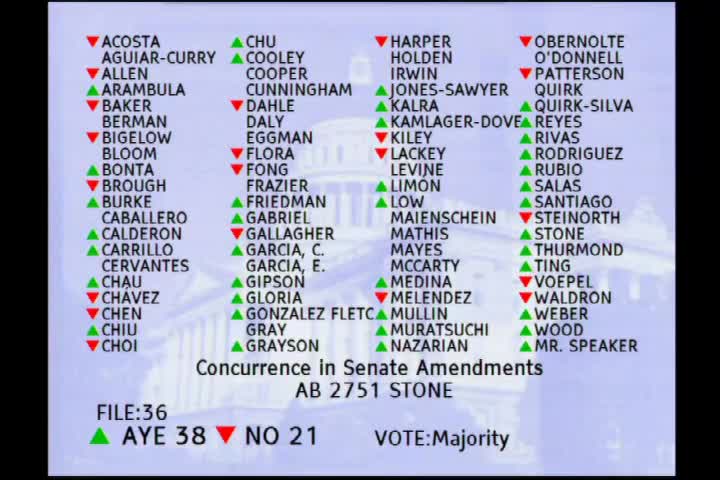


Bill Author

Bill Co-Author(s):