AB 1731: Apprenticeships: training funds: audits.
- Session Year: 2017-2018
- House: Assembly
- Latest Version Date: 2017-07-21
Existing law, the California Community Colleges Economic Workforce Development Program (program), encourages continued coordination between schools that maintain kindergarten and grades 1 to 12, inclusive, and higher education systems to advance career technical education, as specified. Under existing law, the board of governors may award grants and project funds to districts for leadership in accomplishing the mission and goals of the program, provided that funds are appropriated for this purpose in the annual Budget Act. Grants under this section are awarded on a competitive basis, as determined by the board of governors and authorized in the annual Budget Act. Existing law requires the program to operate according to specified principles.
Under existing law, the California Apprenticeship Council, in the Division of Apprenticeship Standards, among other duties, cooperates in the development of apprenticeship programs and advises the programs on problems affecting apprenticeship standards.
This bill would revise the principles upon which the California Community Colleges Economic Workforce Development Program operates to require the program to provide guidance to local educational agencies on the allocation and oversight of apprenticeship training funds, consistent with the rules set by the California Apprenticeship Council.
The Legislature finds and declares the following:
(a)In November 2016, the California State Auditor issued an audit of the apprenticeship program, California State Auditor Report 2016-110. Specifically, the audit examined the programs offered through the Air Conditioning Trade Association.
(b)As part of its examination, the California State Auditor found a number of areas where existing law could be strengthened to ensure greater accountability for state program dollars and increase oversight practices to be consistent and more effective.
(1)More specifically, the California State Auditor recommended that the Legislature should amend state law to provide the apprenticeship division with explicit authority to verify that as a condition of receiving future grant funds, apprenticeship programs are using state funds solely for training apprentices. In addition, if an apprenticeship program is unable to demonstrate how state funds are used or if it is found to be using funds for inappropriate purposes, the apprenticeship division should have the authority to deregister that particular program.
(2)To ensure accountability, the Legislature should amend state law to clarify that the Chancellors Office of the California Community Colleges has the authority to provide accounting guidance and to conduct audits of the K12 local educational agencies oversight of apprenticeship training funds.
SEC. 2.Section 88600 of the Education Code is amended to read:88600.(a)The economic and workforce development program shall operate according to all of the following principles:
(1)The program shall be responsive to the needs of employers, workers, and students.
(2)The program shall collaborate with other public institutions, aligning resources to foster cooperation across workforce education and service delivery systems, and building well-articulated career pathways.
(3)Program decisions shall be data driven and evidence based, investing resources and adopting practices on the basis of what works.
(4)The program shall develop strong partnerships with the private sector, ensuring industry involvement in needs assessment, planning, and program evaluation.
(5)The program shall be outcome oriented and accountable, measuring results for program participants, including students, employers, and workers.
(6)The program shall be accessible to employers, workers, and students who may benefit from its operation.
(7)The program shall provide guidance to local educational agencies on the allocation and oversight of apprenticeship training funds, consistent with the rules set by the California Apprenticeship Council.
(b)The mission of the economic and workforce development program is to do all of the following:
(1)To advance Californias economic growth and global competitiveness through education, training, and services that contribute to continuous workforce improvement.
(2)To advance Californias economic and jobs recovery and sustain economic growth through labor market-aligned education workforce training services, and sector strategies focusing on continuous workforce improvement, technology deployment, and business development, to meet the needs of Californias competitive and emerging industry sectors and industry clusters.
(3)To use labor market information to advise the chancellors office and regional community college bodies on the workforce needs of Californias competitive and emerging industry sectors and industry clusters, in accordance with both of the following:
(A)To the extent possible, the economic and workforce development program shall work with, share information with, and consider the labor market analyses produced by, the Employment Development Departments Labor Market Information Division and the California Workforce Investment Board.
(B)The economic and workforce development program may also use its own resources to bolster and refine these labor market and industry sector and industry cluster analyses to fulfill its mission.
(4)To provide technical assistance and logistical, technical, and communications infrastructure support that engenders alignment between the career technical education programs of the community college system and the needs of Californias competitive and emerging industry sectors and industry clusters.
(5)To collaborate and coordinate investment with other state, regional, or local agencies involved in education and workforce training in California, including, but not necessarily limited to, the California Workforce Investment Board, local workforce investment boards, the Employment Training Panel, the State Department of Education, and the Employment Development Department.
(6)To identify, acquire, and leverage community college and other financial and in-kind public and private resources to support economic and workforce development and the career technical education programs of the states community colleges.
(7)To work with representatives of business, labor, and professional trade associations to explore and develop alternatives for assisting incumbent workers in the states competitive and emerging industry sectors. A key objective is to enable incumbent workers to become more competitive in their regions labor market, increase competency, and identify career pathways to economic self-sufficiency, economic security, and lifelong access to good-paying jobs.
The Legislature finds and declares the following:
(a)In November 2016, the California State Auditor issued an audit of the apprenticeship program, California State Auditor Report 2016-110. Specifically, the audit examined the programs offered through the Air Conditioning Trade Association.
(b)As part of its examination, the California State Auditor found a number of areas where existing law could be strengthened to ensure greater accountability for state program dollars and increase oversight practices to be consistent and more effective.
(1)More specifically, the California State Auditor recommended that the Legislature should amend state law to provide the apprenticeship division with explicit authority to verify that as a condition of receiving future grant funds, apprenticeship programs are using state funds solely for training apprentices. In addition, if an apprenticeship program is unable to demonstrate how state funds are used or if it is found to be using funds for inappropriate purposes, the apprenticeship division should have the authority to deregister that particular program.
(2)To ensure accountability, the Legislature should amend state law to clarify that the Chancellors Office of the California Community Colleges has the authority to provide accounting guidance and to conduct audits of the K-12 local educational agencies oversight of apprenticeship training funds.
SEC. 2.Section 88600 of the Education Code is amended to read:88600.(a)The economic and workforce development program shall operate according to all of the following principles:
(1)The program shall be responsive to the needs of employers, workers, and students.
(2)The program shall collaborate with other public institutions, aligning resources to foster cooperation across workforce education and service delivery systems, and building well-articulated career pathways.
(3)Program decisions shall be data driven and evidence based, investing resources and adopting practices on the basis of what works.
(4)The program shall develop strong partnerships with the private sector, ensuring industry involvement in needs assessment, planning, and program evaluation.
(5)The program shall be outcome oriented and accountable, measuring results for program participants, including students, employers, and workers.
(6)The program shall be accessible to employers, workers, and students who may benefit from its operation.
(7)The program shall provide guidance to local educational agencies on the allocation and oversight of apprenticeship training funds, consistent with the rules set by the California Apprenticeship Council.
(b)The mission of the economic and workforce development program is to do all of the following:
(1)To advance Californias economic growth and global competitiveness through education, training, and services that contribute to continuous workforce improvement.
(2)To advance Californias economic and jobs recovery and sustain economic growth through labor market-aligned education workforce training services, and sector strategies focusing on continuous workforce improvement, technology deployment, and business development, to meet the needs of Californias competitive and emerging industry sectors and industry clusters.
(3)To use labor market information to advise the chancellors office and regional community college bodies on the workforce needs of Californias competitive and emerging industry sectors and industry clusters, in accordance with both of the following:
(A)To the extent possible, the economic and workforce development program shall work with, share information with, and consider the labor market analyses produced by, the Employment Development Departments Labor Market Information Division and the California Workforce Investment Board.
(B)The economic and workforce development program may also use its own resources to bolster and refine these labor market and industry sector and industry cluster analyses to fulfill its mission.
(4)To provide technical assistance and logistical, technical, and communications infrastructure support that engenders alignment between the career technical education programs of the community college system and the needs of Californias competitive and emerging industry sectors and industry clusters.
(5)To collaborate and coordinate investment with other state, regional, or local agencies involved in education and workforce training in California, including, but not necessarily limited to, the California Workforce Investment Board, local workforce investment boards, the Employment Training Panel, the State Department of Education, and the Employment Development Department.
(6)To identify, acquire, and leverage community college and other financial and in-kind public and private resources to support economic and workforce development and the career technical education programs of the states community colleges.
(7)To work with representatives of business, labor, and professional trade associations to explore and develop alternatives for assisting incumbent workers in the states competitive and emerging industry sectors. A key objective is to enable incumbent workers to become more competitive in their regions labor market, increase competency, and identify career pathways to economic self-sufficiency, economic security, and lifelong access to good-paying jobs.
|
Date
|
Status
|
|---|---|
| Jul 21, 2017 | Chaptered by Secretary of State - Chapter 94, Statutes of 2017. |
| Jul 21, 2017 | Approved by the Governor. |
| Jul 10, 2017 | Enrolled and presented to the Governor at 3:40 p.m. |
| Jul 3, 2017 | In Assembly. Ordered to Engrossing and Enrolling. |
| Jul 3, 2017 | Read third time. Passed. Ordered to the Assembly. |
| Jun 27, 2017 | Read second time. Ordered to Consent Calendar. |
| Jun 26, 2017 | From committee: Be placed on second reading file pursuant to Senate Rule 28.8 and ordered to consent calendar. |
| Jun 14, 2017 | From committee: Do pass and re-refer to Com. on APPR. with recommendation: To Consent Calendar. (Ayes 7. Noes 0.) (June 14). Re-referred to Com. on APPR. |
| May 24, 2017 | Referred to Com. on ED. |
| May 15, 2017 | In Senate. Read first time. To Com. on RLS. for assignment. |
| May 15, 2017 | Read third time. Passed. Ordered to the Senate. (Ayes 76. Noes 0. Page 1543.) |
| May 11, 2017 | Read second time. Ordered to third reading. |
| May 10, 2017 | From committee: Do pass. (Ayes 17. Noes 0.) (May 10). |
| Apr 26, 2017 | From committee: Do pass and re-refer to Com. on APPR. (Ayes 12. Noes 0.) (April 25). Re-referred to Com. on APPR. |
| Apr 25, 2017 | From committee: Do pass and re-refer to Com. on HIGHER ED. (Ayes 7. Noes 0.) (April 25). Re-referred to Com. on HIGHER ED. |
| Apr 24, 2017 | Joint Rule 62(a), file notice suspended. (Page 1173.) |
| Apr 3, 2017 | Referred to Coms. on J., E.D., & E. and HIGHER ED. |
| Mar 24, 2017 | From printer. May be heard in committee April 23. |
| Mar 23, 2017 | Read first time. To print. |
|
Date
|
Description
|
Location
|
Votes
|
|
|---|---|---|---|---|
| Jul 3, 2017 | Consent Calendar 2nd AB1731 J., E.D., & E | Senate Floor |
Passed |
|
| Jun 14, 2017 | Do pass, but first be re-referred to the Committee on [Appropriations] with the recommendation: To Consent Calendar | Senate Standing Committee on Education |
Passed |
|
| May 15, 2017 | AB 1731 J., E.D. & E. Assembly Third Reading By QUIRK-SILVA | Assembly Floor |
Passed |
|
| May 10, 2017 | Do pass. | Assembly Standing Committee on Appropriations |
Passed |
|
| Apr 25, 2017 | Do pass and be re-referred to the Committee on [Higher Education] | Assembly Standing Committee on Jobs, Economic Development, and the Economy |
Passed |
|
| Apr 25, 2017 | Do pass and be re-referred to the Committee on [Appropriations] | Assembly Standing Committee on Higher Education |
Passed |
This list shows positions taken on this bill by organizations on the date displayed, which is linked to the original source.
Positions by individuals are not included.
|
Organization
|
Position
|
Date
|
|---|---|---|
| California Community Colleges Chancellor's Office | ** Support | Jun 28, 2017 |
| J., E.D., & E. | ** Against | Apr 23, 2017 |
Office of Senate Floor Analyses (916) 651-1520 Fax: (916) 327-4478 | AB 1731 |
CONSENT
Bill No: AB 1731
Author: Committee on Jobs, Economic Development, and the Economy
Introduced: 3/23/17
SENATE EDUCATION COMMITTEE: 7-0, 6/14/17
AYES: Allen, Wilk, Galgiani, Leyva, Mendoza, Pan, Vidak
SENATE APPROPRIATIONS COMMITTEE: Senate Rule 28.8
ASSEMBLY FLOOR: 76-0, 5/15/17 - See last page for vote
SUBJECT: Apprenticeships: training funds: audits
DIGEST:
This bill requires the California Community Colleges Chancellor's Office (CCCCO) to provide guidance to local educational agencies (LEAs) on the allocation and oversight of apprenticeship training funds.
Existing law:
- Establishes the Economic and Workforce Development (EWD) Program within the CCCCO and assigns it the mission of:
- Advancing California’s economic growth and global competitiveness through education, training, and services that contribute to continuous workforce improvement.
- Advancing California’s economic and jobs recovery and sustaining economic growth through labor market-aligned education workforce training services, and sector strategies focusing on continuous workforce improvement, technology deployment, and business development, to meet the needs of California’s competitive and emerging industry sectors and industry clusters.
- Using labor market information to advise the CCCCO and regional community college bodies on the workforce needs of California’s competitive and emerging industry sectors and industry clusters, as specified.
- Providing technical assistance and logistical, technical, and communications infrastructure support that engenders alignment between the career technical education (CTE) programs of the community college system and the needs of California’s competitive and emerging industry sectors and industry clusters.
- Collaborating and coordinating investment with other state, regional, or local agencies involved in education and workforce training in California, including, but not necessarily limited to, the California Workforce Investment Board, local workforce investment boards, the Employment Training Panel, the California Department of Education, and the Employment Development Department.
- Identifying and leveraging community college and other financial and in-kind public and private resources to support EWD and the CTE programs of the state’s community colleges.
- Working with representatives of business, labor, and professional trade associations to explore and develop alternatives for assisting incumbent workers in the state’s competitive and emerging industry sectors. A key objective is to enable incumbent workers to become more competitive in their region’s labor market, increase competency, and identify career pathways to economic self-sufficiency, economic security, and lifelong access to good-paying jobs. (Education Code § 88600)
- Requires the EWD Program to:
- Be responsive to the needs of employers, workers, and students.
- Collaborate with other public institutions, aligning resources to foster cooperation across workforce education and service delivery systems, and building well-articulated career pathways.
- Make data driven and evidence based decisions.
- Develop strong partnerships with the private sector, ensuring industry involvement in needs assessment, planning, and program evaluation.
- Be outcome oriented and accountable, measuring results for program participants, including students, employers, and workers.
- Be accessible to employers, workers, and students who may benefit from its operation. (EC § 88600)
- Authorizes the California Community Colleges Board of Governors (CCCBOG) to award grants and project funds to districts for leadership in accomplishing the mission and goals of the program, provided that funds are appropriated in the annual Budget Act, on a competitive basis, as determined by the CCCBOG and authorized in the annual Budget Act. (EC § 88610)
- Provides that the EWD Program is administered through the CCCCO, which is required under current law to implement accountability measures and annually report specified information to the Governor and the Legislature. (EC § 88650 et seq.)
- Requires the CCCBOG to assist economic and workforce regional development centers and consortia to improve linkages and CTE pathways between high schools and CCCs in a manner that improves the quality of career exploration. (EC § 88532)
This bill requires the CCCCO to provide guidance to LEAs on the allocation and oversight of apprenticeship training funds. Specifically, this bill:
- Makes the following findings and declarations, including, but not limited to:
- The California State Auditor (CSA) issued an audit of the apprenticeship program, California State Auditor Report 2016-110, which examined the programs offered through the Air Conditioning Trade Association;
- As part of its examination, the CSA found a number of areas where existing law could be strengthened to ensure greater accountability for state program dollars and increase oversight practices to be consistent and more effective; and,
- Among other recommendations, the CSA recommended that the Legislature amend state law to clarify that the CCCCO has the authority to provide accounting guidance and to conduct audits of the K-12 LEAs’ oversight of apprenticeship training funds.
- Requires the EWD Program at the CCCCO to provide guidance to LEAs on the allocation and oversight of apprenticeship training funds, consistent with the rules set by the California Apprenticeship Council.
Comments
- Need for the bill. According to the Assembly Committee on Jobs, Economic Development, and the Economy, “Domestic and global economic conditions are undergoing significant changes since the peak of the recession. Maintaining competiveness requires, among other things, better integrated and well-articulated career pathways between K-12, the state's higher education systems, and workforce training providers. Earn-and-learn strategies, including apprenticeships, are proven models on which the state plans to continue to commit significant workforce resources.
“With this investment, however, comes the responsibility to ensure that training programs are managed and overseen in a manner that ensures accountability. AB 1731 codifies recommendations from a 2016 audit of the DAS and the Chancellor's Office and their oversight of the Air Conditioning Trade Association and its Commercial Sheet Metal Apprenticeships program. The analysis includes background on the state apprenticeship programs, the state audit, and the importance of apprenticeship programs in meeting state workforce demands.”
- CSA report. The CSA issued Report 2016-110 in November of 2016, which, in part, reviewed the CCCCO's oversight of a specific commercial sheet metal apprenticeship program provided through the Air Conditioning Trade Association. The audit, in part, found the following:
- Relative to the CCCCO and Central Unified School District, neither was aware that the Air Conditioning Trade Association had claimed over 10,000 hours, over a five-year period, for homework assignments at a cost of nearly $51,000 for reimbursement; and,
- The CCCCO does not provide guidance to K-12 LEAs offices relative to the need and process for verifying attendance in order to ensure program guidelines and standards are being met.
According to the director of the adult school at Central Unified, his staff never requested documentation from the Air Conditioning Trade Association, such as class sign-in sheets, to verify that the reported attendance hours were only for classroom instruction. No guidance documentation was also ever provided by the CCCCO to Central Unified on how to oversee the apprenticeship program.
The CSA found a number of areas where existing law could be strengthened to ensure greater accountability for state program dollars and to increase oversight practices to be consistent and more effective.
This bill is in response to the CSA audit.
- CCCCO response to audit. The CCCCO, in responding to the audit, stated that it would support any legislative proposals or amendments to state law to clarify that the CCCCO has authority to provide accounting guidance to and conduct audits of LEAs. The CCCCO opined that such authority would improve oversight of apprenticeship training funds.
The audit also recommended that the CCCCO develop a model contract agreement to outline the types of information, roles, and responsibilities for both parties, and make the model contract available to K-12 LEAs by April 2017.
To note, the CCCCO is currently developing a model contract agreement and anticipates its release this spring. The model contract agreement will specify that K-12 LEAs will verify that apprentices attended instructional courses by collecting supporting documentation, such as sign-in sheets or rosters.
- 2017 annual report. According to the EWD Program’s annual report (http://californiacommunitycolleges.cccco.edu/Portals/0/Reports/2017-EWD-Report-ADA-Reduced.pdf), the EWD Program awarded $24.8 million to initiatives to fund 95 grants statewide and EWD Development Program investments, when braided with funds from other sources like the federal Carl D. Perkins Career and Technical Education Act and the state Career Technical Education Pathways Act, have yielded impressive results, including:
- 61,056 students served.
- 19,624 employees served.
- 55,521 total people trained (as of December 2016).
- 3,114 students enrolled in work-based learning (i.e., internships and apprenticeships).
- 19,233 completions of workshops and training.
- 1,433 students placed in jobs.
- 9,414 employees retaining jobs.
- 12,159 businesses served.
- 1,584 people hired by businesses served by the EWD Program.
- 149 new products and services created by businesses across California with the support of EWD Program services.
Related/Prior Legislation
SB 317 (Roth, 2017) extends the EWD Program’s sunset date from January 1, 2018, to January 1, 2023. The bill is pending in the Assembly Committee on Higher Education.
AB 581 (McCarty, 2017) requires, in part, an apprenticeship program, to be eligible to receive grant funds from the California Apprenticeship Council (council), to agree to keep adequate records that document the expenditure of those grant funds; and, to make all records available to the Department of Industrial Relations (DIR) so that DIR is able to verify that grants made by the council were used solely for training apprentices. The bill is scheduled to be heard in the Senate Labor and Industrial Relations Committee on June 28, 2017.
SB 1402 (Lieu, Chapter 361, Statutes of 2012) extended the EWD Program’s sunset through January 1, 2018, and made several changes to the EWD Program, which included:
- Adding six principles to the program's mission, including collaboration with other institutions, making data driven and evidenced-based funding decisions, and developing strong partnerships with the private sector.
- Updating the mission of the EWD Program to reflect the need to implement sector strategies that align with labor markets.
- Enhancing the role of the program's advisory committee to ensure that funding is responsive to changing local market needs.
- Specifying minimum program outcome measures to be implemented by the CCCCO.
- Requiring the CCCCO, by January 1, 2015, to contract for an independent evaluation of the program's effectiveness, the findings of which shall be provided to the Legislature by March 1, 2016.
SB 1809 (Polanco, Chapter 1057, Statutes of 1996) further clarified the EWD Program’s legislative intent, defined regional planning, priority setting, and coordination, added accountability and audit requirements, and made economic development and continuous workforce improvement a primary mission of the CCCs.
FISCAL EFFECT: Appropriation: No Fiscal Com.: Yes Local: No
California Community Colleges Chancellor’s Office
OPPOSITION: (Verified 6/27/17)
None received
ASSEMBLY FLOOR: 76-0, 5/15/17
AYES: Acosta, Aguiar-Curry, Travis Allen, Arambula, Baker, Berman, Bigelow, Bloom, Bocanegra, Bonta, Brough, Burke, Caballero, Calderon, Cervantes, Chau, Chávez, Chen, Chiu, Choi, Chu, Cooley, Cooper, Cunningham, Dababneh, Dahle, Daly, Flora, Fong, Frazier, Friedman, Gallagher, Cristina Garcia, Eduardo Garcia, Gipson, Gloria, Gomez, Gonzalez Fletcher, Gray, Grayson, Harper, Irwin, Jones-Sawyer, Kalra, Kiley, Lackey, Levine, Limón, Low, Maienschein, Mathis, Mayes, Medina, Mullin, Muratsuchi, Nazarian, Obernolte, O'Donnell, Patterson, Quirk, Quirk-Silva, Reyes, Ridley-Thomas, Rodriguez, Rubio, Salas, Santiago, Steinorth, Mark Stone, Thurmond, Ting, Voepel, Waldron, Weber, Wood, Rendon
NO VOTE RECORDED: Eggman, Holden, McCarty, Melendez
Prepared by: Brandon Darnell / ED. /
6/28/17 15:36:45
**** END ****
SENATE COMMITTEE ON EDUCATION
Senator Benjamin Allen, Chair
2017 - 2018 Regular
Bill No: Hearing Date: June 14, 2017
Author: | Committee on Jobs, Economic Development, and the Economy | ||
Version: |
| ||
Urgency: | Fiscal: | ||
Consultant: | |||
Subject:
SUMMARY
This bill requires the California Community Colleges Chancellor's Office (CCCCO) to provide guidance to local educational agencies (LEAs) on the allocation and oversight of apprenticeship training funds.
BACKGROUND
Existing law:
1) Establishes the Economic and Workforce Development Program within the CCCCO and assigns it the mission of:
a) Advancing California’s economic growth and global competitiveness through education, training, and services that contribute to continuous workforce improvement.
b) Advancing California’s economic and jobs recovery and sustaining economic growth through labor market-aligned education workforce training services, and sector strategies focusing on continuous workforce improvement, technology deployment, and business development, to meet the needs of California’s competitive and emerging industry sectors and industry clusters.
c) Using labor market information to advise the chancellor’s office and regional community college bodies on the workforce needs of California’s competitive and emerging industry sectors and industry clusters, as specified.
d) Providing technical assistance and logistical, technical, and communications infrastructure support that engenders alignment between the career technical education programs of the community college system and the needs of California’s competitive and emerging industry sectors and industry clusters.
e) Collaborating and coordinating investment with other state, regional, or local agencies involved in education and workforce training in California, including, but not necessarily limited to, the California Workforce Investment Board, local workforce investment boards, the Employment Training Panel, the California Department of Education, and the Employment Development Department.
f) Identifying and leveraging community college and other financial and in-kind public and private resources to support economic and workforce development and the career technical education programs of the state’s community colleges.
g) Working with representatives of business, labor, and professional trade associations to explore and develop alternatives for assisting incumbent workers in the state’s competitive and emerging industry sectors. A key objective is to enable incumbent workers to become more competitive in their region’s labor market, increase competency, and identify career pathways to economic self-sufficiency, economic security, and lifelong access to good-paying jobs. (Education Code § 88600)
2) Requires the Economic and Workforce Development Program to:
a) Be responsive to the needs of employers, workers, and students.
b) Collaborate with other public institutions, aligning resources to foster cooperation across workforce education and service delivery systems, and building well-articulated career pathways.
c) Make data driven and evidence based decisions.
d) Develop strong partnerships with the private sector, ensuring industry involvement in needs assessment, planning, and program evaluation.
e) Be outcome oriented and accountable, measuring results for program participants, including students, employers, and workers.
f) Be accessible to employers, workers, and students who may benefit from its operation. (EC § 88600)
3) Authorizes the California Community Colleges Board of Governors (CCCBOG) to award grants and project funds to districts for leadership in accomplishing the mission and goals of the program, provided that funds are appropriated in the annual Budget Act, on a competitive basis, as determined by the BOG and authorized in the annual Budget Act. (EC § 88610)
4) Economic and Workforce Development Program is administered through the California Community Colleges Chancellor's Office which is required under current law to implement accountability measures and annually report specified information to the Governor and the Legislature. (EC § 88650 et seq.)
5) Requires the CCCBOG to assist economic and workforce regional development centers and consortia to improve linkages and career technical education (CTE) pathways between high schools and California Community Colleges in a manner that improves the quality of career exploration. (EC § 88532)
ANALYSIS
This bill requires the California Community Colleges Chancellor's Office (CCCCO) to provide guidance to local educational agencies (LEAs) on the allocation and oversight of apprenticeship training funds. Specifically, this bill:
1) Makes the following findings and declarations, including, but not limited to:
a) The California State Auditor (CSA) issued an audit of the apprenticeship program, California State Auditor Report 2016-110, which examined the programs offered through the Air Conditioning Trade Association;
b) As part of its examination, the CSA found a number of areas where existing law could be strengthened to ensure greater accountability for state program dollars and increase oversight practices to be consistent and more effective; and,
c) Among other recommendations, the CSA recommended that the Legislature amend state law to clarify that the CCCCO has the authority to provide accounting guidance and to conduct audits of the K-12 LEAs’ oversight of apprenticeship training funds.
2) Requires the economic and workforce development program at the CCCCO to provide guidance to LEAs on the allocation and oversight of apprenticeship training funds, consistent with the rules set by the California Apprenticeship Council.
STAFF COMMENTS
- Need for the bill. According to the Assembly Committee on Jobs, Economic Development, and the Economy, “Domestic and global economic conditions are undergoing significant changes since the peak of the recession. Maintaining competiveness requires, among other things, better integrated and well-articulated career pathways between K-12, the state's higher education systems, and workforce training providers. Earn-and-learn strategies, including apprenticeships, are proven models on which the state plans to continue to commit significant workforce resources.
With this investment, however, comes the responsibility to ensure that training programs are managed and overseen in a manner that ensures accountability. AB 1731 codifies recommendations from a 2016 audit of the DAS and the Chancellor's Office and their oversight of the Air Conditioning Trade Association and its Commercial Sheet Metal Apprenticeships program. The analysis includes background on the state apprenticeship programs, the state audit, and the importance of apprenticeship programs in meeting state workforce demands.”
2) California State Auditor report. The CSA issued Report 2016-110 in November of 2016, which, in part, reviewed the CCCCO's oversight of a specific commercial sheet metal apprenticeship program provided through the Air Conditioning Trade Association. The audit, in part, found the following:
a) Relative to the California Community Colleges Chancellor's Office (CCCCO) and Central Unified School District, neither was aware that the Air Conditioning Trade Association had claimed over 10,000 hours, over a five-year period, for homework assignments at a cost of nearly $51,000 for reimbursement; and,
b) The CCCCO does not provide guidance to K-12 local educational agencies (LEAs) offices relative to the need and process for verifying attendance in order to ensure program guidelines and standards are being met.
According to the director of the adult school at Central Unified, his staff never requested documentation from the Air Conditioning Trade Association, such as class sign-in sheets, to verify that the reported attendance hours were only for classroom instruction. No guidance documentation was also ever provided by the Chancellor's Office to Central Unified on how to oversee the apprenticeship program.
The California State Auditor (CSA) found a number of areas where existing law could be strengthened to ensure greater accountability for state program dollars and to increase oversight practices to be consistent and more effective.
This measure is in response to the CSA audit.
3) CCCCO response to audit. The CCCCO, in responding to the audit, stated that it would support any legislative proposals or amendments to state law to clarify that the CCCCO has authority to provide accounting guidance to and conduct audits of LEAs. The CCCCO opined that such authority would improve oversight of apprenticeship training funds.
The audit also recommended that the CCCCO develop a model contract agreement to outline the types of information, roles, and responsibilities for both parties, and make the model contract available to K-12 LEAs by April 2017.
To note, the CCCCO is currently developing a model contract agreement and anticipates its release this spring. The model contract agreement will specify that K-12 LEAs will verify that apprentices attended instructional courses by collecting supporting documentation, such as sign-in sheets or rosters.
4) 2017 annual report. According to the EWD Program’s annual report (http://californiacommunitycolleges.cccco.edu/Portals/0/Reports/2017-EWD-Report-ADA-Reduced.pdf), the Economic and Workforce Development Program awarded $24.8 million to initiatives to fund 95 grants statewide and Economic and Workforce Development Program investments, when braided with funds from other sources like the federal Carl D. Perkins Career and Technical Education Act and the state Career Technical Education Pathways Act, have yielded impressive results, including:
- 61,056 students served.
- 19,624 employees served.
- 55,521 total people trained (as of December 2016).
- 3,114 students enrolled in work-based learning (i.e., internships and apprenticeships).
- 19,233 completions of workshops and training.
- 1,433 students placed in jobs.
- 9,414 employees retaining jobs.
- 12,159 businesses served.
- 1,584 people hired by businesses served by the Economic and Workforce Development (EWD) Program.
- 149 new products and services created by businesses across California with the support of EWD Program services.
5) Related and previous legislation. SB 317 (Roth, 2017) would extend the Economic and Workforce Development Program’s sunset date from January 1, 2018, to January 1, 2023. SB 317 is pending in the Assembly.
AB 581 (McCarty, 2017) would require, in part, an apprenticeship program, to be eligible to receive grant funds from the California Apprenticeship Council (council), to agree to keep adequate records that document the expenditure of those grant funds; and, to make all records available to the Department of Industrial Relations (DIR) so that DIR is able to verify that grants made by the council were used solely for training apprentices. AB 581 is pending referral in the Senate.
AB 669 (Berman, 2017) would extend the California Community Colleges EWD Program sunset date from January 1, 2018, to July 1, 2023. AB 669 is pending this committee.
SB 1402 (Lieu, Chapter 361, Statutes of 2012) extended the Economic and Workforce Development Program’s sunset through January 1, 2018, and made several changes to the EWDProgram, which included:
- Adding six principles to the program's mission, including collaboration with other institutions, making data driven and evidenced-based funding decisions, and developing strong partnerships with the private sector.
- Updating the mission of the EWD Program to reflect the need to implement sector strategies that align with labor markets.
- Enhancing the role of the program's advisory committee to ensure that funding is responsive to changing local market needs.
- Specifying minimum program outcome measures to be implemented by the California Community Colleges Chancellor's Office (CCCCO).
- Requiring the CCCCO, by January 1, 2015, to contract for an independent evaluation of the program's effectiveness, the findings of which shall be provided to the Legislature by March 1, 2016.
SB 1809 (Polanco, Chapter 1057, Statutes of 1996) further clarified the Economic and Workforce Development Program’s legislative intent, defined regional planning, priority setting, and coordination, added accountability and audit requirements, and made economic development and continuous workforce improvement a primary mission of the California Community Colleges.
SUPPORT
California Community Colleges Chancellor’s Office
OPPOSITION
None received
-- END --
ASSEMBLY THIRD READING
ATR Bill Id:AB 1731
Author:(Committee on Jobs, Economic Development, and the Economy.)
As Introduced Ver:March 23, 2017
Majority vote
Committee | Votes | Ayes | Noes |
Jobs | 7-0 | Quirk-Silva, Travis Allen, Berman, Cervantes, Grayson, Rodriguez, Steinorth | |
Higher Education | 12-0 | Medina, Baker, Arambula, Bloom, Choi, Irwin, Kiley, Levine, Low, Quirk-Silva, Santiago, Weber | |
Appropriations | 17-0 | Gonzalez Fletcher, Bigelow, Bloom, Bocanegra, Bonta, Brough, Calderon, Chau, Eggman, Fong, Friedman, Gallagher, Eduardo Garcia, Gray, Muratsuchi, Obernolte, Reyes |
|
SUMMARY: Requires the California Chancellor's Office of the Community Colleges to provide guidance to local educational agencies on the allocation and oversight of apprenticeship training funds. Specifically, this bill:
- Makes the following findings and declarations, including, but not limited to:
- The California State Auditor issued an audit of the apprenticeship program, California State Auditor Report 2016-110, which examined the programs offered through the Air Conditioning Trade Association.
- Among other recommendations, the California State Auditor recommended that the Legislature amend state law to clarify that the Chancellor's Office of the California Community Colleges has the authority to provide accounting guidance and to conduct audits of the K-12 local educational agencies' oversight of apprenticeship training funds.
- Requires the economic and workforce development program at the Chancellor's Office of the Community Colleges to provide guidance to local educational agencies on the allocation and oversight of apprenticeship training funds, consistent with the rules set by the California Apprenticeship Council.
FISCAL EFFECT: According to the Appropriations Committee, implementation of this bill will result in minor and absorbable costs.
COMMENTS: Domestic and global economic conditions are undergoing significant changes since the peak of the recession. Maintaining competiveness requires, among other things, better integrated and well-articulated career pathways between K-12, the state's higher education systems, and workforce training providers. Earn-and-learn strategies, including apprenticeships, are proven models on which the state plans to continue to commit significant workforce resources.
With this investment, however, comes responsibility to ensure that training programs are managed and overseen in a manner that ensures accountability. This bill codifies recommendations from a 2016 audit of the Department of Apprenticeship Standards (DAS) and the Chancellor's Office and their oversight of the Air Conditioning Trade Association and its Commercial Sheet Metal Apprenticeships program.
State Audit: In November 2016, the California State Auditor issued an audit of the DAS and the Chancellor Office's oversight of a specific commercial sheet metal apprenticeship program provided through the Air Conditioning Trade Association, California State Auditor Report 2016-110.
Funding for apprenticeship programs is provided through a variety of sources, including, as in the case of the state audit, a combination of grants from the DAS for direct work experience and the Chancellor's Office for instruction time. Prior to 2013-14, the Department of Education was responsible for overseeing apprenticeship-related instruction provided through the K-12 system, including funding for the early years of the program under audit. The chart below shows state funding allocated to the Air Conditioning Trade Association for fiscal years 2010 through 2014-15.
State Funding Allocated to the Air Conditioning Trade Association Fiscal Years 2010-11 through 2014-15 | |||||||
Type of State Funding Received | Entity Providing Funding | 2010-11 | 2011-12 | 2012-13 | 2013-14 | 2014-15 | Five-Year Total |
Grants | Department of Industrial Relation's Division of Apprenticeship Standards | -- | $1,600 | -- | $6,600 | $1,600 | $9,800 |
Reimbursements | California Community Colleges Chancellor's Office | -- | -- | -- | $29,600 | $33,900 | $63,500 |
California Department of Education | $23,100 | $28,200 | $26,900 | -- | -- | $78,200 | |
Total State Funding | $23,100 | $29,800 | $26,900 | $36,200 | $35,500 | $151,500 | |
Source: California State Auditor Report 2016-110 | |||||||
Among other findings the audit found that the DAS oversight of the apprenticeship programs was inadequate and had:
- Not been regularly conducting program audits, with only two audits being completed in 2014-15;
- Not audited the Air Conditioning Trade Association, even though state law requires an audit of any program that has a completion rate below 50% of the state industry average; and
- Not used its audit authority to ensure programs were appropriately spending state funds to train apprentices.
The audit also found that outside of its audit authority, the DAS did not have authority to question or require verification of how state funds were expended.
Relative to the Chancellor's Office and Central Unified, the audit found that neither was aware that the Air Conditioning Trade Association had claimed more than 10,000 hours, over a five-year period, for homework assignments at a cost of nearly $51,000 in ineligible reimbursement.
Further, the audit determined that the Chancellor's Office, in general, does not provide guidance to K-12 local education agencies relative to the need and process for verifying attendance in order to ensure program guidelines and standards are being met. According to the director of the adult school at Central Unified, his staff never requested documentation from the Air Conditioning Trade Association, such as class sign-in sheets, to verify that the reported attendance hours were only for classroom instruction. No guidance documentation was also ever provided by the Chancellor's Office to Central Unified on how to oversee the apprenticeship program.
In response to the issues identified above, the California State Auditor found a number of areas where existing law could be strengthened to ensure greater accountability for state program dollars and increase oversight practices to be consistent and more effective.
More specifically, the California State Auditor recommended that the Legislature amend state law to provide the apprenticeship division with explicit authority to verify how state funds were expended and that documentation of this should be a condition of receiving future grant funds. In addition, if an apprenticeship program is unable to demonstrate how state funds are used or if it is found to be using funds for inappropriate purposes, the apprenticeship division should have the authority to deregister that particular program. These changes have been made in AB 581 (McCarty) of the current legislative session, which passed the Assembly Labor Committee on a 5 to 1 vote on April 19, 2017.
To ensure accountability, the audit also recommended that the Legislature amend state law to clarify that the Chancellor's Office of the California Community Colleges has the authority to provide accounting guidance and to conduct audits of the K-12 local educational agencies' oversight of apprenticeship training funds.
Response to the Audit: The Chancellor's Office, in responding to the audit, stated that it would support any legislative proposals or amendments to state law to clarify that it has authority to provide accounting guidance to and conduct audits of local education agencies. The Chancellor's Office stated that such authority would improve oversight of apprenticeship training funds.
The audit also recommended that the Chancellor's Office develop a model contract agreement to outline the types of information, roles, and responsibilities for both parties, and make the model contract available to K-12 local education agencies by April 2017. This model contract agreement is currently being developed. Among other things, the model contract agreement will specify that K-12 LEAs will verify that apprentices attended instructional courses by collecting supporting documentation, such as sign-in sheets or rosters.
Further Information: The policy analysis includes background on the state apprenticeship programs, the state audit, and the importance of apprenticeship programs in meeting state workforce demands.
Analysis Prepared by: Toni Symonds / J., E.D., & E. / (916) 319-2090 FN: 0000313
Date of Hearing: May 10, 2017
ASSEMBLY COMMITTEE ON APPROPRIATIONS
Lorena Gonzalez Fletcher, Chair
ABPCA Bill Id:AB 1731
Author:(Committee on Jobs, Economic Development, and the Economy) – As Introduced Ver:March 23, 2017
Policy Committee: | Jobs, Economic Development, and the Economy | Vote: | 7 - 0 |
Higher Education | 12 - 0 | ||
|
|
Urgency: No State Mandated Local Program: No Reimbursable: No
SUMMARY:
This bill requires the California Community Colleges Chancellor's Office (CCCCO) to provide guidance to K-12 local educational agencies (LEAs) on the allocation and oversight of apprenticeship training funds, consistent with the rules set by the California Apprenticeship Council.
FISCAL EFFECT:
Minor and absorbable costs to the CCCCO to provide guidance to LEAs.
COMMENTS:
- Background. Existing law establishes the Economic and Workforce Development Program within the CCCCO with a mission to: advance California’s economic growth and global competitiveness through education, training, and services that contribute to continuous workforce improvement and among other duties by providing technical assistance and logistical, technical, and communications infrastructure support that engenders alignment between the career technical education programs of the community college system and the needs of California’s competitive and emerging industry sectors and industry clusters.
The California State Auditor reviewed the CCCCO's oversight of a specific commercial sheet metal apprenticeship program provided through the Air Conditioning Trade Association in 2016. The audit found that the CCCCO does not provide guidance to K-12 LEAs relative to the need and process for verifying attendance in order to ensure program guidelines and standards are being met. The CCCCO, in responding to the audit, stated that it would support any legislative proposals or amendments to state law to clarify that the CCCCO has the authority to provide guidance to, and conduct audits of, LEAs.
- Related legislation. AB 581 (McCarty), which is pending a hearing in this Committee, in part, requires an apprenticeship program, to be eligible to receive grant funds from the California Apprenticeship Council (council), to agree to keep adequate records that document the expenditure of those grant funds; and, to make all records available to the Department of Industrial Relations (DIR), so that DIR is able to verify that grants made by the council are used solely for training apprentices.
Analysis Prepared by: Daisy Gonzales / APPR. / (916) 319-2081
Date of Hearing:
ASSEMBLY COMMITTEE ON HIGHER EDUCATION
Jose Medina, Chair
ABPCA Bill Id:AB 1731 (
Author:Committee on Jobs, Economic Development, and the Economy) – As Introduced Ver:March 23, 2017
SUBJECT: Apprenticeships: training funds: audits
SUMMARY: Requires the California Community Colleges Chancellor's Office (CCCCO) to provide guidance to local educational agencies (LEAs) on the allocation and oversight of apprenticeship training funds. Specifically, this bill:
- Makes the following findings and declarations, including, but not limited to:
- The California State Auditor (CSA) issued an audit of the apprenticeship program, California State Auditor Report 2016-110, which examined the programs offered through the Air Conditioning Trade Association;
- As part of its examination, the CSA found a number of areas where existing law could be strengthened to ensure greater accountability for state program dollars and increase oversight practices to be consistent and more effective; and,
- Among other recommendations, the CSA recommended that the Legislature amend state law to clarify that the CCCCO has the authority to provide accounting guidance and to conduct audits of the K-12 local educational agencies’ oversight of apprenticeship training funds.
- Requires the economic and workforce development program at the CCCCO to provide guidance to LEAs on the allocation and oversight of apprenticeship training funds, consistent with the rules set by the California Apprenticeship Council.
EXISTING LAW: Establishes the Economic and Workforce Development Program within the CCCCO and assigns it the mission of:
- Advancing California’s economic growth and global competitiveness through education, training, and services that contribute to continuous workforce improvement;
- Advancing California’s economic and jobs recovery and sustaining economic growth through labor market-aligned education workforce training services, and sector strategies focusing on continuous workforce improvement, technology deployment, and business development, to meet the needs of California’s competitive and emerging industry sectors and industry clusters;
- Using labor market information to advise the chancellor’s office and regional community college bodies on the workforce needs of California’s competitive and emerging industry sectors and industry clusters, as specified;
- Providing technical assistance and logistical, technical, and communications infrastructure support that engenders alignment between the career technical education programs of the community college system and the needs of California’s competitive and emerging industry sectors and industry clusters;
- Collaborating and coordinating investment with other state, regional, or local agencies involved in education and workforce training in California, including, but not necessarily limited to, the California Workforce Investment Board, local workforce investment boards, the Employment Training Panel, the California Department of Education, and the Employment Development Department;
- Identifying and leveraging community college and other financial and in-kind public and private resources to support economic and workforce development and the career technical education programs of the state’s community colleges; and,
- Working with representatives of business, labor, and professional trade associations to explore and develop alternatives for assisting incumbent workers in the state’s competitive and emerging industry sectors. A key objective is to enable incumbent workers to become more competitive in their region’s labor market, increase competency, and identify career pathways to economic self-sufficiency, economic security, and lifelong access to good-paying jobs.
Requires the Economic and Workforce Development Program to:
- Be responsive to the needs of employers, workers, and students;
- Collaborate with other public institutions, aligning resources to foster cooperation across workforce education and service delivery systems, and building well-articulated career pathways;
- Make data driven and evidence based decisions;
- Develop strong partnerships with the private sector, ensuring industry involvement in needs assessment, planning, and program evaluation;
- Be outcome oriented and accountable, measuring results for program participants, including students, employers, and workers; and,
- Be accessible to employers, workers, and students who may benefit from its operation (Education Code Section 88600).
FISCAL EFFECT: Unknown
COMMENTS: Double referral. This measure was heard by the Assembly Jobs, Economic Development, and the Economy Committee on the morning of April 25, 2017; due to legislative deadlines, it will be heard by this Committee this afternoon, as it relates to issues within the Committee's jurisdiction.
Apprenticeship programs. Apprenticeships are a core component of "earn and learn" workforce training models. State registered apprenticeships have very specific standards, which have been reviewed to ensure participants are obtaining the appropriate skills and knowledge.
Training periods vary from one to six years, depending on the trade and the number of specific processes on which the participant needs to become proficient. To note, Committee understands that most programs are four years.
Apprentices receive both on-the-job training at a worksite and classroom instruction, which is most commonly conducted in public schools. Apprentices attend classes at night four hours each week, for at least 108 hours per year. The classroom instruction includes such subjects as safety laws and regulations, mathematics, drafting, blueprint reading and other sciences connected with the trade; and, apprentices work daily under the supervision of skilled workers to gain the hands on experience within their trade.
This dual instruction method is designed to provide apprentices with a comprehensive understanding of the practical and theoretical aspects of their work. Upon successful completion of training, the apprentice is issued a "Certificate of Completion" by the State of California.
California State Auditor report. The CSA issued Report 2016-110 in November of 2016, which, in part, reviewed the CCCCO's oversight of a specific commercial sheet metal apprenticeship program provided through the Air Conditioning Trade Association. The audit, in part, found the following:
- Relative to the CCCCO and Central Unified School District, neither was aware that the Air Conditioning Trade Association had claimed over 10,000 hours, over a five-year period, for homework assignments at a cost of nearly $51,000 for reimbursement; and,
- The CCCCO does not provide guidance to K-12 LEAs offices relative to the need and process for verifying attendance in order to ensure program guidelines and standards are being met.
The CSA found a number of areas where existing law could be strengthened to ensure greater accountability for state program dollars and to increase oversight practices to be consistent and more effective. To note, the CSA recommended that the Legislature should amend state law to provide the apprenticeship division with explicit authority to verify that as a condition of receiving future grant funds, apprenticeship programs are using state funds solely for training apprentices.
This measure is in response to the CSA audit.
CCCCO response to audit. The CCCCO, in responding to the audit, stated that it would support any legislative proposals or amendments to state law to clarify that the CCCCO has authority to provide accounting guidance to and conduct audits of LEAs. The CCCCO opined that such authority would improve oversight of apprenticeship training funds.
The audit also recommended that the CCCCO develop a model contract agreement to outline the types of information, roles, and responsibilities for both parties, and make the model contract available to K-12 LEAs by April 2017.
To note, the CCCCO is currently developing a model contract agreement and anticipates its release this spring. The model contract agreement will specify that K-12 LEAs will verify that apprentices attended instructional courses by collecting supporting documentation, such as sign-in sheets or rosters.
Related legislation. AB 581 (McCarty), which is pending a hearing in the Assembly Appropriations Committee, would, in part, require an apprenticeship program, to be eligible to receive grant funds from the California Apprenticeship Council (council), to agree to keep adequate records that document the expenditure of those grant funds; and, to make all records available to the Department of Industrial Relations (DIR) so that DIR is able to verify that grants made by the council were used solely for training apprentices.
REGISTERED SUPPORT / OPPOSITION:
Support
None on file.
Opposition
None on file.
Analysis Prepared by: Jeanice Warden / HIGHER ED. / (916) 319-3960
Date of Hearing: April 25, 2017
ASSEMBLY COMMITTEE ON JOBS, ECONOMIC DEVELOPMENT, AND THE ECONOMY
Sharon Quirk-Silva, Chair
ABPCA Bill Id:AB 1731 (
Author:Committee on Jobs, Economic Development, and the Economy) – As Introduced Ver:March 23, 2017
SUBJECT: Apprenticeships: training funds: audits
SUMMARY: Requires the California Chancellor's Office of the Community Colleges to provide guidance to local educational agencies on the allocation and oversight of apprenticeship training funds. Specifically, this bill:
- Makes the following findings and declarations, including, but not limited to:
- The California State Auditor issued an audit of the apprenticeship program, California State Auditor Report 2016-110, which examined the programs offered through the Air Conditioning Trade Association.
- Among other recommendations, the California State Auditor recommended that the Legislature amend state law to clarify that the Chancellor’s Office of the California Community Colleges has the authority to provide accounting guidance and to conduct audits of the K-12 local educational agencies’ oversight of apprenticeship training funds.
- Requires the economic and workforce development program at the Chancellor's Office of the Community Colleges to provide guidance to local educational agencies on the allocation and oversight of apprenticeship training funds, consistent with the rules set by the California Apprenticeship Council.
EXISTING LAW:
- Establishes the Division of Apprenticeship (DAS) within the Department of Industrial Relations for the purpose of enforcing apprenticeship standards for wages, hours, working conditions and the specific skills required for state certification as a journey person in an apprenticeable occupation.
- Establishes the Economic and Workforce Development Program within the Chancellor's Office of the Community Colleges and assigns it the mission of:
- Advancing California’s economic growth and global competitiveness through education, training, and services that contribute to continuous workforce improvement;
- Advancing California’s economic and jobs recovery and sustain economic growth through labor market-aligned education workforce training services, and sector strategies focusing on continuous workforce improvement, technology deployment, and business development, to meet the needs of California’s competitive and emerging industry sectors and industry clusters;
- Using labor market information to advise the chancellor’s office and regional community college bodies on the workforce needs of California’s competitive and emerging industry sectors and industry clusters, as specified;
- Providing technical assistance and logistical, technical, and communications infrastructure support that engenders alignment between the career technical education programs of the community college system and the needs of California’s competitive and emerging industry sectors and industry clusters;
- Collaborating and coordinating investment with other state, regional, or local agencies involved in education and workforce training in California, including, but not necessarily limited to, the California Workforce Investment Board, local workforce investment boards, the Employment Training Panel, the State Department of Education, and the Employment Development Department;
- Identifying and leveraging community college and other financial and in-kind public and private resources to support economic and workforce development and the career technical education programs of the state’s community colleges; and
- Working with representatives of business, labor, and professional trade associations to explore and develop alternatives for assisting incumbent workers in the state’s competitive and emerging industry sectors. A key objective is to enable incumbent workers to become more competitive in their region’s labor market, increase competency, and identify career pathways to economic self-sufficiency, economic security, and lifelong access to good-paying jobs.
- Requires the Economic and Workforce Development Program to:
- Be responsive to the needs of employers, workers, and students;
- Collaborate with other public institutions, aligning resources to foster cooperation across workforce education and service delivery systems, and building well-articulated career pathways;
- Make data driven and evidence based decisions;
- Develop strong partnerships with the private sector, ensuring industry involvement in needs assessment, planning, and program evaluation;
- Be outcome oriented and accountable, measuring results for program participants, including students, employers, and workers; and
- Be accessible to employers, workers, and students who may benefit from its operation.
FISCAL EFFECT: Unknown
POLICY FRAMEWORK
Domestic and global economic conditions are undergoing significant changes since the peak of the recession. Maintaining competiveness requires, among other things, better integrated and well-articulated career pathways between K-12, the state's higher education systems, and workforce training providers. Earn-and-learn strategies, including apprenticeships, are proven models on which the state plans to continue to commit significant workforce resources.
With this investment, however, comes responsibility to ensure that training programs are managed and overseen in a manner that ensures accountability. AB 1731 codifies recommendations from a 2016 audit of the DAS and the Chancellor's Office and their oversight of the Air Conditioning Trade Association and its Commercial Sheet Metal Apprenticeships program. The analysis includes background on the state apprenticeship programs, the state audit, and the importance of apprenticeship programs in meeting state workforce demands.
COMMENTS:
- State Apprenticeship Programs: Primary responsibility for overseeing state apprenticeship programs is conferred on the DAS, which is a division within the Department of Industrial Relations. In general, apprenticeship programs provide instruction that combines a formal course of in-class or on-line instruction with practical “on-the-job” training.
Among other duties, the DAS enforces apprenticeship standards for wages, hours, working conditions and the specific skills required for state certification as a journey person in an apprenticeable occupation. To support workers with a range of skill sets, the Division of Apprenticeship Standards also reviews pre-apprenticeship services and programs designed to prepare individuals to enter and succeed in registered apprenticeship programs. These programs are required to have a documented partnership with at least one registered apprenticeship program sponsor in order to ensure the participant is learning skills which will help to advance known career pathways.
According to the DAS, there are more than 1,000 apprenticeable occupations in the US and over 700 apprenticeable occupations active in California. In 2015 there were 63,959 apprentices registered in over 560 programs recognized by DAS. Minorities numbered 38,160, or 59.7% of all apprentices, and women apprentices numbered 3,810, or 6.0% of all apprentices
In 2014, Governor Brown announced the development of a number of new apprenticeship program which will focus on innovation-based industries, including biotechnology and advanced manufacturing.
- State Education Funding of Apprenticeship Program: The state budget includes instruction funding for apprenticeship programs. This is an eligible use of funds under Proposition 98. The local education agency receives apprenticeship funding from the state on a reimbursement basis for the actual hours of teaching time reported.
The Chancellor's Office is responsible for allocating and overseeing apprenticeship instruction funding for classes provided through community colleges and local education agencies, including regional occupational centers, adult schools, and secondary schools. In 2013-14, the Chancellor's Office provided more than $78.5 million to 260+ apprenticeship programs throughout the state.
- State Audit: In November 2016, the California State Auditor issued an audit of the DAS and the Chancellor Office's oversight of a specific commercial sheet metal apprenticeship program provided through the Air Conditioning Trade Association, California State Auditor Report 2016-110.
As noted above, funding for apprenticeship programs is provided through a variety of sources, including, as in the case of the state audit, a combination of grants from the DAS for direct work experience and the Chancellor's Office for instruction time. Prior to 2013-14, the Department of Education was responsible for overseeing apprenticeship-related instruction provided through the K-12 system, including funding for the early years of the program under audit. The chart below shows state funding allocated to the Air Conditioning Trade Association for fiscal years 2010 through 2014-15.
State Funding Allocated to the Air Conditioning Trade Association Fiscal Years 2010-11 through 2014-15 | |||||||
Type of State Funding Received | Entity Providing Funding | 2010-11 | 2011-12 | 2012-13 | 2013-14 | 2014-15 | Five-Year Total |
Grants | Department of Industrial Relation’s Division of Apprenticeship Standards | -- | $1,600 | -- | $6,600 | $1,600 | $9,800 |
Reimbursements | California Community Colleges Chancellor’s Office | -- | -- | -- | $29,600 | $33,900 | $63,500 |
California Department of Education | $23,100 | $28,200 | $26,900 | -- | -- | $78,200 | |
Total State Funding | $23,100 | $29,800 | $26,900 | $36,200 | $35,500 | $151,500 | |
Source: California State Auditor Report 2016-110 | |||||||
Among other findings the audit found that the DAS oversight of the apprenticeship programs was inadequate and had:
- Not been regularly conducting program audits, with only two audits being completed in 2014-15;
- Not audited the Air Conditioning Trade Association, even though state law requires an audit of any program that has a completion rate below 50% of the state industry average; and
- Not used its audit authority to ensure programs were appropriately spending state funds to train apprentices.
The audit also found that outside of its audit authority, the DAS did not have authority to question or require verification of how state funds were expended.
Relative to the Chancellor's Office and Central Unified, the audit found that neither was aware that the Air Conditioning Trade Association had claimed over 10,000 hours, over a five-year period, for homework assignments at a cost of nearly $51,000 for reimbursement.
Further, the audit determined that the Chancellor's Office, in general, does not provide guidance to K-12 local education offices relative to the need and process for verifying attendance in order to ensure program guidelines and standards are being met. According to the director of the adult school at Central Unified, his staff never requested documentation from the Air Conditioning Trade Association, such as class sign-in sheets, to verify that the reported attendance hours were only for classroom instruction. No guidance documentation was also ever provided by the Chancellor's Office to Central Unified on how to oversee the apprenticeship program.
In response to the issues identified above, the California State Auditor found a number of areas where existing law could be strengthened to ensure greater accountability for state program dollars and increase oversight practices to be consistent and more effective.
More specifically, the California State Auditor recommended that the Legislature amend state law to provide the apprenticeship division with explicit authority to verify how state funds were expended and that documentation of this should be a condition of receiving future grant funds. In addition, if an apprenticeship program is unable to demonstrate how state funds are used or if it is found to be using funds for inappropriate purposes, the apprenticeship division should have the authority to deregister that particular program. These changes have been made in AB 581 (McCarty), which passed the Assembly Labor Committee on a 5 to 1 vote on April 19, 2017.
To ensure accountability, the audit also recommended that the Legislature amend state law to clarify that the Chancellor’s Office of the California Community Colleges has the authority to provide accounting guidance and to conduct audits of the K-12 local educational agencies’ oversight of apprenticeship training funds.
- Structure of Apprenticeship Programs: Apprenticeships are a core component of "earn and learn" workforce training models. State registered apprenticeships have very specific standards, which have been reviewed to ensure participants are obtaining the appropriate skills and knowledge.
Training periods vary from one to six years, depending on the trade and the number of specific processes on which the participant needs to become proficient. According to the DAS, most programs are for four years.
Wages for apprentices start as a percentage of the skilled worker's wage and then increase at regular intervals. Starting rates are usually 35% to 50% of the skilled workers wage, increasing every six months in most trades.
Apprentices receive both on-the-job training at a worksite and classroom instruction, which is most commonly conducted in public schools. Apprentices attend classes at night four hours each week, for at least 108 hours a year. The classroom instruction includes such subjects as safety laws and regulations, mathematics, drafting, blueprint reading and other sciences connected with the trade. In contrast, apprentices work daily under the supervision of skilled workers on the use the tools of the trade. According to the DAS, apprentices of most trades are not allowed to use any power-driven machinery until well advanced in their training.
This dual instruction method is designed to provide apprentices with a comprehensive understanding of the practical and theoretical aspects of their work. Upon successful completion of training, the apprentice is issued a "Certificate of Completion" by the State of California.
- Importance of Apprenticeships: California is facing a significant workforce shortage, especially among middle-skill workers. The Employment Development Department (EDD) has forecasted that California will add 2.6 million nongovernment jobs between 2014 and 2024, which includes 100% recovery of the number of jobs lost during the recession.
By 2024, California is expected to have 19.7 million people in the workforce. Over the 2014-2024 projection period, EDD estimates that California will generate:
• 2,651,100 new jobs from industry growth;
• 3,962,200 jobs due to replacement needs.
EDD estimates that 71% of the job growth will be concentrated in one of five industry sections: educational services; health and social services; professional and business services; leisure and hospitality; and construction.
In preparing to meet this business demand, the state's Unified Strategic Workforce Development Plan (State Plan) outlines a comprehensive strategy for investing federal workforce training and employment service dollars in a manner that aligns and coordinates six core Workforce Innovation and Opportunity Act funded programs. The state goal (2017 through 2027) is to produce one million "middle-skill" industry valued and recognized postsecondary credentials. In meeting this goal, the State Plan anticipates doubling the number of people enrolled in apprenticeship programs.
Key challenges to meeting this important goal are the significant number of workers who are not currently ready to take on middle skill training. In 2012, there were 1.9 million unfilled middle skill jobs. This number is expected to grow as one-third of middle skill workers retire over the next ten years.
Earn and learn strategies like apprenticeship programs provide unique advantages in creating career pathways for individuals who face multiple barriers to employment, including those that may have dropped out of high school and those for whom traditional college tract is not a good fit whether by choice or by circumstance.
An effectiveness assessment and cost benefit analysis noted on the DAS' website, found that apprenticeships afforded participants long-term economic success. The study, which included individuals in 10 states, found that over a career of 36 years, participants who completed a Registered Apprenticeship program had average earnings gains of nearly a quarter million dollars, increasing to $301,533 with employer benefits added.
- Related Legislation: Below is a list of related legislation from the current and previous sessions.
- AB 581 (McCarthy) Apprenticeship Council: This bill requires an apprenticeship program to be eligible to receive grant funds from the California Apprenticeship Council (council), to agree to keep adequate records that document the expenditure of those grant funds. These records are to be available to the Department of Industrial Relations so that DIR is able to verify that grants made by the council were used solely for training apprentices, and prohibits violators from being eligible to receive any future grant from the council under these provisions and authorizes DIR to initiate the proves to rescind the registration of the apprenticeship program. Status: Pending in the Assembly Appropriations Committee.
- SB 1402 (Lieu) California Workforce and Economic Development Program: This bill recasts and revises the California Community Colleges Economic and Workforce Development Program to more closely align with economic and workforce best practices and extends the program's sunset date from January 1, 2013 to January 1, 2018. Status: Signed by the Governor, Chapter 361, Statutes of 2012.
- Double Referral: The Assembly Rules Committee has referred this measure the Assembly Committee on Jobs, Economic Development and the Economy and to the Assembly Committee on Higher Education (Higher Ed). Should this measure pass the committee, it will be referred to Higher Ed for further policy consideration.
REGISTERED SUPPORT / OPPOSITION:
Support - None on File
Opposition - None on File
Analysis Prepared by: Toni Symonds / J., E.D., & E. /
Discussed in Hearing
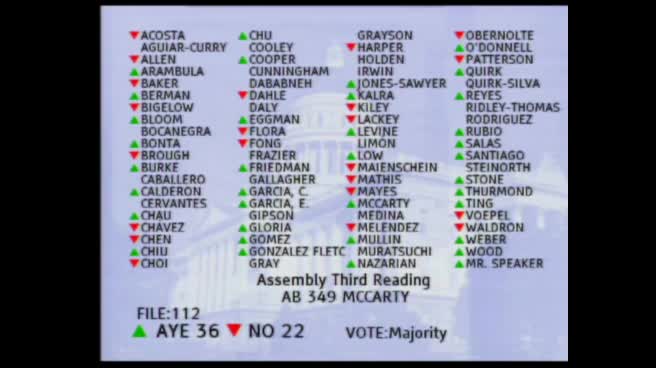 1MIN
Assembly Floor
 2MIN
Assembly Standing Committee on Appropriations
 6MIN
Assembly Standing Committee on Jobs, Economic Development, and the Economy
 7MIN
Assembly Standing Committee on Higher Education
Bill Author
Bill Co-Author(s):