AB 1796: Rental property: electric vehicle charging stations.
- Session Year: 2017-2018
- House: Assembly
- Latest Version Date: 2018-08-20
Existing law requires a lessor of a dwelling to approve a written request of a lessee to install an electric vehicle charging station at a parking space allotted for the lessee in accordance with specified requirements. Existing law provides exemptions for specified dwellings, including an exemption for a dwelling that is subject to the residential rent control ordinance of a public entity.
This bill would eliminate that exemption, thereby requiring a lessor of a dwelling subject to the residential rent control ordinance of a public entity to approve a written request of a lessee to install an electric vehicle charging station in accordance with specified requirements, unless the dwelling is located in a local jurisdiction that, on or before January 1, 2018, adopted an ordinance requiring the lessor of such a dwelling to approve a written request of a lessee to install an electric vehicle charging station.
Existing law requires a lessor of a dwelling to approve a written request of a lessee to install an electric vehicle charging station at a parking space allotted for the lessee in accordance with specified requirements. Existing law provides exemptions for specified dwellings, including an exemption for a dwelling that is subject to the residential rent control ordinance of a public entity.
This bill would eliminate that exemption, thereby requiring a lessor of a dwelling subject to the residential rent control ordinance of a public entity to approve a written request of a lessee to install an electric vehicle charging station in accordance with specified requirements, unless the dwelling is located in a local jurisdiction that, on or before January 1, 2018, adopted a local an ordinance requiring the lessor of such a dwelling to approve a written request of a lessee to install an electric vehicle charging station and the lessor complies with that ordinance.
Existing law requires a lessor of a dwelling to approve a written request of a lessee to install an electric vehicle charging station at a parking space allotted for the lessee in accordance with specified requirements. Existing law provides exemptions for specified dwellings, including an exemption for a dwelling that is subject to the residential rent control ordinance of a public entity.
This bill would eliminate that exemption, thereby requiring a lessor of a dwelling subject to the residential rent control ordinance of a public entity to approve a written request of a lessee to install an electric vehicle charging station in accordance with specified requirements. requirements, unless the dwelling is located in a local jurisdiction that, on or before January 1, 2018, adopted a local ordinance requiring the lessor of such a dwelling to approve a written request of a lessee to install an electric vehicle charging station and the lessor complies with that ordinance.
Existing law requires a lessor of a dwelling to approve a written request of a lessee to install an electric vehicle charging station at a parking space allotted for the lessee in accordance with specified requirements. Existing law provides exemptions for specified dwellings, including an exemption for a dwelling that is subject to the residential rent control ordinance of a public entity.
This bill would eliminate that exemption, thereby requiring a lessor of a dwelling subject to the residential rent control ordinance of a public entity to approve a written request of a lessee to install an electric vehicle charging station in accordance with specified requirements.
(a)For any lease executed, extended, or renewed on and after July 1, 2015, a lessor of a dwelling shall approve a written request of a lessee to install an electric vehicle charging station at a parking space allotted for the lessee that meets the requirements of this section and complies with the lessors procedural approval process for modification to the property.
(b)This section does not apply to residential rental properties where:
(1)Electric vehicle charging stations already exist for lessees in a ratio that is equal to or greater than 10 percent of the designated parking spaces.
(2)Parking is not provided as part of the lease agreement.
(3)There are fewer than five parking spaces.
(4)The dwelling is subject to a residential rent control ordinance. This paragraph shall not apply to a lease executed, extended, or renewed on and after January 1, 2019.
(5)The dwelling is subject to both a residential rent control ordinance and an ordinance, adopted on or before January 1, 2018, that requires the lessor to approve a lessees written request to install an electric vehicle charging station at a parking space allotted to the lessee.
(c)For purposes of this section, electric vehicle charging station or charging station means any level of electric vehicle supply equipment station that is designed and built in compliance with Article 625 of the California Electrical Code, as it reads on the effective date of this section, and delivers electricity from a source outside an electric vehicle into a plug-in electric vehicle.
(d)A lessor shall not be obligated to provide an additional parking space to a lessee in order to accommodate an electric vehicle charging station.
(e)If the electric vehicle charging station has the effect of providing the lessee with a reserved parking space, the lessor may charge a monthly rental amount for that parking space.
(f)An electric vehicle charging station and all modifications and improvements to the property shall comply with federal, state, and local law, and all applicable zoning requirements, land use requirements, and covenants, conditions, and restrictions.
(g)A lessees written request to make a modification to the property in order to install and use an electric vehicle charging station shall include, but is not limited to, the lessees consent to enter into a written agreement that includes, but is not limited to, the following:
(1)Compliance with the lessors requirements for the installation, use, maintenance, and removal of the charging station and installation, use, and maintenance of the infrastructure for the charging station.
(2)Compliance with the lessors requirements for the lessee to provide a complete financial analysis and scope of work regarding the installation of the charging station and its infrastructure.
(3)A written description of how, when, and where the modifications and improvements to the property are proposed to be made consistent with those items specified in the Permitting Checklist of the Zero-Emission Vehicles in California: Community Readiness Guidebook published by the Office of Planning and Research.
(4)Obligation of the lessee to pay the lessor all costs associated with the lessors installation of the charging station and its infrastructure prior to any modification or improvement being made to the leased property. The costs associated with modifications and improvements shall include, but are not limited to, the cost of permits, supervision, construction, and, solely if required by the contractor, consistent with its past performance of work for the lessor, performance bonds.
(5)Obligation of the lessee to pay as part of rent for the costs associated with the electrical usage of the charging station, and cost for damage, maintenance, repair, removal, and replacement of the charging station, and modifications or improvements made to the property associated with the charging station.
(h)The lessee shall maintain in full force and effect a lessees general liability insurance policy in the amount of one million dollars ($1,000,000) and shall name the lessor as a named additional insured under the policy commencing with the date of approval of construction until the lessee forfeits possession of the dwelling to the lessor.
(a)For any lease executed, extended, or renewed on and after July 1, 2015, a lessor of a dwelling shall approve a written request of a lessee to install an electric vehicle charging station at a parking space allotted for the lessee that meets the requirements of this section and complies with the lessors procedural approval process for modification to the property.
(b)This section does not apply to residential rental properties where:
(1)Electric vehicle charging stations already exist for lessees in a ratio that is equal to or greater than 10 percent of the designated parking spaces.
(2)Parking is not provided as part of the lease agreement.
(3)A property where there There are less fewer than five parking spaces.
(4)A The dwelling that is subject to the a residential rent control ordinance of a public entity. ordinance. This paragraph shall not apply to a lease executed, extended, or renewed on and after January 1, 2019.
(5)A dwelling that is subject to the residential rent control ordinance of a public entity and is located in a local jurisdiction that, on or before January 1, 2018, adopted a local ordinance, which the lessor of that dwelling complies with, requiring the
(5)The dwelling is subject to both a residential rent control ordinance and an ordinance, adopted on or before January 1, 2018, that requires the lessor to approve a lessees written request of a lessee to install an electric vehicle charging station at a parking space allotted for to the lessee.
(c)For purposes of this section, electric vehicle charging station or charging station means any level of electric vehicle supply equipment station that is designed and built in compliance with Article 625 of the California Electrical Code, as it reads on the effective date of this section, and delivers electricity from a source outside an electric vehicle into a plug-in electric vehicle.
(d)A lessor shall not be obligated to provide an additional parking space to a lessee in order to accommodate an electric vehicle charging station.
(e)If the electric vehicle charging station has the effect of providing the lessee with a reserved parking space, the lessor may charge a monthly rental amount for that parking space.
(f)An electric vehicle charging station and all modifications and improvements to the property shall comply with federal, state, and local law, and all applicable zoning requirements, land use requirements, and covenants, conditions, and restrictions.
(g)A lessees written request to make a modification to the property in order to install and use an electric vehicle charging station shall include, but is not limited to, his or her the lessees consent to enter into a written agreement that includes, but is not limited to, the following:
(1)Compliance with the lessors requirements for the installation, use, maintenance, and removal of the charging station and installation, use, and maintenance of the infrastructure for the charging station.
(2)Compliance with the lessors requirements for the lessee to provide a complete financial analysis and scope of work regarding the installation of the charging station and its infrastructure.
(3)A written description of how, when, and where the modifications and improvements to the property are proposed to be made consistent with those items specified in the Permitting Checklist of the Zero-Emission Vehicles in California: Community Readiness Guidebook published by the Office of Planning and Research.
(4)Obligation of the lessee to pay the lessor all costs associated with the lessors installation of the charging station and its infrastructure prior to any modification or improvement being made to the leased property. The costs associated with modifications and improvements shall include, but are not limited to, the cost of permits, supervision, construction, and, solely if required by the contractor, consistent with its past performance of work for the lessor, performance bonds.
(5)Obligation of the lessee to pay as part of rent for the costs associated with the electrical usage of the charging station, and cost for damage, maintenance, repair, removal, and replacement of the charging station, and modifications or improvements made to the property associated with the charging station.
(h)The lessee shall maintain in full force and effect a lessees general liability insurance policy in the amount of one million dollars ($1,000,000) and shall name the lessor as a named additional insured under the policy commencing with the date of approval of construction until the lessee forfeits possession of the dwelling to the lessor.
(a)For any lease executed, extended, or renewed on and after July 1, 2015, a lessor of a dwelling shall approve a written request of a lessee to install an electric vehicle charging station at a parking space allotted for the lessee that meets the requirements of this section and complies with the lessors procedural approval process for modification to the property.
(b)This section does not apply to residential rental properties where:
(1)Electric vehicle charging stations already exist for lessees in a ratio that is equal to or greater than 10 percent of the designated parking spaces.
(2)Parking is not provided as part of the lease agreement.
(3)A property where there are less than five parking spaces.
(4)A dwelling that is subject to the residential rent control ordinance of a public entity. This paragraph shall not apply to a lease executed, extended, or renewed on and after January 1, 2019.
(5)A dwelling that is subject to the residential rent control ordinance of a public entity and is located in a local jurisdiction that, on or before January 1, 2018, adopted a local ordinance, which the lessor of that dwelling complies with, requiring the lessor to approve a written request of a lessee to install an electric vehicle charging station at a parking space allotted for the lessee.
(c)For purposes of this section, electric vehicle charging station or charging station means any level of electric vehicle supply equipment station that is designed and built in compliance with Article 625 of the California Electrical Code, as it reads on the effective date of this section, and delivers electricity from a source outside an electric vehicle into a plug-in electric vehicle.
(d)A lessor shall not be obligated to provide an additional parking space to a lessee in order to accommodate an electric vehicle charging station.
(e)If the electric vehicle charging station has the effect of providing the lessee with a reserved parking space, the lessor may charge a monthly rental amount for that parking space.
(f)An electric vehicle charging station and all modifications and improvements to the property shall comply with federal, state, and local law, and all applicable zoning requirements, land use requirements, and covenants, conditions, and restrictions.
(g)A lessees written request to make a modification to the property in order to install and use an electric vehicle charging station shall include, but is not limited to, his or her consent to enter into a written agreement that includes, but is not limited to, the following:
(1)Compliance with the lessors requirements for the installation, use, maintenance, and removal of the charging station and installation, use, and maintenance of the infrastructure for the charging station.
(2)Compliance with the lessors requirements for the lessee to provide a complete financial analysis and scope of work regarding the installation of the charging station and its infrastructure.
(3)A written description of how, when, and where the modifications and improvements to the property are proposed to be made consistent with those items specified in the Permitting Checklist of the Zero-Emission Vehicles in California: Community Readiness Guidebook published by the Office of Planning and Research.
(4)Obligation of the lessee to pay the lessor all costs associated with the lessors installation of the charging station and its infrastructure prior to any modification or improvement being made to the leased property. The costs associated with modifications and improvements shall include, but are not limited to, the cost of permits, supervision, construction, and, solely if required by the contractor, consistent with its past performance of work for the lessor, performance bonds.
(5)Obligation of the lessee to pay as part of rent for the costs associated with the electrical usage of the charging station, and cost for damage, maintenance, repair, removal, and replacement of the charging station, and modifications or improvements made to the property associated with the charging station.
(h)The lessee shall maintain in full force and effect a lessees general liability insurance policy in the amount of one million dollars ($1,000,000) and shall name the lessor as a named additional insured under the policy commencing with the date of approval of construction until the lessee forfeits possession of the dwelling to the lessor.
(a)For any lease executed, extended, or renewed on and after July 1, 2015, a lessor of a dwelling shall approve a written request of a lessee to install an electric vehicle charging station at a parking space allotted for the lessee that meets the requirements of this section and complies with the lessors procedural approval process for modification to the property.
(b)This section does not apply to residential rental properties where:
(1)Electric vehicle charging stations already exist for lessees in a ratio that is equal to or greater than 10 percent of the designated parking spaces.
(2)Parking is not provided as part of the lease agreement.
(3)A property where there are less than five parking spaces.
(4)A dwelling that is subject to the residential rent control ordinance of a public entity. This paragraph shall not apply to a lease executed, extended, or renewed on and after January 1, 2019.
(c)For purposes of this section, electric vehicle charging station or charging station means any level of electric vehicle supply equipment station that is designed and built in compliance with Article 625 of the California Electrical Code, as it reads on the effective date of this section, and delivers electricity from a source outside an electric vehicle into a plug-in electric vehicle.
(d)A lessor shall not be obligated to provide an additional parking space to a lessee in order to accommodate an electric vehicle charging station.
(e)If the electric vehicle charging station has the effect of providing the lessee with a reserved parking space, the lessor may charge a monthly rental amount for that parking space.
(f)An electric vehicle charging station and all modifications and improvements to the property shall comply with federal, state, and local law, and all applicable zoning requirements, land use requirements, and covenants, conditions, and restrictions.
(g)A lessees written request to make a modification to the property in order to install and use an electric vehicle charging station shall include, but is not limited to, his or her consent to enter into a written agreement that includes, but is not limited to, the following:
(1)Compliance with the lessors requirements for the installation, use, maintenance, and removal of the charging station and installation, use, and maintenance of the infrastructure for the charging station.
(2)Compliance with the lessors requirements for the lessee to provide a complete financial analysis and scope of work regarding the installation of the charging station and its infrastructure.
(3)A written description of how, when, and where the modifications and improvements to the property are proposed to be made consistent with those items specified in the Permitting Checklist of the Zero-Emission Vehicles in California: Community Readiness Guidebook published by the Office of Planning and Research.
(4)Obligation of the lessee to pay the lessor all costs associated with the lessors installation of the charging station and its infrastructure prior to any modification or improvement being made to the leased property. The costs associated with modifications and improvements shall include, but are not limited to, the cost of permits, supervision, construction, and, solely if required by the contractor, consistent with its past performance of work for the lessor, performance bonds.
(5)Obligation of the lessee to pay as part of rent for the costs associated with the electrical usage of the charging station, and cost for damage, maintenance, repair, removal, and replacement of the charging station, and modifications or improvements made to the property associated with the charging station.
(h)The lessee shall maintain in full force and effect a lessees general liability insurance policy in the amount of one million dollars ($1,000,000) and shall name the lessor as a named additional insured under the policy commencing with the date of approval of construction until the lessee forfeits possession of the dwelling to the lessor.
|
Date
|
Status
|
|---|---|
| Aug 20, 2018 | Chaptered by Secretary of State - Chapter 163, Statutes of 2018. |
| Aug 20, 2018 | Approved by the Governor. |
| Aug 9, 2018 | Enrolled and presented to the Governor at 11:30 a.m. |
| Aug 6, 2018 | Senate amendments concurred in. To Engrossing and Enrolling. |
| Jul 3, 2018 | In Assembly. Concurrence in Senate amendments pending. May be considered on or after July 5 pursuant to Assembly Rule 77. |
| Jul 2, 2018 | Read third time. Passed. Ordered to the Assembly. |
| Jun 14, 2018 | Read second time and amended. Ordered to third reading. |
| Jun 13, 2018 | From committee: Amend, and do pass as amended. (Ayes 5. Noes 1.) (June 12). |
| May 24, 2018 | Referred to Com. on JUD. |
| May 15, 2018 | In Senate. Read first time. To Com. on RLS. for assignment. |
| May 14, 2018 | Read third time. Passed. Ordered to the Senate. |
| May 10, 2018 | Read second time. Ordered to third reading. |
| May 9, 2018 | From committee: Do pass. (Ayes 7. Noes 0.) (May 9). |
| Apr 26, 2018 | Re-referred to Com. on H. & C.D. |
| Apr 25, 2018 | From committee chair, with author's amendments: Amend, and re-refer to Com. on H. & C.D. Read second time and amended. |
| Apr 3, 2018 | In committee: Hearing postponed by committee. |
| Jan 22, 2018 | Referred to Com. on H. & C.D. |
| Jan 10, 2018 | From printer. May be heard in committee February 9. |
| Jan 9, 2018 | Read first time. To print. |
|
Date
|
Description
|
Location
|
Votes
|
|
|---|---|---|---|---|
| Aug 6, 2018 | AB 1796 MURATSUCHI Concurrence in Senate Amendments | Assembly Floor |
Passed |
|
| Jul 2, 2018 | Assembly 3rd Reading AB1796 Muratsuchi By Allen | Senate Floor |
Passed |
|
| Jun 12, 2018 | Do pass as amended | Senate Standing Committee on Judiciary |
Passed |
|
| May 14, 2018 | AB 1796 MURATSUCHI Assembly Third Reading | Assembly Floor |
Passed |
|
| May 9, 2018 | Do pass. | Assembly Standing Committee on Housing and Community Development |
Passed |
This list shows positions taken on this bill by organizations on the date displayed, which is linked to the original source.
Positions by individuals are not included.
|
Organization
|
Position
|
Date
|
|---|---|---|
| Bay Area Air Quality Management District | ** Support | Jun 15, 2018 |
| California Electric Transportation Coalition | ** Support | Jun 15, 2018 |
| ChargePoint | ** Support | Jun 15, 2018 |
| City of Berkeley | ** Support | Jun 15, 2018 |
| City Of Berkeley Rent Stabilization Board | ** Support | Jun 15, 2018 |
| City of Santa Monica | ** Support | May 7, 2018 |
| City of Santa Monica Rent Control Board | ** Support | Jun 15, 2018 |
| City of West Hollywood | ** Support | Jun 15, 2018 |
| Coalition For Clean Air | ** Support | Jun 15, 2018 |
| Electric Vehicle Charging Association | ** Support | Jun 15, 2018 |
| Environment California | ** Support | May 7, 2018 |
| Natural Resources Defense Council | ** Support | Jun 15, 2018 |
| Plug In America | ** Support | Jun 15, 2018 |
| Silicon Valley Leadership Group | ** Support | Jun 15, 2018 |
| Tesla | ** Support | Jun 15, 2018 |
| The Utility Reform Network | ** Support | Jun 15, 2018 |
CONCURRENCE IN SENATE AMENDMENTS
CSA1 Bill Id:AB 1796
Author:(Muratsuchi)
As Amended Ver:June 14, 2018
Majority vote
ASSEMBLY: | 53-18 | (May 14, 2018) | SENATE: | 26-11 | (July 2, 2018) |
Original Committee Reference: H. & C.D.
SUMMARY: Removes the exemption that allows lessors of dwellings subject to a residential rent control ordinance to deny requests of lessees to install electric vehicle (EV) charging stations at parking spaces, thereby requiring lessors of rent controlled dwellings to approve EV installation requests. Specifically, this bill:
- Extends a tenant's right to install an EV charging station, subject to specified conditions, to residential properties subject to rent control with leases executed, extended, or renewed on or after January 1, 2019.
- Maintains the exemption for rent controlled residential properties if they are located in a jurisdiction that, on or before January 1, 2018, adopted a local ordinance requiring the lessor to approve a written request of a lessee to install an EV charging station at a parking space allotted for the lessee.
The Senate amendments make technical changes and remove gender-based pronouns from this bill.
FISCAL EFFECT: None
COMMENTS:
Need for this bill: According to the author, "[a]ccess to charging stations and a broad charging network continues to be one of the greatest barriers to expanded adoption and use of electric vehicles by California drivers and limited access to residential charging is perhaps one of the greatest challenges associated with this obstacle. Use and adoption of electric vehicles will significantly reduce GHG [greenhouse gas] emissions statewide, as mobile source emissions continue to be the primary contributor to overall emissions. Access to a reliable and readily available charging network, including residential charging stations, will encourage expanded use and help the state meet its climate goals.
"Home owners are able to choose whether or not they wish to install a charging station in their residence, but it was not until 2014 that renters who are electric vehicle owners were able to make this decision with the passage of AB 2565. However, current statute exempts rent controlled properties from being required to authorize installation of electric vehicle charging stations. In some cities, such as San Francisco, rent controlled housing makes up nearly 75% of available rental stock. Authorizing installation of charging stations in rent controlled units would significantly increase access to residential charging and expand EV adoption and use."
AB 2565 (Muratsuchi), Chapter 529, Statutes of 2014: AB 2565 created the requirements for an owner of commercial or residential property to approve the installation of an EV charging station, subject to certain requirements. The June 16, 2014, amendments to AB 2565 added an exemption for dwellings subject to a residential rent control ordinance.
This bill would remove that exemption and apply the provisions of AB 2565 to rent control units with leases executed, extended, or renewed on and after January 1, 2019, unless the local jurisdiction has already adopted an ordinance that requires the owner of the rent controlled building to approve the installation of an EV charging station. The City of West Hollywood is one such jurisdiction that has adopted a local ordinance requiring owners to approve EV installation requests.
Related legislation:
AB 1239 (Holden) of 2017: Required the Department of Housing and Community Development and the California Building Standards Commission (CBSC) to research, develop, and propose building standards for EV capable parking spaces. This bill was vetoed by the Governor.
AB 2565 (Muratsuchi), Chapter 529, Statutes of 2014: Required an owner of a commercial or residential property to approve the installation of an EV charging station if it meets specified requirements and complies with the owner's process for approving a modification to the property, and makes a term in a lease of a commercial property, executed, renewed, or extended on or after January 1, 2015, void and unenforceable if it prohibits or unreasonably restricts the installation of an EV charging station in a parking space.
AB 1092 (Levine), Chapter 410, Statutes of 2013: Required the Building Standards Commission to adopt mandatory building standards for the installation of EV charging infrastructure in multifamily dwellings and non-residential development.
SB 880 (Corbett), Chapter 6, Statutes of 2012: Specified that the governing documents of a common interest development may not prohibit the installation of an EV charging station in an owner's designated parking space.
SB 209 (Corbett), Chapter 121, Statutes of 2011: Provided that a prohibition or restriction on the installation or use of an EV charging station in any of the governing documents of a common interest development is void and unenforceable.
Analysis Prepared by: Lisa Engel / H. & C.D. / (916) 319-2085 FN: 0003694
Office of Senate Floor Analyses (916) 651-1520 Fax: (916) 327-4478 | AB |
THIRD READING
Bill No: AB 1796
: 6/14/18
SENATE JUDICIARY COMMITTEE: 5-1, 6/12/18
AYES: Jackson, Hertzberg, Monning, Stern, Wieckowski
NOES: Anderson
NO VOTE RECORDED: Moorlach
ASSEMBLY FLOOR: 53-18, 5/14/18 - See last page for vote
DIGEST:
This bill extends, to landlords of rent-controlled units, the existing general rule that they must approve tenant requests to install electric vehicle (EV) charging stations so long as the installation meets certain preconditions, including that the tenant will pay for all costs associated with the installation, maintenance, and use of the charging station.
Existing law:
- Requires non-exempt residential landlords who are party to any lease executed, extended, or renewed on and after July 1, 2015, to approve tenant requests to install an EV charging station at a parking space allotted to the tenant so long as the request meets specified requirements and complies with the landlord’s procedural approval process for property modifications. (Civ. Code Sec. 1947.6(a).)
- Exempts residential properties from the requirement to approve tenant EV charging station requests where:
- EV charging stations already exist for lessees in a ratio that is equal to or greater than 10 percent of the designated parking spaces;
- Parking is not provided as part of the lease agreement;
- There are less than five parking spaces at the property; or
- The dwelling that is subject to the residential rent control ordinance of a public entity. (Civ. Code Sec. 1947.6(b).)
- Defines “electric vehicle charging station” or “charging station” as any level of EV supply equipment station that is designed and built in compliance with specified provisions of the California Electrical Code and delivers electricity from a source outside an EV into a plug-in EV. (Civ. Code Sec. 1947.6(c).)
- Provides that a landlord is not obligated to provide an additional parking space to a tenant in order to accommodate an EV charging station. (Civ. Code Sec. 1947.6(d).)
- Provides that if the electric vehicle charging station installation has the effect of providing the tenant with a reserved parking space, the landlord may charge a monthly rental amount for that parking space. (Civ. Code Sec. 1947.6(e).)
- Specifies that an EV charging station and all modifications and improvements to the property must comply with federal, state, and local law, and all applicable zoning requirements, land use requirements, and covenants, conditions, and restrictions. (Civ. Code Sec. 1947.6(f).)
- Provides that, to trigger the landlord’s duty to approve it, the tenant’s request to modify the property in order to install and use an EV charging station must include consent to enter into a written agreement that includes:
- Compliance with the landlord’s requirements for the installation, use, maintenance, and removal of the charging station and related infrastructure;
- Compliance with the landlord’s requirements to provide a complete financial analysis and scope of work regarding the installation of the charging station and its infrastructure;
- Description of how, when, and where the modifications and improvements to the property are proposed to be made consistent with those items specified in the “Permitting Checklist” of the “Zero-Emission Vehicles in California: Community Readiness Guidebook” published by the Office of Planning and Research;
- The tenant’s obligation to pay the landlord all costs associated with the landlord’s installation of the charging station and its infrastructure prior to any modification or improvement being made to the leased property. The costs associated with modifications and improvements shall include, but are not limited to, the cost of permits, supervision, construction, and, solely if required by the contractor, consistent with its past performance of work for the landlord, performance bonds; and
- Obligation of the tenant to pay as part of rent for the costs associated with the electrical usage of the charging station, and cost for damage, maintenance, repair, removal, and replacement of the charging station, and modifications or improvements made to the property associated with the charging station. (Civ. Code Sec. 1946.7(g)
- Requires the tenant to maintain renter’s liability insurance in the amount of $1 million with the landlord as a named additional insured. (Civ. Code Sec. 1946.7(h).)
This bill:
- Extends a tenant’s right to install an EV charging station, subject to specified conditions, to residential properties subject to rent control with leases executed, extended, or renewed on or after January 1, 2019.
- Maintains the exemption for rent controlled residential properties if they are located in a jurisdiction that, on or before January 1, 2018, adopted a local ordinance requiring the lessor to approve a written request of a lessee to install an EV charging station at a parking space allotted for the lessee.
Background
In an effort to do its part to reduce the effects of climate change, California has set aggressive goals for reducing its greenhouse gas (GHG) emissions. Since the transportation sector emits about half of California’s GHG emissions, Governor Brown has called for five million electric cars, buses, and trucks to be on California roads by 2030. (Executive Order B-48-18 (Jan. 2018).)
To reach these aggressive goals for EV use, California will need to quickly develop corresponding infrastructure. Unlike internal combustion engine vehicles, which must be refueled at a gas station, electric cars can be refueled at any electrical outlet. However, EV batteries recharge rather slowly when plugged into standard residential outlets. To refuel an electric car more quickly, it must be plugged into a specialized EV charging station. With that in mind, the Governor has set a goal that California will install 250,000 EV charging stations by 2025.
Residential tenants who want to own and operate an electric car will usually need to install a charging station to go with it. Unless they have the landlord’s authority to make that kind of modification to the property, however, the tenant will not be able install the charging station, making it inconvenient, if not impossible, to have an electric car.
To address this dynamic and help meet the Governor’s goals for EV infrastructure, the Legislature passed AB 2565 (Muratsuchi, Chapter 529, Statutes of 2014.) AB 2565 required landlords to approve a request from a tenant to install an EV charging station, provided that the tenant agrees to pay for all costs of the installation, maintenance, electricity use, and if necessary, removal of, the charging station. In addition, the bill required tenants to maintain a significant insurance policy for the charging station.
AB 2565 exempted certain types of rental properties. Landlords in those properties are still free to refuse a tenant’s request to install an EV charging station. The most significant of these AB 2565 exemptions is for rent controlled properties, which make up a large fraction of the rental housing stock in some of California’s most populous cities, such as San Francisco, Los Angeles, and Oakland. This bill prospectively lifts that exemption for leases executed, extended, or renewed after January 1, 2019, thus giving to tenants in rent controlled properties the same conditional right to install an EV charging station that tenants in other properties enjoy.
Comments
Number of Residential Units Affected
In response to a request from the Senate Judiciary Committee staff, the California Research Bureau undertook to quantify the number of housing units that are currently rent controlled in California and would therefore be impacted by this bill. The Bureau retrieved data from each of the rent controlled jurisdictions in California. Based on those figures, the Bureau concluded that there are currently about 1,020,000 rent controlled units (excluding mobile homes). The Bureau noted, however, that the exact number fluctuates periodically as older units are converted to non-rental units and become exempt from rent control or when cities change rental policies.
These roughly 1,020,000 units are concentrated in jurisdictions with rent control ordinances, of course. Those jurisdictions are: Berkeley, Beverly Hills, Campbell, East Palo Alto, Fremont, Hayward, Los Angeles, Los Gatos, Oakland, Palm Springs, San Francisco, San Jose, Santa Monica, Thousand Oaks, and West Hollywood.
Why Rent Controlled Units were Excluded from AB 2565
The legislative history does not reveal why rent controlled units were excluded from AB 2565. That provision was amended into the bill shortly before it was heard in the Senate Judiciary Committee. The subsequent committee reports on the bill note the change, but do not provide any explanation for why it was made.
From a policy perspective, the most obvious explanation for the exclusion of rent controlled units is that landlords in rent controlled jurisdictions would have a harder time passing on to the tenants any costs associated with installation of an EV charging station. That concern should largely have been tempered by two considerations, however. First, all rent control ordinances must allow landlords to make a fair return on their investments. (Fisher v. City of Berkeley (1984) 37 Cal.3d 644, 652.) As a result, landlords can generally pass through the costs of any capital improvements to their property. Installation of an EV charging station would seem to be an example of such a cost. Second, AB 2565 is premised on the idea that the tenant must agree to pay all costs associated with the EV charging station before the landlord has to approve the installation. Thus, the installation should not generally affect the landlord’s revenue at all. In fact, it would seem that landlords benefit from installation of the EV charging station, since most tenants will leave it behind upon vacating. Ownership of the charging station will then pass to the landlord, and that landlord can then advertise it as an additional amenity that may be attractive to future tenants.
Ultimately, it appears that the exclusion of rent controlled properties from AB 2565 was simply the result of a political compromise, rather than policy considerations. There was significant opposition to the bill in its early iterations. After several amendments, including the exclusion of rent controlled properties, all opposition evaporated.
Compliance with Similar Local Ordinance Exempts Landlord from State Compliance
At the same time that this bill requires landlords of rent controlled properties to approve requests to install EV charging stations, it also creates a new exemption to that requirement. Properties in local jurisdictions that already had a similar requirement in place as of January 1, 2018, would not have to comply with the state law, provided that the property is already in compliance with the local law.
In effect, this allows local jurisdictions to maintain existing local rules if they wish, provided that those rules require approval of a tenant’s installation request. The City of West Hollywood, for example, has required landlords in rent controlled properties to approve EV charging station installation requests from tenants since 2017. (West Hollywood Municipal Code Ch. 17.58.) Unlike the state law, however, the West Hollywood ordinance only requires the tenant to have $25,000 worth of liability coverage on the charging station and landlords only have to approve the request if the tenant is allotted a particular parking space.
The City of Santa Monica has also adopted its own local ordinance. In support of this bill, the City of Santa Monica Rent Control Board writes:
The Board applauds your bill to extend to rent-controlled tenancies the right to obtain an EV charging station at the requesting tenant’s expense. The Board appreciates also that your bill states unequivocally that it would not preempt local legislation, like that which the Board has already adopted.
FISCAL EFFECT: Appropriation: Fiscal Com.: Local:
Bay Area Air Quality Management District
California Electric Transportation Coalition
ChargePoint
City of Berkeley
City of Berkeley Rent Stabilization Board
City of Santa Monica Rent Control Board
City of West Hollywood
Coalition for Clean Air
Electric Vehicle Charging Association
Natural Resources Defense Council
Plug In America
Silicon Valley Leadership Group
Tesla
The Utility Reform Network
OPPOSITION: (Verified 6/14/18)
None received
ARGUMENTS IN SUPPORT: According to the author:
[A]ccess to charging stations and a broad charging network continues to be one of the greatest barriers to expanded adoption and use of electric vehicles by California drivers and limited access to residential charging is perhaps one of the greatest challenges associated with this obstacle. Use and adoption of electric vehicles will significantly reduce GHG emissions statewide, as mobile source emissions continue to be the primary contributor to overall emissions. Access to a reliable and readily available charging network, including residential charging stations, will encourage expanded use and help the state meet its climate goals.
Home owners are able to choose whether or not they wish to install a charging station in their residence, but it was not until 2014 that renters who are electric vehicle owners were able to make this decision with the passage of AB 2565. However, current statute exempts rent controlled properties from being required to authorize installation of electric vehicle charging stations. In some cities, such as San Francisco, rent controlled housing makes up nearly 75% of available rental stock. Authorizing installation of charging stations in rent controlled units would significantly increase access to residential charging and expand EV adoption and use.
In support of this bill, Plug In America writes:
[T]hose Californians who live in rent controlled dwellings are currently prohibited from installing an EV charging station, which significantly impacts the ability of the driver in the rent controlled dwelling from charging the PEV [plug-in electric vehicle] at home and receiving a lower rate to charge the vehicle at night. In this scenario, the driver is left to find street parking someplace with a public charging station, and must pay higher rates for using the public charging station. This bill corrects this significant hurdle, as the current policy dissuades potential PEV buyers from purchasing the vehicle in the first place. Even with PEV prices declining, if Californians do not have easy access to charging infrastructure at their homes, they will likely not purchase the PEV, making it difficult for California to reach the goal of 5 million PEVs on the road by 2030.
In further support of this bill, the Natural Resources Defense Council writes:
AB 1796 would remove a perverse exemption based on the false premise that EVs are ill-suited for low and moderate-income households – the households most in need of relief form the volatility of the world oil market. AB 1796 would provide equal access to a cheaper and cleaner fuel.
ASSEMBLY FLOOR: 53-18, 5/14/18
AYES: Acosta, Aguiar-Curry, Baker, Berman, Bloom, Bonta, Burke, Calderon, Carrillo, Cervantes, Chau, Chiu, Choi, Chu, Cooley, Cooper, Daly, Eggman, Frazier, Friedman, Eduardo Garcia, Gipson, Gloria, Gonzalez Fletcher, Gray, Grayson, Holden, Irwin, Jones-Sawyer, Kalra, Kamlager-Dove, Levine, Limón, Low, Maienschein, McCarty, Medina, Mullin, Muratsuchi, Nazarian, O'Donnell, Quirk, Quirk-Silva, Reyes, Rodriguez, Rubio, Santiago, Mark Stone, Thurmond, Ting, Weber, Wood, Rendon
NOES: Travis Allen, Bigelow, Brough, Caballero, Chávez, Cunningham, Dahle, Fong, Gallagher, Harper, Kiley, Lackey, Melendez, Obernolte, Patterson, Salas, Voepel, Waldron
NO VOTE RECORDED: Arambula, Chen, Flora, Cristina Garcia, Mathis, Mayes, Steinorth
Prepared by: Timothy Griffiths / JUD. / (916) 651-4113
6/15/18 11:05:58
**** END ****
Senator Hannah-Beth Jackson, Chair
2017-2018 Regular Session
Bill No: AB 1796 (Author:Muratsuchi)
Version: April 25, 2018
Hearing Date: June 12, 2018
Fiscal: No
Urgency: No
Consultant: TSG
SUBJECT
Rental property: electric vehicle charging stations
DESCRIPTION
Existing law excludes rent controlled properties from the general rule that residential landlords must approve tenant requests to install electric vehicle charging stations so long as the installation meets certain preconditions. This bill would lift that exclusion, thus giving tenants in rent controlled units the same conditional right to install electric vehicle charging stations as all other tenants.
BACKGROUND
In an effort to do its part to reduce the effects of climate change, California has set aggressive goals for reducing its greenhouse gas emissions. Since the transportation sector emits about half of California’s greenhouse gas emissions, Governor Brown has called for 5 million electric cars, buses, and trucks to be on California roads by 2030. (Executive Order B-48-18 (Jan. 2018).)
To reach these aggressive goals for electric vehicle use, California will need to quickly develop corresponding infrastructure. Unlike internal combustion engine vehicles, which must be refueled at a gas station, electric cars can be refueled at any electrical outlet. However, electric vehicle batteries recharge rather slowly when plugged into standard residential outlets. To refuel an electric car more quickly, it must be plugged into a specialized electric vehicle charging station. With that in mind, the Governor has set a goal that California will install 250,000 electric vehicle charging stations by 2025.
Residential tenants who want to own and operate an electric car will usually need to install a charging station to go with it. Unless they have the landlord’s authority to make that kind of modification to the property, however, the tenant will not be able install the charging station, making it inconvenient, if not impossible, to have an electric car.
To address this dynamic and help meet the Governor’s goals for electric vehicle infrastructure, the Legislature passed AB 2565 (Muratsuchi, Ch. 529, Stats. 2014.) AB 2565 required landlords to approve a request from a tenant to install an electric vehicle charging station, provided that the tenant agrees to pay for all costs of the installation, maintenance, electricity use, and if necessary, removal of, the charging station. In addition, the bill required tenants to maintain a significant insurance policy for the charging station.
AB 2565 exempted certain types of rental properties. Landlords in those properties are still free to refuse a tenant’s request to install an electric vehicle charging station. The most significant of these AB 2565 exemptions is for rent controlled properties, which make up a large fraction of the rental housing stock in some of California’s most populous cities, such as San Francisco, Los Angeles, and Oakland. This bill would prospectively lift that exemption for leases executed, extended, or renewed after January 1, 2019, thus giving to tenants in rent controlled properties the same conditional right to install an electric vehicle charging station that tenants in other properties enjoy.
CHANGES TO EXISTING LAW
Existing law requires non-exempt residential landlords who are party to any lease executed, extended, or renewed on and after July 1, 2015, to approve tenant requests to install an EV charging station at a parking space allotted to the tenant so long as the request meets specified requirements and complies with the landlord’s procedural approval process for property modifications. (Civ. Code Sec. 1947.6(a).)
Existing law exempts residential properties from the requirement to approve tenant electric vehicle charging station requests where:
- electric vehicle charging stations already exist for lessees in a ratio that is equal to or greater than 10 percent of the designated parking spaces;
- parking is not provided as part of the lease agreement;
- there are less than five parking spaces at the property; or
- the dwelling that is subject to the residential rent control ordinance of a public entity. (Civ. Code Sec. 1947.6(b).)
Existing law defines “electric vehicle charging station” or “charging station” as any level of electric vehicle supply equipment station that is designed and built in compliance with specified provisions of the California Electrical Code and delivers electricity from a source outside an electric vehicle into a plug-in electric vehicle. (Civ. Code Sec. 1947.6(c).)
Existing law provides that a landlord is not obligated to provide an additional parking space to a tenant in order to accommodate an electric vehicle charging station. (Civ. Code Sec. 1947.6(d).)
Existing law provides that if the electric vehicle charging station installation has the effect of providing the tenant with a reserved parking space, the landlord may charge a monthly rental amount for that parking space. (Civ. Code Sec. 1947.6(e).)
Existing law specifies that an electric vehicle charging station and all modifications and improvements to the property must comply with federal, state, and local law, and all applicable zoning requirements, land use requirements, and covenants, conditions, and restrictions. (Civ. Code Sec. 1947.6(f).)
Existing law provides that, to trigger the landlord’s duty to approve it, the tenant’s request to modify the property in order to install and use an electric vehicle charging station must include consent to enter into a written agreement that includes:
- compliance with the landlord’s requirements for the installation, use, maintenance, and removal of the charging station and related infrastructure;
- compliance with the landlord’s requirements to provide a complete financial analysis and scope of work regarding the installation of the charging station and its infrastructure;
- description of how, when, and where the modifications and improvements to the property are proposed to be made consistent with those items specified in the “Permitting Checklist” of the “Zero-Emission Vehicles in California: Community Readiness Guidebook” published by the Office of Planning and Research;
- the tenant’s obligation to pay the landlord all costs associated with the landlord’s installation of the charging station and its infrastructure prior to any modification or improvement being made to the leased property. The costs associated with modifications and improvements shall include, but are not limited to, the cost of permits, supervision, construction, and, solely if required by the contractor, consistent with its past performance of work for the landlord, performance bonds; and
- obligation of the tenant to pay as part of rent for the costs associated with the electrical usage of the charging station, and cost for damage, maintenance, repair, removal, and replacement of the charging station, and modifications or improvements made to the property associated with the charging station. (Civ. Code Sec. 1946.7(g)
Existing law requires the tenant to maintain renter’s liability insurance in the amount of one million dollars ($1,000,000) with the landlord as a named additional insured. (Civ. Code Sec. 1946.7(h).)
This bill would extend a tenant’s right to install an electric vehicle charging station, subject to specified conditions, to residential properties subject to rent control with leases executed, extended, or renewed on or after January 1, 2019.
This bill would still exempt rent controlled residential properties if they are located in a jurisdiction that, on or before January 1, 2018, adopted a local ordinance requiring the lessor to approve a written request of a lessee to install an EV charging station at a parking space allotted for the lessee.
COMMENT
1. Stated need for the bill
According to the author:
[a]ccess to charging stations and a broad charging network continues to be one of the greatest barriers to expanded adoption and use of electric vehicles by California drivers and limited access to residential charging is perhaps one of the greatest challenges associated with this obstacle. Use and adoption of electric vehicles will significantly reduce GHG emissions statewide, as mobile source emissions continue to be the primary contributor to overall emissions. Access to a reliable and readily available charging network, including residential charging stations, will encourage expanded use and help the state meet its climate goals.
Home owners are able to choose whether or not they wish to install a charging station in their residence, but it was not until 2014 that renters who are electric vehicle owners were able to make this decision with the passage of AB 2565. However, current statute exempts rent controlled properties from being required to authorize installation of electric vehicle charging stations. In some cities, such as San Francisco, rent controlled housing makes up nearly 75% of available rental stock. Authorizing installation of charging stations in rent controlled units would significantly increase access to residential charging and expand EV adoption and use.
In support of the bill, Plug In America writes:
[T]hose Californians who live in rent controlled dwellings are currently prohibited from installing an EV charging station, which significantly impacts the ability of the driver in the rent controlled dwelling from charging the PEV [plug-in electric vehicle] at home and receiving a lower rate to charge the vehicle at night. In this scenario, the driver is left to find street parking someplace with a public charging station, and must pay higher rates for using the public charging station. This bill corrects this significant hurdle, as the current policy dissuades potential PEV buyers from purchasing the vehicle in the first place. Even with PEV prices declining, if Californians do not have easy access to charging infrastructure at their homes, they will likely not purchase the PEV, making it difficult for California to reach the goal of 5 million PEVs on the road by 2030.
In further support of the bill, the Natural Resources Defense Council writes:
AB 1796 would remove a perverse exemption based on the false premise that EVs are ill-suited for low and moderate-income households – the households most in need of relief form the volatility of the world oil market. AB 1796 would provide equal access to a cheaper and cleaner fuel.
2. Number of residential units affected
In response to a request from Committee staff, the California Research Bureau undertook to quantify the number of housing units that are currently rent controlled in California and would therefore be impacted by this bill. The Bureau retrieved data from each of the rent controlled jurisdictions in California. Based on those figures, the Bureau concluded that there are currently about 1,020,000 rent controlled units (excluding mobile homes). The Bureau noted, however, that the exact number fluctuates periodically as older units are converted to non-rental units and become exempt from rent control or when cities change rental policies.
These roughly 1,020,000 units are concentrated in jurisdictions with rent control ordinances, of course. Those jurisdictions are: Berkeley, Beverly Hills, Campbell, East Palo Alto, Fremont, Hayward, Los Angeles, Los Gatos, Oakland, Palm Springs, San Francisco, San Jose, Santa Monica, Thousand Oaks, and West Hollywood.
3. Why rent controlled units were excluded from AB 2565
The Legislative history does not reveal why rent controlled units were excluded from AB 2565. That provision was amended into the bill shortly before it was heard in this Committee. The subsequent committee reports on the bill note the change, but do not provide any explanation for why it was made.
From a policy perspective, the most obvious explanation for the exclusion of rent controlled units is that landlords in rent controlled jurisdictions would have a harder time passing on to the tenants any costs associated with installation of an electric vehicle charging station. That concern should largely have been tempered by two considerations, however. First, all rent control ordinances must allow landlords to make a fair return on their investments. (Fisher v. City of Berkeley (1984) 37 Cal.3d 644, 652.) As a result, landlords can generally pass through the costs of any capital improvements to their property. Installation of an electric vehicle charging station would seem to be an example of such a cost. Second, AB 2565 is premised on the idea that the tenant must agree to pay all costs associated with the electric vehicle charging station before the landlord has to approve the installation. Thus, the installation should not generally affect the landlord’s revenue at all. In fact, it would seem that landlords benefit from installation of the electric vehicle charging station, since most tenants will leave it behind upon vacating. Ownership of the charging station will then pass to the landlord, and that landlord can then advertise it as an additional amenity that may be attractive to future tenants.
Ultimately, it appears that the exclusion of rent controlled properties from AB 2565 was simply the result of a political compromise, rather than policy considerations. There was significant opposition to the bill in its early iterations. After several amendments, including the exclusion of rent controlled properties, all opposition evaporated.
4. Compliance with similar local ordinance exempts landlord from state compliance
At the same time that the bill requires landlords of rent controlled properties to approve requests to install electric vehicle charging stations, it also creates a new exemption to that requirement. Properties in local jurisdictions that already had a similar requirement in place as of January 1, 2018, would not have to comply with the state law, provided that the property is already in compliance with the local law.
In effect, this allows local jurisdictions to maintain existing local rules if they wish, provided that those rules require approval of a tenant’s installation request. The City of West Hollywood, for example, has required landlords in rent controlled properties to approve electric vehicle charging station installation requests from tenants since 2017. (West Hollywood Municipal Code Ch. 17.58.) Unlike the state law, however, the West Hollywood ordinance only requires the tenant to have $25,000 worth of liability coverage on the charging station and landlords only have to approve the request if the tenant is allotted a particular parking space.
The City of Santa Monica has also adopted its own local ordinance. In support of this bill, the City of Santa Monica Rent Control Board writes:
The Board applauds your bill to extend to rent-controlled tenancies the right to obtain an EV charging station at the requesting tenant’s expense. The Board appreciates also that your bill states unequivocally that it would not preempt local legislation, like that which the Board has already adopted.
5. Proposed Amendments
The author proposes to offer amendments in Committee that would:
- simplify and clarify convoluted language without making substantive changes; and
- remove gender-based pronouns from the bill;
The specific amendments are as follows:
Amendment 1
On page 2, in line 15, strike out “A property where there” and insert:
There
Amendment 2
On page 2, in line 15, strike out “less” and insert:
fewer
Amendment 3
On page 2, in line 16, strike out “A” and insert:
The
Amendment 4
On page 2, in line 16, strike out “that”
Amendment 5
On page 2, in line 16, strike out “the” and insert:
A
Amendment 6
On page 2, in line 17, strike out “ordinance of a public entity.” and insert:
ordinance.
Amendment 7
On page 2, strike out lines 19-22, inclusive, and insert:
(5) The dwelling is subject to both a residential rent control ordinance and an ordinance, adopted on or before January 1, 2018, that requires the
Amendment 8
On page 2, in line 23, after the first “a” insert:
lessee’s
Amendment 9
On page 2, in line 23, strike out “of a lessee”
Amendment 10
On page 2, in line 24, strike out “for” and insert:
to
Amendment 11
On page 3, in line 5, strike out “his or her” and insert:
the lessee’s
Support: Bay Area Air Quality Management District; California Electric Transportation Coalition; ChargePoint; City of Berkeley; City of Berkeley Rent Stabilization Board; City of Santa Monica Rent Control Board; City of West Hollywood; Coalition for Clean Air; Electric Vehicle Charging Association; Natural Resources Defense Council; The Utility Reform Network; Plug In America; Silicon Valley Leadership Group; Tesla
Opposition: None known
HISTORY
Source: Author
Related Pending Legislation: SB 1016 (Allen, 2018) would prohibit the imposition by homeowners associations of unreasonable restrictions on homeowner’s installation of Time-of-Use electric meters for use with electric vehicle charging stations.
Prior Legislation:
AB 1239 (Holden, 2017) required the Department of Housing and Community Development and the California Building Standards Commission (CBSC) to research, develop, and propose building standards for EV capable parking spaces. The Governor vetoed AB 1239, citing the existence of other state governmental efforts to develop EV building standards.
AB 2565 (Muratsuchi, Ch. 529, Stats. 2014) required the owner of a residential property to approve the installation of an EV charging station if it meets specified requirements and complies with the owner’s process for approving a modification to the property. AB 2565 also made a term in a lease of a commercial property, executed, renewed, or extended on or after January 1, 2015, void and unenforceable if it prohibits or unreasonably restricts the installation of an EV charging station in a parking space.
AB 1092 (Levine, Ch. 410, Stats. 2013) required the Building Standards Commission to include mandatory building standards for the installation of electric vehicle charging infrastructure in multifamily dwellings and non-residential developments.
SB 880 (Corbett, Ch. 6, Stats. of 2012) specified that the governing documents of a common interest development may not prohibit the installation of an electric vehicle charging station in an owner’s designated parking space.
SB 209 (Corbett, Ch. 121, Stats. 2011) provided that a prohibition or restriction on the installation or use of an electrical vehicle charging station in any of the governing documents of a common interest development is void and unenforceable.
Prior Vote:
Assembly Floor (Ayes 53, Noes 18)
Assembly Housing and Community Development Committee (Ayes 7, Noes 0)
**************
ASSEMBLY THIRD READING
ATR Bill Id:AB 1796
Author:(Muratsuchi)
As Amended Ver:April 25, 2018
Majority vote
Committee | Votes | Ayes | Noes |
Housing | 7-0 | Chiu, Maienschein, Chau, Choi, Gloria, Limón, Wood |
SUMMARY: Removes the exemption that allows lessors of dwellings subject to a residential rent control ordinance to deny requests of lessees to install electric vehicle (EV) charging stations at parking spaces, thereby requiring lessors of rent controlled dwellings to approve EV installation requests. Specifically, this bill:
- Requires, for leases executed, extended, or renewed beginning January 1, 2019, the lessor of a dwelling that is subject to a residential rent control ordinance of a public entity to approve a written request of a lessee to install an EV charging station at a parking space allotted for the lessee that meets specified requirements and complies with the lessor's procedural approval process for modification to the property.
- Specifies that this requirement does not apply to a dwelling that is subject to rent control and is located in a jurisdiction that, on or before January 1, 2018, adopted a local ordinance requiring the lessor to approve a written request of a lessee to install an EV charging station at a parking space allotted for the lessee.
FISCAL EFFECT: None
COMMENTS:
Need for this bill: According to the author, "[a]ccess to charging stations and a broad charging network continues to be one of the greatest barriers to expanded adoption and use of electric vehicles by California drivers and limited access to residential charging is perhaps one of the greatest challenges associated with this obstacle. Use and adoption of electric vehicles will significantly reduce GHG emissions statewide, as mobile source emissions continue to be the primary contributor to overall emissions. Access to a reliable and readily available charging network, including residential charging stations, will encourage expanded use and help the state meet its climate goals.
"Home owners are able to choose whether or not they wish to install a charging station in their residence, but it was not until 2014 that renters who are electric vehicle owners were able to make this decision with the passage of AB 2565. However, current statute exempts rent controlled properties from being required to authorize installation of electric vehicle charging stations. In some cities, such as San Francisco, rent controlled housing makes up nearly 75% of available rental stock. Authorizing installation of charging stations in rent controlled units would significantly increase access to residential charging and expand EV adoption and use."
AB 2565 (Muratsuchi), Chapter 529, Statutes of 2014: AB 2565 created the requirements for an owner of commercial or residential property to approve the installation of an EV charging station, subject to certain requirements. The June 16, 2014, amendments to AB 2565 added an exemption for dwellings subject to a residential rent control ordinance.
This bill would remove that exemption and apply the provisions of AB 2565 to rent control units with leases executed, extended, or renewed on and after January 1, 2019, unless the local jurisdiction has already adopted an ordinance that requires the owner of the rent controlled building to approve the installation of an EV charging station. The City of West Hollywood is one such jurisdiction that has adopted a local ordinance requiring owners to approve EV installation requests.
Related legislation:
AB 1239 (Holden) of 2017: Required the Department of Housing and Community Development and the California Building Standards Commission (CBSC) to research, develop, and propose building standards for EV capable parking spaces. This bill was vetoed by the Governor.
AB 2565 (Muratsuchi), Chapter 529, Statutes of 2014: Required an owner of a commercial or residential property to approve the installation of an EV charging station if it meets specified requirements and complies with the owner's process for approving a modification to the property, and makes a term in a lease of a commercial property, executed, renewed, or extended on or after January 1, 2015, void and unenforceable if it prohibits or unreasonably restricts the installation of an EV charging station in a parking space.
AB 1092 (Levine), Chapter 410, Statutes of 2013: Required the Building Standards Commission to adopt mandatory building standards for the installation of EV charging infrastructure in multifamily dwellings and non-residential development.
SB 880 (Corbett), Chapter 6, Statutes of 2012: Specified that the governing documents of a common interest development may not prohibit the installation of an EV charging station in an owner's designated parking space.
SB 209 (Corbett), Chapter 121, Statutes of 2011: Provided that a prohibition or restriction on the installation or use of an EV charging station in any of the governing documents of a common interest development is void and unenforceable.
Analysis Prepared by: Lisa Engel / H. & C.D. / (916) 319-2085 FN: 0002892
Date of Hearing: May 9, 2018
ASSEMBLY COMMITTEE ON HOUSING AND COMMUNITY DEVELOPMENT
David Chiu, Chair
ABPCA Bill Id:AB 1796 (
Author:Muratsuchi) – As Amended Ver:April 25, 2018
SUBJECT: Rental property: electric vehicle charging stations
SUMMARY: Removes the exemption that allows lessors of dwellings subject to a residential rent control ordinance to deny requests of lessees to install electric vehicle (EV) charging stations at parking spaces, thereby requiring lessors of rent controlled dwellings to approve EV installation requests. Specifically, this bill:
- Requires, for leases executed, extended, or renewed beginning January 1, 2019, the lessor of a dwelling that is subject to a residential rent control ordinance of a public entity to approve a written request of a lessee to install an EV charging station at a parking space allotted for the lessee that meets specified requirements and complies with the lessor’s procedural approval process for modification to the property.
- Specifies that this requirement does not apply to a dwelling that is subject to rent control and is located in a jurisdiction that, on or before January 1, 2018, adopted a local ordinance requiring the lessor to approve a written request of a lessee to install an EV charging station at a parking space allotted for the lessee.
EXISTING LAW:
- Requires, for any lease executed, extended, or renewed on and after July 1, 2015, a lessor of a dwelling to approve a written request of a lessee to install an EV charging station at a parking space allotted for the lessee that meets specified requirements and complies with the lessor’s procedural approval process for modification to the property.
- Provides that 1), above, does not apply to residential rental properties where:
- EV charging stations already exist for lessees in a ratio that is equal to or greater than 10 percent of the designated parking spaces;
- Parking is not provided as part of the lease agreement;
- A property where there are less than five parking spaces; or
- A dwelling that is subject to the residential rent control ordinance of a public entity.
- Defines “EV charging station” or “charging station” as any level of EV supply equipment station that is designed and built in compliance with Article 625 of the California Electrical Code, as it reads on the effective date of this section, and delivers electricity from a source outside an electric vehicle into a plug-in EV.
- Provides that a lessor shall not be obligated to provide an additional parking space to a lessee in order to accommodate an EV charging station.
- Provides that if the EV charging station has the effect of providing the lessee with a reserved parking space, the lessor may charge a monthly rental amount for that parking space.
- Specifies that an EV charging station and all modifications and improvements to the property must comply with federal, state, and local law, and all applicable zoning requirements, land use requirements, and covenants, conditions, and restrictions.
- Provides that a lessee’s written request to make a modification to the property in order to install and use an EV charging station must include, but is not limited to, his or her consent to enter into a written agreement that includes, but is not limited to, the following:
- Compliance with the lessor’s requirements for the installation, use, maintenance, and removal of the charging station and installation, use, and maintenance of the infrastructure for the charging station;
- Compliance with the lessor’s requirements for the lessee to provide a complete financial analysis and scope of work regarding the installation of the charging station and its infrastructure;
- A written description of how, when, and where the modifications and improvements to the property are proposed to be made consistent with those items specified in the “Permitting Checklist” of the “Zero-Emission Vehicles in California: Community Readiness Guidebook” published by the Office of Planning and Research;
- Obligation of the lessee to pay the lessor all costs associated with the lessor’s installation of the charging station and its infrastructure prior to any modification or improvement being made to the leased property. The costs associated with modifications and improvements shall include, but are not limited to, the cost of permits, supervision, construction, and, solely if required by the contractor, consistent with its past performance of work for the lessor, performance bonds; and
- Obligation of the lessee to pay as part of rent for the costs associated with the electrical usage of the charging station, and cost for damage, maintenance, repair, removal, and replacement of the charging station, and modifications or improvements made to the property associated with the charging station.
- Requires the lessee to maintain in full force and affect a lessee’s general liability insurance policy in the amount of one million dollars ($1,000,000) and requires the lessee to name the lessor as a named additional insured under the policy commencing with the date of approval of construction until the lessee forfeits possession of the dwelling to the lessor.
FISCAL EFFECT: None
COMMENTS:
Need for this bill: According to the author, "[a]ccess to charging stations and a broad charging network continues to be one of the greatest barriers to expanded adoption and use of electric vehicles by California drivers and limited access to residential charging is perhaps one of the greatest challenges associated with this obstacle. Use and adoption of electric vehicles will significantly reduce GHG emissions statewide, as mobile source emissions continue to be the primary contributor to overall emissions. Access to a reliable and readily available charging network, including residential charging stations, will encourage expanded use and help the state meet its climate goals.
"Home owners are able to choose whether or not they wish to install a charging station in their residence, but it was not until 2014 that renters who are electric vehicle owners were able to make this decision with the passage of AB 2565. However, current statute exempts rent controlled properties from being required to authorize installation of electric vehicle charging stations. In some cities, such as San Francisco, rent controlled housing makes up nearly 75% of available rental stock. Authorizing installation of charging stations in rent controlled units would significantly increase access to residential charging and expand EV adoption and use."
AB 2565 (Muratsuchi): AB 2565 (Muratsuchi), Chapter 529, Statutes of 2014 created the requirements for an owner of commercial or residential property to approve the installation of an EV charging station, subject to certain requirements. The June 16, 2014 amendments to AB 2565 added an exemption for dwellings subject to a residential rent control ordinance.
This bill would remove that exemption and apply the provisions of AB 2565 to rent control units with leases executed, extended, or renewed on and after January 1, 2019, unless the local jurisdiction has already adopted an ordinance that requires the owner of the rent controlled building to approve the installation of an EV charging station. The City of West Hollywood is one such jurisdiction that has adopted a local ordinance requiring owners to approve EV installation requests.
Related legislation:
AB 1239 (Holden), 2017: Required the Department of Housing and Community Development and the California Building Standards Commission (CBSC) to research, develop, and propose building standards for EV capable parking spaces. This bill was vetoed by the Governor.
AB 2565 (Muratsuchi), Chapter 529, Statutes of 2014: Required an owner of a commercial or residential property to approve the installation of an EV charging station if it meets specified requirements and complies with the owner's process for approving a modification to the property, and makes a term in a lease of a commercial property, executed, renewed, or extended on or after January 1, 2015, void and unenforceable if it prohibits or unreasonably restricts the installation of an EV charging station in a parking space.
AB 1092 (Levine), Chapter 410, Statutes of 2013: Required the Building Standards Commission to adopt mandatory building standards for the installation of EV charging infrastructure in multifamily dwellings and non-residential development.
SB 880 (Corbett), Chapter 6, Statutes of 2012: Specified that the governing documents of a common interest development may not prohibit the installation of an EV charging station in an owner’s designated parking space.
SB 209 (Corbett), Chapter 121, Statutes of 2011: Provided that a prohibition or restriction on the installation or use of an EV charging station in any of the governing documents of a common interest development is void and unenforceable.
REGISTERED SUPPORT / OPPOSITION:
Support
Bay Area Air Quality Management District
ChargePoint
City of Santa Monica
City of West Hollywood
Coalition for Clean Air
Environment California
The Utility Reform Network
Plug In America
Tesla
Opposition
None on file
Analysis Prepared by: Nicole Restmeyer / H. & C.D. / (916) 319-2085
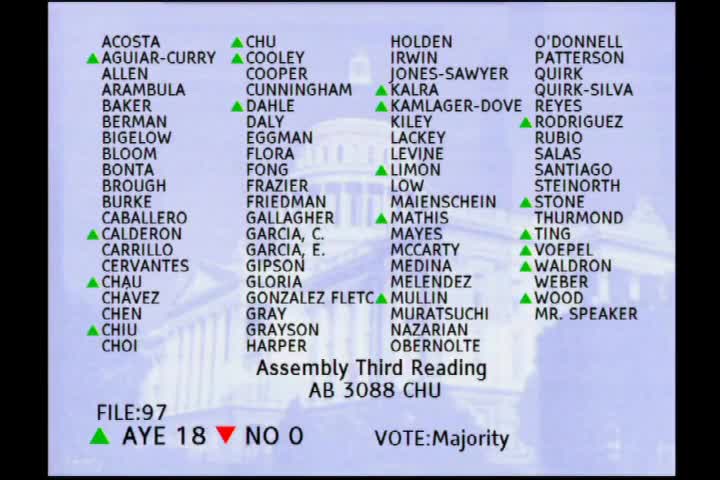
Bill Author

Bill Co-Author(s):