AB 1902: Eligible employers: personal services contracts.
- Session Year: 2017-2018
- House: Assembly
- Latest Version Date: 2018-03-22
Existing law permits state agencies to enter into personal services contracts with firms when certain conditions are met. These conditions include requiring a state agency that enters into a personal services contract for janitorial and housekeeping services, custodians, food service workers, laundry workers, window cleaners, and security guards to include provisions for employee wages that are valued at least 85% of the states cost of wages provided to state employees performing similar duties.
Existing law provides for criminal and civil penalties for violations of specified statutes regarding payment of wages.
This bill would require the Department of Industrial Relations to, by January 1, 2020, and annually thereafter, develop a list of eligible employers that the department determines are valued at least $1,000,000,000. The bill would require an eligible employer that enters into a personal services contract, as defined, on or after January 1, 2020, to include a provision in that contract that requires the employees that will perform the services in that contract to be paid a wage that is equal to an unspecified amount. By expanding the scope of an existing crime, this bill would impose a state-mandated local program.
The California Constitution requires the state to reimburse local agencies and school districts for certain costs mandated by the state. Statutory provisions establish procedures for making that reimbursement.
This bill would provide that no reimbursement is required by this act for a specified reason.
The Legislature finds and declares all of the following:
(a)According to the United States Bureau of Economic Analysis (BEA), after-tax corporate profits grew by 177 percent from the end of 2008 through the third quarter of 2017.
(b)According to the BEA, Californias real gross domestic product grew by 3.3 percent in 2016 while the national real gross domestic product grew by 1.5 percent that year.
(c)According to the United States Bureau of Labor Statistics (BLS), wage growth since the end of the Great Recession, adjusted for inflation, has been relatively flat except for workers on the higher end of the pay scale.
(d)According to the BLS, the wage gap in California between workers earning at or above the 90th percentile and those in the lowest 10th percentile is one of the largest in the nation.
(e)Therefore, the state needs to take action to further address the wage gap for low-wage workers.
SECTION 1.SEC. 2.Section 1182.14 is added to the Labor Code, to read:1182.14.(a)For purposes of this section:
(1)Department means the Department of Industrial Relations.
(2)Eligible employer means an employer that is included on the list prepared by the department pursuant to subdivision (b) for that year.
(3)Personal service contract means a contract to provide janitorial and housekeeping services, custodial services, food service workers, laundry services, window cleaning services, bus driving services, or security guard services to an eligible employer. The department may, by regulation, designate additional types of services that qualify as personal services within the meaning of this section if the department determines that the services are similar to the services described in the previous sentence.
(4)Wage equal to the area ____ income means a wage that if paid for an eight hour 8-hour workday over a 40-hour workweek would be sufficient to equal an annual wage that is equal to the area ____ income.
(5)Workday has the same meaning as defined in subdivision (a) of Section 500.
(6)Workweek has the same meaning as defined in subdivision (b) of Section 500.
(b)The department shall, by January 1, 2020, and annually thereafter, develop a list of eligible employers that the department determines are valued at least one billion dollars ($1,000,000,000). The department shall develop a method to determine whether an employer is eligible under this subdivision, subject to the following requirements:
(1)The employer is located in California. An employer shall be deemed to be located in California if it owns, operates, maintains, or rents any building in California.
(2)If the employer is listed on an established stock exchange, such as the New York Stock Exchange, the American Stock Exchange Exchange, or regional stock exchanges exchanges, or the National Market System of the Nasdaq Stock Market or successors, the department shall use the valuation of the employer on that exchange to calculate whether the employer is eligible under this section.
(3)The department shall use all publicly available information to determine the valuation of an employer.
(c)An eligible employer that enters into a personal services contract on or after January 1, 2020, shall include a provision in that contract that requires the employees that will perform the services in that contract to be paid a wage that is equal to the area ____ income.
(d)The department shall adopt regulations, pursuant to the Administrative Procedure Act (Chapter 3.5 (commencing with Section 11340) of Part 1 of Division 3 of Title 2 of the Government Code), in order to implement this section.
SEC. 2.SEC. 3.No reimbursement is required by this act pursuant to Section 6 of Article XIIIB of the California Constitution because the only costs that may be incurred by a local agency or school district will be incurred because this act creates a new crime or infraction, eliminates a crime or infraction, or changes the penalty for a crime or infraction, within the meaning of Section 17556 of the Government Code, or changes the definition of a crime within the meaning of Section 6 of Article XIIIB of the California Constitution.
(a)For purposes of this section:
(1)Department means the Department of Industrial Relations.
(2)Eligible employer means an employer that is included on the list prepared by the department pursuant to subdivision (b) for that year.
(3)Personal service contract means a contract to provide janitorial and housekeeping services, custodial services, food service workers, laundry services, window cleaning services, bus driving services, or security guard services to an eligible employer. The department may, by regulation, designate additional types of services that qualify as personal services within the meaning of this section if the department determines that the services are similar to the services described in the previous sentence.
(4)Wage equal to the area ____ income means a wage that if paid for an eight hour workday over a 40-hour workweek would be sufficient to equal an annual wage that is equal to the area ____ income.
(5)Workday has the same meaning as defined in subdivision (a) of Section 500.
(6)Workweek has the same meaning as defined in subdivision (b) of Section 500.
(b)The department shall, by January 1, 2020, and annually thereafter, develop a list of eligible employers that the department determines are valued at least one billion dollars ($1,000,000,000). The department shall develop a method to determine whether an employer is eligible under this subdivision, subject to the following requirements:
(1)The employer is located in California. An employer shall be deemed to be located in California if it owns, operates, maintains, or rents any building in California.
(2)If the employer is listed on an established stock exchange, such as the New York Stock Exchange, the American Stock Exchange or regional stock exchanges or the National Market System of the Nasdaq Stock Market or successors, the department shall use the valuation of the employer on that exchange to calculate whether the employer is eligible under this section.
(3)The department shall use all publicly available information to determine the valuation of an employer.
(c)An eligible employer that enters into a personal services contract on or after January 1, 2020, shall include a provision in that contract that requires the employees that will perform the services in that contract to be paid a wage that is equal to the area ____ income.
(d)The department shall adopt regulations, pursuant to the Administrative Procedure Act (Chapter 3.5 (commencing with Section 11340) of Part 1 of Division 3 of Title 2 of the Government Code), in order to implement this section.
SEC. 2.No reimbursement is required by this act pursuant to Section 6 of Article XIIIB of the California Constitution because the only costs that may be incurred by a local agency or school district will be incurred because this act creates a new crime or infraction, eliminates a crime or infraction, or changes the penalty for a crime or infraction, within the meaning of Section 17556 of the Government Code, or changes the definition of a crime within the meaning of Section 6 of Article XIIIB of the California Constitution.
|
Date
|
Status
|
|---|---|
| May 25, 2018 | In committee: Held under submission. |
| May 2, 2018 | In committee: Set, first hearing. Referred to APPR. suspense file. |
| Apr 19, 2018 | From committee: Do pass and re-refer to Com. on APPR. (Ayes 5. Noes 2.) (April 18). Re-referred to Com. on APPR. |
| Apr 2, 2018 | Re-referred to Com. on L. & E. |
| Mar 22, 2018 | From committee chair, with author's amendments: Amend, and re-refer to Com. on L. & E. Read second time and amended. |
| Feb 5, 2018 | Referred to Com. on L. & E. |
| Jan 23, 2018 | From printer. May be heard in committee February 22. |
| Jan 22, 2018 | Read first time. To print. |
|
Date
|
Description
|
Location
|
Votes
|
|
|---|---|---|---|---|
| Apr 18, 2018 | Do pass and be re-referred to the Committee on [Appropriations] | Assembly Standing Committee on Labor and Employment |
Passed |
This list shows positions taken on this bill by organizations on the date displayed, which is linked to the original source.
Positions by individuals are not included.
|
Organization
|
Position
|
Date
|
|---|---|---|
| Building Owners and Managers Association of California | ** Against | Apr 16, 2018 |
| California Ambulance Association | ** Against | Apr 16, 2018 |
| California Building Industry Association | * Against | Apr 18, 2018 |
| California Business Properties Association | ** Against | Apr 16, 2018 |
| California Chamber Of Commerce | * Against | Apr 18, 2018 |
| California Hotel & Lodging Association | ** Against | Apr 16, 2018 |
| California Lodging Industry Association | ** Against | Apr 16, 2018 |
| California Manufacturers And Technology Association | ** Against | Apr 16, 2018 |
| California Retailers Association | ** Against | Apr 16, 2018 |
| International Council of Shopping Centers | ** Against | Apr 16, 2018 |
| National Federation of Independent Business of California | * Against | Apr 18, 2018 |
| Official Police Garages of Los Angeles | ** Against | Apr 16, 2018 |
Date of Hearing: May 2, 2018
ASSEMBLY COMMITTEE ON APPROPRIATIONS
Lorena Gonzalez Fletcher, Chair
ABPCA Bill Id:AB 1902
Author:(Levine) – As Amended Ver:March 22, 2018
Policy Committee: | Labor and Employment | Vote: | 5 - 2 |
|
| ||
|
|
Urgency: No State Mandated Local Program: Yes Reimbursable: No
SUMMARY:
This bill requires employers valued at $1 billion or more by the Department of Industrial Relations (DIR), who enter into a personal services contract, as defined, to include in those contracts a provision requiring an unspecified wage.
FISCAL EFFECT:
Annual staffing costs for DIR in the range of $3.9 million. DIR will need additional staff to determine what personal service contracts are eligible for a new wage rate, additional enforcement staff to respond to claims, and staff to conduct outreach and education about the new requirements.
COMMENTS:
- Purpose. According to the author, contracted personal services workers face significant obstacles to economic mobility. The author argues that AB 1902’s new fair wage requirement will help close the upward mobility gap.
- Personal services contracting with the state. Under existing state law, state agencies face a number of rules and restrictions when entering into a personal services contract. The California Department of Human Resources (CalHR) annually sets the rates departments must pay individuals the departments employ through such contracts, and these rates are set at 85% of the salary and benefit costs for state employees performing similar duties. Moreover, a state agency is prohibited from executing a personal services contract until it has certified that all employee organizations that perform the type of work being contract out have been notified.
Analysis Prepared by: Luke Reidenbach / APPR. / (916) 319-2081
Date of Hearing: April 18, 2018
ASSEMBLY COMMITTEE ON LABOR AND EMPLOYMENT
Tony Thurmond, Chair
ABPCA Bill Id:AB 1902 (
Author:Levine) – As Amended Ver:March 22, 2018
SUBJECT: Eligible employers: personal services contracts
SUMMARY: Requires that employers valued at 1 billion dollars or more by the Department of Industrial Relations (DIR), who enter into personal service contracts, include in those contracts a provision requiring a wage that is equal to an unspecified amount. Specifically, this bill:
- Makes findings and declarations relating to the rise of corporate profits and the stagnation of wage growth for low-wage workers.
- Requires the Department of Industrial Relations (DIR) to, by January 1, 2020, and annually thereafter, develop a list of eligible employers that the DIR determines are valued at least $1,000,000,000.
- Requires an eligible employer that enters into a personal services contract, on or after January 1, 2020, to include a provision in that contract that requires the employees covered in that contract be paid an area wage that is equal to an unspecified amount.
- Defines a personal services contract as a contract to provide janitorial and housekeeping services, custodial services, food service workers, laundry services, window cleaning services, bus driving services, security guard services, or other services the department deems by regulation to qualify as personal services to an eligible employer.
- Directs the DIR to adopt implementing regulations.
EXISTING LAW:
- Permits state agencies to enter into personal services contracts with firms in limited circumstances, including but not limited to:
- Personal service contracts for janitorial and housekeeping services, custodians, food service workers, and other property service workers, that include provisions for employee wages that are valued at least 85% of the state’s cost of wages provided to state employees performing similar duties.
- Provides for criminal and civil penalties for violations of specified statutes regarding payment of wages.
FISCAL EFFECT: Unknown
COMMENTS: In 2016, Working Partnerships USA, a community organization founded on economic justice, published a study on contracted workers in the Silicon Valley. The study found that “over the past 24 years, the number of Silicon Valley jobs in subcontracting industries has grown three times as fast as overall Silicon Valley employment.” In addition, the study identified a large wage gap between direct technology company employees and contracted blue-collar employees. According to Working Partnerships, from 2008-2012, the average annual salary of a direct technology employee was $113,000 while the average annual salary of a contracted blue-collar employee was $19,900.
According to the author, contracted personal services workers face “obstacles in accessing opportunities to further and secure futures for themselves and their families, and ultimately have little means of upward economic mobility.” The national trend of contracting out of work for lower wages, according to the author, was recently highlighted in a New York Times article on rising inequality from September 2017. The article states “There’s no inherent reason that work done through a contractor should involve lower compensation than the same work done under direct employment… But as some companies have outsourced more functions over more time, a strong body of evidence is emerging that it’s not just about efficiency. It seems to be a way for big companies to reduce compensation costs.”
The author also contends that the bill’s requirement of fair wages will ensure that “workers receive [compensation] allowing for personal economic growth and will close the upward mobility gap.”
A coalition of employers, including the California Chamber of Commerce, argues in opposition that, “Artificially increasing rates for such contracts and services based upon an ‘area income’ may ultimately discourage the use of such providers and eliminate jobs in these industries. In doing a cost analysis, targeted companies may ultimately determine it is more cost effective to hire internally than contract for these services at the mandatory rate required by AB 1902. Such a shift would create a loss of jobs for those individuals working for personal service contractors, as it would not necessarily result in a one-for-one ratio with regard to the individuals ultimately employed.”
In the future, the author plans on further amendments to tie the wage rate of the personal services contracted workers to the Department of Housing and Community Development’s income levels for the county in which the work is being performed.
REGISTERED SUPPORT / OPPOSITION:
Support
None on file.
Opposition
Building Owners and Managers Association of California
California Ambulance Association
California Building Industry Association
California Business Properties Association
California Chamber of Commerce
California Hotel & Lodging Association
California Lodging Industry Association
California Manufacturers and Technology Association
California Retailers Association
Commercial Real Estate Development Corporation – NAIOP of California
International Council of Shopping Centers
National Federation of Independent Business
Official Police Garages of Los Angeles
Analysis Prepared by: Megan Lane / L. & E. /
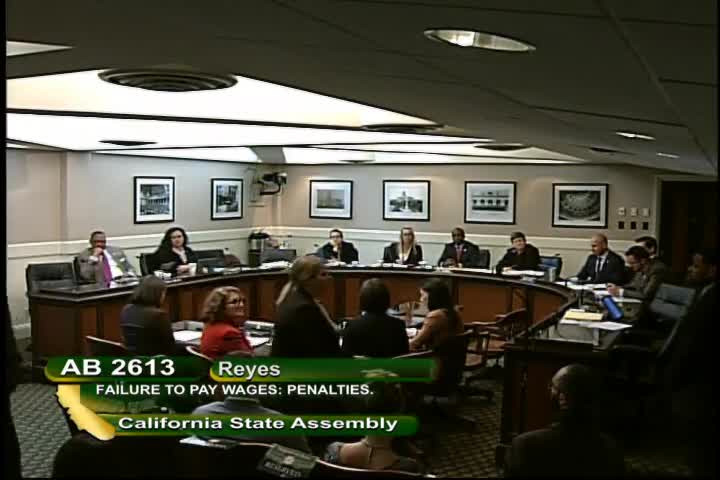
Discussed in Hearing
 9MIN
Assembly Standing Committee on Labor and Employment
Bill Author

Bill Co-Author(s):