AB 1905: Environmental quality: judicial review: transportation projects.
- Session Year: 2017-2018
- House: Assembly
- Latest Version Date: 2018-03-12
The California Environmental Quality Act requires a lead agency, as defined, to prepare, or cause to be prepared, and certify the completion of, an environmental impact report on a project that it proposes to carry out or approve that may have a significant effect on the environment or to adopt a negative declaration if it finds that the project will not have that effect. The act establishes a procedure by which a person may seek judicial review of the decision of the lead agency made pursuant to the act.
This bill would, in an action or proceeding seeking judicial review under the California Environmental Quality Act, prohibit a court from staying or enjoining a transportation project that would reduce total vehicle miles traveled, that is included in a sustainable communities strategy strategy, and for which an environmental impact report has been certified, unless the court makes specified findings.
The California Environmental Quality Act requires a lead agency, as defined, to prepare, or cause to be prepared, and certify the completion of, an environmental impact report on a project that it proposes to carry out or approve that may have a significant effect on the environment or to adopt a negative declaration if it finds that the project will not have that effect. The act establishes a procedure by which a person may seek judicial review of the decision of the lead agency made pursuant to the act.
This bill would, in an action or proceeding seeking judicial review under the California Environmental Quality Act, prohibit a court from staying or enjoining a transportation project that is included in a sustainable communities strategy and for which an environmental impact report has been certified, unless the court makes specified findings.
(a)This section shall only apply to a transportation project that would, based on the lead agencys findings, reduce total vehicle miles traveled, that is included in a sustainable communities strategy approved by a metropolitan planning organization pursuant to Section 65080 of the Government Code Code, and for which an environmental impact report has been certified.
(b)In any action or proceeding to attack, review, set aside, void, or annul the certification of an environmental impact report for a transportation project or the granting of such a projects approval, the court shall not stay or enjoin the construction or operation of the transportation project unless the court finds either of the following:
(1)The continued construction or operation of the transportation project presents an imminent threat to the public health and safety.
(2)The transportation project contains unforeseen important Native American artifacts or unforeseen important historical, archaeological, or ecological values that would be materially, permanently, and adversely affected by the continued construction or operation of the transportation project unless the court stays or enjoins the construction or operation of the transportation project.
(c)If the court finds that paragraph (1) or (2) of subdivision (b) is satisfied, the court shall only enjoin those specific activities associated with the transportation project that present an imminent threat to public health and safety or that materially, permanently, and adversely affect unforeseen important Native American artifacts or unforeseen important historical, archaeological, or ecological values.
(d)An action or proceeding to attack, set aside, void, or annul a determination, finding, or decision of the lead agency or responsible agency granting subsequent project approval for a transportation project included in the environmental impact review shall be subject to the judicial remedy limitations of this section.(e)When an action or proceeding brought pursuant to this section challenges a portion of a transportation project and that portion is severable from the transportation project, the court may enter an order as to those portions of the transportation project that includes one or more of the remedies set forth in Section 21168.9.(f)The provisions of this section are severable. If any provision of this section or its application is held invalid, that invalidity shall not affect other provisions or applications that can be given effect without the invalid provision or application.(a)This section shall only apply to a transportation project that is included in a sustainable communities strategy approved by a metropolitan planning organization pursuant to Section 65080 of the Government Code and for which an environmental impact report has been certified.
(b)In any action or proceeding to attack, review, set aside, void, or annul the certification of an environmental impact report for a transportation project or the granting of such a projects approval, the court shall not stay or enjoin the construction or operation of the transportation project unless the court finds either of the following:
(1)The continued construction or operation of the transportation project presents an imminent threat to the public health and safety.
(2)The transportation project contains unforeseen important Native American artifacts or unforeseen important historical, archaeological, or ecological values that would be materially, permanently, and adversely affected by the continued construction or operation of the transportation project unless the court stays or enjoins the construction or operation of the transportation project.
(c)If the court finds that paragraph (1) or (2) of subdivision (b) is satisfied, the court shall only enjoin those specific activities associated with the transportation project that present an imminent threat to public health and safety or that materially, permanently, and adversely affect unforeseen important Native American artifacts or unforeseen important historical, archaeological, or ecological values.
(d)An action or proceeding to attack, set aside, void, or annul a determination, finding, or decision of the lead agency or responsible agency granting subsequent project approval for a transportation project included in the environmental impact review shall be subject to the judicial remedy limitations of this section.
(e)When an action or proceeding brought pursuant to this section challenges a portion of a transportation project and that portion is severable from the transportation project, the court may enter an order as to those portions of the transportation project that includes one or more of the remedies set forth in Section 21168.9.
(f)The provisions of this section are severable. If any provision of this section or its application is held invalid, that invalidity shall not affect other provisions or applications that can be given effect without the invalid provision or application.
|
Date
|
Status
|
|---|---|
| Apr 16, 2018 | In committee: Hearing for testimony only. |
| Apr 9, 2018 | In committee: Set, first hearing. Hearing canceled at the request of author. |
| Mar 13, 2018 | Re-referred to Com. on NAT. RES. |
| Mar 12, 2018 | From committee chair, with author's amendments: Amend, and re-refer to Com. on NAT. RES. Read second time and amended. |
| Feb 5, 2018 | Referred to Coms. on NAT. RES. and TRANS. |
| Jan 23, 2018 | From printer. May be heard in committee February 22. |
| Jan 22, 2018 | Read first time. To print. |
This list shows positions taken on this bill by organizations on the date displayed, which is linked to the original source.
Positions by individuals are not included.
|
Organization
|
Position
|
Date
|
|---|---|---|
| AAA Northern California, Nevada & Utah | ** Support | Apr 13, 2018 |
| American Planning Association, California Chapter | ** Against | Apr 13, 2018 |
| Association of California Cities - Orange County | ** Support | Apr 13, 2018 |
| Automobile Club of Southern California | ** Support | Apr 13, 2018 |
| BizFed | ** Support | Apr 13, 2018 |
| Cal Chamber | * Support | Apr 16, 2018 |
| California Apartment Association | ** Support | Apr 13, 2018 |
| California Transportation Commission | * Support | Apr 16, 2018 |
| CR Club California | * Against | Apr 16, 2018 |
| Judicial Council of California | ** Against | Apr 13, 2018 |
| Orange County Transportation Authority | ** Support | Apr 13, 2018 |
| Planning And Conservation League Foundation | * Neutral | Apr 16, 2018 |
| Rural County Representatives of California | ** Support | Apr 13, 2018 |
| San Bernadino County Transportation Authority and the Ventura County Transportation Commission | * Support | Apr 16, 2018 |
| San Bernardino County Transportation Authority | ** Support | Apr 13, 2018 |
| San Gabriel Valley Economic Partnership | ** Support | Apr 13, 2018 |
| Sierra Club California | ** Against | Apr 13, 2018 |
| Ventura County Transportation Commission | ** Support | Apr 13, 2018 |
Date of Hearing: April 16, 2018
ASSEMBLY COMMITTEE ON NATURAL RESOURCES
Al Muratsuchi, Acting Chair
ABPCA Bill Id:AB 1905 (
Author:Grayson) – As Amended Ver:March 12, 2018
SUBJECT: Environmental quality: judicial review: transportation projects
SUMMARY: Generally prohibits a court, in granting relief in an action or proceeding challenging a transportation project that would reduce vehicle miles traveled (VMT), is included in an approved sustainable communities strategy (SCS), and for which an environmental impact report (EIR) has been certified under the California Environmental Quality Act (CEQA), from staying or enjoining the construction or operation of the project.
EXISTING LAW:
- CEQA requires lead agencies with the principal responsibility for carrying out or approving a proposed project to prepare a negative declaration, mitigated negative declaration, or EIR for this action, unless the project is exempt from CEQA (CEQA includes various statutory exemptions, as well as categorical exemptions in the CEQA guidelines).
- Requires metropolitan planning organizations (MPOs) to include a sustainable communities strategy (SCS), as defined, in their regional transportation plans, or an alternative planning strategy (APS), for the purpose of reducing greenhouse gas (GHG) emissions, aligns planning for transportation and housing, and creates specified incentives for the implementation of the strategies, including CEQA exemption or abbreviated review for residential or mixed-use residential "transit priority projects" if the project is consistent with the use designation, density, building intensity, and applicable policies specified for the project area in either an approved SCS or APS. [SB 375 (Steinberg), Chapter 728, Statutes of 2008]
- Authorizes judicial review of CEQA actions taken by public agencies, following the agency's decision to carry out or approve the project. Challenges alleging improper determination that a project may have a significant effect on the environment, or alleging an EIR doesn't comply with CEQA, must be filed in the Superior Court within 30 days of filing of the notice of approval. The courts are required to give CEQA actions preference over all other civil actions.
- Upon finding a public agency's actions are not in compliance with CEQA, requires a court to order one or more of the following:
- A mandate that the determination, finding, or decision be voided by the public agency, in whole or in part;
- If the court finds that a specific project activity or activities will prejudice the consideration or implementation of particular mitigation measures or alternatives to the project, a mandate that the public agency and any real parties in interest suspend any or all specific project activity or activities, pursuant to the determination, finding, or decision, that could result in an adverse change or alteration to the physical environment, until the public agency has taken any actions that may be necessary to bring the determination, finding, or decision into compliance with this division; and
- A mandate that the public agency take specific action as may be necessary to bring the determination, finding, or decision into compliance with CEQA.
Any order shall include only those mandates which are necessary to achieve compliance with CEQA and only those specific project activities in noncompliance with CEQA.
- Imposes specific limits on injunctive relief under CEQA for three specified projects: Los Angeles football stadium/convention center, Sacramento downtown arena, and Capitol Building annex project.
THIS BILL:
- Provides that its provisions apply only to a transportation project that would, based on the lead agency's findings, reduce VMT, is included in an MPO-approved SCS, and for which an EIR has been certified.
- Limits remedies available to a court in a CEQA lawsuit challenging a transportation project by generally prohibiting a court, in granting relief, from staying or enjoining the construction or operation of the project and provides that a court may only enjoin those specific activities associated with the project that present an imminent threat to public health and safety or that materially, permanently, and adversely affect unforeseen important Native American artifacts or unforeseen important historical or archaeological values (in effect limiting the equitable powers of the court and prohibiting existing remedies under CEQA such as voiding the lead agency's decision or suspending project activities).
FISCAL EFFECT: Non-fiscal
COMMENTS:
- Background. CEQA provides a process for evaluating the environmental effects of applicable projects undertaken or approved by public agencies. If a project is not exempt from CEQA, an initial study is prepared to determine whether the project may have a significant effect on the environment. If the initial study shows that there would not be a significant effect on the environment, the lead agency must prepare a negative declaration. If the initial study shows that the project may have a significant effect on the environment, the lead agency must prepare an EIR.
Generally, an EIR must accurately describe the proposed project, identify and analyze each significant environmental impact expected to result from the proposed project, identify mitigation measures to reduce those impacts to the extent feasible, and evaluate a range of reasonable alternatives to the proposed project. If mitigation measures are required or incorporated into a project, the agency must adopt a reporting or monitoring program to ensure compliance with those measures.
- CEQA judicial review. CEQA is enforced through judicial review. CEQA actions taken by public agencies can be challenged in Superior Court once the agency approves or determines to carry out the project. CEQA appeals are subject to unusually short statutes of limitations. Under current law, court challenges of CEQA decisions generally must be filed within 30 to 35 days, depending on the type of decision. The courts are required to give CEQA actions preference over all other civil actions. The petitioner must request a hearing within 90 days of filing the petition and, generally, briefing must be completed within 90 days of the request for hearing. There is no deadline specified for the court to render a decision.
Since 2011, the Legislature has established expedited CEQA judicial review procedures for a limited number of projects, including limiting injunctive relief for three projects: Los Angeles football stadium/convention center, Sacramento downtown arena, and Capitol Building annex project.
The bills limiting injunctive relief for the Los Angeles stadium and Sacramento arena projects included provisions requiring the projects to minimize traffic and air quality impacts through project design or mitigation measures, including reducing to at least zero the net GHG emissions from private automobile trips.
- Author's statement:
Both the SCS and the individual projects contained in a Regional Transportation Plan (RTP) are subject to environmental review under CEQA, which requires an EIR, public input, and the consideration of alternatives. Even after an SCS undergoes CEQA review and is certified by ARB to reduce greenhouse gas emissions in a region, individual projects consistent with the SCS may again be challenged on the basis of their environmental impact.
While CEQA review is an important tool for ensuring that projects benefit the environment and surrounding communities, duplicitous litigation is not. Once a project has met ARB's stringent SCS standards, been included in an RTP, and produced an EIR, it is counterproductive and harmful to the state’s climate goals to allow additional lawsuits to impede its timely completion.
- How common are CEQA injunctions against transportation projects? An October 2017 Senate Environmental Quality Committee survey covering Fiscal Years 2011/12 to 2015/16 found a CEQA litigation rate for CalTrans projects of 0.9% (http://senv.senate.ca.gov/sites/senv.senate.ca.gov/files/ceqa_survey_full_report_-_final_12-5-17.pdf). A March 2018 Senate Office of Research report found that CEQA did not have significant adverse effects on Caltrans project delivery overall (http://sor.senate.ca.gov/sites/sor.senate.ca.gov/files/Policy%20Matters%20Research%20CEQA.pdf).
On the other hand, the California Transportation Commission (CTC), which proposed legislation similar to this bill in its 2017 Annual Report, stated that CEQA litigation is "often used to delay transportation projects, ultimately increasing the project cost and delaying the benefits sought by the public agency pursuing the project." However, the CTC has been unable to provide the committee with any examples of transportation projects that have been delayed due to a judge staying or enjoining construction in a CEQA lawsuit.
The author has provided three examples of VMT-reducing transportation projects subject to CEQA litigation: Caltrain electrification on the San Francisco peninsula, trolley line extension from San Diego to University City, and Metrolink extension from Riverside to Moreno Valley and Perris. Of these three projects, only the last one appears to have been subject to an injunction. In that 2013 case, Friends of Riverside's Hills v. Riverside County Transportation Commission (RCTC), the court found five separate deficiencies in the project EIR, set aside the certification of the EIR, and ordered RCTC to halt ground disturbing activities or any other activities that would cause environmental impacts until the CEQA deficiencies were corrected. However, the court authorized RCTC to continue to pursue ongoing design and planning activities associated with the project. In that case, the injunction appears to have been a logical and necessary aspect of the ruling to comply with CEQA. The project was delayed, but improved, and ultimately completed.
- Does VMT reduction alone justify protecting a project from legal challenges on all environmental impacts? There are 18 environmental factors that may be considered under CEQA: Aesthetics; agriculture and forestry resources; air quality; biological resources, including protected species and habitat types; cultural resources, including archaeological resources; geology and soils, including seismic and landslide risk; GHG emissions; hazards and hazardous materials, including toxic chemical exposures, brownfields or contaminated site issues, and accident risks; hydrology and water quality, including flooding and sea level rise; land use planning, including consistency with land use plans; mineral resources; noise; population and housing; public services, including fire and police protection, schools, parks, and other public facilities; recreational resources; traffic and transportation, including transit, vehicular, bicycle, and pedestrian transportation, emergency access, and roadway safety; tribal cultural resources; utilities and service systems, including wastewater, water supply, stormwater, landfill, and waste management systems.
The only project-specific requirement in this bill is that the project reduce total VMT. Following the CTC's argument, this, along with the fact that GHG emissions from transportation projects are addressed at a regional scale in the SCS, may justify protecting individual projects from challenges based on GHG emissions (even though neither VMT reduction nor consistency with the SCS assures that a project will not increase GHG).
However, this bill protects eligible projects from any claim under CEQA. If, for example, an eligible transportation project has water quality or toxics impacts that are not adequately analyzed or mitigated in the EIR, this bill would bar a judge from enjoining project construction to address these impacts.
- Prior legislation. The following bills included provisions limiting injunctive relief nearly identical to the provisions in this bill:
- SB 292 (Padilla), Chapter 353, Statutes of 2011, applied to the Los Angeles football stadium/convention center project, which has not proceeded;
- SB 743 (Steinberg), Chapter 386, Statutes of 2013, applied to the Sacramento downtown arena project, now known as Golden1 Center;
- SB 836 (Committee on Budget and Fiscal Review), Chapter 31, Statutes of 2016, applied to the Capitol Annex project;
- AB 1586 (Mathis), which applied to the Temperance Flat Reservoir, failed in this committee by a vote of 1-6 on April 4, 2016;
- AB 311 (Gallagher), which applied to water storage projects funded by the Water Quality, Supply, and Infrastructure Improvement Act of 2014 (Proposition 1), failed in this committee by a vote of 3-6 on April 27, 2015; and
- AB 641 (Mayes), which applied broadly to housing developments, failed in this committee by a vote of 2-7 on April 27, 2015.
- AB 30 (Caballero), which applied to strip mall housing conversion projects, was held in this committee without a vote after a hearing on May 8, 2017.
- Related legislation:
- AB 2279 (Fong), pending in this committee, establishes similar prohibitions on injunctive relief in CEQA lawsuits for a housing project for which an EIR has been certified.
- AB 2856 (Melendez), which failed in this committee by a vote of 3-3 on April 9, establishes similar prohibitions on injunctive relief in CEQA lawsuits for any activity related to the construction of new housing.
- Double referral. This bill has been double referred to the Transportation Committee.
REGISTERED SUPPORT / OPPOSITION:
Support
AAA Northern California, Nevada & Utah
Association of California Cities – Orange County
Automobile Club of Southern California
BizFed
California Apartment Association
California Chamber of Commerce
Orange County Transportation Authority
Rural County Representatives of California
San Bernardino County Transportation Authority
San Gabriel Valley Economic Partnership
Ventura County Transportation Commission
Opposition
American Planning Association, California Chapter
Judicial Council of California
Sierra Club California
Analysis Prepared by: Lawrence Lingbloom / NAT. RES. /
Discussed in Hearing
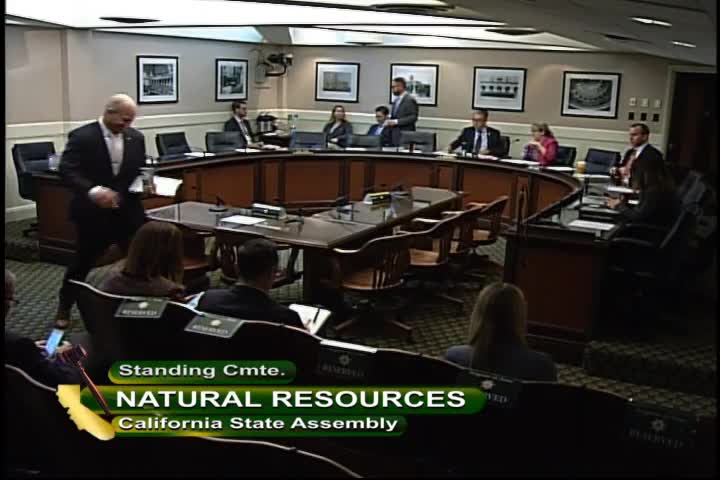 10MIN
Assembly Standing Committee on Natural Resources
Bill Author

Bill Co-Author(s):