AB 1915: Building Homes and Jobs Act: recording fee: mining claims.
- Session Year: 2017-2018
- House: Assembly
- Latest Version Date: 2018-01-23
Existing law imposes a charge, except as provided, of $75 to be paid at the time of the recording of every real estate instrument, paper, or notice required or permitted by law to be recorded, per each single transaction per single parcel of real property, not to exceed $225. Existing law defines real estate instrument, paper, or notice for this purpose as a document relating to real property and specifies a nonexhaustive list of documents deemed to be a real estate instrument, paper, or notice.
This bill would exclude from this definition of real estate instrument, paper, or notice, and thereby exempt from the recording fee, any document recorded in relation to a mining claim, as provided.
This bill would take effect immediately as a tax levy.
(a)(1)(A)Commencing January 1, 2018, and except as provided in paragraph (2), in addition to any other recording fees specified in this code, a fee of seventy-five dollars ($75) shall be paid at the time of recording of every real estate instrument, paper, or notice required or permitted by law to be recorded, except those expressly exempted from payment of recording fees, per each single transaction per parcel of real property. The fee imposed by this section shall not exceed two hundred twenty-five dollars ($225). Real
(B)Real estate instrument, paper, or notice means a document relating to real property, including, but not limited to, the following: deed, grant deed, trustees deed, deed of trust, reconveyance, quit claim deed, fictitious deed of trust, assignment of deed of trust, request for notice of default, abstract of judgment, subordination agreement, declaration of homestead, abandonment of homestead, notice of default, release or discharge, easement, notice of trustee sale, notice of completion, UCC financing statement, mechanics lien, maps, and covenants, conditions, and restrictions. However, real estate instrument, paper, or notice does not include any document recorded in relation to a mining claim, including, but not limited to, the following: location notice, notice of intent to hold, and annual affidavit of assessment.
(2)The fee described in paragraph (1) shall not be imposed on any real estate instrument, paper, or notice recorded in connection with a transfer subject to the imposition of a documentary transfer tax as defined in Section 11911 of the Revenue and Taxation Code or on any real estate instrument, paper, or notice recorded in connection with a transfer of real property that is a residential dwelling to an owner-occupier.
(b)The county recorder shall remit quarterly, on or before the last day of the month next succeeding each calendar quarterly period, the fees, after deduction of any actual and necessary administrative costs incurred by the county recorder in carrying out this section, to the Controller for deposit in the Building Homes and Jobs Trust Fund established by Section 50470 of the Health and Safety Code, to be expended for the purposes set forth in that section. In addition, the county shall pay to the Controller interest, at the legal rate, on any funds not paid to the Controller before the last day of the month next succeeding each quarterly period.
(c)If the Department of Housing and Community Development determines that any moneys derived from fees collected are being allocated by the state for a purpose not authorized by Section 50470 of the Health and Safety Code, the county recorder shall, upon notice of the determination, immediately cease collection of the fees, and shall resume collection of those fees only upon notice that the moneys derived from the fees collected are being allocated by the state only for a purpose authorized by Section 50470 of the Health and Safety Code.
SEC. 2.This act provides for a tax levy within the meaning of Article IV of the California Constitution and shall go into immediate effect.
|
Date
|
Status
|
|---|---|
| May 9, 2018 | In committee: Set, first hearing. Failed passage. Reconsideration granted. |
| Feb 5, 2018 | Referred to Com. on H. & C.D. |
| Jan 24, 2018 | From printer. May be heard in committee February 23. |
| Jan 23, 2018 | Read first time. To print. |
|
Date
|
Description
|
Location
|
Votes
|
|
|---|---|---|---|---|
| May 9, 2018 | Reconsideration. | Assembly Standing Committee on Housing and Community Development |
Passed |
|
| May 9, 2018 | Do pass and be re-referred to the Committee on [Appropriations] | Assembly Standing Committee on Housing and Community Development |
Failed |
This list shows positions taken on this bill by organizations on the date displayed, which is linked to the original source.
Positions by individuals are not included.
|
Organization
|
Position
|
Date
|
|---|---|---|
| California Housing Consortium | * Against | May 9, 2018 |
| Housing California | * Against | May 9, 2018 |
| Inyo County | * Support | May 9, 2018 |
| Inyo County Board of Supervisors | ** Support | May 7, 2018 |
| Nonprofit Housing Association Northern California | * Against | May 9, 2018 |
| Southwest California Legislative Council | ** Support | May 7, 2018 |
Date of Hearing: May 9, 2018
ASSEMBLY COMMITTEE ON HOUSING AND COMMUNITY DEVELOPMENT
David Chiu, Chair
ABPCA Bill Id:AB 1915 (
Author:Mathis) – As Introduced Ver:January 23, 2018
SUBJECT: Building Homes and Jobs Act: recording fee: mining claims
SUMMARY: Makes changes to the Building Homes and Jobs Act of 2017 (the Act). Specifically, this bill: Exempts from the $75 recording fee imposed by the Act any document recorded in relation to a mining claim, including, but not limited to, the location notice, notice of intent to hold, and annual affidavit of assessment. Takes effect immediately as a tax levy.
EXISTING LAW:
- Establishes the Act and, beginning January 1, 2018, imposes a $75 fee on every real estate document, instrument, paper, or notice required or permitted to be recorded, per each single transaction per parcel, except the fee shall not be imposed on any documents recorded in the following instances:
- In connection with the sale of a home;
- A transfer of real property that is a residential dwelling to an owner-occupier;
- Executed or recorded by the federal government in accordance with the Uniform Federal Lien Registration Act; and
- Executed or recorded by the state or any county, municipality, or other political subdivision.
- Defines “real estate instrument, paper, or notice” as a document relating to real property, including but not limited to, the following: deed, grant deed, trustee's deed, deed of trust, conveyance, quit claim deed, fictitious deed of trust, assignment of deed of trust, request for notice of default, abstract of judgment, subordination agreement, declaration of homestead, abandonment of homestead, notice of default, release or discharge, easement, notice of trustee sale, notice of completion, Uniform Commercial Code (UCC) financing statement, mechanic's lien maps, and covenants, conditions, and restrictions.
- Requires the fee, minus any administrative cost to the county recorder for collection, to be transferred quarterly to HCD and deposited into the Building Homes and Jobs Trust Fund (Trust Fund).
- Requires any moneys appropriated by the Legislature, as well as any other moneys made available to HCD for the purposes of the Trust Fund from any other sources, to be deposited into the Trust Fund.
- Requires moneys collected on and after January 1, 2018, and until December 31, 2018, to be allocated as follows:
- Fifty percent of the money shall be available to local governments to update planning documents and zoning ordinances in order to streamline housing production, including, but not limited to, general plans, community plans, specific plans, sustainable communities strategies, and local coastal programs. In addition, funds may be used for new environmental analyses that eliminate the need for project-specific review and local process updates that improve and expedite local permitting. The following shall apply to this funding:
- Five percent of the funding shall be made available for technical assistance from HCD and the Governor's Office of Planning and Research (OPR) to jurisdictions updating specified planning documents;
- Funds shall be held by HCD until a local government submits a request for use that includes a description of the proposed use of the funds that result in an acceleration of housing production; and
- Any funds not allocated within the first two years that they are made available by HCD shall be made available to the Multifamily Housing Program (MHP).
- Fifty percent of the money shall be available to HCD to assist persons experiencing or at risk of homelessness, including, but not limited to, providing rapid rehousing, rental assistance, navigation centers, and the new construction, rehabilitation, and preservation of permanent and transitional rental housing.
- Requires moneys collected on or after January 1, 2019, to be allocated as follows:
- Twenty percent of all the money in the Trust Fund shall be expended for affordable owner-occupied workforce housing.
- Seventy percent of moneys in the Trust Fund shall be made available to local governments as follows:
- Ninety percent of the moneys shall be allocated based on the formula specified in Section 5306 of Title 42 of the United States Code, for Federal Fiscal Year 2017 directly to entitlement jurisdictions, except that the portion allocated for nonentitlement areas shall be distributed through a competitive grant administered by HCD.
- Within the competitive grant program, priority points shall be given to: 1) a county with a population of 200,000 or less within the unincorporated areas of the county, 2) a local government that did not receive an award based on the formula specified in Section 5306 of Title 42 of the United States Code in 2016, and 3) to a local government that pledges to use funds to assist persons experiencing or at risk of homelessness, including but not limited to providing rapid rehousing, rental assistance, navigation centers, and the new construction, rehabilitation, and preservation of permanent and transitional rental housing.
- Ninety percent of the moneys shall be allocated based on the formula specified in Section 5306 of Title 42 of the United States Code, for Federal Fiscal Year 2017 directly to entitlement jurisdictions, except that the portion allocated for nonentitlement areas shall be distributed through a competitive grant administered by HCD.
- Ten percent of the money shall be allocated equitably to local jurisdictions that are nonentitelment areas pursuant to the formula specified in Section 5306 of Title 42 of the United States Code for Federal Fiscal Year 2017.
- Allows money allocated to local governments to be expended for the following purposes:
- Predevelopment, development, acquisition, rehabilitation, and preservation of multifamily, residential live-work, and rental housing affordable to extremely low-, very-low, low- and moderate-income households, including necessary operating subsidies;
- Affordable rental and ownership housing that meets the needs of a growing workforce up to 120% of area median income (AMI), or 150% of AMI in high-cost areas;
- Matching portions of funds placed into local or regional housing trust funds;
- Matching portions of funds placed in the Low- and Moderate-Income Housing Asset Funds of former redevelopment agencies retained by successor agencies;
- Capitalized reserves for services connected to the creation of new permanent supportive housing, including, but not limited to, developments funded through the Veterans Housing and Homelessness Prevention Program;
- Assisting persons who are experiencing or at risk of homelessness, including providing rapid rehousing, rental assistance, navigation centers, emergency shelters, and the new construction, rehabilitation, and preservation of permanent and transitional housing;
- Accessibility modifications;
- Efforts to acquire and rehabilitate foreclosed, vacant, or blighted homes;
- Homeownership opportunities, including, but not limited to, down payment assistance; and
- Fiscal incentives or matching funds to local agencies that approve new housing for extremely-low, very-low, low- and moderate-income households.
- Require local governments to document the following minimum standards to receive moneys:
- Submit a plan to HCD detailing the manner in which funds will be used by the local government consistent with the eligible uses and to meet the local government's unmet share of the regional housing needs allocation (RNHA);
- Have a compliant housing element and have submitted a current housing element annual report;
- Submit an annual report to HCD detailing the uses and expenditures of any allocated funds;
- Expend funds for the purposes allowed under the Act. Two or more local governments may expend moneys on a joint project that is authorized under the eligible uses; and
- Prioritize investments that increase the supply of housing to households that are at or below 60% of AMI, adjusted for household size.
- Provides that if a local government does not have a documented plan to expend the money within five years of an allocation, then moneys shall be exempt from the allocation requirements and shall revert to HCD to be used for the Multifamily Housing Program (MHP) or for technical assistance.
- Allows local governments to petition HCD to return any funds that are allocated to it. Any funds returned by a local government shall be deposited into MHP.
- Thirty percent of moneys deposited in the Trust Fund shall be made available to HCD as follows:
- Five percent shall be used for state incentive programs, including loan and grant programs administered by HCD. If HCD receives insufficient applications for incentive programs, the funds shall be made available for MHP;
- Ten percent shall be used to address affordable homeownership and rental housing opportunities for agricultural workers and their families; and
- Fifteen percent shall be continuously appropriated to the California Housing Finance Agency (CalHFA) for the purpose of creating mixed income multifamily residential housing for lower or moderate-income households.
- Authorizes the Office of State Audits and Evaluation to conduct periodic audits to ensure that the annual allocation to individual programs is awarded by HCD in a timely fashion consistent with the requirements of the Act.
FISCAL EFFECT: Unknown.
COMMENTS:
Background: For well over a decade, California has been struggling with a lack of affordable housing. The crisis has become more acute in the last few years. In 2017, based on local Point in Time counts, 134,000 people were homeless in California on any given night. Already home to the largest homeless population in the country, from 2016 to 2017, California experienced the largest increase in the number of residents experiencing homelessness nationwide – over 16,000 individuals. California accounted for nearly half of all unsheltered people in the country in 2017 (49% or 91,642 people). According to the Legislative Analyst, California needs to produce approximately 180,000 units of housing per year to keep up with population growth – we produce less than half that amount. The lack of affordable housing has the most significant impact on low-income renter households. In the current market, 2.2 million extremely low-income and very low-income renter households are competing for 664,000 affordable rental units. Of the 6 million renter households in the state, 1.7 million are paying more than 50% of their income toward rent. The National Low Income Housing Coalition estimates that the state needs an additional 1.5 million housing units that very-low income Californians can afford.
Last year, SB 2 (Atkins), Chapter of 364, established the Building Homes and Jobs Act (the Act) to provide a permanent funding source to address the state's affordable housing crisis. The Act imposes a $75 recording fee on all recorded real estate documents, except for documents recorded in connect with the sale of a home, a transfer of property to an owner-occupier (when an owner needs to record a new title after a spouse dies), by the IRS, or by a local or state governmental entity. The fee is capped per transaction at $225. In the first year that the fee is collected, the revenue is split between state programs to address homelessness and local efforts to update planning documents and zoning ordinances to increase housing production. In year two and onward, 70% of the funds go directly to counties via formula to go to affordable housing needs and 30% will go to the state to be divided as follows: 15% to the California Housing Finance Agency to create mixed-income rental housing for low- and moderate-income households; 10% to address affordable homeownership and rental housing for agricultural workers and their families; and 5% to fund two programs passed last year, AB 73 (Chiu), Chapter 371 and AB 540 (Roth), Chapter 369 to incentivize housing production.
County recorders are required to transfer the fee collected to the State Controller Office (SCO) on a quarterly basis after deducting the actual and necessary cost of administering collection of the fee. The SCO has received the first payment but as of the release of this analysis the amount received is not yet known.
Purpose of this bill: This bill would exempt mining claims from the SB 2 fee. According to the author, the fee is impacting California's prosperous mining industry. "Mining records are the only type of document that has to be filed every single year – or the owner could lose their claim indefinitely. Due to the nature of mineral exploration and extraction, it is not uncommon for a single project to result in multiple mining documents that need to be recorded. For example, last year in Inyo County a single claimant recorded more than 1,000 mining claim location notices for a single project. The total cost to record these documents in 2017 was $14,000. As of January 1, 2018, the cost will increase to $88,000.
“Today, most mines are operated by small prospectors attempting to eke out a living. In order to keep their claim, the miner must either pay an annual fee to the Bureau of Land Management or prove that they are actively exploring for minerals. If a miner is unable to pay the new tax to record their documents, they will lose their claim.
“California’s nonfuel mineral production is valued at more $3.76 billion per year. In fact, California is the only state to produce boron, which is used in everything from rocket fuel to eye drops to antiseptics. It is also home to the only rare earth mine in the nation. There is also promise of new green energy mineral production, which is in the early stages of exploration. However, these productions are in jeopardy of being lost due to the fee established by the Building Homes and Jobs Act in conjunction with The Desert Renewable Energy Conservation Plan."
Mining industry: According to the California Department of Conservation, California ranked sixth among the states in non-fuel mineral production, accounting for approximately 4.2% of the United States total. There were 717 active mines in the state and the total market value of production was $3.6 billion. In terms of value, the top five non-fuel minerals produced in 2015 were construction sand and gravel, portland cement, boron minerals, crushed stone, and gold. Construction grade sand and gravel was California's leading mineral commodity in terms of dollar value in 2015. California produced 107 million tons of construction sand and gravel worth $1.29 billion in 2015; in 2014 the state produced 96 million tons valued at $1.01 billion.
Arguments in support: According to the Board of Supervisors of the County of Inyo, "Inyo owes much of it development to its rich mineral production, beginning with its formation to modern day. Inyo County has the second largest number of mining claims in the state of California. Today, up to 25% of the documents recorded annual y in Inyo County are associated with mining related activities…Requiring resource related industries to pay an additional $75 per document, per year, creates and unreasonable burden on this valuable industry."
Arguments in opposition: Opponents are concerned with the impact this bill would have on SB 2 revenues. According to the California Housing Consortium (CHC), "the fees only began to be collected for the first time in January and the amount of revenue they will ultimately produce remains unknown. CHC is concerned by the prospect of granting exemptions from this fee before it is clear how much money it will generate. We are also concerned that while narrowly focused on mining claims, will be the first step down a slippery slope, one of many requested exemptions that will make SB 2 less effective – and affordable housing that much more difficult for the state to produce."
Policy concerns: As discussed by the author and highlighted above, the mining industry is a billion dollar industry and the fee charged by SB 2 is $75 dollars. The committee may wish to consider that the fee will have little impact on the financial viability of the mining industry but will significantly reduce the limited dollars available to address the state's housing crisis.
Related legislation:
AB 166 (Salas) (2017) authorize specified low- and very low-income property owners to claim a hardship refund of fees paid in connection with a property refinancing transaction, pursuant to SB 2 (Atkins), as specified. This bill is currently being held at the Senate Desk.
AB 1765 (Quirk-Silva) (2018) exempts from the SB 2 (Atkins) fee any real estate instrument, paper, or notice recorded in connection with real property upon which repairs or reconstruction are taking place as a direct result of a disaster for which the Governor has declared a state of emergency. This bill will be heard in this committee on May 9, 2018.
REGISTERED SUPPORT / OPPOSITION:
Support
Inyo County Board of Supervisors
Southwest California Legislative Council
Opposition
California Housing Consortium
Housing California
Analysis Prepared by: Lisa Engel / H. & C.D. / (916) 319-2085
Discussed in Hearing
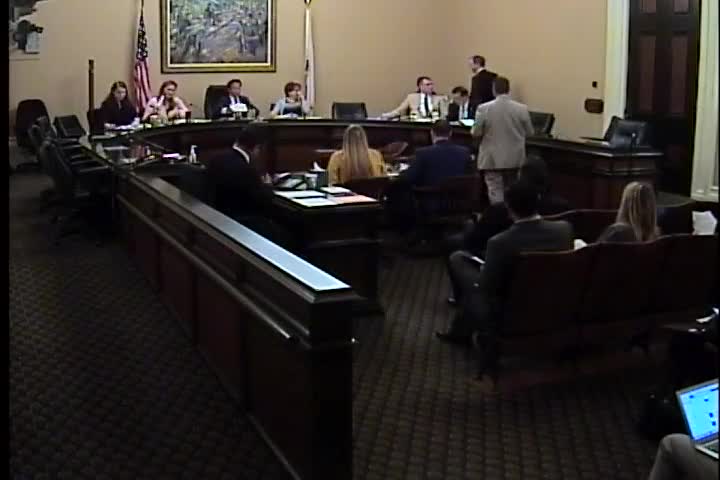 20MIN
Assembly Standing Committee on Housing and Community Development
Bill Author

Bill Co-Author(s):