AB 1936: Postsecondary education: Office of Higher Education Performance and Accountability.
- Session Year: 2017-2018
- House: Assembly
- Latest Version Date: 2018-01-25
(1)Existing law establishes the University of California, under the administration of the Regents of the University of California, the California State University, under the administration of the Trustees of the California State University, the California Community Colleges, under the administration of the Board of Governors of the California Community Colleges, independent institutions of higher education, and private postsecondary educational institutions as the segments of postsecondary education in this state.
Existing law states the intent of the Legislature that budget and policy decisions regarding postsecondary education generally adhere to 3 specified goals and that appropriate metrics be identified, defined, and formally adopted to monitor progress toward the achievement of the goals.
Existing law establishes the California Postsecondary Education Commission (CPEC) as the statewide postsecondary education coordinating and planning agency, and provides for its functions and responsibilities. Existing law also provides for the composition of CPECs membership. The annual state Budget Acts from the 201112 fiscal year to the 201617 fiscal year, inclusive, have provided no funding for CPEC.
This bill would establish the Office of Higher Education Performance and Accountability as the statewide postsecondary education coordination and planning entity. The bill would provide for the appointment by the Governor, subject to confirmation by a majority of the membership of the Senate, of an executive director of the office. The bill would establish an 8-member advisory board for the purpose of examining, and making recommendations to, the office regarding the functions and operations of the office and reviewing and commenting on any recommendations made by the office to the Governor and the Legislature, among other specified duties.
The bill would specify the functions and responsibilities of the office, which would include, among other things, participation, as specified, in the identification and periodic revision of state goals and priorities for higher education, reviewing and making recommendations regarding cross-segmental and interagency initiatives and programs, advising the Legislature and the Governor regarding the need for, and the location of, new institutions and campuses of public higher education, acting as a clearinghouse for postsecondary education information and as a primary source of information for the Legislature, the Governor, and other agencies, and reviewing all proposals for changes in eligibility pools for admission to public institutions and segments of postsecondary education.
The bill would authorize the office to require the governing boards and institutions of public postsecondary education to submit data to the office on plans and programs, costs, selection and retention of students, enrollments, plant capacities, and other matters pertinent to effective planning, policy development, and articulation and coordination. To the extent that this provision would impose new duties on community college districts, it would constitute a state-mandated local program.
The bill would require the office to report to the Legislature and the Governor on or before December 31 of each year regarding its progress in achieving specified objectives and responsibilities.
The bill would repeal these provisions on January 1, 2022.
The California Constitution requires the state to reimburse local agencies and school districts for certain costs mandated by the state. Statutory provisions establish procedures for making that reimbursement.
This bill would provide that, if the Commission on State Mandates determines that the bill contains costs mandated by the state, reimbursement for those costs shall be made pursuant to the statutory provisions noted above.
(a)The Office of Higher Education Performance and Accountability is hereby established as the statewide postsecondary education coordination and planning agency. The office is established in state government within the Governors office, and is under the direct control of an executive director.
(b)The Governor shall appoint the Executive Director of the Office of Higher Education Performance and Accountability, who shall perform all duties, exercise all powers, assume and discharge all responsibilities, and carry out and effect all purposes vested by law in the office, including contracting for professional or consulting services in connection with the work of the office. The appointment of the executive director is subject to confirmation by the affirmative vote of a majority of the membership of the Senate. The executive director shall appoint persons to any staff positions the Governor may authorize.
(c)The Governor may appoint the executive director at a salary that shall be fixed pursuant to Section 12001 of the Government Code.
(d)(1)An advisory board is hereby established for the purpose of examining and making recommendations to the office regarding the functions and operations of the office and reviewing and commenting on any recommendations made by the office to the Governor and the Legislature.
(2)The advisory board consists of the Chairperson of the Senate Committee on Education and the Chairperson of the Assembly Committee on Higher Education, who serve as ex officio members, and six public members with experience in postsecondary education, appointed to terms of four years as follows:
(A)Three members of the advisory board appointed by the Senate Committee on Rules.
(B)Three members of the advisory board appointed by the Speaker of the Assembly.
(3)The office shall actively seek input from, and consult with, the advisory board regarding the functions, operations, and recommendations of the office, and provide the advisory board with sufficient time to review and comment.
(4)Advisory board meetings are subject to the Bagley-Keene Open Meeting Act (Article 9 (commencing with Section 11120) of Chapter 1 of Part 1 of Division 3 of Title 2 of the Government Code). Advisory board materials shall be posted on the Internet.
(5)The advisory board shall meet at least quarterly, and shall appoint one of its members to represent the board for purposes of communicating with the Legislature.
(6)The advisory board is responsible for developing an independent annual report on the condition of higher education in California.
(7)The advisory board is responsible for issuing an annual review of the performance of the Executive Director of the Office of Higher Education Performance and Accountability.
(8)Members of the advisory board shall serve without compensation, but shall receive reimbursement for actual and necessary expenses incurred in connection with the performance of their duties as board members.
(e)The office shall consult with the higher education segments and stakeholders, as appropriate, in the conduct of its duties and responsibilities. For purposes of this subdivision, higher education segments has the same meaning as in Section 66010.95 and higher education stakeholders includes, but is not necessarily limited to, postsecondary faculty and students, K12 representatives, and representatives of the business community.
66010.982.The Office of Higher Education Performance and Accountability exists for the purpose of advising the Governor, the Legislature, and other appropriate governmental officials and institutions of postsecondary education. The office has the following functions and responsibilities in its capacity as the statewide postsecondary education coordination and planning agency and adviser to the Legislature and the Governor:
(a)It shall, through its use of information and its analytic capacity, inform the identification and periodic revision of state goals and priorities for higher education in a manner that is consistent with the goals outlined in Section 66010.91 and takes into consideration the metrics outlined in Sections 89295 and 92675. It shall, biennially, interpret and evaluate both statewide and institutional performance in relation to these goals and priorities.
(b)It shall review and make recommendations, as necessary, regarding cross-segmental and interagency initiatives and programs in areas that may include, but are not necessarily limited to, efficiencies in instructional delivery, financial aid, transfer, and workforce coordination.
(c)It shall advise the Legislature and the Governor regarding the need for, and the location of, new institutions and campuses of public higher education.
(d)It shall review proposals by the public segments for new programs, the priorities that guide the public segments, and the degree of coordination between those segments and nearby public, independent, and private postsecondary educational institutions, and shall make recommendations regarding those proposals to the Legislature and the Governor.
(e)(1)It shall act as a clearinghouse for postsecondary education information and as a primary source of information for the Legislature, the Governor, and other agencies. It shall develop and maintain a comprehensive database that does all of the following:
(A)Ensures comparability of data from diverse sources.
(B)Supports longitudinal studies of individual students as they progress through the states postsecondary educational institutions through the use of a unique student identifier.
(C)Maintains compatibility with California School Information Services and the student information systems developed and maintained by the public segments of higher education, as appropriate.
(D)Provides Internet access to data, as appropriate, to the segments of higher education.
(E)Provides each of the educational segments access to the data made available to the office for purposes of the database, in order to support, most efficiently and effectively, statewide, segmental, and individual campus educational research information needs.
(2)The office, in implementing paragraph (1), shall comply with the federal Family Educational Rights and Privacy Act of 1974 (20 U.S.C. Sec. 1232g) as it relates to the disclosure of personally identifiable information concerning students.
(3)The office shall not make available any personally identifiable information received from a postsecondary educational institution concerning students for any regulatory purpose unless the institution has authorized the office to provide that information on behalf of the institution.
(4)The office shall, following consultation with, and receipt of a recommendation from, the advisory board, provide 30-day notification to the chairpersons of the appropriate policy and budget committees of the Legislature, to the Director of Finance, and to the Governor before making any significant changes to the student information contained in the database.
(f)It shall review all proposals for changes in eligibility pools for admission to public institutions and segments of postsecondary education, and shall make recommendations regarding those proposals to the Legislature, the Governor, and institutions of postsecondary education. In carrying out this subdivision, the office periodically shall conduct a study of the percentages of California public high school graduates estimated to be eligible for admission to the University of California and the California State University.
(g)It shall submit reports to the Legislature in compliance with Section 9795 of the Government Code.
(h)It shall manage data systems and maintain programmatic, policy, and fiscal expertise to receive and aggregate information reported by the institutions of higher education in this state.
66010.984.Notwithstanding any other law, the office may require the governing boards and the institutions of public postsecondary education to submit data to the office on plans and programs, costs, selection and retention of students, enrollments, plant capacities, and other matters pertinent to effective planning, policy development, and articulation and coordination. The office shall furnish information concerning these matters to the Governor and the Legislature as requested by them.
66010.987.(a)On or before December 31 of each year, the office shall report to the Legislature and the Governor regarding its progress in achieving the objectives and responsibilities set forth in subdivision (a) of Section 66010.982.
(b)On or before January 1, 2021, the Legislative Analysts Office shall review and report to the Legislature regarding the performance of the office in fulfilling its functions and responsibilities as outlined in Section 66010.982.
66010.989.This article shall remain in effect only until January 1, 2022, and as of that date is repealed, unless a later enacted statute that is enacted before January 1, 2022, deletes or extends that date.
SEC. 2.If the Commission on State Mandates determines that this act contains costs mandated by the state, reimbursement to local agencies and school districts for those costs shall be made pursuant to Part 7 (commencing with Section 17500) of Division 4 of Title 2 of the Government Code.
|
Date
|
Status
|
|---|---|
| May 25, 2018 | In committee: Held under submission. |
| Apr 4, 2018 | In committee: Set, first hearing. Referred to suspense file. |
| Mar 14, 2018 | From committee: Do pass and re-refer to Com. on APPR. (Ayes 12. Noes 0.) (March 13). Re-referred to Com. on APPR. |
| Feb 5, 2018 | Referred to Com. on HIGHER ED. |
| Jan 26, 2018 | From printer. May be heard in committee February 25. |
| Jan 25, 2018 | Read first time. To print. |
|
Date
|
Description
|
Location
|
Votes
|
|
|---|---|---|---|---|
| Mar 13, 2018 | Do pass and be re-referred to the Committee on [Appropriations] | Assembly Standing Committee on Higher Education |
Passed |
This list shows positions taken on this bill by organizations on the date displayed, which is linked to the original source.
Positions by individuals are not included.
|
Organization
|
Position
|
Date
|
|---|---|---|
| California Competes | * Support | Mar 13, 2018 |
| California State Student Association | * Indeterminate | Mar 13, 2018 |
| Education Trust - West | * Support | Mar 13, 2018 |
Date of Hearing: April 4, 2018
ASSEMBLY COMMITTEE ON APPROPRIATIONS
Lorena Gonzalez Fletcher, Chair
ABPCA Bill Id:AB 1936
Author:(Low) – As Introduced Ver:January 25, 2018
Policy Committee: | Higher Education | Vote: | 12 - 0 |
|
| ||
|
|
Urgency: No State Mandated Local Program: Yes Reimbursable: Yes
SUMMARY:
This bill establishes, until January 1, 2022, the Office of Higher Education Performance and Accountability (OHEPA), a statewide postsecondary education coordinating and planning entity within the Governor’s office. Specifically, this bill:
- Requires OHEPA to perform various duties, including data collection and analysis, planning and oversight, and review of new program and campus proposals.
- Requires the Legislative Analyst’s Office to review the performance of OHEPA and report back to the Legislature by January 1, 2021.
FISCAL EFFECT:
- Approximately $2 million General Fund annually to operate OHEPA. (This estimate is based on the costs of a similar entity that no longer exists.)
- One-time information technology costs and other start-up costs in the low hundreds of thousands of dollars for OHEPA.
- The three public higher education segments report that they would incur the following costs to work with this new entity and to respond to data requests:
- University of California: Ongoing GF costs of about $60,000 annually for one-half position.
- California State University: Ongoing GF costs of $110,000 annually for one position.
- California Community Colleges: Ongoing GF costs of up to $440,000 annually for four positions. Any costs to local community college districts for these activities would be reimbursable.
COMMENTS:
- Purpose. The author indicates OHEPA would provide “greater clarity and accountability for our higher education system’s performance in meeting the statewide goals outlined in the Master Plan of equity, access, and success.”
- Background. The 1960 Master Plan for Higher Education (Master Plan) called for the creation of a coordinating and planning entity for postsecondary education. This entity eventually became the California Postsecondary Education Commission (CPEC). Over time, the state reduced CPEC's budget and responsibilities. Governor Brown vetoed funding for CPEC in the 2011-12 Budget Act, citing its ineffectiveness. Since that time, the Legislature has proposed several bills to reestablish a coordinating and planning entity. All bills have been either held in one of the fiscal committees or vetoed by the governor.
- Staff Comments. Given the size and diversity of the state’s higher education system, a coordinating and planning entity could ensure that resources are being used effectively and that the segments are working together to meet statewide goals. Research suggests that an effective coordinating entity should be independent from higher education segments, be tasked with limited and clear responsibilities, and receive funding aligned with these responsibilities.
Analysis Prepared by: Natasha Collins / APPR. / (916) 319-2081
Date of Hearing: March 13, 2018
ASSEMBLY COMMITTEE ON HIGHER EDUCATION
Jose Medina, Chair
ABPCA Bill Id:AB 1936 (
Author:Low) – As Introduced Ver:January 25, 2018
SUBJECT: Postsecondary education: Office of Higher Education Performance and Accountability
SUMMARY: Establishes, until January 1, 2022, the Office of Higher Education Performance and Accountability (OHEPA) to provide statewide postsecondary education planning and coordination. Specifically, this bill:
- Establishes OHEPA as the statewide postsecondary education coordination and planning entity within the Governor’s office, under the direct control of an Executive Director (Director), to be appointed by the Governor and subject to Senate confirmation.
- Provides that the Director is responsible for all duties, powers, and responsibilities vested in OHEPA, including contracting for relevant professional or consultant services. The Director is required to appoint any staff positions authorized by the Governor.
- Establishes an advisory board to OHEPA, subject to open meetings requirements and required to meet at least quarterly, for the purpose of reviewing and commenting on any recommendations made by OHEPA to the Governor and the Legislature. The board is to develop an annual report on the condition of California higher education and issue an annual performance review of the Director. Establishes advisory board members, as follows, who shall serve without compensation, except reimbursement for expenses:
- Three members with experience in postsecondary education appointed by the Senate Committee on Rules;
- Three members with experience in postsecondary education appointed by the Speaker of the Assembly; and,
- The chair of the Senate Committee on Education and the chair of the Assembly Committee on Higher Education to serve as ex officio members.
- Requires OHEPA to actively seek input from and consult with the advisory board and higher education segments and stakeholders, as appropriate, in the conduct of its duties and responsibilities.
- Establishes OHEPA for the purpose of advising the Governor, the Legislature and other appropriate government officials and institutions of postsecondary education, and specifically requires OHEPA to conduct all of the following:
- Inform the identification and periodic revision of state goals and priorities for higher education in a manner that is consistent with the goals, taking into consideration the metrics, outlined in existing law. OHEPA is required to biennially interpret and evaluate both statewide and institutional performance in relation to these goals and priorities.
- Review and make recommendations, as necessary, regarding cross-segmental and interagency initiatives and programs in areas that may include efficiencies and instructional delivery, financial aid, transfer, and workforce coordination.
- Advise the Legislature and the Governor regarding the need for, and location of, new institutions and campuses of public higher education.
- Review proposals by the public segments for new programs, including the priorities that guide these proposals and the degree of coordination with nearby public, independent, and private postsecondary educational institutions, and make recommendations regarding such proposals to the Legislature and the Governor.
- Act as a clearinghouse for postsecondary education information and as a primary source of information for the Legislature, the Governor, and other agencies, and develop and maintain a comprehensive database, as specified.
- Review proposals for changes in eligibility pools for admission to public institutions and segments of postsecondary education, and make recommendations to the Legislature, the Governor, and institutions of postsecondary education, and periodically study the percentages of California public high school graduates estimated to be eligible for admission to the California State University (CSU) and the University of California (UC).
- Manage data systems and maintain programmatic, policy, and fiscal expertise to receive and aggregate information reported by the state's institutions of higher education in this state; and,
- Report to the Legislature and the Governor, by December 31 of each year, regarding its progress in achieving the aforementioned objectives and responsibilities.
- Requires the Legislative Analyst's Office (LAO), by January 1, 2021, to review and report to the Legislature regarding the performance of the office in fulfilling its functions and responsibilities.
EXISTING LAW: Establishes the California Postsecondary Education Commission (CPEC) composed of 17 members representing the higher education segments, the State Board of Education, and nine representatives appointed by the Governor, Senate Rules Committee, and Assembly Speaker to coordinate public, independent, and private postsecondary education in California. (Education Code Section 66900, et seq.)
FISCAL EFFECT: The Assembly Appropriations Committee identified the following costs in 2017 for an identical bill:
- Approximately $1.9 million General Fund (GF) annually. The office established by this bill is similar to the California Postsecondary Education Commission (CPEC). In its last full year of operation, CPEC’s operating budget was $1.9 million GF.
In addition to operating funds, the Office of Higher Education Performance and Accountability will also incur one-time information technology costs and other start-up costs in the low hundreds of thousands of dollars.
- The three public higher education segments report that they would incur the following costs to work with this new office and to respond to data requests:
- UC: Ongoing costs of $57,000 for one-half position.
- CSU: Ongoing costs of $110,000 for one position.
- CCC: Ongoing costs of up to $440,000 for four positions based on prior workload demands involving CPEC.
COMMENTS: CPEC was established to coordinate postsecondary education in California and to provide independent policy analyses and recommendations to the Legislature and the Governor on postsecondary education issues. However, CPEC's budget and responsibilities were reduced over time, casting doubt on its effectiveness and triggering calls for its restructuring. In the 2011-12 Budget Act, Governor Brown vetoed funding for CPEC citing the agency’s ineffectiveness in higher education oversight. In his veto message, the Governor acknowledged the well-established need for coordinating and guiding state higher education policy and requested that stakeholders explore alternative ways these functions could be fulfilled. CPEC shut down in fall 2011, transferring its federal Teacher Quality Improvement grant program to the California Department of Education (CDE) and extensive data resources to the California Community Colleges (CCC) Chancellor's Office. There is currently no coordinating entity for higher education in California.
Post CPEC. Statewide higher education goals and objectives have been considered by the Legislature for over a decade; in recent years, despite the absence of CPEC, some progress has been made on this front. The 2013-14 Budget Act education trailer bill (AB 94, Chapter 50) required UC and CSU to report annually on specified performance measures, in order to inform budget and policy decisions and promote effective and efficient use of resources. SB 195 (Liu), Chapter 367, Statutes of 2013, established general statewide goals for higher education, and legislative intent to identify specific metrics for measuring progress toward statewide goals. The 2014-15 Budget Act (SB 852, Chapter 25) required UC and CSU to approve three-year "sustainability plans" that use funding projections to establish projections of enrollment and the university's goals for the performance measures that are required to be adopted pursuant to AB 94; this requirement was continued in the 2015-16 and 2016-17 Budget Acts. CCCs were required, pursuant to the 2014-15 Budget higher education trailer bill (SB 860, Chapter 34), to adopt goals and targets for student performance by June 30, 2015, and to establish and report on Student Equity Plans designed to ensure equal educational opportunities and to promote student success for all students.
Purpose. According to the author, "this bill represents the next necessary step in establishing greater clarity and accountability for our higher education system’s performance in meeting the statewide goals outlined in the Master Plan of equity, access, and success; alignment with workforce needs; and the effective and efficient use of resources. This bill establishes OHEPA as the statewide postsecondary coordination and planning entity, outlines its responsibilities, functions and authorities, and establishes an advisory board to the office (comprised of legislative appointees) to examine and make recommendations regarding its functions and operations, and to review and comment on the office’s recommendations to the Governor and Legislature."
Others Recommend Reestablishing State Coordination. A number of reports have been issued in recent years that recommend various approaches to reestablishing higher education oversight and coordination in California. In 2012, the LAO's report, "Improving Higher Education Oversight" recommended that the Legislature establish an oversight body and increase the body's independence from the public higher education segments, assign the body with limited and clear responsibilities, and develop a more unified governing board appointment process. In 2014, California Competes, in "Chartering a Course for California's Colleges: State Leadership in Higher Education", also highlighted the importance of impartiality and independence from the higher education segments. The Institute for Higher Education Leadership and Policy, in March of 2014, issued "A New Vision for California Higher Education: A Model Public Agenda", which noted that policy leadership could be best filled by regional consortia that set goals and targets working in coordination with an executive branch entity (such as a Higher Education Office) that reported to the Governor with respect to finance and accountability.
Prior Legislation: AB 1936 is the latest in a long line of measures proposing to replace CPEC in some fashion. As seen below, all but one have been held in one of the fiscal committees. The one measure to reach the Governor was vetoed, and the Governor has not expressed any interest establishing a new coordinating body. Perhaps AB 1936 can lay the groundwork for discussions with the next administration.
- AB 217 (Low, 2017), an identical bill, was held on Suspense in Assembly Appropriations.
- AB 1038 (Bonta, 2017), which established a Blue Ribbon Commission on Public Postsecondary Education to provide research and recommendations regarding California higher education, was also held on Suspense in Assembly Appropriations.
- AB 1837 (Low, 2016) which was almost identical to this bill, was held on Suspense in Senate Appropriations.
- AB 2434 (Bonta, 2016), which was substantially similar to AB 1038, was held on Suspense in Assembly Appropriations.
- SB 42 (Liu, 2015), which was substantially similar to this measure, was vetoed, with the Governor stating, in part, "While there is much work to be done to improve higher education, I am not convinced we need a new office and an advisory board, especially of the kind this bill proposes, to get the job done."
- AB 1348 (John A. Pérez, 2014), which established the California Higher Education Authority, its governing board and its responsibilities, was held on Suspense in Senate Appropriations.
- AB 2190 (John A. Pérez, 2012), which established a new state oversight and coordinating body for higher education, was held on Suspense in Assembly Appropriations.
- AB 217 (Low, 2017), an identical bill, was held on Suspense in Assembly Appropriations.
REGISTERED SUPPORT / OPPOSITION:
Support
California Competes
Opposition
None on file.
Analysis Prepared by: Chuck Nicol / HIGHER ED. / (916) 319-3960
Discussed in Hearing
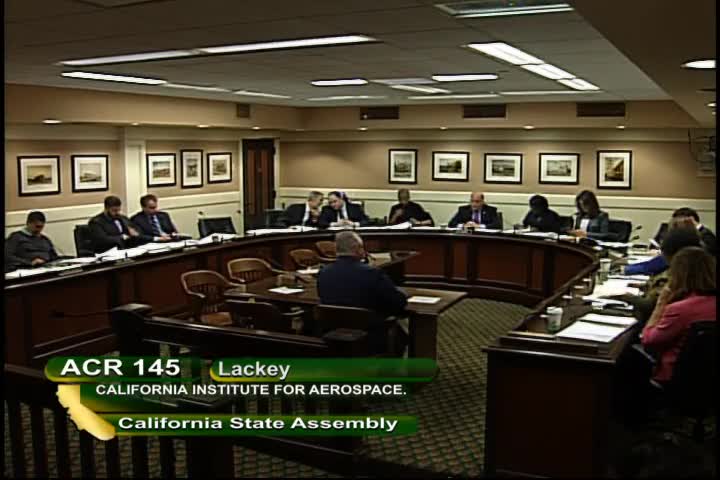 8MIN
Assembly Standing Committee on Higher Education


Bill Co-Author(s):