AB 1940: Parole: reintegration credits.
- Session Year: 2017-2018
- House: Assembly
- Latest Version Date: 2018-05-29
Under existing law, except as otherwise exempted, a person completing a term of imprisonment in the state prison shall be released for a period of supervised parole. Existing law specifies the length of parole for various classifications of inmates. Under existing law, an inmate is released to the county of their his or her residence before incarceration or, when the interest of public safety is best served, to another location specified by the Board of Parole Hearings. Existing law authorizes the Board of Parole Hearings to establish and enforce rules and regulations governing parole. Existing regulations prohibit a parolee from traveling more than 50 miles from his or her residence without the approval of a parole agent.
This bill would create a program under which the length of a parolees period of parole would be reduced through the successful completion of specified education, training, or treatment programs, or by participating in volunteer service, while adhering to the conditions of parole. The bill would make this program inapplicable to a person who is required to register as a sex offender. The bill would also increase the 50-mile travel restriction for a parolee who successfully participates in the program, subject to certain restrictions. The bill would require the Department of Corrections and Rehabilitation and the Board of Parole Hearings to adopt regulations to carry out the program.
Under existing law, except as otherwise exempted, a person completing a term of imprisonment in the state prison shall be released for a period of supervised parole. Existing law specifies the length of parole for various classifications of inmates. Under existing law, an inmate is released to the county of their residence before incarceration or, when the interest of public safety is best served, to another location specified by the Board of Parole Hearings. Existing law authorizes the Board of Parole Hearings to establish and enforce rules and regulations governing parole. Existing regulations prohibit a parolee from traveling more than 50 miles from his or her residence without the approval of a parole agent.
This bill would create a program under which the length of a parolees period of parole may would be reduced through the successful completion of specified education, training, or treatment programs, or by participating in volunteer service, while adhering to the conditions of parole. The bill would make this program inapplicable to a person who is required to register as a sex offender. The bill would also increase the 50-mile travel restriction for a parolee who successfully participates in the program, subject to certain restrictions. The bill would require the Department of Corrections and Rehabilitation and the Board of Parole Hearings to adopt regulations to carry out the program.
Under existing law, except as otherwise exempted, a person completing a term of imprisonment in the state prison shall be released for a period of supervised parole. Existing law specifies the length of parole for various classifications of inmates. Under existing law, an inmate is released to the county of their residence before incarceration or, when the interest of public safety is best served, to another location specified by the Board of Parole Hearings. Existing law authorizes the Board of Parole Hearings to establish and enforce rules and regulations governing parole. Existing regulations prohibit a parolee from traveling more than 50 miles from his or her residence without the approval of a parole agent.
This bill would create a program under which the length of a parolees period of parole may be reduced through the successful completion of specified education, training, or treatment programs, or by participating in volunteer service, and by while adhering to the conditions of parole. The bill would also increase the 50-mile travel restriction for a parolee who successfully participates in the program, subject to certain restrictions. The bill would require the Department of Corrections and Rehabilitation and the Board of Parole Hearings to adopt regulations to carry out the program.
Under existing law, except as otherwise exempted, a person completing a term of imprisonment in the state prison shall be released for a period of supervised parole. Existing law specifies the length of parole for various classifications of inmates. Under existing law, an inmate is released to the county of their residence before incarceration or, when the interest of public safety is best served, to another location specified by the Board of Parole Hearings. Existing law authorizes the Board of Parole Hearings to establish and enforce rules and regulations governing parole. Existing regulations prohibit a parolee from traveling more than 50 miles from his or her residence without the approval of a parole agent.
This bill would create a program under which the length of a parolees period of parole may be reduced through the successful completion of specified education, training, or treatment programs, by participating in volunteer service, and by adhering to the conditions of parole. The bill would also increase the 50-mile travel restriction for a parolee who successfully participates in the program, subject to certain restrictions. The bill would require the Department of Corrections and Rehabilitation and the Board of Parole Hearings to adopt regulations to carry out the program.
(a)A parolee serving a determinate period of parole is entitled to earn reintegration credits to reduce the term of his or her parole. This section does not apply to a person who is required to register pursuant to Section 290.
(b)A parolee subject to lifetime parole may earn reintegration credits to advance the date of his or her discharge review.
(c)Reintegration credits shall be earned at the following rates for completing the following programs or activities while on parole:
(1)(A)For the completion of an accredited academic program or course, as follows:
(A)(i)For a general equivalency high school diploma, 12 months of credit.
(B)(ii)For an associates degree, 12 months of credit.
(C)(iii)For a bachelors degree, 12 months of credit.
(D)(iv)For the completion of any quarter, trimester, or semester-long course taken towards an academic degree for which a passing grade was received and for which credit was not awarded for the completion of a degree, six weeks of credit.
(B)For purposes of this paragraph, accredited means that the program or course is accredited by an accrediting agency recognized by the United States Department of Education or the State of California.
(2)For the completion of a certified career or technical education or training program or certificate, six months of credit. For purposes of this paragraph, certified means that the career or technical education or training program or certificate is offered by an institution that is approved, certified, or sponsored by a government agency or state-recognized professional licensing or certification body that licenses or certifies persons in a particular profession, occupation, trade, or career field.
(3)For the completion of a cognitive behavioral treatment program, two months of credit.
(4)For the completion of a substance abuse treatment program or residential treatment program that is not ordered by a court, three months of credit.
(5)For the completion of a minimum of 12 voluntary service hours per month, 10 days of credit per month.
(6)Reintegration credits may be awarded pursuant to this section for academic achievements completed while on parole in cases in which the parolee began the academic program during his or her period of incarceration.
(d)Reintegration credits earned during the 12-month period before each annual review shall be awarded at the annual review. The department shall reduce the period of parole imposed on a parolee pursuant to Section 3000 by the amount of reintegration credit awarded at the parolees annual review. Once awarded, earned credits shall not be revoked.
(e)Any reintegration credits earned during the 12-month period before each annual review may, at the discretion of the parole agent, be revoked and not awarded only if a parolee has had a new arrest or a parole violation during that 12-month period.
(f)A parolee may not be awarded more than 12 months of credit earned during a 12-month period. Excess credits earned in a 12-month period before an annual review shall not be awarded in a subsequent year.
(g)In revoking earned credits, the parole agent shall utilize the Parole Violation Decision-Making Instrument described in Section 3768.3 of Title 15 of the California Code of Regulations.
(h)A parolee shall be awarded retroactive credits pursuant to paragraph (1) or (2) of subdivision (c) for educational or training programs which were completed during the parolees current period of parole but before the effective date of this section, subject to the restrictions in this section.
(i)As used in subdivision (b), voluntary service means any time spent volunteering for a nonprofit or government agency, including time spent visiting prisons, jails, or juvenile detention facilities. Any volunteer activity shall be approved by a parole agent and documented by a site supervisor in a manner prescribed by the department.
3007.55.(a)A parolee who successfully earns and is awarded any amount of reintegration credits pursuant to Section 3007.5 shall, except as prohibited by law and subject to the approval of the parole agent, have their 50-mile radius of restricted travel increased by 25 miles after each annual review during which credits are awarded.
(b)The total restricted radius of travel authorized shall not exceed 125 miles.
(c)Any increase in travel area made pursuant to this section shall exclude any areas within 35 miles of a victim or witness described in subsection subdivision (f) or (h) of Section 3003 and shall not authorize travel across state borders without a travel pass.
3007.59.The Department of Corrections and Rehabilitation and the Board of Parole Hearings shall adopt any regulations necessary to carry out the provisions of this article.
(a)A parolee serving a determinate period of parole may is entitled to earn reintegration credits to reduce the term of his or her parole. This section does not apply to a person who is required to register pursuant to Section 290.
(b)A parolee subject to lifetime parole may earn reintegration credits to advance the date of his or her discharge review.
(c)Reintegration credits shall be earned at the following rates for completing the following programs or activities while paroled: on parole:
(1)For the completion of an academic program or course, as follows:
(A)For a general equivalency high school diploma, six 12 months of credit.
(B)For an associates degree, nine 12 months of credit.
(C)For a bachelors degree, 12 months of credit.
(D)For the completion of any quarter quarter, trimester, or semester-long course taken towards an academic degree for which a passing grade was received and for which credit was not awarded for the completion of a degree, six weeks of credit.
(2)For the completion of a career or technical education or training program or certificate, six months of credit.
(3)For the completion of a cognitive behavioral treatment program, two months of credit.
(4)For the completion of a substance abuse treatment program or residential treatment program that is not ordered by a court, three months of credit.
(5)For the completion of a minimum of 12 voluntary service hours per month, 10 days of credit per month.
(6)Reintegration credits may be awarded pursuant to this section for academic achievements completed while on parole in cases in which the parolee began the academic program during his or her period of incarceration.
(d)Reintegration credits earned during the 12-month period before each annual review shall be awarded at the annual review. The department shall reduce the period of parole imposed on a parolee pursuant to Section 3000 by the amount of reintegration credit awarded at the parolees annual review. Once awarded, earned credits shall not be revoked.
(e)Any reintegration credits earned during the 12-month period before each annual review may, at the discretion of the parole agent, be revoked and not awarded only if a parolee has had a new arrest or a parole violation during that 12-month period.
(f)A parolee may not be awarded more than 12 months of credit earned during a 12-month period. Excess credits earned in a 12-month period before an annual review shall not be awarded in a subsequent year.
(g)In revoking earned credits, the parole agent shall utilize the Parole Violation Decision-Making Instrument described in Section 3768.3 of Title 15 of the California Code of Regulations.
(h)A parolee may shall be awarded retroactive credits pursuant to paragraph (1) or (2) of subdivision (c) for educational or training programs which were completed during the parolees current period of parole but before the effective date of this section, subject to the restrictions in this section.
(i)As used in subdivision (b), voluntary service means any time spent volunteering for a nonprofit or government agency, including time spent visiting prisons, jails, or juvenile detention facilities. Any volunteer activity shall be approved by a parole agent and documented by a site supervisor in a form manner prescribed by the department.
3007.55.(a)A parolee who successfully earns and is awarded any amount of reintegration credits pursuant to Section 3007.5 shall, except as prohibited by law and subject to the approval of the parole agent, have their 50-mile radius of restricted travel increased by 25 miles after each annual review during which credits are awarded.
(b)The total restricted radius of travel authorized shall not exceed 125 miles.
(c)Any increase in travel area made pursuant to this section shall exclude any areas within 35 miles of a victim or witness described in subsection (f) or (h) of Section 3003 and shall not authorize travel across state borders without a travel pass.
3007.59.The Department of Corrections and Rehabilitation and the Board of Parole Hearings shall adopt any regulations necessary to carry out the provisions of this article.
(a)A parolee serving a determinate period of parole may earn reintegration credits to reduce the term of his or her parole.
(b)A parolee subject to lifetime parole may earn reintegration credits to advance that the date of his or her discharge review.
(c)Reintegration credits shall be earned at the following rates for completing the following programs or activities while paroled:
(1)For the completion of an academic program or course, as follows:
(A)For a general equivalency diploma, six months of credit.
(B)For an associates degree, nine months of credit.
(C)For a bachelors degree, 12 months of credit.
(D)For the completion of any quarter or semester-long course taken towards an academic degree for which a passing grade was received and for which credit was not awarded for the completion of a degree, six weeks of credit.
(2)For the completion of a career or technical education or training program or certificate, six months of credit.
(3)For the completion of a cognitive behavioral treatment program, two months of credit.
(4)For the completion of a substance abuse treatment program that is not ordered by a court, three months of credit.
(5)For the completion of a minimum of 12 voluntary service hours per month, 10 days of credit per month.
(6)For remaining free of any new arrests or parole violations, 15 days of credit per month.(d)Reintegration credits earned during the 12 month 12-month period before each annual review shall be awarded at the annual review. The department shall reduce the period of parole imposed on a parolee pursuant to Section 3000 by the amount of reintegration credit awarded at the parolees annual review. Once awarded, earned credits shall not be revoked.
(e)Any reintegration credits earned during the 12-month period before each annual review may, at the discretion of the parole agent, be revoked and not awarded if a parolee has had a new arrest or a parole violation during that 12-month period.
(f)A parolee may not be awarded more than twelve 12 months of credit earned during a 12-month period. Excess credits earned in a 12-month period before an annual review shall not be awarded in a subsequent year.
(g)In revoking earned credits, the parole agent shall utilize the Parole Violation Decision-Making Instrument described in Section 3768.3 of Title 15 of the California Code of Regulations.
(h)A parolee may be awarded retroactive credits pursuant to paragraph (1) or (2) of subdivision (c) for educational or training programs which were completed during the parolees current period of parole but before the effective date of this section, subject to the restrictions in this section.
(i)As used in subdivision (b), voluntary service means any time spent volunteering for a nonprofit or government agency, including time spent visiting prisons, jails, or juvenile detention facilities. Any volunteer activity shall be approved by a parole agent and documented by a site supervisor in a form prescribed by the department.
3007.55.(a)A parolee who successfully earns and is awarded reintegration credits pursuant to Section 3007.5 shall, except as prohibited by law and subject to the approval of the parole agent, have their 50-mile radius of restricted travel increased by 25 miles after each annual review during which credits are awarded.
(b)The total restricted radius of travel authorized shall not exceed 125 miles.
(c)Any increase in travel area made pursuant to this section shall exclude any areas within 35 miles of a victim or witness described in subsection (f) or (h) of Section 3003 and shall not authorize travel across state borders without a travel pass.
3007.59.The Department of Corrections and Rehabilitation and the Board of Parole Hearings shall adopt any regulations necessary to carry out the provisions of this article.
(a)A parolee serving a determinate period of parole may earn reintegration credits to reduce the term of his or her parole.
(b)A parolee subject to lifetime parole may earn reintegration credits to advance that date of his or her discharge review.
(c)Reintegration credits shall be earned at the following rates for completing the following programs or activities while paroled:
(1)For the completion of an academic program or course, as follows:
(A)For a general equivalency diploma, six months of credit.
(B)For an associates degree, nine months of credit.
(C)For a bachelors degree, 12 months of credit.
(D)For the completion of any quarter or semester-long course taken towards an academic degree for which a passing grade was received and for which credit was not awarded for the completion of a degree, six weeks of credit.
(2)For the completion of career or technical education or training program or certificate, six months of credit.
(3)For the completion of a cognitive behavioral treatment program, two months of credit.
(4)For the completion of a substance abuse treatment program that is not ordered by a court, three months of credit.
(5)For the completion of a minimum of 12 voluntary service hours per month, 10 days of credit per month.
(6)For remaining free of any new arrests or parole violations, 15 days of credit per month.
(d)Reintegration credits earned during the 12 month period before each annual review shall be awarded at the annual review. The department shall reduce the period of parole imposed on a parolee pursuant to Section 3000 by the amount of reintegration credit awarded at the parolees annual review. Once awarded, earned credits shall not be revoked.
(e)Any reintegration credits earned during the 12-month period before each annual review may, at the discretion of the parole agent, be revoked and not awarded if a parolee has had a new arrest or a parole violation during that 12-month period.
(f)A parolee may not be awarded more than twelve months of credit earned during a 12-month period. Excess credits earned in a 12-month period before an annual review shall not be awarded in a subsequent year.
(g)In revoking earned credits, the parole agent shall utilize the Parole Violation Decision-Making Instrument described in Section 3768.3 of Title 15 of the California Code of Regulations.
(h)A parolee may be awarded retroactive credits pursuant to paragraph (1) or (2) of subdivision (c) for educational or training programs which were completed during the parolees current period of parole but before the effective date of this section, subject to the restrictions in this section.
(i)As used in subdivision (b), voluntary service means any time spent volunteering for a nonprofit or government agency, including time spent visiting prisons, jails, or juvenile detention facilities. Any volunteer activity shall be approved by a parole agent and documented by a site supervisor in a form prescribed by the department.
3007.55.(a)A parolee who successfully earns and is awarded reintegration credits pursuant to Section 3007.5 shall, except as prohibited by law and subject to the approval of the parole agent, have their 50-mile radius of restricted travel increased by 25 miles after each annual review during which credits are awarded.
(b)The total restricted radius of travel authorized shall not exceed 125 miles.
(c)Any increase in travel area made pursuant to this section shall exclude any areas within 35 miles of a victim or witness described in subsection (f) or (h) of Section 3003 and shall not authorize travel across state borders without a travel pass.
3007.59.The Department of Corrections and Rehabilitation and the Board of Parole Hearings shall adopt any regulations necessary to carry out the provisions of this article.
|
Date
|
Status
|
|---|---|
| May 31, 2018 | Read third time. Refused passage. |
| May 29, 2018 | Read third time and amended. Ordered to third reading. |
| May 25, 2018 | From committee: Do pass. (Ayes 12. Noes 3.) (May 25). |
| Apr 11, 2018 | In committee: Set, first hearing. Referred to APPR. suspense file. |
| Apr 3, 2018 | Re-referred to Com. on APPR. |
| Apr 2, 2018 | From committee chair, with author's amendments: Amend, and re-refer to Com. on APPR. Read second time and amended. |
| Mar 14, 2018 | Re-referred to Com. on APPR. |
| Mar 13, 2018 | Read second time and amended. |
| Mar 12, 2018 | From committee: Amend, and do pass as amended and re-refer to Com. on APPR. (Ayes 5. Noes 1.) (March 6). |
| Feb 5, 2018 | Referred to Com. on PUB. S. |
| Jan 26, 2018 | From printer. May be heard in committee February 25. |
| Jan 25, 2018 | Read first time. To print. |
|
Date
|
Description
|
Location
|
Votes
|
|
|---|---|---|---|---|
| May 31, 2018 | AB 1940 MCCARTY Assembly Third Reading | Assembly Floor |
Passed |
|
| May 25, 2018 | Do pass. | Assembly Standing Committee on Appropriations |
Passed |
|
| Mar 6, 2018 | Do pass as amended and be re-referred to the Committee on [Appropriations] | Assembly Standing Committee on Public Safety |
Passed |
This list shows positions taken on this bill by organizations on the date displayed, which is linked to the original source.
Positions by individuals are not included.
|
Organization
|
Position
|
Date
|
|---|---|---|
| #cut50 | ** Support | Mar 5, 2018 |
| Anti-Recidivism Coalition | ** Support | Mar 5, 2018 |
| California Correctional Peace Officers Association | ** Against | Mar 5, 2018 |
| California District Attorney's Association | * Indeterminate | Mar 6, 2018 |
| California District Attorneys Association | * Indeterminate | Mar 6, 2018 |
| California Immigrant Policy Center | ** Support | Mar 5, 2018 |
| California Public Defenders Association | ** Support | Mar 5, 2018 |
| Ella Baker Center For Human Rights | ** Support | Mar 5, 2018 |
| Los Angeles Area Chamber Of Commerce | ** Support | Mar 5, 2018 |
| National Institute for Criminal Justice Reform | ** Support | Mar 5, 2018 |
| Root and Rebound | ** Support | Mar 5, 2018 |
| Young Women's Freedom Center | ** Support | Mar 5, 2018 |
ASSEMBLY THIRD READING
ATR Bill Id:AB 1940
Author:(McCarty)
As Amended Ver:May 29, 2018
Majority vote
Committee | Votes | Ayes | Noes |
Public Safety | 5-1 | Jones-Sawyer, Carrillo, Gonzalez Fletcher, Quirk, Santiago | Lackey |
Appropriations | 12-3 | Gonzalez Fletcher, Bloom, Bonta, Calderon, Carrillo, Chau, Eggman, Friedman, Eduardo Garcia, Nazarian, Quirk, Reyes | Bigelow, Fong, Obernolte |
SUMMARY: Creates a program through which parolees, except those subject to sex offender registration requirements, are able to earn "reintegration credits" to reduce the term of parole. Specifically, this bill:
- Entitles parolees serving a determinate period of parole, except those required to register as sex offenders, to earn reintegration credits to reduce the length of parole.
- Allows a parolee subject to lifetime parole to earn reintegration credits to advance the date of his or her discharge review.
- Awards reintegration credits for the completion of an accredited academic program or course, as follows:
- Twelve months of credit for a general equivalency high school diploma;
- Twelve months of credit for an associate's degree;
- Twelve months of credit for a bachelor's degree; and,
- Six weeks of credit for the completion of any quarter, trimester, or semester-long course taken towards an academic degree for which a passing grade was received and for which credit was not awarded for the completion of a degree.
- Defines an ''accredited academic program or course'' as one which ''is accredited by an accrediting agency recognized by the United States Department of Education or the State of California.''
- Specifies that reintegration credits may be awarded for academic achievements commenced during the individual's term of incarceration but completed while on parole.
- Awards reintegration credits for other specified activities as follows:
- Six months of credit for the completion of a certified career or technical education or training program or certificate, as specified;
- Two months of credit for the completion of a cognitive behavioral treatment program;
- Three months of credit for the completion of a substance abuse treatment program or residential treatment program that is not court-ordered; and,
- Ten days of credit per month for the completion of a minimum of 12 voluntary service hours per month.
- Defines ''voluntary service'' for purposes of these provisions as ''any time spent volunteering for a nonprofit or government agency, including time spent visiting prisons, jails, or juvenile detention facilities. Any volunteer activity shall be approved by a parole agent and documented by a site supervisor in a manner prescribed by the department.''
- Provides that reintegration credits earned during the 12-month period before each annual review shall be awarded at the annual review. The parole officer retains discretion to deny credits that have been earned, but not yet awarded at an annual review hearing, but only if the parolee has had a new arrest or parole violation during that 12-month period.
- Prohibits the revocation of reintegration credits which have been awarded at the annual review hearing.
- Limits the awarded of reintegration credits to no more than 12 months of credit during a 12-month period.
- Requires reintegration credits to be awarded retroactively, as specified.
- Allows a parolee who successfully earns any amount of reintegration credits to have his or her radius of restricted travel increased at each annual review, as specified, except as prohibited by law and subject to the approval of the parole officer.
- Requires the Department of Corrections and Rehabilitation (CDCR) and the Board of Parole Hearings (BPH) to adopt any regulations necessary to carry out these provisions.
EXISTING LAW:
- Provides for a period of post-prison supervision immediately following a period of incarceration in state prison.
- Requires the following persons released from prison prior to, or on or after July 1, 2013, be subject to parole under the supervision of CDCR:
- A person who committed a serious felony listed in Penal Code Section 1192.7, subdivision (c);
- A person who committed a violent felony listed in Penal Code Section 667.5, subdivision (c);
- A person serving a Three-Strikes sentence;
- A high risk sex offender;
- A mentally disordered offender;
- A person required to register as a sex offender and subject to a parole term exceeding three years at the time of the commission of the offense for which he or she is being released; and,
- A person subject to lifetime parole at the time of the commission of the offense for which he or she is being released.
- Requires all other offenders released from prison to be placed on post-release community supervision (PRCS) under the supervision of a county agency, such as a probation department.
- States that, notwithstanding any other law, a person released from prison prior to October 1, 2011, is subject to parole under CDCR supervision.
- Establishes parole-term lengths depending on the committing offense and the date the offense is committed.
- Entitles a parolee to an annual review hearing until the statutory maximum period of parole expires.
- Provides for the opportunity for early discharge from parole for all parolees after a certain period of continuously-successful parole. For example, a parolee serving up to a three-year parole period must be discharged from parole within 30 days after a consecutive six-month period of violation-free parole unless the BPH decides to retain the person.
- Triggers suspension of the period of parole if a parolee absconds.
- Provides that an inmate who has committed specified crimes and is released on parole shall not be returned to a location within 35 miles of the residence of a victim or witness if the victim or witness makes such a request and the BPH finds that the placement is necessary to protect the victim or witness.
FISCAL EFFECT: According to the Assembly Appropriations Committee:
- Unknown, likely significant one-time administrative general fund (GF) costs, potentially in the hundreds of thousands of dollars, for CDCR to establish the new parole credits program.
- Unknown, potentially significant ongoing GF costs for increased workload for CDCR to collect and process information on credit earnings. These costs will be offset by savings from reducing the amount of time individuals stay on parole. The magnitude of these savings and the extent to whether they partially, fully, or more than fully offset costs depends on the extent to which parolees choose to complete activities that earn credits. It is possible this bill will result in significant savings over time.
COMMENTS: According to the author, ''AB 1940 will incentivize parolees to reach their full potential by rewarding good behavior, educational attainments and community service. This will encourage the parolee to be an active participant in their efforts to reintegrate into society and leave them with better tools at their disposal to help them rejoin their communities.''
Please see the policy committee analysis for a full discussion of this bill.
Analysis Prepared by: Sandy Uribe / PUB. S. / (916) 319-3744 FN: 0003270
ASSEMBLY THIRD READING
ATR Bill Id:AB 1940
Author:(McCarty)
As Amended Ver: April 2, 2018
Majority vote
Committee | Votes | Ayes | Noes |
Public Safety | 5-1 | Jones-Sawyer, Carrillo, Gonzalez Fletcher, Quirk, Santiago | Lackey |
Appropriations | 12-3 | Gonzalez Fletcher, Bloom, Bonta, Calderon, Carrillo, Chau, Eggman, Friedman, Eduardo Garcia, Nazarian, Quirk, Reyes | Bigelow, Fong, Obernolte |
SUMMARY: Creates a program through which parolees, except those subject to sex offender registration requirements, are able to earn "reintegration credits" to reduce the term of parole. Specifically, this bill:
- Entitles parolees serving a determinate period of parole, except those required to register as sex offenders, to earn reintegration credits to reduce the length of parole.
- Allows a parolee subject to lifetime parole to earn reintegration credits to advance the date of his or her discharge review.
- Awards reintegration credits for the completion of an academic program or course, as follows:
- Twelve months of credit for a general equivalency high school diploma;
- Twelve months of credit for an associate's degree;
- Twelve months of credit for a bachelor's degree; and,
- Six weeks of credit for the completion of any quarter, trimester, or semester-long course taken towards an academic degree for which a passing grade was received and for which credit was not awarded for the completion of a degree.
- Specifies that reintegration credits may be awarded for academic achievements commenced during the individual's term of incarceration but completed while on parole.
- Awards reintegration credits for other specified activities as follows:
- Six months of credit for the completion of career or technical education or training program or certificate;
- Two months of credit for the completion of a cognitive behavioral treatment program;
- Three months of credit for the completion of a substance abuse treatment program or residential treatment program that is not court-ordered; and,
- Ten days of credit per month for the completion of a minimum of 12 voluntary service hours per month.
- Defines ''voluntary service'' for purposes of these provisions as ''any time spent volunteering for a nonprofit or government agency, including time spent visiting prisons, jails, or juvenile detention facilities. Any volunteer activity shall be approved by a parole agent and documented by a site supervisor in a manner prescribed by the department.''
- Provides that reintegration credits earned during the 12-month period before each annual review shall be awarded at the annual review. The parole officer retains discretion to deny credits that have been earned, but not yet awarded at an annual review hearing, but only if the parolee has had a new arrest or parole violation during that 12-month period.
- Prohibits the revocation of reintegration credits which have been awarded at the annual review hearing.
- Limits the awarded of reintegration credits to no more than 12 months of credit during a 12-month period.
- Requires reintegration credits to be awarded retroactively, as specified.
- Allows a parolee who successfully earns any amount of reintegration credits to have his or her radius of restricted travel increased at each annual review, as specified, except as prohibited by law and subject to the approval of the parole officer.
- Requires the Department of Corrections and Rehabilitation (CDCR) and the Board of Parole Hearings (BPH) to adopt any regulations necessary to carry out these provisions.
EXISTING LAW:
- Provides for a period of post-prison supervision immediately following a period of incarceration in state prison.
- Requires the following persons released from prison prior to, or on or after July 1, 2013, be subject to parole under the supervision of CDCR:
- A person who committed a serious felony listed in Penal Code section 1192.7, subdivision (c);
- A person who committed a violent felony listed in Penal Code section 667.5, subdivision (c);
- A person serving a Three-Strikes sentence;
- A high risk sex offender;
- A mentally disordered offender;
- A person required to register as a sex offender and subject to a parole term exceeding three years at the time of the commission of the offense for which he or she is being released; and,
- A person subject to lifetime parole at the time of the commission of the offense for which he or she is being released.
- Requires all other offenders released from prison to be placed on post-release community supervision (PRCS) under the supervision of a county agency, such as a probation department.
- States that, notwithstanding any other law, a person released from prison prior to October 1, 2011, is subject to parole under CDCR supervision.
- Establishes parole-term lengths depending on the committing offense and the date the offense is committed.
- Entitles a parolee to an annual review hearing until the statutory maximum period of parole expires.
- Provides for the opportunity for early discharge from parole for all parolees after a certain period of continuously-successful parole. For example, a parolee serving up to a three-year parole period must be discharged from parole within 30 days after a consecutive six-month period of violation-free parole unless the BPH decides to retain the person.
- Triggers suspension of the period of parole if a parolee absconds.
- Provides that an inmate who has committed specified crimes and is released on parole shall not be returned to a location within 35 miles of the residence of a victim or witness if the victim or witness makes such a request and the BPH finds that the placement is necessary to protect the victim or witness.
FISCAL EFFECT: According to the Assembly Appropriations Committee:
- Unknown, likely significant one-time administrative general fund (GF) costs, potentially in the hundreds of thousands of dollars, for CDCR to establish the new parole credits program.
- Unknown, potentially significant ongoing GF costs for increased workload for CDCR to collect and process information on credit earnings. These costs will be offset by savings from reducing the amount of time individuals stay on parole. The magnitude of these savings and the extent to whether they partially, fully, or more than fully offset costs depends on the extent to which parolees choose to complete activities that earn credits. It is possible this bill will result in significant savings over time.
COMMENTS: According to the author, ''AB 1940 will incentivize parolees to reach their full potential by rewarding good behavior, educational attainments and community service. This will encourage the parolee to be an active participant in their efforts to reintegrate into society and leave them with better tools at their disposal to help them rejoin their communities.''
Please see the policy committee analysis for a full discussion of this bill.
Analysis Prepared by: Sandy Uribe / PUB. S. / (916) 319-3744 FN: 0003124
Date of Hearing: April 11, 2018
ASSEMBLY COMMITTEE ON APPROPRIATIONS
Lorena Gonzalez Fletcher, Chair
ABPCA Bill Id:AB 1940
Author:(McCarty) – As Amended Ver:April 2, 2018
Policy Committee: | Public Safety | Vote: | 5 - 1 |
|
| ||
|
|
Urgency: No State Mandated Local Program: No Reimbursable: No
SUMMARY:
This bill allows a parolee (except a sex offender) to earn “reintegration credits” to reduce the term of his or her parole or to advance his or her discharge review. This bill only applies to parolees and not to individuals released on post-release community supervision. Specifically, this bill:
- Allows a parolee (except a sex offender) serving a determinate period of parole to earn reintegration credits to reduce the length of parole and allows a parolee (except a sex offender) subject to lifetime parole to earn reintegration credits to advance the date of his or her discharge review.
- Awards reintegration credits for the completion of an academic program, as specified.
- Awards reintegration credits for other activities, such as the completion of career or technical education, completion of cognitive behavioral treatment program, or completion of a substance abuse treatment program.
- Allows a parolee who successfully earns reintegration credits to have his or her radius of restricted travel increased at each annual review, as specified, except as prohibited by law and subject to the approval of the parole officer.
- Requires the Department of Corrections and Rehabilitation (CDCR) and the Board of Parole Hearings (BPH) to adopt any regulations necessary to carry out these provisions.
FISCAL EFFECT:
- Unknown, likely significant one-time administrative GF costs, potentially in the hundreds of thousands of dollars, for CDCR to establish the new parole credits program.
- Unknown, potentially significant ongoing GF costs for increased workload for CDCR to collect and process information on credit earnings. These costs will be offset by savings from reducing the amount of time individuals stay on parole. The magnitude of these savings and the extent to whether they partially, fully, or more than fully offset costs depends on the extent to which parolees choose to complete activities that earn credits. It is possible this bill will result in significant savings over time.
COMMENTS:
- Background. When an offender is released from state prison they are subject to supervision in the community either by a CDCR parole officer, or for offenders released on post release community supervision, by a local probation or law enforcement. Existing law establishes the length of parole terms, which generally range from one year to life. Existing law also provides opportunities for early discharge from parole for all parolees after a certain period of continuously-successful parole.
- Purpose. According to the author:
AB 1940 will incentivize parolees to reach their full potential by rewarding good behavior, educational attainments and community service. This will encourage the parolee to be an active participant in their efforts to reintegrate into society and leave them with better tools at their disposal to help them rejoin their communities.
Analysis Prepared by: Jessica Peters / APPR. / (916) 319-2081
Date of Hearing:
Counsel: Sandra Uribe
ASSEMBLY COMMITTEE ON PUBLIC SAFETY
Reginald Byron Jones-Sawyer, Sr., Chair
ABPCA Bill Id:AB 1940
Author:(McCarty) – As Introduced Ver:January 25, 2018
SUMMARY:
Allows a parolee to earn “reintegration credits” to reduce the term of his or her parole or to advance his or her discharge review. Specifically, this bill:
- Allows a parolee serving a determinate period of parole to earn reintegration credits to reduce the length of parole.
- Allows a parolee subject to lifetime parole to earn reintegration credits to advance the date of his or her discharge review.
- Awards reintegration credits for the completion of an academic program or course, as follows:
- Six months of credit for a general equivalency diploma;
- Nine months of credit for or an associate’s degree;
- Twelve months of credit for a bachelor’s degree; and,
- Six weeks of credit for the completion of any quarter or semester-long course taken towards an academic degree for which a passing grade was received and for which credit was not awarded for the completion of a degree.
- Six months of credit for a general equivalency diploma;
- Awards reintegration credits for other specified activities as follows:
- Six months of credit for the completion of career or technical education or training program or certificate;
- Two months of credit for the completion of a cognitive behavioral treatment program;
- Three months of credit for the completion of a substance abuse treatment program that is not court-ordered; and,
- Ten days of credit per month for the completion of a minimum of 12 voluntary service hours per month.
- Fifteen days of credit per month for remaining free of any new arrests or parole violations.
- Six months of credit for the completion of career or technical education or training program or certificate;
- Defines “voluntary service” for purposes of these provisions as “any time spent volunteering for a nonprofit or government agency, including time spent visiting prisons, jails, or juvenile detention facilities. Any volunteer activity shall be approved by a parole agent and documented by a site supervisor in a form prescribed by the department.”
- Provides that reintegration credits earned during the 12-month period before each annual review shall be awarded at the annual review. The parole officer retains discretion to deny credits that have been earned, but not yet awarded at an annual review hearing, if the parolee has had a new arrest or violation during that 12-month period.
- Prohibits the revocation of reintegration credits which have been awarded at the annual review hearing.
- Limits the awarded of reintegration credits to no more than 12 months of credit during a 12-month period.
- Allows reintegration credits to be awarded retroactively, as specified.
- Allows a parolee who successfully earns reintegration credits to have his or her radius of restricted travel increased at each annual review, as specified, except as prohibited by law and subject to the approval of the parole officer.
- Requires the Department of Corrections and Rehabilitation (CDCR) and the Board of Parole Hearings (BPH) to adopt any regulations necessary to carry out these provisions.
EXISTING LAW:
- Provides for a period of post-prison supervision immediately following a period of incarceration in state prison. (Pen. Code, § 3000 et seq.)
- Requires the following persons released from prison prior to, or on or after July 1, 2013, be subject to parole under the supervision of CDCR (Pen. Code, § 3000.08, subds. (a) and (c).):
- A person who committed a serious felony listed in Penal Code section 1192.7, subdivision (c);
- A person who committed a violent felony listed in Penal Code section 667.5, subdivision (c);
- A person serving a Three-Strikes sentence;
- A high risk sex offender;
- A mentally disordered offender;
- A person required to register as a sex offender and subject to a parole term exceeding three years at the time of the commission of the offense for which he or she is being released; and,
- A person subject to lifetime parole at the time of the commission of the offense for which he or she is being released.
- A person who committed a serious felony listed in Penal Code section 1192.7, subdivision (c);
- Requires all other offenders released from prison to be placed on post-release community supervision (PRCS) under the supervision of a county agency, such as a probation department. (Pen. Code, § 3000.08, subd. (b).)
- States that, notwithstanding any other law, a person released from prison prior to October 1, 2011, is subject to parole under CDCR supervision. (Pen. Code, § 3000.09.)
- Establishes parole-term lengths depending on the committing offense and the date the offense is committed. (Pen. Code, §§ 3000, subd. (b)(6), 3000.1.)
- Entitles a parolee to an annual review hearing until the statutory maximum period of parole expires. (Pen. Code, § 3001, subd. (d.)
- Provides for the opportunity for early discharge from parole for all parolees after a certain period of continuously-successful parole. For example, a parolee serving up to a three-year parole period must be discharged from parole within 30 days after a consecutive six-month period of violation-free parole unless the BPH decides to retain the person. (Pen. Code, § 3001.)
- Triggers suspension of the period of parole if a parolee absconds. (Pen. Code, §§ 3000, subd. (b)(6) & 3064.)
- Provides that an inmate who has committed specified crimes and is released on parole shall not be returned to a location within 35 miles of the residence of a victim or witness if the victim or witness makes such a request and the BPH finds that the placement is necessary to protect the victim or witness. (Pen. Code, § 3003, subds. (f) & (h).)
FISCAL EFFECT:
Unknown
COMMENTS:
- Author's Statement: According to the author, “AB 1940 will incentivize parolees to reach their full potential by rewarding good behavior, educational attainments and community service. This will encourage the parolee to be an active participant in their efforts to reintegrate into society and leave them with better tools at their disposal to help them rejoin their communities.”
- Constitutional Authority to Award Credits Given to CDCR in Proposition 57: Proposition 57, the “The Public Safety and Rehabilitation Act of 2016” of the November 2016 election changed the rules governing parole and the granting of custody credits to inmates in state prison. Prop. 57 authorized CDCR to award credits earned for good behavior and approved rehabilitative or educational achievements. Before Prop. 57, the matter of conduct credits earned in prison was governed by statute. (See e.g., Pen. Code, §§ 2933 and 2933.1.)
Specifically, Prop. 57 added section 32 to article I of the California Constitution which states, in pertinent part:
“32. (a) The following provisions are hereby added to enhance public safety, improve rehabilitation, and avoid the release of prisoners by federal court order, notwithstanding anything in this article or any other provision of law….
(2) Credit Earning: The Department of Corrections and Rehabilitation shall have authority to award credits earned for good behavior and approved rehabilitative or educational achievements.
(b) The Department of Corrections and Rehabilitation shall adopt regulations in furtherance of these provisions, and the Secretary of the Department of Corrections and Rehabilitation shall certify that these regulations protect and enhance public safety.” (Cal. Const., art. I, § 32, emphasis added)
As it pertains to this bill, this language raises the question of whether the Legislature still has the authority to enact statutory credit schemes. “It is at least arguable that CDCR is given total control over credits because the Act specifies that CDCR ‘shall have the authority to award credits’ ‘notwithstanding any other law.’” (See Proposition 57: The Public Safety and Rehabilitation Act of 2016, by Couzens & Bigelow, May 2017, p. 13. < http://www.courts.ca.gov/documents/prop57-Parole-and-Credits-Memo.pdf >.)
In People v. Brown (2016) 63 Cal.4th 335, the Supreme Court considered the scope of Elections Code section 9002, which permits amendments to an initiative if they are “reasonably germane” to the measure’s theme, purpose, or subject. In opining the proposed amendments to Prop. 57 which would grant CDCR the power to award credits violated this section, Justice Chin’s dissenting opinion discussed the implications:
“The constitutional amendment would also give the Department of Corrections and Rehabilitation (department) constitutional authority to award behavior and other credits. The Legislature has already enacted detailed mandatory provisions for the department to award conduct and participation credits. (See Pen. Code, § 2931 et seq.) But the amended measure's proposed constitutional language is permissive. Presumably, authority to award credits includes authority not to award credits or to award lower credits than the statutes currently require. Because the Constitution prevails over mere statutes, it appears the proposed constitutional amendment would displace the current statutory provisions for credits and shift authority over such credits from the legislative to the executive branch of government.”
For the moment, I will assume that altering the balance of power between the two branches of government in this way would not be an impermissible constitutional revision. … But shifting power from one branch of government to another is not reasonably germane to the original measure, which left the separation of powers between the branches of government untouched. (Brown, supra, 63 Cal.4th at p. 359.)
Justice Chin’s dissent further stated:
“The proposed constitutional amendment gives the department “authority to award credits earned for good behavior and approved rehabilitative or educational achievements.” (Amended measure, § 3, adding art. I, proposed § 32, subd. (a)(2).) But it does not explain how this new, apparently permissive constitutional provision would interact with the detailed, mandatory provisions for credits the Legislature has enacted. As I have already discussed, the constitutional provision would seem to displace the statutory scheme. But I am not sure that is the intent. Displacing the statutory credit scheme might be one of the measure's “unintended consequences”…. (Brown, supra, 63 Cal.4th at p. 361.)
It remains an open question whether the Legislature still has the authority to enact statutes pertaining to credits. However, as noted by Justice Chin, it is possible that one of the “unintended consequences” of Prop. 57 was to shift this authority exclusively to the executive branch.
- Changes to Parole As a Result of Criminal Justice Realignment: Prior to realignment, individuals released from prison were placed on parole and supervised in the community by parole agents of CDCR. If it was alleged that a parolee had violated a condition of parole, he or she would have a revocation proceeding before the Board of Parole Hearings (BPH). If parole was revoked, the offender would be returned to state prison for violating parole.
Realignment shifted the supervision of some released prison inmates from CDCR parole agents to local probation departments. Parole under the jurisdiction of CDCR for inmates released from prison on or after October 1, 2011 is limited to those defendants whose term was for a serious or violent felony; were serving a Three-Strikes sentence; are classified as high-risk sex offenders; who are required to undergo treatment as mentally disordered offenders; or who, while on certain paroles, commit new offenses. (Pen. Code, §§ 3000.08, subds. (a) and (c), and 3451, subd. (b).) All other inmates released from prison are subject to up to three years of PRCS under local supervision. (Pen. Code, §§ 3000.08, subd. (b), and 3451, subd. (a).)
Realignment also changed where an offender is incarcerated for violating parole or PRCS. Most individuals can no longer be returned to state prison for violating a term of supervision; offenders serve the revocation term in county jail. (Pen. Code, § 3056, subd. (a) and 3458.) There is a 180-day limit to incarceration. (Pen. Code, §§ 3056, subd. (a) and 3455, subd. (c).) The only offenders who are eligible for return to prison for violating parole are life-term inmates paroled pursuant to Penal Code Section 3000.1 (e.g., murderers, specific life term sex offenses).
Additionally, realignment changed the process for revocation hearings. Beginning July 1, 2013, the trial courts assumed responsibility for holding all revocation hearings for those individuals who remain under the jurisdiction of CDCR.
The provisions of this bill would apply only to individuals released from prison and placed on parole, not on PRCS.
- Length of the Parole Term: The length of a person’s parole term depends on the committing offense, the sentence imposed, and the date the offense is committed. Most inmates who received a determinate sentence will serve a three-year period of parole, with the possibility of a one-year extension. (Pen. Code § 3000 subd. (b).)
CDCR has provided this committee with the following data regarding the breakdown in the parole population by parole period as of January 31, 2018:
Parole Population by Parole Period | |
Parole Period (Years) | Parole Population |
1 | 28 |
3 | 37,215 |
5 | 3,790 |
10 | 1,088 |
20 | 68 |
21 | 107 |
Life | 2,169 |
Total | 44,465 |
- Discharge from Parole: Most parolees can be discharged from parole early by successfully completing a specified amount of parole time without obtaining any violations. Different time periods apply in determining the presumptive discharge date, depending on the length of parole. (See Pen. Code, § 3001.) For example, a person who was not imprisoned for a serious or violent felony, or for a registerable sex offense, and who is subject to a three-year parole period must be discharged from parole within 30 days after a consecutive six-month period of violation-free parole unless the BPH decides to retain the person. (Pen. Code, § 3001, subd. (a).)
When a parolee reaches the presumptive discharge date, the parole officer will prepare a report recommending whether or not the person should remain on parole. The BPH will then review the case. Parole terminates automatically unless the BPH acts to retain the parolee after the presumptive discharge date. If the parole is retained on parole, the parolee’s case will be reviewed annually until the maximum parole date is reached. (Pen. Code, § 3001, subd. (d).) If a parolee has not been discharged early, the parolee must discharge after serving the maximum period of parole specified.
CDCR has informed this committee that, in total, there were a total of 27,491 discharges during the two year period from January 2016 through January 2018. For this same period, 8,922 parolees discharged early. - Impact of this Bill: As noted above by the information provided by CDCR, most inmates will serve a three-year period of parole. Taking into consideration both the length of parole and the opportunity for early discharge from parole, many three-year parolees may not be impacted by this bill. However, the milestone credits will provide an opportunity and incentive for those individuals serving a longer period of parole to be discharged early.
- Awarding Credits for Remaining Free of Parole Violations or New Arrests: This bill would give a parolee 15 days of credit per month for remaining free of parole violations or arrests.
The purpose of parole is to provide a post-incarceration transition period to allow the former inmate to reintegrate into the community. As such, the parolee’s freedom is curtailed by a series of conditions and supervision by a parole agent. Certain conditions, called general conditions, are imposed on all parolees. One of the general conditions of parole is to obey all laws. (15 Cal. Code Regs. § 2512.) A person who violates the conditions of parole is subject to sanctions, including incarceration and revocation of parole. Thus, a parolee is expected to remain free of violations and arrest.
Moreover, as noted above, current law provides for the opportunity for early discharge from parole for all parolees after a certain period of continuous parole, meaning no revocation terms, suspensions or absconding from parole. Thus, under current law, a parolee is already given credit for remaining free of parole violations or new arrests.
Should a parolee essentially be given double credit for doing what he or she is expected to do as a condition of supervised release? - Argument in Support: According to the Anti-Recidivism Coalition, a Co-sponsor of this bill, “Under existing California law, a person can be placed on parole for up to a ‘life time.’ Notably, the United States is the only country in the world that imposes these ‘life time’ parole terms. A recent study conducted by the California Department of Corrections and Rehabilitation (CDCR) demonstrates lengthy parole terms such as the ‘life time’ parole term are ineffective and how community supervision is in need of reform. This study, conducted in the fiscal year of 2012-2013, included a group of 35,790 people released onto parole. Research showed that the ‘three year conviction rate for the FY 2012-13 release cohort was 46.1 percent.’
“Just over half of the people who returned to prison (51.1 percent) did so due to non-serious/non-violent convictions. Given the high recidivism rate for low-level offenses during the first three years of parole, this study proves that long and drawn out parole terms are ineffective and a barrier to successful reentry. In recognizing this, other states have begun to reform community supervision. California must follow this lead in order to ensure better outcomes for individuals on parole and our communities by actively encouraging individuals on parole to meet their personal and educational goals and awarding their achievements.
“Experts agree that parole requirements should be goal-oriented and not time-based. The Executive Session on Community Corrections hosted by the Harvard Kennedy School discussed at length in their Consensus Document how ‘America’s community corrections system must reflect and embody the normative values of the wider democracy in which they reside. This implies that community corrections must recognize the worth of justice-involved individuals and prioritize their successful reintegration back into society. Indeed, the Division of Adult Parole Operations of CDCR is committed to offering ‘state supervised parolees the opportunity for change, encouraging and assisting them in their effort to reintegrate into the community.’ Currently, CDCR provides access to education and vocational programs to incarcerated individuals and awards milestone credits upon completion, which are applied to reduce the length of one’s prison sentence. By providing similar incentives for achievements on parole, this bill will extend the credit earning opportunity for individuals on parole who remain under the jurisdiction of CDCR and advance our collective objective to encourage successful outcomes for individuals on parole.
AB 1940 ensures that people on parole are encouraged to proactively engage in their communities and successfully reenter back into society. By incentivizing people on parole to continue their rehabilitation through education, self-help programs, volunteering, and staying disciplinary-free, we are promoting public safety through their success. This bill sends a message that says we want individuals on parole to succeed and we want to recognize their achievements.” - Argument in Opposition: According to the California District Attorneys Association, “The statutory scheme in AB 1940 contains no disqualifiers, meaning every type of parolee is eligible for reintegration credits, including murderers, violent offenders, and sex offenders. Even those individuals whose offenses resulted in lifetime parole would be able to apply reintegration credits to advance the date of their discharge hearing. It is unclear what the public benefit would be in having those individuals unsupervised in the community sooner than they would be under existing law.
“While it’s possible that the intent is to have the Department of Corrections and Rehabilitation (CDCR) and the Board of Parole Hearings (BPH) write disqualifying offenses into their regulations, we believe that those regulations would be overturned by the courts, as we have recently seen with the regulations excluding sex offenders from Proposition 57. If disqualifiers are desired, they should be written into the bill itself.
“We understand and appreciate your desire to create incentives for parolees to avail themselves of educational, career-training, and substance abuse programs. However, under proposed Penal Code section 3007.5(c)(6), even if a parolee chose not to participate in any of those things, he or she would still earn 15 days of reintegration credits every month, simply for not getting arrested or violating their parole. Calling these “reintegration credits” might sound better than just proposing to cut supervision periods by 180 days each year but, in reality, that’s all this provision does. The only way for a parolee to not “earn” their 15 days each month is to violate the conditions of his or her release or commit a new offense. At that point, supervision would be revoked anyway. These particular credits provide a tremendous benefit for those who do the absolute bare minimum.” - Related Legislation:
- Budget Act of 2018 (Committee on Budget) includes $16 million General Fund for the Statewide Prison to Employment Initiative, a partnership of the California Workforce Development Board, California Department of Corrections and Rehabilitation, and California Prison Industry Authority that will provide services for regional and local planning and implementation to integrate reentry and workforce services and direct services to the formerly incarcerated. This initiative is designed to accelerate the alignment of correctional education, training, and increased workforce system collaboration.
- SB 1010 (Beall) establishes a supportive housing pilot program for parolees. SB 1010 is pending in the Senate Public Safety Committee.
- Budget Act of 2018 (Committee on Budget) includes $16 million General Fund for the Statewide Prison to Employment Initiative, a partnership of the California Workforce Development Board, California Department of Corrections and Rehabilitation, and California Prison Industry Authority that will provide services for regional and local planning and implementation to integrate reentry and workforce services and direct services to the formerly incarcerated. This initiative is designed to accelerate the alignment of correctional education, training, and increased workforce system collaboration.
- Prior Legislation:
- AB 335 (Kiley), Chapter 523, Statutes of 2017, added specified sex crimes to the list of offenses where a victim or witness may request that an inmate not be paroled to a location within 35 miles of the residence of the victim or witness.
- AB 109 (Committee on Budget), Chapter 15, Statutes of 2011, enacted Criminal Justice Realignment, which, among other things, shifted the supervision of some inmates released from prison from parole agents of CDCR to local supervision by probation departments.
- AB 335 (Kiley), Chapter 523, Statutes of 2017, added specified sex crimes to the list of offenses where a victim or witness may request that an inmate not be paroled to a location within 35 miles of the residence of the victim or witness.
REGISTERED SUPPORT / OPPOSITION:
Support
#Cut50 (Co-Sponsor)
Anti-Recidivism Coalition (Co-Sponsor)
Los Angeles Area Chamber of Commerce (Co-Sponsor)
National Institute for Criminal Justice Reform (Co-Sponsor)
Root and Rebound (Co-Sponsor)
Young Women’s Freedom Center (Co-Sponsor)
California Immigrant Policy Center
California Public Defenders Association
Ella Baker Center for Human Rights
Opposition
California Correctional Peace Officers Association
California District Attorneys Association
Analysis Prepared by:
Sandy Uribe / PUB. S. / (916) 319-3744
Discussed in Hearing
View Older Hearings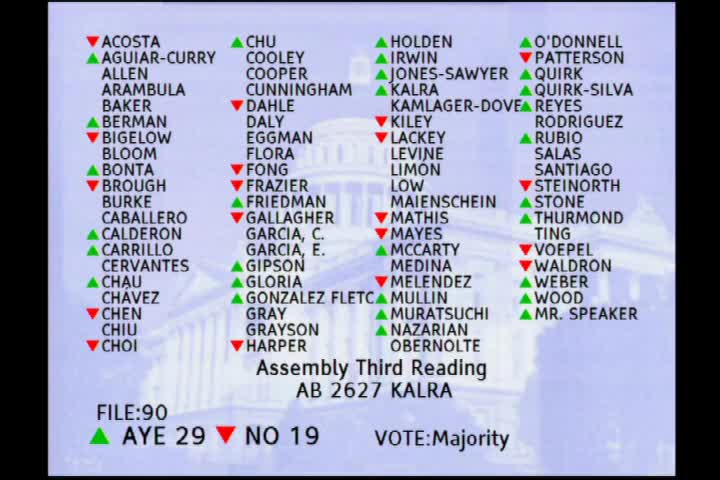
Bill Author

Bill Co-Author(s):




