AB 1945: California Global Warming Solutions Act of 2006: Greenhouse Gas Reduction Fund: investment plan.
- Session Year: 2017-2018
- House: Assembly
- Latest Version Date: 2018-09-04
The California Global Warming Solutions Act of 2006 establishes the State Air Resources Board as the state agency responsible for monitoring and regulating sources emitting greenhouse gases. The act authorizes the state board to include the use of market-based compliance mechanisms. Existing law requires all moneys, except for fines and penalties, collected by the state board from the auction or sale of allowances as part of a market-based compliance mechanism to be deposited in the Greenhouse Gas Reduction Fund and to be available upon appropriation by the Legislature. Existing law requires the Department of Finance, in consultation with the state board and any other relevant state agency, to develop, as specified, a 3-year investment plan for the moneys deposited in the Greenhouse Gas Reduction Fund. Existing law requires the moneys from the fund to be used to facilitate the achievement of reductions of greenhouse gas emissions consistent with the act and, among other things, to maximize economic, environmental, and public health benefits to the state.
This bill, beginning July 1, 2019, would require state agencies administering competitive grant programs that allocate moneys from the fund to give specified communities preferential points during grant application scoring for programs intended to improve air quality and to include a specified application timeline and to allow applicants from the Counties of Imperial and San Diego to include daytime population numbers in grant applications.
This bill, for competitive grant programs that involve housing, urban forestry, urban greening, or planning and that allocate moneys from the fund after July 1, 2019, would require state agencies administering those moneys from the fund to develop at least 3 categories for applications based on the population and density of where the proposed project is to be located and to develop scoring criteria for each category, as specified.
This bill would additionally require the moneys in the fund to be used to facilitate the achievement of reductions of greenhouse gas emissions consistent with the act and to increase water supply resilience; reduce or prevent increases in transportation, energy, or fuel costs, particularly in disadvantaged communities; accelerate the development and implementation of low-carbon technology; reduce vehicle miles traveled; promote zoning and development activities that increase public access to essential services or amenities; promote partnerships between multiple jurisdictions; promote climate change adaptation capacity; and improve community access to green space.
This bill also would require the Department of Finance to include in an annual report to the Legislature specified information on the applications received for each grant program allocating moneys from the fund.
The California Global Warming Solutions Act of 2006 establishes the State Air Resources Board as the state agency responsible for monitoring and regulating sources emitting greenhouse gases. The act authorizes the state board to include the use of market-based compliance mechanisms. Existing law requires all moneys, except for fines and penalties, collected by the state board from the auction or sale of allowances as part of a market-based compliance mechanism to be deposited in the Greenhouse Gas Reduction Fund and to be available upon appropriation by the Legislature. Existing law requires the Department of Finance, in consultation with the state board and any other relevant state agency, to develop, as specified, a 3-year investment plan for the moneys deposited in the Greenhouse Gas Reduction Fund. Existing law requires the moneys from the fund to be used to facilitate the achievement of reductions of greenhouse gas emissions consistent with the act and, among other things, to maximize economic, environmental, and public health benefits to the state.
This bill bill, beginning July 1, 2019, would require the state board to work with state agencies administering competitive grant programs that allocate moneys from the fund to give specified communities preferential points during grant application scoring for programs intended to improve air quality and to include a specified application timeline for programs with competitive application processes and to allow applicants from the Counties of Imperial and San Diego to include daytime population numbers in grant applications.
This bill, for competitive grant programs that involve housing, urban forestry, urban greening, or planning and that allocate moneys from the fund, fund after July 1, 2019, would require the state board state agencies administering those moneys from the fund to develop at least 3 categories for applications based on the population and density of where the proposed project is to be located and to develop scoring criteria for each category, as specified.
This bill would additionally require the moneys in the fund to be used to facilitate the achievement of reductions of greenhouse gas emissions consistent with the act and to increase water supply resilience; reduce or prevent increases in transportation, energy, or fuel costs, particularly in disadvantaged communities; accelerate the development and implementation of low-carbon technology; reduce vehicle miles traveled; promote zoning and development activities that increase public access to essential services or amenities; promote partnerships between multiple jurisdictions; promote climate change adaptation capacity; and improve community access to green space.
This bill also would require the Department of Finance to include in an annual report to the Legislature specified information on the applications received for each grant program allocating moneys from the fund.
The California Global Warming Solutions Act of 2006 establishes the State Air Resources Board as the state agency responsible for monitoring and regulating sources emitting greenhouse gases. The act authorizes the state board to include the use of market-based compliance mechanisms. Existing law requires all moneys, except for fines and penalties, collected by the state board from the auction or sale of allowances as part of a market-based compliance mechanism to be deposited in the Greenhouse Gas Reduction Fund and to be available upon appropriation by the Legislature. Existing law requires the Department of Finance, in consultation with the state board and any other relevant state agency, to develop, as specified, a 3-year investment plan for the moneys deposited in the Greenhouse Gas Reduction Fund. Existing law requires the moneys from the fund to be used to facilitate the achievement of reductions of greenhouse gas emissions consistent with the act and, among other things, to maximize economic, environmental, and public health benefits to the state.
This bill would require the state board to work with state agencies administering grant programs that allocate moneys from the fund to give specified communities preferential points during grant application scoring for programs intended to improve air quality and to include a specified application timeline for programs with competitive application processes and to allow applicants from the Counties of Imperial and San Diego to include daytime population numbers in grant applications.
This bill, for grant programs that allocate moneys from the fund, would require the state board to develop at least 3 categories for applications based on the population and density of where the proposed project is to be located and to develop scoring criteria for each category, as specified.
This bill would additionally require the moneys in the fund to be used to facilitate the achievement of reductions of greenhouse gas emissions consistent with the act and to increase water supply resilience; reduce or prevent increases in transportation, energy, or fuel costs, particularly in disadvantaged communities; accelerate the development and implementation of low-carbon technology; reduce vehicle miles traveled; promote zoning and development activities that increase public access to essential services or amenities; promote partnerships between multiple jurisdictions; promote climate change adaptation capacity; and improve community access to green space.
This bill also would require the Department of Finance to include in an annual report to the Legislature specified information on the applications received for each grant program allocating moneys from the fund.
The California Global Warming Solutions Act of 2006 establishes the State Air Resources Board as the state agency responsible for monitoring and regulating sources emitting greenhouse gases. The act authorizes the state board to include the use of market-based compliance mechanisms. Existing law requires all moneys, except for fines and penalties, collected by the state board from the auction or sale of allowances as part of a market-based compliance mechanism to be deposited in the Greenhouse Gas Reduction Fund and to be available upon appropriation by the Legislature. Existing law requires the Department of Finance, in consultation with the state board and any other relevant state agency, to develop, as specified, a 3-year investment plan for the moneys deposited in the Greenhouse Gas Reduction Fund. Existing law requires the moneys from the fund to be used to facilitate the achievement of reductions of greenhouse gas emissions consistent with the act and, among other things, to maximize economic, environmental, and public health benefits to the state.
This bill would require the state board to work with state agencies administering grant programs that allocate moneys from the Greenhouse Gas Reduction Fund fund to give specified communities preferential points during grant application scoring for programs intended to improve air quality, quality and to include a specified application timeline for programs with competitive application processes, processes and to allow applicants from the Counties of Imperial and San Diego to include daytime population numbers in grant applications, and to ensure applications to programs that involve housing, transportation, urban forestry, urban greening, or planning are scored based on the size and density of the jurisdiction where the project is based, as specified. applications.
This bill, for grant programs that allocate moneys from the fund, would require the state board to develop at least 3 categories for applications based on the population and density of where the proposed project is to be located and to develop scoring criteria for each category, as specified.
This bill would additionally require the moneys in the fund to be used to facilitate the achievement of reductions of greenhouse gas emissions consistent with the act and to increase water supply resilience; reduce or prevent increases in transportation, energy, or fuel costs, particularly in disadvantaged communities; accelerate the development and implementation of low-carbon technology; reduce vehicle miles traveled; promote zoning and development activities that increase public access to essential services or amenities; promote partnerships between multiple jurisdictions; promote climate change adaptation capacity; and improve community access to green space.
This bill also would require the Department of Finance to include in an annual report to the Legislature specified information on the applications received for each grant program allocating moneys from the Greenhouse Gas Reduction Fund. fund.
The California Global Warming Solutions Act of 2006 establishes the State Air Resources Board as the state agency responsible for monitoring and regulating sources emitting greenhouse gases. The act authorizes the state board to include the use of market-based compliance mechanisms. Existing law requires all moneys, except for fines and penalties, collected by the state board from the auction or sale of allowances as part of a market-based compliance mechanism to be deposited in the Greenhouse Gas Reduction Fund and to be available upon appropriation by the Legislature. Existing law requires the Department of Finance, in consultation with the state board and any other relevant state agency, to develop, as specified, a 3-year investment plan for the moneys deposited in the Greenhouse Gas Reduction Fund. Existing law requires the moneys from the fund to be used to facilitate the achievement of reductions of greenhouse gas emissions consistent with the act and, among other things, to maximize economic, environmental, and public health benefits to the state.
This bill would require the state board to work with state agencies administering grant programs that allocate moneys from the Greenhouse Gas Reduction Fund to give specified communities preferential points during grant application scoring for programs intended to improve air quality, to include a specified application timeline for programs with competitive application processes, and to allow applicants from the Counties of Imperial and San Diego to include daytime population numbers in grant applications. applications, and to ensure applications to programs that involve housing, transportation, urban forestry, urban greening, or planning are scored based on the size and density of the jurisdiction where the project is based, as specified.
This bill would additionally require the moneys in the fund to be used to facilitate the achievement of reductions of greenhouse gas emissions consistent with the act and to increase water supply resilience; reduce or prevent increases in transportation, energy, or fuel costs, particularly in disadvantaged communities; accelerate the development and implementation of low-carbon technology; reduce vehicle miles traveled; promote zoning and development activities that increase public access to essential services or amenities; promote partnerships between multiple jurisdictions; promote climate change adaptation capacity; and improve community access to green space.
This bill also would require the Department of Finance to include in an annual report to the Legislature specified information on the applications received for each grant program allocating moneys from the Greenhouse Gas Reduction Fund.
The California Global Warming Solutions Act of 2006 establishes the State Air Resources Board as the state agency responsible for monitoring and regulating sources emitting greenhouse gases. The act authorizes the state board to include the use of market-based compliance mechanisms. Existing law requires all moneys, except for fines and penalties, collected by the state board from the auction or sale of allowances as part of a market-based compliance mechanism to be deposited in the Greenhouse Gas Reduction Fund and to be available upon appropriation by the Legislature. Existing law requires the Department of Finance, in consultation with the state board and any other relevant state agency, to develop, as specified, a 3-year investment plan for the moneys deposited in the Greenhouse Gas Reduction Fund. Existing law requires the moneys from the fund to be used to facilitate the achievement of reductions of greenhouse gas emissions consistent with the act and, among other things, to maximize economic, environmental, and public health benefits to the state.
This bill would require the state board to work with state agencies administering grant programs that allocate moneys from the Greenhouse Gas Reduction Fund to give specified communities preferential points during grant application scoring, scoring for programs intended to improve air quality, to include a specified application timeline for programs with competitive application processes, and to allow applicants from the Counties of Imperial and San Diego to include daytime population numbers in grant applications.
This bill would additionally require the moneys in the fund to be used to facilitate the achievement of reductions of greenhouse gas emissions consistent with the act and to increase water supply resilience; reduce or prevent increases in transportation, energy, or fuel costs, particularly in disadvantaged communities; accelerate the development and implementation of low-carbon technology; reduce vehicle miles traveled; promote zoning and development activities that increase public access to essential services or amenities; promote partnerships between multiple jurisdictions; promote climate change adaptation capacity; and improve community access to green space.
This bill also would require the Department of Finance to include in an annual report to the Legislature specified information on the applications received for each grant program allocating moneys from the Greenhouse Gas Reduction Fund.
The California Global Warming Solutions Act of 2006 establishes the State Air Resources Board as the state agency responsible for monitoring and regulating sources emitting greenhouse gases. The act authorizes the state board to include the use of market-based compliance mechanisms. Existing law requires all moneys, except for fines and penalties, collected by the state board from the auction or sale of allowances as part of a market-based compliance mechanism to be deposited in the Greenhouse Gas Reduction Fund and to be available upon appropriation by the Legislature. Existing law requires the Department of Finance, in consultation with the state board and any other relevant state agency, to develop, as specified, a 3-year investment plan for the moneys deposited in the Greenhouse Gas Reduction Fund. Existing law requires the moneys from the fund to be used to facilitate the achievement of reductions of greenhouse gas emissions consistent with the act and, among other things, to maximize economic, environmental, and public health benefits to the state.
This bill would require the state board to work with state agencies administering grant programs that allocate moneys from the Greenhouse Gas Reduction Fund to add specified cobenefits, to give specified communities preferential points during grant application scoring, to include a specified application timeline for programs with competitive application processes, and to allow applicants from the Counties of Imperial and San Diego to include daytime population numbers in grant applications.
This bill would additionally require the moneys in the fund to be used to facilitate the achievement of reductions of greenhouse gas emissions consistent with the act and to increase water supply resilience; reduce or prevent increases in transportation, energy, or fuel costs, particularly in disadvantaged communities; accelerate the development and implementation of low-carbon technology; reduce vehicle miles traveled; promote zoning and development activities that increase public access to essential services or amenities; promote partnerships between multiple jurisdictions; promote climate change adaptation capacity; and improve community access to green space.
This bill also would require the Department of Finance to include in the 3-year investment plan an annual report to the Legislature specified information on the applications received for each grant program allocating moneys from the Greenhouse Gas Reduction Fund.
The California Global Warming Solutions Act of 2006 establishes the State Air Resources Board as the state agency responsible for monitoring and regulating sources emitting greenhouse gases. The act authorizes the state board to include the use of market-based compliance mechanisms. Existing law requires all moneys, except for fines and penalties, collected by the state board from the auction or sale of allowances as part of a market-based compliance mechanism to be deposited in the Greenhouse Gas Reduction Fund and to be available upon appropriation by the Legislature. Existing law requires the Department of Finance, in consultation with the state board and any other relevant state agency, to develop, as specified, a 3-year investment plan for the moneys deposited in the Greenhouse Gas Reduction Fund.
This bill would make a nonsubstantive change to that provision.This bill would require the state board to work with state agencies administering grant programs that allocate moneys from the Greenhouse Gas Reduction Fund to add specified cobenefits, to give specified communities preferential points during grant application scoring, and to allow applicants from the Counties of Imperial and San Diego to include daytime population numbers in grant applications.
This bill also would require the Department of Finance to include in the 3-year investment plan specified information on the applications received for each grant program allocating moneys from the Greenhouse Gas Reduction Fund.
The California Global Warming Solutions Act of 2006 establishes the State Air Resources Board as the state agency responsible for monitoring and regulating sources emitting greenhouse gases. The act authorizes the state board to include the use of market-based compliance mechanisms. Existing law requires all moneys, except for fines and penalties, collected by the state board from the auction or sale of allowances as part of a market-based compliance mechanism to be deposited in the Greenhouse Gas Reduction Fund and to be available upon appropriation by the Legislature. Existing law requires the Department of Finance, in consultation with the state board and any other relevant state agency, to develop, as specified, a 3-year investment plan for the moneys deposited in the Greenhouse Gas Reduction Fund.
This bill would make a nonsubstantive change to that provision.
The Legislature finds and declares all of the following:
(a)It is important for the state to prioritize climate investments in areas of most need, or where there is the most opportunity for cobenefits, and to continuously learn and evaluate the states spending to ensure it is reaching the intended targets.
(b)Specifically for the California-Mexico border region, where an average of more than 197,000 individuals cross into the Counties of Imperial and San Diego each day and air pollution from Mexico poses significant threats to public health, there need to be special adjustments to ensure that the region can achieve its emission reduction goals.
SEC. 2.Section 16428.87 is added to the Government Code, to read:16428.87.Beginning July 1, 2019, state agencies administering competitive grant programs that allocate moneys from the Greenhouse Gas Reduction Fund to ensure all of the following:
(a)Communities identified for community emission reduction programs pursuant to Section 44391.2 of the Health and Safety Code are given preferential points during grant application scoring for grant programs intended to improve air quality.
(b)There are at least three months between the first call for applications or proposals for projects to be funded and the due date of the proposal.
(c)(1)Applicants from the Counties of Imperial and San Diego are allowed to include daytime population numbers in grant applications.
(2)Daytime population estimates shall be based on the best available estimates of daily northbound border crossings and shall not include residents of the state.
SEC. 3.Section 16428.88 is added to the Government Code, to read:16428.88.(a)(1)For competitive grant programs that involve housing, urban forestry, urban greening, or planning and that allocate moneys from the Greenhouse Gas Reduction Fund after July 1, 2019, state agencies administering those moneys Board shall develop at least three categories for applications based on the population and density of where the proposed project is to be located.
(2)In developing the categories pursuant to this subdivision, the administering state agencies shall develop scoring criteria for each category. The scoring criteria shall take into account the possible impacts a project will have based on the population and density of the communities in which that project is proposed to be located.
(b)Nothing in this section shall be interpreted as requiring a state agency administering a grant program receiving moneys from the Greenhouse Gas Reduction Fund to fund grant applications from all of the categories described in subdivision (a).
(c)It is the intent of the Legislature in enacting this section that a state agency administering a grant program receiving moneys from the Greenhouse Gas Reduction Fund take into account the differences that exist between urban, suburban, and rural communities when reviewing applications for projects in order to ensure that all communities in the state have a reasonable chance of being awarded a grant.
SEC. 4.Section 39712 of the Health and Safety Code is amended to read:39712.(a)(1)It is the intent of the Legislature that moneys shall be appropriated from the fund only in a manner consistent with the requirements of this chapter and Article 9.7 (commencing with Section 16428.8) of Chapter 2 of Part 2 of Division 4 of Title 2 of the Government Code.
(2)The state shall not approve allocations for a measure or program using moneys appropriated from the fund except after determining, based on the available evidence, that the use of those moneys furthers the regulatory purposes of the California Global Warming Solutions Act of 2006 (Division 25.5 (commencing with Section 38500)) and is consistent with law. If any expenditure of moneys from the fund for any measure or project is determined by a court to be inconsistent with law, the allocations for the remaining measures or projects shall be severable and shall not be affected.
(b)Moneys shall be used to facilitate the achievement of reductions of greenhouse gas emissions in this state consistent with the California Global Warming Solutions Act of 2006 (Division 25.5 (commencing with Section 38500)) and, where applicable and to the extent feasible:
(1)Maximize economic, environmental, and public health benefits to the state.
(2)Foster job creation by promoting in-state greenhouse gas emissions reduction projects carried out by California workers and businesses.
(3)Complement efforts to improve air quality.
(4)Direct investment toward the most disadvantaged communities and households in the state.
(5)Provide opportunities for businesses, public agencies, Native American tribes in the state, nonprofits, and other community institutions to participate in and benefit from statewide efforts to reduce greenhouse gas emissions.
(6)Lessen the impacts and effects of climate change on the states communities, economy, and environment.
(7)Increase water supply resilience.
(8)Reduce or prevent increases in transportation, energy, or fuel costs, particularly in disadvantaged communities, as identified pursuant to Section 39711.
(9)Accelerate the development and implementation of low-carbon technology.
(10)Reduce vehicle miles traveled.
(11)Promote zoning and development activities that increase public access to essential services or amenities.
(12)Promote partnerships between multiple jurisdictions.
(13)Promote climate change adaptation capacity, including, but not limited to, efforts that address any of the following:
(A)Higher average temperatures.
(B)Decreased air and water quality.
(C)The spread of infectious and vector-borne diseases or other public health impacts.
(D)Extreme weather events.
(E)Sea level rise.
(F)Flooding.
(G)Heat waves.
(H)Wildfires.
(I)Drought.
(14)Improve community access to green space.
(c)Moneys appropriated from the fund may be allocated, consistent with subdivision (a), for the purpose of reducing greenhouse gas emissions in this state through investments that may include, but are not limited to, any of the following:
(1)Funding to reduce greenhouse gas emissions through energy efficiency, clean and renewable energy generation, distributed renewable energy generation, transmission and storage, and other related actions, including, but not limited to, at public universities, state and local public buildings, and industrial and manufacturing facilities.
(2)Funding to reduce greenhouse gas emissions through the development of stateoftheart systems to move goods and freight, advanced technology vehicles and vehicle infrastructure, advanced biofuels, and lowcarbon and efficient public transportation.
(3)Funding to reduce greenhouse gas emissions associated with water use and supply, land and natural resource conservation and management, forestry, and sustainable agriculture.
(4)Funding to reduce greenhouse gas emissions through strategic planning and development of sustainable infrastructure projects, including, but not limited to, transportation and housing.
(5)Funding to reduce greenhouse gas emissions through increased in-state diversion of municipal solid waste from disposal through waste reduction, diversion, and reuse.
(6)Funding to reduce greenhouse gas emissions through investments in programs implemented by local and regional agencies, local and regional collaboratives, Native American tribes in the state, and nonprofit organizations coordinating with local governments.
(7)Funding research, development, and deployment of innovative technologies, measures, and practices related to programs and projects funded pursuant to this chapter.
SEC. 5.Section 39720 of the Health and Safety Code is amended to read:39720.(a)Notwithstanding Section 10231.5 of the Government Code, the Department of Finance shall submit an annual report on or before March 1 of each year to the appropriate committees of the Legislature on all of the following:
(1)The status of projects funded pursuant to this part and their outcomes.
(2)The applications received for each grant program allocating moneys from the fund, including, but not limited to, all of the following information:
(A)Locations of projects proposed.
(B)Amount of moneys requested for each project.
(C)Names of lead applicants.
(D)Whether the projects were funded in whole or in part with moneys from the fund.
(b)A report submitted pursuant to subdivision (a) shall be submitted in compliance with Section 9795 of the Government Code.
The Legislature finds and declares all of the following:
(a)It is important for the state to prioritize climate investments in areas of most need, or where there is the most opportunity for cobenefits, and to continuously learn and evaluate the states spending to ensure it is reaching the intended targets.
(b)Specifically for the California-Mexico border region, where an average of more than 197,000 individuals cross into the Counties of Imperial and San Diego each day and air pollution from Mexico poses significant threats to public health, there need to be special adjustments to ensure that the region can achieve its emission reduction goals.
SEC. 2.Section 16428.87 is added to the Government Code, to read:16428.87.The State Air Resources Board shall work with Beginning July 1, 2019, state agencies administering competitive grant programs that allocate moneys from the Greenhouse Gas Reduction Fund to ensure all of the following:
(a)Communities identified for community emission reduction programs pursuant to Section 44391.2 of the Health and Safety Code are given preferential points during grant application scoring for grant programs intended to improve air quality.
(b)There are at least three months between the first call for applications or proposals for projects to be funded and the due date of the proposal for programs with competitive application processes. proposal.
(c)(1)Applicants from the Counties of Imperial and San Diego are allowed to include daytime population numbers in grant applications.
(2)Daytime population estimates shall be based on the best available estimates of daily northbound border crossings and shall not include residents of the state.
SEC. 3.Section 16428.88 is added to the Government Code, to read:16428.88.(a)(1)For competitive grant programs that involve housing, urban forestry, urban greening, or planning and that allocate moneys from the Greenhouse Gas Reduction Fund, the State Air Resources Fund after July 1, 2019, state agencies administering those moneys Board shall develop at least three categories for applications based on the population and density of where the proposed project is to be located.
(2)In developing the categories pursuant to this subdivision, the State Air Resources Board administering state agencies shall develop scoring criteria for each category. The scoring criteria shall take into account the possible impacts a project will have based on the population and density of the communities in which that project is proposed to be located.
(b)Nothing in this section shall be interpreted as requiring the State Air Resources Board or an a state agency administering a grant program receiving moneys from the Greenhouse Gas Reduction Fund to fund grant applications from all of the categories described in subdivision (a).
(c)It is the intent of the Legislature in enacting this section that the State Air Resources Board and an a state agency administering a grant program receiving moneys from the Greenhouse Gas Reduction Fund take into account the differences that exist between urban, suburban, and rural communities when reviewing applications for projects in order to ensure that all communities in the state have a reasonable chance of being awarded a grant.
SEC. 4.Section 39712 of the Health and Safety Code is amended to read:39712.(a)(1)It is the intent of the Legislature that moneys shall be appropriated from the fund only in a manner consistent with the requirements of this chapter and Article 9.7 (commencing with Section 16428.8) of Chapter 2 of Part 2 of Division 4 of Title 2 of the Government Code.
(2)The state shall not approve allocations for a measure or program using moneys appropriated from the fund except after determining, based on the available evidence, that the use of those moneys furthers the regulatory purposes of the California Global Warming Solutions Act of 2006 (Division 25.5 (commencing with Section 38500)) and is consistent with law. If any expenditure of moneys from the fund for any measure or project is determined by a court to be inconsistent with law, the allocations for the remaining measures or projects shall be severable and shall not be affected.
(b)Moneys shall be used to facilitate the achievement of reductions of greenhouse gas emissions in this state consistent with the California Global Warming Solutions Act of 2006 (Division 25.5 (commencing with Section 38500)) and, where applicable and to the extent feasible:
(1)Maximize economic, environmental, and public health benefits to the state.
(2)Foster job creation by promoting in-state greenhouse gas emissions reduction projects carried out by California workers and businesses.
(3)Complement efforts to improve air quality.
(4)Direct investment toward the most disadvantaged communities and households in the state.
(5)Provide opportunities for businesses, public agencies, Native American tribes in the state, nonprofits, and other community institutions to participate in and benefit from statewide efforts to reduce greenhouse gas emissions.
(6)Lessen the impacts and effects of climate change on the states communities, economy, and environment.
(7)Increase water supply resilience.
(8)Reduce or prevent increases in transportation, energy, or fuel costs, particularly in disadvantaged communities, as identified pursuant to Section 39711.
(9)Accelerate the development and implementation of low-carbon technology.
(10)Reduce vehicle miles traveled.
(11)Promote zoning and development activities that increase public access to essential services or amenities.
(12)Promote partnerships between multiple jurisdictions.
(13)Promote climate change adaptation capacity, including, but not limited to, efforts that address any of the following:
(A)Higher average temperatures.
(B)Decreased air and water quality.
(C)The spread of infectious and vector-borne diseases or other public health impacts.
(D)Extreme weather events.
(E)Sea level rise.
(F)Flooding.
(G)Heat waves.
(H)Wildfires.
(I)Drought.
(14)Improve community access to green space.
(c)Moneys appropriated from the fund may be allocated, consistent with subdivision (a), for the purpose of reducing greenhouse gas emissions in this state through investments that may include, but are not limited to, any of the following:
(1)Funding to reduce greenhouse gas emissions through energy efficiency, clean and renewable energy generation, distributed renewable energy generation, transmission and storage, and other related actions, including, but not limited to, at public universities, state and local public buildings, and industrial and manufacturing facilities.
(2)Funding to reduce greenhouse gas emissions through the development of stateoftheart systems to move goods and freight, advanced technology vehicles and vehicle infrastructure, advanced biofuels, and lowcarbon and efficient public transportation.
(3)Funding to reduce greenhouse gas emissions associated with water use and supply, land and natural resource conservation and management, forestry, and sustainable agriculture.
(4)Funding to reduce greenhouse gas emissions through strategic planning and development of sustainable infrastructure projects, including, but not limited to, transportation and housing.
(5)Funding to reduce greenhouse gas emissions through increased in-state diversion of municipal solid waste from disposal through waste reduction, diversion, and reuse.
(6)Funding to reduce greenhouse gas emissions through investments in programs implemented by local and regional agencies, local and regional collaboratives, Native American tribes in the state, and nonprofit organizations coordinating with local governments.
(7)Funding research, development, and deployment of innovative technologies, measures, and practices related to programs and projects funded pursuant to this chapter.
SEC. 5.Section 39720 of the Health and Safety Code is amended to read:39720.(a)Notwithstanding Section 10231.5 of the Government Code, the Department of Finance shall submit an annual report on or before March 1 of each year to the appropriate committees of the Legislature on all of the following:
(1)The status of projects funded pursuant to this part and their outcomes.
(2)The applications received for each grant program allocating moneys from the fund, including, but not limited to, all of the following information:
(A)Locations of projects proposed.
(B)Amount of moneys requested for each project.
(C)Names of lead applicants.
(D)Whether the projects were funded in whole or in part with moneys from the fund.
(b)A report submitted pursuant to subdivision (a) shall be submitted in compliance with Section 9795 of the Government Code.
The Legislature finds and declares all of the following:
(a)It is important for the state to prioritize climate investments in areas of most need, or where there is the most opportunity for cobenefits, and to continuously learn and evaluate the states spending to ensure it is reaching the intended targets.
(b)Specifically for the California-Mexico border region, where an average of more than 197,000 individuals cross into the Counties of Imperial and San Diego each day and air pollution from Mexico poses significant threats to public health, there need to be special adjustments to ensure that the region can achieve its emission reduction goals.
SEC. 2.Section 16428.87 is added to the Government Code, to read:16428.87.The State Air Resources Board shall work with state agencies administering grant programs that allocate moneys from the Greenhouse Gas Reduction Fund to ensure both all of the following:
(a)Communities identified for community emission reduction programs pursuant to Section 44391.2 of the Health and Safety Code are given preferential points during grant application scoring for grant programs intended to improve air quality.
(b)There are at least three months between the first call for applications or proposals for projects to be funded and the due date of the proposal for programs with competitive application processes.
(c)(1)Applicants from the Counties of Imperial and San Diego are allowed to include daytime population numbers in grant applications.
(2)Daytime population estimates shall be based on the best available estimates of daily northbound border crossings and shall not include residents of the state.
SEC. 3.Section 16428.88 is added to the Government Code, to read:16428.88.(a)(1)For grant programs that allocate moneys from the Greenhouse Gas Reduction Fund, the State Air Resources Board shall develop at least three categories for applications based on the population and density of where the proposed project is to be located.
(2)In developing the categories pursuant to this subdivision, the State Air Resources Board shall develop scoring criteria for each category. The scoring criteria shall take into account the possible impacts a project will have based on the population and density of the communities in which that project is proposed to be located.
(b)Nothing in this section shall be interpreted as requiring the State Air Resources Board or an agency administering a grant program receiving moneys from the Greenhouse Gas Reduction Fund to fund grant applications from all of the categories described in subdivision (a).
(c)It is the intent of the Legislature in enacting this section that the State Air Resources Board and an agency administering a grant program receiving moneys from the Greenhouse Gas Reduction Fund take into account the differences that exist between urban, suburban, and rural communities when reviewing applications for projects in order to ensure that all communities in the state have a reasonable chance of being awarded a grant.
SEC. 4.Section 39712 of the Health and Safety Code is amended to read:39712.(a)(1)It is the intent of the Legislature that moneys shall be appropriated from the fund only in a manner consistent with the requirements of this chapter and Article 9.7 (commencing with Section 16428.8) of Chapter 2 of Part 2 of Division 4 of Title 2 of the Government Code.
(2)The state shall not approve allocations for a measure or program using moneys appropriated from the fund except after determining, based on the available evidence, that the use of those moneys furthers the regulatory purposes of the California Global Warming Solutions Act of 2006 (Division 25.5 (commencing with Section 38500)) and is consistent with law. If any expenditure of moneys from the fund for any measure or project is determined by a court to be inconsistent with law, the allocations for the remaining measures or projects shall be severable and shall not be affected.
(b)Moneys shall be used to facilitate the achievement of reductions of greenhouse gas emissions in this state consistent with the California Global Warming Solutions Act of 2006 (Division 25.5 (commencing with Section 38500)) and, where applicable and to the extent feasible:
(1)Maximize economic, environmental, and public health benefits to the state.
(2)Foster job creation by promoting in-state greenhouse gas emissions reduction projects carried out by California workers and businesses.
(3)Complement efforts to improve air quality.
(4)Direct investment toward the most disadvantaged communities and households in the state.
(5)Provide opportunities for businesses, public agencies, Native American tribes in the state, nonprofits, and other community institutions to participate in and benefit from statewide efforts to reduce greenhouse gas emissions.
(6)Lessen the impacts and effects of climate change on the states communities, economy, and environment.
(7)Increase water supply resilience.
(8)Reduce or prevent increases in transportation, energy, or fuel costs, particularly in disadvantaged communities, as identified pursuant to Section 39711.
(9)Accelerate the development and implementation of low-carbon technology.
(10)Reduce vehicle miles traveled.
(11)Promote zoning and development activities that increase public access to essential services or amenities.
(12)Promote partnerships between multiple jurisdictions.
(13)Promote climate change adaptation capacity, including, but not limited to, efforts that address any of the following:
(A)Higher average temperatures.
(B)Decreased air and water quality.
(C)The spread of infectious and vector-borne diseases or other public health impacts.
(D)Extreme weather events.
(E)Sea level rise.
(F)Flooding.
(G)Heat waves.
(H)Wildfires.
(I)Drought.
(14)Improve community access to green space.
(c)Moneys appropriated from the fund may be allocated, consistent with subdivision (a), for the purpose of reducing greenhouse gas emissions in this state through investments that may include, but are not limited to, any of the following:
(1)Funding to reduce greenhouse gas emissions through energy efficiency, clean and renewable energy generation, distributed renewable energy generation, transmission and storage, and other related actions, including, but not limited to, at public universities, state and local public buildings, and industrial and manufacturing facilities.
(2)Funding to reduce greenhouse gas emissions through the development of stateoftheart systems to move goods and freight, advanced technology vehicles and vehicle infrastructure, advanced biofuels, and lowcarbon and efficient public transportation.
(3)Funding to reduce greenhouse gas emissions associated with water use and supply, land and natural resource conservation and management, forestry, and sustainable agriculture.
(4)Funding to reduce greenhouse gas emissions through strategic planning and development of sustainable infrastructure projects, including, but not limited to, transportation and housing.
(5)Funding to reduce greenhouse gas emissions through increased in-state diversion of municipal solid waste from disposal through waste reduction, diversion, and reuse.
(6)Funding to reduce greenhouse gas emissions through investments in programs implemented by local and regional agencies, local and regional collaboratives, Native American tribes in the state, and nonprofit organizations coordinating with local governments.
(7)Funding research, development, and deployment of innovative technologies, measures, and practices related to programs and projects funded pursuant to this chapter.
SEC. 5.Section 39720 of the Health and Safety Code is amended to read:39720.(a)Notwithstanding Section 10231.5 of the Government Code, the Department of Finance shall submit an annual report on or before March 1 of each year to the appropriate committees of the Legislature on all of the following:
(1)The status of projects funded pursuant to this part and their outcomes.
(2)The applications received for each grant program allocating moneys from the fund, including, but not limited to, all of the following information:
(A)Locations of projects proposed.
(B)Amount of moneys requested for each project.
(C)Names of lead applicants.
(D)Whether the projects were funded in whole or in part with moneys from the fund.
(b)A report submitted pursuant to subdivision (a) shall be submitted in compliance with Section 9795 of the Government Code.
The Legislature finds and declares all of the following:
(a)It is important for the state to prioritize climate investments in areas of most need, or where there is the most opportunity for cobenefits, and to continuously learn and evaluate the states spending to ensure it is reaching the intended targets.
(b)Specifically for the California-Mexico border region, where an average of more than 197,000 individuals cross into the Counties of Imperial and San Diego each day and air pollution from Mexico poses significant threats to public health, there need to be special adjustments to ensure that the region can achieve its emission reduction goals.
SEC. 2.Section 16428.87 is added to the Government Code, to read:16428.87.The State Air Resources Board shall work with state agencies administering grant programs that allocate moneys from the Greenhouse Gas Reduction Fund to ensure all both of the following:
(a)Communities identified for community emission reduction programs pursuant to Section 44391.2 of the Health and Safety Code are given preferential points during grant application scoring for grant programs intended to improve air quality.
(b)There are at least three months between the first call for applications or proposals for projects to be funded and the due date of the proposal for programs with competitive application processes.
(c)(1)Applicants from the Counties of Imperial and San Diego are allowed to include daytime population numbers in grant applications.
(2)Daytime population estimates shall be based on the best available estimates of daily northbound border crossings and shall not include residents of the state.
(d)Applications to programs that involve housing, transportation, urban forestry, urban greening, or planning are scored based on the size and density of the jurisdiction where the project is based in addition to the metrics established pursuant to paragraph (2).(1)An administering agency shall create at least three tiers for project applications according to the following:(A)Tier 1 shall grade projects that are to be located in jurisdictions with more than 4,000 people per square mile or with 450,000 or more people.(B)Tier 2 shall grade projects that are to be located in jurisdictions with 4,000 people or less per square mile, but no less than 300 people per square mile, and with less than 450,000 people. Tier 2 shall not include a rural area as defined in Section 50101 of the Health and Safety Code.(C)Tier 3 shall grade projects that are to be located in jurisdictions with less than 300 people per square mile or in a rural area as defined in Section 50101 of the Health and Safety Code.(2)An administering agency shall establish application scoring metrics for each tier listed in paragraph (1) based on relevant best practices in jurisdictions that fall within that tier.SEC. 3.Section 16428.88 is added to the Government Code, to read:16428.88.(a)(1)For grant programs that allocate moneys from the Greenhouse Gas Reduction Fund, the State Air Resources Board shall develop at least three categories for applications based on the population and density of where the proposed project is to be located.
(2)In developing the categories pursuant to this subdivision, the State Air Resources Board shall develop scoring criteria for each category. The scoring criteria shall take into account the possible impacts a project will have based on the population and density of the communities in which that project is proposed to be located.
(b)Nothing in this section shall be interpreted as requiring the State Air Resources Board or an agency administering a grant program receiving moneys from the Greenhouse Gas Reduction Fund to fund grant applications from all of the categories described in subdivision (a).
(c)It is the intent of the Legislature in enacting this section that the State Air Resources Board and an agency administering a grant program receiving moneys from the Greenhouse Gas Reduction Fund take into account the differences that exist between urban, suburban, and rural communities when reviewing applications for projects in order to ensure that all communities in the state have a reasonable chance of being awarded a grant.
SEC. 3.SEC. 4.Section 39712 of the Health and Safety Code is amended to read:39712.(a)(1)It is the intent of the Legislature that moneys shall be appropriated from the fund only in a manner consistent with the requirements of this chapter and Article 9.7 (commencing with Section 16428.8) of Chapter 2 of Part 2 of Division 4 of Title 2 of the Government Code.
(2)The state shall not approve allocations for a measure or program using moneys appropriated from the fund except after determining, based on the available evidence, that the use of those moneys furthers the regulatory purposes of the California Global Warming Solutions Act of 2006 (Division 25.5 (commencing with Section 38500)) and is consistent with law. If any expenditure of moneys from the fund for any measure or project is determined by a court to be inconsistent with law, the allocations for the remaining measures or projects shall be severable and shall not be affected.
(b)Moneys shall be used to facilitate the achievement of reductions of greenhouse gas emissions in this state consistent with the California Global Warming Solutions Act of 2006 (Division 25.5 (commencing with Section 38500)) and, where applicable and to the extent feasible:
(1)Maximize economic, environmental, and public health benefits to the state.
(2)Foster job creation by promoting in-state greenhouse gas emissions reduction projects carried out by California workers and businesses.
(3)Complement efforts to improve air quality.
(4)Direct investment toward the most disadvantaged communities and households in the state.
(5)Provide opportunities for businesses, public agencies, Native American tribes in the state, nonprofits, and other community institutions to participate in and benefit from statewide efforts to reduce greenhouse gas emissions.
(6)Lessen the impacts and effects of climate change on the states communities, economy, and environment.
(7)Increase water supply resilience.
(8)Reduce or prevent increases in transportation, energy, or fuel costs, particularly in disadvantaged communities, as identified pursuant to Section 39711.
(9)Accelerate the development and implementation of low-carbon technology.
(10)Reduce vehicle miles traveled.
(11)Promote zoning and development activities that increase public access to essential services or amenities.
(12)Promote partnerships between multiple jurisdictions.
(13)Promote climate change adaptation capacity. capacity, including, but not limited to, efforts that address any of the following:
(A)Higher average temperatures.
(B)Decreased air and water quality.
(C)The spread of infectious and vector-borne diseases or other public health impacts.
(D)Extreme weather events.
(E)Sea level rise.
(F)Flooding.
(G)Heat waves.
(H)Wildfires.
(I)Drought.
(14)Improve community access to green space.
(c)Moneys appropriated from the fund may be allocated, consistent with subdivision (a), for the purpose of reducing greenhouse gas emissions in this state through investments that may include, but are not limited to, any of the following:
(1)Funding to reduce greenhouse gas emissions through energy efficiency, clean and renewable energy generation, distributed renewable energy generation, transmission and storage, and other related actions, including, but not limited to, at public universities, state and local public buildings, and industrial and manufacturing facilities.
(2)Funding to reduce greenhouse gas emissions through the development of stateoftheart systems to move goods and freight, advanced technology vehicles and vehicle infrastructure, advanced biofuels, and lowcarbon and efficient public transportation.
(3)Funding to reduce greenhouse gas emissions associated with water use and supply, land and natural resource conservation and management, forestry, and sustainable agriculture.
(4)Funding to reduce greenhouse gas emissions through strategic planning and development of sustainable infrastructure projects, including, but not limited to, transportation and housing.
(5)Funding to reduce greenhouse gas emissions through increased in-state diversion of municipal solid waste from disposal through waste reduction, diversion, and reuse.
(6)Funding to reduce greenhouse gas emissions through investments in programs implemented by local and regional agencies, local and regional collaboratives, Native American tribes in the state, and nonprofit organizations coordinating with local governments.
(7)Funding research, development, and deployment of innovative technologies, measures, and practices related to programs and projects funded pursuant to this chapter.
SEC. 4.SEC. 5.Section 39720 of the Health and Safety Code is amended to read:39720.(a)Notwithstanding Section 10231.5 of the Government Code, the Department of Finance shall submit an annual report to the appropriate committees of the Legislature on all of the following:
(1)The status of projects funded pursuant to this part and their outcomes.
(2)The applications received for each grant program allocating moneys from the fund, including, but not limited to, all of the following information:
(A)Locations of projects proposed.
(B)Amount of moneys requested for each project.
(C)Names of lead applicants.
(D)Whether the projects were funded in whole or in part with moneys from the fund.
(b)A report submitted pursuant to subdivision (a) shall be submitted in compliance with Section 9795 of the Government Code.
The Legislature finds and declares all of the following:
(a)It is important for the state to prioritize climate investments in areas of most need, or where there is the most opportunity for cobenefits, and to continuously learn and evaluate the states spending to ensure it is reaching the intended targets.
(b)Specifically for the California-Mexico border region, where an average of more than 197,000 individuals cross into the Counties of Imperial and San Diego each day and air pollution from Mexico poses significant threats to public health, there need to be special adjustments to ensure that the region can achieve its emission reduction goals.
SEC. 2.Section 16428.87 is added to the Government Code, to read:16428.87.The State Air Resources Board shall work with state agencies administering grant programs that allocate moneys from the Greenhouse Gas Reduction Fund to ensure all of the following:
(a)Communities identified for community emission reduction programs pursuant to Section 44391.2 of the Health and Safety Code are given preferential points during grant application scoring for grant programs intended to improve air quality.
(b)There are at least three months between the first call for applications or proposals for projects to be funded and the due date of the proposal, proposal for programs with competitive application processes.
(c)(1)Applicants from the Counties of Imperial and San Diego are allowed to include daytime population numbers in grant applications.
(2)Daytime population estimates shall be based on the best available estimates of daily northbound border crossings and shall not include residents of the state.
(d)Applications to programs that involve housing, transportation, urban forestry, urban greening, or planning are scored based on the size and density of the jurisdiction where the project is based in addition to the metrics established pursuant to paragraph (2).
(1)An administering agency shall create at least three tiers for project applications according to the following:
(A)Tier 1 shall grade projects that are to be located in jurisdictions with more than 4,000 people per square mile or with 450,000 or more people.
(B)Tier 2 shall grade projects that are to be located in jurisdictions with 4,000 people or less per square mile, but no less than 300 people per square mile, and with less than 450,000 people. Tier 2 shall not include a rural area as defined in Section 50101 of the Health and Safety Code.
(C)Tier 3 shall grade projects that are to be located in jurisdictions with less than 300 people per square mile or in a rural area as defined in Section 50101 of the Health and Safety Code.
(2)An administering agency shall establish application scoring metrics for each tier listed in paragraph (1) based on relevant best practices in jurisdictions that fall within that tier.
SEC. 3.Section 39712 of the Health and Safety Code is amended to read:39712.(a)(1)It is the intent of the Legislature that moneys shall be appropriated from the fund only in a manner consistent with the requirements of this chapter and Article 9.7 (commencing with Section 16428.8) of Chapter 2 of Part 2 of Division 4 of Title 2 of the Government Code.
(2)The state shall not approve allocations for a measure or program using moneys appropriated from the fund except after determining, based on the available evidence, that the use of those moneys furthers the regulatory purposes of the California Global Warming Solutions Act of 2006 (Division 25.5 (commencing with Section 38500)) and is consistent with law. If any expenditure of moneys from the fund for any measure or project is determined by a court to be inconsistent with law, the allocations for the remaining measures or projects shall be severable and shall not be affected.
(b)Moneys shall be used to facilitate the achievement of reductions of greenhouse gas emissions in this state consistent with the California Global Warming Solutions Act of 2006 (Division 25.5 (commencing with Section 38500)) and, where applicable and to the extent feasible:
(1)Maximize economic, environmental, and public health benefits to the state.
(2)Foster job creation by promoting in-state greenhouse gas emissions reduction projects carried out by California workers and businesses.
(3)Complement efforts to improve air quality.
(4)Direct investment toward the most disadvantaged communities and households in the state.
(5)Provide opportunities for businesses, public agencies, Native American tribes in the state, nonprofits, and other community institutions to participate in and benefit from statewide efforts to reduce greenhouse gas emissions.
(6)Lessen the impacts and effects of climate change on the states communities, economy, and environment.
(7)Increase water supply resilience.
(8)Reduce or prevent increases in transportation, energy, or fuel costs, particularly in disadvantaged communities, as identified pursuant to Section 39711.
(9)Accelerate the development and implementation of low-carbon technology.
(10)Reduce vehicle miles traveled.
(11)Promote zoning and development activities that increase public access to essential services or amenities.
(12)Promote partnerships between multiple jurisdictions.
(13)Promote climate change adaptation capacity.
(14)Improve community access to green space.
(c)Moneys appropriated from the fund may be allocated, consistent with subdivision (a), for the purpose of reducing greenhouse gas emissions in this state through investments that may include, but are not limited to, any of the following:
(1)Funding to reduce greenhouse gas emissions through energy efficiency, clean and renewable energy generation, distributed renewable energy generation, transmission and storage, and other related actions, including, but not limited to, at public universities, state and local public buildings, and industrial and manufacturing facilities.
(2)Funding to reduce greenhouse gas emissions through the development of stateoftheart systems to move goods and freight, advanced technology vehicles and vehicle infrastructure, advanced biofuels, and lowcarbon and efficient public transportation.
(3)Funding to reduce greenhouse gas emissions associated with water use and supply, land and natural resource conservation and management, forestry, and sustainable agriculture.
(4)Funding to reduce greenhouse gas emissions through strategic planning and development of sustainable infrastructure projects, including, but not limited to, transportation and housing.
(5)Funding to reduce greenhouse gas emissions through increased in-state diversion of municipal solid waste from disposal through waste reduction, diversion, and reuse.
(6)Funding to reduce greenhouse gas emissions through investments in programs implemented by local and regional agencies, local and regional collaboratives, Native American tribes in the state, and nonprofit organizations coordinating with local governments.
(7)Funding research, development, and deployment of innovative technologies, measures, and practices related to programs and projects funded pursuant to this chapter.
SEC. 4.Section 39720 of the Health and Safety Code is amended to read:39720.(a)Notwithstanding Section 10231.5 of the Government Code, the Department of Finance shall submit an annual report to the appropriate committees of the Legislature on all of the following:
(1)The status of projects funded pursuant to this part and their outcomes.
(2)The applications received for each grant program allocating moneys from the fund, including, but not limited to, all of the following information:
(A)Locations of projects proposed.
(B)Amount of moneys requested for each project.
(C)Names of lead applicants.
(D)Whether the projects were funded in whole or in part with moneys from the fund.
(b)A report submitted pursuant to subdivision (a) shall be submitted in compliance with Section 9795 of the Government Code.
The Legislature finds and declares all of the following:
(a)It is important for the state to prioritize climate investments in areas of most need, or where there is the most opportunity for cobenefits, and to continuously learn and evaluate the states spending to ensure it is reaching the intended targets.
(b)Specifically for the California-Mexico border region, where an average of more than 197,000 individuals cross into the Counties of Imperial and San Diego each day and air pollution from Mexico poses significant threats to public health, there need to be special adjustments to ensure that the region can achieve its emission reduction goals.
SEC. 2.Section 16428.87 is added to the Government Code, to read:16428.87.The State Air Resources Board shall work with state agencies administering grant programs that allocate moneys from the Greenhouse Gas Reduction Fund to ensure all of the following:
(a)Communities identified for community emission reduction programs pursuant to Section 44391.2 of the Health and Safety Code are given preferential points during grant application scoring. scoring for grant programs intended to improve air quality.
(b)There are at least three months between the first call for applications or proposals for projects to be funded and the due date of the proposal, for programs with competitive application processes.
(c)Applicants from the Counties of Imperial and San Diego are allowed to include daytime population numbers in grant applications.
SEC. 3.Section 39712 of the Health and Safety Code is amended to read:39712.(a)(1)It is the intent of the Legislature that moneys shall be appropriated from the fund only in a manner consistent with the requirements of this chapter and Article 9.7 (commencing with Section 16428.8) of Chapter 2 of Part 2 of Division 4 of Title 2 of the Government Code.
(2)The state shall not approve allocations for a measure or program using moneys appropriated from the fund except after determining, based on the available evidence, that the use of those moneys furthers the regulatory purposes of the California Global Warming Solutions Act of 2006 (Division 25.5 (commencing with Section 38500)) and is consistent with law. If any expenditure of moneys from the fund for any measure or project is determined by a court to be inconsistent with law, the allocations for the remaining measures or projects shall be severable and shall not be affected.
(b)Moneys shall be used to facilitate the achievement of reductions of greenhouse gas emissions in this state consistent with the California Global Warming Solutions Act of 2006 (Division 25.5 (commencing with Section 38500)) and, where applicable and to the extent feasible:
(1)Maximize economic, environmental, and public health benefits to the state.
(2)Foster job creation by promoting in-state greenhouse gas emissions reduction projects carried out by California workers and businesses.
(3)Complement efforts to improve air quality.
(4)Direct investment toward the most disadvantaged communities and households in the state.
(5)Provide opportunities for businesses, public agencies, Native American tribes in the state, nonprofits, and other community institutions to participate in and benefit from statewide efforts to reduce greenhouse gas emissions.
(6)Lessen the impacts and effects of climate change on the states communities, economy, and environment.
(7)Increase water supply resilience.
(8)Reduce or prevent increases in transportation, energy, or fuel costs, particularly in disadvantaged communities, as identified pursuant to Section 39711.
(9)Accelerate the development and implementation of low-carbon technology.
(10)Reduce vehicle miles traveled.
(11)Promote zoning and development activities that increase public access to essential services or amenities.
(12)Promote partnerships between multiple jurisdictions.
(13)Promote climate change adaptation capacity.
(14)Improve community access to green space.
(c)Moneys appropriated from the fund may be allocated, consistent with subdivision (a), for the purpose of reducing greenhouse gas emissions in this state through investments that may include, but are not limited to, any of the following:
(1)Funding to reduce greenhouse gas emissions through energy efficiency, clean and renewable energy generation, distributed renewable energy generation, transmission and storage, and other related actions, including, but not limited to, at public universities, state and local public buildings, and industrial and manufacturing facilities.
(2)Funding to reduce greenhouse gas emissions through the development of stateoftheart systems to move goods and freight, advanced technology vehicles and vehicle infrastructure, advanced biofuels, and lowcarbon and efficient public transportation.
(3)Funding to reduce greenhouse gas emissions associated with water use and supply, land and natural resource conservation and management, forestry, and sustainable agriculture.
(4)Funding to reduce greenhouse gas emissions through strategic planning and development of sustainable infrastructure projects, including, but not limited to, transportation and housing.
(5)Funding to reduce greenhouse gas emissions through increased in-state diversion of municipal solid waste from disposal through waste reduction, diversion, and reuse.
(6)Funding to reduce greenhouse gas emissions through investments in programs implemented by local and regional agencies, local and regional collaboratives, Native American tribes in the state, and nonprofit organizations coordinating with local governments.
(7)Funding research, development, and deployment of innovative technologies, measures, and practices related to programs and projects funded pursuant to this chapter.
SEC. 4.Section 39720 of the Health and Safety Code is amended to read:39720.(a)Notwithstanding Section 10231.5 of the Government Code, the Department of Finance shall submit an annual report to the appropriate committees of the Legislature on all of the following:
(1)The status of projects funded pursuant to this part and their outcomes.
(2)The applications received for each grant program allocating moneys from the fund, including, but not limited to, all of the following information:
(A)Locations of projects proposed.
(B)Amount of moneys requested for each project.
(C)Name Names of lead applicants.
(D)Whether the projects were funded in whole or in part with moneys from the fund.
(b)A report submitted pursuant to subdivision (a) shall be submitted in compliance with Section 9795 of the Government Code.
The Legislature finds and declares all of the following:
(a)It is important for the state to prioritize climate investments in areas of most need, or where there is the most opportunity for cobenefits, and to continuously learn and evaluate the states spending to ensure it is reaching the intended targets.
(b)Specifically for the California-Mexico border region, where there are an average of 60,000 more than 197,000 individuals crossing cross into the Counties of Imperial and San Diego each day, day and air pollution from Mexico poses significant threats to public health, there need to be special adjustments to ensure that the region can achieve its emission reduction goals.
SEC. 2.Section 16428.87 is added to the Government Code, to read:16428.87.The State Air Resources Board shall work with state agencies administering grant programs that allocate moneys from the Greenhouse Gas Reduction Fund to ensure all of the following:
(a)The addition of the following cobenefits:(1)Public and community access.(2)Food access.(3)Access to services.(4)Partnerships with multiple jurisdictions.(5)Improved community resiliency.(6)Avoided emissions.(7)Benefits to the California-Mexico border region.(b)(a)Communities identified for community emission reduction programs pursuant to Section 44391.2 of the Health and Safety Code are given preferential points during grant application scoring.
(b)There are at least three months between the first call for applications or proposals for projects to be funded and the due date of the proposal, for programs with competitive application processes.
(c)Applicants from the Counties of Imperial and San Diego are allowed to include daytime population numbers in grant applications.
SEC. 3.Section 39716 of the Health and Safety Code is amended to read:39716.(a)The Department of Finance, on behalf of the Governor, and in consultation with the state board and any other relevant state entity, shall develop and submit to the Legislature at the time of the departments adjustments to the proposed 201314 fiscal year budget pursuant to subdivision (e) of Section 13308 of the Government Code a three-year investment plan. Commencing with the 201617 fiscal year budget and every three years thereafter, with the release of the Governors budget proposal, the Department of Finance shall include updates to the investment plan following the public process described in subdivisions (b) and (c). The investment plan, consistent with the requirements of Section 39712, shall do all of the following:(1)Identify the states near-term and long-term greenhouse gas emissions reduction goals and targets by sector.(2)Analyze gaps, where applicable, in current state strategies to meeting the states greenhouse gas emissions reduction goals and targets by sector.(3)(A)Identify priority programmatic investments of moneys that will facilitate the achievement of feasible and cost-effective greenhouse gas emissions reductions toward achievement of greenhouse gas emissions reduction goals and targets by sector, consistent with subdivision (c) of Section 39712.(B)In identifying priority programmatic investments, the investment plan shall do both of the following:(i)Assess how proposed investments interact with current state regulations, policies, and programs.(ii)Evaluate if and how those proposed investments could be incorporated into existing programs.(4)Recommend metrics that would measure progress and benefits from the proposed programmatic investments.(5)Report on the applications received for each grant program allocating moneys from the fund, including, but not limited to, all of the following:(A)Locations of projects proposed.(B)Amount of moneys requested for each project.(C)Name of lead applicants.(D)Whether the projects were funded in whole or in part with moneys from the fund.(b)(1)The state board shall hold at least two public workshops in different regions of the state and one public hearing prior to the Department of Finance submitting the investment plan.(2)The state board shall, prior to the submission of each investment plan, consult with the Public Utilities Commission to ensure the investment plan is coordinated with, and does not conflict with or unduly overlap with, activities under the oversight or administration of the Public Utilities Commission undertaken pursuant to Part 5 (commencing with Section 38570) of Division 25.5 or other activities under the oversight or administration of the Public Utilities Commission that facilitate greenhouse gas emissions reductions consistent with this division. The investment plan shall include a description of the use of any moneys generated by the sale of allowances received at no cost by the investor-owned utilities pursuant to a market-based compliance mechanism.(c)The Climate Action Team, established under Executive Order S-3-05, shall provide information to the Department of Finance and the state board to assist in the development of each investment plan. The Climate Action Team shall participate in each public workshop held on an investment plan and provide testimony to the state board on each investment plan. For purposes of this section, the Secretary of Labor and Workforce Development shall assist the Climate Action Team in its efforts.SEC. 3.Section 39712 of the Health and Safety Code is amended to read:39712.(a)(1)It is the intent of the Legislature that moneys shall be appropriated from the fund only in a manner consistent with the requirements of this chapter and Article 9.7 (commencing with Section 16428.8) of Chapter 2 of Part 2 of Division 4 of Title 2 of the Government Code.
(2)The state shall not approve allocations for a measure or program using moneys appropriated from the fund except after determining, based on the available evidence, that the use of those moneys furthers the regulatory purposes of Division the California Global Warming Solutions Act of 2006 (Division 25.5 (commencing with Section 38500) 38500)) and is consistent with law. If any expenditure of moneys from the fund for any measure or project is determined by a court to be inconsistent with law, the allocations for the remaining measures or projects shall be severable and shall not be affected.
(b)Moneys shall be used to facilitate the achievement of reductions of greenhouse gas emissions in this state consistent with Division the California Global Warming Solutions Act of 2006 (Division 25.5 (commencing with Section 38500) 38500)) and, where applicable and to the extent feasible:
(1)Maximize economic, environmental, and public health benefits to the state.
(2)Foster job creation by promoting in-state greenhouse gas emissions reduction projects carried out by California workers and businesses.
(3)Complement efforts to improve air quality.
(4)Direct investment toward the most disadvantaged communities and households in the state.
(5)Provide opportunities for businesses, public agencies, Native American tribes in the state, nonprofits, and other community institutions to participate in and benefit from statewide efforts to reduce greenhouse gas emissions.
(6)Lessen the impacts and effects of climate change on the states communities, economy, and environment.
(7)Increase water supply resilience.
(8)Reduce or prevent increases in transportation, energy, or fuel costs, particularly in disadvantaged communities, as identified pursuant to Section 39711.
(9)Accelerate the development and implementation of low-carbon technology.
(10)Reduce vehicle miles traveled.
(11)Promote zoning and development activities that increase public access to essential services or amenities.
(12)Promote partnerships between multiple jurisdictions.
(13)Promote climate change adaptation capacity.
(14)Improve community access to green space.
(c)Moneys appropriated from the fund may be allocated, consistent with subdivision (a), for the purpose of reducing greenhouse gas emissions in this state through investments that may include, but are not limited to, any of the following:
(1)Funding to reduce greenhouse gas emissions through energy efficiency, clean and renewable energy generation, distributed renewable energy generation, transmission and storage, and other related actions, including, but not limited to, at public universities, state and local public buildings, and industrial and manufacturing facilities.
(2)Funding to reduce greenhouse gas emissions through the development of stateoftheart systems to move goods and freight, advanced technology vehicles and vehicle infrastructure, advanced biofuels, and lowcarbon and efficient public transportation.
(3)Funding to reduce greenhouse gas emissions associated with water use and supply, land and natural resource conservation and management, forestry, and sustainable agriculture.
(4)Funding to reduce greenhouse gas emissions through strategic planning and development of sustainable infrastructure projects, including, but not limited to, transportation and housing.
(5)Funding to reduce greenhouse gas emissions through increased in-state diversion of municipal solid waste from disposal through waste reduction, diversion, and reuse.
(6)Funding to reduce greenhouse gas emissions through investments in programs implemented by local and regional agencies, local and regional collaboratives, Native American tribes in the state, and nonprofit organizations coordinating with local governments.
(7)Funding research, development, and deployment of innovative technologies, measures, and practices related to programs and projects funded pursuant to this chapter.
SEC. 4.Section 39720 of the Health and Safety Code is amended to read:39720.(a)Notwithstanding Section 10231.5 of the Government Code, the Department of Finance shall submit a an annual report on or before March 1, 2014, and annually thereafter, to the appropriate committees of the Legislature on the status of projects funded pursuant to this part and their outcomes. all of the following:
(1)The status of projects funded pursuant to this part and their outcomes.
(2)The applications received for each grant program allocating moneys from the fund, including, but not limited to, all of the following information:
(A)Locations of projects proposed.
(B)Amount of moneys requested for each project.
(C)Name of lead applicants.
(D)Whether the projects were funded in whole or in part with moneys from the fund.
(b)A report submitted pursuant to subdivision (a) shall be submitted in compliance with Section 9795 of the Government Code.
The Legislature finds and declares all of the following:
(a)It is important for the state to prioritize climate investments in areas of most need, or where there is the most opportunity for cobenefits, and to continuously learn and evaluate the states spending to ensure it is reaching the intended targets.
(b)Specifically for the California-Mexico border region, where there are an average of 60,000 individuals crossing into the Counties of Imperial and San Diego each day, there need to be special adjustments to ensure that region can achieve its emission reduction goals.
SEC. 2.Section 16428.87 is added to the Government Code, to read:16428.87.The State Air Resources Board shall work with state agencies administering grant programs that allocate moneys from the Greenhouse Gas Reduction Fund to ensure all of the following:
(a)The addition of the following cobenefits:
(1)Public and community access.
(2)Food access.
(3)Access to services.
(4)Partnerships with multiple jurisdictions.
(5)Improved community resiliency.
(6)Avoided emissions.
(7)Benefits to the California-Mexico border region.
(b)Communities identified for community emission reduction programs pursuant to Section 44391.2 of the Health and Safety Code are given preferential points during grant application scoring.
(c)Applicants from the Counties of Imperial and San Diego are allowed to include daytime population numbers in grant applications.
SECTION 1.SEC. 3.Section 39716 of the Health and Safety Code is amended to read:39716.(a)The Department of Finance, on behalf of the Governor, and in consultation with the state board and any other relevant state entity, shall develop and submit to the Legislature at the time of the departments adjustments to the proposed 201314 fiscal year budget pursuant to subdivision (e) of Section 13308 of the Government Code a three-year investment plan. Commencing with the 201617 fiscal year budget and every three years thereafter, with the release of the Governors budget proposal, the Department of Finance shall include updates to the investment plan following the public process described in subdivisions (b) and (c). The investment plan, consistent with the requirements of Section 39712, shall do all of the following:
(1)Identify the states near-term and long-term greenhouse gas emissions reduction goals and targets by sector.
(2)Analyze gaps, where applicable, in current state strategies to meeting the states greenhouse gas emissions reduction goals and targets by sector.
(3)(A)Identify priority programmatic investments of moneys that will facilitate the achievement of feasible and cost-effective greenhouse gas emissions reductions toward achievement of greenhouse gas emissions reduction goals and targets by sector, consistent with subdivision (c) of Section 39712.
(B)In identifying priority programmatic investments, the investment plan shall do both of the following:
(i)Assess how proposed investments interact with current state regulations, policies, and programs.
(ii)Evaluate if and how those proposed investments could be incorporated into existing programs.
(4)Recommend metrics that would measure progress and benefits from the proposed programmatic investments.
(5)Report on the applications received for each grant program allocating moneys from the fund, including, but not limited to, all of the following:
(A)Locations of projects proposed.
(B)Amount of moneys requested for each project.
(C)Name of lead applicants.
(D)Whether the projects were funded in whole or in part with moneys from the fund.
(b)(1)The state board shall hold at least two public workshops in different regions of the state and one public hearing prior to the Department of Finance submitting the investment plan.
(2)The state board shall, prior to the submission of each investment plan, consult with the Public Utilities Commission to ensure the investment plan is coordinated with, and does not conflict with or unduly overlap with, activities under the oversight or administration of the Public Utilities Commission undertaken pursuant to Part 5 (commencing with Section 38570) of Division 25.5 or other activities under the oversight or administration of the Public Utilities Commission that facilitate greenhouse gas emissions reductions consistent with this division. The investment plan shall include a description of the use of any moneys generated by the sale of allowances received at no cost by the investor-owned utilities pursuant to a market-based compliance mechanism.
(c)The Climate Action Team, established under Executive Order S-3-05, shall provide information to the Department of Finance and the state board to assist in the development of each investment plan. The Climate Action Team shall participate in each public workshop held on an investment plan and provide testimony to the state board on each investment plan. For purposes of this section, the Secretary of Labor and Workforce Development shall assist the Climate Action Team in its efforts.
(a)The Department of Finance, on behalf of the Governor, and in consultation with the state board and any other relevant state entity, shall develop and submit to the Legislature at the time of the departments adjustments to the proposed 201314 fiscal year budget pursuant to subdivision (e) of Section 13308 of the Government Code a three-year investment plan. Commencing with the 201617 fiscal year budget and every three years thereafter, with the release of the Governors budget proposal, the Department of Finance shall include updates to the investment plan following the public process described in subdivisions (b) and (c). The investment plan, consistent with the requirements of Section 39712, shall do all of the following:
(1)Identify the states near-term and long-term greenhouse gas emissions reduction goals and targets by sector.
(2)Analyze gaps, where applicable, in current state strategies to meeting the states greenhouse gas emissions reduction goals and targets by sector.
(3)(A)Identify priority programmatic investments of moneys that will facilitate the achievement of feasible and cost-effective greenhouse gas emissions reductions toward achievement of greenhouse gas emissions reduction goals and targets by sector, consistent with subdivision (c) of Section 39712.
(B)In identifying priority programmatic investments, the investment plan shall do both of the following:
(i)Assess how proposed investments interact with current state regulations, policies, and programs.
(ii)Evaluate if and how those proposed investments could be incorporated into existing programs.
(4)Recommend metrics that would measure progress and benefits from the proposed programmatic investments.
(b)(1)The state board shall hold at least two public workshops in different regions of the state and one public hearing prior to the Department of Finance submitting the investment plan.
(2)The state board shall, prior to the submission of each investment plan, consult with the Public Utilities Commission to ensure the investment plan is coordinated with, and does not conflict with or unduly overlap with, activities under the oversight or administration of the Public Utilities Commission undertaken pursuant to Part 5 (commencing with Section 38570) of Division 25.5 or other activities under the oversight or administration of the Public Utilities Commission that facilitate greenhouse gas emissions reductions consistent with this division. The investment plan shall include a description of the use of any moneys generated by the sale of allowances received at no cost by the investor-owned utilities pursuant to a market-based compliance mechanism.
(c)The Climate Action Team, established under Executive Order S-3-05, shall provide information to the Department of Finance and the state board to assist in the development of each investment plan. The Climate Action Team shall participate in each public workshop held on an investment plan and provide testimony to the state board on each investment plan. For purposes of this section, the Secretary of Labor and Workforce Development shall assist the Climate Action Team in its efforts.
|
Date
|
Status
|
|---|---|
| Sep 27, 2018 | Vetoed by Governor. |
| Sep 10, 2018 | Enrolled and presented to the Governor at 3:30 p.m. |
| Aug 30, 2018 | Senate amendments concurred in. To Engrossing and Enrolling. |
| Aug 29, 2018 | In Assembly. Concurrence in Senate amendments pending. |
| Aug 29, 2018 | Read third time. Passed. Ordered to the Assembly. |
| Aug 27, 2018 | Read second time. Ordered to third reading. |
| Aug 24, 2018 | Action rescinded whereby the bill was read third time, passed, and to Assembly. |
| Aug 23, 2018 | In Senate. Held at Desk. |
| Aug 23, 2018 | Ordered to the Senate. |
| Aug 22, 2018 | In Assembly. Concurrence in Senate amendments pending. May be considered on or after August 24 pursuant to Assembly Rule 77. |
| Aug 21, 2018 | Read third time. Passed. Ordered to the Assembly. |
| Aug 17, 2018 | From committee: Do pass. (Ayes 6. Noes 0.) (August 16). |
| Aug 6, 2018 | In committee: Referred to APPR. suspense file. |
| Aug 6, 2018 | From committee chair, with author's amendments: Amend, and re-refer to committee. Read second time, amended, and re-referred to Com. on APPR. |
| Jun 25, 2018 | Read second time and amended. Re-referred to Com. on APPR. |
| Jun 21, 2018 | From committee: Amend, and do pass as amended and re-refer to Com. on APPR. (Ayes 4. Noes 2.) (June 20). |
| Jun 7, 2018 | From committee chair, with author's amendments: Amend, and re-refer to committee. Read second time, amended, and re-referred to Com. on EQ. |
| Jun 7, 2018 | Referred to Com. on EQ. |
| May 31, 2018 | In Senate. Read first time. To Com. on RLS. for assignment. |
| May 30, 2018 | Read third time. Passed. Ordered to the Senate. |
| May 29, 2018 | Read second time. Ordered to third reading. |
| May 25, 2018 | From committee: Amend, and do pass as amended. (Ayes 13. Noes 3.) (May 25). |
| May 9, 2018 | In committee: Set, first hearing. Referred to APPR. suspense file. |
| Apr 24, 2018 | Re-referred to Com. on APPR. |
| Apr 23, 2018 | Read second time and amended. |
| Apr 19, 2018 | From committee: Amend, and do pass as amended and re-refer to Com. on APPR. (Ayes 7. Noes 2.) (April 16). |
| Mar 19, 2018 | Re-referred to Com. on NAT. RES. |
| Mar 15, 2018 | Referred to Com. on NAT. RES. |
| Jan 30, 2018 | From printer. May be heard in committee March 1. |
| Jan 29, 2018 | Read first time. To print. |
|
Date
|
Description
|
Location
|
Votes
|
|
|---|---|---|---|---|
| Aug 30, 2018 | AB 1945 GARCIA, E. Concurrence in Senate Amendments | Assembly Floor |
Passed |
|
| Aug 29, 2018 | Assembly 3rd Reading AB1945 Eduardo Garcia et al. By Hueso | Senate Floor |
Passed |
|
| Aug 21, 2018 | Assembly 3rd Reading AB1945 Eduardo Garcia et al. By Hueso | Senate Floor |
Passed |
|
| Aug 16, 2018 | Do pass | Senate Standing Committee on Appropriations |
Passed |
|
| Aug 6, 2018 | Placed on suspense file | Senate Standing Committee on Appropriations |
Passed |
|
| Jun 20, 2018 | Do pass as amended, but first amend, and re-refer to the Committee on [Appropriations] | Senate Standing Committee on Environmental Quality |
Passed |
|
| May 30, 2018 | AB 1945 GARCIA, E. Assembly Third Reading | Assembly Floor |
Passed |
|
| May 25, 2018 | Do pass as amended. | Assembly Standing Committee on Appropriations |
Passed |
|
| Apr 16, 2018 | Do pass as amended and be re-referred to the Committee on [Appropriations] | Assembly Standing Committee on Natural Resources |
Passed |
This list shows positions taken on this bill by organizations on the date displayed, which is linked to the original source.
Positions by individuals are not included.
|
Organization
|
Position
|
Date
|
|---|---|---|
| Bear Yuba Land Trust | ** Support | Aug 27, 2018 |
| California Park & Recreation Society | ** Support | Aug 27, 2018 |
| City Of Coachella | ** Support | Aug 27, 2018 |
| City Of El Centro | ** Support | Aug 27, 2018 |
| City Of Heber | ** Support | Aug 27, 2018 |
| County of Riverside | ** Support | Aug 27, 2018 |
| East Bay Regional Park District | ** Support | Aug 27, 2018 |
| Eastern Sierra Land Trust | ** Support | Aug 27, 2018 |
| Engineering Contractors' Association | ** Support | Aug 27, 2018 |
| Friends of the Inyo | ** Support | Aug 27, 2018 |
| Imperial County Air Pollution Control District | * Support | Apr 16, 2018 |
| Imperial County Air Pollution Control District | ** Support | Aug 27, 2018 |
| Imperial County Board of Supervisors | ** Support | Aug 27, 2018 |
| Imperial County Transportation Commission | ** Support | Aug 27, 2018 |
| Mammoth Lakes Recreation | ** Support | Aug 27, 2018 |
| Outdoor Afro | ** Support | Aug 27, 2018 |
| Placer Land Trust | ** Support | Aug 27, 2018 |
| Rails to Trails Conservancy | ** Support | Aug 27, 2018 |
| Sierra Business Council | ** Support | Aug 27, 2018 |
| Sierra Foothill Conservancy | ** Support | Aug 27, 2018 |
| Sierra Nevada Alliance | ** Support | Aug 27, 2018 |
| Sonoma County Regional Parks | ** Support | Aug 27, 2018 |
| Southern California Association Of Governments | ** Support | Aug 27, 2018 |
| State Parks Partners Coalition | ** Support | Aug 27, 2018 |
| Tahoe City Public Utility District | ** Support | Aug 27, 2018 |
| The Trust For Public Land | ** Support | Aug 27, 2018 |
| Truckee Donner Land Trust | ** Support | Aug 27, 2018 |
| Trust for Public Land | * Support | Apr 16, 2018 |
GOVERNOR'S VETO
GV Bill Id:AB 1945
Author:(Eduardo Garcia)
As Enrolled Ver:September 10, 2018
2/3 vote
ASSEMBLY: | 62-7 | (May 30, 2018) | SENATE: | 31-4 | (August 29, 2018) |
ASSEMBLY: | 64-5 | (August 30, 2018) |
|
|
Original Committee Reference: NAT. RES.
SUMMARY: Adds specified co-benefits to be included in Greenhouse Gas Reduction Fund (GGRF) project quantification, gives preferential points for GGRF funding applications to communities identified for community emissions reduction programs (CERP), allows the counties of Imperial and San Diego to count daytime population in GGRF applications, requires the Air Resources Board (ARB) to report information for unfunded GGRF projects, specifies a three month minimum lead time for application announcements.
EXISTING LAW:
- Requires ARB, pursuant to California Global Warming Solutions Act of 2006 [AB 32 (Núñez), Chapter 488, Statutes of 2006], to adopt a statewide greenhouse gas (GHG) emissions limit equivalent to 1990 levels by 2020 and adopt regulations to achieve maximum technologically feasible and cost-effective GHG emission reductions. AB 32 authorizes ARB to permit the use of market-based compliance mechanisms to comply with GHG reduction regulations once specified conditions are met. Requires ARB to approve a statewide GHG emissions limit equivalent to 40% below the 1990 level by 2030.
- Establishes the GGRF and requires all moneys, except for fines and penalties, collected by ARB from the auction or sale of allowances pursuant to a market-based compliance mechanism (i.e., the cap-and-trade program adopted by ARB under AB 32) to be deposited in the GGRF and available for appropriation by the Legislature.
- Establishes the GGRF Investment Plan and Communities Revitalization Act (Act) to set procedures for the investment of GHG allowance auction revenues. Authorizes a range of GHG reduction investments and establishes several policy objectives:
- Maximize economic, environmental, and public health benefits;
- Foster job creation;
- Complement efforts to improve air quality;
- Direct investment toward the most disadvantaged communities and households in the state;
- Provide opportunities for businesses, public agencies, nonprofits, and other community institutions to participate in and benefit from statewide efforts to reduce GHG emissions; and,
- Lessen the impacts and effects of climate change on the state's communities, economy, and environment.
- Specifies that moneys appropriated from the GGRF for investments may include funding to reduce GHG emissions through:
- Energy efficiency, clean and renewable energy generation, distributed renewable energy generation, transmission and storage, and other related actions;
- The development of state-of-the-art systems to move goods and freight, advanced technology vehicles and vehicle infrastructure, advanced biofuels, and low-carbon and efficient public transportation;
- Strategic planning and development of sustainable infrastructure projects;
- Investments in programs implemented by local and regional agencies, local and regional collaboratives, and nonprofit organizations coordinating with local governments; and,
- Funding research, development, and deployment of innovative technologies, measures, and practices related to programs and projects funded pursuant to the Act.
- Requires the investment plan to allocate a minimum of 25% of the available moneys in the GGRF to projects that provide benefits to identified disadvantaged communities, and additional minimum of 5% to projects that benefit low income households or to projects located within and benefitting individuals living in low income communities, and an additional minimum of 5% to projects that benefit low-income households that are outside of, but within a 1/2 mile of, disadvantaged communities, or to projects located within the boundaries of, and benefiting individuals living in, low-income communities that are outside of, but within a 1/2 mile of, disadvantaged communities.
- Directs ARB and agencies administering GGRF funding to maximize the co-benefits associated with funded projects.
- Requires the Department of Finance to submit an annual report and a triennial investment plan to the Legislature on the status of projects funded by GGRF moneys.
FISCAL EFFECT: According to the Senate Appropriations Committee, ongoing costs of approximately $3 million to ARB to support 17 positions and $125,000 in contracting funds (GGRF).
COMMENTS: Proceeds from the state's Cap-and-Trade program are used to fund a variety of projects across state agencies that reduce GHG through California Climate Investments (CCI). As the ultimate oversight agency for distribution of GGRF funds, ARB is directed by statute to provide guidance to administering agencies on quantifying co-benefits associated with CCI investments. For example, efforts to control diesel emissions simultaneously reduce carbon dioxide and particulate matter, which can reduce rates of asthma and respiratory disease. These positive public health outcomes are co- benefits associated with this GHG intervention, and are slated to be tracked as part of the CCI reporting process.
ARB is currently working with researchers from UC Berkeley to develop quantification methods for co-benefits that can be used in project evaluation, and has identified a list of these co-benefits on its website. In its current form, the bill suggests adding co-benefits that cover related topics, but do not align with ongoing ARB efforts to quantify co-benefits. Further, the proposed code location for the co-benefit additions is not adjacent to existing statutory language around co-benefits. The bill would benefit from aligning language around proposed additions to the co-benefit sections with the language used in ongoing ARB efforts and locating the co-benefit language adjacent to existing statutory language. It would also benefit from re-locating the language that prioritizes projects that benefit communities identified for community emissions reductions programs to the code sections relevant to project scoring and selection.
Air pollution along the California-Mexico border poses significant threats to adjacent communities in California. The state Office of Environmental Health Hazard Assessment (OEHHA) is currently funding pilot projects in collaboration with community groups to monitor air quality in the border region, and has found that pollution levels in border adjacent cities such as Calexico are substantially higher than levels in cities such as El Centro, which are farther from the border. ARB estimates that Imperial County would be able to meet the national standard for 2.5 micrometer particulate matter if pollution from Mexico was not crossing the border. An estimated 196,120 people commute daily from Mexico to San Diego and Imperial Counties and back again, and in July of 2015, an estimated 1.1 million passenger cars, 29,000 trucks, and 230 buses crossed through the two ports of entry in Calexico. Border crossings often involve considerable time, sometimes hours, waiting to pass through customs, which leads to idling vehicles that exacerbate pollution. Communities in these areas are not authorized to account for daytime population in applications for CCI programs, so exposure to pollutants is likely higher in these areas than current estimates account for. This bill currently lists the benefits to the California- Mexico border region on the list of co-benefits. Since this language is regionally specific, this bill would benefit from re-drafting and re-locating similar language to code sections relevant to project scoring and selection.
ARB reports CCI program expenditures and programs selected for funding in its "Annual Report to the Legislature on California Climate Investments Using Cap-and-Trade Auction Proceeds." This report specifies the expenditures for approved projects, but does not include a full list of projects proposed but not funded. Including the specified information on non-funded applications as a report appendix would increase transparency and allow applicants to base future application materials on information about funded and un-funded projects. Increased transparency would help applicants better understand the selection process.
To apply for GGRF funding, the administering state agency issues a request for proposals with a specified due date, and the time between announcement and due date varies between programs. This year, for example, the Natural Resources Agency Urban Greening program solicited applications in January with a due date of April 16, the Department of Food and Agriculture Healthy Soils Program solicited applications on March 6 with a due date of April 16, and the Department of Community Service and Development Low-Income Weatherization Program solicited applications on March 27 with a due date of April 27. Short turn-around times for grant applications have the potential to limit the applicant pool and favor groups that have existing capacity to apply for grants. A required minimum time between the initial grant solicitation and due date for competitive GGRF programs across agencies would help the bill address issues with the application process.
This bill creates requirements that would apply to a broad range of climate change competitive grant programs, including criteria to prioritize certain communities and projects over others.
The general goals of this bill have merit but would be better achieved through the budget process.
Analysis Prepared by: Dylan Chapple / NAT. RES. / (916) 319-2092 FN: 0005292
CONCURRENCE IN SENATE AMENDMENTS
CSA1 Bill Id:AB 1945
Author:(Eduardo Garcia)
As Amended Ver:August 24, 2018
Majority vote
ASSEMBLY: | 62-7 | (May 30, 2018) | SENATE: | 34-4 | (August 29, 2018) |
Original Committee Reference: NAT. RES.
SUMMARY: Adds specified co-benefits to be included in Greenhouse Gas Reduction Fund (GGRF) project quantification, gives preferential points for GGRF funding applications to communities identified for community emissions reduction programs (CERP), allows the counties of Imperial and San Diego to count daytime population in GGRF applications, requires the Department of Finance (DOF) to report information for unfunded GGRF projects, specifies a three month minimum lead time for application announcements.
The Senate amendments:
- Make technical changes to clarify bill language.
- Remove language that identifies the Air Resources Board (ARB) as the agency responsible for the requirements of the bill and instead specify that any state agency administering GGRF funding is responsible for implementing the activities in the bill.
- Specify that requirements related to GGRF grant programs contained in the bill are for competitive grant programs administered and become operative on July 1, 2019.
- Specify that daytime population estimates for applicants from Imperial and San Diego Counties shall be based on estimates of northbound border crossings and shall not include California residents.
- Specify that, for competitive grant programs involving housing, urban forestry, urban greening, or planning, the state agency administering the funds must develop at least three categories for scoring GGRF applications based on the population and density of a proposed project location, with the goal of taking into account the differences that exist between urban, suburban, and rural communities to ensure that all communities in the state have a reasonable chance of being awarded a grant.
- Specify that climate adaptation capacity includes, but is not limited to, efforts to address the following: higher average temperatures; decreased air and water quality; public health impacts; extreme weather events; sea level rise; flooding; heat waves; wildfires; and, drought.
- Specify that DOF shall submit an annual report on projects pursuant to this section on or before March 1 of each year.
EXISTING LAW:
- Requires ARB, pursuant to California Global Warming Solutions Act of 2006 (AB 32 (Núñez), Chapter 488, Statutes of 2006), to adopt a statewide greenhouse gas (GHG) emissions limit equivalent to 1990 levels by 2020 and adopt regulations to achieve maximum technologically feasible and cost-effective GHG emission reductions. AB 32 authorizes ARB to permit the use of market-based compliance mechanisms to comply with GHG reduction regulations once specified conditions are met. Requires ARB to approve a statewide GHG emissions limit equivalent to 40% below the 1990 level by 2030.
- Establishes the GGRF and requires all moneys, except for fines and penalties, collected by ARB from the auction or sale of allowances pursuant to a market-based compliance mechanism (i.e., the cap-and-trade program adopted by ARB under AB 32 to be deposited in the GGRF and available for appropriation by the Legislature.
- Establishes the GGRF Investment Plan and Communities Revitalization Act (Act) to set procedures for the investment of GHG allowance auction revenues. Authorizes a range of GHG reduction investments and establishes several policy objectives:
- Maximize economic, environmental, and public health benefits;
- Foster job creation;
- Complement efforts to improve air quality;
- Direct investment toward the most disadvantaged communities and households in the state;
- Provide opportunities for businesses, public agencies, nonprofits, and other community institutions to participate in and benefit from statewide efforts to reduce GHG emissions; and,
- Lessen the impacts and effects of climate change on the state's communities, economy, and environment.
- Specifies that moneys appropriated from the GGRF for investments may include funding to reduce GHG emissions through:
- Energy efficiency, clean and renewable energy generation, distributed renewable energy generation, transmission and storage, and other related actions;
- The development of state-of-the-art systems to move goods and freight, advanced technology vehicles and vehicle infrastructure, advanced biofuels, and low-carbon and efficient public transportation;
- Strategic planning and development of sustainable infrastructure projects;
- Investments in programs implemented by local and regional agencies, local and regional collaboratives, and nonprofit organizations coordinating with local governments; and,
- Funding research, development, and deployment of innovative technologies, measures, and practices related to programs and projects funded pursuant to the Act.
- Requires the investment plan to allocate a minimum of 25% of the available moneys in the GGRF to projects that provide benefits to identified disadvantaged communities, and additional minimum of 5% to projects that benefit low income households or to projects located within and benefitting individuals living in low income communities, and an additional minimum of 5% to projects that benefit low-income households that are outside of, but within a 1/2 mile of, disadvantaged communities, or to projects located within the boundaries of, and benefiting individuals living in, low-income communities that are outside of, but within a 1/2 mile of, disadvantaged communities.
- Directs ARB and agencies administering GGRF funding to maximize the co-benefits associated with funded projects.
- Requires DOF to submit an annual report and a triennial investment plan to the Legislature on the status of projects funded by GGRF moneys.
FISCAL EFFECT: According to the Senate Appropriations Committee, ongoing costs of approximately $3 million to ARB to support 17 positions and $125,000 in contracting funds (GGRF).
COMMENTS:
- Author's statement:
Several important potential co-benefits are not currently identified in ARB's list for administering agencies. That means that projects that would ensure additional community benefits – including projects that serve communities identified by ARB as suffering from cumulative pollution burden pursuant to AB 617 [(Cristina Garcia) Chapter 136, Statutes of 2017] – are not necessarily prioritized over projects that do not result in those benefits.
Imperial County and San Diego County see approximately 200,000 people cross the US-Mexico Border every day. However, those jurisdictions are unable to count that daytime population in their applications for funding, meaning significant emissions reduction opportunities are not feasible because the funding for those projects cannot be justified with the resident population numbers.
Finally, while ARB is charged with coordinating the GGRF programs on behalf of the DOF, they are not currently tracking and reporting applications received for funding. This data could help decision-makers understand where there is unmet funding need, or barriers to accessing funding that need to be addressed.
- Co-benefits in GGRF projects. Proceeds from the state's Cap-and-Trade program are used to fund a variety of projects across state agencies that reduce GHG through California Climate Investments (CCI). As the ultimate oversight agency for distribution of GGRF funds, ARB is directed by statute to provide guidance to administering agencies on quantifying co-benefits associated with CCI investments. For example, efforts to control diesel emissions simultaneously reduce carbon dioxide and particulate matter, which can reduce rates of asthma and respiratory disease. These positive public health outcomes are co- benefits associated with this GHG intervention, and are slated to be tracked as part of the CCI reporting process.
ARB is currently working with researchers from University of California, Berkeley to develop quantification methods for co-benefits that can be used in project evaluation, and has identified a list of these co-benefits on its website. In its current form, the bill suggests adding co-benefits that cover related topics, but do not align with ongoing ARB efforts to quantify co-benefits. Further, the proposed code location for the co-benefit additions is not adjacent to existing statutory language around co-benefits. The bill would benefit from aligning language around proposed additions to the co-benefit sections with the language used in ongoing ARB efforts and locating the co-benefit language adjacent to existing statutory language. It would also benefit from re-locating the language that prioritizes projects that benefit communities identified for community emissions reductions programs to the code sections relevant to project scoring and selection.
- California-Mexico Border. Air pollution along the California-Mexico border poses significant threats to adjacent communities in California. The state Office of Environmental Health Hazard Assessment (OEHHA) is currently funding pilot projects in collaboration with community groups to monitor air quality in the border region, and has found that pollution levels in border adjacent cities such as Calexico are substantially higher than levels in cities such as El Centro, which are farther from the border. ARB estimates that Imperial County would be able to meet the national standard for 2.5 micrometer particulate matter if pollution from Mexico was not crossing the border. An estimated 196,120 people commute daily from Mexico to San Diego and Imperial Counties and back again, and in July of 2015, an estimated 1.1 million passenger cars, 29,000 trucks, and 230 buses crossed through the two ports of entry in Calexico. Border crossings often involve considerable time, sometimes hours, waiting to pass through customs, which leads to idling vehicles that exacerbate pollution. Communities in these areas are not authorized to account for daytime population in applications for CCI programs, so exposure to pollutants is likely higher in these areas than current estimates account for. This bill currently lists the benefits to the California-Mexico border region on the list of co-benefits. Since this language is regionally specific, this bill would benefit from re-drafting and re-locating similar language to code sections relevant to project scoring and selection.
- Reporting requirements. ARB reports CCI program expenditures and programs selected for funding in its "Annual Report to the Legislature on California Climate Investments Using Cap-and-Trade Auction Proceeds." This report specifies the expenditures for approved projects, but does not include a full list of projects proposed but not funded. Including the specified information on non-funded applications as a report appendix would increase transparency and allow applicants to base future application materials on information about funded and un-funded projects. Increased transparency would help applicants better understand the selection process.
- Application lead time. To apply for GGRF funding, the administering state agency issues a request for proposals with a specified due date, and the time between announcement and due date varies between programs. This year, for example, the Natural Resources Agency Urban Greening program solicited applications in January with a due date of April 16, the Department of Food and Agriculture Healthy Soils Program solicited applications on March 6 with a due date of April 16, and the Department of Community Service and Development Low-Income Weatherization Program solicited applications on March 27 with a due date of April 27. Short turn-around times for grant applications have the potential to limit the applicant pool and favor groups that have existing capacity to apply for grants. A required minimum time between the initial grant solicitation and due date for competitive GGRF programs across agencies would help the bill address issues with the application process.
Analysis Prepared by: Dylan Chapple / NAT. RES. / (916) 319-2092 FN: 0004934
Office of Senate Floor Analyses (916) 651-1520 Fax: (916) 327-4478 | AB |
THIRD READING
Bill No: AB 1945
Amended: 8/24/18 in Senate
SENATE ENVIRONMENTAL QUALITY COMMITTEE: 4-2, 6/20/18
AYES: Stone, Lara, Skinner, Stern
NOES: Gaines, Hill
NO VOTE RECORDED: Wieckowski
SENATE APPROPRIATIONS COMMITTEE: 6-0, 8/16/18
AYES: Portantino, Beall, Bradford, Hill, Nielsen, Wiener
NO VOTE RECORDED: Bates
ASSEMBLY FLOOR: 62-7, 5/30/18 - See last page for vote
DIGEST:
This bill requires state agencies administering Greenhouse Gas Reduction Fund (GGRF) grant programs to give communities with a Community Emissions Reduction Program (CERP) preferential points during grant application scoring for programs intended to improve air quality, and allows applicants from the Counties of Imperial and San Diego to include daytime population numbers in grant applications.
Senate Floor Amendments of 8/24/18 strike the requirement that the Air Resources Board (ARB) work with agencies administering GGRF funded programs to ensure, as specified, that communities with a CERP are given preferential points during grant application scoring; require, instead, that each agency do so independently and for competitive GGRF grant programs only; strike the requirement for ARB to develop three categories for applications based on the population and density of where the proposed project is to be located; and require, instead, each state agency to do so independently and only for competitive GGRF grant programs that involve housing, urban forestry, urban greening, or planning.
Existing law:
- Establishes ARB as the air pollution control agency in California and requires ARB, among other things, to control emissions from a wide array of mobile sources and coordinate, encourage, and review the efforts of all levels of government as they affect air quality. (Health and Safety Code (HSC) §39500 et seq.)
- Requires, under the California Global Warming Solutions Act of 2006 (also known as AB 32), ARB to (1) determine the 1990 statewide greenhouse gas (GHG) emissions level and approve a statewide GHG emissions limit that is equivalent to that level to be achieved by 2020; (2) ensure that statewide GHG emissions are reduced to at least 40% below the 1990 level by December 31, 2030 (i.e., SB 32); and (3) adopt regulations, until December 31, 2030, that utilize market-based compliance mechanisms to reduce GHG emissions (i.e., the cap-and-trade program). (HSC §38500 et seq.)
- Establishes the GGRF in the State Treasury, requires all moneys, except for fines and penalties, collected pursuant to a market-based mechanism be deposited in the fund. (Government Code §16428.8)
- Requires that GGRF moneys be used to reduce GHG emissions, as well as other purposes, as specified. (HSC §39712)
- Requires the Department of Finance (DOF) to report on the status of projects funded with GGRF moneys and their outcome, as specified. (HSC §39720)
- Requires ARB to establish CERP for the purposes of reducing emissions of toxic air contaminants and criteria air pollutants, as specified. (HSC §44391.2)
This bill:
- Requires state agencies administering GGRF funded grant programs to ensure all of the following:
- Communities identified for community emission reduction programs pursuant to Section 44391.2 of the Health and Safety Code are given preferential points during grant application scoring for grant programs intended to improve air quality.
- There are at least three months between the first call for applications or proposals for projects to be funded and the due date of the proposal, for programs with competitive application processes.
- Applicants from the Counties of Imperial and San Diego are allowed to include daytime population numbers in grant applications. Requires that daytime population estimates be based on the best available estimates of daily northbound border crossings and shall not include residents of the state.
- Communities identified for community emission reduction programs pursuant to Section 44391.2 of the Health and Safety Code are given preferential points during grant application scoring for grant programs intended to improve air quality.
- Requires state agencies administering GGRF funded grant programs to develop at least three categories for applications based on the population and density of where the proposed project is to be located.
- Specifies that scoring criteria for each category must take into account the possible impacts a project will have based on the population and density of the communities in which that project is proposed to be located.
- Specifies that an agency administering a grant program receiving GGRF moneys is not required to fund grant applications from all of the categories.
- Specifies that scoring criteria for each category must take into account the possible impacts a project will have based on the population and density of the communities in which that project is proposed to be located.
- States that it is the intent of the Legislature that an agency administering a grant program receiving GGRF moneys take into account the differences that exist between urban, suburban, and rural communities when reviewing applications for projects in order to ensure that all communities in the state have a reasonable chance of being awarded a grant.
- Adds, in addition to GHG emissions reductions, the following co-benefits to the list that GGRF moneys should facilitate:
- Increase water supply resilience.
- Reduce or prevent increases in transportation, energy, or fuel costs, particularly in disadvantaged communities, as identified pursuant to Section 39711.
- Accelerate the development and implementation of low-carbon technology.
- Reduce vehicle miles traveled.
- Promote zoning and development activities that increase public access to essential services or amenities.
- Promote partnerships between multiple jurisdictions.
- Promote climate change adaptation capacity, including, but not limited to, efforts that address any of the following: higher average temperatures, decreased air and water quality, the spread of infectious and vector-borne diseases or other public health impacts, extreme weather events, sea level rise, flooding, heat waves, wildfires, and drought.
- Improve community access to green space.
- Increase water supply resilience.
- Requires, in addition to existing information, the report prepared by DoF about GGRF expenditures to include applications received for each grant program allocating moneys from the GGRF, including, but not limited to, all of the following information:
- Locations of projects proposed.
- Amount of moneys requested for each project.
- Names of lead applicants.
- Whether the projects were funded in whole or in part with moneys from the fund.
- Locations of projects proposed.
Background
- Daytime populations in California. Some estimates by the US Census Bureau put the number of people commuting into San Diego during the day at 141,927. Northbound border crossings from Mexico into the USA average 196,120 daily, although clearly not all of those people stop in San Diego. The exact number of people commuting into San Diego from within the United States versus the number of people coming from Mexico is not known.
According to the US Census Bureau, as of 2010, every workday San Francisco nets 162,455 additional people due to commuting, with a margin of error of 4,295 people. Every metropolitan area in the state faces the same issue, yet currently state law does not allow the City and County of San Francisco or any other metropolitan area to count daytime population numbers in applications to GGRF funded programs. There could be several reasons for this, one being that to do so would require neighboring cities and counties not to count their own residents in any grant applications they may have for GGRF funded programs. Otherwise, Californians would be double counted if they do not live and work in the same jurisdiction, making the quantification of the impacts of the state’s programs less rigorous. - Implementing AB 32: The California Global Warming Solutions Act of 2006. In 2006, AB 32 (Núñez and Pavley, Chapter 488, Statutes of 2006) was signed into law, which requires ARB to determine the 1990 statewide GHG emission level and achieve a reduction in GHG emissions to that level by 2020. In addition to calling on ARB to inventory GHGs in California (including carbon dioxide, methane, nitrous oxide, hydrofluorocarbons, perfluorocarbons, and sulfur hexafluoride) and approve the aforementioned statewide GHG emissions limit.
AB 32 also requires ARB to (1) implement regulations that achieve the maximum technologically feasible and cost-effective reduction of GHG emissions, (2) identify and adopt regulations for discrete early-action measures, and (3) prepare and approve a scoping plan, to be updated at least once every five years, to achieve the maximum technologically feasible and cost-effective reduction of GHG emissions. Due to a variety of factors, most importantly being the great recession that started in 2008, California will achieve the goals of AB 32 in advance of the 2020 deadline.
In 2016, the Legislature approved, and the Governor signed, SB 32 (Pavley, Chapter 249, Statutes of 2016), which requires ARB to ensure that statewide GHG emissions are reduced to at least 40% below the 1990 level by December 31, 2030. This new goal is known as the SB 32 target.
The following year, AB 398 (E. Garcia, Chapter 135, Statutes of 2017) was enacted to extend the authority of ARB to implement a cap-and-trade program to reduce GHG emissions throughout the state. AB 398 specified a variety of requirements on the post-2020 cap-and-trade program, most notable are (1) requiring the banking of allowances from the current cap-and-trade program into the post-2020 program, (2) specifying industry assistance factors for the post-2020 program, and (3) requiring that all GHG rules and regulations adopted by ARB must be consistent with the updated scoping plan. - Cap-and-Trade. The cap-and-trade program was recommended in the initial Scoping Plan as a market-based compliance mechanism to reduce GHG emissions over time. Pursuant to legal authority under AB 32, ARB adopted cap-and-trade regulations and those regulations were approved on December 13, 2011.
Sources of GHG emissions included under the cap are termed “covered” entities and must surrender one “compliance instrument” for every emissions unit (i.e., metric ton of carbon dioxide equivalent or MTCO2e) that it emits at the end of a compliance period. Revenues are generated from the sale of those compliance instruments. Two forms of compliance instruments are used: allowances and offsets.
Since November 2012, ARB has conducted eight California-only, 13 joint California-Québec, and two joint California-Québec-Ontario cap-and-trade auctions. To date, $7.8 billion has been generated by the cap-and-trade auctions and deposited into the GGRF (although this total may change as the results of the most recent auction are finalized).
Comments
Double counting. As noted in the background, according to the US Census Bureau, as of 2010, every workday San Francisco nets 162,455 additional people due to commuting, with a margin of error of 4,295 people. Currently, state law does not allow the City and County of San Francisco to count daytime population numbers in applications to GGRF funded programs. There could be several reasons for this, one being that to do so would require neighboring cities and counties not to count their own residents in any grant applications they may have for GGRF funded programs. Otherwise, Californians would be double counted if they do not live and work in the same jurisdiction, making the quantification of the impacts of the state’s programs less rigorous.
The situation in the City of San Diego is similar. While some estimates by the US Census Bureau put the number of people commuting into San Diego during the day at 141,927, northbound border crossings from Mexico into the USA average 196,120 daily (although, clearly not all of those people stop in San Diego). Given these numbers it seems clear that San Diego is more likely to have people from Mexico commuting across the border into San Diego during the day. The issue of country of origin aside, the size of the increased daytime populations in San Francisco and San Diego are the same.
AB 1945 contains a provision that allows applicants from the Counties of Imperial and San Diego to include daytime population numbers in grant applications for GGRF programs. This problem of increased daytime population numbers is not unique to San Diego and Imperial Counties, however. The size of the problem faced by those regions due to increased daytime populations is no different than San Francisco’s or any other metropolitan area in the state.
This bill will give San Diego and Imperial Counties a competitive advantage when applying for GGRF funding at the expense of every other area in the state. Additionally, this bill goes against good fiscal policy that would require competitive grants to have the same standards and scoring for all applicants in order to determine the best use of funds.
FISCAL EFFECT: Appropriation: Fiscal Com.: Local:
According to the Senate Appropriations Committee, ongoing costs of approximately $3 million to ARB to support 17 positions and $125,000 in contracting funds.
Bear Yuba Land Trust
California Park & Recreation Society
City of Coachella
City of El Centro
City of Heber
County of Riverside
East Bay Regional Park District
Eastern Sierra Land Trust
Engineering Contractors’ Association
Friends of the Inyo
Imperial County Air Pollution Control District
Imperial County Board of Supervisors
Imperial County Transportation Commission
Mammoth Lakes Recreation
Outdoor Afro
Placer Land Trust
Rails to Trails Conservancy
Sierra Business Council
Sierra Foothill Conservancy
Sierra Nevada Alliance
Sonoma County Regional Parks
Southern California Association of Governments
State Parks Partners Coalition
Tahoe City Public Utility District
The Trust for Public Land
Truckee Donner Land Trust
OPPOSITION: (Verified 8/15/18)
None received
ASSEMBLY FLOOR: 62-7, 5/30/18
AYES: Acosta, Arambula, Baker, Berman, Bigelow, Bloom, Bonta, Burke, Caballero, Calderon, Carrillo, Cervantes, Chau, Chávez, Chen, Chiu, Choi, Chu, Cunningham, Dahle, Daly, Eggman, Frazier, Friedman, Gallagher, Cristina Garcia, Eduardo Garcia, Gipson, Gloria, Gonzalez Fletcher, Gray, Grayson, Holden, Irwin, Jones-Sawyer, Kalra, Kamlager-Dove, Lackey, Levine, Limón, Low, Maienschein, Mathis, McCarty, Medina, Muratsuchi, Nazarian, O'Donnell, Quirk, Reyes, Rodriguez, Rubio, Santiago, Steinorth, Mark Stone, Thurmond, Ting, Voepel, Waldron, Weber, Wood, Rendon
NOES: Travis Allen, Brough, Harper, Melendez, Obernolte, Quirk-Silva, Salas
NO VOTE RECORDED: Aguiar-Curry, Cooley, Cooper, Flora, Fong, Kiley, Mayes, Mullin, Patterson
8/27/18 12:25:17
CONCURRENCE IN SENATE AMENDMENTS
CSA1 Bill Id:AB 1945
Author:(Eduardo Garcia)
As Amended Ver:August 6, 2018
Majority vote
ASSEMBLY: | 62-7 | (May 30, 2018) | SENATE: | 33-3 | (August 21, 2018) |
Original Committee Reference: NAT. RES.
SUMMARY: Adds specified co-benefits to be included in Greenhouse Gas Reduction Fund (GGRF) project quantification, gives preferential points for GGRF funding applications to communities identified for community emissions reduction programs (CERP), allows the counties of Imperial and San Diego to count daytime population in GGRF applications, requires the Air Resources Board (ARB) to report information for unfunded GGRF projects, specifies a three month minimum lead time for application announcements.
The Senate amendments:
- Make technical changes to clarify bill language.
- Specify that daytime population estimates for applicants from Imperial and San Diego Counties shall be based on estimates of northbound border crossings and shall not include California residents.
- Require ARB to develop at least three categories for scoring GGRF applications based on the population and density of a proposed project location, with the goal of taking into account the differences that exist between urban, suburban, and rural communities to ensure that all communities in the state have a reasonable chance of being awarded a grant.
- Specify that climate adaptation capacity includes, but is not limited to, efforts to address the following: higher average temperatures; decreased air and water quality; public health impacts; extreme weather events; sea level rise; flooding; heat waves; wildfires; and, drought.
- Specify that the Department of Finance shall submit an annual report on projects pursuant to this section on or before March 1 of each year.
EXISTING LAW:
- Requires ARB, pursuant to California Global Warming Solutions Act of 2006 (AB 32 (Núñez), Chapter 488, Statutes of 2006), to adopt a statewide greenhouse gas (GHG) emissions limit equivalent to 1990 levels by 2020 and adopt regulations to achieve maximum technologically feasible and cost-effective GHG emission reductions. AB 32 authorizes ARB to permit the use of market-based compliance mechanisms to comply with GHG reduction regulations once specified conditions are met. Requires ARB to approve a statewide GHG emissions limit equivalent to 40% below the 1990 level by 2030.
- Establishes the GGRF and requires all moneys, except for fines and penalties, collected by ARB from the auction or sale of allowances pursuant to a market-based compliance mechanism (i.e., the cap-and-trade program adopted by ARB under AB 32) to be deposited in the GGRF and available for appropriation by the Legislature.
- Establishes the GGRF Investment Plan and Communities Revitalization Act (Act) to set procedures for the investment of GHG allowance auction revenues. Authorizes a range of GHG reduction investments and establishes several policy objectives:
- Maximize economic, environmental, and public health benefits;
- Foster job creation;
- Complement efforts to improve air quality;
- Direct investment toward the most disadvantaged communities and households in the state;
- Provide opportunities for businesses, public agencies, nonprofits, and other community institutions to participate in and benefit from statewide efforts to reduce GHG emissions; and,
- Lessen the impacts and effects of climate change on the state's communities, economy, and environment.
- Specifies that moneys appropriated from the GGRF for investments may include funding to reduce GHG emissions through:
- Energy efficiency, clean and renewable energy generation, distributed renewable energy generation, transmission and storage, and other related actions;
- The development of state-of-the-art systems to move goods and freight, advanced technology vehicles and vehicle infrastructure, advanced biofuels, and low-carbon and efficient public transportation;
- Strategic planning and development of sustainable infrastructure projects;
- Investments in programs implemented by local and regional agencies, local and regional collaboratives, and nonprofit organizations coordinating with local governments; and,
- Funding research, development, and deployment of innovative technologies, measures, and practices related to programs and projects funded pursuant to the Act.
- Requires the investment plan to allocate a minimum of 25% of the available moneys in the GGRF to projects that provide benefits to identified disadvantaged communities, and additional minimum of 5% to projects that benefit low income households or to projects located within and benefitting individuals living in low income communities, and an additional minimum of 5% to projects that benefit low-income households that are outside of, but within a 1/2 mile of, disadvantaged communities, or to projects located within the boundaries of, and benefiting individuals living in, low-income communities that are outside of, but within a 1/2 mile of, disadvantaged communities.
- Directs ARB and agencies administering GGRF funding to maximize the co-benefits associated with funded projects.
- Requires the Department of Finance to submit an annual report and a triennial investment plan to the Legislature on the status of projects funded by GGRF moneys.
FISCAL EFFECT: According to the Senate Appropriations Committee, ongoing costs of approximately $3 million to ARB to support 17 positions and $125,000 in contracting funds (GGRF).
COMMENTS:
- Author's statement:
Several important potential co-benefits are not currently identified in ARB's list for administering agencies. That means that projects that would ensure additional community benefits – including projects that serve communities identified by ARB as suffering from cumulative pollution burden pursuant to AB 617 – are not necessarily prioritized over projects that do not result in those benefits.
Imperial County and San Diego County see approximately 200,000 people cross the US- Mexico Border every day. However, those jurisdictions are unable to count that daytime population in their applications for funding, meaning significant emissions reduction opportunities are not feasible because the funding for those projects cannot be justified with the resident population numbers.
Finally, while ARB is charged with coordinating the GGRF programs on behalf of the Department of Finance, they are not currently tracking and reporting applications received for funding. This data could help decision-makers understand where there is unmet funding need, or barriers to accessing funding that need to be addressed.
- Co-benefits in GGRF projects. Proceeds from the state's Cap-and-Trade program are used to fund a variety of projects across state agencies that reduce GHG through California Climate Investments (CCI). As the ultimate oversight agency for distribution of GGRF funds, ARB is directed by statute to provide guidance to administering agencies on quantifying co-benefits associated with CCI investments. For example, efforts to control diesel emissions simultaneously reduce carbon dioxide and particulate matter, which can reduce rates of asthma and respiratory disease. These positive public health outcomes are co- benefits associated with this GHG intervention, and are slated to be tracked as part of the CCI reporting process.
ARB is currently working with researchers from UC Berkeley to develop quantification methods for co-benefits that can be used in project evaluation, and has identified a list of these co-benefits on its website. In its current form, the bill suggests adding co-benefits that cover related topics, but do not align with ongoing ARB efforts to quantify co-benefits. Further, the proposed code location for the co-benefit additions is not adjacent to existing statutory language around co-benefits. The bill would benefit from aligning language around proposed additions to the co-benefit sections with the language used in ongoing ARB efforts and locating the co-benefit language adjacent to existing statutory language. It would also benefit from re-locating the language that prioritizes projects that benefit communities identified for community emissions reductions programs to the code sections relevant to project scoring and selection.
- California-Mexico Border. Air pollution along the California-Mexico border poses significant threats to adjacent communities in California. The state Office of Environmental Health Hazard Assessment (OEHHA) is currently funding pilot projects in collaboration with community groups to monitor air quality in the border region, and has found that pollution levels in border adjacent cities such as Calexico are substantially higher than levels in cities such as El Centro, which are farther from the border. ARB estimates that Imperial County would be able to meet the national standard for 2.5 micrometer particulate matter if pollution from Mexico was not crossing the border. An estimated 196,120 people commute daily from Mexico to San Diego and Imperial Counties and back again, and in July of 2015, an estimated 1.1 million passenger cars, 29,000 trucks, and 230 buses crossed through the two ports of entry in Calexico. Border crossings often involve considerable time, sometimes hours, waiting to pass through customs, which leads to idling vehicles that exacerbate pollution. Communities in these areas are not authorized to account for daytime population in applications for CCI programs, so exposure to pollutants is likely higher in these areas than current estimates account for. This bill currently lists the benefits to the California- Mexico border region on the list of co-benefits. Since this language is regionally specific, this bill would benefit from re-drafting and re-locating similar language to code sections relevant to project scoring and selection.
- Reporting requirements. ARB reports CCI program expenditures and programs selected for funding in its "Annual Report to the Legislature on California Climate Investments Using Cap-and-Trade Auction Proceeds." This report specifies the expenditures for approved projects, but does not include a full list of projects proposed but not funded. Including the specified information on non-funded applications as a report appendix would increase transparency and allow applicants to base future application materials on information about funded and un-funded projects. Increased transparency would help applicants better understand the selection process.
- Application lead time. To apply for GGRF funding, the administering state agency issues a request for proposals with a specified due date, and the time between announcement and due date varies between programs. This year, for example, the Natural Resources Agency Urban Greening program solicited applications in January with a due date of April 16, the Department of Food and Agriculture Healthy Soils Program solicited applications on March 6 with a due date of April 16, and the Department of Community Service and Development Low-Income Weatherization Program solicited applications on March 27 with a due date of April 27. Short turn-around times for grant applications have the potential to limit the applicant pool and favor groups that have existing capacity to apply for grants. A required minimum time between the initial grant solicitation and due date for competitive GGRF programs across agencies would help the bill address issues with the application process.
Analysis Prepared by: Dylan Chapple / NAT. RES. / (916) 319-2856 FN: 0004453
Office of Senate Floor Analyses (916) 651-1520 Fax: (916) 327-4478 | AB |
THIRD READING
Bill No: AB 1945
:
SENATE ENVIRONMENTAL QUALITY COMMITTEE: 4-2, 6/20/18
AYES: Stone, Lara, Skinner, Stern
NOES: Gaines, Hill
NO VOTE RECORDED: Wieckowski
SENATE APPROPRIATIONS COMMITTEE: 6-0, 8/16/18
AYES: Portantino, Beall, Bradford, Hill, Nielsen, Wiener
NO VOTE RECORDED: Bates
ASSEMBLY FLOOR: 62-7, 5/30/18 - See last page for vote
DIGEST:
This bill requires the Air Resources Board (ARB) to work with state agencies administering grant programs to give specified communities preferential points during grant application scoring for programs intended to improve air quality, and allows applicants from the Counties of Imperial and San Diego to include daytime population numbers in grant applications.
Existing law:
- Establishes the Air Resources Board (ARB) as the air pollution control agency in California and requires ARB, among other things, to control emissions from a wide array of mobile sources and coordinate, encourage, and review the efforts of all levels of government as they affect air quality. (Health and Safety Code (HSC) §39500 et seq.)
- Requires, under the California Global Warming Solutions Act of 2006 (also known as AB 32), ARB to (1) determine the 1990 statewide greenhouse gas (GHG) emissions level and approve a statewide GHG emissions limit that is equivalent to that level to be achieved by 2020; (2) ensure that statewide GHG emissions are reduced to at least 40% below the 1990 level by December 31, 2030 (i.e., SB 32); and (3) adopt regulations, until December 31, 2030, that utilize market-based compliance mechanisms to reduce GHG emissions (i.e., the cap-and-trade program). (HSC §38500 et seq.)
- Establishes the Greenhouse Gas Reduction Fund (GGRF) in the State Treasury, requires all moneys, except for fines and penalties, collected pursuant to a market-based mechanism be deposited in the fund. (Government Code §16428.8)
- Requires that GGRF moneys be used to reduce GHG emissions, as well as other purposes, as specified. (HSC §39712)
- Requires the Department of Finance (DOF) to report on the status of projects funded with GGRF moneys and their outcome, as specified. (HSC §39720)
- Requires ARB to establish Community Emissions Reductions Programs (CERP) for the purposes of reducing emissions of toxic air contaminants and criteria air pollutants, as specified. (HSC §44391.2)
This bill:
- Requires ARB to work with state agencies administering grant programs that allocate moneys from GGRF to ensure all of the following:
- Communities identified for community emission reduction programs pursuant to Section 44391.2 of the Health and Safety Code are given preferential points during grant application scoring for grant programs intended to improve air quality.
- There are at least three months between the first call for applications or proposals for projects to be funded and the due date of the proposal, for programs with competitive application processes.
- Applicants from the Counties of Imperial and San Diego are allowed to include daytime population numbers in grant applications. Requires that daytime population estimates be based on the best available estimates of daily northbound border crossings and shall not include residents of the state.
- Communities identified for community emission reduction programs pursuant to Section 44391.2 of the Health and Safety Code are given preferential points during grant application scoring for grant programs intended to improve air quality.
- Requires ARB, for grant programs that allocate GGRF moneys, to develop at least three categories for applications based on the population and density of where the proposed project is to be located.
- Specifies that ARB must develop scoring criteria for each category that takes into account the possible impacts a project will have based on the population and density of the communities in which that project is proposed to be located.
- Specifies that neither ARB nor an agency administering a grant program receiving GGRF moneys is required to fund grant applications from all of the categories.
- Specifies that ARB must develop scoring criteria for each category that takes into account the possible impacts a project will have based on the population and density of the communities in which that project is proposed to be located.
- States that it is the intent of the Legislature that ARB and an agency administering a grant program receiving GGRF moneys take into account the differences that exist between urban, suburban, and rural communities when reviewing applications for projects in order to ensure that all communities in the state have a reasonable chance of being awarded a grant.
- Adds, in addition to GHG emissions reductions, the following co-benefits to the list that GGRF moneys should facilitate:
- Increase water supply resilience.
- Reduce or prevent increases in transportation, energy, or fuel costs, particularly in disadvantaged communities, as identified pursuant to Section 39711.
- Accelerate the development and implementation of low-carbon technology.
- Reduce vehicle miles traveled.
- Promote zoning and development activities that increase public access to essential services or amenities.
- Promote partnerships between multiple jurisdictions.
- Promote climate change adaptation capacity, including, but not limited to, efforts that address any of the following: higher average temperatures, decreased air and water quality, the spread of infectious and vector-borne diseases or other public health impacts, extreme weather events, sea level rise, flooding, heat waves, wildfires, and drought.
- Improve community access to green space.
- Increase water supply resilience.
- Requires, in addition to existing information, the report prepared by DoF about GGRF expenditures to include applications received for each grant program allocating moneys from the GGRF, including, but not limited to, all of the following information:
- Locations of projects proposed.
- Amount of moneys requested for each project.
- Names of lead applicants.
- Whether the projects were funded in whole or in part with moneys from the fund.
- Locations of projects proposed.
Background
- Daytime populations in California. Some estimates by the US Census Bureau put the number of people commuting into San Diego during the day at 141,927. Northbound border crossings from Mexico into the USA average 196,120 daily, although clearly not all of those people stop in San Diego. The exact number of people commuting into San Diego from within the United States versus the number of people coming from Mexico is not known.
According to the US Census Bureau, as of 2010, every workday San Francisco nets 162,455 additional people due to commuting, with a margin of error of 4,295 people. Every metropolitan area in the state faces the same issue, yet currently state law does not allow the City and County of San Francisco or any other metropolitan area to count daytime population numbers in applications to GGRF funded programs. There could be several reasons for this, one being that to do so would require neighboring cities and counties not to count their own residents in any grant applications they may have for GGRF funded programs. Otherwise, Californians would be double counted if they do not live and work in the same jurisdiction, making the quantification of the impacts of the state’s programs less rigorous. - Implementing AB 32: The California Global Warming Solutions Act of 2006. In 2006, AB 32 (Núñez and Pavley, Chapter 488, Statutes of 2006) was signed into law, which requires ARB to determine the 1990 statewide GHG emission level and achieve a reduction in GHG emissions to that level by 2020. In addition to calling on ARB to inventory GHGs in California (including carbon dioxide, methane, nitrous oxide, hydrofluorocarbons, perfluorocarbons, and sulfur hexafluoride) and approve the aforementioned statewide GHG emissions limit.
AB 32 also requires ARB to (1) implement regulations that achieve the maximum technologically feasible and cost-effective reduction of GHG emissions, (2) identify and adopt regulations for discrete early-action measures, and (3) prepare and approve a scoping plan, to be updated at least once every five years, to achieve the maximum technologically feasible and cost-effective reduction of GHG emissions. Due to a variety of factors, most importantly being the great recession that started in 2008, California will achieve the goals of AB 32 in advance of the 2020 deadline.
In 2016, the Legislature approved, and the Governor signed, SB 32 (Pavley, Chapter 249, Statutes of 2016), which requires ARB to ensure that statewide GHG emissions are reduced to at least 40% below the 1990 level by December 31, 2030. This new goal is known as the SB 32 target.
The following year, AB 398 (E. Garcia, Chapter 135, Statutes of 2017) was enacted to extend the authority of ARB to implement a cap-and-trade program to reduce GHG emissions throughout the state. AB 398 specified a variety of requirements on the post-2020 cap-and-trade program, most notable are (1) requiring the banking of allowances from the current cap-and-trade program into the post-2020 program, (2) specifying industry assistance factors for the post-2020 program, and (3) requiring that all GHG rules and regulations adopted by ARB must be consistent with the updated scoping plan. - Cap-and-Trade. The cap-and-trade program was recommended in the initial Scoping Plan as a market-based compliance mechanism to reduce GHG emissions over time. Pursuant to legal authority under AB 32, ARB adopted cap-and-trade regulations and those regulations were approved on December 13, 2011.
Sources of GHG emissions included under the cap are termed “covered” entities and must surrender one “compliance instrument” for every emissions unit (i.e., metric ton of carbon dioxide equivalent or MTCO2e) that it emits at the end of a compliance period. Revenues are generated from the sale of those compliance instruments. Two forms of compliance instruments are used: allowances and offsets.
Since November 2012, ARB has conducted eight California-only, 13 joint California-Québec, and two joint California-Québec-Ontario cap-and-trade auctions. To date, $7.8 billion has been generated by the cap-and-trade auctions and deposited into the GGRF (although this total may change as the results of the most recent auction are finalized). - Use of Cap-and-Trade Auction Revenue. State law specifies that the auction revenues must be used to facilitate the achievement of measurable GHG emissions reductions and outlines various categories of allowable expenditures. Statute further requires the DOF, in consultation with ARB and any other relevant state agency, to develop a three-year investment plan for the auction proceeds, which are deposited in the GGRF. ARB is required to develop guidance for administering agencies on reporting and quantifying methodologies for programs and projects funded through the GGRF to ensure the investments further the regulatory purposes of AB 32.
Comments
Double counting. As noted in the background, according to the US Census Bureau, as of 2010, every workday San Francisco nets 162,455 additional people due to commuting, with a margin of error of 4,295 people. Currently, state law does not allow the City and County of San Francisco to count daytime population numbers in applications to GGRF funded programs. There could be several reasons for this, one being that to do so would require neighboring cities and counties not to count their own residents in any grant applications they may have for GGRF funded programs. Otherwise, Californians would be double counted if they do not live and work in the same jurisdiction, making the quantification of the impacts of the state’s programs less rigorous.
The situation in the City of San Diego is similar. While some estimates by the US Census Bureau put the number of people commuting into San Diego during the day at 141,927, northbound border crossings from Mexico into the USA average 196,120 daily (although, clearly not all of those people stop in San Diego). Given these numbers it seems clear that San Diego is more likely to have people from Mexico commuting across the border into San Diego during the day. The issue of country of origin aside, the size of the increased daytime populations in San Francisco and San Diego are the same.
AB 1945 contains a provision that allows applicants from the Counties of Imperial and San Diego to include daytime population numbers in grant applications for GGRF programs. This problem of increased daytime population numbers is not unique to San Diego and Imperial Counties, however. The size of the problem faced by those regions due to increased daytime populations is no different than San Francisco’s or any other metropolitan area in the state.
This bill will give San Diego and Imperial Counties a competitive advantage when applying for GGRF funding at the expense of every other area in the state. Additionally, this bill goes against good fiscal policy that would require competitive grants to have the same standards and scoring for all applicants in order to determine the best use of funds.
FISCAL EFFECT: Appropriation: Fiscal Com.: Local:
According to the Senate Appropriations Committee, ongoing costs of approximately $3 million to ARB to support 17 positions and $125,000 in contracting funds.
Bear Yuba Land Trust
California Park & Recreation Society
City of Coachella
City of El Centro
City of Heber
County of Riverside
East Bay Regional Park District
Eastern Sierra Land Trust
Engineering Contractors’ Association
Friends of the Inyo
Imperial County Air Pollution Control District
Imperial County Board of Supervisors
Imperial County Transportation Commission
Mammoth Lakes Recreation
Outdoor Afro
Placer Land Trust
Rails to Trails Conservancy
Sierra Business Council
Sierra Foothill Conservancy
Sierra Nevada Alliance
Sonoma County Regional Parks
Southern California Association of Governments
State Parks Partners Coalition
Tahoe City Public Utility District
The Trust for Public Land
Truckee Donner Land Trust
OPPOSITION: (Verified 8/15/18)
None received
ASSEMBLY FLOOR: 62-7, 5/30/18
AYES: Acosta, Arambula, Baker, Berman, Bigelow, Bloom, Bonta, Burke, Caballero, Calderon, Carrillo, Cervantes, Chau, Chávez, Chen, Chiu, Choi, Chu, Cunningham, Dahle, Daly, Eggman, Frazier, Friedman, Gallagher, Cristina Garcia, Eduardo Garcia, Gipson, Gloria, Gonzalez Fletcher, Gray, Grayson, Holden, Irwin, Jones-Sawyer, Kalra, Kamlager-Dove, Lackey, Levine, Limón, Low, Maienschein, Mathis, McCarty, Medina, Muratsuchi, Nazarian, O'Donnell, Quirk, Reyes, Rodriguez, Rubio, Santiago, Steinorth, Mark Stone, Thurmond, Ting, Voepel, Waldron, Weber, Wood, Rendon
NOES: Travis Allen, Brough, Harper, Melendez, Obernolte, Quirk-Silva, Salas
NO VOTE RECORDED: Aguiar-Curry, Cooley, Cooper, Flora, Fong, Kiley, Mayes, Mullin, Patterson
8/18/18 14:18:54
SENATE COMMITTEE ON APPROPRIATIONS
Senator Anthony Portantino, Chair
2017 - 2018 Regular Session
AB 1945 (Eduardo Garcia) - California Global Warming Solutions Act of 2006: Greenhouse Gas Reduction Fund: investment plan
Version: June 25, 2018 | Policy Vote: E.Q. 4 - 2 |
Urgency: No | Mandate: No |
Hearing Date: August 6, 2018 | Consultant: Ashley Ames |
This bill meets the criteria for referral to the Suspense File.
Bill Summary:
This bill would require the California Air Resources Board (CARB) to work with state agencies administering grant programs to give specified communities preferential points during grant application scoring for programs intended to improve air quality. It would also allow applicants from the Counties of Imperial and San Diego to include daytime population numbers in grant applications.
Fiscal Impact:
Ongoing costs of approximately $3 million to CARB to support 17 positions and $125,000 in contracting funds (GGRF).
Background:
CARB has statutory responsibility to provide guidance on reporting and quantification methods (Government Code 16428.9) to administering agencies on facilitating greenhouse gas (GHG) emissions reductions and other co-benefits prioritized by the Legislature, and to report on outcomes. To report on outcomes, agencies submit data to CARB, who then compiles the data for inclusion in the Department of Finance’s Annual Report to the Legislature (Annual Report; Health and Safety Code Section 39712).
Proposed Law:
This bill would:
- Require ARB to work with state agencies administering grant programs that allocate moneys from GGRF to ensure all of the following:
- Communities identified for community emission reduction programs pursuant to Section 44391.2 of the Health and Safety Code are given preferential points during grant application scoring for grant programs intended to improve air quality.
- There are at least three months between the first call for applications or proposals for projects to be funded and the due date of the proposal, for programs with competitive application processes.
- Applicants from the Counties of Imperial and San Diego are allowed to include daytime population numbers in grant applications.
- Require that daytime population estimates be based on the best available estimates of daily northbound border crossings and shall not include residents of the state.
- Applications to programs that involve housing, transportation, urban forestry, urban greening, or planning are scored based on the size and density of the jurisdiction where the project is based, as specified, and requires an administering agency to create at least three tiers and scoring criteria for applications.
- Require, in addition to existing information, the report prepared by the Department of Finance about GGRF expenditures to include applications received for each grant program allocating moneys from the GGRF.
Staff Comments:
AB 1945 contains a provision that allows applicants from the Counties of Imperial and San Diego to include daytime population numbers in grant applications for GGRF programs. However, many areas of California that also experience fluctuations between daytime populations and permanent residents are not permitted to do the same. In general, competitive grants have the same standards and scoring for all applicants in order to determine the best use of funds.
-- END --
SENATE COMMITTEE ON ENVIRONMENTAL QUALITY
Senator Wieckowski, Chair
2017 - 2018 Regular
Bill No: AB 1945
Author: | Eduardo Garcia | ||
Version: | 6/7/2018 | Hearing Date: | 6/20/2018 |
Urgency: | No | Fiscal: | Yes |
Consultant: | David Ernest García | ||
SUBJECT: California Global Warming Solutions Act of 2006: Greenhouse Gas Reduction Fund: investment plan
ANALYSIS:
Existing law:
- Establishes the Air Resources Board (ARB) as the air pollution control agency in California and requires ARB, among other things, to control emissions from a wide array of mobile sources and coordinate, encourage, and review the efforts of all levels of government as they affect air quality. (Health and Safety Code (HSC) §39500 et seq.)
- Requires, under the California Global Warming Solutions Act of 2006 (also known as AB 32), ARB to (1) determine the 1990 statewide greenhouse gas (GHG) emissions level and approve a statewide GHG emissions limit that is equivalent to that level to be achieved by 2020; (2) ensure that statewide GHG emissions are reduced to at least 40% below the 1990 level by December 31, 2030 (i.e., SB 32); and (3) adopt regulations, until December 31, 2030, that utilize market-based compliance mechanisms to reduce GHG emissions (i.e., the cap-and-trade program). (HSC §38500 et seq.)
- Establishes the Greenhouse Gas Reduction Fund (GGRF) in the State Treasury, requires all moneys, except for fines and penalties, collected pursuant to a market-based mechanism be deposited in the fund. (Government Code §16428.8)
- Requires that GGRF moneys be used to reduce GHG emissions and, to the extent possible, the following:
- Maximize economic, environmental, and public health benefits to the state.
- Foster job creation by promoting in-state greenhouse gas emissions reduction projects carried out by California workers and businesses.
- Complement efforts to improve air quality.
- Direct investment toward the most disadvantaged communities and households in the state.
- Provide opportunities for businesses, public agencies, Native American tribes in the state, nonprofits, and other community institutions to participate in and benefit from statewide efforts to reduce greenhouse gas emissions.
- Lessen the impacts and effects of climate change on the state’s communities, economy, and environment.
- Maximize economic, environmental, and public health benefits to the state.
- Requires the Department of Finance (DoF) to report on the status of projects funded with GGRF moneys and their outcome, as specified. (HSC §39720)
- Requires ARB to establish Community Emissions Reductions Programs (CERP) for the purposes of reducing emissions of toxic air contaminants and criteria air pollutants, as specified. (HSC §44391.2)
This bill:
- Requires ARB to work with state agencies administering grant programs that allocate moneys from GGRF to ensure all of the following:
- Communities identified for community emission reduction programs pursuant to Section 44391.2 of the Health and Safety Code are given preferential points during grant application scoring for grant programs intended to improve air quality.
- There are at least three months between the first call for applications or proposals for projects to be funded and the due date of the proposal, for programs with competitive application processes.
- Applicants from the Counties of Imperial and San Diego are allowed to include daytime population numbers in grant applications.
- Requires that daytime population estimates be based on the best available estimates of daily northbound border crossings and shall not include residents of the state.
- Requires that daytime population estimates be based on the best available estimates of daily northbound border crossings and shall not include residents of the state.
- Applications to programs that involve housing, transportation, urban forestry, urban greening, or planning are scored based on the size and density of the jurisdiction where the project is based, as specified, and requires an administering agency to create at least three tiers and scoring criteria for applications as follows:
- Tier 1 includes projects in jurisdictions with more than 4,000 people per square mile or more than 450,000 people.
- Tier 2 includes projects in jurisdictions with between 300-4,000 people per square mile, and less than 450,000 people, but does not include an area that:
- Has a population not exceeding 10,000; or
- Has a population not exceeding 20,000 and is contained within a nonmetropolitan area.
- Has any open country, place, town, village, or city located within a Standard Metropolitan Statistical Area if the population thereof does not exceed 20,000 and the area is not part of, or associated with, an urban area and is rural in character.
- Has a population not exceeding 10,000; or
- Tier 3 includes projects in jurisdictions with less than 300 people per square mile and those excluded from Tier 2.
- Tier 1 includes projects in jurisdictions with more than 4,000 people per square mile or more than 450,000 people.
- Communities identified for community emission reduction programs pursuant to Section 44391.2 of the Health and Safety Code are given preferential points during grant application scoring for grant programs intended to improve air quality.
- Adds, in addition to GHG emissions reductions, the following co-benefits to the list that GGRF moneys should facilitate:
- Increase water supply resilience.
- Reduce or prevent increases in transportation, energy, or fuel costs, particularly in disadvantaged communities, as identified pursuant to Section 39711.
- Accelerate the development and implementation of low-carbon technology.
- Reduce vehicle miles traveled.
- Promote zoning and development activities that increase public access to essential services or amenities.
- Promote partnerships between multiple jurisdictions.
- Promote climate change adaptation capacity.
- Improve community access to green space.
- Increase water supply resilience.
- Requires, in addition to existing information, the report prepared by DoF about GGRF expenditures to include applications received for each grant program allocating moneys from the GGRF, including, but not limited to, all of the following information:
- Locations of projects proposed.
- Amount of moneys requested for each project.
- Names of lead applicants.
- Whether the projects were funded in whole or in part with moneys from the fund.
- Locations of projects proposed.
Background
- Daytime populations in California. Some estimates by the US Census Bureau put the number of people commuting into San Diego during the day at 141,927. Northbound border crossings from Mexico into the USA average 196,120 daily, although clearly not all of those people stop in San Diego. The exact number of people commuting into San Diego from within the United States versus the number of people coming from Mexico is not known.
According to the US Census Bureau, as of 2010, every workday San Francisco nets 162,455 additional people due to commuting, with a margin of error of 4,295 people. Currently, state law does not allow the City and County of San Francisco to count daytime population numbers in applications to GGRF funded programs. There could be several reasons for this, one being that to do so would require neighboring cities and counties not to count their own residents in any grant applications they may have for GGRF funded programs. Otherwise, Californians would be double counted if they do not live and work in the same jurisdiction, making the quantification of the impacts of the state’s programs less rigorous. - Implementing AB 32: The California Global Warming Solutions Act of 2006. In 2006, AB 32 (Núñez and Pavley, Chapter 488, Statutes of 2006) was signed into law, which requires ARB to determine the 1990 statewide GHG emission level and achieve a reduction in GHG emissions to that level by 2020. In addition to calling on ARB to inventory GHGs in California (including carbon dioxide, methane, nitrous oxide, hydrofluorocarbons, perfluorocarbons, and sulfur hexafluoride) and approve the aforementioned statewide GHG emissions limit.
AB 32 also requires ARB to (1) implement regulations that achieve the maximum technologically feasible and cost-effective reduction of GHG emissions, (2) identify and adopt regulations for discrete early-action measures, and (3) prepare and approve a scoping plan, to be updated at least once every five years, to achieve the maximum technologically feasible and cost-effective reduction of GHG emissions. Due to a variety of factors, most importantly being the great recession that started in 2008, California will achieve the goals of AB 32 in advance of the 2020 deadline.
In 2016, the Legislature approved, and the Governor signed, SB 32 (Pavley, Chapter 249, Statutes of 2016), which requires ARB to ensure that statewide GHG emissions are reduced to at least 40% below the 1990 level by December 31, 2030. This new goal is known as the SB 32 target.
The following year, AB 398 (E. Garcia, Chapter 135, Statutes of 2017) was enacted to extend the authority of ARB to implement a cap-and-trade program to reduce GHG emissions throughout the state. AB 398 specified a variety of requirements on the post-2020 cap-and-trade program, most notable are (1) requiring the banking of allowances from the current cap-and-trade program into the post-2020 program, (2) specifying industry assistance factors for the post-2020 program, and (3) requiring that all GHG rules and regulations adopted by ARB must be consistent with the updated scoping plan. - Cap-and-Trade. The cap-and-trade program was recommended in the initial Scoping Plan as a market-based compliance mechanism to reduce GHG emissions over time. Pursuant to legal authority under AB 32, ARB adopted cap-and-trade regulations and those regulations were approved on December 13, 2011.
Sources of GHG emissions included under the cap are termed “covered” entities and must surrender one “compliance instrument” for every emissions unit (i.e., metric ton of carbon dioxide equivalent or MTCO2e) that it emits at the end of a compliance period. Revenues are generated from the sale of those compliance instruments. Two forms of compliance instruments are used: allowances and offsets.
Since November 2012, ARB has conducted eight California-only, 13 joint California-Québec, and two joint California-Québec-Ontario cap-and-trade auctions. To date, $7.8 billion has been generated by the cap-and-trade auctions and deposited into the GGRF (although this total may change as the results of the most recent auction are finalized). - Use of Cap-and-Trade Auction Revenue. State law specifies that the auction revenues must be used to facilitate the achievement of measurable GHG emissions reductions and outlines various categories of allowable expenditures. Statute further requires the Department of Finance, in consultation with ARB and any other relevant state agency, to develop a three-year investment plan for the auction proceeds, which are deposited in the GGRF. ARB is required to develop guidance for administering agencies on reporting and quantifying methodologies for programs and projects funded through the GGRF to ensure the investments further the regulatory purposes of AB 32.
Several bills have provided legislative direction for the expenditure of cap-and-trade auction proceeds to help California achieve its climate goals and provide benefits to disadvantaged communities (see Related/Prior Legislation). - Mitigation vs. Adaptation. There are many state and local policies designed to reduce GHG emissions because deep and severe cuts in global GHG emissions are needed to avoid the most severe consequences of a changing climate. While these efforts are crucial, they will not be enough to stave off climate change entirely. Even if all GHG emissions ceased today, many impacts of climate change would still be unavoidable because the climate system changes slowly. Not only has climate change already occurred, it will continue to happen for generations to come, even under the best of circumstances.
Adapting to the irreversibly changing climate is crucial for public health, environmental quality, natural resources protection, food stability, infrastructure maintenance, and withstanding severe weather events like heavier rains, heat waves, and drought. - Legislative Hearings on Climate Adaptation. In 2015 and 2018, the Senate Environmental Quality Committee conducted four informational and oversight hearings on climate adaptation in California. The first hearing was focused mainly on state efforts to adapt to climate change impacts. Subsequent hearings focused on regional climate adaptation efforts, with hearings being held in the bay area, central valley, and southern California.
Testimony also underscored the current and worsening impacts from climate change and the need for coordinating knowledge, tools, and funding so that adaptation is approached efficiently and holistically across government levels and regions.
Taken together, these hearings highlighted the broad, cross-sector nature of climate change, which has been called a “threat multiplier,” exacerbating existing public health and environmental quality concerns, particularly for already socially and economically disadvantaged communities. Prior to this, policy conversations about climate adaptation were largely limited to natural resources and infrastructure issues rather than environmental quality or public health issues.
Comments
- Purpose of Bill. According to the author, “several years into the administration of the Greenhouse Gas Reduction Fund we are hearing of barriers that make it hard for applicants to access these important resources. AB 1945 will direct administering agencies to refine their application processes to ensure communities can compete for resources and other important state priorities are met.”
- Double counting. As noted in the background, according to the US Census Bureau, as of 2010, every workday San Francisco nets 162,455 additional people due to commuting, with a margin of error of 4,295 people. Currently, state law does not allow the City and County of San Francisco to count daytime population numbers in applications to GGRF funded programs. There could be several reasons for this, one being that to do so would require neighboring cities and counties not to count their own residents in any grant applications they may have for GGRF funded programs. Otherwise, Californians would be double counted if they do not live and work in the same jurisdiction, making the quantification of the impacts of the state’s programs less rigorous.
The situation in the City of San Diego is similar. While some estimates by the US Census Bureau put the number of people commuting into San Diego during the day at 141,927, northbound border crossings from Mexico into the USA average 196,120 daily (although, clearly not all of those people stop in San Diego). Given these numbers it seems clear that San Diego is more likely to have people from Mexico commuting across the border into San Diego during the day. The issue of country of origin aside, the size of the increased daytime populations in San Francisco and San Diego are the same.
AB 1945 contains a provision that allows applicants from the Counties of Imperial and San Diego to include daytime population numbers in grant applications for GGRF programs. This problem of increased daytime population numbers is not unique to San Diego and Imperial Counties, however. The size of the problem faced by those regions due to increased daytime populations is no different than San Francisco’s. Therefore, in order to be fair, this provision needs to be removed from the bill.
An amendment is needed to strike the provision relating to daytime populations in San Diego and Imperial Counties from the bill. - Co-benefits to GGRF funded programs. As noted in existing law, there are several co-benefits already listed in statute that GGRF funded programs must consider. Additionally, as noted in the background, there are a wide variety of climate change impacts that relate to environmental quality, such as higher average temperatures, decreased air and water quality, the spread of infectious and vector-borne diseases or other public health impacts, extreme weather events, sea level rise, flooding, heat waves, wildfires, and drought. Currently, none of these are codified in statute.
AB 1945 contains a provision that adds promoting “climate change adaptation capacity” to the list of co-benefits. This is vague and encompasses so many potential climate change impacts on environmental quality that the committee may wish to consider amending AB 1945 to include higher average temperatures, decreased air and water quality, the spread of infectious and vector-borne diseases or other public health impacts, extreme weather events, sea level rise, flooding, heat waves, wildfires, and drought, as subparagraphs to the proposed new paragraph (13). - Tiers. AB 1945 contains direction to ARB and state agencies that administer specific grant programs funded with GGRF moneys to create tiers for applicants based on the population and density where the project is proposed to be located. The tiers created in the bill are very specific in population size and density (for the exact numbers, see “this bill”), but there is no evidence to support those numbers. The bill also includes language about scoring applications “based on relevant best practices in jurisdictions that fall within that tier.” It is entirely unclear what any of this language is meant to accomplish.
In order to clarify his intent, the author would like to offer amendments that (1) direct ARB to determine at least three categories for project applications based on the size and population density of the communities in which the projects will be located, (2) require ARB to develop scoring criteria for each category that takes into account the size of the impacts possible given the population and density of the communities in which the proposed projects are to be located, (3) clarify that an administering agency of a GGRF grant program does not need to fund a project from every category created, and (4) state that the intent of the Legislature is to ensure that urban, suburban, and rural communities all have a reasonable chance of being awarded grants.
Related/Prior Legislation
AB 1550 (Gomez, Chapter 369, Statutes of 2016) requires a minimum of 25% of GGRF moneys be spent on projects located within and benefiting disadvantaged communities and an additional minimum of 10% of GGRF moneys be spent on projects that benefit low-income households, or are within and benefit low-income communities.
SB 862 (Committee on Budget and Fiscal Review, Chapter 36, Statutes of 2014) established a long-term cap-and-trade expenditure plan by continuously appropriating portions of the funds for designated programs or purposes. The legislation appropriates 25% for the state’s high-speed rail project, 20% for affordable housing and sustainable communities grants, 10% to the Transit and Intercity Rail Capital Program, and 5% for low-carbon transit operations. The remaining 40% is available for annual appropriation by the Legislature.
SB 535 (de León, Chapter 830, Statutes of 2012) requires that 25% of GGRF moneys be used to benefit disadvantaged communities and requires that 10% of auction revenue be invested in disadvantaged communities.
SB 1018 (Committee on Budget and Fiscal Review, Chapter 39, Statutes of 2012) created the GGRF, into which all auction revenue is to be deposited. The legislation requires that before departments can spend moneys from the GGRF, they must prepare a record specifying: (1) how the expenditures will be used, (2) how the expenditures will further the purposes of AB 32 (Núñez and Pavley, Chapter 488, Statutes of 2006), (3) how the expenditures will achieve GHG emission reductions, (4) how the department considers other non-GHG-related objectives, and (5) how the department will document the results of the expenditures.
AB 1532 (J. Pérez, Chapter 807, Statutes of 2012) directs the Department of Finance to develop and periodically update a three-year investment plan that identifies feasible and cost-effective GHG emission reduction investments to be funded with cap-and-trade auction revenues and specifies that reduction of GHG emissions through strategic planning and development of sustainable infrastructure projects, as eligible investments of GGRF.
SOURCE:
Author
SUPPORT:
Bear Yuba Land Trust
California Park & Recreation Society
City of Coachella
City of El Centro
County of Riverside
East Bay Regional Park District
Eastern Sierra Land Trust
Engineering Contractors’ Association
Friends of the Inyo
Imperial County Board of Supervisors
Mammoth Lakes Recreation
Outdoor Afro
Placer Land Trust
Rails to Trails Conservancy
Sierra Business Council
Sierra Foothill Conservancy
Sierra Nevada Alliance
Sonoma County Regional Parks
Southern California Association of Governments
State Parks Partners Coalition
Tahoe City Public Utility District
The Trust for Public Land
Truckee Donner Land Trust
OPPOSITION:
None received
-- END --
ASSEMBLY THIRD READING
ATR Bill Id:
Author:(Eduardo Garcia)
As Amended Ver:May 25, 2018
Majority vote
Committee | Votes | Ayes | Noes |
Natural Resources | 7-2 | Muratsuchi, Chau, Eggman, Limón, McCarty, Mark Stone, Bloom | Acosta, Melendez |
Appropriations | 13-3 | Gonzalez Fletcher, Bloom, Bonta, Calderon, Carrillo, Chau, Eggman, Friedman, Gallagher, Eduardo Garcia, Nazarian, Quirk, Reyes | Bigelow, Fong, Obernolte |
SUMMARY: Adds specified co-benefits to be included in Greenhouse Gas Reduction Fund (GGRF) project quantification, gives preferential points for GGRF funding applications to communities identified for community emissions reduction programs (CERP), allows the counties of Imperial and San Diego to count daytime population in GGRF applications, requires the Air Resources Board (ARB) to report information for unfunded GGRF projects, specifies a standard minimum lead time for application announcements.
EXISTING LAW:
- Requires ARB, pursuant to California Global Warming Solutions Act of 2006 [AB 32 (Núñez), Chapter 488, Statutes of 2006], to adopt a statewide greenhouse gas (GHG) emissions limit equivalent to 1990 levels by 2020 and adopt regulations to achieve maximum technologically feasible and cost-effective GHG emission reductions. AB 32 authorizes ARB to permit the use of market-based compliance mechanisms to comply with GHG reduction regulations once specified conditions are met. Requires ARB to approve a statewide GHG emissions limit equivalent to 40% below the 1990 level by 2030.
- Establishes the GGRF and requires all moneys, except for fines and penalties, collected by ARB from the auction or sale of allowances pursuant to a market-based compliance mechanism (i.e., the cap-and-trade program adopted by ARB under AB 32) to be deposited in the GGRF and available for appropriation by the Legislature.
- Establishes the GGRF Investment Plan and Communities Revitalization Act (Act) to set procedures for the investment of GHG allowance auction revenues. Authorizes a range of GHG reduction investments and establishes several policy objectives:
- Maximize economic, environmental, and public health benefits;
- Foster job creation;
- Complement efforts to improve air quality;
- Direct investment toward the most disadvantaged communities and households in the state;
- Provide opportunities for businesses, public agencies, nonprofits, and other community institutions to participate in and benefit from statewide efforts to reduce GHG emissions; and,
- Lessen the impacts and effects of climate change on the state's communities, economy, and environment.
- Specifies that moneys appropriated from the GGRF for investments may include funding to reduce GHG emissions through:
- Energy efficiency, clean and renewable energy generation, distributed renewable energy generation, transmission and storage, and other related actions;
- The development of state-of-the-art systems to move goods and freight, advanced technology vehicles and vehicle infrastructure, advanced biofuels, and low-carbon and efficient public transportation;
- Strategic planning and development of sustainable infrastructure projects;
- Investments in programs implemented by local and regional agencies, local and regional collaboratives, and nonprofit organizations coordinating with local governments; and,
- Funding research, development, and deployment of innovative technologies, measures, and practices related to programs and projects funded pursuant to the Act.
- Directs ARB and agencies administering GGRF funding to maximize the co-benefits associated with funded projects.
- Requires the Department of Finance to submit an annual report and a triennial investment plan to the Legislature on the status of projects funded by GGRF moneys.
FISCAL EFFECT: According to the Assembly Appropriations Committee, increased annual ongoing ARB costs of approximately $840,000 including 4 Personnel Year and $125,000 in contracting funds to meet the requirements of this bill (GGRF).
COMMENTS: Proceeds from the state's Cap-and-Trade program are used to fund a variety of projects across state agencies that reduce GHG through California Climate Investments (CCI). As the ultimate oversight agency for distribution of GGRF funds, ARB is directed by statute to provide guidance to administering agencies on quantifying co-benefits associated with CCI investments. For example, efforts to control diesel emissions simultaneously reduce carbon dioxide and particulate matter, which can reduce rates of asthma and respiratory disease. These positive public health outcomes are co-benefits associated with this GHG intervention, and are slated to be tracked as part of the CCI reporting process. ARB is currently working with researchers from UC Berkeley to develop quantification methods for co-benefits that can be used in project evaluation, and has identified a list of these co-benefits on its website. This bill would add co-benefits related to the following to statute: water supply resilience; transportation, energy, and food costs; supporting the development and implementation of low-carbon technologies; reducing vehicle miles traveled; promoting zoning and development activities to increase public access to services and amenities; promoting partnerships across multiple jurisdictions; promote climate change adaptation capacity; and, improve community access to green space. Further, this bill would give preferential points to communities identified for CERPs for GGRF funded projects related to improving air quality. This would increase the ability of heavily polluted communities to obtain funding for air pollution control efforts.
Air pollution along the California-Mexico border poses significant threats to adjacent communities in California. The state Office of Environmental Health Hazard Assessment is currently funding pilot projects in collaboration with community groups to monitor air quality in the border region, and has found that pollution levels in border adjacent cities such as Calexico are substantially higher than levels in cities such as El Centro, which are farther from the border. ARB estimates that Imperial County would be able to meet the national standard for 2.5 micrometer particulate matter if pollution from Mexico was not crossing the border. An estimated 196,120 people commute daily from Mexico to San Diego and Imperial Counties and back again, and in July of 2015, an estimated 1.1 million passenger cars, 29,000 trucks, and 230 buses crossed through the two ports of entry in Calexico. Border crossings often involve considerable time, sometimes hours, waiting to pass through customs, which leads to idling vehicles that exacerbate pollution. Communities in these areas are not authorized to account for daytime population in applications for CCI programs, so exposure to pollutants is likely higher in these areas than current estimates account for.
ARB reports CCI program expenditures and programs selected for funding in its "Annual Report to the Legislature on California Climate Investments Using Cap-and-Trade Auction Proceeds." This report specifies the expenditures for approved projects, but does not include a full list of projects proposed but not funded. Including the specified information on non-funded applications as a report appendix would increase transparency and allow applicants to base future application materials on information about funded and un-funded projects. Increased transparency would help applicants better understand the selection process.
To apply for GGRF funding, the administering state agency issues a request for proposals with a specified due date, and the time between announcement and due date varies between programs. This year, for example, the Natural Resources Agency Urban Greening program solicited applications in January with a due date of April 16, the Department of Food and Agriculture Healthy Soils Program solicited applications on March 6 with a due date of April 16, and the Department of Community Service and Development Low-Income Weatherization Program solicited applications on March 27 with a due date of April 27. Short turn-around times for grant applications have the potential to limit the applicant pool and favor groups that have existing capacity to apply for grants. A required minimum time between the initial grant solicitation and due date for competitive GGRF programs across agencies would help the bill address issues with the application process.
Analysis Prepared by: Dylan Chapple / NAT. RES. / (916) 319-2092 FN: 0003370
Date of Hearing: May 9, 2018
ASSEMBLY COMMITTEE ON APPROPRIATIONS
Lorena Gonzalez Fletcher, Chair
ABPCA Bill Id:AB 1945
Author:(Eduardo Garcia) – As Amended Ver:April 23, 2018
Policy Committee: | Natural Resources | Vote: | 7 - 2 |
|
| ||
|
|
Urgency: No State Mandated Local Program: No Reimbursable: No
SUMMARY:
This bill requires the California Air Resources Board (ARB) to work with state agencies that administer Greenhouse Gas Reduction Fund (GGRF) grant programs to ensure all of the following:
- Communities identified for community emissions reduction programs pursuant to AB 617 (Cristina Garcia), Chapter 136, Statutes of 2017, are given preferential treatment.
- State agencies allow at least three months between releasing competitive grant solicitations and the due date for proposals.
- Applicants from the counties of Imperial and San Diego are allowed to include daytime population numbers in grant applications.
This bill adds the following expressed uses for GGRF expenditures, where applicable and to the extent feasible to:
- Increase water supply resilience.
- Reduce or prevent increases in transportation, energy, or fuel costs, particularly in disadvantaged communities, as specified.
- Accelerate the development and implementation of low-carbon technology.
- Reduce vehicle miles traveled.
- Promote zoning and development activities that increase public access to essential services or amenities.
- Promote partnerships between multiple jurisdictions.
- Promote climate change adaptation capacity.
- Improve community access to green space.
Lastly, this bill requires the Department of Finance’s annual report to report on the applications received for each grant program allocating GGRF funds, including, but not limited to, all of the following: a) location of projects proposed; b) amount of funds requested for each project; c) name of lead applicants; and d) whether the projects were funded in whole or in part with GGRF funds.
FISCAL EFFECT:
Increased annual ongoing ARB costs of approximately $840,000 including 4 PY and $125,000 in contracting funds to meet the requirements of the bill (GGRF).
COMMENTS:
Background and Purpose. AB 617 (C. Garcia) Chapter 136, Statutes of 2017, among other things, requires the ARB to improve air pollution data collection and reporting, requires ARB to adopt a statewide emissions reduction strategy targeting pollution-burdened communities and requires ARB and local air districts to implement community emissions reduction programs.
Currently, several important potential co-benefits are not identified in ARB’s list for administering agencies. That means that projects to ensure additional community benefits – including projects that serve communities identified by ARB as suffering from cumulative pollution burden pursuant to AB 617 – are not necessarily prioritized over projects that do not result in those benefits.
Approximately 200,000 people cross the US-Mexico border into San Diego and Imperial counties every day. These jurisdictions are unable to count the extra daytime populations in their applications for GGRF funding, which may result in lost funding opportunities because projects cannot be justified using resident population numbers only.
This bill aligns funding priorities with AB 617 and recognizes the impact daytime populations have on our border communities.
ARB is charged with coordinating the GGRF programs on behalf of the Department of Finance, but is not currently tracking and reporting applications received for each grant program allocating GGRF. This bill requires DOF to provide additional information, which may help decision-makers understand where funds are going or where barriers to accessing funding may exist.
Analysis Prepared by: Jennifer Galehouse / APPR. / (916) 319-2081
Date of Hearing: April 16, 2018
ASSEMBLY COMMITTEE ON NATURAL RESOURCES
Al Muratsuchi, Acting Chair
ABPCA Bill Id:AB 1945 (
Author:Eduardo Garcia) – As Amended Ver:March 15, 2018
SUBJECT: California Global Warming Solutions Act of 2006: Greenhouse Gas Reduction Fund: investment plan
SUMMARY: Adds specified co-benefits to be included in Greenhouse Gas Reduction Fund (GGRF) project quantification, gives preferential points for GGRF funding applications to communities identified for community emissions reduction programs (CERP), allows the counties of Imperial and San Diego to count daytime population in GGRF applications, requires the Air Resources Board (ARB) to report information for unfunded GGRF projects, specifies a standard minimum lead time for application announcements.
EXISTING LAW:
- Requires ARB, pursuant to California Global Warming Solutions Act of 2006 [AB 32 (Nunez), Chapter 488, Statutes of 2006], to adopt a statewide greenhouse gas (GHG) emissions limit equivalent to 1990 levels by 2020 and adopt regulations to achieve maximum technologically feasible and cost-effective GHG emission reductions. AB 32 authorizes ARB to permit the use of market-based compliance mechanisms to comply with GHG reduction regulations once specified conditions are met. Requires ARB to approve a statewide GHG emissions limit equivalent to 40% below the 1990 level by 2030.
- Establishes the GGRF and requires all moneys, except for fines and penalties, collected by ARB from the auction or sale of allowances pursuant to a market-based compliance mechanism (i.e., the cap-and-trade program adopted by ARB under AB 32) to be deposited in the GGRF and available for appropriation by the Legislature.
- Establishes the GGRF Investment Plan and Communities Revitalization Act (Act) to set procedures for the investment of GHG allowance auction revenues. Authorizes a range of GHG reduction investments and establishes several policy objectives:
- Maximize economic, environmental, and public health benefits;
- Foster job creation;
- Complement efforts to improve air quality;
- Direct investment toward the most disadvantaged communities and households in the state;
- Provide opportunities for businesses, public agencies, nonprofits, and other community institutions to participate in and benefit from statewide efforts to reduce GHG emissions; and,
- Lessen the impacts and effects of climate change on the state's communities, economy, and environment.
- Maximize economic, environmental, and public health benefits;
- Specifies that moneys appropriated from the GGRF for investments may include funding to reduce GHG emissions through:
- Energy efficiency, clean and renewable energy generation, distributed renewable energy generation, transmission and storage, and other related actions;
- The development of state-of-the-art systems to move goods and freight, advanced technology vehicles and vehicle infrastructure, advanced biofuels, and low-carbon and efficient public transportation;
- Strategic planning and development of sustainable infrastructure projects;
- Investments in programs implemented by local and regional agencies, local and regional collaboratives, and nonprofit organizations coordinating with local governments; and,
- Funding research, development, and deployment of innovative technologies, measures, and practices related to programs and projects funded pursuant to the Act.
- Energy efficiency, clean and renewable energy generation, distributed renewable energy generation, transmission and storage, and other related actions;
- Requires the investment plan to allocate a minimum of 25% of the available moneys in the GGRF to projects that provide benefits to identified disadvantaged communities, and additional minimum of 5% to projects that benefit low income households or to projects located within and benefitting individuals living in low income communities, and an additional minimum of 5% to projects that benefit low-income households that are outside of, but within a 1/2 mile of, disadvantaged communities, or to projects located within the boundaries of, and benefiting individuals living in, low-income communities that are outside of, but within a 1/2 mile of, disadvantaged communities.
- Directs ARB and agencies administering GGRF funding to maximize the co-benefits associated with funded projects.
- Requires the Department of Finance to submit an annual report and a triennial investment plan to the Legislature on the status of projects funded by GGRF moneys.
THIS BILL:
- Directs ARB to work with state agencies administering GGRF grant programs to:
- Add the following co-benefits to the grant consideration process: public and community access, food access, access to services, partnerships with multiple jurisdictions, improved community resiliency, avoided emissions, and benefits to the California-Mexico border region
- Give preferential grant application scoring points to communities identified for community emissions reduction programs pursuant to AB 617 (Cristina Garcia), Chapter 136, Statutes of 2017.
- Allow applicants from the Counties of Imperial and San Diego to include daytime population numbers in grant applications.
- Requires ARB to report, in addition to information on approved grant applications currently reported annually, the following information on applications received (whether successfully funded or not):
- Location of proposed projects;
- Amount of moneys requested for each project;
- Name of lead applicants; and
- Whether projects were funded in whole or in part with GGRF.
- Directs ARB to require state agencies granting GGRF funds to release requests for proposals a minimum of three months prior to the proposal due date.
FISCAL EFFECT: Unknown
COMMENTS:
- Author’s statement:
Several important potential co-benefits are not currently identified in ARB’s list for administering agencies. That means that projects that would ensure additional community benefits – including projects that serve communities identified by ARB as suffering from cumulative pollution burden pursuant to AB 617 – are not necessarily prioritized over projects that do not result in those benefits.
Imperial County and San Diego County see approximately 200,000 people cross the US-Mexico Border every day. However, those jurisdictions are unable to count that daytime population in their applications for funding, meaning significant emissions reduction opportunities are not feasible because the funding for those projects cannot be justified with the resident population numbers.
Finally, while ARB is charged with coordinating the GGRF programs on behalf of the Department of Finance, they are not currently tracking and reporting applications received for funding. This data could help decision-makers understand where there is unmet funding need, or barriers to accessing funding that need to be addressed.
- Co-benefits in GGRF projects. Proceeds from the state’s Cap-and-Trade program are used to fund a variety of projects across state agencies that reduce GHG through California Climate Investments (CCI). As the ultimate oversight agency for distribution of GGRF funds, ARB is directed by statute to provide guidance to administering agencies on quantifying co-benefits associated with CCI investments. For example, efforts to control diesel emissions simultaneously reduce carbon dioxide and particulate matter, which can reduce rates of asthma and respiratory disease. These positive public health outcomes are co-benefits associated with this GHG intervention, and are slated to be tracked as part of the CCI reporting process.
ARB is currently working with researchers from UC Berkeley to develop quantification methods for co-benefits that can be used in project evaluation, and has identified a list of these co-benefits on its website. In its current form, the bill suggests adding co-benefits that cover related topics, but do not align with ongoing ARB efforts to quantify co-benefits. Further, the proposed code location for the co-benefit additions is not adjacent to existing statutory language around co-benefits. The bill would benefit from aligning language around proposed additions to the co-benefit sections with the language used in ongoing ARB efforts and locating the co-benefit language adjacent to existing statutory language. It would also benefit from re-locating the language that prioritizes projects that benefit communities identified for community emissions reductions programs to the code sections relevant to project scoring and selection.
- California-Mexico Border. Air pollution along the California-Mexico border poses significant threats to adjacent communities in California. The state Office of Environmental Health Hazard Assessment (OEHHA) is currently funding pilot projects in collaboration with community groups to monitor air quality in the border region, and has found that pollution levels in border adjacent cities such as Calexico are substantially higher than levels in cities such as El Centro, which are farther from the border. ARB estimates that Imperial County would be able to meet the national standard for 2.5 micrometer particulate matter if pollution from Mexico was not crossing the border. An estimated 196,120 people commute daily from Mexico to San Diego and Imperial Counties and back again, and in July of 2015, an estimated 1.1 million passenger cars, 29,000 trucks, and 230 buses crossed through the two ports of entry in Calexico. Border crossings often involve considerable time, sometimes hours, waiting to pass through customs, which leads to idling vehicles that exacerbate pollution. Communities in these areas are not authorized to account for daytime population in applications for CCI programs, so exposure to pollutants is likely higher in these areas than current estimates account for. This bill currently lists the benefits to the California-Mexico border region on the list of co-benefits. Since this language is regionally specific, this bill would benefit from re-drafting and re-locating similar language to code sections relevant to project scoring and selection.
- Reporting requirements. ARB reports CCI program expenditures and programs selected for funding in its “Annual Report to the Legislature on California Climate Investments Using Cap-and-Trade Auction Proceeds.” This report specifies the expenditures for approved projects, but does not include a full list of projects proposed but not funded. Including the specified information on non-funded applications as a report appendix would increase transparency and allow applicants to base future application materials on information about funded and un-funded projects. Increased transparency would help applicants better understand the selection process.
- Application lead time. To apply for GGRF funding, the administering state agency issues a request for proposals with a specified due date, and the time between announcement and due date varies between programs. This year, for example, the Natural Resources Agency Urban Greening program solicited applications in January with a due date of April 16, the Department of Food and Agriculture Healthy Soils Program solicited applications on March 6 with a due date of April 16, and the Department of Community Service and Development Low-Income Weatherization Program solicited applications on March 27 with a due date of April 27. Short turn-around times for grant applications have the potential to limit the applicant pool and favor groups that have existing capacity to apply for grants. Adding a required minimum time between the initial grant solicitation and due date for competitive GGRF programs across agencies would help the bill address issues with the application process.
- Suggested amendments. The author may wish to consider amendments that do the following: 1) update legislative findings to include accurate figures for border crossing numbers; 2) align language around co-benefits with existing ARB efforts and locate these additions in code sections that refer to co-benefits specifications; 3) remove language concerning communities identified for CERPs and the California-Mexico border region from the co-benefits and locate it in the section of the code that refers to project application scoring; 4) add language related to specifying minimum time between GGRF application solicitation and due dates.
REGISTERED SUPPORT / OPPOSITION:
Support
California Park and Recreation Society
City of Coachella
City of El Centro
County of Imperial
East Bay Regional Park District
Friends of the Inyo
Rails to Trails Conservancy
Sonoma County Regional Parks
Southern California Association of Governments
State Park Partners Coalition
Tahoe City Public Utility District
The Trust for Public Land
Opposition
None on file
Analysis Prepared by: Dylan Chapple / NAT. RES. /
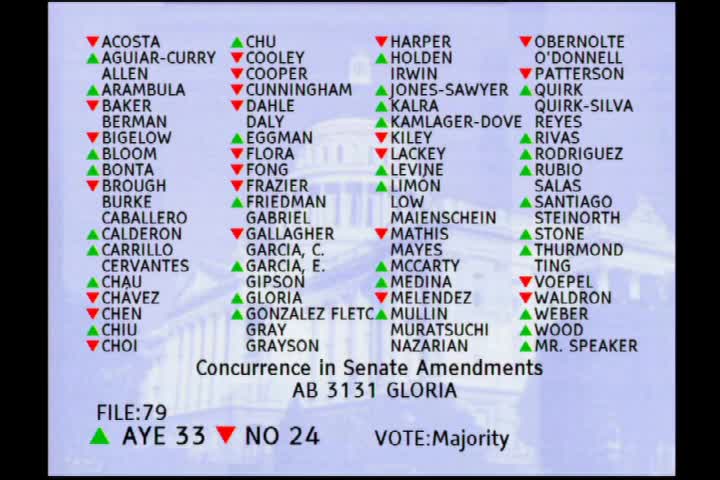

Bill Author