AB 2030: CalWORKs: accommodations.
- Session Year: 2017-2018
- House: Assembly
- Latest Version Date: 2018-09-18
(1)Existing federal law provides for allocation of federal funds through the federal Temporary Assistance for Needy Families (TANF) block grant program to eligible states. Californias version of this program is CalWORKs. Under the CalWORKs program, each county provides cash assistance and other benefits, through a combination of state and county funds and federal funds received through the TANF program, to qualified low-income families and individuals who meet specified eligibility criteria.
Under the CalWORKs program, recipients are required to participate in specified welfare-to-work activities, unless an exception applies. Existing law prohibits medically disabled individuals, as specified, from being required to participate in welfare-to-work activities for so long as the condition continues to exist. Existing law requires that an applicant or recipient be excused from participation in welfare-to-work activities for good cause when the county determines that the applicant or recipient is a victim of domestic violence, as specified. Existing law also authorizes specified supportive services and accommodations for applicants and recipients who are victims of domestic violence or who are experiencing specified conditions, including emotional, mental, or developmental disabilities.
Existing law requires applications for public social services or public assistance, including CalWORKs, to be made to the county welfare department of the county in which the applicant is living. Existing law authorizes applications to be made in writing or upon the standard form prescribed in regulations of the State Department of Social Services. Existing law also requires counties to redetermine the eligibility and grant amounts of a CalWORKs recipient on a semiannual basis through the submission of a semiannual report form.
The federal Americans with Disabilities Act prohibits public entities, such as a state or local government, from discriminating against individuals with a qualified disability or denying those individuals with access to the benefits, services, programs, or activities of that public entity due to disability.
This bill would require the State Department of Social Services to include questions that enable an applicant for, or recipient of, public social services or public assistance, including CalWORKs, to disclose a disability, the need for accommodation due to disability, or any experience of domestic violence in any amendment or revision to the standard form for initial applications and the CalWORKs semiannual report form adopted on or after January 1, 2019.
(2)Existing law directs the Office of Systems Integration within the California Health and Human Services Agency to implement a statewide automated welfare system for specified public assistance programs, including, among others, the CalWORKs program. Existing law requires that statewide implementation of the statewide automated welfare system be achieved through no more than 4 county consortia, including the Interim Statewide Automated Welfare System (SAWS) consortia, and the Los Angeles Eligibility, Automated Determination, Evaluation, and Reporting (LEADER) System. Existing law establishes specified goals for the system, including, among others, the equitable, timely, and consistent treatment of recipients within each program and the reduction of administrative complexity. Existing law declares the intent of the Legislature that representatives from the State Department of Social Services, the State Department of Health Care Services, the Office of Systems Integration, the SAWS consortia, and counties meet with advocates, clients, and other stakeholders no less than quarterly to review the development status of the California Automated Consortium Eligibility System (CalACES) and the California Statewide Automated Welfare System (CalSAWS) projects. Existing law requires the State Department of Social Services, the State Department of Health Care Services, and the Office of Systems Integration to develop, in consultation with the County Welfare Directors Association of California, the SAWS consortia, and stakeholders, a formal process for health and human services advocates and clients to provide input into new or changing public facing elements of CalACES and CalSAWS.
This bill would require any single state automated welfare system implemented pursuant to the above provisions to include a notification to inform the caseworker of a public assistance program applicant or recipient that the applicant or recipient has disclosed the need for an accommodation consistent with the Americans with Disabilities Act or has disclosed a disability or domestic violence experience that may affect his or her eligibility for certain exemptions from, and exceptions to, CalWORKs program requirements. The bill would require the State Department of Social Services to collaborate with county welfare departments in developing this notification. The bill would require the notification to be immediately visible to the caseworker upon opening the applicants or recipients file in the system.
(1)Existing federal law provides for allocation of federal funds through the federal Temporary Assistance for Needy Families (TANF) block grant program to eligible states. Californias version of this program is CalWORKs. Under the CalWORKs program, each county provides cash assistance and other benefits, through a combination of state and county funds and federal funds received through the TANF program, to qualified low-income families and individuals who meet specified eligibility criteria.
Under the CalWORKs program, recipients are required to participate in specified welfare-to-work activities, unless an exception applies. Existing law prohibits medically disabled individuals, as specified, from being required to participate in welfare-to-work activities for so long as the condition continues to exist. Existing law requires that an applicant or recipient be excused from participation in welfare-to-work activities for good cause when the county determines that the applicant or recipient is a victim of domestic violence, as specified. Existing law also authorizes specified supportive services and accommodations for applicants and recipients who are victims of domestic violence or who are experiencing specified conditions, including emotional, mental, or developmental disabilities.
Existing law requires applications for public social services or public assistance, including CalWORKS, to be made to the county welfare department of the county in which the applicant is living. Existing law authorizes applications to be made in writing or upon the standard form prescribed in regulations of the State Department of Social Services. Existing law also requires counties to redetermine the eligibility and grant amounts of a CalWORKs recipient on a semiannual basis through the submission of a semiannual report form.
The federal Americans with Disabilities Act prohibits public entities, such as a state or local government, from discriminating against individuals with a qualified disability or denying those individuals with access to the benefits, services, programs, or activities of that public entity due to disability.
This bill would require the State Department of Social Services to include questions that enable an applicant for, or recipient of, public social services or public assistance, including CalWORKS, to disclose a disability, the need for accommodation due to disability, or any experience of domestic violence in any amendment or revision to the standard form for initial applications and the CalWORKs semiannual report form adopted on or after January 1, 2019.
(2)Existing law directs the Office of Systems Integration within the California Health and Human Services Agency to implement a statewide automated welfare system for specified public assistance programs, including, among others, the CalWORKs program. Existing law requires that statewide implementation of the statewide automated welfare system be achieved through no more than 4 county consortia, including the Interim Statewide Automated Welfare System (SAWS) consortia, and the Los Angeles Eligibility, Automated Determination, Evaluation, and Reporting (LEADER) System. Existing law establishes specified goals for the system, including, among others, the equitable, timely, and consistent treatment of recipients within each program and the reduction of administrative complexity. Existing law declares the intent of the Legislature that representatives from the State Department of Social Services, the State Department of Health Care Services, the Office of Systems Integration, the SAWS consortia, and counties meet with advocates, clients, and other stakeholders no less than quarterly to review the development status of the California Automated Consortium Eligibility System (CalACES) and the California Statewide Automated Welfare System (CalSAWS) projects. Existing law requires the State Department of Social Services, the State Department of Health Care Services, and the Office of Systems Integration to develop, in consultation with the County Welfare Directors Association of California, the SAWS consortia, and stakeholders, a formal process for health and human services advocates and clients to provide input into new or changing public facing elements of CalACES and CalSAWS.
This bill would require the Office of Systems Integration to collaborate with county welfare departments to any single state automated welfare system implemented pursuant to the above provisions to include a notification in the state automated welfare system to inform the caseworker of a public assistance program applicant or recipient that the applicant or recipient has disclosed the need for an accommodation consistent with the Americans with Disabilities Act or has disclosed a disability or domestic violence experience that may affect his or her eligibility for certain exemptions from, and exceptions to, CalWORKs program requirements. The bill would require the State Department of Social Services to collaborate with county welfare departments in developing this notification. The bill would require the notification to be immediately visible to the caseworker upon opening the applicant applicants or recipients file in the system and would require the notification to be included in any revision, modification, or update to the system made on or after January 1, 2019. system.
Existing
(1)Existing federal law provides for allocation of federal funds through the federal Temporary Assistance for Needy Families (TANF) block grant program to eligible states. Californias version of this program is CalWORKs. Under the CalWORKs program, each county provides cash assistance and other benefits, through a combination of state and county funds and federal funds received through the TANF program, to qualified low-income families and individuals who meet specified eligibility criteria.
Under the CalWORKs program, recipients are required to participate in specified welfare-to-work activities, unless an exception applies. Existing law prohibits medically disabled individuals, as specified, from being required to participate in welfare-to-work activities for so long as the condition continues to exist. Existing law requires that an applicant or recipient be excused from participation in welfare-to-work activities for good cause when the county determines that the applicant or recipient is a victim of domestic violence, as specified. Existing law also authorizes specified supportive services and accommodations for applicants and recipients who are victims of domestic violence or who are experiencing specified conditions, including emotional, mental, or developmental disabilities.
Existing law requires applications for public social services or public assistance, including CalWORKS, to be made to the county welfare department of the county in which the applicant is living. Existing law authorizes applications to be made in writing or upon the standard form prescribed in regulations of the Department of Social Services. Existing law also requires counties to redetermine the eligibility and grant amounts of a CalWORKs recipient on a semiannual basis through the submission of a semiannual report form.
The federal Americans with Disabilities Act prohibits public entities, such as a state or local government, from discriminating against individuals with a qualified disability or denying those individuals with access to the benefits, services, programs, or activities of that public entity due to disability.
This bill would require the Department of Social Services to include questions that enable an applicant for, or recipient of, public social services or public assistance, including CalWORKS, to disclose a disability, the need for accommodation due to disability, or any experience of domestic violence in any amendment or revision to the standard form for initial applications and the CalWORKs semiannual report form adopted on or after January 1, 2019. The bill would require a county welfare department to include a notice that is immediately visible upon opening the file of an applicant or recipient to inform a caseworker of the need for an accommodation consistent with the Americans with Disabilities Act, if a need for accommodation is indicated by the applicant or recipient on the forms described above. The bill would also require a county welfare department to include a notice that is immediately visible upon opening the file of an applicant or recipient to inform a caseworker of potential eligibility for exemptions from, or exceptions to, CalWORKS program requirements, if a disability or domestic violence experience is disclosed by the applicant or recipient on the forms described above. By imposing new duties on county welfare departments, this bill would create a state-mandated local program.
The California Constitution requires the state to reimburse local agencies and school districts for certain costs mandated by the state. Statutory provisions establish procedures for making that reimbursement.This bill would provide that, if the Commission on State Mandates determines that the bill contains costs mandated by the state, reimbursement for those costs shall be made pursuant to the statutory provisions noted above.(2)Existing law directs the Office of Systems Integration within the California Health and Human Services Agency to implement a statewide automated welfare system for specified public assistance programs, including, among others, the CalWORKs program. Existing law establishes specified goals for the system, including, among others, the equitable, timely, and consistent treatment of recipients within each program and the reduction of administrative complexity.
This bill would require the Office of Systems Integration to collaborate with county welfare departments to include a notification in the state automated welfare system to inform the caseworker of a public assistance program applicant or recipient that the applicant or recipient has disclosed the need for an accommodation consistent with the Americans with Disabilities Act or has disclosed a disability or domestic violence experience that may affect his or her eligibility for certain exemptions from, and exceptions to, CalWORKs program requirements. The bill would require the notification to be immediately visible to the caseworker upon opening the applicant or recipients file in the system and would require the notification to be included in any revision, modification, or update to the system made on or after January 1, 2019.
Existing federal law provides for allocation of federal funds through the federal Temporary Assistance for Needy Families (TANF) block grant program to eligible states. Californias version of this program is CalWORKs. Under the CalWORKs program, each county provides cash assistance and other benefits, through a combination of state and county funds and federal funds received through the TANF program, to qualified low-income families and individuals who meet specified eligibility criteria.
Under the CalWORKs program, recipients are required to participate in specified welfare-to-work activities, unless an exception applies. Existing law prohibits medically disabled individuals, as specified, from being required to participate in welfare-to-work activities for so long as the condition continues to exist. Existing law requires that an applicant or recipient be excused from participation in welfare-to-work activities for good cause when the county determines that the applicant or recipient is a victim of domestic violence, as specified. Existing law also authorizes specified supportive services and accommodations for applicants and recipients who are victims of domestic violence or who are experiencing specified conditions, including emotional, mental, or developmental disabilities.
Existing law requires applications for CalWORKs public social services or public assistance, including CalWORKS, to be made to the county welfare department of the county in which the applicant is living. Existing law authorizes applications to be made in writing or upon the standard form prescribed in regulations of the Department of Social Services. Existing law also requires counties to redetermine the eligibility and grant amounts of a CalWORKs recipient on a semiannual basis through the submission of a semiannual report form.
The federal Americans with Disabilities Act prohibits public entities, such as a state or local government, from discriminating against individuals with a qualified disability or denying those individuals with access to the benefits, services, programs, or activities of that public entity due to disability.
This bill would require the Department of Social Services to include questions regarding an applicants that enable an applicant for, or recipient of, public social services or public assistance, including CalWORKS, to disclose a disability, the need for accommodation due to disability disability, or any experience of domestic violence in any amendment or revision to the CalWORKs standard form for initial applications or and the CalWORKs semiannual report form adopted on or after January 1, 2019. The bill would also require, if an applicant or recipient requires an accommodation, the county welfare department to include a notice on the first page of the applicant or recipients file to inform the applicant or recipients caseworker of his or her need for accommodation. The bill would require a county welfare department to include a notice that is immediately visible upon opening the file of an applicant or recipient to inform a caseworker of the need for an accommodation consistent with the Americans with Disabilities Act, if a need for accommodation is indicated by the applicant or recipient on the forms described above. The bill would also require a county welfare department to include a notice that is immediately visible upon opening the file of an applicant or recipient to inform a caseworker of potential eligibility for exemptions from, or exceptions to, CalWORKS program requirements, if a disability or domestic violence experience is disclosed by the applicant or recipient on the forms described above. By imposing new duties on county welfare departments, this bill would create a state-mandated local program.
The California Constitution requires the state to reimburse local agencies and school districts for certain costs mandated by the state. Statutory provisions establish procedures for making that reimbursement.
This bill would provide that, if the Commission on State Mandates determines that the bill contains costs mandated by the state, reimbursement for those costs shall be made pursuant to the statutory provisions noted above.
Existing federal law provides for allocation of federal funds through the federal Temporary Assistance for Needy Families (TANF) block grant program to eligible states. Californias version of this program is CalWORKs. Under the CalWORKs program, each county provides cash assistance and other benefits, through a combination of state and county funds and federal funds received through the TANF program, to qualified low-income families and individuals who meet specified eligibility criteria.
Under the CalWORKs program, recipients are required to participate in specified welfare-to-work activities, unless an exception applies. Existing law prohibits medically disabled individuals, as specified, from being required to participate in welfare-to-work activities for so long as the condition continues to exist. Existing law requires that an applicant or recipient be excused from participation in welfare-to-work activities for good cause when the county determines that the applicant or recipient is a victim of domestic violence, as specified. Existing law also authorizes specified supportive services and accommodations for applicants and recipients who are victims of domestic violence or who are experiencing specified conditions, including emotional, mental, or developmental disabilities.
Existing law requires applications for CalWORKs to be made to the county welfare department of the county in which the applicant is living. Existing law authorizes applications to be made in writing or upon the standard form prescribed in regulations of the Department of Social Services. Existing law also requires counties to redetermine the eligibility and grant amounts of a CalWORKs recipient on a semiannual basis through the submission of a semiannual report form.
This bill would require the Department of Social Services to include questions regarding an applicants need for accommodation due to disability or domestic violence in any amendment or revision to the CalWORKs standard form for initial applications or the semiannual report form adopted on or after January 1, 2019. The bill would also require, if an applicant or recipient requires an accommodation, the county welfare department to include a notice on the first page of the applicant or recipients file to inform the applicant or recipients caseworker of his or her need for accommodation. By imposing new duties on county welfare departments, this bill would create a state-mandated local program.
The California Constitution requires the state to reimburse local agencies and school districts for certain costs mandated by the state. Statutory provisions establish procedures for making that reimbursement.
This bill would provide that, if the Commission on State Mandates determines that the bill contains costs mandated by the state, reimbursement for those costs shall be made pursuant to the statutory provisions noted above.
(a)Any single state automated welfare system implemented pursuant to this chapter shall include a notification to inform the caseworker of a public assistance program applicant or recipient of the following information:
(1)That the applicant or recipient has indicated the need for an accommodation due to disability consistent with Section 12132 of Title 42 of the United States Code and Section 35.130 of Title 28 of the Code of Federal Regulations.
(2)That the applicant or recipient has disclosed a disability or experience of domestic violence that may affect his or her eligibility for certain exemptions from, and exceptions to, program requirements contained in Chapter 2 (commencing with Section 11200) of Part 3.
(b)The State Department of Social Services shall collaborate with county welfare departments in developing the notification required by this section.
(c)The notification required by this section shall be immediately visible to the caseworker upon opening the applicants or recipients file in the system.
SEC. 2.Section 11051 is added to the Welfare and Institutions Code, to read:11051.The department shall include questions that enable an applicant to disclose a disability, the need for accommodation due to disability, and any experience of domestic violence, in any amendment or revision adopted on or after January 1, 2019, to the standard form for initial applications described in Section 11050.
SEC. 3.Section 11262 is added to the Welfare and Institutions Code, to read:11262.The department shall include questions that enable a recipient to disclose a disability, the need for accommodation due to disability, and any experience of domestic violence, in any amendment or revision adopted on or after January 1, 2019, to the semiannual report form described in Section 11265.1.
(a)The Office of Systems Integration shall collaborate with county welfare departments to Any single state automated welfare system implemented pursuant to this chapter shall include a notification in the state automated welfare system to inform the caseworker of a public assistance program applicant or recipient of the following information:
(1)That the applicant or recipient has indicated the need for an accommodation due to disability consistent with Section 12132 of Title 42 of the United States Code and Section 35.130 of Title 28 of the Code of Federal Regulations.
(2)That the applicant or recipient has disclosed a disability or experience of domestic violence that may affect his or her eligibility for certain exemptions from, and exceptions to, program requirements contained in Chapter 2 (commencing with Section 11200) of Part 3.
(b)The State Department of Social Services shall collaborate with county welfare departments in developing the notification required by this section.
(b)(c)The notification required by this section shall be immediately visible to the caseworker upon opening the applicant applicants or recipients file in the state automated welfare system and shall be included in any revision, modification, or update to the system made on or after January 1, 2019. system.
SEC. 2.Section 11051 is added to the Welfare and Institutions Code, to read:11051.The department shall include questions that enable an applicant to disclose a disability, the need for accommodation due to disability, and any experience of domestic violence, in any amendment or revision adopted on or after January 1, 2019, to the standard form for initial applications described in Section 11050.
SEC. 3.Section 11262 is added to the Welfare and Institutions Code, to read:11262.The department shall include questions that enable a recipient to disclose a disability, the need for accommodation due to disability, and any experience of domestic violence, in any amendment or revision adopted on or after January 1, 2019, to the semiannual report form described in Section 11265.1.
(a)The Office of Systems Integration shall collaborate with county welfare departments to include a notification in the state automated welfare system to inform the caseworker of a public assistance program applicant or recipient of the following information:
(1)That the applicant or recipient has indicated the need for an accommodation due to disability consistent with Section 12132 of Title 42 of the United States Code and Section 35.130 of Title 28 of the Code of Federal Regulations.
(2)That the applicant or recipient has disclosed a disability or experience of domestic violence that may affect his or her eligibility for certain exemptions from, and exceptions to, program requirements contained in Chapter 2 (commencing with Section 11200) of Part 3.
(b)The notification required by this section shall be immediately visible to the caseworker upon opening the applicant or recipients file in the state automated welfare system and shall be included in any revision, modification, or update to the system made on or after January 1, 2019.
SECTION 1.SEC. 2.Section 11051 is added to the Welfare and Institutions Code, to read:11051.(a)The department shall include questions that enable an applicant to disclose a disability, the need for accommodation due to disability, and any experience of domestic violence, in any amendment or revision adopted on or after January 1, 2019, to the standard form for initial applications described in Section 11050.
(b)If an applicant indicates the need for an accommodation due to disability consistent with Section 12132 of Title 42 of the United States Code and Section 35.130 of Title 28 of the Code of Federal Regulations, the county welfare department shall include a notice that is immediately visible upon opening the applicants file to inform the applicants caseworker of the applicants need for accommodation.(c)If an applicant discloses a disability or experience of domestic violence, the county welfare department shall include a notice that is immediately visible upon opening the applicants file to inform the applicants caseworker of the applicants potential eligibility for certain exemptions from, and exceptions to, program requirements contained in Chapter 2 (commencing with Section 11200).SEC. 2.SEC. 3.Section 11262 is added to the Welfare and Institutions Code, to read:11262.(a)The department shall include questions that enable a recipient to disclose a disability, the need for accommodation due to disability, and any experience of domestic violence, in any amendment or revision adopted on or after January 1, 2019, to the semiannual report form described in Section 11265.1.
(b)If a recipient indicates the need for an accommodation due to disability consistent with Section 12132 of Title 42 of the United States Code and Section 35.130 of Title 28 of the Code of Federal Regulations, the county welfare department shall include a notice that is immediately visible upon opening the recipients file to inform the recipients caseworker of the recipients need for accommodation.(c)If a recipient discloses a disability or experience of domestic violence, the county welfare department shall include a notice that is immediately visible upon opening the recipients file to inform the recipients caseworker of the recipients potential eligibility for certain exemptions from, and exceptions to, program requirements contained in this chapter.SEC. 3.If the Commission on State Mandates determines that this act contains costs mandated by the state, reimbursement to local agencies and school districts for those costs shall be made pursuant to Part 7 (commencing with Section 17500) of Division 4 of Title 2 of the Government Code.(a)The department shall include questions regarding the applicants need for accommodation due to disability or domestic violence that enable an applicant to disclose a disability, the need for accommodation due to disability, and any experience of domestic violence, in any amendment or revision adopted on or after January 1, 2019, to the standard form for initial applications described in Section 11050.
(b)If an applicant requires indicates the need for an accommodation due to disability or domestic violence, consistent with Section 12132 of Title 42 of the United States Code and Section 35.130 of Title 28 of the Code of Federal Regulations, the county welfare department shall include a notice on the first page of that is immediately visible upon opening the applicants file to inform the applicants caseworker of his or her the applicants need for accommodation.
(c)If an applicant discloses a disability or experience of domestic violence, the county welfare department shall include a notice that is immediately visible upon opening the applicants file to inform the applicants caseworker of the applicants potential eligibility for certain exemptions from, and exceptions to, program requirements contained in Chapter 2 (commencing with Section 11200).
SEC. 2.Section 11262 is added to the Welfare and Institutions Code, to read:11262.(a)The department shall include questions regarding a recipients need for accommodation due to disability or domestic violence that enable a recipient to disclose a disability, the need for accommodation due to disability, and any experience of domestic violence, in any amendment or revision adopted on or after January 1, 2019, to the semiannual report form described in Section 11265.1.
(b)If a recipient indicates that he or she requires an accommodation due to disability or domestic violence in the semiannual report form, the need for an accommodation due to disability consistent with Section 12132 of Title 42 of the United States Code and Section 35.130 of Title 28 of the Code of Federal Regulations, the county welfare department shall include a notice on the first page of that is immediately visible upon opening the recipients file to inform the recipients caseworker of his or her the recipients need for accommodation.
(c)If a recipient discloses a disability or experience of domestic violence, the county welfare department shall include a notice that is immediately visible upon opening the recipients file to inform the recipients caseworker of the recipients potential eligibility for certain exemptions from, and exceptions to, program requirements contained in this chapter.
SEC. 3.If the Commission on State Mandates determines that this act contains costs mandated by the state, reimbursement to local agencies and school districts for those costs shall be made pursuant to Part 7 (commencing with Section 17500) of Division 4 of Title 2 of the Government Code.
(a)The department shall include questions regarding the applicants need for accommodation due to disability or domestic violence in any amendment or revision adopted on or after January 1, 2019, to the standard form for initial applications described in Section 11050.
(b)If an applicant requires an accommodation due to disability or domestic violence, the county welfare department shall include a notice on the first page of the applicants file to inform the applicants caseworker of his or her need for accommodation.
SEC. 2.Section 11262 is added to the Welfare and Institutions Code, to read:11262.(a)The department shall include questions regarding a recipients need for accommodation due to disability or domestic violence in any amendment or revision adopted on or after January 1, 2019, to the semiannual report form described in Section 11265.1.
(b)If a recipient indicates that he or she requires an accommodation due to disability or domestic violence in the semiannual report form, the county welfare department shall include a notice on the first page of the recipients file to inform the recipients caseworker of his or her need for accommodation.
SEC. 3.If the Commission on State Mandates determines that this act contains costs mandated by the state, reimbursement to local agencies and school districts for those costs shall be made pursuant to Part 7 (commencing with Section 17500) of Division 4 of Title 2 of the Government Code.
|
Date
|
Status
|
|---|---|
| Sep 18, 2018 | Chaptered by Secretary of State - Chapter 485, Statutes of 2018. |
| Sep 18, 2018 | Approved by the Governor. |
| Sep 4, 2018 | Enrolled and presented to the Governor at 3 p.m. |
| Aug 27, 2018 | Senate amendments concurred in. To Engrossing and Enrolling. |
| Aug 22, 2018 | In Assembly. Concurrence in Senate amendments pending. May be considered on or after August 24 pursuant to Assembly Rule 77. |
| Aug 22, 2018 | Read third time. Passed. Ordered to the Assembly. |
| Aug 20, 2018 | Read second time. Ordered to third reading. |
| Aug 17, 2018 | From committee: Amend, and do pass as amended. (Ayes 7. Noes 0.) (August 16). |
| Aug 6, 2018 | In committee: Referred to APPR. suspense file. |
| Jun 27, 2018 | From committee: Do pass and re-refer to Com. on APPR. (Ayes 6. Noes 0.) (June 26). Re-referred to Com. on APPR. |
| Jun 13, 2018 | Referred to Com. on HUMAN S. |
| Jun 4, 2018 | In Senate. Read first time. To Com. on RLS. for assignment. |
| May 31, 2018 | Read third time. Passed. Ordered to the Senate. |
| May 29, 2018 | Read second time. Ordered to third reading. |
| May 25, 2018 | From committee: Amend, and do pass as amended. (Ayes 12. Noes 0.) (May 25). |
| Apr 18, 2018 | In committee: Set, first hearing. Referred to APPR. suspense file. |
| Apr 3, 2018 | Re-referred to Com. on APPR. |
| Apr 2, 2018 | Read second time and amended. |
| Mar 23, 2018 | From committee: Amend, and do pass as amended and re-refer to Com. on APPR. with recommendation: To Consent Calendar. (Ayes 7. Noes 0.) (March 20). |
| Feb 12, 2018 | Referred to Com. on HUM. S. |
| Feb 6, 2018 | From printer. May be heard in committee March 8. |
| Feb 5, 2018 | Read first time. To print. |
|
Date
|
Description
|
Location
|
Votes
|
|
|---|---|---|---|---|
| Aug 27, 2018 | AB 2030 LIMÓN Concurrence in Senate Amendments | Assembly Floor |
Passed |
|
| Aug 22, 2018 | Assembly 3rd Reading AB2030 Limón By Wiener | Senate Floor |
Passed |
|
| Aug 16, 2018 | Do pass as amended | Senate Standing Committee on Appropriations |
Passed |
|
| Aug 6, 2018 | Placed on suspense file | Senate Standing Committee on Appropriations |
Passed |
|
| Jun 26, 2018 | Do pass, but first be re-referred to the Committee on [Appropriations] | Senate Standing Committee on Human Services |
Passed |
|
| May 31, 2018 | AB 2030 LIMÓN Assembly Third Reading | Assembly Floor |
Passed |
|
| May 25, 2018 | Do pass as amended. | Assembly Standing Committee on Appropriations |
Passed |
|
| Mar 20, 2018 | Do pass as amended, and be re-referred to the Committee on [Appropriations] with recommendation: To Consent Calendar | Assembly Standing Committee on Human Services |
Passed |
This list shows positions taken on this bill by organizations on the date displayed, which is linked to the original source.
Positions by individuals are not included.
|
Organization
|
Position
|
Date
|
|---|---|---|
| California Association Of Food Banks | ** Support | Aug 19, 2018 |
| California Department of Finance | ** Against | Aug 19, 2018 |
| Coalition of California Welfare Rights Organizations | ** Support | Aug 19, 2018 |
| Disability Rights California | ** Support | Aug 19, 2018 |
| Partnership to End Domestic Violence | ** Support | Aug 19, 2018 |
| the national association of social workers | ** Support | Aug 19, 2018 |
| western center on law and poverty | ** Support | Aug 19, 2018 |
| Women Organizing Resources Knowledge and Services | ** Support | Aug 19, 2018 |
| WORKS | ** Support | Mar 19, 2018 |
CONCURRENCE IN SENATE AMENDMENTS
CSA1 Bill Id:AB 2030
Author:(Limón)
As Amended Ver:August 17, 2018
Majority vote
ASSEMBLY: | 78-0 | (May 31, 2018) | SENATE: | 39-0 | (August 22, 2018) |
Original Committee Reference: HUM. S.
SUMMARY: Requires the Department of Social Services (DSS) to include, in certain public social services application and redetermination forms, questions regarding the need for accommodation related to disability or domestic violence and requires any single state automated welfare system to include related notifications.
Specifically, this bill:
- Requires any single state automated welfare system implemented pursuant to current law to include a notification to inform the caseworker of a public assistance program applicant or recipient of the following information, as specified:
- That the applicant or recipient has indicated the need for an accommodation due to disability consistent with federal law and regulations; and
- That the applicant or recipient has disclosed a disability or experience of domestic violence that may affect his or her eligibility for certain exemptions from, and exceptions to, California Work Opportunity and Responsibility to Kids (CalWORKs) program requirements.
- Directs DSS to collaborate with county welfare departments in developing the notification required by the provisions of this bill.
- Requires the notification required by provisions of this bill to be immediately visible to the caseworker upon opening the applicant's or recipient's file in the system.
- Requires DSS to include questions that enable an applicant to disclose a disability, the need for accommodation due to disability, and any experience of domestic violence in any amendment or revision adopted on or after January 1, 2019, to the standard form for initial applications and to the semiannual report form, as specified.
The Senate amendments:
- Delete language requiring the Office of Systems Integrations to collaborate with county welfare departments to include the notification required by this bill in the statewide automated welfare system (SAWS), and instead add language that requires any single state automated welfare system implemented pursuant to current law to include this notification.
- Add language that directs DSS to collaborate with county welfare departments in developing the notification required by the provisions of this bill.
- Delete language requiring the notification required by provisions of this bill to be immediately visible in SAWS and to be included in any revision, modification, or update to the system made on or after January 1, 2019, and instead add language stipulating that the required notification be immediately visible in any single state automated welfare system implemented pursuant to current law, as specified.
EXISTING LAW:
- Establishes under federal law the Temporary Assistance for Needy Families (TANF) program to provide aid and welfare-to-work services to eligible families and, in California, provides that TANF funds for welfare-to-work services are administered through the CalWORKs program. (Title 42 United States Code Section (U.S.C.) 601 et seq., Welfare and Institutions Code Section (WIC) 11200 et seq.)
- Establishes income, asset, and real property limits used to determine eligibility for the CalWORKs program, including net income below the Maximum Aid Payment (MAP), based on family size and county of residence, which is around 40% of the Federal Poverty Level. (WIC 11150 to 11160, 11450 et seq.)
- Establishes a 48-month lifetime limit on CalWORKs benefits for eligible adults, including a period beyond the "24-month time clock" during which a recipient must meet federal work requirements in order to retain eligibility. (WIC 11454, 11322.85)
- Requires all individuals 16 years of age or older, unless they are otherwise exempt, to participate in welfare-to-work activities as a condition of eligibility for CalWORKs. (WIC 11320.3, 11322.6)
- Establishes the number of weekly hours of welfare-to-work participation necessary to remain eligible for aid, including requirements for an unemployed parent in a two-parent assistance unit, as specified. (WIC 11322.8)
- Establishes under federal law the Supplemental Nutrition Assistance Program (SNAP) in order to safeguard the health and wellbeing of individuals and families by raising levels of nutrition among low-income households and establishes, in California statute, the CalFresh program to administer the provision of federal SNAP benefits to families and individuals meeting certain criteria, as specified. (7 U.S.C. 2011 et seq., WIC 18900 et seq.)
- Requires applications for public social services or public assistance, with certain exceptions, to be made to the county department in the county in which an applicant is living, and permits such application to take place using a standard form supplied to the applicant. (WIC 11050)
- Requires counties to redetermine CalWORKs and CalFresh eligibility annually and to, at the time of redetermination, require the family to complete a certification of eligibility, as specified. Further, authorizes counties to require a family to complete this certification of eligibility, as specified, more frequently as deemed necessary. (WIC 11265)
- Requires counties to redetermine CalWORKs and CalFresh eligibility and benefit amounts semiannually using prospective budgeting and requires, in addition to the annual certification of eligibility, a semiannual report form to be used during the first semiannual reporting period following the application or annual redetermination, as specified. (WIC 11265.1)
- Requires a CalWORKs recipient to report income that exceeds a set income reporting threshold, as specified, in addition to submitting the semiannual report form. (WIC 11265.3)
- Exempts a CalWORKs assistance unit that does not contain an eligible adult from other periodic reporting requirements, including submission of the semiannual report form, in addition to annual redetermination, as specified. (WIC 11265.45)
- Prohibits, in federal law and regulations as part of the Americans with Disabilities Act of 1990 (ADA), a qualified individual with a disability from, by reason of such disability, being excluded from participation in or denied the benefits of the services, programs, or activities of a public entity or subjected to discrimination by that entity, as specified. (42 U.S.C. Section 12132, Title 28 Code of Federal Regulations Section (CFR) 35.130)
- Prohibits, in federal law as part of the Rehabilitation Act of 1973, an otherwise qualified person with a disability from, solely due to that disability, being excluded from participation in, denied the benefits of, or subjected to discrimination under any program or activity receiving federal financial assistance. (42 U.S.C. 794)
- Exempts an individual with a doctor-verified disability expected to last at least 30 days and that constitutes a significant impairment to participation in regular employment or welfare-to-work activities, provided appropriate medical treatment is being sought, from having to comply with welfare-to-work requirements. (WIC 11320.3(b)(3)(A))
- Establishes, as one reason for which an individual may request an extension to the CalWORKs 24-month time clock, that a recipient's diagnosed learning or other disability creates a need for additional time to complete a welfare-to-work activity. (WIC 11322.87(a)(4))
- Permits states, within federal TANF law, to adopt the "Family Violence Option," whereby states establish and enforce procedures to screen and identify individuals receiving TANF assistance with a history of domestic violence, refer those individuals to counseling and supportive services, and waive program requirements when it is determined that compliance with those requirements could hinder individuals' ability to escape domestic violence or unfairly penalize individuals who have experienced, or are experiencing or at risk of experiencing, domestic violence, as specified. (42 U.S.C. 602(a)(7))
- Adopts a family violence provision within the CalWORKs program to enact the federal option regarding victims of domestic violence and in Legislative recognition of the fact that some individuals who may need public assistance have been or are victims of abuse and further, states Legislative intent to ensure that applicants and recipients who are past or present victims of abuse are not placed at further risk or unfairly penalized by CalWORKs requirements and procedures. (WIC 11495 et seq.)
- Defines "abuse" to mean battering or subjecting a victim to extreme cruelty by: physical acts resulting in, or threatening to result in, physical injury; sexual abuse; sexual activity involving a child in the home; being forced to participate in nonconsensual sexual acts or activities; threats of, or attempts at, physical or sexual abuse; mental abuse; neglect or deprivation of medical care; or stalking. (WIC 11495.12)
- Requires CalWORKs applicants and recipients to be informed about the availability of services designed to assist individuals to identify, escape, or stop future domestic abuse as well as to overcome the effects of domestic abuse, as specified. (WIC 11495.16)
- Permits a county to waive a CalWORKs program requirement for a recipient who has been determined to be a past or present victim of abuse when it is found that good cause, as specified, exists. (WIC 11495.15)
- Authorizes a CalWORKs recipient to be excused from program participation for good cause when the county has found that there is a condition or circumstance temporarily hindering the recipient's ability to be regularly employed or participate in welfare-to-work activities, and directs the county welfare department to review the good cause determination at least once every three months, as specified. (WIC 11320.3(f))
FISCAL EFFECT: According to the Senate Appropriations Committee on August 16, 2018, this bill may result in the following costs:
- Likely minor costs to include the required information in the case file in the single state automated welfare system. (General Fund)
- Minor costs to DSS to include additional questions on the initial application and redetermination forms during the normal course of revisions to those documents.
COMMENTS:
CalWORKs and CalFresh application and periodic report forms: Applicants for CalWORKs (the state's TANF program), CalFresh (the state's Supplemental Nutrition Assistance Program [SNAP], formerly known as "food stamps"), Medicaid and/or other health programs can apply using the SAWS 2 Plus form. CalWORKs recipients must periodically undergo recertification/redetermination of circumstances impacting eligibility. All recipients must certify eligibility every year; for assistance units with an eligible adult (including adults who are eligible for aid but currently sanctioned), the household must also report every six months using the Semi-Annual Eligibility Status Report (SAR-7). CalWORKs assistance units that are "Child Only" and do not contain an eligible adult only need to recertify once per year.
Recipients also need to report any time their income exceeds the income reporting threshold; this threshold for any assistance unit is the lower of two tiers: 1) 55% of the Federal Poverty Level for a family of three plus the amount of income that was last used to calculate the assistance unit's monthly grant amount, or 2) the amount of income that would likely make the assistance unit ineligible for CalWORKs. These thresholds are updated annually and information on them is periodically provided to recipients.
Disability accommodations and disability-related CalWORKs rules: Individuals with disabilities who seek or receive public services are afforded a number of federal and state rights. Title II of the Americans with Disabilities Act of 1990 (ADA) provides that "…no qualified individual with a disability shall, by reason of such disability, be excluded from participation in or be denied the benefits of the services, programs, or activities of a public entity, or be subjected to discrimination by any such entity" (42 U.S.C. 12132). The Rehabilitation Act of 1973 states that, "no otherwise qualified individual in the United States…shall, solely by reason of his or her disability, be excluded from participation in, be denied the benefits of, or be subjected to discrimination under any program or activity receiving Federal financial assistance…" (42 U.S.C. 794). Public services providers must make reasonable modifications to ensure that individuals with disabilities can participate in services.
For a variety of reasons – including pregnancy, age, or caring for a young child or ill or incapacitated person – some individuals are unable to participate in welfare-to-work activities; these individuals may receive an exemption and be able to remain on cash aid without being required to participate in these activities. DSS reports that, for Federal Fiscal Year (FFY) 2016, 32.6% of adults received some sort of exemption to CalWORKs welfare-to-work requirements. Of all exemptions granted in FFY 2016, over a quarter (27.4%) were for a disability. Additionally, state law (WIC 11322.87(a)(4)) establishes that a recipient's diagnosed learning or other disability that creates a need for additional time to complete a welfare-to-work activity shall constitute a reason for which an individual may request an extension to the CalWORKs 24-month time clock.
Domestic violence: According to the National Coalition Against Domestic Violence (NCADV), domestic violence is "the willful intimidation, physical assault, battery, sexual assault, and/or other abusive behavior as part of a systematic pattern of power and control perpetrated by one intimate partner against another. It includes physical violence, sexual violence, psychological violence, and emotional abuse." The NCADV reports that 40% of women in California experience domestic violence in their lifetimes.
While connections between poverty and domestic violence have been found, it is important to recognize that this association is one of correlation and not causation. Poverty doesn't necessarily cause domestic violence. Rather, the stresses and circumstances of living in poverty, and related factors, may contribute to higher incidence of domestic violence: consider, for example, how lack of access to resources such as money, transportation, and alternate housing options may make it difficult for someone to escape violence in the home.
Family Violence Option: "Welfare reform" of the late 1990s was adopted with passage at the federal level of the Personal Responsibility and Work Opportunity Reconciliation Act (PRWORA) of 1996 (P.L. 104-193), which replaced the previous Aid to Families with Dependent Children (AFDC) program with today's Temporary Assistance for Needy Families (TANF) program. TANF offers block grants to states to design their own welfare programs, provided they meet certain requirements, including establishing work requirements and placing a lifetime limit of five years on receipt of benefits. PRWORA, along with enacting many other program changes and requirements, authorized states to adopt a "Family Violence Option" for TANF recipients experiencing domestic violence. This option allows states to establish and enforce procedures to screen recipients and identify individuals who have a history of experiencing domestic violence, and to refer them to counseling and supportive services, and waive program requirements when it is determined that compliance with those requirements could hinder individuals' ability to escape domestic violence or unfairly penalize individuals who have experienced, or are experiencing or at risk of experiencing, domestic violence.
The CalWORKs program – California's version of TANF – was adopted through AB 1542 (Ducheny), Chapter 270, Statutes of 1997. This bill enacted the state's own family violence provision; it required the establishment of a task force to work in consultation with DSS on developing protocols for handling CalWORKs cases involving recipients who are past or present victims of abuse. Counties are able to waive a CalWORKs program requirement for a recipient who has been determined to be a past or present victim of abuse when it is found that good cause, based on the identification of a condition or circumstance temporarily hindering the recipient's ability to be regularly employed or participate in welfare-to-work activities, exists. Additionally, the recently-adopted AB 557 (Rubio), Chapter 691, Statutes of 2017, establishes, as of July 1, 2018, that a CalWORKs applicant who provides a sworn statement attesting to past or present domestic abuse and who is fleeing his or her abuser shall be deemed homeless and made eligible for CalWORKs temporary homeless assistance. Also, this bill, as of July 1, 2018, allows good-cause exemptions due to domestic violence from school participation and immunization requirements under specified circumstances and requires all CalWORKs applicants and recipients to be informed verbally and in writing about the availability of services designed to assist individuals to identify, escape, or stop future domestic abuse as well as to overcome the effects of domestic abuse.
Need for this bill: According to the author, "[This bill] will make sure victims of domestic violence and persons with disabilities are identified and provided with the proper services when participating in the California Work Opportunity and Responsibility to Kids (CalWORKs)."
Analysis Prepared by: Daphne Hunt / HUM. S. / (916) 319-2089 FN: 0004590
Office of Senate Floor Analyses (916) 651-1520 Fax: (916) 327-4478 | AB |
THIRD READING
Bill No: AB 2030
Amended: 8/17/18 in Senate
SENATE HUMAN SERVICES COMMITTEE: 6-0, 6/26/18
AYES: Wiener, Glazer, Leyva, McGuire, Nguyen, Portantino
NO VOTE RECORDED: Berryhill
SENATE APPROPRIATIONS COMMITTEE: 7-0, 8/16/18
AYES: Portantino, Bates, Beall, Bradford, Hill, Nielsen, Wiener
ASSEMBLY FLOOR: 78-0, 5/31/18 - See last page for vote
SOURCE: Coalition of California Welfare Rights Organizations
Western Center on Law and Poverty
DIGEST:
This bill requires the California Department of Social Services (CDSS) to include, in certain public social services application and redetermination forms, questions regarding the need for accommodation related to disability or domestic violence. This bill also requires the Office of Systems Integration (OSI) to collaborate with county welfare departments to include related notifications in the State Automated Welfare System (SAWS) and make the notifications immediately visible to the caseworker opening the case file.
Existing federal law:
- Prohibits, as part of the Rehabilitation Act of 1973, an otherwise qualified person with a disability from, solely due to that disability, being excluded from participation in, denied the benefits of, or subjected to discrimination under any program or activity receiving federal financial assistance. (42 USC 794)
- Prohibits, in federal law and regulations as part of the Americans with Disabilities Act of 1990 (ADA), a qualified individual with a disability from, by reason of such disability, being excluded from participation in or denied the benefits of the services, programs, or activities of a public entity or subjected to discrimination by that entity, as specified. (42 42 USC 12132, 28 CFR 35.130)
- Establishes the Temporary Assistance for Needy Families (TANF) program to provide cash aid and welfare-to-work (WTW) services to eligible families and, in California, provides that TANF funds for WTW services are administered through the California Work Opportunity and Responsibility to Kids (CalWORKs) program. (42 USC 601 et seq., WIC 11200 et seq.)
- Permits states, within federal TANF law, to adopt the "Family Violence Option," whereby states establish and enforce procedures to screen and identify individuals receiving TANF assistance with a history of domestic violence, refer those individuals to counseling and supportive services, and waive program requirements, as specified. (42 USC 602 (a)(7))
Existing state law:
- Requires OSI to implement a statewide automated welfare system for CalWORKs, CalFresh, Medi-Cal the foster care program, the refugee program and county medical services programs. (WIC 10823)
- Requires applications for public social services or public assistance, with certain exceptions, to be made to the county department in the county in which an applicant is living, and permits such application to take place using a standard form supplied to the applicant. (WIC 11050)
- Establishes income, asset, and real property limits used to determine eligibility for the CalWORKs program, including net income below the Maximum Aid Payment, based on family size and county of residence. (WIC 11150 to 11160 and 11450 et seq.)
- Requires all individuals 16 years of age or older, unless they are otherwise exempt, to participate in WTW activities as a condition of eligibility for CalWORKs, as specified. (WIC 11320 et seq.)
- Establishes under federal law the Supplemental Nutrition Assistance Program (SNAP) in order to safeguard the health and wellbeing of individuals and families by raising levels of nutrition among low-income households and establishes, in California statute, the CalFresh program to administer the provisions of federal SNAP benefits to families and individuals meeting certain criteria, as specified. (7 USC 2011 et seq., WIC 18900 et seq.)
- Requires counties to redetermine CalWORKs eligibility annually and to, at the time of redetermination, require the family to complete a certification of eligibility, as specified. Further, authorizes counties to require a family to complete this certification of eligibility, as specified, more frequently as deemed necessary. (WIC 11265 et seq.)
- Exempts an individual with a doctor-verified disability expected to last at least 30 days and that constitutes a significant impairment from participation in regular employment or WTW activities, provided appropriate medical treatment is being sought, from having to comply with WTW requirements. (WIC 11320.3 (b)(3)(A))
- Establishes, as one reason for which an individual may request an extension to the CalWORKs 24-month time clock, that a recipient's diagnosed learning or other disability creates a need for additional time to complete a WTW activity. (WIC 11322.87 (a)(4))
- Adopts a family violence provision within the CalWORKs program in recognition of the fact that some individuals who may need public assistance have been or are victims of abuse and further, states Legislative intent to ensure that applicants and recipients who are past or present victims of abuse are not placed at further risk or unfairly penalized by CalWORKs requirements and procedures. (WIC 11495 et seq.)
- Defines "abuse" to mean battering or subjecting a victim to extreme cruelty by: physical acts resulting in, or threatening to result in, physical injury; sexual abuse; sexual activity involving a child in the home; being forced to participate in nonconsensual sexual acts or activities; threats of, or attempts at, physical or sexual abuse; mental abuse; neglect or deprivation of medical care; or stalking. (WIC 11495.12)
- Permits a county to waive a CalWORKs program requirement for a recipient who has been determined to be a past or present victim of abuse when it is found that good cause, as specified, exists. (WIC 11495.15)
- Requires CalWORKs applicants and recipients to be informed about the availability of services designed to assist individuals to identify, escape, or stop future domestic abuse as well as to overcome the effects of domestic abuse, as specified. (WIC 11495.16)
- Requires OSI to implement a statewide automated welfare system for CalWORKs, CalFresh, Medi-Cal, the foster care program, the refugee program, and county medical services programs, as specified. (WIC 10823 et seq.)
This bill:
- Requires the OSI to collaborate with county welfare departments to include a notification in SAWS to inform the caseworker of a public assistance program applicant or recipient of the following information:
- That the applicant or recipient has indicated the need for an accommodation due to a disability consistent with federal law and regulations; and
- That the applicant or recipient has disclosed a disability or experience of domestic violence that may affect his or her eligibility for certain exemptions from, and exceptions to, CalWORKs program requirements.
- Requires the notification to be immediately visible to the caseworker upon opening the applicant or recipient’s file in SAWS and shall be included in any revision, modification, or update to the system made on or after January 1, 2019.
- Requires CDSS to include questions that enable an applicant to disclose a disability, the need for an accommodation due to disability, and any experience of domestic violence in any amendment or revision adopted on or after January 1, 2019, to the standard form for initial applications and to the semiannual report form, as specified.
Background
According to the author, AB 2030, “will make sure victims of domestic violence and persons with disabilities are identified and provided with the proper services when participating in CalWORKs."
Statewide Automated Welfare System (SAWS). SAWS is California’s county-managed public assistance eligibility and enrollment system. SAWS serves as the case management system that enables counties to provide CalWORKs, Welfare to Work, CalFresh, Medi-Cal, Foster Care, Refugee Assistance, County Medical Services Program, and General Assistance/General Relief to children, families and individuals in all 58 counties. SAWS functionality includes eligibility determination, benefit calculation, benefit issuance, case management, and reporting.
Currently, there are multiple computer systems that make up SAWS: CalWIN, Consortium IV (C-IV), Los Angeles Eligibility, Automated Determination, Evaluation and Reporting (LEADER) and LEADER Replacement System (LRS). The USDA Food & Nutrition Services and Center for Medical Services has informed California that effective 2023 there will only be federal financial participation for one computer system for public assistance in California.
CDSS, OSI and other interested parties are working toward the migration of SAWS to one system. AB 1811 (Committee on Budget, Chapter 35, Statutes of 2018) requires CDSS, the Department of Health Care Services, OSI, and the SAWS project consortia to engage with stakeholders to discuss current and planned functionality changes, system demonstrations of public portals and mobile applications, and advocates' identification of areas of concern.
This bill requires a notification to be immediately visible in SAWS to inform the caseworker of a public assistance program applicant or recipient if the applicant or recipient has indicated the need for an accommodation due to a disability consistent with federal law and regulations and if the applicant or recipient has disclosed a disability or experience of domestic violence that may affect his or her eligibility for certain exemptions from, and exceptions to, CalWORKs program requirements. Per the bill, that notification must be immediately visible to the caseworker upon opening the applicant’s or recipient’s file in SAWS and shall be included in any revision, modification, or update to the system made on or after January 1, 2019.
Application, Recertification and/or Redetermination for Public Assistance. CalWORKs, CalFresh and Medi-Cal are three of the state’s largest public assistance programs for low-income households. All three are federally funded and implemented to individuals at the county level through the state.
Applicants for CalWORKs, CalFresh, and Medicaid and/or other health programs can apply for assistance on a uniform application. Because these programs are income-based, regular recertification/redetermination of eligibility is required. The frequency for recertification/redetermination varies depending on the program and the circumstances of the recipient. Recipients also need to report any time their income exceeds the income reporting threshold. These thresholds are updated annually and information on them is periodically provided to recipients.
Accommodations for People with Disabilities. Individuals with disabilities who seek public services are afforded a number of federal and state rights. The ADA provides that "…no qualified individual with a disability shall, by reason of such disability, be excluded from participation in or be denied the benefits of the services, programs, or activities of a public entity, or be subjected to discrimination by any such entity.” The Rehabilitation Act of 1973 states that, "no otherwise qualified individual in the United States…shall, solely by reason of his or her disability, be excluded from participation in, be denied the benefits of, or be subjected to discrimination under any program or activity receiving Federal financial assistance…” Therefore, public services providers must make reasonable accommodations to ensure that individuals with disabilities can participate in services.
Generally, CalWORKs recipients are required to meet WTW requirements, which may include subsidized or unsubsidized work; on the job training; community service; vocational education; and other services intended to remove barriers to employment. However, program rules allow exemptions from these activities for a variety of reasons, including medically verified disability, pregnancy, age, or caring for a young child or ill or incapacitated person. Such individuals may receive an exemption from WTW activities and still remain on cash aid. CDSS reports that, for Federal Fiscal Year (FFY) 2016, 32.6 percent of adults received an exemption from WTW requirements. Of those, over a quarter (27.4 percent) were for a disability. Additionally, state law (WIC 11322.87 (a)(4)) establishes that a recipient's diagnosed learning or other disability that creates a need for additional time to complete a WTW activity shall constitute a reason for which an individual may request an extension to the CalWORKs 24-month time clock.
Domestic Violence. According to the National Coalition Against Domestic Violence (NCADV), domestic violence is "the willful intimidation, physical assault, battery, sexual assault, and/or other abusive behavior as part of a systematic pattern of power and control perpetrated by one intimate partner against another. It includes physical violence, sexual violence, psychological violence, and emotional abuse." The NCADV reports that 40 percent of women in California experience domestic violence in their lifetimes.
Federal and state laws recognize that experiencing domestic violence is a valid reason for waiving a recipient of aid from certain program requirements. While TANF rules generally require recipients of aid to meet WTW requirements, states are also permitted to adopt a "Family Violence Option" for TANF recipients experiencing domestic violence. This allows states to establish and enforce procedures to screen recipients and identify individuals who have a history of experiencing domestic violence, refer them to counseling and supportive services, and waive program requirements when it is determined that compliance with those requirements could hinder individuals' ability to escape domestic violence or unfairly penalize individuals who have experienced, or are experiencing or at risk of experiencing, domestic violence.
The CalWORKs program includes California’s family violence provision, under which counties are permitted to waive a CalWORKs program requirement for a recipient who has been determined to be a past or present victim of abuse when it is found that good cause exists based on the identification of a condition or circumstance temporarily hindering the recipient's ability to be regularly employed or participate in WTW activities, exists. Additionally, an applicant who provides a sworn statement attesting to past or present domestic abuse and who is fleeing his or her abuser shall be deemed homeless and made eligible for CalWORKs temporary homeless assistance.
FISCAL EFFECT: Appropriation: Fiscal Com.: Local:
According to the Senate Appropriations Committee analysis dated August 16, 2018:
- Likely minor costs to include the required information in the case file in the single state automated welfare system. (GF)
- Minor cost to CDSS to include additional questions on the initial application and redetermination forms during the normal course of revisions to those documents
Coalition of California Welfare Rights Organizations (co-source)
Western Center on Law and Poverty (co-source)
Disability Rights California
California Association of Food Banks
Partnership to End Domestic Violence
The National Association of Social Workers
Women Organizing Resources Knowledge and Services
OPPOSITION: (Verified 8/17/18)
California Department of Finance
ARGUMENTS IN SUPPORT: The Western Center on Law and Poverty writes the following in support of this bill, “Given the high CalWORKs caseload that each worker has at the county level, it is essential that they have an easy way to effectively and efficiently identify people who need accommodations due to a disability or prior domestic abuse and to ensure that they receive it each time they contact the office. AB 2030 achieves that goal.”
ARGUMENTS IN OPPOSITION: The Department of Finance opposes the May 25, 2018 version of this bill. Writing in opposition DOF states, “Notwithstanding the policy merits, Finance opposes this bill because the necessary automation changes cannot be completed by the January 1, 2019 effective date included in this bill and results in General Fund costs. Additionally, without authority to implement through an All-County Letter, the Department is unlikely to complete regulations before January 1, 2021.”
ASSEMBLY FLOOR: 78-0, 5/31/18
AYES: Acosta, Aguiar-Curry, Travis Allen, Arambula, Baker, Berman, Bigelow, Bloom, Bonta, Brough, Burke, Caballero, Calderon, Carrillo, Cervantes, Chau, Chávez, Chen, Chiu, Choi, Chu, Cooley, Cooper, Cunningham, Dahle, Daly, Eggman, Flora, Fong, Frazier, Friedman, Gallagher, Cristina Garcia, Eduardo Garcia, Gipson, Gloria, Gonzalez Fletcher, Gray, Grayson, Harper, Holden, Irwin, Jones-Sawyer, Kalra, Kamlager-Dove, Kiley, Lackey, Levine, Limón, Low, Maienschein, Mathis, Mayes, McCarty, Medina, Melendez, Mullin, Muratsuchi, Nazarian, Obernolte, O'Donnell, Patterson, Quirk, Quirk-Silva, Reyes, Rodriguez, Rubio, Salas, Santiago, Steinorth, Mark Stone, Thurmond, Ting, Voepel, Waldron, Weber, Wood, Rendon
8/19/18 13:37:33
SENATE COMMITTEE ON
Senator Anthony Portantino, Chair
2017 - 2018 Regular Session
AB 2030 (Limón) - CalWORKs: accommodations
Version: | Policy Vote: |
Urgency: | Mandate: |
Hearing Date: | Consultant: |
Bill Summary:
AB 2030 would require the California Department of Social Services (CDSS) to include, in certain public social services application and redetermination forms, questions regarding the need for accommodation related to disability or domestic violence and would require the Office of Systems Integration (OSI) to collaborate with county welfare departments to include related notifications in the State Automated Welfare Systems (SAWS).
*********** ANALYSIS ADDENDUM – SUSPENSE FILE ***********
The following information is revised to reflect amendments
adopted by the committee on August 16, 2018
Fiscal Impact:
- Likely minor costs to include the required information in the case file in the single state automated welfare system. (GF)
- Minor cost to CDSS to include additional questions on the initial application and redetermination forms during the normal course of revisions to those documents.
Author Amendments:
Require the change to be made while the migration into one SAWS system occurs.
-- END --
SENATE COMMITTEE ON APPROPRIATIONS
Senator Anthony Portantino, Chair
2017 - 2018 Regular Session
AB 2030 (Limón) - CalWORKs: accommodations
Version: May 25, 2018 | Policy Vote: HUMAN S. 6 - 0 |
Urgency: No | Mandate: No |
Hearing Date: August 6, 2018 | Consultant: Debra Cooper |
This bill meets the criteria for referral to the Suspense File.
Bill Summary:
AB 2030 would require the California Department of Social Services (CDSS) to include, in certain public social services application and redetermination forms, questions regarding the need for accommodation related to disability or domestic violence and would require the Office of Systems Integration (OSI) to collaborate with county welfare departments to include related notifications in the State Automated Welfare Systems (SAWS).
Fiscal Impact:
- One-time costs of up to $225,000 for automation changes to update the system to display the required information in the case file. (GF)
- Minor cost to CDSS to include additional questions on the initial application and redetermination forms during the normal course of revisions to those documents.
Background:
CalWORKs, CalFresh, and Medi-Cal are three of the state’s largest public assistance programs for low-income households. All three have federal funding and are implemented to individuals at the county level through the state. Applicants for these three programs and other health programs can apply for assistance on a uniform application and redetermination/recertification of eligibility is required at regular intervals.
Individuals with disabilities who seek public services are afforded a number of federal and state rights. For instance, CalWORKs recipients with a medically verified disability may be exempt from welfare-to-work requirements. CDSS reports that for federal fiscal year 2016, 32.6% of adults received an exemption to welfare-to-work requirements, and of those, 27.4% were due to a disability.
Federal and state laws recognize that experiencing domestic violence is a valid reason for waiving a recipient of aid from certain program requirements. For instance, the CalWORKs program includes California’s family violence provision under which counties are permitted to waive a CalWORKs program requirement for a recipient who has been determined to be a past or present victim of abuse when it is found that good cause, temporarily hindering the recipient’s ability to be regularly employed or participate in welfare-to-work activities, exists.
Proposed Law:
This bill would:
- Require OSI to collaborate with county welfare departments to include a notification in SAWS to inform the caseworker of a public assistance program applicant or recipient of information relating to an applicant or recipient’s need for accommodation due to disability or that the applicant or recipient has disclosed a disability or experience of domestic violence. This bill would also require that this notification be immediately visible to the caseworker upon opening the applicant or recipient’s file in SAWS;
- Require CDSS to include questions that enable an applicant to disclose a disability, the need for accommodation due to disability, and any experience of domestic violence, in any amendment or revision adopted on or after January 1, 2019, to the standard form for initial applications and the semiannual report form.
Related Legislation:
AB 1107 (Garcia, 2013) would have established statewide standards for notifying CalWORKs applicants and recipients of accommodations available to them if they are victims of domestic violence and would have established criteria for granting such waivers. It was held in the Assembly Appropriations Committee.
-- END --
SENATE COMMITTEE ON HUMAN SERVICES
Senator Wiener, Chair
2017 - 2018 Regular
Bill No: AB 2030
Author: | Limón | ||
Version: | May 25, 2018 | Hearing Date: | June 26, 2018 |
Urgency: | No | Fiscal: | Yes |
Consultant: | Taryn Smith | ||
Subject: CalWORKs: accommodations.
SUMMARY
This bill requires the California Department of Social Services (CDSS) to include, in certain public social services application and redetermination forms, questions regarding the need for accommodation related to disability or domestic violence and requires the Office of Systems Integration (OSI) to collaborate with county welfare departments to include related notifications in the State Automated Welfare System (SAWS).
ABSTRACT
Existing law:
- Prohibits, in federal law as part of the Rehabilitation Act of 1973, an otherwise qualified person with a disability from, solely due to that disability, being excluded from participation in, denied the benefits of, or subjected to discrimination under any program or activity receiving federal financial assistance. (42 USC 794)
- Prohibits, in federal law and regulations as part of the Americans with Disabilities Act of 1990 (ADA), a qualified individual with a disability from, by reason of such disability, being excluded from participation in or denied the benefits of the services, programs, or activities of a public entity or subjected to discrimination by that entity, as specified. (42 42 USC 12132, 28 CFR 35.130)
- Establishes under federal law the Temporary Assistance for Needy Families (TANF) program to provide cash aid and welfare-to-work (WTW) services to eligible families and, in California, provides that TANF funds for welfare-to-work services are administered through the California Work Opportunity and Responsibility to Kids (CalWORKs) program. (42 USC 601 et seq., WIC 11200 et seq.)
- Permits states, within federal TANF law, to adopt the "Family Violence Option," whereby states establish and enforce procedures to screen and identify individuals receiving TANF assistance with a history of domestic violence, refer those individuals to counseling and supportive services, and waive program requirements when it is determined that compliance with those requirements could hinder individuals' ability to escape domestic violence or unfairly penalize individuals who have experienced, or are experiencing or at risk of experiencing, domestic violence, as specified. (42 USC 602 (a)(7))
- Requires the OSI to implement a statewide automated welfare system for CalWORKs, CalFresh, Medi-Cal the foster care program, the refugee program and county medical services programs. (WIC 10823)
- Requires applications for public social services or public assistance, with certain exceptions, to be made to the county department in the county in which an applicant is living, and permits such application to take place using a standard form supplied to the applicant. (WIC 11050)
- Establishes income, asset, and real property limits used to determine eligibility for the CalWORKs program, including net income below the Maximum Aid Payment (MAP), based on family size and county of residence, which is around 40% of the Federal Poverty Level. (WIC 11150 to 11160, 11450 et seq.)
- Requires all individuals 16 years of age or older, unless they are otherwise exempt, to participate in WTW activities as a condition of eligibility for CalWORKs. (WIC 11320.3, 11322.6)
- Establishes the number of weekly hours of WTW participation necessary to remain eligible for aid, including requirements for an unemployed parent in a two-parent assistance unit, as specified. (WIC 11322.8)
- Establishes a 48-month lifetime limit on CalWORKs benefits for eligible adults, including a period beyond the "24-month time clock" during which a recipient must meet federal work requirements in order to retain eligibility. (WIC 11454, 11322.85)
- Establishes under federal law the Supplemental Nutrition Assistance Program (SNAP) in order to safeguard the health and wellbeing of individuals and families by raising levels of nutrition among low-income households and establishes, in California statute, the CalFresh program to administer the provisions of federal SNAP benefits to families and individuals meeting certain criteria, as specified. (7 USC 2011 et seq., WIC 18900 et seq.)
- Requires counties to redetermine CalWORKs and CalFresh eligibility annually and to, at the time of redetermination, require the family to complete a certification of eligibility, as specified. Further, authorizes counties to require a family to complete this certification of eligibility, as specified, more frequently as deemed necessary. (WIC 11265)
- Requires counties redetermine CalWORKs and CalFresh eligibility and benefit amounts semiannually using prospective budgeting and requires, in addition to the annual certification of eligibility, a semiannual report form to be used during the first semiannual reporting period following the application or annual redetermination, as specified. (WIC 11265.1)
- Requires a CalWORKs recipient to report income that exceeds a set income reporting threshold, as specified, in addition to submitting the semiannual report form. (WIC 11265.3)
- Exempts a CalWORKs assistance unit that does not contain an eligible adult from periodic reporting requirements, including submission of the semiannual report form, in addition to annual redetermination, as specified. (WIC 11265.45)
- Exempts an individual with a doctor-verified disability expected to last at least 30 days and that constitutes a significant impairment from participation in regular employment or WTW activities, provided appropriate medical treatment is being sought, from having to comply with welfare-to-work requirements. (WIC 11320.3 (b)(3)(A))
- Authorizes a CalWORKs recipient to be excused from program participation for good cause when the county has found that there is a condition or circumstance temporarily hindering the recipient's ability to be regularly employed or participate in WTW activities, and directs the county welfare department to review the good cause determination at least once every three months, as specified. (WIC 11320.3 (f))
- Establishes, as one reason for which an individual may request an extension to the CalWORKs 24-month time clock, that a recipient's diagnosed learning or other disability creates a need for additional time to complete a WTW activity. (WIC 11322.87 (a)(4))
- Adopts a family violence provision within the CalWORKs program to enact the federal option regarding victims of domestic violence and in recognition of the fact that some individuals who may need public assistance have been or are victims of abuse and further, states Legislative intent to ensure that applicants and recipients who are past or present victims of abuse are not placed at further risk or unfairly penalized by CalWORKs requirements and procedures. (WIC 11495 et seq.)
- Defines "abuse" to mean battering or subjecting a victim to extreme cruelty by: physical acts resulting in, or threatening to result in, physical injury; sexual abuse; sexual activity involving a child in the home; being forced to participate in nonconsensual sexual acts or activities; threats of, or attempts at, physical or sexual abuse; mental abuse; neglect or deprivation of medical care; or stalking. (WIC 11495.12)
- Permits a county to waive a CalWORKs program requirement for a recipient who has been determined to be a past or present victim of abuse when it is found that good cause, as specified, exists. (WIC 11495.15)
- Requires CalWORKs applicants and recipients to be informed about the availability of services designed to assist individuals to identify, escape, or stop future domestic abuse as well as to overcome the effects of domestic abuse, as specified. (WIC 11495.16)
This bill:
- Requires OSI to collaborate with county welfare departments to include a notification in SAWS to inform the caseworker of a public assistance program applicant or recipient of the following information, as specified:
- That the applicant or recipient has indicated the need for an accommodation due to disability consistent with federal law and regulations; and
- That the applicant or recipient has disclosed a disability or experience of domestic violence that may affect his or her eligibility for certain exemptions from, and exceptions to, CalWORKs program requirements.
- Requires the notification required by provisions of this bill to be immediately visible to the caseworker upon opening the applicant's or recipient's file in SAWS and to be included in any revision, modification, or update to the system made on or after January 1, 2019.
- Requires CDSS to include questions that enable an applicant to disclose a disability, the need for accommodation due to disability, and any experience of domestic violence in any amendment or revision adopted on or after January 1, 2019, to the standard form for initial applications and to the semiannual report form, as specified.
FISCAL IMPACT
According to the Assembly Committee on Appropriations on May 25, 2018, this bill may result in the following costs:
- Total costs to counties of approximately $300,000 (General Fund) for automation changes necessary to display the required information in the casefile. Approximately $100,000 of that total can be funded with existing resources, and federal funding may be available for a small portion of the non-CalWORKs cost; and
- Negligible costs to CDSS to include additional questions on the specified forms and report during the normal course of revisions to those documents.
BACKGROUND AND DISCUSSION
Purpose of the bill:
According to the author, AB 2030, “will make sure victims of domestic violence and persons with disabilities are identified and provided with the proper services when participating in CalWORKs."
Application, Recertification and/or Redetermination for Certain Public Assistance Programs
CalWORKs, CalFresh and Medi-Cal are three of the state’s largest public assistance programs for low-income households. All three are federally funded and implemented to individuals at the county level through the state.
Applicants for CalWORKs, CalFresh, and Medicaid and/or other health programs can apply for assistance on a uniform application. Because these programs are income-based, regular recertification/redetermination of eligibility is required. The frequency for recertification/redetermination varies depending on the program and the circumstances of the recipient. Recipients also need to report any time their income exceeds the income reporting threshold. These thresholds are updated annually and information on them is periodically provided to recipients.
Accommodations for People with Disabilities
Individuals with disabilities who seek public services are afforded a number of federal and state rights. The ADA provides that "…no qualified individual with a disability shall, by reason of such disability, be excluded from participation in or be denied the benefits of the services, programs, or activities of a public entity, or be subjected to discrimination by any such entity.” The Rehabilitation Act of 1973 states that, "no otherwise qualified individual in the United States…shall, solely by reason of his or her disability, be excluded from participation in, be denied the benefits of, or be subjected to discrimination under any program or activity receiving Federal financial assistance…” Public services providers must make reasonable modifications to ensure that individuals with disabilities can participate in services.
Generally, CalWORKs recipients are required to meet WTW requirements, which may include subsidized or unsubsidized work; on the job training; community service; vocational education; and other services intended to remove barriers to employment. However, program rules allow exemptions from these activities for a variety of reasons, including medically verified disability, pregnancy, age, or caring for a young child or ill or incapacitated person. Such individuals may receive an exemption from WTW activities and still remain on cash aid. CDSS reports that, for Federal Fiscal Year (FFY) 2016, 32.6 percent of adults received an exemption to WTW requirements. Of those, over a quarter (27.4 percent) were for a disability. Additionally, state law (WIC 11322.87 (a)(4)) establishes that a recipient's diagnosed learning or other disability that creates a need for additional time to complete a WTW activity shall constitute a reason for which an individual may request an extension to the CalWORKs 24-month time clock.
Domestic Violence
According to the National Coalition Against Domestic Violence (NCADV), domestic violence is "the willful intimidation, physical assault, battery, sexual assault, and/or other abusive behavior as part of a systematic pattern of power and control perpetrated by one intimate partner against another. It includes physical violence, sexual violence, psychological violence, and emotional abuse." The NCADV reports that 40 percent of women in California experience domestic violence in their lifetimes.
Federal and state laws recognize that experiencing domestic violence is a valid reason for waiving a recipient of aid from certain program requirements. While TANF rules generally require recipients of aid to meet WTW requirements, states are also permitted to adopt a "Family Violence Option" for TANF recipients experiencing domestic violence. This allows states to establish and enforce procedures to screen recipients and identify individuals who have a history of experiencing domestic violence, refer them to counseling and supportive services, and waive program requirements when it is determined that compliance with those requirements could hinder individuals' ability to escape domestic violence or unfairly penalize individuals who have experienced, or are experiencing or at risk of experiencing, domestic violence.
The CalWORKs program includes California’s family violence provision, under which counties are permitted to waive a CalWORKs program requirement for a recipient who has been determined to be a past or present victim of abuse when it is found that good cause, based on the identification of a condition or circumstance temporarily hindering the recipient's ability to be regularly employed or participate in WTW activities, exists. Additionally, the recently-adopted AB 557 (Rubio, Chapter 691, Statutes of 2017) establishes, as of July 1, 2018, that a CalWORKs applicant who provides a sworn statement attesting to past or present domestic abuse and who is fleeing his or her abuser shall be deemed homeless and made eligible for CalWORKs temporary homeless assistance. AB 557 also allows good-cause exemptions due to domestic violence from school participation and immunization requirements under specified circumstances and requires all CalWORKs applicants and recipients to be informed verbally and in writing about the availability of services designed to assist individuals to identify, escape, or stop future domestic abuse as well as to overcome the effects of domestic abuse.
Related legislation:
AB 167 (Chavez, 2017) would have required a county welfare agency to use a blank semiannual report form or prepopulated renewal form in order to streamline the recertification process for CalWORKs and CalFresh programs. This bill was held in Assembly Committee on Appropriations.
AB 557 (Rubio, Chapter 691, Statutes of 2017) authorized, as of July 1, 2018, applicants for and recipients of CalWORKs benefits who have experienced domestic violence to be eligible for CalWORKs homeless assistance and good-cause exemptions from school participation and immunization requirements under specified circumstances.
AB 910 (Ridley-Thomas, Chapter 918, Statutes of 2017) clarified CalWORKs WTW requirements for assistance units consisting of two parents where one parent is living with disabilities; and for assistance units consisting solely of a pregnant woman.
AB 74 (Assembly Committee on Budget, Chapter 21, Statutes of 2013) among a number of other things, required counties to use information reported on the semiannual report form or annual certificate of eligibility to prospectively determine eligibility and the grant amount for each semiannual reporting period and permitted counties to adopt staggered semiannual reporting requirements.
AB 1107 (Garcia, 2013) would have established statewide standards for notifying CalWORKs applicants and recipients of accommodations available to them if they are victims of domestic violence and would have established criteria for granting such waivers. It did not pass out of the Assembly Committee on Appropriations.
SB 1041 (Senate Budget and Fiscal Review, Chapter 47, Statutes of 2012), among a number of other things, exempted a CalWORKs assistance unit that does not include an eligible adult from periodic reporting requirements other than annual redetermination.
AB 6 (Fuentes, Chapter 501, Statutes of 2011) streamlined a number of components of CalWORKs and CalFresh administration, including, among other things, requiring counties to convert from a quarterly to a semi-annual reporting system for CalWORKs and CalFresh by January 1, 2013.
PRIOR VOTES
Assembly Floor: | 78 - 0 |
Assembly Appropriations Committee: | 12 - 0 |
Assembly Human Services Committee: | 7 - 0 |
POSITIONS
Support:
The Coalition of California Welfare Rights Organizations (Sponsor)
The Western Center on Law and Poverty (Sponsor)
California Association of Food Banks
Partnership to End Domestic Violence
The National Association of Social Workers
Women Organizing Resources Knowledge and Services (WORKS)
Oppose:
None received
-- END --
ASSEMBLY THIRD READING
ATR Bill Id:
Author:(Limón)
As Amended Ver:May 25, 2018
Majority vote
Committee | Votes | Ayes | Noes |
Human Services | 7-0 | Rubio, Choi, Arambula, Maienschein, Reyes, Mark Stone, Thurmond | |
Appropriations | 12-0 | Gonzalez Fletcher, Bloom, Bonta, Calderon, Carrillo, Chau, Eggman, Friedman, Eduardo Garcia, Nazarian, Quirk, Reyes |
|
SUMMARY: Requires the Department of Social Services (DSS) to include, in certain public social services application and redetermination forms, questions regarding the need for accommodation related to disability or domestic violence and requires the Office of Systems Integration (OSI) to collaborate with county welfare departments to include related notifications in the state automated welfare system (SAWS).
Specifically, this bill:
- Requires OSI to collaborate with county welfare departments to include a notification in SAWS to inform the caseworker of a public assistance program applicant or recipient of the following information, as specified:
- That the applicant or recipient has indicated the need for an accommodation due to disability consistent with federal law and regulations; and
- That the applicant or recipient has disclosed a disability or experience of domestic violence that may affect his or her eligibility for certain exemptions from, and exceptions to, CalWORKs program requirements.
- Requires the notification required by provisions of this bill to be immediately visible to the caseworker upon opening the applicant's or recipient's file in SAWS and to be included in any revision, modification, or update to the system made on or after January 1, 2019.
- Requires DSS to include questions that enable an applicant to disclose a disability, the need for accommodation due to disability, and any experience of domestic violence in any amendment or revision adopted on or after January 1, 2019, to the standard form for initial applications and to the semiannual report form, as specified.
EXISTING LAW:
- Establishes under federal law the Temporary Assistance for Needy Families (TANF) program to provide aid and welfare-to-work services to eligible families and, in California, provides that TANF funds for welfare-to-work services are administered through the CalWORKs program. (Title 42 United States Code Section (U.S.C.) 601 et seq., Welfare and Institutions Code Section (WIC) 11200 et seq.)
- Establishes income, asset, and real property limits used to determine eligibility for the CalWORKs program, including net income below the Maximum Aid Payment (MAP), based on family size and county of residence, which is around 40% of the Federal Poverty Level. (WIC 11150 to 11160, 11450 et seq.)
- Establishes a 48-month lifetime limit on CalWORKs benefits for eligible adults, including a period beyond the "24-month time clock" during which a recipient must meet federal work requirements in order to retain eligibility. (WIC 11454, 11322.85)
- Requires all individuals 16 years of age or older, unless they are otherwise exempt, to participate in welfare-to-work activities as a condition of eligibility for CalWORKs. (WIC 11320.3, 11322.6)
- Establishes the number of weekly hours of welfare-to-work participation necessary to remain eligible for aid, including requirements for an unemployed parent in a two-parent assistance unit, as specified. (WIC 11322.8)
- Establishes under federal law the Supplemental Nutrition Assistance Program (SNAP) in order to safeguard the health and wellbeing of individuals and families by raising levels of nutrition among low-income households and establishes, in California statute, the CalFresh program to administer the provision of federal SNAP benefits to families and individuals meeting certain criteria, as specified. (7 U.S.C. 2011 et seq., WIC 18900 et seq.)
- Requires applications for public social services or public assistance, with certain exceptions, to be made to the county department in the county in which an applicant is living, and permits such application to take place using a standard form supplied to the applicant. (WIC 11050)
- Requires counties to redetermine CalWORKs and CalFresh eligibility annually and to, at the time of redetermination, require the family to complete a certification of eligibility, as specified. Further, authorizes counties to require a family to complete this certification of eligibility, as specified, more frequently as deemed necessary. (WIC 11265)
- Requires counties to redetermine CalWORKs and CalFresh eligibility and benefit amounts semiannually using prospective budgeting and requires, in addition to the annual certification of eligibility, a semiannual report form to be used during the first semiannual reporting period following the application or annual redetermination, as specified. (WIC 11265.1)
- Requires a CalWORKs recipient to report income that exceeds a set income reporting threshold, as specified, in addition to submitting the semiannual report form. (WIC 11265.3)
- Exempts a CalWORKs assistance unit that does not contain an eligible adult from other periodic reporting requirements, including submission of the semiannual report form, in addition to annual redetermination, as specified. (WIC 11265.45)
- Prohibits, in federal law and regulations as part of the Americans with Disabilities Act of 1990 (ADA), a qualified individual with a disability from, by reason of such disability, being excluded from participation in or denied the benefits of the services, programs, or activities of a public entity or subjected to discrimination by that entity, as specified. (42 U.S.C. Section 12132, Title 28 Code of Federal Regulations Section (CFR) 35.130)
- Prohibits, in federal law as part of the Rehabilitation Act of 1973, an otherwise qualified person with a disability from, solely due to that disability, being excluded from participation in, denied the benefits of, or subjected to discrimination under any program or activity receiving federal financial assistance. (42 U.S.C. 794)
- Exempts an individual with a doctor-verified disability expected to last at least 30 days and that constitutes a significant impairment to participation in regular employment or welfare-to-work activities, provided appropriate medical treatment is being sought, from having to comply with welfare-to-work requirements. (WIC 11320.3 (b)(3)(A))
- Establishes, as one reason for which an individual may request an extension to the CalWORKs 24-month time clock, that a recipient's diagnosed learning or other disability creates a need for additional time to complete a welfare-to-work activity. (WIC 11322.87 (a)(4))
- Permits states, within federal TANF law, to adopt the "Family Violence Option," whereby states establish and enforce procedures to screen and identify individuals receiving TANF assistance with a history of domestic violence, refer those individuals to counseling and supportive services, and waive program requirements when it is determined that compliance with those requirements could hinder individuals' ability to escape domestic violence or unfairly penalize individuals who have experienced, or are experiencing or at risk of experiencing, domestic violence, as specified. (42 U.S.C. 602 (a)(7))
- Adopts a family violence provision within the CalWORKs program to enact the federal option regarding victims of domestic violence and in Legislative recognition of the fact that some individuals who may need public assistance have been or are victims of abuse and further, states Legislative intent to ensure that applicants and recipients who are past or present victims of abuse are not placed at further risk or unfairly penalized by CalWORKs requirements and procedures. (WIC 11495 et seq.)
- Defines "abuse" to mean battering or subjecting a victim to extreme cruelty by: physical acts resulting in, or threatening to result in, physical injury; sexual abuse; sexual activity involving a child in the home; being forced to participate in nonconsensual sexual acts or activities; threats of, or attempts at, physical or sexual abuse; mental abuse; neglect or deprivation of medical care; or stalking. (WIC 11495.12)
- Requires CalWORKs applicants and recipients to be informed about the availability of services designed to assist individuals to identify, escape, or stop future domestic abuse as well as to overcome the effects of domestic abuse, as specified. (WIC 11495.16)
- Permits a county to waive a CalWORKs program requirement for a recipient who has been determined to be a past or present victim of abuse when it is found that good cause, as specified, exists. (WIC 11495.15)
- Authorizes a CalWORKs recipient to be excused from program participation for good cause when the county has found that there is a condition or circumstance temporarily hindering the recipient's ability to be regularly employed or participate in welfare-to-work activities, and directs the county welfare department to review the good cause determination at least once every three months, as specified. (WIC 11320.3 (f))
FISCAL EFFECT: According to the Assembly Appropriations Committee on May 25, 2018, this bill may result in the following costs:
- Total costs to counties of approximately $300,000 (General Fund) for automation changes necessary to display the required information in the casefile. Approximately $100,000 of that total can be funded with existing resources, and federal funding may be available for a small portion of the non-CalWORKs cost; and
- Negligible costs to DSS to include additional questions on the specified forms and report during the normal course of revisions to those documents.
COMMENTS:
CalWORKs and CalFresh application and periodic report forms: Applicants for CalWORKs (the state's TANF program), CalFresh (the state's Supplemental Nutrition Assistance Program [SNAP], formerly known as "food stamps"), Medicaid and/or other health programs can apply using the SAWS 2 Plus form. CalWORKs recipients must periodically undergo recertification/redetermination of circumstances impacting eligibility. All recipients must certify eligibility every year; for assistance units with an eligible adult (including adults who are eligible for aid but currently sanctioned), the household must also report every six months using the Semi-Annual Eligibility Status Report (SAR-7). CalWORKs assistance units that are "Child Only" and do not contain an eligible adult only need to recertify once per year.
Recipients also need to report any time their income exceeds the income reporting threshold; this threshold for any assistance unit is the lower of two tiers: 1) 55% of the Federal Poverty Level for a family of three plus the amount of income that was last used to calculate the assistance unit's monthly grant amount, or 2) the amount of income that would likely make the assistance unit ineligible for CalWORKs. These thresholds are updated annually and information on them is periodically provided to recipients.
Disability accommodations and disability-related CalWORKs rules: Individuals with disabilities who seek or receive public services are afforded a number of federal and state rights. Title II of the Americans with Disabilities Act of 1990 (ADA) provides that "…no qualified individual with a disability shall, by reason of such disability, be excluded from participation in or be denied the benefits of the services, programs, or activities of a public entity, or be subjected to discrimination by any such entity" (42 U.S.C. 12132). The Rehabilitation Act of 1973 states that, "no otherwise qualified individual in the United States…shall, solely by reason of his or her disability, be excluded from participation in, be denied the benefits of, or be subjected to discrimination under any program or activity receiving Federal financial assistance…" (42 U.S.C. 794). Public services providers must make reasonable modifications to ensure that individuals with disabilities can participate in services.
For a variety of reasons – including pregnancy, age, or caring for a young child or ill or incapacitated person – some individuals are unable to participate in welfare-to-work activities; these individuals may receive an exemption and be able to remain on cash aid without being required to participate in these activities. DSS reports that, for Federal Fiscal Year (FFY) 2016, 32.6% of adults received some sort of exemption to CalWORKs welfare-to-work requirements. Of all exemptions granted in FFY 2016, over a quarter (27.4%) were for a disability. Additionally, state law (WIC 11322.87 (a)(4)) establishes that a recipient's diagnosed learning or other disability that creates a need for additional time to complete a welfare-to-work activity shall constitute a reason for which an individual may request an extension to the CalWORKs 24-month time clock.
Domestic violence: According to the National Coalition Against Domestic Violence (NCADV), domestic violence is "the willful intimidation, physical assault, battery, sexual assault, and/or other abusive behavior as part of a systematic pattern of power and control perpetrated by one intimate partner against another. It includes physical violence, sexual violence, psychological violence, and emotional abuse." The NCADV reports that 40% of women in California experience domestic violence in their lifetimes.
While connections between poverty and domestic violence have been found, it is important to recognize that this association is one of correlation and not causation. Poverty doesn't necessarily cause domestic violence. Rather, the stresses and circumstances of living in poverty, and related factors, may contribute to higher incidence of domestic violence: consider, for example, how lack of access to resources such as money, transportation, and alternate housing options may make it difficult for someone to escape violence in the home.
Family Violence Option: "Welfare reform" of the late 1990s was adopted with passage at the federal level of the Personal Responsibility and Work Opportunity Reconciliation Act (PRWORA) of 1996 (P.L. 104-193), which replaced the previous Aid to Families with Dependent Children (AFDC) program with today's Temporary Assistance for Needy Families (TANF) program. TANF offers block grants to states to design their own welfare programs, provided they meet certain requirements, including establishing work requirements and placing a lifetime limit of five years on receipt of benefits. PRWORA, along with enacting many other program changes and requirements, authorized states to adopt a "Family Violence Option" for TANF recipients experiencing domestic violence. This option allows states to establish and enforce procedures to screen recipients and identify individuals who have a history of experiencing domestic violence, and to refer them to counseling and supportive services, and waive program requirements when it is determined that compliance with those requirements could hinder individuals' ability to escape domestic violence or unfairly penalize individuals who have experienced, or are experiencing or at risk of experiencing, domestic violence.
The CalWORKs program – California's version of TANF – was adopted through AB 1542 (Ducheny), Chapter 270, Statutes of 1997. This bill enacted the state's own family violence provision; it required the establishment of a task force to work in consultation with DSS on developing protocols for handling CalWORKs cases involving recipients who are past or present victims of abuse. Counties are able to waive a CalWORKs program requirement for a recipient who has been determined to be a past or present victim of abuse when it is found that good cause, based on the identification of a condition or circumstance temporarily hindering the recipient's ability to be regularly employed or participate in welfare-to-work activities, exists. Additionally, the recently-adopted AB 557 (Rubio), Chapter 691, Statutes of 2017, establishes, as of July 1, 2018, that a CalWORKs applicant who provides a sworn statement attesting to past or present domestic abuse and who is fleeing his or her abuser shall be deemed homeless and made eligible for CalWORKs temporary homeless assistance. Also, this bill, as of July 1, 2018, allows good-cause exemptions due to domestic violence from school participation and immunization requirements under specified circumstances and requires all CalWORKs applicants and recipients to be informed verbally and in writing about the availability of services designed to assist individuals to identify, escape, or stop future domestic abuse as well as to overcome the effects of domestic abuse.
Need for this bill: According to the author, "[This bill] will make sure victims of domestic violence and persons with disabilities are identified and provided with the proper services when participating in the California Work Opportunity and Responsibility to Kids (CalWORKs)."
Analysis Prepared by: Daphne Hunt / HUM. S. / (916) 319-2089 FN: 0003393
Date of Hearing: April 18, 2018
ASSEMBLY COMMITTEE ON APPROPRIATIONS
Lorena Gonzalez Fletcher, Chair
ABPCA Bill Id:AB 2030
Author:(Limón) – As Amended Ver:April 2, 2018
Policy Committee: | Human Services | Vote: | 7 - 0 |
|
| ||
|
|
Urgency: No State Mandated Local Program: Yes Reimbursable: Yes
SUMMARY:
This bill requires the Department of Social Services (DSS) to include questions on certain public social services applications and reports enabling applicants to disclose a disability or any experience of domestic violence and the need for accommodation as a result, and requires counties to display this information in case files to inform caseworkers of the need. Specifically, this bill:
- Requires DSS to include questions that enable an applicant for, or recipient of, public social services or public assistance, including CalWORKS, to disclose a disability, the need for accommodation due to disability, or any experience of domestic violence in any amendment or revision to the standard form for initial applications and the CalWORKs semiannual report form adopted on or after January 1, 2019.
- Requires a county welfare department to include a notice that is immediately visible upon opening the file of an applicant or recipient to inform a caseworker of:
- The need for an accommodation consistent with the Americans with Disabilities Act, if a need is indicated on the forms described above.
- The potential eligibility for exemptions from, or exceptions to, CalWORKS program requirements, if a disability or domestic violence experience is disclosed on the forms described above.
FISCAL EFFECT:
- Total costs to counties of approximately $300,000 (GF) for automation changes necessary to display the required information in the casefile. Approximately $100,000 of that total can be funded with existing resources, and federal funding may be available for a small portion of the non-CalWORKs cost.
- Negligible costs to DSS to include additional questions on the specified forms and report during the normal course of revisions to those documents.
COMMENTS:
- Purpose. According to the author, “[This bill] will make sure victims of domestic violence and persons with disabilities are identified and provided with the proper services when participating in the California Work Opportunity and Responsibility to Kids (CalWORKs).”
The Western Center on Law and Poverty (co-sponsor) states:
Given the high CalWORKs caseload that each worker has at the county level, it is essential that they have an easy way to effectively and efficiently identify people who need accommodations due to a disability or prior domestic abuse and to ensure that they receive it each time they contact the office. [This bill] achieves that goal.
- Background. Individuals with disabilities who seek or receive public services are afforded a number of federal and state rights. Public services providers must make reasonable modifications to ensure that individuals with disabilities can participate in services.
For a variety of reasons, some individuals are unable to participate in welfare-to-work activities. Existing law allows exemptions for these individuals and some may be able to remain on cash aid without being required to participate in these activities. DSS reports that, for Federal Fiscal Year (FFY) 2016, 32.6% of adults received some sort of exemption to CalWORKs welfare-to-work requirements. Of all exemptions granted in FFY 2016, 27.4% were for a disability. Additionally, state law establishes a recipient’s diagnosed learning or other disability that creates a need for additional time to complete a welfare-to-work activity as a reason for which an individual may request an extension to the CalWORKs 24-month eligibility limit.
Counties are also able to waive a CalWORKs program requirement for a recipient who is a past or present victim of abuse when it is found that good cause exists, based on the identification of a condition or circumstance temporarily hindering the recipient’s ability to be regularly employed or participate in welfare-to-work activities.
Additionally, the recently-adopted AB 557 (Rubio), Chapter 691, Statutes of 2017, establishes, as of July 1, 2018, that applicants for and recipients of CalWORKs benefits who have experienced domestic violence are eligible for CalWORKs homeless assistance and good-cause exemptions from school participation and immunization requirements, under specified circumstances.
- Prior Legislation.
AB 910 (Ridley-Thomas), Chapter 918, Statutes of 2017, clarified CalWORKs welfare-to-work requirements for assistance units with two parents where one parent is living with a disability and for an assistance unit consisting solely of a pregnant woman.
AB 1107 (Garcia), of the 2013-14 Legislative Session, would have established statewide standards for notifying CalWORKs applicants and recipients of accommodations available to them if they are victims of domestic violence and would have established criteria for granting such waivers. It was held on the Suspense File in this Committee.
- Technical Amendment. The term “county welfare department” is outdated and should be changed to “county human services agency” throughout the bill.
Analysis Prepared by: Jennifer Swenson / APPR. / (916) 319-2081
Date of Hearing: March 20, 2016
ASSEMBLY COMMITTEE ON HUMAN SERVICES
Blanca Rubio, Chair
ABPCA Bill Id:AB 2030 (
Author:Limón) – As Introduced Ver:February 5, 2018
SUBJECT: CalWORKs: accommodations
SUMMARY: Requires the Department of Social Services (DSS) to include, in certain public social services application and redetermination forms, questions regarding the need for accommodation related to disability or domestic violence and requires counties to, if an applicant or recipient answers any such questions in the affirmative, notate this in the case file.
Specifically, this bill:
- Requires DSS to include questions about an applicant’s need for disability- or domestic-violence-related accommodations in any new revision or amendment to both of the following, as specified:
- The standard initial application form for certain public social services or public assistance, including CalWORKs; and
- The CalWORKs and CalFresh semiannual report form.
- Requires, if an applicant requires a disability- or domestic-violence-related accommodation or a recipient indicates that he or she requires such an accommodation, the county to include a notice in his or her case file, as specified, informing the applicant’s or recipient’s caseworker of his or her need for accommodation.
EXISTING LAW:
- Establishes under federal law the Temporary Assistance for Needy Families (TANF) program to provide aid and welfare-to-work services to eligible families and, in California, provides that TANF funds for welfare-to-work services are administered through the CalWORKs program. (42 U.S.C. 601 et seq., WIC 11200 et seq.)
- Establishes income, asset, and real property limits used to determine eligibility for the CalWORKs program, including net income below the Maximum Aid Payment (MAP), based on family size and county of residence, which is around 40% of the Federal Poverty Level. (WIC 11150 to 11160, 11450 et seq.)
- Establishes a 48-month lifetime limit on CalWORKs benefits for eligible adults, including a period beyond the “24-month time clock” during which a recipient must meet federal work requirements in order to retain eligibility. (WIC 11454, 11322.85)
- Requires all individuals 16 years of age or older, unless they are otherwise exempt, to participate in welfare-to-work activities as a condition of eligibility for CalWORKs.
(WIC 11320.3, 11322.6)
- Establishes the number of weekly hours of welfare-to-work participation necessary to remain eligible for aid, including requirements for an unemployed parent in a two-parent assistance unit, as specified. (WIC 11322.8)
- Establishes under federal law the Supplemental Nutrition Assistance Program (SNAP) in order to safeguard the health and wellbeing of individuals and families by raising levels of nutrition among low-income households and establishes, in California statute, the CalFresh program to administer the provision of federal SNAP benefits to families and individuals meeting certain criteria, as specified. (7 U.S.C. § 2011 et seq., WIC 18900 et seq.)
- Requires applications for public social services or public assistance, with certain exceptions, to be made to the county department in the county in which an applicant is living, and permits such application to take place using a standard form supplied to the applicant. (WIC 11050)
- Requires counties to redetermine CalWORKs and CalFresh eligibility annually and to, at the time of redetermination, require the family to complete a certification of eligibility, as specified. Further, authorizes counties to require a family to complete this certification of eligibility, as specified, more frequently as deemed necessary. (WIC 11265)
- Requires counties to redetermine CalWORKs and CalFresh eligibility and benefit amounts semiannually using prospective budgeting and requires, in addition to the annual certification of eligibility, a semiannual report form to be used during the first semiannual reporting period following the application or annual redetermination, as specified. (WIC 11265.1)
- Requires a CalWORKs recipient to report income that exceeds a set income reporting threshold, as specified, in addition to submitting the semiannual report form. (WIC 11265.3)
- Exempts a CalWORKs assistance unit that does not contain an eligible adult from other periodic reporting requirements, including submission of the semiannual report form, in addition to annual redetermination, as specified. (WIC 11265.45)
- Prohibits, in federal law and regulations as part of the Americans with Disabilities Act of 1990 (ADA), a qualified individual with a disability from, by reason of such disability, being excluded from participation in or denied the benefits of the services, programs, or activities of a public entity or subjected to discrimination by that entity, as specified. (42 U.S.C. § 12132, 28 CFR 35.130)
- Prohibits, in federal law as part of the Rehabilitation Act of 1973, an otherwise qualified person with a disability from, solely due to that disability, being excluded from participation in, denied the benefits of, or subjected to discrimination under any program or activity receiving federal financial assistance. (42 U.S.C. § 794)
- Exempts an individual with a doctor-verified disability expected to last at least 30 days and that constitutes a significant impairment to participation in regular employment or welfare-to-work activities, provided appropriate medical treatment is being sought, from having to comply with welfare-to-work requirements. (WIC 11320.3 (b)(3)(A))
- Establishes, as one reason for which an individual may request an extension to the CalWORKs 24-month time clock, that a recipient’s diagnosed learning or other disability creates a need for additional time to complete a welfare-to-work activity. (WIC 11322.87 (a)(4))
- Permits states, within federal TANF law, to adopt the “Family Violence Option,” whereby states establish and enforce procedures to screen and identify individuals receiving TANF assistance with a history of domestic violence, refer those individuals to counseling and supportive services, and waive program requirements when it is determined that compliance with those requirements could hinder individuals’ ability to escape domestic violence or unfairly penalize individuals who have experienced, or are experiencing or at risk of experiencing, domestic violence, as specified. (42 U.S.C. 602 (a)(7))
- Adopts a family violence provision within the CalWORKs program to enact the federal option regarding victims of domestic violence and in Legislative recognition of the fact that some individuals who may need public assistance have been or are victims of abuse and further, states Legislative intent to ensure that applicants and recipients who are past or present victims of abuse are not placed at further risk or unfairly penalized by CalWORKs requirements and procedures. (WIC 11495 et seq.)
- Defines “abuse” to mean battering or subjecting a victim to extreme cruelty by: physical acts resulting in, or threatening to result in, physical injury; sexual abuse; sexual activity involving a child in the home; being forced to participate in nonconsensual sexual acts or activities; threats of, or attempts at, physical or sexual abuse; mental abuse; neglect or deprivation of medical care; or stalking. (WIC 11495.12)
- Requires CalWORKs applicants and recipients to be informed about the availability of services designed to assist individuals to identify, escape, or stop future domestic abuse as well as to overcome the effects of domestic abuse, as specified. (WIC 11495.16)
- Permits a county to waive a CalWORKs program requirement for a recipient who has been determined to be a past or present victim of abuse when it is found that good cause, as specified, exists. (WIC 11495.15)
- Authorizes a CalWORKs recipient to be excused from program participation for good cause when the county has found that there is a condition or circumstance temporarily hindering the recipient’s ability to be regularly employed or participate in welfare-to-work activities, and directs the county welfare department to review the good cause determination at least once every three months, as specified. (WIC 11320.3 (f))
FISCAL EFFECT: Unknown.
COMMENTS:
CalWORKs and CalFresh: CalWORKs is a county-administered public assistance program that is funded in part by the federal TANF block grant and that aims to help children and families meet basic needs and move out of poverty. Families receive cash assistance and have access to a variety of services, including, where applicable, child care, as well as services aimed at addressing mental health needs, substance use disorders, instances of domestic violence, and learning disabilities, among other issues. Parents must develop and participate in a welfare-to-work plan, unless exempted or otherwise not required to participate. The maximum CalWORKs grant for a family of three living in a high cost county, if the family has no other income, is $714 per month. For Fiscal Year 2017-18, the average monthly CalWORKs cash grant is $564 per household. In Fiscal Year 2016-17, the average monthly CalWORKs caseload was 452,770 households, of which 154,005 were single-parent households and 234,766 were households where only the child or children received aid.
CalWORKs recipients are automatically eligible for Medi-Cal, the state’s Medicaid program, and may be eligible for CalFresh, the state’s Supplemental Nutrition Assistance Program (SNAP), formerly known as “food stamps.” CalFresh benefits, like CalWORKs benefits, are made available on a monthly basis through an electronic benefits transfer (EBT) card; however, unlike CalWORKs cash assistance, CalFresh benefits cannot be withdrawn in cash at point-of-sale terminals or ATM machines and must be used to purchase food items. The average monthly CalFresh benefit is $138.37 per month, or about $4.61 per person per day.
The CalWORKs program typically requires recipients to participate in welfare-to-work requirements, which can include public or private sector subsidized or unsubsidized employment; on-the-job training; community service; secondary school, adult basic education and vocational education and training when the education is needed for the recipient to become employed; specific mental health, substance abuse, or domestic violence services if they are necessary to obtain or retain employment; and a number of other activities necessary to assist a recipient in obtaining unsubsidized employment.
Single parent adults with a child under the age of 6, unless exempt, are required to participate for 20 hours per week in welfare-to-work activities. Non-exempt single parent adults whose children are all 6 years of age or older must participate for at least 30 hours per week in welfare-to-work activities. Families with two parents that do not receive an exemption must participate 35 hours per week. SB 1041 (Senate Committee on Budget and Fiscal Review), Chapter 47, Statutes of 2012, adopted a number of changes to the CalWORKs program, including the establishment of the 24-month time clock. While most adult recipients are expected to participate in welfare-to-work activities during the up to 48 months for which they may receive assistance, those participation requirements can include a broad range of activities for 24 of those 48 months, such as employment, training, education, and mental health, domestic violence, and substance abuse services. After this 24-month time clock “runs out,” recipients must meet the less-flexible federal TANF requirements in order to remain eligible for aid. A CalWORKs recipient who does not meet his or her welfare-to-work requirements and is not exempt from them is subject to sanction, which results in that individual’s portion of the family’s grant being subtracted from the total grant amount provided to the family to meet basic needs.
CalWORKs and CalFresh application and periodic report forms: Applicants for CalWORKs, CalFresh, Medicaid and/or other health programs can apply using the SAWS 2 Plus form. CalWORKs recipients must periodically undergo recertification/redetermination of circumstances impacting eligibility. All recipients must certify eligibility every year; for assistance units with an eligible adult (including adults who are eligible for aid but currently sanctioned), the household must also report every six months using the Semi-Annual Eligibility Status Report (SAR-7). CalWORKs assistance units that are “Child Only” and do not contain an eligible adult only need to recertify once per year.
Recipients also need to report any time their income exceeds the income reporting threshold; this threshold for any assistance unit is the lower of two tiers: 1) 55% of the Federal Poverty Level for a family of three plus the amount of income that was last used to calculate the assistance unit’s monthly grant amount, or 2) the amount of income that would likely make the assistance unit ineligible for CalWORKs. These thresholds are updated annually and information on them is periodically provided to recipients.
Disability accommodations and disability-related CalWORKs rules: Individuals with disabilities who seek or receive public services are afforded a number of federal and state rights. Title II of the Americans with Disabilities Act of 1990 (ADA) provides that “…no qualified individual with a disability shall, by reason of such disability, be excluded from participation in or be denied the benefits of the services, programs, or activities of a public entity, or be subjected to discrimination by any such entity” (42 U.S.C. § 12132). The Rehabilitation Act of 1973 states that, “no otherwise qualified individual in the United States…shall, solely by reason of his or her disability, be excluded from participation in, be denied the benefits of, or be subjected to discrimination under any program or activity receiving Federal financial assistance…” (42 U.S.C. § 794). Public services providers must make reasonable modifications to ensure that individuals with disabilities can participate in services.
For a variety of reasons – including pregnancy, age, or caring for a young child or ill or incapacitated person – some individuals are unable to participate in welfare-to-work activities; these individuals may receive an exemption and be able to remain on cash aid without being required to participate in these activities. DSS reports that, for Federal Fiscal Year (FFY) 2016, 32.6% of adults received some sort of exemption to CalWORKs welfare-to-work requirements. Of all exemptions granted in FFY 2016, over a quarter (27.4%) were for a disability. Additionally, state law (Welfare and Institutions Code Section 11322.87 (a)(4)) establishes that a recipient’s diagnosed learning or other disability that creates a need for additional time to complete a welfare-to-work activity shall constitute a reason for which an individual may request an extension to the CalWORKs 24-month time clock.
Domestic violence: According to the National Coalition Against Domestic Violence (NCADV), domestic violence is “the willful intimidation, physical assault, battery, sexual assault, and/or other abusive behavior as part of a systematic pattern of power and control perpetrated by one intimate partner against another. It includes physical violence, sexual violence, psychological violence, and emotional abuse.” The NCADV reports that 40% of women in California experience domestic violence in their lifetimes.
While connections between poverty and domestic violence have been found, it is important to recognize that this association is one of correlation and not causation. Poverty doesn’t necessarily cause domestic violence. Rather, the stresses and circumstances of living in poverty, and related factors, may contribute to higher incidence of domestic violence: consider, for example, how lack of access to resources such as money, transportation, and alternate housing options may make it difficult for someone to escape violence in the home.
Family Violence Option: “Welfare reform” of the late 1990s was adopted with passage at the federal level of the Personal Responsibility and Work Opportunity Reconciliation Act (PRWORA) of 1996 (P.L. 104-193), which replaced the previous Aid to Families with Dependent Children (AFDC) program with today’s Temporary Assistance for Needy Families (TANF) program. TANF offers block grants to states to design their own welfare programs, provided they meet certain requirements, including establishing work requirements and placing a lifetime limit of five years on receipt of benefits. PRWORA, along with enacting many other program changes and requirements, authorized states to adopt a “Family Violence Option” for TANF recipients experiencing domestic violence. This option allows states to establish and enforce procedures to screen recipients and identify individuals who have a history of experiencing domestic violence, and to refer them to counseling and supportive services, and waive program requirements when it is determined that compliance with those requirements could hinder individuals’ ability to escape domestic violence or unfairly penalize individuals who have experienced, or are experiencing or at risk of experiencing, domestic violence.
The CalWORKs program – California’s version of TANF – was adopted through AB 1542 (Ducheny), Chapter 270, Statutes of 1997. This bill enacted the state’s own family violence provision; it required the establishment of a task force to work in consultation with DSS on developing protocols for handling CalWORKs cases involving recipients who are past or present victims of abuse. Counties are able to waive a CalWORKs program requirement for a recipient who has been determined to be a past or present victim of abuse when it is found that good cause, based on the identification of a condition or circumstance temporarily hindering the recipient’s ability to be regularly employed or participate in welfare-to-work activities, exists. Additionally, the recently-adopted AB 557 (Rubio), Chapter 691, Statutes of 2017, establishes, as of July 1, 2018, that a CalWORKs applicant who provides a sworn statement attesting to past or present domestic abuse and who is fleeing his or her abuser shall be deemed homeless and made eligible for CalWORKs temporary homeless assistance. Also, this bill, as of July 1, 2018, allows good-cause exemptions due to domestic violence from school participation and immunization requirements under specified circumstances and requires all CalWORKs applicants and recipients to be informed verbally and in writing about the availability of services designed to assist individuals to identify, escape, or stop future domestic abuse as well as to overcome the effects of domestic abuse.
Need for this bill: According to the author, “[This bill] will make sure victims of domestic violence and persons with disabilities are identified and provided with the proper services when participating in the California Work Opportunity and Responsibility to Kids (CalWORKs).”
Writing in support of the bill as a co-sponsor, the Western Center on Law and Poverty states that, “Given the high CalWORKs caseload that each worker has at the county level, it is essential that they have an easy way to effectively and efficiently identify people who need accommodations due to a disability or prior domestic abuse and to ensure that they receive it each time they contact the office. [This bill] achieves that goal.”
Recommended amendments: In order to make clear the intent of this bill to ask questions and provide case notation related to both the need for disability-related accommodation and potential eligibility for disability- and domestic-violence-related exceptions to CalWORKs program rules, committee staff recommends the following amendments beginning on line 3 of page 2 of the bill:
P2 1
SECTION 1. Section 11051 is added to the Welfare and
2
Institutions Code, to read:
3
11051. (a) The department shall include questions regarding
4
the applicant’s need for accommodation due to disability or
5
domestic violence that enable applicants to disclose a disability, the need for accommodation due to disability, and any experience of domestic violence in any amendment or revision adopted on or
6
after January 1, 2019, to the standard form for initial applications
7
described in Section 11050.
8
(b) If an applicant requires indicates the need for an accommodation due to disability
9
pursuant to 42 U.S.C. §12132 and 28 C.F.R. §35.130, or domestic violence, the county welfare department shall include
P3 1
a notice on the first page of that is immediately visible upon opening the applicant’s file to inform the
2
applicant’s caseworker of his or her the applicant’s need for accommodation.
(c) If an applicant discloses a disability or experience of domestic violence, the county welfare department shall include a notice that is immediately visible upon opening the applicant’s file to inform the applicant’s caseworker of the applicant’s potential eligibility for certain exemptions from and exceptions to programmatic requirements contained in Chapter 2, commencing with Section 11200.
3
SEC. 2. Section 11262 is added to the Welfare and Institutions
4
Code, to read:
5
11262. (a) The department shall include questions regarding
6
a recipient’s need for accommodation due to disability or domestic
7
violence that enable recipients to disclose a disability, the need for accommodation due to disability, and any experience of domestic violence in any amendment or revision adopted on or after January
8
1, 2019, to the semiannual report form described in Section
9
11265.1.
10
(b) If a recipient indicates that he or she requires the need for an
11
accommodation due to disability pursuant to 42 U.S.C. §12132 and 28 C.F.R. §35.130, or domestic violence in the
12
semiannual report form, the county welfare department shall
13
include a notice on the first page of that is immediately visible upon opening the recipient’s file to inform
14
the recipient’s caseworker of his or her the recipient’s need for accommodation.
(c) If a recipient discloses a disability or experience of domestic violence, the county welfare department shall include a notice that is immediately visible upon opening the recipient’s file to inform the recipient’s caseworker of the recipient’s potential eligibility for certain exemptions from and exceptions to programmatic requirements contained in Chapter 2, commencing with Section 11200.
PRIOR LEGISLATION:
AB 167 (Chavez), 2017, would have required a county welfare agency to use a blank semiannual report form or prepopulated renewal form in order to streamline the recertification process for the CalWORKs and CalFresh programs.
AB 557 (Rubio), Chapter 691, Statutes of 2017, authorizes, as of July 1, 2018, applicants for and recipients of CalWORKs benefits who have experienced domestic violence to be eligible for CalWORKs homeless assistance and good-cause exemptions from school participation and immunization requirements under specified circumstances.
AB 910 (Ridley-Thomas), Chapter 918, Statutes of 2017, clarified CalWORKs welfare-to-work requirements for assistance units with two parents where one parent is living with disabilities and for assistance units consisting solely of a pregnant woman.
AB 74 (Assembly Committee on Budget), Chapter 21, Statutes of 2013, among a number of other things, required counties to use information reported on the semiannual report form or annual certificate of eligibility to prospectively determine eligibility and the grant amount for each semiannual reporting period and permitted counties to adopt staggered semiannual reporting requirements.
AB 1107 (Garcia), 2013, would have established statewide standards for notifying CalWORKs applicants and recipients of accommodations available to them if they are victims of domestic violence and would have established criteria for granting such waivers. It died in the Assembly Appropriations Committee.
SB 1041 (Senate Budget and Fiscal Review), Chapter 47, Statutes of 2012, among a number of other things, exempted a CalWORKs assistance unit that does not include an eligible adult from periodic reporting requirements other than annual redetermination.
AB 6 (Fuentes), Chapter 501, Statutes of 2011, streamlined a number of components of CalWORKs and CalFresh administration, including, among other things, requiring counties to convert from a quarterly to a semi-annual reporting system for CalWORKs and CalFresh by January 1, 2013.
AB 1542 (Ducheny), Chapter 270, Statutes of 1997, created the CalWORKs program as California’s implementation of federal welfare reform.
REGISTERED SUPPORT / OPPOSITION:
Support
California Association of Food Banks
Disability Rights California
Western Center on Law and Poverty (co-sponsor)
WORKS
Opposition
None on file.
Analysis Prepared by: Daphne Hunt / HUM. S. / (916) 319-2089
Discussed in Hearing
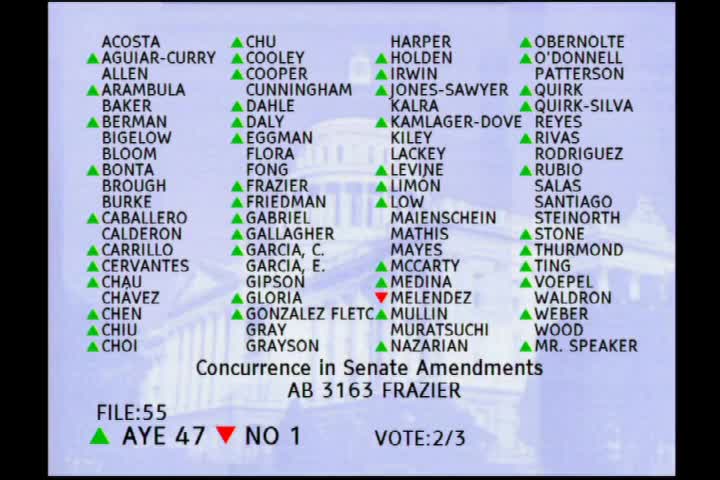 1MIN
Assembly Floor
 1MIN
Senate Floor
 1H
Senate Standing Committee on Appropriations
 1MIN
Assembly Floor
Bill Author

Bill Co-Author(s):