AB 2050: Small System Water Authority Act of 2018.
- Session Year: 2017-2018
- House: Assembly
- Latest Version Date: 2018-08-29
Existing law, the California Safe Drinking Water Act, provides for the operation of public water systems and imposes on the State Water Resources Control Board various responsibilities and duties. The act authorizes the state board to order consolidation with a receiving water system where a public water system or a state small water system, serving a disadvantaged community, as defined, consistently fails to provide an adequate supply of safe drinking water. The act, if consolidation is either not appropriate or not technically and economically feasible, authorizes the state board to contract with an administrator to provide administrative and managerial services to designated public water systems and to order the designated public water system to accept administrative and managerial services, as specified.
Existing law, the Cortese-Knox-Hertzberg Local Government Reorganization Act of 2000, provides the exclusive authority and procedure for the initiation, conduct, and completion of changes of organization and reorganization for cities and districts, except as specified.
This bill would create the Small System Water Authority Act of 2018 and state legislative findings and declarations relating to authorizing the creation of small system water authorities that will have powers to absorb, improve, and competently operate noncompliant public water systems. The bill, no later than March 1, 2019, would require the state board to provide written notice to cure to all public agencies, private water companies, or mutual water companies that operate a public water system that has either less than 3,000 service connections or that serves less than 10,000 people, and are not in compliance, for 4 consecutive quarters, with one or more state or federal primary drinking water standard maximum contaminant levels as of December 31, 2018, as specified. The bill would require the state board to provide a copy of the notice, in the case of a water corporation, to the Public Utilities Commission and would require the Public Utilities Commission to be responsible with the state board for ensuring compliance with the provisions of the bill. The bill would require an entity receiving the notice to respond to the state board, and, if appropriate, the Public Utilities Commission, as to whether the violations of drinking water standards are remedied and the basis for that conclusion, as specified. The bill would require an entity reporting a continuing violation of drinking water standards to have 180 days from the date of a specified response filed with the state board to prepare and submit a plan to the state board to permanently remedy a violation of drinking water standards within a reasonable time that is not later than January 1, 2024. The bill would require the state board to review the plan and accept, accept with reasonable conditions, or reject the plan, as prescribed. The bill would require an entity with an accepted plan to provide quarterly reports to the state board on progress towards a permanent remedy for violations of drinking water standards and would require the state board to annually hold a public hearing to consider whether the progress is satisfactory. The bill would require the state board, if it rejects the plan and after a certain period to allow for a petition for reconsideration, to cause the formation of an authority by the applicable local agency formation commission to serve the customers of the public water system that submitted the plan the state board rejects, if certain findings are made by the state board.
The bill would require the state board, no later than January 1, 2021, to provide written notice to each county, city, water district, private water company, or mutual water company located within a county where an entity receiving a notice to cure from the state board is located stating that the state board may consider the formation of an authority within that county and inviting other public water suppliers to consider a voluntary dissolution and subsequent inclusion into the authority that may be formed. The bill would require an agency wishing to consolidate into a proposed authority to provide a written statement opting into an authority to the administrator of the authority on or before July 1, 2021. The bill would authorize an agency wishing to join an authority after the formation of an authority to do so by a proposal or petition to the local agency formation commission. The bill would require any county or city receiving a notice to cure from the state board to determine, not later than June 1, 2021, whether any county service areas, county waterworks districts, or other dependent special districts providing water service or water and sewer service located within the county that provide water service or water and sewer service only in the proposed area of the authority should be included within the proposed authority, as prescribed. The bill would authorize an authority to include areas that are not contiguous.
The bill would require the state board, no later than 30 days after the rejection of an entitys plan to permanently remedy a violation of drinking water standards, to notify a local agency formation commission of a county where the public water system that submitted the plan is located, and if appropriate, the Public Utilities Commission, that it has determined that the public water system shall be consolidated into an authority. The bill would require the state board, no later than 60 days after the rejection, to notify the local agency formation commission, and if appropriate, the Public Utilities Commission of the public water systems that will be consolidated into an authority and to appoint an administrator for each proposed authority. The bill would require an administrator to be responsible for the interim administration and management of the authority and would require the state board to bear the cost of the administrator, as specified. The bill would require the administrator, after consultation with the executive officer of the local agency formation commission, to submit to the state board a conceptual formation plan, with specified components. The bill would require the state board to provide comments on the conceptual formation plan to the administrator and applicable local agency formation commission within 60 days of its receipt.
The bill would require the administrator, within 180 days after the state board provides comments on the draft conceptual formation plan, to submit an application for formation and proposed plan for service to the local agency formation commission for review and would require the commission to hold a hearing on the plan and approve or deny it, as prescribed. The bill would require an authority to file a statement, under penalty of perjury, with the executive office of the local agency formation commission certifying that the authority will take the appropriate actions to comply with an approved plan. By expanding the application of the crime of perjury, this bill would impose a state-mandated local program. The bill would require the executive officer of the commission, within 30 days of the filing of a statement, to issue a notice of completion to the authority and send a copy of that notice to the state board. The bill would authorize the state board, in the event that the authority fails to timely file a statement certifying compliance with the plan, to issue an order to the authority requiring the filing of a statement certifying compliance with the plan or other remedial action as may be appropriate. The bill would require, annually for the first 3 years after the date of an authoritys formation by a local agency formation commission, an authority to file a certain report with the local agency formation commission. The bill would require a local agency formation commission to hold a public hearing within 90 days of receipt of the report to review the authoritys performance during the previous year and would authorize a local agency formation commission to order an authority to remedy any failures to comply with conditions imposed by the commission or the plan for service. The bill would authorize a local agency formation commission to impose a civil penalty on an authority of up to $500 per day for each violation if an authority fails to timely comply with a remedial order by a local agency formation commission, up to a maximum of $10,000 per year for each particular violation.
The bill would require the Public Utilities Commission to order the dissolution of a public water system and the transfer of all assets of a subject water corporation to an authority formed by the local agency formation commission, as prescribed. The bill would require the state board to petition a court for an order dissolving any mutual water company, water corporation, or private corporation that has been operating a public water system and transferring the assets of that company or corporation to the authority formed by the local agency formation commission. The bill would provide for an owner or shareholder of a dissolved public water system to be compensated, as specified, in accordance with a distressed business valuation issued by the state board. The bill would authorize an authority to receive financing from the state to pay all liabilities assumed from a public water system and would require an authority to issue bonds to repay the state with interest.
The bill would require the Controller, in consultation with the state board and various associations, no later than January 1, 2025, to contract with an independent consultant to review the startup operations of the authorities and the management of the authorities by the administrators. The bill would require the consultant to prepare a report for the Legislature regarding the fiscal and operational health of the authorities that includes recommendations regarding the need for supplemental state funding, if any, and the potential sources of that funding.
The bill would provide for the appointment of an initial board of an authority, and the election of subsequent boards of an authority. The bill would require a director to be a resident of the area served by the authority and, to the extent practicable, to represent a division with equal population being served by the authority. The bill would require a director to receive compensation in an amount not to exceed $250 per day, not to exceed a total of 10 days in any calendar month, together with any expenses incurred in the performance of the directors duties required or authorized by the board. The bill would require the board to hold meetings, exercise and perform all powers, privileges, and duties of an authority, designate a depository to have custody of the funds of the authority, appoint officers, and hire employees, as specified. The bill would require the board to file a certain certificate with the Secretary of State within 180 days of its initial meeting after formation. The bill would require a person convicted of an infraction for a violation of any local ordinance or regulation adopted by an authority to be punished upon a first conviction by a fine not exceeding $50 and for a 2nd conviction within a period of one year by a fine of not exceeding $100 and for a 3rd or any subsequent conviction within a period of one year by a fine of not exceeding $250. By creating new crimes, this bill would impose a state-mandated local program.
The bill would specify the powers of an authority, including that an authority is authorized to acquire, control, distribute, store, spread, sink, treat, purify, recycle, recapture, and salvage any water, including sewage and stormwater, for the beneficial use of the authority. The bill would authorize the authority to fix a water standby assessment or availability charge, as prescribed. The bill would require a board of supervisors to levy the standby charge in the amounts for the respective parcels fixed by the board of the authority. The bill would require all county officers charged with the duty of collecting taxes to collect district standby charges with the regular tax payments to the county and would require the charges to be paid to the authority. The bill would authorize an authority to restrict the use of authority water, as specified, and would provide that it is a misdemeanor, punishable as specified, for any person to use or apply water received from the authority contrary to or in violation of any restriction or prohibition specified in the authoritys ordinance. By creating a new crime, this bill would impose a state-mandated local program. The bill would authorize an authority to conduct inspections and would authorize an authority to obtain an inspection warrant. Because the willful refusal of an inspection lawfully authorized by an inspection warrant is a misdemeanor, this bill would impose a state-mandated local program by expanding the application of a crime. The bill would require an authority to notify the county or city building inspector, county health inspector, or other affected county or city employee or office, in writing, within a reasonable time if an actual violation of an authority, city, or county ordinance is discovered during the investigation.
The bill would require the administrator to prepare and submit a capital improvement plan to the state board no later than one year after the date upon which an authority is formed. The bill would require the plan to bring the authority into full compliance with drinking water standards within 3 years, which time may be extended by the state board for good cause. The bill would require the state board, upon appropriation by the Legislature from the General Fund, or, to the extent funds are available from bond revenues or other sources, including federal, state, academic, or other public or private entities, to provide funding for the administrator and for formation and startup costs for up to 3 fiscal years after formation of the authority, as specified. The bill would provide for the state board, upon appropriation by the Legislature from the General Fund, or, to the extent funds are available from bond revenues or other sources, including federal, state, academic, or other public or private entities, to receive up to $5,400,000 for the preparation of distressed business valuations to determine the net fair market value of the water corporation or company.
By imposing new duties or a higher level of service on cities, counties, and local area formation commissions, this bill would impose a state-mandated local program.
The California Constitution requires the state to reimburse local agencies and school districts for certain costs mandated by the state. Statutory provisions establish procedures for making that reimbursement.
This bill would provide that with regard to certain mandates no reimbursement is required by this act for a specified reason.
With regard to any other mandates, this bill would provide that, if the Commission on State Mandates determines that the bill contains costs so mandated by the state, reimbursement for those costs shall be made pursuant to the statutory provisions noted above.
Existing law, the California Safe Drinking Water Act, provides for the operation of public water systems and imposes on the State Water Resources Control Board various responsibilities and duties. The act authorizes the state board to order consolidation with a receiving water system where a public water system or a state small water system, serving a disadvantaged community, as defined, consistently fails to provide an adequate supply of safe drinking water. The act, if consolidation is either not appropriate or not technically and economically feasible, authorizes the state board to contract with an administrator to provide administrative and managerial services to designated public water systems and to order the designated public water system to accept administrative and managerial services, as specified.
Existing law, the Cortese-Knox-Hertzberg Local Government Reorganization Act of 2000, provides the exclusive authority and procedure for the initiation, conduct, and completion of changes of organization and reorganization for cities and districts, except as specified.
This bill would create the Small System Water Authority Act of 2018 and state legislative findings and declarations relating to authorizing the creation of small system water authorities that will have powers to absorb, improve, and competently operate noncompliant public water systems. The bill, no later than March 1, 2019, would require the state board to provide written notice to cure to all public agencies, private water companies, or mutual water companies that operate a public water system that has either less than 3,000 service connections or that serves less than 10,000 people, and are not in compliance with one or more state or federal primary drinking water standard maximum contaminant levels as of December 31, 2018, and for 4 consecutive quarters, as specified. The bill would require the state board to provide a copy of the notice, in the case of a water corporation, to the Public Utilities Commission and would require the Public Utilities Commission to be responsible with the state board for ensuring compliance with the provisions of the bill. The bill would require an entity receiving the notice to respond to the state board, and, if appropriate, the Public Utilities Commission, as to whether the violations of drinking water standards are remedied and the basis for that conclusion, as specified. The bill would require an entity reporting a continuing violation of drinking water standards to have 180 days from the date of a specified response filed with the state board to prepare and submit a plan to the state board to permanently remedy a violation of drinking water standards within a reasonable time that is not later than January 1, 2024. The bill would require the state board to review the plan and accept, accept with reasonable conditions, or reject the plan, as prescribed. The bill would require an entity with an accepted plan to provide quarterly reports to the state board on progress towards a permanent remedy for violations of drinking water standards and would require the state board to annually hold a public hearing to consider whether the progress is satisfactory. The bill would require the state board, if it rejects the plan and after a certain period to allow for a petition for reconsideration, to cause the formation of an authority by the applicable local agency formation commission to serve the customers of the public water system that submitted the plan the state board rejects, if certain findings are made by the state board.
The bill would require the state board, no later than January 1, 2021, to provide written notice to each county, city, water district, private water company, or mutual water company located within a county where an entity receiving a notice to cure from the state board is located stating that the state board may consider the formation of an authority within that county and inviting other public water suppliers to consider a voluntary dissolution and subsequent inclusion into the authority that may be formed. The bill would require an agency wishing to consolidate into a proposed authority to provide a written statement opting into an authority to the administrator of the authority on or before July 1, 2021. The bill would authorize an agency wishing to join an authority after the formation of an authority to do so by a proposal or petition to the local agency formation commission. The bill would require any county or city receiving a notice to cure from the state board to determine, not later than June 1, 2021, whether any county service areas, county waterworks districts, or other dependent special districts providing water service or water and sewer service located within the county that provide water service or water and sewer service only in the proposed area of the authority should be included within the proposed authority, as prescribed. The bill would authorize an authority to include areas that are not contiguous.
The bill would require the state board, no later than 30 days after the rejection of an entitys plan to permanently remedy a violation of drinking water standards, to notify a local agency formation commission of a county where the public water system that submitted the plan is located, and if appropriate, the Public Utilities Commission, that it has determined that the public water system shall be consolidated into an authority. The bill would require the state board, no later than 60 days after the rejection, to notify the local agency formation commission, and if appropriate, the Public Utilities Commission of the public water systems that will be consolidated into an authority and to appoint an administrator for each proposed authority. The bill would require an administrator to be responsible for the interim administration and management of the authority and would require the state board to bear the cost of the administrator, as specified. The bill would require the administrator, after consultation with the executive officer of the local agency formation commission, to submit to the state board a conceptual formation plan, with specified components. The bill would require the state board to provide comments on the conceptual formation plan to the administrator and applicable local agency formation commission within 60 days of its receipt.
The bill would require the administrator, within 180 days after the state board provides comments on the draft conceptual formation plan, to submit an application for formation and proposed plan for service to the local agency formation commission for review and would require the commission to hold a hearing on the plan and approve or deny it, as prescribed. The bill would require an authority to file a statement, under penalty of perjury, with the executive office of the local agency formation commission certifying that the authority will take the appropriate actions to comply with an approved plan. By expanding the application of the crime of perjury, this bill would impose a state-mandated local program. The bill would require the executive officer of the commission, within 30 days of the filing of a statement, to issue a notice of completion to the authority and send a copy of that notice to the state board. The bill would authorize the state board, in the event that the authority fails to timely file a statement certifying compliance with the plan, to issue an order to the authority requiring the filing of a statement certifying compliance with the plan or other remedial action as may be appropriate. The bill would require, annually for the first 3 years after the date of an authoritys formation by a local agency formation commission, an authority to file a certain report with the commission. The bill would require a local agency formation commission to hold a public hearing within 90 days of receipt of the report to review the authoritys performance during the previous year and would authorize a commission to order an authority to remedy any failures to comply with conditions imposed by the commission or the plan for service. The bill would authorize a commission to impose a civil penalty on an authority of up to $500 per day for each violation if an authority fails to timely comply with a remedial order by a commission, up to a maximum of $10,000 per year for each particular violation.
The bill would require the Public Utilities Commission to order the dissolution of a public water system and the transfer of all assets of a subject water corporation to an authority formed by the local agency formation commission, as prescribed. The bill would require the state board to petition a court for an order dissolving any mutual water company, water corporation, or private corporation that has been operating a public water system and transferring the assets of that company or corporation to the authority formed by the local agency formation commission. The bill would provide for an owner or shareholder of a dissolved public water system to be compensated, as specified, in accordance with a distressed business valuation issued by the state board. The bill would authorize an authority to receive financing from the state to pay all liabilities assumed from a public water system and would require an authority to issue bonds to repay the state with interest.
The bill would require the Controller, in consultation with the state board and various associations, no later than January 1, 2025, to contract with an independent consultant to review the startup operations of the authorities and the management of the authorities by the administrators. The bill would require the consultant to prepare a report for the Legislature regarding the fiscal and operational health of the authorities that includes recommendations regarding the need for supplemental state funding, if any, and the potential sources of that funding.
The bill would provide for the appointment of an initial board of an authority, and the election of subsequent boards of an authority. The bill would require a director to be a resident of the area served by the authority and, to the extent practicable, to represent a division with equal population being served by the authority. The bill would require a director to receive compensation in an amount not to exceed $250 per day, not to exceed a total of 10 days in any calendar month, together with any expenses incurred in the performance of the directors duties required or authorized by the board. The bill would require the board to hold meetings, exercise and perform all powers, privileges, and duties of an authority, designate a depository to have custody of the funds of the authority, appoint officers, and hire employees, as specified. The bill would require the board to file a certain certificate with the Secretary of State within 180 days of its initial meeting after formation. The bill would require a person convicted of an infraction for a violation of any local ordinance or regulation adopted by an authority to be punished upon a first conviction by a fine not exceeding $50 and for a 2nd conviction within a period of one year by a fine of not exceeding $100 and for a 3rd or any subsequent conviction within a period of one year by a fine of not exceeding $250. By creating new crimes, this bill would impose a state-mandated local program.
The bill would specify the powers of an authority, including that an authority is authorized to acquire, control, distribute, store, spread, sink, treat, purify, recycle, recapture, and salvage any water, including sewage and stormwater, for the beneficial use of the authority. The bill would authorize the authority to fix a water standby assessment or availability charge, as prescribed. The bill would require a board of supervisors to levy the standby charge in the amounts for the respective parcels fixed by the board of the authority. The bill would require all county officers charged with the duty of collecting taxes to collect district standby charges with the regular tax payments to the county and would require the charges to be paid to the authority. The bill would authorize an authority to restrict the use of authority water, as specified, and would provide that it is a misdemeanor, punishable as specified, for any person to use or apply water received from the authority contrary to or in violation of any restriction or prohibition specified in the authoritys ordinance. By creating a new crime, this bill would impose a state-mandated local program. The bill would authorize an authority to conduct inspections and would authorize an authority to obtain an inspection warrant. Because the willful refusal of an inspection lawfully authorized by an inspection warrant is a misdemeanor, this bill would impose a state-mandated local program by expanding the application of a crime. The bill would require an authority to notify the county or city building inspector, county health inspector, or other affected county or city employee or office, in writing, within a reasonable time if an actual violation of an authority, city, or county ordinance is discovered during the investigation.
The bill would require the administrator to prepare and submit a capital improvement plan to the state board no later than one year after the date upon which an authority is formed. The bill would require the plan to bring the authority into full compliance with drinking water standards within 3 years, which time may be extended by the state board for good cause. The bill would require the state board, upon appropriation by the Legislature from the General Fund, or, to the extent funds are available from bond revenues or other sources, including federal, state, academic, or other public or private entities, to provide funding for the administrator and for formation and startup costs for up to 3 fiscal years after formation of the authority, as specified. The bill would provide for the state board, upon appropriation by the Legislature from the General Fund, or, to the extent funds are available from bond revenues or other sources, including federal, state, academic, or other public or private entities, to receive up to $5,400,000 for the preparation of distressed business valuations to determine the net fair market value of the water corporation or company.
By imposing new duties or a higher level of service on cities, counties, and local area formation commissions, this bill would impose a state-mandated local program.
The California Constitution requires the state to reimburse local agencies and school districts for certain costs mandated by the state. Statutory provisions establish procedures for making that reimbursement.
This bill would provide that with regard to certain mandates no reimbursement is required by this act for a specified reason.
With regard to any other mandates, this bill would provide that, if the Commission on State Mandates determines that the bill contains costs so mandated by the state, reimbursement for those costs shall be made pursuant to the statutory provisions noted above.
Existing law, the California Safe Drinking Water Act, provides for the operation of public water systems and imposes on the State Water Resources Control Board various responsibilities and duties. The act authorizes the state board to order consolidation with a receiving water system where a public water system or a state small water system, serving a disadvantaged community, as defined, consistently fails to provide an adequate supply of safe drinking water. The act, if consolidation is either not appropriate or not technically and economically feasible, authorizes the state board to contract with an administrator to provide administrative and managerial services to designated public water systems and to order the designated public water system to accept administrative and managerial services, as specified.
Existing law, the Cortese-Knox-Hertzberg Local Government Reorganization Act of 2000, provides the exclusive authority and procedure for the initiation, conduct, and completion of changes of organization and reorganization for cities and districts, except as specified.
This bill would create the Small System Water Authority Act of 2018 and state legislative findings and declarations relating to authorizing the creation of small system water authorities that will have powers to absorb, improve, and competently operate noncompliant public water systems. The bill, no later than March 1, 2019, would require the state board to provide written notice to cure to all public agencies, private water companies, or mutual water companies that operate a public water system that has either less than 3,000 service connections or that serves less than 10,000 people, and are not in compliance with one or more state or federal primary drinking water standard maximum contaminant levels as of December 31, 2018, and for 4 consecutive quarters, as specified. The bill would require the state board to provide a copy of the notice, in the case of a water corporation, to the Public Utilities Commission and would require the Public Utilities Commission to be responsible with the state board for ensuring compliance with the provisions of the bill. The bill would require an entity receiving the notice to respond to the state board, and, if appropriate, the Public Utilities Commission, as to whether the violations of drinking water standards are remedied and the basis for that conclusion, as specified. The bill would require an entity reporting a continuing violation of drinking water standards to have 180 days from the date of a specified response filed with the state board to prepare and submit a plan to the state board to permanently remedy a violation of drinking water standards within a reasonable time that is not later than January 1, 2024. The bill would require the state board to review the plan and accept, accept with reasonable conditions, or reject the plan, as prescribed. The bill would require an entity with an accepted plan to provide quarterly reports to the state board on progress towards a permanent remedy for violations of drinking water standards and would require the state board to annually hold a public hearing to consider whether the progress is satisfactory. The bill would require the state board, if it rejects the plan and after a certain period to allow for a petition for reconsideration, to cause the formation of an authority by the applicable local agency formation commission to serve the customers of the public water system that submitted the plan the state board rejects, if certain findings are made by the state board.
The bill would require the state board, no later than January 1, 2021, to provide written notice to each county, city, water district, private water company, or mutual water company located within a county where an entity receiving a notice to cure from the state board is located stating that the state board may consider the formation of an authority within that county and inviting other public water suppliers to consider a voluntary dissolution and subsequent inclusion into the authority that may be formed. The bill would require an agency wishing to consolidate into a proposed authority to provide a written statement opting into an authority to the administrator of the authority on or before July 1, 2021. The bill would authorize an agency wishing to join an authority after the formation of an authority to do so by a proposal or petition to the local agency formation commission. The bill would require any county or city receiving a notice to cure from the state board to determine, not later than June 1, 2021, whether any county service areas, county waterworks districts, or other dependent special districts providing water service or water and sewer service located within the county that provide water service or water and sewer service only in the proposed area of the authority should be included within the proposed authority, as prescribed. The bill would authorize an authority to include areas that are not contiguous.
The bill would require the state board, no later than 30 days after the rejection of an entitys plan to permanently remedy a violation of drinking water standards, to notify a local agency formation commission of a county where the public water system that submitted the plan is located, and if appropriate, the Public Utilities Commission, that it has determined that the public water system shall be consolidated into an authority. The bill would require the state board, no later than 60 days after the rejection, to notify the local agency formation commission, and if appropriate, the Public Utilities Commission of the public water systems that will be consolidated into an authority and to appoint an administrator for each proposed authority. The bill would require an administrator to be responsible for the interim administration and management of the authority and would require the state board to bear the cost of the administrator, as specified. The bill would require the applicable local agency formation commission to form an authority to provide safe drinking water to the public water systems customers, as prescribed. The bill would require the administrator, after consultation with the executive officer of the local agency formation commission, to submit to the state board a conceptual formation plan, with specified components. The bill would require the state board to provide comments on the conceptual formation plan to the administrator and applicable local agency formation commission within 60 days of its receipt.
The bill would require the administrator, within 180 days after the state board provides comments on the draft conceptual formation plan, to submit an application for formation and proposed plan for service to the local agency formation commission for review and would require the commission to hold a hearing on the plan and approve or deny it, as prescribed. The bill would require an authority to file a statement, under penalty of perjury, with the executive office of the local agency formation commission certifying that the authority will take the appropriate actions to comply with an approved plan. By expanding the application of the crime of perjury, this bill would impose a state-mandated local program. The bill would require the executive officer of the commission, within 30 days of the filing of a statement, to issue a notice of completion to the authority and send a copy of that notice to the state board. The bill would authorize the state board, in the event that the authority fails to timely file a statement certifying compliance with the plan, to issue an order to the authority requiring the filing of a statement certifying compliance with the plan or other remedial action as may be appropriate. The bill would require, annually for the first 3 years after the date of an authoritys formation by a local agency formation commission, an authority to file a certain report with the commission. The bill would require a local agency formation commission to hold a public hearing within 90 days of receipt of the report to review the authoritys performance during the previous year and would authorize a commission to order an authority to remedy any failures to comply with conditions imposed by the commission or the plan for service. The bill would authorize a commission to impose a civil penalty on an authority of up to $500 per day for each violation if an authority fails to timely comply with a remedial order by a commission, up to a maximum of $10,000 per year for each particular violation.
The bill would require the Public Utilities Commission to order the dissolution of a public water system and the transfer of all assets of a subject water corporation to an authority formed by the local agency formation commission, as prescribed. The bill would require the state board to petition a court for an order dissolving any mutual water company, water corporation, or private corporation that has been operating a public water system and transferring the assets of that company or corporation to the authority formed by the local agency formation commission. The bill would provide for an owner or shareholder of a dissolved public water system to be compensated, as specified, in accordance with a distressed business valuation issued by the state board. The bill would authorize an authority to receive financing from the state to pay all liabilities assumed from a public water system and would require an authority to issue bonds to repay the state with interest.
The bill would require the Controller, in consultation with the state board and various associations, no later than January 1, 2025, to contract with an independent consultant to review the startup operations of the authorities and the management of the authorities by the administrators. The bill would require the consultant to prepare a report for the Legislature regarding the fiscal and operational health of the authorities that includes recommendations regarding the need for supplemental state funding, if any, and the potential sources of that funding.
The bill would provide for the appointment of an initial board of an authority, and the election of subsequent boards of an authority. The bill would require a director to be a resident of the area served by the authority and, to the extent practicable, to represent a division with equal population being served by the authority. The bill would require a director to receive compensation in an amount not to exceed $250 per day, not to exceed a total of 10 days in any calendar month, together with any expenses incurred in the performance of the directors duties required or authorized by the board. The bill would require the board to hold meetings, exercise and perform all powers, privileges, and duties of an authority, designate a depository to have custody of the funds of the authority, appoint officers, and hire employees, as specified. The bill would require the board to file a certain certificate with the Secretary of State within 180 days of its initial meeting after formation. The bill would require a person convicted of an infraction for a violation of any local ordinance or regulation adopted by an authority to be punished upon a first conviction by a fine not exceeding $50 and for a 2nd conviction within a period of one year by a fine of not exceeding $100 and for a 3rd or any subsequent conviction within a period of one year by a fine of not exceeding $250. By creating new crimes, this bill would impose a state-mandated local program.
The bill would specify the powers of an authority, including that an authority is authorized to acquire, control, distribute, store, spread, sink, treat, purify, recycle, recapture, and salvage any water, including sewage and stormwater, for the beneficial use of the authority. The bill would authorize the authority to fix a water standby assessment or availability charge, as prescribed. The bill would require a board of supervisors to levy the standby charge in the amounts for the respective parcels fixed by the board of the authority. The bill would require all county officers charged with the duty of collecting taxes to collect district standby charges with the regular tax payments to the county and would require the charges to be paid to the authority. The bill would authorize an authority to restrict the use of authority water, as specified, and would provide that it is a misdemeanor, punishable as specified, for any person to use or apply water received from the authority contrary to or in violation of any restriction or prohibition specified in the authoritys ordinance. By creating a new crime, this bill would impose a state-mandated local program. The bill would authorize an authority to conduct inspections and would authorize an authority to obtain an inspection warrant. Because the willful refusal of an inspection lawfully authorized by an inspection warrant is a misdemeanor, this bill would impose a state-mandated local program by expanding the application of a crime. The bill would require an authority to notify the county or city building inspector, county health inspector, or other affected county or city employee or office, in writing, within a reasonable time if an actual violation of an authority, city, or county ordinance is discovered during the investigation.
The bill would require the administrator to prepare and submit a capital improvement plan to the state board no later than one year after the date upon which an authority is formed. The bill would require the plan to bring the authority into full compliance with drinking water standards within 3 years, which time may be extended by the state board for good cause. The bill would require the state board, upon appropriation by the Legislature from the General Fund, or, to the extent funds are available from bond revenues or other sources, including federal, state, academic, or other public or private entities, to provide funding for the administrator and for formation and startup costs for up to 3 fiscal years after formation of the authority, as specified. The bill would provide for the state board, upon appropriation by the Legislature from the General Fund, or, to the extent funds are available from bond revenues or other sources, including federal, state, academic, or other public or private entities, to receive up to $5,400,000 for the preparation of distressed business valuations to determine the net fair market value of the water corporation or company.
By imposing new duties or a higher level of service on cities, counties, and local area formation commissions, this bill would impose a state-mandated local program.
The California Constitution requires the state to reimburse local agencies and school districts for certain costs mandated by the state. Statutory provisions establish procedures for making that reimbursement.
This bill would provide that with regard to certain mandates no reimbursement is required by this act for a specified reason.
With regard to any other mandates, this bill would provide that, if the Commission on State Mandates determines that the bill contains costs so mandated by the state, reimbursement for those costs shall be made pursuant to the statutory provisions noted above.
Existing law, the California Safe Drinking Water Act, provides for the operation of public water systems and imposes on the State Water Resources Control Board various responsibilities and duties. The act authorizes the state board to order consolidation with a receiving water system where a public water system or a state small water system, serving a disadvantaged community, as defined, consistently fails to provide an adequate supply of safe drinking water. The act, if consolidation is either not appropriate or not technically and economically feasible, authorizes the state board to contract with an administrator to provide administrative and managerial services to designated public water systems and to order the designated public water system to accept administrative and managerial services, as specified.
Existing law, the Cortese-Knox-Hertzberg Local Government Reorganization Act of 2000, provides the exclusive authority and procedure for the initiation, conduct, and completion of changes of organization and reorganization for cities and districts, except as specified.
This bill would create the Small System Water Authority Act of 2018 and state legislative findings and declarations relating to authorizing the creation of small system water authorities that will have powers to absorb, improve, and competently operate noncompliant public water systems. The bill, no later than March 1, 2019, would require the state board to provide written notice to cure to all public agencies, private water companies, or mutual water companies that operate a public water system that has either less than 3,000 service connections or that serves less than 10,000 people, and are not in compliance with one or more state or federal primary drinking water standard maximum contaminant levels as of December 31, 2018, and for 4 consecutive quarters, as specified. The bill would require the state board to provide a copy of the notice, in the case of a water corporation, to the Public Utilities Commission and would require the Public Utilities Commission to be responsible with the state board for ensuring compliance with the provisions of the bill. The bill would require an entity receiving the notice to respond to the state board, and, if appropriate, the Public Utilities Commission, as to whether the violations of drinking water standards are remedied and the basis for that conclusion, as specified. The bill would require an entity reporting a continuing violation of drinking water standards to have 180 days from the date of a specified response filed with the state board to prepare and submit a plan to the state board to permanently remedy a violation of drinking water standards within a reasonable time that is not later than January 1, 2027. 2024. The bill would require the state board to review the plan and accept, accept with reasonable conditions, or reject the plan, as prescribed. The bill would require an entity with an accepted plan to provide quarterly reports to the state board on progress towards a permanent remedy for violations of drinking water standards and would require the state board to annually hold a public hearing to consider whether the progress is satisfactory. The bill would require the state board, if it rejects the plan and after a certain period to allow for a petition for reconsideration, to cause the formation of an authority by the applicable local agency formation commission to serve the customers of the public water system that submitted the plan the state board rejects, if certain findings are made by the state board.
The bill would require the state board, no later than January 1, 2021, to provide written notice to each county, city, water district, private water company, or mutual water company located within a county where an entity receiving a notice to cure from the state board is located stating that the state board may consider the formation of an authority within that county and inviting other public water suppliers to consider a voluntary dissolution and subsequent inclusion into the authority that may be formed. The bill would require an agency wishing to consolidate into a proposed authority to provide a written statement opting into an authority to the administrator of the authority on or before July 1, 2021. The bill would authorize an agency wishing to join an authority after the formation of an authority to do so by a proposal or petition to the local agency formation commission. The bill would require any county or city receiving a notice to cure from the state board to determine, not later than June 1, 2021, whether any county service areas, county waterworks districts, or other dependent special districts providing water service or water and sewer service located within the county that provide water service or water and sewer service only in the proposed area of the authority should be included within the proposed authority, as prescribed. The bill would authorize an authority to include areas that are not contiguous.
The bill would require the state board, no later than 30 days after the rejection of an entitys plan to permanently remedy a violation of drinking water standards, to notify a local agency formation commission of a county where the public water system that submitted the plan is located, and if appropriate, the Public Utilities Commission, that it has determined that the public water system shall be consolidated into an authority. The bill would require the state board, no later than 60 days after the rejection, to notify the local agency formation commission, and if appropriate, the Public Utilities Commission of the public water systems that will be consolidated into an authority and to appoint an administrator for each proposed authority. The bill would require an administrator to be responsible for the interim administration and management of the authority and would require the state board to bear the cost of the administrator, as specified. The bill would require the applicable local agency formation commission to form an authority to provide safe drinking water to the public water systems customers, as prescribed. The bill would require the administrator, after consultation with the executive officer of the local agency formation commission, to submit to the state board a conceptual formation plan, with specified components. The bill would require the state board to provide comments on the conceptual formation plan to the administrator and applicable local agency formation commission within 60 days of its receipt.
The bill would require the administrator, within 180 days after the state board provides comments on the draft conceptual formation plan, to submit an application for formation and proposed plan for service to the local agency formation commission for review and would require the commission to hold a hearing on the plan and approve or deny it, as prescribed. The bill would require an authority to file a statement, under penalty of perjury, with the executive office of the local agency formation commission certifying that the authority will take the appropriate actions to comply with an approved plan. By expanding the application of the crime of perjury, this bill would impose a state-mandated local program. The bill would require the executive officer of the commission, within 30 days of the filing of a statement, to issue a notice of completion to the authority and send a copy of that notice to the state board. The bill would authorize the state board, in the event that the authority fails to timely file a statement certifying compliance with the plan, to issue an order to the authority requiring the filing of a statement certifying compliance with the plan or other remedial action as may be appropriate. The bill would require, annually for the first 3 years after the date of an authoritys formation by a local agency formation commission, an authority to file a certain report with the commission. The bill would require a local agency formation commission to hold a public hearing within 90 days of receipt of the report to review the authoritys performance during the previous year and would authorize a commission to order an authority to remedy any failures to comply with conditions imposed by the commission or the plan for service. The bill would authorize a commission to impose a civil penalty on an authority of up to $500 per day for each violation if an authority fails to timely comply with a remedial order by a commission, up to a maximum of $10,000 per year for each particular violation.
The bill would require the Public Utilities Commission to order the dissolution of a public water system and the transfer of all assets of a subject water corporation to an authority formed by the local agency formation commission, as prescribed. The bill would require the state board to petition a court for an order dissolving any mutual water company, water corporation, or private corporation that has been operating a public water system and transferring the assets of that company or corporation to the authority formed by the local agency formation commission. The bill would provide for an owner or shareholder of a dissolved public water system to be compensated, as specified, in accordance with a distressed business valuation issued by the state board. The bill would authorize an authority to receive financing from the state to pay all liabilities assumed from a public water system and would require an authority to issue bonds to repay the state with interest.
The bill would require the Treasurer, Controller, in consultation with the state board and various associations, no later than January 1, 2025, to contract with an independent consultant to review the startup operations of the authorities and the management of the authorities by the administrators. The bill would require the consultant to prepare a report for the Legislature regarding the fiscal and operational health of the authorities that includes recommendations regarding the need for supplemental state funding, if any, and the potential sources of that funding.
The bill would provide for the appointment of an initial board of an authority, and the election of subsequent boards of an authority. The bill would require a director to be a resident of the area served by the authority and, to the extent practicable, to represent a division with equal population being served by the authority. The bill would require a director to receive compensation in an amount not to exceed $250 per day, not to exceed a total of 10 days in any calendar month, together with any expenses incurred in the performance of the directors duties required or authorized by the board. The bill would require the board to hold meetings, exercise and perform all powers, privileges, and duties of an authority, designate a depository to have custody of the funds of the authority, appoint officers, and hire employees, as specified. The bill would require the board to file a certain certificate with the Secretary of State within 180 days of its initial meeting after formation. The bill would require a person convicted of an infraction for a violation of any local ordinance or regulation adopted by an authority to be punished upon a first conviction by a fine not exceeding $50 and for a 2nd conviction within a period of one year by a fine of not exceeding $100 and for a 3rd or any subsequent conviction within a period of one year by a fine of not exceeding $250. By creating new crimes, this bill would impose a state-mandated local program.
The bill would specify the powers of an authority, including that an authority is authorized to acquire, control, distribute, store, spread, sink, treat, purify, recycle, recapture, and salvage any water, including sewage and stormwaters, stormwater, for the beneficial use of the authority. The bill would authorize the authority to fix a water standby assessment or availability charge, as prescribed. The bill would require a board of supervisors to levy the standby charge in the amounts for the respective parcels fixed by the board of the authority. The bill would require all county officers charged with the duty of collecting taxes to collect district standby charges with the regular tax payments to the county and would require the charges to be paid to the authority. The bill would authorize an authority to restrict the use of authority water, as specified, and would provide that it is a misdemeanor, punishable as specified, for any person to use or apply water received from the authority contrary to or in violation of any restriction or prohibition specified in the authoritys ordinance. By creating a new crime, this bill would impose a state-mandated local program. The bill would authorize an authority to conduct inspections and would authorize an authority to obtain an inspection warrant. Because the willful refusal of an inspection lawfully authorized by an inspection warrant is a misdemeanor, this bill would impose a state-mandated local program by expanding the application of a crime. The bill would require an authority to notify the county or city building inspector, county health inspector, or other affected county or city employee or office, in writing, within a reasonable time if an actual violation of an authority, city city, or county ordinance is discovered during the investigation.
The bill would require the administrator to prepare and submit a capital improvement plan to the state board no later than one year after the date upon which an authority is formed. The bill would require the plan to bring the authority into full compliance with drinking water standards within 3 years, which time may be extended by the state board for good cause. The bill would require the state board, upon appropriation by the Legislature from the General Fund, or, to the extent funds are available from bond revenues or other sources, including federal, state, academic, or other public or private entities, to provide funding for the administrator and for formation and startup costs for up to 3 fiscal years after formation of the authority, as specified. The bill would provide for the state board, upon appropriation by the Legislature from the General Fund, or, to the extent funds are available from bond revenues or other sources, including federal, state, academic, or other public or private entities, to receive up to $5,400,000 for the preparation of a distressed business valuation valuations to determine the net fair market value of the water corporation or company.
By imposing new duties or a higher level of service on cities, counties, and local area formation commissions, this bill would impose a state-mandated local program.
The California Constitution requires the state to reimburse local agencies and school districts for certain costs mandated by the state. Statutory provisions establish procedures for making that reimbursement.
This bill would provide that with regard to certain mandates no reimbursement is required by this act for a specified reason.
With regard to any other mandates, this bill would provide that, if the Commission on State Mandates determines that the bill contains costs so mandated by the state, reimbursement for those costs shall be made pursuant to the statutory provisions noted above.
Existing law, the California Safe Drinking Water Act, provides for the operation of public water systems and imposes on the State Water Resources Control Board various responsibilities and duties. The act authorizes the state board to order consolidation with a receiving water system where a public water system or a state small water system, serving a disadvantaged community, as defined, consistently fails to provide an adequate supply of safe drinking water. The act, if consolidation is either not appropriate or not technically and economically feasible, authorizes the state board to contract with an administrator to provide administrative and managerial services to designated public water systems and to order the designated public water system to accept administrative and managerial services, as specified.
Existing law, the Cortese-Knox-Hertzberg Local Government Reorganization Act of 2000, provides the exclusive authority and procedure for the initiation, conduct, and completion of changes of organization and reorganization for cities and districts, except as specified.
This bill would create the Small System Water Authority Act of 2018 and state legislative findings and declarations relating to authorizing the creation of small system water authorities that will have powers to absorb, improve, and competently operate noncompliant public water systems. The bill, no later than March 1, 2019, would require the state board to provide written notice to cure to all public agencies, private water companies, or mutual water companies that operate a public water system that has either less than 3,000 service connections or that serves less than 10,000 people, and are not in compliance with one or more state or federal primary drinking water standard maximum contaminant levels as of December 31, 2018, and for 4 consecutive quarters, as specified. The bill would require the state board to provide a copy of the notice, in the case of a water corporation, to the Public Utilities Commission and would require the Public Utilities Commission to be responsible with the state board for ensuring compliance with the provisions of the bill. The bill would require an entity receiving the notice to respond to the state board board, and, if appropriate, the Public Utilities Commission, as to whether the violations of drinking water standards are remedied and the basis for that conclusion, as specified. The bill would require an entity reporting a continuing violation of drinking water standards to have 180 days from the date of a specified response filed with the state board to prepare and submit a plan to the state board to permanently remedy a violation of drinking water standards within a reasonable time that is not later than January 1, 2027. The bill would require the state board to review the plan and accept, accept with reasonable conditions, or reject the plan, as prescribed. The bill would require an entity with an accepted plan to provide quarterly reports to the state board on progress towards a permanent remedy for violations of drinking water standards and would require the state board to annually hold a public hearing to consider whether the progress is satisfactory. The bill would require the state board, if it rejects the plan and after a certain period to allow for a petition for reconsideration, to cause the formation of an authority by the applicable local agency formation commission to serve the customers of the public water system that submitted the plan the state board rejects, if certain findings are made by the state board.
The bill would require the state board, no later than January 1, 2021, to provide written notice to each county, city, water district, private water company, or mutual water company located within a county where an entity receiving a notice to cure from the state board is located stating that the state board may consider the formation of an authority within that county and inviting other public water suppliers to consider a voluntary dissolution and subsequent inclusion into the authority that may be formed. The bill would require an agency wishing to consolidate into a proposed authority to provide a written statement opting into an authority to the administrator of the authority on or before July 1, 2021. The bill would authorize an agency wishing to join an authority after the formation of an authority to do so by a proposal or petition to the local agency formation commission. The bill would require any county or city receiving a notice to cure from the state board to determine, not later than June 1, 2021, whether any county service areas, county waterworks districts, or other dependent special districts providing water service or water and sewer service located within the county that provide water service or water and sewer service only in the proposed area of the authority should be included within the proposed authority, as prescribed. The bill would authorize an authority to include areas that are not contiguous.
The bill would require the state board, no later than 30 days after the rejection of an entitys plan to permanently remedy a violation of drinking water standards, to notify a local agency formation commission of a county where the public water system that submitted the plan is located, and if appropriate, the Public Utilities Commission, that it has determined that the public water system shall be consolidated into an authority. The bill would require the state board, no later than 60 days after the rejection, to notify the local agency formation commission, and if appropriate, the Public Utilities Commission of the public water systems that will be consolidated into an authority and to appoint an administrator for each proposed authority. The bill would require an administrator to be responsible for the interim administration and management of the authority and would require the state board to bear the cost of the administrator, as specified. The bill would require the applicable local agency formation commission to form an authority to provide safe drinking water to the public water systems customers, as prescribed. The bill would require the administrator, after consultation with the executive officer of the local agency formation commission, to submit to the state board a conceptual formation plan, with specified components. The bill would require the state board to provide comments on the conceptual formation plan to the administrator and applicable local agency formation commission within 60 days of its receipt.
The bill would require the administrator, within 180 days after the state board provides comments on the draft conceptual formation plan, to submit an application for formation and proposed plan for service to the local agency formation commission for review and would require the commission to hold a hearing on the plan and approve or deny it, as prescribed. The bill would require an authority to file a statement, under penalty of perjury, with the executive office of the local agency formation commission certifying that the authority will take the appropriate actions to comply with an approved plan. By expanding the application of the crime of perjury, this bill would impose a state-mandated local program. The bill would require the executive officer of the commission, within 30 days of the filing of a statement, to issue a notice of completion to the authority and send a copy of that notice to the state board. The bill would authorize the state board, in the event that the authority fails to timely file a statement certifying compliance with the plan, to issue an order to the authority requiring the filing of a statement certifying compliance with the plan or other remedial action as may be appropriate. The bill would require, annually for the first 3 years after the date of an authoritys formation by a local agency formation commission, an authority to file a certain report with the commission. The bill would require a local agency formation commission to hold a public hearing within 90 days of receipt of the report to review the authoritys performance during the previous year and would authorize a commission to order an authority to remedy any failures to comply with conditions imposed by the commission or the plan for service. The bill would authorize a commission to impose a civil penalty on an authority of up to $500 per day for each violation if an authority fails to timely comply with a remedial order by a commission, up to a maximum of $10,000 per year for each particular violation.
The bill would require the Public Utilities Commission to order the dissolution of a public water system and the transfer of all assets of a subject water corporation to an authority formed by the local agency formation commission, as prescribed. The bill would require the state board to petition a court for an order dissolving any mutual water company, water corporation, or private corporation that has been operating a public water system and transferring the assets of that company or corporation to the authority formed by the local agency formation commission. The bill would provide for an owner or shareholder of a dissolved public water system to be compensated, as specified, in accordance with a distressed business valuation issued by the state board. The bill would authorize an authority to receive financing from the state to pay all liabilities assumed from a public water system and would require an authority to issue bonds to repay the state with interest.
The bill would require the Treasurer, in consultation with the state board and various associations, no later than January 1, 2025, to contract with an independent consultant to review the start up startup operations of the authorities and the management of the authorities by the administrators. The bill would require the consultant to prepare a report for the Legislature regarding the fiscal and operational health of the authorities that includes recommendations regarding the need for supplemental state funding, if any, and the potential sources of that funding.
The bill would provide for the appointment of an initial board of an authority, and the election of subsequent boards of an authority. The bill would require a director to be a resident of the area served by the authority and, to the extent practicable, to represent a division with equal population being served by the authority. The bill would require a director to receive compensation in an amount not to exceed $250 per day, not to exceed a total of 10 days in any calendar month, together with any expenses incurred in the performance of the directors duties required or authorized by the board. The bill would require the board to hold meetings, exercise and perform all powers, privileges, and duties of an authority, designate a depository to have custody of the funds of the authority, appoint officers, and hire employees, as specified. The bill would require the board to file a certain certificate with the Secretary of State within 180 days of its initial meeting after formation. The bill would require a person convicted of an infraction for a violation of any local ordinance or regulation adopted by an authority to be punished upon a first conviction by a fine not exceeding $50 and for a 2nd conviction within a period of one year by a fine of not exceeding $100 and for a 3rd or any subsequent conviction within a period of one year by a fine of not exceeding $250. By creating new crimes, this bill would impose a state-mandated local program.
The bill would specify the powers of an authority, including that an authority is authorized to acquire, control, distribute, store, spread, sink, treat, purify, recycle, recapture, and salvage any water, including sewage and stormwaters, for the beneficial use of the authority. The bill would authorize the authority to fix a water standby assessment or availability charge, as prescribed. The bill would require a board of supervisors to levy the standby charge in the amounts for the respective parcels fixed by the board of the authority. The bill would require all county officers charged with the duty of collecting taxes to collect district standby charges with the regular tax payments to the county and would require the charges to be paid to the authority. The bill would authorize an authority to restrict the use of authority water, as specified, and would provide that it is a misdemeanor, punishable as specified, for any person to use or apply water received from the authority contrary to or in violation of any restriction or prohibition specified in the authoritys ordinance. By creating a new crime, this bill would impose a state-mandated local program. The bill would authorize an authority to conduct inspections and would authorize an authority to obtain an inspection warrant. Because the willful refusal of an inspection lawfully authorized by an inspection warrant is a misdemeanor, this bill would impose a state-mandated local program by expanding the application of a crime. The bill would require an authority to notify the county or city building inspector, county health inspector, or other affected county or city employee or office, in writing, within a reasonable time if an actual violation of an authority, city or county ordinance is discovered during the investigation.
The bill would require the administrator to prepare and submit a capital improvement plan to the state board no later than one year after the date upon which an authority is formed. The bill would require the plan to bring the authority into full compliance with drinking water standards within 3 years, which time may be extended by the state board for good cause. The bill would require the state board, upon appropriation by the Legislature, Legislature from the General Fund, to provide funding for the administrator and for formation and start up startup costs for up to 2 3 fiscal years after formation of the authority, as specified. The bill would provide for the state board, upon appropriation by the Legislature, Legislature from the General Fund, to receive up to an unspecified amount per water corporation or mutual water company consolidated into an authority $5,400,000 for the preparation of a distressed business valuation to determine the net fair market value of the water corporation or company.
By imposing new duties or a higher level of service on cities, counties, and local area formation commissions, this bill would impose a state-mandated local program.
The California Constitution requires the state to reimburse local agencies and school districts for certain costs mandated by the state. Statutory provisions establish procedures for making that reimbursement.
This bill would provide that with regard to certain mandates no reimbursement is required by this act for a specified reason.
With regard to any other mandates, this bill would provide that, if the Commission on State Mandates determines that the bill contains costs so mandated by the state, reimbursement for those costs shall be made pursuant to the statutory provisions noted above.
Existing law, the California Safe Drinking Water Act, provides for the operation of public water systems and imposes on the State Water Resources Control Board various responsibilities and duties. The act authorizes the state board to order consolidation with a receiving water system where a public water system or a state small water system, serving a disadvantaged community, as defined, consistently fails to provide an adequate supply of safe drinking water. The act, if consolidation is either not appropriate or not technically and economically feasible, authorizes the state board to contract with an administrator to provide administrative and managerial services to designated public water systems and to order the designated public water system to accept administrative and managerial services, as specified.
Existing law, the Cortese-Knox-Hertzberg Local Government Reorganization Act of 2000, provides the exclusive authority and procedure for the initiation, conduct, and completion of changes of organization and reorganization for cities and districts, except as specified.
This bill would create the Small System Water Authority Act of 2018 and state legislative findings and declarations relating to authorizing the creation of small system water authorities that will have powers to absorb, improve, and competently operate noncompliant public water systems. The bill, no later than March 1, 2019, would require the state board to provide written notice to cure to all public agencies, private water companies, or mutual water companies that operate a public water system that has either less than 3,000 service connections or that serves less than 10,000 people, and are not in compliance with applicable one or more state or federal primary drinking water standards standard maximum contaminant levels as of December 31, 2018. 2018, and for 4 consecutive quarters, as specified. The bill would require an entity receiving the notice to respond to the state board as to whether the violations of drinking water standards are remedied and the basis for that conclusion, as specified. The bill would require an entity reporting a continuing violation of drinking water standards to have 180 days from the date of a specified response filed with the state board to prepare and submit a plan to the state board to permanently remedy a violation of drinking water standards within a reasonable time that is not later than January 1, 2024. 2027. The bill would require the state board to review the plan and accept, accept with reasonable conditions, or reject the plan, as prescribed. The bill would require an entity with an accepted plan to provide quarterly reports to the state board on progress towards a permanent remedy for violations of drinking water standards and would require the state board to annually hold a public hearing to consider whether the progress is satisfactory. The bill would require the state board, if it rejects the plan, plan and after a certain period to allow for a petition for reconsideration, to cause the formation of an authority by the applicable local agency formation commission to serve the customers of the public water system that submitted the plan the state board rejects, if certain findings are made by the state board.
The bill would require the state board, no later than April 1, 2019, January 1, 2021, to provide written notice to each county, city, or water district district, private water company, or mutual water company located within a county where an entity receiving a notice to cure from the state board is located stating that the state board may consider the formation of an authority within that county and inviting other public water suppliers to consider consolidating with a voluntary dissolution and subsequent inclusion into the authority that may be formed. The bill would require an agency wishing to consolidate into a proposed authority to provide a written statement opting into an authority to the administrator of the authority on or before July 1, 2019. 2021. The bill would authorize an agency wishing to join an authority after July 1, 2019, the formation of an authority to do so by a proposal or petition to the local agency formation commission. The bill would require a local agency formation commission to include within an authority all public agencies that timely indicate that they wish to be included, and all any county or city receiving a notice to cure from the state board to determine, not later than June 1, 2021, whether any county service areas, county waterworks districts, or other dependent special districts providing water service or water and sewer service located within the county that provide water service or water and sewer service only in the proposed area of the authority, authority should be included within the proposed authority, as prescribed. The bill would prohibit a local agency formation commission from including any dependent special district in the authority if the county board of supervisors objects in writing within a certain period to the inclusion of the special district. The bill would authorize an authority to include areas that are not contiguous.
The bill would require the state board, no later than 30 days after the rejection of an entitys plan to permanently remedy a violation of drinking water standards, to notify a local agency formation commission of a county where the public water system that submitted the plan is located, and if appropriate, the Public Utilities Commission or the Department of Business Oversight, Commission, that it has determined that the public water system shall be consolidated into an authority. The bill would require the state board, no later than 60 days after the rejection, to notify the local agency formation commission, and if appropriate, the Public Utilities Commission or the Department of Business Oversight, Commission of the public water systems that will be consolidated into an authority and to appoint an administrator for each proposed authority. The bill would require an administrator to be responsible for the interim administration and management of the authority and would require the state board to bear the cost of the administrator, as specified. The bill would require the applicable local agency formation commission to form an authority to provide safe drinking water to the public water systems customers, as prescribed. The bill would require the administrator, after consultation with the executive officer of the local agency formation commission, to submit to the state board a conceptual formation plan, with specified components. The bill would require the state board to provide comments on the conceptual formation plan to the administrator and applicable local agency formation commission within 60 days of its receipt.
The bill would require the administrator, within 180 days after the state board issues a notice that it has determined that the public water system shall be consolidated into an authority, provides comments on the draft conceptual formation plan, to submit an application for formation and proposed plan for service to the local agency formation commission for review and would require the commission to hold a hearing on the plan and approve or deny it, as prescribed. The bill would require an authority to file a statement, under penalty of perjury, with the executive office of the local agency formation commission certifying that the authority will take the appropriate actions to comply with an approved plan. By expanding the application of the crime of perjury, this bill would impose a state-mandated local program. The bill would require the executive officer of the commission, within 30 days of the filing of a certificate, statement, to issue a notice of completion to the authority and send a copy of that notice to the state board. The bill would authorize the state board, in the event that the authority fails to timely file a statement certifying compliance with the plan, to issue an order to the authority requiring the filing of a statement certifying compliance with the plan or other remedial action as may be appropriate. The bill would require, annually on for the first 3 years after the date of an authoritys formation by a local agency formation commission, an authority to file a certain report with the commission. The bill would require a local agency formation commission to hold a public hearing within 90 days of receipt of the report to review the authoritys performance during the previous year and would authorize a commission to order an authority to remedy any failures to comply with conditions imposed by the commission or the plan for service. The bill would authorize a commission to impose a civil penalty on an authority of up to $500 per day for each violation if an authority fails to timely comply with a remedial order by a commission, up to a maximum of $10,000 per year for each particular violation.
The bill would require the Public Utilities Commission to order the dissolution of a public water system and the transfer of all assets of a subject water corporation to an authority formed by the local agency formation commission, as prescribed. The bill would require the Department of Business Oversight to order the dissolution of the public water system and the transfer of all assets of a subject mutual water company to an authority formed by the local agency formation commission. state board to petition a court for an order dissolving any mutual water company, water corporation, or private corporation that has been operating a public water system and transferring the assets of that company or corporation to the authority formed by the local agency formation commission. The bill would provide for an owner or shareholder of a dissolved public water system to be compensated, as specified, in accordance with a distressed business valuation issued by the Department of Business Oversight. state board. The bill would authorize an authority to receive financing from the state to pay all liabilities assumed from a public water system and would require an authority to issue bonds to repay the state with interest.
The bill would require the Treasurer, in consultation with the state board and various associations, no later than January 1, 2022, 2025, to contract with an independent consultant to review the start-up start up operations of the authorities and the management of the authorities by the administrators. The bill would require the consultant to prepare a report for the Legislature regarding the fiscal and operational health of the authorities that includes recommendations regarding the need for supplemental state funding, if any, and the potential sources of that funding.
The bill would provide for the appointment of an initial board of an authority, and the election of subsequent boards of an authority. The bill would require a director to be a resident of the area served by the authority and, to the extent practicable, to represent a division with equal population being served by the authority. The bill would require a director to receive compensation in an amount not to exceed $250 per day, not to exceed a total of 10 days in any calendar month, together with any expenses incurred in the performance of the directors duties required or authorized by the board. The bill would require the board to hold meetings, exercise and perform all powers, privileges, and duties of an authority, designate a depository to have custody of the funds of the authority, appoint officers, and hire employees, as specified. The bill would require the board to file a certain certificate with the Secretary of State within 180 days of its initial meeting after formation. The bill would require a person convicted of an infraction for a violation of any local ordinance or regulation adopted by an authority to be punished upon a first conviction by a fine not exceeding $50 and for a 2nd conviction within a period of one year by a fine of not exceeding $100 and for a 3rd or any subsequent conviction within a period of one year by a fine of not exceeding $250. By creating new crimes, this bill would impose a state-mandated local program.
The bill would specify the powers of an authority, including that an authority is authorized to acquire, control, distribute, store, spread, sink, treat, purify, recycle, recapture, and salvage any water, including sewage and stormwaters, for the beneficial use of the authority. The bill would authorize the authority to fix a water standby assessment or availability charge, as prescribed. The bill would require a board of supervisors to levy the standby charge in the amounts for the respective parcels fixed by the board of the authority. The bill would require all county officers charged with the duty of collecting taxes to collect district standby charges with the regular tax payments to the county and would require the charges to be paid to the authority. The bill would authorize an authority to restrict the use of authority water, as specified, and would provide that it is a misdemeanor, punishable as specified, for any person to use or apply water received from the authority contrary to or in violation of any restriction or prohibition specified in the authoritys ordinance. By creating a new crime, this bill would impose a state-mandated local program. The bill would authorize an authority to conduct inspections and would authorize an authority to obtain an inspection warrant. Because the willful refusal of an inspection lawfully authorized by an inspection warrant is a misdemeanor, this bill would impose a state-mandated local program by expanding the application of a crime. The bill would require an authority to notify the county or city building inspector, county health inspector, or other affected county or city employee or office, in writing, within a reasonable time if an actual violation of an authority, city or county ordinance is discovered during the investigation.
The bill would require the administrator to prepare and submit a capital improvement plan to the state board no later than one year after the date upon which an authority is formed. The bill would require the plan to bring the authority into full compliance with drinking water standards within 3 years, which time may be extended by the state board for good cause. The bill would require the state board, upon appropriation by the Legislature, to provide funding for the administrator and for formation and start-up start up costs for up to 2 fiscal years after formation of the authority, as specified. The bill would provide for the Department of Business Oversight, state board, upon appropriation by the Legislature, to receive up to an unspecified amount per water corporation or mutual water company consolidated into an authority for the preparation of a distressed business valuation to determine the net fair market value of the corporation or company.
By imposing new duties or a higher level of service on counties cities, counties, and local area formation commissions, this bill would impose a state-mandated local program.
The California Constitution requires the state to reimburse local agencies and school districts for certain costs mandated by the state. Statutory provisions establish procedures for making that reimbursement.
This bill would provide that with regard to certain mandates no reimbursement is required by this act for a specified reason.
With regard to any other mandates, this bill would provide that, if the Commission on State Mandates determines that the bill contains costs so mandated by the state, reimbursement for those costs shall be made pursuant to the statutory provisions noted above.
Existing law, the California Safe Drinking Water Act, provides for the operation of public water systems and imposes on the State Water Resources Control Board various responsibilities and duties. The act authorizes the state board to order consolidation with a receiving water system where a public water system or a state small water system, serving a disadvantaged community, as defined, consistently fails to provide an adequate supply of safe drinking water. The act, if consolidation is either not appropriate or not technically and economically feasible, authorizes the state board to contract with an administrator to provide administrative and managerial services to designated public water systems and to order the designated public water system to accept administrative and managerial services, as specified.
Existing law, the Cortese-Knox-Hertzberg Local Government Reorganization Act of 2000, provides the exclusive authority and procedure for the initiation, conduct, and completion of changes of organization and reorganization for cities and districts, except as specified.
This bill would create the Small System Water Authority Act of 2018 and state legislative findings and declarations relating to authorizing the creation of small system water authorities that will have powers to absorb, improve, and competently operate noncompliant public water systems. The bill would define various terms and require a change in organization to be carried out as set forth in the Cortese-Knox-Hertzberg Local Government Reorganization Act of 2000. The bill would state the intent of the Legislature to enact legislation to protect public health that would require the board to provide notice to a water agency that is chronically providing contaminated drinking water, require the agency to develop a plan, as specified, and would subject to a merger with other agencies serving contaminated water an agency that is not able to develop a plan to correct the serving of contaminated water, the merger of which would create a small system water authority. The bill would state the intent of the Legislature to enact legislation that would subject a small system water authority to oversight by the appropriate local agency formation commission and the boards Division of Drinking Water, and that would require the Treasurer to create and submit to the Legislature an oversight report. The bill, no later than March 1, 2019, would require the state board to provide written notice to cure to all public agencies, private water companies, or mutual water companies that operate a public water system that has either less than 3,000 service connections or that serves less than 10,000 people, and are not in compliance with applicable drinking water standards as of December 31, 2018. The bill would require an entity receiving the notice to respond to the state board as to whether the violations of drinking water standards are remedied and the basis for that conclusion, as specified. The bill would require an entity reporting a continuing violation of drinking water standards to have 180 days to prepare and submit a plan to the state board to permanently remedy a violation of drinking water standards within a reasonable time that is not later than January 1, 2024. The bill would require the state board to review the plan and accept, accept with reasonable conditions, or reject the plan, as prescribed. The bill would require an entity with an accepted plan to provide quarterly reports to the state board on progress towards a permanent remedy for violations of drinking water standards and would require the state board to annually hold a public hearing to consider whether the progress is satisfactory. The bill would require the state board, if it rejects the plan, to cause the formation of an authority by the applicable local agency formation commission to serve the customers of the public water system that submitted the plan the state board rejects, if certain findings are made by the state board.
The bill would require the state board, no later than April 1, 2019, to provide written notice to each county, city, or water district located within a county where an entity receiving a notice to cure from the state board is located stating that the state board may consider the formation of an authority within that county and inviting other public water suppliers to consider consolidating with the authority that may be formed. The bill would require an agency wishing to consolidate into a proposed authority to provide a written statement opting into an authority on or before July 1, 2019. The bill would authorize an agency wishing to join an authority after July 1, 2019, to do so by a petition to the local agency formation commission. The bill would require a local agency formation commission to include within an authority all public agencies that timely indicate that they wish to be included, and all county service areas, county waterworks districts, or other dependent special districts providing water service located within the county that provide water service only in the proposed area of the authority, as prescribed. The bill would prohibit a local agency formation commission from including any dependent special district in the authority if the county board of supervisors objects in writing within a certain period to the inclusion of the special district. The bill would authorize an authority to include areas that are not contiguous.
The bill would require the state board, no later than 30 days after the rejection of an entitys plan to permanently remedy a violation of drinking water standards, to notify a local agency formation commission of a county where the public water system that submitted the plan is located, and if appropriate, the Public Utilities Commission or the Department of Business Oversight, that it has determined that the public water system shall be consolidated into an authority. The bill would require the state board, no later than 60 days after the rejection, to notify the local agency formation commission, and if appropriate, the Public Utilities Commission or the Department of Business Oversight, of the public water systems that will be consolidated into an authority and to appoint an administrator for each proposed authority. The bill would require an administrator to be responsible for the interim administration and management of the authority and would require the state board to bear the cost of the administrator, as specified. The bill would require the applicable local agency formation commission to form an authority to provide safe drinking water to the public water systems customers, as prescribed. The bill would require the administrator, after consultation with the executive officer of the local agency formation commission, to submit to the state board a conceptual formation plan, with specified components. The bill would require the state board to provide comments on the conceptual formation plan to the administrator and applicable local agency formation commission within 60 days of its receipt.
The bill would require the administrator, within 180 days after the state board issues a notice that it has determined that the public water system shall be consolidated into an authority, to submit an application for formation and proposed plan for service to the local agency formation commission for review and would require the commission to hold a hearing on the plan and approve or deny it, as prescribed. The bill would require an authority to file a statement, under penalty of perjury, with the executive office of the local agency formation commission certifying that the authority will take the appropriate actions to comply with an approved plan. By expanding the application of the crime of perjury, this bill would impose a state-mandated local program. The bill would require the executive officer of the commission, within 30 days of the filing of a certificate, to issue a notice of completion to the authority and send a copy of that notice to the state board. The bill would require, annually on the date of an authoritys formation by a local agency formation commission, an authority to file a certain report with the commission. The bill would require a local agency formation commission to hold a public hearing within 90 days of receipt of the report to review the authoritys performance during the previous year and would authorize a commission to order an authority to remedy any failures to comply with conditions imposed by the commission or the plan for service. The bill would authorize a commission to impose a civil penalty on an authority of up to $500 per day for each violation if an authority fails to timely comply with a remedial order by a commission, up to a maximum of $10,000 per year for each particular violation.
The bill would require the Public Utilities Commission to order the dissolution of a public water system and the transfer of all assets of a subject water corporation to an authority formed by the local agency formation commission, as prescribed. The bill would require the Department of Business Oversight to order the dissolution of the public water system and the transfer of all assets of a subject mutual water company to an authority formed by the local agency formation commission. The bill would provide for an owner or shareholder of a dissolved public water system to be compensated, as specified, in accordance with a distressed business valuation issued by the Department of Business Oversight. The bill would authorize an authority to receive financing from the state to pay all liabilities assumed from a public water system and would require an authority to issue bonds to repay the state with interest.
The bill would require the Treasurer, in consultation with the state board and various associations, no later than January 1, 2022, to contract with an independent consultant to review the start-up operations of the authorities and the management of the authorities by the administrators. The bill would require the consultant to prepare a report for the Legislature regarding the fiscal and operational health of the authorities that includes recommendations regarding the need for supplemental state funding, if any, and the potential sources of that funding.
The bill would provide for the appointment of an initial board of an authority, and the election of subsequent boards of an authority. The bill would require a director to be a resident of the area served by the authority and, to the extent practicable, to represent a division with equal population being served by the authority. The bill would require a director to receive compensation in an amount not to exceed $250 per day, not to exceed a total of 10 days in any calendar month, together with any expenses incurred in the performance of the directors duties required or authorized by the board. The bill would require the board to hold meetings, exercise and perform all powers, privileges, and duties of an authority, designate a depository to have custody of the funds of the authority, appoint officers, and hire employees, as specified. The bill would require the board to file a certain certificate with the Secretary of State within 180 days of its initial meeting after formation. The bill would require a person convicted of an infraction for a violation of any local ordinance or regulation adopted by an authority to be punished upon a first conviction by a fine not exceeding $50 and for a 2nd conviction within a period of one year by a fine of not exceeding $100 and for a 3rd or any subsequent conviction within a period of one year by a fine of not exceeding $250. By creating new crimes, this bill would impose a state-mandated local program.
The bill would specify the powers of an authority, including that an authority is authorized to acquire, control, distribute, store, spread, sink, treat, purify, recycle, recapture, and salvage any water, including sewage and stormwaters, for the beneficial use of the authority. The bill would authorize the authority to fix a water standby assessment or availability charge, as prescribed. The bill would require a board of supervisors to levy the standby charge in the amounts for the respective parcels fixed by the board of the authority. The bill would require all county officers charged with the duty of collecting taxes to collect district standby charges with the regular tax payments to the county and would require the charges to be paid to the authority. The bill would authorize an authority to restrict the use of authority water, as specified, and would provide that it is a misdemeanor, punishable as specified, for any person to use or apply water received from the authority contrary to or in violation of any restriction or prohibition specified in the authoritys ordinance. By creating a new crime, this bill would impose a state-mandated local program. The bill would authorize an authority to conduct inspections and would authorize an authority to obtain an inspection warrant. Because the willful refusal of an inspection lawfully authorized by an inspection warrant is a misdemeanor, this bill would impose a state-mandated local program by expanding the application of a crime. The bill would require an authority to notify the county or city building inspector, county health inspector, or other affected county or city employee or office, in writing, within a reasonable time if an actual violation of an authority, city or county ordinance is discovered during the investigation.
The bill would require the administrator to prepare and submit a capital improvement plan to the state board no later than one year after the date upon which an authority is formed. The bill would require the plan to bring the authority into full compliance with drinking water standards within 3 years, which time may be extended by the state board for good cause. The bill would require the state board, upon appropriation by the Legislature, to provide funding for the administrator and for formation and start-up costs for up to 2 fiscal years after formation of the authority, as specified. The bill would provide for the Department of Business Oversight, upon appropriation by the Legislature, to receive up to an unspecified amount per water corporation or mutual water company consolidated into an authority for the preparation of a distressed business valuation to determine the net fair market value of the corporation or company.
By imposing new duties or a higher level of service on counties and local area formation commissions, this bill would impose a state-mandated local program.
The California Constitution requires the state to reimburse local agencies and school districts for certain costs mandated by the state. Statutory provisions establish procedures for making that reimbursement.
This bill would provide that with regard to certain mandates no reimbursement is required by this act for a specified reason.
With regard to any other mandates, this bill would provide that, if the Commission on State Mandates determines that the bill contains costs so mandated by the state, reimbursement for those costs shall be made pursuant to the statutory provisions noted above.
Existing law, the California Safe Drinking Water Act, provides for the operation of public water systems and imposes on the State Water Resources Control Board various responsibilities and duties. The act authorizes the state board to order consolidation with a receiving water system where a public water system or a state small water system, serving a disadvantaged community, as defined, consistently fails to provide an adequate supply of safe drinking water. The act, if consolidation is either not appropriate or not technically and economically feasible, authorizes the state board to contract with an administrator to provide administrative and managerial services to designated public water systems and to order the designated public water system to accept administrative and managerial services, as specified.
Existing law, the Cortese-Knox-Hertzberg Local Government Reorganization Act of 2000, provides the exclusive authority and procedure for the initiation, conduct, and completion of changes of organization and reorganization for cities and districts, except as specified.
This bill would create the Small System Water Authority Act of 2018 and state legislative findings and declarations relating to authorizing the creation of small system water authorities that will have powers to absorb, improve, and competently operate noncompliant public water systems. The bill would define various terms and require a change in organization to be carried out as set forth in the Cortese-Knox-Hertzberg Local Government Reorganization Act of 2000. The bill would state the intent of the Legislature to enact legislation to protect public health that would require the board to provide notice to a water agency that is chronically providing contaminated drinking water, require the agency to develop a plan, as specified, and would subject to a merger with other agencies serving contaminated water an agency that is not able to develop a plan to correct the serving of contaminated water, the merger of which would create a small system water authority. The bill would state the intent of the Legislature to enact legislation that would subject a small system water authority to oversight by the appropriate local agency formation commission and the boards Division of Drinking Water, and that would require the Treasurer to create and submit to the Legislature an oversight report.
Applicant means a local agency or person or persons that submits an application, as defined by Section 56017.2, or the State Water Resources Control Board where an application is submitted by its appointed administrator pursuant to Section 78038 of the Water Code.
SEC. 2.Section 56017.2 of the Government Code is amended to read:56017.2.Application means any of the following:
(a)A resolution of application or petition initiating a change of organization or reorganization with supporting documentation as required by the commission or executive officer.
(b)A request for a sphere of influence amendment or update pursuant to Section 56425.
(c)A request by a city or district for commission approval of an extension of services outside the agencys jurisdictional boundaries pursuant to Section 56133.
(d)A request by a public agency for commission approval of an extension of services outside the agencys jurisdictional boundaries pursuant to Section 56134.
(e)A request by the State Water Resources Control Board that includes the formation of a small system water authority made pursuant to Section 78038 of the Water Code.
SEC. 3.Section 56069 of the Government Code is amended to read:56069.Proposal means a desired change of organization or reorganization initiated by a petition, by resolution of application of a legislative body or school district, or by order of the State Water Resources Control Board in the case of an application including the formation of a small system water authority submitted pursuant to Section 78038 of the Water Code, for which a certificate of filing has been issued.
SEC. 4.Section 56653 of the Government Code, as amended by Section 1 of Chapter 43 of the Statutes of 2017, is amended to read:56653.(a)If a proposal for a change of organization or reorganization is submitted pursuant to this part, the applicant shall submit a plan for providing services within the affected territory.
(b)The plan for providing services shall include all of the following information and any additional information required by the commission or the executive officer:
(1)An enumeration and description of the services currently provided or to be extended to the affected territory.
(2)The level and range of those services.
(3)An indication of when those services can feasibly be extended to the affected territory, if new services are proposed.
(4)An indication of any improvement or upgrading of structures, roads, sewer or water facilities, or other conditions the local agency would impose or require within the affected territory if the change of organization or reorganization is completed.
(5)Information with respect to how those services will be financed.
(c)(1)In the case of a change of organization or reorganization initiated by a local agency that includes a disadvantaged, unincorporated community as defined in Section 56033.5, a local agency may include in its resolution of application for change of organization or reorganization an annexation development plan adopted pursuant to Section 99.3 of the Revenue and Taxation Code to improve or upgrade structures, roads, sewer or water facilities, or other infrastructure to serve the disadvantaged, unincorporated community through the formation of a special district or reorganization of one or more existing special districts with the consent of each special districts governing body.
(2)The annexation development plan submitted pursuant to this subdivision shall include information that demonstrates that the formation or reorganization of the special district will provide all of the following:
(A)The necessary financial resources to improve or upgrade structures, roads, sewer or water facilities, or other infrastructure. The annexation development plan shall also clarify the local entity that shall be responsible for the delivery and maintenance of the services identified in the application.
(B)An estimated timeframe for constructing and delivering the services identified in the application.
(C)The governance, oversight, and long-term maintenance of the services identified in the application after the initial costs are recouped and the tax increment financing terminates.
(3)If a local agency includes an annexation development plan pursuant to this subdivision, a local agency formation commission may approve the proposal for a change of organization or reorganization to include the formation of a special district or reorganization of a special district with the special districts consent, including, but not limited to, a community services district, municipal water district, or sanitary district, to provide financing to improve or upgrade structures, roads, sewer or water facilities, or other infrastructure to serve the disadvantaged, unincorporated community, in conformity with the requirements of the principal act of the district proposed to be formed and all required formation proceedings.
(4)Pursuant to Section 56881, the commission shall include in its resolution making determinations a description of the annexation development plan, including, but not limited to, an explanation of the proposed financing mechanism adopted pursuant to Section 99.3 of the Revenue and Taxation Code, including, but not limited to, any planned debt issuance associated with that annexation development plan.
(d)This section shall not preclude a local agency formation commission from considering any other options or exercising its powers under Section 56375.
(e)A plan for providing services accompanying an application that includes the formation of a small system water authority submitted pursuant to subdivision (a) of Section 78038 of the Water Code shall meet the requirements set forth in subdivision (b) of Section 78038 of the Water Code.
(f)This section shall remain in effect only until January 1, 2025, and as of that date is repealed.
SEC. 5.Section 56658 of the Government Code is amended to read:56658.(a)Any petitioner or legislative body desiring to initiate proceedings shall submit an application to the executive officer of the principal county.
(b)(1)Immediately after receiving an application and before issuing a certificate of filing, the executive officer shall give mailed notice that the application has been received to each affected local agency, the county committee on school district organization, and each school superintendent whose school district overlies the affected territory. The notice shall generally describe the proposal and the affected territory. The executive officer shall not be required to give notice pursuant to this subdivision if a local agency has already given notice pursuant to subdivision (c) of Section 56654.
(2)It is the intent of the Legislature that a proposal for incorporation or disincorporation shall be processed in a timely manner. With regard to an application that includes an incorporation or disincorporation, the executive officer shall immediately notify all affected local agencies and any applicable state agencies by mail and request the affected agencies to submit the required data to the commission within a reasonable timeframe established by the executive officer. Each affected agency shall respond to the executive officer within 15 days acknowledging receipt of the request. Each affected local agency and the officers and departments thereof shall submit the required data to the executive officer within the timelines established by the executive officer. Each affected state agency and the officers and departments thereof shall submit the required data to the executive officer within the timelines agreed upon by the executive officer and the affected state departments.
(3)If a special district is, or as a result of a proposal will be, located in more than one county, the executive officer of the principal county shall immediately give the executive officer of each other affected county mailed notice that the application has been received. The notice shall generally describe the proposal and the affected territory.
(c)Except when a commission is the lead agency pursuant to Section 21067 of the Public Resources Code, the executive officer shall determine within 30 days of receiving an application whether the application is complete and acceptable for filing or whether the application is incomplete.
(d)The executive officer shall not accept an application for filing and issue a certificate of filing for at least 20 days after giving the mailed notice required by subdivision (b). The executive officer shall not be required to comply with this subdivision in the case of an application which meets the requirements of Section 56662 or in the case of an application for which a local agency has already given notice pursuant to subdivision (c) of Section 56654.
(e)If the appropriate fees have been paid, an application shall be deemed accepted for filing if no determination has been made by the executive officer within the 30-day period. An executive officer shall accept for filing, and file, any application submitted in the form prescribed by the commission and containing all of the information and data required pursuant to Section 56652.
(f)When an application is accepted for filing, the executive officer shall immediately issue a certificate of filing to the applicant. A certificate of filing shall be in the form prescribed by the executive officer and shall specify the date upon which the proposal shall be heard by the commission. From the date of issuance of a certificate of filing, or the date upon which an application is deemed to have been accepted, whichever is earlier, an application shall be deemed filed pursuant to this division.
(g)If an application is determined not to be complete, the executive officer shall immediately transmit that determination to the applicant specifying those parts of the application which are incomplete and the manner in which they can be made complete.
(h)Following the issuance of the certificate of filing, the executive officer shall proceed to set the proposal for hearing and give published notice thereof as provided in this part. The date of the hearing shall be not more than 90 days after issuance of the certificate of filing or after the application is deemed to have been accepted, whichever is earlier. In the case of an application submitted pursuant to subdivision (a) of Section 78038 of the Water Code by an administrator appointed by the State Water Resources Control Board, the date of the hearing shall be not more than 180 days after issuance of the certificate of filing or after the application is deemed to have been accepted, whichever is earlier. Notwithstanding Section 56106, the date for conducting the hearing, as determined pursuant to this subdivision, is mandatory.
SEC. 6.Section 56666.5 is added to the Government Code, to read:56666.5.(a)This section applies only to a proposal that includes the formation of a small system water authority submitted pursuant to subdivision (a) of Section 78038 of the Water Code.
(b)At the hearing described in Section 56666, the commission shall approve the plan and the formation of the authority, approve the plan and the formation of the authority with modifications, or disapprove the plan and request resubmittal by the administrator.
(c)If the commission disapproves the plan, the commission shall, within 30 days of the hearing, provide the administrator with written comments identifying the changes that the administrator must make in order to submit an acceptable plan. If the administrator concurs with those changes, the administrator may provide a written statement of concurrence to the commission and the commission shall deem approved the commissions proposed changes upon receipt of the written statement of concurrence. If the administrator disagrees with those changes, the administrator shall provide a revised plan for service to the commission no later than 90 days after the date on which the commission provides the administrator with comments disapproving the plan.
(d)The commission shall hold a hearing no later than 90 days after the date the administrator provides a revised plan for service to the commission, during which the commission shall approve the revised plan for service, either as proposed by the administrator or with the modifications the commission believes best serve the public interest.
SEC. 7.Section 56895 of the Government Code is amended to read:56895.(a)When a commission has adopted a resolution making determinations, any person or affected agency may file a written request with the executive officer requesting amendments to or reconsideration of the resolution. The request shall state the specific modification to the resolution being requested and shall state what new or different facts that could not have been presented previously are claimed to warrant the reconsideration. If the request is filed by a school district that received notification pursuant to Section 56658, the commission shall consider that request at a public hearing.
(b)Notwithstanding Section 56106, the deadlines set by this section are mandatory. The person or agency shall file the written request within 30 days of the adoption of the initial or superseding resolution by the commission making determinations. If no person or agency files a timely request, the commission shall not take any action pursuant to this section.
(c)Upon receipt of a timely request, the executive officer shall not take any further action until the commission acts on the request.
(d)Upon receipt of a timely request by the executive officer, the time to file any action, including, but not limited to, an action pursuant to Section 21167 of the Public Resources Code and any provisions of Part 4 (commencing with Section 57000) governing the time within which the commission is to act shall be tolled for the time that the commission takes to act on the request.
(e)The executive officer shall place the request on the agenda of the next meeting of the commission for which notice can be given pursuant to this subdivision. The executive officer shall give notice of the consideration of the request by the commission in the same manner as for the original proposal. The executive officer may give notice in any other manner as he or she deems necessary or desirable.
(f)At that meeting, the commission shall consider the request and receive any oral or written testimony. The consideration may be continued from time to time but not to exceed 35 days from the date specified in the notice. The person or agency that filed the request may withdraw it at any time prior to the conclusion of the consideration by the commission.
(g)At the conclusion of its consideration, the commission may approve with or without amendment, wholly, partially, or conditionally, or disapprove the request. If the commission disapproves the request, it shall not adopt a new resolution making determinations. If the commission approves the request, with or without amendment, wholly, partially, or conditionally, the commission shall adopt a resolution making determinations that shall supersede the resolution previously issued.
(h)The determinations of the commission shall be final and conclusive. No person or agency shall make any further request for the same change or a substantially similar change, as determined by the commission.
(i)Notwithstanding subdivision (h), clerical errors or mistakes may be corrected pursuant to Section 56883.
(j)This section does not apply to commission determinations for a proposal that includes the formation of a small system water authority submitted pursuant to subdivision (a) of Section 78038 of the Water Code.
SEC. 8.Division 23 (commencing with Section 78000) is added to the Water Code, to read:23.Small System Water Authority Act of 20181.Short Title78000.This division shall be known, and may be cited as, the Small System Water Authority Act of 2018.
2.Findings and Declarations78001.The Legislature finds and declares all of the following:
(a)As of November 2017, according to the state board, there are 329 public water systems in the State of California that are chronically serving contaminated water to their customers and are operationally deficient in violation of public health regulations.
(b)The vast majority of those systems are small, only serving a population of less than 10,000 people, with deficiencies that range from natural contaminants, manmade contaminants, and failing infrastructure. These systems are located throughout California, with a greater percentage of these failing systems primarily located in economically distressed or rural counties.
(c)These chronically out of compliance systems lack the financial, managerial, and technical resources to adequately serve their communities and face higher costs per customer to provide adequate service because of their small size, rural location, and aging infrastructure.
(d)There is an inefficient deployment of existing local system financial resources and potential funding shortfalls, largely due to duplication of overhead and the inability to access state and other funding streams necessary for modern water service.
(e)A new category of public water agency is needed to absorb and consolidate failing small public water systems to provide technical, managerial, and financial capabilities to ensure the provision of safe, clean, affordable, and accessible water and local governance.
(f)This act authorizes the creation of small system water authorities that will have unique powers to absorb, improve, and competently operate currently noncompliant public water systems with either contiguous or noncontiguous boundaries.
(g)Existing public water systems, whether public agencies, investor-owned utilities, water corporations regulated by the Public Utilities Commission, private mutual water companies, or other private unregulated water systems, that are currently providing adequate water service but that are located in a county where an authority may be formed will have the option of voluntarily consolidating with a new authority.
3.Definitions78005.Unless the context otherwise requires, the provisions of this part govern the construction of this division.
78006.Affected county means any county in which the land of a proposed authority is situated.
78007.Authority means a small system water authority formed pursuant to this division.
78008.Board means the board of directors of an authority.
78009.Board of supervisors means the board of supervisors of the principal county.
78010.City means any chartered or general law city.
78011.County clerk means the county clerk of the principal county.
78012.Local agency formation commission means a local agency formation commission of the principal county in which the proposed authority is located.
78013.President means the president of the board of directors of an authority.
78014.Principal county means the county in which the greater portion of the land of a proposed authority is situated.
78015.Private corporation means any private corporation organized under the laws of the United States or of this or any other state.
78016.Public agency means the state or any department or agency thereof, and a county, city, public corporation, or public district of the state, including an authority formed pursuant to this division.
78017.Public water system has the same meaning as defined in Section 116275 of the Health and Safety Code.
78018.Secretary means the secretary of an authority.
78019.State board means the State Water Resources Control Board.
78020.Voter means a voter as defined in Section 359 of the Elections Code.
78021.Water includes potable water and nonpotable water.
78022.Water corporation has the same meaning as defined in Section 241 of the Public Utilities Code.
4.Formation1.In General78025.The area proposed to be served by a proposed authority may consist of the service areas of one or more public agencies, private water companies, or mutual water companies that need not be contiguous. The area proposed to be served by a proposed authority may also include one or more parcels that need not be contiguous, either with each other or with the service areas of the public agencies, private water companies, or mutual water companies that will be served through the proposed authority.
2.Formation Proceedings78030.(a)No later than March 1, 2019, the state board shall provide written notice to cure to all public agencies, private water companies, or mutual water companies that meet both of the following criteria:
(1)Operate a public water system that has either less than 3,000 service connections or that serves less than 10,000 people.
(2)Are not in compliance with one or more state or federal primary drinking water standard maximum contaminant levels as of December 31, 2018, and for four consecutive quarters before the March 1, 2019, notice date.
(b)In the case of a water corporation, the state board shall provide a copy of the notice to the Public Utilities Commission and the Public Utilities Commission shall be responsible with the state board for ensuring compliance with this part.
78031.An entity receiving a notice pursuant to subdivision (a) of Section 78030 shall respond to the state board and, if appropriate, the Public Utilities Commission, within 60 days of receiving the notice as to whether the violations of drinking water standards are remedied and the basis for that conclusion.
78032.(a)(1)If an entity receiving a notice pursuant to subdivision (a) of Section 78030 reports pursuant to Section 78031 that a violation of drinking water standards is continuing, the entity shall have 180 days from the date of the response filed with the state board pursuant to Section 78031 to prepare and submit a plan to the state board to permanently remedy a violation of drinking water standards within a reasonable time that is not later than January 1, 2024.
(2)The state board shall review a plan submitted pursuant to paragraph (1) and, within 60 days of receipt, shall accept, accept with reasonable conditions, or reject the plan.
(3)The state board shall not accept the plan with reasonable conditions or reject the plan without meeting with the entity at least 15 days before the acceptance with reasonable conditions or rejection of the plan. The state board may extend the 60-day period described in paragraph (2) by no more than 180 days in order to allow for full consultation and collaboration between the state board and the entity, with the goal of that full consultation and collaboration being a mutually agreeable plan to remedy the violations of drinking water standards in a timely manner. The state board shall not unreasonably withhold or delay approval of a plan or impose unreasonable conditions on a plan.
(b)If an entity receiving a notice pursuant to subdivision (a) of Section 78030 has begun a remediation plan under the authority of the state board, a California regional water quality control board, the Public Utilities Commission, or a local agency formation commission, the state board shall deem the remediation plan acceptable without additional conditions.
(c)(1)If the state board accepts the plan or accepts the plan with conditions, the entity shall provide quarterly reports to the state board on progress towards a permanent remedy for the violations of drinking water standards and the state board shall hold an annual public hearing to consider whether progress is satisfactory.
(2)If the state board rejects the plan, the state board shall cause the formation of an authority, subject to the provisions of subdivision (d), by the applicable local agency formation commission, in accordance with Section 78034, to serve the customers of the public water system that submitted the plan the state board rejects, if the state board makes all of the following findings:
(A)The continued operation of the public water system in its current condition is a threat to public health and safety.
(B)The public water system lacks the financial, managerial, or technical resources required to remedy the violation of state or federal primary drinking water standards, which results in the entitys inability to remain operationally viable as a public water system.
(C)There is no alternative that would protect the public drinking water supplies of the public water system other than for there to be the formation of an authority to serve the customers of the public water system.
(d)Before causing the formation of an authority by the applicable local agency formation commission, the state board shall provide the entity with a period of 15 business days from the date on which the state board issues a written determination rejecting the plan to file a petition for reconsideration. The state board shall, if so requested by the entity, hold an evidentiary hearing under the provisions of the Administrative Procedure Act that shall commence within 90 days of the date on which the petition for reconsideration is filed with the state board and shall issue a final order not later than 60 days after the close of the evidentiary hearing. If the entity does not request an evidentiary hearing, the state board shall issue a final order not later than 60 days after the date on which the entity files its petition for reconsideration.
(e)If the state board and the Public Utilities Commission reject the plan of a water corporation regulated by the commission, the commission shall proceed with the consolidation or receivership, or both, under the commissions existing programs, or, in consultation with the state board, the commission shall cause the dissolution and transfer of assets of the water corporation into an authority pursuant to paragraph (2) of subdivision (a) of Section 78037.
78033.(a)No later than January 1, 2021, the state board shall provide written notice to each county, city, water district, private water company, or mutual water company located within a county where an entity receiving a notice under subdivision (a) of Section 78030 is located stating that the state board may consider the formation of an authority within that county and inviting other public water suppliers to consider a voluntary dissolution and subsequent inclusion into the authority that may be formed. An entity wishing to consolidate into a proposed authority shall provide a written statement opting into an authority to the administrator of the authority on or before July 1, 2021. After the formation of an authority, an entity wishing to join an authority may do so by means of a proposal or petition to the local agency formation commission pursuant to the Cortese-Knox-Hertzberg Local Government Reorganization Act of 2000 (Division 3 (commencing with Section 56000) of Title 5 of the Government Code).
(b)On or before June 1, 2021, a county or city receiving notice from the state board pursuant to subdivision (a) shall determine whether any county service areas, county waterworks districts, or other dependent special districts providing water service or water and sewer service located within the county that provide water service or water and sewer service only in the proposed area of the authority should be included within the proposed authority. If the governing board of the county or city determines that the dependent special district should be included within the proposed authority, the county or city shall provide a written statement on behalf of the dependent special district opting into an authority to the administrator of the authority on or before July 1, 2021. After the formation of an authority, a county or city that concludes that a dependent special district should be consolidated into an authority shall make a proposal or petition to the local agency formation commission for the consolidation pursuant to the Cortese-Knox-Hertzberg Local Government Reorganization Act of 2000 (Division 3 (commencing with Section 56000) of Title 5 of the Government Code).
(c)An authority may include areas that are not contiguous.
(d)No later than March 1, 2021, the administrator for an authority shall consult with all entities identified pursuant to subdivision (a) to provide advice as to the advantages and disadvantages of opting into being included in the authority.
78034.(a)No later than 30 days after the rejection of a plan pursuant to Section 78032, the state board shall notify a local agency formation commission of a county where the public water system that submitted the plan is located, and, if appropriate given the governance of the public water system, the Public Utilities Commission, that it has determined that the public water system shall be consolidated into an authority.
(b)No later than 60 days after the rejection of a proposed plan, the state board shall do both of the following:
(1)Notify the appropriate state agency identified in subdivision (a) of the public water systems that will be consolidated into an authority.
(2)Appoint an independent administrator pursuant to Section 78035 for each proposed authority who shall be responsible for the preparation of a plan for service and interim administration and management of the authority.
78035.(a)On or before January 1, 2022, the administrator, after consultation with the executive officer of the local agency formation commission, shall submit to the state board a conceptual formation plan that includes all of the following:
(1)The public water system service areas to be served by the authority.
(2)The population to be served by the authority.
(3)The available infrastructure to be used by the authority and any known deficiencies.
(4)The recorded violations of drinking water standards and the nature of the threat to public health and safety.
(5)Financial and operational provisions to be addressed in the plan for service pursuant to Section 78038.
(b)The state board shall provide comments on the conceptual formation plan to the administrator and applicable local agency formation commission within 60 days of its receipt.
(c)The state board or an authority may determine the legality of the existence of the authority or validate the financial provisions of an interim plan in an action brought pursuant to Chapter 9 (commencing with Section 860) of Title 10 of Part 2 of the Code of Civil Procedure.
78036.(a)On or before January 1, 2020, the state board shall establish and publish a list of individuals who meet the qualifications in subdivision (e) to serve as administrators pursuant to this division.
(b)A single administrator may provide services to several authorities if, in the judgment of the state board, the services can be provided in a manner that achieves the purposes of this division.
(c)An administrator, who may be an employee of a consulting firm, shall provide or contract for administrative and managerial service to establish the authority, retain staff and consultants, and commence the remediation of the violations of drinking water standards.
(d)The state board shall bear the cost of the administrator and be responsible for all compensation of and reasonable expenses incurred by the administrator for the duration of the period that the administrator serves the authority.
(e)The state board may establish minimum qualifications and a selection process for potential administrators, but all administrators shall have both of the following minimum qualifications and shall not be permanent employees of the state board:
(1)A bachelors degree in engineering or finance, or an advanced degree in business, law, public administration, or public policy.
(2)At least 10 years of increasingly responsible experience in the management of a public water system.
(f)An administrator shall serve at the pleasure of the state board until whichever of the following dates occurs earlier:
(1)The local agency formation commission issues a notice of completion of the plan for service pursuant to Section 78038.
(2)Three years from the date that the local agency formation commission forms an authority.
(3)No sooner than 30 days after the appointment of a general manager by the board of the authority, at which date the services of the administrator shall be terminated.
78037.(a)(1)No later than 240 days after the state board issues a notice pursuant to paragraph (1) of subdivision (b) of Section 78034, the Public Utilities Commission shall order the dissolution of the public water system and the transfer of all assets of the water corporation subject to this paragraph to the authority formed by the local agency formation commission.
(2)No later than 240 days after the state board issues a notice pursuant to paragraph (1) of subdivision (b) of Section 78034, the state board shall petition a court of competent jurisdiction for an order dissolving any mutual water company, water corporation, or private corporation that has been operating a public water system identified in subdivision (a) of Section 78034 and transferring the assets of that company or corporation to the authority formed by the local agency formation commission.
(b)An owner or shareholder of a water corporation or a mutual water company consolidated into an authority pursuant to subdivision (a) shall be compensated as follows:
(1)Within 180 days of the dissolution, the state board shall cause to be prepared a distressed business valuation to determine the net fair market value of the corporation or company, calculated as follows:
(A)The assets of the water corporation or mutual water company shall be calculated by estimating the net book value of all assets, including, but not limited to, cash and investments, receivables, prepaid expenses, water in storage, real property, water rights, structures and improvements, equipment, general facilities, and other assets.
(B)Notwithstanding subparagraph (A), water rights shall be appraised at their market value if both of the following requirements are met:
(i)The water rights provide for the extraction of groundwater in a groundwater basin that has been fully adjudicated and wherein the production right of the water corporation or mutual water company has been determined in that adjudication.
(ii)The market valuation is calculated so as to exclude any capital or operating costs that may be required to bring the water being produced under the water right into full compliance with all state and federal law.
(C)The liabilities of the water corporation or mutual water company shall be calculated by estimating the financial liabilities, including, but not limited to, accounts payable, unfunded pension or other benefit liabilities, notes payable, bonds payable, as well as outstanding fines, fees, or other assessments for drinking water or other public health violations, estimated costs for outstanding litigation and other anticipated liabilities, and the estimated costs to bring all structures and works into good repair and in compliance with contemporary water infrastructure and drinking water standards.
(2)Upon issuance by the state board of the distressed business valuation determining the net fair market value, the authority may seek an order for immediate possession of all of the assets and liabilities of the corporation or company using the procedures set forth in Article 3 (commencing with Section 1255.410) of Chapter 6 of Title 7 of Part 3 of the Code of Civil Procedure. A court shall grant immediate possession if the court determines that the procedures in this section have been followed. Judicial review of the determinations by the state board shall be based on substantial evidence in the record before the state board.
(3)If an owner or shareholder disputes the distressed business valuation of the state board, the owner or shareholder may file an action pursuant to Section 1094.5 of the Code of Civil Procedure seeking a writ of mandate overturning the valuation. An action pursuant to this paragraph shall have preference in the civil calendar.
(4)Payment of the net fair market value of the water corporation or mutual water company, with interest accruing from the effective date of dissolution, shall be paid by the authority within two years of the authoritys formation from the proceeds of bond sales or other available funds derived from rates, fees, charges, taxes, or other revenue sources.
(5)The authority shall assume all obligations and liabilities of the public water system. After paying the net fair market value to the owners or shareholders of a water corporation or mutual water company, the authority may receive financing from the state to pay all liabilities. The authority shall issue bonds to repay the state with interest for those liabilities pursuant to Part 8 (commencing with Section 78100).
(c)At the time a water corporation or a mutual water company is dissolved and consolidated into an authority pursuant to subdivision (a), if there is pending any action in state or federal court or other judicial proceeding brought or maintained by the water corporation or mutual water company for damages to property associated with contamination or pollution of its water supply against one or more responsible parties, both of the following apply:
(1)The water corporations or mutual water companys rights, interests, claims, and causes of action in the action or proceeding shall be deemed transferred, as that term is used in Section 954 of the Civil Code and Section 368.5 of the Code of Civil Procedure, to the authority.
(2)The authority shall assume any and all contractual obligations of the water corporation or mutual water company owed to any attorney or law firm in connection with the attorneys or firms representation of the water corporation or mutual water company in connection with the action or proceeding.
78038.(a)Within 180 days after the state board provides comments on the draft conceptual formation plan pursuant to subdivision (b) of Section 78035, the administrator shall submit an application for the dissolution and formation and proposed plan for service to the local agency formation commission for review and potential approval pursuant to Part 3 (commencing with Section 56650) of Division 3 of Title 5 of the Government Code. An application to form an authority shall include at least five public water systems and may include the following:
(1)A public water system from a county service area or other dependent special district.
(2)A public water system that has been meeting drinking water standards and that wishes to join the proposed authority.
(3)A public water system identified by the state board as chronically serving water that fails to meet drinking water standards in the county in which the proposed authority will be formed.
(b)A proposed plan for service shall include all of the following information, as well as any additional information required or requested by the local agency formation commission or its executive officer:
(1)In the case of the formation of an authority that does not involve the dissolution of an existing special district, the plan for service shall include all of the following:
(A)An enumeration and description of the services currently provided and to be extended to the affected territory, including the level and range of those services and an indication of when those services can feasibly be extended to the affected territory.
(B)An indication of any improvement or upgrading of water facilities, or other conditions the authority would impose or require within the affected territory.
(C)Information with respect to how the services to be provided by the authority will be financed, in accordance with Articles XIII, XIII A, XIII C, and XIII D and any other applicable provisions of the California Constitution, that shall include all of the following:
(i)The necessary financial resources to improve or upgrade water facilities or other infrastructure identified in the formation application.
(ii)A discussion of the economies of scale that accrue when several small organizations are consolidated into a single authority.
(iii)An estimated timeframe for constructing and delivering the services identified in the formation application.
(iv)The operation and maintenance needs of the authority.
(v)Financial plans for the financing of capital improvements, operation and maintenance of facilities, and operation of the authority.
(vi)The governance, oversight, and long-term maintenance of the services identified in the formation application after the initial costs are recouped and any tax increment financing terminates.
(2)In the case of the formation of an authority that includes dissolution of an existing special district, the plan for services shall include all of the following:
(A)All of the elements required pursuant to subparagraphs (A) to (C), inclusive, of paragraph (1).
(B)An enumeration and description of the services currently provided by the special district proposed for dissolution and identification of the authority proposed to be formed by the successor to assume responsibility for the services following completion of the dissolution.
(C)An enumeration and description of each service proposed to be discontinued or transferred, the current financing of each service, and any method of financing proposed by the successor.
(D)A delineation of any existing financing of services currently provided to include, but not be limited to, bonds, assessments, general taxes, special taxes, other charges, and joint powers authorities or agreements.
(E)Information about any current bankruptcy proceeding, including, but not limited to, the status and exit plan.
(F)Information about any current order relating to services provided by the special district proposed for dissolution by any agency, department, office, or other division of the state, including, but not limited to, a cease and desist order or water prohibition order.
(G)Any other information that the local agency formation commission or its executive officer may deem necessary to evaluate the plan for services submitted.
(3)A statement by the administrator that the administrator has consulted with representatives of the entities whose customers will be served by the authority to consider the plan for service.
(c)If the administrator determines that the formation of an authority would be infeasible for financial, technical, or operational reasons, or would not provide the necessary economies of scale or operating benefits, the administrator may set forth those conclusions in a report to the state board in lieu of submitting a plan for service to the local agency formation commission. The administrator shall submit the report to the state board no later than 180 days after the state board issues a notice pursuant to subdivision (b) of Section 78035.
(d)(1)If the local agency formation commission approves the plan and the formation of the authority, the authority shall take the appropriate actions to comply with the plan, subject to Articles XIII, XIII A, XIII C, and XIII D and any other applicable provisions of the California Constitution.
(2)If the local agency formation commission approves the plan and the formation of the authority with modifications, the authority shall take the appropriate actions to comply with the modifications within 180 days of the plans approval with modifications in accordance with Articles XIII, XIII A, XIII C, and XIII D and any other applicable provisions of the California Constitution.
(3)An authority subject to paragraph (1) or (2) shall file a statement, under penalty of perjury, with the executive officer of the local agency formation commission certifying compliance with the plan. An authority shall take the appropriate actions to comply with Articles XIII, XIII A, XIII C, and XIII D and any other applicable provisions of the California Constitution and shall file a statement, under penalty of perjury, with the executive officer of the local agency formation commission certifying the compliance. Within 30 days of filing a statement, the executive officer of the local agency formation commission shall issue a notice of completion to the authority and send a copy of that notice to the state board. In the event that the authority fails to timely file a statement certifying compliance with the plan, the state board may issue an order to the authority requiring the filing or other remedial action as may be appropriate.
(e)An authority is deemed to be a successor agency to an entity identified in subdivision (a) of Section 78030. An action described in this chapter shall not affect an authoritys eligibility or priority for a state loan or grant.
78039.Division 13 (commencing with Section 21000) of the Public Resources Code does not apply to either of the following:
(a)The formation of an authority pursuant to this chapter.
(b)The dissolution of a public water system pursuant to this chapter.
78040.(a)Annually for the first three years after the date of an authoritys formation by the local agency formation commission, an authority shall file a report with the local agency formation commission as follows:
(1)The report shall contain both of the following:
(A)A description of operations over the past year.
(B)Details of any violations of drinking water standards and the actions taken to remediate a violation.
(2)The administrator or, after the discharge of the administrator, the general manager of the authority shall submit the report.
(3)A certificate stating that the report consists of a true, full, and complete description of the activities of the authority during the past year shall accompany the report.
(b)A local agency formation commission shall hold a public hearing within 90 days of receipt of a report pursuant to subdivision (a) to review the authoritys performance during the previous year. If a report states that an authority has failed to comply with any conditions imposed by the commission on either the original formation or the plan for service adopted pursuant to Section 78038, the commission may order the authority to remedy the violations within a reasonable period of time. If an authority fails to timely comply with a remedial order by a local agency formation commission, the commission may impose a civil penalty on the authority in an amount not to exceed five hundred dollars ($500) per day for each violation and not to exceed ten thousand dollars ($10,000) per year for each particular violation.
78041.(a)No later than January 1, 2025, the Controller, in consultation with the state board, the Association of California Water Agencies, the California Association of Local Agency Formation Commissions, the California Municipal Utilities Association, the California Association of Mutual Water Companies, the California State Association of Counties, and others deemed appropriate by the Controller, shall contract with an independent consultant to review the startup operations of the authorities and the management of the authorities by the administrators. The consultant shall prepare a report for the Legislature regarding fiscal and operational health of the authorities that includes recommendations regarding the need for supplemental state funding, if any, and the potential sources of that funding.
(b)(1)A report to be submitted pursuant to subdivision (a) shall be submitted in compliance with Section 9795 of the Government Code.
(2)Pursuant to Section 10231.5 of the Government Code, the requirement for submitting a report imposed under subdivision (a) is inoperative on January 1, 2029.
5.Internal Organization1.Directors78045.(a)The initial board of an authority shall consist of an odd number of directors composed as follows:
(1)One representative from each entity consolidated into the authority appointed by the entity before its dissolution.
(2)One representative from the board of supervisors.
(3)Additional directors, as needed, appointed by the board of supervisors to comprise at least a five-member board of directors, if one of the entities does not appoint a director.
(b)The public water system representatives in consultation with the administrator shall determine the final number of directors that will compose the initial board if it will consist of more than five members because of the number of former public water systems included in the authority. If the number of directors cannot be agreed upon by the representatives of the public water systems that will become part of the authority in a timely manner, the local agency formation commission shall determine the number of directors that will compose the initial board.
(c)If the initial board consists of five members, the directors shall classify themselves by lot so that two of them shall hold office until the qualification of their successors after the first general district election and three of them shall hold office until the election and qualification of their successors and the second general district election. If the initial board of directors consists of more than five members, the local agency formation commission shall provide for the classification of directors so as to provide that not more than a majority of the directors stand for election every two years.
(d)If the initial board consists of more than five members, the administrator shall include, as part of the plan for service, after consultation with the representatives of public water systems, and the local agency formation commission shall include, as part of the order forming the authority, a transitional plan that will bring the number of directors to five within a reasonable period of time. To the extent practicable, the transitional plan shall ensure that each director represents a division with equal population being served by the authority and that the final divisions are drawn so as to ensure that each director represents a division with equal population being served by the authority.
78046.(a)A director shall be a resident of the area served by the authority. To the extent practicable, a director shall represent a division with equal population being served by the authority. If a director moves residence, as defined in Section 244 of the Government Code, outside of the area served by the authority, the director shall have 180 days after the move to reestablish a place of residence within the area served by the authority. If a director cannot establish a place of residence, it shall be presumed that a permanent change of residence has occurred and that a vacancy exists on the board of directors pursuant to Section 1770 of the Government Code.
(b)Each elected director shall hold office for a term of four years. A director elected to office shall take office at noon on the first Friday in December succeeding his or her election.
(c)Whenever a vacancy occurs in the office of director it shall be filled pursuant to Section 1780 of the Government Code by a qualified person.
78047.Notwithstanding Section 20201, a director shall receive compensation in an amount not to exceed two hundred fifty dollars ($250) per day for each days attendance at meetings of the board or for each days service rendered as a director by request of the board, not exceeding a total of 10 days in any calendar month, together with any expenses incurred in the performance of the directors duties required or authorized by the board. For purposes of this section, the determination of whether a directors activities on any specific day are compensable shall be made pursuant to, and reimbursement for these expenses is subject to, Article 2.3 (commencing with Section 53232) of Chapter 2 of Part 1 of Division 2 of Title 5 of the Government Code. The board may adjust the compensation for directors pursuant to Chapter 2 (commencing with Section 20200) of Division 10.
2.The Board78050.(a)The board is the governing body of the authority.
(b)The board shall hold its first meeting as soon as possible after the selection of the first board of directors and not later than the sixth Monday after the date of the formation.
(c)At its first meeting, the board shall provide for the time and place of holding its meetings and the manner in which its special meetings may be called.
(d)At its first meeting, and its first meeting in the month of January of each odd-numbered year, the board shall elect one of its members as president. The board may, at any meeting, elect one of its members as vice president. If the president is absent or unable to act, the vice president shall exercise the powers of the president granted in this division.
(e)A majority of the board shall constitute a quorum for the transaction of business. However, no ordinance, motion, or resolution may become effective without the affirmative vote of a majority of the members of the board.
(f)The board shall act only by ordinance, resolution, or motion. Votes of the members of the board shall not be cast or exercised by proxy.
(g)On all ordinances the roll shall be called and the ayes and noes shall be recorded in the journal of the proceedings of the board.
(h)The board may adopt resolutions or motions by voice vote, but on demand of any member of the board, the roll shall be called.
(i)The board may destroy a record pursuant to Chapter 7 (commencing with Section 60200) of Division 1 of Title 6 of the Government Code.
78051.(a)The board shall exercise and perform all powers, privileges, and duties of an authority.
(b)Any executive, administrative, and ministerial powers may be delegated and redelegated by the board to any of the offices created by this division or by the board.
(c)The board may fix the time and place or places at which its regular meetings will be held and shall provide for the calling and holding of special meetings.
(d)The board may fix the location of the principal place of business of the authority and the location of all offices and departments maintained under this division.
(e)The board may, by ordinance, prescribe a system of business administration.
(f)The board may create any necessary offices and establish and reestablish the powers, duties, and compensation of all officers and employees.
(g)The board may require and fix the amount of all official bonds necessary for the protection of the funds and property of the authority.
(h)The board may, by ordinance, prescribe a system of civil service.
(i)The board may, by ordinance, delegate and redelegate to the officers of the authority the power to employ clerical, legal, and engineering assistants and labor.
(j)The board may prescribe a method of auditing and allowing or rejecting claims and demands.
(k)The board shall designate a depository or depositories to have the custody of the funds of the authority, all of which depositories shall give security sufficient to secure the authority against possible loss, and who shall pay the warrants drawn by the authoritys treasurer for demands against the authority under any rules the directors may prescribe.
(l)An authority may issue bonds, borrow money, and incur indebtedness as authorized by law.
(m)An authority may refund bonds, loans, or indebtedness by the issuance of the same obligations following the same procedure or retire any indebtedness or lien that may exist against the authority or its property.
(n)An authority may insure its directors, officers, assistants, employees, agents, and deputies for injury, death, or disability incurred while engaged in the business of the authority and the cost of the insurance is a proper charge against the authority. The insurance is in addition to any compensation secured under the provisions of Division 4 (commencing with Section 3201) of the Labor Code and inuring to the benefit of the director, officer, deputy, assistant, employee, or agent, or his or her beneficiary or heir.
78052.Within 180 days of its initial meeting after formation, the board shall file a certificate with the Secretary of State that includes all of the following:
(a)The name of the authority.
(b)The date of formation.
(c)Any county in which the authority is located and a legal description of the boundaries of the authority, a reference to a map showing the boundaries of the authority, or a reference to a map on file with a county recorders office showing the boundaries of the authority.
(d)An identification of all of the public agencies, water corporations, or mutual water companies that were consolidated into the authority.
3.Officers and Employees78055.(a)At its first meeting, or as soon as practicable, the board shall appoint, by a majority vote, a secretary, treasurer, attorney, general manager, and auditor. The board, at any meeting, may appoint a deputy secretary and a deputy treasurer. The board shall define the duties of these officers and fix their compensation. Each officer shall serve at the pleasure of the board. A deputy director, deputy secretary, attorney, general manager, and auditor shall not be directors, but the secretary and treasurer may be directors.
(b)The officers appointed pursuant to subdivision (a) shall, until such time as the local agency formation commission issues a notice of completion, pursuant to Section 78038, take direction from the administrator appointed by the state board.
(c)The board may employ additional assistants, contractors, and employees as the board deems necessary to efficiently maintain and operate the authority.
(d)The board may consolidate the offices of secretary and treasurer.
78056.(a)The president and secretary, in addition to the duties imposed on them by law, shall perform any duties that may be imposed on them by the board.
(b)The treasurer, or other person as may be authorized by the board, shall draw checks or warrants to pay demands when the demands have been audited and approved in the manner prescribed by the board.
(c)Subject to the approval of the board, the general manager shall have full charge and control of the maintenance, operation, and construction of the waterworks or waterworks system of the authority, with full power and authority to employ and discharge all employees and assistants, other than those described in subdivision (a) of Section 78055, at pleasure, prescribe their duties, and fix their compensation.
(d)The general manager shall perform duties as may be imposed on him or her by the board. The general manager shall report to the board in accordance with the rules and regulations adopted by the board.
(e)The attorney shall be the legal adviser of the authority and shall perform any other duties that may be prescribed by the board.
(f)The general manager, secretary, and treasurer, and other employees or assistants of the authority designated by the board, shall give any bonds to the authority conditioned for the faithful performance of their duties that the board from time to time may provide. The premiums on the bonds shall be paid by the authority.
6.Elections78060.Elections shall be conducted pursuant to the provisions of the Uniform District Election Law (Part 4 (commencing with Section 10500) of Division 10 of the Elections Code).
7.Powers and Purposes1.Powers Generally78065.An authority may exercise the powers that are expressly granted by this division or are necessarily implied.
78066.An authority may have perpetual succession. An authority may adopt a seal and alter it at pleasure.
78067.An authority may make contracts, employ labor, and do all acts necessary for the full exercise of its powers.
78068.(a)An authority may provide by ordinance for the pensioning of officers or employees, for the terms and conditions under which the pensions shall be awarded, and for the time and extent of service of officers or employees before the pensions shall be available to them.
(b)An authority may contract with any insurance corporation, the Public Employees Retirement System, or any other insurance carrier for the maintenance of a service covering the pension of the authority officers or employees and for their health and accident insurance coverage.
78069.An authority may disseminate information concerning the rights, properties, and activities of the authority. The power shall not be construed as an exception to the California Public Records Act (Chapter 3.5 (commencing with Section 6250) of Division 7 of Title 1 of the Government Code).
78070.An authority may, by resolution, obtain membership in an association having for its purpose the furtherance of a subject relating to the powers and duties of the authority and for the interchange of information relating to those powers and duties. An authority may appropriate the funds necessary for these purposes.
78071.An authority may, by resolution of the board of directors spread on its minutes, change the name of the authority. Certified copies of the resolution changing the name of the authority shall be recorded in the office of the county recorder of every affected county and sent to the county clerk of every affected county and to the state board.
78072.Every person convicted of an infraction for a violation of any local ordinance or regulation adopted pursuant to this division shall be punished upon a first conviction by a fine not exceeding fifty dollars ($50) and for a second conviction within a period of one year by a fine of not exceeding one hundred dollars ($100) and for a third or any subsequent conviction within a period of one year by a fine of not exceeding two hundred fifty dollars ($250).
78073.(a)In order to enforce the provisions of any ordinance of the authority, including an ordinance fixing charges for the furnishing of commodities or services, the authority may correct any violation of an ordinance of the authority. The authority may also petition the superior court for the issuance of a preliminary or permanent injunction, or both, as may be appropriate, restraining any person from the continued violation of any ordinance of the authority or for the issuance of an order stopping or disconnecting a service if the charges for that service are unpaid at the time specified in the ordinance.
(b)The authority may enter upon the private property of any person within the jurisdiction of the authority in order to investigate possible violations of an ordinance of the authority. The investigation shall be made with the consent of the owner or tenant of the property or, if consent is refused, with a warrant duly issued pursuant to the procedures set forth in Title 13 (commencing with Section 1822.50) of Part 3 of the Code of Civil Procedure, except that, notwithstanding Section 1822.52 of the Code of Civil Procedure, the warrant shall be issued only upon probable cause.
(c)The authority shall notify the county or city building inspector, county health inspector, or other affected county or city employee or office, in writing, within a reasonable time if an actual violation of an authority, city, or county ordinance is discovered during the investigation.
2.Water78075.(a)An authority may acquire, control, distribute, store, spread, sink, treat, purify, recycle, recapture, and salvage any water, including sewage and stormwater, for the beneficial use of the authority.
(b)An authority may undertake a water conservation program to reduce water use and may require, as a condition of new service, that reasonable water-saving devices and water reclamation devices be installed to reduce water use.
(c)An authority may sell water under its control, without preference, to cities, other public corporations, agencies, and persons, within the authority for use within the authority.
(d)An authority may fix the rates at which water shall be sold. Different rates may be established for different classes or conditions of service, but rates shall be uniform throughout the authority for like classes and conditions of service. Rates fixed by an authority shall result in revenues that will do all of the following:
(1)Pay the operating expenses of the authority.
(2)Provide for repairs and depreciation of works.
(3)Provide a reasonable surplus for improvements, extensions, and enlargements.
(4)Pay the interest on any bonded debt.
(5)Provide a sinking or other fund for the payment of the principal of the bonded debt as it becomes due.
(e)An authority furnishing water for residential use to a tenant shall not seek to recover any charge or penalty for the furnishing of water to or for the tenants residential use from any subsequent tenant on account of nonpayment of charges by a previous tenant. The authority may require that service to subsequent tenants be furnished on the account of the landlord or property owner.
78076.(a)Pursuant to the notice, protest, and hearing requirements imposed by Section 53753 of the Government Code, an authority, by ordinance on or before the third Monday in August in each fiscal year, may fix a water standby assessment or availability charge in the authority or in any portion of the authority to which the authority makes water available, whether the water is actually used or not.
(b)The standby assessment or availability charge shall not exceed one hundred dollars ($100) per acre per year for each acre of land on which the charge is levied or one hundred dollars ($100) per year for a parcel less than one acre.
(c)The ordinance fixing a standby assessment or availability charge shall be adopted by the board pursuant to the notice, protest, and hearing procedures in Section 53753 of the Government Code and only after adoption of a resolution setting forth the particular schedule or schedules of charges or assessments proposed to be established by ordinance and after a hearing on the resolution.
(d)If the procedures set forth in this section were followed, the board may, by ordinance, continue the standby assessment or availability charge pursuant to this chapter in successive years at the same rate. If new, increased, or extended assessments are proposed, the board shall comply with the notice, protest, and hearing procedures in Section 53753 of the Government Code.
(e)An ordinance fixing a standby assessment or availability charge may establish a schedule varying the charges according to land uses, water uses, and degree of water availability.
(f)On or before the third Monday in August, the board shall furnish in writing to the board of supervisors and the county auditor of each affected county a description of each parcel of land within the authority upon which a standby charge is to be levied and collected for the current fiscal year, together with the amount of standby charge fixed by the authority on each parcel of land.
(g)The board shall direct that, at the time and in the manner required by law for the levying of taxes for county purposes, the board of supervisors shall levy, in addition to any other tax it levies, the standby charge in the amounts for the respective parcels fixed by the board.
(h)All county officers charged with the duty of collecting taxes shall collect authority standby charges with the regular tax payments to the county. The charges shall be collected in the same form and manner as county taxes are collected, and shall be paid to the authority.
(i)Charges fixed by the authority shall be a lien on all the property benefited by the charges. Liens for the charges shall be of the same force and effect as other liens for taxes, and their collection may be enforced by the same means as provided for the enforcement of liens for state and county taxes.
78077.(a)An authority may restrict the use of authority water during any emergency caused by drought, or other threatened or existing water shortage, and may prohibit the wastage of authority water or the use of authority water during periods for any purpose other than household uses or other restricted uses as the authority determines to be necessary. An authority may also prohibit use of authority water during these periods for specific uses which it finds to be nonessential.
(b)An authority may prescribe and define by ordinance the restrictions, prohibitions, and exclusions referred to in subdivision (a). The ordinance is effective upon adoption; but, within 10 days after its adoption, the ordinance shall be published pursuant to Section 6061 of the Government Code in full in a newspaper of general circulation which is printed, published, and circulated in the authority. If there is no newspaper of general circulation printed, published, and circulated in the authority, the ordinance shall be posted within 10 days after its adoption in three public places within the authority.
(c)A finding by the board upon the existence, threat, or duration of an emergency or shortage, or upon the matter of necessity or of any other matter or condition referred to in subdivision (a), shall be made by resolution or ordinance. The finding is prima facie evidence of the fact or matter so found, and the fact or matter shall be presumed to continue unchanged unless and until a contrary finding is made by the board by resolution or ordinance.
(d)The finding made by the board pursuant to subdivision (c) shall be received in evidence in any civil or criminal proceeding in which it may be offered, and shall be proof and evidence of the fact or matter found until rebutted or overcome by other sufficient evidence received in the proceeding. A copy of any resolution or ordinance setting forth the finding shall, when certified by the secretary of the authority, be evidence that the finding was made by the authority as shown by the resolution or ordinance and certification.
(e)From and after the publication or posting of any ordinance pursuant to subdivision (b), and until the ordinance has been repealed or the emergency or threatened emergency has ceased, it is a misdemeanor for any person to use or apply water received from the authority contrary to or in violation of any restriction or prohibition specified in the ordinance. Upon conviction, such a person shall be punished by imprisonment in the county jail for not more than 30 days, or by fine not exceeding six hundred dollars ($600), or by both.
3.Property78080.An authority may, within or without the authority, take real and personal property of every kind by grant, purchase, gift, device, or lease, and hold, use, enjoy, lease, or dispose of real and personal property of every kind.
78081.An authority may do all of the following:
(a)Acquire, or contract to acquire, waterworks or a waterworks system, waters, water rights, lands, rights, and privileges.
(b)Construct, maintain, and operate conduits, pipelines, reservoirs, works, machinery, and other property useful or necessary to store, convey, supply, or otherwise make use of water for a waterworks plant or system for the benefit of the authority.
(c)Complete, extend, add to, repair, or otherwise improve any waterworks or waterworks system acquired by the authority.
(d)Carry on and conduct waterworks or a waterworks system.
78082.An authority may lease from any person, or public corporation or agency, with the privilege of purchasing or otherwise, all or any part of water storage, transportation, or distribution facilities, existing waterworks, or a waterworks system.
78083.An authority may exercise the right of eminent domain to take any property necessary to supply the authority or any portion of the authority with water. The authority, in exercising the power, shall, in addition to the damage for the taking, injury, or destruction of property, also pay the cost of removal, reconstruction, or relocation of any structure, railways, mains, pipes, conduits, wires, cables, or poles of any public utility which is required to be removed to a new location.
78084.An authority may construct works along and across any stream of water, watercourse, street, avenue, highway, canal, ditch, or flume, or across any railway which the route of the works may intersect or cross. The works shall be constructed in such a manner as to afford security for life and property, and the authority shall restore the crossings and intersections to their former state as near as may be, or in a manner so as not to have impaired unnecessarily their usefulness.
4.Contracts78085.Contracts mentioned in this chapter include those made with the United States under the Federal Reclamation Act of June 17, 1902, and all acts amendatory thereof or supplementary thereto, or any other act of Congress heretofore or hereafter enacted permitting cooperation.
78086.An authority may join with one or more public agencies, private corporations, or other persons for the purpose of carrying out any of the powers of the authority, and for that purpose may contract with any other public agencies, private corporations, or persons to finance acquisitions, construction, and operations.
78087.The contracts with other public agencies, private corporations, or persons may provide for contributions to be made by each party to the contract, for the division and apportionment of the expenses of the acquisitions and operations, and for the division and apportionment of the benefits, services, and products from the contract. The contracts may also provide for an agency to effect the acquisitions and to carry on the operations, and shall provide in the powers and methods of procedure for the agency the method by which the agency may contract. The contracts may contain other and further covenants and agreements as may be necessary or convenient to accomplish the purposes of the contract.
5.Controversies78090.An authority may sue and be sued, except as otherwise provided in this division or by law, in all actions and proceedings in all courts and tribunals of competent jurisdiction.
78091.An authority may commence, maintain, intervene in, and compromise, in the name of the authority, any action or proceeding involving or affecting the ownership or use of water or water rights within the authority, used or useful for any purpose of the authority, or a common benefit to lands within the authority or inhabitants of the authority.
78092.An action to determine the validity of any contract authorized by Chapter 4 (commencing with Section 78085) and any bonds, notes, or other evidences of indebtedness may be brought pursuant to Chapter 9 (commencing with Section 860) of Title 10 of Part 2 of the Code of Civil Procedure.
78093.All claims for money or damages against the authority are governed by Part 3 (commencing with Section 900) and Part 4 (commencing with Section 940) of Division 3.6 of Title 1 of the Government Code except as provided therein, or by other statutes or regulations expressly applicable to the authority.
78094.To carry out the purposes of this division, an authority shall have the power to commence, maintain, intervene in, defend, and compromise, in the name of the authority, or as a class representative of the inhabitants, property owners, taxpayers, water producers, or water users within the authority, or otherwise, and to assume the costs and expenses of any and all actions and proceedings now or hereafter begun to determine or adjudicate all or substantially all of the water rights of a basin or other hydrologic unit overlain, in whole or in part, by the authority, as between owners of or claimants to such rights, to prevent any interference with water or water rights used or useful to the lands, inhabitants, owners, operators, or producers within the authority, or to prevent the diminution of the quantity or quality of the water supply of the authority or the basin, or to prevent unlawful exportation of water from the authority or basin.
78095.An authority may employ counsel to defend any action brought against it or against any of its officers, agents, or employees on account of any claimed action or inaction involving any claimed injury, taking, damage, or destruction, and the fees and expenses involved in the defense shall be a lawful charge against the authority.
78096.If any officer, agent, or employee of the authority is held liable for any act or omission in his or her official capacity, except in case of actual fraud or actual malice, and any judgment is rendered, the authority shall pay the judgment without obligation for repayment by the officer, agent, or employee.
8.Financial Provisions1.Powers78100.Article 4 (commencing with Section 53500) and Article 4.5 (commencing with Section 53506) of Chapter 3 of Part 1 of Division 2 of Title 5 of the Government Code apply to an authority for the purpose of providing funds for the acquisition, construction, improving, or financing of any public improvement authorized by this division. For the purposes of Article 4 (commencing with Section 53500) and Article 4.5 (commencing with Section 53506) of Chapter 3 of Part 1 of Division 2 of Title 5 of the Government Code, property shall refer to both land and improvements with the effect that ad valorem taxes or assessments levied by an authority to repay a general obligation bond may be levied upon both land and improvements if approved by the electorate.
78101.Any money belonging to an authority may be deposited or invested and drawn out as provided in Article 2 (commencing with Section 53630) of Chapter 4 of Part 1 of Division 2 of Title 5 of the Government Code, as that article may be amended. References in that article to auditor shall mean, for the purposes of an authority, the secretary of an authority.
78102.(a)An improvement district may be formed in an authority in the same manner as an improvement district is formed in an irrigation district pursuant to Part 7 (commencing with Section 23600) of Division 11. When formed, an improvement district shall be governed and have the same powers as an improvement district in an irrigation district pursuant to Part 7 (commencing with Section 23600) of Division 11.
(b)A board shall have the same rights, powers, duties, and responsibilities with respect to the formation and government of an improvement district as the board of directors of an irrigation district has with respect to an improvement district in an irrigation district pursuant to Division 11 (commencing with Section 20500).
(c)An assessment in an improvement district in an authority shall be levied, collected, and enforced at the same time and in as nearly the same manner as practicable as annual taxes for purposes of the authority in which formed, except that the assessment shall be made in the same manner as provided with respect to an improvement district in an irrigation district pursuant to Part 7 (commencing with Section 23600) of Division 11.
(d)All powers and duties of an authority may be exercised on behalf of or within any improvement district formed pursuant to this section.
(e)An authority may issue revenue bonds in accordance with the Revenue Bond Law of 1941 (Chapter 6 (commencing with Section 54300) of Part 1 of Division 2 of Title 5 of the Government Code) on behalf of any portion of the authority created as an improvement district pursuant to this section, except that the issuance of revenue bonds by an authority shall not be subject to the election procedures of Article 3 (commencing with Section 54380) of Chapter 6 of Part 1 of Division 2 of Title 5 of the Government Code. The board shall authorize undertaking the improvement and the issuance of revenue bonds for that purpose by ordinance or resolution of the board, which shall be subject to referendum. If an authority issues revenue bonds on behalf of an improvement district, the issuance of the revenue bonds is limited to the area of the improvement district. The proceeds of any revenue bonds issued on behalf of an improvement district shall not be used to finance public improvements to provide service outside the service area of the improvement district. Only revenue derived from rates or charges for providing the service within the service area of the improvement district shall be pledged or used to pay for any revenue bonds issued on behalf of an improvement district.
(f)For the purposes of subdivision (e), service area of the improvement district means the territory of an improvement district as it existed at the time of revenue bond issuance plus lands outside of the improvement district, if any, being served at the time of the bond issuance by the improvement district facilities, and additional territory, if any, annexed to the improvement district as the improvement district existed at the time of the issuance election, not exceeding, in the aggregate, 40 percent by area of the improvement district as the improvement district existed at the time of the bond issuance.
78103.The authority may exercise the powers granted pursuant to Division 10 (commencing with Section 8500) of the Streets and Highways Code.
2.Financial Plan and Implementation78110.No later than one year after the date upon which an authority is formed, the administrator shall prepare and submit a capital improvement plan to the state board. The plan shall bring the authority into full compliance with drinking water standards within three years, which time may be extended by the state board for good cause.
78111.No later than 18 months after the date upon which an authority is formed, the authority shall levy an assessment, fee, charge, or special tax, in accordance with Articles XIII, XIII A, XIII C, and XIII D of the California Constitution, and any other applicable law, to fund the ongoing operations and maintenance of the public water system.
3.Fiscal Provisions78115.(a)Upon appropriation by the Legislature from the General Fund, or, to the extent funds are available from bond revenues or other sources, including federal, state, academic, or other public or private entities, the state board shall provide funding for the administrator pursuant to subdivision (d) of Section 78036, and for formation and startup costs of the authority for up to three fiscal years after formation of the authority, as follows:
(1)The state board shall provide to the local agency formation commission in the counties in which one or more authorities are to be formed up to a total of eleven million seven hundred thousand dollars ($11,700,000) for staffing and consulting resources and other reasonable expenses to implement Sections 78035, 78038, 78040, and 78041. This amount shall be for all formations of authorities pursuant to this division.
(2)The state board shall provide, for the administrator and consulting resources under Section 78036, funding of up to a total of fifteen million dollars ($15,000,000). This amount shall be for all formations of authorities pursuant to this division.
(3)The state board shall provide funding assistance to each authority for three consecutive fiscal years after formation based upon the plan for service approved by the local agency formation commission pursuant to Section 78038 in an amount not to exceed 33 percent of an authoritys annual projected rate revenue in the first fiscal year, 20 percent of an authoritys projected rate revenue in the second fiscal year, and 10 percent of an authoritys projected rate revenue in the third fiscal year. The total funding requirement for this paragraph shall not exceed thirteen million three hundred thousand dollars ($13,300,000).
(4)The state board shall provide funding assistance to each authority in its first fiscal year equivalent to 25 percent of an authoritys projected rate revenue to function as a working capital reserve fund. The total funding requirement for this paragraph shall not exceed five million three hundred thousand dollars ($5,300,000).
(b)Upon appropriation by the Legislature from the General Fund, or, to the extent funds are available from bond revenues or other sources, including federal, state, academic, or other public or private entities, the state board shall receive up to five million four hundred thousand dollars ($5,400,000) for the preparation of distressed business valuations to determine the net fair market value of the water corporations or mutual water companies pursuant to Section 78037.
9.Changes in Organization78120.Provided that a change in organization is consistent with this division, a change in organization shall be carried out as set forth in the Cortese-Knox-Hertzberg Local Government Reorganization Act of 2000 (Division 3 (commencing with Section 56000) of Title 5 of the Government Code).
SEC. 9.No reimbursement is required by this act pursuant to Section 6 of Article XIIIB of the California Constitution for certain costs that may be incurred by a local agency or school district because, in that regard, this act creates a new crime or infraction, eliminates a crime or infraction, or changes the penalty for a crime or infraction, within the meaning of Section 17556 of the Government Code, or changes the definition of a crime within the meaning of Section 6 of Article XIIIB of the California Constitution.
However, if the Commission on State Mandates determines that this act contains other costs mandated by the state, reimbursement to local agencies and school districts for those costs shall be made pursuant to Part 7 (commencing with Section 17500) of Division 4 of Title 2 of the Government Code.
Applicant means a local agency or person or persons that submits an application, as defined by Section 56017.2, or the State Water Resources Control Board where an application is submitted by its appointed administrator pursuant to Section 78038 of the Water Code.
SEC. 2.Section 56017.2 of the Government Code is amended to read:56017.2.Application means any of the following:
(a)A resolution of application or petition initiating a change of organization or reorganization with supporting documentation as required by the commission or executive officer.
(b)A request for a sphere of influence amendment or update pursuant to Section 56425.
(c)A request by a city or district for commission approval of an extension of services outside the agencys jurisdictional boundaries pursuant to Section 56133.
(d)A request by a public agency for commission approval of an extension of services outside the agencys jurisdictional boundaries pursuant to Section 56134.
(e)A request by the State Water Resources Control Board that includes the formation of a small system water authority made pursuant to Section 78038 of the Water Code.
SEC. 3.Section 56069 of the Government Code is amended to read:56069.Proposal means a desired change of organization or reorganization initiated by a petition, by resolution of application of a legislative body or school district, or by order of the State Water Resources Control Board in the case of an application including the formation of a small system water authority submitted pursuant to Section 78038 of the Water Code, for which a certificate of filing has been issued.
SEC. 4.Section 56653 of the Government Code, as amended by Section 1 of Chapter 43 of the Statutes of 2017, is amended to read:56653.(a)If a proposal for a change of organization or reorganization is submitted pursuant to this part, the applicant shall submit a plan for providing services within the affected territory.
(b)The plan for providing services shall include all of the following information and any additional information required by the commission or the executive officer:
(1)An enumeration and description of the services currently provided or to be extended to the affected territory.
(2)The level and range of those services.
(3)An indication of when those services can feasibly be extended to the affected territory, if new services are proposed.
(4)An indication of any improvement or upgrading of structures, roads, sewer or water facilities, or other conditions the local agency would impose or require within the affected territory if the change of organization or reorganization is completed.
(5)Information with respect to how those services will be financed.
(c)(1)In the case of a change of organization or reorganization initiated by a local agency that includes a disadvantaged, unincorporated community as defined in Section 56033.5, a local agency may include in its resolution of application for change of organization or reorganization an annexation development plan adopted pursuant to Section 99.3 of the Revenue and Taxation Code to improve or upgrade structures, roads, sewer or water facilities, or other infrastructure to serve the disadvantaged, unincorporated community through the formation of a special district or reorganization of one or more existing special districts with the consent of each special districts governing body.
(2)The annexation development plan submitted pursuant to this subdivision shall include information that demonstrates that the formation or reorganization of the special district will provide all of the following:
(A)The necessary financial resources to improve or upgrade structures, roads, sewer, sewer or water facilities facilities, or other infrastructure. The annexation development plan shall also clarify the local entity that shall be responsible for the delivery and maintenance of the services identified in the application.
(B)An estimated timeframe for constructing and delivering the services identified in the application.
(C)The governance, oversight, and long-term maintenance of the services identified in the application after the initial costs are recouped and the tax increment financing terminates.
(3)If a local agency includes an annexation development plan pursuant to this subdivision, a local agency formation commission may approve the proposal for a change of organization or reorganization to include the formation of a special district or reorganization of a special district with the special districts consent, including, but not limited to, a community services district, municipal water district, or sanitary district, to provide financing to improve or upgrade structures, roads, sewer or water facilities, or other infrastructure to serve the disadvantaged, unincorporated community, in conformity with the requirements of the principal act of the district proposed to be formed and all required formation proceedings.
(4)Pursuant to Section 56881, the commission shall include in its resolution making determinations a description of the annexation development plan, including, but not limited to, an explanation of the proposed financing mechanism adopted pursuant to Section 99.3 of the Revenue and Taxation Code, including, but not limited to, any planned debt issuance associated with that annexation development plan.
(d)This section shall not preclude a local agency formation commission from considering any other options or exercising its powers under Section 56375.
(e)A plan for providing services accompanying an application that includes the formation of a small system water authority submitted pursuant to subdivision (a) of Section 78038 of the Water Code shall meet the requirements set forth in subdivision (b) of Section 78038 of the Water Code.
(f)This section shall remain in effect only until January 1, 2025, and as of that date is repealed.
SEC. 5.Section 56658 of the Government Code is amended to read:56658.(a)Any petitioner or legislative body desiring to initiate proceedings shall submit an application to the executive officer of the principal county.
(b)(1)Immediately after receiving an application and before issuing a certificate of filing, the executive officer shall give mailed notice that the application has been received to each affected local agency, the county committee on school district organization, and each school superintendent whose school district overlies the affected territory. The notice shall generally describe the proposal and the affected territory. The executive officer shall not be required to give notice pursuant to this subdivision if a local agency has already given notice pursuant to subdivision (c) of Section 56654.
(2)It is the intent of the Legislature that a proposal for incorporation or disincorporation shall be processed in a timely manner. With regard to an application that includes an incorporation or disincorporation, the executive officer shall immediately notify all affected local agencies and any applicable state agencies by mail and request the affected agencies to submit the required data to the commission within a reasonable timeframe established by the executive officer. Each affected agency shall respond to the executive officer within 15 days acknowledging receipt of the request. Each affected local agency and the officers and departments thereof shall submit the required data to the executive officer within the timelines established by the executive officer. Each affected state agency and the officers and departments thereof shall submit the required data to the executive officer within the timelines agreed upon by the executive officer and the affected state departments.
(3)If a special district is, or as a result of a proposal will be, located in more than one county, the executive officer of the principal county shall immediately give the executive officer of each other affected county mailed notice that the application has been received. The notice shall generally describe the proposal and the affected territory.
(c)Except when a commission is the lead agency pursuant to Section 21067 of the Public Resources Code, the executive officer shall determine within 30 days of receiving an application whether the application is complete and acceptable for filing or whether the application is incomplete.
(d)The executive officer shall not accept an application for filing and issue a certificate of filing for at least 20 days after giving the mailed notice required by subdivision (b). The executive officer shall not be required to comply with this subdivision in the case of an application which meets the requirements of Section 56662 or in the case of an application for which a local agency has already given notice pursuant to subdivision (c) of Section 56654.
(e)If the appropriate fees have been paid, an application shall be deemed accepted for filing if no determination has been made by the executive officer within the 30-day period. An executive officer shall accept for filing, and file, any application submitted in the form prescribed by the commission and containing all of the information and data required pursuant to Section 56652.
(f)When an application is accepted for filing, the executive officer shall immediately issue a certificate of filing to the applicant. A certificate of filing shall be in the form prescribed by the executive officer and shall specify the date upon which the proposal shall be heard by the commission. From the date of issuance of a certificate of filing, or the date upon which an application is deemed to have been accepted, whichever is earlier, an application shall be deemed filed pursuant to this division.
(g)If an application is determined not to be complete, the executive officer shall immediately transmit that determination to the applicant specifying those parts of the application which are incomplete and the manner in which they can be made complete.
(h)Following the issuance of the certificate of filing, the executive officer shall proceed to set the proposal for hearing and give published notice thereof as provided in this part. The date of the hearing shall be not more than 90 days after issuance of the certificate of filing or after the application is deemed to have been accepted, whichever is earlier. In the case of an application submitted pursuant to subdivision (a) of Section 78038 of the Water Code by an administrator appointed by the State Water Resources Control Board, the date of the hearing shall be not more than 180 days after issuance of the certificate of filing or after the application is deemed to have been accepted, whichever is earlier. Notwithstanding Section 56106, the date for conducting the hearing, as determined pursuant to this subdivision, is mandatory.
SEC. 6.Section 56666.5 is added to the Government Code, to read:56666.5.(a)This section applies only to a proposal that includes the formation of a small system water authority submitted pursuant to subdivision (a) of Section 78038 of the Water Code.
(b)At the hearing described in Section 56666, the commission shall approve the plan and the formation of the authority, approve the plan and the formation of the authority with modifications, or disapprove the plan and request resubmittal by the administrator.
(c)If the commission disapproves the plan, the commission shall, within 30 days of the hearing, provide the administrator with written comments identifying the changes that the administrator must make in order to submit an acceptable plan. If the administrator concurs with those changes, the administrator may provide a written statement of concurrence to the commission and the commission shall deem approved the commissions proposed changes upon receipt of the written statement of concurrence. If the administrator disagrees with those changes, the administrator shall provide a revised plan for service to the commission no later than 90 days after the date on which the commission provides the administrator with comments disapproving the plan.
(d)The commission shall hold a hearing no later than 90 days after the date the administrator provides a revised plan for service to the commission, during which the commission shall approve the revised plan for service, either as proposed by the administrator or with the modifications the commission believes best serve the public interest.
SEC. 7.Section 56895 of the Government Code is amended to read:56895.(a)When a commission has adopted a resolution making determinations, any person or affected agency may file a written request with the executive officer requesting amendments to or reconsideration of the resolution. The request shall state the specific modification to the resolution being requested and shall state what new or different facts that could not have been presented previously are claimed to warrant the reconsideration. If the request is filed by a school district that received notification pursuant to Section 56658, the commission shall consider that request at a public hearing.
(b)Notwithstanding Section 56106, the deadlines set by this section are mandatory. The person or agency shall file the written request within 30 days of the adoption of the initial or superseding resolution by the commission making determinations. If no person or agency files a timely request, the commission shall not take any action pursuant to this section.
(c)Upon receipt of a timely request, the executive officer shall not take any further action until the commission acts on the request.
(d)Upon receipt of a timely request by the executive officer, the time to file any action, including, but not limited to, an action pursuant to Section 21167 of the Public Resources Code and any provisions of Part 4 (commencing with Section 57000) governing the time within which the commission is to act shall be tolled for the time that the commission takes to act on the request.
(e)The executive officer shall place the request on the agenda of the next meeting of the commission for which notice can be given pursuant to this subdivision. The executive officer shall give notice of the consideration of the request by the commission in the same manner as for the original proposal. The executive officer may give notice in any other manner as he or she deems necessary or desirable.
(f)At that meeting, the commission shall consider the request and receive any oral or written testimony. The consideration may be continued from time to time but not to exceed 35 days from the date specified in the notice. The person or agency that filed the request may withdraw it at any time prior to the conclusion of the consideration by the commission.
(g)At the conclusion of its consideration, the commission may approve with or without amendment, wholly, partially, or conditionally, or disapprove the request. If the commission disapproves the request, it shall not adopt a new resolution making determinations. If the commission approves the request, with or without amendment, wholly, partially, or conditionally, the commission shall adopt a resolution making determinations that shall supersede the resolution previously issued.
(h)The determinations of the commission shall be final and conclusive. No person or agency shall make any further request for the same change or a substantially similar change, as determined by the commission.
(i)Notwithstanding subdivision (h), clerical errors or mistakes may be corrected pursuant to Section 56883.
(j)This section does not apply to commission determinations for a proposal that includes the formation of a small system water authority submitted pursuant to subdivision (a) of Section 78038 of the Water Code.
SEC. 8.Division 23 (commencing with Section 78000) is added to the Water Code, to read:23.Small System Water Authority Act of 20181.Short Title78000.This division shall be known, and may be cited as, the Small System Water Authority Act of 2018.
2.Findings and Declarations78001.The Legislature finds and declares all of the following:
(a)As of November 2017, according to the state board, there are 329 public water systems in the State of California that are chronically serving contaminated water to their customers and are operationally deficient in violation of public health regulations.
(b)The vast majority of those systems are small, only serving a population of less than 10,000 people, with deficiencies that range from natural contaminants, manmade contaminants, and failing infrastructure. These systems are located throughout California, with a greater percentage of these failing systems primarily located in economically distressed or rural counties.
(c)These chronically out of compliance systems lack the financial, managerial, and technical resources to adequately serve their communities and face higher costs per customer to provide adequate service because of their small size, rural location, and aging infrastructure.
(d)There is an inefficient deployment of existing local system financial resources and potential funding shortfalls, largely due to duplication of overhead and the inability to access state and other funding streams necessary for modern water service.
(e)A new category of public water agency is needed to absorb and consolidate failing small public water systems to provide technical, managerial, and financial capabilities to ensure the provision of safe, clean, affordable, and accessible water and local governance.
(f)This act authorizes the creation of small system water authorities that will have unique powers to absorb, improve, and competently operate currently noncompliant public water systems with either contiguous or noncontiguous boundaries.
(g)Existing public water systems, whether public agencies, investor-owned utilities, water corporations regulated by the Public Utilities Commission, private mutual water companies, or other private unregulated water systems, that are currently providing adequate water service but that are located in a county where an authority may be formed will have the option of voluntarily consolidating with a new authority.
3.Definitions78005.Unless the context otherwise requires, the provisions of this part govern the construction of this division.
78006.Affected county means any county in which the land of a proposed authority is situated.
78007.Authority means a small system water authority formed pursuant to this division.
78008.Board means the board of directors of an authority.
78009.Board of supervisors means the board of supervisors of the principal county.
78010.City means any chartered or general law city.
78011.County clerk means the county clerk of the principal county.
78012.Local agency formation commission means a local agency formation commission of the principal county in which the proposed authority is located.
78013.President means the president of the board of directors of an authority.
78014.Principal county means the county in which the greater portion of the land of a proposed authority is situated.
78015.Private corporation means any private corporation organized under the laws of the United States or of this or any other state.
78016.Public agency means the state or any department or agency thereof, and a county, city, public corporation, or public district of the state, including an authority formed pursuant to this division.
78017.Public water system has the same meaning as defined in Section 116275 of the Health and Safety Code.
78018.Secretary means the secretary of an authority.
78019.State board means the State Water Resources Control Board.
78020.Voter means a voter as defined in Section 359 of the Elections Code.
78021.Water includes potable water and nonpotable water.
78022.Water corporation has the same meaning as defined in Section 241 of the Public Utilities Code.
4.Formation1.In General78025.The area proposed to be served by a proposed authority may consist of the service areas of one or more public agencies, private water companies, or mutual water companies that need not be contiguous. The area proposed to be served by a proposed authority may also include one or more parcels that need not be contiguous, either with each other or with the service areas of the public agencies, private water companies, or mutual water companies that will be served through the proposed authority.
2.Formation Proceedings78030.(a)No later than March 1, 2019, the state board shall provide written notice to cure to all public agencies, private water companies, or mutual water companies that meet both of the following criteria:
(1)Operate a public water system that has either less than 3,000 service connections or that serves less than 10,000 people.
(2)Are not in compliance with one or more state or federal primary drinking water standard maximum contaminant levels as of December 31, 2018, and for four consecutive quarters before the March 1, 2019, notice date.
(b)In the case of a water corporation, the state board shall provide a copy of the notice to the Public Utilities Commission and the Public Utilities Commission shall be responsible with the state board for ensuring compliance with this part.
78031.An entity receiving a notice pursuant to subdivision (a) of Section 78030 shall respond to the state board and, if appropriate, the Public Utilities Commission, within 60 days of receiving the notice as to whether the violations of drinking water standards are remedied and the basis for that conclusion.
78032.(a)(1)If an entity receiving a notice pursuant to subdivision (a) of Section 78030 reports pursuant to Section 78031 that a violation of drinking water standards is continuing, the entity shall have 180 days from the date of the response filed with the state board pursuant to Section 78031 to prepare and submit a plan to the state board to permanently remedy a violation of drinking water standards within a reasonable time that is not later than January 1, 2024.
(2)The state board shall review a plan submitted pursuant to paragraph (1) and, within 60 days of receipt, shall accept, accept with reasonable conditions, or reject the plan.
(3)The state board shall not accept the plan with reasonable conditions or reject the plan without meeting with the entity at least 15 days before the acceptance with reasonable conditions or rejection of the plan. The state board may extend the 60-day period described in paragraph (2) by no more than 180 days in order to allow for full consultation and collaboration between the state board and the entity, with the goal of that full consultation and collaboration being a mutually agreeable plan to remedy the violations of drinking water standards in a timely manner. The state board shall not unreasonably withhold or delay approval of a plan or impose unreasonable conditions on a plan.
(b)If an entity receiving a notice pursuant to subdivision (a) of Section 78030 has begun a remediation plan under the authority of the state board, a California regional water quality control board, the Public Utilities Commission, or a local agency formation commission, the state board shall deem the remediation plan acceptable without additional conditions.
(c)(1)If the state board accepts the plan or accepts the plan with conditions, the entity shall provide quarterly reports to the state board on progress towards a permanent remedy for the violations of drinking water standards and the state board shall hold an annual public hearing to consider whether progress is satisfactory.
(2)If the state board rejects the plan, the state board shall cause the formation of an authority, subject to the provisions of subdivision (d), by the applicable local agency formation commission, in accordance with Section 78034, to serve the customers of the public water system that submitted the plan the state board rejects, if the state board makes all of the following findings:
(A)The continued operation of the public water system in its current condition is a threat to public health and safety.
(B)The public water system lacks the financial, managerial, or technical resources required to remedy the violation of state or federal primary drinking water standards, which results in the entitys inability to remain operationally viable as a public water system.
(C)There is no alternative that would protect the public drinking water supplies of the public water system other than for there to be the formation of an authority to serve the customers of the public water system.
(d)Before causing the formation of an authority by the applicable local agency formation commission, the state board shall provide the entity with a period of 15 business days from the date on which the state board issues a written determination rejecting the plan to file a petition for reconsideration. The state board shall, if so requested by the entity, hold an evidentiary hearing under the provisions of the Administrative Procedure Act that shall commence within 90 days of the date on which the petition for reconsideration is filed with the state board and shall issue a final order not later than 60 days after the close of the evidentiary hearing. If the entity does not request an evidentiary hearing, the state board shall issue a final order not later than 60 days after the date on which the entity files its petition for reconsideration.
(e)If the state board and the Public Utilities Commission reject the plan of a water corporation regulated by the commission, the commission shall proceed with the consolidation or receivership, or both, under the commissions existing programs, or, in consultation with the state board, the commission shall cause the dissolution and transfer of assets of the water corporation into an authority pursuant to paragraph (2) of subdivision (a) of Section 78037.
78033.(a)No later than January 1, 2021, the state board shall provide written notice to each county, city, water district, private water company, or mutual water company located within a county where an entity receiving a notice under subdivision (a) of Section 78030 is located stating that the state board may consider the formation of an authority within that county and inviting other public water suppliers to consider a voluntary dissolution and subsequent inclusion into the authority that may be formed. An entity wishing to consolidate into a proposed authority shall provide a written statement opting into an authority to the administrator of the authority on or before July 1, 2021. After the formation of an authority, an entity wishing to join an authority may do so by means of a proposal or petition to the local agency formation commission pursuant to the Cortese-Knox-Hertzberg Local Government Reorganization Act of 2000 (Division 3 (commencing with Section 56000) of Title 5 of the Government Code).
(b)On or before June 1, 2021, a county or city receiving notice from the state board pursuant to subdivision (a) shall determine whether any county service areas, county waterworks districts, or other dependent special districts providing water service or water and sewer service located within the county that provide water service or water and sewer service only in the proposed area of the authority should be included within the proposed authority. If the governing board of the county or city determines that the dependent special district should be included within the proposed authority, the county or city shall provide a written statement on behalf of the dependent special district opting into an authority to the administrator of the authority on or before July 1, 2021. After the formation of an authority, a county or city that concludes that a dependent special district should be consolidated into an authority shall make a proposal or petition to the local agency formation commission for the consolidation pursuant to the Cortese-Knox-Hertzberg Local Government Reorganization Act of 2000 (Division 3 (commencing with Section 56000) of Title 5 of the Government Code).
(c)An authority may include areas that are not contiguous.
(d)No later than March 1, 2021, the administrator for an authority shall consult with all entities identified pursuant to subdivision (a) to provide advice as to the advantages and disadvantages of opting into being included in the authority.
78034.(a)No later than 30 days after the rejection of a plan pursuant to Section 78032, the state board shall notify a local agency formation commission of a county where the public water system that submitted the plan is located, and, if appropriate given the governance of the public water system, the Public Utilities Commission, that it has determined that the public water system shall be consolidated into an authority.
(b)No later than 60 days after the rejection of a proposed plan, the state board shall do both of the following:
(1)Notify the appropriate state agency identified in subdivision (a) of the public water systems that will be consolidated into an authority.
(2)Appoint an independent administrator pursuant to Section 78035 for each proposed authority who shall be responsible for the preparation of a plan for service and interim administration and management of the authority.
78035.(a)On or before January 1, 2022, the administrator, after consultation with the executive officer of the local agency formation commission, shall submit to the state board a conceptual formation plan that includes all of the following:
(1)The public water system service areas to be served by the authority.
(2)The population to be served by the authority.
(3)The available infrastructure to be used by the authority and any known deficiencies.
(4)The recorded violations of drinking water standards and the nature of the threat to public health and safety.
(5)Financial and operational provisions to be addressed in the plan for service pursuant to Section 78038.
(b)The state board shall provide comments on the conceptual formation plan to the administrator and applicable local agency formation commission within 60 days of its receipt.
(c)The state board or an authority may determine the legality of the existence of the authority or validate the financial provisions of an interim plan in an action brought pursuant to Chapter 9 (commencing with Section 860) of Title 10 of Part 2 of the Code of Civil Procedure.
78036.(a)On or before January 1, 2020, the state board shall establish and publish a list of individuals who meet the qualifications in subdivision (e) to serve as administrators pursuant to this division.
(b)A single administrator may provide services to several authorities if, in the judgment of the state board, the services can be provided in a manner that achieves the purposes of this division.
(c)An administrator, who may be an employee of a consulting firm, shall provide or contract for administrative and managerial service to establish the authority, retain staff and consultants, and commence the remediation of the violations of drinking water standards.
(d)The state board shall bear the cost of the administrator and be responsible for all compensation of and reasonable expenses incurred by the administrator for the duration of the period that the administrator serves the authority.
(e)The state board may establish minimum qualifications and a selection process for potential administrators, but all administrators shall have both of the following minimum qualifications and shall not be permanent employees of the state board:
(1)A bachelors degree in engineering or finance, or an advanced degree in business, law, public administration, or public policy.
(2)At least 10 years of increasingly responsible experience in the management of a public water system.
(f)An administrator shall serve at the pleasure of the state board until whichever of the following dates occurs earlier:
(1)The local agency formation commission issues a notice of completion of the plan for service pursuant to Section 78038.
(2)Three years from the date that the local agency formation commission forms an authority.
(3)No sooner than 30 days after the appointment of a general manager by the board of the authority, at which date the services of the administrator shall be terminated.
78037.(a)(1)No later than 240 days after the state board issues a notice pursuant to paragraph (1) of subdivision (b) of Section 78034, the Public Utilities Commission shall order the dissolution of the public water system and the transfer of all assets of the water corporation subject to this paragraph to the authority formed by the local agency formation commission.
(2)No later than 240 days after the state board issues a notice pursuant to paragraph (1) of subdivision (b) of Section 78034, the state board shall petition a court of competent jurisdiction for an order dissolving any mutual water company, water corporation, or private corporation that has been operating a public water system identified in subdivision (a) of Section 78034 and transferring the assets of that company or corporation to the authority formed by the local agency formation commission.
(b)An owner or shareholder of a water corporation or a mutual water company consolidated into an authority pursuant to subdivision (a) shall be compensated as follows:
(1)Within 180 days of the dissolution, the state board shall cause to be prepared a distressed business valuation to determine the net fair market value of the corporation or company, calculated as follows:
(A)The assets of the water corporation or mutual water company shall be calculated by estimating the net book value of all assets, including, but not limited to, cash and investments, receivables, prepaid expenses, water in storage, real property, water rights, structures and improvements, equipment, general facilities, and other assets.
(B)Notwithstanding subparagraph (A), water rights shall be appraised at their market value if both of the following requirements are met:
(i)The water rights provide for the extraction of groundwater in a groundwater basin that has been fully adjudicated and wherein the production right of the water corporation or mutual water company has been determined in that adjudication.
(ii)The market valuation is calculated so as to exclude any capital or operating costs that may be required to bring the water being produced under the water right into full compliance with all state and federal law.
(C)The liabilities of the water corporation or mutual water company shall be calculated by estimating the financial liabilities, including, but not limited to, accounts payable, unfunded pension or other benefit liabilities, notes payable, bonds payable, as well as outstanding fines, fees, or other assessments for drinking water or other public health violations, estimated costs for outstanding litigation and other anticipated liabilities, and the estimated costs to bring all structures and works into good repair and in compliance with contemporary water infrastructure and drinking water standards.
(2)Upon issuance by the state board of the distressed business valuation determining the net fair market value, the authority may seek an order for immediate possession of all of the assets and liabilities of the corporation or company using the procedures set forth in Article 3 (commencing with Section 1255.410) of Chapter 6 of Title 7 of Part 3 of the Code of Civil Procedure. A court shall grant immediate possession if the court determines that the procedures in this section have been followed. Judicial review of the determinations by the state board shall be based on substantial evidence in the record before the state board.
(3)If an owner or shareholder disputes the distressed business valuation of the state board, the owner or shareholder may file an action pursuant to Section 1094.5 of the Code of Civil Procedure seeking a writ of mandate overturning the valuation. An action pursuant to this paragraph shall have preference in the civil calendar.
(4)Payment of the net fair market value of the water corporation or mutual water company, with interest accruing from the effective date of dissolution, shall be paid by the authority within two years of the authoritys formation from the proceeds of bond sales or other available funds derived from rates, fees, charges, taxes, or other revenue sources.
(5)The authority shall assume all obligations and liabilities of the public water system. After paying the net fair market value to the owners or shareholders of a water corporation or mutual water company, the authority may receive financing from the state to pay all liabilities. The authority shall issue bonds to repay the state with interest for those liabilities pursuant to Part 8 (commencing with Section 78100).
(c)At the time a water corporation or a mutual water company is dissolved and consolidated into an authority pursuant to subdivision (a), if there is pending any action in state or federal court or other judicial proceeding brought or maintained by the water corporation or mutual water company for damages to property associated with contamination or pollution of its water supply against one or more responsible parties, both of the following apply:
(1)The water corporations or mutual water companys rights, interests, claims, and causes of action in the action or proceeding shall be deemed transferred, as that term is used in Section 954 of the Civil Code and Section 368.5 of the Code of Civil Procedure, to the authority.
(2)The authority shall assume any and all contractual obligations of the water corporation or mutual water company owed to any attorney or law firm in connection with the attorneys or firms representation of the water corporation or mutual water company in connection with the action or proceeding.
78038.(a)Within 180 days after the state board provides comments on the draft conceptual formation plan pursuant to subdivision (b) of Section 78035, the administrator shall submit an application for the dissolution and formation and proposed plan for service to the local agency formation commission for review and potential approval pursuant to Part 3 (commencing with Section 56650) of Division 3 of Title 5 of the Government Code. An application to form an authority shall include at least five public water systems and may include the following:
(1)A public water system from a county service area or other dependent special district.
(2)A public water system that has been meeting drinking water standards and that wishes to join the proposed authority.
(3)A public water system identified by the state board as chronically serving water that fails to meet drinking water standards in the county in which the proposed authority will be formed.
(b)A proposed plan for service shall include all of the following information, as well as any additional information required or requested by the local agency formation commission or its executive officer:
(1)In the case of the formation of an authority that does not involve the dissolution of an existing special district, the plan for service shall include all of the following:
(A)An enumeration and description of the services currently provided and to be extended to the affected territory, including the level and range of those services and an indication of when those services can feasibly be extended to the affected territory.
(B)An indication of any improvement or upgrading of water facilities, or other conditions the authority would impose or require within the affected territory.
(C)Information with respect to how the services to be provided by the authority will be financed, in accordance with Articles XIII, XIII A, XIII C, and XIII D and any other applicable provisions of the California Constitution, that shall include all of the following:
(i)The necessary financial resources to improve or upgrade water facilities or other infrastructure identified in the formation application.
(ii)A discussion of the economies of scale that accrue when several small organizations are consolidated into a single authority.
(iii)An estimated timeframe for constructing and delivering the services identified in the formation application.
(iv)The operation and maintenance needs of the authority.
(v)Financial plans for the financing of capital improvements, operation and maintenance of facilities, and operation of the authority.
(vi)The governance, oversight, and long-term maintenance of the services identified in the formation application after the initial costs are recouped and any tax increment financing terminates.
(2)In the case of the formation of an authority that includes dissolution of an existing special district, the plan for services shall include all of the following:
(A)All of the elements required pursuant to subparagraphs (A) to (C), inclusive, of paragraph (1).
(B)An enumeration and description of the services currently provided by the special district proposed for dissolution and identification of the authority proposed to be formed by the successor to assume responsibility for the services following completion of the dissolution.
(C)An enumeration and description of each service proposed to be discontinued or transferred, the current financing of each service, and any method of financing proposed by the successor.
(D)A delineation of any existing financing of services currently provided to include, but not be limited to, bonds, assessments, general taxes, special taxes, other charges, and joint powers authorities or agreements.
(E)Information about any current bankruptcy proceeding, including, but not limited to, the status and exit plan.
(F)Information about any current order relating to services provided by the special district proposed for dissolution by any agency, department, office, or other division of the state, including, but not limited to, a cease and desist order or water prohibition order.
(G)Any other information that the local agency formation commission or its executive officer may deem necessary to evaluate the plan for services submitted.
(3)A statement by the administrator that the administrator has consulted with representatives of the entities whose customers will be served by the authority to consider the plan for service.
(c)If the administrator determines that the formation of an authority would be infeasible for financial, technical, or operational reasons, or would not provide the necessary economies of scale or operating benefits, the administrator may set forth those conclusions in a report to the state board in lieu of submitting a plan for service to the local agency formation commission. The administrator shall submit the report to the state board no later than 180 days after the state board issues a notice pursuant to subdivision (b) of Section 78035.
(d)(1)If the local agency formation commission approves the plan and the formation of the authority, the authority shall take the appropriate actions to comply with the plan, subject to Articles XIII, XIII A, XIII C, and XIII D and any other applicable provisions of the California Constitution.
(2)If the local agency formation commission approves the plan and the formation of the authority with modifications, the authority shall take the appropriate actions to comply with the modifications within 180 days of the plans approval with modifications in accordance with Articles XIII, XIII A, XIII C, and XIII D and any other applicable provisions of the California Constitution.
(3)An authority subject to paragraph (1) or (2) shall file a statement, under penalty of perjury, with the executive officer of the local agency formation commission certifying compliance with the plan. An authority shall take the appropriate actions to comply with Articles XIII, XIII A, XIII C, and XIII D and any other applicable provisions of the California Constitution and shall file a statement, under penalty of perjury, with the executive officer of the local agency formation commission certifying the compliance. Within 30 days of filing a statement, the executive officer of the local agency formation commission shall issue a notice of completion to the authority and send a copy of that notice to the state board. In the event that the authority fails to timely file a statement certifying compliance with the plan, the state board may issue an order to the authority requiring the filing or other remedial action as may be appropriate.
(e)An authority is deemed to be a successor agency to an entity identified in subdivision (a) of Section 78030. An action described in this chapter shall not affect an authoritys eligibility or priority for a state loan or grant.
78039.Division 13 (commencing with Section 21000) of the Public Resources Code does not apply to either of the following:
(a)The formation of an authority pursuant to this chapter.
(b)The dissolution of a public water system pursuant to this chapter.
78040.(a)Annually for the first three years after the date of an authoritys formation by the local agency formation commission, an authority shall file a report with the local agency formation commission as follows:
(1)The report shall contain both of the following:
(A)A description of operations over the past year.
(B)Details of any violations of drinking water standards and the actions taken to remediate a violation.
(2)The administrator or, after the discharge of the administrator, the general manager of the authority shall submit the report.
(3)A certificate stating that the report consists of a true, full, and complete description of the activities of the authority during the past year shall accompany the report.
(b)A local agency formation commission shall hold a public hearing within 90 days of receipt of a report pursuant to subdivision (a) to review the authoritys performance during the previous year. If a report states that an authority has failed to comply with any conditions imposed by the commission on either the original formation or the plan for service adopted pursuant to Section 78038, the commission may order the authority to remedy the violations within a reasonable period of time. If an authority fails to timely comply with a remedial order by a local agency formation commission, the commission may impose a civil penalty on the authority in an amount not to exceed five hundred dollars ($500) per day for each violation and not to exceed ten thousand dollars ($10,000) per year for each particular violation.
78041.(a)No later than January 1, 2025, the Controller, in consultation with the state board, the Association of California Water Agencies, the California Association of Local Agency Formation Commissions, the California Municipal Utilities Association, the California Association of Mutual Water Companies, the California State Association of Counties, and others deemed appropriate by the Controller, shall contract with an independent consultant to review the startup operations of the authorities and the management of the authorities by the administrators. The consultant shall prepare a report for the Legislature regarding fiscal and operational health of the authorities that includes recommendations regarding the need for supplemental state funding, if any, and the potential sources of that funding.
(b)(1)A report to be submitted pursuant to subdivision (a) shall be submitted in compliance with Section 9795 of the Government Code.
(2)Pursuant to Section 10231.5 of the Government Code, the requirement for submitting a report imposed under subdivision (a) is inoperative on January 1, 2029.
5.Internal Organization1.Directors78045.(a)The initial board of an authority shall consist of an odd number of directors composed as follows:
(1)One representative from each entity consolidated into the authority appointed by the entity before its dissolution.
(2)One representative from the board of supervisors.
(3)Additional directors, as needed, appointed by the board of supervisors to comprise at least a five-member board of directors, if one of the entities does not appoint a director.
(b)The public water system representatives in consultation with the administrator shall determine the final number of directors that will compose the initial board if it will consist of more than five members because of the number of former public water systems included in the authority. If the number of directors cannot be agreed upon by the representatives of the public water systems that will become part of the authority in a timely manner, the local agency formation commission shall determine the number of directors that will compose the initial board.
(c)If the initial board consists of five members, the directors shall classify themselves by lot so that two of them shall hold office until the qualification of their successors after the first general district election and three of them shall hold office until the election and qualification of their successors and the second general district election. If the initial board of directors consists of more than five members, the local agency formation commission shall provide for the classification of directors so as to provide that not more than a majority of the directors stand for election every two years.
(d)If the initial board consists of more than five members, the administrator shall include, as part of the plan for service, after consultation with the representatives of public water systems, and the local agency formation commission shall include, as part of the order forming the authority, a transitional plan that will bring the number of directors to five within a reasonable period of time. To the extent practicable, the transitional plan shall ensure that each director represents a division with equal population being served by the authority and that the final divisions are drawn so as to ensure that each director represents a division with equal population being served by the authority.
78046.(a)A director shall be a resident of the area served by the authority. To the extent practicable, a director shall represent a division with equal population being served by the authority. If a director moves residence, as defined in Section 244 of the Government Code, outside of the area served by the authority, the director shall have 180 days after the move to reestablish a place of residence within the area served by the authority. If a director cannot establish a place of residence, it shall be presumed that a permanent change of residence has occurred and that a vacancy exists on the board of directors pursuant to Section 1770 of the Government Code.
(b)Each elected director shall hold office for a term of four years. A director elected to office shall take office at noon on the first Friday in December succeeding his or her election.
(c)Whenever a vacancy occurs in the office of director it shall be filled pursuant to Section 1780 of the Government Code by a qualified person.
78047.Notwithstanding Section 20201, a director shall receive compensation in an amount not to exceed two hundred fifty dollars ($250) per day for each days attendance at meetings of the board or for each days service rendered as a director by request of the board, not exceeding a total of 10 days in any calendar month, together with any expenses incurred in the performance of the directors duties required or authorized by the board. For purposes of this section, the determination of whether a directors activities on any specific day are compensable shall be made pursuant to, and reimbursement for these expenses is subject to, Article 2.3 (commencing with Section 53232) of Chapter 2 of Part 1 of Division 2 of Title 5 of the Government Code. The board may adjust the compensation for directors pursuant to Chapter 2 (commencing with Section 20200) of Division 10.
2.The Board78050.(a)The board is the governing body of the authority.
(b)The board shall hold its first meeting as soon as possible after the selection of the first board of directors and not later than the sixth Monday after the date of the formation.
(c)At its first meeting, the board shall provide for the time and place of holding its meetings and the manner in which its special meetings may be called.
(d)At its first meeting, and its first meeting in the month of January of each odd-numbered year, the board shall elect one of its members as president. The board may, at any meeting, elect one of its members as vice president. If the president is absent or unable to act, the vice president shall exercise the powers of the president granted in this division.
(e)A majority of the board shall constitute a quorum for the transaction of business. However, no ordinance, motion, or resolution may become effective without the affirmative vote of a majority of the members of the board.
(f)The board shall act only by ordinance, resolution, or motion. Votes of the members of the board shall not be cast or exercised by proxy.
(g)On all ordinances the roll shall be called and the ayes and noes shall be recorded in the journal of the proceedings of the board.
(h)The board may adopt resolutions or motions by voice vote, but on demand of any member of the board, the roll shall be called.
(i)The board may destroy a record pursuant to Chapter 7 (commencing with Section 60200) of Division 1 of Title 6 of the Government Code.
78051.(a)The board shall exercise and perform all powers, privileges, and duties of an authority.
(b)Any executive, administrative, and ministerial powers may be delegated and redelegated by the board to any of the offices created by this division or by the board.
(c)The board may fix the time and place or places at which its regular meetings will be held and shall provide for the calling and holding of special meetings.
(d)The board may fix the location of the principal place of business of the authority and the location of all offices and departments maintained under this division.
(e)The board may, by ordinance, prescribe a system of business administration.
(f)The board may create any necessary offices and establish and reestablish the powers, duties, and compensation of all officers and employees.
(g)The board may require and fix the amount of all official bonds necessary for the protection of the funds and property of the authority.
(h)The board may, by ordinance, prescribe a system of civil service.
(i)The board may, by ordinance, delegate and redelegate to the officers of the authority the power to employ clerical, legal, and engineering assistants and labor.
(j)The board may prescribe a method of auditing and allowing or rejecting claims and demands.
(k)The board shall designate a depository or depositories to have the custody of the funds of the authority, all of which depositories shall give security sufficient to secure the authority against possible loss, and who shall pay the warrants drawn by the authoritys treasurer for demands against the authority under any rules the directors may prescribe.
(l)An authority may issue bonds, borrow money, and incur indebtedness as authorized by law.
(m)An authority may refund bonds, loans, or indebtedness by the issuance of the same obligations following the same procedure or retire any indebtedness or lien that may exist against the authority or its property.
(n)An authority may insure its directors, officers, assistants, employees, agents, and deputies for injury, death, or disability incurred while engaged in the business of the authority and the cost of the insurance is a proper charge against the authority. The insurance is in addition to any compensation secured under the provisions of Division 4 (commencing with Section 3201) of the Labor Code and inuring to the benefit of the director, officer, deputy, assistant, employee, or agent, or his or her beneficiary or heir.
78052.Within 180 days of its initial meeting after formation, the board shall file a certificate with the Secretary of State that includes all of the following:
(a)The name of the authority.
(b)The date of formation.
(c)Any county in which the authority is located and a legal description of the boundaries of the authority, a reference to a map showing the boundaries of the authority, or a reference to a map on file with a county recorders office showing the boundaries of the authority.
(d)An identification of all of the public agencies, water corporations, or mutual water companies that were consolidated into the authority.
3.Officers and Employees78055.(a)At its first meeting, or as soon as practicable, the board shall appoint, by a majority vote, a secretary, treasurer, attorney, general manager, and auditor. The board, at any meeting, may appoint a deputy secretary and a deputy treasurer. The board shall define the duties of these officers and fix their compensation. Each officer shall serve at the pleasure of the board. A deputy director, deputy secretary, attorney, general manager, and auditor shall not be directors, but the secretary and treasurer may be directors.
(b)The officers appointed pursuant to subdivision (a) shall, until such time as the local agency formation commission issues a notice of completion, pursuant to Section 78038, take direction from the administrator appointed by the state board.
(c)The board may employ additional assistants, contractors, and employees as the board deems necessary to efficiently maintain and operate the authority.
(d)The board may consolidate the offices of secretary and treasurer.
78056.(a)The president and secretary, in addition to the duties imposed on them by law, shall perform any duties that may be imposed on them by the board.
(b)The treasurer, or other person as may be authorized by the board, shall draw checks or warrants to pay demands when the demands have been audited and approved in the manner prescribed by the board.
(c)Subject to the approval of the board, the general manager shall have full charge and control of the maintenance, operation, and construction of the waterworks or waterworks system of the authority, with full power and authority to employ and discharge all employees and assistants, other than those described in subdivision (a) of Section 78055, at pleasure, prescribe their duties, and fix their compensation.
(d)The general manager shall perform duties as may be imposed on him or her by the board. The general manager shall report to the board in accordance with the rules and regulations adopted by the board.
(e)The attorney shall be the legal adviser of the authority and shall perform any other duties that may be prescribed by the board.
(f)The general manager, secretary, and treasurer, and other employees or assistants of the authority designated by the board, shall give any bonds to the authority conditioned for the faithful performance of their duties that the board from time to time may provide. The premiums on the bonds shall be paid by the authority.
6.Elections78060.Elections shall be conducted pursuant to the provisions of the Uniform District Election Law (Part 4 (commencing with Section 10500) of Division 10 of the Elections Code).
7.Powers and Purposes1.Powers Generally78065.An authority may exercise the powers that are expressly granted by this division or are necessarily implied.
78066.An authority may have perpetual succession. An authority may adopt a seal and alter it at pleasure.
78067.An authority may make contracts, employ labor, and do all acts necessary for the full exercise of its powers.
78068.(a)An authority may provide by ordinance for the pensioning of officers or employees, for the terms and conditions under which the pensions shall be awarded, and for the time and extent of service of officers or employees before the pensions shall be available to them.
(b)An authority may contract with any insurance corporation, the Public Employees Retirement System, or any other insurance carrier for the maintenance of a service covering the pension of the authority officers or employees and for their health and accident insurance coverage.
78069.An authority may disseminate information concerning the rights, properties, and activities of the authority. The power shall not be construed as an exception to the California Public Records Act (Chapter 3.5 (commencing with Section 6250) of Division 7 of Title 1 of the Government Code).
78070.An authority may, by resolution, obtain membership in an association having for its purpose the furtherance of a subject relating to the powers and duties of the authority and for the interchange of information relating to those powers and duties. An authority may appropriate the funds necessary for these purposes.
78071.An authority may, by resolution of the board of directors spread on its minutes, change the name of the authority. Certified copies of the resolution changing the name of the authority shall be recorded in the office of the county recorder of every affected county and sent to the county clerk of every affected county and to the state board.
78072.Every person convicted of an infraction for a violation of any local ordinance or regulation adopted pursuant to this division shall be punished upon a first conviction by a fine not exceeding fifty dollars ($50) and for a second conviction within a period of one year by a fine of not exceeding one hundred dollars ($100) and for a third or any subsequent conviction within a period of one year by a fine of not exceeding two hundred fifty dollars ($250).
78073.(a)In order to enforce the provisions of any ordinance of the authority, including an ordinance fixing charges for the furnishing of commodities or services, the authority may correct any violation of an ordinance of the authority. The authority may also petition the superior court for the issuance of a preliminary or permanent injunction, or both, as may be appropriate, restraining any person from the continued violation of any ordinance of the authority or for the issuance of an order stopping or disconnecting a service if the charges for that service are unpaid at the time specified in the ordinance.
(b)The authority may enter upon the private property of any person within the jurisdiction of the authority in order to investigate possible violations of an ordinance of the authority. The investigation shall be made with the consent of the owner or tenant of the property or, if consent is refused, with a warrant duly issued pursuant to the procedures set forth in Title 13 (commencing with Section 1822.50) of Part 3 of the Code of Civil Procedure, except that, notwithstanding Section 1822.52 of the Code of Civil Procedure, the warrant shall be issued only upon probable cause.
(c)The authority shall notify the county or city building inspector, county health inspector, or other affected county or city employee or office, in writing, within a reasonable time if an actual violation of an authority, city, or county ordinance is discovered during the investigation.
2.Water78075.(a)An authority may acquire, control, distribute, store, spread, sink, treat, purify, recycle, recapture, and salvage any water, including sewage and stormwater, for the beneficial use of the authority.
(b)An authority may undertake a water conservation program to reduce water use and may require, as a condition of new service, that reasonable water-saving devices and water reclamation devices be installed to reduce water use.
(c)An authority may sell water under its control, without preference, to cities, other public corporations, agencies, and persons, within the authority for use within the authority.
(d)An authority may fix the rates at which water shall be sold. Different rates may be established for different classes or conditions of service, but rates shall be uniform throughout the authority for like classes and conditions of service. Rates fixed by an authority shall result in revenues that will do all of the following:
(1)Pay the operating expenses of the authority.
(2)Provide for repairs and depreciation of works.
(3)Provide a reasonable surplus for improvements, extensions, and enlargements.
(4)Pay the interest on any bonded debt.
(5)Provide a sinking or other fund for the payment of the principal of the bonded debt as it becomes due.
(e)An authority furnishing water for residential use to a tenant shall not seek to recover any charge or penalty for the furnishing of water to or for the tenants residential use from any subsequent tenant on account of nonpayment of charges by a previous tenant. The authority may require that service to subsequent tenants be furnished on the account of the landlord or property owner.
78076.(a)Pursuant to the notice, protest, and hearing requirements imposed by Section 53753 of the Government Code, an authority, by ordinance on or before the third Monday in August in each fiscal year, may fix a water standby assessment or availability charge in the authority or in any portion of the authority to which the authority makes water available, whether the water is actually used or not.
(b)The standby assessment or availability charge shall not exceed one hundred dollars ($100) per acre per year for each acre of land on which the charge is levied or one hundred dollars ($100) per year for a parcel less than one acre.
(c)The ordinance fixing a standby assessment or availability charge shall be adopted by the board pursuant to the notice, protest, and hearing procedures in Section 53753 of the Government Code and only after adoption of a resolution setting forth the particular schedule or schedules of charges or assessments proposed to be established by ordinance and after a hearing on the resolution.
(d)If the procedures set forth in this section were followed, the board may, by ordinance, continue the standby assessment or availability charge pursuant to this chapter in successive years at the same rate. If new, increased, or extended assessments are proposed, the board shall comply with the notice, protest, and hearing procedures in Section 53753 of the Government Code.
(e)An ordinance fixing a standby assessment or availability charge may establish a schedule varying the charges according to land uses, water uses, and degree of water availability.
(f)On or before the third Monday in August, the board shall furnish in writing to the board of supervisors and the county auditor of each affected county a description of each parcel of land within the authority upon which a standby charge is to be levied and collected for the current fiscal year, together with the amount of standby charge fixed by the authority on each parcel of land.
(g)The board shall direct that, at the time and in the manner required by law for the levying of taxes for county purposes, the board of supervisors shall levy, in addition to any other tax it levies, the standby charge in the amounts for the respective parcels fixed by the board.
(h)All county officers charged with the duty of collecting taxes shall collect authority standby charges with the regular tax payments to the county. The charges shall be collected in the same form and manner as county taxes are collected, and shall be paid to the authority.
(i)Charges fixed by the authority shall be a lien on all the property benefited by the charges. Liens for the charges shall be of the same force and effect as other liens for taxes, and their collection may be enforced by the same means as provided for the enforcement of liens for state and county taxes.
78077.(a)An authority may restrict the use of authority water during any emergency caused by drought, or other threatened or existing water shortage, and may prohibit the wastage of authority water or the use of authority water during periods for any purpose other than household uses or other restricted uses as the authority determines to be necessary. An authority may also prohibit use of authority water during these periods for specific uses which it finds to be nonessential.
(b)An authority may prescribe and define by ordinance the restrictions, prohibitions, and exclusions referred to in subdivision (a). The ordinance is effective upon adoption; but, within 10 days after its adoption, the ordinance shall be published pursuant to Section 6061 of the Government Code in full in a newspaper of general circulation which is printed, published, and circulated in the authority. If there is no newspaper of general circulation printed, published, and circulated in the authority, the ordinance shall be posted within 10 days after its adoption in three public places within the authority.
(c)A finding by the board upon the existence, threat, or duration of an emergency or shortage, or upon the matter of necessity or of any other matter or condition referred to in subdivision (a), shall be made by resolution or ordinance. The finding is prima facie evidence of the fact or matter so found, and the fact or matter shall be presumed to continue unchanged unless and until a contrary finding is made by the board by resolution or ordinance.
(d)The finding made by the board pursuant to subdivision (c) shall be received in evidence in any civil or criminal proceeding in which it may be offered, and shall be proof and evidence of the fact or matter found until rebutted or overcome by other sufficient evidence received in the proceeding. A copy of any resolution or ordinance setting forth the finding shall, when certified by the secretary of the authority, be evidence that the finding was made by the authority as shown by the resolution or ordinance and certification.
(e)From and after the publication or posting of any ordinance pursuant to subdivision (b), and until the ordinance has been repealed or the emergency or threatened emergency has ceased, it is a misdemeanor for any person to use or apply water received from the authority contrary to or in violation of any restriction or prohibition specified in the ordinance. Upon conviction, such a person shall be punished by imprisonment in the county jail for not more than 30 days, or by fine not exceeding six hundred dollars ($600), or by both.
3.Property78080.An authority may, within or without the authority, take real and personal property of every kind by grant, purchase, gift, device, or lease, and hold, use, enjoy, lease, or dispose of real and personal property of every kind.
78081.An authority may do all of the following:
(a)Acquire, or contract to acquire, waterworks or a waterworks system, waters, water rights, lands, rights, and privileges.
(b)Construct, maintain, and operate conduits, pipelines, reservoirs, works, machinery, and other property useful or necessary to store, convey, supply, or otherwise make use of water for a waterworks plant or system for the benefit of the authority.
(c)Complete, extend, add to, repair, or otherwise improve any waterworks or waterworks system acquired by the authority.
(d)Carry on and conduct waterworks or a waterworks system.
78082.An authority may lease from any person, or public corporation or agency, with the privilege of purchasing or otherwise, all or any part of water storage, transportation, or distribution facilities, existing waterworks, or a waterworks system.
78083.An authority may exercise the right of eminent domain to take any property necessary to supply the authority or any portion of the authority with water. The authority, in exercising the power, shall, in addition to the damage for the taking, injury, or destruction of property, also pay the cost of removal, reconstruction, or relocation of any structure, railways, mains, pipes, conduits, wires, cables, or poles of any public utility which is required to be removed to a new location.
78084.An authority may construct works along and across any stream of water, watercourse, street, avenue, highway, canal, ditch, or flume, or across any railway which the route of the works may intersect or cross. The works shall be constructed in such a manner as to afford security for life and property, and the authority shall restore the crossings and intersections to their former state as near as may be, or in a manner so as not to have impaired unnecessarily their usefulness.
4.Contracts78085.Contracts mentioned in this chapter include those made with the United States under the Federal Reclamation Act of June 17, 1902, and all acts amendatory thereof or supplementary thereto, or any other act of Congress heretofore or hereafter enacted permitting cooperation.
78086.An authority may join with one or more public agencies, private corporations, or other persons for the purpose of carrying out any of the powers of the authority, and for that purpose may contract with any other public agencies, private corporations, or persons to finance acquisitions, construction, and operations.
78087.The contracts with other public agencies, private corporations, or persons may provide for contributions to be made by each party to the contract, for the division and apportionment of the expenses of the acquisitions and operations, and for the division and apportionment of the benefits, services, and products from the contract. The contracts may also provide for an agency to effect the acquisitions and to carry on the operations, and shall provide in the powers and methods of procedure for the agency the method by which the agency may contract. The contracts may contain other and further covenants and agreements as may be necessary or convenient to accomplish the purposes of the contract.
5.Controversies78090.An authority may sue and be sued, except as otherwise provided in this division or by law, in all actions and proceedings in all courts and tribunals of competent jurisdiction.
78091.An authority may commence, maintain, intervene in, and compromise, in the name of the authority, any action or proceeding involving or affecting the ownership or use of water or water rights within the authority, used or useful for any purpose of the authority, or a common benefit to lands within the authority or inhabitants of the authority.
78092.An action to determine the validity of any contract authorized by Chapter 4 (commencing with Section 78085) and any bonds, notes, or other evidences of indebtedness may be brought pursuant to Chapter 9 (commencing with Section 860) of Title 10 of Part 2 of the Code of Civil Procedure.
78093.All claims for money or damages against the authority are governed by Part 3 (commencing with Section 900) and Part 4 (commencing with Section 940) of Division 3.6 of Title 1 of the Government Code except as provided therein, or by other statutes or regulations expressly applicable to the authority.
78094.To carry out the purposes of this division, an authority shall have the power to commence, maintain, intervene in, defend, and compromise, in the name of the authority, or as a class representative of the inhabitants, property owners, taxpayers, water producers, or water users within the authority, or otherwise, and to assume the costs and expenses of any and all actions and proceedings now or hereafter begun to determine or adjudicate all or substantially all of the water rights of a basin or other hydrologic unit overlain, in whole or in part, by the authority, as between owners of or claimants to such rights, to prevent any interference with water or water rights used or useful to the lands, inhabitants, owners, operators, or producers within the authority, or to prevent the diminution of the quantity or quality of the water supply of the authority or the basin, or to prevent unlawful exportation of water from the authority or basin.
78095.An authority may employ counsel to defend any action brought against it or against any of its officers, agents, or employees on account of any claimed action or inaction involving any claimed injury, taking, damage, or destruction, and the fees and expenses involved in the defense shall be a lawful charge against the authority.
78096.If any officer, agent, or employee of the authority is held liable for any act or omission in his or her official capacity, except in case of actual fraud or actual malice, and any judgment is rendered, the authority shall pay the judgment without obligation for repayment by the officer, agent, or employee.
8.Financial Provisions1.Powers78100.Article 4 (commencing with Section 53500) and Article 4.5 (commencing with Section 53506) of Chapter 3 of Part 1 of Division 2 of Title 5 of the Government Code apply to an authority for the purpose of providing funds for the acquisition, construction, improving, or financing of any public improvement authorized by this division. For the purposes of Article 4 (commencing with Section 53500) and Article 4.5 (commencing with Section 53506) of Chapter 3 of Part 1 of Division 2 of Title 5 of the Government Code, property shall refer to both land and improvements with the effect that ad valorem taxes or assessments levied by an authority to repay a general obligation bond may be levied upon both land and improvements if approved by the electorate.
78101.Any money belonging to an authority may be deposited or invested and drawn out as provided in Article 2 (commencing with Section 53630) of Chapter 4 of Part 1 of Division 2 of Title 5 of the Government Code, as that article may be amended. References in that article to auditor shall mean, for the purposes of an authority, the secretary of an authority.
78102.(a)An improvement district may be formed in an authority in the same manner as an improvement district is formed in an irrigation district pursuant to Part 7 (commencing with Section 23600) of Division 11. When formed, an improvement district shall be governed and have the same powers as an improvement district in an irrigation district pursuant to Part 7 (commencing with Section 23600) of Division 11.
(b)A board shall have the same rights, powers, duties, and responsibilities with respect to the formation and government of an improvement district as the board of directors of an irrigation district has with respect to an improvement district in an irrigation district pursuant to Division 11 (commencing with Section 20500).
(c)An assessment in an improvement district in an authority shall be levied, collected, and enforced at the same time and in as nearly the same manner as practicable as annual taxes for purposes of the authority in which formed, except that the assessment shall be made in the same manner as provided with respect to an improvement district in an irrigation district pursuant to Part 7 (commencing with Section 23600) of Division 11.
(d)All powers and duties of an authority may be exercised on behalf of or within any improvement district formed pursuant to this section.
(e)An authority may issue revenue bonds in accordance with the Revenue Bond Law of 1941 (Chapter 6 (commencing with Section 54300) of Part 1 of Division 2 of Title 5 of the Government Code) on behalf of any portion of the authority created as an improvement district pursuant to this section, except that the issuance of revenue bonds by an authority shall not be subject to the election procedures of Article 3 (commencing with Section 54380) of Chapter 6 of Part 1 of Division 2 of Title 5 of the Government Code. The board shall authorize undertaking the improvement and the issuance of revenue bonds for that purpose by ordinance or resolution of the board, which shall be subject to referendum. If an authority issues revenue bonds on behalf of an improvement district, the issuance of the revenue bonds is limited to the area of the improvement district. The proceeds of any revenue bonds issued on behalf of an improvement district shall not be used to finance public improvements to provide service outside the service area of the improvement district. Only revenue derived from rates or charges for providing the service within the service area of the improvement district shall be pledged or used to pay for any revenue bonds issued on behalf of an improvement district.
(f)For the purposes of subdivision (e), service area of the improvement district means the territory of an improvement district as it existed at the time of revenue bond issuance plus lands outside of the improvement district, if any, being served at the time of the bond issuance by the improvement district facilities, and additional territory, if any, annexed to the improvement district as the improvement district existed at the time of the issuance election, not exceeding, in the aggregate, 40 percent by area of the improvement district as the improvement district existed at the time of the bond issuance.
78103.The authority may exercise the powers granted pursuant to Division 10 (commencing with Section 8500) of the Streets and Highways Code.
2.Financial Plan and Implementation78110.No later than one year after the date upon which an authority is formed, the administrator shall prepare and submit a capital improvement plan to the state board. The plan shall bring the authority into full compliance with drinking water standards within three years, which time may be extended by the state board for good cause.
78111.No later than 18 months after the date upon which an authority is formed, the authority shall levy an assessment, fee, charge, or special tax, in accordance with Articles XIII, XIII A, XIII C, and XIII D of the California Constitution, and any other applicable law, to fund the ongoing operations and maintenance of the public water system.
3.Fiscal Provisions78115.(a)Upon appropriation by the Legislature from the General Fund, or, to the extent funds are available from bond revenues or other sources, including federal, state, academic, or other public or private entities, the state board shall provide funding for the administrator pursuant to subdivision (d) of Section 78036, and for formation and startup costs of the authority for up to three fiscal years after formation of the authority, as follows:
(1)The state board shall provide to the local agency formation commission in the counties in which one or more authorities are to be formed up to a total of eleven million seven hundred thousand dollars ($11,700,000) for staffing and consulting resources and other reasonable expenses to implement Sections 78035, 78038, 78040, and 78041. This amount shall be for all formations of authorities pursuant to this division.
(2)The state board shall provide, for the administrator and consulting resources under Section 78036, funding of up to a total of fifteen million dollars ($15,000,000). This amount shall be for all formations of authorities pursuant to this division.
(3)The state board shall provide funding assistance to each authority for three consecutive fiscal years after formation based upon the plan for service approved by the local agency formation commission pursuant to Section 78038 in an amount not to exceed 33 percent of an authoritys annual projected rate revenue in the first fiscal year, 20 percent of an authoritys projected rate revenue in the second fiscal year, and 10 percent of an authoritys projected rate revenue in the third fiscal year. The total funding requirement for this paragraph shall not exceed thirteen million three hundred thousand dollars ($13,300,000).
(4)The state board shall provide funding assistance to each authority in its first fiscal year equivalent to 25 percent of an authoritys projected rate revenue to function as a working capital reserve fund. The total funding requirement for this paragraph shall not exceed five million three hundred thousand dollars ($5,300,000).
(b)Upon appropriation by the Legislature from the General Fund, or, to the extent funds are available from bond revenues or other sources, including federal, state, academic, or other public or private entities, the state board shall receive up to five million four hundred thousand dollars ($5,400,000) for the preparation of distressed business valuations to determine the net fair market value of the water corporations or mutual water companies pursuant to Section 78037.
9.Changes in Organization78120.Provided that a change in organization is consistent with this division, a change in organization shall be carried out as set forth in the Cortese-Knox-Hertzberg Local Government Reorganization Act of 2000 (Division 3 (commencing with Section 56000) of Title 5 of the Government Code).
SEC. 9.No reimbursement is required by this act pursuant to Section 6 of Article XIIIB of the California Constitution for certain costs that may be incurred by a local agency or school district because, in that regard, this act creates a new crime or infraction, eliminates a crime or infraction, or changes the penalty for a crime or infraction, within the meaning of Section 17556 of the Government Code, or changes the definition of a crime within the meaning of Section 6 of Article XIIIB of the California Constitution.
However, if the Commission on State Mandates determines that this act contains other costs mandated by the state, reimbursement to local agencies and school districts for those costs shall be made pursuant to Part 7 (commencing with Section 17500) of Division 4 of Title 2 of the Government Code.
Applicant means a local agency or person or persons that submits an application, as defined by Section 56017.2. 56017.2, or the State Water Resources Control Board where an application is submitted by its appointed administrator pursuant to Section 78038 of the Water Code.
SEC. 2.Section 56017.2 of the Government Code is amended to read:56017.2.Application means any of the following:
(a)A resolution of application or petition initiating a change of organization or reorganization with supporting documentation as required by the commission or executive officer.
(b)A request for a sphere of influence amendment or update pursuant to Section 56425.
(c)A request by a city or district for commission approval of an extension of services outside the agencys jurisdictional boundaries pursuant to Section 56133.
(d)A request by a public agency for commission approval of an extension of services outside the agencys jurisdictional boundaries pursuant to Section 56134.
(e)A request by the State Water Resources Control Board that includes the formation of a small system water authority made pursuant to Section 78038 of the Water Code.
SEC. 3.Section 56069 of the Government Code is amended to read:56069.Proposal means a desired change of organization or reorganization initiated by a petition or petition, by resolution of application of a legislative body or school district district, or by order of the State Water Resources Control Board in the case of an application including the formation of a small system water authority submitted pursuant to Section 78038 of the Water Code, for which a certificate of filing has been issued.
SEC. 4.Section 56653 of the Government Code, as amended by Section 1 of Chapter 43 of the Statutes of 2017, is amended to read:56653.(a)If a proposal for a change of organization or reorganization is submitted pursuant to this part, the applicant shall submit a plan for providing services within the affected territory.
(b)The plan for providing services shall include all of the following information and any additional information required by the commission or the executive officer:
(1)An enumeration and description of the services currently provided or to be extended to the affected territory.
(2)The level and range of those services.
(3)An indication of when those services can feasibly be extended to the affected territory, if new services are proposed.
(4)An indication of any improvement or upgrading of structures, roads, sewer or water facilities, or other conditions the local agency would impose or require within the affected territory if the change of organization or reorganization is completed.
(5)Information with respect to how those services will be financed.
(c)(1)In the case of a change of organization or reorganization initiated by a local agency that includes a disadvantaged, unincorporated community as defined in Section 56033.5, a local agency may include in its resolution of application for change of organization or reorganization an annexation development plan adopted pursuant to Section 99.3 of the Revenue and Taxation Code to improve or upgrade structures, roads, sewer or water facilities, or other infrastructure to serve the disadvantaged, unincorporated community through the formation of a special district or reorganization of one or more existing special districts with the consent of each special districts governing body.
(2)The annexation development plan submitted pursuant to this subdivision shall include information that demonstrates that the formation or reorganization of the special district will provide all of the following:
(A)The necessary financial resources to improve or upgrade structures, roads, sewer, or water facilities or other infrastructure. The annexation development plan shall also clarify the local entity that shall be responsible for the delivery and maintenance of the services identified in the application.
(B)An estimated timeframe for constructing and delivering the services identified in the application.
(C)The governance, oversight, and long-term maintenance of the services identified in the application after the initial costs are recouped and the tax increment financing terminates.
(3)If a local agency includes an annexation development plan pursuant to this subdivision, a local agency formation commission may approve the proposal for a change of organization or reorganization to include the formation of a special district or reorganization of a special district with the special districts consent, including, but not limited to, a community services district, municipal water district, or sanitary district, to provide financing to improve or upgrade structures, roads, sewer or water facilities, or other infrastructure to serve the disadvantaged, unincorporated community, in conformity with the requirements of the principal act of the district proposed to be formed and all required formation proceedings.
(4)Pursuant to Section 56881, the commission shall include in its resolution making determinations a description of the annexation development plan, including, but not limited to, an explanation of the proposed financing mechanism adopted pursuant to Section 99.3 of the Revenue and Taxation Code, including, but not limited to, any planned debt issuance associated with that annexation development plan.
(d)This section shall not preclude a local agency formation commission from considering any other options or exercising its powers under Section 56375.
(e)A plan for providing services accompanying an application that includes the formation of a small system water authority submitted pursuant to subdivision (a) of Section 78038 of the Water Code shall meet the requirements set forth in subdivision (b) of Section 78038 of the Water Code.
(e)(f)This section shall remain in effect only until January 1, 2025, and as of that date is repealed.
SEC. 5.Section 56658 of the Government Code is amended to read:56658.(a)Any petitioner or legislative body desiring to initiate proceedings shall submit an application to the executive officer of the principal county.
(b)(1)Immediately after receiving an application and before issuing a certificate of filing, the executive officer shall give mailed notice that the application has been received to each affected local agency, the county committee on school district organization, and each school superintendent whose school district overlies the affected territory. The notice shall generally describe the proposal and the affected territory. The executive officer shall not be required to give notice pursuant to this subdivision if a local agency has already given notice pursuant to subdivision (c) of Section 56654.
(2)It is the intent of the Legislature that a proposal for incorporation or disincorporation shall be processed in a timely manner. With regard to an application that includes an incorporation or disincorporation, the executive officer shall immediately notify all affected local agencies and any applicable state agencies by mail and request the affected agencies to submit the required data to the commission within a reasonable timeframe established by the executive officer. Each affected agency shall respond to the executive officer within 15 days acknowledging receipt of the request. Each affected local agency and the officers and departments thereof shall submit the required data to the executive officer within the timelines established by the executive officer. Each affected state agency and the officers and departments thereof shall submit the required data to the executive officer within the timelines agreed upon by the executive officer and the affected state departments.
(3)If a special district is, or as a result of a proposal will be, located in more than one county, the executive officer of the principal county shall immediately give the executive officer of each other affected county mailed notice that the application has been received. The notice shall generally describe the proposal and the affected territory.
(c)Except when a commission is the lead agency pursuant to Section 21067 of the Public Resources Code, the executive officer shall determine within 30 days of receiving an application whether the application is complete and acceptable for filing or whether the application is incomplete.
(d)The executive officer shall not accept an application for filing and issue a certificate of filing for at least 20 days after giving the mailed notice required by subdivision (b). The executive officer shall not be required to comply with this subdivision in the case of an application which meets the requirements of Section 56662 or in the case of an application for which a local agency has already given notice pursuant to subdivision (c) of Section 56654.
(e)If the appropriate fees have been paid, an application shall be deemed accepted for filing if no determination has been made by the executive officer within the 30-day period. An executive officer shall accept for filing, and file, any application submitted in the form prescribed by the commission and containing all of the information and data required pursuant to Section 56652.
(f)When an application is accepted for filing, the executive officer shall immediately issue a certificate of filing to the applicant. A certificate of filing shall be in the form prescribed by the executive officer and shall specify the date upon which the proposal shall be heard by the commission. From the date of issuance of a certificate of filing, or the date upon which an application is deemed to have been accepted, whichever is earlier, an application shall be deemed filed pursuant to this division.
(g)If an application is determined not to be complete, the executive officer shall immediately transmit that determination to the applicant specifying those parts of the application which are incomplete and the manner in which they can be made complete.
(h)Following the issuance of the certificate of filing, the executive officer shall proceed to set the proposal for hearing and give published notice thereof as provided in this part. The date of the hearing shall be not more than 90 days after issuance of the certificate of filing or after the application is deemed to have been accepted, whichever is earlier. In the case of an application submitted pursuant to subdivision (a) of Section 78038 of the Water Code by an administrator appointed by the State Water Resources Control Board, the date of the hearing shall be not more than 180 days after issuance of the certificate of filing or after the application is deemed to have been accepted, whichever is earlier. Notwithstanding Section 56106, the date for conducting the hearing, as determined pursuant to this subdivision, is mandatory.
SEC. 6.Section 56666.5 is added to the Government Code, to read:56666.5.(a)This section applies only to a proposal that includes the formation of a small system water authority submitted pursuant to subdivision (a) of Section 78038 of the Water Code.
(b)At the hearing described in Section 56666, the commission shall approve the plan and the formation of the authority, approve the plan and the formation of the authority with modifications, or disapprove the plan and request resubmittal by the administrator.
(c)If the commission disapproves the plan, the commission shall, within 30 days of the hearing, provide the administrator with written comments identifying the changes that the administrator must make in order to submit an acceptable plan. If the administrator concurs with those changes, the administrator may provide a written statement of concurrence to the commission and the commission shall deem approved the commissions proposed changes upon receipt of the written statement of concurrence. If the administrator disagrees with those changes, the administrator shall provide a revised plan for service to the commission no later than 90 days after the date on which the commission provides the administrator with comments disapproving the plan.
(d)The commission shall hold a hearing no later than 90 days after the date the administrator provides a revised plan for service to the commission, during which the commission shall approve the revised plan for service, either as proposed by the administrator or with the modifications the commission believes best serve the public interest.
SEC. 7.Section 56895 of the Government Code is amended to read:56895.(a)When a commission has adopted a resolution making determinations, any person or affected agency may file a written request with the executive officer requesting amendments to or reconsideration of the resolution. The request shall state the specific modification to the resolution being requested and shall state what new or different facts that could not have been presented previously are claimed to warrant the reconsideration. If the request is filed by a school district that received notification pursuant to Section 56658, the commission shall consider that request at a public hearing.
(b)Notwithstanding Section 56106, the deadlines set by this section are mandatory. The person or agency shall file the written request within 30 days of the adoption of the initial or superseding resolution by the commission making determinations. If no person or agency files a timely request, the commission shall not take any action pursuant to this section.
(c)Upon receipt of a timely request, the executive officer shall not take any further action until the commission acts on the request.
(d)Upon receipt of a timely request by the executive officer, the time to file any action, including, but not limited to, an action pursuant to Section 21167 of the Public Resources Code and any provisions of Part 4 (commencing with Section 57000) governing the time within which the commission is to act shall be tolled for the time that the commission takes to act on the request.
(e)The executive officer shall place the request on the agenda of the next meeting of the commission for which notice can be given pursuant to this subdivision. The executive officer shall give notice of the consideration of the request by the commission in the same manner as for the original proposal. The executive officer may give notice in any other manner as he or she deems necessary or desirable.
(f)At that meeting, the commission shall consider the request and receive any oral or written testimony. The consideration may be continued from time to time but not to exceed 35 days from the date specified in the notice. The person or agency that filed the request may withdraw it at any time prior to the conclusion of the consideration by the commission.
(g)At the conclusion of its consideration, the commission may approve with or without amendment, wholly, partially, or conditionally, or disapprove the request. If the commission disapproves the request, it shall not adopt a new resolution making determinations. If the commission approves the request, with or without amendment, wholly, partially, or conditionally, the commission shall adopt a resolution making determinations that shall supersede the resolution previously issued.
(h)The determinations of the commission shall be final and conclusive. No person or agency shall make any further request for the same change or a substantially similar change, as determined by the commission.
(i)Notwithstanding subdivision (h), clerical errors or mistakes may be corrected pursuant to Section 56883.
(j)This section does not apply to commission determinations for a proposal that includes the formation of a small system water authority submitted pursuant to subdivision (a) of Section 78038 of the Water Code.
SECTION 1.SEC. 8.Division 23 (commencing with Section 78000) is added to the Water Code, to read:23.Small System Water Authority Act of 20181.Short Title78000.This division shall be known, and may be cited as, the Small System Water Authority Act of 2018.
2.Findings and Declarations78001.The Legislature finds and declares all of the following:
(a)As of November 2017, according to the state board, there are 329 public water systems in the State of California that are chronically serving contaminated water to their customers and are operationally deficient in violation of public health regulations.
(b)The vast majority of those systems are small, only serving a population of less than 10,000 people, with deficiencies that range from natural contaminants, manmade contaminants, and failing infrastructure. These systems are located throughout California, with a greater percentage of these failing systems primarily located in economically distressed or rural counties.
(c)These chronically out of compliance systems lack the financial, managerial, and technical resources to adequately serve their communities and face higher costs per customer to provide adequate service because of their small size, rural location, and aging infrastructure.
(d)There is an inefficient deployment of existing local system financial resources and potential funding shortfalls, largely due to duplication of overhead and the inability to access state and other funding streams necessary for modern water service.
(e)A new category of public water agency is needed to absorb and consolidate failing small public water systems to provide technical, managerial, and financial capabilities to ensure the provision of safe, clean, affordable, and accessible water and local governance.
(f)This act authorizes the creation of small system water authorities that will have unique powers to absorb, improve, and competently operate currently noncompliant public water systems with either contiguous or noncontiguous boundaries.
(g)Existing public water systems, whether public agencies, investor-owned utilities, water corporations regulated by the Public Utilities Commission, private mutual water companies, or other private unregulated water systems, that are currently providing adequate water service but that are located in a county where an authority may be formed will have the option of voluntarily consolidating with a new authority.
3.Definitions78005.Unless the context otherwise requires, the provisions of this part govern the construction of this division.
78006.Affected county means any county in which the land of a proposed authority is situated.
78007.Authority means a small system water authority formed pursuant to this division.
78008.Board means the board of directors of an authority.
78009.Board of supervisors means the board of supervisors of the principal county.
78010.City means any chartered or general law city.
78011.County clerk means the county clerk of the principal county.
78012.Local agency formation commission means a local agency formation commission of the principal county in which the proposed authority is located.
78013.President means the president of the board of directors of an authority.
78014.Principal county means the county in which the greater portion of the land of a proposed authority is situated.
78015.Private corporation means any private corporation organized under the laws of the United States or of this or any other state.
78016.Public agency means the United States or any department or agency thereof, the state or any department or agency thereof, and a county, city, public corporation, or public district of the state, including an authority formed pursuant to this division.
78017.Public water system has the same meaning as defined in Section 116275 of the Health and Safety Code.
78018.Secretary means the secretary of an authority.
78019.State board means the State Water Resources Control Board.
78020.Voter means a voter as defined in Section 359 of the Elections Code.
78021.Water includes potable water and nonpotable water.
78022.Water corporation has the same meaning as defined in Section 241 of the Public Utilities Code.
4.Formation1.In General78025.The area proposed to be served by a proposed authority may consist of the service areas of one or more public agencies, private water companies, or mutual water companies that need not be contiguous. The area proposed to be served by a proposed authority may also include one or more parcels that need not be contiguous, either with each other or with the service areas of the public agencies, private water companies, or mutual water companies that will be served through the proposed authority.
2.Formation Proceedings78030.(a)No later than March 1, 2019, the state board shall provide written notice to cure to all public agencies, private water companies, or mutual water companies that meet both of the following criteria:
(1)Operate a public water system that has either less than 3,000 service connections or that serves less than 10,000 people.
(2)Are not in compliance with one or more state or federal primary drinking water standard maximum contaminant levels as of December 31, 2018, and for four consecutive quarters before the March 1, 2019, notice date.
(b)In the case of a water corporation, the state board shall provide a copy of the notice to the Public Utilities Commission and the Public Utilities Commission shall be responsible with the state board for ensuring compliance with this part.
78031.An entity receiving a notice pursuant to subdivision (a) of Section 78030 shall respond to the state board and, if appropriate, the Public Utilities Commission, within 60 days of receiving the notice as to whether the violations of drinking water standards are remedied and the basis for that conclusion.
78032.(a)(1)If an entity receiving a notice pursuant to subdivision (a) of Section 78030 reports pursuant to Section 78031 that a violation of drinking water standards is continuing, the entity shall have 180 days from the date of the response filed with the state board pursuant to Section 78031 to prepare and submit a plan to the state board to permanently remedy a violation of drinking water standards within a reasonable time that is not later than January 1, 2024.
(2)The state board shall review a plan submitted pursuant to paragraph (1) and, within 60 days of receipt, shall accept, accept with reasonable conditions, or reject the plan.
(3)The state board shall not accept the plan with reasonable conditions or reject the plan without meeting with the entity at least 15 days before the acceptance with reasonable conditions or rejection of the plan. The state board may extend the 60-day period described in paragraph (2) by no more than 180 days in order to allow for full consultation and collaboration between the state board and the entity, with the goal of that full consultation and collaboration being a mutually agreeable plan to remedy the violations of drinking water standards in a timely manner. The state board shall not unreasonably withhold or delay approval of a plan or impose unreasonable conditions on a plan.
(b)If an entity receiving a notice pursuant to subdivision (a) of Section 78030 has begun a remediation plan under the authority of the state board, a California regional water quality control board, the Public Utilities Commission, or a local agency formation commission, the state board shall deem the remediation plan acceptable without additional conditions.
(c)(1)If the state board accepts the plan or accepts the plan with conditions, the entity shall provide quarterly reports to the state board on progress towards a permanent remedy for the violations of drinking water standards and the state board shall hold an annual public hearing to consider whether progress is satisfactory.
(2)If the state board rejects the plan, the state board shall cause the formation of an authority, subject to the provisions of subdivision (d), by the applicable local agency formation commission, in accordance with Section 78034, to serve the customers of the public water system that submitted the plan the state board rejects, if the state board makes all of the following findings:
(A)The continued operation of the public water system in its current condition is a threat to public health and safety.
(B)The public water system lacks the financial, managerial, or technical resources required to remedy the violation of state or federal primary drinking water standards, which results in the entitys inability to remain operationally viable as a public water system.
(C)There is no alternative that would protect the public drinking water supplies of the public water system other than for there to be the formation of an authority to serve the customers of the public water system.
(d)Before causing the formation of an authority by the applicable local agency formation commission, the state board shall provide the entity with a period of 15 business days from the date on which the state board issues a written determination rejecting the plan to file a petition for reconsideration. The state board shall, if so requested by the entity, hold an evidentiary hearing under the provisions of the Administrative Procedure Act that shall commence within 90 days of the date on which the petition for reconsideration is filed with the state board and shall issue a final order not later than 60 days after the close of the evidentiary hearing. If the entity does not request an evidentiary hearing, the state board shall issue a final order not later than 60 days after the date on which the entity files its petition for reconsideration.
(e)If the state board and the Public Utilities Commission reject the plan of a water corporation regulated by the commission, the commission shall proceed with the consolidation or receivership, or both, under the commissions existing programs, or, in consultation with the state board, the commission shall cause the dissolution and transfer of assets of the water corporation into an authority pursuant to paragraph (2) of subdivision (a) of Section 78037.
78033.(a)No later than January 1, 2021, the state board shall provide written notice to each county, city, water district, private water company, or mutual water company located within a county where an entity receiving a notice under subdivision (a) of Section 78030 is located stating that the state board may consider the formation of an authority within that county and inviting other public water suppliers to consider a voluntary dissolution and subsequent inclusion into the authority that may be formed. An entity wishing to consolidate into a proposed authority shall provide a written statement opting into an authority to the administrator of the authority on or before July 1, 2021. After the formation of an authority, an entity wishing to join an authority may do so by means of a proposal or petition to the local agency formation commission pursuant to the Cortese-Knox-Hertzberg Local Government Reorganization Act of 2000 (Division 3 (commencing with Section 56000) of Title 5 of the Government Code).
(b)On or before June 1, 2021, a county or city receiving notice from the state board pursuant to subdivision (a) shall determine whether any county service areas, county waterworks districts, or other dependent special districts providing water service or water and sewer service located within the county that provide water service or water and sewer service only in the proposed area of the authority should be included within the proposed authority. If the governing board of the county or city determines that the dependent special district should be included within the proposed authority, the county or city shall provide a written statement on behalf of the dependent special district opting into an authority to the administrator of the authority on or before July 1, 2021. After the formation of an authority, a county or city that concludes that a dependent special district should be consolidated into an authority shall make a proposal or petition to the local agency formation commission for the consolidation pursuant to the Cortese-Knox-Hertzberg Local Government Reorganization Act of 2000 (Division 3 (commencing with Section 56000) of Title 5 of the Government Code).
(c)An authority may include areas that are not contiguous.
(d)No later than March 1, 2021, the administrator for an authority shall consult with all entities identified pursuant to subdivision (a) to provide advice as to the advantages and disadvantages of opting into being included in the authority.
78034.(a)No later than 30 days after the rejection of a plan pursuant to Section 78032, the state board shall notify a local agency formation commission of a county where the public water system that submitted the plan is located, and, if appropriate given the governance of the public water system, the Public Utilities Commission, that it has determined that the public water system shall be consolidated into an authority.
(b)No later than 60 days after the rejection of a proposed plan, the state board shall do both of the following:
(1)Notify the appropriate state agency identified in subdivision (a) of the public water systems that will be consolidated into an authority.
(2)Appoint an independent administrator pursuant to Section 78035 for each proposed authority who shall be responsible for the preparation of a plan for service and interim administration and management of the authority.
(c)No later than 30 days after the date upon which the local agency formation commission determines that the application for formation and proposed plan for service pursuant to Section 78038 is deemed complete, the applicable local agency formation commission shall initiate proceedings to form an authority to provide safe drinking water to the public water systems customers. A local agency formation commission shall not accept an application to form an authority unless the authority consists of at least five public water systems that may include public water systems from county service areas or other dependent special districts, other public water systems that have been meeting drinking water standards, and public water systems identified by the state board that chronically serve contaminated water in the county in which the proposed authority will be formed.78035.(a)On or before January 1, 2022, the administrator, after consultation with the executive officer of the local agency formation commission, shall submit to the state board a conceptual formation plan that includes all of the following:
(1)The public water system service areas to be served by the authority.
(2)The population to be served by the authority.
(3)The available infrastructure to be used by the authority and any known deficiencies.
(4)The recorded violations of drinking water standards and the nature of the threat to public health and safety.
(5)Financial and operational provisions to be addressed in the plan for service pursuant to Section 78038.
(b)The state board shall provide comments on the conceptual formation plan to the administrator and applicable local agency formation commission within 60 days of its receipt.
(c)The state board or an authority may determine the legality of the existence of the authority or validate the financial provisions of an interim plan in an action brought pursuant to Chapter 9 (commencing with Section 860) of Title 10 of Part 2 of the Code of Civil Procedure.
78036.(a)On or before January 1, 2020, the state board shall establish and publish a list of at least ____ individuals who meet the qualifications in subdivision (e) to serve as administrators pursuant to this division.
(b)A single administrator may provide services to several authorities if, in the judgment of the state board, the services can be provided in a manner that achieves the purposes of this division.
(c)An administrator, who may be an employee of a consulting firm, shall provide or contract for administrative and managerial service to establish the authority, retain staff and consultants, and commence the remediation of the violations of drinking water standards.
(d)The state board shall bear the cost of the administrator and be responsible for all compensation of and reasonable expenses incurred by the administrator for the duration of the period that the administrator serves the authority.
(e)The state board may establish minimum qualifications and a selection process for potential administrators, but all administrators shall have both of the following minimum qualifications and shall not be permanent employees of the state board:
(1)A bachelors degree in engineering or finance, or an advanced degree in business, law, public administration, or public policy.
(2)At least 10 years of increasingly responsible experience in the management of a public water system.
(f)An administrator shall serve at the pleasure of the state board until whichever of the following dates occurs earlier:
(1)The local agency formation commission issues a notice of completion of the plan for service pursuant to Section 78038.
(2)Three years from the date that the local agency formation commission forms an authority.
(3)No sooner than 30 days after the appointment of a general manager by the board of the authority, at which date the services of the administrator shall be terminated.
78037.(a)(1)No later than 240 days after the state board issues a notice pursuant to paragraph (1) of subdivision (b) of Section 78034, the Public Utilities Commission shall order the dissolution of the public water system and the transfer of all assets of the water corporation subject to this paragraph to the authority formed by the local agency formation commission.
(2)No later than 240 days after the state board issues a notice pursuant to paragraph (1) of subdivision (b) of Section 78034, the state board shall petition a court of competent jurisdiction for an order dissolving any mutual water company, water corporation, or private corporation that has been operating a public water system identified in subdivision (a) of Section 78034 and transferring the assets of that company or corporation to the authority formed by the local agency formation commission.
(b)An owner or shareholder of a water corporation or a mutual water company consolidated into an authority pursuant to subdivision (a) shall be compensated as follows:
(1)Within 180 days of the dissolution, the state board shall cause to be prepared a distressed business valuation to determine the net fair market value of the corporation or company, calculated as follows:
(A)The assets of the water corporation or mutual water company shall be calculated by estimating the net book value of all assets, including, but not limited to, cash and investments, receivables, prepaid expenses, water in storage, real property, water rights, structures and improvements, equipment, general facilities, and other assets.
(B)Notwithstanding subparagraph (A), water rights shall be appraised at their market value if both of the following requirements are met:
(i)The water rights provide for the extraction of groundwater in a groundwater basin that has been fully adjudicated and wherein the production right of the water corporation or mutual water company has been determined in that adjudication.
(ii)The market valuation is calculated so as to exclude any capital or operating costs that may be required to bring the water being produced under the water right into full compliance with all state and federal law.
(C)The liabilities of the water corporation or mutual water company shall be calculated by estimating the financial liabilities, including, but not limited to, accounts payable, unfunded pension or other benefit liabilities, notes payable, bonds payable, as well as outstanding fines, fees, or other assessments for drinking water or other public health violations, estimated costs for outstanding litigation and other anticipated liabilities, and the estimated costs to bring all structures and works into good repair and in compliance with contemporary water infrastructure and drinking water standards.
(2)Upon issuance by the state board of the distressed business valuation determining the net fair market value, the authority may seek an order for immediate possession of all of the assets and liabilities of the corporation or company using the procedures set forth in Article 3 (commencing with Section 1255.410) of Chapter 6 of Title 7 of Part 3 of the Code of Civil Procedure. A court shall grant immediate possession if the court determines that the procedures in this section have been followed. Judicial review of the determinations by the state board shall be based on substantial evidence in the record before the state board.
(3)If an owner or shareholder disputes the distressed business valuation of the state board, the owner or shareholder may file an action pursuant to Section 1094.5 of the Code of Civil Procedure seeking a writ of mandate overturning the valuation. An action pursuant to this paragraph shall have preference in the civil calendar.
(4)Payment of the net fair market value of the water corporation or mutual water company, with interest accruing from the effective date of dissolution, shall be paid by the authority within two years of the authoritys formation from the proceeds of bond sales or other available funds derived from rates, fees, charges, taxes, or other revenue sources.
(5)The authority shall assume all obligations and liabilities of the public water system. After paying the net fair market value to the owners or shareholders of a water corporation or mutual water company, the authority may receive financing from the state to pay all liabilities. The authority shall issue bonds to repay the state with interest for those liabilities pursuant to Part 8 (commencing with Section 78100).
78038.(a)Within 180 days after the state board provides comments on the draft conceptual formation plan pursuant to subdivision (b) of Section 78035, the administrator shall submit an application for the dissolution and formation and proposed plan for service to the local agency formation commission for review and potential approval pursuant to Chapter 6 (commencing with Section 56880) of Part 3 (commencing with Section 56650) of Division 3 of Title 5 of the Government Code. An application to form an authority shall include at least five public water systems and may include the following:
(1)A public water system from a county service area or other dependent special district.
(2)A public water system that has been meeting drinking water standards and that wishes to join the proposed authority.
(3)A public water system identified by the state board as chronically serving water that fails to meet drinking water standards in the county in which the proposed authority will be formed.
(b)A proposed plan for service shall include all of the following information, as well as any additional information required or requested by the local agency formation commission or its executive officer:
(1)In the case of the formation of an authority that does not involve the dissolution of an existing special district, the plan for service shall include all of the following:
(A)An enumeration and description of the services currently provided and to be extended to the affected territory, including the level and range of those services and an indication of when those services can feasibly be extended to the affected territory.
(B)An indication of any improvement or upgrading of water facilities, or other conditions the authority would impose or require within the affected territory.
(C)Information with respect to how the services to be provided by the authority will be financed, in accordance with Articles XIII, XIII A, XIII C, and XIII D and any other applicable provisions of the California Constitution, that shall include all of the following:
(i)The necessary financial resources to improve or upgrade water facilities or other infrastructure identified in the formation application.
(ii)A discussion of the economies of scale that accrue when several small organizations are consolidated into a single authority.
(iii)An estimated timeframe for constructing and delivering the services identified in the formation application.
(iv)The operation and maintenance needs of the authority.
(v)Financial plans for the financing of capital improvements, operation and maintenance of facilities, and operation of the authority.
(vi)The governance, oversight, and long-term maintenance of the services identified in the formation application after the initial costs are recouped and any tax increment financing terminates.
(2)In the case of the formation of an authority that includes dissolution of an existing special district, the plan for services shall include all of the following:
(A)All of the elements required pursuant to subparagraphs (A) to (C), inclusive, of paragraph (1).
(B)An enumeration and description of the services currently provided by the special district proposed for dissolution and identification of the authority proposed to be formed by the successor to assume responsibility for the services following completion of the dissolution.
(C)An enumeration and description of each service proposed to be discontinued or transferred, the current financing of each service, and any method of financing proposed by the successor.
(D)A delineation of any existing financing of services currently provided to include, but not be limited to, bonds, assessments, general taxes, special taxes, other charges, and joint powers authorities or agreements.
(E)Information about any current bankruptcy proceeding, including, but not limited to, the status and exit plan.
(F)Information about any current order relating to services provided by the special district proposed for dissolution by any agency, department, office, or other division of the state, including, but not limited to, a cease and desist order or water prohibition order.
(G)Any other information that the local agency formation commission or its executive officer may deem necessary to evaluate the plan for services submitted.
(3)A statement by the administrator that the administrator has consulted with representatives of the entities whose customers will be served by the authority to consider the plan for service.
(c)If the administrator determines that the formation of an authority would be infeasible for financial, technical, or operational reasons, or would not provide the necessary economies of scale or operating benefits, the administrator may set forth those conclusions in a report to the state board in lieu of submitting a plan for service to the local agency formation commission. The administrator shall submit the report to the state board no later than 180 days after the state board issues a notice pursuant to subdivision (b) of Section 78035.
(d)The local agency formation commission shall hold a public hearing on the proposed plan for service no later than 180 days after the date upon which the local agency formation commission initiates proceedings relating to the proposed formation pursuant to subdivision (c) of Section 78034. The local agency formation commission may continue the hearing once for a period not to exceed 60 days. At the hearing, the local agency formation commission shall approve the plan and the formation of the authority, approve the plan and the formation of the authority with modifications, or disapprove the plan and request resubmittal by the administrator.(e)If the local agency formation commission disapproves the plan, the commission shall, within 30 days of the hearing, provide the administrator with written comments identifying the changes that the administrator must make in order to submit an acceptable plan. If the administrator concurs with those changes, the administrator may provide a written statement of concurrence to the commission and the commission shall deem approved the local agency formations proposed changes upon receipt of the written statement of concurrence. If the administrator disagrees with those changes, the administrator shall provide a revised plan for service to the local agency formation commission no later than 90 days after the date on which the local agency formation commission provides the administrator with comments disapproving the plan. The local agency formation commission shall hold a hearing no later than 90 days after the date the administrator provides a revised plan for service to the commission, during which it may take the actions identified in subdivision (d).(f)(d)(1)If the local agency formation commission approves the plan and the formation of the authority, the authority shall take the appropriate actions to comply with the plan, subject to Articles XIII, XIII A, XIII C, and XIII D and any other applicable provisions of the California Constitution.
(2)If the local agency formation commission approves the plan and the formation of the authority with modifications, the authority shall take the appropriate actions to comply with the modifications within 180 days of the plans approval with modifications in accordance with Articles XIII, XIII A, XIII C, and XIII D and any other applicable provisions of the California Constitution.
(3)An authority subject to paragraph (1) or (2) shall file a statement, under penalty of perjury, with the executive officer of the local agency formation commission certifying compliance with the plan. An authority shall take the appropriate actions to comply with Articles XIII, XIII A, XIII C, and XIII D and any other applicable provisions of the California Constitution and shall file a statement, under penalty of perjury, with the executive officer of the local agency formation commission certifying the compliance. Within 30 days of filing a statement, the executive officer of the local agency formation commission shall issue a notice of completion to the authority and send a copy of that notice to the state board. In the event that the authority fails to timely file a statement certifying compliance with the plan, the state board may issue an order to the authority requiring the filing or other remedial action as may be appropriate.
(g)(e)An authority is deemed to be a successor agency to an entity identified in subdivision (a) of Section 78030. An action described in this chapter shall not affect an authoritys eligibility or priority for a state loan or grant.
78039.Division 13 (commencing with Section 21000) of the Public Resources Code does not apply to either of the following:
(a)The formation of an authority pursuant to this chapter.
(b)The dissolution of a public water system pursuant to this chapter.
78040.(a)Annually for the first three years after the date of an authoritys formation by the local agency formation commission, an authority shall file a report with the local agency formation commission as follows:
(1)The report shall contain both of the following:
(A)A description of operations over the past year.
(B)Details of any violations of drinking water standards and the actions taken to remediate a violation.
(2)The administrator or, after the discharge of the administrator, the general manager of the authority shall submit the report.
(3)A certificate stating that the report consists of a true, full, and complete description of the activities of the authority during the past year shall accompany the report.
(b)A local agency formation commission shall hold a public hearing within 90 days of receipt of a report pursuant to subdivision (a) to review the authoritys performance during the previous year. If a report states that an authority has failed to comply with any conditions imposed by the commission on either the original formation or the plan for service adopted pursuant to Section 78038, the commission may order the authority to remedy the violations within a reasonable period of time. If an authority fails to timely comply with a remedial order by a local agency formation commission, the commission may impose a civil penalty on the authority in an amount not to exceed five hundred dollars ($500) per day for each violation and not to exceed ten thousand dollars ($10,000) per year for each particular violation.
78041.(a)No later than January 1, 2025, the Controller, in consultation with the state board, the Association of California Water Agencies, the California Association of Local Agency Formation Commissions, the California Municipal Utilities Association, the California Association of Mutual Water Companies, the California State Association of Counties, and others deemed appropriate by the Controller, shall contract with an independent consultant to review the startup operations of the authorities and the management of the authorities by the administrators. The consultant shall prepare a report for the Legislature regarding fiscal and operational health of the authorities that includes recommendations regarding the need for supplemental state funding, if any, and the potential sources of that funding.
(b)(1)A report to be submitted pursuant to subdivision (a) shall be submitted in compliance with Section 9795 of the Government Code.
(2)Pursuant to Section 10231.5 of the Government Code, the requirement for submitting a report imposed under subdivision (a) is inoperative on January 1, 2029.
5.Internal Organization1.Directors78045.(a)The initial board of an authority shall consist of an odd number of directors composed as follows:
(1)One representative from each entity consolidated into the authority appointed by the entity before its dissolution.
(2)One representative from the board of supervisors.
(3)Additional directors, as needed, appointed by the board of supervisors to comprise at least a five-member board of directors, if one of the entities does not appoint a director.
(b)The public water system representatives in consultation with the administrator shall determine the final number of directors that will compose the initial board if it will consist of more than five members because of the number of former public water systems included in the authority. If the number of directors cannot be agreed upon by the representatives of the public water systems that will become part of the authority in a timely manner, the local agency formation commission shall determine the number of directors that will compose the initial board.
(c)If the initial board consists of five members, the directors shall classify themselves by lot so that two of them shall hold office until the qualification of their successors after the first general district election and three of them shall hold office until the election and qualification of their successors and the second general district election. If the initial board of directors consists of more than five members, the local agency formation commission shall provide for the classification of directors so as to provide that not more than a majority of the directors stand for election every two years.
(d)If the initial board consists of more than five members, the administrator shall include, as part of the plan for service, after consultation with the representatives of public water systems, and the local agency formation commission shall include, as part of the order forming the authority, a transitional plan that will bring the number of directors to five within a reasonable period of time. To the extent practicable, the transitional plan shall ensure that each director represents a division with equal population being served by the authority and that the final divisions are drawn so as to ensure that each director represents a division with equal population being served by the authority.
78046.(a)A director shall be a resident of the area served by the authority. To the extent practicable, a director shall represent a division with equal population being served by the authority. If a director moves residence, as defined in Section 244 of the Government Code, outside of the area served by the authority, the director shall have 180 days after the move to reestablish a place of residence within the area served by the authority. If a director cannot establish a place of residence, it shall be presumed that a permanent change of residence has occurred and that a vacancy exists on the board of directors pursuant to Section 1770 of the Government Code.
(b)Each elected director shall hold office for a term of four years. A director elected to office shall take office at noon on the first Friday in December succeeding his or her election.
(c)Whenever a vacancy occurs in the office of director it shall be filled pursuant to Section 1780 of the Government Code by a qualified person.
78047.Notwithstanding Section 20201, a director shall receive compensation in an amount not to exceed two hundred fifty dollars ($250) per day for each days attendance at meetings of the board or for each days service rendered as a director by request of the board, not exceeding a total of 10 days in any calendar month, together with any expenses incurred in the performance of the directors duties required or authorized by the board. For purposes of this section, the determination of whether a directors activities on any specific day are compensable shall be made pursuant to, and reimbursement for these expenses is subject to, Article 2.3 (commencing with Section 53232) of Chapter 2 of Part 1 of Division 2 of Title 5 of the Government Code. The board may adjust the compensation for directors pursuant to Chapter 2 (commencing with Section 20200) of Division 10.
2.The Board78050.(a)The board is the governing body of the authority.
(b)The board shall hold its first meeting as soon as possible after the selection of the first board of directors and not later than the sixth Monday after the date of the formation.
(c)At its first meeting, the board shall provide for the time and place of holding its meetings and the manner in which its special meetings may be called.
(d)At its first meeting, and its first meeting in the month of January of each odd-numbered year, the board shall elect one of its members as president. The board may, at any meeting, elect one of its members as vice president. If the president is absent or unable to act, the vice president shall exercise the powers of the president granted in this division.
(e)A majority of the board shall constitute a quorum for the transaction of business. However, no ordinance, motion, or resolution may become effective without the affirmative vote of a majority of the members of the board.
(f)The board shall act only by ordinance, resolution, or motion. Votes of the members of the board shall not be cast or exercised by proxy.
(g)On all ordinances the roll shall be called and the ayes and noes shall be recorded in the journal of the proceedings of the board.
(h)The board may adopt resolutions or motions by voice vote, but on demand of any member of the board, the roll shall be called.
(i)The board may destroy a record pursuant to Chapter 7 (commencing with Section 60200) of Division 1 of Title 6 of the Government Code.
78051.(a)The board shall exercise and perform all powers, privileges, and duties of an authority.
(b)Any executive, administrative, and ministerial powers may be delegated and redelegated by the board to any of the offices created by this division or by the board.
(c)The board may fix the time and place or places at which its regular meetings will be held and shall provide for the calling and holding of special meetings.
(d)The board may fix the location of the principal place of business of the authority and the location of all offices and departments maintained under this division.
(e)The board may, by ordinance, prescribe a system of business administration.
(f)The board may create any necessary offices and establish and reestablish the powers, duties, and compensation of all officers and employees.
(g)The board may require and fix the amount of all official bonds necessary for the protection of the funds and property of the authority.
(h)The board may, by ordinance, prescribe a system of civil service.
(i)The board may, by ordinance, delegate and redelegate to the officers of the authority the power to employ clerical, legal, and engineering assistants and labor.
(j)The board may prescribe a method of auditing and allowing or rejecting claims and demands.
(k)The board shall designate a depository or depositories to have the custody of the funds of the authority, all of which depositories shall give security sufficient to secure the authority against possible loss, and who shall pay the warrants drawn by the authoritys treasurer for demands against the authority under any rules the directors may prescribe.
(l)An authority may issue bonds, borrow money, and incur indebtedness as authorized by law.
(m)An authority may refund bonds, loans, or indebtedness by the issuance of the same obligations following the same procedure or retire any indebtedness or lien that may exist against the authority or its property.
(n)An authority may insure its directors, officers, assistants, employees, agents, and deputies for injury, death, or disability incurred while engaged in the business of the authority and the cost of the insurance is a proper charge against the authority. The insurance is in addition to any compensation secured under the provisions of Division 4 (commencing with Section 3201) of the Labor Code and inuring to the benefit of the director, officer, deputy, assistant, employee, or agent, or his or her beneficiary or heir.
78052.Within 180 days of its initial meeting after formation, the board shall file a certificate with the Secretary of State that includes all of the following:
(a)The name of the authority.
(b)The date of formation.
(c)Any county in which the authority is located and a legal description of the boundaries of the authority, a reference to a map showing the boundaries of the authority, or a reference to a map on file with a county recorders office showing the boundaries of the authority.
(d)An identification of all of the public agencies, water corporations, or mutual water companies that were consolidated into the authority.
3.Officers and Employees78055.(a)At its first meeting, or as soon as practicable, the board shall appoint, by a majority vote, a secretary, treasurer, attorney, general manager, and auditor. The board, at any meeting, may appoint a deputy secretary and a deputy treasurer. The board shall define the duties of these officers and fix their compensation. Each officer shall serve at the pleasure of the board. A deputy director, deputy secretary, attorney, general manager, and auditor shall not be directors, but the secretary and treasurer may be directors.
(b)The officers appointed pursuant to subdivision (a) shall, until such time as the local agency formation commission issues a notice of completion, pursuant to Section 78038, take direction from the administrator appointed by the state board.
(c)The board may employ additional assistants, contractors, and employees as the board deems necessary to efficiently maintain and operate the authority.
(d)The board may consolidate the offices of secretary and treasurer.
78056.(a)The president and secretary, in addition to the duties imposed on them by law, shall perform any duties that may be imposed on them by the board.
(b)The treasurer, or other person as may be authorized by the board, shall draw checks or warrants to pay demands when the demands have been audited and approved in the manner prescribed by the board.
(c)Subject to the approval of the board, the general manager shall have full charge and control of the maintenance, operation, and construction of the waterworks or waterworks system of the authority, with full power and authority to employ and discharge all employees and assistants, other than those described in subdivision (a) of Section 78055, at pleasure, prescribe their duties, and fix their compensation.
(d)The general manager shall perform duties as may be imposed on him or her by the board. The general manager shall report to the board in accordance with the rules and regulations adopted by the board.
(e)The attorney shall be the legal adviser of the authority and shall perform any other duties that may be prescribed by the board.
(f)The general manager, secretary, and treasurer, and other employees or assistants of the authority designated by the board, shall give any bonds to the authority conditioned for the faithful performance of their duties that the board from time to time may provide. The premiums on the bonds shall be paid by the authority.
6.Elections78060.Elections shall be conducted pursuant to the provisions of the Uniform District Election Law (Part 4 (commencing with Section 10500) of Division 10 of the Elections Code).
7.Powers and Purposes1.Powers Generally78065.An authority may exercise the powers that are expressly granted by this division or are necessarily implied.
78066.An authority may have perpetual succession. An authority may adopt a seal and alter it at pleasure.
78067.An authority may make contracts, employ labor, and do all acts necessary for the full exercise of its powers.
78068.(a)An authority may provide by ordinance for the pensioning of officers or employees, for the terms and conditions under which the pensions shall be awarded, and for the time and extent of service of officers or employees before the pensions shall be available to them.
(b)An authority may contract with any insurance corporation, the Public Employees Retirement System, or any other insurance carrier for the maintenance of a service covering the pension of the authority officers or employees and for their health and accident insurance coverage.
78069.An authority may disseminate information concerning the rights, properties, and activities of the authority. The power shall not be construed as an exception to the California Public Records Act (Chapter 3.5 (commencing with Section 6250) of Division 7 of Title 1 of the Government Code).
78070.An authority may, by resolution, obtain membership in an association having for its purpose the furtherance of a subject relating to the powers and duties of the authority and for the interchange of information relating to those powers and duties. An authority may appropriate the funds necessary for these purposes.
78071.An authority may, by resolution of the board of directors spread on its minutes, change the name of the authority. Certified copies of the resolution changing the name of the authority shall be recorded in the office of the county recorder of every affected county and sent to the county clerk of every affected county and to the state board.
78072.Every person convicted of an infraction for a violation of any local ordinance or regulation adopted pursuant to this division shall be punished upon a first conviction by a fine not exceeding fifty dollars ($50) and for a second conviction within a period of one year by a fine of not exceeding one hundred dollars ($100) and for a third or any subsequent conviction within a period of one year by a fine of not exceeding two hundred fifty dollars ($250).
78073.(a)In order to enforce the provisions of any ordinance of the authority, including an ordinance fixing charges for the furnishing of commodities or services, the authority may correct any violation of an ordinance of the authority. The authority may also petition the superior court for the issuance of a preliminary or permanent injunction, or both, as may be appropriate, restraining any person from the continued violation of any ordinance of the authority or for the issuance of an order stopping or disconnecting a service if the charges for that service are unpaid at the time specified in the ordinance.
(b)The authority may enter upon the private property of any person within the jurisdiction of the authority in order to investigate possible violations of an ordinance of the authority. The investigation shall be made with the consent of the owner or tenant of the property or, if consent is refused, with a warrant duly issued pursuant to the procedures set forth in Title 13 (commencing with Section 1822.50) of Part 3 of the Code of Civil Procedure, except that, notwithstanding Section 1822.52 of the Code of Civil Procedure, the warrant shall be issued only upon probable cause.
(c)The authority shall notify the county or city building inspector, county health inspector, or other affected county or city employee or office, in writing, within a reasonable time if an actual violation of an authority, city, or county ordinance is discovered during the investigation.
2.Water78075.(a)An authority may acquire, control, distribute, store, spread, sink, treat, purify, recycle, recapture, and salvage any water, including sewage and stormwater, for the beneficial use of the authority.
(b)An authority may undertake a water conservation program to reduce water use and may require, as a condition of new service, that reasonable water-saving devices and water reclamation devices be installed to reduce water use.
(c)An authority may sell water under its control, without preference, to cities, other public corporations, agencies, and persons, within the authority for use within the authority.
(d)An authority may fix the rates at which water shall be sold. Different rates may be established for different classes or conditions of service, but rates shall be uniform throughout the authority for like classes and conditions of service. Rates fixed by an authority shall result in revenues that will do all of the following:
(1)Pay the operating expenses of the authority.
(2)Provide for repairs and depreciation of works.
(3)Provide a reasonable surplus for improvements, extensions, and enlargements.
(4)Pay the interest on any bonded debt.
(5)Provide a sinking or other fund for the payment of the principal of the bonded debt as it becomes due.
(e)An authority furnishing water for residential use to a tenant shall not seek to recover any charge or penalty for the furnishing of water to or for the tenants residential use from any subsequent tenant on account of nonpayment of charges by a previous tenant. The authority may require that service to subsequent tenants be furnished on the account of the landlord or property owner.
78076.(a)Pursuant to the notice, protest, and hearing requirements imposed by Section 53753 of the Government Code, an authority, by ordinance on or before the third Monday in August in each fiscal year, may fix a water standby assessment or availability charge in the authority or in any portion of the authority to which the authority makes water available, whether the water is actually used or not.
(b)The standby assessment or availability charge shall not exceed one hundred dollars ($100) per acre per year for each acre of land on which the charge is levied or one hundred dollars ($100) per year for a parcel less than one acre.
(c)The ordinance fixing a standby assessment or availability charge shall be adopted by the board pursuant to the notice, protest, and hearing procedures in Section 53753 of the Government Code and only after adoption of a resolution setting forth the particular schedule or schedules of charges or assessments proposed to be established by ordinance and after a hearing on the resolution.
(d)If the procedures set forth in this section were followed, the board may, by ordinance, continue the standby assessment or availability charge pursuant to this chapter in successive years at the same rate. If new, increased, or extended assessments are proposed, the board shall comply with the notice, protest, and hearing procedures in Section 53753 of the Government Code.
(e)An ordinance fixing a standby assessment or availability charge may establish a schedule varying the charges according to land uses, water uses, and degree of water availability.
(f)On or before the third Monday in August, the board shall furnish in writing to the board of supervisors and the county auditor of each affected county a description of each parcel of land within the authority upon which a standby charge is to be levied and collected for the current fiscal year, together with the amount of standby charge fixed by the authority on each parcel of land.
(g)The board shall direct that, at the time and in the manner required by law for the levying of taxes for county purposes, the board of supervisors shall levy, in addition to any other tax it levies, the standby charge in the amounts for the respective parcels fixed by the board.
(h)All county officers charged with the duty of collecting taxes shall collect authority standby charges with the regular tax payments to the county. The charges shall be collected in the same form and manner as county taxes are collected, and shall be paid to the authority.
(i)Charges fixed by the authority shall be a lien on all the property benefited by the charges. Liens for the charges shall be of the same force and effect as other liens for taxes, and their collection may be enforced by the same means as provided for the enforcement of liens for state and county taxes.
78077.(a)An authority may restrict the use of authority water during any emergency caused by drought, or other threatened or existing water shortage, and may prohibit the wastage of authority water or the use of authority water during periods for any purpose other than household uses or other restricted uses as the authority determines to be necessary. An authority may also prohibit use of authority water during these periods for specific uses which it finds to be nonessential.
(b)An authority may prescribe and define by ordinance the restrictions, prohibitions, and exclusions referred to in subdivision (a). The ordinance is effective upon adoption; but, within 10 days after its adoption, the ordinance shall be published pursuant to Section 6061 of the Government Code in full in a newspaper of general circulation which is printed, published, and circulated in the authority. If there is no newspaper of general circulation printed, published, and circulated in the authority, the ordinance shall be posted within 10 days after its adoption in three public places within the authority.
(c)A finding by the board upon the existence, threat, or duration of an emergency or shortage, or upon the matter of necessity or of any other matter or condition referred to in subdivision (a), shall be made by resolution or ordinance. The finding is prima facie evidence of the fact or matter so found, and the fact or matter shall be presumed to continue unchanged unless and until a contrary finding is made by the board by resolution or ordinance.
(d)The finding made by the board pursuant to subdivision (c) shall be received in evidence in any civil or criminal proceeding in which it may be offered, and shall be proof and evidence of the fact or matter found until rebutted or overcome by other sufficient evidence received in the proceeding. A copy of any resolution or ordinance setting forth the finding shall, when certified by the secretary of the authority, be evidence that the finding was made by the authority as shown by the resolution or ordinance and certification.
(e)From and after the publication or posting of any ordinance pursuant to subdivision (b), and until the ordinance has been repealed or the emergency or threatened emergency has ceased, it is a misdemeanor for any person to use or apply water received from the authority contrary to or in violation of any restriction or prohibition specified in the ordinance. Upon conviction, such a person shall be punished by imprisonment in the county jail for not more than 30 days, or by fine not exceeding six hundred dollars ($600), or by both.
3.Property78080.An authority may, within or without the authority, take real and personal property of every kind by grant, purchase, gift, device, or lease, and hold, use, enjoy, lease, or dispose of real and personal property of every kind.
78081.An authority may do all of the following:
(a)Acquire, or contract to acquire, waterworks or a waterworks system, waters, water rights, lands, rights, and privileges.
(b)Construct, maintain, and operate conduits, pipelines, reservoirs, works, machinery, and other property useful or necessary to store, convey, supply, or otherwise make use of water for a waterworks plant or system for the benefit of the authority.
(c)Complete, extend, add to, repair, or otherwise improve any waterworks or waterworks system acquired by the authority.
(d)Carry on and conduct waterworks or a waterworks system.
78082.An authority may lease from any person, or public corporation or agency, with the privilege of purchasing or otherwise, all or any part of water storage, transportation, or distribution facilities, existing waterworks, or a waterworks system.
78083.An authority may exercise the right of eminent domain to take any property necessary to supply the authority or any portion of the authority with water. The authority, in exercising the power, shall, in addition to the damage for the taking, injury, or destruction of property, also pay the cost of removal, reconstruction, or relocation of any structure, railways, mains, pipes, conduits, wires, cables, or poles of any public utility which is required to be removed to a new location.
78084.An authority may construct works along and across any stream of water, watercourse, street, avenue, highway, canal, ditch, or flume, or across any railway which the route of the works may intersect or cross. The works shall be constructed in such a manner as to afford security for life and property, and the authority shall restore the crossings and intersections to their former state as near as may be, or in a manner so as not to have impaired unnecessarily their usefulness.
4.Contracts78085.Contracts mentioned in this chapter include those made with the United States under the Federal Reclamation Act of June 17, 1902, and all acts amendatory thereof or supplementary thereto, or any other act of Congress heretofore or hereafter enacted permitting cooperation.
78086.An authority may join with one or more public agencies, private corporations, or other persons for the purpose of carrying out any of the powers of the authority, and for that purpose may contract with any other public agencies, private corporations, or persons to finance acquisitions, construction, and operations.
78087.The contracts with other public agencies, private corporations, or persons may provide for contributions to be made by each party to the contract, for the division and apportionment of the expenses of the acquisitions and operations, and for the division and apportionment of the benefits, services, and products from the contract. The contracts may also provide for an agency to effect the acquisitions and to carry on the operations, and shall provide in the powers and methods of procedure for the agency the method by which the agency may contract. The contracts may contain other and further covenants and agreements as may be necessary or convenient to accomplish the purposes of the contract.
5.Controversies78090.An authority may sue and be sued, except as otherwise provided in this division or by law, in all actions and proceedings in all courts and tribunals of competent jurisdiction.
78091.An authority may commence, maintain, intervene in, and compromise, in the name of the authority, any action or proceeding involving or affecting the ownership or use of water or water rights within the authority, used or useful for any purpose of the authority, or a common benefit to lands within the authority or inhabitants of the authority.
78092.An action to determine the validity of any contract authorized by Chapter 4 (commencing with Section 78085) and any bonds, notes, or other evidences of indebtedness may be brought pursuant to Chapter 9 (commencing with Section 860) of Title 10 of Part 2 of the Code of Civil Procedure.
78093.All claims for money or damages against the authority are governed by Part 3 (commencing with Section 900) and Part 4 (commencing with Section 940) of Division 3.6 of Title 1 of the Government Code except as provided therein, or by other statutes or regulations expressly applicable to the authority.
78094.To carry out the purposes of this division, an authority shall have the power to commence, maintain, intervene in, defend, and compromise, in the name of the authority, or as a class representative of the inhabitants, property owners, taxpayers, water producers, or water users within the authority, or otherwise, and to assume the costs and expenses of any and all actions and proceedings now or hereafter begun to determine or adjudicate all or substantially all of the water rights of a basin or other hydrologic unit overlain, in whole or in part, by the authority, as between owners of or claimants to such rights, to prevent any interference with water or water rights used or useful to the lands, inhabitants, owners, operators, or producers within the authority, or to prevent the diminution of the quantity or quality of the water supply of the authority or the basin, or to prevent unlawful exportation of water from the authority or basin.
78095.An authority may employ counsel to defend any action brought against it or against any of its officers, agents, or employees on account of any claimed action or inaction involving any claimed injury, taking, damage, or destruction, and the fees and expenses involved in the defense shall be a lawful charge against the authority.
78096.If any officer, agent, or employee of the authority is held liable for any act or omission in his or her official capacity, except in case of actual fraud or actual malice, and any judgment is rendered, the authority shall pay the judgment without obligation for repayment by the officer, agent, or employee.
8.Financial Provisions1.Powers78100.Article 4 (commencing with Section 53500) and Article 4.5 (commencing with Section 53506) of Chapter 3 of Part 1 of Division 2 of Title 5 of the Government Code apply to an authority for the purpose of providing funds for the acquisition, construction, improving, or financing of any public improvement authorized by this division. For the purposes of Article 4 (commencing with Section 53500) and Article 4.5 (commencing with Section 53506) of Chapter 3 of Part 1 of Division 2 of Title 5 of the Government Code, property shall refer to both land and improvements with the effect that ad valorem taxes or assessments levied by an authority to repay a general obligation bond may be levied upon both land and improvements if approved by the electorate.
78101.Any money belonging to an authority may be deposited or invested and drawn out as provided in Article 2 (commencing with Section 53630) of Chapter 4 of Part 1 of Division 2 of Title 5 of the Government Code, as that article may be amended. References in that article to auditor shall mean, for the purposes of an authority, the secretary of an authority.
78102.(a)An improvement district may be formed in an authority in the same manner as an improvement district is formed in an irrigation district pursuant to Part 7 (commencing with Section 23600) of Division 11. When formed, an improvement district shall be governed and have the same powers as an improvement district in an irrigation district pursuant to Part 7 (commencing with Section 23600) of Division 11.
(b)A board shall have the same rights, powers, duties, and responsibilities with respect to the formation and government of an improvement district as the board of directors of an irrigation district has with respect to an improvement district in an irrigation district pursuant to Division 11 (commencing with Section 20500).
(c)An assessment in an improvement district in an authority shall be levied, collected, and enforced at the same time and in as nearly the same manner as practicable as annual taxes for purposes of the authority in which formed, except that the assessment shall be made in the same manner as provided with respect to an improvement district in an irrigation district pursuant to Part 7 (commencing with Section 23600) of Division 11.
(d)All powers and duties of an authority may be exercised on behalf of or within any improvement district formed pursuant to this section.
(e)An authority may issue revenue bonds in accordance with the Revenue Bond Law of 1941 (Chapter 6 (commencing with Section 54300) of Part 1 of Division 2 of Title 5 of the Government Code) on behalf of any portion of the authority created as an improvement district pursuant to this section, except that the issuance of revenue bonds by an authority shall not be subject to the election procedures of Article 3 (commencing with Section 54380) of Chapter 6 of Part 1 of Division 2 of Title 5 of the Government Code. The board shall authorize undertaking the improvement and the issuance of revenue bonds for that purpose by ordinance or resolution of the board, which shall be subject to referendum. If an authority issues revenue bonds on behalf of an improvement district, the issuance of the revenue bonds is limited to the area of the improvement district. The proceeds of any revenue bonds issued on behalf of an improvement district shall not be used to finance public improvements to provide service outside the service area of the improvement district. Only revenue derived from rates or charges for providing the service within the service area of the improvement district shall be pledged or used to pay for any revenue bonds issued on behalf of an improvement district.
(f)For the purposes of subdivision (e), service area of the improvement district means the territory of an improvement district as it existed at the time of revenue bond issuance plus lands outside of the improvement district, if any, being served at the time of the bond issuance by the improvement district facilities, and additional territory, if any, annexed to the improvement district as the improvement district existed at the time of the issuance election, not exceeding, in the aggregate, 40 percent by area of the improvement district as the improvement district existed at the time of the bond issuance.
78103.The authority may exercise the powers granted pursuant to Division 10 (commencing with Section 8500) of the Streets and Highways Code.
2.Financial Plan and Implementation78110.No later than one year after the date upon which an authority is formed, the administrator shall prepare and submit a capital improvement plan to the state board. The plan shall bring the authority into full compliance with drinking water standards within three years, which time may be extended by the state board for good cause.
78111.No later than 18 months after the date upon which an authority is formed, the authority shall levy an assessment, fee, charge, or special tax, in accordance with Articles XIII, XIII A, XIII C, and XIII D of the California Constitution, and any other applicable law, to fund the ongoing operations and maintenance of the public water system.
3.Fiscal Provisions78115.(a)Upon appropriation by the Legislature from the General Fund, or, to the extent funds are available from bond revenues or other sources, including federal, state, academic, or other public or private entities, the state board shall provide funding for the administrator pursuant to subdivision (d) of Section 78036, and for formation and startup costs of the authority for up to three fiscal years after formation of the authority, as follows:
(1)The state board shall provide to the local agency formation commission in the counties in which one or more authorities are to be formed up to a total of eleven million seven hundred thousand dollars ($11,700,000) for staffing and consulting resources and other reasonable expenses to implement Sections 78035, 78038, 78040, and 78041. This amount shall be for all formations of authorities pursuant to this division.
(2)The state board shall provide, for the administrator and consulting resources under Section 78036, funding of up to a total of fifteen million dollars ($15,000,000). This amount shall be for all formations of authorities pursuant to this division.
(3)The state board shall provide funding assistance to each authority for three consecutive fiscal years after formation based upon the plan for service approved by the local agency formation commission pursuant to Section 78038 in an amount not to exceed 33 percent of an authoritys annual projected rate revenue in the first fiscal year, 20 percent of an authoritys projected rate revenue in the second fiscal year, and 10 percent of an authoritys projected rate revenue in the third fiscal year. The total funding requirement for this paragraph shall not exceed thirteen million three hundred thousand dollars ($13,300,000).
(4)The state board shall provide funding assistance to each authority in its first fiscal year equivalent to 25 percent of an authoritys projected rate revenue to function as a working capital reserve fund. The total funding requirement for this paragraph shall not exceed five million three hundred thousand dollars ($5,300,000).
(b)Upon appropriation by the Legislature from the General Fund, or, to the extent funds are available from bond revenues or other sources, including federal, state, academic, or other public or private entities, the state board shall receive up to five million four hundred thousand dollars ($5,400,000) for the preparation of distressed business valuations to determine the net fair market value of the water corporations or mutual water companies pursuant to Section 78037.
9.Changes in Organization78120.Provided that a change in organization is consistent with this division, a change in organization shall be carried out as set forth in the Cortese-Knox-Hertzberg Local Government Reorganization Act of 2000 (Division 3 (commencing with Section 56000) of Title 5 of the Government Code).
SEC. 2.SEC. 9.No reimbursement is required by this act pursuant to Section 6 of Article XIIIB of the California Constitution for certain costs that may be incurred by a local agency or school district because, in that regard, this act creates a new crime or infraction, eliminates a crime or infraction, or changes the penalty for a crime or infraction, within the meaning of Section 17556 of the Government Code, or changes the definition of a crime within the meaning of Section 6 of Article XIIIB of the California Constitution.
However, if the Commission on State Mandates determines that this act contains other costs mandated by the state, reimbursement to local agencies and school districts for those costs shall be made pursuant to Part 7 (commencing with Section 17500) of Division 4 of Title 2 of the Government Code.
This division shall be known, and may be cited as, the Small System Water Authority Act of 2018.
2.Findings and Declarations78001.The Legislature finds and declares all of the following:
(a)As of November 2017, according to the state board, there are 329 public water systems in the State of California that are chronically serving contaminated water to their customers and are operationally deficient in violation of public health regulations.
(b)The vast majority of those systems are small, only serving a population of less than 10,000 people, with deficiencies that range from natural contaminants, man-made manmade contaminants, and failing infrastructure. These systems are located throughout California, with a greater percentage of these failing systems primarily located in economically distressed or rural counties.
(c)These chronically out of compliance systems lack the financial, managerial, and technical resources to adequately serve their communities and face higher costs per customer to provide adequate service because of their small size, rural location, and aging infrastructure.
(d)There is an inefficient deployment of existing local system financial resources and potential funding shortfalls, largely due to duplication of overhead and the inability to access state and other funding streams necessary for modern water service.
(e)A new category of public water agency is needed to absorb and consolidate failing small public water systems to provide technical, managerial, and financial capabilities to ensure the provision of safe, clean, affordable, and accessible water and local governance.
(f)This act authorizes the creation of small system water authorities that will have unique powers to absorb, improve, and competently operate currently noncompliant public water systems with either contiguous or noncontiguous boundaries.
(g)Existing public water systems, whether public agencies, investor-owned utilities, water corporations regulated by the public utilities commission, Public Utilities Commission, private mutual water companies, or other private unregulated water systems, that are currently providing adequate water service but that are located in a county where an authority may be formed will have the option of voluntarily consolidating with a new authority.
3.Definitions78005.Unless the context otherwise requires, the provisions of this part govern the construction of this division.
78006.Affected county means any county in which the land of a proposed authority is situated.
78007.Authority means a small system water authority formed pursuant to this division.
78008.Board means the board of directors of an authority.
78009.Board of supervisors means the board of supervisors of the principal county.
78010.City means any chartered or general law city.
78011.County clerk means the county clerk of the principal county.
78012.Local agency formation commission means a local agency formation commission of the principal county in which the proposed authority is located.
78013.President means the president of the board of directors of an authority.
78014.Principal county means the county in which the greater portion of the land of a proposed authority is situated.
78015.Private corporation means any private corporation organized under the laws of the United States or of this or any other state.
78016.Public agency means the United States or any department or agency thereof, the state or any department or agency thereof, and a county, city, public corporation, or public district of the state, including an authority formed pursuant to this division.
78017.Public water system has the same meaning as defined in Section 116275 of the Health and Safety Code.
78018.Secretary means the secretary of an authority.
78019.State board means the State Water Resources Control Board.
78020.Voter means a voter as defined in Section 359 of the Elections Code.
78021.Water includes potable water and nonpotable water.
78022.Water corporation has the same meaning as defined in Section 241 of the Public Utilities Code.
4.Formation1.In General78025.The area proposed to be served by a proposed authority may consist of the service areas of one or more public agencies, private water companies, or mutual water companies that need not be contiguous. The area proposed to be served by a proposed authority may also include one or more parcels that need not be contiguous, either with each other or with the service areas of the public agencies, private water companies, or mutual water companies that will be served through the proposed authority.
2.Formation Proceedings78030.(a)No later than March 1, 2019, the state board shall provide written notice to cure to all public agencies, private water companies, or mutual water companies that meet both of the following criteria:
(1)Operate a public water system that has either less than 3,000 service connections or that serves less than 10,000 people.
(2)Are not in compliance with one or more state or federal primary drinking water standard maximum contaminant levels as of December 31, 2018, and for four consecutive quarters before the March 1, 2019, notice date.
(b)In the case of a water corporation, the state board shall provide a copy of the notice to the Public Utilities Commission and the Public Utilities Commission shall be responsible with the state board for ensuring compliance with this part.
78031.An entity receiving a notice pursuant to subdivision (a) of Section 78030 shall respond to the state board and, if appropriate, the Public Utilities Commission, within 60 days of receiving the notice as to whether the violations of drinking water standards are remedied and the basis for that conclusion.
78032.(a)(1)If an entity receiving a notice pursuant to subdivision (a) of Section 78030 reports pursuant to Section 78031 that a violation of drinking water standards is continuing, the entity shall have 180 days from the date of the response filed with the state board pursuant to Section 78031 to prepare and submit a plan to the state board to permanently remedy a violation of drinking water standards within a reasonable time that is not later than January 1, 2024.
(2)The state board shall review a plan submitted pursuant to paragraph (1) and, within 60 days of receipt, shall accept, accept with reasonable conditions, or reject the plan.
(3)The state board shall not accept the plan with reasonable conditions or reject the plan without meeting with the entity at least 15 days before the acceptance with reasonable conditions or rejection of the plan. The state board may extend the 60-day period described in paragraph (2) by no more than 180 days in order to allow for full consultation and collaboration between the state board and the entity, with the goal of that full consultation and collaboration being a mutually agreeable plan to remedy the violations of drinking water standards in a timely manner. The state board shall not unreasonably withhold or delay approval of a plan or impose unreasonable conditions on a plan.
(b)If an entity receiving a notice pursuant to subdivision (a) of Section 78030 has begun a remediation plan under the authority of the state board, a California regional water quality control board, the Public Utilities Commission, or a local agency formation commission, the state board shall deem the remediation plan acceptable without additional conditions.
(c)(1)If the state board accepts the plan or accepts the plan with conditions, the entity shall provide quarterly reports to the state board on progress towards a permanent remedy for the violations of drinking water standards and the state board shall hold an annual public hearing to consider whether progress is satisfactory.
(2)If the state board rejects the plan, the state board shall cause the formation of an authority, subject to the provisions of subdivision (d), by the applicable local agency formation commission, in accordance with Section 78034, to serve the customers of the public water system that submitted the plan the state board rejects, if the state board makes all of the following findings:
(A)The continued operation of the public water system in its current condition is a threat to public health and safety.
(B)The public water system lacks the financial, managerial, or technical resources required to remedy the violation of state or federal primary drinking water standards, which results in the entitys inability to remain operationally viable as a public water system.
(C)There is no alternative that would protect the public drinking water supplies of the public water system other than for there to be the formation of an authority to serve the customers of the public water system.
(d)Before causing the formation of an authority by the applicable local agency formation commission, the state board shall provide the entity with a period of 15 business days from the date on which the state board issues a written determination rejecting the plan to file a petition for reconsideration. The state board shall, if so requested by the entity, hold an evidentiary hearing under the provisions of the Administrative Procedure Act that shall commence within 90 days of the date on which the petition for reconsideration is filed with the state board and shall issue a final order not later than 60 days after the close of the evidentiary hearing. If the entity does not request an evidentiary hearing, the state board shall issue a final order not later than 60 days after the date on which the entity files its petition for reconsideration.
(e)If the state board and the Public Utilities Commission reject the plan of a water corporation regulated by the commission, the commission shall proceed with the consolidation or receivership, or both, under the commissions existing programs, or, in consultation with the state board, the commission shall cause the dissolution and transfer of assets of the water corporation into an authority pursuant to paragraph (2) of subdivision (a) of Section 78037.
78033.(a)No later than January 1, 2021, the state board shall provide written notice to each county, city, water district, private water company, or mutual water company located within a county where an entity receiving a notice under subdivision (a) of Section 78030 is located stating that the state board may consider the formation of an authority within that county and inviting other public water suppliers to consider a voluntary dissolution and subsequent inclusion into the authority that may be formed. An entity wishing to consolidate into a proposed authority shall provide a written statement opting into an authority to the administrator of the authority on or before July 1, 2021. After the formation of an authority, an entity wishing to join an authority may do so by means of a proposal or petition to the local agency formation commission pursuant to the Cortese-Knox-Hertzberg Local Government Reorganization Act of 2000 (Division 3 (commencing with Section 56000) of Title 5 of the Government Code).
(b)On or before June 1, 2021, a county or city receiving notice from the state board pursuant to subdivision (a) shall determine whether any county service areas, county waterworks districts, or other dependent special districts providing water service or water and sewer service located within the county that provide water service or water and sewer service only in the proposed area of the authority should be included within the proposed authority. If the governing board of the county or city determines that the dependent special district should be included within the proposed authority, the county or city shall provide a written statement on behalf of the dependent special district opting into an authority to the administrator of the authority on or before July 1, 2021. After the formation of an authority, a county or city that concludes that a dependent special district should be consolidated into an authority shall make a proposal or petition to the local agency formation commission for the consolidation pursuant to the Cortese-Knox-Hertzberg Local Government Reorganization Act of 2000 (Division 3 (commencing with Section 56000) of Title 5 of the Government Code).
(c)An authority may include areas that are not contiguous.
(d)No later than March 1, 2021, the administrator for an authority shall consult with all entities identified pursuant to subdivision (a) to provide advice as to the advantages and disadvantages of opting into being included in the authority.
78034.(a)No later than 30 days after the rejection of a plan pursuant to Section 78032, the state board shall notify a local agency formation commission of a county where the public water system that submitted the plan is located, and, if appropriate given the governance of the public water system, the Public Utilities Commission, that it has determined that the public water system shall be consolidated into an authority.
(b)No later than 60 days after the rejection of a proposed plan, the state board shall do both of the following:
(1)Notify the appropriate state agency identified in subdivision (a) of the public water systems that will be consolidated into an authority.
(2)Appoint an independent administrator pursuant to Section 78035 for each proposed authority who shall be responsible for the preparation of a plan for service and interim administration and management of the authority.
(c)No later than 30 days after the date upon which the local agency formation commission determines that the application for formation and proposed plan for service pursuant to Section 78038 is deemed complete, the applicable local agency formation commission shall initiate proceedings to form an authority to provide safe drinking water to the public water systems customers. A local agency formation commission shall not accept an application to form an authority unless the authority consists of at least five public water systems that may include public water systems from county service areas or other dependent special districts, other public water systems that have been meeting drinking water standards, and public water systems identified by the state board that chronically serve contaminated water in the county in which the proposed authority will be formed.
78035.(a)On or before January 1, 2022, the administrator, after consultation with the executive officer of the local agency formation commission, shall submit to the state board a conceptual formation plan that includes all of the following:
(1)The public water system service areas to be served by the authority.
(2)The population to be served by the authority.
(3)The available infrastructure to be used by the authority and any known deficiencies.
(4)The recorded violations of drinking water standards and the nature of the threat to public health and safety.
(5)Financial and operational provisions to be addressed in the plan for service pursuant to Section 78038.
(b)The state board shall provide comments on the conceptual formation plan to the administrator and applicable local agency formation commission within 60 days of its receipt.
(c)The state board or an authority may determine the legality of the existence of the authority or validate the financial provisions of an interim plan in an action brought pursuant to Chapter 9 (commencing with Section 860) of Title 10 of Part 2 of the Code of Civil Procedure.
78036.(a)On or before January 1, 2020, the state board shall establish and publish a list of at least ____ individuals who meet the qualifications in subdivision (d) (e) to serve as administrators pursuant to this division.
(b)A single administrator may provide services to several authorities if, in the judgment of the state board, the services can be provided in a manner that achieves the purposes of this division.
(c)An administrator, who may be an employee of a consulting firm, shall provide or contract for administrative and managerial service to establish the authority, retain staff and consultants, and commence the remediation of the violations of drinking water standards.
(d)The state board shall bear the cost of the administrator and be responsible for all compensation of and reasonable expenses incurred by the administrator for the duration of the period that the administrator serves the authority.
(e)The state board may establish minimum qualifications and a selection process for potential administrators, but all administrators shall have both of the following minimum qualifications and shall not be permanent employees of the state board:
(1)A bachelors degree in engineering or finance, or an advanced degree in business, law, public administration, or public policy.
(2)At least 10 years of increasingly responsible experience in the management of a public water system.
(f)An administrator shall serve at the pleasure of the state board until whichever of the following dates occurs earlier:
(1)The local agency formation commission issues a notice of completion of the plan for service pursuant to Section 78038.
(2)Three years from the date that the local agency formation commission forms an authority.
(3)No sooner than 30 days after the appointment of a general manager by the board of the authority, at which date the services of the administrator shall be terminated.
78037.(a)(1)No later than 240 days after the state board issues a notice pursuant to paragraph (1) of subdivision (b) of Section 78034, the Public Utilities Commission shall order the dissolution of the public water system and the transfer of all assets of the water corporation subject to this paragraph to the authority formed by the local agency formation commission.
(2)No later than 240 days after the state board issues a notice pursuant to paragraph (1) of subdivision (b) of Section 78034, the state board shall petition a court of competent jurisdiction for an order dissolving any mutual water company, water corporation, or private corporation that has been operating a public water system identified in subdivision (a) of Section 78034 and transferring the assets of that company or corporation to the authority formed by the local agency formation commission.
(b)An owner or shareholder of a water corporation or a mutual water company consolidated into an authority pursuant to subdivision (a) shall be compensated as follows:
(1)Within 180 days of the dissolution, the state board shall cause to be prepared a distressed business valuation to determine the net fair market value of the corporation or company, calculated as follows:
(A)The assets of the water corporation or mutual water company shall be calculated by estimating the net book value of all assets, including, but not limited to, cash and investments, receivables, prepaid expenses, water in storage, real property, water rights, structures and improvements, equipment, general facilities, and other assets.
(B)Notwithstanding subparagraph (A), water rights shall be appraised at their market value if both of the following requirements are met:
(i)The water rights provide for the extraction of groundwater in a groundwater basin that has been fully adjudicated and wherein the production right of the water corporation or mutual water company has been determined in that adjudication.
(ii)The market valuation is calculated so as to exclude any capital or operating costs that may be required to bring the water being produced under the water right into full compliance with all state and federal law.
(C)The liabilities of the water corporation or mutual water company shall be calculated by estimating the financial liabilities, including, but not limited to, accounts payable, unfunded pension or other benefit liabilities, notes payable, bonds payable, as well as outstanding fines, fees, or other assessments for drinking water or other public health violations, estimated costs for outstanding litigation and other anticipated liabilities, and the estimated costs to bring all structures and works into good repair and in compliance with contemporary water infrastructure and drinking water standards.
(2)Upon issuance by the state board of the distressed business valuation determining the net fair market value, the authority may seek an order for immediate possession of all of the assets and liabilities of the corporation or company using the procedures set forth in Article 3 (commencing with Section 1255.410) of Chapter 6 of Title 7 of Part 3 of the Code of Civil Procedure. A court shall grant immediate possession if the court determines that the procedures in this section have been followed. Judicial review of the determinations by the state board shall be based on substantial evidence in the record before the state board.
(3)If an owner or shareholder disputes the distressed business valuation of the state board, the owner or shareholder may file an action pursuant to Section 1094.5 of the Code of Civil Procedure seeking a writ of mandate overturning the valuation. An action pursuant to this paragraph shall have preference in the civil calendar.
(4)Payment of the net fair market value of the water corporation or mutual water company, with interest accruing from the effective date of dissolution, shall be paid by the authority within two years of the authoritys formation from the proceeds of bond sales or other available funds derived from rates, fees, charges, taxes, or other revenue sources.
(5)The authority shall assume all obligations and liabilities of the public water system. After paying the net fair market value to the owners or shareholders of a water corporation or mutual water company, the authority may receive financing from the state to pay all liabilities. The authority shall issue bonds to repay the state with interest for those liabilities pursuant to Part 8 (commencing with Section 78100).
78038.(a)Within 180 days after the state board provides comments on the draft conceptual formation plan pursuant to subdivision (b) of Section 78035, the administrator shall submit an application for formation and proposed plan for service to the local agency formation commission for review and potential approval pursuant to Chapter 6 (commencing with Section 56880) of Part 3 of Division 3 of Title 5 of the Government Code.
(b)A proposed plan for service shall include all of the following information, as well as any additional information required or requested by the local agency formation commission or its executive officer:
(1)In the case of the formation of an authority that does not involve the dissolution of an existing special district, the plan for service shall include all of the following:
(A)An enumeration and description of the services currently provided and to be extended to the affected territory, including the level and range of those services and an indication of when those services can feasibly be extended to the affected territory.
(B)An indication of any improvement or upgrading of water facilities, or other conditions the authority would impose or require within the affected territory.
(C)Information with respect to how the services to be provided by the authority will be financed, in accordance with Articles XIII, XIII A, XIII C, and XIII D and any other applicable provisions of the California Constitution, that shall include all of the following:
(i)The necessary financial resources to improve or upgrade water facilities or other infrastructure identified in the formation application.
(ii)A discussion of the economies of scale that accrue when several small organizations are consolidated into a single authority.
(iii)An estimated timeframe for constructing and delivering the services identified in the formation application.
(iv)The operation and maintenance needs of the authority.
(v)Financial plans for the financing of capital improvements, operation and maintenance of facilities, and operation of the authority.
(vi)The governance, oversight, and long-term maintenance of the services identified in the formation application after the initial costs are recouped and any tax increment financing terminates.
(2)In the case of the formation of an authority that includes dissolution of an existing special district, the plan for services shall include all of the following:
(A)All of the elements required pursuant to subparagraphs (A) to (C), inclusive, of paragraph (1).
(B)An enumeration and description of the services currently provided by the special district proposed for dissolution and identification of the authority proposed to be formed by the successor to assume responsibility for the services following completion of the dissolution.
(C)An enumeration and description of each service proposed to be discontinued or transferred, the current financing of each service, and any method of financing proposed by the successor.
(D)A delineation of any existing financing of services currently provided to include, but not be limited to, bonds, assessments, general taxes, special taxes, other charges, and joint powers authorities or agreements.
(E)Information about any current bankruptcy proceeding, including, but not limited to, the status and exit plan.
(F)Information about any current order relating to services provided by the special district proposed for dissolution by any agency, department, office, or other division of the state, including, but not limited to, a cease and desist order or water prohibition order.
(G)Any other information that the local agency formation commission or its executive officer may deem necessary to evaluate the plan for services submitted.
(3)A statement by the administrator that the administrator has consulted with representatives of the entities whose customers will be served by the authority to consider the plan for service.
(c)If the administrator determines that the formation of an authority would be infeasible for financial, technical, or operational reasons, or would not provide the necessary economies of scale or operating benefits, the administrator may set forth those conclusions in a report to the state board in lieu of submitting a plan for service to the local agency formation commission. The administrator shall submit the report to the state board no later than 180 days after the state board issues a notice pursuant to subdivision (b) of Section 78035.
(d)The local agency formation commission shall hold a public hearing on the proposed plan for service no later than 180 days after the date upon which the local agency formation commission initiates proceedings relating to the proposed formation pursuant to subdivision (c) of Section 78034. The local agency formation commission may continue the hearing once for a period not to exceed 60 days. At the hearing, the local agency formation commission shall approve the plan and the formation of the authority, approve the plan and the formation of the authority with modifications, or disapprove the plan and request resubmittal by the administrator.
(e)If the local agency formation commission disapproves the plan, the commission shall, within 30 days of the hearing, provide the administrator with written comments identifying the changes that the administrator must make in order to submit an acceptable plan. If the administrator concurs with those changes, the administrator may provide a written statement of concurrence to the commission and the commission shall deem approved the local agency formations proposed changes upon receipt of the written statement of concurrence. If the administrator disagrees with those changes, the administrator shall provide a revised plan for service to the local agency formation commission no later than 90 days after the date on which the local agency formation commission provides the administrator with comments disapproving the plan. The local agency formation commission shall hold a hearing no later than 90 days after the date the administrator provides a revised plan for service to the commission, during which it may take the actions identified in subdivision (d).
(f)(1)If the local agency formation commission approves the plan and the formation of the authority, the authority shall take the appropriate actions to comply with the plan, subject to Articles XIII, XIII A, XIII C, and XIII D and any other applicable provision provisions of the California Constitution.
(2)If the local agency formation commission approves the plan and the formation of the authority with modifications, the authority shall take the appropriate actions to comply with the modifications within 180 days of the plans approval with modifications in accordance with Articles XIII, XIII A, XIII C, and XIII D and any other applicable provisions of the California Constitution.
(3)An authority subject to paragraph (1) or (2) shall file a statement, under penalty of perjury, with the executive officer of the local agency formation commission certifying compliance with the plan. An authority shall take the appropriate actions to comply with Articles XIII, XIII A, XIII C, and XIII D and any other applicable provisions of the California Constitution and shall file a statement, under penalty of perjury, with the executive officer of the local agency formation commission certifying the compliance. Within 30 days of filing a statement, the executive officer of the local agency formation commission shall issue a notice of completion to the authority and send a copy of that notice to the state board. In the event that the authority fails to timely file a statement certifying compliance with the plan, the state board may issue an order to the authority requiring the filing or other remedial action as may be appropriate.
(g)An authority is deemed to be a successor agency to an entity identified in subdivision (a) of Section 78030. An action described in this chapter shall not affect an authoritys eligibility or priority for a state loan or grant.
78039.Division 13 (commencing with Section 21000) of the Public Resources Code does not apply to either of the following:
(a)The formation of an authority pursuant to this chapter.
(b)The dissolution of a public water system pursuant to this chapter.
78040.(a)Annually for the first three years after the date of an authoritys formation by the local agency formation commission, an authority shall file a report with the local agency formation commission as follows:
(1)The report shall contain both of the following:
(A)A description of operations over the past year.
(B)Details of any violations of drinking water standards and the actions taken to remediate a violation.
(2)The administrator or, after the discharge of the administrator, the general manager of the authority shall submit the report.
(3)A certificate stating that the report consists of a true, full, and complete description of the activities of the authority during the past year shall accompany the report.
(b)A local agency formation commission shall hold a public hearing within 90 days of receipt of a report pursuant to subdivision (a) to review the authoritys performance during the previous year. If a report states that an authority has failed to comply with any conditions imposed by the commission on either the original formation or the plan for service adopted pursuant to Section 78038, the commission may order the authority to remedy the violations within a reasonable period of time. If an authority fails to timely comply with a remedial order by a local agency formation commission, the commission may impose a civil penalty on the authority in an amount not to exceed five hundred dollars ($500) per day for each violation and not to exceed ten thousand dollars ($10,000) per year for each particular violation.
78041.(a)No later than January 1, 2025, the Treasurer, Controller, in consultation with the state board, the Association of California Water Agencies, the California Association of Local Agency Formation Commissions, the California Municipal Utilities Association, the California Association of Mutual Water Companies, the California State Association of Counties, and others deemed appropriate by the Treasurer, Controller, shall contract with an independent consultant to review the startup operations of the authorities and the management of the authorities by the administrators. The consultant shall prepare a report for the Legislature regarding fiscal and operational health of the authorities that includes recommendations regarding the need for supplemental state funding, if any, and the potential sources of that funding.
(b)(1)A report to be submitted pursuant to subdivision (a) shall be submitted in compliance with Section 9795 of the Government Code.
(2)Pursuant to Section 10231.5 of the Government Code, the requirement for submitting a report imposed under subdivision (a) is inoperative on January 1, 2026. 2029.
5.Internal Organization1.Directors78045.(a)The initial board of an authority shall consist of an odd number of directors composed as follows:
(1)One representative from each entity consolidated into the authority appointed by the entity before its dissolution.
(2)One representative from the board of supervisors.
(3)Additional directors, as needed, appointed by the board of supervisors to comprise at least a five-member board of directors, if one of the entities does not appoint a director.
(b)The public water system representatives in consultation with the administrator shall determine the final number of directors that will compose the initial board if it will consist of more than five members because of the number of former public water systems included in the authority. If the number of directors cannot be agreed upon by the representatives of the public water systems that will become part of the authority in a timely manner, the local agency formation commission shall determine the number of directors that will compose the initial board.
(c)If the initial board consists of five members, the directors shall classify themselves by lot so that two of them shall hold office until the qualification of their successors after the first general district election and three of them shall hold office until the election and qualification of their successors and the second general district election. If the initial board of directors consists of more than five members, the local agency formation commission shall provide for the classification of directors so as to provide that not more than a majority of the directors stand for election every two years.
(d)If the initial board consists of more than five members, the administrator shall include, as part of the plan for service, after consultation with the representatives of public water systems, and the local agency formation commission shall include, as part of the order forming the authority, a transitional plan that will bring the number of directors to five within a reasonable period of time. To the extent practicable, the transitional plan shall ensure that each director represents a division with equal population being served by the authority and that the final divisions are drawn so as to ensure that each director represents a division with equal population being served by the authority.
78046.(a)A director shall be a resident of the area served by the authority. To the extent practicable, a director shall represent a division with equal population being served by the authority. If a director moves residence, as defined in Section 244 of the Government Code, outside of the area served by the authority, the director shall have 180 days after the move to reestablish a place of residence within the area served by the authority. If a director cannot establish a place of residence, it shall be presumed that a permanent change of residence has occurred and that a vacancy exists on the board of directors pursuant to Section 1770 of the Government Code.
(b)Each elected director shall hold office for a term of four years. A director elected to office shall take office at noon on the first Friday in December succeeding his or her election.
(c)Whenever a vacancy occurs in the office of director it shall be filled pursuant to Section 1780 of the Government Code by a qualified person.
78047.Notwithstanding Section 20201, a director shall receive compensation in an amount not to exceed two hundred fifty dollars ($250) per day for each days attendance at meetings of the board or for each days service rendered as a director by request of the board, not exceeding a total of 10 days in any calendar month, together with any expenses incurred in the performance of the directors duties required or authorized by the board. For purposes of this section, the determination of whether a directors activities on any specific day are compensable shall be made pursuant to, and reimbursement for these expenses is subject to, Article 2.3 (commencing with Section 53232) of Chapter 2 of Part 1 of Division 2 of Title 5 of the Government Code. The board may adjust the compensation for directors pursuant to Chapter 2 (commencing with Section 20200) of Division 10.
2.The Board78050.(a)The board is the governing body of the authority.
(b)The board shall hold its first meeting as soon as possible after the selection of the first board of directors and not later than the sixth Monday after the date of the formation.
(c)At its first meeting, the board shall provide for the time and place of holding its meetings and the manner in which its special meetings may be called.
(d)At its first meeting, and its first meeting in the month of January of each odd-numbered year, the board shall elect one of its members as president. The board may, at any meeting, elect one of its members as vice president. If the president is absent or unable to act, the vice president shall exercise the powers of the president granted in this division.
(e)A majority of the board shall constitute a quorum for the transaction of business. However, no ordinance, motion, or resolution may become effective without the affirmative vote of a majority of the members of the board.
(f)The board shall act only by ordinance, resolution, or motion. Votes of the members of the board shall not be cast or exercised by proxy.
(g)On all ordinances the roll shall be called and the ayes and noes shall be recorded in the journal of the proceedings of the board.
(h)The board may adopt resolutions or motions by voice vote, but on demand of any member of the board, the roll shall be called.
(i)The board may destroy a record pursuant to Chapter 7 (commencing with Section 60200) of Division 1 of Title 6 of the Government Code.
78051.(a)The board shall exercise and perform all powers, privileges, and duties of an authority.
(b)Any executive, administrative, and ministerial powers may be delegated and redelegated by the board to any of the offices created by this division or by the board.
(c)The board may fix the time and place or places at which its regular meetings will be held and shall provide for the calling and holding of special meetings.
(d)The board may fix the location of the principal place of business of the authority and the location of all offices and departments maintained under this division.
(e)The board may, by ordinance, prescribe a system of business administration.
(f)The board may create any necessary offices and establish and reestablish the powers, duties, and compensation of all officers and employees.
(g)The board may require and fix the amount of all official bonds necessary for the protection of the funds and property of the authority.
(h)The board may, by ordinance, prescribe a system of civil service.
(i)The board may, by ordinance, delegate and redelegate to the officers of the authority the power to employ clerical, legal, and engineering assistants and labor.
(j)The board may prescribe a method of auditing and allowing or rejecting claims and demands.
(k)The board shall designate a depository or depositories to have the custody of the funds of the authority, all of which depositories shall give security sufficient to secure the authority against possible loss, and who shall pay the warrants drawn by the authoritys treasurer for demands against the authority under any rules the directors may prescribe.
(l)An authority may issue bonds, borrow money, and incur indebtedness as authorized by law.
(m)An authority may refund bonds, loans, or indebtedness by the issuance of the same obligations following the same procedure or retire any indebtedness or lien that may exist against the authority or its property.
(n)An authority may insure its directors, officers, assistants, employees, agents, and deputies for injury, death, or disability incurred while engaged in the business of the authority and the cost of the insurance is a proper charge against the authority. The insurance is in addition to any compensation secured under the provisions of Division 4 (commencing with Section 3201) of the Labor Code and inuring to the benefit of the director, officer, deputy, assistant, employee, or agent, or his or her beneficiary or heir.
78052.Within 180 days of its initial meeting after formation, the board shall file a certificate with the Secretary of State that includes all of the following:
(a)The name of the authority.
(b)The date of formation.
(c)Any county in which the authority is located and a legal description of the boundaries of the authority, a reference to a map showing the boundaries of the authority, or a reference to a map on file with a county recorders office showing the boundaries of the authority.
(d)An identification of all of the public agencies, water corporations, or mutual water companies that were consolidated into the authority.
3.Officers and Employees78055.(a)At its first meeting, or as soon as practicable, the board shall appoint, by a majority vote, a secretary, treasurer, attorney, general manager, and auditor. The board, at any meeting, may appoint a deputy secretary and a deputy treasurer. The board shall define the duties of these officers and fix their compensation. Each officer shall serve at the pleasure of the board. A deputy director, deputy secretary, attorney, general manager, and auditor shall not be directors, but the secretary and treasurer may be directors.
(b)The officers appointed pursuant to subdivision (a) shall, until such time as the local agency formation commission issues a notice of completion, pursuant to Section 78038, take direction from the administrator appointed by the state board.
(c)The board may employ additional assistants, contractors, and employees as the board deems necessary to efficiently maintain and operate the authority.
(d)The board may consolidate the offices of secretary and treasurer.
78056.(a)The president and secretary, in addition to the duties imposed on them by law, shall perform any duties that may be imposed on them by the board.
(b)The treasurer, or other person as may be authorized by the board, shall draw checks or warrants to pay demands when the demands have been audited and approved in the manner prescribed by the board.
(c)Subject to the approval of the board, the general manager shall have full charge and control of the maintenance, operation, and construction of the waterworks or waterworks system of the authority, with full power and authority to employ and discharge all employees and assistants, other than those described in subdivision (a) of Section 78055, at pleasure, prescribe their duties, and fix their compensation.
(d)The general manager shall perform duties as may be imposed on him or her by the board. The general manager shall report to the board in accordance with the rules and regulations adopted by the board.
(e)The attorney shall be the legal adviser of the authority and shall perform any other duties that may be prescribed by the board.
(f)The general manager, secretary, and treasurer, and other employees or assistants of the authority designated by the board, shall give any bonds to the authority conditioned for the faithful performance of their duties that the board from time to time may provide. The premiums on the bonds shall be paid by the authority.
6.Elections78060.Elections shall be conducted pursuant to the provisions of the Uniform District Election Law (Part 4 (commencing with Section 10500) of Division 10 of the Elections Code).
7.Powers and Purposes1.Powers Generally78065.An authority may exercise the powers that are expressly granted by this division or are necessarily implied.
78066.An authority may have perpetual succession. An authority may adopt a seal and alter it at pleasure.
78067.An authority may make contracts, employ labor, and do all acts necessary for the full exercise of its powers.
78068.(a)An authority may provide by ordinance for the pensioning of officers or employees, for the terms and conditions under which the pensions shall be awarded, and for the time and extent of service of officers or employees before the pensions shall be available to them.
(b)An authority may contract with any insurance corporation, the Public Employees Retirement System, or any other insurance carrier for the maintenance of a service covering the pension of the authority officers or employees and for their health and accident insurance coverage.
78069.An authority may disseminate information concerning the rights, properties, and activities of the authority. The power shall not be construed as an exception to the California Public Records Act (Chapter 3.5 (commencing with Section 6250) of Division 7 of Title 1 of the Government Code).
78070.An authority may, by resolution, obtain membership in an association having for its purpose the furtherance of a subject relating to the powers and duties of the authority and for the interchange of information relating to those powers and duties. An authority may appropriate the funds necessary for these purposes.
78071.An authority may, by resolution of the board of directors spread on its minutes, change the name of the authority. Certified copies of the resolution changing the name of the authority shall be recorded in the office of the county recorder of every affected county and sent to the county clerk of every affected county and to the state board.
78072.Every person convicted of an infraction for a violation of any local ordinance or regulation adopted pursuant to this division shall be punished upon a first conviction by a fine not exceeding fifty dollars ($50) and for a second conviction within a period of one year by a fine of not exceeding one hundred dollars ($100) and for a third or any subsequent conviction within a period of one year by a fine of not exceeding two hundred fifty dollars ($250).
78073.(a)In order to enforce the provisions of any ordinance of the authority, including an ordinance fixing charges for the furnishing of commodities or services, the authority may correct any violation of an ordinance of the authority. The authority may also petition the superior court for the issuance of a preliminary or permanent injunction, or both, as may be appropriate, restraining any person from the continued violation of any ordinance of the authority or for the issuance of an order stopping or disconnecting a service if the charges for that service are unpaid at the time specified in the ordinance.
(b)The authority may enter upon the private property of any person within the jurisdiction of the authority in order to investigate possible violations of an ordinance of the authority. The investigation shall be made with the consent of the owner or tenant of the property or, if consent is refused, with a warrant duly issued pursuant to the procedures set forth in Title 13 (commencing with Section 1822.50) of Part 3 of the Code of Civil Procedure, except that, notwithstanding Section 1822.52 of the Code of Civil Procedure, the warrant shall be issued only upon probable cause.
(c)The authority shall notify the county or city building inspector, county health inspector, or other affected county or city employee or office, in writing, within a reasonable time if an actual violation of an authority, city, or county ordinance is discovered during the investigation.
2.Water78075.(a)An authority may acquire, control, distribute, store, spread, sink, treat, purify, recycle, recapture, and salvage any water, including sewage and stormwaters, stormwater, for the beneficial use of the authority.
(b)An authority may undertake a water conservation program to reduce water use and may require, as a condition of new service, that reasonable water-saving devices and water reclamation devices be installed to reduce water use.
(c)An authority may sell water under its control, without preference, to cities, other public corporations, agencies, and persons, within the authority for use within the authority.
(d)An authority may fix the rates at which water shall be sold. Different rates may be established for different classes or conditions of service, but rates shall be uniform throughout the authority for like classes and conditions of service. Rates fixed by an authority shall result in revenues that will do all of the following:
(1)Pay the operating expenses of the authority.
(2)Provide for repairs and depreciation of works.
(3)Provide a reasonable surplus for improvements, extensions, and enlargements.
(4)Pay the interest on any bonded debt.
(5)Provide a sinking or other fund for the payment of the principal of the bonded debt as it becomes due.
(e)An authority furnishing water for residential use to a tenant shall not seek to recover any charge or penalty for the furnishing of water to or for the tenants residential use from any subsequent tenant on account of nonpayment of charges by a previous tenant. The authority may require that service to subsequent tenants be furnished on the account of the landlord or property owner.
78076.(a)Pursuant to the notice, protest, and hearing requirements imposed by Section 53753 of the Government Code, an authority, by ordinance on or before the third Monday of in August in each fiscal year, may fix a water standby assessment or availability charge in the authority or in any portion of the authority to which the authority makes water available, whether the water is actually used or not.
(b)The standby assessment or availability charge shall not exceed one hundred dollars ($100) per acre per year for each acre of land on which the charge is levied or one hundred dollars ($100) per year for a parcel less than one acre.
(c)The ordinance fixing a standby assessment or availability charge shall be adopted by the board pursuant to the notice, protest, and hearing procedures in Section 53753 of the Government Code and only after adoption of a resolution setting forth the particular schedule or schedules of charges or assessments proposed to be established by ordinance and after a hearing on the resolution.
(d)If the procedures set forth in this section were followed, the board may, by ordinance, continue the standby assessment or availability charge pursuant to this chapter in successive years at the same rate. If new, increased, or extended assessments are proposed, the board shall comply with the notice, protest, and hearing procedures in Section 53753 of the Government Code.
(e)An ordinance fixing a standby assessment or availability charge may establish a schedule varying the charges according to land uses, water uses, and degree of water availability.
(f)On or before the third Monday in August, the board shall furnish in writing to the board of supervisors and the county auditor of each affected county a description of each parcel of land within the authority upon which a standby charge is to be levied and collected for the current fiscal year, together with the amount of standby charge fixed by the authority on each parcel of land.
(g)The board shall direct that, at the time and in the manner required by law for the levying of taxes for county purposes purposes, the board of supervisors shall levy, in addition to any other tax it levies, the standby charge in the amounts for the respective parcels fixed by the board.
(h)All county officers charged with the duty of collecting taxes shall collect authority standby charges with the regular tax payments to the county. The charges shall be collected in the same form and manner as county taxes are collected, and shall be paid to the authority.
(i)Charges fixed by the authority shall be a lien on all the property benefited by the charges. Liens for the charges shall be of the same force and effect as other liens for taxes, and their collection may be enforced by the same means as provided for the enforcement of liens for state and county taxes.
78077.(a)An authority may restrict the use of authority water during any emergency caused by drought, or other threatened or existing water shortage, and may prohibit the wastage of authority water or the use of authority water during periods for any purpose other than household uses or other restricted uses as the authority determines to be necessary. An authority may also prohibit use of authority water during these periods for specific uses which it finds to be nonessential.
(b)An authority may prescribe and define by ordinance the restrictions, prohibitions, and exclusions referred to in subdivision (a). The ordinance is effective upon adoption; but, within 10 days after its adoption, the ordinance shall be published pursuant to Section 6061 of the Government Code in full in a newspaper of general circulation which is printed, published, and circulated in the authority. If there is no newspaper of general circulation printed, published, and circulated in the authority, the ordinance shall be posted within 10 days after its adoption in three public places within the authority.
(c)A finding by the board upon the existence, threat, or duration of an emergency or shortage, or upon the matter of necessity or of any other matter or condition referred to in subdivision (a), shall be made by resolution or ordinance. The finding is prima facie evidence of the fact or matter so found, and the fact or matter shall be presumed to continue unchanged unless and until a contrary finding is made by the board by resolution or ordinance.
(d)The finding made by the board pursuant to subdivision (c) shall be received in evidence in any civil or criminal proceeding in which it may be offered, and shall be proof and evidence of the fact or matter found until rebutted or overcome by other sufficient evidence received in the proceeding. A copy of any resolution or ordinance setting forth the finding shall, when certified by the secretary of the authority, be evidence that the finding was made by the authority as shown by the resolution or ordinance and certification.
(e)From and after the publication or posting of any ordinance pursuant to subdivision (b), and until the ordinance has been repealed or the emergency or threatened emergency has ceased, it is a misdemeanor for any person to use or apply water received from the authority contrary to or in violation of any restriction or prohibition specified in the ordinance. Upon conviction, such a person shall be punished by imprisonment in the county jail for not more than 30 days, or by fine not exceeding six hundred dollars ($600), or by both.
3.Property78080.An authority may, within or without the authority, take real and personal property of every kind by grant, purchase, gift, device, or lease, and hold, use, enjoy, lease, or dispose of real and personal property of every kind.
78081.An authority may do all of the following:
(a)Acquire, or contract to acquire, waterworks or a waterworks system, waters, water rights, lands, rights, and privileges.
(b)Construct, maintain, and operate conduits, pipelines, reservoirs, works, machinery, and other property useful or necessary to store, convey, supply, or otherwise make use of water for a waterworks plant or system for the benefit of the authority.
(c)Complete, extend, add to, repair, or otherwise improve any waterworks or waterworks system acquired by the authority.
(d)Carry on and conduct waterworks or a waterworks system.
78082.An authority may lease from any person, or public corporation or agency, with the privilege of purchasing or otherwise, all or any part of water storage, transportation, or distribution facilities, existing waterworks, or a waterworks system.
78083.An authority may exercise the right of eminent domain to take any property necessary to supply the authority or any portion of the authority with water. The authority, in exercising the power, shall, in addition to the damage for the taking, injury, or destruction of property, also pay the cost of removal, reconstruction, or relocation of any structure, railways, mains, pipes, conduits, wires, cables, or poles of any public utility which is required to be removed to a new location.
78084.An authority may construct works along and across any stream of water, watercourse, street, avenue, highway, canal, ditch, or flume, or across any railway which the route of the works may intersect or cross. The works shall be constructed in such a manner as to afford security for life and property, and the authority shall restore the crossings and intersections to their former state as near as may be, or in a manner so as not to have impaired unnecessarily their usefulness.
4.Contracts78085.Contracts mentioned in this chapter include those made with the United States under the Federal Reclamation Act of June 17, 1902, and all acts amendatory thereof or supplementary thereto, or any other act of Congress heretofore or hereafter enacted permitting cooperation.
78086.An authority may join with one or more public agencies, private corporations, or other persons for the purpose of carrying out any of the powers of the authority, and for that purpose may contract with any other public agencies, private corporations, or persons to finance acquisitions, construction, and operations.
78087.The contracts with other public agencies, private corporations, or persons may provide for contributions to be made by each party to the contract, for the division and apportionment of the expenses of the acquisitions and operations, and for the division and apportionment of the benefits, services, and products from the contract. The contracts may also provide for an agency to effect the acquisitions and to carry on the operations, and shall provide in the powers and methods of procedure for the agency the method by which the agency may contract. The contracts may contain other and further covenants and agreements as may be necessary or convenient to accomplish the purposes of the contract.
5.Controversies78090.An authority may sue and be sued, except as otherwise provided in this division or by law, in all actions and proceedings in all courts and tribunals of competent jurisdiction.
78091.An authority may commence, maintain, intervene in, and compromise, in the name of the authority, any action or proceeding involving or affecting the ownership or use of water or water rights within the authority, used or useful for any purpose of the authority, or a common benefit to lands within the authority or inhabitants of the authority.
78092.An action to determine the validity of any contract authorized by Chapter 4 (commencing with Section 78085) and any bonds, notes, or other evidences of indebtedness may be brought pursuant to Chapter 9 (commencing with Section 860) of Title 10 of Part 2 of the Code of Civil Procedure.
78093.All claims for money or damages against the authority are governed by Part 3 (commencing with Section 900) and Part 4 (commencing with Section 940) of Division 3.6 of Title 1 of the Government Code except as provided therein, or by other statutes or regulations expressly applicable to the authority.
78094.To carry out the purposes of this division, an authority shall have the power to commence, maintain, intervene in, defend, and compromise, in the name of the authority, or as a class representative of the inhabitants, property owners, taxpayers, water producers, or water users within the authority, or otherwise, and to assume the costs and expenses of any and all actions and proceedings now or hereafter begun to determine or adjudicate all or substantially all of the water rights of a basin or other hydrologic unit overlain, in whole or in part, by the authority, as between owners of or claimants to such rights, to prevent any interference with water or water rights used or useful to the lands, inhabitants, owners, operators, or producers within the authority, or to prevent the diminution of the quantity or quality of the water supply of the authority or the basin, or to prevent unlawful exportation of water from the authority or basin.
78095.An authority may employ counsel to defend any action brought against it or against any of its officers, agents, or employees on account of any claimed action or inaction involving any claimed injury, taking, damage, or destruction, and the fees and expenses involved in the defense shall be a lawful charge against the authority.
78096.If any officer, agent, or employee of the authority is held liable for any act or omission in his or her official capacity, except in case of actual fraud or actual malice, and any judgment is rendered, the authority shall pay the judgment without obligation for repayment by the officer, agent, or employee.
8.Financial Provisions1.Powers78100.Article 4 (commencing with Section 53500) and Article 4.5 (commencing with Section 53506) of Chapter 3 of Part 1 of Division 2 of Title 5 of the Government Code apply to an authority for the purpose of providing funds for the acquisition, construction, improving, or financing of any public improvement authorized by this division. For the purposes of Article 4 (commencing with Section 53500) and Article 4.5 (commencing with Section 53506) of Chapter 3 of Part 1 of Division 2 of Title 5 of the Government Code, property shall refer to both land and improvements with the effect that ad valorem taxes or assessments levied by an authority to repay a general obligation bond may be levied upon both land and improvements if approved by the electorate.
78101.Any money belonging to an authority may be deposited or invested and drawn out as provided in Article 2 (commencing with Section 53630) of Chapter 4 of Part 1 of Division 2 of Title 5 of the Government Code, as that article may be amended. References in that article to auditor shall mean, for the purposes of an authority, the secretary of an authority.
78102.(a)An improvement district may be formed in an authority in the same manner as an improvement district is formed in an irrigation district pursuant to Part 7 (commencing with Section 23600) of Division 11. When formed, an improvement district shall be governed and have the same powers as an improvement district in an irrigation district pursuant to Part 7 (commencing with Section 23600) of Division 11.
(b)A board shall have the same rights, powers, duties, and responsibilities with respect to the formation and government of an improvement district as the board of directors of an irrigation district has with respect to an improvement district in an irrigation district pursuant to Division 11 (commencing with Section 20500).
(c)An assessment in an improvement district in an authority shall be levied, collected, and enforced at the same time and in as nearly the same manner as practicable as annual taxes for purposes of the authority in which formed, except that the assessment shall be made in the same manner as provided with respect to an improvement district in an irrigation district pursuant to Part 7 (commencing with Section 23600) of Division 11.
(d)All powers and duties of an authority may be exercised on behalf of or within any improvement district formed pursuant to this section.
(e)An authority may issue revenue bonds in accordance with the Revenue Bond Law of 1941 (Chapter 6 (commencing with Section 54300) of Part 1 of Division 2 of Title 5 of the Government Code) on behalf of any portion of the authority created as an improvement district pursuant to this section, except that the issuance of revenue bonds by an authority shall not be subject to the election procedures of Article 3 (commencing with Section 54380) of Chapter 6 of Part 1 of Division 2 of Title 5 of the Government Code. The board shall authorize undertaking the improvement and the issuance of revenue bonds for that purpose by ordinance or resolution of the board, which shall be subject to referendum. If an authority issues revenue bonds on behalf of an improvement district, the issuance of the revenue bonds is limited to the area of the improvement district. The proceeds of any revenue bonds issued on behalf of an improvement district shall not be used to finance public improvements to provide service outside the service area of the improvement district. Only revenue derived from rates or charges for providing the service within the service area of the improvement district shall be pledged or used to pay for any revenue bonds issued on behalf of an improvement district.
(f)For the purposes of subdivision (e), service area of the improvement district means the territory of an improvement district as it existed at the time of revenue bond issuance plus lands outside of the improvement district, if any, being served at the time of the bond issuance by the improvement district facilities, and additional territory, if any, annexed to the improvement district as the improvement district existed at the time of the issuance election, not exceeding, in the aggregate, 40 percent by area of the improvement district as the improvement district existed at the time of the bond issuance.
78103.The authority may exercise the powers granted pursuant to Division 10 (commencing with Section 8500) of the Streets and Highways Code.
2.Financial Plan and Implementation78110.No later than one year after the date upon which an authority is formed, the administrator shall prepare and submit a capital improvement plan to the state board. The plan shall bring the authority into full compliance with drinking water standards within three years, which time may be extended by the state board for good cause.
78111.No later than 18 months after the date upon which an authority is formed, the authority shall levy an assessment, fee, charge, or special tax, in accordance with Articles XIII, XIII A, XIII C, and XIII D of the California Constitution, and any other applicable law, to fund the ongoing operations and maintenance of the public water system.
3.Fiscal Provisions78115.(a)Upon appropriation by the Legislature from the General Fund, or, to the extent funds are available from bond revenues or other sources, including federal, state, academic, or other public or private entities, the state board shall provide funding for the administrator pursuant to subdivision (d) of Section 78036, and for formation and startup costs of the authority for up to three fiscal years after formation of the authority, as follows:
(1)The state board shall provide to the local agency formation commission in the counties in which one or more authorities are to be formed up to a total of eleven million seven hundred thousand dollars ($11,700,000) for staffing and consulting resources and other reasonable expenses to implement Sections 78035, 78038, 78040, and 78041. This amount shall be for all formations of authorities pursuant to this division.
(2)The state board shall provide, for the administrator and consulting resources under Section 78036, funding of up to a total of fifteen million dollars ($15,000,000). This amount shall be for all formations of authorities pursuant to this division.
(3)The state board shall provide funding assistance to each authority for three consecutive fiscal years after formation based upon the plan for service approved by the local agency formation commission pursuant to Section 78038 in an amount not to exceed 33 percent of an authoritys annual projected rate revenue in the first fiscal year, 20 percent of an authoritys projected rate revenue in the second fiscal year, and 10 percent of an authoritys projected rate revenue in the third fiscal year. The total funding requirement for this paragraph shall not exceed thirteen million three hundred thousand dollars ($13,300,000).
(4)The state board shall provide funding assistance to each authority in its first fiscal year equivalent to 25 percent of an authoritys projected rate revenue to function as a working capital reserve fund. The total funding requirement for this paragraph shall not exceed five million three hundred thousand dollars ($5,300,000).
(b)Upon appropriation by the Legislature from the General Fund, or, to the extent funds are available, available from bond revenues or other sources, including federal, state, academic, or other public or private entities, the state board shall receive up to five million four hundred thousand dollars ($5,400,000) for the preparation of distressed business valuations to determine the net fair market value of the water corporations or mutual water companies pursuant to Section 78037.
9.Changes in Organization78120.Provided that a change in organization is consistent with this division, a change in organization shall be carried out as set forth in the Cortese-Knox-Hertzberg Local Government Reorganization Act of 2000 (Division 3 (commencing with Section 56000) of Title 5 of the Government Code).
SEC. 2.No reimbursement is required by this act pursuant to Section 6 of Article XIIIB of the California Constitution for certain costs that may be incurred by a local agency or school district because, in that regard, this act creates a new crime or infraction, eliminates a crime or infraction, or changes the penalty for a crime or infraction, within the meaning of Section 17556 of the Government Code, or changes the definition of a crime within the meaning of Section 6 of Article XIIIB of the California Constitution.
However, if the Commission on State Mandates determines that this act contains other costs mandated by the state, reimbursement to local agencies and school districts for those costs shall be made pursuant to Part 7 (commencing with Section 17500) of Division 4 of Title 2 of the Government Code.
This division shall be known, and may be cited as, the Small System Water Authority Act of 2018.
2.Findings and Declarations78001.The Legislature finds and declares all of the following:
(a)As of November 2017, according to the state board, there are 329 public water systems in the State of California that are chronically serving contaminated water to their customers and are operationally deficient in violation of public health regulations.
(b)The vast majority of those systems are small, only serving a population of less than 10,000 people, with deficiencies that range from natural contaminants, man-made contaminants, and failing infrastructure. These systems are located throughout California, with a greater percentage of these failing systems primarily located in economically distressed or rural counties.
(c)These chronically out of compliance systems lack the financial, managerial, and technical resources to adequately serve their communities and face higher costs per customer to provide adequate service because of their small size, rural location, and aging infrastructure.
(d)There is an inefficient deployment of existing local system financial resources and potential funding shortfalls, largely due to duplication of overhead and the inability to access state and other funding streams necessary for modern water service.
(e)A new category of public water agency is needed to absorb and consolidate failing small public water systems to provide technical, managerial, and financial capabilities to ensure the provision of safe, clean, affordable, and accessible water and local governance.
(f)This act authorizes the creation of small system water authorities that will have unique powers to absorb, improve, and competently operate currently noncompliant public water systems with either contiguous or noncontiguous boundaries.
(g)Existing public water systems, whether public agencies, investor-owned utilities, or water corporations regulated by the public utilities commission, private mutual water companies, or other private unregulated water systems, that are currently providing adequate water service but that are located in a county where an authority may be formed will have the option of voluntarily consolidating with a new authority.
3.Definitions78005.Unless the context otherwise requires, the provisions of this part govern the construction of this division.
78006.Affected county means any county in which the land of a proposed authority is situated.
78007.Authority means a small system water authority formed pursuant to this division.
78008.Board means the board of directors of an authority.
78009.Board of supervisors means the board of supervisors of the principal county.
78010.City means any chartered or general law city.
78011.County clerk means the county clerk of the principal county.
78012.Local agency formation commission means a local agency formation commission of the principal county in which the proposed authority is located.
78013.President means the president of the board of directors of an authority.
78014.Principal county means the county in which the greater portion of the land of a proposed authority is situated.
78015.Private corporation means any private corporation organized under the laws of the United States or of this or any other state.
78016.Public agency means the United States or any department or agency thereof, the state or any department or agency thereof, and a county, city, public corporation, or public district of the state, including an authority formed pursuant to this division.
78017.Public water system has the same meaning as defined in Section 116275 of the Health and Safety Code.
78018.Secretary means the secretary of an authority.
78019.State board means the State Water Resources Control Board.
78020.Voter means a voter as defined in Section 359 of the Elections Code.
78021.Water includes potable water and nonpotable water.
78022.Water corporation has the same meaning as in Section 241 of the Public Utilities Code.
4.Formation1.In General78025.The area proposed to be served by a proposed authority may consist of the service areas of one or more public agencies, private water companies, or mutual water companies that need not be contiguous. The area proposed to be served by a proposed authority may also include one or more parcels that need not be contiguous, either with each other or with the service areas of the public agencies, private water companies, or mutual water companies that will be served through the proposed authority.
2.Formation Proceedings78030.(a)No later than March 1, 2019, the state board shall provide written notice to cure to all public agencies, private water companies, or mutual water companies that meet both of the following criteria:
(a)(1)Operate a public water system that has either less than 3,000 service connections or that serves less than 10,000 people.
(b)(2)Are not in compliance with one or more state or federal primary drinking water standard maximum contaminant levels as of December 31, 2018, and for four consecutive quarters before the March 1, 2019, notice date.
(b)In the case of a water corporation, the state board shall provide a copy of the notice to the Public Utilities Commission and the Public Utilities Commission shall be responsible with the state board for ensuring compliance with this part.
78031.An entity receiving a notice pursuant to subdivision (a) of Section 78030 shall respond to the state board and, if appropriate, the Public Utilities Commission, within 60 days of receiving the notice as to whether the violations of drinking water standards are remedied and the basis for that conclusion.
78032.(a)(1)If an entity receiving a notice pursuant to subdivision (a) of Section 78030 reports pursuant to Section 78031 that a violation of drinking water standards is continuing, the entity shall have 180 days from the date of the response filed with the state board pursuant to Section 78031 to prepare and submit a plan to the state board to permanently remedy a violation of drinking water standards within a reasonable time that is not later than January 1, 2024.
(2)The state board shall review a plan submitted pursuant to paragraph (1) and, within 60 days of receipt, shall accept, accept with reasonable conditions, or reject the plan.
(3)The state board shall not accept the plan with reasonable conditions or reject the plan without meeting with the entity at least 15 days before the acceptance with reasonable conditions or rejection of the plan. The state board may extend the 60-day period described in paragraph (2) by no more than 180 days in order to allow for full consultation and collaboration between the state board and the entity, with the goal of that full consultation and collaboration being a mutually agreeable plan to remedy the violations of drinking water standards in a timely manner. The state board shall not unreasonably withhold or delay approval of a plan or impose unreasonable conditions on a plan.
(b)If an entity receiving a notice pursuant to subdivision (a) of Section 78030 has begun a remediation plan under the authority of the state board, a California regional water quality control board, the Public Utilities Commission, or a local agency formation commission, the state board shall deem the remediation plan acceptable without additional conditions.
(c)(1)If the state board accepts the plan or accepts the plan with conditions, the entity shall provide quarterly reports to the state board on progress towards a permanent remedy for the violations of drinking water standards and the state board shall hold an annual public hearing to consider whether progress is satisfactory.
(2)If the state board rejects the plan, the state board shall cause the formation of an authority, subject to the provisions of subdivision (d), by the applicable local agency formation commission, in accordance with Section 78034, to serve the customers of the public water system that submitted the plan the state board rejects, if the state board makes all of the following findings:
(A)The continued operation of the public water systems system in its current condition is a threat to public health and safety.
(B)The public water system lacks the financial, managerial, or technical resources required to remedy the violation of state or federal primary drinking water standards, which results in the entitys inability to remain operationally viable as a public water system.
(C)There is no alternative that would protect the public drinking water supplies of the public water system other than for there to be the formation of an authority to serve the customers of the public water system.
(d)Before causing the formation of an authority by the applicable local agency formation commission, the state board shall provide the entity with a period of 15 business days from the date on which the state board issues a written determination rejecting the plan to file a petition for reconsideration. The state board shall, if so requested by the entity, hold an evidentiary hearing under the provisions of the Administrative Procedures Procedure Act that shall commence within 90 days of the date on which the petition for reconsideration is filed with the state board and shall issue a final order not later than 60 days after the close of the evidentiary hearing. If the entity does not request an evidentiary hearing, the state board shall issue a final order not later than 60 days after the date on which the entity files its petition for reconsideration.
(e)If the state board and the Public Utilities Commission reject the plan of a water corporation regulated by the commission, the commission shall proceed with the consolidation or receivership, or both, under the commissions existing programs, or, in consultation with the state board, the commission shall cause the dissolution and transfer of assets of the water corporation into an authority pursuant to paragraph (2) of subdivision (a) of Section 78037.
78033.(a)No later than January 1, 2021, the state board shall provide written notice to each county, city, water district, private water company, or mutual water company located within a county where an entity receiving a notice under subdivision (a) of Section 78030 is located stating that the state board may consider the formation of an authority within that county and inviting other public water suppliers to consider a voluntary dissolution and subsequent inclusion into the authority that may be formed. An entity wishing to consolidate into a proposed authority shall provide a written statement opting into an authority to the administrator of the authority on or before July 1, 2021. After the formation of an authority, an entity wishing to join an authority may do so by means of a proposal or petition to the local agency formation commission pursuant to the Cortese-Knox-Hertzberg Local Government Reorganization Act of 2000 (Division 3 (commencing with Section 56000) of Title 5 of the Government Code).
(b)On or before June 1, 2021, a county or city receiving notice from the state board pursuant to subdivision (a) shall determine whether any county service areas, county waterworks districts, or other dependent special districts providing water service or water and sewer service located within the county that provide water service or water and sewer service only in the proposed area of the authority should be included within the proposed authority. If the governing board of the county or city determines that the dependent special district should be included within the proposed authority, the county or city shall provide a written statement on behalf of the dependent special district opting into an authority to the administrator of the authority on or before July 1, 2021. After the formation of an authority, a county or city that concludes that a dependent special district should be consolidated into an authority shall make a proposal or petition to the local agency formation commission for the consolidation pursuant to the Cortese-Knox-Hertzberg Local Government Reorganization Act of 2000 (Division 3 (commencing with Section 56000) of Title 5 of the Government Code).
(c)An authority may include areas that are not contiguous.
(d)No later than March 1, 2021, the administrator for an authority shall consult with all entities identified pursuant to subdivision (a) to provide advice as to the advantages and disadvantages of opting into being included in the authority.
78034.(a)No later than 30 days after the rejection of a plan pursuant to Section 78032, the state board shall notify a local agency formation commission of a county where the public water system that submitted the plan is located, and, if appropriate given the governance of the public water system, the Public Utilities Commission, that it has determined that the public water system shall be consolidated into an authority.
(b)No later than 60 days after the rejection of a proposed plan, the state board shall do both of the following:
(1)Notify the appropriate state agency identified in subdivision (a) of the public water systems that will be consolidated into an authority.
(2)Appoint an independent administrator pursuant to Section 78035 for each proposed authority who shall be responsible for the preparation of a plan for service and interim administration and management of the authority.
(c)No later than 30 days after the date upon which the local agency formation commission determines that the application for formation and proposed plan for service pursuant to Section 78038 is deemed complete, the applicable local agency formation commission shall initiate proceedings to form an authority to provide safe drinking water to the public water systems customers. A local agency formation commission shall not accept an application to form an authority unless the authority consists of at least five public water systems that may include public water systems from county service areas or other dependent special districts, other public water systems that have been meeting drinking water standards, and public water systems identified by the state board that chronically serve contaminated water in the county in which the proposed authority will be formed.
78035.(a)On or before January 1, 2022, the administrator, after consultation with the executive officer of the local agency formation commission, shall submit to the state board a conceptual formation plan that includes all of the following:
(1)The public water system service areas to be served by the authority.
(2)The population to be served by the authority.
(3)The available infrastructure to be used by the authority and any known deficiencies.
(4)The recorded violations of drinking water standards and the nature of the threat to public health and safety.
(5)Financial and operational provisions to be addressed in the plan for service pursuant to Section 78038.
(b)The state board shall provide comments on the conceptual formation plan to the administrator and applicable local agency formation commission within 60 days of its receipt.
(c)The state board or an authority may determine the legality of the existence of the authority or validate the financial provisions of an interim plan in an action brought pursuant to Chapter 9 (commencing with Section 860) of Title 10 of Part 2 of the Code of Civil Procedure.
78036.(a)On or before January 1, 2020, the state board shall retain establish and publish a list of at least ____ individuals who meet the qualifications in subdivision (d) to serve as administrators pursuant to this division.
(b)A single administrator may provide services to several authorities if, in the judgment of the state board, the services can be provided in a manner that achieves the purposes of this division.
(b)(c)An administrator, who may be an employee of a consulting firm, shall provide or contract for administrative and managerial service to establish the authority, retain staff and consultants, and commence the remediation of the violations of drinking water standards.
(c)(d)The state board shall bear the cost of the administrator and be responsible for all compensation of and reasonable expenses incurred by the administrator for the duration of the period that the administrator serves the authority.
(d)(e)The state board may establish minimum qualifications and a selection process for potential administrators, but all administrators shall have both of the following minimum qualifications and shall not be permanent employees of the state board:
(1)A bachelors degree in engineering or finance, or an advanced degree in business, law, public administration, or public policy.
(2)At least 10 years of increasingly responsible experience in the management of a public water system.
(e)(f)An administrator shall serve at the pleasure of the state board until whichever of the following dates occurs earlier:
(1)The local agency formation commission issues a notice of completion of the plan for service pursuant to Section 78038.
(2)Three years from the date that the local agency formation commission forms an authority.
(3)No sooner than 30 days after the appointment of a general manager by the board of the authority, at which date the services of the administrator shall be terminated.
78037.(a)(1)No later than 240 days after the state board issues a notice pursuant to paragraph (1) of subdivision (b) of Section 78034, the Public Utilities Commission shall order the dissolution of the public water system and the transfer of all assets of the water corporation subject to this paragraph to the authority formed by the local agency formation commission.
(2)No later than 240 days after the state board issues a notice pursuant to paragraph (1) of subdivision (b) of Section 78034, the state board shall petition a court of competent jurisdiction for an order dissolving any mutual water company, water corporation, or private corporation that has been operating a public water system identified in subdivision (a) of Section 78034 and transferring the assets of that company or corporation to the authority formed by the local agency formation commission.
(b)An owner or shareholder of a water corporation or a mutual water company consolidated into an authority pursuant to subdivision (a) shall be compensated as follows:
(1)Within 180 days of the dissolution, the state board shall cause to be prepared a distressed business valuation to determine the net fair market value of the corporation or company, calculated as follows:
(A)The assets of the water corporation or mutual water company shall be calculated by estimating the net book value of all assets, including, but not limited to, cash and investments, receivables, prepaid expenses, water in storage, real property, water rights, structures and improvements, equipment, general facilities, and other assets.
(B)Notwithstanding subparagraph (A), water rights shall be appraised at their market value if both of the following requirements are met:
(i)The water rights provide for the extraction of groundwater in a groundwater basin that has been fully adjudicated and wherein the production right of the water corporation or mutual water company has been determined in that adjudication.
(ii)The market valuation is calculated so as to exclude any capital or operating costs that may be required to bring the water being produced under the water right into full compliance with all state and federal law.
(C)The liabilities of the water corporation or mutual water company shall be calculated by estimating the financial liabilities, including, but not limited to, accounts payable, unfunded pension or other benefit liabilities, notes payable, bonds payable, as well as outstanding fines, fees, or other assessments for drinking water or other public health violations, estimated costs for outstanding litigation and other anticipated liabilities, and the estimated costs to bring all structures and works into good repair and in compliance with contemporary water infrastructure and drinking water standards.
(2)Upon issuance by the state board of the distressed business valuation determining the net fair market value, the authority may seek an order for immediate possession of all of the assets and liabilities of the corporation or company using the procedures set forth in Article 3 (commencing with Section 1255.410) of Chapter 6 of Title 7 of Part 3 of the Code of Civil Procedure. A court shall grant immediate possession if the court determines that the procedures in this section have been followed. Judicial review of the determinations by the state board shall be based on substantial evidence in the record before the state board.
(3)If an owner or shareholder disputes the distressed business valuation of the state board, the owner or shareholder may file an action pursuant to Section 1094.5 of the Code of Civil Procedure seeking a writ of mandate overturning the valuation. An action pursuant to this paragraph shall have preference in the civil calendar.
(4)Payment of the net fair market value of the water corporation or mutual water company, with interest accruing from the effective date of dissolution, shall be paid by the authority within two years of the authoritys formation from the proceeds of bond sales or other available funds derived from rates, fees, charges, taxes, or other revenue sources.
(5)The authority shall assume all obligations and liabilities of the public water system. After paying the net fair market value to the owners or shareholders of a water corporation or mutual water company, the authority may receive financing from the state to pay all liabilities. The authority shall issue bonds to repay the state with interest for those liabilities pursuant to Part 8 (commencing with Section 78100).
78038.(a)Within 180 days after the state board provides comments on the draft conceptual formation plan pursuant to subdivision (b) of Section 78035, the administrator shall submit an application for formation and proposed plan for service to the local agency formation commission for review and potential approval pursuant to Chapter 6 (commencing with Section 56880) of Part 3 of Division 3 of Title 5 of the Government Code.
(b)A proposed plan for service shall include all of the following information, as well as any additional information required or requested by the local agency formation commission or its executive officer:
(1)In the case of the formation of an authority that does not involve the dissolution of an existing special district, the plan for service shall include all of the following:
(A)An enumeration and description of the services currently provided and to be extended to the affected territory, including the level and range of those services and an indication of when those services can feasibly be extended to the affected territory.
(B)An indication of any improvement or upgrading of water facilities, or other conditions the authority would impose or require within the affected territory.
(C)Information with respect to how the services to be provided by the authority will be financed, in accordance with Articles XIII, XIII A, XIII C, and XIII D and any other applicable provisions of the California Constitution, that shall include all of the following:
(i)The necessary financial resources to improve or upgrade water facilities or other infrastructure identified in the formation application.
(ii)A discussion of the economies of scale that accrue when several small organizations are consolidated into a single authority.
(iii)An estimated timeframe for constructing and delivering the services identified in the formation application.
(iv)The operation and maintenance needs of the authority.
(v)Financial plans for the financing of capital improvements, operation and maintenance of facilities, and operation of the authority.
(vi)The governance, oversight, and long-term maintenance of the services identified in the formation application after the initial costs are recouped and any tax increment financing terminates.
(2)In the case of the formation of an authority that includes dissolution of an existing special district, the plan for services shall include all of the following:
(A)All of the elements required pursuant to subparagraphs (A) to (C), inclusive, of paragraph (1).
(B)An enumeration and description of the services currently provided by the special district proposed for dissolution and identification of the authority proposed to be formed by the successor to assume responsibility for the services following completion of the dissolution.
(C)An enumeration and description of each service proposed to be discontinued or transferred, the current financing of each service, and any method of financing proposed by the successor.
(D)A delineation of any existing financing of services currently provided to include, but not be limited to, bonds, assessments, general taxes, special taxes, other charges, and joint powers authorities or agreements.
(E)Information about any current bankruptcy proceeding, including, but not limited to, the status and exit plan.
(F)Information about any current order relating to services provided by the special district proposed for dissolution by any agency, department, office, or other division of the state, including, but not limited to, a cease and desist order or water prohibition order.
(G)Any other information that the local agency formation commission or its executive officer may deem necessary to evaluate the plan for services submitted.
(3)A statement by the administrator that the administrator has consulted with representatives of the entities whose customers will be served by the authority to consider the plan for service.
(c)If the administrator determines that the formation of an authority would be infeasible for financial, technical, or operational reasons, or would not provide the necessary economies of scale or operating benefits, the administrator may set forth those conclusions in a report to the state board in lieu of submitting a plan for service to the local agency formation commission. The administrator shall submit the report to the state board no later than 180 days after the state board issues a notice pursuant to subdivision (b) of Section 78035.
(d)The local agency formation commission shall hold a public hearing on the proposed plan for service no later than 180 days after the date upon which the local agency formation commission initiates proceedings relating to the proposed formation pursuant to subdivision (c) of Section 78034. The local agency formation commission may continue the hearing once for a period not to exceed 60 days. At the hearing, the local agency formation commission shall approve the plan and the formation of the authority, approve the plan and the formation of the authority with modifications, or disapprove the plan and request resubmittal by the administrator.
(e)If the local agency formation commission disapproves the plan, the commission shall, within 30 days of the hearing, provide the administrator with written comments identifying the changes that the administrator must make in order to submit an acceptable plan. If the administrator concurs with those changes, the administrator may provide a written statement of concurrence to the commission and the commission shall deem approved the local agency formations proposed changes upon receipt of the written statement of concurrence. If the administrator disagrees with those changes, the administrator shall provide a revised plan for service to the local agency formation commission no later than 90 days after the date on which the local agency formation commission provides the administrator with comments disapproving the plan. The local agency formation commission shall hold a hearing no later than 90 days after the date the administrator provides a revised plan for service to the commission, during which it may take the actions identified in subdivision (d).
(f)(1)If the local agency formation commission approves the plan and the formation of the authority, the authority shall take the appropriate actions to comply with the plan, subject to Articles XIII, XIII A, XIII C, and XIII D and any other applicable provision of the California Constitution.
(2)If the local agency formation commission approves the plan and the formation of the authority with modifications, the authority shall take the appropriate actions to comply with the modifications within 180 days of the plans approval with modifications in accordance with Articles XIII, XIII A, XIII C, and XIII D and any other applicable provisions of the California Constitution.
(3)An authority subject to paragraph (1) or (2) shall file a statement, under penalty of perjury, with the executive officer of the local agency formation commission certifying compliance with the plan. An authority shall take the appropriate actions to comply with Articles XIII, XIII A, XIII C, and XIII D and any other applicable provisions of the California Constitution and shall file a statement, under penalty of perjury, with the executive officer of the local agency formation commission certifying the compliance. Within 30 days of filing a statement, the executive officer of the local agency formation commission shall issue a notice of completion to the authority and send a copy of that notice to the state board. In the event that the authority fails to timely file a statement certifying compliance with the plan, the state board may issue an order to the authority requiring the filing or other remedial action as may be appropriate.
(g)An authority is deemed to be a successor agency to an entity identified in subdivision (a) of Section 78030. An action described in this chapter shall not affect an authoritys eligibility or priority for a state loan or grant.
78039.Division 13 (commencing with Section 21000) of the Public Resources Code does not apply to either of the following:
(a)The formation of an authority pursuant to this chapter.
(b)The dissolution of a public water system pursuant to this chapter.
78040.(a)Annually for the first three years after the date of an authoritys formation by the local agency formation commission, an authority shall file a report with the local agency formation commission as follows:
(1)The report shall contain both of the following:
(A)A description of operations over the past year.
(B)Details of any violations of drinking water standards and the actions taken to remediate a violation.
(2)The administrator or, after the discharge of the administrator, the general manager of the authority shall submit the report.
(3)A certificate stating that the report consists of a true, full, and complete description of the activities of the authority during the past year shall accompany the report.
(b)A local agency formation commission shall hold a public hearing within 90 days of receipt of a report pursuant to subdivision (a) to review the authoritys performance during the previous year. If a report states that an authority has failed to comply with any conditions imposed by the commission on either the original formation or the plan for service adopted pursuant to Section 78038, the commission may order the authority to remedy the violations within a reasonable period of time. If an authority fails to timely comply with a remedial order by a local agency formation commission, the commission may impose a civil penalty on the authority in an amount not to exceed five hundred dollars ($500) per day for each violation and not to exceed ten thousand dollars ($10,000) per year for each particular violation.
78041.(a)No later than January 1, 2025, the Treasurer, in consultation with the state board, the Association of California Water Agencies, the California Association of Local Agency Formation Commissions, the California Municipal Utilities Association, California Association of Mutual Water Companies, the California State Association of Counties, and others deemed appropriate by the Treasurer, shall contract with an independent consultant to review the start up startup operations of the authorities and the management of the authorities by the administrators. The consultant shall prepare a report for the Legislature regarding fiscal and operational health of the authorities that includes recommendations regarding the need for supplemental state funding, if any, and the potential sources of that funding.
(b)(1)A report to be submitted pursuant to subdivision (a) shall be submitted in compliance with Section 9795 of the Government Code.
(2)Pursuant to Section 10231.5 of the Government Code, the requirement for submitting a report imposed under subdivision (a) is inoperative on January 1, 2026.
5.Internal Organization1.Directors78045.(a)The initial board of an authority shall consist of an odd number of directors composed as follows:
(1)One representative from each entity consolidated into the authority appointed by the entity before its dissolution.
(2)One representative from the board of supervisors.
(3)Additional directors, as needed, appointed by the board of supervisors to comprise at least a five-member board of directors, if one of the entities does not appoint a director.
(b)The public water system representatives in consultation with the administrator shall determine the final number of directors that will compose the initial board if it will consist of more than five members because of the number of former public water systems included in the authority. If the number of directors cannot be agreed upon by the representatives of the public water systems that will become part of the authority in a timely manner, the local agency formation commission shall determine the number of directors that will compose the initial board.
(c)If the initial board consists of five members, the directors shall classify themselves by lot so that two of them shall hold office until the qualification of their successors after the first general district election and three of them shall hold office until the election and qualification of their successors and the second general district election. If the initial board of directors consists of more than five members, the local agency formation commission shall provide for the classification of directors so as to provide that not more than a majority of the directors stand for election every two years.
(d)If the initial board consists of more than five members, the administrator shall include, as part of the plan for service, after consultation with the representatives of public water systems, and the local agency formation commission shall include, as part of the order forming the authority, a transitional plan that will bring the number of directors to five within a reasonable period of time. To the extent practicable, the transitional plan shall ensure that each director represents a division with equal population being served by the authority and that the final divisions are drawn so as to ensure that each director represents a division with equal population being served by the authority.
78046.(a)A director shall be a resident of the area served by the authority. To the extent practicable, a director shall represent a division with equal population being served by the authority. If a director moves residence, as defined in Section 244 of the Government Code, outside of the area served by the authority, the director shall have 180 days after the move to reestablish a place of residence within the area served by the authority. If a director cannot establish a place of residence, it shall be presumed that a permanent change of residence has occurred and that a vacancy exists on the board of directors pursuant to Section 1770 of the Government Code.
(b)Each elected director shall hold office for a term of four years. A director elected to office shall take office at noon on the first Friday in December succeeding his or her election.
(c)Whenever a vacancy occurs in the office of director it shall be filled pursuant to Section 1780 of the Government Code by a qualified person.
78047.Notwithstanding Section 20201, a director shall receive compensation in an amount not to exceed two hundred fifty dollars ($250) per day for each days attendance at meetings of the board or for each days service rendered as a director by request of the board, not exceeding a total of 10 days in any calendar month, together with any expenses incurred in the performance of the directors duties required or authorized by the board. For purposes of this section, the determination of whether a directors activities on any specific day are compensable shall be made pursuant to, and reimbursement for these expenses is subject to, Article 2.3 (commencing with Section 53232) of Chapter 2 of Part 1 of Division 2 of Title 5 of the Government Code. The board may adjust the compensation for directors pursuant to Chapter 2 (commencing with Section 20200) of Division 10.
2.The Board78050.(a)The board is the governing body of the authority.
(b)The board shall hold its first meeting as soon as possible after the selection of the first board of directors and not later than the sixth Monday after the date of the formation.
(c)At its first meeting, the board shall provide for the time and place of holding its meetings and the manner in which its special meetings may be called.
(d)At its first meeting, and its first meeting in the month of January of each odd-numbered year, the board shall elect one of its members as president. The board may, at any meeting, elect one of its members as vice president. If the president is absent or unable to act, the vice president shall exercise the powers of the president granted in this division.
(e)A majority of the board shall constitute a quorum for the transaction of business. However, no ordinance, motion, or resolution may become effective without the affirmative vote of a majority of the members of the board.
(f)The board shall act only by ordinance, resolution, or motion. Votes of the members of the board shall not be cast or exercised by proxy.
(g)On all ordinances the roll shall be called and the ayes and noes shall be recorded in the journal of the proceedings of the board.
(h)The board may adopt resolutions or motions by voice vote, but on demand of any member of the board, the roll shall be called.
(i)The board may destroy a record pursuant to Chapter 7 (commencing with Section 60200) of Division 1 of Title 6 of the Government Code.
78051.(a)The board shall exercise and perform all powers, privileges, and duties of an authority.
(b)Any executive, administrative, and ministerial powers may be delegated and redelegated by the board to any of the offices created by this division or by the board.
(c)The board may fix the time and place or places at which its regular meetings will be held and shall provide for the calling and holding of special meetings.
(d)The board may fix the location of the principal place of business of the authority and the location of all offices and departments maintained under this division.
(e)The board may, by ordinance, prescribe a system of business administration.
(f)The board may create any necessary offices and establish and reestablish the powers, duties, and compensation of all officers and employees.
(g)The board may require and fix the amount of all official bonds necessary for the protection of the funds and property of the authority.
(h)The board may, by ordinance, prescribe a system of civil service.
(i)The board may, by ordinance, delegate and redelegate to the officers of the authority the power to employ clerical, legal, and engineering assistants and labor.
(j)The board may prescribe a method of auditing and allowing or rejecting claims and demands.
(k)The board shall designate a depository or depositories to have the custody of the funds of the authority, all of which depositories shall give security sufficient to secure the authority against possible loss, and who shall pay the warrants drawn by the authoritys treasurer for demands against the authority under any rules the directors may prescribe.
(l)An authority may issue bonds, borrow money, and incur indebtedness as authorized by law.
(m)An authority may refund bonds, loans, or indebtedness by the issuance of the same obligations following the same procedure or retire any indebtedness or lien that may exist against the authority or its property.
(n)An authority may insure its directors, officers, assistants, employees, agents, and deputies for injury, death, or disability incurred while engaged in the business of the authority and the cost of the insurance is a proper charge against the authority. The insurance is in addition to any compensation secured under the provisions of Division 4 (commencing with Section 3201) of the Labor Code and inuring to the benefit of the director, officer, deputy, assistant, employee, or agent, or his or her beneficiary or heir.
78052.Within 180 days of its initial meeting after formation, the board shall file a certificate with the Secretary of State that includes all of the following:
(a)The name of the authority.
(b)The date of formation.
(c)Any county in which the authority is located and a legal description of the boundaries of the authority, a reference to a map showing the boundaries of the authority, or a reference to a map on file with a county recorders office showing the boundaries of the authority.
(d)An identification of all of the public agencies, water corporations, or mutual water companies that were consolidated into the authority.
3.Officers and Employees78055.(a)At its first meeting, or as soon as practicable, the board shall appoint, by a majority vote, a secretary, treasurer, attorney, general manager, and auditor. The board, at any meeting, may appoint a deputy secretary and a deputy treasurer. The board shall define the duties of these officers and fix their compensation. Each officer shall serve at the pleasure of the board. A deputy director, deputy secretary, attorney, general manager, and auditor shall not be directors, but the secretary and treasurer may be directors.
(b)The officers appointed pursuant to subdivision (a) shall, until such time as the local agency formation commission issues a notice of completion, pursuant to Section 78038, take direction from the administrator appointed by the state board.
(c)The board may employ additional assistants, contractors, and employees as the board deems necessary to efficiently maintain and operate the authority.
(d)The board may consolidate the offices of secretary and treasurer.
78056.(a)The president and secretary, in addition to the duties imposed on them by law, shall perform any duties that may be imposed on them by the board.
(b)The treasurer, or other person as may be authorized by the board, shall draw checks or warrants to pay demands when the demands have been audited and approved in the manner prescribed by the board.
(c)Subject to the approval of the board, the general manager shall have full charge and control of the maintenance, operation, and construction of the waterworks or waterworks system of the authority, with full power and authority to employ and discharge all employees and assistants, other than those described in subdivision (a) of Section 78055, at pleasure, prescribe their duties, and fix their compensation.
(d)The general manager shall perform duties as may be imposed on him or her by the board. The general manager shall report to the board in accordance with the rules and regulations adopted by the board.
(e)The attorney shall be the legal adviser of the authority and shall perform any other duties that may be prescribed by the board.
(f)The general manager, secretary, and treasurer, and other employees or assistants of the authority designated by the board, shall give any bonds to the authority conditioned for the faithful performance of their duties that the board from time to time may provide. The premiums on the bonds shall be paid by the authority.
6.Elections78060.Elections shall be conducted pursuant to the provisions of the Uniform District Election Law (Part 4 (commencing with Section 10500) of Division 10 of the Elections Code).
7.Powers and Purposes1.Powers Generally78065.An authority may exercise the powers that are expressly granted by this division or are necessarily implied.
78066.An authority may have perpetual succession. An authority may adopt a seal and alter it at pleasure.
78067.An authority may make contracts, employ labor, and do all acts necessary for the full exercise of its powers.
78068.(a)An authority may provide by ordinance for the pensioning of officers or employees, for the terms and conditions under which the pensions shall be awarded, and for the time and extent of service of officers or employees before the pensions shall be available to them.
(b)An authority may contract with any insurance corporation, the Public Employees Retirement System, or any other insurance carrier for the maintenance of a service covering the pension of the authority officers or employees and for their health and accident insurance coverage.
78069.An authority may disseminate information concerning the rights, properties, and activities of the authority. The power shall not be construed as an exception to the California Public Records Act (Chapter 3.5 (commencing with Section 6250) of Division 7 of Title 1 of the Government Code).
78070.An authority may, by resolution, obtain membership in an association having for its purpose the furtherance of a subject relating to the powers and duties of the authority and for the interchange of information relating to those powers and duties. An authority may appropriate the funds necessary for these purposes.
78071.An authority may, by resolution of the board of directors spread on its minutes, change the name of the authority. Certified copies of the resolution changing the name of the authority shall be recorded in the office of the county recorder of every affected county and sent to the county clerk of every affected county and to the state board.
78072.Every person convicted of an infraction for a violation of any local ordinance or regulation adopted pursuant to this division shall be punished upon a first conviction by a fine not exceeding fifty dollars ($50) and for a second conviction within a period of one year by a fine of not exceeding one hundred dollars ($100) and for a third or any subsequent conviction within a period of one year by a fine of not exceeding two hundred fifty dollars ($250).
78073.(a)In order to enforce the provisions of any ordinance of the authority, including an ordinance fixing charges for the furnishing of commodities or services, the authority may correct any violation of an ordinance of the authority. The authority may also petition the superior court for the issuance of a preliminary or permanent injunction, or both, as may be appropriate, restraining any person from the continued violation of any ordinance of the authority or for the issuance of an order stopping or disconnecting a service if the charges for that service are unpaid at the time specified in the ordinance.
(b)The authority may enter upon the private property of any person within the jurisdiction of the authority in order to investigate possible violations of an ordinance of the authority. The investigation shall be made with the consent of the owner or tenant of the property or, if consent is refused, with a warrant duly issued pursuant to the procedures set forth in Title 13 (commencing with Section 1822.50) of Part 3 of the Code of Civil Procedure, except that, notwithstanding Section 1822.52 of the Code of Civil Procedure, the warrant shall be issued only upon probable cause.
(c)The authority shall notify the county or city building inspector, county health inspector, or other affected county or city employee or office, in writing, within a reasonable time if an actual violation of an authority, city, or county ordinance is discovered during the investigation.
2.Water78075.(a)An authority may acquire, control, distribute, store, spread, sink, treat, purify, recycle, recapture, and salvage any water, including sewage and stormwaters, for the beneficial use of the authority.
(b)An authority may undertake a water conservation program to reduce water use and may require, as a condition of new service, that reasonable water-saving devices and water reclamation devices be installed to reduce water use.
(c)An authority may sell water under its control, without preference, to cities, other public corporations, agencies, and persons, within the authority for use within the authority.
(d)An authority may fix the rates at which water shall be sold. Different rates may be established for different classes or conditions of service, but rates shall be uniform throughout the authority for like classes and conditions of service. Rates fixed by an authority shall result in revenues that will do all of the following:
(1)Pay the operating expenses of the authority.
(2)Provide for repairs and depreciation of works.
(3)Provide a reasonable surplus for improvements, extensions, and enlargements.
(4)Pay the interest on any bonded debt.
(5)Provide a sinking or other fund for the payment of the principal of the bonded debt as it becomes due.
(e)An authority furnishing water for residential use to a tenant shall not seek to recover any charge or penalty for the furnishing of water to or for the tenants residential use from any subsequent tenant on account of nonpayment of charges by a previous tenant. The authority may require that service to subsequent tenants be furnished on the account of the landlord or property owner.
78076.(a)Pursuant to the notice, protest, and hearing requirements imposed by Section 53753 of the Government Code, an authority, by ordinance on or before the third Monday of August in each fiscal year, may fix a water standby assessment or availability charge in the authority or in any portion of the authority to which the authority makes water available, whether the water is actually used or not.
(b)The standby assessment or availability charge shall not exceed one hundred dollars ($100) per acre per year for each acre of land on which the charge is levied or one hundred dollars ($100) per year for a parcel less than one acre.
(c)The ordinance fixing a standby assessment or availability charge shall be adopted by the board pursuant to the notice, protest, and hearing procedures in Section 53753 of the Government Code and only after adoption of a resolution setting forth the particular schedule or schedules of charges or assessments proposed to be established by ordinance and after a hearing on the resolution.
(d)If the procedures set forth in this section were followed, the board may, by ordinance, continue the standby assessment or availability charge pursuant to this chapter in successive years at the same rate. If new, increased, or extended assessments are proposed, the board shall comply with the notice, protest, and hearing procedures in Section 53753 of the Government Code.
(e)An ordinance fixing a standby assessment or availability charge may establish a schedule varying the charges according to land uses, water uses, and degree of water availability.
(f)On or before the third Monday in August, the board shall furnish in writing to the board of supervisors and the county auditor of each affected county a description of each parcel of land within the authority upon which a standby charge is to be levied and collected for the current fiscal year, together with the amount of standby charge fixed by the authority on each parcel of land.
(g)The board shall direct that, at the time and in the manner required by law for the levying of taxes for county purposes the board of supervisors shall levy, in addition to any other tax it levies, the standby charge in the amounts for the respective parcels fixed by the board.
(h)All county officers charged with the duty of collecting taxes shall collect authority standby charges with the regular tax payments to the county. The charges shall be collected in the same form and manner as county taxes are collected, and shall be paid to the authority.
(i)Charges fixed by the authority shall be a lien on all the property benefited by the charges. Liens for the charges shall be of the same force and effect as other liens for taxes, and their collection may be enforced by the same means as provided for the enforcement of liens for state and county taxes.
78077.(a)An authority may restrict the use of authority water during any emergency caused by drought, or other threatened or existing water shortage, and may prohibit the wastage of authority water or the use of authority water during periods for any purpose other than household uses or other restricted uses as the authority determines to be necessary. An authority may also prohibit use of authority water during these periods for specific uses which it finds to be nonessential.
(b)An authority may prescribe and define by ordinance the restrictions, prohibitions, and exclusions referred to in subdivision (a). The ordinance is effective upon adoption; but, within 10 days after its adoption, the ordinance shall be published pursuant to Section 6061 of the Government Code in full in a newspaper of general circulation which is printed, published, and circulated in the authority. If there is no newspaper of general circulation printed, published, and circulated in the authority, the ordinance shall be posted within 10 days after its adoption in three public places within the authority.
(c)A finding by the board upon the existence, threat, or duration of an emergency or shortage, or upon the matter of necessity or of any other matter or condition referred to in subdivision (a), shall be made by resolution or ordinance. The finding is prima facie evidence of the fact or matter so found, and the fact or matter shall be presumed to continue unchanged unless and until a contrary finding is made by the board by resolution or ordinance.
(d)The finding made by the board pursuant to subdivision (c) shall be received in evidence in any civil or criminal proceeding in which it may be offered, and shall be proof and evidence of the fact or matter found until rebutted or overcome by other sufficient evidence received in the proceeding. A copy of any resolution or ordinance setting forth the finding shall, when certified by the secretary of the authority, be evidence that the finding was made by the authority as shown by the resolution or ordinance and certification.
(e)From and after the publication or posting of any ordinance pursuant to subdivision (b), and until the ordinance has been repealed or the emergency or threatened emergency has ceased, it is a misdemeanor for any person to use or apply water received from the authority contrary to or in violation of any restriction or prohibition specified in the ordinance. Upon conviction, such a person shall be punished by imprisonment in the county jail for not more than 30 days, or by fine not exceeding six hundred dollars ($600), or by both.
3.Property78080.An authority may, within or without the authority, take real and personal property of every kind by grant, purchase, gift, device, or lease, and hold, use, enjoy, lease, or dispose of real and personal property of every kind.
78081.An authority may do all of the following:
(a)Acquire, or contract to acquire, waterworks or a waterworks system, waters, water rights, lands, rights, and privileges.
(b)Construct, maintain, and operate conduits, pipelines, reservoirs, works, machinery, and other property useful or necessary to store, convey, supply, or otherwise make use of water for a waterworks plant or system for the benefit of the authority.
(c)Complete, extend, add to, repair, or otherwise improve any waterworks or waterworks system acquired by the authority.
(d)Carry on and conduct waterworks or a waterworks system.
78082.An authority may lease from any person, or public corporation or agency, with the privilege of purchasing or otherwise, all or any part of water storage, transportation, or distribution facilities, existing waterworks, or a waterworks system.
78083.An authority may exercise the right of eminent domain to take any property necessary to supply the authority or any portion of the authority with water. The authority, in exercising the power, shall, in addition to the damage for the taking, injury, or destruction of property, also pay the cost of removal, reconstruction, or relocation of any structure, railways, mains, pipes, conduits, wires, cables, or poles of any public utility which is required to be removed to a new location.
78084.An authority may construct works along and across any stream of water, watercourse, street, avenue, highway, canal, ditch, or flume, or across any railway which the route of the works may intersect or cross. The works shall be constructed in such a manner as to afford security for life and property, and the authority shall restore the crossings and intersections to their former state as near as may be, or in a manner so as not to have impaired unnecessarily their usefulness.
4.Contracts78085.Contracts mentioned in this chapter include those made with the United States under the Federal Reclamation Act of June 17, 1902, and all acts amendatory thereof or supplementary thereto, or any other act of Congress heretofore or hereafter enacted permitting cooperation.
78086.An authority may join with one or more public agencies, private corporations, or other persons for the purpose of carrying out any of the powers of the authority, and for that purpose may contract with any other public agencies, private corporations, or persons to finance acquisitions, construction, and operations.
78087.The contracts with other public agencies, private corporations, or persons may provide for contributions to be made by each party to the contract, for the division and apportionment of the expenses of the acquisitions and operations, and for the division and apportionment of the benefits, services, and products from the contract. The contracts may also provide for an agency to effect the acquisitions and to carry on the operations, and shall provide in the powers and methods of procedure for the agency the method by which the agency may contract. The contracts may contain other and further covenants and agreements as may be necessary or convenient to accomplish the purposes of the contract.
5.Controversies78090.An authority may sue and be sued, except as otherwise provided in this division or by law, in all actions and proceedings in all courts and tribunals of competent jurisdiction.
78091.An authority may commence, maintain, intervene in, and compromise, in the name of the authority, any action or proceeding involving or affecting the ownership or use of water or water rights within the authority, used or useful for any purpose of the authority, or a common benefit to lands within the authority or inhabitants of the authority.
78092.An action to determine the validity of any contract authorized by Chapter 4 (commencing with Section 78085) and any bonds, notes, or other evidences of indebtedness may be brought pursuant to Chapter 9 (commencing with Section 860) of Title 10 of Part 2 of the Code of Civil Procedure.
78093.All claims for money or damages against the authority are governed by Part 3 (commencing with Section 900) and Part 4 (commencing with Section 940) of Division 3.6 of Title 1 of the Government Code except as provided therein, or by other statutes or regulations expressly applicable to the authority.
78094.To carry out the purposes of this division, an authority shall have the power to commence, maintain, intervene in, defend, and compromise, in the name of the authority, or as a class representative of the inhabitants, property owners, taxpayers, water producers, or water users within the authority, or otherwise, and to assume the costs and expenses of any and all actions and proceedings now or hereafter begun to determine or adjudicate all or substantially all of the water rights of a basin or other hydrologic unit overlain, in whole or in part, by the authority, as between owners of or claimants to such rights, to prevent any interference with water or water rights used or useful to the lands, inhabitants, owners, operators, or producers within the authority, or to prevent the diminution of the quantity or quality of the water supply of the authority or the basin, or to prevent unlawful exportation of water from the authority or basin.
78095.An authority may employ counsel to defend any action brought against it or against any of its officers, agents, or employees on account of any claimed action or inaction involving any claimed injury, taking, damage, or destruction, and the fees and expenses involved in the defense shall be a lawful charge against the authority.
78096.If any officer, agent agent, or employee of the authority is held liable for any act or omission in his or her official capacity, except in case of actual fraud or actual malice, and any judgment is rendered, the authority shall pay the judgment without obligation for repayment by the officer, agent, or employee.
8.Financial Provisions1.Powers78100.Article 4 (commencing with Section 53500) and Article 4.5 (commencing with Section 53506) of Chapter 3 of Part 1 of Division 2 of Title 5 of the Government Code apply to an authority for the purpose of providing funds for the acquisition, construction, improving, or financing of any public improvement authorized by this division. For the purposes of Article 4 (commencing with Section 53500) and Article 4.5 (commencing with Section 53506) of Chapter 3 of Part 1 of Division 2 of Title 5 of the Government Code, property shall refer to both land and improvements with the effect that ad valorem taxes or assessments levied by an authority to repay a general obligation bond may be levied upon both land and improvements if approved by the electorate.
78101.Any money belonging to an authority may be deposited or invested and drawn out as provided in Article 2 (commencing with Section 53630) of Chapter 4 of Part 1 of Division 2 of Title 5 of the Government Code, as that article may be amended. References in that article to auditor shall mean, for the purposes of an authority, the secretary of an authority.
78102.(a)An improvement district may be formed in an authority in the same manner as an improvement district is formed in an irrigation district pursuant to Part 7 (commencing with Section 23600) of Division 11. When formed, an improvement district shall be governed and have the same powers as an improvement district in an irrigation district pursuant to Part 7 (commencing with Section 23600) of Division 11.
(b)A board shall have the same rights, powers, duties, and responsibilities with respect to the formation and government of an improvement district as the board of directors of an irrigation district has with respect to an improvement district in an irrigation district pursuant to Division 11 (commencing with Section 20500).
(c)An assessment in an improvement district in an authority shall be levied, collected, and enforced at the same time and in as nearly the same manner as practicable as annual taxes for purposes of the authority in which formed, except that the assessment shall be made in the same manner as provided with respect to an improvement district in an irrigation district pursuant to Part 7 (commencing with Section 23600) of Division 11.
(d)All powers and duties of an authority may be exercised on behalf of or within any improvement district formed pursuant to this section.
(e)An authority may issue revenue bonds in accordance with the Revenue Bond Law of 1941 (Chapter 6 (commencing with Section 54300) of Part 1 of Division 2 of Title 5 of the Government Code) on behalf of any portion of the authority created as an improvement district pursuant to this section, except that the issuance of revenue bonds by an authority shall not be subject to the election procedures of Article 3 (commencing with Section 54380) of Chapter 6 of Part 1 of Division 2 of Title 5 of the Government Code. The board shall authorize undertaking the improvement and the issuance of revenue bonds for that purpose by ordinance or resolution of the board, which shall be subject to referendum. If an authority issues revenue bonds on behalf of an improvement district, the issuance of the revenue bonds is limited to the area of the improvement district. The proceeds of any revenue bonds issued on behalf of an improvement district shall not be used to finance public improvements to provide service outside the service area of the improvement district. Only revenue derived from rates or charges for providing the service within the service area of the improvement district shall be pledged or used to pay for any revenue bonds issued on behalf of an improvement district.
(f)For the purposes of subdivision (e), service area of the improvement district means the territory of an improvement district as it existed at the time of revenue bond issuance plus lands outside of the improvement district, if any, being served at the time of the bond issuance by the improvement district facilities, and additional territory, if any, annexed to the improvement district as the improvement district existed at the time of the issuance election, not exceeding, in the aggregate, 40 percent by area of the improvement district as the improvement district existed at the time of the bond issuance.
78103.The authority may exercise the powers granted pursuant to Article 4 (commencing with Section 53500) of Chapter 3 of, and Chapter 6 (commencing with Section 54300) of, Part 1 of Division 2 of Title 5 of the Government Code, and Division 10 (commencing with Section 8500) of the Streets and Highways Code.
2.Financial Plan and Implementation78110.No later than one year after the date upon which an authority is formed, the administrator shall prepare and submit a capital improvement plan to the state board. The plan shall bring the authority into full compliance with drinking water standards within three years, which time may be extended by the state board for good cause.
78111.No later than 18 months after the date upon which an authority is formed, the authority shall levy an assessment, fee, charge, or special tax, in accordance with Articles XIII, XIII A, XIII C, and XIII D of the California Constitution, and any other applicable law, to fund the ongoing operations and maintenance of the public water system.
3.Fiscal Provisions78115.(a)Upon appropriation by the Legislature, Legislature from the General Fund, the state board shall provide funding for the administrator pursuant to subdivision (c) (d) of Section 78036, and for formation and start up startup costs of the authority for up to two three fiscal years after formation of the authority, as follows:
(1)The state board shall provide a to the local agency formation commission in each county in which one or more authorities are to be formed up to ____ dollars ($____) per formation of an authority the counties in which one or more authorities are to be formed up to a total of eleven million seven hundred thousand dollars ($11,700,000) for staffing and consulting resources and other reasonable expenses to implement Sections 78035, 78038, 78040, and 78041. This amount shall be for all formations of authorities pursuant to this division.
(2)The state board shall provide, for the administrator and consulting resources under Section 78036, funding of up to a total of fifteen million dollars ($15,000,000). This amount shall be for all formations of authorities pursuant to this division.
(2)(3)The state board shall provide funding assistance to each authority for two three consecutive fiscal years after formation based upon the plan for service approved by the local agency formation commission pursuant to Section 78038 in an amount not to exceed twenty 33 percent of an authoritys annual operating budget. projected rate revenue in the first fiscal year, 20 percent of an authoritys projected rate revenue in the second fiscal year, and 10 percent of an authoritys projected rate revenue in the third fiscal year. The total funding requirement for this paragraph shall not exceed thirteen million three hundred thousand dollars ($13,300,000).
(4)The state board shall provide funding assistance to each authority in its first fiscal year equivalent to 25 percent of an authoritys projected rate revenue to function as a working capital reserve fund. The total funding requirement for this paragraph shall not exceed five million three hundred thousand dollars ($5,300,000).
(b)Upon appropriation by the Legislature, Legislature from the General Fund, or, to the extent funds are available, from bond revenues or other sources, including federal, state, academic, or other public or private entities, the state board shall receive up to ____dollars ($____) per water corporation or mutual water company consolidated into an authority five million four hundred thousand dollars ($5,400,000) for the preparation of a distressed business valuation valuations to determine the net fair market value of the corporation water corporations or company mutual water companies pursuant to Section 78037.
9.Changes in Organization78120.Provided that a change in organization is consistent with this division, a change in organization shall be carried out as set forth in the Cortese-Knox-Hertzberg Local Government Reorganization Act of 2000 (Division 3 (commencing with Section 56000) of Title 5 of the Government Code).
SEC. 2.No reimbursement is required by this act pursuant to Section 6 of Article XIIIB of the California Constitution for certain costs that may be incurred by a local agency or school district because, in that regard, this act creates a new crime or infraction, eliminates a crime or infraction, or changes the penalty for a crime or infraction, within the meaning of Section 17556 of the Government Code, or changes the definition of a crime within the meaning of Section 6 of Article XIIIB of the California Constitution.
However, if the Commission on State Mandates determines that this act contains other costs mandated by the state, reimbursement to local agencies and school districts for those costs shall be made pursuant to Part 7 (commencing with Section 17500) of Division 4 of Title 2 of the Government Code.
This division shall be known, and may be cited as, the Small System Water Authority Act of 2018.
2.Findings and Declarations78001.The Legislature finds and declares all of the following:
(a)As of November 2017, according to the state board, there are 329 public water systems in the State of California that are chronically serving contaminated water to their customers and are operationally deficient in violation of public health regulations.
(b)The vast majority of those systems are small, only serving a population of less than 10,000 people, with deficiencies that range from natural contaminants, man-made contaminants, and failing infrastructure. These systems are located throughout California, with a greater percentage of these failing systems primarily located in economically distressed or rural counties.
(c)These chronically out of compliance systems lack the financial, managerial, and technical resources to adequately serve their communities and face higher costs per customer to provide adequate service because of their small size, rural location, and aging infrastructure.
(d)There is an inefficient deployment of existing local system financial resources and potential funding shortfalls, largely due to duplication of overhead and the inability to access state and other funding streams necessary for modern water service.
(e)A new category of public water agency is needed to absorb and consolidate failing small public water systems to provide technical, managerial, and financial capabilities to ensure the provision of safe, clean, affordable, and accessible water and local governance.
(f)This act authorizes the creation of small system water authorities that will have unique powers to absorb, improve, and competently operate currently noncompliant public water systems with either contiguous or noncontiguous boundaries.
(g)Existing public water systems, whether public agencies, investor-owned utilities, or private mutual water companies, that are currently providing adequate water service but that are located in a county where an authority may be formed will have the option of voluntarily consolidating with a new authority.
3.Definitions78005.Unless the context otherwise requires, the provisions of this part govern the construction of this division.
78006.Affected county means any county in which the land of a proposed authority is situated.
78007.Authority means a small system water authority formed pursuant to this division.
78008.Board means the board of directors of an authority.
78009.Board of supervisors means the board of supervisors of the principal county.
78010.City means any chartered or general law city.
78011.County clerk means the county clerk of the principal county.
78012.Local agency formation commission means a local agency formation commission of the principal county in which the proposed authority is located.
78013.President means the president of the board of directors of an authority.
78014.Principal county means the county in which the greater portion of the land of a proposed authority is situated.
78015.Private corporation means any private corporation organized under the laws of the United States or of this or any other state.
78016.Public agency means the United States or any department or agency thereof, the state or any department or agency thereof, and a county, city, public corporation, or public district of the state. state, including an authority formed pursuant to this division.
78017.Public water system has the same meaning as defined in Section 116275 of the Health and Safety Code.
78018.Secretary means the secretary of an authority.
78019.State board means the State Water Resources Control Board.
78020.Voter means a voter as defined in Section 359 of the Elections Code.
78021.Water includes potable water and nonpotable water.
4.Formation1.In General78025.The area proposed to be served by a proposed authority may consist of the service areas of one or more public agencies, private water companies, or mutual water companies that need not be contiguous. The area proposed to be served by a proposed authority may also include one or more parcels that need not be contiguous, either with each other or with the service areas of the public agencies, private water companies, or mutual water companies that will be served through the proposed authority.
2.Formation Proceedings78030.No later than March 1, 2019, the state board shall provide written notice to cure to all public agencies, private water companies, or mutual water companies that meet both of the following criteria:
(a)Operate a public water system that has either less than 3,000 service connections or that serves less than 10,000 people.
(b)Are not in compliance with applicable drinking water standards one or more state or federal primary drinking water standard maximum contaminant levels as of December 31, 2018. 2018, and for four consecutive quarters before the March 1, 2019, notice date.
78031.An entity receiving a notice pursuant to Section 78030 shall respond to the state board within 60 days of receiving the notice as to whether the violations of drinking water standards are remedied and the basis for that conclusion.
78032.(a)(1)If an entity receiving a notice pursuant to Section 78030 reports pursuant to Section 78031 that a violation of drinking water standards is continuing, the entity shall have 180 days from the date of the response filed with the state board pursuant to Section 78031 to prepare and submit a plan to the state board to permanently remedy a violation of drinking water standards within a reasonable time that is not later than January 1, 2024.
(2)The state board shall review a plan submitted pursuant to paragraph (1) and, within 60 days of receipt, shall accept, accept with reasonable conditions, or reject the plan.
(3)The state board shall not accept the plan with reasonable conditions or reject the plan without meeting with the entity at least 15 days before the acceptance with reasonable conditions or rejection of the plan. The state board may extend the 60-day period described in paragraph (2) by no more than 180 days in order to allow for full consultation and collaboration between the state board and the entity, with the goal of that full consultation and collaboration being a mutually agreeable plan to remedy the violations of drinking water standards in a timely manner. The state board shall not unreasonably withhold or delay approval of a plan or impose unreasonable conditions on a plan.
(b)If an entity receiving a notice pursuant to Section 78030 has begun a remediation plan under the authority of the state board, a California regional water quality control board, or a local agency formation commission, the state board shall deem the remediation plan acceptable without additional conditions.
(c)(1)If the state board accepts the plan or accepts the plan with conditions, the entity shall provide quarterly reports to the state board on progress towards a permanent remedy for the violations of drinking water standards and the state board shall hold an annual public hearing to consider whether progress is satisfactory.
(2)If the state board rejects the plan, the state board shall cause the formation of an authority authority, subject to the provisions of subdivision (d), by the applicable local agency formation commission, in accordance with Section 78034, to serve the customers of the public water system that submitted the plan the state board rejects, if the state board makes all of the following findings:
(A)The continued operation of the public water systems in its current condition is a threat to public health and safety.
(B)Public assistance, in the form of The public water system lacks the financial, managerial, or technical resources, is resources required to remedy the public health violations. violation of state or federal primary drinking water standards, which results in the entitys inability to remain operationally viable as a public water system.
(C)There is no alternative that would protect the public drinking water supplies of the public water system other than for there to be the formation of an authority to serve the customers of the public water system.
(d)Before causing the formation of an authority by the applicable local agency formation commission, the state board shall provide the entity with a period of 15 business days from the date on which the state board issues a written determination rejecting the plan to file a petition for reconsideration. The state board shall, if so requested by the entity, hold an evidentiary hearing under the provisions of the Administrative Procedures Act that shall commence within 90 days of the date on which the petition for reconsideration is filed with the state board and shall issue a final order not later than 60 days after the close of the evidentiary hearing. If the entity does not request an evidentiary hearing, the state board shall issue a final order not later than 60 days after the date on which the entity files its petition for reconsideration.
78033.(a)No later than April 1, 2019, January 1, 2021, the state board shall provide written notice to each county, city, or water district water district, private water company, or mutual water company located within a county where an entity receiving a notice under Section 78030 is located stating that the state board may consider the formation of an authority within that county and inviting other public water suppliers to consider consolidating with a voluntary dissolution and subsequent inclusion into the authority that may be formed. An agency entity wishing to consolidate into a proposed authority shall provide a written statement opting into an authority to the administrator of the authority on or before July 1, 2019. After July 1, 2019, 2021. After the formation of an authority, an agency entity wishing to join an authority may do so by means of a proposal or petition to the local agency formation commission pursuant to the Cortese-Knox-Hertzberg Local Government Reorganization Act of 2000 (Division 3 (commencing with Section 56000) of Title 5 of the Government Code).
(b)In determining which public agencies are to be included within an authority, a local agency formation commission shall include all public agencies timely indicating that they wish to be included in the authority pursuant to subdivision (a). The local agency formation commission shall also include all On or before June 1, 2021, a county or city receiving notice from the state board pursuant to subdivision (a) shall determine whether any county service areas, county waterworks districts, or other dependent special districts providing water service or water and sewer service located within the county that provide water service or water and sewer service only in the proposed area of the authority, provided that the local agency formation commission provides at least 60 days written notice to the board of supervisors of the proposed inclusion of a county service area, county waterworks district, or other dependent special district in the new authority. A local agency formation commission shall not include any dependent special district in the authority if the board of supervisors, within the 60-day period, objects in writing to the inclusion of the special district. An authority may include areas that are not contiguous. authority should be included within the proposed authority. If the governing board of the county or city determines that the dependent special district should be included within the proposed authority, the county or city shall provide a written statement on behalf of the dependent special district opting into an authority to the administrator of the authority on or before July 1, 2021. After the formation of an authority, a county or city that concludes that a dependent special district should be consolidated into an authority shall make a proposal or petition to the local agency formation commission for the consolidation pursuant to the Cortese-Knox-Hertzberg Local Government Reorganization Act of 2000 (Division 3 (commencing with Section 56000) of Title 5 of the Government Code).
(c)An authority may include areas that are not contiguous.
(d)No later than March 1, 2021, the administrator for an authority shall consult with all entities identified pursuant to subdivision (a) to provide advice as to the advantages and disadvantages of opting into being included in the authority.
78034.(a)No later than 30 days after the rejection of a plan pursuant to Section 78032, the state board shall notify a local agency formation commission of a county where the public water system that submitted the plan is located, and, if appropriate given the governance of the public water system, the Public Utilities Commission or the Department of Business Oversight, Commission, that it has determined that the public water system shall be consolidated into an authority.
(b)No later than 60 days after the rejection of a proposed plan, the state board shall do both of the following:
(1)Notify an entity the appropriate state agency identified in subdivision (a) of the public water systems that will be consolidated into an authority.
(2)Appoint an independent administrator pursuant to Section 78035 for each proposed authority who shall be responsible for the preparation of a plan for service and interim administration and management of the authority.
(c)No later than 180 30 days after the administrator submits an date upon which the local agency formation commission determines that the application for formation and proposed plan for service pursuant to Section 78038, 78038 is complete, the applicable local agency formation commission shall initiate proceedings to form an authority to provide safe drinking water to the public water systems customers. A local agency formation commission shall not accept an application to form an authority unless the authority consists of at least five public water systems that may include public water systems from county service areas or other dependent special districts, other public water systems that have been meeting drinking water standards, and public water systems identified by the state board that chronically serve contaminated water in the county in which the proposed authority will be formed.
78035.(a)No later than 60 days after the state board issues a notice pursuant to paragraph (1) of subdivision (b) of Section 78034, On or before January 1, 2022, the administrator, after consultation with the executive officer of the local agency formation commission, shall submit to the state board a conceptual formation plan that includes all of the following:
(1)The public water system service areas to be served by the authority.
(2)The population to be served by the authority.
(3)The available infrastructure to be used by the authority and any known deficiencies.
(4)The recorded violations of drinking water standards and the nature of the threat to public health and safety.
(5)Financial and operational provisions to be addressed in the plan for service pursuant to Section 78038.
(b)The state board shall provide comments on the conceptual formation plan to the administrator and applicable local agency formation commission within 60 days of its receipt.
(c)The state board or an authority may determine the legality of the existence of the authority or validate the financial provisions of an interim plan in an action brought pursuant to Chapter 9 (commencing with Section 860) of Title 10 of Part 2 of the Code of Civil Procedure.
78036.(a)In appointing an administrator, the state board shall consult with the executive officers of a local agency formation commission for a county in which the authority will be formed to ensure that there are sufficient water purveyors in a proposed authority to provide economies of scale in the operation of the proposed authority and to ensure that the proposed authority will be responsive to local ratepayers concerns. A single administrator may provide services to several authorities if, in the judgment of the state water board, the services can be provided in a manner that achieves the purposes of this division.78036.(a)On or before January 1, 2020, the state board shall retain at least ____ individuals who meet the qualifications in subdivision (d) to serve as administrators pursuant to this division.
(b)An administrator, who may be an employee of a consulting firm, shall provide or contract for administrative and managerial service to establish the authority, retain staff and consultants, and commence the remediation of the violations of drinking water standards.
(c)The state board shall bear the cost of the administrator and be responsible for all compensation of and reasonable expenses incurred by the administrator for the duration of the period that the administrator serves the authority.
(d)The state board may establish minimum qualifications and a selection process for potential administrators, but all administrators shall have both of the following minimum qualifications and shall not be permanent employees of the state board:
(1)A bachelors degree in engineering or finance, or an advanced degree in business, law, public administration, or public policy.
(2)At least 10 years of increasingly responsible experience in the management of a public water system.
(e)An administrator shall serve at the pleasure of the state board until whichever of the following dates occurs earlier:
(1)The local agency formation commission issues a notice of completion of the plan for service pursuant to Section 78038.
(2)Three years from the date that the local agency formation commission forms an authority.
(3)No sooner than 30 days after the appointment of a general manager by the board of the authority, at which date the services of the administrator shall be terminated.
78037.(a)(1)No later than 240 days after the state board issues a notice pursuant to paragraph (1) of subdivision (b) of Section 78034, the Public Utilities Commission shall order the dissolution of the public water system and the transfer of all assets of the water corporation subject to this paragraph to the authority formed by the local agency formation commission.
(2)No later than 240 days after the state board issues a notice pursuant to paragraph (1) of subdivision (b) of Section 78034, the Department of Business Oversight shall order the dissolution of the public water system and the transfer of all assets of the mutual water company subject to this paragraph to the authority formed by the local agency formation commission. state board shall petition a court of competent jurisdiction for an order dissolving any mutual water company, water corporation, or private corporation that has been operating a public water system identified in subdivision (a) of Section 78034 and transferring the assets of that company or corporation to the authority formed by the local agency formation commission.
(b)An owner or shareholder of a water corporation or a mutual water company consolidated into an authority pursuant to subdivision (a) shall be compensated as follows:
(1)Within 180 days of the dissolution, the Department of Business Oversight state board shall cause to be prepared a distressed business valuation to determine the net fair market value of the corporation or company, calculated as follows:
(A)The assets of the water corporation or mutual water company shall be calculated by estimating the net book value of all assets, including, but not limited to, cash and investments, receivables, prepaid expenses, water in storage, real property, water rights, structures and improvements, equipment, general facilities, and other assets.
(B)Notwithstanding subparagraph (A), water rights shall be appraised at their market value if both of the following requirements are met:
(i)The water rights provide for the extraction of groundwater in a groundwater basin that has been fully adjudicated and wherein the production right of the water corporation or mutual water company has been determined in that adjudication.
(ii)The market valuation is calculated so as to exclude any capital or operating costs that may be required to bring the water being produced under the water right into full compliance with all state and federal law.
(B)(C)The liabilities of the water corporation or mutual water company shall be calculated by estimating the financial liabilities, including, but not limited to, accounts payable, unfunded pension or other benefit liabilities, notes payable, bonds payable, as well as outstanding fines, fees, or other assessments for drinking water or other public health violations, estimated costs for outstanding litigation and other anticipated liabilities, and the estimated costs to bring all structures and works into good repair and in compliance with contemporary water infrastructure and drinking water standards.
(2)Upon issuance by the Department of Business Oversight state board of the distressed business valuation determining the net fair market value, the authority may seek an order for immediate possession of all of the assets and liabilities of the corporation or company using the procedures set forth in Article 3 (commencing with Section 1255.410) of Chapter 6 of Title 7 of Part 3 of the Code of Civil Procedure. A court shall grant immediate possession if the court determines that the procedures in this section have been followed. Judicial review of the determinations by the Department of Business Oversight state board shall be based on substantial evidence in the record before the Department of Business Oversight. state board.
(3)If an owner or shareholder disputes the distressed business valuation of the Department of Business Oversight, state board, the owner or shareholder may file an action pursuant to Section 1094.5 of the Code of Civil Procedure seeking a writ of mandate overturning the valuation. An action pursuant to this paragraph shall have preference in the civil calendar.
(4)Payment of the net fair market value of the water corporation or mutual water company, with interest accruing from the effective date of dissolution, shall be paid by the authority within three two years of the authoritys formation from the proceeds of bond sales or other available funds derived from rates, fees, charges, taxes, or other revenue sources.
(5)The authority shall assume all obligations and liabilities of the public water system. After paying the net fair market value to the owners or shareholders of a water corporation or mutual water company, the authority may receive financing from the state to pay all liabilities. The authority shall issue bonds to repay the state with interest for those liabilities pursuant to Part 8 (commencing with Section 78100).
78038.(a)Within 180 days after the state board issues a notice pursuant to paragraph (1) of provides comments on the draft conceptual formation plan pursuant to subdivision (b) of Section 78034, 78035, the administrator shall submit an application for formation and proposed plan for service to the local agency formation commission for review and potential approval pursuant to Chapter 6 (commencing with Section 56880) of Part 3 of Division 3 of Title 5 of the Government Code.
(b)A proposed plan for service shall include all of the following information: information, as well as any additional information required or requested by the local agency formation commission or its executive officer:
(1)Any information required by the local agency formation commission or its executive officer.(1)In the case of the formation of an authority that does not involve the dissolution of an existing special district, the plan for service shall include all of the following:
(2)(A)An enumeration and description of the services to be provided by the authority. currently provided and to be extended to the affected territory, including the level and range of those services and an indication of when those services can feasibly be extended to the affected territory.
(3)An indication of when the services to be provided by the authority can feasibly be provided to the affected territory.(4)(B)An indication of any improvement or upgrading of structures or water facilities, or other conditions the authority would impose or require within the affected territory in order to provide safe and clean drinking water. territory.
(5)(C)Information with respect to how the services to be provided by the authority will be financed, in accordance with Articles XIII, XIII A, XIII C, and XIII D and any other applicable provisions of the California Constitution, that shall include all of the following:
(i)The necessary financial resources to improve or upgrade water facilities or other infrastructure identified in the formation application.
(ii)A discussion of the economies of scale that accrue when several small organizations are consolidated into a single authority.
(iii)An estimated timeframe for constructing and delivering the services identified in the formation application.
(A)A discussion of the economies of scale that accrue when several small organizations are consolidated into a single authority.(B)(iv)The operation and maintenance needs of the authority.
(C)(v)Financial plans for the financing of capital improvements, operation and maintenance of facilities, and operation of the authority.
(vi)The governance, oversight, and long-term maintenance of the services identified in the formation application after the initial costs are recouped and any tax increment financing terminates.
(2)In the case of the formation of an authority that includes dissolution of an existing special district, the plan for services shall include all of the following:
(A)All of the elements required pursuant to subparagraphs (A) to (C), inclusive, of paragraph (1).
(B)An enumeration and description of the services currently provided by the special district proposed for dissolution and identification of the authority proposed to be formed by the successor to assume responsibility for the services following completion of the dissolution.
(C)An enumeration and description of each service proposed to be discontinued or transferred, the current financing of each service, and any method of financing proposed by the successor.
(D)A delineation of any existing financing of services currently provided to include, but not be limited to, bonds, assessments, general taxes, special taxes, other charges, and joint powers authorities or agreements.
(E)Information about any current bankruptcy proceeding, including, but not limited to, the status and exit plan.
(F)Information about any current order relating to services provided by the special district proposed for dissolution by any agency, department, office, or other division of the state, including, but not limited to, a cease and desist order or water prohibition order.
(G)Any other information that the local agency formation commission or its executive officer may deem necessary to evaluate the plan for services submitted.
(3)A statement by the administrator that the administrator has consulted with representatives of the entities whose customers will be served by the authority to consider the plan for service.
(c)If the administrator determines that the formation of an authority would be infeasible for financial, technical, or operational reasons, or would not provide the necessary economies of scale or operating benefits, the administrator may set forth those conclusions in a report to the state board in lieu of submitting a plan for service to the local agency formation commission. The administrator shall submit the report to the state board no later than 180 days after the state board issues a notice pursuant to subdivision (b) of Section 78035.
(c)(d)The local agency formation commission shall hold a public hearing on the proposed plan for service no later than 180 days after the date upon which the administrator submits the proposed plan to the local agency formation commission. local agency formation commission initiates proceedings relating to the proposed formation pursuant to subdivision (c) of Section 78034. The local agency formation commission may continue the hearing once for a period not to exceed 60 days. At the hearing, the local agency formation commission shall approve the plan and the formation of the authority, approve the plan and the formation of the authority with conditions, modifications, or disapprove the plan and request resubmittal by the administrator.
(d)(e)If the local agency formation commission disapproves the plan, the commission shall, within 30 days of the hearing, provide the administrator with written comments identifying the changes that the administrator must make in order to submit an acceptable plan. If the administrator concurs with those changes, the administrator may provide a written statement of concurrence to the commission and the commission shall deem approved the local agency formations proposed changes upon receipt of the written statement of concurrence. If the administrator disagrees with those changes, the administrator shall provide a revised plan for service to the local agency formation commission no later than 90 days after the date on which the local agency formation commission provides the administrator with comments disapproving the plan. The local agency formation commission shall hold a hearing no later than 90 days after the date the administrator provides a revised plan for service to the commission, during which it may take the actions identified in subdivision (c). (d).
(e)(f)(1)If the local agency formation commission approves the plan and the formation of the authority, the authority shall take the appropriate actions to comply with the plan, subject to Articles XIII, XIII A, XIII C, and XIII D and any other applicable provision of the California Constitution.
(2)If the local agency formation commission approves the plan and the formation of the authority with conditions, modifications, the authority shall take the appropriate actions to comply with the conditions modifications within 180 days of the plans conditional approval with modifications in accordance with Articles XIII, XIII A, XIII C, and XIII D and any other applicable provisions of the California Constitution.
(3)An authority subject to paragraph (1) or (2) shall file a statement, under penalty of perjury, with the executive officer of the local agency formation commission certifying compliance with the plan. An authority shall take the appropriate actions to comply with Articles XIII, XIII A, XIII C, and XIII D and any other applicable provisions of the California Constitution and shall file a statement, under penalty of perjury, with the executive officer of the local agency formation commission certifying the compliance. Within 30 days of filing a certificate, statement, the executive officer of the local agency formation commission shall issue a notice of completion to the authority and send a copy of that notice to the state board. In the event that the authority fails to timely file a statement certifying compliance with the plan, the state board may issue an order to the authority requiring the filing or other remedial action as may be appropriate.
(g)An authority is deemed to be a successor agency to an entity identified in Section 78030. An action described in this chapter shall not affect an authoritys eligibility or priority for a state loan or grant.
78039.Division 13 (commencing with Section 21000) of the Public Resources Code does not apply to either of the following:
(a)The formation of an authority pursuant to this chapter.
(b)The dissolution of a public water system pursuant to this chapter.
78040.(a)Annually on for the first three years after the date of an authoritys formation by the local agency formation commission, an authority shall file a report with the local agency formation commission as follows:
(1)The report shall contain all both of the following:
(A)A description of operations over the past year.
(B)Details of any violations of drinking water standards and the actions taken to remediate a violation.
(C)A description of the authoritys compliance with any conditions imposed by the local agency formation commission on either the original formation or the plan for service adopted pursuant to Section 78038.(2)The administrator or, after the discharge of the administrator, the general manager of the authority shall submit the report.
(3)A certificate stating that the report consists of a true, full, and complete description of the activities of the authority during the past year shall accompany the report.
(b)A local agency formation commission shall hold a public hearing within 90 days of receipt of a report pursuant to subdivision (a) to review the authoritys performance during the previous year. If a report states that an authority has failed to comply with any conditions imposed by the commission on either the original formation or the plan for service adopted pursuant to Section 78038, the commission may order the authority to remedy the violations within a reasonable period of time. If an authority fails to timely comply with a remedial order by a local agency formation commission, the commission may impose a civil penalty on the authority in an amount not to exceed five hundred dollars ($500) per day for each violation and not to exceed ten thousand dollars ($10,000) per year for each particular violation.
78041.(a)No later than January 1, 2022, 2025, the Treasurer, in consultation with the state board, the Association of California Water Agencies, the California Association of Local Agency Formation Commissions, the California Municipal Utilities Association, and California Association of Mutual Water Companies, the California State Association of Counties, and others deemed appropriate by the Treasurer, shall contract with an independent consultant to review the start-up start up operations of the authorities and the management of the authorities by the administrators. The consultant shall prepare a report for the Legislature regarding fiscal and operational health of the authorities that includes recommendations regarding the need for supplemental state funding, if any, and the potential sources of that funding.
(b)(1)A report to be submitted pursuant to subdivision (a) shall be submitted in compliance with Section 9795 of the Government Code.
(2)Pursuant to Section 10231.5 of the Government Code, the requirement for submitting a report imposed under subdivision (a) is inoperative on January 1, 2026.
5.Internal Organization1.Directors78045.(a)The initial board of an authority shall consist of an odd number of directors composed as follows:
(1)One representative from each entity consolidated into the authority appointed by the entity before its dissolution.
(2)One representative from the board of supervisors.
(3)Additional directors, as needed, appointed by the board of supervisors to comprise at least a five-member board of directors. directors, if one of the entities does not appoint a director.
(b)The public water system representatives in consultation with the administrator shall determine the final number of directors that will compose the initial board if it will consist of more than five members because of the number of former public water systems included in the authority. If the number of directors cannot be agreed upon by the representatives of the public water systems that will become part of the authority in a timely manner, the local agency formation commission shall determine the number of directors that will compose the initial board.
(c)If the initial board consists of five members, the directors shall classify themselves by lot so that two of them shall hold office until the qualification of their successors after the first general district election and three of them shall hold office until the election and qualification of their successors and the second general district election. If the initial board of directors consists of more than five members, the local agency formation commission shall provide for the classification of directors so as to provide that not more than a majority of the directors stand for election every two years.
(d)If the initial board consists of more than five members, the administrator shall include, as part of the plan for service, after consultation with the representatives of public water systems, and the local agency formation commission shall include, as part of the order forming the authority, the local agency formation commission shall provide for a transitional plan that will bring the number of directors to five within a reasonable period of time. To the extent practicable, the transitional plan shall ensure that each director represents a division with equal population being served by the authority and that the final divisions are drawn so as to ensure that each director represents a division with equal population being served by the authority.
78046.(a)A director shall be a resident of the area served by the authority. To the extent practicable, a director shall represent a division with equal population being served by the authority. If a director moves residence, as defined in Section 244 of the Government Code, outside of the area served by the authority, the director shall have 180 days after the move to reestablish a place of residence within the area served by the authority. If a director cannot establish a place of residence, it shall be presumed that a permanent change of residence has occurred and that a vacancy exists on the board of directors pursuant to Section 1770 of the Government Code.
(b)Each elected director shall hold office for a term of four years. A director elected to office shall take office at noon on the first Friday in December succeeding his or her election.
(c)Whenever a vacancy occurs in the office of director it shall be filled pursuant to Section 1780 of the Government Code by a qualified person.
78047.Notwithstanding Section 20201, a director shall receive compensation in an amount not to exceed two hundred fifty dollars ($250) per day for each days attendance at meetings of the board or for each days service rendered as a director by request of the board, not exceeding a total of 10 days in any calendar month, together with any expenses incurred in the performance of the directors duties required or authorized by the board. For purposes of this section, the determination of whether a directors activities on any specific day are compensable shall be made pursuant to, and reimbursement for these expenses is subject to, Article 2.3 (commencing with Section 53232) of Chapter 2 of Part 1 of Division 2 of Title 5 of the Government Code. An adjustment to The board may adjust the compensation for directors shall be pursuant to Chapter 2 (commencing with Section 20200) of Division 10.
2.The Board78050.(a)The board is the governing body of the authority.
(b)The board shall hold its first meeting as soon as possible after the selection of the first board of directors and not later than the sixth Monday after the date of the formation.
(c)At its first meeting, the board shall provide for the time and place of holding its meetings and the manner in which its special meetings may be called.
(d)At its first meeting, and its first meeting in the month of January of each odd-numbered year, the board shall elect one of its members as president. The board may, at any meeting, elect one of its members as vice president. If the president is absent or unable to act, the vice president shall exercise the powers of the president granted in this division.
(e)A majority of the board shall constitute a quorum for the transaction of business. However, no ordinance, motion, or resolution may become effective without the affirmative vote of a majority of the members of the board.
(f)The board shall act only by ordinance, resolution, or motion. Votes of the members of the board shall not be cast or exercised by proxy.
(g)On all ordinances the roll shall be called and the ayes and noes shall be recorded in the journal of the proceedings of the board.
(h)The board may adopt resolutions or motions by voice vote, but on demand of any member of the board, the roll shall be called.
(i)The board may destroy a record pursuant to Chapter 7 (commencing with Section 60200) of Division 1 of Title 6 of the Government Code.
78051.(a)The board shall exercise and perform all powers, privileges, and duties of an authority.
(b)Any executive, administrative, and ministerial powers may be delegated and redelegated by the board to any of the offices created by this division or by the board.
(c)The board may fix the time and place or places at which its regular meetings will be held and shall provide for the calling and holding of special meetings.
(d)The board may fix the location of the principal place of business of the authority and the location of all offices and departments maintained under this division.
(e)The board may, by ordinance, prescribe a system of business administration.
(f)The board may create any necessary offices and establish and reestablish the powers, duties, and compensation of all officers and employees.
(g)The board may require and fix the amount of all official bonds necessary for the protection of the funds and property of the authority.
(h)The board may, by ordinance, prescribe a system of civil service.
(i)The board may, by ordinance, delegate and redelegate to the officers of the authority the power to employ clerical, legal, and engineering assistants and labor.
(j)The board may prescribe a method of auditing and allowing or rejecting claims and demands.
(k)The board shall designate a depository or depositories to have the custody of the funds of the authority, all of which depositories shall give security sufficient to secure the authority against possible loss, and who shall pay the warrants drawn by the authoritys treasurer for demands against the authority under any rules the directors may prescribe.
(l)An authority may issue bonds, borrow money, and incur indebtedness as authorized by law.
(m)An authority may refund bonds, loans, or indebtedness by the issuance of the same obligations following the same procedure or retire any indebtedness or lien that may exist against the authority or its property.
(n)An authority may insure its directors, officers, assistants, employees, agents, and deputies for injury, death, or disability incurred while engaged in the business of the authority and the cost of the insurance is a proper charge against the authority. The insurance is in addition to any compensation secured under the provisions of Division 4 (commencing with Section 3201) of the Labor Code and inuring to the benefit of the director, officer, deputy, assistant, employee, or agent, or his or her beneficiary or heir.
78052.Within 180 days of its initial meeting after formation, the board shall file a certificate with the Secretary of State that includes all of the following:
(a)The name of the authority.
(b)The date of formation.
(c)Any county in which the authority is located and a legal description of the boundaries of the authority, a reference to a map showing the boundaries of the authority, or a reference to a map on file with a county recorders office showing the boundaries of the authority.
(d)An identification of all of the public agencies, water corporations, or mutual water companies that were consolidated into the authority.
3.Officers and Employees78055.(a)At its first meeting, or as soon as practicable, the board shall appoint, by a majority vote, a secretary, treasurer, attorney, general manager, and auditor. The board, at any meeting, may appoint a deputy secretary and a deputy treasurer. The board shall define the duties of these officers and fix their compensation. Each officer shall serve at the pleasure of the board. A deputy director, deputy secretary, attorney, general manager, and auditor shall not be directors, but the secretary and treasurer may be directors.
(b)The officers appointed pursuant to subdivision (a) shall, until such time as the local agency formation commission issues a notice of completion, pursuant to Section 78038, take direction from the administrator appointed by the state board.
(c)The board may employ additional assistants, contractors, and employees as the board deems necessary to efficiently maintain and operate the authority.
(d)The board may consolidate the offices of secretary and treasurer.
78056.(a)The president and secretary, in addition to the duties imposed on them by law, shall perform any duties that may be imposed on them by the board.
(b)The treasurer, or other person as may be authorized by the board, shall draw checks or warrants to pay demands when the demands have been audited and approved in the manner prescribed by the board.
(c)Subject to the approval of the board, the general manager shall have full charge and control of the maintenance, operation, and construction of the waterworks or waterworks system of the authority, with full power and authority to employ and discharge all employees and assistants, other than those described in subdivision (a) of Section 78055, at pleasure, prescribe their duties, and fix their compensation.
(d)The general manager shall perform duties as may be imposed on him or her by the board. The general manager shall report to the board in accordance with the rules and regulations adopted by the board.
(e)The attorney shall be the legal adviser of the authority and shall perform any other duties that may be prescribed by the board.
(f)The general manager, secretary, and treasurer, and other employees or assistants of the authority designated by the board, shall give any bonds to the authority conditioned for the faithful performance of their duties that the board from time to time may provide. The premiums on the bonds shall be paid by the authority.
6.Elections78060.Elections shall be conducted pursuant to the provisions of the Uniform District Election Law (Part 4 (commencing with Section 10500) of Division 10 of the Elections Code).
7.Powers and Purposes1.Powers Generally78065.An authority may exercise the powers that are expressly granted by this division or are necessarily implied.
78066.An authority may have perpetual succession. An authority may adopt a seal and alter it at pleasure.
78067.An authority may make contracts, employ labor, and do all acts necessary for the full exercise of its powers.
78068.(a)An authority may provide by ordinance for the pensioning of officers or employees, for the terms and conditions under which the pensions shall be awarded, and for the time and extent of service of officers or employees before the pensions shall be available to them.
(b)An authority may contract with any insurance corporation, the Public Employees Retirement System, or any other insurance carrier for the maintenance of a service covering the pension of the authority officers or employees and for their health and accident insurance coverage.
78069.An authority may disseminate information concerning the rights, properties, and activities of the authority. The power shall not be construed as an exception to the California Public Records Act (Chapter 3.5 (commencing with Section 6250) of Division 7 of Title 1 of the Government Code).
78070.An authority may, by resolution, obtain membership in an association having for its purpose the furtherance of a subject relating to the powers and duties of the authority and for the interchange of information relating to those powers and duties. An authority may appropriate the funds necessary for these purposes.
78071.An authority may, by resolution of the board of directors spread on its minutes, change the name of the authority. Certified copies of the resolution changing the name of the authority shall be recorded in the office of the county recorder of every affected county and sent to the county clerk of every affected county and to the state board.
78072.Every person convicted of an infraction for a violation of any local ordinance or regulation adopted pursuant to this division shall be punished upon a first conviction by a fine not exceeding fifty dollars ($50) and for a second conviction within a period of one year by a fine of not exceeding one hundred dollars ($100) and for a third or any subsequent conviction within a period of one year by a fine of not exceeding two hundred fifty dollars ($250).
78073.(a)In order to enforce the provisions of any ordinance of the authority, including an ordinance fixing charges for the furnishing of commodities or services, the authority may correct any violation of an ordinance of the authority. The authority may also petition the superior court for the issuance of a preliminary or permanent injunction, or both, as may be appropriate, restraining any person from the continued violation of any ordinance of the authority or for the issuance of an order stopping or disconnecting a service if the charges for that service are unpaid at the time specified in the ordinance.
(b)The authority may enter upon the private property of any person within the jurisdiction of the authority in order to investigate possible violations of an ordinance of the authority. The investigation shall be made with the consent of the owner or tenant of the property or, if consent is refused, with a warrant duly issued pursuant to the procedures set forth in Title 13 (commencing with Section 1822.50) of Part 3 of the Code of Civil Procedure, except that, notwithstanding Section 1822.52 of the Code of Civil Procedure, the warrant shall be issued only upon probable cause.
(c)The authority shall notify the county or city building inspector, county health inspector, or other affected county or city employee or office, in writing, within a reasonable time if an actual violation of an authority, city, or county ordinance is discovered during the investigation.
2.Water78075.(a)An authority may acquire, control, distribute, store, spread, sink, treat, purify, recycle, recapture, and salvage any water, including sewage and stormwaters, for the beneficial use of the authority.
(b)An authority may undertake a water conservation program to reduce water use and may require, as a condition of new service, that reasonable water-saving devices and water reclamation devices be installed to reduce water use.
(c)An authority may sell water under its control, without preference, to cities, other public corporations, agencies, and persons, within the authority for use within the authority.
(d)An authority may fix the rates at which water shall be sold. Different rates may be established for different classes or conditions of service, but rates shall be uniform throughout the authority for like classes and conditions of service. Rates fixed by an authority shall result in revenues that will do all of the following:
(1)Pay the operating expenses of the authority.
(2)Provide for repairs and depreciation of works.
(3)Provide a reasonable surplus for improvements, extensions, and enlargements.
(4)Pay the interest on any bonded debt.
(5)Provide a sinking or other fund for the payment of the principal of the bonded debt as it becomes due.
(e)An authority furnishing water for residential use to a tenant shall not seek to recover any charge or penalty for the furnishing of water to or for the tenants residential use from any subsequent tenant on account of nonpayment of charges by a previous tenant. The authority may require that service to subsequent tenants be furnished on the account of the landlord or property owner.
78076.(a)Pursuant to the notice, protest, and hearing requirements imposed by Section 53753 of the Government Code, an authority, by ordinance on or before the third Monday of August in each fiscal year, may fix a water standby assessment or availability charge in the authority or in any portion of the authority to which the authority makes water available, whether the water is actually used or not.
(b)The standby assessment or availability charge shall not exceed one thousand dollars ($1,000) hundred dollars ($100) per acre per year for each acre of land on which the charge is levied or one thousand dollars ($1,000) hundred dollars ($100) per year for a parcel less than one acre.
(c)The ordinance fixing a standby assessment or availability charge shall be adopted by the board pursuant to the notice, protest, and hearing procedures in Section 53753 of the Government Code and only after adoption of a resolution setting forth the particular schedule or schedules of charges or assessments proposed to be established by ordinance and after a hearing on the resolution.
(d)If the procedures set forth in this section were followed, the board may, by ordinance, continue the standby assessment or availability charge pursuant to this chapter in successive years at the same rate. If new, increased, or extended assessments are proposed, the board shall comply with the notice, protest, and hearing procedures in Section 53753 of the Government Code.
(e)An ordinance fixing a standby assessment or availability charge may establish a schedule varying the charges according to land uses, water uses, and degree of water availability.
(f)On or before the third Monday in August, the board shall furnish in writing to the board of supervisors and the county auditor of each affected county a description of each parcel of land within the authority upon which a standby charge is to be levied and collected for the current fiscal year, together with the amount of standby charge fixed by the authority on each parcel of land.
(g)The board shall direct that, at the time and in the manner required by law for the levying of taxes for county purposes the board of supervisors shall levy, in addition to any other tax it levies, the standby charge in the amounts for the respective parcels fixed by the board.
(h)All county officers charged with the duty of collecting taxes shall collect authority standby charges with the regular tax payments to the county. The charges shall be collected in the same form and manner as county taxes are collected, and shall be paid to the authority.
(i)Charges fixed by the authority shall be a lien on all the property benefited by the charges. Liens for the charges shall be of the same force and effect as other liens for taxes, and their collection may be enforced by the same means as provided for the enforcement of liens for state and county taxes.
78077.(a)An authority may restrict the use of authority water during any emergency caused by drought, or other threatened or existing water shortage, and may prohibit the wastage of authority water or the use of authority water during periods for any purpose other than household uses or other restricted uses as the authority determines to be necessary. An authority may also prohibit use of authority water during these periods for specific uses which it finds to be nonessential.
(b)An authority may prescribe and define by ordinance the restrictions, prohibitions, and exclusions referred to in subdivision (a). The ordinance is effective upon adoption; but, within 10 days after its adoption, the ordinance shall be published pursuant to Section 6061 of the Government Code in full in a newspaper of general circulation which is printed, published, and circulated in the authority. If there is no newspaper of general circulation printed, published, and circulated in the authority, the ordinance shall be posted within 10 days after its adoption in three public places within the authority.
(c)A finding by the board upon the existence, threat, or duration of an emergency or shortage, or upon the matter of necessity or of any other matter or condition referred to in subdivision (a), shall be made by resolution or ordinance. The finding is prima facie evidence of the fact or matter so found, and the fact or matter shall be presumed to continue unchanged unless and until a contrary finding is made by the board by resolution or ordinance.
(d)The finding made by the board pursuant to subdivision (c) shall be received in evidence in any civil or criminal proceeding in which it may be offered, and shall be proof and evidence of the fact or matter found until rebutted or overcome by other sufficient evidence received in the proceeding. A copy of any resolution or ordinance setting forth the finding shall, when certified by the secretary of the authority, be evidence that the finding was made by the authority as shown by the resolution or ordinance and certification.
(e)From and after the publication or posting of any ordinance pursuant to subdivision (b), and until the ordinance has been repealed or the emergency or threatened emergency has ceased, it is a misdemeanor for any person to use or apply water received from the authority contrary to or in violation of any restriction or prohibition specified in the ordinance. Upon conviction, such a person shall be punished by imprisonment in the county jail for not more than 30 days, or by fine not exceeding six hundred dollars ($600), or by both.
3.Property78080.An authority may, within or without the authority, take real and personal property of every kind by grant, purchase, gift, device, or lease, and hold, use, enjoy, lease, or dispose of real and personal property of every kind.
78081.An authority may do all of the following:
(a)Acquire, or contract to acquire, waterworks or a waterworks system, waters, water rights, lands, rights, and privileges.
(b)Construct, maintain, and operate conduits, pipelines, reservoirs, works, machinery, and other property useful or necessary to store, convey, supply, or otherwise make use of water for a waterworks plant or system for the benefit of the authority.
(c)Complete, extend, add to, repair, or otherwise improve any waterworks or waterworks system acquired by the authority.
(d)Carry on and conduct waterworks or a waterworks system.
78082.An authority may lease from any person, or public corporation or agency, with the privilege of purchasing or otherwise, all or any part of water storage, transportation, or distribution facilities, existing waterworks, or a waterworks system.
78083.An authority may exercise the right of eminent domain to take any property necessary to supply the authority or any portion of the authority with water. The authority, in exercising the power, shall, in addition to the damage for the taking, injury, or destruction of property, also pay the cost of removal, reconstruction, or relocation of any structure, railways, mains, pipes, conduits, wires, cables, or poles of any public utility which is required to be removed to a new location.
78084.An authority may construct works along and across any stream of water, watercourse, street, avenue, highway, canal, ditch, or flume, or across any railway which the route of the works may intersect or cross. The works shall be constructed in such a manner as to afford security for life and property, and the authority shall restore the crossings and intersections to their former state as near as may be, or in a manner so as not to have impaired unnecessarily their usefulness.
4.Contracts78085.Contracts mentioned in this chapter include those made with the United States under the Federal Reclamation Act of June 17, 1902, and all acts amendatory thereof or supplementary thereto, or any other act of Congress heretofore or hereafter enacted permitting cooperation.
78086.An authority may join with one or more public agencies, private corporations, or other persons for the purpose of carrying out any of the powers of the authority, and for that purpose may contract with any other public agencies, private corporations, or persons to finance acquisitions, constructions, construction, and operations.
78087.The contracts with other public agencies, private corporations, or persons may provide for contributions to be made by each party to the contract, for the division and apportionment of the expenses of the acquisitions and operations, and for the division and apportionment of the benefits, services, and products from the contract. The contracts may also provide for an agency to effect the acquisitions and to carry on the operations, and shall provide in the powers and methods of procedure for the agency the method by which the agency may contract. The contracts may contain other and further covenants and agreements as may be necessary or convenient to accomplish the purposes of the contract.
5.Controversies78090.An authority may sue and be sued, except as otherwise provided in this division or by law, in all actions and proceedings in all courts and tribunals of competent jurisdiction.
78091.An authority may commence, maintain, intervene in, and compromise, in the name of the authority, any action or proceeding involving or affecting the ownership or use of water or water rights within the authority, used or useful for any purpose of the authority, or a common benefit to lands within the authority or inhabitants of the authority.
78092.An action to determine the validity of any contract authorized by Chapter 4 (commencing with Section 78085) and any bonds, notes, or other evidences of indebtedness may be brought pursuant to Chapter 9 (commencing with Section 860) of Title 10 of Part 2 of the Code of Civil Procedure.
78093.All claims for money or damages against the authority are governed by Part 3 (commencing with Section 900) and Part 4 (commencing with Section 940) of Division 3.6 of Title 1 of the Government Code except as provided therein, or by other statutes or regulations expressly applicable to the authority.
78094.To carry out the purposes of this division, an authority shall have the power to commence, maintain, intervene in, defend, and compromise, in the name of the authority, or as a class representative of the inhabitants, property owners, taxpayers, water producers, or water users within the authority, or otherwise, and to assume the costs and expenses of any and all actions and proceedings now or hereafter begun to determine or adjudicate all or substantially all of the water rights of a basin or other hydrologic unit overlain, in whole or in part, by the authority, as between owners of or claimants to such rights, to prevent any interference with water or water rights used or useful to the lands, inhabitants, owners, operators, or producers within the authority, or to prevent the diminution of the quantity or quality of the water supply of the authority or the basin, or to prevent unlawful exportation of water from the authority or basin.
78095.An authority may employ counsel to defend any action brought against it or against any of its officers, agents, or employees on account of any claimed action or inaction involving any claimed injury, taking, damage, or destruction, and the fees and expenses involved in the defense shall be a lawful charge against the authority.
78096.If any officer, agent or employee of the authority is held liable for any act or omission in his or her official capacity, except in case of actual fraud or actual malice, and any judgment is rendered, the authority shall pay the judgment without obligation for repayment by the officer, agent, or employee.
8.Financial Provisions1.Powers78100.Article 4 (commencing with Section 53500) and Article 4.5 (commencing with Section 53506) of Chapter 3 of Part 1 of Division 2 of Title 5 of the Government Code apply to an authority for the purpose of providing funds for the acquisition, construction, improving, or financing of any public improvement authorized by this division. For the purposes of Article 4 (commencing with Section 53500) and Article 4.5 (commencing with Section 53506) of Chapter 3 of Part 1 of Division 2 of Title 5 of the Government Code, property shall refer to both land and improvements with the effect that ad valorem taxes or assessments levied by an authority to repay a general obligation bond may be levied upon both land and improvements if approved by the electorate.
78101.Any money belonging to an authority may be deposited or invested and drawn out as provided in Article 2 (commencing with Section 53630) of Chapter 4 of Part 1 of Division 2 of Title 5 of the Government Code, as that article may be amended. References in that article to auditor shall mean, for the purposes of an authority, the secretary of an authority.
78102.(a)An improvement district may be formed in an authority in the same manner as an improvement district is formed in an irrigation district pursuant to Part 7 (commencing with Section 23600) of Division 11. When formed, an improvement district shall be governed and have the same powers as an improvement district in an irrigation district pursuant to Part 7 (commencing with Section 23600) of Division 11.
(b)A board shall have the same rights, powers, duties, and responsibilities with respect to the formation and government of an improvement district as the board of directors of an irrigation district has with respect to an improvement district in an irrigation district pursuant to Division 11 (commencing with Section 20500).
(c)An assessment in an improvement district in an authority shall be levied, collected, and enforced at the same time and in as nearly the same manner as practicable as annual taxes for purposes of the authority in which formed, except that the assessment shall be made in the same manner as provided with respect to an improvement district in an irrigation district pursuant to Part 7 (commencing with Section 23600) of Division 11.
(d)All powers and duties of an authority may be exercised on behalf of or within any improvement district formed pursuant to this section.
(e)An authority may issue revenue bonds in accordance with the Revenue Bond Law of 1941 (Chapter 6 (commencing with Section 54300) of Part 1 of Division 2 of Title 5 of the Government Code) on behalf of any portion of the authority created as an improvement district pursuant to this section, except that the issuance of revenue bonds by an authority shall not be subject to the election procedures of Article 3 (commencing with Section 54380) of Chapter 6 of Part 1 of Division 2 of Title 5 of the Government Code. The board shall authorize undertaking the improvement and the issuance of revenue bonds for that purpose by ordinance or resolution of the board, which shall be subject to referendum. If an authority issues revenue bonds on behalf of an improvement district, the issuance of the revenue bonds is limited to the area of the improvement district. The proceeds of any revenue bonds issued on behalf of an improvement district shall not be used to finance public improvements to provide service outside the service area of the improvement district. Only revenue derived from rates or charges for providing the service within the service area of the improvement district shall be pledged or used to pay for any revenue bonds issued on behalf of an improvement district.
(f)For the purposes of subdivision (e), service area of the improvement district means the territory of an improvement district as it existed at the time of revenue bond issuance plus lands outside of the improvement district, if any, being served at the time of the bond issuance by the improvement district facilities, and additional territory, if any, annexed to the improvement district as the improvement district existed at the time of the issuance election, not exceeding, in the aggregate, 40 percent by area of the improvement district as the improvement district existed at the time of the bond issuance.
78103.The authority may exercise the powers granted pursuant to Article 4 (commencing with Section 53500) of Chapter 3 of, and Chapter 6 (commencing with Section 54300) of, Part 1 of Division 2 of Title 5 of the Government Code, and Division 10 (commencing with Section 8500) of the Streets and Highways Code.
2.Financial Plan and Implementation78110.No later than one year after the date upon which an authority is formed, the administrator shall prepare and submit a capital improvement plan to the state board. The plan shall bring the authority into full compliance with drinking water standards within three years, which time may be extended by the state board for good cause.
78111.No later than 18 months after the date upon which an authority is formed, the authority shall levy an assessment, fee, charge, or special tax, in accordance with Articles XIII, XIII A, XIII C, and XIII D of the California Constitution, and any other applicable law, to fund the ongoing operations and maintenance of the public water system.
3.Fiscal Provisions78115.(a)Upon appropriation by the Legislature, the state board shall provide funding for the administrator pursuant to subdivision (c) of Section 78036, and for formation and start-up start up costs of the authority for up to two fiscal years after formation of the authority, as follows:
(1)The state board shall provide a local agency formation commission in each county in which one or more authorities are to be formed up to ____ dollars ($____) per formation of an authority for staffing and consulting resources and other reasonable expenses to implement Sections 78035, 78038, 78040, and 78041.
(2)The state board shall provide funding assistance to each authority for two consecutive fiscal years after formation based upon the plan for service approved by the local agency formation commission pursuant to Section 78038 in an amount not to exceed twenty percent of an authoritys annual operating budget.
(b)Upon appropriation by the Legislature, the Department of Business Oversight state board shall receive up to ____dollars ($____) per water corporation or mutual water company consolidated into an authority for the preparation of a distressed business valuation to determine the net fair market value of the corporation or company pursuant to Section 78037.
9.Changes in Organization78120.Provided that a change in organization is consistent with this division, a change in organization shall be carried out as set forth in the Cortese-Knox-Hertzberg Local Government Reorganization Act of 2000 (Division 3 (commencing with Section 56000) of Title 5 of the Government Code).
SEC. 2.No reimbursement is required by this act pursuant to Section 6 of Article XIIIB of the California Constitution for certain costs that may be incurred by a local agency or school district because, in that regard, this act creates a new crime or infraction, eliminates a crime or infraction, or changes the penalty for a crime or infraction, within the meaning of Section 17556 of the Government Code, or changes the definition of a crime within the meaning of Section 6 of Article XIIIB of the California Constitution.
However, if the Commission on State Mandates determines that this act contains other costs mandated by the state, reimbursement to local agencies and school districts for those costs shall be made pursuant to Part 7 (commencing with Section 17500) of Division 4 of Title 2 of the Government Code.
This division shall be known, and may be cited as, the Small System Water Authority Act of 2018.
2.Findings and Declarations78001.The Legislature finds and declares all of the following:
(a)As of November 2017, according to the state board, there are 329 public water systems in the State of California that are chronically serving contaminated water to their customers and are operationally deficient in violation of public health regulations.
(b)The vast majority of those systems are small, only serving a population of less than 10,000 people, with deficiencies that range from natural contaminants, man-made contaminants, and failing infrastructure. These systems are located throughout California, with a greater percentage of these failing systems primarily located in economically distressed or rural counties.
(c)These chronically out of compliance systems lack the financial, managerial, and technical resources to adequately serve their communities and face higher costs per customer to provide adequate service because of their small size, rural location, and aging infrastructure.
(d)There is an inefficient deployment of existing local system financial resources and potential funding shortfalls, largely due to duplication of overhead and the inability to access state and other funding streams necessary for modern water service.
(e)A new category of public water agency is needed to absorb and consolidate failing small public water systems to provide technical, managerial, and financial capabilities to ensure the provision of safe, clean, affordable, and accessible water and local governance.
(f)This act authorizes the creation of small system water authorities that will have unique powers to absorb, improve, and competently operate currently noncompliant public water systems with either contiguous or noncontiguous boundaries.
(g)Existing public water systems, whether public agencies, investor-owned utilities, or private mutual water companies, that are currently providing adequate water service but that are located in a county where an authority may be formed will have the option of voluntarily consolidating with a new authority.
3.Definitions78010.78005.Unless the context otherwise requires, the provisions of this part govern the construction of this division.
78011.78006.Affected county means any county in which the land of a proposed authority is situated.
78012.78007.Authority means a small system water authority formed pursuant to this division.
78013.78008.Board means the board of directors of an authority.
78009.Board of supervisors means the board of supervisors of the principal county.
78014.78010.City means any chartered or general law city.
78011.County clerk means the county clerk of the principal county.
78015.78012.Local agency formation commission means a local agency formation commission of the principal county in which the proposed authority is located.
78016.78013.President means the president of the board of directors of an authority.
78017.78014.Principal county means the county in which the greater portion of the land of a proposed authority is situated.
78015.Private corporation means any private corporation organized under the laws of the United States or of this or any other state.
78016.Public agency means the United States or any department or agency thereof, the state or any department or agency thereof, and a county, city, public corporation, or public district of the state.
78017.Public water system has the same meaning as defined in Section 116275 of the Health and Safety Code.
78018.Secretary means the secretary of an authority.
78019.State board means the State Water Resources Control Board.
78020.Voter means a voter as defined in Section 359 of the Elections Code.
78021.Water includes potable water and nonpotable water.
4.Written Notification to Cure78030.It is the intent of the Legislature to enact legislation to protect public health that would do the following:(a)Require the state board to provide notice to a water agency that is chronically providing contaminated drinking water.(b)Require a water agency provided notice to develop a plan to stop serving contaminated water to its customers.(c)Require a plan developed to stop serving contaminated water to be reported to the state board by July 1, 2019.(d)Subject to a merger with other agencies that are serving contaminated water within the same county or an adjacent county through the local agency formation commission process any water agency not able to develop a plan to correct the serving of contaminated water, thereby creating a larger public water agency known as a small system water authority that will have an improved economy of scale and that will, through the composition of its governing board, be responsive to the needs of local residents.(e)Subject a small system water authority to oversight by the appropriate local agency formation commission and the state boards Division of Drinking Water.(f)Require the Treasurer to create and submit to the Legislature an oversight report.4.Formation1.In General78025.The area proposed to be served by a proposed authority may consist of the service areas of one or more public agencies, private water companies, or mutual water companies that need not be contiguous. The area proposed to be served by a proposed authority may also include one or more parcels that need not be contiguous, either with each other or with the service areas of the public agencies, private water companies, or mutual water companies that will be served through the proposed authority.
2.Formation Proceedings78030.No later than March 1, 2019, the state board shall provide written notice to cure to all public agencies, private water companies, or mutual water companies that meet both of the following criteria:
(a)Operate a public water system that has either less than 3,000 service connections or that serves less than 10,000 people.
(b)Are not in compliance with applicable drinking water standards as of December 31, 2018.
78031.An entity receiving a notice pursuant to Section 78030 shall respond to the state board within 60 days of receiving the notice as to whether the violations of drinking water standards are remedied and the basis for that conclusion.
78032.(a)(1)If an entity receiving a notice pursuant to Section 78030 reports pursuant to Section 78031 that a violation of drinking water standards is continuing, the entity shall have 180 days to prepare and submit a plan to the state board to permanently remedy a violation of drinking water standards within a reasonable time that is not later than January 1, 2024.
(2)The state board shall review a plan submitted pursuant to paragraph (1) and, within 60 days of receipt, shall accept, accept with reasonable conditions, or reject the plan.
(3)The state board shall not accept the plan with reasonable conditions or reject the plan without meeting with the entity at least 15 days before the acceptance with reasonable conditions or rejection of the plan. The state board may extend the 60-day period described in paragraph (2) by no more than 180 days in order to allow for full consultation and collaboration between the state board and the entity, with the goal of that full consultation and collaboration being a mutually agreeable plan to remedy the violations of drinking water standards in a timely manner. The state board shall not unreasonably withhold or delay approval of a plan or impose unreasonable conditions on a plan.
(b)If an entity receiving a notice pursuant to Section 78030 has begun a remediation plan under the authority of the state board, a California regional water quality control board, or a local agency formation commission, the state board shall deem the remediation plan acceptable without additional conditions.
(c)(1)If the state board accepts the plan or accepts the plan with conditions, the entity shall provide quarterly reports to the state board on progress towards a permanent remedy for the violations of drinking water standards and the state board shall hold an annual public hearing to consider whether progress is satisfactory.
(2)If the state board rejects the plan, the state board shall cause the formation of an authority by the applicable local agency formation commission, in accordance with Section 78034, to serve the customers of the public water system that submitted the plan the state board rejects, if the state board makes all of the following findings:
(A)The continued operation of the public water systems is a threat to public health and safety.
(B)Public assistance, in the form of financial, managerial, or technical resources, is required to remedy the public health violations.
(C)There is no alternative that would protect the public drinking water supplies of the public water system other than for there to be the formation of an authority to serve the customers of the public water system.
78033.(a)No later than April 1, 2019, the state board shall provide written notice to each county, city, or water district located within a county where an entity receiving a notice under Section 78030 is located stating that the state board may consider the formation of an authority within that county and inviting other public water suppliers to consider consolidating with the authority that may be formed. An agency wishing to consolidate into a proposed authority shall provide a written statement opting into an authority on or before July 1, 2019. After July 1, 2019, an agency wishing to join an authority may do so by means of a petition to the local agency formation commission pursuant to the Cortese-Knox-Hertzberg Local Government Reorganization Act of 2000 (Division 3 (commencing with Section 56000) of Title 5 of the Government Code).
(b)In determining which public agencies are to be included within an authority, a local agency formation commission shall include all public agencies timely indicating that they wish to be included in the authority pursuant to subdivision (a). The local agency formation commission shall also include all county service areas, county waterworks districts, or other dependent special districts providing water service located within the county that provide water service only in the proposed area of the authority, provided that the local agency formation commission provides at least 60 days written notice to the board of supervisors of the proposed inclusion of a county service area, county waterworks district, or other dependent special district in the new authority. A local agency formation commission shall not include any dependent special district in the authority if the board of supervisors, within the 60-day period, objects in writing to the inclusion of the special district. An authority may include areas that are not contiguous.
78034.(a)No later than 30 days after the rejection of a plan pursuant to Section 78032, the state board shall notify a local agency formation commission of a county where the public water system that submitted the plan is located, and, if appropriate given the governance of the public water system, the Public Utilities Commission or the Department of Business Oversight, that it has determined that the public water system shall be consolidated into an authority.
(b)No later than 60 days after the rejection of a proposed plan, the state board shall do both of the following:
(1)Notify an entity identified in subdivision (a) of the public water systems that will be consolidated into an authority.
(2)Appoint an independent administrator pursuant to Section 78035 for each proposed authority who shall be responsible for the preparation of a plan for service and interim administration and management of the authority.
(c)No later than 180 days after the administrator submits an application for formation and proposed plan for service pursuant to Section 78038, the applicable local agency formation commission shall initiate proceedings to form an authority to provide safe drinking water to the public water systems customers. A local agency formation commission shall not form an authority unless the authority consists of at least five public water systems that may include public water systems from county service areas or other dependent special districts, other public water systems that have been meeting drinking water standards, and public water systems identified by the state board that chronically serve contaminated water in the county in which the proposed authority will be formed.
78035.(a)No later than 60 days after the state board issues a notice pursuant to paragraph (1) of subdivision (b) of Section 78034, the administrator, after consultation with the executive officer of the local agency formation commission, shall submit to the state board a conceptual formation plan that includes all of the following:
(1)The public water system service areas to be served by the authority.
(2)The population to be served by the authority.
(3)The available infrastructure to be used by the authority and any known deficiencies.
(4)The recorded violations of drinking water standards and the nature of the threat to public health and safety.
(5)Financial and operational provisions to be addressed in the plan for service pursuant to Section 78038.
(b)The state board shall provide comments on the conceptual formation plan to the administrator and applicable local agency formation commission within 60 days of its receipt.
(c)The state board or an authority may determine the legality of the existence of the authority or validate the financial provisions of an interim plan in an action brought pursuant to Chapter 9 (commencing with Section 860) of Title 10 of Part 2 of the Code of Civil Procedure.
78036.(a)In appointing an administrator, the state board shall consult with the executive officers of a local agency formation commission for a county in which the authority will be formed to ensure that there are sufficient water purveyors in a proposed authority to provide economies of scale in the operation of the proposed authority and to ensure that the proposed authority will be responsive to local ratepayers concerns. A single administrator may provide services to several authorities if, in the judgment of the state water board, the services can be provided in a manner that achieves the purposes of this division.
(b)An administrator, who may be an employee of a consulting firm, shall provide or contract for administrative and managerial service to establish the authority, retain staff and consultants, and commence the remediation of the violations of drinking water standards.
(c)The state board shall bear the cost of the administrator and be responsible for all compensation of and reasonable expenses incurred by the administrator for the duration of the period that the administrator serves the authority.
(d)The state board may establish minimum qualifications and a selection process for potential administrators, but all administrators shall have both of the following minimum qualifications and shall not be permanent employees of the state board:
(1)A bachelors degree in engineering or finance, or an advanced degree in business, law, public administration, or public policy.
(2)At least 10 years of increasingly responsible experience in the management of a public water system.
(e)An administrator shall serve at the pleasure of the state board until whichever of the following dates occurs earlier:
(1)The local agency formation commission issues a notice of completion of the plan for service pursuant to Section 78038.
(2)Three years from the date that the local agency formation commission forms an authority.
(3)No sooner than 30 days after the appointment of a general manager by the board of the authority, at which date the services of the administrator shall be terminated.
78037.(a)(1)No later than 240 days after the state board issues a notice pursuant to paragraph (1) of subdivision (b) of Section 78034, the Public Utilities Commission shall order the dissolution of the public water system and the transfer of all assets of the water corporation subject to this paragraph to the authority formed by the local agency formation commission.
(2)No later than 240 days after the state board issues a notice pursuant to paragraph (1) of subdivision (b) of Section 78034, the Department of Business Oversight shall order the dissolution of the public water system and the transfer of all assets of the mutual water company subject to this paragraph to the authority formed by the local agency formation commission.
(b)An owner or shareholder of a water corporation or a mutual water company consolidated into an authority pursuant to subdivision (a) shall be compensated as follows:
(1)Within 180 days of the dissolution, the Department of Business Oversight shall cause to be prepared a distressed business valuation to determine the net fair market value of the corporation or company, calculated as follows:
(A)The assets of the water corporation or mutual water company shall be calculated by estimating the net book value of all assets, including, but not limited to, cash and investments, receivables, prepaid expenses, water in storage, real property, water rights, structures and improvements, equipment, general facilities, and other assets.
(B)The liabilities of the water corporation or mutual water company shall be calculated by estimating the financial liabilities, including, but not limited to, accounts payable, unfunded pension or other benefit liabilities, notes payable, bonds payable, as well as outstanding fines, fees, or other assessments for drinking water or other public health violations, estimated costs for outstanding litigation and other anticipated liabilities, and the estimated costs to bring all structures and works into good repair and in compliance with contemporary water infrastructure and drinking water standards.
(2)Upon issuance by the Department of Business Oversight of the distressed business valuation determining the net fair market value, the authority may seek an order for immediate possession of all of the assets and liabilities of the corporation or company using the procedures set forth in Article 3 (commencing with Section 1255.410) of Chapter 6 of Title 7 of Part 3 of the Code of Civil Procedure. A court shall grant immediate possession if the court determines that the procedures in this section have been followed. Judicial review of the determinations by the Department of Business Oversight shall be based on substantial evidence in the record before the Department of Business Oversight.
(3)If an owner or shareholder disputes the distressed business valuation of the Department of Business Oversight, the owner or shareholder may file an action pursuant to Section 1094.5 of the Code of Civil Procedure seeking a writ of mandate overturning the valuation. An action pursuant to this paragraph shall have preference in the civil calendar.
(4)Payment of the net fair market value of the water corporation or mutual water company, with interest accruing from the date of dissolution, shall be paid by the authority within three years of the authoritys formation from the proceeds of bond sales or other available funds derived from rates, fees, charges, taxes, or other revenue sources.
(5)The authority shall assume all obligations and liabilities of the public water system. After paying the net fair market value to the owners or shareholders of a water corporation or mutual water company, the authority may receive financing from the state to pay all liabilities. The authority shall issue bonds to repay the state with interest for those liabilities pursuant to Part 8 (commencing with Section 78100).
78038.(a)Within 180 days after the state board issues a notice pursuant to paragraph (1) of subdivision (b) of Section 78034, the administrator shall submit an application for formation and proposed plan for service to the local agency formation commission for review and potential approval pursuant to Chapter 6 (commencing with Section 56880) of Part 3 of Division 3 of Title 5 of the Government Code.
(b)A proposed plan for service shall include all of the following information:
(1)Any information required by the local agency formation commission or its executive officer.
(2)An enumeration and description of the services to be provided by the authority.
(3)An indication of when the services to be provided by the authority can feasibly be provided to the affected territory.
(4)An indication of any improvement or upgrading of structures or water facilities, or other conditions the authority would impose or require within the affected territory in order to provide safe and clean drinking water.
(5)Information with respect to how the services to be provided by the authority will be financed, in accordance with Articles XIII, XIII A, XIII C, and XIII D and any other applicable provisions of the California Constitution, that shall include all of the following:
(A)A discussion of the economies of scale that accrue when several small organizations are consolidated into a single authority.
(B)The operation and maintenance needs of the authority.
(C)Financial plans for the financing of capital improvements, operation and maintenance of facilities, and operation of the authority.
(c)The local agency formation commission shall hold a public hearing on the proposed plan for service no later than 180 days after the date upon which the administrator submits the proposed plan to the local agency formation commission. At the hearing, the local agency formation commission shall approve the plan and the formation of the authority, approve the plan and the formation of the authority with conditions, or disapprove the plan and request resubmittal by the administrator.
(d)If the local agency formation commission disapproves the plan, the commission shall, within 30 days of the hearing, provide the administrator with written comments identifying the changes that the administrator must make in order to submit an acceptable plan. If the administrator concurs with those changes, the administrator may provide a written statement of concurrence to the commission and the commission shall deem approved the local agency formations proposed changes upon receipt of the written statement of concurrence. If the administrator disagrees with those changes, the administrator shall provide a revised plan for service to the local agency formation commission no later than 90 days after the date on which the local agency formation commission provides the administrator with comments disapproving the plan. The local agency formation commission shall hold a hearing no later than 90 days after the date the administrator provides a revised plan for service to the commission, during which it may take the actions identified in subdivision (c).
(e)(1)If the local agency formation commission approves the plan and the formation of the authority, the authority shall take the appropriate actions to comply with the plan, subject to Articles XIII, XIII A, XIII C, and XIII D and any other applicable provision of the California Constitution.
(2)If the local agency formation commission approves the plan and the formation of the authority with conditions, the authority shall take the appropriate actions to comply with the conditions within 180 days of the plans conditional approval in accordance with Articles XIII, XIII A, XIII C, and XIII D and any other applicable provisions of the California Constitution.
(3)An authority subject to paragraph (1) or (2) shall file a statement, under penalty of perjury, with the executive officer of the local agency formation commission certifying compliance with the plan. An authority shall take the appropriate actions to comply with Articles XIII, XIII A, XIII C, and XIII D and any other applicable provisions of the California Constitution and shall file a statement, under penalty of perjury, with the executive officer of the local agency formation commission certifying the compliance. Within 30 days of filing a certificate, the executive officer of the local agency formation commission shall issue a notice of completion to the authority and send a copy of that notice to the state board.
78039.Division 13 (commencing with Section 21000) of the Public Resources Code does not apply to either of the following:
(a)The formation of an authority pursuant to this chapter.
(b)The dissolution of a public water system pursuant to this chapter.
78040.(a)Annually on the date of an authoritys formation by the local agency formation commission, an authority shall file a report with the local agency formation commission as follows:
(1)The report shall contain all of the following:
(A)A description of operations over the past year.
(B)Details of any violations of drinking water standards and the actions taken to remediate a violation.
(C)A description of the authoritys compliance with any conditions imposed by the local agency formation commission on either the original formation or the plan for service adopted pursuant to Section 78038.
(2)The administrator or, after the discharge of the administrator, the general manager of the authority shall submit the report.
(3)A certificate stating that the report consists of a true, full, and complete description of the activities of the authority during the past year shall accompany the report.
(b)A local agency formation commission shall hold a public hearing within 90 days of receipt of a report pursuant to subdivision (a) to review the authoritys performance during the previous year. If a report states that an authority has failed to comply with any conditions imposed by the commission on either the original formation or the plan for service adopted pursuant to Section 78038, the commission may order the authority to remedy the violations within a reasonable period of time. If an authority fails to timely comply with a remedial order by a local agency formation commission, the commission may impose a civil penalty on the authority in an amount not to exceed five hundred dollars ($500) per day for each violation and not to exceed ten thousand dollars ($10,000) per year for each particular violation.
78041.(a)No later than January 1, 2022, the Treasurer, in consultation with the state board, the Association of California Water Agencies, the California Association of Local Agency Formation Commissions, the California Municipal Utilities Association, and the California State Association of Counties, shall contract with an independent consultant to review the start-up operations of the authorities and the management of the authorities by the administrators. The consultant shall prepare a report for the Legislature regarding fiscal and operational health of the authorities that includes recommendations regarding the need for supplemental state funding, if any, and the potential sources of that funding.
(b)(1)A report to be submitted pursuant to subdivision (a) shall be submitted in compliance with Section 9795 of the Government Code.
(2)Pursuant to Section 10231.5 of the Government Code, the requirement for submitting a report imposed under subdivision (a) is inoperative on January 1, 2026.
5.Internal Organization1.Directors78045.(a)The initial board of an authority shall consist of an odd number of directors composed as follows:
(1)One representative from each entity consolidated into the authority appointed by the entity before its dissolution.
(2)One representative from the board of supervisors.
(3)Additional directors, as needed, appointed by the board of supervisors to comprise at least a five-member board of directors.
(b)The public water system representatives in consultation with the administrator shall determine the final number of the initial board if it will consist of more than five members because of the number of former public water systems included in the authority. If the number of directors cannot be agreed upon by the representatives of the public water systems that will become part of the authority in a timely manner, the local agency formation commission shall determine the number of directors that will compose the initial board.
(c)If the initial board consists of five members, the directors shall classify themselves by lot so that two of them shall hold office until the qualification of their successors after the first general district election and three of them shall hold office until the election and qualification of their successors and the second general district election. If the initial board of directors consists of more than five members, the local agency formation commission shall provide for the classification of directors so as to provide that not more than a majority of the directors stand for election every two years.
(d)If the initial board consists of more than five members, as part of the order forming the authority, the local agency formation commission shall provide for a transitional plan that will bring the number of directors to five within a reasonable period of time.
78046.(a)A director shall be a resident of the area served by the authority. To the extent practicable, a director shall represent a division with equal population being served by the authority. If a director moves residence, as defined in Section 244 of the Government Code, outside of the area served by the authority, the director shall have 180 days after the move to reestablish a place of residence within the area served by the authority. If a director cannot establish a place of residence, it shall be presumed that a permanent change of residence has occurred and that a vacancy exists on the board of directors pursuant to Section 1770 of the Government Code.
(b)Each elected director shall hold office for a term of four years. A director elected to office shall take office at noon on the first Friday in December succeeding his or her election.
(c)Whenever a vacancy occurs in the office of director it shall be filled pursuant to Section 1780 of the Government Code by a qualified person.
78047.Notwithstanding Section 20201, a director shall receive compensation in an amount not to exceed two hundred fifty dollars ($250) per day for each days attendance at meetings of the board or for each days service rendered as a director by request of the board, not exceeding a total of 10 days in any calendar month, together with any expenses incurred in the performance of the directors duties required or authorized by the board. For purposes of this section, the determination of whether a directors activities on any specific day are compensable shall be made pursuant to, and reimbursement for these expenses is subject to, Article 2.3 (commencing with Section 53232) of Chapter 2 of Part 1 of Division 2 of Title 5 of the Government Code. An adjustment to the compensation for directors shall be pursuant to Chapter 2 (commencing with Section 20200) of Division 10.
2.The Board78050.(a)The board is the governing body of the authority.
(b)The board shall hold its first meeting as soon as possible after the selection of the first board of directors and not later than the sixth Monday after the date of the formation.
(c)At its first meeting, the board shall provide for the time and place of holding its meetings and the manner in which its special meetings may be called.
(d)At its first meeting, and its first meeting in the month of January of each odd-numbered year, the board shall elect one of its members as president. The board may, at any meeting, elect one of its members as vice president. If the president is absent or unable to act, the vice president shall exercise the powers of the president granted in this division.
(e)A majority of the board shall constitute a quorum for the transaction of business. However, no ordinance, motion, or resolution may become effective without the affirmative vote of a majority of the members of the board.
(f)The board shall act only by ordinance, resolution, or motion. Votes of the members of the board shall not be cast or exercised by proxy.
(g)On all ordinances the roll shall be called and the ayes and noes shall be recorded in the journal of the proceedings of the board.
(h)The board may adopt resolutions or motions by voice vote, but on demand of any member of the board, the roll shall be called.
(i)The board may destroy a record pursuant to Chapter 7 (commencing with Section 60200) of Division 1 of Title 6 of the Government Code.
78051.(a)The board shall exercise and perform all powers, privileges, and duties of an authority.
(b)Any executive, administrative, and ministerial powers may be delegated and redelegated by the board to any of the offices created by this division or by the board.
(c)The board may fix the time and place or places at which its regular meetings will be held and shall provide for the calling and holding of special meetings.
(d)The board may fix the location of the principal place of business of the authority and the location of all offices and departments maintained under this division.
(e)The board may, by ordinance, prescribe a system of business administration.
(f)The board may create any necessary offices and establish and reestablish the powers, duties, and compensation of all officers and employees.
(g)The board may require and fix the amount of all official bonds necessary for the protection of the funds and property of the authority.
(h)The board may, by ordinance, prescribe a system of civil service.
(i)The board may, by ordinance, delegate and redelegate to the officers of the authority the power to employ clerical, legal, and engineering assistants and labor.
(j)The board may prescribe a method of auditing and allowing or rejecting claims and demands.
(k)The board shall designate a depository or depositories to have the custody of the funds of the authority, all of which depositories shall give security sufficient to secure the authority against possible loss, and who shall pay the warrants drawn by the authoritys treasurer for demands against the authority under any rules the directors may prescribe.
(l)An authority may issue bonds, borrow money, and incur indebtedness as authorized by law.
(m)An authority may refund bonds, loans, or indebtedness by the issuance of the same obligations following the same procedure or retire any indebtedness or lien that may exist against the authority or its property.
(n)An authority may insure its directors, officers, assistants, employees, agents, and deputies for injury, death, or disability incurred while engaged in the business of the authority and the cost of the insurance is a proper charge against the authority. The insurance is in addition to any compensation secured under the provisions of Division 4 (commencing with Section 3201) of the Labor Code and inuring to the benefit of the director, officer, deputy, assistant, employee, or agent, or his or her beneficiary or heir.
78052.Within 180 days of its initial meeting after formation, the board shall file a certificate with the Secretary of State that includes all of the following:
(a)The name of the authority.
(b)The date of formation.
(c)Any county in which the authority is located and a legal description of the boundaries of the authority, a reference to a map showing the boundaries of the authority, or a reference to a map on file with a county recorders office showing the boundaries of the authority.
(d)An identification of all of the public agencies, water corporations, or mutual water companies that were consolidated into the authority.
3.Officers and Employees78055.(a)At its first meeting, or as soon as practicable, the board shall appoint, by a majority vote, a secretary, treasurer, attorney, general manager, and auditor. The board, at any meeting, may appoint a deputy secretary and a deputy treasurer. The board shall define the duties of these officers and fix their compensation. Each officer shall serve at the pleasure of the board. A deputy director, deputy secretary, attorney, general manager, and auditor shall not be directors, but the secretary and treasurer may be directors.
(b)The officers appointed pursuant to subdivision (a) shall, until such time as the local agency formation commission issues a notice of completion, pursuant to Section 78038, take direction from the administrator appointed by the state board.
(c)The board may employ additional assistants, contractors, and employees as the board deems necessary to efficiently maintain and operate the authority.
(d)The board may consolidate the offices of secretary and treasurer.
78056.(a)The president and secretary, in addition to the duties imposed on them by law, shall perform any duties that may be imposed on them by the board.
(b)The treasurer, or other person as may be authorized by the board, shall draw checks or warrants to pay demands when the demands have been audited and approved in the manner prescribed by the board.
(c)Subject to the approval of the board, the general manager shall have full charge and control of the maintenance, operation, and construction of the waterworks or waterworks system of the authority, with full power and authority to employ and discharge all employees and assistants, other than those described in subdivision (a) of Section 78055, at pleasure, prescribe their duties, and fix their compensation.
(d)The general manager shall perform duties as may be imposed on him or her by the board. The general manager shall report to the board in accordance with the rules and regulations adopted by the board.
(e)The attorney shall be the legal adviser of the authority and shall perform any other duties that may be prescribed by the board.
(f)The general manager, secretary, and treasurer, and other employees or assistants of the authority designated by the board, shall give any bonds to the authority conditioned for the faithful performance of their duties that the board from time to time may provide. The premiums on the bonds shall be paid by the authority.
6.Elections78060.Elections shall be conducted pursuant to the provisions of the Uniform District Election Law (Part 4 (commencing with Section 10500) of Division 10 of the Elections Code).
7.Powers and Purposes1.Powers Generally78065.An authority may exercise the powers that are expressly granted by this division or are necessarily implied.
78066.An authority may have perpetual succession. An authority may adopt a seal and alter it at pleasure.
78067.An authority may make contracts, employ labor, and do all acts necessary for the full exercise of its powers.
78068.(a)An authority may provide by ordinance for the pensioning of officers or employees, for the terms and conditions under which the pensions shall be awarded, and for the time and extent of service of officers or employees before the pensions shall be available to them.
(b)An authority may contract with any insurance corporation, the Public Employees Retirement System, or any other insurance carrier for the maintenance of a service covering the pension of the authority officers or employees and for their health and accident insurance coverage.
78069.An authority may disseminate information concerning the rights, properties, and activities of the authority. The power shall not be construed as an exception to the California Public Records Act (Chapter 3.5 (commencing with Section 6250) of Division 7 of Title 1 of the Government Code).
78070.An authority may, by resolution, obtain membership in an association having for its purpose the furtherance of a subject relating to the powers and duties of the authority and for the interchange of information relating to those powers and duties. An authority may appropriate the funds necessary for these purposes.
78071.An authority may, by resolution of the board of directors spread on its minutes, change the name of the authority. Certified copies of the resolution changing the name of the authority shall be recorded in the office of the county recorder of every affected county and sent to the county clerk of every affected county and to the state board.
78072.Every person convicted of an infraction for a violation of any local ordinance or regulation adopted pursuant to this division shall be punished upon a first conviction by a fine not exceeding fifty dollars ($50) and for a second conviction within a period of one year by a fine of not exceeding one hundred dollars ($100) and for a third or any subsequent conviction within a period of one year by a fine of not exceeding two hundred fifty dollars ($250).
78073.(a)In order to enforce the provisions of any ordinance of the authority, including an ordinance fixing charges for the furnishing of commodities or services, the authority may correct any violation of an ordinance of the authority. The authority may also petition the superior court for the issuance of a preliminary or permanent injunction, or both, as may be appropriate, restraining any person from the continued violation of any ordinance of the authority or for the issuance of an order stopping or disconnecting a service if the charges for that service are unpaid at the time specified in the ordinance.
(b)The authority may enter upon the private property of any person within the jurisdiction of the authority in order to investigate possible violations of an ordinance of the authority. The investigation shall be made with the consent of the owner or tenant of the property or, if consent is refused, with a warrant duly issued pursuant to the procedures set forth in Title 13 (commencing with Section 1822.50) of Part 3 of the Code of Civil Procedure, except that, notwithstanding Section 1822.52 of the Code of Civil Procedure, the warrant shall be issued only upon probable cause.
(c)The authority shall notify the county or city building inspector, county health inspector, or other affected county or city employee or office, in writing, within a reasonable time if an actual violation of an authority, city, or county ordinance is discovered during the investigation.
2.Water78075.(a)An authority may acquire, control, distribute, store, spread, sink, treat, purify, recycle, recapture, and salvage any water, including sewage and stormwaters, for the beneficial use of the authority.
(b)An authority may undertake a water conservation program to reduce water use and may require, as a condition of new service, that reasonable water-saving devices and water reclamation devices be installed to reduce water use.
(c)An authority may sell water under its control, without preference, to cities, other public corporations, agencies, and persons, within the authority for use within the authority.
(d)An authority may fix the rates at which water shall be sold. Different rates may be established for different classes or conditions of service, but rates shall be uniform throughout the authority for like classes and conditions of service. Rates fixed by an authority shall result in revenues that will do all of the following:
(1)Pay the operating expenses of the authority.
(2)Provide for repairs and depreciation of works.
(3)Provide a reasonable surplus for improvements, extensions, and enlargements.
(4)Pay the interest on any bonded debt.
(5)Provide a sinking or other fund for the payment of the principal of the bonded debt as it becomes due.
(e)An authority furnishing water for residential use to a tenant shall not seek to recover any charge or penalty for the furnishing of water to or for the tenants residential use from any subsequent tenant on account of nonpayment of charges by a previous tenant. The authority may require that service to subsequent tenants be furnished on the account of the landlord or property owner.
78076.(a)Pursuant to the notice, protest, and hearing requirements imposed by Section 53753 of the Government Code, an authority, by ordinance on or before the third Monday of August in each fiscal year, may fix a water standby assessment or availability charge in the authority or in any portion of the authority to which the authority makes water available, whether the water is actually used or not.
(b)The standby assessment or availability charge shall not exceed one thousand dollars ($1,000) per acre per year for each acre of land on which the charge is levied or one thousand dollars ($1,000) per year for a parcel less than one acre.
(c)The ordinance fixing a standby assessment or availability charge shall be adopted by the board pursuant to the notice, protest, and hearing procedures in Section 53753 of the Government Code and only after adoption of a resolution setting forth the particular schedule or schedules of charges or assessments proposed to be established by ordinance and after a hearing on the resolution.
(d)If the procedures set forth in this section were followed, the board may, by ordinance, continue the standby assessment or availability charge pursuant to this chapter in successive years at the same rate. If new, increased, or extended assessments are proposed, the board shall comply with the notice, protest, and hearing procedures in Section 53753 of the Government Code.
(e)An ordinance fixing a standby assessment or availability charge may establish a schedule varying the charges according to land uses, water uses, and degree of water availability.
(f)On or before the third Monday in August, the board shall furnish in writing to the board of supervisors and the county auditor of each affected county a description of each parcel of land within the authority upon which a standby charge is to be levied and collected for the current fiscal year, together with the amount of standby charge fixed by the authority on each parcel of land.
(g)The board shall direct that, at the time and in the manner required by law for the levying of taxes for county purposes the board of supervisors shall levy, in addition to any other tax it levies, the standby charge in the amounts for the respective parcels fixed by the board.
(h)All county officers charged with the duty of collecting taxes shall collect authority standby charges with the regular tax payments to the county. The charges shall be collected in the same form and manner as county taxes are collected, and shall be paid to the authority.
(i)Charges fixed by the authority shall be a lien on all the property benefited by the charges. Liens for the charges shall be of the same force and effect as other liens for taxes, and their collection may be enforced by the same means as provided for the enforcement of liens for state and county taxes.
78077.(a)An authority may restrict the use of authority water during any emergency caused by drought, or other threatened or existing water shortage, and may prohibit the wastage of authority water or the use of authority water during periods for any purpose other than household uses or other restricted uses as the authority determines to be necessary. An authority may also prohibit use of authority water during these periods for specific uses which it finds to be nonessential.
(b)An authority may prescribe and define by ordinance the restrictions, prohibitions, and exclusions referred to in subdivision (a). The ordinance is effective upon adoption; but, within 10 days after its adoption, the ordinance shall be published pursuant to Section 6061 of the Government Code in full in a newspaper of general circulation which is printed, published, and circulated in the authority. If there is no newspaper of general circulation printed, published, and circulated in the authority, the ordinance shall be posted within 10 days after its adoption in three public places within the authority.
(c)A finding by the board upon the existence, threat, or duration of an emergency or shortage, or upon the matter of necessity or of any other matter or condition referred to in subdivision (a), shall be made by resolution or ordinance. The finding is prima facie evidence of the fact or matter so found, and the fact or matter shall be presumed to continue unchanged unless and until a contrary finding is made by the board by resolution or ordinance.
(d)The finding made by the board pursuant to subdivision (c) shall be received in evidence in any civil or criminal proceeding in which it may be offered, and shall be proof and evidence of the fact or matter found until rebutted or overcome by other sufficient evidence received in the proceeding. A copy of any resolution or ordinance setting forth the finding shall, when certified by the secretary of the authority, be evidence that the finding was made by the authority as shown by the resolution or ordinance and certification.
(e)From and after the publication or posting of any ordinance pursuant to subdivision (b), and until the ordinance has been repealed or the emergency or threatened emergency has ceased, it is a misdemeanor for any person to use or apply water received from the authority contrary to or in violation of any restriction or prohibition specified in the ordinance. Upon conviction, such a person shall be punished by imprisonment in the county jail for not more than 30 days, or by fine not exceeding six hundred dollars ($600), or by both.
3.Property78080.An authority may, within or without the authority, take real and personal property of every kind by grant, purchase, gift, device, or lease, and hold, use, enjoy, lease, or dispose of real and personal property of every kind.
78081.An authority may do all of the following:
(a)Acquire, or contract to acquire, waterworks or a waterworks system, waters, water rights, lands, rights, and privileges.
(b)Construct, maintain, and operate conduits, pipelines, reservoirs, works, machinery, and other property useful or necessary to store, convey, supply, or otherwise make use of water for a waterworks plant or system for the benefit of the authority.
(c)Complete, extend, add to, repair, or otherwise improve any waterworks or waterworks system acquired by the authority.
(d)Carry on and conduct waterworks or a waterworks system.
78082.An authority may lease from any person, or public corporation or agency, with the privilege of purchasing or otherwise, all or any part of water storage, transportation, or distribution facilities, existing waterworks, or a waterworks system.
78083.An authority may exercise the right of eminent domain to take any property necessary to supply the authority or any portion of the authority with water. The authority, in exercising the power, shall, in addition to the damage for the taking, injury, or destruction of property, also pay the cost of removal, reconstruction, or relocation of any structure, railways, mains, pipes, conduits, wires, cables, or poles of any public utility which is required to be removed to a new location.
78084.An authority may construct works along and across any stream of water, watercourse, street, avenue, highway, canal, ditch, or flume, or across any railway which the route of the works may intersect or cross. The works shall be constructed in such a manner as to afford security for life and property, and the authority shall restore the crossings and intersections to their former state as near as may be, or in a manner so as not to have impaired unnecessarily their usefulness.
4.Contracts78085.Contracts mentioned in this chapter include those made with the United States under the Federal Reclamation Act of June 17, 1902, and all acts amendatory thereof or supplementary thereto, or any other act of Congress heretofore or hereafter enacted permitting cooperation.
78086.An authority may join with one or more public agencies, private corporations, or other persons for the purpose of carrying out any of the powers of the authority, and for that purpose may contract with any other public agencies, private corporations, or persons to finance acquisitions, constructions, and operations.
78087.The contracts with other public agencies, private corporations, or persons may provide for contributions to be made by each party to the contract, for the division and apportionment of the expenses of the acquisitions and operations, and for the division and apportionment of the benefits, services, and products from the contract. The contracts may also provide for an agency to effect the acquisitions and to carry on the operations, and shall provide in the powers and methods of procedure for the agency the method by which the agency may contract. The contracts may contain other and further covenants and agreements as may be necessary or convenient to accomplish the purposes of the contract.
5.Controversies78090.An authority may sue and be sued, except as otherwise provided in this division or by law, in all actions and proceedings in all courts and tribunals of competent jurisdiction.
78091.An authority may commence, maintain, intervene in, and compromise, in the name of the authority, any action or proceeding involving or affecting the ownership or use of water or water rights within the authority, used or useful for any purpose of the authority, or a common benefit to lands within the authority or inhabitants of the authority.
78092.An action to determine the validity of any contract authorized by Chapter 4 (commencing with Section 78085) and any bonds, notes, or other evidences of indebtedness may be brought pursuant to Chapter 9 (commencing with Section 860) of Title 10 of Part 2 of the Code of Civil Procedure.
78093.All claims for money or damages against the authority are governed by Part 3 (commencing with Section 900) and Part 4 (commencing with Section 940) of Division 3.6 of Title 1 of the Government Code except as provided therein, or by other statutes or regulations expressly applicable to the authority.
78094.To carry out the purposes of this division, an authority shall have the power to commence, maintain, intervene in, defend, and compromise, in the name of the authority, or as a class representative of the inhabitants, property owners, taxpayers, water producers, or water users within the authority, or otherwise, and to assume the costs and expenses of any and all actions and proceedings now or hereafter begun to determine or adjudicate all or substantially all of the water rights of a basin or other hydrologic unit overlain, in whole or in part, by the authority, as between owners of or claimants to such rights, to prevent any interference with water or water rights used or useful to the lands, inhabitants, owners, operators, or producers within the authority, or to prevent the diminution of the quantity or quality of the water supply of the authority or the basin, or to prevent unlawful exportation of water from the authority or basin.
78095.An authority may employ counsel to defend any action brought against it or against any of its officers, agents, or employees on account of any claimed action or inaction involving any claimed injury, taking, damage, or destruction, and the fees and expenses involved in the defense shall be a lawful charge against the authority.
78096.If any officer, agent or employee of the authority is held liable for any act or omission in his or her official capacity, except in case of actual fraud or actual malice, and any judgment is rendered, the authority shall pay the judgment without obligation for repayment by the officer, agent, or employee.
8.Financial Provisions1.Powers78100.Article 4 (commencing with Section 53500) and Article 4.5 (commencing with Section 53506) of Chapter 3 of Part 1 of Division 2 of Title 5 of the Government Code apply to an authority for the purpose of providing funds for the acquisition, construction, improving, or financing of any public improvement authorized by this division. For the purposes of Article 4 (commencing with Section 53500) and Article 4.5 (commencing with Section 53506) of Chapter 3 of Part 1 of Division 2 of Title 5 of the Government Code, property shall refer to both land and improvements with the effect that ad valorem taxes or assessments levied by an authority to repay a general obligation bond may be levied upon both land and improvements if approved by the electorate.
78101.Any money belonging to an authority may be deposited or invested and drawn out as provided in Article 2 (commencing with Section 53630) of Chapter 4 of Part 1 of Division 2 of Title 5 of the Government Code, as that article may be amended. References in that article to auditor shall mean, for the purposes of an authority, the secretary of an authority.
78102.(a)An improvement district may be formed in an authority in the same manner as an improvement district is formed in an irrigation district pursuant to Part 7 (commencing with Section 23600) of Division 11. When formed, an improvement district shall be governed and have the same powers as an improvement district in an irrigation district pursuant to Part 7 (commencing with Section 23600) of Division 11.
(b)A board shall have the same rights, powers, duties, and responsibilities with respect to the formation and government of an improvement district as the board of directors of an irrigation district has with respect to an improvement district in an irrigation district pursuant to Division 11 (commencing with Section 20500).
(c)An assessment in an improvement district in an authority shall be levied, collected, and enforced at the same time and in as nearly the same manner as practicable as annual taxes for purposes of the authority in which formed, except that the assessment shall be made in the same manner as provided with respect to an improvement district in an irrigation district pursuant to Part 7 (commencing with Section 23600) of Division 11.
(d)All powers and duties of an authority may be exercised on behalf of or within any improvement district formed pursuant to this section.
(e)An authority may issue revenue bonds in accordance with the Revenue Bond Law of 1941 (Chapter 6 (commencing with Section 54300) of Part 1 of Division 2 of Title 5 of the Government Code) on behalf of any portion of the authority created as an improvement district pursuant to this section, except that the issuance of revenue bonds by an authority shall not be subject to the election procedures of Article 3 (commencing with Section 54380) of Chapter 6 of Part 1 of Division 2 of Title 5 of the Government Code. The board shall authorize undertaking the improvement and the issuance of revenue bonds for that purpose by ordinance or resolution of the board, which shall be subject to referendum. If an authority issues revenue bonds on behalf of an improvement district, the issuance of the revenue bonds is limited to the area of the improvement district. The proceeds of any revenue bonds issued on behalf of an improvement district shall not be used to finance public improvements to provide service outside the service area of the improvement district. Only revenue derived from rates or charges for providing the service within the service area of the improvement district shall be pledged or used to pay for any revenue bonds issued on behalf of an improvement district.
(f)For the purposes of subdivision (e), service area of the improvement district means the territory of an improvement district as it existed at the time of revenue bond issuance plus lands outside of the improvement district, if any, being served at the time of the bond issuance by the improvement district facilities, and additional territory, if any, annexed to the improvement district as the improvement district existed at the time of the issuance election, not exceeding, in the aggregate, 40 percent by area of the improvement district as the improvement district existed at the time of the bond issuance.
78103.The authority may exercise the powers granted pursuant to Article 4 (commencing with Section 53500) of Chapter 3 of, and Chapter 6 (commencing with Section 54300) of, Part 1 of Division 2 of Title 5 of the Government Code, and Division 10 (commencing with Section 8500) of the Streets and Highways Code.
2.Financial Plan and Implementation78110.No later than one year after the date upon which an authority is formed, the administrator shall prepare and submit a capital improvement plan to the state board. The plan shall bring the authority into full compliance with drinking water standards within three years, which time may be extended by the state board for good cause.
78111.No later than 18 months after the date upon which an authority is formed, the authority shall levy an assessment, fee, charge, or special tax, in accordance with Articles XIII, XIII A, XIII C, and XIII D of the California Constitution, and any other applicable law, to fund the ongoing operations and maintenance of the public water system.
3.Fiscal Provisions78115.(a)Upon appropriation by the Legislature, the state board shall provide funding for the administrator pursuant to subdivision (c) of Section 78036, and for formation and start-up costs of the authority for up to two fiscal years after formation of the authority, as follows:
(1)The state board shall provide a local agency formation commission in each county in which one or more authorities are to be formed up to ____ dollars ($____) per formation of an authority for staffing and consulting resources and other reasonable expenses to implement Sections 78035, 78038, 78040, and 78041.
(2)The state board shall provide funding assistance to each authority for two consecutive fiscal years after formation based upon the plan for service approved by the local agency formation commission pursuant to Section 78038 in an amount not to exceed twenty percent of an authoritys annual operating budget.
(b)Upon appropriation by the Legislature, the Department of Business Oversight shall receive up to ____dollars ($____) per water corporation or mutual water company consolidated into an authority for the preparation of a distressed business valuation to determine the net fair market value of the corporation or company pursuant to Section 78037.
5. 9.Changes in Organization78035.78120.Provided that a change in organization is consistent with this division, a change in organization shall be carried out as set forth in the Cortese-Knox-Hertzberg Local Government Reorganization Act of 2000 (Division 3 (commencing with Section 56000) of Title 5 of the Government Code).
SEC. 2.No reimbursement is required by this act pursuant to Section 6 of Article XIIIB of the California Constitution for certain costs that may be incurred by a local agency or school district because, in that regard, this act creates a new crime or infraction, eliminates a crime or infraction, or changes the penalty for a crime or infraction, within the meaning of Section 17556 of the Government Code, or changes the definition of a crime within the meaning of Section 6 of Article XIIIB of the California Constitution.
However, if the Commission on State Mandates determines that this act contains other costs mandated by the state, reimbursement to local agencies and school districts for those costs shall be made pursuant to Part 7 (commencing with Section 17500) of Division 4 of Title 2 of the Government Code.
This division shall be known, and may be cited as, the Small System Water Authority Act of 2018.
2.Findings and Declarations78001.The Legislature finds and declares all of the following:
(a)As of November 2017, according to the state board, there are 329 public water systems in the State of California that are chronically serving contaminated water to their customers and are operationally deficient in violation of public health regulations.
(b)The vast majority of those systems are small, only serving a population of less than 10,000 people, with deficiencies that range from natural contaminants, man-made contaminants, and failing infrastructure. These systems are located throughout California, with a greater percentage of these failing systems primarily located in economically distressed or rural counties.
(c)These chronically out of compliance systems lack the financial, managerial, and technical resources to adequately serve their communities and face higher costs per customer to provide adequate service because of their small size, rural location, and aging infrastructure.
(d)There is an inefficient deployment of existing local system financial resources and potential funding shortfalls, largely due to duplication of overhead and the inability to access state and other funding streams necessary for modern water service.
(e)A new category of public water agency is needed to absorb and consolidate failing small public water systems to provide technical, managerial, and financial capabilities to ensure the provision of safe, clean, affordable, and accessible water and local governance.
(f)This act authorizes the creation of small system water authorities that will have unique powers to absorb, improve, and competently operate currently noncompliant public water systems with either contiguous or noncontiguous boundaries.
(g)Existing public water systems, whether public agencies, investor-owned utilities, or private mutual water companies, that are currently providing adequate water service but that are located in a county where an authority may be formed will have the option of voluntarily consolidating with a new authority.
3.Definitions78010.Unless the context otherwise requires, the provisions of this part govern the construction of this division.
78011.Affected county means any county in which the land of a proposed authority is situated.
78012.Authority means a small system water authority formed pursuant to this division.
78013.Board means the board of directors of an authority.
78014.City means any chartered or general law city.
78015.Local agency formation commission means a local agency formation commission of the principal county in which the proposed authority is located.
78016.President means the president of the board of directors of an authority.
78017.Principal county means the county in which the greater portion of the land of a proposed authority is situated.
78018.Secretary means the secretary of an authority.
78019.State board means the State Water Resources Control Board.
78020.Voter means a voter as defined in Section 359 of the Elections Code.
4.Written Notification to Cure78030.It is the intent of the Legislature to enact legislation to protect public health that would do the following:
(a)Require the state board to provide notice to a water agency that is chronically providing contaminated drinking water.
(b)Require a water agency provided notice to develop a plan to stop serving contaminated water to its customers.
(c)Require a plan developed to stop serving contaminated water to be reported to the state board by July 1, 2019.
(d)Subject to a merger with other agencies that are serving contaminated water within the same county or an adjacent county through the local agency formation commission process any water agency not able to develop a plan to correct the serving of contaminated water, thereby creating a larger public water agency known as a small system water authority that will have an improved economy of scale and that will, through the composition of its governing board, be responsive to the needs of local residents.
(e)Subject a small system water authority to oversight by the appropriate local agency formation commission and the state boards Division of Drinking Water.
(f)Require the Treasurer to create and submit to the Legislature an oversight report.
5.Changes in Organization78035.Provided that a change in organization is consistent with this division, a change in organization shall be carried out as set forth in the Cortese-Knox-Hertzberg Local Government Reorganization Act of 2000 (Division 3 (commencing with Section 56000) of Title 5 of the Government Code).
|
Date
|
Status
|
|---|---|
| Sep 28, 2018 | Vetoed by Governor. |
| Sep 5, 2018 | Enrolled and presented to the Governor at 3 p.m. |
| Aug 27, 2018 | Senate amendments concurred in. To Engrossing and Enrolling. |
| Aug 22, 2018 | In Assembly. Concurrence in Senate amendments pending. May be considered on or after August 24 pursuant to Assembly Rule 77. |
| Aug 22, 2018 | Read third time. Passed. Ordered to the Assembly. |
| Aug 17, 2018 | From committee: Do pass. (Ayes 5. Noes 0.) (August 16). |
| Aug 13, 2018 | In committee: Referred to APPR. suspense file. |
| Aug 6, 2018 | In committee: Hearing postponed by committee. |
| Aug 6, 2018 | From committee chair, with author's amendments: Amend, and re-refer to committee. Read second time, amended, and re-referred to Com. on APPR. |
| Jun 28, 2018 | From committee: Do pass and re-refer to Com. on APPR. (Ayes 7. Noes 0.) (June 27). Re-referred to Com. on APPR. |
| Jun 21, 2018 | From committee: Do pass and re-refer to Com. on GOV. & F. (Ayes 6. Noes 1.) (June 20). Re-referred to Com. on GOV. & F. |
| Jun 11, 2018 | From committee chair, with author's amendments: Amend, and re-refer to committee. Read second time, amended, and re-referred to Com. on EQ. |
| Jun 7, 2018 | Referred to Coms. on EQ. and GOV. & F. |
| May 31, 2018 | In Senate. Read first time. To Com. on RLS. for assignment. |
| May 30, 2018 | Read third time. Passed. Ordered to the Senate. |
| May 29, 2018 | Read second time. Ordered to third reading. |
| May 25, 2018 | Joint Rule 62(a), file notice suspended. |
| May 23, 2018 | In committee: Set, first hearing. Referred to APPR. suspense file. |
| May 10, 2018 | Re-referred to Com. on APPR. |
| May 9, 2018 | From committee chair, with author's amendments: Amend, and re-refer to Com. on APPR. Read second time and amended. |
| Apr 26, 2018 | From committee: Do pass and re-refer to Com. on APPR. (Ayes 6. Noes 1.) (April 25). Re-referred to Com. on APPR. |
| Apr 18, 2018 | Re-referred to Com. on L. GOV. |
| Apr 17, 2018 | From committee chair, with author's amendments: Amend, and re-refer to Com. on L. GOV. Read second time and amended. |
| Apr 11, 2018 | From committee: Do pass and re-refer to Com. on L. GOV. (Ayes 5. Noes 2.) (April 10). Re-referred to Com. on L. GOV. |
| Mar 20, 2018 | Re-referred to Com. on E.S. & T.M. |
| Mar 19, 2018 | From committee chair, with author's amendments: Amend, and re-refer to Com. on E.S. & T.M. Read second time and amended. |
| Mar 19, 2018 | Referred to Coms. on E.S. & T.M. and L. GOV. |
| Feb 7, 2018 | From printer. May be heard in committee March 9. |
| Feb 6, 2018 | Read first time. To print. |
|
Date
|
Description
|
Location
|
Votes
|
|
|---|---|---|---|---|
| Aug 27, 2018 | AB 2050 CABALLERO Concurrence in Senate Amendments | Assembly Floor |
Passed |
|
| Aug 22, 2018 | Assembly 3rd Reading AB2050 Caballero By Roth | Senate Floor |
Passed |
|
| Aug 16, 2018 | Do pass | Senate Standing Committee on Appropriations |
Passed |
|
| Aug 13, 2018 | Placed on suspense file | Senate Standing Committee on Appropriations |
Passed |
|
| Jun 27, 2018 | Do pass, but first be re-referred to the Committee on [Appropriations] | Senate Standing Committee on Governance and Finance |
Passed |
|
| Jun 20, 2018 | Do pass, but first be re-referred to the Committee on [Governance and Finance] | Senate Standing Committee on Environmental Quality |
Passed |
|
| May 30, 2018 | AB 2050 CABALLERO Assembly Third Reading | Assembly Floor |
Passed |
|
| May 25, 2018 | Do pass as amended. | Assembly Standing Committee on Appropriations |
Passed |
|
| Apr 25, 2018 | Do pass and be re-referred to the Committee on [Appropriations] | Assembly Standing Committee on Local Government |
Passed |
|
| Apr 10, 2018 | Do pass and be re-referred to the Committee on [Local Government] | Assembly Standing Committee on Environmental Safety and Toxic Materials |
Passed |
This list shows positions taken on this bill by organizations on the date displayed, which is linked to the original source.
Positions by individuals are not included.
|
Organization
|
Position
|
Date
|
|---|---|---|
| According To Supporters: | ** Against | Aug 17, 2018 |
| Arguments In Opposition: | ** Against | Aug 17, 2018 |
| Association Of California Water Agencies | ** Support | Aug 18, 2018 |
| California Association of LAFCOs | * Indeterminate | Apr 25, 2018 |
| California Association of Local Agency Formation Commissions | ** Support | Aug 18, 2018 |
| California Association Of Mutual Water Companies | ** Support | Aug 17, 2018 |
| California Association Of Mutual Water Companies [If Amended] | ** Support | Apr 24, 2018 |
| California Department of Finance | ** Against | Aug 18, 2018 |
| California Municipal Utilities Association | ** Support | Aug 18, 2018 |
| California Special Districts Association | ** Support | Aug 18, 2018 |
| California State Association Of Counties | ** Support | Aug 18, 2018 |
| Calleguas Municipal Water District | ** Support | Aug 18, 2018 |
| Camrosa Water District | ** Support | Aug 18, 2018 |
| City of Riverside | ** Support | Aug 18, 2018 |
| City Of Sacramento | ** Support | Aug 18, 2018 |
| Clean Water Action | ** Against | Aug 18, 2018 |
| Cucamonga Valley Water District | ** Support | Aug 18, 2018 |
| Eastern Municipal Water District | ** Support | Aug 18, 2018 |
| Eastern Municipal Water District [Co-Sponsor] | ** Support | Apr 24, 2018 |
| Economic Development Coalition | ** Support | Aug 18, 2018 |
| Elsinore Valley Municipal Water District | ** Support | Aug 18, 2018 |
| Howard Jarvis Taxpayers Association | ** Against | Aug 18, 2018 |
| Inland Empire Utilities Agency | ** Support | Aug 18, 2018 |
| Irvine Ranch Water District | ** Support | Aug 17, 2018 |
| Jurupa Community Services District | ** Support | Aug 18, 2018 |
| Las Virgenes Municipal Water District | ** Support | Aug 18, 2018 |
| Leadership Counsel for Justice and Accountability | ** Against | Aug 18, 2018 |
| Long Beach Water Department | ** Support | Aug 18, 2018 |
| Mesa Water District | ** Support | Aug 18, 2018 |
| Metropolitan Water District Of Orange County | ** Support | Aug 17, 2018 |
| Monterey Peninsula Water Management District | ** Support | Aug 18, 2018 |
| Municipal Water District Of Orange County | ** Support | Aug 18, 2018 |
| Murrieta | ** Support | Aug 18, 2018 |
| Northern California Water Association | ** Support | Aug 18, 2018 |
| Orange County Water District | ** Support | Aug 18, 2018 |
| Regional Water Authority | ** Support | Aug 18, 2018 |
| Rural County Representatives of California | ** Support | Aug 18, 2018 |
| San Diego County Water Authority | ** Support | Aug 18, 2018 |
| San Diego Local Agency Formation Commission | ** Support | Aug 18, 2018 |
| Santa Ana Watershed Project Authority | ** Support | Aug 17, 2018 |
| Santa Clara Valley Water District | ** Support | Aug 18, 2018 |
| Santa Margarita Water District | ** Support | Aug 18, 2018 |
| Silicon Valley Leadership Group | ** Support | Aug 18, 2018 |
| The Metropolitan Water District Of Southern California | ** Support | Aug 18, 2018 |
| the water foundation | * Support | Apr 25, 2018 |
| Three Valleys Municipal Water District | ** Support | Aug 18, 2018 |
| Western Municipal Water District | ** Support | Aug 18, 2018 |
| Wildomar Chamber Of Commerce | ** Support | Aug 18, 2018 |
GOVERNOR'S VETO
GV Bill Id:AB 2050
Author:(Caballero)
As Enrolled Ver:September 5, 2018
2/3 vote
ASSEMBLY: | 56-19 | (May 30, 2018) | SENATE: | 34-3 | (August 22, 2018) |
ASSEMBLY: | 58-21 | (August 27, 2018) |
Original Committee Reference: E.S. & T.M.
SUMMARY: Creates the Small System Water Authority Act of 2018, which authorizes the creation of a small system water authority (Authority) that will have powers to absorb, improve, and competently operate noncompliant public water systems. Requires the State Water Resources Control Board (State Water Board) to send a notice to public water systems that are not in compliance with drinking water standards, and if the system does not return to compliance in a timely manner, requires the State Water Board to first attempt to consolidate the public water system with an existing water system, and, if not, force the dissolution of the public water system and merge that system into a new Authority.
The Senate amendments
- Require the application for formation of an Authority to include at least five public water systems which may include a public water system from a county service area or other dependent special district; a public water system that has been meeting drinking water standards and that wishes to join the proposed Authority; or, a public water system identified by the State Water Board as chronically serving water that fails to meet drinking water standards in the county in which the proposed Authority will be formed.
- Clarify that an administrator, appointed by the State Water Board to prepare the application for the Authority and serve as the interim administration for the Authority, can submit an application for the dissolution of a water agency and an application for the formation and proposed plan for an Authority to the local agency formation commission.
- Specify that at the time a water corporation or mutual water company is dissolved and consolidated into an Authority, if there is any pending action in state or federal court brought or maintained by the water corporation or mutual water company for damages to property associated with contamination or pollution of its water supply against one or more responsible parties, the rights, interests, claims, and causes of action of the water corporation or mutual water company are transferred to the Authority, and the Authority shall assume any and all contractual obligations of the water corporation or mutual water company owed to any attorney or law firm in connection with the attorneys for the firm's representation of the water corporation or mutual water company.
EXISTING LAW:
1) Authorizes the State Water Board, where a public water system or a state small water system within a disadvantaged community consistently fails to provide an adequate supply of safe drinking water, to order consolidation with a receiving water system. Provides that the consolidation may be physical or operational.
2) Declares that it is the established policy of the state that every human being has the right to safe, clean, affordable, and accessible water adequate for human consumption, cooking, and sanitary purposes.
FISCAL EFFECT: According to the Senate Appropriations Committee, the bill limits funding for operating costs of the new authorities to $13.3 million for all years, and total funding for administrator costs to $15 million for all years, however the State Water Board indicates that additional resources may be needed to fully implement the bill.
COMMENTS:
Drinking water contamination in disadvantaged communities: The State Water Board report, "Communities that Rely on Contaminated Groundwater," released in January 2013, reported that 682 community public water systems in California, which serve nearly 21 million people, rely on contaminated groundwater as a primary source of drinking water. It also found that 265 community public water systems that rely on contaminated groundwater, which serve a little more than two million people, had received at least one drinking water quality violation within the last compliance cycle. The report points out that an additional two million Californians rely on groundwater from a private domestic well or a smaller groundwater-reliant system that is not regulated by the state, of which the water quality is uncertain. The findings from the State Water Board report, and a January 2012, University of California at Davis study, "Addressing Nitrate in California's Drinking Water," suggest that drinking water contamination in California disproportionally affects small, rural, and low-income communities that depend mostly on groundwater as their drinking water source.
New tools for addressing drinking water system failures: SB 88 (Budget and Fiscal Review Committee), Chapter 27 Statutes of 2015, authorizes the State Water Board to require water systems that are serving disadvantaged communities with unreliable and unsafe drinking water to consolidate with or receive service from public water systems with safe, reliable, and adequate drinking water. SB 552 (Wolk), Chapter 773, Statutes of 2016, authorizes the State Water Board to identify public water systems that are consistently unable to provide an adequate and affordable supply of safe drinking water and, once funding is available, to then contract with a competent administrator to provide managerial and/or technical expertise to that system.
How does consolidation of a public water system work? Consolidating public water systems and extending service from existing public water systems to communities and areas that currently rely on under-performing or failing small water systems or private wells reduces costs and improves reliability. Consolidating or extending service from a public water system to a community otherwise served by unreliable systems or unregulated private wells advances the goal of a reliable, accessible supply of safe drinking water for all California residents. Public water systems experiencing chronic water quality failures or unreliable supplies are first provided technical assistance by the State Water Board to analyze the problem and a course of action is recommended by the State Water Board.
Ordering consolidations: Enforcement may also be necessary to achieve compliance with state Safe Drinking Water Act (SDWA) requirements. Lacking progress, the State Water Board may initiate discussions with the system and neighboring/adjacent public water systems regarding consolidation. Consolidation may involve the actual physical consolidation of the participating water systems (physical consolidation), just the management of the participating water system (managerial consolidation), or both. If voluntary consolidation cannot be negotiated in a reasonable time period, the State Water Board may commence proceedings for direct mandatory consolidation or a mandatory extension of service.
Consolidation funding: The State Water Board will provide funding as necessary and appropriate from the Water Quality, Supply, and Infrastructure Improvement Act of 2014 (Proposition 1), the Drinking Water State Revolving Fund, and monies made available from the emergency drought relief package, for consolidation or extension of service, including infrastructure improvements.
SB 88 added a provision to the law limiting the liability of water systems, wholesalers, or any other agencies that deliver water to consolidated water systems. This liability relief is available regardless of whether the consolidation occurs through the mandatory consolidation process or through a voluntary act. These liability relief provisions will protect water systems involved in consolidations and remove a barrier that previously limited voluntary consolidations.
Consolidation in California to date: The State Water Board currently posts information on its website about ordered consolidations. It also tracks and has information on voluntary consolidations. Under the State Water Board's authority, there have been two mandatory consolidations completed, and there have been more than 100 voluntary consolidations in that time period. And within those, the State Water Board has had varying levels of participation. Some (about 40) were consolidations the State Water Board helped to fund, some for which the State Water Board provided guidance, and others for which the State Water Board just issued a permit for the newly consolidated system.
Progress on providing clean drinking water: Ensuring that all Californians have access to clean, affordable drinking water is a goal the state has been vigorously pursuing, especially in the last several years. Legislatively, the state has enacted laws to give the State Water Board the authority to force failing water systems to consolidate, either physically, or managerially, as well as improving the permitting of new public water systems in order to avoid the proliferation of unsustainable water systems. While the State Water Board has been pursuing voluntary and forced consolidation, the ability to provide funding for this effort has fallen short. One major piece that has eluded the Legislature is an ongoing funding stream to provide clean drinking water for small, disadvantaged communities and ultimately set them on a path of sustainability.
This bill sets up the authority for new local water systems that will each take over and consolidate five identified failing systems within a county. The approach in this bill does provide the State Water Board with an additional tool to address the issue of chronically failing water systems. This tool may be useful as the State Water Board evaluates failing water systems and pursues consolidation when necessary. The Legislature should continue the dialogue about finding adequate funding to ensure that all Californians have access to clean, safe, affordable drinking water.
While I appreciate the author's intent, this bill creates an expensive, bureaucratic process and does not address the most significant problem with providing safe drinking water – a stable funding source to pay for ongoing operations and maintenance costs.
My administration remains committed to a comprehensive solution to address safe drinking water issues based on shared responsibility between water users and water providers that will not result in ongoing costs to the General Fund. I urge the Legislature and stakeholders to work towards a stable funding solution in 2019.
Analysis Prepared by: Josh Tooker / E.S. & T.M. / (916) 319-3965 FN: 0005321
CONCURRENCE IN SENATE AMENDMENTS
CSA1 Bill Id:AB 2050
Author:(Caballero)
As Amended Ver:August 6, 2018
Majority vote
ASSEMBLY: | 56-19 | (May 30, 2018) | SENATE: | 34-3 | (August 22, 2018) |
Original Committee Reference: E.S. & T.M.
SUMMARY: Creates the Small System Water Authority Act of 2018, which authorizes the creation of a small system water authority (Authority) that will have powers to absorb, improve, and competently operate noncompliant public water systems. Requires the State Water Resources Control Board (State Water Board) to send a notice to public water systems that are not in compliance with drinking water standards, and if the system does not return to compliance in a timely manner, requires the State Water Board to first attempt to consolidate the public water system with an existing water system, and, if not, force the dissolution of the public water system and merge that system into a new Authority.
The Senate amendments
- Require the application for formation of an Authority to include at least five public water systems which may include a public water system from a county service area or other dependent special district; a public water system that has been meeting drinking water standards and that wishes to join the proposed Authority; or, a public water system identified by the State Water Board as chronically serving water that fails to meet drinking water standards in the county in which the proposed Authority will be formed.
- Clarify that an administrator, appointed by the State Water Board to prepare the application for the Authority and serve as the interim administration for the Authority, can submit an application for the dissolution of a water agency and an application for the formation and proposed plan for an Authority to the local agency formation commission.
- Specify that at the time a water corporation or mutual water company is dissolved and consolidated into an Authority, if there is any pending action in state or federal court brought or maintained by the water corporation or mutual water company for damages to property associated with contamination or pollution of its water supply against one or more responsible parties, the rights, interests, claims, and causes of action of the water corporation or mutual water company are transferred to the Authority, and the Authority shall assume any and all contractual obligations of the water corporation or mutual water company owed to any attorney or law firm in connection with the attorneys for the firm's representation of the water corporation or mutual water company.
EXISTING LAW:
1) Authorizes the State Water Board, where a public water system or a state small water system within a disadvantaged community consistently fails to provide an adequate supply of safe drinking water, to order consolidation with a receiving water system. Provides that the consolidation may be physical or operational.
2) Declares that it is the established policy of the state that every human being has the right to safe, clean, affordable, and accessible water adequate for human consumption, cooking, and sanitary purposes.
FISCAL EFFECT: According to the Senate Appropriations Committee, the bill limits funding for operating costs of the new authorities to $13.3 million for all years, and total funding for administrator costs to $15 million for all years, however the State Water Board indicates that additional resources may be needed to fully implement the bill.
COMMENTS:
Drinking water contamination in disadvantaged communities: The State Water Board report, "Communities that Rely on Contaminated Groundwater," released in January 2013, reported that 682 community public water systems in California, which serve nearly 21 million people, rely on contaminated groundwater as a primary source of drinking water. It also found that 265 community public water systems that rely on contaminated groundwater, which serve a little more than two million people, had received at least one drinking water quality violation within the last compliance cycle. The report points out that an additional two million Californians rely on groundwater from a private domestic well or a smaller groundwater-reliant system that is not regulated by the state, of which the water quality is uncertain. The findings from the State Water Board report, and a January 2012, University of California at Davis study, "Addressing Nitrate in California's Drinking Water," suggest that drinking water contamination in California disproportionally affects small, rural, and low-income communities that depend mostly on groundwater as their drinking water source.
New tools for addressing drinking water system failures: SB 88 (Budget and Fiscal Review Committee), Chapter 27 Statutes of 2015, authorizes the State Water Board to require water systems that are serving disadvantaged communities with unreliable and unsafe drinking water to consolidate with or receive service from public water systems with safe, reliable, and adequate drinking water. SB 552 (Wolk), Chapter 773, Statutes of 2016, authorizes the State Water Board to identify public water systems that are consistently unable to provide an adequate and affordable supply of safe drinking water and, once funding is available, to then contract with a competent administrator to provide managerial and/or technical expertise to that system.
How does consolidation of a public water system work? Consolidating public water systems and extending service from existing public water systems to communities and areas that currently rely on under-performing or failing small water systems or private wells reduces costs and improves reliability. Consolidating or extending service from a public water system to a community otherwise served by unreliable systems or unregulated private wells advances the goal of a reliable, accessible supply of safe drinking water for all California residents. Public water systems experiencing chronic water quality failures or unreliable supplies are first provided technical assistance by the State Water Board to analyze the problem and a course of action is recommended by the State Water Board.
Ordering consolidations: Enforcement may also be necessary to achieve compliance with state Safe Drinking Water Act (SDWA) requirements. Lacking progress, the State Water Board may initiate discussions with the system and neighboring/adjacent public water systems regarding consolidation. Consolidation may involve the actual physical consolidation of the participating water systems (physical consolidation), just the management of the participating water system (managerial consolidation), or both. If voluntary consolidation cannot be negotiated in a reasonable time period, the State Water Board may commence proceedings for direct mandatory consolidation or a mandatory extension of service.
Consolidation funding: The State Water Board will provide funding as necessary and appropriate from the Water Quality, Supply, and Infrastructure Improvement Act of 2014 (Proposition 1), the Drinking Water State Revolving Fund, and monies made available from the emergency drought relief package, for consolidation or extension of service, including infrastructure improvements.
SB 88 added a provision to the law limiting the liability of water systems, wholesalers, or any other agencies that deliver water to consolidated water systems. This liability relief is available regardless of whether the consolidation occurs through the mandatory consolidation process or through a voluntary act. These liability relief provisions will protect water systems involved in consolidations and remove a barrier that previously limited voluntary consolidations.
Consolidation in California to date: The State Water Board currently posts information on its website about ordered consolidations. It also tracks and has information on voluntary consolidations. Under the State Water Board's authority, there have been two mandatory consolidations completed, and there have been more than 100 voluntary consolidations in that time period. And within those, the State Water Board has had varying levels of participation. Some (about 40) were consolidations the State Water Board helped to fund, some for which the State Water Board provided guidance, and others for which the State Water Board just issued a permit for the newly consolidated system.
Progress on providing clean drinking water: Ensuring that all Californians have access to clean, affordable drinking water is a goal the state has been vigorously pursuing, especially in the last several years. Legislatively, the state has enacted laws to give the State Water Board the authority to force failing water systems to consolidate, either physically, or managerially, as well as improving the permitting of new public water systems in order to avoid the proliferation of unsustainable water systems. While the State Water Board has been pursuing voluntary and forced consolidation, the ability to provide funding for this effort has fallen short. One major piece that has eluded the Legislature is an ongoing funding stream to provide clean drinking water for small, disadvantaged communities and ultimately set them on a path of sustainability.
This bill sets up the authority for new local water systems that will each take over and consolidate five identified failing systems within a county. The approach in this bill does provide the State Water Board with an additional tool to address the issue of chronically failing water systems. This tool may be useful as the State Water Board evaluates failing water systems and pursues consolidation when necessary. The Legislature should continue the dialogue about finding adequate funding to ensure that all Californians have access to clean, safe, affordable drinking water.
Analysis Prepared by: Josh Tooker / E.S. & T.M. / (916) 319-3965 FN: 0004417
Office of Senate Floor Analyses (916) 651-1520 Fax: (916) 327-4478 | AB |
THIRD READING
Bill No: AB 2050
:
SENATE ENVIRONMENTAL QUALITY COMMITTEE: 6-1, 6/20/18
AYES: Wieckowski, Stone, Hill, Lara, Skinner, Stern
NOES: Gaines
SENATE GOVERNANCE & FIN. COMMITTEE: 7-0, 6/27/18
AYES: McGuire, Nguyen, Beall, Hernandez, Hertzberg, Lara, Moorlach
SENATE APPROPRIATIONS COMMITTEE: 5-0, 8/16/18
AYES: Portantino, Beall, Bradford, Hill, Wiener
NO VOTE RECORDED: Bates, Nielsen
ASSEMBLY FLOOR: 56-19, 5/30/18 - See last page for vote
SOURCE: California Municipal Utilities Association
Eastern Municipal Water District
DIGEST:
This bill enacts the Small System Water Authority Act of 2018, which authorizes the creation of a small system water authority (Authority) and requires consolidation of failing water systems into an Authority.
Existing law, under the California Safe Drinking Water Act:
- Requires the State Water Resources Control Board (SWRCB) to administer provisions relating to the regulation of drinking water to protect public health, including, but not limited to, conducting research, studies, and demonstration programs relating to the provision of a dependable, safe supply of drinking water, enforcing the federal Safe Drinking Water Act, adoption of enforcement regulations, and conducting studies and investigations to assess the quality of water in domestic water supplies.
- Requires SWRCB to ensure that all public water systems are operated in compliance with the act.
- Authorizes SWRCB, where a public water system or a state small water system within a disadvantaged community, consistently fails to provide an adequate supply of safe drinking water, to order consolidation with a receiving water system. Provides that the consolidation may be physical or operational.
- Authorizes SWRCB to contract with an administrator to provide administrative and managerial services to a designated public water system, as defined, to assist with the provision of an adequate and affordable supply of safe drinking water.
- Prohibits, in the case of an ordered consolidation, fees or charges imposed on a customer of a subsumed water system from exceeding the cost of consolidating the water system with a receiving system or the extension of service to the area.
- Requires SWRCB to make financial assistance available to an administrator for a designated public water system, as appropriate and to the extent that funding is available.
- Authorizes an administrator to expend available moneys for capital infrastructure improvements; set and collect user water rates and fees; and, expend available moneys for operation and maintenance costs of the designated public water system.
- Requires SWRCB to work with the administrator and the communities served by the designated public water system to develop adequate technical, managerial, and financial capacity to deliver safe drinking water so that the services of the administrator are no longer necessary.
- Provides that administrative and managerial contracts for consolidations are exempt from the state acquisition of goods and services statute and may be awarded on a noncompetitive bid basis.
- Provides that a local government that sets water rates in accordance with Proposition 218, as approved by the voters on November 5, 1996, shall be deemed to be providing affordable water and would not be subject to administrative or managerial services by an administrator contracted by SWRCB due to lack of affordability.
This bill:
- Creates the Small System Water Authority Act of 2018, which authorizes the creation of small system water authorities (Authority) that will have powers to absorb, improve, and competently operate noncompliant public water systems.
- Requires the SWRCB to send a notice to public water systems that are not in compliance with drinking water standards, and if the system does not return to compliance in a timely manner.
- Requires SWRCB to first attempt to consolidate the public water system with an existing water system, and, if not, force the dissolution of the public water system and merge that system into a new Authority.
Background
- Transfer of the Drinking Water Program. SB 861 (Committee on Budget and Fiscal Review, Chapter 35, Statutes of 2014) transferred the Drinking Water Program from the California Department of Public Health (DPH) to SWRCB, giving SWRCB primary enforcement authority (primacy) to enforce federal and state safe drinking water acts, and is responsible for the regulatory oversight of about 8,000 public water systems throughout the state.
The 2014-15 Budget Act and SB 861 transferred $200.3 million ($5 million General Fund) and 291.2 positions for the administration of the Drinking Water Program from DPH to SWRCB.
The goal of Transferring the Drinking Water Program was to achieve the following objectives:
- Establish a single water quality agency to enhance accountability for water quality issues.
- Better provide comprehensive technical and financial assistance to help communities, especially small disadvantaged communities, address an array of challenges related to drinking water, wastewater, water recycling, pollution, desalination, and stormwater.
- Improve the efficiency and effectiveness of drinking water, groundwater, water recycling, and water quality programs.
- Safe Drinking Water Plan for California. In 1993, the California Department of Health Services (DHS) (now DPH) submitted to the Legislature the report entitled, "Drinking Water into the 21st Century: Safe Drinking Water Plan for California" (1993 Plan). In 1996, the Legislature enacted SB 1307 (Calderon, Chapter 755, Statutes of 1996) requiring a periodic update of the original Plan.
DPH assembled a team of experts that conducted extensive reviews and analyses, resulting in a draft plan that included an overview of drinking water regulation, reviews and plans for drinking water quality/monitoring and threats, treatment technologies, funding aspects and financial assistance, and a focus on the challenges faced by small drinking water systems.
Following the July 1, 2014 transition of the Drinking Water Program to the SWRCB, the draft plan's recommendations and implementation plan has been enhanced based on the synergies and resources resulting from incorporation of the program into SWRCB.
The Safe Drinking Water Plan for California includes SWRCB’s assessment of the overall quality of the state's drinking water, the identification of specific water quality problems, an analysis of the known and potential health risks that may be associated with drinking water contamination in California, and specific recommendations to improve drinking water quality.
- The Water Quality, Supply, and Infrastructure Improvement Act of 2014 (Proposition 1). Proposition 1, approved by the voters in November, 2014, authorizes $7.12 billion in general obligation bonds for state water supply infrastructure projects, such as public water system improvements, surface and groundwater storage, drinking water protection, water recycling and advanced water treatment technology, water supply management and conveyance, wastewater treatment, drought relief, emergency water supplies, and ecosystem and watershed protection and restoration.
- Clean, Safe and Reliable Drinking Water. Proposition 1 authorizes $520 million for expenditures, grants and loans for projects that improve water quality or help provide clean, safe, and reliable drinking water to all Californians and provides that the projects eligible for funding pursuant to this section shall help improve water quality for a beneficial use.
- How does consolidation of a public water system work? Consolidating public water systems and extending service from existing public water systems to communities and areas, which currently rely on under-performing or failing small water systems, as well as private wells, reduces costs and improves reliability. Consolidating or extending service from a public water system to a community otherwise served by unreliable systems or unregulated private wells advances the goal of a reliable, accessible supply of safe drinking water for all California residents.
Public water systems experiencing chronic water quality failures or unreliable supplies are first provided technical assistance to analyze the problem and recommend a course of action.
Enforcement may also be necessary to achieve compliance with SDWA requirements. Lacking progress, SWRCB may initiate discussions with the system and neighboring/adjacent public water systems regarding consolidation. Consolidation may involve the actual physical consolidation of the participating water systems (physical consolidation), just the management of the participating water system (managerial consolidation), or both. If voluntary consolidation cannot be negotiated in a reasonable time period, the SWRCB may commence proceedings for direct mandatory consolidation or a mandatory extension of service. In this case, consolidation letters will be sent to the consistently failing water system (subsumed system) and to the receiving system notifying them that they have six months to develop a plan for voluntarily consolidation. If the two systems have not developed a plan for consolidation within six months of the letters being issued, the SWRCB may then order the two systems to consolidate.
SWRCB will provide funding as necessary and appropriate from the Water Quality, Supply, and Infrastructure Improvement Act of 2014 (Proposition 1), the Drinking Water State Revolving Fund (DWSRF), and monies made available from the emergency drought relief package, for consolidation or extension of service, including infrastructure improvements. SB 88 added a provision to the law limiting the liability of water systems, wholesalers, or any other agencies that deliver water to consolidated water systems. This liability relief is available regardless of whether the consolidation occurs through the mandatory consolidation process or through a voluntary act. These new liability relief provisions will protect water systems involved in consolidations and remove a barrier that previously limited voluntary consolidations.
- Consolidation in California to date: SWRCB currently posts information on its website about ordered consolidations. It also tracks and has information on voluntary consolidations. Under the SWRCB's authority, there have been two mandatory consolidations completed, and there have been more than 100 voluntary consolidations in that time period. And within those, the SWRCB has had varying levels of participation. Some (about 40) were consolidations SWRCB helped to fund, some to which SWRCB provided guidance, and others for which SWRCB issued a permit.
Comments
- Purpose of Bill. According to the author, “The State Water Resources Control Board has identified 329 water systems statewide that chronically serve contaminated drinking water or cannot provide reliable water service due to unsound infrastructure or because they lack the local financial, managerial, and technical resources to do so. The vast majority of these systems are small, rural systems that typically serve less than 10,000 people. A sustainable solution is necessary to address this drastic health and safety crisis.”
- An Unnecessarily Complicated and Expensive Process. Over the last five years the state has made strides to create a set of tools to grant SWRCB authorities to consolidate and provide oversight by appointing an administrator for water systems that are unable to sustainably provide clean, reliable, affordable drinking water. In essence this bill builds on the authority granted to SWRCB to consolidate water systems and appoint an administrator for administration and management. However, it does not utilize the structure that already exists in law. It creates an unnecessarily complicated and expensive new process involving new special districts and the LAFCOs.
- A Temporary and Expensive Fix. This bill only applies to systems that were identified to be out of compliance with state or federal primary drinking water standards as of December 31, 2018. Any small systems found out of compliance after that date would not qualify for this program. The intense process that would have to be undertaken to administer a statute such as this one would be finite. Additionally, the cost of compensating the water system owners that for the loss of their system and the cost of appointing an administrator and the cost to the LAFCOs would all be borne by the state. It is likely that this bill would cost at least $100 million to implement for a finite number of small systems.
If the intent of this bill is to provide another tool in the toolbox for SWRCB to utilize the consolidation power for the administration and management of small water systems then that authority should be expanded in that statute – not create a whole new complicated and expensive process outside of that statute. An amendment should be taken to amend the bill to extend SWRCB’s current authority to include consolidation of small water systems in disadvantaged communities for the purposes of consolidating administration and management.
FISCAL EFFECT: Appropriation: Fiscal Com.: Local:
According to the Senate Appropriations Committee, in order to fully implement this bill, the SWRCB estimates that it would need the following resources:
- Initial costs of $12.5 million per year in 2019-20 and 2020-21 (General Fund) for the SWRCB to fund operations of new small system authorities and provide appointed administrators.
- Ongoing costs of approximately $50 million (General Fund) for the SWRCB to meet the requirements of this bill.
- Unknown costs, likely in the tens of millions to hundreds of millions of dollars, for the SWRCB to compensate current water system owners and acquire the assets of small private water systems that are not delivering safe drinking water.
California Municipal Utilities Association (co-source)
Eastern Municipal Water District (co-source)
Association of California Water Agencies
California Association of Local Agency Formation Commissions
California Special Districts Association
California State Association of Counties
Calleguas Municipal Water District
Camrosa Water District
City of Riverside (Office of the Mayor)
City of Sacramento
Cucamonga Valley Water District
Economic Development Coalition
Elsinore Valley Municipal Water District
Inland Empire Utilities Agency
Jurupa Community Services District
Las Virgenes Municipal Water District
Long Beach Water Department
Mesa Water District
Municipal Water District of Orange County
The Metropolitan Water District of Southern California
Monterey Peninsula Water Management District
Murrieta/Wildomar Chamber of Commerce
Northern California Water Association
Orange County Water District
Regional Water Authority
Rural County Representatives of California
San Diego County Water Authority
San Diego Local Agency Formation Commission
Santa Clara Valley Water District
Santa Margarita Water District
Silicon Valley Leadership Group
Three Valleys Municipal Water District
Western Municipal Water District
OPPOSITION: (Verified 8/18/18)
California Department of Finance
Clean Water Action
Howard Jarvis Taxpayers Association
Leadership Counsel for Justice and Accountability
ASSEMBLY FLOOR: 56-19, 5/30/18
AYES: Aguiar-Curry, Arambula, Baker, Berman, Bigelow, Bloom, Bonta, Burke, Caballero, Calderon, Carrillo, Cervantes, Chau, Chiu, Chu, Cooley, Cooper, Daly, Eggman, Frazier, Friedman, Cristina Garcia, Eduardo Garcia, Gipson, Gloria, Gonzalez Fletcher, Gray, Grayson, Holden, Irwin, Jones-Sawyer, Kalra, Kamlager-Dove, Levine, Limón, Low, Mayes, McCarty, Medina, Mullin, Muratsuchi, Nazarian, O'Donnell, Quirk, Quirk-Silva, Reyes, Rodriguez, Rubio, Salas, Santiago, Mark Stone, Thurmond, Ting, Weber, Wood, Rendon
NOES: Acosta, Travis Allen, Chávez, Chen, Cunningham, Dahle, Flora, Gallagher, Harper, Kiley, Lackey, Maienschein, Mathis, Melendez, Obernolte, Patterson, Steinorth, Voepel, Waldron
NO VOTE RECORDED: Brough, Choi, Fong
8/18/18 17:01:21
**** END ****
SENATE COMMITTEE ON ENVIRONMENTAL QUALITY
Senator Wieckowski, Chair
2017 - 2018 Regular
Bill No: AB 2050
Author: | Caballero | ||
Version: | 6/11/2018 | Hearing Date: | 6/20/2018 |
Urgency: | No | Fiscal: | Yes |
Consultant: | Rachel Machi Wagoner | ||
SUBJECT: Small System Water Authority Act of 2018
ANALYSIS:
Existing law, under the California Safe Drinking Water Act,
- Requires the State Water Resources Control Board (SWRCB) to administer provisions relating to the regulation of drinking water to protect public health, including, but not limited to, conducting research, studies, and demonstration programs relating to the provision of a dependable, safe supply of drinking water, enforcing the federal Safe Drinking Water Act, adoption of enforcement regulations, and conducting studies and investigations to assess the quality of water in domestic water supplies.
- Requires SWRCB to ensure that all public water systems are operated in compliance with the act.
- Authorizes SWRCB, where a public water system or a state small water system within a disadvantaged community, consistently fails to provide an adequate supply of safe drinking water, to order consolidation with a receiving water system. Provides that the consolidation may be physical or operational.
- Authorizes SWRCB to contract with an administrator to provide administrative and managerial services to a designated public water system, as defined, to assist with the provision of an adequate and affordable supply of safe drinking water.
- Prohibits, in the case of an ordered consolidation, fees or charges imposed on a customer of a subsumed water system from exceeding the cost of consolidating the water system with a receiving system or the extension of service to the area.
- Requires SWRCB to make financial assistance available to an administrator for a designated public water system, as appropriate and to the extent that funding is available.
- Authorizes an administrator to expend available moneys for capital infrastructure improvements; set and collect user water rates and fees; and, expend available moneys for operation and maintenance costs of the designated public water system.
- Requires SWRCB to work with the administrator and the communities served by the designated public water system to develop adequate technical, managerial, and financial capacity to deliver safe drinking water so that the services of the administrator are no longer necessary.
- Provides that administrative and managerial contracts for consolidations are exempt from the state acquisition of goods and services statute and may be awarded on a noncompetitive bid basis.
- Provides that a local government that sets water rates in accordance with Proposition 218, as approved by the voters on November 5, 1996, shall be deemed to be providing affordable water and would not be subject to administrative or managerial services by an administrator contracted by SWRCB due to lack of affordability.
This bill: Creates the Small System Water Authority Act of 2018, which authorizes the creation of small system water authorities (Authority) that will have powers to absorb, improve, and competently operate noncompliant public water systems. Requires the State Water Resources Control Board (State Water Board) to send a notice to public water systems that are not in compliance with drinking water standards, and if the system does not return to compliance in a timely manner. Requires the State Water Board to first attempt to consolidate the public water system with an existing water system, and, if not, force the dissolution of the public water system and merge that system into a new Authority.
Specifically, this bill:
- Requires, no later than March 1, 2019, SWRCB to provide written notice to all public agencies, private water companies, or mutual water companies that operate a public water system that has either less than 3,000 service connections or that serves less than 10,000 people, and are not in compliance with one or more state or federal primary drinking water standard maximum contaminant levels as of December 31, 2018, and for 4 consecutive quarters, as specified.
- Requires SWRCB to provide a copy of the notice, in the case of a water corporation, to the Public Utilities Commission and would require the Public Utilities Commission to be responsible with the state board for ensuring compliance with the provisions of the bill.
- Requires an entity receiving the notice to respond to SWRCB, and, if appropriate, the Public Utilities Commission, as to whether the violations of drinking water standards are remedied and the basis for that conclusion, as specified.
- Requires an entity reporting a continuing violation of drinking water standards to have 180 days from the date of a specified response filed with the state board to prepare and submit a plan to SWRCB to permanently remedy a violation of drinking water standards within a reasonable time that is not later than January 1, 2024.
- Requires SWRCB to review the plan and accept, accept with reasonable conditions, or reject the plan, as prescribed.
- Requires an entity with an accepted plan to provide quarterly reports to the state board on progress towards a permanent remedy for violations of drinking water standards and would require the state board to annually hold a public hearing to consider whether the progress is satisfactory.
- Requires SWRCB, if it rejects the plan and after a certain period to allow for a petition for reconsideration, to cause the formation of an authority by the applicable local agency formation commission to serve the customers of the public water system that submitted the plan the state board rejects, if certain findings are made by the state board.
- Requires SWRCB, no later than January 1, 2021, to provide written notice to each county, city, water district, private water company, or mutual water company located within a county where an entity receiving a notice to cure from the state board is located stating that the state board may consider the formation of an authority within that county and inviting other public water suppliers to consider a voluntary dissolution and subsequent inclusion into the authority that may be formed.
- Requires an agency wishing to consolidate into a proposed authority to provide a written statement opting into an authority to the administrator of the authority on or before July 1, 2021.
- Authorizes an agency wishing to join an authority after the formation of an authority to do so by a proposal or petition to the local agency formation commission.
- Requires any county or city receiving a notice to cure from the state board to determine, not later than June 1, 2021, whether any county service areas, county waterworks districts, or other dependent special districts providing water service or water and sewer service located within the county that provide water service or water and sewer service only in the proposed area of the authority should be included within the proposed authority, as prescribed.
- Authorizes an authority to include areas that are not contiguous.
- Requires SWRCB, no later than 30 days after the rejection of an entity’s plan to permanently remedy a violation of drinking water standards, to notify a local agency formation commission of a county where the public water system that submitted the plan is located, and if appropriate, the Public Utilities Commission, that it has determined that the public water system shall be consolidated into an authority.
- Requires SWRCB, no later than 60 days after the rejection, to notify the local agency formation commission, and if appropriate, the Public Utilities Commission of the public water systems that will be consolidated into an authority and to appoint an administrator for each proposed authority.
- Requires an administrator to be responsible for the interim administration and management of the authority and requires SWRCB to bear the cost of the administrator, as specified.
- Requires the administrator, after consultation with the executive officer of the local agency formation commission, to submit to AWRCB a conceptual formation plan, with specified components.
- Require SWRCB provide comments on the conceptual formation plan to the administrator and applicable local agency formation commission within 60 days of its receipt.
- Requires the administrator, within 180 days after the state board provides comments on the draft conceptual formation plan, to submit an application for formation and proposed plan for service to the local agency formation commission for review and would require the commission to hold a hearing on the plan and approve or deny it, as prescribed.
- Requires an authority to file a statement, under penalty of perjury, with the executive office of the local agency formation commission certifying that the authority will take the appropriate actions to comply with an approved plan. By expanding the application of the crime of perjury, this bill would impose a state-mandated local program.
- Requires the executive officer of the commission, within 30 days of the filing of a statement, to issue a notice of completion to the authority and send a copy of that notice to the state board.
- Authorizes SWRCB, in the event that the authority fails to timely file a statement certifying compliance with the plan, to issue an order to the authority requiring the filing of a statement certifying compliance with the plan or other remedial action as may be appropriate.
- Requires, annually for the first 3 years after the date of an authority’s formation by a local agency formation commission, an authority to file a certain report with the commission. The bill would require a local agency formation commission to hold a public hearing within 90 days of receipt of the report to review the authority’s performance during the previous year and would authorize a commission to order an authority to remedy any failures to comply with conditions imposed by the commission or the plan for service.
- Authorizes a commission to impose a civil penalty on an authority of up to $500 per day for each violation if an authority fails to timely comply with a remedial order by a commission, up to a maximum of $10,000 per year for each particular violation.
- Requires the Public Utilities Commission to order the dissolution of a public water system and the transfer of all assets of a subject water corporation to an authority formed by the local agency formation commission, as prescribed.
- Requires SWRCB to petition a court for an order dissolving any mutual water company, water corporation, or private corporation that has been operating a public water system and transferring the assets of that company or corporation to the authority formed by the local agency formation commission.
- Provides for an owner or shareholder of a dissolved public water system to be compensated, as specified, in accordance with a distressed business valuation issued by the state board. The bill would authorize an authority to receive financing from the state to pay all liabilities assumed from a public water system and would require an authority to issue bonds to repay the state with interest.
- Require the Controller, in consultation with SWRCB and various associations, no later than January 1, 2025, to contract with an independent consultant to review the startup operations of the authorities and the management of the authorities by the administrators. The bill would require the consultant to prepare a report for the Legislature regarding the fiscal and operational health of the authorities that includes recommendations regarding the need for supplemental state funding, if any, and the potential sources of that funding.
- Provides for the appointment of an initial board of an authority, and the election of subsequent boards of an authority.
- Requires a director to be a resident of the area served by the authority and, to the extent practicable, to represent a division with equal population being served by the authority. The bill would require a director to receive compensation in an amount not to exceed $250 per day, not to exceed a total of 10 days in any calendar month, together with any expenses incurred in the performance of the director’s duties required or authorized by the board.
- Requires the board to hold meetings, exercise and perform all powers, privileges, and duties of an authority, designate a depository to have custody of the funds of the authority, appoint officers, and hire employees, as specified.
- Requires the board to file a certain certificate with the Secretary of State within 180 days of its initial meeting after formation. The bill would require a person convicted of an infraction for a violation of any local ordinance or regulation adopted by an authority to be punished upon a first conviction by a fine not exceeding $50 and for a 2nd conviction within a period of one year by a fine of not exceeding $100 and for a 3rd or any subsequent conviction within a period of one year by a fine of not exceeding $250. By creating new crimes, this bill would impose a state-mandated local program.
- Specifies the powers of an authority, including that an authority is authorized to acquire, control, distribute, store, spread, sink, treat, purify, recycle, recapture, and salvage any water, including sewage and stormwater, for the beneficial use of the authority.
- Authorizes the authority to fix a water standby assessment or availability charge, as prescribed. The bill would require a board of supervisors to levy the standby charge in the amounts for the respective parcels fixed by the board of the authority.
- Requires all county officers charged with the duty of collecting taxes to collect district standby charges with the regular tax payments to the county and would require the charges to be paid to the authority.
- Authorizes an authority to restrict the use of authority water, as specified, and would provide that it is a misdemeanor, punishable as specified, for any person to use or apply water received from the authority contrary to or in violation of any restriction or prohibition specified in the authority’s ordinance. By creating a new crime, this bill would impose a state-mandated local program. The bill would authorize an authority to conduct inspections and would authorize an authority to obtain an inspection warrant. Because the willful refusal of an inspection lawfully authorized by an inspection warrant is a misdemeanor, this bill would impose a state-mandated local program by expanding the application of a crime. The bill would require an authority to notify the county or city building inspector, county health inspector, or other affected county or city employee or office, in writing, within a reasonable time if an actual violation of an authority, city, or county ordinance is discovered during the investigation.
- Requires the administrator to prepare and submit a capital improvement plan to the state board no later than one year after the date upon which an authority is formed. The bill would require the plan to bring the authority into full compliance with drinking water standards within 3 years, which time may be extended by the state board for good cause. The bill would require the state board, upon appropriation by the Legislature from the General Fund, or, to the extent funds are available from bond revenues or other sources, including federal, state, academic, or other public or private entities, to provide funding for the administrator and for formation and startup costs for up to 3 fiscal years after formation of the authority, as specified. The bill would provide for the state board, upon appropriation by the Legislature from the General Fund, or, to the extent funds are available from bond revenues or other sources, including federal, state, academic, or other public or private entities, to receive up to $5,400,000 for the preparation of distressed business valuations to determine the net fair market value of the water corporation or company.
- By imposing new duties or a higher level of service on cities, counties, and local area formation commissions, this bill would impose a state-mandated local program.
Background
- Transfer of the Drinking Water Program.
SB 861 (Committee on Budget and Fiscal Review), Chapter 35, Statutes of 2014, transferred the Drinking Water Program from the California Department of Public Health (DPH) to SWRCB, giving SWRCB primary enforcement authority (primacy) to enforce federal and state safe drinking water acts, and is responsible for the regulatory oversight of about 8,000 public water systems throughout the state.
The 2014-15 Budget Act and SB 861 transferred $200.3 million ($5 million General Fund) and 291.2 positions for the administration of the Drinking Water Program from DPH to SWRCB.
The goal of Transferring the Drinking Water Program was to achieve the following objectives:
- Establish a single water quality agency to enhance accountability for water quality issues.
- Better provide comprehensive technical and financial assistance to help communities, especially small disadvantaged communities, address an array of challenges related to drinking water, wastewater, water recycling, pollution, desalination, and stormwater.
- Improve the efficiency and effectiveness of drinking water, groundwater, water recycling, and water quality programs.
- Safe Drinking Water Plan for California.
In 1993, the California Department of Health Services (DHS) (now DPH) submitted to the Legislature the report entitled, "Drinking Water into the 21st Century: Safe Drinking Water Plan for California" (1993 Plan). In 1996, the Legislature enacted SB 1307 (Calderon), Chapter 755, Statutes of 1996, requiring a periodic update of the original Plan.
DPH assembled a team of experts that conducted extensive reviews and analyses, resulting in a draft plan that included an overview of drinking water regulation, reviews and plans for drinking water quality/monitoring and threats, treatment technologies, funding aspects and financial assistance, and a focus on the challenges faced by small drinking water systems.
Following the July 1, 2014 transition of the Drinking Water Program to the SWRCB, the draft plan's recommendations and implementation plan has been enhanced based on the synergies and resources resulting from incorporation of the program into SWRCB.
The Safe Drinking Water Plan for California includes SWRCB’s assessment of the overall quality of the state's drinking water, the identification of specific water quality problems, an analysis of the known and potential health risks that may be associated with drinking water contamination in California, and specific recommendations to improve drinking water quality.
- The Water Quality, Supply, and Infrastructure Improvement Act of 2014 (Proposition 1).
Proposition 1, approved by the voters in November, 2014, authorizes $7.12 billion in general obligation bonds for state water supply infrastructure projects, such as public water system improvements, surface and groundwater storage, drinking water protection, water recycling and advanced water treatment technology, water supply management and conveyance, wastewater treatment, drought relief, emergency water supplies, and ecosystem and watershed protection and restoration.
- Clean, Safe and Reliable Drinking Water. Proposition 1 authorizes $520 million for expenditures, grants and loans for projects that improve water quality or help provide clean, safe, and reliable drinking water to all Californians and provides that the projects eligible for funding pursuant to this section shall help improve water quality for a beneficial use. The purposes of this section are to:
- Reduce contaminants in drinking water supplies regardless of the source of the water or the contamination.
- Assess and prioritize the risk of contamination to drinking water supplies.
- Address the critical and immediate needs of disadvantaged, rural, or small communities that suffer from contaminated drinking water supplies, including, but not limited to, projects that address a public health emergency.
- Leverage other private, federal, state, and local drinking water quality and wastewater treatment funds.
- Reduce contaminants in discharges to, and improve the quality of, waters of the state.
- Prevent further contamination of drinking water supplies.
- Provide disadvantaged communities with public drinking water infrastructure that provides clean, safe, and reliable drinking water supplies that the community can sustain over the long term.
- Ensure access to clean, safe, reliable, and affordable drinking water for California’s communities.
- Meet primary and secondary safe drinking water standards or remove contaminants identified by the state or federal government for development of a primary or secondary drinking water standard.
The funds are to be allocated as follows:
- $260 million shall be available for deposit into the State Water Pollution Control Revolving Fund Small Community Grant Fund for grants for wastewater treatment projects. Priority shall be given to projects that serve disadvantaged communities and severely disadvantaged communities, and to projects that address public health hazards. Projects may include, but not be limited to, projects that identify, plan, design, and implement regional mechanisms to consolidate wastewater systems or provide affordable treatment technologies.
- $260 million shall be available for grants and loans for public water system infrastructure improvements and related actions to meet safe drinking water standards, ensure affordable drinking water, or both. Priority shall be given to projects that provide treatment for contamination or access to an alternate drinking water source or sources for small community water systems or state small water systems in disadvantaged communities whose drinking water source is impaired by chemical and nitrate contaminants and other health hazards identified by SWRCB.
- Specifies that at least 10% of the funds must be allocated for severely disadvantaged communities and up to 15% of the funds must be allocated for technical assistance to disadvantaged communities.
- How does consolidation of a public water system work? Consolidating public water systems and extending service from existing public water systems to communities and areas, which currently rely on under-performing or failing small water systems, as well as private wells, reduces costs and improves reliability. Consolidating or extending service from a public water system to a community otherwise served by unreliable systems or unregulated private wells advances the goal of a reliable, accessible supply of safe drinking water for all California residents.
Public water systems experiencing chronic water quality failures or unreliable supplies are first provided technical assistance to analyze the problem and recommend a course of action.
Enforcement may also be necessary to achieve compliance with SDWA requirements. Lacking progress, SWRCB may initiate discussions with the system and neighboring/adjacent public water systems regarding consolidation. Consolidation may involve the actual physical consolidation of the participating water systems (physical consolidation), just the management of the participating water system (managerial consolidation), or both. If voluntary consolidation cannot be negotiated in a reasonable time period, the State Water Board may commence proceedings for direct mandatory consolidation or a mandatory extension of service. In this case, consolidation letters will be sent to the consistently failing water system (subsumed system) and to the receiving system notifying them that they have six months to develop a plan for voluntarily consolidation. If the two systems have not developed a plan for consolidation within six months of the letters being issued, the State Water Board may then order the two systems to consolidate.
SWRCB will provide funding as necessary and appropriate from the Water Quality, Supply, and Infrastructure Improvement Act of 2014 (Proposition 1), the Drinking Water State Revolving Fund (DWSRF), and monies made available from the emergency drought relief package, for consolidation or extension of service, including infrastructure improvements. SB 88 added a provision to the law limiting the liability of water systems, wholesalers, or any other agencies that deliver water to consolidated water systems. This liability relief is available regardless of whether the consolidation occurs through the mandatory consolidation process or through a voluntary act. These new liability relief provisions will protect water systems involved in consolidations and remove a barrier that previously limited voluntary consolidations.
- Consolidation in California to date: SWRCB currently posts information on its website about ordered consolidations. It also tracks and has information on voluntary consolidations. Under the State Water Board's authority, there have been two mandatory consolidations completed, and there have been more than 100 voluntary consolidations in that time period. And within those, the State Water Board has had varying levels of participation. Some (about 40) were consolidations SWRCB helped to fund, some to which SWRCB provided guidance, and others for which SWRCB issued a permit.
- Progress on providing clean drinking water: Ensuring that all Californians have access to clean, affordable drinking water is a goal the state has been vigorously pursuing, especially in the last several years. Legislatively the state has enacted laws to give the State Water Board the authority to force failing water systems to consolidate, either physically, or managerially, as well as improving the permitting of new public water system in order to avoid the proliferation of new unsustainable water systems. While the State Water Board has been pursing voluntary and forced consolidation, the ability to provide funding for this effort has fallen short. One major piece that has eluded the Legislature is an ongoing funding stream to provide clean drinking water for small, disadvantaged communities and ultimately set them on a path of sustainability.
AB 2050 seeks to provide the SWRCB with another tool to address chronically failing public water systems. This bill sets up a series of new local water systems that essentially take over five failing systems within a county. If there are fewer than five failing systems in a county that the SWRCB has identified has failing, it is unclear exactly what would be the remedy, other than using existing consolidation authority.
- Economy of Scale. According to SWRCB, for common sources of drinking water contamination, such as arsenic and nitrates, expensive systems must be installed and operated to treat the water to meet drinking water standards. In many cases, technological advances have not yet been sufficient to make such treatment systems affordable, especially to small, disadvantaged communities. In addition, many small disadvantaged communities do not have the technical, managerial, or financial capability to operate what are sometimes complex drinking water systems. Disadvantaged communities also often lack the rate base to pay for operation and maintenance costs, meaning that they are effectively prohibited from accessing capital improvement funding that requires demonstration of ability to fund such costs.
SWRCB maintains that consolidating public water systems and extending service from existing public water systems to communities and areas which currently rely on under-performing or failing small water systems, as well as private wells, reduces costs and improves reliability. Consolidation does this by extending costs to a larger pool of ratepayers.
SWRCB notes that the use of a contracted entity, in cases where public water systems have proven inadequate, would provide technical and managerial capacity, economies of scale, and other efficiencies such as web-based operating systems. The use of a contracted entity would also provide transparency and avoid fraud, waste, and abuse in the provision of these services.
Comments
- Purpose of Bill. According to the author, “The State Water Resources Control Board has identified 329 water systems statewide that chronically serve contaminated drinking water or cannot provide reliable water service due to unsound infrastructure or because they lack the local financial, managerial, and technical resources to do so. The vast majority of these systems are small, rural systems that typically serve less than 10,000 people. A sustainable solution is necessary to address this drastic health and safety crisis.”
- An Unnecessarily Complicated and Expensive Process. Over the last five years the state has made strides to create a set of tools to grant SWRCB authorities to consolidate and provide oversight by appointing an administrator for water systems that are unable to sustainably provide clean, reliable, affordable drinking water. In essence this bill builds on the authority granted to SWRCB to consolidate water systems and appoint an administrator for administration and management. However, it does not utilize the structure that already exists in law. It creates an unnecessarily complicated and expensive new process involving new special districts and the LAFCOs.
- A Temporary and Expensive Fix. This bill only applies to systems that were identified to be out of compliance with state or federal primary drinking water standards as of December 31, 2018. Any small systems found out of compliance after that date would not qualify for this program. The intense process that would have to be undertaken to administer a statute such as this one would be finite. Additionally, the cost of compensating the water system owners that for the loss of their system and the cost of appointing an administrator and the cost to the LAFCOs would all be borne by the state. It is likely that this bill would cost at least $100 million to implement for a finite number of small systems.
If the intent of this bill is to provide another tool in the toolbox for SWRCB to utilize the consolidation power for the administration and management of small water systems then that authority should be expanded in that statute – not create a whole new complicated and expensive process outside of that statute. An amendment should be taken to amend the bill to extend SWRCB current authority to include consolidation of small water systems in disadvantaged communities for the purposes of consolidating administration and management.
Related/Prior Legislation
SB 623 (Monning, 2017). Creates the Safe and Affordable Drinking Water Fund, administered by the State Water Board, to assist communities and individual domestic well users to address contaminants in drinking water that exceed safe drinking water standards. This bill is pending action in the Assembly Rules Committee.
SB 778 (Hertzberg, 2017). Would have required the State Water Board to report on public water system consolidations to date, and their success or failure. This bill was held in Assembly Appropriations.
SB 552 (Wolk, Chapter 773, Statutes of 2016). Authorizes the State Water Board to contract with an administrator to provide administrative and managerial services to a designated public water system to assist with the provision of an adequate and affordable supply of safe drinking water.
SB 1263 (Wieckowski, Chapter 843, Statutes of 2016). Requires a person submitting an application for a permit for a proposed new public water system to first submit a preliminary technical report to the State Water Board. Authorizes the State Water Board to deny a permit for a new public water system if it determines that it is reasonably foreseeable that the proposed new public water system will be unable to provide affordable, safe drinking water.
SB 88 (Budget Committee, Chapter 27 Statutes of 2015). Authorizes the State Water Board to require water systems that are serving disadvantaged communities with unreliable and unsafe drinking water to consolidate with or receive service from public water systems with safe, reliable, and adequate drinking water.
AB 685 (Eng, Chapter 524, Statutes of 2012). Declares that it is the established policy of the state that every human being has the right to clean, affordable, and accessible water adequate for human consumption, cooking, and sanitary purposes and that relevant state agencies, including the Department of Water Resources, the State Water Board, and the State Department of Public Health shall consider this state policy when revising, adopting, or establishing policies, regulations, and grant criteria pertinent to the human uses of water.
DOUBLE REFERRAL:
If this measure is approved by the Senate Environmental Quality Committee, the do pass motion must include the action to re-refer the bill to the Senate Governance and Finance Committee.
SOURCE:
California Municipal Utilities Association
Eastern Municipal Water District
SUPPORT:
Association of California Water Agencies
California Association of Mutual Water Companies
California Municipal Utilities Association
California Special Districts Association
California State Association of Counties
Calleguas Municipal Water District
Camrosa Water District
City of Riverside
City of Sacramento
Cucamonga Valley Water District
Eastern Municipal Water District
Economic Development Coalition
Inland Empire Utilities Agency
Irvine Ranch Water District
Jurupa Community Services District
Las Virgenes Municipal Water District
Long Beach Water Department
Mesa Water District
Metropolitan Water District of Orange County
Metropolitan Water District of Southern California
Monterey Peninsula Water Management District
Murrieta/Wildomar Chamber of Commerce
Northern California Water Association
Orange County Water District
Regional Water Authority
Rural County Representatives of California
San Diego County Water Authority
San Diego Local Agency Formation Commission
Santa Ana Watershed Project Authority
Santa Clara Valley Water District
Santa Margarita Water District
Silicon Valley Leadership Group
Three Valleys Municipal Water District
Western Municipal Water District
OPPOSITION:
Clean Water Action
Leadership Council for Justice and Accountability
Howard Jarvis Taxpayers Association
ARGUMENTS IN SUPPORT:
According to supporters:
The process proposed by AB 2050 would provide some additional authority to the State Water Board, but ultimately, would empower local governments to determine what is best for their communities. By addressing the governance structures of failing water systems, the state could make safe, clean and reliable drinking water a reality for all residents.
ARGUMENTS IN OPPOSITION:
According to Clean Water Action and the Leadership Council for Justice and Accountability:
Our organizations regret to inform you that we are unable to support Assembly Bill 2050 in its current form. We appreciate your commitment to safe drinking water as well as the time that staff spent meeting with us to explain the bill’s intent and respond to our concerns. However, as organizations that have worked diligently for many years to help communities access safe and affordable drinking water, we remain concerned that this legislation is overly complicated, costly, and fails to recognize the progress that the Legislature has made in recent years in providing tools to the State Board to assist communities in achieving permanent, sustainable solutions to their water challenges.
-- END --
SENATE COMMITTEE ON
Senator Anthony Portantino, Chair
2017 - 2018 Regular Session
AB 2050 (Caballero) - Small System Water Authority Act of 2018
Version: | Policy Vote: |
Urgency: | Mandate: |
Hearing Date: | Consultant: |
This bill meets the criteria for referral to the Suspense File.
Bill Summary:
This bill would require consolidation of failing water systems into a small system water authority, as defined.
Fiscal Impact:
Recent amendments to this bill would limit the total allowable funding for operating costs of the new authorities to $13.3 million for all years, and total funding for administrator costs to $15 million for all years. However, the State Water Resources Control Board (SWRCB) indicates that they would be unable to fully implement the bill with that level of resources. In order to fully implement this bill, the SWRCB estimates that it would need the following resources:
- Initial costs of $12.5 million per year in 2019-20 and 2020-21 (General Fund) for the SWRCB to fund operations of new small system authorities and provide appointed administrators.
- Ongoing costs of approximately $50 million (General Fund) for the SWRCB to meet the requirements of this bill.
- Unknown costs, likely in the tens of millions to hundreds of millions of dollars, for the SWRCB to compensate current water system owners and acquire the assets of small private water systems that are not delivering safe drinking water.
Background:
The SWRCB has the authority to order water systems to consolidate if it finds they consistently fail to provide safe drinking water:
SB 88 (Chapter 27, Statutes of 2015) gave SWRCB authority to require certain water systems that consistently fail to provide safe drinking water to consolidate with, or receive an extension of service from, another public water system following a series of specific actions. Although for many years the Safe Drinking Water Program has encouraged the voluntary consolidation of public water systems, the new authority given to SWRCB allows it to mandate consolidation of water systems when appropriate.
- SB 552 (Wolk, Chapter 776, Statutes of 2016) further expanded SWRCB’s authority to authorize SWRCB, for the purpose providing affordable, safe drinking water and preventing fraud, waste, and abuse, to contract with an administrator to provide administrative and managerial services to a designated water system and to order that water system to accept those services. SWRCB would be permitted to if sufficient funding is available if the state board finds that consolidation or extension of service is not appropriate or not technically or economically feasible.
According to SWRCB, it has not yet ordered a designated water system to accept administrative and managerial services.
Proposed Law:
This bill would create the Small System Water Authority Act of 2018 authorize the creation of small system water authorities that will have powers to absorb, improve, and competently operate noncompliant public water systems. This bill would require the SWRCB to provide written notice to cure to all public agencies, private water companies, or mutual water companies that operate a public water system that has either less than 3,000 service connections or that serves less than 10,000 people, and are not in compliance with one or more state or federal primary drinking water standards, as specified.
The bill would require the State Controller, in consultation with the SWRCB and various associations to contract with an independent consultant to review the startup operations of the authorities and the management of the authorities by the administrators.
Finally, this bill would require the administrator to prepare and submit a capital improvement plan to the SWRCB no later than one year after the date upon which an authority is formed. The plan would bring the authority into full compliance with drinking water standards within 3 years
This bill would provide for the SWRCB, upon appropriation by the Legislature to receive up to $5,400,000 for the preparation of distressed business valuations to determine the net fair market value of the water corporation or company.
Related Legislation:
There are two bills currently before this committee related to water system consolidation:
- AB 2501 (Chu, 2017) would give the SWRCB authority to order consolidation or extension of service to domestic wells, defined to mean a groundwater well used to supply water for the domestic needs of an individual residence or a water system that is not a public water system that has no more than four service connections.
- AB 1577 (Gipson, 2018) would require the SWRCB to order the Sativa-Los Angeles County Water District to accept administrative and managerial services from an administrator selected by SWRCB.
Staff Comments:
Approximately one million Californians are exposed to contaminated water in their homes and communities each year, which has only been exacerbated by the recent drought. There are currently several bills attempting to address this issue. Moreover, Governor Brown offered several proposals during the 2018-19 budget process to address safe drinking water.
-- END --
SENATE COMMITTEE ON GOVERNANCE AND FINANCE
Senator Mike McGuire, Chair
2017 - 2018 Regular
Bill No: | AB 2050 | Hearing Date: | 6/27/18 |
Author: | Caballero | Tax Levy: | No |
Version: | 6/11/18 | Fiscal: | Yes |
Consultant: | Favorini-Csorba | ||
Small System Water Authority Act of 2018
Requires consolidation of failing water systems into a “small system water authority.”
Background
Local government boundaries. The Cortese-Knox-Hertzberg Act creates a local agency formation commission (LAFCO) in each county to control the boundaries of cities, county service areas, and most special districts. The courts often refer to LAFCOs as the Legislature’s watchdog over boundary changes. To plan for the future boundaries and service areas of the cities and special districts, a LAFCO must adopt a policy document for each city and district called a sphere of influence. The LAFCO’s boundary decisions must be consistent with the spheres of influence of the affected cities or districts. Spheres must be updated at least every five years.
Local governments can only exercise their powers and provide services where LAFCO allows them to: within their boundaries (which are set by LAFCO), within their spheres of influence but outside their boundaries (with authorization by LAFCO), and outside their spheres to address a major threat to public health if the extension is consistent with LAFCO’s policies. In 2015, the Legislature approved AB 402 (Dodd), which established a pilot program in Napa County and San Bernardino County that allowed the extension of services outside a local agency’s sphere of influence to support existing or planned uses under specified conditions. A local government that wants to expand its territory must ask LAFCO to annex new territory into the local government’s boundaries.
To determine spheres of influence, LAFCOs must periodically conduct a “municipal service review” (MSR) to inform their decisions. Among other topics, MSRs must analyze and make determinations about whether adequate public services are available to current and future residents in the county, and whether services could be improved by governmental reorganizations.
Most changes of organization, including consolidations of districts, require numerous steps in the following order:
- First, there must be a completed application to LAFCO, including a petition or resolution, a “plan for service”, an environmental review document, and a property tax exchange agreement.
- Second, LAFCO must hold a noticed public hearing, take testimony, and may approve the proposed change of organization. The LAFCO may impose terms and conditions that spell out what happens to the affected agencies’ property, assets, and liabilities. If LAFCO disapproves, the proposed change of organization stops.
- Third, LAFCO must hold another public hearing to measure protests. The proposed change of organization stops if there is a majority protest; that is, if more than 50 percent of the affected voters file written protests.
- Fourth, if enough voters protest, but not a majority, LAFCO must order an election on the proposed change, subject to majority voter approval.
- Finally, LAFCO’s staff files documents to complete the change.
LAFCOs are required to approve district consolidations where each merging district passes a resolution endorsing the consolidation, but the provisions that govern protest and elections still apply.
Drinking water regulation. The California Safe Drinking Water Act (SDWA) regulates the quality of drinking water provided to the state’s residents by “public water systems”—generally, those systems regularly serving 15 or more connections or 25 individuals—and other water providers. Until 2014, the California Department of Public Health administered the SDWA. However, SB 861 (Committee on Budget and Fiscal Review, 2014) transferred the Drinking Water Program from the Department of Public Health to the State Water Resources Control Board (SWRCB) effective July 1, 2014, creating the new Division of Drinking Water within the State Water Board. It also made other statutory changes to create efficiencies in the administration of the Drinking Water Program.
The State Water Board directly enforces the SDWA for all large water systems (those with 200 or more service connections). For small water systems (those with less than 200 connections), SWRCB can delegate SDWA regulatory authority to local health departments.
In 2012, California became the first state to enact a Human Right to Water law (AB 685, Eng). The Human Right to Water states that every human being has a right to safe, clean, affordable, and accessible water adequate for human consumption, cooking, and sanitation.
Drinking water challenges. In 2013, SWRCB released a report, "Communities that Rely on Contaminated Groundwater," that identified 682 water systems in California, serving nearly 21 million people, that rely on contaminated groundwater as a primary source of drinking water. While many of those systems successfully treat their water to all required standards, the report also found that 265 water systems, serving a little more than two million people, had received at least one drinking water quality violation within the last compliance cycle. The report also noted that an additional two million Californians rely on groundwater from a private domestic well or a smaller groundwater-reliant system that is not regulated by the state, of which the water quality is uncertain. The findings from SWRCB report, as well as a January 2012, University of California at Davis study on nitrate contamination in California’s groundwater, indicate that drinking water contamination in California disproportionally affects small, rural, and low-income communities that depend mostly on groundwater as their drinking water source.
SB 88 and SB 552. To begin to address California’s safe drinking water challenges, the Legislature granted SWRCB the authority to order the consolidation of neighboring drinking water systems where it is economically feasible in order to address public health threats (SB 88, Committee on Budget and Fiscal Review, 2015). SB 88 established an elaborate process for consolidating water systems that requires multiple public hearings, as well as consultations with affected entities (such as the water system being subsumed, the receiving water system, domestic well owners, and the local government with land use authority over the area) and LAFCO.
Before ordering consolidation or extension of service, SWRCB must also encourage voluntary consolidations or extension of service, consider other enforcement remedies, obtain written consent from any domestic well owner, and provide technical assistance to both systems. The SWRCB must also make a series of findings, including that:
- Consolidation or extension of service is the most effective and cost-effective means to provide an adequate supply of safe drinking water; and
- The capacity of the proposed interconnection needed to accomplish the consolidation is limited to serving the current customers of the subsumed water system.
Under SB 88, SWRCB must pay the full cost of the new capacity, including replacing any capacity lost as a result of the consolidation or extension of service, providing additional capacity needed as a result of the consolidation or extension of service, and legal fees. The SWRCB must also pay LAFCO’s costs and fees, adequately compensate the owners of any privately owned subsumed water system, and coordinate with the appropriate local agency formation commission and other relevant local agencies to facilitate the change of organization or reorganization.
To date, SWRCB has completed two mandatory consolidations and initiated an additional nine mandatory consolidations of 13 failing water systems. SWRCB has also issued 230 informal consolidation letters indicating SWRCB’s intent to initiate consolidation, which have led to over 40 voluntary consolidations. In addition, SWRCB now tracks non-compliant water systems and makes that information publicly available on its website.
The following year, SB 552 (Wolk, 2016) gave SWRCB another tool to address the systemic issues affecting public water systems serving small, disadvantaged communities. SB 552 authorizes SWRCB to identify public water systems that are consistently unable to provide an adequate and affordable supply of safe drinking water and, once funding is available, to then contract with a competent administrator to provide managerial and technical expertise to that system.
Despite the recent legislation and state action, as of June 2018, SWRCB had identified 269 systems statewide that chronically serve contaminated drinking water or cannot provide reliable water service due to either unsound infrastructure or lack of local financial, managerial, and technical resources. Eastern Municipal Water District and the California Municipal Utilities Association want the Legislature to provide additional tools for improving drinking water quality in the state.
Proposed Law
Assembly Bill 2050 enacts the Small System Water Authority Act of 2018, which authorizes the creation of a small system water authority (authority) and requires consolidation of failing water systems into an authority.
Notifying noncompliant systems. AB 2050 directs SWRCB by March 1, 2019, to provide written notice to all public agencies, private water companies, or mutual water companies that operate a public water system that has either less than 3,000 service connections or that serves less than 10,000 people, and are not in compliance with one or more state or federal primary drinking water standard maximum contaminant levels as of December 31, 2018, and for four consecutive quarters, as specified. If the noncompliant system is a water corporation, SWRCB must provide a copy of the notice to the Public Utilities Commission (PUC). AB 2050 requires the PUC to be responsible with the state board for ensuring compliance with the provisions of the bill.
Response from noncompliant systems. AB 2050 requires an entity receiving the notice to respond to SWRCB, and, if appropriate, the PUC, as to whether the violations of drinking water standards are remedied and the basis for that conclusion. If an entity reports a continuing violation of drinking water standards, the entity has 180 days from the date of a specified response filed with the state board to prepare and submit a plan to SWRCB to permanently remedy a violation of drinking water standards within a reasonable time that is no later than January 1, 2024.
AB 2050 requires SWRCB to review the plan and accept, accept with reasonable conditions, or reject the plan. An entity with an accepted plan must provide quarterly reports to SWRCB on progress towards a permanent remedy for violations of drinking water standards. The SWRCB must annually hold a public hearing to consider whether the progress is satisfactory.
Formation of an authority. If SWRCB rejects the plan, AB 2050 requires SWRCB to cause the formation of a small system water authority by the applicable LAFCO, subject to conditions in the bill. To order the creation of the authority, SWRCB must first find that:
- The continued operation of the public water system in its current condition is a threat to public health and safety;
- The public water system lacks the financial, managerial, or technical resources required to remedy the violation of state or federal primary drinking water standards, which results in the entity’s inability to remain operationally viable as a public water system; and
- There is no alternative that would protect the public drinking water supplies of the public water system other than for there to be the formation of an authority.
AB 2050 also requires SWRCB, by January 1, 2021, to notify each county, city, water district, private water company, or mutual water company located within a county where SWRCB is considering forming an authority and to invite other public water suppliers to consider a voluntary dissolution and subsequent inclusion into the authority. An agency wishing to consolidate into a proposed authority must opt in to the authority on or before July 1, 2021. A city or county that wants to later include a dependent district in the authority may do so by a proposal or petition to LAFCO. AB 2050 allows an authority to include non-contiguous territory.
Within 30 days of rejecting a plan to remedy a violation of drinking water standards, AB 2050 requires SWRCB to notify LAFCO and the PUC, if applicable, that it has determined that the public water system shall be consolidated into an authority. Within 60 days of the rejection, SWRCB must notify LAFCO and the PUC of the public water systems that will be consolidated into an authority.
Administrator responsibilities. AB 2050 requires SWRCB to appoint an administrator for each proposed authority. The administrator serves at the pleasure of SWRCB until whichever of the following dates occurs earlier:
- The LAFCO issues a notice of completion regarding the plan for service for the authority;
- Three years from the date that LAFCO forms an authority; or
- No sooner than 30 days after the appointment of a general manager by the board of the authority.
AB 2050 also requires SWRCB to establish a list of individuals qualified to be an administrator by January 1, 2020. AB 2050 requires an administrator to be responsible for the interim administration and management of the authority and requires SWRCB to bear the cost of the administrator. After a consultation with LAFCO, the administrator must submit to SWRCB a conceptual formation plan that includes:
- The public water system service areas to be served by the authority;
- The population to be served by the authority;
- The available infrastructure to be used by the authority and any known deficiencies;
- The recorded violations of drinking water standards and the nature of the threat to public health and safety; and
- Financial and operational provisions to be addressed in the plan for service provided to LAFCO.
The SWRCB must comment on the conceptual formation plan to the administrator and applicable LAFCO within 60 days of its receipt.
LAFCO review. AB 2050 requires the administrator, within 180 days after the state board provides comments on the draft conceptual formation plan, to submit an application for formation and proposed plan for service to LAFCO for review and would require LAFCO to hold a hearing on the plan and approve or deny it, or approve it with modifications. The LAFCO can only approve formation of an authority if at least five public water systems—including failing systems, voluntary participants, and dependent districts of a city or county—are proposed to be included in the authority. The plan for service evaluated by LAFCO must include:
- A description of the services currently provided and proposed to be provided;
- The improvements that will be made within the affected territory;
- The authority’s process for ensuring compliance with Constitutional requirements and limitations on taxes and fees;
- The necessary financial resources to improve or upgrade water facilities or other infrastructure identified in the formation application;
- A discussion of the economies of scale that accrue when several small organizations are consolidated into a single authority;
- An estimated timeframe for constructing and delivering the services identified in the formation application;
- The operation and maintenance needs of the authority;
- Financial plans for the financing of capital improvements, operation and maintenance of facilities, and operation of the authority;
- Financial resources currently available, including taxes, bonds, and other charges; and
- The governance, oversight, and long-term maintenance of the services identified in the formation application after the initial costs are recouped and any tax increment financing terminates.
If the administrator determines that the formation of an authority would be infeasible for financial, technical, or operational reasons, or would not provide the necessary economies of scale or operating benefits, the administrator may set forth those conclusions in a report to SWRCB instead of submitting a plan for service to LAFCO. The administrator must submit the report to the state board no later than 180 days after receiving comments from SWRCB on the plan.
Once the plan is approved by LAFCO, the authority must file a statement, under penalty of perjury, with LAFCO certifying that the authority will take the appropriate actions to comply with an approved plan. Within 30 days of receiving the statement, LAFCO must issue a notice of completion to the authority and send a copy of that notice to SWRCB. If the authority fails to timely file a statement certifying compliance with the plan, SWRCB can compel the authority to file a statement certifying compliance with the plan or other remedial action as may be appropriate.
AB 2050 requires the authority to file an annual report with LAFCO describing its compliance with the plan for three years after formation. The LAFCO must hold a public hearing on the report to review the authority’s performance during the previous year. AB 2050 allows LAFCO to order an authority to remedy any failures to comply with conditions, and allows a LAFCO to impose a civil penalty on an authority of up to $500 per day for each violation if an authority fails to timely comply with its remedial order, up to a maximum of $10,000 per year for each particular violation.
Within a year of formation, AB 2050 requires the administrator to submit a capital improvement plan to SWRCB that will bring the authority into full compliance with drinking water standards within three years or longer if authorized by the board.
Asset transfer. AB 2050 requires the authority to assume all obligations and liabilities of a subsumed public water system. The bill also requires the PUC to order the dissolution of a public water system and the transfer of all assets of a subject water corporation to the authority, and requires SWRCB to petition a court for an order dissolving any mutual water company, water corporation, or private corporation that has been operating a public water system and transferring the assets of that company or corporation to the authority. AB 2050 also establishes a process for valuing any private companies according to a “distressed business valuation” and requires the authority to compensate the owners of the company accordingly.
Review of authorities. AB 2050 requires the State Controller, in consultation with SWRCB and various associations, no later than January 1, 2025, to contract with an independent consultant to review the startup operations of the authorities and the management of the authorities by the administrators. The bill requires the consultant to prepare a report for the Legislature regarding the fiscal and operational health of the authorities, including recommendations regarding the need for supplemental state funding, if any, and the potential sources of that funding.
Powers and duties of an authority. AB 2050 establishes the governing board, powers, and duties of an authority, in a manner similar to existing municipal water districts. AB 2050 provides for the appointment of an initial board of an authority, comprising a representative from each consolidated system and a representative from the board of supervisors. It also provides for staggered elections of board members every two years thereafter. The formation plan approved by LAFCO must provide for a transition plan to result in a five-member board within a reasonable period of time. The transition plan must also provide for the creation of electoral districts with equal populations. Once elected, board members serve four-year terms.
AB 2050 requires a board member to be a resident of the area served by the authority and, to the extent practicable, to represent a division with equal population being served by the authority. Board members can be compensated up to $250 per day, for up to 10 days per month, and may be reimbursed for their expenses, as provided in existing law.
AB 2050 requires the board to hold meetings, exercise and perform all powers, privileges, and duties of an authority, designate a depository to have custody of the funds of the authority, appoint officers, and hire employees. AB 2050 provides that the board may act by ordinance, resolution, or motion, and specifies other procedures for the operation of the district. AB 2050 also provides that anyone convicted of an infraction for a violation of an authority’s ordinances to be subject to a fine of up to $50 for a first violation, $100 for a second violation within the same year, and $250 for subsequent violations in the same year.
AB 2050 specifies the powers of an authority, including to acquire, control, distribute, store, spread, sink, treat, purify, recycle, recapture, and salvage any water, including sewage and stormwater, for the beneficial use of the authority. The authority may also set water rates and restrict the use of authority water during times of water shortages. AB 2050 makes a violation of such a restriction a misdemeanor. The authority may also issue revenue bonds backed by water charges without voter approval, in a manner similar to other water districts.
AB 2050 requires the board to levy fees or other charges to fund the operation and maintenance of the authority within 18 months of formation.
Funding. AB 2050 requires SWRCB, upon appropriation by the Legislature from the General Fund, or, to the extent funds are available from bond revenues or other sources, to provide funding for the administrator and for formation and startup costs for up to three fiscal years after formation of the authority. Specifically, the bill allocates up to:
- $11.7 million to LAFCOs to carry out the formations of authorities;
- $15.0 million to fund administrators;
- $13.3 million to an authority in the first three years of its operation, up to 33 percent of the expected rate of revenue to the authority in its first year, 20 percent in its second, and 10 percent in its third;
- $5.3 million for a working capital fund for an authority in the first year after formation, up to 25 percent of its expected rate of revenue; and
- $5.4 million for the preparation of distressed business valuations.
AB 2050 defines its terms, incorporates relevant cross references into the Cortese-Knox-Hertzberg Act, and includes findings and declarations to support its purposes.
State Revenue Impact
No estimate.
Comments
1. Purpose of the bill. According to the author, “recently, the State Water Resources Control Board identified over 300 water systems that chronically serve contaminated drinking water or fail to provide a reliable water service to over one million Californians, mostly in rural California. In the wealthiest state in the wealthiest nation on the planet, this is not acceptable. AB 2050 addresses this problem by granting the State Board the authority to consolidate these failing water systems. Traditional consolidations rely on a bordering larger host agency to absorb the failing system. AB 2050 provides an alternate solution by merging small noncompliant water systems into a larger, more robust public water system that can take advantage of improved economies of scale, streamlined managerial functions, and enhanced financial capacity. The merged systems will be formed as independent special districts and provided with new internal and external financing opportunities, and increased transparency, including an elected Board of Directors. This will lead to more sustainable water systems that can effectively deliver safe and affordable drinking water. AB 2050 provides a valuable tool so that we can ensure all Californians drink, cook, and bathe in safe water.”
2. Where’s the beef? The Legislature already has established several ways of improving drinking water quality by installing better management. Most directly, SB 552 allows SWRCB to contract with a qualified administrator to take over management of failing systems. In addition, SB 88 allowed SWRCB to merge failing systems into functioning ones that possess strong ratepayer bases. However, SB 88 raised concerns that ratepayers for the receiving water system may have to subsidize those residents newly merged into the system. AB 2050 provides an alternative process where only failing systems are consolidated, with the result that less cross-subsidization occurs. But consolidating multiple failing systems, even with a competent interim administrator, may simply compound the problem. For example, a 2011 report by the Legislative Analyst’s Office on the efficiency of special districts noted that “consolidation of two poorly managed districts would have resulted in the formation of a larger poorly managed district. Therefore, although poor management can be related in some fashion to district size, consolidation may not solve the issue.” Accordingly, AB 2050 may simply result in larger systems that remain susceptible to failure. Furthermore, it is unclear to what extent SB 88 is likely to result in subsidization: it requires SWRCB to replace lost capacity and pay for necessary infrastructure, and Article XIII D of the California Constitution further prohibits charging ratepayers more than the proportional cost of service to the parcel. Costs necessary to maintain the system as a whole may be shared among classes of ratepayers, which could be interpreted to be subsidization, but such subsidization already exists within water systems: California courts have found that Article XIII D does not require accounting for where individual molecules of water flow. Moreover, any such sharing of costs among disadvantaged communities and higher income communities may be justified and even necessary to ensure that all Californians have access to safe drinking water, per the state’s Human Right to Water policy. AB 2050 avoids any concerns related to cost-sharing from strong systems to weak ones, but do these concerns outweigh the benefits of competent long-term management that can be provided by using existing methods to consolidate a failing system into a functional one?
3. Sure, but will it work? Consolidations can be an effective strategy to improve drinking water quality, as evidenced by the state’s experience with numerous voluntary consolidations and those ordered or encouraged by SB 88. They can provide significant economies of scale: staff costs can be reduced and capital costs lowered on a per capita basis as those assets are shared among a larger ratepayer base. AB 2050 is likely to assist with staff costs and other soft costs of running a water system—those can be shared across far-flung communities relatively easily, and the communities can pool funds to hire competent management. It is less clear if it will be cost-effective to physically consolidate many of the failing systems due to the distances between them. Particularly given that water delivery is a capital-intensive service, managerial consolidations may be insufficient to remedy the problem on a large scale.
In addition, AB 2050 only allows for the formation of an authority where five or more systems in a county are failing, under the assumption that an authority composed of fewer systems will lack the economies of scale to fix the problems. While this is a reasonable assumption, this requirement may artificially limit some beneficial consolidations. AB 2050 smartly requires the proposal for the formation of an authority to be reviewed and approved by the applicable LAFCO, which is well suited to evaluate the viability of the new entity. The Committee may wish to consider amending AB 2050 to remove the requirement that an authority contain five systems and instead allow LAFCO to exercise discretion when presented with a proposal for the merger of any number of systems.
4. Cash rules everything around me. AB 2050 comes with a hefty price tag: the bill itself provides for, upon appropriation of the Legislature, over $50 million in administrative costs and assistance to the new authorities for formation and startup costs. Some funds for drinking water are available from recent water bonds, but these funds are best used to support capital assets with a life that matches the long payback period of the bonds—not to support staff or otherwise administer programs. Accordingly, AB 2050 may require General Fund or other pay-as-you-go funding to support its implementation. In addition, the problem for some failing systems is that the system’s customers lack the income to adequately fund their operations and maintenance—a problem that cannot be ameliorated with bond funds. Such systems may need ongoing financial assistance from the state to provide safe, affordable water to its residents. The Legislature recently put forward an alternative approach in SB 623 (Monning, 2017), which would levy a charge on water delivery statewide and increase the state’s existing charge on fertilizer sales to provide ongoing financial assistance to communities and individual domestic well users to address contaminants in drinking water that exceed safe drinking water standards. Providing assistance directly to failing systems may present a complementary or more effective means of addressing the state’s water issues.
5. Tying two stones together and hoping they’ll float. Liability for the past misdeeds of failing systems is frequently a concern in consolidation efforts. To address those concerns, on two occasions the Legislature has granted limited immunity from liability. SB 1130 (Roth, 2014) protected several water systems, including the sponsor of this measure, from liability for claims from customers of a failing system that those agencies absorbed. Subsequently, SB 88 also provided liability protection to any receiving water system that has a failing system consolidated into it. These liability protections are important to ensure that the customers of a functional system do not have to bear the risk of being liable for claims that they had no part in. AB 2050, however, explicitly provides that liability from the failing systems transfers to the newly created authority. This transfer of liability may impair the effectiveness of the bill for two reasons. First, this liability may discourage functional systems from voluntarily joining an authority. Second, should the authority be found liable based on the actions of one of its constituent systems, the other systems that merged into the authority would be on the hook for payment of claims. Given that these systems were in a fragile state to begin with, this liability may push not just the responsible system but the other participating systems further into financial unsustainability. The Committee may wish to consider amending AB 2050 to provide the same liability protections as are provided in SB 88.
6. Incoming! The Senate Environmental Quality Committee passed AB 2050 at its June 20th meeting on a vote of 6 to 1. The Senate Governance and Finance Committee is hearing the bill as the committee of second reference.
7. Mandate. The California Constitution requires the state to reimburse local governments for the costs of new or expanded state mandated local programs. The authorities created by AB 2050 can restrict the use of its water during drought or other times of water shortage by ordinance, violation of which is a misdemeanor. By creating a new crime, AB 2050 also creates a new state-mandated program. But the bill disclaims the state's responsibility for reimbursing local governments for enforcing these new crimes. That's consistent with the California Constitution, which says that the state does not have to reimburse local governments for the costs of new crimes (Article XIIIB, 6[a][2]). AB 2050 also provides that if the bill creates other mandates, reimbursement must be provided pursuant to procedures in existing law.
Assembly Actions
Assembly Environmental Safety and Toxic Materials Committee: 5-2
Assembly Local Government Committee: 6-1
Assembly Appropriations Committee: 12-1
Assembly Floor: 56-19
Support and Opposition
(6/25/18)
Support: California Municipal Utilities Association (co-sponsor); Eastern Municipal Water District (co-sponsor); Association of California Water Agencies; California Association of Local Agency Formation Commissions; CalMutuals; California Special Districts Association; California State Association of Counties; Calleguas Municipal Water District; Camrosa Water District; City of Riverside; City of Sacramento; Cucamonga Valley Water District; Economic Development Coalition; Elsinore Valley Municipal Water District; Inland Empire Utilities Agency; Irvine Ranch Water District; Jurupa Community Services District; Las Virgenes Municipal Water District; Long Beach Water Department; Mesa Water District; Metropolitan Water District of Orange County; Metropolitan Water District of Southern California; Monterey Peninsula Water Management District; Municipal Water District of Orange County; Murrieta/Wildomar Chamber of Commerce; Northern California Water Association; Orange County Water District; Regional Water Authority; Rural County Representatives of California; San Diego County Water Authority; San Diego Local Agency Formation Commission; Santa Ana Watershed Project Authority; Santa Clara Valley Water District; Santa Margarita Water District; Silicon Valley Leadership Group; Three Valleys Municipal Water District; Western Municipal Water District.
Opposition: Clean Water Action; Howard Jarvis Taxpayers Association; Leadership Counsel for Justice and Accountability.
-- END --
SENATE COMMITTEE ON ENVIRONMENTAL QUALITY
Senator Wieckowski, Chair
2017 - 2018 Regular
Bill No: AB 2050
Author: | Caballero | ||
Version: | 6/11/2018 | Hearing Date: | 6/20/2018 |
Urgency: | No | Fiscal: | Yes |
Consultant: | Rachel Machi Wagoner | ||
SUBJECT: Small System Water Authority Act of 2018
ANALYSIS:
Existing law, under the California Safe Drinking Water Act,
- Requires the State Water Resources Control Board (SWRCB) to administer provisions relating to the regulation of drinking water to protect public health, including, but not limited to, conducting research, studies, and demonstration programs relating to the provision of a dependable, safe supply of drinking water, enforcing the federal Safe Drinking Water Act, adoption of enforcement regulations, and conducting studies and investigations to assess the quality of water in domestic water supplies.
- Requires SWRCB to ensure that all public water systems are operated in compliance with the act.
- Authorizes SWRCB, where a public water system or a state small water system within a disadvantaged community, consistently fails to provide an adequate supply of safe drinking water, to order consolidation with a receiving water system. Provides that the consolidation may be physical or operational.
- Authorizes SWRCB to contract with an administrator to provide administrative and managerial services to a designated public water system, as defined, to assist with the provision of an adequate and affordable supply of safe drinking water.
- Prohibits, in the case of an ordered consolidation, fees or charges imposed on a customer of a subsumed water system from exceeding the cost of consolidating the water system with a receiving system or the extension of service to the area.
- Requires SWRCB to make financial assistance available to an administrator for a designated public water system, as appropriate and to the extent that funding is available.
- Authorizes an administrator to expend available moneys for capital infrastructure improvements; set and collect user water rates and fees; and, expend available moneys for operation and maintenance costs of the designated public water system.
- Requires SWRCB to work with the administrator and the communities served by the designated public water system to develop adequate technical, managerial, and financial capacity to deliver safe drinking water so that the services of the administrator are no longer necessary.
- Provides that administrative and managerial contracts for consolidations are exempt from the state acquisition of goods and services statute and may be awarded on a noncompetitive bid basis.
- Provides that a local government that sets water rates in accordance with Proposition 218, as approved by the voters on November 5, 1996, shall be deemed to be providing affordable water and would not be subject to administrative or managerial services by an administrator contracted by SWRCB due to lack of affordability.
This bill: Creates the Small System Water Authority Act of 2018, which authorizes the creation of small system water authorities (Authority) that will have powers to absorb, improve, and competently operate noncompliant public water systems. Requires the State Water Resources Control Board (State Water Board) to send a notice to public water systems that are not in compliance with drinking water standards, and if the system does not return to compliance in a timely manner. Requires the State Water Board to first attempt to consolidate the public water system with an existing water system, and, if not, force the dissolution of the public water system and merge that system into a new Authority.
Specifically, this bill:
- Requires, no later than March 1, 2019, SWRCB to provide written notice to all public agencies, private water companies, or mutual water companies that operate a public water system that has either less than 3,000 service connections or that serves less than 10,000 people, and are not in compliance with one or more state or federal primary drinking water standard maximum contaminant levels as of December 31, 2018, and for 4 consecutive quarters, as specified.
- Requires SWRCB to provide a copy of the notice, in the case of a water corporation, to the Public Utilities Commission and would require the Public Utilities Commission to be responsible with the state board for ensuring compliance with the provisions of the bill.
- Requires an entity receiving the notice to respond to SWRCB, and, if appropriate, the Public Utilities Commission, as to whether the violations of drinking water standards are remedied and the basis for that conclusion, as specified.
- Requires an entity reporting a continuing violation of drinking water standards to have 180 days from the date of a specified response filed with the state board to prepare and submit a plan to SWRCB to permanently remedy a violation of drinking water standards within a reasonable time that is not later than January 1, 2024.
- Requires SWRCB to review the plan and accept, accept with reasonable conditions, or reject the plan, as prescribed.
- Requires an entity with an accepted plan to provide quarterly reports to the state board on progress towards a permanent remedy for violations of drinking water standards and would require the state board to annually hold a public hearing to consider whether the progress is satisfactory.
- Requires SWRCB, if it rejects the plan and after a certain period to allow for a petition for reconsideration, to cause the formation of an authority by the applicable local agency formation commission to serve the customers of the public water system that submitted the plan the state board rejects, if certain findings are made by the state board.
- Requires SWRCB, no later than January 1, 2021, to provide written notice to each county, city, water district, private water company, or mutual water company located within a county where an entity receiving a notice to cure from the state board is located stating that the state board may consider the formation of an authority within that county and inviting other public water suppliers to consider a voluntary dissolution and subsequent inclusion into the authority that may be formed.
- Requires an agency wishing to consolidate into a proposed authority to provide a written statement opting into an authority to the administrator of the authority on or before July 1, 2021.
- Authorizes an agency wishing to join an authority after the formation of an authority to do so by a proposal or petition to the local agency formation commission.
- Requires any county or city receiving a notice to cure from the state board to determine, not later than June 1, 2021, whether any county service areas, county waterworks districts, or other dependent special districts providing water service or water and sewer service located within the county that provide water service or water and sewer service only in the proposed area of the authority should be included within the proposed authority, as prescribed.
- Authorizes an authority to include areas that are not contiguous.
- Requires SWRCB, no later than 30 days after the rejection of an entity’s plan to permanently remedy a violation of drinking water standards, to notify a local agency formation commission of a county where the public water system that submitted the plan is located, and if appropriate, the Public Utilities Commission, that it has determined that the public water system shall be consolidated into an authority.
- Requires SWRCB, no later than 60 days after the rejection, to notify the local agency formation commission, and if appropriate, the Public Utilities Commission of the public water systems that will be consolidated into an authority and to appoint an administrator for each proposed authority.
- Requires an administrator to be responsible for the interim administration and management of the authority and requires SWRCB to bear the cost of the administrator, as specified.
- Requires the administrator, after consultation with the executive officer of the local agency formation commission, to submit to AWRCB a conceptual formation plan, with specified components.
- Require SWRCB provide comments on the conceptual formation plan to the administrator and applicable local agency formation commission within 60 days of its receipt.
- Requires the administrator, within 180 days after the state board provides comments on the draft conceptual formation plan, to submit an application for formation and proposed plan for service to the local agency formation commission for review and would require the commission to hold a hearing on the plan and approve or deny it, as prescribed.
- Requires an authority to file a statement, under penalty of perjury, with the executive office of the local agency formation commission certifying that the authority will take the appropriate actions to comply with an approved plan. By expanding the application of the crime of perjury, this bill would impose a state-mandated local program.
- Requires the executive officer of the commission, within 30 days of the filing of a statement, to issue a notice of completion to the authority and send a copy of that notice to the state board.
- Authorizes SWRCB, in the event that the authority fails to timely file a statement certifying compliance with the plan, to issue an order to the authority requiring the filing of a statement certifying compliance with the plan or other remedial action as may be appropriate.
- Requires, annually for the first 3 years after the date of an authority’s formation by a local agency formation commission, an authority to file a certain report with the commission. The bill would require a local agency formation commission to hold a public hearing within 90 days of receipt of the report to review the authority’s performance during the previous year and would authorize a commission to order an authority to remedy any failures to comply with conditions imposed by the commission or the plan for service.
- Authorizes a commission to impose a civil penalty on an authority of up to $500 per day for each violation if an authority fails to timely comply with a remedial order by a commission, up to a maximum of $10,000 per year for each particular violation.
- Requires the Public Utilities Commission to order the dissolution of a public water system and the transfer of all assets of a subject water corporation to an authority formed by the local agency formation commission, as prescribed.
- Requires SWRCB to petition a court for an order dissolving any mutual water company, water corporation, or private corporation that has been operating a public water system and transferring the assets of that company or corporation to the authority formed by the local agency formation commission.
- Provides for an owner or shareholder of a dissolved public water system to be compensated, as specified, in accordance with a distressed business valuation issued by the state board. The bill would authorize an authority to receive financing from the state to pay all liabilities assumed from a public water system and would require an authority to issue bonds to repay the state with interest.
- Require the Controller, in consultation with SWRCB and various associations, no later than January 1, 2025, to contract with an independent consultant to review the startup operations of the authorities and the management of the authorities by the administrators. The bill would require the consultant to prepare a report for the Legislature regarding the fiscal and operational health of the authorities that includes recommendations regarding the need for supplemental state funding, if any, and the potential sources of that funding.
- Provides for the appointment of an initial board of an authority, and the election of subsequent boards of an authority.
- Requires a director to be a resident of the area served by the authority and, to the extent practicable, to represent a division with equal population being served by the authority. The bill would require a director to receive compensation in an amount not to exceed $250 per day, not to exceed a total of 10 days in any calendar month, together with any expenses incurred in the performance of the director’s duties required or authorized by the board.
- Requires the board to hold meetings, exercise and perform all powers, privileges, and duties of an authority, designate a depository to have custody of the funds of the authority, appoint officers, and hire employees, as specified.
- Requires the board to file a certain certificate with the Secretary of State within 180 days of its initial meeting after formation. The bill would require a person convicted of an infraction for a violation of any local ordinance or regulation adopted by an authority to be punished upon a first conviction by a fine not exceeding $50 and for a 2nd conviction within a period of one year by a fine of not exceeding $100 and for a 3rd or any subsequent conviction within a period of one year by a fine of not exceeding $250. By creating new crimes, this bill would impose a state-mandated local program.
- Specifies the powers of an authority, including that an authority is authorized to acquire, control, distribute, store, spread, sink, treat, purify, recycle, recapture, and salvage any water, including sewage and stormwater, for the beneficial use of the authority.
- Authorizes the authority to fix a water standby assessment or availability charge, as prescribed. The bill would require a board of supervisors to levy the standby charge in the amounts for the respective parcels fixed by the board of the authority.
- Requires all county officers charged with the duty of collecting taxes to collect district standby charges with the regular tax payments to the county and would require the charges to be paid to the authority.
- Authorizes an authority to restrict the use of authority water, as specified, and would provide that it is a misdemeanor, punishable as specified, for any person to use or apply water received from the authority contrary to or in violation of any restriction or prohibition specified in the authority’s ordinance. By creating a new crime, this bill would impose a state-mandated local program. The bill would authorize an authority to conduct inspections and would authorize an authority to obtain an inspection warrant. Because the willful refusal of an inspection lawfully authorized by an inspection warrant is a misdemeanor, this bill would impose a state-mandated local program by expanding the application of a crime. The bill would require an authority to notify the county or city building inspector, county health inspector, or other affected county or city employee or office, in writing, within a reasonable time if an actual violation of an authority, city, or county ordinance is discovered during the investigation.
- Requires the administrator to prepare and submit a capital improvement plan to the state board no later than one year after the date upon which an authority is formed. The bill would require the plan to bring the authority into full compliance with drinking water standards within 3 years, which time may be extended by the state board for good cause. The bill would require the state board, upon appropriation by the Legislature from the General Fund, or, to the extent funds are available from bond revenues or other sources, including federal, state, academic, or other public or private entities, to provide funding for the administrator and for formation and startup costs for up to 3 fiscal years after formation of the authority, as specified. The bill would provide for the state board, upon appropriation by the Legislature from the General Fund, or, to the extent funds are available from bond revenues or other sources, including federal, state, academic, or other public or private entities, to receive up to $5,400,000 for the preparation of distressed business valuations to determine the net fair market value of the water corporation or company.
- By imposing new duties or a higher level of service on cities, counties, and local area formation commissions, this bill would impose a state-mandated local program.
Background
- Transfer of the Drinking Water Program.
SB 861 (Committee on Budget and Fiscal Review), Chapter 35, Statutes of 2014, transferred the Drinking Water Program from the California Department of Public Health (DPH) to SWRCB, giving SWRCB primary enforcement authority (primacy) to enforce federal and state safe drinking water acts, and is responsible for the regulatory oversight of about 8,000 public water systems throughout the state.
The 2014-15 Budget Act and SB 861 transferred $200.3 million ($5 million General Fund) and 291.2 positions for the administration of the Drinking Water Program from DPH to SWRCB.
The goal of Transferring the Drinking Water Program was to achieve the following objectives:
- Establish a single water quality agency to enhance accountability for water quality issues.
- Better provide comprehensive technical and financial assistance to help communities, especially small disadvantaged communities, address an array of challenges related to drinking water, wastewater, water recycling, pollution, desalination, and stormwater.
- Improve the efficiency and effectiveness of drinking water, groundwater, water recycling, and water quality programs.
- Safe Drinking Water Plan for California.
In 1993, the California Department of Health Services (DHS) (now DPH) submitted to the Legislature the report entitled, "Drinking Water into the 21st Century: Safe Drinking Water Plan for California" (1993 Plan). In 1996, the Legislature enacted SB 1307 (Calderon), Chapter 755, Statutes of 1996, requiring a periodic update of the original Plan.
DPH assembled a team of experts that conducted extensive reviews and analyses, resulting in a draft plan that included an overview of drinking water regulation, reviews and plans for drinking water quality/monitoring and threats, treatment technologies, funding aspects and financial assistance, and a focus on the challenges faced by small drinking water systems.
Following the July 1, 2014 transition of the Drinking Water Program to the SWRCB, the draft plan's recommendations and implementation plan has been enhanced based on the synergies and resources resulting from incorporation of the program into SWRCB.
The Safe Drinking Water Plan for California includes SWRCB’s assessment of the overall quality of the state's drinking water, the identification of specific water quality problems, an analysis of the known and potential health risks that may be associated with drinking water contamination in California, and specific recommendations to improve drinking water quality.
- The Water Quality, Supply, and Infrastructure Improvement Act of 2014 (Proposition 1).
Proposition 1, approved by the voters in November, 2014, authorizes $7.12 billion in general obligation bonds for state water supply infrastructure projects, such as public water system improvements, surface and groundwater storage, drinking water protection, water recycling and advanced water treatment technology, water supply management and conveyance, wastewater treatment, drought relief, emergency water supplies, and ecosystem and watershed protection and restoration.
- Clean, Safe and Reliable Drinking Water. Proposition 1 authorizes $520 million for expenditures, grants and loans for projects that improve water quality or help provide clean, safe, and reliable drinking water to all Californians and provides that the projects eligible for funding pursuant to this section shall help improve water quality for a beneficial use. The purposes of this section are to:
- Reduce contaminants in drinking water supplies regardless of the source of the water or the contamination.
- Assess and prioritize the risk of contamination to drinking water supplies.
- Address the critical and immediate needs of disadvantaged, rural, or small communities that suffer from contaminated drinking water supplies, including, but not limited to, projects that address a public health emergency.
- Leverage other private, federal, state, and local drinking water quality and wastewater treatment funds.
- Reduce contaminants in discharges to, and improve the quality of, waters of the state.
- Prevent further contamination of drinking water supplies.
- Provide disadvantaged communities with public drinking water infrastructure that provides clean, safe, and reliable drinking water supplies that the community can sustain over the long term.
- Ensure access to clean, safe, reliable, and affordable drinking water for California’s communities.
- Meet primary and secondary safe drinking water standards or remove contaminants identified by the state or federal government for development of a primary or secondary drinking water standard.
The funds are to be allocated as follows:
- $260 million shall be available for deposit into the State Water Pollution Control Revolving Fund Small Community Grant Fund for grants for wastewater treatment projects. Priority shall be given to projects that serve disadvantaged communities and severely disadvantaged communities, and to projects that address public health hazards. Projects may include, but not be limited to, projects that identify, plan, design, and implement regional mechanisms to consolidate wastewater systems or provide affordable treatment technologies.
- $260 million shall be available for grants and loans for public water system infrastructure improvements and related actions to meet safe drinking water standards, ensure affordable drinking water, or both. Priority shall be given to projects that provide treatment for contamination or access to an alternate drinking water source or sources for small community water systems or state small water systems in disadvantaged communities whose drinking water source is impaired by chemical and nitrate contaminants and other health hazards identified by SWRCB.
- Specifies that at least 10% of the funds must be allocated for severely disadvantaged communities and up to 15% of the funds must be allocated for technical assistance to disadvantaged communities.
- How does consolidation of a public water system work? Consolidating public water systems and extending service from existing public water systems to communities and areas, which currently rely on under-performing or failing small water systems, as well as private wells, reduces costs and improves reliability. Consolidating or extending service from a public water system to a community otherwise served by unreliable systems or unregulated private wells advances the goal of a reliable, accessible supply of safe drinking water for all California residents.
Public water systems experiencing chronic water quality failures or unreliable supplies are first provided technical assistance to analyze the problem and recommend a course of action.
Enforcement may also be necessary to achieve compliance with SDWA requirements. Lacking progress, SWRCB may initiate discussions with the system and neighboring/adjacent public water systems regarding consolidation. Consolidation may involve the actual physical consolidation of the participating water systems (physical consolidation), just the management of the participating water system (managerial consolidation), or both. If voluntary consolidation cannot be negotiated in a reasonable time period, the State Water Board may commence proceedings for direct mandatory consolidation or a mandatory extension of service. In this case, consolidation letters will be sent to the consistently failing water system (subsumed system) and to the receiving system notifying them that they have six months to develop a plan for voluntarily consolidation. If the two systems have not developed a plan for consolidation within six months of the letters being issued, the State Water Board may then order the two systems to consolidate.
SWRCB will provide funding as necessary and appropriate from the Water Quality, Supply, and Infrastructure Improvement Act of 2014 (Proposition 1), the Drinking Water State Revolving Fund (DWSRF), and monies made available from the emergency drought relief package, for consolidation or extension of service, including infrastructure improvements. SB 88 added a provision to the law limiting the liability of water systems, wholesalers, or any other agencies that deliver water to consolidated water systems. This liability relief is available regardless of whether the consolidation occurs through the mandatory consolidation process or through a voluntary act. These new liability relief provisions will protect water systems involved in consolidations and remove a barrier that previously limited voluntary consolidations.
- Consolidation in California to date: SWRCB currently posts information on its website about ordered consolidations. It also tracks and has information on voluntary consolidations. Under the State Water Board's authority, there have been two mandatory consolidations completed, and there have been more than 100 voluntary consolidations in that time period. And within those, the State Water Board has had varying levels of participation. Some (about 40) were consolidations SWRCB helped to fund, some to which SWRCB provided guidance, and others for which SWRCB issued a permit.
- Progress on providing clean drinking water: Ensuring that all Californians have access to clean, affordable drinking water is a goal the state has been vigorously pursuing, especially in the last several years. Legislatively the state has enacted laws to give the State Water Board the authority to force failing water systems to consolidate, either physically, or managerially, as well as improving the permitting of new public water system in order to avoid the proliferation of new unsustainable water systems. While the State Water Board has been pursing voluntary and forced consolidation, the ability to provide funding for this effort has fallen short. One major piece that has eluded the Legislature is an ongoing funding stream to provide clean drinking water for small, disadvantaged communities and ultimately set them on a path of sustainability.
AB 2050 seeks to provide the SWRCB with another tool to address chronically failing public water systems. This bill sets up a series of new local water systems that essentially take over five failing systems within a county. If there are fewer than five failing systems in a county that the SWRCB has identified has failing, it is unclear exactly what would be the remedy, other than using existing consolidation authority.
- Economy of Scale. According to SWRCB, for common sources of drinking water contamination, such as arsenic and nitrates, expensive systems must be installed and operated to treat the water to meet drinking water standards. In many cases, technological advances have not yet been sufficient to make such treatment systems affordable, especially to small, disadvantaged communities. In addition, many small disadvantaged communities do not have the technical, managerial, or financial capability to operate what are sometimes complex drinking water systems. Disadvantaged communities also often lack the rate base to pay for operation and maintenance costs, meaning that they are effectively prohibited from accessing capital improvement funding that requires demonstration of ability to fund such costs.
SWRCB maintains that consolidating public water systems and extending service from existing public water systems to communities and areas which currently rely on under-performing or failing small water systems, as well as private wells, reduces costs and improves reliability. Consolidation does this by extending costs to a larger pool of ratepayers.
SWRCB notes that the use of a contracted entity, in cases where public water systems have proven inadequate, would provide technical and managerial capacity, economies of scale, and other efficiencies such as web-based operating systems. The use of a contracted entity would also provide transparency and avoid fraud, waste, and abuse in the provision of these services.
Comments
- Purpose of Bill. According to the author, “The State Water Resources Control Board has identified 329 water systems statewide that chronically serve contaminated drinking water or cannot provide reliable water service due to unsound infrastructure or because they lack the local financial, managerial, and technical resources to do so. The vast majority of these systems are small, rural systems that typically serve less than 10,000 people. A sustainable solution is necessary to address this drastic health and safety crisis.”
- An Unnecessarily Complicated and Expensive Process. Over the last five years the state has made strides to create a set of tools to grant SWRCB authorities to consolidate and provide oversight by appointing an administrator for water systems that are unable to sustainably provide clean, reliable, affordable drinking water. In essence this bill builds on the authority granted to SWRCB to consolidate water systems and appoint an administrator for administration and management. However, it does not utilize the structure that already exists in law. It creates an unnecessarily complicated and expensive new process involving new special districts and the LAFCOs.
- A Temporary and Expensive Fix. This bill only applies to systems that were identified to be out of compliance with state or federal primary drinking water standards as of December 31, 2018. Any small systems found out of compliance after that date would qualify for this program. The intense process that would have to be undertaken to administer a statute such as this one would be finite. Additionally, the cost of compensating the water system owners that for the loss of their system and the cost of appointing an administrator and the cost to the LAFCOs would all be borne by the state. It is likely that this bill would cost at least $100 million to implement for a finite number of small systems.
If the intent of this bill is to provide another tool in the toolbox for SWRCB to utilize the consolidation power for the administration and management of small water systems then that authority should be expanded in that statute – not create a whole new complicated and expensive process outside of that statute. An amendment should be taken to amend the bill to extend SWRCB current authority to include consolidation of small water systems in disadvantaged communities for the purposes of consolidating administration and management.
Related/Prior Legislation
SB 623 (Monning, 2017). Creates the Safe and Affordable Drinking Water Fund, administered by the State Water Board, to assist communities and individual domestic well users to address contaminants in drinking water that exceed safe drinking water standards. This bill is pending action in the Assembly Rules Committee.
SB 778 (Hertzberg, 2017). Would have required the State Water Board to report on public water system consolidations to date, and their success or failure. This bill was held in Assembly Appropriations.
SB 552 (Wolk, Chapter 773, Statutes of 2016). Authorizes the State Water Board to contract with an administrator to provide administrative and managerial services to a designated public water system to assist with the provision of an adequate and affordable supply of safe drinking water.
SB 1263 (Wieckowski, Chapter 843, Statutes of 2016). Requires a person submitting an application for a permit for a proposed new public water system to first submit a preliminary technical report to the State Water Board. Authorizes the State Water Board to deny a permit for a new public water system if it determines that it is reasonably foreseeable that the proposed new public water system will be unable to provide affordable, safe drinking water.
SB 88 (Budget Committee, Chapter 27 Statutes of 2015). Authorizes the State Water Board to require water systems that are serving disadvantaged communities with unreliable and unsafe drinking water to consolidate with or receive service from public water systems with safe, reliable, and adequate drinking water.
AB 685 (Eng, Chapter 524, Statutes of 2012). Declares that it is the established policy of the state that every human being has the right to clean, affordable, and accessible water adequate for human consumption, cooking, and sanitary purposes and that relevant state agencies, including the Department of Water Resources, the State Water Board, and the State Department of Public Health shall consider this state policy when revising, adopting, or establishing policies, regulations, and grant criteria pertinent to the human uses of water.
DOUBLE REFERRAL:
If this measure is approved by the Senate Environmental Quality Committee, the do pass motion must include the action to re-refer the bill to the Senate Governance and Finance Committee.
SOURCE:
California Municipal Utilities Association
Eastern Municipal Water District
SUPPORT:
Association of California Water Agencies
California Association of Mutual Water Companies
California Municipal Utilities Association
California Special Districts Association
California State Association of Counties
Calleguas Municipal Water District
Camrosa Water District
City of Riverside
City of Sacramento
Cucamonga Valley Water District
Eastern Municipal Water District
Economic Development Coalition
Inland Empire Utilities Agency
Irvine Ranch Water District
Jurupa Community Services District
Las Virgenes Municipal Water District
Long Beach Water Department
Mesa Water District
Metropolitan Water District of Orange County
Metropolitan Water District of Southern California
Monterey Peninsula Water Management District
Murrieta/Wildomar Chamber of Commerce
Northern California Water Association
Orange County Water District
Regional Water Authority
Rural County Representatives of California
San Diego County Water Authority
San Diego Local Agency Formation Commission
Santa Ana Watershed Project Authority
Santa Clara Valley Water District
Santa Margarita Water District
Silicon Valley Leadership Group
Three Valleys Municipal Water District
Western Municipal Water District
OPPOSITION:
Clean Water Action
Leadership Council for Justice and Accountability
Howard Jarvis Taxpayers Association
ARGUMENTS IN SUPPORT:
According to supporters:
The process proposed by AB 2050 would provide some additional authority to the State Water Board, but ultimately, would empower local governments to determine what is best for their communities. By addressing the governance structures of failing water systems, the state could make safe, clean and reliable drinking water a reality for all residents.
ARGUMENTS IN OPPOSITION:
According to Clean Water Action and the Leadership Council for Justice and Accountability:
Our organizations regret to inform you that we are unable to support Assembly Bill 2050 in its current form. We appreciate your commitment to safe drinking water as well as the time that staff spent meeting with us to explain the bill’s intent and respond to our concerns. However, as organizations that have worked diligently for many years to help communities access safe and affordable drinking water, we remain concerned that this legislation is overly complicated, costly, and fails to recognize the progress that the Legislature has made in recent years in providing tools to the State Board to assist communities in achieving permanent, sustainable solutions to their water challenges.
-- END --
ASSEMBLY THIRD READING
ATR Bill Id:AB 2050
Author:(Caballero)
As Amended Ver:May 25, 2018
Majority vote
Committee | Votes | Ayes | Noes |
Environmental Safety | 5-2 | Quirk, Arambula, Friedman, Holden, Muratsuchi | Melendez, Brough |
Local Government | 6-1 | Aguiar-Curry, Bloom, Caballero, Cooley, Grayson, Mark Stone | Waldron |
Appropriations | 12-1 | Gonzalez Fletcher, Bloom, Bonta, Calderon, Carrillo, Chau, Eggman, Friedman, Eduardo Garcia, Nazarian, Quirk, Reyes | Gallagher |
SUMMARY: Creates the Small System Water Authority Act of 2018, which authorizes the creation of small system water authorities (Authority) that will have powers to absorb, improve, and competently operate noncompliant public water systems. Requires the State Water Resources Control Board (State Water Board) to send a notice to public water systems that are not in compliance with drinking water standards, and if the system does not return to compliance in a timely manner. Requires the State Water Board to first attempt to consolidate the public water system with an existing water system, and, if not, force the dissolution of the public water system and merge that system into a new Authority.
EXISTING LAW:
1) Requires the State Water Board, in administering Safe Drinking Water Act (SDWA) programs to fund improvements and expansions of small community water systems, to encourage the consolidation of small community water systems that serve disadvantaged communities, and prioritize funding for construction projects that involve the physical restructuring of two or more community water systems, at least one of which is a small community water system that serves a disadvantaged community, into a single, consolidated system.
2) Authorizes the State Water Board, where a public water system or a state small water system within a disadvantaged community, consistently fails to provide an adequate supply of safe drinking water, to order consolidation with a receiving water system. Provides that the consolidation may be physical or operational.
3) Limits the liability of a consolidated water system, wholesaler, or any other agency in the chain of distribution that delivers water to a consolidated water system, as specified.
4) Declares to be the established policy of the state that every human being has the right to safe, clean, affordable, and accessible water adequate for human consumption, cooking, and sanitary purposes.
FISCAL EFFECT: According to the Assembly Appropriations Committee, enactment of this bill could cost the State Water Board in the range of $12.5 million in Fiscal Years (FY) 2019-20 and 2020-21, increasing to $42.2 million in FY 2021-22 and $46.9 million in FY 2022-23, 2023-24 and 2024-25.
COMMENTS:
Need for the bill: According to the author,
"The State Water Board, as of November 2017, has identified 329 water systems statewide that chronically serve contaminated drinking water or cannot provide reliable water service due to unsound infrastructure or because they lack the local financial, managerial, and technical resources to do so. The vast majority of these systems are small, rural systems that typically serve less than 10,000 people. A sustainable solution is necessary to address this drastic health and safety crisis. AB 2050 proposes to merge noncompliant water systems into a larger and more robust public water system that can take advantage of improved economies of scale, streamlined managerial functions, and enhanced financial capacity."
Drinking water contamination in disadvantaged communities: The State Water Board report, "Communities that Rely on Contaminated Groundwater," released in January 2013, reported that 682 community public water systems in California, which serve nearly 21 million people, rely on contaminated groundwater as a primary source of drinking water. It also found that 265 community public water systems that rely on contaminated groundwater, which serve a little more than two million people, had received at least one drinking water quality violation within the last compliance cycle. The report points out that an additional two million Californians rely on groundwater from a private domestic well or a smaller groundwater-reliant system that is not regulated by the state, of which the water quality is uncertain. The findings from the State Water Board report, and a January 2012, University of California at Davis study, "Addressing Nitrate in California's Drinking Water," suggest that drinking water contamination in California disproportionally affects small, rural, and low-income communities that depend mostly on groundwater as their drinking water source.
New tools for addressing drinking water system failures: SB 88 (Budget Committee, Chapter 27 Statutes of 2015) authorizes the State Water Board to require water systems that are serving disadvantaged communities with unreliable and unsafe drinking water to consolidate with or receive service from public water systems with safe, reliable, and adequate drinking water. SB 552 (Wolk, Chapter 773, Statutes of 2016) gave the State Water Board another tool to address the systemic issues affecting public water systems serving small, disadvantaged communities. SB 552 authorizes the State Water Board to identify public water systems that are consistently unable to provide an adequate and affordable supply of safe drinking water and, once funding is available, to then contract with a competent administrator to provide managerial and technical expertise to that system.
How does consolidation of a public water system work? Consolidating public water systems and extending service from existing public water systems to communities and areas, which currently rely on under-performing or failing small water systems, as well as private wells, reduces costs and improves reliability. Consolidating or extending service from a public water system to a community otherwise served by unreliable systems or unregulated private wells advances the goal of a reliable, accessible supply of safe drinking water for all California residents.
Public water systems experiencing chronic water quality failures or unreliable supplies are first provided technical assistance to analyze the problem and a course of action is recommended.
Enforcement may also be necessary to achieve compliance with SDWA requirements. Lacking progress, the State Water Board may initiate discussions with the system and neighboring/adjacent public water systems regarding consolidation. Consolidation may involve the actual physical consolidation of the participating water systems (physical consolidation), just the management of the participating water system (managerial consolidation), or both. If voluntary consolidation cannot be negotiated in a reasonable time period, the State Water Board may commence proceedings for direct mandatory consolidation or a mandatory extension of service. In this case, consolidation letters will be sent to the consistently failing water system (subsumed system) and to the receiving system notifying them that they have six months to develop a plan for voluntarily consolidation. If the two systems have not developed a plan for consolidation within six months of the letters being issued, the State Water Board may then order the two systems to consolidate.
Consolidation funding: The State Water Board will provide funding as necessary and appropriate from the Water Quality, Supply, and Infrastructure Improvement Act of 2014 (Proposition 1), the Drinking Water State Revolving Fund (DWSRF), and monies made available from the emergency drought relief package, for consolidation or extension of service, including infrastructure improvements.
SB 88 added a provision to the law limiting the liability of water systems, wholesalers, or any other agencies that deliver water to consolidated water systems. This liability relief is available regardless of whether the consolidation occurs through the mandatory consolidation process or through a voluntary act. These new liability relief provisions will protect water systems involved in consolidations and remove a barrier that previously limited voluntary consolidations.
Consolidation in California to date: The State Water Board currently posts information on its website about ordered consolidations. It also tracks and has information on voluntary consolidations. Under the State Water Board's authority, there have been two mandatory consolidations completed, and there have been more than 100 voluntary consolidations in that time period. And within those, the State Water Board has had varying levels of participation. Some (about 40) were consolidations the State Water Board helped to fund, some to which the State Water Board provided guidance, and others for which the State Water Board just issued a permit.
Progress on providing clean drinking water: Ensuring that all Californians have access to clean, affordable drinking water is a goal the state has been vigorously pursuing, especially in the last several years. Legislatively, the state has enacted laws to give the State Water Board the authority to force failing water systems to consolidate, either physically, or managerially, as well as improving the permitting of new public water system in order to avoid the proliferation of new unsustainable water systems. While the State Water Board has been pursuing voluntary and forced consolidation, the ability to provide funding for this effort has fallen short. One major piece that has eluded the Legislature is an ongoing funding stream to provide clean drinking water for small, disadvantaged communities and ultimately set them on a path of sustainability.
This bill seeks to provide the State Water Board with another tool to address chronically failing public water systems. This bill sets up a series of new local water systems that will take over and consolidate five identified failing systems within a county. If there are fewer than five failing systems in a county that the State Water Board has identified as failing, it is unclear what the remedy would be other than using existing consolidation authority. Additionally, this bill does not address how these new water agencies will be funded, other than by the same ratepayers that were providing funding to the failing water system. The approach in this bill does provide the State Water Board with an additional tool to address the issue of chronically failing water systems. This tool may be useful as the State Water Board evaluates failing water systems and pursues consolidation when necessary. The Legislature should continue the dialogue towards finding adequate funding to ensure that all Californians have access to clean, safe, affordable drinking water.
Analysis Prepared by: Josh Tooker / E.S. & T.M. / (916) 319-3965 FN: 0003377
Date of Hearing: May 23, 2018
ASSEMBLY COMMITTEE ON APPROPRIATIONS
Lorena Gonzalez Fletcher, Chair
ABPCA Bill Id:AB 2050
Author:(Caballero) – As Amended Ver:May 9, 2018
Policy Committee: | Environmental Safety and Toxic Materials | Vote: | 5 - 2 |
Local Government | 6 - 1 | ||
|
|
Urgency: No State Mandated Local Program: Yes Reimbursable: Yes
SUMMARY:
This bill creates the Small System Water Authority Act of 2018 to establish a process to create small water authorities to absorb, improve, and operate noncompliant public water systems. Specifically, this bill:
- Requires the State Water Resources Control Board (State Water Board), no later than March 1, 2019, to provide written notice to cure (Notice) to all small public agencies, private water companies, or mutual water companies with a history of drinking water violations, as specified. Defines small systems as ones with either less than 3,000 service connections or that serve less than 10,000 people.
- Requires an entity receiving a Notice to respond to the State Water Board or California Public Utilities Commission (CPUC), as appropriate, within 60 days as to whether the violations of drinking water standards are remedied and the basis for that conclusion.
- If the entity reports it is still in violation of drinking water standards, provides 180 days to prepare and submit a plan to the State Water Board to permanently remedy the violations within a reasonable time period, but no later than January 1, 2024. Requires the State Water Board to accept, accept with conditions, or reject the plan within 60 days of submittal, with an opportunity for consultation and deadline extension, as specified.
- If the entity is currently performing a remediation plan under the authority of the State Water Board, CPUC, regional water quality control board, or local agency formation commission (LAFCO), requires the State Water Board to deem the remediation plan acceptable.
- If the entity’s plan is rejected, requires the State Water Board to cause the formation of a small system water authority (authority) by an applicable LAFCO to serve the customers of the public water system that submitted the rejected plan after making specified findings. Allows a process for reconsideration, including an evidentiary hearing pursuant to the Administrative Procedures Act, as specified.
- If a water corporation’s plan is rejected by the State Water Board and the CPUC, the CPUC shall proceed with consolidation or receivership, as specified.
- Requires the State Water Board, no later than January 1, 2021, to provide written notice to each county, city, or water district, private water company, or mutual water company located within a noticed county stating the State Water Board may consider the formation of an authority within that county and inviting other public water suppliers to consider consolidating with the authority that may be formed.
- Requires an entity wishing to consolidate into a proposed authority to provide a written statement opting into an authority on or before July 1, 2021.
- Authorizes an entity, after July 1, 2019, wishing to join an authority to do so by means of a petition to the LAFCO.
- Specifies that on or before June 1, 2021, a county or city receiving notice from the State Water Board shall determine whether any county service areas, county waterworks districts, or other dependent special districts providing water service or water and sewer service located within the county that provide water service or water and sewer service only in the proposed area of the authority should be included within the proposed authority. Requires the local government to opt in by July 1, 2021. After the formation of an authority, a county or city that concludes that a dependent special district should be consolidated into an authority shall make a proposal to the LAFCO.
- Provides an authority may include areas that are not contiguous.
- Requires the State Water Board, no later than 30 days after the rejection of a plan by an entity that received a Notice, to notify a LAFCO of a county where the public water system that submitted the plan is located, and that it has determined that the public water system shall be consolidated into an authority.
- Requires the State Water Board, no later than 60 days after rejecting the plan to notify the entity that submitted the plan, that the plan was rejected and that it will be consolidated into an authority and appoint an administrator who shall be responsible for preparing a plan for service and interim administration and management of the authority.
- Prohibits a LAFCO from accepting an application to form an authority, unless the authority consists of at least five public water systems that may include public water systems from county services areas, other public water systems that have been meeting drinking water standards, and public water systems identified by the State Water Board that chronically serve contaminated water in the county in which the proposed authority will be formed.
- Requires the applicable LAFCO, no later than 30 days after the date upon which the LAFCO determines the application and proposed plan for service is complete, to initiate proceedings to form an authority, as specified.
- Requires, on or before January 1, 2022, the administrator, after consultation with the executive officer of the LAFCO, to submit to the State Water Board a conceptual formation plan that includes the following:
- The public water system service areas to be served by the authority.
- The population to be served by the authority.
- The available infrastructure to be used by the authority and any known deficiencies.
- The recorded violation of drinking water standards and the nature of the threat to public health and safety.
- Financial and operational provisions to be addressed in the plan for service.
- Mandates by January 1, 2020, the State Water Board shall establish and publish a list of _______individuals who meet the qualifications to serve as administrators, as specified.
- Requires the CPUC, no later than 240 days after the State Water Board informs an entity that its plan was rejected and it will be consolidated into an authority, to order the dissolution of the public water system that is being consolidated and the transfer of all assets of the water corporation to the authority formed by LAFCO.
- Requires the State Water Board to petition a court of competent jurisdiction for an order dissolving any mutual water company, nonregulated water corporation, or nonregulated private water company, no later than 240 days after the State Water Board informs an entity that their plan was rejected and they will be consolidated into an authority, and the transfer
of all assets of the water system to the authority formed by LAFCO. - Provides compensation and an appeal process for the owner or shareholder of a water corporation or a mutual water company that is consolidated into an authority.
- Requires the administrator, within 180 days after the State Water Board provides comments on the draft conceptual formation plan, to submit an application for formation and proposed plan for service to the LAFCO for review and potential approval.
- Specifies what information a proposed plan for service needs to include.
- Provides that if the administrator determines that a formation of an authority would be infeasible for financial, technical, or operational reasons, or would not provide the necessary economies of scale or operating benefits, the administrator may set forth those conclusions in a report to the State Water Board in lieu of submitting a plan for service to the LAFCO.
- Requires a LAFCO to hold a public hearing on the proposed plan for service no later than 180 days after the LAFCO initiates proceedings.
- Requires the authority, if the LAFCO approves the plan and the formation of the authority,
to take the appropriate actions to comply with the plan. Places additional requirements on the LAFCO if the plan for service is disapproved. - Exempts the formation of an authority and the dissolution of a public water system from the requirements of the California Environmental Quality Act.
- Requires an authority for the first three years after the date of its formation to file a report with the LAFCO containing specified information.
- Requires a LAFCO to hold a public hearing within 90 days of the receipt of the report to review the authority’s performance. If the report states the authority has failed to comply with any conditions imposed by the LAFCO, the LAFCO can order the authority to remedy the violations and impose a civil penalty not to exceed $500 per day for each violation and not to exceed $10,000 per year for each particular violation.
- Requires the state treasurer, no later than January 1, 2025, and in consultation with the various specified entities as well as others deemed appropriate, to contract with an independent consultant to review the start-up operations of the Authorities and the management of the Authorities by the administrators. Requires the consultant to prepare a report for the Legislature regarding fiscal and operational health of the Authorities that includes recommendations regarding the need for supplemental state funding, if any, and the potential sources of that funding.
- Provides specified criteria and requirements for the following:
- The establishment of the authority’s board.
- Elections of the board.
- Appointment of officers and employees of the authority.
- The powers, duties, and financial provisions of the authority.
This bill contains the following fiscal provisions:
- Requires the State Water Board to bear the cost of the administrator and costs for the formation and startup of the authority for up to three fiscal years after the formation, upon General Fund (GF) appropriation by the Legislature. (Note, this provisions contains a drafting error. The author’s intent is to include bond revenues, or other funding sources, including federal, state, academic, or other private or public entities, to the extent available, in addition to GF.)
- Requires the State Board to provide LAFCOs with a total of $11.7 million for staffing, consulting and other “reasonable” expenses as specified.
- Caps the amount the State Board is required to provide for administrators at $15 million.
- Requires the State Board to provide funding to each Authority for three consecutive fiscal years, up to 33% of the annual projected rate revenue the first year, 20% the second year, and 10% the third year, in a total amount not to exceed $13 million.
- Requires the State Board to provide funding to each Authority of 25% of it projected rate revenue for the first year to serve as a working capital reserve fund, in a total amount not to exceed 5.3 million.
- Requires the State Water Board to receive up to $5.4 million for the preparation of distressed business valuations to determine the net fair market value of water corporations or mutual water companies, upon GF appropriation by the Legislature or bond revenues, or other funding sources, including federal, state, academic, or other private or public entities, to the extent available.
FISCAL EFFECT:
- This bill limits total allowable funding for operating costs of the new authorities to $13.3 million for all years, and total funding for administrator costs to $15 million for all years.
With the caps in place, the estimated funding for fiscal year 2021-2022 would be $19.5 million, rising to $26.8 million in 2022-23, and falling to $16.8 million in 2023-24 and 2024-25.
Although this bill limits total allowable funding, these amounts are far below the funding levels the State Water Board estimates would be necessary to fully implement the bill. State Water Board cost estimates to carry out the requirements of AB 2050 are more in the range of $12.5 million in 2019-20 and 2020-21, increasing to $42.2 million in 2021-22 and $46.9 million in 2022-23, 2023-24 and 2024-25. Additionally, the State Water Board estimates further costs ranging in the tens of millions to hundreds of millions of dollars to compensate owners and acquire the assets of small private water systems that are not delivering safe drinking water. It should be noted that these estimates do not include costs for system improvements needed to bring small systems into compliance with drinking water standards.
The funding caps may hinder the ability to form authorities, and result in the continued operation of unsustainable small water systems that fail to provide safe drinking water to the state’s most vulnerable communities. The author may wish to consider removing the caps and seeking a permanent, reliable funding source.
- According to CPUC, costs are absorbable within existing resources, however, it is reasonable to assume additional duties may require an additional staff person assigned to the water division.
- Unknown increased cost for the treasurer’s office to meet the requirements of the bill.
It is unclear why the state treasurer was chosen to consult with stakeholders and contract with the independent consultant to review the start-up operations. The author may wish to consider the Department of Finance or the State Controller, or other entities with local government and auditing authority.
- Unknown state-mandated reimbursable local costs. Although this bill caps the amount the State Water Board may provide LAFCOs, the LAFCO cost may exceed this amount and claims may be submitted through the normal process.
COMMENTS:
- Purpose. According to the author:
To date, laws have been passed that address various elements of the water accessibility issue, including voluntary and forced consolidations, supplying resources and technical support, and limiting the development of new unsustainable water systems. While these efforts have created a portfolio of options to address this critical issue of water accessibility in California, immediate and lasting changes to the underlying governance structure of chronically noncompliant small systems is still needed to protect public health and safety.
AB 2050 does not preclude voluntary or mandated consolidations; instead, this bill seeks to complement existing consolidations laws. However, consolidations are complex to execute and each consolidation must address the unique nature of the region and the situation that has resulted in the system failure. Additionally, traditional consolidations must rely on a larger host agency to facilitate the consolidation. That larger system must also ensure that the consolidation does not impact its existing customers. AB 2050 establishes a roadmap for the consolidation of multiple systems and does not rely on a larger host agency – which is important as many of these systems may not be adjacent to a larger system.
- The scope of the bill. According to the sponsors, the California Municipal Utilities Association, this bill is based upon the February 2018 Human Right to Water portal database, which identified 329 community water systems in the state of California with non‐compliance issues ranging from natural contaminants, such as arsenic, to man‐made contaminants, such as nitrates. Of those, 13 serve a population of greater than 10,000, and are exempt from the bill.
The bill, as currently proposed, requires at least five small systems in a county in order to trigger the formation of an Authority. As such, using that data extract, there are 15 total counties in which an Authority formed, which are as follows:
County Number of systems Total Population Served
FRESNO 37 16,493
HUMBOLDT 7 2,775
IMPERIAL 10 19,820
KERN 42 25,237
LOS ANGELES 6 1,824
MADERA 24 8,976
MONTEREY 27 3,132
RIVERSIDE 6 7,705
SACRAMENTO 10 2,848
SAN BERNARDINO 10 4,420
SAN DIEGO 12 2,952
SAN JOAQUIN 5 1,320
SANTA CRUZ 5 5,005
STANISLAUS 16 16,267
TULARE 24 14,780
Total 241 133,554
- Arguments in Support. Supporters argue that there are communities throughout the state that do not have access to safe and reliable water supplies. In fact, as of November 2017, the State Water Board has identified 329 water systems that consistently fail to provide safe drinking water to their residents, often due to a lack of technical, managerial, and financial capacity. Supporters assert it is unacceptable for any Californians to live without safe drinking water and it is imperative that a solution be crafted to address this critical health issue. These supporters contend the Small Water System Authority Act of 2018 would establish a new and innovative tool for water systems that are currently unable to serve safe drinking water in their communities.
- Arguments in Opposition. Opponents argue that this new authority is exempted from getting voter approval before issuing some bonds.
Analysis Prepared by: Jennifer Galehouse / APPR. / (916) 319-2081
Date of Hearing: April 25, 2018
ASSEMBLY COMMITTEE ON LOCAL GOVERNMENT
Cecilia Aguiar-Curry, Chair
ABPCA Bill Id:AB 2050 (
Author:Caballero) – As Amended Ver:April 17, 2018
SUBJECT: Small System Water Authority Act of 2018.
SUMMARY: Creates the Small System Water Authority Act of 2018, which authorizes the creation of small system water authorities (authority) that will have powers to absorb, improve, and operate noncompliant public water systems. Specifically, this bill:
- Defines the following terms:
- “Authority” as a small system water authority;
- “Affected county” as any county in which the land of a proposed authority is situated;
- “Board” as the board of directors of an authority;
- “Board of Supervisors” as the board of supervisors of the principal county;
- “City” as any chartered or general law city;
- “County clerk” as the county clerk of the principal county;
- “Local agency formation commission (LAFCO)” as the LAFCO of the principal county in which the proposed authority is located;
- “President” as the president of the board of an authority;
- “Principal county” as the county in which the greater portion of the land of a proposed authority is situated;
- “Private corporation” as any private corporation organized under the law of the United States or of this or any other state;
- “Public agency” as the United States or any department or agency thereof, the state or any departments or agency thereof, and a county, city, public corporation, or public district of the state, including an authority formed pursuant to this Act;
- “Public water system” as a system for the provision of water for human consumption through pipes or other constructed conveyances that has 15 or more service connections or regularly serves at least 25 individuals daily at least 60 days out of the year;
- “Secretary” as the secretary of an authority;
- “State board” as the State Water Resources Control Board (State Water Board); and,
- “Water” as potable and nonpotable water.
- Provides that the area proposed to be served by a proposed authority may consist of the service areas of one or more public agencies, private water companies, or mutual water companies that do not need to be contiguous.
- Requires the State Water Board, no later than March 1, 2019, to provide written notice to cure (Notice) to all public agencies, private water companies, or mutual water companies that meet both of the following criteria:
- Operate a public water system that has either less than 3,000 service connections or that serves less than 10,000 people; and,
- Are not in compliance with one or more state or federal primary drinking water standard maximum contaminant levels as of December 31, 2018, and for four consecutive quarters before March 1, 2019.
- Operate a public water system that has either less than 3,000 service connections or that serves less than 10,000 people; and,
- Requires an entity receiving a Notice to respond to the State Water Board within 60 days
of receiving the Notice as to whether the violations of drinking water standards are remedied and the basis for that conclusion. - Gives the entity receiving the Notice, that reports that it is still in violation of drinking water standards, 180 days, from the date of the response filed with the State Water Board, to prepare and submit a plan (Plan) to the State Water Board to permanently remedy a violation of drinking water standards within a reasonable time that is not later than January 1, 2024.
- Requires the State Water Board to review a Plan, and within 60 days of receipt of the Plan,
to accept, accept with reasonable conditions, or reject the Plan. - Specifies that the State Water Board shall not accept the plan with reasonable conditions
or reject the plan without meeting with the entity at least 15 days before acceptance with reasonable conditions or rejection of the plan. - Authorizes the State Water Board to extend the 60 day period by no more than 180 days in order to allow for full consultation and collaboration between the State Water Board and the entity.
- Requires an entity where the State Water Board has accepted the Plan or accepted the Plan with conditions, to provide quarterly reports to the State Water Board on progress towards a permanent remedy for the violations of drinking water standards.
- Requires the State Water Board, if it rejects the Plan, to cause the formation of an authority by the applicable LAFCO, to serve the customers of the public water system that submitted the Plan.
- Specifies that before causing the formation of an authority, the State Water Board shall provide the entity with a period of 15 business days from the date on which the State Water Board issues a written determination rejecting the Plan to file a petition for reconsideration. The State Water Board shall, if so requested by the entity, hold an evidentiary hearing under the provisions of the Administrative Procedures Act that shall commence within 90 days of the date on which the petition for reconsideration is filed. The State Water Board shall issue a final order not later than 60 days after the close of the hearing. If the entity does not request a hearing, the State Water Board shall issue a final order not later than 60 days after the date on which the entity files its petition for reconsideration.
- Requires the State Water Board, no later than January 1, 2021, to provide written notice to each county, city, or water district, private water company, or mutual water company located within a county where an entity receiving a notice is located stating that the State Water Board may consider the formation of an authority within that county and inviting other public water suppliers to consider consolidating with the authority that may be formed.
- Requires an entity wishing to consolidate into a proposed authority to provide a written statement opting into an authority on or before July 1, 2021.
- Authorizes an entity, after July 1, 2019, wishing to join an authority to do so by means of a petition to the LAFCO.
- Specifies that on or before June 1, 2021, a county or city receiving notice from the State Water Board shall determine whether any county service areas, county waterworks districts, or other dependent special districts providing water service or water and sewer service located within the county that provide water service or water and sewer service only in the proposed area of the authority should be included within the proposed authority.
- Provides that if the governing body of the county or city determines that the dependent special district should be included within the proposed authority, the county or city shall provide a written statement opting into an authority on or before July 1, 2021. After the formation of an authority, a county or city that concludes that a dependent special district should be consolidated into an authority shall make a proposal to the LAFCO.
- Authorizes that an authority may include areas that are not contiguous.
- Specifies that no later than March 1, 2021, the independent administrator (Administrator)
for an authority shall consult with all entities to provide advice as to the advantages and disadvantages of opting into being included in the authority. - Requires the State Water Board, no later than 30 days after the rejection of a Plan by an entity that received a Notice, to notify a LAFCO of a county where the public water system that submitted the Plan is located, and that it has determined that the public water system shall be consolidated into an authority. If appropriate the Public Utilities Commission shall be notified as well.
- Requires the State Water Board, no later than 60 days after rejecting the Plan to notify the entity that submitted the Plan, that the Plan was rejected and that it will be consolidated into an authority and appoint an Administrator who shall be responsible for preparing a plan for service and interim administration and management of the authority.
- Prohibits a LAFCO from accepting an application to form an authority, unless the authority consists of at least five public water systems that may include public water systems from county services areas, other public water systems that have been meeting drinking water standards, and public water systems identified by the State Water Board that chronically serve contaminated water in the county in which the proposed authority will be formed.
- Requires the applicable LAFCO, no later than 30 days after the date upon which the LAFCO determines the application for formation and proposed plan for service is complete, to initiate proceedings to form an authority to provide safe drinking water to the public water system's customers.
- Requires that, on or before January 1, 2022, the Administrator, after consultation with the executive officer of the LAFCO, shall submit to the State Water Board a conceptual formation plan that includes the following:
- The public water system service areas to be served by the authority;
- The population to be served by the authority;
- The available infrastructure to be used by the authority and any known deficiencies;
- The recorded violation of drinking water standards and the nature of the threat to public health and safety; and,
- Financial and operational provisions to be addressed in the plan for service.
- Mandates that on or before January 1, 2020, the State Water Board shall retain a minimum number of individuals who meet the qualifications to serve as Administrators, as specified.
- Requires the State Water Board to bear the cost of the Administrator and be responsible for all compensation of and reasonable expenses incurred by the Administrator for the duration of the period that the Administrator serves the authority.
- Requires the Public Utilities Commission, no later than 240 days after the State Water Board informs an entity that their Plan was rejected and they will be consolidated into an authority, to order the dissolution of the public water system that is being consolidated and the transfer of all assets of the water corporation to the authority formed by LAFCO.
- Requires the State Water Board to petition a court of competent jurisdiction for an order dissolving any mutual water company, nonregulated water corporation, or nonregulated private water company, no later than 240 days after the State Water Board informs an entity that their Plan was rejected and they will be consolidated into an authority, and the transfer
of all assets of the water system to the authority formed by LAFCO. - Provides compensation and an appeal process for the owner or shareholder of a water corporation or a mutual water company that is consolidated into an authority.
- Requires the Administrator, within 180 days after the State Water Board provides comments on the draft conceptual formation plan, to submit an application for formation and proposed plan for service to the LAFCO for review and potential approval.
- Specifies what information a proposed plan for service needs to include.
- Provides that if the Administrator determines that a formation of an authority would be infeasible for financial, technical, or operational reasons, or would not provide the necessary economies of scale or operating benefits, he or she may set forth those conclusions in a report to the State Water Board in lieu of submitting a plan for service to the LAFCO.
- Requires a LAFCO to hold a public hearing on the proposed plan for service no later than 180 days after the LAFCO initiates proceedings.
- Requires the authority, if the LAFCO approves the Plan and the formation of the authority,
to take the appropriate actions to comply with the Plan. Places additional requirements on the LAFCO if the plan for service is disapproved. - Exempts the formation of an authority and the dissolution of a public water system from the requirements of the California Environmental Quality Act.
- Requires an authority for the first three years after the date of its formation to file a report with the LAFCO containing specified information.
- Requires a LAFCO to hold a public hearing within 90 days of the receipt of the report to review the authority’s performance. If the report states the authority has failed to comply with any conditions imposed by the LAFCO, the LAFCO can order the authority to remedy the violations and impose a civil penalty not to exceed $500 per day for each violation and not to exceed $10,000 per year for each particular violation.
- Requires the State Treasurer, no later than January 1, 2025, and in consultation with the
State Water Board, the Association of California Water Agencies, the California Association of LAFCOs, the California Municipal Utilities Association, California Association of Mutual Water Companies, the California State Association of Counties, and others deemed appropriate by the Treasurer, to contract with an independent consultant to review the start-up operations of the Authorities and the management of the Authorities by the Administrators. Requires the consultant to prepare a report for the Legislature regarding fiscal and operational health of the Authorities that includes recommendations regarding the need for supplemental state funding, if any, and the potential sources of that funding. - Provides specified criteria and requirements for the following:
- The establishment of the authority’s board;
- Elections of the board;
- Appointment of officers and employees of the authority; and,
- The powers, duties, and financial provisions of the authority.
- Contains findings and declarations to support its purposes.
- Provides that if the Commission on State Mandates determines that this act contains other costs mandated by the state, reimbursement to local agencies and school districts for those costs shall be made.
EXISTING LAW:
- Vests the State Water Board with all of the authority, duties, powers, purposes, functions, responsibilities, and jurisdiction of the State Department of Public Health and its predecessor to enforce the State Drinking Water Act (SDWA).
- Defines a "public water system" as a system for the provision of water for human consumption through pipes or other constructed conveyances that has 15 or more service connections or regularly serves at least 25 individuals daily at least 60 days out of the year.
- Requires the State Water Board, in administering SDWA programs to fund improvements and expansions of small community water systems, to encourage the consolidation of small community water systems that serve disadvantaged communities, and prioritize funding for construction projects that involve the physical restructuring of two or more community water systems, at least one of which is a small community water system that serves a disadvantaged community, into a single, consolidated system.
- Authorizes the State Water Board, where a public water system or a state small water system within a disadvantaged community, consistently fails to provide an adequate supply of safe drinking water, to order consolidation with a receiving water system. Provides that the consolidation may be physical or operational.
- Limits the liability of a consolidated water system, wholesaler, or any other agency in the chain of distribution that delivers water to a consolidated water system, as specified.
- Declares to be the established policy of the state that every human being has the right to safe, clean, affordable, and accessible water adequate for human consumption, cooking, and sanitary purposes.
- Enacts the Cortese-Knox-Hertzberg Local Government Reorganization Act of 2000 (CKH Act), which:
- Controls how local officials change the boundaries of cities and special districts, putting LAFCOs in charge of the proceedings; and,
- Directs LAFCOs to ensure that services are effectively and efficiently delivered, and local governments can only exercise their powers and provide services where allowed
to by LAFCO, including the formation of new cities and special districts, modifications of existing boundaries, and dissolutions of unsustainable special districts.
- Controls how local officials change the boundaries of cities and special districts, putting LAFCOs in charge of the proceedings; and,
FISCAL EFFECT: This bill is keyed fiscal and contains a state mandated local program.
COMMENTS:
- Bill Summary. This bill creates the Small System Water Authority Act of 2018, which authorizes the creation of authorities that will have powers to absorb, improve, and competently operate noncompliant public water systems. This bill requires the State Water Board, no later than March 1, 2019, to provide Notice to all public agencies, private water companies, or mutual water companies of a specified size and that are in violation of certain drinking water standards. If the water systems are unable to remedy the compliance violations, the State Water Board is required to cause the formation of an authority. Lastly, AB 2050 establishes a governance structure, provides for the election of board members and appointment of employees, and authorizes specified powers, duties, and financing mechanisms for the delivery of water to residents. This bill is co-sponsored by the Eastern Municipal Water District and the California Municipal Utilities Association.
- Author’s Statement. According to the author, “The State Water Resources Control Board has identified 329 water systems (as of November 2017) statewide that chronically serve contaminated drinking water or cannot provide reliable water service due to unsound infrastructure or because they lack the local financial, managerial, and technical resources to do so. The vast majority of these systems are small, rural systems that typically serve less than 10,000 people. A sustainable solution is necessary to address this drastic public health and safety crisis.
“To date, laws have been passed that address various elements of the water accessibility issue, including voluntary and forced consolidations, supplying resources and technical support, and limiting the development of new unsustainable water systems. While these efforts have created a portfolio of options to address this critical issue of water accessibility in California, immediate and lasting changes to the underlying governance structure of chronically noncompliant small systems is still needed to protect public health and safety.
“AB 2050 does not preclude voluntary or mandated consolidations; instead, this bill seeks to complement existing consolidations laws. However, consolidations are complex to execute and each consolidation must address the unique nature of the region and the situation that has resulted in the system failure. Additionally, traditional consolidations must rely on a larger host agency to facilitate the consolidation. That larger system must also ensure that the consolidation does not impact its existing customers. AB 2050 establishes a roadmap for the consolidation of multiple systems and does not rely on a larger host agency – which is important as many of these systems may not be adjacent to a larger system.”
- California’s Drinking Water Program. Senate Bill 861 (Committee on Budget and Fiscal Review), Chapter 35, Statutes of 2014, transferred the Drinking Water Program from the Department of Public Health (DPH) to the State Water Board effective July 1, 2014, creating the new Division of Drinking Water within the State Water Board, and made other statutory changes to create efficiencies and adoption and administration of the Drinking Water Program.
The State Water Board directly enforces the SDWA for all large water systems (those with 200 or more service connections). For small water systems (those with less than 200 connections), local health departments can be delegated to have regulatory authority as the local primacy agency.
- Human Right to Water. In 2012, California became the first state to enact a Human Right to Water law [AB 685 (Eng), Chapter 524, Statutes of 2012]. Public policy continues to be focused on the right of every human being to have safe, clean, affordable, and accessible water adequate for human consumption, cooking, and sanitation. Water supply, contaminants, costs of treatment and distribution systems, the number and nature of small public water systems, especially in disadvantaged communities, and many other factors will continue to challenge progress in addressing the Human Right to Water.
- Drinking Water Contamination in Disadvantaged Communities. The State Water Board report, "Communities that Rely on Contaminated Groundwater," released in January 2013, reported that 682 community public water systems in California, which serve nearly 21 million people, rely on contaminated groundwater as a primary source of drinking water. It also found that 265 community public water systems that rely on contaminated groundwater, which serve a little more than two million people, had received at least one drinking water quality violation within the last compliance cycle. The report points out that an additional two million Californians rely on groundwater from a private domestic well or a smaller groundwater-reliant system that is not regulated by the state, of which the water quality is uncertain. The findings from the State Water Board report, and a January 2012, University of California at Davis study, "Addressing Nitrate in California's Drinking Water," suggest that drinking water contamination in California disproportionally affects small, rural, and low-income communities that depend mostly on groundwater as their drinking water source.
The recent drought has further compromised the state's drinking water supplies. Since many rural households rely on shallow, domestic wells or small, poorly funded community water supply systems, they have been hardest hit. According to the Public Policy Institute of California, as of early July 2015, more than 2,000 domestic wells were reported to be dry, mostly in the Central Valley and the Sierras. Emergency water supply needs have also been identified for more than 100 small water community water systems around the state.
- Water Contamination. According to the State Water Board, for common sources of drinking water contamination, such as arsenic and nitrates, expensive systems must be installed and operated to treat the water to meet drinking water standards. In many cases, technological advances have not yet been sufficient to make such treatment systems affordable, especially to small, disadvantaged communities. In addition, many small, disadvantaged communities do not have the technical, managerial, or financial capability to operate what are sometimes complex drinking water systems.
Below is a snapshot of the public water systems out of compliance with SDWA requirements for the first three months of 2018.
As shown above, about 9% of all systems are failing to meet the SDWA standards.
- Existing Tools for Addressing Drinking Water System Failures. SB 88 (Committee on Budget and Fiscal Review), Chapter 27, Statutes of 2015, authorizes the State Water Board to require water systems that are serving disadvantaged communities with unreliable and unsafe drinking water to consolidate with, or receive service from, public water systems with safe, reliable, and adequate drinking water. SB 552 (Wolk), Chapter 773, Statutes of 2016, gave the State Water Board another tool to address the systemic issues affecting public water systems serving small, disadvantaged communities. SB 552 authorizes the State Water Board to identify public water systems that are consistently unable to provide an adequate and affordable supply of safe drinking water and, once funding is available, to then contract with a competent Administrator to provide managerial and technical expertise to that system.
- How Does Consolidation of a Public Water System Work? Consolidating public water systems and extending service from existing public water systems to communities and areas, which currently rely on under-performing or failing small water systems, as well as private wells, reduces costs and improves reliability. Consolidating or extending service from a public water system to a community otherwise served by unreliable systems or unregulated private wells advances the goal of a reliable, accessible supply of safe drinking water for all California residents.
Public water systems experiencing chronic water quality failures or unreliable supplies are first provided technical assistance to analyze the problem and recommend a course of action.
Enforcement may also be necessary to achieve compliance with SDWA requirements. Lacking progress, the State Water Board may initiate discussions with the system and neighboring/adjacent public water systems regarding consolidation. Consolidation may involve the actual physical consolidation of the participating water systems (physical consolidation), just the management of the participating water system (managerial consolidation), or both. If voluntary consolidation cannot be negotiated in a reasonable time period, the State Water Board may commence proceedings for direct mandatory consolidation or a mandatory extension of service. In this case, consolidation letters will be sent to the consistently failing water system (subsumed system) and to the receiving system notifying them that they have six months to develop a plan for voluntarily consolidation.
If the two systems have not developed a plan for consolidation within six months of the letters being issued, the State Water Board may then order the two systems to consolidate.
The State Water Board will provide funding as necessary and appropriate from the Water Quality, Supply, and Infrastructure Improvement Act of 2014 (Proposition 1, 2014), the Drinking Water State Revolving Fund (DWSRF), and monies made available from the emergency drought relief package, for consolidation or extension of service, including infrastructure improvements. SB 88 added a provision to the law limiting the liability
of water systems, wholesalers, or any other agencies that deliver water to consolidated water systems. This liability relief is available regardless of whether the consolidation occurs through the mandatory consolidation process or through a voluntary act. These new liability relief provisions will protect water systems involved in consolidations and remove a barrier that previously limited voluntary consolidations.
- Consolidations in California to Date. The State Water Board currently posts information on its website about ordered consolidations. It also tracks and has information on voluntary consolidations. Under the State Water Board's authority, there have been two mandatory consolidations completed, and there have been more than 100 voluntary consolidations in that time period. Within those, the State Water Board has had varying levels of participation. Some (about 40) were consolidations the State Water Board helped to fund, some to which the State Water Board provided guidance, and others for which the State Water Board just issued a permit.
- Progress on Providing Clean Drinking Water. Ensuring that all Californians have access to clean, affordable drinking water is a goal the state has been vigorously pursuing, especially in the last several years. Legislatively, the state has enacted laws to give the State Water Board the authority to force failing water systems to consolidate, either physically, or managerially, as well as improving the permitting of new public water systems in order to avoid the proliferation of new unsustainable water systems. While the State Water Board has been pursing voluntary and forced consolidation, the ability to provide funding for this effort has fallen short. One major piece that has eluded the Legislature is an ongoing funding stream to provide clean drinking water for small, disadvantaged communities and ultimately set them on a path of sustainability.
AB 2050 seeks to provide the State Water Board with another tool to address chronically failing public water systems. This bill sets up a series of new local water systems that essentially take over five failing systems within a county. If there are fewer than five failing systems in a county that the State Water Board has identified as failing, it is unclear exactly what would be the remedy, other than using existing consolidation authority.
The approach in the bill does provide the State Water Board with an additional tool to address the issue of chronically failing water systems. This tool may be useful as the State Water Board evaluates failing water systems and pursues consolidation when necessary.
- LAFCO. LAFCOs are responsible for coordinating logical and timely changes in local governmental boundaries, conducting special studies that review ways to reorganize, simplify, and streamline governmental structures, and preparing a sphere of influence for each city and special district within each county. The courts refer to LAFCOs as the Legislature's "watchdog" over local boundary changes. LAFCO law establishes procedures for local government changes of organization, including special district consolidations. LAFCOs regulate boundary changes through the approval or denial of proposals by other public agencies or individuals for these procedures.
The process for most boundary changes and agency formations requires numerous steps:
- Application to LAFCO, by petition or resolution, for an environmental review, property tax exchange agreement, and a plan for services that describe what services will be provided and how the services will be financed;
- Noticed public hearing, testimony, and approval or disapproval by LAFCO in which LAFCO can impose terms and conditions;
- Additional public hearing for protests. If a majority of the city's voters file protest, the disincorporation stops, and if not, LAFCO must order an election on the proposed disincorporation;
- If existing law requires it, an election that requires a majority vote approval; and,
- LAFCO staff files documents to complete the reorganization. LAFCOs are required to approve district consolidations where each merging district passes a resolution endorsing the consolidation, but provisions that govern protest and elections still apply.
- Application to LAFCO, by petition or resolution, for an environmental review, property tax exchange agreement, and a plan for services that describe what services will be provided and how the services will be financed;
The formation of an authority is not subject to the usual LAFCO process. This bill establishes a modified LAFCO process. While LAFCOs certainly are given the opportunity to provide input and to apply terms and conditions to the formation of an authority, the LAFCO ultimately does not have the authorization to prohibit an authority’s formation.
- Policy Considerations. The Committee may wish to consider the following:
- Penalties. AB 2050 gives LAFCOs the authority to levy civil penalties if the authority does not comply with the conditions imposed on its formation. This bill allows the LAFCO to order the authority to remedy any violations of the conditions within a reasonable period of time. If the authority fails to timely comply with the remedial order by the LAFCO, the LAFCO can impose civil penalties of $500 per day per violation, and up to $10,000 per year for each particular violation. LAFCOs do not currently have any authority to levy fines or other penalties. The Committee may wish to consider if there is a more suitable entity to apply these penalties. For instance, the State Water Board does have the authorization to levy penalties for a number of different reasons and may be the more appropriate entity.
- Where Does the Money Come From? Implementation of the provisions of AB 2050 will likely be costly. The bill currently contains placeholder language that requires the State Water Board to provide funding for an authority’s Administrator, formation of the authority, and two years of start-up costs. While this bill is clear that the State Water Board is responsible for providing funding for the formation of an authority and its associated costs, the funding sources and amounts are not identified. The Committee may wish to consider if the bill should identify specific funding sources, whether it be through the General Fund, cap-and-trade funds, from the Proposition 1 Water Bond, the DWSRF, or others.
- Who Pays? Traditionally, the agency that initiates dissolution, consolidation, annexation, or other change of organization pays for the costs associated with completing the process. LAFCOs are funded by the cities, counties, and, in 30 counties, special districts. CALAFCO states that one third of the 58 LAFCOs have an annual budget of less than $100,000 and one-fifth have an annual budget of less than $50,000. AB 2050 is unclear on the amount that is to be provided for the LAFCO’s efforts. Depending upon each unique set of circumstances, the complexity, and therefore cost, is going to vary widely. As LAFCOs budgets are already strained, the Committee may wish to consider if the language in this bill should be less specific regarding the amount of money the State Water Board is required to provide.
- Penalties. AB 2050 gives LAFCOs the authority to levy civil penalties if the authority does not comply with the conditions imposed on its formation. This bill allows the LAFCO to order the authority to remedy any violations of the conditions within a reasonable period of time. If the authority fails to timely comply with the remedial order by the LAFCO, the LAFCO can impose civil penalties of $500 per day per violation, and up to $10,000 per year for each particular violation. LAFCOs do not currently have any authority to levy fines or other penalties. The Committee may wish to consider if there is a more suitable entity to apply these penalties. For instance, the State Water Board does have the authorization to levy penalties for a number of different reasons and may be the more appropriate entity.
- Related and Prior Legislation. AB 685 (Eng), Chapter 524, Statutes of 2012, declares that it is the established policy of the state that every human being has the right to clean, affordable, and accessible water adequate for human consumption, cooking, and sanitary purposes and that relevant state agencies, including the Department of Water Resources, the State Water Board, and the State Department of Public Health shall consider this state policy when revising, adopting, or establishing policies, regulations, and grant criteria pertinent to the human uses of water.
SB 88 (Committee on Budget and Fiscal Review), Chapter 27, Statutes of 2015, authorizes the State Water Board to require water systems that are serving disadvantaged communities with unreliable and unsafe drinking water to consolidate with or receive service from public water systems with safe, reliable, and adequate drinking water.
SB 1263 (Wieckowski), Chapter 843, Statutes of 2016, requires a person submitting an application for a permit for a proposed new public water system to first submit a preliminary technical report to the State Water Board. Authorizes the State Water Board to deny a permit for a new public water system, if it determines that it is reasonably foreseeable that the proposed new public water system will be unable to provide affordable, safe drinking water.
SB 552 (Wolk), Chapter 773, Statutes of 2016, authorizes the State Water Board to contract with an Administrator to provide administrative and managerial services to a designated public water system to assist with the provision of an adequate and affordable supply of safe drinking water.
SB 623 (Monning, 2017) creates the Safe and Affordable Drinking Water Fund, administered by the State Water Board, to assist communities and individual domestic well users to address contaminants in drinking water that exceed safe drinking water standards. This bill is pending action in the Assembly Rules Committee.
SB 778 (Hertzberg, 2017). Would have required the State Water Board to report on public water system consolidations to date, and their success or failure. This bill was held in Assembly Appropriations.
SB 1215 (Hertzberg, 2018) authorizes the State Water Board to order the provision of sewer service by a special district, city, or county to a disadvantaged community, as defined, under specified circumstances, and requires the State Water Board to take certain actions before ordering the provision of sewer service that are similar to those required for the consolidation or extension of water systems.
- Arguments in Support. Supporters argue that there are communities throughout the state that do not have access to safe and reliable water supplies. In fact, as of November 2017, the State Water Board has identified 329 water systems that consistently fail to provide safe drinking water to their residents, often due to a lack of technical, managerial, and financial capacity. It is unacceptable for any Californians to live without safe drinking water and it is imperative that a solution be crafted to address this critical health issue. The Small Water System Authority Act of 2018 would establish a new and innovative tool for water systems that are currently unable to serve safe drinking water in their communities.
- Arguments in Opposition. Opponents argue that this new authority is exempted from getting voter approval before issuing some bonds. While the measure allows the bond to be subject to the People’s power of referenda, this is far from a sufficient safeguard. Just because the bonds being issued are revenue bonds, voter approval remains imperative.
- Double referral. This bill was heard in the Environmental Safety and Toxic Materials Committee on April 10, and passed with a 5-2 vote.
REGISTERED SUPPORT / OPPOSITION:
Support
California Municipal Utilities Association [CO-SPONSOR]
Eastern Municipal Water District [CO-SPONSOR]
Association of California Water Agencies
California Association of Mutual Water Companies [if amended]
California Special Districts Association
California State Association of Counties
Calleguas Municipal Water District
City of Riverside
City of Sacramento
Cucamonga Valley Water District
Inland Empire Utilities Agency
Irvine Ranch Water District
Las Virgenes Municipal Water District
Long Beach Water Department
Mesa Water District
Metropolitan Water District of Southern California
Municipal Water District of Orange County
Northern California Water Association
Orange County Water District
Rural County Representatives of California
San Diego County Water Authority
Santa Ana Watershed Project Authority
Western Municipal Water District
Opposition
Howard Jarvis Taxpayers Association
Analysis Prepared by: Jimmy MacDonald / L. GOV. / (916) 319-3958
Date of Hearing: April 10, 2018
ASSEMBLY COMMITTEE ON ENVIRONMENTAL SAFETY AND TOXIC MATERIALS
Bill Quirk, Chair
ABPCA Bill Id:AB 2050 (
Author:Caballero) – As Amended Ver:March 19, 2018
SUBJECT: Small System Water Authority Act of 2018
SUMMARY: Creates the Small System Water Authority Act of 2018, which authorizes the creation of small system water authorities (Authority) that will have powers to absorb, improve, and competently operate noncompliant public water systems. Requires the State Water Resources Control Board (State Water Board) to send a notice to public water systems that are not in compliance with drinking water standards, and if the system does not return to compliance in a timely manner, the State Water Board shall first attempt to consolidate the public water system with an existing water system, and, if not, force the dissolution of the public water system and merge that system into a new Authority. Specifically, this bill:
1) Defines "Authority" as a small system water authority.
2) Provides that the area proposed to be served by a proposed Authority may consist of the service areas of one or more public agencies, private water companies, or mutual water companies that need not be contiguous.
3) Requires the State Water Board, no later than March 1, 2019, to provide written notice to cure (Notice) to all public agencies, private water companies, or mutual water companies that meet both of the following criteria:
(a) Operate a public water system that has either less than 3,000 service connections or that serves less than 10,000 people and
(b) Are not in compliance with applicable drinking water standards as of December 31, 2018.
4) Requires an entity receiving a Notice to respond to the State Water Board within 60 days of receiving the Notice as to whether the violations of drinking water standards are remedied and the basis for that conclusion.
5) Gives the entity receiving the Notice, that reports that it is still in violation of drinking water standards, 180 days to prepare and submit a plan (Plan) to the State Water Board to permanently remedy a violation of drinking water standards within a reasonable time that is not later than January 1, 2024.
6) Requires the State Water Board to review a Plan, and within 60 days of receipt of the Plan, to accept, accept with reasonable conditions, or reject the Plan.
7) Requires an entity where the State Water Board has accepted the Plan or accepted the Plan with conditions, to provide quarterly reports to the State Water Board on progress towards a permanent remedy for the violations of drinking water standards.
8) Requires the State Water Board, if it rejects the Plan, to cause the formation of an Authority by the applicable local agency formation commission (LAFCO), to serve the customers of the public water system that submitted the Plan.
9) Requires the State Water Board, no later than April 1, 2019, to provide written notice to each county, city, or water district located within a county where an entity receiving a Notice is located stating that the State Water Board may consider the formation of an Authority within that county and inviting other public water suppliers to consider consolidating with the Authority that may be formed. Requires an agency wishing to consolidate into a proposed Authority to provide a written statement opting into an Authority on or before July 1, 2019. Authorizes an agency, after July 1, 2019, wishing to join an Authority to do so by means of a petition to the LAFCO.
10) Requires the State Water Board, no later than 30 days after the rejection of a Plan by an entity that received a Notice, to notify a LAFCO of a county where the public water system that submitted the Plan is located, and, if appropriate given the governance of the public water system, the Public Utilities Commission or the Department of Business Oversight, that it has determined that the public water system shall be consolidated into an Authority.
11) Requires the State Water Board, no later than 60 days after rejecting the Plan to notify the entity that submitted the Plan, that the Plan was rejected and that it will be consolidated into an Authority and appoint an independent administrator (Administrator) who shall be responsible for preparing a plan for service and interim administration and management of the Authority.
12) Requires the applicable LAFCO, no later than 180 days after the Administrator submits an application for formation and proposed plan for service, to initiate proceedings to form an Authority to provide safe drinking water to the public water system's customers.
13) Prohibits a LAFCO from forming an Authority unless the Authority consists of at least five public water systems that may include public water systems from county services areas, other public water systems that have been meeting drinking water standards, and public water systems identified by the State Water Board that chronically serve contaminated water in the county in which the proposed Authority will be formed.
14) Requires an Administrator, no later than 60 days after the State Water Board has informed the entity that it will be consolidated, and after consultation with the executive officer of the LAFCO, to submit to the State Water Board a conceptual formation plan.
15) Requires the State Water Board, in appointing an Administrator, to consult with the executive officers of a LAFCO for a county in which the Authority will be formed to ensure that there are sufficient water purveyors in a proposed Authority to provide economies of scale in the operation of the proposed Authority and to ensure that the proposed Authority will be responsive to local ratepayers’ concerns.
16) Requires the State Water Board to bear the cost of the Administrator and be responsible for all compensation of and reasonable expenses incurred by the Administrator for the duration of the period that the Administrator serves the Authority.
17) Requires the Public Utilities Commission, no later than 240 days after the State Water Board informs an entity that their Plan was rejected and they will be consolidated into an Authority, to order the dissolution of the public water system that is being consolidated and the transfer of all assets of the water corporation to the Authority formed by LAFCO.
18) Requires the Department of Business Oversight, no later than 240 days after the State Water Board informs an entity that their Plan was rejected and they will be consolidated into an Authority, to order the dissolution of the public water system that is being consolidated and the transfer of all assets of the mutual water company to the Authority formed by LAFCO.
19) Provides compensation for the owner or shareholder of a water corporation or a mutual water company that is consolidated into an Authority.
20) Requires the Administrator, within 180 days after the State Water Board notified the entity that it was being consolidated, to submit an application for formation and proposed plan for service to the LAFCO for review and potential approval.
21) Requires a LAFCO to hold a public hearing on the proposed plan for service no later than 180 days after the Administrator submits the proposed plan to the LAFCO.
22) Requires the Authority, if the LAFCO approves the Plan and the formation of the Authority, to take the appropriate actions to comply with the Plan.
23) Exempts the formation of an Authority and the dissolution of a public water system from the requirements of the California Environmental Quality Act.
24) Requires the State Treasurer, no later than January 1, 2022, and in consultation with the State Water Board, the Association of California Water Agencies, the California Association of LAFCO's, the California Municipal Utilities Association, and the California State Association of Counties, to contract with an independent consultant to review the start-up operations of the Authorities and the management of the Authorities by the Administrators. Requires the consultant to prepare a report for the Legislature regarding fiscal and operational health of the Authorities that includes recommendations regarding the need for supplemental state funding, if any, and the potential sources of that funding.
25) Provides criteria and requirements for the establishment of the Authority including a Board, elections of the Board, officers and employees of the Authority, and the powers, duties, and financial provisions of the Authority.
EXISTING LAW:
- Vests the State Water Board with all of the authority, duties, powers, purposes, functions, responsibilities, and jurisdiction of the State Department of Public Health and its predecessor to enforce the State Drinking Water Act (SDWA). (Health and Safety Code (HSC) § 116271)
- Defines a "public water system" as a system for the provision of water for human consumption through pipes or other constructed conveyances that has 15 or more service connections or regularly serves at least 25 individuals daily at least 60 days out of the year. (HSC § 116275)
3) Requires the State Water Board, in administering SDWA programs to fund improvements and expansions of small community water systems, to encourage the consolidation of small community water systems that serve disadvantaged communities, and prioritize funding for construction projects that involve the physical restructuring of two or more community water systems, at least one of which is a small community water system that serves a disadvantaged community, into a single, consolidated system. (HSC § 116326)
4) Authorizes the State Water Board, where a public water system or a state small water system within a disadvantaged community, consistently fails to provide an adequate supply of safe drinking water, to order consolidation with a receiving water system. Provides that the consolidation may be physical or operational. (HSC § 116682 (a))
5) Limits the liability of a consolidated water system, wholesaler, or any other agency in the chain of distribution that delivers water to a consolidated water system, as specified. (HSC § 116684)
6) Declares to be the established policy of the state that every human being has the right to safe, clean, affordable, and accessible water adequate for human consumption, cooking, and sanitary purposes. (Water Code § 106.3)
FISCAL EFFECT: Unknown.
COMMENTS:
Need for the bill: According to the author,
"The State Water Board, as of November 2017, has identified 329 water systems statewide that chronically serve contaminated drinking water or cannot provide reliable water service due to unsound infrastructure or because they lack the local financial, managerial, and technical resources to do so. The vast majority of these systems are small, rural systems that typically serve less than 10,000 people. A sustainable solution is necessary to address this drastic health and safety crisis.
To date, laws have been passed that address various elements of the water accessibility issue including voluntary and forced consolidations, supplying resources and technical support, and limiting the development of new unsustainable water systems. While these efforts have created a portfolio of options to address this critical issue of water accessibility in California, immediate and lasting changes to the underlying governance structure of chronically noncompliant small systems is still needed to protect public health and safety.
AB 2050 proposes to merge noncompliant water systems into a larger and more robust public water system that can take advantage of improved economies of scale, streamlined managerial functions, and enhanced financial capacity."
California’s drinking water program: Senate Bill 861 (Committee on Budget and Fiscal Review, Chapter 35, Statutes of 2014) transferred the Drinking Water Program from the Department of Public Health (DPH) to the State Water Board effective July 1, 2014, creating the new Division of Drinking Water within the State Water Board, and made other statutory changes to create efficiencies and adoption and administration of the Drinking Water Program.
The State Water Board directly enforces the federal Safe Drinking Water Act (SDWA) for all large water systems (those with 200 or more service connections). For small water systems (those with less than 200 connections), local health departments can be delegated to have regulatory authority as the local primacy agency.
Human right to water: In 2012, California became the first state to enact a Human Right to Water law, AB 685 (Eng, Chapter 524, Statutes of 2012). Public policy continues to be focused on the right of every human being to have safe, clean, affordable, and accessible water adequate for human consumption, cooking, and sanitation. Water supply, contaminants, costs of treatment and distribution systems, the number and nature of small public water systems, especially in disadvantaged communities, and many other factors will continue to challenge progress in addressing the Human Right to Water.
Drinking water contamination in disadvantaged communities: The State Water Board report, "Communities that Rely on Contaminated Groundwater," released in January 2013, reported that 682 community public water systems in California, which serve nearly 21 million people, rely on contaminated groundwater as a primary source of drinking water. It also found that 265 community public water systems that rely on contaminated groundwater, which serve a little more than two million people, had received at least one drinking water quality violation within the last compliance cycle. The report points out that an additional two million Californians rely on groundwater from a private domestic well or a smaller groundwater-reliant system that is not regulated by the state, of which the water quality is uncertain. The findings from the State Water Board report, and a January 2012, University of California at Davis study, "Addressing Nitrate in California's Drinking Water," suggest that drinking water contamination in California disproportionally affects small, rural, and low-income communities that depend mostly on groundwater as their drinking water source.
The recent drought has further compromised the state's drinking water supplies. Since many rural households rely on shallow, domestic wells or small, poorly funded community water supply systems, they have been hardest hit. According to the Public Policy Institute of California, as of early July 2015, more than 2,000 domestic wells were reported to be dry, mostly in the Central Valley and the Sierras. Emergency water supply needs have also been identified for more than 100 small water community water systems around the state.
Providing safe drinking water to disadvantaged communities: According to the State Water Board, for common sources of drinking water contamination, such as arsenic and nitrates, expensive systems must be installed and operated to treat the water to meet drinking water standards. In many cases, technological advances have not yet been sufficient to make such treatment systems affordable, especially to small, disadvantaged communities. In addition, many small, disadvantaged communities do not have the technical, managerial, or financial capability to operate what are sometimes complex drinking water systems.
Below is a snapshot of the public water systems out of compliance with SDWA requirements for the first three months of 2018.
As shown above, about 9% of all systems are failing to meet the SDWA standards.
New tools for addressing drinking water system failures: SB 88 (Budget Committee, Chapter 27 Statutes of 2015) authorizes the State Water Board to require water systems that are serving disadvantaged communities with unreliable and unsafe drinking water to consolidate with or receive service from public water systems with safe, reliable, and adequate drinking water. SB 552 (Wolk, Chapter 773, Statutes of 2016) gave the State Water Board another tool to address the systemic issues affecting public water systems serving small, disadvantaged communities. SB 552 authorizes the State Water Board to identify public water systems that are consistently unable to provide an adequate and affordable supply of safe drinking water and, once funding is available, to then contract with a competent administrator to provide managerial and technical expertise to that system.
How does consolidation of a public water system work? Consolidating public water systems and extending service from existing public water systems to communities and areas, which currently rely on under-performing or failing small water systems, as well as private wells, reduces costs and improves reliability. Consolidating or extending service from a public water system to a community otherwise served by unreliable systems or unregulated private wells advances the goal of a reliable, accessible supply of safe drinking water for all California residents.
Public water systems experiencing chronic water quality failures or unreliable supplies are first provided technical assistance to analyze the problem and recommend a course of action.
Enforcement may also be necessary to achieve compliance with SDWA requirements. Lacking progress, the State Water Board may initiate discussions with the system and neighboring/adjacent public water systems regarding consolidation. Consolidation may involve the actual physical consolidation of the participating water systems (physical consolidation), just the management of the participating water system (managerial consolidation), or both. If voluntary consolidation cannot be negotiated in a reasonable time period, the State Water Board may commence proceedings for direct mandatory consolidation or a mandatory extension of service. In this case, consolidation letters will be sent to the consistently failing water system (subsumed system) and to the receiving system notifying them that they have six months to develop a plan for voluntarily consolidation. If the two systems have not developed a plan for consolidation within six months of the letters being issued, the State Water Board may then order the two systems to consolidate.
The State Water Board will provide funding as necessary and appropriate from the Water Quality, Supply, and Infrastructure Improvement Act of 2014 (Proposition 1), the Drinking Water State Revolving Fund (DWSRF), and monies made available from the emergency drought relief package, for consolidation or extension of service, including infrastructure improvements. SB 88 added a provision to the law limiting the liability of water systems, wholesalers, or any other agencies that deliver water to consolidated water systems. This liability relief is available regardless of whether the consolidation occurs through the mandatory consolidation process or through a voluntary act. These new liability relief provisions will protect water systems involved in consolidations and remove a barrier that previously limited voluntary consolidations.
Consolidation in California to date: The State Water Board currently posts information on its website about ordered consolidations. It also tracks and has information on voluntary consolidations. Under the State Water Board's authority, there have been two mandatory consolidations completed, and there have been more than 100 voluntary consolidations in that time period. And within those, the State Water Board has had varying levels of participation. Some (about 40) were consolidations the State Water Board helped to fund, some to which the State Water Board provided guidance, and others for which the State Water Board just issued a permit.
Progress on providing clean drinking water: Ensuring that all Californians have access to clean, affordable drinking water is a goal the state has been vigorously pursing, especially in the last several years. Legislatively the state has enacted laws to give the State Water Board the authority to force failing water systems to consolidate, either physically, or managerially, as well as improving the permitting of new public water system in order to avoid the proliferation of new unsustainable water systems. While the State Water Board has been pursing voluntary and forced consolidation, the ability to provide funding for this effort has fallen short. One major piece that has eluded the Legislature is an ongoing funding stream to provide clean drinking water for small, disadvantaged communities and ultimately set them on a path of sustainability. AB 2050 seeks to provide the State Water Board with another tool to address chronically failing public water systems. This bill sets up a series of new local water systems that essentially take over five failing systems within a county. If there are fewer than five failing systems in a county that the State Water Board has identified has failing, it is unclear exactly what would be the remedy, other than using existing consolidation authority. Additionally, AB 2050 does not address how these new water agencies will be funded, other than by the same ratepayers that were providing funding to the failing water system. The approach in the bill, does provide the State Water Board with an additional tool to address the issue of chronically failing water systems. This tool may be useful as the State Water Board evaluates failing water systems and pursues consolidation when necessary. The Legislature should continue the dialogue towards finding adequate funding to ensure that all Californians have access to clean, safe, affordable drinking water.
Double referral: Should this bill be approved by this Committee, it will be heard next in the Assembly Local Government Committee.
Related legislation:
1) SB 623 (Monning, 2017). Creates the Safe and Affordable Drinking Water Fund, administered by the State Water Board, to assist communities and individual domestic well users to address contaminants in drinking water that exceed safe drinking water standards. This bill is pending action in the Assembly Rules Committee.
2) SB 778 (Hertzberg, 2017). Would have required the State Water Board to report on public water system consolidations to date, and their success or failure. This bill was held in Assembly Appropriations.
2) SB 552 (Wolk, Chapter 773, Statutes of 2016). Authorizes the State Water Board to contract with an administrator to provide administrative and managerial services to a designated public water system to assist with the provision of an adequate and affordable supply of safe drinking water.
3) SB 1263 (Wieckowski, Chapter 843, Statutes of 2016). Requires a person submitting an application for a permit for a proposed new public water system to first submit a preliminary technical report to the State Water Board. Authorizes the State Water Board to deny a permit for a new public water system if it determines that it is reasonably foreseeable that the proposed new public water system will be unable to provide affordable, safe drinking water.
4) SB 88 (Budget Committee, Chapter 27 Statutes of 2015). Authorizes the State Water Board to require water systems that are serving disadvantaged communities with unreliable and unsafe drinking water to consolidate with or receive service from public water systems with safe, reliable, and adequate drinking water.
5) AB 685 (Eng, Chapter 524, Statutes of 2012). Declares that it is the established policy of the state that every human being has the right to clean, affordable, and accessible water adequate for human consumption, cooking, and sanitary purposes and that relevant state agencies, including the Department of Water Resources, the State Water Board, and the State Department of Public Health shall consider this state policy when revising, adopting, or establishing policies, regulations, and grant criteria pertinent to the human uses of water.
REGISTERED SUPPORT / OPPOSITION:
Support
Association of California Water Agencies
California Municipal Utilities Association
California Special Districts Association
Calleguas Municipal Water District
City of Riverside
City of Sacramento
Eastern Municipal Water District
Inland Empire Utilities Agency
Irvine Ranch Water District
Las Virgenes Municipal Water District
Mesa Water District
Metropolitan Water District of Southern California
Northern California Water Association
Orange County Water District
Opposition
Howard Jarvis Taxpayers Association
Analysis Prepared by: Josh Tooker / E.S. & T.M. /
Discussed in Hearing
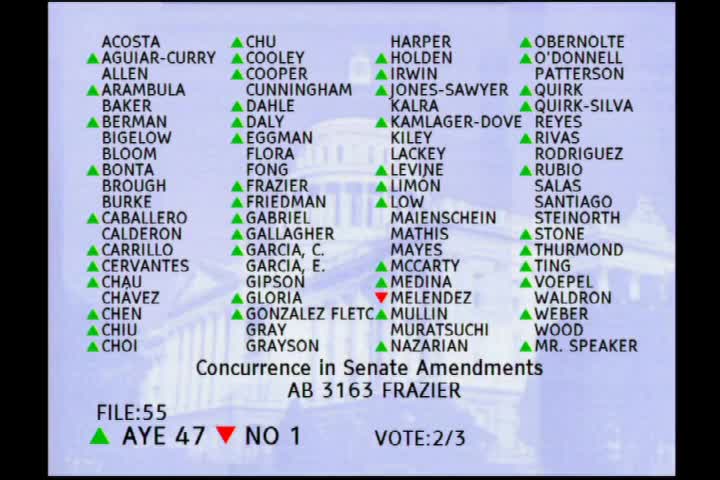 54SEC
Assembly Floor
 1H
Senate Standing Committee on Appropriations
 2MIN
Assembly Floor
 17MIN
Assembly Standing Committee on Local Government
 17MIN
Assembly Standing Committee on Environmental Safety and Toxic Materials
Bill Author

Bill Co-Author(s):