AB 2060: Water: grants: advanced payments.
- Session Year: 2017-2018
- House: Assembly
- Latest Version Date: 2018-08-31
(1)Existing law, the Porter-Cologne Water Quality Control Act, establishes the State Water Pollution Control Revolving Fund program pursuant to which state and federal funds are continuously appropriated from the State Water Pollution Control Revolving Fund to the State Water Resources Control Board for loans and other financial assistance for the construction of publicly owned treatment works by a municipality, the implementation of a management program, the development and implementation of a conservation and management plan, and other related purposes in accordance with the federal Clean Water Act. Existing law authorizes the board to assess a specified annual charge in connection with any financial assistance made pursuant to the revolving fund program in lieu of interest that otherwise would be charged and requires the proceeds generated from the imposition of that charge to be deposited in the State Water Pollution Control Revolving Fund Small Community Grant Fund, along with any interest earned upon the moneys in that grant fund. Existing law authorizes the board to expend the moneys in the grant fund, upon appropriation by the Legislature, for grants for eligible projects under the revolving fund program that serve small communities, as defined.
Existing law, the Water Quality, Supply, and Infrastructure Improvement Act of 2014, approved by the voters as Proposition 1 at the November 4, 2014, statewide general election, authorizes the issuance of general obligation bonds in the amount of $7,545,000,000 to finance a water quality, supply, and infrastructure improvement program. The bond act provides that the sum of $520,000,000 is to be available, upon appropriation by the Legislature, for expenditures, grants, and loans for projects that improve water quality or help provide clean, safe, and reliable drinking water to all Californians. The bond act provides that $260,000,000 is available for deposit in the grant fund for grants for wastewater treatment projects.
This bill would require the board, within 60 days of awarding a grant from the grant fund, to provide a project proponent that requests an advanced payment and satisfies certain criteria with the requested advanced payment, up to a maximum of $500,000 or 50% of the grant award, whichever is less, for projects in which the project proponent is a nonprofit organization or a disadvantaged community, or the project benefits a disadvantaged community. The bill would require the advanced funds to be handled as prescribed. The bill would authorize the board to adopt additional requirements for the recipient regarding the use of the advanced payment to ensure that the funds are used properly. The bill would authorize the board to impose penalties for misuse of advanced payments, as specified, and would require the penalty moneys collected to be deposited in the State Water Pollution Revolving Fund Small Community Grant Fund.
(2)Proposition 1 provides that of the $520,000,000 available for projects that improve water quality or help provide clean, safe, and reliable drinking water to all Californians, the sum of $260,000,000 is available for grants and loans for public water system infrastructure improvements and related actions to meet safe drinking water standards, ensure affordable drinking water, or both. The bond act requires that eligible recipients serve disadvantaged communities and are public water systems or public agencies. The bond act prohibits more than 25% of the grant from being awarded in advance of actual expenditures.
This bill would require the board, within 60 days of awarding a grant for these purposes under the bond act, to provide a project proponent that requests an advanced payment and satisfies certain criteria with the requested advanced payment, up to a maximum of $500,000 or 25% of the grant award, whichever is less. The bill would require the advanced funds to be handled as prescribed. The bill would authorize the board to adopt additional requirements for the recipient regarding the use of the advanced payment to ensure that the funds are used properly. The bill would authorize the board to impose penalties for misuse of advanced payments, as specified, and would require the penalty moneys collected to be available, upon appropriation by the Legislature, for the above-described grants and loans for public water system infrastructure improvements.
(1)Existing law, the Porter-Cologne Water Quality Control Act, establishes the State Water Pollution Control Revolving Fund program pursuant to which state and federal funds are continuously appropriated from the State Water Pollution Control Revolving Fund to the State Water Resources Control Board for loans and other financial assistance for the construction of publicly owned treatment works by a municipality, the implementation of a management program, the development and implementation of a conservation and management plan, and other related purposes in accordance with the federal Clean Water Act. Existing law authorizes the board to assess a specified annual charge in connection with any financial assistance made pursuant to the revolving fund program in lieu of interest that otherwise would be charged and requires the proceeds generated from the imposition of that charge to be deposited in the State Water Pollution Control Revolving Fund Small Community Grant Fund, along with any interest earned upon the moneys in that grant fund. Existing law authorizes the board to expend the moneys in the grant fund, upon appropriation by the Legislature, for grants for eligible projects under the revolving fund program that serve small communities, as defined.
Existing law, the Water Quality, Supply, and Infrastructure Improvement Act of 2014, approved by the voters as Proposition 1 at the November 4, 2014, statewide general election, authorizes the issuance of general obligation bonds in the amount of $7,545,000,000 to finance a water quality, supply, and infrastructure improvement program. The bond act provides that the sum of $520,000,000 is to be available, upon appropriation by the Legislature, for expenditures, grants, and loans for projects that improve water quality or help provide clean, safe, and reliable drinking water to all Californians. The bond act provides that $260,000,000 is available for deposit in the grant fund for grants for wastewater treatment projects.
This bill would require the board, within 60 days of awarding a grant from the grant fund, to provide a project proponent that requests an advanced payment and satisfies certain criteria with the requested advanced payment payment, up to a maximum of $500,000 or 50% of the grant award, whichever is less, for projects in which the project proponent is a nonprofit organization or a disadvantaged community, or the project benefits a disadvantaged community. The bill would require the advanced funds to be handled as prescribed. The bill would authorize the board to adopt additional requirements for the recipient regarding the use of the advanced payment to ensure that the funds are used properly. The bill would authorize the board to impose penalties for misuse of advanced payments, as specified, and would require the penalty moneys collected to be deposited in the State Water Pollution Revolving Fund Small Community Grant Fund.
(2)Proposition 1 provides that of the $520,000,000 available for projects that improve water quality or help provide clean, safe, and reliable drinking water to all Californians, the sum of $260,000,000 is available for grants and loans for public water system infrastructure improvements and related actions to meet safe drinking water standards, ensure affordable drinking water, or both. The bond act requires that eligible recipients serve disadvantaged communities and are public water systems or public agencies. The bond act prohibits more than 25% of the grant from being awarded in advance of actual expenditures.
This bill would require the board, within 60 days of awarding a grant for these purposes under the bond act, to provide a project proponent that requests an advanced payment and satisfies certain criteria with the requested advanced payment payment, up to a maximum of $500,000 or 25% of the grant award, whichever is less. The bill would require the advanced funds to be handled as prescribed. The bill would authorize the board to adopt additional requirements for the recipient regarding the use of the advanced payment to ensure that the funds are used properly. The bill would authorize the board to impose penalties for misuse of advanced payments, as specified, and would require the penalty moneys collected to be available, upon appropriation by the Legislature, for the above-described grants and loans for public water system infrastructure improvements.
(1)Existing law, the Porter-Cologne Water Quality Control Act, establishes the State Water Pollution Control Revolving Fund program pursuant to which state and federal funds are continuously appropriated from the State Water Pollution Control Revolving Fund to the State Water Resources Control Board for loans and other financial assistance for the construction of publicly owned treatment works by a municipality, the implementation of a management program, the development and implementation of a conservation and management plan, and other related purposes in accordance with the federal Clean Water Act. Existing law authorizes the board to assess a specified annual charge in connection with any financial assistance made pursuant to the revolving fund program in lieu of interest that otherwise would be charged and requires the proceeds generated from the imposition of that charge to be deposited in the State Water Pollution Control Revolving Fund Small Community Grant Fund, along with any interest earned upon the moneys in that grant fund. Existing law authorizes the board to expend the moneys in the grant fund, upon appropriation by the Legislature, for grants for eligible projects under the revolving fund program that serve small communities, as defined.
Existing law, the Water Quality, Supply, and Infrastructure Improvement Act of 2014, approved by the voters as Proposition 1 at the November 4, 2014, statewide general election, authorizes the issuance of general obligation bonds in the amount of $7,545,000,000 to finance a water quality, supply, and infrastructure improvement program. The bond act provides that the sum of $520,000,000 is to be available, upon appropriation by the Legislature, for expenditures, grants, and loans for projects that improve water quality or help provide clean, safe, and reliable drinking water to all Californians. The bond act provides that $260,000,000 is available for deposit in the grant fund for grants for wastewater treatment projects.
This bill would require the board, within 60 days of awarding a grant from the grant fund, to provide a project proponent that requests and demonstrates a need for an advanced payment and satisfies certain criteria with advanced payment of $500,000 or 50% of the grant award, whichever is less, for projects in which the project proponent is a nonprofit organization or a disadvantaged community, or the project benefits a disadvantaged community. The bill would require the advanced funds to be handled as prescribed. The bill would authorize the board to adopt additional requirements for the recipient regarding the use of the advanced payment to ensure that the funds are used properly.
(2)Proposition 1 provides that of the $520,000,000 available for projects that improve water quality or help provide clean, safe, and reliable drinking water to all Californians, the sum of $260,000,000 is available for grants and loans for public water system infrastructure improvements and related actions to meet safe drinking water standards, ensure affordable drinking water, or both. The bond act requires that eligible recipients serve disadvantaged communities and are public water systems or public agencies. The bond act prohibits more than 25% of the grant from being awarded in advance of actual expenditures.
This bill would require the board, within 60 days of awarding a grant for these purposes under the bond act, to provide a project proponent that requests and demonstrates a need for an advanced payment and satisfies certain criteria with advanced payment of $500,000 or 25% of the grant award, whichever is less. The bill would require the advanced funds to be handled as prescribed. The bill would authorize the board to adopt additional requirements for the recipient regarding the use of the advanced payment to ensure that the funds are used properly.
(1)Existing law, the Porter-Cologne Water Quality Control Act, establishes the State Water Pollution Control Revolving Fund program pursuant to which state and federal funds are continuously appropriated from the State Water Pollution Control Revolving Fund to the State Water Resources Control Board for loans and other financial assistance for the construction of publicly owned treatment works by a municipality, the implementation of a management program, the development and implementation of a conservation and management plan, and other related purposes in accordance with the federal Clean Water Act. Existing law authorizes the board to assess a specified annual charge in connection with any financial assistance made pursuant to the revolving fund program in lieu of interest that otherwise would be charged and requires the proceeds generated from the imposition of that charge to be deposited in the State Water Pollution Control Revolving Fund Small Community Grant Fund, along with any interest earned upon the moneys in that grant fund. Existing law authorizes the board to expend the moneys in the grant fund, upon appropriation by the Legislature, for grants for eligible projects under the revolving fund program that serve small communities, as defined.
Existing law, the Water Quality, Supply, and Infrastructure Improvement Act of 2014, approved by the voters as Proposition 1 at the November 4, 2014, statewide general election, authorizes the issuance of general obligation bonds in the amount of $7,545,000,000 to finance a water quality, supply, and infrastructure improvement program. The bond act provides that the sum of $520,000,000 is to be available, upon appropriation by the Legislature, for expenditures, grants, and loans for projects that improve water quality or help provide clean, safe, and reliable drinking water to all Californians. The bond act provides that $260,000,000 is available for deposit in the grant fund for grants for wastewater treatment projects.
This bill would require the board, within 60 days of awarding a grant from the grant fund, to provide a project proponent that requests and demonstrates a need for advanced payment with advanced payment of $500,000 or 50% of the grant award, whichever is less, for projects in which the project proponent is a nonprofit organization or a disadvantaged community, or the project benefits a disadvantaged community. The bill would require the advanced funds to be handled as prescribed. The bill would authorize the board to adopt additional requirements for the recipient regarding the use of the advanced payment to ensure that the funds are used properly.
(3)(2)Proposition 1 provides that of the $520,000,000 available for projects that improve water quality or help provide clean, safe, and reliable drinking water to all Californians, the sum of $260,000,000 is available for grants and loans for public water system infrastructure improvements and related actions to meet safe drinking water standards, ensure affordable drinking water, or both. The bond act requires that eligible recipients serve disadvantaged communities and are public water systems or public agencies. The bond act prohibits more than 25% of the grant from being awarded in advance of actual expenditures.
This bill would require the board, within 60 days of awarding a grant for these purposes under the bond act, to provide a project proponent that requests and demonstrates a need for advanced payment with advanced payment of $500,000 or 25% of the grant award, whichever is less. The bill would require the advanced funds to be handled as prescribed. The bill would authorize the board to adopt additional requirements for the recipient regarding the use of the advanced payment to ensure that the funds are used properly.
(1)Existing law, the Integrated Regional Water Management Planning Act, authorizes a regional water management group to prepare and adopt an integrated regional water management plan with specified components relating to water supply and water quality. Existing law provides that an integrated regional water management plan is eligible for funding allocated specifically for implementation of integrated regional water management. Existing law requires a regional water management group, within 90 days of notice that a grant has been awarded, to provide the Department of Water Resources with a list of projects to be funded by the grant funds where the project proponent is a nonprofit organization or a disadvantaged community, or the project benefits a disadvantaged community. Existing law requires the department, within 60 days of receiving the project information, to provide advanced payment of 50% of the grant award for those projects that satisfy specified criteria, including that the grant award for the project is less than $1,000,000 $1,000,000, and requires the advanced funds to be handled as prescribed. Existing law repeals these advanced payment provisions on January 1, 2025.
This bill would instead require the department to provide a project proponent that requests and demonstrates a need for advanced payment with advanced payment for those projects of $500,000 or 50% of the grant award, whichever is less. The bill would eliminate the requirement that the grant award for the project be less than $1,000,000 to obtain advanced payment. The bill would eliminate the repeal of these advanced payment provisions.
(2)Existing law, the Porter-Cologne Water Quality Control Act, establishes the State Water Pollution Control Revolving Fund program pursuant to which state and federal funds are continuously appropriated from the State Water Pollution Control Revolving Fund to the State Water Resources Control Board for loans and other financial assistance for the construction of publicly owned treatment works by a municipality, the implementation of a management program, the development and implementation of a conservation and management plan, and other related purposes in accordance with the federal Clean Water Act. Existing law authorizes the board to assess a specified annual charge in connection with any financial assistance made pursuant to the revolving fund program in lieu of interest that otherwise would be charged and requires the proceeds generated from the imposition of that charge to be deposited in the State Water Pollution Control Revolving Fund Small Community Grant Fund, along with any interest earned upon the moneys in that grant fund. Existing law authorizes the board to expend the moneys in the grant fund, upon appropriation by the Legislature, for grants for eligible projects under the revolving fund program that serve small communities, as defined.
Existing law, the Water Quality, Supply, and Infrastructure Improvement Act of 2014, approved by the voters as Proposition 1 at the November 4, 2014, statewide general election, authorizes the issuance of general obligation bonds in the amount of $7,545,000,000 to finance a water quality, supply, and infrastructure improvement program. The bond act provides that the sum of $520,000,000 is to be available, upon appropriation by the Legislature, for expenditures, grants, and loans for projects that improve water quality or help provide clean, safe, and reliable drinking water to all Californians. The bond act provides that $260,000,000 is available for deposit in the grant fund for grants for wastewater treatment projects.
This bill would require the board, within 60 days of awarding a grant from the grant fund, to provide a project proponent that requests and demonstrates a need for advanced payment with advanced payment of $500,000 or 50% of the grant award, whichever is less, for projects in which the project proponent is a nonprofit organization or a disadvantaged community, or the project benefits a disadvantaged community. The bill would require the advanced funds to be handled as prescribed. The bill would authorize the board to adopt additional requirements for the recipient regarding the use of the advanced payment to ensure that the funds are used properly.
(3)Proposition 1 provides that of the $520,000,000 available for projects that improve water quality or help provide clean, safe, and reliable drinking water to all Californians, the sum of $260,000,000 is available for grants and loans for public water system infrastructure improvements and related actions to meet safe drinking water standards, ensure affordable drinking water, or both. The bond act requires that eligible recipients serve disadvantaged communities and are public water systems or public agencies. The bond act prohibits more than 25% of the grant from being awarded in advance of actual expenditures.
This bill would require the board, within 60 days of awarding a grant for these purposes under the bond act, to provide a project proponent that requests and demonstrates a need for advanced payment with advanced payment of $500,000 or 25% of the grant award, whichever is less. The bill would require the advanced funds to be handled as prescribed. The bill would authorize the board to adopt additional requirements for the recipient regarding the use of the advanced payment to ensure that the funds are used properly.
(1)Existing law, the Integrated Regional Water Management Planning Act, authorizes a regional water management group to prepare and adopt an integrated regional water management plan with specified components relating to water supply and water quality. Existing law provides that an integrated regional water management plan is eligible for funding allocated specifically for implementation of integrated regional water management. Existing law requires a regional water management group, within 90 days of notice that a grant has been awarded, to provide the Department of Water Resources with a list of projects to be funded by the grant funds where the project proponent is a nonprofit organization or a disadvantaged community, or the project benefits a disadvantaged community. Existing law requires the department, within 60 days of receiving the project information, to provide advanced payment of 50% of the grant award for those projects that satisfy specified criteria, including that the grant award for the project is less than $1,000,000 and requires the advanced funds to be handled as prescribed. Existing law repeals these advanced payment provisions on January 1, 2025.
This bill would instead require the department to provide advanced payment for those projects of $500,000 or 50% of the grant award, whichever is less. The bill would eliminate the requirement that the grant award for the project be less than $1,000,000 to obtain advanced payment. The bill would eliminate the repeal of these advanced payment provisions.
(2)Existing law, the Porter-Cologne Water Quality Control Act, establishes the State Water Pollution Control Revolving Fund program pursuant to which state and federal funds are continuously appropriated from the State Water Pollution Control Revolving Fund to the State Water Resources Control Board for loans and other financial assistance for the construction of publicly owned treatment works by a municipality, the implementation of a management program, the development and implementation of a conservation and management plan, and other related purposes in accordance with the federal Clean Water Act. Existing law authorizes the board to assess a specified annual charge in connection with any financial assistance made pursuant to the revolving fund program in lieu of interest that otherwise would be charged and requires the proceeds generated from the imposition of that charge to be deposited in the State Water Pollution Control Revolving Fund Small Community Grant Fund, along with any interest earned upon the moneys in that grant fund. Existing law authorizes the board to expend the moneys in the grant fund, upon appropriation by the Legislature, for grants for eligible projects under the revolving fund program that serve small communities, as defined.
Existing law, the Water Quality, Supply, and Infrastructure Improvement Act of 2014, approved by the voters as Proposition 1 at the November 4, 2014, statewide general election, authorizes the issuance of general obligation bonds in the amount of $7,545,000,000 to finance a water quality, supply, and infrastructure improvement program. The bond act provides that the sum of $520,000,000 is to be available, upon appropriation by the Legislature, for expenditures, grants, and loans for projects that improve water quality or help provide clean, safe, and reliable drinking water to all Californians. The bond act provides that $260,000,000 is available for deposit in the grant fund for grants for wastewater treatment projects.
This bill would require the board, within 60 days of awarding a grant from the grant fund, to provide advanced payment of $500,000 or 50% of the grant award, whichever is less, for projects in which the project proponent is a nonprofit organization or a disadvantaged community, or the project benefits a disadvantaged community. The bill would require the advanced funds to be handled as prescribed. The bill would authorize the board to adopt additional requirements for the recipient regarding the use of the advanced payment to ensure that the funds are used properly.
(3)Proposition 1 provides that of the $520,000,000 available for projects that improve water quality or help provide clean, safe, and reliable drinking water to all Californians, the sum of $260,000,000 is available for grants and loans for public water system infrastructure improvements and related actions to meet safe drinking water standards, ensure affordable drinking water, or both. The bond act requires that eligible recipients serve disadvantaged communities and are public water systems or public agencies. The bond act prohibits more than 25% of the grant from being awarded in advance of actual expenditures.
This bill would require the board, within 60 days of awarding a grant for these purposes under the bond act, to provide advanced payment of $500,000 or 25% of the grant award, whichever is less. The bill would require the advanced funds to be handled as prescribed. The bill would authorize the board to adopt additional requirements for the recipient regarding the use of the advanced payment to ensure that the funds are used properly.
(a)The State Water Pollution Control Revolving Fund Small Community Grant Fund is hereby created in the State Treasury.
(b)The following moneys shall be deposited in the grant fund:
(1)Moneys transferred to the grant fund pursuant to subdivision (c).
(2)Notwithstanding Section 16475 of the Government Code, any interest earned upon the moneys deposited in the grant fund.
(3)Any moneys deposited pursuant to Section 79723.
(4)All moneys collected pursuant to subparagraph (F) of paragraph (2) of subdivision (e).
(c)(1)For any financing made pursuant to Section 13480, the board may assess an annual charge to be deposited in the grant fund in lieu of interest that would otherwise be charged.
(2)The charge authorized by this subdivision may be applied at any time during the term of the financing, and, once applied, shall remain unchanged unless the board determines that the application of the charge is any of the following:
(A)No longer consistent with federal requirements regarding the fund.
(B)No longer necessary.
(C)Negatively affecting the boards ability to fund projects that support its water quality goals.
(3)The charge shall not increase the financing repayment amount as set forth in the terms and conditions imposed pursuant to this chapter.
(4)If the board ceases collecting the charge before the financing repayment is complete, the board shall replace the charge with an identical interest rate.
(d)(1)Moneys in the grant fund, upon appropriation by the Legislature to the board, may be expended, in accordance with this chapter, for grants for wastewater projects described in subdivision (c) of Section 1383 of Title 33 of the United States Code that serve small communities as defined in subdivision (a) of Section 30925 of the Public Resources Code. The board shall expend moneys appropriated from the grant fund within four years from the date of encumbrance.
(2)For the purpose of approving grants, the board shall give priority to projects that serve severely disadvantaged communities.
(3)In addition to the uses set forth in paragraph (1), moneys deposited in the grant fund pursuant to Section 79723, upon appropriation by the Legislature to the board, may be expended for technical assistance as authorized by Section 79725.
(e)(1)Within 60 days of awarding a grant under this section, the board shall provide a project proponent that requests an advanced payment with the requested advanced payment, up to a maximum of five hundred thousand dollars ($500,000) or 50 percent of the grant award, whichever is less, provided the project satisfies all of the following criteria:
(A)The project proponent is a nonprofit organization or a disadvantaged community, or the project benefits a disadvantaged community.
(B)The project proponent has demonstrated to the boards satisfaction a need for an advanced payment.
(C)(i)The project proponent has demonstrated to the boards satisfaction that the project proponent is sufficiently qualified to manage the project and the finances of the project.
(ii)If the board is not satisfied that the project proponent is sufficiently qualified to manage the project and the finances of the project, the board may impose additional requirements on the project proponent, including requiring additional partners to manage the project, the financing, or both.
(2)Funds advanced pursuant to paragraph (1) shall be handled as follows:
(A)The recipient shall place the funds in a noninterest-bearing account until expended.
(B)The funds shall be spent within six months of the date of receipt, unless the board waives this requirement.
(C)The recipient shall, on a quarterly basis, provide an accountability report to the board regarding the expenditure and use of any advanced grant funds that provides, at a minimum, the following information:
(i)An itemization as to how advanced payment funds provided under this section have been expended.
(ii)A project itemization as to how any remaining advanced payment funds provided under this section will be expended over the period specified in subparagraph (B).
(iii)Whether the funds are placed in a noninterest-bearing account, and if so, the date that occurred and the dates of withdrawals of funds from that account, if applicable.
(iv)An evaluation of whether the project is on schedule or not. If the project is behind schedule, the report shall identify what has caused the delay and actions taken or being taken to remedy the delay.
(D)If funds are not expended, the unused portion of the grant shall be returned to the board within 60 days after project completion or the end of the grant performance period, whichever is earlier.
(E)The board may adopt additional requirements for the recipient regarding the use of the advanced payment to ensure that the funds are used properly, including provisions for random audits and other verifications of the authorized use of funds.
(F)The board may impose penalties for misuse of advanced payments as follows:
(i)A recipient may be barred from receipt of financial assistance from the board for a term of years or permanently.
(ii)The board may recover any costs incurred.
(iii)The board may, through the Attorney General, bring an action in superior court to enforce the provisions of this section, whether criminal or civil.
(iv)Any person, including a recipient, recipients contractors, consultants, employees, agents, assignees, or grantees who violates any requirement or term of a financial assistance agreement from the board is liable for a civil penalty of not more than one thousand dollars ($1000) for each day of violation, not to exceed 25 percent of the total amount of the financial assistance agreement.
(v)A person who fails or refuses to furnish information or furnishes false information to the board in connection with a financial assistance agreement, in accordance with the requirements of subparagraph (C), is subject to civil liability of not more than ten thousand dollars ($10,000) for each violation described by this clause.
(3)If the project proponent rejects additional requirements imposed by the board pursuant to clause (ii) of subparagraph (C) of paragraph (1) or if the board determines that no additional requirements it may impose could make the project proponent sufficiently qualified to manage the project and the finances of the project, the board may reject the request.
(4)As used in this subdivision, disadvantaged community and nonprofit organization have the same meanings as defined in Section 79702.
SEC. 2.Section 79724.5 is added to the Water Code, to read:79724.5.(a)Within 60 days of awarding a grant under subdivision (a) of Section 79724, the state board shall provide a project proponent that requests an advanced payment with the requested advanced payment, up to a maximum of five hundred thousand dollars ($500,000) or 25 percent of the grant award, whichever is less, provided the project satisfies all of the following criteria:
(1)The project proponent is a nonprofit organization or a disadvantaged community, or the project benefits a disadvantaged community.
(2)The project proponent has demonstrated to the state boards satisfaction a need for an advanced payment.
(3)(A)The project proponent has demonstrated to the state boards satisfaction that the project proponent is sufficiently qualified to manage the project and the finances of the project.
(B)If the state board is not satisfied that the project proponent is sufficiently qualified to manage the project and the finances of the project, the state board may impose additional requirements on the project proponent, including requiring additional partners to manage the project, the financing, or both.
(b)Funds advanced pursuant to subdivision (a) shall be handled as follows:
(1)The recipient shall place the funds in a noninterest-bearing account until expended.
(2)The funds shall be spent within six months of the date of receipt, unless the state board waives this requirement.
(3)The recipient shall, on a quarterly basis, provide an accountability report to the state board regarding the expenditure and use of any advanced grant funds that provides, at a minimum, the following information:
(A)An itemization as to how advanced payment funds provided under this section have been expended.
(B)A project itemization as to how any remaining advanced payment funds provided under this section will be expended over the period specified in paragraph (2).
(C)Whether the funds are placed in a noninterest-bearing account, and if so, the date that occurred and the dates of withdrawals of funds from that account, if applicable.
(D)An evaluation of whether the project is on schedule or not. If the project is behind schedule, the report shall identify what has caused the delay and actions taken or being taken to remedy the delay.
(4)If funds are not expended, the unused portion of the grant shall be returned to the state board within 60 days after project completion or the end of the grant performance period, whichever is earlier.
(5)The state board may adopt additional requirements for the recipient regarding the use of the advanced payment to ensure that the funds are used properly, including provisions for random audits and other verifications of the authorized use of funds.
(6)The state board may impose penalties for misuse of advanced payments as follows:
(A)A recipient may be barred from receipt of financial assistance from the state board for a term of years or permanently.
(B)The state board may recover any costs incurred.
(C)The state board may, through the Attorney General, bring an action in superior court to enforce the provisions of this section, whether criminal or civil.
(D)Any person, including a recipient, recipients contractors, consultants, employees, agents, assignees, or grantees who violates any requirement or term of a financial assistance agreement from the state board is liable for a civil penalty of not more than one thousand dollars ($1000) for each day of violation, not to exceed 25 percent of the total amount of the financial assistance agreement.
(E)A person who fails or refuses to furnish information or furnishes false information to the state board in connection with a financial assistance agreement, in accordance with the requirements of paragraph (3), is subject to civil liability of not more than ten thousand dollars ($10,000) for each violation described by this subparagraph.
(F)All moneys collected pursuant to this paragraph shall be available, upon appropriation by the Legislature, for the purposes of Section 79724.
(c)If the project proponent rejects additional requirements imposed by the state board pursuant to subparagraph (B) of paragraph (3) of subdivision (a) or if the state board determines that no additional requirements it may impose could make the project proponent sufficiently qualified to manage the project and the finances of the project, the state board may reject the request.
(a)The State Water Pollution Control Revolving Fund Small Community Grant Fund is hereby created in the State Treasury.
(b)The following moneys shall be deposited in the grant fund:
(1)Moneys transferred to the grant fund pursuant to subdivision (c).
(2)Notwithstanding Section 16475 of the Government Code, any interest earned upon the moneys deposited in the grant fund.
(3)Any moneys deposited pursuant to Section 79723.
(4)All moneys collected pursuant to subparagraph (F) of paragraph (2) of subdivision (e).
(c)(1)For any financing made pursuant to Section 13480, the board may assess an annual charge to be deposited in the grant fund in lieu of interest that would otherwise be charged.
(2)The charge authorized by this subdivision may be applied at any time during the term of the financing, and, once applied, shall remain unchanged unless the board determines that the application of the charge is any of the following:
(A)No longer consistent with federal requirements regarding the fund.
(B)No longer necessary.
(C)Negatively affecting the boards ability to fund projects that support its water quality goals.
(3)The charge shall not increase the financing repayment amount as set forth in the terms and conditions imposed pursuant to this chapter.
(4)If the board ceases collecting the charge before the financing repayment is complete, the board shall replace the charge with an identical interest rate.
(d)(1)Moneys in the grant fund, upon appropriation by the Legislature to the board, may be expended, in accordance with this chapter, for grants for wastewater projects described in subdivision (c) of Section 1383 of Title 33 of the United States Code that serve small communities as defined in subdivision (a) of Section 30925 of the Public Resources Code. The board shall expend moneys appropriated from the grant fund within four years from the date of encumbrance.
(2)For the purpose of approving grants, the board shall give priority to projects that serve severely disadvantaged communities.
(3)In addition to the uses set forth in paragraph (1), moneys deposited in the grant fund pursuant to Section 79723, upon appropriation by the Legislature to the board, may be expended for technical assistance as authorized by Section 79725.
(e)(1)Within 60 days of awarding a grant under this section, the board shall provide a project proponent that requests an advanced payment with the requested advanced payment payment, up to a maximum of five hundred thousand dollars ($500,000) or 50 percent of the grant award, whichever is less, provided the project satisfies all of the following criteria:
(A)The project proponent is a nonprofit organization or a disadvantaged community, or the project benefits a disadvantaged community.
(B)The project proponent has demonstrated to the boards satisfaction a need for an advanced payment.
(C)(i)The project proponent has demonstrated to the boards satisfaction that the project proponent is sufficiently qualified to manage the project and the finances of the project.
(ii)If the board is not satisfied that the project proponent is sufficiently qualified to manage the project and the finances of the project, the board may impose additional requirements on the project proponent, including requiring additional partners to manage the project, the financing, or both.
(2)Funds advanced pursuant to paragraph (1) shall be handled as follows:
(A)The recipient shall place the funds in a noninterest-bearing account until expended.
(B)The funds shall be spent within six months of the date of receipt, unless the board waives this requirement.
(C)The recipient shall, on a quarterly basis, provide an accountability report to the board regarding the expenditure and use of any advanced grant funds that provides, at a minimum, the following information:
(i)An itemization as to how advanced payment funds provided under this section have been expended.
(ii)A project itemization as to how any remaining advanced payment funds provided under this section will be expended over the period specified in subparagraph (B).
(iii)Whether the funds are placed in a noninterest-bearing account, and if so, the date that occurred and the dates of withdrawals of funds from that account, if applicable.
(iv)An evaluation of whether the project is on schedule or not. If the project is behind schedule, the report shall identify what has caused the delay and actions taken or being taken to remedy the delay.
(D)If funds are not expended, the unused portion of the grant shall be returned to the board within 60 days after project completion or the end of the grant performance period, whichever is earlier.
(E)The board may adopt additional requirements for the recipient regarding the use of the advanced payment to ensure that the funds are used properly, including provisions for random audits and other verifications of the authorized use of funds.
(F)The board may impose penalties for misuse of advanced payments as follows:
(i)A recipient may be barred from receipt of financial assistance from the board for a term of years or permanently.
(ii)The board may recover any costs incurred.
(iii)The board may, through the Attorney General, bring an action in superior court to enforce the provisions of this section, whether criminal or civil.
(iv)Any person, including a recipient, recipients contractors, consultants, employees, agents, assignees, or grantees who violates any requirement or term of a financial assistance agreement from the board is liable for a civil penalty of not more than one thousand dollars ($1000) for each day of violation, not to exceed 25 percent of the total amount of the financial assistance agreement.
(v)A person who fails or refuses to furnish information or furnishes false information to the board in connection with a financial assistance agreement, in accordance with the requirements of subparagraph (C), is subject to civil liability of not more than ten thousand dollars ($10,000) for each violation described by this clause.
(3)If the project proponent rejects additional requirements imposed by the board pursuant to clause (ii) of subparagraph (C) of paragraph (1) or if the board determines that no additional requirements it may impose could make the project proponent sufficiently qualified to manage the project and the finances of the project, the board may reject the request.
(4)As used in this subdivision, disadvantaged community and nonprofit organization have the same meanings as defined in Section 79702.
SEC. 2.Section 79724.5 is added to the Water Code, to read:79724.5.(a)Within 60 days of awarding a grant under subdivision (a) of Section 79724, the state board shall provide a project proponent that requests an advanced payment with advanced payment the requested advanced payment, up to a maximum of five hundred thousand dollars ($500,000) or 25 percent of the grant award, whichever is less, provided the project satisfies all of the following criteria:
(1)The project proponent is a nonprofit organization or a disadvantaged community, or the project benefits a disadvantaged community.
(2)The project proponent has demonstrated to the state boards satisfaction a need for an advanced payment.
(3)(A)The project proponent has demonstrated to the state boards satisfaction that the project proponent is sufficiently qualified to manage the project and the finances of the project.
(B)If the state board is not satisfied that the project proponent is sufficiently qualified to manage the project and the finances of the project, the state board may impose additional requirements on the project proponent, including requiring additional partners to manage the project, the financing, or both.
(b)Funds advanced pursuant to subdivision (a) shall be handled as follows:
(1)The recipient shall place the funds in a noninterest-bearing account until expended.
(2)The funds shall be spent within six months of the date of receipt, unless the state board waives this requirement.
(3)The recipient shall, on a quarterly basis, provide an accountability report to the state board regarding the expenditure and use of any advanced grant funds that provides, at a minimum, the following information:
(A)An itemization as to how advanced payment funds provided under this section have been expended.
(B)A project itemization as to how any remaining advanced payment funds provided under this section will be expended over the period specified in paragraph (2).
(C)Whether the funds are placed in a noninterest-bearing account, and if so, the date that occurred and the dates of withdrawals of funds from that account, if applicable.
(D)An evaluation of whether the project is on schedule or not. If the project is behind schedule, the report shall identify what has caused the delay and actions taken or being taken to remedy the delay.
(4)If funds are not expended, the unused portion of the grant shall be returned to the state board within 60 days after project completion or the end of the grant performance period, whichever is earlier.
(5)The state board may adopt additional requirements for the recipient regarding the use of the advanced payment to ensure that the funds are used properly, including provisions for random audits and other verifications of the authorized use of funds.
(6)The state board may impose penalties for misuse of advanced payments as follows:
(A)A recipient may be barred from receipt of financial assistance from the state board for a term of years or permanently.
(B)The state board may recover any costs incurred.
(C)The state board may, through the Attorney General, bring an action in superior court to enforce the provisions of this section, whether criminal or civil.
(D)Any person, including a recipient, recipients contractors, consultants, employees, agents, assignees, or grantees who violates any requirement or term of a financial assistance agreement from the state board is liable for a civil penalty of not more than one thousand dollars ($1000) for each day of violation, not to exceed 25 percent of the total amount of the financial assistance agreement.
(E)A person who fails or refuses to furnish information or furnishes false information to the state board in connection with a financial assistance agreement, in accordance with the requirements of paragraph (3), is subject to civil liability of not more than ten thousand dollars ($10,000) for each violation described by this subparagraph.
(F)All moneys collected pursuant to this paragraph shall be available, upon appropriation by the Legislature, for the purposes of Section 79724.
(c)If the project proponent rejects additional requirements imposed by the state board pursuant to subparagraph (B) of paragraph (3) of subdivision (a) or if the state board determines that no additional requirements it may impose could make the project proponent sufficiently qualified to manage the project and the finances of the project, the state board may reject the request.
(a)The State Water Pollution Control Revolving Fund Small Community Grant Fund is hereby created in the State Treasury.
(b)The following moneys shall be deposited in the grant fund:
(1)Moneys transferred to the grant fund pursuant to subdivision (c).
(2)Notwithstanding Section 16475 of the Government Code, any interest earned upon the moneys deposited in the grant fund.
(3)Any moneys deposited pursuant to Section 79723.
(c)(1)For any financing made pursuant to Section 13480, the board may assess an annual charge to be deposited in the grant fund in lieu of interest that would otherwise be charged.
(2)The charge authorized by this subdivision may be applied at any time during the term of the financing, and, once applied, shall remain unchanged unless the board determines that the application of the charge is any of the following:
(A)No longer consistent with federal requirements regarding the fund.
(B)No longer necessary.
(C)Negatively affecting the boards ability to fund projects that support its water quality goals.
(3)The charge shall not increase the financing repayment amount as set forth in the terms and conditions imposed pursuant to this chapter.
(4)If the board ceases collecting the charge before the financing repayment is complete, the board shall replace the charge with an identical interest rate.
(d)(1)Moneys in the grant fund, upon appropriation by the Legislature to the board, may be expended, in accordance with this chapter, for grants for wastewater projects described in subdivision (c) of Section 1383 of Title 33 of the United States Code that serve small communities as defined in subdivision (a) of Section 30925 of the Public Resources Code. The board shall expend moneys appropriated from the grant fund within four years from the date of encumbrance.
(2)For the purpose of approving grants, the board shall give priority to projects that serve severely disadvantaged communities.
(3)In addition to the uses set forth in paragraph (1), moneys deposited in the grant fund pursuant to Section 79723, upon appropriation by the Legislature to the board, may be expended for technical assistance as authorized by Section 79725.
(e)(1)Within 60 days of awarding a grant under this section, the board shall provide a project proponent that requests and demonstrates a need for an advanced payment with advanced payment of five hundred thousand dollars ($500,000) or 50 percent of the grant award, whichever is less, for projects in which the project proponent is a nonprofit organization or a disadvantaged community, or the project benefits a disadvantaged community. provided the project satisfies all of the following criteria:
(A)The project proponent is a nonprofit organization or a disadvantaged community, or the project benefits a disadvantaged community.
(B)The project proponent has demonstrated to the boards satisfaction a need for an advanced payment.
(C)(i)The project proponent has demonstrated to the boards satisfaction that the project proponent is sufficiently qualified to manage the project and the finances of the project.
(ii)If the board is not satisfied that the project proponent is sufficiently qualified to manage the project and the finances of the project, the board may impose additional requirements on the project proponent, including requiring additional partners to manage the project, the financing, or both.
(2)Funds advanced pursuant to paragraph (1) shall be handled as follows:
(A)The recipient shall place the funds in a noninterest-bearing account until expended.
(B)The funds shall be spent within six months of the date of receipt, unless the board waives this requirement.
(C)The recipient shall, on a quarterly basis, provide an accountability report to the board regarding the expenditure and use of any advanced grant funds that provides, at a minimum, the following information:
(i)An itemization as to how advanced payment funds provided under this section have been expended.
(ii)A project itemization as to how any remaining advanced payment funds provided under this section will be expended over the period specified in subparagraph (B).
(iii)Whether the funds are placed in a noninterest-bearing account, and if so, the date that occurred and the dates of withdrawals of funds from that account, if applicable.
(iv)An evaluation of whether the project is on schedule or not. If the project is behind schedule, the report shall identify what has caused the delay and actions taken or being taken to remedy the delay.
(D)If funds are not expended, the unused portion of the grant shall be returned to the board within 60 days after project completion or the end of the grant performance period, whichever is earlier.
(E)The board may adopt additional requirements for the recipient regarding the use of the advanced payment to ensure that the funds are used properly. properly, including provisions for random audits and other verifications of the authorized use of funds.
(3)If the project proponent rejects additional requirements imposed by the board pursuant to clause (ii) of subparagraph (C) of paragraph (1) or if the board determines that no additional requirements it may impose could make the project proponent sufficiently qualified to manage the project and the finances of the project, the board may reject the request.
(3)(4)As used in this subdivision, disadvantaged community and nonprofit organization have the same meanings as defined in Section 79702.
SEC. 2.Section 79724.5 is added to the Water Code, to read:79724.5.(a)Within 60 days of awarding a grant under subdivision (a) of Section 79724, the state board shall provide a project proponent that requests and demonstrates a need for an advanced payment with advanced payment of five hundred thousand dollars ($500,000) or 25 percent of the grant award, whichever is less. less, provided the project satisfies all of the following criteria:
(1)The project proponent is a nonprofit organization or a disadvantaged community, or the project benefits a disadvantaged community.
(2)The project proponent has demonstrated to the state boards satisfaction a need for an advanced payment.
(3)(A)The project proponent has demonstrated to the state boards satisfaction that the project proponent is sufficiently qualified to manage the project and the finances of the project.
(B)If the state board is not satisfied that the project proponent is sufficiently qualified to manage the project and the finances of the project, the state board may impose additional requirements on the project proponent, including requiring additional partners to manage the project, the financing, or both.
(b)Funds advanced pursuant to subdivision (a) shall be handled as follows:
(1)The recipient shall place the funds in a noninterest-bearing account until expended.
(2)The funds shall be spent within six months of the date of receipt, unless the state board waives this requirement.
(3)The recipient shall, on a quarterly basis, provide an accountability report to the state board regarding the expenditure and use of any advanced grant funds that provides, at a minimum, the following information:
(A)An itemization as to how advanced payment funds provided under this section have been expended.
(B)A project itemization as to how any remaining advanced payment funds provided under this section will be expended over the period specified in paragraph (2).
(C)Whether the funds are placed in a noninterest-bearing account, and if so, the date that occurred and the dates of withdrawals of funds from that account, if applicable.
(D)An evaluation of whether the project is on schedule or not. If the project is behind schedule, the report shall identify what has caused the delay and actions taken or being taken to remedy the delay.
(4)If funds are not expended, the unused portion of the grant shall be returned to the state board within 60 days after project completion or the end of the grant performance period, whichever is earlier.
(5)The state board may adopt additional requirements for the recipient regarding the use of the advanced payment to ensure that the funds are used properly. properly, including provisions for random audits and other verifications of the authorized use of funds.
(c)If the project proponent rejects additional requirements imposed by the state board pursuant to subparagraph (B) of paragraph (3) of subdivision (a) or if the state board determines that no additional requirements it may impose could make the project proponent sufficiently qualified to manage the project and the finances of the project, the state board may reject the request.
(a)The State Water Pollution Control Revolving Fund Small Community Grant Fund is hereby created in the State Treasury.
(b)The following moneys shall be deposited in the grant fund:
(1)Moneys transferred to the grant fund pursuant to subdivision (c).
(2)Notwithstanding Section 16475 of the Government Code, any interest earned upon the moneys deposited in the grant fund.
(3)Any moneys deposited pursuant to Section 79723.
(c)(1)For any financing made pursuant to Section 13480, the board may assess an annual charge to be deposited in the grant fund in lieu of interest that would otherwise be charged.
(2)The charge authorized by this subdivision may be applied at any time during the term of the financing, and, once applied, shall remain unchanged unless the board determines that the application of the charge is any of the following:
(A)No longer consistent with federal requirements regarding the fund.
(B)No longer necessary.
(C)Negatively affecting the boards ability to fund projects that support its water quality goals.
(3)The charge shall not increase the financing repayment amount as set forth in the terms and conditions imposed pursuant to this chapter.
(4)If the board ceases collecting the charge before the financing repayment is complete, the board shall replace the charge with an identical interest rate.
(d)(1)Moneys in the grant fund, upon appropriation by the Legislature to the board, may be expended, in accordance with this chapter, for grants for wastewater projects described in subdivision (c) of Section 1383 of Title 33 of the United States Code that serve small communities as defined in subdivision (a) of Section 30925 of the Public Resources Code. The board shall expend moneys appropriated from the grant fund within four years from the date of encumbrance.
(2)For the purpose of approving grants, the board shall give priority to projects that serve severely disadvantaged communities.
(3)In addition to the uses set forth in paragraph (1), moneys deposited in the grant fund pursuant to Section 79723, upon appropriation by the Legislature to the board, may be expended for technical assistance as authorized by Section 79725.
(e)(1)Within 60 days of awarding a grant under this section, the board shall provide a project proponent that requests and demonstrates a need for advanced payment with advanced payment of five hundred thousand dollars ($500,000) or 50 percent of the grant award, whichever is less, for projects in which the project proponent is a nonprofit organization or a disadvantaged community, or the project benefits a disadvantaged community.
(2)Funds advanced pursuant to paragraph (1) shall be handled as follows:
(A)The recipient shall place the funds in a noninterest-bearing account until expended.
(B)The funds shall be spent within six months of the date of receipt, unless the board waives this requirement.
(C)The recipient shall, on a quarterly basis, provide an accountability report to the board regarding the expenditure and use of any advanced grant funds that provides, at a minimum, the following information:
(i)An itemization as to how advanced payment funds provided under this section have been expended.
(ii)A project itemization as to how any remaining advanced payment funds provided under this section will be expended over the period specified in subparagraph (B).
(iii)Whether the funds are placed in a noninterest-bearing account, and if so, the date that occurred and the dates of withdrawals of funds from that account, if applicable.
(D)If funds are not expended, the unused portion of the grant shall be returned to the board within 60 days after project completion or the end of the grant performance period, whichever is earlier.
(E)The board may adopt additional requirements for the recipient regarding the use of the advanced payment to ensure that the funds are used properly.
(3)As used in this subdivision, disadvantaged community and nonprofit organization have the same meanings as defined in Section 79702.
SEC. 4.SEC. 2.Section 79724.5 is added to the Water Code, to read:79724.5.(a)Within 60 days of awarding a grant under subdivision (a) of Section 79724, the state board shall provide a project proponent that requests and demonstrates a need for advanced payment with advanced payment of five hundred thousand dollars ($500,000) or 25 percent of the grant award, whichever is less.
(b)Funds advanced pursuant to subdivision (a) shall be handled as follows:
(1)The recipient shall place the funds in a noninterest-bearing account until expended.
(2)The funds shall be spent within six months of the date of receipt, unless the state board waives this requirement.
(3)The recipient shall, on a quarterly basis, provide an accountability report to the state board regarding the expenditure and use of any advanced grant funds that provides, at a minimum, the following information:
(A)An itemization as to how advanced payment funds provided under this section have been expended.
(B)A project itemization as to how any remaining advanced payment funds provided under this section will be expended over the period specified in paragraph (2).
(C)Whether the funds are placed in a noninterest-bearing account, and if so, the date that occurred and the dates of withdrawals of funds from that account, if applicable.
(4)If funds are not expended, the unused portion of the grant shall be returned to the state board within 60 days after project completion or the end of the grant performance period, whichever is earlier.
(5)The state board may adopt additional requirements for the recipient regarding the use of the advanced payment to ensure that the funds are used properly.
(a)Within 90 days of notice that a grant for projects included and implemented in an integrated regional water management plan has been awarded, the regional water management group shall provide the department with a list of projects to be funded by the grant funds where the project proponent is a nonprofit organization or a disadvantaged community, or the project benefits a disadvantaged community. The list shall specify how the projects are consistent with the adopted integrated regional water management plan and shall include all of the following information:
(1)Descriptive information concerning each project identified.
(2)The names of the entities that will receive the funding for each project, including, but not limited to, an identification as to whether the project proponent or proponents are nonprofit organizations or a disadvantaged community.
(3)The budget of each project.
(4)The anticipated schedule for each project.
(b)Within 60 days of receiving the project information pursuant to subdivision (a), the department shall provide a project proponent that requests and demonstrates a need for advanced payment with advanced payment of five hundred thousand dollars ($500,000) or 50 percent of the grant award, whichever is less, for projects in which the project proponent is a nonprofit organization or a disadvantaged community, or the project benefits a disadvantaged community.
(c)Funds advanced pursuant to subdivision (b) shall be handled as follows:
(1)The recipient shall place the funds in a noninterest-bearing account until expended.
(2)The funds shall be spent within six months of the date of receipt, unless the department waives this requirement.
(3)The recipient shall, on a quarterly basis, provide an accountability report to the department regarding the expenditure and use of any advanced grant funds that provides, at a minimum, the following information:
(A)An itemization as to how advanced payment funds provided under this section have been expended.
(B)A project itemization as to how any remaining advanced payment funds provided under this section will be expended over the period specified in paragraph (2).
(C)Whether the funds are placed in a noninterest-bearing account, and if so, the date that occurred and the dates of withdrawals of funds from that account, if applicable.
(4)If funds are not expended, the unused portion of the grant shall be returned to the department within 60 days after project completion or the end of the grant performance period, whichever is earlier.
(5)The department may adopt additional requirements for the recipient regarding the use of the advanced payment to ensure that the funds are used properly.
(d)As used in this section:
(1)Disadvantaged community has the same meaning as defined in subdivision (j) of Section 79702.
(2)Nonprofit organization has the same meaning as defined in subdivision (p) of Section 79702.
SEC. 2.Section 10552 of the Water Code is repealed.SEC. 3.Section 13477.6 of the Water Code is amended to read:13477.6.(a)The State Water Pollution Control Revolving Fund Small Community Grant Fund is hereby created in the State Treasury.
(b)The following moneys shall be deposited in the grant fund:
(1)Moneys transferred to the grant fund pursuant to subdivision (c).
(2)Notwithstanding Section 16475 of the Government Code, any interest earned upon the moneys deposited in the grant fund.
(3)Any moneys deposited pursuant to Section 79723.
(c)(1)For any financing made pursuant to Section 13480, the board may assess an annual charge to be deposited in the grant fund in lieu of interest that would otherwise be charged.
(2)The charge authorized by this subdivision may be applied at any time during the term of the financing, and, once applied, shall remain unchanged unless the board determines that the application of the charge is any of the following:
(A)No longer consistent with federal requirements regarding the fund.
(B)No longer necessary.
(C)Negatively affecting the boards ability to fund projects that support its water quality goals.
(3)The charge shall not increase the financing repayment amount as set forth in the terms and conditions imposed pursuant to this chapter.
(4)If the board ceases collecting the charge before the financing repayment is complete, the board shall replace the charge with an identical interest rate.
(d)(1)Moneys in the grant fund, upon appropriation by the Legislature to the board, may be expended, in accordance with this chapter, for grants for wastewater projects described in subdivision (c) of Section 1383 of Title 33 of the United States Code that serve small communities as defined in subdivision (a) of Section 30925 of the Public Resources Code. The board shall expend moneys appropriated from the grant fund within four years from the date of encumbrance.
(2)For the purpose of approving grants, the board shall give priority to projects that serve severely disadvantaged communities.
(3)In addition to the uses set forth in paragraph (1), moneys deposited in the grant fund pursuant to Section 79723, upon appropriation by the Legislature to the board, may be expended for technical assistance as authorized by Section 79725.
(e)(1)Within 60 days of awarding a grant under this section, the board shall provide a project proponent that requests and demonstrates a need for advanced payment with advanced payment of five hundred thousand dollars ($500,000) or 50 percent of the grant award, whichever is less, for projects in which the project proponent is a nonprofit organization or a disadvantaged community, or the project benefits a disadvantaged community.
(2)Funds advanced pursuant to paragraph (1) shall be handled as follows:
(A)The recipient shall place the funds in a noninterest-bearing account until expended.
(B)The funds shall be spent within six months of the date of receipt, unless the board waives this requirement.
(C)The recipient shall, on a quarterly basis, provide an accountability report to the board regarding the expenditure and use of any advanced grant funds that provides, at a minimum, the following information:
(i)An itemization as to how advanced payment funds provided under this section have been expended.
(ii)A project itemization as to how any remaining advanced payment funds provided under this section will be expended over the period specified in subparagraph (B).
(iii)Whether the funds are placed in a noninterest-bearing account, and if so, the date that occurred and the dates of withdrawals of funds from that account, if applicable.
(D)If funds are not expended, the unused portion of the grant shall be returned to the board within 60 days after project completion or the end of the grant performance period, whichever is earlier.
(E)The board may adopt additional requirements for the recipient regarding the use of the advanced payment to ensure that the funds are used properly.
(3)As used in this subdivision, disadvantaged community and nonprofit organization have the same meanings as defined in Section 79702.
SEC. 4.Section 79724.5 is added to the Water Code, to read:79724.5.(a)Within 60 days of awarding a grant under subdivision (a) of Section 79724, the state board shall provide a project proponent that requests and demonstrates a need for advanced payment with advanced payment of five hundred thousand dollars ($500,000) or 25 percent of the grant award, whichever is less.
(b)Funds advanced pursuant to subdivision (a) shall be handled as follows:
(1)The recipient shall place the funds in a noninterest-bearing account until expended.
(2)The funds shall be spent within six months of the date of receipt, unless the state board waives this requirement.
(3)The recipient shall, on a quarterly basis, provide an accountability report to the state board regarding the expenditure and use of any advanced grant funds that provides, at a minimum, the following information:
(A)An itemization as to how advanced payment funds provided under this section have been expended.
(B)A project itemization as to how any remaining advanced payment funds provided under this section will be expended over the period specified in paragraph (2).
(C)Whether the funds are placed in a noninterest-bearing account, and if so, the date that occurred and the dates of withdrawals of funds from that account, if applicable.
(4)If funds are not expended, the unused portion of the grant shall be returned to the state board within 60 days after project completion or the end of the grant performance period, whichever is earlier.
(5)The state board may adopt additional requirements for the recipient regarding the use of the advanced payment to ensure that the funds are used properly.
(a)Within 90 days of notice that a grant for projects included and implemented in an integrated regional water management plan has been awarded, the regional water management group shall provide the department with a list of projects to be funded by the grant funds where the project proponent is a nonprofit organization or a disadvantaged community, or the project benefits a disadvantaged community. The list shall specify how the projects are consistent with the adopted integrated regional water management plan and shall include all of the following information:
(1)Descriptive information concerning each project identified.
(2)The names of the entities that will receive the funding for each project, including, but not limited to, an identification as to whether the project proponent or proponents are nonprofit organizations or a disadvantaged community.
(3)The budget of each project.
(4)The anticipated schedule for each project.
(b)Within 60 days of receiving the project information pursuant to subdivision (a), the department shall provide advanced payment of five hundred thousand dollars ($500,000) or 50 percent of the grant award for those projects that satisfy both of the following criteria: award, whichever is less, for projects in which the project proponent is a nonprofit organization or a disadvantaged community, or the project benefits a disadvantaged community.
(1)The project proponent is a nonprofit organization or a disadvantaged community, or the project benefits a disadvantaged community.(2)The grant award for the project is less than one million dollars ($1,000,000).(c)Funds advanced pursuant to subdivision (b) shall be handled as follows:
(1)The recipient shall place the funds in a noninterest-bearing account until expended.
(2)The funds shall be spent within six months of the date of receipt, unless the department waives this requirement.
(3)The recipient shall, on a quarterly basis, provide an accountability report to the department regarding the expenditure and use of any advanced grant funds that provides, at a minimum, the following information:
(A)An itemization as to how advanced payment funds provided under this section have been expended.
(B)A project itemization as to how any remaining advanced payment funds provided under this section will be expended over the period specified in paragraph (2).
(C)Whether the funds are placed in a noninterest-bearing account, and if so, the date that occurred and the dates of withdrawals of funds from that account, if applicable.
(4)If funds are not expended, the unused portion of the grant shall be returned to the department within 60 days after project completion or the end of the grant performance period, whichever is earlier.
(5)The department may adopt additional requirements for the recipient regarding the use of the advanced payment to ensure that the funds are used properly.
(d)As used in this section:
(1)Disadvantaged community has the same meaning as defined in subdivision (j) of Section 79702.
(2)Nonprofit organization has the same meaning as defined in subdivision (p) of Section 79702.
SEC. 2.Section 10552 of the Water Code is repealed.10552.This chapter shall remain in effect only until January 1, 2025, and as of that date is repealed, unless a later enacted statute, that is enacted before January 1, 2025, deletes or extends that date.SEC. 3.Section 13477.6 of the Water Code is amended to read:13477.6.(a)The State Water Pollution Control Revolving Fund Small Community Grant Fund is hereby created in the State Treasury.
(b)The following moneys shall be deposited in the grant fund:
(1)Moneys transferred to the grant fund pursuant to subdivision (c).
(2)Notwithstanding Section 16475 of the Government Code, any interest earned upon the moneys deposited in the grant fund.
(3)Any moneys deposited pursuant to Section 79723.
(c)(1)For any financing made pursuant to Section 13480, the board may assess an annual charge to be deposited in the grant fund in lieu of interest that would otherwise be charged.
(2)The charge authorized by this subdivision may be applied at any time during the term of the financing, and, once applied, shall remain unchanged unless the board determines that the application of the charge is any of the following:
(A)No longer consistent with federal requirements regarding the fund.
(B)No longer necessary.
(C)Negatively affecting the boards ability to fund projects that support its water quality goals.
(3)The charge shall not increase the financing repayment amount as set forth in the terms and conditions imposed pursuant to this chapter.
(4)If the board ceases collecting the charge before the financing repayment is complete, the board shall replace the charge with an identical interest rate.
(d)(1)Moneys in the grant fund, upon appropriation by the Legislature to the board, may be expended, in accordance with this chapter, for grants for wastewater projects described in subdivision (c) of Section 1383 of Title 33 of the United States Code that serve small communities as defined in subdivision (a) of Section 30925 of the Public Resources Code. The board shall expend moneys appropriated from the grant fund within four years from the date of encumbrance.
(2)For the purpose of approving grants, the board shall give priority to projects that serve severely disadvantaged communities.
(3)In addition to the uses set forth in paragraph (1), moneys deposited in the grant fund pursuant to Section 79723, upon appropriation by the Legislature to the board, may be expended for technical assistance as authorized by Section 79725.
(e)(1)Within 60 days of awarding a grant under this section, the board shall provide advanced payment of five hundred thousand dollars ($500,000) or 50 percent of the grant award, whichever is less, for projects in which the project proponent is a nonprofit organization or a disadvantaged community, or the project benefits a disadvantaged community.
(2)Funds advanced pursuant to paragraph (1) shall be handled as follows:
(A)The recipient shall place the funds in a noninterest-bearing account until expended.
(B)The funds shall be spent within six months of the date of receipt, unless the board waives this requirement.
(C)The recipient shall, on a quarterly basis, provide an accountability report to the board regarding the expenditure and use of any advanced grant funds that provides, at a minimum, the following information:
(i)An itemization as to how advanced payment funds provided under this section have been expended.
(ii)A project itemization as to how any remaining advanced payment funds provided under this section will be expended over the period specified in subparagraph (B).
(iii)Whether the funds are placed in a noninterest-bearing account, and if so, the date that occurred and the dates of withdrawals of funds from that account, if applicable.
(D)If funds are not expended, the unused portion of the grant shall be returned to the board within 60 days after project completion or the end of the grant performance period, whichever is earlier.
(E)The board may adopt additional requirements for the recipient regarding the use of the advanced payment to ensure that the funds are used properly.
SEC. 4.Section 79724.5 is added to the Water Code, to read:79724.5.(a)Within 60 days of awarding a grant under subdivision (a) of Section 79724, the state board shall provide advanced payment of five hundred thousand dollars ($500,000) or 25 percent of the grant award, whichever is less.
(b)Funds advanced pursuant to subdivision (a) shall be handled as follows:
(1)The recipient shall place the funds in a noninterest-bearing account until expended.
(2)The funds shall be spent within six months of the date of receipt, unless the state board waives this requirement.
(3)The recipient shall, on a quarterly basis, provide an accountability report to the state board regarding the expenditure and use of any advanced grant funds that provides, at a minimum, the following information:
(A)An itemization as to how advanced payment funds provided under this section have been expended.
(B)A project itemization as to how any remaining advanced payment funds provided under this section will be expended over the period specified in paragraph (2).
(C)Whether the funds are placed in a noninterest-bearing account, and if so, the date that occurred and the dates of withdrawals of funds from that account, if applicable.
(4)If funds are not expended, the unused portion of the grant shall be returned to the state board within 60 days after project completion or the end of the grant performance period, whichever is earlier.
(5)The state board may adopt additional requirements for the recipient regarding the use of the advanced payment to ensure that the funds are used properly.
|
Date
|
Status
|
|---|---|
| Sep 28, 2018 | Vetoed by Governor. |
| Sep 6, 2018 | Enrolled and presented to the Governor at 3 p.m. |
| Aug 29, 2018 | Senate amendments concurred in. To Engrossing and Enrolling. |
| Aug 27, 2018 | In Assembly. Concurrence in Senate amendments pending. May be considered on or after August 29 pursuant to Assembly Rule 77. |
| Aug 27, 2018 | Read third time. Passed. Ordered to the Assembly. |
| Aug 22, 2018 | Read second time. Ordered to third reading. |
| Aug 21, 2018 | Ordered to special consent calendar. |
| Aug 17, 2018 | From committee: Do pass. (Ayes 7. Noes 0.) (August 16). |
| Aug 6, 2018 | In committee: Referred to APPR. suspense file. |
| Jun 28, 2018 | Read second time and amended. Re-referred to Com. on APPR. |
| Jun 27, 2018 | From committee: Amend, and do pass as amended and re-refer to Com. on APPR. (Ayes 9. Noes 0.) (June 26). |
| Jun 21, 2018 | From committee: Do pass and re-refer to Com. on N.R. & W. (Ayes 5. Noes 0.) (June 20). Re-referred to Com. on N.R. & W. |
| Jun 13, 2018 | Referred to Coms. on EQ. and N.R. & W. |
| Jun 4, 2018 | In Senate. Read first time. To Com. on RLS. for assignment. |
| May 31, 2018 | Read third time. Passed. Ordered to the Senate. |
| May 29, 2018 | Read second time. Ordered to third reading. |
| May 25, 2018 | From committee: Amend, and do pass as amended. (Ayes 12. Noes 0.) (May 25). |
| May 9, 2018 | In committee: Set, first hearing. Referred to APPR. suspense file. |
| May 2, 2018 | In committee: Hearing postponed by committee. |
| Apr 25, 2018 | In committee: Hearing postponed by committee. |
| Apr 16, 2018 | Re-referred to Com. on APPR. |
| Apr 12, 2018 | Read second time and amended. |
| Apr 11, 2018 | From committee: Amend, and do pass as amended and re-refer to Com. on APPR. (Ayes 7. Noes 0.) (April 10). |
| Mar 20, 2018 | From committee: Do pass and re-refer to Com. on E.S. & T.M. (Ayes 15. Noes 0.) (March 20). Re-referred to Com. on E.S. & T.M. |
| Feb 22, 2018 | Referred to Coms. on W.,P., & W. and E.S. & T.M. |
| Feb 7, 2018 | From printer. May be heard in committee March 9. |
| Feb 6, 2018 | Read first time. To print. |
|
Date
|
Description
|
Location
|
Votes
|
|
|---|---|---|---|---|
| Aug 29, 2018 | AB 2060 GARCIA, E. Concurrence in Senate Amendments | Assembly Floor |
Passed |
|
| Aug 27, 2018 | Assembly 3rd Reading AB2060 Eduardo Garcia et al. By Hueso | Senate Floor |
Passed |
|
| Aug 16, 2018 | Do pass | Senate Standing Committee on Appropriations |
Passed |
|
| Aug 6, 2018 | Placed on suspense file | Senate Standing Committee on Appropriations |
Passed |
|
| Jun 26, 2018 | Do pass as amended, but first amend, and re-refer to the Committee on [Appropriations] | Senate Standing Committee on Natural Resources and Water |
Passed |
|
| Jun 20, 2018 | Do pass, but first be re-referred to the Committee on [Natural Resources and Water] | Senate Standing Committee on Environmental Quality |
Passed |
|
| May 31, 2018 | AB 2060 GARCIA, E. Assembly Third Reading | Assembly Floor |
Passed |
|
| May 25, 2018 | Do pass as amended. | Assembly Standing Committee on Appropriations |
Passed |
|
| Apr 10, 2018 | Do pass as amended and be re-referred to the Committee on [Appropriations] | Assembly Standing Committee on Environmental Safety and Toxic Materials |
Passed |
|
| Mar 20, 2018 | Do pass and be re-referred to the Committee on [Environmental Safety and Toxic Materials] | Assembly Standing Committee on Water, Parks, and Wildlife |
Passed |
This list shows positions taken on this bill by organizations on the date displayed, which is linked to the original source.
Positions by individuals are not included.
|
Organization
|
Position
|
Date
|
|---|---|---|
| American Society of Civil Engineers | ** Support | Aug 22, 2018 |
| Association Of California Water Agencies | ** Support | Aug 22, 2018 |
| California Association Of Mutual Water Companies | ** Support | Aug 22, 2018 |
| California Municipal Utilities Association | ** Support | Aug 22, 2018 |
| California Water Association | ** Support | Aug 22, 2018 |
| Calmutuals | ** Support | Aug 22, 2018 |
| Clean Water Action | ** Support | Aug 22, 2018 |
| Community Water Center | ** Support | Aug 22, 2018 |
| County Water Authority | ** Support | Jun 22, 2018 |
| Desert Water Agency | ** Support | Aug 22, 2018 |
| East Bay Municipal Utility District | ** Support | Aug 22, 2018 |
| Leadership Counsel for Justice and Accountability | ** Support | Aug 22, 2018 |
| Pacific Forest Trust | ** Support | Aug 22, 2018 |
| Rural Community Assistance Corporation | * Support | Apr 10, 2018 |
| Rural County Representatives of California | ** Support | Aug 22, 2018 |
| San Diego County Water Authority | ** Support | Aug 22, 2018 |
| Self-Help Enterprises | * Support | Apr 10, 2018 |
| Self-Help Enterprises | * Support | Mar 20, 2018 |
GOVERNOR'S VETO
GV Bill Id:AB 2060
Author:(Eduardo Garcia)
As Enrolled Ver:September 6, 2018
2/3 vote
ASSEMBLY: | 78-0 | (May 31, 2018) | SENATE: | 39-0 | (August 27, 2018) |
ASSEMBLY: | 79-0 | (August 29, 2018) |
Original Committee Reference: W., P., & W.
SUBJECT: Water: grants: advanced payments
SUMMARY: Creates an advanced payment mechanism for the State Water Pollution Control Revolving Fund Small Community Grant (Small Community Grant) and specified drinking water grant programs funded by Proposition 1, administered by the State Water Resources Control Board (SWRCB). Specifically, this bill:
- Requires the SWRCB to provide advanced payment of up to $500,000 or 50%, whichever is less, of the grant award for grants awarded under the Small Community Grant, and to provide up to $500,000 or 25%, whichever is less, of the grant award for grants awarded under specified Proposition 1 of 2014 programs, within 60 days of awarding the grant, provided the following conditions are met:
- The project proponent is a nonprofit organization or a disadvantaged community or the project benefits a disadvantaged community;
- The project proponent has requested an advanced payment; and
- The project proponent has demonstrated a need for such payments and that the project proponent is sufficiently qualified to manage the project and the finances for the project.
- Requires the advanced funds to be handled as follows:
- The recipient shall place the funds in a noninterest-bearing account until expended;
- The funds shall be spent within six months of the date of receipt, unless the SWRCB waives this requirement; and
- The recipient shall, on a quarterly basis, provide an accountability report to the SWRCB regarding the expenditure and use of any advanced grant funds that provides specified information.
- Requires that if funds are not expended, the unused portion of the grant be returned to the SWRCB within 60 days after project completion or the end of the grant performance period, whichever is earlier.
- Authorizes the SWRCB to adopt additional requirements for the recipient regarding the use of the advanced payment to ensure that the funds are used properly, including provisions for random audits and other verifications of the authorized use of funds.
- Authorizes the SWRCB to impose penalties for misuse of advanced payments, as specified, and requires the penalty moneys collected to be available, upon appropriation by the Legislature, for future grants made under the specified grant programs.
The Senate amendments:
- Allow the SWRCB to impose additional requirements on the project proponent, including requiring additional partners to manage the project, the financing, or both, if the SWRCB is not satisfied that the project proponent is sufficiently qualified to manage the project and the finances of the project.
- Require the project proponent to include information in required quarterly accountability reports about whether the project is on schedule or not. If the project is behind schedule, the report has to identify what has caused the delay and actions taken or being taken to remedy the delay.
- Allow the SWRCB to reject an advanced payment request if the project proponent is unwilling to comply with additional requirements imposed by the SWRCB or if the SWRCB determines that no additional requirements it may impose could make the project proponent sufficiently qualified to manage the project and the finances of the project.
- Authorize the SWRCB to impose penalties for misuse of advanced payments, as specified, and require the penalty moneys collected to be available, upon appropriation by the Legislature, for future grants made under the specified grant programs.
- Make other technical and clarifying changes.
EXISTING LAW:
- With regard to the Small Community Grant program:
- Establishes the State Water Pollution Control Revolving Fund, administered by the SWRCB, to which state and federal funds are continuously appropriated for loans and other financial assistance for the construction of publicly owned treatment works by a municipality, the implementation of a management program, the development and implementation of a conservation and management plan, and other related purposes in accordance with the federal Clean Water Act.
- Establishes the Small Community Grant Fund within the State Water Pollution Control Revolving Fund.
- Authorizes the SWRCB to expend the moneys in the Small Community Grant Fund, upon appropriation by the Legislature, for grants for eligible projects under the revolving fund program that serve small communities, as defined, and gives priority to projects that serve severely disadvantaged communities.
- With regard to Proposition 1:
- Authorizes the issuance of general obligation bonds in the amount of $7.5 billion to finance water quality, supply, and infrastructure improvement projects.
- Provides that the sum of $520 million is to be available, upon appropriation by the Legislature, for expenditures, grants, and loans for projects that improve water quality or help provide clean, safe, and reliable drinking water to all Californians.
- Provides that, of the sum of $520 million, $260 million is available for deposit in the Small Community Grant Fund for grants for wastewater treatment projects, with priority given to projects that serve disadvantaged communities and severely disadvantaged communities, and to projects that address public health hazards.
- Provides that, of the sum of $520 million, $260 million is available for grants and loans for public water system infrastructure improvements and related actions to meet safe drinking water standards, ensure affordable drinking water, or both, provided that certain criteria are met.
FISCAL EFFECT: According to the Assembly Appropriations Committee, this bill has increased ongoing annual costs to the SWRCB of $450,000 (Clean Water State Revolving Fund/Safe Drinking Water Revolving Fund) for three positions to carry out new activities related to ensuring the proper oversight and processing of advanced payments.
COMMENTS:
Background and Purpose: For nonprofit organizations or disadvantaged communities, it can be a financial hardship to bear the costs of grant-funded projects until reimbursement. Local entities claim that it is not unusual for a number of months to pass between the time grant-related expenses are incurred and the time reimbursement is received from the SWRCB. For grants made by the Department of Water Resources (DWR) under the Integrated Regional Water Management Plan (IRWMP) program, SB 208 (Lara), Chapter 675, Statutes of 2015, established an advanced payment mechanism to eliminate these delays.
This bill would expand the advanced payment mechanism created by SB 208, with some modifications, to the Small Community Grant program and specified drinking water grant programs funded by Proposition 1. Advanced payment would be limited to the first 50% or $500,000, whichever is less, for Small Community Grant awards and limited to the first 25% or $500,000, whichever is less, for Proposition 1 grant awards. Project proponents would have to satisfy specified criteria prior to receiving an advanced payment, including that the proponent is a nonprofit organization or a disadvantaged community, or the project benefits a disadvantaged community, and that the project proponent has demonstrated a need for such payments. The SWRCB would also make a determination as to whether the project proponent is sufficiently qualified to manage the project and the finances for the project.
The SWRCB has approved approximately 146 disadvantaged community projects in the twelve-month period beginning March 1, 2017. This resulted in an approximate total funding commitment of $99.3 million. The SWRCB has received a total of 682 requests for disbursement during this same period.
The SWRCB generally does not provide advanced payments due to the additional administrative burden and costs, as well as the potential for increased instances of fraud. Instead of advanced payments, the SWRCB says they expedite reimbursements and encourage grant applicants to talk with project contractors about payment schedules that match the reimbursement schedule. This expedited process is not codified in statute or regulation for all grants administered by the SWRCB, and no information was provided to evaluate the effectiveness of these practices.
This bill would require the State Water Resources Control Board to provide advance payment of grant awards to a nonprofit organization or disadvantage community grantee, upon request, if the grantee demonstrates a need and if other specified criteria are met. These provisions would apply to wastewater and drinking water projects.
I appreciate the author's intent to help nonprofit organizations and disadvantaged communities meet cash-flow needs when managing projects. In recent years, however, the State Water Board has established other means for grantees to address cash-flow problems. For example, the State Water Board facilitates payment of invoices, including paying additional fees to the State Controller for expedited processing. Additionally, when a grantee obtains a bridge loan to access funds before completion of a project, the State Water Board will reimburse the grantee for interest costs.
As such, the additional financial risks and administrative costs associated with advanced payments, as proposed in AB 2060, are unwarranted.
Analysis Prepared by: Keith Cialino / W., P., & W. / (916) 319-2096 FN: 0005317
CONCURRENCE IN SENATE AMENDMENTS
CSA1 Bill Id:AB 2060
Author:(Eduardo Garcia)
As Amended Ver:August 21, 2018
Majority vote
ASSEMBLY: | 78-0 | (May 31, 2018) | SENATE: | 39-0 | (August 27, 2018) |
Original Committee Reference: W., P., & W.
SUBJECT: Water: grants: advanced payments
SUMMARY: Creates an advanced payment mechanism for the State Water Pollution Control Revolving Fund Small Community Grant (Small Community Grant) and specified drinking water grant programs funded by Proposition 1, administered by the State Water Resources Control Board (SWRCB). Specifically, this bill:
- Requires the SWRCB to provide advanced payment of up to $500,000 or 50%, whichever is less, of the grant award for grants awarded under the Small Community Grant, and to provide up to $500,000 or 25%, whichever is less, of the grant award for grants awarded under specified Proposition 1 of 2014 programs, within 60 days of awarding the grant, provided the following conditions are met:
- The project proponent is a nonprofit organization or a disadvantaged community or the project benefits a disadvantaged community;
- The project proponent has requested an advanced payment; and
- The project proponent has demonstrated a need for such payments and that the project proponent is sufficiently qualified to manage the project and the finances for the project.
- Requires the advanced funds to be handled as follows:
- The recipient shall place the funds in a noninterest-bearing account until expended;
- The funds shall be spent within six months of the date of receipt, unless the SWRCB waives this requirement; and
- The recipient shall, on a quarterly basis, provide an accountability report to the SWRCB regarding the expenditure and use of any advanced grant funds that provides specified information.
- Requires that if funds are not expended, the unused portion of the grant be returned to the SWRCB within 60 days after project completion or the end of the grant performance period, whichever is earlier.
- Authorizes the SWRCB to adopt additional requirements for the recipient regarding the use of the advanced payment to ensure that the funds are used properly, including provisions for random audits and other verifications of the authorized use of funds.
- Authorizes the SWRCB to impose penalties for misuse of advanced payments, as specified, and requires the penalty moneys collected to be available, upon appropriation by the Legislature, for future grants made under the specified grant programs.
The Senate amendments:
- Allow the SWRCB to impose additional requirements on the project proponent, including requiring additional partners to manage the project, the financing, or both, if the SWRCB is not satisfied that the project proponent is sufficiently qualified to manage the project and the finances of the project.
- Require the project proponent to include information in required quarterly accountability reports about whether the project is on schedule or not. If the project is behind schedule, the report has to identify what has caused the delay and actions taken or being taken to remedy the delay.
- Allow the SWRCB to reject an advanced payment request if the project proponent is unwilling to comply with additional requirements imposed by the SWRCB or if the SWRCB determines that no additional requirements it may impose could make the project proponent sufficiently qualified to manage the project and the finances of the project.
- Authorize the SWRCB to impose penalties for misuse of advanced payments, as specified, and require the penalty moneys collected to be available, upon appropriation by the Legislature, for future grants made under the specified grant programs.
- Make other technical and clarifying changes.
EXISTING LAW:
- With regard to the Small Community Grant program:
- Establishes the State Water Pollution Control Revolving Fund, administered by the SWRCB, to which state and federal funds are continuously appropriated for loans and other financial assistance for the construction of publicly owned treatment works by a municipality, the implementation of a management program, the development and implementation of a conservation and management plan, and other related purposes in accordance with the federal Clean Water Act.
- Establishes the Small Community Grant Fund within the State Water Pollution Control Revolving Fund.
- Authorizes the SWRCB to expend the moneys in the Small Community Grant Fund, upon appropriation by the Legislature, for grants for eligible projects under the revolving fund program that serve small communities, as defined, and gives priority to projects that serve severely disadvantaged communities.
- With regard to Proposition 1:
- Authorizes the issuance of general obligation bonds in the amount of $7.5 billion to finance water quality, supply, and infrastructure improvement projects.
- Provides that the sum of $520 million is to be available, upon appropriation by the Legislature, for expenditures, grants, and loans for projects that improve water quality or help provide clean, safe, and reliable drinking water to all Californians.
- Provides that, of the sum of $520 million, $260 million is available for deposit in the Small Community Grant Fund for grants for wastewater treatment projects, with priority given to projects that serve disadvantaged communities and severely disadvantaged communities, and to projects that address public health hazards.
- Provides that, of the sum of $520 million, $260 million is available for grants and loans for public water system infrastructure improvements and related actions to meet safe drinking water standards, ensure affordable drinking water, or both, provided that certain criteria are met.
FISCAL EFFECT: According to the Assembly Appropriations Committee, this bill has increased ongoing annual costs to the SWRCB of $450,000 (Clean Water State Revolving Fund/Safe Drinking Water Revolving Fund) for three positions to carry out new activities related to ensuring the proper oversight and processing of advanced payments.
COMMENTS:
Background and Purpose: For nonprofit organizations or disadvantaged communities, it can be a financial hardship to bear the costs of grant-funded projects until reimbursement. Local entities claim that it is not unusual for a number of months to pass between the time grant-related expenses are incurred and the time reimbursement is received from the SWRCB. For grants made by the Department of Water Resources (DWR) under the Integrated Regional Water Management Plan (IRWMP) program, SB 208 (Lara), Chapter 675, Statutes of 2015, established an advanced payment mechanism to eliminate these delays.
This bill would expand the advanced payment mechanism created by SB 208, with some modifications, to the Small Community Grant program and specified drinking water grant programs funded by Proposition 1. Advanced payment would be limited to the first 50% or $500,000, whichever is less, for Small Community Grant awards and limited to the first 25% or $500,000, whichever is less, for Proposition 1 grant awards. Project proponents would have to satisfy specified criteria prior to receiving an advanced payment, including that the proponent is a nonprofit organization or a disadvantaged community, or the project benefits a disadvantaged community, and that the project proponent has demonstrated a need for such payments. The SWRCB would also make a determination as to whether the project proponent is sufficiently qualified to manage the project and the finances for the project.
The SWRCB has approved approximately 146 disadvantaged community projects in the twelve-month period beginning March 1, 2017. This resulted in an approximate total funding commitment of $99.3 million. The SWRCB has received a total of 682 requests for disbursement during this same period.
The SWRCB generally does not provide advanced payments due to the additional administrative burden and costs, as well as the potential for increased instances of fraud. Instead of advanced payments, the SWRCB says they expedite reimbursements and encourage grant applicants to talk with project contractors about payment schedules that match the reimbursement schedule. This expedited process is not codified in statute or regulation for all grants administered by the SWRCB, and no information was provided to evaluate the effectiveness of these practices.
Related Legislation:
AB 2356 (Arambula), Chapter 609, Statutes of 2008, created the Small Community Grant Fund within the State Water Pollution Control Revolving Fund.
SB 208 (Lara), Chapter 675, Statutes of 2015, requires the DWR to provide advanced funding of IRWMP grants less than $1 million when the project proponent is a nonprofit organization or a disadvantaged community, or the project benefits a disadvantaged community.
AB 2064 (Gloria) of the current legislative session, would allow advanced payments for eligible IRWMP grants over $1 million and require the DWR to provide advanced funding of any remaining grant funds to project proponents that have received a prior advanced payment, satisfied all quarterly reporting requirements, and submitted a project accountability report to the DWR. This bill is currently on the Senate Floor.
Analysis Prepared by: Keith Cialino / W., P., & W. / (916) 319-2096 FN: 0004618
Office of Senate Floor Analyses (916) 651-1520 Fax: (916) 327-4478 | AB |
THIRD READING
Bill No: AB 2060
: 8/21/18
SENATE ENVIRONMENTAL QUALITY COMMITTEE: 5-0, 6/20/18
AYES: Stone, Gaines, Hill, Lara, Skinner
NO VOTE RECORDED: Wieckowski, Stern
SENATE NATURAL RES. & WATER COMMITTEE: 9-0, 6/26/18
AYES: Hertzberg, Stone, Allen, Hueso, Jackson, McGuire, Monning, Stern, Vidak
SENATE APPROPRIATIONS COMMITTEE: 7-0, 8/16/18
AYES: Portantino, Bates, Beall, Bradford, Hill, Nielsen, Wiener
ASSEMBLY FLOOR: 78-0, 5/31/18 - See last page for vote
SUBJECT: Water: grants: advanced payments
DIGEST:
This bill requires the State Water Resources Control Board (SWRCB), within 60 days of awarding a grant under either the small community Grant Fund or the Proposition 1 funds for safe affordable drinking water, to provide a project proponent that requests and demonstrates a need for advanced payment with an advanced payment of a percentage of the grant award.
Senate Floor Amendments of 8/21/18 clarify the penalties the SWRCB may impose for the misuse of advanced payment funds; and give the board discretion to provide advanced payment equaling less than 50% of the grant award.
Existing law:
- Specifies the following, with regard to the State Water Pollution Control Revolving Fund Small Community Grant Fund:
- Establishes the State Water Pollution Control Revolving Fund to which state and federal funds are continuously appropriated from the State Water Pollution Control Revolving Fund to the SWRCB for loans and other financial assistance for the construction of publicly owned treatment works by a municipality, the implementation of a management program, the development and implementation of a conservation and management plan, and other related purposes in accordance with the federal Clean Water Act.
- Establishes the Small Community Grant Fund within the State Water Pollution Control Revolving Fund. Authorizes the SWRCB to expend the moneys in the Small Community Grant Fund, upon appropriation by the Legislature, for grants for eligible projects under the revolving fund program that serve small communities, as defined, and gives priority to projects that serve severely disadvantaged communities. (Water Code (WAT) §13477 et seq.)
- Establishes the State Water Pollution Control Revolving Fund to which state and federal funds are continuously appropriated from the State Water Pollution Control Revolving Fund to the SWRCB for loans and other financial assistance for the construction of publicly owned treatment works by a municipality, the implementation of a management program, the development and implementation of a conservation and management plan, and other related purposes in accordance with the federal Clean Water Act.
- Provides for the following, under the Water Quality, Supply, and Infrastructure Improvement Act of 2014, approved by the voters as Proposition 1 at the November 4, 2014, statewide general election:
- Authorizes the issuance of general obligation bonds in the amount of $7,545,000,000 to finance water quality, supply, and infrastructure improvement projects.
- Provides that the sum of $520 million is to be available, upon appropriation by the Legislature, for expenditures, grants, and loans for projects that improve water quality or help provide clean, safe, and reliable drinking water to all Californians.
- Provides that, of the sum of $520 million, $260 million is available for deposit in the State Water Pollution Control Revolving Fund Small Community Grant Fund for grants for wastewater treatment projects, with priority given to projects that serve disadvantaged communities and severely disadvantaged communities, and to projects that address public health hazards.
- Provides that, of the sum of $520 million, $260 million is available for grants and loans for public water system infrastructure improvements and related actions to meet safe drinking water standards, ensure affordable drinking water, or both.
- Requires that eligible recipients serve disadvantaged communities and are public water systems or public agencies.
- Prioritizes projects that provide shared solutions for multiple communities, at least one of which is a disadvantaged community that lacks safe, affordable drinking water and is served by a small community water system, state small water system, or a private well.
- Limits construction grants to $5 million per project, except the state board may set a limit of not more than $20 million for projects that provide regional benefits or are shared among multiple entities, at least one of which is a small disadvantaged community.
- Prohibits more than 25% of the grant from being awarded in advance of actual expenditures. (WAT §79700 et seq.)
- Requires that eligible recipients serve disadvantaged communities and are public water systems or public agencies.
- Establishes a process whereby the Department of Water Resources (DWR) can provide advance funding of IRWMP grants where the project proponent is a nonprofit organization or a disadvantaged community, or the project benefits a disadvantaged community.
- Requires a regional water management group (RWMG), within 90 days of notice that a grant has been awarded, to provide the DWR with a list of projects to be funded by the grant funds where the project proponent is a nonprofit organization or a disadvantaged community, or the project benefits a disadvantaged community.
- Requires the DWR, within 60 days of receiving the specified project information, to provide advanced payment of 50% of the grant award for those projects that satisfy specified criteria, including that the grant award for the project is less than $1,000,000.
- Requires the project proponent to handle the advanced funds as prescribed.
- Sunsets the provisions on January 1, 2025. (WAT §§10551, 10552)
- Requires a regional water management group (RWMG), within 90 days of notice that a grant has been awarded, to provide the DWR with a list of projects to be funded by the grant funds where the project proponent is a nonprofit organization or a disadvantaged community, or the project benefits a disadvantaged community.
This bill:
- Provides that for grants awarded from the State Water Pollution Control Revolving Fund Small Community Grant Fund:
- Requires the SWRCB, within 60 days of awarding a grant from the State Water Pollution Control Revolving Fund Small Community Grant Fund, to provide advanced payment of up to $500,000 or 50% of the grant award, whichever is less, for projects in which the project proponent is a nonprofit organization or a disadvantaged community, or the project benefits a disadvantaged community.
- Requires the advanced funds to be handled by the recipient in a manner similar to that prescribed for advanced payments for IRWMP grants. Authorizes the board to impose additional requirements for the recipient regarding the use of the advanced payment to ensure that the funds are used properly. Authorizes the board to reject requests if no additional requirements could make the project proponent sufficiently qualified to manage the project. Clarifies the penalties the board may impose for the misuse of advanced payment funds.
- Requires the SWRCB, within 60 days of awarding a grant from the State Water Pollution Control Revolving Fund Small Community Grant Fund, to provide advanced payment of up to $500,000 or 50% of the grant award, whichever is less, for projects in which the project proponent is a nonprofit organization or a disadvantaged community, or the project benefits a disadvantaged community.
- Provides that for grants related to a portion of the funding of the Water Quality, Supply, and Infrastructure Improvement Act of 2014, approved by the voters as Proposition 1 at the November 4, 2014, statewide general election:
- Requires the SWRCB, within 60 days of awarding a grant under the bond act to eligible recipients for public water system infrastructure improvements and related actions to meet safe drinking water standards, ensure affordable drinking water, or both, to provide advanced payment of up to $500,000 or 25% of the grant award, whichever is less.
- Requires the advanced funds to be handled by the recipient in a manner similar to that prescribed for advanced payments for IRWMP grants. Authorizes the board to preform random audits and other verifications of authorized use of project funds. Authorizes the board to reject requests if no additional requirements could make the project proponent sufficiently qualified to manage the project. Clarifies the penalties the board may impose for the misuse of advanced payment funds.
Background
- Small Community Grant Fund. The Small Community Grant Fund authorizes the State Water Board to finance wastewater treatment projects, and other water quality projects, in small communities that might not otherwise be able to afford a loan or similar financing. The Small Community Grant Fund includes funds available through the Clean Water State Revolving Fund (CWSRF) Program’s Small Community Grant Fund allocation, general obligation bond funds available as a result of Proposition 1, and any available residual general obligation bond funds. Through the CWSRF, the State Water Board has an annual Small Community Grant Fund appropriation of $8 million dollars, which is administered consistent with the CWSRF Intended Use Plan and CWSRF Policy. In addition, Proposition 1 allocates $260 million to the Small Community Grant Fund. The State Water Board reports that as of March 8, 2018, there is an unappropriated balance of $19.6 million of Proposition 1 Small Community Grant Fund funds for wastewater projects.
- Proposition 1 drinking water funding. Proposition 1 was enacted by AB 1471 (Rendon, Chapter 188, Statutes of 2014) and approved by the voters of California on November 4, 2014. Proposition 1 allocates $520 million for drinking water for disadvantaged communities and for wastewater treatment in small communities. Of the $520 million, Proposition 1 allocates $260 million to the Small Community Grant Fund for wastewater treatment in small communities, as mentioned above, and $260 million for drinking water grants and loans for public water system infrastructure improvements and related actions to meet safe drinking water standards, to ensure affordable drinking water, or both, in disadvantaged communities.
According to the State Water Board, Proposition 1 drinking water funds are administered consistent with the Drinking Water State Revolving Fund (DWSRF) Intended Use Plan and the DWSRF Policy, to the extent allowed by federal regulations and state law. The State Water Board reports that as of March 8, 2018, it has an unencumbered balance of $8.4 million available from Proposition 1 drinking water funds. The State Water Board has committed these remaining Proposition 1 drinking water funds and anticipates fully encumbering the funds by May 2018.
- Advance funding and reimbursement requirements for wastewater projects. General State Water Quality Control law (WAT § 13193.9) requires the State Water Board, if it determines that an advance is needed for a wastewater project serving a small, disadvantaged community to proceed in an efficient manner, to allocate to the recipient up to 25% of the financial assistance amount, not exceeding $1 million, in advance of actual expenditures. This section of the Water Code also requires the State Water Board to establish a payment process in which the recipient of financial assistance for a wastewater project serving a small, disadvantaged community receives funds within 30 days of the date on which the State Water Board receives a project payment request.
- Advanced Payments. For nonprofit organizations or disadvantaged communities, it can be a financial hardship to bear the costs of project implementation until reimbursement. The advanced payment mechanism, establish by SB 208 (Lara, Chapter 675, Statutes of 2015), was created to eliminate reimbursement delays following the project proponent incurring expenses for projects funded through the Integrated Regional Water Management Plan (IRWMP). Under existing law, advanced payment of the first 50% or $500,000, whichever is less, of the grant award is provided for projects that satisfy specified criteria, including that the proponent is a nonprofit organization or a disadvantaged community, or the project benefits a disadvantaged community, and that the grant award is less than $1,000,000.
Comments
Purpose of bill. According to the author, “ensures clean, safe drinking water and the proper treatment of wastewater for disadvantaged communities and small communities. These types of infrastructure projects can be very costly, and the state has several competitive grant programs to help communities pay for these types of projects. However, disadvantaged communities, small communities, and nonprofits may not have the cash flow to cover grant costs while waiting for a grant reimbursement from the state.
“Our solution helps to relieve the financial burden on disadvantaged communities that face cash flow issues, reduces the need for disadvantaged communities to borrow funds in order to bridge the gap between invoice and reimbursements, and reduces the risk of disadvantaged communities dropping out of programs that are specifically designed to help them. This bill expands eligibility for an existing, proven advanced payment mechanism created by SB 208 (Lara, 2015) to two funding sources managed by the State Water Resources Control Board. Like SB 208, the maximum advanced payment is capped at $500,000, no matter the total size of the grant award. We hope that our solution ensures that projects are completed on time and on budget as expected from our constituents and taxpayers.”
Balancing accessibility and accountability. The intent of this bill is to ensure that small nonprofit organizations and disadvantaged communities that are participating in water grant programs throughout the state will continue to be active participants and not be left out of the process due to cashflow issues that arise when those groups become project proponents utilizing grant awards. This bill expands eligibility for an existing advanced payment mechanism created by SB 208 (Lara, Chapter 675, Statutes of 2015) to two funding sources managed by the SWRCB that can benefit disadvantaged communities, small communities, and nonprofits. This bill also includes financial and project management safeguards by requiring project proponents to provide information on their qualifications for both project and finance management, as well as by giving the board discretion to deny a request if no additional requirements could make project proponents qualified for advanced payment. Finally, this bill also clarifies the penalties the board may impose for the misuse of advanced payment funds.
FISCAL EFFECT: Appropriation: Fiscal Com.: Local:
According to the Senate Appropriations Committee, $450,000 annually (Clean Water State Revolving Fund/Safe Drinking Water Revolving Fund) for SWRCB to carry out new activities related to ensuring the proper oversight and processing of advanced payments.
American Society of Civil Engineers
Association of California Water Agencies
California Association of Mutual Water Companies
California Municipal Utilities Association
California Water Association
CalMutuals
Clean Water Action
Community Water Center
Desert Water Agency
East Bay Municipal Utility District
Leadership Counsel for Justice and Accountability
Pacific Forest Trust
Rural County Representatives of California
San Diego County Water Authority
OPPOSITION: (Verified 8/22/18)
None received
ASSEMBLY FLOOR: 78-0, 5/31/18
AYES: Acosta, Aguiar-Curry, Travis Allen, Arambula, Baker, Berman, Bigelow, Bloom, Bonta, Brough, Burke, Caballero, Calderon, Carrillo, Cervantes, Chau, Chávez, Chen, Chiu, Choi, Chu, Cooley, Cooper, Cunningham, Dahle, Daly, Eggman, Flora, Fong, Frazier, Friedman, Gallagher, Cristina Garcia, Eduardo Garcia, Gipson, Gloria, Gonzalez Fletcher, Gray, Grayson, Harper, Holden, Irwin, Jones-Sawyer, Kalra, Kamlager-Dove, Kiley, Lackey, Levine, Limón, Low, Maienschein, Mathis, Mayes, McCarty, Medina, Melendez, Mullin, Muratsuchi, Nazarian, Obernolte, O'Donnell, Patterson, Quirk, Quirk-Silva, Reyes, Rodriguez, Rubio, Salas, Santiago, Steinorth, Mark Stone, Thurmond, Ting, Voepel, Waldron, Weber, Wood, Rendon
8/22/18 14:31:34
**** END ****
Office of Senate Floor Analyses (916) 651-1520 Fax: (916) 327-4478 | AB |
THIRD READING
Bill No: AB 2060
:
SENATE ENVIRONMENTAL QUALITY COMMITTEE: 5-0, 6/20/18
AYES: Stone, Gaines, Hill, Lara, Skinner
NO VOTE RECORDED: Wieckowski, Stern
SENATE NATURAL RES. & WATER COMMITTEE: 9-0, 6/26/18
AYES: Hertzberg, Stone, Allen, Hueso, Jackson, McGuire, Monning, Stern, Vidak
SENATE APPROPRIATIONS COMMITTEE: 7-0, 8/16/18
AYES: Portantino, Bates, Beall, Bradford, Hill, Nielsen, Wiener
ASSEMBLY FLOOR: 78-0, 5/31/18 - See last page for vote
DIGEST:
This bill requires the State Water Resources Control Board (SWRCB), within 60 days of awarding a grant under either the small community Grant Fund or the Proposition 1 funds for safe affordable drinking water, to provide a project proponent that requests and demonstrates a need for advanced payment with an advanced payment of $500,000 or 25 percent of the grant award, whichever is less.
Existing law:
- Specifies the following, with regard to the State Water Pollution Control Revolving Fund Small Community Grant Fund:
- Establishes the State Water Pollution Control Revolving Fund to which state and federal funds are continuously appropriated from the State Water Pollution Control Revolving Fund to the SWRCB for loans and other financial assistance for the construction of publicly owned treatment works by a municipality, the implementation of a management program, the development and implementation of a conservation and management plan, and other related purposes in accordance with the federal Clean Water Act.
- Establishes the Small Community Grant Fund within the State Water Pollution Control Revolving Fund. Authorizes the SWRCB to expend the moneys in the Small Community Grant Fund, upon appropriation by the Legislature, for grants for eligible projects under the revolving fund program that serve small communities, as defined, and gives priority to projects that serve severely disadvantaged communities. (Water Code (WAT) §13477 et seq.)
- Establishes the State Water Pollution Control Revolving Fund to which state and federal funds are continuously appropriated from the State Water Pollution Control Revolving Fund to the SWRCB for loans and other financial assistance for the construction of publicly owned treatment works by a municipality, the implementation of a management program, the development and implementation of a conservation and management plan, and other related purposes in accordance with the federal Clean Water Act.
- Provides for the following, under the Water Quality, Supply, and Infrastructure Improvement Act of 2014, approved by the voters as Proposition 1 at the November 4, 2014, statewide general election:
- Authorizes the issuance of general obligation bonds in the amount of $7,545,000,000 to finance water quality, supply, and infrastructure improvement projects.
- Provides that the sum of $520 million is to be available, upon appropriation by the Legislature, for expenditures, grants, and loans for projects that improve water quality or help provide clean, safe, and reliable drinking water to all Californians.
- Provides that, of the sum of $520 million, $260 million is available for deposit in the State Water Pollution Control Revolving Fund Small Community Grant Fund for grants for wastewater treatment projects, with priority given to projects that serve disadvantaged communities and severely disadvantaged communities, and to projects that address public health hazards.
- Provides that, of the sum of $520 million, $260 million is available for grants and loans for public water system infrastructure improvements and related actions to meet safe drinking water standards, ensure affordable drinking water, or both.
- Requires that eligible recipients serve disadvantaged communities and are public water systems or public agencies.
- Prioritizes projects that provide shared solutions for multiple communities, at least one of which is a disadvantaged community that lacks safe, affordable drinking water and is served by a small community water system, state small water system, or a private well.
- Limits construction grants to $5 million per project, except the state board may set a limit of not more than $20 million for projects that provide regional benefits or are shared among multiple entities, at least one of which is a small disadvantaged community.
- Prohibits more than 25% of the grant from being awarded in advance of actual expenditures. (WAT §79700 et seq.)
- Requires that eligible recipients serve disadvantaged communities and are public water systems or public agencies.
- Establishes a process whereby the Department of Water Resources (DWR) can provide advance funding of IRWMP grants where the project proponent is a nonprofit organization or a disadvantaged community, or the project benefits a disadvantaged community.
- Requires a regional water management group (RWMG), within 90 days of notice that a grant has been awarded, to provide the DWR with a list of projects to be funded by the grant funds where the project proponent is a nonprofit organization or a disadvantaged community, or the project benefits a disadvantaged community.
- Requires the DWR, within 60 days of receiving the specified project information, to provide advanced payment of 50% of the grant award for those projects that satisfy specified criteria, including that the grant award for the project is less than $1,000,000.
- Requires the project proponent to handle the advanced funds as prescribed.
- Sunsets the provisions on January 1, 2025. (WAT §§10551, 10552)
- Requires a regional water management group (RWMG), within 90 days of notice that a grant has been awarded, to provide the DWR with a list of projects to be funded by the grant funds where the project proponent is a nonprofit organization or a disadvantaged community, or the project benefits a disadvantaged community.
This bill:
- Provides that for grants awarded from the State Water Pollution Control Revolving Fund Small Community Grant Fund:
- Requires the SWRCB, within 60 days of awarding a grant from the State Water Pollution Control Revolving Fund Small Community Grant Fund, to provide advanced payment of $500,000 or 50% of the grant award, whichever is less, for projects in which the project proponent is a nonprofit organization or a disadvantaged community, or the project benefits a disadvantaged community.
- Requires the advanced funds to be handled by the recipient in a manner similar to that prescribed for advanced payments for IRWMP grants. Authorizes the board to impose additional requirements for the recipient regarding the use of the advanced payment to ensure that the funds are used properly. Authorizes the board to reject requests if no additional requirements could make the project proponent sufficiently qualified to manage the project.
- Requires the SWRCB, within 60 days of awarding a grant from the State Water Pollution Control Revolving Fund Small Community Grant Fund, to provide advanced payment of $500,000 or 50% of the grant award, whichever is less, for projects in which the project proponent is a nonprofit organization or a disadvantaged community, or the project benefits a disadvantaged community.
- Provides that for grants related to a portion of the funding of the Water Quality, Supply, and Infrastructure Improvement Act of 2014, approved by the voters as Proposition 1 at the November 4, 2014, statewide general election:
- Requires the SWRCB, within 60 days of awarding a grant under the bond act to eligible recipients for public water system infrastructure improvements and related actions to meet safe drinking water standards, ensure affordable drinking water, or both, to provide advanced payment of $500,000 or 25% of the grant award, whichever is less.
- Requires the advanced funds to be handled by the recipient in a manner similar to that prescribed for advanced payments for IRWMP grants. Authorizes the board to preform random audits and other verifications of authorized use of project funds. Authorizes the board to reject requests if no additional requirements could make the project proponent sufficiently qualified to manage the project.
Background
- Small Community Grant Fund. The Small Community Grant Fund authorizes the State Water Board to finance wastewater treatment projects, and other water quality projects, in small communities that might not otherwise be able to afford a loan or similar financing. The Small Community Grant Fund includes funds available through the Clean Water State Revolving Fund (CWSRF) Program’s Small Community Grant Fund allocation, general obligation bond funds available as a result of Proposition 1, and any available residual general obligation bond funds. Through the CWSRF, the State Water Board has an annual Small Community Grant Fund appropriation of $8 million dollars, which is administered consistent with the CWSRF Intended Use Plan and CWSRF Policy. In addition, Proposition 1 allocates $260 million to the Small Community Grant Fund. The State Water Board reports that as of March 8, 2018, there is an unappropriated balance of $19.6 million of Proposition 1 Small Community Grant Fund funds for wastewater projects.
- Proposition 1 drinking water funding. Proposition 1 was enacted by AB 1471 (Rendon, Chapter 188, Statutes of 2014) and approved by the voters of California on November 4, 2014. Proposition 1 allocates $520 million for drinking water for disadvantaged communities and for wastewater treatment in small communities. Of the $520 million, Proposition 1 allocates $260 million to the Small Community Grant Fund for wastewater treatment in small communities, as mentioned above, and $260 million for drinking water grants and loans for public water system infrastructure improvements and related actions to meet safe drinking water standards, to ensure affordable drinking water, or both, in disadvantaged communities.
According to the State Water Board, Proposition 1 drinking water funds are administered consistent with the Drinking Water State Revolving Fund (DWSRF) Intended Use Plan and the DWSRF Policy, to the extent allowed by federal regulations and state law. The State Water Board reports that as of March 8, 2018, it has an unencumbered balance of $8.4 million available from Proposition 1 drinking water funds. The State Water Board has committed these remaining Proposition 1 drinking water funds and anticipates fully encumbering the funds by May 2018.
- Advance funding and reimbursement requirements for wastewater projects. General State Water Quality Control law (WAT § 13193.9) requires the State Water Board, if it determines that an advance is needed for a wastewater project serving a small, disadvantaged community to proceed in an efficient manner, to allocate to the recipient up to 25% of the financial assistance amount, not exceeding $1 million, in advance of actual expenditures. This section of the Water Code also requires the State Water Board to establish a payment process in which the recipient of financial assistance for a wastewater project serving a small, disadvantaged community receives funds within 30 days of the date on which the State Water Board receives a project payment request.
- Advanced Payments. For nonprofit organizations or disadvantaged communities, it can be a financial hardship to bear the costs of project implementation until reimbursement. The advanced payment mechanism, establish by SB 208 (Lara, Chapter 675, Statutes of 2015), was created to eliminate reimbursement delays following the project proponent incurring expenses for projects funded through the Integrated Regional Water Management Plan (IRWMP). Under existing law, advanced payment of the first 50% or $500,000, whichever is less, of the grant award is provided for projects that satisfy specified criteria, including that the proponent is a nonprofit organization or a disadvantaged community, or the project benefits a disadvantaged community, and that the grant award is less than $1,000,000.
Comments
Purpose of bill. According to the author, “ensures clean, safe drinking water and the proper treatment of wastewater for disadvantaged communities and small communities. These types of infrastructure projects can be very costly, and the state has several competitive grant programs to help communities pay for these types of projects. However, disadvantaged communities, small communities, and nonprofits may not have the cash flow to cover grant costs while waiting for a grant reimbursement from the state.
“Our solution helps to relieve the financial burden on disadvantaged communities that face cash flow issues, reduces the need for disadvantaged communities to borrow funds in order to bridge the gap between invoice and reimbursements, and reduces the risk of disadvantaged communities dropping out of programs that are specifically designed to help them. This bill expands eligibility for an existing, proven advanced payment mechanism created by SB 208 (Lara, 2015) to two funding sources managed by the State Water Resources Control Board. Like SB 208, the maximum advanced payment is capped at $500,000, no matter the total size of the grant award. We hope that our solution ensures that projects are completed on time and on budget as expected from our constituents and taxpayers.”
Balancing accessibility and accountability. The intent of this bill is to ensure that small nonprofit organizations and disadvantaged communities that are participating in water grant programs throughout the state will continue to be active participants and not be left out of the process due to cashflow issues that arise when those groups become project proponents utilizing grant awards. This bill expands eligibility for an existing advanced payment mechanism created by SB 208 (Lara, Chapter 675, Statutes of 2015) to two funding sources managed by the SWRCB that can benefit disadvantaged communities, small communities, and nonprofits. This bill also includes financial and project management safeguards by requiring project proponents to provide information on their qualifications for both project and finance management, as well as by giving the board discretion to deny a request if no additional requirements could make project proponents qualified for advanced payment.
FISCAL EFFECT: Appropriation: Fiscal Com.: Local:
According to the Senate Appropriations Committee, $450,000 annually (Clean Water State Revolving Fund/Safe Drinking Water Revolving Fund) for SWRCB to carry out new activities related to ensuring the proper oversight and processing of advanced payments.
American Society of Civil Engineers
Association of California Water Agencies
California Association of Mutual Water Companies
California Municipal Utilities Association
California Water Association
CalMutuals
Clean Water Action
Community Water Center
Desert Water Agency
East Bay Municipal Utility District
Leadership Counsel for Justice and Accountability
Pacific Forest Trust
Rural County Representatives of California
San Diego County Water Authority
OPPOSITION: (Verified 8/17/18)
None received
ASSEMBLY FLOOR: 78-0, 5/31/18
AYES: Acosta, Aguiar-Curry, Travis Allen, Arambula, Baker, Berman, Bigelow, Bloom, Bonta, Brough, Burke, Caballero, Calderon, Carrillo, Cervantes, Chau, Chávez, Chen, Chiu, Choi, Chu, Cooley, Cooper, Cunningham, Dahle, Daly, Eggman, Flora, Fong, Frazier, Friedman, Gallagher, Cristina Garcia, Eduardo Garcia, Gipson, Gloria, Gonzalez Fletcher, Gray, Grayson, Harper, Holden, Irwin, Jones-Sawyer, Kalra, Kamlager-Dove, Kiley, Lackey, Levine, Limón, Low, Maienschein, Mathis, Mayes, McCarty, Medina, Melendez, Mullin, Muratsuchi, Nazarian, Obernolte, O'Donnell, Patterson, Quirk, Quirk-Silva, Reyes, Rodriguez, Rubio, Salas, Santiago, Steinorth, Mark Stone, Thurmond, Ting, Voepel, Waldron, Weber, Wood, Rendon
8/18/18 17:02:49
**** END ****
SENATE COMMITTEE ON APPROPRIATIONS
Senator Anthony Portantino, Chair
2017 - 2018 Regular Session
AB 2060 (Eduardo Garcia) - Water: grants: advanced payments
Version: June 28, 2018 | Policy Vote: E.Q. 5 - 0, N.R. & W. 9 - 0 |
Urgency: No | Mandate: No |
Hearing Date: August 6, 2018 | Consultant: Ashley Ames |
This bill meets the criteria for referral to the Suspense File.
Bill Summary:
This bill would require the State Water Resources Control Board (SWRCB), within 60 days of awarding a grant under either the small community Grant Fund or the Proposition 1 funds for safe affordable drinking water, to provide a project proponent that requests and demonstrates a need for advanced payment with an advanced payment of $500,000 or 25 percent of the grant award, whichever is less.
Fiscal Impact:
$450,000 annually (Clean Water State Revolving Fund/Safe Drinking Water Revolving Fund) for SWRCB to carry out new activities related to ensuring the proper oversight and processing of advanced payments.
Background:
Currently, the State Water Pollution Control Revolving Fund Small Community Grant Fund, upon appropriation by the Legislature to the board, may be expended for grants for wastewater projects that serve small communities. The board is required to give priority to projects that serve severely disadvantaged communities.
Proposition 1, the Water Quality, Supply, and Infrastructure Improvement Act of 2014, provided $260 million for grants and loans for public water system infrastructure improvements and related actions to meet safe drinking water standards, ensure affordable drinking water, or both.
Proposed Law: This bill would require the board, within 60 days of awarding a grant under either the small community Grant Fund or the Proposition 1 funds for safe affordable drinking water, to provide a project proponent that requests and demonstrates a need for advanced payment with an advanced payment of $500,000 or 25 percent of the grant award, whichever is less.
If funds are not expended, the unused portion of the grant would be required to be returned to the state board within 60 days after project completion, or the end of the grant performance period, whichever is earlier.
The board would be authorized to adopt additional requirements for the recipient regarding the use of the advanced payment to ensure that the funds are used properly.
Staff Comments: The current workload for processing grant projects such as those targeted by the bill is substantial. The SWRCB has approved approximately 146 disadvantaged community projects over the past twelve-month period beginning March 1, 2017. This has resulted in an approximate total funding commitment amount of $99.3 million. The SWRCB has received a total of 682 requests for disbursement during this same period. The SWRCB estimates it will require three additional positions to develop and implement advanced payment guidelines and tracking protocols.
-- END --
SENATE COMMITTEE ON NATURAL RESOURCES AND WATER
Senator Robert Hertzberg, Chair
2017 - 2018 Regular
Bill No: AB 2060 Hearing Date: June 26, 2018
Author: | |||
Version: |
| ||
Urgency: | Fiscal: | ||
Consultant: | |||
Subject: Water: grants: advanced payments
BACKGROUND AND EXISTING LAW
Existing law:
- Establishes to the State Water Pollution Control Revolving Fund Small Community Grant Fund:
- The Small Community Grant Fund includes funds available through the Small Community Grant Fund allocation, general obligation bond funds available as a result of Proposition 1, and any available residual general obligation bond funds.
- Moneys in the grant fund, upon appropriation by the Legislature to the State Water Resources Control Board (board), may be expended for grants for wastewater projects that serve small communities
- The board is required to give priority to projects that serve severely disadvantaged communities.
- Moneys deposited in the grant fund from Proposition 1, upon appropriation by the Legislature to the board, may be expended for technical assistance.
- Proposition 1, the Water Quality, Supply, and Infrastructure Improvement Act of 2014, among other things, provided $260 million for grants and loans for public water system infrastructure improvements and related actions to meet safe drinking water standards, ensure affordable drinking water, or both.
- The board is required to give priority to projects that provide shared solutions for multiple communities, at least one of which is a disadvantaged community that lacks safe, affordable drinking water and is served by a small community water system, state small water system, or a private well.
- Construction grants are limited to $5M per project, except that the state board may set a limit of not more $20M for projects that provide regional benefits or are shared among multiple entities, at least one of which shall be a small disadvantaged community.
- Not more than 25 percent of a grant may be awarded in advance of actual expenditures.
PROPOSED LAW
This bill would require the board, within 60 days of awarding a grant under either the small community Grant Fund or the Proposition 1 funds for safe affordable drinking water, to provide a project proponent that requests and demonstrates a need for advanced payment with an advanced payment of $500,000 or 25 percent of the grant award, whichever is less.
- Funds advanced under this bill would be handled as follows:
- The recipient shall place the funds in a noninterest-bearing account until expended.
- The funds would be required to be spent within six months of the date of receipt, unless the state board waives this requirement.
- The recipient would be required, on a quarterly basis, to provide an accountability report to the state board regarding the expenditure and use of any advanced grant funds that provides, at a minimum, the following information:
- An itemization as to how advanced payment funds provided under this section have been expended.
- A project itemization as to how any remaining advanced payment funds provided under this section will be expended over the period specified in paragraph (b) above.
- Whether the funds are placed in a noninterest-bearing account, and, if so, the date that occurred and the dates of withdrawals of funds from that account, if applicable.
- If funds are not expended, the unused portion of the grant would be required to be returned to the state board within 60 days after project completion, or the end of the grant performance period, whichever is earlier.
- The state board would be authorized to adopt additional requirements for the recipient regarding the use of the advanced payment to ensure that the funds are used properly.
ARGUMENTS IN SUPPORT
According to the author, “The intent of this bill is to ensure clean, safe drinking water and the proper treatment of wastewater for disadvantaged communities and small communities. These types of infrastructure projects can be very costly, and the state has several competitive grant programs to help communities pay for these types of projects. However, disadvantaged communities, small communities, and nonprofits may not have the cash flow to cover grant costs while waiting for a grant reimbursement from the state.“
“Our solution helps to relieve the financial burden on disadvantaged communities that face cash flow issues, reduces the need for disadvantaged communities to borrow funds in order to bridge the gap between invoice and reimbursements, and reduces the risk of disadvantaged communities dropping out of programs that are specifically designed to help them. This bill expands eligibility for an existing, proven advanced payment mechanism created by SB 208 (Lara, 2015) to two funding sources managed by the State Water Resources Control Board. Like SB 208, the maximum advanced payment is capped at $500,000, no matter the total size of the grant award. We hope that our solution ensures that projects are completed on time and on budget as expected from our constituents and taxpayers.”
ARGUMENTS IN OPPOSITION: None received
COMMENTS
Previously Heard In Senate Environmental Quality. This bill was heard on 6/20/18 in the Senate Environmental Quality Committee (EQ), where the author committed to take the following amendments in this committee:
- An amendment is needed to require project proponents to provide information on their qualifications for both project and finance management.
- An amendment is needed that adds the following eligibility criteria:
- The project proponent has demonstrated to the board’s satisfaction a need for an advance payment.
- The project proponent has demonstrated to the board’s satisfaction that the project proponent is sufficiently qualified to manage the project and the finances of the project. If the board is not satisfied the board may impose additional requirements on the project proponent.
- An amendment is needed to give the board the discretion to deny the request for advanced payment if the project proponent rejects the additional eligibility requirements, as specified, or the board determines that there are no additional requirements that could make the project proponent qualified.
- An amendment is needed to add the following provisions for the handling of funds:
- An evaluation of whether the project is on schedule or not must be submitted. If the project is behind schedule, the report shall identify what has caused the delay and actions taken or being taken to remedy the delay.
- The board may randomly audit, as well as use other means of verification, to ensure authorized use of funds.
These amendments are shown in the attached mock-up
Related Bills. AB 2064 (Gloria) would require the Department of Water Resources to provide advanced funding, under specified conditions, of Integrated Regional Water Management Plan grants. AB 2064 was heard in this committee on 6/12/18, where the author agreed to accept amendments similar to those suggested by EQ for this bill.
SUGGESTED AMENDMENTS: See attached mock-up
SUPPORT
American Society of Civil Engineers, Region 9
Association of California Water Agencies
California Municipal Utilities Association
California Water Association
CalMutuals
Clean Water Action
Community Water Center
County Water Authority
Desert Water Agency
Leadership Counsel for Justice and Accountability
Pacific Forest Trust
San Diego County Water Authority
OPPOSITION: None Received
Mock-Up Of Amendments To AB 2060
SECTION 1. Section 13477.6 of the Water Code is amended to read:
13477.6. (a) The State Water Pollution Control Revolving Fund Small Community Grant Fund is hereby created in the State Treasury.
(b) The following moneys shall be deposited in the grant fund:
(1) Moneys transferred to the grant fund pursuant to subdivision (c).
(2) Notwithstanding Section 16475 of the Government Code, any interest earned upon the moneys deposited in the grant fund.
(3) Any moneys deposited pursuant to Section 79723.
(c) (1) For any financing made pursuant to Section 13480, the board may assess an annual charge to be deposited in the grant fund in lieu of interest that would otherwise be charged.
(2) The charge authorized by this subdivision may be applied at any time during the term of the financing, and, once applied, shall remain unchanged unless the board determines that the application of the charge is any of the following:
(A) No longer consistent with federal requirements regarding the fund.
(B) No longer necessary.
(C) Negatively affecting the board’s ability to fund projects that support its water quality goals.
(3) The charge shall not increase the financing repayment amount as set forth in the terms and conditions imposed pursuant to this chapter.
(4) If the board ceases collecting the charge before the financing repayment is complete, the board shall replace the charge with an identical interest rate.
(d) (1) Moneys in the grant fund, upon appropriation by the Legislature to the board, may be expended, in accordance with this chapter, for grants for wastewater projects described in subdivision (c) of Section 1383 of Title 33 of the United States Code that serve small communities as defined in subdivision (a) of Section 30925 of the Public Resources Code. The board shall expend moneys appropriated from the grant fund within four years from the date of encumbrance.
(2) For the purpose of approving grants, the board shall give priority to projects that serve severely disadvantaged communities.
(3) In addition to the uses set forth in paragraph (1), moneys deposited in the grant fund pursuant to Section 79723, upon appropriation by the Legislature to the board, may be expended for technical assistance as authorized by Section 79725.
(e) (1) Within 60 days of awarding a grant under this section, the board shall provide a project proponent that requests and demonstrates a need for an advanced payment with advanced payment of five hundred thousand dollars ($500,000) or 50 percent of the grant award, whichever is less, provided the project satisfies the following criteria: for projects in which the project proponent is a nonprofit organization or a disadvantaged community, or the project benefits a disadvantaged community.
(A) The project proponent is a nonprofit organization or a disadvantaged community, or the project benefits a disadvantaged community.
(B) The project proponent has demonstrated to the board’s satisfaction a need for an advance payment.
(C) (i) The project proponent has demonstrated to the board’s satisfaction that the project proponent is sufficiently qualified to manage the project and the finances of the project.
(ii) If the board is not satisfied that the project proponent is sufficiently qualified to manage the project and the finances of the project, the board may impose additional requirements on the project proponent, including requiring additional partners to manage the project, the financing, or both.
(iii) If the project proponent rejects the additional requirements, or the board determines that there are no additional requirements that could make the project proponent qualified, the board may reject the request.”
(2) Funds advanced pursuant to paragraph (1) shall be handled as follows:
(A) The recipient shall place the funds in a noninterest-bearing account until expended.
(B) The funds shall be spent within six months of the date of receipt, unless the board waives this requirement.
(C) The recipient shall, on a quarterly basis, provide an accountability report to the board regarding the expenditure and use of any advanced grant funds that provides, at a minimum, the following information:
(i) An itemization as to how advanced payment funds provided under this section have been expended.
(ii) A project itemization as to how any remaining advanced payment funds provided under this section will be expended over the period specified in subparagraph (B).
(iii) Whether the funds are placed in a noninterest-bearing account, and if so, the date that occurred and the dates of withdrawals of funds from that account, if applicable.
(iv) An evaluation of whether the project is on schedule or not. If the project is behind schedule, the report shall identify what has caused the delay and actions taken or being taken to remedy the delay.
(D) If funds are not expended, the unused portion of the grant shall be returned to the board within 60 days after project completion or the end of the grant performance period, whichever is earlier.
(E) The board may adopt additional requirements for the recipient regarding the use of the advanced payment to ensure that the funds are used properly, including provisions for random audits and other verifications of the authorized use of funds.
(3) As used in this subdivision, “disadvantaged community” and “nonprofit organization” have the same meanings as defined in Section 79702.
SEC. 2. Section 79724.5 is added to the Water Code, to read:
79724.5. (a) Within 60 days of awarding a grant under subdivision (a) of Section 79724, the state board shall provide a project proponent that requests and demonstrates a need for an advanced payment with advanced payment of five hundred thousand dollars ($500,000) or 25 percent of the grant award, whichever is less. less, provided the project satisfies the following criteria:
(1) The project proponent is a nonprofit organization or a disadvantaged community, or the project benefits a disadvantaged community.
(2) The project proponent has demonstrated to the board’s satisfaction a need for an advance payment.
(3) (A) The project proponent has demonstrated to the board’s satisfaction that the project proponent is sufficiently qualified to manage the project and the finances of the project.
(B) If the board is not satisfied that the project proponent is sufficiently qualified to manage the project and the finances of the project, the board may impose additional requirements on the project proponent, including requiring additional partners to manage the project, the financing, or both.
(C) If the project proponent rejects the additional requirements, or the board determines that there are no additional requirements that could make the project proponent qualified, the board may reject the request.
(b) Funds advanced pursuant to subdivision (a) shall be handled as follows:
(1) The recipient shall place the funds in a noninterest-bearing account until expended.
(2) The funds shall be spent within six months of the date of receipt, unless the state board waives this requirement.
(3) The recipient shall, on a quarterly basis, provide an accountability report to the state board regarding the expenditure and use of any advanced grant funds that provides, at a minimum, the following information:
(A) An itemization as to how advanced payment funds provided under this section have been expended.
(B) A project itemization as to how any remaining advanced payment funds provided under this section will be expended over the period specified in paragraph (2).
(C) Whether the funds are placed in a noninterest-bearing account, and if so, the date that occurred and the dates of withdrawals of funds from that account, if applicable.
(D) An evaluation of whether the project is on schedule or not. If the project is behind schedule, the report shall identify what has caused the delay and actions taken or being taken to remedy the delay.
(4) If funds are not expended, the unused portion of the grant shall be returned to the state board within 60 days after project completion or the end of the grant performance period, whichever is earlier.
(5) The state board may adopt additional requirements for the recipient regarding the use of the advanced payment to ensure that the funds are used properly, including provisions for random audits and other verifications of the authorized use of funds.
-- END --
SENATE COMMITTEE ON ENVIRONMENTAL QUALITY
Senator Wieckowski, Chair
2017 - 2018 Regular
Bill No: AB 2060
Author: | Eduardo Garcia | ||
Version: | 5/25/2018 | Hearing Date: | 6/20/18 |
Urgency: | No | Fiscal: | Yes |
Consultant: | Magdalena Gutowska | ||
SUBJECT: Water: grants: advanced payments
ANALYSIS:
Existing law:
- With regard to the State Water Pollution Control Revolving Fund Small Community Grant Fund:
- Establishes the State Water Pollution Control Revolving Fund to which state and federal funds are continuously appropriated from the State Water Pollution Control Revolving Fund to the State Water Resources Control Board (SWRCB) for loans and other financial assistance for the construction of publicly owned treatment works by a municipality, the implementation of a management program, the development and implementation of a conservation and management plan, and other related purposes in accordance with the federal Clean Water Act.
- Establishes the Small Community Grant Fund within the State Water Pollution Control Revolving Fund. Authorizes the SWRCB to expend the moneys in the Small Community Grant Fund, upon appropriation by the Legislature, for grants for eligible projects under the revolving fund program that serve small communities, as defined, and gives priority to projects that serve severely disadvantaged communities. (Water Code (WAT) §13477 et seq.)
- Establishes the State Water Pollution Control Revolving Fund to which state and federal funds are continuously appropriated from the State Water Pollution Control Revolving Fund to the State Water Resources Control Board (SWRCB) for loans and other financial assistance for the construction of publicly owned treatment works by a municipality, the implementation of a management program, the development and implementation of a conservation and management plan, and other related purposes in accordance with the federal Clean Water Act.
- Under the Water Quality, Supply, and Infrastructure Improvement Act of 2014, approved by the voters as Proposition 1 at the November 4, 2014, statewide general election:
- Authorizes the issuance of general obligation bonds in the amount of $7,545,000,000 to finance water quality, supply, and infrastructure improvement projects.
- Provides that the sum of $520 million is to be available, upon appropriation by the Legislature, for expenditures, grants, and loans for projects that improve water quality or help provide clean, safe, and reliable drinking water to all Californians.
- Provides that, of the sum of $520 million, $260 million is available for deposit in the State Water Pollution Control Revolving Fund Small Community Grant Fund for grants for wastewater treatment projects, with priority given to projects that serve disadvantaged communities and severely disadvantaged communities, and to projects that address public health hazards.
- Provides that, of the sum of $520 million, $260 million is available for grants and loans for public water system infrastructure improvements and related actions to meet safe drinking water standards, ensure affordable drinking water, or both.
- Requires that eligible recipients serve disadvantaged communities and are public water systems or public agencies.
- Prioritizes projects that provide shared solutions for multiple communities, at least one of which is a disadvantaged community that lacks safe, affordable drinking water and is served by a small community water system, state small water system, or a private well.
- Limits construction grants to $5 million per project, except the state board may set a limit of not more than $20 million for projects that provide regional benefits or are shared among multiple entities, at least one of which is a small disadvantaged community.
- Prohibits more than 25% of the grant from being awarded in advance of actual expenditures. (WAT §79700 et seq.)
- Requires that eligible recipients serve disadvantaged communities and are public water systems or public agencies.
- Establishes a process whereby the Department of Water Resources (DWR) can provide advance funding of IRWMP grants where the project proponent is a nonprofit organization or a disadvantaged community, or the project benefits a disadvantaged community.
- Requires a regional water management group (RWMG), within 90 days of notice that a grant has been awarded, to provide the DWR with a list of projects to be funded by the grant funds where the project proponent is a nonprofit organization or a disadvantaged community, or the project benefits a disadvantaged community.
- Requires the DWR, within 60 days of receiving the specified project information, to provide advanced payment of 50% of the grant award for those projects that satisfy specified criteria, including that the grant award for the project is less than $1,000,000.
- Requires the project proponent to handle the advanced funds as prescribed.
- Sunsets the provisions on January 1, 2025. (WAT §§10551, 10552)
- Requires a regional water management group (RWMG), within 90 days of notice that a grant has been awarded, to provide the DWR with a list of projects to be funded by the grant funds where the project proponent is a nonprofit organization or a disadvantaged community, or the project benefits a disadvantaged community.
This bill:
- For grants awarded from the State Water Pollution Control Revolving Fund Small Community Grant Fund:
- Requires the SWRCB, within 60 days of awarding a grant from the State Water Pollution Control Revolving Fund Small Community Grant Fund, to provide advanced payment of $500,000 or 50% of the grant award, whichever is less, for projects in which the project proponent is a nonprofit organization or a disadvantaged community, or the project benefits a disadvantaged community.
- Requires the advanced funds to be handled by the recipient in a manner similar to that prescribed for advanced payments for IRWMP grants. Authorizes the board to adopt additional requirements for the recipient regarding the use of the advanced payment to ensure that the funds are used properly.
- Requires the SWRCB, within 60 days of awarding a grant from the State Water Pollution Control Revolving Fund Small Community Grant Fund, to provide advanced payment of $500,000 or 50% of the grant award, whichever is less, for projects in which the project proponent is a nonprofit organization or a disadvantaged community, or the project benefits a disadvantaged community.
- For grants related to a portion of the funding of the Water Quality, Supply, and Infrastructure Improvement Act of 2014, approved by the voters as Proposition 1 at the November 4, 2014, statewide general election:
- Requires the SWRCB, within 60 days of awarding a grant under the bond act to eligible recipients for public water system infrastructure improvements and related actions to meet safe drinking water standards, ensure affordable drinking water, or both, to provide advanced payment of $500,000 or 25% of the grant award, whichever is less.
- Requires the advanced funds to be handled by the recipient in a manner similar to that prescribed for advanced payments for IRWMP grants.
- Requires the SWRCB, within 60 days of awarding a grant under the bond act to eligible recipients for public water system infrastructure improvements and related actions to meet safe drinking water standards, ensure affordable drinking water, or both, to provide advanced payment of $500,000 or 25% of the grant award, whichever is less.
Background
- Small Community Grant Fund. The Small Community Grant Fund authorizes the State Water Board to finance wastewater treatment projects, and other water quality projects, in small communities that might not otherwise be able to afford a loan or similar financing. The Small Community Grant Fund includes funds available through the Clean Water State Revolving Fund (CWSRF) Program’s Small Community Grant Fund allocation, general obligation bond funds available as a result of Proposition 1, and any available residual general obligation bond funds. Through the CWSRF, the State Water Board has an annual Small Community Grant Fund appropriation of $8 million dollars, which is administered consistent with the CWSRF Intended Use Plan and CWSRF Policy. In addition, Proposition 1 allocates $260 million to the Small Community Grant Fund. The State Water Board reports that as of March 8, 2018, there is an unappropriated balance of $19.6 million of Proposition 1 Small Community Grant Fund funds for wastewater projects.
- Proposition 1 drinking water funding. Proposition 1 was enacted by AB 1471 (Rendon, Chapter 188, Statutes of 2014) and approved by the voters of California on November 4, 2014. Proposition 1 allocates $520 million for drinking water for disadvantaged communities and for wastewater treatment in small communities. Of the $520 million, Proposition 1 allocates $260 million to the Small Community Grant Fund for wastewater treatment in small communities, as mentioned above, and $260 million for drinking water grants and loans for public water system infrastructure improvements and related actions to meet safe drinking water standards, to ensure affordable drinking water, or both, in disadvantaged communities.
According to the State Water Board, Proposition 1 drinking water funds are administered consistent with the Drinking Water State Revolving Fund (DWSRF) Intended Use Plan and the DWSRF Policy, to the extent allowed by federal regulations and state law. The State Water Board reports that as of March 8, 2018, it has an unencumbered balance of $8.4 million available from Proposition 1 drinking water funds. The State Water Board has committed these remaining Proposition 1 drinking water funds and anticipates fully encumbering the funds by May 2018.
- Advance funding and reimbursement requirements for wastewater projects. General State Water Quality Control law (WAT § 13193.9) requires the State Water Board, if it determines that an advance is needed for a wastewater project serving a small, disadvantaged community to proceed in an efficient manner, to allocate to the recipient up to 25% of the financial assistance amount, not exceeding $1 million, in advance of actual expenditures. This section of the Water Code also requires the State Water Board to establish a payment process in which the recipient of financial assistance for a wastewater project serving a small, disadvantaged community receives funds within 30 days of the date on which the State Water Board receives a project payment request.
- Advanced Payments. For nonprofit organizations or disadvantaged communities, it can be a financial hardship to bear the costs of project implementation until reimbursement. The advanced payment mechanism, establish by SB 208 (Lara, Chapter 675, Statutes of 2015), was created to eliminate reimbursement delays following the project proponent incurring expenses for projects funded through the Integrated Regional Water Management Plan (IRWMP). Under existing law, advanced payment of the first 50% or $500,000, whichever is less, of the grant award is provided for projects that satisfy specified criteria, including that the proponent is a nonprofit organization or a disadvantaged community, or the project benefits a disadvantaged community, and that the grant award is less than $1,000,000.
Comments
- Purpose of Bill. According to the author this bill, “ensures clean, safe drinking water and the proper treatment of wastewater for disadvantaged communities and small communities. These types of infrastructure projects can be very costly, and the state has several competitive grant programs to help communities pay for these types of projects. However, disadvantaged communities, small communities, and nonprofits may not have the cash flow to cover grant costs while waiting for a grant reimbursement from the state.
Our solution helps to relieve the financial burden on disadvantaged communities that face cash flow issues, reduces the need for disadvantaged communities to borrow funds in order to bridge the gap between invoice and reimbursements, and reduces the risk of disadvantaged communities dropping out of programs that are specifically designed to help them. This bill expands eligibility for an existing, proven advanced payment mechanism created by SB 208 (Lara, 2015) to two funding sources managed by the State Water Resources Control Board. Like SB 208, the maximum advanced payment is capped at $500,000, no matter the total size of the grant award. We hope that our solution ensures that projects are completed on time and on budget as expected from our constituents and taxpayers.”
- Balancing accessibility and accountability. The intent of this bill is to ensure that small nonprofit organizations and disadvantaged communities that are participating in water grant programs throughout the state will continue to be active participants and not be left out of the process due to cashflow issues that arise when those groups become project proponents utilizing grant awards. This bill expands eligibility for an existing advanced payment mechanism created by SB 208 (Lara, Chapter 675, Statutes of 2015) to two funding sources managed by the State Water Resources Control Board that can benefit disadvantaged communities, small communities, and nonprofits. However, the concern arises that some smaller nonprofit organizations that lack the necessary financial capacity to implement projects prior to allocation of state funds, may also lack necessary project and finance management experience. Therefore the following amendments are needed to increase the financial and project management safeguards for an advanced payment mechanism:
An amendment is needed to require project proponents to provide information on their qualifications for both project and finance management.
An amendment is needed that adds the following eligibility criteria:
- The project proponent has demonstrated to the board’s satisfaction a need for an advance payment.
- The project proponent has demonstrated to the board’s satisfaction that the project proponent is sufficiently qualified to manage the project and the finances of the project. If the board is not satisfied the board may impose additional requirements on the project proponent.
- The project proponent has demonstrated to the board’s satisfaction a need for an advance payment.
An amendment is needed to give the board the discretion to deny the request for advanced payment if the project proponent rejects the additional eligibility requirements as specified, or that the board determines that there are no additional requirements that could make the project proponent qualified.
An amendment is needed to add the following provisions for the handling of funds:
- An evaluation of whether the project is on schedule or not must be submitted. If the project is behind schedule, the report shall identify what has caused the delay and actions taken or being taken to remedy the delay.
- The board may randomly audit, as well as use other means of verification, to ensure authorized use of funds.
- An evaluation of whether the project is on schedule or not must be submitted. If the project is behind schedule, the report shall identify what has caused the delay and actions taken or being taken to remedy the delay.
Amendments will be taken in the Senate Natural Resources Committee due to the short time frame between the hearing dates of the Environmental Quality and Natural Resources Committees.
Related/Prior Legislation
AB 2356 (Arambula, Chapter 609, Statutes of 2008) created the Small Community Grant Fund within the State Water Pollution Control Revolving Fund.
SB 208 (Lara, Chapter 675, Statutes of 2015) requires the DWR to provide advance funding of IRWMP grants less than $1,000,000 when the project proponent is a nonprofit organization or a disadvantaged community, or the project benefits a disadvantaged community.
AB1471 (Rendon, Chapter 188, Statutes of 2014) The Water Quality, Supply, and Infrastructure Improvement Act of 2014, approved by the voters as Proposition 1 at the November 4, 2014, statewide general election, provides $7.545 billion in bond funding for water-related projects and programs, including $520 million for expenditures, grants, and loans for projects that improve water quality or help provide clean, safe, and reliable drinking water to all Californians.
AB 2064 (Gloria) of the current legislative session, would allow advanced payments for eligible IRWMP grants over $1 million and require the DWR to provide advanced funding of any remaining grant funds to project proponents that have received a prior advanced payment, satisfied all quarterly reporting requirements, and submitted a project accountability report to the DWR.
SOURCE:
Rural Community Assistance Corporation
SUPPORT:
American Society of Civil Engineers
Association of California Water Agencies
California Association of Mutual Water Companies
California Municipal Utilities Association
California Water Association
Clean Water Action
Community Water Center
Desert Water Agency
Leadership Counsel for Justice and Accountability
Pacific Forest Trust
Rural County Representatives of California
San Diego County Water Authority
OPPOSITION:
None received
-- END --
ASSEMBLY THIRD READING
ATR Bill Id:AB 2060
Author:(Eduardo Garcia)
As Amended Ver:May 25, 2018
Majority vote
Committee | Votes | Ayes | Noes |
Water | 15-0 | Eduardo Garcia, Gallagher, Bigelow, Carrillo, Choi, Chu, Friedman, Gloria, Harper, Kalra, Levine, Mathis, Rubio, Salas, Wood | |
Environmental Safety | 7-0 | Quirk, Melendez, Arambula, Brough, Friedman, Holden, Muratsuchi | |
Appropriations | 12-0 | Gonzalez Fletcher, Bloom, Bonta, Calderon, Carrillo, Chau, Eggman, Friedman, Eduardo Garcia, Nazarian, Quirk, Reyes |
|
SUBJECT: Water: grants: advanced payments
SUMMARY: Creates an advanced payment mechanism for the State Water Pollution Control Revolving Fund Small Community Grant (Small Community Grant) and specified drinking water grant programs funded by Proposition 1, administered by the State Water Resources Control Board (SWRCB). Specifically, this bill:
- Requires the SWRCB, to provide advanced payment of $500,000 or 50%, whichever is less, of the grant award for grants awarded under the Small Community Grant, and to provide $500,000 or 25%, whichever is less, of the grant award for grants awarded under specified Proposition 1 programs, within 60 days of awarding the grant for projects in which the project proponent is a nonprofit organization or a disadvantaged community or the project benefits a disadvantaged community, and where the project proponent has requested and demonstrated a need for such payments.
- Requires the advanced funds to be handled as follows:
- The recipient shall place the funds in a noninterest-bearing account until expended;
- The funds shall be spent within six months of the date of receipt, unless the SWRCB waives this requirement;
- The recipient shall, on a quarterly basis, provide an accountability report to the SWRCB regarding the expenditure and use of any advanced grant funds that provides specified information.
- Requires that if funds are not expended, the unused portion of the grant be returned to the SWRCB within 60 days after project completion or the end of the grant performance period, whichever is earlier.
- Authorizes the SWRCB to adopt additional requirements for the recipient regarding the use of the advanced payment to ensure that the funds are used properly.
EXISTING LAW:
- With regard to the Small Community Grant program:
- Establishes the State Water Pollution Control Revolving Fund, administered by the SWRCB, to which state and federal funds are continuously appropriated for loans and other financial assistance for the construction of publicly owned treatment works by a municipality, the implementation of a management program, the development and implementation of a conservation and management plan, and other related purposes in accordance with the federal Clean Water Act.
- Establishes the Small Community Grant Fund within the State Water Pollution Control Revolving Fund.
- Authorizes the SWRCB to expend the moneys in the Small Community Grant Fund, upon appropriation by the Legislature, for grants for eligible projects under the revolving fund program that serve small communities, as defined, and gives priority to projects that serve severely disadvantaged communities.
- With regard to Proposition 1:
- Authorizes the issuance of general obligation bonds in the amount of $7.5 billion to finance water quality, supply, and infrastructure improvement projects.
- Provides that the sum of $520 million is to be available, upon appropriation by the Legislature, for expenditures, grants, and loans for projects that improve water quality or help provide clean, safe, and reliable drinking water to all Californians.
- Provides that, of the sum of $520 million, $260 million is available for deposit in the Small Community Grant Fund for grants for wastewater treatment projects, with priority given to projects that serve disadvantaged communities and severely disadvantaged communities, and to projects that address public health hazards.
- Provides that, of the sum of $520 million, $260 million is available for grants and loans for public water system infrastructure improvements and related actions to meet safe drinking water standards, ensure affordable drinking water, or both, provided that certain criteria are met.
FISCAL EFFECT: According to the Assembly Appropriations Committee, increased ongoing annual State Water Boards costs of $450,000 for 3 PY (Clean Water State Revolving Fund/Safe Drinking Water Revolving Fund).
The State Water Board has approved approximately 146 disadvantaged community projects over the past twelve-month period beginning March 1, 2017. This has resulted in an approximate total funding commitment amount of $99.3 million. The State Water Board has received a total of 682 requests for disbursement during this same period.
COMMENTS:
Background and Purpose:
For nonprofit organizations or disadvantaged communities, it can be a financial hardship to bear the costs of grant-funded projects until reimbursement. Local entities claim that it is not unusual for a number of months to pass between the time grant-related expenses are incurred and the time reimbursement is received from the SWRCB. For grants made by the Department of Water Resources (DWR) under the IRWMP program, SB 208 (Lara), Chapter 675, Statutes of 2015, established an advanced payment mechanism to eliminate these delays.
This bill would expand the advanced payment mechanism created by SB 208 to the Small Community Grant program and specified drinking water grant programs funded by Proposition 1. Advanced payment would be limited to the first 50% or $500,000, whichever is less, for Small Community Grant awards and limited to the first 25% or $500,000, whichever is less, for Proposition 1 grant awards. Project proponents would have to satisfy specified criteria prior to receiving an advanced payment, including that the proponent is a nonprofit organization or a disadvantaged community, or the project benefits a disadvantaged community, and that the project proponent has requested and demonstrated a need for such payments.
The SWRCB has approved approximately 146 disadvantaged community projects over the past twelve-month period beginning March 1, 2017. This has resulted in an approximate total funding commitment amount of $99.3 million. The SWRCB has received a total of 682 requests for disbursement during this same period.
The SWRCB generally does not provide advanced payments due to the additional administrative burden and costs, as well as the potential for increased instances of fraud. Instead of advanced payments, the SWRCB expedites reimbursements and encourages grant applicants to talk with project contractors about payment schedules that match the reimbursement schedule. This expedited process is not codified in statute or regulation for all SWRCB-administered grant programs.
Related Legislation:
- AB 2356 (Arambula), Chapter 609, Statutes of 2008, created the Small Community Grant Fund within the State Water Pollution Control Revolving Fund.
- SB 208 (Lara), Chapter 675, Statutes of 2015, requires the DWR to provide advanced funding of IRWMP grants less than $1,000,000 when the project proponent is a nonprofit organization or a disadvantaged community, or the project benefits a disadvantaged community.
- AB1471 (Rendon), Chapter 188, Statutes of 2014, The Water Quality, Supply, and Infrastructure Improvement Act of 2014, approved by the voters as Proposition 1 at the November 4, 2014, statewide general election, provides $7.545 billion in bond funding for water-related projects and programs, including $520 million for expenditures, grants, and loans for projects that improve water quality or help provide clean, safe, and reliable drinking water to all Californians.
- AB 2064 (Gloria) of the current legislative session, would allow advanced payments for eligible IRWMP grants over $1 million and require the DWR to provide advanced funding of any remaining grant funds to project proponents that have received a prior advanced payment, satisfied all quarterly reporting requirements, and submitted a project accountability report to the DWR. This bill is currently on the Assembly floor.
Analysis Prepared by: Keith Cialino / W., P., & W. / (916) 319-2096 FN: 0003306
Date of Hearing: May 9, 2018
ASSEMBLY COMMITTEE ON APPROPRIATIONS
Lorena Gonzalez Fletcher, Chair
ABPCA Bill Id:AB 2060
Author:(Eduardo Garcia) – As Amended Ver:April 12, 2018
Policy Committee: | Water, Parks and Wildlife | Vote: | 15 - 0 |
Environmental Safety and Toxic Materials | 7 - 0 | ||
|
|
Urgency: No State Mandated Local Program: No Reimbursable: No
SUMMARY:
This bill modifies and extends the advanced payment provisions of the Integrated Regional Water Management Plan (IRWMP) grant program at the Department of Water Resources (DWR). This bill also creates advanced payment options for the State Water Pollution Control Revolving Fund Small Community Grant (Small Community Grant) and specified drinking water grant programs funded by Proposition 1 (Prop 1), administered by the State Water Resources Control Board (State Water Board).
For grants awarded under IRWMP, this bill:
- Limits advanced payments to project proponents that request and demonstrate a need for such payments.
- Deletes the requirement for the grant award to be less than $1 million in order to receive advanced funding and instead allows advanced payments of $500,000 or 50% of the grant award, whichever is less.
- Deletes the January 1, 2025 sunset date.
For grants awarded under the Small Community Grant and Prop 1 programs, this bill:
- Requires the State Water Resources Control Board (State Water Board), within 60 days of awarding the grant to provide advanced payment of $500,000 or 50% of the grant award, whichever is less, for projects in which the project proponent is a nonprofit organization or a disadvantaged community, or the project benefits a disadvantaged community.
- Requires the advanced funds to be handled as follows:
- The recipient shall place the funds in a noninterest-bearing account until expended;
- The funds shall be spent within six months of the date of receipt, unless the State Water Board waives this requirement;
- The recipient shall, on a quarterly basis, provide an accountability report to the State Water Board regarding the expenditure and use of any advanced grant funds that provides specified information.
- Requires that if funds are not expended, the unused portion of the grant be returned to the State Water Board within 60 days after project completion or the end of the grant performance period, whichever is earlier.
- Authorizes the State Water Board to adopt additional requirements for the recipient regarding the use of the advanced payment to ensure that the funds are used properly.
FISCAL EFFECT:
- Unknown, potential losses, possibly in the hundreds of thousands of dollars (bond/GF) for misspent advanced funds that are unrecoverable. However, according to DWR, no funds have been misspent since the advanced payments have been available.
- Increased ongoing annual DWR costs of approximately $225,000 and 2 PY (bond/GF) per grant cycle resulting from increased project and payment review and verification requirements.
The first round of funding for which advanced payments were available was the 2015 IRWM Implementation grants. DWR made $8.7million in advanced payments to 7 grants (18 projects) in (Proposition 84) and 5 grants (18 projects) in IRWM disadvantaged community planning grants (Proposition 1).
- Increased ongoing annual State Water Boards costs of $450,000 and 3 PY (Clean Water State Revolving Fund/Safe Drinking Water Revolving Fund).
The State Water Board has approved approximately 146 disadvantaged community projects over the past twelve-month period beginning March 1, 2017. This has resulted in an approximate total funding commitment amount of $99.3 million. The State Water Board has received a total of 682 requests for disbursement during this same period.
COMMENTS:
- Purpose. According to the author, “No disadvantaged communities should have to drop out of grant programs specifically designed to help them, simply because they are unable to afford the predevelopment and construction costs while waiting for the state reimbursement.”
Additionally, the Rural Community Assistance Corporation, a co-sponsor of this measure, points to at least 21 cash-flow loans they have made over the past 5 years for groups that received grants from either DWR or the State Water Board , totaling $17.97 million.
This bill is intended to provide upfront capital to implement grant funded projects.
- Background. SB 208 (Lara), Chapter 675, Statutes of 2015, was established to eliminate reimbursement delays following the project proponent incurring expenses. SB 208 allows advanced payment of the first 50% or $500,000, whichever is less, of the grant award provided for projects that satisfy specified criteria, including that the proponent is a nonprofit organization or a disadvantaged community, or the project benefits a disadvantaged community, and the grant award is less than $1,000,000.
The committee may wish to consider whether the advanced payment program has existed long enough to be adequately evaluated and if expansion is justified.
Further, the State Water Board contends that under current practice, grantees can come to the board and request special consideration when cash-flow circumstances arise.
- Prior and Related Legislation. AB 1874 (Gonzalez), of the 2014-15 Legislative Session, would have required DWR to pass IRWMP funding appropriated by the Legislature directly to a regional group if that group was eligible for, and had completed, a streamlined application process and requested the funding. AB 1874 was held in this committee on suspense.
SB 208 (Lara), Chapter 675, Statutes of 2015, requires DWR to provide advanced funding of IRWMP grants less than $1,000,000 when the project proponent is a nonprofit organization or a disadvantaged community or the project benefits a disadvantaged community.
AB 2064 (Gloria) requires DWR to provide advance funding of any remaining grant funds under IRWMP to project proponents that have received a prior advanced payment, satisfied all quarterly reporting requirements, and submitted a first one-half project accountability report. This bill is currently in this committee on suspense.
Analysis Prepared by: Jennifer Galehouse / APPR. / (916) 319-2081
Date of Hearing: April 10, 2018
ASSEMBLY COMMITTEE ON ENVIRONMENTAL SAFETY AND TOXIC MATERIALS
Bill Quirk, Chair
ABPCA Bill Id:AB 2060 (
Author:Eduardo Garcia) – As Introduced Ver:February 6, 2018
SUBJECT: Water: grants: advanced payments
SUMMARY: Requires advanced payment, as specified, of grants disbursed through the Integrated Regional Water Management plan program, the State Water Pollution Control Revolving Fund Small Community Grant Fund, and the Water Quality, Supply, and Infrastructure Improvement Act of 2014 (Proposition 1). Specifically, this bill:
Under the Integrated Regional Water Management Planning Act:
- Requires the Department of Water Resources (DWR), within 60 days of receiving the required project information for a grant for projects included and implemented in an Integrated Regional Water Management (IRWM) plan, to provide advanced payment of $500,000 or 50 percent of the grant award, whichever is less, for projects in which the project proponent is a nonprofit organization or a disadvantaged community, or the project benefits a disadvantaged community.
- Deletes the statutory requirement that in order for a project included and implemented in an IRWM plan to receive an advanced payment of 50 percent of the grant award, the grant award for the project must be less than $1 million.
- Deletes the January 1, 2025, sunset on the requirement for advanced payment of grants disbursed through the IRWM plan program.
Under the State Water Pollution Control Revolving Fund Small Community Grant Fund (Small Community Grant Fund) law:
- Requires the State Water Resources Control Board (State Water Board), within 60 days of awarding a grant from the Small Community Grant Fund, to provide advanced payment of $500,000 or 50 percent of the grant award, whichever is less, for projects in which the project proponent is a nonprofit organization or a disadvantaged community, or the project benefits a disadvantaged community.
- Requires the advanced funds to be handled as follows:
- The recipient shall place the funds in a noninterest-bearing account until expended;
- The funds shall be spent within six months of the date of receipt, unless the State Water Board waives this requirement;
- The recipient shall, on a quarterly basis, provide an accountability report to the State Water Board regarding the expenditure and use of any advanced grant funds that provides, at a minimum, the following information:
- An itemization as to how the advanced payment funds have been expended;
- A project itemization as to how any remaining advanced payment funds provided will be expended over six months or the otherwise specified period; and,
- Whether the funds are placed in a noninterest-bearing account, and if so, the date that occurred and the dates of withdrawals of funds from that account, if applicable.
- Requires that if funds are not expended, the unused portion of the grant be returned to the State Water Board within 60 days after project completion or the end of the grant performance period, whichever is earlier; and,
- Authorizes the State Water Board to adopt additional requirements for the recipient regarding the use of the advanced payment to ensure that the funds are used properly.
Under Water Quality, Supply, and Infrastructure Improvement Act of 2014 (Proposition 1) funding law:
- Requires the State Water Board, within 60 days of awarding a grant from specified Proposition 1 funds for public water system infrastructure improvements and related actions taken to meet safe drinking water standards or ensure affordable drinking water, or both, to provide advanced payment of $500,000 or 25 percent of the grant award, whichever is less.
- Requires the advanced funds to be handled as follows:
- The recipient shall place the funds in a noninterest-bearing account until expended;
- The funds shall be spent within six months of the date of receipt, unless the State Water Board waives this requirement;
- The recipient shall, on a quarterly basis, provide an accountability report to the State Water Board regarding the expenditure and use of any advanced grant funds that provides, at a minimum, the following information:
- An itemization as to how the advanced payment funds have been expended;
- A project itemization as to how any remaining advanced payment funds provided will be expended over six months or the otherwise specified period; and,
- Whether the funds are placed in a noninterest-bearing account, and if so, the date that occurred and the dates of withdrawals of funds from that account, if applicable.
- Requires that if funds are not expended, the unused portion of the grant be returned to the State Water Board within 60 days after project completion or the end of the grant performance period, whichever is earlier; and,
- Authorizes the State Water Board to adopt additional requirements for the recipient regarding the use of the advanced payment to ensure that the funds are used properly.
EXISTING LAW:
Under the Integrated Regional Water Management Planning Act:
- Defines "integrated regional water management plan" as a comprehensive plan for a defined geographic area, the specific development, content, and adoption of which shall satisfy requirements developed pursuant to statute. (Water Code (WC) § 10534)
- Authorizes a regional water management group to prepare and adopt an integrated regional water management plan in accordance with specified requirements. (WC § 10540(a))
- Provides that an IRWM plan shall be eligible for funding pursuant to the Safe Drinking Water, Water Quality and Supply, Flood Control, River and Coastal Protection Bond Act of 2006 (Proposition 84), and for any funding authorized on or after January 1, 2009, that is allocated specifically for implementation of integrated regional water management. (WC § 10546)
- Requires the regional water management group to, within 90 days of notice that a grant for projects included and implemented in an IRWM plan has been awarded, provide DWR with a list of projects to be funded by the grant funds in cases where the project proponent is a nonprofit organization or a disadvantaged community, or the project benefits a disadvantaged community. (WC § 10551(a))
- Requires, within 60 days of receiving the project information above, DWR to provide advanced payment of 50 percent of the grant award for those projects that satisfy both of the following criteria: the project proponent is a nonprofit organization or a disadvantaged community, or the project benefits a disadvantaged community; and, the grant award for the project is less than $1 million. (WC § 10551 (b))
- Requires the project proponent to handle the advanced funds as prescribed. (WC § 10551(c))
- Repeals the advanced payment requirements as of January 1, 2025. (WC § 10552)
Under the Small Community Grant Fund law:
- Creates the Small Community Grant Fund in the State Treasury. (WC § 13477.6(a))
- Specifies monies that may be deposited into the Small Community Grant Fund. (WC § 13477.6)
- Provides that moneys in the Small Community Grant Fund, upon appropriation by the Legislature to the State Water Board, may be expended for grants for wastewater projects, as described, that serve small communities, as defined, and requires the State Water Board to prioritize projects that serve severely disadvantaged communities. (WC § 13477.6 (d)(1) and (2))
Under Proposition 1 funding law:
- Provides that from Proposition 1, $260 million shall be available for the Small Community Grant Fund for grants for wastewater treatment projects. Requires that priority be given to projects that serve disadvantaged communities, and severely disadvantaged communities, and to projects that address public health hazards. (WC § 79723)
- Provides that from Proposition 1, $260 million shall be available for grants and loans for public water system infrastructure improvements and related actions to meet safe drinking water standards to ensure affordable drinking water, or both. In relation to the $260 million allocation:
- Requires that priority be given to projects that provide treatment for contamination or access to an alternate drinking water source or sources for small community water systems or state small water systems in disadvantaged communities whose drinking water source is impaired by chemical and nitrate contaminants and other health hazards identified by the state board.
- Provides that eligible recipients serve disadvantaged communities and are public water systems or public agencies.
- Requires that priority be given to projects that provide shared solutions for multiple communities, at least one of which is a disadvantaged community that lacks safe, affordable drinking water, and is served by a small community water system, state small water system, or a private well.
- Limits construction grants to $5 million per project, except that the State Water Board may set a limit of not more than $20 million for projects that provide regional benefits or are shared among multiple entities, at least one of which shall be a small disadvantaged community.
- Prohibits more than 25 percent of a grant from being awarded in advance of actual expenditures. (WC § 79724 (a)(1))
Under general State Water Quality Control law:
- Requires the State Water Board to take the following actions for the purpose of allocating funds on behalf of a wastewater collection, treatment, or disposal project, if the recipient of financial assistance is a small, disadvantaged community:
- Allocate to the recipient up to 25 percent of the financial assistance amount, not exceeding $1 million in advance of actual expenditures, if the State Water Board determines that an advance is needed for the project to proceed in an efficient manner; and,
- Establish a payment process pursuant to which the recipient of financial assistance receives funds within 30 days of the date on which the State Water Board receives a project payment request unless the State Water Board, within that 30-day period, determines that the project payment would not be in accordance with the terms of the program guidelines. (WC § 13193.9)
FISCAL EFFECT: Unknown.
COMMENTS:
Need for the bill: According to the author's office,
"This bill will allow certain water funding agencies to advance up to $500,000 or 50 percent of project costs (whichever is less, depending on agency) to water and wastewater projects that serve Disadvantaged Communities (DACs) for all projects.
Currently, state law (SB 208 Lara) allows water and wastewater projects that serve DACs and receive IRWM funding to request advances of up to 50 percent of project costs if the project costs are less than $1 million. Projects that top $1 million, even by one dollar, may not receive advances. In addition, there are long delays, often 90 days or more, in processing reimbursement requests once projects have expensed all of the advanced funds. This creates a cash flow burden on DACs, including penalties and additional project costs from contractors working on the projects, and can require the sponsor to find interim funding sources.
Because SB 208 only applied to IRWM projects, the numerous small DACs now participating in the Prop 1 program at State Water Resources Control Board (SWRCB) are in the same position. Many of the projects in the program will be larger than $1 million. It will be impossible for these small communities to pay design and construction costs while enduring lengthy waits [for] the state to reimburse expenses."
Integrated regional water management (IRWM) plan grant funding: IRWM is a collaborative effort to manage all aspects of water resources in a region. IRWM crosses jurisdictional, watershed, and political boundaries; involves multiple agencies, stakeholders, individuals, and groups; and, attempts to address the issues and differing perspectives of all the entities involved through mutually beneficial solutions. DWR manages the IRWM Grant Program that funds planning, implementation, and disadvantaged community involvement. The IRWM Grant Program’s intent is to promote and practice integrated regional water management to ensure sustainable water uses, reliable water supplies, better water quality, environmental stewardship, efficient urban development, protection of agriculture, and a strong economy.
The IRWM Grant Program has been funded by several sources, including Proposition 50, the Water Security, Clean Drinking Water, Coastal and Beach Protection Act of 2002 (all Proposition 50 grant funds have been awarded); Proposition 84, the Safe Drinking Water, Water Quality and Supply, Flood Control, River and Coastal Protection Bond Act of 2006 (all Proposition 84 grant funds have been awarded); and, Proposition 1, the Water Quality, Supply, and Infrastructure Improvement Act of 2014. Proposition 1 authorized $510 million in IRWM funding. DWR reports that about $420 million remains of the Proposition 1 IRWM allocation.
Currently, WC § 10551 (b) requires DWR, under the IRWM grant program, to, within 60 days of receiving a list of projects to be funded by the IRWM grant funds, provide advanced payment of 50 percent of the grant award for those projects in which the project proponent is a nonprofit organization or a disadvantaged community, or the project benefits a disadvantaged community; and, the grant award for the project is less than $1 million. DWR reports that under these provisions, 37 projects have requested advanced payment. DWR contends that there has not been any issues or problems with the advanced payment process; however, some advanced payment recipients could not spend the funds as fast as required by law. In these cases, DWR works directly with the recipients to allow more time.
This bill would instead require DWR, within 60 days of receiving the required project information for a grant for projects included and implemented in an IRWM plan, to provide advanced payment of $500,000 or 50 percent of the grant award, whichever is less, for projects in which the project proponent is a nonprofit organization or a disadvantaged community, or the project benefits a disadvantaged community.
Small Community Grant Fund / wastewater project funding: The Small Community Grant Fund authorizes the State Water Board to finance wastewater treatment projects, and other water quality projects, in small communities that might not otherwise be able to afford a loan or similar financing. The Small Community Grant Fund includes funds available through the Clean Water State Revolving Fund (CWSRF) Program’s Small Community Grant Fund allocation, general obligation bond funds available as a result of Proposition 1, and any available residual general obligation bond funds. Through the CWSRF, the State Water Board has an annual Small Community Grant Fund appropriation of $8 million dollars, which is administered consistent with the CWSRF Intended Use Plan and CWSRF Policy. In addition, Proposition 1 allocates $260 million to the Small Community Grant Fund. The State Water Board reports that as of March 8, 2018, there is an unappropriated balance of $19.6 million of Proposition 1 Small Community Grant Fund funds for wastewater projects.
General State Water Quality Control law (WC § 13193.9) requires the State Water Board, if it determines that an advance is needed for a wastewater project serving a small, disadvantaged community to proceed in an efficient manner, to allocate to the recipient up to 25 percent of the financial assistance amount, not exceeding $1 million, in advance of actual expenditures. This section of the Water Code also requires the State Water Board to establish a payment process in which the recipient of financial assistance for a wastewater project serving a small, disadvantaged community receives funds within 30 days of the date on which the State Water Board receives a project payment request.
The State Water Board contends that it routinely expedites payments to small, disadvantaged communities by ensuring that the recipient receives the funds within 30 days of submitting its invoice for the project. The State Water Board does not appear to routinely use advanced funding, as advanced payment could increase the incident of fraud and create new administrative complexity.
This bill would require the State Water Board, within 60 days of awarding a grant from the Small Community Grant Fund for wastewater projects for small communities, to provide advanced payment of $500,000 or 50 percent of the grant award, whichever is less, for projects in which the project proponent is a nonprofit organization or a disadvantaged community, or the project benefits a disadvantaged community.
Proposition 1 funding / drinking water funding: Proposition 1 was enacted by AB 1471 (Rendon, Chapter 188, Statutes of 2014) and approved by the voters of California on November 4, 2014. Proposition 1 authorized $7.12 billion in general obligation bonds for state water supply infrastructure projects, such as public water system improvements, surface and groundwater storage, drinking water protection, water recycling and advanced water treatment technology, water supply management and conveyance, wastewater treatment, drought relief, emergency water supplies, and ecosystem and watershed protection and restoration. The measure also redirected $425 million in unsold bonds that voters previously approved for water and other environmental uses.
Proposition 1 allocates $520 million for drinking water for disadvantaged communities and for wastewater treatment in small communities. Of the $520 million, Proposition 1 allocates $260 million to the Small Community Grant Fund for wastewater treatment in small communities, as mentioned above, and $260 million for drinking water grants and loans for public water system infrastructure improvements and related actions to meet safe drinking water standards, to ensure affordable drinking water, or both, in disadvantaged communities. According to the State Water Board, Proposition 1 drinking water funds are administered consistent with the Drinking Water State Revolving Fund (DWSRF) Intended Use Plan and the DWSRF Policy, to the extent allowed by federal regulations and state law. The State Water Board reports that as of March 8, 2018, it has an unencumbered balance of $8.4 million available from Proposition 1 drinking water funds. The State Water Board has committed these remaining Proposition 1 drinking water funds and anticipates fully encumbering the funds by May 2018.
This bill would require the State Water Board, within 60 days of awarding a grant from specified Proposition 1 drinking water funds, to provide advanced payment of $500,000 or 25 percent of the grant award, whichever is less.
Advanced payments of public funds: For most publicly funded projects, funds are disbursed only after costs are incurred. This bill requires advanced payments of funds before the invoice is submitted, including for funds associated with the state's two State Revolving Funds (SRFs), the CWSRF, and the DWSRF. There is some concern that the state's operating agreements with United States Environmental Protection Agency specifically disallow the State Water Board to draw funds from either SRF until costs have been incurred (CWSRF Operating Agreement, § II(A)(2)(f); DWSRF Operating Agreement, § II(G)(1)). This agreement language comes from the federal regulations in 40 CFR Part 35 (40 Code of Federal Regulations (CFR), § 35.3160 [CWSRF]; 40 CFR, § 35.3565 [DWSRF].) Should this bill be enacted, it is likely the State Water Board would need to request permission from USEPA to use advanced payments on funding related to the SRFs.
Future funds impacted by the bill: In addition to the funding sources mentioned in this analysis, future funding sources, such as funding through Proposition 68, the Parks, Environment, and Water Bond, which is on the ballot in California as a legislatively referred bond act on June 5, 2018, could be impacted by the requirements of this bill. Proposition 68 also contains advanced funding provisions for IRWM projects.
Are advanced funds always necessary?: This bill requires advanced funding within the three different funding programs mentioned above; the IRWM grant program for regional water resources management; the Small Community Grant Fund for wastewater treatment improvements in small communities; and, specified Proposition1 drinking water funding for drinking water system improvements in disadvantaged communities. When AB 2356 (Arambula, 2008) was heard in the Assembly Environmental Safety and Toxic Materials Committee, Committee members were concerned that the bill required the State Water Board, for all financial assistance recipients that fit the definition of small, disadvantaged community, to provide advanced payment of up to 25% of the financial assistance amount for wastewater projects. The concern was that not all small, disadvantaged communities need a 25% advance of financial assistance funds and advanced funds could sit idle in their accounts or not be expended within a reasonable timeframe. Requiring advanced funds in every instance seemed inflexible, and could potentially create administrative challenges for both the State Water Board and recipients. Therefore, the bill was amended in Committee to instead require the State Water Board to advance up to 25% of the financial assistance amount when an advance is needed for the project to proceed to an efficient manner.
In addition to requiring advanced payment in all cases within the three funding programs included in the bill, AB 2060 includes provisions requiring the funding recipient to expend the advanced funds within six months of the date of receipt, unless the administering agency waives this requirement. The author may wish to similarly link need to the advanced payment requirements in this bill.
Conflict with AB 2064 (Gloria): AB 2064 (Gloria) requires DWR to provide advanced funding of any remaining grant funds under IRWM funding to project proponents that have received a prior advanced payment, satisfied all quarterly reporting requirements, and submitted a first one-half project accountability report to DWR. The author should work together with Assemblymember Gloria to ensure that AB 2060 and AB 2064 do not conflict.
Double referral: On March 20, 2018, this bill passed the Assembly Water, Parks, and Wildlife Committee on a 15 – 0 vote.
Proposed amendments:
In order to ensure that the advanced payment requirements in the bill consider project proponent need, the Committee may wish to consider amending the bill to provide that the administering agency shall provide advanced payment of funds under the provisions of the bill if the project proponent requests advanced payment and the project proponent demonstrates a need for the advanced funds.
In addition, the Committee may wish to consider amending the bill with the technical amendments proposed by the Assembly Water, Parks, and Wildlife Committee that link current statutory definitions of "disadvantaged community" and "nonprofit organization" to the provisions of the bill.
Related legislation:
- AB 2064 (Gloria). Requires DWR to provide advanced funding of any remaining grant funds under IRWM to project proponents that have received a prior advanced payment, satisfied all quarterly reporting requirements, and submitted a first one-half project accountability report to DWR. This bill passed the Assembly Water, Parks, and Wildlife Committee on March 20, 2018, and is currently in the Assembly Appropriations Committee.
- SB 208 (Lara, Chapter 675, Statutes of 2015). Requires DWR to provide advanced funding of 50% of the grant for IRWM plan grants less than $1 million when the project proponent is a nonprofit organization or a disadvantaged community, or the project benefits a disadvantaged community.
- AB 1471 (Rendon, Chapter 188, Statutes of 2014). Provides, under the Water Quality, Supply, and Infrastructure Improvement Act of 2014, approved by the voters as Proposition 1 at the November 4, 2014, statewide general election, $7.5 billion in bond funding for water-related projects and programs, including $520 million for expenditures, grants, and loans for projects that improve water quality or help provide clean, safe, and reliable drinking water for all Californians.
- AB 2356 (Arambula, Chapter 609, Statutes of 2008). Creates the Small Community Grant Fund and authorizes the State Water Board to assess an annual charge to be deposited in the grant fund in lieu of interest that would otherwise be charged on a financing.
REGISTERED SUPPORT / OPPOSITION:
Support
Association of California Water Agencies
California Municipal Utilities Association
California Water Association
Desert Water Agency
Pacific Forest Trust
Rural County Representatives of California
Opposition
None received.
Analysis Prepared by: Shannon McKinney / E.S. & T.M. /
Date of Hearing: March 20, 2018
ASSEMBLY COMMITTEE ON WATER, PARKS, AND WILDLIFE
Eduardo Garcia, Chair
ABPCA Bill Id:AB 2060 (
Author:Eduardo Garcia) – As Introduced Ver:February 6, 2018
SUBJECT: Water: grants: advanced payments
SUMMARY: Requires the Department of Water Resources (DWR) and the State Water Resources Control Board (SWRCB) to provide advance funding, under specified conditions, of Integrated Regional Water Management Plan (IRWMP) and State Water Pollution Control Revolving Fund Small Community Grant Fund grants. Requires the SWRCB to provide advance funding, under specified conditions, of Proposition 1 bond funding for public water system infrastructure improvements and related actions to meet safe drinking water standards, ensure affordable drinking water, or both. Specifically, this bill,
- For grants awarded under the Integrated Regional Water Management Plan (IRWMP) Act:
- Eliminates the requirement that the grant award for the project be less than $1,000,000 to obtain advanced payment of $500,000 or 50% of the grant award, whichever is less.
- Eliminates the January 1, 2025, repeal of the advanced payment provisions.
- For grants awarded from the State Water Pollution Control Revolving Fund Small Community Grant Fund:
- Requires the SWRCB, within 60 days of awarding a grant from the State Water Pollution Control Revolving Fund Small Community Grant Fund, to provide advanced payment of $500,000 or 50% of the grant award, whichever is less, for projects in which the project proponent is a nonprofit organization or a disadvantaged community, or the project benefits a disadvantaged community.
- Requires the advanced funds to be handled by the recipient in a manner similar to that prescribed for advanced payments for IRWMP grants.
- Authorizes the board to adopt additional requirements for the recipient regarding the use of the advanced payment to ensure that the funds are used properly.
- For grants related to a portion of the funding of the Water Quality, Supply, and Infrastructure Improvement Act of 2014, approved by the voters as Proposition 1 at the November 4, 2014, statewide general election:
- Requires the SWRCB, within 60 days of awarding a grant under the bond act to eligible recipients for public water system infrastructure improvements and related actions to meet safe drinking water standards, ensure affordable drinking water, or both, to provide advanced payment of $500,000 or 25% of the grant award, whichever is less.
- Requires the advanced funds to be handled by the recipient in a manner similar to that prescribed for advanced payments for IRWMP grants.
- Authorizes the board to adopt additional requirements for the recipient regarding the use of the advanced payment to ensure that the funds are used properly.
EXISTING LAW:
- Under the IRWMP Act:
- Authorizes a regional water management group (RWMG) to prepare and adopt an IRWMP with specified components relating to water supply and water quality.
- Provides that an IRWMP is eligible for funding allocated specifically for implementation of integrated regional water management.
- Requires a RWMG, within 90 days of notice that a grant has been awarded, to provide the DWR with a list of projects to be funded by the grant funds where the project proponent is a nonprofit organization or a disadvantaged community, or the project benefits a disadvantaged community.
- Requires the DWR, within 60 days of receiving the specified project information, to provide advanced payment of 50% of the grant award for those projects that satisfy specified criteria, including that the grant award for the project is less than $1,000,000.
- Requires the project proponent to handle the advanced funds as prescribed.
- Repeals the advanced payment provisions as of January 1, 2025.
- With regard to the State Water Pollution Control Revolving Fund Small Community Grant Fund:
- Establishes the State Water Pollution Control Revolving Fund to which state and federal funds are continuously appropriated from the State Water Pollution Control Revolving Fund to the SWRCB for loans and other financial assistance for the construction of publicly owned treatment works by a municipality, the implementation of a management program, the development and implementation of a conservation and management plan, and other related purposes in accordance with the federal Clean Water Act.
- Establishes the Small Community Grant Fund within the State Water Pollution Control Revolving Fund.
- Authorizes the SWRCB to expend the moneys in the Small Community Grant Fund, upon appropriation by the Legislature, for grants for eligible projects under the revolving fund program that serve small communities, as defined, and gives priority to projects that serve severely disadvantaged communities.
- Under the Water Quality, Supply, and Infrastructure Improvement Act of 2014, approved by the voters as Proposition 1 at the November 4, 2014, statewide general election:
- Authorizes the issuance of general obligation bonds in the amount of $7,545,000,000 to finance water quality, supply, and infrastructure improvement projects.
- Provides that the sum of $520 million is to be available, upon appropriation by the Legislature, for expenditures, grants, and loans for projects that improve water quality or help provide clean, safe, and reliable drinking water to all Californians.
- Provides that, of the sum of $520 million, $260 million is available for deposit in the State Water Pollution Control Revolving Fund Small Community Grant Fund for grants for wastewater treatment projects, with priority given to projects that serve disadvantaged communities and severely disadvantaged communities, and to projects that address public health hazards.
- Provides that, of the sum of $520 million, $260 million is available for grants and loans for public water system infrastructure improvements and related actions to meet safe drinking water standards, ensure affordable drinking water, or both.
- Requires that eligible recipients serve disadvantaged communities and are public water systems or public agencies.
- Prioritizes projects that provide shared solutions for multiple communities, at least one of which is a disadvantaged community that lacks safe, affordable drinking water and is served by a small community water system, state small water system, or a private well.
- Limits construction grants to $5 million per project, except the state board may set a limit of not more than $20 million for projects that provide regional benefits or are shared among multiple entities, at least one of which is a small disadvantaged community.
- Prohibits more than 25% of the grant from being awarded in advance of actual expenditures.
FISCAL EFFECT: Unknown
COMMENTS: Requires the DWR and the SWRCB to provide advance funding, under specified conditions, of IRWMP and State Water Pollution Control Revolving Fund Small Community Grant Fund grants. Requires the SWRCB to provide advance funding, under specified conditions, of Proposition 1 bond funding for public water system infrastructure improvements and related actions to meet safe drinking water standards, ensure affordable drinking water, or both.
Author’s Statement:
Disadvantaged communities, small communities, and nonprofits are at a disadvantage when receiving water and wastewater grants issued by the Department of Water Resources (DWR) and the State Water Resources Control Board (SWRCB). It is almost impossible for these small communities to pay design and construction costs while enduring lengthy waits for the state to reimburse expenses. Currently, projects cannot receive advanced payments if the grant award is more than $1,000,000. However, many of the potential projects that could be funded require more than $1,000,000 to be successful. Our solution reduces the financial burden on disadvantaged communities that face cash flow issues and reduces the need for disadvantaged communities to borrow funds, incurring extra fees and interest charges, in order to bridge the gap between invoice and reimbursements. No disadvantaged communities should have to drop out of the grant programs that are specifically designed to help them, simply because they are unable to afford carrying the pre-development and construction costs while waiting for the state reimbursement. We hope that our solution ensures that projects are completed on time and on budget as expected from our constituents and taxpayers.
Background: Reimbursement Process. For most state grants, funding is reimbursed following expenditure. For nonprofit organizations or disadvantaged communities, it can be a financial hardship to bear the costs of a project until reimbursement. Because of this, the DWR provides advanced payments of IRWMP grants for projects that meet specified criteria. The SWRCB generally does not provide advanced payments due to the additional administrative burden and costs, as well as the potential for increased instances of fraud. Instead of advanced payments, the SWRCB expedites reimbursements and encourages grant applicants to talk with project contractors about payment schedules that match the reimbursement schedule.
Eligibility. This bill would make additional project proponents eligible to receive advanced payments. More nonprofit organizations or disadvantaged communities, or additional projects that benefit a disadvantaged community, may apply for grant funding if advanced payment is available to them.
Advanced Payments. The IRWMP advanced payment mechanism [SB 208 (Lara), Chapter 675, Statutes of 2015] was established to eliminate reimbursement delays following the project proponent incurring expenses. For IRWMP grants, advanced payment of the first 50% or $500,000, whichever is less, of the grant award is provided for projects that satisfy specified criteria, including that the proponent is a nonprofit organization or a disadvantaged community, or the project benefits a disadvantaged community, and that the grant award is less than $1,000,000. This bill extends the advance payment mechanism to grants with a value of $1,000,000 or more, but continues to limit the payment to the first 50% of the grant award or $500,000, whichever is less.
This bill introduces a process for advancing payment for grants made under the State Water Pollution Control Revolving Fund Small Community Grant Fund. Advanced payments are limited to $500,000 or 50% of the grant award, whichever is less. This fund does not currently have a mechanism in place for advancing grant funding.
The SWRCB, at their discretion, can advance up to 25% of the funding for Proposition 1 grants for public water system infrastructure improvements and related actions to meet safe drinking water standards, ensure affordable drinking water, or both. There are no known instances of this mechanism being utilized. This bill would require the SWRCB to provide advanced payment of $500,000 or 25% of the grant award, whichever is less, for projects that satisfy specified criteria.
Risks. This bill could have the positive effect of increasing access to funding for projects that benefit disadvantaged communities. Concerns have been raised regarding the possibility of increased fraud should this bill be passed, as it could result in the funding of riskier projects or the awarding of funds to project proponents without adequate financial or technical capabilities. If fraud occurs, enforcement actions by the DWR or the SWRCB may be required.
Fraud Relating to the Underground Storage Tank Cleanup Fund. The SWRCB has a Fraud, Waste, and Abuse Prevention (Fraud Prevention) Unit to deter claimants and contractors from submitting false, misleading, or inflated invoices to the Underground Storage Tank Cleanup Fund (UST Cleanup Fund). Misrepresentations submitted to the UST Cleanup Fund by a claimant or consultant in a report, certification, application, invoice, or other document are subject to fines of up to $500,000 for each violation; disqualification of claimants and consultants from further participation in the UST Cleanup Fund; and liability for enforcement and prosecution costs. Since 2015, 19 Fraud Prevention Unit enforcement actions have resulted in disqualification of claimants and consultants from further participation in the UST Cleanup Fund. Additional cases have resulted in civil, criminal, and administrative actions pertaining to fraud, waste, and abuse of the UST Cleanup Fund.
Reporting Requirements. IRWMP advance funding recipients are currently required to provide a quarterly accountability report to the DWR regarding the expenditure and use of any advanced grant funds. Under current law, the above reporting requirements do not apply to grants with values of $1,000,000 or more, as these are not eligible for advance grant payments. This bill would extend the reporting requirements to all grants receiving advanced payments under the IRWMP.
Small Community Grant Fund and Proposition 1 project proponents would also be required to provide quarterly accountability reports to the SWRCB regarding the expenditure and use of any advanced grant funds.
Funding Remaining from Proposition 1. As of March 5, 2018, $22,754,000 remains unallocated from the Small Community Grant Fund for wastewater treatment projects. As of March 5, 2018, $1,211,000 remains unallocated for grants for public water system infrastructure improvements.
Definitions:
- Disadvantaged community: a community with an annual median household income that is less than 80 percent of the statewide annual median household income (Water Code, Section 79505.5, subdivision (a))
- Severely disadvantaged community: a community with a median household income of less than 60 percent of the statewide median household income (Water Code, Section 13476, subdivision (j))
- Nonprofit organization: an organization qualified to do business in California and qualified under Section 501(c)(3) of Title 26 of the United States Code (Water Code, Section 79702, subdivision (p))
- Small community: a municipality with a population of 20,000 persons or less, a rural county, or a reasonably isolated and divisible segment of a larger municipality where the segment of the population is 20,000 persons or less, with a financial hardship, as determined by the board (Public Resources Code, Section 30925, subdivision (a))
Double Referral: Assembly Environmental Safety and Toxic Materials is the committee of second referral for this bill.
Supporting Arguments: Supporters of AB 2060 argue that the bill improves access to grant programs for nonprofits and disadvantaged communities since it can be costly and difficult for these groups to obtain the upfront capital to implement grant-funded projects. In addition, there can be delays of 90 days or more in processing reimbursement requests. AB 2060 relieves the cash flow burden on disadvantaged communities by providing advance payments.
Suggested Amendments:
If this bill moves forward, the author may wish to consider adding the definitions of disadvantaged community and nonprofit organization from above to Water Code, Section 13476 or within section 13477.6.
Prior and Related Legislation:
- AB 2356 (Arambula), Chapter 609, Statutes of 2008, created the Small Community Grant Fund within the State Water Pollution Control Revolving Fund.
- AB 1874 (Gonzalez), 2014, would have required the DWR to pass IRWMP funding appropriated by the Legislature directly through to a regional group if that group was eligible for, and had completed, a streamlined application process and requested the funding. AB 1874 was introduced in order to address IRWMP project reimbursement delays, particularly for nonprofit organizations and disadvantaged communities. AB 1874 was held in the Assembly Appropriations Committee.
- SB 208 (Lara), Chapter 675, Statutes of 2015, requires the DWR to provide advance funding of IRWMP grants less than $1,000,000 when the project proponent is a nonprofit organization or a disadvantaged community, or the project benefits a disadvantaged community.
- AB1471 (Rendon), Chapter 188, Statutes of 2014, The Water Quality, Supply, and Infrastructure Improvement Act of 2014, approved by the voters as Proposition 1 at the November 4, 2014, statewide general election, provides $7.545 billion in bond funding for water-related projects and programs, including $520 million for expenditures, grants, and loans for projects that improve water quality or help provide clean, safe, and reliable drinking water to all Californians.
- AB 2064 (Gloria), 2018, would require the DWR to provide advance funding of any remaining grant funds under IRWMP to project proponents that have received a prior advanced payment, satisfied all quarterly reporting requirements, and submitted a first one-half project accountability report to the DWR. This bill is currently in the Assembly Water, Parks, and Wildlife committee.
REGISTERED SUPPORT / OPPOSITION:
Support
Pacific Forest Trust
Rural Community Assistance Corporation (Sponsor)
Opposition
None on file
Analysis Prepared by: Keith Cialino / W., P., & W. / (916) 319-2096
Discussed in Hearing
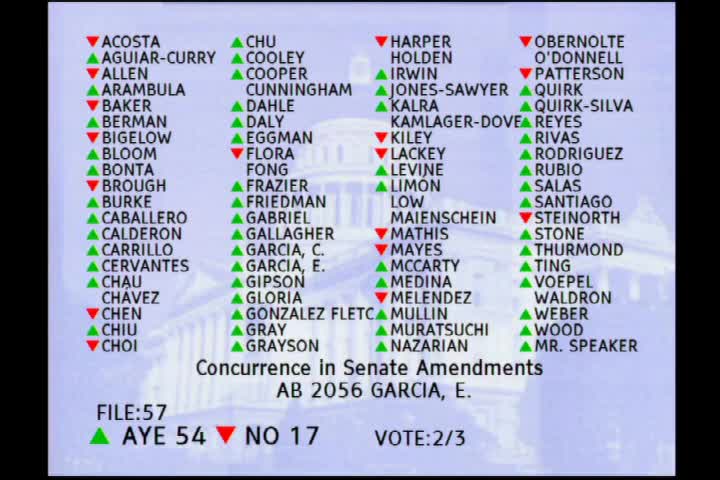 1MIN
Assembly Floor
 1MIN
Senate Floor
 1H
Senate Standing Committee on Appropriations
 1MIN
Assembly Floor
 5MIN
Assembly Standing Committee on Environmental Safety and Toxic Materials
 9MIN
Assembly Standing Committee on Water, Parks, and Wildlife
Bill Author