AB 2081: Postsecondary education: Campus Free Speech Act.
- Session Year: 2017-2018
- House: Assembly
- Latest Version Date: 2018-02-07
Existing law establishes the University of California, established under the California Constitution as a public trust under the administration of the Regents of the University of California, the California State University, under the administration of the Trustees of the California State University, the California Community Colleges, under the administration of the Board of Governors of the California Community Colleges, independent institutions of higher education, and private postsecondary educational institutions as the segments of postsecondary education in this state.
This bill would establish the Campus Free Speech Act, which would, among other things, require the appropriate governing board or body of each higher education institution, as defined, to develop and adopt a policy on free expression that contains specified components. The act would require that the policy supersede any provisions in the policies and regulations of the institution that restrict speech on campus and are inconsistent with the policy, and would require the appropriate governing board or body of the institution to remove or revise the provisions to ensure compatibility with the policy.
The act would require the appropriate governing board or body of the institution to establish a Committee on Free Expression, consisting of no less than 5 members and no more than 15 members, as specified. The act would require each committee to report, on or before September 1 of each year, to the governing board or body, the Legislature, and the Governor specified information regarding the status of free expression at the campus, or at each campus of the higher education institution, as applicable. The act would require each higher education institution to include in its freshman orientation programs a section describing to its students the institutions policies and regulations regarding free expression.
The act would make a higher education institution with written policies that do not comply with the act as of January 1, 2019, ineligible for any state funding except pursuant to the Cal Grant Program or a successor state-funded student financial aid program. Because the bill would impose new duties on community college districts, this bill would impose a state-mandated local program. The act would apply to educational programs or activities offered by a higher education institution that is controlled by a religious organization only if the application would not be inconsistent with the religious tenets of that organization.
The California Constitution requires the state to reimburse local agencies and school districts for certain costs mandated by the state. Statutory provisions establish procedures for making that reimbursement.
This bill would provide that, if the Commission on State Mandates determines that the bill contains costs mandated by the state, reimbursement for those costs shall be made pursuant to the statutory provisions noted above.
This chapter shall be known, and may be cited, as the Campus Free Speech Act.
99306.For purposes of this chapter, the following terms have the following meanings:
(a)Appropriate governing board or body for a campus of the California Community Colleges means the Board of Governors of the California Community Colleges.
(b)Appropriate governing board or body for a campus of the California State University means the Trustees of the California State University.
(c)Appropriate governing board or body for a campus of the University of California means the Regents of the University of California.
(d)First Amendment means the First Amendment to the United States Constitution.
(e)Higher education institution means a campus of the California Community Colleges, the California State University, or the University of California, a private postsecondary educational institution, or an independent institution of higher education.
(f)Peer-on-peer harassment means unwelcome conduct directed toward a person that is discriminatory on the basis of race, color, national origin, disability, religion, age, sex, sexual orientation, gender, or gender identity, and that is so severe, pervasive, and objectively offensive that it effectively bars the victims access to an educational opportunity or benefit.
(g)Quid pro quo harassment means explicitly or implicitly conditioning a students participation in an education program or activity or basing an educational decision on the students submission to unwelcome sexual advances, requests for sexual favors, or other verbal, nonverbal, or physical conduct of a sexual nature.
99307.(a)The appropriate governing board or body for each higher education institution shall develop and adopt a policy on free expression that contains, at least, all of the following components:
(1)A statement that the primary function of the institution is the discovery, improvement, transmission, and dissemination of knowledge by means of teaching, discussion, debate, and research, as applicable. The statement shall provide that, to fulfill this function, the institution must strive to ensure the fullest degree of intellectual freedom and free expression.
(2)A statement that it is not the proper role of the institution to shield individuals from speech protected by the First Amendment, including, but not limited to, ideas and opinions they find unwelcome, disagreeable, or even deeply offensive.
(3)Provisions ensuring that students and faculty have the freedom to discuss any problem that presents itself, as the First Amendment permits and within the limits of reasonable viewpoint- and content-neutral restrictions on time, place, and manner of expression that are consistent with this chapter and that are necessary to achieve a compelling institutional interest if these restrictions are clear, published, and provide ample alternative means of expression. Students and faculty shall be permitted to assemble and engage in spontaneous expressive activity if the activity is not unlawful and does not materially and substantially disrupt the functioning of the institution, subject to the requirements of this chapter.
(4)Provisions ensuring that any person lawfully present on campus may protest or demonstrate there. The policy shall make clear that protests and demonstrations that materially and substantially infringe upon the rights of others to engage in or listen to expressive activity shall not be permitted and shall be subject to sanction. This paragraph does not prohibit professors or other instructors from maintaining order in the classroom.
(5)Provisions ensuring that the institution is open to any speaker whom students, student groups, or members of the faculty have invited.
(6)Provisions designating the public open outdoor areas of the institution as public forums that shall operate under the rules applicable at traditional public forums, open on the same terms to any speaker.
(7)A range of disciplinary sanctions, which may include suspensions, firings, and expulsions, as applicable, for anyone under the jurisdiction of the institution who materially and substantially interferes with the free expression of others.
(8)(A) Provisions ensuring that, in all disciplinary cases involving expressive conduct, students are entitled to a disciplinary hearing under published procedures, including, but not limited to, all of the following:
(i)The right to receive advanced written notice of the charges.
(ii)The right to review the evidence in support of the charges.
(iii)The right to confront witnesses against them.
(iv)The right to present a defense.
(v)The right to call witnesses.
(vi)A decision by an impartial arbiter or panel.
(vii)The right of appeal.
(B)When suspension for longer than 30 days or expulsion are potential penalties, students shall be entitled to a disciplinary hearing under published procedures, including, but not limited to, all of the procedures listed in subparagraph (A), plus the right to active assistance of counsel.
(9)A prohibition on the institution charging its students security fees for specific events based on the content of their speech or the content of the speech of external speakers invited by students for the events.
(10)A requirement that the institution make all reasonable efforts and make available all reasonable resources to ensure the safety of speakers invited by students.
(11)Provisions authorizing the institution to restrict the use of its nonpublic facilities by anyone who is not a student, faculty member, administrator, or other employee at the institution if he or she is not invited by students, faculty members, administrators, or other employees at the institution.
(12)A prohibition on the institution revoking an invitation made by a student, student organization, or faculty member to a guest speaker based on the conclusion that the speakers anticipated speech may be considered offensive, unwise, immoral, indecent, disagreeable, conservative, liberal, traditional, radical, or wrongheaded by students, faculty, administrators, government officials, or members of the public.
(13)A prohibition on the institution confining a students free speech rights to limited areas of the campus, sometimes known as free speech zones, or otherwise creating a policy implying that a students free speech rights are restricted to limited areas of the campus. The institution may maintain a policy that grants members of the college or university community the right to reserve certain outdoor spaces in advance.
(14)Provisions ensuring that individual students, faculty, and staff of the institution shall be free to take positions on the public controversies of the day.
(b)The policy established pursuant to subdivision (a) shall supersede any provisions in the policies and regulations of a higher education institution that restrict speech on campus and are inconsistent with the requirements of subdivision (a). The appropriate governing board or body of the institution shall remove or revise these provisions in its policies and regulations to ensure compatibility with the policy established pursuant to subdivision (a).
99308.(a)The appropriate governing board or body of each higher education institution shall establish a Committee on Free Expression for the institution or segment, as appropriate, consisting of no less than 5 members and no more than 15 members.
(b)On or before September 1 of each year, each committee established pursuant to subdivision (a) shall submit a report to the governing board or body and, pursuant to Section 9795 of the Government Code, or a successor statute, to the Legislature and the Governor. The report shall include all of the following information for the previous academic year, disaggregated by higher education institution, as appropriate:
(1)A description of any barriers to or disruptions of free expression within the institution.
(2)A description of the administrative handling and discipline relating to the disruptions or barriers described in subparagraph (A).
(3)A description of substantial difficulties, controversies, or successes in maintaining a posture of administrative and institutional neutrality with regard to political or social issues.
(4)Any assessments, criticisms, commendations, or recommendations the committee sees fit to include.
99309.A higher education institution shall include in its freshman orientation programs a section describing to its students the institutions policies and regulations regarding free expression consistent with this chapter.
99310.(a)The governing board or body of each institution of higher education may adopt regulations to further the purposes of the policies adopted pursuant to this chapter.
(b)Nothing in this chapter shall be construed to prevent institutions from regulating student speech or activity that is prohibited by law. Except as further limited by this chapter, institutions may restrict student expression only for expressive activity not protected by the First Amendment, including, but not necessarily limited to, all of the following:
(1)Violations of state or federal law.
(2)Expression that a court has deemed unprotected defamation.
(3)Peer-on-peer harassment.
(4)Quid pro quo sexual harassment.
(5)True threats, as defined by applicable legal precedent.
(6)An unjustifiable invasion of privacy or confidentiality not involving a matter of public concern.
(7)An action that unlawfully disrupts the function of the institution.
(8)Reasonable time, place, and manner restrictions on expressive activities consistent with paragraph (3) of subdivision (a) of Section 99307.
99311.A higher education institution may restrict expressive conduct in the public areas of campus only if it demonstrates that the restriction meets all of the following requirements:
(a)It is in furtherance of a compelling institutional interest.
(b)It is the least restrictive means of furthering that compelling institutional interest.
(c)It leaves open ample other opportunities to engage in the expressive conduct.
(d)It provides for spontaneous assembly and distribution of literature.
99312.A higher education institution with written policies that do not comply with this chapter as of January 1, 2019, is ineligible for any state funding except pursuant to the Cal Grant Program established in Chapter 1.7 (commencing with Section 69430) of Part 42 of Division 5 of Title 3 of the Education Code, or a successor state-funded student financial aid program.
99313.This chapter shall apply to educational programs or activities offered by a higher education institution that is controlled by a religious organization only if the application of this chapter would not be inconsistent with the religious tenets of that organization.
SEC. 2.If the Commission on State Mandates determines that this act contains costs mandated by the state, reimbursement to local agencies and school districts for those costs shall be made pursuant to Part 7 (commencing with Section 17500) of Division 4 of Title 2 of the Government Code.
|
Date
|
Status
|
|---|---|
| May 9, 2018 | From committee: Without further action pursuant to Joint Rule 62(a). |
| Apr 3, 2018 | In committee: Set, first hearing. Failed passage. |
| Feb 22, 2018 | Referred to Coms. on HIGHER ED. and JUD. |
| Feb 8, 2018 | From printer. May be heard in committee March 10. |
| Feb 7, 2018 | Read first time. To print. |
|
Date
|
Description
|
Location
|
Votes
|
|
|---|---|---|---|---|
| Apr 3, 2018 | Do pass and be re-referred to the Committee on [Judiciary] | Assembly Standing Committee on Higher Education |
Failed |
This list shows positions taken on this bill by organizations on the date displayed, which is linked to the original source.
Positions by individuals are not included.
|
Organization
|
Position
|
Date
|
|---|---|---|
| Anti-Defamation League | ** Against | Apr 2, 2018 |
| Goldwater Institute | * Support | Apr 3, 2018 |
| Pacific Legal Foundation | * Support | Apr 3, 2018 |
| UC Berkeley | * Support | Apr 3, 2018 |
Date of Hearing: April 3, 2018
ASSEMBLY COMMITTEE ON HIGHER EDUCATION
Jose Medina, Chair
ABPCA Bill Id:AB 2081 (
Author:Melendez) – As Introduced Ver:February 7, 2018
[Note: This bill is doubled referred to the Assembly Judiciary Committee and will be heard by that Committee as it relates to issues under its jurisdiction.]
SUBJECT: Postsecondary education: Campus Free Speech Act.
SUMMARY: Establishes the Campus Free Speech Act, which, in part, requires each higher education institution to develop and adopt a policy on free expression, as specified; requires that the policy supersede any provisions in the policies and regulations of the institution that restrict free speech on campus and are inconsistent with the policy; makes a higher education institution with written policies that do not comply with the act, as of January 1, 2019, ineligible for any state funding except for Cal Grant Program funds; and, stipulates that the act applies to educational programs or activities offered by faith-based higher education institutions only if the act is not inconsistent with the religious tenets of the institution. Specifically, this bill:
- Requires the appropriate governing board or body for each higher education institution to develop and adopt a policy on free expression that contains, at least, all of the following:
- A statement that the primary function of the institution is the discovery, improvement, transmission, and dissemination of knowledge by means of teaching, discussion, debate, and research, as applicable; stipulates that the statement provide that, to fulfill this function, the institution must strive to ensure the fullest degree of intellectual freedom and free expression;
- A statement that it is not the proper role of the institution to shield individuals from speech protected by the First Amendment, including, but not limited to, ideas and opinions they find unwelcome, disagreeable, or even deeply offensive;
- Provisions ensuring that students and faculty have the freedom to discuss any problem that presents itself, as the First Amendment permits and within the limits of reasonable viewpoint- and content-neutral restrictions on time, place, and manner of expression that are consistent with the act and that are necessary to achieve a compelling institutional interest if these restrictions are clear, published, and provide ample alternative means of expression; and requires students and faculty be permitted to assemble and engage in spontaneous expressive activity if the activity is not unlawful and does not materially and substantially disrupt the functioning of the institution;
- Provisions ensuring that any person lawfully present on campus may protest or demonstrate there; requires the policy make clear that protests and demonstrations that materially and substantially infringe upon the rights of others to engage in or listen to expressive activity shall not be permitted and shall be subject to sanction (to note, this clause does not prohibit professors or other instructors from maintaining order in the classroom);
- Provisions ensuring that the institution is open to any speaker whom students, student groups, or members of the faculty have invited;
- Provisions designating the public open outdoor areas of the institution as public forums that shall operate under the rules applicable at traditional public forums, open on the same terms to any speaker;
- A range of disciplinary sanctions, which may include suspensions, firings, and expulsions, as applicable, for anyone under the jurisdiction of the institution who materially and substantially interferes with the free expression of others;
- Provisions ensuring that, in all disciplinary cases involving expressive conduct, students are entitled to a disciplinary hearing under published procedures, including, but not limited to:
- The right to receive advanced written notice of the charges;
- The right to review the evidence in support of the charges;
- The right to confront witnesses against them; and,
- The right of appeal.
- Requires that when suspension for longer than 30 days or expulsion are potential penalties, students be entitled to a disciplinary hearing under published procedures, including, but not limited to, all of the procedures listed in (h)(i-iv) above, plus the right to active assistance of counsel;
- A prohibition on the institution charging its students security fees for specific events based on the content of their speech or the content of the speech of external speakers invited by students for the events;
- A requirement that the institution make all reasonable efforts and make available all reasonable resources to ensure the safety of speakers invited by students;
- Provisions authorizing the institution to restrict the use of its nonpublic facilities by anyone who is not a student, faculty member, administrator, or other employee at the institution if he or she is not invited by students, faculty members, administrators, or other employees at the institution;
- A prohibition on the institution revoking an invitation made by a student, student organization, or faculty member to a guest speaker based on the conclusion that the speaker’s anticipated speech may be considered offensive, unwise, immoral, indecent, disagreeable, conservative, liberal, traditional, radical, or wrongheaded by students, faculty, administrators, government officials, or members of the public;
- A prohibition on the institution confining a student’s free speech rights to limited areas of the campus, sometimes known as free speech zones, or otherwise creating a policy implying that a student’s free speech rights are restricted to limited areas of the campus, and authorizes the institution to maintain a policy that grants members of the college or university community the right to reserve certain outdoor spaces in advance; and,
- Provisions ensuring that individual students, faculty, and staff of the institution shall be free to take positions on the public controversies of the day.
- Stipulates the policy established shall supersede any provisions in the policies and regulations of a higher education institution that restrict speech on campus and are inconsistent with the requirements of the act, and requires the appropriate governing board or body of the institution to remove or revise these provisions in its policies and regulations to ensure compatibility with the policy established under the act.
- Stipulates that a higher education institution with written policies that do not comply with the act, as of January 1, 2019, be ineligible for any state funding except for Cal Grant Program funds, or a successor state-funded student financial aid program.
- Requires the appropriate governing board or body of each higher education institution to establish a Committee on Free Expression for the institution or segment, as appropriate, consisting of no less than 5 members and no more than 15 members.
- Requires, on or before September 1 of each year, each committee established pursuant to (3) above, to submit a report to the governing board or body to the Legislature and the Governor.
- Requires the report include all of the following information for the previous academic year, disaggregated by higher education institution, as appropriate:
- A description of any barriers to or disruptions of free expression within the institution;
- A description of the administrative handling and discipline relating to the disruptions or barriers, as specified;
- A description of substantial difficulties, controversies, or successes in maintaining a posture of administrative and institutional neutrality with regard to political or social issues; and,
- Any assessments, criticisms, commendations, or recommendations the committee sees fit to include.
- Stipulates that the act applies to educational programs or activities offered by faith-based higher education institutions only if the act is not inconsistent with the religious tenets of the institution.
- Requires that a higher education institution include in its freshman orientation programs a section describing to its students the institution's policies and regulations regarding free expression.
- Authorizes the governing board or body of each institution of higher education to adopt regulations to further the purposes of the policies adopted pursuant to the act.
- Specifies that nothing in the act shall be construed to prevent institutions from regulating student speech or activity that is prohibited by law. Except as further limited by the act, institutions may restrict student expression only for expressive activity not protected by the First Amendment, including, but not necessarily limited to, all of the following:
- Violations of state or federal law;
- Expression that a court has deemed unprotected defamation;
- Peer-on-peer harassment;
- Quid pro quo sexual harassment;
- True threats, as defined by applicable legal precedent;
- An unjustifiable invasion of privacy or confidentiality not involving a matter of public concern;
- An action that unlawfully disrupts the function of the institution; and,
- Reasonable time, place, and manner restrictions on expressive activities, as specified.
- Authorizes a higher education institution to restrict expressive conduct in the public areas of campus only if it demonstrates that the restriction meets all of the following requirements:
- It is in furtherance of a compelling institutional interest;
- It is the least restrictive means of furthering that compelling institutional interest;
- It leaves open ample other opportunities to engage in the expressive conduct; and,
- It provides for spontaneous assembly and distribution of literature.
- Defines the following terms:
- “Appropriate governing board or body” for a campus of the California Community Colleges (CCC) means the CCC Board of Governors;
- “Appropriate governing board or body” for a campus of the California State University (CSU) means the CSU Trustees;
- “Appropriate governing board or body” for a campus of the University of California (UC) means the UC Regents;
- “First Amendment” means the First Amendment to the United States Constitution;
- “Higher education institution” means a campus of the CCC, the CSU, or the UC, a private postsecondary educational institution, or an independent institution of higher education;
- “Peer-on-peer harassment” means unwelcome conduct directed toward a person that is discriminatory on the basis of race, color, national origin, disability, religion, age, sex, sexual orientation, gender, or gender identity, and that is so severe, pervasive, and objectively offensive that it effectively bars the victim’s access to an educational opportunity or benefit; and,
- “Quid pro quo harassment” means explicitly or implicitly conditioning a student’s participation in an education program or activity or basing an educational decision on the student’s submission to unwelcome sexual advances, requests for sexual favors, or other verbal, nonverbal, or physical conduct of a sexual nature.
EXISTING LAW:
Federal law.
Prohibits Congress from making any law respecting an establishment of religion, or prohibiting the free exercise thereof; or abridging the freedom of speech, or of the press; or the right of the people peaceably to assemble, and to petition the government for a redress of grievances (First Amendment to the United States Constitution).
State law.
- Provides that every person may freely speak, write and publish his or her sentiments on all subjects, being responsible for the abuse of this right. Existing law prohibits a law from restraining or abridging liberty of speech or press (California Constitution, Article I, Section 2).
- Prohibits the UC Regents, the CSU Trustees, the governing board of a community college district, and an administrator of any campus of those institutions, from making or enforcing a rule subjecting a student to disciplinary sanction solely on the basis of conduct that is speech or other communication that, when engaged in outside a campus of those institutions, is protected from governmental restriction (Education Code (EC) Section 66301).
- Provides that (2) and (3) above do not prohibit an institution from adopting rules and regulations that are designed to prevent hate violence from being directed at students in a manner that denies them their full participation in the educational process, if the rules and regulations conform to standards established by the First Amendment to the United States Constitution and Section 2 of Article I of the California Constitution for citizens generally. Authorizes a student to commence a civil action to obtain appropriate injunctive and declaratory relief as determined by the court. Upon a motion, a court may award attorney’s fees to a prevailing plaintiff in a civil action pursuant to this section (EC Sections 66301 and 94367).
- Requires the governing board of a community college district to adopt rules and regulations relating to the exercise of free expression by students upon the premises of each community college maintained by the district, which shall include reasonable provisions for the time, place, and manner of conducting such activities. Provides that such rules and regulations shall not prohibit the right of students to exercise free expression, except that expression which is obscene, libelous or slanderous according to current legal standards, or which so incites students as to create a clear and present danger of the commission of unlawful acts on community college premises, or the violation of lawful community college regulations, or the substantial disruption of the orderly operation of the community college, shall be prohibited (EC Section 76120).
FISCAL EFFECT: Unknown
COMMENTS: Need for this bill. According to the author, "Postsecondary education institutions are currently not required by law to develop free speech protections for students."
The author contends that without the presence of a state law, administrators, faculty, and students are, "arbitrarily denying a person's freedom of expression on college campuses simply because they disagree with the political message".
What this bill does. The act requires all postsecondary institutions of learning to comply with many stipulated requirements. However, below, are the major components of act, as created by this bill:
- Mandates all postsecondary institutions create a universal policy on the importance of freedom of expression. If campuses do not adopt all components called for by the act, they will not be allowed, pursuant to the bill, state funding (with the exception of Cal Grant Program funds).
- Prevents campus administrators the ability to "disinvite" speakers invited by various student clubs and organizations.
- Requires all higher education institutions to develop disciplinary sanctions for students and anyone else who interferes violently with the associated rights of free speech.
- Prohibits all higher education institutions from having designated "free speech zones" on campuses.
- Mandates that all higher education institutions add a section during their freshman orientation sessions to include the policies on free expression.
- Prohibits all higher education institutions from charging student run clubs or organizations, security fees for their events.
- Mandates every higher education institution create a Committee on Free Expression, consisting of no less than 5 members and no more than 15 members, and every year, provide a report to the Governor and Legislature on the various concerns or issues a campus may have experienced from the previous academic year.
- Exempts any faith-based higher education institution from adhering to the requirements set forth by the act if it is inconsistent with the religious tenets of the institution.
Free speech and codes of conduct. Freedom of speech on public college and university campuses is allowed within the confines of codes of conduct and time, place, and manner restrictions. Institutions cannot discipline a student for engaging in a free speech activity, but can discipline a student if the free speech activity crosses into unlawful behavior, or otherwise violates the institution’s time, place and manner restrictions.
Postsecondary educational institutions maintain time, place, and manner restrictions to ensure safety, security, and order. As an example, CSU, Sacramento’s policy states:
“A. Overview: All activities set forth in this policy are subject to these general time, place, and manner restrictions as specified below:
B. Time: At all times except for non-University affiliated organizations and individuals, who are limited to normal operating hours.
C. Place: Freedom of expression activities may take place anywhere on campus with the following exceptions: inside parking lots and structures, inside University buildings, and near any location in which instructional, educational, and/or official business activities are being conducted (generally within 20 feet). Popular locations for freedom of expression activities are the Library Quad, Main Quad, and South Green.
D. Manner:
- Freedom of expression, which includes marches and/or moving protests, must be conducted in a manner that (1) shall not interfere with or obstruct the free flow of pedestrian or vehicular traffic; (2) shall not interfere with or disrupt the conduct of University business; (3) shall be carried out without creating excessive noise by use of a device; (4) shall not unreasonably interfere with classes in session or other scheduled academic, educational, co-curricular, and/or cultural/arts programs; (5) shall not promote an unlawful end, such as promoting actual violence or bodily or property harms, terrorist threats, defamation, obscenity, and false advertising; and (6) shall not violate any federal, state, or local safety code, such as regulations set by the State Fire Marshal, or University policy.
- For any public meeting, demonstration, rally, etc., held on University grounds, advance reservations are advised to avoid conflict with previously reserved activities. Use of space shall not conflict with prior reservation of that space for another use. (Casual or unscheduled users will not be allowed to interfere with scheduled, organized, or traditional use). Use of any campus buildings for this purpose requires advance reservations and is restricted to non-profit organizations or student organizations, and faculty-, staff- or administration-sponsored events. To maintain access and safety, the use of ramps, entrances, breezeways, hallways, and other pedestrian pathways is not authorized for such purposes.
- The scheduling process will ensure order and adequate preparation for the event and a suitable space for the intended use and expected attendance. Policies and procedures for reserving campus facilities are available in the Student Organizations & Leadership office and the Office of Space Management. Requests for student organization-sponsored events shall be directed to the Student Organizations & Leadership office. Requests for faculty-, staff- and administration-sponsored, and community events shall be directed to the Office of Space Management or the office that oversees reservations for that particular venue (e.g., requests for University Union space must be made through the University Union Events Services Office). Please consult the University’s Office of Space Management’s website for information relating to the appropriate office to contact to make reservations for a particular location on the University’s campus” (http://www.csus.edu/umanual/student/stu-0125.htm).
Committee considerations. Committee Staff understands that all public segments (CCC, CSU, and UC) have free speech policies and actively review them to ensure free speech protections apply to all speakers on a content neutral basis. Where there are violations of free speech rights, the segments take measures to hold individuals accountable when they are in violation of campus free expression policies.
To note, measures may include arrests of individuals by campus police, student discipline, and employee discipline.
- No state funding. The act would prohibit each higher education institution from receiving state funds, except for Cal Grant Program funds, if it does not adopt and implement every aspect, pursuant to the act on the same day the act would go into effect, January 1, 2019.
The Committee may wish to consider whether or not it desires to pass out a bill that could potentially close the doors to many of the campuses of our public institutions of higher learning, thus, in part, disrupting thousands of students from being able to receive a quality and affordable education.
- Elimination of free speech zones. The act would eliminate campuses from being able to have specified free speech zones. The segments have expressed concerns that this could create safety issues for not only students, but faculty, staff, and the communities surrounding the campuses.
The Committee may wish to consider whether or not it desires to pass out a measure that could lead to many unintended consequences.
- Prohibition on charging students' security fees. Committee Staff understands that each public campus has its own policies in place as it relates to collecting security fees from students. However, most campuses have established set event fees that are based on view-point neutral criteria, including, but not limited to, number of attendees and location. If there is a fee, the fee amount is determined by the criteria.
If the student organizations and clubs are not assessed a student security fee, who would be responsible for paying for additional required security that may be needed based on the free expression event?
- Prevention of campus administration, or appropriate entity from disinviting invited speaker. What happens if there is an eminent threat of danger or harm by having an invited speaker be present on a campus?
As currently drafted, this measure would virtually prohibit a campus from being able to disinvite the speaker.
The Committee may wish to consider whether or not it desires to pass out a bill that essentially removes the authority of its administration from making executive decisions and being able to disinvite a speaker.
- Faith-based institutions. As presently drafted, this bill exempts any faith-based institution from having to follow the requirements of the act, if doing so makes the institution inconsistent with its religious tenets.
If the author's intent is to ensure free expression is allowed on all campuses of higher education institutions, the Committee may wish to consider whether or not it desires to pass out a bill that potentially exempts some institutions from having to adhere to the free expression standards, pursuant to the bill.
- Inconsistent definitions of terms. As presently drafted, this measure uses several definitions that are defined differently in case law. Additionally, the definition for "appropriate governing board or body for a campus of the CCC" should not be the CCC Board of Governors, but rather the local community college district board of trustees.
Should this measure pass out, the author may wish to work with Legislative Counsel and the segments, to ensure the definitions are consistent.
Related legislation. AB 2374 (Kiley and Quirk), which will be heard by this Committee today, creates the Free Speech on Campus Act of 2018, which, in part, requires a campus of the CCC or the CSU, and requests a campus of the UC, to make and disseminate a free speech statement that affirms the importance of, and the campus’s commitment to promoting, freedom of expression.
SB 1381 (Nielsen), which is set to be heard by the Senate Education Committee on April 4, 2018, in part, requires a person who wishes to engage in expressive activity on the campus of a public postsecondary institution to be permitted to do so freely, as long as that person’s conduct is not unlawful and does not materially and substantially disrupt the functioning of the institution.
SB 1388 (Anderson), which is set to be heard by the Senate Education Committee on April 4, 2018, establishes the Forming Open and Robust University Minds Act, which, in part, requires that the outdoor areas of a public institution of higher education be deemed traditional public forums, subject to certain exceptions, and requires that a person who wishes to engage in noncommercial expressive activity in the outdoor areas of a public institution of higher education be permitted to do so freely, as long as the person’s conduct is not unlawful and does not materially and substantially disrupt the functioning of the public institution of higher education.
Previous legislation. ACA 14 (Melendez) of 2017, which the author did not move through the Legislative Process, created the Campus Free Speech Act, which, in part, would make a higher education institution that does not comply with the act ineligible for any state funding except pursuant to the Cal Grant Program or a successor state-funded student financial aid program.
ACR 21 (Kiley), Resolution Chapter 103, Statutes of 2017, which urged all private and public universities in California to consider free speech statements that are consistent with specified principles to be a model for developing and adopting free speech statements.
SB 472 (Nielsen) of 2017, which was held on the Senate Appropriations Suspense File, was virtually identical to SB 1381 (as described in the "Related legislation" section of this analysis).
REGISTERED SUPPORT / OPPOSITION:
Support
Goldwater Institute
Opposition
Anti-Defamation League
Analysis Prepared by: Jeanice Warden / HIGHER ED. / (916) 319-3960
Discussed in Hearing
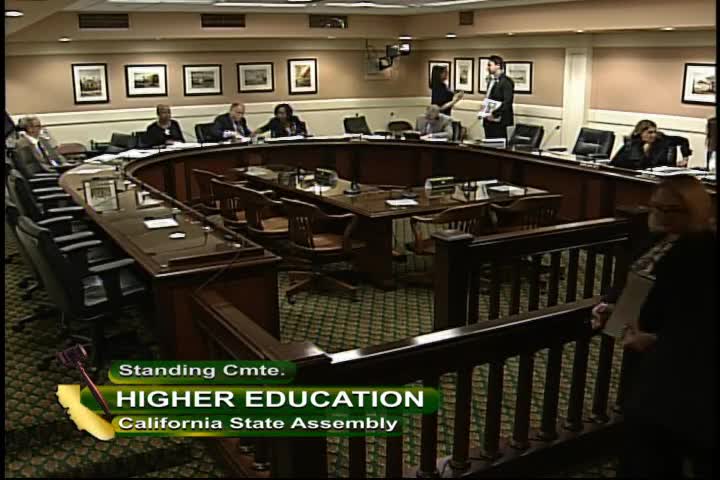 35MIN
Assembly Standing Committee on Higher Education
Bill Author

Bill Co-Author(s):