AB 2119: Foster care: gender affirming health care and mental health care.
- Session Year: 2017-2018
- House: Assembly
- Latest Version Date: 2018-09-14
Existing law provides that it is the policy of the state that all minors and nonminors in foster care have specified rights, including, among others, the right to receive medical, dental, vision, and mental health services, the right to be involved in the development of their own case plans and plans for permanent placement, and the right to be placed in out-of-home care according to their gender identity, regardless of the gender or sex listed in their court or child welfare records.
This bill would provide that the rights of minors and nonminors in foster care, as described above, include the right to be involved in the development of case plan elements related to placement and gender affirming health care, with consideration of their gender identity. The bill would also provide that the right of minors and nonminors in foster care to health care and mental health care includes covered gender affirming health care and gender affirming mental health care, as defined. The bill would require the State Department of Social Services, in consultation with the State Department of Health Care Services and other stakeholders, to develop guidance and describe best practices to identify, coordinate, and support foster youth seeking access to gender affirming health care and gender affirming mental health care and to incorporate current guidance on ensuring access to Medi-Cal services for transgender beneficiaries. The bill would require the department to issue written guidance by January 1, 2020. The bill would also include a statement of legislative findings and declarations.
Existing law provides that it is the policy of the state that all minors and nonminors in foster care have specified rights, including, among others, the right to receive medical, dental, vision, and mental health services, the right to be involved in the development of their own case plans and plans for permanent placement, and the right to be placed in out-of-home care according to their gender identity, regardless of the gender or sex listed in their court or child welfare records.
This bill would provide that the rights of minors and nonminors in foster care, as described above, include the right to be involved in the development of case plan elements related to placement and gender affirming health care, with consideration of their gender identity. The bill would also provide that the right of minors and nonminors in foster care to health care and mental health care includes covered gender affirming health care and gender affirming mental health care, as defined. The bill would require the State Department of Social Services, in consultation with the State Department of Health Care Services and other stakeholders, to develop guidance and describe best practices to identify, coordinate, and support foster youth seeking access to gender affirming health care and gender affirming mental health care and to incorporate current guidance on ensuring access to Medi-Cal services for transgender beneficiaries. The bill would require the department to issue written guidance by January 1, 2020. The bill would also include a statement of legislative findings and declarations.
Existing law provides that it is the policy of the state that all minors and nonminors in foster care have specified rights, including, among others, the right to receive medical, dental, vision, and mental health services, the right to be involved in the development of their own case plans and plans for permanent placement, and the right to be placed in out-of-home care according to their gender identity, regardless of the gender or sex listed in their court or child welfare records.
This bill would provide that the rights of minors and nonminors described above in foster care, as described above, include the right to be involved in the development of the case plan case plan elements related to placement and gender affirming health care, with consideration of their gender identity. The bill would also provide that the right of minors and nonminors in foster care to health care and mental health care includes covered gender affirming health care and gender affirming mental health care, as defined. The bill would require the State Department of Social Services, in consultation with the State Department of Health Care Services and other stakeholders, to develop guidance describing and describe best practices to identify, coordinate, and support foster youth seeking access to gender affirming health care and gender affirming mental health care and to incorporate current guidance on ensuring access to Medi-Cal services for transgender beneficiaries. The bill would require the department to issue written guidance by January 1, 2020. The bill would also include a statement of legislative findings and declarations.
Existing law provides that it is the policy of the state that all minors and nonminors in foster care have specified rights, including, among others, the right to receive medical, dental, vision, and mental health services services, the right to be involved in the development of their own case plans and plans for permanent placement, and the right to be placed in out-of-home care according to their gender identity, regardless of the gender or sex listed in their court or child welfare records.
This bill would additionally specify that all minors and nonminors in foster care have the right to have access to gender affirming health care and gender affirming behavioral health care. The bill would, upon the request of a child or nonminor dependent, or his or her caregiver, attorney, Court Appointed Special Advocate, or social worker, require the county child welfare agency to ensure that the child or nonminor dependent has access to gender affirming health care and gender affirming behavioral health services, which are defined to mean health care or behavioral health services that respect the gender identity of the patient, as specified. The bill would require the State Department of Social Services to adopt regulations to implement these provisions on or before January 1, 2020. The bill would also include a statement of legislative findings and declarations.The California Constitution requires the state to reimburse local agencies and school districts for certain costs mandated by the state. Statutory provisions establish procedures for making that reimbursement.This bill would provide that no reimbursement is required by this act for a specified reason.This bill would provide that the rights of minors and nonminors described above include the right to be involved in the development of the case plan with consideration of their gender identity. The bill would also provide that the right of minors and nonminors in foster care to health care and mental health care includes covered gender affirming health care and gender affirming mental health care, as defined. The bill would require the State Department of Social Services, in consultation with the State Department of Health Care Services and other stakeholders, to develop guidance describing best practices to identify, coordinate, and support foster youth seeking access to gender affirming health care and gender affirming mental health care and to incorporate current guidance on ensuring access to Medi-Cal services for transgender beneficiaries. The bill would require the department to issue written guidance by January 1, 2020. The bill would also include a statement of legislative findings and declarations.
Existing law provides that it is the policy of the state that all minors and nonminors in foster care have specified rights, including, among others, the right to receive medical, dental, vision, and mental health services and the right to be placed in out-of-home care according to their gender identity, regardless of the gender or sex listed in their court or child welfare records.
This bill would additionally specify that all minors and nonminors in foster care have the right to have access to gender affirming health care and gender affirming behavioral health care. The bill would, upon the request of a child or nonminor dependent, or his or her caregiver, attorney, Court Appointed Special Advocate, or social worker, require the county child welfare agency to ensure that the child or nonminor dependent has access to gender affirming health care and gender affirming behavioral health services, which are defined to mean health care or behavioral health services that respect the gender identity of the patient, as specified. The bill would prohibit a licensed professional, or any other individual, from subjecting a foster child or nonminor dependent to any treatment, intervention, or conduct that seeks to change the foster childs or nonminor dependents gender identity. The bill would require the State Department of Social Services to adopt regulations to implement these provisions on or before January 1, 2020. The bill would also include a statement of legislative findings and declarations.
The California Constitution requires the state to reimburse local agencies and school districts for certain costs mandated by the state. Statutory provisions establish procedures for making that reimbursement.
This bill would provide that no reimbursement is required by this act for a specified reason.
Existing law provides that it is the policy of the state that all minors and nonminors in foster care have specified rights, including, among others, the right to receive medical, dental, vision, and mental health services and the right to be placed in out-of-home care according to their gender identity, regardless of the gender or sex listed in their court or child welfare records.
This bill would additionally specify that all minors and nonminors in foster care have the right to have access to gender affirming health care and gender affirming behavioral health care. The bill would, upon the request of a child or nonminor dependent, or his or her caregiver, attorney, Court Appointed Special Advocate, or social worker, require the county child welfare agency to ensure that the child or nonminor dependent has access to gender affirming health care and gender affirming behavioral health services, which are defined to mean health care or behavioral health services that respect the gender identity of the patient, as specified. The bill would prohibit a licensed professional, or any other individual, from subjecting a foster child or nonminor dependent to any treatment, intervention, or conduct that seeks to change the foster childs or nonminor dependents gender identity. The bill would require the State Department of Social Services to adopt regulations to implement these provisions on or before January 1, 2020. The bill would also include a statement of legislative findings and declarations.
The California Constitution requires the state to reimburse local agencies and school districts for certain costs mandated by the state. Statutory provisions establish procedures for making that reimbursement.
This bill would provide that no reimbursement is required by this act for a specified reason.
Existing law provides that it is the policy of the state that all minors and nonminors in foster care have specified rights, including, among others, the right to receive medical, dental, vision, and mental health services and the right to be placed in out-of-home care according to their gender identity, regardless of the gender or sex listed in their court or child welfare records.
This bill would additionally specify that all minors and nonminors in foster care have the right to have access to gender affirming health care and gender affirming behavioral health care. The bill would, upon the request of a child or nonminor dependent, or his or her caregiver, attorney, Court Appointed Special Advocate, or social worker, require the county child welfare agency to ensure that the child or nonminor dependent has access to gender affirming health care and gender affirming behavioral health services, which are defined to mean health care or behavioral health services that respect the gender identity of the patient, as specified. The bill would require the State Department of Social Services to adopt regulations to implement these provisions on or before January 1, 2020.
The California Constitution requires the state to reimburse local agencies and school districts for certain costs mandated by the state. Statutory provisions establish procedures for making that reimbursement.
This bill would provide that no reimbursement is required by this act for a specified reason.
The Legislature hereby finds and declares all of the following:
(a)It is the intent of the Legislature to ensure the health and well-being of all foster children and nonminor dependents, including those who are transgender or gender nonconforming (TGNC).
(b)When their families, schools, and communities support and nurture their developing identities, TGNC children, like all children, thrive and succeed.
(c)TGNC children and adolescents who experience rejection and mistreatment based on their gender identity or expression are at significantly elevated risk for negative health outcomes, school dropout or exclusion, homelessness, and involvement in foster care and juvenile justice systems.
(d)Based, in part, on family rejection and societal bias, TGNC children and adolescents experience worse outcomes than their nontransgender peers and are significantly overrepresented in Californias child welfare system.
(e)TGNC foster children and nonminor dependents need accurate and timely information related to gender identity and expression, and access to gender affirming medical and behavioral health care.
(f)TGNC foster children and nonminor dependents are at additional risk of harm because unclear policies and a shortage of knowledgeable gender affirming providers create barriers to accessing medically necessary care.
(g)Foster youth who are 12 years of age or older have established rights to privately seek and consent to outpatient mental health counseling and treatment, including pursuant to Section 6924 of the Family Code and Section 124260 of the Health and Safety Code.
(h)Depending on a foster youths custody situation, a foster youths parent, social worker, licensed caregiver, judge, or the youth may give consent for the foster youths medical, surgical, dental, or other remedial care.
(i)Nonminor dependents give consent for their own medical, surgical, dental, and other health care.
(j)The Insurance Gender Nondiscrimination Act, pursuant to Section 1365.5 of the Health and Safety Code and Section 10140 of the Insurance Code, prohibits health plans from discriminating against individuals because of a persons sex, gender, gender identity, or gender expression.
(k)It is the role of the child welfare agency, within the parameters set forth in Section 369 of the Welfare and Institutions Code, to support dependent childrens ability to access medically necessary care, including gender affirming health care and gender affirming behavioral health services.
All children in foster care, as well as former foster youth up to 26 years of age, are entitled to Medi-Cal coverage without cost share or income or resource limits. The Medi-Cal program provides transition-related health care services when those services are determined to be medically necessary.
SEC. 2.Section 16001.9 of the Welfare and Institutions Code is amended to read:16001.9.(a)It is the policy of the state that all minors and nonminors in foster care shall have the following rights:
(1)To live in a safe, healthy, and comfortable home where he or she is treated with respect.
(2)To be free from physical, sexual, emotional, or other abuse, or corporal punishment.
(3)To receive adequate and healthy food, adequate clothing, and, for youth in group homes, an allowance.
(4)To receive medical, dental, vision, and mental health services.
(5)To be free of the administration of medication or chemical substances, unless authorized by a physician.
(6)To contact family members, unless prohibited by court order, and social workers, attorneys, foster youth advocates and supporters, Court Appointed Special Advocates (CASAs), and probation officers.
(7)To visit and contact brothers and sisters, unless prohibited by court order.
(8)To contact the Community Care Licensing Division of the State Department of Social Services or the State Foster Care Ombudsperson regarding violations of rights, to speak to representatives of these offices confidentially, and to be free from threats or punishment for making complaints.
(9)To make and receive confidential telephone calls and send and receive unopened mail, unless prohibited by court order.
(10)To attend religious services and activities of his or her choice.
(11)To maintain an emancipation bank account and manage personal income, consistent with the childs age and developmental level, unless prohibited by the case plan.
(12)To not be locked in a room, building, or facility premises, unless placed in a community treatment facility.
(13)To attend school and participate in extracurricular, cultural, and personal enrichment activities, consistent with the childs age and developmental level, with minimal disruptions to school attendance and educational stability.
(14)To work and develop job skills at an age-appropriate level, consistent with state law.
(15)To have social contacts with people outside of the foster care system, including teachers, church members, mentors, and friends.
(16)To attend Independent Living Program classes and activities if he or she meets the age requirements.
(17)To attend court hearings and speak to the judge.
(18)To have storage space for private use.
(19)To be involved in the development of his or her own case plan and plan for permanent placement. This involvement includes, but is not limited to, the development of case plan elements related to placement and gender affirming health care, with consideration of their gender identity.
(20)To review his or her own case plan and plan for permanent placement, if he or she is 12 years of age or older and in a permanent placement, and to receive information about his or her out-of-home placement and case plan, including being told of changes to the plan.
(21)To be free from unreasonable searches of personal belongings.
(22)To the confidentiality of all juvenile court records consistent with existing law.
(23)To have fair and equal access to all available services, placement, care, treatment, and benefits, and to not be subjected to discrimination or harassment on the basis of actual or perceived race, ethnic group identification, ancestry, national origin, color, religion, sex, sexual orientation, gender identity, mental or physical disability, or HIV status.
(24)To be placed in out-of-home care according to their gender identity, regardless of the gender or sex listed in their court or child welfare records.
(25)To have caregivers and child welfare personnel who have received instruction on cultural competency and sensitivity relating to, and best practices for, providing adequate care to lesbian, gay, bisexual, and transgender youth in out-of-home care.
(26)At 16 years of age or older, to have access to existing information regarding the educational options available, including, but not limited to, the coursework necessary for vocational and postsecondary educational programs, and information regarding financial aid for postsecondary education.
(27)To have access to age-appropriate, medically accurate information about reproductive health care, the prevention of unplanned pregnancy, and the prevention and treatment of sexually transmitted infections at 12 years of age or older.
(b)This section does not require and shall not be interpreted to require a foster care provider to take any action that would impair the health and safety of children in out-of-home placement.
(c)The State Department of Social Services and each county welfare department are encouraged to work with the Student Aid Commission, the University of California, the California State University, and the California Community Colleges to receive information pursuant to paragraph (26) of subdivision (a).
SEC. 3.Section 16010.2 of the Welfare and Institutions Code is amended to read:16010.2.(a)The department, in consultation with pediatricians, other health care experts, including public health nurses, and experts in and recipients of child welfare services, including parents, shall develop a plan for the ongoing oversight and coordination of health care services for a child in a foster care placement. The plan shall ensure a coordinated strategy to identify and respond to the health care needs of foster children, including mental health and dental needs, consistent with Section 205 of the federal Fostering Connections to Success and Increasing Adoptions Act of 2008 (Public Law 110-351).
(b)(1)The right of minors and nonminors in foster care to health care and mental health care described in paragraph (4) of subdivision (a) of Section 16001.9 includes covered gender affirming health care and gender affirming mental health care. This right is subject to existing laws governing consent to health care for minors and nonminors and does not limit, add, or otherwise affect applicable laws governing consent to health care.
(2)The department shall, in consultation with the State Department of Health Care Services and other stakeholders, develop guidance and describe best practices to identify, coordinate, and support foster youth seeking access to gender affirming health care and gender affirming mental health care and shall incorporate current guidance on ensuring access to Medi-Cal services for transgender beneficiaries. This consultation may be incorporated into existing departmental workgroups focused on foster youth rights or on foster youth sexual orientation, gender identity, and gender expression. The department shall issue written guidance by January 1, 2020.
(3)For purposes of this section, the following definitions apply:
(A)Gender affirming health care means medically necessary health care that respects the gender identity of the patient, as experienced and defined by the patient, and may include, but is not limited to, the following:
(i)Interventions to suppress the development of endogenous secondary sex characteristics.
(ii)Interventions to align the patients appearance or physical body with the patients gender identity.
(iii)Interventions to alleviate symptoms of clinically significant distress resulting from gender dysphoria, as defined in the Diagnostic and Statistical Manual of Mental Disorders, 5th Edition.
(B)Gender affirming mental health care means mental health care or behavioral health care that respects the gender identity of the patient, as experienced and defined by the patient, and may include, but is not limited to, developmentally appropriate exploration and integration of identity, reduction of distress, adaptive coping, and strategies to increase family acceptance.
The Legislature hereby finds and declares all of the following:
(a)It is the intent of the Legislature to ensure the health and well-being of all foster children and nonminor dependents, including those who are transgender or gender nonconforming (TGNC).
(b)When their families, schools, and communities support and nurture their developing identities, TGNC children, like all children, thrive and succeed.
(c)TGNC children and adolescents who experience rejection and mistreatment based on their gender identity or expression are at significantly elevated risk for negative health outcomes, school dropout or exclusion, homelessness, and involvement in foster care and juvenile justice systems.
(d)Based, in part, on family rejection and societal bias, TGNC children and adolescents experience worse outcomes than their nontransgender peers and are significantly overrepresented in Californias child welfare system.
(e)TGNC foster children and nonminor dependents need accurate and timely information related to gender identity and expression, and access to gender affirming medical and behavioral health care.
(f)TGNC foster children and nonminor dependents are at additional risk of harm because unclear policies and a shortage of knowledgeable gender affirming providers create barriers to accessing medically necessary care.
(g)Foster youth who are 12 years of age or older have established rights to privately seek and consent to outpatient mental health counseling and treatment, including pursuant to Section 6924 of the Family Code and Section 124260 of the Health and Safety Code.
(h)Depending on a foster youths custody situation, a foster youths parent, social worker, licensed caregiver, judge, or the youth may give consent for the foster youths medical, surgical, dental, or other remedial care.
(i)Nonminor dependents give consent for their own medical, surgical, dental, and other health care.
(j)The Insurance Gender Nondiscrimination Act, pursuant to Section 1365.5 of the Health and Safety Code and Section 10140 of the Insurance Code, prohibits health plans from discriminating against individuals because of a persons sex, gender, gender identity, or gender expression.
(k)It is the role of the child welfare agency, within the parameters set forth in Section 369 of the Welfare and Institutions Code, to support dependent childrens ability to access medically necessary care, including gender affirming health care and gender affirming behavioral health services.
All children in foster care, as well as former foster youth up to 26 years of age, are entitled to Medi-Cal coverage without cost share or income or resource limits. The Medi-Cal program provides transition-related health care services when those services are determined to be medically necessary.
SEC. 2.Section 16001.9 of the Welfare and Institutions Code is amended to read:16001.9.(a)It is the policy of the state that all minors and nonminors in foster care shall have the following rights:
(1)To live in a safe, healthy, and comfortable home where he or she is treated with respect.
(2)To be free from physical, sexual, emotional, or other abuse, or corporal punishment.
(3)To receive adequate and healthy food, adequate clothing, and, for youth in group homes, an allowance.
(4)To receive medical, dental, vision, and mental health services.
(5)To be free of the administration of medication or chemical substances, unless authorized by a physician.
(6)To contact family members, unless prohibited by court order, and social workers, attorneys, foster youth advocates and supporters, Court Appointed Special Advocates (CASAs), and probation officers.
(7)To visit and contact brothers and sisters, unless prohibited by court order.
(8)To contact the Community Care Licensing Division of the State Department of Social Services or the State Foster Care Ombudsperson regarding violations of rights, to speak to representatives of these offices confidentially, and to be free from threats or punishment for making complaints.
(9)To make and receive confidential telephone calls and send and receive unopened mail, unless prohibited by court order.
(10)To attend religious services and activities of his or her choice.
(11)To maintain an emancipation bank account and manage personal income, consistent with the childs age and developmental level, unless prohibited by the case plan.
(12)To not be locked in a room, building, or facility premises, unless placed in a community treatment facility.
(13)To attend school and participate in extracurricular, cultural, and personal enrichment activities, consistent with the childs age and developmental level, with minimal disruptions to school attendance and educational stability.
(14)To work and develop job skills at an age-appropriate level, consistent with state law.
(15)To have social contacts with people outside of the foster care system, including teachers, church members, mentors, and friends.
(16)To attend Independent Living Program classes and activities if he or she meets the age requirements.
(17)To attend court hearings and speak to the judge.
(18)To have storage space for private use.
(19)To be involved in the development of his or her own case plan and plan for permanent placement. This involvement includes, but is not limited to, the development of case plan elements related to placement and gender affirming health care, with consideration of their gender identity.
(20)To review his or her own case plan and plan for permanent placement, if he or she is 12 years of age or older and in a permanent placement, and to receive information about his or her out-of-home placement and case plan, including being told of changes to the plan.
(21)To be free from unreasonable searches of personal belongings.
(22)To the confidentiality of all juvenile court records consistent with existing law.
(23)To have fair and equal access to all available services, placement, care, treatment, and benefits, and to not be subjected to discrimination or harassment on the basis of actual or perceived race, ethnic group identification, ancestry, national origin, color, religion, sex, sexual orientation, gender identity, mental or physical disability, or HIV status.
(24)To be placed in out-of-home care according to their gender identity, regardless of the gender or sex listed in their court or child welfare records.
(25)To have caregivers and child welfare personnel who have received instruction on cultural competency and sensitivity relating to, and best practices for, providing adequate care to lesbian, gay, bisexual, and transgender youth in out-of-home care.
(26)At 16 years of age or older, to have access to existing information regarding the educational options available, including, but not limited to, the coursework necessary for vocational and postsecondary educational programs, and information regarding financial aid for postsecondary education.
(27)To have access to age-appropriate, medically accurate information about reproductive health care, the prevention of unplanned pregnancy, and the prevention and treatment of sexually transmitted infections at 12 years of age or older.
(b)This section does not require and shall not be interpreted to require a foster care provider to take any action that would impair the health and safety of children in out-of-home placement.
(c)The State Department of Social Services and each county welfare department are encouraged to work with the Student Aid Commission, the University of California, the California State University, and the California Community Colleges to receive information pursuant to paragraph (26) of subdivision (a).
SEC. 3.Section 16010.2 of the Welfare and Institutions Code is amended to read:16010.2.(a)The department, in consultation with pediatricians, other health care experts, including public health nurses, and experts in and recipients of child welfare services, including parents, shall develop a plan for the ongoing oversight and coordination of health care services for a child in a foster care placement. The plan shall ensure a coordinated strategy to identify and respond to the health care needs of foster children, including mental health and dental needs, consistent with Section 205 of the federal Fostering Connections to Success and Increasing Adoptions Act of 2008 (Public Law 110-351).
(b)(1)The right of minors and nonminors in foster care to health care and mental health care described in paragraph (4) of subdivision (a) of Section 16001.9 includes covered gender affirming health care and gender affirming mental health care. This right is subject to existing laws governing consent to health care for minors and nonminors and does not limit, add, or otherwise affect applicable laws governing consent to health care.
(2)The department shall, in consultation with the State Department of Health Care Services and other stakeholders, develop guidance and describe best practices to identify, coordinate, and support foster youth seeking access to gender affirming health care and gender affirming mental health care and shall incorporate current guidance on ensuring access to Medi-Cal services for transgender beneficiaries. This consultation may be incorporated into existing departmental workgroups focused on foster youth rights or on foster youth sexual orientation, gender identity, and gender expression. The department shall issue written guidance by January 1, 2020.
(3)For purposes of this section, the following definitions apply:
(A)Gender affirming health care means medically necessary health care that respects the gender identity of the patient, as experienced and defined by the patient, and may include, but is not limited to, the following:
(i)Interventions to suppress the development of endogenous secondary sex characteristics.
(ii)Interventions to align the patients appearance or physical body with the patients gender identity.
(iii)Interventions to alleviate symptoms of clinically significant distress resulting from gender dysphoria, as defined in the Diagnostic and Statistical Manual of Mental Disorders, 5th Edition.
(B)Gender affirming mental health care means mental health care or behavioral health care that respects the gender identity of the patient, as experienced and defined by the patient, and may include, but is not limited to, developmentally appropriate exploration and integration of identity, reduction of distress, adaptive coping, and strategies to increase family acceptance.
The Legislature hereby finds and declares all of the following:
(a)It is the intent of the Legislature to ensure the health and well-being of all foster children and nonminor dependents, including those who are transgender or gender nonconforming (TGNC).
(b)When their families, schools, and communities support and nurture their developing identities, TGNC children, like all children, thrive and succeed.
(c)TGNC children and adolescents who experience rejection and mistreatment based on their gender identity or expression are at significantly elevated risk for negative health outcomes, school dropout or exclusion, homelessness, and involvement in foster care and juvenile justice systems.
(d)Based, in part, on family rejection and societal bias, TGNC children and adolescents experience worse outcomes than their nontransgender peers and are significantly overrepresented in Californias child welfare system.
(e)TGNC foster children and nonminor dependents need accurate and timely information related to gender identity and expression, and access to gender affirming medical and behavioral health care.
(f)TGNC foster children and nonminor dependents are at additional risk of harm because unclear policies and a shortage of knowledgeable gender affirming providers create barriers to accessing medically necessary care.
(g)Foster youth who are 12 years of age or older have established rights to privately seek and consent to outpatient mental health counseling and treatment, including pursuant to Section 6924 of the Family Code and Section 124260 of the Health and Safety Code.
(h)Depending on a foster youths custody situation, a foster youths parent, social worker, licensed caregiver, judge, or the youth may give consent for the foster youths medical, surgical, dental, or other remedial care.
(i)Nonminor dependents give consent for their own medical, surgical, dental, and other health care.
(j)The Insurance Gender Nondiscrimination Act, pursuant to Section 1365.5 of the Health and Safety Code and Section 10140 of the Insurance Code, prohibits health plans from discriminating against individuals because of a persons sex, gender, gender identity, or gender expression.
(k)It is the role of the child welfare agency, within the parameters set forth in Section 369 of the Welfare and Institutions Code, to support dependent childrens ability to access medically necessary care, including gender affirming health care and gender affirming behavioral health services.
All children in foster care, as well as former foster youth up to 26 years of age, are entitled to Medi-Cal coverage without cost share or income or resource limits. The Medi-Cal program provides transition-related health care services when those services are determined to be medically necessary.
SEC. 2.Section 16001.9 of the Welfare and Institutions Code is amended to read:16001.9.(a)It is the policy of the state that all minors and nonminors in foster care shall have the following rights:
(1)To live in a safe, healthy, and comfortable home where he or she is treated with respect.
(2)To be free from physical, sexual, emotional, or other abuse, or corporal punishment.
(3)To receive adequate and healthy food, adequate clothing, and, for youth in group homes, an allowance.
(4)To receive medical, dental, vision, and mental health services.
(5)To be free of the administration of medication or chemical substances, unless authorized by a physician.
(6)To contact family members, unless prohibited by court order, and social workers, attorneys, foster youth advocates and supporters, Court Appointed Special Advocates (CASAs), and probation officers.
(7)To visit and contact brothers and sisters, unless prohibited by court order.
(8)To contact the Community Care Licensing Division of the State Department of Social Services or the State Foster Care Ombudsperson regarding violations of rights, to speak to representatives of these offices confidentially, and to be free from threats or punishment for making complaints.
(9)To make and receive confidential telephone calls and send and receive unopened mail, unless prohibited by court order.
(10)To attend religious services and activities of his or her choice.
(11)To maintain an emancipation bank account and manage personal income, consistent with the childs age and developmental level, unless prohibited by the case plan.
(12)To not be locked in a room, building, or facility premises, unless placed in a community treatment facility.
(13)To attend school and participate in extracurricular, cultural, and personal enrichment activities, consistent with the childs age and developmental level, with minimal disruptions to school attendance and educational stability.
(14)To work and develop job skills at an age-appropriate level, consistent with state law.
(15)To have social contacts with people outside of the foster care system, including teachers, church members, mentors, and friends.
(16)To attend Independent Living Program classes and activities if he or she meets the age requirements.
(17)To attend court hearings and speak to the judge.
(18)To have storage space for private use.
(19)To be involved in the development of his or her own case plan and plan for permanent placement. This involvement includes, but is not limited to, the development of case plan elements related to placement and gender affirming health care, with consideration of their gender identity.
(20)To review his or her own case plan and plan for permanent placement, if he or she is 12 years of age or older and in a permanent placement, and to receive information about his or her out-of-home placement and case plan, including being told of changes to the plan.
(21)To be free from unreasonable searches of personal belongings.
(22)To the confidentiality of all juvenile court records consistent with existing law.
(23)To have fair and equal access to all available services, placement, care, treatment, and benefits, and to not be subjected to discrimination or harassment on the basis of actual or perceived race, ethnic group identification, ancestry, national origin, color, religion, sex, sexual orientation, gender identity, mental or physical disability, or HIV status.
(24)To be placed in out-of-home care according to their gender identity, regardless of the gender or sex listed in their court or child welfare records. The rights described in paragraphs (4) and (19) include the right to be involved in the development of their own case plan, including, but not limited to, placement and gender affirming health care, with consideration of their gender identity.
(25)To have caregivers and child welfare personnel who have received instruction on cultural competency and sensitivity relating to, and best practices for, providing adequate care to lesbian, gay, bisexual, and transgender youth in out-of-home care.
(26)At 16 years of age or older, to have access to existing information regarding the educational options available, including, but not limited to, the coursework necessary for vocational and postsecondary educational programs, and information regarding financial aid for postsecondary education.
(27)To have access to age-appropriate, medically accurate information about reproductive health care, the prevention of unplanned pregnancy, and the prevention and treatment of sexually transmitted infections at 12 years of age or older.
(b)This section does not require and shall not be interpreted to require a foster care provider to take any action that would impair the health and safety of children in out-of-home placement.
(c)The State Department of Social Services and each county welfare department are encouraged to work with the Student Aid Commission, the University of California, the California State University, and the California Community Colleges to receive information pursuant to paragraph (26) of subdivision (a).
SEC. 3.Section 16010.2 of the Welfare and Institutions Code is amended to read:16010.2.(a)The department, in consultation with pediatricians, other health care experts, including public health nurses, and experts in and recipients of child welfare services, including parents, shall develop a plan for the ongoing oversight and coordination of health care services for a child in a foster care placement. The plan shall ensure a coordinated strategy to identify and respond to the health care needs of foster children, including mental health and dental needs, consistent with Section 205 of the federal Fostering Connections to Success and Increasing Adoptions Act of 2008 (Public Law 110-351).
(b)(1)The right of minors and nonminors in foster care to health care and mental health care described in paragraph (4) of subdivision (a) of Section 16001.9 includes covered gender affirming health care and gender affirming mental health care. This right is subject to existing laws governing consent to health care for minors and nonminors and does not limit, add, or otherwise affect applicable laws governing consent to health care.
(2)The department shall, in consultation with the State Department of Health Care Services and other stakeholders, develop guidance describing and describe best practices to identify, coordinate, and support foster youth seeking access to gender affirming health care and gender affirming mental health care and shall incorporate current guidance on ensuring access to Medi-Cal services for transgender beneficiaries. This consultation may be incorporated into existing departmental workgroups focused on foster youth rights or on foster youth sexual orientation, gender identity, and gender expression. The department shall issue written guidance by January 1, 2020.
(3)For purposes of this section, the following definitions apply:
(A)Gender affirming health care means medically necessary health care that respects the gender identity of the patient, as experienced and defined by the patient, and may include, but is not limited to, the following:
(i)Interventions to suppress the development of endogenous secondary sex characteristics.
(ii)Interventions to align the patients appearance or physical body with the patients gender identity.
(iii)Interventions to alleviate symptoms of clinically significant distress resulting from gender dysphoria, as defined in the Diagnostic and Statistical Manual of Mental Disorders, 5th Edition.
(B)Gender affirming mental health care means mental health care or behavioral health care that respects the gender identity of the patient, as experienced and defined by the patient, and may include, but is not limited to, developmentally appropriate exploration and integration of identity, reduction of distress, adaptive coping, and strategies to increase family acceptance.
The Legislature hereby finds and declares all of the following:
(a)It is the intent of the Legislature to ensure the health and well-being of all foster children and nonminor dependents, including those who are transgender or gender nonconforming (TGNC).
(b)When their families, schools schools, and communities support and nurture their developing identities, TGNC children, like all children, thrive and succeed.
(c)TGNC children and adolescents who experience rejection and mistreatment based on their gender identity or expression are at significantly elevated risk for negative health outcomes, school dropout or exclusion, homelessness, and involvement in foster care and juvenile justice systems.
(d)Based, in part, on family rejection and societal bias, TGNC children and adolescents experience worse outcomes than their nontransgender peers and are significantly overrepresented in Californias child welfare system.
(e)TGNC foster children and nonminor dependents need accurate and timely information related to gender identity and expression, and access to gender affirming medical and behavioral health care.
(f)TGNC foster children and nonminor dependents are at additional risk of harm because unclear policies and a shortage of knowledgeable gender-affirming gender affirming providers create barriers to accessing medically necessary care.
(g)Foster youth who are 12 years of age or older have established rights to privately seek and consent to outpatient mental health counseling and treatment, including pursuant to Section 6924 of the Family Code and Section 124260 of the Health and Safety Code.
(h)Depending on a foster youths custody situation, a foster youths parent, social worker, licensed caregiver, judge, or the youth may give consent for the foster youths medical, surgical, dental, or other remedial care.
(i)Nonminor dependents give consent for their own medical, surgical, dental dental, and other health care.
(j)The Insurance Gender Nondiscrimination Act, pursuant to Section 1365.5 of the Health and Safety Code and Section 10140 of the Insurance Code, prohibits health plans from discriminating against individuals because of a persons sex, gender, gender identity, or gender expression.
(k)It is the role of the child welfare agency, within the parameters set forth in Section 369 of the Welfare and Institutions Code, to support dependent childrens ability to access medically necessary care, including gender affirming health care and gender affirming behavioral health services.
All children in foster care, as well as former foster youth up to 26 years of age, are entitled to Medi-Cal coverage without cost share or income or resource limits. The Medi-Cal program provides transition-related health care services when those services are determined to be medically necessary.
SEC. 2.Section 16001.9 of the Welfare and Institutions Code is amended to read:16001.9.(a)It is the policy of the state that all minors and nonminors in foster care shall have the following rights:
(1)To live in a safe, healthy, and comfortable home where he or she is treated with respect.
(2)To be free from physical, sexual, emotional, or other abuse, or corporal punishment.
(3)To receive adequate and healthy food, adequate clothing, and, for youth in group homes, an allowance.
(4)To receive medical, dental, vision, and mental health services.
(5)To be free of the administration of medication or chemical substances, unless authorized by a physician.
(6)To contact family members, unless prohibited by court order, and social workers, attorneys, foster youth advocates and supporters, Court Appointed Special Advocates (CASAs), and probation officers.
(7)To visit and contact brothers and sisters, unless prohibited by court order.
(8)To contact the Community Care Licensing Division of the State Department of Social Services or the State Foster Care Ombudsperson regarding violations of rights, to speak to representatives of these offices confidentially, and to be free from threats or punishment for making complaints.
(9)To make and receive confidential telephone calls and send and receive unopened mail, unless prohibited by court order.
(10)To attend religious services and activities of his or her choice.
(11)To maintain an emancipation bank account and manage personal income, consistent with the childs age and developmental level, unless prohibited by the case plan.
(12)To not be locked in a room, building, or facility premises, unless placed in a community treatment facility.
(13)To attend school and participate in extracurricular, cultural, and personal enrichment activities, consistent with the childs age and developmental level, with minimal disruptions to school attendance and educational stability.
(14)To work and develop job skills at an age-appropriate level, consistent with state law.
(15)To have social contacts with people outside of the foster care system, including teachers, church members, mentors, and friends.
(16)To attend Independent Living Program classes and activities if he or she meets the age requirements.
(17)To attend court hearings and speak to the judge.
(18)To have storage space for private use.
(19)To be involved in the development of his or her own case plan and plan for permanent placement.
(20)To review his or her own case plan and plan for permanent placement, if he or she is 12 years of age or older and in a permanent placement, and to receive information about his or her out-of-home placement and case plan, including being told of changes to the plan.
(21)To be free from unreasonable searches of personal belongings.
(22)To the confidentiality of all juvenile court records consistent with existing law.
(23)To have fair and equal access to all available services, placement, care, treatment, and benefits, and to not be subjected to discrimination or harassment on the basis of actual or perceived race, ethnic group identification, ancestry, national origin, color, religion, sex, sexual orientation, gender identity, mental or physical disability, or HIV status.
(24)To be placed in out-of-home care according to their gender identity, regardless of the gender or sex listed in their court or child welfare records. The rights described in paragraphs (4) and (19) include the right to be involved in the development of their own case plan, including, but not limited to, placement and gender affirming health care, with consideration of their gender identity.
(25)To have caregivers and child welfare personnel who have received instruction on cultural competency and sensitivity relating to, and best practices for, providing adequate care to lesbian, gay, bisexual, and transgender youth in out-of-home care.
(26)At 16 years of age or older, to have access to existing information regarding the educational options available, including, but not limited to, the coursework necessary for vocational and postsecondary educational programs, and information regarding financial aid for postsecondary education.
(27)To have access to age-appropriate, medically accurate information about reproductive health care, the prevention of unplanned pregnancy, and the prevention and treatment of sexually transmitted infections at 12 years of age or older.
(28)To have access to gender affirming health care and gender affirming behavioral health services, as defined in Section 16501.31.(b)This section does not require and shall not be interpreted to require a foster care provider to take any action that would impair the health and safety of children in out-of-home placement.
(c)The State Department of Social Services and each county welfare department are encouraged to work with the Student Aid Commission, the University of California, the California State University, and the California Community Colleges to receive information pursuant to paragraph (26) of subdivision (a).
SEC. 3.Section 16501.31 is added to the Welfare and Institutions Code, to read:16501.31.(a)Upon the request of a child or nonminor dependent, or their caregiver, attorney, Court Appointed Special Advocate, or social worker, the county child welfare agency shall ensure that the child or nonminor dependent has access to gender affirming health care and gender affirming behavioral health services.(b)(1)Gender affirming health care means health care that respects the gender identity of the patient, as experienced and defined by the patient, and may include, but is not limited to, all of the following:(A)Interventions to suppress the development of endogenous secondary sex characteristics.(B)Interventions to align the patients appearance or physical body with the patients gender identity.(C)Interventions to alleviate symptoms of clinically significant distress resulting from gender dysphoria, as defined in the Diagnostic and Statistical Manual of Mental Disorders, 5th Edition.(2)Gender affirming behavioral health services means behavioral health services that respect the gender identity of the patient, as experienced and defined by the patient, and may include, but is not limited to, developmentally appropriate exploration and integration of identity, reduction of distress, adaptive coping, and strategies to increase family acceptance.(c)Gender affirming health care and gender affirming behavioral health services provided pursuant to this section are subject to existing laws governing consent to health care. This section does not limit, add, or otherwise affect, applicable law on consent to health care.(d)The department shall adopt regulations to implement this section on or before January 1, 2020.SEC. 4.To the extent that this act has an overall effect of increasing the costs already borne by a local agency for programs or levels of service mandated by the 2011 Realignment Legislation within the meaning of Section 36 of Article XIII of the California Constitution, it shall apply to local agencies only to the extent that the state provides annual funding for the cost increase. Any new program or higher level of service provided by a local agency pursuant to this act above the level for which funding has been provided shall not require a subvention of funds by the state or otherwise be subject to Section 6 of Article XIIIB of the California Constitution.SEC. 3.Section 16010.2 of the Welfare and Institutions Code is amended to read:16010.2.(a)The department, in consultation with pediatricians, other health care experts, including public health nurses, and experts in and recipients of child welfare services, including parents, shall develop a plan for the ongoing oversight and coordination of health care services for a child in a foster care placement. The plan shall ensure a coordinated strategy to identify and respond to the health care needs of foster children, including mental health and dental needs, consistent with Section 205 of the federal Fostering Connections to Success and Increasing Adoptions Act of 2008 (Public Law 110-351).
(b)(1)The right of minors and nonminors in foster care to health care and mental health care described in paragraph (4) of subdivision (a) of Section 16001.9 includes covered gender affirming health care and gender affirming mental health care. This right is subject to existing laws governing consent to health care for minors and nonminors and does not limit, add, or otherwise affect applicable laws governing consent to health care.
(2)The department shall, in consultation with the State Department of Health Care Services and other stakeholders, develop guidance describing best practices to identify, coordinate, and support foster youth seeking access to gender affirming health care and gender affirming mental health care and shall incorporate current guidance on ensuring access to Medi-Cal services for transgender beneficiaries. This consultation may be incorporated into existing departmental workgroups focused on foster youth rights or on foster youth sexual orientation, gender identity, and gender expression. The department shall issue written guidance by January 1, 2020.
(3)For purposes of this section, the following definitions apply:
(A)Gender affirming health care means medically necessary health care that respects the gender identity of the patient, as experienced and defined by the patient, and may include, but is not limited to, the following:
(i)Interventions to suppress the development of endogenous secondary sex characteristics.
(ii)Interventions to align the patients appearance or physical body with the patients gender identity.
(iii)Interventions to alleviate symptoms of clinically significant distress resulting from gender dysphoria, as defined in the Diagnostic and Statistical Manual of Mental Disorders, 5th Edition.
(B)Gender affirming mental health care means mental health care or behavioral health care that respects the gender identity of the patient, as experienced and defined by the patient, and may include, but is not limited to, developmentally appropriate exploration and integration of identity, reduction of distress, adaptive coping, and strategies to increase family acceptance.
The Legislature hereby finds and declares all of the following:
(a)It is the intent of the Legislature to ensure the health and well-being of all foster children and nonminor dependents, including those who are transgender or gender nonconforming (TGNC).
(b)When their families, schools and communities support and nurture their developing identities, TGNC children, like all children, thrive and succeed.
(c)TGNC children and adolescents who experience rejection and mistreatment based on their gender identity or expression are at significantly elevated risk for negative health outcomes, school dropout or exclusion, homelessness, and involvement in foster care and juvenile justice systems.
(d)Based, in part, on family rejection and societal bias, TGNC children and adolescents experience worse outcomes than their nontransgender peers and are significantly overrepresented in Californias child welfare system.
(e)TGNC foster children and nonminor dependents need accurate and timely information related to gender identity and expression, and access to gender affirming medical and behavioral health care.
(f)TGNC foster children and nonminor dependents are at additional risk of harm because unclear policies and a shortage of knowledgeable gender-affirming providers create barriers to accessing medically necessary care.
(g)Foster youth who are 12 years of age or older have established rights to privately seek and consent to outpatient mental health counseling and treatment, including pursuant to Section 6924 of the Family Code and Section 124260 of the Health and Safety Code.
(h)Depending on a foster youths custody situation, a foster youths parent, social worker, licensed caregiver, judge, or the youth may give consent for the foster youths medical, surgical, dental, or other remedial care.
(i)Nonminor dependents give consent for their own medical, surgical, dental and other health care.
(j)The Insurance Gender Nondiscrimination Act, pursuant to Section 1365.5 of the Health and Safety Code and Section 10140 of the Insurance Code, prohibits health plans from discriminating against individuals because of a persons sex, gender, gender identity, or gender expression.
(k)It is the role of the child welfare agency, within the parameters set forth in Section 369 of the Welfare and Institutions Code, to support dependent childrens ability to access medically necessary care, including gender affirming health care and gender affirming behavioral health services.
All children in foster care, as well as former foster youth up to 26 years of age, are entitled to Medi-Cal coverage without cost share or income or resource limits. The Medi-Cal program provides transition-related health care services when those services are determined to be medically necessary.
SEC. 2.Section 16001.9 of the Welfare and Institutions Code is amended to read:16001.9.(a)It is the policy of the state that all minors and nonminors in foster care have the following rights:
(1)To live in a safe, healthy, and comfortable home where he or she is treated with respect.
(2)To be free from physical, sexual, emotional, or other abuse, or corporal punishment.
(3)To receive adequate and healthy food, adequate clothing, and, for youth in group homes, an allowance.
(4)To receive medical, dental, vision, and mental health services.
(5)To be free of the administration of medication or chemical substances, unless authorized by a physician.
(6)To contact family members, unless prohibited by court order, and social workers, attorneys, foster youth advocates and supporters, Court Appointed Special Advocates (CASAs), and probation officers.
(7)To visit and contact brothers and sisters, unless prohibited by court order.
(8)To contact the Community Care Licensing Division of the State Department of Social Services or the State Foster Care Ombudsperson regarding violations of rights, to speak to representatives of these offices confidentially, and to be free from threats or punishment for making complaints.
(9)To make and receive confidential telephone calls and send and receive unopened mail, unless prohibited by court order.
(10)To attend religious services and activities of his or her choice.
(11)To maintain an emancipation bank account and manage personal income, consistent with the childs age and developmental level, unless prohibited by the case plan.
(12)To not be locked in a room, building, or facility premises, unless placed in a community treatment facility.
(13)To attend school and participate in extracurricular, cultural, and personal enrichment activities, consistent with the childs age and developmental level, with minimal disruptions to school attendance and educational stability.
(14)To work and develop job skills at an age-appropriate level, consistent with state law.
(15)To have social contacts with people outside of the foster care system, including teachers, church members, mentors, and friends.
(16)To attend Independent Living Program classes and activities if he or she meets the age requirements.
(17)To attend court hearings and speak to the judge.
(18)To have storage space for private use.
(19)To be involved in the development of his or her own case plan and plan for permanent placement.
(20)To review his or her own case plan and plan for permanent placement, if he or she is 12 years of age or older and in a permanent placement, and to receive information about his or her out-of-home placement and case plan, including being told of changes to the plan.
(21)To be free from unreasonable searches of personal belongings.
(22)To the confidentiality of all juvenile court records consistent with existing law.
(23)To have fair and equal access to all available services, placement, care, treatment, and benefits, and to not be subjected to discrimination or harassment on the basis of actual or perceived race, ethnic group identification, ancestry, national origin, color, religion, sex, sexual orientation, gender identity, mental or physical disability, or HIV status.
(24)To be placed in out-of-home care according to their gender identity, regardless of the gender or sex listed in their court or child welfare records.
(25)To have caregivers and child welfare personnel who have received instruction on cultural competency and sensitivity relating to, and best practices for, providing adequate care to lesbian, gay, bisexual, and transgender youth in out-of-home care.
(26)At 16 years of age or older, to have access to existing information regarding the educational options available, including, but not limited to, the coursework necessary for vocational and postsecondary educational programs, and information regarding financial aid for postsecondary education.
(27)To have access to age-appropriate, medically accurate information about reproductive health care, the prevention of unplanned pregnancy, and the prevention and treatment of sexually transmitted infections at 12 years of age or older.
(28)To have access to gender affirming health care and gender affirming behavioral health services, as defined in Section 16501.31.
(b)This section does not require a foster care provider to take any action that would impair the health and safety of children in out-of-home placement.
(c)The State Department of Social Services and each county welfare department are encouraged to work with the Student Aid Commission, the University of California, the California State University, and the California Community Colleges to receive information pursuant to paragraph (26) of subdivision (a).
SEC. 3.Section 16501.31 is added to the Welfare and Institutions Code, to read:16501.31.(a)Upon the request of a child or nonminor dependent, or their caregiver, attorney, Court Appointed Special Advocate, or social worker, the county child welfare agency shall ensure that the child or nonminor dependent has access to gender affirming health care and gender affirming behavioral health services.
(b)(1)Gender affirming health care means health care that respects the gender identity of the patient, as experienced and defined by the patient, and may include, but is not limited to, all of the following:
(A)Interventions to suppress the development of endogenous secondary sex characteristics.
(B)Interventions to align the patients appearance or physical body with the patients gender identity.
(C)Interventions to alleviate symptoms of clinically significant distress resulting from gender dysphoria, as defined in the Diagnostic and Statistical Manual of Mental Disorders, 5th Edition.
(2)Gender affirming behavioral health services means behavioral health services that respect the gender identity of the patient, as experienced and defined by the patient, and may include, but is not limited to, developmentally appropriate exploration and integration of identity, reduction of distress, adaptive coping, and strategies to increase family acceptance.
(c)A licensed professional, or any other individual, shall not subject a foster child or nonminor dependent to any treatment, intervention, or conduct that seeks to change the foster childs or nonminor dependents gender identity.(d)(c)Gender affirming health care and gender affirming behavioral health services provided pursuant to this section are subject to existing laws governing consent to health care. This section does not limit, add, or otherwise affect, applicable law on consent to health care.
(e)(d)The department shall adopt regulations to implement this section on or before January 1, 2020.
SEC. 4.To the extent that this act has an overall effect of increasing the costs already borne by a local agency for programs or levels of service mandated by the 2011 Realignment Legislation within the meaning of Section 36 of Article XIII of the California Constitution, it shall apply to local agencies only to the extent that the state provides annual funding for the cost increase. Any new program or higher level of service provided by a local agency pursuant to this act above the level for which funding has been provided shall not require a subvention of funds by the state or otherwise be subject to Section 6 of Article XIIIB of the California Constitution.
The Legislature hereby finds and declares all of the following:
(a)It is the intent of the Legislature to ensure the health and well-being of all foster children and nonminor dependents, including those who are transgender or gender nonconforming (TGNC).
(b)When their families, schools and communities support and nurture their developing identities, TGNC children, like all children, thrive and succeed.
(c)TGNC children and adolescents who experience rejection and mistreatment based on their gender identity or expression are at significantly elevated risk for negative health outcomes, school dropout or exclusion, homelessness, and involvement in foster care and juvenile justice systems.
(d)Based, in part, on family rejection and societal bias, TGNC children and adolescents experience worse outcomes than their nontransgender peers and are significantly overrepresented in Californias child welfare system.
(e)TGNC foster children and nonminor dependents need accurate and timely information related to gender identity and expression, and access to gender affirming medical and behavioral health care.
(f)TGNC foster children and nonminor dependents are at additional risk of harm because unclear policies and a shortage of knowledgeable gender-affirming providers create barriers to accessing medically necessary care.
(g)Foster youth who are 12 years of age or older have established rights to privately seek and consent to outpatient mental health counseling and treatment, including pursuant to Section 6924 of the Family Code and Section 124260 of the Health and Safety Code.
(h)Depending on a foster youths custody situation, a foster youths parent, social worker, licensed caregiver, judge, or the youth may give consent for the foster youths medical, surgical, dental, or other remedial care.
(i)Nonminor dependents give consent for their own medical, surgical, dental and other health care.
(j)The Insurance Gender Nondiscrimination Act, pursuant to Section 1365.5 of the Health and Safety Code and Section 10140 of the Insurance Code, prohibits health plans from discriminating against individuals because of a persons sex, gender, gender identity, or gender expression.
(k)It is the role of the child welfare agency, within the parameters set forth in Section 369 of the Welfare and Institutions Code, to support dependent childrens ability to access medically necessary care, including gender affirming health care and gender affirming behavioral health services.
All children in foster care, as well as former foster youth up to 26 years of age, are entitled to Medi-Cal coverage without cost share or income or resource limits. The Medi-Cal program provides transition-related health care services when those services are determined to be medically necessary.
SECTION 1.SEC. 2.Section 16001.9 of the Welfare and Institutions Code is amended to read:16001.9.(a)It is the policy of the state that all minors and nonminors in foster care have the following rights:
(1)To live in a safe, healthy, and comfortable home where he or she is treated with respect.
(2)To be free from physical, sexual, emotional, or other abuse, or corporal punishment.
(3)To receive adequate and healthy food, adequate clothing, and, for youth in group homes, an allowance.
(4)To receive medical, dental, vision, and mental health services.
(5)To be free of the administration of medication or chemical substances, unless authorized by a physician.
(6)To contact family members, unless prohibited by court order, and social workers, attorneys, foster youth advocates and supporters, Court Appointed Special Advocates (CASAs), and probation officers.
(7)To visit and contact brothers and sisters, unless prohibited by court order.
(8)To contact the Community Care Licensing Division of the State Department of Social Services or the State Foster Care Ombudsperson regarding violations of rights, to speak to representatives of these offices confidentially, and to be free from threats or punishment for making complaints.
(9)To make and receive confidential telephone calls and send and receive unopened mail, unless prohibited by court order.
(10)To attend religious services and activities of his or her choice.
(11)To maintain an emancipation bank account and manage personal income, consistent with the childs age and developmental level, unless prohibited by the case plan.
(12)To not be locked in a room, building, or facility premises, unless placed in a community treatment facility.
(13)To attend school and participate in extracurricular, cultural, and personal enrichment activities, consistent with the childs age and developmental level, with minimal disruptions to school attendance and educational stability.
(14)To work and develop job skills at an age-appropriate level, consistent with state law.
(15)To have social contacts with people outside of the foster care system, including teachers, church members, mentors, and friends.
(16)To attend Independent Living Program classes and activities if he or she meets the age requirements.
(17)To attend court hearings and speak to the judge.
(18)To have storage space for private use.
(19)To be involved in the development of his or her own case plan and plan for permanent placement.
(20)To review his or her own case plan and plan for permanent placement, if he or she is 12 years of age or older and in a permanent placement, and to receive information about his or her out-of-home placement and case plan, including being told of changes to the plan.
(21)To be free from unreasonable searches of personal belongings.
(22)To the confidentiality of all juvenile court records consistent with existing law.
(23)To have fair and equal access to all available services, placement, care, treatment, and benefits, and to not be subjected to discrimination or harassment on the basis of actual or perceived race, ethnic group identification, ancestry, national origin, color, religion, sex, sexual orientation, gender identity, mental or physical disability, or HIV status.
(24)To be placed in out-of-home care according to their gender identity, regardless of the gender or sex listed in their court or child welfare records.
(25)To have caregivers and child welfare personnel who have received instruction on cultural competency and sensitivity relating to, and best practices for, providing adequate care to lesbian, gay, bisexual, and transgender youth in out-of-home care.
(26)At 16 years of age or older, to have access to existing information regarding the educational options available, including, but not limited to, the coursework necessary for vocational and postsecondary educational programs, and information regarding financial aid for postsecondary education.
(27)To have access to age-appropriate, medically accurate information about reproductive health care, the prevention of unplanned pregnancy, and the prevention and treatment of sexually transmitted infections at 12 years of age or older.
(28)To have access to gender affirming health care and gender affirming behavioral health services, as defined in Section 16501.31.
(b)Nothing in this section shall be interpreted to This section does not require a foster care provider to take any action that would impair the health and safety of children in out-of-home placement.
(c)The State Department of Social Services and each county welfare department are encouraged to work with the Student Aid Commission, the University of California, the California State University, and the California Community Colleges to receive information pursuant to paragraph (26) of subdivision (a).
SEC. 2.SEC. 3.Section 16501.31 is added to the Welfare and Institutions Code, to read:16501.31.(a)Upon the request of a child or nonminor dependent, or his or her their caregiver, attorney, Court Appointed Special Advocate, or social worker, the county child welfare agency shall ensure that the child or nonminor dependent has access to gender affirming health care and gender affirming behavioral health services.
(b)(1)Gender affirming health care means health care that respects the gender identity of the patient, as experienced and defined by the patient, and may include, but is not limited to, all of the following:
(A)Interventions to suppress the development of endogenous secondary sex characteristics.
(B)Interventions to align the patients appearance or physical body with the patients gender identity.
(C)Interventions to alleviate symptoms of clinically significant distress resulting from gender dysphoria, as defined in the Diagnostic and Statistical Manual of Mental Disorders, 5th Edition.
(2)Gender affirming behavioral health services means behavioral health services that respect the gender identity of the patient, as experienced and defined by the patient, and may include, but is not limited to, developmentally appropriate exploration and integration of identity, reduction of distress, adaptive coping, and strategies to increase family acceptance.
(c)Treatment plans shall not include interventions aimed at aligning a childs or nonminor dependents assigned sex at birth and gender identity, nor may a child or nonminor dependent be subjected to those interventions by licensed professionals or any other individual.(c)A licensed professional, or any other individual, shall not subject a foster child or nonminor dependent to any treatment, intervention, or conduct that seeks to change the foster childs or nonminor dependents gender identity.
(d)Gender affirming health care and gender affirming behavioral health services provided pursuant to this section are subject to existing laws governing consent to health care. Nothing in this section shall be construed to This section does not limit, add, or otherwise affect, applicable law on consent to health care.
(e)The department shall adopt regulations to implement this section on or before January 1, 2020.
SEC. 3.SEC. 4.To the extent that this act has an overall effect of increasing the costs already borne by a local agency for programs or levels of service mandated by the 2011 Realignment Legislation within the meaning of Section 36 of Article XIII of the California Constitution, it shall apply to local agencies only to the extent that the state provides annual funding for the cost increase. Any new program or higher level of service provided by a local agency pursuant to this act above the level for which funding has been provided shall not require a subvention of funds by the state or otherwise be subject to Section 6 of Article XIIIB of the California Constitution.
(a)It is the policy of the state that all minors and nonminors in foster care shall have the following rights:
(1)To live in a safe, healthy, and comfortable home where he or she is treated with respect.
(2)To be free from physical, sexual, emotional, or other abuse, or corporal punishment.
(3)To receive adequate and healthy food, adequate clothing, and, for youth in group homes, an allowance.
(4)To receive medical, dental, vision, and mental health services.
(5)To be free of the administration of medication or chemical substances, unless authorized by a physician.
(6)To contact family members, unless prohibited by court order, and social workers, attorneys, foster youth advocates and supporters, Court Appointed Special Advocates (CASAs), and probation officers.
(7)To visit and contact brothers and sisters, unless prohibited by court order.
(8)To contact the Community Care Licensing Division of the State Department of Social Services or the State Foster Care Ombudsperson regarding violations of rights, to speak to representatives of these offices confidentially, and to be free from threats or punishment for making complaints.
(9)To make and receive confidential telephone calls and send and receive unopened mail, unless prohibited by court order.
(10)To attend religious services and activities of his or her choice.
(11)To maintain an emancipation bank account and manage personal income, consistent with the childs age and developmental level, unless prohibited by the case plan.
(12)To not be locked in a room, building, or facility premises, unless placed in a community treatment facility.
(13)To attend school and participate in extracurricular, cultural, and personal enrichment activities, consistent with the childs age and developmental level, with minimal disruptions to school attendance and educational stability.
(14)To work and develop job skills at an age-appropriate level, consistent with state law.
(15)To have social contacts with people outside of the foster care system, including teachers, church members, mentors, and friends.
(16)To attend Independent Living Program classes and activities if he or she meets the age requirements.
(17)To attend court hearings and speak to the judge.
(18)To have storage space for private use.
(19)To be involved in the development of his or her own case plan and plan for permanent placement.
(20)To review his or her own case plan and plan for permanent placement, if he or she is 12 years of age or older and in a permanent placement, and to receive information about his or her out-of-home placement and case plan, including being told of changes to the plan.
(21)To be free from unreasonable searches of personal belongings.
(22)To the confidentiality of all juvenile court records consistent with existing law.
(23)To have fair and equal access to all available services, placement, care, treatment, and benefits, and to not be subjected to discrimination or harassment on the basis of actual or perceived race, ethnic group identification, ancestry, national origin, color, religion, sex, sexual orientation, gender identity, mental or physical disability, or HIV status.
(24)To be placed in out-of-home care according to their gender identity, regardless of the gender or sex listed in their court or child welfare records.
(25)To have caregivers and child welfare personnel who have received instruction on cultural competency and sensitivity relating to, and best practices for, providing adequate care to lesbian, gay, bisexual, and transgender youth in out-of-home care.
(26)At 16 years of age or older, to have access to existing information regarding the educational options available, including, but not limited to, the coursework necessary for vocational and postsecondary educational programs, and information regarding financial aid for postsecondary education.
(27)To have access to age-appropriate, medically accurate information about reproductive health care, the prevention of unplanned pregnancy, and the prevention and treatment of sexually transmitted infections at 12 years of age or older.
(28)To have access to gender affirming health care and gender affirming behavioral health services, as defined in Section 16501.31.
(b)Nothing in this section shall be interpreted to require a foster care provider to take any action that would impair the health and safety of children in out-of-home placement.
(c)The State Department of Social Services and each county welfare department are encouraged to work with the Student Aid Commission, the University of California, the California State University, and the California Community Colleges to receive information pursuant to paragraph (26) of subdivision (a).
SEC. 2.Section 16501.31 is added to the Welfare and Institutions Code, to read:16501.31.(a)Upon the request of a child or nonminor dependent, or his or her caregiver, attorney, Court Appointed Special Advocate, or social worker, the county child welfare agency shall ensure that the child or nonminor dependent has access to gender affirming health care and gender affirming behavioral health services.
(b)(1)Gender affirming health care means health care that respects the gender identity of the patient, as experienced and defined by the patient, and may include, but is not limited to, all of the following:
(A)Interventions to suppress the development of endogenous secondary sex characteristics.
(B)Interventions to align the patients appearance or physical body with the patients gender identity.
(C)Interventions to alleviate symptoms of clinically significant distress resulting from gender dysphoria, as defined in the Diagnostic and Statistical Manual of Mental Disorders, 5th Edition.
(2)Gender affirming behavioral health services means behavioral health services that respect the gender identity of the patient, as experienced and defined by the patient, and may include, but is not limited to, developmentally appropriate exploration and integration of identity, reduction of distress, adaptive coping, and strategies to increase family acceptance.
(c)Treatment plans shall not include interventions aimed at aligning a childs or nonminor dependents assigned sex at birth and gender identity, nor may a child or nonminor dependent be subjected to those interventions by licensed professionals or any other individual.
(d)Gender affirming health care and gender affirming behavioral health services provided pursuant to this section are subject to existing laws governing consent to health care. Nothing in this section shall be construed to limit, add, or otherwise affect, applicable law on consent to health care.
(e)The department shall adopt regulations to implement this section on or before January 1, 2020.
SEC. 3.To the extent that this act has an overall effect of increasing the costs already borne by a local agency for programs or levels of service mandated by the 2011 Realignment Legislation within the meaning of Section 36 of Article XIII of the California Constitution, it shall apply to local agencies only to the extent that the state provides annual funding for the cost increase. Any new program or higher level of service provided by a local agency pursuant to this act above the level for which funding has been provided shall not require a subvention of funds by the state or otherwise be subject to Section 6 of Article XIIIB of the California Constitution.
|
Date
|
Status
|
|---|---|
| Sep 14, 2018 | Chaptered by Secretary of State - Chapter 385, Statutes of 2018. |
| Sep 14, 2018 | Approved by the Governor. |
| Sep 6, 2018 | Enrolled and presented to the Governor at 3 p.m. |
| Aug 29, 2018 | Senate amendments concurred in. To Engrossing and Enrolling. |
| Aug 27, 2018 | In Assembly. Concurrence in Senate amendments pending. May be considered on or after August 29 pursuant to Assembly Rule 77. |
| Aug 27, 2018 | Read third time. Passed. Ordered to the Assembly. |
| Aug 21, 2018 | Read second time. Ordered to third reading. |
| Aug 20, 2018 | Read third time and amended. Ordered to second reading. |
| Aug 14, 2018 | Read second time. Ordered to third reading. |
| Aug 13, 2018 | From committee: Be ordered to second reading pursuant to Senate Rule 28.8. |
| Aug 6, 2018 | In committee: Hearing postponed by committee. |
| Aug 6, 2018 | From committee chair, with author's amendments: Amend, and re-refer to committee. Read second time, amended, and re-referred to Com. on APPR. |
| Jun 27, 2018 | From committee: Do pass and re-refer to Com. on APPR. (Ayes 5. Noes 2.) (June 26). Re-referred to Com. on APPR. |
| Jun 18, 2018 | From committee chair, with author's amendments: Amend, and re-refer to committee. Read second time, amended, and re-referred to Com. on JUD. |
| Jun 13, 2018 | From committee: Do pass and re-refer to Com. on JUD. (Ayes 5. Noes 0.) (June 12). Re-referred to Com. on JUD. |
| May 30, 2018 | Referred to Coms. on HUMAN S. and JUD. |
| May 22, 2018 | In Senate. Read first time. To Com. on RLS. for assignment. |
| May 21, 2018 | Read third time. Passed. Ordered to the Senate. |
| May 10, 2018 | Read second time. Ordered to third reading. |
| May 9, 2018 | From committee: Do pass. (Ayes 11. Noes 5.) (May 9). |
| May 2, 2018 | In committee: Hearing postponed by committee. |
| Apr 11, 2018 | From committee: Do pass and re-refer to Com. on APPR. (Ayes 5. Noes 1.) (April 10). Re-referred to Com. on APPR. |
| Apr 5, 2018 | Re-referred to Com. on HUM. S. |
| Apr 4, 2018 | From committee chair, with author's amendments: Amend, and re-refer to Com. on HUM. S. Read second time and amended. |
| Mar 20, 2018 | In committee: Hearing postponed by committee. |
| Feb 22, 2018 | Referred to Com. on HUM. S. |
| Feb 9, 2018 | From printer. May be heard in committee March 11. |
| Feb 8, 2018 | Read first time. To print. |
|
Date
|
Description
|
Location
|
Votes
|
|
|---|---|---|---|---|
| Aug 29, 2018 | AB 2119 GLORIA Concurrence in Senate Amendments | Assembly Floor |
Passed |
|
| Aug 27, 2018 | Assembly 3rd Reading AB2119 Gloria et al. By Wiener | Senate Floor |
Passed |
|
| Jun 26, 2018 | Do pass, but first be re-referred to the Committee on [Appropriations] | Senate Standing Committee on Judiciary |
Passed |
|
| Jun 12, 2018 | Do pass, but first be re-referred to the Committee on [Judiciary] | Senate Standing Committee on Human Services |
Passed |
|
| May 21, 2018 | AB 2119 GLORIA Assembly Third Reading | Assembly Floor |
Passed |
|
| May 9, 2018 | Do pass. | Assembly Standing Committee on Appropriations |
Passed |
|
| Apr 10, 2018 | Do pass and be re-referred to the Committee on [Appropriations] | Assembly Standing Committee on Human Services |
Passed |
This list shows positions taken on this bill by organizations on the date displayed, which is linked to the original source.
Positions by individuals are not included.
|
Organization
|
Position
|
Date
|
|---|---|---|
| 1 individual | ** Support | Jun 8, 2018 |
| 4 individuals | ** Against | Jun 8, 2018 |
| 936 Individuals | ** Against | Apr 6, 2018 |
| American Academy of Pediatrics | ** Support | Aug 21, 2018 |
| American Civil Liberties Union of California | ** Support | Aug 21, 2018 |
| American College Of Pediatricians | ** Against | Aug 21, 2018 |
| American College of Pediatricians | * Against | Apr 10, 2018 |
| American College of Pediatricians | * Against | Jun 12, 2018 |
| API Equality-LA | ** Support | Aug 21, 2018 |
| Asians & Pacific Islanders For Lgbtq Equality | ** Support | Apr 6, 2018 |
| Bay Fellowship Church | * Against | Jun 12, 2018 |
| Benjamin Laniakea, Md- Clinical Instructor At Stanford University | ** Support | Apr 6, 2018 |
| Bethel Church | ** Against | Aug 21, 2018 |
| Bethel Church | * Indeterminate | Apr 10, 2018 |
| California Alliance Of Child And Family Services | * Support | Jun 12, 2018 |
| California Chapter National Association of Social Workers | * Support | Apr 10, 2018 |
| California Coalition For Youth | ** Support | Aug 21, 2018 |
| California County Welfare Directors Association | * Support | Jun 12, 2018 |
| California Family Council | ** Against | Aug 21, 2018 |
| California LGBT Health and Human Services Network | ** Support | Aug 21, 2018 |
| California Pan-Ethnic Health Network | ** Support | Apr 6, 2018 |
| CASA of Los Angeles | ** Support | Aug 21, 2018 |
| Castro Valley, California | * Against | Apr 10, 2018 |
| Center For Advocacy And Policy | ** Support | Aug 21, 2018 |
| Children Now | ** Support | Aug 21, 2018 |
| Concerned Women for America of California | ** Against | Aug 21, 2018 |
| Concerned Women of America | * Against | Jun 12, 2018 |
| Concerned Women of America | * Against | Jun 12, 2018 |
| Concerned Women of America | * Against | Jun 12, 2018 |
| Congress of California Seniors | ** Support | Aug 21, 2018 |
| County Behavioral Health Directors Association | ** Support | Aug 21, 2018 |
| Court Appointed Special Advocates, Los Angeles | ** Support | Apr 6, 2018 |
| Eagle Forum of California | * Against | Jun 12, 2018 |
| East Bay Children's Law Offices | ** Support | Aug 21, 2018 |
| Equality California | ** Support | Aug 21, 2018 |
| Equipped to Love | ** Against | Aug 21, 2018 |
| Equipped to Love | * Against | Apr 10, 2018 |
| Faith Community Christian Church | * Against | Jun 12, 2018 |
| Family Builders | ** Support | Apr 6, 2018 |
| Family Builders By Adoption | ** Support | Aug 21, 2018 |
| Foster Parent | * Against | Apr 10, 2018 |
| Foster Youth | * Support | Apr 10, 2018 |
| four individuals | ** Against | Aug 21, 2018 |
| Frederick Douglass Foundation of California | * Against | Jun 12, 2018 |
| Gender Spectrum | * Support | Apr 10, 2018 |
| Glad Tiddings Church | * Against | Jun 12, 2018 |
| HIS Ministries | * Against | Apr 10, 2018 |
| imperial valley lgbt resource center | ** Support | Apr 6, 2018 |
| Junior Leagues of California | ** Support | Aug 21, 2018 |
| Juvenile Court Judges of California | ** Support | Aug 21, 2018 |
| Lambda Legal | ** Support | Aug 21, 2018 |
| Legal Services for Children | ** Support | Aug 21, 2018 |
| Lincoln Hill Community Church | * Against | Jun 12, 2018 |
| Los Angeles LGBT Center | ** Support | Aug 21, 2018 |
| National Center for Lesbian Rights | * Support | Apr 10, 2018 |
| National Center for Youth Law | ** Support | Aug 21, 2018 |
| National Prayer Line | * Support | Jun 12, 2018 |
| National Taskforce For Therapy Equality | ** Against | Aug 21, 2018 |
| Outpatient Psychiatry and Counseling Centers | * Indeterminate | Apr 10, 2018 |
| Pacific Justice Institute Center for Public Policy | * Against | Apr 10, 2018 |
| Pediatric Endocrine Society | ** Support | Aug 21, 2018 |
| Planned Parenthood Affiliates Of California | ** Support | Aug 21, 2018 |
| Sacramento LGBT Community Center | ** Support | Aug 21, 2018 |
| San Francisco City and County | * Support | Jun 12, 2018 |
| Shiloh Tabernacle Church | * Against | Jun 12, 2018 |
| Teen Line | ** Support | Aug 21, 2018 |
| The Alliance For Children'S Rights | ** Support | Aug 21, 2018 |
| The California Alliance | ** Support | Aug 21, 2018 |
| The Child And Adolescent Gender Center | ** Support | Aug 21, 2018 |
| The Child And Adolescent Gender Center, Ucsf | ** Support | Apr 6, 2018 |
| The County Of Santa Clara | ** Support | Aug 21, 2018 |
| The Health Officers Association Of California | ** Support | Jun 8, 2018 |
| The Imperial Valley Lgbt Resource Center | ** Support | Aug 21, 2018 |
| The Western Center on Law and Poverty | ** Support | Aug 21, 2018 |
| Trans Lifeline | * Support | Apr 10, 2018 |
| William Jessup University | ** Against | Aug 21, 2018 |
| Youth Law Center | * Support | Jun 12, 2018 |
CONCURRENCE IN SENATE AMENDMENTS
CSA1 Bill Id:AB 2119
Author:(Gloria)
As Amended Ver:August 20, 2018
Majority vote
ASSEMBLY: | 46-22 | (May 21, 2018) | SENATE: | 26-12 | (August 27, 2018) |
Original Committee Reference: HUM. S.
SUMMARY: Clarifies the right of foster youth to gender affirming health care and gender affirming mental health care and requires the Department of Social Services (DSS) to, in consultation with stakeholders, develop and issue written guidance regarding foster youth access to gender affirming health care and gender affirming mental health care by January 1,2020.
Specifically, this bill:
- States Legislative intent to ensure the health and well-being of all foster children and nonminor dependents, including those who are transgender or gender nonconforming (TGNC).
- Makes a number of Legislative findings and declarations related to the experiences, needs, and rights of TGNC children and adolescents.
- Defines "gender affirming health care" to mean medically necessary health care that respects the gender identity of the patient, as experienced and defined by the patient, that may include, but not be limited to:
- Interventions to suppress the development of endogenous secondary sex characteristics;
- Interventions to align the patient's appearance or physical body with the patient's gender identity; and
- Interventions to alleviate the symptoms of clinically significant distress resulting from gender dysphoria, as specified.
- Defines "gender affirming mental health care" to mean mental health care or behavioral health care that respects the gender identity of the patient, as experienced and defined by the patient, that may include, but not be limited to:
- Developmentally appropriate exploration and integration of identity;
- Reduction of distress;
- Adaptive coping; and
- Strategies to increase family acceptance.
- Clarifies that a foster youth's right, pursuant to the Foster Youth Bill of Rights in current law, to be involved in the development of his or her own case plan and plan for permanent placement includes, but is not limited to, the development of case plan elements related to placement and gender affirming health care, with consideration of gender identity.
- Clarifies that the right of minors and nonminors in foster care to health care and mental health care includes covered gender affirming health care and gender affirming mental health care and subjects this right to existing laws governing consent to health care, as specified.
- Requires DSS to, in consultation, as specified, with the Department of Health Care Services and other stakeholders, develop guidance describing best practices to identify, coordinate, and support foster youth seeking access to gender affirming health care or gender affirming mental health care, to incorporate current guidance on ensuring access to Medi-Cal services for transgender beneficiaries, and to issue written guidance by January 1, 2020.
- Makes technical changes.
The Senate amendments:
- Clarify that the definition of "gender affirming health care" refers to medically necessary health care.
- Change the term "gender affirming behavioral health services" to "gender affirming mental health care" and clarify that this includes mental health care alongside behavioral health care.
- Delete language that includes in the Foster Youth Bill of Rights the right to have access to gender affirming health care and gender affirming behavioral health services, as specified
- Clarify that a foster youth's right, pursuant to the Foster Youth Bill of Rights in current law, to be involved in the development of his or her own case plan and plan for permanent placement includes, but is not limited to, the development of case plan elements related to placement and gender affirming health care, with consideration of gender identity.
- Delete language requiring a county child welfare agency to, upon request by a child or nonminor dependent or their caregiver, attorney, Court Appointed Special Advocate (CASA), or social worker, to ensure that a child or nonminor dependent has access to gender affirming health care and gender affirming behavioral health services.
- Delete language prohibiting a licensed professional or any other individual from subjecting a foster child or nonminor dependent to any treatment, intervention, or conduct that seeks to change the foster child's or nonminor dependent's gender identity.
- Delete language requiring DSS to adopt regulations to implement the provisions of this bill by January 1, 2020.
- Add language that clarifies that the right of minors and nonminors in foster care to health care and mental health care includes covered gender affirming health care and gender affirming mental health care and subjects this right to existing laws governing consent to health care, as specified.
- Add language that requires DSS to, in consultation, as specified, with the Department of Health Care Services and other stakeholders, develop guidance describing best practices to identify, coordinate, and support foster youth seeking access to gender affirming health care or gender affirming mental health care, to incorporate current guidance on ensuring access to Medi-Cal services for transgender beneficiaries, and to issue written guidance by January 1, 2020.
- Make technical changes.
EXISTING LAW:
- Permits the juvenile court to adjudge a child a dependent of the court for specified reasons, including, but not limited to, if a child has suffered or is at substantial risk of suffering serious physical harm, emotional damage, or sexual abuse, as specified. (Welfare and Institutions Code Section (WIC) 300)
- States that the purpose of foster care law is to provide maximum safety and protection for children who are currently being physically, sexually, or emotionally abused, neglected, or exploited, and to ensure the safety, protection, and physical and emotional well-being of children who are at risk of harm. (WIC 300.2)
- Declares the intent of the Legislature to, whenever possible, preserve and strengthen a child's family ties and, when a child must be removed from the physical custody of the child's parents, to give preferential consideration to placement with relatives. States the intent of the Legislature to reaffirm its commitment to children who are in out-of-home placement to live in the least restrictive family setting and as close to the child's family as possible, as specified. Further states the intent of the Legislature that all children live with a committed, permanent, nurturing family, and states that services and supports should be tailored to meet the specific needs of the individual child and family being served, as specified. (WIC 16000)
- Requires out-of-home placement of a child in foster care to be based upon selection of a safe setting that is the least restrictive family setting that promotes normal childhood experiences and the most appropriate setting that meets the child's individual needs, as specified. Further, requires the selection of placement to consider, in order of priority, placement with: relatives, nonrelative extended family members, and tribal members; foster family homes, resource families, and approved or certified homes of foster family agencies; followed by intensive services for foster care homes or multidimensional treatment foster care homes or therapeutic foster care homes; group care placements in the order of short-term residential therapeutic programs, group homes, community treatment facilities, and out-of-state residential treatment, as specified. (WIC 16501.1(d)(1))
- Defines "nonminor dependent" as a current foster youth or ward of the juvenile court, or nonminor under the transition jurisdiction of the court, who is between 18 and 21 years old, in foster care under the responsibility of the county welfare department, county probation department, or Indian Tribe, and has a transitional independent living plan, as specified. (WIC 11400(v))
- Establishes a Foster Youth Bill of Rights, which enumerates rights of minors and nonminors in foster care, including but not limited to the right to: live in a safe, healthy, and comfortable home where the child is treated with respect; be free from physical, sexual, emotional, or other abuse, or corporal punishment; receive adequate and healthy food, adequate clothing, and, for youth in group homes, an allowance; receive medical, dental, vision, and mental health services; be involved in the development of the child's own case plan and plan for permanent placement; be placed in out-of-home care according to their gender identity; and review the child's own case plan and plan for permanent placement, if the youth is 12 years of age or older and in a permanent placement, and receive information about the child's out-of-home placement and case plan, including being told of changes to the plan. (WIC 16001.9)
- Requires care providers that provide foster care for children to provide each schoolage child who is placed in foster care, and the child's authorized representative, with an age- and developmentally appropriate orientation that includes an explanation of the rights of the child, as described in the Foster Youth Bill of Rights, and addresses the child's questions and concerns, as specified. (Health and Safety Code Section (HSC) 1530.91(a))
- Requires any facility licensed to provide foster care for six or more children to post a listing of a foster child's rights as delineated in the Foster Youth Bill of Rights and requires the Office of the State Foster Care Ombudsperson to design posters related to these rights containing the phone number of the State Foster Care Ombudsperson and to distribute these posters to each facility that is required to display the list of rights. (HSC 1530.91 (b))
- Establishes the Office of the State Foster Care Ombudsperson within the Department of Social Services (DSS) for the purpose of providing children placed in foster care with a means to resolve issues related to their care, placement, or services. (WIC 16160 to 16167)
- Requires the Office of the State Foster Care Ombudsperson to investigate and seek to resolve complaints regarding care, placement, or services made by, or on behalf of, foster youth and further, requires the Ombudsperson to document the number, source, origin, location, and nature of these complaints and annually report on the complaints to the Legislature, as specified. (WIC 16164)
- Authorizes the juvenile court to limit the control exercised by a parent or guardian in all cases in which a minor is adjudged a dependent child of the court, as specified. (WIC 361(a))
- Permits a social worker to, upon recommendation by a medical professional, authorize the performance of certain necessary medical or dental care for a child or youth taken into temporary custody, provided the social worker has notified the child's or youth's parent, guardian, or person standing in loco parentis, as specified. Further, prohibits the social worker from authorizing such care if any of these individuals objects, at which point care can only be authorized upon order of the court, as specified. (WIC 369(a))
- Authorizes the court, upon written recommendation of a medical professional and after proper notification of the parent, guardian, or person standing in loco parentis, to make an order authorizing the performance of necessary medical care for a person for whom a petition has been filed with the juvenile court in instances where there is no parent, guardian, or person standing in loco parentis capable of authorizing or willing to authorize such care. (WIC 369(b))
- Authorizes persons licensed or approved to provide residential foster care to a child placed with them either through an order of the juvenile court or voluntarily by the person(s) having legal custody of the child to give the same legal consent for that child as a parent, with certain exceptions including but not limited to medical and dental treatment outside of ordinary medical and dental treatment including, such as immunizations, physical exams, and X-rays, as specified. (HSC 1530.6)
- Authorizes a minor over the age of 11 to consent to mental health treatment through outpatient counseling or residential shelter services provided the minor is determined by the attending professional person to be mature enough to participate intelligently in those services and provided the minor meets one of a few certain criteria, including that the minor is an alleged victim of incest or child abuse. (Family Code Section (FAM) 6924)
- Prohibits a health plan from refusing to contract, canceling, or declining to renew or reinstate any health plan contract because of the race, color, national origin, ancestry, religion, sex, marital status, sexual orientation, or age of any contracting party, prospective contracting party, subscriber, enrollee, member or otherwise. (HSC 1365.5)
FISCAL EFFECT: According to the Senate Appropriations Committee, pursuant to Senate Rule 28.8, this bill will result in negligible state costs.
COMMENTS:
Gender-affirming health care and behavioral health services: With the release of the fifth edition of the Diagnostic and Statistical Manual of Mental Disorders (DSM-5) in 2013, the American Psychiatric Association included a new entry of "Gender Dysphoria," replacing the outdated category of "Gender Identity Disorder."
According to the American Psychiatric Association: "[The DSM-5] provides for one overarching diagnosis of gender dysphoria with separate specific criteria for children and for adolescents and adults. In adolescents and adults gender dysphoria diagnosis involves a difference between one's experienced/expressed gender and assigned gender, and significant distress or problems functioning. It lasts at least six months and is shown by at least two of the following:
- A marked incongruence between one's experienced/expressed gender and primary and/or secondary sex characteristics;
- A strong desire to be rid of one's primary and/or secondary sex characteristics;
- A strong desire for the primary and/or secondary sex characteristics of the other gender;
- A strong desire to be of the other gender;
- A strong desire to be treated as the other gender; or
- A strong conviction that one has the typical feelings and reactions of the other gender.
In children, gender dysphoria diagnosis involves at least six of the following and an associated significant distress or impairment in function, lasting at least six months:
- A strong desire to be of the other gender or an insistence that one is the other gender;
- A strong preference for wearing clothes typical of the opposite gender;
- A strong preference for cross-gender roles in make-believe play or fantasy play;
- A strong preference for the toys, games or activities stereotypically used or engaged in by the other gender;
- A strong preference for playmates of the other gender;
- A strong rejection of toys, games and activities typical of one's assigned gender;
- A strong dislike of one's sexual anatomy; or
- A strong desire for the physical sex characteristics that match one's experienced gender."
The University of California, San Francisco (UCSF) Center of Excellence for Transgender Health notes that care for children and adolescents experiencing gender dysphoria – i.e., transgender or non-gender-conforming (TGNC) youth – is a rapidly growing field of medicine.
Gender-affirming health care and behavioral health care involve a variety of factors and can begin when the front desk of an office offers cultural sensitivity and awareness. Mental health care plays a crucial and foundational role in providing care for TGNC youth, offering a place where youth can safely discuss and explore their gender identity alongside any mental health concerns. Trained mental health professionals can assist TGNC youth in identifying their needs, developing self-acceptance and disclosure strategies, and discussing options for alleviating any distress and facilitating gender transition.
Depending on one's stage of development and personal preferences, gender transition can include social transition, suppression of puberty, hormone replacement, and/or surgery. Social transition can involve working with a youth to identify, achieve, and honor the youth's preferred name, pronouns, hairstyle, clothing, and the like. Social transition, while beneficial for TGNC youth of all ages, plays a very important role for many youth who are pre-pubertal, and constitutes the primary form of gender-affirming care available for this developmental stage.
For youth in the early stages of puberty, this can be a particularly stressful time. According to the UCSF Center of Excellence for Transgender Health, "Youth with gender dysphoria often experience significant trauma at the onset of their endogenous pubertal process. Not uncommonly, gender dysphoria first emerges with the onset of puberty. The development of secondary sexual characteristics can be the solidification of an undesired physical developmental process for those with a gender identity that is incongruent with their assigned sex at birth. With the high frequency among transgender youth of mental health challenges including anxiety, depression, social isolation, self-harm, drug and alcohol misuse, many providers view early treatment as life-saving." For these youth, suppression drugs – sometimes referred to as "puberty blockers" – stop the release of testosterone or estrogen; when the body is not exposed to these hormones, it does not undergo the changes associated with them. Therefore, the development of secondary sex characteristics – growth of hair in certain places, development of breasts, deepening of the voice – is halted. If an individual stops taking these drugs, the development of those characteristics will re-commence, and the individual will go through puberty as would have occurred prior to taking the puberty suppressors. TGNC youth may also decide to receive gender-affirming hormone therapy to facilitate the development of feminizing or masculinizing features in transgender youth; they may in certain instances be administered alongside puberty suppression drugs, or on their own, depending on, among other factors, a youth's developmental stage.
Gender-affirming health care can also involve surgical interventions. The UCSF Center observes that:
Despite advances in youth care that include the use of puberty blockers and hormones in adolescence, many transgender youth (particularly transfeminine youth) often experience genital dysphoria that results in significant anxiety and depression, and has been reported by many youth as a barrier to quality of life. The ability to develop skills and experience in social relationships is negatively impacted in those youth with genitals that do not correspond to their gender. High school is a time when young people begin to explore intimacy, as well as experience their own, and each other's, physical bodies. For transgender adolescents, the very idea of sharing intimate space with a potential partner is often overwhelmingly terrifying, since their transgender status can be disclosed in an instant if their bodies are inadvertently exposed. For many transgender women, this disclosure has resulted in physical assault and all too often, death, at the hands of an angry partner. For many youth, social situations and dating are foregone, and the opportunity to learn necessary social skills during this stage of development is lost. Both the Endocrine Society Guidelines and the World Professional Association of Transgender Health (WPATH) Standards of Care version 7.0 recommend deferring genital surgery for both transmasculine and transfeminine youth until the age of 18 years. As youth are transitioning at increasingly younger ages, genital surgery is being performed on a case-by-case basis more frequently in minors, in order to address the issues mentioned above.
Need for this bill: Exact estimates of the percentage of foster youth who identify as TGNC are difficult to attain. The Williams Institute at the UCLA School of Law, in a 2014 report, found that, in Los Angeles County, approximately 5.6% of youth ages 12 through 21 in out-of-home care identified as transgender (19.1% overall identified as lesbian, gay, bisexual, transgender, or questioning [LGBTQ]). This estimate of 5.6% is higher than the 1.3% to 3.2% of the overall youth population in the U.S. believed to identify as transgender.
The Child Welfare League of America has reported that, while some LGBTQ youth enter CWS for reasons unrelated to their sexual orientation or gender identity:
A large proportion of LGBT youth enter these systems, however, for reasons either directly or indirectly related to their sexual orientation or gender identity. This includes youth who, because of their sexual orientation or gender identity, have been rejected, neglected, or abused by their birth families; youth who have stopped attending school because of anti-LGBT abuse or harassment; runaway, 'throwaway,' and homeless youth, some of whom engage in survival crimes; and youth who have been mislabeled as sex offenders simply because of their sexual orientation or gender identity."
The LGBTQ youth in foster care in Los Angeles County who were surveyed by the Williams Institute were found to have higher than average numbers of foster care placements than their non-LGBTQ peers, and reported that they were being treated less well by the child welfare system, and were more likely to have been homeless at some point in their lives. Many professionals agree that it is harmful to prevent transgender youth from expressing their gender identity. According to the Child Welfare League of America: "The integration of a positive gender identity is also a critical aspect of healthy adolescent development. This task is especially challenging for transgender youth, whose gender identity does not correspond with their anatomical sex… Child welfare and juvenile justice agencies should not require youth to conform to traditional conceptions of gender or punish youth who are transgender or gender nonconforming. The agency's basic approach should be to validate a young person's core gender identity, as defined by the youth."
According to the author of this bill: "All children in foster care deserve to have the medical and mental health care they need. Unfortunately, when it comes to gender-affirming care, too many transgender and gender non-conforming (TGNC) foster youth are denied critical care because misconceptions and misinformation lead system stakeholders to disregard those needs. By ensuring the healthy development of TGNC foster youth and nonminor dependents, [this bill] will further California's objective of promoting the safety, well-being, and permanency of all children in the state's child welfare system."
PRIOR LEGISLATION:
SB 731 (Leno), Chapter 805, Statutes of 2015, required the out-of-home placement of foster youth and nonminor dependents to be based on an individual's gender identity.
AB 899 (Liu), Chapter 683, Statutes of 2001, adopted California's Foster Youth Bill of Rights.
SB 1974 (Watson) of 1996, among other things, would have required youth placed in foster care to be provided an orientation that included an explanation of the child's rights. It was vetoed by the Governor.
AB 2923 (Bates) of 1994, would have adopted a Group Home Bill of Rights. It was vetoed by the Governor.
Analysis Prepared by: Daphne Hunt / HUM. S. / (916) 319-2089 FN: 0004982
Office of Senate Floor Analyses (916) 651-1520 Fax: (916) 327-4478 | AB |
THIRD READING
Bill No: AB 2119
:
SENATE HUMAN SERVICES COMMITTEE: 5-0, 6/12/18
AYES: Wiener, Glazer, Leyva, McGuire, Portantino
NO VOTE RECORDED: Berryhill, Nguyen
SENATE JUDICIARY COMMITTEE: 5-2, 6/26/18
AYES: Jackson, Hertzberg, Monning, Stern, Wieckowski
NOES: Moorlach, Anderson
SENATE APPROPRIATIONS COMMITTEE: Senate Rule 28.8
ASSEMBLY FLOOR: 46-22, 5/21/18 - See last page for vote
SUBJECT: Foster care: gender affirming health care and mental health care
SOURCE: American Civil Liberties Union of California
Center for Advocacy and Policy
Equality California
DIGEST:
This bill provides that the rights of minors and nonminors in foster care includes the right to be involved in the development of the case plan with consideration of the youth’s gender identity, and the right to health care and mental health care that includes covered gender affirming health care and gender affirming mental health care, as defined. This bill also requires the California Department of Social Services (CDSS) to develop and issue guidance describing best practices to identify, coordinate, and support foster youth seeking access to gender affirming care by January 1, 2020.
Senate Floor Amendments of 8/20/18 clarify amendments made to this bill on August 6, 2018, by clarifying that the child’s or youth’s involvement with their case plan relates to both placement and gender affirming care, with consideration of their gender identity.
Existing law:
- Establishes a system of juvenile dependency for children who are, or are at risk of, being physically, sexually, or emotionally abused, being neglected or being exploited, to ensure their safety, protection, and physical and emotional well-being, as specified. (WIC 300 et seq.)
- States that the purpose of foster care law is to provide maximum safety and protection for children who are currently being physically, sexually, or emotionally abused, neglected or exploited, and to ensure the safety, protection, and physical and emotional well-being of children who are at risk of harm. (WIC 300.2)
- Authorizes the juvenile court to limit the control exercised by a parent or guardian in all cases in which a minor is adjudged a dependent child of the court, as specified. (WIC 361(a))
- Permits a social worker to, upon recommendation by a medical professional, authorize the performance of certain necessary medical or dental care for a child or youth taken into temporary custody, provided the social worker has notified the child’s or youth’s parent, guardian, or person standing in loco parentis, as specified. Further, prohibits the social worker from authorizing such care if any of these individuals objects, at which point care can only be authorized upon order of the court, as specified. (WIC 369(a))
- Authorizes the court, upon written recommendation of a medical professional and after proper notification of the parent, guardian, or person standing in loco parentis, to make an order authorizing the performance of necessary medical care for a person for whom a petition has been filed with the juvenile court in instances where there is no parent, guardian, or person standing in loco parentis capable of authorizing or willing to authorize such care. (WIC 369(b))
- Requires CDSS, in consultation with pediatricians and other health care experts, to develop a plan for the ongoing oversight and coordination of health care services for a child in a foster care placement. The plan shall ensure a coordinated strategy to identify and respond to all health care needs of foster children. (WIC 16010.2)
- Requires out-of-home placement of a child in foster care to be based upon selection of a safe setting that is the least restrictive family setting that promotes normal childhood experiences and the most appropriate setting that meets the child’s individual needs, as specified. (WIC 16501.1)
- Defines “nonminor dependent” as a current foster youth or ward of the juvenile court, or nonminor under the transition jurisdiction of the court, who is between 18 and 21 years old, in foster care under the responsibility of the county welfare department, county probation department, or Indian tribe, and has a transitional independent living plan, as specified. (WIC 11400 (v))
- Establishes a Foster Youth Bill of Rights, which enumerates rights of minors and nonminors in foster care, including but not limited to the right to: live in a safe, healthy, and comfortable home where the child is treated with respect; be free from physical, sexual, emotional, or other abuse, or corporal punishment; receive adequate and healthy food, adequate clothing, and, for youth in group homes, an allowance; receive medical, dental, vision, and mental health services; be free of the administration of medication or chemical substances, unless authorized by a physician; be placed in out-of-home care according to their gender identity; and review the child’s own case plan and plan for permanent placement. (WIC 16001.9)
- Establishes the Office of the State Foster Care Ombudsperson within the CDSS for the purpose of providing children placed in foster care with a means to resolve issues related to their care, placement, or services. (WIC 16160-16167)
- Requires the Office of the State Foster Care Ombudsperson to investigate and seek to resolve complaints regarding care, placement, or services made by, or on behalf of, foster youth and further, requires the Ombudsperson to document the number, source, origin, location, and nature of these complaints and annually report on the complaints to the Legislature, as specified. (WIC 16164)
- Requires care providers for children in foster care to provide school age children placed in their care with a developmentally appropriate orientation that includes an explanation of the rights of the child as described in the Foster Youth Bill of Rights, as specified. Further requires facilities licensed to foster care for six or more children at a time to post a listing of a foster child’s rights as delineated in the Foster Youth Bill of Rights. (HSC 1530.91)
- Authorizes persons licensed or approved to provide residential foster care to a child placed with them either through an order of the juvenile court or voluntarily by the person(s) having legal custody of the child to give the same legal consent for that child as a parent, with certain exceptions including but not limited to medical and dental treatment outside of ordinary medical and dental treatment, including immunizations, physical exams, and X-rays, as specified. (HSC 1530.6)
- Authorizes a minor age 12 or older to consent to mental health treatment through outpatient counseling or residential shelter services provided the minor is determined by the attending professional person to be mature enough to participate intelligently in those services and provided the minor meets one of a few certain criteria, including that the minor is an alleged victim of incest or child abuse. (FAM 6924; HSC 124260)
- Prohibits a health plan from refusing to contract, canceling, or declining to renew or reinstate any health plan contract because of the race, color, national origin, ancestry, religion, sex, marital status, sexual orientation, or age of any contracting party, prospective contracting party, subscriber, enrollee, member or otherwise. (HSC 1365.5)
This bill:
- States the Legislature’s intent to ensure the health and well-being of all foster children and nonminor dependents, including those who are transgender or gender nonconforming (TGNC).
- Makes a number of legislative findings and declarations related to the experiences, needs, and rights of TGNC children and adolescents.
- Expands the foster child’s or youth’s right to be involved in the development of his or her own case plan to include the development of case plan elements related to placement and gender affirming health care, with consideration of their gender identity.
- Expands the right of minors and nonminors in foster care to covered gender affirming health care and gender affirming mental health care, subject to existing laws governing consent to health care for minors and nonminors.
- Specifies that this bill does not limit, add, or otherwise affect applicable laws governing consent to health care.
- Requires CDSS, in consultation with the State Department of Health Care Services (DHCS) and other stakeholders, to develop and issue guidance describing best practices to identify, coordinate, and support foster youth seeking access to gender affirming health care and gender affirming mental health care and shall incorporate current guidance on ensuring access to Medi-Cal services for transgender beneficiaries by January 1, 2020. Further provides that this consultation may be incorporated into specified existing departmental workgroups.
- Defines “gender affirming health care” as meaning medically necessary heath care that respects the gender identity of the patient, as experienced and defined by the patient, and may include, but is not limited to, all of the following:
- Interventions to suppress the development of endogenous secondary sex characteristics;
- Interventions to align the patient’s appearance or physical body with the patient’s gender identity; and
- Interventions to alleviate symptoms of clinically significant distress resulting from gender dysphoria, as defined in the Diagnostic and Statistical Manual of Mental Disorders, 5th Edition.
- Defines “gender affirming behavioral health services” as meaning mental health care or behavioral health services that respects the gender identity of the patient, as experienced and defined by the patient, and may include, but is not limited to, developmentally appropriate exploration and integration of identity, reduction of distress, adaptive coping, and strategies to increase family acceptance.
Comments
According to the author, TGNC youth within California’s child welfare system currently face barriers to appropriate and necessary treatment if their caregiver, social worker, or other child welfare system personnel hold misconceptions, lack information or understanding, or have religious or political views influencing what services they seek out on a TGNC youth’s behalf. Thus, the author states, “this bill is intended to make clear that caregivers and child welfare personnel must treat transition-related care the same way that they would treat any other medically necessary care – by facilitating access to competent providers who can work with the youth to decide on an appropriate course of treatment, consistent with established standards of care.”
Foster Youth Bill of Rights. California’s Foster Youth Bill of Rights was adopted with the passage of AB 899 (Liu, Chapter 683, Statutes of 2001), which codified the rights of dependent children and youth into one place in statute, as well as required social workers and probations officers to periodically inform children of these rights in an age-appropriate manner. The Office of the State Foster Care Ombudsperson is mandated to disseminate information on these rights. Additionally, any facility licensed to provide foster care for six or more children is required to post a listing of these rights.
Additional rights have been added to the Foster Youth Bill of Rights over time. Most recently, SB 731 (Leno, Chapter 805, Statutes of 2015) added the right of foster youth to be placed in out-of-home care according to their gender identity, regardless of the gender or sex listed in their court or child welfare records. Currently, the list includes 27 enumerated rights, such as the right to: live in a safe, healthy, and comfortable home where the youth is treated with respect; be free from physical, sexual, emotional, or other abuse, or corporal punishment; receive adequate and healthy food, adequate clothing, and, for youth in group homes, an allowance; and receive medical, dental, vision, and mental health services.
This bill amends the Foster Youth Bill of Rights, expanding a child’s or youth’s right to be involved in the development of their own case plan so that it includes their right to be involved with case plan elements related to placement and gender affirming health care, with consideration of their gender identity.
Gender-affirming health care and behavioral health services. In 2013 the fifth edition of the Diagnostic and Statistical Manual of Mental Disorders (DSM-5) was released. Among other updates, the DSM-5 replaced the outdated category of “Gender Identity Disorder” with the new entry of “Gender Dysphoria.”
According to the American Psychiatric Association, gender dysphoria involves a conflict between the person’s physical or assigned gender and the gender with which they identify. Within the DSM-5 there is one overarching diagnosis of gender dysphoria, but separate specific criteria for children and for adolescents.
The American Psychiatric Association also reports that for children, cross-gender behaviors may begin between ages two and four, the same age at which most developing children begin to show gendered behaviors and interest. Gender atypical behavior is common among young children and may be part of normal development. Children who meet the criteria for gender dysphoria may or may not continue to experience it into adolescence and adulthood.[1]
The American Medical Association and the American Psychiatric Association recognize the medical necessity and benefit of hormone replacement therapy, gender affirming surgery, and behavioral health services as treatments for gender dysphoria. Furthermore, the Endocrine Society, World Professional Association for Transgender Health, and the University of California, San Francisco Center (UCSF) Center of Excellence for Transgender Health have each promulgated detailed standards of care for the treatment of gender dysphoria and youth with gender dysphoria.[2]
Yet, the UCSF Center of Excellence for Transgender Health notes that various needs assessments have demonstrated that transgender people encounter a range of barriers to accessing primary health care. For example, the 2011 National Transgender Discrimination Survey found that 28 percent of the 6,000 transgender people surveyed delayed care due to past discrimination, while 19 percent were found to have been denied health care outright. Additionally, 50 percent of respondents shared that they had to teach their primary care providers about their own healthcare.[3]
Research shows that withholding timely, gender-affirming treatment for TNGC youth prolongs and worsens gender dysphoria, which may result in or contribute to increased abuse and stigmatization.[4] The UCSF Center of Excellence for Transgender Health reports high frequency of mental health challenges among TGNC youth, including anxiety, depression, self-harm, drug and alcohol misuse. These challenges combined with the significant trauma many TGNC youth experience at the onset of their endogenous pubertal process has lead the UCSF Center of Excellence for Transgender Health to report that “many providers view early treatment as life-saving.”[5]
This bill provides that the right of minors and nonminors in foster care to health care and mental health care includes a right to gender affirming health care and gender affirming mental health care. This bill limits minors’ or nominors’ access to care to “covered gender affirming health care and gender affirming mental health care.” This likely means its limited to care that would be covered by Medi-Cal. At this time Medi-Cal covers gender affirming health care and gender affirming mental health care, as defined in this bill. Additionally, this bill requires CDSS, in consultation with DHCS and other stakeholders, to develop and issue guidance describing best practices to identify, coordinate, and support foster youth seeking access to gender affirming care by January 1, 2020.
FISCAL EFFECT: Appropriation: Fiscal Com.: Local:
American Civil Liberties Union of California (co-source)
Center for Advocacy and Policy (co-source)
Equality California (co-source)
American Academy of Pediatrics
API Equality-LA
California Coalition for Youth
California LGBT Health and Human Services Network
CASA of Los Angeles
Children Now
City and County of San Francisco Human Services Agency
Congress of California Seniors
County Behavioral Health Directors Association
East Bay Children’s Law Offices
Family Builders by Adoption
Junior Leagues of California
Juvenile Court Judges of California
Lambda Legal
Legal Services for Children
Los Angeles LGBT Center
National Center for Youth Law
Pediatric Endocrine Society
Planned Parenthood Affiliates of California
Sacramento LGBT Community Center
Teen Line
The Alliance for Children’s Rights
The California Alliance
The Child and Adolescent Gender Center
The County of Santa Clara
The Imperial Valley LGBT Resource Center
The Western Center on Law and Poverty
One individual
OPPOSITION: (Verified 8/21/18)
American College of Pediatricians
Bethel Church
California Family Council
Concerned Women for America of California
Equipped to Love
National Taskforce for Therapy Equality
William Jessup University
Four individuals
ARGUMENTS IN SUPPORT: Equality California, a co-sponsor of this bill states, “all foster youth and nonminor dependents are entitled to medically necessary health and behavioral health care. Unfortunately, many TGNC foster youth face obstacles when seeking the specific health care services they need. These youth are at extremely high risk for depression, poor health, and even suicide as a result of the rejection, harassment and abuse they experience in their homes, schools, and communities.
“Existing law gives foster youth and nonminor dependents the right to receive medical, dental, vision, and mental health services, but does not explicitly address gender-affirming care. [This bill] makes clear that child welfare agencies must ensure that TGNC foster youth and nonminor dependents can get access to the gender-affirming care they need, consistent with established medical standards.”
ARGUMENTS IN OPPOSITION: Opposition cites, among other things, spiritual, ethical, and moral concerns and concerns that this legislation does not allow for “aligning a child’s or nonminor dependent’s assigned sex at birth and gender identity.”
Writing in opposition, William Jessup University states, “this bill would silence the deeply held religious convictions of many in our culture such as churches, counselors, teachers and others about human sexuality and the family. There will be no opportunity for those caregivers to provide help and support to individuals who are confused or who seek to change their sexual orientation.”
ASSEMBLY FLOOR: 46-22, 5/21/18
AYES: Aguiar-Curry, Arambula, Baker, Berman, Bloom, Bonta, Burke, Caballero, Calderon, Carrillo, Cervantes, Chau, Chiu, Chu, Cooper, Daly, Frazier, Friedman, Gipson, Gloria, Gonzalez Fletcher, Holden, Irwin, Jones-Sawyer, Kalra, Kamlager-Dove, Levine, Limón, Low, McCarty, Medina, Mullin, Muratsuchi, Nazarian, O'Donnell, Quirk, Reyes, Rodriguez, Rubio, Santiago, Mark Stone, Thurmond, Ting, Weber, Wood, Rendon
NOES: Acosta, Travis Allen, Bigelow, Brough, Chávez, Chen, Choi, Cunningham, Dahle, Flora, Fong, Gallagher, Harper, Kiley, Lackey, Mathis, Melendez, Obernolte, Patterson, Steinorth, Voepel, Waldron
NO VOTE RECORDED: Cooley, Eggman, Cristina Garcia, Eduardo Garcia, Gray, Grayson, Maienschein, Mayes, Quirk-Silva, Salas
8/21/18 18:57:49
**** END ****
“What is Gender Dysphoria?” American Psychiatric Association (February 2016) <https://www.psychiatry.org/patients-families/gender-dysphoria/what-is-gender-dysphoria> (June 4, 2018). ↑
For more information on these standards of care see: “Standards of Care for the Health of Transsexual, Transgender, and Gender Nonconforming People at https://s3.amazonaws.com/amo_hub_content /Association140/files/Standards%20of%20Care%20V7%20-%202011%20WPATH%20(2)(1).pdf or “Guidelines for the Primary and Gender-Affirming Care of Transgender and Gender Nonbinary People” at http://transhealth.ucsf.edu/protocols. ↑
Grant JM, Mottet LA, Tanis J, Harrison J, Herman J, Keisling M, Injustice at Every Turn: a Report of the National Transgender Discrimination Survey (2011) <http://www.thetaskforce.org/static_html/ downloads/reports/reports/ntds_full.pdf> (as of June 5, 2018). ↑
Nuttbrock, L., Hwahng, S., Bockting, W., Rosenblum, A., Mason, M., Macri, M., & Becker, J. Psychiatric impact of gender-related abuse across the life course of male-to-female transgender persons (2010) Journal of Sex Research, 47(1), 12-23. ↑
Olson-Kennedy, J., Rosenthal, S., Hastings, J., Wesp, L. Health Considerations for Gender Non-Conforming Children and Transgender Adolescents (2016) < http://transhealth.ucsf.edu/trans?page=guidelines-youth> (as of June 5, 2016). ↑
Office of Senate Floor Analyses (916) 651-1520 Fax: (916) 327-4478 | AB |
THIRD READING
Bill No: AB 2119
:
SENATE HUMAN SERVICES COMMITTEE: 5-0, 6/12/18
AYES: Wiener, Glazer, Leyva, McGuire, Portantino
NO VOTE RECORDED: Berryhill, Nguyen
SENATE JUDICIARY COMMITTEE: 5-2, 6/26/18
AYES: Jackson, Hertzberg, Monning, Stern, Wieckowski
NOES: Moorlach, Anderson
SENATE APPROPRIATIONS COMMITTEE: Senate Rule 28.8
ASSEMBLY FLOOR: 46-22, 5/21/18 - See last page for vote
SUBJECT: Foster care: gender affirming health care and mental health care
SOURCE: American Civil Liberties Union of California Center for Advocacy and Policy
Equality California
DIGEST:
This bill provides that the rights of minors and nonminors in foster care includes the right to be involved in the development of the case plan with consideration of the youth’s gender identity, and the right to health care and mental health care that includes covered gender affirming health care and gender affirming mental health care, as defined. This bill also requires the California Department of Social Services (CDSS) to develop and issue guidance describing best practices to identify, coordinate, and support foster youth seeking access to gender affirming care by January 1, 2020.
Existing law:
- Establishes a system of juvenile dependency for children who are, or are at risk of, being physically, sexually, or emotionally abused, being neglected or being exploited, to ensure their safety, protection, and physical and emotional well-being, as specified. (WIC 300 et seq.)
- States that the purpose of foster care law is to provide maximum safety and protection for children who are currently being physically, sexually, or emotionally abused, neglected or exploited, and to ensure the safety, protection, and physical and emotional well-being of children who are at risk of harm. (WIC 300.2)
- Authorizes the juvenile court to limit the control exercised by a parent or guardian in all cases in which a minor is adjudged a dependent child of the court, as specified. (WIC 361(a))
- Permits a social worker to, upon recommendation by a medical professional, authorize the performance of certain necessary medical or dental care for a child or youth taken into temporary custody, provided the social worker has notified the child’s or youth’s parent, guardian, or person standing in loco parentis, as specified. Further, prohibits the social worker from authorizing such care if any of these individuals objects, at which point care can only be authorized upon order of the court, as specified. (WIC 369(a))
- Authorizes the court, upon written recommendation of a medical professional and after proper notification of the parent, guardian, or person standing in loco parentis, to make an order authorizing the performance of necessary medical care for a person for whom a petition has been filed with the juvenile court in instances where there is no parent, guardian, or person standing in loco parentis capable of authorizing or willing to authorize such care. (WIC 369(b))
- Requires CDSS, in consultation with pediatricians and other health care experts, to develop a plan for the ongoing oversight and coordination of health care services for a child in a foster care placement. The plan shall ensure a coordinated strategy to identify and respond to all health care needs of foster children. (WIC 16010.2)
- Requires out-of-home placement of a child in foster care to be based upon selection of a safe setting that is the least restrictive family setting that promotes normal childhood experiences and the most appropriate setting that meets the child’s individual needs, as specified. (WIC 16501.1)
- Defines “nonminor dependent” as a current foster youth or ward of the juvenile court, or nonminor under the transition jurisdiction of the court, who is between 18 and 21 years old, in foster care under the responsibility of the county welfare department, county probation department, or Indian tribe, and has a transitional independent living plan, as specified. (WIC 11400 (v))
- Establishes a Foster Youth Bill of Rights, which enumerates rights of minors and nonminors in foster care, including but not limited to the right to: live in a safe, healthy, and comfortable home where the child is treated with respect; be free from physical, sexual, emotional, or other abuse, or corporal punishment; receive adequate and healthy food, adequate clothing, and, for youth in group homes, an allowance; receive medical, dental, vision, and mental health services; be free of the administration of medication or chemical substances, unless authorized by a physician; be placed in out-of-home care according to their gender identity; and review the child’s own case plan and plan for permanent placement. (WIC 16001.9)
- Establishes the Office of the State Foster Care Ombudsperson within the CDSS for the purpose of providing children placed in foster care with a means to resolve issues related to their care, placement, or services. (WIC 16160-16167)
- Requires the Office of the State Foster Care Ombudsperson to investigate and seek to resolve complaints regarding care, placement, or services made by, or on behalf of, foster youth and further, requires the Ombudsperson to document the number, source, origin, location, and nature of these complaints and annually report on the complaints to the Legislature, as specified. (WIC 16164)
- Requires care providers for children in foster care to provide school age children placed in their care with a developmentally appropriate orientation that includes an explanation of the rights of the child as described in the Foster Youth Bill of Rights, as specified. Further requires facilities licensed to foster care for six or more children at a time to post a listing of a foster child’s rights as delineated in the Foster Youth Bill of Rights. (HSC 1530.91)
- Authorizes persons licensed or approved to provide residential foster care to a child placed with them either through an order of the juvenile court or voluntarily by the person(s) having legal custody of the child to give the same legal consent for that child as a parent, with certain exceptions including but not limited to medical and dental treatment outside of ordinary medical and dental treatment, including immunizations, physical exams, and X-rays, as specified. (HSC 1530.6)
- Authorizes a minor age 12 or older to consent to mental health treatment through outpatient counseling or residential shelter services provided the minor is determined by the attending professional person to be mature enough to participate intelligently in those services and provided the minor meets one of a few certain criteria, including that the minor is an alleged victim of incest or child abuse. (FAM 6924; HSC 124260)
- Prohibits a health plan from refusing to contract, canceling, or declining to renew or reinstate any health plan contract because of the race, color, national origin, ancestry, religion, sex, marital status, sexual orientation, or age of any contracting party, prospective contracting party, subscriber, enrollee, member or otherwise. (HSC 1365.5)
This bill:
- States the Legislature’s intent to ensure the health and well-being of all foster children and nonminor dependents, including those who are transgender or gender nonconforming (TGNC).
- Makes a number of legislative findings and declarations related to the experiences, needs, and rights of TGNC children and adolescents.
- Expands the Foster Youth Bill of Rights to include the right to be involved with the development of their own case plan, including, but not limited to, placement and gender affirming health care, with consideration of their gender identity.
- Expands the right of minors and nonminors in foster care to covered gender affirming health care and gender affirming mental health care, subject to existing laws governing consent to health care for minors and nonminors.
- Specifies that this bill does not limit, add, or otherwise affect applicable laws governing consent to health care.
- Requires CDSS, in consultation with the State Department of Health Care Services (DHCS) and other stakeholders, to develop and issue guidance describing best practices to identify, coordinate, and support foster youth seeking access to gender affirming health care and gender affirming mental health care and shall incorporate current guidance on ensuring access to Medi-Cal services for transgender beneficiaries by January 1, 2020. Further provides that this consultation may be incorporated into specified existing departmental workgroups.
- Defines “gender affirming health care” as meaning medically necessary heath care that respects the gender identity of the patient, as experienced and defined by the patient, and may include, but is not limited to, all of the following:
- Interventions to suppress the development of endogenous secondary sex characteristics;
- Interventions to align the patient’s appearance or physical body with the patient’s gender identity; and
- Interventions to alleviate symptoms of clinically significant distress resulting from gender dysphoria, as defined in the Diagnostic and Statistical Manual of Mental Disorders, 5th Edition.
- Defines “gender affirming behavioral health services” as meaning mental health care or behavioral health services that respects the gender identity of the patient, as experienced and defined by the patient, and may include, but is not limited to, developmentally appropriate exploration and integration of identity, reduction of distress, adaptive coping, and strategies to increase family acceptance.
Comments
According to the author, TGNC youth within California’s child welfare system currently face barriers to appropriate and necessary treatment if their caregiver, social worker, or other child welfare system personnel hold misconceptions, lack information or understanding, or have religious or political views influencing what services they seek out on a TGNC youth’s behalf. Thus, the author states, “this bill is intended to make clear that caregivers and child welfare personnel must treat transition-related care the same way that they would treat any other medically necessary care – by facilitating access to competent providers who can work with the youth to decide on an appropriate course of treatment, consistent with established standards of care.”
Foster Youth Bill of Rights. California’s Foster Youth Bill of Rights was adopted with the passage of AB 899 (Liu, Chapter 683, Statutes of 2001), which codified the rights of dependent children and youth into one place in statute, as well as required social workers and probations officers to periodically inform children of these rights in an age-appropriate manner. The Office of the State Foster Care Ombudsperson is mandated to disseminate information on these rights. Additionally, any facility licensed to provide foster care for six or more children is required to post a listing of these rights.
Additional rights have been added to the Foster Youth Bill of Rights over time. Most recently, SB 731 (Leno, Chapter 805, Statutes of 2015) added the right of foster youth to be placed in out-of-home care according to their gender identity, regardless of the gender or sex listed in their court or child welfare records. Currently, the list includes 27 enumerated rights, such as the right to: live in a safe, healthy, and comfortable home where the youth is treated with respect; be free from physical, sexual, emotional, or other abuse, or corporal punishment; receive adequate and healthy food, adequate clothing, and, for youth in group homes, an allowance; and receive medical, dental, vision, and mental health services.
This bill amends the Foster Youth Bill of Rights, adding the right to be involved in the development of their own case plan, including, but not limited to, placement and gender affirming health care and behavioral health care, with consideration of their gender identity to existing rights of foster youth.
Gender-affirming health care and behavioral health services. In 2013 the fifth edition of the Diagnostic and Statistical Manual of Mental Disorders (DSM-5) was released. Among other updates, the DSM-5 replaced the outdated category of “Gender Identity Disorder” with the new entry of “Gender Dysphoria.”
According to the American Psychiatric Association, gender dysphoria involves a conflict between the person’s physical or assigned gender and the gender with which they identify. Within the DSM-5 there is one overarching diagnosis of gender dysphoria, but separate specific criteria for children and for adolescents.
The American Psychiatric Association also reports that for children, cross-gender behaviors may begin between ages two and four, the same age at which most developing children begin to show gendered behaviors and interest. Gender atypical behavior is common among young children and may be part of normal development. Children who meet the criteria for gender dysphoria may or may not continue to experience it into adolescence and adulthood.[1]
The American Medical Association and the American Psychiatric Association recognize the medical necessity and benefit of hormone replacement therapy, gender affirming surgery, and behavioral health services as treatments for gender dysphoria. Furthermore, the Endocrine Society, World Professional Association for Transgender Health, and the University of California, San Francisco Center (UCSF) Center of Excellence for Transgender Health have each promulgated detailed standards of care for the treatment of gender dysphoria and youth with gender dysphoria.[2]
Yet, the UCSF Center of Excellence for Transgender Health notes that various needs assessments have demonstrated that transgender people encounter a range of barriers to accessing primary health care. For example, the 2011 National Transgender Discrimination Survey found that 28 percent of the 6,000 transgender people surveyed delayed care due to past discrimination, while 19 percent were found to have been denied health care outright. Additionally, 50 percent of respondents shared that they had to teach their primary care providers about their own healthcare.[3]
Research shows that withholding timely, gender-affirming treatment for TNGC youth prolongs and worsens gender dysphoria, which may result in or contribute to increased abuse and stigmatization.[4] The UCSF Center of Excellence for Transgender Health reports high frequency of mental health challenges among TGNC youth, including anxiety, depression, self-harm, drug and alcohol misuse. These challenges combined with the significant trauma many TGNC youth experience at the onset of their endogenous pubertal process has lead the UCSF Center of Excellence for Transgender Health to report that “many providers view early treatment as life-saving.”[5]
This bill provides that the right of minors and nonminors in foster care to health care and mental health care includes a right to gender affirming health care and gender affirming mental health care. This bill limits minors’ or nominors’ access to care to “covered gender affirming health care and gender affirming mental health care.” This likely means its limited to care that would be covered by Medi-Cal. At this time Medi-Cal covers gender affirming health care and gender affirming mental health care, as defined in this bill. Additionally, this bill requires CDSS, in consultation with DHCS and other stakeholders, to develop and issue guidance describing best practices to identify, coordinate, and support foster youth seeking access to gender affirming care by January 1, 2020.
FISCAL EFFECT: Appropriation: Fiscal Com.: Local:
American Civil Liberties Union of California Center for Advocacy and Policy (co-source)
Equality California (co-source)
American Academy of Pediatrics
API Equality-LA
California Coalition for Youth
California LGBT Health and Human Services Network
CASA of Los Angeles
Children Now
City and County of San Francisco Human Services Agency
Congress of California Seniors
County Behavioral Health Directors Association
East Bay Children’s Law Offices
Family Builders by Adoption
Junior Leagues of California
Juvenile Court Judges of California
Lambda Legal
Legal Services for Children
Los Angeles LGBT Center
National Center for Youth Law
Pediatric Endocrine Society
Planned Parenthood Affiliates of California
Sacramento LGBT Community Center
Teen Line
The Alliance for Children’s Rights
The California Alliance
The Child and Adolescent Gender Center
The County of Santa Clara
The Imperial Valley LGBT Resource Center
The Western Center on Law and Poverty
One individual
OPPOSITION: (Verified 8/13/18)
American College of Pediatricians
Bethel Church
California Family Council
Concerned Women for America of California
Equipped to Love
National Taskforce for Therapy Equality
William Jessup University
Four individuals
ARGUMENTS IN SUPPORT: Equality California, a co-sponsor of this bill states, “all foster youth and nonminor dependents are entitled to medically necessary health and behavioral health care. Unfortunately, many TGNC foster youth face obstacles when seeking the specific health care services they need. These youth are at extremely high risk for depression, poor health, and even suicide as a result of the rejection, harassment and abuse they experience in their homes, schools, and communities.
“Existing law gives foster youth and nonminor dependents the right to receive medical, dental, vision, and mental health services, but does not explicitly address gender-affirming care. [This bill] makes clear that child welfare agencies must ensure that TGNC foster youth and nonminor dependents can get access to the gender-affirming care they need, consistent with established medical standards.”
ARGUMENTS IN OPPOSITION: Opposition cites, among other things, spiritual, ethical, and moral concerns and concerns that this legislation does not allow for “aligning a child’s or nonminor dependent’s assigned sex at birth and gender identity.”
Writing in opposition, William Jessup University states, “this bill would silence the deeply held religious convictions of many in our culture such as churches, counselors, teachers and others about human sexuality and the family. There will be no opportunity for those caregivers to provide help and support to individuals who are confused or who seek to change their sexual orientation.”
ASSEMBLY FLOOR: 46-22, 5/21/18
AYES: Aguiar-Curry, Arambula, Baker, Berman, Bloom, Bonta, Burke, Caballero, Calderon, Carrillo, Cervantes, Chau, Chiu, Chu, Cooper, Daly, Frazier, Friedman, Gipson, Gloria, Gonzalez Fletcher, Holden, Irwin, Jones-Sawyer, Kalra, Kamlager-Dove, Levine, Limón, Low, McCarty, Medina, Mullin, Muratsuchi, Nazarian, O'Donnell, Quirk, Reyes, Rodriguez, Rubio, Santiago, Mark Stone, Thurmond, Ting, Weber, Wood, Rendon
NOES: Acosta, Travis Allen, Bigelow, Brough, Chávez, Chen, Choi, Cunningham, Dahle, Flora, Fong, Gallagher, Harper, Kiley, Lackey, Mathis, Melendez, Obernolte, Patterson, Steinorth, Voepel, Waldron
NO VOTE RECORDED: Cooley, Eggman, Cristina Garcia, Eduardo Garcia, Gray, Grayson, Maienschein, Mayes, Quirk-Silva, Salas
8/15/18 11:08:34
**** END ****
“What is Gender Dysphoria?” American Psychiatric Association (February 2016) <https://www.psychiatry.org/patients-families/gender-dysphoria/what-is-gender-dysphoria> (June 4, 2018). ↑
For more information on these standards of care see: “Standards of Care for the Health of Transsexual, Transgender, and Gender Nonconforming People at https://s3.amazonaws.com/amo_hub_content /Association140/files/Standards%20of%20Care%20V7%20-%202011%20WPATH%20(2)(1).pdf or “Guidelines for the Primary and Gender-Affirming Care of Transgender and Gender Nonbinary People” at http://transhealth.ucsf.edu/protocols. ↑
Grant JM, Mottet LA, Tanis J, Harrison J, Herman J, Keisling M, Injustice at Every Turn: a Report of the National Transgender Discrimination Survey (2011) <http://www.thetaskforce.org/static_html/ downloads/reports/reports/ntds_full.pdf> (as of June 5, 2018). ↑
Nuttbrock, L., Hwahng, S., Bockting, W., Rosenblum, A., Mason, M., Macri, M., & Becker, J. Psychiatric impact of gender-related abuse across the life course of male-to-female transgender persons (2010) Journal of Sex Research, 47(1), 12-23. ↑
Olson-Kennedy, J., Rosenthal, S., Hastings, J., Wesp, L. Health Considerations for Gender Non-Conforming Children and Transgender Adolescents (2016) < http://transhealth.ucsf.edu/trans?page=guidelines-youth> (as of June 5, 2016). ↑
Senator Hannah-Beth Jackson, Chair
2017-2018 Regular Session
Bill No: AB 2119 (Author:Gloria)
Version: June 18, 2018
Hearing Date: June 26, 2018
Fiscal: Yes
Urgency: No
Consultant: JDT
SUBJECT
Foster care: gender affirming health care and behavioral health services
DESCRIPTION
This bill would provide that minors and nonminors in foster care have a right to gender affirming health care and gender affirming behavioral health services, and would include this right in the Foster Youth Bill of Rights.
BACKGROUND
Transgender and gender nonconforming (TGNC) youth are overrepresented in California’s foster care system. These youth share many of the experiences and characteristics of their peers in the foster care system, yet also face barriers to accessing medically necessary care. These youth are at high risk for depression, poor health, and even suicide as a result of the rejection, harassment, and abuse they experience in their homes, schools, and communities.
The Foster Youth Bill of Rights, established in 2002, initially provided that foster youth have the right to live in a safe, healthy, and comfortable home, to be treated with respect, and to be free from physical, sexual, emotional, or other abuse. (AB 899, Liu, Ch. 683, Stats. 2001.) Additional rights have been added to the Foster Youth Bill of Rights over time. Most recently, SB 731 (Leno, Ch. 805, Stats. 2015), added the right of foster youth to be placed in out-of-home care according to their gender identity, regardless of the gender or sex listed in their court or child welfare records. The current list of rights for all minors and nonminors in foster care includes 27 enumerated rights, including the right to live in a safe, healthy, and comfortable home where the youth is treated with respect; be free from physical, sexual, emotional, or other abuse, or corporal punishment; receive adequate and healthy food, adequate clothing, and, for youth in group homes, an allowance; and receive medical, dental, vision, and mental health services.
This bill would provide that minors and nonminors in foster care have a right to gender affirming health care and gender affirming behavioral health services, and would include this right in the Foster Youth Bill of Rights.
This bill was previously heard in the Senate Committee on Human Services, and passed by a vote of 5-0.
CHANGES TO EXISTING LAW
Existing law permits a juvenile court to adjudge a child a dependent of the court for specified reasons, including, but not limited to, if a child has suffered or is at substantial risk of suffering serious physical harm, emotional damage, or sexual abuse, as specified. (Welf. & Inst. Code Sec. 300.)
Existing law establishes the Foster Youth Bill of Rights, which enumerates rights of minors and nonminors in foster care, including the right to:
- live in a safe, healthy, and comfortable home where the child is treated with respect;
- be free from physical, sexual, emotional, or other abuse, or corporal punishment;
- receive adequate and healthy food, adequate clothing, and, for youth in group homes, an allowance; receive medical, dental, vision, and mental health services;
- be involved in the development of the child’s own case plan and plan for permanent placement;
- be placed in out-of-home care according to their gender identity; and
- review the child’s own case plan and plan for permanent placement, if the youth is 12 years of age or older and in a permanent placement, and receive information about the child’s out-of-home placement and case plan, including being told of changes to the plan. (Welf. & Inst. Code Sec. 16001.9.)
Existing law authorizes the juvenile court to limit the control exercised by a parent or guardian in all cases in which a minor is adjudged a dependent child of the court, as specified. (Welf. & Inst. Code Sec. 361 (a).)
Existing law permits a social worker to, upon recommendation by a medical professional, authorize the performance of certain necessary medical or dental care for a child or youth taken into temporary custody, provided the social worker has notified the child’s or youth’s parent, guardian, or person standing in loco parentis, as specified. Existing law also prohibits the social worker from authorizing such care if any of these individuals objects, at which point care can only be authorized upon order of the court, as specified. (Welf. & Inst. Code Sec. 369(a).)
Existing law authorizes a court, upon written recommendation of a medical professional and after proper notification of the parent, guardian, or person standing in loco parentis, to make an order authorizing the performance of necessary medical care for a person for whom a petition has been filed with the juvenile court in instances where there is no parent, guardian, or person standing in loco parentis capable of authorizing or willing to authorize such care. (Welf. & Inst. Code Sec. 369 (b).)
Existing law authorizes persons licensed or approved to provide residential foster care to a child placed with them either through an order of the juvenile court or voluntarily by the person(s) having legal custody of the child to give the same legal consent for that child as a parent, with certain exceptions, including medical and dental treatment outside of ordinary medical and dental treatment, such as immunizations, physical exams, and X-rays, as specified. (Health & Saf. Code Sec. 1530.6.)
Existing law defines a minor as an individual who is under 18 years of age, and defines an adult as an individual who is 18 years of age or older. (Fam. Code Secs. 6500 & 6501.)
Existing law provides that, subject to specified limitations, a minor may consent to certain medical treatments, and the consent of the minor’s parent or guardian is not necessary. (Fam. Code Sec. 6920 et seq. ) Thus, in specified circumstances, a minor who is 12 years of age or older may consent to treatment related to:
- mental health treatment or counseling services on an outpatient basis;
- infectious, contagious, or communicable disease;
- an alleged rape; or
- a drug- or alcohol-related problem. (Fam. Code Secs. 6924, 6926, 6927 & 6929.)
Existing law additionally provides that, a minor, regardless of their age, may consent to medical care related to the prevention and treatment of pregnancy and to diagnosis, treatment, and collection of medical evidence with regard to sexual assault. (Fam. Code Secs. 6925 & 6928.)
Existing law, with regard to an alleged rape, provides that a minor who is 12 years of age or older may consent to medical care related to the diagnosis or treatment of the condition and the collection of medical evidence. (Fam. Code Sec. 6927.)
Existing law, with regard to an alleged assault, provides that a minor, regardless of their age, may consent to medical care related to the diagnosis and treatment of the condition, and the collection of medical evidence with regard to the alleged sexual assault. (Fam. Code Sec. 6928(b).) Existing law requires the professional person providing medical treatment, unless they reasonably believe the minor’s parent or guardian committed the sexual assault, to contact the minor’s parent or guardian and to note in the minor’s treatment records the date and time of that attempted contact and whether it was successful or unsuccessful. (Fam. Code Sec. 6928(c).)
Existing law prohibits a health plan from refusing to contract, canceling, or declining to renew or reinstate any health plan contract because of the race, color, national origin, ancestry, religion, sex, marital status, sexual orientation, or age of any contracting party, prospective contracting party, subscriber, enrollee, member or otherwise. (Health & Saf. Code Sec. 1365.5.)
This bill would state the Legislature’s intent to ensure the health and well-being of all foster children and nonminor dependents, including those who are transgender or gender nonconforming (TGNC).
This bill would make legislative findings and declarations related to the experiences, needs, and rights of TGNC children and adolescents.
This bill would include among the rights provided in the Foster Youth Bill of Rights the right to have access to gender affirming health care and gender affirming behavioral health services, as specified.
This bill would require a county child welfare agency to, upon request by a child or nonminor dependent or their caregiver, attorney, Court Appointed Special Advocate, or social worker, to ensure that a child or nonminor dependent has access to gender affirming health care and gender affirming behavioral health services.
This bill would define “gender affirming health care” as health care that respects the gender identity of the patient, as experienced and defined by the patient, that may include, but not be limited to:
- interventions to suppress the development of endogenous secondary sex characteristics;
- interventions to align the patient’s appearance or physical body with the patient’s gender identity; and
- interventions to alleviate the symptoms of clinically significant distress resulting from gender dysphoria, as specified.
This bill would define “gender affirming behavioral health services” as behavioral health services that respect the gender identity of the patient, as experienced and defined by the patient, that may include, but not be limited to:
- developmentally appropriate exploration and integration of identity;
- reduction of distress;
- adaptive coping; and
- strategies to increase family acceptance.
This bill would provide that gender affirming health care and gender affirming behavioral health services provided pursuant to the provisions of this bill are subject to existing laws governing consent to health care, as specified.
This bill would require the Department of Social Services to adopt regulations to implement the provisions of this bill by January 1, 2020.
COMMENT
1. Stated need for the bill
According to the author:
All children in foster care deserve to have the medical and mental health care they need. Unfortunately, when it comes to gender-affirming care, too many transgender and gender non-conforming (TGNC) foster youth are denied critical care because misconceptions and misinformation lead system stakeholders to disregard those needs. By ensuring the healthy development of TGNC foster youth and nonminor dependents, AB 2119 will further California’s objective of promoting the safety, well-being, and permanency of all children in the state’s child welfare system.
Equality California, a co-sponsor of this bill, writes:
All foster youth and nonminor dependents are entitled to medically necessary health and behavioral health care. Unfortunately, many transgender and gender nonconforming (TGNC) foster youth face obstacles when seeking the specific health care services they need. These youth are at extremely high risk for depression, poor health, and even suicide as a result of the rejection, harassment and abuse they experience in their homes, schools, and communities.
Existing law gives foster youth and nonminor dependents the right to receive medical, dental, vision, and mental health services, but does not explicitly address gender-affirming care. [This bill] makes clear that child welfare agencies must ensure that TGNC foster youth and nonminor dependents can get access to the gender-affirming care they need, consistent with established medical standards.
2. Gender-affirming behavioral treatments
In 2013, the American Psychiatric Association released the fifth edition of the Diagnostic and Statistical Manual of Mental Disorders (DSM-5), which include a new entry of “Gender Dysphoria,” replacing the outdated category of “Gender Identity Disorder.”
According to the American Psychiatric Association:
[The DSM-5] provides for one overarching diagnosis of gender dysphoria with separate specific criteria for children and for adolescents and adults. In adolescents and adults, gender dysphoria diagnosis involves a difference between one’s experienced/expressed gender and assigned gender, and significant distress or problems functioning. It lasts at least six months and is shown by at least two of the following:
- A marked incongruence between one’s experienced/expressed gender and primary and/or secondary sex characteristics;
- A strong desire to be rid of one’s primary and/or secondary sex characteristics;
- A strong desire for the primary and/or secondary sex characteristics of the other gender;
- A strong desire to be of the other gender;
- A strong desire to be treated as the other gender; or
- A strong conviction that one has the typical feelings and reactions of the other gender.
In children, gender dysphoria diagnosis involves at least six of the following and an associated significant distress or impairment in function, lasting at least six months:
- A strong desire to be of the other gender or an insistence that one is the other gender;
- A strong preference for wearing clothes typical of the opposite gender;
- A strong preference for cross-gender roles in make-believe play or fantasy play;
- A strong preference for the toys, games or activities stereotypically used or engaged in by the other gender;
- A strong preference for playmates of the other gender;
- A strong rejection of toys, games and activities typical of one’s assigned gender;
- A strong dislike of one’s sexual anatomy; or
- A strong desire for the physical sex characteristics that match one’s experienced gender.
For children, cross-gender behaviors may start between ages 2 and 4, the same age at which most typically developing children begin showing gendered behaviors and interests. Gender atypical behavior is common among young children and may be part of normal development. Children who meet the criteria for gender dysphoria may or may not continue to experience it into adolescence and adulthood. Some research shows that children who had more intense symptoms and distress, who were more persistent, insistent and consistent in their cross-gender statements and behaviors, and who used more declarative statements (‘I am a boy (or girl)’ rather than ‘I want to be a boy (or girl)’) were more likely to become transgender adults.
The University of California, San Francisco Center of Excellence for Transgender Health notes that care for children and adolescents experiencing gender dysphoria – i.e., transgender or non-gender-conforming (TGNC) youth – is a rapidly growing field of medicine and that:
The principle challenge in determining best practice for transgender youth lies in the fact that development is different for each individual. While there are standard ranges of pubertal initiation in children, the age at which children begin to articulate their experience of gender dysphoria or assert a gender identity that is distinct from their assigned sex at birth is highly variable. Providers of transgender youth care should be skilled at meeting the needs of young people presenting for care at any stage in their process. The care of transgender youth does not need to be limited to pediatric endocrinologists. General pediatricians, specialists in adolescent medicine, family medicine, medicine/pediatrics, as well as nurse practitioners, physician assistants and others are all potentially qualified to provide high quality care for transgender youth.
The Assembly Committee on Human Services analysis of this bill elaborates on gender-affirming behavioral and medical treatments as follows:
Gender-affirming health care and behavioral health care involve a variety of factors and can begin when the front desk of an office offers cultural sensitivity and awareness. Mental health care plays a crucial and foundational role in providing care for TGNC youth, offering a place where youth can safely discuss and explore their gender identity alongside any mental health concerns. Trained mental health professionals can assist TGNC youth in identifying their needs, developing self-acceptance and disclosure strategies, and discussing options for alleviating any distress and facilitating gender transition.
Depending on one’s stage of development and personal preferences, gender transition can include social transition, suppression of puberty, hormone replacement, and/or surgery. Social transition can involve working with a youth to identify, achieve, and honor the youth’s preferred name, pronouns, hairstyle, clothing, and the like. Social transition, while beneficial for TGNC youth of all ages, plays a very important role for many youth who are pre-pubertal, and constitutes the primary form of gender-affirming care available for this developmental stage.
3. Minor consent to treatment
- Medical consent for children in the dependency system
As a general rule, if a parent or guardian’s consent would have been required for services outside of the dependency system, the parent or guardian’s consent is still necessary. However, this general rule does not apply if the juvenile court removes a parent or guardian’s right to consent when the minor is declared a dependent child. (Welf. & Inst. Code Sec. 361(a).) Additionally, certain entities may have authority to consent to a dependent’s health care in connection with their responsibilities to the dependent. The National Center for Youth Law (NCYL), in a 2014 report entitled “Consent to Medical Treatment for Foster Children: California Law,” states that some common scenarios include:
- County social workers, who may provide consent to medical care in certain instances, including: when this right is granted by the court, when there is an emergency, and when a minor is in temporary custody, provided the individual holding consent rights has been notified and does not object.
- The court, which may authorize treatment for a minor in instances when a licensed physician has recommended treatment, when a notice is provided to the minor’s parent or guardian, when the juvenile court finds no one standing in loco parentis is willing and able to give consent, and for certain special care requiring a court order.
- Licensed caregivers providing residential foster care, who may provide consent for “ordinary” medical and dental treatment, such as physical exams, immunizations, and X-rays, but not including services that require the minor’s consent.
- Minor consent statutes apply to foster youths
Over the past 70 years, the Legislature has enacted a series of statutes that allow minors to seek medical care in certain situations without parental consent. In a narrow set of cases, statutes effectively grant the minor full emancipation from parental control for medical purposes. For instance, a minor who is 15 years of age or older, who is financially independent and does not live with their parents or guardian, may consent to the minor’s medical or dental care, as specified. (Fam. Code Sec. 6922.)
Additionally, California has adopted statutes that authorize minors, without parental consent, to seek certain categories of medical treatment for designated conditions. For example, in 1953, the Legislature authorized an unmarried pregnant minor, without parental consent, to obtain hospital, medical, and surgical care related to pregnancy. (Fam. Code Sec. 6925.) In 1968, the Legislature adopted a similar provision authorizing any minor, 12 years of age or older, to obtain, without parental consent, medical care related to the diagnosis or treatment of any infectious, contagious, or communicable disease, including a sexually transmitted disease. (Fam. Code Sec. 6926.) In 1977, an analogous provision was adopted authorizing any minor, 12 years of age or older, to obtain, without parental consent, medical care related to the diagnosis and treatment of rape. (Fam. Code Sec. 6927.) That same year, the Legislature authorized a minor (of any age) to obtain, without parental consent, medical care relating to sexual assault. (Fam. Code Sec. 6928.) Finally, in 1979, the Legislature enacted a statute authorizing minors who are 12 years of age or older to obtain, without parental consent, mental health treatment or counseling on an outpatient basis. (Fam. Code Sec. 6924.)
According to the California Supreme Court, “each of these statutory provisions embodies a legislative recognition that, particularly in matters concerning sexual conduct, minors frequently are reluctant, either because of embarrassment or fear, to inform their parents of medical conditions relating to such conduct, and consequently that there is a considerable risk that minors will postpone or avoid seeking needed medical care if they are required to obtain parental consent before receiving medical care for such conditions.” (Am. Acad. of Pediatrics v. Lungren, supra, 16 Cal.4th at pp. 317-18.) These statutes, according to the Court, “reflect a long-standing legislative recognition that (1) minors frequently are reluctant to disclose to their parents medical needs arising out of the minor’s involvement in sexual activity and may postpone or avoid seeking such care if parental consent is required, and (2) as a consequence, the health of minors generally will be protected best in this setting by authorizing minors to obtain medical care relating to such activity without parental consent.” (Id., at p. 353.) Ultimately, the Court held that a state law that required parental consent for a minor to obtain an abortion violated the right of minors to privacy under the California Constitution. (Id., at p. 359.)
Welfare and Institutions Code Section 369(h) explicitly recognizes a foster youth’s ability to consent to the above described treatments. That subdivision provides as follows:
Nothing in this section shall be construed as limiting the rights of dependent children, pursuant to Chapter 3 (commencing with Section 6920) of Part 4 of Division 11 of the Family Code, to consent to, among other things, the diagnosis and treatment of sexual assault, medical care relating to the prevention or treatment of pregnancy, including contraception, abortion, and prenatal care, treatment of infectious, contagious, or communicable diseases, mental health treatment, and treatment for alcohol and drug abuse. If a dependent child is 12 years of age or older, his or her social worker is authorized to inform the child of his or her right as a minor to consent to and receive those health services, as necessary. Social workers are authorized to provide dependent children access to age-appropriate, medically accurate information about sexual development, reproductive health, and prevention of unplanned pregnancies and sexually transmitted infections.
- Foster Youth Bill of Rights
The Foster Youth Bill of Rights, established in 2002, initially provided that foster youth have the right to live in a safe, healthy, and comfortable home, to be treated with respect, and to be free from physical, sexual, emotional, or other abuse. (AB 899, Liu, Ch. 683 Stats. 2001.) Additional rights have been added to the Foster Youth Bill of Rights over time. Most recently, SB 731 (Leno, Ch. 805, Stats. 2015), added the right of foster youth to be placed in out-of-home care according to their gender identity, regardless of the gender or sex listed in their court or child welfare records. The current list of rights for all minors and nonminors in foster care includes 27 enumerated rights, including the right live in a safe, healthy, and comfortable home where the youth is treated with respect; be free from physical, sexual, emotional, or other abuse, or corporal punishment; receive adequate and healthy food, adequate clothing, and, for youth in group homes, an allowance; and receive medical, dental, vision, and mental health services.
This bill would provide that minors and nonminors in foster care have a right to gender affirming health care and gender affirming behavioral health services, and would include this right in the Foster Youth Bill of Rights.
4. Opposition
Writing in opposition, William Jessup University states:
[T]his bill would silence the deeply held religious convictions of many in our culture such as churches, counselors, teachers and others about human sexuality and the family. There will be no opportunity for those caregivers to provide help and support to individuals who are confused or who seek to change their sexual orientation.
Support: Alliance for Children’s Rights; American Academy of Pediatrics, CA; API Equality-LA; Asians & Pacific Islanders for LGBTQ Equality; Benjamin Laniakea, MD- Clinical Instructor at Stanford University; California Alliance of Child and Family Services; California Coalition for Youth; California LGBT Health and Human Services Network; California Council of Community Behavioral Health Agencies; California Pan-Ethnic Health Network; Children Now; County Behavioral Health Directors Association; County Welfare Directors Association of California; Court Appointed Special Advocates, Los Angeles; East Bay Children’s Law Offices; Family Builders; Health Officers Association of California; Imperial Valley LGBT Resource Center; Junior Leagues of California; Juvenile Court Judges of California; Legal Services for Children; National Association of Social Workers, CA Chapter; National Center for Youth Law; Pediatric Endocrine Society; Planned Parenthood Affiliates of California; SacLegal; Sacramento LGBT Community Center; Santa Clara County; Teen Line; The Child and Adolescent Gender Center, UCSF; Western Center on Law and Poverty
Opposition: American College of Pediatricians; Bethel Church; Equipped to Love; New Life; William Jessup University; over 900 Individuals
HISTORY
Source: ACLU of California; Equality California; Lambda Legal; Los Angeles LGBT Center; and the National Center for Lesbian Rights
Related Pending Legislation: None Known
Prior Legislation:
AB 1067 (Gipson, Ch. 851, Stats. 2016), requires the Department of Social Services to convene a working group to make recommendations to the Legislature for revising the Foster Youth Bill of Rights.
SB 731 (Leno, Ch. 805, Stats. of 2015), required the out-of-home placement of foster youth and nonminor dependents to be based on an individual’s gender identity.
AB 899 (Liu, Ch. 683, Stats. 2001), adopted California's Foster Youth Bill of Rights.
Prior Vote:
Senate Committee on Human Services (Ayes 5, Noes 0)
Assembly Floor (Ayes 46, Noes 22)
Assembly Appropriations Committee (Ayes 11, Noes 5)
Assembly Human Services Committee (Ayes 5, Noes 1)
SENATE COMMITTEE ON HUMAN SERVICES
Senator Wiener, Chair
2017 - 2018 Regular
Bill No: AB 2119
Author: | Gloria | ||
Version: | April 4, 2018 | Hearing Date: | June 12, 2018 |
Urgency: | No | Fiscal: | Yes |
Consultant: | Marisa Shea | ||
Subject: Foster care: gender affirming health care and behavioral health services
SUMMARY
This bill requires minors and nonminors in foster care to have access to gender affirming health care and gender affirming behavioral health services, if requested.
ABSTRACT
Existing law:
- Establishes a system of juvenile dependency for children who are, or are at risk of, being physically, sexually, or emotionally abused, being neglected or being exploited, to ensure their safety, protection, and physical and emotional well-being, as specified. (WIC 300 et seq.)
- States that the purpose of foster care law is to provide maximum safety and protection for children who are currently being physically, sexually, or emotionally abused, neglected or exploited, and to ensure the safety, protection, and physical and emotional well-being of children who are at risk of harm. (WIC 300.2)
- Authorizes the juvenile court to limit the control exercised by a parent or guardian in all cases in which a minor is adjudged a dependent child of the court, as specified. (WIC 361(a))
- Permits a social worker to, upon recommendation by a medical professional, authorize the performance of certain necessary medical or dental care for a child or youth taken into temporary custody, provided the social worker has notified the child’s or youth’s parent, guardian, or person standing in loco parentis, as specified. Further, prohibits the social worker from authorizing such care if any of these individuals objects, at which point care can only be authorized upon order of the court, as specified. (WIC 369(a))
- Authorizes the court, upon written recommendation of a medical professional and after proper notification of the parent, guardian, or person standing in loco parentis, to make an order authorizing the performance of necessary medical care for a person for whom a petition has been filed with the juvenile court in instances where there is no parent, guardian, or person standing in loco parentis capable of authorizing or willing to authorize such care. (WIC 369(b))
- Declares the intent of the Legislature, to whenever possible, preserve and strengthen a child’s family ties and, when a child must be removed from the physical custody of his or her parents, to give preferential consideration to placement with relatives. States the intent of the Legislature to reaffirm its commitment to children who are in out-of-home placements to live in the least restrictive family settings and as close to their family as possible, as specified. Further states the intent of the Legislature that all children live with a committed, permanent, nurturing family and states that services and supports should be tailored to meet the specific needs of the individual child and family being served, as specified. (WIC 16000)
- Requires out-of-home placement of a child in foster care to be based upon selection of a safe setting that is the least restrictive family setting that promotes normal childhood experiences and the most appropriate setting that meets the child’s individual needs, as specified. Further requires the selection of placement to consider, in order of priority, placement with: relatives, nonrelated extended family members, and tribal members; foster family homes, resource families, and nontreatment certified homes of foster family agencies; followed by treatment and intensive treatment certified homes of foster family agencies or multidimensional treatment foster care homes or therapeutic foster care homes; group care placements in the order of short-term residential treatment centers, group homes, community treatment facilities, and out-of-state residential treatment, as specified. (WIC 16501.1)
- Defines “nonminor dependent” as a current foster youth or ward of the juvenile court, or nonminor under the transition jurisdiction of the court, who is between 18 and 21 years old, in foster care under the responsibility of the county welfare department, county probation department, or Indian tribe, and has a transitional independent living plan, as specified. (WIC 11400 (v))
- Establishes a Foster Youth Bill of Rights, which enumerates rights of minors and nonminors in foster care, including but not limited to the right to: live in a safe, healthy, and comfortable home where the child is treated with respect; be free from physical, sexual, emotional, or other abuse, or corporal punishment; receive adequate and healthy food, adequate clothing, and, for youth in group homes, an allowance; receive medical, dental, vision, and mental health services; be free of the administration of medication or chemical substances, unless authorized by a physician; be placed in out-of-home care according to their gender identity; and review the child’s own case plan and plan for permanent placement, if the youth is 12 years of age or older and in a permanent placement, and receive information about the child’s out-of-home placement and case plan, including being told of changes to the plan. (WIC 16001.9)
- Establishes the Office of the State Foster Care Ombudsperson within the California Department of Social Services (CDSS) for the purpose of providing children placed in foster care with a means to resolve issues related to their care, placement, or services. (WIC 16160-16167)
- Requires the Office of the Foster Care Ombudsperson to investigate and seek to resolve complaints regarding care, placement, or services made by, or on behalf of, foster youth and further, requires the Ombudsperson to document the number, source, origin, location, and nature of these complaints and annually report on the complaints to the Legislature, as specified. (WIC 16164)
- Requires care providers that provide foster care for children to provide each school age child who is placed in foster care, and the child’s authorized representative, with an age- and developmentally appropriate orientation that includes an explanation of the rights of the child, as described in the Foster Youth Bill of Rights, and addresses the child’s questions and concerns, as specified. (HSC 1530.91(a))
- Requires any facility licensed to provide foster care for six or more children to post a listing of a foster child’s rights as delineated in the Foster Youth Bill of Rights and requires the Office of the State Foster Care Ombudsperson to design posters related to these rights containing the phone number of the State Foster Care Ombudsperson and to distribute these posters to each facility that is required to display the list of rights. (HSC 1530.91(b))
- Authorizes persons licensed or approved to provide residential foster care to a child placed with them either through an order of the juvenile court or voluntarily by the person(s) having legal custody of the child to give the same legal consent for that child as a parent, with certain exceptions including but not limited to medical and dental treatment outside of ordinary medical and dental treatment, including immunizations, physical exams, and X-rays, as specified. (HSC 1530.6)
- Authorizes a minor age 12 or older to consent to mental health treatment through outpatient counseling or residential shelter services provided the minor is determined by the attending professional person to be mature enough to participate intelligently in those services and provided the minor meets one of a few certain criteria, including that the minor is an alleged victim of incest or child abuse. (FAM 6924; HSC 124260)
- Prohibits a health plan from refusing to contract, canceling, or declining to renew or reinstate any health plan contract because of the race, color, national origin, ancestry, religion, sex, marital status, sexual orientation, or age of any contracting party, prospective contracting party, subscriber, enrollee, member or otherwise. (HSC 1365.5)
This bill:
- States the Legislature’s intent to ensure the health and well-being of all foster children and nonminor dependents (NMD), including those who are transgender or gender nonconforming (TGNC).
- Makes a number of Legislative findings and declarations related to the experiences, needs, and rights of TGNC children and adolescents.
- Adds the right to have access to gender affirming health care and gender affirming behavioral health services, as provided, to the list of rights that it is the policy of the state that all minors and nonminors in foster care have, commonly referred to as the Foster Youth Bill of Rights.
- Requires a county child welfare agency to, upon request by a child or NMD or their caregiver, attorney, Court Appointed Special Advocate (CASA), or social worker, to ensure that a child or NMD has access to gender affirming health care and gender affirming behavioral health services.
- Defines “gender affirming health care” as meaning heath care that respects the gender identity of the patient, as experienced and defined by the patient, and may include, but is not limited to, all of the following:
- Interventions to suppress the development of endogenous secondary sex characteristics;
- Interventions to align the patient’s appearance or physical body with the patient’s gender identity; and
- Interventions to alleviate symptoms of clinically significant distress resulting from gender dysphoria, as defined in the Diagnostic and Statistical Manual of Mental Disorders, 5th Edition.
- Defines “gender affirming behavioral health services” as meaning behavioral health services that respect the gender identity of the patient, as experienced and defined by the patient, and may include, but is not limited to, developmentally appropriate exploration and integration of identity, reduction of distress, adaptive coping, and strategies to increase family acceptance.
- Prohibits a licensed professional, or any other individual, from subjecting a foster child or NMD to any treatment, intervention, or conduct that seeks to change the foster child’s or NMD’s gender identity.
- Stipulates that gender affirming health care and gender affirming behavioral health services provided pursuant to the provisions of this bill are subject to existing laws governing consent to health care, as specified.
- Requires CDSS to adopt regulations to implement the provisions of this bill by January 1, 2020.
- Makes technical changes.
FISCAL IMPACT
According to the Assembly Appropriations Committee on May 9, this bill may result in the following costs:
- Onetime minor costs to CDSS (General Fund) to update the Foster Youth Bill of Rights and adopt regulations. CDSS is in the process of updating the bill of rights per AB 1067 (Gipson, Chapter 851, Statutes of 2016). The updates required in this bill could likely be incorporated into that effort.
- Onetime minor costs to counties to update social workers regarding a foster youth's right to gender-affirming care. Counties already have policies in place and view this bill as a clarification of existing law.
- Ongoing minor costs of less than $25,000 (Legal Services Revolving Fund) annually to the Department of Justice to the extent there are legal challenges to the required regulations. These costs are fully reimbursable through direct billings to the client agency.
BACKGROUND AND DISCUSSION
Purpose of the bill:
According to the author, TGNC youth within California’s child welfare system currently face barriers to appropriate and necessary treatment if their caregiver, social worker, or other child welfare system personnel hold misconceptions, lack information or understanding, or have religious or political views influencing what services they seek out on a TGNC youth’s behalf. Thus, the author states, “this bill is intended to make clear that caregivers and child welfare personnel must treat transition-related care the same way that they would treat any other medically necessary care – by facilitating access to competent providers who can work with the youth to decide on an appropriate course of treatment, consistent with established standards of care.
Child Welfare Services
California’s child welfare services (CWS) system is an essential component of the state’s safety net. Social workers in each county who receive reports of abuse or neglect, investigate and resolve those reports. In 2016, the state’s child welfare agencies received nearly 500,000 reports of child abuse or neglect. When a case is substantiated, as about 14 percent are, a family is either provided with services to ensure a child’s well-being and avoid court involvement, or a child is removed and placed into foster care.
Abused and neglected children who have been removed from their homes fall under the jurisdiction of the County’s juvenile dependency court. The dependency court holds legal jurisdiction over the child, while the child is served by the CWS system social worker. This system seeks to ensure the safety and protection of these children, and where possible, preserve and strengthen families through visitation and family reunification. The CWS system provides multiple opportunities for the custody of the child, or the child’s placement outside of the home, to be evaluated, reviewed and determined by the judicial system, in consultation with the child’s social worker to help provide the best possible services to the child. It is the state’s goal to reunify a foster child or youth with their biological family whenever possible. In instances where reunification is not possible, it is the state’s goal to provide a permanent placement alternative, such as adoption or guardianship, with the second highest placement priority of the CWS system being to unite children with other relatives or nonrelative extended family members.
As of October 1, 2017, there were 60,354 children in California’s child welfare system.
Foster Youth Bill of Rights
California’s Foster Youth Bill of Rights was adopted with the passage of AB 899 (Liu, Chapter 683, Statutes of 2001). Prior attempts to codify the rights of children in foster care had been made, but were vetoed by then-Governor Pete Wilson (AB 2923 (Bates, 1994) and SB 1974 (Watson, 1996)). When AB 899 was being considered, proponents of the bill acknowledged that existing regulations contained a number of rights of foster children, but argued that these lists tended to vary and were not conveyed in a uniform and consistent manner to foster youth.
AB 899 consolidated and codified all of the rights of dependent children and youth into one place in statute, as well as required social workers and probations officers to periodically inform children of these rights in an age-appropriate manner. The Office of the State Foster Care Ombudsperson is mandated to disseminate information on these rights. Additionally, any facility licensed to provide foster care for six or more children is required to post a listing of these rights.
Additional rights have been added to the Foster Youth Bill of Rights over time. Most recently, SB 731 (Leno, Chapter 805, Statutes of 2015) added the right of foster youth to be placed in out-of-home care according to their gender identity, regardless of the gender or sex listed in their court or child welfare records. Currently, the list includes 27 enumerated rights, such as the right to: live in a safe, healthy, and comfortable home where the youth is treated with respect; be free from physical, sexual, emotional, or other abuse, or corporal punishment; receive adequate and healthy food, adequate clothing, and, for youth in group homes, an allowance; and receive medical, dental, vision, and mental health services.
This bill amends the Foster Youth Bill of Rights to include the right to have access to gender affirming health care and gender affirming behavioral health services, as provided.
Gender-Affirming Health Care and Behavioral Health Services
In 2013 the fifth edition of the Diagnostic and Statistical Manual of Mental Disorders (DSM-5) was released. Among other updates, the DSM-5 replaced the outdated category of “Gender Identity Disorder” with the new entry of “Gender Dysphoria.
According to the American Psychiatric Association, gender dysphoria involves a conflict between the person’s physical or assigned gender and the gender with which they identify. Within the DSM-5 there is one overarching diagnosis of gender dysphoria, but separate specific criteria for children and for adolescents/adults. The separate specific criteria are as follows:
American Psychiatric Association Criteria for Gender Dysphoria | |
Children | Adolescents and Adults |
Involves at least six of the following criteria and an associated significant distress or impairment in function, lasting at least six months: | Involves a difference between one’s experienced/expressed gender and assigned gender, and significant distress or problems functioning. It lasts at least six months and is shown by at least two of the following: |
Strong desire to be of the other gender or an insistence that one is the other gender; | Marked incongruence between one’s experienced/expressed gender and primary and/or secondary sex characteristics; |
Strong preference for wearing clothes typical of the opposite gender; | Strong desire to be rid of one’s primary and/or secondary sex characteristics; |
Strong preference for cross-gender roles in make-believe play or fantasy play; | Strong desire for the primary and/or secondary sex characteristics of the other gender |
Strong preference for the toys, games, or activities stereotypically used or engaged in by the other gender; | Strong desire to be of the other gender; |
Strong preference for playmates of the other gender; | Strong desire to be treated as the other gender; |
Strong rejection of toys, games, and activities typical of ones assigned gender; | Strong conviction that one has the typical feelings and reactions of the other gender.[1] |
Strong dislike of one’s sexual anatomy; and/or | |
Strong desire for the physical sex characteristics that match one’s experienced gender. | |
The American Psychiatric Association also reports that for children, cross-gender behaviors may begin between ages 2 and 4, the same age at which most typically developing children begin to show gendered behaviors and interest. Gender atypical behavior is common among young children and may be part of normal development. Children who meet the criteria for gender dysphoria may or may not continue to experience it into adolescence and adulthood.[2]
The American Medical Association and the American Psychiatric Association recognize the medical necessity and benefit of hormone replacement therapy, gender affirming surgery, and behavioral health services as treatments for gender dysphoria. Furthermore, the Endocrine Society, World Professional Association for Transgender Health, and the University of California, San Francisco Center (UCSF) Center of Excellence for Transgender Health have each promulgated detailed standards of care for the treatment of gender dysphoria and youth with gender dysphoria.[3]
Yet, the UCSF Center of Excellence for Transgender Health notes that various needs assessments have demonstrated that transgender people encounter a range of barriers to accessing primary health care. For example, the 2011 National Transgender Discrimination Survey found that 28 percent of the 6,000 transgender people surveyed delayed care due to past discrimination, while 19 percent were found to have been denied health care outright. Additionally, 50 percent of respondents shared that they had to teach their primary care providers about their own healthcare.[4]
Ensuring TNGC youth’s access to gender affirming physical and behavioral health care is particularly important because research shows that withholding timely, gender-affirming treatment for TNGC youth prolongs and worsens gender dysphoria, which may result in or contribute to increased abuse and stigmatization.[5] Furthermore, the UCSF Center of Excellence for Transgender Health reports high frequency of mental health challenges among TGNC youth, including anxiety, depression, self-harm, drug and alcohol misuse. These challenges combined with the significant trauma many TGNC youth experience at the onset of their endogenous pubertal process has lead the UCSF Center of Excellence for Transgender Health to report that “many providers view early treatment as life-saving.”[6]
Medical Consent for Foster Youth
Existing law does not automatically remove a parent’s right to consent to their child’s health care, while the child is in foster care. Rather, the juvenile court may remove a parent’s right to consent, if this limitation is so ordered by the court. Should the court remove the parent’s right to consent, the court will likely place primary consent rights with another designee, often the child welfare agency. Regardless of who holds primary consent rights, once a child is taken into care, a social worker may authorize the performance of certain necessary medical or dental care for those in temporary custody, provided the social worker notifies the child’s parent, guardian, or person standing in loco parentis, as specified. If, after receiving notification, the child’s parent, guardian, or person standing in loco parentis objects, the care may only be authorized upon the order of the court. Additionally, if there is no parent, guardian, or person standing in loco parentis, it is dependent upon the filing of a juvenile court order for the authorization of medical care, based upon a written recommendation of a medical professional.
However, to ensure timely care is available, existing law also authorizes persons licensed or approved to provide residential foster care to a child placed with them as having the same ability to give legal consent for the child’s medical and dental treatment as the parent, with some exceptions as provided. These individuals cannot consent to care that would require the minor’s consent. Thus, under existing law, the child, court, county social worker, parents, guardians, and licensed caregivers may all play a role in the provision of health care to a TGNC youth.
Related legislation:
SB 731 (Leno, Chapter 805, Statutes of 2015) required the out-of-home placement of foster youth and nonminor dependents to be based on an individual's gender identity.
AB 899 (Liu, Chapter 683, Statutes of 2001) adopted California's Foster Youth Bill of Rights.
SB 1974 (Watson, 1996) among other things, would have required youth placed in foster care to be provided an orientation that included an explanation of the child's rights. It was vetoed by the Governor.
AB 2923 (Bates, 1994) would have adopted a Group Home Bill of Rights. It was vetoed by the Governor.
COMMENTS
This bill requires TNGC foster youth have access to gender affirming health care and gender affirming behavioral health services by providing that the child, their caregiver, attorney, CASA, or social worker, may request that the county child welfare agency ensure the youth have access to such care. This bill additionally provides broad categories of gender affirming care through the definition of gender affirming health care and gender affirming behavioral health services, while not codifying what specific treatments may be available.
The UCSF Center of Excellence for Transgender Health, American Medical Association, and the American Psychiatric Association all report that gender affirming health care is a rapidly advancing area. It is additionally reported that each TNGC youth’s treatment plan should be based on the very specific needs of that individual child. As written, the definitions provided in this bill would allow the care available to grow with new research and medical advancements, as well as allow for individualized health care, based on the needs of that specific child.
This bill arguably does not modify who may consent to physical or behavioral health care on behalf of a foster youth, but rather requires that those providing access ensure a youth receives gender-affirming health care. This may impact an individual’s ability to deny gender-affirming health care to a TGNC youth. As this bill provides that upon the request of specified individuals, a county child welfare agency shall ensure a child has access to gender affirming health care and gender affirming behavioral health services, as defined.
Additionally, the bill proposes to limit the ability of a licensed professional, working within the child welfare system, to provide treatment, intervention, or conduct that seeks to change a foster child’s gender identity. This change does not appear to modify who may consent to treatment on behalf of a foster youth, but rather what types of treatment the child may receive. However, this bill has been double referred, and should it pass this Committee the Senate Committee on the Judiciary may wish to further explore any potential impacts on consent as it relates to a foster youth’s physical and behavioral health care as it relates to that Committee’s jurisdiction.
Arguments in Support
Equality California, a co-sponsor of this bill states:
All foster youth and nonminor dependents are entitled to medically necessary health and behavioral health care. Unfortunately, many TGNC foster youth face obstacles when seeking the specific health care services they need. These youth are at extremely high risk for depression, poor health, and even suicide as a result of the rejection, harassment and abuse they experience in their homes, schools, and communities.
Existing law gives foster youth and nonminor dependents the right to receive medical, dental, vision, and mental health services, but does not explicitly address gender-affirming care. [This bill] makes clear that child welfare agencies must ensure that TGNC foster youth and nonminor dependents can get access to the gender-affirming care they need, consistent with established medical standards.
Arguments in Opposition
Opposition cites, among other things, spiritual, ethical, and moral concerns and concerns that this legislation does not allow for “aligning a child’s or nonminor dependent’s assigned sex at birth and gender identity.” Writing in opposition, William Jessup University states:
This bill would silence the deeply held religious convictions of many in our culture such as churches, counselors, teachers and others about human sexuality and the family. There will be no opportunity for those caregivers to provide help and support to individuals who are confused or who seek to change their sexual orientation.
PRIOR VOTES
Assembly Floor: | 46 - 22 |
Assembly Appropriations Committee: | 11 - 5 |
Assembly Human Services Committee: | 5 - 1 |
POSITIONS
Support:
American Civil Liberties Union of California Center for Advocacy and Policy (Sponsor)
American Academy of Pediatrics
API Equality-LA
California Coalition for Youth
California LGBT Health and Human Services Network
CASA of Los Angeles
Children Now
City and County of San Francisco Human Services Agency
Congress of California Seniors
County Behavioral Health Directors Association
County Behavioral Health Directors Association
East Bay Children’s Law Offices
Equality California
Family Builders by Adoption
Juvenile Court Judges of California
Junior Leagues of California
Lambda Legal
Legal Services for Children
Los Angeles LGBT Center
National Center for Youth Law
Pediatric Endocrine Society
Planned Parenthood Affiliates of California
Sacramento LGBT Community Center
Teen Line
The Alliance for Children’s Rights
The California Alliance
The Child and Adolescent Gender Center
The County of Santa Clara
The Imperial Valley LGBT Resource Center
The Western Center on Law and Poverty
The Health Officers Association of California
1 individual
Oppose:
American College of Pediatricians
Bethel Church
California Family Council
Equipped to Love
National Taskforce for Therapy Equality
William Jessup University
4 individuals
-- END --
“What is Gender Dysphoria?” American Psychiatric Association (February 2016) <https://www.psychiatry.org/patients-families/gender-dysphoria/what-is-gender-dysphoria> (June 4, 2018). ↑
Id. ↑
For more information on these standards of care see: “Standards of Care for the Health of Transsexual, Transgender, and Gender Nonconforming People at https://s3.amazonaws.com/amo_hub_content /Association140/files/Standards%20of%20Care%20V7%20-%202011%20WPATH%20(2)(1).pdf or “Guidelines for the Primary and Gender-Affirming Care of Transgender and Gender Nonbinary People” at http://transhealth.ucsf.edu/protocols. ↑
Grant JM, Mottet LA, Tanis J, Harrison J, Herman J, Keisling M, Injustice at Every Turn: a Report of the National Transgender Discrimination Survey (2011) <http://www.thetaskforce.org/static_html/ downloads/reports/reports/ntds_full.pdf> (as of June 5, 2018). ↑
Nuttbrock, L., Hwahng, S., Bockting, W., Rosenblum, A., Mason, M., Macri, M., & Becker, J. Psychiatric impact of gender-related abuse across the life course of male-to-female transgender persons (2010) Journal of Sex Research, 47(1), 12-23. ↑
Olson-Kennedy, J., Rosenthal, S., Hastings, J., Wesp, L. Health Considerations for Gender Non-Conforming Children and Transgender Adolescents (2016) < http://transhealth.ucsf.edu/trans?page=guidelines-youth> (as of June 5, 2016). ↑
ASSEMBLY THIRD READING
ATR Bill Id:AB 2119
Author:(Gloria)
As Amended Ver:April 4, 2018
Majority vote
Committee | Votes | Ayes | Noes |
Human Services | 5-1 | Rubio, Arambula, Reyes, Mark Stone, Thurmond | Choi |
Appropriations | 11-5 | Gonzalez Fletcher, Bloom, Bonta, Calderon, Carrillo, Chau, Friedman, Eduardo Garcia, Nazarian, Quirk, Reyes | Bigelow, Brough, Fong, Gallagher, Flora |
SUMMARY: Requires minors and nonminors in foster care to have access to gender affirming health care and gender affirming behavioral health services if requested.
Specifically, this bill:
- States Legislative intent to ensure the health and well-being of all foster children and nonminor dependents, including those who are transgender or gender nonconforming (TGNC).
- Makes a number of Legislative findings and declarations related to the experiences, needs, and rights of TGNC children and adolescents.
- Defines "gender affirming health care" to mean health care that respects the gender identity of the patient, as experienced and defined by the patient, that may include, but not be limited to:
- Interventions to suppress the development of endogenous secondary sex characteristics;
- Interventions to align the patient's appearance or physical body with the patient's gender identity; and
- Interventions to alleviate the symptoms of clinically significant distress resulting from gender dysphoria, as specified.
- Defines "gender affirming behavioral health services" to mean behavioral health services that respect the gender identity of the patient, as experienced and defined by the patient, that may include, but not be limited to:
- Developmentally appropriate exploration and integration of identity;
- Reduction of distress;
- Adaptive coping; and
- Strategies to increase family acceptance.
- Includes among the rights that it is the policy of the state that all minors and nonminors in foster care have – commonly referred to as the Foster Youth Bill of Rights – the right to have access to gender affirming health care and gender affirming behavioral health services, as specified.
- Requires a county child welfare agency to, upon request by a child or nonminor dependent or their caregiver, attorney, Court Appointed Special Advocate (CASA), or social worker, to ensure that a child or nonminor dependent has access to gender affirming health care and gender affirming behavioral health services.
- Prohibits a licensed professional or any other individual from subjecting a foster child or nonminor dependent to any treatment, intervention, or conduct that seeks to change the foster child's or nonminor dependent's gender identity.
- Stipulates that gender affirming health care and gender affirming behavioral health services provided pursuant to the provisions of this bill are subject to existing laws governing consent to health care, as specified.
- Requires the Department of Social Services (DSS) to adopt regulations to implement the provisions of this bill by January 1, 2020.
- Makes technical changes.
EXISTING LAW:
- Permits the juvenile court to adjudge a child a dependent of the court for specified reasons, including, but not limited to, if a child has suffered or is at substantial risk of suffering serious physical harm, emotional damage, or sexual abuse, as specified. (Welfare and Institutions Code Section (WIC) 300)
- States that the purpose of foster care law is to provide maximum safety and protection for children who are currently being physically, sexually, or emotionally abused, neglected, or exploited, and to ensure the safety, protection, and physical and emotional well-being of children who are at risk of harm. (WIC 300.2)
- Declares the intent of the Legislature to, whenever possible, preserve and strengthen a child's family ties and, when a child must be removed from the physical custody of the child's parents, to give preferential consideration to placement with relatives. States the intent of the Legislature to reaffirm its commitment to children who are in out-of-home placement to live in the least restrictive family setting and as close to the child's family as possible, as specified. Further states the intent of the Legislature that all children live with a committed, permanent, nurturing family, and states that services and supports should be tailored to meet the specific needs of the individual child and family being served, as specified. (WIC 16000)
- Requires out-of-home placement of a child in foster care to be based upon selection of a safe setting that is the least restrictive family setting that promotes normal childhood experiences and the most appropriate setting that meets the child's individual needs, as specified. Further, requires the selection of placement to consider, in order of priority, placement with: relatives, nonrelative extended family members, and tribal members; foster family homes, resource families, and approved or certified homes of foster family agencies; followed by intensive services for foster care homes or multidimensional treatment foster care homes or therapeutic foster care homes; group care placements in the order of short-term residential therapeutic programs, group homes, community treatment facilities, and out-of-state residential treatment, as specified. (WIC 16501.1(d)(1))
- Defines "nonminor dependent" as a current foster youth or ward of the juvenile court, or nonminor under the transition jurisdiction of the court, who is between 18 and 21 years old, in foster care under the responsibility of the county welfare department, county probation department, or Indian Tribe, and has a transitional independent living plan, as specified. (WIC 11400(v))
- Establishes a Foster Youth Bill of Rights, which enumerates rights of minors and nonminors in foster care, including but not limited to the right to: live in a safe, healthy, and comfortable home where the child is treated with respect; be free from physical, sexual, emotional, or other abuse, or corporal punishment; receive adequate and healthy food, adequate clothing, and, for youth in group homes, an allowance; receive medical, dental, vision, and mental health services; be involved in the development of the child's own case plan and plan for permanent placement; be placed in out-of-home care according to their gender identity; and review the child's own case plan and plan for permanent placement, if the youth is 12 years of age or older and in a permanent placement, and receive information about the child's out-of-home placement and case plan, including being told of changes to the plan. (WIC 16001.9)
- Requires care providers that provide foster care for children to provide each schoolage child who is placed in foster care, and the child's authorized representative, with an age- and developmentally appropriate orientation that includes an explanation of the rights of the child, as described in the Foster Youth Bill of Rights, and addresses the child's questions and concerns, as specified. (Health and Safety Code Section (HSC) 1530.91(a))
- Requires any facility licensed to provide foster care for six or more children to post a listing of a foster child's rights as delineated in the Foster Youth Bill of Rights and requires the Office of the State Foster Care Ombudsperson to design posters related to these rights containing the phone number of the State Foster Care Ombudsperson and to distribute these posters to each facility that is required to display the list of rights. (HSC 1530.91 (b))
- Establishes the Office of the State Foster Care Ombudsperson within the Department of Social Services (DSS) for the purpose of providing children placed in foster care with a means to resolve issues related to their care, placement, or services. (WIC 16160 to 16167)
- Requires the Office of the State Foster Care Ombudsperson to investigate and seek to resolve complaints regarding care, placement, or services made by, or on behalf of, foster youth and further, requires the Ombudsperson to document the number, source, origin, location, and nature of these complaints and annually report on the complaints to the Legislature, as specified. (WIC 16164)
- Authorizes the juvenile court to limit the control exercised by a parent or guardian in all cases in which a minor is adjudged a dependent child of the court, as specified. (WIC 361(a))
- Permits a social worker to, upon recommendation by a medical professional, authorize the performance of certain necessary medical or dental care for a child or youth taken into temporary custody, provided the social worker has notified the child's or youth's parent, guardian, or person standing in loco parentis, as specified. Further, prohibits the social worker from authorizing such care if any of these individuals objects, at which point care can only be authorized upon order of the court, as specified. (WIC 369(a))
- Authorizes the court, upon written recommendation of a medical professional and after proper notification of the parent, guardian, or person standing in loco parentis, to make an order authorizing the performance of necessary medical care for a person for whom a petition has been filed with the juvenile court in instances where there is no parent, guardian, or person standing in loco parentis capable of authorizing or willing to authorize such care. (WIC 369(b))
- Authorizes persons licensed or approved to provide residential foster care to a child placed with them either through an order of the juvenile court or voluntarily by the person(s) having legal custody of the child to give the same legal consent for that child as a parent, with certain exceptions including but not limited to medical and dental treatment outside of ordinary medical and dental treatment including, such as immunizations, physical exams, and X-rays, as specified. (HSC 1530.6)
- Authorizes a minor over the age of 11 to consent to mental health treatment through outpatient counseling or residential shelter services provided the minor is determined by the attending professional person to be mature enough to participate intelligently in those services and provided the minor meets one of a few certain criteria, including that the minor is an alleged victim of incest or child abuse. (Family Code Section (FAM) 6924)
- Prohibits a health plan from refusing to contract, canceling, or declining to renew or reinstate any health plan contract because of the race, color, national origin, ancestry, religion, sex, marital status, sexual orientation, or age of any contracting party, prospective contracting party, subscriber, enrollee, member or otherwise. (HSC 1365.5)
FISCAL EFFECT: According to the Assembly Appropriations Committee on May 9, this bill may result in the following costs:
- Onetime minor costs to DSS (General Fund) to update the Foster Youth Bill of Rights and adopt regulations. DSS is in the process of updating the bill of rights per AB 1067 (Gipson), Chapter 851, Statutes of 2016. The updates required in this bill could likely be incorporated into that effort.
- Onetime minor costs to counties to update social workers regarding a foster youth's right to gender-affirming care. Counties already have policies in place and view this bill as a clarification of existing law.
- Ongoing minor costs of less than $25,000 (Legal Services Revolving Fund) annually to the Department of Justice to the extent there are legal challenges to the required regulations. These costs are fully reimbursable through direct billings to the client agency.
COMMENTS:
Gender-affirming health care and behavioral health services: With the release of the fifth edition of the Diagnostic and Statistical Manual of Mental Disorders (DSM-5) in 2013, the American Psychiatric Association included a new entry of "Gender Dysphoria," replacing the outdated category of "Gender Identity Disorder."
According to the American Psychiatric Association: "[The DSM-5] provides for one overarching diagnosis of gender dysphoria with separate specific criteria for children and for adolescents and adults. In adolescents and adults gender dysphoria diagnosis involves a difference between one's experienced/expressed gender and assigned gender, and significant distress or problems functioning. It lasts at least six months and is shown by at least two of the following:
- A marked incongruence between one's experienced/expressed gender and primary and/or secondary sex characteristics;
- A strong desire to be rid of one's primary and/or secondary sex characteristics;
- A strong desire for the primary and/or secondary sex characteristics of the other gender;
- A strong desire to be of the other gender;
- A strong desire to be treated as the other gender; or
- A strong conviction that one has the typical feelings and reactions of the other gender.
In children, gender dysphoria diagnosis involves at least six of the following and an associated significant distress or impairment in function, lasting at least six months:
- A strong desire to be of the other gender or an insistence that one is the other gender;
- A strong preference for wearing clothes typical of the opposite gender;
- A strong preference for cross-gender roles in make-believe play or fantasy play;
- A strong preference for the toys, games or activities stereotypically used or engaged in by the other gender;
- A strong preference for playmates of the other gender;
- A strong rejection of toys, games and activities typical of one's assigned gender;
- A strong dislike of one's sexual anatomy; or
- A strong desire for the physical sex characteristics that match one's experienced gender."
The University of California, San Francisco (UCSF) Center of Excellence for Transgender Health notes that care for children and adolescents experiencing gender dysphoria – i.e., transgender or non-gender-conforming (TGNC) youth – is a rapidly growing field of medicine.
Gender-affirming health care and behavioral health care involve a variety of factors and can begin when the front desk of an office offers cultural sensitivity and awareness. Mental health care plays a crucial and foundational role in providing care for TGNC youth, offering a place where youth can safely discuss and explore their gender identity alongside any mental health concerns. Trained mental health professionals can assist TGNC youth in identifying their needs, developing self-acceptance and disclosure strategies, and discussing options for alleviating any distress and facilitating gender transition.
Depending on one's stage of development and personal preferences, gender transition can include social transition, suppression of puberty, hormone replacement, and/or surgery. Social transition can involve working with a youth to identify, achieve, and honor the youth's preferred name, pronouns, hairstyle, clothing, and the like. Social transition, while beneficial for TGNC youth of all ages, plays a very important role for many youth who are pre-pubertal, and constitutes the primary form of gender-affirming care available for this developmental stage.
For youth in the early stages of puberty, this can be a particularly stressful time. According to the UCSF Center of Excellence for Transgender Health, "Youth with gender dysphoria often experience significant trauma at the onset of their endogenous pubertal process. Not uncommonly, gender dysphoria first emerges with the onset of puberty. The development of secondary sexual characteristics can be the solidification of an undesired physical developmental process for those with a gender identity that is incongruent with their assigned sex at birth. With the high frequency among transgender youth of mental health challenges including anxiety, depression, social isolation, self-harm, drug and alcohol misuse, many providers view early treatment as life-saving." For these youth, suppression drugs – sometimes referred to as "puberty blockers" – stop the release of testosterone or estrogen; when the body is not exposed to these hormones, it does not undergo the changes associated with them. Therefore, the development of secondary sex characteristics – growth of hair in certain places, development of breasts, deepening of the voice – is halted. If an individual stops taking these drugs, the development of those characteristics will re-commence, and the individual will go through puberty as would have occurred prior to taking the puberty suppressors. TGNC youth may also decide to receive gender-affirming hormone therapy to facilitate the development of feminizing or masculinizing features in transgender youth; they may in certain instances be administered alongside puberty suppression drugs, or on their own, depending on, among other factors, a youth's developmental stage.
Gender-affirming health care can also involve surgical interventions. The UCSF Center observes that:
Despite advances in youth care that include the use of puberty blockers and hormones in adolescence, many transgender youth (particularly transfeminine youth) often experience genital dysphoria that results in significant anxiety and depression, and has been reported by many youth as a barrier to quality of life. The ability to develop skills and experience in social relationships is negatively impacted in those youth with genitals that do not correspond to their gender. High school is a time when young people begin to explore intimacy, as well as experience their own, and each other's, physical bodies. For transgender adolescents, the very idea of sharing intimate space with a potential partner is often overwhelmingly terrifying, since their transgender status can be disclosed in an instant if their bodies are inadvertently exposed. For many transgender women, this disclosure has resulted in physical assault and all too often, death, at the hands of an angry partner. For many youth, social situations and dating are foregone, and the opportunity to learn necessary social skills during this stage of development is lost. Both the Endocrine Society Guidelines and the World Professional Association of Transgender Health (WPATH) Standards of Care version 7.0 recommend deferring genital surgery for both transmasculine and transfeminine youth until the age of 18 years. As youth are transitioning at increasingly younger ages, genital surgery is being performed on a case-by-case basis more frequently in minors, in order to address the issues mentioned above.
Need for this bill: Exact estimates of the percentage of foster youth who identify as TGNC are difficult to attain. The Williams Institute at the UCLA School of Law, in a 2014 report, found that, in Los Angeles County, approximately 5.6% of youth ages 12 through 21 in out-of-home care identified as transgender (19.1% overall identified as lesbian, gay, bisexual, transgender, or questioning [LGBTQ]). This estimate of 5.6% is higher than the 1.3% to 3.2% of the overall youth population in the U.S. believed to identify as transgender.
The Child Welfare League of America has reported that, while some LGBTQ youth enter CWS for reasons unrelated to their sexual orientation or gender identity:
A large proportion of LGBT youth enter these systems, however, for reasons either directly or indirectly related to their sexual orientation or gender identity. This includes youth who, because of their sexual orientation or gender identity, have been rejected, neglected, or abused by their birth families; youth who have stopped attending school because of anti-LGBT abuse or harassment; runaway, 'throwaway,' and homeless youth, some of whom engage in survival crimes; and youth who have been mislabeled as sex offenders simply because of their sexual orientation or gender identity."
The LGBTQ youth in foster care in Los Angeles County who were surveyed by the Williams Institute were found to have higher than average numbers of foster care placements than their non-LGBTQ peers, and reported that they were being treated less well by the child welfare system, and were more likely to have been homeless at some point in their lives. Many professionals agree that it is harmful to prevent transgender youth from expressing their gender identity. According to the Child Welfare League of America: "The integration of a positive gender identity is also a critical aspect of healthy adolescent development. This task is especially challenging for transgender youth, whose gender identity does not correspond with their anatomical sex… Child welfare and juvenile justice agencies should not require youth to conform to traditional conceptions of gender or punish youth who are transgender or gender nonconforming. The agency's basic approach should be to validate a young person's core gender identity, as defined by the youth."
According to the author of this bill:
All children in foster care deserve to have the medical and mental health care they need. Unfortunately, when it comes to gender-affirming care, too many transgender and gender non-conforming (TGNC) foster youth are denied critical care because misconceptions and misinformation lead system stakeholders to disregard those needs. By ensuring the healthy development of TGNC foster youth and nonminor dependents, [this bill] will further California's objective of promoting the safety, well-being, and permanency of all children in the state's child welfare system.
Equality California, a co-sponsor of this bill, adds that:
All foster youth and nonminor dependents are entitled to medically necessary health and behavioral health care. Unfortunately, many transgender and gender nonconforming (TGNC) foster youth face obstacles when seeking the specific health care services they need. These youth are at extremely high risk for depression, poor health, and even suicide as a result of the rejection, harassment and abuse they experience in their homes, schools, and communities.
Withholding timely, appropriate treatment to TGNC youth in foster care places them at even higher risk of harm. Existing law gives foster youth and nonminor dependents the right to receive medical, dental, vision, and mental health services, but does not explicitly address gender-affirming care. [This bill] makes clear that child welfare agencies must ensure that TGNC foster youth and nonminor dependents can get access to the gender-affirming care they need, consistent with established medical standards.
[This bill] will further the healthy development of TGNC foster youth and nonminor dependents and advance the state's goal to promote the safety, well-being, and permanency of all children in California's child welfare system.
Opposition: Opposition to this bill has cited, among other things, spiritual, ethical, and moral concerns and concerns that this legislation does not allow for "aligning a child's or nonminor dependent's assigned sex at birth and gender identity."
Writing in opposition, William Jessup University states that:
As a faith-based organization, we are deeply concerned with the spiritual, ethical, and moral ideology that forms the basis of this proposed legislation. It seeks to establish by law a state-sanctioned viewpoint that gender identity and sexuality are arbitrary, fluid, and subject only to personal desire. In fact, if this bill is enacted, it would make it illegal for those who are foster care providers to help minors and non-minors who want to change their same-sex desire or gender identity to their biological gender. Though the author's intention is to protect individuals from harm and to affirm their gender selection, this bill actually prevents them from exploring all points of view by marginalizing, if not entirely excluding, a large segment of caregivers simply based on a different perspective. Nobody wins when exploration of ideas and different viewpoints are constrained or eliminated.
…This bill would silence the deeply held religious convictions of many in our culture such as churches, counselors, teachers and others about human sexuality and the family. There will be no opportunity for those caregivers to provide help and support to individuals who are confused or who seek to change their sexual orientation.
PRIOR LEGISLATION:
SB 731 (Leno), Chapter 805, Statutes of 2015, required the out-of-home placement of foster youth and nonminor dependents to be based on an individual's gender identity.
AB 899 (Liu), Chapter 683, Statutes of 2001, adopted California's Foster Youth Bill of Rights.
SB 1974 (Watson) of 1996, among other things, would have required youth placed in foster care to be provided an orientation that included an explanation of the child's rights. It was vetoed by the Governor.
AB 2923 (Bates) of 1994, would have adopted a Group Home Bill of Rights. It was vetoed by the Governor.
Analysis Prepared by: Daphne Hunt / HUM. S. / (916) 319-2089 FN: 0002877
Date of Hearing: May 9, 2018
ASSEMBLY COMMITTEE ON APPROPRIATIONS
Lorena Gonzalez Fletcher, Chair
ABPCA Bill Id:AB 2119
Author:(Gloria) – As Amended Ver:April 4, 2018
Policy Committee: | Human Services | Vote: | 5 - 1 |
|
| ||
|
|
Urgency: No State Mandated Local Program: Yes Reimbursable: No
SUMMARY:
This bill specifies that minors and nonminors in foster care have the right to have access to gender-affirming health care and gender affirming behavioral health services and includes this right in the Foster Youth Bill of Rights. Specifically, this bill:
- Includes in the Foster Youth Bill of Rights the right to have access to gender-affirming health care and gender-affirming behavioral health services.
- Requires a county child welfare agency to, upon request by a child or nonminor dependent or their caregiver, attorney, Court Appointed Special Advocate (CASA), or social worker, to ensure the child or nonminor dependent has access to gender-affirming health care and gender-affirming behavioral health services.
- Prohibits a licensed professional or any other individual from subjecting a foster child or nonminor dependent to any treatment, intervention, or conduct that seeks to change the foster child’s or nonminor dependent’s gender identity.
- Stipulates that gender-affirming health care and gender-affirming behavioral health services provided pursuant to the provisions of this bill are subject to existing laws governing consent to health care, as specified.
- Requires the Department of Social Services (DSS) to adopt regulations to implement these provisions by January 1, 2020.
FISCAL EFFECT:
- Onetime minor costs to DSS (GF) to update the Foster Youth Bill of Rights and adopt regulations. DSS is in the process of updating the bill of rights per AB 1067 (Gipson), Chapter 851, Statutes of 2016. The updates required in this bill could likely be incorporated into that effort.
- Onetime minor costs to counties to update social workers regarding a foster youth’s right to gender-affirming care. Counties already have policies in place and view this bill as a clarification of existing law.
- Ongoing minor costs of less than $25,000 (Legal Services Revolving Fund) annually to the Department of Justice (DOJ) to the extent there are legal challenges to the required regulations. These costs are fully reimbursable through direct billings to the client agency.
COMMENTS:
- Purpose. This bill seeks to ensure youth in foster care the right to access gender-affirming health care and gender-affirming behavioral health services. According to the author:
All children in foster care deserve to have the medical and mental health care they need. Unfortunately, when it comes to gender-affirming care, too many transgender and gender non-conforming (TGNC) foster youth are denied critical care because misconceptions and misinformation lead system stakeholders to disregard those needs. By ensuring the healthy development of TGNC foster youth and nonminor dependents, [this bill] will further California’s objective of promoting the safety, well-being, and permanency of all children in the state’s child welfare system.
- Background. Transgender and gender nonconforming (TGNC) youth are overrepresented in California’s foster care system. These youth share many of the experiences and characteristics of their peers in the foster care system, yet also face barriers to accessing medically necessary care. Exact estimates of the percentage of foster youth who identify as TGNC are difficult to attain. The Williams Institute at the UCLA School of Law, in a 2014 report, found that, in Los Angeles County, approximately 5.6% of youth ages 12 through 21 in out-of-home care identified as transgender (19.1% overall identified as lesbian, gay, bisexual, transgender, or questioning (LGBTQ)). This estimate of 5.6% is higher than the 1.3% to 3.2% of the overall youth population in the U.S. estimated to identify as transgender.
California’s Foster Youth Bill of Rights (AB 899 (Liu), Chapter 683, Statutes of 2001) consolidated and codified in statute all of the rights of dependent children and youth. The bill required social workers and probation officers to periodically inform children of these rights in an age-appropriate manner and mandated that the Office of the State Foster Care Ombudsperson disseminate information on these rights.
Additional rights have been added to the Foster Youth Bill of Rights over time. Most recently, SB 731 (Leno), Chapter 805, Statutes of 2015, added the right of foster youth to be placed in out-of-home care according to their gender identity, regardless of the gender or sex listed in their court or child welfare records. The current list of rights for all minors and nonminors in foster care includes 27 enumerated rights, including the right to receive medical, dental, vision, and mental health services.
- Gender-affirming health care and behavioral health services. Current law requires child welfare agencies to address the health and behavioral health needs of all young people in foster care and ensure such young people receive appropriate and timely care to address their needs. For TGNC youth, this means access to clinicians who provide gender-affirming treatment consistent with established standards of care. In particular, these youth need access to health and behavioral health care providers competent to diagnose and treat gender dysphoria, a condition characterized by clinically significant distress stemming from incongruence between one’s gender identity and assigned sex. Health care for foster youth is covered under Medi-Cal.
- Arguments in Support. Equality California, a co-sponsor of this bill, states:
All foster youth and nonminor dependents are entitled to medically necessary health and behavioral health care. Unfortunately, many transgender and gender nonconforming (TGNC) foster youth face obstacles when seeking the specific health care services they need. These youth are at extremely high risk for depression, poor health, and even suicide as a result of the rejection, harassment and abuse they experience in their homes, schools, and communities.
Existing law gives foster youth and nonminor dependents the right to receive medical, dental, vision, and mental health services, but does not explicitly address gender-affirming care. [This bill] makes clear that child welfare agencies must ensure that TGNC foster youth and nonminor dependents can get access to the gender-affirming care they need, consistent with established medical standards.
- Arguments in Opposition. Opposition cites, among other things, spiritual, ethical, and moral concerns and concerns that this legislation does not allow for “aligning a child’s or nonminor dependent’s assigned sex at birth and gender identity.” Writing in opposition, William Jessup University states:
This bill would silence the deeply held religious convictions of many in our culture such as churches, counselors, teachers and others about human sexuality and the family. There will be no opportunity for those caregivers to provide help and support to individuals who are confused or who seek to change their sexual orientation.
- Prior Legislation.
AB 1067 (Gipson), Chapter 851, Statutes of 2016, requires the Department of Social Services (DSS) to convene a working group to make recommendations to the Legislature for revising the Foster Youth Bill of Rights.
Analysis Prepared by: Jennifer Swenson / APPR. / (916) 319-2081
Date of Hearing: April 10, 2018
ASSEMBLY COMMITTEE ON HUMAN SERVICES
Blanca Rubio, Chair
ABPCA Bill Id:AB 2119 (
Author:Gloria) – As Amended Ver:April 4, 2018
SUBJECT: Foster care: gender affirming health care and behavioral health services
SUMMARY: Requires minors and nonminors in foster care to have access to gender affirming health care and gender affirming behavioral health services if requested.
Specifically, this bill:
- States Legislative intent to ensure the health and well-being of all foster children and nonminor dependents, including those who are transgender or gender nonconforming (TGNC).
- Makes a number of Legislative findings and declarations related to the experiences, needs, and rights of TGNC children and adolescents.
- Defines “gender affirming health care” to mean health care that respects the gender identity of the patient, as experienced and defined by the patient, that may include, but not be limited to:
- Interventions to suppress the development of endogenous secondary sex characteristics;
- Interventions to align the patient’s appearance or physical body with the patient’s gender identity; and
- Interventions to alleviate the symptoms of clinically significant distress resulting from gender dysphoria, as specified.
- Defines “gender affirming behavioral health services” to mean behavioral health services that respect the gender identity of the patient, as experienced and defined by the patient, that may include, but not be limited to:
- Developmentally appropriate exploration and integration of identity;
- Reduction of distress;
- Adaptive coping; and
- Strategies to increase family acceptance.
- Includes among the rights that it is the policy of the state that all minors and nonminors in foster care have – commonly referred to as the Foster Youth Bill of Rights – the right to have access to gender affirming health care and gender affirming behavioral health services, as specified.
- Requires a county child welfare agency to, upon request by a child or nonminor dependent or their caregiver, attorney, Court Appointed Special Advocate (CASA), or social worker, to ensure that a child or nonminor dependent has access to gender affirming health care and gender affirming behavioral health services.
- Prohibits a licensed professional or any other individual from subjecting a foster child or nonminor dependent to any treatment, intervention, or conduct that seeks to change the foster child’s or nonminor dependent’s gender identity.
- Stipulates that gender affirming health care and gender affirming behavioral health services provided pursuant to the provisions of this bill are subject to existing laws governing consent to health care, as specified.
- Requires DSS to adopt regulations to implement the provisions of this bill by January 1, 2020.
- Makes technical changes.
EXISTING LAW:
- Permits the juvenile court to adjudge a child a dependent of the court for specified reasons, including, but not limited to, if a child has suffered or is at substantial risk of suffering serious physical harm, emotional damage, or sexual abuse, as specified. (WIC 300)
- States that the purpose of foster care law is to provide maximum safety and protection for children who are currently being physically, sexually, or emotionally abused, neglected, or exploited, and to ensure the safety, protection, and physical and emotional well-being of children who are at risk of harm. (WIC 300.2)
- Declares the intent of the Legislature to, whenever possible, preserve and strengthen a child’s family ties and, when a child must be removed from the physical custody of the child’s parents, to give preferential consideration to placement with relatives. States the intent of the Legislature to reaffirm its commitment to children who are in out-of-home placement to live in the least restrictive family setting and as close to the child’s family as possible, as specified. Further states the intent of the Legislature that all children live with a committed, permanent, nurturing family, and states that services and supports should be tailored to meet the specific needs of the individual child and family being served, as specified. (WIC 16000)
- Requires out-of-home placement of a child in foster care to be based upon selection of a safe setting that is the least restrictive family setting that promotes normal childhood experiences and the most appropriate setting that meets the child’s individual needs, as specified. Further, requires the selection of placement to consider, in order of priority, placement with: relatives, nonrelative extended family members, and tribal members; foster family homes, resource families, and approved or certified homes of foster family agencies; followed by intensive services for foster care homes or multidimensional treatment foster care homes or therapeutic foster care homes; group care placements in the order of short-term residential therapeutic programs, group homes, community treatment facilities, and out-of-state residential treatment, as specified. (WIC 16501.1(d)(1))
- Defines “nonminor dependent” as a current foster youth or ward of the juvenile court, or nonminor under the transition jurisdiction of the court, who is between 18 and 21 years old, in foster care under the responsibility of the county welfare department, county probation department, or Indian Tribe, and has a transitional independent living plan, as specified. (WIC 11400 (v))
- Establishes a Foster Youth Bill of Rights, which enumerates rights of minors and nonminors in foster care, including but not limited to the right to: live in a safe, healthy, and comfortable home where the child is treated with respect; be free from physical, sexual, emotional, or other abuse, or corporal punishment; receive adequate and healthy food, adequate clothing, and, for youth in group homes, an allowance; receive medical, dental, vision, and mental health services; be involved in the development of the child’s own case plan and plan for permanent placement; be placed in out-of-home care according to their gender identity; and review the child’s own case plan and plan for permanent placement, if the youth is 12 years of age or older and in a permanent placement, and receive information about the child’s out-of-home placement and case plan, including being told of changes to the plan. (WIC 16001.9)
- Requires care providers that provide foster care for children to provide each schoolage child who is placed in foster care, and the child’s authorized representative, with an age- and developmentally appropriate orientation that includes an explanation of the rights of the child, as described in the Foster Youth Bill of Rights, and addresses the child’s questions and concerns, as specified. (HSC 1530.91 (a))
- Requires any facility licensed to provide foster care for six or more children to post a listing of a foster child’s rights as delineated in the Foster Youth Bill of Rights and requires the Office of the State Foster Care Ombudsperson to design posters related to these rights containing the phone number of the State Foster Care Ombudsperson and to distribute these posters to each facility that is required to display the list of rights. (HSC 1530.91 (b))
- Establishes the Office of the State Foster Care Ombudsperson within the Department of Social Services (DSS) for the purpose of providing children placed in foster care with a means to resolve issues related to their care, placement, or services. (WIC 16160-16167)
- Requires the Office of the State Foster Care Ombudsperson to investigate and seek to resolve complaints regarding care, placement, or services made by, or on behalf of, foster youth and further, requires the Ombudsperson to document the number, source, origin, location, and nature of these complaints and annually report on the complaints to the Legislature, as specified. (WIC 16164)
- Authorizes the juvenile court to limit the control exercised by a parent or guardian in all cases in which a minor is adjudged a dependent child of the court, as specified. (WIC 361 (a))
- Permits a social worker to, upon recommendation by a medical professional, authorize the performance of certain necessary medical or dental care for a child or youth taken into temporary custody, provided the social worker has notified the child’s or youth’s parent, guardian, or person standing in loco parentis, as specified. Further, prohibits the social worker from authorizing such care if any of these individuals objects, at which point care can only be authorized upon order of the court, as specified. (WIC 369 (a))
- Authorizes the court, upon written recommendation of a medical professional and after proper notification of the parent, guardian, or person standing in loco parentis, to make an order authorizing the performance of necessary medical care for a person for whom a petition has been filed with the juvenile court in instances where there is no parent, guardian, or person standing in loco parentis capable of authorizing or willing to authorize such care. (WIC 369 (b))
- Authorizes persons licensed or approved to provide residential foster care to a child placed with them either through an order of the juvenile court or voluntarily by the person(s) having legal custody of the child to give the same legal consent for that child as a parent, with certain exceptions including but not limited to medical and dental treatment outside of ordinary medical and dental treatment including, such as immunizations, physical exams, and X-rays, as specified. (HSC 1530.6)
- Authorizes a minor over the age of 11 to consent to mental health treatment through outpatient counseling or residential shelter services provided the minor is determined by the attending professional person to be mature enough to participate intelligently in those services and provided the minor meets one of a few certain criteria, including that the minor is an alleged victim of incest or child abuse. (FAM 6924)
- Prohibits a health plan from refusing to contract, canceling, or declining to renew or reinstate any health plan contract because of the race, color, national origin, ancestry, religion, sex, marital status, sexual orientation, or age of any contracting party, prospective contracting party, subscriber, enrollee, member or otherwise. (HSC 1365.5)
FISCAL EFFECT: Unknown.
COMMENTS:
Child Welfare Services: California's Child Welfare Services (CWS) system exists for the protection of children from abuse and neglect and is designed to provide for their health and safety. County juvenile courts can hold legal jurisdiction over children determined to be at risk of abuse, neglect, or abandonment. These children are served by the CWS system through the appointment of a social worker. There are multiple opportunities for the custody of the child, or the child’s placement outside of the home, to be evaluated, reviewed and determined by the judicial system, in consultation with the child's social worker, to help provide the best possible services to the child. Often, the goal of the CWS system is to help children who have been removed from their homes reunify with their parents or guardians, whenever appropriate. When this is not appropriate, the second highest placement priority of the CWS system is to unite children with other relatives or nonrelative extended family members. As of October 1, 2017, there were 60,354 children in California’s child welfare system.
Foster Youth Bill of Rights: California’s Foster Youth Bill of Rights was adopted with the passage of AB 899 (Liu), Chapter 683, Statutes of 2001. Prior to that, there had been other Legislative attempts to codify the rights of children in foster care through AB 2923 (Bates) in 1994 and SB 1974 (Watson) in 1996, but both were vetoed by then-Governor Pete Wilson. At the time AB 899 was being considered, proponents of the bill acknowledged that existing regulations contained a number of rights of foster children, but they also argued that the lists of these rights tended to vary and were not conveyed in a uniform and consistent manner to foster youth. Additionally, staff of the Office of the State Foster Care Ombudsperson (Office) also acknowledged at the time that most of the rights contained in AB 899 were consistent with those provided by the Office to youth, but the Office still struggled with uniformly conveying this information; the Office also pointed to the lack of a clear process of accountability when youth were not provided with this information.
In making the Foster Youth Bill of Rights law, AB 899 consolidated and codified all of the rights of dependent children and youth into one place in statute. The bill also required social workers and probation officers to periodically inform children of these rights in an age-appropriate manner and mandated that the Office disseminate information on these rights. Additionally, AB 899 required any facility licensed to provide foster care for six or more children to post a listing of these rights.
Additional rights have been added to the Foster Youth Bill of Rights over time. Most recently, SB 731 (Leno), Chapter 805, Statutes of 2015, added the right of foster youth to be placed in out-of-home care according to their gender identity, regardless of the gender or sex listed in their court or child welfare records. The current list of rights for all minors and nonminors in foster care includes 27 enumerated rights, such as the right to: live in a safe, healthy, and comfortable home where the youth is treated with respect; be free from physical, sexual, emotional, or other abuse, or corporal punishment; receive adequate and healthy food, adequate clothing, and, for youth in group homes, an allowance; and receive medical, dental, vision, and mental health services.
Medical consent for foster youth: Laws and regulations regarding consent to medical treatment for dependents are somewhat complicated, in that rules regarding this consent can vary according to a number of factors, including the type of care being sought, whether or not a minor is in temporary custody, certain court determinations, the age of the youth, and whether or not there is an emergency situation.
The National Center for Youth Law (NCYL), in a 2014 report entitled “Consent to Medical Treatment for Foster Children: California Law,” provided the following summary:
“As a starting point, the general rule still holds: where parent or guardian consent would have been required for services outside the dependency system, the parent or guardian’s consent is necessary to receive those services inside the dependency system. However, the general rule has three important exceptions when children enter the dependency system.
- First, while entry into the dependency system does not automatically remove a parent’s right to consent to his or her child’s health care, the juvenile court does have the authority to remove a parent’s right to consent to medical care once a minor is declared a dependent child. If the court exercises this authority and removes a parent’s right to consent, the court must put that removal in a court order. That same order likely will place primary consent rights with someone else, such as the child welfare agency.
- Second, California law allows additional people to consent for a dependent’s health care at times. This does not mean the parents or other person who holds primary consent rights have been divested of their authority. Rather, the law simply provides additional options to ensure necessary services can be provided in a timely manner…
- Finally, there are special consent rules when a minor under court jurisdiction or court proceedings needs care in certain circumstances or needs certain types of specialty care. Minor consent rules also still apply.”
Regarding additional individuals who may at times consent for a dependent’s health care, there are a number of people in addition to the individual holding primary consent rights. Some of the more common scenarios include:
- County social workers, who may provide consent to medical care in certain instances, including: when this right is granted by the court, when there is an emergency (the social worker must make reasonable attempts to contact the holder of consent rights, but is not required to heed that individual’s objection), and when a minor is in temporary custody (provided the individual holding consent rights has been notified and does not object).
- The court, which may authorize treatment for a minor in instances when a licensed physician has recommended treatment, when a notice is provided to the minor’s parent or guardian, when the juvenile court finds no one standing in loco parentis is willing and able to give consent, and for certain special care requiring a court order.
- Licensed caregivers providing residential foster care, who may provide consent for “ordinary” medical and dental treatment, such as physical exams, immunizations, and X-rays, but not including services that require the minor’s consent.
The NCYL report also notes that, “federal and state law grants minors the right to consent to certain types of health care on their own accord. These rights do not change when a minor becomes a dependent.” These include pregnancy related care, sexual assault treatment, and substance abuse care (for minors at least 12 years of age), among others.
Gender-affirming health care and behavioral health services: With the release of the fifth edition of the Diagnostic and Statistical Manual of Mental Disorders (DSM-5) in 2013, the American Psychiatric Association included a new entry of “Gender Dysphoria,” replacing the outdated category of “Gender Identity Disorder.”
According to the American Psychiatric Association:
“[The DSM-5] provides for one overarching diagnosis of gender dysphoria with separate specific criteria for children and for adolescents and adults. In adolescents and adults gender dysphoria diagnosis involves a difference between one’s experienced/expressed gender and assigned gender, and significant distress or problems functioning. It lasts at least six months and is shown by at least two of the following:
- A marked incongruence between one’s experienced/expressed gender and primary and/or secondary sex characteristics;
- A strong desire to be rid of one’s primary and/or secondary sex characteristics;
- A strong desire for the primary and/or secondary sex characteristics of the other gender;
- A strong desire to be of the other gender;
- A strong desire to be treated as the other gender; or
- A strong conviction that one has the typical feelings and reactions of the other gender.
In children, gender dysphoria diagnosis involves at least six of the following and an associated significant distress or impairment in function, lasting at least six months:
- A strong desire to be of the other gender or an insistence that one is the other gender;
- A strong preference for wearing clothes typical of the opposite gender;
- A strong preference for cross-gender roles in make-believe play or fantasy play;
- A strong preference for the toys, games or activities stereotypically used or engaged in by the other gender;
- A strong preference for playmates of the other gender;
- A strong rejection of toys, games and activities typical of one’s assigned gender;
- A strong dislike of one’s sexual anatomy; or
- A strong desire for the physical sex characteristics that match one’s experienced gender.
For children, cross-gender behaviors may start between ages 2 and 4, the same age at which most typically developing children begin showing gendered behaviors and interests. Gender atypical behavior is common among young children and may be part of normal development. Children who meet the criteria for gender dysphoria may or may not continue to experience it into adolescence and adulthood. Some research shows that children who had more intense symptoms and distress, who were more persistent, insistent and consistent in their cross-gender statements and behaviors, and who used more declarative statements (‘I am a boy (or girl)’ rather than ‘I want to be a boy (or girl)’) were more likely to become transgender adults.”
The University of California, San Francisco (UCSF) Center of Excellence for Transgender Health notes that care for children and adolescents experiencing gender dysphoria – i.e., transgender or non-gender-conforming (TGNC) youth – is a rapidly growing field of medicine and that:
“The principle challenge in determining best practice for transgender youth lies in the fact that development is different for each individual. While there are standard ranges of pubertal initiation in children, the age at which children begin to articulate their experience of gender dysphoria or assert a gender identity that is distinct from their assigned sex at birth is highly variable. Providers of transgender youth care should be skilled at meeting the needs of young people presenting for care at any stage in their process. The care of transgender youth does not need to be limited to pediatric endocrinologists. General pediatricians, specialists in adolescent medicine, family medicine, medicine/pediatrics, as well as nurse practitioners, physician assistants and others are all potentially qualified to provide high quality care for transgender youth.”
Gender-affirming health care and behavioral health care involve a variety of factors and can begin when the front desk of an office offers cultural sensitivity and awareness. Mental health care plays a crucial and foundational role in providing care for TGNC youth, offering a place where youth can safely discuss and explore their gender identity alongside any mental health concerns. Trained mental health professionals can assist TGNC youth in identifying their needs, developing self-acceptance and disclosure strategies, and discussing options for alleviating any distress and facilitating gender transition.
Depending on one’s stage of development and personal preferences, gender transition can include social transition, suppression of puberty, hormone replacement, and/or surgery. Social transition can involve working with a youth to identify, achieve, and honor the youth’s preferred name, pronouns, hairstyle, clothing, and the like. Social transition, while beneficial for TGNC youth of all ages, plays a very important role for many youth who are pre-pubertal, and constitutes the primary form of gender-affirming care available for this developmental stage.
For youth in the early stages of puberty, this can be a particularly stressful time. According to the UCSF Center of Excellence for Transgender Health, “Youth with gender dysphoria often experience significant trauma at the onset of their endogenous pubertal process. Not uncommonly, gender dysphoria first emerges with the onset of puberty. The development of secondary sexual characteristics can be the solidification of an undesired physical developmental process for those with a gender identity that is incongruent with their assigned sex at birth. With the high frequency among transgender youth of mental health challenges including anxiety, depression, social isolation, self-harm, drug and alcohol misuse, many providers view early treatment as life-saving.” For these youth, suppression drugs – sometimes referred to as “puberty blockers” – stop the release of testosterone or estrogen; when the body is not exposed to these hormones, it does not undergo the changes associated with them. Therefore, the development of secondary sex characteristics – growth of hair in certain places, development of breasts, deepening of the voice – is halted. If an individual stops taking these drugs, the development of those characteristics will re-commence, and the individual will go through puberty as would have occurred prior to taking the puberty suppressors. TGNC youth may also decide to receive gender-affirming hormone therapy to facilitate the development of feminizing or masculinizing features in transgender youth; they may in certain instances be administered alongside puberty suppression drugs, or on their own, depending on, among other factors, a youth’s developmental stage.
Gender-affirming health care can also involve surgical interventions. The UCSF Center observes that:
“Despite advances in youth care that include the use of puberty blockers and hormones in adolescence, many transgender youth (particularly transfeminine youth) often experience genital dysphoria that results in significant anxiety and depression, and has been reported by many youth as a barrier to quality of life. The ability to develop skills and experience in social relationships is negatively impacted in those youth with genitals that do not correspond to their gender. High school is a time when young people begin to explore intimacy, as well as experience their own, and each other's, physical bodies. For transgender adolescents, the very idea of sharing intimate space with a potential partner is often overwhelmingly terrifying, since their transgender status can be disclosed in an instant if their bodies are inadvertently exposed. For many transgender women, this disclosure has resulted in physical assault and all too often, death, at the hands of an angry partner. For many youth, social situations and dating are foregone, and the opportunity to learn necessary social skills during this stage of development is lost. Both the Endocrine Society Guidelines and the World Professional Association of Transgender Health (WPATH) Standards of Care version 7.0 recommend deferring genital surgery for both transmasculine and transfeminine youth until the age of 18 years. As youth are transitioning at increasingly younger ages, genital surgery is being performed on a case-by-case basis more frequently in minors, in order to address the issues mentioned above.”
Need for this bill: Exact estimates of the percentage of foster youth who identify as TGNC are difficult to attain. The Williams Institute at the UCLA School of Law, in a 2014 report, found that, in Los Angeles County, approximately 5.6% of youth ages 12 through 21 in out-of-home care identified as transgender (19.1% overall identified as lesbian, gay, bisexual, transgender, or questioning [LGBTQ]). This estimate of 5.6% is higher than the 1.3% to 3.2% of the overall youth population in the U.S. believed to identify as transgender.
The Child Welfare League of America has reported that, while some LGBTQ youth enter CWS for reasons unrelated to their sexual orientation or gender identity:
“A large proportion of LGBT youth enter these systems, however, for reasons either directly or indirectly related to their sexual orientation or gender identity. This includes youth who, because of their sexual orientation or gender identity, have been rejected, neglected, or abused by their birth families; youth who have stopped attending school because of anti-LGBT abuse or harassment; runaway, ‘throwaway,’ and homeless youth, some of whom engage in survival crimes; and youth who have been mislabeled as sex offenders simply because of their sexual orientation or gender identity.”
The LGBTQ youth in foster care in Los Angeles County who were surveyed by the Williams Institute were found to have higher than average numbers of foster care placements than their non-LGBTQ peers, and reported that they were being treated less well by the child welfare system, and were more likely to have been homeless at some point in their lives. Many professionals agree that it is harmful to prevent transgender youth from expressing their gender identity. According to the Child Welfare League of America: “The integration of a positive gender identity is also a critical aspect of healthy adolescent development. This task is especially challenging for transgender youth, whose gender identity does not correspond with their anatomical sex… Child welfare and juvenile justice agencies should not require youth to conform to traditional conceptions of gender or punish youth who are transgender or gender nonconforming. The agency’s basic approach should be to validate a young person’s core gender identity, as defined by the youth.”
According to the author of this bill:
“All children in foster care deserve to have the medical and mental health care they need. Unfortunately, when it comes to gender-affirming care, too many transgender and gender non-conforming (TGNC) foster youth are denied critical care because misconceptions and misinformation lead system stakeholders to disregard those needs. By ensuring the healthy development of TGNC foster youth and nonminor dependents, [this bill] will further California’s objective of promoting the safety, well-being, and permanency of all children in the state’s child welfare system.”
Equality California, a co-sponsor of this bill, adds that:
“All foster youth and nonminor dependents are entitled to medically necessary health and behavioral health care. Unfortunately, many transgender and gender nonconforming (TGNC) foster youth face obstacles when seeking the specific health care services they need. These youth are at extremely high risk for depression, poor health, and even suicide as a result of the rejection, harassment and abuse they experience in their homes, schools, and communities.
Withholding timely, appropriate treatment to TGNC youth in foster care places them at even higher risk of harm. Existing law gives foster youth and nonminor dependents the right to receive medical, dental, vision, and mental health services, but does not explicitly address gender-affirming care. [This bill] makes clear that child welfare agencies must ensure that TGNC foster youth and nonminor dependents can get access to the gender-affirming care they need, consistent with established medical standards.
[This bill] will further the healthy development of TGNC foster youth and nonminor dependents and advance the state’s goal to promote the safety, well-being, and permanency of all children in California’s child welfare system.”
Opposition: Opposition to this bill has cited, among other things, spiritual, ethical, and moral concerns and concerns that this legislation does not allow for “aligning a child’s or nonminor dependent’s assigned sex at birth and gender identity.”
Writing in opposition, William Jessup University states that:
“As a faith-based organization, we are deeply concerned with the spiritual, ethical, and moral ideology that forms the basis of this proposed legislation. It seeks to establish by law a state-sanctioned viewpoint that gender identity and sexuality are arbitrary, fluid, and subject only to personal desire. In fact, if this bill is enacted, it would make it illegal for those who are foster care providers to help minors and non-minors who want to change their same-sex desire or gender identity to their biological gender. Though the author’s intention is to protect individuals from harm and to affirm their gender selection, this bill actually prevents them from exploring all points of view by marginalizing, if not entirely excluding, a large segment of caregivers simply based on a different perspective. Nobody wins when exploration of ideas and different viewpoints are constrained or eliminated.
…This bill would silence the deeply held religious convictions of many in our culture such as churches, counselors, teachers and others about human sexuality and the family. There will be no opportunity for those caregivers to provide help and support to individuals who are confused or who seek to change their sexual orientation.”
PRIOR LEGISLATION:
SB 731 (Leno), Chapter 805, Statutes of 2015, required the out-of-home placement of foster youth and nonminor dependents to be based on an individual's gender identity.
AB 899 (Liu), Chapter 683, Statutes of 2001, adopted California's Foster Youth Bill of Rights.
SB 1974 (Watson) of 1996, among other things, would have required youth placed in foster care to be provided an orientation that included an explanation of the child's rights. It was vetoed by the Governor.
AB 2923 (Bates) of 1994, would have adopted a Group Home Bill of Rights. It was vetoed by the Governor.
REGISTERED SUPPORT / OPPOSITION:
Support
Alliance for Children’s Rights
American Academy of Pediatrics, CA
American Civil Liberties Union of California Center, co-sponsor
API Equality-LA
Asians & Pacific Islanders for LGBTQ Equality
Benjamin Laniakea, MD- Clinical Instructor at Stanford University
California Alliance of Child and Family Services
California Coalition for Youth
California LGBT Health and Human Services Network
California Pan-Ethnic Health Network
Children Now
County Welfare Directors Association of California
Court Appointed Special Advocates, Los Angeles
East Bay Children’s Law Offices
Equality California (co-sponsor)
Family Builders
Imperial Valley LGBT Resource Center
Lambda Legal (co-sponsor)
Legal Services for Children
Los Angeles LGBT Center (co-sponsor)
National Association of Social Workers, CA Chapter
National Center for Lesbian Rights (co-sponsor)
National Center for Youth Law
Pediatric Endocrine Society
Planned Parenthood Affiliates of California
Santa Clara County
Teen Line
The Child and Adolescent Gender Center, UCSF
Western Center on Law and Poverty
Opposition
Equipped to Love
Bethel Church
William Jessup University
American College of Pediatricians
936 Individuals
Analysis Prepared by: Daphne Hunt / HUM. S. / (916) 319-2089
Discussed in Hearing
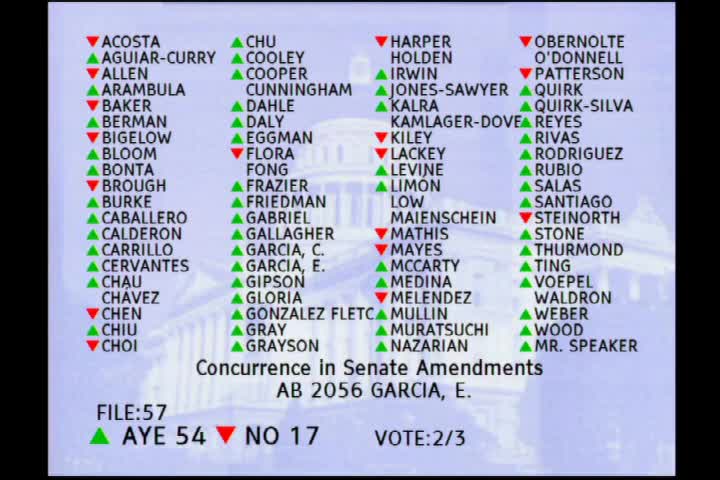 48SEC
Assembly Floor
 3MIN
Senate Floor
 42MIN
Senate Standing Committee on Human Services
 2MIN
Assembly Floor
 2MIN
Assembly Standing Committee on Appropriations
 24MIN
Assembly Standing Committee on Human Services
Bill Author
Bill Co-Author(s):
