AB 2203: Medi-Cal: primary care services.
- Session Year: 2017-2018
- House: Assembly
- Latest Version Date: 2018-02-12
Existing law establishes the Medi-Cal program, administered by the State Department of Health Care Services, under which basic health care services are provided to qualified low-income persons. The Medi-Cal program is, in part, governed and funded by federal Medicaid provisions. Existing federal law requires the state to provide payment for primary care services furnished in the 2013 and 2014 calendar years by Medi-Cal providers with specified primary specialty designations at a rate not less than 100% of the payment rate that applies to those services and physicians under the federal Medicare Program. Under state law, this requirement was implemented for both Medi-Cal fee-for-service and managed care plans, only to the extent that the federal medical assistance percentage was equal to 100%, until January 1, 2015.
This bill would, beginning July 1, 2019, require that the basic Medi-Cal rate for primary care services provided by a primary care service provider be not less than 100% of the payment rate that applies to those services as established by the Medicare Program, as specified. The bill would make the payment increases inapplicable to provider rates for specified program services provided to individuals who are not eligible for the Medi-Cal program or the Family Planning, Access, Care, and Treatment (Family PACT) Program. The bill would also make the payments exempt from specified provider payment reductions. The bill would require the Director of Health Care Services to prepare appropriate amendments in the state plan and waiver requests, as necessary, for the implementation of these provisions. This bill would require the department to implement its provisions by provider bulletins or similar instructions until regulations are adopted.
(a)(1)Beginning July 1, 2019, the basic Medi-Cal rate for primary care services provided by a primary care service provider shall not be less than 100 percent of the payment rate that applies to those services as established by the federal Medicare Program, for both fee-for-service and managed care plans that contract with the department pursuant to this chapter and Chapter 8 (commencing with Section 14200).
(2)An adjustment in the basic Medi-Cal rate for primary care services pursuant to paragraph (1) shall be made within 90 days of a change in the payment rate that applies to those services as established by the Medicare Program.
(b)For purposes of this section, the following definitions shall apply:
(1)Primary care services means the services defined in Section 1396a(jj) of Title 42 of the United States Code.
(2)Primary care service provider means a Medi-Cal provider who either is, or works under the supervision of, a physician with a specialty designation of family medicine, general internal medicine, or pediatric medicine.
(c)Payments for primary care services made pursuant to this section shall be exempt from the payment reductions under Sections 14105.191 and 14105.192.
(d)Payment increases made pursuant to this section shall not apply to provider rates of payment described in Section 14105.18 for services provided to individuals who are not eligible for the Medi-Cal program or the Family Planning, Access, Care, and Treatment (Family PACT) Program.
(e)The director shall prepare appropriate amendments in the state plan and waiver requests, as necessary, for the implementation of this section.
(f)Notwithstanding Chapter 3.5 (commencing with Section 11340) of Part 1 of Division 3 of Title 2 of the Government Code, the department shall implement, interpret, or make specific this section by means of provider bulletins or similar instructions, without taking regulatory action, until regulations are adopted.
|
Date
|
Status
|
|---|---|
| May 25, 2018 | In committee: Held under submission. |
| May 16, 2018 | In committee: Set, first hearing. Referred to APPR. suspense file. |
| Apr 11, 2018 | From committee: Do pass and re-refer to Com. on APPR. (Ayes 15. Noes 0.) (April 10). Re-referred to Com. on APPR. |
| Mar 1, 2018 | Referred to Com. on HEALTH. |
| Feb 13, 2018 | From printer. May be heard in committee March 15. |
| Feb 12, 2018 | Read first time. To print. |
|
Date
|
Description
|
Location
|
Votes
|
|
|---|---|---|---|---|
| Apr 10, 2018 | Do pass and be re-referred to the Committee on [Appropriations] | Assembly Standing Committee on Health |
Passed |
This list shows positions taken on this bill by organizations on the date displayed, which is linked to the original source.
Positions by individuals are not included.
|
Organization
|
Position
|
Date
|
|---|---|---|
| California Academy Of Family Physicians | * Support | Apr 10, 2018 |
| California Labor Federation | * Support | Apr 10, 2018 |
| California Medical Association | * For If Amend | Apr 10, 2018 |
| Health Access California | * Support | Apr 10, 2018 |
| SEIU California | * Support | Apr 10, 2018 |
| Union of America Physicians and Dentists | * Support | Apr 10, 2018 |
| United Ways Of California | * Support | Apr 10, 2018 |
Date of Hearing: May 16, 2018
ASSEMBLY COMMITTEE ON APPROPRIATIONS
Lorena Gonzalez Fletcher, Chair
ABPCA Bill Id:AB 2203
Author:(Gray) – As Introduced Ver:February 12, 2018
Policy Committee: | Health | Vote: | 15 - 0 |
Urgency: No State Mandated Local Program: No Reimbursable: No
SUMMARY:
This bill increases rates in the Medi-Cal program for primary care services, as defined, by establishing that the rates are equal to 100% of Medicare rates for such services in both the fee-for-service and managed care delivery systems, and exempts primary care services from rate reductions that otherwise apply.
FISCAL EFFECT:
- Ongoing costs of at least $1.7 billion, and likely in the range of $2.5 to $3 billion annually (GF/federal). To the extent Medicare rates increase, unknown additional state costs, as this bill would require Medi-Cal rates to be adjusted to match Medicare rates.
- One-time administrative staff costs in the low hundreds of thousands of dollars to Department of Health Care Services to seek federal approval and adjust payment rates, including in the managed care and fee-for-service delivery systems (GF/federal).
COMMENTS:
- Purpose. The purpose of this bill is to increase primary care payment rates in the Medi-Cal program, and to reverse cuts made in the recent recession, to increase access to primary care for Medi-Cal patients.
- Background. California pays its Medi-Cal FFS providers some of the lowest rates in the country. Medi-Cal has long paid poorly by national standards. A 2001 LAO report notes that 1998 FFS rates were 47% of Medicare rates, as compared to 51% today. Medi-Cal managed care plans negotiate rates with providers, but generally pay less than commercial health insurers. With the Medi-Cal program estimated to cover one-third of the state, ensuring enrollees can access care has been a major state priority. Payment rates are cited as a primary reason physicians don't participate in the program.
The 2010 federal Affordable Care Act included a provision that increased primary care rates Medicare levels in calendar years 2013 and 2014 for primary care services, as this bill proposes. That provision was intended to boost primary care physician participation in Medicaid in preparation for a large influx of beneficiaries who were newly eligible pursuant to the law. According to evaluations, the payment increase is thought to have had a limited effect on Medicaid provider participation rates, but the implementation was complicated by several factors that may not be present if rates were increased permanently. For purposes of this bill, primary care is defined as "evaluation and management services" (generally office visits) and immunization-related services.
AB 97 (Committee on Budget), Chapter 3, Statutes of 2011, mandated a 10% reduction in Medi-Cal provider FFS rates and payments made to Medi-Cal managed care plans effective June 1, 2011. Although the cuts were litigated, they eventually became effective for most services, including physician services. This bill reverses those rate cuts for primary care services.
- Prior Legislation. AB 366 (Bonta), of the 2015-16 Legislative Session, would have increased rates paid to providers in the Medi-Cal program to the comparable rate paid in the Medicare program. AB 366 was held on the Suspense File of the Senate Appropriations Committee and was eventually amended to deal with another issue.
SB 243 (Ed Hernandez), of the 2015-16 Legislative Session, was virtually identical to AB 366. SB 243 was also held on the Suspense File of the Senate Appropriations Committee
Analysis Prepared by: Lisa Murawski / APPR. / (916) 319-2081
Date of Hearing: April 10, 2018
ASSEMBLY COMMITTEE ON HEALTH
Jim Wood, Chair
ABPCA Bill Id:AB 2203
Author:(Gray) – As Introduced Ver:February 12, 2018
SUBJECT: Medi-Cal: primary care services.
SUMMARY: Requires the basic Medi-Cal rate for primary care services provided by a primary care service provider to be not less than 100% of the payment rate that applies to the same services as established by the Medicare program, for both the fee-for-service (FFS) and Medi-Cal managed care plans (MCMC). Specifically, this bill:
- Requires, beginning July 1, 2019, the basic Medi-Cal rate for primary care services provided by a primary care service provider to be not less than 100% of the payment rate that applies to those services as established by the federal Medicare Program, for both FFS and MCMC plans that contract with the Department of Health Care Services (DHCS).
- Requires an adjustment in the basic Medi-Cal rate for primary care services pursuant to 1) above to be made within 90 days of a change in the payment rate that applies to those services as established by the Medicare program.
- Defines a primary care service provider as a Medi-Cal provider who either is, or works under the supervision of, a physician with a specialty designation of family medicine, general internal medicine, or pediatric medicine.
- Requires that payments for primary care services made pursuant to this bill to be exempt from the payment reductions made under AB 97 (Committee on Budget), Chapter 3, Statutes of 2011 (see discussion below).
- Exempts from the payment increases provisions of this bill specified services provided to individuals who are not eligible for the Medi-Cal program or the Family Planning, Access, Care, and Treatment (Family PACT) Program.
- Requires the DHCS Director to prepare appropriate amendments in the state plan and waiver requests, as necessary, for the implementation of this bill.
- Requires DHCS to implement, interpret, or make specific this bill by means of provider bulletins or similar instructions, without taking regulatory action, until regulations are adopted.
EXISTING LAW:
- Establishes the Medi-Cal program, administered by DHCS, under which qualified low-income patients receive health care benefits.
- Requires Medi-Cal provider payments and payments to MCMC plans to be reduced by 10% for dates of service on and after June 1, 2011.
- Defines under federal law, primary care services to mean evaluation and management services that are procedure codes for services in the category designated by the Evaluation and Management in the Healthcare Common Procedure Coding System, as specified, and services related to immunization administration for vaccines and toxoids, as specified.
- Defines primary care services in the Medical Practice Act as services involving the specialties of general practice, family practice, general internal medicine, obstetrics and gynecology, and general pediatrics.
FISCAL EFFECT: This bill has not yet been analyzed by a fiscal committee.
COMMENTS:
- PURPOSE OF THIS BILL. According to the author, more than 13 million Californians, nearly a third of the state’s population, is served by Medi-Cal with nearly 5 million people gaining coverage since the Affordable Care Act took effect. With a Medi-Cal patient population larger than the population of Pennsylvania, California has made significant financial commitments to expand enrollment in the program without addressing the inadequacies that exist once enrollees seek access to care. In 2011, Medi-Cal payment rates to providers were cut by 10% to balance the state’s budget, and, despite the economic recovery since the recession, physician payments have not been restored. Even before the 2011 cuts, California provided one of the lowest reimbursement rates of any state – 47th lowest in the nation. Not only do low reimbursement rates de-incentivize doctors from practicing in the areas of the state more in need of their services, they also restrict the ability of existing doctors from accepting Medi-Cal patients in the first place. The author points out that Medi-Cal is no longer just a safety net program. It is the primary form of health insurance for a third of the state, thus it must be prioritized to the same degree the federal government prioritizes Medicare recipients, and make Medi-Cal patients more attractive for doctors to serve.
- BACKGROUND. California's Medicaid program, administered by DHCS, is a federal/state funded public health insurance program which provides comprehensive health care services at no or low cost to over 13 million low-income individuals including families with children, seniors, persons with disabilities, children in foster care, and pregnant women. The federal government mandates basic services including physician services, family nurse practitioner services, nursing facility services, hospital inpatient and outpatient services, laboratory and radiology services, family planning, and early and periodic screening, diagnosis, and treatment services for children. In addition to these mandatory services, the state provides optional benefits such as outpatient drugs, home and community-based services, and medical equipment.
There are two Medi-Cal systems for the delivery of medical services: FFS and MCMC. In a FFS system, a health care provider receives an individual payment from DHCS for each medical service delivered to a beneficiary. Beneficiaries in Medi-Cal FFS generally may obtain services from any provider who has agreed to accept Medi-Cal FFS payments. In a managed care system, DHCS contracts with MCMC, also known as health maintenance organizations, to provide health care coverage for Medi-Cal beneficiaries. Currently, 81% of Medi-Cal enrollees are served through managed care.
- ACA Primary Care Rate Bump. With the expansion of the Medi-Cal program under the federal Patient Protection and Affordable Care Act (ACA), federal legislation also increased reimbursement to certain Medi-Cal primary care providers (obstetrics & gynecology were excluded) to match Medicare rates for specified services starting in 2013, but this increase is only temporary. The provision, funded entirely by the federal government, was intended to encourage health providers to accept additional Medi-Cal patients, to help address the rate and access problems outlined above. However, these provisions, known as the primary care bump, expired after December 31, 2014. This bill would increase the reimbursement of Medi-Cal primary care providers that received the rate bump under the ACA that ended in 2014.
- Physician Participation in Medi-Cal. In 2017, the California HealthCare Foundation (CHCF) published “Physician Participation in Medi-Cal: Is Supply Meeting Demand,” a summary of a study conducted by the University of California, San Francisco, that evaluated physician participation in Medi-Cal between 2013 and 2015. Specifically, the study: i) compared the percentage of California physicians reporting that they serve Medi-Cal patients, patients with private insurance or Medicare, and the uninsured; ii) calculated the ratio of full-time equivalent (FTE) physicians serving Medi-Cal patients per 100,000 Medi-Cal beneficiaries (with full-scope benefits) — a key benchmark to assess the adequacy of physician supply; and, iii) documented the difficulty physicians report in obtaining referrals to specialists for Medi-Cal patients, as well as the reasons they limit the number of Medi-Cal patients in their practices.
The key findings of the study support the conclusion that Medi-Cal provides a vital safety net to low-income Californians and also that further investments and improvements are needed to ensure adequate access to care for all beneficiaries. The key findings include:- Primary care physicians in California were more likely to serve Medi-Cal patients than uninsured patients, but less likely to have Medi-Cal patients in their practices than patients with private health insurance;
- Non-primary care physicians were more likely to serve Medi-Cal patients than uninsured patients, but less likely to have Medi-Cal patients in their practices than patients with either Medicare or private insurance;
- Rates at which physicians accept new Medi-Cal patients and uninsured patients varied across specialties, practice settings, and regions;
- From 2013 to 2015 the percentage of California physicians serving Medi-Cal patients decreased from 69% to 64%, but the overall number of FTE physicians serving Medi-Cal patients increased by 9%. This is probably because, among physicians serving Medi-Cal patients in 2015, the overall share of their patients on Medi-Cal increased (many patients who had been uninsured in 2013 were covered by Medi-Cal in 2015);
- The increase in the number of FTE physicians participating in Medi-Cal did not keep pace with the growth of Medi-Cal enrollment, so the ratios of FTE physicians per 100,000 Medi-Cal enrollees with full-scope benefits decreased between 2013 and 2015; and,
- For both primary care and non-primary care physicians, the ratios of FTE physicians per 100,000 Medi-Cal enrollees with full-scope benefits fell below national and state recommendations.
- Medi-Cal Enrollees’ Access to Care. Early this year, in a presentation to the Assembly Select Committee on Health Care Delivery Systems and Universal Coverage, a representative from the CHCF indicated that payment is the number one reason physicians give for limiting their participation in Medi-Cal. These physicians also report greater difficulty obtaining referrals for their Medi-Cal patients. Additionally, the testimony included the following key Medi-Cal access to care findings: access to care for adult Medi-Cal enrollees is generally comparable to the individual market and better than uninsured; adult Medi-Cal enrollees are less likely to forego care due to cost, but have more difficulty getting timely care; some Medi-Cal enrollees experience more difficulty accessing care than others, especially for specialty care; and, quality of care in MCMC is similar to national Medicaid average, but not improving.
- AB 97 Provider Rate Reductions. AB 97 (Committee on Budget), Chapter 3, Statutes of 2011, mandated a 10% reduction in Medi-Cal provider FFS rates and payments made to MCMC plans effective June 1, 2011. Additionally, payment rates for skilled nursing facilities that are a distinct part of a general acute care facility were rolled back to 2008-09 payment rates and then further reduced by 10%. Shortly afterwards, a district court blocked these cuts, ruling that they would harm the millions of low-income Californians who depend on Medi-Cal to receive health care. In January 2013, a three judge panel of the federal Ninth Circuit Court of Appeals ruled that the state could proceed with rate cuts. Plaintiffs subsequently requested rehearing of this case by the full Ninth District Court of Appeals but this request was denied. The U.S. Supreme Court was then asked to review the Ninth Circuit hearing but this petition was also denied. Subsequently, the Governor announced in his 2014-15 Budget proposal that the state would not proceed with retroactive collection of payment cuts but made clear the state’s intention to proceed with the mandated cuts moving forward.
- Proposition 56. Proposition 56 raised state taxes on tobacco products and dedicates the majority of associated revenues to Medi-Cal on an ongoing basis. Proposition 56 revenues can be used for two main purposes: i) augmenting the Medi-Cal program, such as, for example, by increasing Medi-Cal provider payments; and, ii) offsetting General Fund (GF) spending on cost growth in Medi-Cal.
The 2017-2018 budget package included a two-year budget agreement on Proposition 56 revenues in Medi-Cal. According to the Legislative Analyst’s Office (LAO), broadly speaking, the agreement dedicates Proposition 56 funding: i) increasing payments for certain Medi-Cal providers, and, ii) paying for anticipated growth in state Medi-Cal costs over and above 2016-17 Budget Act levels, which offsets what otherwise would be GF costs. Specifically, the agreement authorized up to $546 million in 2017-18 and up to $800 million in 2018-19 in provider payment increases, with any remaining Proposition 56 Medi-Cal funding from 2017-18 ($711 million) and 2018-19 ($125 million) to be used to offset GF spending on cost growth in the Medi-Cal program. For 2017-18, the Budget agreement came with a structure of fixed dollar amount or fixed percentage increases in provider reimbursement levels that applied to an identified set of Medi-Cal services ranging from physician and dental visits to certain women’s health visits. Moreover, it is the LAO’s understanding that the budget agreement provides that for any provider payment increases in 2018-19 above the total 2017-18 amount, 70% is to be dedicated to physician services payment increases and 30 percent is to be dedicated to dental services payment increases. As the 2017-18 Budget agreement only goes through 2018-19, future use of Proposition 56 funding for Medi-Cal will be determined through the annual budget process.
- SUPPORT. Health Access California states that increasing provider rates for primary care services helps incentivize participation in Medi-Cal for providers. When MCMC plans increase rates for their primary care providers, providers may see more Medi-Cal patients which means that more beneficiaries are able to access care.
- PREVIOUS LEGISLATION.
- AB 366 (Bonta) of 2015, among other provisions, would have increased rates paid to providers in the Medi-Cal program to the comparable rate paid in the Medicare program. AB 366 was held in the Senate Appropriations Committee suspense file and was eventually amended to deal with another issue.
- SB 243 (Ed Hernandez) of 2015 was virtually identical to AB 366. SB 243 was held in the Senate Appropriations Committee suspense file.
- AB 1805 (Skinner and Pan) would have required DHCS to disregard the 10% payment reductions for Medi-Cal providers, to the maximum extent permitted by federal law and for the maximum time period for which federal financial participation is obtained. AB 1805 was set for hearing in the Assembly Appropriations Committee, but the hearing was cancelled at the request of the author.
REGISTERED SUPPORT / OPPOSITION:
Support
Health Access California
Opposition
None on file.
Analysis Prepared by: Rosielyn Pulmano / HEALTH / (916) 319-2097
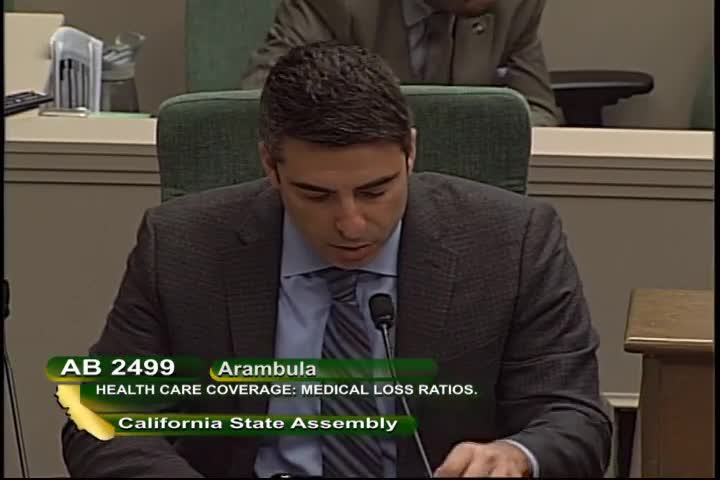
Bill Author

Bill Co-Author(s):