AB 2215: Veterinarians: cannabis: animals.
- Session Year: 2017-2018
- House: Assembly
- Latest Version Date: 2018-09-27
The California Uniform Controlled Substances Act classifies controlled substances into 5 designated schedules, and places cannabis and cannabis products under Schedule I. The act prohibits prescribing, administering, dispensing, or furnishing a controlled substance to or for any person or animal, unless otherwise specified.
The Veterinary Medicine Practice Act provides for the licensure and regulation of veterinarians and the practice of veterinary medicine by the Veterinary Medical Board, which is within the Department of Consumer Affairs. The act authorizes the board to revoke or suspend the license of a person to practice veterinary medicine, or to assess a fine, for specified causes, including violating a statute related to controlled substances. The act also makes a violation of its provisions a misdemeanor.
This bill would authorize the board to revoke or suspend a veterinarian license, or to assess a fine, for accepting, soliciting, or offering any form of remuneration from or to a Medicinal and Adult-Use Cannabis Regulation and Safety Act (MAUCRSA) licensee if the veterinarian or his or her immediate family has a financial interest, as defined, with the MAUCRSA licensee. The bill would authorize the board to revoke or suspend a veterinarian license, or to assess a fine, for discussing medicinal cannabis with a client while the veterinarian is employed by, or has an agreement with, a MAUCRSA licensee. The bill would authorize the board to revoke or suspend a license, or to assess a fine, for distributing any form of advertising for cannabis in California. The bill would prohibit a licensed veterinarian from dispensing or administering cannabis or cannabis products to an animal patient. Because a violation of the Veterinary Medicine Practice Acts provisions is a crime, the bill would expand the scope of that crime, thereby imposing a state-mandated local program.
The bill would also prohibit the Veterinary Medical Board from disciplining, or denying, revoking, or suspending the license of, a licensed veterinarian solely for discussing the use of cannabis on an animal for medicinal purposes, absent negligence or incompetence. The bill would require the board to adopt guidelines for these discussions on or before January 1, 2020, and would require the board to post the guidelines on its Internet Web site.
The California Constitution requires the state to reimburse local agencies and school districts for certain costs mandated by the state. Statutory provisions establish procedures for making that reimbursement.
This bill would provide that no reimbursement is required by this act for a specified reason.
The California Uniform Controlled Substances Act classifies controlled substances into 5 designated schedules, and places cannabis and cannabis products under Schedule I. The act prohibits prescribing, administering, dispensing, or furnishing a controlled substance to or for any person or animal, unless otherwise specified.
The Veterinary Medicine Practice Act provides for the licensure and regulation of veterinarians and the practice of veterinary medicine by the Veterinary Medical Board, which is within the Department of Consumer Affairs. The act authorizes the board to revoke or suspend the license of a person to practice veterinary medicine, or to assess a fine, for specified causes, including violating a statute related to controlled substances. The act also makes a violation of its provisions a misdemeanor.
This bill would authorize the board to revoke or suspend a veterinarian license, or to assess a fine, for accepting, soliciting, or offering any form of remuneration from or to a Medical and Adult-Use Cannabis Regulation and Safety Act (MAUCRSA) licensee if the veterinarian or his or her immediate family has a financial interest, as defined, with the MAUCRSA licensee. The bill would authorize the board to revoke or suspend a veterinarian license, or to assess a fine, for discussing medicinal cannabis with a client while the veterinarian is employed by, or has an agreement with, a MAUCRSA licensee. The bill would authorize the board to revoke or suspend a license, or to assess a fine, for distributing any form of advertising for cannabis in California. The bill would prohibit a licensed veterinarian from dispensing or administering cannabis or cannabis products to an animal patient. Because a violation of the Veterinary Medicine Practice Acts provisions is a crime, the bill would expand the scope of that crime, thereby imposing a state-mandated local program.
The bill would also prohibit the Veterinary Medical Board from disciplining, or denying, revoking, or suspending the license of, a licensed veterinarian solely for discussing the use of cannabis on an animal for medicinal purposes. purposes, absent negligence or incompetence. The bill would require the board to develop adopt guidelines for these discussions on or before January 1, 2020, and would require the board to post the guidelines on its Internet Web site.
AUMA authorizes legislative amendment of its provisions with a 2/3 vote of both houses, without submission to the voters, to further its purposes and intent.This bill would declare that its provisions further the purposes and intent of AUMA.The California Constitution requires the state to reimburse local agencies and school districts for certain costs mandated by the state. Statutory provisions establish procedures for making that reimbursement.
This bill would provide that no reimbursement is required by this act for a specified reason.
The Control, Regulate and Tax Adult Use of Marijuana Act of 2016 (AUMA), an initiative measure approved as Proposition 64 at the November 8, 2016, statewide general election, authorizes a person who obtains a state license under AUMA to engage in commercial adult-use cannabis activity pursuant to that license and applicable local ordinances. The Medicinal and Adult-Use Cannabis Regulation and Safety Act (MAUCRSA), among other things, consolidates the licensure and regulation of commercial medicinal and adult-use cannabis activities and states that it is the intent of MAUCRSA to control and regulate the cultivation, distribution, transport, storage, manufacturing, processing, and sale of both medicinal cannabis and medicinal cannabis products for patients with a valid physician recommendation and adult-use cannabis and adult-use cannabis products for adults 21 years of age and over. MAUCRSA defines cannabis products for these purposes.
This bill would state that it is additionally the intent of MAUCRSA to control and regulate the cultivation, distribution, transport, storage, manufacturing, processing, and sale of cannabis and cannabis products for medicinal use on an animal owned by an adult 21 years of age and over and would define cannabis products to include products intended for medicinal use on an animal. The bill would authorize an adult 21 years of age and over to use, for medicinal purposes, cannabis and cannabis products on an animal owned by that adult and would limit the sale of the products to those adults to a licensee who has been issued a retailer license under MAUCRSA. The bill would also make other conforming changes.
The California Uniform Controlled Substances Act classifies controlled substances into 5 designated schedules, and places cannabis and cannabis products under Schedule I. The act prohibits prescribing, administering, dispensing, or furnishing a controlled substance to or for any person or animal, unless otherwise specified.
The Veterinary Medicine Practice Act provides for the licensure and regulation of veterinarians and the practice of veterinary medicine by the Veterinary Medical Board, which is within the Department of Consumer Affairs. The act authorizes the board to revoke or suspend the license of a person to practice veterinary medicine, or to assess a fine, for specified causes, including violating a statute related to controlled substances. The act also makes a violation of its provisions a misdemeanor.
This bill would prohibit a licensed veterinarian from dispensing or administering cannabis or cannabis products to an animal patient. Because a violation of the Veterinary Medicine Practice Acts provisions is a crime, the bill would expand the scope of that crime, thereby imposing a state-mandated local program.
The bill would also prohibit the Veterinary Medical Board from disciplining, or denying, revoking, or suspending the license of, a licensed veterinarian solely for discussing the use of cannabis on an animal for medicinal purposes. The bill would require the board to develop guidelines for these discussions on or before July 1, 2019, January 1, 2020, and would require the board to post the guidelines on its Internet Web site.
AUMA authorizes legislative amendment of its provisions with a 2/3 vote of both houses, without submission to the voters, to further its purposes and intent.
This bill would declare that its provisions further the purposes and intent of AUMA.
The California Constitution requires the state to reimburse local agencies and school districts for certain costs mandated by the state. Statutory provisions establish procedures for making that reimbursement.
This bill would provide that no reimbursement is required by this act for a specified reason.
The Control, Regulate and Tax Adult Use of Marijuana Act of 2016 (AUMA), an initiative measure approved as Proposition 64 at the November 8, 2016, statewide general election, authorizes a person who obtains a state license under AUMA to engage in commercial adult-use cannabis activity pursuant to that license and applicable local ordinances. The Medicinal and Adult-Use Cannabis Regulation and Safety Act (MAUCRSA), among other things, consolidates the licensure and regulation of commercial medicinal and adult-use cannabis activities and states that it is the intent of MAUCRSA to control and regulate the cultivation, distribution, transport, storage, manufacturing, processing, and sale of both medicinal cannabis and medicinal cannabis products for patients with a valid physician recommendation and adult-use cannabis and adult-use cannabis products for adults 21 years of age and over. MAUCRSA defines cannabis products for these purposes.
This bill would state that it is additionally the intent of MAUCRSA to control and regulate the cultivation, distribution, transport, storage, manufacturing, processing, and sale of cannabis and cannabis products for medicinal use on an animal owned by an adult 21 years of age and over and would define cannabis products to include products intended for medicinal use on an animal. The bill would authorize an adult 21 years of age and over to use, for medicinal purposes, cannabis and cannabis products on an animal owned by that adult. The bill would define cannabis products to include products intended for medicinal use on an animal adult and would limit the sale of those the products to M-licensees. those adults to a licensee who has been issued a retailer license under MAUCRSA. The bill would also make other conforming changes.
The California Uniform Controlled Substances Act classifies controlled substances into 5 designated schedules, and places cannabis and cannabis products under Schedule I. The act prohibits prescribing, administering, dispensing, or furnishing a controlled substance to or for any person or animal, unless otherwise specified.
The Veterinary Medicine Practice Act provides for the licensure and regulation of veterinarians and the practice of veterinary medicine by the Veterinary Medical Board, which is within the Department of Consumer Affairs. The act authorizes the board to revoke or suspend the license of a person to practice veterinary medicine, or to assess a fine, for specified causes, including violating a statute related to controlled substances. The act also makes a violation of its provisions a misdemeanor.
This bill would prohibit a licensed veterinarian from dispensing or administering cannabis or cannabis products to an animal patient. Because a violation of the Veterinary Medicine Practice Acts provisions is a crime, the bill would expand the scope of that crime, thereby imposing a state-mandated local program.
The bill would also prohibit the Veterinary Medical Board from disciplining, or denying, revoking, or suspending the license of, a licensed veterinarian solely for discussing the use of cannabis on an animal for medicinal purposes. The bill would require the board to develop guidelines for these specified discussions on or before July 1, 2019, and would require the board to post those the guidelines on its Internet Web site.
AUMA authorizes legislative amendment of its provisions with a 2/3 vote of both houses, without submission to the voters, to further its purposes and intent.
This bill would declare that its provisions further the purposes and intent of AUMA.
The California Constitution requires the state to reimburse local agencies and school districts for certain costs mandated by the state. Statutory provisions establish procedures for making that reimbursement.
This bill would provide that no reimbursement is required by this act for a specified reason.
The Control, Regulate and Tax Adult Use of Marijuana Act of 2016 (AUMA), an initiative measure approved as Proposition 64 at the November 8, 2016, statewide general election, authorizes a person who obtains a state license under AUMA to engage in commercial adult-use cannabis activity pursuant to that license and applicable local ordinances. The Medicinal and Adult-Use Cannabis Regulation and Safety Act (MAUCRSA), among other things, consolidates the licensure and regulation of commercial medicinal and adult-use cannabis activities and states that it is the intent of MAUCRSA to control and regulate the cultivation, distribution, transport, storage, manufacturing, processing, and sale of both medicinal cannabis and medicinal cannabis products for patients with a valid physician recommendation and adult-use cannabis and adult-use cannabis products for adults 21 years of age and over. MAUCRSA defines cannabis products for these purposes.
This bill would state that it is additionally the intent of MAUCRSA to control and regulate the cultivation, distribution, transport, storage, manufacturing, processing, and sale of cannabis and cannabis products for medicinal use on an animal owned by an adult 21 years of age and over and would authorize an adult 21 years of age and over to use, for medicinal purposes, cannabis and cannabis products on an animal owned by that adult. The bill would define cannabis products to include products intended for medicinal use on an animal and would limit the sale of those products to M-licensees. The bill would also make other conforming changes.
The California Uniform Controlled Substances Act classifies controlled substances into 5 designated schedules, and places cannabis and cannabis products under Schedule I. The act prohibits prescribing, administering, dispensing, or furnishing a controlled substance to or for any person or animal, unless otherwise specified.
The Veterinary Medicine Practice Act provides for the licensure and regulation of veterinarians and the practice of veterinary medicine by the Veterinary Medical Board, which is within the Department of Consumer Affairs. The act authorizes the board to revoke or suspend the license of a person to practice veterinary medicine, or to assess a fine, for specified causes, including violating a statute related to controlled substances. The act also makes a violation of its provisions a misdemeanor.
This bill would prohibit a licensed veterinarian from dispensing or administering cannabis or cannabis products to an animal patient. Because a violation of the Veterinary Medicine Practice Acts provisions is a crime, the bill would expand the scope of that crime, thereby imposing a state-mandated local program.
The bill would also prohibit the Veterinary Medical Board from disciplining, or denying, revoking, or suspending the license of, a licensed veterinarian for discussing the use of cannabis on an animal for medicinal purposes. The bill would require the board to develop guidelines for these specified discussions on or before July 1, 2019, and would require the board to post those guidelines on its Internet Web site.
AUMA authorizes legislative amendment of its provisions with a 2/3 vote of both houses, without submission to the voters, to further its purposes and intent.
This bill would declare that its provisions further the purposes and intent of AUMA.
The California Constitution requires the state to reimburse local agencies and school districts for certain costs mandated by the state. Statutory provisions establish procedures for making that reimbursement.
This bill would provide that no reimbursement is required by this act for a specified reason.
The Veterinary Medicine Practice Act provides for the licensure and regulation of veterinarians and the practice of veterinary medicine by the Veterinary Medical Board, which is within the Department of Consumer Affairs. That act authorizes the board to revoke or suspend the license of a person to practice veterinary medicine for specified causes and authorizes the board to assess a fine for specified causes, including, but not limited to, unprofessional conduct.The Medicinal and Adult-Use Cannabis Regulation and Safety Act (MAUCRSA), among other things, consolidates the licensure and regulation of commercial medicinal and adult-use cannabis activities, and states that it is the intent of MAUCRSA to control and regulate the cultivation, distribution, transport, storage, manufacturing, processing, and sale of both medicinal cannabis and medicinal cannabis products for patients with a valid physician recommendation and adult-use cannabis and adult-use cannabis products for adults 21 years of age and over.This bill would state the intent of the Legislature to enact legislation to require the Veterinary Medical Board to establish guidelines for licensed veterinarians to discuss the use of cannabis on animal patient clients and to protect state-licensed veterinarians from disciplinary action for discussing the use of cannabis on animal patient clients.The Veterinary Medicine Practice Act provides for the licensure and regulation of veterinarians and the practice of veterinary medicine by the Veterinary Medical Board, which is within the Department of Consumer Affairs. That act authorizes the board to revoke or suspend the license of a person to practice veterinary medicine for specified causes and authorizes the board to assess a fine for specified causes, including, but not limited to, unprofessional conduct.
The Medicinal and Adult-Use Cannabis Regulation and Safety Act (MAUCRSA), among other things, consolidates the licensure and regulation of commercial medicinal and adult-use cannabis activities, and states that it is the intent of MAUCRSA to control and regulate the cultivation, distribution, transport, storage, manufacturing, processing, and sale of both medicinal cannabis and medicinal cannabis products for patients with a valid physician recommendation and adult-use cannabis and adult-use cannabis products for adults 21 years of age and over.
This bill would state the intent of the Legislature to enact legislation to require the Veterinary Medical Board to establish guidelines for licensed veterinarians to discuss the use of cannabis on animal patient clients and to protect state-licensed veterinarians from disciplinary action for discussing the use of cannabis on animal patient clients.
The board may deny, revoke, or suspend a license or registration or assess a fine as provided in Section 4875 for any of the following:
(a)Conviction of a crime substantially related to the qualifications, functions, or duties of veterinary medicine, surgery, or dentistry, in which case the record of the conviction shall be conclusive evidence.
(b)For having professional connection with, or lending the licensees or registrants name to, any illegal practitioner of veterinary medicine and the various branches thereof.
(c)Violation or attempting to violate, directly or indirectly, any of the provisions of this chapter.
(d)Fraud or dishonesty in applying, treating, or reporting on tuberculin or other biological tests.
(e)Employment of anyone but a veterinarian licensed in the state to demonstrate the use of biologics in the treatment of animals.
(f)False or misleading advertising.
(g)Unprofessional conduct, that includes, but is not limited to, the following:
(1)Conviction of a charge of violating any federal statutes or rules or any statute or rule of this state regulating dangerous drugs or controlled substances. The record of the conviction is conclusive evidence thereof. A plea or verdict of guilty or a conviction following a plea of nolo contendere is deemed to be a conviction within the meaning of this section. The board may order the license or registration to be suspended or revoked, or assess a fine, or decline to issue a license or registration, when the time for appeal has elapsed, or the judgment of conviction has been affirmed on appeal or when an order granting probation is made suspending the imposition of sentence, irrespective of a subsequent order under Section 1203.4, 1210.1, or 3063.1 of the Penal Code allowing the person to withdraw his or her plea of guilty and to enter a plea of not guilty, or setting aside the verdict of guilty, or dismissing the accusation, information, or indictment.
(2)(A)The use of or prescribing for or administering to himself or herself, any controlled substance.
(B)The use of any of the dangerous drugs specified in Section 4022, or of alcoholic beverages to the extent, or in any manner as to be dangerous or injurious to a person licensed or registered under this chapter, or to any other person or to the public, or to the extent that the use impairs the ability of the person so licensed or registered to conduct with safety the practice authorized by the license or registration.
(C)The conviction of more than one misdemeanor or any felony involving the use, consumption, or self-administration of any of the substances referred to in this section or any combination thereof, and the record of the conviction is conclusive evidence.
A plea or verdict of guilty or a conviction following a plea of nolo contendere is deemed to be a conviction within the meaning of this section. The board may order the license or registration to be suspended or revoked or assess a fine, or may decline to issue a license or registration, when the time for appeal has elapsed or the judgment of conviction has been affirmed on appeal or when an order granting probation is made suspending imposition of sentence, irrespective of a subsequent order under Section 1203.4, 1210.1, or 3063.1 of the Penal Code allowing the person to withdraw his or her plea of guilty and to enter a plea of not guilty, or setting aside the verdict of guilty, or dismissing the accusation, information, or indictment.
(3)A violation of any federal statute, rule, or regulation or any of the statutes, rules, or regulations of this state regulating dangerous drugs or controlled substances.
(h)Failure to keep the licensees or registrants premises and all equipment therein in a clean and sanitary condition.
(i)Fraud, deception, negligence, or incompetence in the practice of veterinary medicine.
(j)Aiding or abetting in any acts that are in violation of any of the provisions of this chapter.
(k)The employment of fraud, misrepresentation, or deception in obtaining the license or registration.
(l)The revocation, suspension, or other discipline by another state or territory of a license, certificate, or registration to practice veterinary medicine or as a veterinary technician in that state or territory.
(m)Cruelty to animals, conviction on a charge of cruelty to animals, or both.
(n)Disciplinary action taken by any public agency in any state or territory for any act substantially related to the practice of veterinary medicine or the practice of a veterinary technician.
(o)Violation, or the assisting or abetting violation, of any regulations adopted by the board pursuant to this chapter.
(p)Accepting, soliciting, or offering any form of remuneration from or to a cannabis licensee if the veterinarian or his or her immediate family have a financial interest with the cannabis licensee. For purposes of this subdivision, the following definitions shall apply:
(1)Cannabis licensee shall have the same meaning as licensee in Section 26001.
(2)Financial interest shall have the same meaning as in Section 650.01.
(q)Discussing medicinal cannabis with a client while the veterinarian is employed by, or has an agreement with, a cannabis licensee. For purposes of this subdivision, cannabis licensee shall have the same meaning as licensee in Section 26001.
(r)Distributing any form of advertising for cannabis in California.
SEC. 2.Section 4884 is added to the Business and Professions Code, to read:4884.(a)A licensee shall not dispense or administer cannabis or cannabis products to an animal patient.
(b)Notwithstanding any other law and absent negligence or incompetence, a veterinarian licensed under this chapter shall not be disciplined by the board or have his or her license denied, revoked, or suspended solely for discussing the use of cannabis on an animal for medicinal purposes.
(c)On or before January 1, 2020, the board shall adopt guidelines for veterinarians to follow when discussing cannabis within the veterinarian-client-patient relationship. These guidelines shall be posted on the boards Internet Web site.
SEC. 3.No reimbursement is required by this act pursuant to Section 6 of Article XIIIB of the California Constitution because the only costs that may be incurred by a local agency or school district will be incurred because this act creates a new crime or infraction, eliminates a crime or infraction, or changes the penalty for a crime or infraction, within the meaning of Section 17556 of the Government Code, or changes the definition of a crime within the meaning of Section 6 of Article XIIIB of the California Constitution.
The board may deny, revoke, or suspend a license or registration or assess a fine as provided in Section 4875 for any of the following:
(a)Conviction of a crime substantially related to the qualifications, functions, or duties of veterinary medicine, surgery, or dentistry, in which case the record of the conviction shall be conclusive evidence.
(b)For having professional connection with, or lending the licensees or registrants name to, any illegal practitioner of veterinary medicine and the various branches thereof.
(c)Violation or attempting to violate, directly or indirectly, any of the provisions of this chapter.
(d)Fraud or dishonesty in applying, treating, or reporting on tuberculin or other biological tests.
(e)Employment of anyone but a veterinarian licensed in the state to demonstrate the use of biologics in the treatment of animals.
(f)False or misleading advertising.
(g)Unprofessional conduct, that includes, but is not limited to, the following:
(1)Conviction of a charge of violating any federal statutes or rules or any statute or rule of this state regulating dangerous drugs or controlled substances. The record of the conviction is conclusive evidence thereof. A plea or verdict of guilty or a conviction following a plea of nolo contendere is deemed to be a conviction within the meaning of this section. The board may order the license or registration to be suspended or revoked, or assess a fine, or decline to issue a license or registration, when the time for appeal has elapsed, or the judgment of conviction has been affirmed on appeal or when an order granting probation is made suspending the imposition of sentence, irrespective of a subsequent order under Section 1203.4, 1210.1, or 3063.1 of the Penal Code allowing the person to withdraw his or her plea of guilty and to enter a plea of not guilty, or setting aside the verdict of guilty, or dismissing the accusation, information, or indictment.
(2)(A)The use of or prescribing for or administering to himself or herself, any controlled substance.
(B)The use of any of the dangerous drugs specified in Section 4022, or of alcoholic beverages to the extent, or in any manner as to be dangerous or injurious to a person licensed or registered under this chapter, or to any other person or to the public, or to the extent that the use impairs the ability of the person so licensed or registered to conduct with safety the practice authorized by the license or registration.
(C)The conviction of more than one misdemeanor or any felony involving the use, consumption, or self-administration of any of the substances referred to in this section or any combination thereof, and the record of the conviction is conclusive evidence.
A plea or verdict of guilty or a conviction following a plea of nolo contendere is deemed to be a conviction within the meaning of this section. The board may order the license or registration to be suspended or revoked or assess a fine, or may decline to issue a license or registration, when the time for appeal has elapsed or the judgment of conviction has been affirmed on appeal or when an order granting probation is made suspending imposition of sentence, irrespective of a subsequent order under Section 1203.4, 1210.1, or 3063.1 of the Penal Code allowing the person to withdraw his or her plea of guilty and to enter a plea of not guilty, or setting aside the verdict of guilty, or dismissing the accusation, information, or indictment.
(3)A violation of any federal statute, rule, or regulation or any of the statutes, rules, or regulations of this state regulating dangerous drugs or controlled substances.
(h)Failure to keep the licensees or registrants premises and all equipment therein in a clean and sanitary condition.
(i)Fraud, deception, negligence, or incompetence in the practice of veterinary medicine.
(j)Aiding or abetting in any acts that are in violation of any of the provisions of this chapter.
(k)The employment of fraud, misrepresentation, or deception in obtaining the license or registration.
(l)The revocation, suspension, or other discipline by another state or territory of a license, certificate, or registration to practice veterinary medicine or as a veterinary technician in that state or territory.
(m)Cruelty to animals, conviction on a charge of cruelty to animals, or both.
(n)Disciplinary action taken by any public agency in any state or territory for any act substantially related to the practice of veterinary medicine or the practice of a veterinary technician.
(o)Violation, or the assisting or abetting violation, of any regulations adopted by the board pursuant to this chapter.
(p)Accepting, soliciting, or offering any form of remuneration from or to a cannabis licensee if the veterinarian or his or her immediate family have a financial interest with the cannabis licensee. For purposes of this subdivision, the following definitions shall apply:
(1)Cannabis licensee shall have the same meaning as licensee in Section 26001.
(2)Financial interest shall have the same meaning as in Section 650.01.
(q)Discussing medicinal cannabis with a client while the veterinarian is employed by, or has an agreement with, a cannabis licensee. For purposes of this subdivision, cannabis licensee shall have the same meaning as licensee in Section 26001.
(r)Distributing any form of advertising for cannabis in California.
SECTION 1.SEC. 2.Section 4884 is added to the Business and Professions Code, to read:4884.(a)A licensee shall not dispense or administer cannabis or cannabis products to an animal patient.
(b)Notwithstanding any other law, law and absent negligence or incompetence, a veterinarian licensed under this chapter shall not be disciplined by the board or have his or her license denied, revoked, or suspended solely for discussing the use of cannabis on an animal for medicinal purposes.
(c)On or before January 1, 2020, the board shall adopt guidelines for veterinarians to follow when discussing cannabis within the veterinarian-client-patient relationship. These guidelines shall be posted on the boards Internet Web site.
SEC. 2.Section 26000 of the Business and Professions Code is amended to read:26000.(a)This division shall be known, and may be cited, as the Medicinal and Adult Use Cannabis Regulation and Safety Act.(b)The purpose and intent of this division is to establish a comprehensive system to control and regulate the cultivation, distribution, transport, storage, manufacturing, processing, and sale of all of the following:(1)Medicinal cannabis and medicinal cannabis products for patients with valid physicians recommendations.(2)Adult-use cannabis and adult-use cannabis products for adults 21 years of age and over.(3)Cannabis and cannabis products for medicinal use on an animal owned by an adult 21 years of age and over.(c)In the furtherance of subdivision (b), this division sets forth the power and duties of the state agencies responsible for controlling and regulating the commercial medicinal and adult-use cannabis industry.(d)The Legislature may, by majority vote, enact laws to implement this division, provided those laws are consistent with the purposes and intent of the Control, Regulate and Tax Adult Use of Marijuana Act.SEC. 3.Section 26001 of the Business and Professions Code is amended to read:26001.For purposes of this division, the following definitions shall apply:(a)A-license means a state license issued under this division for cannabis or cannabis products that are intended for adults who are 21 years of age and older and who do not possess a physicians recommendation.(b)A-licensee means any person holding a license under this division for cannabis or cannabis products that are intended for adults who are 21 years of age and older and who do not possess a physicians recommendation.(c)Applicant means an owner applying for a state license pursuant to this division.(d)Batch means a specific quantity of homogeneous cannabis or cannabis product that is one of the following types:(1)Harvest batch. Harvest batch means a specifically identified quantity of dried flower or trim, leaves, and other cannabis plant matter that is uniform in strain, harvested at the same time, and, if applicable, cultivated using the same pesticides and other agricultural chemicals, and harvested at the same time.(2)Manufactured cannabis batch. Manufactured cannabis batch means either of the following:(A)An amount of cannabis concentrate or extract that is produced in one production cycle using the same extraction methods and standard operating procedures.(B)An amount of a type of manufactured cannabis produced in one production cycle using the same formulation and standard operating procedures.(e)Bureau means the Bureau of Cannabis Control within the Department of Consumer Affairs, formerly named the Bureau of Marijuana Control, the Bureau of Medical Cannabis Regulation, and the Bureau of Medical Marijuana Regulation.(f)Cannabis means all parts of the plant Cannabis sativa Linnaeus, Cannabis indica, or Cannabis ruderalis, whether growing or not; the seeds thereof; the resin, whether crude or purified, extracted from any part of the plant; and every compound, manufacture, salt, derivative, mixture, or preparation of the plant, its seeds, or resin. Cannabis also means the separated resin, whether crude or purified, obtained from cannabis. Cannabis does not include the mature stalks of the plant, fiber produced from the stalks, oil or cake made from the seeds of the plant, any other compound, manufacture, salt, derivative, mixture, or preparation of the mature stalks (except the resin extracted therefrom), fiber, oil, or cake, or the sterilized seed of the plant which is incapable of germination. For the purpose of this division, cannabis does not mean industrial hemp as defined by Section 11018.5 of the Health and Safety Code.(g)Cannabis accessories has the same meaning as in Section 11018.2 of the Health and Safety Code.(h)Cannabis concentrate means cannabis that has undergone a process to concentrate one or more active cannabinoids, thereby increasing the products potency. Resin from granular trichomes from a cannabis plant is a concentrate for purposes of this division. A cannabis concentrate is not considered food, as defined by Section 109935 of the Health and Safety Code, or a drug, as defined by Section 109925 of the Health and Safety Code.(i)Cannabis products has the same meaning as in Section 11018.1 of the Health and Safety Code. Cannabis products includes cannabis products, as defined in Section 11018.1 of the Health and Safety Code, intended for medicinal use on an animal.(j)Child resistant means designed or constructed to be significantly difficult for children under five years of age to open, and not difficult for normal adults to use properly.(k)Commercial cannabis activity includes the cultivation, possession, manufacture, distribution, processing, storing, laboratory testing, packaging, labeling, transportation, delivery or sale of cannabis and cannabis products as provided for in this division.(l)Cultivation means any activity involving the planting, growing, harvesting, drying, curing, grading, or trimming of cannabis.(m)Cultivation site means a location where cannabis is planted, grown, harvested, dried, cured, graded, or trimmed, or a location where any combination of those activities occurs.(n)Customer means a natural person 21 years of age or older or a natural person 18 years of age or older who possesses a physicians recommendation, or a primary caregiver.(o)Day care center has the same meaning as in Section 1596.76 of the Health and Safety Code.(p)Delivery means the commercial transfer of cannabis or cannabis products to a customer. Delivery also includes the use by a retailer of any technology platform.(q)Director means the Director of Consumer Affairs.(r)Distribution means the procurement, sale, and transport of cannabis and cannabis products between licensees.(s)Dried flower means all dead cannabis that has been harvested, dried, cured, or otherwise processed, excluding leaves and stems.(t)Edible cannabis product means cannabis product that is intended to be used, in whole or in part, for human or animal consumption, including, but not limited to, chewing gum, but excluding products set forth in Division 15 (commencing with Section 32501) of the Food and Agricultural Code. An edible cannabis product is not considered food, as defined by Section 109935 of the Health and Safety Code, or a drug, as defined by Section 109925 of the Health and Safety Code.(u)Fund means the Cannabis Control Fund established pursuant to Section 26210.(v)Kind means applicable type or designation regarding a particular cannabis variant or cannabis product type, including, but not limited to, strain name or other grower trademark, or growing area designation.(w)Labeling means any label or other written, printed, or graphic matter upon a cannabis product, upon its container or wrapper, or that accompanies any cannabis product.(x)Labor peace agreement means an agreement between a licensee and any bona fide labor organization that, at a minimum, protects the states proprietary interests by prohibiting labor organizations and members from engaging in picketing, work stoppages, boycotts, and any other economic interference with the applicants business. This agreement means that the applicant has agreed not to disrupt efforts by the bona fide labor organization to communicate with, and attempt to organize and represent, the applicants employees. The agreement shall provide a bona fide labor organization access at reasonable times to areas in which the applicants employees work, for the purpose of meeting with employees to discuss their right to representation, employment rights under state law, and terms and conditions of employment. This type of agreement shall not mandate a particular method of election or certification of the bona fide labor organization.(y)License means a state license issued under this division, and includes both an A-license and an M-license, as well as a testing laboratory license.(z)Licensee means any person holding a license under this division, regardless of whether the license held is an A-license or an M-license, and includes the holder of a testing laboratory license.(aa)Licensing authority means the state agency responsible for the issuance, renewal, or reinstatement of the license, or the state agency authorized to take disciplinary action against the licensee.(ab)Live plants means living cannabis flowers and plants, including seeds, immature plants, and vegetative stage plants.(ac)Local jurisdiction means a city, county, or city and county.(ad)Lot means a batch or a specifically identified portion of a batch.(ae)M-license means a state license issued under this division for commercial cannabis activity involving medicinal cannabis.(af)M-licensee means any person holding a license under this division for commercial cannabis activity involving medicinal cannabis.(ag)Manufacture means to compound, blend, extract, infuse, or otherwise make or prepare a cannabis product.(ah)Manufacturer means a licensee that conducts the production, preparation, propagation, or compounding of cannabis or cannabis products either directly or indirectly or by extraction methods, or independently by means of chemical synthesis, or by a combination of extraction and chemical synthesis at a fixed location that packages or repackages cannabis or cannabis products or labels or relabels its container.(ai)Medicinal cannabis or medicinal cannabis product means cannabis or a cannabis product, respectively, intended to be sold for use pursuant to the Compassionate Use Act of 1996 (Proposition 215), found at Section 11362.5 of the Health and Safety Code, by a medicinal cannabis patient in California who possesses a physicians recommendation.(aj)Nursery means a licensee that produces only clones, immature plants, seeds, and other agricultural products used specifically for the propagation and cultivation of cannabis.(ak)Operation means any act for which licensure is required under the provisions of this division, or any commercial transfer of cannabis or cannabis products.(al)Owner means any of the following:(1)A person with an aggregate ownership interest of 20 percent or more in the person applying for a license or a licensee, unless the interest is solely a security, lien, or encumbrance.(2)The chief executive officer of a nonprofit or other entity.(3)A member of the board of directors of a nonprofit.(4)An individual who will be participating in the direction, control, or management of the person applying for a license.(am)Package means any container or receptacle used for holding cannabis or cannabis products.(an)Person includes any individual, firm, partnership, joint venture, association, corporation, limited liability company, estate, trust, business trust, receiver, syndicate, or any other group or combination acting as a unit, and the plural as well as the singular.(ao)Physicians recommendation means a recommendation by a physician and surgeon that a patient use cannabis provided in accordance with the Compassionate Use Act of 1996 (Proposition 215), found at Section 11362.5 of the Health and Safety Code.(ap)Premises means the designated structure or structures and land specified in the application that is owned, leased, or otherwise held under the control of the applicant or licensee where the commercial cannabis activity will be or is conducted. The premises shall be a contiguous area and shall only be occupied by one licensee.(aq)Primary caregiver has the same meaning as in Section 11362.7 of the Health and Safety Code.(ar)Purchaser means the customer who is engaged in a transaction with a licensee for purposes of obtaining cannabis or cannabis products.(as)Sell, sale, and to sell include any transaction whereby, for any consideration, title to cannabis or cannabis products is transferred from one person to another, and includes the delivery of cannabis or cannabis products pursuant to an order placed for the purchase of the same and soliciting or receiving an order for the same, but does not include the return of cannabis or cannabis products by a licensee to the licensee from whom the cannabis or cannabis product was purchased.(at)Testing laboratory means a laboratory, facility, or entity in the state that offers or performs tests of cannabis or cannabis products and that is both of the following:(1)Accredited by an accrediting body that is independent from all other persons involved in commercial cannabis activity in the state.(2)Licensed by the bureau.(au)Unique identifier means an alphanumeric code or designation used for reference to a specific plant on a licensed premises and any cannabis or cannabis product derived or manufactured from that plant.(av)Youth center has the same meaning as in Section 11353.1 of the Health and Safety Code.SEC. 4.Section 26001.5 is added to the Business and Professions Code, to read:26001.5.(a)An adult 21 years of age or over may use, for medicinal purposes, cannabis and cannabis products on an animal owned by that adult.(b)Notwithstanding any other law, cannabis products, as defined in Section 11018.1 of the Health and Safety Code, intended for medicinal use on an animal may only be sold to an adult as described in subdivision (a) by a licensee who has been issued a retailer license under this division.SEC. 5.The Legislature finds and declares that this act furthers the purposes and intent of the Control, Regulate and Tax Adult Use of Marijuana Act of 2016.SEC. 6.SEC. 3.No reimbursement is required by this act pursuant to Section 6 of Article XIIIB of the California Constitution because the only costs that may be incurred by a local agency or school district will be incurred because this act creates a new crime or infraction, eliminates a crime or infraction, or changes the penalty for a crime or infraction, within the meaning of Section 17556 of the Government Code, or changes the definition of a crime within the meaning of Section 6 of Article XIIIB of the California Constitution.
(a)A licensee shall not dispense or administer cannabis or cannabis products to an animal patient.
(b)Notwithstanding any other law, a veterinarian licensed under this chapter shall not be disciplined by the board or have his or her license denied, revoked, or suspended solely for discussing the use of cannabis on an animal for medicinal purposes.
(c)On or before July 1, 2019, January 1, 2020, the board shall adopt guidelines for veterinarians to follow when discussing cannabis within the veterinarian-client veterinarian-client-patient relationship. These guidelines shall be posted on the boards Internet Web site.
SEC. 2.Section 26000 of the Business and Professions Code is amended to read:26000.(a)This division shall be known, and may be cited, as the Medicinal and Adult Use Cannabis Regulation and Safety Act.
(b)The purpose and intent of this division is to establish a comprehensive system to control and regulate the cultivation, distribution, transport, storage, manufacturing, processing, and sale of all of the following:
(1)Medicinal cannabis and medicinal cannabis products for patients with valid physicians recommendations.
(2)Adult-use cannabis and adult-use cannabis products for adults 21 years of age and over.
(3)Cannabis and cannabis products for medicinal use on an animal owned by an adult 21 years of age and over.
(c)In the furtherance of subdivision (b), this division sets forth the power and duties of the state agencies responsible for controlling and regulating the commercial medicinal and adult-use cannabis industry.
(d)The Legislature may, by majority vote, enact laws to implement this division, provided those laws are consistent with the purposes and intent of the Control, Regulate and Tax Adult Use of Marijuana Act.
SEC. 3.Section 26001 of the Business and Professions Code is amended to read:26001.For purposes of this division, the following definitions shall apply:
(a)A-license means a state license issued under this division for cannabis or cannabis products that are intended for adults who are 21 years of age and older and who do not possess a physicians recommendation.
(b)A-licensee means any person holding a license under this division for cannabis or cannabis products that are intended for adults who are 21 years of age and older and who do not possess a physicians recommendation.
(c)Applicant means an owner applying for a state license pursuant to this division.
(d)Batch means a specific quantity of homogeneous cannabis or cannabis product that is one of the following types:
(1)Harvest batch. Harvest batch means a specifically identified quantity of dried flower or trim, leaves, and other cannabis plant matter that is uniform in strain, harvested at the same time, and, if applicable, cultivated using the same pesticides and other agricultural chemicals, and harvested at the same time.
(2)Manufactured cannabis batch. Manufactured cannabis batch means either of the following:
(A)An amount of cannabis concentrate or extract that is produced in one production cycle using the same extraction methods and standard operating procedures.
(B)An amount of a type of manufactured cannabis produced in one production cycle using the same formulation and standard operating procedures.
(e)Bureau means the Bureau of Cannabis Control within the Department of Consumer Affairs, formerly named the Bureau of Marijuana Control, the Bureau of Medical Cannabis Regulation, and the Bureau of Medical Marijuana Regulation.
(f)Cannabis means all parts of the plant Cannabis sativa Linnaeus, Cannabis indica, or Cannabis ruderalis, whether growing or not; the seeds thereof; the resin, whether crude or purified, extracted from any part of the plant; and every compound, manufacture, salt, derivative, mixture, or preparation of the plant, its seeds, or resin. Cannabis also means the separated resin, whether crude or purified, obtained from cannabis. Cannabis does not include the mature stalks of the plant, fiber produced from the stalks, oil or cake made from the seeds of the plant, any other compound, manufacture, salt, derivative, mixture, or preparation of the mature stalks (except the resin extracted therefrom), fiber, oil, or cake, or the sterilized seed of the plant which is incapable of germination. For the purpose of this division, cannabis does not mean industrial hemp as defined by Section 11018.5 of the Health and Safety Code.
(g)Cannabis accessories has the same meaning as in Section 11018.2 of the Health and Safety Code.
(h)Cannabis concentrate means cannabis that has undergone a process to concentrate one or more active cannabinoids, thereby increasing the products potency. Resin from granular trichomes from a cannabis plant is a concentrate for purposes of this division. A cannabis concentrate is not considered food, as defined by Section 109935 of the Health and Safety Code, or a drug, as defined by Section 109925 of the Health and Safety Code.
(i)Cannabis products has the same meaning as in Section 11018.1 of the Health and Safety Code. Cannabis products includes cannabis products, as defined in Section 11018.1 of the Health and Safety Code, intended for medicinal use on an animal.
(j)Child resistant means designed or constructed to be significantly difficult for children under five years of age to open, and not difficult for normal adults to use properly.
(k)Commercial cannabis activity includes the cultivation, possession, manufacture, distribution, processing, storing, laboratory testing, packaging, labeling, transportation, delivery or sale of cannabis and cannabis products as provided for in this division.
(l)Cultivation means any activity involving the planting, growing, harvesting, drying, curing, grading, or trimming of cannabis.
(m)Cultivation site means a location where cannabis is planted, grown, harvested, dried, cured, graded, or trimmed, or a location where any combination of those activities occurs.
(n)Customer means a natural person 21 years of age or older or a natural person 18 years of age or older who possesses a physicians recommendation, or a primary caregiver.
(o)Day care center has the same meaning as in Section 1596.76 of the Health and Safety Code.
(p)Delivery means the commercial transfer of cannabis or cannabis products to a customer. Delivery also includes the use by a retailer of any technology platform.
(q)Director means the Director of Consumer Affairs.
(r)Distribution means the procurement, sale, and transport of cannabis and cannabis products between licensees.
(s)Dried flower means all dead cannabis that has been harvested, dried, cured, or otherwise processed, excluding leaves and stems.
(t)Edible cannabis product means cannabis product that is intended to be used, in whole or in part, for human or animal consumption, including, but not limited to, chewing gum, but excluding products set forth in Division 15 (commencing with Section 32501) of the Food and Agricultural Code. An edible cannabis product is not considered food, as defined by Section 109935 of the Health and Safety Code, or a drug, as defined by Section 109925 of the Health and Safety Code.
(u)Fund means the Cannabis Control Fund established pursuant to Section 26210.
(v)Kind means applicable type or designation regarding a particular cannabis variant or cannabis product type, including, but not limited to, strain name or other grower trademark, or growing area designation.
(w)Labeling means any label or other written, printed, or graphic matter upon a cannabis product, upon its container or wrapper, or that accompanies any cannabis product.
(x)Labor peace agreement means an agreement between a licensee and any bona fide labor organization that, at a minimum, protects the states proprietary interests by prohibiting labor organizations and members from engaging in picketing, work stoppages, boycotts, and any other economic interference with the applicants business. This agreement means that the applicant has agreed not to disrupt efforts by the bona fide labor organization to communicate with, and attempt to organize and represent, the applicants employees. The agreement shall provide a bona fide labor organization access at reasonable times to areas in which the applicants employees work, for the purpose of meeting with employees to discuss their right to representation, employment rights under state law, and terms and conditions of employment. This type of agreement shall not mandate a particular method of election or certification of the bona fide labor organization.
(y)License means a state license issued under this division, and includes both an A-license and an M-license, as well as a testing laboratory license.
(z)Licensee means any person holding a license under this division, regardless of whether the license held is an A-license or an M-license, and includes the holder of a testing laboratory license.
(aa)Licensing authority means the state agency responsible for the issuance, renewal, or reinstatement of the license, or the state agency authorized to take disciplinary action against the licensee.
(ab)Live plants means living cannabis flowers and plants, including seeds, immature plants, and vegetative stage plants.
(ac)Local jurisdiction means a city, county, or city and county.
(ad)Lot means a batch or a specifically identified portion of a batch.
(ae)M-license means a state license issued under this division for commercial cannabis activity involving medicinal cannabis.
(af)M-licensee means any person holding a license under this division for commercial cannabis activity involving medicinal cannabis.
(ag)Manufacture means to compound, blend, extract, infuse, or otherwise make or prepare a cannabis product.
(ah)Manufacturer means a licensee that conducts the production, preparation, propagation, or compounding of cannabis or cannabis products either directly or indirectly or by extraction methods, or independently by means of chemical synthesis, or by a combination of extraction and chemical synthesis at a fixed location that packages or repackages cannabis or cannabis products or labels or relabels its container.
(ai)Medicinal cannabis or medicinal cannabis product means cannabis or a cannabis product, respectively, intended to be sold for use pursuant to the Compassionate Use Act of 1996 (Proposition 215), found at Section 11362.5 of the Health and Safety Code, by a medicinal cannabis patient in California who possesses a physicians recommendation.
(aj)Nursery means a licensee that produces only clones, immature plants, seeds, and other agricultural products used specifically for the propagation and cultivation of cannabis.
(ak)Operation means any act for which licensure is required under the provisions of this division, or any commercial transfer of cannabis or cannabis products.
(al)Owner means any of the following:
(1)A person with an aggregate ownership interest of 20 percent or more in the person applying for a license or a licensee, unless the interest is solely a security, lien, or encumbrance.
(2)The chief executive officer of a nonprofit or other entity.
(3)A member of the board of directors of a nonprofit.
(4)An individual who will be participating in the direction, control, or management of the person applying for a license.
(am)Package means any container or receptacle used for holding cannabis or cannabis products.
(an)Person includes any individual, firm, partnership, joint venture, association, corporation, limited liability company, estate, trust, business trust, receiver, syndicate, or any other group or combination acting as a unit, and the plural as well as the singular.
(ao)Physicians recommendation means a recommendation by a physician and surgeon that a patient use cannabis provided in accordance with the Compassionate Use Act of 1996 (Proposition 215), found at Section 11362.5 of the Health and Safety Code.
(ap)Premises means the designated structure or structures and land specified in the application that is owned, leased, or otherwise held under the control of the applicant or licensee where the commercial cannabis activity will be or is conducted. The premises shall be a contiguous area and shall only be occupied by one licensee.
(aq)Primary caregiver has the same meaning as in Section 11362.7 of the Health and Safety Code.
(ar)Purchaser means the customer who is engaged in a transaction with a licensee for purposes of obtaining cannabis or cannabis products.
(as)Sell, sale, and to sell include any transaction whereby, for any consideration, title to cannabis or cannabis products is transferred from one person to another, and includes the delivery of cannabis or cannabis products pursuant to an order placed for the purchase of the same and soliciting or receiving an order for the same, but does not include the return of cannabis or cannabis products by a licensee to the licensee from whom the cannabis or cannabis product was purchased.
(at)Testing laboratory means a laboratory, facility, or entity in the state that offers or performs tests of cannabis or cannabis products and that is both of the following:
(1)Accredited by an accrediting body that is independent from all other persons involved in commercial cannabis activity in the state.
(2)Licensed by the bureau.
(au)Unique identifier means an alphanumeric code or designation used for reference to a specific plant on a licensed premises and any cannabis or cannabis product derived or manufactured from that plant.
(av)Youth center has the same meaning as in Section 11353.1 of the Health and Safety Code.
SEC. 4.Section 26001.5 is added to the Business and Professions Code, to read:26001.5.(a)An adult 21 years of age or over may use, for medicinal purposes, cannabis and cannabis products on an animal owned by that adult.
(b)Notwithstanding any other law, cannabis products, as defined in Section 11018.1 of the Health and Safety Code, intended for medicinal use on an animal may only be sold to an adult as described in subdivision (a) by a licensee who has been issued a retailer license under this division.
SEC. 5.The Legislature finds and declares that this act furthers the purposes and intent of the Control, Regulate and Tax Adult Use of Marijuana Act of 2016.
SEC. 6.No reimbursement is required by this act pursuant to Section 6 of Article XIIIB of the California Constitution because the only costs that may be incurred by a local agency or school district will be incurred because this act creates a new crime or infraction, eliminates a crime or infraction, or changes the penalty for a crime or infraction, within the meaning of Section 17556 of the Government Code, or changes the definition of a crime within the meaning of Section 6 of Article XIIIB of the California Constitution.
(a)A licensee shall not dispense or administer cannabis or cannabis products to an animal patient.
(b)Notwithstanding any other law, a veterinarian licensed under this chapter shall not be disciplined by the board or have his or her license denied, revoked, or suspended solely for discussing the use of cannabis on an animal for medicinal purposes.
(c)On or before July 1, 2019, the board shall adopt guidelines for veterinarians to follow in when discussing cannabis within the veterinarian-client relationship. These guidelines shall be posted on the boards Internet Web site.
SEC. 2.Section 26000 of the Business and Professions Code is amended to read:26000.(a)This division shall be known, and may be cited, as the Medicinal and Adult Use Cannabis Regulation and Safety Act.
(b)The purpose and intent of this division is to establish a comprehensive system to control and regulate the cultivation, distribution, transport, storage, manufacturing, processing, and sale of all of the following:
(1)Medicinal cannabis and medicinal cannabis products for patients with valid physicians recommendations.
(2)Adult-use cannabis and adult-use cannabis products for adults 21 years of age and over.
(3)Cannabis and cannabis products for medicinal use on an animal owned by an adult 21 years of age and over.
(c)In the furtherance of subdivision (b), this division sets forth the power and duties of the state agencies responsible for controlling and regulating the commercial medicinal and adult-use cannabis industry.
(d)The Legislature may, by majority vote, enact laws to implement this division, provided those laws are consistent with the purposes and intent of the Control, Regulate and Tax Adult Use of Marijuana Act.
SEC. 3.Section 26001 of the Business and Professions Code is amended to read:26001.For purposes of this division, the following definitions shall apply:
(a)A-license means a state license issued under this division for cannabis or cannabis products that are intended for adults who are 21 years of age and older and who do not possess a physicians recommendation.
(b)A-licensee means any person holding a license under this division for cannabis or cannabis products that are intended for adults who are 21 years of age and older and who do not possess a physicians recommendation.
(c)Applicant means an owner applying for a state license pursuant to this division.
(d)Batch means a specific quantity of homogeneous cannabis or cannabis product that is one of the following types:
(1)Harvest batch. Harvest batch means a specifically identified quantity of dried flower or trim, leaves, and other cannabis plant matter that is uniform in strain, harvested at the same time, and, if applicable, cultivated using the same pesticides and other agricultural chemicals, and harvested at the same time.
(2)Manufactured cannabis batch. Manufactured cannabis batch means either of the following:
(A)An amount of cannabis concentrate or extract that is produced in one production cycle using the same extraction methods and standard operating procedures.
(B)An amount of a type of manufactured cannabis produced in one production cycle using the same formulation and standard operating procedures.
(e)Bureau means the Bureau of Cannabis Control within the Department of Consumer Affairs, formerly named the Bureau of Marijuana Control, the Bureau of Medical Cannabis Regulation, and the Bureau of Medical Marijuana Regulation.
(f)Cannabis means all parts of the plant Cannabis sativa Linnaeus, Cannabis indica, or Cannabis ruderalis, whether growing or not; the seeds thereof; the resin, whether crude or purified, extracted from any part of the plant; and every compound, manufacture, salt, derivative, mixture, or preparation of the plant, its seeds, or resin. Cannabis also means the separated resin, whether crude or purified, obtained from cannabis. Cannabis does not include the mature stalks of the plant, fiber produced from the stalks, oil or cake made from the seeds of the plant, any other compound, manufacture, salt, derivative, mixture, or preparation of the mature stalks (except the resin extracted therefrom), fiber, oil, or cake, or the sterilized seed of the plant which is incapable of germination. For the purpose of this division, cannabis does not mean industrial hemp as defined by Section 11018.5 of the Health and Safety Code.
(g)Cannabis accessories has the same meaning as in Section 11018.2 of the Health and Safety Code.
(h)Cannabis concentrate means cannabis that has undergone a process to concentrate one or more active cannabinoids, thereby increasing the products potency. Resin from granular trichomes from a cannabis plant is a concentrate for purposes of this division. A cannabis concentrate is not considered food, as defined by Section 109935 of the Health and Safety Code, or a drug, as defined by Section 109925 of the Health and Safety Code.
(i)Cannabis products has the same meaning as in Section 11018.1 of the Health and Safety Code. Cannabis products includes cannabis products, as defined in Section 11018.1 of the Health and Safety Code, intended for medicinal use on an animal.
(j)Child resistant means designed or constructed to be significantly difficult for children under five years of age to open, and not difficult for normal adults to use properly.
(k)Commercial cannabis activity includes the cultivation, possession, manufacture, distribution, processing, storing, laboratory testing, packaging, labeling, transportation, delivery or sale of cannabis and cannabis products as provided for in this division.
(l)Cultivation means any activity involving the planting, growing, harvesting, drying, curing, grading, or trimming of cannabis.
(m)Cultivation site means a location where cannabis is planted, grown, harvested, dried, cured, graded, or trimmed, or a location where any combination of those activities occurs.
(n)Customer means a natural person 21 years of age or older or a natural person 18 years of age or older who possesses a physicians recommendation, or a primary caregiver.
(o)Day care center has the same meaning as in Section 1596.76 of the Health and Safety Code.
(p)Delivery means the commercial transfer of cannabis or cannabis products to a customer. Delivery also includes the use by a retailer of any technology platform.
(q)Director means the Director of Consumer Affairs.
(r)Distribution means the procurement, sale, and transport of cannabis and cannabis products between licensees.
(s)Dried flower means all dead cannabis that has been harvested, dried, cured, or otherwise processed, excluding leaves and stems.
(t)Edible cannabis product means cannabis product that is intended to be used, in whole or in part, for human or animal consumption, including, but not limited to, chewing gum, but excluding products set forth in Division 15 (commencing with Section 32501) of the Food and Agricultural Code. An edible cannabis product is not considered food, as defined by Section 109935 of the Health and Safety Code, or a drug, as defined by Section 109925 of the Health and Safety Code.
(u)Fund means the Cannabis Control Fund established pursuant to Section 26210.
(v)Kind means applicable type or designation regarding a particular cannabis variant or cannabis product type, including, but not limited to, strain name or other grower trademark, or growing area designation.
(w)Labeling means any label or other written, printed, or graphic matter upon a cannabis product, upon its container or wrapper, or that accompanies any cannabis product.
(x)Labor peace agreement means an agreement between a licensee and any bona fide labor organization that, at a minimum, protects the states proprietary interests by prohibiting labor organizations and members from engaging in picketing, work stoppages, boycotts, and any other economic interference with the applicants business. This agreement means that the applicant has agreed not to disrupt efforts by the bona fide labor organization to communicate with, and attempt to organize and represent, the applicants employees. The agreement shall provide a bona fide labor organization access at reasonable times to areas in which the applicants employees work, for the purpose of meeting with employees to discuss their right to representation, employment rights under state law, and terms and conditions of employment. This type of agreement shall not mandate a particular method of election or certification of the bona fide labor organization.
(y)License means a state license issued under this division, and includes both an A-license and an M-license, as well as a testing laboratory license.
(z)Licensee means any person holding a license under this division, regardless of whether the license held is an A-license or an M-license, and includes the holder of a testing laboratory license.
(aa)Licensing authority means the state agency responsible for the issuance, renewal, or reinstatement of the license, or the state agency authorized to take disciplinary action against the licensee.
(ab)Live plants means living cannabis flowers and plants, including seeds, immature plants, and vegetative stage plants.
(ac)Local jurisdiction means a city, county, or city and county.
(ad)Lot means a batch or a specifically identified portion of a batch.
(ae)M-license means a state license issued under this division for commercial cannabis activity involving medicinal cannabis.
(af)M-licensee means any person holding a license under this division for commercial cannabis activity involving medicinal cannabis.
(ag)Manufacture means to compound, blend, extract, infuse, or otherwise make or prepare a cannabis product.
(ah)Manufacturer means a licensee that conducts the production, preparation, propagation, or compounding of cannabis or cannabis products either directly or indirectly or by extraction methods, or independently by means of chemical synthesis, or by a combination of extraction and chemical synthesis at a fixed location that packages or repackages cannabis or cannabis products or labels or relabels its container.
(ai)Medicinal cannabis or medicinal cannabis product means cannabis or a cannabis product, respectively, intended to be sold for use pursuant to the Compassionate Use Act of 1996 (Proposition 215), found at Section 11362.5 of the Health and Safety Code, by a medicinal cannabis patient in California who possesses a physicians recommendation.
(aj)Nursery means a licensee that produces only clones, immature plants, seeds, and other agricultural products used specifically for the propagation and cultivation of cannabis.
(ak)Operation means any act for which licensure is required under the provisions of this division, or any commercial transfer of cannabis or cannabis products.
(al)Owner means any of the following:
(1)A person with an aggregate ownership interest of 20 percent or more in the person applying for a license or a licensee, unless the interest is solely a security, lien, or encumbrance.
(2)The chief executive officer of a nonprofit or other entity.
(3)A member of the board of directors of a nonprofit.
(4)An individual who will be participating in the direction, control, or management of the person applying for a license.
(am)Package means any container or receptacle used for holding cannabis or cannabis products.
(an)Person includes any individual, firm, partnership, joint venture, association, corporation, limited liability company, estate, trust, business trust, receiver, syndicate, or any other group or combination acting as a unit, and the plural as well as the singular.
(ao)Physicians recommendation means a recommendation by a physician and surgeon that a patient use cannabis provided in accordance with the Compassionate Use Act of 1996 (Proposition 215), found at Section 11362.5 of the Health and Safety Code.
(ap)Premises means the designated structure or structures and land specified in the application that is owned, leased, or otherwise held under the control of the applicant or licensee where the commercial cannabis activity will be or is conducted. The premises shall be a contiguous area and shall only be occupied by one licensee.
(aq)Primary caregiver has the same meaning as in Section 11362.7 of the Health and Safety Code.
(ar)Purchaser means the customer who is engaged in a transaction with a licensee for purposes of obtaining cannabis or cannabis products.
(as)Sell, sale, and to sell include any transaction whereby, for any consideration, title to cannabis or cannabis products is transferred from one person to another, and includes the delivery of cannabis or cannabis products pursuant to an order placed for the purchase of the same and soliciting or receiving an order for the same, but does not include the return of cannabis or cannabis products by a licensee to the licensee from whom the cannabis or cannabis product was purchased.
(at)Testing laboratory means a laboratory, facility, or entity in the state that offers or performs tests of cannabis or cannabis products and that is both of the following:
(1)Accredited by an accrediting body that is independent from all other persons involved in commercial cannabis activity in the state.
(2)Licensed by the bureau.
(au)Unique identifier means an alphanumeric code or designation used for reference to a specific plant on a licensed premises and any cannabis or cannabis product derived or manufactured from that plant.
(av)Youth center has the same meaning as in Section 11353.1 of the Health and Safety Code.
SEC. 4.Section 26001.5 is added to the Business and Professions Code, to read:26001.5.(a)An adult 21 years of age or over may use, for medicinal purposes, cannabis and cannabis products on an animal owned by that adult.
(b)Notwithstanding any other law, cannabis products, as defined in Section 11018.1 of the Health and Safety Code, intended for medicinal use on an animal may only be sold by an M-licensee. to an adult as described in subdivision (a) by a licensee who has been issued a retailer license under this division.
SEC. 5.The Legislature finds and declares that this act furthers the purposes and intent of the Control, Regulate and Tax Adult Use of Marijuana Act of 2016.
SEC. 6.No reimbursement is required by this act pursuant to Section 6 of Article XIIIB of the California Constitution because the only costs that may be incurred by a local agency or school district will be incurred because this act creates a new crime or infraction, eliminates a crime or infraction, or changes the penalty for a crime or infraction, within the meaning of Section 17556 of the Government Code, or changes the definition of a crime within the meaning of Section 6 of Article XIIIB of the California Constitution.
(a)A licensee shall not dispense or administer cannabis or cannabis products to an animal patient.
(b)Notwithstanding any other law, a veterinarian licensed under this chapter shall not be disciplined by the board or have his or her license denied, revoked, or suspended for discussing the use of cannabis on an animal for medicinal purposes.
(c)On or before July 1, 2019, the board shall adopt guidelines for veterinarians to follow in discussing cannabis within the veterinarian-client relationship. These guidelines shall be posted on the boards Internet Web site.
SEC. 2.Section 26000 of the Business and Professions Code is amended to read:26000.(a)This division shall be known, and may be cited, as the Medicinal and Adult-Use Adult Use Cannabis Regulation and Safety Act.
(b)The purpose and intent of this division is to establish a comprehensive system to control and regulate the cultivation, distribution, transport, storage, manufacturing, processing, and sale of both all of the following:
(1)Medicinal cannabis and medicinal cannabis products for patients with valid physicians recommendations.
(2)Adult-use cannabis and adult-use cannabis products for adults 21 years of age and over.
(3)Cannabis and cannabis products for medicinal use on an animal owned by an adult 21 years of age and over.
(c)In the furtherance of subdivision (b), this division sets forth the power and duties of the state agencies responsible for controlling and regulating the commercial medicinal and adult-use cannabis industry.
(d)The Legislature may, by majority vote, enact laws to implement this division, provided those laws are consistent with the purposes and intent of the Control, Regulate and Tax Adult Use of Marijuana Act.
SEC. 3.Section 26001 of the Business and Professions Code is amended to read:26001.For purposes of this division, the following definitions shall apply:
(a)A-license means a state license issued under this division for cannabis or cannabis products that are intended for adults who are 21 years of age and older and who do not possess a physicians recommendation.
(b)A-licensee means any person holding a license under this division for cannabis or cannabis products that are intended for adults who are 21 years of age and older and who do not possess a physicians recommendation.
(c)Applicant means an owner applying for a state license pursuant to this division.
(d)Batch means a specific quantity of homogeneous cannabis or cannabis product that is one of the following types:
(1)Harvest batch. Harvest batch means a specifically identified quantity of dried flower or trim, leaves, and other cannabis plant matter that is uniform in strain, harvested at the same time, and, if applicable, cultivated using the same pesticides and other agricultural chemicals, and harvested at the same time.
(2)Manufactured cannabis batch. Manufactured cannabis batch means either of the following:
(A)An amount of cannabis concentrate or extract that is produced in one production cycle using the same extraction methods and standard operating procedures.
(B)An amount of a type of manufactured cannabis produced in one production cycle using the same formulation and standard operating procedures.
(e)Bureau means the Bureau of Cannabis Control within the Department of Consumer Affairs, formerly named the Bureau of Marijuana Control, the Bureau of Medical Cannabis Regulation, and the Bureau of Medical Marijuana Regulation.
(f)Cannabis means all parts of the plant Cannabis sativa Linnaeus, Cannabis indica, or Cannabis ruderalis, whether growing or not; the seeds thereof; the resin, whether crude or purified, extracted from any part of the plant; and every compound, manufacture, salt, derivative, mixture, or preparation of the plant, its seeds, or resin. Cannabis also means the separated resin, whether crude or purified, obtained from cannabis. Cannabis does not include the mature stalks of the plant, fiber produced from the stalks, oil or cake made from the seeds of the plant, any other compound, manufacture, salt, derivative, mixture, or preparation of the mature stalks (except the resin extracted therefrom), fiber, oil, or cake, or the sterilized seed of the plant which is incapable of germination. For the purpose of this division, cannabis does not mean industrial hemp as defined by Section 11018.5 of the Health and Safety Code.
(g)Cannabis accessories has the same meaning as in Section 11018.2 of the Health and Safety Code.
(h)Cannabis concentrate means cannabis that has undergone a process to concentrate one or more active cannabinoids, thereby increasing the products potency. Resin from granular trichomes from a cannabis plant is a concentrate for purposes of this division. A cannabis concentrate is not considered food, as defined by Section 109935 of the Health and Safety Code, or a drug, as defined by Section 109925 of the Health and Safety Code.
(i)Cannabis products has the same meaning as in Section 11018.1 of the Health and Safety Code. Cannabis products includes cannabis products, as defined in Section 11018.1 of the Health and Safety Code, intended for medicinal use on an animal.
(j)Child resistant means designed or constructed to be significantly difficult for children under five years of age to open, and not difficult for normal adults to use properly.
(k)Commercial cannabis activity includes the cultivation, possession, manufacture, distribution, processing, storing, laboratory testing, packaging, labeling, transportation, delivery or sale of cannabis and cannabis products as provided for in this division.
(l)Cultivation means any activity involving the planting, growing, harvesting, drying, curing, grading, or trimming of cannabis.
(m)Cultivation site means a location where cannabis is planted, grown, harvested, dried, cured, graded, or trimmed, or a location where any combination of those activities occurs.
(n)Customer means a natural person 21 years of age or older or a natural person 18 years of age or older who possesses a physicians recommendation, or a primary caregiver.
(o)Day care center has the same meaning as in Section 1596.76 of the Health and Safety Code.
(p)Delivery means the commercial transfer of cannabis or cannabis products to a customer. Delivery also includes the use by a retailer of any technology platform.
(q)Director means the Director of Consumer Affairs.
(r)Distribution means the procurement, sale, and transport of cannabis and cannabis products between licensees.
(s)Dried flower means all dead cannabis that has been harvested, dried, cured, or otherwise processed, excluding leaves and stems.
(t)Edible cannabis product means cannabis product that is intended to be used, in whole or in part, for human or animal consumption, including, but not limited to, chewing gum, but excluding products set forth in Division 15 (commencing with Section 32501) of the Food and Agricultural Code. An edible cannabis product is not considered food, as defined by Section 109935 of the Health and Safety Code, or a drug, as defined by Section 109925 of the Health and Safety Code.
(u)Fund means the Cannabis Control Fund established pursuant to Section 26210.
(v)Kind means applicable type or designation regarding a particular cannabis variant or cannabis product type, including, but not limited to, strain name or other grower trademark, or growing area designation.
(w)Labeling means any label or other written, printed, or graphic matter upon a cannabis product, upon its container or wrapper, or that accompanies any cannabis product.
(x)Labor peace agreement means an agreement between a licensee and any bona fide labor organization that, at a minimum, protects the states proprietary interests by prohibiting labor organizations and members from engaging in picketing, work stoppages, boycotts, and any other economic interference with the applicants business. This agreement means that the applicant has agreed not to disrupt efforts by the bona fide labor organization to communicate with, and attempt to organize and represent, the applicants employees. The agreement shall provide a bona fide labor organization access at reasonable times to areas in which the applicants employees work, for the purpose of meeting with employees to discuss their right to representation, employment rights under state law, and terms and conditions of employment. This type of agreement shall not mandate a particular method of election or certification of the bona fide labor organization.
(y)License means a state license issued under this division, and includes both an A-license and an M-license, as well as a testing laboratory license.
(z)Licensee means any person holding a license under this division, regardless of whether the license held is an A-license or an M-license, and includes the holder of a testing laboratory license.
(aa)Licensing authority means the state agency responsible for the issuance, renewal, or reinstatement of the license, or the state agency authorized to take disciplinary action against the licensee.
(ab)Live plants means living cannabis flowers and plants, including seeds, immature plants, and vegetative stage plants.
(ac)Local jurisdiction means a city, county, or city and county.
(ad)Lot means a batch or a specifically identified portion of a batch.
(ae)M-license means a state license issued under this division for commercial cannabis activity involving medicinal cannabis.
(af)M-licensee means any person holding a license under this division for commercial cannabis activity involving medicinal cannabis.
(ag)Manufacture means to compound, blend, extract, infuse, or otherwise make or prepare a cannabis product.
(ah)Manufacturer means a licensee that conducts the production, preparation, propagation, or compounding of cannabis or cannabis products either directly or indirectly or by extraction methods, or independently by means of chemical synthesis, or by a combination of extraction and chemical synthesis at a fixed location that packages or repackages cannabis or cannabis products or labels or relabels its container.
(ai)Medicinal cannabis or medicinal cannabis product means cannabis or a cannabis product, respectively, intended to be sold for use pursuant to the Compassionate Use Act of 1996 (Proposition 215), found at Section 11362.5 of the Health and Safety Code, by a medicinal cannabis patient in California who possesses a physicians recommendation.
(aj)Nursery means a licensee that produces only clones, immature plants, seeds, and other agricultural products used specifically for the propagation and cultivation of cannabis.
(ak)Operation means any act for which licensure is required under the provisions of this division, or any commercial transfer of cannabis or cannabis products.
(al)Owner means any of the following:
(1)A person with an aggregate ownership interest of 20 percent or more in the person applying for a license or a licensee, unless the interest is solely a security, lien, or encumbrance.
(2)The chief executive officer of a nonprofit or other entity.
(3)A member of the board of directors of a nonprofit.
(4)An individual who will be participating in the direction, control, or management of the person applying for a license.
(am)Package means any container or receptacle used for holding cannabis or cannabis products.
(an)Person includes any individual, firm, partnership, joint venture, association, corporation, limited liability company, estate, trust, business trust, receiver, syndicate, or any other group or combination acting as a unit, and the plural as well as the singular.
(ao)Physicians recommendation means a recommendation by a physician and surgeon that a patient use cannabis provided in accordance with the Compassionate Use Act of 1996 (Proposition 215), found at Section 11362.5 of the Health and Safety Code.
(ap)Premises means the designated structure or structures and land specified in the application that is owned, leased, or otherwise held under the control of the applicant or licensee where the commercial cannabis activity will be or is conducted. The premises shall be a contiguous area and shall only be occupied by one licensee.
(aq)Primary caregiver has the same meaning as in Section 11362.7 of the Health and Safety Code.
(ar)Purchaser means the customer who is engaged in a transaction with a licensee for purposes of obtaining cannabis or cannabis products.
(as)Sell, sale, and to sell include any transaction whereby, for any consideration, title to cannabis or cannabis products is transferred from one person to another, and includes the delivery of cannabis or cannabis products pursuant to an order placed for the purchase of the same and soliciting or receiving an order for the same, but does not include the return of cannabis or cannabis products by a licensee to the licensee from whom the cannabis or cannabis product was purchased.
(at)Testing laboratory means a laboratory, facility, or entity in the state that offers or performs tests of cannabis or cannabis products and that is both of the following:
(1)Accredited by an accrediting body that is independent from all other persons involved in commercial cannabis activity in the state.
(2)Licensed by the bureau.
(au)Unique identifier means an alphanumeric code or designation used for reference to a specific plant on a licensed premises and any cannabis or cannabis product derived or manufactured from that plant.
(av)Youth center has the same meaning as in Section 11353.1 of the Health and Safety Code.
SEC. 4.Section 26001.5 is added to the Business and Professions Code, to read:26001.5.(a)An adult 21 years of age or over may use, for medicinal purposes, cannabis and cannabis products on an animal owned by that adult.
(b)Notwithstanding any other law, cannabis products, as defined in Section 11018.1 of the Health and Safety Code, intended for medicinal use on an animal may only be sold by an M-licensee.
SEC. 5.The Legislature finds and declares that this act furthers the purposes and intent of the Control, Regulate and Tax Adult Use of Marijuana Act of 2016.
SEC. 6.No reimbursement is required by this act pursuant to Section 6 of Article XIIIB of the California Constitution because the only costs that may be incurred by a local agency or school district will be incurred because this act creates a new crime or infraction, eliminates a crime or infraction, or changes the penalty for a crime or infraction, within the meaning of Section 17556 of the Government Code, or changes the definition of a crime within the meaning of Section 6 of Article XIIIB of the California Constitution.
SECTION 1.(a)It is the intent of the Legislature to enact legislation to require the Veterinary Medical Board to establish guidelines for licensed veterinarians to discuss the use of cannabis on animal patient clients.(b)It is the intent of the Legislature to enact legislation to protect state-licensed veterinarians from disciplinary action for discussing the use of cannabis on animal patient clients.(a)It is the intent of the Legislature to enact legislation to require the Veterinary Medical Board to establish guidelines for licensed veterinarians to discuss the use of cannabis on animal patient clients.
(b)It is the intent of the Legislature to enact legislation to protect state-licensed veterinarians from disciplinary action for discussing the use of cannabis on animal patient clients.
|
Date
|
Status
|
|---|---|
| Sep 27, 2018 | Chaptered by Secretary of State - Chapter 819, Statutes of 2018. |
| Sep 27, 2018 | Approved by the Governor. |
| Sep 11, 2018 | Enrolled and presented to the Governor at 4:30 p.m. |
| Aug 30, 2018 | Senate amendments concurred in. To Engrossing and Enrolling. |
| Aug 29, 2018 | In Assembly. Concurrence in Senate amendments pending. |
| Aug 29, 2018 | Read third time. Passed. Ordered to the Assembly. |
| Aug 24, 2018 | Read second time. Ordered to third reading. |
| Aug 23, 2018 | Read third time and amended. Ordered to second reading. |
| Aug 7, 2018 | Read second time. Ordered to third reading. |
| Aug 6, 2018 | From committee: Be ordered to second reading pursuant to Senate Rule 28.8. |
| Jun 27, 2018 | Read second time and amended. Re-referred to Com. on APPR. |
| Jun 26, 2018 | From committee: Amend, and do pass as amended and re-refer to Com. on APPR. (Ayes 9. Noes 0.) (June 25). |
| Jun 7, 2018 | Referred to Com. on B., P. & E.D. |
| May 30, 2018 | In Senate. Read first time. To Com. on RLS. for assignment. |
| May 29, 2018 | Read third time. Passed. Ordered to the Senate. |
| May 10, 2018 | Read second time. Ordered to third reading. |
| May 9, 2018 | From committee: Do pass. (Ayes 11. Noes 4.) (May 9). |
| Apr 25, 2018 | Re-referred to Com. on APPR. |
| Apr 24, 2018 | Read second time and amended. |
| Apr 23, 2018 | From committee: Amend, and do pass as amended and re-refer to Com. on APPR. (Ayes 14. Noes 2.) (April 17). |
| Apr 2, 2018 | Re-referred to Com. on B. & P. |
| Mar 23, 2018 | From committee chair, with author's amendments: Amend, and re-refer to Com. on B. & P. Read second time and amended. |
| Mar 22, 2018 | Referred to Com. on B. & P. |
| Feb 13, 2018 | From printer. May be heard in committee March 15. |
| Feb 12, 2018 | Read first time. To print. |
|
Date
|
Description
|
Location
|
Votes
|
|
|---|---|---|---|---|
| Aug 30, 2018 | AB 2215 KALRA Concurrence in Senate Amendments | Assembly Floor |
Passed |
|
| Aug 29, 2018 | Assembly 3rd Reading AB2215 Kalra et al. By Hernandez | Senate Floor |
Passed |
|
| Jun 25, 2018 | Do pass as amended, but first amend, and re-refer to the Committee on [Appropriations] | Senate Standing Committee on Business, Professions and Economic Development |
Passed |
|
| May 29, 2018 | AB 2215 KALRA Assembly Third Reading | Assembly Floor |
Passed |
|
| May 9, 2018 | Do pass. | Assembly Standing Committee on Appropriations |
Passed |
|
| Apr 17, 2018 | Do pass as amended and be re-referred to the Committee on [Appropriations] | Assembly Standing Committee on Business and Professions |
Passed |
This list shows positions taken on this bill by organizations on the date displayed, which is linked to the original source.
Positions by individuals are not included.
|
Organization
|
Position
|
Date
|
|---|---|---|
| American Association For Laboratory Accreditation | ** Support | Aug 24, 2018 |
| California Academy Of Sciences | * Against | Apr 17, 2018 |
| California Cannabis Industry Association | ** Support | Aug 24, 2018 |
| California NORML | ** Support | Aug 24, 2018 |
| California Veterinary Medical Association | ** Support | Aug 24, 2018 |
| California Veterinary Medical Board | ** Support | Aug 24, 2018 |
| Caliva | ** Support | Aug 24, 2018 |
| K Street Consulting | * Support | Apr 17, 2018 |
| Long Beach Collectives Association | * Support | May 9, 2018 |
| Lovingly and Legally | * Against Unless Amend | May 9, 2018 |
| Mendocino County, CA | * Against | Apr 17, 2018 |
| San Francisco Spca | * Against | Apr 17, 2018 |
| Social Compassion In Legislation | ** Support | Aug 24, 2018 |
| The Green Cross | ** Support | Aug 24, 2018 |
| Unidentified | * Against Unless Amend | May 9, 2018 |
| United Cannabis Business Association | * Support | Apr 17, 2018 |
| Vetcbd | ** Support | Aug 24, 2018 |
CONCURRENCE IN SENATE AMENDMENTS
CSA1 Bill Id:AB 2215
Author:(Kalra)
As Amended Ver:August 23, 2018
Majority vote
ASSEMBLY: | 60-10 | (May 29, 2018) | SENATE: | 37-1 | (August 29, 2018) |
Original Committee Reference: B. & P.
SUMMARY: This bill would expand the intent of the Medicinal and Adult-Use Cannabis Regulation and Safety Act (MAUCRSA) to control and regulate cannabis and cannabis products for medicinal use on pets. The bill would define "cannabis products" to include products intended for medicinal use on a pet. The bill would prohibit a licensed veterinarian from dispensing or administering cannabis or cannabis products and would prohibit the Veterinary Medical Board (Board) from disciplining, denying, revoking, or suspending the license of a licensed veterinarian for discussing the use of cannabis on an animal for medicinal purposes. The Board would have until July 1, 2019 to promulgate guidelines on this topic.
The Senate amendments:
- Add that accepting, soliciting, or offering any form of remuneration to or from a cannabis licensee if the veterinarian or a family member has a financial interest with a cannabis licensee is an offense that may lead to suspension of veterinary license.
- Allows a veterinarian to be disciplined by the Board as a result of negligence relative to the discussion of cannabis.
EXISTING LAW:
- Establishes the Veterinary Medical Board (Board) under the Department of Consumer Affairs for the purpose of exercising licensing, regulatory, and disciplinary functions over the veterinary profession in California. (Business and Professions Code (BPC) Section 4800 et seq.)
- Establishes the Bureau of Cannabis Control (Bureau), under the Department of Consumer Affairs (DCA), to establish a comprehensive system to control and regulate the cultivation, distribution, transport, storage, manufacturing, processing, and sale of cannabis products. (BPC Section 26000 et seq.)
- Defines terms relevant to cannabis regulations and statute. (BPC Section 26001)
FISCAL EFFECT: According to the Assembly Committee on Appropriations: Minor costs to the Veterinary Medical Board to issue regulations (Veterinary Medical Board Contingent Fund), and minor costs to the Bureau of Cannabis Control to issue or amend regulations (Cannabis Control Fund).
COMMENTS:
Purpose. This bill is author sponsored. According to the author, "Today Californians have unprecedented access to cannabis, including products that are already available and marketed for pet-use. It is critical for the protection of our beloved pets that veterinarians be allowed to discuss the safe-use and medicinal value of cannabis products already available to California consumers. Similar to how medical cannabis has evolved within the policy framework, the need to address its benefits within veterinary practices desperately needs our attention."
Background. This bill would provide greater flexibility to veterinarians to consult with clients about cannabis use and exposure for pets. Under current, law a veterinarian could face disciplinary action for doing so. A veterinarian would not be able to recommend or dispense cannabis to a client.
History of Legal Cannabis in California. In 1996, California voters passed Proposition 215, legalizing the use of medical cannabis (MC) in the state. In October 2015, nearly 20 years after the authorization of the use of MC, Governor Jerry Brown signed into law a trio of bills [AB 243 (Wood), Chapter 688, Statutes of 2015, AB 266 (Bonta, Cooley, Jones-Sawyer, Lackey, and Wood), Chapter 689, Statutes of 2015, and SB 643 (McGuire), Chapter 719, Statutes of 2015] collectively known as the Medical Cannabis Regulation and Safety Act (MCRSA). MCRSA established the state's first comprehensive regulatory framework for MC.
In 2016, the voters of California passed Proposition 64, the Adult Use of Marijuana Act (AUMA) to legalize the recreational use of cannabis in the state by 2018. In June 2017, AUMA and MCRSA were combined via the budget process to form one system for the regulation of cannabis, MAUCRSA.
Applicants for Licensure. Current law prescribes 11 steps for licensure for cannabis-related businesses. Current law also permits the bureau to issue temporary licenses for the purpose of retailing at temporary cannabis events. These licensing requirements include transmission of fingerprints, submission to a background check, and submission of fees, as well as a requirement that applicants with more than 20 employees seeking licensure engage in cannabis related business must submit to the licensing authority a statement that the applicant will enter into or demonstrate that it has already entered into a labor peace agreement. Under current manufacturing regulations, licensees may only manufacture cannabis products for human use.
Cannabis efficacy. While there is substantial anecdotal evidence related to the medicinal benefits of cannabis for pets and humans, there is very little clinical research available on the topic. As a Schedule I drug on both the federal and state levels, cannabis is highly controlled in research settings with very small populations of researchers being granted access to a limited supply of government grown cannabis for research. Dosing of cannabis is an inexact science, impacted by height, weight, and other biological and environmental factors. As such, the University of California, Davis School of Veterinary Medicine launched a survey in November 2017 to learn more about cannabis use for pets in an effort to begin research at the most basic level.
Cannabis for pets. There are a number of companies offering cannabis products oriented around the pet market, including those that may not be legal under current regulations. Many of these contain Cannabidiol (CBD) oil, a cannabis extract generally thought to provide muscle relaxation and relief from body aches without the psychoactive effects of traditional cannabis products. While extraction from cannabis plants for anything other than human consumption is illegal under existing law, products oriented for pets often cite that they are derived from Hemp, a legal agricultural product with very low tetrahydrocannabinol (THC) content.
Consequences for veterinarians. Veterinarians do not have the authority to prescribe a Schedule I drug and doing so on a prescription pad tracked by the Federal Food and Drug Administration would constitute a federal crime. This distinction has led to the rise of medical practices in the human market oriented around "recommendations" rather than prescription. Though this bill would not allow a veterinarian to recommend cannabis to a client, it would allow them to discuss cases in which an animal may have ingested cannabis unintentionally or if it may be an option for medical use.
Analysis Prepared by: Jimmy Fremgen / B. & P. / (916) 319-3301 FN: 0004879
Office of Senate Floor Analyses (916) 651-1520 Fax: (916) 327-4478 | AB |
THIRD READING
Bill No: AB 2215
: 8/23/18
SENATE BUS., PROF. & ECON. DEV. COMMITTEE: 9-0, 6/25/18
AYES: Hill, Fuller, Allen, Dodd, Galgiani, Glazer, Hernandez, Pan, Wilk
SENATE APPROPRIATIONS COMMITTEE: Senate Rule 28.8
ASSEMBLY FLOOR: 60-10, 5/29/18 - See last page for vote
SUBJECT: Veterinarians: cannabis: animals
DIGEST: This bill prohibits a licensed veterinarian from dispensing or administering cannabis or cannabis products; specifies that absent negligence or incompetence a veterinarian shall not be disciplined or have his or her license denied, revoked or suspended by the Veterinary Medical Board (VMB) solely for discussing the use of cannabis on an animal for medicinal purposes; provides that the VMB would have until January 1, 2020, to promulgate guidelines for veterinarians to follow when discussing the use of cannabis; and prohibits a veterinarian from having any financial or pecuniary interest with a Medical and Adult-Use Cannabis Regulation and Safety Act (MAUCRSA) licensee or to distribute any form of advertising for cannabis in California.
Senate Floor Amendments of 8/23/18 delete provisions related to cannabis products for medicinal use on an animal and clarify the ability of the VMB to take disciplinary action against veterinarian for conflicts of interest and in discussing the use of cannabis on an animal for medicinal purposes.
Existing law:
- Provides for the licensing and regulation of veterinarians and registered veterinary technicians by the VMB within the Department of Consumer Affairs, whose highest priority is to protect the public in exercising licensing, regulatory, and disciplinary functions. (Business and Professions Code (BPC) §§ 4800, et seq.)
- Establishes the Veterinary Medicine Practice Act (Act), and prohibits any person from practicing veterinary medicine unless the person holds a valid, unexpired, and unrevoked license as a veterinarian, or is the bona fide owner of the animal. (BPC §§ 4811 and 4825)
- Defines the practice of veterinary medicine as including, among other things, administering a drug, medicine, appliance, application, or treatment of whatever nature for the prevention, cure, or relief of a wound, fracture, bodily injury, or disease of animals. (BPC § 4826)
- Provides that the VMB may deny, revoke, or suspend a license or registration or assess a fine for specified purposes including, among others: conviction of a crime; violation or attempting to violate, directly or indirectly, any provisions of the Veterinary Medicine Practice Act; false or misleading advertising; unprofessional conduct; fraud, deception, negligence, or incompetence in the practice of veterinary medicine; conviction on a charge or cruelty to animals; violation of any regulations of the VMB. (BPC § 4883)
- Requires the Medical Board of California to prioritize cases for repeated acts of clearly excessive recommending of cannabis to patients without a good faith prior examination of the patient and medical reason therefor, and specifies that it is unprofessional conduct to recommend medical cannabis to a patient without an appropriate prior examination and medical indication.
(BPC §§ 2220.05(a)(4), 2241.5(c)(3) and 2525.3) - States that it is unlawful for a physician and surgeon who recommends cannabis to a patient for a medical purpose to accept, solicit, or offer any form of remuneration from or to a facility issued a state license under MAUCRSA if the physician and surgeon or his or her immediate family have a financial interest in that facility. (BPC § 2525)
- Provides that a person shall not distribute any form of advertising for physician recommendations for medical cannabis in California unless the advertisement bears a notice to consumers as specified. (BPC § 2525.5)
- States that it is unprofessional conduct for any attending physician recommending medical cannabis to be employed by, or enter into any other agreement with any person or entity dispensing medical cannabis.
(BPC § 2525.4) - Specifies that the advertising for attending physicians recommendations for medical cannabis shall not be fraudulent, deceitful, or misleading, including statements or advertisements of bait, discounts, premiums, gifts, or statements or a similar nature. (BPC § 2525.5)
- Establishes the Bureau of Cannabis Control (Bureau) under the Department of Consumer Affairs to regulate the medical and adult-use cannabis industry.
(BPC § 26010) - Establishes MAUCRSA as a comprehensive system to control and regulate the cultivation, distribution, transport, storage, manufacturing, processing, and sale of both medicinal and adult-use cannabis. (BPC § 26000)
- Defines the following: (BPC § 26001)
- “Cannabis” means all the parts of the plant as specified, but does not mean “industrial hemp” as defined.
- “Medicinal cannabis” means cannabis or a cannabis product intended to be sold for use pursuant to the Compassionate Use Act of 1996 (CUA) by a medicinal cannabis patient in California who possesses a physician’s recommendation.
- “Licensee” means any person holding a license under the MAUCRSA, regardless of whether the license held is a A-license or an M-license, and includes the holder of a testing laboratory license.
- “A-license” means a state license issued under the MAUCRSA that are intended for adults 21 years of age or over and who do not possess physician’s recommendations.
- “M-license” means a state license issued under the MAUCRSA for commercial cannabis activity involving medicinal cannabis
- “Cannabis” means all the parts of the plant as specified, but does not mean “industrial hemp” as defined.
- Defines “financial interest” as any type of ownership interest, debt, loan, lease, compensation, remuneration, discount, rebate, refund, dividend, distribution, subsidy, or other form of direct or indirect payment, whether in money or otherwise, between a licensee and a person or entity to whom the licensee refers a person for a good or service as specified. (BPC § 650.1(b) (2))
- Defines “cannabis products” as cannabis that has undergone a process whereby the plant material has been transformed into a concentrate, including, but limited to, concentrated cannabis, or an edible or topical product containing cannabis or concentrated cannabis and other ingredients. (Health and Safety Code (HSC) § 11018.1)
- Defines “industrial hemp” as a fiber or oilseed crop, or both, that is limited to types of the plant Cannabis sativa L. having no more than three-tenths of 1 percent tetrahydrocannabinol (THC) contained in the dried flowering tops, whether growing or not; the seeds of the plant; the resin extracted from any part of the plant; and every compound, manufacture, salt, derivative, mixture, or preparation of the plan, its seeds or resin produced therefrom.
(HSC § 11018.5) - Encourages the University of California Regents to create the California Cannabis Research Program to develop and conduct studies intended to ascertain the general medical safety and efficacy of cannabis and, if found valuable, develop medical guidelines for the appropriate administration and use of cannabis. The studies may include studies to ascertain the effect of cannabis on motor skills. (HSC § 11362.9 (a))
This bill:
- Provides that the VMB may deny, revoke, or suspend a license or registration or assess a fine for accepting, soliciting, or offering any form of remuneration from or to a cannabis licensee, as defined, if the veterinarian or his or her immediate family have a financial interest, as defined, with the cannabis licensee; discussing medicinal cannabis with a client while the veterinarian is employed by, or has an agreement with, a cannabis licensee; or distributing any form of advertising for cannabis in California.
- Prohibits a licensed veterinarian from dispensing or administering cannabis or cannabis products.
- Specifies that absent negligence or incompetence, a veterinarian shall not be disciplined or have his or her license denied, revoked or suspended by the VMB solely for discussing the use of cannabis on an animal for medicinal purposes
- Requires the VMB on or before January 1, 2020, to adopt guidelines for veterinarians to follow when discussing cannabis within the veterinarian-client-patient relationship and to post the guidelines on the VMB’s Internet Web site.
History of Legal Cannabis and Regulation in California. In 1996, California voters passed Proposition 215, legalizing the use of medical cannabis in the state. In October 2015, nearly 20 years after the authorization of the use of medical cannabis, Governor Jerry Brown signed into law a trio of bills [AB 243 (Wood, Chapter 688, Statutes of 2015), AB 266 (Bonta, Cooley, Jones-Sawyer, Lackey, and Wood, Chapter 689, Statutes of 2015), and SB 643 (McGuire, Chapter 719, Statutes of 2015)] collectively known as the Medical Cannabis Regulation and Safety Act (MCRSA). MCRSA established, for the first time, a comprehensive statewide licensing and regulatory framework for the cultivation, manufacture, transportation, testing, distribution, and sale of medicinal cannabis to be administered by the newly established Bureau within Department of Consumer Affairs, the Department of Public Health, and the Department of Food and Agriculture, with implementation relying on each agency’s area of expertise.
Shortly following the passage of MCRSA, in November 2016 California voters passed Proposition 64, the "Control, Regulate and Tax Adult Use of Marijuana Act" (AUMA, or Prop 64), to legalize the recreational use of cannabis in the state by 2018. Less than a year later in June 2017, the California State Legislature passed a budget trailer bill, SB 94 (Committee on Budget and Fiscal Review, Chapter 27, Statutes of 2017), that integrated MCRSA with Prop 64 to create MAUCRSA. On May 18, 2018, the Administration readopted emergency regulations implementing MAUCRSA that initially went into effect in December 2017.
Licensure under the MAUCRSA. Current law prescribes 11 steps for licensure for cannabis-related businesses. Current law also permits the Bureau to issue temporary licenses for the purpose of retailing at temporary cannabis events. These licensing requirements include transmission of fingerprints, submission to a background check, and submission of fees, as well as a requirement that applicants with more than 20 employees seeking licensure engage in cannabis related business must submit to the licensing authority a statement that the applicant will enter into or demonstrate that it has already entered into a labor peace agreement. Under current manufacturing regulations, licensees may only manufacture cannabis products for human use.
Consequences for Veterinarians. Veterinarians do not have the authority to prescribe a Schedule I drug and doing so on a prescription pad tracked by the Federal Food and Drug Administration would constitute a federal crime. This distinction has led to the rise of medical practices in the human market oriented around “recommendations” rather than prescription. Recent law for physicians allows them to recommend medical cannabis to a patient only after an appropriate prior examination reveals there is a medical indication for the use of cannabis. Though this bill will not allow a veterinarian to recommend cannabis to a client, it will allow them to discuss cases in which an animal may have ingested cannabis unintentionally or if it may be an option for medical use which the client is considering.
Cannabis Efficacy for Pets. While there is substantial anecdotal evidence related to the medicinal benefits of cannabis for pets, there is very little clinical research available on the topic. As a Schedule I drug on both the federal and state levels, cannabis is highly controlled in research settings with very small populations of researchers being granted access to a limited supply of government grown cannabis for research. Dosing of cannabis is an inexact science, impacted by height, weight, and other biological and environmental factors. As such, the University of California, Davis School of Veterinary Medicine launched a survey in November 2017 to learn more about cannabis use for pets in an effort to begin research at the most basic level.
There are a number of companies offering cannabis products oriented around the pet market, including those that may not be legal under current regulations. Many of these contain Cannabidiol (CBD) oil, a cannabis extract generally thought to provide muscle relaxation and relief from body aches without the psychoactive effects of cannabis products containing THC. While extraction from cannabis plants for anything other than human consumption is illegal under existing law, products oriented for pets often cite that they are derived from Hemp, a legal agricultural product with very low THC content and not regulated by the MAUCRSA.
FISCAL EFFECT: Appropriation: Fiscal Com.: Local:
American Association for Laboratory Accreditation
California Cannabis Industry Association
California NORML
California Veterinary Medical Association
California Veterinary Medical Board
CMG/Caliva
Social Compassion in Legislation
The Green Cross
VetCBD
OPPOSITION: (Verified 8/24/18)
None received
ARGUMENTS IN SUPPORT: The California Veterinary Medical Association (CVMA) is in support of this bill and writes that, “CVMA has been extensively researching the cannabis issue, in light of past and recent changes to state law, and its impact on the veterinary profession. As per federal law, a healing arts practitioner is prohibited from prescribing, dispensing, or administering cannabis to a patient under their care. Consequently, veterinarians are prohibited from incorporating cannabis into the treatment of animal patients and may not even discuss or recommend the use of cannabis products. This factor was confirmed by the Veterinary’s Medical Board’s attorney, who opined in an October 5, 2017 memorandum to the Board that ‘it is unclear whether veterinarians have any protection from DEA discipline or prosecution for having discussions with clients regarding cannabis treatment of animal patients. Due to the increasing exposure of animals to cannabis products and the need for veterinarians to properly treat animal patients suffering from cannabis toxicity or medical maladies for which animal owners are treating with cannabis products, the Board may wish to recommend legislative proposals to address these issues.’”
The CVMA further states that: “Currently consumers are receiving recommendations on the use of cannabis products for their pets from the internet, marijuana dispensary clerks, family and friends. This exchange of information occurs while licensed veterinarians are prohibited from providing clinical information and guidance to their clients under current law. Clearly, this structure is not in the best interest or health of the animal patient.” The CVMA believes that changes to current law are necessary and are pleased that this bill will prohibit the VMB from disciplining, or denying, revoking, or suspending the license of veterinarian for discussing the use of cannabis on an animal for medicinal purposes.
The California Cannabis Industry Association is in support of this measure and writes that veterinarians have no protections for discussing the use of cannabis with pet owners, putting their licenses and animal lives at risk and that this bill would protect the ability of veterinarians to discuss cannabis with pet owners and direct the VMB to establish guidelines for those discussions.
ASSEMBLY FLOOR: 60-10, 5/29/18
AYES: Acosta, Aguiar-Curry, Arambula, Baker, Berman, Bloom, Bonta, Brough, Burke, Caballero, Calderon, Carrillo, Cervantes, Chau, Chávez, Chen, Chiu, Chu, Cooley, Cooper, Cunningham, Dahle, Daly, Eggman, Friedman, Cristina Garcia, Eduardo Garcia, Gipson, Gloria, Gonzalez Fletcher, Grayson, Holden, Irwin, Jones-Sawyer, Kalra, Kamlager-Dove, Kiley, Lackey, Levine, Limón, Low, McCarty, Medina, Mullin, Nazarian, O'Donnell, Quirk, Quirk-Silva, Reyes, Rodriguez, Rubio, Santiago, Steinorth, Mark Stone, Thurmond, Ting, Waldron, Weber, Wood, Rendon
NOES: Travis Allen, Choi, Gallagher, Gray, Harper, Maienschein, Melendez, Obernolte, Salas, Voepel
NO VOTE RECORDED: Bigelow, Flora, Fong, Frazier, Mathis, Mayes, Muratsuchi, Patterson
8/24/18 15:52:14
**** END ****
Office of Senate Floor Analyses (916) 651-1520 Fax: (916) 327-4478 | AB |
THIRD READING
Bill No: AB 2215
:
SENATE BUS., PROF. & ECON. DEV. COMMITTEE: 9-0, 6/25/18
AYES: Hill, Fuller, Allen, Dodd, Galgiani, Glazer, Hernandez, Pan, Wilk
SENATE APPROPRIATIONS COMMITTEE: Senate Rule 28.8
ASSEMBLY FLOOR: 60-10, 5/29/18 - See last page for vote
DIGEST: This bill (1) expands the intent of the Medicinal and Adult-Use Cannabis Regulation and Safety Act (MAUCRSA) to control and regulate cannabis and cannabis products for medicinal use on pets; (2) defines “cannabis products” to include products intended for medicinal use on a pet; (3) prohibits a licensed veterinarian from dispensing or administering cannabis or cannabis products, but allows a veterinarian to discuss the use of cannabis on an animal for medicinal purposes without being disciplined or denied, revoked or suspended by the Veterinary Medical Board (VMB); (4) provides that the VMB would have until January 1, 2020, to promulgate guidelines for veterinarians to follow when discussing the use of cannabis; and (5) provides that a cannabis product for use on a pet may only be sold to an adult 21 years or age or over, by a licensee who has been issued a retailer license, as specified.
Existing law:
- Provides for the licensing and regulation of veterinarians and registered veterinary technicians by the VMB within the Department of Consumer Affairs, whose highest priority is to protect the public in exercising licensing, regulatory, and disciplinary functions. (Business and Professions Code (BPC) §§ 4800, et seq.)
- Establishes the Veterinary Medicine Practice Act (Act), and prohibits any person from practicing veterinary medicine unless the person holds a valid, unexpired, and unrevoked license as a veterinarian, or is the bona fide owner of the animal. (BPC §§ 4811 and 4825)
- Defines the practice of veterinary medicine as including, among other things, administering a drug, medicine, appliance, application, or treatment of whatever nature for the prevention, cure, or relief of a wound, fracture, bodily injury, or disease of animals. (BPC § 4826)
- Requires the Medical Board of California to prioritize cases for repeated acts of clearly excessive recommending of cannabis to patients without a good faith prior examination of the patient and medical reason therefor, and specifies that it is unprofessional conduct to recommend medical cannabis to a patient without an appropriate prior examination and medical indication.
(BPC §§ 2220.05 and 2241.5) - Establishes the Bureau of Cannabis Control (Bureau) under the Department of Consumer Affairs to regulate the medical and adult-use cannabis industry.
(BPC § 26010) - Establishes MAUCRSA as a comprehensive system to control and regulate the cultivation, distribution, transport, storage, manufacturing, processing, and sale of both medicinal and adult-use cannabis. (BPC § 26000)
- Defines the following: (BPC § 26001)
- “Cannabis” means all the parts of the plant as specified, but does not mean “industrial hemp” as defined.
- “Medicinal cannabis” means cannabis or a cannabis product intended to be sold for use pursuant to the Compassionate Use Act of 1996 (CUA) by a medicinal cannabis patient in California who possesses a physician’s recommendation.
- “Cannabis” means all the parts of the plant as specified, but does not mean “industrial hemp” as defined.
- Establishes the following license types related to the sale and distribution of cannabis and cannabis products: (BPC § 26070 (a))
- “Retailer,” for the retail sale and delivery of cannabis or cannabis products to customers. A retailer shall have a licensed premise which is a physical location from which commercial cannabis activities are conducted. A retailer’s premises may be closed to the public. A retailer may conduct sales exclusively by delivery.
- “Distributor,” for the distribution of cannabis and cannabis products. A distributor licensee shall be bonded and insured.
- Authorizes a testing laboratory to receive and test samples of cannabis from a qualified patient with a valid physician’s recommendation. (BPC § 26104 (d))
- Prohibits an A-licensee from selling or transferring cannabis or cannabis products to a person unless the person presents documentation which reasonably appears to be a valid government-issued ID identifying the person as 21 years of age or older. (BPC § 26140 (a)(4))
- Authorizes an M-licensee to sell cannabis, cannabis products, and cannabis accessories to a person 18 years of age or older who possesses a valid government-issued ID and either a valid county-issued CUA ID or a valid physician’s recommendation for himself or herself or for a person for whom he or she is a primary caregiver. (BPC § 26140 (c)(3))
- Specifies that a licensee shall not advertise or market in a manner that is false or untrue in any material particular, or that, irrespective of falsity, directly, or by ambiguity, omission, or inference, or by the addition of irrelevant, scientific, or technical matter, tends to create a misleading impression. (BPC § 26152 (a))
- Requires that a licensee not include on the label of any cannabis or cannabis product or publish or disseminate advertising or marketing containing any health-related statement that is untrue in any particular manner or tends to create a misleading impression as to the effects on health of cannabis consumption. (BPC § 26154)
- Defines “cannabis products” as cannabis that has undergone a process whereby the plant material has been transformed into a concentrate, including, but limited to, concentrated cannabis, or an edible or topical product containing cannabis or concentrated cannabis and other ingredients. (Health and Safety Code (HSC) § 11018.1)
- Defines “industrial hemp” as a fiber or oilseed crop, or both, that is limited to types of the plant Cannabis sativa L. having no more than three-tenths of 1 percent tetrahydrocannabinol (THC) contained in the dried flowering tops, whether growing or not; the seeds of the plant; the resin extracted from any part of the plant; and every compound, manufacture, salt, derivative, mixture, or preparation of the plan, its seeds or resin produced therefrom. (HSC § 11018.5)
- Encourages the University of California Regents to create the California Cannabis Research Program to develop and conduct studies intended to ascertain the general medical safety and efficacy of cannabis and, if found valuable, develop medical guidelines for the appropriate administration and use of cannabis. The studies may include studies to ascertain the effect of cannabis on motor skills. (HSC § 11362.9 (a))
This bill:
- Prohibits a licensed veterinarian from dispensing or administering cannabis or cannabis products to an animal patient, but would allow a licensed veterinarian to discuss the use of cannabis on an animal for medical purposes without being disciplined by the VMB or having his or her license denied, revoked or suspended.
- Requires the VMB on or before January 1, 2020, to adopt guidelines for veterinarians to follow when discussing cannabis within the veterinarian-client-patient relationship and to post the guidelines on the VMB’s Internet Web site.
- Expands the intent of MAUCRSA to control and regulate cannabis and cannabis products for medicinal use on an animal owned by an adult 21 years of age or over.
- Defines “cannabis products” to include cannabis products, as defined in Section 11018.1 of the HSC, intended for medicinal use on a pet.
- Specifies that an adult 21 years of age or over may use, for medicinal purposes, cannabis and cannabis products on an animal owned by that adult.
- Provides that cannabis products as defined, intended for medicinal use on an animal may only be sold to an adult 21 years of age or over by a licensee who has been issued a retailer license under the MAUCRSA.
- States that the Legislature finds and declares that this act furthers the purposes and intent of the Control, Regulate and Tax Adult Use of Marijuana Act of 2016.
History of legal cannabis and regulation in California. In 1996, California voters passed Proposition 215, legalizing the use of medical cannabis (MC) in the state. In October 2015, nearly 20 years after the authorization of the use of MC, Governor Jerry Brown signed into law a trio of bills [AB 243 (Wood, Chapter 688, Statutes of 2015), AB 266 (Bonta, Cooley, Jones-Sawyer, Lackey, and Wood, Chapter 689, Statutes of 2015), and SB 643 (McGuire, Chapter 719, Statutes of 2015)] collectively known as the Medical Cannabis Regulation and Safety Act (MCRSA). MCRSA established, for the first time, a comprehensive statewide licensing and regulatory framework for the cultivation, manufacture, transportation, testing, distribution, and sale of medicinal cannabis to be administered by the newly established Bureau within Department of Consumer Affairs, the Department of Public Health, and the Department of Food and Agriculture, with implementation relying on each agency’s area of expertise.
Shortly following the passage of MCRSA, in November 2016 California voters passed Proposition 64, the "Control, Regulate and Tax Adult Use of Marijuana Act" (AUMA, or Prop 64), to legalize the recreational use of cannabis in the state by 2018. Less than a year later in June 2017, the California State Legislature passed a budget trailer bill, SB 94 (Committee on Budget and Fiscal Review, Chapter 27, Statutes of 2017), that integrated MCRSA with Prop 64 to create MAUCRSA. On May 18, 2018, the Administration readopted emergency regulations implementing MAUCRSA that initially went into effect in December 2017.
Licensure under the MAUCRSA. Current law prescribes 11 steps for licensure for cannabis-related businesses. Current law also permits the Bureau to issue temporary licenses for the purpose of retailing at temporary cannabis events. These licensing requirements include transmission of fingerprints, submission to a background check, and submission of fees, as well as a requirement that applicants with more than 20 employees seeking licensure engage in cannabis related business must submit to the licensing authority a statement that the applicant will enter into or demonstrate that it has already entered into a labor peace agreement. Under current manufacturing regulations, licensees may only manufacture cannabis products for human use.
Cannabis efficacy for pets. While there is substantial anecdotal evidence related to the medicinal benefits of cannabis for pets, there is very little clinical research available on the topic. As a Schedule I drug on both the federal and state levels, cannabis is highly controlled in research settings with very small populations of researchers being granted access to a limited supply of government grown cannabis for research. Dosing of cannabis is an inexact science, impacted by height, weight, and other biological and environmental factors. As such, the University of California, Davis School of Veterinary Medicine launched a survey in November 2017 to learn more about cannabis use for pets in an effort to begin research at the most basic level.
There are a number of companies offering cannabis products oriented around the pet market, including those that may not be legal under current regulations. Many of these contain Cannabidiol (CBD) oil, a cannabis extract generally thought to provide muscle relaxation and relief from body aches without the psychoactive effects of cannabis products containing THC. While extraction from cannabis plants for anything other than human consumption is illegal under existing law, products oriented for pets often cite that they are derived from Hemp, a legal agricultural product with very low THC content and not regulated by the MAUCRSA.
Consequences for veterinarians. Veterinarians do not have the authority to prescribe a Schedule I drug and doing so on a prescription pad tracked by the Federal Food and Drug Administration would constitute a federal crime. This distinction has led to the rise of medical practices in the human market oriented around “recommendations” rather than prescription. Recent law for physicians allows them to recommend medical cannabis to a patient only after an appropriate prior examination reveals there is a medical indication for the use of cannabis. Though this bill will not allow a veterinarian to recommend cannabis to a client, it will allow them to discuss cases in which an animal may have ingested cannabis unintentionally or if it may be an option for medical use which the client is considering.
FISCAL EFFECT: Appropriation: Fiscal Com.: Local:
American Association for Laboratory Accreditation
California Cannabis Industry Association
California Veterinary Medical Association
California Veterinary Medical Board
CMG/Caliva
Social Compassion in Legislation
VetCBD
None received
ARGUMENTS IN SUPPORT: The California Veterinary Medical Association (CVMA) is in support of this bill and writes that, “CVMA has been extensively researching the cannabis issue, in light of past and recent changes to state law, and its impact on the veterinary profession. As per federal law, a healing arts practitioner is prohibited from prescribing, dispensing, or administering cannabis to a patient under their care. Consequently, veterinarians are prohibited from incorporating cannabis into the treatment of animal patients and may not even discuss or recommend the use of cannabis products. This factor was confirmed by the Veterinary’s Medical Board’s attorney, who opined in an October 5, 2017 memorandum to the Board that ‘it is unclear whether veterinarians have any protection from DEA discipline or prosecution for having discussions with clients regarding cannabis treatment of animal patients. Due to the increasing exposure of animals to cannabis products and the need for veterinarians to properly treat animal patients suffering from cannabis toxicity or medical maladies for which animal owners are treating with cannabis products, the Board may wish to recommend legislative proposals to address these issues.’”
The CVMA further states that: “Currently consumers are receiving recommendations on the use of cannabis products for their pets from the internet, marijuana dispensary clerks, family and friends. This exchange of information occurs while licensed veterinarians are prohibited from providing clinical information and guidance to their clients under current law. Clearly, this structure is not in the best interest or health of the animal patient.” The CVMA believes that changes to current law are necessary and are pleased that this bill will prohibit the VMB from disciplining, or denying, revoking, or suspending the license of veterinarian for discussing the use of cannabis on an animal for medicinal purposes.
The California Cannabis Industry Association is in support of this measure and writes that veterinarians have no protections for discussing the use of cannabis with pet owners, putting their licenses and animal lives at risk and that this bill would protect the ability of veterinarians to discuss cannabis with pet owners and direct the VMB to establish guidelines for those discussions. Also, that this bill addresses the issue of allowing the sale of medicinal cannabis products designed for animals by commercial cannabis businesses in possession of a medicinal retail license. Other proponents make similar comments regarding this measure and point out that this bill will now allow safe and reliable access to medicinal cannabis products for animals. They assert that many customers value cannabis products as therapeutic treatment for their pets and that specifically the CBD extract has been shown to improve the quality of life for pets with treatable conditions or are in need for pain management.
ASSEMBLY FLOOR: 60-10, 5/29/18
AYES: Acosta, Aguiar-Curry, Arambula, Baker, Berman, Bloom, Bonta, Brough, Burke, Caballero, Calderon, Carrillo, Cervantes, Chau, Chávez, Chen, Chiu, Chu, Cooley, Cooper, Cunningham, Dahle, Daly, Eggman, Friedman, Cristina Garcia, Eduardo Garcia, Gipson, Gloria, Gonzalez Fletcher, Grayson, Holden, Irwin, Jones-Sawyer, Kalra, Kamlager-Dove, Kiley, Lackey, Levine, Limón, Low, McCarty, Medina, Mullin, Nazarian, O'Donnell, Quirk, Quirk-Silva, Reyes, Rodriguez, Rubio, Santiago, Steinorth, Mark Stone, Thurmond, Ting, Waldron, Weber, Wood, Rendon
NOES: Travis Allen, Choi, Gallagher, Gray, Harper, Maienschein, Melendez, Obernolte, Salas, Voepel
NO VOTE RECORDED: Bigelow, Flora, Fong, Frazier, Mathis, Mayes, Muratsuchi, Patterson
8/8/18 16:00:34
**** END ****
SENATE COMMITTEE ON
BUSINESS, PROFESSIONS AND ECONOMIC DEVELOPMENT
Senator Jerry Hill, Chair
2017 - 2018 Regular
Bill No: Hearing Date: June 25, 2018
Author: | |||
Version: | April 24, 2018 | ||
Urgency: | No | Fiscal: | Yes |
Consultant: | Bill Gage | ||
Subject:
SUMMARY:
Expands the intent of the Medicinal and Adult-Use Cannabis Regulation and Safety Act (MAUCRSA) to control and regulate cannabis and cannabis products for medicinal use on pets. The bill would define “cannabis products” to include products intended for medicinal use on a pet. The bill would prohibit a licensed veterinarian from dispensing or administering cannabis or cannabis products, but allow a veterinarian to discuss the use of cannabis on an animal for medicinal purposes without being disciplined or denied, revoked or suspended by the Veterinary Medical Board (VMB). The VMB would have until July 1, 2019 to promulgate guidelines for veterinarians to follow when discussing the use of cannabis. Provides that a cannabis product for use on a pet may only be sold to an adult 21 years or age or over by a licensee who has been issued a retailer license, as specified.
Existing law:
- Provides for the licensing and regulation of veterinarians and registered veterinary technicians by the VMB within the Department of Consumer Affairs, whose highest priority is to protect the public in exercising licensing, regulatory, and disciplinary functions. (Business and Professions Code (BPC) § 4800, et seq.)
- Establishes the Veterinary Medicine Practice Act (Act), and prohibits any person from practicing veterinary medicine unless the person holds a valid, unexpired, and unrevoked license as a veterinarian, or is the bona fide owner of the animal.
(BPC §§ 4811 and 4825) - Defines the practice of veterinary medicine as including, among other things, administering a drug, medicine, appliance, application, or treatment of whatever nature for the prevention, cure, or relief of a wound, fracture, bodily injury, or disease of animals. (BPC § 4826)
- Requires the Medical Board of California to prioritize cases for repeated acts of clearly excessive recommending of cannabis to patients without a good faith prior examination of the patient and medical reason therefor, and specifies that it is unprofessional conduct to recommend medical cannabis to a patient without an appropriate prior examination and medical indication. (BPC §§ 2220.05 and
2241.5) - Establishes the Bureau of Cannabis Control (Bureau) under the Department of Consumer Affairs to regulate the medical and adult-use cannabis industry.
(BPC § 26010) - Establishes MAUCRSA as a comprehensive system to control and regulate the cultivation, distribution, transport, storage, manufacturing, processing, and sale of both medicinal and adult-use cannabis. (BPC § 26000)
- Defines the following: (BPC § 26001)
- “Cannabis” means all the parts of the plant as specified, but does not mean “industrial hemp” as defined.
- “Medicinal cannabis” means cannabis or a cannabis product intended to be sold for use pursuant to the Compassionate Use Act of 1996 (CUA) by a medicinal cannabis patient in California who possesses a physician’s recommendation.
- “A-license” means a state license issued under MAUCRSA for cannabis or cannabis products that are intended for adults 21 years of age and over and who do not possess physician’s recommendations.
- “M-license” means a state license issued under MAUCRSA for commercial cannabis activity involving medicinal cannabis.
- “Cannabis” means all the parts of the plant as specified, but does not mean “industrial hemp” as defined.
- Establishes the following license types related to the sale and distribution of cannabis and cannabis products: (BPC § 26070 (a))
- “Retailer,” for the retail sale and delivery of cannabis or cannabis products to customers. A retailer shall have a licensed premise which is a physical location from which commercial cannabis activities are conducted. A retailer’s premises may be closed to the public. A retailer may conduct sales exclusively by delivery.
- “Distributor,” for the distribution of cannabis and cannabis products. A distributor licensee shall be bonded and insured.
- Authorizes a testing laboratory to receive and test samples of cannabis from a qualified patient with a valid physician’s recommendation. (BPC § 26104 (d))
- Prohibits an A-licensee from selling or transferring cannabis or cannabis products to a person unless the person presents documentation which reasonably appears to be a valid government-issued ID identifying the person as 21 years of age or older. (BPC § 26140 (a)(4))
- Authorizes an M-licensee to sell cannabis, cannabis products, and cannabis accessories to a person 18 years of age or older who possesses a valid government-issued ID and either a valid county-issued CUA ID or a valid physician’s recommendation for himself or herself or for a person for whom he or she is a primary caregiver. (BPC § 26140 (c)(3))
- Specifies that a licensee shall not advertise or market in a manner that is false or untrue in any material particular, or that, irrespective of falsity, directly, or by ambiguity, omission, or inference, or by the addition of irrelevant, scientific, or technical matter, tends to create a misleading impression. (BPC § 26152 (a))
- Requires that a licensee not include on the label of any cannabis or cannabis product or publish or disseminate advertising or marketing containing any health-related statement that is untrue in any particular manner or tends to create a misleading impression as to the effects on health of cannabis consumption.
(BPC § 26154) - Requires a cannabis retailer to grant access to the retail area only after verifying that an individual is at least 21 years of age and has a valid proof of identification, or that an individual is at least 18 years of age and has valid proof of identification and a valid physician’s recommendation for himself or herself or for a person for whom he or she is a primary caregiver. (Title 16, California Code of Regulations § 5402)
- Defines “cannabis products” as cannabis that has undergone a process whereby the plant material has been transformed into a concentrate, including, but limited to , concentrated cannabis, or an edible or topical product containing cannabis or concentrated cannabis and other ingredients. (Health and Safety Code (HSC)
§ 11018.1) - Defines “industrial hemp” as a fiber or oilseed crop, or both, that is limited to types of the plant Cannabis sativa L. having no more than three-tenths of 1 percent tetrahydrocannabinol (THC) contained in the dried flowering tops, whether growing or not; the seeds of the plant; the resin extracted from any part of the plant; and every compound, manufacture, salt, derivative, mixture, or preparation of the plan, its seeds or resin produced therefrom. (HSC § 11018.5)
- Establishes CUA, which ensures that seriously ill Californians have the right to obtain and use cannabis for medical purposes where that medical use is deemed appropriate and has been recommended by a physician who has determined that the person’s health would benefit from the use of cannabis. (HSC § 11362.5)
- Encourages the UC Regents to create the California Cannabis Research Program (Program) to develop and conduct studies intended to ascertain the general medical safety and efficacy of cannabis and, if found valuable, develop medical guidelines for the appropriate administration and use of cannabis. The studies may include studies to ascertain the effect of cannabis on motor skills. (HSC § 11362.9 (a))
This bill:
- Would prohibit a licensed veterinarian from dispensing or administering cannabis or cannabis products to an animal patient, but would allow a licensed veterinarian to discuss the use of cannabis on an animal for medical purposes without being disciplined by the VMB or having his or her license denied, revoked or suspended.
- Requires the VMB on or after July 1, 2019, to adopt guidelines for veterinarians to follow when discussing cannabis within the veterinarians-client relationship and to post the guidelines on the VMB’s Internet Web site.
- Would expand the intent of MAUCRSA to control and regulate cannabis and cannabis products for medicinal use on an animal owned by an adult 21 years of age or over.
- Would define “cannabis products” to include cannabis products, as defined in Section 11018.1 of the Health and Safety Code, intended for medicinal use on a pet.
- Specifies that an adult 21 years of age or over may use, for medicinal purposes, cannabis and cannabis products on an animal owned by that adult.
- Provides that cannabis products as defined, intended for medicinal use on an animal may only be sold to an adult 21 years of age or over by a licensee who has been issued a retailer license under the MAUCRSA.
- States that the Legislature finds and declares that this act furthers the purposes and intent of the Control, Regulate and Tax Adult Use of Marijuana Act of 2016.
FISCAL EFFECT:
This bill has been keyed fiscal by Legislative Counsel. According to the Assembly Committee on Appropriations analysis dated May 9, 2018, there are minor costs to the VMB to issue regulations (VMB Contingent Fund), and minor costs to the Bureau to issue or amend regulations (Cannabis Control Fund).
COMMENTS:
- Purpose. The Author is the sponsor of this measure. According to the Author, “Recently, the VMB issued a statement to all licensed veterinarians, stating: ‘There is nothing in California law that would allow a veterinarian to prescribe, recommend, or approve marijuana for treating animals. Veterinarians are in violation of California law if they are incorporating cannabis into their practices.’
As stated by the Author, “Although a veterinarian may lawfully discuss and administer treatment for cannabis toxicity, it is unclear whether a veterinarian is protected from discipline or prosecution during discussions with a client regarding the use of cannabis treatment on an animal patient.” - Background.
History of Legal Cannabis and Regulation in California. In 1996, California voters passed Proposition 215, legalizing the use of medical cannabis (MC) in the state.
In October 2015, nearly 20 years after the authorization of the use of MC, Governor Jerry Brown signed into law a trio of bills [AB 243 (Wood), Chapter 688, Statutes of 2015, AB 266 (Bonta, Cooley, Jones-Sawyer, Lackey, and Wood), Chapter 689, Statutes of 2015, and SB 643 (McGuire), Chapter 719, Statutes of 2015] collectively known as the Medical Cannabis Regulation and Safety Act (MCRSA). MCRSA established, for the first time, a comprehensive statewide licensing and regulatory framework for the cultivation, manufacture, transportation, testing, distribution, and sale of medicinal cannabis to be administered by the newly established Bureau within Department of Consumer Affairs, the Department of Public Health, and the Department of Food and Agriculture, with implementation relying on each agency’s area of expertise.
Shortly following the passage of MCRSA, in November 2016 California voters passed Proposition 64, the "Control, Regulate and Tax Adult Use of Marijuana Act" (AUMA, or Prop 64), to legalize the recreational use of cannabis in the state by 2018. Less than a year later in June 2017, the California State Legislature passed a budget trailer bill, SB 94 (Committee on Budget and Fiscal Review, Chapter 27, Statutes of 2017), that integrated MCRSA with Prop 64 to create MAUCRSA.
On May 18, 2018, the Administration readopted emergency regulations implementing MAUCRSA that initially went into effect in December 2017.
Licensure Under the MAUCRSA. Current law prescribes 11 steps for licensure for cannabis-related businesses. Current law also permits the Bureau to issue temporary licenses for the purpose of retailing at temporary cannabis events. These licensing requirements include transmission of fingerprints, submission to a background check, and submission of fees, as well as a requirement that applicants with more than 20 employees seeking licensure engage in cannabis related business must submit to the licensing authority a statement that the applicant will enter into or demonstrate that it has already entered into a labor peace agreement. Under current manufacturing regulations, licensees may only manufacture cannabis products for human use.
Cannabis Efficacy for Pets. While there is substantial anecdotal evidence related to the medicinal benefits of cannabis for pets, there is very little clinical research available on the topic. As a Schedule I drug on both the federal and state levels, cannabis is highly controlled in research settings with very small populations of researchers being granted access to a limited supply of government grown cannabis for research. Dosing of cannabis is an inexact science, impacted by height, weight, and other biological and environmental factors. As such, the University of California, Davis School of Veterinary Medicine launched a survey in November 2017 to learn more about cannabis use for pets in an effort to begin research at the most basic level.
There are a number of companies offering cannabis products oriented around the pet market, including those that may not be legal under current regulations. Many of these contain Cannabidiol (CBD) oil, a cannabis extract generally thought to provide muscle relaxation and relief from body aches without the psychoactive effects of cannabis products containing THC. While extraction from cannabis plants for anything other than human consumption is illegal under existing law, products oriented for pets often cite that they are derived from Hemp, a legal agricultural product with very low THC content and not regulated by the MAUCRSA.
Consequences for Veterinarians. Veterinarians do not have the authority to prescribe a Schedule I drug and doing so on a prescription pad tracked by the Federal Food and Drug Administration would constitute a federal crime. This distinction has led to the rise of medical practices in the human market oriented around “recommendations” rather than prescription. Recent law for physicians allows them to recommend medical cannabis to a patient only after an appropriate prior examination reveals there is a medical indication for the use of cannabis. Though this bill would not allow a veterinarian to recommend cannabis to a client, it would allow them to discuss cases in which an animal may have ingested cannabis unintentionally or if it may be an option for medical use which the client is considering.
- Cannabis vs. Hemp Products. Cannabis is composed of hundreds of different compounds, known as “cannabinoids.” One of the most popular (and non-psychoactive) is cannabidiol, or CBD. CBD can also be derived from industrial hemp, which is not considered cannabis under current law. Industrial hemp also contains another cannabinoid, THC, which is psychoactive and is the chemical responsible for cannabis’ psychoactive effects. An average batch of cannabis contains anywhere from 5-20% THC content. Some premium cannabis can have up to 25-30% THC. Hemp, on the other hand, is regulated to only contain a maximum THC level of 0.3%, essentially making it impossible to feel any psychoactive effect or get a “high.” Rather, hemp contains high CBD content that acts as THC’s antagonist, essentially making the minimal amount of THC useless. [It is interesting to note that cannabis reformers argue that hemp is not a controlled substance and therefore legal to possess and distribute, while the Drug Enforcement Agency (DEA) still treats it as illegal. However, DEA has indicated that are not going after individuals who have benefited from CBD oil. In California, industrial hemp is not regulated under the MAUCRSA.]
CBD has gained prominence in recent years for its therapeutic properties. Cannabis advocates have hailed the cannabinoid for its promise in combating seizures, anxiety and a myriad of other ailments. CBD is the new “it drug,” according to the Washington Post. It’s a “rapidly rising start for its capacity to deliver mental and physical benefits,” according to some. More and more pet stores and their operations are now making strong claims about the benefits of CBD and state that “scientific research and anecdotal evidence” suggest that CBD products may provide such benefits for dogs and cats as relieving anxiety, reducing inflammation and pain, reducing seizures and convulsions, kill or slow growth of bacteria, reduce blood sugar levels, reduce nausea and vomiting and inhibit cancer cell growth. It should be clear that there is no scientific evidence in the U.S. that has been completed to make these claims, although some advocates for selling CBD products to pets will indicate that some research has been done in other countries.
- The Center for Medicinal Cannabis Research at the University of California. The Legislature encouraged the UC Regents to establish the Center in 1999
(SB 847 (Vasconcellos, Chapter 750, Statutes of 1999)). The Center was tasked with conducting clinical and pre-clinical studies of CBDs, including smoked cannabis, to investigate cannabis’ therapeutic value. To this end, according to the Center’s website, it “issued calls for applications from researchers at leading California institutions, developed a close working relationship with state and federal agencies to gain regulatory approvals, established panels of nationally-recognized experts to rigorously review the merit of applications, and funded carefully designed studies that have now been published in high impact scientific journals, making significant contributions to the available literature on cannabis and the cannabinoids.”
The Center’s studies have thus far examined the efficacy of cannabis as a painkiller and its value for the treatment of spasticity in multiple sclerosis. Current studies are examining the effects of cannabis on pain, as well as public safety issues surrounding the use of cannabis and CBD. According to the Center, proposals in the submission process plan to “examine the initial safety and efficacy of a CBD oral solution for pain, as well as the potential opioid-sparing effects of cannabis use.”
- Related Legislation This Session. AB 1996 (Lackey) of 2018 amends directives for the Program, authorizes the Program to cultivate its own cannabis, extends its reporting timelines, and requires the Bureau to consider selecting the University of California and the Program as a recipient of research funding. (Status: This bill is pending in the Senate Appropriations Committee.)
AB 2721 (Quirk) of 2018 authorizes cannabis testing laboratories to receive and test samples for cannabis or cannabis products from a person over 21 years of age when the cannabis has been grown by that person and will be used solely for his or her personal use. (Status: This bill is pending in the Senate Appropriations Committee.)
AB 3067 (Chau) of 2018 adds cannabis, cannabis products, cannabis businesses, and cannabis paraphernalia to the list of products subject to advertising restrictions in the Privacy Rights for the California Minors in the Digital World. (Status: This bill is currently pending in Senate Judiciary Committee). - Prior Related Legislation. SB 94 (Committee on Budget and Fiscal Review, Chapter 27, Statutes of 2017) combined the Adult Use of Marijuana Act and the Medical Cannabis Regulation and Safety Act into one system for the regulation of cannabis, resulting in MAUCRSA.
AB 133 (Committee on Budget, Chapter 253, Statutes of 2017) made technical changes on cannabis related issues necessary to implement the 2017 Budget Act, including allowing testing laboratories to test MUA ID patients’ cannabis for personal use.
SB 643 (McGuire, Chapter 719, Statutes of 2015) stated legislative intent to commission objective scientific research by the UC regarding the efficacy and safety of administering cannabis as part of medical treatment. Requires UC, if it accepts by appropriate resolution, the responsibility to create the Program that will develop and conduct studies intended to ascertain the general medical safety and efficacy of cannabis, and if found valuable, to develop medical guidelines for the appropriate administration and use of cannabis.
AB 243 (Wood, Chapter 688, Statutes of 2015) requires California Department of Food and Agriculture, Department of Pesticide Regulation, the State Department of Public Health, the Department of Fish and Wildlife, and the State Water Resources Control Board to promulgate regulations or standards relating to medical cannabis and its cultivation, as specified, and establishes licensing fees, fines, and penalties.
AB 266 (Bonta et al., Chapter 689, Statutes of 2015) established the Act for the licensure and regulation of medical cannabis and establishes the Bureau.
SB 643 (McGuire, Chapter 719, Statutes of 2015) set standards for the licensed cultivation and physician prescription of medical cannabis; establishes a track and trace program or the transportation of medical cannabis; and authorizes counties to impose a tax on medical cannabis.
- Arguments in Support. The California Veterinary Medical Association (CVMA) is in support of this measure and writes that, “CVMA has been extensively researching the cannabis issue, in light of past and recent changes to state law, and its impact on the veterinary profession. As per federal law, a healing arts practitioner is prohibited from prescribing, dispensing, or administering cannabis to a patient under their care. Consequently, veterinarians are prohibited from incorporating cannabis into the treatment of animal patients and may not even discuss or recommend the use of cannabis products. This factor was confirmed by the Veterinary’s Medical Board’s attorney, who opined in an October 5, 2017 memorandum to the Board that ‘it is unclear whether veterinarians have any protection from DEA discipline or prosecution for having discussions with clients regarding cannabis treatment of animal patients. Due to the increasing exposure of animals to cannabis products and the need for veterinarians to properly treat animal patients suffering from cannabis toxicity or medical maladies for which animal owners are treating with cannabis products, the Board may wish to recommend legislative proposals to address these issues.’”
The CVMA further states that: “Currently consumers are receiving recommendations on the use of cannabis products for their pets from the internet, marijuana dispensary clerks, family and friends. This exchange of information occurs while licensed veterinarians are prohibited from providing clinical information and guidance to their clients under current law. Clearly, this structure is not in the best interest or health of the animal patient.”
The CVMA believes that changes to current law are necessary and are pleased that this bill will prohibit the VMB from disciplining, or denying, revoking, or suspending the license of veterinarian for discussing the use of cannabis on an animal for medicinal purposes.
The California Cannabis Industry Association is in support of this measure and writes that veterinarians have no protections for discussing the use of cannabis with pet owners, putting their licenses and animal lives at risk and that this bill would protect the ability of veterinarians to discuss cannabis with pet owners and direct the VMB to establish guidelines for those discussions. Also, that this bill addresses the
issue of allowing the sale of medicinal cannabis products designed for animals by commercial cannabis businesses in possession of a medicinal retail license. Other Proponents make similar comments regarding this measure and point out that this bill will now allow safe and reliable access to medicinal cannabis products for animals. They assert that many customers value cannabis products as therapeutic treatment for their pets and that specifically the CBD extract has been shown to improve the quality of life for pets with treatable conditions or are in need for pain management.
Social Compassion in Legislation also writes in support of this measure and believes that there needs to be a reasonable solution to this area of medicine so that veterinarians can counsel their clients on important health concerns and can discuss issues regarding cannabis and pets without fear of disciplinary action by the VMB. It is also important, however, that this bill does not allow veterinarians to recommend or dispense cannabis. - Policy Considerations.
- Further research is necessary before veterinarians can make any recommendations regarding the use of cannabis by pets. In California, extensive research on cannabis treatment of human patients continues throughout the Program, and the Legislature has enacted comprehensive oversight of human cannabis use and treatment; however, California has not yet studied or enacted legislation to address cannabis use or treatment for animal patients. For example, without research on the effects of cannabis treatment and overdoses, it is difficult for veterinarians to know what to advise their clients regarding toxicity treatment. To address concerns regarding the lack of sufficient research and study of cannabis treatment on animals, the Legislature should consider that cannabis treatment on animals be studied in a manner similar to the study required for cannabis treatment on humans under the MAUCRSA and performed by the University of California through the Program.
- Advertising and marketing the efficacy of cannabis and hemp products. Current law specifies that a licensee under the MAUCRSA shall not advertise or market in a manner that is false or untrue in any material particular, or that, irrespective of falsity, directly, or by ambiguity, omission, or inference, or by the addition of irrelevant, scientific, or technical matter, tends to create a misleading impression.
It also requires that a licensee not include on the label of any cannabis or cannabis product or publish or disseminate advertising or marketing containing any health-related statement that is untrue in any particular manner or tends to create a misleading impression as to the effects on health of cannabis consumption. This measure would now require that these same restrictions for advertising and marketing also apply to cannabis products that are being sold for animals. However, hemp products and primarily CBD products would not be covered. The MAUCRSA is basically silent on the issue of hemp products and their use by adults since it is not covered under MARCRSA, but there may be concern that the efficacy and the claims being made about the benefits to pets, as indicated, may need more oversight since the focus of this measure is on the sale of cannabis products intended for medicinal use on animals and by implication any cannabis type products that may be sold which are alleged to have some beneficial effect on the health and well-being of the animal. The Author should work with this Committee to address this issue.
- Further research is necessary before veterinarians can make any recommendations regarding the use of cannabis by pets. In California, extensive research on cannabis treatment of human patients continues throughout the Program, and the Legislature has enacted comprehensive oversight of human cannabis use and treatment; however, California has not yet studied or enacted legislation to address cannabis use or treatment for animal patients. For example, without research on the effects of cannabis treatment and overdoses, it is difficult for veterinarians to know what to advise their clients regarding toxicity treatment. To address concerns regarding the lack of sufficient research and study of cannabis treatment on animals, the Legislature should consider that cannabis treatment on animals be studied in a manner similar to the study required for cannabis treatment on humans under the MAUCRSA and performed by the University of California through the Program.
- Proposed Author’s Amendments.
- To give the VMB sufficient time to adopt guidelines for veterinarians to follow when discussing cannabis required the guidelines to be adopted on or before January 1, 2020 rather than July 1, 2019.
- Technical change to clarify that the veterinarian-client relationship is actually the veterinarian-client-patient relationship.
- To give the VMB sufficient time to adopt guidelines for veterinarians to follow when discussing cannabis required the guidelines to be adopted on or before January 1, 2020 rather than July 1, 2019.
SUPPORT AND OPPOSITION:
Support:
American Association for Laboratory Accreditation
California Cannabis Industry Association
California Veterinary Medical Association
CMG/Caliva
Social Compassion in Legislation
VetCBD
Opposition:
None on file as of June 20, 2018.
-- END --
ASSEMBLY THIRD READING
ATR Bill Id:AB 2215
Author:(Kalra)
As Amended Ver:April 24, 2018
2/3 vote
Committee | Votes | Ayes | Noes |
Business & Professions | 14-2 | Low, Brough, Arambula, Baker, Bloom, Chen, Chiu, Cunningham, Eggman, Grayson, Holden, Irwin, Mullin, Ting | Fong, Gipson |
Appropriations | 11-4 | Gonzalez Fletcher, Bloom, Bonta, Brough, Carrillo, Chau, Friedman, Eduardo Garcia, Nazarian, Quirk, Reyes | Bigelow, Fong, Gallagher, Flora |
SUMMARY: This bill would expand the intent of the Medicinal and Adult-Use Cannabis Regulation and Safety Act (MAUCRSA) to control and regulate cannabis and cannabis products for medicinal use on pets. The bill would define "cannabis products" to include products intended for medicinal use on a pet. The bill would prohibit a licensed veterinarian from dispensing or administering cannabis or cannabis products and would prohibit the Veterinary Medical Board (Board) from disciplining, denying, revoking, or suspending the license of a licensed veterinarian for discussing the use of cannabis on an animal for medicinal purposes. The Board would have until July 1, 2019 to promulgate guidelines on this topic. Specifically, this bill:
- Would expand the intent of MAUCRSA to control and regulate cannabis and cannabis products for pets.
- Would define "cannabis products" to include products intended for medicinal use on a pet.
- Would prohibit a licensed veterinarian from dispensing or administering cannabis or cannabis products and would prohibit the Board from disciplining, denying, revoking, or suspending the license of a licensed veterinarian for discussing the use of cannabis on an animal for medicinal purposes.
- Would require the Board to promulgate guidelines on cannabis use and consultation in regard to pets by July 1, 2019.
FISCAL EFFECT: According to the Assembly Appropriations Committee, minor costs to the Veterinary Medical Board to issue regulations (Veterinary Medical Board Contingent Fund), and minor costs to the Bureau of Cannabis Control to issue or amend regulations (Cannabis Control Fund).
COMMENTS:
Purpose. This bill is author sponsored. According to the author, "Today Californians have unprecedented access to cannabis, including products that are already available and marketed for pet-use. It is critical for the protection of our beloved pets that veterinarians be allowed to discuss the safe-use and medicinal value of cannabis products already available to California consumers. Similar to how medical cannabis has evolved within the policy framework, the need to address its benefits within veterinary practices desperately needs our attention."
Background. This bill would provide greater flexibility to veterinarians to consult with clients about cannabis use and exposure for pets. Under current, law a veterinarian could face disciplinary action for doing so. A veterinarian would not be able to recommend or dispense cannabis to a client.
History of Legal Cannabis in California. In 1996, California voters passed Proposition 215, legalizing the use of medical cannabis (MC) in the state. In October 2015, nearly 20 years after the authorization of the use of MC, Governor Jerry Brown signed into law a trio of bills [AB 243 (Wood), Chapter 688, Statutes of 2015, AB 266 (Bonta, et al.), Chapter 689, Statutes of 2015, and SB 643 (McGuire), Chapter 719, Statutes of 2015] collectively known as the Medical Cannabis Regulation and Safety Act (MCRSA). MCRSA established the state's first comprehensive regulatory framework for MC.
In 2016, the voters of California passed Proposition 64, the Adult Use of Marijuana Act (AUMA) to legalize the recreational use of cannabis in the state by 2018. In June 2017, AUMA and MCRSA were combined via the budget process to form one system for the regulation of cannabis, MAUCRSA.
Applicants for Licensure. Current law prescribes 11 steps for licensure for cannabis-related businesses. Current law also permits the bureau to issue temporary licenses for the purpose of retailing at temporary cannabis events. These licensing requirements include transmission of fingerprints, submission to a background check, and submission of fees, as well as a requirement that applicants with more than 20 employees seeking licensure engage in cannabis related business must submit to the licensing authority a statement that the applicant will enter into or demonstrate that it has already entered into a labor peace agreement. Under current manufacturing regulations, licensees may only manufacture cannabis products for human use.
Cannabis efficacy. While there is substantial anecdotal evidence related to the medicinal benefits of cannabis for pets and humans, there is very little clinical research available on the topic. As a Schedule I drug on both the federal and state levels, cannabis is highly controlled in research settings with very small populations of researchers being granted access to a limited supply of government grown cannabis for research. Dosing of cannabis is an inexact science, impacted by height, weight, and other biological and environmental factors. As such, the University of California, Davis School of Veterinary Medicine launched a survey in November 2017 to learn more about cannabis use for pets in an effort to begin research at the most basic level.
Cannabis for pets. There are a number of companies offering cannabis products oriented around the pet market, including those that may not be legal under current regulations. Many of these contain Cannabidiol (CBD) oil, a cannabis extract generally thought to provide muscle relaxation and relief from body aches without the psychoactive effects of traditional cannabis products. While extraction from cannabis plants for anything other than human consumption is illegal under existing law, products oriented for pets often cite that they are derived from Hemp, a legal agricultural product with very low THC content.
Consequences for veterinarians. Veterinarians do not have the authority to prescribe a Schedule I drug and doing so on a prescription pad tracked by the Federal Food and Drug Administration would constitute a federal crime. This distinction has led to the rise of medical practices in the human market oriented around "recommendations" rather than prescription. Though this bill would not allow a veterinarian to recommend cannabis to a client, it would allow them to discuss cases in which an animal may have ingested cannabis unintentionally or if it may be an option for medical use.
ARGUMENTS IN SUPPORT:
The California Cannabis Industry Association writes, "The California Cannabis Industry Association (CCIA) is pleased to support AB 2215, which would protect a veterinarian's ability to discuss the use of medicinal cannabis for their animal patients and allow for medicinal cannabis products designed for animals to be sold by commercial cannabis businesses in possession of a medicinal retail license."
VetCBD writes "AB 2215 would not only provide protections for veterinarians to discuss cannabis but allow safe and reliable access to medicinal cannabis products for animals. For these reasons, we respectfully ask for your 'aye' vote."
Loving and Legally Grown writes, "Assemblymember Kalra has introduced AB 2215 and we applaud him for taking action on this important issue."
ARGUMENTS IN OPPOSITION:
None on file
Analysis Prepared by: Jimmy Fremgen / B. & P. / (916) 319-3301 FN: 0002910
Date of Hearing: May 9, 2018
ASSEMBLY COMMITTEE ON APPROPRIATIONS
Lorena Gonzalez Fletcher, Chair
ABPCA Bill Id:AB 2215
Author:(Kalra) – As Amended Ver:April 24, 2018
Policy Committee: | Business and Professions | Vote: | 14 - 2 |
Urgency: No State Mandated Local Program: Yes Reimbursable: No
SUMMARY:
This bill sets parameters for cannabis use on animals. Specifically, this bill:
- Allows an adult to use, for medicinal purposes, cannabis and cannabis products on an animal owned by that adult, and restricts sales to licensed cannabis retailers.
- Prohibits the Veterinary Medical Board from disciplining a veterinarian solely for discussing the use of cannabis on an animal for medicinal purposes, and requires the Board to adopt guidelines by July 1, 2019, for veterinarians to follow when discussing cannabis use on animals.
- Prohibits a veterinarian from dispensing or administering cannabis or cannabis products to an animal patient.
- Adds "cannabis products intended for use on an animal" into relevant provisions of the state's legal framework for cannabis.
FISCAL EFFECT:
Minor costs to the Veterinary Medical Board to issue regulations (Veterinary Medical Board Contingent Fund), and minor costs to the Bureau of Cannabis Control to issue or amend regulations (Cannabis Control Fund).
COMMENTS:
- Purpose. This author-sponsored bill is intended to update the law to account for the potential medicinal use of cannabis for pets.
- Background. Currently, even though cannabis-derived products for pets are offered in the market, veterinarians can be disciplined for discussing medical cannabis for pets with their clients. This bill would allow veterinarians to discuss medical cannabis, but not to recommend it. Prescription of cannabis is already illegal since it is considered a Schedule I drug with no medicinal use under federal law.
Analysis Prepared by: Lisa Murawski / APPR. / (916) 319-2081
Date of Hearing:
ASSEMBLY COMMITTEE ON BUSINESS AND PROFESSIONS
Evan Low, Chair
ABPCA Bill Id:AB 2215
Author:(Kalra) – As Amended Ver:March 23, 2018
SUBJECT: Cannabis: veterinarians: animals.
SUMMARY: This bill would expand the intent of the Medicinal and Adult-Use Cannabis Regulation and Safety Act (MAUCRSA) to control and regulate cannabis and cannabis products for medicinal use on pets. The bill would define “cannabis products” to include products intended for medicinal use on a pet. The bill would prohibit a licensed veterinarian from dispensing or administering cannabis or cannabis products and would prohibit the Veterinary Medical Board (Board) from disciplining, denying, revoking, or suspending the license of a licensed veterinarian for discussing the use of cannabis on an animal for medicinal purposes. The Board would have until July 1, 2019 to promulgate guidelines on this topic.
EXISTING LAW:
- Establishes the Veterinary Medical Board (Board) under the Department of Consumer Affairs for the purpose of exercising licensing, regulatory, and disciplinary functions over the veterinary profession in California. (Business and Professions Code (BPC) Section 4800 et seq.)
- Establishes the Bureau of Cannabis Control (Bureau), under the Department of Consumer Affairs (DCA), to establish a comprehensive system to control and regulate the cultivation, distribution, transport, storage, manufacturing, processing, and sale of cannabis products. (BPC Section 26000 et seq.)
- Defines terms relevant to cannabis regulations and statute. (BPC Section 26001)
THIS BILL:
- Would expand the intent of MAUCRSA to control and regulate cannabis and cannabis products for pets.
- Would define “cannabis products” to include products intended for medicinal use on a pet.
- Would prohibit a licensed veterinarian from dispensing or administering cannabis or cannabis products and would prohibit the Board from disciplining, denying, revoking, or suspending the license of a licensed veterinarian for discussing the use of cannabis on an animal for medicinal purposes.
- Would require the Board to promulgate guidelines on cannabis use and consultation in regard to pets by July 1, 2019.
FISCAL EFFECT: Unknown. This bill has been keyed fiscal by Legislative Counsel.
COMMENTS:
Purpose. This bill is author sponsored. According to the author, “Today Californians have unprecedented access to cannabis, including products that are already available and marketed for pet-use. It is critical for the protection of our beloved pets that veterinarians be allowed to discuss the safe-use and medicinal value of cannabis products already available to California consumers. Similar to how medical cannabis has evolved within the policy framework, the need to address its benefits within veterinary practices desperately needs our attention.”
Background. This bill would provide greater flexibility to veterinarians to consult with clients about cannabis use and exposure for pets. Under current, law a veterinarian could face disciplinary action for doing so. A veterinarian would not be able to recommend or dispense cannabis to a client.
History of Legal Cannabis in California. In 1996, California voters passed Proposition 215, legalizing the use of medical cannabis (MC) in the state. In October 2015, nearly 20 years after the authorization of the use of MC, Governor Jerry Brown signed into law a trio of bills [AB 243 (Wood), Chapter 688, Statutes of 2015, AB 266 (Bonta, Cooley, Jones-Sawyer, Lackey, and Wood), Chapter 689, Statutes of 2015, and SB 643 (McGuire), Chapter 719, Statutes of 2015] collectively known as the Medical Cannabis Regulation and Safety Act (MCRSA). MCRSA established the state’s first comprehensive regulatory framework for MC.
In 2016, the voters of California passed Proposition 64, the Adult Use of Marijuana Act (AUMA) to legalize the recreational use of cannabis in the state by 2018. In June 2017, AUMA and MCRSA were combined via the budget process to form one system for the regulation of cannabis, MAUCRSA.
Applicants for Licensure. Current law prescribes 11 steps for licensure for cannabis-related businesses. Current law also permits the bureau to issue temporary licenses for the purpose of retailing at temporary cannabis events. These licensing requirements include transmission of fingerprints, submission to a background check, and submission of fees, as well as a requirement that applicants with more than 20 employees seeking licensure engage in cannabis related business must submit to the licensing authority a statement that the applicant will enter into or demonstrate that it has already entered into a labor peace agreement. Under current manufacturing regulations, licensees may only manufacture cannabis products for human use.
Cannabis efficacy. While there is substantial anecdotal evidence related to the medicinal benefits of cannabis for pets and humans, there is very little clinical research available on the topic. As a Schedule I drug on both the federal and state levels, cannabis is highly controlled in research settings with very small populations of researchers being granted access to a limited supply of government grown cannabis for research. Dosing of cannabis is an inexact science, impacted by height, weight, and other biological and environmental factors. As such, the University of California, Davis School of Veterinary Medicine launched a survey in November 2017 to learn more about cannabis use for pets in an effort to begin research at the most basic level.
Cannabis for pets. There are a number of companies offering cannabis products oriented around the pet market, including those that may not be legal under current regulations. Many of these contain Cannabidiol (CBD) oil, a cannabis extract generally thought to provide muscle relaxation and relief from body aches without the psychoactive effects of traditional cannabis products. While extraction from cannabis plants for anything other than human consumption is illegal under existing law, products oriented for pets often cite that they are derived from Hemp, a legal agricultural product with very low THC content.
Consequences for veterinarians. Veterinarians do not have the authority to prescribe a Schedule I drug and doing so on a prescription pad tracked by the Federal Food and Drug Administration would constitute a federal crime. This distinction has led to the rise of medical practices in the human market oriented around “recommendations” rather than prescription. Though this bill would not allow a veterinarian to recommend cannabis to a client, it would allow them to discuss cases in which an animal may have ingested cannabis unintentionally or if it may be an option for medical use.
Prior Related Legislation. SB 94 (Committee on Budget and Fiscal Review, Chapter 27, Statutes of 2017) of the current legislative session, combined AUMA and MCRSA into one system for the regulation of cannabis, resulting in MAUCRSA.
AB 64 (Bonta, Cooley, Jones-Sawyer, Lackey, Wood) of the current legislative session seeks to reconcile a number of differences between MCRSA and AUMA to provide clarity in regulation and enforcement of both medical and recreational cannabis. STATUS: This bill was passed by the Assembly Committee on Business and Professions on April 18, 2017 and was held in the Assembly Committee on Appropriations.
ARGUMENTS IN SUPPORT:
The California Cannabis Industry Association writes, “The California Cannabis Industry Association (CCIA) is pleased to support AB 2215, which would protect a veterinarian’s ability to discuss the use of medicinal cannabis for their animal patients and allow for medicinal cannabis products designed for animals to be sold by commercial cannabis businesses in possession of a medicinal retail license.”
VetCBD writes “AB 2215 would not only provide protections for veterinarians to discuss cannabis but allow safe and reliable access to medicinal cannabis products for animals. For these reasons, we respectfully ask for your “aye” vote.”
Loving and Legally Grown writes, “Assemblymember Kalra has introduced AB 2215 and we applaud him for taking action on this important issue.”
ARGUMENTS IN OPPOSITION:
None on file
POLICY ISSUE(S) FOR CONSIDERATION:
It is worth noting that while a number of these products are already in the marketplace, especially those that are derived from hemp, allowing the expansion of legal cannabis into the pet market does not strictly align with Propositions 215 or 64, the initiatives that legalized medical and adult-use cannabis. Each of these initiatives specifically applied to human use and while public opinion may support this expansion, it has not been strictly addressed in the voter approved law that this bill would amend.
IMPLEMENTATION ISSUES:
It is unclear how and where pet oriented cannabis products would be purchased and obtained. Current language of the bill stipulates that these products may only be sold at an M-licensed retailer, yet to make a purchase at such a retailer, a consumer must have a medical recommendation. This may cause logistical problems for both retailers and pet owners as an owner may not have such a recommendation or the medical condition necessary to obtain one and may not be able to access cannabis for their pet.
Additionally, the bill stipulates that a pet owner must be 21 years of age or older to purchase and administer cannabis to their pet, however, existing law allows an M-licensee to sell cannabis to a medical patient 18 years of age and older. This restriction on sale may result in logistical challenges for retailers.
AMENDMENTS:
2884 (b) after “suspended” insert “solely”
26001.5 (b): To address the above implementation concerns, the committee strikes ”M-“ and inserts “cannabis retail.”
REGISTERED SUPPORT:
California Cannabis Industry Association
VetCBD
Loving and Legally Grown
REGISTERED OPPOSITION:
None on file
Analysis Prepared by: Jimmy Fremgen / B. & P. / (916) 319-3301
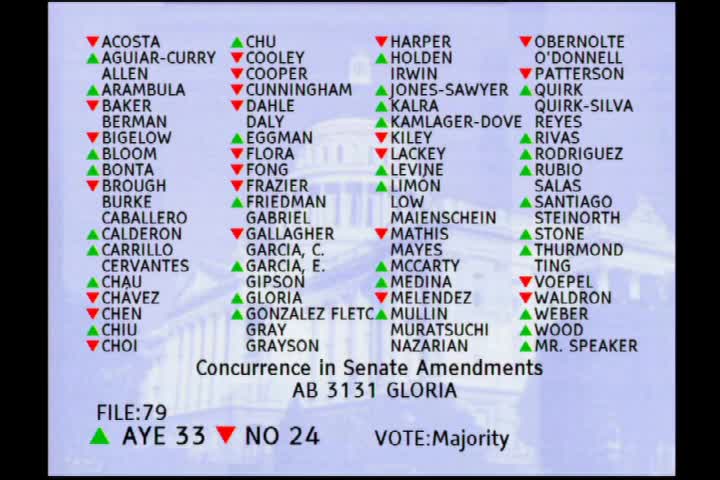
Bill Author


