AB 2231: California Voting Rights Act of 2001.
- Session Year: 2017-2018
- House: Assembly
- Latest Version Date: 2018-04-17
(1)The California Voting Rights Act of 2001 (CVRA) prohibits the use of an at-large election in a political subdivision if it would impair the ability of a protected class, as defined, to elect candidates of its choice or otherwise influence the outcome of an election. The CVRA provides that a violation of the act is established upon a showing of racially polarized voting, as defined.
This bill would provide that a violation of the CVRA is established if the totality of the circumstances show that members of a protected class are not equally able to reasonably participate in the local political processes of the political subdivision because racially polarized voting occurs, as specified. The bill would require the party asserting the violation to demonstrate that three prescribed factors are met.
(2)The CVRA requires a court that finds a violation of the CVRA to implement appropriate remedies, including the imposition of district-based elections, that are tailored to remedy the violation.
This bill would provide that the political subdivision in which the violation occurs may also implement appropriate remedies, as specified.
(3)The CVRA provides that a prevailing plaintiff party, other than the state or a political subdivision thereof, in a CVRA lawsuit may recover reasonable attorneys fees and litigation expenses, as specified. The CVRA prohibits prevailing defendant parties from recovering costs, unless the court finds the action to be frivolous, unreasonable, or without foundation.
This bill would instead allow any prevailing party party, other than the state, to recover a reasonable attorneys fee and costs in a CVRA action.
(1)The California Voting Rights Act of 2001 (CVRA) prohibits the use of an at-large election in a political subdivision if it would impair the ability of a protected class, as defined, to elect candidates of its choice or otherwise influence the outcome of an election. The CVRA provides that a violation of the act is established upon a showing of racially polarized voting, as defined. The CVRA provides that a voter who is a member of a protected class, as specified, may bring an action in superior court to enforce the provisions of the CVRA, and, if the voter prevails in the case, he or she may be awarded reasonable litigation costs and attorneys fees.
This bill would make technical, nonsubstantive changes to provisions of law defining several terms for purposes of the CVRA. provide that a violation of the CVRA is established if the totality of the circumstances show that members of a protected class are not equally able to reasonably participate in the local political processes of the political subdivision because racially polarized voting occurs, as specified. The bill would require the party asserting the violation to demonstrate that three prescribed factors are met.
(2)The CVRA requires a court that finds a violation of the CVRA to implement appropriate remedies, including the imposition of district-based elections, that are tailored to remedy the violation.
This bill would provide that the political subdivision in which the violation occurs may also implement appropriate remedies, as specified.
(3)The CVRA provides that a prevailing plaintiff party, other than the state or a political subdivision thereof, in a CVRA lawsuit may recover reasonable attorneys fees and litigation expenses, as specified. The CVRA prohibits prevailing defendant parties from recovering costs, unless the court finds the action to be frivolous, unreasonable, or without foundation.
This bill would instead allow any prevailing party to recover costs in a CVRA action.
The California Voting Rights Act of 2001 (CVRA) prohibits the use of an at-large election in a political subdivision if it would impair the ability of a protected class, as defined, to elect candidates of its choice or otherwise influence the outcome of an election. The CVRA provides that a violation of the act is established upon a showing of racially polarized voting, as defined. The CVRA provides that a voter who is a member of a protected class, as specified, may bring an action in superior court to enforce the provisions of the CVRA, and, if the voter prevails in the case, he or she may be awarded reasonable litigation costs and attorneys fees.
This bill would make technical, nonsubstantive changes to provisions of law defining several terms for purposes of the CVRA.
(a)(1)A violation of Section 14027 is established if it is shown by the totality of the circumstances that members of a protected class are not equally able to reasonably participate in the local political processes of the political subdivision because racially polarized voting occurs in elections for members of the governing body of the political subdivision or in elections incorporating other electoral choices by the voters of the political subdivision. Elections conducted prior to the filing of an action pursuant to Section 14027 and this section are more probative to establish the existence of racially polarized voting than elections conducted after the filing of the action.
(2)At a minimum, to make a showing under paragraph (1), the party asserting the violation must demonstrate, by a preponderance of evidence, that the following three factors have been met:
(A)The protected class is sufficiently large in number and geographically insular to comprise a voting majority within a proposed district that is intended to be represented by a single member of the governing body of the political subdivision.
(B)The protected class has previously voted in a cohesive and reasonably uniform manner.
(C)The voting preferences of the bloc-voting majority show that it is a unified bloc that regularly prevents the protected classs preferred candidate from prevailing.
(3)The factors in paragraph (2) shall be interpreted and applied consistent with Thornburg v. Gingles (1986) 478 U.S. 30 and related controlling precedent.
(b)The occurrence of racially polarized voting shall be determined from examining the totality of the circumstances leading to the results of elections in which at least one candidate is a member of a protected class or elections involving ballot measures, or other electoral choices that specifically or intentionally affect the rights and privileges of members of a protected class.
(c)Proof of an intent on the part of the voters or elected officials to discriminate against a protected class is not required.
(d)Other factors such as the history of discrimination, the use of electoral devices or other voting practices or procedures that may enhance the dilutive effects of at-large elections, denial of access to those processes determining which groups of candidates will receive financial or other support in a given election, the extent to which members of a protected class bear the effects of past discrimination in areas such as education, employment, and health, which hinder their ability to participate effectively in the political process, and the use of overt or subtle racial appeals in political campaigns are probative, but not necessary factors to establish a violation of Section 14027 and this section.
SEC. 2.Section 14029 of the Elections Code is amended to read:14029.Upon a finding of a violation of Section 14027 and Section 14028, the political subdivision or the court shall implement appropriate remedies, which may include the imposition of district-based elections, that are tailored to remedy the violation.
SEC. 3.Section 14030 of the Elections Code is amended to read:14030.In any action to enforce Section 14027 and Section 14028, the court shall allow the prevailing party party, other than the state, a reasonable attorneys fee consistent with the standards established in Serrano v. Priest (1977) 20 Cal.3d 25, 48-49, and litigation expenses including, but not limited to, expert witness fees and expenses as part of the costs.
(a)(1)A violation of Section 14027 is established if it is shown that by the totality of the circumstances that members of a protected class are not equally able to reasonably participate in the local political processes of the political subdivision because racially polarized voting occurs in elections for members of the governing body of the political subdivision or in elections incorporating other electoral choices by the voters of the political subdivision. Elections conducted prior to the filing of an action pursuant to Section 14027 and this section are more probative to establish the existence of racially polarized voting than elections conducted after the filing of the action.
(2)At a minimum, to make a showing under paragraph (1), the party asserting the violation must demonstrate, by a preponderance of evidence, that the following three factors have been met:
(A)The protected class is sufficiently large in number and geographically insular to comprise a voting majority within a proposed district that is intended to be represented by a single member of the governing body of the political subdivision.
(B)The protected class has previously voted in a cohesive and reasonably uniform manner.
(C)The voting preferences of the bloc-voting majority show that it is a unified bloc that regularly prevents the protected classs preferred candidate from prevailing.
(3)The factors in paragraph (2) shall be interpreted and applied consistent with Thornburg v. Gingles (1986) 478 U.S. 30 and related controlling precedent.
(b)The occurrence of racially polarized voting shall be determined from examining the totality of the circumstances leading to the results of elections in which at least one candidate is a member of a protected class or elections involving ballot measures, or other electoral choices that specifically or intentionally affect the rights and privileges of members of a protected class. One circumstance that may be considered in determining a violation of Section 14027 and this section is the extent to which candidates who are members of a protected class and who are preferred by voters of the protected class, as determined by an analysis of voting behavior, have been elected to the governing body of a political subdivision that is the subject of an action based on Section 14027 and this section. In multiseat at-large election districts, where the number of candidates who are members of a protected class is fewer than the number of seats available, the relative groupwide support received by candidates from members of a protected class shall be the basis for the racial polarization analysis.
(c)The fact that members of a protected class are not geographically compact or concentrated may not preclude a finding of racially polarized voting, or a violation of Section 14027 and this section, but may be a factor in determining an appropriate remedy.(d)(c)Proof of an intent on the part of the voters or elected officials to discriminate against a protected class is not required.
(e)(d)Other factors such as the history of discrimination, the use of electoral devices or other voting practices or procedures that may enhance the dilutive effects of at-large elections, denial of access to those processes determining which groups of candidates will receive financial or other support in a given election, the extent to which members of a protected class bear the effects of past discrimination in areas such as education, employment, and health, which hinder their ability to participate effectively in the political process, and the use of overt or subtle racial appeals in political campaigns are probative, but not necessary factors to establish a violation of Section 14027 and this section.
SEC. 2.Section 14029 of the Elections Code is amended to read:14029.Upon a finding of a violation of Section 14027 and Section 14028, the political subdivision or the court shall implement appropriate remedies, including which may include the imposition of district-based elections, that are tailored to remedy the violation.
SEC. 3.Section 14030 of the Elections Code is amended to read:14030.In any action to enforce Section 14027 and Section 14028, the court shall allow the prevailing plaintiff party, other than the state or political subdivision thereof, party a reasonable attorneys fee consistent with the standards established in Serrano v. Priest (1977) 20 Cal.3d 25, 48-49, and litigation expenses including, but not limited to, expert witness fees and expenses as part of the costs. Prevailing defendant parties shall not recover any costs, unless the court finds the action to be frivolous, unreasonable, or without foundation.
SECTION 1.Section 14026 of the Elections Code is amended to read:14026.As used in this chapter:(a)At-large method of election means any of the following methods of electing members to the governing body of a political subdivision:(1)One in which the voters of the entire jurisdiction elect the members to the governing body.(2)One in which candidates are required to reside within given areas of the jurisdiction and the voters of the entire jurisdiction elect the members to the governing body.(3)One that combines at-large elections with district-based elections.(b)District-based elections means a method of electing members to the governing body of a political subdivision in which the candidate must reside within an election district that is a divisible part of the political subdivision and is elected only by voters residing within that election district.(c)Political subdivision means a geographic area of representation created for the provision of government services, including, but not limited to, a general law city, general law county, charter city, charter county, charter city and county, school district, community college district, or other district organized pursuant to state law.(d)Protected class means a class of voters who are members of a race, color, or language minority group, as this class is referenced and defined in the federal Voting Rights Act of 1965 (52 U.S.C. Sec. 10301 et seq.).(e)Racially polarized voting means voting in which there is a difference, as defined in case law regarding enforcement of the federal Voting Rights Act of 1965 (52 U.S.C. Sec. 10301 et seq.), in the choice of candidates or other electoral choices that are preferred by voters in a protected class, and in the choice of candidates and electoral choices that are preferred by voters in the rest of the electorate. The methodologies for estimating group voting behavior as approved in applicable federal cases to enforce the federal Voting Rights Act of 1965 (52 U.S.C. Sec. 10301 et seq.) to establish racially polarized voting may be used for purposes of this section to prove that elections are characterized by racially polarized voting.As used in this chapter:
(a)At-large method of election means any of the following methods of electing members to the governing body of a political subdivision:
(1)One in which the voters of the entire jurisdiction elect the members to the governing body.
(2)One in which the candidates are required to reside within given areas of the jurisdiction and the voters of the entire jurisdiction elect the members to the governing body.
(3)One that combines at-large elections with district-based elections.
(b)District-based elections means a method of electing members to the governing body of a political subdivision in which the candidate must reside within an election district that is a divisible part of the political subdivision and is elected only by voters residing within that election district.
(c)Political subdivision means a geographic area of representation created for the provision of government services, including, but not limited to, a general law city, general law county, charter city, charter county, charter city and county, school district, community college district, or other district organized pursuant to state law.
(d)Protected class means a class of voters who are members of a race, color, or language minority group, as this class is referenced and defined in the federal Voting Rights Act of 1965 (52 U.S.C. Sec. 10301 et seq.).
(e)Racially polarized voting means voting in which there is a difference, as defined in case law regarding enforcement of the federal Voting Rights Act of 1965 (52 U.S.C. Sec. 10301 et seq.), in the choice of candidates or other electoral choices that are preferred by voters in a protected class, and in the choice of candidates and electoral choices that are preferred by voters in the rest of the electorate. The methodologies for estimating group voting behavior as approved in applicable federal cases to enforce the federal Voting Rights Act of 1965 (52 U.S.C. Sec. 10301 et seq.) to establish racially polarized voting may be used for purposes of this section to prove that elections are characterized by racially polarized voting.
|
Date
|
Status
|
|---|---|
| May 23, 2018 | From committee: Without further action pursuant to Joint Rule 62(a). |
| Apr 25, 2018 | In committee: Set, second hearing. Failed passage. |
| Apr 18, 2018 | Re-referred to Com. on E. & R. |
| Apr 17, 2018 | From committee chair, with author's amendments: Amend, and re-refer to Com. on E. & R. Read second time and amended. |
| Apr 11, 2018 | In committee: Set, first hearing. Hearing canceled at the request of author. |
| Apr 2, 2018 | Re-referred to Com. on E. & R. |
| Mar 23, 2018 | From committee chair, with author's amendments: Amend, and re-refer to Com. on E. & R. Read second time and amended. |
| Mar 22, 2018 | Referred to Coms. on E. & R. and JUD. |
| Feb 14, 2018 | From printer. May be heard in committee March 16. |
| Feb 13, 2018 | Read first time. To print. |
|
Date
|
Description
|
Location
|
Votes
|
|
|---|---|---|---|---|
| Apr 25, 2018 | Do pass and be re-referred to the Committee on [Judiciary] | Assembly Standing Committee on Elections and Redistricting |
Failed |
This list shows positions taken on this bill by organizations on the date displayed, which is linked to the original source.
Positions by individuals are not included.
|
Organization
|
Position
|
Date
|
|---|---|---|
| ACLU of California | * Against | Apr 25, 2018 |
| City Of Mission Viejo | ** Support | Apr 23, 2018 |
| City of Mission Viejo | * Support | Apr 25, 2018 |
| League Of Women Voters Of California | * Against | Apr 25, 2018 |
| Mexican American Legal Defense and Educational Fund (MALDEF) | * Against | Apr 25, 2018 |
Date of Hearing: April 25, 2018
ASSEMBLY COMMITTEE ON ELECTIONS AND REDISTRICTING
Marc Berman, Chair
ABPCA Bill Id:AB 2231 (
Author:Brough) – As Amended Ver:April 17, 2018
SUBJECT: California Voting Rights Act of 2001.
SUMMARY: Makes it harder for plaintiffs to successfully bring claims under the California Voting Rights Act (CVRA) alleging that an at-large method of election illegally impairs the ability of a protected class of voters to elect the candidate of its choice or its ability to influence the outcome of an election, as a result of the dilution or the abridgement of the rights of voters who are members of a protected class. Allows successful defendants in non-frivolous CVRA lawsuits to recover attorneys' fees from the plaintiff. Specifically, this bill:
- Requires a plaintiff, in order to prevail on a claim under the CVRA that an at-large method of election impairs the ability of a protected class of voters to elect the candidates of its choice or its ability to influence the outcome of an election, to demonstrate by a preponderance of the evidence the factors that must be demonstrated in order to prevail in a federal Voting Rights Act (VRA) lawsuit as outlined by the United States (US) Supreme Court in Thornburg v. Gingles (1986) 478 U.S. 30 (Gingles). One of those factors is demonstrating that a protected class of voters is sufficiently large in number and geographically insular to comprise a majority within a proposed district, as specified.
- Provides that electoral choices that affect the rights and privileges of members of a protected class of voters can be used to demonstrate racially polarized voting only if those electoral choices specifically or intentionally affect the rights and privileges of the protected class.
- Requires a plaintiff, in order to prevail on a CVRA claim, to demonstrate by a totality of the circumstances that members of the protected class are not equally able to reasonably participate in the local political process of the political subdivision due to the racially polarized voting in the jurisdiction. Provides that the occurrence of racially polarized voting shall be determined from examining the totality of the circumstances leading to the election results, as specified.
- Deletes a provision of law that expressly allows the success or failure of candidates who are members of a protected class and who are preferred by voters of the protected class to be considered as a circumstance in determining whether a CVRA violation exists.
- Deletes a provision of the CVRA that provides that the fact that the members of a protected class are not geographically compact or concentrated may not preclude a finding of racially polarized voting, or a violation of the CVRA, but may be a factor in determining an appropriate remedy.
- Permits a political subdivision that is found to have violated the CVRA to implement its own remedies to address the CVRA violation.
- Repeals a provision of law that prohibits a prevailing defendant party in a CVRA action from recovering attorneys' fees or costs unless the court finds that the action was frivolous, unreasonable, or without foundation. Allows any prevailing party in a CVRA action, other than the state, to be awarded a reasonable attorney's fee consistent with the standards established in Serrano v. Priest (1977) 20 Cal.3d 25, 48-49, and litigation expenses including, but not limited to, expert witness fees and expenses as part of the costs.
EXISTING LAW:
- Prohibits, pursuant to the CVRA, an at-large method of election from being imposed or applied in a political subdivision in a manner that impairs the ability of a protected class of voters to elect the candidate of its choice or its ability to influence the outcome of an election, as a result of the dilution or the abridgement of the rights of voters who are members of a protected class.
- Provides that a violation of the CVRA is established if it is shown that racially polarized voting occurs in elections for members of the governing body of the political subdivision or in elections incorporating other electoral choices by voters of the political subdivision.
- Provides that one circumstance that may be considered in determining a violation of the CVRA is the extent to which candidates who are members of a protected class and who are preferred by voters of the protected class, as determined by an analysis of voting behavior, have been elected to the governing body of a political subdivision that is the subject of an action based on the CVRA. Provides that in multiseat at-large election districts, where the number of candidates who are members of a protected class is fewer than the number of seats available, the relative groupwide support received by candidates from members of a protected class shall be the basis for the racial polarization analysis.
- Provides that the fact that members of a protected class are not geographically compact or concentrated may not preclude a finding of racially polarized voting, or a violation of the CVRA, but may be a factor in determining an appropriate remedy.
- Requires a court, upon finding a violation of the CVRA, to implement appropriate remedies, including the imposition of district-based elections, which are tailored to remedy the violation.
- Permits any voter who is a member of a protected class and who resides in a political subdivision where a violation of the CVRA is alleged to file an action in the superior court of the county in which the political subdivision is located.
- Permits a prevailing plaintiff party in an action brought under the CVRA, other than the state or political subdivision thereof, to recover a reasonable attorney's fee and litigation expenses including, but not limited to, expert witness fees and expenses. Prohibits a prevailing defendant party from recovering any costs unless the court finds the action to be frivolous, unreasonable, or without foundation.
FISCAL EFFECT: None. This bill is keyed non-fiscal by the Legislative Counsel.
COMMENTS:
- Purpose of the Bill: According to the author:
The CVRA, as a simple "one size fits all" remedy, expressly identifies district elections as one available remedy. Adopting a "by-district" election ordinance that puts into place lawfully crafted election districts is a convenient response, but not always a solution that actually solves the particular issues present within a city. Each city is different, with different populations, different geography and different local objectives.
The CVRA itself recognizes that the facts attendant to each city are different and different solutions may be factually necessary to provide a suitable remedy to the community. Attention must be given to the following language of the CVRA: …(c) The fact that members of a protected class are not geographically compact or concentrated may not preclude a finding of racially polarized voting, or a violation of Section 14027 and this section, but may be a factor in determining an appropriate remedy.
In Mission Viejo, the facts have precluded the identification of a feasible "minority/majority" district mapping configuration that would serve as an actual, rather than an "in name only," appropriate remedy to respond to the racially polarized voting impacting the protected class of Hispanics who have raised this issue. This is reconfirmed as a demonstrated truth in the further analysis of the 2018 Voting Age Population by Citizenship and Race data.
The City Council, on behalf of the subject protected class, and for the benefit of the entire population of Mission Viejo, are better served to seek to beneficially and in actuality implement both the letter and spirit of the CVRA. Adopting a by district election format that does not actually provide any real remedy is a disservice to all.
AB 2231 will develop a more stringent standard for a voting rights act violation to ensure a fair and unbiased election. Further, this bill will require a party asserting such a violation to prove that district elections really will create more fair representation. Instead of attempting to resolve the threat of litigation with a reactive, hasty solution, this bill will help ensure that minority groups are represented by ensuring that a thoughtful, effective approach is taken to resolve the issue.
AB 2231 will provide actual and beneficial solutions that will help resolve the polarization factors present in our communities.
- Historical Background on the California Voting Rights Act of 2001: SB 976 (Polanco), Chapter 129, Statutes of 2002, enacted the CVRA to address racial block voting in at-large elections for local office in California. In areas where racial block voting occurs, an at-large method of election can dilute the voting rights of minority communities if the majority typically votes to support candidates that differ from the candidates who are preferred by minority communities. In such situations, breaking a jurisdiction up into districts can result in districts in which a minority community can elect the candidate of its choice or otherwise have the ability to influence the outcome of an election. Accordingly, the CVRA prohibits an at-large method of election from being imposed or applied in a political subdivision in a manner that impairs the ability of a protected class of voters to elect the candidate of its choice or to influence the outcome of an election, as a result of the dilution or the abridgement of the rights of voters who are members of the protected class.
In all, at least 200 local government bodies have transitioned from at-large to district-based elections since the enactment of the CVRA. While some jurisdictions did so in response to litigation or threats of litigation, other jurisdictions proactively changed election methods because they believed they could be susceptible to a legal challenge under the CVRA, and they wished to avoid the potential expense of litigation.
Before the CVRA was enacted, legal challenges to at-large methods of election that diluted the voting rights of minority communities typically were brought under the federal Voting Rights Act (VRA). The most notable California example is Gomez v. City of Watsonville (1988) 863 F.2d 1407 (Gomez), in which the Ninth Circuit Court of Appeals found that at-large elections of city council members in Watsonville, California had diluted the voting strength of Hispanics, and ordered the city to switch to single-member district elections. (The US Supreme Court subsequently denied a petition to review the Ninth Circuit's decision.)
Two years before the decision in Gomez, the US Supreme Court established a new standard for a plaintiff to establish that an election system dilutes the voting strength of a protected minority group in violation of the VRA. That case—the Gingles case—was the first case in which the US Supreme Court had the opportunity to consider amendments to Section 2 of the VRA that were adopted by Congress in 1982. Section 2, as originally enacted, prohibited any "voting qualification or prerequisite to voting, or standard, practice, or procedure [from being] imposed or applied by any State or political subdivision to deny or abridge the right of any citizen of the United States to vote on account of race or color." Among other changes, the 1982 amendments specified that a violation of Section 2 of the VRA could be proved by showing that a policy or procedure had a discriminatory effect, and made it clear that those challenging such a policy or procedure did not have to prove that it had a discriminatory purpose.
Specifically, in Gingles, the US Supreme Court announced three preconditions that a plaintiff first must establish to prove that an election system involving multimember districts diluted the voting strength of a minority group:
(1) The minority community is sufficiently large and geographically compact that it is possible to create a district in which the minority could constitute a majority in a single-member district;
(2) The minority community is politically cohesive, in that a significant portion of the minority group usually supports the same candidates; and,
(3) There is racially polarized voting among the majority community, which usually (but not necessarily always), allows the majority voting as a bloc to defeat the minority's preferred candidate.
Notwithstanding the fact that the Gomez plaintiffs successfully established the three preconditions in Gingles, and ultimately were successful in their challenge to Watsonville's at-large election system, concerns about at-large election systems, and the possibility that racial block voting could dilute the voting power of some communities, led to the consideration of a number of bills that sought to prohibit at-large voting in certain political subdivisions (for example, AB 2 (Chacon), of the 1989-90 regular session; AB 1002 (Chacon), of the 1991-92 regular session; AB 2482 (Baca), of the 1993-94 regular session; and AB 172 (Firebaugh), of the 1999-2000 regular session all proposed to prohibit at-large elections in school districts that met certain criteria; additionally, AB 8 (Cardenas) and AB 1328 (Cardenas), both of the 1999-2000 regular session, sought to eliminate the at-large election system within the Los Angeles Community College District). None of these bills became law—in many cases the bills were vetoed, while in other cases, the bills failed to reach the Governor's desk. For those bills that were vetoed, the veto messages typically stated that the decision to create single-member districts was best made at the local level, and not by the state.
The CVRA followed these unsuccessful efforts and was developed specifically for the purpose of creating a new cause of action for challenging at-large methods of election under state law. Rather than prohibiting at-large elections in certain political subdivisions, the CVRA instead established a policy that an at-large method of election could not be imposed in situations where it could be demonstrated that such a policy had the effect of impairing the ability of a protected class of voters to elect a candidate of its choice or its ability to influence the outcome of an election. Recognizing the difficulty of challenging at-large methods of election under the federal VRA, the CVRA sought to make it easier for plaintiffs to prevail on a claim that an at-large election system had the effect of diluting or abridging minority voting rights.
Specifically, the CVRA requires a plaintiff to establish only two of the three Gingles preconditions in order to prevail on a claim that an at-large method of election dilutes or abridges the voting rights of a protected class of voters. To prevail on a CVRA claim, the plaintiffs must prove that the minority community was politically cohesive and that there was racially polarized voting among the majority community, but they are not required to show that the minority community was geographically concentrated. In fact, the CVRA expressly provides that "[t]he fact that members of a protected class are not geographically compact or concentrated may not preclude a finding of racially polarized voting, or a violation of [the CVRA], but may be a factor in determining and appropriate remedy."
Among other provisions, this bill requires the plaintiffs in a CVRA action to demonstrate that all three Gingles preconditions were met in order to prevail. In effect, this bill undercuts one of the core purposes of the CVRA—to allow a determination of whether an at-large election system dilutes or abridges the rights of voters to be made independently of the question of whether the members of a protected class are geographically concentrated. - California Voting Rights Act and Attorneys' Fees: The CVRA specifically provides for a prevailing plaintiff party to have the ability to recover attorneys' fees and litigation expenses. That provision, which is modeled after federal laws that apply to actions brought to enforce federal civil rights laws, was intended to increase the likelihood that attorneys would be willing to bring challenges under the law. While the relevant federal laws typically do not expressly distinguish between prevailing plaintiff parties and prevailing defendant parties when providing that attorney's fees may be awarded, the US Supreme Court has held that successful plaintiffs who vindicate the intent of those civil rights laws generally should be entitled to recover attorneys' fees in the absence of special circumstances, while prevailing defendants should recover fees only when a plaintiff's action was "frivolous, unreasonable, or without foundation." (Newman v. Piggie Park Enterprises, Inc. (1968) 390 US 400; Christiansburg Garment Co. v. Equal Employment Opportunity Commission (1978) 434 US 412).
In reaching those decisions, the courts recognized that enforcement of civil rights laws would be difficult, and as such would depend in part on private litigation to ensure compliance with those laws. The court noted that plaintiffs who bring successful litigation to enforce civil rights laws typically do not recover damages, but instead may obtain injunctive relief that serves the broader public interest. In finding that Congress had enacted the attorneys' fees provision to encourage plaintiffs to bring litigation that promoted the intent behind civil rights laws, the court noted that "[i]f successful plaintiffs were routinely forced to bear their own attorneys' fees, few aggrieved parties would be in a position to advance the public interest by invoking the injunctive powers of the federal courts." (Newman, supra, 390 US at 402). The attorneys' fees language in the CVRA was crafted to reflect this caselaw, specifically providing for a prevailing plaintiff party to recover a reasonable attorney's fee and litigation expenses and prohibiting prevailing defendant parties from recovering costs unless the court finds the action to be frivolous, unreasonable, or without foundation.
This bill repeals provisions of the CVRA that prohibit prevailing defendant parties in CVRA litigation from recovering costs unless the court finds the action to be frivolous, unreasonable, or without foundation. By potentially requiring unsuccessful plaintiff parties in CVRA litigation to pay attorneys' fees of a prevailing defendant party in non-frivolous litigation, this bill could reduce the willingness of plaintiffs to bring CVRA actions, potentially undercutting another purpose of the CVRA. When considered in combination with the changes outlined above for a plaintiff to prevail on a CVRA claim, it is possible that the net effect of this bill could be to end CVRA litigation entirely. Instead, plaintiffs who sought to challenge potentially discriminatory at-large elections systems likely would pursue those claims under the federal VRA, since they would continue to be protected against paying attorneys' fees in a federal lawsuit unless the claim was found to be frivolous, unreasonable, or without foundation. - Remedies for California Voting Rights Act Violations: One of the provisions of this bill provides that in situations where a violation of the CVRA is found, the political subdivision that is found to have violated the CVRA may implement its own remedies. Currently, the CVRA requires the court to implement appropriate remedies. The extent and effect of this provision is unclear. Would a political subdivision that lost a CVRA lawsuit be able to implement remedies that it deemed appropriate even over the objections of the prevailing plaintiffs or of the court? If the political subdivision implemented its own remedies, would that preclude the court from implementing appropriate remedies?
Furthermore, it is unclear how the protection of voting rights and the purposes of the CVRA are served by allowing a political subdivision that is found to have violated the CVRA to decide on the remedies that should be implemented. If a political subdivision loses a lawsuit and is found by a court to be conducting elections in a manner that dilutes or abridges the rights of voters, is that subdivision likely to implement remedies that truly will address the dilution or abridgement of voting rights? - Previous Legislation to Facilitate Changes from At-Large to District-Based Elections: At the time the CVRA was enacted, local government bodies generally were required to receive voter approval to move from an at-large method of election to a district-based method of election for selecting governing board members. That voter approval requirement made it difficult for jurisdictions to proactively transition to district-based elections to address potential liability under the CVRA. If a jurisdiction attempted to transition from at-large to district-based elections to address CVRA concerns, but the voters rejected the proposal, the jurisdiction nonetheless would remain subject to a lawsuit under the CVRA. Furthermore, to the extent that there was racially polarized voting on the question of whether to transition from at-large to district-based elections, the results of the vote on that question could provide further evidence for a lawsuit under the CVRA.
As the number of jurisdictions that faced lawsuits or threats of lawsuits under the CVRA increased, many jurisdictions sought ways to transition from at-large to district-based elections without having to receive voter approval for such a change. Most notably, many school districts have transitioned from at-large to district-based elections without receiving voter approval in an effort to avoid potential liability under the CVRA. Even though state law generally requires such a transition to be approved by the voters in a school district, existing law also permits the State Board of Education (SBE) to waive all or part of any section of the Education Code, with certain identified exceptions, upon request by the governing board of a school district or county board of education. The SBE generally is required to approve any and all requests for waivers unless it makes a finding that one of seven enumerated conditions exists. Since 2009, the SBE has approved waivers to permit approximately 158 school districts to change from at-large to district elections without receiving voter approval, as would otherwise be required by the Education Code.
In response to concerns that community college districts were subject to liability under the CVRA but were unable to change from at-large to district-based elections without voter approval, AB 684 (Block), Chapter 614, Statutes of 2011, established a process under which a community college district could transition from at-large to district-based elections without receiving voter approval if such a transition was approved by the Board of Governors (BOG) of the California Community Colleges, among other provisions. Since the enactment of AB 684, the BOG has approved requests from approximately 28 community college districts to change from at-large to district elections.
During the 2015-2016 Legislative Session, the Legislature took further steps to facilitate transitions from at-large to district elections. Specifically, SB 493 (Cannella), Chapter 735, Statutes of 2015, permitted a city with a population of fewer than 100,000 people to change the method of electing council members to a by-district method of election without receiving voter approval if such a change was made in furtherance of the purposes of the CVRA. AB 278 (R. Hernandez), Chapter 736, Statutes of 2016, expanded on SB 493 by allowing any city, regardless of population, to change the method of electing its governing board members from at-large to a by-district method of election without receiving voter approval. Similarly, AB 2389 (Ridley-Thomas), Chapter 754, Statutes of 2016, permitted a special district to change the method of electing its governing board members from at-large to a by-district method of election without receiving voter approval, if the change was made in furtherance of the purposes of the CVRA.
In addition to taking steps to make it easier for local governments to comply with the CVRA by transitioning from at-large to district-based elections, the Legislature also enacted new laws designed to provide a more formal mechanism for prospective plaintiffs and local jurisdictions to address at-large election systems that are potentially unlawful under the CVRA prior to litigation being filed. Specifically, AB 350 (Alejo), Chapter 737, Statutes of 2016, required that written notice be provided before an action can be brought against a political subdivision under the CVRA, and capped the amount of attorneys' fees that a prospective plaintiff could recover from a political subdivision under the CVRA if the subdivision promptly transitioned from an at-large to a district-based method of election upon receiving such a written notice.
Under the provisions of AB 350, once a jurisdiction receives a written notice from a prospective plaintiff alleging that the jurisdiction's method of conducting elections may violate the CVRA, the jurisdiction has 45 days to pass a resolution outlining its intention to transition from at-large to district-based elections (a jurisdiction may also choose to enact such a resolution before receiving any such written notice). If a jurisdiction has passed such a resolution, no legal action may be filed against the jurisdiction alleging a CVRA violation within 90 days of the resolution's passage. To take full advantage of the cap on attorneys' fees to prospective plaintiffs that is provided in AB 350, a jurisdiction would have a maximum of 135 days (45 days to pass a resolution plus 90 days to adopt districts) from the time it received a written notice from the prospective plaintiffs until it had to finalize the new district boundaries. - Arguments in Support: In support of this bill, the City of Mission Viejo writes:
Public agencies across California have and are facing lawsuits and threats of lawsuits alleging that their at-large election process violates the California Voting Rights Act by diluting the minority vote. This is usually based on claims not supported by any evidence. In reaction, solely to protect the taxpayers' money, most public agencies have taken the generic default approach and transitioned to the sole statutorily identified "by-district" election process. By the current statute, districting is the only remedy expressly identified, and so is the most common reaction of a challenged City. Other lawful remedies are not identified or expressly authorized by the law. And, it's proven that fair and equal representation is not always ensured by a district election process.
The City of Mission Viejo was recently faced with this challenge. A professional review of all voting patterns dating back to 2010 in fact shows evidence of racially polarized voting in Mission Viejo. However, this review also revealed that moving to district voting would not solve the racially polarized voting problem. The vague and uncertain reference to appropriate alternative remedies, rather than the judicially approved alternative solutions, is all [that] exists. The City must go through a "friendly" lawsuit with the claimant to obtain judicial approval rather than employ simple legislative authorization.
AB 2231 will provide a more stringent standard for a challenger to first demonstrate facts showing that a voting rights act violation exists which prevents a fair and unbiased election. Further, this bill will require a party asserting such a violation prove that district elections really will create more fair representation. Instead of attempting to resolve the threat of litigation with a reactive, "generic" solution, this bill will help ensure that minority groups are represented by ensuring that a thoughtful, effective approach is taken to give them a voice.
- Arguments in Opposition: In opposition to this bill, the Mexican American Legal Defense and Educational Fund writes:
Unfortunately, AB 2231 (Brough) completely undermines the CVRA and fails to recognize the original intent of the CVRA which is to understand how racially polarized voting and vote dilution occurs and allow a court to have discretion to order an appropriate remedy tailored to address the specific violation. At its core, the CVRA was meant to address years of discrimination and the election systems that continue to deny meaningful access to the democratic process in local jurisdictions across California.
AB 2231 completely disregards the issue that the CVRA was designed to address and limits the judge's ability to implement appropriate remedies tailored to correct the specific violation which is the backbone of the CVRA. This bill would instead allow the political subdivision to craft a remedy. This completely fails to make sense. Why would you allow the political subdivision to craft a remedy when its members are the direct beneficiaries of the discriminatory election system.
Regrettably, AB 2231 would also negatively impact the publics' ability to challenge discriminatory election systems by changing the fee-shifting provisions. The fee-shifting provisions are designed to ensure that individuals are able to enforce their civil rights and allow individuals to hire attorneys. In a CVRA lawsuit, plaintiffs do not get awarded money damages and are suing for injunctive relief, therefore adopting such a policy in AB 2331 would have a devastating and chilling effect on plaintiffs.
- Related Legislation: AB 2123 (Cervantes), which is pending in the Assembly Judiciary Committee, permits a prospective plaintiff and a political subdivision to agree to extend the deadline by up to 90 days for completing the transition from an at-large to a district-based election system in accordance with the CVRA. AB 2123 was heard in this committee on April 11, 2018 and was approved on a 6-1 vote.
AB 2432 (Obernolte), which is also being heard in this committee today, prohibits a court from imposing district-based elections upon a finding of a violation of the CVRA unless the plaintiff has established that the district-based elections would remedy the dilution or abridgment of voting rights and that alternatives to district-based elections would not achieve greater voting rights and other benefits. - Double-Referral: This bill is double-referred to the Assembly Judiciary Committee.
REGISTERED SUPPORT / OPPOSITION:
Support
City of Mission Viejo
Opposition
American Civil Liberties Union of California Center for Advocacy and Policy
League of Women Voters of California
Mexican American Legal Defense and Educational Fund
Analysis Prepared by: Ethan Jones / E. & R. / (916) 319-2094
Discussed in Hearing
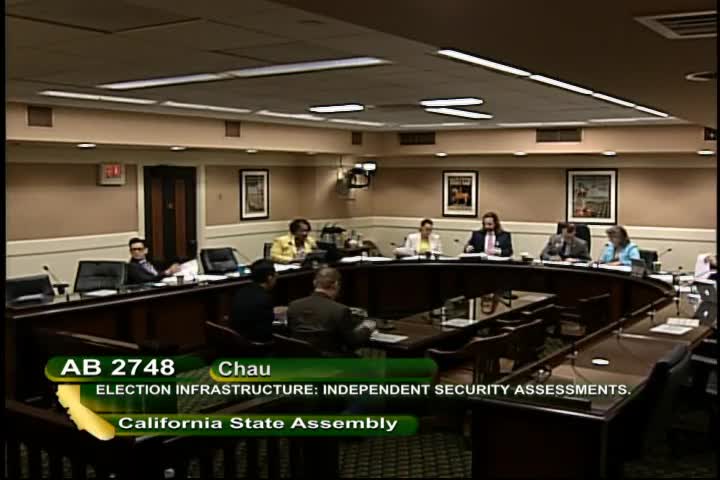 22MIN
Assembly Standing Committee on Elections and Redistricting
Bill Author

Bill Co-Author(s):