AB 2233: Medi-Cal: Assisted Living Waiver program.
- Session Year: 2017-2018
- House: Assembly
- Latest Version Date: 2018-08-31
Existing law establishes the Medi-Cal program, which is administered by the State Department of Health Care Services and under which qualified low-income individuals receive health care services. The Medi-Cal program is, in part, governed and funded by federal Medicaid program provisions.
Existing law requires the State Department of Health Care Services to develop a federal waiver program, known as the Assisted Living Waiver program, to test the efficacy of providing an assisted living benefit to beneficiaries under the Medi-Cal program. Existing law requires that the benefit include, but not be limited to, the care and supervision activities specified for residential care facilities for the elderly. Existing law requires implementation of the program only to the extent federal financial participation is available and funds are appropriated or otherwise available for the program.
This bill would require the department to submit, in 2019, to the federal Centers for Medicare and Medicaid Services a request for renewal of the Assisted Living Waiver program with specified amendments. The bill would require, as part of the amendments, additional slots, as specified, in the 15 existing waiver counties, expansion of the program beyond those counties on a regional basis, and modification to the provider reimbursement tiers while also maintaining the programs budget-neutral provisions. The bill would require the department, before the submission of the waiver renewal request, to notify specified legislative committees about certain information relating to the additional slots and the regional expansion, to conduct open in-person meetings with stakeholders, as specified, and to release a draft of the proposed waiver renewal for stakeholder comment.
The bill would condition implementation of the waiver amendments on obtaining the necessary federal approvals and on the availability of federal financial participation. The bill would require implementation of the waiver amendments to commence within 6 months of the departments receipt of authorization for the necessary resources, as specified.
The bill would also make legislative findings and declarations relating to the Assisted Living Waiver program.
Existing law establishes the Medi-Cal program, which is administered by the State Department of Health Care Services and under which qualified low-income individuals receive health care services. The Medi-Cal program is, in part, governed and funded by federal Medicaid Program program provisions.
Existing law requires the State Department of Health Care Services to develop a federal waiver program, known as the Assisted Living Waiver program, to test the efficacy of providing an assisted living benefit to beneficiaries under the Medi-Cal program. Existing law requires that the benefit include, but not be limited to, the care and supervision activities specified for residential care facilities for the elderly. Existing law requires implementation of the program only to the extent federal financial participation is available and funds are appropriated or otherwise available for the program.
This bill would require the department to submit, in 2019, to the federal Centers for Medicare and Medicaid Services a request for renewal of the Assisted Living Waiver program with specified amendments. The bill would require, as part of the amendments, additional slots, as specified, in the 15 existing waiver counties, expansion of the program beyond those counties on a regional basis, and modification to the provider reimbursement tiers while also maintaining the programs budget-neutral provisions. The bill would require the department, before the submission of the waiver renewal request, to notify specified legislative committees about certain information relating to the additional slots and the regional expansion, to conduct open in-person meetings with stakeholders, as specified, and to release a draft of the proposed waiver renewal for stakeholder comment.
The bill would condition implementation of the waiver amendments on obtaining the necessary federal approvals and on the availability of federal financial participation. The bill would require implementation of the waiver amendments to commence within 6 months of the departments receipt of authorization for the necessary resources, as specified.
The bill would also make legislative findings and declarations relating to the Assisted Living Waiver program.
Existing law establishes the Medi-Cal program, which is administered by the State Department of Health Care Services and under which qualified low-income individuals receive health care services. The Medi-Cal program is, in part, governed and funded by federal Medicaid Program provisions.
Existing law requires the State Department of Health Care Services to develop a federal waiver program program, known as the Assisted Living Waiver program, to test the efficacy of providing an assisted living benefit to beneficiaries under the Medi-Cal program. Existing law requires that the benefit include, but not be limited to, the care and supervision activities specified for residential care facilities for the elderly. Existing law requires implementation of the program only to the extent federal financial participation is available and funds are appropriated or otherwise available for the program.
This bill would require the department to submit submit, in 2019, to the federal Centers for Medicare and Medicaid Services a request for renewal of the Assisted Living Waiver program with specified amendments. The bill would require, as part of the amendments, additional slots, as specified, in the 15 counties where the waiver program is currently in operation. The waiver amendments would also require the department to expand the program on a statewide basis, as specified. The waiver amendments would, among other things, authorize assessments to be conducted by trained individuals, visits to be conducted on an as-needed and quarterly basis, and the provision of certain accommodations to account for the needs of dementia care residents. existing waiver counties, expansion of the program beyond those counties on a regional basis, and modification to the provider reimbursement tiers while also maintaining the programs budget-neutral provisions. The bill would require the department, before the submission of the waiver renewal request, to notify specified legislative committees about certain information relating to the additional slots and the regional expansion, to conduct open in-person meetings with stakeholders, as specified, and to release a draft of the proposed waiver renewal for stakeholder comment.
The bill would also require the department to authorize eligibility for share-of-cost Medi-Cal beneficiaries, and to modify its provider reimbursement tier, as specified, while also maintaining the waiver programs budget-neutral provisions.The bill would condition implementation of the waiver amendments on obtaining the necessary federal approvals and on the availability of federal financial participation. The bill would require implementation of the waiver amendments to commence within 6 months of the departments receipt of authorization for the necessary resources, as specified.
The bill would also make legislative findings and declarations relating to the Assisted Living Waiver program.
Existing law establishes the Medi-Cal program, which is administered by the State Department of Health Care Services and under which qualified low-income individuals receive health care services. The Medi-Cal program is, in part, governed and funded by federal Medicaid Program provisions.
Existing law requires the State Department of Health Services to develop a federal waiver program to test the efficacy of providing an assisted living benefit to beneficiaries under the Medi-Cal program. Existing law requires that the benefit include, but not be limited to, the care and supervision activities specified for residential care facilities for the elderly. Existing law requires implementation of the program only to the extent federal financial participation is available and funds are appropriated or otherwise available for the program.
This bill would require the department to submit to the federal Centers for Medicare and Medicaid Services a request for renewal of the Assisted Living Waiver program with specified amendments. The bill would require, as part of the amendments, additional slots, as specified, in the 15 counties where the waiver program is currently in operation. The waiver amendments would also require the department to expand the program on a statewide basis, as specified. The waiver amendments would, among other things, authorize assessments to be conducted by trained individuals, visits to be conducted on an as-needed and quarterly basis, and the provision of certain accommodations to account for the needs of dementia care residents.
The bill would also require the department to authorize eligibility for share-of-cost Medi-Cal beneficiaries, and to modify its provider reimbursement tier, as specified, while also maintaining the waiver programs budget-neutral provisions.
The bill would condition implementation of the waiver amendments on obtaining the necessary federal approvals and on the availability of federal financial participation. The bill would require implementation of the waiver amendments to commence within 6 months of the departments receipt of authorization for the necessary resources, as specified.
The bill would also make legislative findings and declarations relating to the Assisted Living Waiver program.
The Legislature finds and declares all of the following:
(a)In 1999, the United States Supreme Court ruled in the case of Olmstead v. L.C. (1999) 527 U.S. 581, finding that the unnecessary institutionalization of people with disabilities is a violation of the Americans with Disabilities Act of 1990 (ADA), thereby establishing the right of individuals with disabilities to receive services in the most integrated setting.
(b)To meet the intent of the Olmstead decision, it is the states obligation to ensure that individuals have access to an array of necessary services and supports that meet each persons needs and preferences, regardless of age or degree of disability.
(c)The Assisted Living Waiver program has provided a valuable alternative to institutionalization for individuals whose care needs qualify them for Medicaid coverage of nursing facility care and who meet the criteria for admission to a licensed residential care facility for the elderly. Demand for the Assisted Living Waiver program has outpaced supply and operates with a waiting list of approximately 2,500 individuals across 15 counties: the Counties of Alameda, Contra Costa, Fresno, Kern, Los Angeles, Orange, Riverside, Sacramento, San Bernardino, San Diego, San Francisco, San Joaquin, San Mateo, Santa Clara, and Sonoma.
(d)Despite the demand for the Assisted Living Waiver program, a number of challenges prevent the program from realizing its potential, including a dearth of available providers, little awareness of the program, low reimbursement rates that hamper provider participation, lack of availability across the remaining 43 counties that do not participate in the program, and ineffective administrative requirements.
(e)According to the 2017 Long-Term Services and Supports Scorecard, almost 11 percent of Californias 101,000 nursing home residents, or 11,000 individuals, are identified as having low-care needs. These individuals could be cared for in the community, or in assisted living settings, as an alternative to institutionalization. However, for many of those individuals, either the opportunities to transition do not exist or these individuals are unaware of the alternatives.
(f)As part of Californias efforts to realize its commitment to the Olmstead decision, availability of slots under the Assisted Living Waiver program should be increased, while also addressing the programmatic issues impacting its effectiveness.
SEC. 2.Section 14132.265 is added to the Welfare and Institutions Code, immediately following Section 14132.26, to read:14132.265.(a)In 2019, the department shall submit to the federal Centers for Medicare and Medicaid Services a request for renewal of the Assisted Living Waiver program described in Section 14132.26, with all of the following amendments to the program components:
(1)The department shall increase the number of slots beyond the currently authorized 3,700 to at least 18,500 slots. For slots beyond the initial 3,700 slots, at least 60 percent shall be reserved for persons transitioning from an institutional setting.
(2)The department shall phase in the 18,500 slots over the waiver program renewals five-year term, with the initial phase of additional slots prioritized for the 15 existing waiver counties.
(3)Geographic availability of slots on a regional basis. The department shall outline a process to expand the waiver program beyond the 15 existing waiver counties to enable the waiver programs availability on a regional basis in the states northern, central, and southern regions that currently are without access to the program. The regional expansion shall be phased in throughout the waiver program renewals five-year term. As part of the minimum 18,500 slots, slots beyond those authorized for the 15 existing waiver counties shall be phased in on a regional basis.
(4)Before submission of the waiver renewal request, the department shall notify the appropriate fiscal and policy committees of the Legislature of the methodology for allotting the waiver slots among the 15 existing waiver counties and the process for regional expansion, along with supportive data for those slots.
(5)The department shall address all of the following components within the waiver renewal process:
(A)Accommodations. The department shall consider the appropriateness of requiring participating residential care facilities for the elderly to provide private or semi-private bedrooms and bathrooms, and refrigerators and microwave ovens. That consideration shall include the program participants quality of life, provider participation in the program, and other relevant concerns. The consideration shall be included in the stakeholder process described in paragraph (6).
(B)Financial eligibility and exploration of expansion of the waiver.
(i)In the 2019 waiver renewal request, the department shall provide for financial eligibility standards that are no more restrictive than the financial eligibility standards as set forth in the currently applicable waiver application, effective since March 1, 2017, and as implemented through the current requirements of Article 19D of the departments Medi-Cal Eligibility Procedures Manual.
(ii)As part of the stakeholder process described in paragraph (6), the department shall provide written clarification regarding the departments Assisted Living Waiver financial eligibility standards for all waiver eligibility categories indicated on the federally approved current waiver document, including eligibility for recipients under the Supplemental Security Income program, recipients under the State Supplementary Payment program, aged or disabled persons with eligibility based on the federal poverty level, medically needy persons, and persons in the special home and community-based waiver group under Section 435.217 of Title 42 of the Code of Federal Regulations.
(iii)During the same stakeholder process, the department shall also explore and explain options to expand financial eligibility to include persons not currently eligible, or to make participation in the waiver program more financially feasible to persons who, under current eligibility rules, may be eligible but are without adequate resources to pay for room and board and other essential expenses.
(C)Provider reimbursement. The department shall modify its provider reimbursement tiers to ensure sufficient participation from providers, while also maintaining the waiver programs budget-neutral provisions.
(D)The department shall establish requirements and procedures so that any person on the waiver programs waiting list each month is able to know his or her position on the waiting list and when he or she is likely to reach the top of the waiting list. The department shall clearly indicate all methodologies and prioritizations used in selecting persons from the waiting list, including, but not limited to, any priorities based on imminent risk of institutionalization, current residence in a nursing home, care needs, or county of residence.
(6)(A)As part of the waiver renewal process, the department shall conduct open in-person meetings in the northern, central, and southern areas of the state with stakeholders, including, but not limited to, consumers, providers, and families of consumers, and shall receive input on the design and oversight of the Assisted Living Waiver program. The department shall also seek written feedback from stakeholders on the provisions included within the waiver program. The department shall give at least a 30-day notice of each of the in-person meetings, and at least a 30-day notice of the opportunity to submit written feedback.
(B)Before submission of the waiver renewal request, the department shall release a draft of the proposed waiver renewal for stakeholder comment. The release of the draft shall allow for at least a 30-day comment period, and shall precede the submission of the waiver renewal request to the federal Centers for Medicare and Medicaid Services by at least 60 days.
(b)(1)The department shall implement this section only to the extent federal financial participation is available and only if any necessary federal approvals have been obtained.
(2)Upon federal approval of the waiver renewal request with the amendments described in this section, implementation of the amended waiver program shall commence within six months of the department receiving authorization for the necessary resources to provide the services to additional waiver program participants.
The Legislature finds and declares all of the following:
(a)In 1999, the United States Supreme Court ruled in the case of Olmstead v. L.C. (1999) 527 U.S. 581, finding that the unnecessary institutionalization of people with disabilities is a violation of the Americans with Disabilities Act of 1990 (ADA), thereby establishing the right of individuals with disabilities to receive services in the most integrated setting.
(b)To meet the intent of the Olmstead decision, it is the states obligation to ensure that individuals have access to an array of necessary services and supports that meet each persons needs and preferences, regardless of age or degree of disability.
(c)The Assisted Living Waiver program has provided a valuable alternative to institutionalization for individuals whose care needs qualify them for Medicaid coverage of nursing facility care and who meet the criteria for admission to a licensed residential care facility for the elderly. Demand for the Assisted Living Waiver program has outpaced supply and operates with a waiting list of approximately 2,500 individuals across 15 counties: the Counties of Alameda, Contra Costa, Fresno, Kern, Los Angeles, Orange, Riverside, Sacramento, San Bernardino, San Diego, San Francisco, San Joaquin, San Mateo, Santa Clara, and Sonoma.
(d)Despite the demand for the Assisted Living Waiver program, a number of challenges prevent the program from realizing its potential, including a dearth of available providers, little awareness of the program, low reimbursement rates that hamper provider participation, lack of availability across the remaining 43 counties that do not participate in the program, and ineffective administrative requirements.
(e)According to the 2017 Long-Term Services and Supports Scorecard, almost 11 percent of Californias 101,000 nursing home residents, or 11,000 individuals, are identified as having low-care needs. These individuals could be cared for in the community, or in assisted living settings, as an alternative to institutionalization. However, for many of those individuals, either the opportunities to transition do not exist or these individuals are unaware of the alternatives.
(f)As part of Californias efforts to realize its commitment to the Olmstead decision, availability of slots under the Assisted Living Waiver program should be increased, while also addressing the programmatic issues impacting its effectiveness.
SEC. 2.Section 14132.265 is added to the Welfare and Institutions Code, immediately following Section 14132.26, to read:14132.265.(a)In 2019, the department shall submit to the federal Centers for Medicare and Medicaid Services a request for renewal of the Assisted Living Waiver program described in Section 14132.26, with all of the following amendments to the program components:
(1)The department shall increase the number of slots beyond the currently authorized 3,700 to at least 18,500 slots. Of the new slots, at least 60 percent shall be reserved for individuals living in institutional settings who desire to transition to the community. The remainder of the new slots shall be reserved for individuals residing in the community who are eligible for placement in the waiver program and who are on the waiver programs waiting list. For slots beyond the initial 3,700 slots, at least 60 percent shall be reserved for persons transitioning from an institutional setting.
(2)The department shall phase in the 18,500 slots over the waiver program renewals five-year term, with the initial phase of additional slots prioritized for the 15 existing waiver counties.
(3)Geographic availability of slots on a regional basis. The department shall outline a process to expand the waiver program beyond the 15 existing waiver counties to enable the waiver programs availability on a regional basis in the states northern, central, and southern regions that currently are without access to the program. The regional expansion shall be phased in throughout the waiver program renewals five-year term. As part of the minimum 18,500 slots, slots beyond those authorized for the 15 existing waiver counties shall be phased in on a regional basis.
(4)Before submission of the waiver renewal request, the department shall notify the appropriate fiscal and policy committees of the Legislature of the methodology for allotting the waiver slots among the 15 existing waiver counties and the process for regional expansion, along with supportive data for those slots.
(5)The department shall address all of the following components within the waiver renewal process:
(A)Accommodations. The department shall consider the appropriateness of requiring participating residential care facilities for the elderly to provide private or semi-private bedrooms and bathrooms, and refrigerators and microwave ovens. That consideration shall include the program participants quality of life, provider participation in the program, and other relevant concerns. The consideration shall be included in the stakeholder process described in paragraph (6).
(B)Financial eligibility and exploration of expansion of the waiver.
(i)In the 2019 waiver renewal request, the department shall provide for financial eligibility standards that are no more restrictive than the financial eligibility standards as set forth in the currently applicable waiver application, effective since March 1, 2017, and as implemented through the current requirements of Article 19D of the departments Medi-Cal Eligibility Procedures Manual.
(ii)As part of the stakeholder process described in paragraph (6), the department shall provide written clarification regarding the departments Assisted Living Waiver financial eligibility standards for all waiver eligibility categories indicated on the federally approved current waiver document, including eligibility for recipients under the Supplemental Security Income program, recipients under the State Supplementary Payment program, aged or disabled persons with eligibility based on the federal poverty level, medically needy persons, and persons in the special home and community-based waiver group under Section 435.217 of Title 42 of the Code of Federal Regulations.
(iii)During the same stakeholder process, the department shall also explore and explain options to expand financial eligibility to include persons not currently eligible, or to make participation in the waiver program more financially feasible to persons who, under current eligibility rules, may be eligible but are without adequate resources to pay for room and board and other essential expenses.
(C)Provider reimbursement. The department shall modify its provider reimbursement tiers to ensure sufficient participation from providers, while also maintaining the waiver programs budget-neutral provisions.
(D)The department shall establish requirements and procedures so that any person on the waiver programs waiting list each month is able to know his or her position on the waiting list and when he or she is likely to reach the top of the waiting list. The department shall clearly indicate all methodologies and prioritizations used in selecting persons from the waiting list, including, but not limited to, any priorities based on imminent risk of institutionalization, current residence in a nursing home, care needs, or county of residence.
(6)(A)As part of the waiver renewal process, the department shall conduct open in-person meetings in the northern, central, and southern areas of the state with stakeholders, including, but not limited to, consumers, providers, and families of consumers, and shall receive input on the design and oversight of the Assisted Living Waiver program. The department shall also seek written feedback from stakeholders on the provisions included within the waiver program. The department shall give at least a 30-day notice of each of the in-person meetings, and at least a 30-day notice of the opportunity to submit written feedback.
(B)Before submission of the waiver renewal request, the department shall release a draft of the proposed waiver renewal for stakeholder comment. The release of the draft shall allow for at least a 30-day comment period, and shall precede the submission of the waiver renewal request to the federal Centers for Medicare and Medicaid Services by at least 60 days.
(b)(1)The department shall implement this section only to the extent federal financial participation is available and only if any necessary federal approvals have been obtained.
(2)Upon federal approval of the waiver renewal request with the amendments described in this section, implementation of the amended waiver program shall commence within six months of the department receiving authorization for the necessary resources to provide the services to additional waiver program participants.
The Legislature finds and declares all of the following:
(a)In 1999, the United States Supreme Court ruled in the case of Olmstead v. L.C. (1999) 527 U.S. 581, finding that the unnecessary institutionalization of people with disabilities is a violation of the Americans with Disabilities Act of 1990 (ADA), thereby establishing the right of individuals with disabilities to receive services in the most integrated setting.
(b)To meet the intent of the Olmstead decision, it is the states obligation to ensure that individuals have access to an array of necessary services and supports that meet each persons needs and preferences, regardless of age or degree of disability.
(c)The Assisted Living Waiver program has provided a valuable alternative to institutionalization for individuals whose care needs qualify them for Medicaid coverage of nursing facility care and who meet the criteria for admission to a licensed residential care facility for the elderly. Demand for the Assisted Living Waiver program has outpaced supply and operates with a waiting list of approximately 2,500 individuals across 15 counties: the Counties of Alameda, Contra Costa, Fresno, Kern, Los Angeles, Orange, Riverside, Sacramento, San Bernardino, San Diego, San Francisco, San Joaquin, San Mateo, Santa Clara, and Sonoma.
(d)Despite the demand for the Assisted Living Waiver program, a number of challenges prevent the program from realizing its potential, including a dearth of available providers, little awareness of the program, low reimbursement rates that hamper provider participation, lack of availability across the remaining 43 counties that do not participate in the program, and ineffective administrative requirements.
(e)According to the 2017 Long-Term Services and Supports Scorecard, almost 11 percent of Californias 101,000 nursing home residents, or 11,000 individuals, are identified as having low-care needs. These individuals could be cared for in the community, or in assisted living settings, as an alternative to institutionalization. However, for many of those individuals, either the opportunities to transition do not exist or these individuals are unaware of the alternatives.
(f)As part of Californias efforts to realize its commitment to the Olmstead decision, availability of slots under the Assisted Living Waiver program should be increased, while also addressing the programmatic issues impacting its effectiveness.
SEC. 2.Section 14132.265 is added to the Welfare and Institutions Code, immediately following Section 14132.26, to read:14132.265.(a)In 2019, the department shall submit to the federal Centers for Medicare and Medicaid Services a request for renewal of the Assisted Living Waiver program described in Section 14132.26, with all of the following amendments to the program components:
(1)The department shall increase the number of slots beyond the currently authorized 3,700 to at least 18,500 slots. Of the new slots, at least 60 percent shall be reserved for individuals living in institutional settings who desire to transition to the community. The remainder of the new slots shall be reserved for individuals residing in the community who are eligible for placement in the waiver program and who are on the waiver programs waiting list.
(2)The department shall phase in the 18,500 slots over the waiver program renewals five-year term, with the initial phase of additional slots prioritized for the 15 existing waiver counties.
(3)Geographic availability of slots on a regional basis. The department shall outline a process to expand the waiver program beyond the 15 existing waiver counties to enable the waiver programs availability on a regional basis in the states northern, central, and southern regions that currently are without access to the program. The regional expansion shall be phased in throughout the waiver program renewals five-year term. As part of the minimum 18,500 slots, slots beyond those authorized for the 15 existing waiver counties shall be phased in on a regional basis.
(4)Before submission of the waiver renewal request, the department shall notify the appropriate fiscal and policy committees of the Legislature of the methodology for allotting the waiver slots among the 15 existing waiver counties and the process for regional expansion, along with supportive data for those slots.
(5)The department shall address all of the following components within the waiver renewal process:
(A)Accommodations. The department shall consider the appropriateness of requiring participating residential care facilities for the elderly to provide private or semi-private bedrooms and bathrooms, and refrigerators and microwave ovens. That consideration shall include the program participants quality of life, provider participation in the program, and other relevant concerns. The consideration shall be included in the stakeholder process described in paragraph (6).
(B)Financial eligibility and exploration of expansion of the waiver.
(i)In the 2019 waiver renewal request, the department shall provide for financial eligibility standards that are no more restrictive than the financial eligibility standards as set forth in the currently applicable waiver application, effective since March 1, 2017, and as implemented through the current requirements of Article 19D of the departments Medi-Cal Eligibility Procedures Manual.
(ii)As part of the stakeholder process described in paragraph (6), the department shall provide written clarification regarding the departments Assisted Living Waiver financial eligibility standards for all waiver eligibility categories indicated on the federally approved current waiver document, including eligibility for recipients under the Supplemental Security Income program, recipients under the State Supplementary Payment program, aged or disabled persons with eligibility based on the federal poverty level, medically needy persons, and persons in the special home and community-based waiver group under Section 435.217 of Title 42 of the Code of Federal Regulations.
(iii)During the same stakeholder process, the department shall also explore and explain options to expand financial eligibility to include persons not currently eligible, or to make participation in the waiver program more financially feasible to persons who, under current eligibility rules, may be eligible but are without adequate resources to pay for room and board and other essential expenses.
(C)Provider reimbursement. The department shall modify its provider reimbursement tiers to ensure sufficient participation from providers, while also maintaining the waiver programs budget-neutral provisions. The modification shall include, but not be limited to, an adjustment to account for the increase in Californias minimum hourly wage from six dollars and seventy-five cents ($6.75) to ten dollars ($10) that occurred from January 1, 2007, through January 1, 2016.
(D)The department shall establish requirements and procedures so that any person on the waiver programs waiting list each month is able to know his or her position on the waiting list and when he or she is likely to reach the top of the waiting list. The department shall clearly indicate all methodologies and prioritizations used in selecting persons from the waiting list, including, but not limited to, any priorities based on imminent risk of institutionalization, current residence in a nursing home, care needs, or county of residence.
(6)(A)As part of the waiver renewal process, the department shall conduct open in-person meetings in the northern, central, and southern areas of the state with stakeholders, including, but not limited to, consumers, providers, and families of consumers, and shall receive input on the design and oversight of the Assisted Living Waiver program. The department shall also seek written feedback from stakeholders on the provisions included within the waiver program. The department shall give at least a 30-day notice of each of the in-person meetings, and at least a 30-day notice of the opportunity to submit written feedback.
(B)Before submission of the waiver renewal request, the department shall release a draft of the proposed waiver renewal for stakeholder comment. The release of the draft shall allow for at least a 30-day comment period, and shall precede the submission of the waiver renewal request to the federal Centers for Medicare and Medicaid Services by at least 60 days.
(b)(1)The department shall implement this section only to the extent federal financial participation is available and only if any necessary federal approvals have been obtained.
(2)Upon federal approval of the waiver renewal request with the amendments described in this section, implementation of the amended waiver program shall commence within six months of the department receiving authorization for the necessary resources to provide the services to additional waiver program participants.
The Legislature finds and declares all of the following:
(a)In 1999, the United States Supreme Court ruled in the case of Olmstead v. L.C. (1999) 527 U.S. 581, finding that the unnecessary institutionalization of people with disabilities is a violation of the Americans with Disabilities Act of 1990 (ADA), thereby establishing the right of individuals with disabilities to receive services in the most integrated setting.
(b)To meet the intent of the Olmstead decision, it is the states obligation to ensure that individuals have access to an array of necessary services and supports that meet each persons needs and preferences, regardless of age or degree of disability.
(c)The Assisted Living Waiver program has provided a valuable alternative to institutionalization for individuals whose care needs qualify them for Medicaid coverage of nursing facility care and who meet the criteria for admission to a licensed residential care facility for the elderly. Demand for the Assisted Living Waiver program has outpaced supply and operates with a waiting list of approximately 2500 2,500 individuals across 15 counties: the Counties of Alameda, Contra Costa, Fresno, Kern, Los Angeles, Orange, Riverside, Sacramento, San Bernardino, San Diego, San Francisco, San Joaquin, San Mateo, Santa Clara, and Sonoma.
(d)Despite the demand for the Assisted Living Waiver program, a number of challenges prevent the program from realizing its potential, including a dearth of available providers, little awareness of the program, low reimbursement rates that hamper provider participation, lack of availability across the remaining 43 counties that do not participate in the program, and ineffective administrative requirements.
(e)According to the 2017 Long-Term Services and Supports Scorecard, almost 11 percent of Californias 101,000 nursing home residents, or 11,000 individuals, are identified as having low-care needs. These individuals could be cared for in the community, or in assisted living settings, as an alternative to institutionalization. However, for many of those individuals, either the opportunities to transition do not exist or these individuals are unaware of the alternatives.
(f)As part of Californias efforts to realize its commitment to the Olmstead decision, availability of slots under the Assisted Living Waiver program should be increased, while also addressing the programmatic issues impacting its effectiveness.
SEC. 2.Section 14132.265 is added to the Welfare and Institutions Code, immediately following Section 14132.26, to read:14132.265.(a)In 2019, the department shall submit to the federal Centers for Medicare and Medicaid Services a request for renewal of the Assisted Living Waiver program described in Section 14132.26, with all of the following amendments to the program components:
(1)The department shall increase the number of slots beyond the currently authorized 3,700 to at least 18,500 slots.
(2)The department shall phase in the 18,500 slots over the waiver program renewals five-year term, with the initial phase of additional slots prioritized for the 15 existing waiver counties.
(3)Geographic availability of slots on a regional basis. The department shall outline a process to expand the waiver program beyond the 15 existing waiver counties to enable the waiver programs availability on a regional basis in the states northern, central, and southern regions that currently are without access to the program. The regional expansion shall be phased in throughout the waiver program renewals five-year term. As part of the minimum 18,500 slots, slots beyond those authorized for the 15 existing waiver counties shall be phased in on a regional basis.
(4)Before submission of the waiver renewal request, the department shall notify the appropriate fiscal and policy committees of the Legislature of the methodology for allotting the waiver slots among the 15 existing waiver counties and the process for regional expansion, along with supportive data for those slots.
(5)The department shall address all of the following components within the waiver renewal process:
(A)Accommodations. The department shall consider the appropriateness of requiring participating residential care facilities for the elderly to provide private or semi-private bedrooms and bathrooms, and refrigerators and microwave ovens. That consideration shall include the program participants quality of life, provider participation in the program, and other relevant concerns. The consideration shall be included in the stakeholder process described in paragraph (6).
(B)Financial eligibility and exploration of expansion of the waiver.
(i)In the 2019 waiver renewal request, the department shall provide for financial eligibility standards that are no more restrictive than the financial eligibility standards currently employed by the department for the Assisted Living Waiver program. as set forth in the currently applicable waiver application, effective since March 1, 2017, and as implemented through the current requirements of Article 19D of the departments Medi-Cal Eligibility Procedures Manual.
(ii)As part of the stakeholder process described in paragraph (6), the department shall provide written clarification regarding the departments Assisted Living Waiver financial eligibility standards for all waiver eligibility categories indicated on the federally approved current waiver document, including eligibility for recipients under the Supplemental Security Income program, recipients under the State Supplementary Payment program, aged or disabled persons with eligibility based on the federal poverty level, medically needy persons, and persons in the special home and community-based waiver group under Section 435.217 of Title 42 of the Code of Federal Regulations.
(iii)During the same stakeholder process, the department shall also explore and explain options to expand financial eligibility to include persons not currently eligible, or to make participation in the waiver program more financially feasible to persons who, under current eligibility rules, may be eligible but are without adequate resources to pay for room and board and other essential expenses.
(C)Provider reimbursement. The department shall modify its provider reimbursement tiers to ensure sufficient participation from providers, while also maintaining the waiver programs budget-neutral provisions. The modification shall include, but not be limited to, an adjustment to account for the increase in Californias minimum hourly wage from six dollars and seventy-five cents ($6.75) to ten dollars ($10) that occurred from January 1, 2007, through January 1, 2016.
(D)The department shall establish requirements and procedures so that any person on the waiver programs waiting list each month is able to know his or her position on the waiting list and when he or she is likely to reach the top of the waiting list. The department shall clearly indicate all methodologies and prioritizations used in selecting persons from the waiting list, including, but not limited to, any priorities based on imminent risk of institutionalization, current residence in a nursing home, care needs, or county of residence.
(6)(A)As part of the waiver renewal process, the department shall conduct open in-person meetings in the northern, central, and southern areas of the state with stakeholders, including, but not limited to, consumers, providers, and families of consumers, and shall receive input on the design and oversight of the Assisted Living Waiver program. The department shall also seek written feedback from stakeholders on the provisions included within the waiver program. The department shall give at least a 30-day notice of each of the in-person meetings, and at least a 30-day notice of the opportunity to submit written feedback.
(B)Before submission of the waiver renewal request, the department shall release a draft of the proposed waiver renewal for stakeholder comment. The release of the draft shall allow for at least a 30-day comment period, and shall precede the submission of the waiver renewal request to the federal Centers for Medicare and Medicaid Services by at least 60 days.
(b)(1)The department shall implement this section only to the extent federal financial participation is available and only if any necessary federal approvals have been obtained.
(2)Upon federal approval of the waiver renewal request with the amendments described in this section, implementation of the amended waiver program shall commence within six months of the department receiving authorization for the necessary resources to provide the services to additional waiver program participants.
The Legislature finds and declares all of the following:
(a)In 1999, the United States Supreme Court ruled in the case of Olmstead v. L.C. (1999) 527 U.S. 581, finding that the unnecessary institutionalization of people with disabilities is a violation of the Americans with Disabilities Act of 1990 (ADA), thereby establishing the right of individuals with disabilities to receive services in the most integrated setting.
(b)To meet the intent of the Olmstead decision, it is the states obligation to ensure that individuals have access to an array of necessary services and supports that meet each persons needs and preferences, regardless of age or degree of disability.
(c)The Assisted Living Waiver program has provided a valuable alternative to institutionalization for individuals whose care needs qualify them for Medicaid coverage of nursing facility care and who meet the criteria for admission to a licensed residential care facility for the elderly. Demand for the Assisted Living Waiver program has outpaced supply and operates with a waiting list of approximately 2500 individuals across 15 counties: the Counties of Alameda, Contra Costa, Fresno, Kern, Los Angeles, Orange, Riverside, Sacramento, San Bernardino, San Diego, San Francisco, San Joaquin, San Mateo, Santa Clara, and Sonoma.
(d)Despite the demand for the Assisted Living Waiver program, a number of challenges prevent the program from realizing its potential, including a dearth of available providers, little awareness of the program, low reimbursement rates that hamper provider participation, lack of availability across the remaining 43 counties that do not participate in the program, and ineffective administrative requirements.
(e)According to the 2017 Long-Term Services and Supports Scorecard, almost 11 percent of Californias 101,000 nursing home residents, or 11,000 individuals, are identified as having low-care needs. These individuals could be cared for in the community, or in assisted living settings, as an alternative to institutionalization. However, for many of those individuals, either the opportunities to transition do not exist or these individuals are unaware of the alternatives.
(f)As part of Californias efforts to realize its commitment to the Olmstead decision, availability of slots under the Assisted Living Waiver program should be increased, while also addressing the programmatic issues impacting its effectiveness.
SEC. 2.Section 14132.265 is added to the Welfare and Institutions Code, immediately following Section 14132.26, to read:14132.265.(a)In 2019, the department shall submit to the federal Centers for Medicare and Medicaid Services a request for renewal of the Assisted Living Waiver program described in Section 14132.26, with all of the following amendments to the program components:
(1)The department shall increase the number of slots beyond the currently authorized 3,700 to at least 18,500 slots.
(2)The department shall phase in the 18,500 slots over the waiver program renewals five-year term, with the initial phase of additional slots prioritized for the 15 existing waiver counties.
(3)Geographic availability of slots on a regional basis. The department shall outline a process to expand the waiver program beyond the 15 existing waiver counties to enable the waiver programs availability on a regional basis in the states northern, central, and southern regions that currently are without access to the program. The regional expansion shall be phased in throughout the waiver program renewals five-year term. As part of the minimum 18,500 slots, slots beyond those authorized for the 15 existing waiver counties shall be phased in on a regional basis.
(4)Before submission of the waiver renewal request, the department shall notify the appropriate fiscal and policy committees of the Legislature of the methodology for allotting the waiver slots among the 15 existing waiver counties and the process for regional expansion, along with supportive data for those slots.
(5)The department shall address all of the following components within the waiver renewal process:
(A)Accommodations. The department shall consider the appropriateness of requiring participating residential care facilities for the elderly to provide private or semi-private bedrooms and bathrooms, and refrigerators and microwave ovens. That consideration shall include the program participants quality of life, provider participation in the program, and other relevant concerns. The consideration shall be included in the stakeholder process described in paragraph (6).
(B)Financial eligibility and exploration of expansion of the waiver.
(i)In the 2019 waiver renewal request, the department shall provide for financial eligibility standards that are no more restrictive than the financial eligibility standards currently employed by the department for the Assisted Living Waiver program.
(ii)As part of the stakeholder process described in paragraph (6), the department shall provide written clarification regarding the departments Assisted Living Waiver financial eligibility standards for all waiver eligibility categories indicated on the federally approved current waiver document, including eligibility for recipients under the Supplemental Security Income program, recipients under the State Supplementary Payment program, aged or disabled persons with eligibility based on the federal poverty level, medically needy persons, and persons in the special home and community-based waiver group under Section 435.217 of Title 42 of the Code of Federal Regulations.
(iii)During the same stakeholder process, the department shall also explore and explain options to expand financial eligibility to include persons not currently eligible, or to make participation in the waiver program more financially feasible to persons who, under current eligibility rules, may be eligible but are without adequate resources to pay for room and board and other essential expenses.
(C)Provider reimbursement. The department shall modify its provider reimbursement tiers to ensure sufficient participation from providers, while also maintaining the waiver programs budget-neutral provisions. The modification shall include, but not be limited to, all of the following:
(i)An to, an adjustment to account for the increase in Californias minimum hourly wage from six dollars and seventy-five cents ($6.75) to ten dollars ($10) that occurred from January 1, 2007, through January 1, 2016.
(ii)A 15-percent increase to tier levels one, two, three, and four, applied after the adjustment described in clause (i).(iii)An augmented reimbursement rate at the tier three and tier four levels of care when program participants in those tier levels have been admitted to hospice care as a federal Medicare benefit.(D)The department shall establish requirements and procedures so that any person on the waiver programs waiting list each month is able to know his or her position on the waiting list and when he or she is likely to reach the top of the waiting list. The department shall clearly indicate all methodologies and prioritizations used in selecting persons from the waiting list, including, but not limited to, any priorities based on imminent risk of institutionalization, current residence in a nursing home, care needs, or county of residence.
(6)(A)As part of the waiver renewal process, the department shall conduct open in-person meetings in the northern, central, and southern areas of the state with stakeholders, including, but not limited to, consumers, providers, and families of consumers, and shall receive input on the design and oversight of the Assisted Living Waiver program. The department shall also seek written feedback from stakeholders on the provisions included within the waiver program. The department shall give at least a 30-day notice of each of the in-person meetings, and at least a 30-day notice of the opportunity to submit written feedback.
(B)Before submission of the waiver renewal request, the department shall release a draft of the proposed waiver renewal for stakeholder comment. The release of the draft shall allow for at least a 30-day comment period, and shall precede the submission of the waiver renewal request to the federal Centers for Medicare and Medicaid Services by at least 60 days.
(b)(1)The department shall implement this section only to the extent federal financial participation is available and only if any necessary federal approvals have been obtained.
(2)Upon federal approval of the waiver renewal request with the amendments described in this section, implementation of the amended waiver program shall commence within six months of the department receiving authorization for the necessary resources to provide the services to additional waiver program participants.
The Legislature finds and declares all of the following:
(a)In 1999, the United States Supreme Court ruled in the case of Olmstead v. L.C. (1999) 527 U.S. 581, finding that the unnecessary institutionalization of people with disabilities is a violation of the Americans with Disabilities Act of 1990 (ADA), thereby establishing the right of individuals with disabilities to receive services in the most integrated setting.
(b)To meet the intent of the Olmstead decision, it is the states obligation to ensure that individuals have access to an array of necessary services and supports that meet each persons needs and preferences, regardless of age or degree of disability.
(c)The Assisted Living Waiver program has provided a valuable alternative to institutionalization for individuals who would otherwise reside in a facility but prefer to remain in a community-based setting and cannot afford the costs of assisted living. whose care needs qualify them for Medicaid coverage of nursing facility care and who meet the criteria for admission to a licensed residential care facility for the elderly. Demand for the Assisted Living Waiver program has outpaced supply and operates with a waiting list of approximately 2500 individuals across 15 counties, including counties: the Counties of Alameda, Contra Costa, Fresno, Kern, Los Angeles, Orange, Riverside, Sacramento, San Bernardino, San Diego, San Francisco, San Joaquin, San Mateo, Santa Clara, and Sonoma.
(d)Despite the demand for the Assisted Living Waiver program, a number of challenges prevent the program from realizing its potential, including lack a dearth of available providers, lack of little awareness of the program, low reimbursement rates that hamper provider participation, lack of availability across the remaining 43 counties that do not participate in the program, and ineffective administrative requirements.
(e)According to the 2017 Long-Term Services and Supports Scorecard, almost 11 percent of Californias 101,000 nursing home residents, or 11,000 individuals, are identified as having low-care needs. These individuals could be cared for in the community, or in assisted living settings, as an alternative to institutionalization. However, for many of those individuals, either the opportunities to transition do not exist or these individuals are unaware of the alternatives.
(f)As part of Californias efforts to realize its commitment to the Olmstead decision, availability of slots under the Assisted Living Waiver program should be increased, while also addressing the programmatic issues impacting its effectiveness.
SEC. 2.Section 14132.265 is added to the Welfare and Institutions Code, immediately following Section 14132.26, to read:14132.265.(a)The department shall submit to the federal Centers for Medicare and Medicaid Services a request for renewal of the Assisted Living Waiver program described in Section 14132.26, with all of the following amendments to the program components:(1)Additional slots in the 15 counties where the waiver program is currently in operation. The department shall increase the number of slots beyond the currently authorized 3,700 to 10,000, to address the waiting list, while expanding the number of available slots on an annual basis. Before submission of the waiver renewal request, the department shall notify the appropriate fiscal and policy committees of the Legislature of the number of waiver slots included in the waiver renewal request along with supportive data for those slots. A report submitted to the Legislature pursuant to this paragraph shall be submitted in compliance with Section 9795 of the Government Code.(2)Geographic availability of slots on a statewide basis. The department shall expand the waiver program beyond the existing counties to enable its availability on a statewide basis. The statewide expansion shall be phased in on a scheduled basis throughout the waiver programs five-year term.(3)Administrative and provider requirements. The department shall include within the waiver renewal request all of the following provisions:(A)Authorize assessments to be conducted by trained individuals, including registered nurses, licensed vocational nurses, individuals with a Masters degree in social work, geriatric care managers, or a related field.(B)Authorize visits be conducted on an as-needed and quarterly basis, instead of a monthly basis.(C)Authorize semi-private bedrooms and bathrooms or kitchenettes in order to account for the needs of dementia care residents.(D)Consider revising the requirement that nursing staff be either on call or employed by the facility, in order to allow for greater provider participation.(4)Eligibility. The department shall permit eligibility for share-of-cost Medi-Cal beneficiaries who do not qualify for full-scope Medi-Cal eligibility.(5)Provider reimbursement. The department shall modify its provider reimbursement tier to ensure sufficient participation from providers with the daily rate for each tier not less than the rate in 201718 fiscal year, while also maintaining the waiver programs budget-neutral provisions. The provider reimbursement methodology shall include a tier specific to provision of memory care.(b)(1)The department shall implement this section only to the extent federal financial participation is available and only if any necessary federal approvals have been obtained.(2)Upon federal approval of the waiver renewal request with the amendments described in this section, implementation of the amended waiver program shall commence within six months of the department receiving authorization for the necessary resources to provide the services to additional waiver program participants.SEC. 2.Section 14132.265 is added to the Welfare and Institutions Code, immediately following Section 14132.26, to read:14132.265.(a)In 2019, the department shall submit to the federal Centers for Medicare and Medicaid Services a request for renewal of the Assisted Living Waiver program described in Section 14132.26, with all of the following amendments to the program components:
(1)The department shall increase the number of slots beyond the currently authorized 3,700 to at least 18,500 slots.
(2)The department shall phase in the 18,500 slots over the waiver program renewals five-year term, with the initial phase of additional slots prioritized for the 15 existing waiver counties.
(3)Geographic availability of slots on a regional basis. The department shall outline a process to expand the waiver program beyond the 15 existing waiver counties to enable the waiver programs availability on a regional basis in the states northern, central, and southern regions that currently are without access to the program. The regional expansion shall be phased in throughout the waiver program renewals five-year term. As part of the minimum 18,500 slots, slots beyond those authorized for the 15 existing waiver counties shall be phased in on a regional basis.
(4)Before submission of the waiver renewal request, the department shall notify the appropriate fiscal and policy committees of the Legislature of the methodology for allotting the waiver slots among the 15 existing waiver counties and the process for regional expansion, along with supportive data for those slots.
(5)The department shall address all of the following components within the waiver renewal process:
(A)Accommodations. The department shall consider the appropriateness of requiring participating residential care facilities for the elderly to provide private or semi-private bedrooms and bathrooms, and refrigerators and microwave ovens. That consideration shall include the program participants quality of life, provider participation in the program, and other relevant concerns. The consideration shall be included in the stakeholder process described in paragraph (6).
(B)Financial eligibility and exploration of expansion of the waiver.
(i)In the 2019 waiver renewal request, the department shall provide for financial eligibility standards that are no more restrictive than the financial eligibility standards currently employed by the department for the Assisted Living Waiver program.
(ii)As part of the stakeholder process described in paragraph (6), the department shall provide written clarification regarding the departments Assisted Living Waiver financial eligibility standards for all waiver eligibility categories indicated on the federally approved current waiver document, including eligibility for recipients under the Supplemental Security Income program, recipients under the State Supplementary Payment program, aged or disabled persons with eligibility based on the federal poverty level, medically needy persons, and persons in the special home and community-based waiver group under Section 435.217 of Title 42 of the Code of Federal Regulations.
(iii)During the same stakeholder process, the department shall also explore and explain options to expand financial eligibility to include persons not currently eligible, or to make participation in the waiver program more financially feasible to persons who, under current eligibility rules, may be eligible but are without adequate resources to pay for room and board and other essential expenses.
(C)Provider reimbursement. The department shall modify its provider reimbursement tiers to ensure sufficient participation from providers, while also maintaining the waiver programs budget-neutral provisions. The modification shall include, but not be limited to, all of the following:
(i)An adjustment to account for the increase in Californias minimum hourly wage from six dollars and seventy-five cents ($6.75) to ten dollars ($10) that occurred from January 1, 2007, through January 1, 2016.
(ii)A 15-percent increase to tier levels one, two, three, and four, applied after the adjustment described in clause (i).
(iii)An augmented reimbursement rate at the tier three and tier four levels of care when program participants in those tier levels have been admitted to hospice care as a federal Medicare benefit.
(D)The department shall establish requirements and procedures so that any person on the waiver programs waiting list each month is able to know his or her position on the waiting list and when he or she is likely to reach the top of the waiting list. The department shall clearly indicate all methodologies and prioritizations used in selecting persons from the waiting list, including, but not limited to, any priorities based on imminent risk of institutionalization, current residence in a nursing home, care needs, or county of residence.
(6)(A)As part of the waiver renewal process, the department shall conduct open in-person meetings in the northern, central, and southern areas of the state with stakeholders, including, but not limited to, consumers, providers, and families of consumers, and shall receive input on the design and oversight of the Assisted Living Waiver program. The department shall also seek written feedback from stakeholders on the provisions included within the waiver program. The department shall give at least a 30-day notice of each of the in-person meetings, and at least a 30-day notice of the opportunity to submit written feedback.
(B)Before submission of the waiver renewal request, the department shall release a draft of the proposed waiver renewal for stakeholder comment. The release of the draft shall allow for at least a 30-day comment period, and shall precede the submission of the waiver renewal request to the federal Centers for Medicare and Medicaid Services by at least 60 days.
(b)(1)The department shall implement this section only to the extent federal financial participation is available and only if any necessary federal approvals have been obtained.
(2)Upon federal approval of the waiver renewal request with the amendments described in this section, implementation of the amended waiver program shall commence within six months of the department receiving authorization for the necessary resources to provide the services to additional waiver program participants.
REVISIONS: HeadingLine 2.The Legislature finds and declares all of the following:
(a)In 1999, the United States Supreme Court ruled in the case of Olmstead v. L.C. (1999) 527 U.S. 581, finding that the unnecessary institutionalization of people with disabilities is a violation of the Americans with Disabilities Act of 1990 (ADA), thereby establishing the right of individuals with disabilities to receive services in the most integrated setting.
(b)To meet the intent of the Olmstead decision, it is the states obligation to ensure that individuals have access to an array of necessary services and supports that meet each persons needs and preferences, regardless of age or degree of disability.
(c)The Assisted Living Waiver program has provided a valuable alternative to institutionalization for individuals who would otherwise reside in a facility but prefer to remain in a community-based setting and cannot afford the costs of assisted living. Demand for the Assisted Living Waiver program has outpaced supply and operates with a waiting list of approximately 2500 individuals across 15 counties, including the Counties of Alameda, Contra Costa, Fresno, Kern, Los Angeles, Orange, Riverside, Sacramento, San Bernardino, San Diego, San Francisco, San Joaquin, San Mateo, Santa Clara, and Sonoma.
(d)Despite the demand for the Assisted Living Waiver program, a number of challenges prevent the program from realizing its potential, including lack of available providers, lack of awareness of the program, low reimbursement rates that hamper provider participation, lack of availability across the remaining 43 counties that do not participate in the program, and ineffective administrative requirements.
(e)According to the 2017 Long-Term Services and Supports Scorecard, almost 11 percent of Californias 101,000 nursing home residents, or 11,000 individuals, are identified as having low-care needs. These individuals could be cared for in the community, or in assisted living settings, as an alternative to institutionalization. However, for many of those individuals, either the opportunities to transition do not exist or these individuals are unaware of the alternatives.
(f)As part of Californias efforts to realize its commitment to the Olmstead decision, availability of slots under the Assisted Living Waiver program should be increased, while also addressing the programmatic issues impacting its effectiveness.
SEC. 2.Section 14132.265 is added to the Welfare and Institutions Code, immediately following Section 14132.26, to read:14132.265.(a)The department shall submit to the federal Centers for Medicare and Medicaid Services a request for renewal of the Assisted Living Waiver program described in Section 14132.26, with all of the following amendments to the program components:
(1)Additional slots in the 15 counties where the waiver program is currently in operation. The department shall increase the number of slots beyond the currently authorized 3,700 to 10,000, to address the waiting list, while expanding the number of available slots on an annual basis. Before submission of the waiver renewal request, the department shall notify the appropriate fiscal and policy committees of the Legislature of the number of waiver slots included in the waiver renewal request along with supportive data for those slots. A report submitted to the Legislature pursuant to this paragraph shall be submitted in compliance with Section 9795 of the Government Code.
(2)Geographic availability of slots on a statewide basis. The department shall expand the waiver program beyond the existing counties to enable its availability on a statewide basis. The statewide expansion shall be phased in on a scheduled basis throughout the waiver programs five-year term.
(3)Administrative and provider requirements. The department shall include within the waiver renewal request all of the following provisions:
(A)Authorize assessments to be conducted by trained individuals, including registered nurses, licensed vocational nurses, individuals with a Masters degree in social work, geriatric care managers, or a related field.
(B)Authorize visits be conducted on an as-needed and quarterly basis, instead of a monthly basis.
(C)Authorize semi-private bedrooms and bathrooms or kitchenettes in order to account for the needs of dementia care residents.
(D)Consider revising the requirement that nursing staff be either on call or employed by the facility, in order to allow for greater provider participation.
(4)Eligibility. The department shall permit eligibility for share-of-cost Medi-Cal beneficiaries who do not qualify for full-scope Medi-Cal eligibility.
(5)Provider reimbursement. The department shall modify its provider reimbursement tier to ensure sufficient participation from providers with the daily rate for each tier not less than the rate in 201718 fiscal year, while also maintaining the waiver programs budget-neutral provisions. The provider reimbursement methodology shall include a tier specific to provision of memory care.
(b)(1)The department shall implement this section only to the extent federal financial participation is available and only if any necessary federal approvals have been obtained.
(2)Upon federal approval of the waiver renewal request with the amendments described in this section, implementation of the amended waiver program shall commence within six months of the department receiving authorization for the necessary resources to provide the services to additional waiver program participants.
|
Date
|
Status
|
|---|---|
| Sep 29, 2018 | Vetoed by Governor. |
| Sep 6, 2018 | Enrolled and presented to the Governor at 3 p.m. |
| Aug 29, 2018 | Senate amendments concurred in. To Engrossing and Enrolling. |
| Aug 27, 2018 | In Assembly. Concurrence in Senate amendments pending. May be considered on or after August 29 pursuant to Assembly Rule 77. |
| Aug 27, 2018 | Read third time. Passed. Ordered to the Assembly. |
| Aug 23, 2018 | Read second time. Ordered to third reading. |
| Aug 22, 2018 | Read third time and amended. Ordered to second reading. |
| Aug 20, 2018 | Read second time. Ordered to third reading. |
| Aug 17, 2018 | From committee: Amend, and do pass as amended. (Ayes 7. Noes 0.) (August 16). |
| Aug 6, 2018 | In committee: Referred to APPR. suspense file. |
| Jun 25, 2018 | Read second time and amended. Re-referred to Com. on APPR. |
| Jun 21, 2018 | From committee: Amend, and do pass as amended and re-refer to Com. on APPR. (Ayes 9. Noes 0.) (June 20). |
| Jun 13, 2018 | Referred to Com. on HEALTH. |
| Jun 4, 2018 | In Senate. Read first time. To Com. on RLS. for assignment. |
| May 31, 2018 | Read third time. Passed. Ordered to the Senate. |
| May 29, 2018 | Read second time. Ordered to third reading. |
| May 25, 2018 | From committee: Amend, and do pass as amended. (Ayes 12. Noes 0.) (May 25). |
| May 9, 2018 | In committee: Set, first hearing. Referred to APPR. suspense file. |
| Apr 4, 2018 | Coauthors revised. |
| Apr 2, 2018 | Re-referred to Com. on HEALTH. |
| Mar 23, 2018 | From committee chair, with author's amendments: Amend, and re-refer to Com. on HEALTH. Read second time and amended. |
| Mar 1, 2018 | Referred to Com. on HEALTH. |
| Feb 14, 2018 | From printer. May be heard in committee March 16. |
| Feb 13, 2018 | Read first time. To print. |
|
Date
|
Description
|
Location
|
Votes
|
|
|---|---|---|---|---|
| Aug 29, 2018 | AB 2233 KALRA Concurrence in Senate Amendments | Assembly Floor |
Passed |
|
| Aug 27, 2018 | Assembly 3rd Reading AB2233 Kalra et al. By Pan | Senate Floor |
Passed |
|
| Aug 16, 2018 | Do pass as amended | Senate Standing Committee on Appropriations |
Passed |
|
| Aug 6, 2018 | Placed on suspense file | Senate Standing Committee on Appropriations |
Passed |
|
| Jun 20, 2018 | Do pass as amended, but first amend, and re-refer to the Committee on [Appropriations] | Senate Standing Committee on Health |
Passed |
|
| May 31, 2018 | AB 2233 KALRA Assembly Third Reading | Assembly Floor |
Passed |
|
| May 25, 2018 | Do pass as amended. | Assembly Standing Committee on Appropriations |
Passed |
|
| Apr 3, 2018 | Do pass and be re-referred to the Committee on [Appropriations] | Assembly Standing Committee on Health |
Passed |
This list shows positions taken on this bill by organizations on the date displayed, which is linked to the original source.
Positions by individuals are not included.
|
Organization
|
Position
|
Date
|
|---|---|---|
| 6BEDS, Inc. | ** Support | Aug 23, 2018 |
| AARP California | ** Support | Aug 23, 2018 |
| Alzheimer's Association | ** Support | Aug 23, 2018 |
| California Assisted Living Association | ** Support | Aug 23, 2018 |
| California Association For Health Services At Home | ** Support | Aug 23, 2018 |
| California Collaborative for Long-Term Services and Supports | ** Support | Aug 23, 2018 |
| California Commission on Aging | ** Support | Aug 23, 2018 |
| California Hospital Association | ** Support | Mar 30, 2018 |
| California Long-Term Care Ombudsman Association | ** Support | Aug 23, 2018 |
| California Senior Legislature | ** Support | Aug 23, 2018 |
| Calpace | * Support | Apr 3, 2018 |
| County Of San Diego | ** Support | Aug 23, 2018 |
| County Welfare Directors Association of California | ** Support | Aug 23, 2018 |
| Department Of Finance | ** Against | Aug 23, 2018 |
| Department of Health Care Services | ** Against | Aug 23, 2018 |
| Disability Rights California | ** Support | Aug 23, 2018 |
| Justice in Aging | * Support | Apr 3, 2018 |
| LeadingAge California | ** Support | Aug 23, 2018 |
| Monterey County Board of Supervisors | ** Support | Aug 23, 2018 |
| National Association Of Social Workers, California Chapter | ** Support | Aug 23, 2018 |
| San Diego County Supervisor Dianne Jacob | ** Support | Aug 23, 2018 |
| The Western Center on Law and Poverty | * Support | Apr 3, 2018 |
| United Domestic Workers of America AFSCME Local 3930 | ** Support | Aug 23, 2018 |
| Ventura County Board of Supervisors | ** Support | Aug 23, 2018 |
GOVERNOR'S VETO
GV Bill Id:AB 2233
Author:(Kalra)
As Enrolled Ver:September 6, 2018
2/3 vote
ASSEMBLY: | 77-1 | (May 31, 2018) | SENATE: | 39-0 | (August 27, 2018) |
ASSEMBLY: | 78-0 | (August 29, 2018) |
|
|
|
Original Committee Reference: HEALTH
SUMMARY: Requires the Department of Health Care Services (DHCS) to submit in 2019 to the federal Centers for Medicare and Medicaid Services (CMS) a request for renewal of the Assisted Living Waiver program (ALW program) to increase the slots that would be phased in on a regional basis. Specifically, this bill:
- Requires DHCS to submit in 2019 to CMS a request for renewal of the ALW program, with all of the following amendments to the program components:
- DHCS to increase the number of slots beyond the currently authorized 3,700 to at least 18,500. Requires that for slots beyond the initial 3,700 slots, at least 60% to be reserved for persons transitioning from an institutional setting.
- DHCS to phase in the 18,500 slots over the waiver program renewal's five-year term with the initial phase of additional slots prioritized for the 15 existing waiver counties.
- Geographic availability of slots on a regional basis. Requires DHCS to outline a process to expand the ALW beyond the 15 existing waiver counties to enable the ALW program's availability on a regional basis in the state's northern, central, and southern regions that currently are without access to the program. Requires the regional expansion to be phased in throughout the ALW program renewal's five-year term. Requires, as part of the minimum 18,500 slots, slots beyond those authorized for the 15 existing waiver counties to be phased in on a regional basis.
- DHCS, before submission of the waiver renewal request, to notify the appropriate fiscal and policy committees of the Legislature of the methodology for allotting the waiver slots among the 15 existing waiver counties and the process for regional expansion, along with supportive data for those slots;
- DHCS to address all of the following components within the waiver renewal process:
- Accommodations: requires DHCS to consider the appropriateness of requiring participating residential care facilities for the elderly (RCFE) to provide private or semi-private bedrooms and bathrooms, refrigerators, and microwave ovens, as specified;
- Financial eligibility and exploration of expansion of the waiver;
- In the 2019 waiver renewal request, requires DHCS to provide for financial eligibility standards that are no more restrictive than the financial eligibility standards as set forth in the currently applicable waiver application, effective since March 1, 2017, and as implemented through the current requirements of the Medi-Cal Eligibility Procedures Manual.
- As part of the stakeholder process specified in 2) below, requires DHCS to provide written clarification regarding the ALW program financial eligibility standards for all waiver eligibility categories indicated on the federally approved current Waiver document, including eligibility for recipients under the Supplemental Security Income program, recipients under the State Supplementary Payment program, aged or disabled persons with eligibility based on the federal poverty level, medically needy persons, and persons in the special home and community-based waiver groups, as specified.
- During the stakeholder process specified in 2) below, requires DHCS to also explore and explain options to expand financial eligibility to include persons not currently eligible, or to make participation in the waiver program more financially feasible to persons who, under current eligibility rules, may be eligible but are without adequate resources to pay for room and board and other essential expenses.
- Provider reimbursement: requires DHCS to modify its provider reimbursement tiers to ensure sufficient participation from providers, while also maintaining the ALW program's budget-neutral provisions.
- Requires DHCS to establish requirements and procedures so that any person on the waiver program's waiting list each month is able to know his or her position on the waiting list and when he or she is likely to reach the top of the waiting list. Requires DHCS to clearly indicate all methodologies and prioritizations used in selecting persons from the waiting list, including, but not limited to, any priorities based on imminent risk of institutionalization, current residence in a nursing home, care needs, or county of residence.
- Requires DHCS, as part of the waiver renewal process, to conduct open in-person meetings in the northern, central, and southern areas of the state with stakeholders, including, but not limited to, consumers, providers, and families of consumers, and to receive input on the design and oversight of the ALW program. Requires DHCS to seek written feedback from stakeholders on the provisions included within the waiver program. Requires DHCS to give at least a 30-day notice of each of the in-person meetings, and at least a 30-day notice of the opportunity to submit written feedback.
- Requires DHCS before submission of the waiver renewal request, to release a draft of the proposed waiver renewal for stakeholder comment. Requires the release of the draft to allow for at least a 30-day comment period, and to precede the submission of the waiver renewal request to CMS by at least 60 days.
- Requires DHCS to implement this bill only to the extent federal financial participation is available and only if any necessary federal approvals have been obtained.
- Requires upon federal approval of the waiver renewal request with the amendments described in this section, implementation of the amended waiver program to commence within six months of DHCS receiving authorization for the necessary resources to provide the services to additional waiver program participants.
- Finds and declares that as part of California's efforts to realize its commitment to the Olmstead v. L.C (1999) 527 U.S.581 decision, availability of slots under the ALW program should be increased.
The Senate amendments:
- Require, for slots beyond the initial 3700 slots, at least 60% to be reserved for persons transitional from an institutional setting.
- Require slots beyond those authorized for the 15 existing waiver counties to be phased in on a regional basis.
- Clarify financial eligibility standards that apply for the 2019 waiver renewal request.
- Delete the requirement that the modification of provider reimbursement tiers to account for the increase in California's minimum wage.
FISCAL EFFECT: According to the Senate Appropriations Committee:
- Overall costs of $2.3 million total funds in fiscal year 2019-20 and $2.3 million total funds in fiscal year 2020-23 and ongoing, for 18 positions to perform provider onsite reviews to ensure initial and ongoing provider eligibility and compliance with waiver requirements.
- Significant General Fund savings with participants on the program waitlist can move from a SNF to a community-based setting where costs are lower, with the increase from 5,744 to up to 18,500 slots. DHCS estimates 300 participants will transition in January 2020 and will gradually increase to 600 participants per month by July 2020 with the additional staff to process more claims.
COMMENTS: According to the author, the ALW program provides a critical community-based alternative to institutionalization for eligible older adults and people with disabilities. Yet, the program faces a number of challenges that prevent it from realizing its potential, including lack of available providers, a long waitlist, lack of awareness of the program, low reimbursement rates that hamper provider participation, lack of access on a statewide/regional basis, and inconsistent administrative requirements. The author states that this bill seeks to address the programmatic issues that impact the ALW program's ability to achieve its potential in providing an important alternative to institutionalization for our state's most vulnerable residents.
The ALW program started as a pilot project in 2005 designed to determine if assisted living services reimbursed by Medi-Cal can be provided. According to DHCS, the goals of ALW is to: 1) facilitate a safe and timely transition of Medi-Cal eligible seniors and persons with disabilities from a nursing facility to a community home-like setting in a RCFE, or PSH with a HHA providing the assisted care services, utilizing ALW services; and, 2) offer eligible seniors and persons with disabilities, who reside in the community, but are at risk of being institutionalized, the option of utilizing ALW services to develop a program that will safely meet the consumer's care needs while continuing to reside in a RCFE or PSH. The parameter of the ALW program is contained in a 137-page Waiver document that was approved by CMS.
The ALW program is currently available in the following counties: Alameda; Contra Costa; Fresno; Kern; Los Angeles; Orange; Riverside; Sacramento; San Bernardino; San Diego; San Francisco; San Joaquin; San Mateo; Santa Clara; and, Sonoma. CMS approved a five year waiver renewal that became effective on March 1, 2014. This bill would require DHCS to outline a process to expand ALW program beyond the existing waiver counties, as specified.
This bill would require a significant expansion of the Assisted Living Waiver program in Medi-Cal.
This program was expanded in this year's budget. Any further changes should be considered in next year's budget.
Analysis Prepared by: Rosielyn Pulmano / HEALTH / (916) 319-2097 FN: 0005357
CONCURRENCE IN SENATE AMENDMENTS
CSA1 Bill Id:AB 2233
Author:(Kalra)
As Amended Ver:August 22, 2018
Majority vote
ASSEMBLY: | 77-1 | (May 31, 2018) | SENATE: | 39-0 | (August 27, 2018) |
Original Committee Reference: HEALTH
SUMMARY: Requires the Department of Health Care Services (DHCS) to submit in 2019 to the federal Centers for Medicare and Medicaid Services (CMS) a request for renewal of the Assisted Living Waiver program (ALW program) to increase the slots that would be phased in on a regional basis. Specifically, this bill:
- Requires DHCS to submit in 2019 to CMS a request for renewal of the ALW program, with all of the following amendments to the program components:
- DHCS to increase the number of slots beyond the currently authorized 3,700 to at least 18,500. Requires that for slots beyond the initial 3,700 slots, at least 60% to be reserved for persons transitioning from an institutional setting.
- DHCS to phase in the 18,500 slots over the waiver program renewal's five-year term with the initial phase of additional slots prioritized for the 15 existing waiver counties.
- Geographic availability of slots on a regional basis. Requires DHCS to outline a process to expand the ALW beyond the 15 existing waiver counties to enable the ALW program's availability on a regional basis in the state's northern, central, and southern regions that currently are without access to the program. Requires the regional expansion to be phased in throughout the ALW program renewal's five-year term. Requires, as part of the minimum 18,500 slots, slots beyond those authorized for the 15 existing waiver counties to be phased in on a regional basis.
- DHCS, before submission of the waiver renewal request, to notify the appropriate fiscal and policy committees of the Legislature of the methodology for allotting the waiver slots among the 15 existing waiver counties and the process for regional expansion, along with supportive data for those slots;
- DHCS to address all of the following components within the waiver renewal process:
- Accommodations: requires DHCS to consider the appropriateness of requiring participating residential care facilities for the elderly (RCFE) to provide private or semi-private bedrooms and bathrooms, refrigerators, and microwave ovens, as specified;
- Financial eligibility and exploration of expansion of the waiver;
- In the 2019 waiver renewal request, requires DHCS to provide for financial eligibility standards that are no more restrictive than the financial eligibility standards as set forth in the currently applicable waiver application, effective since March 1, 2017, and as implemented through the current requirements of the Medi-Cal Eligibility Procedures Manual.
- As part of the stakeholder process specified in 2) below, requires DHCS to provide written clarification regarding the ALW program financial eligibility standards for all waiver eligibility categories indicated on the federally approved current Waiver document, including eligibility for recipients under the Supplemental Security Income program, recipients under the State Supplementary Payment program, aged or disabled persons with eligibility based on the federal poverty level, medically needy persons, and persons in the special home and community-based waiver groups, as specified.
- During the stakeholder process specified in 2) below, requires DHCS to also explore and explain options to expand financial eligibility to include persons not currently eligible, or to make participation in the waiver program more financially feasible to persons who, under current eligibility rules, may be eligible but are without adequate resources to pay for room and board and other essential expenses.
- Provider reimbursement: requires DHCS to modify its provider reimbursement tiers to ensure sufficient participation from providers, while also maintaining the ALW program's budget-neutral provisions.
- Requires DHCS to establish requirements and procedures so that any person on the waiver program's waiting list each month is able to know his or her position on the waiting list and when he or she is likely to reach the top of the waiting list. Requires DHCS to clearly indicate all methodologies and prioritizations used in selecting persons from the waiting list, including, but not limited to, any priorities based on imminent risk of institutionalization, current residence in a nursing home, care needs, or county of residence.
- Requires DHCS, as part of the waiver renewal process, to conduct open in-person meetings in the northern, central, and southern areas of the state with stakeholders, including, but not limited to, consumers, providers, and families of consumers, and to receive input on the design and oversight of the ALW program. Requires DHCS to seek written feedback from stakeholders on the provisions included within the waiver program. Requires DHCS to give at least a 30-day notice of each of the in-person meetings, and at least a 30-day notice of the opportunity to submit written feedback.
- Requires DHCS before submission of the waiver renewal request, to release a draft of the proposed waiver renewal for stakeholder comment. Requires the release of the draft to allow for at least a 30-day comment period, and to precede the submission of the waiver renewal request to CMS by at least 60 days.
- Requires DHCS to implement this bill only to the extent federal financial participation is available and only if any necessary federal approvals have been obtained.
- Requires upon federal approval of the waiver renewal request with the amendments described in this section, implementation of the amended waiver program to commence within six months of DHCS receiving authorization for the necessary resources to provide the services to additional waiver program participants.
- Finds and declares that as part of California's efforts to realize its commitment to the Olmstead v. L.C (1999) 527 U.S.581 decision, availability of slots under the ALW program should be increased.
The Senate amendments:
- Require, for slots beyond the initial 3700 slots, at least 60% to be reserved for persons transitional from an institutional setting.
- Require slots beyond those authorized for the 15 existing waiver counties to be phased in on a regional basis.
- Clarify financial eligibility standards that apply for the 2019 waiver renewal request.
- Delete the requirement that the modification of provider reimbursement tiers to account for the increase in California's minimum wage.
FISCAL EFFECT: According to the Senate Appropriations Committee:
- Overall costs of $2.3 million total funds in fiscal year 2019-20 and $2.3 million total funds in fiscal year 2020-23 and ongoing, for 18 positions to perform provider onsite reviews to ensure initial and ongoing provider eligibility and compliance with waiver requirements.
- Significant General Fund savings with participants on the program waitlist can move from a SNF to a community-based setting where costs are lower, with the increase from 5,744 to up to 18,500 slots. DHCS estimates 300 participants will transition in January 2020 and will gradually increase to 600 participants per month by July 2020 with the additional staff to process more claims.
COMMENTS: According to the author, the ALW program provides a critical community-based alternative to institutionalization for eligible older adults and people with disabilities. Yet, the program faces a number of challenges that prevent it from realizing its potential, including lack of available providers, a long waitlist, lack of awareness of the program, low reimbursement rates that hamper provider participation, lack of access on a statewide/regional basis, and inconsistent administrative requirements. The author states that this bill seeks to address the programmatic issues that impact the ALW program's ability to achieve its potential in providing an important alternative to institutionalization for our state's most vulnerable residents.
The ALW program started as a pilot project in 2005 designed to determine if assisted living services reimbursed by Medi-Cal can be provided. According to DHCS, the goals of ALW is to: 1) facilitate a safe and timely transition of Medi-Cal eligible seniors and persons with disabilities from a nursing facility to a community home-like setting in a RCFE, or PSH with a HHA providing the assisted care services, utilizing ALW services; and, 2) offer eligible seniors and persons with disabilities, who reside in the community, but are at risk of being institutionalized, the option of utilizing ALW services to develop a program that will safely meet the consumer's care needs while continuing to reside in a RCFE or PSH. The parameter of the ALW program is contained in a 137-page Waiver document that was approved by CMS.
The ALW program is currently available in the following counties: Alameda; Contra Costa; Fresno; Kern; Los Angeles; Orange; Riverside; Sacramento; San Bernardino; San Diego; San Francisco; San Joaquin; San Mateo; Santa Clara; and, Sonoma. CMS approved a five year waiver renewal that became effective on March 1, 2014. This bill would require DHCS to outline a process to expand ALW program beyond the existing waiver counties, as specified.
Analysis Prepared by: Rosielyn Pulmano / HEALTH / (916) 319-2097 FN: 0004961
Office of Senate Floor Analyses (916) 651-1520 Fax: (916) 327-4478 | AB 2233 |
THIRD READING
Bill No: AB 2233
Amended: 8/22/18 in Senate
SENATE HEALTH COMMITTEE: 9-0, 6/20/18
AYES: Pan, Nguyen, Beall, Hernandez, Leyva, Mitchell, Monning, Nielsen, Roth
SENATE APPROPRIATIONS COMMITTEE: 7-0, 8/16/18
AYES: Portantino, Bates, Beall, Bradford, Hill, Nielsen, Wiener
ASSEMBLY FLOOR: 77-1, 5/31/18 - See last page for vote
SUBJECT: Medi-Cal: Assisted Living Waiver program
DIGEST:
This bill requires the Department of Health Care Services (DHCS) to submit to the federal Centers for Medicare and Medicaid Services a request for renewal of the Medi-Cal Assisted Living Waiver Program (ALWP), with an increase in the number of slots beyond the currently authorized 3,700 to at least 18,500 slots. This bill requires DHCS to outline a process to expand the ALWP beyond the 15 existing waiver counties to enable the ALWP’s availability on a regional basis in the state’s northern, central, and southern regions that currently are without access to the program.
Senate Floor Amendments of 8/22/18 delete the requirement in this bill that reserves at least 60% of slots in the ALWP for individuals living in institutional settings who desire to transition to the community, and instead require, for slots beyond the initial 3,700 slots, at least 60% to be reserved for persons transitioning from an institutional setting. In addition, the amendments delete the requirement in this bill that the remainder of the new slots be reserved for individuals residing in the community who are eligible for placement in the waiver program and who are on the waiver program’s waiting list.
Existing law:
- Establishes the Medi-Cal program, administered by the DHCS, under which qualified low-income individuals receive health care services. [WIC §14000, et seq.]
- Establishes a schedule of benefits in the Medi-Cal program, which includes nursing facility services. Requires DHCS to develop a program that requires a waiver of federal law to test the efficacy of providing an assisting living benefit to beneficiaries under the Medi-Cal program. This program is known as the ALWP. [WIC §14132 and 14132.26]
- Requires DHCS to submit any necessary waiver applications or modifications to the Medicaid state plan to the Centers for Medicare and Medicaid Services (CMS) to implement the ALWP, and to implement the ALWP only to the extent federal financial participation (FFP) is available and only to the extent that funds are appropriated or otherwise available for that purpose. Prohibits DHCS from implementing the ALWP if the benefits provided will result in additional costs to the Medi-Cal program. [WIC §14132.26]
- Requires the assisted living benefit to be designed to provide eligible individuals with a range of services that enable them to remain in the least restrictive and most homelike environment while receiving the medical and personal care necessary to protect their health and well-being. Requires benefits provided under the ALWP to include only those not otherwise available under the state plan, and may include, but are not limited to, medicine management, coordination with a primary health care provider, and case management. [WIC §14132.26]
- Defines “eligible individuals” for purposes of the ALWP as those who are Medi-Cal eligible and who are determined by DHCS to be eligible for placement in a nursing facility. Requires eligibility to be based on an assessment of an individual’s ability to perform functional and instrumental activities of daily living, as well as the individual’s medical diagnosis and prognosis, and other criteria, including other Medi-Cal services that the beneficiary is receiving, as specified in the waiver. [WIC §14132.26]
- Requires the ALWP to test the effectiveness of providing a Medi-Cal assisted living benefit through two service delivery approaches, one of which is through licensed residential care facilities and the second through publicly funded senior and disabled housing projects. [WIC §14132.26]
This bill:
- Requires DHCS, in 2019, to submit to the federal CMS a request for renewal of the ALWP, with all of the following amendments to the program components:
- Requires DHCS to increase the number of slots beyond the currently authorized 3,700 to at least 18,500 slots. Requires, for slots beyond the initial 3,700 slots, at least 60% be reserved for persons transitioning from an institutional setting; and,
- Requires DHCS to phase in the 18,500 slots over the waiver program renewal’s five-year term, with the initial phase of additional slots prioritized for the 15 existing waiver counties.
- Requires DHCS to outline a process to expand the ALWP beyond the 15 existing waiver counties to enable the ALWP’s availability on a regional basis in the state’s northern, central, and southern regions that currently are without access to the program.
- Requires the regional expansion to be phased in throughout the ALWP renewal’s five-year term. Requires, as part of the minimum 18,500 slots, slots beyond those authorized for the 15 existing waiver counties to be phased in on a regional basis.
- Requires DHCS, before submission of the waiver renewal request, to notify the appropriate legislative fiscal and policy committees of the methodology for allotting the waiver slots among the 15 existing waiver counties and the process for regional expansion, along with supportive data for those slots.
- Requires DHCS to address all of the following components within the waiver renewal process:
- Requires DHCS to consider the appropriateness of requiring participating residential care facilities for the elderly to provide private or semi-private bedrooms and bathrooms, and refrigerators and microwave ovens. Requires that consideration to include the program participant’s quality of life, provider participation in the program, and other relevant concerns. Requires the consideration to be included in the stakeholder process described below; and,
- Financial eligibility and exploration of expansion of the waiver.
- Requires DHCS, in the 2019 waiver renewal request, to provide for financial eligibility standards that are no more restrictive than the financial eligibility standards as set forth in the currently applicable waiver application currently employed by DHCS for the ALWP.
- Requires DHCS, as part of the stakeholder process, to provide written clarification regarding DHCS’ ALWP financial eligibility standards for all waiver eligibility categories indicated on the federally approved current waiver document, including eligibility for recipients under the Supplemental Security Income program, recipients under the State Supplementary Payment program, aged or disabled persons with eligibility based on the federal poverty level, medically needy persons, and persons in the special home and community-based waiver group under a specified provision of federal regulation.
- Requires DHCS, during the same stakeholder process, to also explore and explain options to expand financial eligibility to include persons not currently eligible, or to make participation in the ALWP more financially feasible to persons who, under current eligibility rules, may be eligible but are without adequate resources to pay for room and board and other essential expenses.
- Requires DHCS to modify its provider reimbursement tiers to ensure sufficient participation from providers, while also maintaining the ALWP’s budget-neutral provisions.
- Requires DHCS to establish requirements and procedures so that any person on the ALWP’s waiting list each month is able to know his or her position on the waiting list and when he or she is likely to reach the top of the waiting list. Requires DHCS to clearly indicate all methodologies and prioritizations used in selecting persons from the waiting list, including, but not limited to, any priorities based on imminent risk of institutionalization, current residence in a nursing home, care needs, or county of residence.
- Requires DHCS, as part of the waiver renewal process, to conduct open in-person meetings in the northern, central, and southern areas of the state with stakeholders, including, but not limited to, consumers, providers, and families of consumers, and to receive input on the design and oversight of the ALWP. Requires DHCS to also seek written feedback from stakeholders on the provisions included within the ALWP. Requires DHCS to give at least a 30-day notice of each of the in-person meetings, and at least a 30-day notice of the opportunity to submit written feedback.
- Requires DHCS, before submission of the waiver renewal request, to release a draft of the proposed waiver renewal for stakeholder comment. Requires the release of the draft to allow for at least a 30-day comment period, and to precede the submission of the waiver renewal request to CMS by at least 60 days.
- Requires DHCS to implement this bill only to the extent FFP is available and only if any necessary federal approvals have been obtained.
- Requires, upon federal approval of the waiver renewal request with the amendments described in this bill, implementation of the amended ALWP to commence within six months of DHCS receiving authorization for the necessary resources to provide the services to additional waiver program participants.
- Makes legislative findings and declarations regarding the 1999 United States Supreme Court Olmstead decision, the state’s obligation to ensure that individuals have access to an array of necessary services and supports that meet each person’s needs and preferences, the benefits of the ALWP program, demand for the ALWP, the lack of available providers, lack of awareness of the program, low reimbursement rates that hamper provider participation, lack of availability across the remaining 43 counties that do not participate in the ALWP, and ineffective administrative requirements, the number of nursing home residents who could be cared for in the community, and that the availability of “slots” under the ALWP program should be increased, while also addressing the programmatic issues impacting its effectiveness.
Comments
- Author’s statement. According to the author, the ALWP provides a critical community-based alternative to institutionalization for eligible older adults and people with disabilities. Yet, the program faces a number of challenges that prevent it from realizing its potential, including lack of available providers, a long wait list, lack of awareness of the program, low reimbursement rates that hamper provider participation, lack of access on a statewide/regional basis, and inconsistent administrative requirements. AB 2233 seeks to address the issues that impact the ALWP’s ability to achieve its potential in providing an important alternative to institutionalization for our state’s most vulnerable residents.
- Assisted living waiver program. The ALWP offers Medi-Cal eligible beneficiaries over age 21 the choice of residing in an assisted living setting as an alternative to long-term placement in a nursing facility. The goal of the ALWP is to facilitate nursing facility transition back into a homelike and community setting or prevent skilled nursing admissions for beneficiaries with an imminent need for nursing facility placement. The ALWP program parameters are contained in a 137-page waiver document that was approved by CMS.
This bill proposes multiple changes to the ALWP, including requiring DHCS to seek approval to extend the waiver, expand the program locations and geographic reach, to increase the number of ALWP slots, and add transparency to the program waiting list.
The current ALWP has a cap on the number of unduplicated participants, ranging from 3,700 in year one, increasing to 4,464 in year five. In March 2016, the ALWP reached its cap of 3,700 participants. DHCS instituted a wait list in May 2017. DHCS indicates the current waitlist number is 4,397 individuals. The ALWP is presently available in the following 15 counties: Alameda, Contra Costa, Fresno, Kern, Los Angeles, Orange, Riverside, Sacramento, San Bernardino, San Diego, San Francisco, San Joaquin, San Mateo, Santa Clara, and Sonoma. The current ALWP waiver permits the expansion of the ALWP into additional counties through a waiver amendment. The 2018 Budget Act expanded the number of ALWP slots by 2,000.
FISCAL EFFECT: Appropriation: No Fiscal Com.: Yes Local: No
According to the Senate Appropriations Committee:
- Overall costs of $2.3 million total funds in fiscal year 2019-20 and $2.3 million total funds in fiscal year 2020-23 and ongoing, for 18 positions to perform provider onsite reviews to ensure initial and ongoing provider eligibility and compliance with waiver requirements.
- Significant General Fund savings with participants on the program waitlist can move from a SNF to a community-based setting where costs are lower, with the increase from 5,744 to up to 18,500 slots. DHCS estimates 300 participants will transition in January 2020 and will gradually increase to 600 participants per month by July 2020 with the additional staff to process more claims.
6Beds, Inc.
AARP California
Alzheimer’s Association
California Assisted Living Association
California Association for Health Services at Home
California Collaborative for Long-Term Services and Supports
California Commission on Aging
California Long-Term Care Ombudsman Association
California Senior Legislature
County of San Diego
County Welfare Directors Association of California
Disability Rights California
Innovative Development and Living Solutions of California
Justice in Aging
LeadingAge California
Monterey County Board of Supervisors
National Association of Social Workers, California Chapter
San Diego County Supervisor Dianne Jacob
United Domestic Workers of America AFSCME Local 3930/AFL-CIO
Ventura County Board of Supervisors
One individual
OPPOSITION: (Verified 8/22/18)
Department of Finance
Department of Health Care Services
ARGUMENTS IN SUPPORT: Supporters of this bill include organizations representing providers and seniors, including AARP California, which write the ALWP benefit offers the dignity to live fuller more independent lives in assisted living facilities for older and dependent adults, who are medically qualified for skilled care and require minor additional supports, but that the current number of slots is woefully insufficient for the need. In addition, the current ALWP requirements do not allow many homelike residential care facilities to participate in the program. In California, almost 70% of the nearly 185,000 residential care facilities beds are found in facilities with six or fewer residents. Such homelike settings cannot fulfill the current program requirements of offering private or semi-private rooms or kitchenettes. This bill addresses this need by amending the facility provider requirements allowing DHCS to consider the appropriateness and the potential impact of the older adult’s quality of life. This program is a win-win for both the state and these older and dependent adults. Expansion of this program with the increase in slots will allow for quality care, appropriate to the needs of the senior, in a less restrictive assisted living environment at a lower cost to the state than if the resident remains in a skilled nursing facility.
ARGUMENTS IN OPPOSITION: The Department of Finance (DOF) writes in opposition that the 2018 Budget Act already includes the expansion of the ALWP by an additional 2,000 waiver slots to address the current waitlist, this bill results in General Fund costs not included in the fiscal plan, including the requirements of modifying provider reimbursement and minimum wage adjustment. Finally, DOF notes potential implementation concerns due to the significant changes required under this bill, particularly the increase of the number of enrollment slots from 3,700 to at least 18,500 slots and the expansion of the program on a regional scale beyond the existing 15 counties over a short time period.
DHCS writes in opposition that it does not have the capacity to operate the program on such a large scale as proposed in this bill over a short amount of time, and this has the potential to put program participants’ health and safety at risk.
ASSEMBLY FLOOR: 77-1, 5/31/18
AYES: Acosta, Aguiar-Curry, Travis Allen, Arambula, Baker, Berman, Bigelow, Bloom, Bonta, Brough, Burke, Caballero, Calderon, Carrillo, Cervantes, Chau, Chávez, Chen, Chiu, Choi, Chu, Cooley, Cooper, Cunningham, Dahle, Daly, Eggman, Flora, Fong, Frazier, Friedman, Gallagher, Cristina Garcia, Eduardo Garcia, Gipson, Gloria, Gonzalez Fletcher, Gray, Grayson, Holden, Irwin, Jones-Sawyer, Kalra, Kamlager-Dove, Kiley, Lackey, Levine, Limón, Low, Maienschein, Mathis, Mayes, McCarty, Medina, Melendez, Mullin, Muratsuchi, Nazarian, Obernolte, O'Donnell, Patterson, Quirk, Quirk-Silva, Reyes, Rodriguez, Rubio, Salas, Santiago, Steinorth, Mark Stone, Thurmond, Ting, Voepel, Waldron, Weber, Wood, Rendon
NOES: Harper
8/23/18 16:08:26
**** END ****
Office of Senate Floor Analyses (916) 651-1520 Fax: (916) 327-4478 | AB 2233 |
THIRD READING
Bill No: AB 2233
Amended: 8/17/18 in Senate
SENATE HEALTH COMMITTEE: 9-0, 6/20/18
AYES: Pan, Nguyen, Beall, Hernandez, Leyva, Mitchell, Monning, Nielsen, Roth
SENATE APPROPRIATIONS COMMITTEE: 7-0, 8/16/18
AYES: Portantino, Bates, Beall, Bradford, Hill, Nielsen, Wiener
ASSEMBLY FLOOR: 77-1, 5/31/18 - See last page for vote
SUBJECT: Medi-Cal: Assisted Living Waiver program
DIGEST:
This bill requires the Department of Health Care Services (DHCS) to submit to the federal Centers for Medicare and Medicaid Services a request for renewal of the Medi-Cal Assisted Living Waiver Program (ALWP), with an increase in the number of slots beyond the currently authorized 3,700 to at least 18,500 slots. This bill requires DHCS to outline a process to expand the ALWP beyond the 15 existing waiver counties to enable the ALWP’s availability on a regional basis in the state’s northern, central, and southern regions that currently are without access to the program.
Existing law:
- Establishes the Medi-Cal program, administered by the DHCS, under which qualified low-income individuals receive health care services. [WIC §14000, et seq.]
- Establishes a schedule of benefits in the Medi-Cal program, which includes nursing facility services. Requires DHCS to develop a program that requires a waiver of federal law to test the efficacy of providing an assisting living benefit to beneficiaries under the Medi-Cal program. This program is known as the ALWP. [WIC §14132 and 14132.26]
- Requires DHCS to submit any necessary waiver applications or modifications to the Medicaid state plan to the Centers for Medicare and Medicaid Services (CMS) to implement the ALWP, and to implement the ALWP only to the extent federal financial participation (FFP) is available and only to the extent that funds are appropriated or otherwise available for that purpose. Prohibits DHCS from implementing the ALWP if the benefits provided will result in additional costs to the Medi-Cal program. [WIC §14132.26]
- Requires the assisted living benefit to be designed to provide eligible individuals with a range of services that enable them to remain in the least restrictive and most homelike environment while receiving the medical and personal care necessary to protect their health and well-being. Requires benefits provided under the ALWP to include only those not otherwise available under the state plan, and may include, but are not limited to, medicine management, coordination with a primary health care provider, and case management. [WIC §14132.26]
- Defines “eligible individuals” for purposes of the ALWP as those who are Medi-Cal eligible and who are determined by DHCS to be eligible for placement in a nursing facility. Requires eligibility to be based on an assessment of an individual’s ability to perform functional and instrumental activities of daily living, as well as the individual’s medical diagnosis and prognosis, and other criteria, including other Medi-Cal services that the beneficiary is receiving, as specified in the waiver. [WIC §14132.26]
- Requires the ALWP to test the effectiveness of providing a Medi-Cal assisted living benefit through two service delivery approaches, one of which is through licensed residential care facilities and the second through publicly funded senior and disabled housing projects. [WIC §14132.26]
This bill:
- Requires DHCS, in 2019, to submit to the federal CMS a request for renewal of the ALWP, with all of the following amendments to the program components:
- Requires DHCS to increase the number of slots beyond the currently authorized 3,700 to at least 18,500 slots. Requires, of the new slots, at least 60% to be reserved for individuals living in institutional settings who desire to transition to the community, and the remainder of the new slots to be reserved for individuals residing in the community who are eligible for placement in the waiver program and who are on the waiver program’s waiting list; and,
- Requires DHCS to phase in the 18,500 slots over the waiver program renewal’s five-year term, with the initial phase of additional slots prioritized for the 15 existing waiver counties.
- Requires DHCS to outline a process to expand the ALWP beyond the 15 existing waiver counties to enable the ALWP’s availability on a regional basis in the state’s northern, central, and southern regions that currently are without access to the program.
- Requires the regional expansion to be phased in throughout the ALWP renewal’s five-year term. Requires, as part of the minimum 18,500 slots, slots beyond those authorized for the 15 existing waiver counties to be phased in on a regional basis.
- Requires DHCS, before submission of the waiver renewal request, to notify the appropriate legislative fiscal and policy committees of the methodology for allotting the waiver slots among the 15 existing waiver counties and the process for regional expansion, along with supportive data for those slots.
- Requires DHCS to address all of the following components within the waiver renewal process:
- Requires DHCS to consider the appropriateness of requiring participating residential care facilities for the elderly to provide private or semi-private bedrooms and bathrooms, and refrigerators and microwave ovens. Requires that consideration to include the program participant’s quality of life, provider participation in the program, and other relevant concerns. Requires the consideration to be included in the stakeholder process described below; and,
- Financial eligibility and exploration of expansion of the waiver.
- Requires DHCS, in the 2019 waiver renewal request, to provide for financial eligibility standards that are no more restrictive than the financial eligibility standards as set forth in the currently applicable waiver application currently employed by DHCS for the ALWP.
- Requires DHCS, as part of the stakeholder process, to provide written clarification regarding DHCS’ ALWP financial eligibility standards for all waiver eligibility categories indicated on the federally approved current waiver document, including eligibility for recipients under the Supplemental Security Income program, recipients under the State Supplementary Payment program, aged or disabled persons with eligibility based on the federal poverty level, medically needy persons, and persons in the special home and community-based waiver group under a specified provision of federal regulation.
- Requires DHCS, during the same stakeholder process, to also explore and explain options to expand financial eligibility to include persons not currently eligible, or to make participation in the ALWP more financially feasible to persons who, under current eligibility rules, may be eligible but are without adequate resources to pay for room and board and other essential expenses.
- Requires DHCS to modify its provider reimbursement tiers to ensure sufficient participation from providers, while also maintaining the ALWP’s budget-neutral provisions.
- Requires DHCS to establish requirements and procedures so that any person on the ALWP’s waiting list each month is able to know his or her position on the waiting list and when he or she is likely to reach the top of the waiting list. Requires DHCS to clearly indicate all methodologies and prioritizations used in selecting persons from the waiting list, including, but not limited to, any priorities based on imminent risk of institutionalization, current residence in a nursing home, care needs, or county of residence.
- Requires DHCS, as part of the waiver renewal process, to conduct open in-person meetings in the northern, central, and southern areas of the state with stakeholders, including, but not limited to, consumers, providers, and families of consumers, and to receive input on the design and oversight of the ALWP. Requires DHCS to also seek written feedback from stakeholders on the provisions included within the ALWP. Requires DHCS to give at least a 30-day notice of each of the in-person meetings, and at least a 30-day notice of the opportunity to submit written feedback.
- Requires DHCS, before submission of the waiver renewal request, to release a draft of the proposed waiver renewal for stakeholder comment. Requires the release of the draft to allow for at least a 30-day comment period, and to precede the submission of the waiver renewal request to CMS by at least 60 days.
- Requires DHCS to implement this bill only to the extent FFP is available and only if any necessary federal approvals have been obtained.
- Requires, upon federal approval of the waiver renewal request with the amendments described in this bill, implementation of the amended ALWP to commence within six months of DHCS receiving authorization for the necessary resources to provide the services to additional waiver program participants.
- Makes legislative findings and declarations regarding the 1999 United States Supreme Court Olmstead decision, the state’s obligation to ensure that individuals have access to an array of necessary services and supports that meet each person’s needs and preferences, the benefits of the ALWP program, demand for the ALWP, the lack of available providers, lack of awareness of the program, low reimbursement rates that hamper provider participation, lack of availability across the remaining 43 counties that do not participate in the ALWP, and ineffective administrative requirements, the number of nursing home residents who could be cared for in the community, and that the availability of “slots” under the ALWP program should be increased, while also addressing the programmatic issues impacting its effectiveness.
Comments
- Author’s statement. According to the author, the ALWP provides a critical community-based alternative to institutionalization for eligible older adults and people with disabilities. Yet, the program faces a number of challenges that prevent it from realizing its potential, including lack of available providers, a long wait list, lack of awareness of the program, low reimbursement rates that hamper provider participation, lack of access on a statewide/regional basis, and inconsistent administrative requirements. AB 2233 seeks to address the issues that impact the ALWP’s ability to achieve its potential in providing an important alternative to institutionalization for our state’s most vulnerable residents.
- Assisted living waiver program. The ALWP offers Medi-Cal eligible beneficiaries over age 21 the choice of residing in an assisted living setting as an alternative to long-term placement in a nursing facility. The goal of the ALWP is to facilitate nursing facility transition back into a homelike and community setting or prevent skilled nursing admissions for beneficiaries with an imminent need for nursing facility placement. The ALWP program parameters are contained in a 137-page waiver document that was approved by CMS.
This bill proposes multiple changes to the ALWP, including requiring DHCS to seek approval to extend the waiver, expand the program locations and geographic reach, to increase the number of ALWP slots, and add transparency to the program waiting list.
The current ALWP has a cap on the number of unduplicated participants, ranging from 3,700 in year one, increasing to 4,464 in year five. In March 2016, the ALWP reached its cap of 3,700 participants. DHCS instituted a wait list in May 2017. DHCS indicates the current waitlist number is 4,397 individuals. The ALWP is presently available in the following 15 counties: Alameda, Contra Costa, Fresno, Kern, Los Angeles, Orange, Riverside, Sacramento, San Bernardino, San Diego, San Francisco, San Joaquin, San Mateo, Santa Clara, and Sonoma. The current ALWP waiver permits the expansion of the ALWP into additional counties through a waiver amendment. The 2018 Budget Act expanded the number of ALWP slots by 2,000.
FISCAL EFFECT: Appropriation: No Fiscal Com.: Yes Local: No
According to the Senate Appropriations Committee:
- Overall costs of $2.3 million total funds in fiscal year 2019-20 and $2.3 million total funds in fiscal year 2020-23 and ongoing, for 18 positions to perform provider onsite reviews to ensure initial and ongoing provider eligibility and compliance with waiver requirements.
- Significant General Fund savings with participants on the program waitlist can move from a SNF to a community-based setting where costs are lower, with the increase from 5,744 to up to 18,500 slots. DHCS estimates 300 participants will transition in January 2020 and will gradually increase to 600 participants per month by July 2020 with the additional staff to process more claims.
6Beds, Inc.
AARP California
Alzheimer’s Association
California Assisted Living Association
California Association for Health Services at Home
California Collaborative for Long-Term Services and Supports
California Commission on Aging
California Long-Term Care Ombudsman Association
California Senior Legislature
County of San Diego
County Welfare Directors Association of California
Disability Rights California
Innovative Development and Living Solutions of California
Justice in Aging
LeadingAge California
Monterey County Board of Supervisors
National Association of Social Workers, California Chapter
San Diego County Supervisor Dianne Jacob
United Domestic Workers of America AFSCME Local 3930/AFL-CIO
Ventura County Board of Supervisors
One individual
OPPOSITION: (Verified 8/15/18)
Department of Finance
Department of Health Care Services
ARGUMENTS IN SUPPORT: Supporters of this bill include organizations representing providers and seniors, including AARP California, which write the ALWP benefit offers the dignity to live fuller more independent lives in assisted living facilities for older and dependent adults, who are medically qualified for skilled care and require minor additional supports, but that the current number of slots is woefully insufficient for the need. In addition, the current ALWP requirements do not allow many homelike residential care facilities to participate in the program. In California, almost 70% of the nearly 185,000 residential care facilities beds are found in facilities with six or fewer residents. Such homelike settings cannot fulfill the current program requirements of offering private or semi-private rooms or kitchenettes. This bill addresses this need by amending the facility provider requirements allowing DHCS to consider the appropriateness and the potential impact of the older adult’s quality of life. This program is a win-win for both the state and these older and dependent adults. Expansion of this program with the increase in slots will allow for quality care, appropriate to the needs of the senior, in a less restrictive assisted living environment at a lower cost to the state than if the resident remains in a skilled nursing facility.
ARGUMENTS IN OPPOSITION: The Department of Finance (DOF) writes in opposition that the 2018 Budget Act already includes the expansion of the ALWP by an additional 2,000 waiver slots to address the current waitlist, this bill results in General Fund costs not included in the fiscal plan, including the requirements of modifying provider reimbursement and minimum wage adjustment. Finally, DOF notes potential implementation concerns due to the significant changes required under this bill, particularly the increase of the number of enrollment slots from 3,700 to at least 18,500 slots and the expansion of the program on a regional scale beyond the existing 15 counties over a short time period.
DHCS writes in opposition that it does not have the capacity to operate the program on such a large scale as proposed in this bill over a short amount of time, and this has the potential to put program participants’ health and safety at risk.
ASSEMBLY FLOOR: 77-1, 5/31/18
AYES: Acosta, Aguiar-Curry, Travis Allen, Arambula, Baker, Berman, Bigelow, Bloom, Bonta, Brough, Burke, Caballero, Calderon, Carrillo, Cervantes, Chau, Chávez, Chen, Chiu, Choi, Chu, Cooley, Cooper, Cunningham, Dahle, Daly, Eggman, Flora, Fong, Frazier, Friedman, Gallagher, Cristina Garcia, Eduardo Garcia, Gipson, Gloria, Gonzalez Fletcher, Gray, Grayson, Holden, Irwin, Jones-Sawyer, Kalra, Kamlager-Dove, Kiley, Lackey, Levine, Limón, Low, Maienschein, Mathis, Mayes, McCarty, Medina, Melendez, Mullin, Muratsuchi, Nazarian, Obernolte, O'Donnell, Patterson, Quirk, Quirk-Silva, Reyes, Rodriguez, Rubio, Salas, Santiago, Steinorth, Mark Stone, Thurmond, Ting, Voepel, Waldron, Weber, Wood, Rendon
NOES: Harper
8/20/18 9:50:26
**** END ****
SENATE COMMITTEE ON APPROPRIATIONS
Senator Anthony Portantino, Chair
2017 - 2018 Regular Session
AB 2233 (Kalra) - Medi-Cal: Assisted Living Waiver program
Version: June 25, 2018 | Policy Vote: HEALTH 9 - 0 |
Urgency: No | Mandate: No |
Hearing Date: August 16, 2018 | Consultant: Samantha Lui |
Bill Summary:
Requires the Department of Health Care Services (DHCS) to submit to the federal Centers for Medicare and Medicaid Services (CMS) a request for renewal of the Assisted Living Waiver (ALW) program in calendar year 2019. Requires DHCS to include specific changes to the current program within the request for renewal, including: an increase in the number of enrollment slots from 3,700 to at least 18,500 across the five-year waiver term, with the initial phase of additional slots prioritized for the 15 existing waiver counties; expansion of the program on a regional basis beyond the existing 15 counties; and modifications to the daily-tiered rates to account for an increase in California’s minimum hourly wage. Requires DHCS, prior to submitting the waiver, to: 1) release a draft for stakeholder comment at least 60 days prior to submitting the waiver renewal, and 2) notify the appropriate fiscal and policy committees of the Legislature of the methodology for allotting the waiver slots among the existing 15 waiver counties and the process for regional expansion.
*********** ANALYSIS ADDENDUM – SUSPENSE FILE ***********
The following information is revised to reflect amendments
adopted by the committee on August 16, 2018
Fiscal Impact:
- Overall costs of $2.3 million total funds in fiscal year 2019-20 and $2.3 million total funds in fiscal year 2020-23 and ongoing, for 18 positions to perform provider onsite reviews to ensure initial and ongoing provider eligibility and compliance with waiver requirements.
- Significant General Fund savings with participants on the program waitlist can move from a SNF to a community-based setting where costs are lower, with the increase from 5,744 to up to 18,500 slots. DHCS estimates 300 participants will transition in January 2020 and will gradually increase to 600 participants per month by July 2020.
Author Amendments:
- Requires that of the new slots, at least 60 percent must be reserved for individuals living in institutional settings who desire to transition to the community.
- Requires the remainder of the slots be reserved for individuals residing in the community who are eligible for placement in the waive program and who are on the waiver program’s waiting list.
- Removes language pertaining to how DHCS must modify its provider reimbursement tiers.
-- END --
SENATE COMMITTEE ON APPROPRIATIONS
Senator Anthony Portantino, Chair
2017 - 2018 Regular Session
AB 2233 (Kalra) - Medi-Cal: Assisted Living Waiver program
Version: June 25, 2018 | Policy Vote: HEALTH 9 - 0 |
Urgency: No | Mandate: No |
Hearing Date: August 6, 2018 | Consultant: Samantha Lui |
This bill meets the criteria for referral to the Suspense File.
Bill Summary:
Requires the Department of Health Care Services (DHCS) to submit to the federal Centers for Medicare and Medicaid Services (CMS) a request for renewal of the Assisted Living Waiver (ALW) program in calendar year 2019. Requires DHCS to include specific changes to the current program within the request for renewal, including: an increase in the number of enrollment slots from 3,700 to at least 18,500 across the five-year waiver term, with the initial phase of additional slots prioritized for the 15 existing waiver counties; expansion of the program on a regional basis beyond the existing 15 counties; and modifications to the daily-tiered rates to account for an increase in California’s minimum hourly wage. Requires DHCS, prior to submitting the waiver, to: 1) release a draft for stakeholder comment at least 60 days prior to submitting the waiver renewal, and 2) notify the appropriate fiscal and policy committees of the Legislature of the methodology for allotting the waiver slots among the existing 15 waiver counties and the process for regional expansion.
Fiscal Impact:
According to DHCS:
- Overall costs of $2.3 million total funds in fiscal year 2019-20 and $2.3 million total funds in fiscal year 2020-23 and ongoing, for 18 positions to perform provider onsite reviews to ensure initial and ongoing provider eligibility and compliance with waiver requirements. For more detail about the positions, please see Staff Comments.
- Significant General Fund savings with participants on the program waitlist can move from a SNF to a community-based setting where costs are lower, with the increase from 5,744 to up to 18,500 slots. DHCS estimates 300 participants will transition in January 2020 and will gradually increase to 600 participants per month by July 2020 with the additional staff to process more claims. For more detail about savings, please see below.
Background:
The AWLP is one of seven 1915(c) Medicaid home-and community based services (HCBS) waivers in California. The HCBS waiver program allows a state to furnish an array of home and community-based services that assist Medicaid beneficiaries to live in the community and avoid institutionalization. The ALWP offers Medi-Cal eligible beneficiaries, over age 21, the choice of residing in an assisted living setting as an alternative to long-term placement in a nursing facility. The goal of the ALW is to facilitate nursing facility transition back into a homelike and community setting or prevent skilled nursing admissions for beneficiaries with an imminent need for nursing facility placement.
AB 2233 (Kalra) established a pilot program from 2006-2009 in three counties. In March 2009, CMS approved the waiver for additional five year terms. In 2014, CMS approved a five year waiver renewal that became effective on March 1, 2014, and expires February 28, 2019. In anticipation of ALWP waiver extension, in May 2018, DHCS held two stakeholder meetings on the AWLP. DHCS indicates it would prepare the waiver renewal and application in May-June 2018, have a 30-day comment period in August-September, and submit the waiver to CMS in November 2018 with a March 1, 2019 effective date.
The current ALWP has a cap on the number of unduplicated participants, ranging from 3,700 in year one, increasing to 4,464 in year five. In March 2016, the ALWP reached its cap of 3,700 participants. The DHCS May 2018 Medi-Cal Estimate indicates DHCS intends to expand waiver slots to 5,744 for 2017-18, 2018-19, and 2019-20 to accommodate current and anticipated need. DHCS indicates a reserve capacity will be set for new enrollments which will require that 60% of all new enrollments be reserved for individuals transitioning from institutional settings after residing in them for a minimum of 90 consecutive days. This change will require a waiver amendment to increase slots.
The ALWP is presently available in the following 15 counties: Alameda, Contra Costa, Fresno, Kern, Los Angeles, Orange, Riverside, Sacramento, San Bernardino, San Diego, San Francisco, San Joaquin, San Mateo, Santa Clara, and Sonoma. The current ALWP waiver permits the expansion of the ALWP into additional counties through a waiver amendment. The assisted living provider is responsible for meeting the needs of the participant, including Activities of Daily Living (ADLs), Instrumental ADLs (IADLs), meals, transportation, medication administration and skilled nursing as needed. Medi-Cal reimburses for the services provided to residents enrolled in the ALWP, however, the resident is responsible to pay for their own room and board.
Proposed Law:
Assembly Bill 2233 includes the following provisions, among others:
- In 2019, the department shall submit to the federal Centers for Medicare and Medicaid Services a request for renewal of the Assisted Living Waiver program described in Section 14132.26, with all of the following amendments to the program components:
- Increase the number of slots beyond the currently authorized 3,700 to at least 18,500 slots.
- Phase in the 18,500 slots over the waiver program renewal’s five-year term, with the initial phase of additional slots prioritized for the 15 existing waiver counties.
- Outline a process to expand the waiver program beyond the 15 existing waiver counties to enable the waiver program’s availability on a regional basis in the state’s northern, central, and southern regions that currently are without access to the program.
- Before submission of the waiver renewal request, notify the appropriate fiscal and policy committees of the Legislature of the methodology for allotting the waiver slots among the 15 existing waiver counties and the process for regional expansion, along with supportive data for those slots.
- Include the following components as part of the renewal process: conduct open in-person meetings in the northern, central, and southern areas of the state with stakeholders; seek written feedback from stakeholders on the provisions included within the waiver program; give at least a 30-day notice of each of the in-person meetings, and at least a 30-day notice of the opportunity to submit written feedback; release a draft of the proposed waiver renewal for stakeholder comment prior to submission and allow for a 30-day comment period that precedes the submission of the waiver renewal request to the federal Centers for Medicare and Medicaid Services by at least 60 days.
- Requires DHCS to implement the bill only to the extent federal financial participation is available and only if any necessary federal approvals have been obtained.
- Provides that upon federal approval of the waiver renewal request with the amendments described in this section, implementation of the amended waiver program must commence within six months of the department receiving authorization for the necessary resources to provide the services to additional waiver program participants.
Staff Comments:
Staff notes the DHCS estimate is predicated on the following:
- Beginning July 2019, assumes DHCS will hire the additional staff needed to operate the additional workload for the program.
- Beginning January 1, 2020, DHCS will begin enrolling participants to the program.
- Assumes transitions to the ALW will be limited to 300 participants per month in January 2020 and will gradually increase to 600 participants per month by July 2020.
- Of the new 12,756 participants, assume 7,654 will be from an institution and 5,102 will be from the community.
- Assumes the average annual cost for waiver services is $24,996 in CY 2020 and $27,108 in CY 2021.
- Assumes the average annual cost in a skilled nursing facility is $68,046.
The following 18.0 positions are assumed to be effective July 1, 2019.
- 6.0 permanent full-time associate governmental program analysts (AGPAs) 50 percent General Fund/50 percent federal fund. Estimated high travel for 4.0 AGPA positions and low travel for 2.0 AGPA positions.
- 4.0 of the 6.0 proposed AGPAs would perform provider onsite review and ensure ongoing provider eligibility and waiver compliance.
- 2.0 AGPAs would perform program operation duties and would have low travel costs.
- 12.0 nurse evaluator IIs (25 percent General Fund/75 percent federal fund) to manage initial eligibility of each applicant and any tier change.
- 8.0 of the 12.0 nurse evaluators would review initial eligibility of each applicant and any tier change, and 4.0 of the 12.0 nurse evaluators would perform provider onsite review to ensure initial and ongoing provide eligibility and waiver compliance.
-- END --
SENATE COMMITTEE ON HEALTH
Senator Dr. Richard Pan, Chair
BILL NO: AB 2233
AUTHOR: | Kalra | ||
VERSION: | May 25, 2018 | ||
HEARING DATE: | June 20, 2018 | ||
CONSULTANT: | Scott Bain | ||
SUBJECT: Medi-Cal: Assisted Living Waiver program.
SUMMARY:
Requires the Department of Health Care Services (DHCS) to submit to the federal Centers for Medicare and Medicaid Services a request for renewal of the Medi-Cal Assisted Living Waiver Program (ALWP), with an increase in the number of slots beyond the currently authorized 3,700 to at least 18,500 slots. Requires DHCS to outline a process to expand the ALWP beyond the 15 existing waiver counties to enable the AWLP’s availability on a regional basis in the state’s northern, central, and southern regions that currently are without access to the program.
Existing law:
- Establishes the Medi-Cal program, administered by the DHCS, under which qualified low-income individuals receive health care services. [WIC §14000, et seq.]
- Establishes a schedule of benefits in the Medi-Cal program, which includes nursing facility services. Requires DHCS to develop a program that requires a waiver of federal law to test the efficacy of providing an assisting living benefit to beneficiaries under the Medi-Cal program. This program is known as the AWLP. [WIC §14132 and 14132.26]
- Requires DHCS to submit any necessary waiver applications or modifications to the Medicaid state plan to the Centers for Medicare and Medicaid Services (CMS) to implement the AWLP, and to implement the AWLP only to the extent federal financial participation (FFP) is available and only to the extent that funds are appropriated or otherwise available for that purpose. Prohibits DHCS from implementing the ALWP if the benefits provided will result in additional costs to the Medi-Cal program. [WIC §14132.26]
- Requires the assisted living benefit to be designed to provide eligible individuals with a range of services that enable them to remain in the least restrictive and most homelike environment while receiving the medical and personal care necessary to protect their health and well-being. Requires benefits provided under the AWLP to include only those not otherwise available under the state plan, and may include, but are not limited to, medicine management, coordination with a primary health care provider, and case management. [WIC §14132.26]
- Defines “eligible individuals” for purposes of the AWLP as those who are Medi-Cal eligible and who are determined by DHCS to be eligible for placement in a nursing facility. Requires eligibility to be based on an assessment of an individual’s ability to perform functional and instrumental activities of daily living, as well as the individual’s medical diagnosis and prognosis, and other criteria, including other Medi-Cal services that the beneficiary is receiving, as specified in the waiver. [WIC §14132.26]
- Requires the AWLP to test the effectiveness of providing a Medi-Cal assisted living benefit through two service delivery approaches, one of which is through licensed residential care facilities and the second through publicly funded senior and disabled housing projects. [WIC §14132.26]
This bill:
- Requires DHCS, in 2019, to submit to the federal CMS a request for renewal of the AWLP, with all of the following amendments to the program components:
- Requires DHCS to increase the number of slots beyond the currently authorized 3,700 to at least 18,500 slots; and,
- Requires DHCS to phase in the 18,500 slots over the waiver program renewal’s five-year term, with the initial phase of additional slots prioritized for the 15 existing waiver counties.
- Requires DHCS to outline a process to expand the ALWP beyond the 15 existing waiver counties to enable the AWLP’s availability on a regional basis in the state’s northern, central, and southern regions that currently are without access to the program.
- Requires the regional expansion to be phased in throughout the AWLP renewal’s five-year term. Requires, as part of the minimum 18,500 slots, slots beyond those authorized for the 15 existing waiver counties to be phased in on a regional basis.
- Requires DHCS, before submission of the waiver renewal request, to notify the appropriate legislative fiscal and policy committees of the methodology for allotting the waiver slots among the 15 existing waiver counties and the process for regional expansion, along with supportive data for those slots.
- Requires DHCS to address all of the following components within the waiver renewal process:
- Requires DHCS to consider the appropriateness of requiring participating residential care facilities for the elderly (RCFE) to provide private or semi-private bedrooms and bathrooms, and refrigerators and microwave ovens. Requires that consideration to include the program participant’s quality of life, provider participation in the program, and other relevant concerns. Requires the consideration to be included in the stakeholder process described below; and,
- Financial eligibility and exploration of expansion of the waiver.
- Requires DHCS, in the 2019 waiver renewal request, to provide for financial eligibility standards that are no more restrictive than the financial eligibility standards as set forth in the currently applicable waiver application currently employed by DHCS for the ALWP.
- Requires DHCS, as part of the stakeholder process, to provide written clarification regarding DHCS’ ALWP financial eligibility standards for all waiver eligibility categories indicated on the federally approved current waiver document, including eligibility for recipients under the Supplemental Security Income program, recipients under the State Supplementary Payment program, aged or disabled persons with eligibility based on the federal poverty level, medically needy persons, and persons in the special home and community-based waiver group under a specified provision of federal regulation.
- Requires DHCS, during the same stakeholder process, to also explore and explain options to expand financial eligibility to include persons not currently eligible, or to make participation in the ALWP more financially feasible to persons who, under current eligibility rules, may be eligible but are without adequate resources to pay for room and board and other essential expenses.
- Requires DHCS to modify its provider reimbursement tiers to ensure sufficient participation from providers, while also maintaining the AWLP’s budget-neutral provisions. Requires the modification to include, but not be limited to, an adjustment to account for the increase in California’s minimum hourly wage from $6.75 to $10 that occurred from January 1, 2007, through January 1, 2016.
- Requires DHCS to establish requirements and procedures so that any person on the AWLP’s waiting list each month is able to know his or her position on the waiting list and when he or she is likely to reach the top of the waiting list. Requires DHCS to clearly indicate all methodologies and prioritizations used in selecting persons from the waiting list, including, but not limited to, any priorities based on imminent risk of institutionalization, current residence in a nursing home, care needs, or county of residence.
- Requires DHCS, as part of the waiver renewal process, to conduct open in-person meetings in the northern, central, and southern areas of the state with stakeholders, including, but not limited to, consumers, providers, and families of consumers, and to receive input on the design and oversight of the ALWP. Requires DHCS to also seek written feedback from stakeholders on the provisions included within the ALWP. Requires DHCS to give at least a 30-day notice of each of the in-person meetings, and at least a 30-day notice of the opportunity to submit written feedback.
- Requires DHCS, before submission of the waiver renewal request, to release a draft of the proposed waiver renewal for stakeholder comment. Requires the release of the draft to allow for at least a 30-day comment period, and to precede the submission of the waiver renewal request to CMS by at least 60 days.
- Requires DHCS to implement this bill only to the extent FFP is available and only if any necessary federal approvals have been obtained.
- Requires, upon federal approval of the waiver renewal request with the amendments described in this bill, implementation of the amended AWLP to commence within six months of DHCS receiving authorization for the necessary resources to provide the services to additional waiver program participants.
- Makes legislative findings and declarations regarding the 1999 United States Supreme Court Olmstead decision, the state’s obligation to ensure that individuals have access to an array of necessary services and supports that meet each person’s needs and preferences, the benefits of the ALWP program, demand for the ALWP, the lack of available providers, lack of awareness of the program, low reimbursement rates that hamper provider participation, lack of availability across the remaining 43 counties that do not participate in the AWLP, and ineffective administrative requirements, the number of nursing home residents who could be cared for in the community, and that the availability of “slots” under the ALWP program should be increased, while also addressing the programmatic issues impacting its effectiveness.
FISCAL EFFECT:
According to the Assembly Appropriations Committee:
- One-time administrative costs to negotiate an expanded waiver renewal as described in this bill may be slightly higher than the state would experience under the status quo (General Fund (GF)/federal).
- Ongoing administrative costs to DHCS for the life of the waiver (generally three to five years), potentially in the range of low hundreds of thousands of dollars to implement new transparency, information, and outreach standards (GF/federal).
- Benefit costs as a result of this bill are difficult to estimate. This bill also includes a provider rate increase that increases benefit costs above what they might otherwise be. Provider rates in the current waiver are set to maintain cost neutrality. On the other hand, over 40% of individuals enrolled in the current waiver are transitioning to community-based placements from institutional care. To the extent expanding the number of waiver slots allows more transitions to the community and the rate increase doesn't eliminate the associated savings, this bill could also result in significant cost savings.
PRIOR VOTES:
Assembly Floor: | 77 - 1 |
Assembly Appropriations Committee: | 12 - 0 |
Assembly Health Committee: | 15 - 0 |
COMMENTS:
- Author’s statement. According to the author, the ALWP provides a critical community-based alternative to institutionalization for eligible older adults and people with disabilities. Yet, the program faces a number of challenges that prevent it from realizing its potential, including lack of available providers, a long wait list, lack of awareness of the program, low reimbursement rates that hamper provider participation, lack of access on a statewide/regional basis, and inconsistent administrative requirements. AB 2233 seeks to address the issues that impact the ALWP’s ability to achieve its potential in providing an important alternative to institutionalization for our state’s most vulnerable residents.
- Assisted living waiver program. The AWLP is one of seven 1915(c) Medicaid home-and community based services (HCBS) waivers in California. The HCBS waiver program allows a state to furnish an array of home and community-based services that assist Medicaid beneficiaries to live in the community and avoid institutionalization. The ALWP offers Medi-Cal eligible beneficiaries over age 21 the choice of residing in an assisted living setting as an alternative to long-term placement in a nursing facility. The goal of the ALW is to facilitate nursing facility transition back into a homelike and community setting or prevent skilled nursing admissions for beneficiaries with an imminent need for nursing facility placement. The ALWP program parameters are contained in a 137-page waiver document that was approved by CMS.
- ALWP and this bill. This bill proposes multiple changes to the ALWP, including requiring DHCS to seek approval to extend the waiver, expand the program locations and geographic reach, to increase the number of ALWP slots, add transparency to the program waiting list, as described below:
- ALWP waiver extension and process. The AWLP was initiated by the California Legislature through AB 499 (Aroner, Chapter 557, Statutes of 2000). The AWLP was a pilot program from 2006-2009 in three counties. In March 2009, CMS approved the waiver for additional five year terms. In 2014, CMS approved a five year waiver renewal that became effective on March 1, 2014, and which expires February 28, 2019.
In anticipation of ALWP waiver extension, in May 2018, DHCS held two stakeholder meetings on the AWLP. DHCS indicates it would prepare the waiver renewal and application in May-June 2018, have a 30-day comment period in August-September, and submit the waiver to CMS in November 2018 with a March 1, 2019 effective date.
This bill requires DHCS, in 2019, to submit to the federal CMS a request for renewal of the AWLP. This bill also requires DHCS, before its submission of the waiver renewal request, to release a draft of the proposed waiver renewal for stakeholder comment, to allow for at least a 30-day comment period, and to precede the submission of the waiver renewal request to CMS by at least 60 days. - ALWP enrollment expansion. The current ALWP has a cap on the number of unduplicated participants, ranging from 3,700 in year one, increasing to 4,464 in year five. In March 2016, the ALWP reached its cap of 3,700 participants.
The DHCS May 2018 Medi-Cal Estimate indicates DHCS intends to expand waiver slots to 5,744 for 2017-18, 2018-19, and 2019-20 to accommodate current and anticipated need. DHCS indicates a reserve capacity will be set for new enrollments which will require that 60% of all new enrollments be reserved for individuals transitioning from institutional settings after residing in them for a minimum of 90 consecutive days. This change will require a waiver amendment to increase slots.
This bill requires DHCS to increase the number of slots to at least 18,500 slots, phased in over the waiver program renewal’s five-year term, with the initial phase of additional slots prioritized for the 15 existing waiver counties. - ALWP geographic expansion. The ALWP is presently available in the following 15 counties: Alameda, Contra Costa, Fresno, Kern, Los Angeles, Orange, Riverside, Sacramento, San Bernardino, San Diego, San Francisco, San Joaquin, San Mateo, Santa Clara, and Sonoma. The current ALWP waiver permits the expansion of the ALWP into additional counties through a waiver amendment.
This bill requires DHCS to outline a process to expand the ALWP beyond the 15 existing waiver counties to expand the AWLP’s availability on a regional basis in the state’s northern, central, and southern regions that currently are without access to the program, and requires the regional expansion to be phased in throughout the ALWP renewal’s five-year term. - ALWP program services. The assisted living provider is responsible for meeting the needs of the participant, including Activities of Daily Living (ADLs), Instrumental ADLs (IADLs), meals, transportation, medication administration and skilled nursing as needed. Medi-Cal reimburses for the services provided to residents enrolled in the ALWP, however, the resident is responsible to pay for their own room and board.
Advocates state that there is lack of clarity on DHCS’s policy on requiring providers to offer private room accommodations even though the waiver document indicates that as a condition of provider enrollment, providers must be able to offer a private room. This bill would require DHCS, through the stakeholder process, to consider the appropriateness of requiring participating RCFEs to provide private or semi-private bedrooms and bathrooms, and refrigerators and microwave ovens, taking into consideration the program participant’s quality of life, provider participation in the program, and other relevant concerns.
- Financial eligibility for ALWP. ALWP eligible individuals are those who are enrolled in Medi-Cal and meet the level of care provided in a nursing facility due to their medical needs. DHCS’ fact sheet on the ALWP indicates individuals with Medi-Cal benefits that include a share of cost may not be enrolled in the ALWP.
This bill would require, in the 2019 waiver renewal request, DHCS to provide for financial eligibility standards that are no more restrictive than the financial eligibility standards as set forth in the currently applicable waiver application, effective since March 1, 2017, and as implemented through the current requirements of Article 19D of the Medi-Cal Eligibility Procedures Manual. This bill would also require DHCS to provide written clarification regarding financial eligibility standards as part of the stakeholder process. Advocates state that the financial eligibility provisions of this bill are necessary because of the uncertainty and inconsistency surrounding who is currently eligible. For example, DHCS’s Fact Sheet on the ALWP states that “individuals with Medi-Cal benefits that include a share of cost may not be enrolled in the ALWP.” However the CMS-approved waiver document makes certain individuals with a share of cost eligible, such as medically needy individuals. - ALWP provider payments. Medi-Cal reimburses for the services provided to residents enrolled in the ALWP, but residents are responsible for paying for their own room and board.
Medi-Cal pays bundled payments to RCFEs and HHAs for five tiers/levels of care and services depending on the consumer’s needs (Tier 1 as the lowest and Tier 5 as the highest care level), in the following amounts: Tier 1 - $58; Tier 2 - $69; Tier 3 - $80; Tier 4 - $92; Tier 5 - $200. Care coordination compensation is $320 per participant per month.
This bill requires DHCS to modify its provider reimbursement tiers to ensure sufficient participation from providers, while also maintaining the AWLP’s budget-neutral provisions. The modification must include, but not be limited to, an adjustment to account for the increase in California’s minimum hourly wage from $6.75 to $10 that occurred from January 1, 2007, through January 1, 2016. - ALWP wait list. DHCS instituted a wait list in May 2017. DHCS indicates the current waitlist number is 4,397 individuals.
This bill would add transparency to the wait list process by requiring DHCS to establish procedures so that any person on the AWLP’s waiting list each month is able to know his or her position on the waiting list and when he or she is likely to reach the top of the waiting list. In addition, this bill would require DHCS to clearly indicate the methodologies and prioritizations used to select individuals from the waiting list (including any priorities based on imminent risk of institutionalization, current residence in a nursing home, care needs, or county of residence). - Related legislation. AB 2295 (Voepel) requires DHCS to submit to CMS a HCBS waiver application or a state plan amendment for HCBS to allows an individual who is eligible for HCBS to enroll for those services if: a) the beneficiary is a veteran in need of HCBS services or if the beneficiary’s parent or guardian is an active or retired military service member; b) the military service member has received military orders to transfer into California and a copy of the military order is submitted with the application; and, c) the beneficiary was receiving Medicaid HCBS in the last state of residence. AB 2295 was held on the Assembly Appropriations Committee suspense file.
- Support. Supporters of this bill include organizations representing providers and seniors, including AARP California, which write the ALWP benefit offers the dignity to live fuller more independent lives in assisted living facilities for older and dependent adults, who are medically qualified for skilled care and require minor additional supports, but that the current number of slots is woefully insufficient for the need. In addition, the current ALWP requirements do not allow many homelike residential care facilities to participate in the program. In California, almost 70% of the nearly 185,000 residential care facilities beds are found in facilities with six or fewer residents. Such homelike settings cannot fulfill the current program requirements of offering private or semi-private rooms or kitchenettes. This bill addresses this need by amending the facility provider requirements allowing DHCS to consider the appropriateness and the potential impact of the older adult’s quality of life. This program is a win-win for both the state and these older and dependent adults. Expansion of this program with the increase in slots will allow for quality care, appropriate to the needs of the senior, in a less restrictive assisted living environment at a lower cost to the state than if the resident remains in a skilled nursing facility.
- Proposed amendments. The author is proposing to clarify a portion of the language on page 4, lines 30-34 regarding financial eligibility standards for the ALWP. Under Article 19-D of the Medi-Cal Eligibility Procedures Manual, an RCFE resident can receive an additional $315 deduction for (in effect) money paid towards RCFE services, and that deduction may reduce the person’s income enough (with other deductions) for Medi-Cal eligibility. The revised language is as follows:
(i) In the 2019 waiver renewal request, the department shall provide for financial eligibility standards that are no more restrictive than the financial eligibility standards as set forth in the currently applicable waiver application,currently employed by the department for the Assisted Living Waiver programeffective since March 1, 2017, and as implemented through the current requirements of Article 19D of the department’s Medi-Cal Eligibility Procedures Manual. - Clarification recommended. This bill requires DHCS to address certain issues within the waiver renewal process, including “[F]inancial eligibility and exploration of expansion of the waiver” (page 4, lines 28 and 29). Staff recommends this provision be clarified to reflect the author’s intent.
SUPPORT AND OPPOSITION:
Support: AARP California
Alzheimer’s Association
California Assisted Living Association
California Association for Health Services at Home
California Long-Term Care Ombudsman Association
California Senior Legislature
Disability Rights California
Innovative Development and Living Solutions of California
Justice in Aging
LeadingAge California
Monterey County Board of Supervisors
National Association of Social Workers, California Chapter
United Domestic Workers of America AFSCME Local 3930/AFL-CIO
Ventura County Board of Supervisors
Oppose: None received
-- END --
ASSEMBLY THIRD READING
ATR Bill Id:AB 2233
Author:()
As Ver:May 25, 2018
Committee | Votes | Ayes | Noes |
Health | 15-0 | Wood, Maienschein, Aguiar-Curry, Bonta, Burke, Carrillo, Flora, Limón, McCarty, Nazarian, Rodriguez, Santiago, Steinorth, Thurmond, Waldron | |
Appropriations | 12-0 | Gonzalez Fletcher, Bloom, Bonta, Calderon, Carrillo, Chau, Eggman, Friedman, Eduardo Garcia, Nazarian, Quirk, Reyes |
SUMMARY: Requires the Department of Health Care Services (DHCS) to submit in 2019 to the federal Centers for Medicare and Medicaid Services (CMS) a request for renewal of the Assisted Living Waiver program (ALW program) to increase the slots that would be phased in on a regional basis. Specifically, this bill:
- Requires DHCS to submit in 2019 to CMS a request for renewal of the ALW program, with all of the following amendments to the program components:
- DHCS to increase the number of slots beyond the currently authorized 3,700 to at least 18,500;
- DHCS to phase in the 18,500 slots on a regional basis. Requires DHCS to outline a process to expand the ALW beyond the existing waiver counties to enable the ALW program's availability on a regional basis in the state's northern, central, and southern regions that currently are without access to the program. Requires the regional expansion to be phased in throughout the ALW program renewal's five-year term. Requires, as part of the minimum 18,500 slots, slots beyond those authorized for the 15 existing waiver counties to be phased in on a regional basis;
- DHCS, before submission of the waiver renewal request, to notify the appropriate fiscal and policy committees of the Legislature of the methodology for allotting the waiver slots among the 15 existing waiver counties and the process for regional expansion, along with supportive data for those slots;
- DHCS to address all of the following components within the waiver renewal process:
- Accommodations: requires DHCS to consider the appropriateness of requiring participating residential care facilities for the elderly (RCFE) to provide private or semi-private bedrooms and bathrooms, refrigerators, and microwave ovens, as specified;
- Financial eligibility and exploration of expansion of the waiver;
- In the 2019 waiver renewal request, requires DHCS to provide for financial eligibility standards that are no more restrictive than the financial eligibility standards currently employed by DHCS for the program;
- As part of the stakeholder process specified in 2) below, requires DHCS to provide written clarification regarding the ALW program financial eligibility standards for all waiver eligibility categories indicated on the federally approved current Waiver document, including eligibility for recipients under the Supplemental Security Income program, recipients under the State Supplementary Payment program, aged or disabled persons with eligibility based on the federal poverty level, medically needy persons, and persons in the special home and community-based waiver groups, as specified.
- During the stakeholder process specified in 2) below, requires DHCS to also explore and explain options to expand financial eligibility to include persons not currently eligible, or to make participation in the waiver program more financially feasible to persons who, under current eligibility rules, may be eligible but are without adequate resources to pay for room and board and other essential expenses.
- Provider reimbursement: requires DHCS to modify its provider reimbursement tiers to ensure sufficient participation from providers, while also maintaining the ALW program's budget-neutral provisions. Requires the modification to include, but not be limited to an adjustment to account for the increase in California's minimum hourly wage from six dollars and seventy-five cents ($6.75) to ten dollars ($10) that occurred from January 1, 2007, through January 1, 2016;
- Requires DHCS to establish requirements and procedures so that any person on the waiver program's waiting list each month is able to know his or her position on the waiting list and when he or she is likely to reach the top of the waiting list. Requires DHCS to clearly indicate all methodologies and prioritizations used in selecting persons from the waiting list, including, but not limited to, any priorities based on imminent risk of institutionalization, current residence in a nursing home, care needs, or county of residence.
- Requires DHCS, as part of the waiver renewal process, to conduct open in-person meetings in the northern, central, and southern areas of the state with stakeholders, including, but not limited to, consumers, providers, and families of consumers, and to receive input on the design and oversight of the ALW. Requires DHCS to seek written feedback from stakeholders on the provisions included within the waiver program. Requires DHCS to give at least a 30-day notice of each of the in-person meetings, and at least a 30-day notice of the opportunity to submit written feedback.
- Requires DHCS before submission of the waiver renewal request, to release a draft of the proposed waiver renewal for stakeholder comment. Requires the release of the draft to allow for at least a 30-day comment period, and to precede the submission of the waiver renewal request to CMS by at least 60 days.
- Requires DHCS to implement this bill only to the extent federal financial participation is available and only if any necessary federal approvals have been obtained.
- Requires upon federal approval of the waiver renewal request with the amendments described in this section, implementation of the amended waiver program to commence within six months of DHCS receiving authorization for the necessary resources to provide the services to additional waiver program participants.
- Finds and declares that as part of California's efforts to realize its commitment to the Olmstead v. L.C (1999) 527 U.S.581 decision, availability of slots under the ALW program should be increased.
FISCAL EFFECT: According to the Assembly Appropriations Committee:
- One-time administrative costs to negotiate an expanded waiver renewal as described in this bill may be slightly higher than the state would experience under the status quo (General Fund (GF)/federal).
- Ongoing administrative costs to DHCS for the life of the waiver (generally three to five years), potentially in the range of low hundreds of thousands of dollars to implement new transparency, information, and outreach standards (GF/federal).
- Benefit costs as a result of this bill are difficult to estimate. This bill also includes a provider rate increase that increases benefit costs above what they might otherwise be. Provider rates in the current waiver are set to maintain cost neutrality. On the other hand, over 40% of individuals enrolled in the current waiver are transitioning to community-based placements from institutional care. To the extent expanding the number of waiver slots allows more transitions to the community and the rate increase doesn't eliminate the associated savings, this bill could also result in significant cost savings.
COMMENTS: According to the author, the ALW program provides a critical community-based alternative to institutionalization for eligible older adults and people with disabilities. Yet, the program faces a number of challenges that prevent it from realizing its potential, including lack of available providers, a long waitlist, lack of awareness of the program, low reimbursement rates that hamper provider participation, lack of access on a statewide/regional basis, and inconsistent administrative requirements. The author states that this bill seeks to address the programmatic issues that impact the ALW program's ability to achieve its potential in providing an important alternative to institutionalization for our state's most vulnerable residents.
The ALW program started as a pilot project in 2005 designed to determine if assisted living services reimbursed by Medi-Cal can be provided. According to DHCS, the goals of ALW is to: i) facilitate a safe and timely transition of Medi-Cal eligible seniors and persons with disabilities from a nursing facility to a community home-like setting in a RCFE, or PSH with a HHA providing the assisted care services, utilizing ALW services; and, ii) offer eligible seniors and persons with disabilities, who reside in the community, but are at risk of being institutionalized, the option of utilizing ALW services to develop a program that will safely meet the consumer's care needs while continuing to reside in a RCFE or PSH. The parameter of the ALW program is contained in a 137-page Waiver document that was approved by CMS.
The ALW program is currently available in the following counties: Alameda; Contra Costa; Fresno; Kern; Los Angeles; Orange; Riverside; Sacramento; San Bernardino; San Diego; San Francisco; San Joaquin; San Mateo; Santa Clara; and, Sonoma. CMS approved a five year waiver renewal that became effective on March 1, 2014. This bill would require DHCS to outline a process to expand ALW program beyond the existing waiver counties, as specified.
Analysis Prepared by: FN: 0003341
Date of Hearing: May 9, 2018
ASSEMBLY COMMITTEE ON APPROPRIATIONS
Lorena Gonzalez Fletcher, Chair
ABPCA Bill Id:AB 2233
Author:(Kalra) – As Amended Ver:March 23, 2018
Policy Committee: | Health | Vote: | 15 - 0 |
Urgency: No State Mandated Local Program: No Reimbursable: No
SUMMARY:
This bill requires the Department of Health Care Services (DHCS) to submit to the federal government an application for an expanded Medi-Cal assisted living waiver to replace the current waiver expiring in March 2019. Specifically, this bill:
- Requires the number of waiver slots to be expanded from 3,700 to at least 18,500, and requires access to the waiver in more places.
- Stipulates a number of other waiver requirements, including improvements in transparency, eligibility standards that are no less restrictive than current standards, enhanced public information and outreach in waiver development and administration, and increases in provider reimbursement, as specified.
- Conditions its requirements upon federal approval and the availability of federal financial participation.
FISCAL EFFECT:
- One-time administrative costs to negotiate an expanded waiver renewal as described in this bill may be slightly higher than the state would experience under the status quo (GF/federal). However, the timing of this bill's implementation is unclear. The current waiver is effective through February 28, 2019. This month, DHCS is beginning stakeholder meetings to solicit input to inform the next waiver, which is likely to be renegotiated with the federal government during the same time as this bill will be considered in the Legislature. Unless DHCS requests a waiver extension from the federal government, if this bill is signed into law, the department will have two months from the effective date of this bill to the expiration of the current waiver.
- Ongoing administrative costs to DHCS for the life of the waiver (generally three to five years), potentially in the range of low hundreds of thousands of dollars to implement new transparency, information, and outreach standards (GF/federal).
- Benefit costs as a result of this bill are difficult to estimate. To be approved at the federal level, the state must demonstrate the waiver is cost-neutral to the federal government. Because the state pays half the Medi-Cal costs for the population under the waiver, overall state costs are bound by this cost-neutrality requirement, meaning enrolling beneficiaries in the waiver won't cost more than the state would otherwise pay in absence of the waiver. However, this bill also includes provider rate increases that increase benefit costs above what they might otherwise be. Provider rates in the current waiver are set to maintain cost neutrality. Thus, the effect of this bill is a significant rate increase that will raise the cost of waiver services beyond what may be negotiated under the status quo, and in a manner that may not be consistent with budget neutrality.
On the other hand, over 40% of individuals enrolled in the current waiver are transitioning to community-based placements from institutional care. To the extent expanding the number of waiver slots allows more transitions to the community and the rate increase doesn't eliminate the associated savings, this bill could also result in significant cost savings.
COMMENTS:
- Purpose. According to the author, the state's Assisted Living Waiver program provides a critical community-based alternative to institutionalization for eligible older adults and people with disabilities. Yet the program faces a number of challenges that prevent it from realizing its potential: a lack of available providers, a long waitlist, lack of awareness of the program, low reimbursement rates that hamper provider participation, lack of access on a statewide basis, and inconsistent administrative requirements. This bill seeks to address these programmatic issues.
- Background. Medicaid (Medi-Cal in California) is a joint state-federal program that provides a variety of health care and long-term care services to eligible low-income beneficiaries. Federal law strictly defines program standards, but also allows states to seek federal approval for "waivers" of these standards, which allows states to tailor their Medicaid programs to a certain extent. According to DHCS, home and community-based services (HCBS) waivers allow creative alternatives for individuals who would otherwise require care in a nursing facility or hospital. Beneficiaries certified eligible for institutional or inpatient services but who would prefer to receive care at home may be eligible for a HCBS waiver, wherein they receive health care and supportive services that allow them to remain in the community. Federal rules limit the cost of services offered under the waiver to no more than the cost of alternative institutional placements.
The current Assisted Living Waiver is an HCBS waiver that allows beneficiaries to access numerous health and supportive services while residing in a residential care facility for the elderly (RCFE, commonly called an assisted living facility). The current waiver is at the 3,700 capacity and has a waiting list. The governor's 2018-19 budget proposes to add 2,000 slots to the current waiver in existing counties, with 60% of waiver slots reserved for beneficiaries who have been in skilled nursing care for more than 90 days.
- Related Legislation. AB 2295 (Voepel), pending on the Suspense File of this committee, requires DHCS to submit to the federal Centers for Medicare and Medicaid Services (CMS) a waiver addressing the HCBS needs of veterans and military families.
- Staff Comment. Since it is unclear whether the requirement for specific provider rates is consistent with cost-neutrality requirements, the author may wish to remove the provider rate increases or reframe the way provider rates are addressed in order to ensure consistency with cost neutrality requirements.
Analysis Prepared by: Lisa Murawski / APPR. / (916) 319-2081
Date of Hearing: April 3, 2018
ASSEMBLY COMMITTEE ON HEALTH
Jim Wood, Chair
ABPCA Bill Id:AB 2233
Author:(Kalra) – As Amended Ver:March 23, 2018
SUBJECT: Medi-Cal: Assisted Living Waiver program.
SUMMARY: Requires the Department of Health Care Services (DHCS) to submit in 2019 to the federal Centers for Medicare and Medicaid Services (CMS) a request for renewal of the Assisted Living Waiver program (ALW program) to increase the slots that would be phased in on a regional basis. Specifically, this bill:
- Requires DHCS to submit in 2019 to CMS a request for renewal of the ALW program, with all of the following amendments to the program components:
- DHCS to increase the number of slots beyond the currently authorized 3,700 to at least 18,500;
- DHCS to phase in the 18,500 slots on a regional basis. Requires DHCS to outline a process to expand the ALW beyond the existing waiver counties to enable the ALW program’s availability on a regional basis in the state’s northern, central, and southern regions that currently are without access to the program. Requires the regional expansion to be phased in throughout the ALW program renewal’s five-year term. Requires, as part of the minimum 18,500 slots, slots beyond those authorized for the 15 existing waiver counties to be phased in on a regional basis;
- DHCS, before submission of the waiver renewal request, to notify the appropriate fiscal and policy committees of the Legislature of the methodology for allotting the waiver slots among the 15 existing waiver counties and the process for regional expansion, along with supportive data for those slots;
- DHCS to address all of the following components within the waiver renewal process:
- Accommodations: requires DHCS to consider the appropriateness of requiring participating residential care facilities for the elderly (RCFE) to provide private or semi-private bedrooms and bathrooms, refrigerators, and microwave ovens, as specified;
- Financial eligibility and exploration of expansion of the waiver;
- In the 2019 waiver renewal request, requires DHCS to provide for financial eligibility standards that are no more restrictive than the financial eligibility standards currently employed by DHCS for the program;
- As part of the stakeholder process specified in 2) below, requires DHCS to provide written clarification regarding the ALW program financial eligibility standards for all waiver eligibility categories indicated on the federally approved current Waiver document, including eligibility for recipients under the Supplemental Security Income (SSI) program, recipients under the State Supplementary Payment (SSP) program, aged or disabled persons with eligibility based on the federal poverty level, medically needy persons, and persons in the special home and community-based waiver groups, as specified.
- During the stakeholder process specified in 2) below, requires DHCS to also explore and explain options to expand financial eligibility to include persons not currently eligible, or to make participation in the waiver program more financially feasible to persons who, under current eligibility rules, may be eligible but are without adequate resources to pay for room and board and other essential expenses.
- Provider reimbursement: requires DHCS to modify its provider reimbursement tiers to ensure sufficient participation from providers, while also maintaining the ALW program’s budget-neutral provisions. Requires the modification to include, but not be limited to, all of the following:
- An adjustment to account for the increase in California’s minimum hourly wage from six dollars and seventy-five cents ($6.75) to ten dollars ($10) that occurred from January 1, 2007, through January 1, 2016;
- A 15% increase to tier levels one, two, three, and four, applied after the adjustment described in 1) above;
- An augmented reimbursement rate at the tier three and tier four levels of care when program participants in those tier levels have been admitted to hospice care as a federal Medicare benefit;
- Requires DHCS to establish requirements and procedures so that any person on the waiver program’s waiting list each month is able to know his or her position on the waiting list and when he or she is likely to reach the top of the waiting list. Requires DHCS to clearly indicate all methodologies and prioritizations used in selecting persons from the waiting list, including, but not limited to, any priorities based on imminent risk of institutionalization, current residence in a nursing home, care needs, or county of residence.
- Requires DHCS, as part of the waiver renewal process, to conduct open in-person meetings in the northern, central, and southern areas of the state with stakeholders, including, but not limited to, consumers, providers, and families of consumers, and to receive input on the design and oversight of the ALW. Requires DHCS to seek written feedback from stakeholders on the provisions included within the waiver program. Requires DHCS to give at least a 30-day notice of each of the in-person meetings, and at least a 30-day notice of the opportunity to submit written feedback.
- Requires DHCS before submission of the waiver renewal request, to release a draft of the proposed waiver renewal for stakeholder comment. Requires the release of the draft to allow for at least a 30-day comment period, and to precede the submission of the waiver renewal request to CMS by at least 60 days.
- Requires DHCS to implement this bill only to the extent federal financial participation is available and only if any necessary federal approvals have been obtained.
- Requires upon federal approval of the waiver renewal request with the amendments described in this section, implementation of the amended waiver program to commence within six months of DHCS receiving authorization for the necessary resources to provide the services to additional waiver program participants.
- Finds and declares that as part of California’s efforts to realize its commitment to the Olmstead v. L.C (1999) 527 U.S.581 decision (Olmstead), availability of slots under the ALW program should be increased.
EXISTING LAW:
- Establishes the Medi-Cal program as California’s version of the federal Medicaid program. Provides under Medi-Cal, comprehensive health benefits to low-income children, their parents or caretaker relatives, pregnant women, elderly, blind or disabled persons, nursing home residents, and refugees who meet specified eligibility criteria.
- Provides for the licensure and regulation of long term care facilities by the Licensing and Certification Division of the Department of Public Health.
- Licenses and regulates RCFEs under the Department of Social Services.
- Licenses and regulates home health agencies (HHA) under DHCS, which renders services in public subsidized housing (PSH) setting.
- Requires DHCS to develop a program that requires a waiver of federal law to test the efficacy of providing an assisted living benefit to beneficiaries under the Medi-Cal program.
- Increases the minimum wage in California as follows:
Date | Minimum Wage for Employers with 25 Employees or Less | Minimum Wage for Employers with 26 Employees or More |
January 1, 2017 | $10.00/hour | $10.50/hour |
January 1, 2018 | $10.50/hour | $11.00/hour |
January 1, 2019 | $11.00/hour | $12.00/hour |
January 1, 2020 | $12.00/hour | $13.00/hour |
January 1, 2021 | $13.00/hour | $14.00/hour |
January 1, 2022 | $14.00/hour | $15.00/hour |
January 1, 2023 | $15.00/hour |
|
- Establishes the SSI Program which is a federally funded program which provides income support to eligible individuals who are aged 65 or older, blind or disabled. Specifies that SSI benefits are also available to qualified blind or disabled children.
- Establishes the SSP Program as a state program which augments SSI.
- Specifies that administration of SSI and SSP benefits is with the Social Security Administration.
- Requires under the Olmstead decision public entities to provide community-based services to persons with disabilities when: a) such services are appropriate; b) the affected persons do not oppose community-based treatment; and, c) community-based services can be reasonably accommodated, taking into account the resources available to the public entity and the needs of others who are receiving disability services from the entity.
FISCAL EFFECT: This bill has not yet been analyzed by a fiscal committee.
COMMENTS:
- PURPOSE OF THIS BILL. According to the author, the ALW program provides a critical community-based alternative to institutionalization for eligible older adults and people with disabilities. Yet, the program faces a number of challenges that prevent it from realizing its potential, including lack of available providers, a long waitlist, lack of awareness of the program, low reimbursement rates that hamper provider participation, lack of access on a statewide/regional basis, and inconsistent administrative requirements. The author states that this bill seeks to address the programmatic issues that impact the ALW program’s ability to achieve its potential in providing an important alternative to institutionalization for our state’s most vulnerable residents.
- BACKGROUND. California is projected to be one of the fastest growing states in the nation in total population. In 1990, California comprised 12% of the nation's population and is expected to have 14% of the nation's population by 2020 (an increase of 15.7 million people). In California, the elderly population is expected to grow more than twice as fast as the total population and this growth will vary by region.
According to the Public Policy Institute of California, the increase in the over-65 population will result in increased demand for health and support services. This population will also become more racially and ethnically diverse, signaling a growing need for culturally competent care—that is, care that respects the beliefs and responds to the linguistic needs of seniors from diverse backgrounds. In addition, the senior population in 2030 will have more single and/or childless adults than it does today, suggesting an increased number of people living alone. This particular shift is likely to have a significant impact on senior support services, since on average; people living alone as they age are more likely to need either home health care or nursing home care. Taken together, all of these changes point to a new and evolving landscape for senior care in the state and a greater share of the state’s human and economic resources will be used to provide health care and other types of support for this group.- Federal Medicaid Home and Community-Based Services Waivers. Federal law authorizes states to waive certain Medicaid program requirements and one of these waivers is the Home and Community-Based Services (HCBS) Waivers. HCBS Waivers are designed to meet the needs of people who prefer to receive long-term care services and supports in their home or community, rather than in an institutional setting. HCBS waiver programs must:
- Demonstrate that providing waiver services won’t cost more than providing these services in an institution;
- Ensure the protection of individual health and welfare;
- Provide adequate and reasonable provider standards to meet the needs of the target population; and,
- Ensure that services follow an individualized and person-centered plan of care.
- Federal Medicaid Home and Community-Based Services Waivers. Federal law authorizes states to waive certain Medicaid program requirements and one of these waivers is the Home and Community-Based Services (HCBS) Waivers. HCBS Waivers are designed to meet the needs of people who prefer to receive long-term care services and supports in their home or community, rather than in an institutional setting. HCBS waiver programs must:
The waivers must not cost the federal government more than the expected Medicaid costs for the traditional Medicaid population under the same time period. An example of these HCBS Waivers is the ALW program.
- ALW Program. The ALW program started as a pilot project in 2005 designed to determine if assisted living services reimbursed by Medi-Cal can be provided. According to DHCS, the goals of ALW is to: i) facilitate a safe and timely transition of Medi-Cal eligible seniors and persons with disabilities from a nursing facility to a community home-like setting in a RCFE, or PSH with a HHA providing the assisted care services, utilizing ALW services; and, ii) offer eligible seniors and persons with disabilities, who reside in the community, but are at risk of being institutionalized, the option of utilizing ALW services to develop a program that will safely meet the consumer’s care needs while continuing to reside in a RCFE or PSH. The parameter of the ALW program is contained in a 137-page Waiver document that was approved by CMS.
The ALW program is currently available in the following counties: Alameda; Contra Costa; Fresno; Kern; Los Angeles; Orange; Riverside; Sacramento; San Bernardino; San Diego; San Francisco; San Joaquin; San Mateo; Santa Clara; and, Sonoma. CMS approved a five year waiver renewal that became effective on March 1, 2014. This bill would require DHCS to outline a process to expand ALW program beyond the existing waiver counties, as specified. - ALW Eligibility Criteria. Eligibility criteria under ALW include: a person must be age 21 or older, have full-scope Medi-Cal eligibility with zero share of cost; have care needs equal to those of Medi-Cal funded residents in nursing facilities; choose to live in an ALW setting as an alternative to a nursing facility; and, able to be served within the ALW cost limitations and able to reside safely in an RCFE or PSH setting.
This bill would require DHCS to provide written clarification regarding the financial eligibility standards for all waiver eligibility categories that were approved on the current Waiver document including eligibility for SSI, SSP, aged or disabled persons with eligibility based on federal poverty level, medically needy persons and persons in the special home and community-based waiver group, as specified. Advocates state that the financial eligibility provisions of this bill are necessary because of the uncertainty and inconsistency surrounding who is currently eligible. For example, DHCS’s Fact Sheet on ALW states that “individuals with Medi-Cal benefits that include a share of cost may not be enrolled in the ALW.” However the Waiver document that was approved by CMS makes certain individuals with a share of cost eligible, such as medically needy persons. - ALW Program Services. Participants in the ALW program have access to the following assisted living services that may be provided in an RCFE, or PSH:
- Assistance in developing and updating an individualized care plan for each resident;
- Personal care and assistance with activities of daily living;
- Laundry;
- Housekeeping;
- Maintenance of the facility;
- Providing intermittent skilled nursing care;
- Meals and snacks;
- Providing assistance with self-administration of medications;
- Providing or coordinating transportation;
- Providing recreational activities; and,
- Providing social services.
- ALW Program. The ALW program started as a pilot project in 2005 designed to determine if assisted living services reimbursed by Medi-Cal can be provided. According to DHCS, the goals of ALW is to: i) facilitate a safe and timely transition of Medi-Cal eligible seniors and persons with disabilities from a nursing facility to a community home-like setting in a RCFE, or PSH with a HHA providing the assisted care services, utilizing ALW services; and, ii) offer eligible seniors and persons with disabilities, who reside in the community, but are at risk of being institutionalized, the option of utilizing ALW services to develop a program that will safely meet the consumer’s care needs while continuing to reside in a RCFE or PSH. The parameter of the ALW program is contained in a 137-page Waiver document that was approved by CMS.
Care coordination, including identifying, organizing, coordinating and monitoring services needed by participants, and nursing facility transition care coordination which help transition participants from a nursing home to the community are also provided.
This bill would require DHCS, through a stakeholder process, to consider the appropriateness of requiring the use of private or semi-private bedrooms and bathrooms, and refrigerators and microwave ovens. Advocates state that there is lack of clarity on DHCS’s policy on requiring providers to offer private room accommodations even though the Waiver document indicates that as a condition of provider enrollment, providers must be able to offer a private room.
- ALW Payment Rates. Under the ALW program, Medi-Cal reimburses for the services provided to residents enrolled in the ALW, however the resident is responsible for paying for their own room and board. Medi-Cal pays the RCFEs and HHAs for five tiers/levels of care and services depending on the consumer’s needs (tier 1 as the lowest and tier 5 as the highest care level). RCFEs and home health agencies cannot negotiate the services to be delivered or the payment rate.
This bill would modify provider reimbursement, including requiring an adjustment to account for minimum wage increase that occurred from January 1, 2007, when the minimum wage was $6.75 through January 1, 2016 when minimum wage was increased to $10. Advocates indicate that the minimum wage must be incorporated into the provider rate for these years. Additionally, this bill would require a 15% increase to be applied after the minimum wage adjustments for those that are in tier one- four level of care. Lastly, this bill requires an augmentation of the reimbursement rate for those in tier three and four when the participants have been admitted to hospice care. - ALW Program Wait List. In March 2016, ALW reached its capacity of 3,700 participants. DHCS instituted a waitlist and began accepting “Waitlist Request Forms” in May 2017.
This bill would require DHCS to establish requirements and procedures regarding the waiting list and how prioritization is determined. Advocates state that these provisions are necessary because there is lack of transparency on how the waitlist and prioritization are handled - ALW program Expansion. The Governor’s current budget proposes to add 2,000 slots to the ALW program starting June 1, 2018 to accommodate current and anticipated need. According to DHCS, a reserve capacity will be set for new enrollments which will require that 60% of all new enrollments be reserved for individuals transitioning from institutional settings after residing in them for a minimum of 90 consecutive days. According to DHCS, the budget proposal to increase the slots will require a waiver amendment.
This bill would increase the ALW program slots to 18,500 with the initial phase of additional slots prioritized for the existing 15 waiver counties and this would represent a 60% institutional and 40% community placement. In reaching this number, advocates considered the current enrollment, the governor’s proposal, the 11,000 low-care needs persons in nursing facilities currently, the significant existing wait list, and the proposed expansion of the waiver to counties that currently are not included.
- ALW Payment Rates. Under the ALW program, Medi-Cal reimburses for the services provided to residents enrolled in the ALW, however the resident is responsible for paying for their own room and board. Medi-Cal pays the RCFEs and HHAs for five tiers/levels of care and services depending on the consumer’s needs (tier 1 as the lowest and tier 5 as the highest care level). RCFEs and home health agencies cannot negotiate the services to be delivered or the payment rate.
- SUPPORT. Justice in Aging states that the ALW is scheduled to expire in March 2019. This bill would require DHCS to renew the ALW and, in so doing, to implement certain improvements. The bill requires that financial eligibility standards be clarified and strengthened, reimbursement rates be revised to reflect current costs, and waiting-list policies be clarified and then implemented with transparency. In addition, this bill increases the enrollment to a maximum of 18,500, and directs DHCS to evaluate how to expand the program to additional counties. The current cap of 3,700 is far short of what is needed to give low-income Californians a choice when they need facility-based care. Because of enrollment caps, waiting lists, lengthy application and enrollment processes, and low reimbursement rates, many older Californians have been forced to receive necessary services in nursing homes, or suffered needlessly by staying at home without adequate services.
LeadingAge California, the Alzheimer’s Association, and the California Assisted Living Association state that this bill would significantly expand the number of available slots, provide a mechanism to expand the program into additional counties and make additional changes to the program to ensure adequate provider and consumer participation. These changes are necessary reduce the current waitlist in the program, and ensure its overall sustainability and success. - RELATED LEGISLATION. AB 2295 (Voepel) requires DHCS to submit to CMS a HCBS waiver application or a state plan amendment for HCBS to allows an individual who is eligible for HCBS to enroll for those services if: a) the beneficiary is a veteran in need of HCBS services or if the beneficiary’s parent or guardian is an active or retired military service member; b) the military service member has received military orders to transfer into California and a copy of the military order is submitted with the application; and, c) the beneficiary was receiving Medicaid HCBS in the last state of residence. AB 2295 is pending in the Assembly Health Committee.
REGISTERED SUPPORT / OPPOSITION:
Support
Alzheimer’s Association
California Assisted Living Association
California Association for Health Services at Home
California Hospital Association
California Long-Term Care Ombudsman Association
Justice in Aging
LeadingAge California
National Association of Social Workers, California Chapter
United Domestic Workers of America AFSCME Local 3930/AFL-CIO
Opposition
None on file.
Analysis Prepared by: Rosielyn Pulmano / HEALTH / (916) 319-2097
Discussed in Hearing
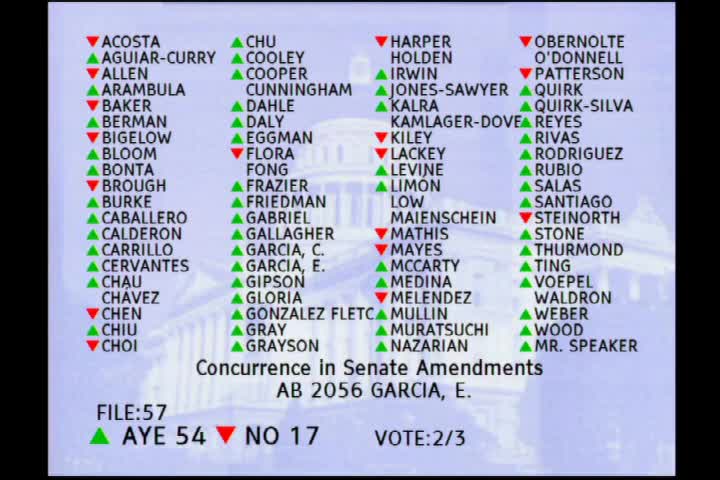 1MIN
Assembly Floor
 2MIN
Senate Floor
 1H
Senate Standing Committee on Appropriations
 2MIN
Assembly Floor
 3MIN
Assembly Standing Committee on Appropriations
 14MIN

