AB 2240: Trial Jury Selection and Management Act.
- Session Year: 2017-2018
- House: Assembly
- Latest Version Date: 2018-08-27
Existing law generally requires the jury commissioner to randomly select jurors to participate in voir dire. Existing law prohibits the selection of designated peace officers for voir dire in either criminal or both criminal and civil matters, as specified.
This bill would additionally prohibit the selection of designated parole and correctional officers for voir dire in criminal matters.
Existing law generally requires the jury commissioner to randomly select jurors to participate in voir dire. Existing law prohibits the selection of designated peace officers for voir dire in either criminal or both criminal and civil matters, as specified.
This bill would additionally prohibit the selection of designated parole and correctional officers for voir dire in both criminal and civil matters.
(a)Except as provided in subdivision (b), the jury commissioner shall randomly select jurors for jury panels to be sent to courtrooms for voir dire.
(b)(1)Notwithstanding subdivision (a), a peace officer, as defined in Section 830.1, subdivision (a) of Section 830.2, or subdivision (a) of Section 830.33 of the Penal Code, shall not be selected for voir dire in civil or criminal matters.
(2)Notwithstanding subdivision (a), a peace officer, as defined in subdivisions (b) or (c) of Section 830.2 or subdivision (a) or (b) of Section 830.5 of the Penal Code, shall not be selected for voir dire in criminal matters.
(a)Except as provided in subdivision (b), the jury commissioner shall randomly select jurors for jury panels to be sent to courtrooms for voir dire.
(b)(1)Notwithstanding subdivision (a), a peace officer, as defined in Section 830.1, subdivision (a) of Section 830.2, or subdivision (a) of Section 830.33, or subdivision (a) or (b) of Section 830.5 830.33 of the Penal Code, shall not be selected for voir dire in civil or criminal matters.
(2)Notwithstanding subdivision (a), a peace officer, as defined in subdivisions (b) or (c) of Section 830.2 or subdivision (a) or (b) of Section 830.5 of the Penal Code, shall not be selected for voir dire in criminal matters.
(a)Except as provided in subdivision (b), the jury commissioner shall randomly select jurors for jury panels to be sent to courtrooms for voir dire.
(b)(1)Notwithstanding subdivision (a), no a peace officer, as defined in Section 830.1, subdivision (a) of Section 830.2, and subdivision (a) of Section 830.33, or subdivision (a) or (b) of Section 830.5 of the Penal Code, shall not be selected for voir dire in civil or criminal matters.
(2)Notwithstanding subdivision (a), no a peace officer, as defined in subdivisions (b) and or (c) of Section 830.2 of the Penal Code, shall not be selected for voir dire in criminal matters.
|
Date
|
Status
|
|---|---|
| Sep 17, 2018 | Vetoed by Governor. |
| Aug 30, 2018 | Enrolled and presented to the Governor at 4:30 p.m. |
| Aug 24, 2018 | In Assembly. Ordered to Engrossing and Enrolling. |
| Aug 24, 2018 | Read third time. Passed. Ordered to the Assembly. |
| Jun 27, 2018 | Read second time. Ordered to third reading. |
| Jun 26, 2018 | From committee: Do pass. (Ayes 4. Noes 2.) (June 26). |
| Jun 13, 2018 | Referred to Com. on PUB. S. |
| Jun 4, 2018 | In Senate. Read first time. To Com. on RLS. for assignment. |
| May 31, 2018 | Read third time. Passed. Ordered to the Senate. |
| May 9, 2018 | Read second time. Ordered to third reading. |
| May 8, 2018 | From committee: Do pass. (Ayes 5. Noes 1.) (May 8). |
| Apr 24, 2018 | In committee: Set, first hearing. Held without recommendation. |
| Apr 10, 2018 | Re-referred to Com. on PUB. S. |
| Apr 9, 2018 | Read second time and amended. |
| Apr 5, 2018 | From committee: Amend, and do pass as amended and re-refer to Com. on PUB. S. (Ayes 8. Noes 1.) (April 3). |
| Mar 1, 2018 | Referred to Coms. on JUD. and PUB. S. |
| Feb 14, 2018 | From printer. May be heard in committee March 16. |
| Feb 13, 2018 | Read first time. To print. |
|
Date
|
Description
|
Location
|
Votes
|
|
|---|---|---|---|---|
| Aug 24, 2018 | Assembly 3rd Reading AB2240 Grayson By Galgiani | Senate Floor |
Passed |
|
| Jun 26, 2018 | Do pass | Senate Standing Committee on Public Safety |
Passed |
|
| May 31, 2018 | AB 2240 GRAYSON Assembly Third Reading | Assembly Floor |
Passed |
|
| May 8, 2018 | Do pass. | Assembly Standing Committee on Public Safety |
Passed |
|
| Apr 3, 2018 | Do pass as amended and be re-referred to the Committee on [Public Safety] | Assembly Standing Committee on Judiciary |
Passed |
This list shows positions taken on this bill by organizations on the date displayed, which is linked to the original source.
Positions by individuals are not included.
|
Organization
|
Position
|
Date
|
|---|---|---|
| Amador County | * Indeterminate | Apr 24, 2018 |
| Assembly Floor Vote: 59 - 7 | ** Against | Jun 25, 2018 |
| California Judges Association | ** Against | Jun 27, 2018 |
| California Judges Association; Judicial Council Of California | ** Against | Jun 25, 2018 |
| California Probation, Parole And Correctional Association | ** Support | May 7, 2018 |
| California Public Defenders Association | ** Support | Jun 27, 2018 |
| Californians for Safety and Justice | * Indeterminate | Jun 26, 2018 |
| Chief Probation Officers Of California | ** Support | Jun 27, 2018 |
| Judicial Council of California | ** Against | Jun 27, 2018 |
| Sacramento County Probation Association | * Support | Apr 24, 2018 |
| san francisco juvenile probation department | * Support | Jun 26, 2018 |
| State Coalition Of Probation Organizations | ** Support | Jun 27, 2018 |
| The Monterey County Superior Court | ** Against | Jun 27, 2018 |
GOVERNOR'S VETO
GV Bill Id:AB 2240
Author:(Grayson)
As Enrolled Ver:August 30, 2018
2/3 vote
Committee | Votes | Ayes | Noes |
Judiciary | 8-1 | Mark Stone, Chau, Chiu, Gonzalez Fletcher, Holden, Kalra, Maienschein, Reyes | Kiley |
Public Safety | 5-1 | Jones-Sawyer, Lackey, Carrillo, Kamlager-Dove, Santiago | Kiley |
ASSEMBLY: | 59-7 | (May 31, 2018) | SENATE: | 27-9 | (August 24, 2018) |
SUMMARY: Exempts probation, parole, correctional officers from jury service in criminal trials.
EXISTING LAW:
- Provides a right to a jury trial in felony and misdemeanor cases.
- States the policy of California is that all persons selected for jury service shall be selected at random from the population of the area served by the court; that all qualified persons have an equal opportunity to be considered for jury service in the State; that all qualified persons have an obligation to serve as jurors when summoned; and that it is the responsibility of jury commissioners to manage all jury systems in an efficient, equitable, and cost-effective manner.
- Provides that persons who are not residents of the jurisdiction where the trial is held are not eligible to be jurors.
- States that all persons selected for jury service shall be selected at random, from sources that include a representative cross section of the population of the area served by the court.
- States that no person shall be excluded from eligibility for jury service in California unless they:
- Are not citizens of the United States;
- Are under 18 years of age;
- Are not domiciliaries of the State of California, or residents of the jurisdiction wherein they are summoned to serve;
- Have been convicted of malfeasance in office or a felony, and whose civil rights have not been restored;
- Do not hold sufficient knowledge of the English language;
- Currently serve as a grand or trial juror in any court of this state; or
- Are currently in conservatorship.
- States that no eligible person shall be exempt from jury service as a trial juror by reason of occupation.
- Requires the jury commissioner to randomly select jurors for jury panels to be sent to courtrooms for voir dire.
- Excludes the following peace officers from random selection to be sent to courtrooms for voir dire civil and criminal matters:
- Any sheriff, undersheriff, or deputy sheriff employed in the capacity by a county government;
- Any chief of police, of a city, or a chief, a director, or a chief executive officer of a municipal public safety agency, and any police officer appointed by one of these individuals;
- Any police officers or port wardens employed by the San Diego Unified Port District Police or the Harbor District of the City of Los Angeles;
- Any marshal or deputy marshal of a superior court or county;
- The Attorney General of California;
- All special agents and investigators of the Department of Justice;
- Any chief, assistant chief, deputy chief, deputy director, and division director of the Department of Justice designated as a peace officer by the Attorney General;
- Any deputy sheriff from 32 counties, as specified, employed to perform duties related to custodial responsibilities at any county custodial facility;
- Any member of the Department of the Highway Patrol provided that their duty is the enforcement of the law or the protection of state officers, state properties, and the occupants of state properties; and,
- A member of the San Francisco Bay Area Rapid Transit District Police Department provided that their duty is the enforcement of the law in or about the property owned by the District.
- Excludes the following peace officers from random selection to be sent to courtrooms for voir dire in criminal matters:
- A member of the University of California Police Department provided that the officer is assigned to the enforcement of the law within one mile of a University of California campus or property owned and administered by the University of California; and
- A member of the California State University Police Department provided that the officer is assigned to the enforcement of the law within one mile of a California State University campus.
- Allows an eligible person to be excused from jury duty in cases of undue hardship, upon the person or the public, as defined by Judicial Council.
- Provides that it is an undue hardship for a prospective juror whose services are immediately needed for the protection of the public health and safety, if it is not feasible to make alternative arrangements to relieve the person of those responsibilities during the period of service as a juror without substantially reducing essential public services.
- Requires Judicial Council to adopt a rule of court, requiring the trial courts to establish procedures for jury service that gives peace officers scheduling accommodations when necessary.
FISCAL EFFECT: Unknown. This bill is keyed non-fiscal by the Legislative Counsel.
COMMENTS: According to the author, ''Recent state initiatives have the potential to increase California's probation and parole population. Our state also continues to manage a state prison population that is overcapacity, despite efforts to reduce the overall population. As a result, it is imperative that the Legislature revisit the jury exemption policy for probation, parole and correctional officers. These peace officers are responsible for critical public safety services that include, but are not limited to, supervising offenders on Post Release Community Supervision, Mandatory Supervision, probation, and parole as well as those serving time in state and local detention facilities. Pulling these officers away from their duties, even for the important civic act of serving on a jury, significantly impacts their respective agencies' ability to effectively manage supervision of those son probation, parole, or serving time in prison, as well as, in the case of correctional officers, ensuring the safety of prison personnel and the administration of rehabilitation programs.
''While current law allows scheduling accommodations for these peace officers, this process is a burdensome one that often results in the officers ultimately being excused from jury duty. In addition, probation, parole and correctional officers are in positions where the defendant in a criminal trial could potentially be under their jurisdiction in the future, which creates a public safety risk to these peace officers by requiring personal information to be shared. Though the concern about creating a slippery slope that will lead to the wholesale exemption of all sworn peace officers is understandable, and certainly not to goal of this bill, a policy that continues to treat peace officers whose jobs require them to supervise and rehabilitate those who are captured by the peace officers who are exempt from jury duty is inefficient and imbalanced.''
This bill would exempt probation, parole and correctional officers from jury service in criminal trials.
Jury service is a fundamental obligation of citizenship. I am not inclined to expand the list of those exempt simply because of their occupation.
Analysis Prepared by: Liah Burnley / PUB. S. / (916) 319-3744 FN: 0005270
Office of Senate Floor Analyses (916) 651-1520 Fax: (916) 327-4478 | AB |
THIRD READING
Bill No: AB 2240
:
SENATE PUBLIC SAFETY COMMITTEE: 4-2, 6/26/18
AYES: Skinner, Anderson, Stone, Wiener
NOES: Jackson, Mitchell
NO VOTE RECORDED: Bradford
ASSEMBLY FLOOR: 59-7, 5/31/18 - See last page for vote
SUBJECT: Trial Jury Selection and Management Act
SOURCE: Chief Probation Officers of California
DIGEST:
This bill exempts probation, parole, correctional officers from jury service in criminal trials.
Existing law:
- Provides a right to a jury trial in felony and misdemeanor cases. (Cal. Const., art I § 16.)
- States the policy of California is that all persons selected for jury service shall be selected at random from the population of the area served by the court; that all qualified persons have an equal opportunity to be considered for jury service in the state; that all qualified persons have an obligation to serve as jurors when summoned; and that it is the responsibility of jury commissioners to manage all jury systems in an efficient, equitable, and cost-effective manner. (Code Civil Procedure (CCP) § 191.)
- Provides that persons who are not residents of the jurisdiction where the trial is held are not eligible to be jurors. (Civil Code § 203 (a)(4).)
- States that all persons selected for jury service shall be selected at random, from sources that include a representative cross section of the population of the area served by the court. (CCP § 197.)
- States that no person shall be excluded from eligibility for jury service in California unless they:
- Are not citizens of the United States;
- Are under 18 years of age;
- Are not domiciliaries of the State of California, or residents of the jurisdiction wherein they are summoned to serve;
- Have been convicted of malfeasance in office or a felony, and whose civil rights have not been restored;
- Do not hold sufficient knowledge of the English language;
- Currently serve as a grand or trial juror in any court of this state; or
- Are currently in conservatorship. (CCP § 203.)
- States that no eligible person shall be exempt from jury service as a trial juror by reason of occupation. (CCP § 204 subd. (b).)
- Requires the jury commissioner to randomly select jurors for jury panels to be sent to courtrooms for voir dire. (CCP § 219 (a).)
- Excludes the following peace officers from random selection to be sent to courtrooms for voir dire civil and criminal matters:
- Any sheriff, undersheriff, or deputy sheriff employed in the capacity by a county government;
- Any chief of police, of a city, or a chief, a director, or a chief executive officer of a municipal public safety agency, and any police officer appointed by one of these individuals;
- Any police officers or port wardens employed by the San Diego Unified Port District Police or the Harbor District of the City of Los Angeles;
- Any marshal or deputy marshal of a superior court or county;
- The Attorney General of California;
- All special agents and investigators of the Department of Justice;
- Any chief, assistant chief, deputy chief, deputy director, and division director of the Department of Justice designated as a peace officer by the Attorney General;
- Any deputy sheriff from 32 counties, as specified, employed to perform duties related to custodial responsibilities at any county custodial facility;
- Any member of the Department of the Highway Patrol provided that their duty is the enforcement of the law or the protection of state officers, state properties, and the occupants of state properties; and,
- A member of the San Francisco Bay Area Rapid Transit District Police Department provided that their duty is the enforcement of the law in or about the property owned by the District. (CCP § 219 (b)(1).)
- Excludes the following peace officers from random selection to be sent to courtrooms for voir dire in criminal matters:
- A member of the University of California Police Department provided that the officer is assigned to the enforcement of the law within one mile of a University of California campus or property owned and administered by the University of California; and
- A member of the California State University Police Department provided that the officer is assigned to the enforcement of the law within one mile of a California State University campus. (CCP § 219 (b)(2).)
- Allows an eligible person to be excused from jury duty in cases of undue hardship, upon the person or the public, as defined by Judicial Council. (CCP § 204 (b).)
- Provides that it is an undue hardship for a prospective juror whose services are immediately needed for the protection of the public health and safety, if it is not feasible to make alternative arrangements to relieve the person of those responsibilities during the period of service as a juror without substantially reducing essential public services. (California Rule of Court 2.1008 (d)(6).)
- Requires Judicial Council to adopt a rule of court, requiring the trial courts to establish procedures for jury service that gives peace officers scheduling accommodations when necessary. (CCP § 219.5.)
This bill prohibits parole officers and probation officers from being selected for voir dire in a criminal matter.
Background
Jury Service Exemptions
Prior to the 1980's, jury service exemptions were provided for legislators, congressmen, military personnel, peace officers, local office holders, attorneys, clergy, teachers, doctors, dentists, merchant seamen, telephone and telegraph operators, firefighters, and railroad employees. However, because those exemptions limited the available jury pool, the Legislature subsequently repealed jury service exemptions. The view of the Legislature at that time was that adding specific exemptions for jury service was a "slippery slope," especially considering the difficulties in having members of the public serve the court.
However, the Legislature has reinstated the existing exemptions for certain peace officers. The rationale for re-establishing these jury service exemptions was that these particular peace officers perform critical public safety functions and are constantly needed on the job to protect the public. It was not as the sponsor alleges because there was an “inherent danger that police officers and deputy sheriffs are exposed to through their interactions with potential criminals.” Many law enforcement peace officers, including those who work for the Departments of Fish and Game, Parks and Recreation, Forestry and Fire Protection, Alcoholic Beverages, Motor Vehicles, and State Fire Marshals, as well as the community college and school district police departments, are still not exempt from jury duty.
In the early 1990's, the Legislature recommenced the creation of new "carve outs" from jury service for specified peace officers. An exemption for specified peace officers and California Highway Patrol officers from civil and criminal matters was created in 1992 and an exemption for University of California police officers and members of the Department of Corrections Law Enforcement Liaison Unit was added in 1994. In 2001, SB 303 (Torlakson, Chapter 55, Statutes of 2001) created a new public safety officer "carve out" that exempts San Francisco Bay Area Rapid Transit District police from jury service in both civil and criminal matters. In 2002, AB 1970 (Mathews) attempted to add probation and parole officers to the jury duty exemptions and it was never heard in Senate Public Safety Committee after it was clear it would not have the votes.
Exemption from Criminal Trials
This bill exempts parole and probation officers from criminal trials only. Since jury pools are not called separately for criminal or civil trials, this bill should not keep a parole or probation officer from showing up for a jury.
The sponsor argues that “as an arm of the court, probation officers have pre-conviction responsibilities such as operating pretrial programs and conduction risk assessments as well as preparing probation reports and making recommendations to the bench on suitability and eligibility for probation which may involve interviewing the defendant and witnesses and reviewing information on the circumstances of the offense.” While this is true, a probation officer who worked on a particular case or had contact with the defendant or witnesses would be immediately dismissed for cause just as any juror would. A probation officer may also not live in the jurisdiction in which he or she serves so thus may not have professional contact with a defendant in the jurisdiction in which he or she works. In addition others, including attorneys, spouses of attorneys, judges, social workers etc., may have contact with the attorneys involved or the judge or may come in contact with the case during the trial or appellate phase and they still have to appear for jury duty. In fact when he was Chief Justice, Ronald George showed up for jury duty as do many lower court judges throughout the state. (http://articles.latimes.com/2003/may/16/local/me-onthelaw16)
FISCAL EFFECT: Appropriation: Fiscal Com.: Local:
Chief Probation Officers of California (source)
California Public Defenders Association
State Coalition of Probation Organizations
OPPOSITION: (Verified 6/27/18)
California Judges Association
Judicial Council of California
The Monterey County Superior Court
ARGUMENT IN SUPPORT: The Chief Probation Officers of California support this bill stating:
As an arm of the court, probation officers have pre-conviction responsibilities such as operating pretrial programs and conduction risk assessments as well as preparing probation reports and making recommendations to the bench on suitability and eligibility for probation which may involve interviewing the defendant and witnesses and reviewing information on the circumstances of the offense.
Further, probation officers also have significant post-conviction responsibilities including supervision and programming of persons on probation, mandatory supervision and PRCS. The role probation plays at multiple parts of the system puts officers in a position where the defendant in a criminal trial could potentially be under their department’s jurisdiction, creating an inherent conflict of interest.
ARGUMENT IN OPPOSITION: According to the California Judges Association (CJA):
CJA’s opposition to AB 2240 is consistent with its historical rejection of expanded exemptions from jury service. Many courts already struggle with the challenges of not having enough jurors available for prospective jury service. Further exemptions increase the burden not only on courts, but on the remaining citizens expected to serve. This is particularly true in smaller counties.
AB 2240 seeks to expand categorical exemptions to jury service. Amendments limited those proposed exemptions to criminal matters, thereby further complicating the jury administration process. Proponents assert than this exemption is needed for public safety and privacy purposes. Respectfully, this just isn’t the case: any prospective juror can request, and judges grant, private conversations about their reasons they are unable to serve. Further, it seems that corrections can appropriately manage caseloads to avoid the rare conflict of an officer who has served on a jury to prevent later supervision of that defendant.
Existing law and the voir dire process provide adequate opportunity for excuse when needed. Creating further categorical exemptions harms the diversity of the jury pool and increases the burden on the remaining prospective-juror community.
Jury service is a necessary part of our democracy, not an inconvenient impediment to our days. For these reasons, the California Judges Association opposes AB 2240 and respectfully requests your NO vote.
ASSEMBLY FLOOR: 59-7, 5/31/18
AYES: Acosta, Arambula, Baker, Berman, Bigelow, Bloom, Bonta, Burke, Caballero, Calderon, Carrillo, Cervantes, Chau, Chávez, Chen, Chiu, Choi, Chu, Cooley, Cooper, Cunningham, Dahle, Daly, Eggman, Friedman, Gallagher, Eduardo Garcia, Gipson, Gloria, Gonzalez Fletcher, Gray, Grayson, Holden, Irwin, Jones-Sawyer, Kalra, Lackey, Levine, Low, Maienschein, Mathis, McCarty, Medina, Melendez, Mullin, O'Donnell, Quirk-Silva, Rodriguez, Rubio, Salas, Santiago, Steinorth, Mark Stone, Thurmond, Ting, Waldron, Weber, Wood, Rendon
NOES: Travis Allen, Brough, Harper, Kiley, Muratsuchi, Obernolte, Patterson
NO VOTE RECORDED: Aguiar-Curry, Flora, Fong, Frazier, Cristina Garcia, Kamlager-Dove, Limón, Mayes, Nazarian, Quirk, Reyes, Voepel
Prepared by: Mary Kennedy / PUB. S. /
6/27/18 15:09:32
**** END ****
SENATE COMMITTEE ON PUBLIC SAFETY
Senator Nancy Skinner, Chair
2017 - 2018 Regular
Bill No: AB 2240 Hearing Date: June 26, 2018
Author: | Grayson | ||
Version: | April 9, 2018 | ||
Urgency: | No | Fiscal: | No |
Consultant: | MK | ||
Subject: Trial Jury Selection and Management Act
HISTORY
Source: Chief Probation Officers of California
Prior Legislation: SB 1133 (Anderson) Failed Senate Judiciary 2014 (Fish and Game officers)
AB 1708 (Alejo) not heard Senate Public Safety 2014(parole officers, CDCR officers, state hospital officers etc.)
AB 1993 (Nakanishi) not heard Senate Judiciary 2005-06 (nurses)
AB 270 (Bates) Failed Senate Public Safety 2003(harbor and port police)
AB 1978 (Haynes) Failed Assembly Judiciary 2003 (single parents)
AB 2253 (Mountjoy) Failed Assembly Judiciary 2004 (75 years or older)
AB 2271 (Parra) Failed Senate Public Safety 2004 (CDCR officers
AB 1660 (Negrete McLeod) Failed Assembly Judiciary 2002
AB 1970 (Matthews) - not heard in Senate 2001-02 (Parole, Probation
and Correctional officers)
AB 303 (Torlakson) Chapter 55, Stats. 2001 (Bart officers)
AB 1814 (Lempert) - Chapter 266, Stats. 2000 (Breastfeeding moms)
SB 801 (Poochigian) Failed Senate Judiciary 1999 (Judges)
AB 2608 (Wildman) - held Senate Approps. 1997-98 (Firefighters)
AB 316 (Morrissey) - held Senate Judiciary 1997-98 (LA County Park
Rangers, Safety Police and Security Officers)
SB 2066 (Rogers) - Chapter 742, Stats. 1994 (UC and CSU Police)
AB 2577 (Wright) - Chapter 324, Stats. 1992 (Peace Officers and CHP)
Support: California Public Defenders Association; State Coalition of Probation Organizations
Opposition: California Judges Association; Judicial Council of California
Assembly Floor Vote: 59 - 7
PURPOSE
The purpose of this bill is to exempt probation, parole, correctional officers from jury service in criminal trials.
Existing law provides a right to a jury trial in felony and misdemeanor cases. (Cal. Const., art I § 16.)
Existing law states the policy of California is that all persons selected for jury service shall be selected at random from the population of the area served by the court; that all qualified persons have an equal opportunity to be considered for jury service in the State; that all qualified persons have an obligation to serve as jurors when summoned; and that it is the responsibility of jury commissioners to manage all jury systems in an efficient, equitable, and cost-effective manner. (Code Civil Procedure (CCP) § 191.)
Existing law provides that persons who are not residents of the jurisdiction where the trial is held are not eligible to be jurors. (Civil Code § 203 (a)(4).)
Existing law states that all persons selected for jury service shall be selected at random, from sources that include a representative cross section of the population of the area served by the court. (CCP § 197.)
Existing law states that no person shall be excluded from eligibility for jury service in California unless they:
- Are not citizens of the United States;
- Are under 18 years of age;
- Are not domiciliaries of the State of California, or residents of the jurisdiction wherein they are summoned to serve;
- Have been convicted of malfeasance in office or a felony, and whose civil rights have not been restored;
- Do not hold sufficient knowledge of the English language;
- Currently serve as a grand or trial juror in any court of this state; or
- Are currently in conservatorship. (CCP § 203.)
Existing law states that no eligible person shall be exempt from jury service as a trial juror by reason of occupation. (CCP § 204 subd. (b).)
Existing law requires the jury commissioner to randomly select jurors for jury panels to be sent to courtrooms for voir dire. (CCP § 219 (a).)
Existing law excludes the following peace officers from random selection to be sent to courtrooms for voir dire civil and criminal matters:
- Any sheriff, undersheriff, or deputy sheriff employed in the capacity by a county government;
- Any chief of police, of a city, or a chief, a director, or a chief executive officer of a municipal public safety agency, and any police officer appointed by one of these individuals;
- Any police officers or port wardens employed by the San Diego Unified Port District Police or the Harbor District of the City of Los Angeles;
- Any marshal or deputy marshal of a superior court or county;
- The Attorney General of California;
- All special agents and investigators of the Department of Justice;
- Any chief, assistant chief, deputy chief, deputy director, and division director of the Department of Justice designated as a peace officer by the Attorney General;
- Any deputy sheriff from 32 counties, as specified, employed to perform duties related to custodial responsibilities at any county custodial facility;
- Any member of the Department of the Highway Patrol provided that their duty is the enforcement of the law or the protection of state officers, state properties, and the occupants of state properties; and,
- A member of the San Francisco Bay Area Rapid Transit District Police Department provided that their duty is the enforcement of the law in or about the property owned by the District. (CCP § 219 (b)(1).)
Existing law excludes the following peace officers from random selection to be sent to courtrooms for voir dire in criminal matters:
- A member of the University of California Police Department provided that the officer is assigned to the enforcement of the law within one mile of a University of California campus or property owned and administered by the University of California; and
- A member of the California State University Police Department provided that the officer is assigned to the enforcement of the law within one mile of a California State University campus. (CCP § 219 (b)(2).)
Existing law allows an eligible person to be excused from jury duty in cases of undue hardship, upon the person or the public, as defined by Judicial Council. (CCP § 204 (b).)
Existing law provides that it is an undue hardship for a prospective juror whose services are immediately needed for the protection of the public health and safety, if it is not feasible to make alternative arrangements to relieve the person of those responsibilities during the period of service as a juror without substantially reducing essential public services. (California Rule of Court 2.1008 (d)(6).)
Existing law requires Judicial Council to adopt a rule of court, requiring the trial courts to establish procedures for jury service that gives peace officers scheduling accommodations when necessary. (CCP § 219.5.)
This bill would prohibit parole officers and probation officers from being selected for voir dire in a criminal matter.
COMMENTS
1. Need for This Bill
According to the author:
Currently sheriffs, police, CHP, San Francisco BART police, and UC and CSU police are exempted from jury duty, due to the role they have in pretrial responsibilities. AB 2240 would similarly exempt probation officers from jury duty in criminal matters.
As an arm of the court, probation officers have pre-conviction responsibilities such as operating pretrial programs and conducting risk assessments, as well as preparing probation reports and making recommendations to the bench on suitability and eligibility for probation, which may involve interviewing the defendant and witnesses, and reviewing information on the circumstances of the offense.
Probation officers also have significant post-conviction responsibilities including supervision and programming of approximately 350,000 persons on probation, mandatory supervision, PRCS, as well as administering the operation and programming of juvenile halls and serving youth in the community. As of 2016, there are approximately 39,000 youth at varying levels of the county probation system. The role probation plays at multiple parts of the system puts officers in a position where the defendant in a criminal trial could potentially be under their department’s jurisdiction, creating an inherent conflict of interest.
Furthermore, recently there have been instances where a mistrial has been sought due to having a probation officer empaneled in criminal trials.
AB 2240 recognizes the role of probation officers in the adult and juvenile justice systems, both from a pre-conviction and post-conviction perspective, and ensures that officers can continue to best serve the needs of those under care and supervision.
2. Jury Service Exemptions
Prior to the 1980's, jury service exemptions were provided for legislators, congressmen, military personnel, peace officers, local office holders, attorneys, clergy, teachers, doctors, dentists, merchant seamen, telephone and telegraph operators, firefighters, and railroad employees. However, because those exemptions limited the available jury pool, the Legislature subsequently repealed jury service exemptions. The view of the Legislature at that time was that adding specific exemptions for jury service was a "slippery slope," especially considering the difficulties in having members of the public serve the court.
However, the Legislature has reinstated the existing exemptions for certain peace officers. The rationale for re-establishing these jury service exemptions was that these particular peace officers perform critical public safety functions and are constantly needed on the job to protect the public. It was not as the sponsor alleges because there was an “inherent danger that police officers and deputy sheriffs are exposed to through their interactions with potential criminals.” Many law enforcement peace officers, including those who work for the Departments of Fish and Game, Parks and Recreation, Forestry and Fire Protection, Alcoholic Beverages, Motor Vehicles, and State Fire Marshals, as well as the community college and school district police departments, are still not exempt from jury duty.
In the early 1990's, the Legislature recommenced the creation of new "carve outs" from jury service for specified peace officers. An exemption for specified peace officers and CHP officers from civil and criminal matters was created in 1992 and an exemption for University of California police officers and members of the Department of Corrections Law Enforcement Liaison Unit was added in 1994. In 2001, SB 303 (Torlakson), Chapter 55, Statutes of 2001, created a new public safety officer "carve out" that exempts San Francisco Bay Area Rapid Transit District police from jury service in both civil and criminal matters. In 2002, AB 1970 (Mathews) attempted to add probation and parole officers to the jury duty exemptions and it was never heard in Senate Public Safety after it was clear it would not have the votes.
3. Exemption from criminal trials
This bill would exempt parole and probation officers from criminal trials only. Since jury pools are not called separately for criminal or civil trials this bill should not keep a parole or probation officer from showing up for a jury.
The sponsor argues that “as an arm of the court, probation officers have pre-conviction responsibilities such as operating pretrial programs and conduction risk assessments as well as preparing probation reports and making recommendations to the bench on suitability and eligibility for probation which may involve interviewing the defendant and witnesses and reviewing information on the circumstances of the offense.” While this is true, a probation officer who worked on a particular case or had contact with the defendant or witnesses would be immediately dismissed for cause just as any juror would. A probation officer may also not live in the jurisdiction in which he or she serves so thus may not have professional contact with a defendant in the jurisdiction in which he or she works. In addition others, including attorneys, spouses of attorneys, judges, social workers etc. may have contacts with the attorneys involved or the judge or may come in contact with the case during the trial or appellate phase and they still have to appear for jury duty. In fact when he was Chief Justice, Ronald George showed up for jury duty as do many lower court judges throughout the state. (http://articles.latimes.com/2003/may/16/local/me-onthelaw16)
4. Argument in Support
The Chief Probation Officers support this bill stating:
As an arm of the court, probation officers have pre-conviction responsibilities such as operating pretrial programs and conduction risk assessments as well as preparing probation reports and making recommendations to the bench on suitability and eligibility for probation which may involve interviewing the defendant and witnesses and reviewing information on the circumstances of the offense.
Further, probation officers also have significant post-conviction responsibilities including supervision and programming of persons on probation, mandatory supervision and PRCS. The role probation plays at multiple parts of the system puts officers in a position where the defendant in a criminal trial could potentially be under their department’s jurisdiction, creating an inherent conflict of interest.
5. Argument in Opposition
According to the California Judges Association:
CJA’s opposition to AB 2240 is consistent with its historical rejection of expanded exemptions from jury service. Many courts already struggle with the challenges of not having enough jurors available for prospective jury service. Further exemptions increase the burden not only on courts, but on the remaining citizens expected to serve. This is particularly true in smaller counties.
AB 2240 seeks to expand categorical exemptions to jury service. Amendments limited those proposed exemptions to criminal matters, thereby further complicating the jury administration process. Proponents assert than this exemption is needed for public safety and privacy purposes. Respectfully, this just isn’t the case: any prospective juror can request, and judges grant, private conversations about their reasons they are unable to serve. Further, it seems that corrections can appropriately manage caseloads to avoid the rare conflict of an officer who has served on a jury to prevent later supervision of that defendant.
Existing law and the voir dire process provide adequate opportunity for excuse when needed. Creating further categorical exemptions harms the diversity of the jury pool and increases the burden on the remaining prospective-juror community.
Jury service is a necessary part of our democracy, not an inconvenient impediment to our days. For these reasons, the California Judges Association opposes AB 2240 and respectfully requests your NO vote.
-- END –
ASSEMBLY THIRD READING
ATR Bill Id:AB 2240
Author:(Grayson)
As Amended Ver:April 9, 2018
Majority vote
Committee | Votes | Ayes | Noes |
Judiciary | 8-1 | Mark Stone, Chau, Chiu, Gonzalez Fletcher, Holden, Kalra, Maienschein, Reyes | Kiley |
Public Safety | 5-1 | Jones-Sawyer, Lackey, Carrillo, Kamlager-Dove, Santiago | Kiley |
SUMMARY: Exempts probation, parole, correctional officers from jury service in criminal trials.
EXISTING LAW:
- Provides a right to a jury trial in felony and misdemeanor cases.
- States the policy of California is that all persons selected for jury service shall be selected at random from the population of the area served by the court; that all qualified persons have an equal opportunity to be considered for jury service in the State; that all qualified persons have an obligation to serve as jurors when summoned; and that it is the responsibility of jury commissioners to manage all jury systems in an efficient, equitable, and cost-effective manner.
- Provides that persons who are not residents of the jurisdiction where the trial is held are not eligible to be jurors.
- States that all persons selected for jury service shall be selected at random, from sources that include a representative cross section of the population of the area served by the court.
- States that no person shall be excluded from eligibility for jury service in California unless they:
- Are not citizens of the United States;
- Are under 18 years of age;
- Are not domiciliaries of the State of California, or residents of the jurisdiction wherein they are summoned to serve;
- Have been convicted of malfeasance in office or a felony, and whose civil rights have not been restored;
- Do not hold sufficient knowledge of the English language;
- Currently serve as a grand or trial juror in any court of this state; or
- Are currently in conservatorship.
- States that no eligible person shall be exempt from jury service as a trial juror by reason of occupation.
- Requires the jury commissioner to randomly select jurors for jury panels to be sent to courtrooms for voir dire.
- Excludes the following peace officers from random selection to be sent to courtrooms for voir dire civil and criminal matters:
- Any sheriff, undersheriff, or deputy sheriff employed in the capacity by a county government;
- Any chief of police, of a city, or a chief, a director, or a chief executive officer of a municipal public safety agency, and any police officer appointed by one of these individuals;
- Any police officers or port wardens employed by the San Diego Unified Port District Police or the Harbor District of the City of Los Angeles;
- Any marshal or deputy marshal of a superior court or county;
- The Attorney General of California;
- All special agents and investigators of the Department of Justice;
- Any chief, assistant chief, deputy chief, deputy director, and division director of the Department of Justice designated as a peace officer by the Attorney General;
- Any deputy sheriff from 32 counties, as specified, employed to perform duties related to custodial responsibilities at any county custodial facility;
- Any member of the Department of the Highway Patrol provided that their duty is the enforcement of the law or the protection of state officers, state properties, and the occupants of state properties; and,
- A member of the San Francisco Bay Area Rapid Transit District Police Department provided that their duty is the enforcement of the law in or about the property owned by the District.
- Excludes the following peace officers from random selection to be sent to courtrooms for voir dire in criminal matters:
- A member of the University of California Police Department provided that the officer is assigned to the enforcement of the law within one mile of a University of California campus or property owned and administered by the University of California; and
- A member of the California State University Police Department provided that the officer is assigned to the enforcement of the law within one mile of a California State University campus.
- Allows an eligible person to be excused from jury duty in cases of undue hardship, upon the person or the public, as defined by Judicial Council.
- Provides that it is an undue hardship for a prospective juror whose services are immediately needed for the protection of the public health and safety, if it is not feasible to make alternative arrangements to relieve the person of those responsibilities during the period of service as a juror without substantially reducing essential public services.
- Requires Judicial Council to adopt a rule of court, requiring the trial courts to establish procedures for jury service that gives peace officers scheduling accommodations when necessary.
FISCAL EFFECT: Unknown. This bill is keyed non-fiscal by the Legislative Counsel.
COMMENTS: According to the author, ''Recent state initiatives have the potential to increase California's probation and parole population. Our state also continues to manage a state prison population that is overcapacity, despite efforts to reduce the overall population. As a result, it is imperative that the Legislature revisit the jury exemption policy for probation, parole and correctional officers. These peace officers are responsible for critical public safety services that include, but are not limited to, supervising offenders on Post Release Community Supervision, Mandatory Supervision, probation, and parole as well as those serving time in state and local detention facilities. Pulling these officers away from their duties, even for the important civic act of serving on a jury, significantly impacts their respective agencies' ability to effectively manage supervision of those son probation, parole, or serving time in prison, as well as, in the case of correctional officers, ensuring the safety of prison personnel and the administration of rehabilitation programs.
''While current law allows scheduling accommodations for these peace officers, this process is a burdensome one that often results in the officers ultimately being excused from jury duty. In addition, probation, parole and correctional officers are in positions where the defendant in a criminal trial could potentially be under their jurisdiction in the future, which creates a public safety risk to these peace officers by requiring personal information to be shared. Though the concern about creating a slippery slope that will lead to the wholesale exemption of all sworn peace officers is understandable, and certainly not to goal of this bill, a policy that continues to treat peace officers whose jobs require them to supervise and rehabilitate those who are captured by the peace officers who are exempt from jury duty is inefficient and imbalanced.''
Analysis Prepared by: Liah Burnley / PUB. S. / (916) 319-3744 FN: 0002809
Date of Hearing: May 8, 2018
Counsel: Liah Burnley
ASSEMBLY COMMITTEE ON
Reginald Byron Jones-Sawyer, Sr., Chair
ABPCA Bill Id:
Author:() – As Ver:
VOTE ONLY
SUMMARY: Exempts probation, parole, correctional officers from jury service in criminal trials.
EXISTING LAW:
- Provides a right to a jury trial in felony and misdemeanor cases. (Cal. Const., art I § 16.)
- States the policy of California is that all persons selected for jury service shall be selected at random from the population of the area served by the court; that all qualified persons have an equal opportunity to be considered for jury service in the State; that all qualified persons have an obligation to serve as jurors when summoned; and that it is the responsibility of jury commissioners to manage all jury systems in an efficient, equitable, and cost-effective manner. (Code Civ. Proc., § 191.)
- Provides that persons who are not residents of the jurisdiction where the trial is held are not eligible to be jurors. (Civ. Code, § 203, subd. (a)(4).)
- States that all persons selected for jury service shall be selected at random, from sources that include a representative cross section of the population of the area served by the court. (Code Civ. Proc., § 197.)
- States that no person shall be excluded from eligibility for jury service in California unless they:
- Are not citizens of the United States;
- Are under 18 years of age;
- Are not domiciliaries of the State of California, or residents of the jurisdiction wherein they are summoned to serve;
- Have been convicted of malfeasance in office or a felony, and whose civil rights have not been restored;
- Do not hold sufficient knowledge of the English language;
- Currently serve as a grand or trial juror in any court of this state; or
- Are currently in conservatorship. (Code Civ. Proc., § 203.)
- Are not citizens of the United States;
- States that no eligible person shall be exempt from jury service as a trial juror by reason of occupation. (Code Civ. Proc., § 204 subd. (b).)
- Requires the jury commissioner to randomly select jurors for jury panels to be sent to courtrooms for voir dire. (Code Civ. Proc., § 219 subd. (a).)
- Excludes the following peace officers from random selection to be sent to courtrooms for voir dire civil and criminal matters:
- Any sheriff, undersheriff, or deputy sheriff employed in the capacity by a county government;
- Any chief of police, of a city, or a chief, a director, or a chief executive officer of a municipal public safety agency, and any police officer appointed by one of these individuals;
- Any police officers or port wardens employed by the San Diego Unified Port District Police or the Harbor District of the City of Los Angeles;
- Any marshal or deputy marshal of a superior court or county;
- The Attorney General of California;
- All special agents and investigators of the Department of Justice;
- Any chief, assistant chief, deputy chief, deputy director, and division director of the Department of Justice designated as a peace officer by the Attorney General;
- Any deputy sheriff from 32 counties, as specified, employed to perform duties related to custodial responsibilities at any county custodial facility;
- Any member of the Department of the Highway Patrol provided that their duty is the enforcement of the law or the protection of state officers, state properties, and the occupants of state properties; and,
- A member of the San Francisco Bay Area Rapid Transit District Police Department provided that their duty is the enforcement of the law in or about the property owned by the District. (Code Civ. Proc., § 219 subd. (b)(1).)
- Any sheriff, undersheriff, or deputy sheriff employed in the capacity by a county government;
- Excludes the following peace officers from random selection to be sent to courtrooms for voir dire in criminal matters:
- A member of the University of California Police Department provided that the officer is assigned to the enforcement of the law within one mile of a University of California campus or property owned and administered by the University of California; and
- A member of the California State University Police Department provided that the officer is assigned to the enforcement of the law within one mile of a California State University campus. (Code Civ. Proc., § 219 subd. (b)(2).)
- A member of the University of California Police Department provided that the officer is assigned to the enforcement of the law within one mile of a University of California campus or property owned and administered by the University of California; and
- Allows an eligible person to be excused from jury duty in cases of undue hardship, upon the person or the public, as defined by Judicial Council. (Code Civ. Proc., § 204 subd. (b).)
- Provides that it is an undue hardship for a prospective juror whose services are immediately needed for the protection of the public health and safety, if it is not feasible to make alternative arrangements to relieve the person of those responsibilities during the period of service as a juror without substantially reducing essential public services. (California Rule of Court 2.1008 subd. (d)(6).)
- Requires Judicial Council to adopt a rule of court, requiring the trial courts to establish procedures for jury service that gives peace officers scheduling accommodations when necessary. (Code Civ. Proc., § 219.5.)
FISCAL EFFECT:
Unknown
COMMENTS:
- Author’s Statement: According to the author, “Recent state initiatives have the potential to increase California’s probation and parole population. Our state also continues to manage a state prison population that is overcapacity, despite efforts to reduce the overall population. As a result, it is imperative that the Legislature revisit the jury exemption policy for probation, parole and correctional officers. These peace officers are responsible for critical public safety services that include, but are not limited to, supervising offenders on Post Release Community Supervision, Mandatory Supervision, probation, and parole as well as those serving time in state and local detention facilities. Pulling these officers away from their duties, even for the important civic act of serving on a jury, significantly impacts their respective agencies’ ability to effectively manage supervision of those son probation, parole, or serving time in prison, as well as, in the case of correctional officers, ensuring the safety of prison personnel and the administration of rehabilitation programs.
“While current law allows scheduling accommodations for these peace officers, this process is a burdensome one that often results in the officers ultimately being excused from jury duty. In addition, probation, parole and correctional officers are in positions where the defendant in a criminal trial could potentially be under their jurisdiction in the future, which creates a public safety risk to these peace officers by requiring personal information to be shared. Though the concern about creating a slippery slope that will lead to the wholesale exemption of all sworn peace officers is understandable, and certainly not to goal of this bill, a policy that continues to treat peace officers whose jobs require them to supervise and rehabilitate those who are captured by the peace officers who are exempt from jury duty is inefficient and imbalanced.”
- Potential Conflicts, Bias, and Impartiality: Both the U.S. and state constitution guarantee defendants accused of a crime the right to a trial by unbiased, impartial jurors. [1] (U.S. Const., 6th and 14th Amends.; Cal. Const., art. I, section 16; Irvin v. Dowd (1961) 366 U.S. 717, 722; In re Hitchings (1993) 6 Cal.4th 97, 110.) An impartial juror is someone capable and willing to decide the case solely on the evidence presented at trial. (Smith v. Phillips (1982) 455 U.S. 209, 217.) A sitting juror’s bias renders him unable to perform his duty and thus the juror could be challenged for cause and subject to discharge and substitution. (People v. Keenan (1988) 46 Cal.3d 478, 532; People v. Lomax (2010) 49 Cal.4th 530, 589.)
Whether a juror is impartial is discovered through the voir dire process. During voir dire the parties (and sometimes the judge) ask questions of prospective jurors in order to learn information about them. The most common and most important questions asked during voir dire is whether the prospective juror knows any of the people associated with the case, including the parties, their witnesses, the attorneys, the judge, and the court staff. Concerns about peace officer confidentiality during voir dire are inapposite—the parties should not ask for confidential information such as a juror’s home address, telephone number, social security number, or driver’s license number. Potential jurors are also informed that, if a question calls for information they wish to keep confidential, they should not answer the question but speak to the trial judge and attorneys privately. (Bellas v. Superior Court (2000) 85 CA4th 636, 639.)
The Judiciary Committee’s analysis of this bill asserts that “post-conviction peace officers in the criminal justice process does raise potential conflict concerns,” thus the categorical exemption for certain peace officers from voir dire in criminal matters may be justified. (Assem. Jud. Com., analysis of AB No. 2240 (2017*2018 Reg. Sess.) As Introduced Feb. 13, 2018 at p. 7.) “The parole and probation officers may wind up supervising a defendant, writing sentencing recommendations, or may have preexisting knowledge of prior offenses committed by a repeat offender who may be a defendant or a witness.” (Id.) As such, this bill has been amended to exempt corrections, probation, and parole officers from jury duty in criminal matters—they may still serve in civil trials.
However, the same impartiality and conflict concerns do indeed arise in civil cases. For example, court dockets are overflowing with civil actions filed by state and local inmates, former inmates, and parolees alleging challenges to their conditions of confinement and supervision against officers and correctional institutions under state and federal law. These lawsuits often allege systematic or isolated instances of excessive use of force, wrongful death, deliberate indifference, negligence, retaliation, and other civil rights violations on the inmate by an officer. In these cases, correctional officers, probation officers, and parole officers selected for jury duty could still end up supervising the plaintiff, and could have preexisting knowledge of prior offenses committed by a repeat offender who may be a plaintiff or a witness, and could be more favorable to the defendants and defendants’ witnesses. In both criminal and civil cases, these potential conflicts should be exposed during voir dire, and the officer could be dismissed via a preemptory challenge, or by a judge or either party for cause. Also, the fact that parties have a limited number of preemptory challenges, as highlighted by the Judiciary analysis, is immaterial because if either party believed that such a problem existed, in a civil or criminal trial, they could properly ask the judge to “dismiss the juror for cause,” Unlike preemptory challenges, for cause dismissals are unlimited because of the parties’ right to an impartial jury.
Moreover, the potential for conflict does not justify a categorical exemption because probation officers, corrections officials, and parole officers, are tasked with supervising the defendant after the conviction, unlike sheriffs, highway patrol, and police who necessarily have pretrial responsibilities. One caveat—probation officers are responsible for conducting a pre-sentence investigations and reports. (See Pen. Code, § 1203.) Given this interaction with the court, there could indeed be a potential for a conflict, depending on particular facts and circumstances of the case. Still, there is not much cause for concern— a probation officer assigned to a particular defendant’s case simply cannot be an empaneled member of that defendant’s jury and also provide a pre-sentence investigation and report, meet with, or even talk to the defendant during trial and sentencing. This information would be discovered by the parties during voir dire, would be known to the judge, and the officer would necessarily be dismissed for cause. To impanel a probation officer who is actively involved in the case would be such a glaring injustice that it would entitle the defendant to a new trial. “Because a defendant charged with a crime has a right to the unanimous verdict of 12 impartial jurors, it is settled that a conviction cannot stand if even a single juror has been improperly influenced.” (People v. Holloway (1990) 50 Cal.3d 1098, 1112.) However, a probation officer uninvolved with the specific case, and who has no prior history or interaction with the defendant, may still be able to fulfil her duty to serve as a juror. Obliging criminal attorneys, public defenders, prosecutors, paralegals, and court reporters, expert witnesses, or any court employee and criminal justice professional for that matter, to serve on a criminal jury presents the same risk of a conflict.
Should the Legislature categorically exclude probation, parole, and corrections officers from jury duty in criminal trials, but not civil trials, even though both could present a conflict of interest in some cases, and both require officers to miss time from work? Are the parties and the judge in a better position to determine, through voir dire, whether a particular officer has a conflict of interests in serving on the jury on a case by case basis?
- The Constitutional Problem of Categorically Excluding from Jury Duty Certain Occupations: The Legislature should exercise extreme caution when deciding whether to continue down the path of excluding certain categories of people from jury service.
“The constitutional rule requiring a representative jury bars not only the exclusion of a group, but disproportionate reduction in its members; if some persons with a particular life experience are barred from the jury, others cannot properly represent the perspective of those excluded because the number of persons with that perspective will be disproportionately small.” (People v. Harris (1984) 36 Cal. 3d 36, 51.)
It is a fundamental tenet of the U.S. Constitution that a criminal defendant is entitled to trial by an impartial jury drawn from a representative cross-section of the community. (Taylor v. Louisiana (1975) 419 U.S. 522, 530; 16; People v. Wheeler (1978) 22 Cal.3d 258, 272; see also Cal. Const. art. I, §16.) As the Supreme Court stated, “in our heterogeneous society jurors will inevitably belong to diverse and often overlapping groups defined by race, religion, ethnic or national origin, sex, age, education, occupation, economic condition, place of residence, and political affiliation; that it is unrealistic to expect jurors to be devoid of opinions, preconceptions, or even deep-rooted biases derived from their life experiences in such groups; and hence that the only practical way to achieve an overall impartiality is to encourage the representation of a variety of such groups on the jury so that the respective biases of their members, to the extent they are antagonistic, will tend to cancel each other out.” (Wheeler at pp. 276.) The Court held, “the exclusion of prospective jurors solely on the ground of group bias violates the right to trial by a jury drawn from a representative cross-section of the community.” (Id. at. pp.276-77.) emphasis added.)
A defendant may challenge a jury conviction for a violation of the fair-cross-section requirement. To do so the defendant must show (1) that the group alleged to be excluded is a distinctive group in the community; (2) that the representation of this group in venires from which juries are selected is not fair and reasonable in relation to the number of such persons in the community; and (3) that this underrepresentation is due to systematic exclusion of the group in the jury-selection process.” (Duren v. Missouri (1979) 439 U.S. 357, 364.) No litigant has the right to a jury that mirrors the demographic composition of the population, or necessarily includes members of his own group, or is composed of any particular individuals. (Id. at 762.) This is because prospective jurors are subject to for cause and peremptory challenges on grounds of specific bias; but, as the Court warned “we cannot countenance the decimation of the surviving jurors” on the ground of group bias. (Id.) In Sixth Amendment fair-cross-section cases, systematic disproportion itself demonstrates an infringement of the defendant’s interest in a jury chosen from a fair community cross section, no showing of intent to discriminate, for example on the bases of a group’s perceived bias, is required. (Id.)
In California the jury commissioner is required to randomly select qualified prospective jurors for jury panels to be sent to courtrooms for voir dire. The names are selected from various source lists including records from the DMV and registrar of voters. The jury commissioner may send a questionnaire to potential jurors from the source lists only to determine if the potential juror is qualified. Notably, being a law enforcement officer is not a disqualification to be a prospective juror, and no person shall be excluded from eligibility other than specified reasons. (Code Civ. Proc., §§ 203-204.)[2] Thus, law enforcement officers can be on the list of qualified jurors to appear on a summons list. The jury commissioner must summon prospective jurors and hear the excuses of jurors summoned. It is left to the discretion of the jury commissioner to accept an excuse without a personal appearance. Unless excused by reason of undue hardship, the summoned prospective jurors shall be available to appear for service. (Code Civ. Proc., § 213.) The Civil Code specifies that it is an undue hardship for a prospective juror, whose services are immediately needed for the protection of the public health and safety, including correctional, probation, and parole officers.
Once summoned, jurors appear for jury duty, and the jury commissioner selects, at random, jurors to be on jury panels to be sent to courtrooms for voir dire. (Code Civ. Proc., § 219.) The only category of people who are excluded from being randomly selected on a jury panel to be sent to a court room for voir dire are sheriffs, police, and highway patrol officers in criminal and civil trials, and UC and CSU police in criminal trials. (Code Civ. Proc., § 219.) This is the law despite the fact that this group of individuals may be excused, without a personal appearance, if jury service is an undue hardship because their services are immediately needed for the protection of the public health and safety, and members of this group can also be dismissed for cause during voir dire, if needed.
Should the unique experience and perspectives of peace officers be represented in fair cross section of the community? Is categorically excluding peace officers from voir dire, reasonable in relation to the number of such officers in the community? Does the exclusion of prospective jurors based solely on their occupation as a peace officer violate the constitutional right to trial by a jury drawn from a representative cross-section of the community?
This bill would add additional occupations, including parole, corrections, and probation officers, to the list of occupations already categorically excluded from jury duty in criminal cases. Proponents of this bill claim that pulling these officers away from their duties can significantly impact the agency’s ability to effectively manage and administer programs and supervision. However, this argument is unpersuasive, because a peace officer who is not already statutorily specifically exempt may request to be excused from jury duty on the basis of undue hardship because he or she is immediately needed in a critical public safety function, on a case by case basis. Furthermore, while post-conviction and post-release supervisory officers are an important part of the public safety system, it is unclear if each and every peace officer employed as a probation officer, parole officer, or correctional officer is continuously needed to fulfill a critical public safety function that would justify a blanket exemption from jury duty.
Moreover, a categorical exclusion based on occupation would prohibit individuals who desire to fulfil their civic duty of serving on a jury the opportunity to do so.
- Argument in Support: According to the bill’s sponsor, the Chief Probation Officers of California, “Pulling probation officers away from their duties of providing for the supervision, programming and treatment of adults and juveniles significantly impedes this work. It has been the experience of probation officers across the State that they are rarely selected to serve on juries, particularly in criminal cases, yet time spent reporting to jury duty for a day or more is critical time away from their public safety duties and often creates further hardships in having to backfill positions to ensure staffing levels in juvenile facilities and over adult caseloads. Although existing Rules of Court allow a prospective juror to request an excuse or to reschedule, the request may not always be granted and rescheduling merely delays the challenges created as a result of being pulled away from core, critical public safety duties.
“Additionally, as an arm of the court, probation officers prepare probation reports and make recommendations to the bench. This role puts officers in a position where the defendant in a criminal trial could potentially be under their jurisdiction, creating an inherent conflict of interest and a public safety risk to the officers. It is imperative officers are not put in a situation whereby they are sharing personal information as part of the jury selection process, especially in light of their role in the criminal justice system supervising offenders.”
- Argument in Opposition: According to the California Judges Association, “AB 2240 seeks to expand categorical exemptions to jury service to include additional designated parole and correctional officers, as specified, as exempt from voir dire in civil and criminal matters.
“CJA’s opposition to AB 2240 is consistent with its general opposition to exemptions from jury service. Many courts already struggle with the challenges of having enough jurors available for prospective jury service, and the expansion of further exemptions will further complicate this. This is particularly true in counties with smaller populations.
“Existing law and the voir dire process provide adequate opportunity for excuse where allowable. Creating further categorical exemptions harms the diversity of the jury pool and increases the burden on the remaining prospective-juror community.”
- Prior Legislation:
- AB 1541 (Kalra), Chapter 223, Statues of 2017, requires a trial judge to permit counsel for each party to conduct a jury examination that is calculated to discover bias or prejudice with regard to the circumstances of a particular case or the parties before the court.
- AB 1541 (Kiley), Chapter 302, Statutes of 2017, permitted counsel for each party to conduct a jury examination that is calculated to discover bias or prejudice with regard to the circumstances of a particular case or the parties before the court.
- SB 658 (Weiner) Chapter 337, Statutes of 2017, requires that the parties be provided reasonable time to evaluate the responses to a voir dire questionnaire, if utilized, before oral questioning commences.
- AB 535 (Jones-Sawyer), of the 2017-2018 Legislative Session, would have allowed people with felony records to serve jury duty, except for those who have not completed probation, parole, post-release community supervision, or mandatory supervision. AB 535 died in the Assembly.
- SB 576 (Weiner), of the 2017-2018 Legislative Session, would have required a jury commissioner to develop a form for the purpose of determining if the pool of prospective jurors who appear for jury service accurately represents a cross section of the population of the area served by the court. SB 576 died in Senate Appropriations Committee.
- AB 1708 (Alejo), of the 2013- 2014 Legislative Session, was identical to this bill. AB 1708 was held in the Assembly Public Safety Committee.
- AB 1993 (Nakanishi), of the 2005-2006 Legislative Session, would have exempted active nurses who work at least 20 hours per week in direct patient care services from jury service in criminal and civil matters. AB 1993 was held in Assembly Judiciary Committee.
- AB 1978 (Haynes), of the 2003-2004 Legislative Session, would have provided that an eligible parent or guardian of a minor child under six years of age who remains at home to care for the minor may be excused from jury service. AB 1978 was held in Assembly Judiciary Committee.
- AB 2253 (Mountjoy), of the 2003-2004 Legislative Session, would have permitted the exclusion of a prospective juror who is 75 years of age or older, if that person wishes to be excused. AB 2253 was held in Assembly Judiciary Committee.
- AB 270 (Bates), of the 2003-2004 Legislative Session, would have exempted harbor and port police from jury service in criminal and civil matters. AB 270 failed passage in Senate Public Safety Committee.
- AB 513 (Matthews), Chapter 353, Statutes of 2003, requires the Judicial Council to adopt a rule of court establishing jury service procedures that provide correctional officers, parole agents and probation officers scheduling accommodations when necessary. These procedures are now reflected in Rule 2.1008 of the California Rules of Court.
- AB 1970 (Matthews), of the 2001-02 Legislative Session, was similar to this bill, and would have exempted parole officers, probation officers, and correctional officers who are peace officers from jury panels. AB 1970 died in the Senate Public Safety Committee.
- SB 303 (Torlakson), Chapter 353, Statutes of 2001, exempted the San Francisco Bay Area Rapid Transit District police from voir dire in criminal and civil matters.
- AB 316 (Morrissey), of the 1997-1998 Legislative Session, would have exempted local agency park rangers and Los Angeles County safety police from civil and criminal jury duty and also exempts state university police and Department of Corrections Law Enforcement Liaison officers from civil jury duty, in addition to their current exemption from criminal jury duty. AB 316 failed in the Senate Judiciary Committee.
- AB 2608 (Wildman), of the 1997-1998 Legislative Session, would have required the Judicial Council to adopt a rule of court requiring every trial court to adopt a requirement limiting the jury service of firefighters to either one trial, or one day on call, except in those counties which can demonstrate good cause why such a requirement is impractical. AB 2608 failed in the Senate Appropriations Committee.
- SB 2066 (Rogers), Chapter 742, Statutes of 1994, exempted the California State University campus police from jury service.
- AB 2577 (Wright), Chapter 324 Statutes of 1992, exempted the Officers of the Department of the Highway Patrol from jury service.
- AB 1541 (Kalra), Chapter 223, Statues of 2017, requires a trial judge to permit counsel for each party to conduct a jury examination that is calculated to discover bias or prejudice with regard to the circumstances of a particular case or the parties before the court.
REGISTERED SUPPORT / OPPOSITION:
Support
Chief Probation Officers (Sponsor)
California Probation, Parole and Correctional Association
California Public Defenders Association
Opposition
California Judges Association
Judicial Council of California
Analysis Prepared by:
The Judiciary Committee Analysis of this bill provides a detailed review of the history of the jury trial and significance of juror participation. (Assem. Jud. Com., analysis of AB No. 2240 (2017-2018 Reg. Sess.) As Introduced Feb. 13, 2018.) ↑
Pursuant to Code of Civil Procedure section 203, the only categorical disqualifications for jury service in California are: persons who are not citizens of the United States, persons who are less than 18 years of age, persons who are not domiciliaries of the State of California, persons who are not residents of the jurisdiction where they are summoned to serve, persons who have been convicted of a felony, and whose civil rights have not been restored, persons who are not sufficient in the English language, persons who are serving as grand or trial jurors in any court of this state, and persons who are the subject of conservatorship. Section 203, Judicial Council’s model jury summons includes “law enforcement m a peace officer as defined in sections 830.1, 830.2(a)–(c) or 830.33(a) of the Penal Code” with the category of groups who are “Not Qualified.” (http://www.courts.ca.gov/documents/modelsummons.pdf.) ↑
Date of Hearing:
Counsel: Liah Burnley
ASSEMBLY COMMITTEE ON PUBLIC SAFETY
Reginald Byron Jones-Sawyer, Sr., Chair
ABPCA Bill Id:AB 2240
Author:(Grayson) – As Amended Ver:April 9, 2018
SUMMARY: Exempts probation, parole, correctional officers from jury service in criminal trials.
EXISTING LAW:
- Provides a right to a jury trial in felony and misdemeanor cases. (Cal. Const., art I § 16.)
- States the policy of California is that all persons selected for jury service shall be selected at random from the population of the area served by the court; that all qualified persons have an equal opportunity to be considered for jury service in the State; that all qualified persons have an obligation to serve as jurors when summoned; and that it is the responsibility of jury commissioners to manage all jury systems in an efficient, equitable, and cost-effective manner. (Code Civ. Proc., § 191.)
- Provides that persons who are not residents of the jurisdiction where the trial is held are not eligible to be jurors. (Civ. Code, § 203, subd. (a)(4).)
- States that all persons selected for jury service shall be selected at random, from sources that include a representative cross section of the population of the area served by the court. (Code Civ. Proc., § 197.)
- States that no person shall be excluded from eligibility for jury service in California unless they:
- Are not citizens of the United States;
- Are under 18 years of age;
- Are not domiciliaries of the State of California, or residents of the jurisdiction wherein they are summoned to serve;
- Have been convicted of malfeasance in office or a felony, and whose civil rights have not been restored;
- Do not hold sufficient knowledge of the English language;
- Currently serve as a grand or trial juror in any court of this state; or
- Are currently in conservatorship. (Code Civ. Proc., § 203.)
- Are not citizens of the United States;
- States that no eligible person shall be exempt from jury service as a trial juror by reason of occupation. (Code Civ. Proc., § 204 subd. (b).)
- Requires the jury commissioner to randomly select jurors for jury panels to be sent to courtrooms for voir dire. (Code Civ. Proc., § 219 subd. (a).)
- Excludes the following peace officers from random selection to be sent to courtrooms for voir dire civil and criminal matters:
- Any sheriff, undersheriff, or deputy sheriff employed in the capacity by a county government;
- Any chief of police, of a city, or a chief, a director, or a chief executive officer of a municipal public safety agency, and any police officer appointed by one of these individuals;
- Any police officers or port wardens employed by the San Diego Unified Port District Police or the Harbor District of the City of Los Angeles;
- Any marshal or deputy marshal of a superior court or county;
- The Attorney General of California;
- All special agents and investigators of the Department of Justice;
- Any chief, assistant chief, deputy chief, deputy director, and division director of the Department of Justice designated as a peace officer by the Attorney General;
- Any deputy sheriff from 32 counties, as specified, employed to perform duties related to custodial responsibilities at any county custodial facility;
- Any member of the Department of the Highway Patrol provided that their duty is the enforcement of the law or the protection of state officers, state properties, and the occupants of state properties; and,
- A member of the San Francisco Bay Area Rapid Transit District Police Department provided that their duty is the enforcement of the law in or about the property owned by the District. (Code Civ. Proc., § 219 subd. (b)(1).)
- Any sheriff, undersheriff, or deputy sheriff employed in the capacity by a county government;
- Excludes the following peace officers from random selection to be sent to courtrooms for voir dire in criminal matters:
- A member of the University of California Police Department provided that the officer is assigned to the enforcement of the law within one mile of a University of California campus or property owned and administered by the University of California; and
- A member of the California State University Police Department provided that the officer is assigned to the enforcement of the law within one mile of a California State University campus. (Code Civ. Proc., § 219 subd. (b)(2).)
- A member of the University of California Police Department provided that the officer is assigned to the enforcement of the law within one mile of a University of California campus or property owned and administered by the University of California; and
- Allows an eligible person to be excused from jury duty in cases of undue hardship, upon the person or the public, as defined by Judicial Council. (Code Civ. Proc., § 204 subd. (b).)
- Provides that it is an undue hardship for a prospective juror whose services are immediately needed for the protection of the public health and safety, if it is not feasible to make alternative arrangements to relieve the person of those responsibilities during the period of service as a juror without substantially reducing essential public services. (California Rule of Court 2.1008 subd. (d)(6).)
- Requires Judicial Council to adopt a rule of court, requiring the trial courts to establish procedures for jury service that gives peace officers scheduling accommodations when necessary. (Code Civ. Proc., § 219.5.)
FISCAL EFFECT:
Unknown
COMMENTS:
- Author’s Statement: According to the author, “Recent state initiatives have the potential to increase California’s probation and parole population. Our state also continues to manage a state prison population that is overcapacity, despite efforts to reduce the overall population. As a result, it is imperative that the Legislature revisit the jury exemption policy for probation, parole and correctional officers. These peace officers are responsible for critical public safety services that include, but are not limited to, supervising offenders on Post Release Community Supervision, Mandatory Supervision, probation, and parole as well as those serving time in state and local detention facilities. Pulling these officers away from their duties, even for the important civic act of serving on a jury, significantly impacts their respective agencies’ ability to effectively manage supervision of those son probation, parole, or serving time in prison, as well as, in the case of correctional officers, ensuring the safety of prison personnel and the administration of rehabilitation programs.
“While current law allows scheduling accommodations for these peace officers, this process is a burdensome one that often results in the officers ultimately being excused from jury duty. In addition, probation, parole and correctional officers are in positions where the defendant in a criminal trial could potentially be under their jurisdiction in the future, which creates a public safety risk to these peace officers by requiring personal information to be shared. Though the concern about creating a slippery slope that will lead to the wholesale exemption of all sworn peace officers is understandable, and certainly not to goal of this bill, a policy that continues to treat peace officers whose jobs require them to supervise and rehabilitate those who are captured by the peace officers who are exempt from jury duty is inefficient and imbalanced.”
- Potential Conflicts, Bias, and Impartiality: Both the U.S. and state constitution guarantee defendants accused of a crime the right to a trial by unbiased, impartial jurors. [1] (U.S. Const., 6th and 14th Amends.; Cal. Const., art. I, section 16; Irvin v. Dowd (1961) 366 U.S. 717, 722; In re Hitchings (1993) 6 Cal.4th 97, 110.) An impartial juror is someone capable and willing to decide the case solely on the evidence presented at trial. (Smith v. Phillips (1982) 455 U.S. 209, 217.) A sitting juror’s bias renders him unable to perform his duty and thus the juror could be challenged for cause and subject to discharge and substitution. (People v. Keenan (1988) 46 Cal.3d 478, 532; People v. Lomax (2010) 49 Cal.4th 530, 589.)
Whether a juror is impartial is discovered through the voir dire process. During voir dire the parties (and sometimes the judge) ask questions of prospective jurors in order to learn information about them. The most common and most important questions asked during voir dire is whether the prospective juror knows any of the people associated with the case, including the parties, their witnesses, the attorneys, the judge, and the court staff. Concerns about peace officer confidentiality during voir dire are inapposite—the parties should not ask for confidential information such as a juror’s home address, telephone number, social security number, or driver’s license number. Potential jurors are also informed that, if a question calls for information they wish to keep confidential, they should not answer the question but speak to the trial judge and attorneys privately. (Bellas v. Superior Court (2000) 85 CA4th 636, 639.)
The Judiciary Committee’s analysis of this bill asserts that “post-conviction peace officers in the criminal justice process does raise potential conflict concerns,” thus the categorical exemption for certain peace officers from voir dire in criminal matters may be justified. (Assem. Jud. Com., analysis of AB No. 2240 (2017*2018 Reg. Sess.) As Introduced Feb. 13, 2018 at p. 7.) “The parole and probation officers may wind up supervising a defendant, writing sentencing recommendations, or may have preexisting knowledge of prior offenses committed by a repeat offender who may be a defendant or a witness.” (Id.) As such, this bill has been amended to exempt corrections, probation, and parole officers from jury duty in criminal matters—they may still serve in civil trials.
However, the same impartiality and conflict concerns do indeed arise in civil cases. For example, court dockets are overflowing with civil actions filed by state and local inmates, former inmates, and parolees alleging challenges to their conditions of confinement and supervision against officers and correctional institutions under state and federal law. These lawsuits often allege systematic or isolated instances of excessive use of force, wrongful death, deliberate indifference, negligence, retaliation, and other civil rights violations on the inmate by an officer. In these cases, correctional officers, probation officers, and parole officers selected for jury duty could still end up supervising the plaintiff, and could have preexisting knowledge of prior offenses committed by a repeat offender who may be a plaintiff or a witness, and could be more favorable to the defendants and defendants’ witnesses. In both criminal and civil cases, these potential conflicts should be exposed during voir dire, and the officer could be dismissed via a preemptory challenge, or by a judge or either party for cause. Also, the fact that parties have a limited number of preemptory challenges, as highlighted by the Judiciary analysis, is immaterial because if either party believed that such a problem existed, in a civil or criminal trial, they could properly ask the judge to “dismiss the juror for cause,” Unlike preemptory challenges, for cause dismissals are unlimited because of the parties’ right to an impartial jury.
Moreover, the potential for conflict does not justify a categorical exemption because probation officers, corrections officials, and parole officers, are tasked with supervising the defendant after the conviction, unlike sheriffs, highway patrol, and police who necessarily have pretrial responsibilities. One caveat—probation officers are responsible for conducting a pre-sentence investigations and reports. (See Pen. Code, § 1203.) Given this interaction with the court, there could indeed be a potential for a conflict, depending on particular facts and circumstances of the case. Still, there is not much cause for concern— a probation officer assigned to a particular defendant’s case simply cannot be an empaneled member of that defendant’s jury and also provide a pre-sentence investigation and report, meet with, or even talk to the defendant during trial and sentencing. This information would be discovered by the parties during voir dire, would be known to the judge, and the officer would necessarily be dismissed for cause. To impanel a probation officer who is actively involved in the case would be such a glaring injustice that it would entitle the defendant to a new trial. “Because a defendant charged with a crime has a right to the unanimous verdict of 12 impartial jurors, it is settled that a conviction cannot stand if even a single juror has been improperly influenced.” (People v. Holloway (1990) 50 Cal.3d 1098, 1112.) However, a probation officer uninvolved with the specific case, and who has no prior history or interaction with the defendant, may still be able to fulfil her duty to serve as a juror. Obliging criminal attorneys, public defenders, prosecutors, paralegals, and court reporters, expert witnesses, or any court employee and criminal justice professional for that matter, to serve on a criminal jury presents the same risk of a conflict.
Should the Legislature categorically exclude probation, parole, and corrections officers from jury duty in criminal trials, but not civil trials, even though both could present a conflict of interest in some cases, and both require officers to miss time from work? Are the parties and the judge in a better position to determine, through voir dire, whether a particular officer has a conflict of interests in serving on the jury on a case by case basis?
- The Constitutional Problem of Categorically Excluding from Jury Duty Certain Occupations: The Legislature should exercise extreme caution when deciding whether to continue down the path of excluding certain categories of people from jury service.
“The constitutional rule requiring a representative jury bars not only the exclusion of a group, but disproportionate reduction in its members; if some persons with a particular life experience are barred from the jury, others cannot properly represent the perspective of those excluded because the number of persons with that perspective will be disproportionately small.” (People v. Harris (1984) 36 Cal. 3d 36, 51.)
It is a fundamental tenet of the U.S. Constitution that a criminal defendant is entitled to trial by an impartial jury drawn from a representative cross-section of the community. (Taylor v. Louisiana (1975) 419 U.S. 522, 530; 16; People v. Wheeler (1978) 22 Cal.3d 258, 272; see also Cal. Const. art. I, §16.) As the Supreme Court stated, “in our heterogeneous society jurors will inevitably belong to diverse and often overlapping groups defined by race, religion, ethnic or national origin, sex, age, education, occupation, economic condition, place of residence, and political affiliation; that it is unrealistic to expect jurors to be devoid of opinions, preconceptions, or even deep-rooted biases derived from their life experiences in such groups; and hence that the only practical way to achieve an overall impartiality is to encourage the representation of a variety of such groups on the jury so that the respective biases of their members, to the extent they are antagonistic, will tend to cancel each other out.” (Wheeler at pp. 276.) The Court held, “the exclusion of prospective jurors solely on the ground of group bias violates the right to trial by a jury drawn from a representative cross-section of the community.” (Id. at. pp.276-77.) emphasis added.)
A defendant may challenge a jury conviction for a violation of the fair-cross-section requirement. To do so the defendant must show (1) that the group alleged to be excluded is a distinctive group in the community; (2) that the representation of this group in venires from which juries are selected is not fair and reasonable in relation to the number of such persons in the community; and (3) that this underrepresentation is due to systematic exclusion of the group in the jury-selection process.” (Duren v. Missouri (1979) 439 U.S. 357, 364.) No litigant has the right to a jury that mirrors the demographic composition of the population, or necessarily includes members of his own group, or is composed of any particular individuals. (Id. at 762.) This is because prospective jurors are subject to for cause and peremptory challenges on grounds of specific bias; but, as the Court warned “we cannot countenance the decimation of the surviving jurors” on the ground of group bias. (Id.) In Sixth Amendment fair-cross-section cases, systematic disproportion itself demonstrates an infringement of the defendant’s interest in a jury chosen from a fair community cross section, no showing of intent to discriminate, for example on the bases of a group’s perceived bias, is required. (Id.)
In California the jury commissioner is required to randomly select qualified prospective jurors for jury panels to be sent to courtrooms for voir dire. The names are selected from various source lists including records from the DMV and registrar of voters. The jury commissioner may send a questionnaire to potential jurors from the source lists only to determine if the potential juror is qualified. Notably, being a law enforcement officer is not a disqualification to be a prospective juror, and no person shall be excluded from eligibility other than specified reasons. (Code Civ. Proc., §§ 203-204.)[2] Thus, law enforcement officers can be on the list of qualified jurors to appear on a summons list. The jury commissioner must summon prospective jurors and hear the excuses of jurors summoned. It is left to the discretion of the jury commissioner to accept an excuse without a personal appearance. Unless excused by reason of undue hardship, the summoned prospective jurors shall be available to appear for service. (Code Civ. Proc., § 213.) The Civil Code specifies that it is an undue hardship for a prospective juror, whose services are immediately needed for the protection of the public health and safety, including correctional, probation, and parole officers.
Once summoned, jurors appear for jury duty, and the jury commissioner selects, at random, jurors to be on jury panels to be sent to courtrooms for voir dire. (Code Civ. Proc., § 219.) The only category of people who are excluded from being randomly selected on a jury panel to be sent to a court room for voir dire are sheriffs, police, and highway patrol officers in criminal and civil trials, and UC and CSU police in criminal trials. (Code Civ. Proc., § 219.) This is the law despite the fact that this group of individuals may be excused, without a personal appearance, if jury service is an undue hardship because their services are immediately needed for the protection of the public health and safety, and members of this group can also be dismissed for cause during voir dire, if needed.
Should the unique experience and perspectives of peace officers be represented in fair cross section of the community? Is categorically excluding peace officers from voir dire, reasonable in relation to the number of such officers in the community? Does the exclusion of prospective jurors based solely on their occupation as a peace officer violate the constitutional right to trial by a jury drawn from a representative cross-section of the community?
This bill would add additional occupations, including parole, corrections, and probation officers, to the list of occupations already categorically excluded from jury duty in criminal cases. Proponents of this bill claim that pulling these officers away from their duties can significantly impact the agency’s ability to effectively manage and administer programs and supervision. However, this argument is unpersuasive, because a peace officer who is not already statutorily specifically exempt may request to be excused from jury duty on the basis of undue hardship because he or she is immediately needed in a critical public safety function, on a case by case basis. Furthermore, while post-conviction and post-release supervisory officers are an important part of the public safety system, it is unclear if each and every peace officer employed as a probation officer, parole officer, or correctional officer is continuously needed to fulfill a critical public safety function that would justify a blanket exemption from jury duty.
Moreover, a categorical exclusion based on occupation would prohibit individuals who desire to fulfil their civic duty of serving on a jury the opportunity to do so.
- Argument in Support: According to the bill’s sponsor, the Chief Probation Officers of California, “Pulling probation officers away from their duties of providing for the supervision, programming and treatment of adults and juveniles significantly impedes this work. It has been the experience of probation officers across the State that they are rarely selected to serve on juries, particularly in criminal cases, yet time spent reporting to jury duty for a day or more is critical time away from their public safety duties and often creates further hardships in having to backfill positions to ensure staffing levels in juvenile facilities and over adult caseloads. Although existing Rules of Court allow a prospective juror to request an excuse or to reschedule, the request may not always be granted and rescheduling merely delays the challenges created as a result of being pulled away from core, critical public safety duties.
“Additionally, as an arm of the court, probation officers prepare probation reports and make recommendations to the bench. This role puts officers in a position where the defendant in a criminal trial could potentially be under their jurisdiction, creating an inherent conflict of interest and a public safety risk to the officers. It is imperative officers are not put in a situation whereby they are sharing personal information as part of the jury selection process, especially in light of their role in the criminal justice system supervising offenders.”
- Argument in Opposition: According to the California Judges Association, “AB 2240 seeks to expand categorical exemptions to jury service to include additional designated parole and correctional officers, as specified, as exempt from voir dire in civil and criminal matters.
“CJA’s opposition to AB 2240 is consistent with its general opposition to exemptions from jury service. Many courts already struggle with the challenges of having enough jurors available for prospective jury service, and the expansion of further exemptions will further complicate this. This is particularly true in counties with smaller populations.
“Existing law and the voir dire process provide adequate opportunity for excuse where allowable. Creating further categorical exemptions harms the diversity of the jury pool and increases the burden on the remaining prospective-juror community.”
- Prior Legislation:
- AB 1541 (Kalra), Chapter 223, Statues of 2017, requires a trial judge to permit counsel for each party to conduct a jury examination that is calculated to discover bias or prejudice with regard to the circumstances of a particular case or the parties before the court.
- AB 1541 (Kiley), Chapter 302, Statutes of 2017, permitted counsel for each party to conduct a jury examination that is calculated to discover bias or prejudice with regard to the circumstances of a particular case or the parties before the court.
- SB 658 (Weiner) Chapter 337, Statutes of 2017, requires that the parties be provided reasonable time to evaluate the responses to a voir dire questionnaire, if utilized, before oral questioning commences.
- AB 535 (Jones-Sawyer), of the 2017-2018 Legislative Session, would have allowed people with felony records to serve jury duty, except for those who have not completed probation, parole, post-release community supervision, or mandatory supervision. AB 535 died in the Assembly.
- SB 576 (Weiner), of the 2017-2018 Legislative Session, would have required a jury commissioner to develop a form for the purpose of determining if the pool of prospective jurors who appear for jury service accurately represents a cross section of the population of the area served by the court. SB 576 died in Senate Appropriations Committee.
- AB 1708 (Alejo), of the 2013- 2014 Legislative Session, was identical to this bill. AB 1708 was held in the Assembly Public Safety Committee.
- AB 1993 (Nakanishi), of the 2005-2006 Legislative Session, would have exempted active nurses who work at least 20 hours per week in direct patient care services from jury service in criminal and civil matters. AB 1993 was held in Assembly Judiciary Committee.
- AB 1978 (Haynes), of the 2003-2004 Legislative Session, would have provided that an eligible parent or guardian of a minor child under six years of age who remains at home to care for the minor may be excused from jury service. AB 1978 was held in Assembly Judiciary Committee.
- AB 2253 (Mountjoy), of the 2003-2004 Legislative Session, would have permitted the exclusion of a prospective juror who is 75 years of age or older, if that person wishes to be excused. AB 2253 was held in Assembly Judiciary Committee.
- AB 270 (Bates), of the 2003-2004 Legislative Session, would have exempted harbor and port police from jury service in criminal and civil matters. AB 270 failed passage in Senate Public Safety Committee.
- AB 513 (Matthews), Chapter 353, Statutes of 2003, requires the Judicial Council to adopt a rule of court establishing jury service procedures that provide correctional officers, parole agents and probation officers scheduling accommodations when necessary. These procedures are now reflected in Rule 2.1008 of the California Rules of Court.
- AB 1970 (Matthews), of the 2001-02 Legislative Session, was similar to this bill, and would have exempted parole officers, probation officers, and correctional officers who are peace officers from jury panels. AB 1970 died in the Senate Public Safety Committee.
- SB 303 (Torlakson), Chapter 353, Statutes of 2001, exempted the San Francisco Bay Area Rapid Transit District police from voir dire in criminal and civil matters.
- AB 316 (Morrissey), of the 1997-1998 Legislative Session, would have exempted local agency park rangers and Los Angeles County safety police from civil and criminal jury duty and also exempts state university police and Department of Corrections Law Enforcement Liaison officers from civil jury duty, in addition to their current exemption from criminal jury duty. AB 316 failed in the Senate Judiciary Committee.
- AB 2608 (Wildman), of the 1997-1998 Legislative Session, would have required the Judicial Council to adopt a rule of court requiring every trial court to adopt a requirement limiting the jury service of firefighters to either one trial, or one day on call, except in those counties which can demonstrate good cause why such a requirement is impractical. AB 2608 failed in the Senate Appropriations Committee.
- SB 2066 (Rogers), Chapter 742, Statutes of 1994, exempted the California State University campus police from jury service.
- AB 2577 (Wright), Chapter 324 Statutes of 1992, exempted the Officers of the Department of the Highway Patrol from jury service.
- AB 1541 (Kalra), Chapter 223, Statues of 2017, requires a trial judge to permit counsel for each party to conduct a jury examination that is calculated to discover bias or prejudice with regard to the circumstances of a particular case or the parties before the court.
REGISTERED SUPPORT / OPPOSITION:
Support
Chief Probation Officers (Sponsor)
California Probation, Parole and Correctional Association
California Public Defenders Association
Opposition
Judicial Council of California
California Judges Association
Analysis Prepared by:
Liah Burnley / PUB. S. / (916) 319-3744
The Judiciary Committee Analysis of this bill provides a detailed review of the history of the jury trial and significance of juror participation. (Assem. Jud. Com., analysis of AB No. 2240 (2017-2018 Reg. Sess.) As Introduced Feb. 13, 2018.) ↑
Pursuant to Code of Civil Procedure section 203, the only categorical disqualifications for jury service in California are: persons who are not citizens of the United States, persons who are less than 18 years of age, persons who are not domiciliaries of the State of California, persons who are not residents of the jurisdiction where they are summoned to serve, persons who have been convicted of a felony, and whose civil rights have not been restored, persons who are not sufficient in the English language, persons who are serving as grand or trial jurors in any court of this state, and persons who are the subject of conservatorship. Section 203, Judicial Council’s model jury summons includes “law enforcement m a peace officer as defined in sections 830.1, 830.2(a)–(c) or 830.33(a) of the Penal Code” with the category of groups who are “Not Qualified.” (http://www.courts.ca.gov/documents/modelsummons.pdf.) ↑
Date of Hearing: April 3, 2018
ASSEMBLY COMMITTEE ON JUDICIARY
Mark Stone, Chair
ABPCA Bill Id:AB 2240
Author:(Grayson) – As Introduced Ver:February 13, 2018
As Proposed to be Amended
SUBJECT: Trial Jury Selection and Management Act
KEY ISSUE: SHOULD corrections, probation, and parole officers BE CATEGORICALLY EXEMPTED FROM SERVING ON JURIES IN CRIMINAL MATTERS?
SYNOPSIS
This bill is the latest in a series of bills heard by this Committee over the past several decades seeking to exempt an entire group—based upon their occupation--from the civic duty of jury service. Since 1975, California law has, generally, required all citizens to serve as potential jurors regardless of a person’s occupation or life experience. The State’s policy reflects the belief that a truly democratic and impartial jury is best obtained when a diverse spectrum of citizens, with broad life experiences and backgrounds, are eligible for jury service. Since 1975, the only group to successfully obtain a new categorical exemption from jury service was front-line police officers, and this Committee has frequently rejected or dramatically scaled back other attempts to exempt a broad category of persons from jury service based on their professional or personal circumstances.
The sponsors of this bill, the Chief Probation Officers of California, argue that jury service poses undue time burdens on their officers. As currently in print, allegedly seeking to address these time burdens, this bill would grant a categorical exemption for corrections, probation, and parole officers from serving on juries in both criminal and civil matters. This approach may be overbroad given that existing California Rules of Court allow a prospective juror’s service to be excused from a jury during voir dire when their service is “immediately needed for the protection of the public health and safety” and “it is not feasible to make alternative arrangements to relieve the person” from those public health or safety duties. As proposed to be amended, this bill recognizes that for certain classifications of peace officers potential conflicts of interests or biases may be present in criminal cases. In the wake of recent changes to California’s preemptory challenge rules for criminal cases a categorical exemption may be justified for criminal jury service for some peace officers. This bill is opposed by the California Judges Association and Judicial Council of California who argue that any reduction of the jury pool will further complicate the burdensome process of assembling a trail jury. Recognizing the concerns of the opposition, and the potential conflicts raised by the bill’s sponsor, the proposed amendments to this bill limit the exemption for corrections, probation, and parole officers to criminal cases only, recognizing that these peace officers are perfectly capable and worthy members of the civil jury pool. Those proposed amendments are reflected and discussed in the analysis. If the bill is approved by this Committee, it will be referred to the Assembly Committee on Public Safety, the appropriate venue to evaluate issues regarding potential conflicts in criminal cases.
SUMMARY: Provides that thirteen individual classifications of corrections, probation, and parole officers, that are deemed peace officers under existing law, are categorically exempted from jury duty in criminal matters. Specifically, this bill:
- Provides that the following classifications of peace officers employed by the California Department of Corrections and Rehabilitation (CDCR), as designated by Penal Code Section 830.5, shall not be selected for voir dire for jury service in criminal matters:
- A parole officer employed by CDCR;
- A parole officer employed by CDCR’s Division of Juvenile Parole Operations (Division);
- A board coordinating parole agent with the Juvenile Parole Board;
- A correctional officer employed by CDCR;
- A correctional officer employed by the Division;
- Any correctional counselor series employee of CDCR;
- Any medical technical assistant series employee designated by the Secretary of CDCR or employed by the Department of State Hospitals;
- Any employee of the Board of Parole Hearings designated by the Secretary of CDCR as a peace officer; and
- Any other employee designated as a peace officer by the Secretary of CDCR;
- Provides that the following classifications of local peace officers as designated by Penal Code Section 830.5, shall not be selected for voir dire for jury service in criminal matters:
- Probation Officers;
- Deputy Probation Officers;
- Any superintendent, supervisor, or employee of an institution operated by a probation department with custodial responsibilities; and
- Any transportation officer of a probation department.
EXISTING LAW:
- States that the policy of the State of California is that all persons selected for jury service shall be selected at random from the population of the area served by the court; that all qualified persons have an equal opportunity to be considered for jury service in the State; that all qualified persons have an obligation to serve as jurors when summoned; and that it is the responsibility of jury commissioners to manage all jury systems in an efficient, equitable, and cost-effective manner. (Code of Civil Procedure Section 191. All further statutory references are to the Code of Civil Procedure, unless otherwise indicated.)
- All persons selected for jury service shall be selected at random, from sources that include a representative cross section of the population of the area served by the court. (Section 197.)
- Presumes a person is eligible for jury service unless they:
- Are not citizens of the United States;
- Are under 18 years of age;
- Are not domiciliaries of the State of California, or residents of the jurisdiction wherein they are summoned to serve;
- Have been convicted of malfeasance in office or a felony, and whose civil rights have not been restored;
- Do not hold sufficient knowledge of the English language;
- Currently serve as a grand or trial juror in any court of this state; or
- Are currently in conservatorship. (Section 203.)
- The jury commissioner shall randomly select jurors for jury panels to be sent to courtrooms for voir dire. (Section 219 (a).)
- Prohibits from selection for voir dire for jury service in civil and criminal matters the following peace officers:
- Any sheriff, undersheriff, or deputy sheriff employed in the capacity by a county government;
- Any chief of police, of a city, or a chief, a director, or a chief executive officer of a municipal public safety agency;
- A police officer appointed by a person designated in b);
- Any police officers or port wardens employed by the San Diego Unified Port District Police or the Harbor District of the City of Los Angeles;
- Any marshal or deputy marshal of a superior court or county;
- The Attorney General of California;
- All special agents and investigators of the Department of Justice;
- Any chief, assistant chief, deputy chief, deputy director, and division director of the Department of Justice designated as a peace officer by the Attorney General;
- Any deputy sheriff from 32 counties, as specified, employed to perform duties related to custodial responsibilities at any county custodial facility;
- Any member of the Department of the Highway Patrol provided that their duty is the enforcement of the law or the protection of state officers, state properties, and the occupants of state properties; and
- A member of the San Francisco Bay Area Rapid Transit District Police Department provided that their duty is the enforcement of the law in or about the property owned by the District. (Section 219(a).)
- Prohibits from selection for voir dire for jury service in criminal matters the following peace officers:
- A member of the University of California Police Department provided that the officer is assigned to the enforcement of the law within one mile of a University of California campus or property owned and administered by the University of California; and
- A member of the California State University Police Department provided that the officer is assigned to the enforcement of the law within one mile of a California State University campus or property owned and administered by the California State University. (Section 219 (b).)
FISCAL EFFECT: As currently in print this bill is keyed non-fiscal.
COMMENTS: This bill seeks to exempt corrections, parole, and probation officers that qualify as peace officers from being summoned for voir dire for jury service in any criminal matter, despite the State’s general policy that all eligible persons should have an equal opportunity to serve on a jury.
A Brief History of the Trial Jury. Although the United States Constitution was the first document to formally codify the right to a trial by jury, the use of panels compromised of members of the public to adjudicate legal matters long predates the founding of the United States. Although the earliest evidence of the use of juries can be traced to the ancient Greeks, the American tradition of trial juries has roots in early Nordic influences on the English Common Law. Norway long utilized courts comprised of “laugrettomadr,” or lawmen, who were citizens nominated from various districts to hear cases of national importance. During the Norman Conquest, these traditions took hold in England. However, as the English legal scholar Blackstone noted, trial by jury in England is a privilege, not a right. Nonetheless, the use of jury trials became an established practice in the American colonies.
Seeking to maintain royal order in North America, colonial juries were frequently made up of loyalists to the English monarch. However, as the interests of the American colonists and the English monarch began to diverge in the mid-1700s, colonial attorneys sought to exclude persons perceived as bias from juries. Following the widely publicized trial of John Peter Zenger for seditious libel in 1735, the legislature of the Massachusetts Bay Colony passed the America’s first jury selection law removing the monarch’s control of the jury selection process and granting sole control of jury selection to the courts. The Massachusetts courts then developed a system to select jury pools encompassing all land-owning men within the colony. Believing that the Massachusetts law provided too much control over the questioning and selection of jurors to the people, the English Parliament passed a law restoring full control of jury selection in the colonies to the crown. (Hans, Valerie P., and Neil Vidmar. Judging the Jury. Perseus, 2001.)
The pro-monarch juries of the pre-Revolutionary period convinced early Americans of the need for unbiased juries to handle legal matters as a check on unrestrained government power. To protect these beliefs, the jury process was codified in the Fifth, Sixth, and Seventh Amendments to the United States Constitution, enshrining the American notion that democratic deliberation, “by jurors of different backgrounds and perspectives, to reach consensus through debate and discussion” was a right guaranteed to all Americans. (Robert P. Burns, The History and Theory of the American Jury, 83 Cal. L.Rev. 1477 (1995).)
Throughout American history jury participation has, generally, been expanded to better reflect the community as a whole. Unlike England, which dramatically scaled back the use of juries due to the lack of men available for jury service during World War I, the United States has significantly broadened the pool of potential jurors throughout its history. While early American juries were limited to white, land-owning men, as civil and voting rights expanded so too did eligibility for jury service, albeit slowly. Not until the passage of the Federal Civil Rights Act of 1875 (now codified at 18 USC § 243) did Congress formally require African Americans to be included in the jury pool for federal cases. The first record of women serving on a trial jury was in the Wyoming Territory in 1870, although that right was removed upon the Territory’s obtaining statehood. As late as 1961, the U.S. Supreme Court held that a “woman is still regarded as the center of home and family life. We cannot say that it is constitutionally impermissible for a State... to conclude that a woman should be relieved from the civic duty of jury service unless she herself determines that such service is consistent with her own special responsibilities.” (Hoyt v. Florida, 368 U.S. 57 (1961).) The Hoyt decision was not formally overturned until 1975.
California law has long held that a broad pool of potential jurors is needed to ensure fairness in the legal process. California expanded jury service faster than the nation as a whole such that by 1975, the only groups exempt from jury duty were those that the Legislature believed worked in occupations that provided a valuable public service that should not be interrupted by a requirement of jury service. Those occupations included the legislators themselves, members of Congress, military personnel, peace officers, local office holders, attorneys, clergy, teachers, doctors, dentists, merchant seamen, telephone and telegraph operators, firefighters, railroad employees, faith healers, and cloister monks and nuns. In 1975, AB 681 (Siegler, Chap. 593, Stats. 1975) replaced the remaining jury duty exemptions with a generic provision allowing any person to be excused from jury duty for undue hardship on themselves or the public. In the years since 1975, several categories of front-line peace officers have been exempted from jury service on the notion that they were rarely chosen for jury service, and frequently have potential conflicts including pre-existing relationships with fellow officers who may testify, the prosecutor, judge, or defense attorney.
This bill seeks to establish greater parity among peace officers regarding jury service. Generally, only front-line peace officers are currently exempt from jury service. This bill would add correctional officers, parole officers, and probation officers to the list of peace officers qualifying for a full exemption from jury service in criminal matters. Although this bill does not apply to all peace officers currently subject to jury service, including Wardens of the Department of Fish and Wildlife or Park Rangers with the Department of Parks and Recreation, the author and sponsors of this measure believe the proposed exemption would provide greater parity between peace officers, and ensure these officers are not required to miss critical time from work. In support of this measure, the author notes:
Recent state initiatives have the potential to increase California’s probation and parole population. Our state also continues to manage a state prison population that is overcapacity, despite efforts to reduce the overall population. As a result, it is imperative that the Legislature revisit the jury exemption policy for probation, parole and correctional officers. These peace officers are responsible for critical public safety services that include, but are not limited to, supervising offenders on Post Release Community Supervision, Mandatory Supervision, probation, and parole as well as those serving time in state and local detention facilities. Pulling these officers away from their duties, even for the important civic act of serving on a jury, significantly impacts their respective agencies’ ability to effectively manage supervision of those son probation, parole, or serving time in prison, as well as, in the case of correctional officers, ensuring the safety of prison personnel and the administration of rehabilitation programs.
Existing Voir Dire Procedures and Approved Excuses from Jury Service. The California Rules of Court, established by the Judicial Council of California, set forth principles for guiding the voir dire process and list potential excuses for jury service. (California Rules of Court, Rule 2.1008.) The rules are designed to embody the notion that jury service is a responsibility of citizenship, and that maintaining the legitimacy of the jury system requires all eligible citizens to, at minimum, potentially be called upon to render a legal decision involving a fellow member of the community. The democratization of the jury process is essential to meeting the Constitution’s due process goals.
Several of the procedures described in the California Rules of Court are of particular relevance to this bill. The rules specifically note that “inconvenience to a prospective juror or an employer is not an adequate reason to be excused from jury duty, although it may be considered a ground for deferral.” (Ibid.) However, to address the needs of peace officers and other first responders, the rules state that if “the prospective juror’s services are immediately needed for the protection of the public health and safety, and it is not feasible to make alternative arrangements to relieve the person,” a juror may be excused from jury duty during the voir dire process. (Ibid.) This provision applies to the service of peace officers on both civil and criminal juries.
In support of the exemption from jury service proposed by this measure, the author notes that, “While current law allows scheduling accommodations for…peace officers, this process is a burdensome one that often results in the officers ultimately being excused from jury duty.” Although there is little doubt that correction, probation, and parole officers serve critical public functions, that require long and demanding hours at work, it remains unclear how the existing California Rules of Court providing for scheduling flexibility do not already adequately address the timing issue. Furthermore, many of the professions exempted from jury service prior to 1975, including members of the Legislature, teachers, judges, firefighters, and doctors can make a similar argument. Nonetheless, these groups have not received, and generally not sought, statutory exemptions from jury service despite their demanding and important professions. The other pre-1975 groups must raise timing conflicts during the voir dire process. Given that a diverse jury pool is essential to maintaining the legitimacy of the jury process, this Committee must consider whether scheduling is a sufficient reason to exempt correction, probation, and parole officers from jury service in civil matters.
Despite the need for a diverse jury pool, potential conflicts may justify a categorical exemption from jury service in certain circumstances. The existing exemptions for front-line peace officers were generally justified on the grounds that police officers may have potential conflicts, including personally knowing and working with witnesses, knowing attorneys for the parties, or potentially knowing the defendant themselves. As noted by the sponsor of this bill, the Chief Probation Officers of California, “probation officers prepare probation reports and make recommendations to the bench. This role put officers in a position where the defendant in a criminal trial could potentially be under their jurisdiction.”
The role of post-conviction peace officers in the criminal justice process does raise potential conflict concerns. The parole and probation officers may wind up supervising a defendant, writing sentencing recommendations, or may have preexisting knowledge of prior offenses committed by a repeat offender who may be a defendant or a witness. While these potential conflicts would be exposed during the voir dire process, and a peace officer could be dismissed via a preemptory challenge, the Legislature recently enacted SB 843 (Committee on Budget and Fiscal Review, Chap. 33, Stats. 2016) that reduced the number of preemptory challenges from ten to six in many criminal matters. Given the decrease in preemptory challenges, a categorical exemption for certain peace officers from criminal matters may be justified. While this Committee focuses on civil law related matters, this bill is double referred to the Assembly Public Safety Committee, and that Committee is the appropriate venue to evaluate issues regarding potential conflicts in criminal cases.
Proposed Amendments. Despite the potential conflicts in criminal matters, the proponents of this bill do not suggest any inherent conflict of interests exist in civil matters, from which probation, parole, and correctional officers are also exempted by the bill, as it is now in print. Civil matters involve disputes between two parties, and do not result in any form of incarceration or state-sanctioned supervision of the parties. Indeed, there is little evidence to suggest that a class correction, probation, and parole officers would be incapable of impartially rendering a decision in a civil matter. For example, there is no inherent characteristic of a corrections officer that would suggest they would be bias in rendering a decision in a case involving a slip and fall at a grocery store or determining liability for a defective product. In fact, in accordance with California’s statutory preference that qualified persons have an equal opportunity to be considered for jury service, the jury pool would benefit from their background and experience. Accordingly, as proposed to be amended, this bill would apply the proposed exemption from jury service for correction, probation, and parole officers to criminal cases only. The proposed amendments would read as follows:
Section 219 of the Code of Civil Procedure is amended to read:
(a) Except as provided in subdivision (b), the jury commissioner shall randomly select jurors for jury panels to be sent to courtrooms for voir dire.
(b) (1) Notwithstanding subdivision (a), a peace officer, as defined in Section 830.1, subdivision (a) of Section 830.2, or subdivision (a) of Section 830.33, or subdivision (a) or (b) of Section 830.5 of the Penal Code, shall not be selected for voir dire in civil or criminal matters.
(2) Notwithstanding subdivision (a), a peace officer, as defined in subdivisions (b) or (c) of Section 830.2 of the Penal Code or subdivision (a) or (b) of Section 830.5 , shall not be selected for voir dire in criminal matters.
ARGUMENTS IN SUPPORT: In support of this measure, the Chief Probation Officers of California note:
Pulling probation officers away from their duties of providing for the supervision, programming and treatment of adults and juveniles significantly impedes this work. It has been the experience of probation officers across the State that they are rarely selected to serve on juries, particularly in criminal cases, yet time spent reporting to jury duty for a day or more is critical time away from their public safety duties and often creates further hardships in having to backfill positions to ensure staffing levels in juvenile facilities and over adult caseloads.
ARGUMENTS IN OPPOSITION: In opposition to this measure, the California Judges Association argues that existing procedures are sufficient and highlight the impact this bill may have on finding potential jurors for trial. The Judges Association notes:
Many courts already struggle with the challenges of having enough jurors available for prospective jury service, and the expansion of further exemptions will further complicate this. This is particularly true in counties with smaller populations.
Existing law and the voir dire process provide adequate opportunity for excuse where allowable. Creating further categorical exemptions harms the diversity of the jury pool and increases the burden on the remaining prospective-juror community.
Past Related Legislation: AB 1541 (Kiley), Chap. 302, Stats. 2017, permitted counsel for each party to conduct a jury examination that is calculated to discover bias or prejudice with regard to the circumstances of a particular case or the parties before the court.
AB 1708 (Alejo), 2014, was a nearly identical to this bill. That bill passed this Committee and was held in the Assembly Public Safety Committee.
AB 1993 (Nakanishi), 2006, would have exempted active nurses who work at least 20 hours per week in directed patient care services from jury service in criminal and civil matters. The bill was held in this Committee.
AB 1978 (Haynes), 2004, would have provided that an eligible person who is a single parent or guardian and has sole custody of a minor child under 6 years of age or is a parent in a 2-parent household who remains at home to care for a minor child under 6 years of age may be excused from jury service. The bill was held in this Committee.
AB 2253 (Mountjoy), 2004, would have permitted the exclusion of a prospective juror who is 75 years of age or older, if that person wishes to be excused. The bill failed passage in this Committee.
AB 270 (Bates), 2003, would have exempted harbor and port police from jury service in criminal and civil matters. The bill failed passage in the Senate Public Safety Committee.
AB 513 (Matthews), Chap.353, Stats. 2003, required the Judicial Council to adopt a rule of court establishing jury service procedures that provide Penal Code 830.5 peace officers - correctional officers, parole agents and probation officers - scheduling accommodations when necessary. These procedures are now reflected in Rule 2.1008 of the California Rules of Court.
SB 303 (Torlakson), Chap. 353, Stats. 2001, exempted the San Francisco Bay Area Rapid Transit District police from voir dire in criminal and civil matters.
SB 2066 (Rogers), Chap. 742, Stats. 1994, exempted the California State University campus police from civil jury service.
AB 2577 (Wright), Chap. 324 Stats. 1992, exempted the Officers of the Department of the Highway Patrol from jury service.
REGISTERED SUPPORT / OPPOSITION:
Support
Chief Probation Officers of California (sponsor)
State Coalition of Probation Organizations
Opposition
California Judges Association
Judicial Council of California
Analysis Prepared by: Nicholas Liedtke / JUD. / (916) 319-2334
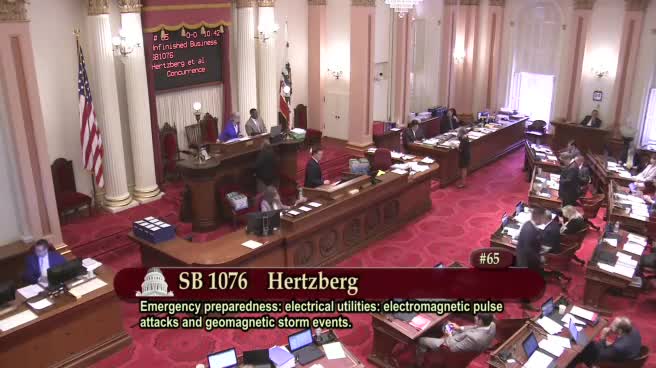
Bill Author

Bill Co-Author(s):