AB 2245: Voter registration.
- Session Year: 2017-2018
- House: Assembly
- Latest Version Date: 2018-08-29
Under existing law, a person may not be registered to vote except by affidavit of registration. Existing law authorizes a person who is at least 16 years of age and otherwise meets all voter eligibility requirements to preregister to vote by submitting his or her affidavit of registration, which, if properly executed, will be deemed effective as of the date the affiant will be 18 years of age.
Existing law requires a county elections official to prepare specified information on registered voters in the county, including the total number of voters and the number of voters registered as preferring each qualified political party, and to provide notice to the Secretary of State that the information is available.
This bill would require a county elections official to also include specified information on persons who have preregistered to vote. By imposing additional duties on county elections officials, the bill would impose a state-mandated local program.
Existing law provides that certain information on a voters affidavit of registration, including the voters home address and signature, is confidential and prohibits disclosure of the information except in specified circumstances.
This bill would additionally provide that the affidavit of registration of a preregistered person who is not yet a registered voter is confidential, and would prohibit its disclosure to any person without exception.
This bill would incorporate additional changes to Section 2187 of the Elections Code proposed by AB 3258 to be operative only if this bill and AB 3258 are enacted and this bill is enacted last.
The California Constitution requires the state to reimburse local agencies and school districts for certain costs mandated by the state. Statutory provisions establish procedures for making that reimbursement.
This bill would provide that, if the Commission on State Mandates determines that the bill contains costs mandated by the state, reimbursement for those costs shall be made pursuant to the statutory provisions noted above.
Under existing law, a person may not be registered to vote except by affidavit of registration. Existing law authorizes a person who is at least 16 years of age and otherwise meets all eligibility requirements to vote to preregister to vote by submitting his or her affidavit of registration, which, if properly executed, will be deemed effective as of the date the affiant will be 18 years of age.
Existing law requires a county elections official to prepare specified information on registered voters in the county, including the total number of voters and the number of voters registered as preferring each qualified political party, and to provide notice to the Secretary of State that the information is available.
This bill would require a county elections official to also include specified information on persons who have preregistered to vote. By imposing additional duties on county elections officials, the bill would impose a state-mandated local program.
Existing law provides that certain information on a voters affidavit of registration, including the voters home address and signature, is confidential and prohibits disclosure of the information except in specified circumstances.
This bill would additionally provide that the affidavit of registration of a preregistered person who is not yet a registered voter is confidential, and would prohibit its disclosure to any person without exception.
The California Constitution requires the state to reimburse local agencies and school districts for certain costs mandated by the state. Statutory provisions establish procedures for making that reimbursement.
This bill would provide that, if the Commission on State Mandates determines that the bill contains costs mandated by the state, reimbursement for those costs shall be made pursuant to the statutory provisions noted above.
(a)Each county elections official shall provide notice to the Secretary of State that the following information is available:
(1)The total number of voters, and the total number of people who have preregistered to vote, in the county.
(2)The number registered and the number preregistered as preferring each qualified political party.
(3)The number registered and the number preregistered as preferring nonqualified parties.
(4)The number registered and the number preregistered without choosing a political party preference.
(5)The number of voters, and the number of people who have preregistered to vote, by political party preferences in each of the following political subdivisions, located in whole or in part within the county:
(A)A supervisorial district.
(B)Congressional district.
(C)Senate district.
(D)Assembly district.
(E)Board of Equalization district.
(F)Cities and unincorporated areas.
(b)The Secretary of State, within 30 days after receiving the information specified in subdivision (a), shall compile a statewide list showing the number of voters, and the number of people who have preregistered to vote, by party preferences, in the state and in each county, city, supervisorial district, Assembly district, Senate district, and congressional district in the state. A copy of this list shall be made available, upon request, to any elector in this state.
(c)The county elections officials shall prepare the information referenced in subdivision (a) and provide notice to the Secretary of State at the following times:
(1)On the 135th day before each presidential primary election and before each direct primary election, with respect to voters registered and people who are preregistered on the 154th day before the primary election.
(2)Not less than 50 days before the primary election, with respect to voters registered and people who are preregistered on the 60th day before the primary election.
(3)Not less than seven days before the primary election, with respect to voters registered and people who are preregistered before the 14th day before the primary election.
(4)Not less than 102 days prior to each presidential general election, with respect to voters registered and people who are preregistered before the 123rd day before the presidential general election.
(5)Not less than 50 days before the general election, with respect to voters registered and people who are preregistered on the 60th day before the general election.
(6)Not less than seven days before the general election, with respect to voters registered and people who are preregistered before the 14th day before the general election.
(7)On or before March 1 of each odd-numbered year, with respect to voters registered and people who are preregistered as of February 10.
(d)The Secretary of State may adopt regulations prescribing additional regular reporting times, except that the total number of reporting times in any one calendar year shall not exceed 12.
SEC. 1.5.Section 2187 of the Elections Code is amended to read:2187.(a)Each county elections official shall provide notice to the Secretary of State that the following information is available:
(1)The total number of voters, and the total number of people who have preregistered to vote, in the county.
(2)The number registered and the number preregistered as preferring each qualified political party.
(3)The number registered and the number preregistered as preferring nonqualified parties.
(4)The number registered and the number preregistered without choosing a political party preference.
(5)The number of voters, and the number of people who have preregistered to vote, by political party preferences in each of the following political subdivisions, located in whole or in part within the county:
(A)A supervisorial district.
(B)Congressional district.
(C)Senate district.
(D)Assembly district.
(E)Board of Equalization district.
(F)Cities and unincorporated areas.
(b)The Secretary of State, within 30 days after receiving the information specified in subdivision (a), shall compile a statewide list showing the number of voters, and the number of people who have preregistered to vote, by party preferences, in the state and in each county, city, supervisorial district, Assembly district, Senate district, and congressional district in the state. A copy of this list shall be made available, upon request, to any elector in this state.
(c)The county elections officials shall prepare the information referenced in subdivision (a) and provide notice to the Secretary of State at the following times:
(1)On the 135th day before each presidential primary election and before each direct primary election, with respect to all voters who are registered voters and people who are preregistered on the 154th day before the primary election.
(2)Not less than 50 days before the primary election, with respect to all voters who are registered voters and people who are preregistered on the 60th day before the primary election.
(3)Not less than seven days before the primary election, with respect to all voters who are registered voters and people who are preregistered on the 15th day before the primary election.
(4)Not less than 102 days before each presidential general election, with respect to all voters who are registered voters and people who are preregistered on the 123rd day before the presidential general election.
(5)Not less than 50 days before the general election, with respect to all voters who are registered voters and people who are preregistered on the 60th day before the general election.
(6)Not less than seven days before the general election, with respect to all voters who are registered voters and people who are preregistered on the 15th day before the general election.
(7)On or before March 1 of each odd-numbered year, with respect to all voters who are registered voters and people who are preregistered on February 10.
(d)The Secretary of State may adopt regulations prescribing additional regular reporting times, except that the total number of reporting times in any one calendar year shall not exceed 12.
SEC. 2.Section 2194 of the Elections Code is amended to read:2194.(a)Except as provided in Section 2194.1, the affidavit of voter registration information identified in Section 6254.4 of the Government Code:
(1)Shall be confidential and shall not appear on any computer terminal, list, affidavit, duplicate affidavit, or other medium routinely available to the public at the county elections officials office.
(2)Shall not be used for any personal, private, or commercial purpose, including, but not limited to:
(A)The harassment of any voter or voters household.
(B)The advertising, solicitation, sale, or marketing of products or services to any voter or voters household.
(C)Reproduction in print, broadcast visual or audio, or display on the Internet or any computer terminal unless pursuant to paragraph (3).
(3)Shall be provided with respect to any voter, subject to the provisions of Sections 2166, 2166.5, 2166.7, and 2188, to any candidate for federal, state, or local office, to any committee for or against any initiative or referendum measure for which legal publication is made, and to any person for election, scholarly, journalistic, or political purposes, or for governmental purposes, as determined by the Secretary of State.
(4)May be used by the Secretary of State for the purpose of educating voters pursuant to Section 12173 of the Government Code.
(b)(1)Notwithstanding any other law, the California drivers license number, the California identification card number, the social security number, and any other unique identifier used by the State of California for purposes of voter identification shown on the affidavit of voter registration of a registered voter, or added to voter registration records to comply with the requirements of the federal Help America Vote Act of 2002 (52 U.S.C. Sec. 20901 et seq.), are confidential and shall not be disclosed to any person.
(2)Notwithstanding any other law, the signature of the voter shown on the affidavit of voter registration or an image thereof is confidential and shall not be disclosed to any person, except as provided in subdivision (c).
(3)Notwithstanding any other law, the affidavit of voter registration for a person who has submitted an affidavit pursuant to subdivision (d) of Section 2102, but who is not yet a registered voter, is confidential and shall not be disclosed to any person.
(c)(1)The home address or signature of any voter shall be released whenever the persons vote is challenged pursuant to Sections 15105 to 15108, inclusive, or Article 3 (commencing with Section 14240) of Chapter 3 of Division 14. The address or signature shall be released only to the challenger, to elections officials, and to other persons as necessary to make, defend against, or adjudicate the challenge.
(2)An elections official shall permit a person to view the signature of a voter for the purpose of determining whether the signature matches a signature on an affidavit of registration or an image thereof or a petition, but shall not permit a signature to be copied.
(d)A governmental entity, or officer or employee thereof, shall not be held civilly liable as a result of disclosure of the information referred to in this section, unless by a showing of gross negligence or willfulness.
(e)For the purposes of this section, voters household is defined as the voters place of residence or mailing address or any persons who reside at the place of residence or use the mailing address as supplied on the affidavit of registration pursuant to paragraphs (3) and (4) of subdivision (a) of Section 2150.
SEC. 3.Section 6254.4 of the Government Code is amended to read:6254.4.(a)The home address, telephone number, email address, precinct number, or other number specified by the Secretary of State for voter registration purposes, and prior registration information shown on the affidavit of registration, is confidential and shall not be disclosed to any person, except pursuant to Section 2194 of the Elections Code.
(b)For purposes of this section, home address means street address only, and does not include an individuals city or post office address.
(c)The California drivers license number, the California identification card number, the social security number, and any other unique identifier used by the State of California for purposes of voter identification shown on an affidavit of registration, or added to the voter registration records to comply with the requirements of the federal Help America Vote Act of 2002 (52 U.S.C. Sec. 20901 et seq.), are confidential and shall not be disclosed to any person.
(d)The signature of the voter that is shown on the affidavit of registration is confidential and shall not be disclosed to any person.
(e)The affidavit of voter registration for a person who has submitted an affidavit pursuant to subdivision (d) of Section 2102 of the Elections Code, but who is not yet a registered voter, is confidential and shall not be disclosed to any person.
SEC. 4.Section 1.5 of this bill incorporates amendments to Section 2187 of the Elections Code proposed by both this bill and Assembly Bill 3258. That section shall only become operative if (1) both bills are enacted and become effective on or before January 1, 2019, (2) each bill amends Section 2187 of the Elections Code, and (3) this bill is enacted after Assembly Bill 3258, in which case Section 1 of this bill shall not become operative.
SEC. 5.If the Commission on State Mandates determines that this act contains costs mandated by the state, reimbursement to local agencies and school districts for those costs shall be made pursuant to Part 7 (commencing with Section 17500) of Division 4 of Title 2 of the Government Code.
(a)Each county elections official shall provide notice to the Secretary of State that the following information is available:
(1)The total number of voters, and the total number of people who have preregistered to vote, in the county.
(2)The number registered and the number preregistered as preferring each qualified political party.
(3)The number registered and the number preregistered as preferring nonqualified parties.
(4)The number registered and the number preregistered without choosing a political party preference.
(5)The number of voters, and the number of people who have preregistered to vote, by political party preferences in each of the following political subdivisions, located in whole or in part within the county:
(A)A supervisorial district.
(B)Congressional district.
(C)Senate district.
(D)Assembly district.
(E)Board of Equalization district.
(F)Cities and unincorporated areas.
(b)The Secretary of State, within 30 days after receiving the information specified in subdivision (a), shall compile a statewide list showing the number of voters, and the number of people who have preregistered to vote, by party preferences, in the state and in each county, city, supervisorial district, Assembly district, Senate district, and congressional district in the state. A copy of this list shall be made available, upon request, to any elector in this state.
(c)The county elections officials shall prepare the information referenced in subdivision (a) and provide notice to the Secretary of State at the following times:
(1)On the 135th day before each presidential primary election and before each direct primary election, with respect to voters registered and people who are preregistered on the 154th day before the primary election.
(2)Not less than 50 days before the primary election, with respect to voters registered and people who are preregistered on the 60th day before the primary election.
(3)Not less than seven days before the primary election, with respect to voters registered and people who are preregistered before the 14th day before the primary election.
(4)Not less than 102 days prior to each presidential general election, with respect to voters registered and people who are preregistered before the 123rd day before the presidential general election.
(5)Not less than 50 days before the general election, with respect to voters registered and people who are preregistered on the 60th day before the general election.
(6)Not less than seven days before the general election, with respect to voters registered and people who are preregistered before the 14th day before the general election.
(7)On or before March 1 of each odd-numbered year, with respect to voters registered and people who are preregistered as of February 10.
(d)The Secretary of State may adopt regulations prescribing additional regular reporting times, except that the total number of reporting times in any one calendar year shall not exceed 12.
SEC. 1.5.Section 2187 of the Elections Code is amended to read:2187.(a)Each county elections official shall provide notice to the Secretary of State that the following information is available:
(1)The total number of voters voters, and the total number of people who have preregistered to vote, in the county.
(2)The number registered and the number preregistered as preferring each qualified political party.
(3)The number registered and the number preregistered as preferring nonqualified parties.
(4)The number registered and the number preregistered without choosing a political party preference.
(5)The number of voters voters, and the number of people who have preregistered to vote, by political party preferences in each of the following political subdivisions, located in whole or in part within the county:
(A)A supervisorial district.
(B)Congressional district.
(C)Senate district.
(D)Assembly district.
(E)Board of Equalization district.
(F)Cities and unincorporated areas.
(b)The Secretary of State, within 30 days after receiving the information specified in subdivision (a), shall compile a statewide list showing the number of voters, and the number of people who have preregistered to vote, by party preferences, in the state and in each county, city, supervisorial district, Assembly district, Senate district, and congressional district in the state. A copy of this list shall be made available, upon request, to any elector in this state.
(c)The county elections officials shall prepare the information referenced in subdivision (a) and provide notice to the Secretary of State at the following times:
(1)On the 135th day before each presidential primary election and before each direct primary, primary election, with respect to all voters who are registered voters and people who are preregistered on the 154th day before the primary election.
(2)Not less than 50 days prior to before the primary election, with respect to all voters who are registered voters and people who are preregistered on the 60th day before the primary election.
(3)Not less than seven days prior to before the primary election, with respect to all voters who are registered before voters and people who are preregistered on the 14th 15th day prior to before the primary election.
(4)Not less than 102 days prior to before each presidential general election, with respect to all voters who are registered before voters and people who are preregistered on the 123rd day before the presidential general election.
(5)Not less than 50 days prior to before the general election, with respect to all voters who are registered voters and people who are preregistered on the 60th day before the general election.
(6)Not less than seven days prior to before the general election, with respect to all voters who are registered before voters and people who are preregistered on the 14th 15th day prior to before the general election.
(7)On or before March 1 of each odd-numbered year, with respect to all voters who are registered as of voters and people who are preregistered on February 10.
(d)The Secretary of State may adopt regulations prescribing additional regular reporting times, except that the total number of reporting times in any one calendar year shall not exceed 12.
SEC. 2.Section 2194 of the Elections Code is amended to read:2194.(a)Except as provided in Section 2194.1, the affidavit of voter registration information identified in Section 6254.4 of the Government Code:
(1)Shall be confidential and shall not appear on any computer terminal, list, affidavit, duplicate affidavit, or other medium routinely available to the public at the county elections officials office.
(2)Shall not be used for any personal, private, or commercial purpose, including, but not limited to:
(A)The harassment of any voter or voters household.
(B)The advertising, solicitation, sale, or marketing of products or services to any voter or voters household.
(C)Reproduction in print, broadcast visual or audio, or display on the Internet or any computer terminal unless pursuant to paragraph (3).
(3)Shall be provided with respect to any voter, subject to the provisions of Sections 2166, 2166.5, 2166.7, and 2188, to any candidate for federal, state, or local office, to any committee for or against any initiative or referendum measure for which legal publication is made, and to any person for election, scholarly, journalistic, or political purposes, or for governmental purposes, as determined by the Secretary of State.
(4)May be used by the Secretary of State for the purpose of educating voters pursuant to Section 12173 of the Government Code.
(b)(1)Notwithstanding any other law, the California drivers license number, the California identification card number, the social security number, and any other unique identifier used by the State of California for purposes of voter identification shown on the affidavit of voter registration of a registered voter, or added to voter registration records to comply with the requirements of the federal Help America Vote Act of 2002 (52 U.S.C. Sec. 20901 et seq.), are confidential and shall not be disclosed to any person.
(2)Notwithstanding any other law, the signature of the voter shown on the affidavit of voter registration or an image thereof is confidential and shall not be disclosed to any person, except as provided in subdivision (c).
(3)Notwithstanding any other law, the affidavit of voter registration for a person who has submitted an affidavit pursuant to subdivision (d) of Section 2102, but who is not yet a registered voter, is confidential and shall not be disclosed to any person.
(c)(1)The home address or signature of any voter shall be released whenever the persons vote is challenged pursuant to Sections 15105 to 15108, inclusive, or Article 3 (commencing with Section 14240) of Chapter 3 of Division 14. The address or signature shall be released only to the challenger, to elections officials, and to other persons as necessary to make, defend against, or adjudicate the challenge.
(2)An elections official shall permit a person to view the signature of a voter for the purpose of determining whether the signature matches a signature on an affidavit of registration or an image thereof or a petition, but shall not permit a signature to be copied.
(d)A governmental entity, or officer or employee thereof, shall not be held civilly liable as a result of disclosure of the information referred to in this section, unless by a showing of gross negligence or willfulness.
(e)For the purposes of this section, voters household is defined as the voters place of residence or mailing address or any persons who reside at the place of residence or use the mailing address as supplied on the affidavit of registration pursuant to paragraphs (3) and (4) of subdivision (a) of Section 2150.
SEC. 3.Section 6254.4 of the Government Code is amended to read:6254.4.(a)The home address, telephone number, email address, precinct number, or other number specified by the Secretary of State for voter registration purposes, and prior registration information shown on the affidavit of registration, is confidential and shall not be disclosed to any person, except pursuant to Section 2194 of the Elections Code.
(b)For purposes of this section, home address means street address only, and does not include an individuals city or post office address.
(c)The California drivers license number, the California identification card number, the social security number, and any other unique identifier used by the State of California for purposes of voter identification shown on an affidavit of registration, or added to the voter registration records to comply with the requirements of the federal Help America Vote Act of 2002 (52 U.S.C. Sec. 20901 et seq.), are confidential and shall not be disclosed to any person.
(d)The signature of the voter that is shown on the affidavit of registration is confidential and shall not be disclosed to any person.
(e)The affidavit of voter registration for a person who has submitted an affidavit pursuant to subdivision (d) of Section 2102 of the Elections Code, but who is not yet a registered voter, is confidential and shall not be disclosed to any person.
SEC. 4.Section 1.5 of this bill incorporates amendments to Section 2187 of the Elections Code proposed by both this bill and Assembly Bill 3258. That section shall only become operative if (1) both bills are enacted and become effective on or before January 1, 2019, (2) each bill amends Section 2187 of the Elections Code, and (3) this bill is enacted after Assembly Bill 3258, in which case Section 1 of this bill shall not become operative.
SEC. 4.SEC. 5.If the Commission on State Mandates determines that this act contains costs mandated by the state, reimbursement to local agencies and school districts for those costs shall be made pursuant to Part 7 (commencing with Section 17500) of Division 4 of Title 2 of the Government Code.
(a)Each county elections official shall provide notice to the Secretary of State that the following information is available:
(1)The total number of voters voters, and the total number of people who have preregistered to vote, in the county.
(2)The number registered and the number preregistered as preferring each qualified political party.
(3)The number registered and the number preregistered as preferring nonqualified parties.
(4)The number registered and the number preregistered without choosing a political party preference.
(5)The number of voters voters, and the number of people who have preregistered to vote, by political party preferences in each of the following political subdivisions, located in whole or in part within the county:
(A)A supervisorial district.
(B)Congressional district.
(C)Senate district.
(D)Assembly district.
(E)Board of Equalization district.
(F)Cities and unincorporated areas.
(b)The Secretary of State, within 30 days after receiving the information specified in subdivision (a), shall compile a statewide list showing the number of voters, and the number of people who have preregistered to vote, by party preferences, in the state and in each county, city, supervisorial district, Assembly district, Senate district, and congressional district in the state. A copy of this list shall be made available, upon request, to any elector in this state.
(c)The county elections officials shall prepare the information referenced in subdivision (a) and provide notice to the Secretary of State at the following times:
(1)On the 135th day before each presidential primary election and before each direct primary, primary election, with respect to voters registered and people who are preregistered on the 154th day before the primary election.
(2)Not less than 50 days prior to before the primary election, with respect to voters registered and people who are preregistered on the 60th day before the primary election.
(3)Not less than seven days prior to before the primary election, with respect to voters registered and people who are preregistered before the 14th day prior to before the primary election.
(4)Not less than 102 days prior to each presidential general election, with respect to voters registered and people who are preregistered before the 123rd day before the presidential general election.
(5)Not less than 50 days prior to before the general election, with respect to voters registered and people who are preregistered on the 60th day before the general election.
(6)Not less than seven days prior to before the general election, with respect to voters registered and people who are preregistered before the 14th day prior to before the general election.
(7)On or before March 1 of each odd-numbered year, with respect to voters registered and people who are preregistered as of February 10.
(d)The Secretary of State may adopt regulations prescribing additional regular reporting times, except that the total number of reporting times in any one calendar year shall not exceed 12.
SEC. 2.Section 2194 of the Elections Code is amended to read:2194.(a)Except as provided in Section 2194.1, the affidavit of voter registration information identified in Section 6254.4 of the Government Code:
(1)Shall be confidential and shall not appear on any computer terminal, list, affidavit, duplicate affidavit, or other medium routinely available to the public at the county elections officials office.
(2)Shall not be used for any personal, private, or commercial purpose, including, but not limited to:
(A)The harassment of any voter or voters household.
(B)The advertising, solicitation, sale, or marketing of products or services to any voter or voters household.
(C)Reproduction in print, broadcast visual or audio, or display on the Internet or any computer terminal unless pursuant to paragraph (3).
(3)Shall be provided with respect to any voter, subject to the provisions of Sections 2166, 2166.5, 2166.7, and 2188, to any candidate for federal, state, or local office, to any committee for or against any initiative or referendum measure for which legal publication is made, and to any person for election, scholarly, journalistic, or political purposes, or for governmental purposes, as determined by the Secretary of State.
(4)May be used by the Secretary of State for the purpose of educating voters pursuant to Section 12173 of the Government Code.
(b)(1)Notwithstanding any other law, the California drivers license number, the California identification card number, the social security number, and any other unique identifier used by the State of California for purposes of voter identification shown on the affidavit of voter registration of a registered voter, or added to voter registration records to comply with the requirements of the federal Help America Vote Act of 2002 (52 U.S.C. Sec. 20901 et seq.), are confidential and shall not be disclosed to any person.
(2)Notwithstanding any other law, the signature of the voter shown on the affidavit of voter registration or an image thereof is confidential and shall not be disclosed to any person, except as provided in subdivision (c).
(3)Notwithstanding any other law, the affidavit of voter registration for a person who has submitted an affidavit pursuant to subdivision (d) of Section 2102, but who is not yet a registered voter, is confidential and shall not be disclosed to any person.
(c)(1)The home address or signature of any voter shall be released whenever the persons vote is challenged pursuant to Sections 15105 to 15108, inclusive, or Article 3 (commencing with Section 14240) of Chapter 3 of Division 14. The address or signature shall be released only to the challenger, to elections officials, and to other persons as necessary to make, defend against, or adjudicate the challenge.
(2)An elections official shall permit a person to view the signature of a voter for the purpose of determining whether the signature matches a signature on an affidavit of registration or an image thereof or a petition, but shall not permit a signature to be copied.
(d)A governmental entity, or officer or employee thereof, shall not be held civilly liable as a result of disclosure of the information referred to in this section, unless by a showing of gross negligence or willfulness.
(e)For the purposes of this section, voters household is defined as the voters place of residence or mailing address or any persons who reside at the place of residence or use the mailing address as supplied on the affidavit of registration pursuant to paragraphs (3) and (4) of subdivision (a) of Section 2150.
SEC. 3.Section 6254.4 of the Government Code is amended to read:6254.4.(a)The home address, telephone number, email address, precinct number, or other number specified by the Secretary of State for voter registration purposes, and prior registration information shown on the affidavit of registration, is confidential and shall not be disclosed to any person, except pursuant to Section 2194 of the Elections Code.
(b)For purposes of this section, home address means street address only, and does not include an individuals city or post office address.
(c)The California drivers license number, the California identification card number, the social security number, and any other unique identifier used by the State of California for purposes of voter identification shown on an affidavit of registration, or added to the voter registration records to comply with the requirements of the federal Help America Vote Act of 2002 (42 U.S.C. Sec. 15301 (52 U.S.C. Sec. 20901 et seq.), are confidential and shall not be disclosed to any person.
(d)The signature of the voter that is shown on the affidavit of registration is confidential and shall not be disclosed to any person.
(e)The affidavit of voter registration for a person who has submitted an affidavit pursuant to subdivision (d) of Section 2102 of the Elections Code, but who is not yet a registered voter, is confidential and shall not be disclosed to any person.
SEC. 4.If the Commission on State Mandates determines that this act contains costs mandated by the state, reimbursement to local agencies and school districts for those costs shall be made pursuant to Part 7 (commencing with Section 17500) of Division 4 of Title 2 of the Government Code.
|
Date
|
Status
|
|---|---|
| Sep 18, 2018 | Vetoed by Governor. |
| Sep 5, 2018 | Enrolled and presented to the Governor at 3 p.m. |
| Aug 27, 2018 | Senate amendments concurred in. To Engrossing and Enrolling. |
| Aug 22, 2018 | In Assembly. Concurrence in Senate amendments pending. May be considered on or after August 24 pursuant to Assembly Rule 77. |
| Aug 22, 2018 | Read third time. Passed. Ordered to the Assembly. |
| Aug 20, 2018 | Read second time. Ordered to third reading. |
| Aug 17, 2018 | From committee: Amend, and do pass as amended. (Ayes 6. Noes 0.) (August 16). |
| Jul 2, 2018 | In committee: Referred to APPR. suspense file. |
| Jun 20, 2018 | From committee: Do pass and re-refer to Com. on APPR. (Ayes 5. Noes 0.) (June 19). Re-referred to Com. on APPR. |
| Jun 7, 2018 | Referred to Com. on E. & C.A. |
| May 30, 2018 | In Senate. Read first time. To Com. on RLS. for assignment. |
| May 29, 2018 | Read third time. Passed. Ordered to the Senate. |
| May 24, 2018 | Read second time. Ordered to third reading. |
| May 23, 2018 | From committee: Do pass. (Ayes 16. Noes 0.) (May 23). |
| Apr 11, 2018 | From committee: Do pass and re-refer to Com. on APPR. (Ayes 7. Noes 0.) (April 11). Re-referred to Com. on APPR. |
| Mar 1, 2018 | Referred to Com. on E. & R. |
| Feb 14, 2018 | From printer. May be heard in committee March 16. |
| Feb 13, 2018 | Read first time. To print. |
|
Date
|
Description
|
Location
|
Votes
|
|
|---|---|---|---|---|
| Aug 27, 2018 | AB 2245 BERMAN Concurrence in Senate Amendments | Assembly Floor |
Passed |
|
| Aug 22, 2018 | Assembly 3rd Reading AB2245 Berman et al. By Jackson | Senate Floor |
Passed |
|
| Aug 16, 2018 | Do pass as amended | Senate Standing Committee on Appropriations |
Passed |
|
| Jul 2, 2018 | Placed on suspense file | Senate Standing Committee on Appropriations |
Passed |
|
| Jun 19, 2018 | Do pass, but first be re-referred to the Committee on [Appropriations] | Senate Standing Committee on Elections and Constitutional Amendments |
Passed |
|
| May 29, 2018 | AB 2245 BERMAN Assembly Third Reading | Assembly Floor |
Passed |
|
| May 23, 2018 | Do pass. | Assembly Standing Committee on Appropriations |
Passed |
|
| Apr 11, 2018 | Do pass and be re-referred to the Committee on [Appropriations] | Assembly Standing Committee on Elections and Redistricting |
Passed |
This list shows positions taken on this bill by organizations on the date displayed, which is linked to the original source.
Positions by individuals are not included.
|
Organization
|
Position
|
Date
|
|---|---|---|
| League Of Women Voters Of California | ** Support | Aug 20, 2018 |
| Secretary of State Alex Padilla | ** Support | Aug 20, 2018 |
GOVERNOR'S VETO
GV Bill Id:AB 2245
Author:(Berman)
As Enrolled Ver:September 5, 2018
2/3 vote
ASSEMBLY: | 78-0 | (May 29, 2018) | SENATE: | 39-0 | (August 22, 2018) |
ASSEMBLY: | 80-0 | (August 27, 2018) |
Original Committee Reference: E. & R.
SUMMARY: Requires the registration information of a person who has pre-registered to vote pursuant to current law to be confidential, and prohibits the information from being disclosed to any person. Requires a county elections official to provide the Secretary of State (SOS) with information on persons who have pre-registered to vote, as specified. Specifically, this bill:
- Requires, notwithstanding any other law, that the affidavit of registration information for a person who has pre-registered to vote, but who is not yet a registered voter, to be confidential and prohibits its disclosure to any person.
- Requires a county elections official, in addition to providing the SOS with information about the number of registered voters, to provide the SOS information about the number of pre-registered voters, as specified.
- Requires county elections officials to provide information about the number of pre-registered voters to the SOS at certain times, as specified.
- Requires the SOS, within 30 days after receiving the information listed above, to compile a statewide list showing the number of people who have pre-registered to vote, by party preference, in the state and in each county, city, supervisorial district, Assembly district, Senate district, and congressional district in the state.
The Senate amendments add double-jointing language to avoid chaptering problems with AB 3258 (Committee on Elections & Redistricting) of the current legislative session and add a co-author.
FISCAL EFFECT: According to the Senate Appropriations Committee, by requiring county elections officials to provide the SOS with information on persons who have preregistered to vote, this bill would create a state-mandated local program. To the extent the Commission on State Mandates determines that the provisions of this bill create a new program or impose a higher level of service on local agencies, local agencies could claim reimbursement of those costs (General Fund). The magnitude is unknown, but potentially over $50,000 annually. Costs to the SOS to implement the bill would be minor and absorbable.
COMMENTS: According to the author, "Nearly 90,000 youth have pre-registered to vote in California since the state began pre-registering 16-and 17-year-olds to vote in 2016. I'm thrilled that so many youth have taken this critical step in becoming engaged, active participants in our democracy. As more minors pre-register to vote, it's imperative that the legislature protects their privacy by prohibiting the disclosure of their personal information in the voter file."
Current law requires certain information from affidavits of voter registration, such as the name, home address, telephone number, email address, and party preference, to be provided to, among others, any person for election, scholarly, journalistic, or political purposes, or for governmental purposes, as determined by the SOS. Existing law, however, explicitly requires an affiant's driver's license number, identification card number, social security number, and the signature contained on an affidavit of registration or voter registration card to be confidential and prohibits its disclosure, as specified. This bill requires an affidavit of registration of a pre-registered person whose registration is not yet deemed effective to be confidential and prohibits its disclosure to any person. In other words, this bill requires all information, including the name, home address, telephone number, email address, and party preference, which otherwise is allowed to be disclosed to certain persons for specified purposes pursuant to current law, to remain confidential until the person's voter registration is deemed effective.
The Senate amendments add double-jointing language to avoid chaptering problems with AB 3258 (Committee on Elections & Redistricting) of the current legislative session and add a co-author. The bill, as amended in the Senate, is consistent with Assembly actions.
Please see the policy committee analysis for a full discussion on this bill.
This bill requires elections officials to provide the Secretary of State with information on persons who have pre-registered to vote, prohibits the information from being disclosed to any person, and requires the Secretary of State to compile a statewide list by various political subdivisions.
The Secretary of State already provides pre-registered voter data by county and nothing prohibits the breakdown of the data into further political subdivisions. Moreover, it is common practice for county election officials to keep pre-registered voter data confidential. Therefore, this bill is unnecessary.
Analysis Prepared by: Nichole Becker / E. & R. / (916) 319-2094 FN: 0005246
CONCURRENCE IN SENATE AMENDMENTS
CSA1 Bill Id:AB 2245
Author:(Berman)
As Amended Ver:August 17, 2018
Majority vote
ASSEMBLY: | 78-0 | (May 29, 2018) | SENATE: | 39-0 | (August 22, 2018) |
Original Committee Reference: E. & R.
SUMMARY: Requires the registration information of a person who has pre-registered to vote pursuant to current law to be confidential, and prohibits the information from being disclosed to any person. Requires a county elections official to provide the Secretary of State (SOS) with information on persons who have pre-registered to vote, as specified. Specifically, this bill:
- Requires, notwithstanding any other law, that the affidavit of registration information for a person who has pre-registered to vote, but who is not yet a registered voter, to be confidential and prohibits its disclosure to any person.
- Requires a county elections official, in addition to providing the SOS with information about the number of registered voters, to provide the SOS information about the number of pre-registered voters, as specified.
- Requires county elections officials to provide information about the number of pre-registered voters to the SOS at certain times, as specified.
- Requires the SOS, within 30 days after receiving the information listed above, to compile a statewide list showing the number of people who have pre-registered to vote, by party preference, in the state and in each county, city, supervisorial district, Assembly district, Senate district, and congressional district in the state.
The Senate amendments add double-jointing language to avoid chaptering out problems with AB 3258 (Committee on Elections & Redistricting) of the current legislative session and add a co-author.
FISCAL EFFECT: According to the Senate Appropriations Committee, by requiring county elections officials to provide the SOS with information on persons who have preregistered to vote, this bill would create a state-mandated local program. To the extent the Commission on State Mandates determines that the provisions of this bill create a new program or impose a higher level of service on local agencies, local agencies could claim reimbursement of those costs (General Fund). The magnitude is unknown, but potentially over $50,000 annually. Costs to the SOS to implement the bill would be minor and absorbable.
COMMENTS: According to the author, "Nearly 90,000 youth have pre-registered to vote in California since the state began pre-registering 16-and 17-year-olds to vote in 2016. I'm thrilled that so many youth have taken this critical step in becoming engaged, active participants in our democracy. As more minors pre-register to vote, it's imperative that the legislature protects their privacy by prohibiting the disclosure of their personal information in the voter file."
Current law requires certain information from affidavits of voter registration, such as the name, home address, telephone number, email address, and party preference, to be provided to, among others, any person for election, scholarly, journalistic, or political purposes, or for governmental purposes, as determined by the SOS. Existing law, however, explicitly requires an affiant's driver's license number, identification card number, social security number, and the signature contained on an affidavit of registration or voter registration card to be confidential and prohibits its disclosure, as specified. This bill requires an affidavit of registration of a pre-registered person whose registration is not yet deemed effective to be confidential and prohibits its disclosure to any person. In other words, this bill requires all information, including the name, home address, telephone number, email address, and party preference, which otherwise is allowed to be disclosed to certain persons for specified purposes pursuant to current law, to remain confidential until the person's voter registration is deemed effective.
The Senate amendments add double-jointing language to avoid chaptering problems with AB 3258 (Committee on Elections & Redistricting) of the current legislative session and add a co-author. The bill, as amended in the Senate, is consistent with Assembly actions.
Please see the policy committee analysis for a full discussion on this bill.
Analysis Prepared by: Nichole Becker / E. & R. / (916) 319-2094 FN: 0004507
Office of Senate Floor Analyses (916) 651-1520 Fax: (916) 327-4478 | AB |
THIRD READING
Bill No: AB 2245
: in Senate
SENATE ELECTIONS & C.A. COMMITTEE: 5-0, 6/19/18
AYES: Stern, Anderson, Allen, Hertzberg, Leyva
SENATE APPROPRIATIONS COMMITTEE: 6-0, 8/16/18
AYES: Portantino, Beall, Bradford, Hill, Nielsen, Wiener
NO VOTE RECORDED: Bates
ASSEMBLY FLOOR: 78-0, 5/29/18 - See last page for vote
DIGEST:
This bill requires the registration information of a person who has pre-registered to vote to be confidential, and prohibits the information from being disclosed to any person, as specified. Additionally, this bill requires a county elections official to provide the Secretary of State (SOS) with information on persons who have pre-registered to vote, as specified.
Existing law:
- Requires each county elections official to provide notice to the SOS with the following information:
- The total number of voters in the county.
- The number registered as preferring each qualified political party.
- The number registered as preferring nonqualified political parties.
- The number registered without choosing a political party preference.
- The number of voters by political party preference in each of the following subdivisions, located in whole or in part within the county:
- A supervisorial district
- Congressional district
- Senate district
- Assembly district
- Board of Equalization district
- Cities and unincorporated areas
- Provides the SOS compile a statewide list showing the number of voters by party preferences, in the state and in each county, city, supervisorial district, Assembly district, Senate district, and congressional district in the state within 30 days after receiving the information. Additionally, requires this list be available to any elector in California, upon request.
- Requires county elections officials to provide the information listed above to the SOS at the following times:
- On the 135th day before each presidential primary and before each direct primary of voters registered to vote on the 154th day before the primary election.
- Not less than 50 days prior to the primary election of people who are registered to vote on the 60th day prior to the primary election.
- Not less than seven days prior to the primary election of people who are registered to vote prior to the 14th day before the primary election.
- Not less than 102 days prior to each presidential general election of people who are registered to vote before the 123rd day before the presidential general election.
- Not less than 50 days prior to the general election of people who are registered to vote on the 60th day before the general election.
- Not less than seven days prior to the general election of people who are registered to vote on the 14th day before the general election.
- On or before March 1 of each odd-numbered year of people who are registered to vote as of February 10th.
- Permits a person who is a United States citizen, a resident of California, not imprisoned or on parole for the conviction of a felony, and is at least 18 years of age at the time of the next election to register to vote in any local, state, or federal election.
- Provides that a person may only be registered to vote by affidavit of registration.
- Allows a person who is at least 16 years old and otherwise meets all voter eligibility requirements to pre-register to vote. Provides that the registration will be deemed effective as soon as the affiant is 18 years old at the time of the next election.
- Requires county elections officials to prepare specified information on registered voters in the county, including the total number of voters and the total number of voters registered as preferring each qualified political party, and to provide the information to the SOS, as specified.
- Requires each state, pursuant to the federal Help America Vote Act of 2002 (HAVA), to implement a single, uniform, official, centralized, interactive computerized statewide voter registration list defined, maintained, and administered at the state level that contains the name and registration information of every legally registered voter in the state and assigns a unique identifier to each legally registered voter in the state.
- Requires certain information on affidavits of voter registration, such as the name, home address, telephone number, email address, and party affiliation, to be provided to, among others, any person for election, scholarly, journalistic, or political purposes, or for governmental purposes, as determined by the SOS.
- Requires an affiant's driver's license number, identification card number, social security number, and the signature contained on an affidavit of registration or voter registration card to be confidential and not be disclosed, as specified.
This bill:
- Requires a county elections official to provide the SOS with information about the number of pre-registered voters in accordance to the categories and deadlines established in existing law.
- Requires the SOS, within 30 days after receiving this information, to compile a statewide list showing the number of people who have pre-registered to vote by party preference, in the state and in each county, city, supervisorial district, Assembly district, Senate district, and congressional district.
- Requires, notwithstanding any other law, that the affidavit of registration for a person who has pre-registered to vote, but who is not yet a registered voter, to be confidential and prohibits its disclosure to any person.
- Includes double-jointing language with AB 3258 (Committee on Elections and Redistricting).
Background
Statewide Voter Registration Database. On October 29, 2002, President George W. Bush signed HAVA. Enacted partially in response to the 2000 Presidential election, HAVA was designed to improve the administration of federal elections. Among other provisions, HAVA requires every state to implement a computerized statewide voter registration list maintained at the state level. This statewide voter registration list will serve as the official list of eligible voters for any federal election held within the state.
In September of 2016, the SOS certified VoteCal and declared it to be the system of record for voter registration in California. VoteCal's many functions will improve service to voters such as connecting the SOS and all 58 counties offices to improve the voter registration process, provide a single, official statewide database of voter registration information, and provide a publically available Web site which allows a voter to register online, check their voter registration status, find their polling place, opt-out of being mailed a state voter information guide, and check if their vote by mail (VBM) or provisional ballot was counted by their county elections official and, if not, the reason why it was not counted.
Youth Voter Registration and Turnout. In 2018, SOS indicated that approximately 19 million Californians are registered to vote. According to the SOS Web site, youth aged 18-24 years old register to vote at a lower rate than any other age group. For example, in 2016, of the nearly 79% of Californians who were registered to vote, only 13.2% were youth between the ages of 17.5 to 25.
In the November 2014 election, according to the California Civic Engagement Project, an analysis on the youth vote (ages 18-24) found that 8.2% of eligible California youth voted, only consisting of 3.9% of all voters in that election.
This disproportion was also seen in the Public Policy Institute of California’s 2017 report, California’s Likely Voters, stating that “young adults (18 to 34) make up 33% of the population but only 22% of likely voters.” In contrast, Californians age 55 and older make up 31% of the state's adult population but constitute 45% of likely voters.
Pre-registration in California. In 2014, the Legislature passed and the Governor signed SB 113 (Jackson, Chapter 619, Statutes of 2014). The bill, upon certification of California’s statewide voter registration database (VoteCal), allowed future voters to pre-register beginning at age 16. In September 2016, the SOS certified VoteCal, officially launching pre-registration in California.
In their 15-Day Report of Registration from May 21, 2018, the SOS indicated that over 132,000 16- and 17-year olds have pre-registered since the certification of VoteCal. Of the 132,529 total pre-registrants, 67,883 individuals were currently pre-registered to vote.
Pre-registration in the United States. In addition to California, according to the National Conference of State Legislatures, Colorado, Delaware, District of Columbia, Florida, Hawaii, Louisiana, Maryland, Massachusetts, North Carolina, Oregon, Rhode Island, Utah, and Washington permit 16-year-olds to pre-register to vote.
Confidential Voter Information. Current law requires certain information from affidavits of voter registration, such as the name, home address, telephone number, email address, and party affiliation, to be provided to, among others, any person for election, scholarly, journalistic, or political purposes, or for governmental purposes, as determined by the SOS. However, existing law explicitly requires an affiant's driver's license number, identification card number, social security number, and the signature contained on an affidavit of registration or voter registration card to be confidential and prohibits its disclosure, as specified. AB 2245 requires an affidavit of registration of a pre-registered person whose registration is not yet deemed effective to be confidential and prohibits its disclosure to any person. In other words, this bill requires all information, including the name, home address, telephone number, email address, and party affiliation, which is allowed to be disclosed to certain scholarly and journalistic persons pursuant to current law, to remain confidential until the person turns 18 years old and his or her voter registration is deemed effective.
Comments
According to the author, with over 100,000 16- and 17-year olds pre-registering to vote, the law is unclear whether their records can be disclosed in the voter file. Those who may be affected are the youth who have pre-registered. As more minors pre-register to vote, it is imperative that the Legislature protects their privacy by prohibiting the disclosure of their personal information in the voter file. AB 2245 clarifies that the information of minors who will not be 18 by the time of the next election be kept confidential and prohibited from disclosure. In addition, this bill expands the existing county voter registration reporting law to include the number of people who have pre-registered to vote.
Related/Prior Legislation
SB 1400 (Stern, 2018) would have allowed 15-year-olds to pre-register to vote. SB 1400 was held in the Senate Appropriations Committee on the Suspense File.
ACA 10 (Low, 2017) lowers the minimum voting age and allows a person who is 17 years old and a resident of California to vote. ACA 10 is currently pending in the Assembly after failing passage on the Assembly Third Reading.
ACA 2 (Mullin, 2015) would have allowed 17-year-olds and who will be 18 years of age at the time of the next general election to register and vote in that general election and in any intervening primary or special election that occurs after the person registers to vote. ACA 2 was not brought up for a vote on the Assembly Floor.
SB 113 (Jackson, Chapter 619, Statutes of 2014) allowed a person who is 16 years of age to pre-register to vote, provided he or she would otherwise meet all eligibility requirements.
AB 30 (Price, Chapter 364, Statutes of 2009) allowed a person who is 17 years of age to pre-register to vote, provided he or she would otherwise meet all eligibility requirements.
FISCAL EFFECT: Appropriation: Fiscal Com.: Local:
According to the Senate Appropriations Committee, by requiring county elections officials to provide SOS with information on persons who have preregistered to vote, this bill would create a state-mandated local program. To the extent the Commission on State Mandates determines that the provisions of this bill create a new program or impose a higher level of service on local agencies, local agencies could claim reimbursement of those costs (General Fund). The magnitude is unknown, but potentially over $50,000 annually. Costs to SOS to implement the bill would be minor and absorbable.
Secretary of State Alex Padilla
League of Women Voters of California
OPPOSITION: (Verified 8/13/18)
None received
ARGUMENTS IN SUPPORT: In support of AB 2245, California Secretary of State Alex Padilla writes that the:
Elections Code places firm limits on who can request voter data and the type of information they can access. Only campaigns, journalists, and academic researchers may request a limited set of voter data, but sensitive information such as social security numbers and state license or ID numbers is never shared in response to a request for the voter file.
AB 2245 would ensure that 16- and 17-year olds who pre-register will be fully protected by not allowing any of their information to be disclosed in a voter file request.
This measure would incorporate pre-registration data into existing reports on voter registration statistics reports by county elections officials.
ASSEMBLY FLOOR: 78-0, 5/29/18
AYES: Acosta, Aguiar-Curry, Travis Allen, Arambula, Baker, Berman, Bigelow, Bloom, Bonta, Brough, Burke, Caballero, Calderon, Carrillo, Cervantes, Chau, Chávez, Chen, Chiu, Choi, Chu, Cooley, Cooper, Cunningham, Dahle, Daly, Eggman, Flora, Fong, Frazier, Friedman, Gallagher, Cristina Garcia, Eduardo Garcia, Gipson, Gloria, Gonzalez Fletcher, Gray, Grayson, Harper, Holden, Irwin, Jones-Sawyer, Kalra, Kamlager-Dove, Kiley, Lackey, Levine, Limón, Low, Maienschein, Mathis, Mayes, McCarty, Medina, Melendez, Mullin, Muratsuchi, Nazarian, Obernolte, O'Donnell, Patterson, Quirk, Quirk-Silva, Reyes, Rodriguez, Rubio, Salas, Santiago, Steinorth, Mark Stone, Thurmond, Ting, Voepel, Waldron, Weber, Wood, Rendon
8/20/18 9:50:26
**** END ****
SENATE COMMITTEE ON
Senator Anthony Portantino, Chair
2017 - 2018 Regular Session
AB 2245 (Berman) - Voter registration
Version: | Policy Vote: |
Urgency: | Mandate: |
Hearing Date: | Consultant: |
Bill Summary:
AB 2245 would (1) require the registration information of a person who has pre-registered to vote to be confidential, (2) prohibit the information from being disclosed to any person, as specified, and (3) require a county elections official to provide the Secretary of State (SOS) with information on persons who have pre-registered to vote, as specified.
*********** ANALYSIS ADDENDUM – SUSPENSE FILE ***********
The following information is revised to reflect amendments
adopted by the committee on August 16, 2018
Fiscal Impact:
By requiring county elections officials to provide SOS with information on persons who have preregistered to vote, this bill would create a state-mandated local program. To the extent the Commission on State Mandates determines that the provisions of this bill create a new program or impose a higher level of service on local agencies, local agencies could claim reimbursement of those costs (General Fund). The magnitude is unknown, but potentially over $50,000 annually. Costs to SOS to implement the bill would be minor and absorbable.
Author Amendments:
Address a chaptering issue and add a coauthor.
-- END --
SENATE COMMITTEE ON
Senator Anthony Portantino, Chair
2017 - 2018 Regular Session
AB 2245 (Berman) - Voter registration
Version: | Policy Vote: |
Urgency: | Mandate: |
Hearing Date: | Consultant: |
This bill meets the criteria for referral to the Suspense File.
Bill Summary:
AB 2245 would (1) require the registration information of a person who has pre-registered to vote to be confidential, (2) prohibit the information from being disclosed to any person, as specified, and (3) require a county elections official to provide the Secretary of State (SOS) with information on persons who have pre-registered to vote, as specified.
Fiscal Impact:
By requiring county elections officials to provide SOS with information on persons who have preregistered to vote, this bill would create a state-mandated local program. To the extent the Commission on State Mandates determines that the provisions of this bill create a new program or impose a higher level of service on local agencies, local agencies could claim reimbursement of those costs (General Fund). The magnitude is unknown, but potentially over $50,000 annually. Costs to SOS to implement the bill would be minor and absorbable.
Background:
Current law requires specified information from affidavits of voter registration, including name, home address, telephone number, email address, and party affiliation, to be provided to specified individuals, including any person for election, scholarly, journalistic, or political purposes, or for governmental purposes, as determined by SOS. However, current law (1) explicitly requires an affiant's driver's license number, identification card number, social security number, and the signature contained on an affidavit of registration or voter registration card to be confidential, and (2) prohibits its disclosure, as specified.
Proposed Law:
This bill would do the following:
- Require a county elections official to provide SOS with information about the number of pre-registered voters in accordance to the categories and deadlines established in existing law.
- Require SOS, within 30 days after receiving this information, to compile a statewide list showing the number of people who have pre-registered to vote by party preference, in the state and in each county, city, supervisorial district, Assembly district, Senate district, and congressional district.
- Require, notwithstanding any other law, that the affidavit of registration for a person who has pre-registered to vote, but who is not yet a registered voter, to be confidential and prohibit its disclosure to any person.
Related Legislation:
- AB 30 (Price, Chapter 364, Statutes of 2009) allowed a person who is 17 years of age to pre-register to vote, provided he or she would otherwise meet all eligibility requirements.
- SB 113 (Jackson, Chapter 619, Statutes of 2014) allowed a person who is 16 years of age to pre-register to vote, provided he or she would otherwise meet all eligibility requirements.
- ACA 2 (Mullin, 2015), would have allowed 17-year-olds and who will be 18 years of age at the time of the next general election to register and vote in that general election and in any intervening primary or special election that occurs after the person registers to vote. ACA 2 was not brought up for a vote on the Assembly floor.
- ACA 10 (Low, 2017), would lower the minimum voting age and allows a person who is 17 years old and a resident of California to vote. The measure is currently pending in the Assembly after failing passage on the Assembly Third Reading.
- SB 1400 (Stern, 2018) would have allowed 15-year-olds to pre-register to vote. The bill was held under submission on the Suspense File of this Committee.
Staff Comments:
This bill would require all information, including the name, home address, telephone number, email address, and party affiliation, which is allowed to be disclosed to certain scholarly and journalistic persons pursuant to current law, to remain confidential until an individual turns 18 years old and his or her voter registration is deemed effective.
As noted above, SB 113 was implemented in 2014. This bill, upon certification of California’s statewide voter registration database (VoteCal), allowed future voters to pre-register beginning at age 16. In September 2016, SOS certified VoteCal, officially allowing pre-registration in California. SOS data indicate that as of May 2018, over 132,000 16- and 17-year olds have pre-registered since the certification of VoteCal.
-- END --
SENATE COMMITTEE ON
ELECTIONS AND CONSTITUTIONAL AMENDMENTS
Senator Henry Stern, Chair
2017 - 2018 Regular
Bill No: AB Hearing Date: 6/19/18
Author: | |||
Version: | 2/13/18 | ||
Urgency: | No | Fiscal: | Yes |
Consultant: | Scott Matsumoto | ||
Subject: Voter registration.
DIGEST
This bill requires the registration information of a person who has pre-registered to vote to be confidential, and prohibits the information from being disclosed to any person, as specified. Additionally, requires a county elections official to provide the Secretary of State (SOS) with information on persons who have pre-registered to vote, as specified.
ANALYSIS
Existing law:
- Requires each county elections official to provide notice to the SOS with the following information:
- The total number of voters in the county.
- The number registered as preferring each qualified political party.
- The number registered as preferring nonqualified political parties.
- The number registered without choosing a political party preference.
- The number of voters by political party preference in each of the following subdivisions, located in whole or in part within the county:
- A supervisorial district
- Congressional district
- Senate district
- Assembly district
- Board of Equalization district
- Cities and unincorporated areas
- Provides the SOS compile a statewide list showing the number of voters by party preferences, in the state and in each county, city, supervisorial district, Assembly district, Senate district, and congressional district in the state within 30 days after receiving the information. Additionally, requires this list be available to any elector in California, upon request.
- Requires county elections officials to provide the information listed above to the SOS at the following times:
- On the 135th day before each presidential primary and before each direct primary of voters registered to vote on the 154th day before the primary election.
- Not less than 50 days prior to the primary election of people who are registered to vote on the 60th day prior to the primary election.
- Not less than seven days prior to the primary election of people who are registered to vote prior to the 14th day before the primary election.
- Not less than 102 days prior to each presidential general election of people who are registered to vote before the 123rd day before the presidential general election.
- Not less than 50 days prior to the general election of people who are registered to vote on the 60th day before the general election.
- Not less than seven days prior to the general election of people who are registered to vote on the 14th day before the general election.
- On or before March 1 of each odd-numbered year of people who are registered to vote as of February 10th.
- On the 135th day before each presidential primary and before each direct primary of voters registered to vote on the 154th day before the primary election.
- Permits a person who is a United States citizen, a resident of California, not imprisoned or on parole for the conviction of a felony, and is at least 18 years of age at the time of the next election to register to vote in any local, state, or federal election.
- Provides that a person may only be registered to vote by affidavit of registration.
- Allows a person who is at least 16 years old and otherwise meets all voter eligibility requirements to pre-register to vote. Provides that the registration will be deemed effective as soon as the affiant is 18 years old at the time of the next election.
- Requires county elections officials to prepare specified information on registered voters in the county, including the total number of voters and the total number of voters registered as preferring each qualified political party, and to provide the information to the SOS, as specified.
- Requires each state, pursuant to the federal Help America Vote Act of 2002 (HAVA), to implement a single, uniform, official, centralized, interactive computerized statewide voter registration list defined, maintained, and administered at the state level that contains the name and registration information of every legally registered voter in the state and assigns a unique identifier to each legally registered voter in the state.
- Requires certain information on affidavits of voter registration, such as the name, home address, telephone number, email address, and party affiliation, to be provided to, among others, any person for election, scholarly, journalistic, or political purposes, or for governmental purposes, as determined by the SOS.
- Requires an affiant's driver's license number, identification card number, social security number, and the signature contained on an affidavit of registration or voter registration card to be confidential and not be disclosed, as specified.
This bill:
- Requires a county elections official to provide the SOS with information about the number of pre-registered voters in accordance to the categories and deadlines established in existing law.
- Requires the SOS, within 30 days after receiving this information, to compile a statewide list showing the number of people who have pre-registered to vote by party preference, in the state and in each county, city, supervisorial district, Assembly district, Senate district, and congressional district.
- Requires, notwithstanding any other law, that the affidavit of registration for a person who has pre-registered to vote, but who is not yet a registered voter, to be confidential and prohibits its disclosure to any person.
BACKGROUND
Statewide Voter Registration Database. On October 29, 2002, President George W. Bush signed HAVA. Enacted partially in response to the 2000 Presidential election, HAVA was designed to improve the administration of federal elections. Among other provisions, HAVA requires every state to implement a computerized statewide voter registration list maintained at the state level. This statewide voter registration list will serve as the official list of eligible voters for any federal election held within the state.
In September of 2016, the SOS certified VoteCal and declared it to be the system of record for voter registration in California. VoteCal's many functions will improve service to voters such as connecting the SOS and all 58 counties offices to improve the voter registration process, provide a single, official statewide database of voter registration information, and provide a publically available website which allows a voter to register online, check their voter registration status, find their polling place, opt-out of being mailed a state voter information guide, and check if their vote by mail (VBM) or provisional ballot was counted by their county elections official and, if not, the reason why it was not counted.
Youth Voter Registration and Turnout. In 2018, SOS indicated that approximately 19 million Californians are registered to vote. According to the SOS website, youth aged 18-24 years old register to vote at a lower rate than any other age group. For example, in 2016, of the nearly 79% of Californians who were registered to vote, only 13.2% were youth between the ages of 17.5 to 25.
In the November 2014 election, according to the California Civic Engagement Project, an analysis on the youth vote (ages 18-24) found that 8.2% of eligible California youth voted, only consisting of 3.9% of all voters in that election.
This disproportion was also seen in the Public Policy Institute of California’s 2017 report, California’s Likely Voters, stating that “young adults (18 to 34) make up 33% of the population but only 22% of likely voters.” In contrast, Californians age 55 and older make up 31% of the state's adult population but constitute 45% of likely voters.
Pre-registration in California. In 2014, the Legislature passed and the Governor signed SB 113 (Jackson), Chapter 619, Statutes of 2014. This bill, upon certification of California’s statewide voter registration database (VoteCal), allowed future voters to pre-register beginning at age 16. In September 2016, the SOS certified VoteCal, officially launching pre-registration in California.
As of May 21, 2018, the SOS indicated that over 132,000 16- and 17-year olds have pre-registered since the certification of VoteCal. Of the 105,053 total pre-registrants, 67,883 individuals were currently pre-registered to vote.
Pre-registration in the United States. In addition to California, according to the National Conference of State Legislatures, Colorado, Delaware, District of Columbia, Florida, Hawaii, Louisiana, Maryland, Massachusetts, North Carolina, Oregon, Rhode Island, Utah, and Washington permit 16-year-olds to pre-register to vote.
Confidential Voter Information. Current law requires certain information from affidavits of voter registration, such as the name, home address, telephone number, email address, and party affiliation, to be provided to, among others, any person for election, scholarly, journalistic, or political purposes, or for governmental purposes, as determined by the SOS. However, existing law explicitly requires an affiant's driver's license number, identification card number, social security number, and the signature contained on an affidavit of registration or voter registration card to be confidential and prohibits its disclosure, as specified. AB 2245 requires an affidavit of registration of a pre-registered person whose registration is not yet deemed effective to be confidential and prohibits its disclosure to any person. In other words, this bill requires all information, including the name, home address, telephone number, email address, and party affiliation, which is allowed to be disclosed to certain scholarly and journalistic persons pursuant to current law, to remain confidential until the person turns 18 years old and his or her voter registration is deemed effective.
COMMENTS
- According to the author: With over 100,000 16- and 17-year olds pre-registering to vote, the law is unclear whether their records can be disclosed in the voter file. Those who may be affected are the youth who have pre-registered. As more minors pre-register to vote, it is imperative that the Legislature protects their privacy by prohibiting the disclosure of their personal information in the voter file. AB 2245 would clarify that the information of minors who will not be 18 by the time of the next election be kept confidential and prohibited from disclosure. In addition, this bill would expand the existing county voter registration reporting law to include the number of people who have pre-registered to vote.
- Argument in Support. In support of AB 2245, California Secretary of State, Alex Padilla writes that the:
Elections Code places firm limits on who can request voter data and the type of information they can access. Only campaigns, journalists, and academic researchers may request a limited set of voter data, but sensitive information such as social security numbers and state license or ID numbers is never shared in response to a request for the voter file.
AB 2245 would ensure that 16- and 17-year olds who pre-register will be fully protected by not allowing any of their information to be disclosed in a voter file request.
This measure would incorporate pre-registration data into existing reports on voter registration statistics reports by county elections officials.
- Prohibiting Partnerships with Third Parties? As currently stated in the bill, notwithstanding any other law, the affidavit of voter registration for a person who has submitted an affidavit for pre-registration is confidential and shall not be disclosed to any person. Moving forward, the author may want to clarify whether a third party is able to partner with the SOS or a local elections official in collaborating in an endeavor that seeks to increase the civic engagement of a pre-registered voter, such as through a mock election. In a mock election example, the SOS would retain the information provided through voter registration affidavits and not disclose the confidential information to a third party, but work in collaboration with a third party in providing a platform for the mock election to be held.
- Pre-registered Data by School District? For pre-registered individuals, having data on pre-registered individuals separated by school district may be beneficial for school districts, government entities, and civic engagement groups who seek to promote youth participation in the political process. Having comprehensive pre-registered data separated by school districts would also assist and be used to improve existing mock election processes as well as other youth engagement programs currently administered by the SOS and county elections officials. The author may wish to consider adding the submission for pre-registered voters by school district as part of the information provided by county elections officials to the SOS for the purposes of compiling a comprehensive list of voters and pre-registered voters in California.
RELATED/PRIOR LEGISLATION
AB 30 (Price), Chapter 364, Statutes of 2009, allowed a person who is 17 years of age to pre-register to vote, provided he or she would otherwise meet all eligibility requirements.
SB 113 (Jackson), Chapter 619, Statutes of 2014, allowed a person who is 16 years of age to pre-register to vote, provided he or she would otherwise meet all eligibility requirements.
ACA 2 (Mullin) of 2015, would have allowed 17-year-olds and who will be 18 years of age at the time of the next general election to register and vote in that general election and in any intervening primary or special election that occurs after the person registers to vote. ACA 2 was not brought up for a vote on the Assembly floor.
ACA 10 (Low) of 2017, lowers the minimum voting age and allows a person who is 17 years old and a resident of California to vote. ACA 10 is currently pending in the Assembly after failing passage on the Assembly Third Reading.
SB 1400 (Stern) of 2018, would have allowed 15-year-olds to pre-register to vote. SB 1400 was held in the Senate Appropriations Committee on the Suspense File.
PRIOR ACTION
Assembly Floor: | |
Assembly Appropriations Committee: | |
Assembly Elections and Redistricting Committee: |
POSITIONS
Sponsor: Author
Support: Secretary of State, Alex Padilla
League of Women Voters of California
Oppose: None received
-- END --
ASSEMBLY THIRD READING
ATR Bill Id:AB 2245
Author:(Berman)
As Introduced Ver:February 13, 2018
Majority vote
Committee | Votes | Ayes | Noes |
Elections | 7-0 | Berman, Harper, Calderon, McCarty, Mullin, Steinorth, Weber | |
Appropriations | 16-0 | Gonzalez Fletcher, Bigelow, Bloom, Mathis, Calderon, Carrillo, Chau, Eggman, Fong, Friedman, Gallagher, Eduardo Garcia, Nazarian, Obernolte, Quirk, Reyes |
|
SUMMARY: Requires the registration information of a person who has pre-registered to vote pursuant to current law to be confidential, and prohibits the information from being disclosed to any person. Requires a county elections official to provide the Secretary of State (SOS) with information on persons who have pre-registered to vote, as specified. Specifically, this bill:
- Requires, notwithstanding any other law, that the affidavit of registration information for a person who has pre-registered to vote, but who is not yet a registered voter, to be confidential and prohibits its disclosure to any person.
- Requires a county elections official, in addition to providing the SOS with information about the number of registered voters, to provide the SOS information about the number of pre-registered voters, as specified.
- Requires county elections officials to provide information about the number of pre-registered voters to the SOS at certain times, as specified.
- Requires the SOS, within 30 days after receiving the information listed above, to compile a statewide list showing the number of people who have pre-registered to vote by party preference, in the state and in each county, city, supervisorial district, Assembly district, Senate district, and congressional district in the state.
FISCAL EFFECT: According to the Assembly Appropriations Committee:
- Potential minor reimbursable state-mandated local costs of less than $100,000 annually.
- SOS costs are absorbable within existing resources.
COMMENTS: According to the author, "Nearly 90,000 youth have pre-registered to vote in California since the state began pre-registering 16-and 17-year-olds to vote in 2016. I'm thrilled that so many youth have taken this critical step in becoming engaged, active participants in our democracy. As more minors pre-register to vote, it's imperative that the legislature protects their privacy by prohibiting the disclosure of their personal information in the voter file."
Current law requires certain information from affidavits of voter registration, such as the name, home address, telephone number, email address, and party affiliation, to be provided to, among others, any person for election, scholarly, journalistic, or political purposes, or for governmental purposes, as determined by the SOS. Existing law, however, explicitly requires an affiant's driver's license number, identification card number, social security number, and the signature contained on an affidavit of registration or voter registration card to be confidential and prohibits its disclosure, as specified. This bill requires an affidavit of registration of a pre-registered person whose registration is not yet deemed effective to be confidential and prohibits its disclosure to any person. In other words, this bill requires all information, including the name, home address, telephone number, email address, and party affiliation, which is allowed to be disclosed to certain persons for specified purposes pursuant to current law, to remain confidential until the person's voter registration is deemed effective.
Please see the policy committee analysis for a full discussion on this bill.
Analysis Prepared by: Nichole Becker / E. & R. / (916) 319-2094 FN: 0002993
Date of Hearing: May 23, 2018
ASSEMBLY COMMITTEE ON APPROPRIATIONS
Lorena Gonzalez Fletcher, Chair
ABPCA Bill Id:AB 2245
Author:(Berman) – As Introduced Ver:February 13, 2018
Policy Committee: | Elections and Redistricting | Vote: | 7 - 0 |
|
| ||
|
|
Urgency: No State Mandated Local Program: Yes Reimbursable: Yes
SUMMARY:
This bill requires information of youth who have pre-registered to vote to be confidential and prohibits disclosure of the information to any person. Additionally, this bill requires county elections officials to provide the Secretary of State (SOS) with specified information on youth who have pre-registered to vote. Specifically, this bill:
- Requires, notwithstanding any other law, the affidavit of registration information for a person who has pre-registered to vote, but who is not yet a registered voter, to be confidential and prohibits its disclosure to any person.
- Requires a county elections official, in addition to providing the SOS with information about the number of registered voters, to provide the SOS with the following information:
- The total number of people who have pre-registered to vote in a county.
- The number pre-registered as preferring each qualified political party.
- The number pre-registered as preferring nonqualified parties.
- The number pre-registered without choosing a political party preference.
- The number of people who have pre-registered to vote, by political party preference, and by specified political subdivisions located in the county.
- Requires county elections officials to provide the information listed above to the SOS at specified times prior to elections.
- Requires the SOS, within 30 days after receiving the information listed above, to compile a statewide list showing the number of people who have pre-registered to vote by party preference, in the state and in each county, city, supervisorial district, Assembly district, Senate district, and congressional district in the state.
FISCAL EFFECT:
- Potential minor reimbursable state-mandated local costs of less than $100,000 annually.
- SOS costs are absorbable within existing resources.
COMMENTS:
- Purpose. According to the author:
Nearly 90,000 youth have pre-registered to vote in California since the state began pre-registering 16-and 17-year-olds to vote in 2016. I’m thrilled that so many youth have taken this critical step in becoming engaged, active participants in our democracy. As more minors pre-register to vote, it’s imperative that the legislature protects their privacy by prohibiting the disclosure of their personal information in the voter file.
- Background. Current law requires certain information from affidavits of voter registration, such as the name, home address, telephone number, email address, and party affiliation, to be provided to, among others, any person for election, scholarly, journalistic, or political purposes, or for governmental purposes, as determined by the SOS.
Existing law, however, explicitly requires an affiant's driver's license number, identification card number, social security number, and the signature contained on an affidavit of registration or voter registration card to be confidential and prohibits its disclosure, as specified.
This bill requires an affidavit of registration of a pre-registered person whose registration is not yet deemed effective to be confidential and prohibits its disclosure to any person. In other words, this bill requires all information, including the name, home address, telephone number, email address, and party affiliation, which is allowed to be disclosed to certain scholarly and journalistic persons pursuant to current law, to remain confidential until the person turns 18 years old and his or her voter registration is deemed effective.
- Prior Legislation. AB 30 (Price), Chapter 364, Statutes of 2009, allows a person who is 17 years of age to pre-register to vote, provided he or she would otherwise meet all eligibility requirements.
Analysis Prepared by: Jennifer Galehouse / APPR. / (916) 319-2081
Date of Hearing: April 11, 2018
ASSEMBLY COMMITTEE ON ELECTIONS AND REDISTRICTING
Marc Berman, Chair
ABPCA Bill Id:AB 2245 (
Author:Berman) – As Introduced Ver:February 13, 2018
SUBJECT: Voter registration.
SUMMARY: Requires the registration information of a person who has pre-registered to vote pursuant to current law to be confidential, and prohibits the information from being disclosed to any person. Requires a county elections official to provide the Secretary of State (SOS) with information on persons who have pre-registered to vote, as specified. Specifically, this bill:
- Requires, notwithstanding any other law, that the affidavit of registration information for a person who has pre-registered to vote, but who is not yet a registered voter, to be confidential and prohibits its disclosure to any person.
- Requires a county elections official, in addition to providing the SOS with information about the number of registered voters, to provide the SOS with the following information:
- The total number of people who have pre-registered to vote in a county;
- The number pre-registered as preferring each qualified political party;
- The number pre-registered as preferring nonqualified parties;
- The number pre-registered without choosing a political party preference; and,
- The number of people who have pre-registered to vote, by political party preference, for each of the following political subdivisions located in the county:
- A supervisorial district:
- Congressional district;
- Senate district;
- Assembly district;
- Board of Equalization district; and,
- Cities and unincorporated areas.
- A supervisorial district:
- The total number of people who have pre-registered to vote in a county;
- Requires county elections officials to provide the information listed above to the SOS at the following times:
- On the 135th day before each presidential primary election and before each direct primary election of people who are pre-registered to vote on the 154th day before the primary election;
- Not less than 50 days before the primary election of people who are pre-registered to vote on the 60th day before the primary election;
- Not less than seven days before the primary election of people who are pre-registered to vote before the 14th day before the primary election;
- Not less than 102 days before a presidential general election of people who are pre-registered to vote before the 123rd day before the presidential general election;
- Not less than 50 days before the general election of people who are pre-registered to vote on the 60th day before the general election;
- Not less than seven days before the general election of people who are pre-registered to vote on the 14th day before the general election; and,
- On or before March 1 of each odd-numbered year of people who are pre-registered to vote as of February 10th.
- On the 135th day before each presidential primary election and before each direct primary election of people who are pre-registered to vote on the 154th day before the primary election;
- Requires the SOS, within 30 days after receiving the information listed above, to compile a statewide list showing the number of people who have pre-registered to vote by party preference, in the state and in each county, city, supervisorial district, Assembly district, Senate district, and congressional district in the state.
EXISTING LAW:
- Permits a person who is a United States citizen, a resident of California, not imprisoned or on parole for the conviction of a felony, and is at least 18 years of age at the time of the next election to register to vote in any local, state, or federal election.
- Provides that a person may only be registered to vote by affidavit of registration.
- Allows a person who is at least 16 years old and otherwise meets all voter eligibility requirements to pre-register to vote. Provides that the registration will be deemed effective as soon as the affiant is 18 years old at the time of the next election.
- Requires county elections officials to prepare specified information on registered voters in the county, including the total number of voters and the total number of voters registered as preferring each qualified political party, and to provide the information to the SOS, as specified.
- Requires each state, pursuant to the federal Help America Vote Act of 2002 (HAVA), to implement a single, uniform, official, centralized, interactive computerized statewide voter registration list defined, maintained, and administered at the state level that contains the name and registration information of every legally registered voter in the state and assigns a unique identifier to each legally registered voter in the state.
- Requires certain information on affidavits of voter registration, such as the name, home address, telephone number, email address, and party affiliation, to be provided to, among others, any person for election, scholarly, journalistic, or political purposes, or for governmental purposes, as determined by the SOS.
- Requires an affiant's driver's license number, identification card number, social security number, and the signature contained on an affidavit of registration or voter registration card to be confidential and not be disclosed, as specified.
FISCAL EFFECT: Unknown. State mandated local program; contains reimbursement direction.
COMMENTS:
- Purpose of the Bill: According to the author:
Nearly 90,000 youth have pre-registered to vote in California since the state began pre-registering 16-and 17-year-olds to vote in 2016. I’m thrilled that so many youth have taken this critical step in becoming engaged, active participants in our democracy. As more minors pre-register to vote, it’s imperative that the legislature protects their privacy by prohibiting the disclosure of their personal information in the voter file.
- New California Motor Voter: Last session, the Legislature passed and the Governor signed AB 1461 (Gonzalez), Chapter 729, Statutes of 2015, also known as the California New Motor Voter Program (CNMVP), which provides for every person who submits an application for a driver's license or state identification card, or provides the Department of Motor Vehicles with a change of address, and who attests that he or she meets all voter eligibility requirements, to be registered to vote, unless that person opts out, as specified. The process established under the CNMVP is sometimes referred to as "automatic" or "automated" voter registration. According to the SOS, CNMVP is scheduled to begin on April 16.
Earlier this year the Legislature approved and the Governor signed AB 1407 (McCarty), Chapter 4, Statutes of 2018, which specified in law that CNMVP includes pre-registration for 16- and 17-year olds.
- Confidential Voter Information: Current law requires certain information from affidavits of voter registration, such as the name, home address, telephone number, email address, and party affiliation, to be provided to, among others, any person for election, scholarly, journalistic, or political purposes, or for governmental purposes, as determined by the SOS. Existing law, however, explicitly requires an affiant's driver's license number, identification card number, social security number, and the signature contained on an affidavit of registration or voter registration card to be confidential and prohibits its disclosure, as specified. This bill requires an affidavit of registration of a pre-registered person whose registration is not yet deemed effective to be confidential and prohibits its disclosure to any person. In other words, this bill requires all information, including the name, home address, telephone number, email address, and party affiliation, which is allowed to be disclosed to certain scholarly and journalistic persons pursuant to current law, to remain confidential until the person turns 18 years old and his or her voter registration is deemed effective.
- Statewide Voter Registration Database: On October 29, 2002, President George W. Bush signed HAVA. Enacted partially in response to the 2000 Presidential election, HAVA was designed to improve the administration of federal elections. Among other provisions, HAVA requires every state to implement a computerized statewide voter registration list maintained at the state level. This statewide voter registration list will serve as the official list of eligible voters for any federal election held within the state.
In September of 2016, the SOS certified VoteCal and declared it to be the system of record for voter registration in California. VoteCal's many functions will improve service to voters such as connecting the SOS and all 58 counties offices to improve the voter registration process, provide a single, official statewide database of voter registration information, and provide a publically available website which allows a voter to register online, check their voter registration status, find their polling place, opt-out of being mailed a state voter information guide, and check if their VBM or provisional ballot was counted by their county elections official and, if not, the reason why it was not counted.
- Youth Voter Registration: According to information from the SOS's website, youth aged 18-24 years old stand out as registering at a far lower rate than any other age group. In the presidential election year of 2016, of the nearly 75% of Californians who were registered to vote, only 12% were youth between the ages of 17.5 to 24. In 2014 only 52 percent of the state's residents ages 18 to 24 were registered to vote before the midterm election. This was more than 20 points below any other age group.
In its report California's Likely Voters, the Public Policy Institute of California states that young adults (18 to 34) make up 33% of the population but only 18% of likely voters, while adults ages 35 to 54 are proportionally represented. In contrast, Californians age 55 and older make up 31% of the state's adult population but constitute 47% of likely voters. - Previous Legislation: AB 30 (Price), Chapter 364, Statutes of 2009, allows a person who is 17 years of age to pre-register to vote, provided he or she would otherwise meet all eligibility requirements.
SB 113 (Jackson), Chapter 619, Statutes of 2014, allows a person who is 16 years of age to pre-register to vote, provided he or she would otherwise meet all eligibility requirements.
ACA 2 (Mullin) of 2015 would have allowed a person who is 17 years old and who will be 18 years old at the time of the next general election to register and vote in that general election and in any intervening primary or special election that occurs after the person registers to vote. ACA 2 was approved by this committee, but was never brought up for a vote on the Assembly floor.
- Related Legislation: ACA 10 (Low) lowers the voting age from 18 years of age to 17 years of age. ACA 10 is pending on the Assembly Floor.
REGISTERED SUPPORT / OPPOSITION:
Support
Secretary of State Alex Padilla
Opposition
None on file.
Analysis Prepared by: Nichole Becker / E. & R. / (916) 319-2094
Discussed in Hearing
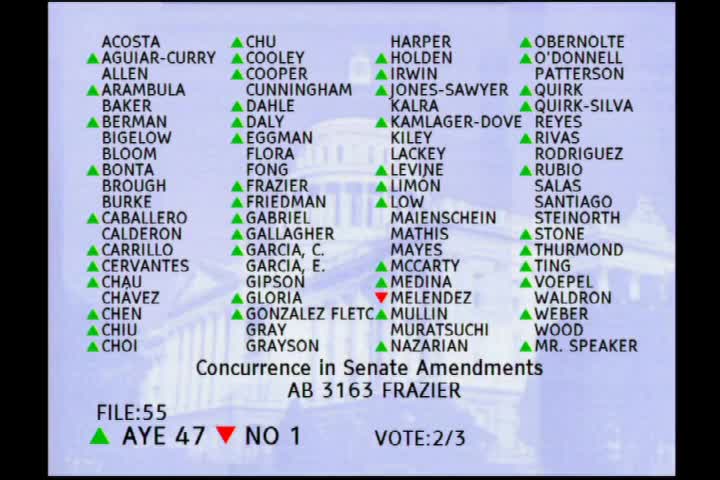 50SEC
Assembly Floor
 2MIN
Senate Floor
 1H
Senate Standing Committee on Appropriations
 4MIN
Senate Standing Committee on Elections and Constitutional Amendments
 1MIN
Assembly Floor
 44SEC
Assembly Standing Committee on Appropriations
 3MIN
Assembly Standing Committee on Elections and Redistricting
Bill Author

Bill Co-Author(s):
