AB 2300: Continuing education: veterinarians.
- Session Year: 2017-2018
- House: Assembly
- Latest Version Date: 2018-08-28
Existing law creates a Veterinary Medical Board in the Department of Consumer Affairs whose highest priority is to protect the public in exercising its licensing, regulatory, and disciplinary functions. Existing law requires applications for a veterinarian license to be furnished on a form and accompanied by a diploma or other verification of graduation from a veterinary college recognized by the board. Existing law requires each veterinarian licensed by the board to biennially apply for renewal of his or her license. Existing law requires the board to issue renewal licenses to those applicants that have completed a minimum of 36 hours of continuing education in the preceding 2 years, including no more than 6 hours of self-study courses.
This bill would instead authorize an applicant for renewal to earn a total of 6 hours or less of the 36 hours of continuing education by either taking up to 6 hours of self-study courses or providing up to 4 hours of pro bono spaying or neutering services to a household with a demonstrated financial need for reduced-cost services, or a combination thereof.
Existing law creates a Veterinary Medical Board in the Department of Consumer Affairs whose highest priority is to protect the public in exercising its licensing, regulatory, and disciplinary functions. Existing law requires applications for a veterinarian license to be furnished on a form and accompanied by a diploma or other verification of graduation from a veterinary college recognized by the board. Existing law requires each veterinarian licensed by the board to biennially apply for renewal of his or her license. Existing law requires the board to issue renewal licenses to those applicants that have completed a minimum of 36 hours of continuing education in the preceding 2 years, including no more than 6 hours of self-study courses.
This bill would instead authorize an applicant for renewal to earn a total of 6 hours or less of the 36 hours of continuing education by either taking up to 6 hours of self-study courses or providing up to 4 hours of pro bono spaying or neutering services to benefit residents of low-income communities, as defined, a household with a demonstrated financial need for reduced-cost services, or a combination thereof.
Existing law creates a Veterinary Medical Board in the Department of Consumer Affairs whose highest priority is to protect the public in exercising its licensing, regulatory, and disciplinary functions. Existing law requires applications for a veterinarian license to be furnished on a form and accompanied by a diploma or other verification of graduation from a veterinary college recognized by the board. Existing law requires each veterinarian licensed by the board to biennially apply for renewal of his or her license. Existing law requires the board to issue renewal licenses to those applicants that have completed a minimum of 36 hours of continuing education in the preceding 2 years, including no more than 6 hours of self-study courses.
This bill would instead authorize an applicant for renewal to earn a total of 6 hours or less of the 36 hours of continuing education doing by either taking up to 6 hours of self-study courses or providing up to 4 hours of pro bono spaying or neutering services to benefit residents of low-income communities, as defined. defined, or a combination thereof.
Existing law creates a Veterinary Medical Board in the Department of Consumer Affairs whose highest priority is to protect the public in exercising its licensing, regulatory, and disciplinary functions. Existing law requires applications for a veterinarian license to be furnished on a form and accompanied by a diploma or other verification of graduation from a veterinary college recognized by the board. Existing law requires each veterinarian licensed by the board to biennially apply for renewal of his or her license. Existing law requires the board to issue renewal licenses to those applicants that have completed a minimum of 36 hours of continuing education in the preceding 2 years, including no more than 6 hours of self-study courses.
This bill would instead authorize an applicant for renewal to earn a total of 6 hours or less of the 36 hours of continuing education doing either self-study courses or providing pro bono spaying or neutering services to benefit residents of low-income communities, as defined.
(a)Except as provided in this section, the board shall issue renewal licenses only to those applicants that have completed a minimum of 36 hours of continuing education in the preceding two years.
(b)(1)Notwithstanding any other law, continuing education hours shall be earned by attending courses relevant to veterinary medicine and sponsored or cosponsored by any of the following:
(A)American Veterinary Medical Association (AVMA) accredited veterinary medical colleges.
(B)Accredited colleges or universities offering programs relevant to veterinary medicine.
(C)The American Veterinary Medical Association.
(D)American Veterinary Medical Association recognized specialty or affiliated allied groups.
(E)American Veterinary Medical Associations affiliated state veterinary medical associations.
(F)Nonprofit annual conferences established in conjunction with state veterinary medical associations.
(G)Educational organizations affiliated with the American Veterinary Medical Association or its state affiliated veterinary medical associations.
(H)Local veterinary medical associations affiliated with the California Veterinary Medical Association.
(I)Federal, state, or local government agencies.
(J)Providers accredited by the Accreditation Council for Continuing Medical Education (ACCME) or approved by the American Medical Association (AMA), providers recognized by the American Dental Association Continuing Education Recognition Program (ADA CERP), and AMA or ADA affiliated state, local, and specialty organizations.
(2)Notwithstanding paragraph (1), a total of six hours or less of the required 36 hours of continuing education may be earned by doing either of the following, or a combination thereof:
(A)Up to six hours may be earned by taking self-study courses, which may include, but are not limited to, reading journals, viewing video recordings, or listening to audio recordings.
(B)Up to four hours may be earned by providing pro bono spaying or neutering services under the supervision of a public animal control agency or shelter, society for the prevention of cruelty to animals shelter, humane society shelter, or rescue group. The services shall be administered at a facility that is appropriately equipped and staffed to provide those services. The service shall be provided to a household with a demonstrated financial need for reduced-cost services.
(3)The board may approve other continuing veterinary medical education providers not specified in paragraph (1).
(A)The board has the authority to recognize national continuing education approval bodies for the purpose of approving continuing education providers not specified in paragraph (1).
(B)Applicants seeking continuing education provider approval shall have the option of applying to the board or to a board-recognized national approval body.
(4)For good cause, the board may adopt an order specifying, on a prospective basis, that a provider of continuing veterinary medical education authorized pursuant to paragraph (1) or (3) is no longer an acceptable provider.
(5)Continuing education hours earned by attending courses sponsored or cosponsored by those entities listed in paragraph (1) between January 1, 2000, and January 1, 2001, shall be credited toward a veterinarians continuing education requirement under this section.
(c)Every person renewing his or her license issued pursuant to Section 4846.4, or any person applying for relicensure or for reinstatement of his or her license to active status, shall submit proof of compliance with this section to the board certifying that he or she is in compliance with this section. Any false statement submitted pursuant to this section shall be a violation subject to Section 4831.
(d)This section shall not apply to a veterinarians first license renewal. This section shall apply only to second and subsequent license renewals granted on or after January 1, 2002.
(e)The board shall have the right to audit the records of all applicants to verify the completion of the continuing education requirement. Applicants shall maintain records of completion of required continuing education coursework for a period of four years and shall make these records available to the board for auditing purposes upon request. If the board, during this audit, questions whether any course reported by the veterinarian satisfies the continuing education requirement, the veterinarian shall provide information to the board concerning the content of the course; the name of its sponsor and cosponsor, if any; and specify the specific curricula that was of benefit to the veterinarian.
(f)A veterinarian desiring an inactive license or to restore an inactive license under Section 701 shall submit an application on a form provided by the board. In order to restore an inactive license to active status, the veterinarian shall have completed a minimum of 36 hours of continuing education within the last two years preceding application. The inactive license status of a veterinarian shall not deprive the board of its authority to institute or continue a disciplinary action against a licensee.
(g)Knowing misrepresentation of compliance with this article by a veterinarian constitutes unprofessional conduct and grounds for disciplinary action or for the issuance of a citation and the imposition of a civil penalty pursuant to Section 4883.
(h)The board, in its discretion, may exempt from the continuing education requirement any veterinarian who for reasons of health, military service, or undue hardship cannot meet those requirements. Applications for waivers shall be submitted on a form provided by the board.
(i)The administration of this section may be funded through professional license and continuing education provider fees. The fees related to the administration of this section shall not exceed the costs of administering the corresponding provisions of this section.
(j)For those continuing education providers not listed in paragraph (1) of subdivision (b), the board or its recognized national approval agent shall establish criteria by which a provider of continuing education shall be approved. The board shall initially review and approve these criteria and may review the criteria as needed. The board or its recognized agent shall monitor, maintain, and manage related records and data. The board may impose an application fee, not to exceed two hundred dollars ($200) biennially, for continuing education providers not listed in paragraph (1) of subdivision (b).
(k)(1)Beginning January 1, 2018, a licensed veterinarian who renews his or her license shall complete a minimum of one credit hour of continuing education on the judicious use of medically important antimicrobial drugs every four years as part of his or her continuing education requirements.
(2)For purposes of this subdivision, medically important antimicrobial drug means an antimicrobial drug listed in Appendix A of the federal Food and Drug Administrations Guidance for Industry #152, including critically important, highly important, and important antimicrobial drugs, as that appendix may be amended.
(a)Except as provided in this section, the board shall issue renewal licenses only to those applicants that have completed a minimum of 36 hours of continuing education in the preceding two years.
(b)(1)Notwithstanding any other law, continuing education hours shall be earned by attending courses relevant to veterinary medicine and sponsored or cosponsored by any of the following:
(A)American Veterinary Medical Association (AVMA) accredited veterinary medical colleges.
(B)Accredited colleges or universities offering programs relevant to veterinary medicine.
(C)The American Veterinary Medical Association.
(D)American Veterinary Medical Association recognized specialty or affiliated allied groups.
(E)American Veterinary Medical Associations affiliated state veterinary medical associations.
(F)Nonprofit annual conferences established in conjunction with state veterinary medical associations.
(G)Educational organizations affiliated with the American Veterinary Medical Association or its state affiliated veterinary medical associations.
(H)Local veterinary medical associations affiliated with the California Veterinary Medical Association.
(I)Federal, state, or local government agencies.
(J)Providers accredited by the Accreditation Council for Continuing Medical Education (ACCME) or approved by the American Medical Association (AMA), providers recognized by the American Dental Association Continuing Education Recognition Program (ADA CERP), and AMA or ADA affiliated state, local, and specialty organizations.
(2)Notwithstanding paragraph (1), a total of six hours or less of the required 36 hours of continuing education may be earned by doing either of the following, or a combination thereof:
(A)Up to six hours may be earned by taking self-study courses, which may include, but are not limited to, reading journals, viewing video recordings, or listening to audio recordings.
(B)(i)Up to four hours may be earned by providing pro bono spaying or neutering services to benefit residents of low-income communities. Services shall be provided under the supervision of a public animal control agency or shelter, society for the prevention of cruelty to animals shelter, humane society shelter, or rescue group. Services The services shall be administered at a facility that is appropriately equipped and staffed to provide those services. The service shall be provided to a household with a demonstrated financial need for reduced-cost services.
(ii)For purposes of clause (i), low-income communities means census tracts with median household incomes at or below 80 percent of the statewide median income or with median household incomes at or below the threshold designated by the Department of Housing and Community Development as low income on its list of state income limits adopted pursuant to Section 50093 of the Health and Safety Code.(3)The board may approve other continuing veterinary medical education providers not specified in paragraph (1).
(A)The board has the authority to recognize national continuing education approval bodies for the purpose of approving continuing education providers not specified in paragraph (1).
(B)Applicants seeking continuing education provider approval shall have the option of applying to the board or to a board-recognized national approval body.
(4)For good cause, the board may adopt an order specifying, on a prospective basis, that a provider of continuing veterinary medical education authorized pursuant to paragraph (1) or (3) is no longer an acceptable provider.
(5)Continuing education hours earned by attending courses sponsored or cosponsored by those entities listed in paragraph (1) between January 1, 2000, and January 1, 2001, shall be credited toward a veterinarians continuing education requirement under this section.
(c)Every person renewing his or her license issued pursuant to Section 4846.4, or any person applying for relicensure or for reinstatement of his or her license to active status, shall submit proof of compliance with this section to the board certifying that he or she is in compliance with this section. Any false statement submitted pursuant to this section shall be a violation subject to Section 4831.
(d)This section shall not apply to a veterinarians first license renewal. This section shall apply only to second and subsequent license renewals granted on or after January 1, 2002.
(e)The board shall have the right to audit the records of all applicants to verify the completion of the continuing education requirement. Applicants shall maintain records of completion of required continuing education coursework for a period of four years and shall make these records available to the board for auditing purposes upon request. If the board, during this audit, questions whether any course reported by the veterinarian satisfies the continuing education requirement, the veterinarian shall provide information to the board concerning the content of the course; the name of its sponsor and cosponsor, if any; and specify the specific curricula that was of benefit to the veterinarian.
(f)A veterinarian desiring an inactive license or to restore an inactive license under Section 701 shall submit an application on a form provided by the board. In order to restore an inactive license to active status, the veterinarian shall have completed a minimum of 36 hours of continuing education within the last two years preceding application. The inactive license status of a veterinarian shall not deprive the board of its authority to institute or continue a disciplinary action against a licensee.
(g)Knowing misrepresentation of compliance with this article by a veterinarian constitutes unprofessional conduct and grounds for disciplinary action or for the issuance of a citation and the imposition of a civil penalty pursuant to Section 4883.
(h)The board, in its discretion, may exempt from the continuing education requirement any veterinarian who for reasons of health, military service, or undue hardship cannot meet those requirements. Applications for waivers shall be submitted on a form provided by the board.
(i)The administration of this section may be funded through professional license and continuing education provider fees. The fees related to the administration of this section shall not exceed the costs of administering the corresponding provisions of this section.
(j)For those continuing education providers not listed in paragraph (1) of subdivision (b), the board or its recognized national approval agent shall establish criteria by which a provider of continuing education shall be approved. The board shall initially review and approve these criteria and may review the criteria as needed. The board or its recognized agent shall monitor, maintain, and manage related records and data. The board may impose an application fee, not to exceed two hundred dollars ($200) biennially, for continuing education providers not listed in paragraph (1) of subdivision (b).
(k)(1)Beginning January 1, 2018, a licensed veterinarian who renews his or her license shall complete a minimum of one credit hour of continuing education on the judicious use of medically important antimicrobial drugs every four years as part of his or her continuing education requirements.
(2)For purposes of this subdivision, medically important antimicrobial drug means an antimicrobial drug listed in Appendix A of the federal Food and Drug Administrations Guidance for Industry #152, including critically important, highly important, and important antimicrobial drugs, as that appendix may be amended.
(a)Except as provided in this section, the board shall issue renewal licenses only to those applicants that have completed a minimum of 36 hours of continuing education in the preceding two years.
(b)(1)Notwithstanding any other law, continuing education hours shall be earned by attending courses relevant to veterinary medicine and sponsored or cosponsored by any of the following:
(A)American Veterinary Medical Association (AVMA) accredited veterinary medical colleges.
(B)Accredited colleges or universities offering programs relevant to veterinary medicine.
(C)The American Veterinary Medical Association.
(D)American Veterinary Medical Association recognized specialty or affiliated allied groups.
(E)American Veterinary Medical Associations affiliated state veterinary medical associations.
(F)Nonprofit annual conferences established in conjunction with state veterinary medical associations.
(G)Educational organizations affiliated with the American Veterinary Medical Association or its state affiliated veterinary medical associations.
(H)Local veterinary medical associations affiliated with the California Veterinary Medical Association.
(I)Federal, state, or local government agencies.
(J)Providers accredited by the Accreditation Council for Continuing Medical Education (ACCME) or approved by the American Medical Association (AMA), providers recognized by the American Dental Association Continuing Education Recognition Program (ADA CERP), and AMA or ADA affiliated state, local, and specialty organizations.
(2)Notwithstanding paragraph (1), a total of six hours or less of the required 36 hours of continuing education may be earned by doing either of the following, or a combination of either: thereof:
(A)Taking Up to six hours may be earned by taking self-study courses, which may include, but are not limited to, reading journals, viewing video recordings, or listening to audio recordings.
(B)(i)Providing Up to four hours may be earned by providing pro bono spaying or neutering services to benefit residents of low-income communities. Services shall be provided under the supervision of a public animal control agency or shelter, society for the prevention of cruelty to animals shelter, humane society shelter, or rescue group. Services shall be administered at a facility that is appropriately equipped and staffed to provide those services.
(ii)For purposes of clause (i), low-income communities means census tracts with median household incomes at or below 80 percent of the statewide median income or with median household incomes at or below the threshold designated by the Department of Housing and Community Development as low income on its list of state income limits adopted pursuant to Section 50093 of the Health and Safety Code.
(3)The board may approve other continuing veterinary medical education providers not specified in paragraph (1).
(A)The board has the authority to recognize national continuing education approval bodies for the purpose of approving continuing education providers not specified in paragraph (1).
(B)Applicants seeking continuing education provider approval shall have the option of applying to the board or to a board-recognized national approval body.
(4)For good cause, the board may adopt an order specifying, on a prospective basis, that a provider of continuing veterinary medical education authorized pursuant to paragraph (1) or (3) is no longer an acceptable provider.
(5)Continuing education hours earned by attending courses sponsored or cosponsored by those entities listed in paragraph (1) between January 1, 2000, and January 1, 2001, shall be credited toward a veterinarians continuing education requirement under this section.
(c)Every person renewing his or her license issued pursuant to Section 4846.4, or any person applying for relicensure or for reinstatement of his or her license to active status, shall submit proof of compliance with this section to the board certifying that he or she is in compliance with this section. Any false statement submitted pursuant to this section shall be a violation subject to Section 4831.
(d)This section shall not apply to a veterinarians first license renewal. This section shall apply only to second and subsequent license renewals granted on or after January 1, 2002.
(e)The board shall have the right to audit the records of all applicants to verify the completion of the continuing education requirement. Applicants shall maintain records of completion of required continuing education coursework for a period of four years and shall make these records available to the board for auditing purposes upon request. If the board, during this audit, questions whether any course reported by the veterinarian satisfies the continuing education requirement, the veterinarian shall provide information to the board concerning the content of the course; the name of its sponsor and cosponsor, if any; and specify the specific curricula that was of benefit to the veterinarian.
(f)A veterinarian desiring an inactive license or to restore an inactive license under Section 701 shall submit an application on a form provided by the board. In order to restore an inactive license to active status, the veterinarian shall have completed a minimum of 36 hours of continuing education within the last two years preceding application. The inactive license status of a veterinarian shall not deprive the board of its authority to institute or continue a disciplinary action against a licensee.
(g)Knowing misrepresentation of compliance with this article by a veterinarian constitutes unprofessional conduct and grounds for disciplinary action or for the issuance of a citation and the imposition of a civil penalty pursuant to Section 4883.
(h)The board, in its discretion, may exempt from the continuing education requirement any veterinarian who for reasons of health, military service, or undue hardship cannot meet those requirements. Applications for waivers shall be submitted on a form provided by the board.
(i)The administration of this section may be funded through professional license and continuing education provider fees. The fees related to the administration of this section shall not exceed the costs of administering the corresponding provisions of this section.
(j)For those continuing education providers not listed in paragraph (1) of subdivision (b), the board or its recognized national approval agent shall establish criteria by which a provider of continuing education shall be approved. The board shall initially review and approve these criteria and may review the criteria as needed. The board or its recognized agent shall monitor, maintain, and manage related records and data. The board may impose an application fee, not to exceed two hundred dollars ($200) biennially, for continuing education providers not listed in paragraph (1) of subdivision (b).
(k)(1)Beginning January 1, 2018, a licensed veterinarian who renews his or her license shall complete a minimum of one credit hour of continuing education on the judicious use of medically important antimicrobial drugs every four years as part of his or her continuing education requirements.
(2)For purposes of this subdivision, medically important antimicrobial drug means an antimicrobial drug listed in Appendix A of the federal Food and Drug Administrations Guidance for Industry #152, including critically important, highly important, and important antimicrobial drugs, as that appendix may be amended.
(a)Except as provided in this section, the board shall issue renewal licenses only to those applicants that have completed a minimum of 36 hours of continuing education in the preceding two years.
(b)(1)Notwithstanding any other law, continuing education hours shall be earned by attending courses relevant to veterinary medicine and sponsored or cosponsored by any of the following:
(A)American Veterinary Medical Association (AVMA) accredited veterinary medical colleges.
(B)Accredited colleges or universities offering programs relevant to veterinary medicine.
(C)The American Veterinary Medical Association.
(D)American Veterinary Medical Association recognized specialty or affiliated allied groups.
(E)American Veterinary Medical Associations affiliated state veterinary medical associations.
(F)Nonprofit annual conferences established in conjunction with state veterinary medical associations.
(G)Educational organizations affiliated with the American Veterinary Medical Association or its state affiliated veterinary medical associations.
(H)Local veterinary medical associations affiliated with the California Veterinary Medical Association.
(I)Federal, state, or local government agencies.
(J)Providers accredited by the Accreditation Council for Continuing Medical Education (ACCME) or approved by the American Medical Association (AMA), providers recognized by the American Dental Association Continuing Education Recognition Program (ADA CERP), and AMA or ADA affiliated state, local, and specialty organizations.
(2)Continuing education credits shall be granted to those veterinarians taking self-study courses, which may include, but are not limited to, reading journals, viewing video recordings, or listening to audio recordings. The taking of these courses shall be limited to no more than six hours biennially.(2)Notwithstanding paragraph (1), a total of six hours or less of the required 36 hours of continuing education may be earned doing either of the following, or a combination of either:
(A)Taking self-study courses, which may include, but are not limited to, reading journals, viewing video recordings, or listening to audio recordings.
(B)(i)Providing pro bono spaying or neutering services to benefit residents of low-income communities. Services shall be provided under the supervision of a public animal control agency or shelter, society for the prevention of cruelty to animals shelter, humane society shelter, or rescue group. Services shall be administered at a facility that is appropriately equipped and staffed to provide those services.
(ii)For purposes of clause (i), low-income communities means census tracts with median household incomes at or below 80 percent of the statewide median income or with median household incomes at or below the threshold designated by the Department of Housing and Community Development as low income on its list of state income limits adopted pursuant to Section 50093 of the Health and Safety Code.
(3)The board may approve other continuing veterinary medical education providers not specified in paragraph (1).
(A)The board has the authority to recognize national continuing education approval bodies for the purpose of approving continuing education providers not specified in paragraph (1).
(B)Applicants seeking continuing education provider approval shall have the option of applying to the board or to a board-recognized national approval body.
(4)For good cause, the board may adopt an order specifying, on a prospective basis, that a provider of continuing veterinary medical education authorized pursuant to paragraph (1) or (3) is no longer an acceptable provider.
(5)Continuing education hours earned by attending courses sponsored or cosponsored by those entities listed in paragraph (1) between January 1, 2000, and January 1, 2001, shall be credited toward a veterinarians continuing education requirement under this section.
(c)Every person renewing his or her license issued pursuant to Section 4846.4, or any person applying for relicensure or for reinstatement of his or her license to active status, shall submit proof of compliance with this section to the board certifying that he or she is in compliance with this section. Any false statement submitted pursuant to this section shall be a violation subject to Section 4831.
(d)This section shall not apply to a veterinarians first license renewal. This section shall apply only to second and subsequent license renewals granted on or after January 1, 2002.
(e)The board shall have the right to audit the records of all applicants to verify the completion of the continuing education requirement. Applicants shall maintain records of completion of required continuing education coursework for a period of four years and shall make these records available to the board for auditing purposes upon request. If the board, during this audit, questions whether any course reported by the veterinarian satisfies the continuing education requirement, the veterinarian shall provide information to the board concerning the content of the course; the name of its sponsor and cosponsor, if any; and specify the specific curricula that was of benefit to the veterinarian.
(f)A veterinarian desiring an inactive license or to restore an inactive license under Section 701 shall submit an application on a form provided by the board. In order to restore an inactive license to active status, the veterinarian shall have completed a minimum of 36 hours of continuing education within the last two years preceding application. The inactive license status of a veterinarian shall not deprive the board of its authority to institute or continue a disciplinary action against a licensee.
(g)Knowing misrepresentation of compliance with this article by a veterinarian constitutes unprofessional conduct and grounds for disciplinary action or for the issuance of a citation and the imposition of a civil penalty pursuant to Section 4883.
(h)The board, in its discretion, may exempt from the continuing education requirement any veterinarian who for reasons of health, military service, or undue hardship cannot meet those requirements. Applications for waivers shall be submitted on a form provided by the board.
(i)The administration of this section may be funded through professional license and continuing education provider fees. The fees related to the administration of this section shall not exceed the costs of administering the corresponding provisions of this section.
(j)For those continuing education providers not listed in paragraph (1) of subdivision (b), the board or its recognized national approval agent shall establish criteria by which a provider of continuing education shall be approved. The board shall initially review and approve these criteria and may review the criteria as needed. The board or its recognized agent shall monitor, maintain, and manage related records and data. The board may impose an application fee, not to exceed two hundred dollars ($200) biennially, for continuing education providers not listed in paragraph (1) of subdivision (b).
(k)(1)Beginning January 1, 2018, a licensed veterinarian who renews his or her license shall complete a minimum of one credit hour of continuing education on the judicious use of medically important antimicrobial drugs every four years as part of his or her continuing education requirements.
(2)For purposes of this subdivision, medically important antimicrobial drug means an antimicrobial drug listed in Appendix A of the federal Food and Drug Administrations Guidance for Industry #152, including critically important, highly important, and important antimicrobial drugs, as that appendix may be amended.
|
Date
|
Status
|
|---|---|
| Aug 28, 2018 | Chaptered by Secretary of State - Chapter 236, Statutes of 2018. |
| Aug 28, 2018 | Approved by the Governor. |
| Aug 16, 2018 | Enrolled and presented to the Governor at 4 p.m. |
| Aug 13, 2018 | Senate amendments concurred in. To Engrossing and Enrolling. |
| Aug 9, 2018 | In Assembly. Concurrence in Senate amendments pending. May be considered on or after August 11 pursuant to Assembly Rule 77. |
| Aug 9, 2018 | Read third time. Passed. Ordered to the Assembly. |
| Jul 3, 2018 | Read second time. Ordered to third reading. |
| Jul 2, 2018 | From committee: Be ordered to second reading pursuant to Senate Rule 28.8. |
| Jun 27, 2018 | From committee chair, with author's amendments: Amend, and re-refer to committee. Read second time, amended, and re-referred to Com. on APPR. |
| Jun 19, 2018 | From committee: Do pass and re-refer to Com. on APPR. (Ayes 8. Noes 0.) (June 18). Re-referred to Com. on APPR. |
| May 3, 2018 | Referred to Com. on B., P. & E.D. |
| Apr 19, 2018 | In Senate. Read first time. To Com. on RLS. for assignment. |
| Apr 19, 2018 | Read third time. Passed. Ordered to the Senate. (Ayes 71. Noes 0.) |
| Apr 12, 2018 | Read second time. Ordered to Consent Calendar. |
| Apr 11, 2018 | From committee: Do pass. To Consent Calendar. (Ayes 15. Noes 0.) (April 11). |
| Apr 3, 2018 | Re-referred to Com. on APPR. |
| Apr 2, 2018 | Read second time and amended. |
| Mar 22, 2018 | From committee: Amend, and do pass as amended and re-refer to Com. on APPR. (Ayes 12. Noes 0.) (March 20). |
| Mar 1, 2018 | Referred to Com. on B. & P. |
| Feb 14, 2018 | From printer. May be heard in committee March 16. |
| Feb 13, 2018 | Read first time. To print. |
|
Date
|
Description
|
Location
|
Votes
|
|
|---|---|---|---|---|
| Aug 13, 2018 | AB 2300 MAIENSCHEIN Concurrence in Senate Amendments | Assembly Floor |
Passed |
|
| Aug 9, 2018 | Assembly 3rd Reading AB2300 Maienschein et al. By Hill | Senate Floor |
Passed |
|
| Jun 18, 2018 | Do pass, but first be re-referred to the Committee on [Appropriations] | Senate Standing Committee on Business, Professions and Economic Development |
Passed |
|
| Apr 19, 2018 | AB 2300 MAIENSCHEIN Consent Calendar Second Day Regular Session | Assembly Floor |
Passed |
|
| Apr 11, 2018 | Do pass. To Consent Calendar. | Assembly Standing Committee on Appropriations |
Passed |
|
| Mar 20, 2018 | Do pass as amended and be re-referred to the Committee on [Appropriations] | Assembly Standing Committee on Business and Professions |
Passed |
This list shows positions taken on this bill by organizations on the date displayed, which is linked to the original source.
Positions by individuals are not included.
|
Organization
|
Position
|
Date
|
|---|---|---|
| Best Friends Animal Society | * Support | Jun 18, 2018 |
| Best Friends Animal Society In Los Angeles | ** Support | Jul 3, 2018 |
| California Veterinary Medical Association | * Support | Mar 20, 2018 |
| Humane Society Of The United States | ** Support | Jul 3, 2018 |
| San Diego Humane Society | ** Support | Jul 3, 2018 |
| San Francisco Spca | ** Support | Jul 3, 2018 |
CONCURRENCE IN SENATE AMENDMENTS
CSA1 Bill Id:AB 2300
Author:(Maienschein)
As Amended Ver:June 27, 2018
Majority vote
ASSEMBLY: | 71-0 | (April 19, 2018) | SENATE: | 34-0 | (August 9, 2018) |
Original Committee Reference: B. & P.
SUMMARY: Authorizes veterinarians licensed by the Veterinary Medical Board (Board) to earn up to six hours towards the required minimum of 36 hours of continuing education by performing self-study courses or by providing pro bono spaying or neutering services to households with a demonstrated financial need.
The Senate amendments strike the definition of "low income communities" and instead requires that the service shall be provided to a household with a demonstrated financial need.
EXISTING LAW:
- Establishes the Veterinary Medical Board in the Department of Consumer Affairs, whose highest priority is to protect the public in exercising licensing, regulatory, and disciplinary functions. (Business and Professions Code Section (BPC) 4800 et seq.)
- Requires applications for a veterinary license to be furnished on a form and be accompanied by either a diploma or other verification of graduation from a veterinary college that is licensed by the board. (BPC Section 4846)
- Requires each veterinarian that is licensed by the board to biennially apply for license renewal. (BPC Section 4846.4)
- Requires applicants for license renewal to complete a minimum of 36 hours of continuing education in the preceding 2 years, including no more than six hours of self-study courses. (BPC Section 4846.5)
FISCAL EFFECT: According to the Assembly Committee on Appropriations:
Negligible. The Veterinary Medical Board currently allows veterinarians to earn up to six hours of CE credit for "self-study" that is not specifically verified by the board, and this bill would allow four of those six hours to be earned for providing pro bono spay and neuter services. The negligible cost estimate assumes the board relies on self-attestation that the work was appropriately completed, consistent with current practice.
COMMENTS:
Negligible. The Veterinary Medical Board currently allows veterinarians to earn up to six hours of CE credit for "self-study" that is not specifically verified by the board, and this bill would allow four of those six hours to be earned for providing pro bono spay and neuter services. The negligible cost estimate assumes the board relies on self-attestation that the work was appropriately completed, consistent with current practice.
Analysis Prepared by: Jimmy Fremgen / B. & P. / (916) 319-3301 FN: 0003680
Office of Senate Floor Analyses (916) 651-1520 Fax: (916) 327-4478 | AB |
THIRD READING
Bill No: AB 2300
:
SENATE BUS., PROF. & ECON. DEV. COMMITTEE: 8-0, 6/18/18
AYES: Hill, Fuller, Allen, Dodd, Galgiani, Glazer, Hernandez, Wilk
NO VOTE RECORDED: Pan
SENATE APPROPRIATIONS COMMITTEE: Senate Rule 28.8
ASSEMBLY FLOOR: 71-0, 4/19/18 (Consent) - See last page for vote
SOURCE: American Society for the Prevention of Cruelty to Animals
DIGEST:
This bill authorizes veterinarians licensed by the Veterinary Medical Board (Board) to earn up to six hours towards the required minimum of 36 hours of continuing education (CE) by performing self-study courses or by providing pro bono spaying or neutering services to residents of low income communities, as specified.
Existing law:
- Provides for the licensing and regulation of veterinarians and registered veterinary technicians by the Board within the Department of Consumer Affairs, whose highest priority is to protect the public in exercising licensing, regulatory, and disciplinary functions. (Business and Professions Code (BPC) § 4800, et seq.)
- Establishes the Veterinary Medicine Practice Act (Act), and prohibits any person from practicing veterinary medicine unless the person holds a valid, unexpired, and unrevoked license as a veterinarian, or is the bona fide owner of the animal. (BPC §§ 4811 and 4825)
- Requires applicants for license renewal to complete a minimum of 36 hours of CE in the preceding two years, including no more than six hours of self-study courses biennially, as specified. (BPC § 4846.5)
- Provides that CE hours are earned by attending courses relevant to veterinary medicine and sponsored or cosponsored by certain specified entities. (Id.)
- Provides that the Board may approve other CE providers. (Id.)
- Requires that every person renewing his or her license, or any person applying for re-licensure or reinstatement of his or her license to active status, shall submit proof of compliance to the Board certifying that he or she is in compliance with obtaining the specified CE and that any false statement submitted to the Board regarding CE shall be a violation of the Act and subject the licensed veterinarian to unprofessional conduct. (Id.)
This bill provides that a total of six hours or less of the required 36 hours of CE may be earned by doing either of the following, or a combination thereof:
- Up to six hours may be earned by taking self-study courses, which may include, but are not limited to, reading journals, viewing video recordings, or listening to audio recordings.
- Up to four hours may be earned by providing pro bono spaying or neutering services. Services must be provided under the supervision of a public animal control agency or shelter, society for the prevention of cruelty to animal shelter, humane society shelter, or rescue group and that the services shall be administered at a facility that is appropriately equipped and staffed to provide those services, and be provided to a household with a demonstrated financial need for reduced-cost services.
Background
This bill is sponsored by the American Society for the Prevention of Cruelty to Animals (ASPCA). According to the ASPCA, voluntary spay and neuter (S/N) for cats and dogs is widely understood to be an effective method in reducing shelter intake and euthanasia rates, and in reducing overall costs to deal with stray, abandoned, and feral animals. Uncontrolled breeding, particularly among cats, is a major cause of shelter overpopulation, resulting in numerous negative health and social impacts to animal health and well-being, as well as numerous community impacts. Unfortunately, cost and access are primary barriers to S/N surgery in many communities. The majority of low income communities suffer from a lack of veterinary services altogether and the cost can serve as a financial deterrent to those that would otherwise prefer to alter their pet.
As stated by the ASPCA, “[t]he results are clear. Lower income households are statistically associated with having higher rates of sexually intact cats. A 2009 peer-reviewed scientific study published in the Journal of the American Veterinary Medical Association found that while most pet cats are altered, the S/N rate is significantly lower for cats living in households earning $35,000 or less annually. For the lower-income owners of intact cats interviewed in the study, high cost was the most commonly cited reason for not altering their cats.”
Some California jurisdictions, as indicated by the ASPCA, have adopted laws that require mandatory alteration of dogs and/or cats. While these laws are well-meaning, they tend to have unintended consequences for some lower income households. The cost of alteration, which can be in the hundreds of dollars, may result in the relinquishment of a pet. Research indicates that relinquishment of pets to shelters and intake into shelters, are greatest from areas where human poverty levels are high. These unfortunate outcomes could be avoided, as asserted by the ASPCA, by making pro bono services more readily available to lower income households. Allowing veterinarians to obtain CE credit by performing qualified S/N surgeries is likely to increase the number of veterinarians willing to provide such services. By incentivizing veterinarians to perform volunteer S/N services, shelter intakes and euthanasia, and thus, shelter costs, could be reduced.
Continuing education requirements for veterinarians. Board-licensed veterinarians must apply for the renewal of their licenses every two years. Among other requirements, the Board may issue license renewals only to those licensed veterinarians who have completed a minimum of 36 hours of CE. Requirements for CE may be satisfied by attending courses relevant to veterinary medicine that are sponsored by associations such as the American Veterinary Medical Association. Currently, up to six hours of the required CE may be completed by taking self-study courses, and one credit hour of CE must be taken on the judicious use of medically important antimicrobial drugs every four years as part of CE requirements.
The need for low-cost (or no-cost), high-quality, high-volume S/N programs. According to a report of the Humane Society Veterinary Medical Association (HSVMA), low-cost, high-quality, high-volume, spay and neuter programs have a vital place in the veterinary profession and are essential to decreasing cat and dog overpopulation and shelter euthanasia. Research which has been done shows a significant reduction in shelter intake and euthanasia associated with these programs. “And by providing care to underserved patient populations, spay and neuter work enhances the quality of life for animals and the humans who live with them.” One of the reasons, however, that people do not take advantage of programs available is because of the costs, especially the cost to people who live in low income areas. The HSVMA argues that low-cost or free spay and neuter is the only way to reach these segments of the companion animal population.
Recent efforts have focused on providing California cities and counties with monies for free and low cost spay and neuter programs by utilizing clinics, shelters and other facilities where spay and neuter programs/services could be provided. For example, currently the California Spay and Neuter License Plate program is to go into effect in September of this year and is to be administered by the Department of Food and Agriculture (DFA). Grants and other monies will be made available for those offering spay and neuter programs. The California Spay and Neuter License Plate Fund now has over $1 million dollars from the sale of these license plates which will be available for disbursement to these programs once approved by the DFA. The ability to provide another incentive to veterinarians to provide their services for these new programs will be even more critical as these programs become more available in numerous communities.
Other states. Board-licensed veterinarians in the state of New Jersey may earn up to 10% of the required CE hours during the biennial renewal period by performing voluntary veterinary services. These services allow licensed veterinarians to perform veterinary care to eligible persons or to licensed shelters or pounds at no charge. Board-licensed veterinarians in the state of New York may earn up to 21½ hours of self-instructional coursework during the triennial renewal period. Such coursework may include free spaying and neutering services to municipalities, not-for-profits, humane societies, and animal protection associations.
FISCAL EFFECT: Appropriation: Fiscal Com.: Local:
American Society for the Prevention of Cruelty to Animals (source)
Best Friends Animal Society in Los Angeles
Humane Society of the United States
San Diego Humane Society
San Francisco SPCA
None received
ARGUMENTS IN SUPPORT: The Humane Society of the United States (HSUS) writes in support of this measure and states that: “Voluntary spay and neuter (S/N) for cats and dogs has consistently been proven as an effective method in reducing shelter intake and euthanasia rates. Uncontrolled breeding, particularly among cats, is a major cause of shelter overpopulation, resulting in numerous negative health and social impacts to animal health and well-being. Furthermore, unchecked breeding can also have serious consequences for the community at large, including disease, injury, and environmental harm.” The HSUS believes that while animal shelters and animal rescue organizations often provide free or discounted surgeries, their financial and human resources for providing the service are often lean, resulting in severe limitations on availability. “AB 2300 could expand access to these services exponentially by incentivizing veterinarians to donate their time and medical expertise in exchange for CE credit.”
Other supporters also believe that allowing veterinarians to obtain CE credit by performing pro bono S/N surgeries is likely to increase the number of veterinarians willing to provide such services, expanding the capacity organizations like theirs to provide the service to low income households and experience from other states with similar laws shows that while veterinarians are incentivized by the opportunity to earn CE credits, they also gain multiple educational benefits from participation.
ASSEMBLY FLOOR: 71-0, 4/19/18
AYES: Acosta, Aguiar-Curry, Travis Allen, Arambula, Baker, Berman, Bigelow, Bloom, Bonta, Brough, Burke, Caballero, Carrillo, Cervantes, Chau, Chávez, Chen, Chiu, Choi, Chu, Cooley, Cooper, Cunningham, Dahle, Daly, Eggman, Flora, Fong, Frazier, Friedman, Gallagher, Gipson, Gloria, Gonzalez Fletcher, Gray, Grayson, Harper, Holden, Irwin, Jones-Sawyer, Kalra, Kamlager-Dove, Kiley, Lackey, Levine, Limón, Low, Maienschein, Mathis, Mayes, McCarty, Medina, Muratsuchi, Nazarian, Obernolte, O'Donnell, Patterson, Quirk-Silva, Reyes, Rubio, Salas, Santiago, Steinorth, Mark Stone, Thurmond, Ting, Voepel, Waldron, Weber, Wood, Rendon
NO VOTE RECORDED: Calderon, Cristina Garcia, Eduardo Garcia, Melendez, Mullin, Quirk, Rodriguez
7/3/18 15:47:02
SENATE COMMITTEE ON
BUSINESS, PROFESSIONS AND ECONOMIC DEVELOPMENT
Senator Jerry Hill, Chair
2017 - 2018 Regular
Bill No: AB 2300 Hearing Date: June 18, 2018
Author: | Maienschein | ||
Version: |
| ||
Urgency: | Fiscal: | ||
Consultant: | |||
Subject: Continuing education: veterinarians
SUMMARY:
Authorizes veterinarians licensed by the Veterinary Medical Board (Board) to earn up to six hours towards the required minimum of 36 hours of continuing education (CE) by performing self-study courses or by providing pro bono spaying or neutering services to residents of low-income communities, as specified.
Existing law:
- Provides for the licensing and regulation of veterinarians and registered veterinary technicians by the Veterinary Medical Board within the Department of Consumer Affairs, whose highest priority is to protect the public in exercising licensing, regulatory, and disciplinary functions. (Business and Professions Code (BPC) § 4800, et seq.)
- Establishes the Veterinary Medicine Practice Act (Act), and prohibits any person from practicing veterinary medicine unless the person holds a valid, unexpired, and unrevoked license as a veterinarian, or is the bona fide owner of the animal.
(BPC §§ 4811 and 4825) - Defines the practice of veterinary medicine as including, among other things, administering a drug, medicine, appliance, application, or treatment of whatever nature for the prevention, cure, or relief of a wound, fracture, bodily injury, or disease of animals. (BPC § 4826)
- Requires applications for a veterinary license to be furnished on a form and be accompanied by either a diploma or other verification of graduation from a veterinary college that is licensed by the board. (BPC § 4846)
- Requires each veterinarian that is licensed by the board to biennially apply for license renewal. (BPC § 4846.4)
- Requires applicants for license renewal to complete a minimum of 36 hours of CE in the preceding two years, including no more than six hours of self-study courses biennially, as specified. (BPC § 4846.5)
- Provides that CE hours are earned by attending courses relevant to veterinary medicine and sponsored or cosponsored by certain specified entities. (Id.)
- Provides that the Board may approve other CE providers. (Id.)
- Requires that every person renewing his or her license, or any person applying for relicensure or reinstatement of his or her license to active status, shall submit proof of compliance to the Board certifying that he or she is in compliance with obtaining the specified CE and that any false statement submitted to the Board regarding CE shall be a violation of the Act and subject the licensed veterinarian to unprofessional conduct. (Id.)
- Provides that the Board may in its discretion exempt from the CE requirement any veterinarian who for reasons of health, military service, or undue hardship cannot meet those requirements. (Id.)
- Specifies that beginning January 1, 2018, a licensed veterinarian shall complete a minimum of one credit hour of CE on the judicious use of medically important antimicrobial drugs, as defined, every four years as part of his or her CE requirements. (Id.)
This bill:
- Provides that a total of six hours or less of the required 36 hours of CE may be earned by doing either of the following, or a combination thereof:
- Up to six hours may be earned by taking self-study courses, which may include, but are not limited to, reading journals, viewing video recordings, or listening to audio recordings.
- Up to four hours may be earned by providing pro bono spaying or neutering services to benefit residents of low-income communities. Services must be provided under the supervision of a public animal control agency or shelter, society for the prevention of cruelty to animal shelter, humane society shelter, or rescue group and that services shall be administered at a facility that is appropriately equipped and staffed to provide those services.
- Specifies, for purposes of this bill, that “low-income communities” means census tracts with median household incomes at or below 80 percent of the statewide median income or with median household incomes at or below the threshold designated by the Department of Housing and Community Development as low income on its list of state income limits adopted pursuant to § 50093 of the Health and Safety Code.
- Up to six hours may be earned by taking self-study courses, which may include, but are not limited to, reading journals, viewing video recordings, or listening to audio recordings.
FISCAL EFFECT:
The bill is keyed fiscal by Legislative Counsel. According to the Assembly Committee on Appropriations analysis dated April 11, 2018, the costs for changing the option for earning CE would be negligible. The Board currently allows veterinarians to earn up to six hours of CE credit for "self-study" that is not specifically verified by the board, and this bill would allow four of those six hours to be earned for providing pro bono spay and neuter services. The negligible cost estimate assumes the Board relies on self-attestation that the work was appropriately completed, consistent with current practice.
COMMENTS:
- Purpose. This measure is sponsored by the American Society for the Prevention of Cruelty to Animals (ASPCA). According to the ASPCA, voluntary spay and neuter (S/N) for cats and dogs is widely understood to be an effective method in reducing shelter intake and euthanasia rates, and in reducing overall costs to deal with stray, abandoned, and feral animals. Uncontrolled breeding, particularly among cats, is a major cause of shelter overpopulation, resulting in numerous negative health and social impacts to animal health and well-being, as well as numerous community impacts. Unfortunately, cost and access are primary barriers to S/N surgery in many communities. The majority of low income communities suffer from a lack of veterinary services altogether and the cost can serve as a financial deterrent to those that would otherwise prefer to alter their pet.
As stated by the ASPCA, “[t]he results are clear. Lower income households are statistically associated with having higher rates of sexually intact cats. A 2009 peer-reviewed scientific study published in the Journal of the American Veterinary Medical Association found that while most pet cats are altered, the S/N rate is significantly lower for cats living in households earning $35,000 or less annually. For the lower-income owners of intact cats interviewed in the study, high cost was the most commonly cited reason for not altering their cats.”
Some California jurisdictions, as indicated by the ASPCA, have adopted laws that require mandatory alteration of dogs and/or cats. While these laws are well-meaning, they tend to have unintended consequences for some lower income households. The cost of alteration, which can be in the hundreds of dollars, may result in the relinquishment of a beloved pet. Research indicates that relinquishment of pets to shelters and intake into shelters, are greatest from areas where human poverty levels are high.
These unfortunate outcomes could be avoided, as asserted by the ASPCA, by making pro bono services more readily available to lower income households. Allowing veterinarians to obtain continuing education credit by performing qualified S/N surgeries is likely to increase the number of veterinarians willing to provide such services. By incentivizing veterinarians to perform volunteer S/N services, shelter intakes and euthanasia, and thus, shelter costs, could be reduced.
- Background.
Continuing Education Requirements for Veterinarians. Board-licensed veterinarians must apply for the renewal of their licenses every two years. Among other requirements, the Board may issue license renewals only to those licensed veterinarians who have completed a minimum of 36 hours of CE. Requirements for CE may be satisfied by attending courses relevant to veterinary medicine that are sponsored by associations such as the American Veterinary Medical Association (AVMA). Currently, up to six hours of the required CE may be completed by taking self-study courses, and one credit hour of CE must be taken on the judicious use of medically important antimicrobial drugs every four years as part of CE requirements.
The Need for Low-Cost (or No-Cost), High-Quality, High-Volume Spay and Neuter Programs. According to a report of the Humane Society Veterinary Medical Association (HSVMA), low-cost, high-quality, high-volume, spay and neuter programs have a vital place in the veterinary profession and are essential to decreasing cat and dog overpopulation and shelter euthanasia. Research which has been done shows a significant reduction in shelter intake and euthanasia associated with these programs. “And by providing care to underserved patient populations, spay and neuter work enhances the quality of life for animals and the humans who live with them.” One of the reasons, however, that people do not take advantage of programs available is because of the costs, especially the cost to people who live in low income areas. The HSVMA argues that low-cost or free spay and neuter is the only way to reach these segments of the companion animal population.
Recent efforts have focused on providing California cities and counties with monies for free and low cost spay and neuter programs by utilizing clinics, shelters and other facilities where spay and neuter programs/services could be provided. For example, currently the California Spay and Neuter License Plate program is to go into effect in September of this year and is to be administered by the Department of Food and Agriculture (DFA). Grants and other monies will be made available for those offering spay and neuter programs. The California Spay and Neuter License Plate Fund now has over $1 million dollars from the sale of these License plates which will be available for disbursement to these programs once approved by the DFA. The ability to provide another incentive to veterinarians to provide their services for these new programs will be even more critical as these programs become more available in numerous communities.
Other States. Board-licensed veterinarians in the state of New Jersey may earn up to 10% of the required CE hours during the biennial renewal period by performing voluntary veterinary services. These services allow licensed veterinarians to perform veterinary care to eligible persons or to licensed shelters or pounds at no charge.
Board-licensed veterinarians in the state of New York may earn up to 21½ hours of self-instructional coursework during the triennial renewal period. Such coursework may include free spaying and neutering services to municipalities, not-for-profits, humane societies, and animal protection associations. - Related Legislation This Session. SB 1305 (Glazer) would enact the Sutter Brown Act to permit an emergency medical services (EMS) provider to provide basic first aid, as specified, to a dog or a cat to the extent the provider is authorized by the employer to provide the care. (Status: In the Assembly awaiting referral to a Committee.)
SB 1480 (Hill) would make various changes to the Veterinary Practice Act including a requirement that veterinarians provide in person or through electronic means to the client responsible for the animal, a consultation on medication provided that includes information as specified. (Status: This measure has been referred to the Assembly Business and Professions Committee.)
AB 2215 (Kalra) would expand the intent of the Medicinal and Adult-Use Cannabis Regulation and Safety Act (MAUCRSA) to control and regulate cannabis and cannabis products for medicinal use on pets. The bill would define "cannabis products" to include products intended for medicinal use on a pet. The bill would prohibit a licensed veterinarian from dispensing or administering cannabis or cannabis products and would prohibit the Board from disciplining, denying, revoking, or suspending the license of a licensed veterinarian for discussing the use of cannabis on an animal for medicinal purposes. The Board would have until July 1, 2019 to promulgate guidelines on this topic. (Status: This measure has been referred to this Committee and is scheduled to be heard on June 25, 2018.)
AB 2445 (O’Donnel) would require a pet store selling an animal obtained from an animal shelter to maintain health and other records for a minimum of two years and to make these records available to law enforcement, animal control, or purchasers of the animal during normal business hours. This bill would also require the pet store to make the veterinary medical records available to the purchaser and provide information as to the terms and conditions under which the animal will be eligible for veterinary care covered by the pet store. (Status: This measure has been referred to this Committee and is scheduled to be heard on June 18, 2018.) - Prior Related Legislation. SB 1193 (Hill, Chapter 484, Statutes of 2016) made various changes to the Veterinary Practice Act including an amendment of existing CE requirements, and extended the operation of the Board to January 1, 2021.
SB 361 (Hill, Chapter 764, Statutes of 2015) requires a licensed veterinarian to complete a minimum of one credit hour of CE on the judicious use of medically important antimicrobial drugs every four years as part of his or her continuing education requirements. - Arguments in Support. The Humane Society of the United States (HSUS) writes in support of this measure and states that: “Voluntary spay and neuter (S/N) for cats and dogs has consistently been proven as an effective method in reducing shelter intake and euthanasia rates. Uncontrolled breeding, particularly among cats, is a major cause of shelter overpopulation, resulting in numerous negative health and social impacts to animal health and well-being. Furthermore, unchecked breeding can also have serious consequences for the community at large, including disease, injury, and environmental harm.” The HSUS believes that while animal shelters and animal rescue organizations often provide free or discounted surgeries, their financial and human resources for providing the service are often lean, resulting in severe limitations on availability. “AB 2300 could expand access to these services exponentially by incentivizing veterinarians to donate their time and medical expertise in exchange for CE credit.”
Other supporters also believe that allowing veterinarians to obtain CE credit by performing pro bono S/N surgeries is likely to increase the number of veterinarians willing to provide such services, expanding the capacity organizations like theirs to provide the service to low-income households and experience from other states with similar laws shows that while veterinarians are incentivized by the opportunity to earn CE credits, they also gain multiple educational benefits from participation. - Policy Issue for Consideration: Is the requirement for only providing CE credit for veterinarians who provide their pro bono spay and neuter services for those from “low income communities” necessary? Current programs which exist that provide spay and neuter services usually indicate that they are available to provide these services for those who identify themselves as coming from a low-income household. However, there are other programs which will waive the low-income requirement if a person indicates that they are unable to pay for the sometimes high-cost of having their animal spayed or neutered. Also, assuring that the owner of the animal also provides the verification necessary to indicate that they come from a “low-income community” and that they meet the requirements as being low income pursuant to Section 50093 of the Health and Safety Code may be difficult for some who provide S/N programs. It would also appear that with the start-up of one major funding program through DFA, which will make monies available for S/N programs throughout the state and would not requier that the S/N program only serve low-income communities, may indicate that providing CE credit for veterinarians who provide the S/N services should be more flexible in the populations they can serve. There may be an argument made that low-income communities are the most in need of such services, but the experience of some of these S/N programs has been to try and provide S/N services to those who request it when they learn of the program and that few, if any, take advantage of such a low-cost or no-cost program if they can afford to S/N their own animal.
SUPPORT AND OPPOSITION:
Support:
American Society for the Prevention of Cruelty to Animals (Sponsor)
Best Friends Animal Society in Los Angeles
Humane Society of the United States
San Diego Humane Society
San Francisco SPCA
Opposition:
None on file as of June 12, 2018.
-- END --
Date of Hearing: April 11, 2018
ASSEMBLY COMMITTEE ON APPROPRIATIONS
Lorena Gonzalez Fletcher, Chair
ABPCA Bill Id:AB 2300
Author:(Maienschein) – As Amended Ver:April 2, 2018
Policy Committee: | Business and Professions | Vote: | 12 - 0 |
Urgency: No State Mandated Local Program: No Reimbursable: No
SUMMARY:
This bill allows veterinarians the option to earn up to four hours of continuing education (CE) credit for providing pro bono spaying or neutering services to benefit residents of low-income communities.
FISCAL EFFECT:
Negligible. The Veterinary Medical Board currently allows veterinarians to earn up to six hours of CE credit for "self-study" that is not specifically verified by the board, and this bill would allow four of those six hours to be earned for providing pro bono spay and neuter services. The negligible cost estimate assumes the board relies on self-attestation that the work was appropriately completed, consistent with current practice.
COMMENTS:
Purpose and Background. This bill is intended to encourage veterinarians to provide pro bono spaying or neutering services by allowing them to claim CE hours for providing such services. It is sponsored by the American Society for the Prevention of Cruelty to Animals (ASPCA) and has no opposition. Current law requires licensed veterinarians to complete at least 36 hours of approved CE during each two-year license renewal cycle.
Analysis Prepared by: Lisa Murawski / APPR. / (916) 319-2081
Date of Hearing:
ASSEMBLY COMMITTEE ON BUSINESS AND PROFESSIONS
Evan Low, Chair
ABPCA Bill Id:AB 2300
Author:(Maienschein) – As Introduced Ver:February 13, 2018
SUBJECT: Continuing education: veterinarians.
SUMMARY: Authorizes veterinarians licensed by the Veterinary Medical Board (Board) to earn up to 6 hours towards the required minimum of 36 hours of continuing education by performing self-study courses or by providing pro bono spaying or neutering services to residents of low-income communities.
EXISTING LAW:
- Establishes the Veterinary Medical Board in the Department of Consumer Affairs, whose highest priority is to protect the public in exercising licensing, regulatory, and disciplinary functions. (Business and Professions Code Section (BPC) 4800 et seq.)
- Requires applications for a veterinary license to be furnished on a form and be accompanied by either a diploma or other verification of graduation from a veterinary college that is licensed by the board. (BPC Section 4846)
- Requires each veterinarian that is licensed by the board to biennially apply for license renewal. (BPC Section 4846.4)
- Requires applicants for license renewal to complete a minimum of 36 hours of continuing education in the preceding 2 years, including no more than 6 hours of self-study courses. (BPC Section 4846.5)
THIS BILL:
- Authorizes Board-licensed veterinarians applying for license renewal to earn up to 6 hours of continuing education by performing self-study courses or by providing pro bono spaying or neutering services to residents of low-income communities.
FISCAL EFFECT: Unknown. This bill is keyed fiscal by the Legislative Counsel.
COMMENTS:
Purpose. This bill is sponsored by the American Society for the Prevention of Cruelty to Animals (ASPCA). According to the author:
Expanding veterinarian continuing education to include a voluntary option for pro bono spay and neutering services serves multiple benefits across stakeholders –
• For the stray, feral, and homeless animals that are euthanized every day, the policy would be a step in the right direction in reducing needless deaths.
• For individual households otherwise unable to afford the cost of surgery, the barriers of cost and accessibility within low-income communities could be reduced.
• For the broader community, we can avoid the multitude of health and safety concerns that come with free roaming, unowned animals in a community, including traffic accidents, rabies and other communicable diseases, impacts to the environment, attraction of predators, and other nuisance issues.
• And, last but not least, veterinarians choosing to participate in the voluntary program are provided a hands on learning opportunity. This is especially significant for those that do not routinely perform alteration surgeries. The shelter medicine and rescue community is constantly pushed to ensure that its medical procedures are among the most cost effective and cutting edge available. Veterinarians in private practice could benefit from the latest thinking in alteration procedures, while building lasting and significant good will in their communities.
Background. This bill authorizes veterinarians to receive credit toward their continuing education requirements by performing pro bono spaying or neutering to residents of low-income communities in place of, or in addition, to self-study courses for a maximum of 6 combined hours.
Continuing education requirements. Board-licensed veterinarians must apply for the renewal of their licenses every two years. Among other requirements, the Board may issue license renewals only to those licensed veterinarians who have completed a minimum of 36 hours of continuing education. Continuing education requirements may be satisfied by attending courses relevant to veterinary medicine that are sponsored by associations such as the American Veterinary Medical Association (AVMA). Currently, up to 6 hours of the required continuing education may also be completed by taking self-study courses.
According to a study published by the AVMA in 2009, low-income communities, defined as households with annual incomes under $35,000, are more likely to have pets that have not been spayed or neutered, with the high cost of the services cited as the most common reason for not altering pets. This bill purports to alleviate the financial barrier for low-income households by allowing licensed veterinarians to perform these services and earn up to 6 hours of continuing education credit while doing so.
Other States. Board-licensed veterinarians in the state of New Jersey may earn up to 10% of the required continuing education hours during the biennial renewal period by performing voluntary veterinary services. These services allow licensed veterinarians to perform veterinary care to eligible persons or to licensed shelters or pounds at no charge.
Board-licensed veterinarians in the state of New York may earn up to 21 ½ hours of self-instructional coursework during the triennial renewal period. Such coursework may include free spaying and neutering services to municipalities, not-for-profits, humane societies, and animal protection associations.
Prior Related Legislation. SB 1193 (Hill), Chapter 484, Statutes of 2016 – Extended the operation of the Veterinary Medical Board, including the amendment of existing continuing education requirements.
ARGUMENTS IN SUPPORT:
The American Society for the Prevention of Cruelty to Animals (ASPCA) writes: While animal shelters and animal rescue organizations often provide free or discounted surgeries, their financial and human resources for providing the service are often lean, resulting in severe limitations on availability. AB 2300 could expand access to these services exponentially by incentivizing veterinarians to donate their time and medical expertise in exchange for continuing education credit.
The Humane Society of the United States writes: “AB 2300 could expand access to these services exponentially by incentivizing veterinarians to donate their time and medical expertise in exchange for continuing education credit.”
Best Friends writes: “We support AB 2300 because it helps fulfill our goal of ending the killing of adoptable/treatable dogs and healthy cats in shelters.”
ARGUMENTS IN OPPOSITION:
None on file.
POLICY ISSUE(S) FOR CONSIDERATION:
Some veterinarians may argue that this bill does not serve the purpose of continuing education because the performing of pro bono spaying and neutering services does not provide any educational value. While there is an established need for expanding access to spaying and neutering services in low-income communities, this interest should be weighed against the possible reduction of continuing education in the veterinary profession. The author should consider alternate ways to advance the availability of pro bono work and engage with stakeholders to ensure that the intent of the continuing education requirements is upheld by any possible statutory changes.
IMPLEMENTATION ISSUES:
It is unclear how this pro bono work would be verified, since there would not necessarily be an established entity to certify the licensee’s hours in the same manner as an education provider does for continuing education courses. However, it should be noted that the proposed language would only allow the work to satisfy the “self-study” portion of continuing education requirements and that licensees do not currently have a mechanism for verifying the completion of that requirement by other means.
The author should work with stakeholders, especially the Board, to establish how the Board would verify completion of these requirements.
AMENDMENTS:
In Section (BPC Section 4846.5 (2)) strike “six” and insert “four”
REGISTERED SUPPORT:
American Society for the Prevention of Cruelty to Animals
Humane Society of the United States
Best Friends
REGISTERED OPPOSITION:
None on file.
Analysis Prepared by: Jimmy Fremgen / B. & P. / (916) 319-3301
Discussed in Hearing
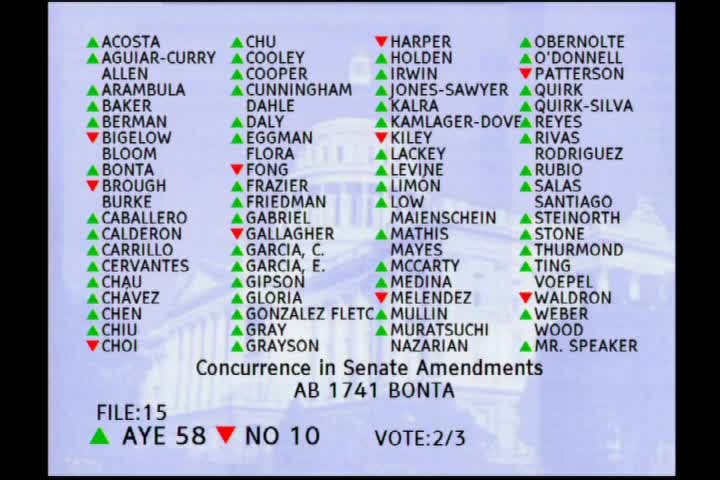 57SEC
Assembly Floor
 3MIN
Senate Floor
 12MIN
Senate Standing Committee on Business, Professions and Economic Development
 6MIN
Assembly Standing Committee on Business and Professions
Bill Author





